Welcome back my readers, YouTube viewers and all others who followed this series of articles focused on YouTube videos worth watching. Have you been searching for something fun or interesting to watch on YouTube? Do you feel bored right now and you crave for something to see on the world’s most popular online video destination?
I recommend you check out the following videos I found.
#1 Terminator 2 Arcade Game Revisited – As a teenager, I was a huge fan of Terminator 2: Judgment Day. In 1992, the official arcade game of Terminator 2 arrived here in the Philippines and there was this time I played it in a Makati arcade (with one other player on the other gun), spent a lot of money on tokens for it and played the game extensively. As the game was very hard and overly chaotic, us players were unable to finish it. Recently, I saw this analytical, retrospective video about the Terminator 2 arcade game on YouTube by Mass Replay. It was a very engaging video to watch as it examines the game very closely, explains why it is so challenging to play and how much would it cost gamers today to finish it. Watch the video below and pay attention to the details.
#2 Problems With Windows 11 – Are you using Windows 11 on your personal computer? The way the Microsoft operating system is right now with artificial intelligence (AI) integrated, it has attracted a lot of user complaints over its reliability, lack of efficiency, features, forced updates and being not so user-friendly. The complaints and criticism over Windows 11 are only getting louder as of this writing and you can find out exactly why by watching the ColdFusion video below.
#3 Japan’s Ekiben – You might be familiar with the packed meal in Japan called bento. The Ekiben is a specific type of bento which is normally sold at train stations and those who bought it enjoy their meals while traveling. Ekiben comes with different types of food, ingredients and flavors, and it also highlights the local cuisine of the station or region it was sold in. To learn more about it, watch the Nippon TV video below.
#4 Sega’s Best Games On Xbox 360 – Over twenty years have passed since Microsoft first launched the Xbox 360 game console in America which eventually became the most popular gaming console in Xbox gaming history as well as having the best online gaming network of the 7th console generation. As with the original Xbox console, Sega released several games on Xbox 360 (a mix of remastered games and brand new ones) via retail and through the Xbox network online (AKA Xbox LIVE). Recently Sega Lord X posted a video highlighting the best of what Sega released on the console, and it is fun to watch!
#5 Street Fighter 1994 Movie Revisited – In late 1994, the live-action movie Street Fighter was released in cinemas and there was buzz about it among Street Fighter II groups of fans of the time. Not only did the filmmakers have Jean-Claude Van Damme as its main attraction, they had to make up a functional story and cram a lot of characters into it. The film event had Australia’s icon Kylie Minogue as Cammy. To this day, some moviegoers (including gamers and fans of the Street Fighter franchise) enjoyed Street Fighter while there were others who found it very flawed. If you want to discover Street Fighter (1994) but are not willing to spend precious time and money on it, watch the videos below.
#6 Ashleigh Burton Reacts To National Lampoon’s Christmas Vacation – When it comes to movies set during the Christmas season, do you enjoy watching comedies? Way back in December of 1989, National Lampoon’s Christmas Vacation – starring Chevy Chase – was released to mixed reviews but managed to achieve commercial success and movie buffs today consider it a classic of the Christmas season. How much of an impact the movie can have on first-timers can be seen in Ashleigh Burton’s reaction video below.
Welcome back readers, fellow geeks and electronic gaming fans!
In this edition of the Retro Gaming Ads Blast (RGAB) series, we will take a look at another batch of retro gaming print ads – including arcade flyers – from the 1970s to the 1990s.
For the newcomers reading this, Retro Gaming Ads Blast (RGAB) looks back at the many print ads of games (console, arcade, computer and handheld) that were published in comic books, magazines, flyers, posters and newspapers long before smartphones, social media, the worldwide web and streaming became popular. To put things in perspective, people back in the 1970s and 1990s were more trusting of print media for information and images about electronic games and related products.
With those details laid down, here is the newest batch of retro gaming print ads for you to see and enjoy…
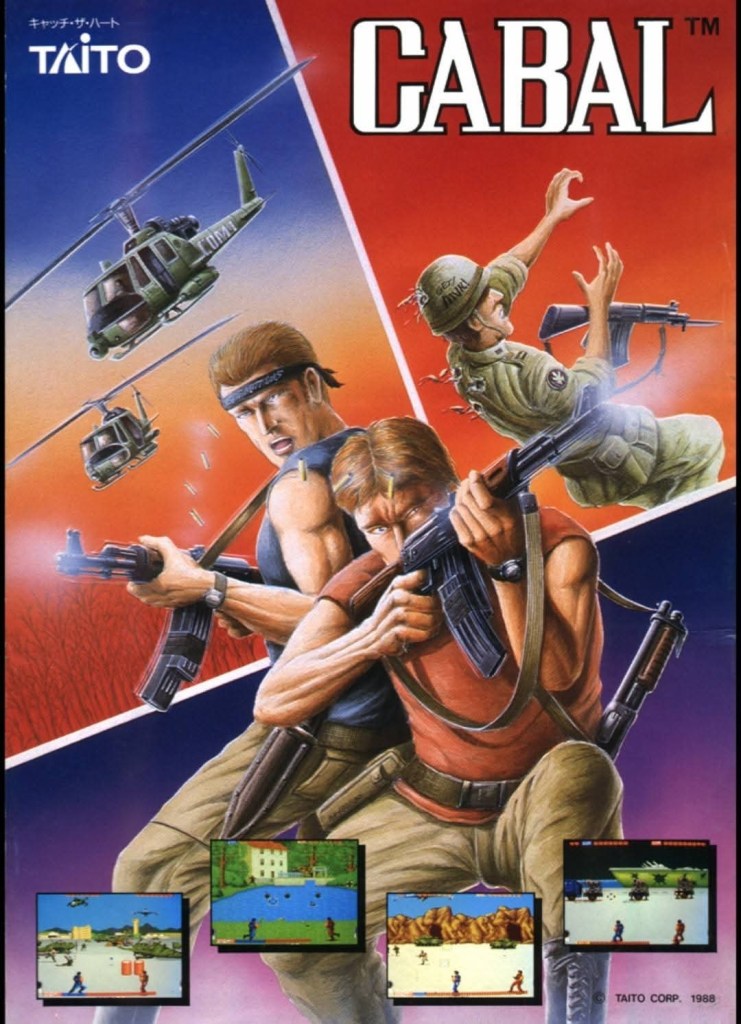
1. Cabal Japanese arcade flyer/poster
Can you feel the action and intensity here?
When it was first released in video arcades in Japan in late 1988, Cabal was another game inspired by military action movies of Hollywood which explains the art work done for the arcade flyer and poster shown above. The Vietnam War was still fresh in people’s minds and the concept of having one or two players firing their weapons against enemy soldiers resonated with gamers who saw Hollywood’s military action flicks. That said, it is not surprising that Cabal became a huge hit in Japan before getting released in arcades around the world.
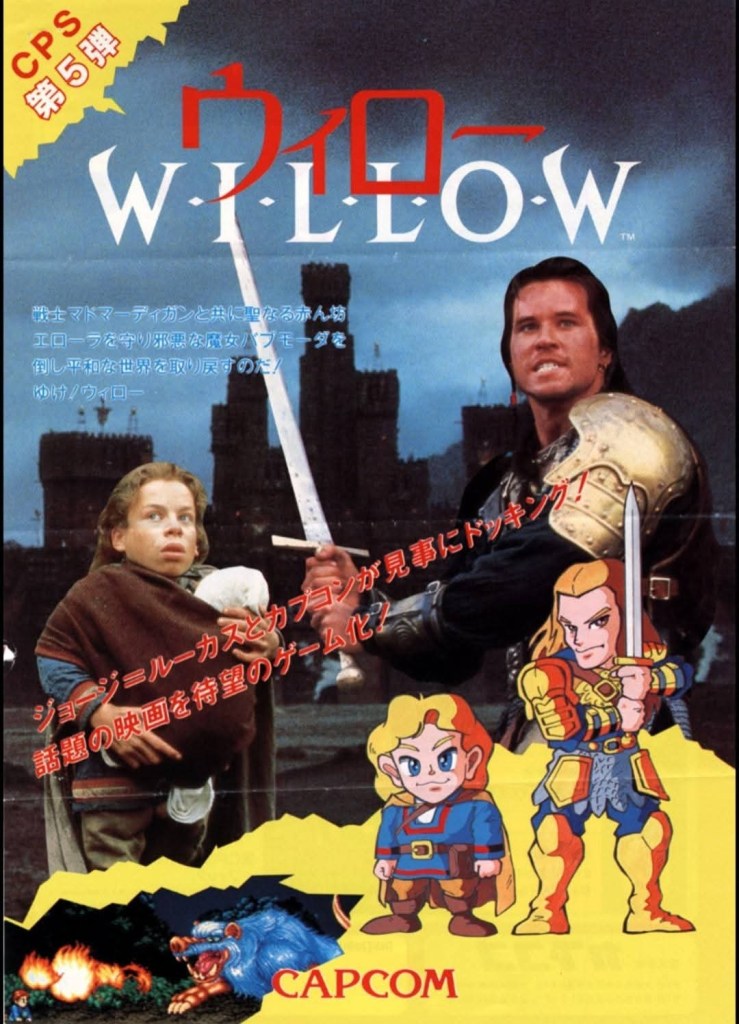
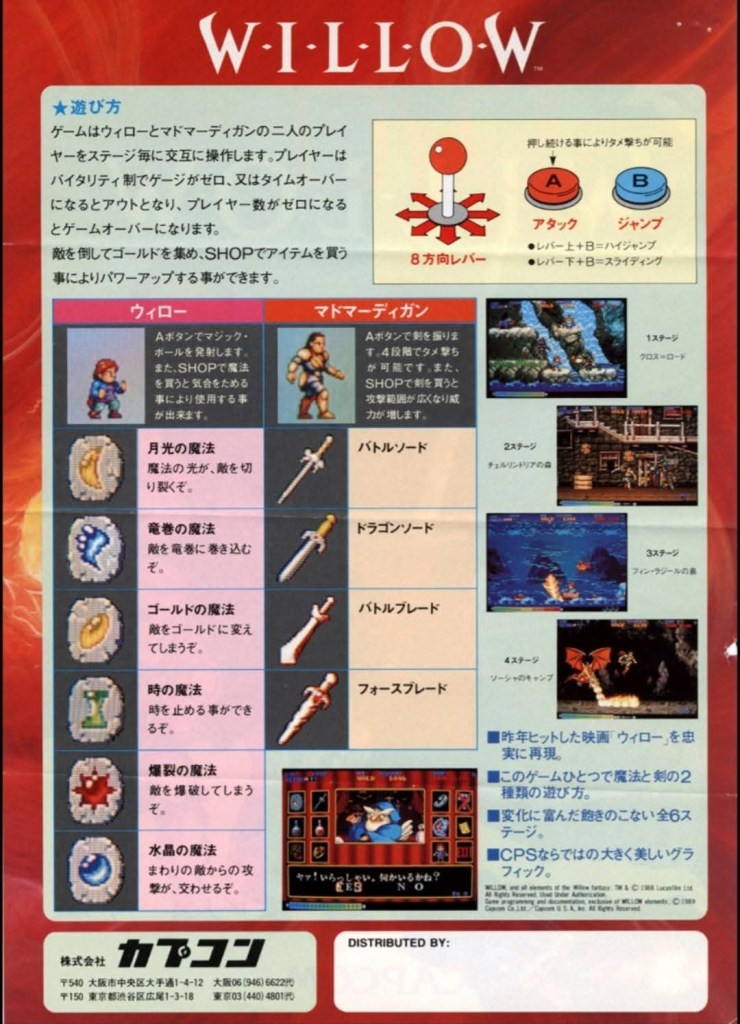
2. Willows Japanese arcade flyer
The front.
The rear.
Remember the 1988 high fantasy adventure film Willow? That film was produced by George Lucas and was a bold new production of Lucasfilm shifting away from Star Wars. Believe it or not, an official arcade game adaptation of Willow was made by Capcom and they promoted it by having images of Val Kilmer and Warwick Davis on the front of the arcade flyer (opposite the illustrated versions of their characters). The game, which was a side-scrolling platform game with run-and-gun elements, went on to be an arcade hit in Japan and eventually pleased gamers worldwide.
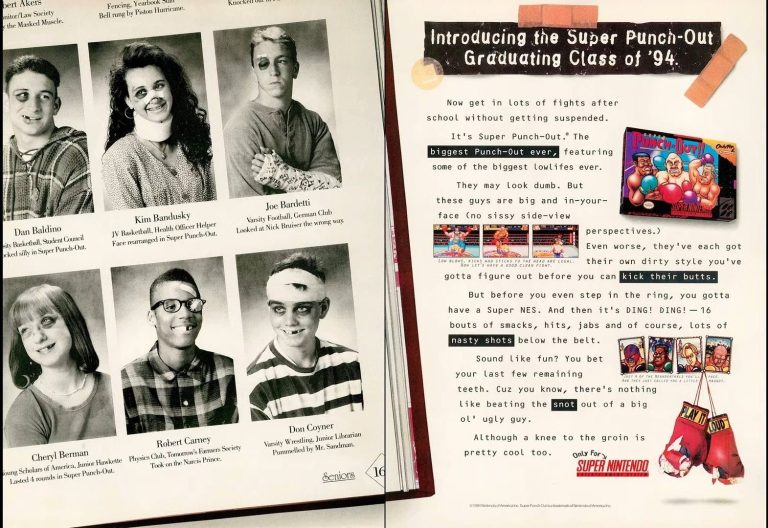
3. Super Punch-Out!! North American print ad
This is funny to look at.
Historically, Nintendo’s Punch-Out!! series started in the arcade in 1984 and the first game was the result of the company’s effort to make a new game using arcade cabinets with two screens. The 2nd game – Mike Tyson’s Punch-Out!! – became a huge critical and commercial hit (over 2 million copies sold in 1988) on console and it made great business sense for Nintendo for release another Punch-Out!! for its console gamers to enjoy in the comfort of home. In 1994, Super Punch-Out!! was released on the Super Nintendo Entertainment System (SNES) in America and to promote it, the company came up with a hilarious 2-page ad that showed fictional high school graduates with boxing-related injuries. The imagery creatively connected with the words “biggest Punch-Out ever” and “Graduating Class of ‘94”.
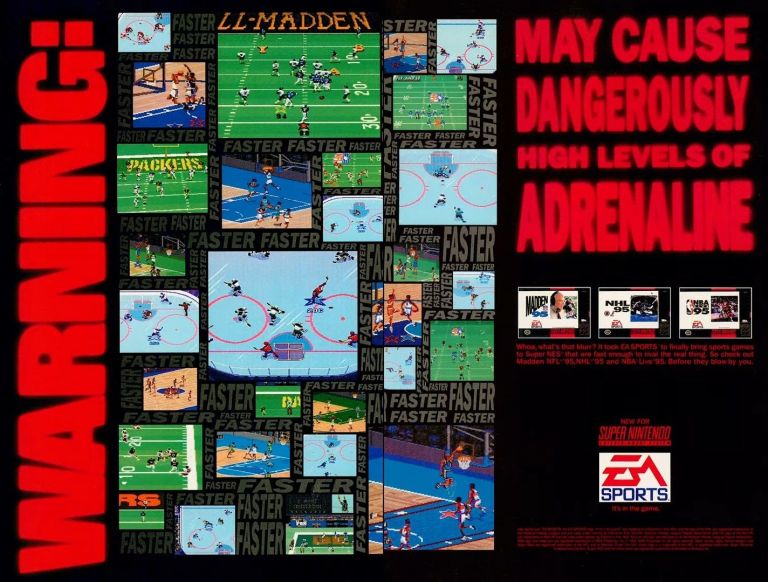
4. EA Sports 3-in-1 SNES games print ad
EA Sports games on the SNES.
In 1994, Electronic Arts (EA) released their sports games NBA Live 95, NHL 95 and Madden NFL 95 for consoles at the time. Even though the Sega Genesis sold better than Super Nintendo Entertainment System (SNES) in America at the time, EA went on to aggressively market their 3 sports video games on Nintendo’s console using a 3-in-1 games print ad. In retrospect, the SNES for the most part had better graphics and sounds than the Genesis which is reflected clearly on EA Sports games of the time. This print ad still looks fun and exciting.
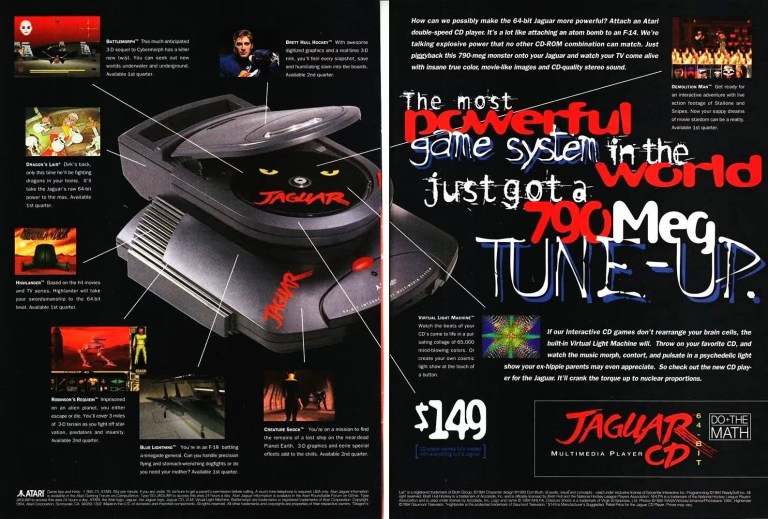
5. Atari Jaguar CD print ad
Were you able to play any game on the Atari Jaguar with the CD add-on included?
Apart from the obvious advances of technology that impacted video games, the 1990s is also known for the rise of CD-ROM as a medium for gaming. In an effort to boost sales of the Atari Jaguar console (launched in America in 1993 for around $250) and capitalize on the trust of the fans and console owners, Atari launched a CD-ROM add-on device for about $150 in 1995. To promote it, the company went aggressive with the 2-page ad showing the add-on fully connected on top of the main console, showing off some games and posting a text description emphasizing hardware power and the advantages that come with the CD technology. Even in the captured image, the Atari Jaguar CD still resembled a toilet. This is an aggressive ad campaign that failed as less than 20,000 Atari Jaguar CD units were sold by the time it was discontinued in 1996.
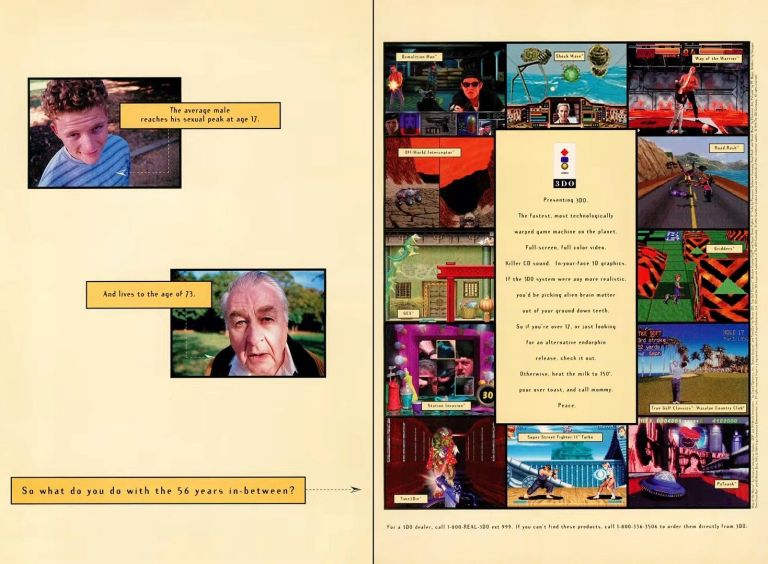
6. 3DO print ad
While it lacks intensity, this 3DO ad emphasized the games.
Without showing any hardware, the 3DO Company came up with this 2-page print ad that had a slightly adulterated tone (look at the left page) and aggressively marketed the 3DO console games available at the time. Games like Demolition Man, Shock Wave, Road Rash and Super Street Fighter II Turbo were the standout titles which clearly showed the company made the effort to emphasize gaming more than multimedia features. This 1990s ad tackled the generations with a touch of humor.
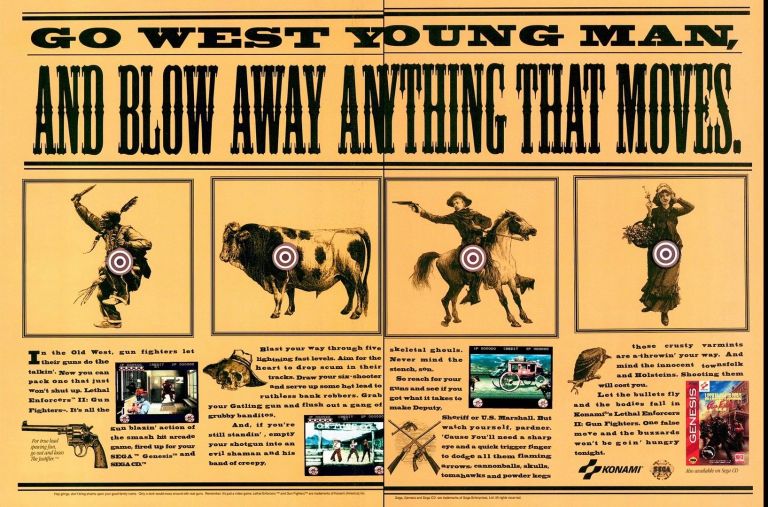
7. Lethal Enforcers II: Gun Fighters Sega Genesis print ad
This is a fun ad to look at.
When Lethal Enforcers II: Gun Fighters was released in the arcades in 1994, it became a commercial success for Konami which went on to announce it would port the game to consoles of Nintendo and Sega at the time. While the port for the Super Nintendo Entertainment System (SNES) was never released, Lethal Enforcers II: Gun Fighters made its way to the Sega Genesis and Sega CD. The print ad of the Sega Genesis version (Sega CD mentioned in small text) had an inspired design emphasizing the Old West, shooting and the conflict between cowboys and Indians. The screenshots gave people the clear idea that Old West was the setting (versus modern day in the previous game). This is still fun to look at.
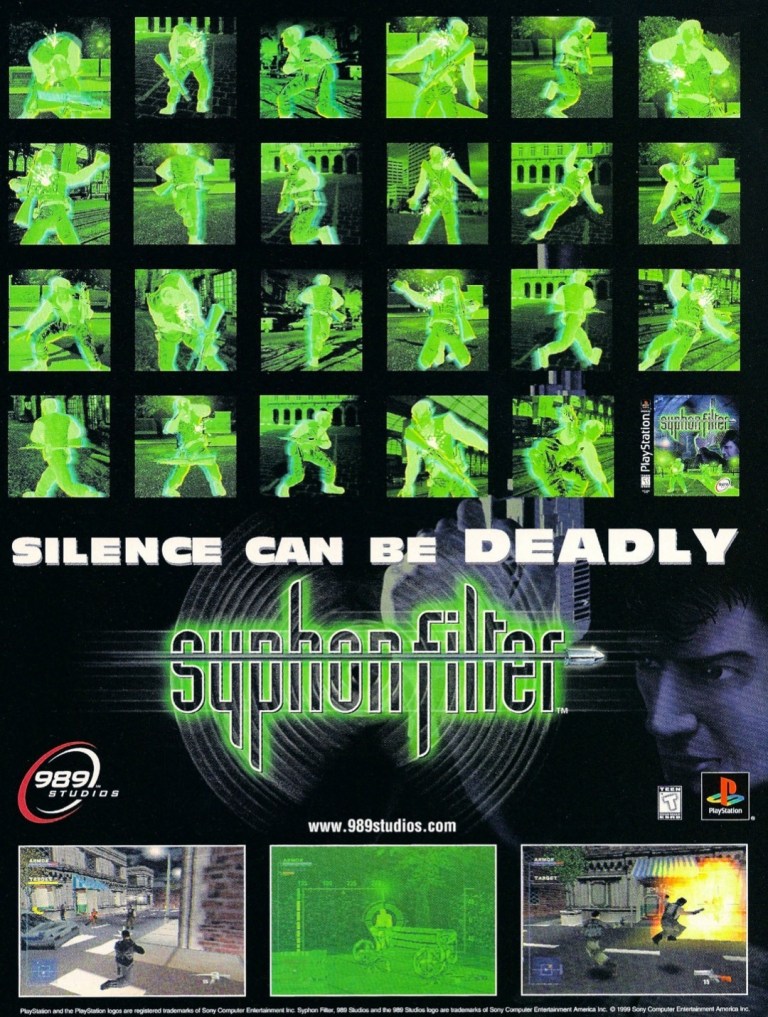
8. Syphon Filter
Syphon Filter went on to become a surprise hit game in 1999.
In 1999, Sony’s 989 Studios released Syphon Filter exclusively on the PlayStation console. This single-page print ad showed a few screenshots on the bottom and several action snippets with a night vision touch ultimately emphasizing the stealth aspect within the gameplay. The marketing proved to be effective as the game sold a lot at retail and went on to establish a new game franchise exclusive to PlayStation consoles.
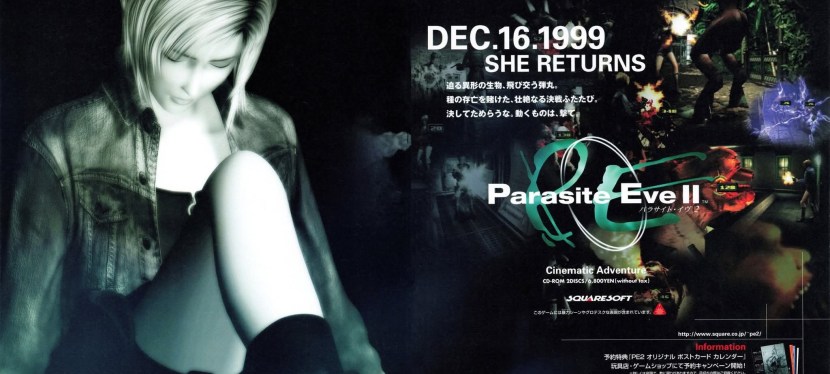
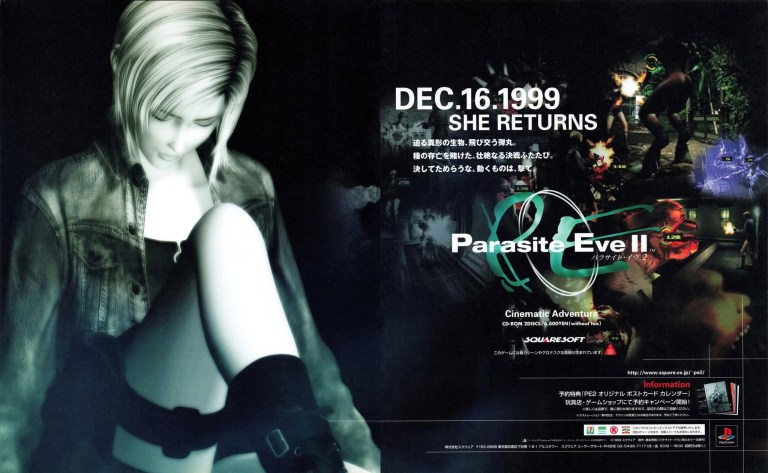
9. Parasite Eve II Japanese print ad
Were you a big fan of Aya Brea and the Parasite Eve franchise in the late 1990s?
Following the critical and commercial success of Parasite Eve in 1998, SquareSoft proceeded with Parasite Eve II and the production (note: initially for a spin-off game before becoming a sequel) did not even involve the main creators of the first game. Instead the company had a different team of developers – including those who previously worked on Resident Evil games for Capcom – in Osaka to make the sequel. This explains why Parasite Eve II had stronger survival horror gameplay resembling a Resident Evil game. As major changes were made during the production, it was decided that Aya Brea would become the main protagonist and already the character was already popular with gamers. That being said, the marketing of Parasite Eve II for the Japanese market heavily featured Aya Brea with subtle sexiness, beauty and action in mind. The marketing intensified leading to its eventual December 16, 1999 release in Japan.
Welcome back readers, fellow geeks and electronic gaming fans!
In this edition of the Retro Gaming Ads Blast (RGAB) series, we will take a look at another batch of retro gaming print ads – including arcade flyers – from the 1970s to the 1990s.
For the newcomers reading this, Retro Gaming Ads Blast (RGAB) looks back at the many print ads of games (console, arcade, computer and handheld) that were published in comic books, magazines, flyers, posters and newspapers long before smartphones, social media, the worldwide web and streaming became popular. To put things in perspective, people back in the 1980s and 1990s were more trusting of print media for information and images about electronic games and related products.
With those details laid down, here is the newest batch of retro gaming print ads for you to see and enjoy…
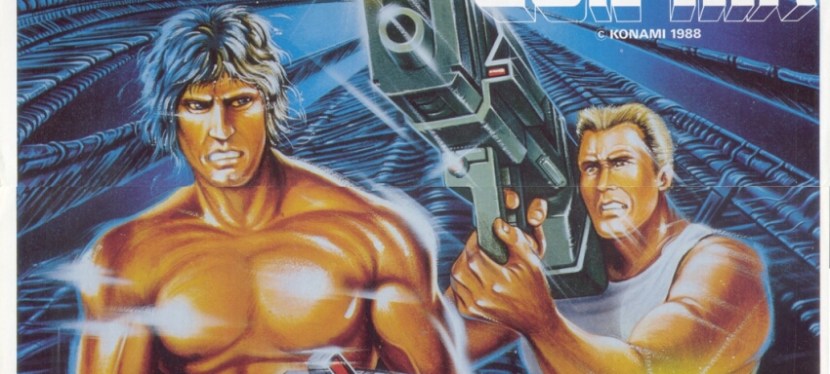
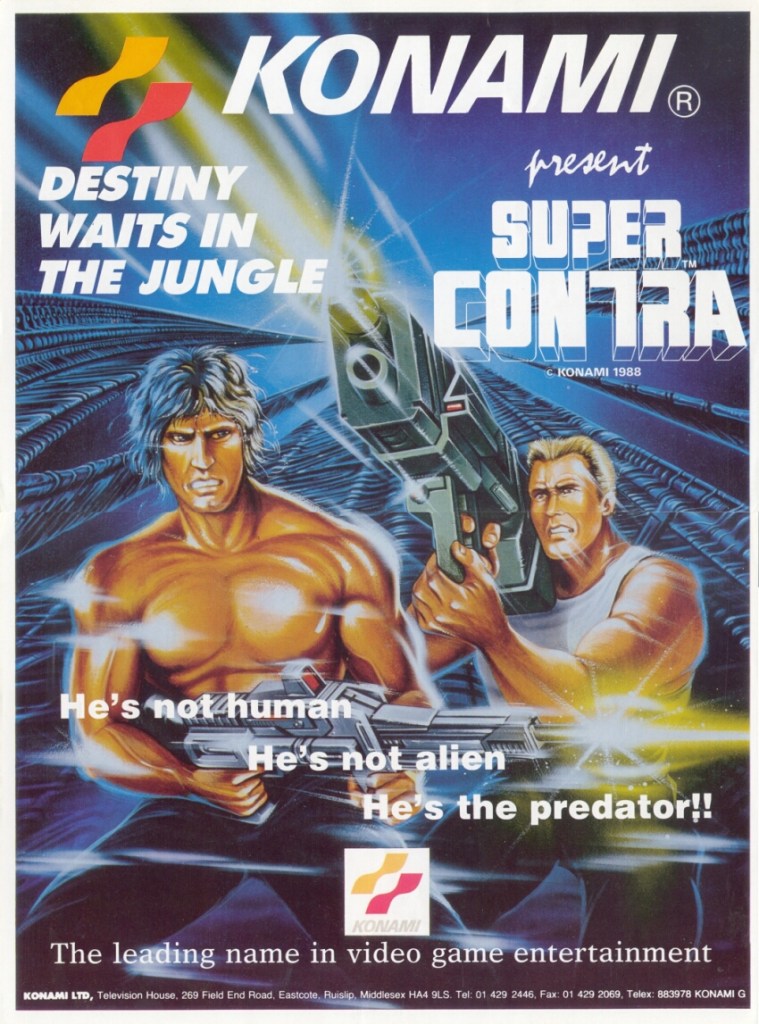
1. Super Contra North American arcade flyer
Have you seen many Hollywood action movies of the 1980s? Does this arcade flyer remind you of something?
After Konami struck gold with Contra in 1987, it was inevitable that sequels and spin-offs will be made. In 1988, they released the follow-up Super Contra in the arcades and to promote it in America, the company came up with artwork that easily gave gamers the impression they are seeing Sylvester Stallone as a fantasized Rambo and another armed guy who might remind them of Arnold Schwarzenegger’s character in Commando or Dutch in Predator. To capitalize on the movie references even more, the American arcade flyer had the line “He’s not human. He’s not alien. He’s the predator!!” As it was the 1980s, this creative approach to promotion was not surprising as Konami and its game makers were influenced by Hollywood movies.
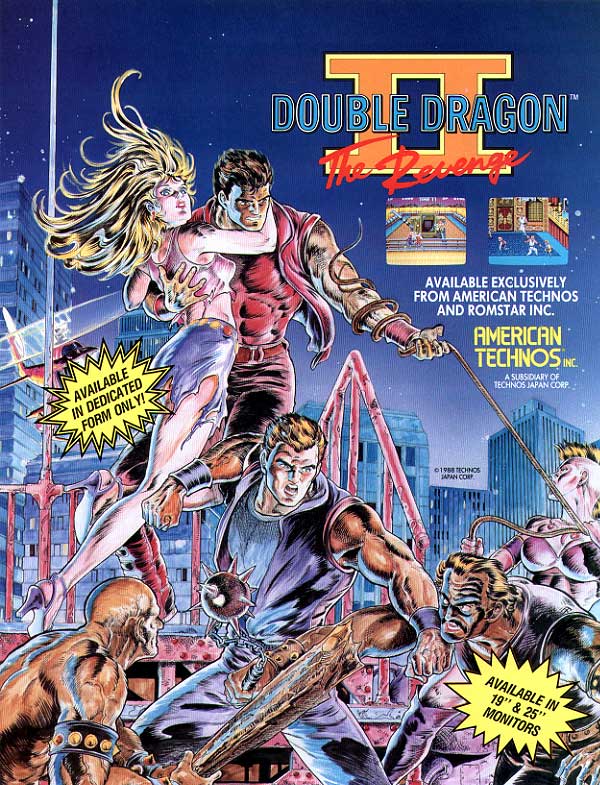
2. Double Dragon II: The Revenge North American arcade flyer
The artwork used in this arcade flyer remains intriguing to look at.
I never played Double Dragon II: The Revenge in the arcade, but I played it on the Nintendo Entertainment System (NES). That being said, I was surprised to see how this old North American arcade flyer has the same hand-drawn artwork used on the cover of the NES version. Take note that the arcade game was released in 1988 while the NES port was released in early 1990. I can only guess that Technos decided to use the same artwork not only for convenience but to have a definitive image emphasizing Double Dragon II to gamers wherever they are.
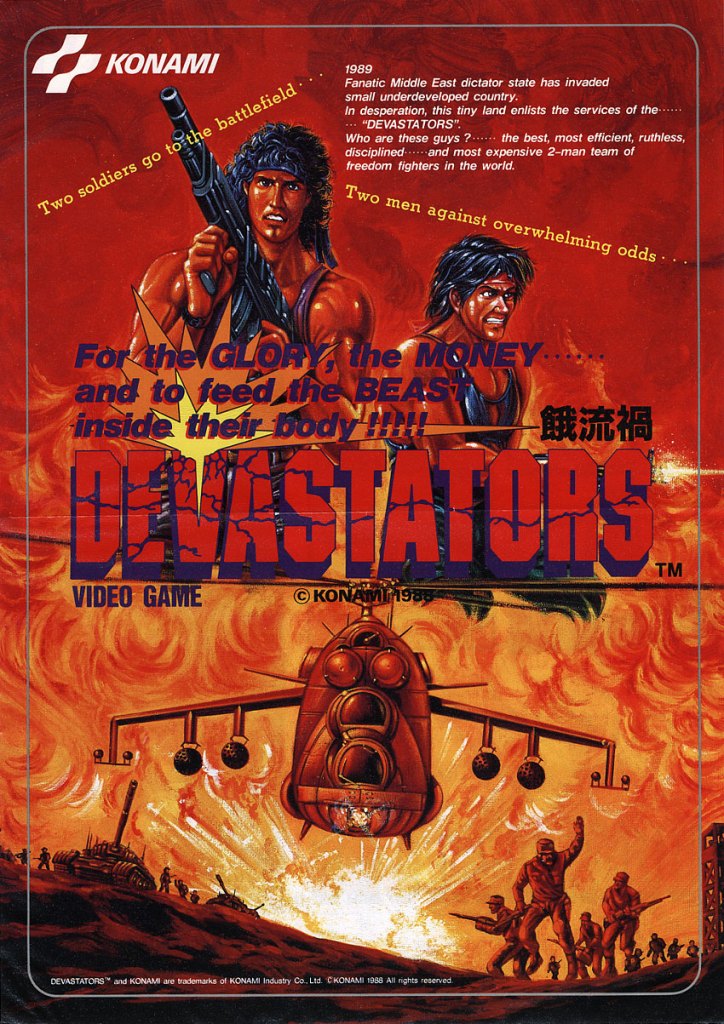
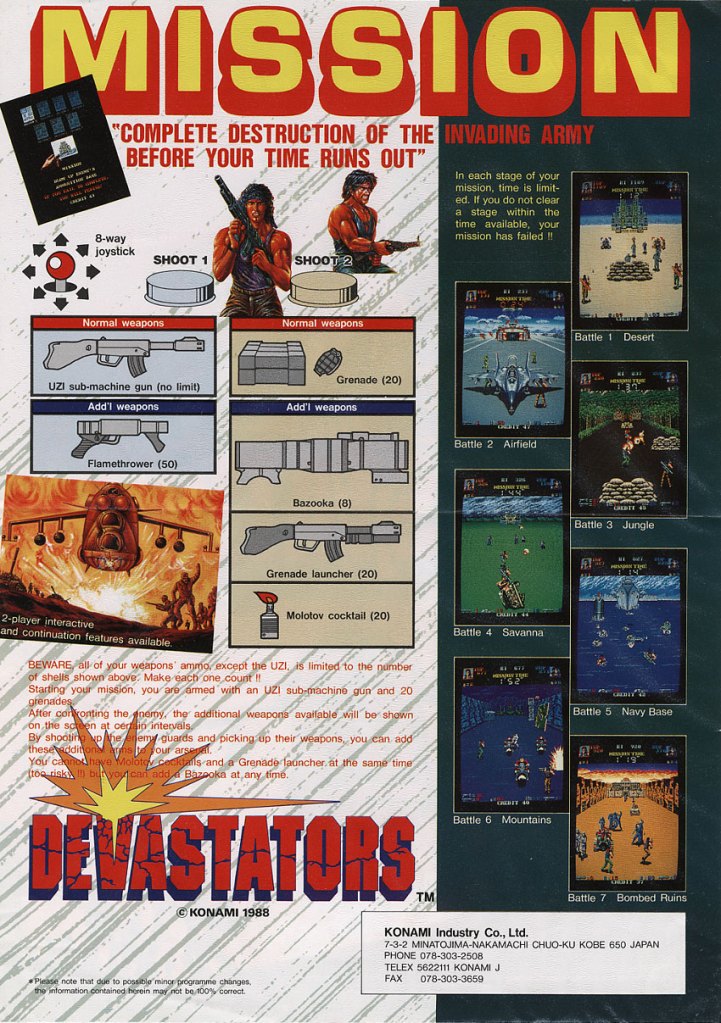
3. Devastators North American arcade flyer
The front.
The rear.
Devastators is another Konami arcade game that had a strong war theme and it was influenced by Hollywood action films of the 1980s. This particular arcade flyer for the North American market is almost identical with the Japanese arcade flyer as both have the same artwork on the front and almost the same visual layout on the rear. The most obvious difference is the use of English text for the North American flyer.
4. Assault North American arcade flyer
The front.
The rear.
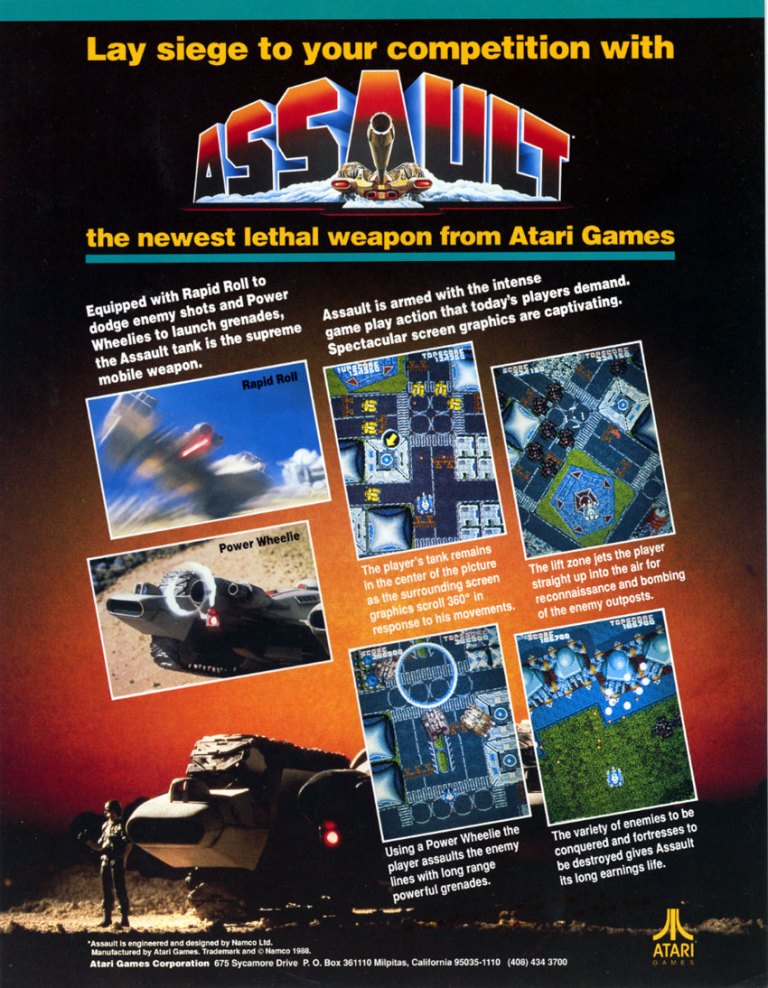
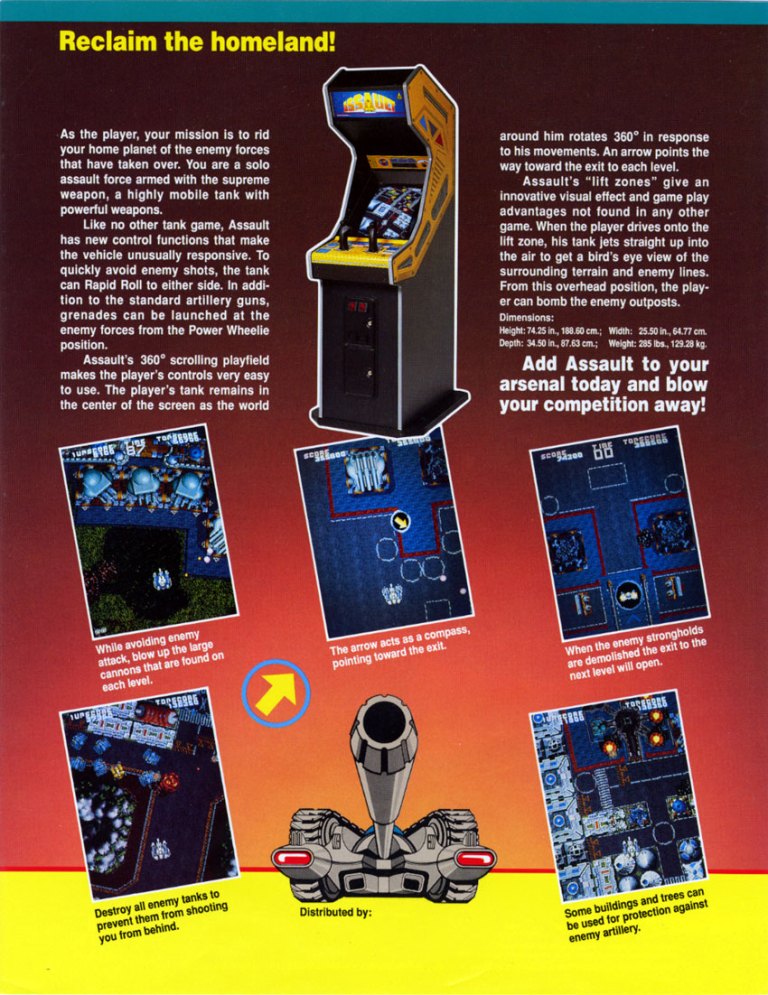
Released in American arcades by Atari, Assault is a multi-directional shooter that had a twin-stick control layout (similar with the classic Battlezone) and players experienced intense battles as well as immersive visual effects such as sprite scaling and environment rotation of up to 360 degrees. To promote the game (this originated in Japan by Namco), Atari came up with this arcade flyer that had selected screenshots and descriptive text on both the front and the rear (which showed the arcade cabinet). Assault was a hit with gamers at the arcades and it was not released on consoles until 2009.
5. Sega CD print ad
Having a socially relevant message can be catchy but it leaves little room for excitement.
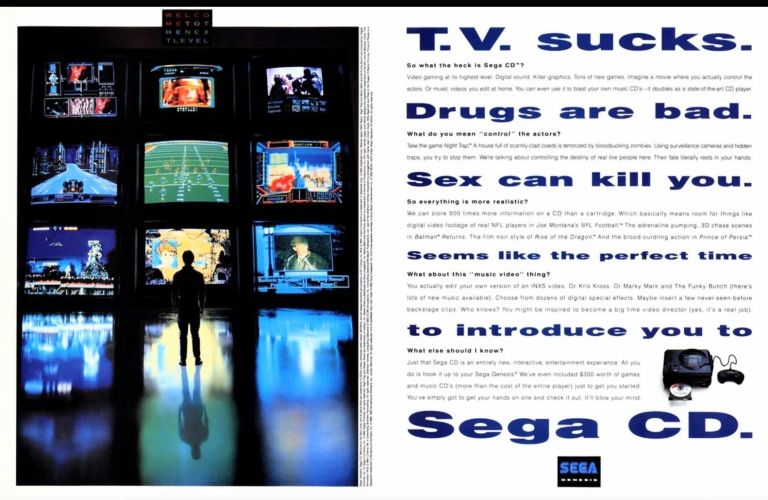
As the Sega Genesis console became a huge commercial success in North America, Sega itself became ambitious about what CD-ROM technology would do for video games. Sega in Japan tasked its Consumer Products Research and Development Labs to create a CD-ROM add-on which resulted in the Sega CD (Mega-CD in other parts of the world) which launched in America in 1992. To promote the add-on towards existing Genesis console owners as well as potential new customers, Sega of America came up with the above 2-page print ad that had a social message on the right and an image of a man standing in front of large monitors (showing Sega CD game footage) on the left. While it looked like an odd way of promoting video game hardware, it still remains catchy to see.
6. Panasonic 3DO print ad
Panasonic knows how to promote entertainment hardware for people’s homes.
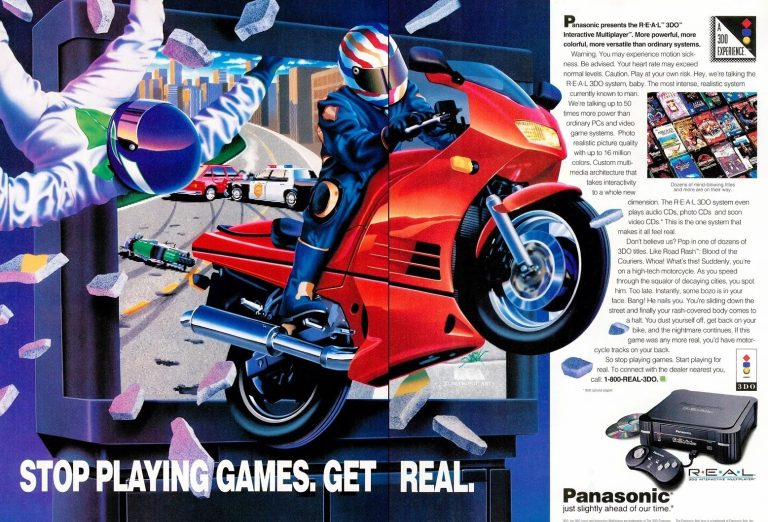
Still in the field of CD-ROM gaming, Panasonic had competitive presence in video gaming when its Panasonic FZ-1 R.E.A.L. 3DO Interactive Multiplayer (with technology licensed by The 3DO Company) was launched in America in 1993. If you look at the print ad closely, you will notice that the descriptive text emphasized the multimedia entertainment aspect more than video gaming. The dominating artwork used does not come from a particular video game as it was made to emphasize home entertainment in general. It’s not surprising that the Panasonic 3DO and other 3DO machines from other manufacturers failed commercially.
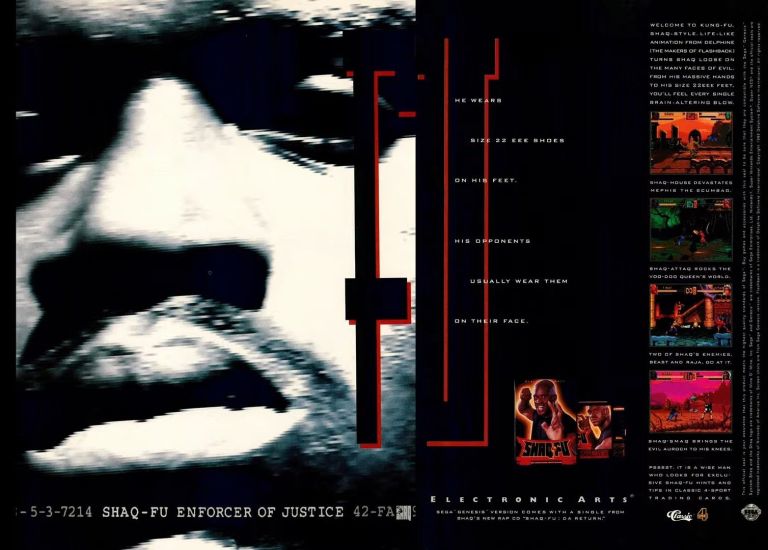
7. Shaq Fu print ad
The close-up of Shaquille O’Neal’s face on the left made him looked less recognizable.
Yes, it is true! There was indeed a video game endorsed by Shaquille O’Neal and it was not a basketball game. Shaq Fu is a 1994 2D fighting game with adventure elements and a story in which gamers play O’Neal as martial artist (note: O’Neal himself participated in the game’s production). To promote the game, Electronic Arts came up with a 2-page print ad that had a very odd black-and-white close-up image of O’Neal’s face on the left leaving small screenshots and hard-to-read text on the right (even though there was some vacant space remaining. I remember seeing this ad while reading a video game magazine and the ad ended up looking more like a promotion of O’Neal (already an NBA superstar) than the game itself. By today’s standards, this print ad is an example of a marketing misfire.
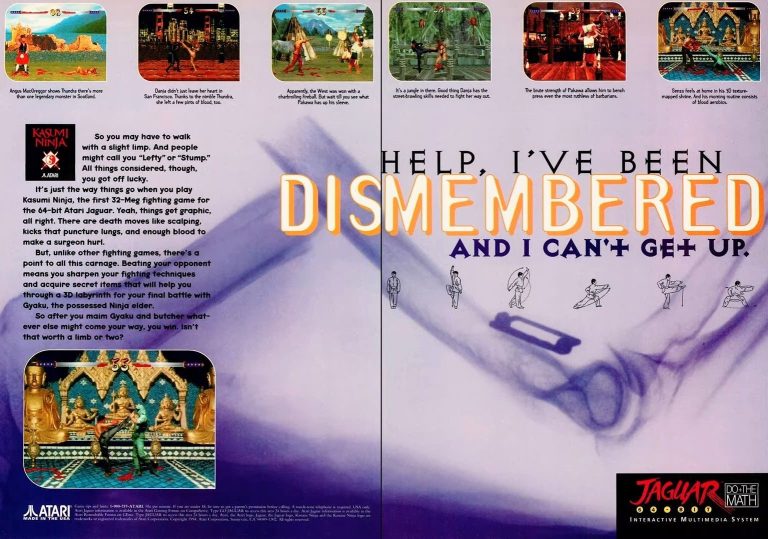
8. Kasumi Ninja print ad
Do you even remember seeing this print ad in magazines?
Remember the 1990s video game trends of digitized human images and disturbingly violent 2D fighting games sparked by Mortal Kombat? The Atari Jaguar-exclusive game Kasumi Ninja was made to capitalize on those trends and it failed badly. Apart from the low sales of the Jaguar console, Atari as publisher came up with the above 2-page print ad that was not appealing to gamers’ eyes and it had almost no excitement overall. This is another marketing misfire.
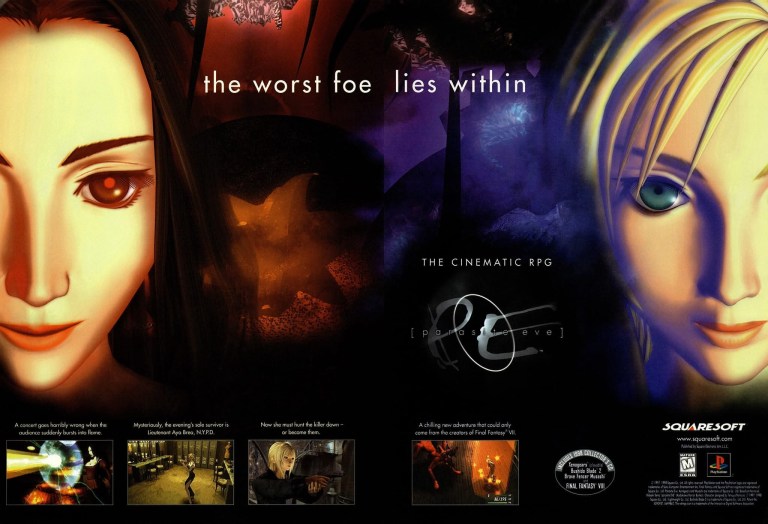
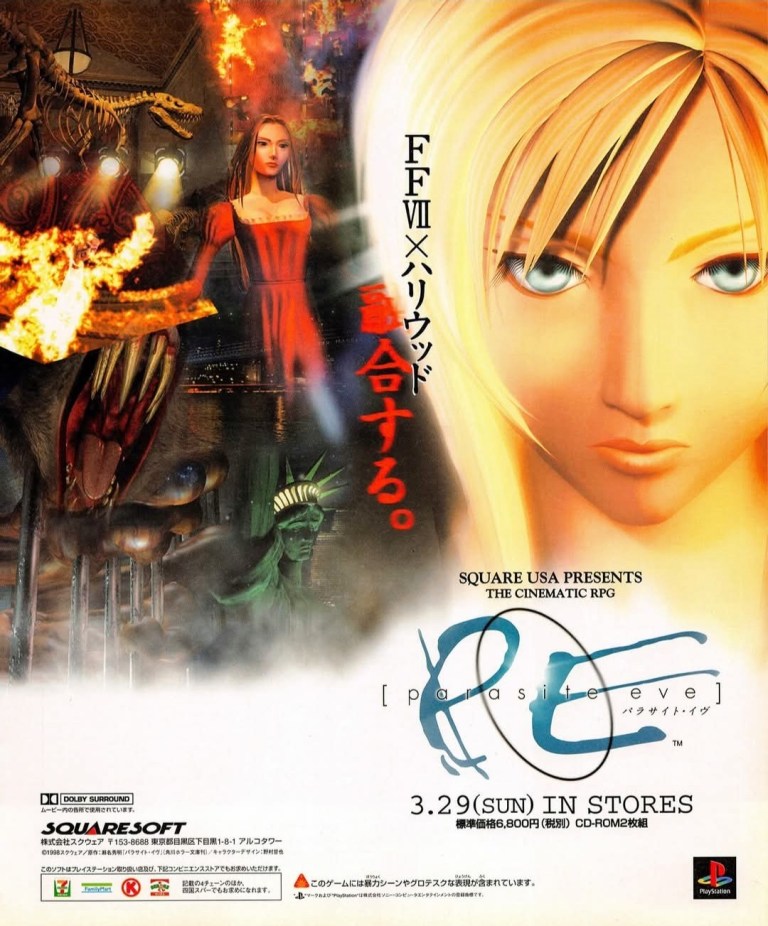
9. Parasite Eve North American and Japanese print ads
Following the successful release of Final Fantasy VII, this ad excited PlayStation gamers and JRPG enthusiasts for Parasite Eve’s 1998 release in America.
A stronger horror presentation in this print ad for the Japanese market. There were already a lot of people in Japan who enjoyed horror.
Starting in the mid-1990s, Squaresoft (now Square Enix) really became aggressive with video game creativity and experimentation as they launched several new projects that eventually got released on PlayStation in the late 1990s until 2000. One of those daring new projects was Parasite Eve which was a role-playing game (RPG) that had visual elements – particularly pre-rendered backgrounds – and a style of exploration that reminded gamers of Resident Evil. The game was a sequel to the Japanese science fiction horror novel of the same name and it involved the creativity of Final Fantasy creator Hironobu Sakaguchi (credited as producer). To promote the game, the 2-page North American print ad had protagonist Aya Brea on the right and the enemy on the left with a cryptic line placed strategically between them. The North American ad clearly stated that the game is a cinematic RPG. By comparison, the Japanese print ad of Parasite Eve has a strong horror vibe which is not surprising because of the novel’s horror elements and the fact that Squaresoft was capitalizing on the popularity of horror-related entertainment in Japan. By today’s standards, Parasite Eve is truly a product of the late-1990s and it has a dedicated fanbase.
Welcome back my readers, YouTube viewers and all others who followed this series of articles focused on YouTube videos worth watching. Have you been searching for something fun or interesting to watch on YouTube? Do you feel bored right now and you crave for something to see on the world’s most popular online video destination?
I recommend you check out the following videos I found.
#1 VKunia and Popcorn in Bed react to Minority Report – In 2002, I saw Steven Spielberg’s Minority Report inside one of the cinemas of Festival Mall here in the Philippines. The suspenseful science fiction movie was the first-ever creative collaboration between Spielberg and Tom Cruise, and it ultimately entertained and intrigued many local moviegoers. To find out if Minority Report remains an engaging film by today’s standards, watch the reaction videos of VKunia and Popcorn in Bed below.
#2 PatmanQC examines Zaxxon – I never played Zaxxon in the arcade but managed to play a version of it on MS-DOS PC in the 1980s. Back then, I was often intrigued with Zaxxon’s visual design which involved an isometric view and a clever presentation of the 2D sprites. Due to its depth of gameplay related to the overall design, it was indeed challenging to play. To find who were responsible in making the game and what inspired its visual design, watch the in-depth Zaxxon video of PatmanQC below.
#3 You, Me and the Movies react to Creature from the Black Lagoon – Released in 1954, Creature from the Black Lagoon is a black-and-white 3D monster horror movie kept moviegoers on the edge of their seats. The feature film’s creature went on to become a part of Universal Picture’s classic monsters and also left an impact on American pop culture. Several months ago, You, Me and the Movies posted their reaction video and it is entertaining to see.
#4 Teenage Mutant Ninja Turtles: Tournament Fighters retrospective videos – I never got to play Teenage Mutant Ninja Turtles: Tournament Fighters when it was released in 1993. We had a Super Nintendo Entertainment System (SNES) but we never bought the game. I heard from a few of my friends – who were fortunate enough to play it – that the game was indeed a lot of fun to play and was a nice addition to the sudden rise of fighting games at the time. Developed and published by Konami, Teenage Mutant Ninja Turtles: Tournament Fighters was a commercial and critical hit clearly with the SNES version. To find out what made the game competent with other fighting games and why many considered it to be a great licensed video game, watch the selected retrospective videos below.
#5 Ashleigh Burton reacts to Alien vs. Predator – Back in 2004, I saw Alien vs. Predator in the local cinema in Cebu City, and after watching it I went back home feeling numb and disappointed. For one thing, it was directed by Paul W.S. Anderson who really is not a very good director. Next, the script was pretty bad in quality. Ultimately, the filmmakers did not raise serious efforts to delight fans of both Aliens and Predator. For YouTuber Ashleigh Burton, however, the film has a different impact on her and you can watch her reaction video below.
Welcome back readers, fellow geeks and electronic gaming fans!
In this edition of the Retro Gaming Ads Blast (RGAB) series, we will take a look at another batch of retro gaming print ads – including arcade flyers – from the 1980s and 1990s but with focus on Star Wars games that were released during the era of George Lucas. This is the Star Wars Special of RGAB.
For the newcomers reading this, Retro Gaming Ads Blast (RGAB) looks back at the many print ads of games (console, arcade, computer and handheld) that were published in comic books, magazines, flyers, posters and newspapers long before smartphones, social media, the worldwide web and streaming became popular. To put things in perspective, people back in the 1980s and 1990s were more trusting of print media for information and images about electronic games and related products.
With those details laid down, here is the newest batch of retro gaming print ads for you to see and enjoy…
1. 1983 Star Wars arcade game flyer
The front of the flyer.
The rear of the flyer.
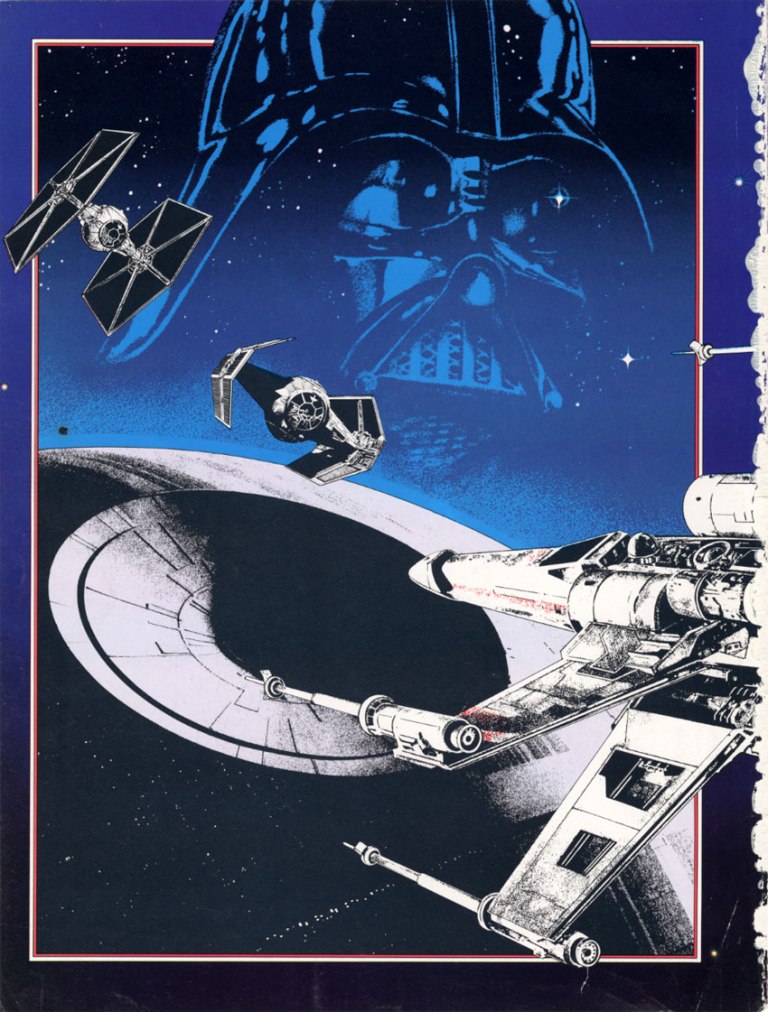
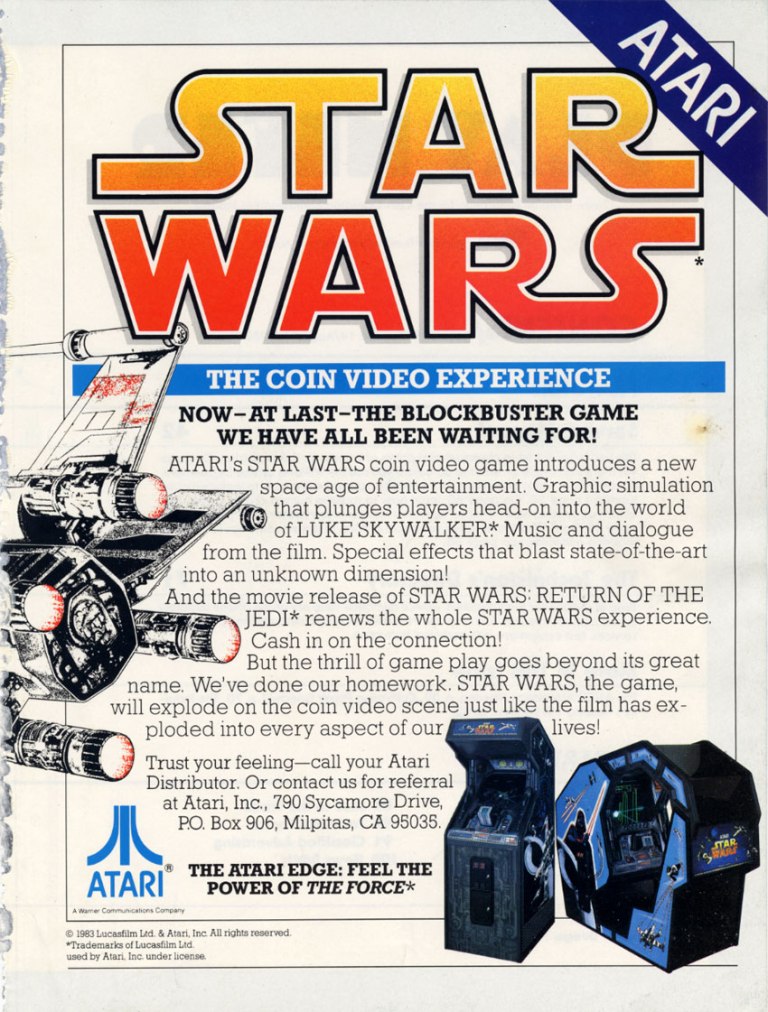
Just weeks before the Star Wars movie Return of the Jedi was released in cinemas in 1983, Atari released the Star Wars arcade game which became a tremendous hit around the world. Both Star Wars fans and gamers of the time loved the game as it provided a very immersive and fun-filled arcade experience. The print ad Atari released has a nice artwork on the front (showing a portion of the Death Star, two TIE Fighters, a Rebel X-Wing Fighter and Darth Vader’s image) and the text description plus the pictures of two arcade machines on the back. While no screenshots were shown, the print ad still had strong visual impact to catch the attention of players and arcade operators. This arcade flyer still looks great!
2. Star Wars: Return of the Jedi – Death Star Battle Atari 2600 print ad
Parker Brothers really stood out among publishers of games on the Atari 2600 and they even had the Star Wars license.
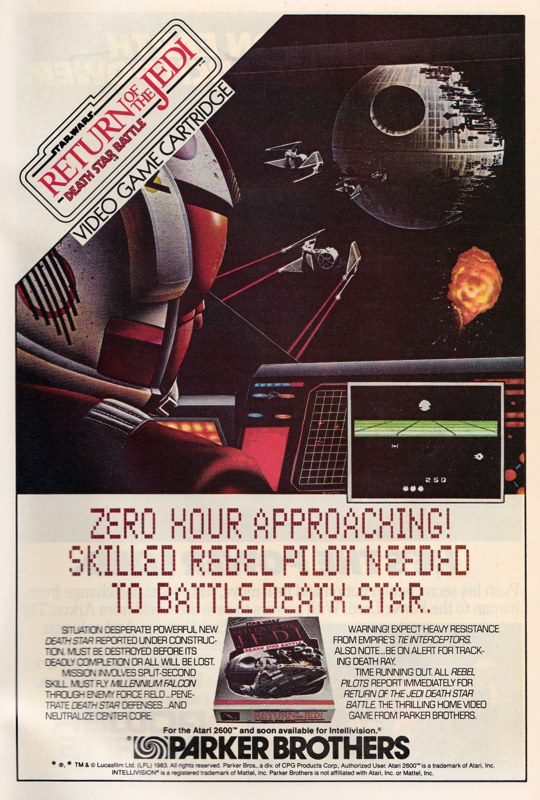
Considering the massive success that Star Wars and The Empire Strikes Back had in cinemas, merchandising and other entertainment media, it was not surprising that games based on Return of the Jedi were produced. For the Atari 2600, Parker Brothers produced Star Wars: Return of the Jedi – Death Star Battle which my friends and I played a lot in 1983. The print ad Parker Brothers came up with has a very eye-catching design showing a Rebel pilot flying a space ship (supposedly the Millennium Falcon which is the only playable ship in the game) towards the Death Star. The visual design is a stroke of genius because it appeals strongly to Star Wars fans while highlighting a major battle in the film which influenced the core concept of the game. This is a classic Star Wars game ad.
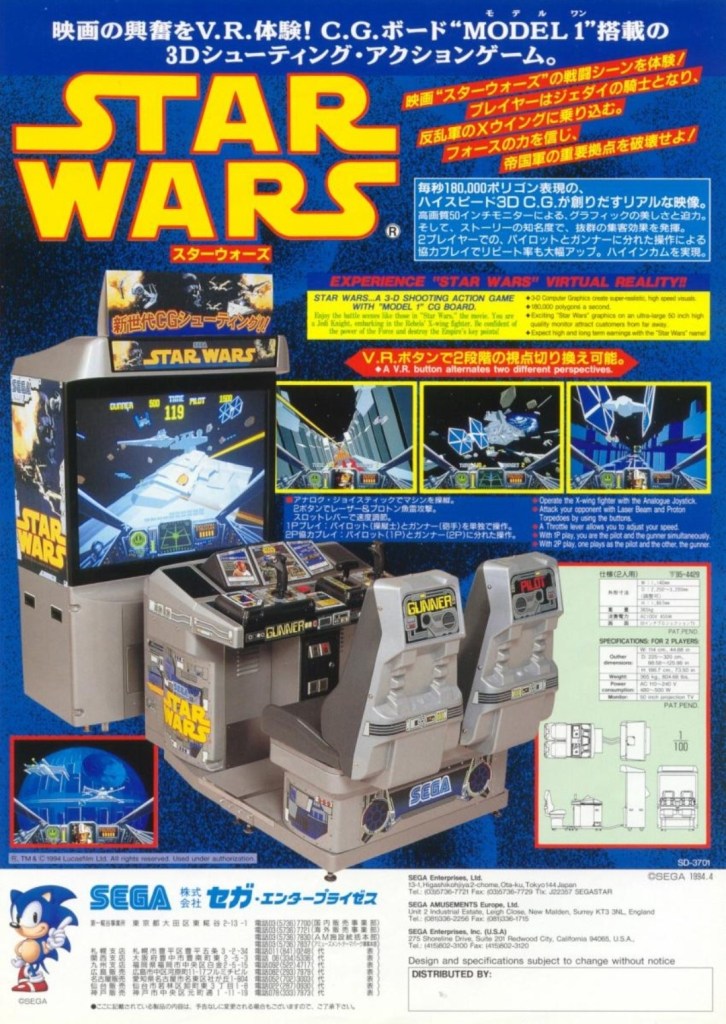
3. Star Wars Arcade Japanese market flyer
This arcade game was one of the first fully polygonal Star Wars games released.
In the 1990s, Sega acquired the license to produce Star Wars games for the arcades and they had the hardware for polygonal graphics. In 1993, the released Star Wars Arcade which is a space shooter that offered gamers the freedom to fly their Rebel space ship in 3D space with environments and huge space ships rendered in polygons. As you can see in the arcade flyer for the Japanese market, Sega went hard with their presentation showing 3 carefully selected screenshots (amazing for the time) and a picture of the arcade machine which had an elaborate control set-up, seats and decorations. As Star Wars Arcade was released more than a year before the polygonal game consoles Sega Saturn and Sony PlayStation hit the market, this arcade flyer was mind-blowing to gamers who were on the verge of playing video games with polygonal visuals.
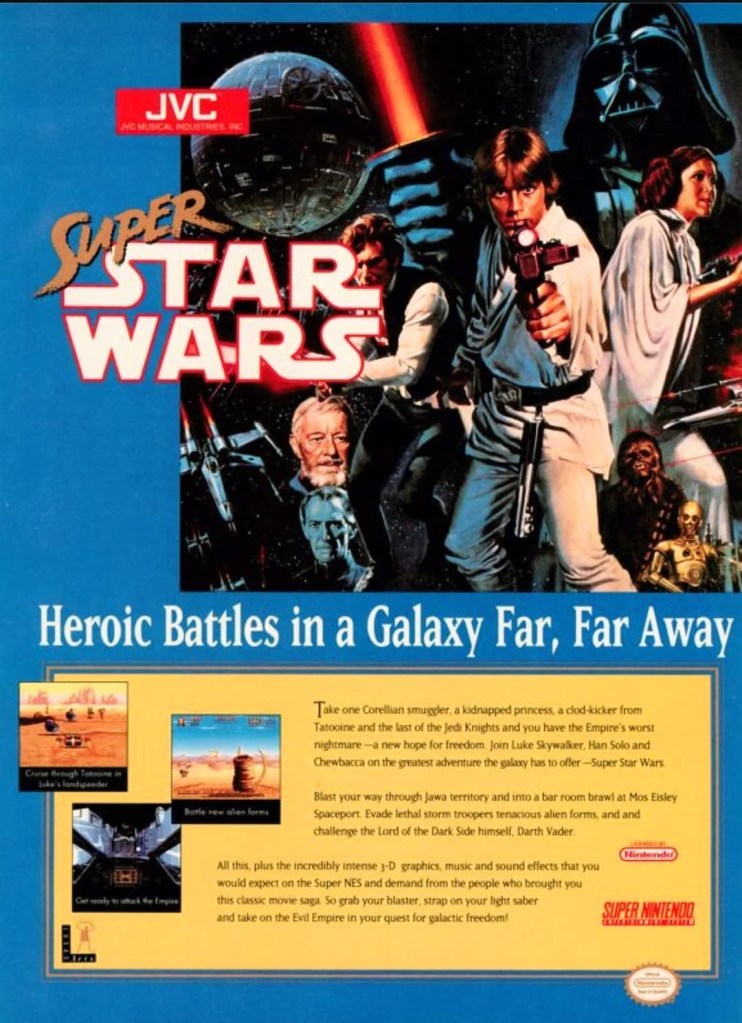
4. Super Star Wars print ad
Yes, JVC was involved with the Super Star Wars trilogy starting with this one.
In 1992, Star Wars fans who enjoyed playing 2D side-scrolling games saw their dream of the next great Star Wars console experience come true when Super Star Wars was released on the Super Nintendo Entertainment System (SNES). With the SNES technology, more detailed visuals and improved audio brought the Star Wars universe to life and the addition of 3D-like playable sequences (made possible by Mode 7 effects) made Super Star Wars a very unique console experience. The print ad only showed three screenshots and three paragraphs of descriptive text but the use of images from the 1977 movie poster added a lot of punch to the visual presentation. This ad is both eye-catching to gamers and long-time Star Wars fans.
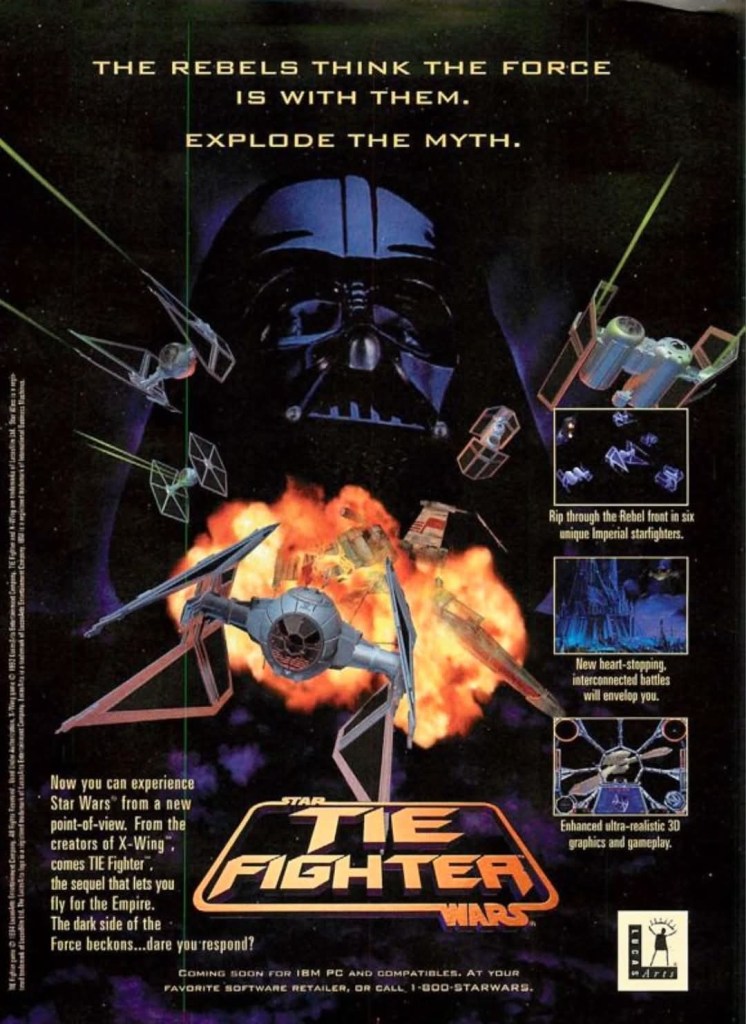
5. Star Wars: TIE Fighter print ad
This game offered gamers the opportunities to be with the dark side.
In 1994, LucasArts released Star Wars: TIE Fighter which offered gamers the opportunity to play an Imperial pilot serving Darth Vader on missions set between The Empire Strikes Back and Return of the Jedi. This print ad has a sharp visual design enhanced by Darth Vader’s iconic look in the background. The selected screenshots shown were good to look at but the artwork used to present the TIE Fighters really stood out. This solid looking print ad does come with a bit of disturbance as the Galactic Empire in Star Wars lore are evil.
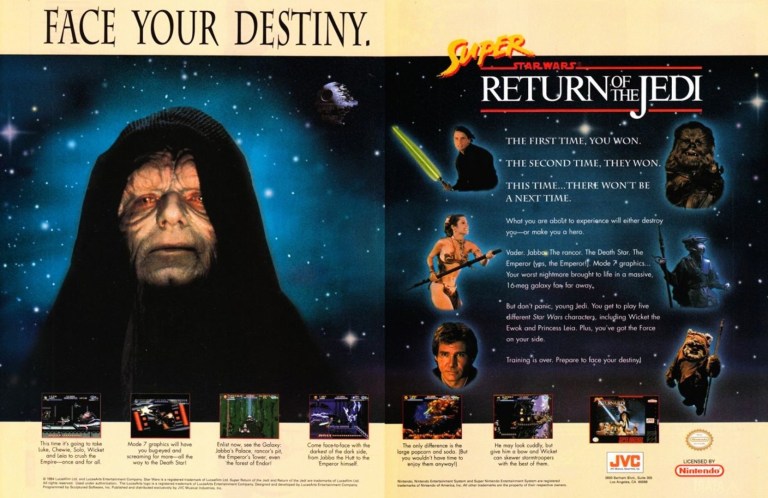
6. Super Star Wars: Return of the Jedi print ads
Nothing like seeing Harrison Ford, Carrie Fisher and Mark Hamill as the Star Wars icons on a video game ad.
I never played the portable editions of Super Star Wars: Return of the Jedi. Have you?
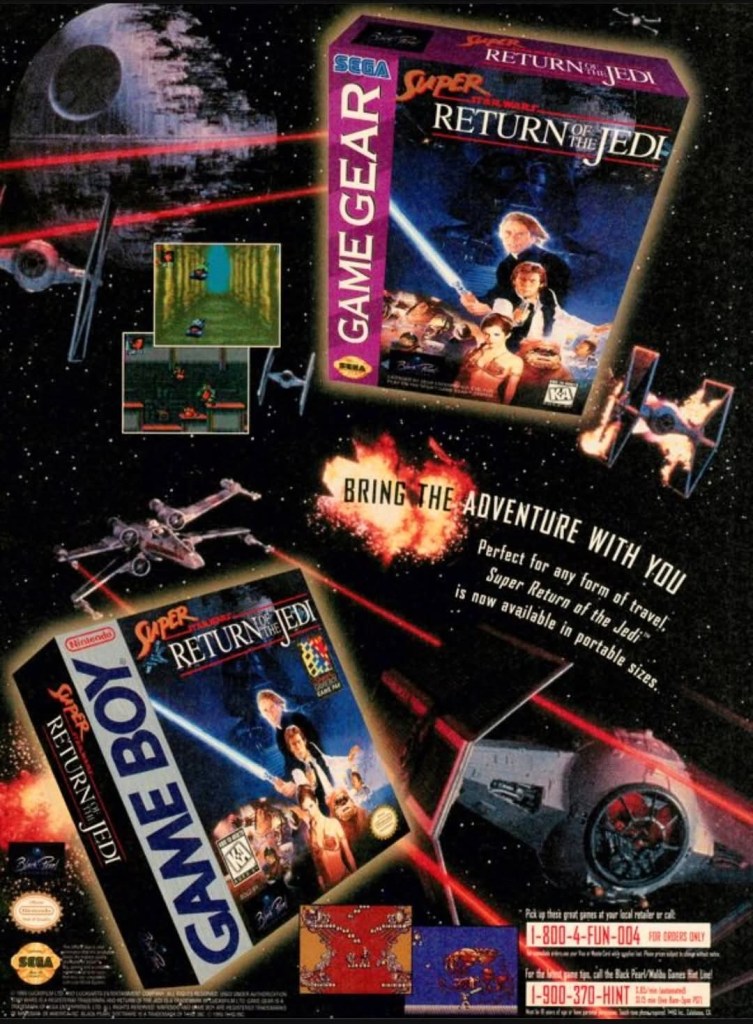
As far as gaming on the SNES was concerned, the Super Star Wars trilogy of games really kept fans and casual gamers busy. By the time Super Star Wars: Return of the Jedi was released in 1994 on the SNES, there was already immense speculation about the Star Wars prequel trilogy and George Lucas himself started writing them that same year. The 2-page print ad of the game on SNES had a creepy photo of Emperor Palpatine on one side, the other characters on the other side, and six selected screenshots displayed on the lower part. The way the print ad was design reflects that the game is the end of the trilogy like the 1983 film itself. Super Star Wars: Return of the Jedi was also released on Game Gear and Game Boy and the ad makers made the right decision to use the Death Star and space battle image as the background so that the portable games would stand out.
7. Star Wars: Masters of Teräs Käsi print ad
I wonder if George Lucas ever regretted approving this Star Wars fighting game. It was so rough and unpolished with its quality.
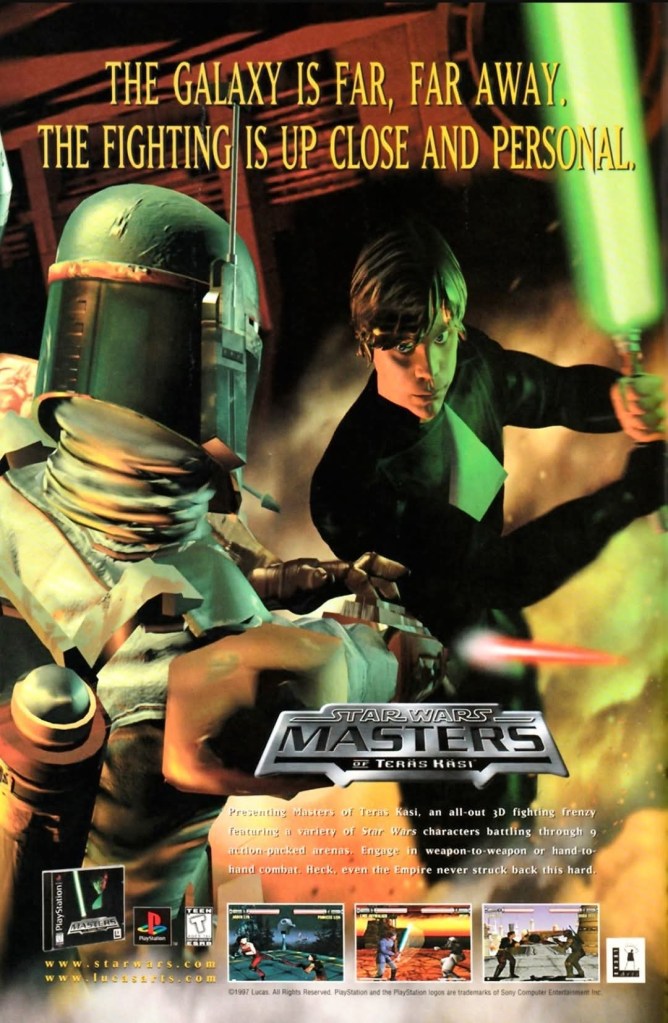
If there is any sub-par Star Wars game released in the 1990s, it is none other than Star Wars: Masters of Teräs Käsi on the PlayStation. The 1997 game was LucasArts’ attempt to cash in on the booming fighting games genre and they took a huge risk of making it entirely polygonal. Instead of using photographs or hand-drawn art, the ad makers used a fully rendered 3D polygonal models of Luke Skywalker and Boba Fett which was alienating to look at. In fact, those polygonal models looked very different from the in-game polygonal models of Skywalker and Boba Fett presented during gameplay. This print ad is a sad reminder about an ill-conceived concept for Star Wars that materialized into an actual product.
8. Star Wars: Shadows of the Empire print ad
If you have read the novel, were you able to play this video game?
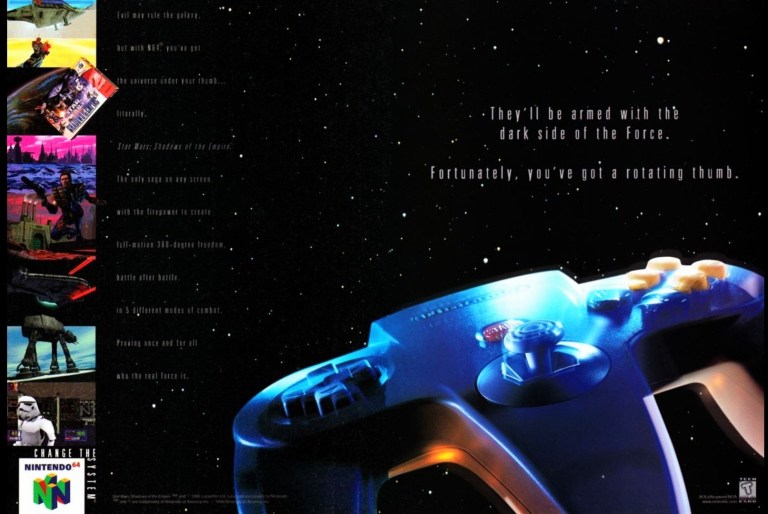
LucasArts and Nintendo teamed up with something ambitious – a video game adaptation of Star Wars: Shadows of the Empire that was released exclusively to the Nintendo 64 (N64). Released in late 1996, Star Wars: Shadows of the Empire was part of the multimedia entertainment project of the same name and it is the result of LucasArts’ decision to be an early adopter of the N64 for business-related reasons. The 2-page print ad shown here has a dark, star-filled background which captivating screenshots on the left and the N64 controller standing out. This print ad strongly expresses that gamers would need the N64 in order to play Star Wars: Shadows of the Empire in the comfort of home.
9. Star Wars Trilogy arcade flyer
The front.
The other side.
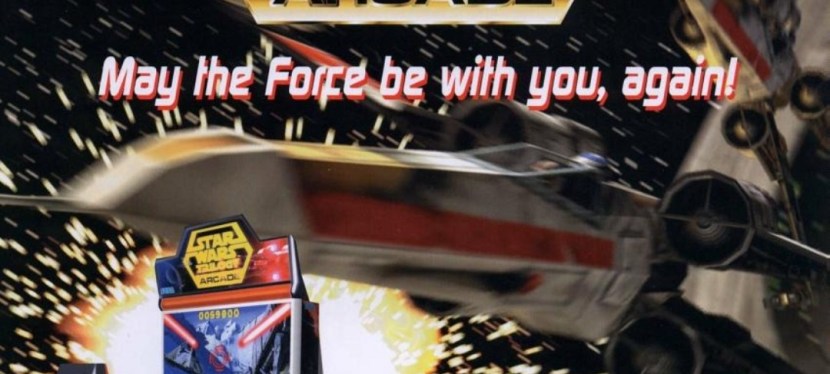
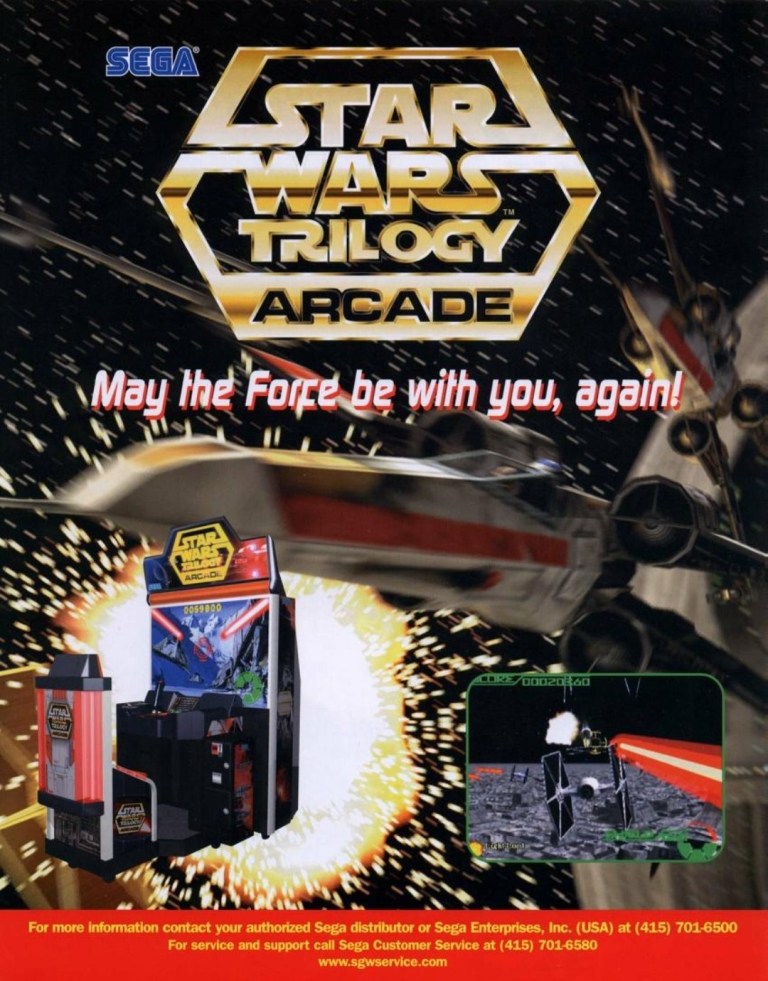
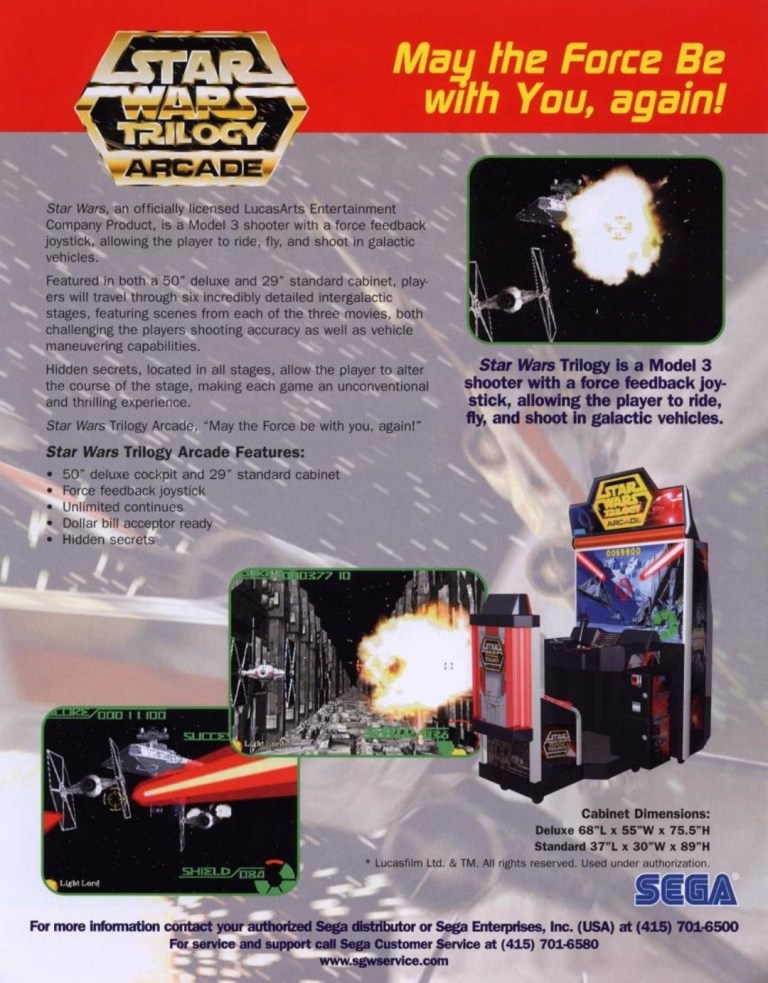
Before the Star Wars Prequel trilogy started with The Phantom Menace, Sega came out strongly by releasing Star Wars Trilogy Arcade in arcades around the world. Released in 1998, the game was arguably Sega’s most ambitious Star Wars-licensed game ever as it was made with the powerful Model 3 hardware, it came with unique controls and the game was designed as a polygonal rail shooter focused on key segments from the original trilogy of films. Sega wisely used dynamic artwork for the front of the flyer giving viewers the impression that the X-Wing fighter was approaching them closely. At the rear, three screenshots only showed space battles which was a wise decision by Sega to keep the surprise intact for gamers until they play the game. Having played this in the arcade myself, I can assure you that Star Wars Trilogy Arcade has more varied types of gameplay and challenges. It’s a lot more than flying and shooting in space, and it has a lot of stuff that Star Wars fans will love.
Welcome back Xbox fans, geeks, retro gaming enthusiasts, fighting game enthusiasts and other gamers!
With the current Xbox-exclusive fantasy role-playing game Avowedcoming out on February 18, I’m supposed to be excited about what Team Xbox has prepared this year. Of course, there were disappointments not only with certain Xbox first-party releases but also with the way things have been changing on the part of Team Xbox.
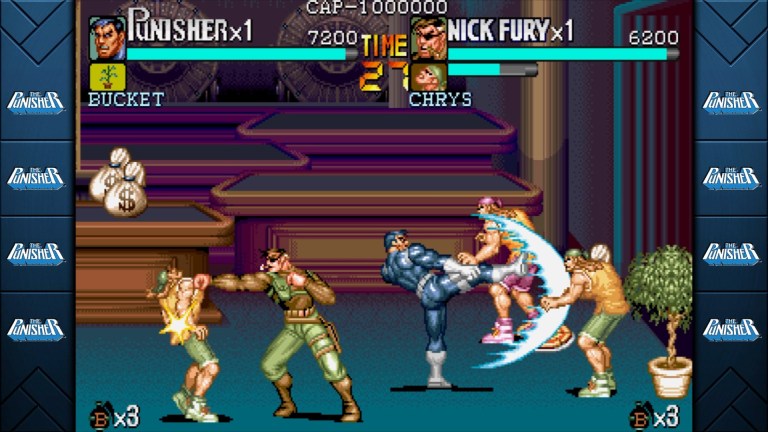
Wow! That’s a collection of very fun and popular games Capcom released from 1993 to 2000. With the exception of The Punisher arcade game (a 2D adventure game), I played them all in the arcades decades ago and I can say that having them in a single collection for the modern Xbox consoles is indeed a blessing for long-time Xbox gamers who love 2D fighting games and retro gaming. The way I feel right now, Marvel vs. Capcom Fighting Collection: Arcade Classics looks really enticing to purchase.
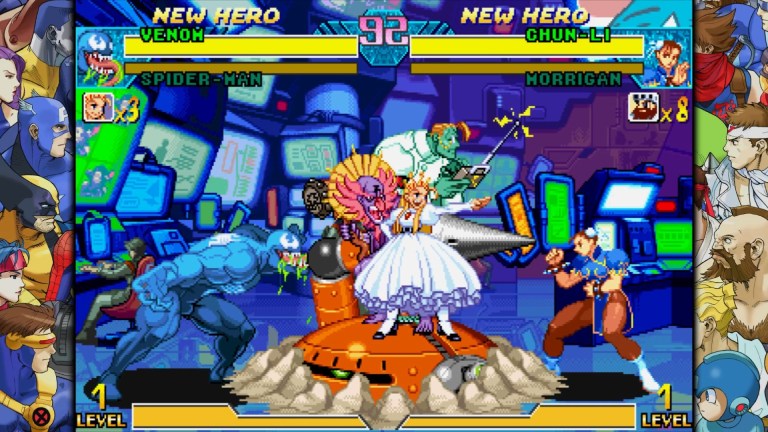
Marvel vs. Capcom: Clash of Super Heroes is not just a lot of fun to play but also will please those who love the characters. With Wolverine, Spider-Man, Venom, Captain America from Marvel’s side included, there is something that will bring both geeks and gamers together.
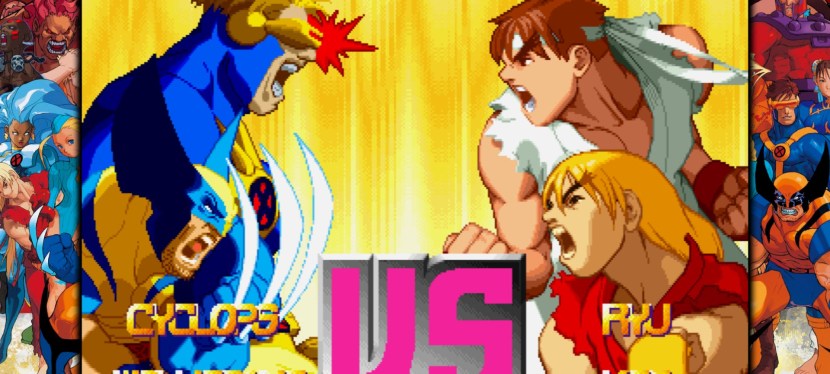
I have fond memories of Capcom 2D fighting games that carried Marvel’s intellectual properties. X-Me: Children of the Atom was enjoyable to play with and it resonated with me as I was already an X-Men comic book reader back in the 1990s. Marvel Super Heroes was also fun to play and it somewhat reminded me of The Infinity Gauntlet storyline. X-Men vs. Street Fighter was the most intriguing crossover fighting game at the time of its release and it really raised the bar for fast-and-furious style gameplay complete with a quick character swap during the heat of battles. Marvel Super Heroes vs. Street Fighter was the follow-up which came with changes that were not well received by the fans.
Then came the two Marvel vs. Capcom crossover fighting games which really built upon the foundation of X-Men vs. Street Fighter for more team battles with speed and impact in mind. I could not forget the inclusion of Resident Evil characters, Mega Man and others.
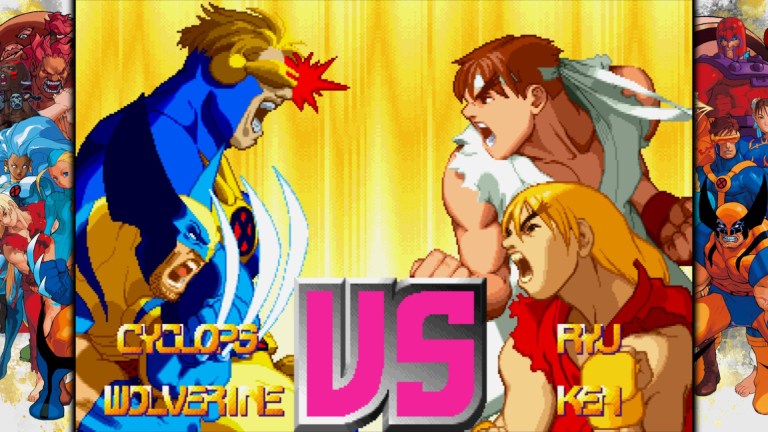
X-Men vs. Street Fighter is a classic tag-team, crossover-oriented video game! Fast and furious action ensured!
The Punisher arcade game is the only non-fighting game of the collection. Punisher fans should look at this.
Adding further zest to the collection is online play that allows casual matches, ranked matches, custom matches. Think about how your skills or your scoring will compare with those of other players from around the world.
That being said, Marvel vs. Capcom Fighting Collection: Arcade Classics is a retro gaming package that deserves attention as it carries some of the finest video games Capcom ever made.
Welcome back, my readers, YouTube viewers and all others who followed this series of articles focused on YouTube videos worth watching. Have you been searching for something fun or interesting to watch on YouTube? Do you feel bored right now and you crave for something to see on the world’s most popular online video destination?
I recommend you check out the following topics and the related videos I found.
#1A look back at Tobal No. 1 – The 1990s will always be remembered as the decade when fighting games became wildly popular. While franchises like Tekken, Virtua Fighter, Street Fighter and The King of Fighters literally flooded the arcades and consoles, game developers at DreamFactory (a subsidiary of Square) were dissatisfied with the state of fighting games at the time and this eventually led to the creation of Tobal No. 1, one of the most unique games of its genre ever made. To learn more about it, watch the video below.
#2 Assorted videos of Air Force One (1997) – Watching Air Force One (starring Harrison Ford) on the big screen in 1997 was a fun experience for me. It was one of the many so-called Die Hard clones of the 1990s which featured one brave, vulnerable hero fighting terrorists while confined in a place where escape is not option. For your enjoyment, I selected one trivia video and a few reaction videos of Air Force One. As it is a great film, I encourage you to watch it first in case you have not seen it. Otherwise, go watch the selected videos below.
#3 Slope’s Game Room’s look back at the Choplifter series – I first played Choplifter on the Family Computer back in the late-1980s and it really was both unique and fun to play. It was a side-scrolling adventure game with military action but it was not an all-offense experience. In fact, the game gives you opportunities to rescue hostages and the game development history is pretty interesting to discover. As such, I encourage you to watch Slope’s Game Room’s retrospective of Choplifter.
#4 The games of Square in the 1990s remembered – If you know your video game history, Square Enix was established in 2003 as a result of a merger between Square (AKA SquareSoft) and Enix. When Square was still an independent, standalone company it released a lot of memorable games on the Super Nintendo Entertainment System (SNES) and the PlayStation in the 1990s. If you love retro gaming and if you are interested to discover (or rediscover) what Square released back in the 1990s, then this video is for you.
#5 Canadian Prime Minister Justin Trudeau receives response from returning US President Donald Trump regarding new tariffs – Justin Trudeau – the super woke and out-of-touch Canadian Prime Minister – told the returning US President Donald Trump that new tariffs would kill the economy of Canada. The result is a memorable response from Trump. To see what happened and how the public reacted, watch this Sky News Australia video. Lastly, never ever trust Trudeau. You will regret it believing in him as he is a very bad leader.
#6 Kamala Harris being hit by her donors and her fellow Democrats for reckless campaign spending – The defeated Commie Kamala Harris is now the target of her US presidential campaign donors and even her fellow Democrats. You see, her campaign team raised at least $1.5 billion and ended up with a debt of at least $20 million due to reckless spending and irresponsible handling of money. Apart from literally BUYING the support of celebrities and Hollywood Communists, the Harris campaign spent excessively on online ads, private jets and others. The donors are very furious and a lot of Democrats realized that the laughing hyena Kamala Harris severely damaged the political party. That being said, Kamala Harris would be delusional enough to actually run for US President again in 2028. Watch and learn from Sky News Australia’s video.
#7 You, Me and the Movies react to Friday the 13th Part VIII: Jason Takes Manhattan – Years I ago, I posted my retro review of Friday the 13th Part VIII: Jason Takes Manhattan. The 1989 Friday The 13th sequel was so sloppy and bad with its presentation, it sometimes could be funny to see and it’s okay to ridicule it. If you want to discover Jason Takes Manhattan without spending too much time, you should watch the reaction video of You, Me and the Movies.
8. The collapse of the Assad dictatorship in Syria – In case you missed the news, a new chapter in the history of Syria has officially started as the dictatorship of Bashar al-Assad officially ended with the Islamist rebels taking over the country. Assad and his family are now in Russia. While there is euphoria going on in Syria, you should not allow yourselves to be deceived because the civil war in Syria was never a case of “good versus evil”. Assad was allied with Russia and terrorist state Iran. Meanwhile, the Syrian rebels are allied with the Islamist Turkish forces, Jihadists, terrorists and they have Al-Qaeda members in their ranks. Syria now has a new beginning but where will it go? Watch the videos I selected for your viewing and learning.
Welcome back, my readers, YouTube viewers and all others who followed this series of articles focused on YouTube videos worth watching. Have you been searching for something fun or interesting to watch on YouTube? Do you feel bored right now and you crave for something to see on the world’s most popular online video destination?
I recommend you check out the following topics and the related videos I found.
#1Ashleigh Burton’s Logan reaction video – Finally, after posting several X-Men-related reaction videos on her YouTube channel, YouTuber Ashleigh Burton posted her reaction to the great movieLogan. As it is a great film, you must watch it entirely first. If you have seen it already, then I urge you to watch Burton’s reaction video below.
#2 Woke Hollywood continues to freak out over Donald Trump’s comeback as US President – Remember all those many Hollywood elitists who went all out to fool Americans to vote for Commie Kamala Harris for US President? A lot of them plus Hollywood media are still freaking out over Harris’ loss to Donald Trump (who pulled off the greatest American comeback ever). Watch the videos from Midnight’s Edge and RK Outpost below. Pay close attention to the details.
#3 1990s explanatory video about the Fighter’s History – Street Fighter II case – Back in the 1990s, Capcom USA sued Data East over the video game Fighter’s History for infringing on Street Fighter II. As part of its efforts defending Fighter’s History, Data East released to the media an explanatory video (lawsuit exhibit video) which was recently posted on YouTube for millions of people to watch for the first time ever. Watch it now.
#4 Examining Final Exam – Have you ever seen the 1981 movie Final Exam? It was a low-budget, independently made slasher horror movie that looks inspired by Halloween (1978), Friday The 13th (1980) and even National Lampoon’s Animal House (1978). While it is a fact that the movie faded away into obscurity for decades, it suddenly gained attention among film buffs arguably because of its 2023 release on 4K Blu-ray format. Apart from that, Final Exam has a very interesting story of production and execution, and you can learn more about it in the two videos below.
#5 Spotlight on Predator 2 – While it is clear that the 1990 sci-fi action movie Predator 2 does not match the greatness of its predecessor, it still aged well and clearly succeeded in expanding the lore of the Predator entertainment franchise. It also established very creatively the link between Predator and the Alien film franchise. That being said, it is not surprising that the movie became the subject of several YouTubers’ retro movie review videos and movie reaction videos. Before you watch the selected videos below, I encourage you to watch the film first in case you have not seen it. Otherwise, enjoy the selected videos below.
#6 Halo 2 remembered – Twenty years ago this month, Microsoft launched Halo 2 on the original Xbox console with massive hype and success. I could never forget the excitement leading towards its launch followed by the fun I had playing the single-player campaign. The only problem I had with Halo 2 was the abrupt ending. Regardless, Halo 2 is still memorable and if you feel nostalgic about it, watch the video below. Remember, this is a look back at the time when Team Xbox invested a lot not only on Halo 2 but also on making Xbox fans happy with exclusive content.
Welcome back readers, fellow geeks and electronic gaming fans!
In this edition of the Retro Gaming Ads Blast (RGAB) series, we will take a look at another batch of retro gaming print ads – including arcade flyers – from the 1980s and 1990s.
For the newcomers reading this, Retro Gaming Ads Blast (RGAB) looks back at the many print ads of games (console, arcade, computer and handheld) that were published in comic books, magazines, flyers, posters and newspapers long before smartphones, social media, the worldwide web and streaming became popular. To put things in perspective, people back in the 1980s and 1990s were more trusting of print media for information and images about electronic games and related products.
With those details laid down, here is the newest batch of retro gaming print ads for you to see and enjoy…
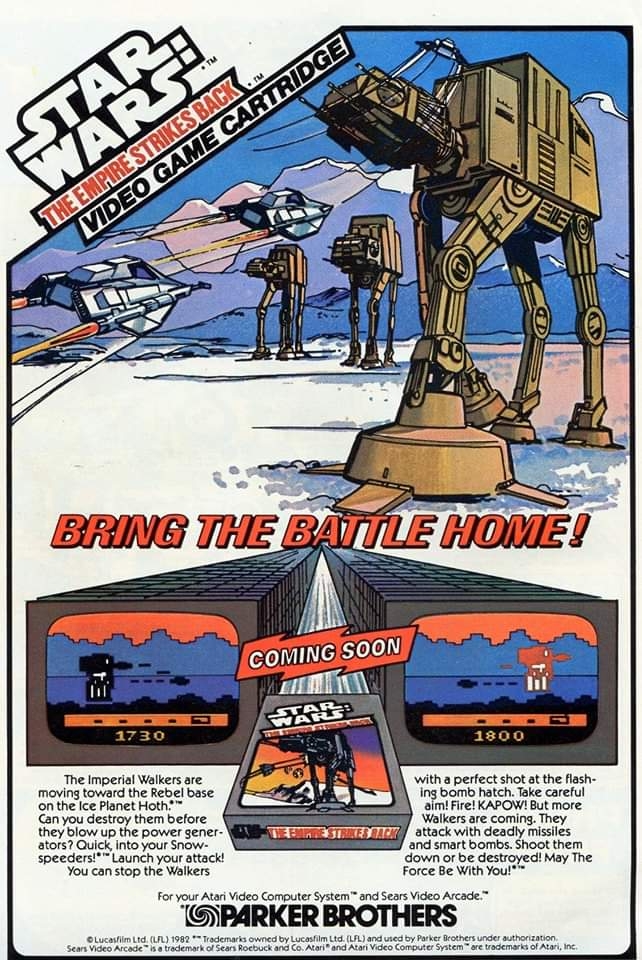
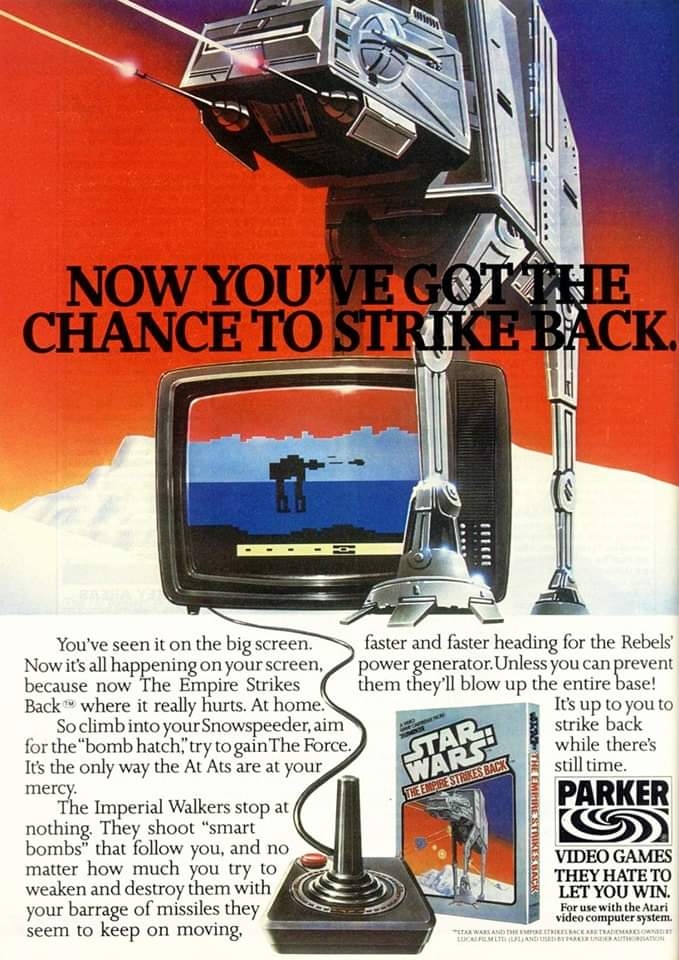
1. Star Wars: The Empire Strikes Back Atari print ads
I could not forget the first time I saw this print ad while reading a comic book.
This ad showed the Atari 2600 controller.
Even during its early years under George Lucas, the Star Wars entertainment franchise made its way into video games due to its massive popularity and Parker Brothers really made moves to cash in. This resulted in the Atari 2600 video game adaptation (1982) of The Empire Strikes Back which focused mainly on the memorable Hoth battles between Rebel fighters and the Empire’s AT-AT walkers. Parker Brothers came up with two print ads and each had a different visual concept: one had nicely drawn art along with two screenshots shown while the other had painted art of the AT-AT while showing the Atari joystick. These old print ads still look great and exciting.
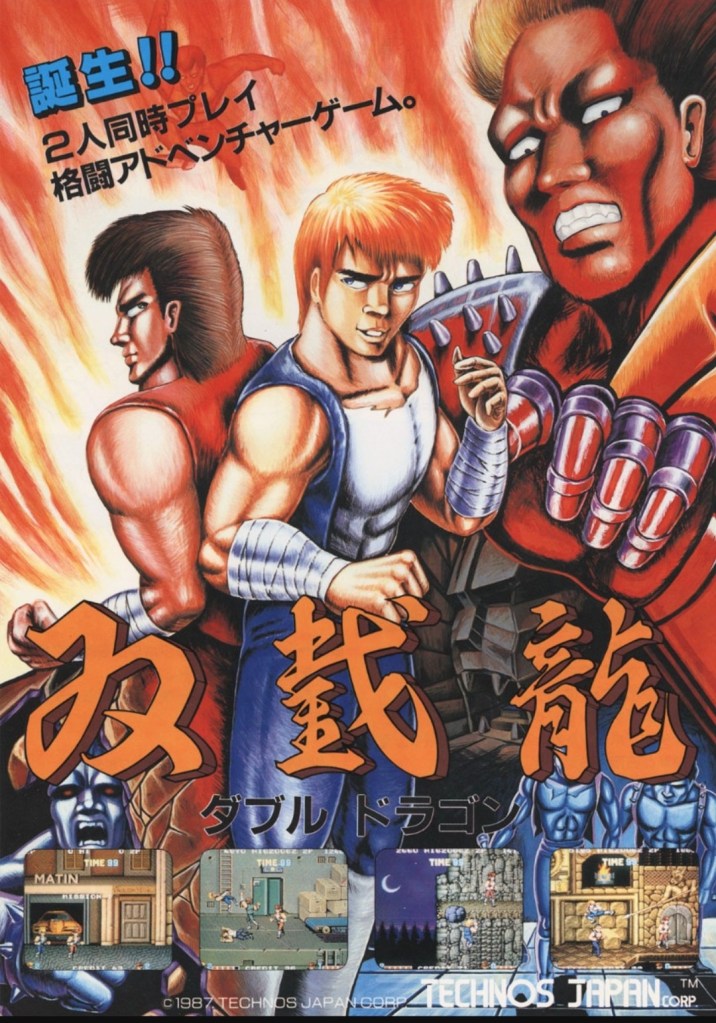
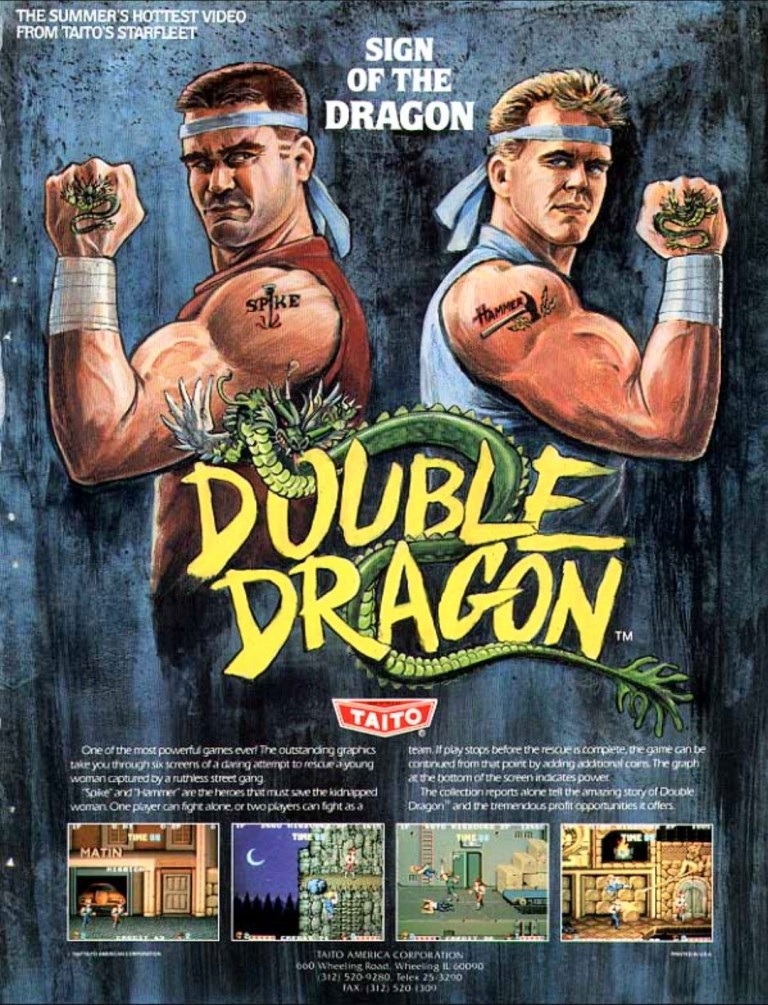
2. Double Dragon Japanese and North American arcade flyers
If you read manga (Japanese comics) in Japan, then the art style of this arcade flyer should look familiar to you.
The character designs seem inspired by 1980s Hollywood action cinema.
Released in 1987, Double Dragon became a huge hit in the arcades of Japan, America and Europe resulting in financial gains for developer Technōs Japan and publisher Taito. What I find intriguing was the fact that the Double Dragon arcade flyers for Japan and North America had drastically different art styles used to promote it. The Japanese flyer had art style that is more common with manga while the North American had artwork that seemed inspired by Hollywood action movies (as well as the rise of martial arts films in America during the 1980s). The American flyer even had the two characters identified as Hammer and Spike and they both looked American. This is a classic example of using different approaches to promote a game in each market.
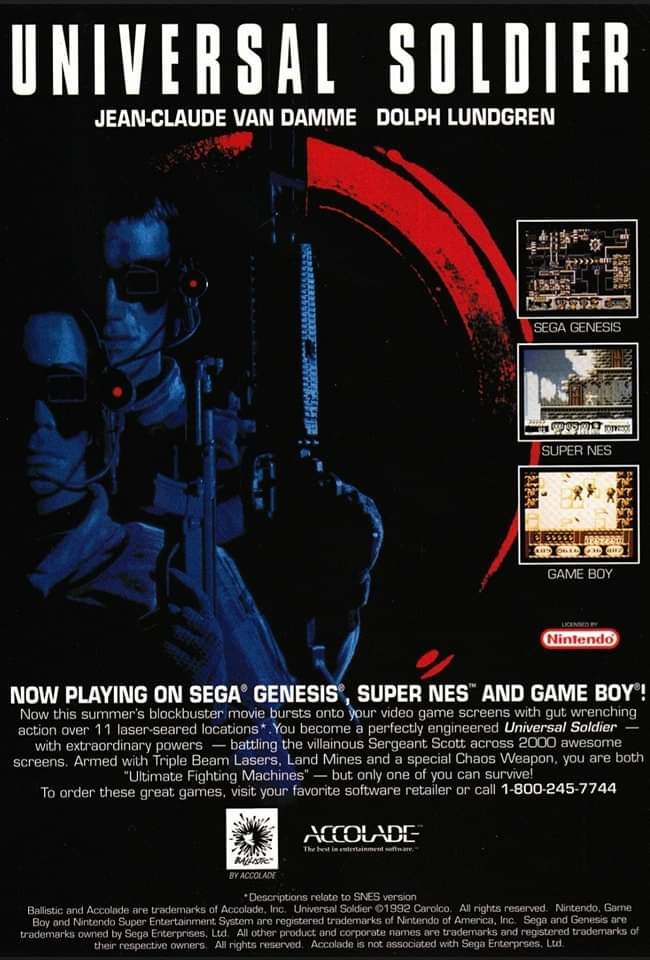
3. Universal Soldier print ad
The people who made this print ad made sure to use the names of the stars to help sell the game.
Even though its worldwide ticket sales did not reach $100 million, the 1992 movie Universal Soldier still caught a lot of attention from moviegoers simply because it had Jean-Claude Van Damme and Dolph Lundgren as the stars. Unsurprisingly, the movie had a video game adaptation and because publisher Accolade wanted to cash-in on the film’s hype, they made some deceptive moves by rebranding one of its games (already development) as a tie-in. Advertised as an official adaptation, Universal Soldier was actually a rushed conversion of Turrican II: The Final Fight. This print ad – which even showed the stars’ names – is a reminder of the deception Accolade pulled off.
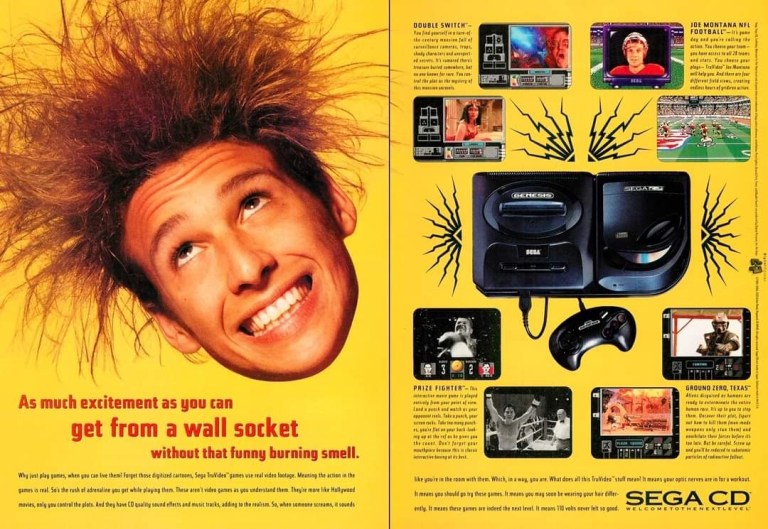
4. Sega CD print ad
Do you find this Sega CD print ad hilarious?
When Sega was making waves with its Sega Genesis (Sega Mega Drive in Japan), the company was quick to react to the growing use of the compact disc (CD) format as a useful storage medium for video games. The Sega CD (Mega CD in Japan) was released as an add-on device to work with the Genesis console and Sega’s American team came up with a series of promotions. This print ad is just one of the promotions and ad makers came up with a “crazed” or “electrified” gamer dominating one page while showing the Genesis, the Sega CD and screenshots of games (running on CD) on the other page. By today’s standards, the Sega CD print ad is funny and catchy to look at.
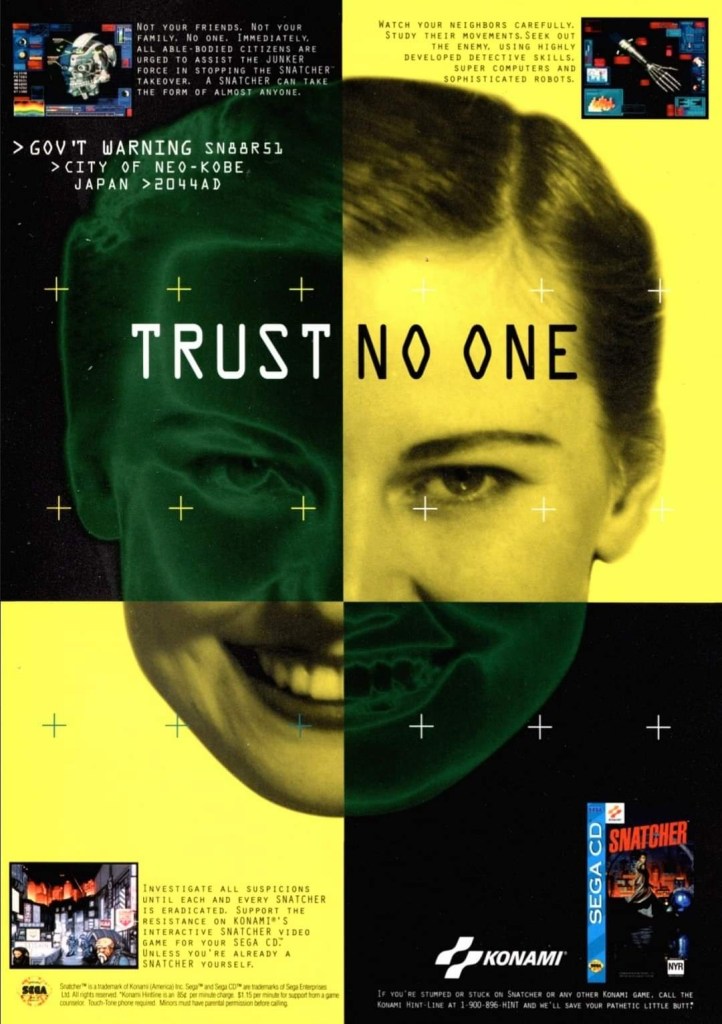
5. Snatcher for Sega CD print ad
I find this Snatch print ad looking odd. The ad makers could have done more to focus on the game itself.
First released in Japan in 1988, Snatcher was a cyberpunk visual adventure game that was one of the early works of the famous Hideo Kojima (Metal Gear series). Due to its design and approach on visuals to tell a story, it was not surprising that a Sega CD version of it got released in 1994. To promote the game to the growing number of North American Sega CD gamers at the time, Konami came up with this rather unusual print ad showing the face of a smiling lady dominating the space leaving little room to show the screenshots and the game’s cover. The visual concept is engaging but it takes effort to notice it was promoting the Sega CD version of the video game. This old ad would have worked better had the ad makers increased the sizes of the screenshots and the game cover.
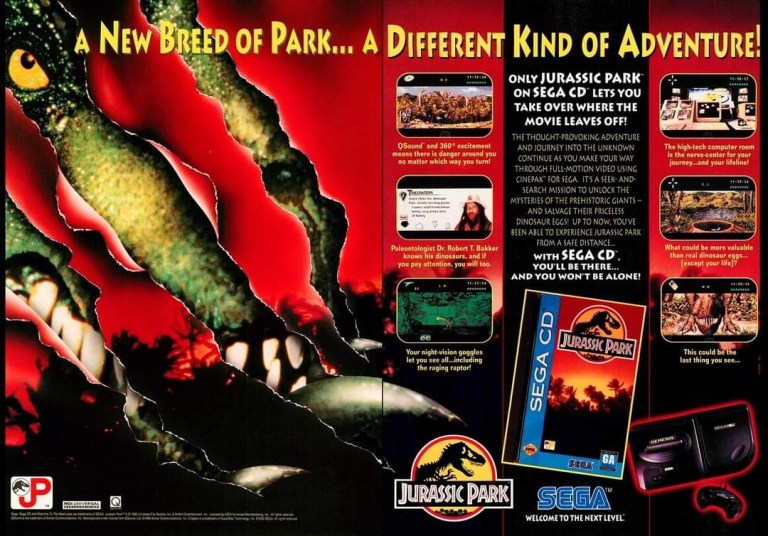
6. Jurassic Park for Sega CD print ad
Does the T. Rex look scary to you?
As part of its drive to add more games to the Sega CD add-on and help it sell more units, Sega acquired the Jurassic Park license and went on to produce an adaptation utilizing the technological features of the Sega CD. To aggressively promote the game, Sega came up with this print ad that had a Tyrannosaurs Rex (looking through spaces) on one page and then several screenshots plus text descriptions on the other. For a click-and-point Jurassic Park game, this ad was really exciting and intriguing to look at.
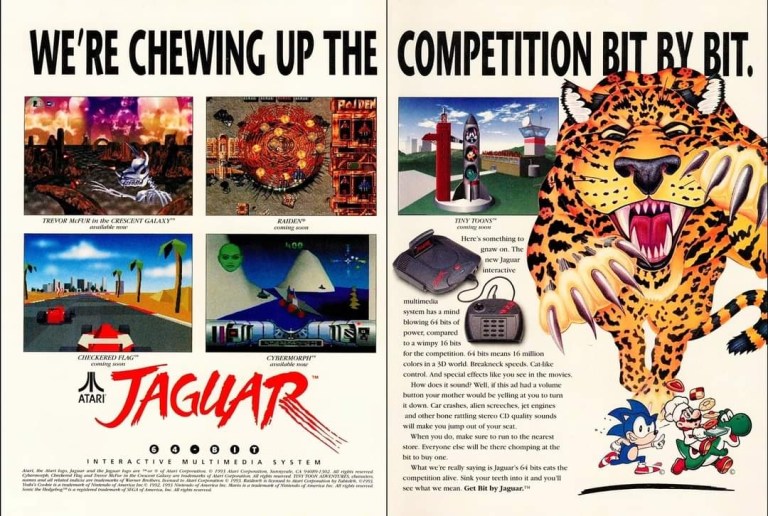
7. Atari Jaguar print ad
This was indeed an eye-catching ad.
In the early 1990s, Atari made an aggressive move to compete in the arena of video game consoles which they used to dominate from the late 1970s until 1983. This time around, they came up with the Jaguar console which had some pretty advanced technologies for the time. As part of their North American marketing campaign, Atari unleashed an ad showing game screenshots on the first page and huge artwork of a jaguar coming after Sonic, Mario and Yoshi (mascots of Sega and Nintendo respectively) symbolizing that the Atari Jaguar had more power and better technology than the Genesis and the Super Nintendo Entertainment System (SNS). While it was engaging to look at early on, this print ad is now an embarrassment as the Jaguar console failed terribly. Lastly, the marketing of the Jaguar as a 64-bit machine was never real.
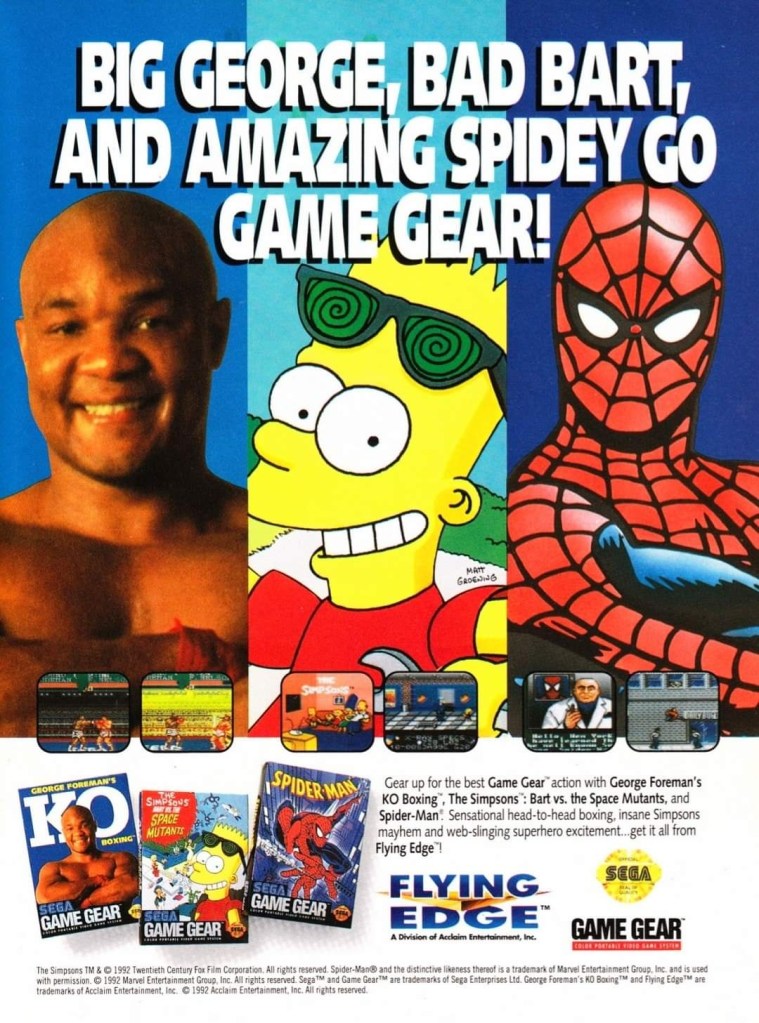
8. George Foreman, The Simpsons and Spider-Man Game Gear print ad
This ad appeared in a lot of comic books in the 1990s.
In the early 1990s, Sega released the Game Gear handheld gaming device which instantly placed them in competition with Nintendo’s Game Boy. Through its Flying Edge label, Acclaim Entertainment promoted George Foreman’s KO Boxing, The Simpsons: Bart vs. the Space Mutants, and Spider-Man for the Game Gear hoping to sell well. This 3-game print ad highlighted the popular figures who had a lot of space for attracting attention. The ad maker managed to insert two screenshots per game, the game covers and a text description to inform consumers what they were being offered. A good ad to look at.
9. Time Gal for Sega CD print ad
The presentation here looks nice but Time Gal herself looked like she was drawn by a different artist.
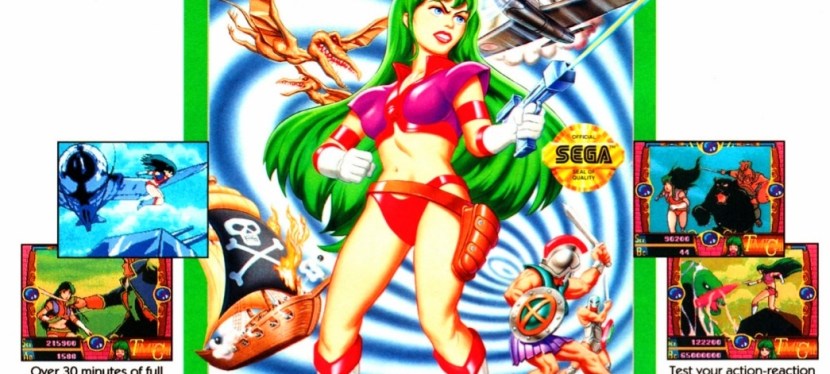
Originally released in the arcades in Japan in 1985, Time Gal made its way to the Sega CD add-on in the early 1990s. It was a highly unusual video game as it was an interactive movie (with lots of anime footage) made with the use of Laserdisc technology for its arcade version. It played lots of anime scenes and players must choose the on-screen options to execute the character’s next action in order to progress. For the Sega CD version for North America, this print was made to capture the attention of consumers using the protagonist’s sex appeal on the cover art with four screenshots placed on the sides to show what to expect. I noticed that Time Gal on the cover art looked different from how she appeared in the anime sequences. At least the ad makers tried hard to sell the game.
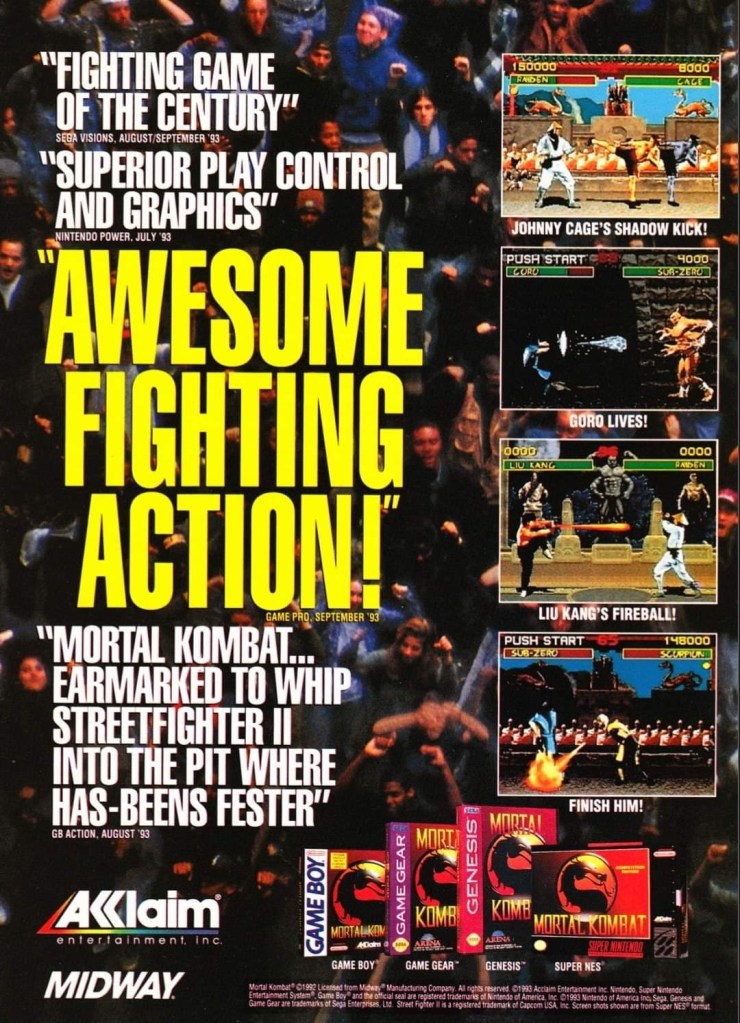
10. Mortal Kombat print ad
Still an effective ad to promote a blockbuster game and make people informed it was coming to multiple platforms.
Considering how successful it was in the arcades, the 1993 release of Mortal Kombat for game consoles and handhelds was unsurprisingly highly anticipated and publisher acclaim came up with this single-page ad. The presentation involved the use of a photographic background of many spectators (to emphasize excitement and popularity), media quotes and screenshots to effectively promote the game.
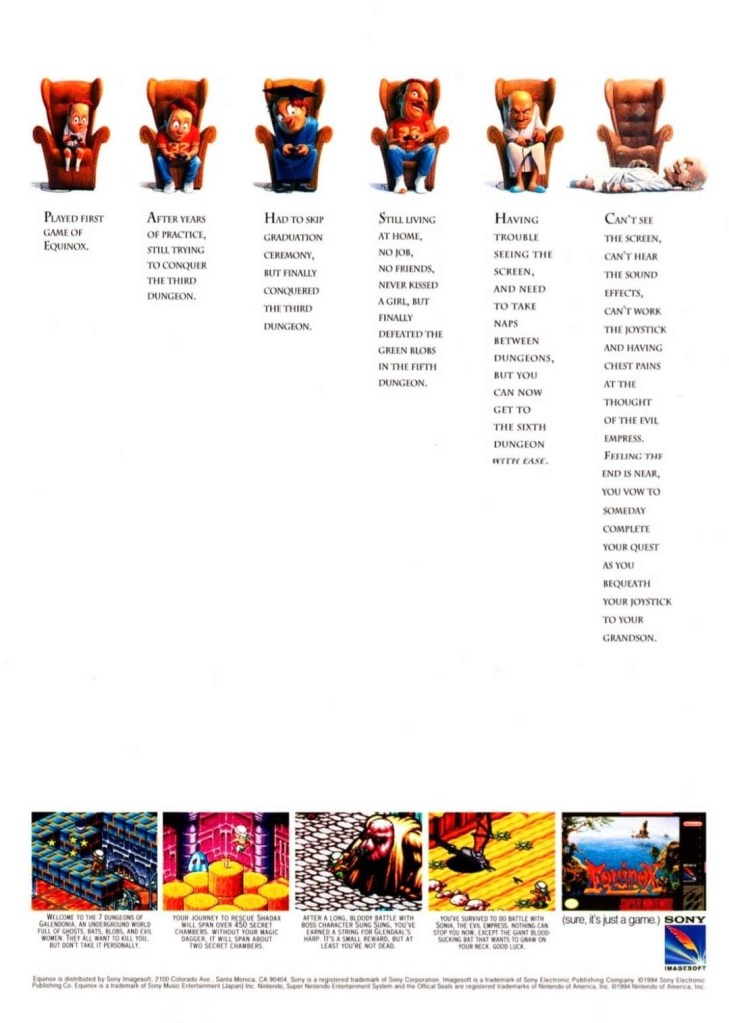
11. Equinox print ad
Take a close look. Tell me if you find it funny.
I never played Equinox but I heard the loud buzz about its design as a 3D isometric game that had elements of exploration, platform play and puzzle solving. The people responsible for this print ad emphasized the concept that the game is so addicting to play, players will still play it as they get older. This ad has a subtle yet effective approach with humor.
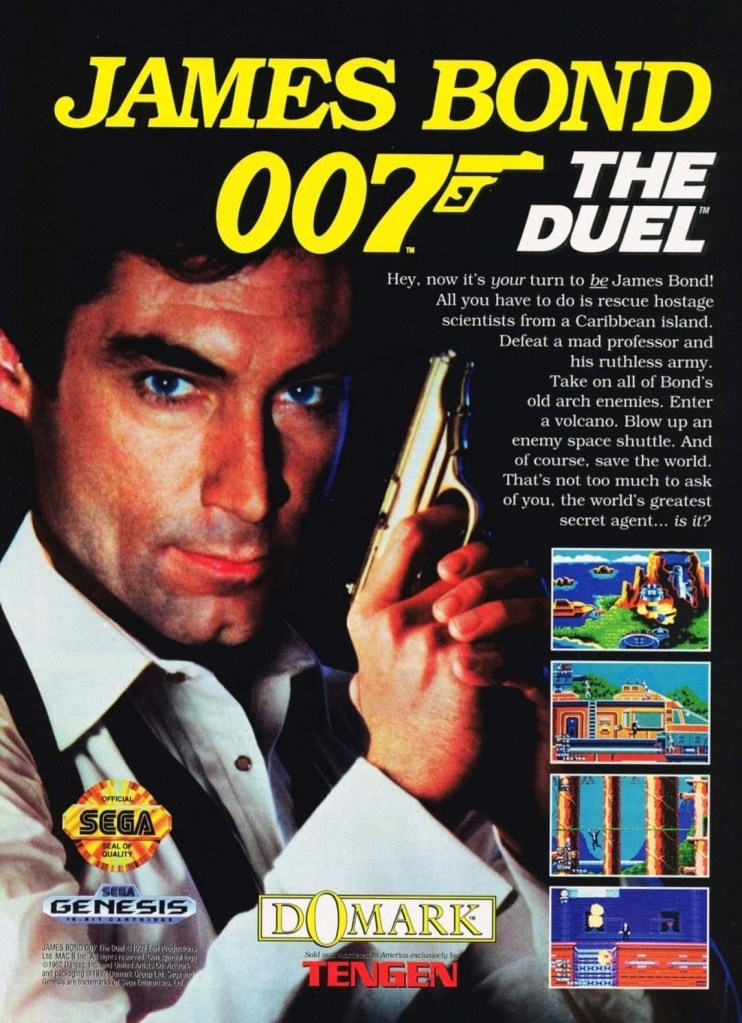
12. James Bond 007: The Duel print ad
Timothy Dalton’s image as James Bond was sourced from Licence to Kill for this game’s ad.
Here is another decades-old James Bond video game print ad I found. Released a few years after Licence to Kill, James Bond 007: The Duel was notable not for its gameplay nor game design but for the fact that it used the image of Timothy Dalton as 007 for its print ad and the opening scenes in the game itself. Dalton’s Bond image here was never new nor originally taken for the game as it came directly from Licence to Kill’s publicity library. Each time I saw this ad, I was only reminded of the 1989 movie which I still enjoy watching.
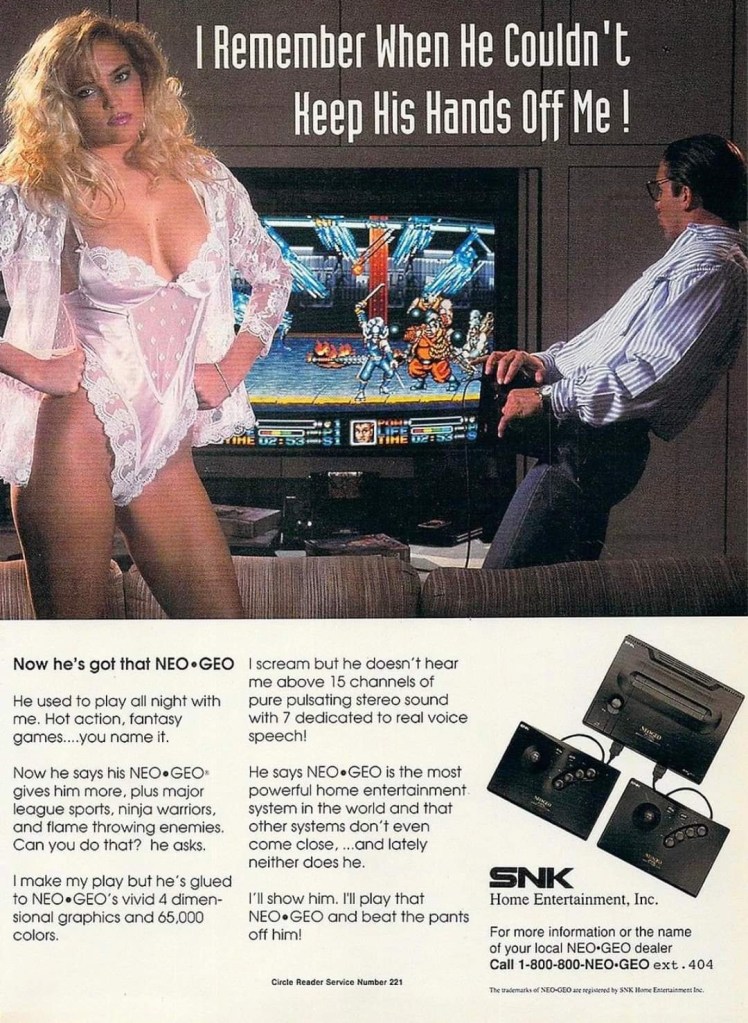
13. Neo Geo AES console print ad
Do you find this ad both sexy and funny?
Decades ago, SNK made a huge splash in the arcades with lots of really fun games released with their Neo Geo (stylized as NEO GEO) hardware. In 1990, they released the cartridge-based Neo Geo AES console in Japan and America and it carried the same technology as the arcade hardware. To promote the console in North America (note: the Neo Geo console and its games were very expensive), SNK came up with this catchy and funny print ad showing a sexy woman feeling annoyed that her man spends more time with Neo Geo gaming than with her. This was a clever way of emphasizing the arcade-perfect experience in the comfort of home, and it was funny to look at.
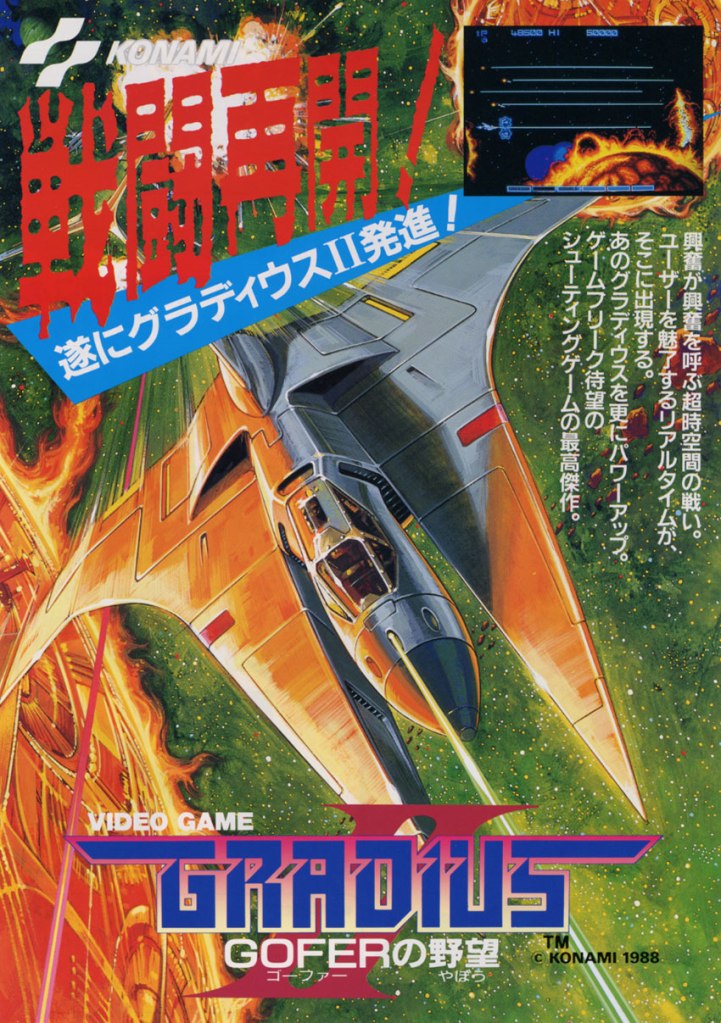
14. Gradius II Japanese arcade flyer
Great looking painted art was used for this 1988 arcade game.
Since the original Gradius was a big hit in arcades in Japan in 1985, it was not surprising that Konami released Gradius II three years later. With regards to the use of painted art, the artist showed the game’s spaceship in a dominating position emphasizing high-speed travel and excitement. The image, which also looks more colorful, is a complete reversal of the painted art used in the flyer of the previous which showed the rear of the spaceship as it moves towards a larger spaceship (the opposition). This arcade flyer art still looks great as it has a timeless charm.
Welcome back, my readers, YouTube viewers and all others who followed this series of articles focused on YouTube videos worth watching. Have you been searching for something fun or interesting to watch on YouTube? Do you feel bored right now and you crave for something to see on the world’s most popular online video destination?
I recommend you check out the following topics and the related videos I found.
#1Donald Trump’s decades-long journey to becoming US President – No matter what your political views are, there is no denying that Donald Trump’s incredible 2016 election victory as President of the United States was the culmination of a very long journey that started since 1980s. As Trump kept doing lots of business, he observed what went wrong in America, what the nation lost to other countries with regards to trade or diplomacy, why many ordinary Americans became forgotten, and more. Watch Trump’s journey in the video below.
#2 A look back at Street Fighter II V (anime) – If you are a long-time gamer like me, chance are, you must have played one of the many games of Street Fighter II. If you have played the games, were you able to watch the short-lived anime series titled Street Fighter II V? Loosely based on Super Street Fighter II Turbo, the anime series started in 1995 and was directed by Gisaburō Sugii who was responsible for the anime movie of 1994. I found two YouTube videos revisiting Street Fighter II V posted below for your enjoyment.
#3 Fox News interview shows Kamala Fit is too dishonest and too out-of-touch to be US President – If there is anything notable with the incumbent United States Vice President Kamala Harris – the one woke candidate the Democrats nominated after pushing Joe Biden out of the way – is that she has a very distorted view of reality and she is very unfit to become US President. Her recent interview with Fox News is the worst yet and the consequences are still being felt as I write this down. Watch the selected videos below to find out.
#4 A look back at Koudelka – During the late stage of the first PlayStation console’s life, Japanese role-playing games (JRPGs) became really popular with gamers in Europe and America. Back in 1999, the role-playing game Koudelka was released on PlayStation in Japan and an international release followed in 2000. That game did not achieve critical acclaim and was never a big seller. As many old-time gamers have forgotten about its existence, Koudelka’s production history is rather intriguing and surprising to discover.
Koudelka was developed by Sacnoth which was founded by former Squaresoft employee Hiroki Kikuta (Secret of Mana, Trials of Mana, and Soukaigi). To find out why Koudelka had an unusual RPG concept and style of gameplay, I encourage you to watch the retro gaming video below.
#5 More Iranians need Israel’s help – It is a fact that the Islamic regime of Iran has a long record of brutalizing Iranians who do not follow their evil moves. In short, the people of Iran are not their wicked government. That being said, the dissenting Iranians are reaching out to Israel for help in the form of military action against the evil regime. Watch the video of The 700 Club below. It includes statements from Iran’s Crown Prince Reza Pahlavi.
#6. George Romero was hired to make a Resident Evil motion picture – Back in the late 1990s when the Resident Evil game franchise really soared in popularity and became bankable for Capcom, a movie project was approved and the late George A. Romero (Night of the Living Dead, Dawn of the Dead, Creepshow) was hired to write and direct it. It should be noted that Capcom hired Romero to make the Resident Evil 2 commercial which became very popular and contributed to the game’s big success. Eventually, Romero’s drafts of the script got rejected and Constantin Film replaced him with Paul W. S. Anderson resulting in the 2002 Resident Evil movie.
If you are fascinated with Romero’s short-lived involvement with the Resident Evil movie project, you should watch the related videos posted below…
#7. China’s Bonnie and Clyde – Have you been following the YouTube channel Dark Asia with Megan? Every week, there is always a new episode about true crime stories that took place within Asia and the host Megan is often great with her presentation and she clearly does a lot of research. Recently an episode about China’s very own Bonnie and Clyde was released. I saw it and it is very intriguing to watch. For the newcomers reading this, Bonnie and Clyde refers to real-life American bandits and serial killers who caused a lot of trouble from 1931 to 1934. Hollywood even released a movie in 1967 glorifying them. As for who exactly were China’s Bonnie and Clyde, and what had they done, I encourage you to watch Dark Asia with Megan’s episode below.
#8. Kamala Harris supporter shouts at toddler – Going back to the 2024 US Presidential campaign, a supporter of Communist Kamala Harris (the US Vice President since 2021) was caught on camera yelling at and traumatizing a toddler. I know for a fact that liberals, Leftists, Marxists, socialists and woke Americans can be quite wild but the die-hard Kamala supporter who screamed at the toddler clearly has crossed the line. It makes me wonder if the Democrats ever oriented their supporters to be civil and in control. Watch the Sky News Australia Lefties Losing It video below.
#9. Kamala Harris got booed at her own campaign rally! – The presidential campaign of Commie Kamala Harris is clearly failing not only because the opinion polls – most of which are Left-leaning and oversampling Democrat voters – are showing her falling further behind Donald Trump but also because unfortunate events have been happening at her campaign rallies. The new embarrassment this time is Harris getting booed at her own campaign rally! Watch the videos below.








 Author Carlo Carrasco