Disclaimer: This is my original work with details sourced from reading the comic book and doing personal research. Anyone who wants to use this article, in part or in whole, needs to secure first my permission and agree to cite me as the source and author. Let it be known that any unauthorized use of this article will constrain the author to pursue the remedies under R.A. No. 8293, the Revised Penal Code, and/or all applicable legal actions under the laws of the Philippines.
Welcome back, superhero enthusiasts, 1990s culture enthusiasts, X-Men fans and comic book collectors! Today we revisit the Marvel Comics shared universe through one of the many tales of the X-Men 2099 monthly series.
One of the things I enjoyed the most about the X-Men 2099 series was its expansion of the 2099 universe lore as well as the portrayal of uncertainty that mutants deal with in the more desolate parts of America (far away from Spider-Man 2099 and Punisher 2099). Along the way, the futuristic X-Men themselves were really torn down by a series of unfortunate events that includes the departure of their founder and leader Xi’an (eventually Controller X of the Theater of Pain). With the team members separated by circumstances, they were given their own tales and character development periods.
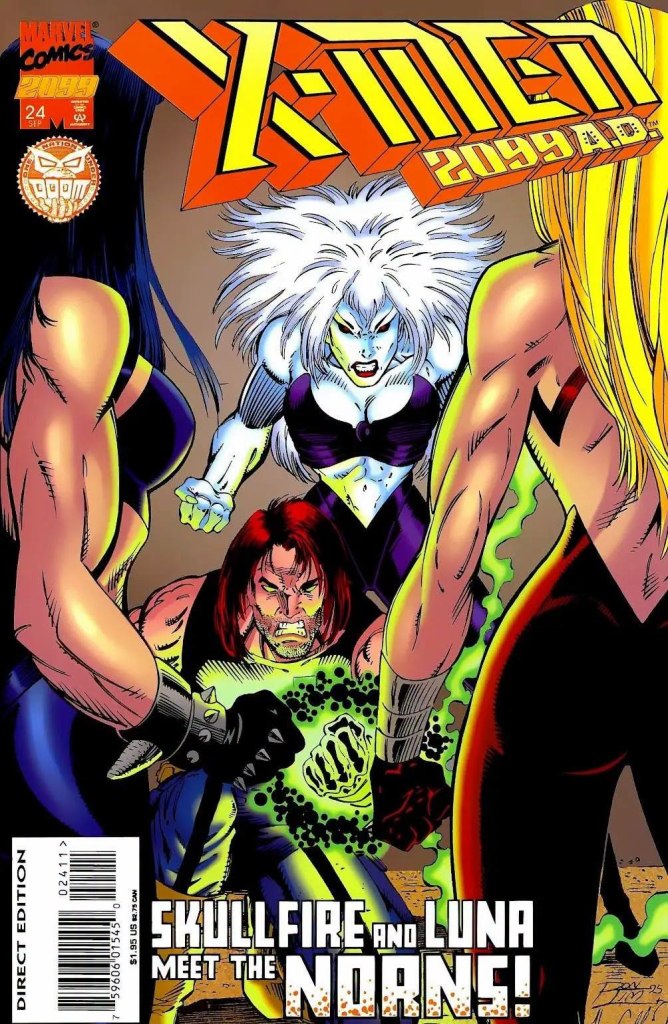
With those details laid down, here is a look back at X-Men 2099 #24, published by Marvel Comics in 1995 with a story written by John Francis Moore and drawn by Ron Lim.
The cover.
Early story
The story begins in southern California where the Slaughterhouse gets shaken by the force of a gamma bomb that detonated far away. Inside the facility, Quiver and Sham struggle as they sneak carefully. They intend to escape even though the odds are against them.
Nearby, the demonic Theater of Pain leader Brimstone Love strikes Junkpile (now with SHIELD serving the new President Doom 2099) hard and seriously damages him. With Junkpile down, the evil leader believes that Doom’s best is a failure and the Theater of Pain has nothing to fear from him. Brimstone Love issues an order to have Junkpile disposed.
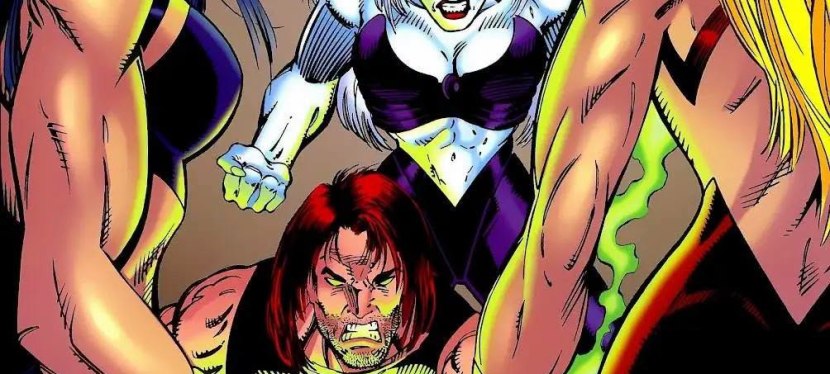
Several feet below the ground, Skullfire and Luna find themselves contained after getting captured. For Luna, Xi’an is a lost cause and she prefers to find Shakti and escape. Skullfire, however, insists on pursuing Xi’an even though their situation looks very hopeless. As the two try to escape, they end up facing the muses of the Theater of Pain’s bloodsport arenas…Euphoria, Felicity and Bliss. Luna was previously one of them…
Quality
Shakti represents the remaining X-Men while her former superior Xi’an has fully sided with the evil Theater of Pain as Controller X.
Being the comic book that immediately precedes issue #25, there is a lot of creative stuff here that X-Men 2099 fans will enjoy. The Moore-Lim duo took their time in setting up the eventual restoration of the futuristic X-Men as a team while carefully telling the dangerous events they will face with the Theater of Pain standing in their way.
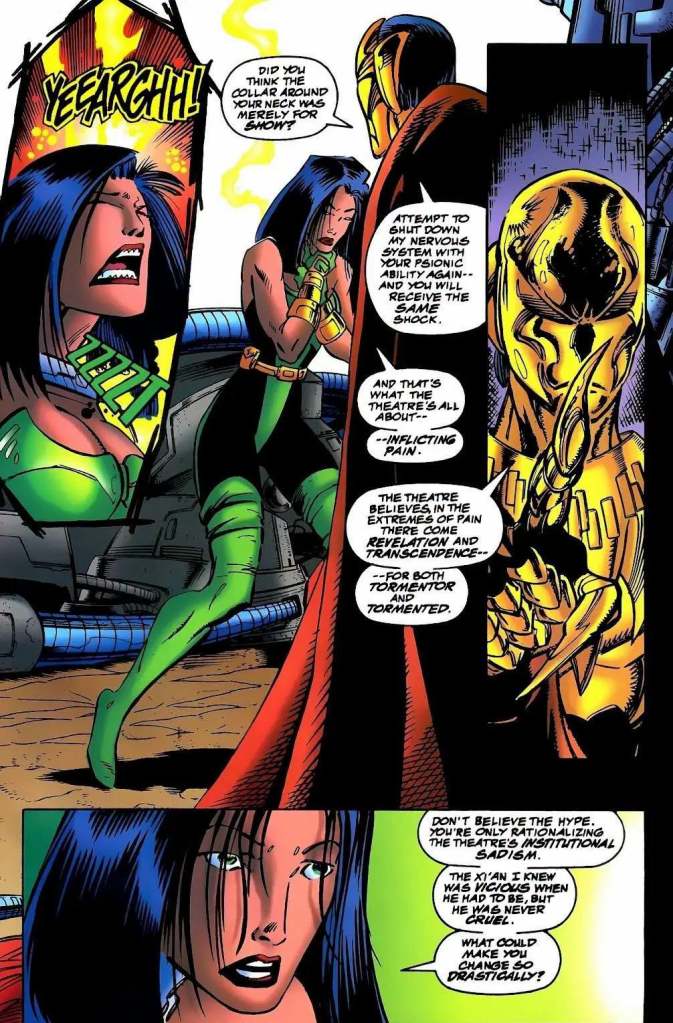
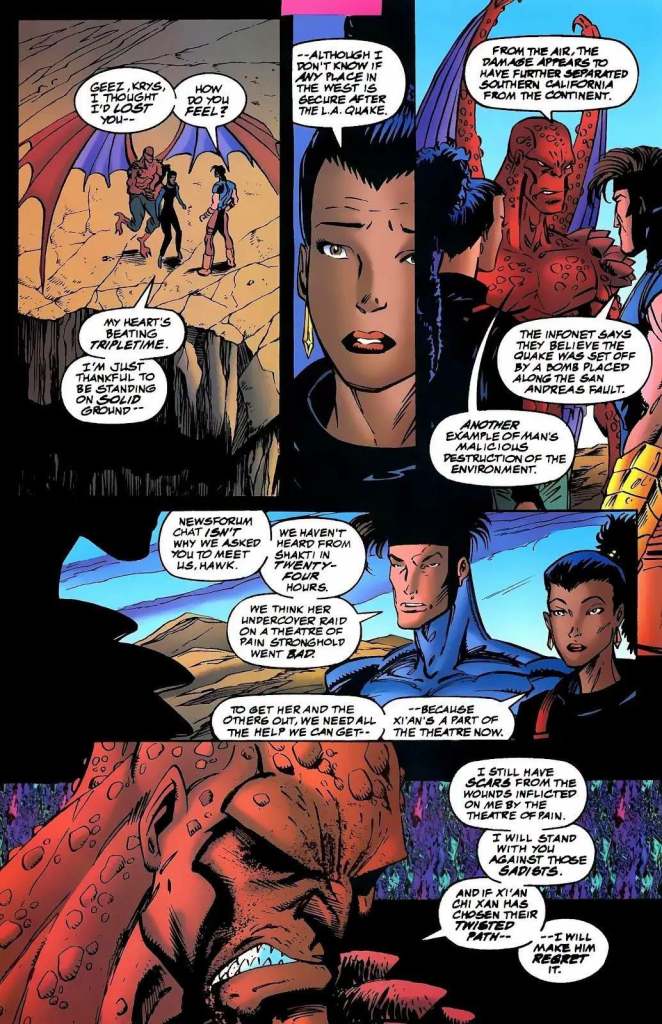
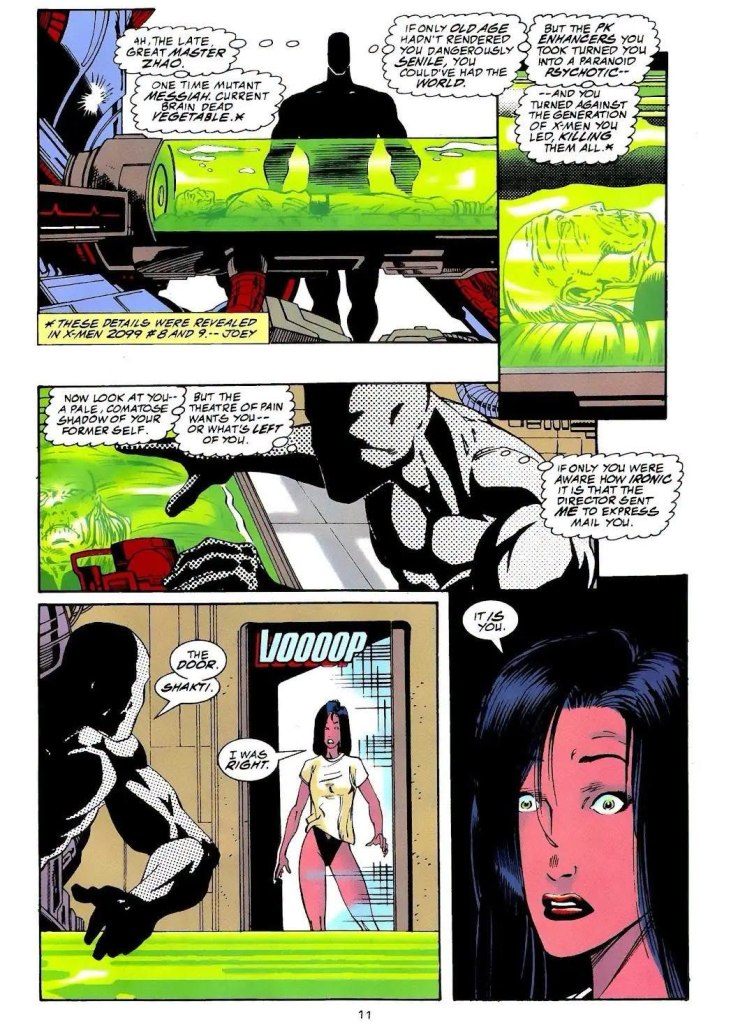
Fans can find small moments that can be enjoyable or even intriguing to discover such as Luna facing off with her Theater of Pain “sisters” of long ago, the reuniting of Bloodhawk with Meanstreak and Krystalin followed by the justification behind their decision to get involved, and more. What I find very compelling to read is Shakti’s interaction with Controller X (Xi’an behind the mask obsessively serving the Theater of Pain) and the rising danger the Theater’s operation is brewing. There is richness in the dialogue between Shakti and Xi’an, and the symbolic division between them – Shakti representing the X-Men and their former leader Xi’an now serving the evil ones – is really powerful to see.
The storytelling as a whole has a lot of depth behind it, and the build-up of the events is undeniably powerful. As the story progressed, the tension also grew stronger and you can feel the danger that awaits the futuristic X-Men.
Conclusion
Bloodhawk is back with Meanstreak and Krystalin.
X-Men 2099 #24 (1995) succeeds a lot on setting-up the big conflict of issue #25 and it also sets in motion the eventual reuniting of the X-Men. Along the way, there are small details here and there that will compel you to revisit previous X-Men 2099 issues. Brimstone Love’s evil was emphasized more here and Controller X/Xi’an’s determination to serve him and make a lot of people suffer under the Theater’s operation added a lot of tension to the plot. Consider this a very important read before reading X-Men 2099 #25.
Disclaimer: This is my original work with details sourced from reading the comic book and doing personal research. Anyone who wants to use this article, in part or in whole, needs to secure first my permission and agree to cite me as the source and author. Let it be known that any unauthorized use of this article will constrain the author to pursue the remedies under R.A. No. 8293, the Revised Penal Code, and/or all applicable legal actions under the laws of the Philippines.
Welcome back, superhero enthusiasts, 1990s culture enthusiasts, X-Men fans and comic book collectors! Today we revisit the Marvel Comics shared universe through one of the many tales of the X-Men 2099 monthly series.
Having taken over the United States as its President, Doom 2099’s impact was undeniably felt even though his appearances in X-Men 2099 issues #21 and #22 were pretty short. Along the way, members of the futuristic X-Men are gradually making their way back together. While Meanstreak and Krystalin have reunited and left Las Vegas, the trio of Skullfire, Shakti and Luna pursue a dangerous mission to get back Xi’an who has officially joined the Theater of Pain led by the demonic Brimstone Love.
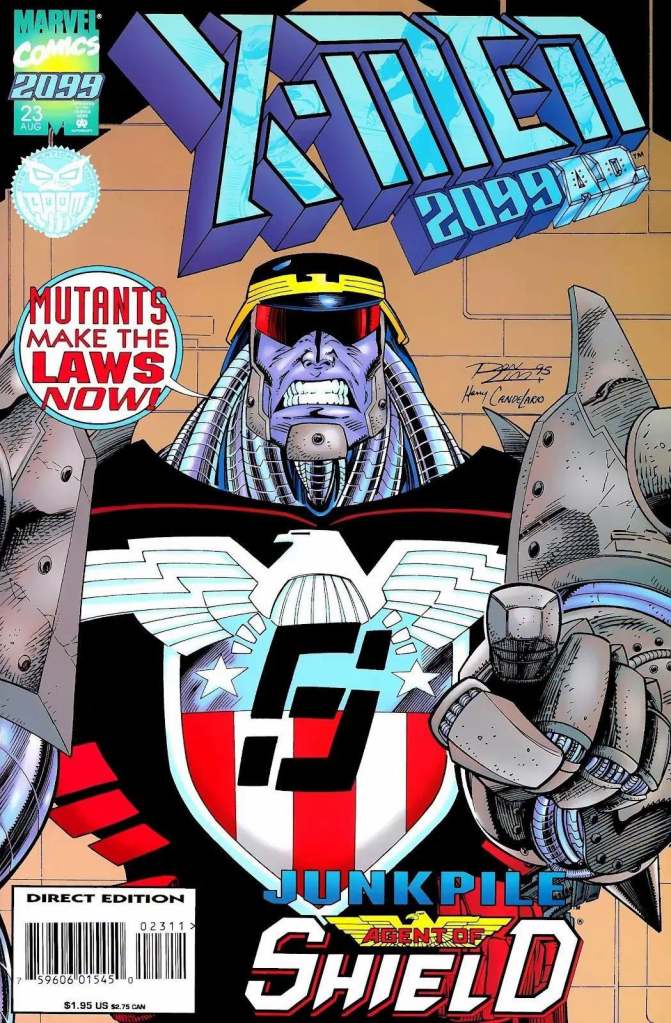
With those details laid down, here is a look back at X-Men 2099 #23, published by Marvel Comics in 1995 with a story written by John Francis Moore and drawn by Ron Lim.
The cover.
Early story
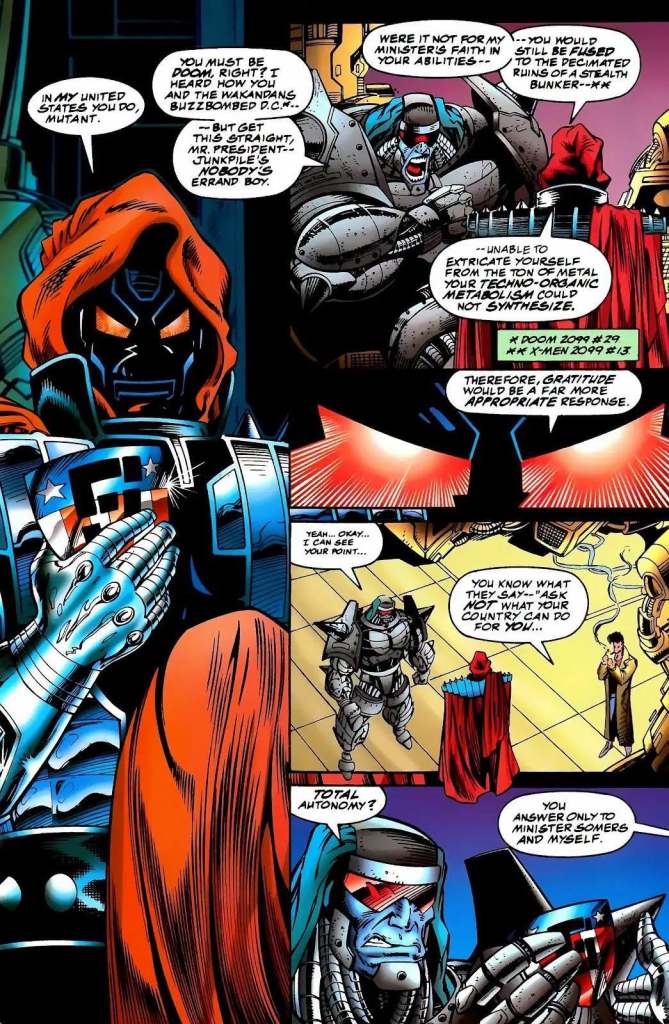
The story begins with Junkpile who was recently rescued by Doom’s team and restored to functioning status. Doom’s minister of humanity Morphine Somers informs him that he has the chance to join SHIELD (the elite security force of the nation) and operate autonomously and with full administrative sanction. Suddenly, Doom himself appears and convinces Junkpile to calm down and formally join SHIELD.
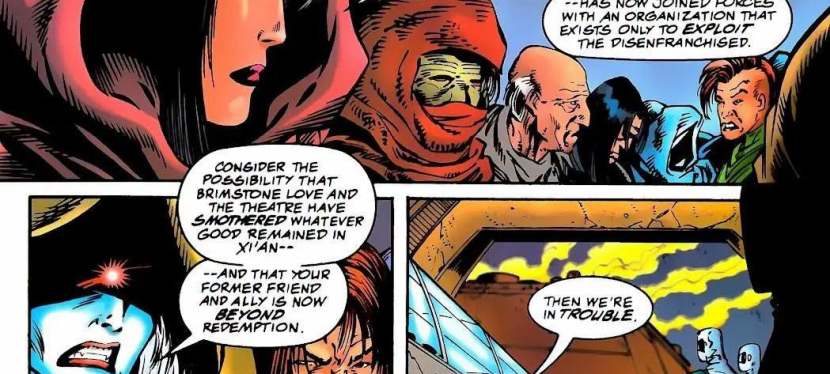
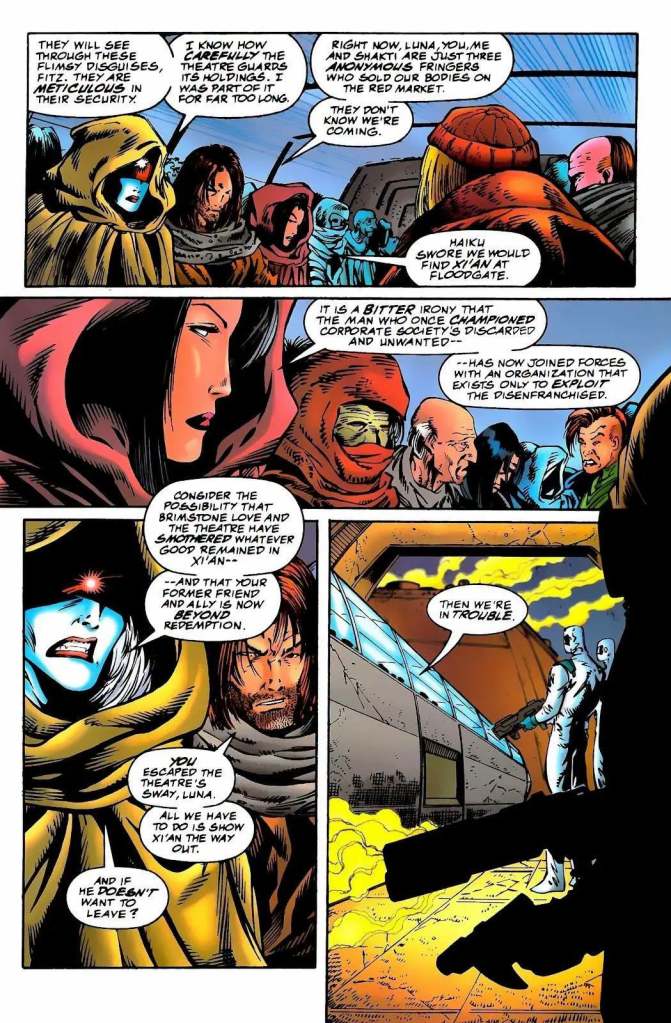
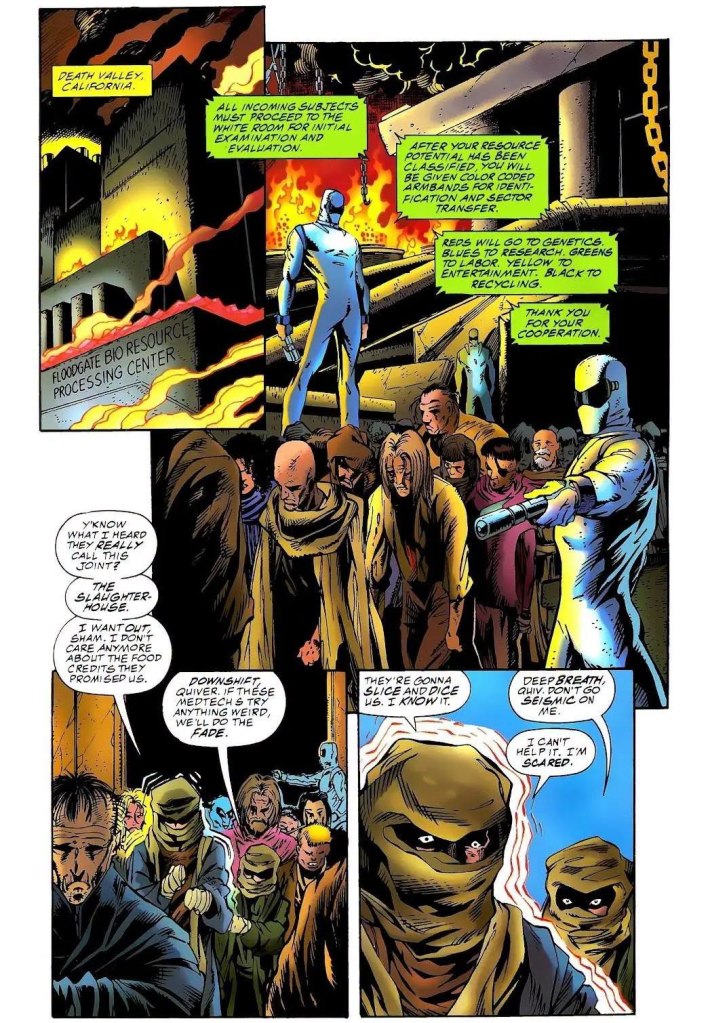
Over at Death Valley, Skullfire, Shakti and Luna are disguised and traveling with the many disenfranchised people (the ones discarded and unwanted by society) heading to the floodgate bio-resource processing center. Even though the odds are tremendous, the three of them are determined to find their former leader Xi’an and save him from the Theater of Pain.
Upon arriving at the floodgate facility filled with armed guards and handlers, Skullfire, Shakti and Luna join the line for processing. Watching from a distance is Xi’an who is now operating as Controller X…
Quality
Pay attention to the details closely. In 2099, human lives can be disregarded or turned into something else.
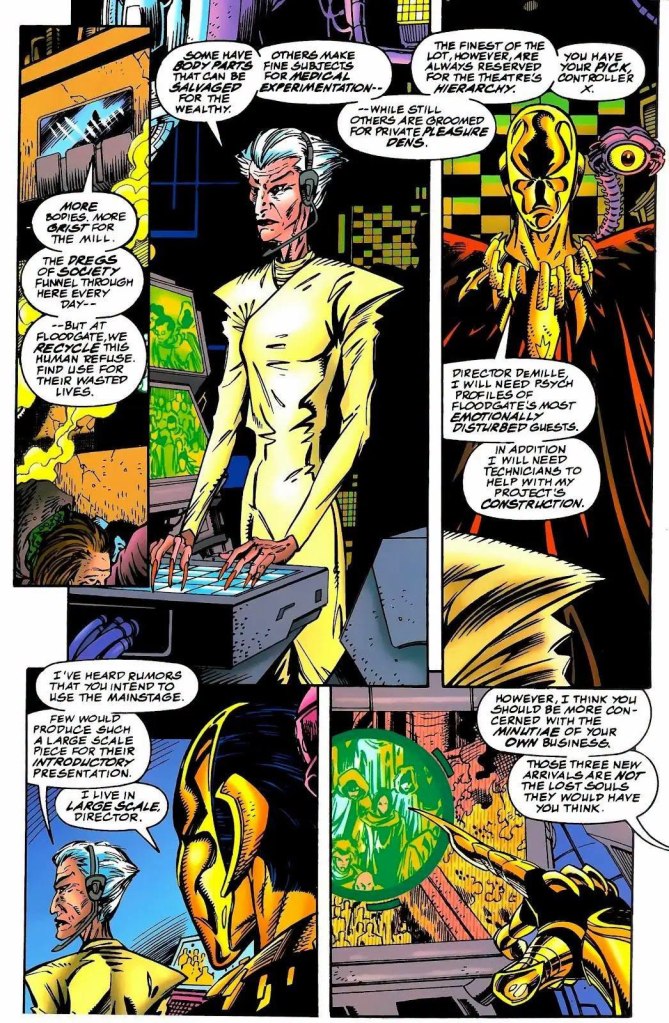
Apart from the obvious fact that this particular story is part of the build-up towards the events of issue #25, this comic book carries a fundamental expansion of the lore of America of 2099. As the theme of mega corporations taking over America has been a core element of Marvel 2099, this X-Men 2099 tale further explores what happens to the social outcasts and unwanted people, and why the self-declared authorities have such power to have each of them processed under heavy surveillance.
Even without resources, Skullfire, Shakti and Luna push through with their very dangerous mission.
Through words and images, the Moore-Lim duo gave readers a really dark look at how human lives got turned into commodities by those who wield a lot of power in 2099 America. Some people who got processed end up being subjects for medical experimentation, others are groomed for private pleasure dens while the best ones are prepared for the use of the Theater of Pain. That said, Xi’an being part of the Theater of Pain as Controller X really strikes hard at the foundation of the futuristic X-Men who have been struggling a lot since he left them.
More on the plot itself, the X-Men are the underdogs and they really don’t have much resources nor a solid strategy to get to Xi’an while dealing with the dangerous forces of Brimstone Love and the Theater of Pain. Fortunately for them, there are a few others who have the means to take on the Theater of Pain directly.
Conclusion
Junkpile joins SHIELD in the presence of Doom 2099.
X-Men 2099 #23 (1995) is another engaging read and it nicely sets the stage for the inevitable big story in issue #25. The odds are really up against the X-Men whose three members are truly determined to get Xi’an back believing there is hope for him to turn away from the Theater of Pain. Bigger than the story itself is the presentation about the immense power others have over the people and why being a social outcast can be very dangerous. That said, I am looking forward to the next issue and see how it connects with issue #25.
Disclaimer: This is my original work with details sourced from reading the comic book and doing personal research. Anyone who wants to use this article, in part or in whole, needs to secure first my permission and agree to cite me as the source and author. Let it be known that any unauthorized use of this article will constrain the author to pursue the remedies under R.A. No. 8293, the Revised Penal Code, and/or all applicable legal actions under the laws of the Philippines.
Welcome back, superhero enthusiasts, 1990s culture enthusiasts, X-Men fans and comic book collectors! Today we revisit the Marvel Comics shared universe through one of the many tales of the X-Men 2099 monthly series.
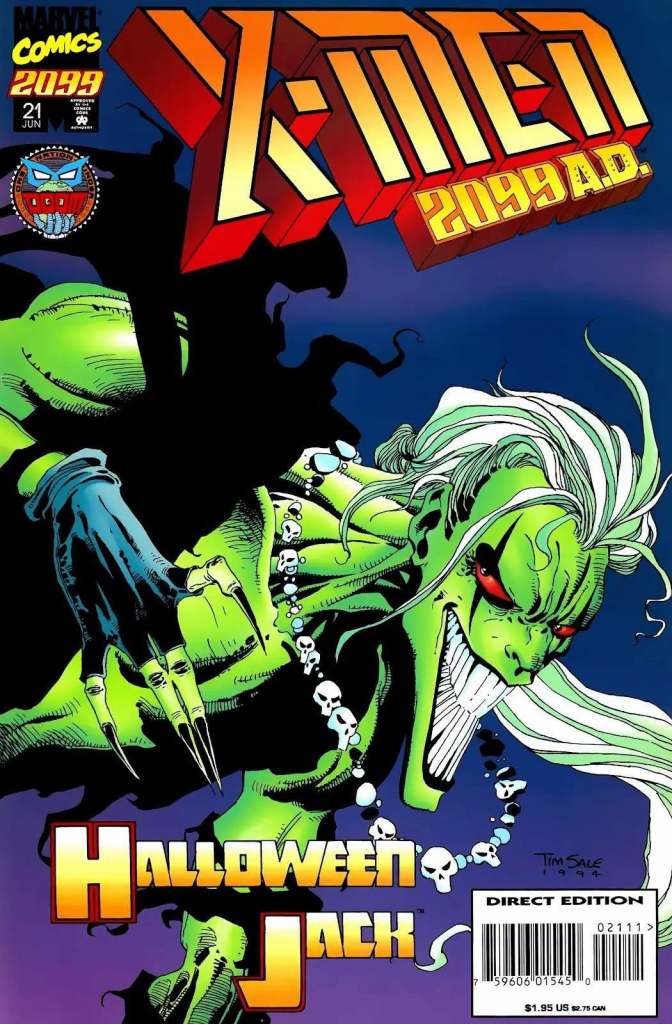
Issue #21 had a wild story as it reflected the impact of Doom 2099 who took over as President of the United States. Not only did Doom appear (which easily reminded readers about the Fall of the Hammer storyline and the few X-Men members who got involved) in Las Vegas, Halloween Jack was on the verge of causing tremendous chaos on the city and many innocent people within. Quite notably, the series started its movement of gradually getting the futuristic X-Men together again.
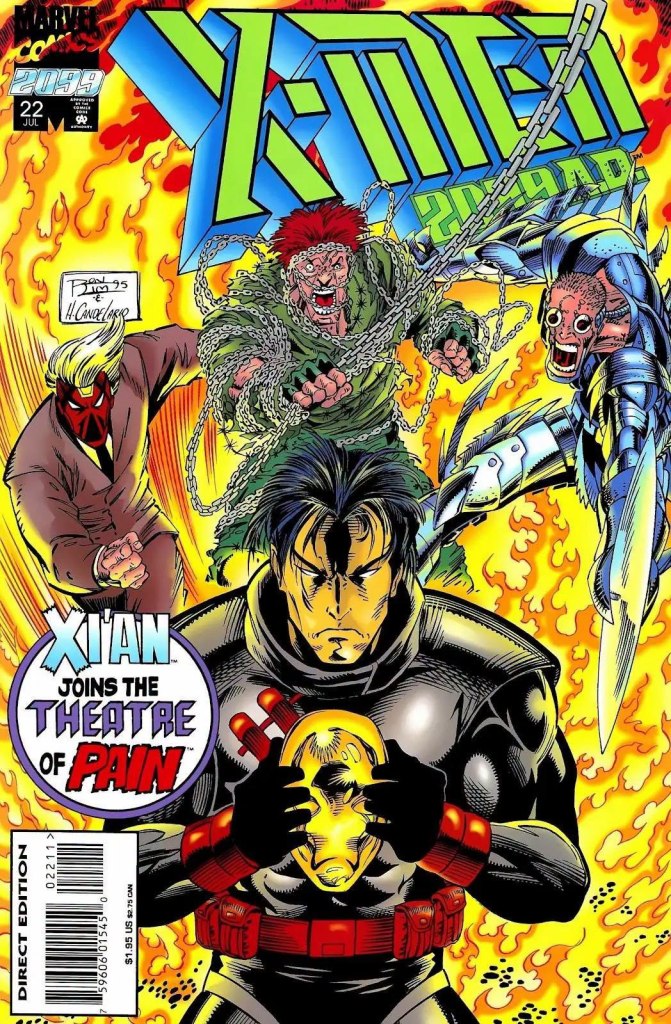
With those details laid down, here is a look back at X-Men 2099 #22, published by Marvel Comics in 1995 with a story written by John Francis Moore and drawn by Ron Lim.
The cover.
Early story
The story begins at the Sangre de Cristo mountains in New Mexico where a government helicopter arrives. Morphine Somers and an armored member of S.H.IE.L.D. appear to inspect the ruins. No lifeforms dead or alive were detected.
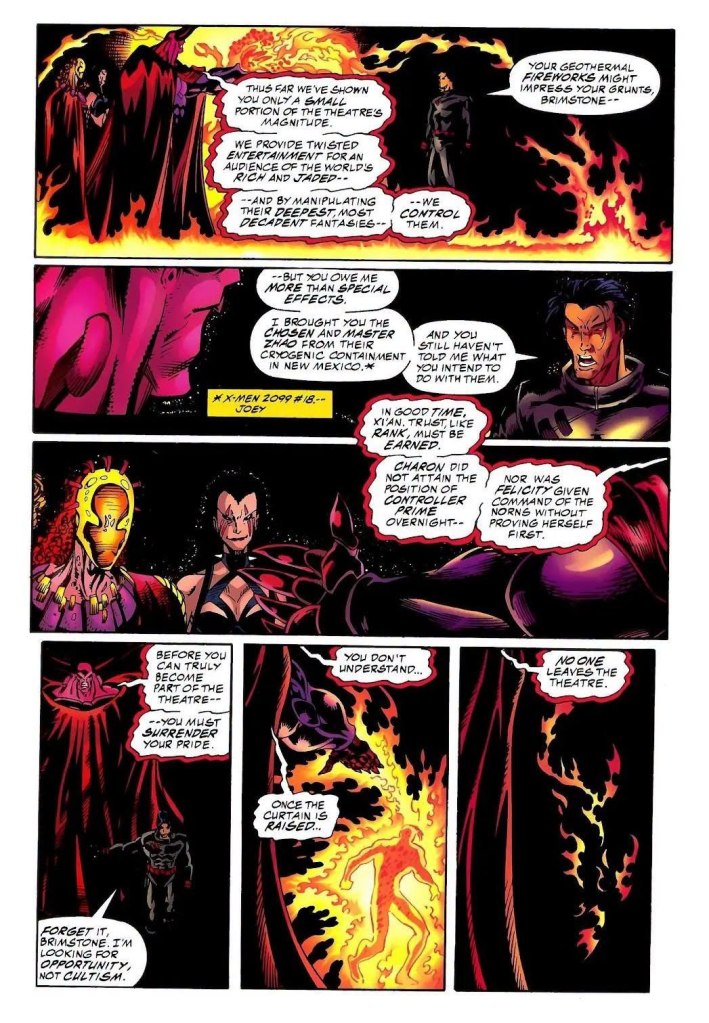
Meanwhile at a very dark location lighted by flames, former X-Men leader Xi’an meets with Brimstone Love and his trusted companions Charon and Felicity. The demonic leader of the Theater of Pain tells Xi’an that once he is initiated into the exquisite mysteries and dark truths of their group, he will emerge transformed. The Theater of Pain operates by providing twisted entertainment for an audience of the world’s rich and jaded, and by manipulating their deepest, most decadent fantasies which puts them under control.
Xi’an, who reverted back to his sinister self and abandoned the principles he held as leader of the X-Men, arrogantly tells Brimstone Love that he brought the Chosen and Master Zhao to him without being told what would happen to them. After being told that he must surrender his pride to become part of the Theater of Pain, Xi’an turns his back on the leader and begins to walk away expressing rejection. Brimstone Love suddenly tells him no one leaves the theater and teleports him…
Quality
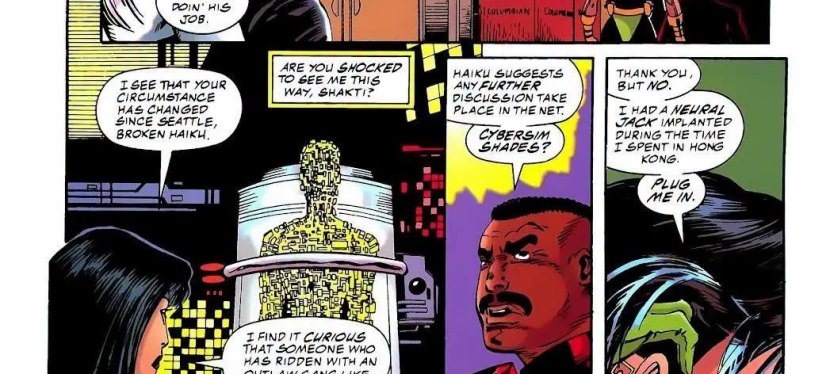
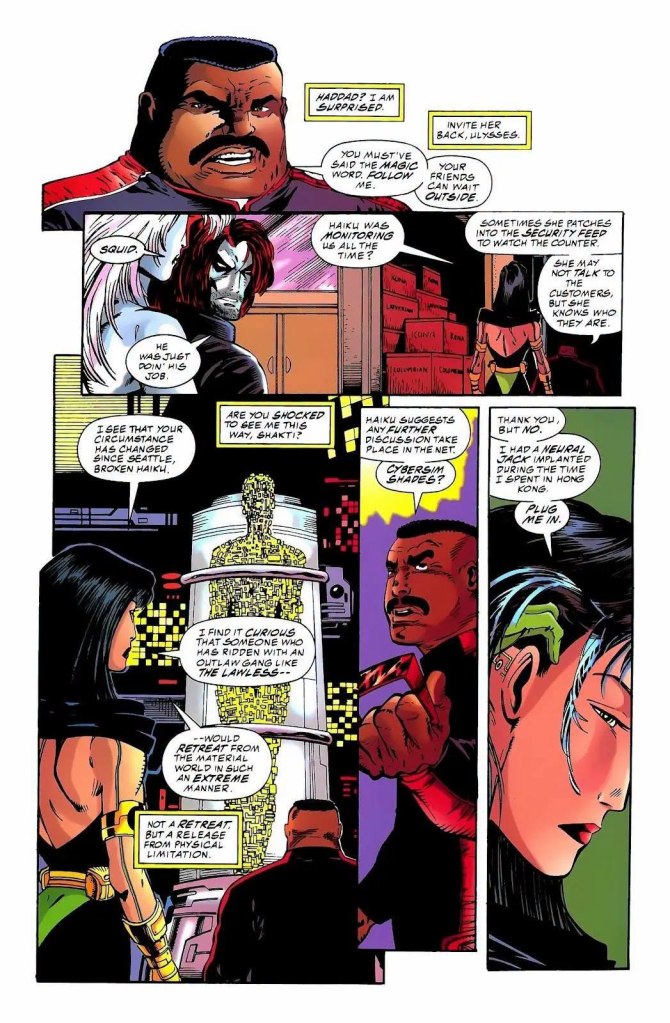
An important meeting between Shakti and Haiku is about to start.
If you have been craving for a powerful tale about Xi’an in the X-Men 2099 monthly series, this is the one to read. This comic book mostly follows Xi’an who at this stage had left the X-Men behind and started his participation with the Theater of Pain. As it turns out, his actual initiation to become a true member of the Theater of Pain really started in this tale and his new superior Brimstone Love is absolutely evil, exploitative and manipulative. Without spoiling the plot, I can say that Xi’an here was portrayed to be very vulnerable and truly disadvantaged as the initiation happens in three different scenarios which instantly reconnects with the painful stages of his past. That said, Xi’an perception of what had happened and how he related with personalities he encountered before truly gets tested. The same goes with his endurance as well as his handling of emotions and trauma. I can also say that the conclusion of Xi’an tale here is absolutely powerful and meaningful to see.
Imagine this as the future of woke California.
While Krystalin and Meanstreak are completely absent in this comic book, you will see Shakti, Skullfire and Luna who are still exerting efforts to figure out how to track down the Theater of Pain and save their former leader. Having served as the second-in-command to their leader when the X-Men was still intact, Shakti seeks a meeting with someone who was personally involved with Xi’an. At this stage in the series, Shakti and Skullfire are both focused on finding Xi’an believing that he can be recovered. This adds more to the tension leading towards the events of issue #25.
Conclusion
Symbolically, Xi’an looks like he is already in Hell in the presence of the demonic Brimstone Love of the Theater of Pain.
I really like X-Men 2099 #22 (1995). The struggle of Xi’an is the very meat of the comic book as the Moore-Lim duo set the stage for the reuniting of the X-Men and the major conflict that awaits them all in the 25th issue. Xi’an’s tale here is absolutely compelling to read and there will be moments when you will feel sympathy or confusion as his struggle with the initiation goes on. Symbolically, the mental and personality torture on the former X-Men leader strikes hard on the essence of the futuristic X-Men itself. You might end up speculating Xi’an might have been delusional on following the steps of Charles Xavier and Magneto to lead mutants in 2099’s America. This comic book could make you think deeply how far the futuristic X-Men could exist without their former leader. As such, this issue should inspire you to revisit the first three issues of the series.
Disclaimer: This is my original work with details sourced from reading the comic book and doing personal research. Anyone who wants to use this article, in part or in whole, needs to secure first my permission and agree to cite me as the source and author. Let it be known that any unauthorized use of this article will constrain the author to pursue the remedies under R.A. No. 8293, the Revised Penal Code, and/or all applicable legal actions under the laws of the Philippines.
Welcome back, superhero enthusiasts, 1990s culture enthusiasts, X-Men fans and comic book collectors! Today we revisit the Marvel Comics shared universe through one of the many tales of the X-Men 2099 monthly series.
If you have been reading a great majority of the Marvel 2099 comic book series of the 1990s, then you should be aware about a notable turning point that saw Doom 2099 taking over as the President of the United States. The comic book Spider-Man 2099 #34 reflected the impact of that turning point and it had this pretty clever way of having Doom 2099 and Spider-Man 2099 (but in civilian form as Miguel O’Hara) getting reunited for the first time since the Fall of the Hammer crossover storyline. The same thing also happened in the X-Men 2099 series and the encounter between Doom 2099 and a few X-Men members was remembered.
With those details laid down, here is a look back at X-Men 2099 #21, published by Marvel Comics in 1995 with a story written by John Francis Moore and drawn by Ron Lim.
The cover.
Early story
The story begins with government propaganda released to the public. It announces the direction that America will go to under the rule of Doom 2099 as US President. It turns out, Doom has been President for days and already a series of changes is happening nationwide. Halloween Jack (who was a fake Loki during the events of the Fall of the Hammer) asks a rhetorical question about Doom. Halloween Jack and Meanstreak meet with Celestia Amberlyn who is the biggest star of the Synge casino and also a close personal friend of Indigo Eshun, the minister of Signal.
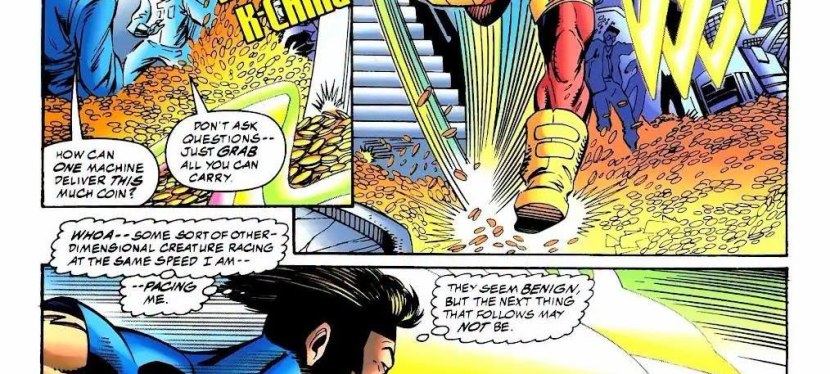
Their meeting intensified quickly due to their conflicting agendas. Amberlyn is with the Doom administration while Halloween Jack is defiant towards the new US President. He shows her his new technology called the virtual unreality projector. He tells her that he will overturn the natural laws of physics throughout Las Vegas and replace them with the wildly unpredictable reality of another dimension…
Quality
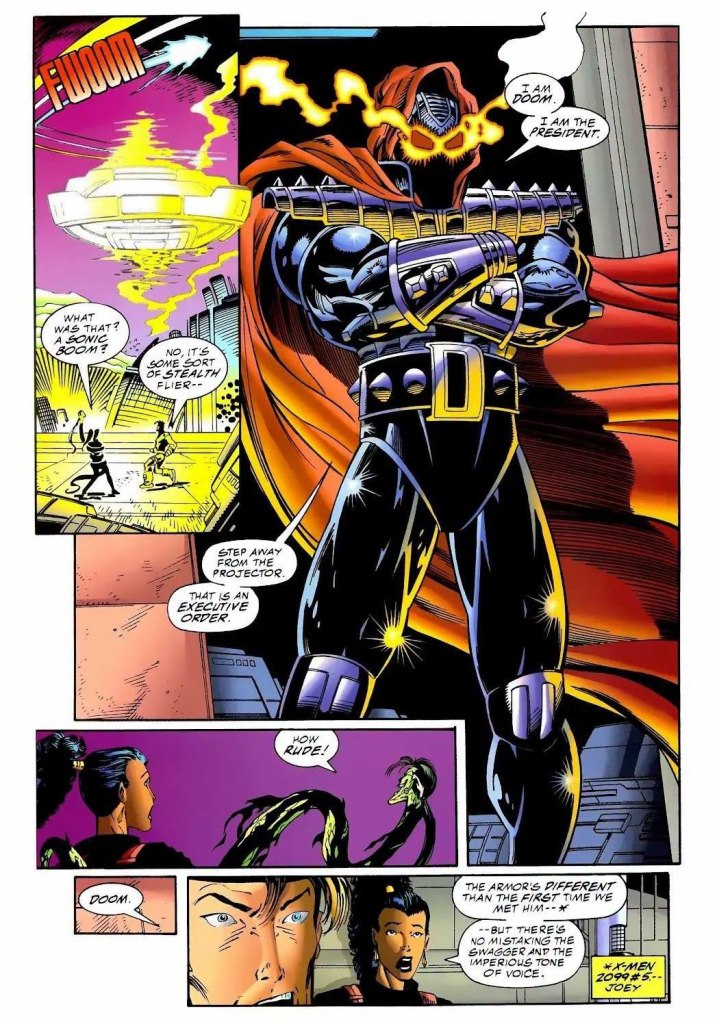
Meanstreak, Krystalin and Halloween Jack witness the arrival of Doom 2099 in Las Vegas.
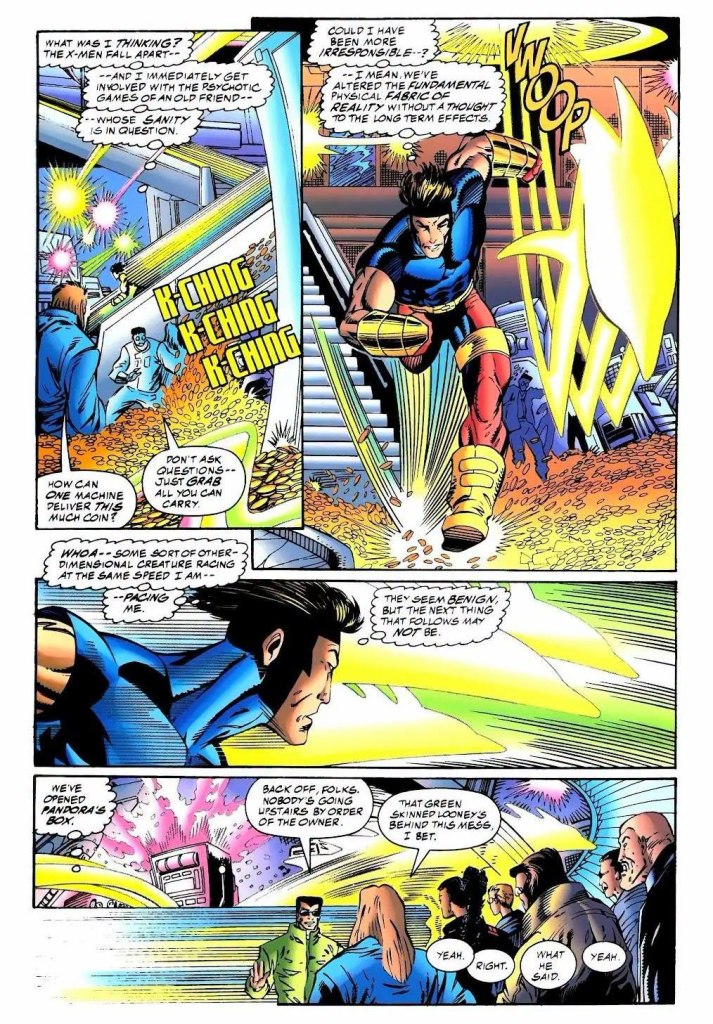
With Doom’s influence as US President felt a lot in this comic book, I can say that the storytelling and events here really got wild. Halloween Jack’s machine really caused a very unique kind of chaos on Las Vegas and his insanity here reminds me a lot about the Joker of DC Comics. After working a lot on making Halloween Jack’s insane agenda happen, Meanstreak finally realizes his errors and decides to take action before total disaster happens. That said, Meanstreak’s old self is back complete with recalling his rightful place with the X-Men.
As stated earlier, Doom has impact on the story and it is truly an expressive portrayal of what he could achieve with the power of the US Presidency. Doom clearly has plans for America and he has his own vision about establishing order and this comic book clearly dramatizes it. On face value, it looks like Doom’s short appearance in this comic book is just for show but I can assure you that he has an action-packed response to Halloween Jack’s insane operation on Las Vegas.
Conclusion
Finally, Meanstreak realizes the wrong things he committed and has decided to take action before total disaster happens.
X-Men 2099 #21 (1995) is indeed a wild tale that concluded with purpose. Not only does it reunite Meanstreak with a teammate, it also sets that direction towards the inevitable reuniting of the futuristic X-Men. The wild turn of events here is balanced with the good amount of details and character development implemented by the Moore-Lim duo. Doom’s presence here really shook things up and the impact on the city of Las Vegas has to be seen.
Disclaimer: This is my original work with details sourced from reading the comic book and doing personal research. Anyone who wants to use this article, in part or in whole, needs to secure first my permission and agree to cite me as the source and author. Let it be known that any unauthorized use of this article will constrain the author to pursue the remedies under R.A. No. 8293, the Revised Penal Code, and/or all applicable legal actions under the laws of the Philippines.
Welcome back, superhero enthusiasts, 1990s culture enthusiasts, X-Men fans and comic book collectors! Today we revisit the Marvel Comics shared universe through one of the many tales of the X-Men 2099 monthly series.
The past few issues followed the developments seen through the eyes of separated X-Men members – Meanstreak who assisted Halloween Jack’s move to take Las Vegas away from the Synge family, Krystalin who has been in California to help her brother, and Shakti who recently uncovered something about the legacy of mutants. That said, Bloodhawk’s absence was really noticeable and this was because Marvel Comics had him appear in a few Doom 2099 comic books set in the Savage Land.
With those details laid down, here is a look back at X-Men 2099 #20, published by Marvel Comics in 1995 with a story written by John Francis Moore and drawn by Ron Lim.
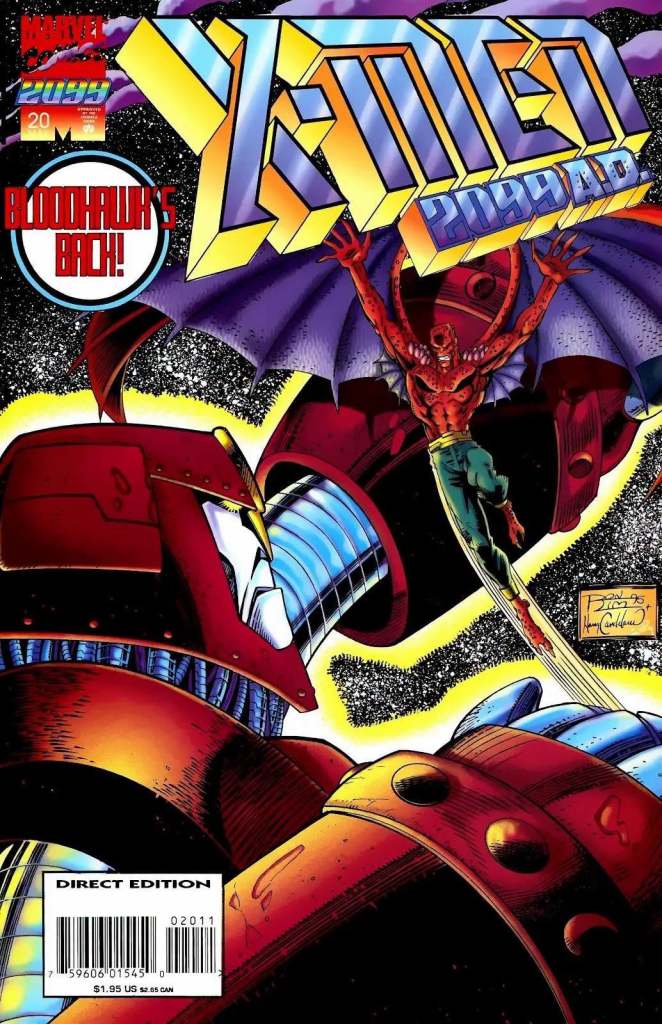
The cover.
Early story
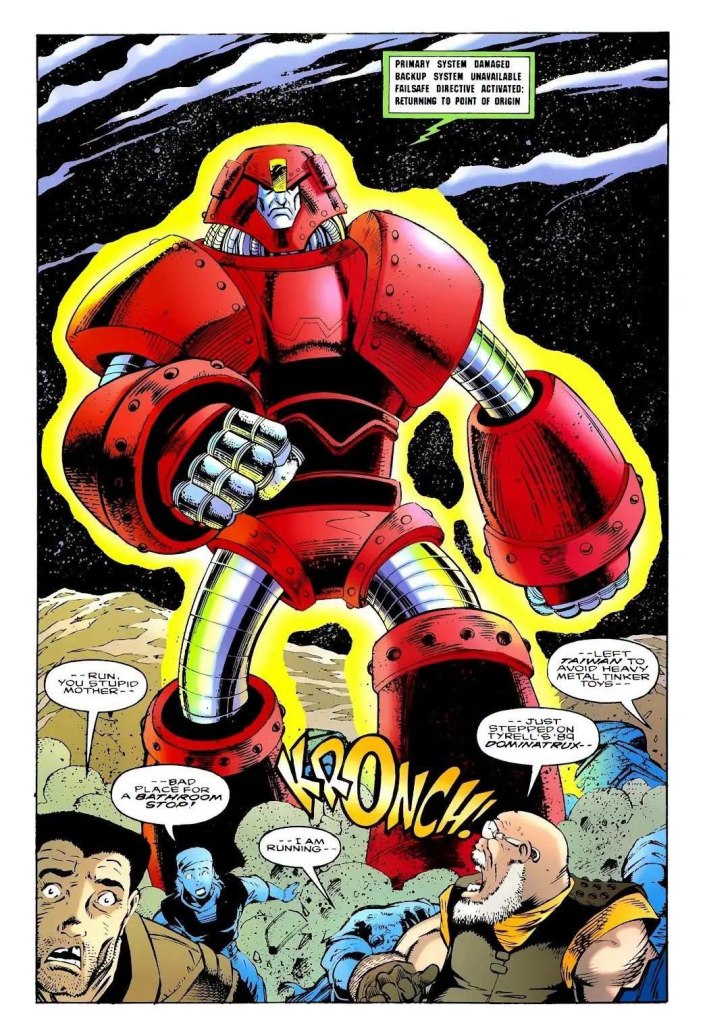
The story begins in the Arizona desert where Bloodhawk flies over the wasteland. He just returned from the Savage Land and he immediately notices huge tracks left behind by some kind of large machine and they are radiated. He notices a sick and radiated coyote approach. Bloodhawk grabs the coyote, says some words to it and kills it to end its suffering.
Meanwhile at the ACME Pit Stop (a roadside tradition of fuel and food since the year 2047), a conflict between business owner Cyrus and Lou Ann is taking place with lots of bystanders watching. Their conflict gets disrupted as a massive, large robot suddenly arrived causing everyone to panic. The robot grabs a long rig and threw it at the ground causing a huge explosion.
Bloodhawk, who raided one of his weapons cashes to arm himself with grenades, quickly flies in to attack the giant robot…
Quality
If you read the details closely, you will realize the extremism of the Free Radicals and why they have so much in common with real-life anarchists and zealots.
To point out the obvious, the main feature here is the focus on Bloodhawk’s return to the American wasteland coming from the Savage Land (chronicled in Doom 2099). By having him encounter a massive robot, it is clear that John Francis Moore and Ron Lim planned this to have a huge storytelling weight and give the X-Men 2099 fans – especially the ones who love Bloodhawk – something to enjoy. Along the way, this comic book has Bloodhawk gaining an unexpected ally which allowed the creators to show some character development on him. As many fans already know, Bloodhawk values nature and despises both technology and modern society as he saw them as devourers of the natural environment. In this comic book, he has a gigantic mechanical problem to deal with and the odds are absolutely against him. That said, Bloodhawk’s tale here is pretty much a big comeback from being absent in the past issues.
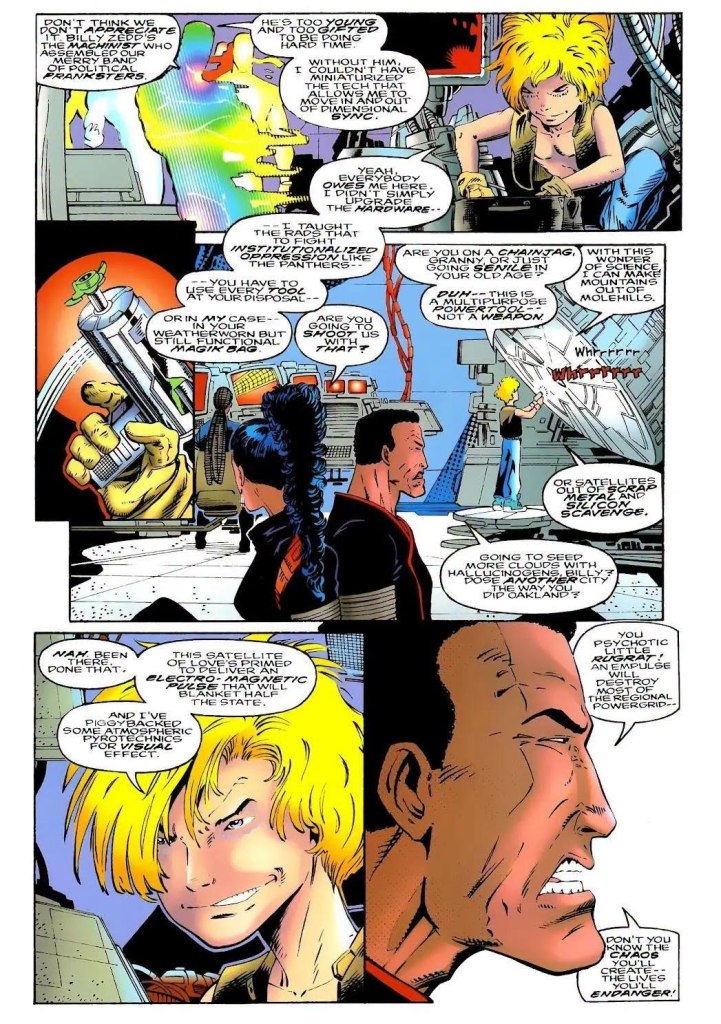
Meanwhile, Krystalin finds herself in deeper trouble. After helping the Free Radicals regain their very young but tech-oriented teammate, she finds herself and her brother still trapped by the gang. Continuing from what was symbolized in the previous issues, this comic book sheds light on political symbolism and the radicalized people’s obsession with drastic change in world they believe is controlled by institutions they perceive as oppressive. The Free Radicals have sinister values that make them comparable with real-life evil forces like Black Lives Matter (BLM), Palestinian terrorist group Hamas, Antifa, LGBTQ mobs, Islamists and others. The Free Radical’s youngest member clearly believes that anarchy means freedom.
Conclusion
The design of this giant robot is corny to look at.
Crafted with care and symbolism, X-Men 2099 #20 (1995) has two tales that are gripping to follow. The tales of Bloodhawk and Krystalin succeeded with ensuring a gripping read and moving events forward. That said, the stakes of Krystalin’s conflict with the Free Radicals have been raised even more. Those who are very fond of Bloodhawk will have good stuff to enjoy here. This comic book’s only weakness is the rather corny design of the giant robot, and it felt distracting from time to time.
Welcome back my readers, YouTube viewers and all others who followed this series of articles focused on YouTube videos worth watching.
Have you been searching for something fun or interesting to watch on YouTube? Do you feel bored right now and you crave for something to see on the world’s most popular online video destination?
I recommend you check out the following videos I found.
#1 Popcorn in Bed’s X-Men movie reaction videos – I enjoy watching the movie reaction videos posted by Popcorn in Bed. For the most part, Cassie and her sister Carly (who joined her many times in reaction videos) are pretty reactive to the movies they saw for the first time ever regardless of genre. Recently, I replayed watching their reaction videos of the live-action, X-Men movies (the main ones specifically) from 2000’s X-Men to 2016’s X-Men: Apocalypse. Each X-Men reaction video of theirs is fun to watch and I noticed how Cassy and Carly discovered who the characters are, familiarized themselves with them, and still succeeded on following the stories even though there were so many characters in each film. That said, I encourage you all to watch their videos below.
#2 The Sherman Oaks Galleria today – You may not have visited the Sherman Oaks Galleria in California, but you might have seen it in films like Fast Times at Ridgemont High, Chopping Mall, Commando, and Terminator 2: Judgment Day. Indeed, the said shopping mall was used as a location in the movies and given the fact that a lot of shopping malls across America have closed down, revisiting the Sherman Oak Galleria’s legacy is both nostalgic and even educational. To find out what the Sherman Oaks Galleria looks like today, watch the video below. Tell me if you can recognize the malls spots that appeared in movies.
#3 Magic Johnson’s 1996 Comeback as a Lakers Player – Looking back at the career of Magic Johnson, the 1990s was a series of drastic changes about him. He quickly retired in 1991 because he had Human immunodeficiency virus (HIV) but returned as a player in the 1992 NBA All-Star Game and represented the United States as a Dream Team members in the Barcelona Olympics. He retired again in 1992 as controversy and protests grew from players over his plan to rejoin the Los Angeles Lakers for the 1992-93 season. He came back to the NBA as Lakers head coach in 1994 winning 5 games and losing 11, and eventually stepped down. In 1996, he came back as a player for the Lakers taking a new role as a power forward. Magic Johnson’s presence on the basketball courts looked exciting on face value but there was a lot of tension behind the scenes and even division among the Lakers. To discover what happened, watch the video below.
#4 Eels to eat in Japan – I enjoy eating Unadon, the classic Japanese dish that has eel (unagi) grilled in the kabayaki way and served in a rice bowl. I had Unadon during my visits to Japan and in Japanese restaurants (both locally and overseas). Eels are truly popular in Japan. Even though supply constraints of live eels are felt by consumers and businesses, somehow the Japanese food joints found ways to secure enough of them and offer them to hungry customers in creative ways. Watch and learn from the Nippon TV video below.
#5 Retro World Expo 2026 – I always wanted to attend a retro gaming convention in America. I saw this video about Retro World Expo 2026 which took place in Connecticut and it was enjoyable to see. There is nothing like playing classic arcade games and classic console/computer games running on their original hardware. Watch the video below.
#6You, Me and the Movies react to Resident Evil: Degeneration – If you are a fan of the Resident Evil games and movies, do you really enjoy watching the computer-generated Resident Evil movies? Back in 2008, the pure-CGI movie Resident Evil: Degeneration was released in cinemas and there was some excitement for it among RE enthusiasts as it had fan-favorite characters Leon Kennedy and Claire Redfield. Not only that, RE fans who were disappointed with the Milla Jovovich-led live-action movies wanted to see RE movies that were more connected with the games they enjoyed. You, Me and the Movies recently posted their reaction video about Resident Evil: Degeneration and it is a must-watch.
#7 Ashleigh Burton reacts to The Transformers: The Movie – Finally, Ashleigh Burton saw the animated classic The Transformers: The Movie and posted her reaction video of it. It is nice that the animated movie got featured by her as this year marks its 40th anniversary. Go watch her video now! It’s fun to watch.
#7 Deathmate and the 1990s comics revisited – As a long-time comic book reader, I personally witnessed the presence and impact of the Deathmate crossover comic books in 1993. The Deathmate comics published by Valiant were released on time while those from Image Comics really arrived late. Local comic book collectors near me had no excitement for Deathmate even though famous artists like Rob Liefeld, Jim Lee and Whilce Portacio participated in it in various degrees. The video below is very comprehensive with its focus on not just Deathmate but also the comic book speculator boom, the 1990s comics trends, the intrigue behind the scenes and more. Watch the video now.
Disclaimer: This is my original work with details sourced from reading the comic book and doing personal research. Anyone who wants to use this article, in part or in whole, needs to secure first my permission and agree to cite me as the source and author. Let it be known that any unauthorized use of this article will constrain the author to pursue the remedies under R.A. No. 8293, the Revised Penal Code, and/or all applicable legal actions under the laws of the Philippines.
Welcome back, superhero enthusiasts, 1990s culture enthusiasts, X-Men fans and comic book collectors! Today we revisit the Marvel Comics shared universe through one of the many tales of the X-Men 2099 monthly series.
Issue #18 had some political flavor as it tried to shake the foundation of the X-Men 2099 series. It also had symbolism that reminded me about the criminal past of Las Vegas, the twisted Black Panthers (the evil Marxist-Leninist and black power political organization of America) and the social unrest that happened in America during the era of Richard Nixon as US President. At this point in the series, the futuristic X-Men are a shell of themselves as the members have been separated and are involved in different developments far away from each other.
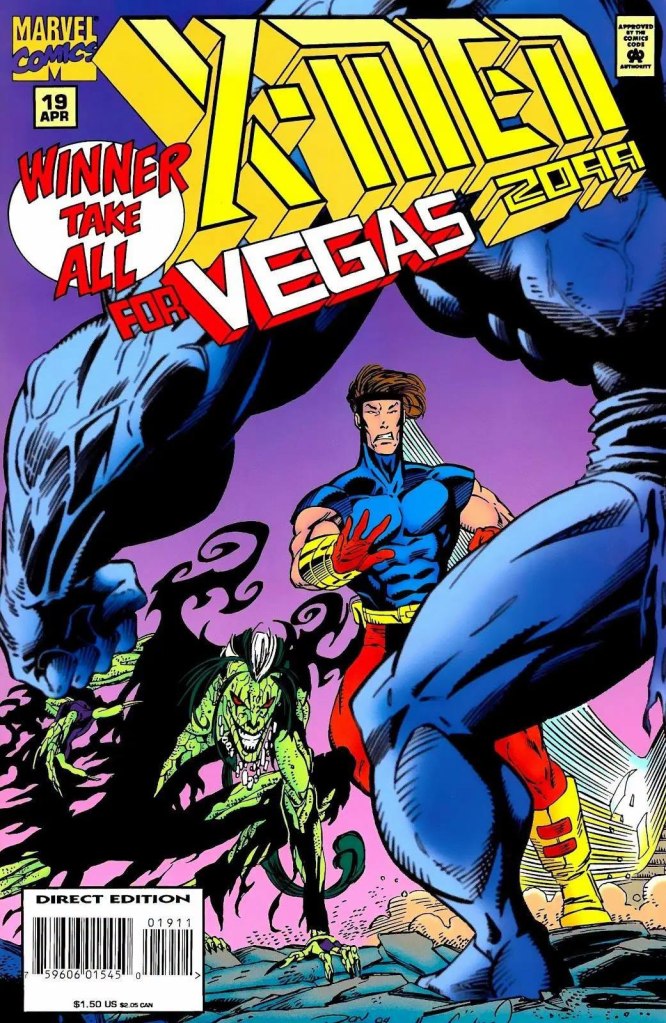
With those details laid down, here is a look back at X-Men 2099 #19, published by Marvel Comics in 1995 with a story written by John Francis Moore and drawn by Ron Lim.
The cover.
Early story
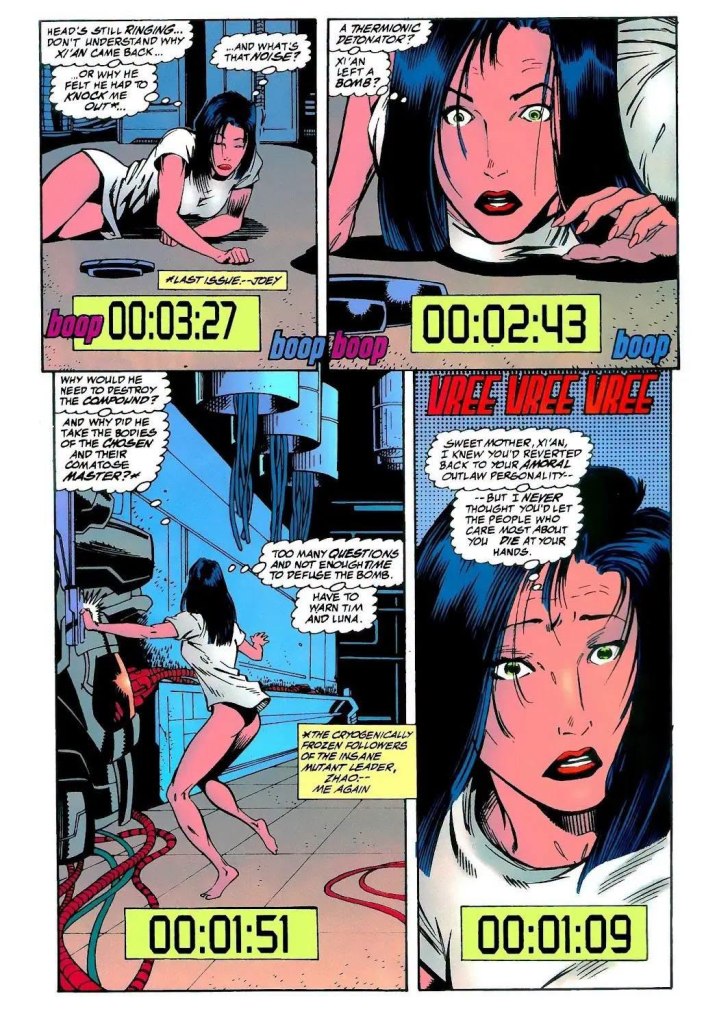
The story begins inside an old facility in New Mexico. Shakti, who is only wearing a t-shirt and a panty – has been unconscious for several minutes. After waking up, she learns that a thermionic detonator (left by their former leader Xi’an) has been set to explode and time is quickly running out. She also realizes that the bodies of the Chosen have been taken.
In desperation, she wakes up Skullfire and Luna, and they ran out of the facility to save themselves. The facility blows up and Skullfire asks Shakti for an explanation. She reveals to him that Xi’an – whom she momentarily encountered several minutes prior – is responsible for the destruction and he clearly made an attempt to kill them all. As such, Xi’an is now an enemy of the X-Men.
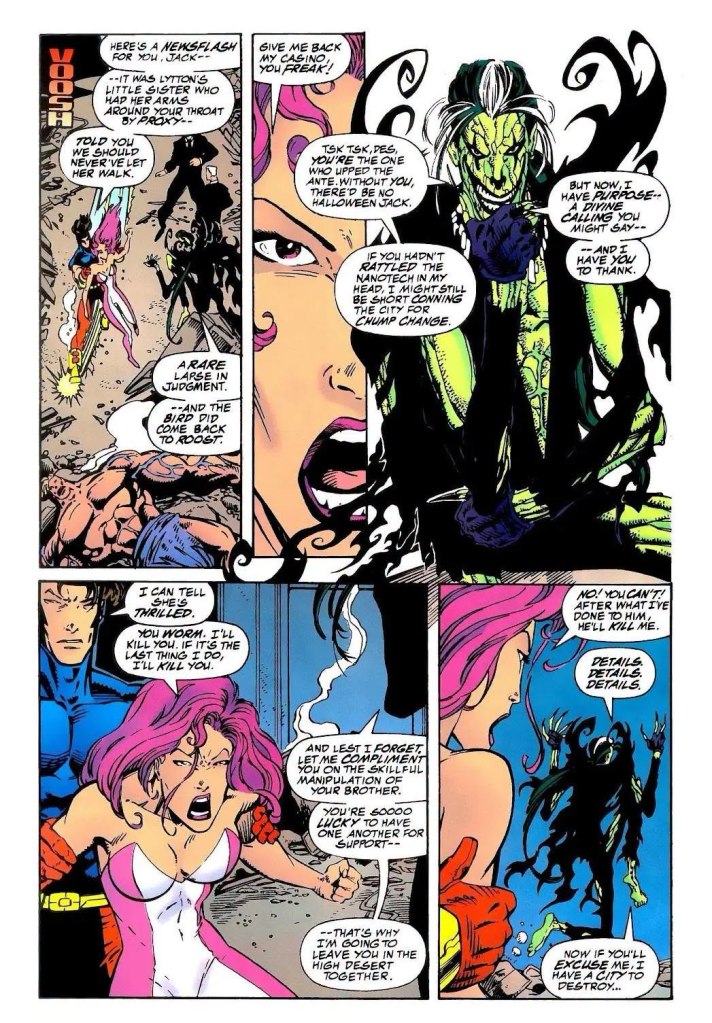
Meanwhile in Las Vegas, a heavily mutated and oversized Lytton Synge grabs his sister Desdemona by the neck. While explaining details to him, Desdemona uses a failsafe device to cause him to stop moving and free her. She puts on additional gear that enables her to control Lytton’s body and she made it clear to him that he will be used against Halloween Jack…
Quality
Desdemona, Halloween Jack and Meanstreak are together again. Desdemona here had a desperate attempt to reclaim the casino and their company from Halloween Jack.
There is a good amount of intrigue in this comic book covering the three plot threads. The thread of Shakti, Skullfire and Luna was very short but it added to the tension about having their former leader Xi’an as a deadly enemy.
On the other hand, the events set in Las Vegas saw the return of Lytton Synge in a bloated, Hulk-like figure as Desdemona used him to attack Halloween Jack who has gained control of the Synge business empire (at least in the building they are in) as he continues with his obsession of changing Las Vegas and moving forward with his plan that could mean doom for the city. In this particular plot thread, Halloween Jack has prepared highly advanced technology to redefine Las Vegas in the most phenomenal way. What I find disturbing is Meanstreak’s lack of morality as he keeps on assisting Halloween Jack (his old friend Jordan) with his sinister plan. This makes Meanstreak appear cold-hearted, sinister and unbecoming as an X-Men member.
Over at California, Krystalin pursues a mission to find Billy the Kid as she has absolutely no choice as the life of her brother is at stake. The Free Radicals literally have her cornered and she cannot do anything except doing what they want her to do. In this particular plot thread, the creators did a good job presenting Krystalin as desperate as she is in the middle of a conflict between the Panthers of Wakanda (where her brother belongs to) and the Free Radicals.
Conclusion
Shakti in a very dangerous situation with not much time left.
X-Men 2099 #19 (1995) unsurprisingly moved plot developments forward. Apart from developing the X-Men members more, this comic book also expanded the lore of 2099 America nicely. At this stage, I am eager to find out what would happen next to the X-Men members in their respective plot threads. That said, I am still engaged enough to continue with the remaining X-Men 2099 issues that I have yet to read.
Welcome back readers, fellow geeks and electronic gaming fans!
In this edition of the Retro Gaming Ads Blast (RGAB) series, we will take a look at another batch of retro gaming print ads from the 1980s to the 1990s.
For the newcomers reading this, Retro Gaming Ads Blast (RGAB) looks back at the many print ads of games (console, arcade, computer and handheld) that were published in comic books, magazines, flyers, posters and newspapers long before smartphones, social media, the worldwide web and streaming became popular. To put things in perspective, people back in the 1980s to the 1990s were more trusting of print media for information and images about electronic games and related products.
With those details laid down, here is the newest batch of retro gaming print ads for you to see and enjoy…
1. Atari Console and Games Print Ad
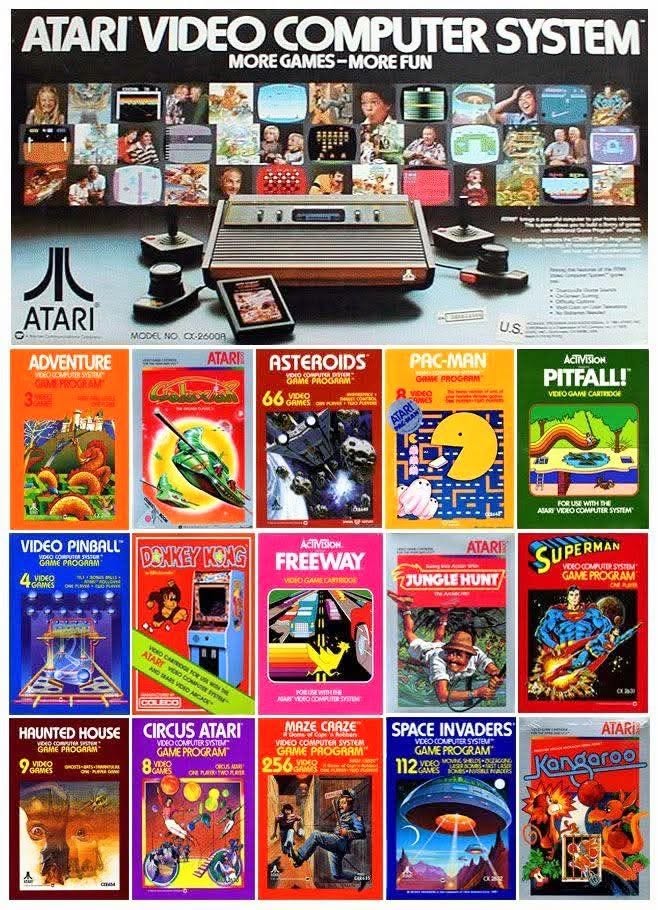
Back in the 1980s, this was simple and yet exciting to look at.
Back in the 1980s, the styles of video game advertising were very different. Back then, Atari was the market leader on console gaming with the Atari 2600 and they had a lot of video games made for it. As such, the above print ad showing the console and the video games (with the front covers of the game boxes) was typical of the era and it was captivating to look at. By today’s standards, the ad looks simple but it still has the appeal to lure gamers.
2. Shark Attack North American Arcade Flyer
The front.
The rear.
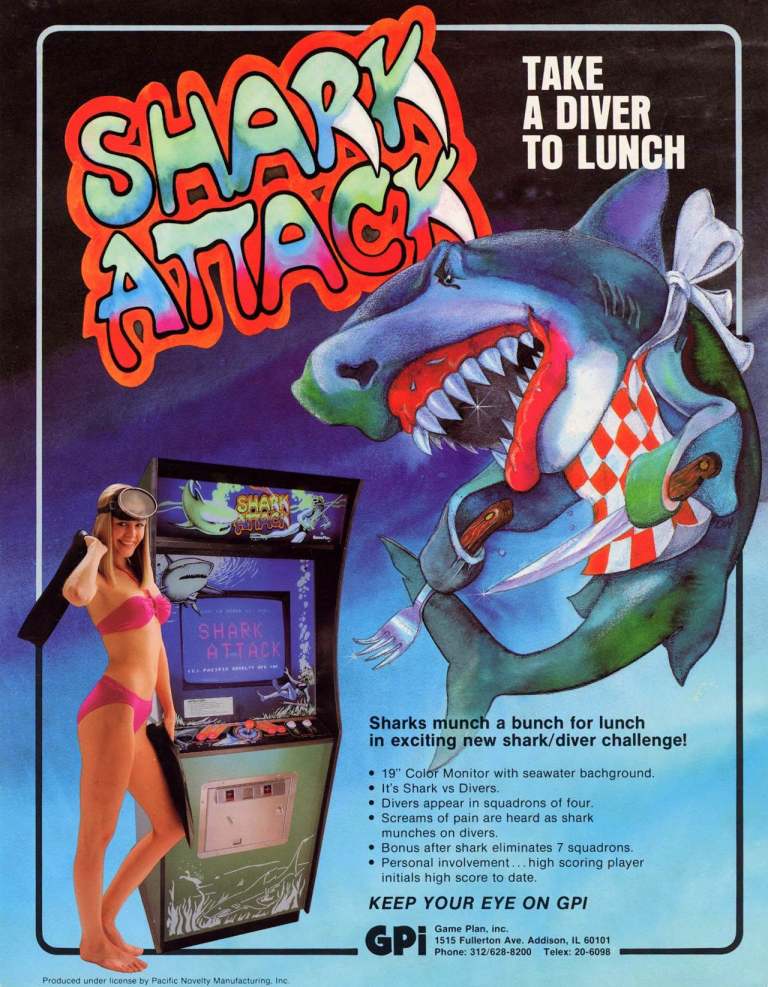
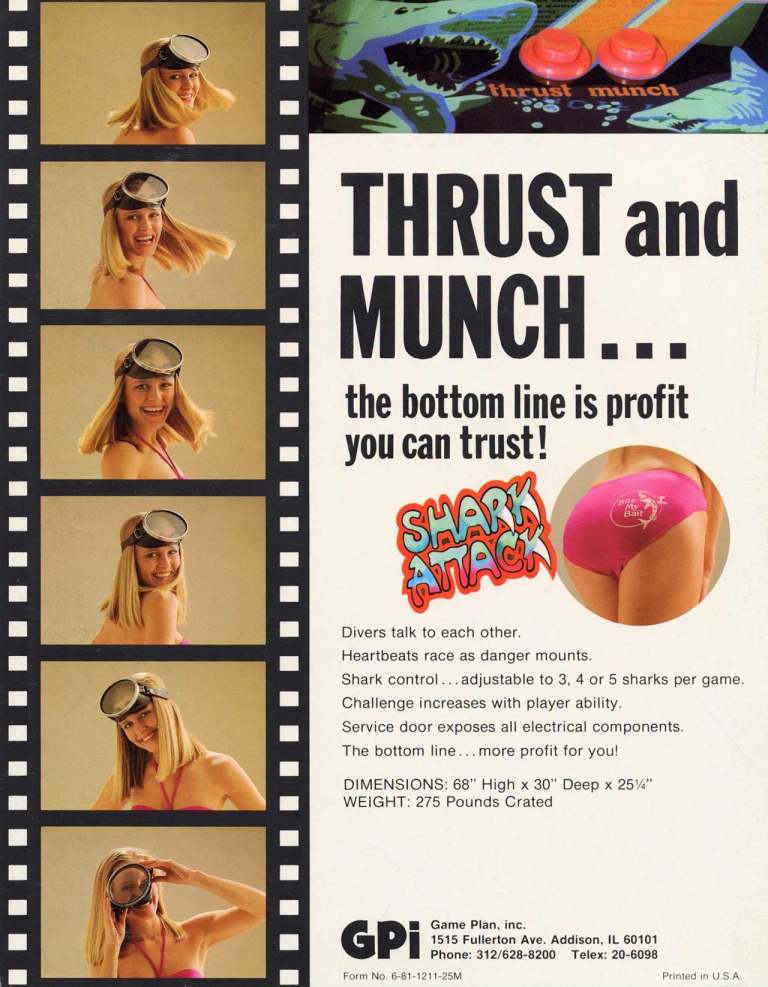
Remember long ago when Steven Spielberg’s Jaws made some people afraid of sharks and the sea? Jaws was a massive blockbuster, and it was influential to the public. A few years later, Universal Pictures pushed through with Jaws 2 without Spielberg, and it also was a huge commercial hit. By the start of the 1980s, creature feature films inspired by Jaws were released and pop culture itself was influenced. In 1981, the obscure arcade outfit Pacific Novelty Manufacturing released their game Shark Attack in arcades. To promote the game, the company came up with an arcade flyer that had a comedic touch on the text descriptions while featuring a pretty blonde fashion model posing as the diver. The front of the flyer had the arcade cabinet, the model and an exaggerated artwork of a shark holding a knife and a fork. On the rear, the sexiness was ramped up with a shot of the model’s behind (plus more pictures of the model herself). This is indeed an amusing and funny arcade flyer.
3. Centipede North American Arcade Flyer
This was designed with arcade operators in mind.
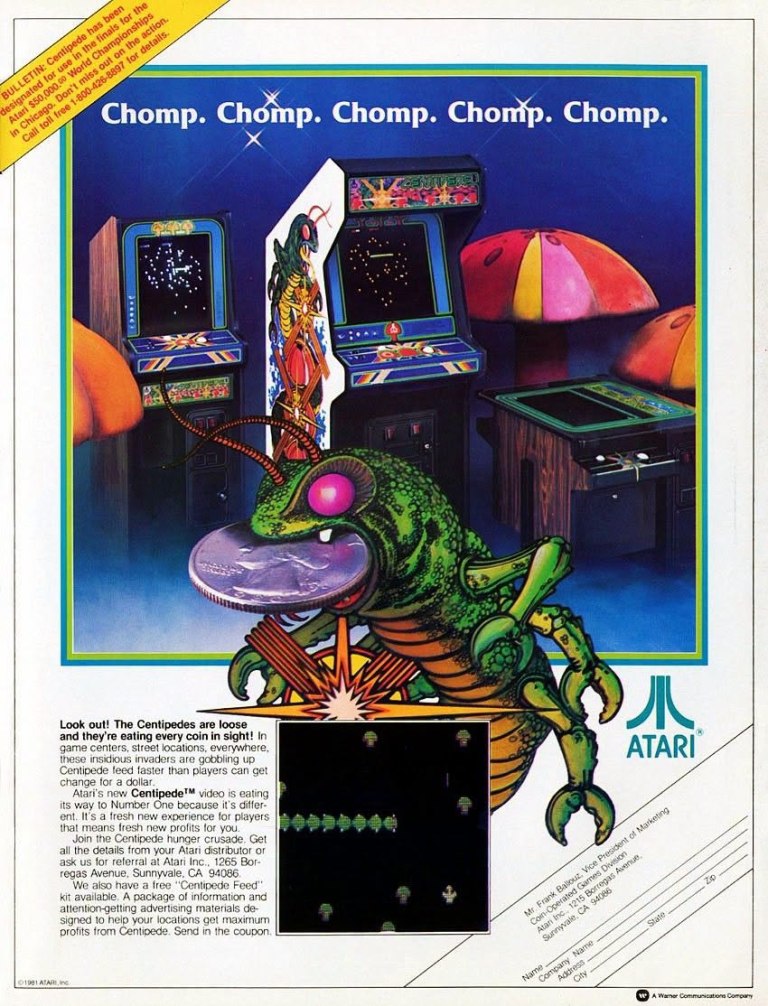
When Atari released Centipede in arcades in 1981, it attracted a lot of gamers and became a huge commercial hit. Part of its success is linked with the strategic promotions Atari committed, and the above arcade flyer is one of the variants of Centipede flyers. The one above shows an illustrated centipede carrying a coin in its mouth and in the background are two different arcade cabinets plus a cocktail table machine (for those who want to play Centipede while sitting down). This particular arcade flyer of Centipede emphasizes the popularity of the game and there are different types of machines that arcade operators can choose from. At the same time, this old flyer remains amusing to look at.
4. Rambo Famicom Japanese Print Ad
Using this iconic imagery of Sylvester Stallone as Rambo was a very smart move.
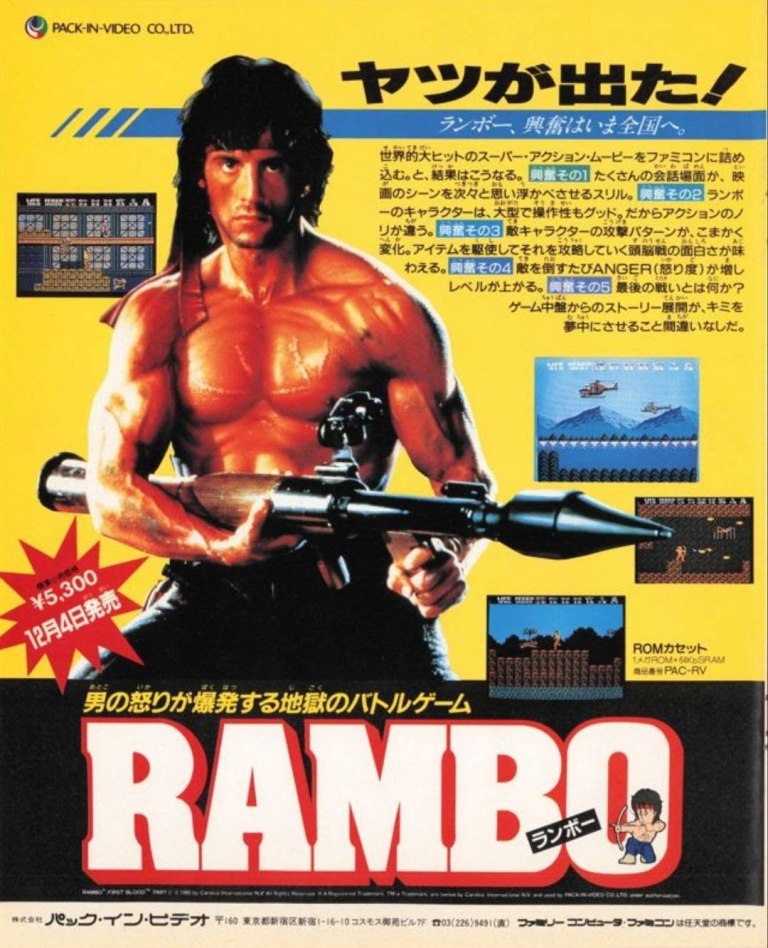
When it comes to Hollywood action movies of the 1980s, Sylvester Stallone was highly successful, and he impacted American pop culture with the Rocky and Rambo films. By 1985, Stallone struck gold with Rambo: First Blood Part II which made over $300 million worldwide. Considering the Cold War theme and ambitious action scenes of the movie, it was clear for Japanese game developer Pack-In-Video to make an official video game adaptation of Rambo: First Blood Part II for the Nintendo Family Computer (Famicom) in the form of a 2D side-scrolling adventure game. The said game was simply titled Rambo and to promote it, the company came up with the above Japanese print ad that had the iconic Rambo image of Stallone holding the rocket launcher, and a few screenshots of the game itself. If you look closely at the lower-right corner, you will see a cartoonish hand-drawn art of the Rambo character with a bow and arrow. Considering how very popular Stallone, his character and the movie were, it made a lot of sense to promote the Rambo Famicom game like this in Japan.
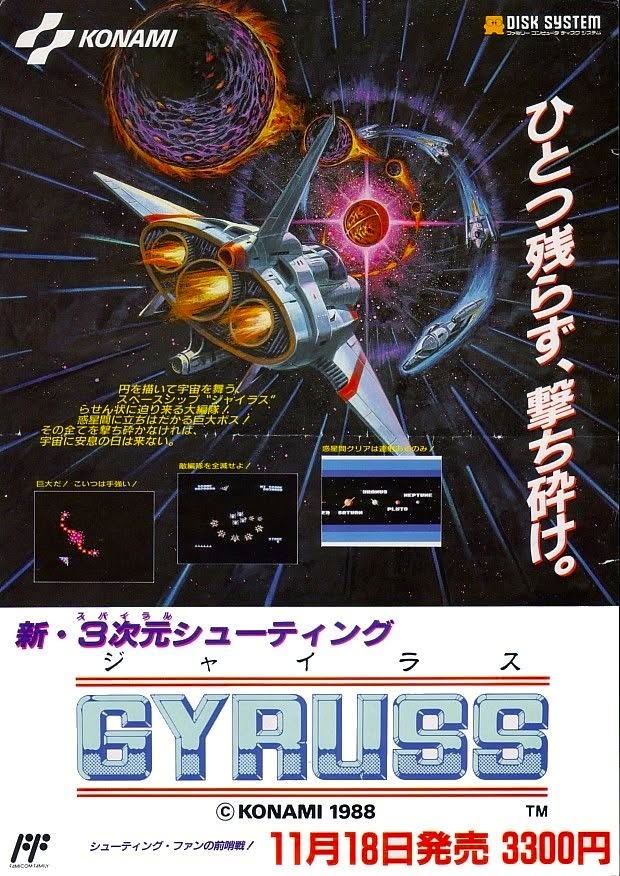
5. Gyruss Family Computer Disk System Japanese Print Ad
Gyruss was Konami’s first-ever game developed for the Famicom Disk System of Nintendo.
In 1983, Konami released Gyruss, a science fiction tube shooter designed by Yoshiko Okamoto. The game was a huge arcade hit and it really attracted a lot of players who enjoyed the unique game design and spaceship shooting. Konami licensed the game to a few companies which resulted in the creation and release of Gyruss ports for different consoles and home computer systems. In 1988, Konami released an enhanced Gyruss port for the Family Computer Disk System of Nintendo. To promote the Famicom Disk System port, Konami came up with a print ad that had a nicely detailed painted artwork of a spaceship (representing the player) about to hit incoming enemies deep in space, 3 screenshots and the official price and release date displayed. The artwork is still captivating to look at and the port itself features major overhauls that arguably made it better than the arcade original. Konami really went the extra mile for this Gyruss port.
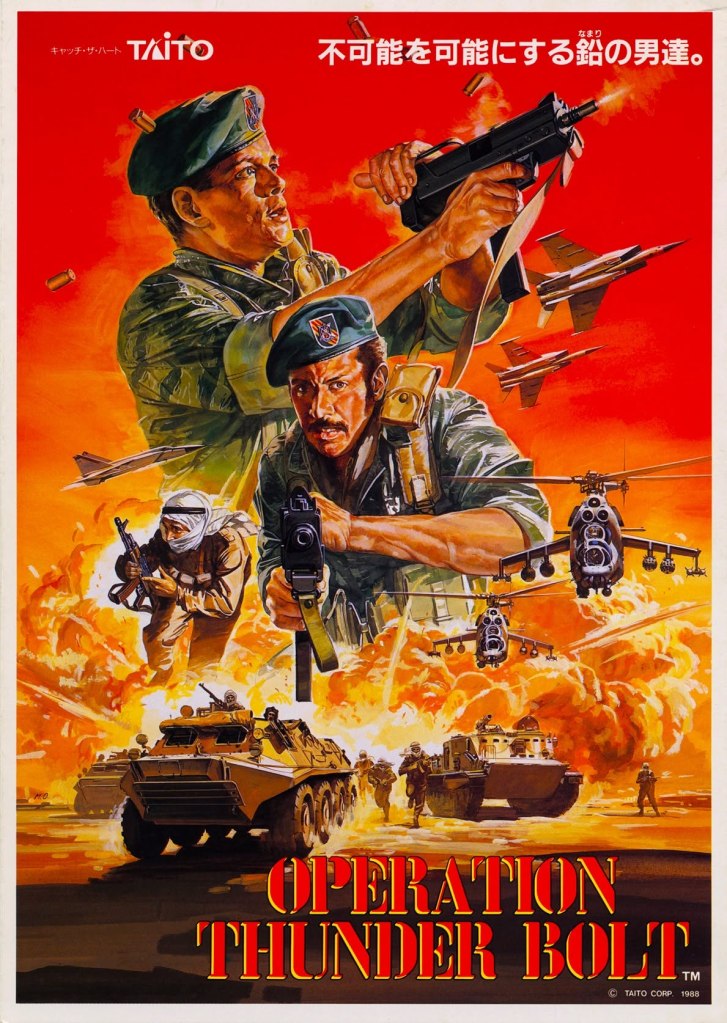
6. Operation Thunderbolt Japanese Arcade Flyer
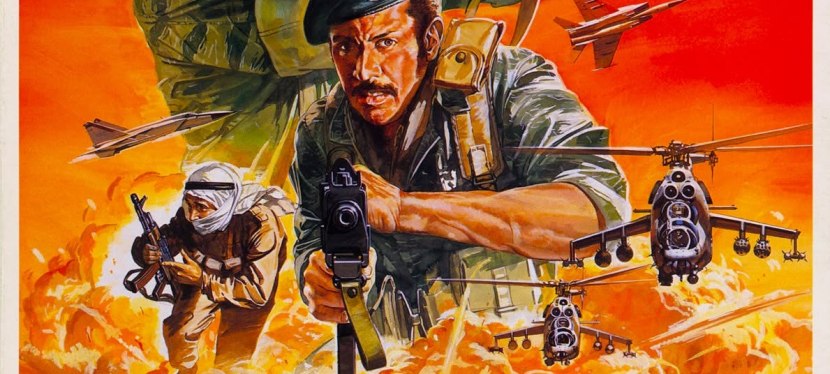
Great looking artwork on the front.
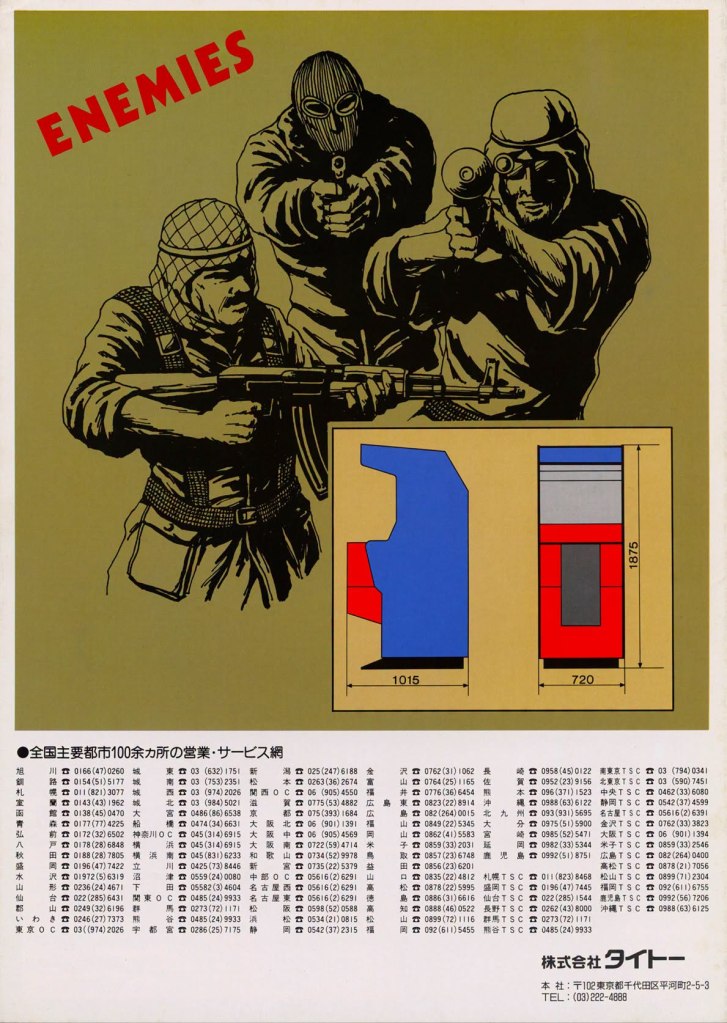
The rear.
Following the huge success of Operation Wolf, Taito went on to make the sequel military shooter Operation Thunderbolt which was named after the 1977 movie that itself was based on the real-life Entebbe raid of 1976. To promote the game, the company came up with a pretty compelling arcade flyer for the Japanese market. The front has a detailed painted artwork that emphasizes the conflict between soldiers and Islamic terrorists in the Middle East. The rear has technical details of the arcade cabinet, several phone numbers and hand-drawn art of the terrorists (they easily remind me of Palestinian terrorists) clearly called the enemies. While the listing of phone numbers on the rear was very unusual, this old arcade flyer still looks great. Operation Thunderbolt went on to achieve huge commercial success in the arcades and later on consoles. It was one of the highest grossing arcade games in Japan in 1989.
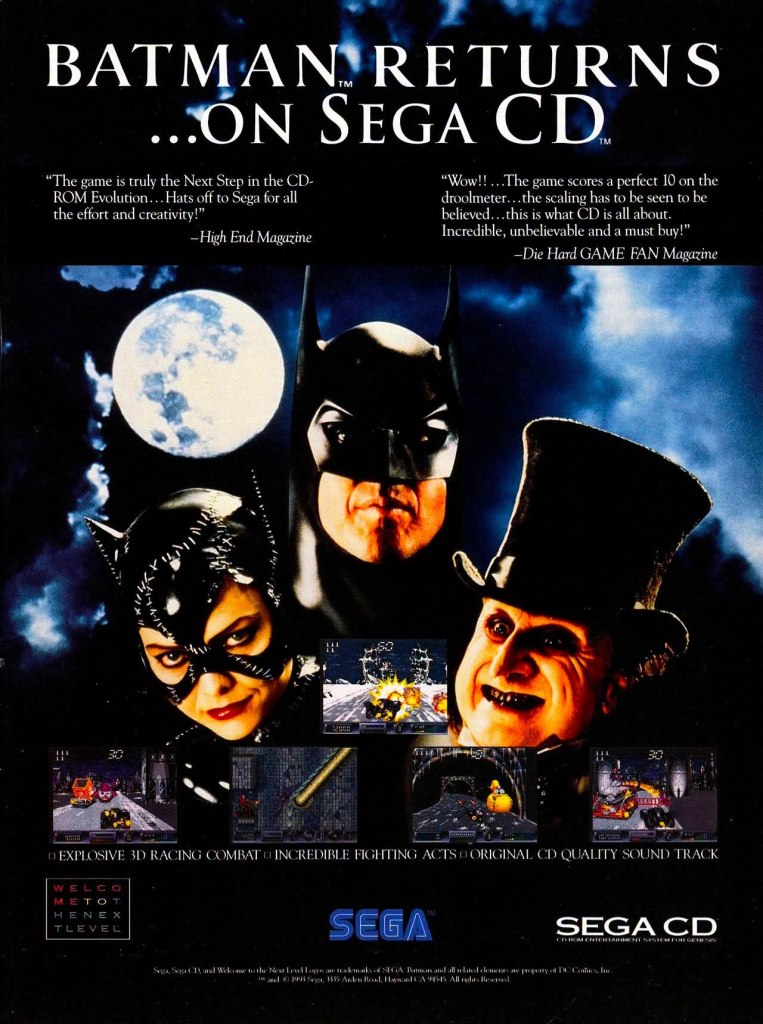
7. Batman Returns North American Print Ad
Sega’s clever print ad promoting the Sega CD game of Batman Returns.
Batman Returns was a big hit in cinemas in 1992 although it never came close to matching the success of its 1989 predecessor. When it comes to video games, Batman Returns was even more ambitious as there were different game adaptations on different platforms. For the Sega CD Batman Returns game, Sega came up with the above ad that strongly featured photos of Michael Keaton as Batman, Michelle Pfeiffer as Catwoman and Danny DeVito as the Penguin with a stylish dark background and four screenshots of the game. The line “Batman Returns…on Sega CD” was really catchy and ultimately the game itself was very notably an expanded version of the Sega Genesis version with selected video footage from the film. As Sega had the license to make Batman Returns games for its platforms, this print ad is absolutely an attention-grabber.
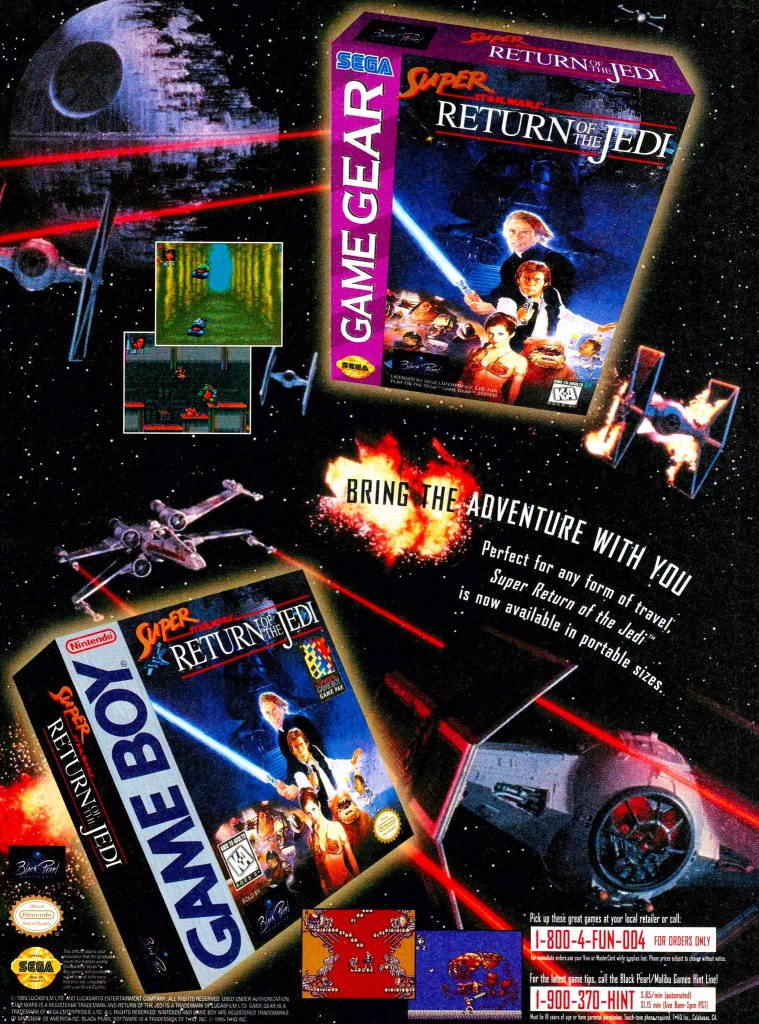
8. Super Star Wars: Return of the Jedi North American Print Ad
The Force is with the handheld gamers.
If there is anything notable about Star Wars in the 1990s, it is the fact that there is a lot of merchandise, comic books, video games, books and other licensed products released long after 1983’s Return of the Jedi which itself was perceived to be the last of the film franchise. In the mid-1990s, ports of Super Star Wars: Return of the Jedi were released on the competing handheld platforms Nintendo Game Boy and Sega Game Gear. This particular single-page ad has a nice visual design that captured the vibe of the movie (which I saw as a young boy in 1983) and it made handheld gaming look cool.
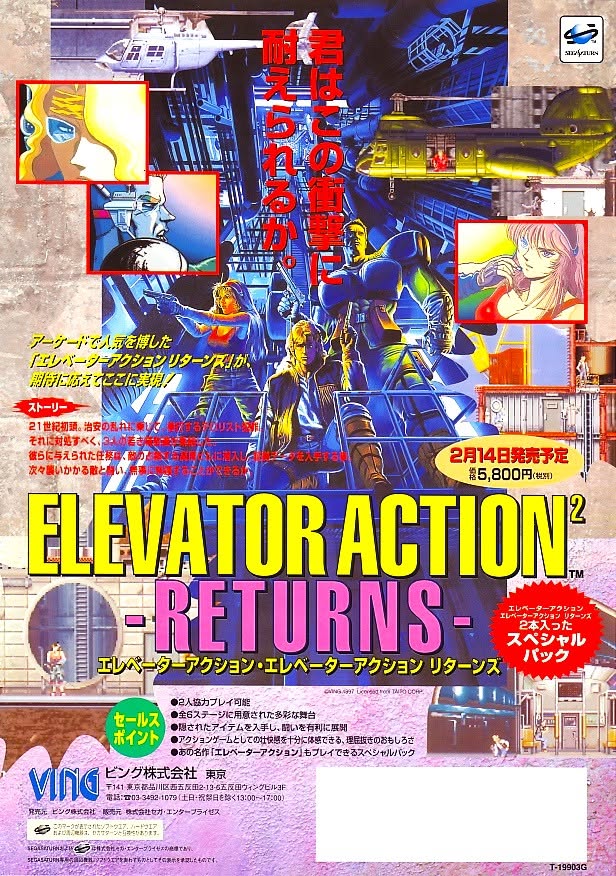
9. Elevator Action Returns Japanese Print Ad
Did you play Elevator Action Returns on the Sega Saturn?
In 1994, Taito struck gold with the release of Elevator Action Returns in Japanese arcades. The sequel was a big hit for the company and they eventually released a console port on the Sega Saturn only in Japan. For promotion, a print ad was made using the official painted artwork while also showing the screenshots and other details about it running on the Saturn (which itself was a powerful 2D sprite machine). Just looking at this old ad brings back the excitement of Elevator Action Returns and I now have a digital copy of it on my Xbox Series X.
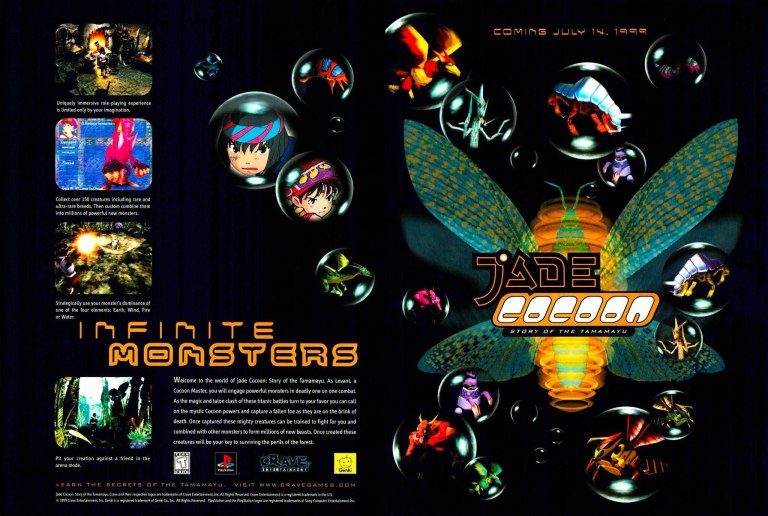
10. Jade Cocoon: Story of the Tamamayu North American Print Ad
A very ambitious print ad promoting Jade Cocoon in North America.
By the late 1990s, Japanese role-playing games (JRPG) really became popular on gaming consoles in America which arguably was the result of the massive global success of Final Fantasy VII. In 1999, there were a lot of JRPGs that got released on PlayStation and publisher Crave Entertainment literally pounced on American gamers’ interest on JRPGs by releasing Jade Cocoon: Story of the Tamamayu. Crave aggressively promoted the game and the result was this 2-page print ad that emphasized the game concept (developed by Genki), showed screenshots of the game, and displayed artworks that fans of Studio Ghibli anime productions can recognize. While Jade Cocoon: Story of the Tamamayu never became a massive commercial hit because of the low print run, there is no denying that its print ad was one of the most visually appealing ads of 1999. The ad alone made it look very ambitious.
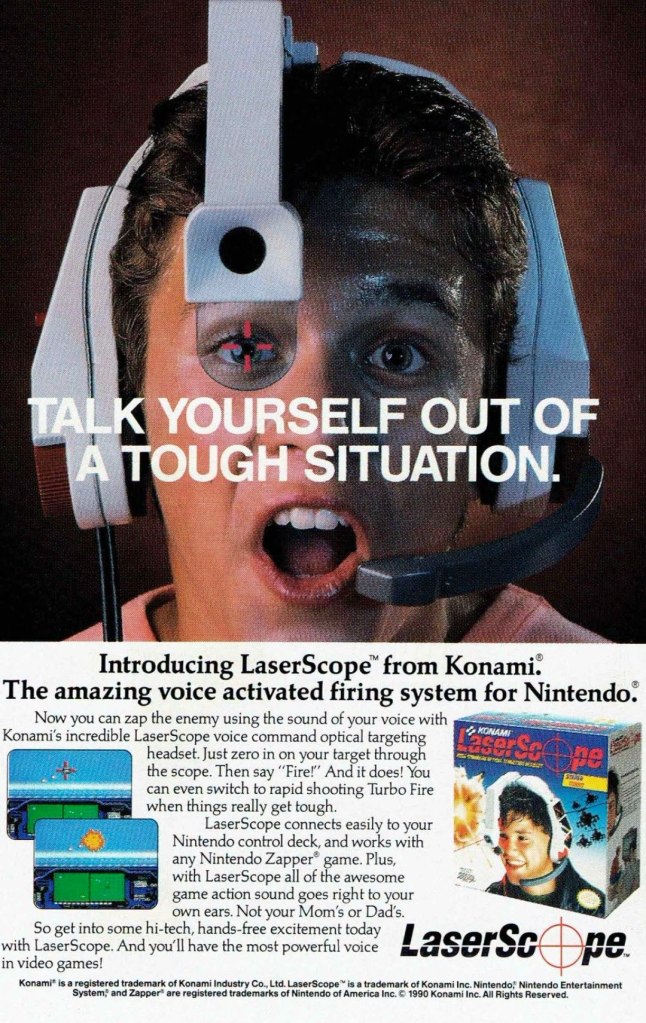
11. Konami LaserScope North American print ad
Did you get excited after seeing this Konami LaserScope print ad? Do you know anyone who bought the peripheral?
In 1990, this print ad of Konami’s LaserScope appeared in comic books and several other publications. The LaserScope was a gaming peripheral designed for use on the Nintendo Entertainment System (NES) complete with compatibility with existing games that were made to support the NES Zapper. The ad even boasted a voice-activated firing feature and a hands-free approach on playing NES games. While the ad boasted that players will have the most powerful voice in video games, the LaserScope itself was a very flawed and badly optimized device. Apart from having a built-in microphone that was oversensitive, tracking targets was a chore requiring constant head-turning which in turn made the gameplay experience very tiring and frustrating. This old ad promised a lot and the LaserScope was a catastrophe. When was the last time you bought hardware from Konami?
Welcome back my readers, YouTube viewers and all others who followed this series of articles focused on YouTube videos worth watching.
Have you been searching for something fun or interesting to watch on YouTube? Do you feel bored right now and you crave for something to see on the world’s most popular online video destination?
I recommend you check out the following videos I found.
#1 Virtua Fighter anime revisited – Remember back in the 1990s when Sega struck gold with the groundbreaking success of the first Virtua Fighter game? Virtua Fighter was their first 3D polygonal fighting game and it easily attracted attention as well as tons of money from arcade gamers and later console gamers. Virtua Fighter also sparked strong sales for the Sega Saturn console in Japan. Along the way, Sega itself got involved in anime productions with their ownership of TMS Entertainment and by the year 1995, the Virtua Fighter anime TV series was launched. To be clear, the Virtua Fighter anime series was not a simple production as the creators behind it made something cohesive as well as the characters worth following. To learn more about the said anime, watch the GTV Japan video below.
#2 A look at the legacy of Reggie Lewis – When the late Reggie Lewis first entered the NBA as a rookie, the Celtics were still the best in the Eastern Conference and their famous starting five of Larry Bird, Kevin McHale, Robert Parish, Dennis Johnson and Danny Ainge were aging. During his second season, Lewis improved heavily as he replaced the injured Larry Bird, and he went on to become a very productive Celtic over the next several years. Tragedy struck in 1993 when Lewis died at age 27 and the details behind his heart condition and death are complicated to say the least. What most people did not know was that Lewis entered the NBA to lift his family (note: his mother was a drug addict) up from poverty. The legacy of Reggie Lewis is explained in detail in the video below and I encourage you all to watch it.
#3 The Creepiest Episodes of Unsolved Mysteries – Recently, YouTuber Minty Comedic Arts posted a video about the ten creepiest episodes of Unsolved Mysteries (hosted by the late Robert Stack). In that video, I saw most of the creepy episodes featured and there were a few ones that I saw for the first time. Indeed, almost all the episodes of Unsolved Mysteries can be viewed for free on YouTube and there are some that were missing due to legal reasons. Now is the time to watch Minty’s video below. Tell me if you find them creepy.
#4 American cheese in Japan – With the intensifying demand for cheese around the world, there is now a so-called battle for market share. In Japan, most cheese offered are imported and their prices have gone up significantly affecting the restaurants and local consumers. Along the way, cheese produced in the United States have entered Japan in growing numbers and it is being offered to local businesses and consumers for their consumption and cooking needs. America has key advantages with regards to production of milk and cheese and there is a renewed focus on exporting products aggressively. Watch and learn from the Nippon TV video below.
#5 The Unreleased Marvel 2099 Video Game of the 1990s – Thirty years ago, I read a video game magazine and got excited over the news about an official video game based on the Marvel 2099 comics franchise. I already read lots of issues of Spider-Man 2099, X-Men 2099, Ravage 2099, Punisher 2099, Doom 2099, and the 2099 Unlimited quarterly series. That said, I was delightfully surprised that the Marvel 2099 game was set for release on PlayStation. Then as time passed by, nothing happened and the unreleased game was forgotten. To find out exactly what happened, go watch the in-depth video below.
#6Chopping Mall reaction videos – How many times have you seen a horror movie or a cinematic misadventure that happened inside a shopping mall? In 1986, the low-budget techno-horror movie Chopping Mall (original title: Killbots) was released and it had a lot of scenes filmed inside the Sherman Oaks Galleria (which was also a location for Commando and Fast Times at Ridgemont High) in California. What makes Chopping Mall unique is its concept of security robots going rogue and harming people which brings back vibes of The Terminator. In today’s age of rampant artificial intelligence (AI) development, Chopping Mall has gotten more socially relevant and it has been featured in many movie reaction and retro review videos on YouTube. I found for you guys and gals the more engaging videos of the said movie.
#7 Adults Who Went to the Extreme for Disney and Buried Themselves with Debt – What is the worst thing you can do with your time and money with regards to entertainment from the woke Disney company? A few years ago, a survey found that 24% of all Disney-goers accrued debt during their trips along with 45% of parents with children (aged below 18). To be very clear, visiting a Disney theme park with the family is very costly and the very expensive rates on the food, transportation, accommodations, souvenirs and services related with Disney won’t fade away. Even with those painful prices, there still are certain adults who put themselves at huge financial risks because they could not restrain themselves from enjoying anything Disney. The Disney adults are real, and they lack discipline on spending. In the long run, these people are morally and spiritually lost. You better not follow their bad examples, and you can find out why by watch the informative video below.
Disclaimer: This is my original work with details sourced from reading the comic book and doing personal research. Anyone who wants to use this article, in part or in whole, needs to secure first my permission and agree to cite me as the source and author. Let it be known that any unauthorized use of this article will constrain the author to pursue the remedies under R.A. No. 8293, the Revised Penal Code, and/or all applicable legal actions under the laws of the Philippines.
Welcome back, superhero enthusiasts, 1990s culture enthusiasts, X-Men fans and comic book collectors! Today we revisit the Marvel Comics shared universe through one of the many tales of the X-Men 2099 monthly series.
After 17 issues read, it is clear that the futuristic X-Men were destined to be separated from each other before getting back together against all odds. By having the team in disarray and the members separated with different situations that affected them, it provided the comic book creators opportunities to really develop each member extensively while expanding the lore of Marvel 2099 in creative ways. After seventeen issues, Skullfire has transformed into a more reasonable person who aligned himself with Shakti closely. Meanstreak meanwhile went to Las Vegas with Halloween Jack to do something that could alter the city seriously. Krystalin in California is on a quest to find her kidnapped brother.
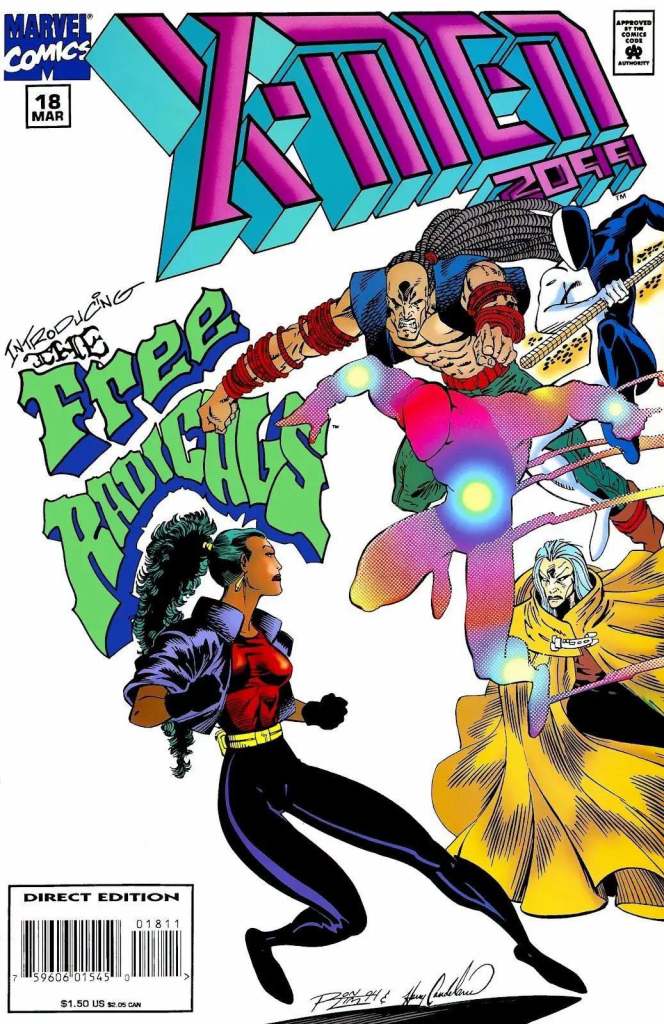
With those details laid down, here is a look back at X-Men 2099 #18, published by Marvel Comics in 1995 with a story written by John Francis Moore and drawn by Ron Lim.
The cover.
Early story
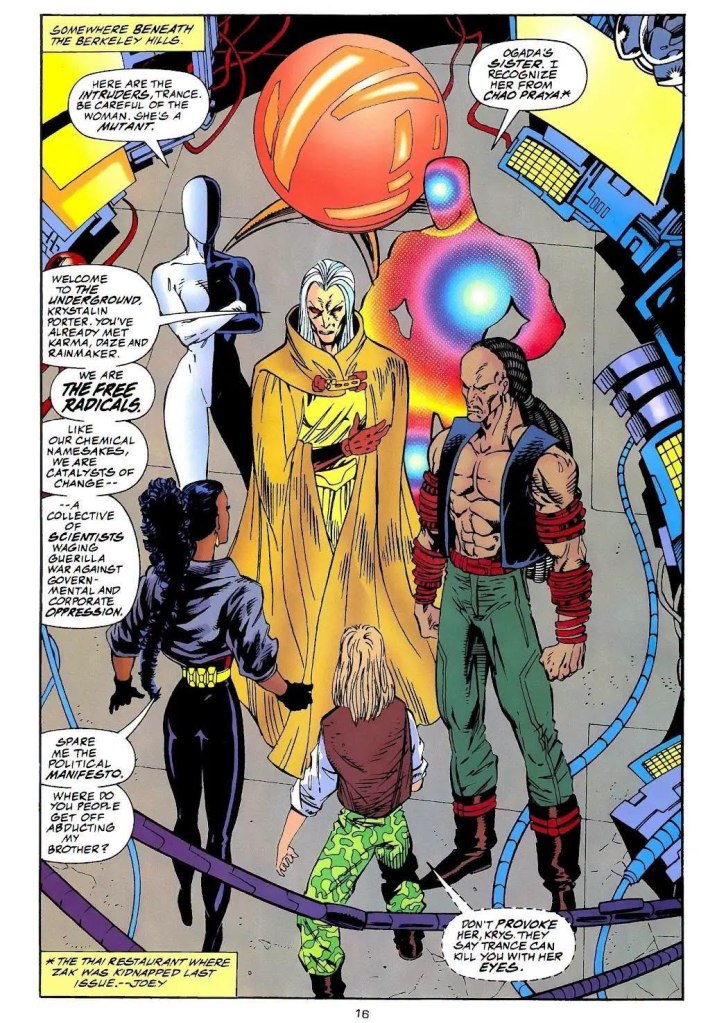
The story begins in Berkeley where Krystalin and her companion visit a ruined part of the city. She is told that it is best for them to turn around but Krystalin insists on finding the Free Radicals who are responsible for kidnapping her brother Zak. As they walk further, they both fall into a trap door only to find themselves in a very dark wind tunnel which caused their fall to slow down. After landing on the floor, gas is suddenly pumped on them. A very bright light followed which disoriented them both. A man and woman appear to take them in. Krystalin decides to fight and find her brother.
Meanwhile in the mountains of New Mexico, three intruders appeared inside a secret laboratory while Shakti struggles to sleep. The intruders analyze Zhao’s attempt to make analogs of the original 20th century X-Men members which ended in failure. One of them thinks that Shakti has finally halted and reversed the deterioration. Using technology, they have the three fossilized bodies teleported to the Theater of Pain.
Shakti, who has been unable to sleep, senses the presence of a mutant inside the laboratory…
Quality
Krystalin and her companion meet the Free Radicals, a group of dangerous freaks.
As expected, this comic book continues the tales of the previous issue, specifically Krystalin’s quest and Halloween Jack’s takeover of Las Vegas. Things, however, turned for the weird and the wild.
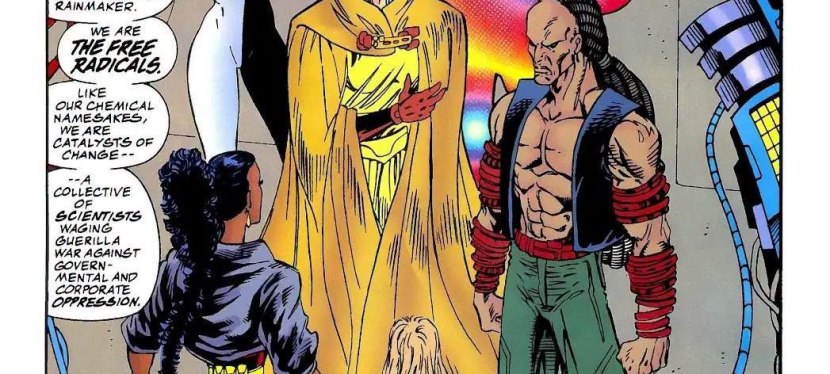
Krystalin’s quest for her kidnapped brother Zack led her to facing off with the Free Radicals, a group of freaks composed of scientists who have been waging guerilla war against governmental and corporate oppression. Elements of politics were mixed into the narrative of Krystalin’s tale as it brings back memories of radicalized groups in America who engaged in crime, political activism and terrorism during the rule of President Richard Nixon (for insight, click here). As expected, Krystalin finds herself on a huge disadvantage and her will to get her brother (a highly prominent part of the Panthers) back really got tested here.
As for the other important tale, Halloween Jack (assisted by Meanstreak) pushed forward with his insane intention to take over the Synge casino and bring down the syndicate while Desdemona Synge is helpless. This tale easily reminds me of the Las Vegas legacy of crime, particularly with the establishment of businesses owned by gangsters many decades ago. As Marvel 2099 has a strong anti-corporate message (which confirms the Leftist bias and philosophies with Marvel Comics and creators during the 1990s), the boundary that separated good and evil got blurred away in this tale. While Halloween Jack believes he is doing something good and significant by bringing down the Synge empire and changing Las Vegas, he does not realize he himself is evil and is executing a plan of one evil force replacing the current evil force. This should remind you about the Black Panthers, the Palestinian terrorists, the Black Lives Matter (BLM) movement and other wicked forces of the world who see themselves as liberators and went to the extremes with violence and coercion.
Along the way, Meanstreak assists Halloween Jack without any hesitation which made him a pawn of evil. As such, Meanstreak’s character and moral standing got compromised a lot which makes his membership of the X-Men questionable.
Indeed, there is a lot of symbolism in the tales of Krystalin and Halloween Jack here and the undeniable thing is that John Francis Moore implemented a good amount of depth within.
Conclusion
Shakti, who has the ability to sense the presence of mutants, encounters the intruder.
X-Men 2099 #18 (1995) is clearly an attempt to shake the foundation of the series itself. Las Vegas has always been a key location since the beginning, and the Synge empire was the original enemy of the futuristic X-Men. Even as the mentioned two tales resulted in the weird and the wild, the creators succeeded in ensuring a cohesive read.