Retro Gaming Ads Blast – Part 45

Welcome back readers, fellow geeks and electronic gaming fans!

In this edition of the Retro Gaming Ads Blast (RGAB) series, we will take a look at another batch of retro gaming print ads from the 1980s to the 1990s.

For the newcomers reading this, Retro Gaming Ads Blast (RGAB) looks back at the many print ads of games (console, arcade, computer and handheld) that were published in comic books, magazines, flyers, posters and newspapers long before smartphones, social media, the worldwide web and streaming became popular. To put things in perspective, people back in the 1980s to the 1990s were more trusting of print media for information and images about electronic games and related products.

With those details laid down, here is the newest batch of retro gaming print ads for you to see and enjoy…

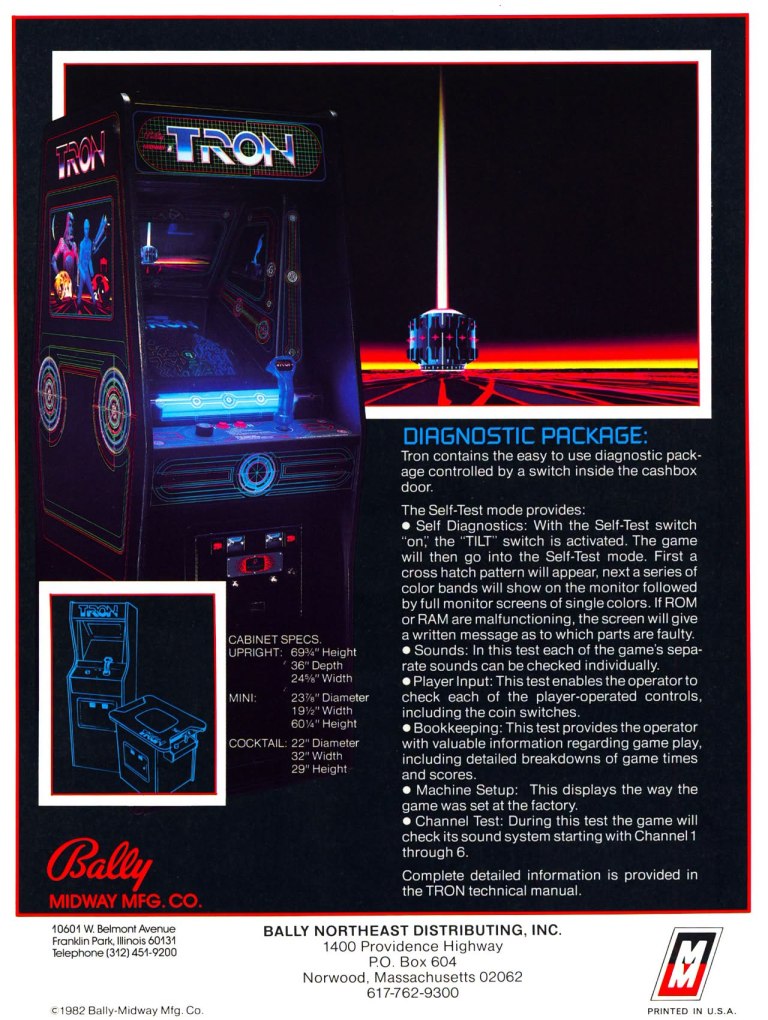
1. Tron Arcade Flyer
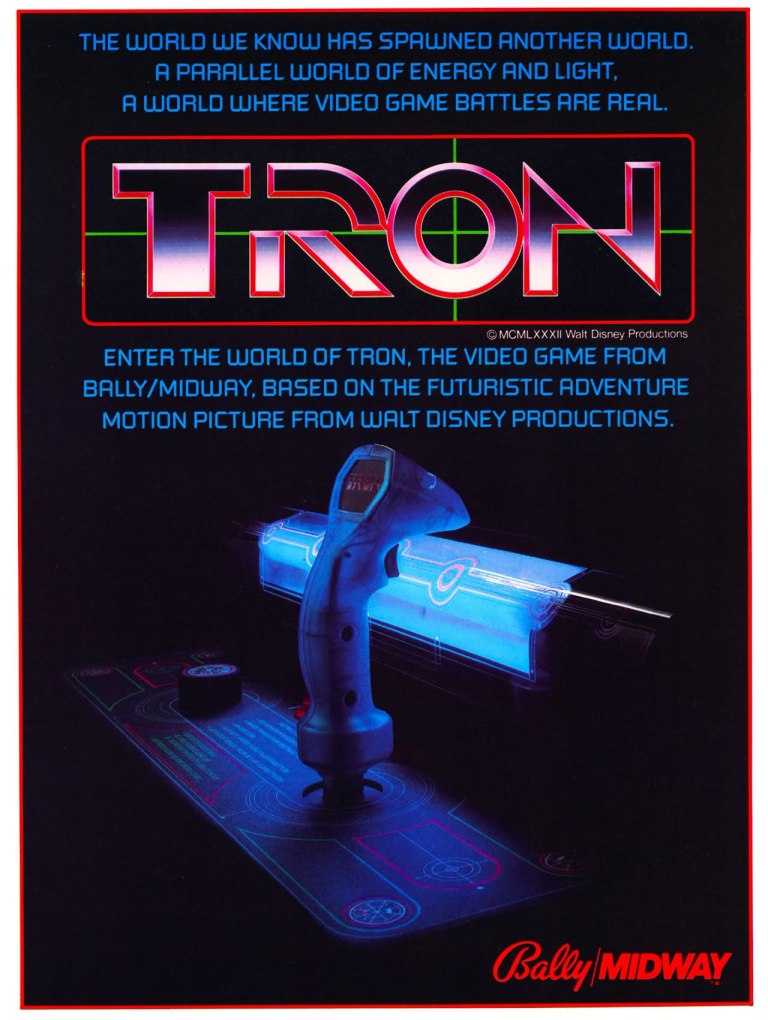
The front.
The rear. The details were clearly written for arcade operators.

Remember how dazzling the 1982 movie Tron was when you first saw it? That film had groundbreaking computer-generated graphics and the filmmakers worked very hard to tell a story covering both the real and digital worlds. Along the way, the movie had strong video game vibes which resonated with gamers at a time when arcade gaming was wildly popular in America. Believe it or not, an official arcade game of Tron was released the same year as the movie and it was a massive success. The arcade flyer perfectly captured the vibe and look from the movie and the machine itself had a control stick the same with what was shown to viewers. This old flyer is still great to look at.

2. Green Beret Japanese Arcade Flyer
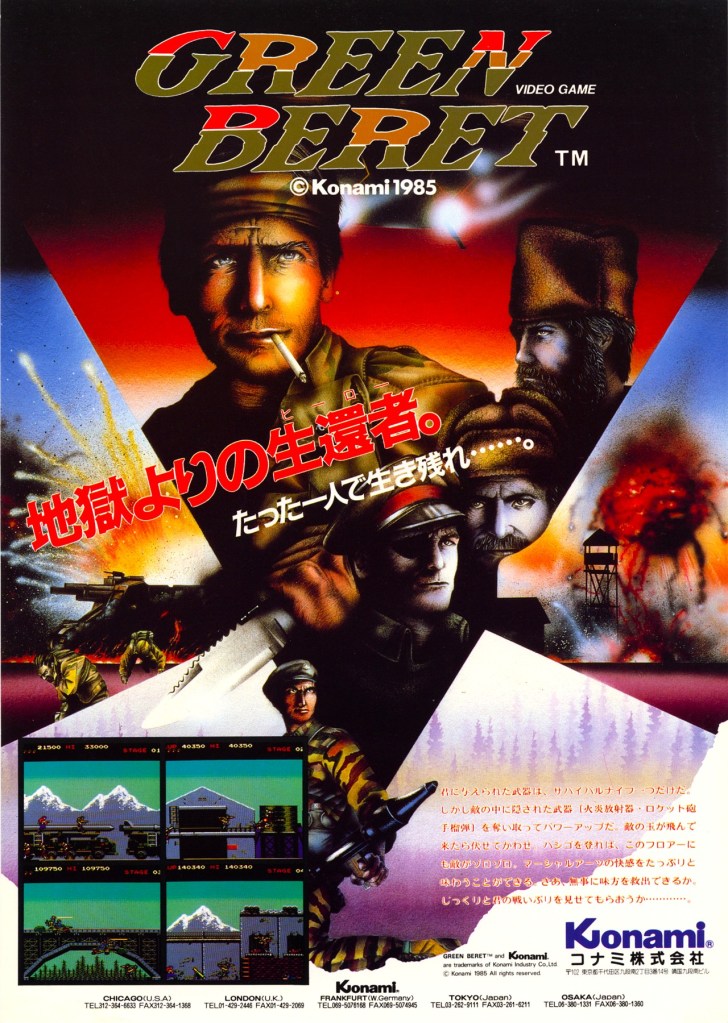
This is a very stylish flyer.

Konami was a highly prolific game publisher in the 1980s and it had lots of games that became huge blockbusters. During the decade, their game developers were strongly influenced by both Hollywood action movies and the Cold War. In 1985, Konami released the militaristic game Green Beret in Japanese arcades and to promote it, they created an arcade flyer featuring a very stylish artwork highlighting military images of soldiers (including a guy smoking) and warfare. This ad still looks great and it was not surprising it helped the game achieve huge commercial success. Green Beret was released in America as Rush’n Attack.

3. Darius Japanese And North American Arcade Flyers
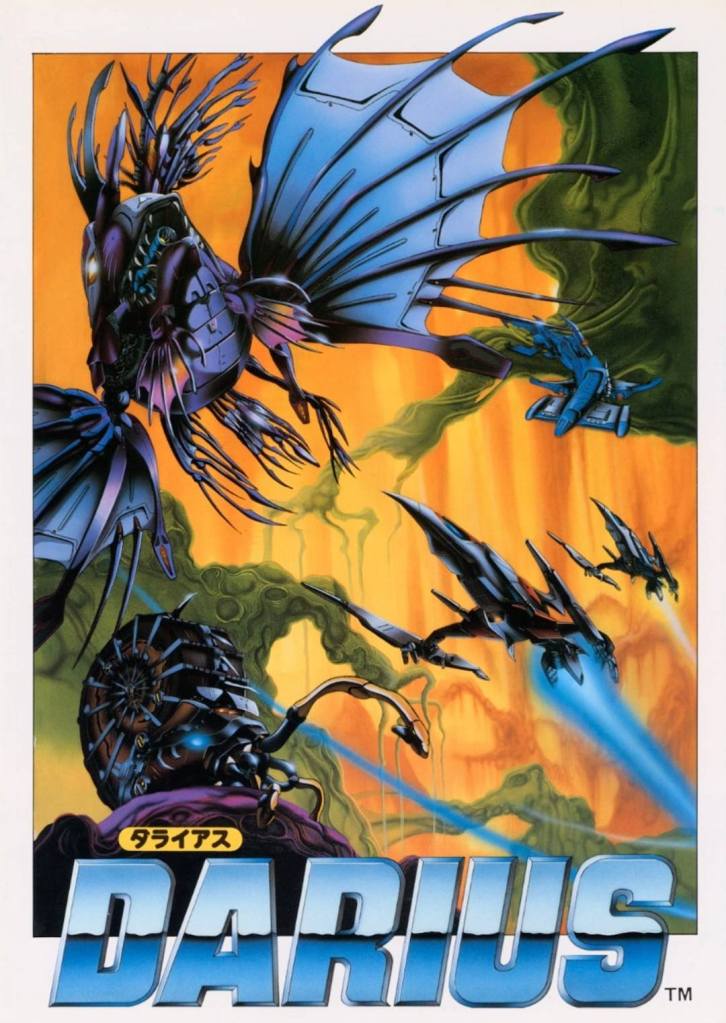
The Japanese flyer.
The North American flyer.

Released in arcades worldwide in 1987, Darius is a 2D side-scrolling shooter game from Taito which had a science fiction concept of the starship Silver Hawk (piloted by players) which sets on a mission to destroy an evil empire before it could destroy the world called Darius. The game was successful, most notably in Japan and it eventually led to sequels being released later. What I find intriguing is how the arcade game was promoted in Japan and in North America. The Japanese arcade flyer had this intriguing artwork that reflected a blend of sci-fi with a touch of horror. The North American flyer had a strong sci-fi touch with a male and female model wearing costumes (that made them look futuristic) standing beside the Darius machine. Which flyer looks more appealing to you?

4. Data East’s Arcade Alley Print Ad
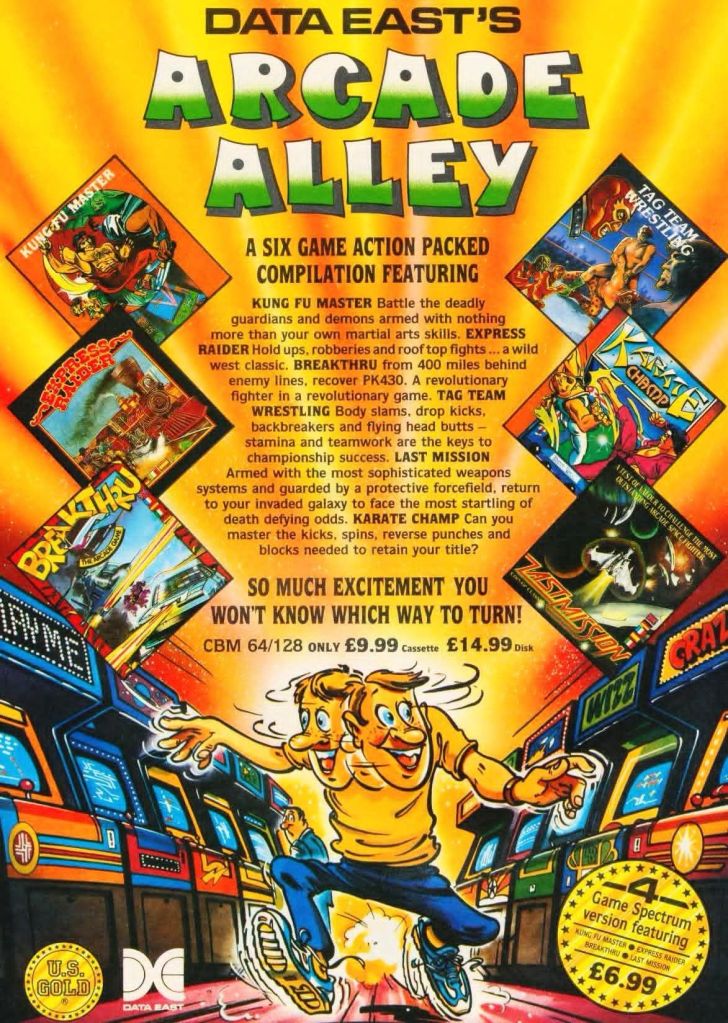
Fun and excitement emphasized in this print ad.

There is nothing like porting arcade hits to computer systems for gamers to enjoy. In 1988 there in Europe, U.S. Gold released Data East’s Arcade Alley for computer systems and it included ports of popular Data East games like Kung Fu Master, Express Raider, Breakthru, Tag Team Wrestling, Last Mission and Karate Champ. U.S. Gold’s print ad showed a guy in the middle of a video arcade looking on both sides to pick which game to play which strongly emphasized the essence of the game collection (offered in cassettes and disk). This old ad is still amusing to look at.

5. Blasteroids European Print Ad
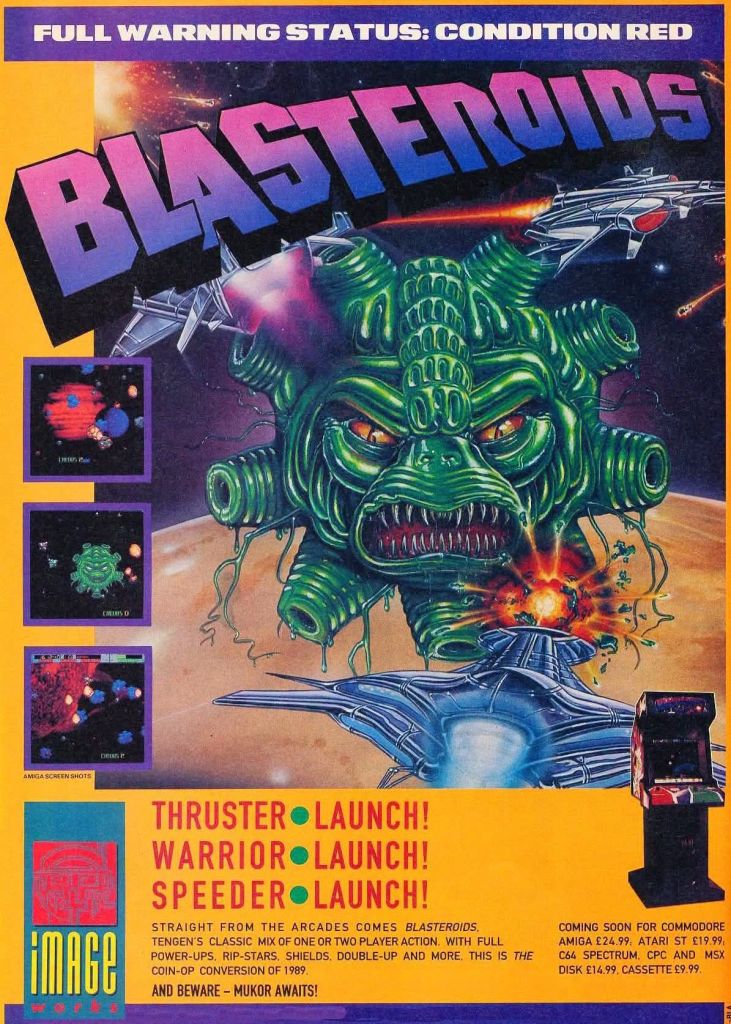
Blasteroids for the Europeans.

Blasteroids, the third entry in Atari’s popular Asteroids games series, was released in European arcades by Image Works and eventually landed on computer systems there. For Europe, the ad makers came up with artwork showing a creepy, green space monster surrounded by a few spaceships to emphasize the game’s concept. The said monster eventually appeared on the game covers of the computer ports of Blasteroids later. This ad shows creative adjustments taken to promote games in different parts of the world.

6. Dream Team USA Japanese Print Ad
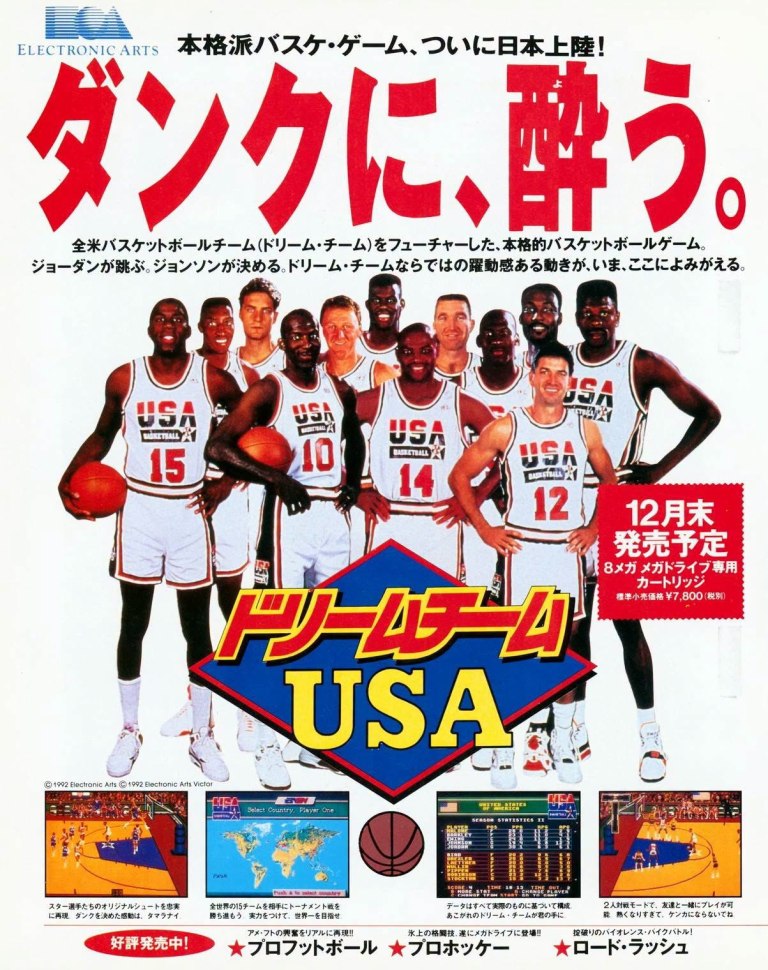
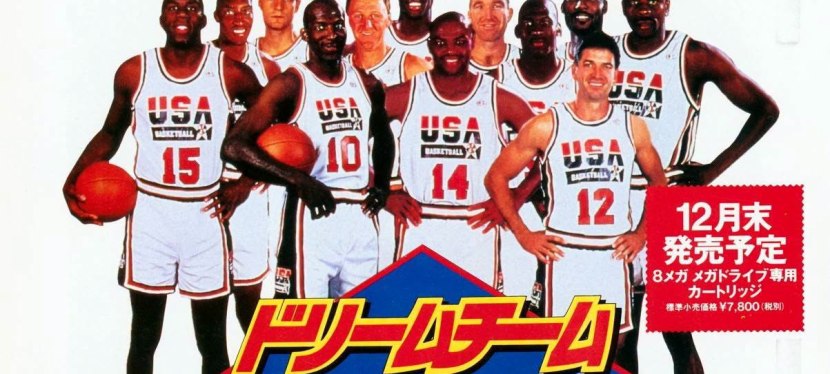
The legends of the NBA in the Japanese version of EA’s Team USA Basketball. Retitling the game as Dream Team USA made more sense because “Dream Team” was a much more popular reference than “Team USA Basketball”.

Remember how wildly popular the Dream Team (Team USA in Olympic basketball) was in 1992? With NBA legends Larry Bird, Michael Jordan, Magic Johnson, Charles Barkley, Karl Malone, John Stockton and more representing America in the basketball tournament of the Olympic Summer Games in Barcelona, Spain, the Dream Team (a media-led reference for the team) was easily the main attraction not only for basketball fans worldwide but also those who craved for excitement in international sports events. That said, Electronic Arts secured the license to make an official video game about the Dream Team and actually released the game Team USA Basketball within 1992 for the Sega Genesis. As basketball is popular also in Japan, EA released the game there titled as Dream Team USA and came up with a Japanese print ad to seriously capture gamers’ attention. This ad is still effective in delighting both basketball and video game enthusiasts.

7. Super Star Wars: The Empire Strikes Back And Return Of The Jedi Print Ad
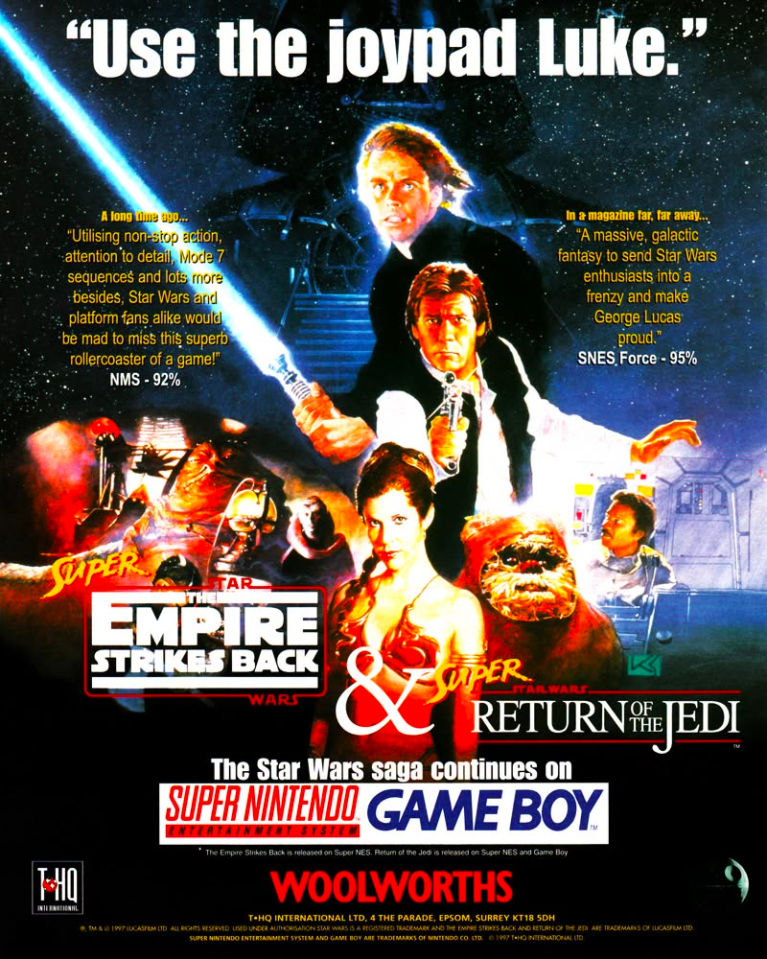
No screenshots of games used. Just the official images from the posters of the two movies.

Back in the 1990s, there was a resurgence of the original Star Wars trilogy across different forms of media. Apart from the VHS re-releases of Star Wars, The Empire Strikes Back and Return of the Jedi, there was a slew of video games of Star Wars released during the decade and the fans had new stuff to entertain themselves with. Along the way, the company THQ secured the rights to Super Star Wars: The Empire Strikes Back and Super Star Wars: Return of the Jedi for re-release to coincide with the 1997 “Special Edition” theatrical releases of their respective movies. THQ’s print ad simply used official images of Return of the Jedi and inserted a tiny bit of The Empire Strikes Back, and they did not show any screenshots that could have been helpful for Super Nintendo Entertainment System (SNES) and Game Boy users. Still, it was smart for THQ to print two excerpts of game reviews to sell the games.

8. Super Mario RPG North American Print Ad
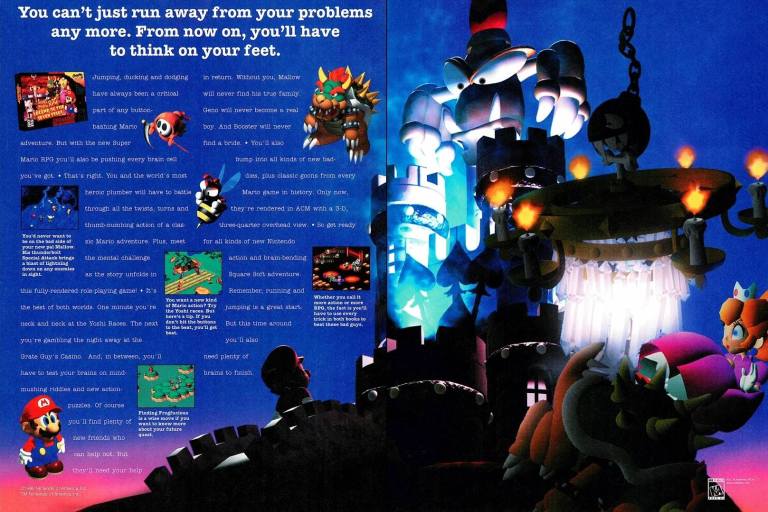
A mesmerizing ad for the acclaimed Super Mario RPG.

Remember back in the 1990s when Nintendo and role-playing game giant SquareSoft had a very healthy business relationship that proved successful? Before their eventual breakup (related to Square signing with Sony for PlayStation development), the two companies joined forces to make a fully featured role-playing game for the SNES featuring Super Mario and related characters…Super Mario RPG: Legend of the Seven Stars. To promote the game, Nintendo (the publisher) created a mesmerizing 2-page print ad highlighting their characters while emphasizing the role-playing and fantasy aspects of the game. At the time of its release, Super Mario was often identified with platform games and the Super Mario RPG print ad was a serious attempt to lure fans into RPGs which the SNES was already rich with. This ad, which I first saw in gaming magazines in 1996, still looks great.

9. NBA Shootout ’97 Print Ad
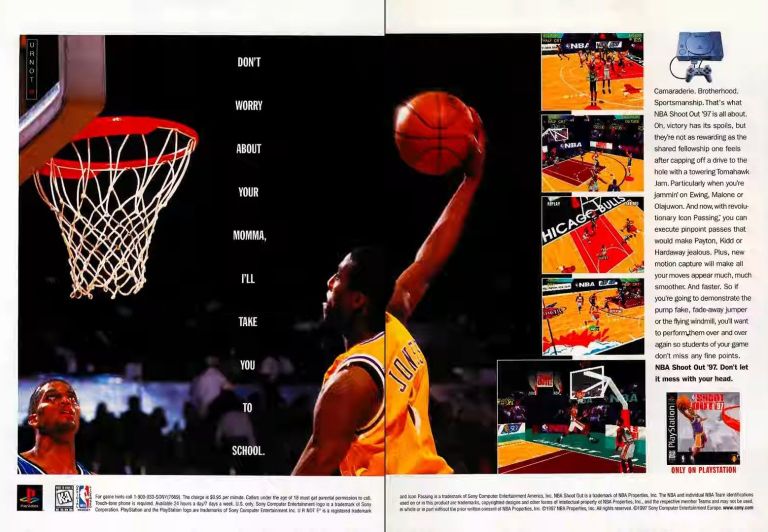
Did you play this on PlayStation in 1997?

If there is anything I miss about 1990s console gaming, it is the fact that there were a lot of NBA-licensed video games that were offered to players with different tastes in basketball gaming. Sony had its own exclusive NBA games series called NBA Shootout and they were pretty aggressive selling its own basketball games along with the PlayStation going up against the likes of Electronic Arts (NBA Live), Sega and others. This is reflected in this 2-page print ad of NBA Shootout ’97 which was a PlayStation-exclusive release. They featured a photograph of Lakers’ Eddie Jones about to dunk and showed screenshots as well as the descriptive text written with excitement. Since it first started, NBA Shootout was basketball in full 3D polygonal graphics backed with motion-captured moves and dunks that players could enjoy only PlayStation. This ad is a reminder that Sony used to make official NBA games and there is a lack of variety and players’ choice of NBA gaming in today’s world.

10. Legend of Legaia North American Print Ad
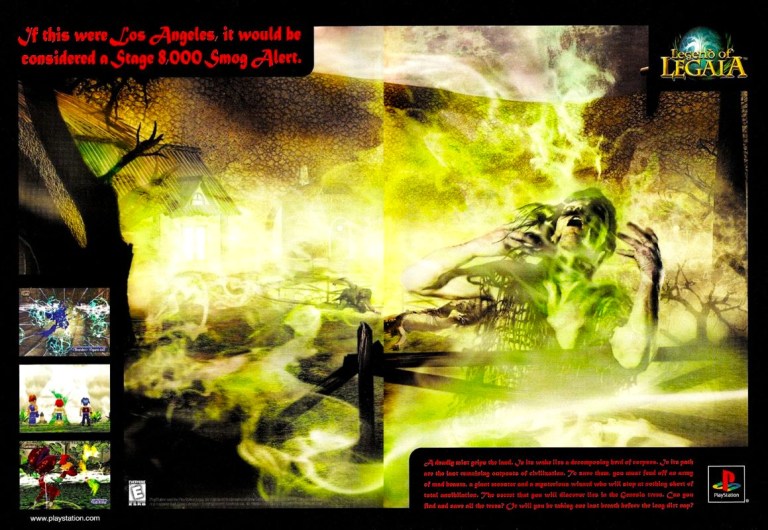
Perhaps someone at Sony Computer Entertainment America (SCEA) thought Legend of Legaia was a horror video game.

There was a time when Sony produced Japanese RPGs (JRPGs) exclusive for PlayStation consoles. One of them was Legend of Legaia which had a combat system that emphasized martial arts and it had an interesting fantasy concept. For its 1999 North American release, Sony came up with a very bizarre 2-page print ad that had digital artwork with a very strong horror vibe and the visual designs within the three screenshots shown were clearly not related with it. How this ad was made remains unclear. This is easily one of the most misguided gaming ads of the 1990s.

+++++

Thank you for reading. If you find this article engaging, please click the like button below, share this article to others and also please consider making a donation to support my publishing. If you are looking for a copywriter to create content for your special project or business, check out my services and my portfolio. Feel free to contact me with a private message. Also please feel free to visit my Facebook page Author Carlo Carrasco and follow me on Twitter at @CarloCarrascoPH as well as on Tumblr at https://carlocarrasco.tumblr.com/ and on Instagram athttps://www.instagram.com/authorcarlocarrasco
Retro Gaming Ads Blast – Part 44

Welcome back readers, fellow geeks and electronic gaming fans!

In this edition of the Retro Gaming Ads Blast (RGAB) series, we will take a look at another batch of retro gaming print ads from the 1980s to the early 2000s.

For the newcomers reading this, Retro Gaming Ads Blast (RGAB) looks back at the many print ads of games (console, arcade, computer and handheld) that were published in comic books, magazines, flyers, posters and newspapers long before smartphones, social media, the worldwide web and streaming became popular. To put things in perspective, people back in the 1980s to the 1990s were more trusting of print media for information and images about electronic games and related products.

With those details laid down, here is the newest batch of retro gaming print ads for you to see and enjoy…

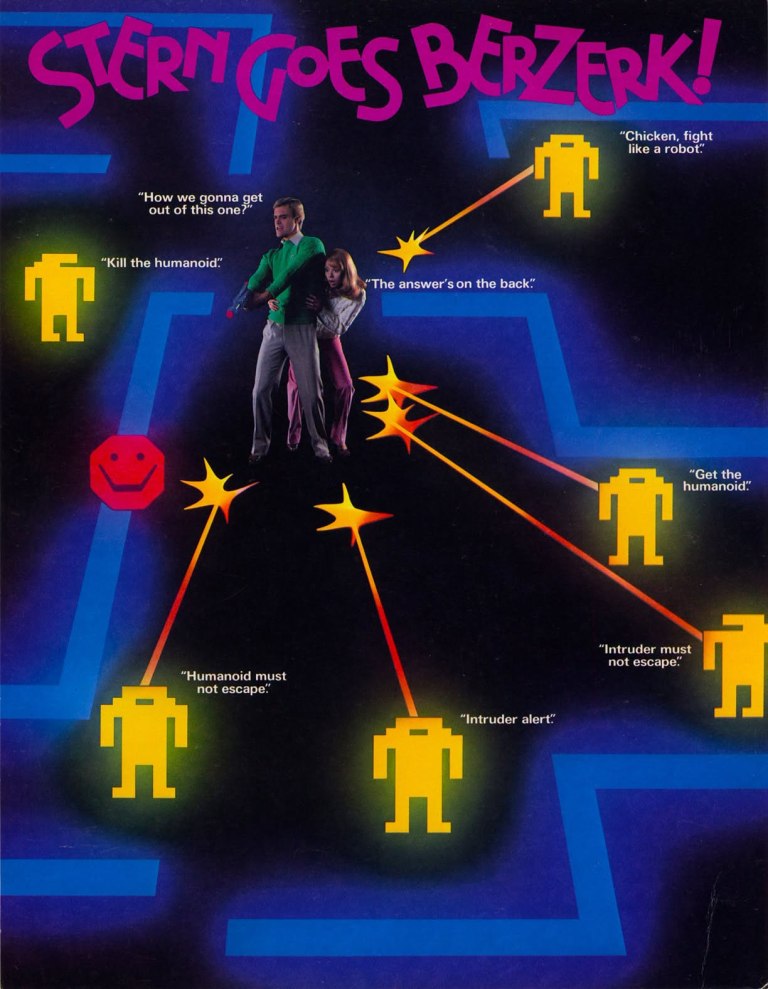
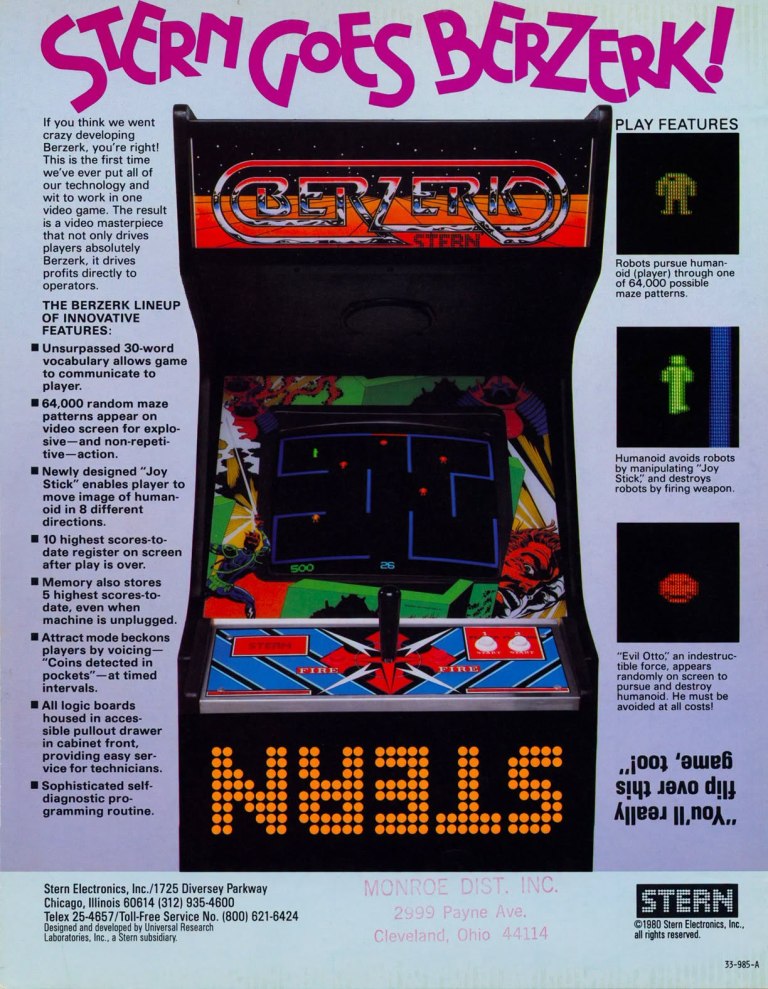
1. Berzerk Arcade Flyer

The front.
The rear.

Could you imagine being trapped deep within a maze surrounded by dangerous robots (plus one other unstoppable enemy) capable firing laser blasts at you? This was the concept behind the design of Berzerk, an arcade game released by Stern Electronics in 1980. Released at a time when science fiction became wildly popular in American entertainment, Berzerk was immersive for gamers and the multidirectional gameplay feature was captivating for many. To promote the game, Stern Electronics came up with a customized visual design that blended 2D sprite elements with a photograph of two people and some hand-drawn art pieces. The front of the flyer emphasized accurate the core concept of the game while the rear explained the technical details. They even played with their company name with the line “Stern goes berzerk!”

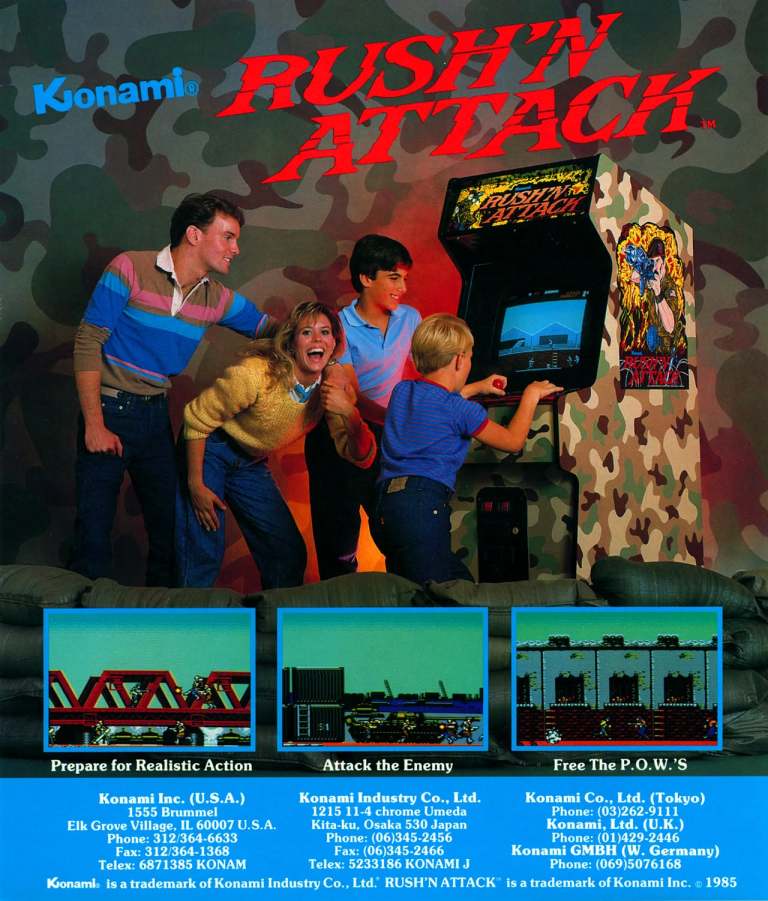
2. Rush’n Attack North American Arcade Flyer

The arcade flyer for North America

During the late stages of the Cold War, Konami made a lot of military-themed video games which resonated not only with those who were already aware about the global conflict but also with gamers who craved for action and excitement. One of those games was Rush’n Attack (alternative title: Green Beret) which was released in American arcades in late-1985. Konami came up with an arcade flyer showing four people (looking like an American family) having a good time in front of an arcade cabinet, and three screenshots of the game were displayed on the lower half. Rush’n Attack – which was deliberately titled to resemble the phrase “Russian attack” due to its obvious Cold War setting – went on to succeed commercially and critically. One notable game review compared Rush’n Attack favorably with the movie Rambo: First Blood Part II.

3. Turbo Out Run North American Arcade Flyer

The flyer.

Following the massive success Sega achieved with Out Run in 1986, the company went on to release the follow-up Turbo OutRun three years later. As seen in their North American flyer, Sega emphasized the in-game locations, the look of the machine with the driver’s seat and steering wheel, and the excitement they can expect. Turbo OutRun went on to become successful in the arcades worldwide and it got ported to a variety of consoles and computer systems in the years that followed. On its own, the arcade flyer sparked excitement for gamers.

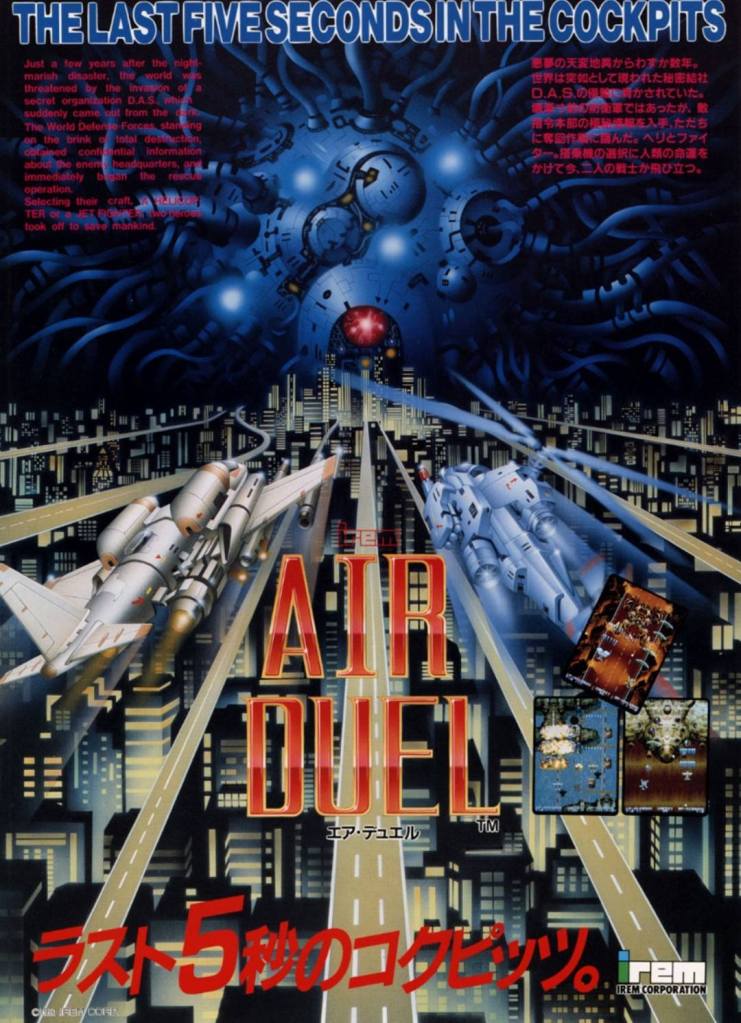
4. Air Duel Japanese Arcade Flyer

The artwork here is captivating to look at.

Released in Japanese arcades in 1990, Air Duel from Irem is an intense and fast-paced 2D sprite vertically scrolling shooter that attracted a lot of players. It had a war theme and its aesthetic has a mix of military and somewhat futuristic science fiction elements. The game’s arcade flyer featured a very intriguing artwork by Takashi Yamasaki showing two aircrafts flying over a city heading towards a massively large enemy in the distance. In my opinion, the artwork alone is pretty engaging to see and it’s more than enough to make me think about playing the game.

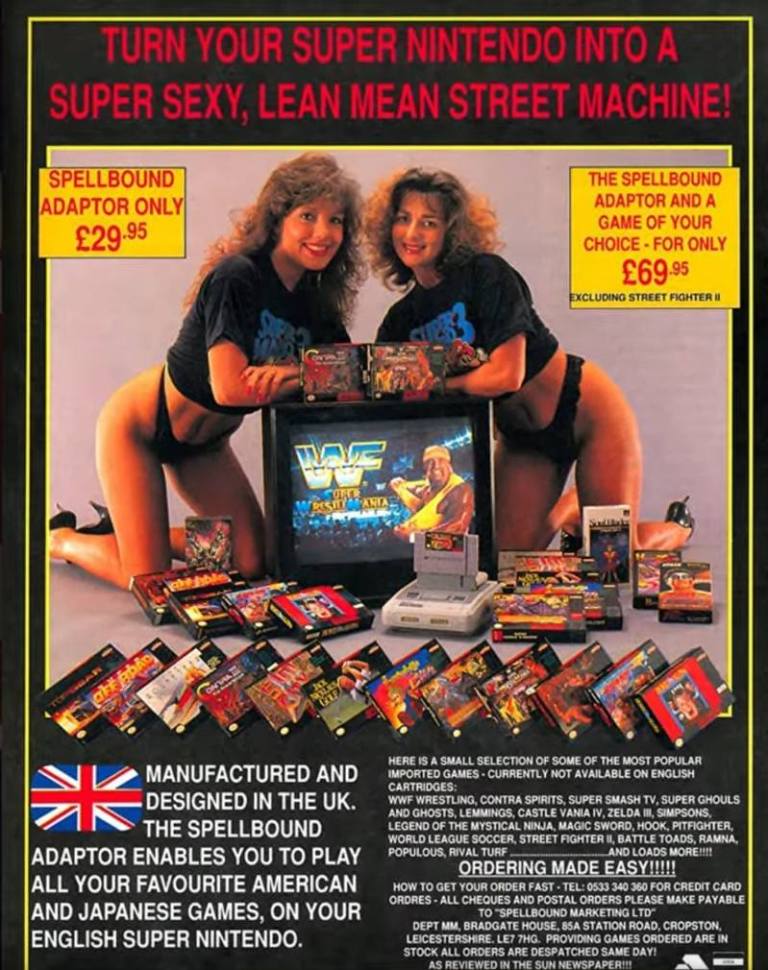
5. Spellbound Adaptor Print Ad

The Spellbound Adaptor print ad in Europe. UK design and manufacturing emphasized.

Remember back in the old days when there were hardware lockouts on game consoles that prevented users from playing games imported from different regions? In Europe, a special cheat and regional bypass cartridge called the Spellbound Adaptor was released and it allowed Super Nintendo Entertainment System (SNES) users to bypass the lockouts and play games from overseas. The Spellbound Adaptor was notably advertised in European print media showing two sexy ladies posing with the adaptor itself (on the SNES), the television and many SNES games. The ad even includes a promo of buying the adaptor with a game of choice for only £69.95. The ad is still impactful to look at.

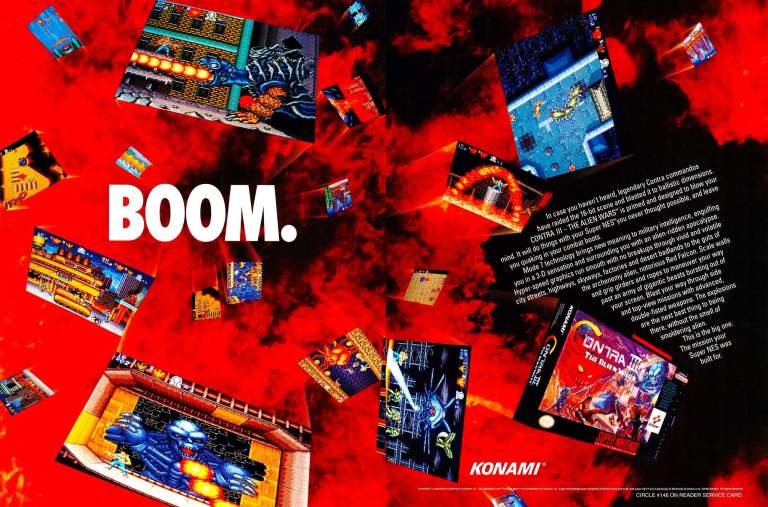
6. Contra III: The Alien Wars North American Print Ad

Konami’s made a huge impression visually with this 2-page print ad promoting Contra III: The Alien Wars.

By the time the SNES was launched in America in 1991, a lot of gamers who enjoyed Contra games on the Nintendo Entertainment System (NES) have been craving for a sequel on the newer console. Their dreams finally came through in early 1992 when Konami released Contra III: The Alien Wars on the SNES, and it was a lot more than visual upgrade as it had groundbreaking features connected with the game developers’ clever use of the console’s technology. Konami was already aware of Contra’s huge following in America, so they came up with an aggressive looking print ad promoting Contra III: The Alien Wars. With a red-and-black background, the ad had a variety of screenshots that were tilted to look 3D (showing what the game offered) and used a minor space for the descriptive text and image of the game box. This old print ad is one of the finest ways to promote a sequel while also emphasizing the next-generation experience fans can enjoy. This ad is a classic!

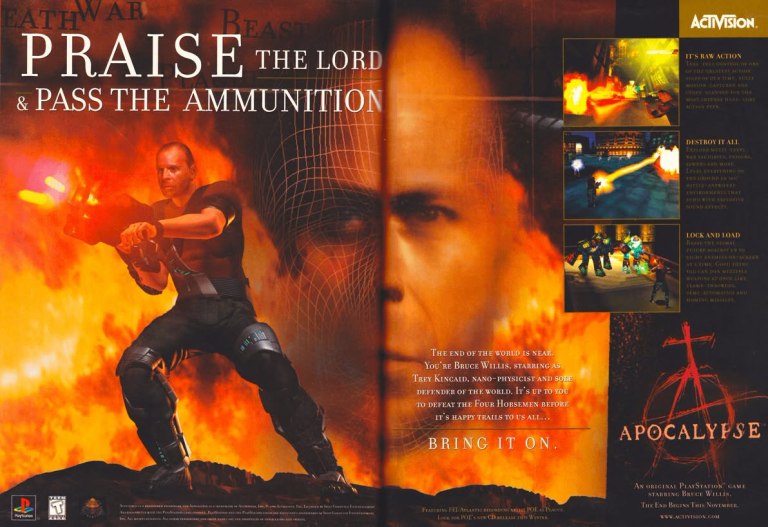
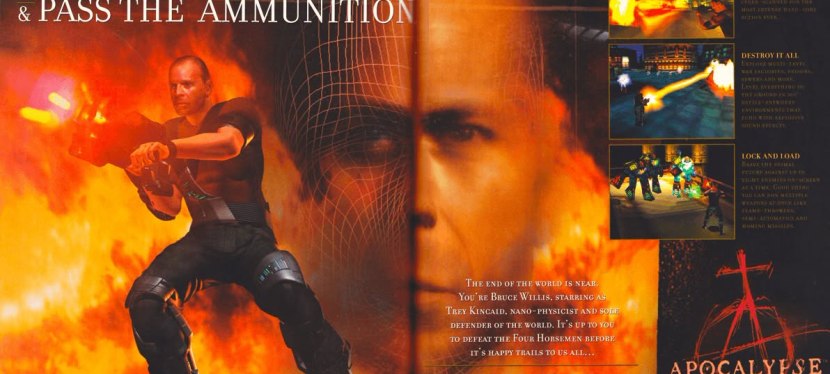
7. Apocalypse Print Ads

With Bruce Willis’ face, this 2-page Apocalypse print ad captured the attention of readers.
The more action-oriented 2-page print ad of Apocalypse. Bruce Willis is more visible here.

Believe it or not, Hollywood legend Bruce Willis actually starred in the ambitious video game titled Apocalypse. Before its 1998 released on PlayStation, Apocalypse started with the player character having an AI-controlled partner named Trey Kincaid to be played by Willis. Publisher Activision signed a multi-million Dollar deal with Bruce Willis to use his likeness and voice for the Trey character. Eventually the Trey Kincaid role was modified to be the playable character. Given the huge deal signed with the super star and the additional costs that came with game design revisions, Activision launched an aggressive marketing campaign for Apocalypse and they heavily used Bruce Willis’s name and imagery. Ultimately the game sold less than one million copies and yet Activision was satisfied with the sales which convinced them to go back to Apocalypse developer Neversoft for a new project.

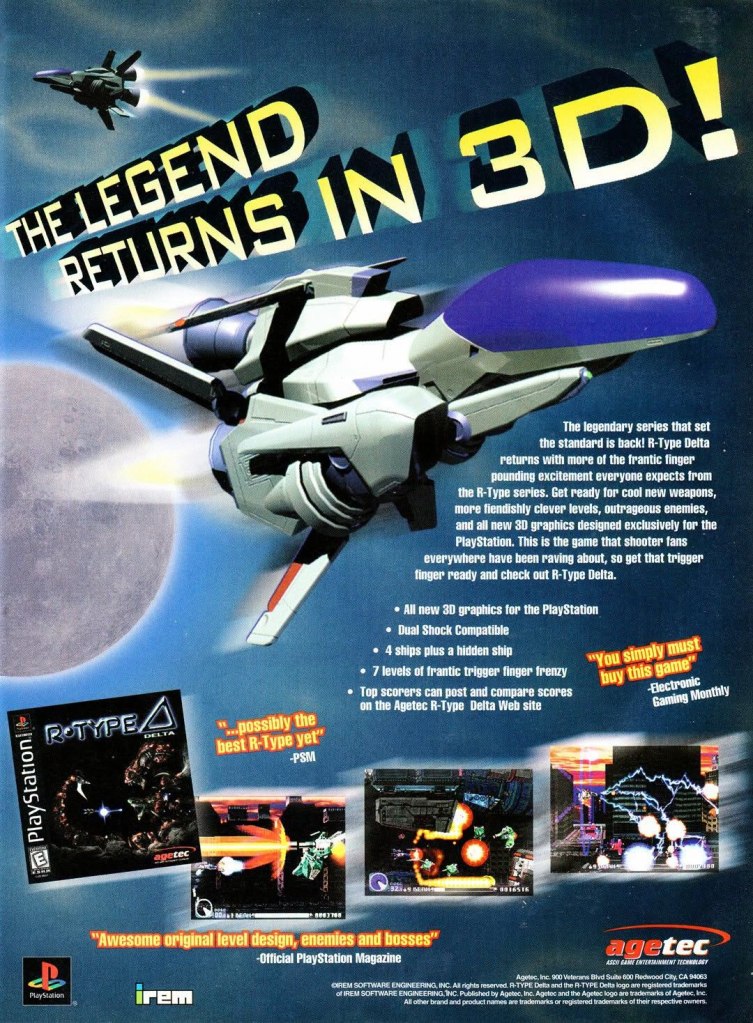
8. R-Type Delta North American Print Ad

R-Type Delta was the 4th game of the R-Type series and also the first to be made with 3D polygons.

R-Type, the long-running series of 2D side-scrolling shooters by Irem, fully embraced 3D polygons with R-Type Delta on PlayStation in 1998. To promote the game in North America, Irem and their partner Agetec went all-in emphasizing their series shift into 3D polygonal graphics while promising new in-game weapons. Very smartly, they included positive quotes from Electronic Gaming Monthly (EGM), PlayStation Magazine (PSM) and Official PlayStation Magazine (OPM) to show credibility. In recent times, an enhanced version of R-Type Delta (R-Type Delta: HD Boosted) was released on modern game console and PC.

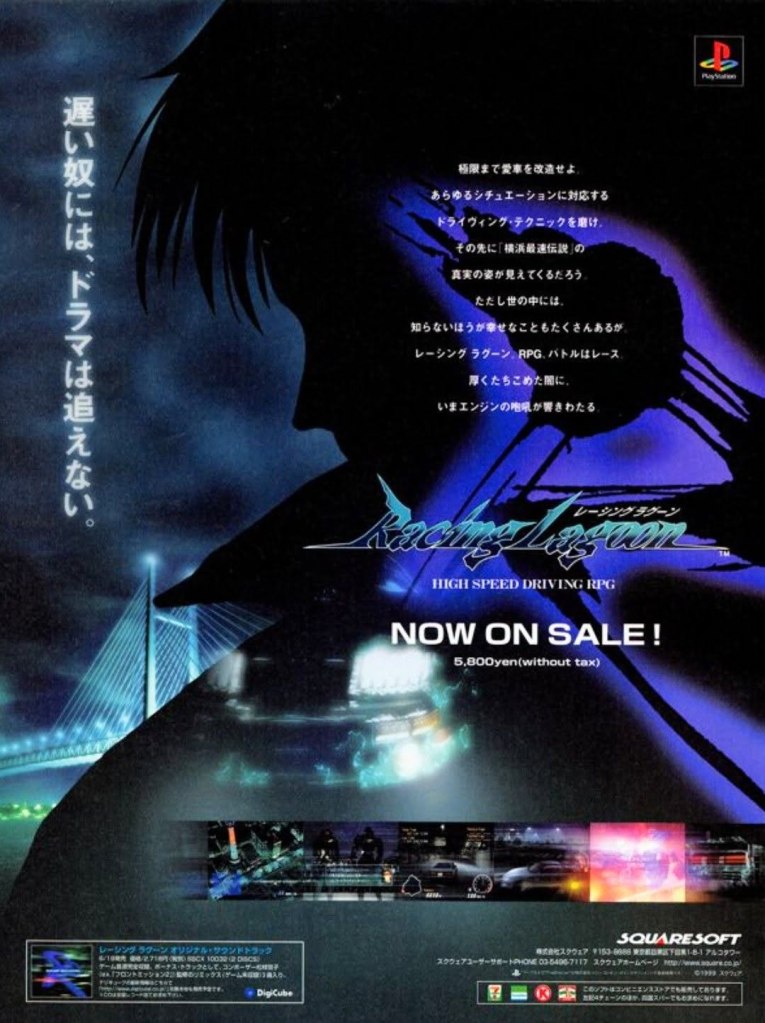
9. Racing Lagoon Japanese Print Ad

Have you ever played this game from SquareSoft?

Released in 1999 for PlayStation only in Japan, Racing Lagoon was one of many games SquareSoft made for a genre other than role-playing games (RPGs). Released at a time when the PlayStation already had lots of racing games available from around the world, Racing Lagoon was a racing game that had role-playing elements mixed in. To promote it, SquareSoft made a print ad that had a night-time city vibe and they showed some screenshots with a unique visual style. The in-game story was influenced by the illegal street racing trend that happened in Japan during the 1980s.

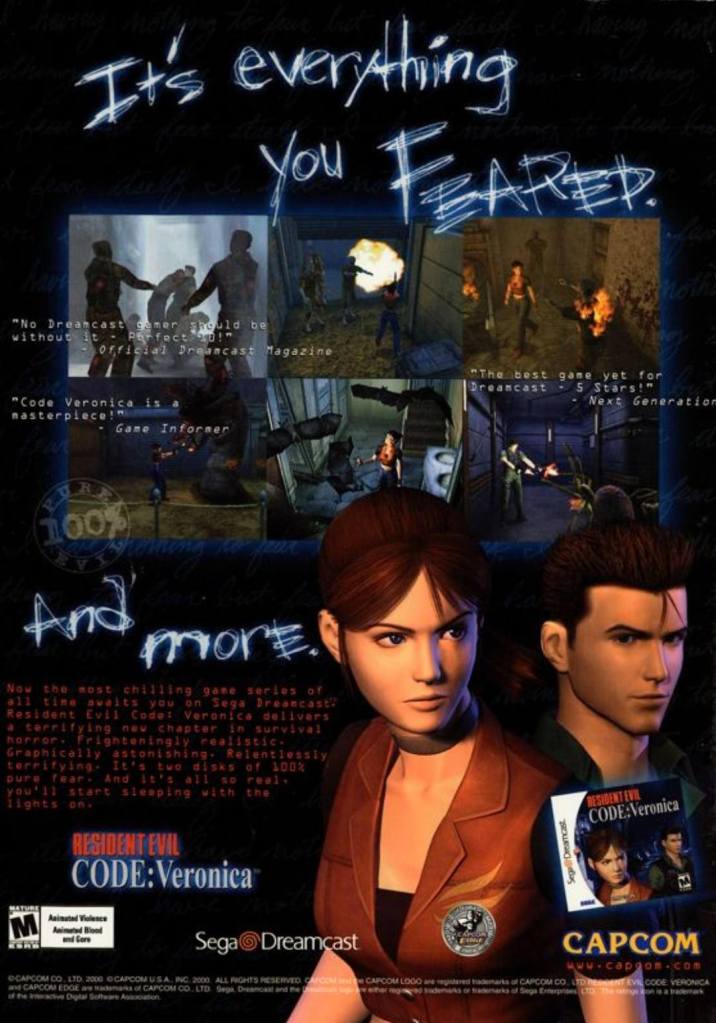
10. Resident Evil – Code: Veronica North America Print Ads

Truly a next-generation Resident Evil experience first launched on the Sega Dreamcast! I know some people who bought the console just to play Resident Evil – Code: Veronica.
The 2-page print ad of RE – Code: Veronica.

When Resident Evil – Code: Veronica was released on the Sega Dreamcast in Japan in February 2000, it delivered a next-generation survival horror experience to die-hard RE fans and it was easily one of the must-have games for Dreamcast owners of the time. Along the way, RE fans and Dreamcast owners in America were already anticipating the game. Capcom had an aggressive ad campaign for the game with US gamers in mind and this particular single-page print ad showed the fan-favorite characters Claire and Chris Redfield on one corner, six selected screenshots and quotes from the published game reviews of Game Informer, Next Generation and the Official Dreamcast Magazine. The 2-page print ad had the same elements but had the Redfield siblings on the 2nd page. I remember seeing these ads on a few gaming magazines and they made me think about buying a Dreamcast just to play RE – Code: Veronica. These old ads emphasized the strong business trust between Capcom and Sega (which itself lost a lot of money and credibility with the Sega Saturn consoles and many add-on devices released years prior).  

+++++

Thank you for reading. If you find this article engaging, please click the like button below, share this article to others and also please consider making a donation to support my publishing. If you are looking for a copywriter to create content for your special project or business, check out my services and my portfolio. Feel free to contact me with a private message. Also please feel free to visit my Facebook page Author Carlo Carrasco and follow me on Twitter at @CarloCarrascoPH as well as on Tumblr at https://carlocarrasco.tumblr.com/ and on Instagram athttps://www.instagram.com/authorcarlocarrasco
What To Watch On YouTube Right Now – Part 141

Welcome back my readers, YouTube viewers and all others who followed this series of articles focused on YouTube videos worth watching.

Have you been searching for something fun or interesting to watch on YouTube? Do you feel bored right now and you crave for something to see on the world’s most popular online video destination?

I recommend you check out the following videos I found.

#1 Reaction Videos Of Scary Movie 3 – After enjoying the original Scary Movie of 2000, I saw its 2001 sequel and left the cinema disappointed. Two years later, I saw Scary Movie 3 and it was an indeed an improvement over Scary Movie 2. What is very notable about Scary Movie 3 is the fact that the Wayans Brothers were no longer involved and it was directed by David Zucker of ZAZ (Zucker-Abrahams-Zucker). Scary Movie 3 is popular with YouTubers and already there are several reaction videos about it posted online. For your enjoyment, I posted below the reaction videos I found entertaining.

#2 Ranting For Vengeance Debunks Zealots Who Believe Anime Is Leftist – If you were fortunate enough to watch multiple anime productions dating back to the 1960s, you would be aware about the collective mindset of the creators, what the anime trends were and what the messages came with what was shown through the decades. Still, there are some zealots on social media who have this foolish belief that all anime is woke and leftist in nature. That said, Ranting for Vengeance recently posted another video debunking those zealots and his explanations have strong details. Watch his video now.

#3 The Enduring Story Behind Super Mario Bros. 2 – Back in the mid-1980s, Super Mario Bros. became a massive commercial success for Nintendo and it went on to make an impact not only on gamers but also on pop culture. Shigeru Miyamoto and his team worked hard to make Super Mario Bros. 2 which was released on the Family Disk System in Japan. Strangely, the Super Mario Bros. 2 released on the Nintendo Entertainment System (NES) in America was not the same game the Japanese gamers enjoyed. Confused? There is a lot of details in GTV Japan’s video below and they are all worth discovering. Go watch it and pay attention to the details closely.

#4 Wagyu For Breakfast In Japan – When was the last time you had Wagyu for a meal? Was there ever a time you experienced a luxurious breakfast while traveling overseas? Japan is where you can find them and you can discover where exactly they are and what other types of food is offered to customers in the Nippon TV video below. Watch, learn and enjoy!

#5 The Worst NBA Arenas – Considering how many teams there are in the National Basketball Association (NBA) representing different cities, America clearly has a lot of venues where the basketball games can be held at. Some stadiums have modern designs that can accommodate not only lots of people but also the high-spending spectators (those who can afford luxuries) while providing everyone convenience and comfort for game viewing. Meanwhile, there are places that are sub-par or even undesirable for watching basketball games. The video below explores and explains what the worst NBA arenas are.

#6 No Chances For A Remake Of Xenogears? – When it comes to Japanese role-playing games (JRPGs) that were released on the PlayStation console in 1998, the one game I want to play again is Square Enix’s Xenogears. I played it on the PlayStation but I never got to finish it. While Square Enix managed to remaster Chrono Cross and released it on different platforms in recent years, the company has been very quiet about any remake or remastering of Xenogears. Apart from the fact that many of the people who worked on Xenogears under Square’s umbrella have left the company, there are other possible factors as to why remaking Xenogears is complicated in ways that have yet to be revealed to the public. To find out why, watch the in-depth video below.

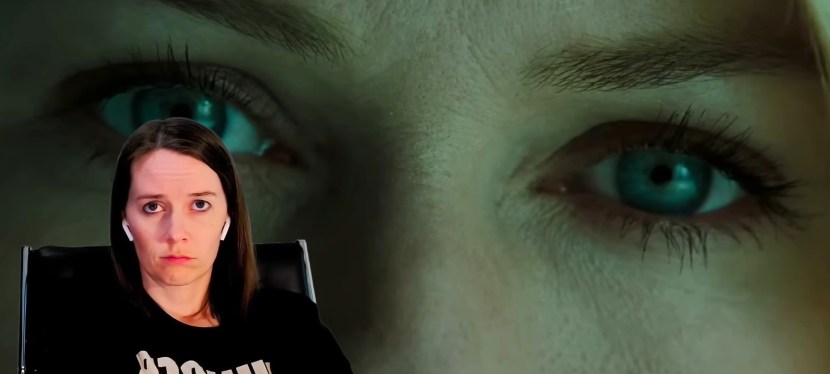
#7 Ashleigh Burton Reacts To What Lies Beneath – In late-2000, I saw What Lies Beneath on a Friday night inside a packed cinema at Festival Mall. The film, starring Michelle Pfeiffer and Harrison Ford as a couple, really made moviegoers around me stressed and scared. There were even some bouts of screaming as the movie unleashed its scary moments. Recently, I watched Ashleigh Burton’s reaction video of the movie and it is a must-see!

#8 Rhetorical Thrill Reacts To Dragonslayer – When it was released in the early 1980s, Dragonslayer was one of many fantasy movies that got released. On its own, Dragonslayer was dark, gritty, violent and even gruesome to see. The Walt Disney Company and Paramount Pictures banded together to co-produce the film and eventually it ended up as a commercial failure. Even though it failed, Dragonslayer managed to gain a following and people who want to watch dark and violent fantasy movies are attracted to it. To see how it impacts Rhetorical Thrill, go watch her reaction video below. It’s a must-see.

+++++

Thank you for reading. If you find this article engaging, please click the like button below, share this article to others and also please consider making a donation to support my publishing. If you are looking for a copywriter to create content for your special project or business, check out my services and my portfolio. Feel free to contact me with a private message. Also please feel free to visit my Facebook page Author Carlo Carrasco and follow me on Twitter at @CarloCarrascoPH as well as on Tumblr at https://carlocarrasco.tumblr.com/ and on Instagram athttps://www.instagram.com/authorcarlocarrasco
What To Watch On YouTube Right Now – Part 136

Welcome back my readers, YouTube viewers and all others who followed this series of articles focused on YouTube videos worth watching.

Have you been searching for something fun or interesting to watch on YouTube? Do you feel bored right now and you crave for something to see on the world’s most popular online video destination?

I recommend you check out the following videos I found.

#1 Parasite Eve Revisited– If you were fortunate enough to have played the horror-themed Japanese role-playing game (JRPG) Parasite Eve on PlayStation in 1998, be thankful you did because there is no certainty that the Parasite Eve franchise of games will be revived anytime soon due to legal obstacles and disagreements between Square Enix and PE’s creator Hideaki Sena. That said, I found this in-depth and extensive retrospective video about the 1998 game and I encourage you all to watch it.

#2 Food Courts In Japan Getting Fancy – Have you ever tried eating in a food court while visiting Japan? While food courts in many countries have the typical set-up of chairs and tables with many food/beverage joints present and ready to sell something affordable to customers, there are a few food courts of Japan getting fancier and more unique. Watch and learn from the Nippon TV video below.

#3 The 1995 Mortal Kombat Animated Feature Revisited – In the mid-1990s, live-action film adaptations of popular fighting games were released in cinemas. While the movies of Street Fighter and Double Dragon failed in the cinemas, the live-action Mortal Kombat movie of 1995 succeeded commercially and was mostly approved by the fans. But before the MK film was released, there was actually a prequel animated movie titled Mortal Kombat: The Journey Legends released straight to video in April 1995. If you want to discover the animated Mortal Kombat without having to invest anything on it, go watch the GoodBadFlicks retrospective video of it below. It’s an entertaining watch!

#4 Another Batman Returns Retrospective By Minty Comedic Arts – Minty Comedic Arts made another retrospective video about a version of Batman Returns that most people have not seen. This one covers the original plans of having Robin in the 1992 movie, the casting shifts and scenes that were edited or removed entirely from the film’s theatrical release. If you are a fan of the movie, or a Batman fan or you simply enjoy superhero movies, then this video is a must-see!

#5 Assorted Blade Runner Reaction Videos – Have you ever seen the 1982 science fiction detective movie Blade Runner starring Harrison Ford? I did and it definitely is not the thrilling adventure that the movie’s official poster made people think it would be. It’s more of suspense, intrigue and atmosphere, and the movie was deliberately paced between slow and medium speed to effectively tell its story. For some people, it is a futuristic-looking crawler while others admired it. Not only that, there are multiple versions of the movie released. Considering its reputation, it is not surprising that Blade Runner was featured in many movie reaction videos and I found the ones that are entertaining to watch. Watch the videos below.

#6 Ranting For Vengeance Slams Upcoming Resident Evil Movie – Let us be very clear here. Resident Evil is one of the most popular video game franchises of all time with many of its games ending up as commercial and critical blockbusters. When it comes to live-action movie adaptations of Resident Evil, those films ended up as action-packed vehicles of Milla Jovovich with selected Resident Evil characters like Jill Valentine, Claire Redfield, Chris Redfield and Leon Kennedy ending up as token characters on the big screen. Now there is a new Resident Evil live-action movie coming up and it clearly is not faithful to the games and its bad quality production values are dead giveaways. Recently Ranting For Vengeance posted a video slamming the new RE movie and I encourage you to watch it now.

+++++

Thank you for reading. If you find this article engaging, please click the like button below, share this article to others and also please consider making a donation to support my publishing. If you are looking for a copywriter to create content for your special project or business, check out my services and my portfolio. Feel free to contact me with a private message. Also please feel free to visit my Facebook page Author Carlo Carrasco and follow me on Twitter at @CarloCarrascoPH as well as on Tumblr at https://carlocarrasco.tumblr.com/ and on Instagram athttps://www.instagram.com/authorcarlocarrasco
What To Watch On YouTube Right Now – Part 133

Welcome back my readers, YouTube viewers and all others who followed this series of articles focused on YouTube videos worth watching.

Have you been searching for something fun or interesting to watch on YouTube? Do you feel bored right now and you crave for something to see on the world’s most popular online video destination?

I recommend you check out the following videos I found.

#1 The Ring Reaction Videos – When The Ring (an American remake of the 1998 film Ringu) was released in cinemas in 2002, it had a huge impact on many moviegoers as it scared them and made them think that Asian horror can be adapted by Western filmmakers to entertain a larger, English-oriented audience worldwide. In fact, The Ring sparked a wave of American remakes of established horror films from Asia. The movie also made Naomi Watts a movie star. There are viewers who enjoyed the subtle yet creepy approach to horror by the 2002 film and there are those who find it superior to the Japanese original. How The Ring impacts the following YouTubers through their reaction videos below is a must-see.

#2 Batman versus Predator Revisited – Back in the early 1990s, I saw issues of the huge crossover mini-series Batman versus Predator displayed on shelves on local comic book stores, and each one cost a lot of money! Looking back at the crossover, there definitely is a lot of things about it that justify the high cover price. Some comic book enthusiasts say that Batman versus Predator is the best crossover comic book story to feature the Predator while there are others who said that Batman is the perfect superhero to be matched against the sci-fi movie icon. To understand how Batman versus Predator came to be, watch the retrospective video below.

#3 Project Sylpheed Examined – First released in Japan in 2006, Project Sylpheed was a science fiction shooter game that was released by Square Enix exclusively on the Xbox 360 console. I always wanted to play that game’s English version (released in 2007) but I never had the opportunity to buy it. Project Sylpheed was the third game of its franchise and it was the successor to the original Silpheed game of the 1980s. Believe it or not, the game still looks great by today’s standards and the vibrant colors and stylish visual elements made it stand out nicely among 3D shooters. To see what Project Sylpheed is about and why is it still enjoyable to play, watch the video below.

#4 Ranting For Vengeance Slams Jon Bernthal’s Punisher And The Woke Mob – When I first think about the Punisher who first appeared in comics long ago, I think of a very hard-edged vigilante who wages a dangerous war against criminals on his own terms. In the 21st century, we now have a live-action Punisher who drifted away from his comic book legacy and woke Disney now fully dictates Marvel Comics. Along the way, the current Punisher actor Jon Bernthal is woke and supports the LGBTQ community and its agenda. Ranting for Vengeance recently posted a video slamming Bernthal’s Punisher and the woke mob, and you can find out more by watching it below.

#5 Rice Ball Craze In Japan – In Japan, rice balls are popular and there is nothing like the enjoyment of consuming rice with seaweed wrapping and ingredients mixed in. From time to time, rice balls get discounted and there is always an influx of buyers who pursue them with good taste and better value in mind. Even foreign tourists can take advantage of the discounts of rice balls. Watch and learn from the Nippon TV video below.

#6 Orion Pictures Revisited – When I was very young, there were some notables movies I saw that involved Orion Pictures in more ways than one. Some movies the Orion produced (or co-produced) that were memorable to watch include Caddyshack and Excalibur. Other memorable films distributed by Orion include Platoon, RoboCop, The Terminator, First Blood and The Silence of the Lambs to name some. Before Orion even started as a movie business, there were notable events in Hollywood history that led to its founding. Watch and learn from the retrospective video below.

+++++

Thank you for reading. If you find this article engaging, please click the like button below, share this article to others and also please consider making a donation to support my publishing. If you are looking for a copywriter to create content for your special project or business, check out my services and my portfolio. Feel free to contact me with a private message. Also please feel free to visit my Facebook page Author Carlo Carrasco and follow me on Twitter at  @HavenorFantasy as well as on Tumblr at https://carlocarrasco.tumblr.com/ and on Instagram athttps://www.instagram.com/authorcarlocarrasco

Retro Gaming Ads Blast – Part 40 (RPG Special)

Welcome back readers, fellow geeks and electronic gaming fans!

In this edition of the Retro Gaming Ads Blast (RGAB) series, we will take a look at another batch of retro gaming print ads from the 1980s to the 1990s focused mainly on role-playing games (RPGs) from the East and the West. This is the RPG Special!

For the newcomers reading this, Retro Gaming Ads Blast (RGAB) looks back at the many print ads of games (console, arcade, computer and handheld) that were published in comic books, magazines, flyers, posters and newspapers long before smartphones, social media, the worldwide web and streaming became popular. To put things in perspective, people back in the 1980s to the 1990s were more trusting of print media for information and images about electronic games and related products.

With those details laid down, here is the newest batch of retro gaming print ads for you to see and enjoy…

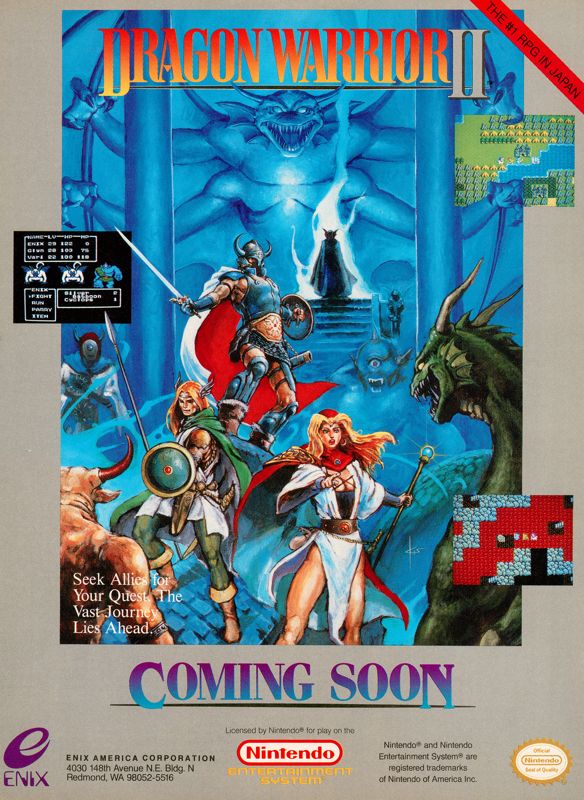
1. Dragon Warrior II Print Ad

The art style used made this one looked similar with Dungeons & Dragons.

When Dragon Quest was released in America titled as Dragon Warrior, its sales there came nowhere close to what it sold in Japan. The game, however, sold enough copies to convince Enix to bring the sequel Dragon Warrior II (Japanese title: Dragon Quest II) to the Nintendo Entertainment System (NES) in America and they came up with an ad that had obvious Western-style artwork to emphasize the fantasy elements. By comparison, the Japanese version of the game used the distinct art of Akira Toriyama (Dragon Ball Z). Back in those days, there was this belief that Toriyama’s art style would not be effective in promoting the game in America.

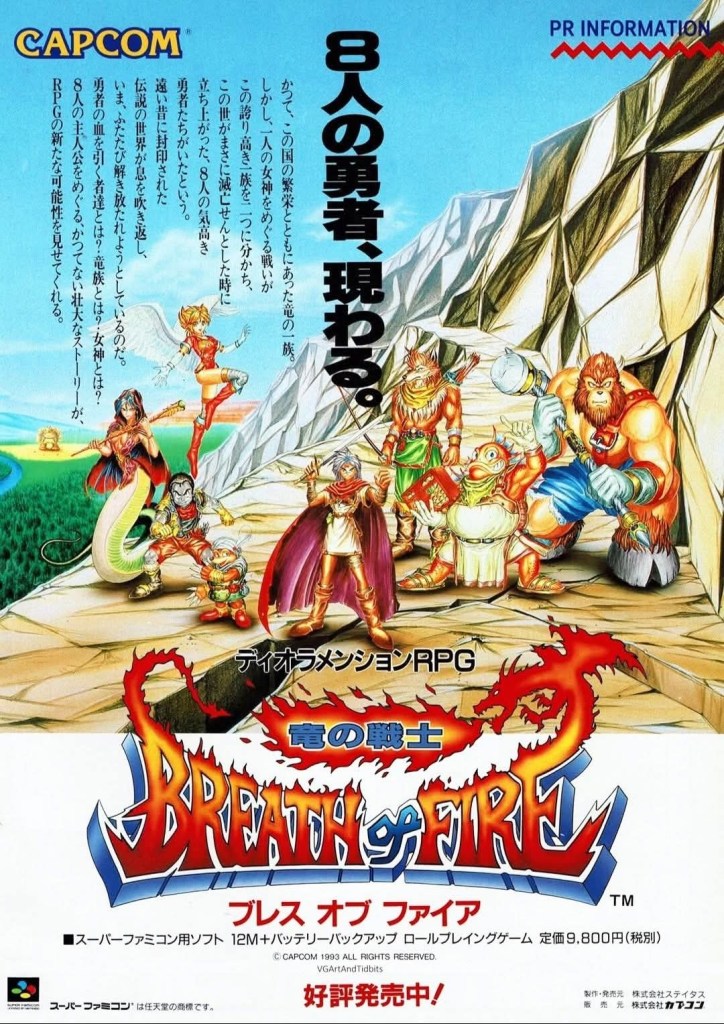
2. Breath Of Fire Japanese Print Ad

This is how Breath of Fire looked like in Japanese print media.

In 1993, Capcom officially broke into the Japanese role-playing game (JRPG) genre with Breath of Fire on the Super Family Computer (Super Famicom). The print ad they came up with for the Japanese market showed several characters – including Ryu and Nina who would later become recurring characters as sequels were released – with designs that had elements of anime and manga styles blended which contrasted the gritty and realistic approach of Western fantasy art. The ad made it clear to readers that new adventures in a fantastic world await them. The game achieved enough commercial success in Japan which convinced Capcom to make a sequel (plus more in the years that followed).

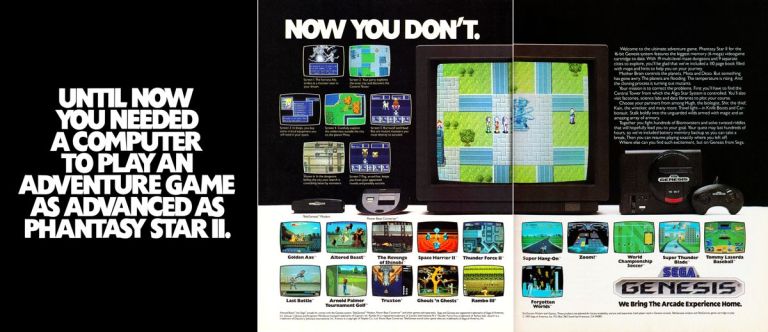
3. Phantasy Star II North American Print Ad

The 3-page ad showcasing Phantasy Star II and many other games.

After selling a good amount of copies of the original Phantasy Star worldwide on the Sega Master System, Sega knew they were on to something. They confidently produced the sequel Phantasy Star II for their brand-new Sega Genesis console in 1989 and aggressively promoted it in America with a daring 3-page print ad. If you look closely, majority of two of the pages were used to promote Phantasy Star II with screenshots (including a big one with a TV), the text description and the console. The spaces below allowed Sega to promote their many other games in convenient fashion. The result is huge success for Sega as more than 1.6 million copies of Phantasy Star II were sold worldwide. Sega would go on to make even more Phantasy Star games.

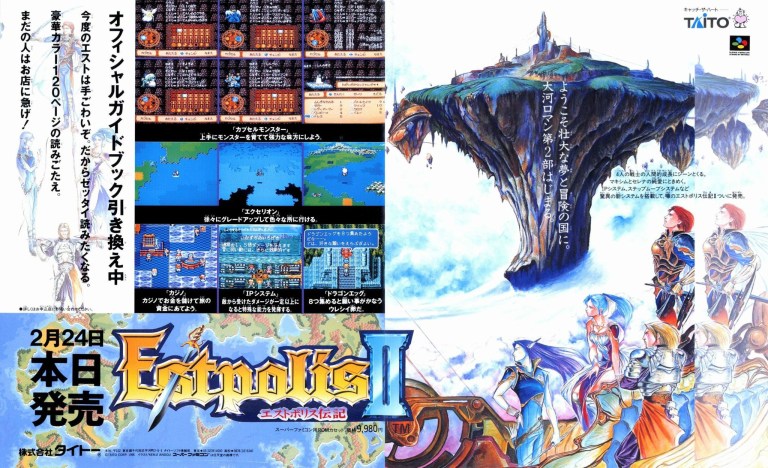
4. Estopolis Denki II Japanese Print Ad

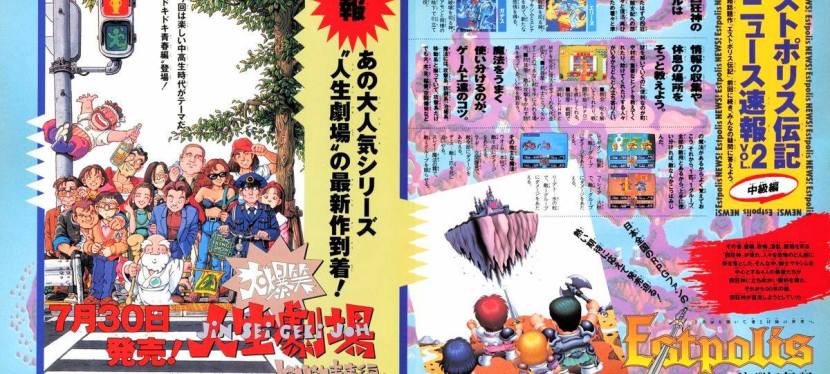
Estopolis Denki II print ad in Japan.

When Estopolis Denki was released on the Super Famicom in Japan, sold enough copies to justify not only bringing the game to Western markets as Lufia & The Fortress of Doom but also the production of a follow-up titled Estopolis Denki II. To promote it, Taito made a Japanese print ad that had a captivating art style (with the characters looking more realistic and a floating land that had a gritty touch), some screenshots and the promise of fantastic adventures. While the game’s title sounded like a sequel, its story was actually set in the past. Estopolis Denki II would be released in the West as Lufia II: Rise of the Sinistrals.

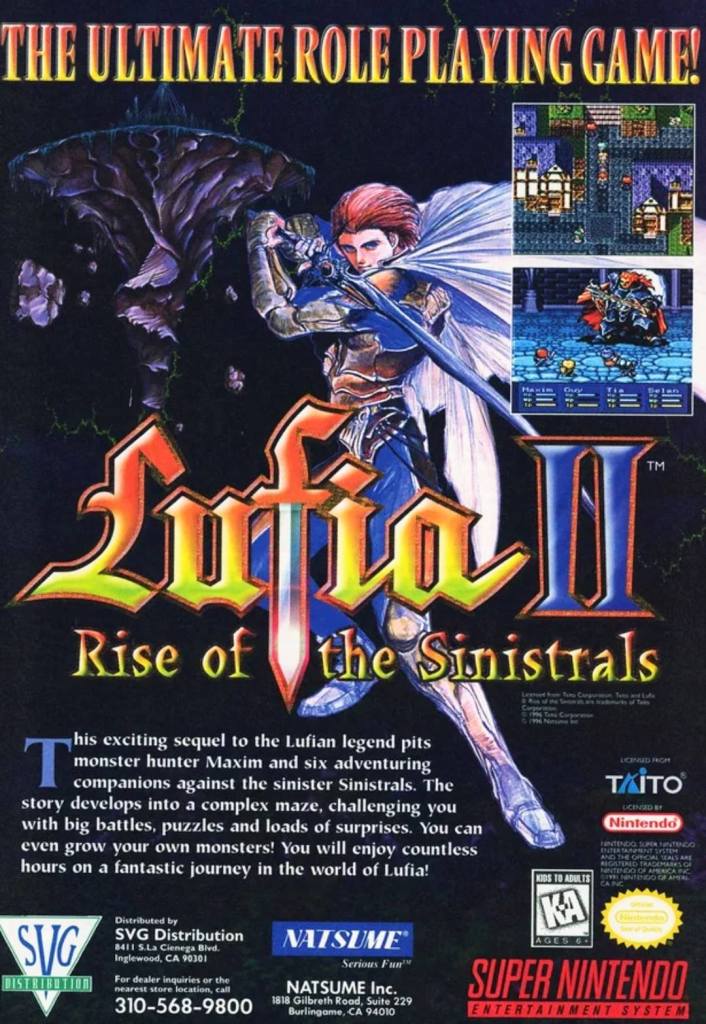
5. Lufia II: Rise of the Sinistrals North American Print Ad

Clearly Natsume did not have any game critics quotes to use to promote Lufia II.

When the first Lufia RPG was released in America on the Super Nintendo Entertainment System (SNES), it became a commercial hit finishing as the top SNES game in the February 1994 sales chart. The sequel Lufia II: Rise of the Sinistrals was published by Natsume in America in 1996 and they daringly called it “The Ultimate Role Playing Game!” in its print ad utilizing the official artwork of a major character, two screenshots and descriptive text giving readers an idea on what to expect. This ad strongly relied on the visual elements while the first game’s American print ad (made by Taito) emphasized the critical acclaim received.

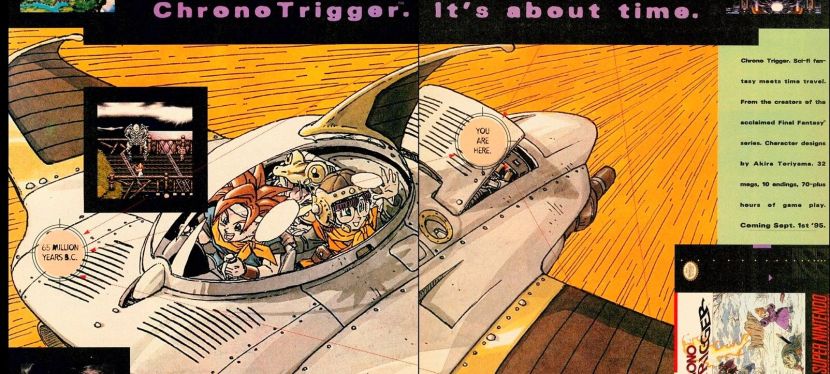
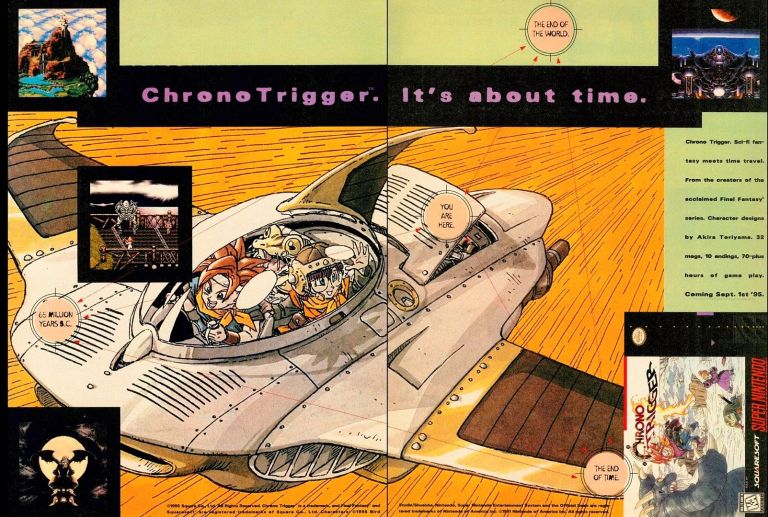
6. Chrono Trigger North American Print Ad

A lot of Dragon Ball Z fans recognized the art style of Akira Toriyama here.

Chrono Trigger, the JRPG that had the dream team creators of Hironobu Sakaguchi (Final Fantasy creator), Yuji Horii (Dragon Quest creator) and Akira Toriyama (Dragon Ball Z creator) behind the production, was easily the most ambitious game SquareSoft released in 1995. As part of the marketing strategy for the North American market, Square came up with a 2-page ad that had Toriyama’s art as the dominant image while using the remaining space for screenshots, the description and the SNES box cover placed strategically. Such a creative visual design was eye-catching and even memorable. Chrono Trigger became a huge commercial and critical hit in the West and it has long been regarded as a classic JRPG.

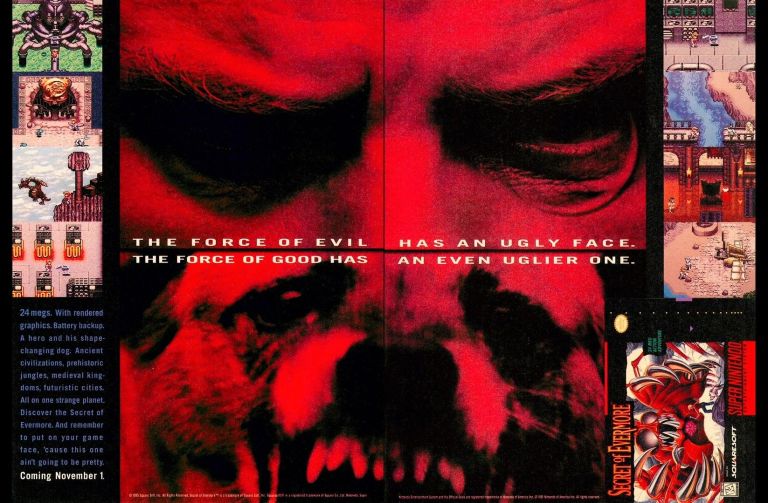
7. Secret of Evermore North American Print Ad

The creepy red images overshadowed the promotion of Secret of Evermore in America. Some readers might have been scared away by this ad.

Still in 1995, Square released Secret of Evermore for the SNES. Unlike most of Square’s RPGs, Secret of Evermore was developed by an American team in Washington state which explains why the game has a very distinct tone and strongly Western art style (note: the gameplay was patterned after that of Secret of Mana). To promote the game, Square came up with a very odd-looking 2-page print ad that had two dominating red images – eyes of a man on top and the front of a dog below) that felt like a forced approach to emphasize the game’s concept of the hero (a teenager boy) and his loyal dog (a very capable fighter). They used the remaining space for screenshots (which made gamers believe it was a sequel to Secret of Mana), the game box cover and a not so helpful text description. In my view, this print ad was a marketing misfire and Square could have produced hand-drawn art of the hero and his dog instead of the creepy red pictures.

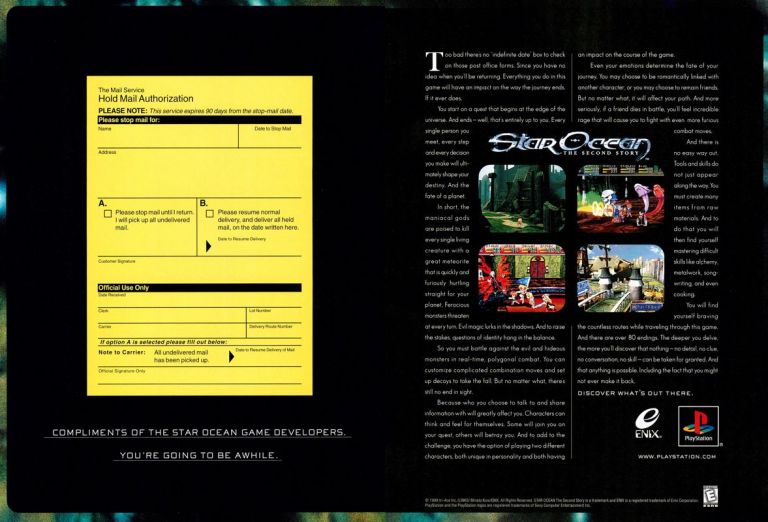
8. Star Ocean: The Second Story North American Print Ad

A really odd-looking print ad.

The Star Ocean JRPG franchise of Enix had its first game released in Japan only. That first game on Super Famicom sold a lot of copies which led to the production of the sequel Star Ocean: The Second Story. By the late 1990s, Enix itself had a partnership with developer tri-Ace on the Star Ocean games. Somewhere along the way, Sony Computer Entertainment America (SCEA) secured the publishing rights of Star Ocean: The Second Story for not only America but also in other parts of the world. For the American market, Sony came up with a very odd-looking 2-page print ad that had a mail service form on the left. The form emphasized the concept of being away for a long time (reflecting the science fiction and extensive fantasy adventuring of the game itself) which incidentally was the eye-catcher of the ad. The other half of the page showing the game’s title, screenshots and detailed text description got overshadowed. This is another marketing misfire.

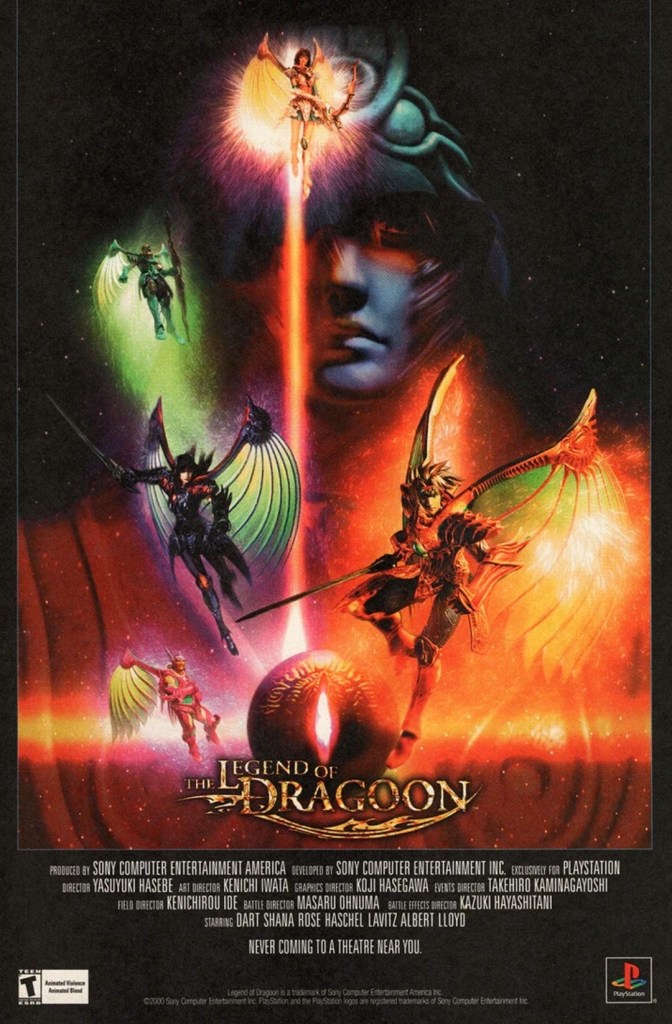
9. The Legend of Dragoon North American Print Ad

The movie poster-inspired print ad is memorable to look at.

Given how success Sony was with selling PlayStation consoles worldwide and how massively successful the Final Fantasy RPG franchise of SquareSoft was, it was not surprising that they decided to make their very own big-budget and exclusive JRPG with the intention to succeed and possibly establish a franchise. The result was the PlayStation-exclusive game The Legend of Dragoon which was made with a budget of $16 million and lasted three years in development. The game was released in Japan in late-1999 and sold at least 280,000 copies (note: majority of that in its first week of sales). In preparation for the June 2000 launch in America, Sony produced a print ad that had a very strong movie poster vibe showing what looked like painted art of the characters with vivid colors in the background and the title on the lower part. If you look closely, the credits were deliberately stylized over the way movie posters showed credits. While the game was not the massive hit Sony hoped for, it went on to become a million-seller and a great majority of its sales were from America. By today’s standards, the movie poster-like ad used to promote The Legend of Dragoon is memorable and an inspired piece of marketing work.

+++++

Thank you for reading. If you find this article engaging, please click the like button below, share this article to others and also please consider making a donation to support my publishing. If you are looking for a copywriter to create content for your special project or business, check out my services and my portfolio. Feel free to contact me with a private message. Also please feel free to visit my Facebook page Author Carlo Carrasco and follow me on Twitter at  @HavenorFantasy as well as on Tumblr at https://carlocarrasco.tumblr.com/ and on Instagram at https://www.instagram.com/authorcarlocarrasco

What to watch on YouTube right now – Part 123

Welcome back my readers, YouTube viewers and all others who followed this series of articles focused on YouTube videos worth watching. Have you been searching for something fun or interesting to watch on YouTube? Do you feel bored right now and you crave for something to see on the world’s most popular online video destination?

I recommend you check out the following videos I found.

#1 Dawn Of The Dead Remake Revisited – Back in 2004, I saw the Dawn of the Dead remake inside a cinema located inside a shopping mall here in the Philippines. The Zack Snyder-directed film only inspired me to look for the 1978 original version of Dawn of the Dead directed by the late George Romero. The only thing the two films have in common is the concept of desperate people taking refuge inside a shopping mall during a zombie apocalypse. Zack Snyder’s film was more about violent action with horror elements blended with it. As Snyder went on to direct high-profile DC Comics superhero movies and produced other such projects of Warner Bros., it was natural for film buffs to gravitate to 2004’s Dawn of Dead which was his directorial debut. To learn more about the said remake and see the cinematic elements that formed the style of Snyder, watch the videos below.

#2 Premium Sushi, Hearty Tempura And Wagyu Beef For Breakfast In Japan –If you were traveling overseas, how hungry do you get when you start the day? Would you go for a simple and affordable breakfast or would you want something special in the morning? In Tokyo, there are these food joints that offer customers a luxurious breakfast with Wagyu beef, special tempura and premium sushi to name some. Already, local and foreign tourists are flocking to such food joints for the premium breakfast experience and you can learn more from the Nippon TV videos below.

#3 The Different Versions Of Final Fantasy VI – Among all the many Final Fantasy games released since 1987, Final Fantasy VI is still my favorite of them all. I first played the classic Japanese role-playing game (JRPG) on Super Nintendo Entertainment System (SNES) in 1994 which was titled “Final Fantasy III”, and it has a great epic story, a huge cast of playable characters, lots of unique gameplay features and great game design. Through the decades, Final Fantasy VI was ported to many consoles, mobile devices and even on personal computer. You might be wondering which version of Final Fantasy VI is the best in terms of visual quality, which one is the most available and which one is the most updated version. That said, you can find out by watching the video below.

#4 Castlevania II: Simon’s Quest Revisited – When Castlevania II: Simon’s Quest was first released on the Nintendo Entertainment System (NES) in 1987, many fans who enjoyed the first game were alienated by how different the sequel felt, looked and played. It still was horror-themed 2D adventure game with Simon Belmont as the playable protagonist again but the creative team of Konami implemented role-playing elements and open-world exploration into the gameplay. Major game design changes aside, Castlevania II still has a lot more than meets the eye and you can find out by watching the video below. Surely it will challenge what you know about Simon Belmont and the Castlevania lore.

#5 Why Feminists Support Islam – Let’s be very clear here. Islam is a truly ugly religion and it is incompatible not only with Western democracy and values, but also with several other cultures around the world. The strange thing is that modern-day feminists actually support Islam even though the ugly religion itself goes against women’s rights, against personal liberty and against freedom as we know it. In the video below, Ayaan Hirsi Ali explains in detail why mainstream feminists today support Islam, why feminism today is very twisted and why feminists even aligned themselves with Islamic terrorists.

+++++

Thank you for reading. If you find this article engaging, please click the like button below, share this article to others and also please consider making a donation to support my publishing. If you are looking for a copywriter to create content for your special project or business, check out my services and my portfolio. Feel free to contact me with a private message. Also please feel free to visit my Facebook page Author Carlo Carrasco and follow me on Twitter at  @HavenorFantasy as well as on Tumblr at https://carlocarrasco.tumblr.com/ and on Instagram athttps://www.instagram.com/authorcarlocarrasco
What to watch on YouTube right now – Part 122

Welcome back my readers, YouTube viewers and all others who followed this series of articles focused on YouTube videos worth watching. Have you been searching for something fun or interesting to watch on YouTube? Do you feel bored right now and you crave for something to see on the world’s most popular online video destination?

I recommend you check out the following videos I found.

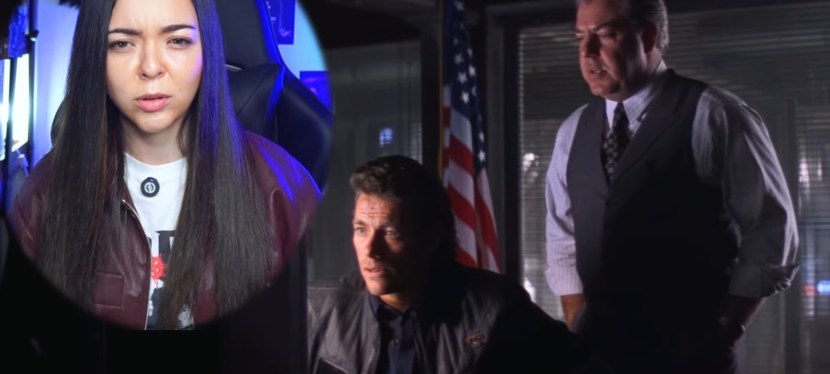
#1 Timecop Revisited – I am not a fan of Jean-Claude Van Damme but his 1994 movie Timecop managed to entertain me when I first saw it on home video. After watching it, I learned that it was based on the Timecop literary property and stories published by Dark Horse Comics. Directed by Peter Hyams, Timecop ended up as one of the better movies of JCVD and it even has its own fanbase. If you want to discover more about the cinematic Timecop, watch the videos posted below.

#2 Inhumanoids Revisited –I remember seeing some episodes of the animated TV series Inhumanoids on local TV and I can say it was easily the most bizarre and even shocking thing to watch. Inhumanoid has a very dark and even cynical tone, and it had gruesome scenes which were really disturbing to see. Behind the scenes, Inhumanoids was animated by Japan-based Toei and involved Hasbro, Sunbro and even Marvel Productions. To find out what made Inhumanoids so disturbing, watch the video below and pay attention to the details.

#3 Luxurious Breakfast Spots In Tokyo – Have you ever thought about having a luxurious breakfast while traveling overseas? In Tokyo, Japan’s most famous city, there are indeed places where visitors can have breakfast with the premium experience. These luxurious places have something unique to offer to customers who have more than enough money to spend for the morning meal. Watch and learn from the Nippon TV video below.

#4 Remember The Rotoscoped Lord Of The Rings – Decades before Peter Jackson and his team rocked the world of moviegoers with memorable Lord of the Rings film trilogy, an animated LOTR was actually made. I am talking about the 1978 rotoscoped animated film The Lord of The Rings directed by Ralph Bakshi which I first saw on home video after seeing Peter Jackson’s LOTR. I found the 1978 LOTR a really unique animated viewing experience and it definitely involved a lot of production work without any use of computers. To find out more about the animated LOTR film, watch the video below.

#5 You, Me and The Movies React To Can’t Hardly Wait – When Can’t Hardly Wait was shown in cinemas in 1998, it faded away as not enough moviegoers were attracted watch it. However, the movie did not fade into obscurity and it actually got new fans as it was discovered on home video, cable TV, pay-per-view and streaming. More importantly, the movie itself was pretty funny the cast led by Jennifer Love Hewitt delivered fine performances as teenagers. Slowly but surely, new retrospective videos about Can’t Hardly Wait are emerging on YouTube and the most entertaining video is the reaction by You, Me and The Movies which I encourage you to watch right now.

#6 Square Enix In The 2000s – Back in the 1990s, Squaresoft and Enix were separate Japanese gaming companies that released a lot of Japanese role-playing games (KRPGs) which entertained many millions of gamers. Square was famous for the best-selling Final Fantasy games while Enix had the wildly popular Dragon Quest franchise. In the 2000s, a series of changes happened in the video game industry and the two companies merged into Square Enix. Since then, a lot of Final Fantasy and Dragon Quest games with evolved designs and styles of presentation were released under a single publisher. There is a lot more to discover what happened behind the scenes as documented in the in-depth video below from Gaming Broductions.

+++++

Thank you for reading. If you find this article engaging, please click the like button below, share this article to others and also please consider making a donation to support my publishing. If you are looking for a copywriter to create content for your special project or business, check out my services and my portfolio. Feel free to contact me with a private message. Also please feel free to visit my Facebook page Author Carlo Carrasco and follow me on Twitter at  @HavenorFantasy as well as on Tumblr at https://carlocarrasco.tumblr.com/ and on Instagram athttps://www.instagram.com/authorcarlocarrasco
What to watch on YouTube right now – Part 121

Welcome back my readers, YouTube viewers and all others who followed this series of articles focused on YouTube videos worth watching. Have you been searching for something fun or interesting to watch on YouTube? Do you feel bored right now and you crave for something to see on the world’s most popular online video destination?

I recommend you check out the following videos I found.

#1 Discover Shiriyaki Onsen In Japan’s Kanto Region – Japan has a lot of wonderful sites and special places of nature that are worth visiting. Within the Kanto region (which contains Tokyo) is the wonderful place called Shiriyaki Onsen which stands out nicely among the hot springs there. Nippon TV recently produced a feature of the place and you can find out more by watching the video below.

#2 Disasters That Hit Cruise Ships And Troubled The Passengers  –Spending days at sea on a cruise ship can be a nice way of having a vacation with momentum. However, bad weather conditions can ruin such vacations. Worse, the cruise could turn into bouts of danger and already there have been cruise ships that got hit hard with bad weather at sea which in turn placed the passengers in deep danger. Even as they are inside the cruise ship during powerful storms and big waves at sea, passengers and the crew have to deal with interior damage, falling debris and furniture that moved a lot. You can learn about what happened to the unfortunate ones at sea by watching the video below.

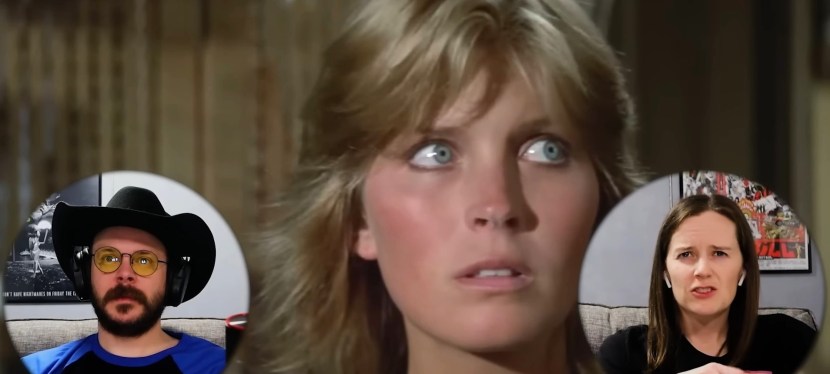
#3 You, Me and the Movies React To Orca: The Killer Whale – When Steven Spielberg and Universal Pictures struck box office gold with Jaws in 1975, it was not surprising that many filmmakers and producers scrambled to cash in on the “creature feature” trend of movies at that time. Indeed, there were imitations or “monster movies” that were inspired by Jaws released during the late 1970s. One of those films was Orca: The Killer Whale (AKA Orca) which had a lot of similarities with Spielberg’s massive blockbuster due to it featuring an aquatic monster and having the sea as the main environment. Still, Orca has certain creative elements that made it stand out in a very disturbing way and its cast has Richard Harris, Charlotte Rampling and Bo Derek. To find out about Orca, watch the movie reaction video below.

#4 The Monster Squad Revisited – What can be said about The Monster Squad? The 1987 movie directed by Fred Dekker was a failure in the American box office and yet it still has a dedicated fan base. A lot of people who support the movie point to its monster lineup composed of horror movie icons like Dracula, Frankenstein’s monster, the mummy, the wolfman and the creature from the black lagoon. As such, it is not surprising to see YouTubers make retrospective features and reaction/review videos about The Monster Squad which have been posted below for your viewing.

#5 The Many Ports Of Final Fantasy IV – Since it was first released in Japan on the Super Famicom, Final Fantasy IV became a critical and commercial success. It was released on the Super Nintendo Entertainment System (SNES) in America titled as “Final Fantasy II” which further expanded the game’s reach with many gamers who don’t understand Japanese. Furthermore, the classic Japanese role-playing game (JRPG) was ported to multiple systems through the decades and it even had a 3D polygonal remake on the Nintendo DS. To find out the many ports of Final Fantasy IV and which ones stood out technically and visually, watch and learn from the video below.

#6 Ranting For Vengeance Hits Woke Hijackers On Resident Evil – Let us be very clear here. The woke/socialist/LGBTQ/commie/SJW mob cannot help but be very loud with their twisted ideology and they simply cannot stop themselves from literally hijacking pop culture as we know it. In this case, the Leftists are trying to claim the Resident Evil games franchise for themselves and they are only getting worse as the release of Resident Evil Requiem moves closer. In response to this, Ranting For Vengeance posted three RE-related videos, slammed the woke mob and exposed who the fake fans are. You can find out more by watching his videos below.

+++++

Thank you for reading. If you find this article engaging, please click the like button below, share this article to others and also please consider making a donation to support my publishing. If you are looking for a copywriter to create content for your special project or business, check out my services and my portfolio. Feel free to contact me with a private message. Also please feel free to visit my Facebook page Author Carlo Carrasco and follow me on Twitter at  @HavenorFantasy as well as on Tumblr at https://carlocarrasco.tumblr.com/ and on Instagram athttps://www.instagram.com/authorcarlocarrasco
Retro Gaming Ads Blast – Part 39 (RPG Special)

Welcome back readers, fellow geeks and electronic gaming fans!

In this edition of the Retro Gaming Ads Blast (RGAB) series, we will take a look at another batch of retro gaming print ads from the 1980s to the 1990s, particularly on role-playing games (RPGs) from the East and the West. This is the RPG Special!

For the newcomers reading this, Retro Gaming Ads Blast (RGAB) looks back at the many print ads of games (console, arcade, computer and handheld) that were published in comic books, magazines, flyers, posters and newspapers long before smartphones, social media, the worldwide web and streaming became popular. To put things in perspective, people back in the 1980s to the 1990s were more trusting of print media for information and images about electronic games and related products.

With those details laid down, here is the newest batch of retro gaming print ads for you to see and enjoy…

1. Phantasie North American and Japanese Print Ads

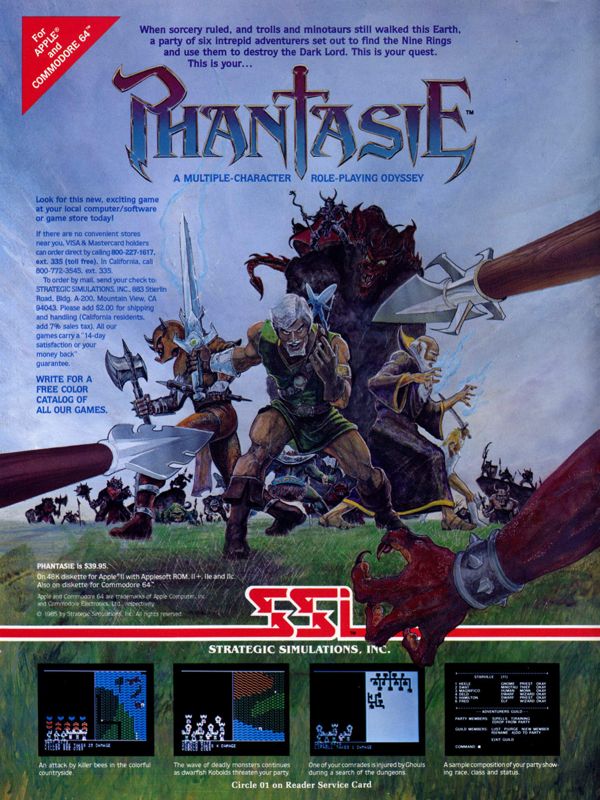
The North American print ad.
The Japanese print ad.

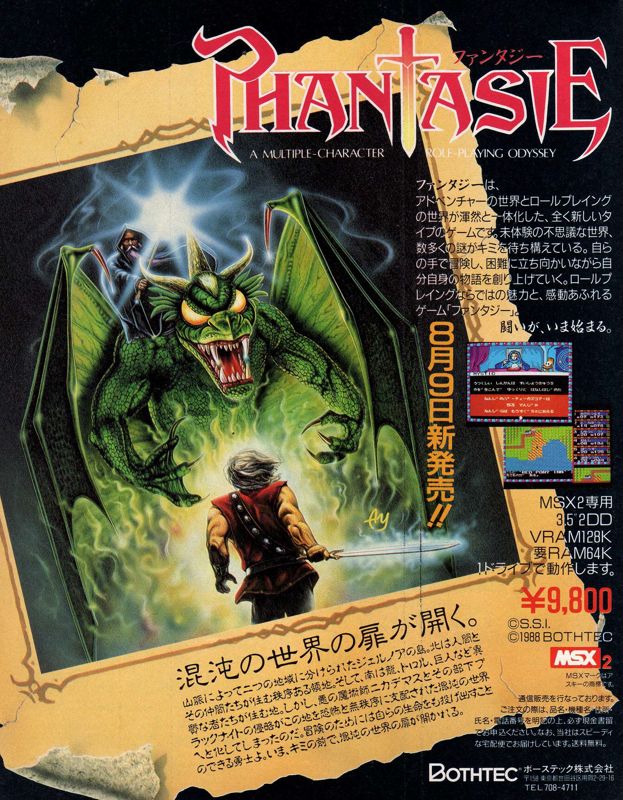
Released by Strategic Simulations in the mid-1980s, Phantasie was a fantasy role-playing game that became a huge commercial success paving the way for not only ports on other computer systems of the time but also sequels later. The ad they came up with for the North American market had strong fantasy vibes and the screenshots gave readers the impression that it looked playable or user friendly. For the Japanese market, Phantasie was ported to the MSX system and they came up with an ad using radically different art work that had a horror vibe.

2. Phantasy Star Japanese Print Ad

Phantasy Star in the Japanese print ad sharing the spotlight with After Burner.

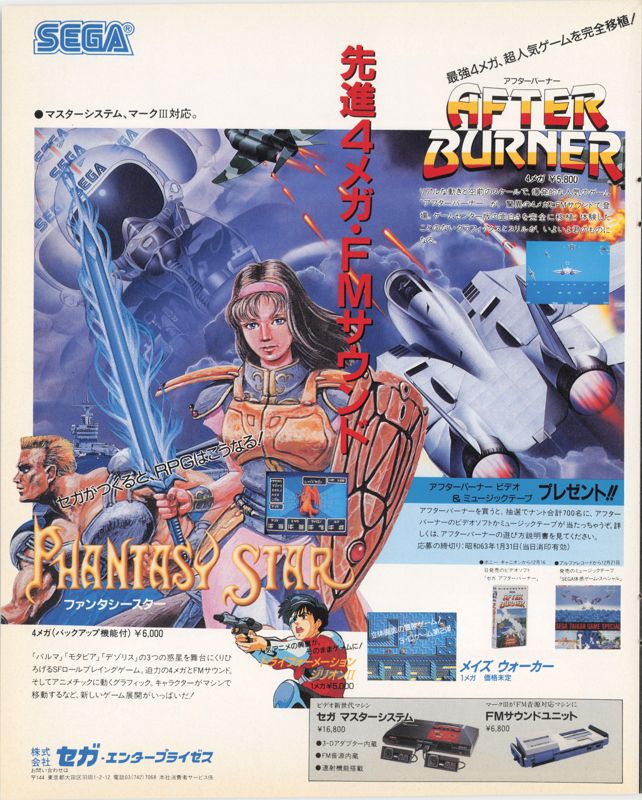
In the 1980s, role-playing games started gaining popularity with Japanese console gamers and there were game developers who were inspired by established RPGs from the West. Enix released two Dragon Quest games and each of them sold a lot of copies on Nintendo’s Family Computer (Famicom). At the time, Sega already had the Master System (called the SG-1000 and its variants with revisions) in the console market and they were way behind Nintendo on hardware sales. Knowing there is a market for console RPGs, Sega went on to make their exclusive RPG Phantasy Star. In 1987, a print ad was released showing Phantasy Star sharing the spotlight with Sega’s blockbuster game After Burner in the background. While the ad felt a bit disorienting to see, the game achieved much-needed success for Sega which in turn brought the game to the Master System in America in 1988. The game sold more and eventually led to sequels in the years that followed.

3. Ultima III Japanese Print Ad

Remember the old days when anime or comic book-style artwork was used to promote games in the Japanese print media?

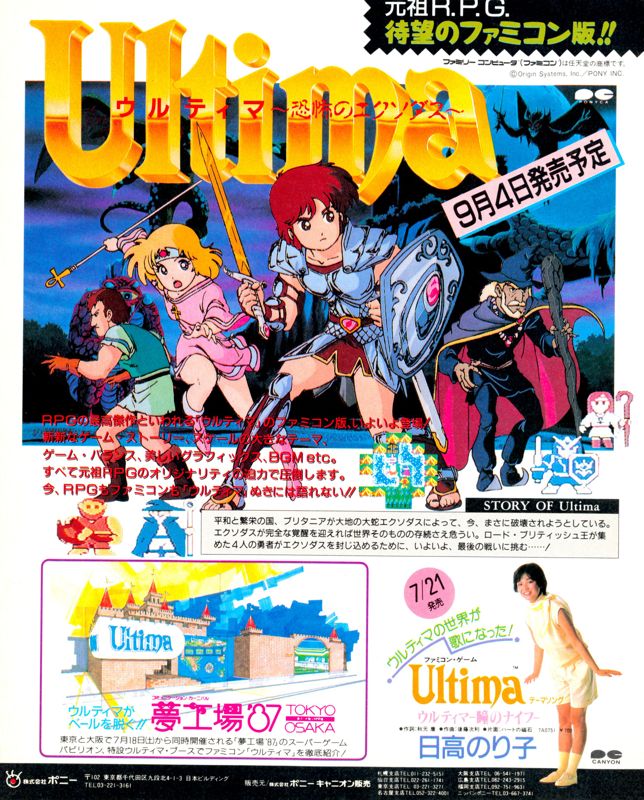
Released in Japan under the title Ultima: Kyoufu no Exodus, Ultima III: Exodus was a breakthrough for the series as the Famicom version marked the first console release for Japanese gamers (note: the game was also offered for MSX and other computer systems in the country). The anime-style artwork used for the print ad is the same virtually the same with the front cover of Famicom version. Very notably, the art on the covers of the PC-88 and PC-98 versions were different. 

4. Lunar: The Silver Star Japanese Print Ad

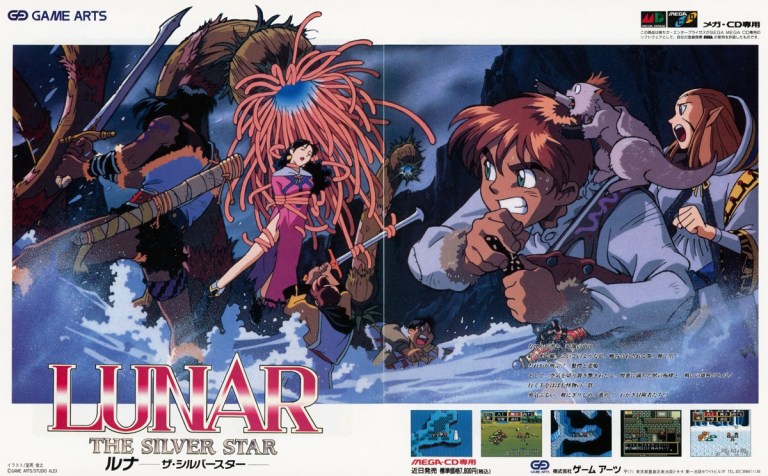
Game Arts’ Lunar: The Silver Star as advertized in Japanese magazines.

By the 1990s, console RPGs were very popular as franchises like Dragon Quest and Final Fantasy each released sequels that sold a lot of copies. The company Game Arts decided to make a role-playing game which can tell stories better using animation with voiceovers and music while being very playable and enjoyable. They came up with Lunar: The Silver Star and released it on the Mega-CD add-on (connected with the Mega Drive console of Sega) in 1992. As such, it was not surprising to see the print ad having anime-style artwork as the game itself had several minutes of anime cutscenes complete with audio. As most Japanese role-playing games (JRPGs) did not have playable anime cutscenes for storytelling, Lunar: The Silver Star really stood out. Sometime later, the small American company Working Designs would handle the game’s English version and start a healthy business relationship with Game Arts.

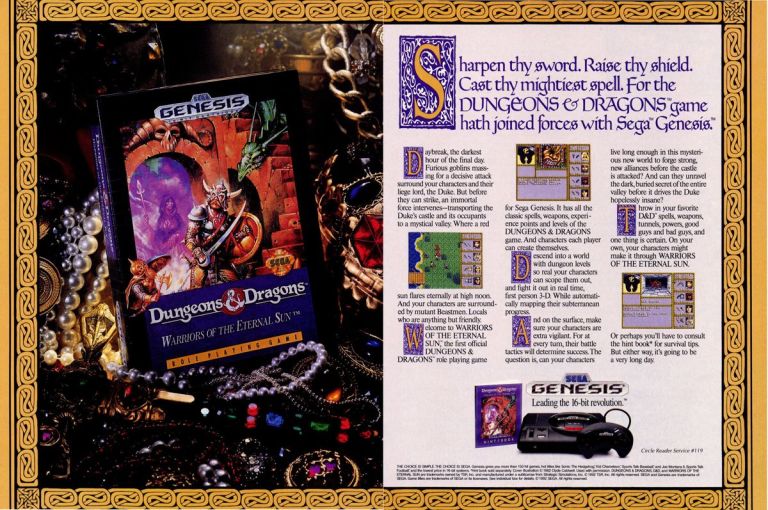
5. Dungeons & Dragons: Warriors of the Eternal Sun North American Print Ad

A print ad that strongly appealed to both Sega Genesis gamers as well as fans of Dungeons & Dragons.

By the year 1992, the fantasy games franchise Dungeons & Dragons was wildly popular as players around the world kept enjoying the tabletop RPG modules (using dice, pen paper) as well as many computer and video games already available. Sega acquired a D&D license and eventually released Dungeons & Dragons: Warriors of the Eternal Sun exclusively on their Genesis console in 1992. To promote it, Sega produced a 2-page print ad that had one half showing the game’s box placed with jewelry while using the other half to show the screenshots, descriptive text and other details. The way it was presented, the print ad was cleverly structured to attract the attention of Sega Genesis gamers as well as Dungeons & Dragons fans. The game ended up as the first and only official D&D product for the console.

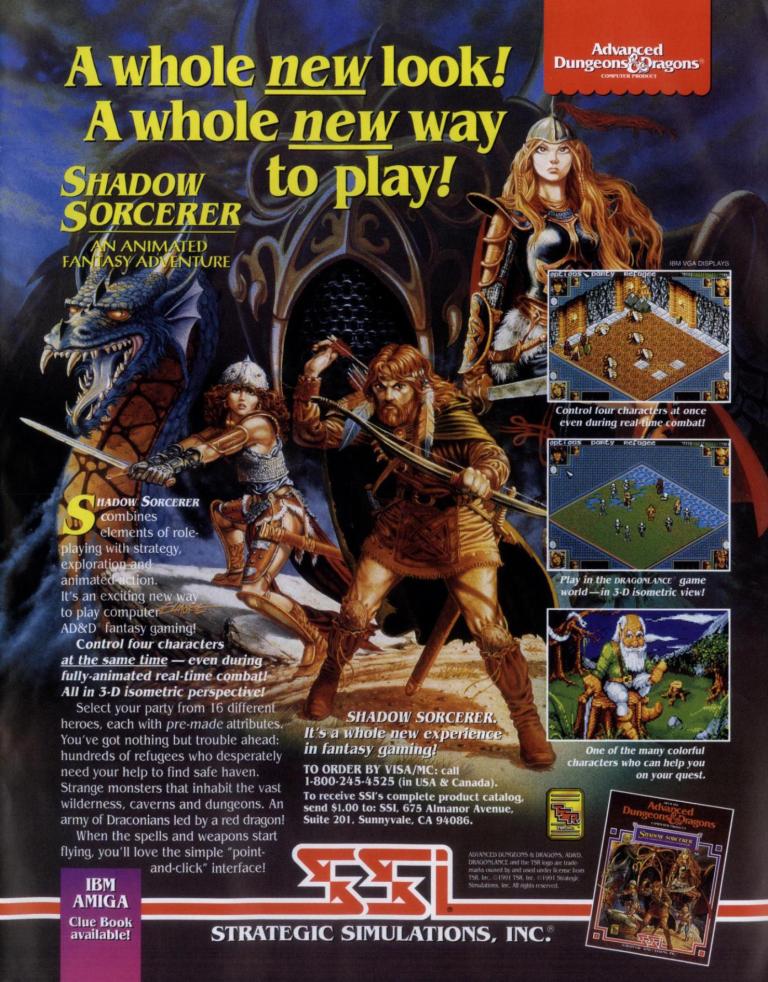
6. Shadow Sorcerer North American Print Ad

This is one of many Dungeons & Dragons computer games released. The use of painted art for marketing was done many times.

In the history of the Dungeons & Dragons franchise and electronic gaming, it was on computers where the more ambitious and more intricate licensed games were played by many fans. In 1991, the Advanced Dungeons & Dragons (AD&D) electronic game Shadow Sorcerer was released on MS-DOS PC, Amiga and the Atari ST. The painted artwork used on the print ad was virtually the same as that on the box covers of the MS-DOS and Amiga versions. I can only guess that the ad markers must have paid a lot of money on the painted art and decided to use it for both marketing and packaging since it looked so detailed.

7. Estopolis Denki Japanese Print Ad

The 2-page Japanese print ad of Estopolis Denki.

In 1993, a brand-new Japanese developer called Neverland was established and its first project was the fantasy role-playing game Estopolis Denki for the Super Family Computer (Super Famicom). That same year, publisher Taito released the game and they promoted it with a 2-page print ad that featured a whimsical looking hand-drawn art work on one half and utilized the other half with details, screenshots and part of the art that was used on the game’s Super Famicom box cover. While Japanese game sales are not available, it seems Estopolis Denki sold enough to convince the publisher to release the game in North America as Lufia & The Fortress of Doom.

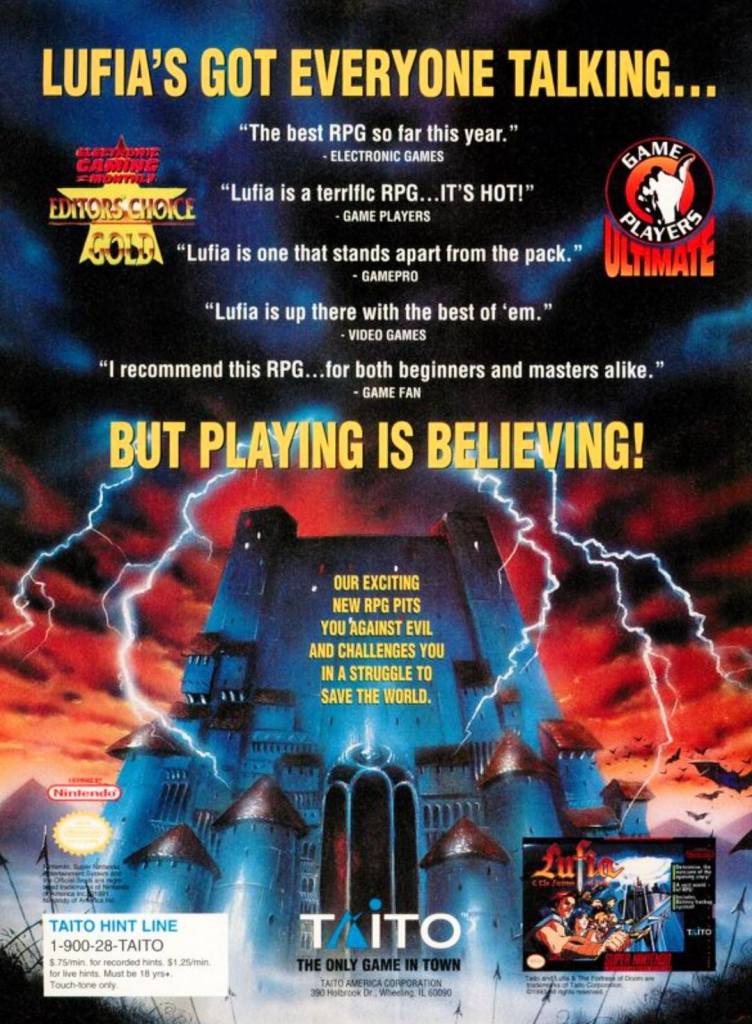
8. Lufia & The Fortress of Doom North American Print Ad

If you were able to play Lufia & The Fortress of Doom on the SNES, were you able to see this ad in a comic book or in a magazine?

Upon release in America in late 1993, Taito scored gold as Lufia & The Fortress of Doom on the Super Nintendo Entertainment System (SNES or Super NES) became a critical and commercial success. In fact, it literally gained steam during the early months of availability and ended up as the top-selling SNES game in America for the month of February of 1994. Take note that at this particular point of time, RPGs on game consoles in America were not yet in high demand as gamers’ tastes were different. When it comes to the marketing, Taito came up with a single-page print ad showing fantasy artwork, the game’s box cover and the published quotes from game critics who gave the game positive reviews. This is smart marketing on the part of Taito.

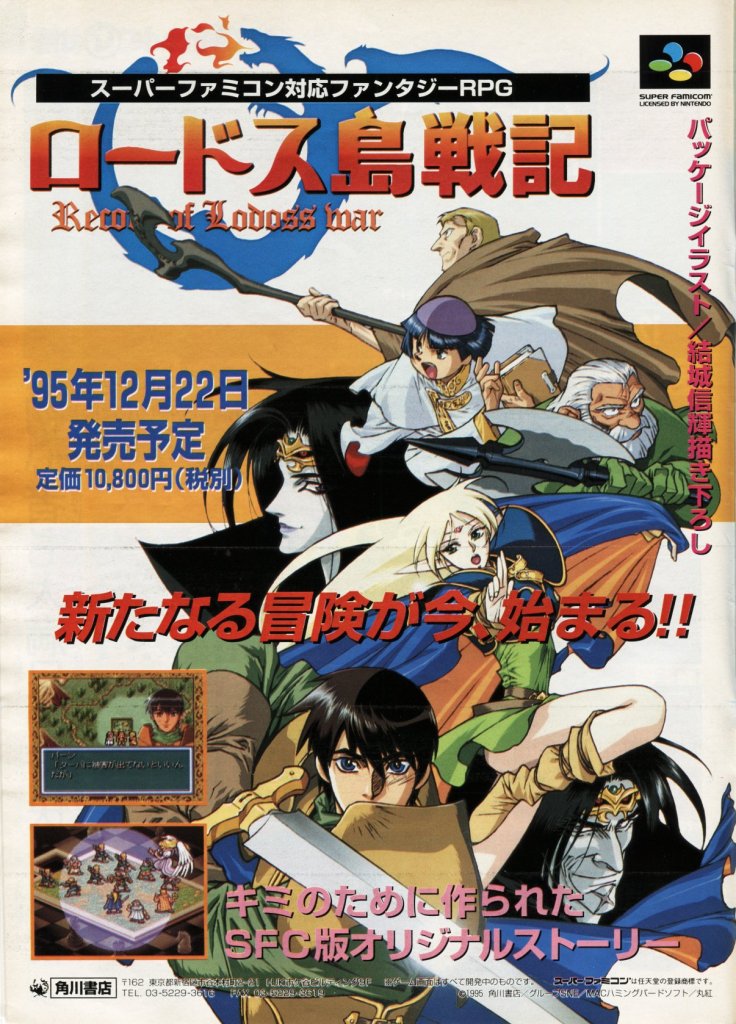
9. Record of Lodoss War Japanese Print Ad

The Japanese print ad of Record of Lodoss War for Super Famicom.

Have you ever heard of the Record of Lodoss War fantasy franchise? That one started as a series of fantasy novels by Ryo Mizuno who previously worked on an RPG project. Record of Lodoss War was eventually adapted into comics, anime and video games. One of those games was released on the Super Famicom in December 1995 published by Kadokawa Shoten which in turn made the one-page print ad for the Japanese market. Using established art from the anime OVA (original video animation) series was a strategic move by the publisher as millions of Japanese people viewed it. Unsurprisingly, the art on the ad is almost the same as the one displayed on the game box cover.

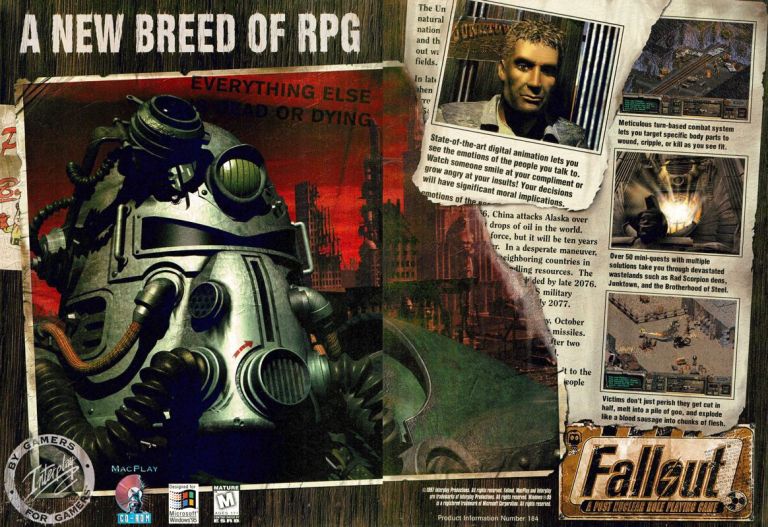
10. Fallout North American Print Ad

A gritty looking print ad of the original Fallout PC game.

In my gaming life, I played Fallout 3, Fallout 4 and Fallout: New Vegas on Xbox consoles. When the first-ever Fallout game was released in 1997, I did not notice it as I was more into console gaming than PC gaming. The above print ad appeared is several PC gaming magazines and it clearly shows what it offered which gamers eventually ended up enjoying a lot. The mechanical helmet – protection for the user during battles and from radiation in the nuclear wasteland – on the left side of the ad became a key symbol of the Fallout franchise as further games also featured mechanical helmets. Fallout was highly acclaimed for featuring open-ended gameplay and its immersive post-apocalyptic setting. It sold enough copies to convince publisher Interplay to proceed with a sequel and the rest was history.

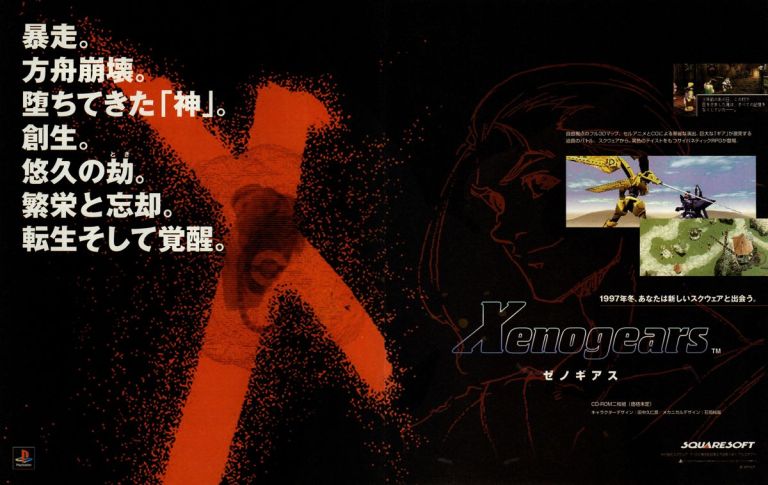
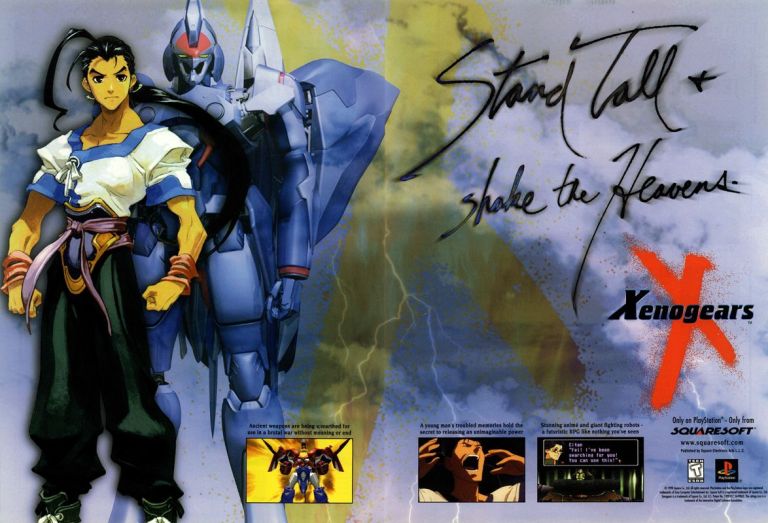
11. Xenogears Japanese and North American Print Ad

Japanese advertisement of Xenogears.
This North American print ad of Xenogears clearly showed the main character, a robot, the sci-fi setting and the visual style of the game.

Xenogears was a sci-fi JRPG I played on the PlayStation in 1998 but I was unable to finish it. Before it was released in America, there was speculation that Squaresoft would not be able to produce an English version for international release due to its religious content. The game was highly challenging to translate into English due to religious themes and psychological elements. Regardless, the game achieved successes commercially and critically in both Japan and America. Xenogears has since been considered by many as a classic JRPG and to play it today is pretty challenging as an existing PlayStation One, PlayStation 3 or PlayStation Vita is required as well as the physical PlayStation disc itself (note: digital copy of Xenogears for PS Vita). Square Enix – which previously remastered Chrono Cross and several Final Fantasy games for modern gaming platforms – has yet to remaster Xenogears for those with modern game consoles, mobile devices and the PC.

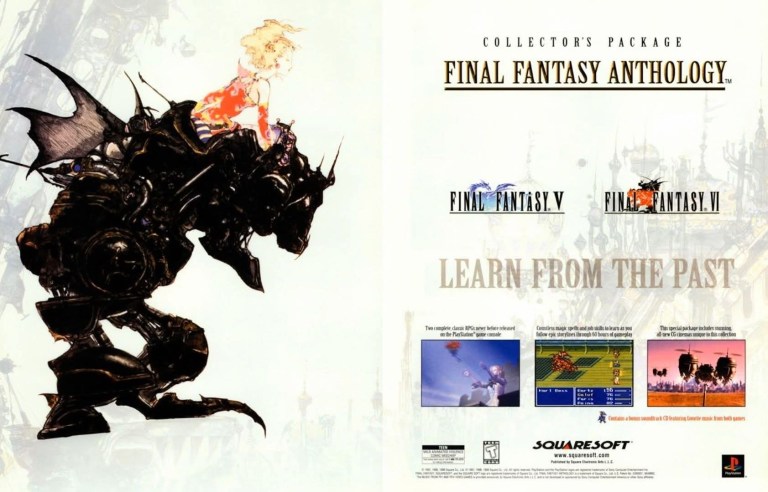
12. Final Fantasy Anthology Print Ad

I remember seeing this 2-page print ad in many gaming magazines I read.

By the year 1999, Squaresoft established itself as the best role-playing game company as they achieved critical and commercial success with Final Fantasy VII in 1997, Brave Fencer Musashi, Parasite Eve and Xenogears in 1998. For 1999, Squaresoft decided to bring ports Final Fantasy V and Final Fantasy VI – both games were released in cartridge format on Super Famicom/Super NES some years prior – to their fans who owned PlayStation consoles by releasing the collection called Final Fantasy Anthology. For the North American market, Squaresoft aggressively promoted the 2-game collection with the above 2-page print ad on several video game publications. One half featured exquisite artwork by Yoshitaka Amano and the other half showed the screenshots, descriptions and details. Clearly the ad was made with Final Fantasy fans in mind and it was also clever with the use of nostalgia.

13. Final Fantasy VII North American Print Ad

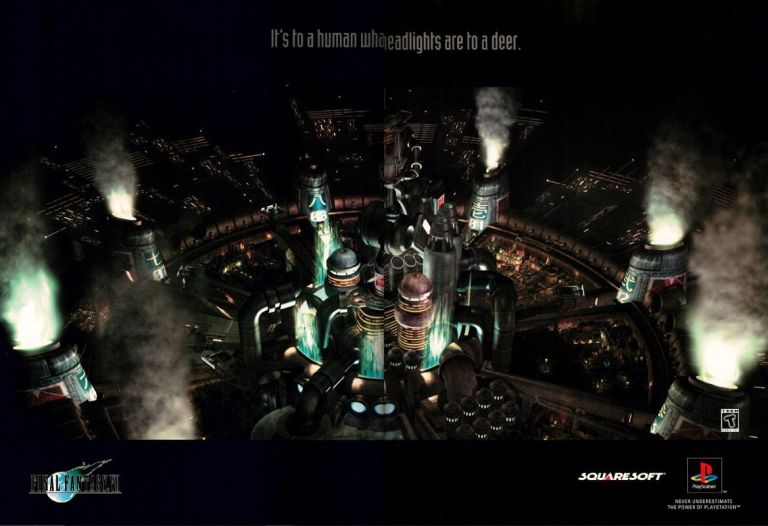
While it did not show any of the characters, this 2-page print ad of Final Fantasy VII appeared in many gaming magazines and ultimately made the public aware of the game which went on to sell millions.

There is no denying that Final Fantasy VII is the most defining Japanese RPG of the 1990s. Given its huge pre-release promotions, the critical acclaim and the tremendous sales achieved in North America and Europe, the game arguably made the JRPG sub-genre more popular among gamers and game publishers while also making the original PlayStation console the must-have machine for video gaming. The above print ad is one of several released through print media and even though it did not show any characters, the image of a futuristic looking city caught the attention of not just gamers but also others who loved entertainment.

+++++

Thank you for reading. If you find this article engaging, please click the like button below, share this article to others and also please consider making a donation to support my publishing. If you are looking for a copywriter to create content for your special project or business, check out my services and my portfolio. Feel free to contact me with a private message. Also please feel free to visit my Facebook page Author Carlo Carrasco and follow me on Twitter at  @HavenorFantasy as well as on Tumblr at https://carlocarrasco.tumblr.com/ and on Instagram at https://www.instagram.com/authorcarlocarrasco