Economic cooperation and growth between the Philippines and Greece got boosted recently as a result of the Subic Bay Metropolitan Authority (SBMA) and Hellenic ASEAN Business Council (HABC) formally signing the Memorandum of Understanding (MOU) which sealed a strategic partnership, according to the official announcement by the SBMA. As of this writing, five foreign companies have expressed interest to invest within the Subic Bay Freeport Zone.
To put things in perspective, posted below is an excerpt from the official announcement. Some parts in boldface…
The Subic Bay Metropolitan Authority (SBMA) and the Hellenic ASEAN Business Council (HABC) have formalized a strategic partnership through a Memorandum of Understanding (MOU) to enhance economic cooperation and growth between Greece and the Philippines.
The MOU was signed on 17 September 2026 at Building 225 in Subic Bay Freeport by SBMA Chairman and Administrator Eduardo Jose L. Aliño and HABC Chairman Nick Stasinopoulos.The agreement aims to promote bilateral trade, investment, tourism, logistics, maritime cooperation, infrastructure development, and sustainable economic growth, leveraging active engagement from both private sectors and institutional partners.
This collaboration will spotlight investment opportunities within the Subic Bay Freeport Zone (SBFZ) and facilitate business matching, trade delegations, and commercial ventures in key sectors. Specific areas of focus includeshipbuilding, ship repair, port operations, logistics, marine maintenance, tourism, cruise terminal development, and waterfront enhancements.
“Subic Bay has evolved into one of the Philippines’ premier investment and economic hubs,” said Aliño. “We are proud to welcome HABC and the broader Hellenic business community as partners in this promising new chapter. This agreement represents a shared commitment to fostering enduring ties that will benefit both our nations for years to come.”
Stasinopoulos emphasized the significance of the pact, noting, “Today’s signing marks a vital milestone in strengthening the relationship between Greece and the Philippines. Our partnership builds on ongoing dialogues, visits, and direct exchanges between both sides.”
Highlighting the maritime sector’s role, he added, “The synergy between our countries is undeniable — Greece is home to the world’s largest maritime communities, while the Philippines is a key contributor to the global maritime workforce. Subic Bay has emerged as a crucial maritime and economic hub, integrating port operations, logistics, manufacturing, and investment.”
The HABC chairman outlined the council’s objectives under the agreement: “We aim to facilitate greater exchanges between Greek and Philippine maritime stakeholders, identify mutual investment opportunities, foster business partnerships, and encourage the sharing of knowledge and expertise.”
Five companies have already expressed interest in investing within the SBFZ, including ERMA Tech Group, a global leader in sustainable maritime technologies specializing in decarbonization, water and wastewater treatment, and marine equipment solutions. Also among the interested investors is Fontanakis Ship Repair, a Piraeus-based Greek company specializing in ship repairs, dry-docking services, engineering studies, and yacht building and restoration.
Let me end this post by asking you readers: What is your reaction to this recent development? Do you feel confident that trade and cooperation between Greece and the Philippines will create positive economic impact in the near future? Do you think this will make the Subic Bay Freeport Zone even more attractive to foreign investors?
Remember a few years ago when the Department of Tourism (DOT) unveiled an ambitious plan to establish the Philippines as a major tourism player in Asia? A lot has changed since then as economic growth of the country has slowed down tremendously and there is not much it can do to compete with others when it comes to attracting a lot of foreign tourists. That said, the DOT under its new leader is not only doing a campaign rebrand but also a notable adjustment of its strategy toward investment, jobs and connectivity, according to a news report by The Daily Tribune.
To put things in perspective, posted below is an excerpt from the news report of The Daily Tribune. Some parts in boldface…
The Department of Tourism (DOT) is shifting its focus beyond visitor arrivals, placing greater emphasis on investments, infrastructure, connectivity, jobs and higher tourism revenues as it seeks to build a more competitive and sustainable industry.
Tourism Secretary Dita Angara-Mathay said the agency is pursuing an investment-driven and people-centered approach as the sector continues to make a significant contribution to the economy.
The Philippine Statistics Authority (PSA) reported that tourism accounted for 8.1% of the economy in 2025, generating P2.27 trillion in Tourism Direct Gross Value Added and supporting 7.70 million jobs.
“We want to be defined as an agency that’s proactively taking the lead in tourism readiness. This means strengthening our airports and gateways, improving our physical tourism infrastructure, and expanding air connectivity, so our visitors can move seamlessly across the country,” Angara-Mathay said.
The DOT is working with the Department of Transportation and other stakeholders to expand flights and establish air and sea links with strategic and emerging markets. From January 1 to May 19, international air seats on direct inbound flights reached 7.78 million, up 8.31% from the same period in 2025.
China was among the fastest-growing markets, with 310,000 arrivals during the period, up 69.15% year-on-year. The Philippines also secured expanded air services with Türkiye, doubling Manila-Istanbul flights to 14 weekly and opening frequency rights for secondary gateways.
To attract more investment, the DOT is implementing programs focused on tourism investment readiness, intelligence, accountability and strategic investor engagement. It has also begun developing partnerships in Japan, including potential projects involving a specialty medical clinic and telecommunications infrastructure in underserved destinations.
The agency is also pushing for a larger tourism marketing budget, with about 70% of its planned 2027 marketing allocation expected to go toward digital campaigns and media placements.
At the same time, the DOT is expanding support for tourism MSMEs through partnerships with Klook, GCash, Viber, Mastercard and Visa, while strengthening accreditation, workforce training and tourism data systems.
Let me end this post by asking you readers: What is your reaction to this recent development? Do you think the DOT will be able to make the tourism sector of the Philippines more attractive towards investors and large businesses that could potentially add a lot of economic value? How many news tourism jobs do you think could be created by the middle of 2028?
Thank you for reading. If you find this article engaging, please click the like button below, share this article to others and also please consider making a donation to support my publishing. If you are looking for a copywriter to create content for your special project or business, check out my services and my portfolio. Feel free to contact me with a private message. Also please feel free to visit my Facebook page Author Carlo Carrasco and follow me on Twitter at @CarloCarrascoPH as well as on Tumblr at https://carlocarrasco.tumblr.com/and on Instagram at https://www.instagram.com/authorcarlocarrasco
The anticipated Swiss challenge bidding for the Subic Bay International Airport (SBIA) has been reset once more as the Subic Bay Metropolitan Authority (SBMA) extended again the deadline for the submission of comparative proposals as a result of making corrections on bidding parameters, according to a BusinessMirror news report.
To put things in perspective, posted below is an excerpt from the BusinessMirror report. Some parts in boldface…
The Subic Bay Metropolitan Authority (SBMA) has again extended the deadline for the submission of comparative proposals for the Subic International Airport (SIA) project after making corrections on bidding parameters for the P6.2 billion project to transform the Subic airfield into a modern high-capacity cargo and logistics hub.
In a bid bulletin, theSBMA Prequalification, Bids and Awards Committee (PBAC) said it will issue the final draft PPP (public-private partnership) contract or final bid bulletin on October 15, instead of September 29as scheduled earlier.
Consequently, theopening of qualification documents from bidders will be held on November 16, instead of October 29, the SBMA-PBAC added.
Therevised bidding schedule came about alongside corrections made by the SBMA on the bid parameters that defined the guaranteed fixed annual payment for the 25-year development contract.
The SBMA-PBAC clarified that while the base concession remittance amount submitted by the challenger for Contract Year 1 shall apply to the first seven years, the same shall be subject to an annual escalation of 1.5 percent beginning Contract Year 8 until its expiry on the 25th year.
The PBAC also clarified that the bid amount should be expressed as a fixed amount in Philippine pesos, and not as a percentage.
Following the revised bidding schedule, the SBMA also set the deadline for payment of participation fees by challengers at seven calendar days before the deadline of submission and opening of the comparative proposals.The participation fee has been set at the non-refundable amount of P1.4 million.
This was thesecond extension made for the bidding after the formal launch of the Swiss challenge for the Subic airport project on April 28 this year.
The SBMA opened the Subic airport project for comparative proposals, or Swiss challenge, after approving the unsolicited proposal by original proponent Cerberus Asia Pacific Investments LLC.
Cerberus Asia Pacific, a key affiliate of the New York-based alternative investment firm Cerberus Capital Management, presented its original proposal to the SBMA on March 26 last year.
The project includes therehabilitation and comprehensive upgrading of existing facilities to restore them to full operational condition; operational and infrastructural improvements to enhance airport safety and regulatory compliance; and development of new airport infrastructure and acquisition of equipment to expand airport capacity, improve operational efficiency, and support new service offerings.
Let me end this post by asking you readers: What is your reaction to this recent development? Do you think the corrections made by the SBMA will turn out final and legally sound so that the bidding can finally push through?
For more South Metro Manila community news and developments, come back here soon. Also say NO to fake news, NO to irresponsible journalism, NO to misinformation, NO to plagiarists, NO to reckless publishers and NO to sinister propaganda when it comes to news and developments. For South Metro Manila community developments, member engagement, commerce and other relevant updates, join the growing South Metro Manila Facebook group at https://www.facebook.com/groups/342183059992673
Welcome back readers, fellow geeks and electronic gaming fans!
In this edition of the Retro Gaming Ads Blast (RGAB) series, we will take a look at another batch of retro gaming print ads from the 1980s to the 1990s.
For the newcomers reading this, Retro Gaming Ads Blast (RGAB) looks back at the many print ads of games (console, arcade, computer and handheld) that were published in comic books, magazines, flyers, posters and newspapers long before smartphones, social media, the worldwide web and streaming became popular. To put things in perspective, people back in the 1980s to the 1990s were more trusting of print media for information and images about electronic games and related products.
With those details laid down, here is the newest batch of retro gaming print ads for you to see and enjoy…
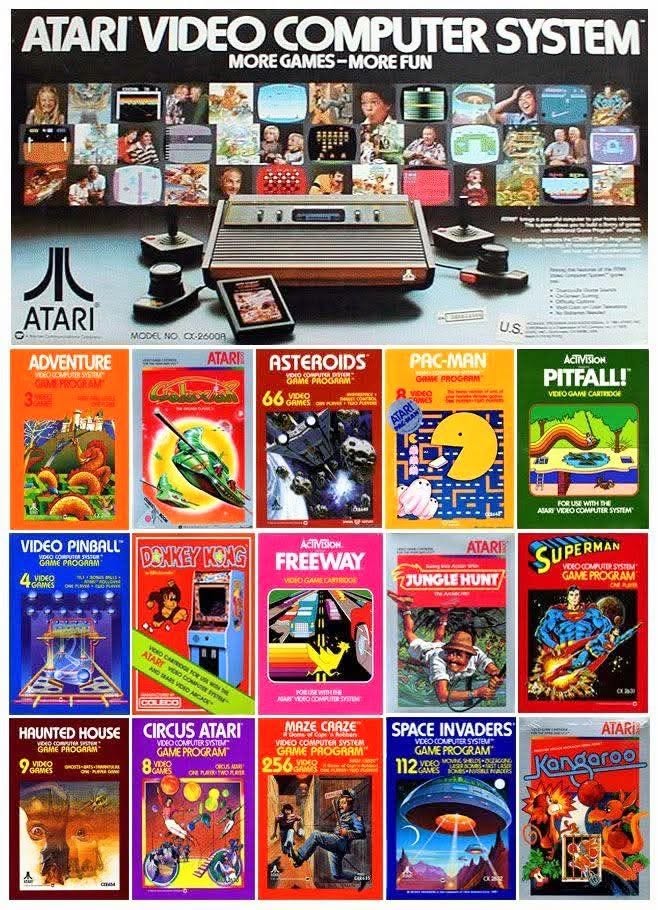
1. Atari Console and Games Print Ad
Back in the 1980s, this was simple and yet exciting to look at.
Back in the 1980s, the styles of video game advertising were very different. Back then, Atari was the market leader on console gaming with the Atari 2600 and they had a lot of video games made for it. As such, the above print ad showing the console and the video games (with the front covers of the game boxes) was typical of the era and it was captivating to look at. By today’s standards, the ad looks simple but it still has the appeal to lure gamers.
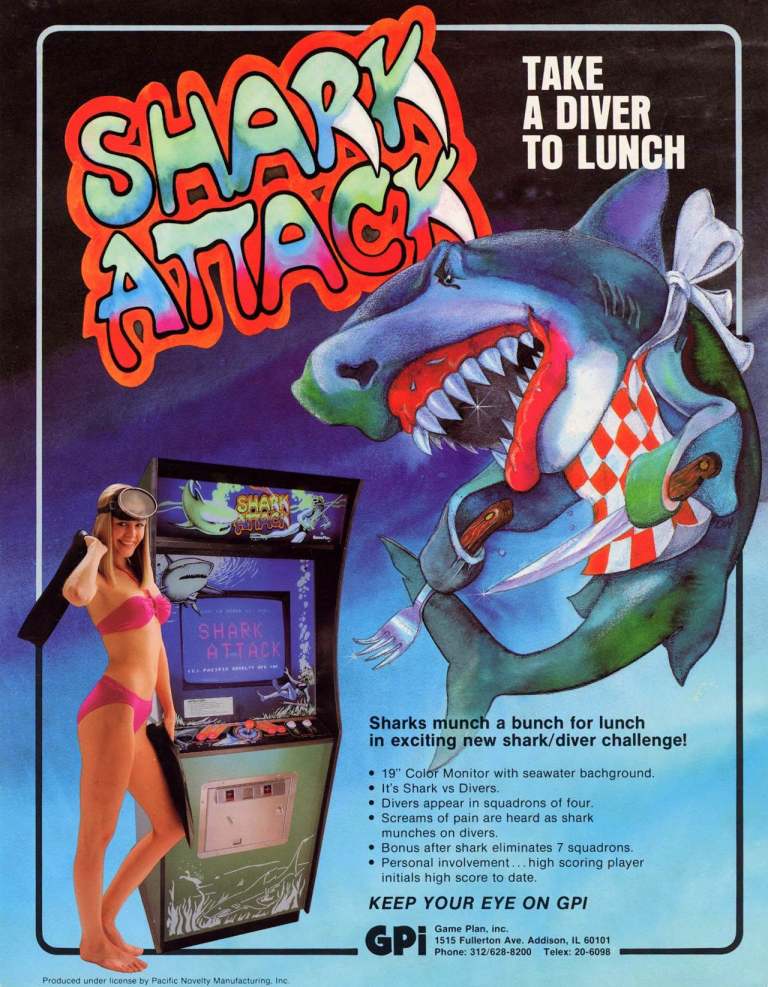
2. Shark Attack North American Arcade Flyer
The front.
The rear.
Remember long ago when Steven Spielberg’s Jaws made some people afraid of sharks and the sea? Jaws was a massive blockbuster, and it was influential to the public. A few years later, Universal Pictures pushed through with Jaws 2 without Spielberg, and it also was a huge commercial hit. By the start of the 1980s, creature feature films inspired by Jaws were released and pop culture itself was influenced. In 1981, the obscure arcade outfit Pacific Novelty Manufacturing released their game Shark Attack in arcades. To promote the game, the company came up with an arcade flyer that had a comedic touch on the text descriptions while featuring a pretty blonde fashion model posing as the diver. The front of the flyer had the arcade cabinet, the model and an exaggerated artwork of a shark holding a knife and a fork. On the rear, the sexiness was ramped up with a shot of the model’s behind (plus more pictures of the model herself). This is indeed an amusing and funny arcade flyer.
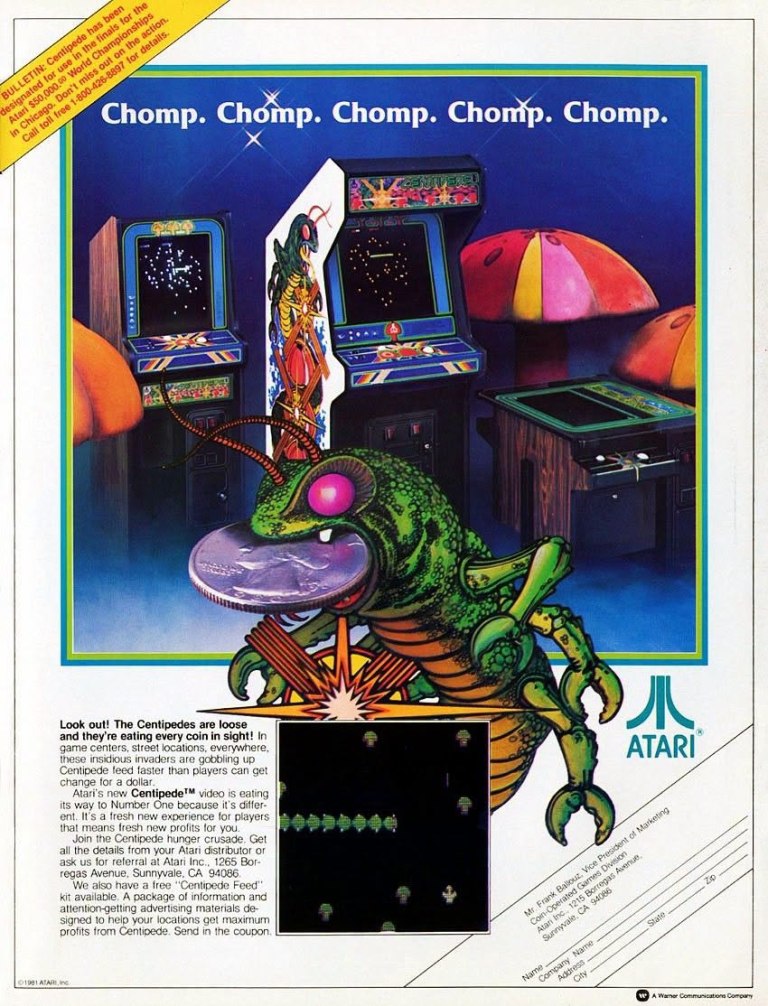
3. Centipede North American Arcade Flyer
This was designed with arcade operators in mind.
When Atari released Centipede in arcades in 1981, it attracted a lot of gamers and became a huge commercial hit. Part of its success is linked with the strategic promotions Atari committed, and the above arcade flyer is one of the variants of Centipede flyers. The one above shows an illustrated centipede carrying a coin in its mouth and in the background are two different arcade cabinets plus a cocktail table machine (for those who want to play Centipede while sitting down). This particular arcade flyer of Centipede emphasizes the popularity of the game and there are different types of machines that arcade operators can choose from. At the same time, this old flyer remains amusing to look at.
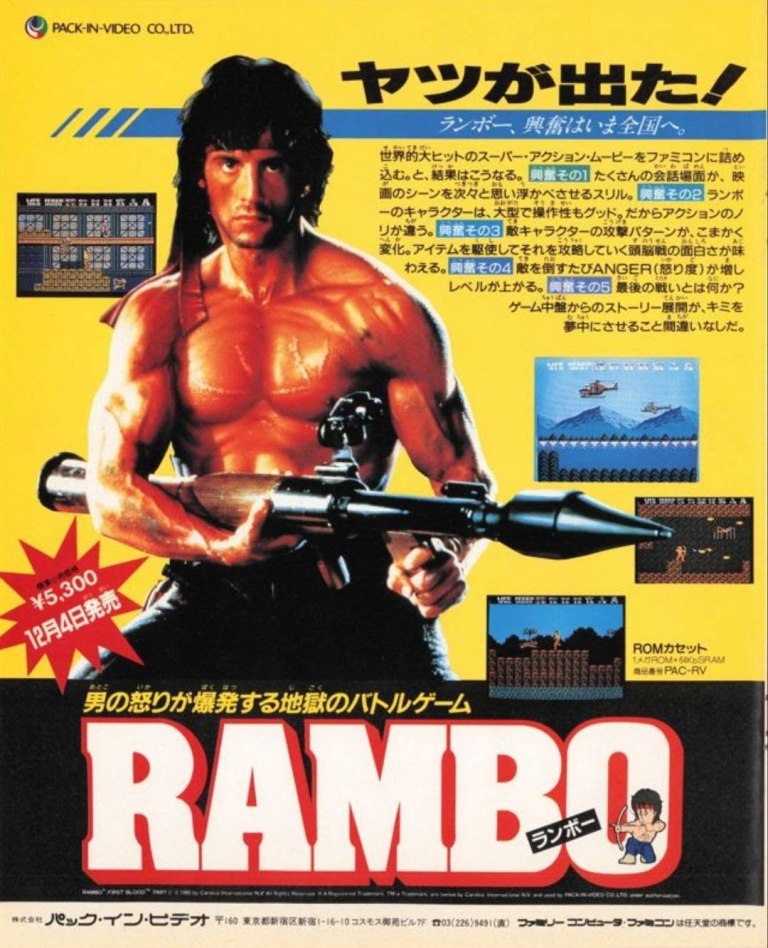
4. Rambo Famicom Japanese Print Ad
Using this iconic imagery of Sylvester Stallone as Rambo was a very smart move.
When it comes to Hollywood action movies of the 1980s, Sylvester Stallone was highly successful, and he impacted American pop culture with the Rocky and Rambo films. By 1985, Stallone struck gold with Rambo: First Blood Part II which made over $300 million worldwide. Considering the Cold War theme and ambitious action scenes of the movie, it was clear for Japanese game developer Pack-In-Video to make an official video game adaptation of Rambo: First Blood Part II for the Nintendo Family Computer (Famicom) in the form of a 2D side-scrolling adventure game. The said game was simply titled Rambo and to promote it, the company came up with the above Japanese print ad that had the iconic Rambo image of Stallone holding the rocket launcher, and a few screenshots of the game itself. If you look closely at the lower-right corner, you will see a cartoonish hand-drawn art of the Rambo character with a bow and arrow. Considering how very popular Stallone, his character and the movie were, it made a lot of sense to promote the Rambo Famicom game like this in Japan.
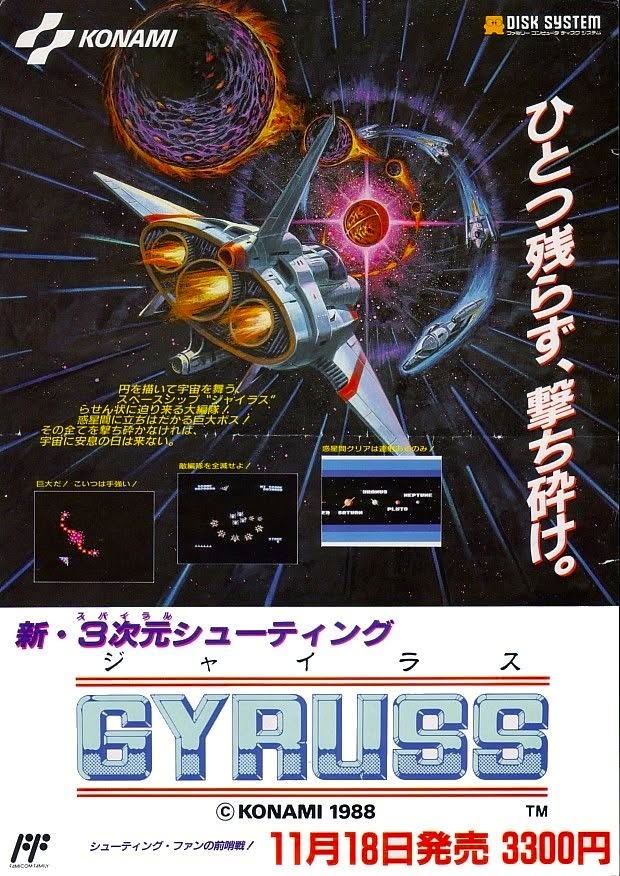
5. Gyruss Family Computer Disk System Japanese Print Ad
Gyruss was Konami’s first-ever game developed for the Famicom Disk System of Nintendo.
In 1983, Konami released Gyruss, a science fiction tube shooter designed by Yoshiko Okamoto. The game was a huge arcade hit and it really attracted a lot of players who enjoyed the unique game design and spaceship shooting. Konami licensed the game to a few companies which resulted in the creation and release of Gyruss ports for different consoles and home computer systems. In 1988, Konami released an enhanced Gyruss port for the Family Computer Disk System of Nintendo. To promote the Famicom Disk System port, Konami came up with a print ad that had a nicely detailed painted artwork of a spaceship (representing the player) about to hit incoming enemies deep in space, 3 screenshots and the official price and release date displayed. The artwork is still captivating to look at and the port itself features major overhauls that arguably made it better than the arcade original. Konami really went the extra mile for this Gyruss port.
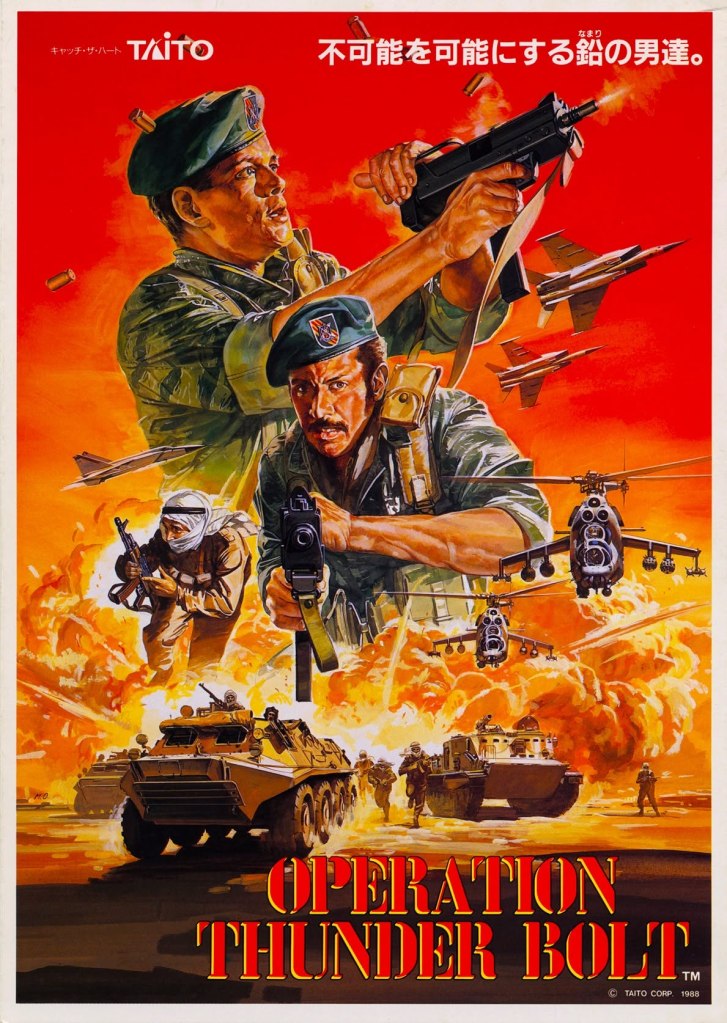
6. Operation Thunderbolt Japanese Arcade Flyer
Great looking artwork on the front.
The rear.
Following the huge success of Operation Wolf, Taito went on to make the sequel military shooter Operation Thunderbolt which was named after the 1977 movie that itself was based on the real-life Entebbe raid of 1976. To promote the game, the company came up with a pretty compelling arcade flyer for the Japanese market. The front has a detailed painted artwork that emphasizes the conflict between soldiers and Islamic terrorists in the Middle East. The rear has technical details of the arcade cabinet, several phone numbers and hand-drawn art of the terrorists (they easily remind me of Palestinian terrorists) clearly called the enemies. While the listing of phone numbers on the rear was very unusual, this old arcade flyer still looks great. Operation Thunderbolt went on to achieve huge commercial success in the arcades and later on consoles. It was one of the highest grossing arcade games in Japan in 1989.
7. Batman Returns North American Print Ad
Sega’s clever print ad promoting the Sega CD game of Batman Returns.
Batman Returns was a big hit in cinemas in 1992 although it never came close to matching the success of its 1989 predecessor. When it comes to video games, Batman Returns was even more ambitious as there were different game adaptations on different platforms. For the Sega CD Batman Returns game, Sega came up with the above ad that strongly featured photos of Michael Keaton as Batman, Michelle Pfeiffer as Catwoman and Danny DeVito as the Penguin with a stylish dark background and four screenshots of the game. The line “Batman Returns…on Sega CD” was really catchy and ultimately the game itself was very notably an expanded version of the Sega Genesis version with selected video footage from the film. As Sega had the license to make Batman Returns games for its platforms, this print ad is absolutely an attention-grabber.
8. Super Star Wars: Return of the Jedi North American Print Ad
The Force is with the handheld gamers.
If there is anything notable about Star Wars in the 1990s, it is the fact that there is a lot of merchandise, comic books, video games, books and other licensed products released long after 1983’s Return of the Jedi which itself was perceived to be the last of the film franchise. In the mid-1990s, ports of Super Star Wars: Return of the Jedi were released on the competing handheld platforms Nintendo Game Boy and Sega Game Gear. This particular single-page ad has a nice visual design that captured the vibe of the movie (which I saw as a young boy in 1983) and it made handheld gaming look cool.
9. Elevator Action Returns Japanese Print Ad
Did you play Elevator Action Returns on the Sega Saturn?
In 1994, Taito struck gold with the release of Elevator Action Returns in Japanese arcades. The sequel was a big hit for the company and they eventually released a console port on the Sega Saturn only in Japan. For promotion, a print ad was made using the official painted artwork while also showing the screenshots and other details about it running on the Saturn (which itself was a powerful 2D sprite machine). Just looking at this old ad brings back the excitement of Elevator Action Returns and I now have a digital copy of it on my Xbox Series X.
10. Jade Cocoon: Story of the Tamamayu North American Print Ad
A very ambitious print ad promoting Jade Cocoon in North America.
By the late 1990s, Japanese role-playing games (JRPG) really became popular on gaming consoles in America which arguably was the result of the massive global success of Final Fantasy VII. In 1999, there were a lot of JRPGs that got released on PlayStation and publisher Crave Entertainment literally pounced on American gamers’ interest on JRPGs by releasing Jade Cocoon: Story of the Tamamayu. Crave aggressively promoted the game and the result was this 2-page print ad that emphasized the game concept (developed by Genki), showed screenshots of the game, and displayed artworks that fans of Studio Ghibli anime productions can recognize. While Jade Cocoon: Story of the Tamamayu never became a massive commercial hit because of the low print run, there is no denying that its print ad was one of the most visually appealing ads of 1999. The ad alone made it look very ambitious.
11. Konami LaserScope North American print ad
Did you get excited after seeing this Konami LaserScope print ad? Do you know anyone who bought the peripheral?
In 1990, this print ad of Konami’s LaserScope appeared in comic books and several other publications. The LaserScope was a gaming peripheral designed for use on the Nintendo Entertainment System (NES) complete with compatibility with existing games that were made to support the NES Zapper. The ad even boasted a voice-activated firing feature and a hands-free approach on playing NES games. While the ad boasted that players will have the most powerful voice in video games, the LaserScope itself was a very flawed and badly optimized device. Apart from having a built-in microphone that was oversensitive, tracking targets was a chore requiring constant head-turning which in turn made the gameplay experience very tiring and frustrating. This old ad promised a lot and the LaserScope was a catastrophe. When was the last time you bought hardware from Konami?
Remember all the craziness that used to infect the United States during the term of the failed US President Joe Biden and his woke administration? Common sense in America continues to get restored as the Trump Administration will proceed with formally removing the Biden-era Title IX regulations and this includes restoring rules that were in place during the first term of President Donald J. Trump, according to a Breitbart news report.
To put things in perspective, posted below is the excerpt from the Breitbart news report. Some parts in boldface…
The Department of Education said Monday it will formally remove the Biden administration’s Title IX regulations and restore rules issued during President Donald Trump’s first term.
The change takes effect Tuesday.Under the final rule issued Monday, the Education Department’s anti-discrimination policy will recognize sex as male or female at birth. It formally removes Biden-era regulations that extended protections based on sexual orientation and gender identity to students and employees at federally funded schools.
The 2024 rules also forced schools to use transgender students’ pronouns and changed how schools handle harassment complaints. A federal court struck down the rules in January 2025.
The Education Department then told schools it would enforce the 2020 rules. Monday’s action puts that change into the published federal regulations; schools have already been operating under the earlier rules.
The department said the last lawsuits over the Biden rules were dismissed in August, clearing the way for it to formally remove them. Education Secretary Linda McMahon said the move would make the written regulations match the court rulings and the rules her department has been enforcing since Trump returned to office:
Today’s rulemaking clears the Biden Administration’s illegal rewrite of Title IX from the Code of Federal Regulations and restores the commonsense language promulgated in the first Trump Administration, which we have been enforcing since the first days of the Administration. Thanks to today’s action, the published Title IX regulations faithfully reflects court orders and Congressional intent—reducing confusion for parents, students, and educational institutions. We will continue to relentlessly champion equal opportunity for all Americans and hold accountable any school or college that violates the rights, privacy, or athletic opportunities of our women and girls.
Let me end this piece by asking you readers: What is your reaction to this development? Are you feeling glad that the Biden-era Title IX rules are no more? Does this development make you feel safer and more confident about your children or relatives in schools? Do you feel that this development ensures protection for women and girls in sports activities or events? What do you think the mob of SJWs, feminists, transgendered and LGBTQ will do in response to this breakthrough?
It looks like there is no end yet for the ongoing economic disappointment for the Philippines as S&P Global Ratings and the Asian Development Bank (ADB) sharply downgraded their respective 2026 growth forecasts for the country, according to a news report by BusinessWorld.
To put things in perspective, posted below is an excerpt from the news report of BusinessWorld. Some parts in boldface…
S&P GLOBAL RATINGS and the Asian Development Bank (ADB) sharply downgraded their Philippine growth forecasts for this year as a weaker-than-expected first half and persistent economic headwinds threaten to stall the country’s recovery.
Based on its latest Economic Outlook for Asia-Pacific published on Wednesday, S&P cut its Philippine gross domestic product (GDP) growth projection for this year to 2.9% from 4.1%.
“We have lowered our growth forecast for 2026, reflecting the weaker-than-expected first-half growth and a more gradual recovery trajectory,” S&P Global Ratings Asia-Pacific Senior Economist Vishrut Rana said in an e-mailed response to questions. “It will take some time for the economy to recover its footing.”
At the same time, ADB trimmed its 2026 Philippine GDP growth projection to 3.3% from the 3.8% forecast it made in July.
“In the Philippines, weak public investment contributed to the 2026 downgrade from 3.8% to 3.3%, although a rebound is expected to support growth of 5.1% in 2027,” the Manila-based multilateral lender said in its Asian Development Outlook report released on Wednesday.
The ADB said that household consumption remained subdued amid high inflation and weak consumer confidence.
According to the ADB report, the Philippines is expected to be one of the slowest-growing economies in developing Southeast Asia this year, ahead only of Brunei Darussalam (1.2%), Thailand (2%) and Myanmar (2.2%). Vietnam is expected to post the fastest growth this year with 7.8%, followed by Indonesia (5.2%), Malaysia (4.9%), the Lao People’s Democratic Republic (4%), Timor-Leste (4%) and Cambodia (3.9%).
The lower growth projections from S&P and ADB come after the Philippine economy grew by 2.3% — a new post-pandemic low — in the second quarter, bringing first-half growth to 2.6%.
If S&P and ADB’s estimates hold, GDP growth will be slower than 4.4% in 2025, when a massive flood control corruption mess dampened the country’s spending and investments.
This year could also mark the fourth straight year that the government will miss its full-year growth goal. For this year, the Development Budget Coordination Committee (DBCC) is targeting 3.5%-4.5% GDP growth.
“The economy is facing a sharp pullback in public capital expenditure, a steep energy price shock, and elevated food prices, partly due to El Niño conditions,” S&P’s Mr. Rana said.
Let me end this post by asking you readers: What is your reaction to this recent development? Did you notice how the national economy got weaker as the government of the Philippines focused more on foreign affairs and the hosting of the Association of Southeast Asian Nations (ASEAN) Summit? Are you convinced there is simply no room for economic improvement for the Philippines this year? Do you think the Philippines is on its way to falling into a recession in 2027?
Thank you for reading. If you find this article engaging, please click the like button below, share this article to others and also please consider making a donation to support my publishing. If you are looking for a copywriter to create content for your special project or business, check out my services and my portfolio. Feel free to contact me with a private message. Also please feel free to visit my Facebook page Author Carlo Carrasco and follow me on Twitter at @CarloCarrascoPH as well as on Tumblr at https://carlocarrasco.tumblr.com/and on Instagram at https://www.instagram.com/authorcarlocarrasco
A major breakthrough happened in Israel where researchers of Ben-Gurion University of the Negev (BGU) developed aerogel that is capable of capturing and breaking down oil spills, according to a feature article by The Jerusalem Post. This breakthrough could improve Israel’s way of protecting the natural environment and solving problems caused by oil spills.
To put things in perspective, posted below is an excerpt from the article of The Jerusalem Post. Some parts in boldface.
Oil spills occur regularly around the world, but large, catastrophic disasters are much less common than small, everyday leaks.
Thousands of minor spills happen every year during routine tasks like refueling ships, pipeline leaks, or equipment failures on land. In the 1970s, there were between 70 and 100 large tanker spills annually. Fortunately, major marine spills from tanker accidents have dropped by more than 90% since the 1970s, with fewer than 10% per year.
Spills actually occur more frequently on land near storage tanks, industrial sites, and pipelines, but these get more attention because they spread fast and harm fragile ocean and coastal habitats.
Nature is also responsible – the single largest source of oil entering the oceans isn’t human error at all; it is natural seepage from rocks on the seafloor, accounting for about 40% to 50% of all oceanic oil.
Israelis probably remember February 2021, when its most severe and prominent modern disaster – a massive undisclosed spill (estimated at dozens to hundreds of tons of crude oil) sent heavy black tar washing ashore. It contaminated roughly 160 kilometers of Israel’s 195-km. coastline, from Rosh Hanikra to Ashkelon, severely harming marine wildlife like sea turtles and birds. They recall seeing masses of seabirds covered in tar and dying as a result of the environmental catastrophe.
But now,researchers at Ben-Gurion University of the Negev (BGU) in Beersheba are the first to develop a technology that captures and biologically breaks down oil pollution, treating crude oil and fuel pollution in marine and aquatic environments– a promising approach to both immediate containment and long-term environmental recovery.
The BGU technology is aimed at both the immediate capture of hydrocarbons and their longer-term degradation. Lab experiments showed that the material can adsorb approximately 80 to 100 times its own mass in crude oil, fuel, tar, and other hydrocarbons.
It was developed in the university’s Environmental Biotechnology Laboratory, led by Prof. Ariel Kushmaro and Dr. Danit Lisa Karsagi Biron of BGU’s Faculty of Engineering.
They created a porous aerogel made from cellulose fibers – that could be created from used egg cartons, old newspapers, and other paper materials – enriched with nitrogen and phosphorus.These nutrients support oil-degrading bacteria, making it possible for the material not only to capture pollutants but also to speed their subsequent biological breakdown.
The research team saidthey developed the aerogel using nutrient enrichment, freeze-drying, and pyrolysis (the thermal decomposition of organic materials at high temperatures – typically 300°C to 900°C) in the absence of oxygen, which prevents combustion.
Kushmaro told The Jerusalem Post in an interview thatthe aerogel provides a surface on which the bacteria can attach, bringing them into close contact with both the adsorbed hydrocarbons and the nutrients they require. In this way,the system creates conditions that support the microbial breakdown of the captured pollutants.
The process can even minimize the need to remove and dispose of contaminated adsorption material after treatment. The technology is currently undergoing patent recognition through BGN Technologies, BGU’s technology commercialization company.
To all my readers, I encourage you to thank the Lord for this scientific breakthrough achieved by Israeli researchers. Even though it has been attacked militarily and through misinformation campaigns by its enemies, Israel continues to be a world leader on technology and economics. Indeed, God has a plan for Israel to be the guiding light for the world. The aerogel developed by Israel’s researchers will pave the way to protecting the natural environment better and help affected communities recover faster from oil spills. Soon enough, other nations will want to have Israel’s breakthrough for the same reasons. It is just a matter of time.
At the same time, I encourage you all to realize the truth that Israel is the land God designated specifically for the Jewish people (read Genesis 35:10-12) and His command must be followed without hesitation. If you want to be blessed further by the Lord, do so by loving and blessing the Jewish people (Genesis 12:1-3). I did my part when I was in Israel. Also, let me remind you all that the ties between the Jews and Christians are truly biblical!
I encourage you all to pray to the Lord God in support of Israel, to love and bless the Jewish people, and pray for the peace of Jerusalem.
2026 has been a very disappointing year for the Philippines in terms of economic growth, foreign investments, inflation and foreign exchange. There is still hope, however, with the ambitious Pax Silica initiative. That said, the Bases Conversion and Development Authority (BCDA) sees investments worth over P100 billion on Pax Silica, according to a news report by BusinessWorld.
To put things in perspective, posted below is an excerpt from the news report of BusinessWorld. Some parts in boldface…
INVESTMENT APPROVALS of the Bases Conversion and Development Authority (BCDA) are expected to exceed P100 billion this year, fueled by growing investor interest in New Clark City and upcoming projects under the US-led Pax Silica initiative.
“If we count the whole year, we will breach P100 billion in investments,” BCDA President and Chief Executive Officer Joshua Bingcang said during a forum hosted by the Foreign Correspondents Association of the Philippines on Monday.
“In a few years, we might be at the same level of the BoI (Board of Investments) in terms of investments generation,” he said.
The BCDA’s project pipeline includes the P25-million expansion of logistics apron and access roads, as well as the construction of a P155-million runway in Clark International Airport (CIA).
Also in its pipeline is the construction of a P1.4-billion apron to support logistics firms within CIA, along with a P10-billion runway and taxiway project.
“Last week, we approved the procurement for the construction of the apron. It will serve as the parking space for FedEx and UPS planes, and other logistics companies going to put up business in Clark,” Mr. Bingcang said.
Mr. Bingcang also noted that Science Park of the Philippines, Inc. is building a 106-hectare industrial park in New Clark City. Construction is expected to begin within the fourth quarter of this year.
BCDA also plans to sign a memorandum of agreement with the Home Development Mutual Fund (Pag-IBIG Fund) to build economic housing units in New Clark City for workers based in the area.
He also said that the National Commission on Indigenous Peoples (NCIP) has issued a no-objection letter for the North-South Commuter Railway (NSCR).
“So, we’re seeing now the greenlight for this project to extend all the way to New Clark City,” Mr. Bingcang said.
The 147-kilometer NSCR will connect Malolos, Bulacan with Clark International Airport, and Tutuban, Manila with Calamba, Laguna.
The BCDA is also looking to bid four hectares of land near the Market! Market! commercial property in Taguig City by the first quarter of 2027.
“Only the mall was renewed by Ayala Land, Inc. The rest will be open for public bidding… that will be the site for the Mega Manila subway station in BGC (Bonifacio Global City),” Mr. Bingcang said, noting that about four Japanese developers are interested in the property.
Meanwhile, Trade Undersecretary Ceferino S. Rodolfo said the artificial intelligence (AI)-native industrial hub in New Clark City in Tarlac under the US’ Pax Silica bloc is one of several “nodes” that will build the “Philippine technology corridor” connecting the technology value chain across manufacturing, minerals, talent, and digital infrastructure.
“Viewed separately, they are projects, but viewed through the AI lens, they become an ecosystem that creates long-term competitive advantage,” Mr. Rodolfo said at the same event.
He said the technology corridor also includes the National Capital Region (integrated circuit design hub), Batangas (an AI compute hub), Bulacan (wafer fabrication facility) and Mindanao (minerals).
Let me end this post by asking you readers: What is your reaction to this recent development? Do you think potential huge investments on Pax Silica will be realized in the near future? Do you think a lot of people here in the Philippines lack a full understanding of Pax Silica?
Thank you for reading. If you find this article engaging, please click the like button below, share this article to others and also please consider making a donation to support my publishing. If you are looking for a copywriter to create content for your special project or business, check out my services and my portfolio. Feel free to contact me with a private message. Also please feel free to visit my Facebook page Author Carlo Carrasco and follow me on Twitter at @CarloCarrascoPH as well as on Tumblr at https://carlocarrasco.tumblr.com/and on Instagram at https://www.instagram.com/authorcarlocarrasco
There definitely is such a thing as illegally voting in elections in the United States. Since Donald Trump returned as US President in 2025, the government has been unrelenting on pushing back against illegal immigration while restoring the integrity of American elections. That said, an immigrant from the Philippines pleaded guilty to voting illegally in the US Presidential election of 2024 and it happened just months after the Department of Homeland Security (DHS) under failed US President Joe Biden approved her for the green card, according to a news report by Breitbart.
To put things in perspective, posted below is the excerpt from the Breitbart news report. Some parts in boldface…
Last week, the Department of Justice (DOJ) announced that 37-year-old Evelyn Miller of the Philippines, who resided in Emmaus, Pennsylvania, pleaded guilty to illegal voting.
On Monday, Breitbart News learned that Miller, who was approved for a green card by Biden’s Department of Homeland Security (DHS) in July 2024, registered to vote on October 9, 2024, and illegally voted in the presidential election on November 5, 2024.
“This alien from the Philippines pleaded guilty toillegally voting in the 2024 election in Pennsylvania,” DHS Secretary Markwayne Mullin said in a statement. “Thanks to the hard work of the men and women of HSI, as well as our partners at the Department of Justice, this alien will soon face justice for her efforts to subvert our elections. American elections are for Americans only.”
In the investigation, Miller confessed to Federal Bureau of Investigation (FBI) agents that she registered to vote online ahead of the election and voted in person on Election Day.
Let me end this piece by asking you readers: What is your reaction to this development? Does this case of illegal voting convince you that there should be more restrictions to prevent green card holders from voting in any election? What do you think is the ideal punishment for green card holders who actually voted? Are you convinced that Democrats would do anything to allow illegal voting in order to gain power?
During the Luzon Economic Corridor Investment Forum recently held at the Best Western Hotel inside the Subic Bay Freeport Zone, representatives of several American companies expressed strong interest to invest in the Luzon Economic Corridor (LEC), the Subic Bay Metropolitan Authority (SBMA) revealed.
To put things in perspective, posted below is an excerpt from the SBMA announcement. Some parts in boldface…
Representatives from approximately 50 U.S. companies have expressed strong interest in investing in the Luzon Economic Corridor (LEC), a key economic zone recognized for its strategic role in the logistics sector.
Leading the delegation was Thomas R. Hardy, Deputy Director and Chief Operating Officer of the U.S. Trade and Development Agency (USTDA), during the Luzon Economic Corridor Investment Forum held at the Best Western Hotel, Subic Bay Freeport.
Joining thedelegation consisting not only of American businesses, were representatives from international companies, development partners, and major financial institutionsseeking to explore business opportunities within Subic Bay Freeport and the broader LEC region.
Subic Bay Metropolitan Authority (SBMA) Chairman and Administrator Eduardo Jose L. Aliño, together with other SBMA officials, warmly welcomed the delegates. They were joined by stakeholders from the Subic Bay International Terminal Corporation (SBITC) and other freeport investors aiming to engage in productive Business-to-Business (B2B) engagements, addressing inquiries from the visiting foreign companies.
“As the host of the Subic leg of the LEC Investment Forum, this delegation has a unique opportunity to participate in meaningful B2B discussions, tour Subic Freeport, and explore avenues for deepening economic integration across the Luzon Economic Corridor. Participants are highly encouraged to explore investment opportunities, pathways to collaborate, and how they can positively impact the success of the LEC initiative,” said Chairman Aliño.
Sponsored by the USTDA, Aliño emphasized that this visit highlights Subic Bay Freeport’s vital role in the LEC’s foundational tripartite partnership among the Philippines, the United States, and Japan.
He further noted that the LEC project has since expanded to include partners from Australia, Canada, Denmark, France, Italy, South Korea, Sweden, and the United Kingdom. “This is excellent news for Subic Bay as a critical western maritime gateway and strategic logistics hub, connecting major centers such as Clark, Manila, and Batangas. It underscores our commitment to advancing infrastructure, enhancing supply chain resilience, and attracting technology investments within the corridor,” Aliño added.
In line with these developments, the USTDA reaffirmed its support for secure, robust, and resilient supply chains by facilitating the expansion of port infrastructure at Subic Bay.
Let me end this post by asking you readers: What is your reaction to this recent development? Do you feel confident that the American companies that attended the important forum will indeed push through with investing in the Luzon Economic Corridor in the near future? Do you think their investment plans will create a lot new job opportunities for Filipinos?