In its latest move on reforming immigration, Japan has officially revised its guidelines for granting permanent residency to foreign nationals and these will take effect in April 2027, according to a news report by Kyodo News. Guidelines include Japanese language-proficiency and having an above-average income compared with Japanese households.
To learn about the events that preceded the new residency fees, click here, here and here.
To put things in perspective, posted below is the excerpt from the Kyodo News report. Some parts in boldface…
Japan’s immigration agency on Thursday revised its guidelines for granting permanent residency to foreign nationals, requiring applicants to have an income above the average for Japanese households and demonstrating a certain level of projected pension benefits.
The revised guidelines, which are set to take effect in April 2027, also require applicants to demonstrate Japanese-language proficiency at the level of an “independent user.”
The income requirement will be applied retroactively to applications made from April 2026 onward, as the immigration authorities aim to ensure that foreign applicants are financially independent. The average annual income per household was around 5.75 million yen ($36,500) in 2024.
The government of Prime Minister Sanae Takaichi has been seeking to tighten regulations on the acceptance of foreign nationals. Fees for residence status applications were also hiked sharply on Thursday.
Applicants will also be required to have projected pension benefits equivalent to those payable after 30 years of enrollment in the employees’ pension program at their income level at the time they apply.
In principle, applicants must have lived in Japan for more than 10 years to qualify for permanent residency.
Previously, spouses of Japanese nationals or permanent residents could obtain permanent residency if they had been married for at least three years and had resided in Japan for at least one year.
However, the revised guidelines raise those thresholds to five years of marriage and three years of residence.
The Immigration Services Agency received around 5,000 public comments since it unveiled the draft guidelines in August.
Let me end this piece by asking you readers: What is your reaction to this development? Are you convinced that the Japanese government is executing the right moves with the revised guidelines? Do you think this latest immigration reform by Japan could inspire other nations to follow suit? What do you think could be the reasons why foreigners want to live permanently in Japan without following their rules, without paying their bills and without learning the Japanese language?
Thank you for reading. If you find this article engaging, please click the like button below, share this article to others and also please consider making a donation to support my publishing. If you are looking for a copywriter to create content for your special project or business, check out my services and my portfolio. Feel free to contact me with a private message. Also please feel free to visit my Facebook page Author Carlo Carrasco and follow me on Twitter at @CarloCarrascoPH as well as on Tumblr at https://carlocarrasco.tumblr.com/and on Instagram at https://www.instagram.com/authorcarlocarrasco
Vietnam successfully attracted 17.7 million foreign tourists during the first nine months of 2026 having China, South Korea and Russia as their top 3 tourist markets, according to a news report by VnExpress. As it currently stands, Vietnam saw its foreign tourist count rise by 14.5% compared to the year before and it is looking more likely for the nation to exceed its 2025 overall foreign tourist count of 21.2 million by the end of this year.
To put things in perspective, posted below is an excerpt from the news report of VnExpress. Some parts in boldface…
Vietnam welcomed 17.7 million international visitors in the first nine months of 2026, up 14.5% year-on-year, bucking a decline in arrivals across several Southeast Asian destinations.
Mainland Chinaremained Vietnam’s largest source market, with3.95 million visitors, accounting for about 22.3% of the total.South Korearanked second with approximately3.05 million visitors, or 17.3%.
Russia ranked third with 1.1 million, followed byTaiwan (964,000)and theU.S. (746,000), according to the General Statistics Office.
The rest of the top 10 were Cambodia (688,000), Japan (674,000), India (670,000), thePhilippines (522,000)and Australia (485,000).
In September, foreign visitors declined by 11.3% from August but rose by 16.5% year-on-year to 1.77 million.
Martin Koerner, commercial director of The Anam Group, a chain of luxury resort hotels in Vietnam, said what is particularly encouraging is Vietnam’s diversification of source markets.
European arrivals increased by more than 50%, while arrivals from markets including the United States, Australia and India also recorded strong growth. This makesVietnam less dependent on only one or two major Asian source markets, he added.
“Vietnam is no longer seen simply as an inexpensive holiday destination. Increasingly, it is being
recognized as a destination capable of delivering sophisticated, world-class hospitality,” Koerner said.
Several Southeast Asian countries have faced declines in international arrivals amid the impact of the Middle East crisis.
Let me end this piece by asking you readers: What is your reaction to this development? Have you visited Singapore over the past twelve months? Do you think Singapore can keep innovating and improving itself on tourism development? Do you know anyone who visited Vietnam recently and mentioned positive things about their tour? How interested are you right now to visit Vietnam?
Thank you for reading. If you find this article engaging, please click the like button below, share this article to others and also please consider making a donation to support my publishing. If you are looking for a copywriter to create content for your special project or business, check out my services and my portfolio. Feel free to contact me with a private message. Also please feel free to visit my Facebook page Author Carlo Carrasco and follow me on Twitter at @CarloCarrascoPH as well as on Tumblr at https://carlocarrasco.tumblr.com/and on Instagram at https://www.instagram.com/authorcarlocarrasco
Welcome back readers, fellow geeks and electronic gaming fans!
In this edition of the Retro Gaming Ads Blast (RGAB) series, we will take a look at another batch of retro gaming print ads from the 1980s to the 1990s.
For the newcomers reading this, Retro Gaming Ads Blast (RGAB) looks back at the many print ads of games (console, arcade, computer and handheld) that were published in comic books, magazines, flyers, posters and newspapers long before smartphones, social media, the worldwide web and streaming became popular. To put things in perspective, people back in the 1980s to the 1990s were more trusting of print media for information and images about electronic games and related products.
With those details laid down, here is the newest batch of retro gaming print ads for you to see and enjoy…
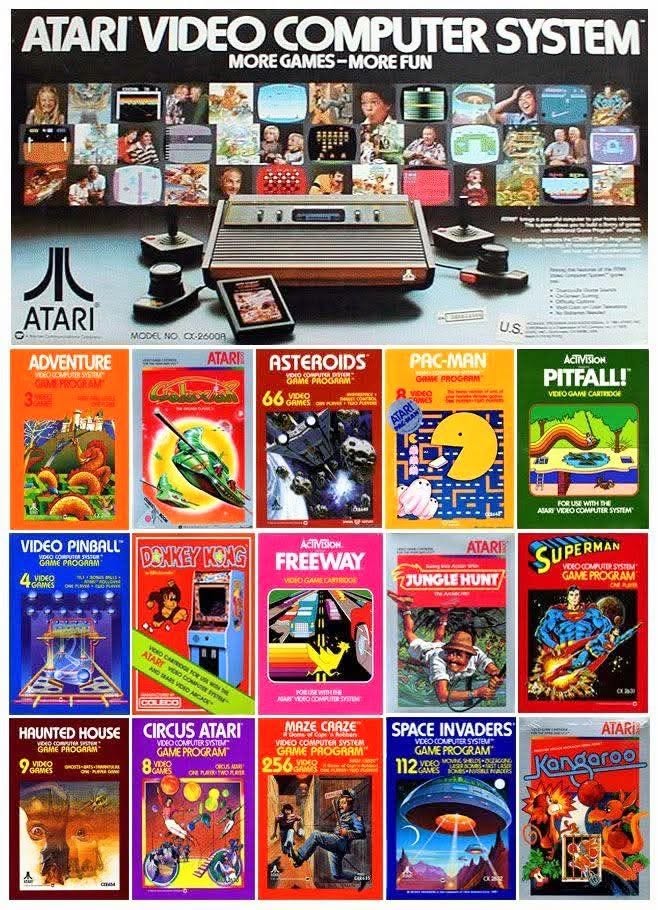
1. Atari Console and Games Print Ad
Back in the 1980s, this was simple and yet exciting to look at.
Back in the 1980s, the styles of video game advertising were very different. Back then, Atari was the market leader on console gaming with the Atari 2600 and they had a lot of video games made for it. As such, the above print ad showing the console and the video games (with the front covers of the game boxes) was typical of the era and it was captivating to look at. By today’s standards, the ad looks simple but it still has the appeal to lure gamers.
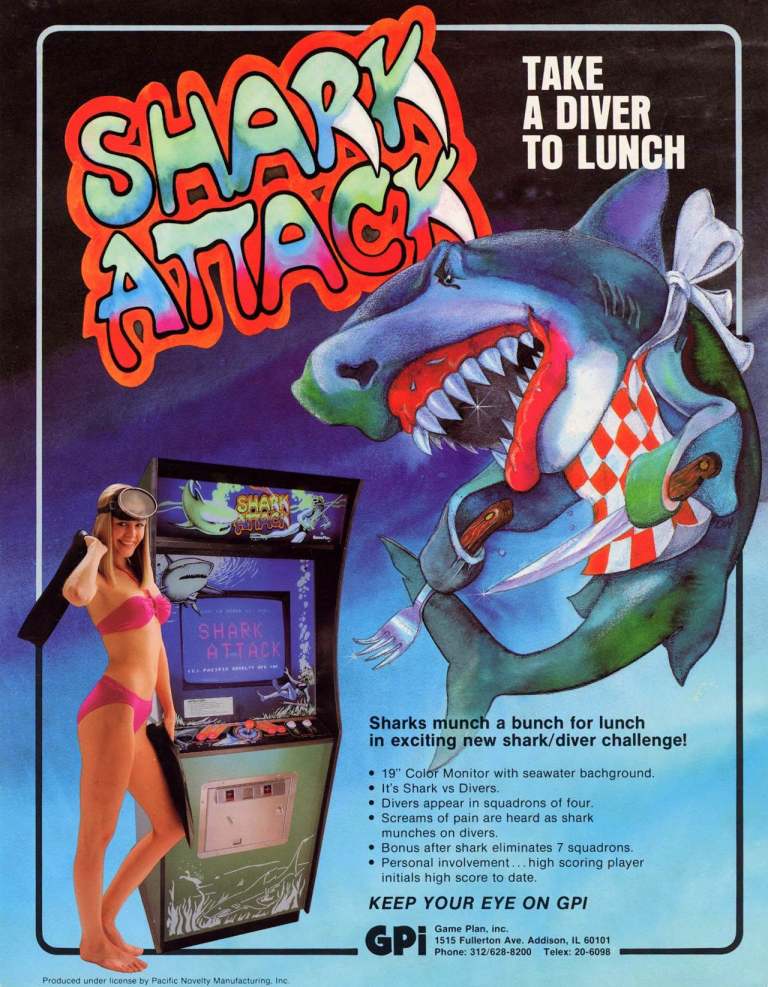
2. Shark Attack North American Arcade Flyer
The front.
The rear.
Remember long ago when Steven Spielberg’s Jaws made some people afraid of sharks and the sea? Jaws was a massive blockbuster, and it was influential to the public. A few years later, Universal Pictures pushed through with Jaws 2 without Spielberg, and it also was a huge commercial hit. By the start of the 1980s, creature feature films inspired by Jaws were released and pop culture itself was influenced. In 1981, the obscure arcade outfit Pacific Novelty Manufacturing released their game Shark Attack in arcades. To promote the game, the company came up with an arcade flyer that had a comedic touch on the text descriptions while featuring a pretty blonde fashion model posing as the diver. The front of the flyer had the arcade cabinet, the model and an exaggerated artwork of a shark holding a knife and a fork. On the rear, the sexiness was ramped up with a shot of the model’s behind (plus more pictures of the model herself). This is indeed an amusing and funny arcade flyer.
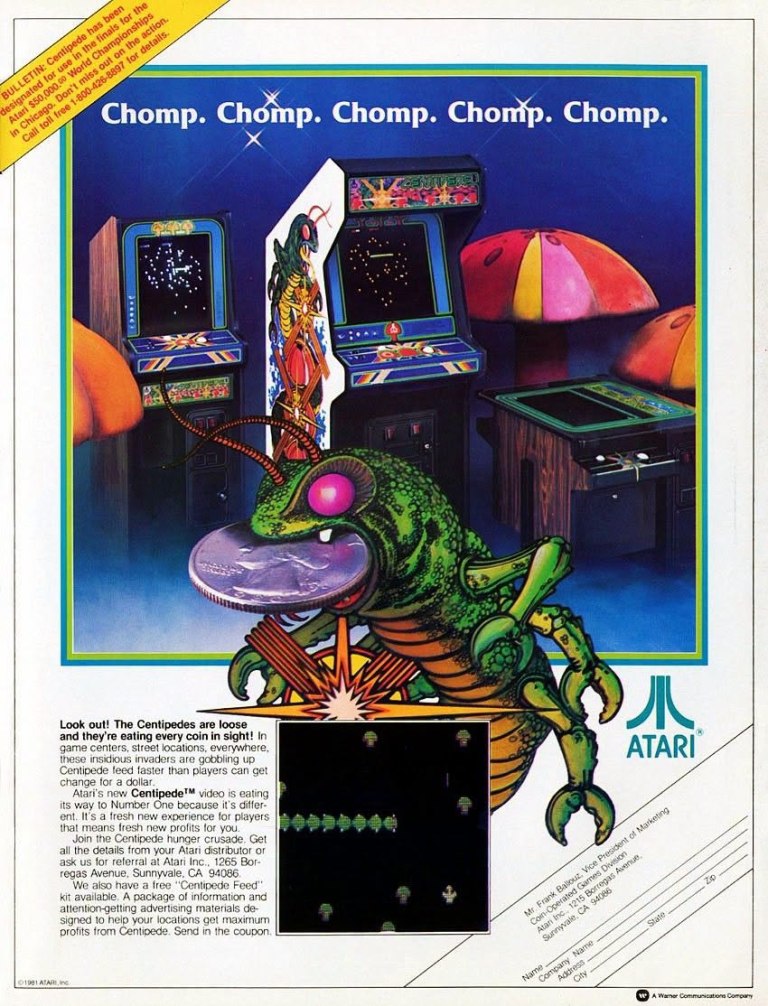
3. Centipede North American Arcade Flyer
This was designed with arcade operators in mind.
When Atari released Centipede in arcades in 1981, it attracted a lot of gamers and became a huge commercial hit. Part of its success is linked with the strategic promotions Atari committed, and the above arcade flyer is one of the variants of Centipede flyers. The one above shows an illustrated centipede carrying a coin in its mouth and in the background are two different arcade cabinets plus a cocktail table machine (for those who want to play Centipede while sitting down). This particular arcade flyer of Centipede emphasizes the popularity of the game and there are different types of machines that arcade operators can choose from. At the same time, this old flyer remains amusing to look at.
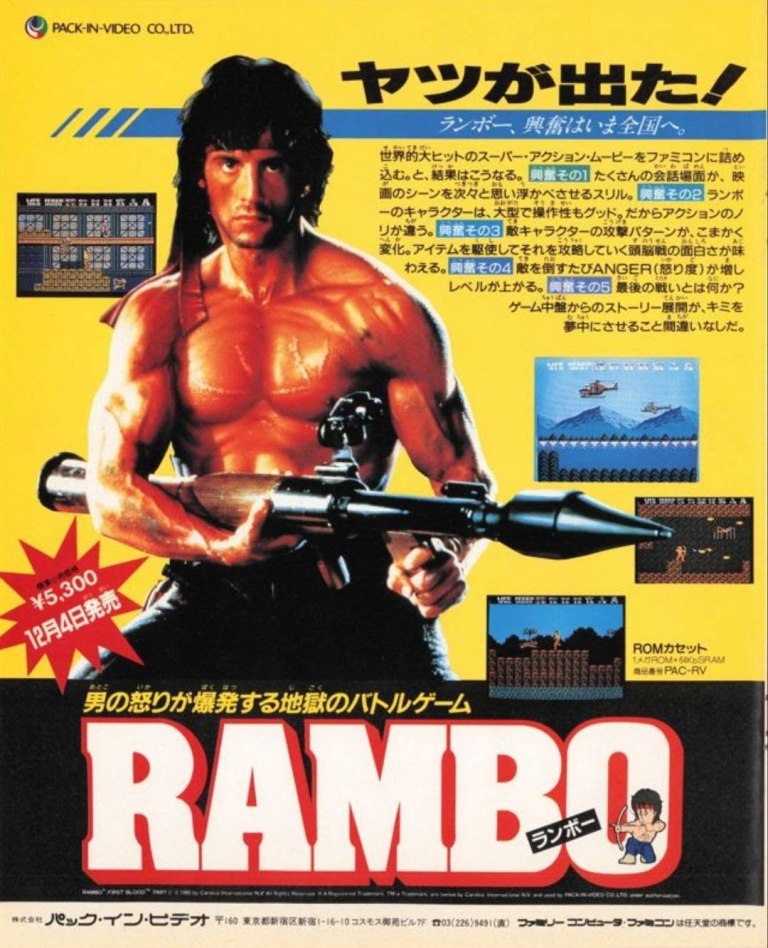
4. Rambo Famicom Japanese Print Ad
Using this iconic imagery of Sylvester Stallone as Rambo was a very smart move.
When it comes to Hollywood action movies of the 1980s, Sylvester Stallone was highly successful, and he impacted American pop culture with the Rocky and Rambo films. By 1985, Stallone struck gold with Rambo: First Blood Part II which made over $300 million worldwide. Considering the Cold War theme and ambitious action scenes of the movie, it was clear for Japanese game developer Pack-In-Video to make an official video game adaptation of Rambo: First Blood Part II for the Nintendo Family Computer (Famicom) in the form of a 2D side-scrolling adventure game. The said game was simply titled Rambo and to promote it, the company came up with the above Japanese print ad that had the iconic Rambo image of Stallone holding the rocket launcher, and a few screenshots of the game itself. If you look closely at the lower-right corner, you will see a cartoonish hand-drawn art of the Rambo character with a bow and arrow. Considering how very popular Stallone, his character and the movie were, it made a lot of sense to promote the Rambo Famicom game like this in Japan.
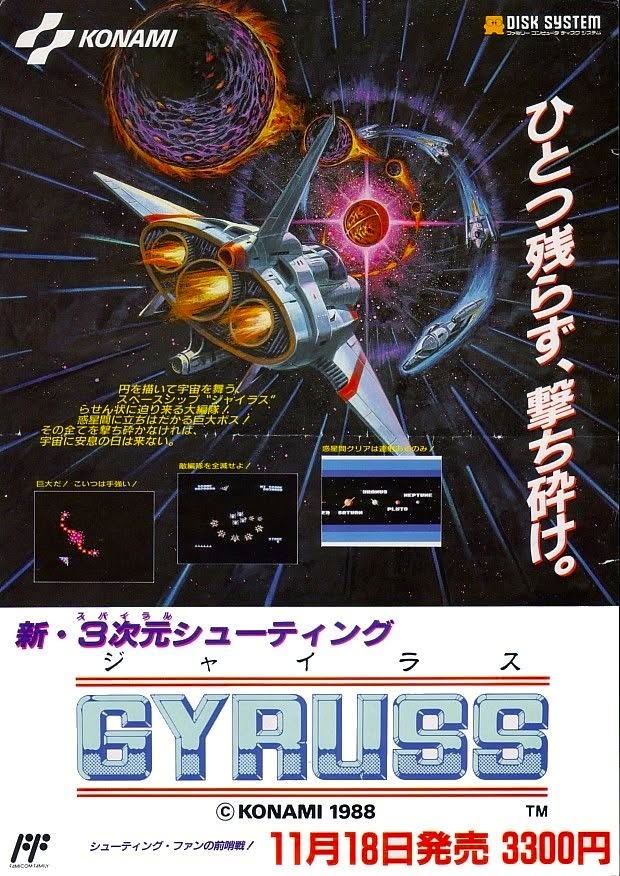
5. Gyruss Family Computer Disk System Japanese Print Ad
Gyruss was Konami’s first-ever game developed for the Famicom Disk System of Nintendo.
In 1983, Konami released Gyruss, a science fiction tube shooter designed by Yoshiko Okamoto. The game was a huge arcade hit and it really attracted a lot of players who enjoyed the unique game design and spaceship shooting. Konami licensed the game to a few companies which resulted in the creation and release of Gyruss ports for different consoles and home computer systems. In 1988, Konami released an enhanced Gyruss port for the Family Computer Disk System of Nintendo. To promote the Famicom Disk System port, Konami came up with a print ad that had a nicely detailed painted artwork of a spaceship (representing the player) about to hit incoming enemies deep in space, 3 screenshots and the official price and release date displayed. The artwork is still captivating to look at and the port itself features major overhauls that arguably made it better than the arcade original. Konami really went the extra mile for this Gyruss port.
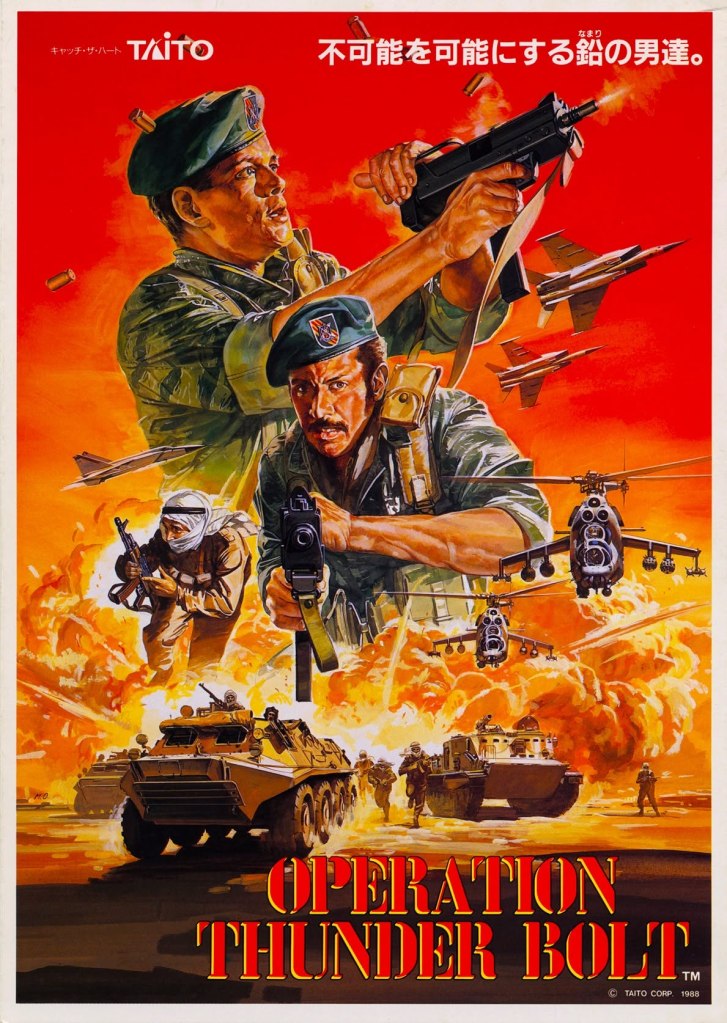
6. Operation Thunderbolt Japanese Arcade Flyer
Great looking artwork on the front.
The rear.
Following the huge success of Operation Wolf, Taito went on to make the sequel military shooter Operation Thunderbolt which was named after the 1977 movie that itself was based on the real-life Entebbe raid of 1976. To promote the game, the company came up with a pretty compelling arcade flyer for the Japanese market. The front has a detailed painted artwork that emphasizes the conflict between soldiers and Islamic terrorists in the Middle East. The rear has technical details of the arcade cabinet, several phone numbers and hand-drawn art of the terrorists (they easily remind me of Palestinian terrorists) clearly called the enemies. While the listing of phone numbers on the rear was very unusual, this old arcade flyer still looks great. Operation Thunderbolt went on to achieve huge commercial success in the arcades and later on consoles. It was one of the highest grossing arcade games in Japan in 1989.
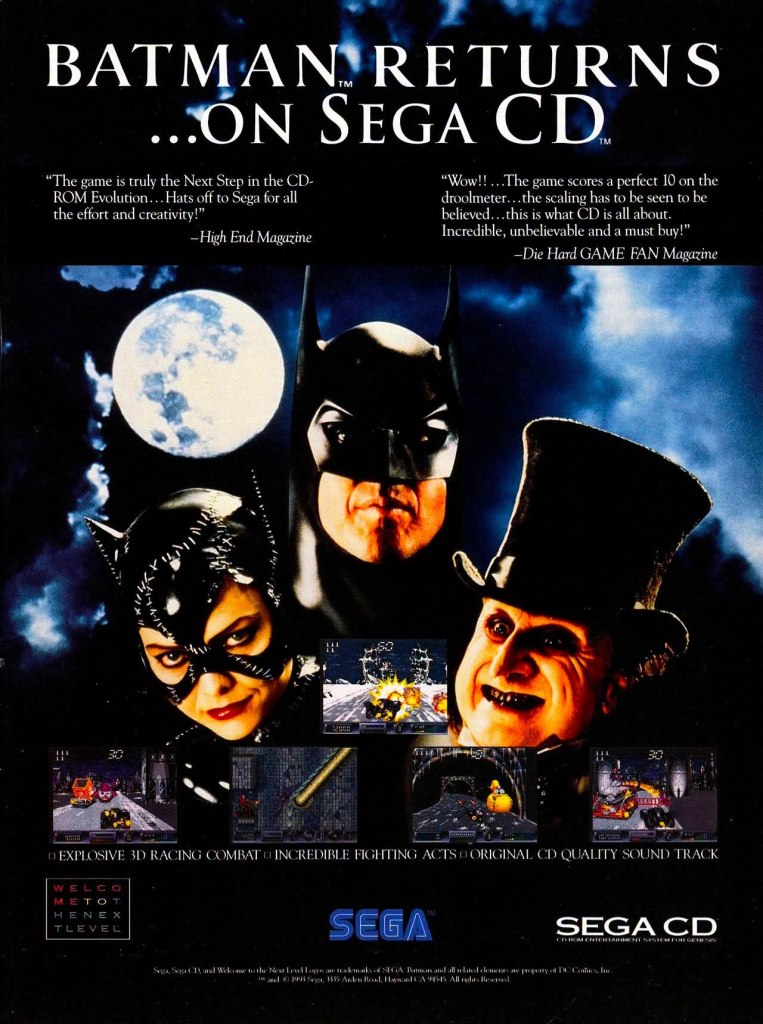
7. Batman Returns North American Print Ad
Sega’s clever print ad promoting the Sega CD game of Batman Returns.
Batman Returns was a big hit in cinemas in 1992 although it never came close to matching the success of its 1989 predecessor. When it comes to video games, Batman Returns was even more ambitious as there were different game adaptations on different platforms. For the Sega CD Batman Returns game, Sega came up with the above ad that strongly featured photos of Michael Keaton as Batman, Michelle Pfeiffer as Catwoman and Danny DeVito as the Penguin with a stylish dark background and four screenshots of the game. The line “Batman Returns…on Sega CD” was really catchy and ultimately the game itself was very notably an expanded version of the Sega Genesis version with selected video footage from the film. As Sega had the license to make Batman Returns games for its platforms, this print ad is absolutely an attention-grabber.
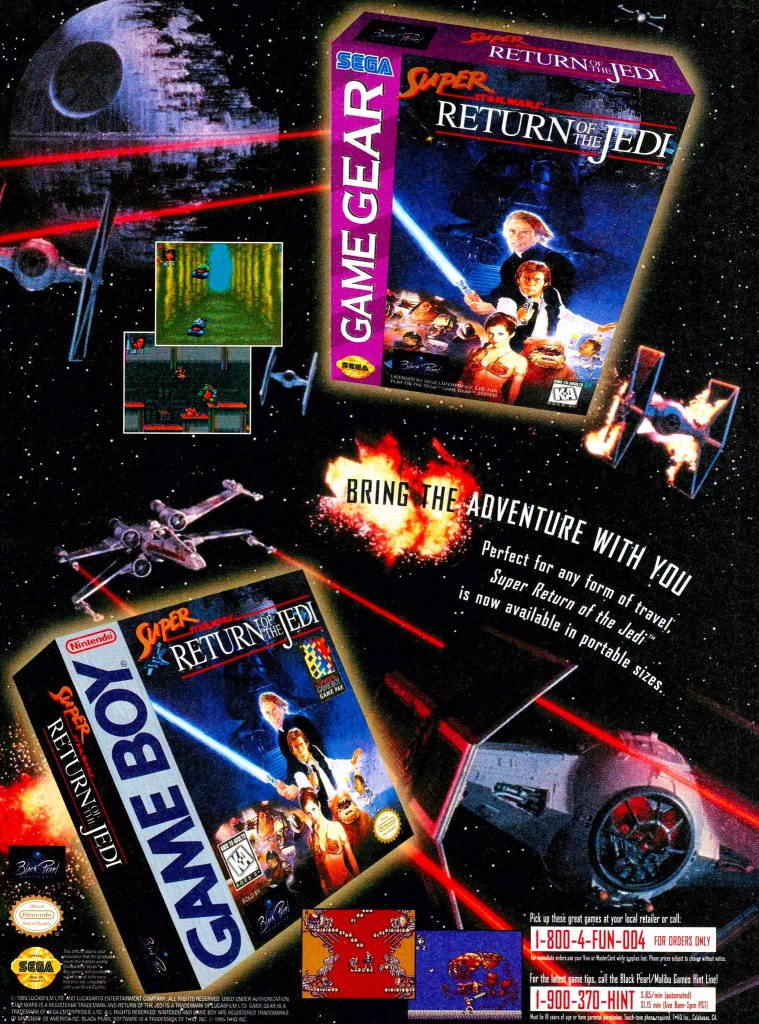
8. Super Star Wars: Return of the Jedi North American Print Ad
The Force is with the handheld gamers.
If there is anything notable about Star Wars in the 1990s, it is the fact that there is a lot of merchandise, comic books, video games, books and other licensed products released long after 1983’s Return of the Jedi which itself was perceived to be the last of the film franchise. In the mid-1990s, ports of Super Star Wars: Return of the Jedi were released on the competing handheld platforms Nintendo Game Boy and Sega Game Gear. This particular single-page ad has a nice visual design that captured the vibe of the movie (which I saw as a young boy in 1983) and it made handheld gaming look cool.
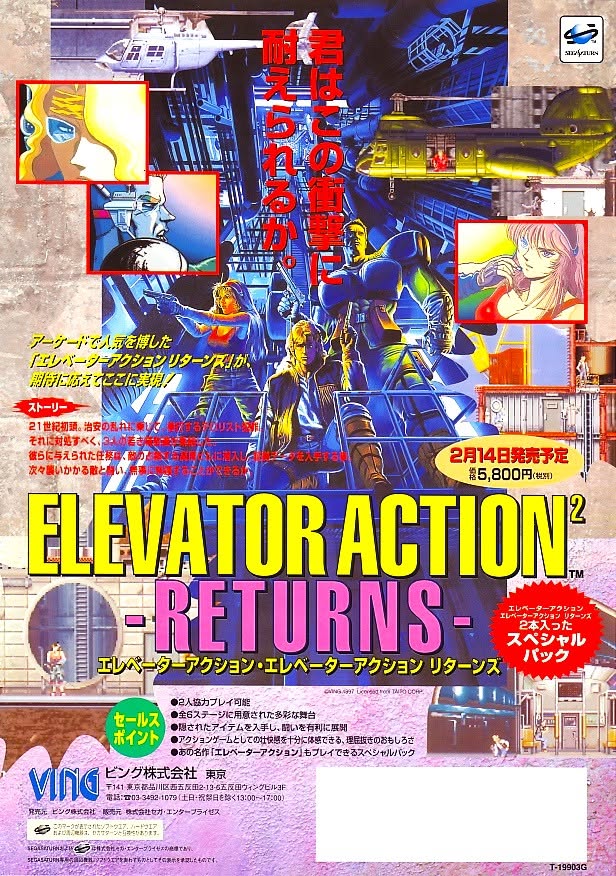
9. Elevator Action Returns Japanese Print Ad
Did you play Elevator Action Returns on the Sega Saturn?
In 1994, Taito struck gold with the release of Elevator Action Returns in Japanese arcades. The sequel was a big hit for the company and they eventually released a console port on the Sega Saturn only in Japan. For promotion, a print ad was made using the official painted artwork while also showing the screenshots and other details about it running on the Saturn (which itself was a powerful 2D sprite machine). Just looking at this old ad brings back the excitement of Elevator Action Returns and I now have a digital copy of it on my Xbox Series X.
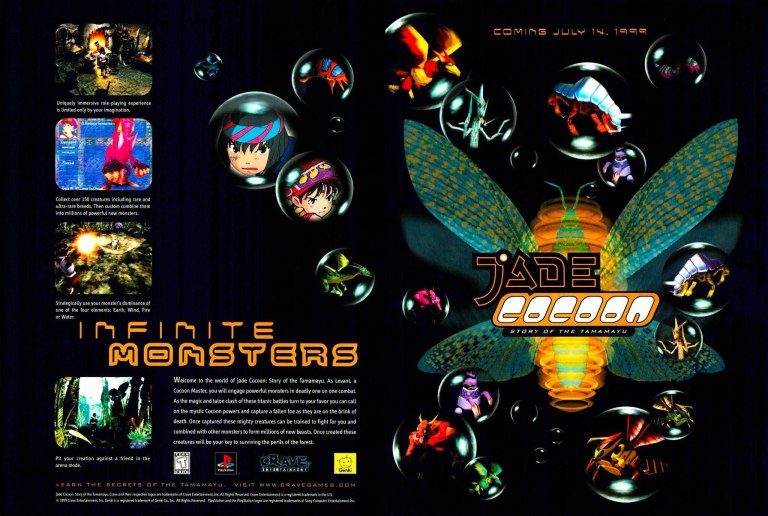
10. Jade Cocoon: Story of the Tamamayu North American Print Ad
A very ambitious print ad promoting Jade Cocoon in North America.
By the late 1990s, Japanese role-playing games (JRPG) really became popular on gaming consoles in America which arguably was the result of the massive global success of Final Fantasy VII. In 1999, there were a lot of JRPGs that got released on PlayStation and publisher Crave Entertainment literally pounced on American gamers’ interest on JRPGs by releasing Jade Cocoon: Story of the Tamamayu. Crave aggressively promoted the game and the result was this 2-page print ad that emphasized the game concept (developed by Genki), showed screenshots of the game, and displayed artworks that fans of Studio Ghibli anime productions can recognize. While Jade Cocoon: Story of the Tamamayu never became a massive commercial hit because of the low print run, there is no denying that its print ad was one of the most visually appealing ads of 1999. The ad alone made it look very ambitious.
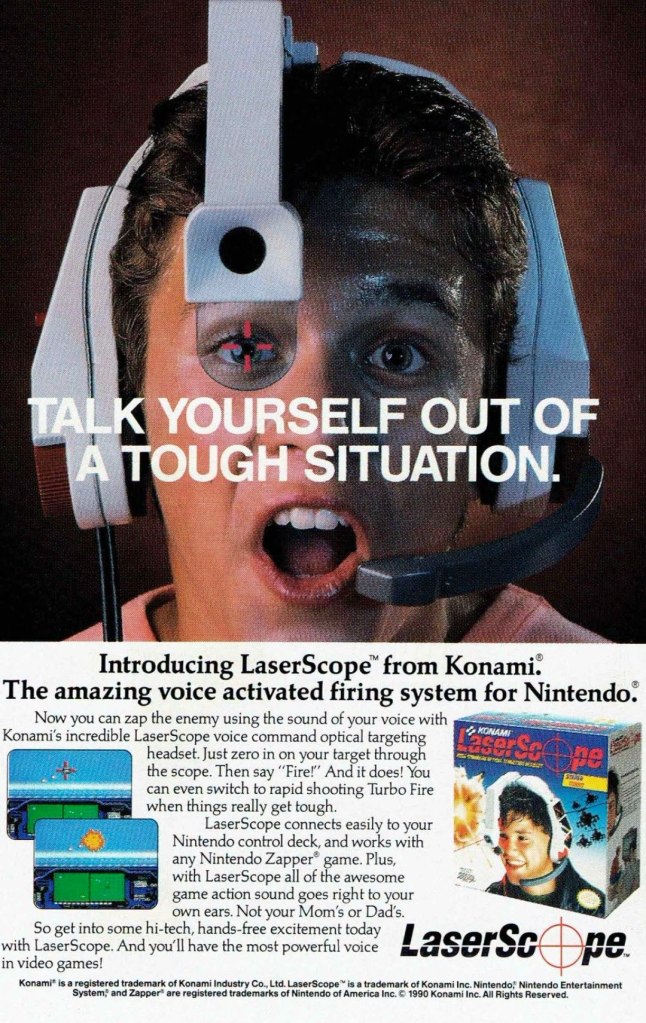
11. Konami LaserScope North American print ad
Did you get excited after seeing this Konami LaserScope print ad? Do you know anyone who bought the peripheral?
In 1990, this print ad of Konami’s LaserScope appeared in comic books and several other publications. The LaserScope was a gaming peripheral designed for use on the Nintendo Entertainment System (NES) complete with compatibility with existing games that were made to support the NES Zapper. The ad even boasted a voice-activated firing feature and a hands-free approach on playing NES games. While the ad boasted that players will have the most powerful voice in video games, the LaserScope itself was a very flawed and badly optimized device. Apart from having a built-in microphone that was oversensitive, tracking targets was a chore requiring constant head-turning which in turn made the gameplay experience very tiring and frustrating. This old ad promised a lot and the LaserScope was a catastrophe. When was the last time you bought hardware from Konami?
What Japan promised as a part of immigration reform has finally been executed yesterday. The fees for foreign nationals seeking a change or a renewal of their residency status in Japan has been hiked dramatically to 200,000 Yen (US$1,280), according to a news report by Kyodo News. In relation with this development, there were long lines of foreign nationals who applied at regional immigration service centers hoping to beat the scheduled hike of residency fees.
To learn about the events that preceded the new residency fees, click here, here and here.
To put things in perspective, posted below is the excerpt from the Kyodo News report. Some parts in boldface…
Japan on Thursday hiked fees for foreign nationals seeking to change or renew their residency status, with the cost of permanent residency jumping twentyfold to 200,000 yen ($1,280).
The increase triggered a last-minute rush to apply under the old rates earlier this week, with long lines forming at immigration offices and heavy traffic making it difficult for some people to use the government’s online application system.
At the Osaka Regional Immigration Services Bureau on Tuesday, about 350 people were waiting when the office opened at 9 a.m., with the line stretching outside the building.
Before the hikes, the fees for non-permanent residency applications were 6,000 yen to change residency status or extending the period of stay. The fee for permanent residency was 10,000 yen.
From Thursday, the fee varies according to the period of stay granted, starting at 10,000 yen for three months or less and rising to 75,000 yen for five years or more.
The change comes following a revision to Japan’s immigration and refugee law enacted in May, with the government citing rising costs for visa screening.
For some foreign residents trying to continue working and living in Japan, including asylum seekers who fled hardship at home, the higher fees are adding to their financial burden.
A man in his 30s from East Africa, who came to Japan in 2023, said he is seeking refugee status for political reasons. He is currently unemployed after his seasonal job ended, adding that finding work has been difficult as many Japanese companies are reluctant to hire asylum seekers.
He currently holds a six-month “designated activities” residency status, meaning his renewal fee will rise to 18,000 yen under the new system.
“I like Japan,” he said, adding that he intends to pay the fees required to remain in the country. But he said policymakers should listen more closely to people directly affected by immigration rules.
An Indonesian man, 35, who went to the Osaka immigration office to apply for permanent residency before the increase took effect, said the twentyfold rise had come as a shock.
Let me end this piece by asking you readers: What is your reaction to this development? Now that higher residency fees are already in effect, do you anticipate a huge back backlash by foreign residents and their respective national governments against Japan? Do you think the woke mob and open borders zealots around the world will criticize Japan and pressure them to reverse all the immigration reforms they executed? Do you think the hiked fees will somehow compel illegal aliens and illegal immigrants to surrender to the local authorities and leave Japan?
Thank you for reading. If you find this article engaging, please click the like button below, share this article to others and also please consider making a donation to support my publishing. If you are looking for a copywriter to create content for your special project or business, check out my services and my portfolio. Feel free to contact me with a private message. Also please feel free to visit my Facebook page Author Carlo Carrasco and follow me on Twitter at @CarloCarrascoPH as well as on Tumblr at https://carlocarrasco.tumblr.com/and on Instagram at https://www.instagram.com/authorcarlocarrasco
Welcome back my readers, YouTube viewers and all others who followed this series of articles focused on YouTube videos worth watching.
Have you been searching for something fun or interesting to watch on YouTube? Do you feel bored right now and you crave for something to see on the world’s most popular online video destination?
I recommend you check out the following videos I found.
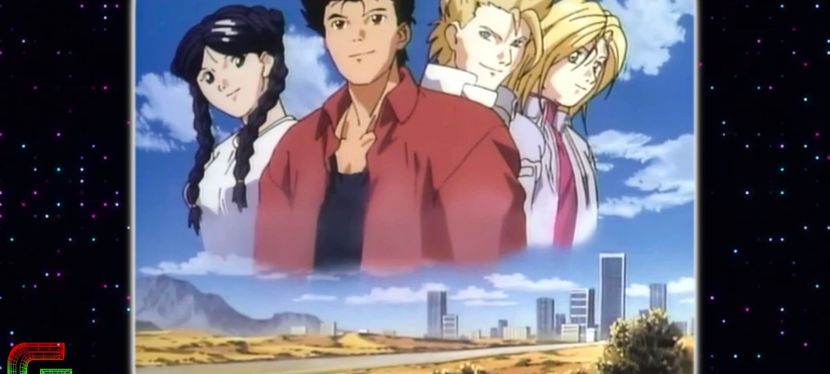
#1 Virtua Fighter anime revisited – Remember back in the 1990s when Sega struck gold with the groundbreaking success of the first Virtua Fighter game? Virtua Fighter was their first 3D polygonal fighting game and it easily attracted attention as well as tons of money from arcade gamers and later console gamers. Virtua Fighter also sparked strong sales for the Sega Saturn console in Japan. Along the way, Sega itself got involved in anime productions with their ownership of TMS Entertainment and by the year 1995, the Virtua Fighter anime TV series was launched. To be clear, the Virtua Fighter anime series was not a simple production as the creators behind it made something cohesive as well as the characters worth following. To learn more about the said anime, watch the GTV Japan video below.
#2 A look at the legacy of Reggie Lewis – When the late Reggie Lewis first entered the NBA as a rookie, the Celtics were still the best in the Eastern Conference and their famous starting five of Larry Bird, Kevin McHale, Robert Parish, Dennis Johnson and Danny Ainge were aging. During his second season, Lewis improved heavily as he replaced the injured Larry Bird, and he went on to become a very productive Celtic over the next several years. Tragedy struck in 1993 when Lewis died at age 27 and the details behind his heart condition and death are complicated to say the least. What most people did not know was that Lewis entered the NBA to lift his family (note: his mother was a drug addict) up from poverty. The legacy of Reggie Lewis is explained in detail in the video below and I encourage you all to watch it.
#3 The Creepiest Episodes of Unsolved Mysteries – Recently, YouTuber Minty Comedic Arts posted a video about the ten creepiest episodes of Unsolved Mysteries (hosted by the late Robert Stack). In that video, I saw most of the creepy episodes featured and there were a few ones that I saw for the first time. Indeed, almost all the episodes of Unsolved Mysteries can be viewed for free on YouTube and there are some that were missing due to legal reasons. Now is the time to watch Minty’s video below. Tell me if you find them creepy.
#4 American cheese in Japan – With the intensifying demand for cheese around the world, there is now a so-called battle for market share. In Japan, most cheese offered are imported and their prices have gone up significantly affecting the restaurants and local consumers. Along the way, cheese produced in the United States have entered Japan in growing numbers and it is being offered to local businesses and consumers for their consumption and cooking needs. America has key advantages with regards to production of milk and cheese and there is a renewed focus on exporting products aggressively. Watch and learn from the Nippon TV video below.
#5 The Unreleased Marvel 2099 Video Game of the 1990s – Thirty years ago, I read a video game magazine and got excited over the news about an official video game based on the Marvel 2099 comics franchise. I already read lots of issues of Spider-Man 2099, X-Men 2099, Ravage 2099, Punisher 2099, Doom 2099, and the 2099 Unlimited quarterly series. That said, I was delightfully surprised that the Marvel 2099 game was set for release on PlayStation. Then as time passed by, nothing happened and the unreleased game was forgotten. To find out exactly what happened, go watch the in-depth video below.
#6Chopping Mall reaction videos – How many times have you seen a horror movie or a cinematic misadventure that happened inside a shopping mall? In 1986, the low-budget techno-horror movie Chopping Mall (original title: Killbots) was released and it had a lot of scenes filmed inside the Sherman Oaks Galleria (which was also a location for Commando and Fast Times at Ridgemont High) in California. What makes Chopping Mall unique is its concept of security robots going rogue and harming people which brings back vibes of The Terminator. In today’s age of rampant artificial intelligence (AI) development, Chopping Mall has gotten more socially relevant and it has been featured in many movie reaction and retro review videos on YouTube. I found for you guys and gals the more engaging videos of the said movie.
#7 Adults Who Went to the Extreme for Disney and Buried Themselves with Debt – What is the worst thing you can do with your time and money with regards to entertainment from the woke Disney company? A few years ago, a survey found that 24% of all Disney-goers accrued debt during their trips along with 45% of parents with children (aged below 18). To be very clear, visiting a Disney theme park with the family is very costly and the very expensive rates on the food, transportation, accommodations, souvenirs and services related with Disney won’t fade away. Even with those painful prices, there still are certain adults who put themselves at huge financial risks because they could not restrain themselves from enjoying anything Disney. The Disney adults are real, and they lack discipline on spending. In the long run, these people are morally and spiritually lost. You better not follow their bad examples, and you can find out why by watch the informative video below.
Japan will intensify its crackdown against illegal foreign workers by boosting cooperation with the other divisions of the government very soon, according to a news report by Jiji Press. While the intention to solve the problems connected with illegal foreign workers is clear, the government of Japan still has varied obstacles that needs to be cleared in order to launch an effective crackdown.
To put things in perspective, posted below is the entire Jiji Press news report. Some parts in boldface…
Japan’s Immigration Services Agency will boost cooperation with other government divisions to crack down on illegal foreign workers.
Starting as early as October, agency officials will join land ministry inspections of demolition and construction sites.
The land ministry conducts regular patrols of demolition and construction sites. However, its construction-related officials do not have the authority to verify the identities of foreign nationals, even when they are suspected of working illegally.
To address this issue, the Immigration Services Agency will send immigration control officers to participate in these patrols, as these officers have the authority to ask foreign residents to show their residence cards, which they are required to carry under the immigration control and refugee recognition law.
The agency also plans to collaborate with the Environment Ministry, which oversees outdoor storage yards for waste plastics and scrap metal.
Let me end this piece by asking you readers: What is your reaction to this development? If you have been living in Japan, did you notice any illegal acts committed by foreign residents over the past three months? Are you aware of the illegal mosque built in Japan by Pakistani nationals who defied the local authorities? Why do you think foreigners from Third World nations tend to behave negatively while living in Japan? Do you think Prime Minister Takaichi Sanae and her government can achieve comprehensive immigration reform within the next few years?
Thank you for reading. If you find this article engaging, please click the like button below, share this article to others and also please consider making a donation to support my publishing. If you are looking for a copywriter to create content for your special project or business, check out my services and my portfolio. Feel free to contact me with a private message. Also please feel free to visit my Facebook page Author Carlo Carrasco and follow me on Twitter at @CarloCarrascoPH as well as on Tumblr at https://carlocarrasco.tumblr.com/and on Instagram at https://www.instagram.com/authorcarlocarrasco
As planned, Japanese Prime Minister Takaichi Sanae met with US President Donald Trump in New York to emphasize the strong bilateral relations before the arrival of China’s president, according to a news report by Kyodo News. Together they discussed several key issues such as the security environment in Asia, Japan’s industry, and more.
To put things in perspective, posted below is an excerpt of the Kyodo News report. Some parts in boldface…
Japanese Prime Minister Sanae Takaichi met with U.S. President Donald Trump on Tuesday to demonstrate the strength of bilateral relations, just a day before Chinese leader Xi Jinping arrives in Washington for his first state visit in 11 years.
During a meeting in New York, Takaichi and Trump discussed “various issues concerning China, including economic security” and agreed to further strengthen the deterrence and response capabilities of the Japan-U.S. alliance, the Japanese government said.
Takaichi told Trump that the security environment in Asia and elsewhere is becoming increasingly severe, and that she wanted to show the world “how robust our alliance is through holding another round of meetings.”
Takaichi’s roughly 35-minute meeting with Trump, held on the sidelines of the U.N. General Assembly, was intended to coordinate on China and align policies in areas of mutual interest, according to Japanese officials.
“Thanks to Donald’s leadership and also my own leadership, our bilateral economic security cooperation in areas such as AI, semiconductors and critical minerals has been steadily advancing,” Takaichi also said in front of the press ahead of their closed-door discussions.
Trump also praised his counterpart, saying, “She’s done a great job” and that he has been keeping a close eye on her high approval ratings.
“The industry in Japan is doing very well. The country is doing very well. It’s a very big improvement, and it’s an honor to be with her,” Trump said.
“She’s a friend of mine. We got to know each other very well over the last period of time,” he said of Japan’s first female premier, who took office nearly a year ago. “She’s going to be a great prime minister.”
The meeting was their first since March, when she visited the U.S. capital. They spoke for about five minutes on the margins of a Group of Seven summit in June in France.
Japan and China have been in a diplomatic freeze since Takaichi suggested in November that an attack on Taiwan could constitute an existential threat to her country and warrant a response from its armed forces.
Infuriated by her statement, China, which views Taiwan as part of its territory, has since unleashed a series of political and economic reprisals against Japan, including export restrictions on rare earths needed to manufacture various high-tech products.
China has shown no sign of easing tensions with Japan, with Beijing prioritizing a managed detente with Washington. The Trump administration is concerned about the knock-on impact of the restrictions on U.S. supply chains.
With trade and artificial intelligence likely to top the agenda at the Trump-Xi summit at the White House on Thursday, the officials had said Takaichi would likely use the meeting with Trump to discuss China’s export controls and Tokyo’s willingness to boost cooperation on emerging technologies with Washington.
During their talks, Takaichi and Trump also reaffirmed the two countries’ commitment to the complete denuclearization of North Korea and had a candid discussion of U.S. sanctions against International Criminal Court officials, according to the government.
Let me end this piece by asking you readers: What is your reaction to this development? Do you think the strong ties between the United States and Japan will eventually have a positive impact on international affairs, the security in Asia and other developments? Do you think the US-Japan alliance will push China back from locking in crucial supply chains and infrastructure projects of sovereign nations?
Thank you for reading. If you find this article engaging, please click the like button below, share this article to others and also please consider making a donation to support my publishing. If you are looking for a copywriter to create content for your special project or business, check out my services and my portfolio. Feel free to contact me with a private message. Also please feel free to visit my Facebook page Author Carlo Carrasco and follow me on Twitter at @CarloCarrascoPH as well as on Tumblr at https://carlocarrasco.tumblr.com/and on Instagram at https://www.instagram.com/authorcarlocarrasco
Welcome back my readers, YouTube viewers and all others who followed this series of articles focused on YouTube videos worth watching.
Have you been searching for something fun or interesting to watch on YouTube? Do you feel bored right now and you crave for something to see on the world’s most popular online video destination?
I recommend you check out the following videos I found.
#1 You, Me and the Movies react to Swordfish – Let’s be clear here. No matter how much the movie critics rejected it, the 2001 film Swordfish remains very entertaining to watch and the creativity behind it made it memorable. I still remember the sudden impact the movie had on the public shortly after it opened in cinemas twenty-five years ago…a lot of moviegoers were stunned by the elaborate explosion early in the story and many people were so impressed with John Travolta’s performance as Gabriel, they forgave him for his involvement in the super bad movie Battlefield Earth. Considering how entertaining Swordfish really is, there are still too few movie reaction videos of it on YouTube. Fortunately, You, Me and the Movies posted their Swordfish reaction video and I encourage you all to watch it.
#2 Totally Whatever reacts to From Russia With Love – My favorite among all the James Bond movies of the late Sean Connery is still From Russia With Love. I enjoyed the film’s approach on espionage storytelling laced with Cold War political influence mixed with thrills and misadventures that are grounded that were believable. Some people find it boring while others enjoyed it for what it is. That said, I encourage you to watch Totally Whatever’s reaction video of the 1963 James Bond movie.
#3 The Dream Team of 1992 and their Impact on the World– In the history of basketball, nothing can ever be more groundbreaking than the Dream Team of 1992. I’m talking about the American basketball team that played in the Olympic Games with NBA legends like Magic Johnson, Michael Jordan, Larry Bird, John Stockton, Chris Mullin, Karl Malone, and Charles Barkley to name some. Behind the scenes, getting the NBA legends to work together as a true team was challenging due to egos and, fortunately, serious adjustments were made over time. To rediscover the Dream Team and how they impacted the whole world through basketball, watch the video below.
#4 Traditional and Popular Edo Cuisine in Japan – When it comes to Japanese food, have you ever heard of Edo cuisine? Edo cuisine refers to the style of cooking that developed in the city of Edo (modern-day Tokyo) during the Edo period (1603–1868). Unlike the refined, slow-paced banquets favored by the imperial aristocracy in Kyoto, Edo cuisine’s development was shaped by a booming population of hasty merchants, construction workers and the samurai. As such, Japan’s original street food culture came to be. In modern Japan, there are places where visitors can find and enjoy Edo cuisine. Watch the video below and pay attention to the details.
#5 Arcade Games Made to Suck Money from Players – If you were fond of playing games in the video arcades, chances are you may have felt like you spent too much money on playing one or two particular games that did not reward you enough in terms of fun. Indeed, there were arcade games that were design to absorb as much money from players, especially those who are obsessed with completing them or getting satisfied from the gameplay. Watch and learn from the video below.
#6 Sega Saturn and Nintendo 64 – Console gaming in the second half of the 1990s was indeed a wild period. While the PlayStation eventually outsold the competition, there are indeed very distinct features and unique gaming experiences that the Sega Saturn and Nintendo 64 offered to gamers. The two said consoles also have unique game designs as the people behind Sega and Nintendo’s respective offices had their own approach on designing them. For another round of retro gaming, watch the video below.
#7 Ashleigh Burton reacts to Rhinestone – Have you ever seen the 1984 comedy film Rhinestone? The first time I saw it was on local TV and I was really laughing at the scene wherein Sylvester Stallone started singing so wildly in a rural community whose residents love country music. This movie has a colorful performance by the late Dolly Parton (who died recently) and there is indeed chemistry between her and Stallone. By today’s standards, this comedy is considered by Stallone fans an anomaly given his huge success in 1980s Hollywood cinema with action films. If you really want to see comedy from Stallone and Parton, I encourage to watch Ashleigh Burton’s reaction video below.
#8 EOM Reacts to early X-Men movies – Were you able to watch the first three live-action X-Men movies as they were released within a 6-year period? I did. I saw X-Men (2000), X2: X-Men United (2003) and X-Men: The Last Stand (2006) in different cinemas in two cities. Each cinematic experience was entertaining but as a long-time X-Men comic book reader, I could tell that liberties were taken on the characters, settings and other elements. In recent times, YouTube EOM Reacts posted his reaction videos of the three mentioned X-Men movies and they are fun to watch one-by-one. I encourage you to watch them now.
Kikkoman Corp. – the Japan-based food manufacturer and world’s largest producer of soy sauce – formally launched its third American plant in the state of Wisconsin to meet the growing demand in North America, according to a Jiji Press news article. This is the latest development of Japanese companies (or subsidiaries) investing in the United States.
To put things in perspective, posted below is the entire news article of Jiji Press. Some parts in boldface…
Japanese soy sauce maker Kikkoman Corp. on Friday held an opening ceremony for its third U.S. plant in Jefferson, Wisconsin.
During the ceremony at the new plant, Yuzaburo Mogi, honorary CEO of Kikkoman, said that the company will increase soy sauce production to meet the growing demand in North America.
The third plant has already begun operating and will start shipping products in October. It is scheduled to produce some 4,000 kiloliters of soy sauce by March next year.
Kikkoman is also considering producing teriyaki sauce and “ponzu” citrus-flavored sauce at the plant in the future.
Other attendees at the ceremony included Kikkoman President and CEO Shozaburo Nakano and Senior Executive Corporate Officer Osamu Mogi, as well as local representatives.
Let me end this piece by asking you readers: What is your reaction to this development? If you are based in the United States, how many Kikkoman products do you have in your kitchen right now? Is Kikkoman your first choice whenever you look for soy sauce?
Thank you for reading. If you find this article engaging, please click the like button below, share this article to others and also please consider making a donation to support my publishing. If you are looking for a copywriter to create content for your special project or business, check out my services and my portfolio. Feel free to contact me with a private message. Also please feel free to visit my Facebook page Author Carlo Carrasco and follow me on Twitter at @CarloCarrascoPH as well as on Tumblr at https://carlocarrasco.tumblr.com/and on Instagram at https://www.instagram.com/authorcarlocarrasco
During the Luzon Economic Corridor Investment Forum recently held at the Best Western Hotel inside the Subic Bay Freeport Zone, representatives of several American companies expressed strong interest to invest in the Luzon Economic Corridor (LEC), the Subic Bay Metropolitan Authority (SBMA) revealed.
To put things in perspective, posted below is an excerpt from the SBMA announcement. Some parts in boldface…
Representatives from approximately 50 U.S. companies have expressed strong interest in investing in the Luzon Economic Corridor (LEC), a key economic zone recognized for its strategic role in the logistics sector.
Leading the delegation was Thomas R. Hardy, Deputy Director and Chief Operating Officer of the U.S. Trade and Development Agency (USTDA), during the Luzon Economic Corridor Investment Forum held at the Best Western Hotel, Subic Bay Freeport.
Joining thedelegation consisting not only of American businesses, were representatives from international companies, development partners, and major financial institutionsseeking to explore business opportunities within Subic Bay Freeport and the broader LEC region.
Subic Bay Metropolitan Authority (SBMA) Chairman and Administrator Eduardo Jose L. Aliño, together with other SBMA officials, warmly welcomed the delegates. They were joined by stakeholders from the Subic Bay International Terminal Corporation (SBITC) and other freeport investors aiming to engage in productive Business-to-Business (B2B) engagements, addressing inquiries from the visiting foreign companies.
“As the host of the Subic leg of the LEC Investment Forum, this delegation has a unique opportunity to participate in meaningful B2B discussions, tour Subic Freeport, and explore avenues for deepening economic integration across the Luzon Economic Corridor. Participants are highly encouraged to explore investment opportunities, pathways to collaborate, and how they can positively impact the success of the LEC initiative,” said Chairman Aliño.
Sponsored by the USTDA, Aliño emphasized that this visit highlights Subic Bay Freeport’s vital role in the LEC’s foundational tripartite partnership among the Philippines, the United States, and Japan.
He further noted that the LEC project has since expanded to include partners from Australia, Canada, Denmark, France, Italy, South Korea, Sweden, and the United Kingdom. “This is excellent news for Subic Bay as a critical western maritime gateway and strategic logistics hub, connecting major centers such as Clark, Manila, and Batangas. It underscores our commitment to advancing infrastructure, enhancing supply chain resilience, and attracting technology investments within the corridor,” Aliño added.
In line with these developments, the USTDA reaffirmed its support for secure, robust, and resilient supply chains by facilitating the expansion of port infrastructure at Subic Bay.
Let me end this post by asking you readers: What is your reaction to this recent development? Do you feel confident that the American companies that attended the important forum will indeed push through with investing in the Luzon Economic Corridor in the near future? Do you think their investment plans will create a lot new job opportunities for Filipinos?