The Philippines, which is currently the host of the ASEAN Summit and is also one of the economic weaklings of Southeast Asia, continues to grow tremendously as a tourism market for Vietnam as an estimated 522,000 Filipinos visited the said nation during the first nine months of 2026, according to a news report by VnExpress.
Historically speaking, the number of Philippine visitors welcomed by Vietnam was 49,266 in 2022, 153,168 in 2023, 265,947 in 2024 and 482,173 in 2025. At 522,000 as of the end of September, the number of Philippine visitors arriving in Vietnam could reach around 700,000 by the end of this year.
To put things in perspective, posted below is an excerpt from the news report of VnExpress. Some parts in boldface…
Vietnam welcomed 17.7 million international visitors in the first nine months of 2026, up 14.5% year-on-year, bucking a decline in arrivals across several Southeast Asian destinations.
Mainland China remained Vietnam’s largest source market, with 3.95 million visitors, accounting for about 22.3% of the total. South Korea ranked second with approximately 3.05 million visitors, or 17.3%.
Russia ranked third with 1.1 million, followed by Taiwan (964,000) and the U.S. (746,000), according to the General Statistics Office.
The rest of the top 10 were Cambodia (688,000), Japan (674,000), India (670,000), the Philippines (522,000) and Australia (485,000).
In September, foreign visitors declined by 11.3% from August but rose by 16.5% year-on-year to 1.77 million.
Let me end this post by asking you readers: What is your reaction to this recent development? Considering the strong interest of Filipinos to visit Vietnam, do you think it is possible for Vietnam to attract at least one million visitors from the Philippines next year if not this year? Do you think more Filipinos will realize the great value they could get by visiting Vietnam?
Thank you for reading. If you find this article engaging, please click the like button below, share this article to others and also please consider making a donation to support my publishing. If you are looking for a copywriter to create content for your special project or business, check out my services and my portfolio. Feel free to contact me with a private message. Also please feel free to visit my Facebook page Author Carlo Carrasco and follow me on Twitter at @CarloCarrascoPH as well as on Tumblr at https://carlocarrasco.tumblr.com/and on Instagram at https://www.instagram.com/authorcarlocarrasco
Vietnam successfully attracted 17.7 million foreign tourists during the first nine months of 2026 having China, South Korea and Russia as their top 3 tourist markets, according to a news report by VnExpress. As it currently stands, Vietnam saw its foreign tourist count rise by 14.5% compared to the year before and it is looking more likely for the nation to exceed its 2025 overall foreign tourist count of 21.2 million by the end of this year.
To put things in perspective, posted below is an excerpt from the news report of VnExpress. Some parts in boldface…
Vietnam welcomed 17.7 million international visitors in the first nine months of 2026, up 14.5% year-on-year, bucking a decline in arrivals across several Southeast Asian destinations.
Mainland Chinaremained Vietnam’s largest source market, with3.95 million visitors, accounting for about 22.3% of the total.South Korearanked second with approximately3.05 million visitors, or 17.3%.
Russia ranked third with 1.1 million, followed byTaiwan (964,000)and theU.S. (746,000), according to the General Statistics Office.
The rest of the top 10 were Cambodia (688,000), Japan (674,000), India (670,000), thePhilippines (522,000)and Australia (485,000).
In September, foreign visitors declined by 11.3% from August but rose by 16.5% year-on-year to 1.77 million.
Martin Koerner, commercial director of The Anam Group, a chain of luxury resort hotels in Vietnam, said what is particularly encouraging is Vietnam’s diversification of source markets.
European arrivals increased by more than 50%, while arrivals from markets including the United States, Australia and India also recorded strong growth. This makesVietnam less dependent on only one or two major Asian source markets, he added.
“Vietnam is no longer seen simply as an inexpensive holiday destination. Increasingly, it is being
recognized as a destination capable of delivering sophisticated, world-class hospitality,” Koerner said.
Several Southeast Asian countries have faced declines in international arrivals amid the impact of the Middle East crisis.
Let me end this piece by asking you readers: What is your reaction to this development? Have you visited Singapore over the past twelve months? Do you think Singapore can keep innovating and improving itself on tourism development? Do you know anyone who visited Vietnam recently and mentioned positive things about their tour? How interested are you right now to visit Vietnam?
Thank you for reading. If you find this article engaging, please click the like button below, share this article to others and also please consider making a donation to support my publishing. If you are looking for a copywriter to create content for your special project or business, check out my services and my portfolio. Feel free to contact me with a private message. Also please feel free to visit my Facebook page Author Carlo Carrasco and follow me on Twitter at @CarloCarrascoPH as well as on Tumblr at https://carlocarrasco.tumblr.com/and on Instagram at https://www.instagram.com/authorcarlocarrasco
Welcome back readers, fellow geeks and electronic gaming fans!
In this edition of the Retro Gaming Ads Blast (RGAB) series, we will take a look at another batch of retro gaming print ads from the 1980s to the 1990s.
For the newcomers reading this, Retro Gaming Ads Blast (RGAB) looks back at the many print ads of games (console, arcade, computer and handheld) that were published in comic books, magazines, flyers, posters and newspapers long before smartphones, social media, the worldwide web and streaming became popular. To put things in perspective, people back in the 1980s to the 1990s were more trusting of print media for information and images about electronic games and related products.
With those details laid down, here is the newest batch of retro gaming print ads for you to see and enjoy…
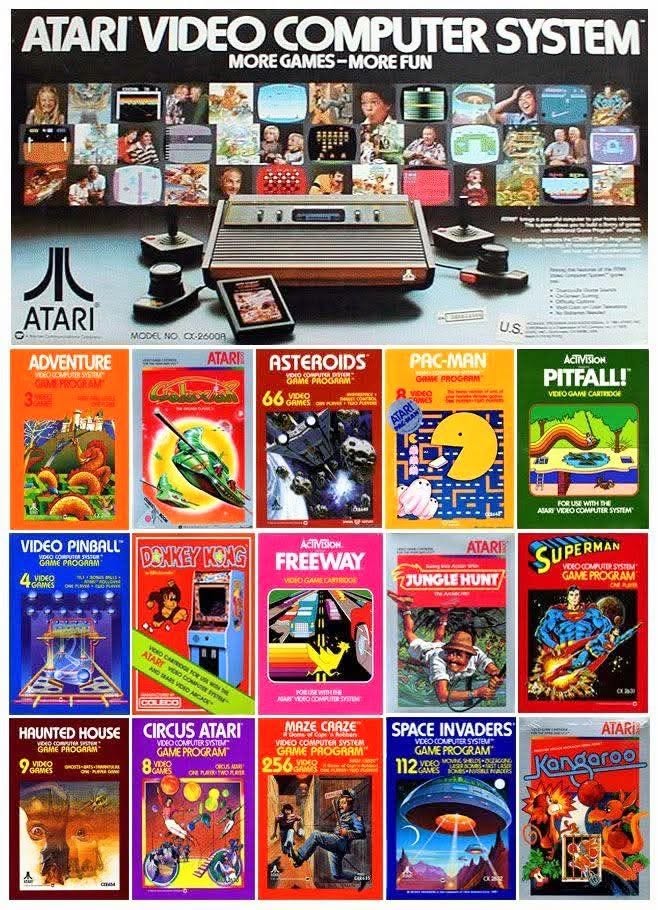
1. Atari Console and Games Print Ad
Back in the 1980s, this was simple and yet exciting to look at.
Back in the 1980s, the styles of video game advertising were very different. Back then, Atari was the market leader on console gaming with the Atari 2600 and they had a lot of video games made for it. As such, the above print ad showing the console and the video games (with the front covers of the game boxes) was typical of the era and it was captivating to look at. By today’s standards, the ad looks simple but it still has the appeal to lure gamers.
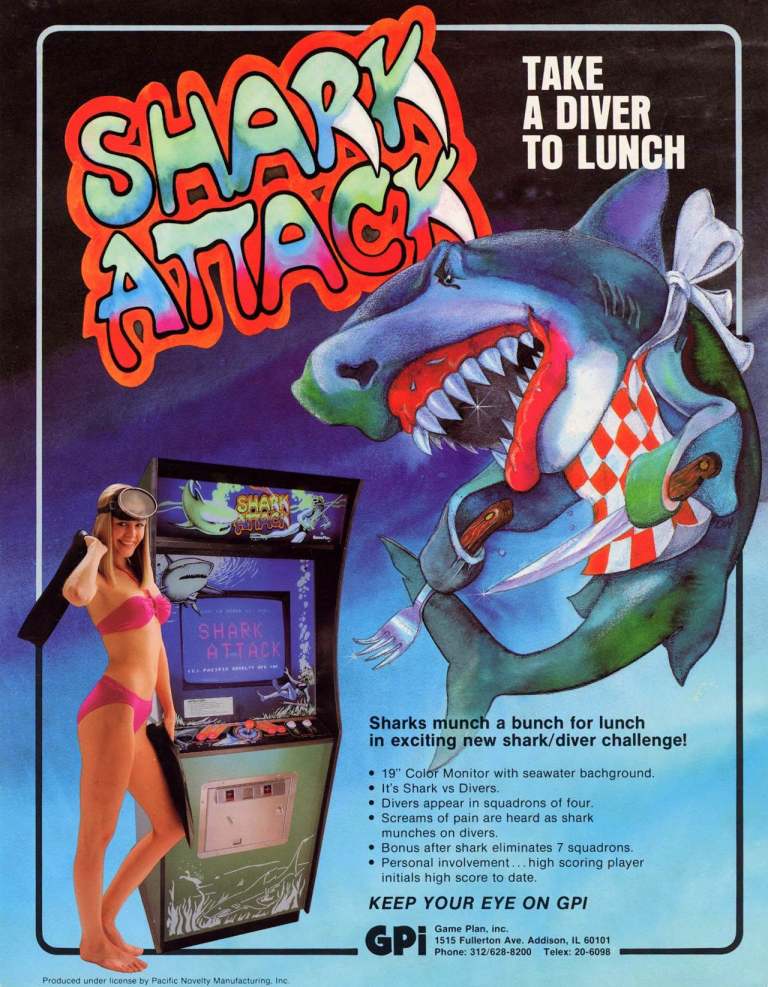
2. Shark Attack North American Arcade Flyer
The front.
The rear.
Remember long ago when Steven Spielberg’s Jaws made some people afraid of sharks and the sea? Jaws was a massive blockbuster, and it was influential to the public. A few years later, Universal Pictures pushed through with Jaws 2 without Spielberg, and it also was a huge commercial hit. By the start of the 1980s, creature feature films inspired by Jaws were released and pop culture itself was influenced. In 1981, the obscure arcade outfit Pacific Novelty Manufacturing released their game Shark Attack in arcades. To promote the game, the company came up with an arcade flyer that had a comedic touch on the text descriptions while featuring a pretty blonde fashion model posing as the diver. The front of the flyer had the arcade cabinet, the model and an exaggerated artwork of a shark holding a knife and a fork. On the rear, the sexiness was ramped up with a shot of the model’s behind (plus more pictures of the model herself). This is indeed an amusing and funny arcade flyer.
3. Centipede North American Arcade Flyer
This was designed with arcade operators in mind.
When Atari released Centipede in arcades in 1981, it attracted a lot of gamers and became a huge commercial hit. Part of its success is linked with the strategic promotions Atari committed, and the above arcade flyer is one of the variants of Centipede flyers. The one above shows an illustrated centipede carrying a coin in its mouth and in the background are two different arcade cabinets plus a cocktail table machine (for those who want to play Centipede while sitting down). This particular arcade flyer of Centipede emphasizes the popularity of the game and there are different types of machines that arcade operators can choose from. At the same time, this old flyer remains amusing to look at.
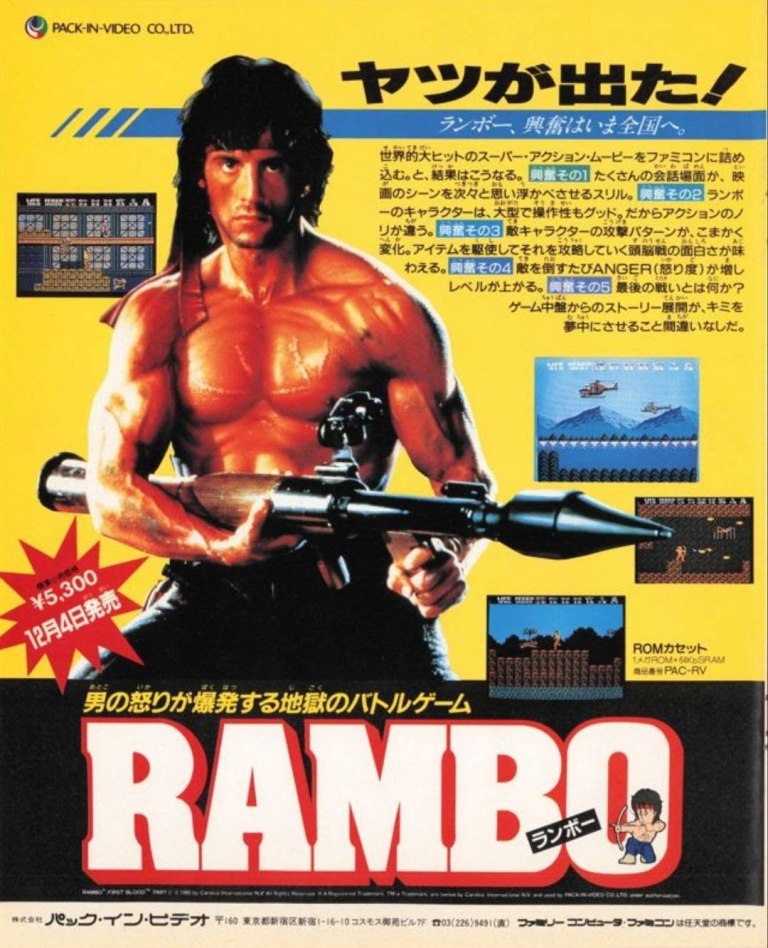
4. Rambo Famicom Japanese Print Ad
Using this iconic imagery of Sylvester Stallone as Rambo was a very smart move.
When it comes to Hollywood action movies of the 1980s, Sylvester Stallone was highly successful, and he impacted American pop culture with the Rocky and Rambo films. By 1985, Stallone struck gold with Rambo: First Blood Part II which made over $300 million worldwide. Considering the Cold War theme and ambitious action scenes of the movie, it was clear for Japanese game developer Pack-In-Video to make an official video game adaptation of Rambo: First Blood Part II for the Nintendo Family Computer (Famicom) in the form of a 2D side-scrolling adventure game. The said game was simply titled Rambo and to promote it, the company came up with the above Japanese print ad that had the iconic Rambo image of Stallone holding the rocket launcher, and a few screenshots of the game itself. If you look closely at the lower-right corner, you will see a cartoonish hand-drawn art of the Rambo character with a bow and arrow. Considering how very popular Stallone, his character and the movie were, it made a lot of sense to promote the Rambo Famicom game like this in Japan.
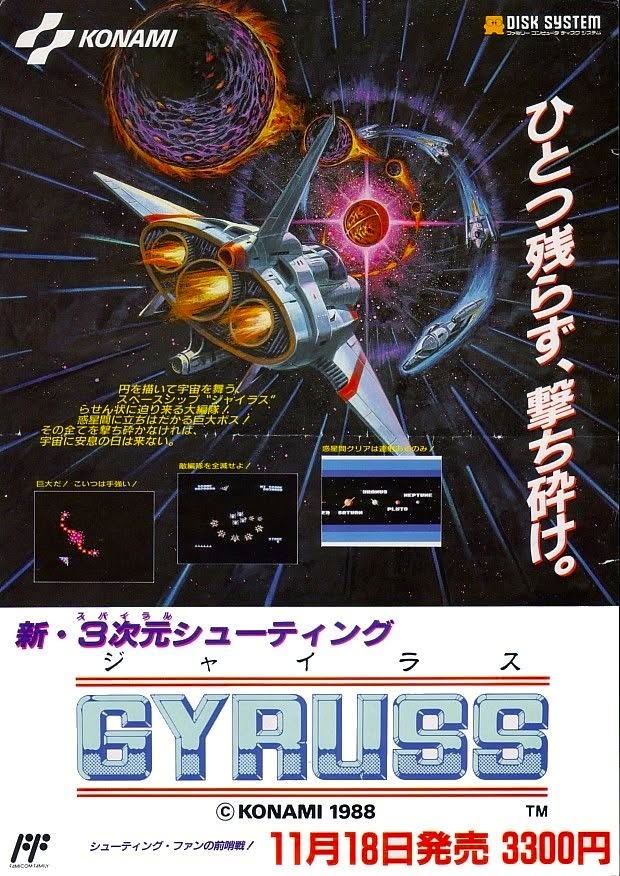
5. Gyruss Family Computer Disk System Japanese Print Ad
Gyruss was Konami’s first-ever game developed for the Famicom Disk System of Nintendo.
In 1983, Konami released Gyruss, a science fiction tube shooter designed by Yoshiko Okamoto. The game was a huge arcade hit and it really attracted a lot of players who enjoyed the unique game design and spaceship shooting. Konami licensed the game to a few companies which resulted in the creation and release of Gyruss ports for different consoles and home computer systems. In 1988, Konami released an enhanced Gyruss port for the Family Computer Disk System of Nintendo. To promote the Famicom Disk System port, Konami came up with a print ad that had a nicely detailed painted artwork of a spaceship (representing the player) about to hit incoming enemies deep in space, 3 screenshots and the official price and release date displayed. The artwork is still captivating to look at and the port itself features major overhauls that arguably made it better than the arcade original. Konami really went the extra mile for this Gyruss port.
6. Operation Thunderbolt Japanese Arcade Flyer
Great looking artwork on the front.
The rear.
Following the huge success of Operation Wolf, Taito went on to make the sequel military shooter Operation Thunderbolt which was named after the 1977 movie that itself was based on the real-life Entebbe raid of 1976. To promote the game, the company came up with a pretty compelling arcade flyer for the Japanese market. The front has a detailed painted artwork that emphasizes the conflict between soldiers and Islamic terrorists in the Middle East. The rear has technical details of the arcade cabinet, several phone numbers and hand-drawn art of the terrorists (they easily remind me of Palestinian terrorists) clearly called the enemies. While the listing of phone numbers on the rear was very unusual, this old arcade flyer still looks great. Operation Thunderbolt went on to achieve huge commercial success in the arcades and later on consoles. It was one of the highest grossing arcade games in Japan in 1989.
7. Batman Returns North American Print Ad
Sega’s clever print ad promoting the Sega CD game of Batman Returns.
Batman Returns was a big hit in cinemas in 1992 although it never came close to matching the success of its 1989 predecessor. When it comes to video games, Batman Returns was even more ambitious as there were different game adaptations on different platforms. For the Sega CD Batman Returns game, Sega came up with the above ad that strongly featured photos of Michael Keaton as Batman, Michelle Pfeiffer as Catwoman and Danny DeVito as the Penguin with a stylish dark background and four screenshots of the game. The line “Batman Returns…on Sega CD” was really catchy and ultimately the game itself was very notably an expanded version of the Sega Genesis version with selected video footage from the film. As Sega had the license to make Batman Returns games for its platforms, this print ad is absolutely an attention-grabber.
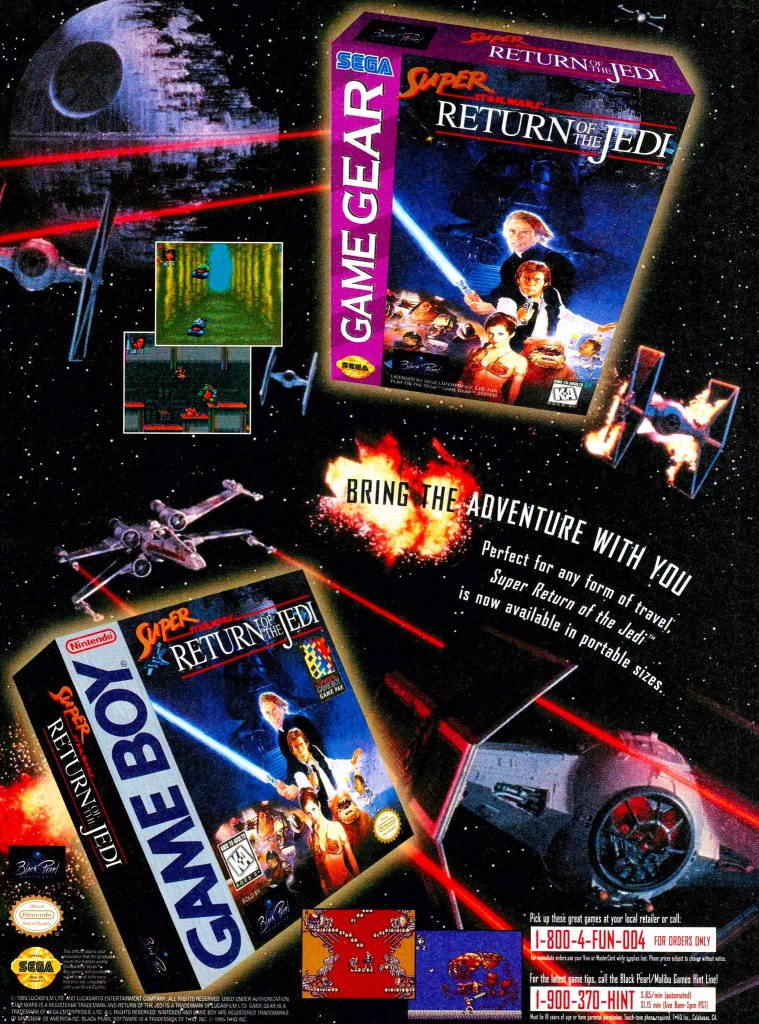
8. Super Star Wars: Return of the Jedi North American Print Ad
The Force is with the handheld gamers.
If there is anything notable about Star Wars in the 1990s, it is the fact that there is a lot of merchandise, comic books, video games, books and other licensed products released long after 1983’s Return of the Jedi which itself was perceived to be the last of the film franchise. In the mid-1990s, ports of Super Star Wars: Return of the Jedi were released on the competing handheld platforms Nintendo Game Boy and Sega Game Gear. This particular single-page ad has a nice visual design that captured the vibe of the movie (which I saw as a young boy in 1983) and it made handheld gaming look cool.
9. Elevator Action Returns Japanese Print Ad
Did you play Elevator Action Returns on the Sega Saturn?
In 1994, Taito struck gold with the release of Elevator Action Returns in Japanese arcades. The sequel was a big hit for the company and they eventually released a console port on the Sega Saturn only in Japan. For promotion, a print ad was made using the official painted artwork while also showing the screenshots and other details about it running on the Saturn (which itself was a powerful 2D sprite machine). Just looking at this old ad brings back the excitement of Elevator Action Returns and I now have a digital copy of it on my Xbox Series X.
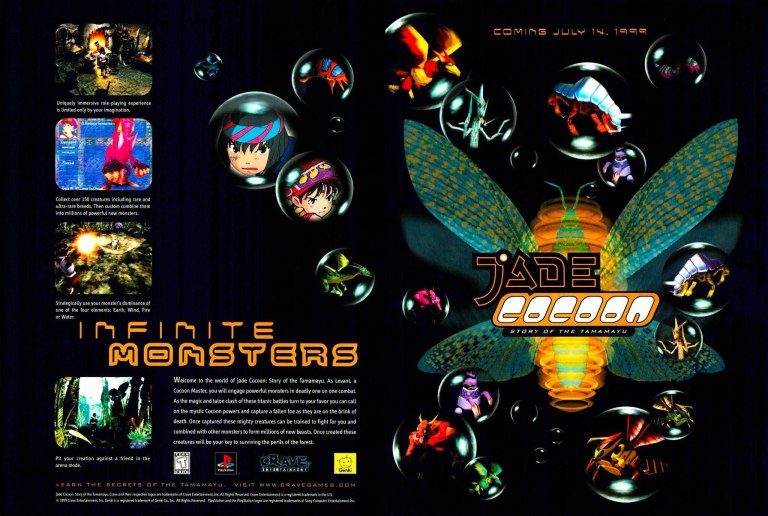
10. Jade Cocoon: Story of the Tamamayu North American Print Ad
A very ambitious print ad promoting Jade Cocoon in North America.
By the late 1990s, Japanese role-playing games (JRPG) really became popular on gaming consoles in America which arguably was the result of the massive global success of Final Fantasy VII. In 1999, there were a lot of JRPGs that got released on PlayStation and publisher Crave Entertainment literally pounced on American gamers’ interest on JRPGs by releasing Jade Cocoon: Story of the Tamamayu. Crave aggressively promoted the game and the result was this 2-page print ad that emphasized the game concept (developed by Genki), showed screenshots of the game, and displayed artworks that fans of Studio Ghibli anime productions can recognize. While Jade Cocoon: Story of the Tamamayu never became a massive commercial hit because of the low print run, there is no denying that its print ad was one of the most visually appealing ads of 1999. The ad alone made it look very ambitious.
11. Konami LaserScope North American print ad
Did you get excited after seeing this Konami LaserScope print ad? Do you know anyone who bought the peripheral?
In 1990, this print ad of Konami’s LaserScope appeared in comic books and several other publications. The LaserScope was a gaming peripheral designed for use on the Nintendo Entertainment System (NES) complete with compatibility with existing games that were made to support the NES Zapper. The ad even boasted a voice-activated firing feature and a hands-free approach on playing NES games. While the ad boasted that players will have the most powerful voice in video games, the LaserScope itself was a very flawed and badly optimized device. Apart from having a built-in microphone that was oversensitive, tracking targets was a chore requiring constant head-turning which in turn made the gameplay experience very tiring and frustrating. This old ad promised a lot and the LaserScope was a catastrophe. When was the last time you bought hardware from Konami?
To put things in perspective, posted below is an excerpt from the news article of VnExpress. Some parts in boldface…
The number of Russian visitors to Vietnam is forecast to reach a historic record of 1.5 million this year, a senior official has said.
Russian news website news.ru quoted Nikita Kondratiev, Director of the Department for Multilateral Economic Cooperation and Special Projects under Russia’s Ministry of Economic Development, as saying that evenduring the pre-pandemic peak in 2018-2019, Russian arrivals to Vietnam stood at only around 700,000-800,000.
The figures show impressive growth in the tourism sector, he noted.
According to the official,key factors behind Vietnam’s growing appeal include the maintenance and expansion of direct air routes, as well as convenient payment options for Russian tourists through QR codes and MIR bank cards at some locations in Vietnam.
The strong interest from the Russian market is fully reflected in recently released statistics.
On Sept. 4, Travel Russian News cited figures from the Vietnam National Authority of Tourism showing thatRussian arrivals to Vietnam surpassed 1 million in the first eight months of 2026, representing a 165.7% increase year-on-year. This was the highest growth rate among Vietnam’s major international tourist markets.
With this result,Russia jumped from around seventh place in 2025 to become Vietnam’s third largest source market, behind China with 3.54 million visitors and South Korea 2.76 million.
Let me end this piece by asking you readers: What is your reaction to this development? Apart from what was reported, what do you think makes Vietnam such a very attractive place for Russians? Do you think other Southeast Asian nations are discreetly making plans of their own to attract Russian tourists away from Vietnam?
Thank you for reading. If you find this article engaging, please click the like button below, share this article to others and also please consider making a donation to support my publishing. If you are looking for a copywriter to create content for your special project or business, check out my services and my portfolio. Feel free to contact me with a private message. Also please feel free to visit my Facebook page Author Carlo Carrasco and follow me on Twitter at @CarloCarrascoPH as well as on Tumblr at https://carlocarrasco.tumblr.com/and on Instagram at https://www.instagram.com/authorcarlocarrasco
VTB Bank, one of the major financial institutions of Russia, has officially been sanctioned by the United States for assisting the Islamic terrorist regime of Iran evade sanctions, according to the US State Department’s official announcement.
To put things in perspective, posted below is the whole announcement of the State Department. Some parts in boldface…
The United States sanctioned VTB Bank, one of Russia’s largest financial institutions, for helping Iran evade sanctions and sustain its support for terrorism. VTB Bank opened offices in Iran, built banking ties with sanctioned Iranian financial institutions, and worked to move billions of dollars in Iranian assets.
The United States remains steadfast in cutting off the financial lifelines that allow the Iranian regime to fund terrorism, destabilize the region, and threaten U.S. economic security.
Today’s action sends a clear message to governments and financial institutions considering similar arrangements: any effort to help Iran evade sanctions will carry serious consequences, including exposure to U.S. financial restrictions.
The United States will continue to use every diplomatic and economic tool at its disposal to isolate the Iranian regime. We urge the international community to join this effort to sever the financial lifelines of a regime that threatens peace and security.
Let me end this piece by asking you readers: What is your reaction to this development? Do you think this latest move by the United States will convince more members of the international community to join in the effort to cut the financial lifelines of the Islamic terrorist state Iran? Do you think VTB Bank has a lot of financial ties with your local business community?
As Vietnam successfully attracted almost sixteen million foreign tourists during the first eight months of this year, Russia and the Philippines have emerged as the fast-growing tourist markets at 166% and 58% respectively, according to a VnExpress news report.
To put things in perspective, posted below is an excerpt from the news report of VnExpress. Some parts in boldface…
Tourist arrivals from Russia and the Philippines surged 166% and 58%, respectively, in the first eight months, as Vietnam recorded nearly 16 million international visitors, up more than 14% year-on-year.
The rise in Russian tourists has made Russia the largest European market and the third largest source of international arrivals to Vietnam this year, with around 1 million visitors, only after mainland China (3.5 million) and South Korea (2.8 million).
Nguyen Tien Dat, CEO of AZA Travel, said: “Russian tourists enjoy swimming, sunbathing, eating seafood, and relaxing at resorts. Vietnam fully meets these needs, so it is understandable why they are visiting in large numbers,” Dat says.
Kristina Zagumennaya, director of a Russian travel agency, told the Russian news agency Sputnik in early August that Russian tourist flows are shifting between markets. While Turkey remains the top choice, Vietnam and China have recorded outstanding growth.
“Vietnam stands out as a popular choice this tourist season,” Zagumennaya said, noting that multiple charter flights are operating to destinations across the country to meet demand for both beach holidays and cultural tourism.
In addition to charter flights, Vietnam Airlines increased the frequency of its direct Hanoi-Moscow route from three to four flights per week starting in July.
Ranking behind Russia, thePhilippines also showed notable growth, despite not being a prominent source market for Vietnamese tourism prior to 2025.
Filipino visitors have risen to nearly 470,000 this year, among the 10 largest group of foreign visitors to Vietnam.
Bui Thanh Tu, marketing director of BestPrice Travel, attributes thisrise to more convenient flight routes, especially from Manila and Cebu, competitive costs, and tourism products that differ from the island destinations familiar to Filipinos.
He also cites the viral impact of TikTok and YouTube videos featuring Hanoi, Sa Pa, Da Nang, and Hoi An.
Let me end this piece by asking you readers: What is your reaction to this development? Do you find it surprising that Russia and the Philippines became the fastest growing tourist markets for Vietnam? Do you think it is only a matter of time before Vietnam could someday attract at least 30 million foreign tourists per year?
Thank you for reading. If you find this article engaging, please click the like button below, share this article to others and also please consider making a donation to support my publishing. If you are looking for a copywriter to create content for your special project or business, check out my services and my portfolio. Feel free to contact me with a private message. Also please feel free to visit my Facebook page Author Carlo Carrasco and follow me on Twitter at @CarloCarrascoPH as well as on Tumblr at https://carlocarrasco.tumblr.com/and on Instagram at https://www.instagram.com/authorcarlocarrasco
The tourism boom in Vietnam continued strongly as the nation successfully attracted almost sixteen million foreign tourists during the first eight months of 2026, according to a news report by VnExpress.
To put things in perspective, posted below is an excerpt from the news report of VnExpress. Some parts in boldface…
Vietnam welcomed nearly 2 million international visitors in August, up 19.7% from July and 18.4% year-on-year, according to the Vietnam National Authority of Tourism.
In the first eight months of this year, the country received nearly 16 million foreign visitors, an increase of 14.4% from the same period in 2025and equivalent to 63.6% of the full-year target.
The August figure is notable as the month is usually considered part of the low season for international tourism.
The result shows that the country’s tourism market continued to maintain and expand its appeal. Air travel remained the main mode of entry, accounting for 83% of international arrivals, while arrivals by road continued to increase, particularly from neighboring countries.
By region,Asia was still Vietnam’s largest source market, with about 11.8 million visitors in the eight-month period, making up nearly 74% of the total and increasing 7.4% year-on-year.
Europe recorded the strongest growth among major regions, at 53.4%, with about 2.68 million visitors.
Arrivals from the Americas reached around 887,000, up 20.7%, whilethose from Oceania rose 23.3% to nearly 489,000.Africa sent about 45,000 visitors to Vietnam, up 25.1%.
The tourism authority said the figures show that Vietnam is expanding its reach beyond nearby Asian markets, with strong growth from long-haul markets, helping diversify the visitor base and reduce dependence on individual markets.
By country, China remained Vietnam’s largest source market, with 3.54 million visitors, accounting for about 22.3% of the total. South Korea ranked second with approximately 2.76 million visitors, or 17.3%. Together, the two markets provided more than 6.3 million visitors, nearly 40% of the country’s total.
Russia ranked third with more than 1 million visitors, representing a year-on-year increase of about 165.7%, the highest growth among major source markets.
Other key markets also posted strong growth.Visitors from the U.S. increased 20.4%, Cambodia 41.5%, Japan 9.2%,the Philippines 58.8%andAustralia 23.3%.
European markets continued to perform well, with arrivals from the U.K. rising 9.8%, France 13.4%, Germany 15.1%, Sweden 25.1%, Switzerland 27%, Poland 51.2% and the Czech Republic 28.2%. In Southeast Asia, tourists from Malaysia grew 20.5%, Singapore 31.7%, and Indonesia 26.7%.
India was another fast-growing market. The number of Indian visitors rose from just 102,000 in 2019 to more than 612,000 in the first eight months of 2026.
The expansion of direct air services between major Indian cities and Hanoi, Ho Chi Minh City, and Da Nang has helped make Vietnam more accessible to Indian travelers.
Let me end this piece by asking you readers: What is your reaction to this development? Do you think Vietnam can attract at least 25 million foreign tourists by the end of this year? If you plan to visit Vietnam soon, what are your three main reasons for visiting?
Thank you for reading. If you find this article engaging, please click the like button below, share this article to others and also please consider making a donation to support my publishing. If you are looking for a copywriter to create content for your special project or business, check out my services and my portfolio. Feel free to contact me with a private message. Also please feel free to visit my Facebook page Author Carlo Carrasco and follow me on Twitter at @CarloCarrascoPH as well as on Tumblr at https://carlocarrasco.tumblr.com/and on Instagram at https://www.instagram.com/authorcarlocarrasco
Thailand, one of the leaders of tourism in Southeast Asia, saw its 2026 tourism revenue reach almost $30 billion as of August 22 and it has also attracted over twenty million foreign tourists along the way, according to a report by VnExpress.
To put things in perspective, posted below is an excerpt from the news report of VnExpress. Some parts in boldface…
Thailand, Southeast Asia’s second-most visited country after Malaysia, recorded tourism revenue of 984.32 billion baht (US$29.8 billion) between Jan. 1 and Aug. 22, down 2.9% year-on-year, amid a slowdown in tourist arrivals.
The top five sources of tourists contributing to this revenue were China, Malaysia, India, Russia, and South Korea, Nation Thailand reported.
The tourism-dependent countrywelcomed 20.32 million international visitorsduring the period, down 2.96% from the same period last year.
Once a tourism powerhouse in Southeast Asia, Thailand has faced a slowdown in foreign arrivals since last year amid growing concerns over kidnapping and visitor safety.
Safety concerns have intensified following the deaths of two Russian tourists and three members of a Thai family in Chon Buri Province earlier this month, Bangkok Post reported.
The recent kidnapping of a Chinese tourist, who managed to escape before being taken across the border into Myanmar, has renewed concerns over the safety of foreign visitors.
The Thai government has cut its forecast for Chinese arrivals in 2026 from 9 million to 7 million.
Let me end this piece by asking you readers: What is your reaction to this development? Do you think Thailand’s tourism can somehow attract more foreign tourists and at least match their 2025 numbers? Do you consider Thailand a very safe place for foreigners? If you have visited Thailand before, did you get good value in return on your spending there?
Thank you for reading. If you find this article engaging, please click the like button below, share this article to others and also please consider making a donation to support my publishing. If you are looking for a copywriter to create content for your special project or business, check out my services and my portfolio. Feel free to contact me with a private message. Also please feel free to visit my Facebook page Author Carlo Carrasco and follow me on Twitter at @CarloCarrascoPH as well as on Tumblr at https://carlocarrasco.tumblr.com/and on Instagram athttps://www.instagram.com/authorcarlocarrasco
As it enjoys the many benefits of the ongoing tourism boom, Vietnam now has the opportunity to truly build itself up economically by means of long-term investments and creating new jobs. That said, the tourism industry of the nation has shifted focus from attracting visitors to higher spending, longer stays and other economic opportunities, according to a news report by VnExpress.
To put things in perspective, posted below is an excerpt from the news report of VnExpress. Some parts in boldface…
Vietnam is shifting tourism growth from attracting more visitors to generating greater value from each trip, with a focus on higher spending, longer stays, green development, technology application and cultural experiences.
Thecountry aims to welcome 45-50 million international visitors and 160 million domestic tourists by 2030, Do Cam Tho, head of the Planning and Finance Division at the Vietnam National Authority of Tourism (VNAT) under the Ministry of Culture, Sports and Tourism, said at HORECFEX Vietnam 2026, a major hospitality and tourism forum.
She said 2026-27 would be a pivotal period in shifting tourism development from expansion in scale to deeper value creation.
Vietnam welcomed 21.2 million international visitors and 137 million domestic tourists in 2025, with total tourism revenue estimated at around VND1 quadrillion ($38.1 billion).
In thefirst seven months of 2026, the country received nearly 13.92 million foreign tourists, up 13.8% year on year, whiledomestic visitors numbered about 98 million, withtourism revenue of 675 trillion VND.
International visitors currently spend an average of US$1,200-1,400 per trip in Vietnam, while domestic tourists about 2.4-2.6 million VND (US$92-99).
About 70% of foreign visitors come from China, the Republic of Korea, Japan and Taiwan (China), while markets with higher spending power, including the Middle East, Northern Europe, North America and Australia, still account for relatively small shares.
Tourism is receiving greater attention as Vietnam seeks to achieve rapid national development and make tourism a spearhead economic sector, Tho was quoted by Tuoi Tre (Youth) newspaper as saying.
Under the proposed approach, Vietnam targets total tourism revenue of $80-90 billion by 2030. The country is expected to have about 1.5 million accommodation rooms and tourism is projected to create around 5.8 million direct and indirect jobs.
Among three development scenarios for 2030, the most ambitious targets annual international visitor growth of 15-18%. Achieving it will require institutional reforms, development of the night-time economy, diversification of high-end markets and measures to increase visitor spending.
VNAT said Vietnam will continue to consolidate Northeast Asian and ASEAN markets while expanding into Europe, North America, Australia and other markets with high spending capacity and longer stays.
India, the Gulf Cooperation Council (GCC) countries, Russia and Muslim markets have been identified as areas with significant growth potential.
For domestic tourism, the focus will shift from boosting visitor numbers to encouraging higher spending, with an emphasis on two- to three-day weekend getaways, high-end Meetings, Incentives, Conferences and Exhibitions (MICE) tourism, family vacations and night-time tourism.
Let me end this piece by asking you readers: What is your reaction to this development? Do you think Vietnam’s tourism industry players are fully prepared to make the most of the economic benefits that come with surging foreign and domestic tourism? Do you think new investments related with the tourism boom will be made soon in Vietnam? How many millions of new jobs do you think will be created in Vietnam as a result of the tourism boom?
Thank you for reading. If you find this article engaging, please click the like button below, share this article to others and also please consider making a donation to support my publishing. If you are looking for a copywriter to create content for your special project or business, check out my services and my portfolio. Feel free to contact me with a private message. Also please feel free to visit my Facebook page Author Carlo Carrasco and follow me on Twitter at @CarloCarrascoPH as well as on Tumblr at https://carlocarrasco.tumblr.com/and on Instagram athttps://www.instagram.com/authorcarlocarrasco
It is clear that Russia is the newest regional problem for Japan. Not only have their ties been strained since 2022, tension intensified as Russia conducted a missile test off the group of islands claimed by Japan, according to a news report by Kyodo News. Recently, Russian President Vladimir Putin visited Etorofu Island (referred by the Russians as Iturup) which drew backlash from the Japanese.
To put things in perspective, posted below is an excerpt from the news report of Kyodo News. Some parts in boldface…
Russia’s Pacific Fleet said Thursday it has conducted a missile test off a group of Russian-held, Japanese-claimed islands amid an intensifying row over the disputed territory following President Vladimir Putin’s first-ever visit there last week.
While it was unclear exactly when the test was carried out, the announcement comes after the Russian Foreign Ministry summoned Japanese Ambassador to Russia Akira Muto over Japan’s protest against Putin’s trip to the area.
Putin visited Etorofu Island, the largest of the four islands collectively called the Northern Territories by Japan and the Southern Kurils by Russia, on Aug. 13.
The naval fleet said a unit equipped with the Bastion surface-to-ship missile system conducted the test. The system is deployed to Etorofu.
The guided missile cruiser Varyag, the flagship of the Pacific Fleet, also took part in the missile test along with the Omsk nuclear-powered submarine, the fleet said.
The test simulated an attack on enemy vessels and succeeded in hitting all the intended targets at a range of at least 300 kilometers, according to the fleet.
“We cannot tolerate moves (by Russia) to strengthen military power on the four northern islands because they go against our country’s stance (on the territories),” Japanese Foreign Minister Toshimitsu Motegi told reporters Thursday during his visit to Oman.
A senior ministry official revealed Friday that Japan had lodged a protest with Russia shortly after Moscow notified Tokyo that it would conduct the missile exercise during the week beginning last Sunday.
Japan says the islands, which also include Kunashiri, Shikotan and the Habomai islet group, were illegally seized by the Soviet Union soon after Japan’s surrender in World War II on Aug. 15, 1945. Russia claims the action was legitimate, saying the islands became part of its territory as a result of the war.
Let me end this piece by asking you readers: What is your reaction to this development? Do you think Russia’s military activity in the Pacific is the first sign of more disturbances that will affect Japan and possibly the rest of Asia? Do you anticipate China or North Korea will get involved in the Russia-Japan conflict at sea? Do you think the tension with Russia will negatively impact the economy of Japan?
Thank you for reading. If you find this article engaging, please click the like button below, share this article to others and also please consider making a donation to support my publishing. If you are looking for a copywriter to create content for your special project or business, check out my services and my portfolio. Feel free to contact me with a private message. Also please feel free to visit my Facebook page Author Carlo Carrasco and follow me on Twitter at @CarloCarrascoPH as well as on Tumblr at https://carlocarrasco.tumblr.com/and on Instagram athttps://www.instagram.com/authorcarlocarrasco