Elbit Systems, the international military technology company and defense contractor based in Israel, recently announced its successful acquisition of the Canadian advanced autonomous underwater firm Submarine Engineering Ltd. (ISE), according to a news report by The Jerusalem Post. This breakthrough strengthens Elbit Systems’ underwater surveillance, mine countermeasures and anti-submarine warfare capabilities.
To put things in perspective, posted below is an excerpt from The Jerusalem Post report. Some parts in boldface.
Israeli defense manufacturer Elbit Systems Ltd. completed the acquisition of Canada-based advanced autonomous underwater company International Submarine Engineering Ltd. (ISE), the company announced on Tuesday.
Elbit said the “acquisition was completed for a purchase price that is not material,” which means it was not a notable amount of money.
ISE specializes in advanced autonomous underwater and remotely operated systems for the maritime domain, which Elbit described as a “high-technology company engaged in the development and manufacture of undersea vehicles, including Autonomous Underwater Vehicles (AUVs) and Remotely Operated Vehicles (ROVs), as well as computer control systems and robotics.”
“Elbit Systems delivers proven naval capabilities supporting missions ranging from coastal security to blue-water operations,” the company said.
Acquisition of Canadian naval drone company boosts Elbit’s underwater capabilities– “The addition of ISE’s underwater autonomous technologies is intended to expand Elbit Systems’ capabilities in underwater Intelligence, Surveillance and Reconnaissance (ISR), Mine Counter-Measures (MCM) and Anti-Submarine Warfare (ASW), further strengthening the company’s end-to-end maritime offering,” Elbit added.
“With more than 50 years of experience in subsea robotics, ISE has delivered over 250 underwater vehicles to customers in more than 20 countries worldwide,” Elbit said.
The Israeli defense giant’s naval portfolio includes “unmanned surface vessels, underwater systems, integrated command-and-control (C2) suites, electro-optical and sonar systems, communications, and electronic warfare technologies.”
“This acquisition marks another milestone in Elbit Systems’ strategy to expand its offerings in the naval domain. Combined with our existing capabilities in naval electronic warfare, autonomous systems, naval precision munitions and maritime mission systems, ISE’s underwater technologies will further strengthen our position as a global provider of comprehensive, integrated maritime solutions,” said President and CEO of Elbit Systems, Bezhalel “Butzi” Machlis.
To all my readers, I encourage you to thank the Lord for this tremendous breakthrough. Elbit Systems’ acquisition of International Submarine Engineering is very crucial for a variety of reasons.
At the same time, I encourage you all to realize the truth that Israel is the land God designated specifically for the Jewish people (read Genesis 35:10-12) and His command must be followed without hesitation. If you want to be blessed further by the Lord, do so by loving and blessing the Jewish people (Genesis 12:1-3). I did my part when I was in Israel. Also, let me remind you all that the ties between the Jews and Christians are truly biblical!
I encourage you all to pray to the Lord God in support of Israel, to love and bless the Jewish people, and pray for the peace of Jerusalem.
In a serious effort to weaken the fighting capability and severing the resources (financially and militarily) of the Islamic terrorist regime of Iran, the United States sanctioned entities and individuals in four nations that enabled the Islamic Revolutionary Guard Corps (IRGC), according to the official announcement of the Department of State.
To put things in perspective, posted below is the entire announcement of the State Department. Some parts in boldface…
The United States today sanctioned six entities and individuals in China, India, Russia, and Iran that enable the Iranian regime’s Islamic Revolutionary Guard Corps (IRGC).
These include entities that support Mahan Air, the IRGC’s airline of choice for moving weapons, military personnel, and equipment. Today’s action also targets DadeNegar Startup Studio, an IRGC-affiliated front company supporting Iranian military targeting by soliciting locations of American and Israeli equipment in the Middle East.
The United States calls on the international community, particularly companies and individuals doing business with Mahan Air or any other sanctioned Iranian carrier, to recognize the serious risks raised by continuing such engagement.
The United States will continue to expose and disrupt entities providing the IRGC with the tools and information it uses to threaten American personnel, our partners, and regional stability.
Let me end this piece by asking you readers: What is your reaction to this development? Do you think this new move by the US will cripple the Islamic terrorist regime of Iran financial and militarily? Do you think members of the international community will follow America’s initiative? Do you think other nations like Pakistan, Malaysia and Bangladesh have entities or individuals who are supporting the Islamic terrorist regime of Iran?
The Philippines’ capability to defend itself will be enhanced soon as Japan committed to transfer crucial military equipment to them as part of the defense cooperation, according to a news article by the Philippine News Agency (PNA).
To put things in perspective, posted below is an excerpt from the news article of the PNA. Some parts in boldface…
Japan has pledged to beef up its defense cooperation with the Philippines through the provision of military equipment and technology aimed at enhancing the Philippine forces’ capabilities.
The commitment was made after a summit meeting between President Ferdinand R. Marcos Jr. and Japanese Prime Minister Sanae Takaichi in Tokyo, Japan on Thursday.
In a joint statement, the two nations committed to step up collaboration to facilitate the transfer of defense equipment, including destroyers, TC-90 aircraft and radar systems.
This was in accordance with the two nations’ Agreement concerning the Transfer of Defense Equipment and Technology and the Official Security Assistance (OSA), a collaborative effort to enhance defense capabilities and strengthen security cooperation.
Takaichi reaffirmed Tokyo’s commitment to contributing to the capacity building of the Armed Forces of the Philippines (AFP), especially in the maritime area.
The two leaders vowed to advance cooperation in defense sector to support the development of mutually beneficial industrial capabilities, enhance supply chain resilience, and contribute to interoperability and long-term defense readiness.
The Philippines welcomed Japan’s newly revised Three Principles on Transfer of Defense Equipment and Technology and its implementation guidelines, acknowledging that such efforts contribute to regional peace and stability.
Marcos and Takaichi recognized that the closer cooperation between their defense authorities in recent years has laid “a robust foundation for their bilateral partnership.”
They agreed to the early convening of the next Philippines-Japan ‘2+2′ (Foreign and Defense Ministerial Meeting) to strengthen strategic coordination and ensure effective high-level policy discussions.
Maritime cooperation – Both leaders also stressed the need to advance maritime cooperation, considering that the Philippines and Japan are “neighbors connected by the sea.”
They acknowledged that enhancing maritime cooperation, underpinned by respect for international law, promotes peace, stability, and mutual trust.
Marcos also expressed gratitude to Japan over its continued support in enhancing Philippine Coast Guard’s capabilities through the provision of patrol ships.
The two leaders vowed to promote mutual exchanges between the maritime law enforcement agencies through joint training and capacity-building activities aimed at ensuring maritime safety and upholding the rule of law in the Indo-Pacific.
Let me end this post by asking you readers: What is your reaction to this recent development? Do you think the Philippines will be better in defending itself once it receives military equipment from Japan?
Thank you for reading. If you find this article engaging, please click the like button below, share this article to others and also please consider making a donation to support my publishing. If you are looking for a copywriter to create content for your special project or business, check out my services and my portfolio. Feel free to contact me with a private message. Also please feel free to visit my Facebook page Author Carlo Carrasco and follow me on Twitter at @CarloCarrascoPH as well as on Tumblr at https://carlocarrasco.tumblr.com/and on Instagram athttps://www.instagram.com/authorcarlocarrasco
During the morning yesterday, Philippine President Ferdinand “Bongbong” Marcos received a telephone call from United States Secretary of State Marco Rubio and they discussed security and economic priorities, according to a news report by the Manila Bulletin. Rubio reaffirmed America’s commitment to peace and stability in the South China Sea and the Luzon Economic Corridor (for references, click here and here).
To put things in perspective, posted below is the excerpt from the Manila Bulletin report. Some parts in boldface…
President Marcos and United States Secretary of State Marco Rubio discussed bilateral security and economic priorities, including developments in the South China Sea and regional energy concerns, during a phone call on Monday morning, June 1.
In a Facebook post, President Marcos described his phone call with Rubio as “productive.”
“I had a productive phone call with US Secretary of State Marco Rubio this morning, during which we discussed critical regional and economic priorities, and bilateral trade matters,” he said.
“Our exchange underscored our countries’ mutual commitment to strengthening the PH-US alliance and addressing shared regional interests,” he added.
Details of the conversation were first released by the US State Department through a readout attributed to spokesperson Thomas Pigott.
“Secretary of State Marco Rubio spoke today with Philippine President Ferdinand Marcos, Jr. to discuss a range of bilateral economic and security priorities, including efforts to advance peace and security in the South China Sea,” the statement read.
According to the US State Department, Rubio also reaffirmed Washington’s commitment to the Luzon Economic Corridor — a trilateral initiative involving the Philippines, the US, and Japan aimed at accelerating infrastructure and investment projects in Luzon.
“The Secretary reaffirmed US commitment to developing the Luzon Economic Corridor and exploring ways to address the energy challenges in the region,” the statement added.
Rubio also underscored the strength of the long-standing alliance between Manila and Washington.
“The Secretary emphasized the strength of the United States-Philippines Alliance and the continued close cooperation as the two countries commemorate 80 years of diplomatic relations and 75 years as Allies in 2026, the US readout stated.
The Philippines and the United States are treaty allies under the 1951 Mutual Defense Treaty and have expanded defense cooperation in recent years amid growing tensions in the South China Sea.
Let me end this piece by asking you readers: What is your reaction to this development? Do you think the current state of ties between America and the Philippines will eventually get stronger soon? Do you think the anticipated economic benefits of Pax Silica and the Luzon Economic Corridor will be realized before the end of President Marcos’ term? Do you think the Philippines will have to drop whatever agreements it recently made with America’s enemies such as Communist China, the Palestinian terrorists and the Islamic terrorist regime of Iran?
On the sidelines of the recent International Institute for Strategic Studies (IISS) Shangri-La Dialogue in Singapore, the United States Secretary of War Pete Hegseth announced the plan to transfer a US Coast Guard Cutter to the Philippines to help its maritime security in the West Philippine Sea, according to a news report by the Manila Bulletin.
To put things in perspective, posted below is the excerpt from the Manila Bulletin report. Some parts in boldface…
The United States plans to transfer a Coast Guard cutter to the Philippines to bolster the latter’s maritime security amid ongoing tensions in the West Philippine Sea (WPS).
US Secretary of War Pete Hegseth announced the vessel transfer following a high-level bilateral meeting with Department of National Defense (DND) Secretary Gilberto C. Teodoro Jr. on Saturday, May 30, on the sidelines of the International Institute for Strategic Studies (IISS) Shangri-La Dialogue in Singapore.
“Honored to meet Secretary Teodoro for the fifth time as we bolster defense cooperation along the First Island Chain—backed by our most advanced-ever BALIKATAN exercise and a Coast Guard cutter transfer,” Hegseth said in a social media post on X (formerly Twitter).
“We continue to put Peace through Strength into action,” he added.
The meeting took place as Manila and Washington mark the 75th anniversary of the Philippines-U.S. Mutual Defense Treaty (MDT). The 1951 accord binds both nations to defend each other in the event of an armed attack in the Pacific.
During the meeting, Teodoro reaffirmed the Philippines’ “ironclad alliance” with the US. He also underscored Manila’s “strong support for the US’ commitment to strengthening partnerships in the Indo-Pacific.”
Teodoro emphasized that the Philippines stands as a “witness to the robustness of US partnerships in the region,” noting that such efforts contribute to “greater resilience and deterrence in the Indo-Pacific.”
Meanwhile, Hegseth highlighted that the frequency of their meetings underscored the “depth and consistency of Philippines-US defense cooperation.”
The Pentagon chief also commended the successful conduct of the recent Exercise Balikatan, noting it as the “largest iteration to date and a testament to the growing interoperability and readiness of both armed forces.”
The US reaffirmed its commitment to support the monitoring of the Philippines’ exclusive economic zone (EEZ) amid ongoing maritime tensions and Hegseth expressed continued American support for Philippine defense interests.
To sustain long-term operational defense ties, the Armed Forces of the Philippines (AFP) and the United States Indo-Pacific Command (US Indopacom) renewed for another 15 years the Communications Interoperability and Security Memorandum of Agreement (CISMOA), a defense agreement that allows the two forces to use secure and encrypted communications systems when operating together.
Teodoro also invited Hegseth to the ASEAN Defence Ministers’ Meeting (ADMM) Plus later this year, recognizing the upcoming occasion as an “opportunity to strengthen engagement not only with the Philippines but also with defense counterparts.”
Capitol Hill backing – Aside from his meeting with Hegseth, Teodoro also secured commitments from the US legislature during separate engagements with US Senate and House of Representatives delegations.
Teodoro expressed appreciation for the “continued bipartisan support of the United States (US) Congress for Philippine defense priorities” and reaffirmed the “enduring strength of the Philippines-US alliance.”
Meeting with a US Senate delegation led by Senator Pete Ricketts and joined by Senator Tammy Duckworth, Teodoro underscored the importance of “consistently exposing malign actions that threaten human lives, as well as regional peace and security.”
The defense chief highlighted the importance of “principled and collective action in upholding international law, particularly the United Nations Convention on the Law of the Sea (UNCLOS).”
In response, the American senators expressed appreciation for the Philippines’ “efforts in addressing malign activities and promoting adherence to international law.”
They also recognized the successful conduct of Exercise Balikatan and its contribution to “enhancing interoperability among the Philippines, the US, and other like-minded partners.”
Let me end this piece by asking you readers: What is your reaction to this development? Do you think the planned transfer of a US Coast Guard vessel to the Philippines will prove to be very helpful soon? Do you think China will be intimidated by the strong alliance between America and the Philippines?
In the presence of Philippines’ Defense Secretary Gilberto Teodoro, Japan’s Defense Minister Shinjiro Koizumi, the media and many other officials, the Self-Defense Forces (SDF) launched two anti-ship missiles during a Balikatan multi-national exercise held in Paoay in the Philippines, according to a Kyodo News report. The live-fire drill involved one hundred forty ground SDF personnel and was a success in terms of directly hitting a target at sea.
To put things in perspective, posted below is an excerpt from the news report of Kyodo News Some parts in boldface…
The Japanese Self-Defense Forces on Wednesday fired two anti-ship missiles during a large-scale multinational exercise in the Philippines, with the two countries’ defense ministers observing the launches.
The two Type 88 surface-to-ship missiles successfully hit and sank a decommissioned Philippine navy vessel floating about 75 kilometers off Paoay on the northern Philippine island of Luzon during the annual Balikatan exercise co-hosted by the United States and the Philippines.
The live-fire drill involving about 140 Ground Self-Defense Force personnel was open to the media.
Japanese Defense Minister Shinjiro Koizumi and his Philippine counterpart, Gilberto Teodoro, watched the drill on site, while Philippine President Ferdinand Marcos Jr. observed the exercise remotely from Manila, according to the military of the Southeast Asian country.
China criticized the missile launches, with Foreign Ministry spokesman Lin Jian saying Japan’s “right-wing forces are pushing for the acceleration of remilitarization,” posing a threat to regional peace and stability.
Let me end this piece by asking you readers: What is your reaction to this development? Do you think Japan and their Filipino counterpart will cooperate even more to enhance the Philippines’ defense capabilities and modernize its military? Do you think it is inevitable that the Philippines will purchase more military weapons from Japan in the near future? Were you surprised to learn about Communist China’s criticism against the successful live-drill?
Thank you for reading. If you find this article engaging, please click the like button below, share this article to others and also please consider making a donation to support my publishing. If you are looking for a copywriter to create content for your special project or business, check out my services and my portfolio. Feel free to contact me with a private message. Also please feel free to visit my Facebook page Author Carlo Carrasco and follow me on Twitter at @CarloCarrascoPH as well as on Tumblr at https://carlocarrasco.tumblr.com/and on Instagram athttps://www.instagram.com/authorcarlocarrasco
In a serious bid to strengthen its defense industry and boost security cooperation with partner nations, the government of Japan officially revised the limits on defense equipment exports, according to a news report by Kyodo News. This means enabling the sales of weapons overseas.
To put things in perspective, posted below is an excerpt from the news report of Kyodo News Some parts in boldface…
The Japanese government revised limits on defense equipment exports Tuesday to enable the sale of weapons overseas, as it seeks to boost security cooperation with partner countries.
The changes, approved by the Cabinet and the National Security Council, come as the government of Prime Minister Sanae Takaichi, a national security hawk, aims to strengthen the country’s defense industry amid what the administration has called Japan’s most severe security environment since the end of World War II.
The revisions to the “three principles on transfer of defense equipment and technology” and their implementation guidelines scrap rules that limit exports to five noncombat categories — rescue, transport, warning, surveillance and minesweeping.
While the revisions in principle prohibit the export of arms to countries where conflict is taking place, they do allow for exceptions “in special circumstances” that take into consideration Japan’s security needs and U.S. military operations in the Indo-Pacific region.
Defense equipment would be divided into “weapons” and “non-weapons” categories, based on whether they have lethal capability.
Exports of non-weapons such as warning and control radar systems face no restrictions, while those of weapons including destroyers and missiles are limited to countries that have signed agreements with Japan on protecting classified information related to defense equipment and technology.
The changes, which state that parliament will only be notified of weapon exports after government approval, are likely to draw criticism from opposition parties. They have argued parliament should give prior approval to avoid Japan becoming involved in exacerbating conflicts or fueling arms races.
The National Security Council will examine and decide whether to approve weapon exports. The next-generation fighter jet being developed with Britain and Italy will be an exception requiring Cabinet approval.
Let me end this piece by asking you readers: What is your reaction to this development? Do you think the government of Japan made the right move in line with the intention to strengthen its defense industry while boosting security cooperation with its partner nations? Do you think this development will enhance security and stability in the Indo-Pacific region? How do you think Communist China and North Korea will react to Japan’s move? Do you think member nations of the Association of Southeast Asian Nations (ASEAN) will be among the first to buy weapons from Japan?
Thank you for reading. If you find this article engaging, please click the like button below, share this article to others and also please consider making a donation to support my publishing. If you are looking for a copywriter to create content for your special project or business, check out my services and my portfolio. Feel free to contact me with a private message. Also please feel free to visit my Facebook page Author Carlo Carrasco and follow me on Twitter at @CarloCarrascoPH as well as on Tumblr at https://carlocarrasco.tumblr.com/and on Instagram athttps://www.instagram.com/authorcarlocarrasco
Welcome back, my readers, YouTube viewers and all others who followed this series of articles focused on YouTube videos worth watching. Have you been searching for something fun or interesting to watch on YouTube? Do you feel bored right now and you crave for something to see on the world’s most popular online video destination?
I recommend you check out the following topics and the related videos I found.
#1A look at Donald Trump’s amazing comeback as US President – I already blogged about the amazing comeback of Donald Trump who won the 2024 US Presidential Election decisively. While that blog post had lots of videos about the victory, I added some more below for your enlightenment.
#2 The engineering of the F-117 Nighthawk – Do you still remember the F-117 Nighthawk? It was the sophisticated stealth fighter America used against Iraq during the Gulf War in 1991. I personally could not forget the first time I ever saw it on TV (news broadcast of the 1991 war) as a teenager. The F-117 is no longer in use but its engineering and the history of its development should be seen in the video below. Watch and learn!
#3 Dragon Age: The Veilguard’s wokeness – It is a sad fact that very similar with Communist-filled Hollywood (Commiewood), wokeness and identity politics are ruining video games. Recently, EA released Dragon Age: The Veilguard which was the first new Dragon Age game they released in ten long years. The big problem here is that woke activists at BioWare inserted their poison into the game. Watch RK Outpost’s videos below.
#4 The blunders of Kamala Harris, her allies and the Democrats – Kamala Harris, who has been US Vice President for almost four years now, lost the US Presidential Election to Donald Trump convincingly. She led a campaign that was dishonest, pretentious and even turned to hatred by comparing Trump with Adolf Hitler. No matter Kamala did, she and her woke allies failed miserably to connect with voters. Instead of discussing policies and plans to serve the people in the near future, Kamala emphasized identity politics and vibes. Is it any wonder why she lost and why are the Democrats so unpopular? Watch the selected videos to find out why and how she lost.
#5 Kamala Harris supporters freaking out – Losing an election is always painful and embarrassing. So much so, there were supporters of Kamala Harris who could do nothing but record/stream themselves freaking out. Some supporters working in the media or in government just keep on spreading their distorted views and lies to as many people as possible. They also had trouble containing their emotions. I can only wonder if the Democrats themselves care to calm down their devastated supporters. Watch and learn from these videos.
Welcome back readers, fellow geeks and electronic gaming fans!
In this edition of the Retro Gaming Ads Blast (RGAB) series, we will take a look at another batch of retro gaming print ads – including arcade flyers – from the 1980s and 1990s.
For the newcomers reading this, Retro Gaming Ads Blast (RGAB) looks back at the many print ads of games (console, arcade, computer and handheld) that were published in comic books, magazines, flyers, posters and newspapers long before smartphones, social media, the worldwide web and streaming became popular. To put things in perspective, people back in the 1980s and 1990s were more trusting of print media for information and images about electronic games and related products.
With those details laid down, here is the newest batch of retro gaming print ads for you to see and enjoy…
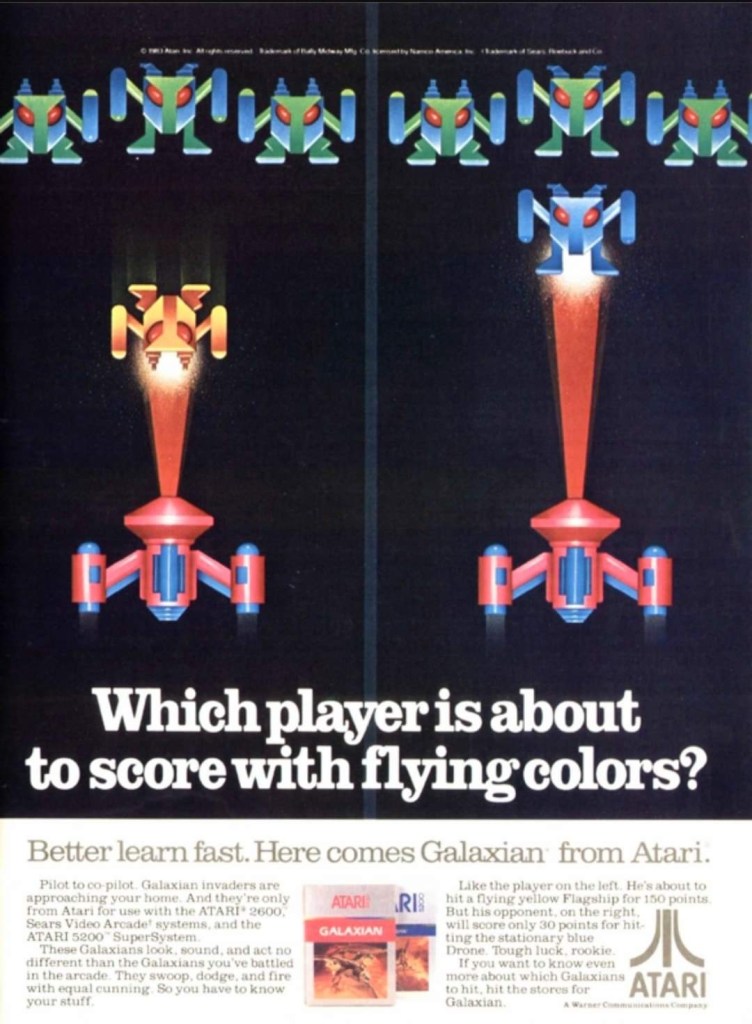
1. Galaxian for Atari print ad
A unique approach to the art done by the advertisers.
Developed by Namco, Galaxian was a 2D sci-fi shooter that debuted in arcades in 1979. It was so successful and widely acclaimed, it got ported to varied game consoles and home computers as the years passed by. For its release on the Atari 2600 and Atari 5200, this print ad was created to catch the attention of fans and gamers by utilizing artwork that resembled the look of 2D sprites from the game. That being said, no screenshots of Galaxian on the Atari consoles were shown because the artwork used looked detailed and were attention-grabbing already.
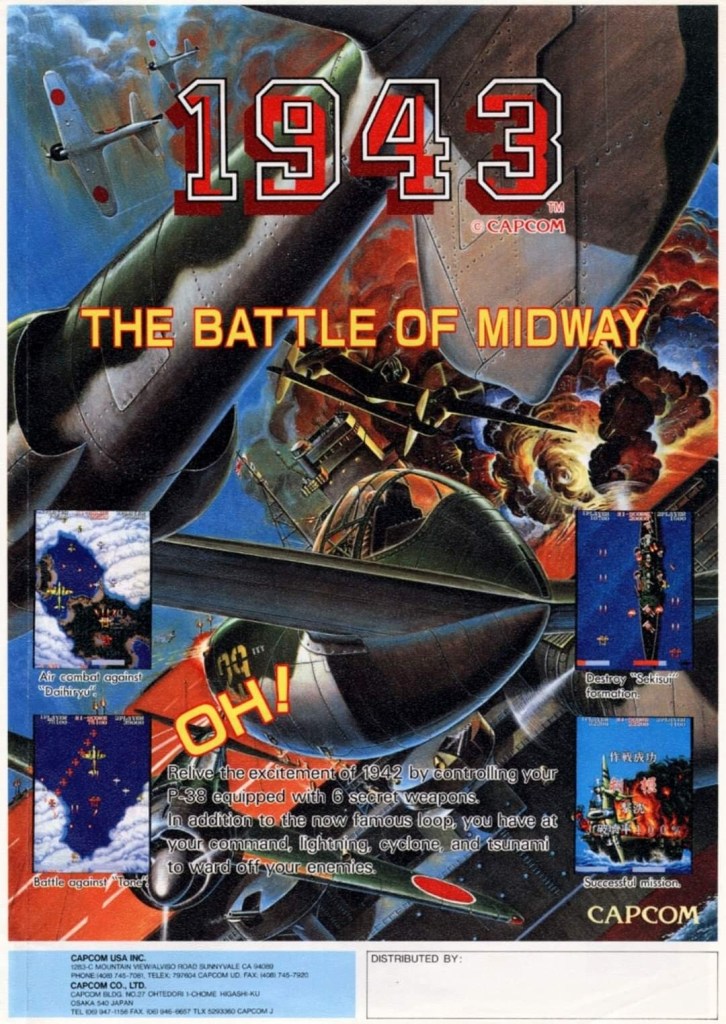
2. 1943: The Battle of Midway arcade flyer
This is a fine looking flyer.
In 1987, Capcom released in the arcades 1943: The Battle of Midway which was their follow-up to 1942. The arcade flyer itself was designed to strongly promote the game using a combination of screenshots, short-but-clear text descriptions and the great looking piece of artwork which really emphasized the World War II concept. Behind it all, this game was made by Japanese developers with the Western markets in mind and the irony is that the game has players control Americans fighting the Japanese fleet.
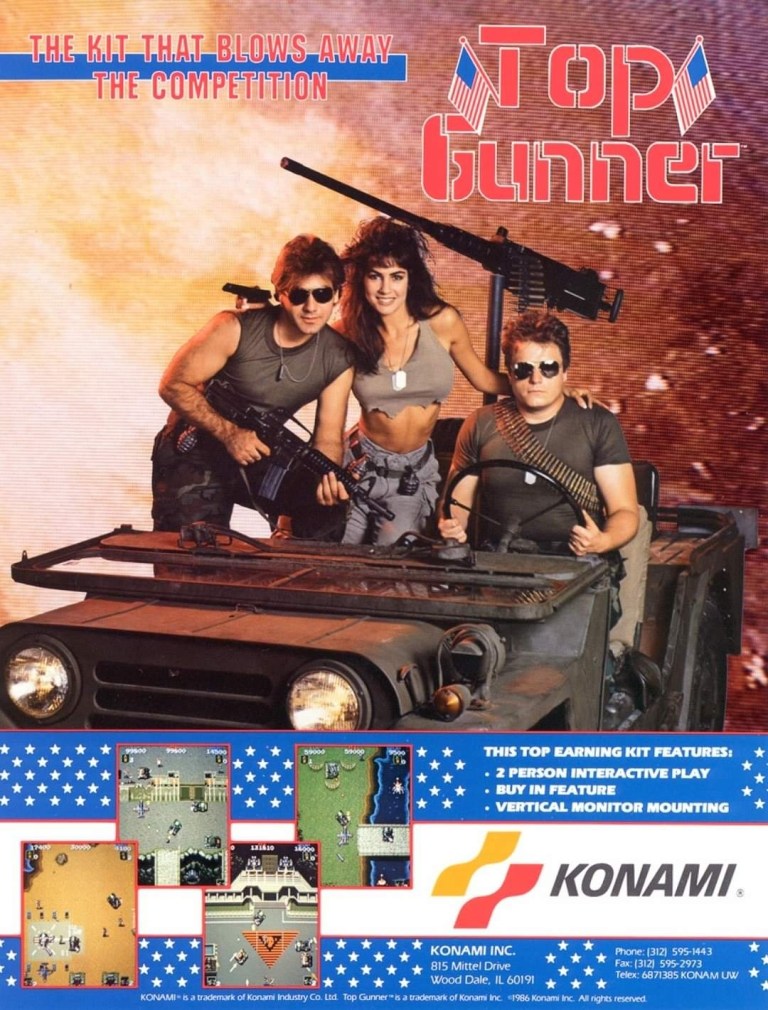
3. Top Gunner arcade conversion kit flyer
Show this nice looking image to the woke nut or modern day Communist near you. Watch and observe his or her reaction.
To make things clear, Top Gunner is actually the run-and-gun game Jackal and the alternative titles was mainly used in North American arcade distribution and also reflected Konami’s move of coming up with titles inspired by blockbuster movies of the time. To promote its 1986 arcade release in America as a conversion kit, the advertisers had three models playing soldiers on a military jeep to immerse gamers into the core concept of the game – moving armed military jeeps from one location to another while fighting bad guys. The approach used for the visual concept is indeed inspiring, especially during the Cold War. Top Gunner/Jackal became a hit in both arcades and consoles.
4. Joust for Atari print ad
While I played Joust on console, I don’t remember seeing this print ad before.
Made by Williams Electronics, Joust was one of those early 1980s arcade games that eventually made its way to the Atari 2600 console which was massively popular in North America. Strangely enough, the artistic approach Atari’s advertising came up with for the console version of Joust was similar with that of the ad of the Atari version of Galaxian (see item #1 above) in which artwork was used to resemble the 2D sprites of the game. Regardless, the images of this ad showed what a joust looked like – a martial game between two armed combatants going against each other while riding an animal.
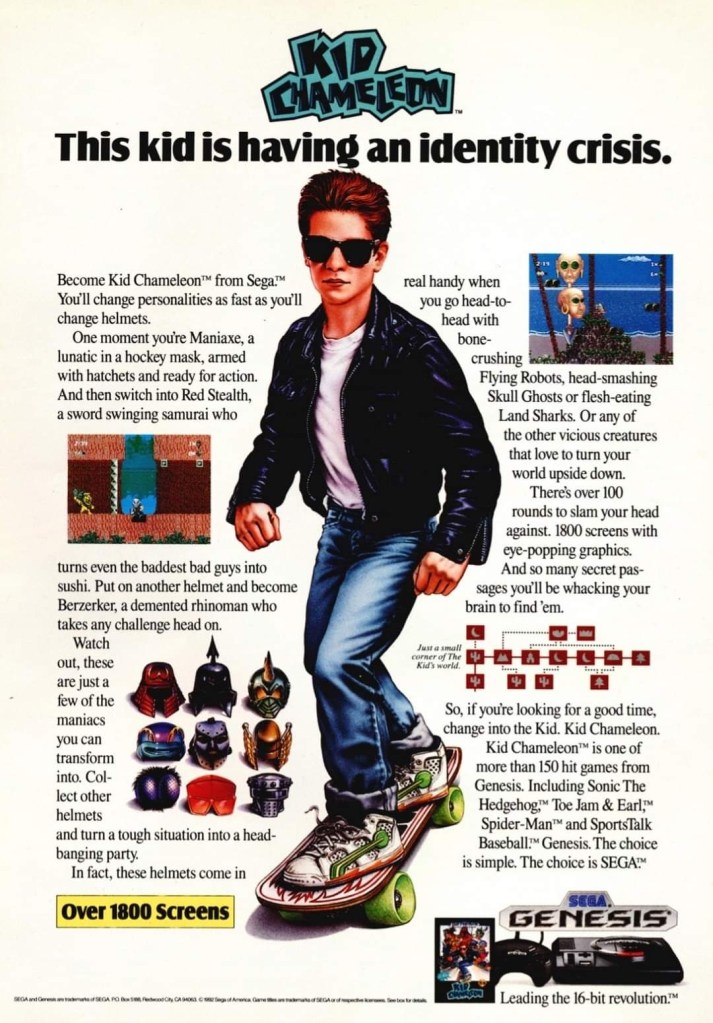
5. Kid Chameleon print ad
Can you relate with Kid Chameleon’s identity crisis?
During the early years of the Sega Genesis, Sega of America exerted efforts to make new games that were not only exclusive to their console but also stand out among the many 2D side-scrolling adventure games by coming up with a protagonist with a unique personality that could somehow resonate with young kids and teenagers.
Developed by their internal experts (Sega Technical Institute), the company released Kid Chameleon in 1992 and they came up with the above print ad that had detailed hand-drawn art of the lead character as well as a wordy text description which was a clear attempt to help young gamers (including teenagers) get connected with both the game and the protagonist. The advertisers even had space to spare to accommodate two screenshots of the game.
6. Terminator 2: Judgment Day (AKA T2: The Arcade Game) for Sega Genesis print ad
This print ad appeared on the many comic books I read long ago.
Back in the early 1990s, Terminator 2: Judgment Day was a massive success in the global box office and this resulted in Arnold Schwarzenegger’s popularity to soar very high while also establishing the Terminator as an essential pop culture figure. Apart from comic books and merchandise, video games based on the movie were made and the one that stood out the most was the arcade shooter game initially titled Terminator 2: Judgment Day (later retitled as T2: The Arcade Game).
The arcade mega hit eventually got ported to the Sega Genesis and this print ad really looked flashy with its visual presentation showing screenshots and a zoomed-in look at how the Terminator T-800 looked like in the Genesis version complete with a few explosions in the background. It should be noted that this flashy print ad cleverly concealed the visual downgrades and the redrawn images as the Genesis itself could never come close to matching the high quality visuals of the arcade version.
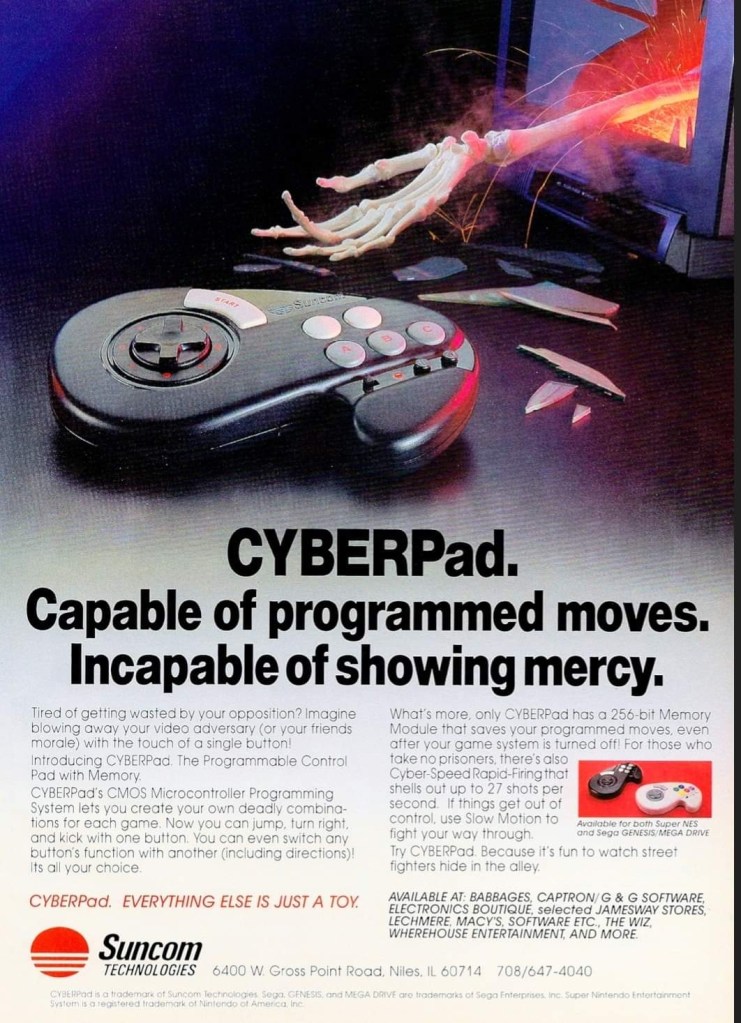
7. CYBERPad print ad
I never owned the CYBERPad, nor have I ever used one.
During the so-called 16-bit console generation (actually the 4th console generation), there were lots of licensed console peripherals made by independent companies in support of the Sega Genesis and Super Nintendo Entertainment System (SNES). The company Suncom Technologies came up with the CYBERPad controller for the two consoles and they boasted in their print ad that the product had a programmable control pad that allowed users to create combinations for each game with convenience in mind. The CYBERPad also allowed the saving of the programmable moves and it had a rapid-fire feature and even a slow-motion function. The CYBERPad was made to make the gameplay experience more user-friendly.
If you look closely, this print announcement by GamePro technically advertised the game consoles, the arcade game and Lara Croft to its readers.
In 1999, GamePro magazine celebrated its 10th anniversary and to keep on resonating with gamers and maintaining the loyalty of their fans, they organized a reader sweepstakes with prizes worth over $25,000 to be won by the few winners. GamePro boasted a date with an unnamed model who played the iconic Lara Croft (Tomb Raider). Certain arcade machines plus the modern consoles of the time – including the brand-new Sega Dreamcast – were also at stake. The way it was presented, this GamePro print announcement was enticing to read.
9. Smash T.V. for SNES print ad
Smash T.V. was a lot of fun on both arcade and console.
The arcade hit Smash T.V. made its way to the Super Nintendo Entertainment System (SNES) in 1992 and the publisher came up with a print ad that had captivating artwork, six screenshots and a text description that emphasized that a lot of fun awaits gamers on the console version. In my view, this old ad is still amusing to look at.
10. David Robinson’s Supreme Court print ad
It was a smart move by Sega to get NBA superstar David Robinson as the endorser of this basketball video game exclusive on the Sega Genesis. This ad was published many years before Robinson finally won an NBA championship.
As part of its strategy in competing with Nintendo during the 4th console generation, Sega of America was focused on producing exclusive sports video games for the Genesis console backed by endorsements of sports professionals. In 1992, they released David Robinson’s Supreme Court on the Genesis and unsurprisingly their print ad used a large, stylized image of the NBA superstar dunking backed with an exciting text description plus screenshots showing the game’s use of the isometric view for gameplay. This is still worth looking at.
11. Taito’s “heat wave” print ad
An amusing and creative way to sell video games.
If your company lacks money to effectively market your video games individually, you can try making a single ad promoting them together. This is what Taito did in this print ad which showcases multiple games for different platforms and they used artwork of a player experiencing the so-called heat wave. This is a nice stroke of creativity on the part of Taito.
12. Jurassic Park Interactive print ad
This was a creepy print ad promoting the 3DO-exclusive Jurassic Park Interactive.
When it comes to video game consoles, having exclusive games is essential as long as they are of high quality, highly playable and enjoyable. The 3DO company acquired a license of the Jurassic Park movie and made the exclusive game Jurassic Park Interactive hoping it would sell a lot and lift up 3DO hardware sales.
This print ad, which features a zoomed-in image of the Raptor from the game, was more focused on selling the 3DO console than the video game as seen on the descriptive text. 3DO ran a promo selling the console which would entitle the buyer to get Jurassic Park Interactive and another game free. Nothing was done to describe the console’s multimedia capabilities of showing videos, images and graphics of the game (which was essentially a collection of mini-games). This print ad shows ignorance on the part of the 3DO company and the ad maker as it showed desperation happening really early in the console’s life. Notably, Jurassic Park Interactive was the only video game adaptation to use actual footage (note: the faces of the actors were edited out) and music from the film.
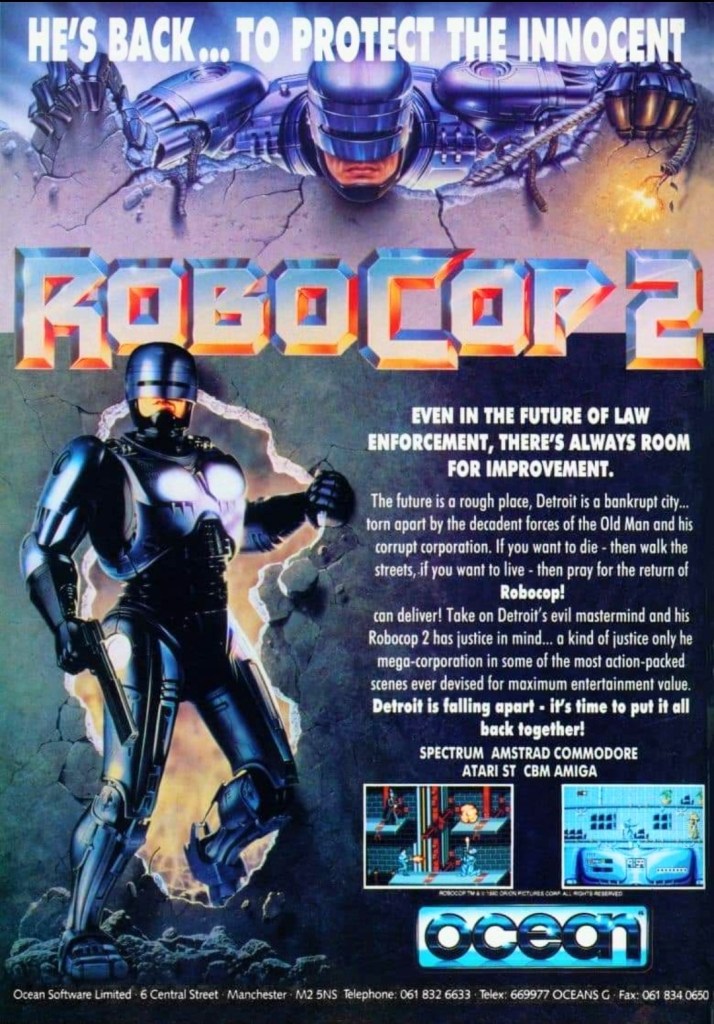
13. RoboCop 2 print ad
You want to become RoboCop to save the city of Detroit from criminals?
Way back in 1990, RoboCop 2 was a big hit in cinemas here in the Philippines and in some places around the world. As typical of the time, licenses to make video games based on the movie were released resulting in RoboCop 2 games for multiple platforms. The print ad featured two different images of RoboCop – one from the movie poster and the other from an official artwork. The descriptive text does a fine job to immerse readers into the story concept of the game but showing only two screenshots was a lackluster effort to sell the game.
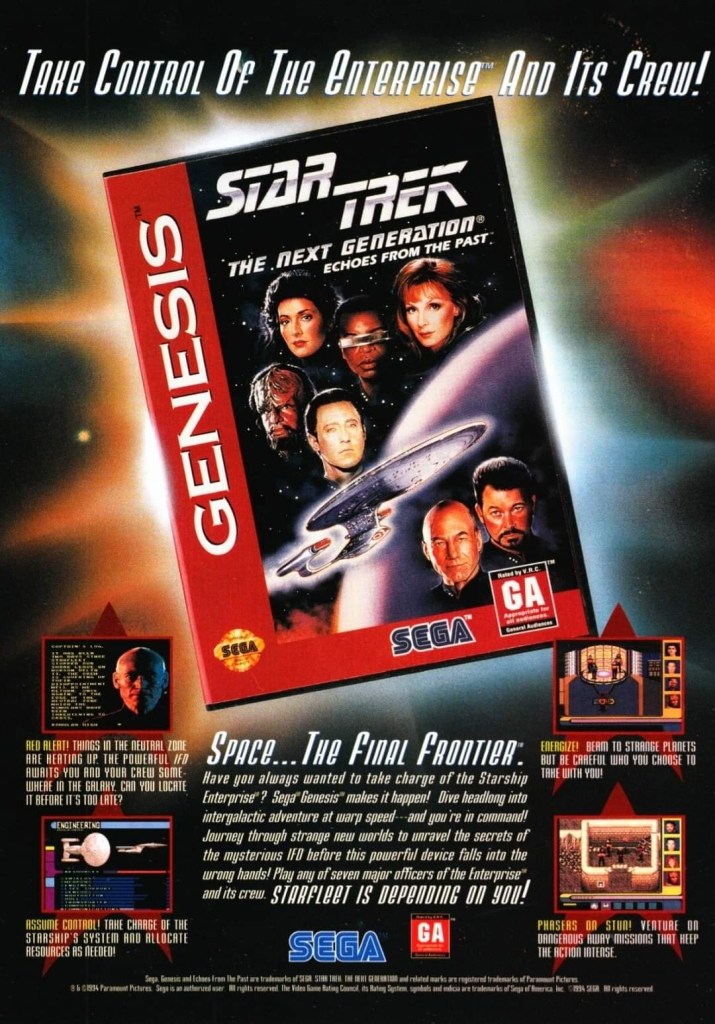
14. Star Trek: The Next Generation – Echoes from the Past print ad
Space…the final frontier waiting for Sega Genesis gamers.
Released in 1994, Star Trek: The Next Generation – Echoes from the Past delivered the Star Trek TNG adventure experience to Sega Genesis gamers. In fact, it is the exact same experience that SNES gamers got the same year. In reality, Star Trek: The Next Generation – Echoes from the Past is actually a port of Star Trek: The Next Generation – Future’s Past on the SNES and the screenshots on the print ad are giveaways about it. In fairness to the ad makers, this print ad never attempted to deceive gamers that it promoted a totally different Star Trek TNG game.
15. Dinosaurs for Hire print ad
This print ad caught my attention and made me interested in the game and the comic book series. Even though it was small, Malibu Comics’ logo was still recognizable.
Dinosaurs for Hire (sometimes referred to as Tom Mason’s Dinosaurs for Hire) was a 2D side-scrolling platform adventure game based on the comic book series of Tom Mason. Published by Sega, it was a Genesis-exclusive game and this print ad had a catchy text description, a few screenshots and the eye-catching artwork of a triceratops facing the viewer. This print ad is still good to look at. If you’re thinking about searching for existing copies of the game, I encourage you to also read some Dinosaurs for Hire comic books before playing. By the way, Tom Mason also wrote several comic books of the Ultraverse.
As some of you are already aware, I fully stand with Israel which is very connected with my uncompromising faith in the Lord. I keep on praying to Him for Israel to overwhelm its enemies, rescue the hostages and recover from the effects of the October 7, 2023 terrorist attacks committed by the Palestinian terrorist group Hamas which is sponsored by terrorist state Iran. I can assure all of you that nobody from the evil Islamo-Leftist mob, nobody from the pro-Palestine radicals and nobody from any evil society would stop me from supporting and loving Israel.
Now, on with the news…
Recently it was announced that two Israeli-produced Fast Attack Interdiction Crafts (FAICs) were received by the Philippines which raises the current number of Philippine Navy (PN) FAICs to eight, according to a Philippine News Agency (PNA) new article.
To put things in perspective, posted below is an excerpt from the PNA news article. Some parts in boldface…
The Philippine Fleet (PF) on Monday announced that two more fast attack interdiction craft (FAIC), also known as the Acero-class patrol vessels, were delivered to the country.
In a message to reporters, PF spokesperson Lt. Giovanni Badidles said the two FAICs were delivered at the Pier 15 of the Manila South Harbor on Sept. 17.
“These two FAICs, to be designated with bow numbers PG-908 and PG-909, will be the seventh and the eighth fast boats under the Acero-class patrol vessels,” PF spokesperson Lt. Giovanni Badidles said in a message to reporters.
Once commissioned into service, the number of FAICs in the Philippine Navy (PN) will rise to eight, leaving only one to be delivered by contractor Israeli Shipyards Ltd.
“Similar with their predecessors, the newly delivered platforms are designed for high-speed operations, featuring advanced missile systems and sophisticated onboard technology, which enhances the PN’s capability to conduct rapid and effective maritime interdiction operations,” Badidles said.
He also said the arrival of these vessels underscores the continued modernization of the PN and represents a crucial step toward bolstering Manila’s Self-Reliant Defense Posture (SRDP) program.
On May 22 this year, the PN formally commissioned into service the fifth and sixth FAICs and named them BRP Herminigildo Yurong (PG-906) and BRP Laurence Narag (PG-907). These two FAICs are equipped with the Spike NLOS (non-line of sight) missile systems.
The PN received the two gunboats from Israel Shipyards Ltd. on Nov. 18, 2023.
The vessels were named after two Medal of Valor awardees, the late Marine Staff Sgt. Herminigildo Yurong and Marine Cpl. Laurence Narag, who perished in the line of duty during the Philippine government’s campaign against Moro rebels in Mindanao in 2000.
This latest development shows the continuing growth of Israel-Philippines ties through defense and military technology. The Philippine Navy needs the best technology they could get to help them in their operations as well as securing the nation.
To my fellow Filipinos reading this, I encourage you to accept the truth that Israel is the land God designated specifically for the Jewish people (read Genesis 35:10-12) and His command must be followed without hesitation. If you want to be blessed further by the Lord, do so by loving and blessing the Jewish people (Genesis 12:1-3). I did my part when I was in Israel. Also, let me remind you all that the ties between the Jews and Christians are truly biblical!
We live in a very divided world. Around the world, Leftist forces have been supporting evil forces like the current regime of Iran which is known for supplying and arming the Palestinian terrorists, Hezbollah and other terrorist groups around the Middle East. The Leftists and terrorists always go together and their anti-Semitism is clearly obvious. Overseas, Israel recently intensified its fight against the Iran-sponsored terrorist group Hezbollah. Israel made it clear that they are at war with Hezbollah, not the people of Lebanon.
With all that said, I encourage you all to pray to the Lord God in support of Israel and believe that He will guide the Israeli forces to another victory which means finishing off Hamas, crushing Hezbollah and forcing Iran and its terror proxies to fall down. Read Joshua 11:1-20 in the Holy Bible for relevance and truth. Pray to the Lord to support Israel, its government officials, the Israel Defense Forces (IDF), the citizens and other stakeholders.