In the presence of Philippines’ Defense Secretary Gilberto Teodoro, Japan’s Defense Minister Shinjiro Koizumi, the media and many other officials, the Self-Defense Forces (SDF) launched two anti-ship missiles during a Balikatan multi-national exercise held in Paoay in the Philippines, according to a Kyodo News report. The live-fire drill involved one hundred forty ground SDF personnel and was a success in terms of directly hitting a target at sea.
To put things in perspective, posted below is an excerpt from the news report of Kyodo News Some parts in boldface…
The Japanese Self-Defense Forces on Wednesday fired two anti-ship missiles during a large-scale multinational exercise in the Philippines, with the two countries’ defense ministers observing the launches.
The two Type 88 surface-to-ship missiles successfully hit and sank a decommissioned Philippine navy vessel floating about 75 kilometers off Paoay on the northern Philippine island of Luzon during the annual Balikatan exercise co-hosted by the United States and the Philippines.
The live-fire drill involving about 140 Ground Self-Defense Force personnel was open to the media.
Japanese Defense Minister Shinjiro Koizumi and his Philippine counterpart, Gilberto Teodoro, watched the drill on site, while Philippine President Ferdinand Marcos Jr. observed the exercise remotely from Manila, according to the military of the Southeast Asian country.
China criticized the missile launches, with Foreign Ministry spokesman Lin Jian saying Japan’s “right-wing forces are pushing for the acceleration of remilitarization,” posing a threat to regional peace and stability.
Let me end this piece by asking you readers: What is your reaction to this development? Do you think Japan and their Filipino counterpart will cooperate even more to enhance the Philippines’ defense capabilities and modernize its military? Do you think it is inevitable that the Philippines will purchase more military weapons from Japan in the near future? Were you surprised to learn about Communist China’s criticism against the successful live-drill?
Thank you for reading. If you find this article engaging, please click the like button below, share this article to others and also please consider making a donation to support my publishing. If you are looking for a copywriter to create content for your special project or business, check out my services and my portfolio. Feel free to contact me with a private message. Also please feel free to visit my Facebook page Author Carlo Carrasco and follow me on Twitter at @CarloCarrascoPH as well as on Tumblr at https://carlocarrasco.tumblr.com/and on Instagram athttps://www.instagram.com/authorcarlocarrasco

With many nations in Asia already struggling with the very expensive prices of fuel related to the conflicts in the Middle East, their respective economic struggles are only getting worse. That said, they are very fortunate to have Japan on their side as Prime Minister Takaichi Sanae officially announced that her government will provide them financial support worth $10 billion, according to a Kyodo News report.
To put things in perspective, posted below is an excerpt from the news report of Kyodo News Some parts in boldface…
The Japanese government said Wednesday it will provide a total of $10 billion in financial support to other Asian nations to help them secure crude oil supplies as prices soar amid the Middle East conflict, aiming to ensure that petroleum-derived products made in those countries keep flowing into Japan.
The aid, announced by Prime Minister Sanae Takaichi following an online meeting with her counterparts mainly from the Association of Southeast Asian Nations, is aimed at beefing up energy supply chains across the region such as through loans for procuring crude oil and petroleum products as well as expansion of stockpiles.
“Japan is closely interconnected with each Asian country through supply chains and mutually dependent with them,” Takaichi told reporters, adding that oil shortages or supply disruptions in Asia could have a “significant negative impact” on her nation’s economy and society.
The planned financial aid is equivalent to up to 1.2 billion barrels — about one year of crude oil imports by ASEAN countries, she said.
Japan imports petroleum-derived products from Southeast Asia, including items used at medical facilities. Many countries in the region maintain limited oil reserves, so there have been concerns that supply shortages could eventually affect shipments to Japan.
The surge in oil prices on the back of the war that led to a blockade of the Strait of Hormuz, a key waterway for global energy transportation, has raised concerns in some Southeast Asian countries over their ability to pay for imports.
Tokyo aims to address the risks through financial support, including loans via the government-backed Japan Bank for International Cooperation, according to government sources.
The Japanese prime minister emphasized that the latest supportive scheme does not include direct crude oil provisions from Japan’s reserves and therefore will not negatively affect domestic supplies.
Given its high dependence on the Middle East for crude oil imports, Japan keeps abundant oil stockpiles in the country.
The other nations that joined the Japan-led, leaders-level virtual gathering were Australia, Bangladesh, Brunei, Cambodia, East Timor, India, Indonesia, Laos, Malaysia, the Philippines, Singapore, South Korea, Sri Lanka, Thailand and Vietnam.
Let me end this piece by asking you readers: What is your reaction to this development? Do you think the $10 billion assistance of Japan will be sufficient for the Asian nations for their oil and energy needs? Do you think the Islamic terrorist regime of Iran will eventually stop harming its neighbors now that American forces have blocked all the Iranian ports to allow other ships to pass through the Strait of Hormuz safely? Do you think the ASEAN member nations have learned their lessons about depending excessively on the Middle East for importing oil?
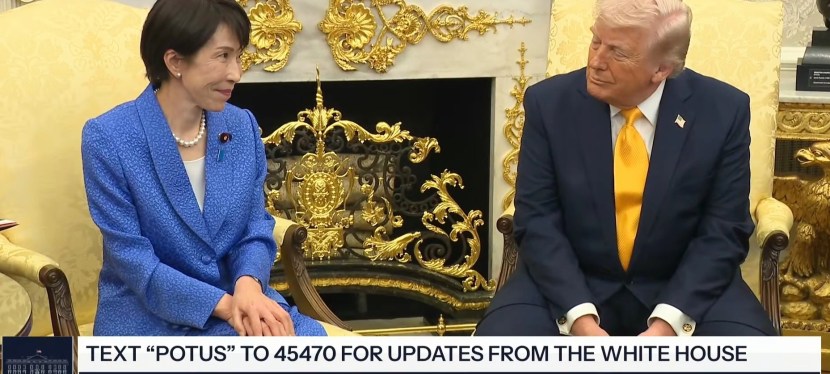
Japanese Prime Minister Takaichi Sanae visited Washington for the first time as the head of her nation and met with US President Donald Trump at the White House where they discussed very important matters in front of the media and officials, according to a news report by Kyodo News. Takaichi also praised the President for his peace efforts.
To put things in perspective, posted below is an excerpt from the news report of Kyodo News Some parts in boldface…
Prime Minister Sanae Takaichi told U.S. President Donald Trump on Thursday that Japan is ready to contribute to the safety of the Strait of Hormuz as the U.S.-Israeli war on Iran intensifies, while explaining Tokyo’s legal constraints on sending ships from its defense forces to the region.
Takaichi told reporters after her meeting at the White House with Trump that she told the U.S. leader “in detail what Japan can do and cannot do” from a legal perspective under the country’s war-renouncing Constitution.
Trump, for his part, reiterated his expectation that Japan would be engaged, while saying during the part of their talks open to media that he believes Japan has been “stepping up to the plate” in recent days over the Iran war, “unlike NATO.”
The U.S. leader has made public his dissatisfaction with Washington’s allies, including Tokyo and members of the trans-Atlantic alliance, over their reluctance to pitch in to help secure the Hormuz strait, a vital waterway for global oil transportation now largely blocked by Iran.
“I expect Japan to step up, because, you know, we have that kind of relationship,” he said. “We have 45,000 soldiers in Japan. We have, we spend a lot of money on Japan…so I expect, I’m not surprised that they would step up.“
Noting also that more than 90 percent of Japan’s crude oil imports normally pass through the strait, Trump said Japan has a “big reason” to do more.
In affirming Japan-U.S. collaboration on expanding U.S. energy production, Takaichi said she proposed to Trump a joint oil-reserve project to ease supply concerns driven by the Middle East conflict.
At the talks, Takaichi praised Trump’s “peace” efforts, expressing readiness to assist by reaching out to other countries. “Donald is the only person who can bring peace and prosperity across the world,” she said.
Takaichi emphasized that the prospect of Iran developing nuclear weapons is unacceptable. Trump alluded earlier to Iran’s nuclear program to explain the U.S. decision to launch its military campaign against the country.
Facing an increasingly assertive China, Takaichi also reminded Trump that the security environment remains severe in the Indo-Pacific, at a time when reports have emerged that some U.S. military assets are being moved from the region to the Middle East.
The two leaders “committed to peace and stability across the Taiwan Strait as an indispensable element of regional security and global prosperity” and “opposed any attempts to unilaterally change the status quo, including by force or coercion,” the White House said in a press release without naming China.
They confirmed that their nations oppose measures threatening critical mineral supplies such as export controls, senior Japanese government officials told reporters, apparently referring to Beijing’s tighter regulations on rare earths exports.
They agreed to advance broad defense cooperation, including joint missile development and production, and promote a free and open Indo-Pacific, according to Takaichi. The White House said the production of the interceptor Standard Missile-3 Block 2A in Japan will be quadrupled.
“We were able to affirm many concrete forms of cooperation that will further enhance the quality of our alliance in wide-ranging fields,” Takaichi said, adding that she and Trump are aiming to elevate bilateral ties to “a higher level” together.
Trump welcomed Japan buying “a lot of” U.S. military equipment. He further stressed that he has a “very fine relationship” with Takaichi, describing her as “a very special person” who is doing a “fantastic job.”
The U.S. side did not bring up fresh demands for Japan to spend more on its defense, the officials said.
Takaichi’s main goals in her first trip to the United States since taking office in October were to strengthen the personal trust in her ties with Trump and reaffirm the U.S. security commitment to the Indo-Pacific region as China’s influence grows.
The meeting came amid increasing concerns within Japan that the U.S. focus in terms of policy and military assets could shift from the Indo-Pacific to the Middle East if the U.S.-Israeli war with Iran drags on, a development that would work in China’s favor.
The U.S. military has reportedly begun relocating the amphibious assault ship Tripoli and over 2,000 Marines from their bases in southwestern and southern Japan to the Middle East.
Takaichi got off to a positive start in building personal ties with Trump when they met in person for the first time in October in Tokyo, shortly after she became Japan’s first female prime minister.
Since the outbreak of the Middle East conflict, Tokyo has sought to strike a delicate balance between maintaining its strong alliance with Washington and its friendly relations with Tehran.
For more insight about the Trump-Takaichi meeting, watch the videos below.
Let me end this piece by asking you readers: What is your reaction to this development? What is your impression about the many matters and announcements that happened during the Trump-Takaichi meeting at the White House? Were you surprised when it was announced that US allies Japan, Italy, England, Netherlands, Germany, and France jointly agreed to secure the Strait of Hormuz in response to Trump’s demand? With Japan having a close relationship with Trump’s America now, do you think Communist China and North Korea will feel intimidated at their side of the Pacific?
To put things in perspective, posted below is an excerpt from the news report of Kyodo News Some parts in boldface…
Prime Minister Sanae Takaichi is considering expressing Japan’s desire to cooperate on the U.S. “Golden Dome” next-generation missile defense system at her upcoming meeting with President Donald Trump, Japanese government sources said Tuesday.
The envisaged missile defense collaboration is among the expected agreements, covering various areas from the long-standing Japan-U.S. alliance to the fields of economic security and cutting-edge technology, at the summit slated for Thursday in Washington, the sources said.
Revealed by Trump in May, the Golden Dome scheme is intended to detect and destroy hypersonic missiles, which can fly at above five times the speed of sound, in outer space in mid-flight. The total costs are estimated at $175 billion.
The trajectories of hypersonic weapons are irregular and low-altitude, making them difficult to shoot down or track by radar. China, North Korea and Russia have been aggressively pursuing such arms.
In August 2023, Tokyo and Washington agreed to develop a new type of missile to intercept hypersonic weapons, with the goal of completing it by the 2030s. It is intended that Aegis destroyers of the U.S. Navy and the Japan Maritime Self-Defense Force will be equipped with the missile.
To enhance the missile defense system’s detecting and tracking capabilities, the U.S. military has been building a “satellite constellation” system that allows it to capture incoming missiles with high accuracy by linking multiple small satellites.
Japan’s Defense Ministry, which has also been conducting research on technologies necessary for detecting projectiles from outer space, is eyeing information sharing with the United States, the sources said.
During the summit talks, which will take place amid the Middle East conflict following U.S. and Israeli attacks on Iran, Takaichi also plans to ask Trump about purchasing crude oil produced from Alaska, according to the sources.
Japan, which relies heavily on the Middle East for its crude oil imports, has once again had its energy vulnerability exposed in the wake of the war in the region, with the effective closure of the Strait of Hormuz disrupting oil flows.
Takaichi and Trump, meanwhile, are expected to agree on a $100 million joint project in shipbuilding, a sector both countries are keen on enhancing amid dominance by Chinese makers.
Let me end this piece by asking you readers: What is your reaction to this development? Do you think the US-Japan summit this week will result in big breakthroughs with regards to defense, economics and energy? What do you hope to see happen after President Trump and Prime Minister Takaichi meet in Washington? Do you think the Golden Dome missile defense project will be fully realized and operational in the years to come?
Disclaimer: This is my original work with details sourced from reading the video game and doing personal research. Anyone who wants to use this article, in part or in whole, needs to secure first my permission and agree to cite me as the source and author. Let it be known that any unauthorized use of this article will constrain the author to pursue the remedies under R.A. No. 8293, the Revised Penal Code, and/or all applicable legal actions under the laws of the Philippines.
Welcome back retro gaming enthusiasts, Atari fans, geeks and others who are passionate about video games!
Today we go all the way back to the year 1980 when Atari released in arcades a game that strongly resonated with people who were concerned about a potential nuclear conflict between the United States and Russia during the Cold War…Missile Command.
Designed by Dave Theurer and programmed by Rich Adam with Theurer, Missile Command is a 2-dimension shoot ‘em up arcade game that had a trackball to allow players to control a crosshair to defend six existing cities. The arcade also had three buttons players could use to launch surface-to-air missiles from the three missile bases to protect the cities from incoming ballistic missiles that came from an unseen enemy.
With those details laid down, here is a look back at the Missile Command arcade game of 1980 developed and published by Atari.
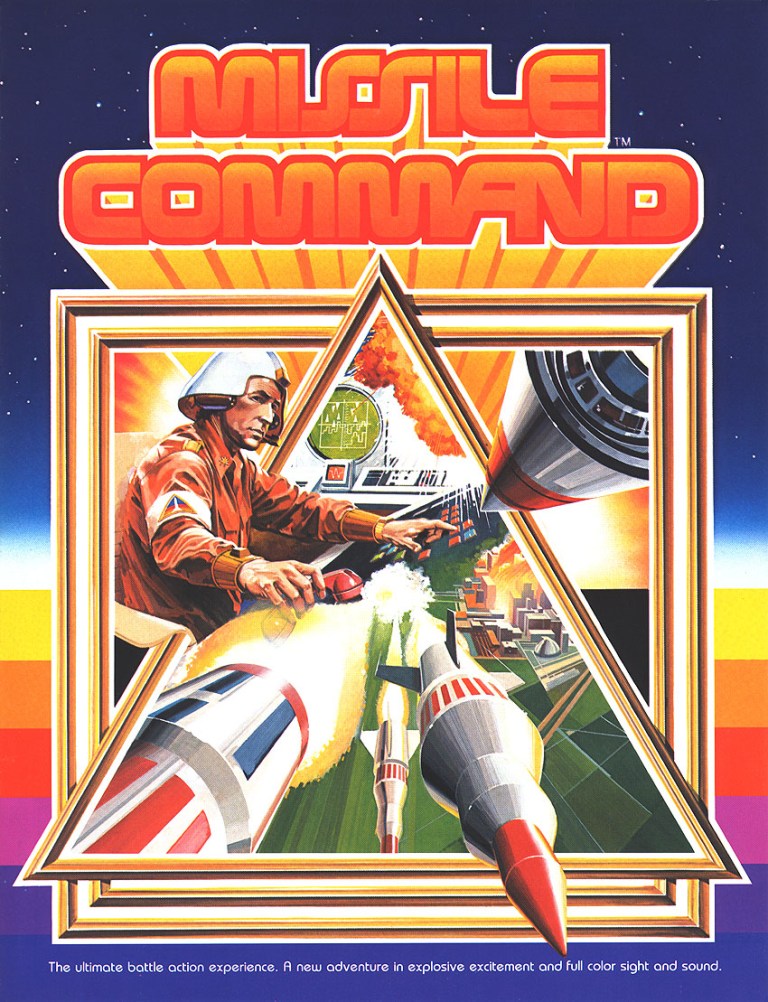
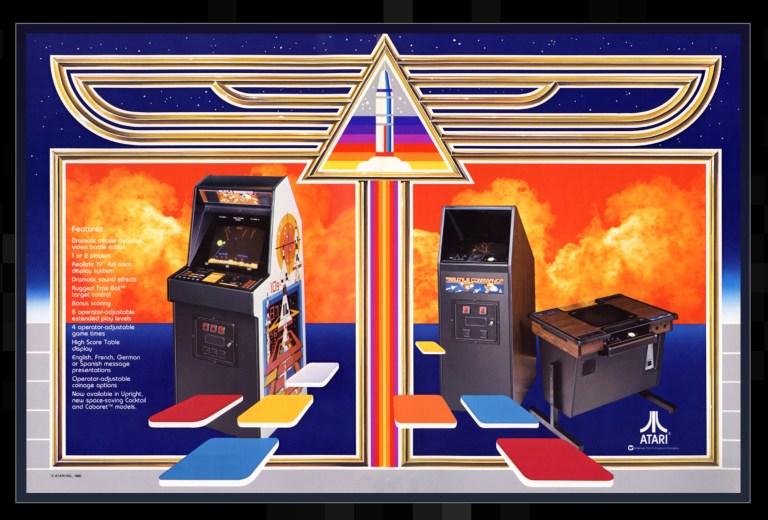
The arcade flyer with a great looking painted artwork. This one really resonated with gamers who lived during the Cold War.
Game design
As the commander of three missile bases (each armed with 10 defense missiles), the player is tasked to protect six existing cities from waves of ballistic missiles (launched by an unnamed enemy) coming down. From time to time, the enemy deploys bombers, satellites/drones and smart bombs to overwhelm your defense and test your precision and decision making.
You have three missile bases that each has its own supply of defense missiles. There are cities between each base which you have to defend from the endless assault of enemy missiles, smart bombs, war planes and satellites/drones.
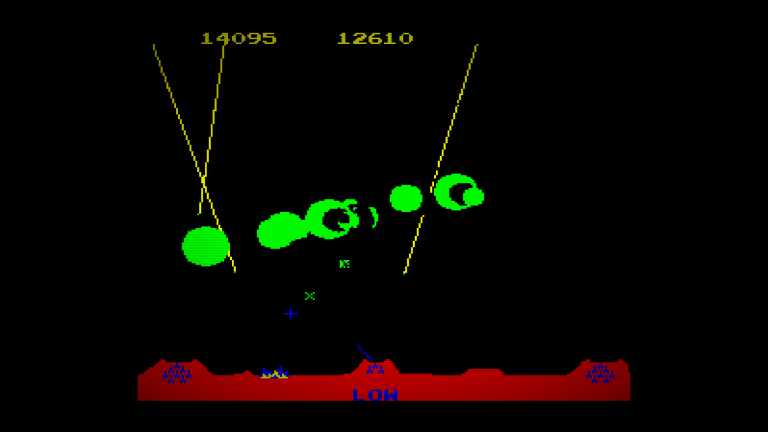
When your defense missile detonates in the air, it creates an explosion which serve as a shield to destroy enemy missiles, war planes and satellite/drones when contact is made. If any projectiles from the enemy manages to get through the aerial explosion, you will have to quickly launch more defense missiles from the near base you have.
Watch and learn.
Players use a single crosshair which designates which part of the sky a defense missile can be fired at. Once the defense missile reaches its destination (placed by the crosshair) in the sky, it will explode and cause a growing flame lasting seconds. The said flame serves as a shield that can destroy the enemy’s ballistic missiles, smart bombs, war planes and satellites/drones upon contact. Defense missiles can be launched consecutively into selected spots in the sky in anticipation of the incoming weapons of the enemy.
To proceed from one level to another, the player must have at least one city remaining intact. Once all the six cities have been destroyed and the player no longer has any unused missiles (and no new cities earned by reaching certain high scores that justify rewards), the game will end with a “Game Over” screen with an explosion in the background.
Quality
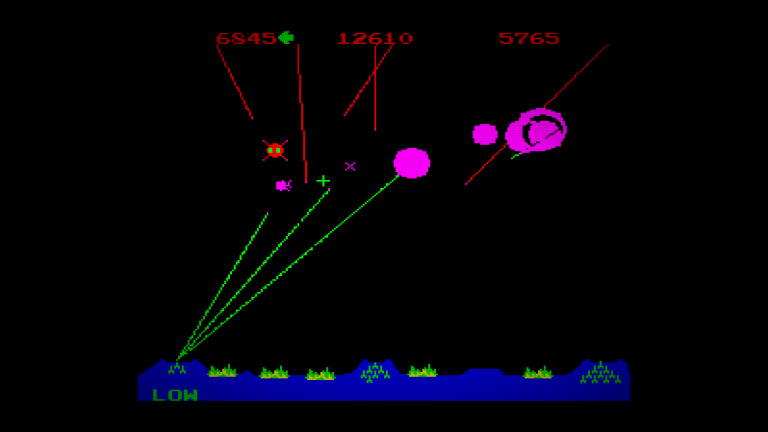
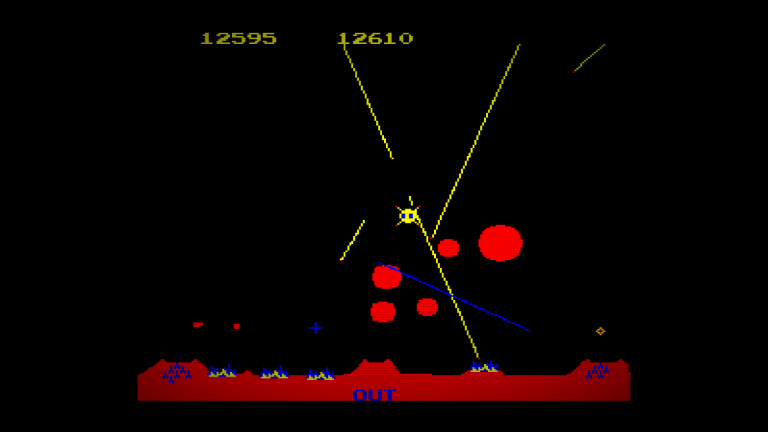
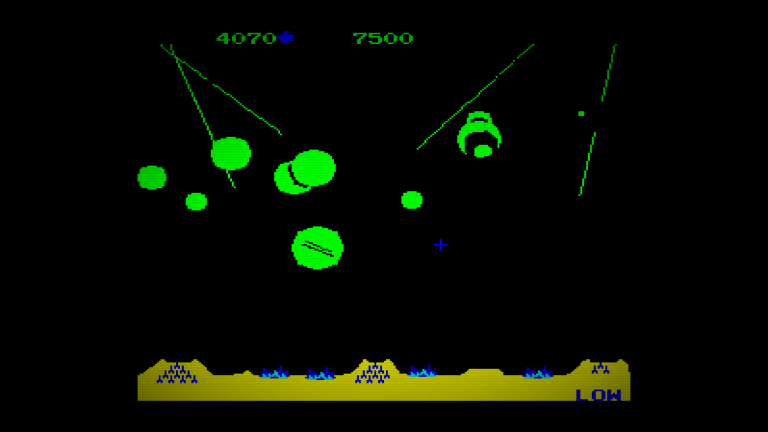
In this screenshot, the enemy’s satellite/drone is floating while a smart bomb is about to hit the missile base at the lower-right. Smart bombs can be challenging to intercept because it reacts by avoiding the aerial explosion of defense missiles.
This arcade game – which is currently available for modern console owners to play via the Atari 50: The Anniversary Collection – remains very engaging and a lot of fun to play with after all these decades. As a player, my only objective was to defend the six existing cities and three missile bases from the waves of enemy ballistic missiles (and smart bombs in later levels) coming from the sky. Given the way the game was designed, this is strongly emphasized and the only times I could attack the enemy is by launching my own missiles towards the enemy’s bombers and satellites/drones (note: both of these are capable of launching more missiles at you).
If any of the enemy’s weapons hits one of your missile bases, it and the remaining supply of defensive missiles will be wiped out. Enemy missiles that hit a city will result in total destruction. Considering the intentional increase in challenge with each new level of play started, the enemy’s ballistic missiles move faster, the warplanes and/or satellite/drones appear more and the smart bomb – which is the most difficult to intercept as it deliberately avoids the aerial flames caused by your defense missiles – get launched against you.
When intercepting enemy missiles, you have to think quick where to aim (ahead of incoming missiles), which missile base to use to launch defense missiles and remember how much missiles do you have left per base.
That being said, the game deliberately becomes harder which compelled me to be more watchful of enemy weapon movements, and to be more strategic using my defense missiles while keeping a quick eye on the remaining supply of missiles per base. While the in-game difficulty intensifies per level, the game never became frustrating to play nor did it ever turn into a chore on my part. I just keep playing because I found the increasing challenges actually fun to take on.
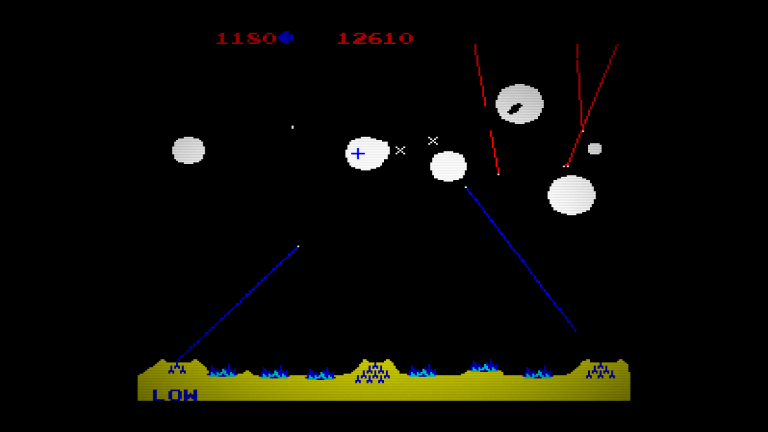
The game’s visuals are still good to look at. It’s still engaging to see streaks of missile trails (both your defense missiles and the enemy’s ballistic missiles) fill the air above the cities and the flashing light effects that simulate explosions are still effective as eye candy. Along the way, the game’s sound effects worked perfectly with the visuals and they added a lot to the immersion.
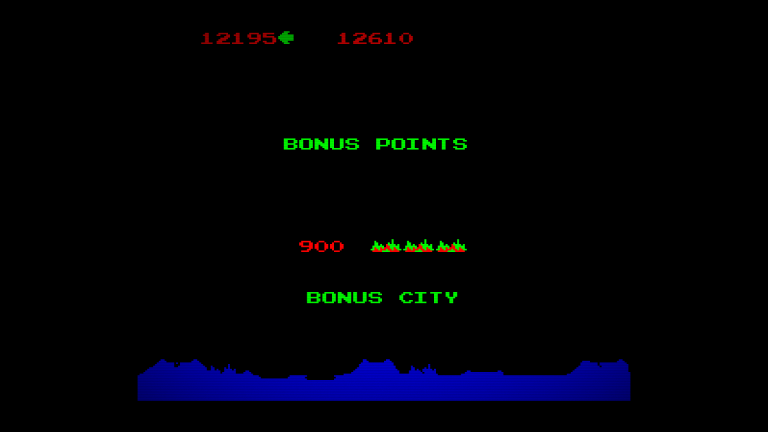
When you score enough points, the game will reward you with a bonus city.
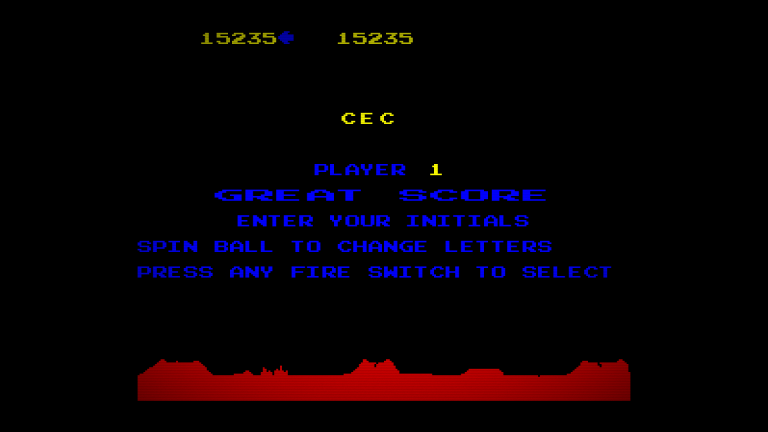
Me putting my initials after achieving a great score in Missile Command.
Considering its simplicity and the way it was designed, there clearly is no way for players to win at all. Rather, the game will challenge your precision, decision-making and ability to defend your cities and bases. That being said, the greater challenge is to survive and be able to move on to the next level with missile bases and whatever cities remaining you still have to defend. As with other games of the past, achieving the high possible score – which reflects your endurance, skill and progress – is a goal here. Achieving certain high scores also result in an extra city for you.
Cultural relevance
Missile Command’s legacy as one of the greatest arcade games ever released is undeniably real. Not only that, this game resulted in a lot of ports for consoles, portable gaming devices and home computers through the decades. This classic was re-released in several compilations from Atari and the Xbox-listed Missile Command contains the arcade version. In 2020, a remake called Missile Command: Recharged was released as part of the Atari Recharged series of games.
The different Missile Command arcade machines.
Missile Command even appeared for a few seconds in Terminator 2: Judgment Day which added more to the film’s concept of nuclear war.
With regards to arcade gaming, Missile Command is notable for having a trackball on its machine as a way for arcade players to control the crosshair during game sessions.
Conclusion
Apart from being the commander of missile defense, try imagining yourself being on of the citizens living in one of those cities. Can you imagine watching real-life missiles get intercepted in sky above you?
The Missile Command (1980) arcade game is a true video game classic and it remains compelling and enjoyable at the same time. It can also be an intriguing game experience since it does not let players complete the game by winning. All players can do is perform the best defense they could, survive to the next round and keep playing until their defense gets overwhelmed by the enemy and the rising in-game difficulty.
As a result of the game design, playing Missile Command is actually moral because the concept of defending your people using powerful yet limited resources is very strong all the time. Even with progressive difficulty, the game never became frustrating to play and I actually enjoyed the challenges knowing that defense and survival are main goals. Achieving the highest possible score is the other goal as reflected by video gaming of the era. Missile Command simply delivers bouts of fun and you cannot go wrong with playing it. It is not surprising that this game became a massive hit and established itself as a true classic among video games.
Overall, Missile Command (1980) highly recommended and the best way to play it on console today is to avail of Atari 50: The Anniversary Celebration compilation.