With the Peso performing terribly in the global currency market, weakening economic growth, high inflation and fears of an economic recession growing, 2026 has not been good for the Philippines. There is a bright spot in tourism, however, as the Philippines saw its 2026 foreign tourist arrivals reach 4.11 million in the January-August period and the United States and South Korea combined for more than 1.5 million tourist arrivals, according to a news article by the Philippine News Agency (PNA).
To put things in perspective, posted below is an excerpt from the news report of BusinessWorld. Some parts in boldface…
The Philippines has recorded 4.11 million foreign arrivals from January to August, higher by 3.7 percent compared to the same period last year, the Department of Tourism (DOT) said on Tuesday.
The United States posted the highest number of share at 818,318, followed by South Korea at 727,379, Japan at 350,191, China at 310,088, and Australia at 234,156.
Also making it in the top 10 source markets are Canada with 231,972, Taiwan with 154,957, the United Kingdom with 132,370, Singapore with 126,812, and India with 77,883.
Tourism Secretary Dita Angara-Mathay said the Philippines targets to surpass its 2025 arrival figures to reach between 6.4 million and 6.8 million, or at least 7 million, by the end of 2026.
To achieve this, she said the DOT is intensifying its branding and promotions to reach more tourists in its key source markets.
The DOT is also in active talks with airlines to open up and establish more chartered flights between the Philippines and secondary cities of Korea and China.
DOT Assistant Secretary Ren Sapitan said the agency is also set to sign a contract with a creative agency in November to broaden the country’s marketing efforts and make the Philippines more visible worldwide.
Let me end this post by asking you readers: What is your reaction to this recent development? Do you think the Philippines will be able to exceed the 2025 foreign tourist arrivals number by the end of this year? Do you think the DOT is doing a good job to strengthen the Philippines’ attraction of foreign tourists? Considering the Top 10 markets of foreign tourists the Philippines attracted so far, are you convinced that the nation’s hosting of the Association of Southeast Asian Nations (ASEAN) Summit did not create any positive tourism results?
Thank you for reading. If you find this article engaging, please click the like button below, share this article to others and also please consider making a donation to support my publishing. If you are looking for a copywriter to create content for your special project or business, check out my services and my portfolio. Feel free to contact me with a private message. Also please feel free to visit my Facebook page Author Carlo Carrasco and follow me on Twitter at @CarloCarrascoPH as well as on Tumblr at https://carlocarrasco.tumblr.com/and on Instagram athttps://www.instagram.com/authorcarlocarrasco
Welcome back readers, fellow geeks and electronic gaming fans!
In this edition of the Retro Gaming Ads Blast (RGAB) series, we will take a look at another batch of retro gaming print ads from the 1980s to the early 2000s.
For the newcomers reading this, Retro Gaming Ads Blast (RGAB) looks back at the many print ads of games (console, arcade, computer and handheld) that were published in comic books, magazines, flyers, posters and newspapers long before smartphones, social media, the worldwide web and streaming became popular. To put things in perspective, people back in the 1980s to the 1990s were more trusting of print media for information and images about electronic games and related products.
With those details laid down, here is the newest batch of retro gaming print ads for you to see and enjoy…
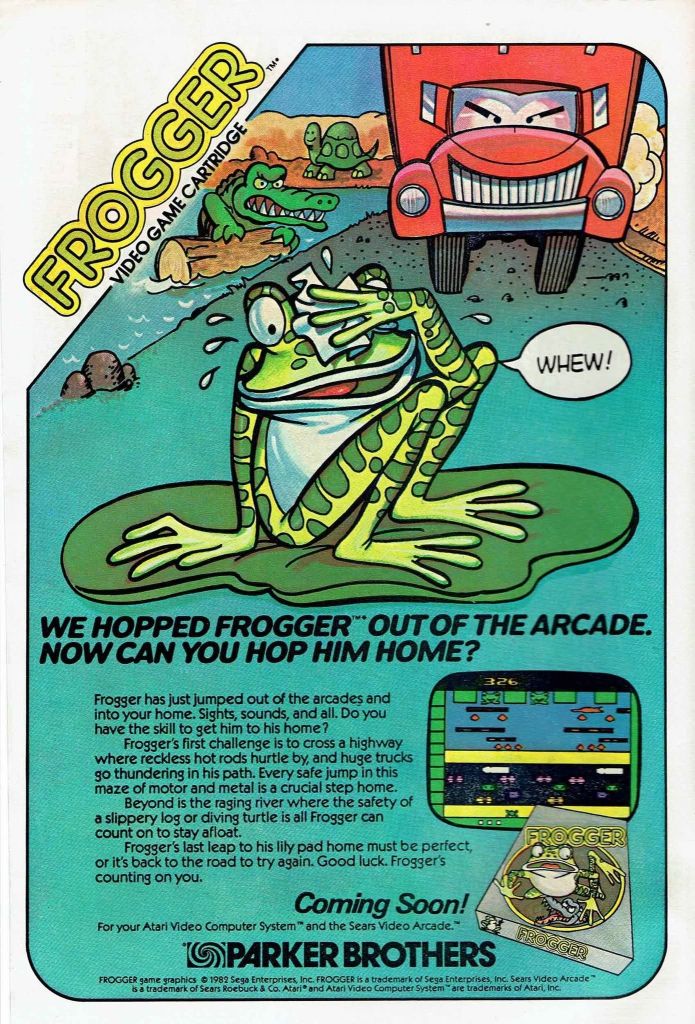
1. Frogger Print Ad
Do you find this old ad humorous?
When Frogger was first released in video arcades in 1981, it easily attracted countless gamers offering them bouts of fun and the video game critics were very impressed with it. Considering its massive arcade success, it was unsurprisingly ported to the game consoles and home computers of the time. Parker Brothers secured the license for cartridge versions and the company produced Frogger ports for not just the Atari 2600 but also the Atari 7800. This print ad they came up with had a deliberate cartoony artwork (with a touch of humor) and an artist created a hand-drawn illustration intentionally made to resemble a screenshot from the game. I saw this ad a number of times when I read comic books in 1982.
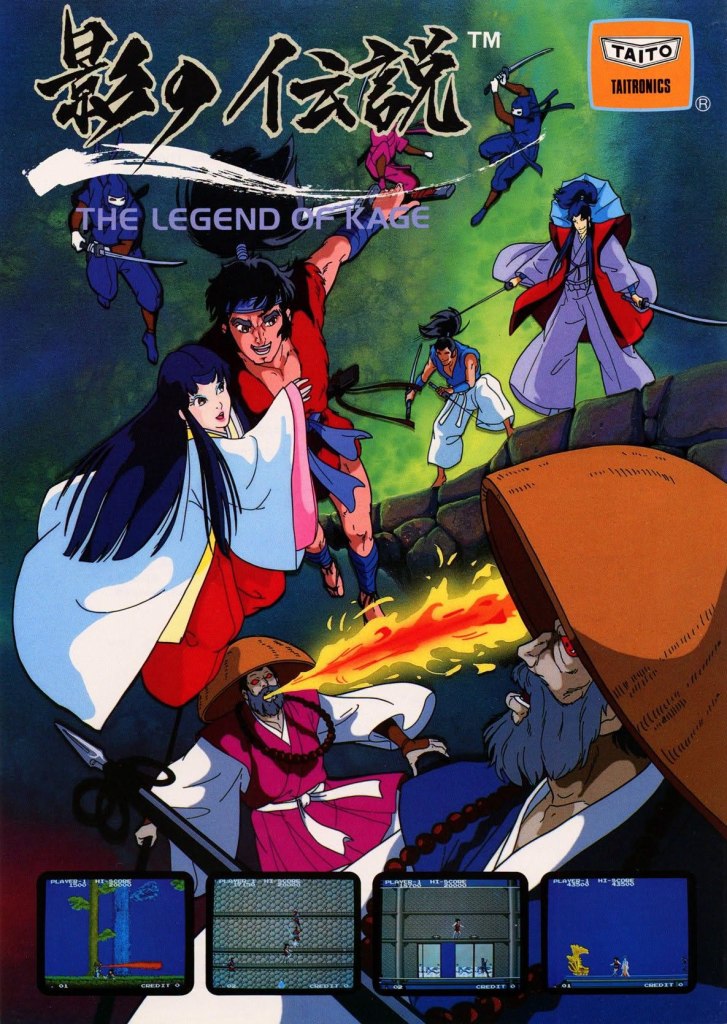
2. The Legend of Kage Japanese Arcade Flyer
Action and excitement in ancient Japan!
In my life, I never had the opportunity to play the original arcade version of The Legend of Kage and ended up playing only the Nintendo Family Computer (Famicom) port. Behind the scenes, Taito itself came close to preventing The Legend of Kage from being released in the arcades. The company placed it in a certain game show where it received praise by many which prompted Taito to give it a full arcade release. To promote the game, the Japanese arcade flyer had lively hand-drawn artwork that perfectly reflected what the game is about, who the playable hero is and what ancient Japanese setting was used. Fortunately for Taito, The Legend of Kage became a huge commercial hit and this led to the production of ports for different consoles and computers.
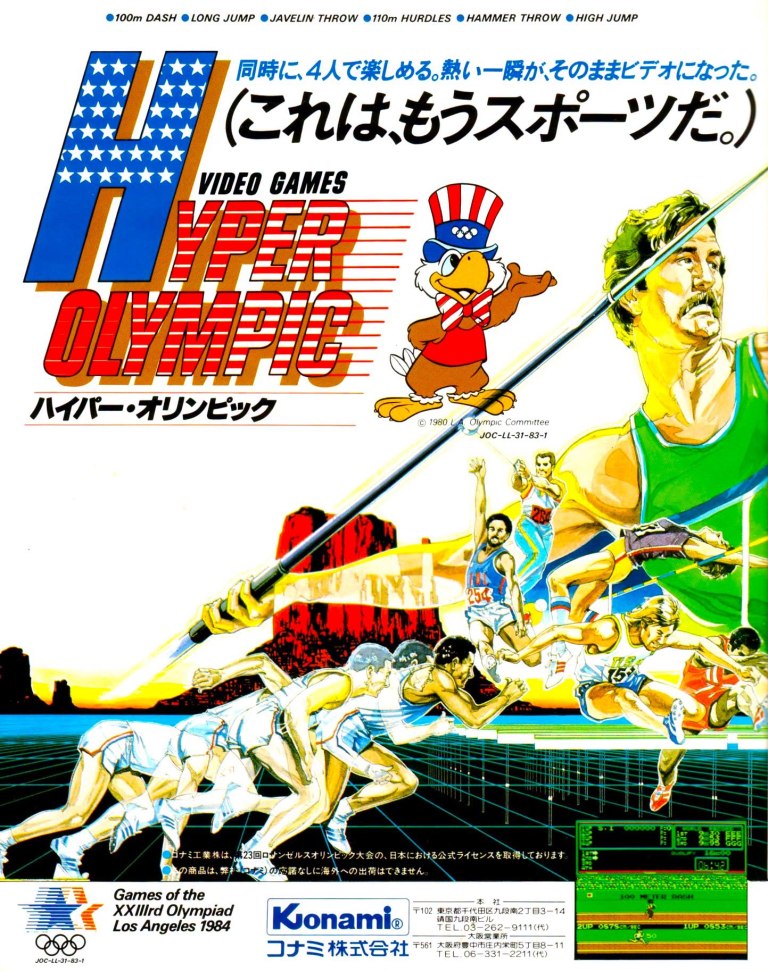
3. Hyper Olympic Japanese Arcade Flyer
Arguably the best track and field game ever made for the arcades.
In 1983, Konami released their summer Olympics-inspired arcade game Hyper Olympic (titled Track & Field in other parts of the world) which offered players the opportunities to compete in a series of events with emphasis on pressing the buttons as quickly as possible. The arcade flyer Konami came up with featured fine-looking hand-drawn artwork showing athletes competing in track and field events (with the types of events displayed at the top-most part of the flyer) while showing just one screenshot (lower right) and displaying the officially 1984 Los Angeles Olympics logo (lower left). In my view, this old arcade flyer does a good job promoting both the arcade game as well as the 1984 Olympics itself. Too bad nobody makes this kind of arcade flyer anymore.
4. Terra Cresta Japanese Arcade Flyer
Did you ever play Terra Cresta in the arcades in Japan?
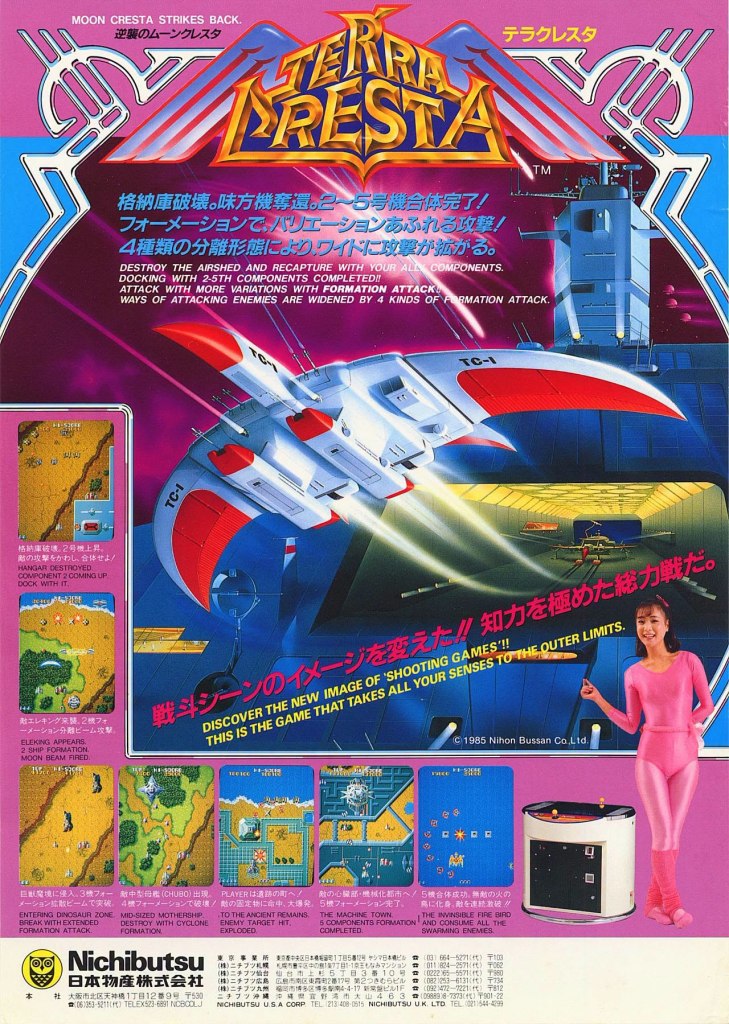
Nichibutsu, which produced a lot of arcade games that were released only in Japan, released Terra Cresta in Japanese arcades in 1985. It turns out Terra Cresta is a sequel to their 1980 game Moon Cresta which itself was their first big arcade hit game. Nichibutsu literally loaded the front of Terra Cresta’s arcade flyer with lots of visuals and details. As you can see, seven screenshots of the game were displayed (each with descriptive text), a fancy looking artwork that emphasized the science fiction setting, some English descriptive text, the cocktail table arcade machine and a pretty Japanese lady wearing an aerobics outfit with legwarmers (popular in the 1980s). This flyer truly has a strong 1980s flavor.
5. Sega Master System European Print Ad
From the early days of Sega’s console business.
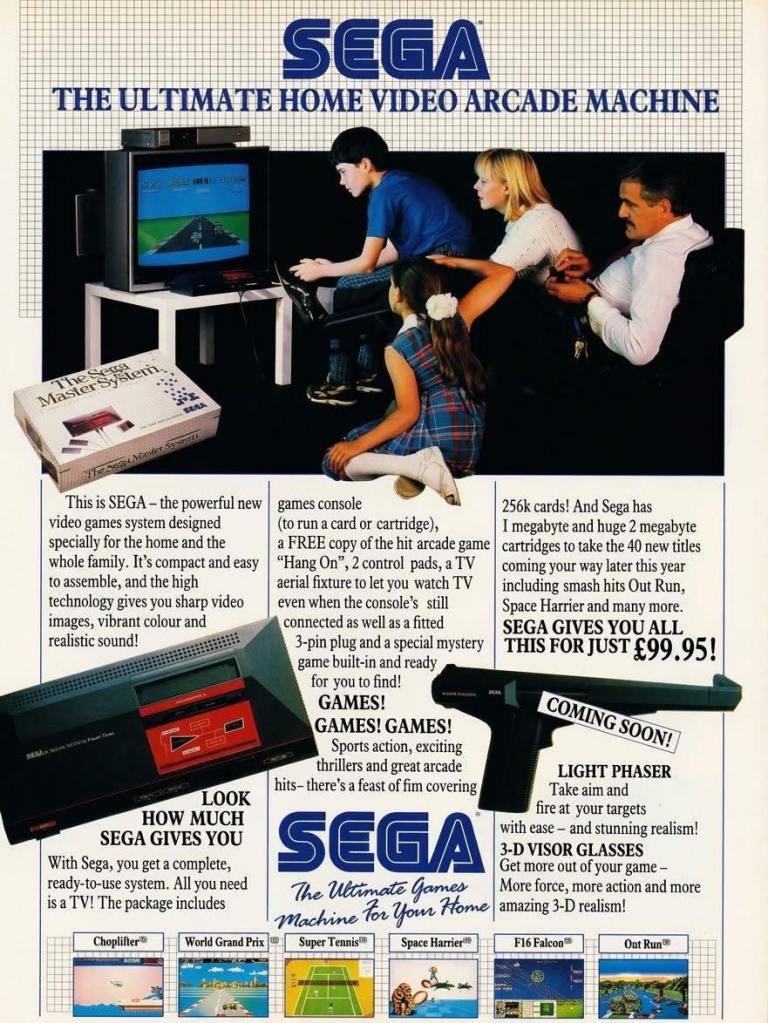
After many years doing arcade games, Sega made the bold decision to start competing in console gaming with the release of the SG-1000 in 1983 in Japan. Even though Nintendo was a very tough competitor with the best-selling Famicom, Sega did not give up and proceeded to launch their console in America and Europe referred to as the Master System. In a serious attempt to gain customers specifically in England, Sega made a print ad showcasing a family sitting in front of a TV set with the young boy playing a racing game on a Master System. Looking at how the descriptive text was presented, it was clear that Sega emphasized bringing the arcade game experience into the comfort of home while also promising that a lot more new games will be released in the near future. This is an eye-catching ad and also a fine example of aggressive marketing by Sega.
6. Ken Griffey Jr.’s Winning Run North American Print Ad
What was the best baseball video game you ever played?
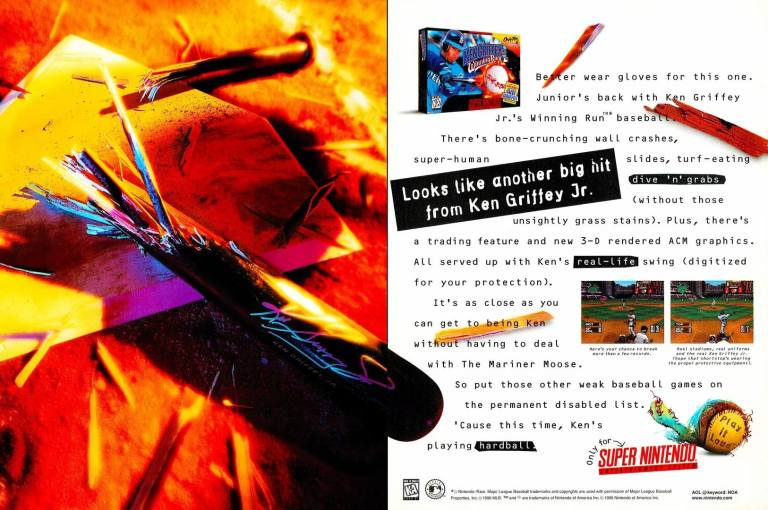
Following the commercial success of the 1994 Super Nintendo Entertainment System (SNES) game Ken Griffey Jr. Presents Major League Baseball, Nintendo got Ken Griffey Jr. again as endorser and proceeded with the follow-up Ken Griffey Jr.’s Winning Run. With the highly talented Rare (Donkey Kong Country) chosen as game developer, Nintendo was highly confident with the baseball sequel and the 2-page print ad reflected that. The Ken Griffey Jr.’s Winning Run ad had a striking image of a broken baseball bat on one side while the game’s details, two screenshots and the creative description dominated the other side. While I am not so interested in baseball, I can say that this old print ad is indeed attention-grabbing.
7. 2Xtreme North American Print Ad
From the time when the X Games were wildly popular.
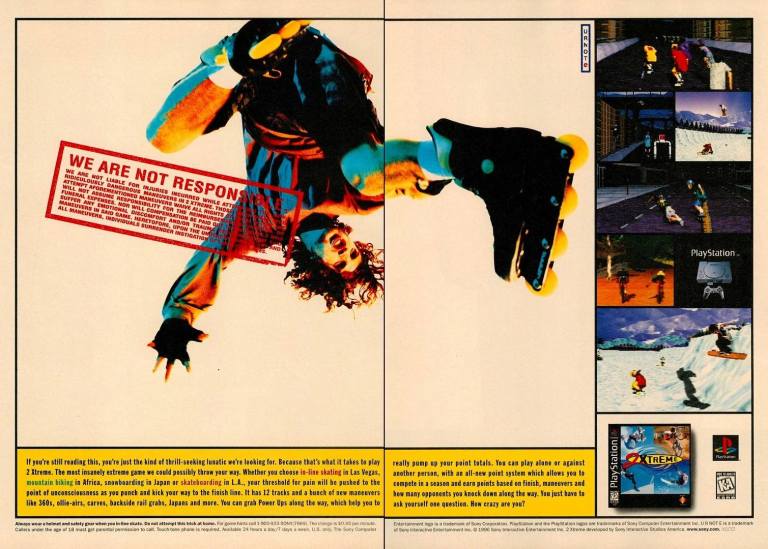
Remember how popular the X Games (Extreme Games) were back in the 1990s? Early in the life of the PlayStation console, Sony released ESPN Extreme Games which sold over a million copies worldwide. As expected, a follow-up titled 2Xtreme was approved for a 1996 release. Sony came up with a 2-page ad that had an upside-down X Games participant with roller blades dominating most of the space and six screenshots were displayed. The descriptive text in the lower part of the ad was deliberately written to be hip and cool.
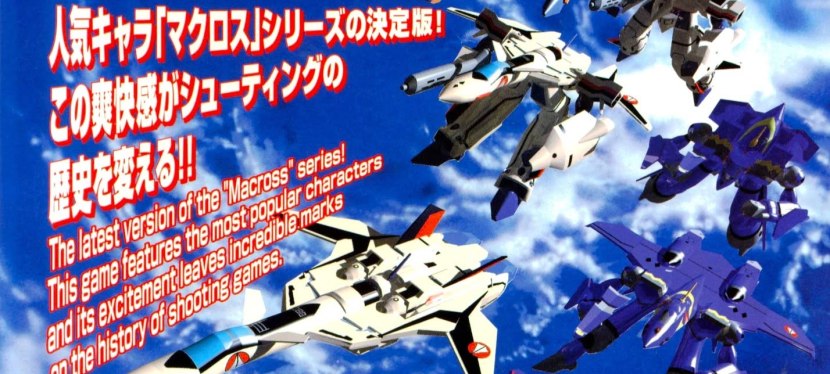
8. Macross Plus Japanese Arcade Flyer
The front.
The rear.
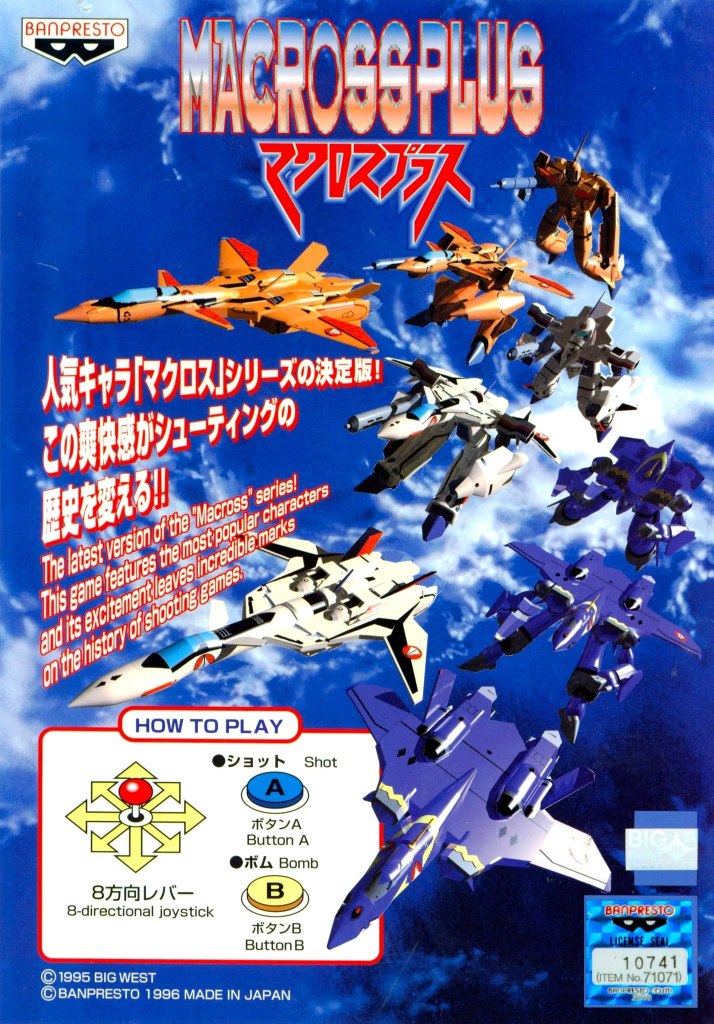
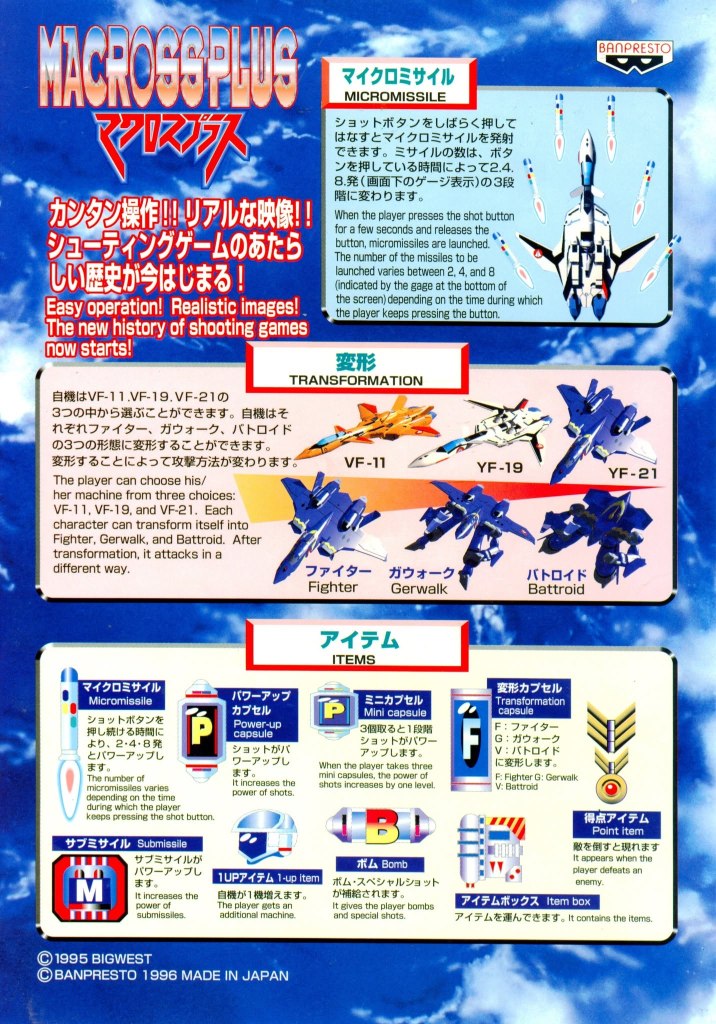
Based on the mid-1990s anime OAV, the Macross Plus video game from Banpresto was designed as a vertical-scrolling 2D shooter that captures the feel and intensity of the anime’s spectacle. The front of the Japan-only arcade flyer showcased the YF-19 Excalibur, the YF-21 Sturmvogel and the VF-11 Thunderbolt (plus the basic arcade controls on the lower-left) which were all rendered in 3D polygons to delight Macross fans and gamers who are interested in new 2D shooting experiences. The rear of the flyer showed additional details and it even includes English text descriptions. Strangely, no screenshots of the game were displayed. Being a long-time Macross fan, I can say this old arcade flyer is still engaging to look at.
9. Macross VF-X2 North American Print Ad
An impressive looking print ad for a Macross video game that never got released in North America.
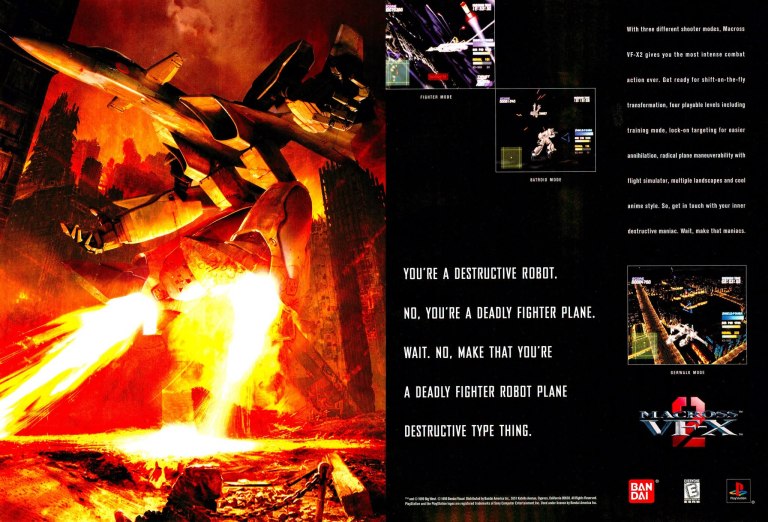
In the late 1990s, Bandai prepared to launch Macross VF-X2 (the sequel to 1997’s Macross Digital Mission VF-X) on the PlayStation console in North America. This was a very intriguing move because Bandai never brought the mentioned 1997 Macross game outside of Japan. Shortly after the official announcement of a North American release, Macross VF-X2 got featured in video game magazines, an English demo of the game (first mission only) was distributed through Official U.S. PlayStation Magazine, and Bandai came up with the 2-page print ad you see here. Unfortunately, Macross VF-X2’s North American release got cancelled because of copyright issues and legal obstacles (note: Harmony Gold held the Western rights to Robotech and actively blocked the release of genuine Macross products in America). As such, this impressive looking Macross VF-X2 print ad for North America ended up as a promotion for nothing!
10. Star Wars: Racer Arcade Japanese Print Ad/Poster
This is one of the many video games based on Star Wars: The Phantom Menace.
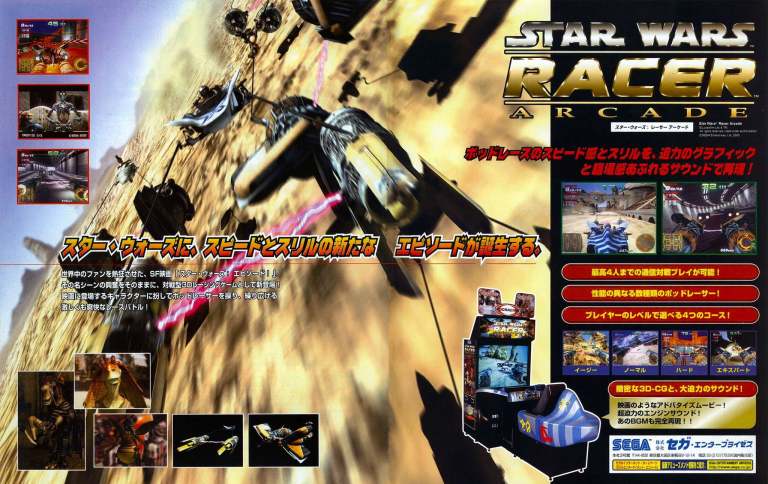
In 1999, Star Wars Episode I: The Phantom Menace was a massive box office hit in theaters around the world and it marked a new era of Star Wars movies with digital effects available. Similar with 1993’s Jurassic Park, George Lucas’ movie also had a huge lineup of merchandise, action figures and video games. The pod racing from the movie became the basis for Star Wars: Racer Arcade which was released in Japan on June 2000, and then in America a month later. To help arcade operators attract gamers and Star Wars fans, a print ad and poster were released featuring a very dynamic image of pod racing from the game dominating the background, a few screenshots displayed and some computer-generated of characters and vehicles. At the lower right part of the ad/poster is the image of the arcade machine which has a huge screen, a seat and control panel. The descriptive Japanese text was written to excite both fans and gamers. Did you play this Sega-produced Star Wars game in the arcades?
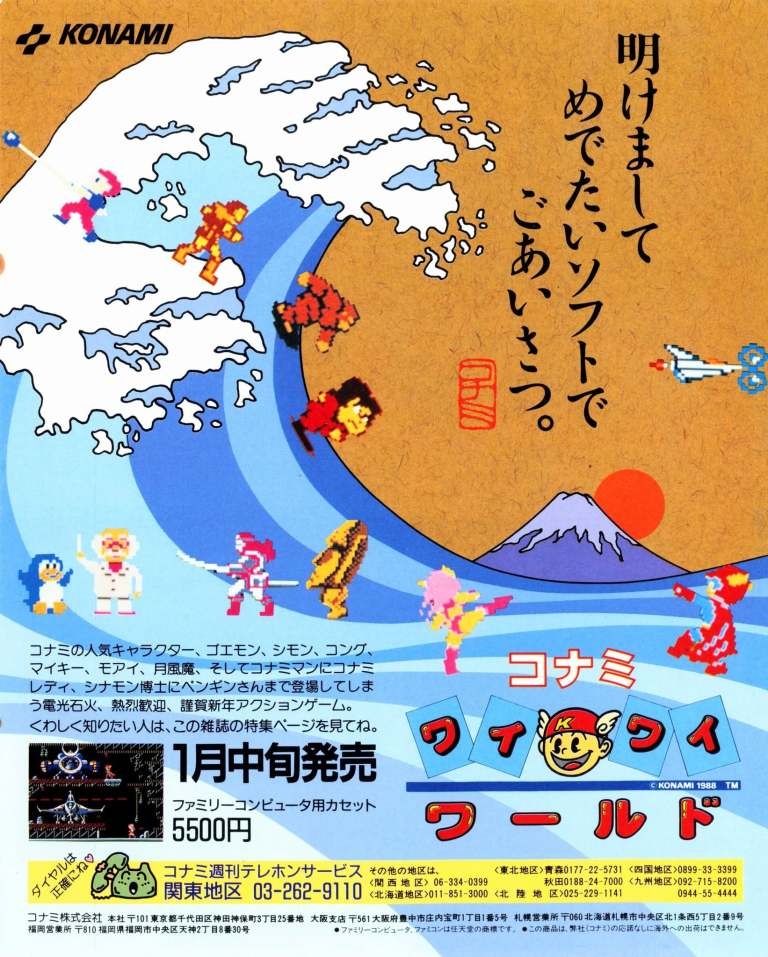
11. Konami Wai Wai World Japanese Print Ad
Can you spot Simon Belmont, Mikey Walsh and King Kong in this Japan-only print ad of Konami Wai Wai World?
Going back to the late-1980s, Konami released a 2D adventure game on the Famicom that was very ambitious as it featured side-scrolling treks, vertical-scrolling shooting sequences and, most notably, a cast of characters that emphasized crossovers between intellectual properties of gaming. I am talking about Konami Wai Wai World (sometimes called Konami World for short) which had characters, settings and elements of Konami’s own properties like Gradius, Castlevania and Twin Bee. Not only that, King Kong of King Kong 2: Ikari no Megaton Punch and Mikey Walsh of The Goonies were also featured which is astonishing because they represent entertainment intellectual properties that were licensed to Konami for video game adaptation. That said, the emphasis of crossovers and excitement was shown in the form of 2D character sprites in this Japanese print ad of Konami Wai Wai World. This is the kind of game that Konami itself will never be able to make again and to do a remake or an enhanced re-release of Konami Wai Wai World will require overcoming all the legal obstacles in the way.
Welcome back readers, fellow geeks and electronic gaming fans!
In this edition of the Retro Gaming Ads Blast (RGAB) series, we will take a look at another batch of retro gaming print ads from the 1980s to the 1990s.
For the newcomers reading this, Retro Gaming Ads Blast (RGAB) looks back at the many print ads of games (console, arcade, computer and handheld) that were published in comic books, magazines, flyers, posters and newspapers long before smartphones, social media, the worldwide web and streaming became popular. To put things in perspective, people back in the 1980s to the 1990s were more trusting of print media for information and images about electronic games and related products.
With those details laid down, here is the newest batch of retro gaming print ads for you to see and enjoy…
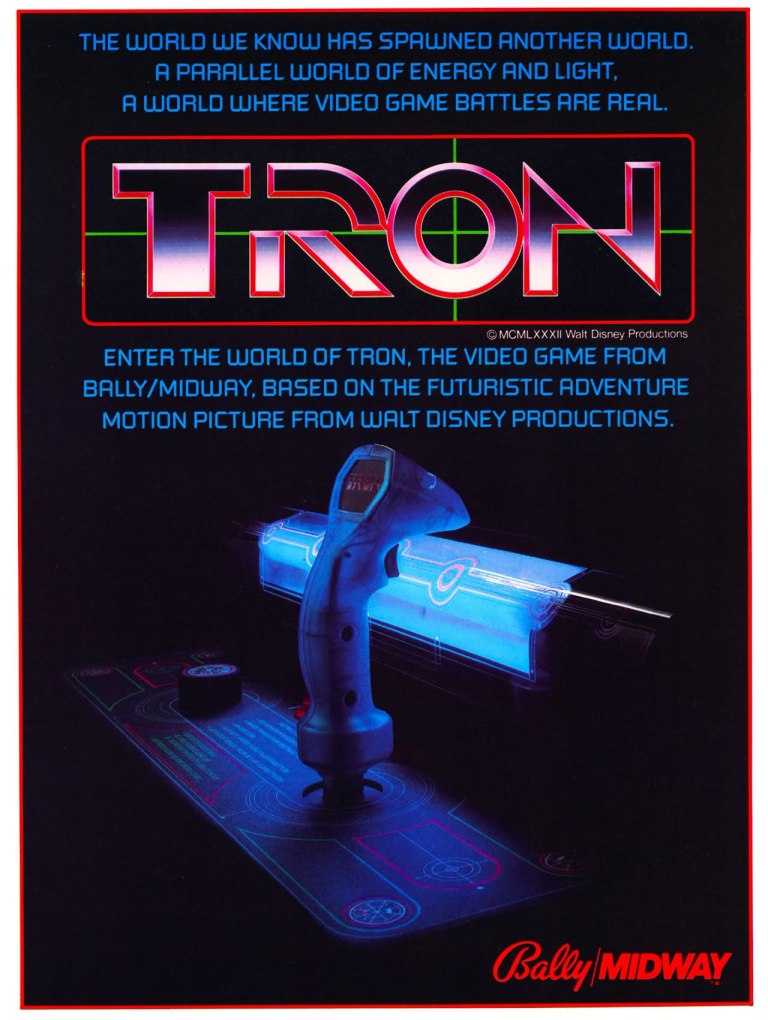
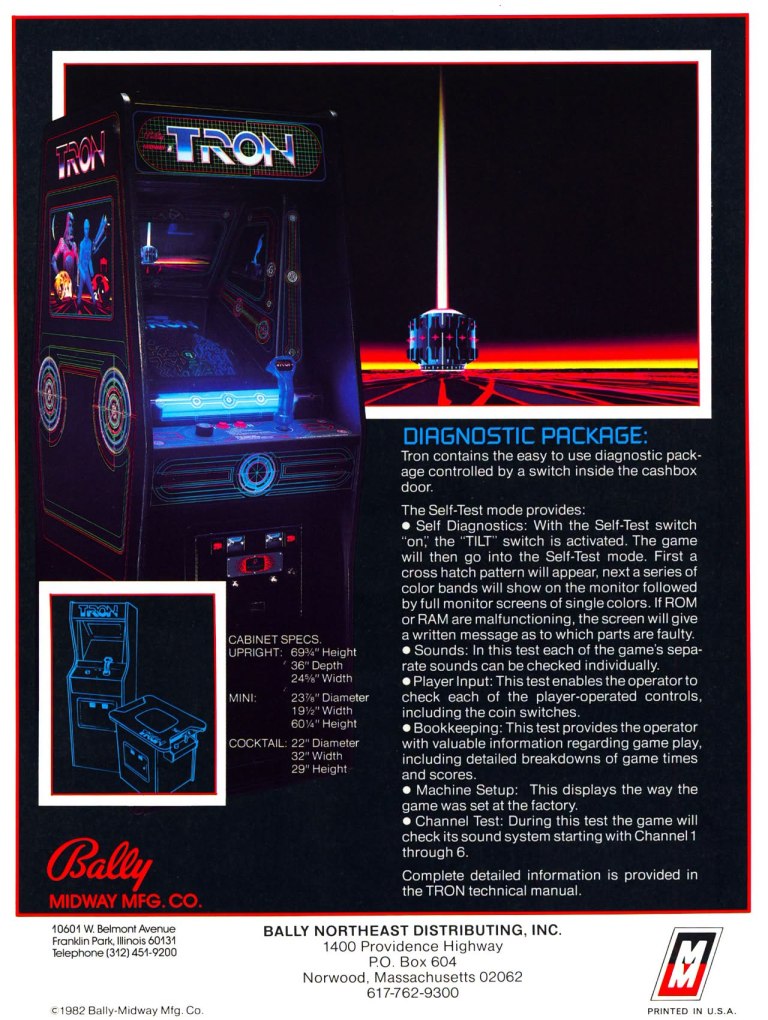
1. Tron Arcade Flyer
The front.
The rear. The details were clearly written for arcade operators.
Remember how dazzling the 1982 movie Tron was when you first saw it? That film had groundbreaking computer-generated graphics and the filmmakers worked very hard to tell a story covering both the real and digital worlds. Along the way, the movie had strong video game vibes which resonated with gamers at a time when arcade gaming was wildly popular in America. Believe it or not, an official arcade game of Tron was released the same year as the movie and it was a massive success. The arcade flyer perfectly captured the vibe and look from the movie and the machine itself had a control stick the same with what was shown to viewers. This old flyer is still great to look at.
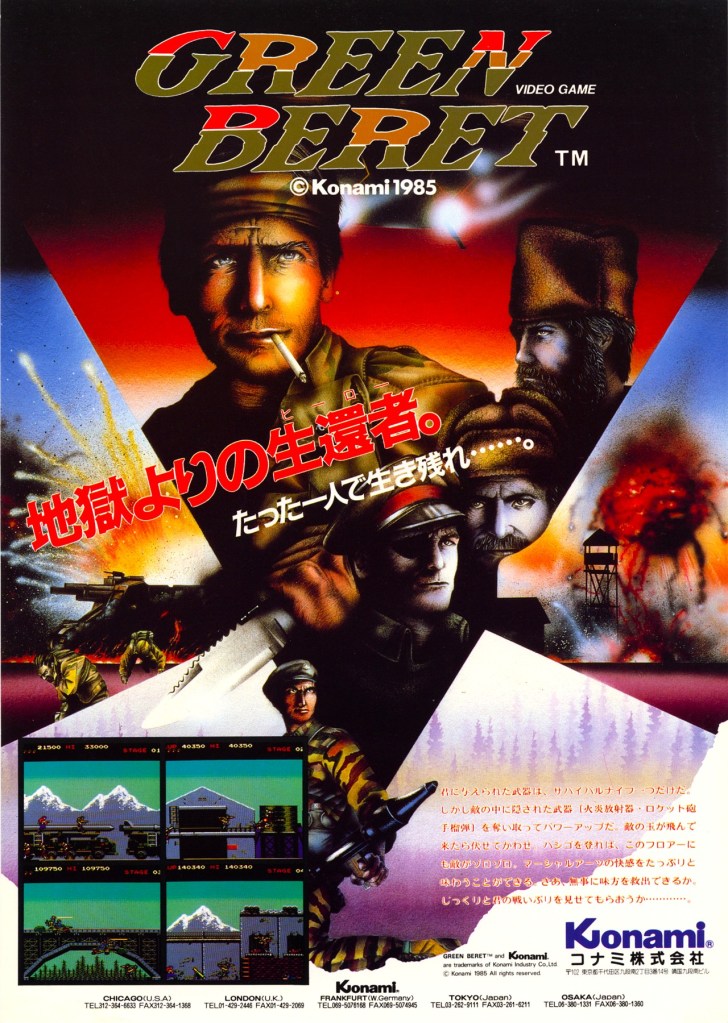
2. Green Beret Japanese Arcade Flyer
This is a very stylish flyer.
Konami was a highly prolific game publisher in the 1980s and it had lots of games that became huge blockbusters. During the decade, their game developers were strongly influenced by both Hollywood action movies and the Cold War. In 1985, Konami released the militaristic game Green Beret in Japanese arcades and to promote it, they created an arcade flyer featuring a very stylish artwork highlighting military images of soldiers (including a guy smoking) and warfare. This ad still looks great and it was not surprising it helped the game achieve huge commercial success. Green Beret was released in America as Rush’n Attack.
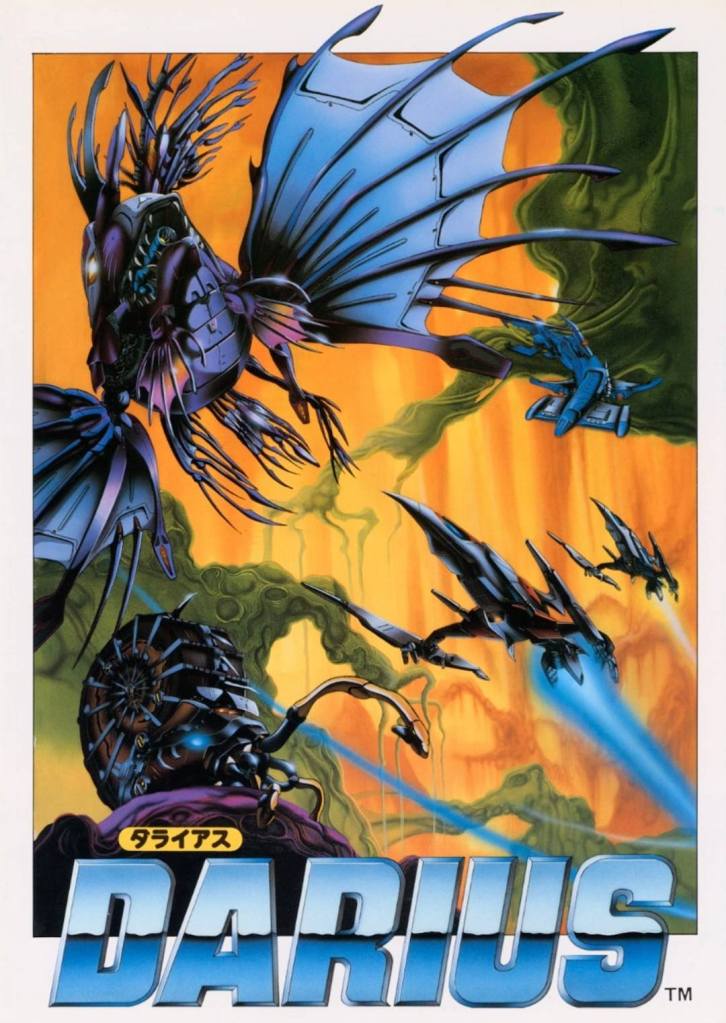
3. Darius Japanese And North American Arcade Flyers
The Japanese flyer.
The North American flyer.
Released in arcades worldwide in 1987, Darius is a 2D side-scrolling shooter game from Taito which had a science fiction concept of the starship Silver Hawk (piloted by players) which sets on a mission to destroy an evil empire before it could destroy the world called Darius. The game was successful, most notably in Japan and it eventually led to sequels being released later. What I find intriguing is how the arcade game was promoted in Japan and in North America. The Japanese arcade flyer had this intriguing artwork that reflected a blend of sci-fi with a touch of horror. The North American flyer had a strong sci-fi touch with a male and female model wearing costumes (that made them look futuristic) standing beside the Darius machine. Which flyer looks more appealing to you?
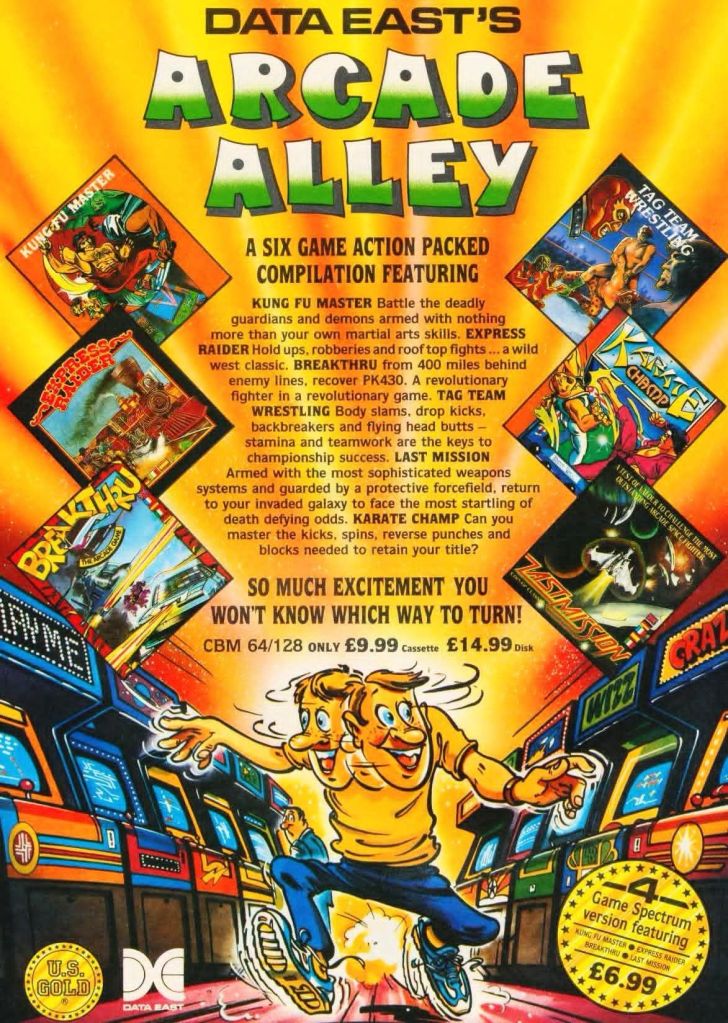
4. Data East’s Arcade Alley Print Ad
Fun and excitement emphasized in this print ad.
There is nothing like porting arcade hits to computer systems for gamers to enjoy. In 1988 there in Europe, U.S. Gold released Data East’s Arcade Alley for computer systems and it included ports of popular Data East games like Kung Fu Master, Express Raider, Breakthru, Tag Team Wrestling, Last Mission and Karate Champ. U.S. Gold’s print ad showed a guy in the middle of a video arcade looking on both sides to pick which game to play which strongly emphasized the essence of the game collection (offered in cassettes and disk). This old ad is still amusing to look at.
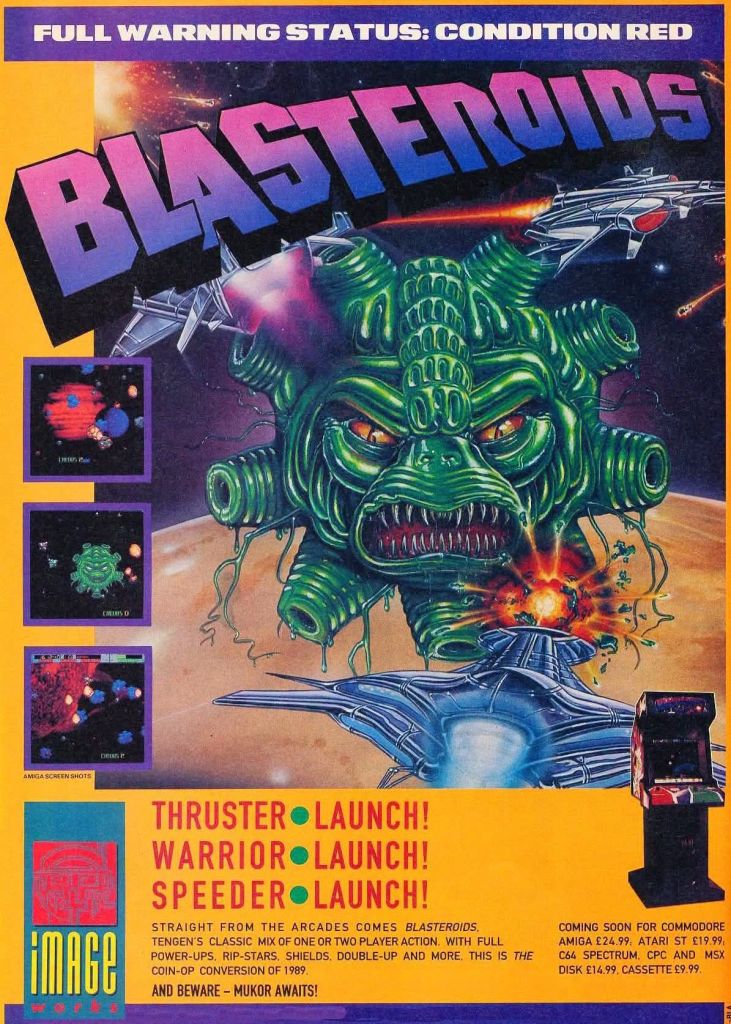
5. Blasteroids European Print Ad
Blasteroids for the Europeans.
Blasteroids, the third entry in Atari’s popular Asteroids games series, was released in European arcades by Image Works and eventually landed on computer systems there. For Europe, the ad makers came up with artwork showing a creepy, green space monster surrounded by a few spaceships to emphasize the game’s concept. The said monster eventually appeared on the game covers of the computer ports of Blasteroids later. This ad shows creative adjustments taken to promote games in different parts of the world.
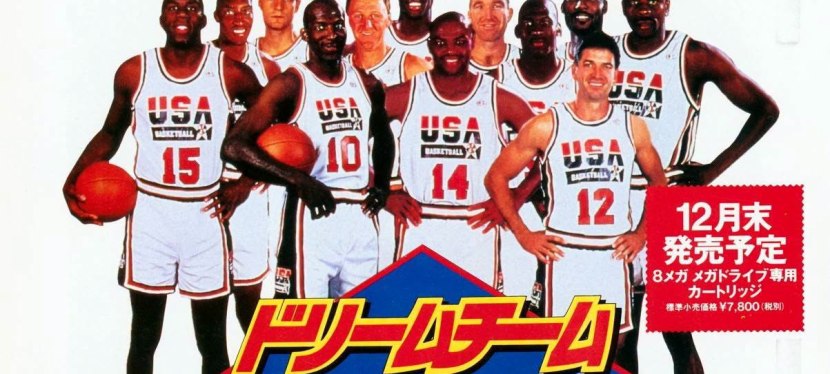
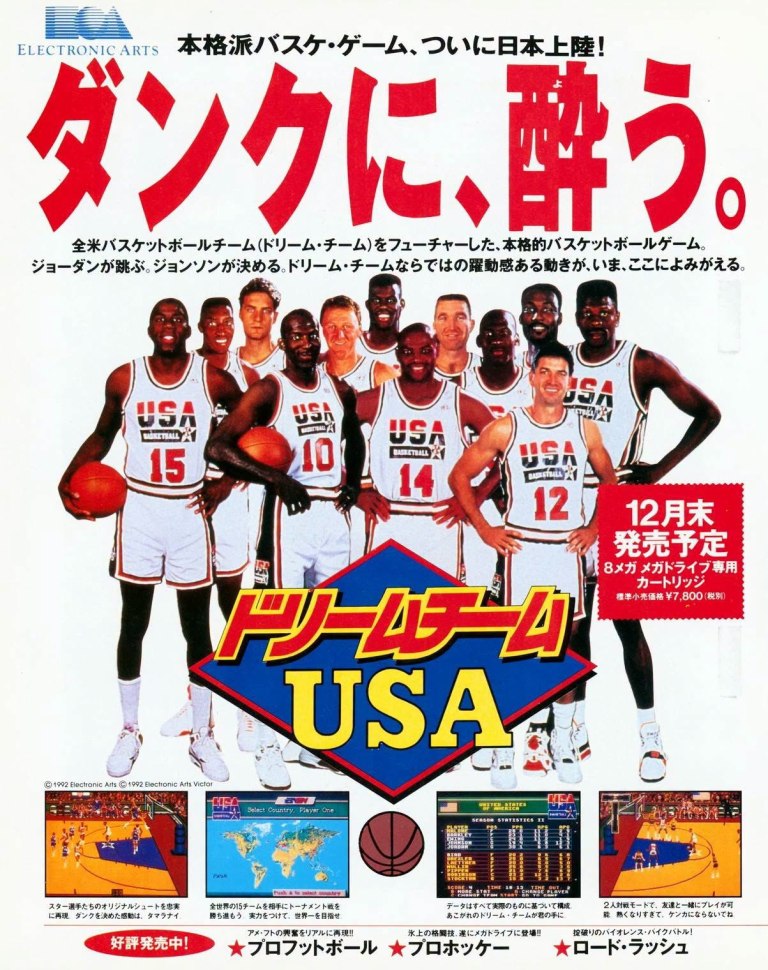
6. Dream Team USA Japanese Print Ad
The legends of the NBA in the Japanese version of EA’s Team USA Basketball. Retitling the game as Dream Team USA made more sense because “Dream Team” was a much more popular reference than “Team USA Basketball”.
Remember how wildly popular the Dream Team (Team USA in Olympic basketball) was in 1992? With NBA legends Larry Bird, Michael Jordan, Magic Johnson, Charles Barkley, Karl Malone, John Stockton and more representing America in the basketball tournament of the Olympic Summer Games in Barcelona, Spain, the Dream Team (a media-led reference for the team) was easily the main attraction not only for basketball fans worldwide but also those who craved for excitement in international sports events. That said, Electronic Arts secured the license to make an official video game about the Dream Team and actually released the game Team USA Basketball within 1992 for the Sega Genesis. As basketball is popular also in Japan, EA released the game there titled as Dream Team USA and came up with a Japanese print ad to seriously capture gamers’ attention. This ad is still effective in delighting both basketball and video game enthusiasts.
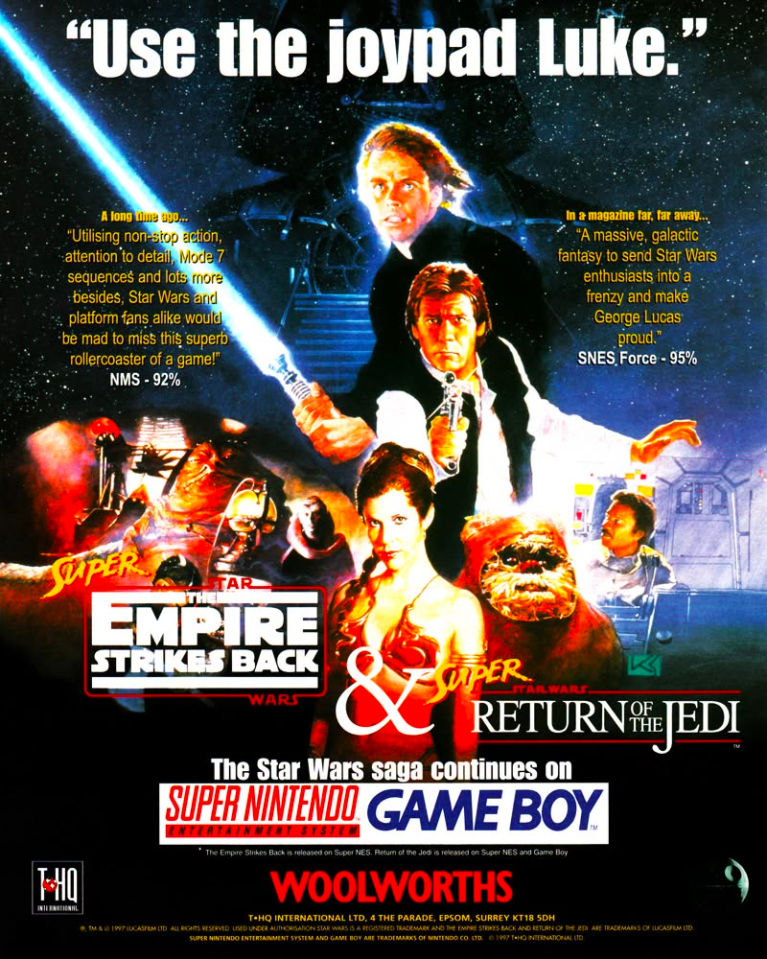
7. Super Star Wars: The Empire Strikes Back And Return Of The Jedi Print Ad
No screenshots of games used. Just the official images from the posters of the two movies.
Back in the 1990s, there was a resurgence of the original Star Wars trilogy across different forms of media. Apart from the VHS re-releases of Star Wars, The Empire Strikes Back and Return of the Jedi, there was a slew of video games of Star Wars released during the decade and the fans had new stuff to entertain themselves with. Along the way, the company THQ secured the rights to Super Star Wars: The Empire Strikes Back and Super Star Wars: Return of the Jedi for re-release to coincide with the 1997 “Special Edition” theatrical releases of their respective movies. THQ’s print ad simply used official images of Return of the Jedi and inserted a tiny bit of The Empire Strikes Back, and they did not show any screenshots that could have been helpful for Super Nintendo Entertainment System (SNES) and Game Boy users. Still, it was smart for THQ to print two excerpts of game reviews to sell the games.
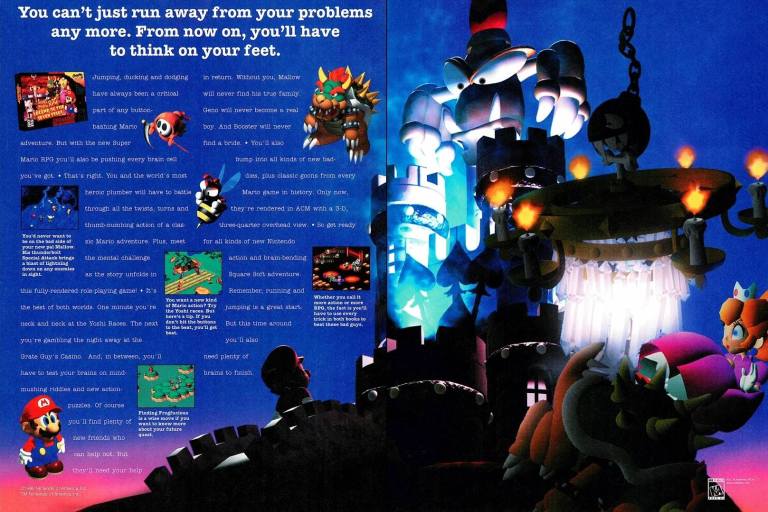
8. Super Mario RPG North American Print Ad
A mesmerizing ad for the acclaimed Super Mario RPG.
Remember back in the 1990s when Nintendo and role-playing game giant SquareSoft had a very healthy business relationship that proved successful? Before their eventual breakup (related to Square signing with Sony for PlayStation development), the two companies joined forces to make a fully featured role-playing game for the SNES featuring Super Mario and related characters…Super Mario RPG: Legend of the Seven Stars. To promote the game, Nintendo (the publisher) created a mesmerizing 2-page print ad highlighting their characters while emphasizing the role-playing and fantasy aspects of the game. At the time of its release, Super Mario was often identified with platform games and the Super Mario RPG print ad was a serious attempt to lure fans into RPGs which the SNES was already rich with. This ad, which I first saw in gaming magazines in 1996, still looks great.
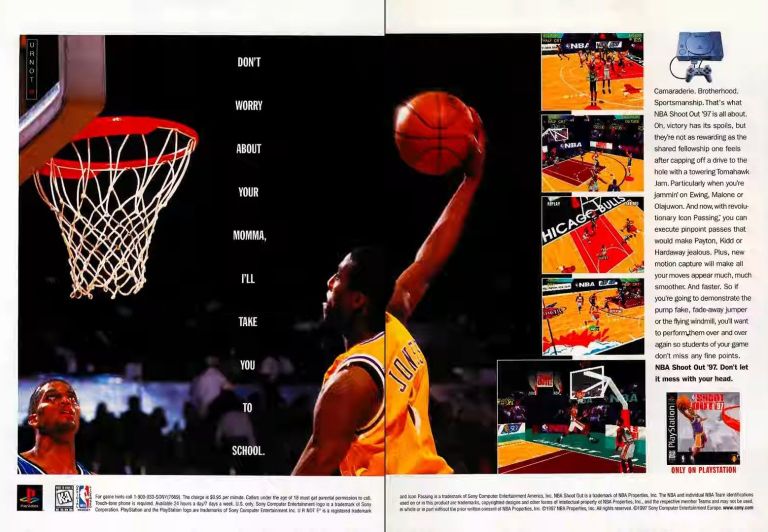
9. NBA Shootout ’97 Print Ad
Did you play this on PlayStation in 1997?
If there is anything I miss about 1990s console gaming, it is the fact that there were a lot of NBA-licensed video games that were offered to players with different tastes in basketball gaming. Sony had its own exclusive NBA games series called NBA Shootout and they were pretty aggressive selling its own basketball games along with the PlayStation going up against the likes of Electronic Arts (NBA Live), Sega and others. This is reflected in this 2-page print ad of NBA Shootout ’97 which was a PlayStation-exclusive release. They featured a photograph of Lakers’ Eddie Jones about to dunk and showed screenshots as well as the descriptive text written with excitement. Since it first started, NBA Shootout was basketball in full 3D polygonal graphics backed with motion-captured moves and dunks that players could enjoy only PlayStation. This ad is a reminder that Sony used to make official NBA games and there is a lack of variety and players’ choice of NBA gaming in today’s world.
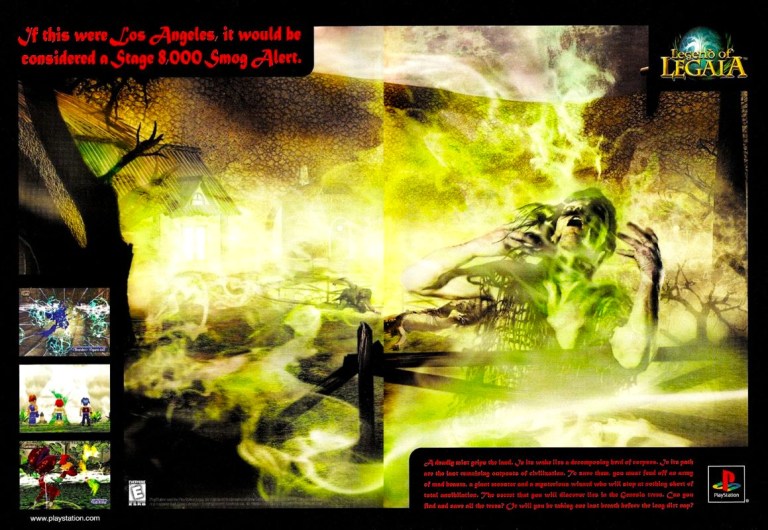
10. Legend of Legaia North American Print Ad
Perhaps someone at Sony Computer Entertainment America (SCEA) thought Legend of Legaia was a horror video game.
There was a time when Sony produced Japanese RPGs (JRPGs) exclusive for PlayStation consoles. One of them was Legend of Legaia which had a combat system that emphasized martial arts and it had an interesting fantasy concept. For its 1999 North American release, Sony came up with a very bizarre 2-page print ad that had digital artwork with a very strong horror vibe and the visual designs within the three screenshots shown were clearly not related with it. How this ad was made remains unclear. This is easily one of the most misguided gaming ads of the 1990s.
For the first half of this year, the Philippines attracted 2.9 million foreign tourists and 1.13 million of that came from the United States and South Korea combined, according to a news report by Business Mirror. The figure does not include the 260,717 overseas Filipinos or balikbayan.
When compared to its Asian neighbors’ first-half foreign tourist numbers, the Philippines is still way behind Vietnam which attracted 12.3 million and Japan which attracted 21 million.
To put things in perspective, posted below is an excerpt from the Business Mirror report. Some parts in boldface…
MORE relaxed visa entry requirements have enabled the Philippines to attract an increasing number of foreign tourists, lifting total visitor arrivals by 5.41 percent in the first half of the year.
Data from the Department of Tourism (DOT) showed 3.16 million inbound tourists from January to June 2026, of which 2.9 million were foreign nationals and 260,717 were overseas Filipinos. The latter are described as Philippine passport holders permanently residing abroad. This year’s arrivals are 76.5 percent of the 4.13 million total in the first half of prepandemic 2019.
The DOT stressed that the data are based on e-travel records provided by the Department of Information and Communications Technology, and are not final until Bureau of Immigration records are taken into account. E-travel registration is mandatory for those arriving in the Philippines except foreign diplomats, dignitaries, foreign government officials and their delegation, visiting business executives and students sponsored by the Philippine government or international organizations, and their immediate family members (9e visa).
Of the total foreign nationals, which were up 6.3 percent from the 2.73 million year on year (yoy), tourists from China and India were the most improved by 64.54 percent and 43 percent, respectively. Residents from both countries have been allowed to enter the Philippines visa-free for tourism purposes for 14 days.
The top 12 source markets of visitors for the Philippines all recorded increases, except for South Korea, with long-haul markets like Germany even showing monthly increases yoy, despite the ongoing tensions in the Middle East, which had jacked up jet fuel prices.
S. Korea plunges 13.7%– The United States continues to be the top source market for the Philippines with arrivals at 581,565 in the first half of the year, an increase of some 6.9 percent from the same period in 2025. Most of the market continues to be composed of Americans of Filipino decent, or Filipino immigrants, who visit the Philippines usually during the holiday season in December and January.
Some 300 Filipino-Americans are currently in the country as part of government’s long-running Very Important Pinoy (VIP) tour, and visiting destinations other than Metro Manila such as Cebu, Dumaguete, and Siquijor.
In second place are tourists from South Korea at 552,860, slumping by 13.7 percent, yoy. This was followed by Japan at 581,565 (+6.87 percent); China at 219,796 (+64.54 percent); Australia at 174,257 (+12.3 percent); and Canada at 156,763 (+15.6 percent), another haven of Filipino immigrants. Air Canada began offering direct flights from Vancouver to Manila in April last year, while flag carrier Philippine Airlines offers nonstop flights between Manila and Vancouver, and Toronto.
Tourists from Taiwan were in seventh place at 111,134, an increase of 11.85 percent; folowed by the United Kingdom at 92,829 (+1.7 percent); Singapore at 78,069 (0.35 percent); India at 60,583 (43.03 percent); Malaysia at 53,437 (+11.5 percent); and Germany at 48,657 (+6.9 percent).
Under the General Appropriations Act of 2026, the DOT committed to attract 6.7 million foreign tourists this year.
Let me end this post by asking you readers: What is your reaction to this recent development? Do you think the Philippines will be able to attract 6.7 million foreign tourists by the end of this year? What do you think are the three most serious problems the Philippines has when it comes to attracting foreign tourists?
Thank you for reading. If you find this article engaging, please click the like button below, share this article to others and also please consider making a donation to support my publishing. If you are looking for a copywriter to create content for your special project or business, check out my services and my portfolio. Feel free to contact me with a private message. Also please feel free to visit my Facebook page Author Carlo Carrasco and follow me on Twitter at @CarloCarrascoPH as well as on Tumblr at https://carlocarrasco.tumblr.com/and on Instagram athttps://www.instagram.com/authorcarlocarrasco
Welcome back readers, fellow geeks and electronic gaming fans!
In this edition of the Retro Gaming Ads Blast (RGAB) series, we will take a look at another batch of retro gaming print ads from the 1980s to the early 2000s.
For the newcomers reading this, Retro Gaming Ads Blast (RGAB) looks back at the many print ads of games (console, arcade, computer and handheld) that were published in comic books, magazines, flyers, posters and newspapers long before smartphones, social media, the worldwide web and streaming became popular. To put things in perspective, people back in the 1980s to the 1990s were more trusting of print media for information and images about electronic games and related products.
With those details laid down, here is the newest batch of retro gaming print ads for you to see and enjoy…
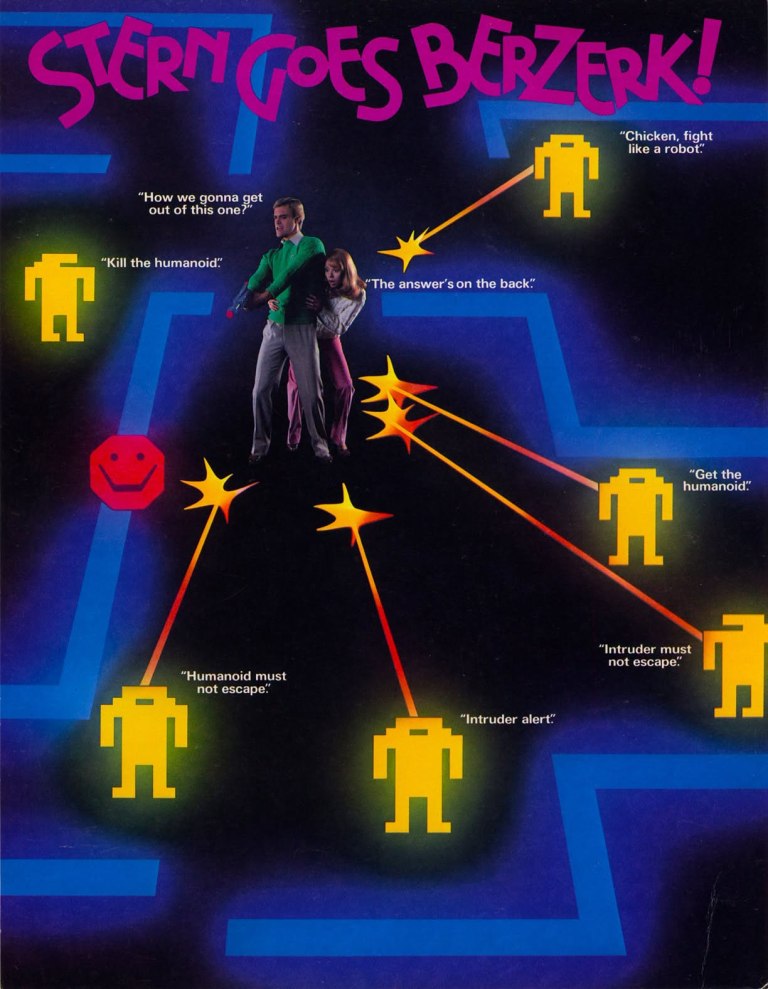
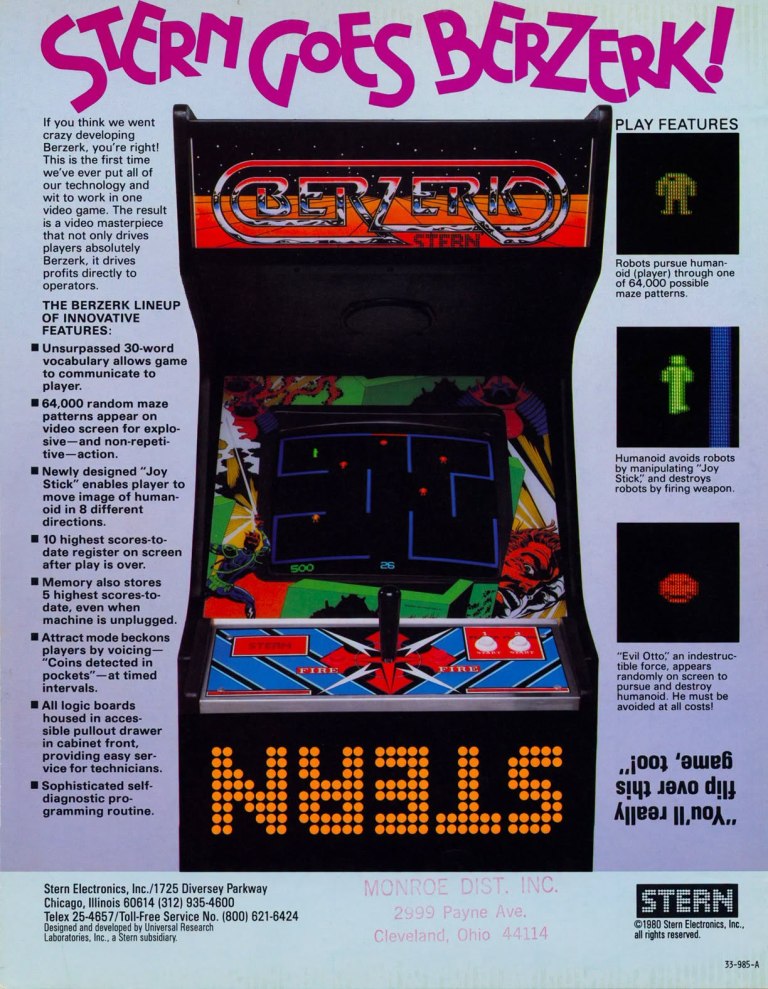
1. Berzerk Arcade Flyer
The front.
The rear.
Could you imagine being trapped deep within a maze surrounded by dangerous robots (plus one other unstoppable enemy) capable firing laser blasts at you? This was the concept behind the design of Berzerk, an arcade game released by Stern Electronics in 1980. Released at a time when science fiction became wildly popular in American entertainment, Berzerk was immersive for gamers and the multidirectional gameplay feature was captivating for many. To promote the game, Stern Electronics came up with a customized visual design that blended 2D sprite elements with a photograph of two people and some hand-drawn art pieces. The front of the flyer emphasized accurate the core concept of the game while the rear explained the technical details. They even played with their company name with the line “Stern goes berzerk!”
2. Rush’n Attack North American Arcade Flyer
The arcade flyer for North America
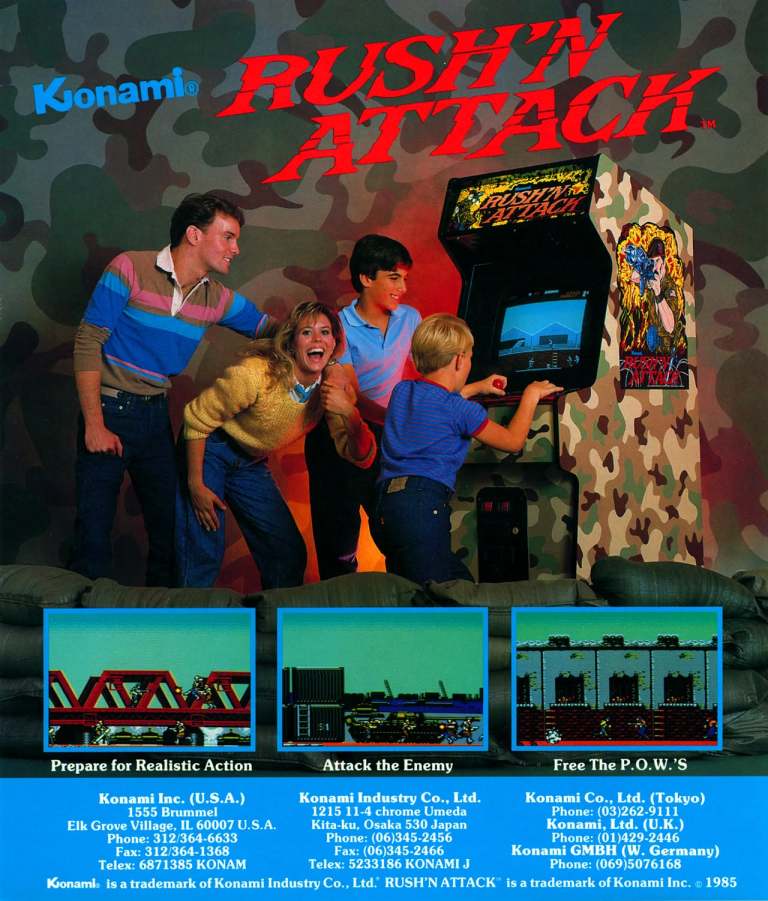
During the late stages of the Cold War, Konami made a lot of military-themed video games which resonated not only with those who were already aware about the global conflict but also with gamers who craved for action and excitement. One of those games was Rush’n Attack (alternative title: Green Beret) which was released in American arcades in late-1985. Konami came up with an arcade flyer showing four people (looking like an American family) having a good time in front of an arcade cabinet, and three screenshots of the game were displayed on the lower half. Rush’n Attack – which was deliberately titled to resemble the phrase “Russian attack” due to its obvious Cold War setting – went on to succeed commercially and critically. One notable game review compared Rush’n Attack favorably with the movie Rambo: First Blood Part II.
3. Turbo Out Run North American Arcade Flyer
The flyer.
Following the massive success Sega achieved with Out Run in 1986, the company went on to release the follow-up Turbo OutRun three years later. As seen in their North American flyer, Sega emphasized the in-game locations, the look of the machine with the driver’s seat and steering wheel, and the excitement they can expect. Turbo OutRun went on to become successful in the arcades worldwide and it got ported to a variety of consoles and computer systems in the years that followed. On its own, the arcade flyer sparked excitement for gamers.
4. Air Duel Japanese Arcade Flyer
The artwork here is captivating to look at.
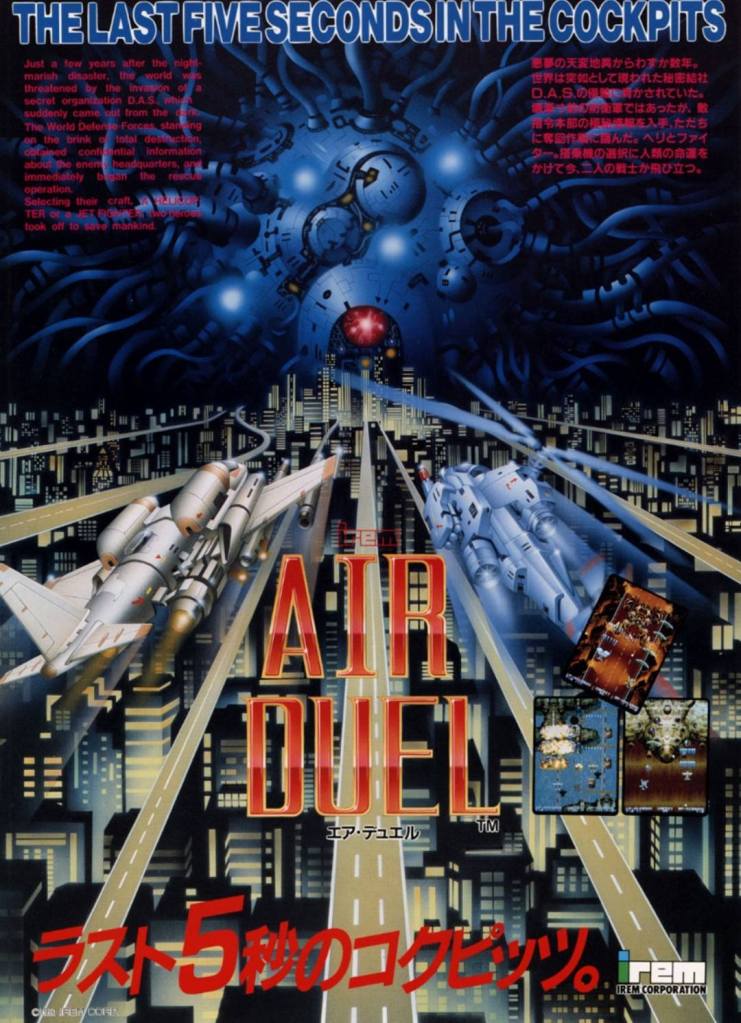
Released in Japanese arcades in 1990, Air Duel from Irem is an intense and fast-paced 2D sprite vertically scrolling shooter that attracted a lot of players. It had a war theme and its aesthetic has a mix of military and somewhat futuristic science fiction elements. The game’s arcade flyer featured a very intriguing artwork by Takashi Yamasaki showing two aircrafts flying over a city heading towards a massively large enemy in the distance. In my opinion, the artwork alone is pretty engaging to see and it’s more than enough to make me think about playing the game.
5. Spellbound Adaptor Print Ad
The Spellbound Adaptor print ad in Europe. UK design and manufacturing emphasized.
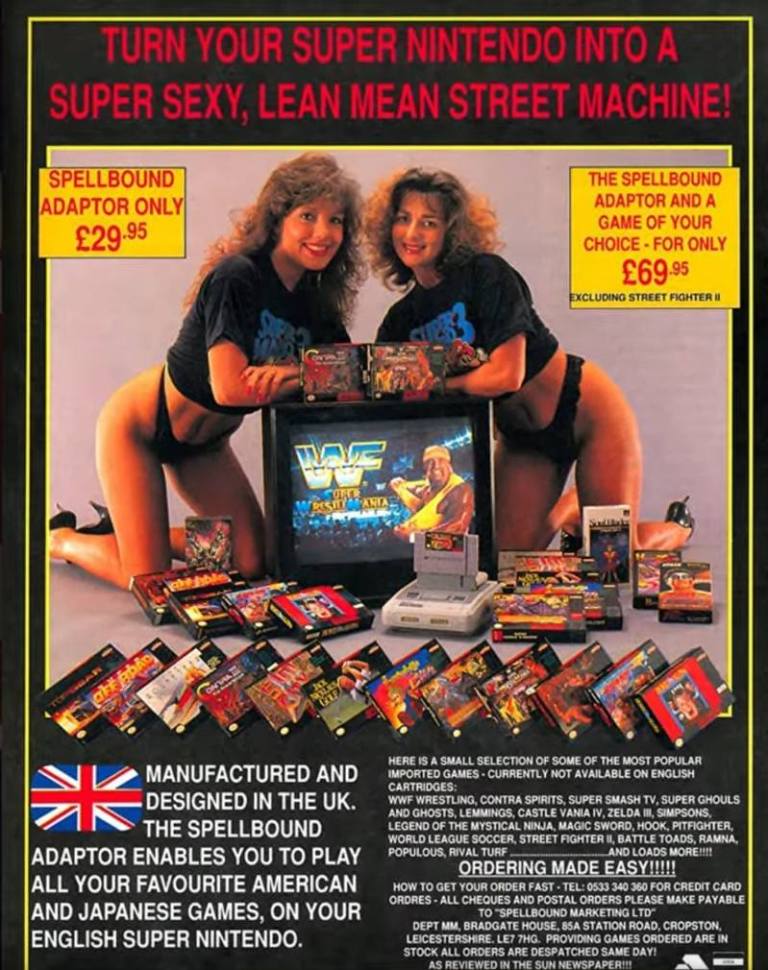
Remember back in the old days when there were hardware lockouts on game consoles that prevented users from playing games imported from different regions? In Europe, a special cheat and regional bypass cartridge called the Spellbound Adaptor was released and it allowed Super Nintendo Entertainment System (SNES) users to bypass the lockouts and play games from overseas. The Spellbound Adaptor was notably advertised in European print media showing two sexy ladies posing with the adaptor itself (on the SNES), the television and many SNES games. The ad even includes a promo of buying the adaptor with a game of choice for only £69.95. The ad is still impactful to look at.
6. Contra III: The Alien Wars North American Print Ad
Konami’s made a huge impression visually with this 2-page print ad promoting Contra III: The Alien Wars.
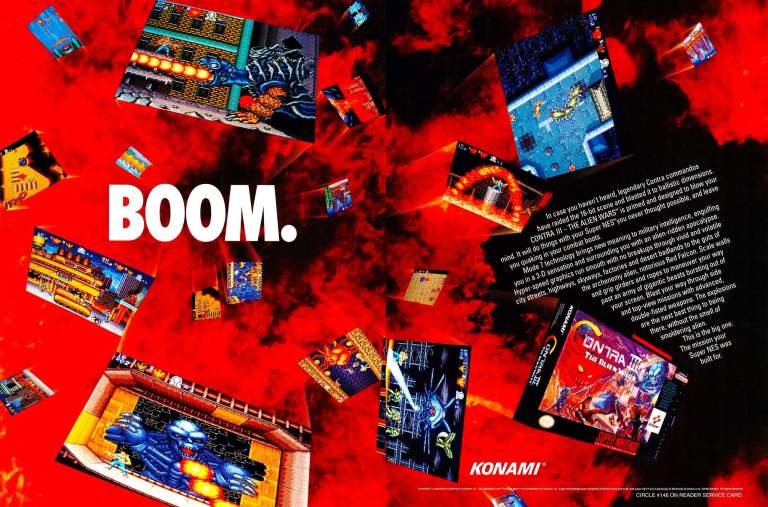
By the time the SNES was launched in America in 1991, a lot of gamers who enjoyed Contra games on the Nintendo Entertainment System (NES) have been craving for a sequel on the newer console. Their dreams finally came through in early 1992 when Konami released Contra III: The Alien Wars on the SNES, and it was a lot more than visual upgrade as it had groundbreaking features connected with the game developers’ clever use of the console’s technology. Konami was already aware of Contra’s huge following in America, so they came up with an aggressive looking print ad promoting Contra III: The Alien Wars. With a red-and-black background, the ad had a variety of screenshots that were tilted to look 3D (showing what the game offered) and used a minor space for the descriptive text and image of the game box. This old print ad is one of the finest ways to promote a sequel while also emphasizing the next-generation experience fans can enjoy. This ad is a classic!
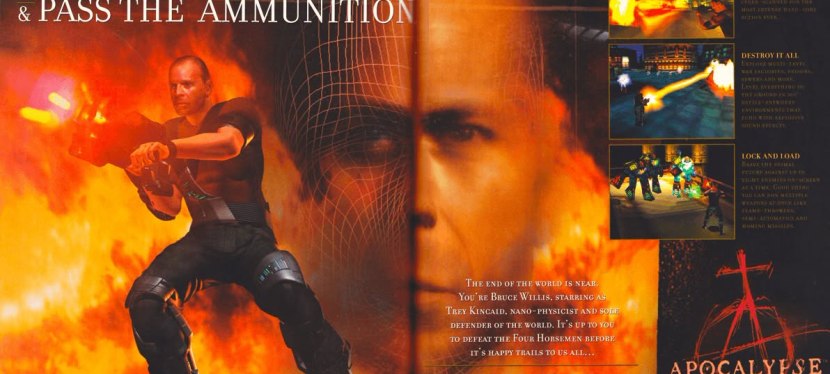
7. Apocalypse Print Ads
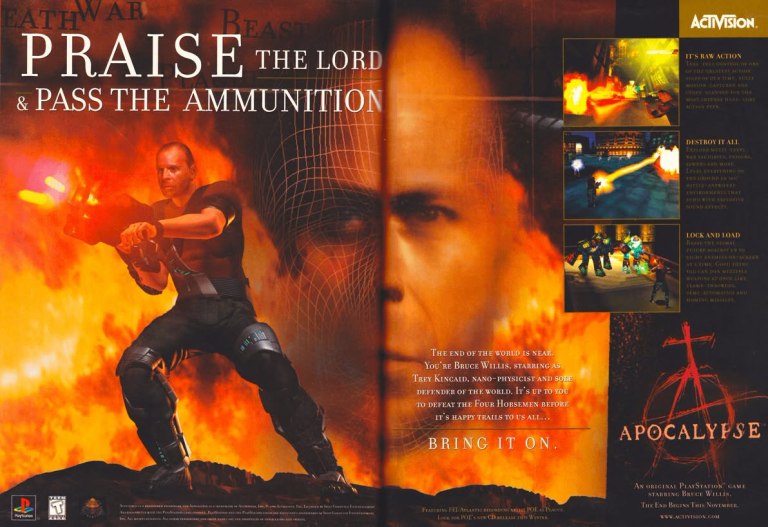
With Bruce Willis’ face, this 2-page Apocalypse print ad captured the attention of readers.
The more action-oriented 2-page print ad of Apocalypse. Bruce Willis is more visible here.
Believe it or not, Hollywood legend Bruce Willis actually starred in the ambitious video game titled Apocalypse. Before its 1998 released on PlayStation, Apocalypse started with the player character having an AI-controlled partner named Trey Kincaid to be played by Willis. Publisher Activision signed a multi-million Dollar deal with Bruce Willis to use his likeness and voice for the Trey character. Eventually the Trey Kincaid role was modified to be the playable character. Given the huge deal signed with the super star and the additional costs that came with game design revisions, Activision launched an aggressive marketing campaign for Apocalypse and they heavily used Bruce Willis’s name and imagery. Ultimately the game sold less than one million copies and yet Activision was satisfied with the sales which convinced them to go back to Apocalypse developer Neversoft for a new project.
8. R-Type Delta North American Print Ad
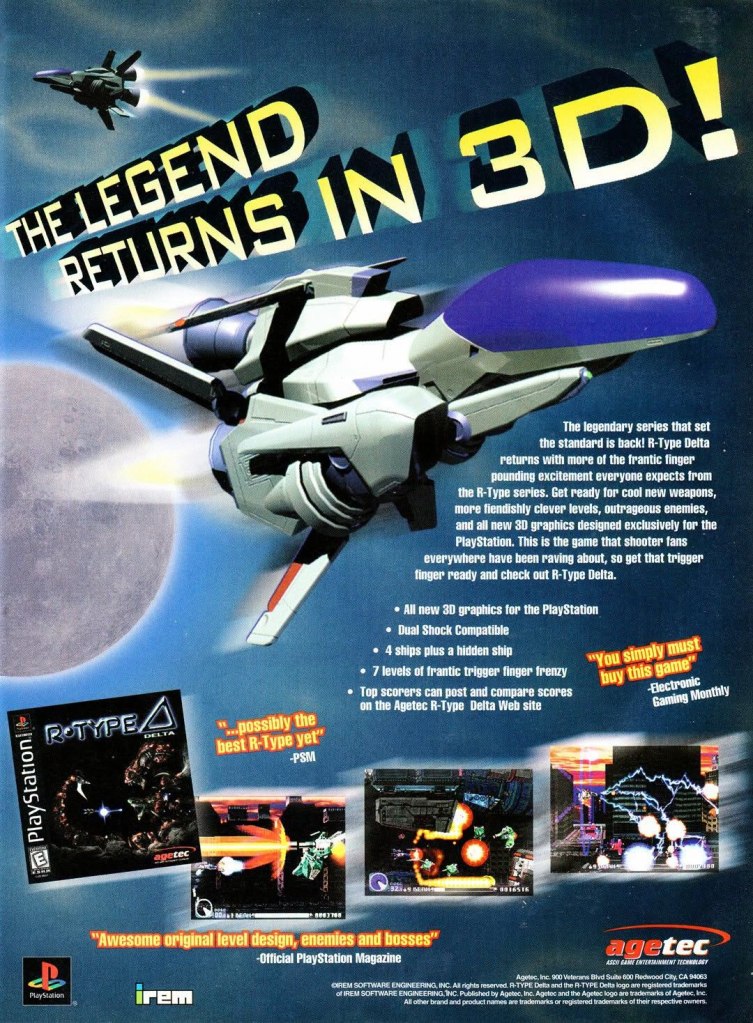
R-Type Delta was the 4th game of the R-Type series and also the first to be made with 3D polygons.
R-Type, the long-running series of 2D side-scrolling shooters by Irem, fully embraced 3D polygons with R-Type Delta on PlayStation in 1998. To promote the game in North America, Irem and their partner Agetec went all-in emphasizing their series shift into 3D polygonal graphics while promising new in-game weapons. Very smartly, they included positive quotes from Electronic Gaming Monthly (EGM), PlayStation Magazine (PSM) and Official PlayStation Magazine (OPM) to show credibility. In recent times, an enhanced version of R-Type Delta (R-Type Delta: HD Boosted) was released on modern game console and PC.
9. Racing Lagoon Japanese Print Ad
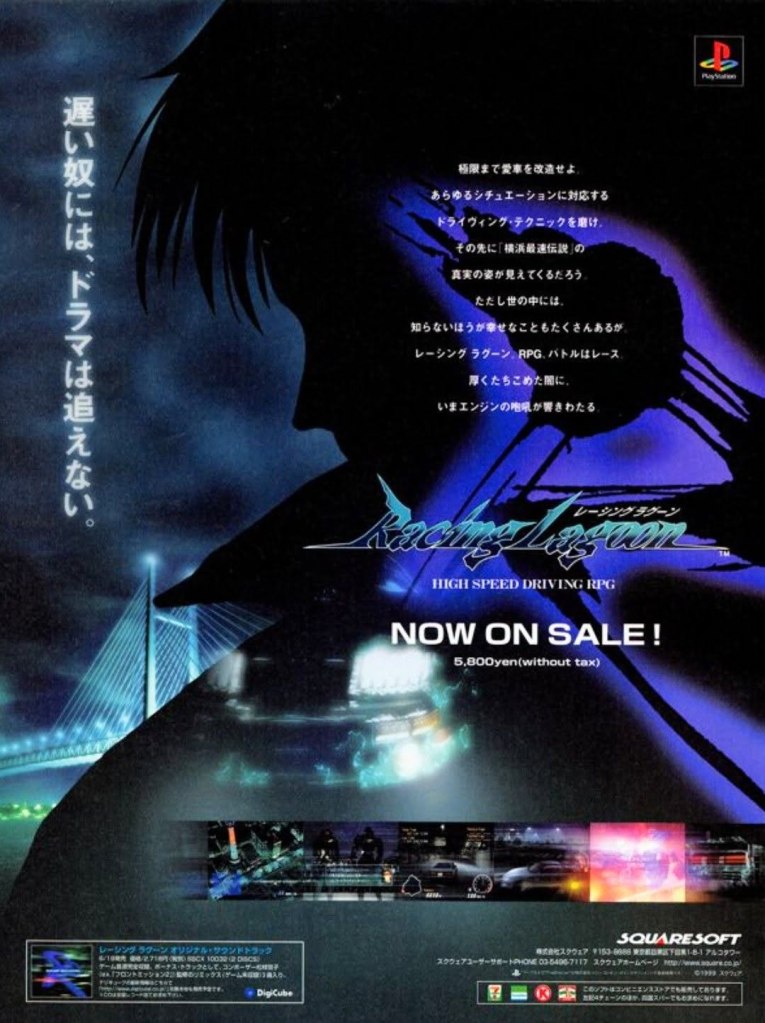
Have you ever played this game from SquareSoft?
Released in 1999 for PlayStation only in Japan, Racing Lagoon was one of many games SquareSoft made for a genre other than role-playing games (RPGs). Released at a time when the PlayStation already had lots of racing games available from around the world, Racing Lagoon was a racing game that had role-playing elements mixed in. To promote it, SquareSoft made a print ad that had a night-time city vibe and they showed some screenshots with a unique visual style. The in-game story was influenced by the illegal street racing trend that happened in Japan during the 1980s.
10. Resident Evil – Code: Veronica North America Print Ads
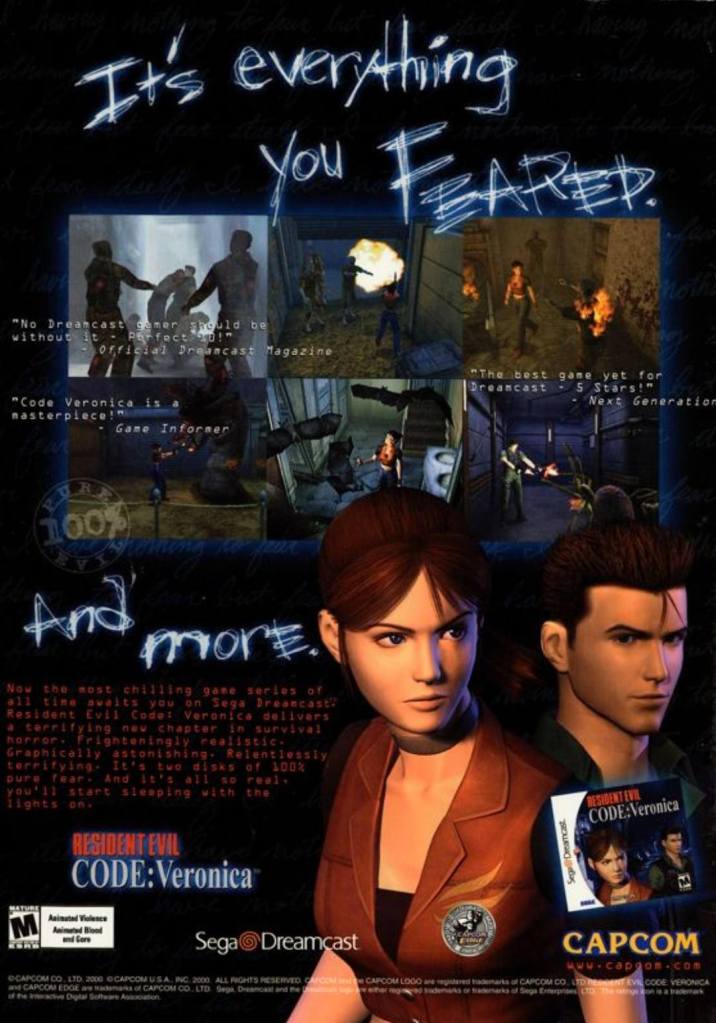
Truly a next-generation Resident Evil experience first launched on the Sega Dreamcast! I know some people who bought the console just to play Resident Evil – Code: Veronica.
The 2-page print ad of RE – Code: Veronica.
When Resident Evil – Code: Veronica was released on the Sega Dreamcast in Japan in February 2000, it delivered a next-generation survival horror experience to die-hard RE fans and it was easily one of the must-have games for Dreamcast owners of the time. Along the way, RE fans and Dreamcast owners in America were already anticipating the game. Capcom had an aggressive ad campaign for the game with US gamers in mind and this particular single-page print ad showed the fan-favorite characters Claire and Chris Redfield on one corner, six selected screenshots and quotes from the published game reviews of Game Informer, Next Generation and the Official Dreamcast Magazine. The 2-page print ad had the same elements but had the Redfield siblings on the 2nd page. I remember seeing these ads on a few gaming magazines and they made me think about buying a Dreamcast just to play RE – Code: Veronica. These old ads emphasized the strong business trust between Capcom and Sega (which itself lost a lot of money and credibility with the Sega Saturn consoles and many add-on devices released years prior).
In the latest development between the United States and the Philippines, the US Department of State announced that the two nations plan the launch of a historic economic security zone of four thousand acres which will shore up supply chains and it will be located in the main island of Luzon.
To put things in perspective, posted below is an excerpt from the fact sheet posted by the State Department. Some parts in boldface…
Under Secretary of State for Economic Affairs Jacob Helberg today announced the United States’ and the Philippines’ plans to establish a 4,000-acre industrial hub to secure inputs vital to American and global supply chains. The site is located in the Luzon Economic Corridor of the Philippines. The site—the first of its kind—is being designated by the Philippines as an Economic Security Zone, a new model for AI-native investment acceleration hubs being developed under the Pax Silica Initiative.
The Economic Security Zone is part of a broader strategy to surge production for inputs vital to U.S. supply chains. It is expected to serve as a purpose-built platform for allied manufacturing—an investment acceleration hub where the specific industrial activities are shaped by market demand, host-country comparative advantages, and the evolving needs of the allied network. Situated within the Luzon Economic Corridor, the Zone can leverage the Philippines’ geographic centrality in the Indo-Pacific, its young and technically skilled workforce, and its deepening alliance with the United States.
Structure and Planned Governance
Joint governance: The two governments intend to identify appropriate frameworks for the long-term development of the Zone that facilitate sovereign alignment and shared upside as it scales.
Enhanced Operational Certainty: The Economic Security Zone is intended to fuse American expertise in institutions and legal regimes – internationally enforceable contracts, transparent regulatory standards, and expert dispute resolution – with enhanced access to the Philippines’ outstanding workforce and talent, mineral endowments, energy resources, and strategic position at the crossroads of Indo-Pacific trade.
The Philippines and Pax Silica
Critical minerals: The Philippines holds significant reserves of nickel, copper, chromite, and cobalt—minerals increasingly vital to global supply chains.
Infrastructure: The Luzon Economic Corridor (LEC) is a coordinated, high-impact investment in key sectors, including in transportation, energy, digital infrastructure, and advanced manufacturing. The LEC will transform Luzon into a more prosperous and interconnected region while delivering value to American investors.
The Economic Security Zone
First of many: The Luzon hub is intended to be the first Zone in a broader industrial network—a constellation of integrated manufacturing sites, logistics corridors, and shared financial instruments spanning partner nations across multiple continents.
System transformation: This interconnection can transform Pax Silica industrial policy from a collection of bilateral projects into a genuine system capable of competing with—and ultimately displacing—the concentrated supply chains on which the world currently depends.
For insight, Pax Silica is the State Department’s flagship effort on artificial intelligence (AI) and supply chain security, advancing new economic security consensus among allies and trusted partners. To learn more, click here.
Meanwhile the Philippine News Agency (PNA) published its news article about this development revealing that the Philippines officially joined the Pax Silica Initiative described as a strategic coalition among fourteen states to create a secure supply for semiconductors and AI. To read the news article, click here.
Let me end this piece by asking you readers: What is your reaction to this development? Do you think both the Philippines and America will benefit from the planned 4,000-acre special economic security zone in the long-term?
Disclaimer: This is my original work with details sourced from reading the comic book and doing personal research. Anyone who wants to use this article, in part or in whole, needs to secure first my permission and agree to cite me as the source and author. Let it be known that any unauthorized use of this article will constrain the author to pursue the remedies under R.A. No. 8293, the Revised Penal Code, and/or all applicable legal actions under the laws of the Philippines.
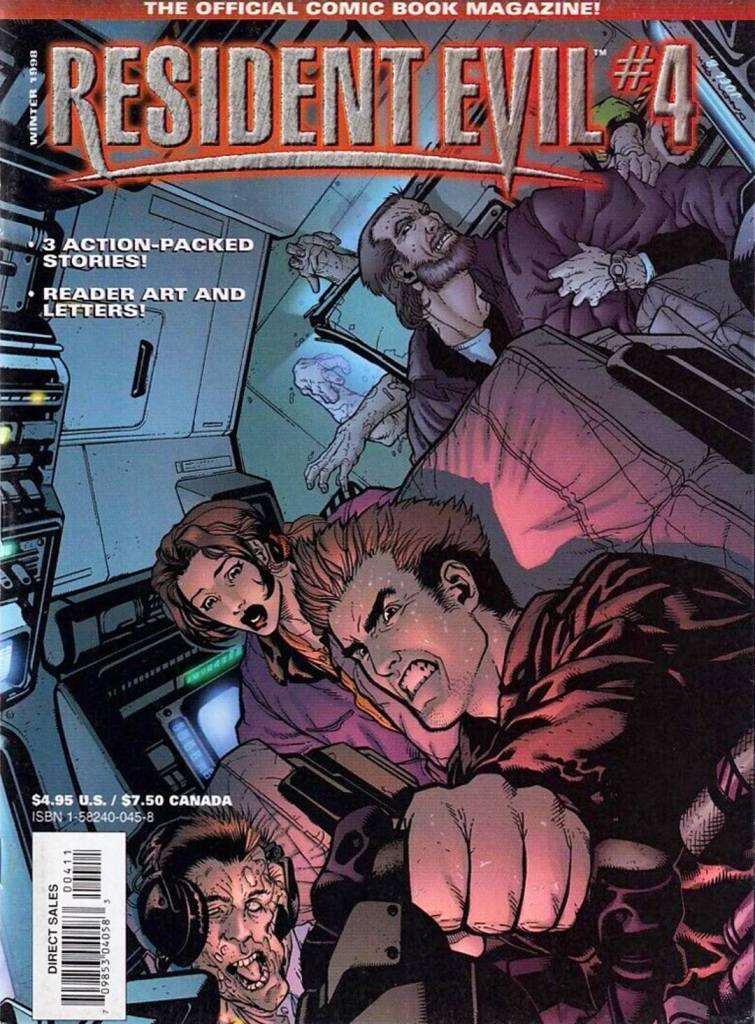
Welcome back, 1990s arts and culture enthusiasts, video game enthusiasts and comic book collectors! Today we go back to the late-1990s to examine another issue of the magazine-sized comic book series titled Resident Evil: The Official Comic Book Magazine.
Having read the first three issues of the RE comic book magazine series, I can say that the quality has been mixed. While issue #2 had pretty bad Resident Evil 2 illustrated adaptation, issue #3 had a short story that functioned as a sequel to Resident Evil (1996) in the form of a polished fan fiction. There were other short stories that turned out serviceable to intriguing and surprisingly entertaining to read. How much creative freedom WildStorm had in its publishing deal with Capcom remains unclear.
With those details laid down, here is a look back at Resident Evil: The Official Comic Book Magazine #4, published by WildStorm/Image Comics in 1998 with short stories written by Ted Adams, Marc Mostman and Kris Oprisko, and drawn by Rafael Kayanan, Ryan Odagawa and Norman Felchie.
The cover.
Early stories
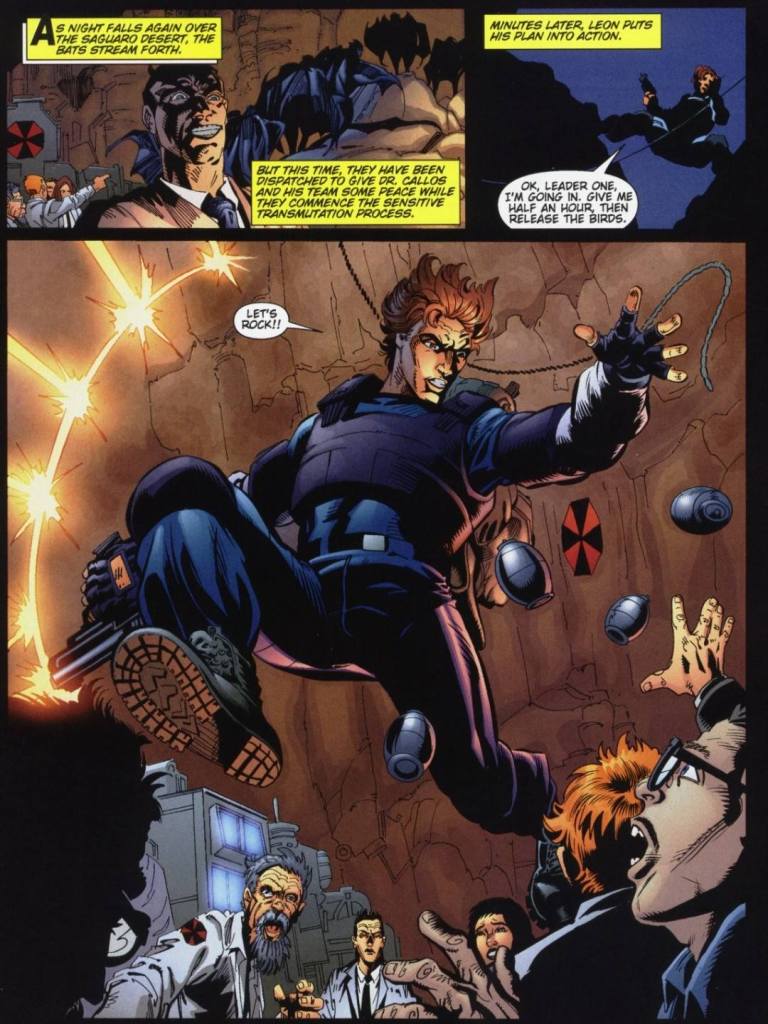
Night Stalkers – In a sleepy town in the southwestern part of America, two men suddenly got abducted by humanoid bats (referred to as “zombie bats” by the publisher) and were brought to a secret facility of Umbrella. The scientists of Umbrella have the technology to control the bats and they have already abducted many people who became helpless subjects of a transmutation process. Back in the sleepy town, the community is panicking and the son of the sheriff was rescued from a group of humanoid bats. In response to the town’s call for help, the United States government sends agent Leon Kennedy to solve their problem.
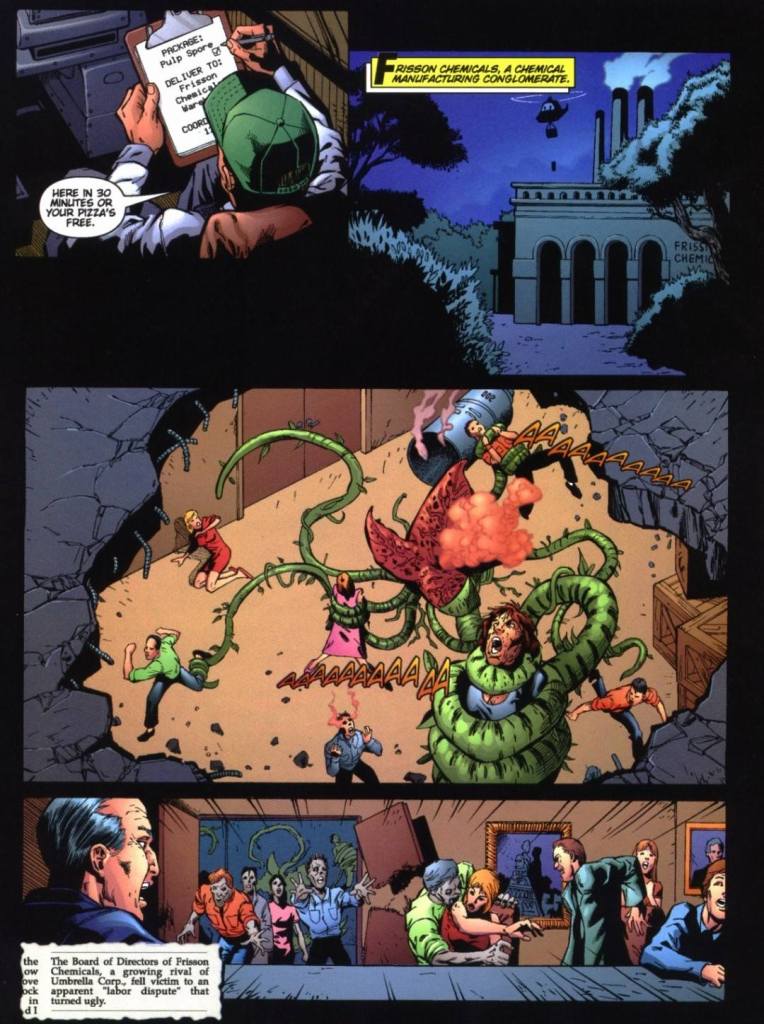
Special Delivery – Two helicopter operators working for Umbrella are tasked to lift special containers of their company’s bio-weapons. Their goal is to drop specific containers at different sites within and outside of Raccoon City. One by one, the monsters of Umbrella are dropped in some very unsuspecting laps from above.
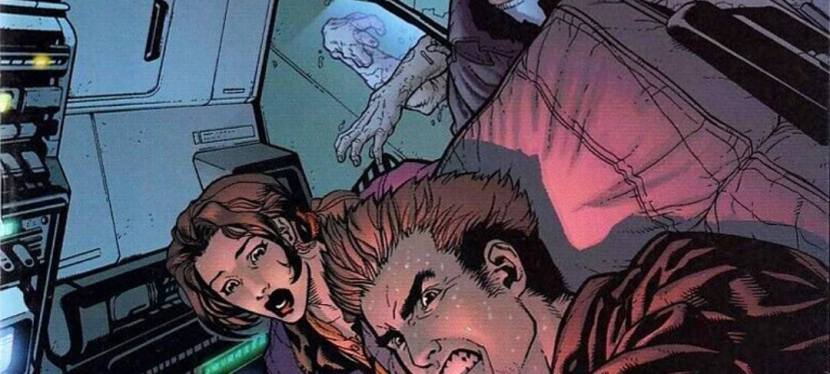
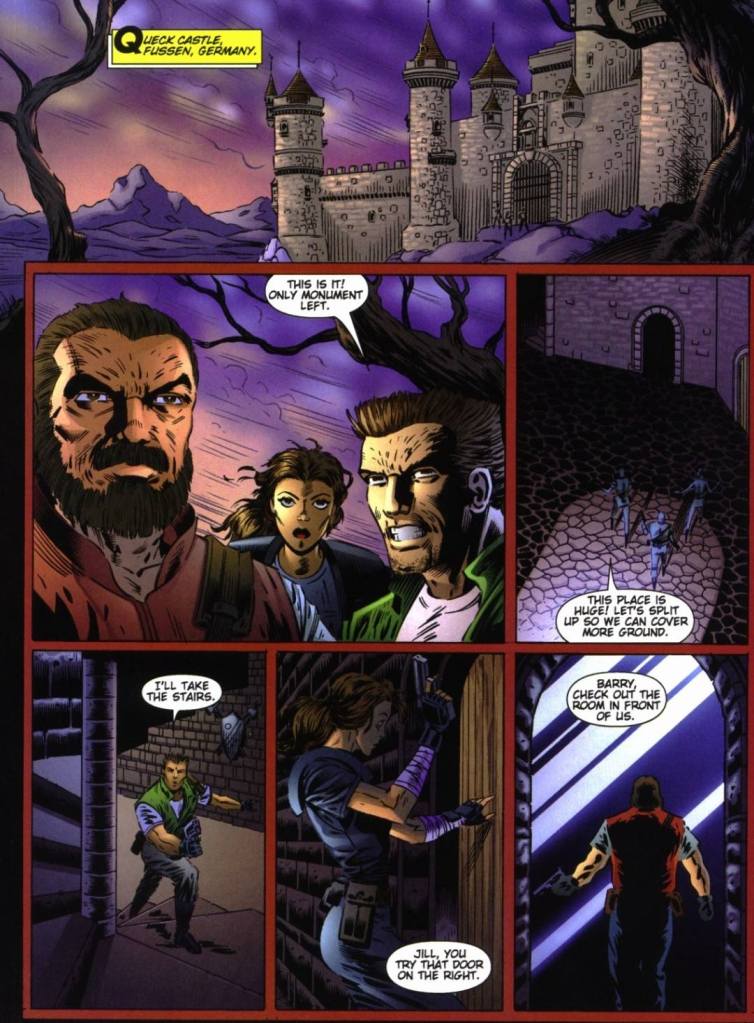
Zombies Aboard – Inside the airplane, Chris Redfield, his sister Claire and Barry Burton realize the there is nobody left to pilot the aircraft. Using the flight training he had with S.T.A.R.S., Chris takes control of the airplane.
Quality
When Umbrella’s helicopter drops its biological weapons, chaos happens.
This early, I can say that I was entertained by this Resident Evil comic book.
The first short story Night Stalkers is WildStorm’s next attempt of making a sequel to Resident Evil following Leon Kennedy on his mission to take on Umbrella and the town it affected. There are no zombies but Umbrella’s scientists and the project leader are using man-sized bats to spread the G-virus and their methods clearly caused human rights violations on the victims. This short story, which was well written and had a good structure, is actually prophetic because it portrayed Leon Kennedy as an agent of the US government and this comic book was released many years before Resident Evil 4 (2005) came out. For context, Leon Kennedy in RE4 worked for the US government and his mission was to rescue the American President’s daughter. In the short story and in the said video game, both versions of Leon Kennedy showed him being very proficient with action and he has no fear going up against multiple enemies. One has to wonder if RE creator and RE4 game director Shinji Mikami ever read Night Stalkers for inspiration. Night Stalkers is entertaining.
The brave and dynamic Leon Kennedy springs into action against Umbrella.
The second short story Special Delivery is a really intriguing look at the personnel who operated the helicopter to transport Umbrella’s monsters. This is in reference to what happened in Resident Evil 2 as Mr. X got dropped down. There are no established characters here but that’s not a problem because the story made a lot of sense and fit in nicely with the Resident Evil universe. It also shows how unethical, cold-hearted and evil Umbrella really is not only towards its business rivals but also against humanity. This one is surprisingly entertaining.
The final short story Zombies Aboard follows Chris, Jill and Barry Burton on their high-risk mission to find Umbrella in Europe and stop them from causing danger on the world. This is the continuation of Dead Air in issue #3 and it was a serious attempt by WildStorm creators to function as a sequel to the RE games of the time. With regards to its quality, the short story was structured with action and horror in mind. While the three established RE characters search for Umbrella, the story lacked depth as there is way too little detective elements in it. Instead, you will see the S.T.A.R.S. members firing or stabbing or slashing zombies they encountered from England to Germany (the story never showed the authorities reacting to the collateral damage caused by the three), and it is at the very end of the tale when the suspense and horror came in. This short story is clearly less engaging compared to its predecessor. At least the art work is good and the artist did not hold back on the violence.
Conclusion
Chris Redfield, Jill Valentine and Barry Burton search for Umbrella in Europe.
With the three stories featured, Resident Evil: The Official Comic Book Magazine #4 (1998) is just as entertaining as issue #3. For me, the only letdown was the final short story. The highlight was actually the first short story as it turned out to be very prophetic as to how Leon Kennedy would eventually turn out in video games – the brave and dynamic action hero millions of fans and gamers today enjoy.
Overall, Resident Evil: The Official Comic Book Magazine #4 (1998) is recommended.
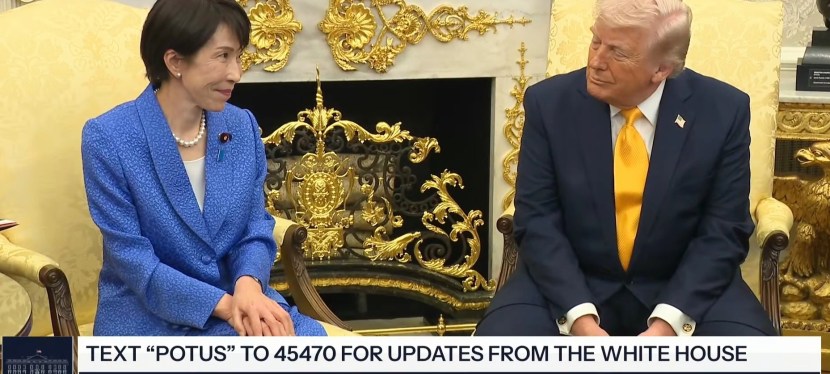
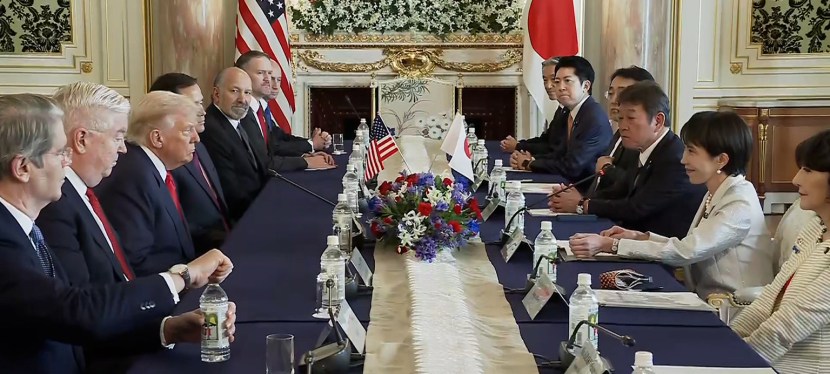
Japanese Prime Minister Takaichi Sanae visited Washington for the first time as the head of her nation and met with US President Donald Trump at the White House where they discussed very important matters in front of the media and officials, according to a news report by Kyodo News. Takaichi also praised the President for his peace efforts.
To put things in perspective, posted below is an excerpt from the news report of Kyodo News Some parts in boldface…
Prime Minister Sanae Takaichi told U.S. President Donald Trump on Thursday that Japan is ready to contribute to the safety of the Strait of Hormuz as the U.S.-Israeli war on Iran intensifies, while explaining Tokyo’s legal constraints on sending ships from its defense forces to the region.
Takaichi told reporters after her meeting at the White House with Trump that she told the U.S. leader “in detail what Japan can do and cannot do” from a legal perspective under the country’s war-renouncing Constitution.
Trump, for his part, reiterated his expectation that Japan would be engaged, while saying during the part of their talks open to media that he believes Japan has been “stepping up to the plate” in recent days over the Iran war, “unlike NATO.”
The U.S. leader has made public his dissatisfaction with Washington’s allies, including Tokyo and members of the trans-Atlantic alliance, over their reluctance to pitch in to help secure the Hormuz strait, a vital waterway for global oil transportation now largely blocked by Iran.
“I expect Japan to step up, because, you know, we have that kind of relationship,” he said. “We have 45,000 soldiers in Japan. We have, we spend a lot of money on Japan…so I expect, I’m not surprised that they would step up.“
Noting also that more than 90 percent of Japan’s crude oil imports normally pass through the strait, Trump said Japan has a “big reason” to do more.
In affirming Japan-U.S. collaboration on expanding U.S. energy production, Takaichi said she proposed to Trump a joint oil-reserve project to ease supply concerns driven by the Middle East conflict.
At the talks, Takaichi praised Trump’s “peace” efforts, expressing readiness to assist by reaching out to other countries. “Donald is the only person who can bring peace and prosperity across the world,” she said.
Takaichi emphasized that the prospect of Iran developing nuclear weapons is unacceptable. Trump alluded earlier to Iran’s nuclear program to explain the U.S. decision to launch its military campaign against the country.
Facing an increasingly assertive China, Takaichi also reminded Trump that the security environment remains severe in the Indo-Pacific, at a time when reports have emerged that some U.S. military assets are being moved from the region to the Middle East.
The two leaders “committed to peace and stability across the Taiwan Strait as an indispensable element of regional security and global prosperity” and “opposed any attempts to unilaterally change the status quo, including by force or coercion,” the White House said in a press release without naming China.
They confirmed that their nations oppose measures threatening critical mineral supplies such as export controls, senior Japanese government officials told reporters, apparently referring to Beijing’s tighter regulations on rare earths exports.
They agreed to advance broad defense cooperation, including joint missile development and production, and promote a free and open Indo-Pacific, according to Takaichi. The White House said the production of the interceptor Standard Missile-3 Block 2A in Japan will be quadrupled.
“We were able to affirm many concrete forms of cooperation that will further enhance the quality of our alliance in wide-ranging fields,” Takaichi said, adding that she and Trump are aiming to elevate bilateral ties to “a higher level” together.
Trump welcomed Japan buying “a lot of” U.S. military equipment. He further stressed that he has a “very fine relationship” with Takaichi, describing her as “a very special person” who is doing a “fantastic job.”
The U.S. side did not bring up fresh demands for Japan to spend more on its defense, the officials said.
Takaichi’s main goals in her first trip to the United States since taking office in October were to strengthen the personal trust in her ties with Trump and reaffirm the U.S. security commitment to the Indo-Pacific region as China’s influence grows.
The meeting came amid increasing concerns within Japan that the U.S. focus in terms of policy and military assets could shift from the Indo-Pacific to the Middle East if the U.S.-Israeli war with Iran drags on, a development that would work in China’s favor.
The U.S. military has reportedly begun relocating the amphibious assault ship Tripoli and over 2,000 Marines from their bases in southwestern and southern Japan to the Middle East.
Takaichi got off to a positive start in building personal ties with Trump when they met in person for the first time in October in Tokyo, shortly after she became Japan’s first female prime minister.
Since the outbreak of the Middle East conflict, Tokyo has sought to strike a delicate balance between maintaining its strong alliance with Washington and its friendly relations with Tehran.
For more insight about the Trump-Takaichi meeting, watch the videos below.
Let me end this piece by asking you readers: What is your reaction to this development? What is your impression about the many matters and announcements that happened during the Trump-Takaichi meeting at the White House? Were you surprised when it was announced that US allies Japan, Italy, England, Netherlands, Germany, and France jointly agreed to secure the Strait of Hormuz in response to Trump’s demand? With Japan having a close relationship with Trump’s America now, do you think Communist China and North Korea will feel intimidated at their side of the Pacific?
Welcome back fellow geeks, Blu-ray collectors and movie buffs!
When it comes to the seven James Bond movies that the late Roger Moore starred in, 1981’s For Your Eyes Only is my favorite. To put things short, the said Agent 007 adventure film was more grounded with reality, revived certain espionage elements used in the Sean Connery Bond films of the early 1960s, focused more on the Cold War, delivered solidly with thrills, and was ultimately more character-driven with its storytelling.
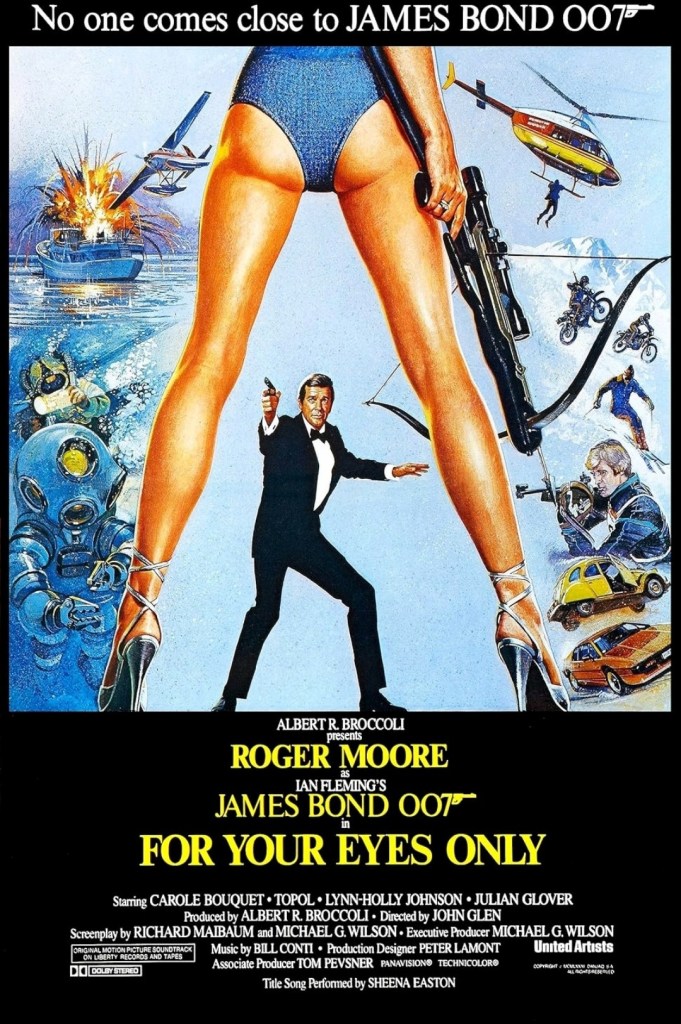
The movie poster of Fot Your Eyes Only. (photo source – IMDB.com)
In my experience, I never saw For Your Eyes Only in the cinemas. My first time viewing it was on a rented home video tape (Betamax). In the 1990s, by chance I replayed the movie on cable TV. I bought a DVD copy of the movie in 2009.
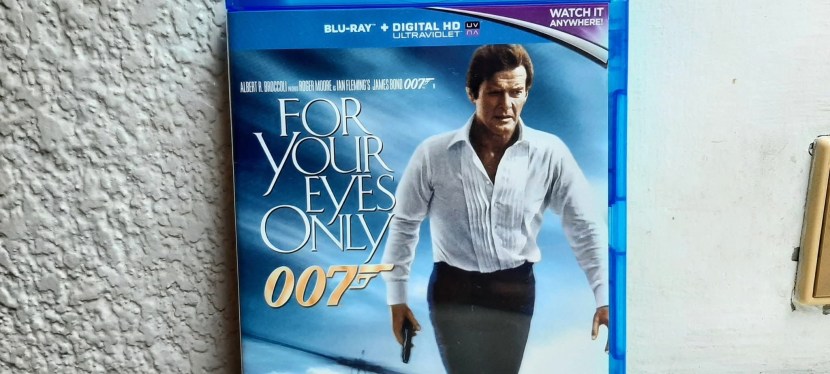
Very recently, I had my first-ever high-definition (HD) viewing of For Your Eyes Only on Blu-ray which is my latest purchase this year. I bought it for a little over $8 (delivery fee excluded) on Amazon.
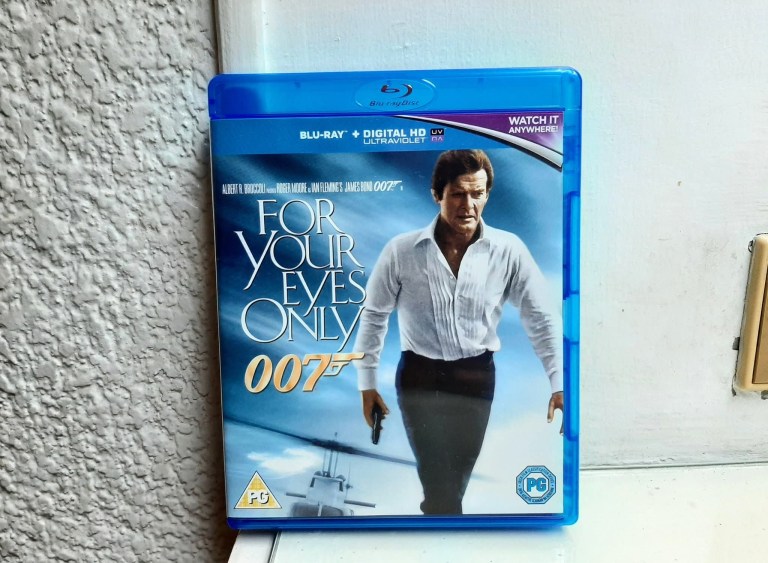
My Blu-ray copy of For Your Eyes Only. I bought it for a little over $8.
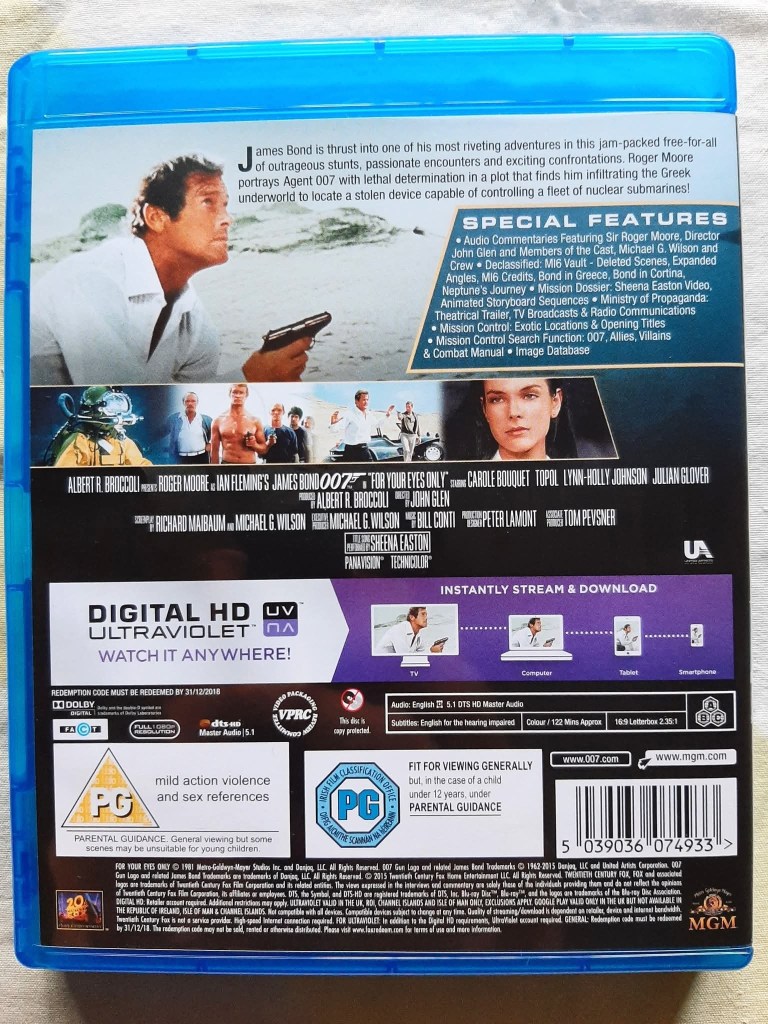
The rear of my Blu-ray copy of For Your Eyes Only.
As of this writing, I replayed For Your Eyes Only in HD twice with my Blu-ray copy and I can say that I enjoyed the Moore-led Bond movie yet again. While the film is not exactly spectacular with regards to visuals as it was recorded, it looks better than ever in HD. Apart from the higher resolution, the movie is clearer and there are more tiny visual details spotted as I watched on Blu-ray. It was nice to see on HD the film’s key moments, character development scenes and, of course, the many action scenes and stunts performed.
With regards to the extra stuff, this Blu-ray contains the exact same content made available on For Your Eyes Only DVD that I bought 16 years ago. The on-screen options as well as the visual presentation were also the same.
I am really delighted with For Your Eyes Only on Blu-ray disc format and my recent purchase resulted in a tremendous value in return. I am glad to have this classic James Bond movie in my collection as the film itself is great and it is my favorite among the seven Agent 007 movies Roger Moore starred in.
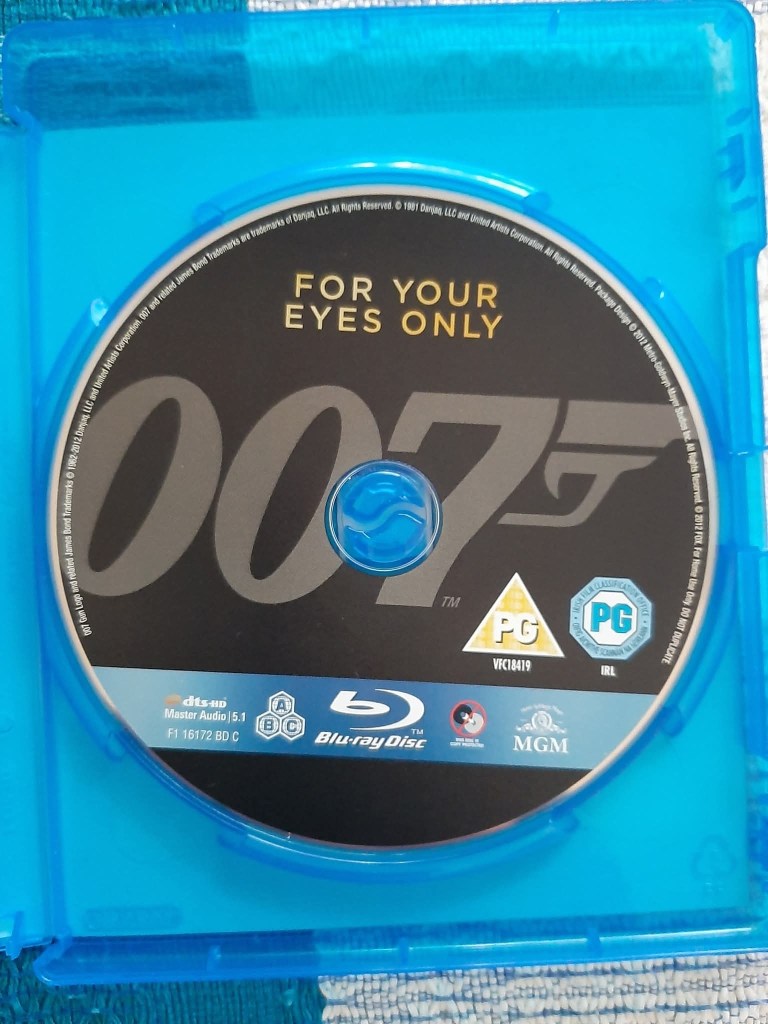
The Blu-ray disc of the 1981 James Bond movie.
If you are a long-time James Bond or if you are a newcomer who wants to the see the very best of Roger Moore James Bond movies in HD, the Blu-ray disc is still available for ordering online and you only need to click here.
For me, the next step to enjoy For Your Eyes Only would be on 4K Blu-ray (standalone release). In conclusion, I posted below the official song of the movie by Sheena Easton.
If you wish to join a group of movie enthusiasts and talk about cinema, cinematic trends, Blu-ray releases and more relevant stuff, visit the Movie Fans Worldwide Facebook group at https://www.facebook.com/groups/322857711779576
United States President Donald Trump and new Japanese Prime Minister Takaichi Sanae met in Tokyo yesterday and officially America and Japan reaffirmed its alliance, according to the English news report of NHK and other sources.
To put things in perspective, posted below is an excerpt from NHK’s English news report. Some parts in boldface…
Japanese Prime Minister Takaichi Sanae and US President Donald Trump are taking part in a series of talks and appearances during their first summit in Tokyo.
Takaichi welcomed Trump at the State Guest House in Tokyo Tuesday morning. They received a salute from a ceremonial guard of honor with Japan’s Self-Defense Forces. Soon after, the two leaders sat down for their first face-to-face meeting.
Takaichi said, “I am determined to restore Japan’s dynamic diplomacy to protect Japanese national interests. I am ready to promote further collaboration between Japan and the United States toward our shared goal of achieving a free and open Indo-Pacific. I want to realize a new golden age of our Japan-US alliance in which both nations become stronger and more prosperous.“
Trump said, “I have always had a great love of Japan and a great respect of Japan, and I will say that this will be a relationship that will be stronger than ever before, and I look forward to working with you and on behalf of our country. I want to just let you know anytime you have any questions, any doubt, anything you want, any favors you need, anything I can do to help Japan, we will be there, we are an ally at the strongest level.”
The two leaders have signed documents to cement a deal reached as a result of tariff talks.
Trump meets abductee families – After the meeting, Trump met families of Japanese citizens abducted by North Korea.
He said, “I met the families before, and I’m with them all the way, and the US is with them all the way, and with Japan and the prime minister.“
Trump also said he’s had the issue in mind since meeting late Prime Minister Abe Shinzo. He told the families the US will do everything in its power to help.
Japan’s government says at least 17 Japanese nationals were kidnapped by North Korean agents in the 1970s and ’80s. Five of them returned in 2002, but what happened to a dozen others remains unknown.
Takaichi seeks to strengthen security, economic ties with US – Ahead of the meeting on Tuesday morning, Takaichi wrote on X that she is looking forward to “having a fruitful discussion on how we can further strengthen our great Alliance.”
Trump has complained that the burden for security shouldered by US allies is insufficient. The measures include revising three national security documents, including the National Security Strategy, by the end of next year.
Japan had been aiming to increase defense spending and related expenditures to two percent of the GDP in fiscal 2027. Takaichi will likely tell Trump that Japan will instead achieve that goal in the current fiscal year.
Takaichi wants to use the occasion to build a personal relationship with Trump. She is also hoping to enhance bilateral cooperation across a wide range of fields, including security and economy.
For additional coverage of Trump’s visit in Japan, watch the selected YouTube videos below…
Let me end this piece by asking you readers: What is your reaction to this development? Are you feeling confident that US-Japan relations will improve under Trump and Takaichi? Considering the geopolitical interests of both leaders, do you think US-Japan will help turn the tide against Communist China with regards to disputes on the sea of Southeast Asia? Do you think illegal immigrants, the LGBTQ mob, the woke extremists and Islamists are now feeling uneasy about invading Japan and America?