A Look Back at X-Men 2099 #13 (1994)

Welcome back, superhero enthusiasts, 1990s culture enthusiasts, X-Men fans and comic book collectors! Today we revisit the Marvel Comics shared universe to examine one of the many tales of the X-Men 2099 monthly series.  

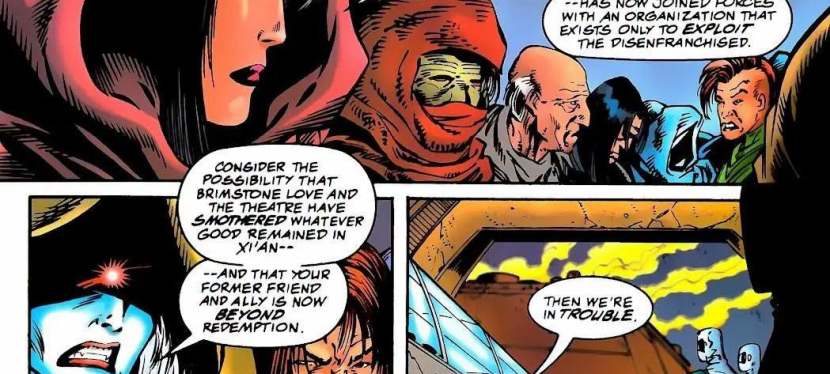
I enjoyed the way John Francis Moore put things into motion in issue #12 and other previous issues of X-Men 2099. During the 3-part storyline at the start of the series, the Synge business empire and its wing of enforcers looked like the definitive force of evil for the mutants led then by Xi’an. As the series progressed, the Theater of Pain (first introduced comprehensively in issue #4) and its leader Brimstone emerged as the new force of evil while the X-Men lost Xi’an and Skullfire became more unhinged and got more involved with Luna (the one who messed with his mind and emotions). Xi’an, who reverted back to his sinister mindset, is obsessed with finding the Driver. It should be noted that these characters are all in the middle of the wasteland in 2099’s America (for 2099 historical reference, click here).

With those details laid down, here is a look back at X-Men 2099 #13, published by Marvel Comics in 1994 with a story written by John Francis Moore and drawn by Ron Lim.
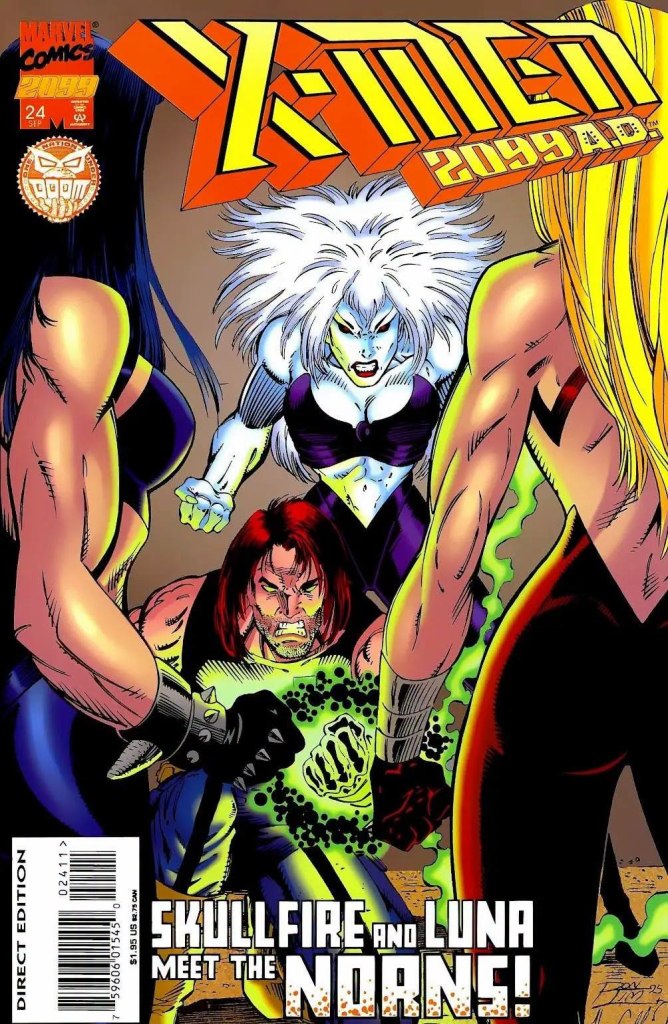
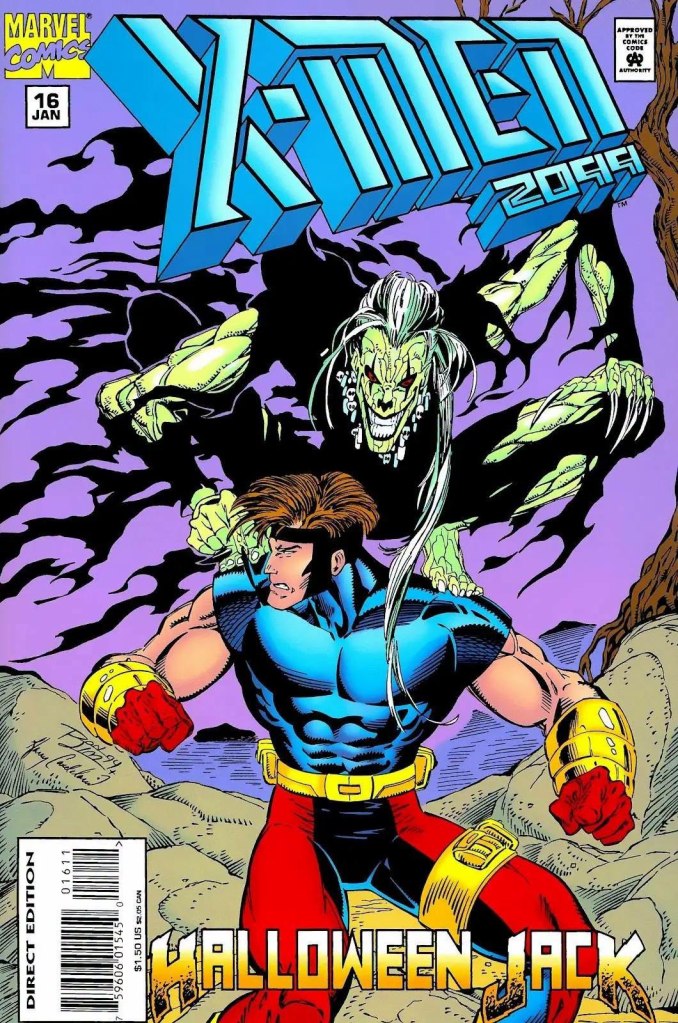
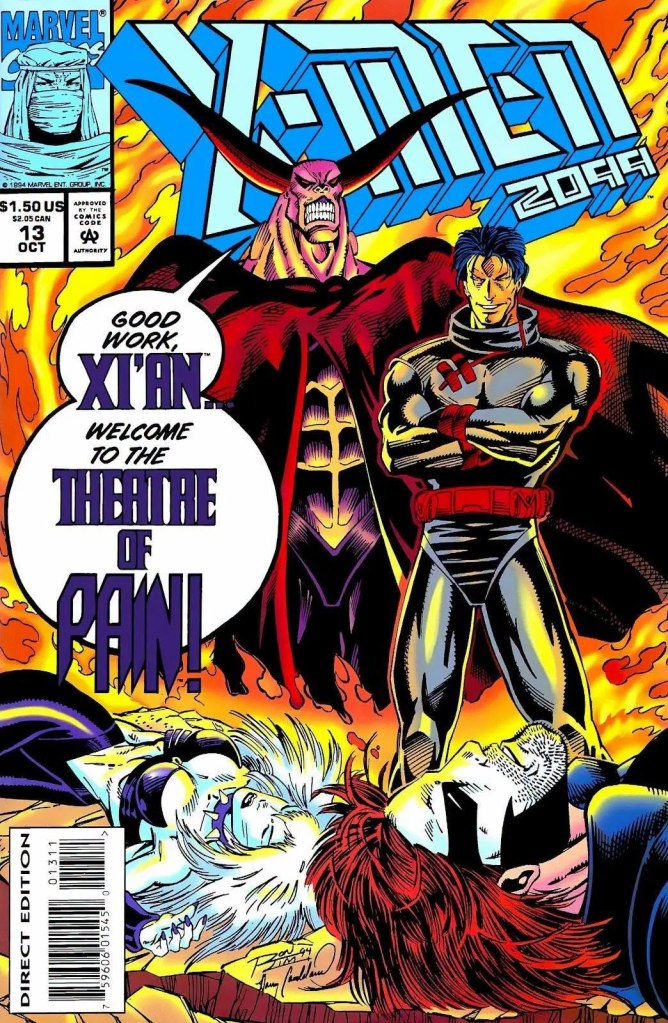
The cover.

Early story

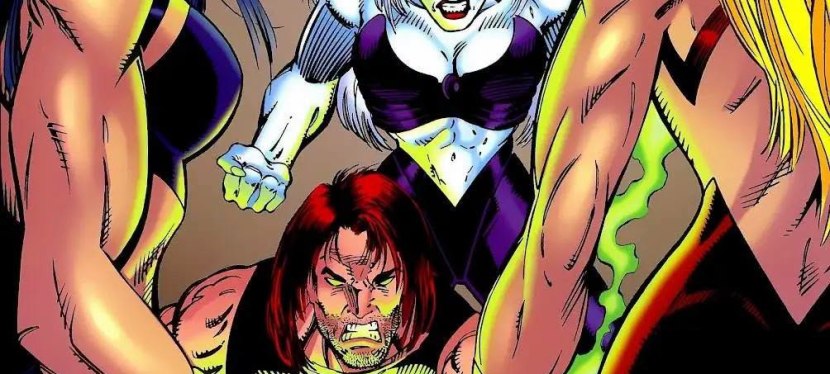
The story begins with Brimstone Love making his way into the Garage, a secret high-tech facility of the Driver. He finds it interesting that his hunt for Luna led him into the strange structure in the desert and he know that she and her companions are inside.

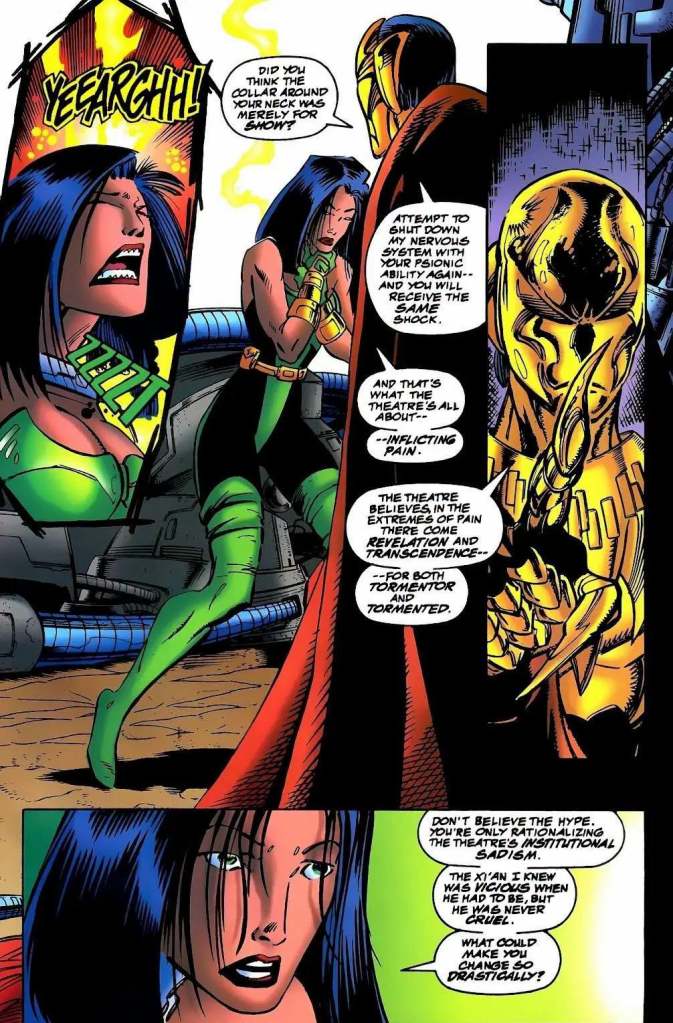
Inside the structure, Junkpile is bound and tortured on a chair with Adamantium restraints holding him. With Junkpile is the Driver watching him while Xi’an, Skullfire and Luna are trapped nearby by a laser grid. Skullfire, who is aware that Xi’an has been pursuing the Driver ever since he learned key details from Hurricane, implied to the former X-Men leader that the Driver is more of a problem and antagonist while Luna added her own comments about their situation. Xi’an tells them they need to determine the severity of their situation.

Xi’an tells the Driver that Hurricane described him as a part of the mutant underground during the Purge. It turns out, the Driver has not heard about Hurricane for a long time and insisted to Xi’an that he mistook his actions as hostile.

The Driver begins to explain what he has been doing, why he continues to fight and protect the sacred mutant tribe and why he sought out hundreds of mutants to give them sanctuary…

Quality

A lot of intriguing developments happened here and it concludes Xi’an’s pursuit of the Driver.

With regards to storytelling and revelations, I can say that the intensity from the previous continued smoothly in this comic book. While the Theater of Pain was first revealed in issue #4, it was in the previous issue and in this particular story that its actual scope was made clear, and the presence of Brimstone Love – obviously 2099’s walking symbol of Satan – added great tension and a new evil presence for the X-Men to deal with.

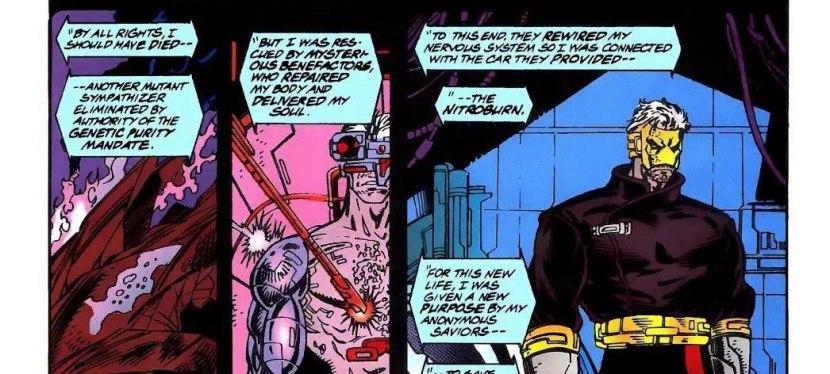
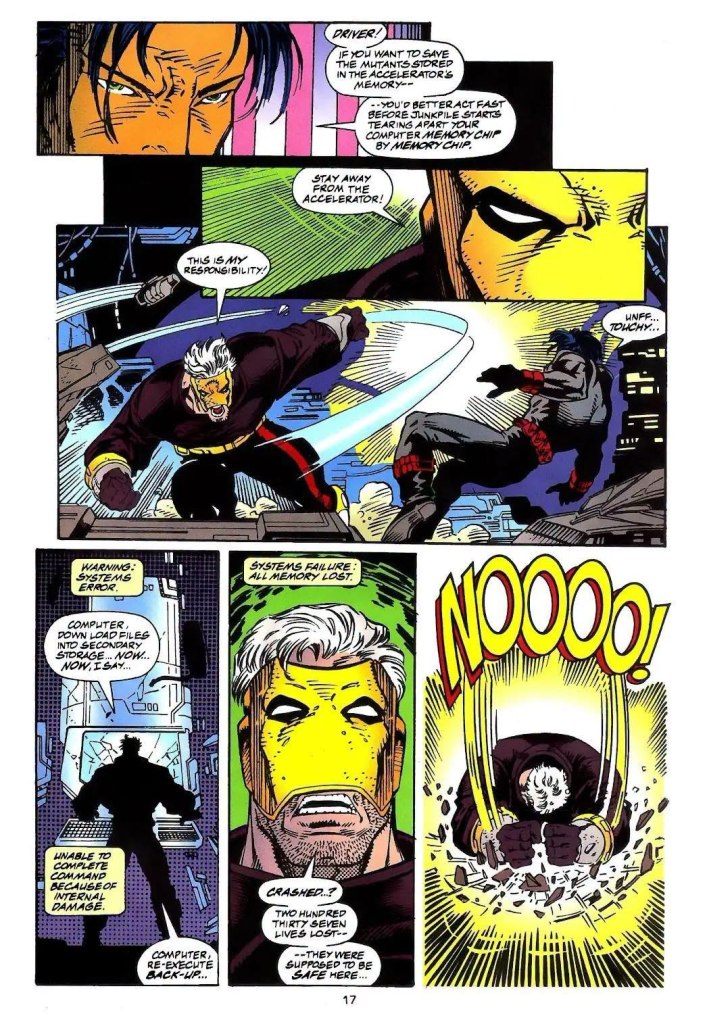
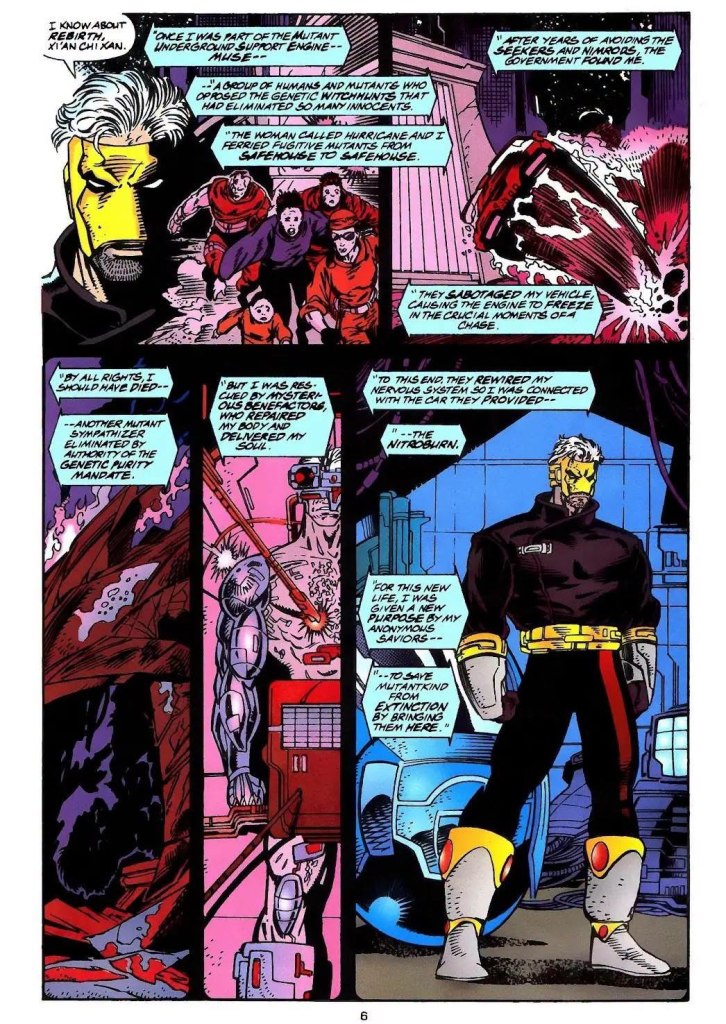
What I enjoyed most in the story crafted by John Francis Moore are the revelations. The Driver, who came close to death and witnessed the plight of mutants, has a personal mission of providing sanctuary to mutants who are still living in danger in 2099’s America which has been dominated by mega corporations (MegaCorps). Still, his specific methods of achieving his goals for mutantkind are intriguingly questionable and in someways they made him looked even sinister. That said, Xi’an’s pursuit of him (which started a few issues prior) really resulted in some shock value that has to be seen page by page.  

Very notably, Moore made the script even more dramatic which is clearly reflected in the dialogue of the characters and the art done by Ron Lim. I should also state that flashbacks of the mutants struggle for survival under the Driver and Hurricane are included and they are worth seeing.

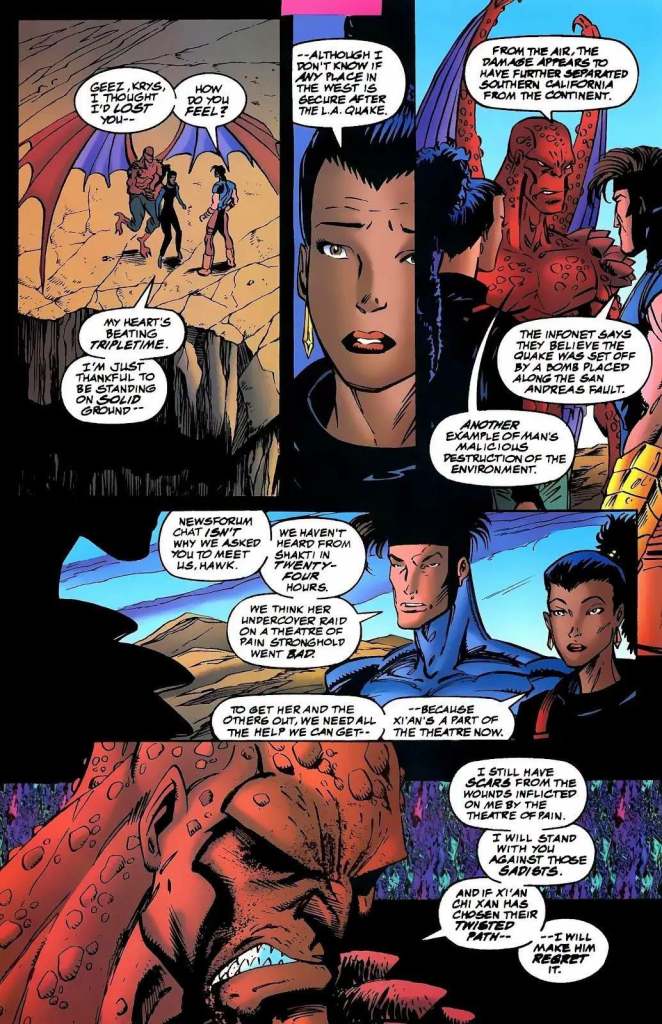
Considering what this comic book has, it will make readers think deeply about the essence of X-Men 2099 as a team and the comic book series itself. At the same time, new mysteries about the direction of the series will be realized in ways that readers don’t expect.

Conclusion

The Driver himself was part of the effort that saved desperate mutants decades prior and he came close to dying. This comic book heavily defines his existence and his mission on providing sanctuary to any mutants he finds.

If there is anything significant about X-Men 2099 #13 (1994), it is the fact that it changed the trajectory of the series and reshaped the concept of X-Men 2099 as a whole in dramatic fashion. The build-ups, the pay-offs and revelations in this comic book are powerful. Along the way, this will make you question even further the intentions of Xi’an (former X-Men leader) and Skullfire (the unhinged X-Men member who used to be so weak and unsure of himself). As for the Driver, he is very well defined by the Moore-Lim duo in this comic book and he has gotten even more significant by the end. If there is anything severely lacking here, it is the spotlight on the surviving X-Men team members (with Shakti as their new leader).

Overall, X-Men 2099 #13 (1994) is recommended.

+++++

Thank you for reading. If you find this article engaging, please click the like button below and also please consider sharing this article to others. If you are looking for a copywriter to create content for your special project or business, check out my services and my portfolio. If you want to support my website, please consider making a donation. Feel free to contact me with a private message. Also please feel free to visit my Facebook page Author Carlo Carrasco and follow me on Twitter at  @HavenorFantasy as well as on Tumblr at https://carlocarrasco.tumblr.com/ and on Instagram at https://www.instagram.com/authorcarlocarrasco/.
A Look Back at X-Men 2099 #12 (1994)

Welcome back, superhero enthusiasts, 1990s culture enthusiasts, X-Men fans and comic book collectors! Today we revisit the Marvel Comics shared universe to examine one of the many tales of the X-Men 2099 monthly series.  

Looking back at the X-Men 2099 series of the 1990s, so much has developed during the first eleven issues released from 1993 to 1994. When I first read issue #1 in 1993, I found the futuristic X-Men really intriguing to follow and there was the expectation that the team led by Xi’an would somehow grow and make breakthroughs happen in 2099’s America. Surprisingly, members of the team got separated from each other – such as losing Metalhead to the Freakshow – and Xi’an himself changed for the worse and eventually left the team. Tim Fitzgerald/Skullfire (the weak and unsure newcomer who joined the futuristic X-Men) himself changed radically becoming unhinged and he has gotten really close with Luna (the one who messed with his mind and triggered his emotions).

With those details laid down, here is a look back at X-Men 2099 #12, published by Marvel Comics in 1994 with a story written by John Francis Moore and drawn by Ron Lim.

The cover.

Early story

The story begins in the black market mall with Luna struggling to separate Skullfire and Junkpile from each other. Skullfire hates Junkpile whom he holds responsible for killing his friend Serpentina (the one X-Men member who welcomed him at their sanctuary). Junkpile blames Skullfire and his teammates for causing him some serious grief in Las Vegas. Luna tells them both to shut up or she would do something on both of them.

Moments later, the three of them are accused by the mall security for violating the market regulations. An armed mall security officer points his weapon at them accusing them of willful destruction of market property. The looks of Junkpile, Luna and Skullfire, however, scared him and convinced him to move away. Luna then reveals to Skullfire that she encountered Junkpile outside of Las Vegas shortly after the violent encounter with the X-Men. The three of them proceeded to a café to have a civil talk. Skullfire asks Luna about the Theater of Pain…

Quality

Former X-Men member Metalhead with the group of degenerates called the Freakshow. One of their members clearly rejects him given his status as a mutant.

Wow! The Moore-Lim team loaded this comic book with immense details that established the true force of opposition that awaits the X-Men. The story reveals to readers the Theater of Pain, its demonic leader Brimstone Love and what the theater’s purpose truly is. Brimstone Love and the theater were first revealed at the very end of issue #3 and this comic book offers readers a close look at them complete with very intriguing details that turned out to be worth discovering. That said, it was clear that John Francis Moore designed the Theater of Pain to be not just a planned force of evil the X-Men must face but also an actual threat to many living in 2099’s America. The Theater of Pain has a very sinister agenda and its operations involves the accumulating human misery which is a frightening concept on its own.

While Luna’s history and connection with the Theater of Pain is emphasized, Xi’an’s search for the Driver makes a lot more sense here as the former X-Men leader (now sinister and spiritually lost) communicates again with someone from his past. That said, the plot really thickened a lot in this comic book and that alone makes it engaging to follow.

As this issue follows Skullfire, Luna, Junkpile and Xi’an – plus a quick look at former X-Men member Metalhead now spending time with the Freakshow – the tone of the tale turned dark and gritty which I think was intentionally done by the creators as the Theater of Pain was strongly emphasized. That said, this is indeed inspired work.

Conclusion

Skullfire, Junkpile and Luna look so intimidating and creepy, the mall security guy got scared and abandoned his duty.

With a dark tale and an established force of evil rising in the horizon, X-Men 2099 #12 (1994) can be described as an inspired turn of events for the monthly series as a whole. At this stage, the direction of the series really started to take shape. It is also a lively reminder that the mutants struggling in 2099 have the wilderness and its violent elements as the least of their worries. The Theater of Pain itself is a reminder about sinister yet unseen forces that are operating while lots of people remain unaware of them (note: think about the World Economic Forum and what its core organization really do behind closed doors as time passes). Lastly, the twisted developments of Skullfire and Xi’an’s respective personalities will keep you in suspense as to how the futuristic X-Men can survive without them.

Overall, X-Men 2099 #12 (1994) is recommended.

+++++

Thank you for reading. If you find this article engaging, please click the like button below and also please consider sharing this article to others. If you are looking for a copywriter to create content for your special project or business, check out my services and my portfolio. If you want to support my website, please consider making a donation. Feel free to contact me with a private message. Also please feel free to visit my Facebook page Author Carlo Carrasco and follow me on Twitter at  @HavenorFantasy as well as on Tumblr at https://carlocarrasco.tumblr.com/ and on Instagram at https://www.instagram.com/authorcarlocarrasco/.
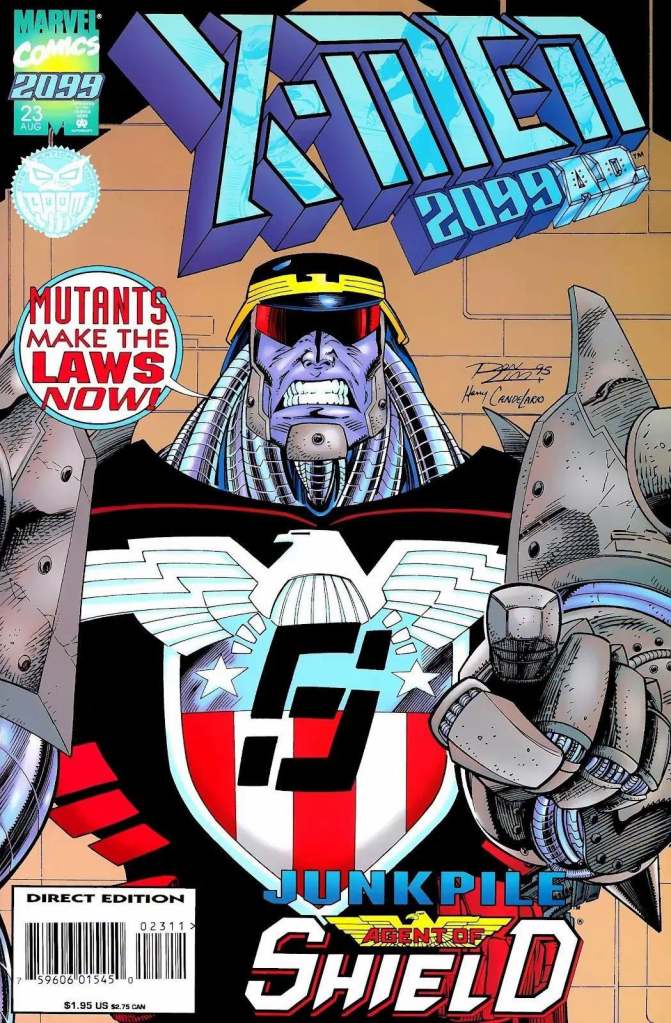
A Look Back at X-Men 2099 #8 (1994)

Welcome back, superhero enthusiasts, 1990s culture enthusiasts, X-Men fans and comic book collectors! Today we revisit the Marvel Comics shared universe to examine one of the many tales of the X-Men 2099 monthly series.  

After the first seven issues of the series, it is clear that the futuristic mutants under Xi’an have tough challenges to not only survive in the dangerous and unpredictable wasteland of 2099’s America but also help their leader fulfill the ultimate goal of protecting mutants from the evil corporations in accordance to the dream of Professor X (Charles Xavier). Unlike the X-Men of the 20th century, the team of 2099 does not have vast resources nor do they have a permanent place for living and development. Xi’an himself is still struggling with the elements from his past as a violent criminal.

With those details laid down, here is a look back at X-Men 2099 #8, published by Marvel Comics in 1994 with a story written by John Francis Moore and drawn by Ron Lim.

The cover.

Early story

The story begins with Krystalin examining Archangel with amazement. Moments later, she sees Cyclops, Iceman, Beast and Jean Grey (in her Phoenix form). She wondered how many times did each of Professor X’s first students appear to die only to return again and again. She recalls that the records of their deaths may have been in error or even falsified. She also remembers the succeeding X-Men teams of Del Ruiz and Zhao.

It turns out the original X-Men members she saw were holograms as Victor Ten Eagles (who was a fellow outlaw with Xi’an in the old days) reveals that he opened his studio to few people and never to strangers. He allowed Krystalin in because he owes Xi’an a blood debt from their time together with the Lawless. As they talk, he explains to her his personal interest in the X-Men and the legacy.

Over at Iron Horse in Arizona, Hurricane talks with two trackers who were tied up. Meanstreak uses his super speed to dismantle the trackers’ suits of armor and examine the technologies within. He finds one Tetsuo Mark 6 signal beacon that was used to monitor armor in the field. He tells Hurricane she can use it as an advance warning the next time trackers are sent after her.

Hurricane tells the X-Men that she and the Freakshow never stay too long in one place. Moments later, the infected Metalhead tells Skullfire that he is trapped in his current metal form and could not change back…

Quality

As the Freakshow is about to leave, Metalhead surprises his fellow X-Men.

To make things clear, this X-Men 2099 comic book is very engaging to read as it is filled with a lot of details that further expanded the lore of the 2099 universe concerning mutants and legacy of the X-Men in the 21st century. As such, I really enjoyed learning about the “future history” of the X-Men, how mutants struggled to survive in a corporation-controlled America, and why the wasteland became the 21st century’s very own Old West where danger and uncertainty are constant.

If have an obsession about the 2099 universe, there is a lot to discover and enjoy here. Xi’an’s pursuit for knowledge about the mutant underground and Hurricane’s involvement is compelling to read and what was revealed is worth discovering. Meanwhile, Krystalin and Ten Eagles’ exploration of facilities as they search for answers reminds me a lot about a notable part of the story in Beneath the Planet of the Apes.

Conclusion

The closest thing to a crossover with the original X-Men.

X-Men 2099 #8 (1994) is a compelling read and it is one of the stronger references about the 2099 universe and the legacy of the X-Men from the time of Xavier to that of Zhao. The details revealed here are fine pay-offs to what was built up in the previous issues, and they connect well with the existence of Xi’an’s X-Men. This comic book will really help you understand the place of mutants in the 21st century and in my experience, the learning is enjoyable.

Overall, X-Men 2099 #8 (1994) is highly recommended.

+++++

Thank you for reading. If you find this article engaging, please click the like button below and also please consider sharing this article to others. If you are looking for a copywriter to create content for your special project or business, check out my services and my portfolio. If you want to support my website, please consider making a donation. Feel free to contact me with a private message. Also please feel free to visit my Facebook page Author Carlo Carrasco and follow me on Twitter at  @HavenorFantasy as well as on Tumblr at https://carlocarrasco.tumblr.com/ and on Instagram at https://www.instagram.com/authorcarlocarrasco/.
A Look Back at X-Men 2099 #6 (1994)

Welcome back, superhero enthusiasts, 1990s culture enthusiasts, X-Men fans and comic book collectors! Today we revisit the Marvel Comics shared universe to examine one of the many tales of the X-Men 2099 monthly series.  

In late-1993, Marvel Comics published the Fall of the Hammer crossover storyline highlighting the major figures of Marvel 2099 and the X-Men members involved were only Skullfire, Krystalin, Bloodhawk and Meanstreak. As told in Ravage 2099 #15, the said X-Men members made it to Valhalla with Ravage. After the events of Fall of the Hammer, the four X-Men members survived and eventually started traveling all the way back West in America to rejoin the rest of the team.

With those details laid down, here is a look back at X-Men 2099 #6, published by Marvel Comics in 1994 with a story written by John Francis Moore and drawn by Ron Lim.

The cover.

Early story

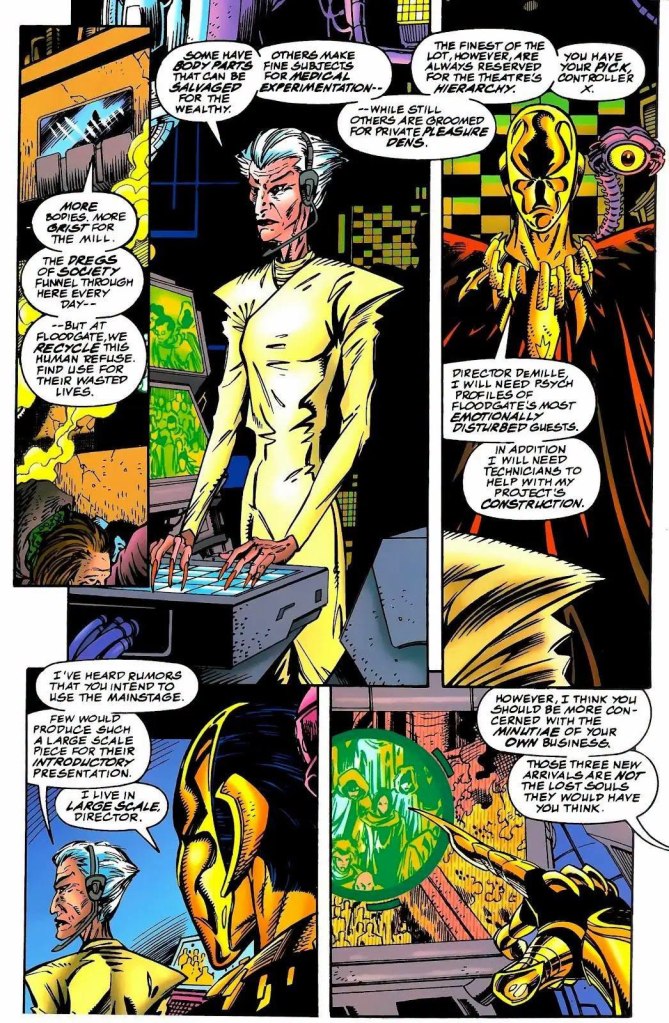
The story begins in Arizona when two fully armed personnel wearing suits of armor search for a monster-like mutant who tries to hide. The mutant is named Dominic and he eventually got corned by the two armored figures. As he is about to get shot, one of the armored guys got pushed by force somehow. The next moment, a gang of mutants called the Freakshow appears.

In the southern part of Nevada, Skullfire, Bloodhawk, Krystalin and Meanstreak travel in an aircraft going back to Xi’an and the rest of their teammates. As Bloodhawk jumps of after saying goodbye, Skullfire jumps off as well in a suicidal manner. He eventually grabs Bloodhawk by the ankle. Back at the aircraft, Krystalin and Meanstreak shared their respective observations about Skullfire’s sudden change of personality since the psychic vampire Luna messed with him… 

Quality

As the X-Men search for Hurricane, the Freakshow stands in their way.

The script of this comic book was finely crafted by John Francis Moore and it is amazing how efficient he got the X-Men team back (after Skullfire, Krystalin, Meanstreak returned) on track while ensuring a good amount of depth as reflected in the dynamics between the team members as the story went on. The storytelling felt natural and really believable.

Along the way, this comic book shed light on team leader Xi’an and the threads of the past that came back to haunt to him. This instantly added a new layer of development on Xi’an which established an element of uncertainty on the future of the X-Men under him (and his personal struggles). That said, Xi’an does not have the rock-solid stability of Professor X (Charles Xavier) which will remind readers how different the X-Men of 2099 are from the classic X-Men.

The X-Men are on the search for a mutant called Hurricane who has been active on resisting the corporations’ control on the nation and has long emphasized liberty and self-control on personal living. Historically, Hurricane led a part of the Underground Railroad which carried mutants to safe haven during a time of terror and fear. That said, X-Men’s search has a heavy purpose and the challenges they faced here is gripping and intriguing to follow. I should also state that Ron Lim’s delivery of dynamic action is really good to look at.

Conclusion

I really enjoyed the dynamics of the interactions between the members of the X-Men in this comic book. There is richness in John Francis Moore’s script here.

X-Men 2099 #6 (1994) is both a solid follow-up to the events of the Fall of the Hammer storyline and also a fine portrayal of how the team works under Xi’an’s leadership. More notably, it pushed the narrative of the series forward and gave us readers an in-depth exploration of the isolated places of America’s southwestern region in 2099 which is a sharp contrast to that era’s New York City dominated by Alchemax. More notably, this comic book implemented renewed focus on the state of mutants who have been living in fear, danger and uncertainty in America of 2099 which connects directly with the purpose of the X-Men as a team.

Overall, X-Men 2099 #6 is recommended. (1994)

+++++

Thank you for reading. If you find this article engaging, please click the like button below and also please consider sharing this article to others. If you are looking for a copywriter to create content for your special project or business, check out my services and my portfolio. If you want to support my website, please consider making a donation. Feel free to contact me with a private message. Also please feel free to visit my Facebook page Author Carlo Carrasco and follow me on Twitter at  @HavenorFantasy as well as on Tumblr at https://carlocarrasco.tumblr.com/ and on Instagram at https://www.instagram.com/authorcarlocarrasco/.
A Look Back at X-Men 2099 #11 (1994)

Welcome back, superhero enthusiasts, 1990s culture enthusiasts, X-Men fans and comic book collectors! Today we revisit the Marvel Comics shared universe to examine one of the many tales of the X-Men 2099 monthly series.  

If there is anything notable about the futuristic X-Men, it is the separation of the team members that started really early in the monthly series. Meanstreak left the team to pursue something personal. A few members of the team – including Meanstreak – got involved in the Fall of the Hammer crossover storyline (click here, here and here), Metalhead got infected and decides to leave the team to stay with another group, and their leader Xi’an lost his way.

With those details laid down, here is a look back at X-Men 2099 #11, published by Marvel Comics in 1994 with a story written by John Francis Moore and drawn by Ron Lim.

The cover.

Early story

The story begins with Tim Fitzgerald/Skullfire and Luna enjoying their time together outdoors. Tim, whose personality has changed into becoming radical and wild, tells her that he has not forgotten the anguish she put him in through the darkroom which made him relive the death of his beloved Reiko from some time ago.

As the tension between Tim and Luna intensifies, Xi’an tells him that they have to go to El Paso in Texas. It was Luna’s first time to meet Xi’an. The former leader of the X-Men states that they are closing in on the Driver…

Quality

Skullfire blasts Junkpile, the one responsible for the death of Sepertina (see X-Men 2099 #3).

Given the way the members of the X-Men got separated, the Moore-Lim duo succeeded in telling an intriguing story without even having a clear enemy for them to encounter. This is a tale about a drastically changed Xi’an (now arrogant and with an agenda of his own) develops into someone becoming more undesirable and dangerous with the passage of time. Similarly, Tim here is turning more unhinged and dangerous as he gradually turns into Skullfire (personally and visually) and Luna here is ironically the one keeping him stable.

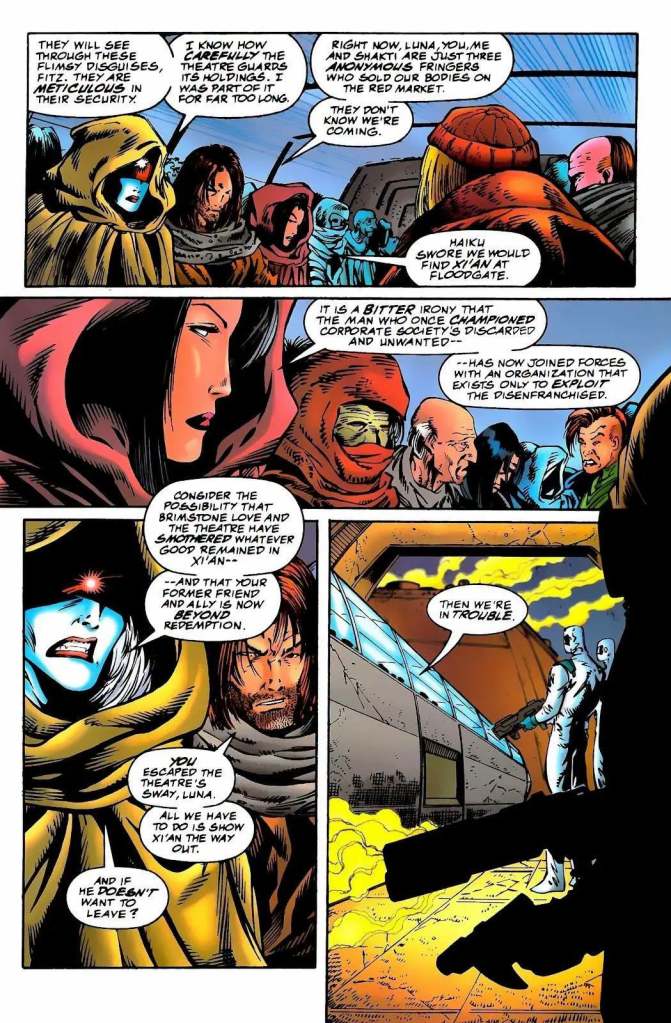
On the other side, the remaining X-Men are still together but with a huge cloud of doubt over them. At this stage, Shakti/Cerebra – who was the faithful second-in-command when Xi’an still led the team – is taking more responsibilities as she gradually becomes the team leader. The writing done by John Francis Moore is rich when Shakti sticks strongly to principles during her interaction with Meanstreak who himself has turned uncertain about their status as a team. That said, there are certain traits of Xi’an visible in Shakti. Along the way, a few friends of the X-Men went away which added to the uncertainty that hounded them.

With regards to the reveal of the Driver on the cover of this comic book, the tale indeed reveals him and a new story thread about him was gradually built up. The Driver is Xi’an’s target and his act of helping one of the X-Men’s friends added to the suspense over what could happen next.

Conclusion

As the new leader of the X-Men, Shakti remains very principled. Her talk with Meanstreak in this scene is meaningful.

X-Men 2099 #11 (1994) is a very character-driven story from start to finish and the good news is that it is engaging and entertaining to read. The lack of a good-versus-evil conflict never hurt the story at all as Moore and Lim went deep to develop Tim, Xi’an and others while building up the pending encounter with the Driver. Not only that, having Tim and Xi’an more radicalized reflect the atmosphere of uncertainty and danger in the region (with lots of wilderness throughout and far away from the metropolis dominated by Alchemax) within America of 2099. It is a good read and I enjoyed the character development done by the creative duo.

Overall, X-Men 2099 #11 (1994) is recommended.

+++++

Thank you for reading. If you find this article engaging, please click the like button below and also please consider sharing this article to others. If you are looking for a copywriter to create content for your special project or business, check out my services and my portfolio. If you want to support my website, please consider making a donation. Feel free to contact me with a private message. Also please feel free to visit my Facebook page Author Carlo Carrasco and follow me on Twitter at  @HavenorFantasy as well as on Tumblr at https://carlocarrasco.tumblr.com/ and on Instagram at https://www.instagram.com/authorcarlocarrasco/.
A Look Back at X-Men 2099 #2 (1993)

Welcome back, superhero enthusiasts, 1990s culture enthusiasts, X-Men fans and comic book collectors! Today we revisit the Marvel Comics shared universe to examine one of the many tales of the X-Men 2099 monthly series.  

Way back in 1993, I had a fun reading X-Men 2099 #1 as soon as it was released in the local comic book specialty store here in the Philippines. Back then, I was already into the 30th anniversary celebration of the X-Men while also reading more comic books about Marvel’s science fiction 2099 franchise of comic books. I love the way X-Men 2099 #1 ended as it was a powerful way of building up the tension and excitement that comes with waiting another 30 days for issue #2 to come out.

With those details laid down, here is a look back at X-Men 2099 #2, published by Marvel Comics in 1993 with a story written by John Francis Moore and drawn by Ron Lim.

The cover.

Early story

The story begins with the X-Men desperately trying to escape as the arcology has been invaded by enforcers (also referred to as the Greater Nevada Syndicate) of the Synge casino. Their leader Xi’an is in critical condition after getting shot during an assassination attempt that happened moments earlier. The X-Men are inside their van speeding away and Meanstreak (Henri Huang) uses his super speed to run ahead of them to quickly check what awaits them all. During the ride, Krystalin learned of the news that Noah Synge has died and Xi’an has been blamed for murder. Cerebra confirmed that Xi’an expressed hatred towards Synge.

When the van finally reaches the outdoor area, the X-Men find themselves facing a large tank and a helicopter of the syndicate which anticipated their arrival. The syndicate tells them to surrender Xi’an…

Quality

Cerebra shows their leader Xi’an with a biological cocoon forming over his body. Pay attention to the details.

As a follow-up to the impressive first issue, this one remains a very good read after all these decades. It is clear to me that John Francis Moore had carefully planned an engaging tale of the futuristic X-Men with Tim Fitzgerald (who will later be called Skullfire) as the symbolic reflection of the readers who get to discover more about the team, the situation they are in and why they exist in the first place.

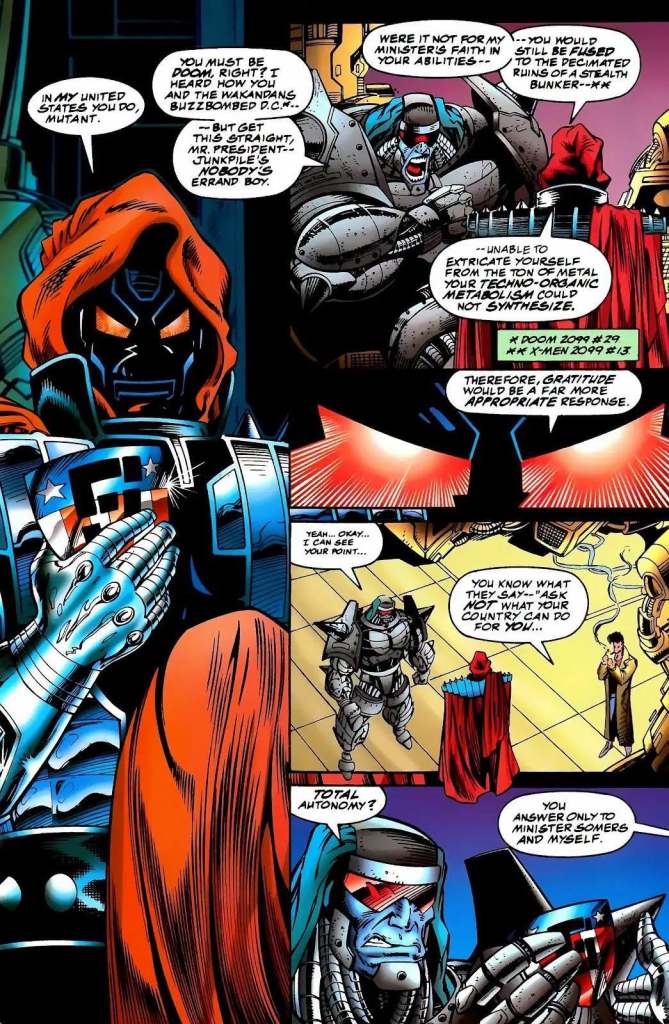
As expected, the creative stuff that started in issue #1 progressed naturally as the story went on in this comic book. The X-Men of 2099 got away to find safety and get themselves organized as their leader remains in critical condition. Along the way, the syndicate itself gets adjusted as it has the son and daughter of Noah Synge taking over their evil empire suddenly. The syndicate is responsible for seven deaths, the wounding of nineteen people and the capture of over forty people as a result of their sudden invasion of the arcology and their attempt to assassinate Xi’an in retaliation of the death of Noah Synge. This was the creative duo’s way of telling readers who the bad guys are and why the X-Men are at a great disadvantage.

What I find engaging here is how the Moore-Lim duo emphasized Xi’an’s significance through flashbacks and background details (which further revealed more of the founding of the futuristic X-Men). This creative gamble worked wonders and clearly more than made up for the lack of dialogue and interactions from the X-Men’s leader. At the same time, the narrative has this flavor of conspiracy when the Synge empire was emphasized.

Conclusion

The futuristic X-Men encounter strong opposition from the syndicate.

X-Men 2099 #2 (1993) is clearly a very good read. As a follow-up to the very solid issue #1, it added to the build-up emphasizing the futuristic X-Men a lot more while still having enough room to develop the Synge empire and its syndicate. Along the way there were some nice pay-offs to certain build-ups in issue #1 and there was a fine balance between action scenes and the plot/character development scenes. That said, this comic book is a solid bridge between issue #1 and the conclusion in issue #3.

Overall, X-Men 2099 #2 (1993) is highly recommended.

+++++

Thank you for reading. If you find this article engaging, please click the like button below and also please consider sharing this article to others. If you are looking for a copywriter to create content for your special project or business, check out my services and my portfolio. If you want to support my website, please consider making a donation. Feel free to contact me with a private message. Also please feel free to visit my Facebook page Author Carlo Carrasco and follow me on Twitter at  @HavenorFantasy as well as on Tumblr at https://carlocarrasco.tumblr.com/ and on Instagram at https://www.instagram.com/authorcarlocarrasco/.
A Look Back at Spider-Man #45 (1994)

Welcome back superhero enthusiasts, 1990s culture enthusiasts, Spider-Man fans and comic book collectors! Today we go back to the mid-1990s and to explore a part of the Marvel Comics shared universe through a tale of the Spider-Man monthly series.

As revealed in Amazing Spider-Man #388, Richard and Mary Parker – who spent some time living with Peter Parker’s family after suddenly emerging from nowhere – were not Peter’s parents but androids designed to look, act and feel human. They were life model decoys (LFDs) programmed infiltrate Peter’s life until they learn Spider-Man’s true identity. As programmed, they reported to their master the Chameleon. Just seconds before Richard revealed the secret identity, Spider-Man suddenly interfered and this led to a series of violent acts.

With those details laid down, here is a look back at Spider-Man #45, published in 1994 by Marvel Comics with a story written by Howard Mackie and drawn by the late Tom Lyle. This is the first chapter of the Pursuit storyline.

The cover.

Early story

The story begins moments after the huge conflict that happened. A very broken-hearted Spider-Man realized that “Mary” and “Richard” were impostors and his actual parents have long been gone. He is also concerned about how his Aunt May will handle the truth about Richard and Mary. Deep inside him, a desire for vengeance against the Chameleon is growing.

As he swings from one building to another in New York City, Peter Parker begins to realize that his role as Spider-Man is turning into a farce. He begins his obsession of hunting down the Chameleon and stopping him until he keeps him out of his life for good…

Quality

What you are seeing here is a very obsessive, aggressive and more violent Spider-Man. Vengeance is his motivation.

To make things clear to everyone, this tale does not have the long-running friendly neighborhood Spider-Man. Instead, we have the iconic webslinger who is deeply hurt and the pain he carries motivates him to pursue the Chameleon (who is responsible for reviving the deep pain Peter felt after his parents died). It is clearly a pursuit for vengeance and the writing by Howard Mackie is very believable.

That said, readers will not only see Peter Parker wanting vengeance but also his dark side emerge. Carrying over the tragedy that happened in Amazing Spider-Man #388, Mackie and Lyle precisely crafted a story that had a very dramatic and radically different Peter Parker. Peter even shouts at his wife Mary Jane and struggles with revealing the details of the tragedy to his beloved Aunt May. When he goes out as Spider-Man to find answers, he approaches crooks aggressively and with more violence than before. In short, Spider-Man here lacks restraint and really looks like he could become a public menace.

That said, the portrayal of a very broken Peter Parker here can be alienating even to long-time Spider-Man fans.

Along the way, the Mackie-Lyle duo managed to develop the Chameleon not only as Spider-Man’s target but also as his most cunning and very diabolical enemy yet. The Chameleon (first appearance in 1963’s Amazing Spider-Man #1) is very prominently shown here which is quite meaningful because he is the very first super villain to encounter the webslinger. The long-time villain is very organized and has set up a trap for Spider-Man. The Chameleon also has his own obsession versus Spider-Man and his personal connection with Kraven the Hunter has a lot of depth to the story. As such, there are common elements that the webslinger and the evil master of disguise share.

Conclusion

Great work by Howard Mackie and the late Tom Lyle on expressing Peter Parker’s sadness over the loss of his parents.

Spider-Man #45 (1994) is clearly a very engaging read even though its concept of Spider-Man wanting vengeance can be a turnoff to some readers. For one thing, the script Howard Mackie wrote has a lot of depth and Tom Lyle brought it to life with a fine art style. Having seen the 1989 movie Licence to Kill, I noticed the similarities Spider-Man has with Timothy Dalton’s James Bond when it comes to executing a private vendetta. That said, I enjoyed what was presented in this comic book. Indeed, this tale was published at a time when the dynamics of superhero storytelling in the 1990s changed dramatically moving towards tragedy, disaster and death. It is clearly a product of its time and anyone who wants to read a dark and gritty Spider-Man portrayal should go for this. As such, I am convinced to read on with the Pursuit storyline.

Overall, Spider-Man #45 (1994) is recommended.

+++++

Thank you for reading. If you find this article engaging, please click the like button below, share this article to others and also please consider making a donation to support my publishing. If you are looking for a copywriter to create content for your special project or business, check out my services and my portfolio. Feel free to contact me with a private message. Also please feel free to visit my Facebook page Author Carlo Carrasco and follow me on Twitter at @CarloCarrascoPH as well as on Tumblr at https://carlocarrasco.tumblr.com/ and on Instagram at https://www.instagram.com/authorcarlocarrasco

A Look Back at Gen13 #4 (1994)

Welcome back, superhero fans, 1990s arts and culture enthusiasts, Image Comics fans and comic book collectors! Today we go back to the mid-1990s to examine one of the many tales of Jim Lee’s original WildStorm universe through the original Gen13 mini-series.

In the previous issue, Dale Keown’s Pitt made a crossover appearance, and his presence was strongly felt. For International Operations (IO), John Lynch and the Black Razors, Pitt is a monster that could handle and transport safely. Their stop at the IO facility in the middle of desert disturbed Ivana and only added tension as Caitlin Fairchild daringly returned to rescue her friends (who endured torture and humiliation under Threshold). Things intensified when Fairchild encountered Pitt.

With those details laid down, here is a look back at Gen13 #4, published by Image Comics in 1994 with a story written by Jim Lee and Brandon Choi with artwork done by Jeffrey Scott Campbell. This is the fourth issue of the mini-series.  

The cover.

Early story

The story begins inside the facility in the middle of the desert. Fairchild and the freed Pitt find themselves cornered by John Lynch, Ivana and several armored personnel with their guns aimed at them.

Lynch wants the two secured and escorted to the holding cells. Ivana, who is already upset over the immense damage caused by Fairchild and Pitt moments earlier, wants the two killed instead. Lynch tells her to stop worrying as he will take both Fairchild and Pitt with him the next morning. Ivana responds negatively and orders the Black Razors to have Lynch arrested.

As the Black Razors did not immediately respond to her, Ivana grabs a machine gun and kills them in front of Lynch. Fairchild seized the moment to sweep Ivana and her two red-colored armed guards off their feet to cause them to lose their balance. As Fairchild and Pitt begin to make their next move, more armed guards under Ivana arrived.

Meanwhile on another part of the facility, Grunge, Roxy, Rainmaker and Burnout are on the loose and they have the blonde young boy Timmy with them…

Quality

Facing certain death, Roxy uses her power to overcome the two armed troopers of Ivana.

At this particular stage of the mini-series, the story here is creatively a handsome pay-off to what was built up in the previous issue. As Caitlin Fairchild got delayed in her pursuit to rescue her friends, those four young people saw their respective super abilities manifest which enabled them to overcome tough and violent odds. Grunge here got braver, Roxy learned more how to handle her power properly and the more. As such, the building blocks of Gen13 as a team have started to take shape while still leaving some room left for suspense and surprises. In short, there is more to come after this story and the creative team carefully paced the storytelling, the spectacle and the character development.

Dale Keown’s Pitt continued to have a presence here and he does have an exit that is worth the attention of readers. Anyone who is not fan of Pitt will be able to discover something new and interesting about the character. In some ways, this comic book – plus issue #3 – made me a bit interested to read the Pitt comic books that were published under the Image Comics banner.

Team 7 made a quick appearance here. This was a clever way to promote the Team 7 mini-series to WildStorm fans.

John Lynch, one of the more established characters of WildStorm who appeared in mostly supporting roles, got a bigger spotlight here as he uses his authority as an IO executive which impacted the direction of the story. To be clear, Lynch is not in line with the managers of the facility (which belongs to IO) and his conflict with Ivana led to violence in the facility. What happened also led to his encounter with the Gen13 teenagers. As Lynch realizes their potential, he takes action using IO’s resources to even the odds as Ivana’s troops begin to arrive.

Conclusion

Caitlin Fairchild, Pitt, John Lynch and Ivana early in the story.

Compared to the previous issue, Gen13 #4 (1994) has stronger writing with regards to storytelling and character development. The plot really got deeper here even as twists and turns happened. At this stage, the facility has turned into a battle zone which literally placed the Gen13 teenagers and Lynch into a corner. This 4th issue of the mini-series is very entertaining and gripping.

Overall, Gen13 #4 (1994) is highly recommended.

+++++

Thank you for reading. If you find this article engaging, please click the like button below and also please consider sharing this article to others. If you are looking for a copywriter to create content for your special project or business, check out my services and my portfolio. If you want to support my website, please consider making a donation. Feel free to contact me with a private message. Also please feel free to visit my Facebook page Author Carlo Carrasco and follow me on Twitter at @CarloCarrascoPH as well as on Tumblr at https://carlocarrasco.tumblr.com/ and on Instagram at https://www.instagram.com/authorcarlocarrasco/.
A Look Back at Gen13 #3 (1994)

Welcome back, superhero fans, 1990s arts and culture enthusiasts, Image Comics fans and comic book collectors! Today we go back to the mid-1990s to examine one of the many tales of Jim Lee’s original WildStorm universe through the original Gen13 mini-series.

With the first two issues over, the stakes have been raised now that Caitlin Fairchild has been separated from her eventual teammates. Fairchild is alone in the middle of the desert in Nevada and her pals – who went back to the International Operations (IO) facility that trained them – are in deep trouble already.

With those details laid down, here is a look back at Gen13 #3, published by Image Comics in 1994 with a story written by Jim Lee and Brandon Choi with artwork done by Jeffrey Scott Campbell. This is the third issue of the mini-series.  

The cover.

Early story

The story begins in the desert. From a distance, Caitlin Fairchild spots a paramilitary convoy delivering something big and important. It turns out the convoy is handled by the Black Razors and they arrived at the IO facility in the middle of the night.

Ivana (one of leaders of the facility) woke up to personally examine what the convoy delivered to them unexpectedly. When she asked who is giving the orders, John Lynch (formerly of Team 7) appears and he tells her that he has an unidentified super-powered being that has to be secured at their facility only for the night.

Inside the heavy containment unit is Pitt…

Quality

Fairchild and Pitt fight!

I can say that the story here is both a thrill ride and also a build-up for what is clearly the next stage of the mini-series’ concept. The addition of Pitt here is actually a crossover-related appearance as the said character is a creation of Dale Keown (essentially a non-WildStorm character). Pitt’s presence added weight to the spectacle as a short fight between him and a stronger Caitland Fairchild over a misunderstanding took place.

One part of the narrative followed Fairchild who made the suicidal move to return to the facility alone as she decided to rescue her companions Roxy, Grunge, Rainmaker and Burnout. Even though she already has an idea that a trap could be set up for her, Fairchild has fully decided to pursue a rescue rather running away to freedom. As such, Fairchild here is braver, took huge risks to meet her new goals and has shown notable changes following what happened in the first two issues.

Another part of the plot follows Roxy, Grunge, Burnout and Rainmaker who have been held captive in very humiliating fashion as they have been stripped naked and have been restrained in ways that would outrage the human rights activists. The main antagonists Ivana, Threshold and Nicole wield absolute power in the facility and they are indeed ruthless. Ivana, who had to receive and meet John Lynch, is obsessed with experimenting on gen-active youth to create her own personal army of super-powered beings. Threshold helps her by torturing the captured companions of Fairchild and he is so cold-hearted, he actually enjoys performing both torture and humiliation.

The WildStorm universe veteran John Lynch (read my past reviews of Team 7 and The Kindred) appears here and was portrayed to be uncompromising and dead serious with his task handling Pitt’s transfer. His presence and interactions with Ivana shed more light on the purpose of International Operations (IO) and how the organization is connected with the youth program at the facility.

Conclusion

Grunge gets tortured in front of his naked companions. Threshold takes pleasure in torturing him.

Gen13 #3 (1994) has a lot of thrills plus intrigue and even some shock value that made it stand out among the many superhero comic books about powered teenagers published in the 1990s. There is clear development on Fairchild and what she does here is the result of the huge decision she made at the end of issue #2. Fairchild’s captured companions also got their fair share of development as well and it is here where their bond as a group really grows. Along the way, Pitt added the monster presence but with a touch of heroism instead of instant death towards others. Anyone who follows Pitt should see his crossover appearance here. Indeed, this third issue of the mini-series is still fun to read.

Overall, Gen13 #3 (1994) is recommended.

+++++

Thank you for reading. If you find this article engaging, please click the like button below and also please consider sharing this article to others. If you are looking for a copywriter to create content for your special project or business, check out my services and my portfolio. If you want to support my website, please consider making a donation. Feel free to contact me with a private message. Also please feel free to visit my Facebook page Author Carlo Carrasco and follow me on Twitter at @CarloCarrascoPH as well as on Tumblr at https://carlocarrasco.tumblr.com/ and on Instagram at https://www.instagram.com/authorcarlocarrasco/.
A Look Back at Team 7 #3 (1994)

Welcome back superhero enthusiasts, 1990s arts and culture enthusiasts, Image Comics fans and comic book collectors! Today we go back to the year 1995 to take a close look at one of the many tales of the original WildStorm universe through one of the comic books of the first mini-series of Team 7.

For the newcomers reading this, Team 7 is set in the past within the original WildStorm universe. This is the special forces team that had major WildStorm heroes – Grifter (WildCATS: Covert Action Teams), Backlash, Jackson Dane (Wetworks), John Lynch (Gen13) and Michael Cray (Deathblow) – who were younger, were proficient with combat and gained special abilities as a result of a sinister move by their superiors. Issue #2 took place after the team got exposed to something they never anticipated and their superiors knew it.

With those details laid down, here is a look back at Team 7 #3, published in 1994 by Image Comics with a story written by Chuck Dixon and drawn by Aron Wiesenfeld. This is the 3rd chapter of a 4-issue mini-series.

The cover.

Early story

Set in the 1970s, the surviving Team 7 members (already exposed to the chemical agent) are in the middle of a new mission somewhere in East Africa. Because their teammate Johnson abused his new power to manipulate a black general to kill himself against his own will, Cole Cash eliminates Johnson causing John Lynch to be outraged. Cash tells Lynch that Johnson lost himself completely. He also tells him to list Johnson as MIA (missing-in-action) and turn a blind eye as before.

Lynch points his gun at Cash’s head believing he is standing for the mission and rules. After Cash tells him that they are monsters and that the world is better off without them, Lynch relents and shoots the wall instead. The mission concludes and Team 7 goes home by helicopter.

As the ride goes on, John Lynch thinks very deeply about everything that happened since they got exposed to the chemical agent. He realizes that they were exposed to genetic altering elements and wonders if he and his teammates were nothing more than lab rats for International Operations (IO)…

Quality

John Lynch in the presence of his traitorous superiors following the East African operation.

If there is anything notable here apart from the continued dark and gritty tone, the plot really thickened clearly. At this stage, it is more obvious that the superiors have indeed something more sinister planned for Team 7 to endure. They know that the infected team members are closing ranks to protect itself which means they are ready for the so-called final test.

Along the way, John Lynch gradually realizes the evil of his superiors and being the field leader, he begins to analyze what is best for him and his teammates and which options to take knowing the betrayal from above. Quitting is simply not an option for Lynch and the pressure builds up as the story went on. Cole Cash here sees things very clearly and he easily became the pathfinder among Team 7 members. When he scolds his teammate Fairchild (father of Gen13’s Caitlin Fairchild) for abusing his power in a public place while off-duty, it is clear that Cash wants to keep the team together by means of keeping together while maintaining sanity.

As for Team 7 itself, there is something intriguing that awaits readers once they start their new mission here. I won’t spoil it and it has to be seen. Simply grab a copy of this comic book, read it and pay attention to the details. It’s strong stuff from the creative team.

Conclusion

Cole Cash (Grifter) talks sense into John Lynch about what has really been going on and why they have become monsters.

Team 7 #3 (1994) has a lot of intrigue as the plot thickened. At this stage, it is clear that IO is really up to no good and Team 7 is symbolically their scientific and military experiment. Fortunately for the team, they have John Lynch and Cole Cash as the reasonable members who are able to cut through the noise and became aware of what IO has been executing. The stage is set for the concluding issue and this comic book is indeed a solid build-up and also an engaging WildStorm read.

Overall, Team 7 #3 (1994) is recommended.

+++++

Thank you for reading. If you find this article engaging, please click the like button below, share this article to others and also please consider making a donation to support my publishing. If you are looking for a copywriter to create content for your special project or business, check out my services and my portfolio. Feel free to contact me with a private message. Also please feel free to visit my Facebook page Author Carlo Carrasco and follow me on Twitter at  @CarloCarrascoPH as well as on Tumblr at https://carlocarrasco.tumblr.com/ and on Instagram at https://www.instagram.com/authorcarlocarrasco