A Look Back at The Kindred #4 (1994)

Welcome back, superhero fans, 1990s arts and culture enthusiasts, Image Comics and comic book collectors! Today we go back to the mid-1990s to examine one of the many tales of the WildStorm universe through The Kindred mini-series.

After reading the first three issues of this WildStorm mini-series, Grifter and Backlash were well defined as two former teammates of Team 7 who are at great odds with each other. Adding more emphasis to the Team 7 legacy and the dirty history of International Operations (IO) was IO officer John Lynch (who became a captive in this mini-series) and the revealed leader of the Kindred. The stage is set for the conclusion of this mini-series.

With those details laid down, here is a look back at The Kindred #4, published by Image Comics in 1994 with a story written by Jim Lee, Brandon Choi, Sean Ruffner and the illustrator himself, Brett Booth.

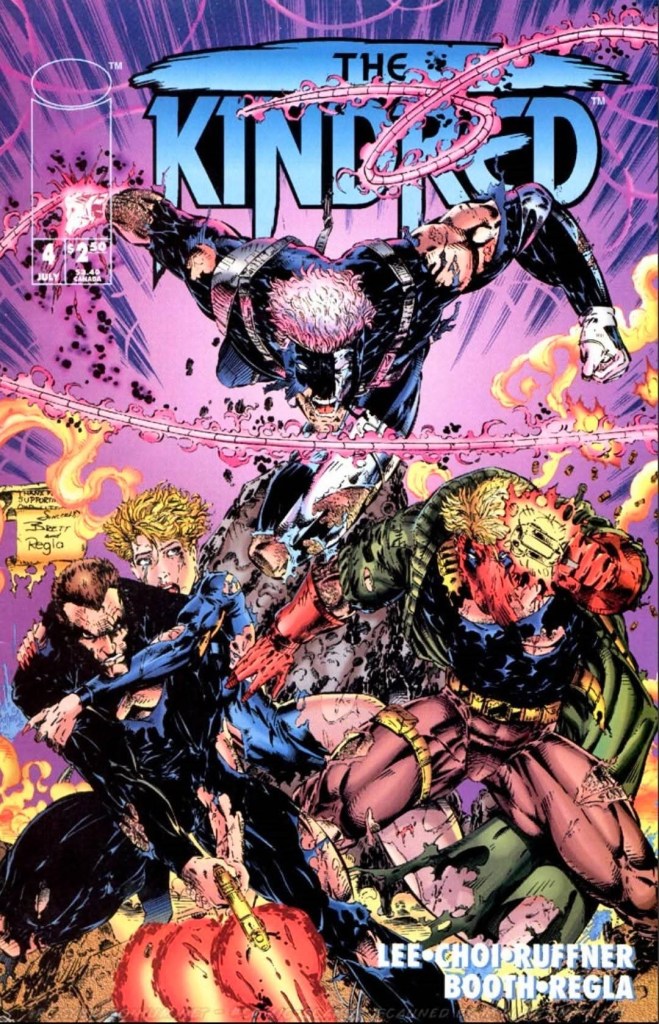
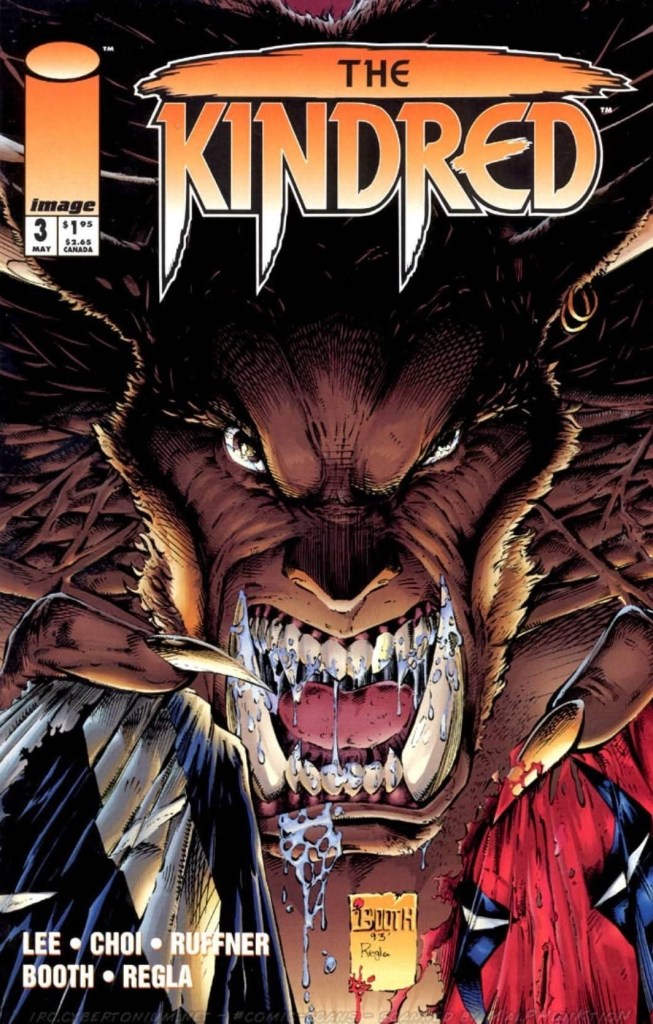
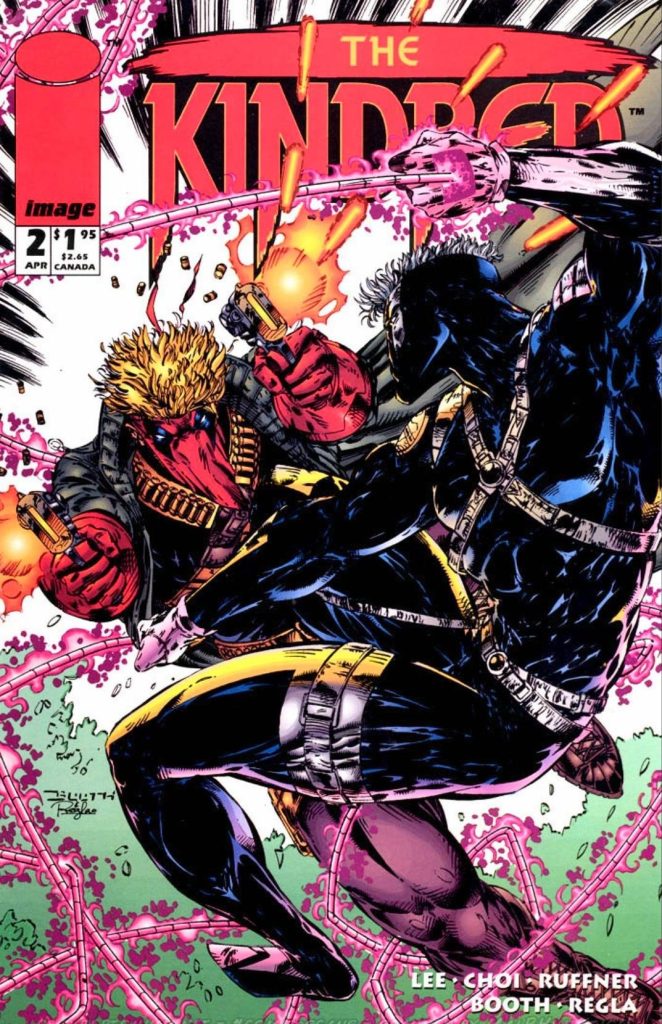
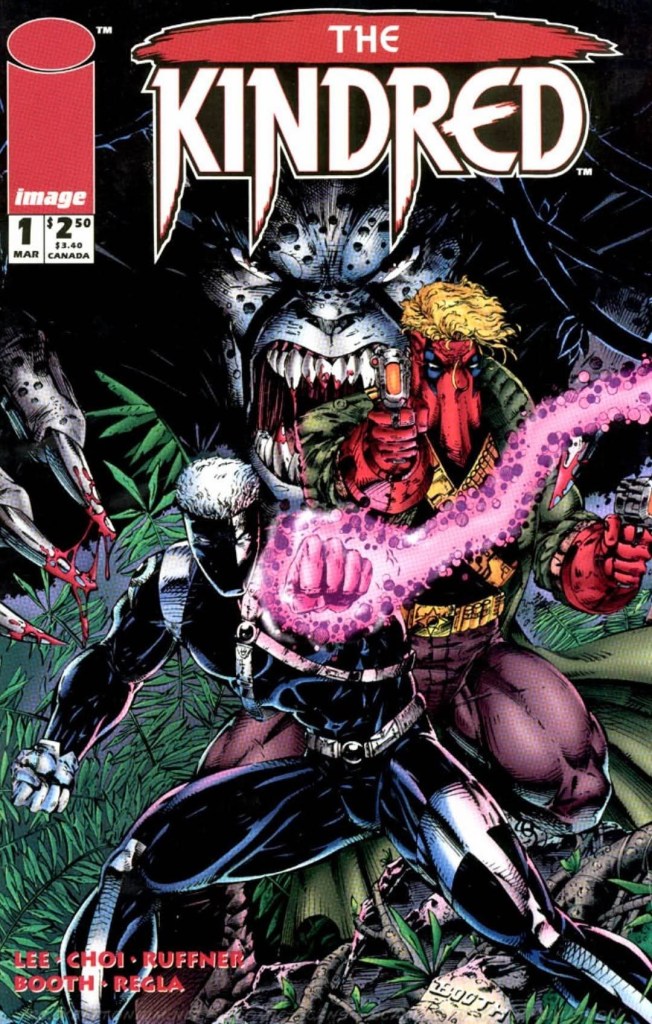
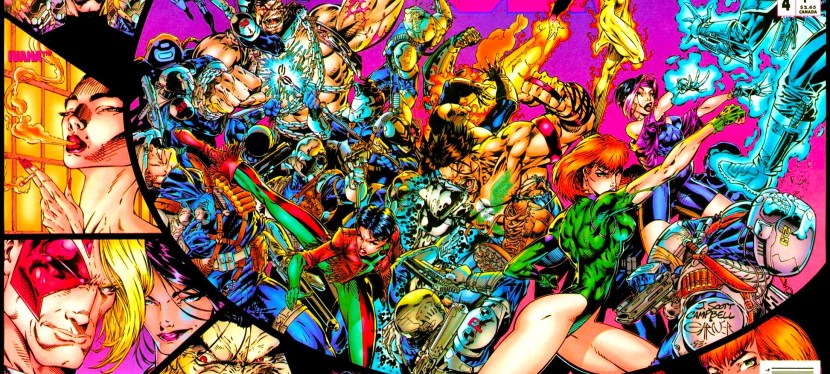
The cover.

Early story

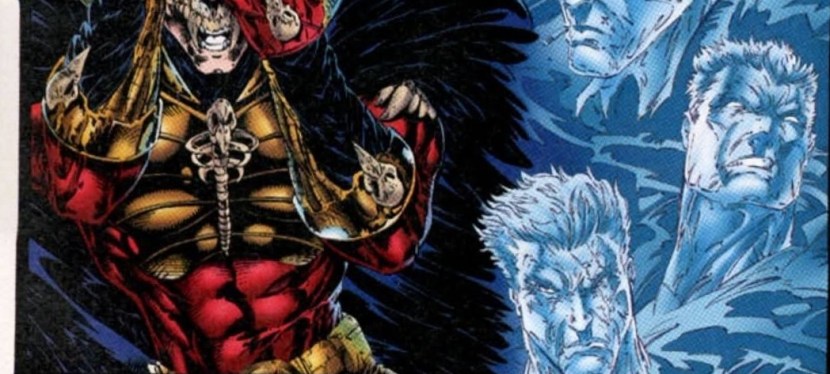
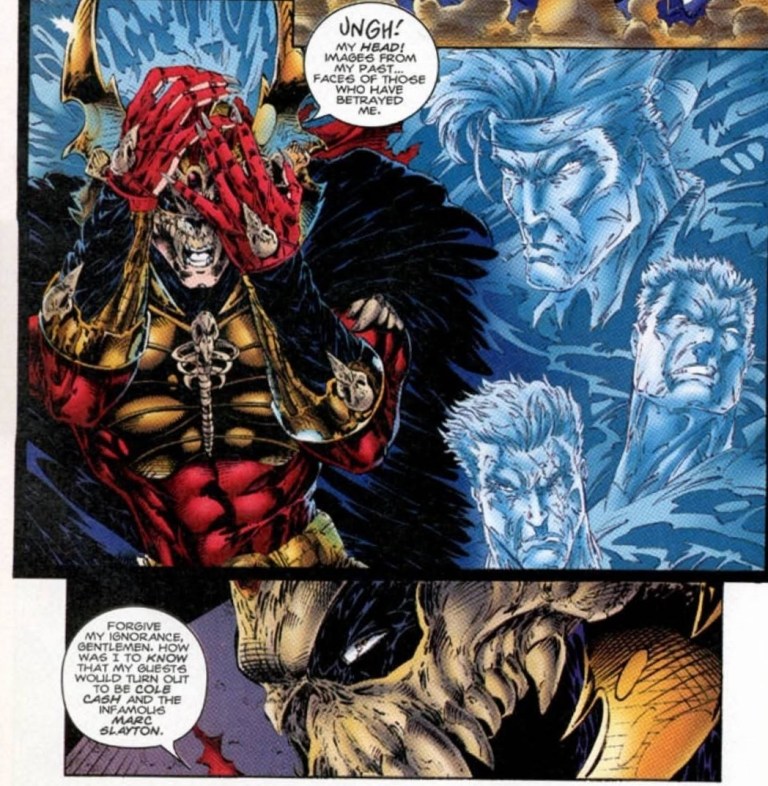
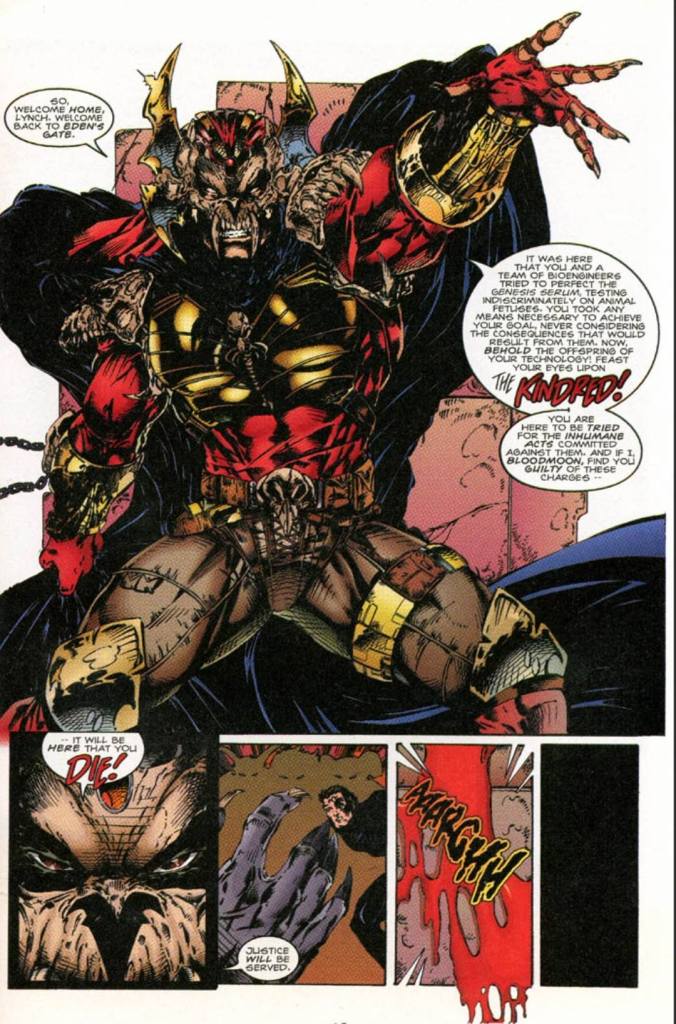
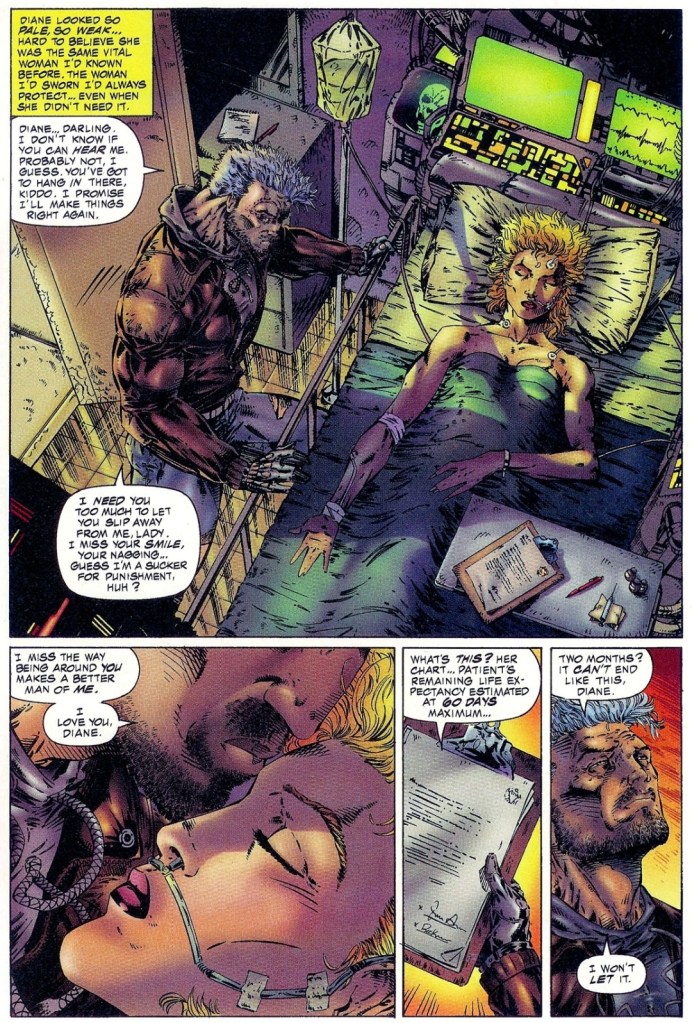
The story begins some time after the leader of the Kindred revealed himself to Lynch, Grifter, Backlash and Alicia Turner. It has been former IO operative and Team 7 member Roberto Diaz all along and he blamed Backlash for leaving him for dead more than twenty years prior during a desperate situation in South America.

On the orders of Diaz, a few of the beastly Kindred servants carried the severely damaged body of Backlash to a waterfall and threw him down. Elsewhere, Grifter is naked and contained in a water container with oxygen and a communication device attached to him. Roberto Diaz watches and communicates with him. Diaz tells Grifter that the his old identity is no more and the only thing he requires from him are gen samples which are crucial to better understand the genesis drug.

Diaz reveals to him that duplicating the genesis drug is crucial for the Kindred to create more life and be able to overwhelm the world and force it to recognize the might of the Kindred society. Grifter tries to reason with his former teammate by telling him that the genesis serum is something that is not meant to be tampered as it will lead to destruction…

Quality

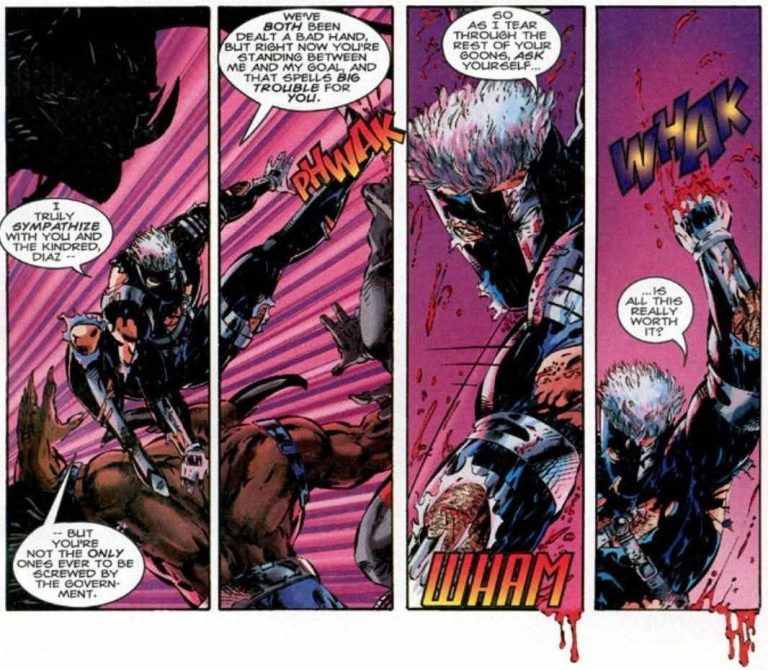
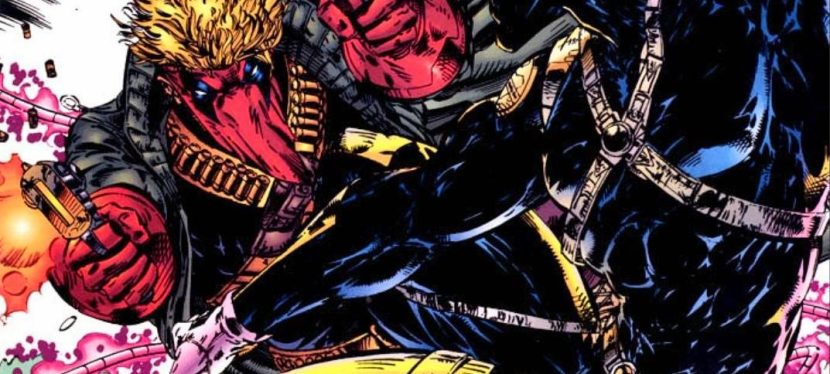
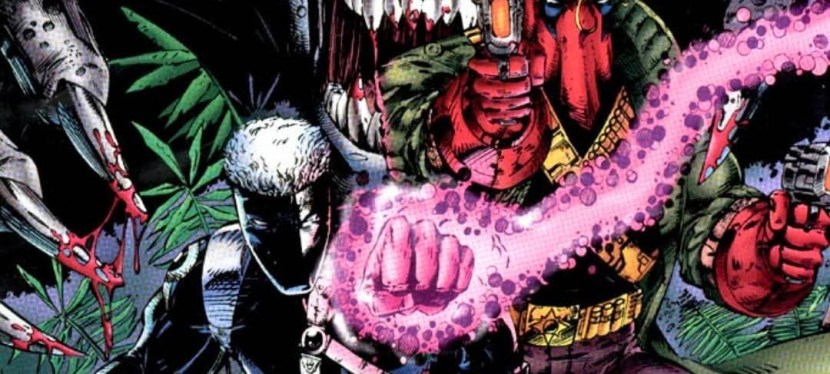
Backlash in action!

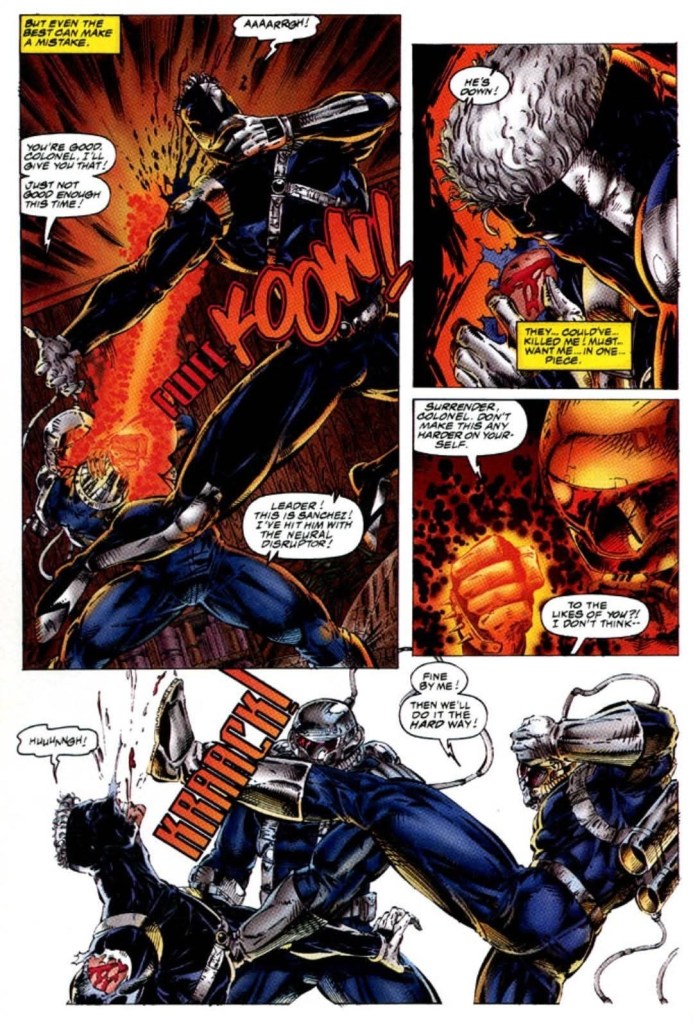
This early, I can say that Jim Lee, Brandon Choi, Sean Ruffner and Brett Booth gave their best effort to make this final chapter very intriguing, dramatic and explosive to read at the same time. Along the way, they expanded the lore of the original WildStorm universe while building up anticipation for the Team 7 original mini-series (released in the 4th quarter of 1994).

The writing got even stronger in this final issue in terms of storytelling and character development. Roberto Diaz is not a one-dimensional super villain. In fact, he strongly believes that he was betrayed not only by Team 7 and IO, but by humanity in general. As such, he found purpose with the Kindred during his survival days and injected himself with the genesis drug which enhanced him but also turned him into an addict (this alone added drug addiction as a key theme). As far as Roberto Diaz is concerned, he is on a path of no return and his obsession with vengeance against humanity justifies his leadership of the Kindred and the master plan to overwhelm humanity someday. In terms of geopolitics, this reminds me a lot about Islamic terrorists going up against Western civilization using violence while having their fellow Islamists migrate into different nations worldwide to overwhelm those societies from within. Of course, the concept of Diaz and the Kindred plotting against many billions of humans here is high fantasy mixed with unethical science, terrorism, infiltration and terrorism.

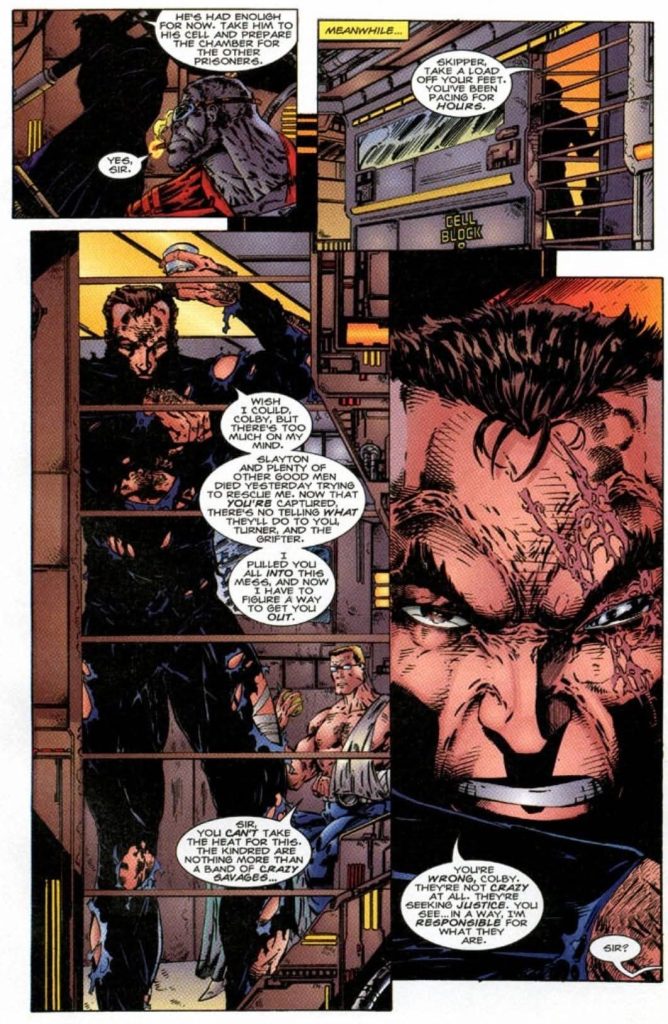
The creators managed to develop Grifter, Backlash and John Lynch even more. Lynch here is portrayed as very stressed and struggling with being responsible over the deaths of many men IO sent to rescue him. He even believed for a while that Backlash is dead and he knows fully well that the Kindred are not crazy but rather intelligent and are obsessed with seeking justice. In some ways, Lynch is also responsible for the Kindred and he reflects on what he did for decades for IO while serving as a Team 7 member with a leadership role.

John Lynch in the prison cell with Colby.

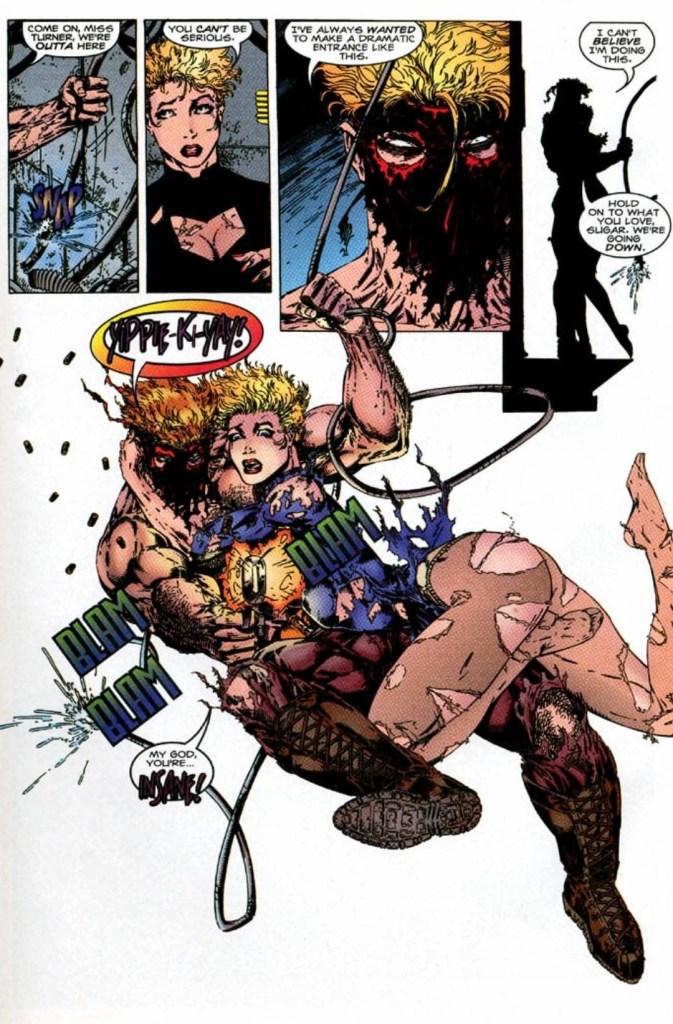
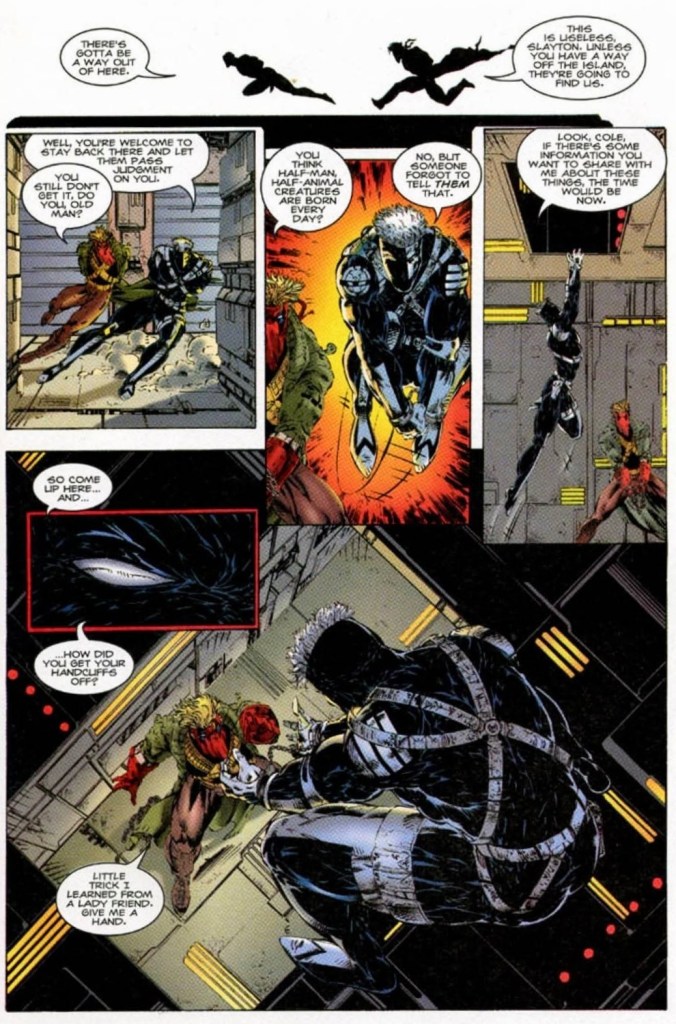
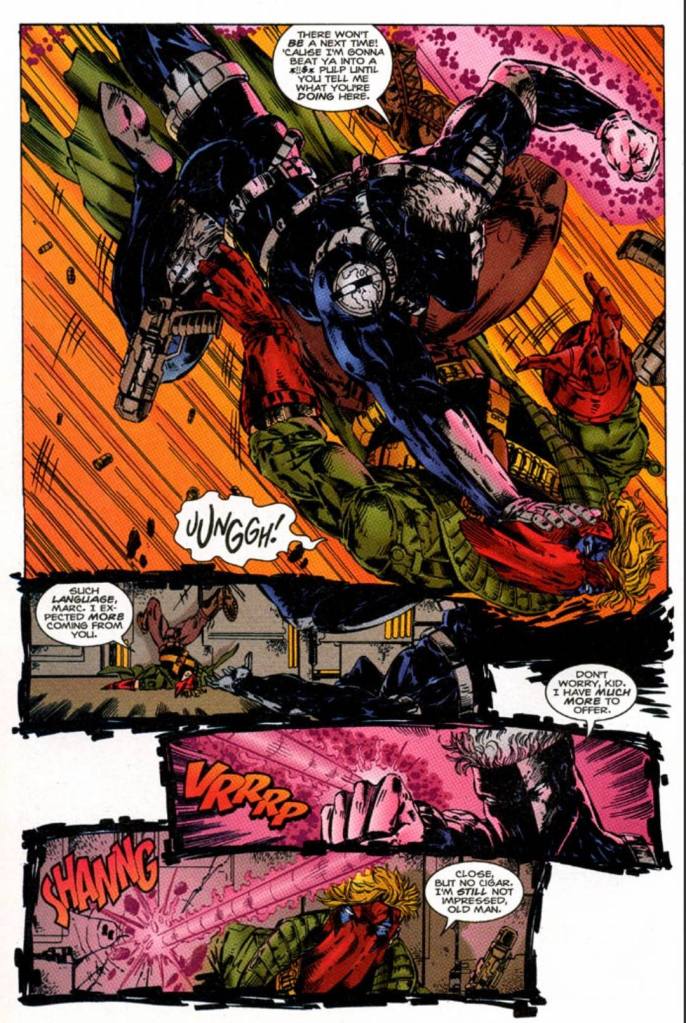
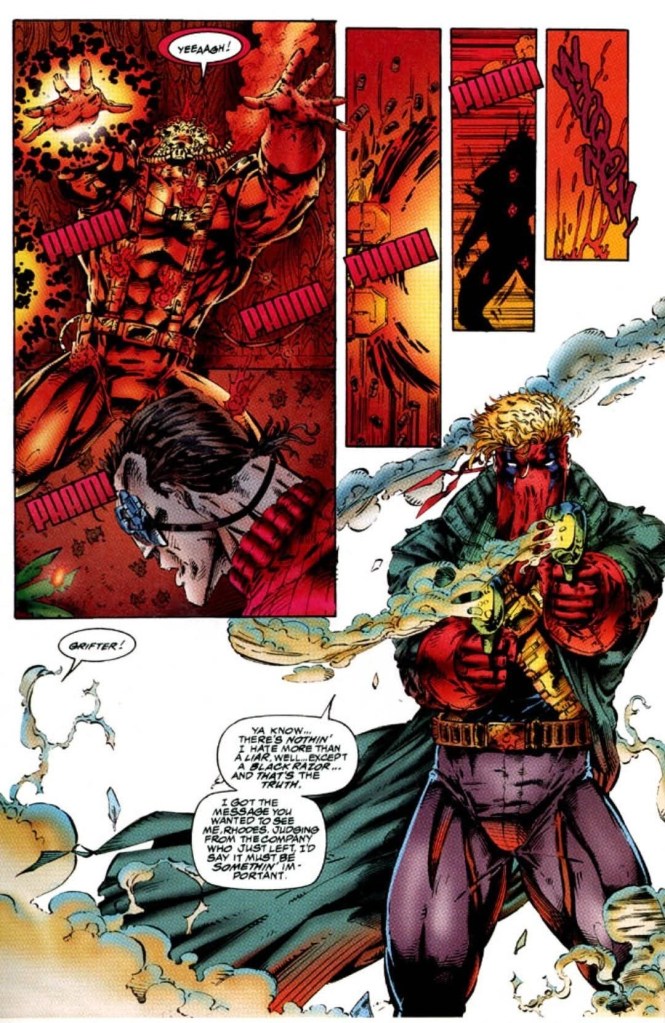
Grifter and Backlash, who are often visually featured in the promos of this mini-series, also have their fair share of the spotlight. Both heroes are severely beaten and not even their special talents or powers were enough to overcome the violent opposition of the Kindred. I like the way the creators emphasized Grifter’s (civilian identity: Cole Cash) personality as he got into the same prison cell with Alicia Turner who turned out to be involved with him several years prior. Grifter here is uneasy about the past not only as member of Team 7 but also as a person. As for Backlash, I’ll say that he has the classic heroic comeback in this issue and things got really tense between him and Roberto Diaz.

When it comes to superhero spectacle, this one is really packed with action and Brett Booth delivered some dynamic artworks to make the story look entertaining. When he draws the Kindred – those animalistic loyalists of Roberto Diaz – he makes them look horrific and intimidating from time to time. When it comes to drawing Backlash and Grifter, Booth’s take has some rough edges as this mini-series was produced before the start of the Backlash series.

Conclusion

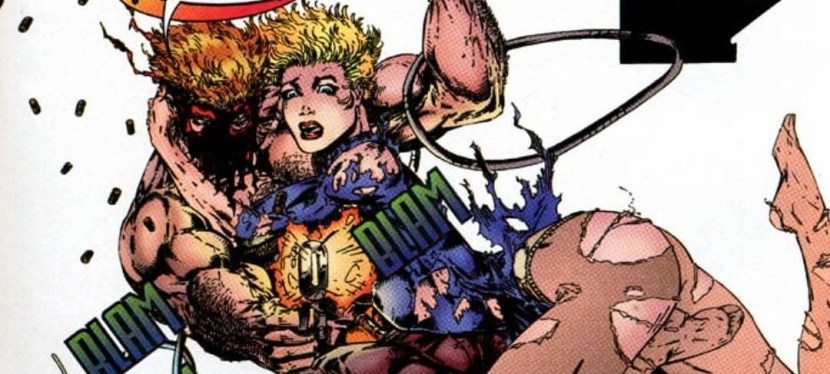
A dynamic action shot of a battered Grifter with Alicia Turner.

I can say that The Kindred #4 (1994) is a worthy end to the mini-series. By the time the plot concluded, the lore and the paramilitary concepts of the original WildStorm universe got expanded a lot with emphasis on the legacy left behind by Team 7 and IO. Grifter, Backlash and John Lynch – all former teammates of Team 7 – got nicely developed here and their significance within the WildStorm universe got stronger. This comic book delivered intrigue, surprises and a good amount of spectacle from start to finish. It also succeeded in setting the stage for the late-1994 launch of Team 7.

Overall, The Kindred #4 (1994) is recommended.

+++++

Thank you for reading. If you find this article engaging, please click the like button below and also please consider sharing this article to others. If you are looking for a copywriter to create content for your special project or business, check out my services and my portfolio. If you want to support my website, please consider making a donation. Feel free to contact me with a private message. Also please feel free to visit my Facebook page Author Carlo Carrasco and follow me on Twitter at @CarloCarrascoPH as well as on Tumblr at https://carlocarrasco.tumblr.com/ and on Instagram at https://www.instagram.com/authorcarlocarrasco/.
A Look Back at Gen13 #2 (1994)

Welcome back, superhero fans, 1990s arts and culture enthusiasts, Image Comics fans and comic book collectors! Today we go back to the mid-1990s to examine one of the many tales of Jim Lee’s original WildStorm universe through the original Gen13 mini-series.

Historically, Gen13 (stylized as Gen13) was launched at a time when Jim Lee’s company was establishing and expanding the original WildStorm shared universe with such comic book titles like WildCATS: Covert Action Teams, StormWatch, Backlash, Wetworks and the prequel title Team 7. When compared to those mentioned titles that had strong paramilitary elements combined with conspiracy and intrigue, Gen13 stood out with its concept of super-powered teenagers who don’t realize they are subjects of International Operations (IO) which has a long history of abuse, corruption and human rights violations. Gen13 #1 started strongly thanks to the solid writing of Jim Lee and Brandon Choi who challenged themselves to expand the WildStorm lore differently.

With those details laid down, here is a look back at Gen13 #2, published by Image Comics in 1994 with a story written by Jim Lee and Brandon Choi with artwork done by Jeffrey Scott Campbell. This is the second issue of the mini-series.  

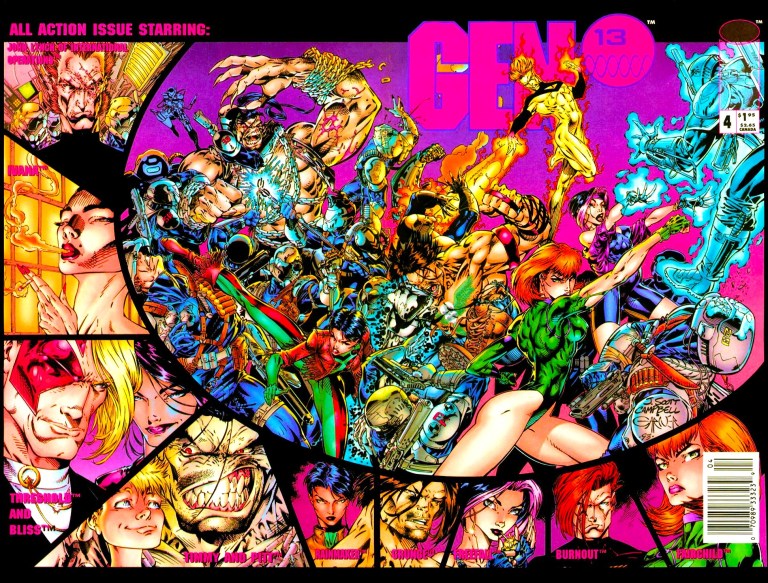
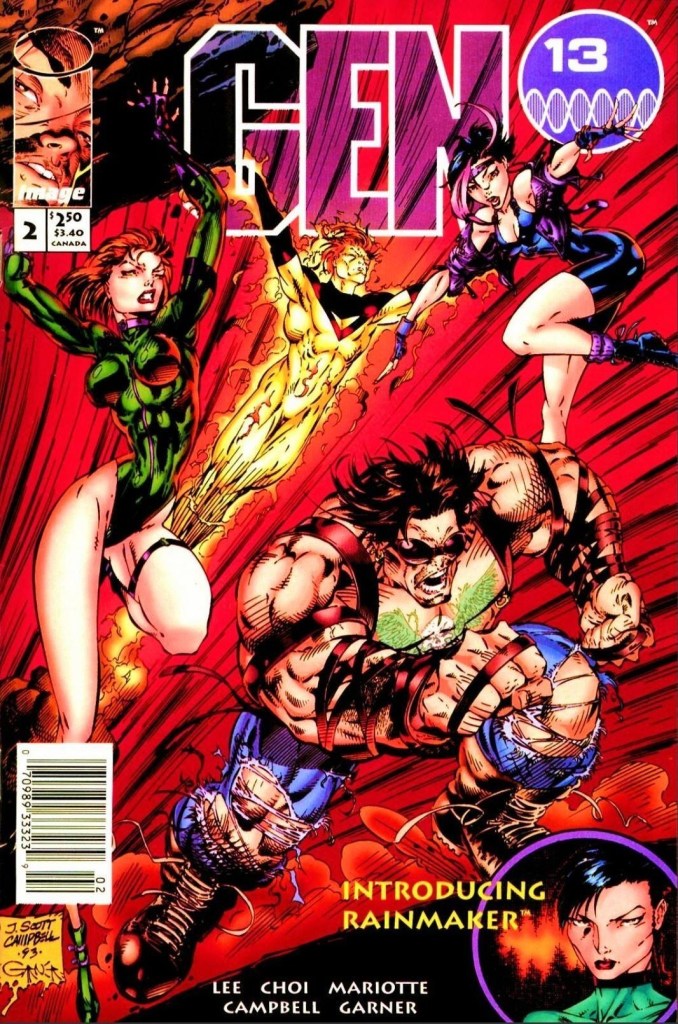
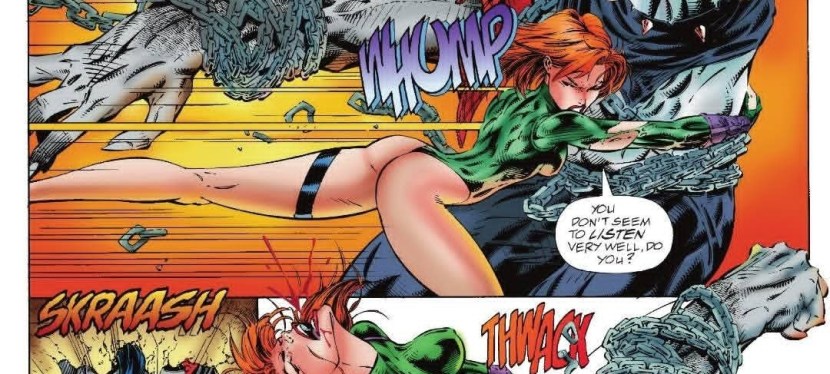
The cover.

Early story

The story begins with Caitlin Fairchild, Grunge, Roxy, Bobby, Rainmaker and Tom Hallinan in the middle of a desert running away from the floating troopers of Project Genesis. They just escaped from the top-secret facility.

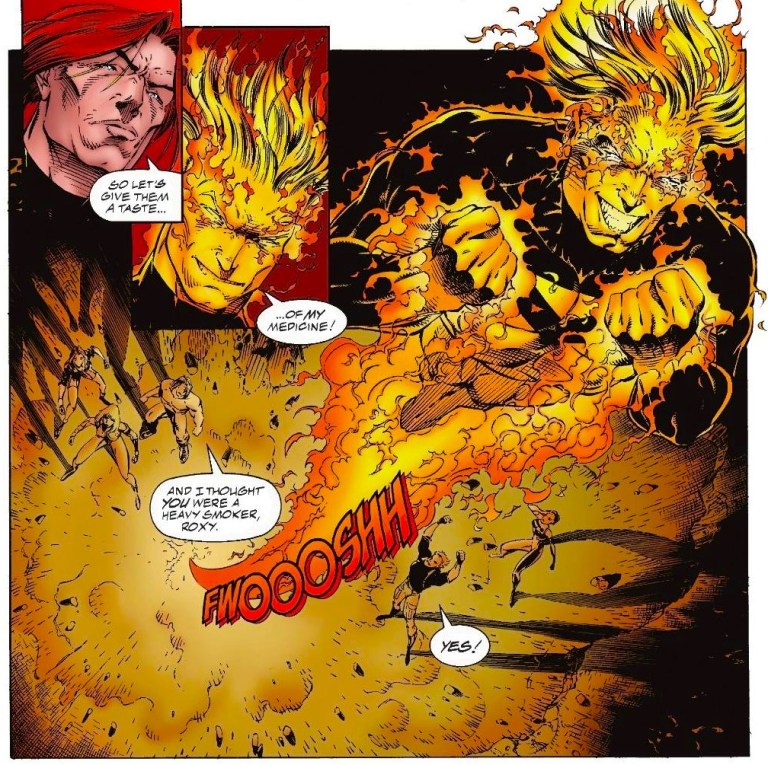
Tom Hallinan suddenly uses his power to shock three troopers on a floating craft (gunship) and brings them down to an explosive end. As Caitlin has trouble accepting the fact that the troopers were killed, Tom emphasizes that they can fight back using their super powers and Bobby (Burnout) agrees by utilizing his own powers of flight and flame to confront even more troopers on their gunships.

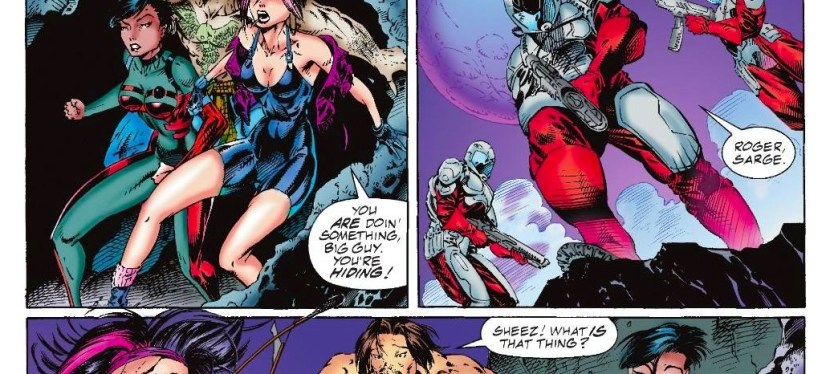
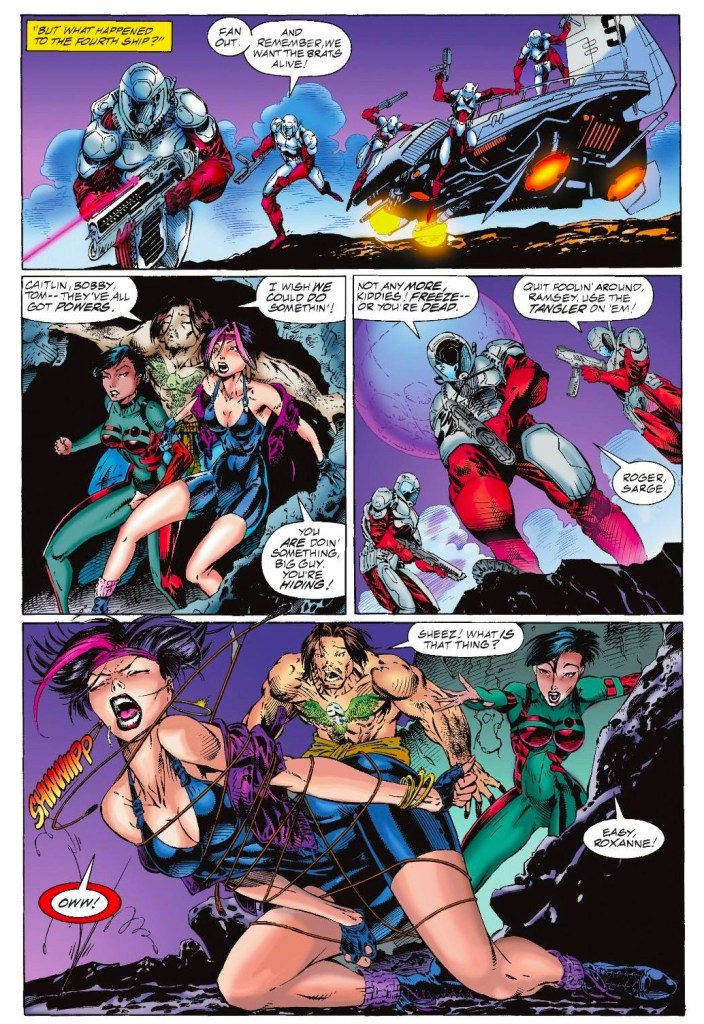
As the conflict escalates, Fairchild begins to use her super strength to tear off a huge rock and successfully destroys one of the gunships with it. Nearby, Roxy, Rainmaker and Grunge find themselves cornered by armed troopers. Roxy gets hit by the tangler from the troopers…

Quality

Roxy, Grunge and Rainmaker cornered by the armed troopers.

Similar to the first issue, this comic book has a solid plot structure and the writers took their time to emphasize the tale, develop the characters within their limits, and doing both build-ups and pay-offs.

Following the events of issue #1, Fairchild and her eventual Gen13 teammates here are only discovering their respective super capabilities at a time of confusion and desperation. They still have yet to form the rock-solid bond as a team and they are still struggling with the new situation they found themselves in. The tale opened with a desperate escape from the Project Genesis facility (with a clever flashback used to explain what happened) putting themselves into a series of unfortunate events with no guarantee of survival ahead.

While this comic book featured the eventual core Gen13 characters, the tale is still pretty much focused on Caitlin Fairchild and the writers did a really good job developing her with not just the present-day events but also with her own perception of how her life turned out. Apart from being a very smart college student, Fairchild is also very observant and does her best when dealing with the challenges in new situations. At this stage, she has yet to realize her true goals as she deals with the sudden changes and dangers that came with being a super-powered teenager under the grasp of IO.

Grunge, Roxy, Burnout and Rainmaker also got their own shares of the spotlight but nowhere as great as Fairchild which is understandable. At this stage, it clear that the writers had something planned for them for further parts of the story.

More on the story itself, the plot really moved forward without being rushed. The pace moved from medium to fast, and as generous pay-offs to previous build-up’s took place, more plot elements were being built-up. In line with the greater lore of WildStorm, the concept of the government testing drugs on people for decades is raised and it makes the sinister moves of IO on human subjects really believable. Symbolically, the government and IO have affected generations of people with mad science and experimentation, and these are reflected well on the characters.

The plot indeed has intrigue and strong dramatic moments to back it up. However, the storytelling got weakened with the way one of the new characters here expressed himself which made the late-story twist predictable and unsurprising. Along the way, the visual eroticism ramped up here as Jeffrery Scott Campbell went on to visualize the script. The said visual eroticism (perhaps eye candy to those who enjoyed it) is unnecessary in my opinion and they took away from the written dialogue. The sexy imagery is a reminder of the 1990s comic book trends.

Conclusion

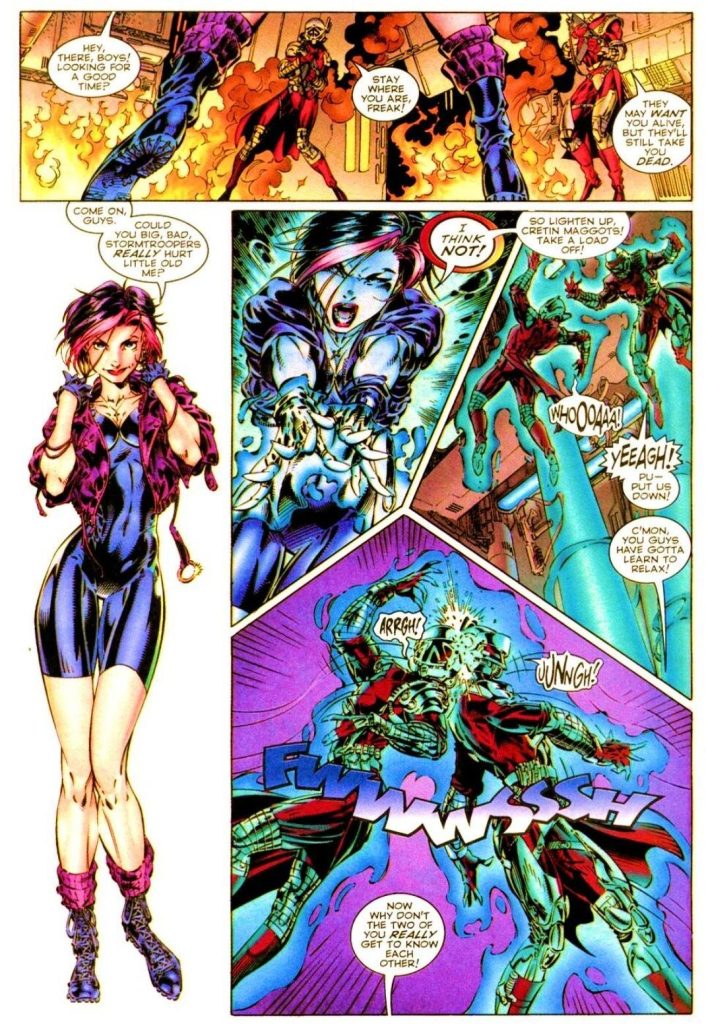
For the first time ever, Bobby becomes Burnout.

With the exception of the mentioned storytelling weakness and the unnecessary erotic visuals, Gen13 #2 (1994) managed to be a solid follow-up to its predecessor and is also an entertaining read. The continued strong writing by Lee and Choi ensured strong engagement, suspense and spectacle throughout. Revisiting this old comic book resulted in a fun read in my experience and I am convinced to keep going on with this WildStorm mini-series.

Overall, Gen13 #2 (1994) is recommended.

+++++

Thank you for reading. If you find this article engaging, please click the like button below and also please consider sharing this article to others. If you are looking for a copywriter to create content for your special project or business, check out my services and my portfolio. If you want to support my website, please consider making a donation. Feel free to contact me with a private message. Also please feel free to visit my Facebook page Author Carlo Carrasco and follow me on Twitter at @CarloCarrascoPH as well as on Tumblr at https://carlocarrasco.tumblr.com/ and on Instagram at https://www.instagram.com/authorcarlocarrasco/

A Look Back at Gen13 #1 (1994)

Welcome back, superhero fans, 1990s arts and culture enthusiasts, Image Comics fans and comic book collectors! Today we go back to the mid-1990s to examine one of the many tales of Jim Lee’s original WildStorm universe through the original Gen13 mini-series.

There is a lot to enjoy in the WildStorm comic book universe of the 1990s with such titles like WildCATS: Covert Action Teams, Team 7, StormWatch, Grifter, Backlash and Wetworks to name some. The WildStorm depicts the world as chaotic filled with strong paramilitary concepts, conspiracies and even aliens from deep space.

Along the way, WildStorm has its own take on the sub-genre of super-powered teenagers which was realized as Gen13 (stylized as Gen13). Strangely enough, the team – which actually first appeared in the Deathmate Black crossover comic book in 1993 – was originally titled as Gen X but WildStorm had to rebrand it into Gen13 as Marvel Comics already trademarked the name Generation X for an X-Men-related comic book project. To learn more about production history and background of Gen13, click here.

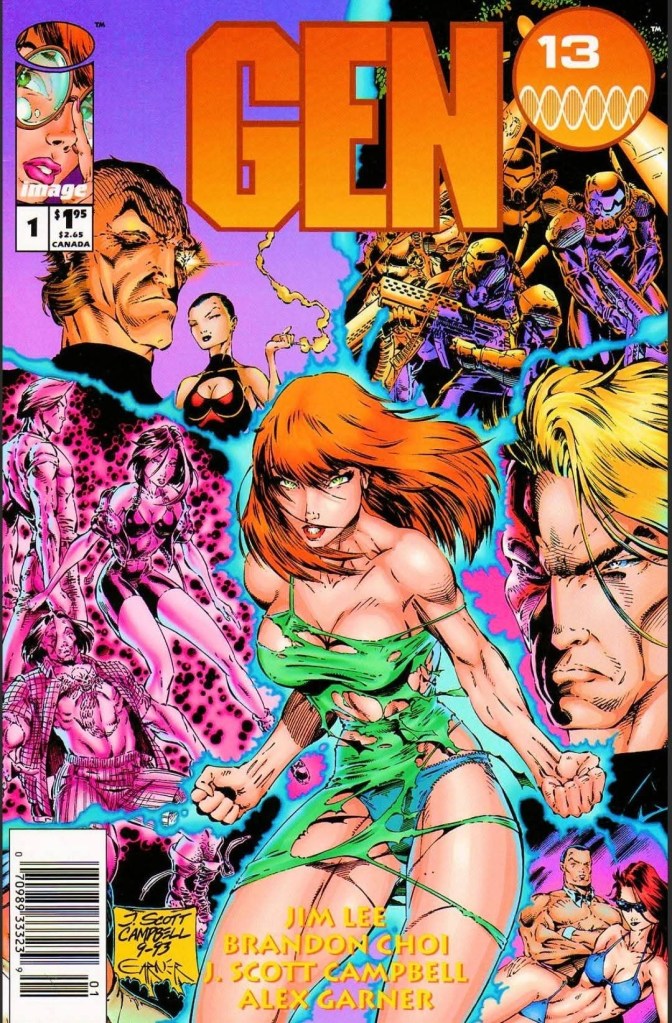
With those details laid down, here is a look back at Gen13 #1, published by Image Comics in 1994 with a story written by Jim Lee and Brandon Choi with artwork done by Jeffrey Scott Campbell (ink work by Alex Garner). This is the first issue of the mini-series.  

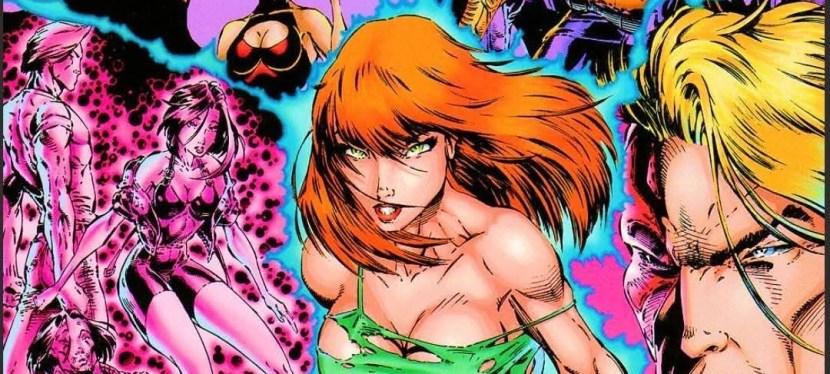
The cover.

Early story

The story begins sometime in 1979 when a married couple (Stephen and Rachel Callahan) desperate runs away with their two little children. A team of armored troops (the Black Razors) riding two hovering vehicles catches up with them and hit Rachel with bullets passing through her body. Stephen, who is carrying his son Matthew, uses his power to destroy one of the hovering vehicles. One of the Black Razors realized that the husband is gen-active and nobody informed their team that he was with Gen12.

Agonizing with severe head pain, Stephen tells Matthew to take his little sister Nicole with him and run to the trees. As far as Stephen is concerned, he is finished and all he can do is buy time for the two little children to escape. He tells Matthew to protect his sister. Suddenly, the Black Razors killed Stephen right in front of Matthew and Nicole.

Fifteen years later, a young, nerdy college student named Caitlin Fairchild makes her way through the college campus in Princeton. She is a gifted student who has been focused on maintaining a high grade and graduate with her advanced degree in computer science in the near future.

Upon arriving at the dormitory, she meets her promiscuous roommate Alexa who informs her that some guys arrived earlier looking for her. The guys were described as middle-aged suits and they wanted to talk to Caitlin about some internship program. Alexa then leaves.

A few hours later, Caitlin wakes up as the door gets knocked. Special agent baker of the National Security Committee tells her that she has been accepted into the Gen13 program and her presence is immediately required in order to process her into the program before it begins the next day…

Quality

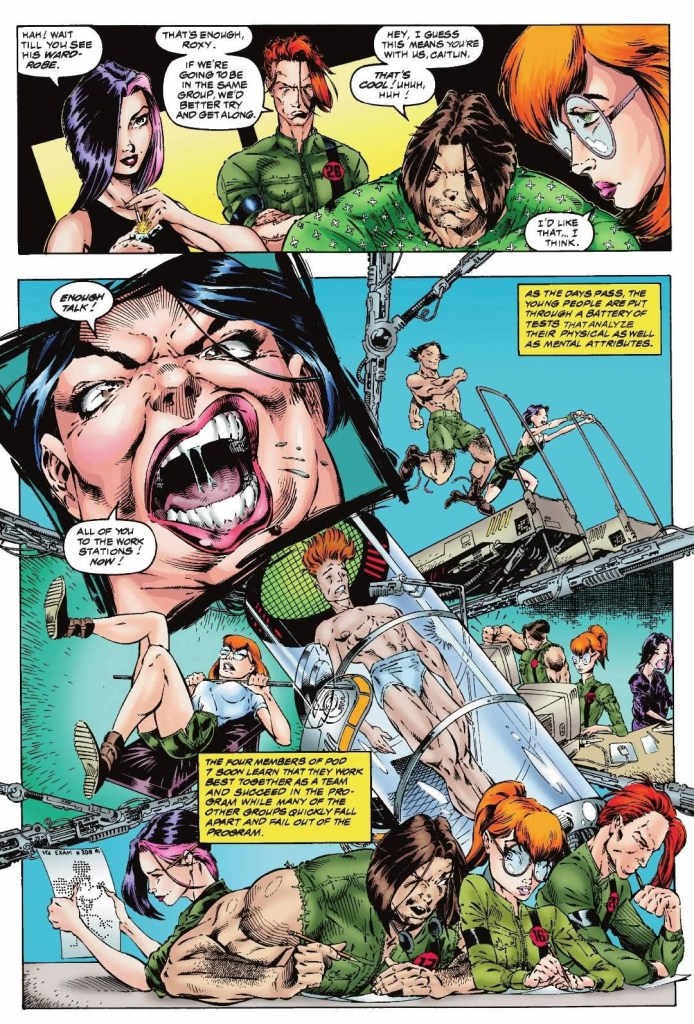
Roxy, Burnout, Grunge and Caitlin Fairchild together for the first time at the secret facility of the Gen13 program. One other member – Rainmaker – has yet to appear.

I enjoyed this comic book the first time I had it in 1994. I can clearly say that it is still fun and engaging to read again today.

This comic book was written with the intention to introduce super-powered teenagers as a new and really distinctive team in one corner of the original WildStorm universe while also expanding the lore by focusing more on International Operations’ unethical covert operations which will easily remind people about government conspiracies, top secret missions and the like. The story has really strong elements about conspiracies, unethical scientific experiments and even human rights violations. The story by Jim Lee and Brandon Choi has a strong structure but what stood out to me was the really creative writing done to bring the characters to life complete with a touch of the 1990s vibe (in reference to comic book trends and real-life society).

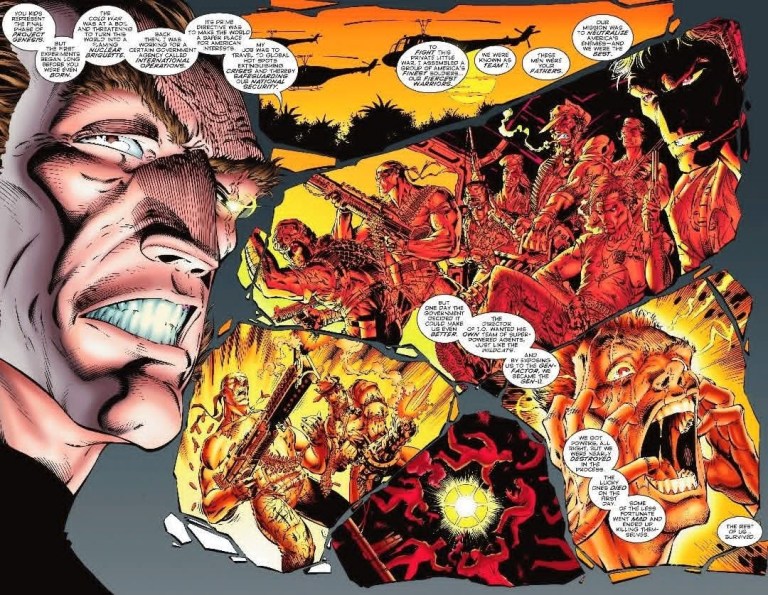
John Lynch, a former member of Team 7 and also one of the high-ranking officials of IO who occasionally appeared in prior WildStorm comic books, gets a nice share of the spotlight in the story and indeed he is not full control of his organization. In fact, IO’s execution of a new program about developing people with special abilities or powers (without their knowledge) raises Lynch’s concerns as he himself was a victim of betrayal and exposure to an experimental gas during his time with Team 7. Lynch also appeared in The Kindred mini-series (read my reviews by clicking here, here and here).

When it comes to the characters, Gen13’s members here are introduced with notable differences in terms of personality. The nerdy Caitlin Fairchild is the very promising smart young lady who has the potential to succeed. Bobby (Burnout) is the quiet guy who quickly realizes that true unity is needed in order for a group to succeed under the program they are in. Roxy is the undisciplined and rebellious young lady while Grunge is the loose cannon and has trouble with authorities. While it is clear you won’t see much of their powers yet in this comic book, they turned out to be interesting enough to follow thanks to the strong creative writing by Lee and Choi.

When it comes to the visuals, Jeffrey Scott Campbell’s artworks really stood out mainly due to his distinctive style. If you look closely at how he draws the faces of women – particularly the ones who are young and fit – you will realize the exaggerated look complete with the big eyes and curves seen on females in anime or even manga (Japanese comics). If you are looking visual realism on the characters, you won’t find it here at all. Campbell’s style truly defined the look of the characters and yet he was able to draw armored troops (Black Razors and the armed security guard) with a really high level of details (including their weapons) which really stood out visually. Campbell is also good with superhero spectacle and hard action. Last but not least, there is a deliberate amount of erotic imagery in this comic book which serves as a reminder that this is a story aimed at young adult and adult readers.  

Conclusion

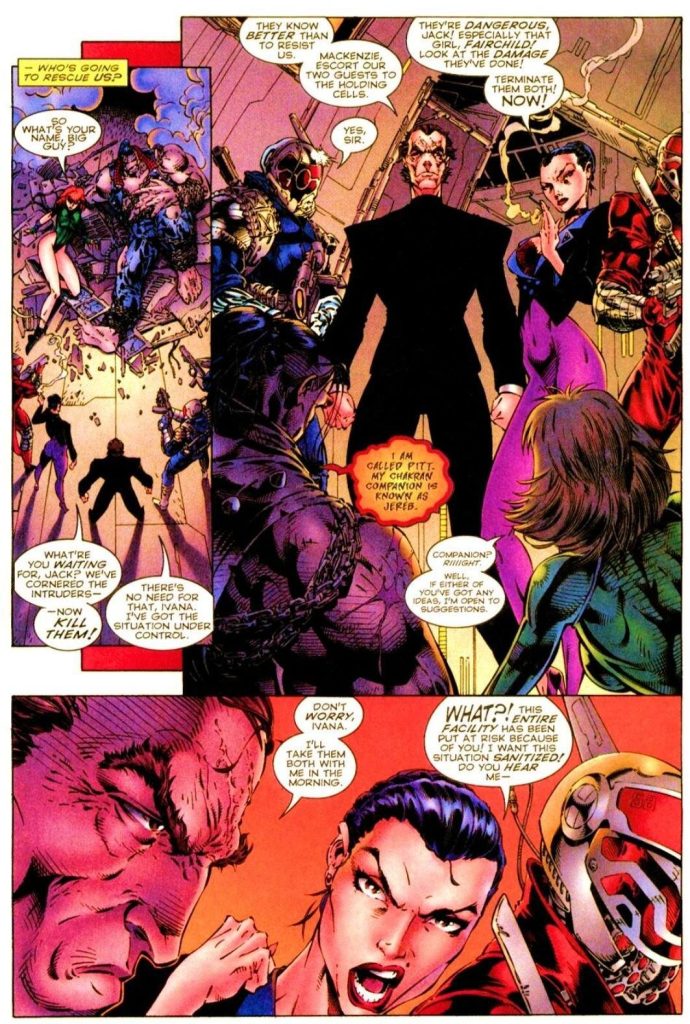
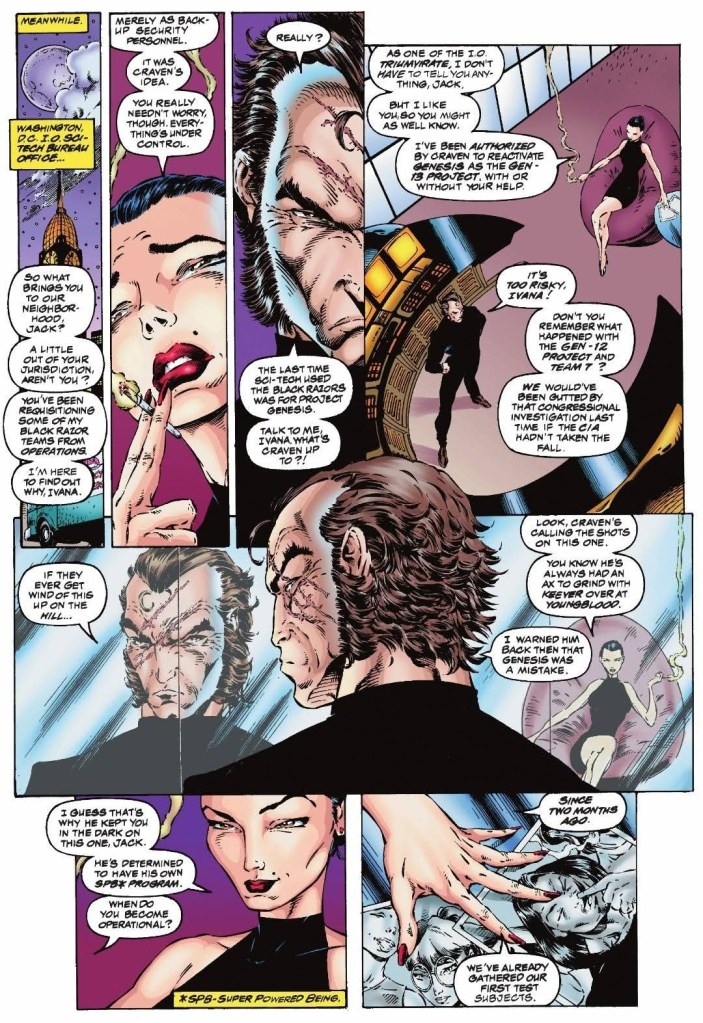
John Lynch and Ivana having a confidential talk about International Operations and its current project about super-powered beings. Even though he is a very high officer at IO, Lynch was kept in the dark about something crucial.

Indeed, Gen13 #1 (1994) remains entertaining to read mainly because of the strong writing. The story moved at a smooth pace, the exposition was done cleverly, and the characters ended up being worthy enough to pay attention to. By the time I reached the end, I am convinced to go on to the next issue and rediscover not only more of the mini-series but also the way it expanded the lore of the WildStorm universe of the 1990s. This comic book alone strongly emphasized the connections with other elements of the WildStorm universe, particularly with Team 7 (its mini-series launched months after this one) and the dark legacy of IO. It is an adulterated superhero comic book that really offered readers something new and intriguing.

Overall, Gen13 #1 (1994) is recommended.

+++++

Thank you for reading. If you find this article engaging, please click the like button below and also please consider sharing this article to others. If you are looking for a copywriter to create content for your special project or business, check out my services and my portfolio. If you want to support my website, please consider making a donation. Feel free to contact me with a private message. Also please feel free to visit my Facebook page Author Carlo Carrasco and follow me on Twitter at @CarloCarrascoPH as well as on Tumblr at https://carlocarrasco.tumblr.com/ and on Instagram at https://www.instagram.com/authorcarlocarrasco/.
A Look Back at The Kindred #3 (1994)

Welcome back, superhero fans, 1990s arts and culture enthusiasts, Image Comics and comic book collectors! Today we go back to the mid-1990s to examine one of the many tales of the WildStorm universe through The Kindred mini-series.

Having read the first two issues, I can say that the plot has been built-up into something that justifies not only the reuniting of former Team 7 teammates Grifter and Backlash (who hate each other) but also the consequences caused by IO’s (International Operations) a long time prior. So far the creative team of WildStorm father Jim Lee, Brandon Choi, Sean Ruffner and artist Brett Booth succeeded in telling an entertaining story with a balance on action, suspense and intrigue.

With those details laid down, here is a look back at The Kindred #3, published by Image Comics in 1994 with a story written by Jim Lee, Brandon Choi, Sean Ruffner and Brett Booth. Booth illustrated the comic book.  

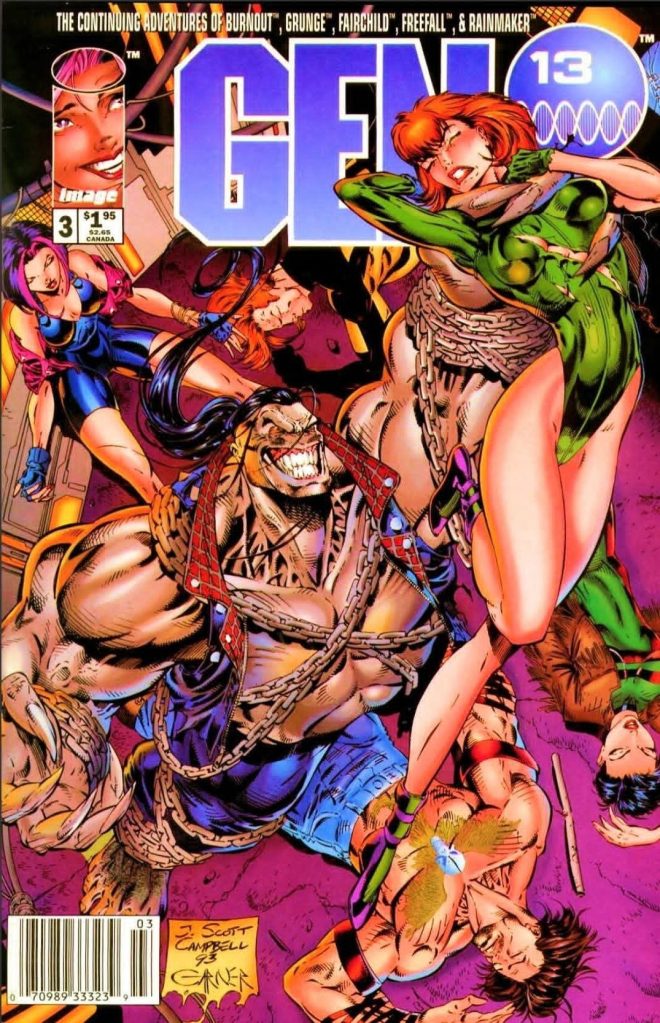
The cover.

Early story

The story begins with John Lynch being helpless in front of Bloodmoon, the vicious leader of the Kindred. Lynch tells him that he has no recollection of him, the Kindred and the crimes he has been accused of. Regardless, Lynch is being prepared for the trial under the Kindred’s system of justice.

Bloodmoon learns from one of his pawns that they captured the three men who were sent to rescue the prisoners. Two of the captured were sensed to have the Kindred’s blood within them. Bloodmoon then orders to have them brought to him immediately.

Minutes later, Grifter and Backlash – both battered and worn down – were brought to Bloodmoon.

Quality

Literally, the past bites Bloodmoon hard.

Following the events of issue #2, there is a huge pay-off in this comic book and it added more depth into the plot. With Lynch, Backlash and Grifter – all of them were teammates in Team 7 a long time prior – helpless early in the story, the stakes really went high up as something significant about Bloodmoon and how the Kindred started got revealed.

Bloodmoon is not the typical comic book villain. His origin and how the Kindred was established are linked to the high-stakes experiments IO conducted on animals on Caballito (this makes IO’s top-secret experimentation on humans to unlock super-human potential literally just the tip of the iceberg). The way Bloodmoon was portrayed here, he is convinced that he exists with an undeniable purpose to lead the Kindred while getting striking back at humanity for vengeance starting with IO and former Team 7 members. The tragic events of the past made him a very hardened character and the living and walking evidence of IO’s unethical experimentation agenda.

Worth focusing here is, unsurprisingly, the uneasy new alliance between Grifter and Backlash who had no choice but to set aside their differences to survive and somehow bring down Bloodmoon deep within the turf of the Kindred. You will get a glimpse as to how they used to work during their time with Team 7 and how they could pull off tough achievements with their modern-day abilities and technology. The dynamics between the two former Team 7 teammates is a must-see and there are indeed 1980s Hollywood action film vibes embedded within.

Not to be outdone is John Lynch whose super-human potential gets unleashed while being in the middle of a very desperate situation facing three deadly enemies at once. Lynch here gets more of the spotlight and he does something else apart from serving as a convenient tool for exposition about IO and its past.  

Conclusion

Grifter and Backlash on the run.

As the plot moved closer to concluding, The Kindred #3 (1994) had the stakes raised a lot for the former Team 7 members involved as well as IO’s current people. The big reveal that happened late in the comic book was pretty powerful and it will encourage readers to focus more on the past operations of IO as well as Team 7. At this stage in the publishing history of Image Comics, WildStorm’s para-military concepts got solidified more effectively setting the stage for the launch of the original Team 7 mini-series. As for The Kindred mini-series, the engagement and entertainment value of issue #3 convinced me to go on to issue #4.

Overall, The Kindred #3 (1994) is recommended.

+++++

Thank you for reading. If you find this article engaging, please click the like button below, share this article to others and also please consider making a donation to support my publishing. If you are looking for a copywriter to create content for your special project or business, check out my services and my portfolio. Feel free to contact me with a private message. Also please feel free to visit my Facebook page Author Carlo Carrasco and follow me on Twitter at @CarloCarrascoPH as well as on Tumblr at https://carlocarrasco.tumblr.com/ and on Instagram athttps://www.instagram.com/authorcarlocarrasco

A Look Back at The Kindred #2 (1994)

Welcome back, superhero fans, 1990s arts and culture enthusiasts, Image Comics and comic book collectors! Today we go back to the mid-1990s to examine one of the many tales of the WildStorm universe through The Kindred mini-series.

The Kindred #1 was an entertaining piece of work by Jim Lee’s team. It was a build-up comic book that smoothly sets the stage for the inevitable reuniting of Grifter and Backlash – two former teammates of Team 7 who are also among the most defining heroes of the WildStorm universe – and the dangerous mission to find and rescue IO director John Lynch (who was also part of Team 7) and his assistant in South America. As the story of issue #1 went on, it was clear that elements from the past are creeping up on the characters and IO itself.

With those details laid down, here is a look back at The Kindred #2, published by Image Comics in 1994 with a story written by Jim Lee, Brandon Choi, Sean Ruffner and Brett Booth. Booth illustrated the comic book.  

The cover.

Early story

The story begins with a high-tech aircraft speeding off the coast of South America. Inside, the temporary leader Backlash (supported by deputy Colby) talks with members of the Black Razor team about what the mission is about and what their objectives are. Their goal is to find IO superior John Lynch and his assistant Alica Turner who have been held captive by a mysterious and dangerous bunch called the Kindred.

Upon arrival at their destination, Backlash, Colby and the Black Razors land to start their operation. Moments later, the stowaway Grifter emerges from inside the aircraft and gets spotted by a corporal. Grifter fires at an ugly, human-like monster of the Kindred saving the corporal’s life. Grifter then descends to follow Backlash and the Black Razors…

Quality

Backlash and Grifter (Marc Slayton and Cole Cash) together after so many years apart. They are former teammates of Team 7.

This early, I can say that the entertainment value of this comic book went up really high. It is clearly a nice pay-off to the build-up that happened in issue #1 and it has some notable moments as the storytelling went on.

Without spoiling the plot, the core concept of this series became clearer to me as the story progressed. Apart from the creative idea of having the former Team 7 teammates reunited, there are believable reasons as to why Backlash is leading a team of IO’s armed operative and why Grifter tagged along. Both of them are searching for answers while having different agendas or personal goals. There is also animosity between them which strongly implies something bad happened during their time together with Team 7. John Lynch, who often has been a background or supporting character in previous WildStorm tales (but eventually got a stronger role in Team 7 comics), finds himself cornered by the Kindred whose leader is very aware of what IO has been doing all along. At the same time, IO’s legacy of indiscriminate genetic testing on animal fetuses created a force of not only evil but vengeance. What the Kindred leader mentions effectively blurred the boundary that separates good and evil, and even that of abusers and victims.

By the time I reached the end of the comic book, the stakes and the suspense were raised. The same can be said about the overall fun factor.

Conclusion

The leader of the Kindred is not only evil. He is driven by vengeance and he knows a lot about IO.

Thanks to strong creative writing, The Kindred #2 (1994) is indeed a more engaging and more intriguing comic book. It consistently paid off the build-up that happened in the previous issue, and the creative team managed to keep on building up the suspense and tension as the story went on. Those who love spectacle will enjoy the high amount of action here and artist Brett Booth proved himself to be capable of showing dynamic visuals. Booth has an inspired take on showing Backlash and Grifter in action. I am looking forward to the next issue.

Overall, The Kindred #2 (1994) is recommended.

+++++

Thank you for reading. If you find this article engaging, please click the like button below and also please consider sharing this article to others. If you are looking for a copywriter to create content for your special project or business, check out my services and my portfolio. If you want to support my website, please consider making a donation. Feel free to contact me with a private message. Also please feel free to visit my Facebook page Author Carlo Carrasco and follow me on Twitter at  @HavenorFantasy as well as on Tumblr at https://carlocarrasco.tumblr.com/ and on Instagram at https://www.instagram.com/authorcarlocarrasco/.
A Look Back at The Kindred #1 (1994)

Welcome back, superhero fans, 1990s arts and culture enthusiasts, Image Comics fans and comic book collectors! Today we go back to the mid-1990s to examine one of the many tales of the WildStorm universe as published by Image Comics.

To put things in perspective, Jim Lee’s WildStorm universe quickly expanded after launching WildC.A.T.s: Covert Action Teams in 1992. Other WildStorm properties followed such as StormWatch, Gen13, Team 7 and Wetworks. By 1994, things went rolling with the WildStorm projects and the production team of Jim Lee decided to expand the lore by having key characters Grifter (WildCATs) and Backlash involved in a story told in a mini-series. The said characters are actually former teammates of Team 7.

With those details laid down, here is a look back at The Kindred #1, published by Image Comics in 1994 with a story written by Jim Lee, Brandon Choi, Sean Ruffner and Brett Booth. Booth illustrated the comic book.  

The cover.

Early story

The story begins in New York City. Even as darkness envelopes the city that never sleeps, thousands of its denizens walk the streets in relentless pursuit of their hopes and dreams. One man walks alone and his thoughts are not filled with dreams of the future. Instead, he has nightmares from the past.

The man is Marc Slayton and he knocks the door communicating with Jack. He converts himself into vapor and easily enters the building moving towards Jack. He emerges as Backlash and tells Jack that he needs classified information on an alien race known as the Daemonites. It turns out, Backlash needs Jack’s hacking abilities to bypass the government’s bureaucracy and secrecy.

Suddenly, the armored members of Black Razor emerge behind Backlash…

Quality

Grifter appears in a violent way of helping someone.

I like this comic book. This is a tale that has strong elements of the 1990s WildStorm universe all over it, specifically paramilitary influence and intrigue. As this was released before Team 7 #1 (a tale set in the past), it was the WildStorm creators’ way of getting former teammates Grifter and Backlash together after being separated for a long time. The result is a dangerous mission launched while bringing key elements from the past back for the two heroes to encounter. Conveniently, this comic book added to the pre-release anticipation of the Team 7 mini-series.

More on the plot itself, Backlash wants crucial information about the Daemonites (monsters from space that are ugly, dangerous and capable of possessing people) and it so happens he has been targeted by IO (International Operations) for the mentioned mission. The way Backlash was portrayed involved his past coming back at him, dealing with IO and having to decide to participate or not. Clearly, Backlash here is cornered more than once and it is a sign that something intriguing and dangerous awaits him.

Grifter’s presence here is directly linked with his exit from WildCATs #8. Similar with Backlash, Grifter is in search for answers and he shows no intention of having a friendly reunion with his former teammate. Along the way, you will see the masked gunslinger being more analytical as the plot went on and his determination to find answers is really strong. Grifter here is also a huge risk-taker which is a nice touch.

Speaking of elements of the past, this comic book has some notable connections with other developments and parts of the WildStorm universe. A certain scene here could convince WildStorm fans to revisit the WildCATs mini-series.

Conclusion

Backlash hit hard by Black Razor members.

Considering the way the story was told and the high amount of expository dialogue executed, The Kindred #1 (1994) is clearly a build-up comic book that will eventually lead to the true essence of this mini-series. What I enjoyed the most here was how the creative team portrayed Backlash and Grifter. They are former teammates of Team 7 who each have grudges, personal problems and secrets that could potentially widen the gap between them. At the same time, the creative team succeeded in setting up the threat by showing the violent kidnap of John Lynch (the former leader of Team 7) and the rise of a new enemy who is very driven by revenge. Ultimately, this comic book succeeded in convincing me to read the next issue.

Overall, The Kindred #1 (1994) is recommended.

+++++

Thank you for reading. If you find this article engaging, please click the like button below and also please consider sharing this article to others. If you are looking for a copywriter to create content for your special project or business, check out my services and my portfolio. If you want to support my website, please consider making a donation. Feel free to contact me with a private message. Also please feel free to visit my Facebook page Author Carlo Carrasco and follow me on Twitter at  @HavenorFantasy as well as on Tumblr at https://carlocarrasco.tumblr.com/ and on Instagram at https://www.instagram.com/authorcarlocarrasco/.
A Look Back at Wetworks #1 (1994)

Welcome back superhero enthusiasts, 1990s arts and culture enthusiasts, and comic book collectors! Today we go back to the mid-1990s to explore the comic book launch of a notable fictional team co-created by the Whilce Portacio and Brandon Choi…Wetworks.

For the newcomers reading this, Whilce Portacio was one of the highly talented illustrators who left Marvel Comics and co-founded Image Comics in the early 1990s. While his fellow co-founders Todd McFarlane, Jim Lee, Rob Liefeld, Marc Silvestri, Jim Valentino and Erik Larsen were able to launch their respective dream projects (creator-owned properties) during Image’s first year of publishing, the launch of Wetworks was delayed by two years due to a death in Portacio’s family.

As a very young comic book reader in those days, I remember hearing rumors about Wetworks inside comic book stores I visited. There were rumors of business negotiations, solicitations and scheduled launches (ranging from October 1993 to January 1994). I also noticed some comic book enthusiasts who bought old copies of X-Factor and Uncanny X-Men that Portacio illustrated while waiting for Wetworks to debut.

In the middle of 1994, Wetworks was finally launched under the Image Comics label and I still remember the day when I saw lots of copies of issue #1 displayed on the shelves and windows of comic book stores.

With those details laid down, here is a look back at Wetworks #1, published in 1994 by Image Comics with a story written by Whilce Portacio and Brandon Choi. The art was done by Portacio with ink work by Scott Williams.

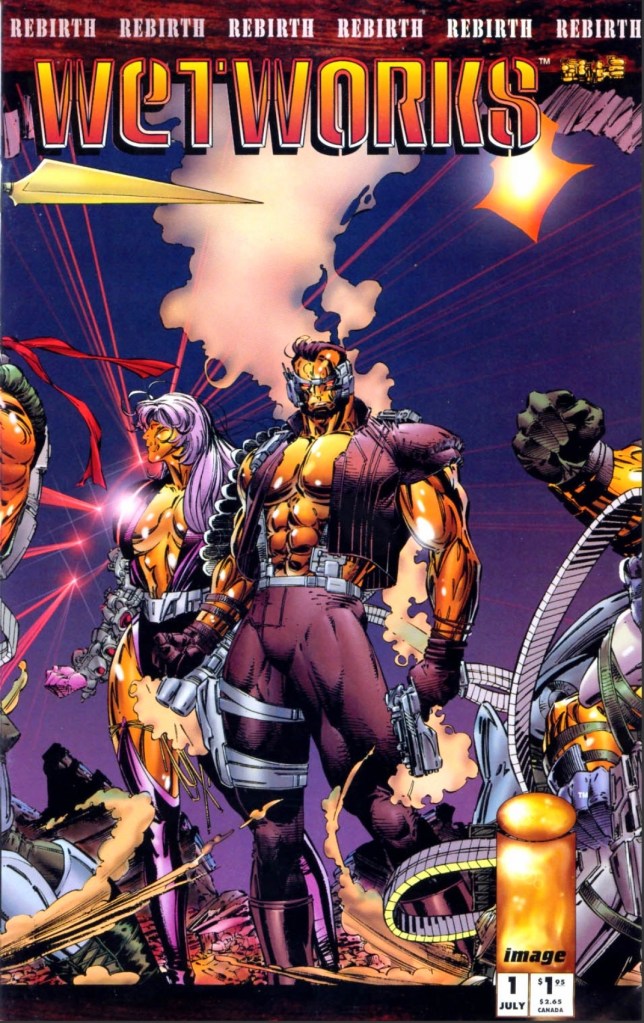
The cover.

Early story

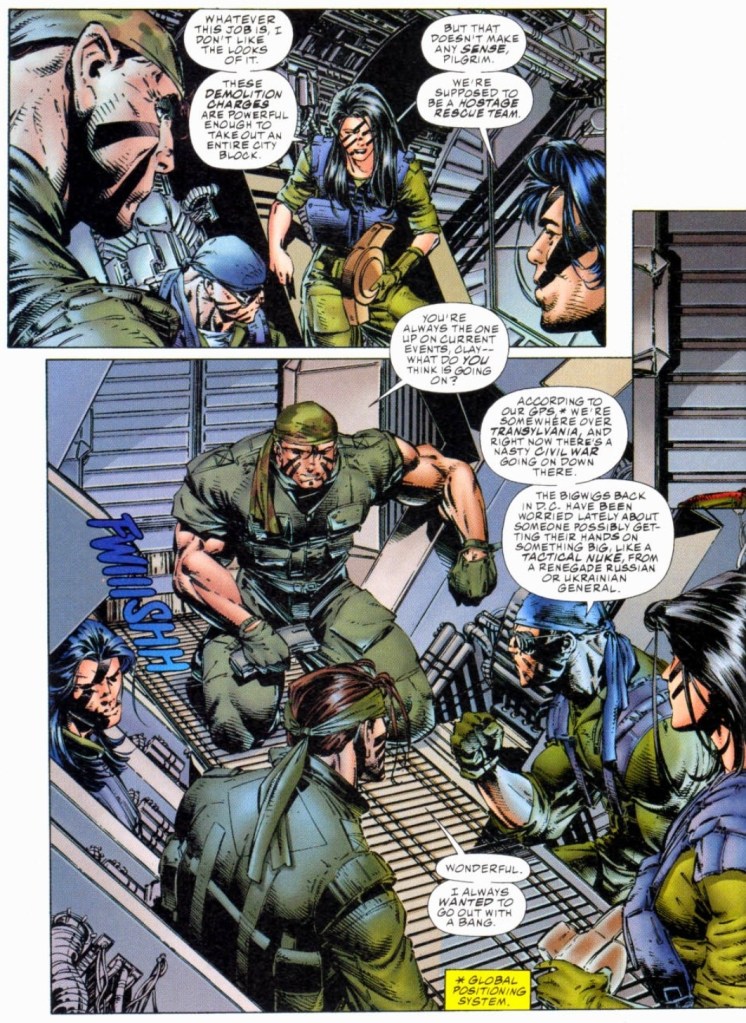
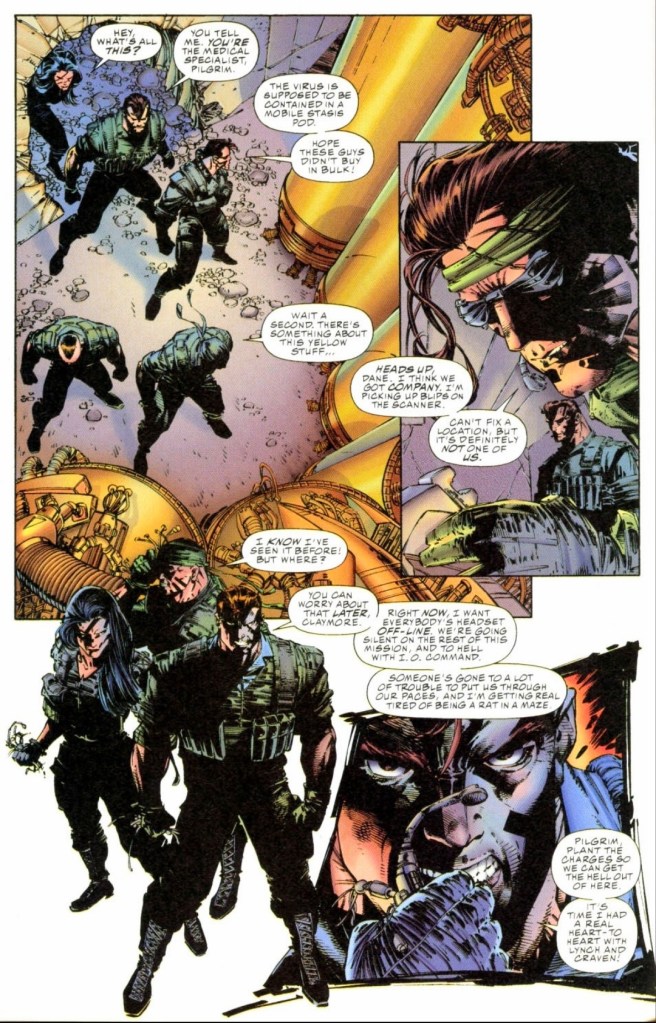
The story begins when a covert operations team working under International Operations (IO) travels to eastern Europe to infiltrate and destroy the base of operations of a certain warring faction and retrieve a biological agent (highly contagious) no matter what the cost. As it turns out, this new mission for the team (led by Colonel Jackson Dane, one of the pioneers of Team 7) started less than twenty four houses after their previous mission and their female member Pilgrim (reconnaissance specialist) pointed out that the demolition charges they are carrying are strong enough to wipe out an entire city block. Another teammate called Grail (the Filipino named Salvador Joel Alonday) stated that they are supposed to be a hostage rescue team.

Meanwhile deep inside the command center of IO in Washington, D.C., Admiral Halsey tells Miles Craven that Team 7 (the team led by Dane) are under his command and states that his sources tell him that there is more to the mission than just a group of ethnic nationalists obsessed on a biological terror campaign. It turns out, Craven sent the team to eastern Europe without fully informing them of what they are going up against. Craven insists that Team 7 are paid to put their lives on the line and to die if necessary just to get the job done. Craven then reveals to Halsey the true nature of the mission. The admiral then realizes Craven is right and certain sacrifices must be made for the greater good.

Craven and his team arrived at the location in Transylvania. They started seeing signs that someone else arrived ahead of them…

Quality

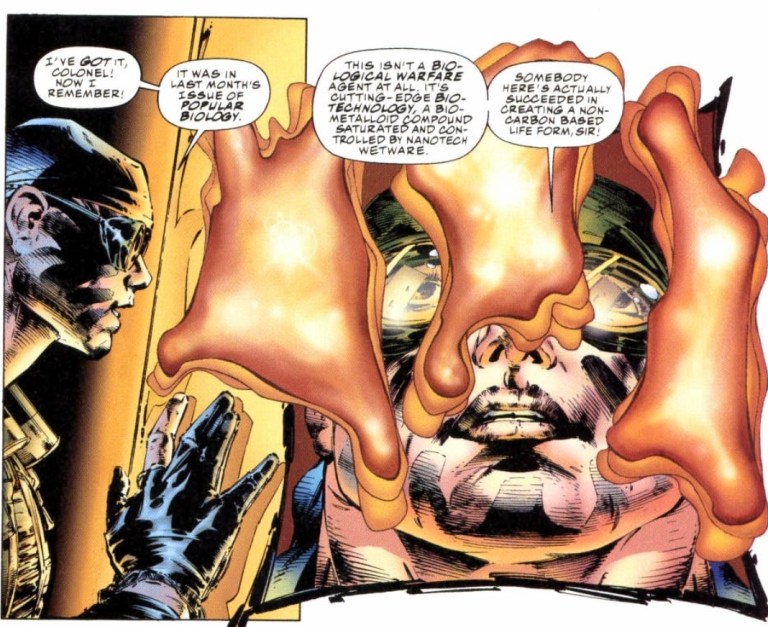
One of the team members looks at a symbiote.

I’ll start first with the fantasy concept and the storytelling. Whilce Portacio and Brandon Choi’s joint creation of Wetworks is indeed an inspired move with connections to real-life military influences the creators had. The Wetworks team – initially referred to as Team 7 – started looking and acting like typical military squad in the world of fiction but the major twist that happened drastically redefined and refined them into the most unique military team in the world of superhero comics. It’s the closest thing to seeing G.I. Joe fused with living symbiotes (another inspired move most likely influenced by a certain Marvel murderer with a symbiote whose origin is linked with one of the most iconic superheroes ever) there is and I can say Wetworks remains relevant and stands out nicely among superhero comic book teams to this day.

With regards to the plot, it looks cliched on face value. I’m talking about the trope in which a team is sent by their powerful superiors on a mission without knowing all the crucial details needed (because the superiors hid it from them) and they eventually encounter immense danger. As mentioned earlier, the major twist in the plot not only completed a major transformation of Dane and his teammates but also ramped up the fantasy aspect of the tale to much higher levels.

Still on the plot, Portacio and Choi came up with a solid structure for the narrative. The build-up of details and tension was very good and the pay-offs (lots of spectacle plus twists) were great. As the story moved on, the suspense grew stronger and the narrative succeeded in making me care about the team led by Dane.

Meet the team members who would later become Wetworks.

When it comes to the art, Portacio’s work here (with ink by Scott Williams) still looks great and, more notably, it is a fine departure from the superhero visuals he worked in years prior. As with his past works, you will see the artist’s stylized approach on visualizing the narrative related to how he implements the panels per page.

Portacio did a very good job with the military look of Wetworks and he drew their guns with a high amount of detail that should be seen (you should try using a magnifying glass on this comic book). Not only that, his art on military hardware such as the gunships, the interiors plus equipment all have that detailed appearance. When it comes to action, I believe that Portacio took a lot inspiration from Hollywood action flicks (most notably Predator) on portraying Wetworks members using their guns and positioning during battle.

Of course, the spectacle is not totally limited to military stuff. There is a touch of fantasy and horror visuals involved which is directly related to what was set-up for Wetworks to encounter in the near future. To realize what I am saying here, you must read this comic book until the intense end.

Conclusion

Wetworks #1 from 1994 is still great to read!

I can say without a doubt that Wetworks #1 (1994) remains as gripping and as entertaining as when I first read it decades ago. In short, it has aged well and reading it all over again today is compelling and a lot of fun to do. If you ask me, this is one of the finest works ever by Whilce Portacio in terms of art and storytelling. As one of the many comic books Image published during its first few years in the industry, Wetworks #1 (1994) clearly stands out with its military theme and fantasy concept. Lastly, Wetworks is set within the WildStorm universe as dramatically symbolized with the presence of International Operations (the team’s superiors).

Overall, Wetworks #1 (1994) is highly recommended!

+++++

Thank you for reading. If you find this article engaging, please click the like button below, share this article to others and also please consider making a donation to support my publishing. If you are looking for a copywriter to create content for your special project or business, check out my services and my portfolio. Feel free to contact me with a private message. Also please feel free to visit my Facebook page Author Carlo Carrasco and follow me on Twitter at  @HavenorFantasy as well as on Tumblr at https://carlocarrasco.tumblr.com/ and on Instagram at https://www.instagram.com/authorcarlocarrasco

A Look Back at Backlash #1 (1994)

Disclaimer: This is my original work with details sourced from reading the comic book and doing personal research. Anyone who wants to use this article, in part or in whole, needs to secure first my permission and agree to cite me as the source and author. Let it be known that any unauthorized use of this article will constrain the author to pursue the remedies under R.A. No. 8293, the Revised Penal Code, and/or all applicable legal actions under the laws of the Philippines.

Welcome back superhero fans, 1990s arts and culture enthusiasts and comic book collectors! Today we continue revisiting the Wildstorm universe as it was under the Image Comics banner back in the 1990s. Recently, I reviewed back-to-back issues of Jim Lee’s WildC.A.T.S: Covert Action Teams that involved Chris Claremont and his creation Huntsman (click here, here, here and here) which ultimately expanded the lore of the team within the Wildstorm universe of the time while developing Zealot tremendously.

Still within the Wildstorm universe of the 1990s, it’s time to shift to another key figure – Backlash (civilian identity: Marc Slayton) co-created by Jim Lee and Brett Booth (follow him at Twitter and visit his blog). To put things in perspective, Backlash and WildC.A.T.S’ popular Grifter (Cole Cash) have something in common other than being highly capable fighters – they were teammates within Team 7 long before StormWatch (note: Backlash first appeared in StormWatch #3 in 1993) and WildC.A.T.S were formed. In fact, Team 7 also had Michael Cray (Deathblow), Jackson Dane (Wetworks) and John Lynch (who appeared in early WildC.A.T.S issues and went on to be the mentor in Gen13) who went on to become important Wildstorm figures in the present day.

In 1994, a 4-issue mini-series titled The Kindred was published featuring Backlash and Grifter with a story written by Jim Lee, Brandon Choi, Brett Booth (who illustrated) and Sean Ruffner. Months after that mini-series ended, a regular series focused on Backlash was launched.

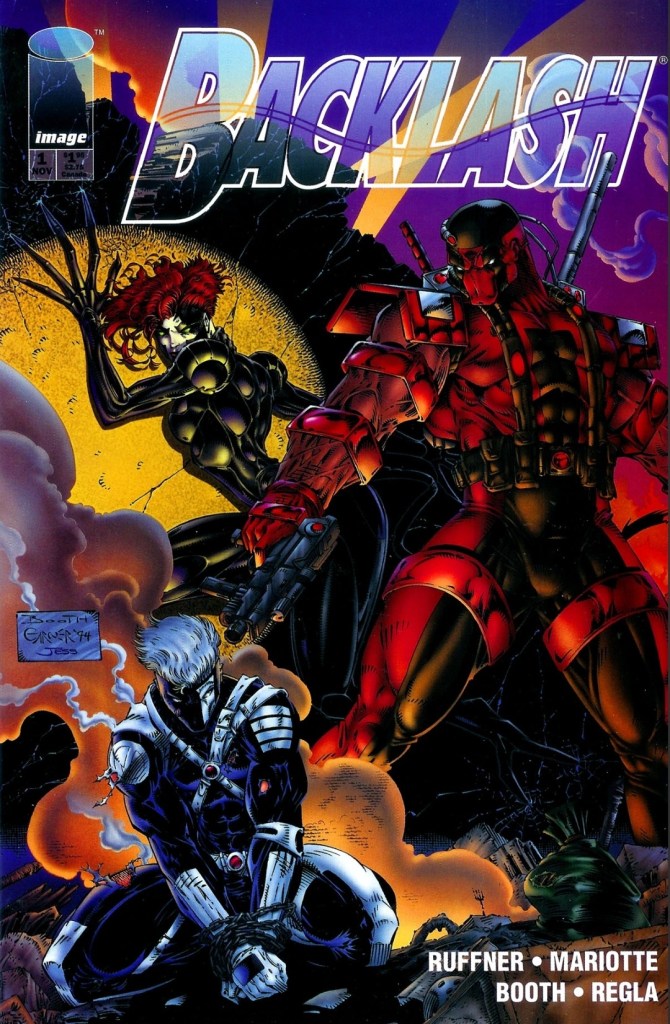
With those details laid down, here is a look back at Backlash #1, published by Image Comics in 1994 with a story written by Ruffner, Jeff Mariotte and Booth. Booth was the artist.

The cover.

Early story

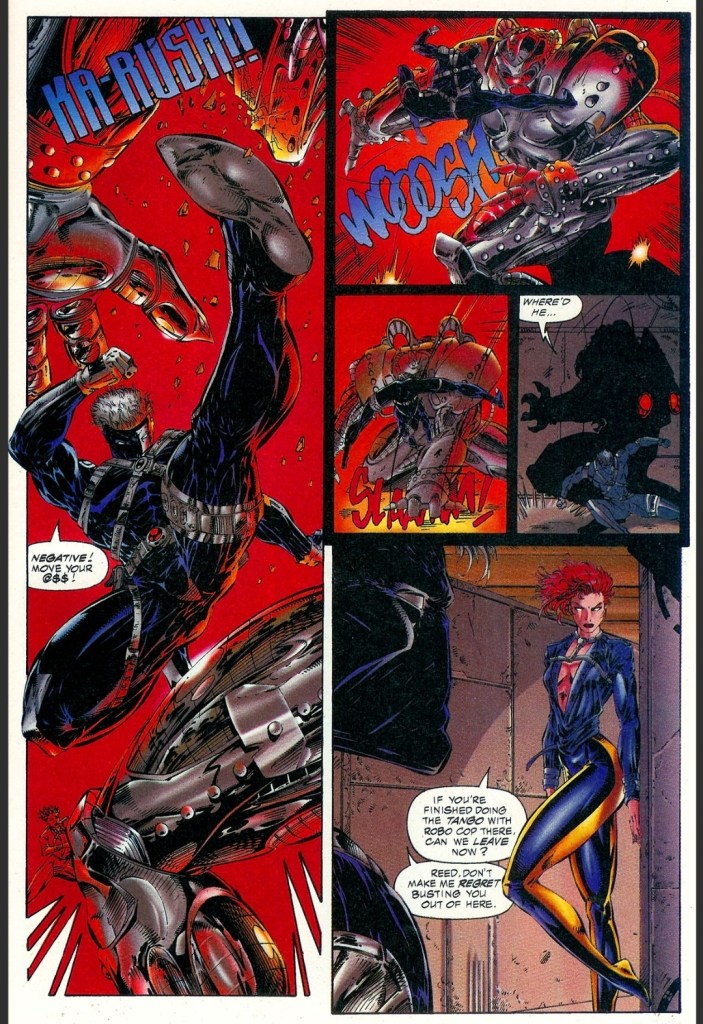
The story begins with Backlash quietly infiltrating the Edward H. Levi Federal Penitentiary, a facility designed to control the growing population of criminal super-powered beings (SPBs). Eventually two armored guards pass by and as soon as one of them notices signs of the break-in, Backlash takes them down using his psionic whip and hard action.

After subduing two more pairs of guards, Backlash enters a large place that has prisoners contained in what he refers to as “aquariums”. Two of the prisoners recognize him. He finally reaches the cell of a red-headed lady named Amanda Reed – also known as Taboo – who has been imprisoned for murder. Backlash makes an offer – if she helps him, he will get her out of the prison…

Quality

Backlash struggling on the way of getting out with Taboo.

Let me start with the story. This comic book has an unusual approach on its plot in which the flashbacks are more prominent than the present-day tale of Backlash freeing Taboo and getting out of the prison. The good news here is that the flashbacks are pretty engaging to read and they solidly fulfilled the writers’ goals of immersing the readers with useful story details and building up the tension while also emphasizing Backlash’s personality and what motivates him deep from within. To put it short, the flashbacks are the most important features of the storytelling and they also have the most interesting scenes (including an encounter with Pike who previously appeared in the early issues of WildC.A.T.S). The present-day view of the plot lack engagement compared to the flashbacks but the creative team succeeded in emphasizing Taboo, what she is capable off and why she is feared.

The characterization of Marc Slayton is pretty good in my view. By the time I reached the end of this comic book, I found him to be a really intriguing protagonist. Backlash is definitely not inspiring but the irony is that his personality and purpose within the Wildstorm universe of the time were compelling enough to follow.

When it comes to the art, Brett Booth’s work here is still good to look at as I follow the story. Be mindful that this was his work when he was very young and as seen in this comic book, he definitely proved his talent, his art style was clearly distinct and he was capable of coming up with really good action scenes that really made Backlash a notable Wildstorm action hero. It should be noted that Booth illustrated this comic book with dynamism in mind.

Conclusion

A key scene from the past of Marc Slayton/Backlash nicely drawn by Brett Booth.

Backlash #1 (1994) is fun and compelling to read. The flashbacks are strangely the most engaging parts of the plot and they succeeded in getting me oriented with the protagonist, what has been going on and what the stakes are right at the start of this particular series. Combined with the still-good-to-view art by a very young Brett Booth, this comic book has a lot of fun stuff to enjoy especially for those who are obsessed or simply wanting to discover more about the Wildstorm universe of the 1990s.

Backlash #1 (1994) is recommended.

+++++

Thank you for reading. If you find this article engaging, please click the like button below and also please consider sharing this article to others. If you are looking for a copywriter to create content for your special project or business, check out my services and my portfolio. Feel free to contact me with a private message. Also please feel free to visit my Facebook page Author Carlo Carrasco and follow me on Twitter at  @HavenorFantasy as well as on Tumblr at https://carlocarrasco.tumblr.com/ and on Instagram athttps://www.instagram.com/authorcarlocarrasco/

A Look Back at WildC.A.T.S: Covert Action Teams #9 (1994)

Disclaimer: This is my original work with details sourced from reading the comic book and doing personal research. Anyone who wants to use this article, in part or in whole, needs to secure first my permission and agree to cite me as the source and author. Let it be known that any unauthorized use of this article will constrain the author to pursue the remedies under R.A. No. 8293, the Revised Penal Code, and/or all applicable legal actions under the laws of the Philippines.

Welcome back superhero fans, 1990s arts and culture enthusiasts and comic book collectors! Today we continue revisiting Jim Lee’s flagship title under the Image Comics label – WildC.A.T.S: Covert Action Teams!

Last time around, members of the WildC.A.T.S were split apart in terms of locations as they had their rest-and-relaxation period. While Grifter went away to do something urgent (read: the Kindred comic books), Zealot, Void and Jacob Marlowe’s executive assistant Jules picked up Warblade and Maul using their high-tech aircraft to head on to the Bahamas where an entire cruise ship disappeared with Marlowe, Voodoo and Spartan on it.

Unbeknownst to the WildC.A.T.S flying in their jet, Voodoo, Spartan and Marlowe found themselves as captives of an armored man (wearing a half-helmet) called Entropy inside his domain in an undetermined location. Entropy refers to Marlowe as lord Emp and states that he will suffer from his wrath. Marlowe does not recognize him.

With those details laid down, here is a look back WildC.A.T.S: Covert Action Teams #9, published by Image Comics in 1994 with a story written by Brandon Choi and Jim Lee. Lee did the art with Scott Williams in-charge with the ink work.

The cover.

Early story

The story begins with the partial WildC.A.T.S team arriving in the area of the Bermuda triangle with their aircraft. From their view, there was nothing to spot but Zealot insists that they keep on searching as they must be overlooking something.

Meanwhile, Spartan and Voodoo find themselves in deep trouble as a horde of Daemonites persistently attack them. Already heavily damaged, Spartan keeps on using his energy blasts to hold the monsters off. Voodoo on the other hand is too weak and could not concentrate to help her teammate.

Suddenly one of the Daemonites slashes Spartan’s left arm which neutralizes his energy blast. His body got pierced by one of the monsters which pinned him down, leaving Voodoo completely helpless…

Quality

The WildC.A.T.S on search-and-rescue.

On face value, this comic book looks like another generic or even disposable good-versus-evil story drawn by Jim Lee. In reality, its story has more significance to it and the creators themselves came up with something fresh for WildC.A.T.S fans. Firstly, this is a story about one group of WildC.A.T.S trying to rescue their boss and their two other teammates from Entropy in a location that could not be easily found. Secondly, this comic book puts strong focus back on the Kherubim-Daemonite war which creatively looks back at one of the many events that took place in Jacob Marlowe’s past (which he could not remember at first) complete with implementing a strong fantasy (read: swords and armors) element which gives the story a mixed-genre aesthetic.

The good news here is that the storytelling and visual presentation by the creators are really well done! While the dual approach of storytelling involving both the present and the far past was used in Jim Lee’s past X-Men works with Marvel, the said approach was well executed with WildC.A.T.S which not only expanded its lore further but also developed Jacob Marlowe’s personality even further.

To have Entropy (note: he eerily resembles’ Mantra arch-villain Boneyard in the Ultraverse) as an enraged opposition figure living with a lust for revenge against Marlowe is a smart move and at the same time this adds variety to the kind of opposition WildC.A.T.S have. More on what happened in the past involving both Marlowe and Entropy, the flashback raises new questions about the value and true nature of the WildC.A.T.S’ leader who at this point was a brash manager who wields lots of resources to operate with. The flashback also challenges readers on how to evaluate Jacob Marlowe when it comes to being accountable about his past actions, including the many things he did but could not remember. All of these lead to a really impactful ending that you readers must see.

Conclusion

Meet Entropy, a man with a shared past with Jacob Marlowe.

WildC.A.T.S: Covert Action Teams #9 (1994) is a Jim Lee-drawn tale that has solid depth and a very creative approach to its presentation, specifically its daring and well-executed method of mixing the superhero and fantasy elements. When it comes to the narrative, the creative team succeeded in telling both the present and the past tales followed by connecting them with each other while ultimately telling an overall cohesive tale. This is a Wild.C.A.T.S story that must be read from start to finish, and it is a powerful follow-up to issue #8.

If you are seriously planning to buy an existing hard copy of WildC.A.T.S: Covert Action Teams #9 (1994), be aware that as of this writing, MileHighComics.com shows that the near-mint copy of the regular edition costs $30.

Overall, WildC.A.T.S: Covert Action Teams #9 (1994) is highly recommended.

+++++

Thank you for reading. If you find this article engaging, please click the like button below and also please consider sharing this article to others. If you are looking for a copywriter to create content for your special project or business, check out my services and my portfolio. Feel free to contact me with a private message. Also please feel free to visit my Facebook page Author Carlo Carrasco and follow me on Twitter at  @HavenorFantasy as well as on Tumblr at https://carlocarrasco.tumblr.com/and on Instagram at https://www.instagram.com/authorcarlocarrasco/

A Look Back at WildC.A.T.S: Covert Action Teams #8 (1994)

Disclaimer: This is my original work with details sourced from reading the comic book and doing personal research. Anyone who wants to use this article, in part or in whole, needs to secure first my permission and agree to cite me as the source and author. Let it be known that any unauthorized use of this article will constrain the author to pursue the remedies under R.A. No. 8293, the Revised Penal Code, and/or all applicable legal actions under the laws of the Philippines.

Welcome back superhero enthusiasts, 1990s culture enthusiasts and comic book collectors! Today we continue revisiting Jim Lee’s flagship title under the Image Comics label – WildC.A.T.S: Covert Action Teams!

In my previous retro review of WildC.A.T.S #7, that story marked the 3rd chapter of the 4-part Killer Instinct crossover storyline which brought Jim Lee’s team together with Marc Silvestri’s Cyber Force. That storyline ended in a Cyber Force comic book which leads to the questions – what is next for WildC.A.T.S? Will there be a new and fresh storyline set up for them?

With those details laid down, here is a look back WildC.A.T.S: Covert Action Teams #8, published by Image Comics in 1994 with a story written by Brandon Choi and Jim Lee. Lee did the art along with Richard Bennett and Scott Williams.

The cover.

Early story

The story begins inside a large bar within New York City where Cole Cash/Grifter and Zealot (both of them in civilian clothes) spend time together playing pool. There are men nearby staring at them. While Grifter tries to unwind and have fun with the game, Zealot still sticks to her warrior mindset even though they are no longer in a battle field. Suddenly, one man arrogantly pours beer on Grifter’s head while another man touches Zealot’s hair.

The two WildC.A.T.S members struck the two violators and subsequently made short physical work of the other men who tried to hurt them. After that, Zealot and Grifter talk outside. The latter receives an urgent message which compels him to leave Zealot behind and do something important…

Quality

Spartan and Voodoo on holiday in their civilian forms.

I’ll be straight to the point here. If you enjoyed Jim Lee’s previous work on Marvel’s X-Men that include bombastic action, misadventures, team members appearing in swimwear and character moments, you will find that in this story which is really a transitional tale of the team taking a break from action only to find themselves facing new danger. That being said, the concept and structure of the plot in this comic book is pretty simple and it does succeed in setting up WildC.A.T.S for another misadventure while cleverly emphasizing the Kherubim-Daemonite concept of the WildStorm universe back then.

As expected, Jim Lee’s artwork here is really great to look at and he sure always finds ways to make the dialogue scenes look interesting. What stands out to me the most in this comic book are the character moments which more than made up for the lightness of the plot. While the romantic interactions between Spartan and Voodoo is interesting, the interactions between Zealot and Grifter (referred to as Brother Grifter) really gave me additional insight on their respective personalities and, more notably, their feelings for each other.

More on character moments, you will see Maul and Warblade in their respective civilian identities as Reno and Jeremy. If you only see those two as violent action performers based on the previous issues of WildC.A.T.S, you will be surprised with the way Brandon Choi and Jim Lee presented them in this story.  

Conclusion

Can you recognize Maul and Warblade?

While its story was pretty light, WildC.A.T.S: Covert Action Teams #8 (1994) still manages to entertain me mainly due to the character moments that the creators came up with. In many ways, this comic book showed how human the team members are which is a nice change from all the action-focused stuff they were so busy with in the previous issues. Along the way, you will see a few creative gimmicks Jim Lee inserted visually, including the unofficial cameo appearance of two pretty notable members of X-Men (note: they just got married). Meanwhile, those who love Pris/Voodoo will find some extra entertainment here as this comic book has an additional short story about her past (set after WildC.A.T.S Trilogy #1) which was written by Peter Seagle and drawn by Travis Charest (who would later replace Jim Lee as illustrator of this comic book series).

If you are seriously planning to buy an existing hard copy of WildC.A.T.S: Covert Action Teams #8 (1994), be aware that as of this writing, MileHighComics.com shows that the near-mint copy of the regular edition costs $40 while the near-mint copy of the newsstand edition costs $120.

Overall, WildC.A.T.S: Covert Action Teams #8 (1994) is recommended.

+++++

Thank you for reading. If you find this article engaging, please click the like button below and also please consider sharing this article to others. If you are looking for a copywriter to create content for your special project or business, check out my services and my portfolio. Feel free to contact me with a private message. Also please feel free to visit my Facebook page Author Carlo Carrasco and follow me on Twitter at  @HavenorFantasy as well as on Tumblr at https://carlocarrasco.tumblr.com/