
A Look Back at Amazing Spider-Man #365 (1992)

Welcome back superhero enthusiasts, 1990s arts and culture enthusiasts, Spider-Man fans and comic book collectors! Today we go back to the early 1990s to examine a small part of the Marvel Comics shared universe through a tale of the Amazing Spider-Man monthly series.

Back in 1992, Marvel Comics organized the celebration of what was back then the 30th anniversary of their most famous icon Spider-Man. Each Spider-Man monthly series that year had an anniversary celebration issue that had hologram covers and page content that was higher than usual. I previously reviewed Web of Spider-Man #90 and Spider-Man #26. The purest Spider-Man monthly series – Amazing Spider-Man – also had the anniversary treatment.

With those details laid down, here is a look back at Amazing Spider-Man #365, published in 1994 by Marvel Comics with the main story “Fathers and Sins” written by David Michelinie and drawn by Mark Bagley. Other stories here include “How I Created Spider-Man” by Michelinie and Aaron Lopresti; “I Remember Gwen” by Stan Lee, Tom DeFalco and John Romita; and “A Friend in Need” by DeFalco.
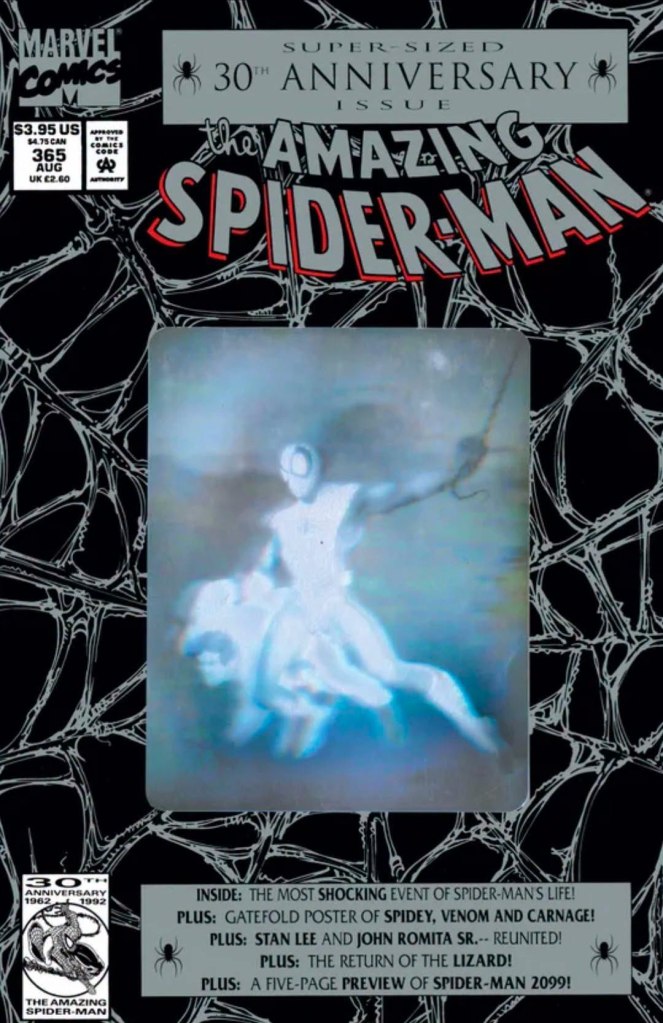
Cover of The Amazing Spider-Man comic book, issue 365, featuring a ghostly image and spider web design, celebrating the 30th anniversary of the series.
The cover.

Early story (main story)

The story begins with the Lizard (Dr. Connors) prowling from one building to another during the night in New York City. He secretly stays outside the windows of the apartment of his wife Martha and their son. A birthday celebration is happening inside the apartment and among the guests are Peter Parker and his wife Mary Jane. Peter knows that growing up without a father is rough and he remembers that no one has seen Curt Connors since he last turned into the Lizard (refer to the Spider-Man: Torment storyline written and drawn by Todd McFarlane).

As the celebration goes on, the Lizard silently sneaks into the apartment through an open window. This alarms Peter through his spider sense which compels him to decide to secretly change into Spider-Man.

As Martha Connors enters a dark room to get a prepared gift for her son Billy, the Lizard shuts the door and confronts her. In his reptilian form, the Lizard communicates to his wife in English and assures her that he (Dr. Connors) is in control. He tells her that the evil sorceress Calypso sent her into a berserker rage to kill Spider-Man but his human consciousness was aware all the time. He tells her to bring to him their son. Martha is frightened and she knows that there is too much risk to grant her husband’s command…

Quality
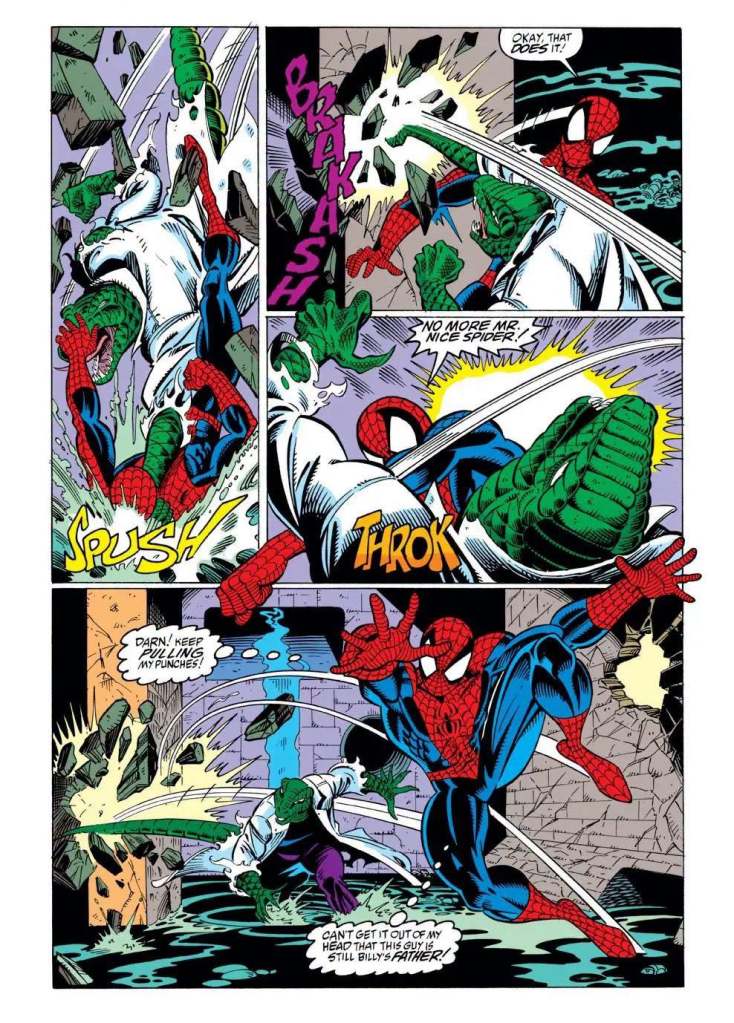
A comic book panel featuring Spider-Man fighting a green-skinned villain, with action words like 'SPUSH' and 'THROK' illustrated around them. Spider-Man is depicted in a dynamic pose as he attacks the villain, who is wearing a white coat and green pants, surrounded by debris.
The main story has a rematch between Spidey and the Lizard. Unlike Todd McFarlane’s Torment, the story and visuals here have more subtlety, suspense and balance.

The main story “Fathers and Sins” is the anticipated rematch between Spider-Man and the Lizard following the very violent events that happened in the Torment storyline. Unlike that tale authored by McFarlane, this one has more depth and subtlety balanced with superhero spectacle.

David Michelinie carefully crafted the tale with clear progression in mind for the enduring rivalry between Spider-Man and the Lizard. He also took the opportunities to develop the characters whenever possible, and he did so with Dr. Connor’s wife and son. In fact, there are family dynamics within this story and the Lizard – portrayed here with multiple personality disorder (MPD) switching from Dr. Connor and the wild animal itself – is simply not the murderous entity seen in Torment. That said, this tale opens up questions such as how Dr. Connors will live on knowing the murders he committed as the Lizard, does he have any chance of keeping his family intact, and more.

More on Spider-Man himself, he was portrayed as a sensible and caring superhero. Even though he had traumatic encounters with the Lizard in Torment, he engaged his rival with reason instead of head-on violent action. He consistently believes that he could overcome the Lizard and somehow get Dr. Connors back intact knowing that the family needs him. When it comes to problems related with science and technology, Spider-Man here makes efforts to solve them using the knowledge he gained in university. The iconic webslinger here is pretty versatile, strategic and calculating. I should state that Mark Bagley has really fine artworks here and it is clear he truly captured the essence of Michelinie’s script.

The short story “How I Created Spider-Man” follows J. Jonah Jameson’s recollection of Spider-Man. This was cleverly written by Michelinie to revisit key moments from the origin and early superhero days of Spider-Man through Jameson’s memories, his own perception of the hero and his history of abusing his publishing power to make him look like a menace to society. The nostalgia and related details are easily the main attractions of this short story. This is something that fans of Spidey will enjoy.
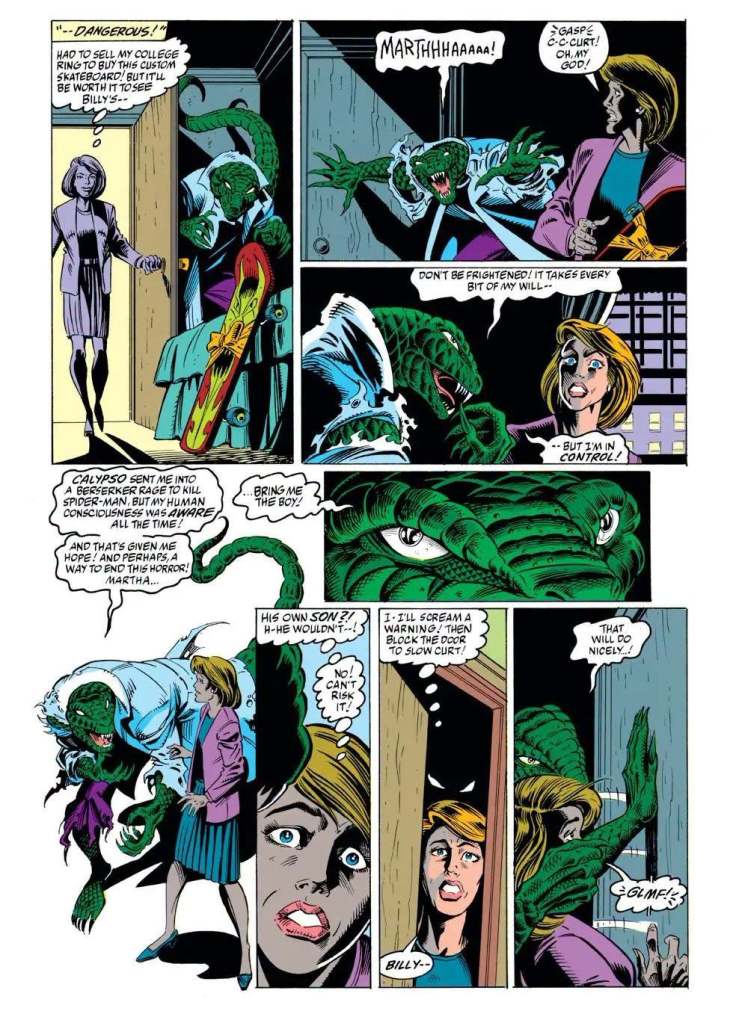
A comic book page depicting a tense scene with a humanoid creature with green scales and claws confronting two women. One woman appears frightened while the other is trying to remain calm. Dialogue bubbles convey urgency and fear as the creature discusses control and a boy named Billy.
There is absolutely nothing like encountering a family member who has turned into a large, dangerous reptilian!
A comic book page showcasing several characters engaging in conversation at a party. The scene includes characters with distinct hairstyles and outfits, expressing emotions and interactions amidst a festive backdrop.
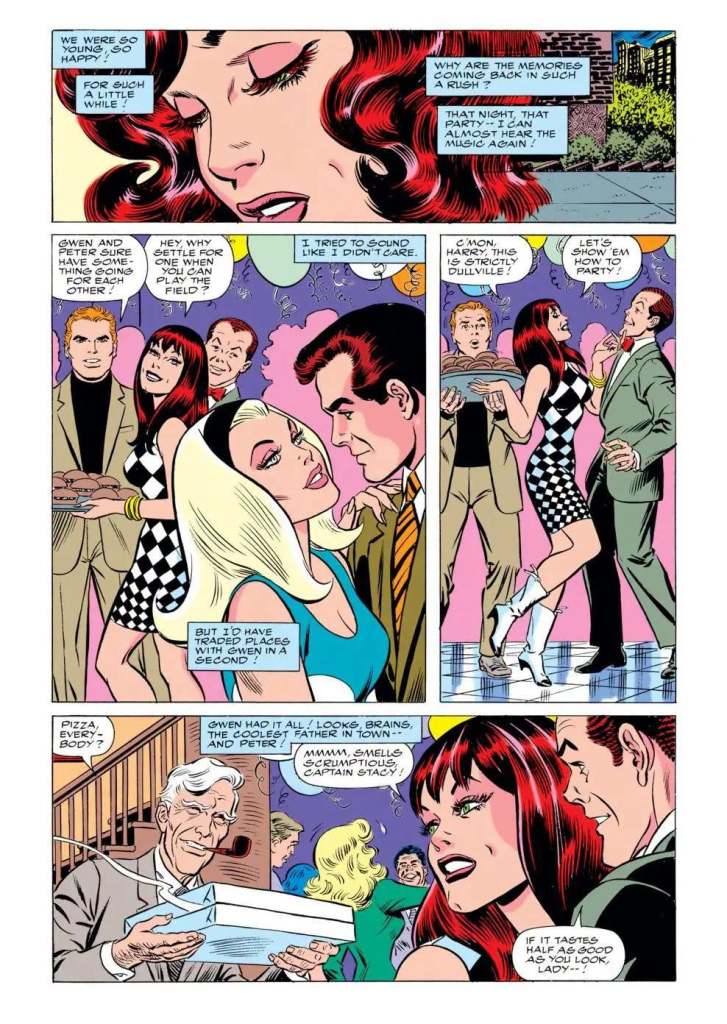
The short story “I Remember Gwen” is a great way of revisiting the past of Spider-Man, Mary Jane and Gwen Stacy. The art by the late John Romita is great to see!

The Spider-Man nostalgia intensified in the 2nd short story “I Remember Gwen” which features artwork by the late John Romita. This one is about Mary Jane Parker recalling her friendship with the late Gwen Stacy (who back then was romantically linked with Peter Parker) and key moments she remembered from Spider-Man. This short story has fine art by Romita and this resulted in a retro visual ride that captured the 1970s aesthetics. As this tale revisited Spider-Man’s past relationship with Gwen, it also offered readers a close look at the MJ-Gwen friendship. That said, long-time fans of Spidey will enjoy this.

The final short story “A Friend in Need” is easily the weakest part of this anniversary celebration comic book. It features the Prowler and does not have much to do with Spider-Man. This one is a shallow filler-type of story.

Conclusion
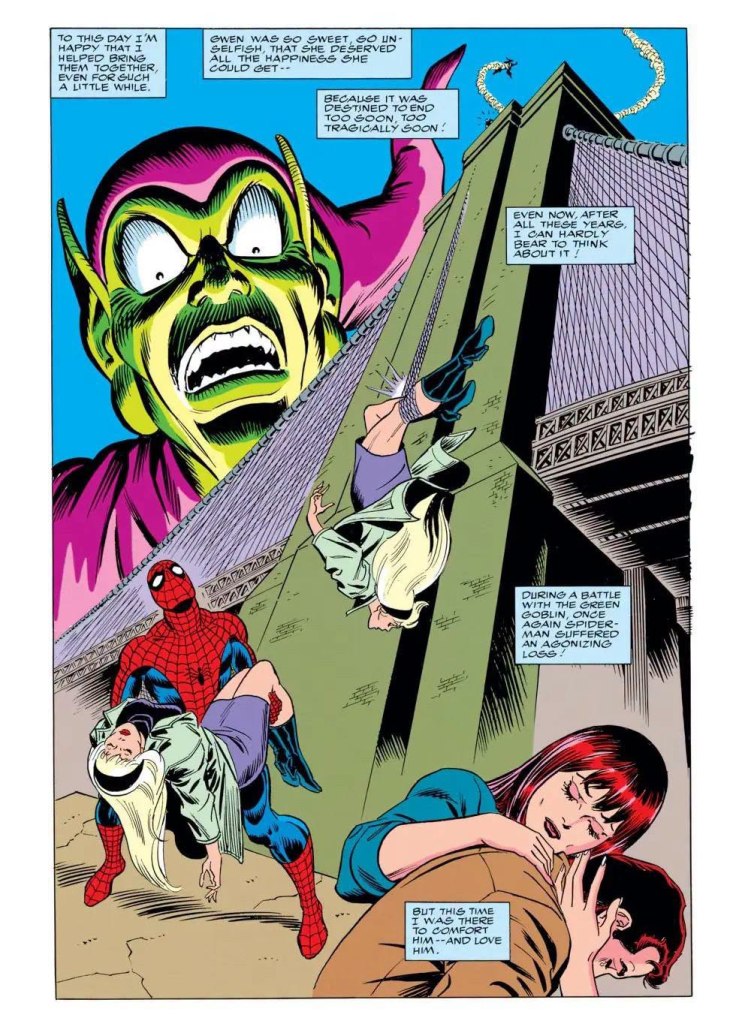
Comic book panel featuring Spider-Man carrying two women, one with blonde hair and the other with red hair, while a giant Green Goblin head looms in the background. The scene captures a moment of tension and emotion with speech bubbles conveying inner thoughts.
This page drawn by John Romita should compel you to read Amazing Spider-Man #121.

As of now, I can say that Amazing Spider-Man #365 (1992) is easily the best of the 30th anniversary celebration comic books I have read so far. It has a very solid main story that moved the Spider-Man-Lizard rivalry forward (and also has a conclusion that tapped directly into the icon’s origin with a good element of surprise) and two of the three short stories are great offerings for the very dedicated Spider-Man fans. It also has short articles/special messages that highlight the importance of Spidey’s 30th anniversary, and a Spider-Man 2099 preview! In short, this anniversary celebration comic book is the complete package for the fans and is also one of the most defining Amazing Spider-Man comic books of the 1990s. It truly is worth having in your collection!

Overall, Amazing Spider-Man #365 (1992) is highly recommended.

+++++

Thank you for reading. If you find this article engaging, please click the like button below, share this article to others and also please consider making a donation to support my publishing. If you are looking for a copywriter to create content for your special project or business, check out my services and my portfolio. Feel free to contact me with a private message. Also please feel free to visit my Facebook page Author Carlo Carrasco and follow me on Twitter at @CarloCarrascoPH as well as on Tumblr at https://carlocarrasco.tumblr.com/ and on Instagram at https://www.instagram.com/authorcarlocarrasco
A Look Back at Elven #3 (1995)

Welcome back, superhero fans, 1990s arts and culture enthusiasts, Ultraverse fans and comic book collectors! Today we go back to the mid-1990s to examine one of the many tales of the Ultraverse through the Elven mini-series.

Having read the first two issues (click here and here), I can say that there is indeed progressive development of the personality of Elvia and her fantasy inspired identity as Elven. At the same time, the fantasy elements of the Ultraverse itself were portrayed in lively fashion. Clearly, Elven’s own corner of the Ultraverse has been established and there is some excitement to find out what would happen next and how it could affect others within the UV.

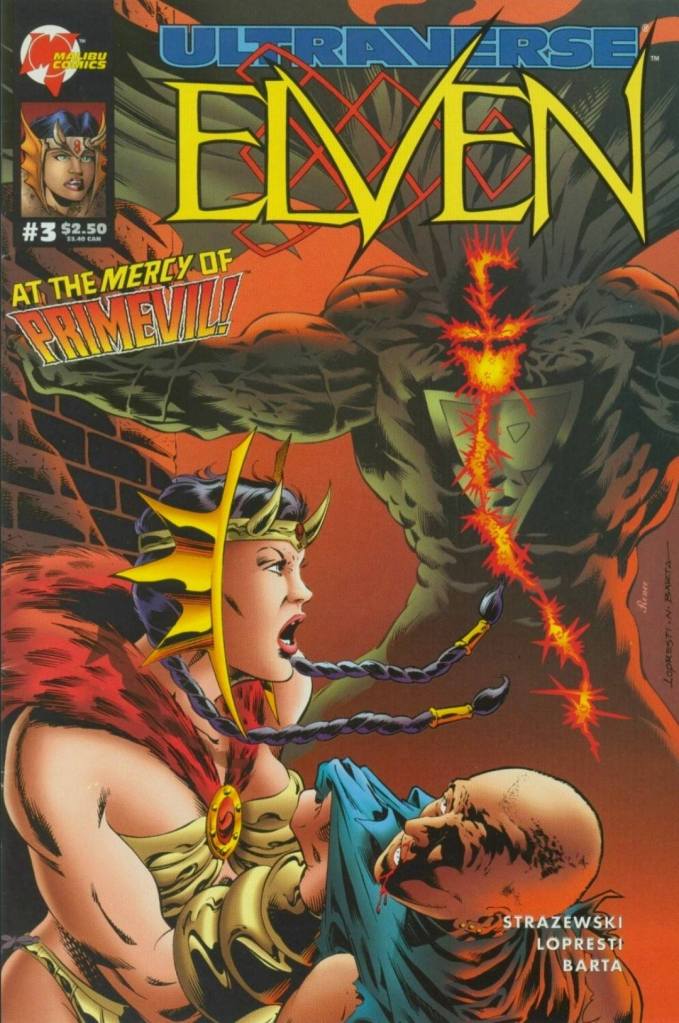
With those details laid down, here is a look back at Elven #3, published by Malibu Comics in 1995 with a story written by Len Strazewski and illustrated by Aaron Lopresti (Sludge).

The cover.

Early story

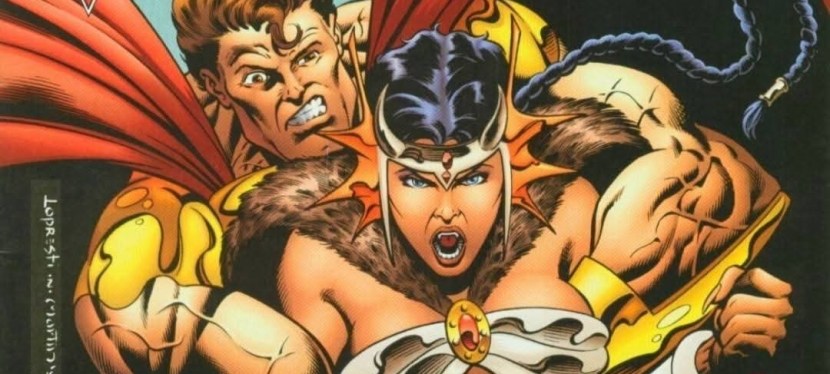
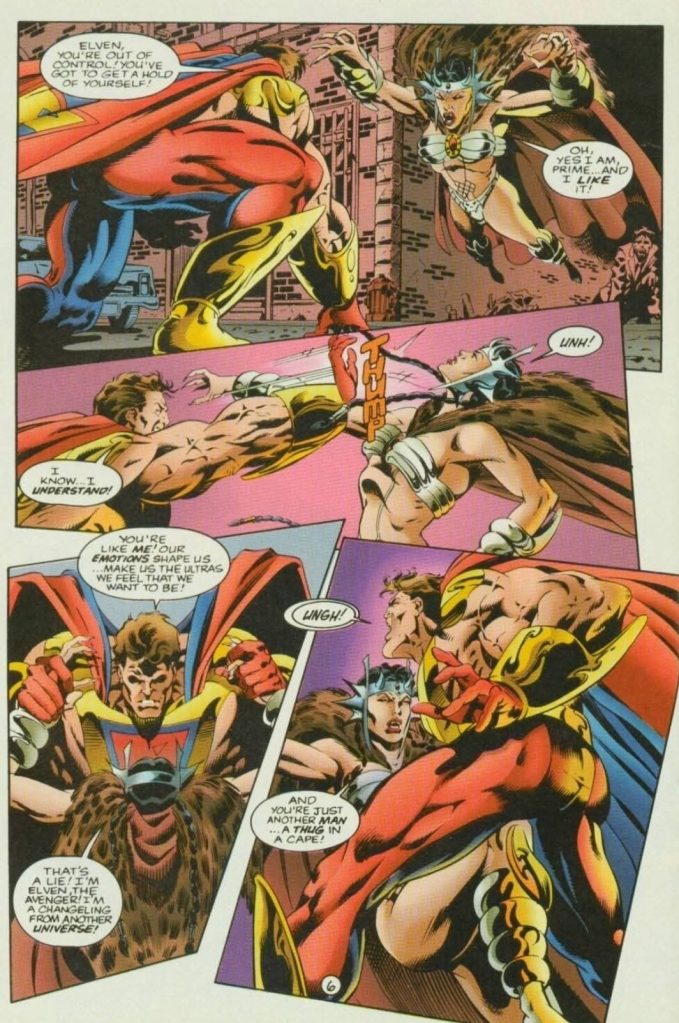
The story begins on top of the building with Elven and Prime meeting again. Tensions are high as Elven accuses him of lying. By this time, she learned a lot of details about her origin from the demon she fought with which convinced her that Prime lied to her about their genetic connections with each other (note: Doctor Vincent Gross was involved as he wanted to create ultras).

Elven rejects the science as she is strong convinced she is of magical origin from a mystical world and happens to be trapped on Earth. As Prime tries to put sense into her, Elven strikes him with a blast of energy to push him back. The blast turned to be of biological energy instead of magic.

As Elven reveals that she learned crucial information from the demon she fought with, Prime realizes it is none other than the one enemy he fought with some time ago…

Quality

Once again, Elven impulsively uses violence on individuals to help Bruno.

Following the events of issue #2, Elven here remains confused and even lost as she has a lot of trouble figuring out the facts. Of course, being a fanatic of fantasy and Elfquest, Elven clings on to the belief that the fantasy realm is real and that she is of magical origin (which conflicts with the biology and science of her abilities and physical transformation). This is evident in the early part of the comic book when she has a tense reunion with Prime who did his best to explain details and help her understand.

When it comes to the very conflict of the story itself, the stakes were raised when Strazewski has Prime-Evil and elements of unethical science present during the later stage. Apart from abducting Elven, Prime-Evil has his own agenda pursuing Mantra (who in turn has an evil version called Necro Mantra) and a lot of arrogance within. Literally, Prime-Evil’s presence added intrigue to the plot and only made Elven’s struggle to realize the truth of her origin – both the scientific and fantasy aspects – even more complicated.

Bruno, who was a significant and surprising factor behind the conflict in issue #2, gets his nice share of the spotlight. Without spoiling the plot, I can say that he is a lot more than what he seems and has more to add to the conflict.

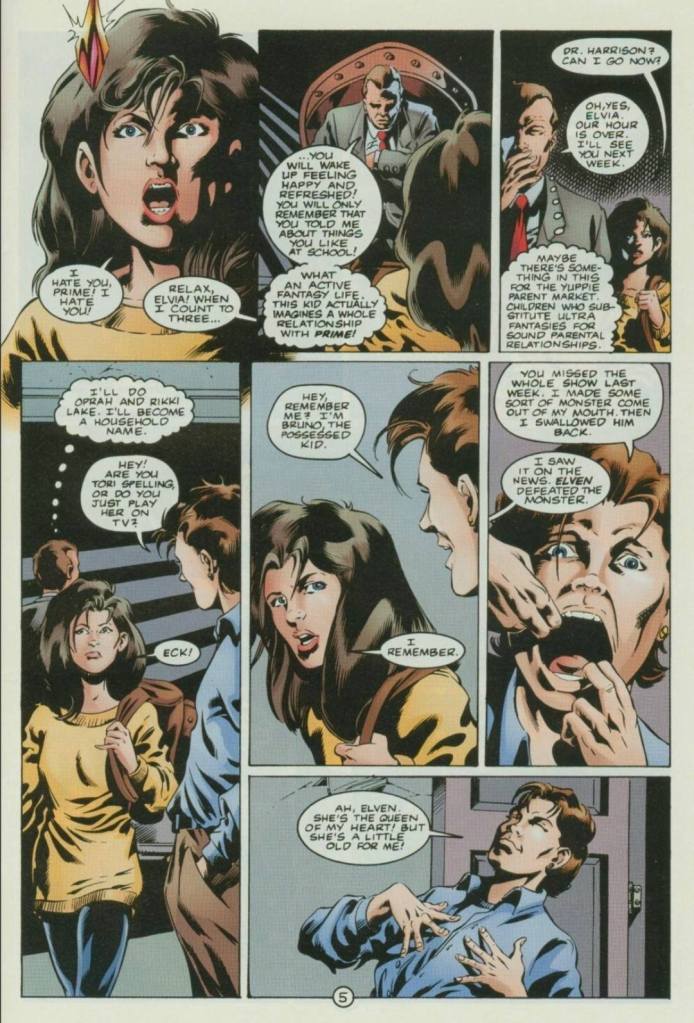
Considering the intensity of the conflict in issue #2, I find it very weird that Bruno and Elvia were not even reported to the local authorities for questioning and accountability. Perhaps the psychiatrist did not bother to do what is right since he was so fascinated with the fantastic conflict and unexplained moments that happened in his office (note: his own office assistant even became naked suddenly), and he has ambitions to become America’s next big name with his knowledge.

Conclusion

Elvia with Bruno and their psychiatrist.

At this particular stage of the mini-series, Elven #3 (1995) had an even more intriguing story to tell while gradually moving forward with Elven’s quest for the truth of her origin and her own purpose. The Strazewski-Lopresti duo did fine work in this comic book for the most part and ultimately the story convinced me to look forward to the next issue. I can say that the ending of this comic book is more suspenseful than that of issue #2.

Overall, Elven #3 (1995) is recommended.

+++++

Thank you for reading. If you find this article engaging, please click the like button below and also please consider sharing this article to others. If you are looking for a copywriter to create content for your special project or business, check out my services and my portfolio. If you want to support my website, please consider making a donation. Feel free to contact me with a private message. Also please feel free to visit my Facebook page Author Carlo Carrasco and follow me on Twitter at  @HavenorFantasy as well as on Tumblr at https://carlocarrasco.tumblr.com/ and on Instagram at https://www.instagram.com/authorcarlocarrasco/.
A Look Back at Elven #2 (1995)

Welcome back, superhero fans, 1990s arts and culture enthusiasts, Ultraverse fans and comic book collectors! Today we go back to the mid-1990s to examine one of the many tales of the Ultraverse through the Elven mini-series.

When I grabbed a copy of Elven #1, I did not expect much entertainment and surprise. But as I started reading it and witnessed Elven’s interactions with Prime, the narrative became even more engaging to read. In addition, Len Strazewski’s writing clearly defined the personality of fantasy fanatic and confused girl Elvia Swanson and established Elven as a twisted female parallel to Prime. Along the way, Aaron Lopresti’s art showed a lot of details, emotions and dynamism (on the action).

With those details laid down, here is a look back at Elven #2, published by Malibu Comics in 1995 with a story written by Len Strazewski and illustrated by Aaron Lopresti (Sludge).

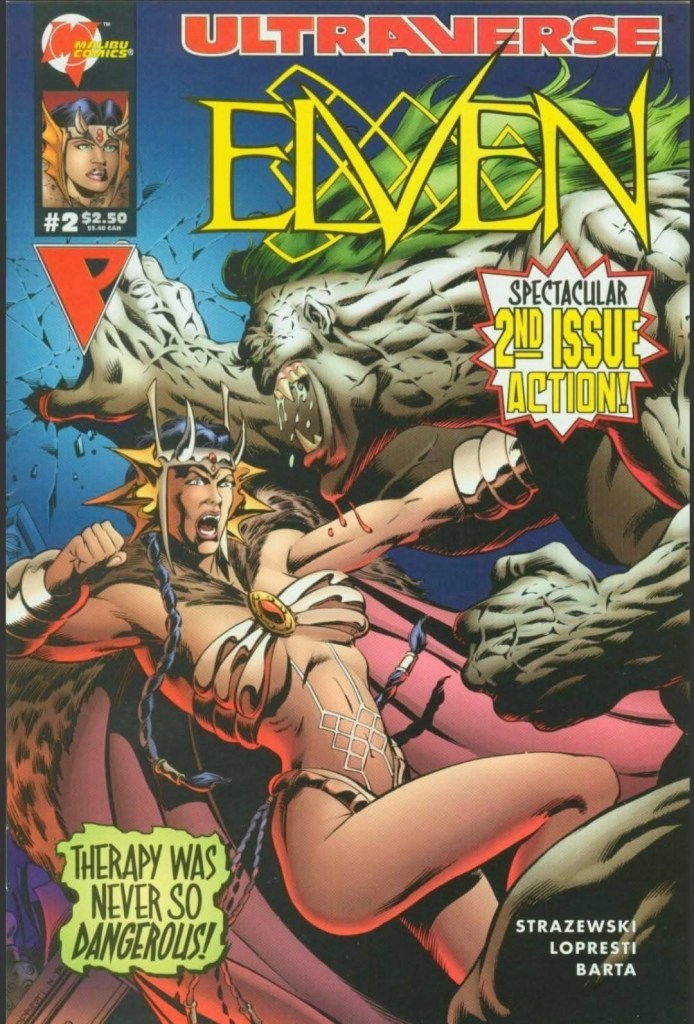
The cover.

Early story

The story begins inside the office of a psychiatrist where Elven encounters a demon which just came out of the teenage boy Bruno. As the two fight each other violently, the psychiatrist watches them obsessively and writes down the notable details for a potential advancement in his career. Bruno, who carried the demon in him some time prior, watches the fight from a distance marveling at Elven while also observing how chaotic the demon is.

Elven fights the demon hard while maintaining a mindset of pride and even being superior. The demon reveals his link with Boneyard (for reference, click here) confirming he came from a distant world.

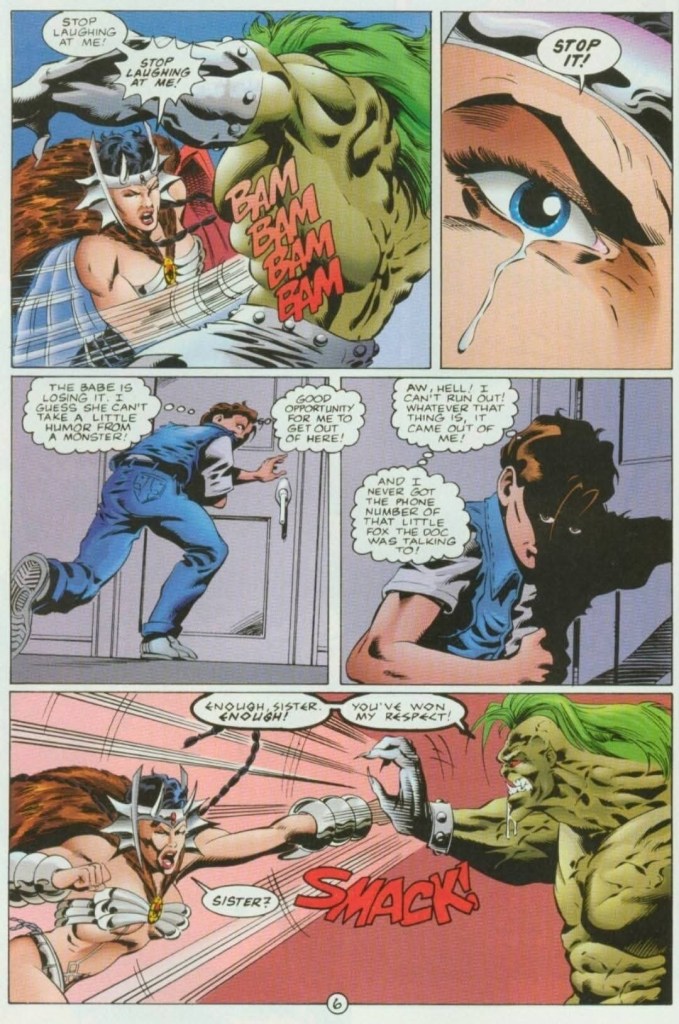
After getting hit by Elven’s elf-fire, the demon begins to laugh at her. Elven gets triggered and starts hitting the demon more…

Quality

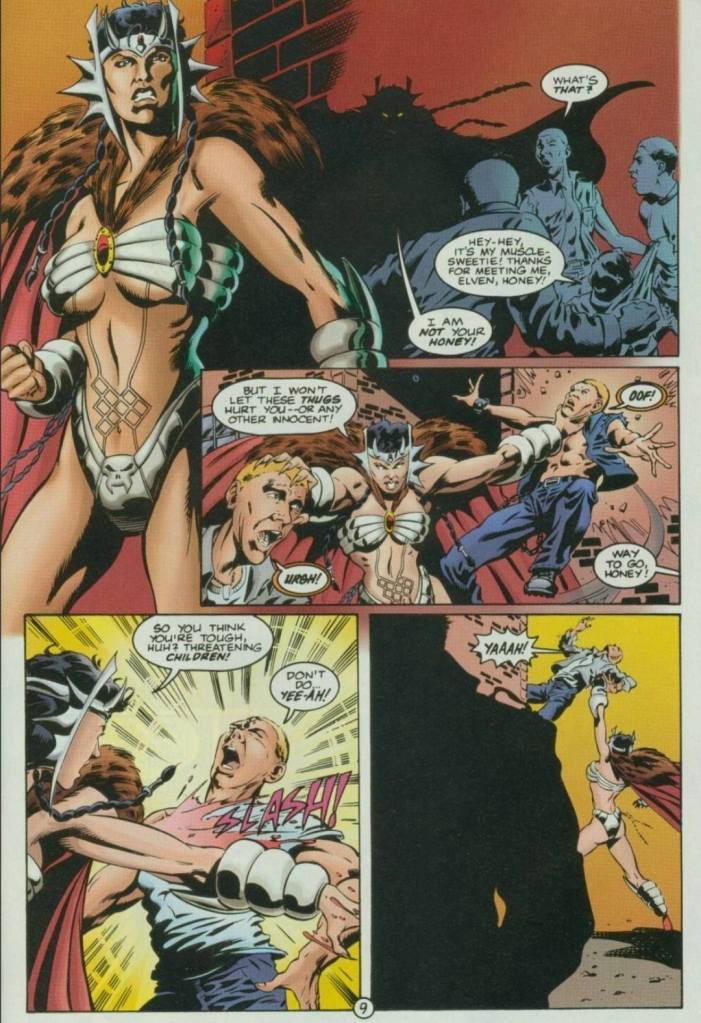
By giving in to her impulses, Elven commits a very violent move on a man. This also shows her inability to restrain herself.

While issue #1 established Elvia Swenson personality and her super-powered, fantasy inspired Elven identity who has a genetic connection with Prime, this comic book emphasizes the deeper fantasy aspects of the Ultraverse while expanding the lore within Elven’s part of the shared comic book universe.

Similar to Prime (Kevin Green in disguise), Elven gets triggered emotionally which is the result of the youth and obvious lack of maturity of Elvia. That being said, the moments of Elven getting more violent and shedding a few tears after getting laughed at by the demon deserve any reader’s attention.

Len Strazewski’s writing is pretty rich here and he pulled of some clever moves with the narrative. As the battle between Elven and the demon intensified, there were signs that the conflict would turn into an even bigger and more destructive battle. Instead, there were these deep revelations that happened (note: for relevance, you will have to read Prime #5 which I reviewed some time ago) and even the arrogant boy Bruno has his own share of what has been going on. Even the psychiatrist turned out to be a pretty significant bystander during the battle which suggests a build-up for a sub-plot.

As such, Strazewski wrote the story to be very intriguing and the plot threads are not limited to Elven and the demon. The way I see it, something is being built up and to grasp the relevance, you will have to read some issues of the Prime and Mantra comic book series.

If there is any weakness in the storytelling, it is the fact that the psychiatrist and his office assistant very easily forgot the moments of Bruno turning evil during the late part of issue #1. The way they reacted in this comic book after the end of the battle between Elven and the demon, they did not make any moves to hold Bruno accountable nor did they question Elven’s way of handling matters (which includes the eventual ruining of the office).

Conclusion

After getting triggered (being laughed at by the demon), Elven acted move violently and impulsively.

While there were a few weak spots in certain parts of the story, Elven #2 (1995) is another solid read from the Strazewski-Lopresti duo. Elven got developed even more through conflict with the demon, and her own search for the truth about her origin. Aside from that, the fantasy elements implemented in the story expanded the lore of the Ultraverse in a very unique way. Ultimately, I am looking forward to reading the next chapter of this mini-series.

Overall, Elven #2 (1995) is recommended.

+++++

Thank you for reading. If you find this article engaging, please click the like button below and also please consider sharing this article to others. If you are looking for a copywriter to create content for your special project or business, check out my services and my portfolio. If you want to support my website, please consider making a donation. Feel free to contact me with a private message. Also please feel free to visit my Facebook page Author Carlo Carrasco and follow me on Twitter at  @HavenorFantasy as well as on Tumblr at https://carlocarrasco.tumblr.com/ and on Instagram at https://www.instagram.com/authorcarlocarrasco/.

A Look Back at Elven #1 (1995)

Welcome back, superhero fans, 1990s arts and culture enthusiasts, Ultraverse fans and comic book collectors! Today we go back to the mid-1990s to examine one of the many tales of the Ultraverse.

For the newcomers to the Ultraverse, Prime is one of its most definitive heroes and his true identity is the teenager Kevin Green who can transform into an overly muscular caped adult superhero. The Prime monthly series of comic books ran for two years and the title character appeared in many other Ultraverse comic books.

Considering the prominence of Prime, it is not surprising that Malibu Comics proceeded to create comic books featuring a female counterpart to Prime. That counterpart is called Elven who appeared in a few early issues of the Ultraverse Premiere series and eventually Prime interacted with her.

With those details laid down, here is a look back at Elven #1, published by Malibu Comics in 1995 with a story written by Len Strazewski and illustrated by Aaron Lopresti (Sludge).

The cover.

Early story

The story begins deep within a city when a beautiful blonde woman got hurt by a very angry man named Billy. With the lady down on the floor, the man raises his metallic weapon intending to strike her not realizing that someone is emerging from behind. He turns and sees a scantily clad caped woman who immediately hits him hard. The caped woman is Elven who believes she is helping the blonde woman.

To Elven’s surprise, the blonde woman tells her to stop and not hurt the man who was violent towards her. The man hits Elven on the face with his weapon but ended up getting hit hard again in retaliation. Elven then uses an optic blast at the wall as she tells the blonde woman to leave.

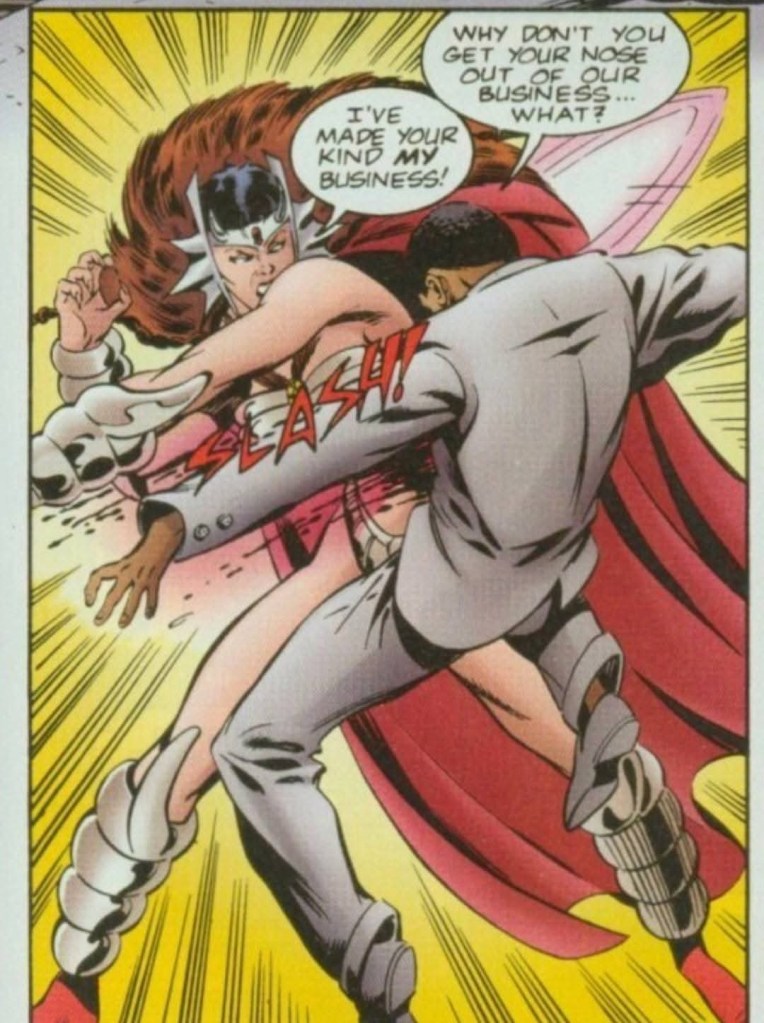
With the violent man down and hurt, Elven decides to kill him but is prevented by Prime from behind. After telling Prime that she told him not to interfere with her, she hits him with an energy blast…

Quality

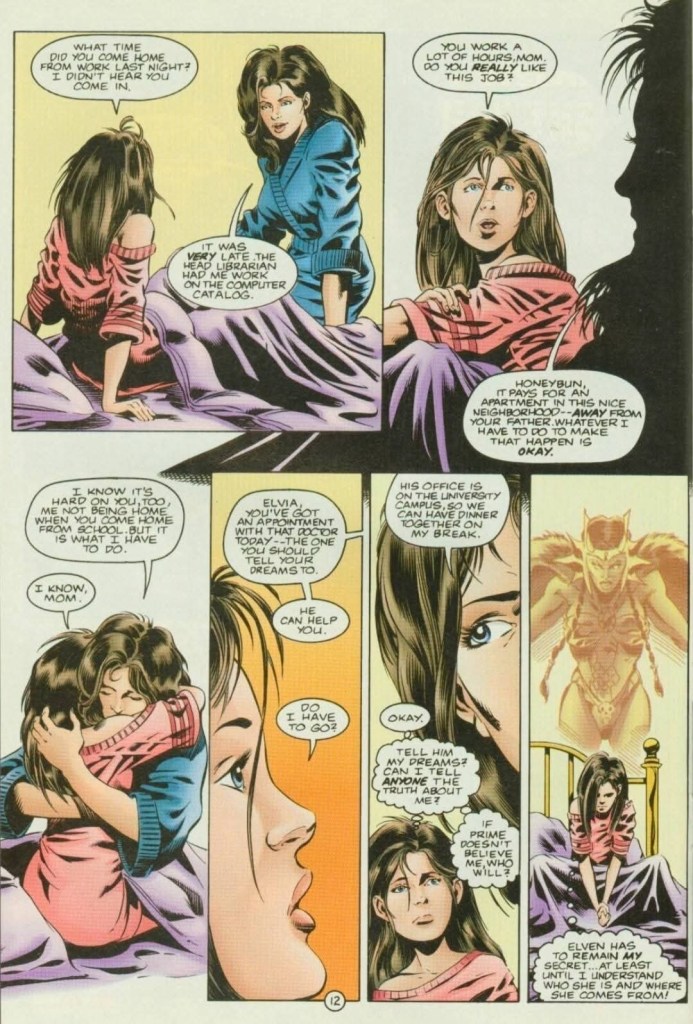
Elvia with her hard-working mother. The lack of a loving father affected Elvia deeply.

Being written by Prime co-creator and series co-author Len Strazewski, this Ultraverse tale about Elven is very good and there is a lot of depth in the plot. You will meet Elven and the true human behind her named Elvia Swenson, a teenage girl who has a painful past, has an obsession with fantasy tales, and was created through the very same secret government fertility research program as Kevin Green/Prime. Elven’s disturbing look (with elvish features) reflects Elvia’s fantasy obsession and personally belief of using violence against men. She and Prime are genetically related due to the top secret project.

This comic book examines Elvia whose life lacks direction and her abusive father really impacted her negatively. With her mother’s love and guidance remaining in her life, Elvia is literally in a quest to find purpose, happiness and friendship. Unfortunately, the young guy Bruno is in the neighborhood and he is actually a demon. Bruno’s presence literally raised the stakes of the story which justifies Elvia’s transformation into Elven for the eventually good-versus-evil conflict. All throughout, there is tension and drama which got balanced with superhero spectacle. The way Elven is portrayed here makes her comparable with the arrogant, man-bashing, rabid feminists of modern society.

When it comes to Prime himself, this comic book features a really mature portrayal of him. I am talking about the early part of the story when Prime did his best to calm Elven down, restrain her and convince her to think first as a way to prevent her recklessness. Long-time Ultraverse readers should now that Prime is actually teenager Kevin Green inside all that muscle and he often has an awkward or a tense way of communicating with others (note: imagine the teenager pretending to think and act like an adult). That said, Prime here really interacts maturely and his attempt to put a lot of sense into the impulsive Elven is very believable. This is clever writing by Strazewski and it is one of the more notable portrayals of Prime.  

When it comes to the visual side, artist Aaron Lopresti’s style worked smoothly in this comic book. I have seen his works in the Sludge series and he really excels with facial expressions, spectacle and the monsters looking very creepy. Strangely enough, Lopresti’s take on Elven is noticeable smaller and less muscular when compared to how the character appeared in Elven #0 and Ultraverse Premiere drawn by Greg Luzniak.

Conclusion

Prime struggles to calm the impulsive and reckless Elven down. Without Prime’s intervention, Elven definitely would have committed murder against a man who harmed a woman moments earlier.

Elven #1 (1995) is clearly a very solid read and easily one of the best spin-off comic books of the Ultraverse. Strazewski and Lopresti crafted a tale that was intense and dramatic while successfully defining Elven and her true identity as the teenage Elvia. Considering her painful background and current situation, Elvia is sympathetic although things got twisted when she becomes Elven which brings out her violent side, her recklessness and distorted view about helping women by using violence. That being said, Elven at this stage in the Ultraverse is not really a likable lead character and that only makes her more unique when compared to Prime. Will Elven become as terrible as the evil ones? There is more to discover as this comic book is part of the limited series.

The specific portrayals of Elvia and Elven is very tricky to write down and Strazewski succeeded in making it work. Ultimately, this comic book added strong fantasy elements within the Ultraverse.

Overall, Elven #1 (1995) is recommended.

+++++

Thank you for reading. If you find this article engaging, please click the like button below and also please consider sharing this article to others. If you are looking for a copywriter to create content for your special project or business, check out my services and my portfolio. If you want to support my website, please consider making a donation. Feel free to contact me with a private message. Also please feel free to visit my Facebook page Author Carlo Carrasco and follow me on Twitter at  @HavenorFantasy as well as on Tumblr at https://carlocarrasco.tumblr.com/ and on Instagram at https://www.instagram.com/authorcarlocarrasco/.

A Look Back at Ultraverse Year One (1994)

Disclaimer: This is my original work with details sourced from reading the comic book and doing personal research. Anyone who wants to use this article, in part or in whole, needs to secure first my permission and agree to cite me as the source and author. Let it be known that any unauthorized use of this article will constrain the author to pursue the remedies under R.A. No. 8293, the Revised Penal Code, and/or all applicable legal actions under the laws of the Philippines.

Welcome back superhero enthusiasts, 1990s culture enthusiasts and comic book collectors! Today we go back to the mid-1990s which was a pretty wild time for comic collectors. To be more specific, this newest retro review revisits the Ultraverse through a comic-like publication in the form of a guide meant for UV fans and comic collectors.

The subject at hand is Ultraverse Year One which, as written on the edge of the front cover, was designed to be the “complete guide to the Ultraverse’s first year.” It is a reference guide for those who seriously want to discover each and every Ultraverse comic book that was published during its first year. In my experience as a comic collector, the Ultraverse launch in 1993 was very memorable even though my financial limitations prevented me from acquiring each and every launch comic book and subsequent releases of the time. How useful is this complete UV guide? We can go on and find out.

With those details laid down, here is a look back at Ultraverse Year One, published in 1994 by Malibu Comics.

The cover.

Quality

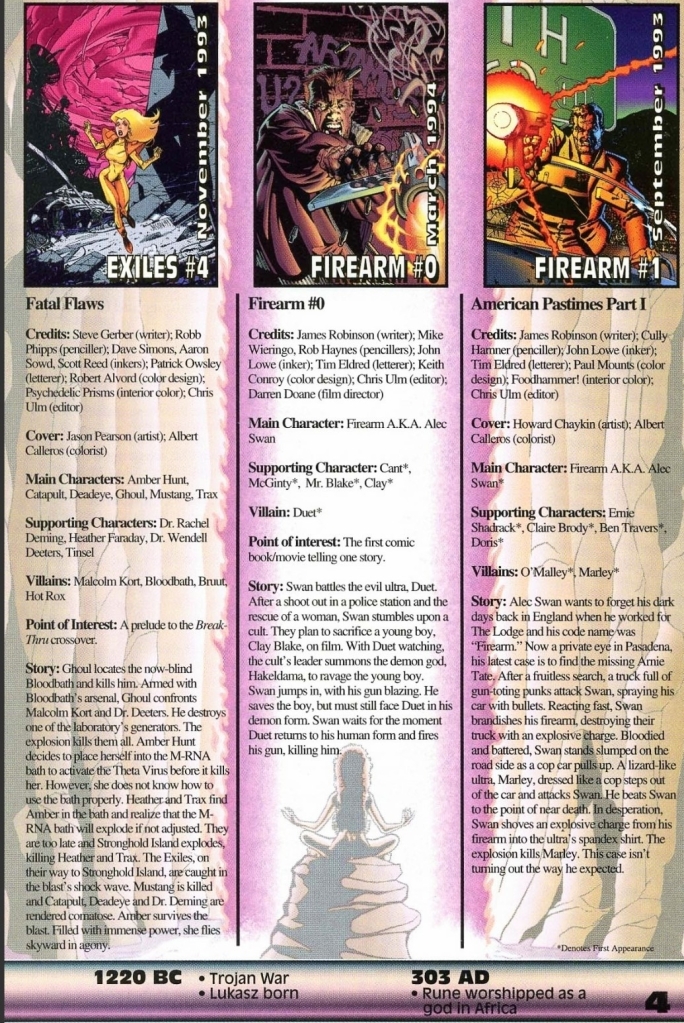
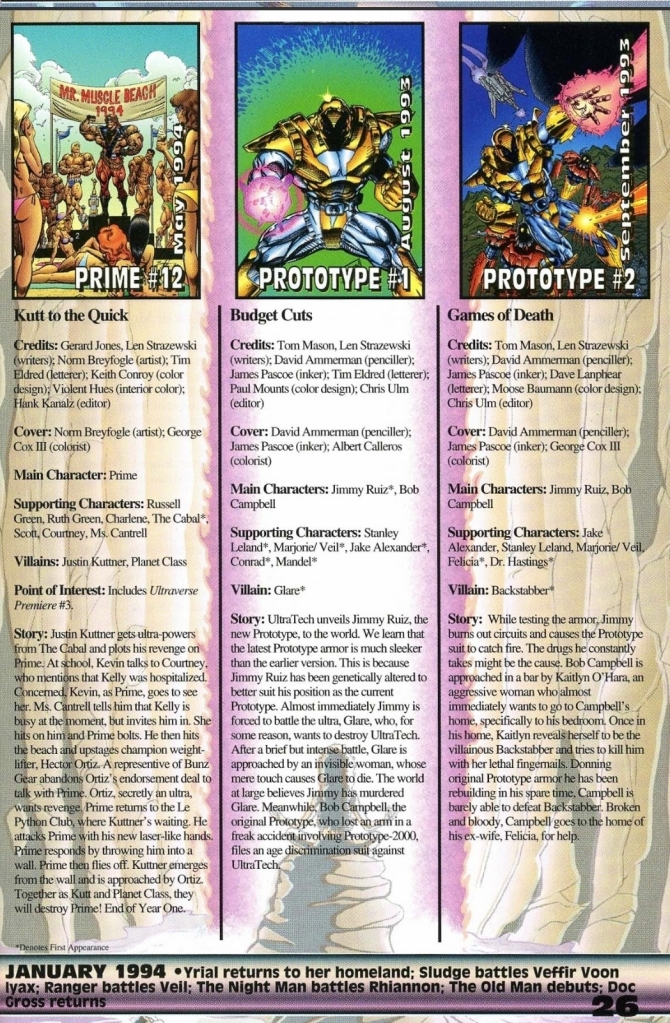
I can say without a doubt that this publication is indeed a complete guide to each and every Ultraverse comic book released during its first year from 1993 to 1994 specifically. You want to know exactly how many issues of Mantra, Prime, Hardcase, The Solution, Prototype, The Strangers and others were published in the first year? This one has it all listed! You want to know which UV comic book involved the talents of Steve Gerber, Norm Breyfogle, Rick Hoberg, Len Strazewski, Aaron Lopresti, George Perez, James Hudnall, Gerard Jones, Steve Englehart, Tom Mason, Terry Dodson, James Robinson, Howard Chaykin, Mike W. Barr and many others under the Malibu Comics banner? This guide has it all listed! What months were Exiles #1, Sludge #1, Firearm #0, Break-Thru #1 and Mantra #1 were published? The answers to each are included. The same can also be said when it comes to which characters appeared in each comic book.

This is what each page typically looks like with details of the Ultraverse timeline on the lower part.
The timeline reveals that the male warrior Lukasz, who would later end up in woman’s body as Mantra/Eden Blake, was born in 1220 BC.

Very clearly, the Malibu Comics people worked hard to collect the essential types of information, organized them and put them all into print media form for readers and collectors to use when it comes to searching just about everything about the Ultraverse’s first year. Things did not just stop there, however.

What I found amusing to look at in each page of this Ultraverse guide are details of the shared universe’s timeline posted on the lowest part. The said timeline – which is limited to text and numbers – reveal interesting details such as what year was Lukasz (AKA Mantra) born, when did Rune begin, when was the Choice corporation established, what year did the island of Yrial’s people move up to the clouds, what years were infants injected by Wetware Mary and more. These details are actually quite encouraging to make readers discover or re-read Ultraverse comic books to see how they are dramatized on paper.

Conclusion

As you can see in the details above, Len Strazewski was involved in both the Prime and Prototype comic book series.

Ultraverse Year One (1994) is a pretty detailed guide that will not only help readers track down each and every UV comic book of the mentioned time period, but also help them spot the precise comic books that has characters included as well as the published works of varied comic book creators. If you are really determined to track down and buy all the Year One UV comic books, this guide is a must-have. If there are any weaknesses to mention, it would be the fact that each comic book’s entire plot got summarized in full which are actually spoilers.

Overall, Ultraverse Year One (1994) is recommended.

+++++

Thank you for reading. If you find this article engaging, please click the like button below and also please consider sharing this article to others. If you are looking for a copywriter to create content for your special project or business, check out my services and my portfolio. Feel free to contact me with a private message. Also please feel free to visit my Facebook page Author Carlo Carrasco and follow me on Twitter at  @HavenorFantasy as well as on Tumblr at https://carlocarrasco.tumblr.com/ and on Instagram at https://www.instagram.com/authorcarlocarrasco/
A Look Back at Sludge #8 (1994)

Disclaimer: This is my original work with details sourced from reading the comic book and doing personal research. Anyone who wants to use this article, in part or in whole, needs to secure first my permission and agree to cite me as the source and author. Let it be known that any unauthorized use of this article will constrain the author to pursue the remedies under R.A. No. 8293, the Revised Penal Code, and/or all applicable legal actions under the laws of the Philippines.

Welcome back, superhero fans, 1990s arts and culture enthusiasts and comic book collectors! Today we revisit the Ultraverse of Malibu Comics and examine one of its many stories told through an issue of the Sludge comic book series.

As seen in my previous Sludge retro review, the stakes were raised even higher and Sludge finds himself in the middle of a major conflict between the gangs of the city with the involvement of the group of the Pump. By this point, the titular character is not only desperate but also is getting torn between good and evil.

With those details laid down, here is a look back at Sludge #8, published by Malibu Comics in 1994 with a story written by Steve Gerber and drawn by Aaron Lopresti.

The cover.

Early story

The story begins with TV news coverage doing a recap of events that shook New York City and its people – the abduction of a drug mule, the destruction of a ship filled with illegal immigrants, the destruction in the cemetery left behind by a major conflict there, and the death of crime boss John Paul Marcello which involved action by Sludge.

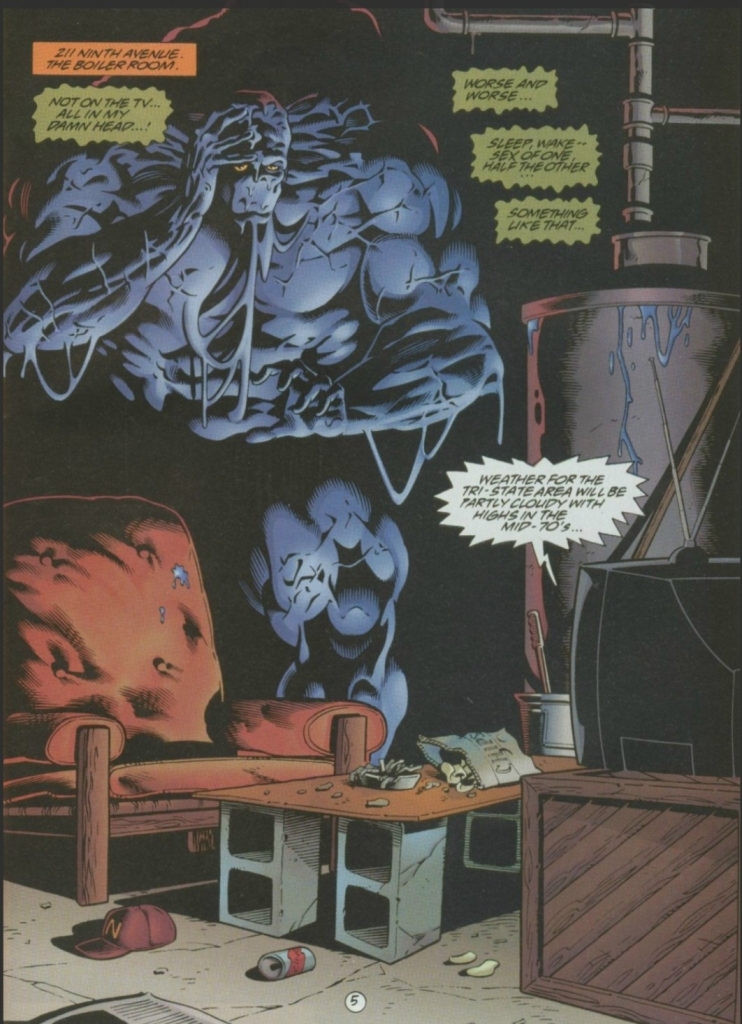
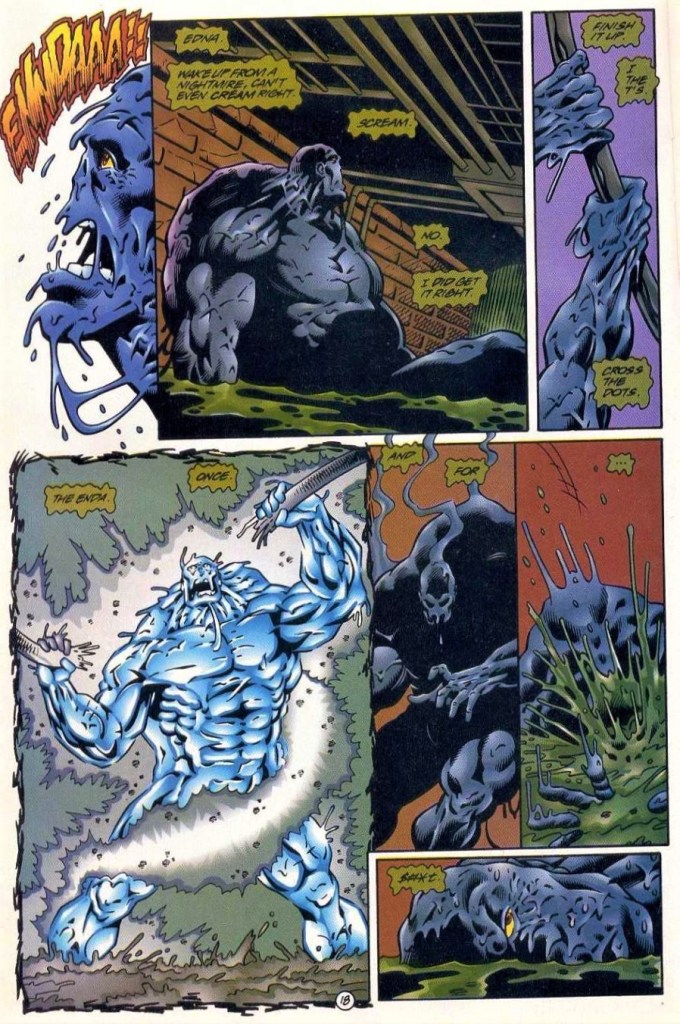
Sludge then wakes up from another nightmare and finds himself inside a boiler room which has a TV set and a chair. It turns out the place was set up by a janitor who does not even know Sludge is present. Slowly, Sludge sneaks his way back to the sewer.

At a cemetery, the burial of Marcello is being attended by many people and among them is Don Celini who regarded the late crime boss as a man of vision who made a lot of money for many people. Vittorio, the former loyal assistant to Marcello, is told by Don Celini to demonstrate leadership qualities to the heads of the other gangs. In the evening at a discreet place, Vittorio meets with Bloodstorm with a lot of money on the side…

The reporter Shelley on the pursuit for details.

Quality

To make things clear about the storytelling, the conflict between the crime gangs not only became more intense but also turned out quite intriguing. Clearly writer Steve Gerber carefully planned out the events, character developments and twists for this series. That being said, this comic book has a fine mix of suspense, crime story and even the supernatural for the narrative’s progress, and the good news is that these elements were presented in a believable way.

As presented in the previous issues, Sludge’s desperation and death wish will keep on intriguing you especially when he gets bothered by the Pump (arguably the most evil figure of the entire Ultraverse). Even as the war between gangs heat up, the story even had space for investigative journalism moments through the news reporter Shelley (who encountered Sludge in person before) whose pursuit for the facts remains unrelenting.

Conclusion

Sludge in a dark boiler room.

While the previous issue made me think deeply about the state of Sludge’s character and the gang war he became involved with, Sludge #8 (1994) is an even more intriguing Ultraverse read complete with solid twists that must be seen. Without spoiling the story, this comic book will strongly resonate with readers who really started the Sludge series from issue #1 (note: Bloodstorm’s involvement in this comic book will be more relevant if you have previously read his detailed introduction in issue #2). The current storyline – Street Wars – went significant steps forward in this story and I can say that the creative team of Gerber and Aaron Lopresti were successful in making me anticipate the conclusion.

Overall, Sludge #8 (1994) is recommended.

+++++

Thank you for reading. If you find this article engaging, please click the like button below and also please consider sharing this article to others. If you are looking for a copywriter to create content for your special project or business, check out my services and my portfolio. Feel free to contact me with a private message. Also please feel free to visit my Facebook page Author Carlo Carrasco and follow me on Twitter at  @HavenorFantasy as well as on Tumblr at https://carlocarrasco.tumblr.com/ and on Instagram at https://www.instagram.com/authorcarlocarrasco/

A Look Back at Sludge #7 (1994)

Disclaimer: This is my original work with details sourced from reading the comic book and doing personal research. Anyone who wants to use this article, in part or in whole, needs to secure first my permission and agree to cite me as the source and author. Let it be known that any unauthorized use of this article will constrain the author to pursue the remedies under R.A. No. 8293, the Revised Penal Code, and/or all applicable legal actions under the laws of the Philippines.

Welcome back, superhero fans, 1990s arts and culture enthusiasts and comic book collectors! Today we revisit the Ultraverse of Malibu Comics and examine one of its many stories told through an issue of the Sludge comic book series.

In my previous Sludge retro comic book review, the stakes were raised for Sludge and the city of New York as a new conflict started brewing that brought in two gangs along with the Pump and his own gang, and even mercenaries. Issue #6 was the start of a new multi-part storyline that Steve Gerber crafted and it encouraged re-reading the early issues of the Sludge series to understand the scope of the new conflict.

With those details laid down, here is a look back at Sludge #7, published by Malibu Comics in 1994 with a story written by Steve Gerber and drawn by Aaron Lopresti.

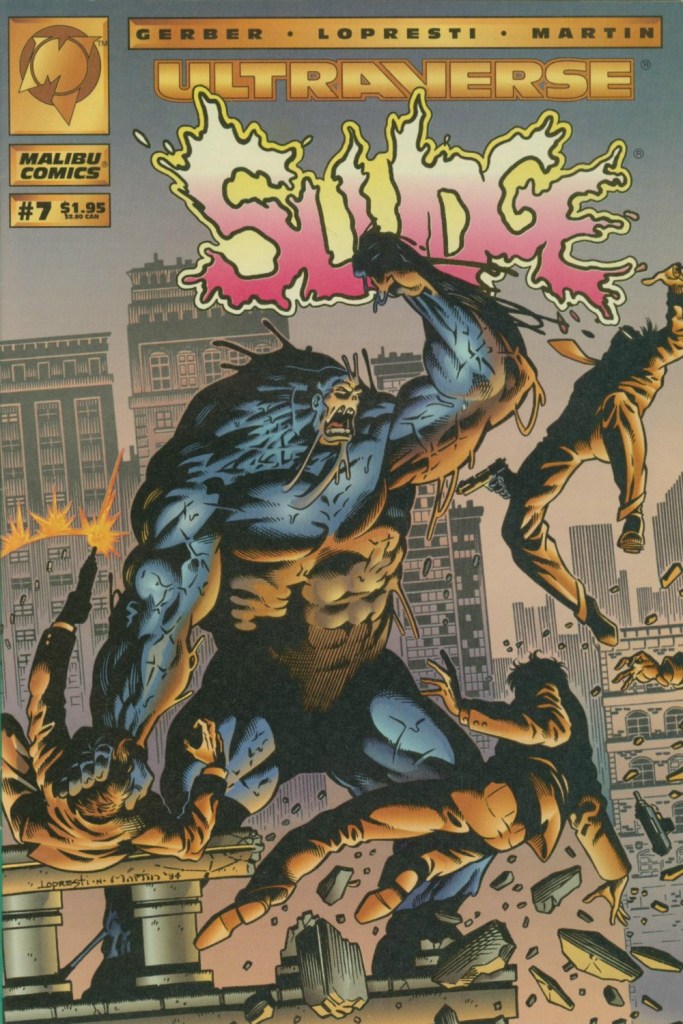
The cover.

Early story

The story begins with a man and a woman on bed. Their privacy gets interrupted when the Pump suddenly appears in frightening fashion. It turns out, Sludge was in the middle of a nightmare and even sees a frightening vision of Edna. He then makes his way through in the sewer.

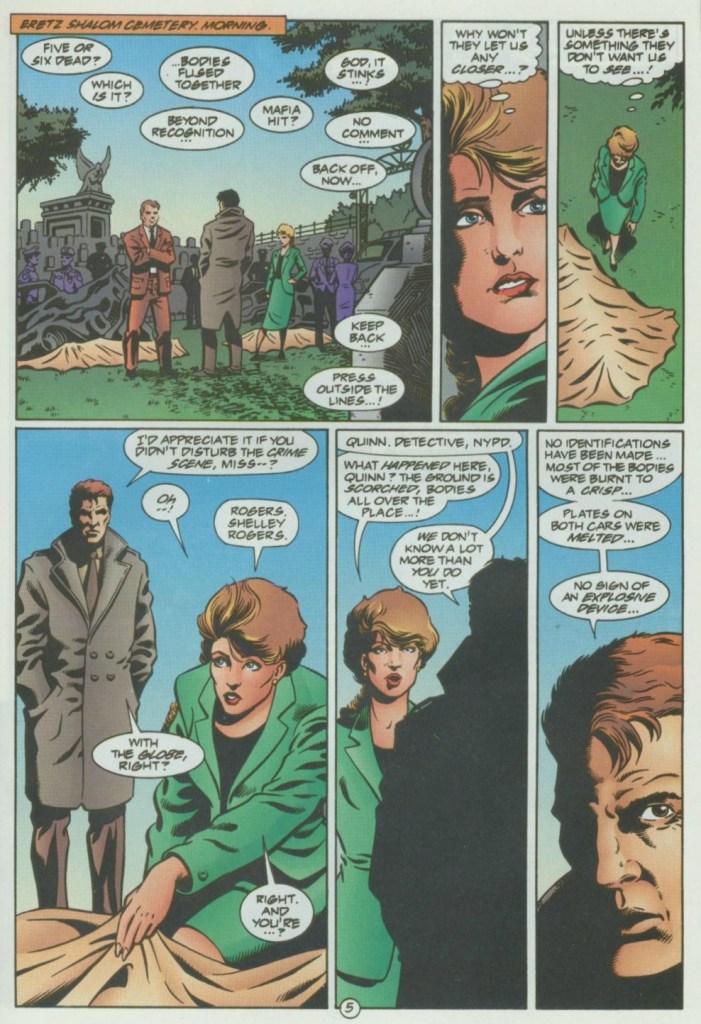
One morning at the Eretz Shalom Cemetery, a police investigation is being conducted as the local authorities found several dead bodies as well as scorched ground, bodies fused together and a some odor. Shelley, the very determined reporter of the New York Daily Globe, tries to uncover details at the crime scene only to be interrupted by a detective named Quinn. In response to her question, Quinn admits they are just discovering things and trying to figure things out.

Suddenly a lady wearing a suit and necktie approaches them…

Quality

Avoiding the touch of Sludge is a must!

As far as storytelling goes, this tale is a very solid follow-up to the previous issue. While issue #6 showed the start of a big conflict involving three groups, this one shows the emotional and physical impact on the gang leaders (John Paul Marcello and the Dragon Fang) and the unrelenting pursuit of the Pump and his minions on wrecking down society by means of drug pushing and violence. In a way, this Ultraverse story daringly showed its own portrayal of illegal drugs and gang wars while also showing Sludge suffering more and getting even more desperate with his life. I should also state that there are scenes that added detective story and suspense vibes into the narrative.

It should be noted that at this point in the Sludge series, the titular character does some things here that would maker readers question his moves and his sanity, especially since the Pump (note: the Ultraverse’ very own Satan figure) keeps on tempting and manipulating him. Sludge, who was once a crooked cop when he was still human, clearly is vulnerable deep inside and he also is not resistant to the evil influences around him. Very notably, the story by Steve Gerber is strong enough to make me go on to read the next issue.

Conclusion

Shelley of the city newspaper at the scene of the crime.

Sludge #7 (1994) is the kind of comic book that will make you think deeply about the true nature of the titular character and why should you keep on reading each new comic book of this series when you learn that the said character is far from being heroic. The lines that separate good and evil is very blurred at this stage of the Sludge series. This is one clever and really engaging piece of work done by the Gerber-Lopresti team, and at the same time it is also one of the most intriguing Ultraverse tales ever told. That being said, the comic book’s concept is incidentally not ideal for readers who seek good-versus-evil conflicts that get resolved.

If you are seriously planning to buy an existing hard copy of Sludge #7 (1994) be aware that as of this writing, MileHighComics.com shows that the near-mint copy of the regular edition costs $16.

Overall, Sludge #7 (1994) is recommended.

+++++

Thank you for reading. If you find this article engaging, please click the like button below and also please consider sharing this article to others. If you are looking for a copywriter to create content for your special project or business, check out my services and my portfolio. Feel free to contact me with a private message. Also please feel free to visit my Facebook page Author Carlo Carrasco and follow me on Twitter at  @HavenorFantasy as well as on Tumblr at https://carlocarrasco.tumblr.com/and on Instagram at https://www.instagram.com/authorcarlocarrasco/

A Look Back at Sludge #6 (1994)

Disclaimer: This is my original work with details sourced from reading the comic book and doing personal research. Anyone who wants to use this article, in part or in whole, needs to secure first my permission and agree to cite me as the source and author. Let it be known that any unauthorized use of this article will constrain the author to pursue the remedies under R.A. No. 8293, the Revised Penal Code, and/or all applicable legal actions under the laws of the Philippines.

Welcome back, superhero fans, 1990s arts and culture enthusiasts and comic book collectors! Today we revisit the Ultraverse of Malibu Comics and examine one of its many stories told through an issue of the Sludge comic book series.

In my previous retro comic book review, I found Sludge #5 an inspired piece of work that relates to Mary Shelley’s Frankenstein which also carried elements about resurrection, man’s abuse of science, and the consequences of dealing with the unnatural. The comic book was also the 2nd consecutive issue of Sludge written by artist Aaron Lopresti.

With those details laid down, here is a look back at Sludge #6, published by Malibu Comics in 1994 with a story written by Steve Gerber and drawn by Aaron Lopresti.

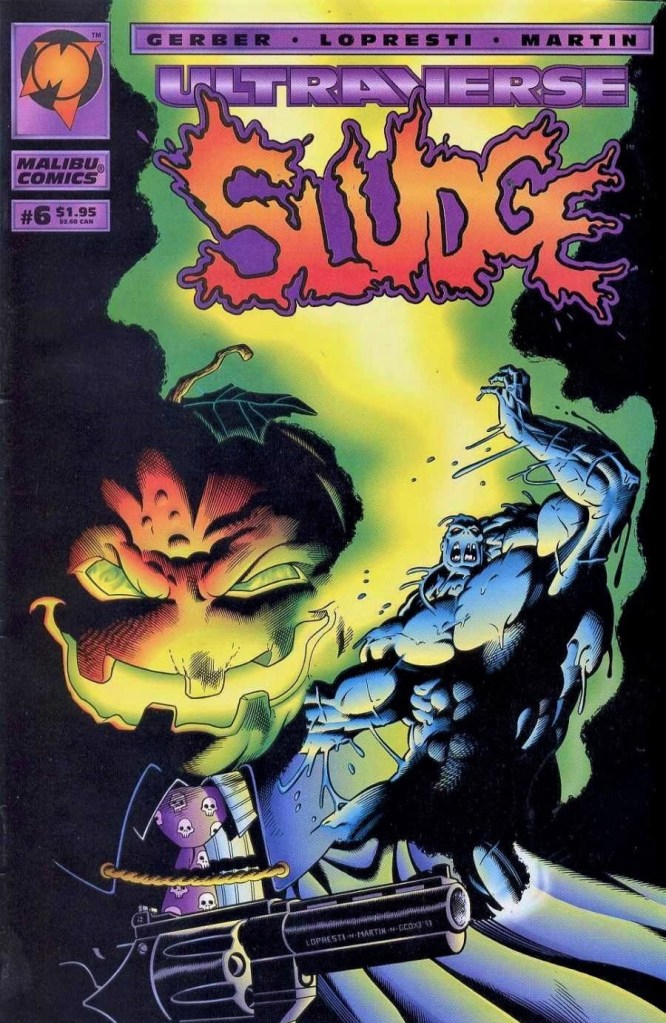
The cover.

Early story

The story begins on the ocean with Sludge hitching a ride on a garbage barge being towed by a ship. Sludge then starts swimming off to a certain destination.

On the upper east side of Manhattan, a nicely dressed lady arrives with a suitcase and meets with a lawyer named Roger Sutton at his office. Inside, a trade happens with papers of a transfer of deed in exchange for highly unusual looking capsules.

Shortly after, as she drives off to her next destination, a blockade of two cars formed to stop her. A few armed men show up and fired bullets into her car to abduct her and take the suitcase containing the capsules.

Quality

Sludge doing something dangerous after waking up from a nightmare.

As this comic book marks the return of Steve Gerber, the story built up tension signaling that an urban war involving crime lords, mercenaries and the evil Pumpkin is coming. Remember Bloodstorm from issue #2? He’s back with a supporting role that fits in nicely within the brewing conflict. The demonic Pump, his teenage crime captain and gang are back serving as the unseen third force in the same conflict.

The way Steve Gerber constructed the brewing conflict is pretty solid and he managed to even efficiently introduce an Asian gang lord (complete with his family business and members) while emphasizing the presence of John Paul Marcello as the other big-time crime figure of the city. As for the titular protagonist, Sludge is portrayed to be struggling with guilt and hopelessness which push him to approach one of the evil forces. Sludge’s knowledge about Marcello will compel you to revisit issue #2. At this stage in the series, Sludge is becoming more desperate about his existence and purpose while dealing with the stress of being in the middle of a brewing conflict. His personal struggle on dealing with the evil influence of the Pump (clearly the Satan figure of the Ultraverse) is something that people living with weak faith and suffering will find relatable.

Conclusion

The first signs of the brewing crime war in the city.

Sludge #6 (1994) is a strong return by Steve Gerber on the storytelling and it marked the start of a new storyline titled Street Wars which really raised the stakes of the series. The good news is that Gerber’s writing is very good and the characters are all nicely defined. Aaron Lopresti’s visuals maintained that high level of quality and he clearly defined the look of the Sludge series.  

If you are seriously planning to buy an existing hard copy of Sludge #6 (1994) be aware that as of this writing, MileHighComics.com shows that the near-mint copy of the regular edition costs $16 while the near-mint copy of the newsstand edition costs $48.

Overall, Sludge #6 (1994) is recommended.

+++++

Thank you for reading. If you find this article engaging, please click the like button below and also please consider sharing this article to others. If you are looking for a copywriter to create content for your special project or business, check out my services and my portfolio. Feel free to contact me with a private message. Also please feel free to visit my Facebook page Author Carlo Carrasco and follow me on Twitter at  @HavenorFantasy as well as on Tumblr at https://carlocarrasco.tumblr.com/and on Instagram at https://www.instagram.com/authorcarlocarrasco/

A Look Back at Sludge #5 (1994)

Disclaimer: This is my original work with details sourced from reading the comic book and doing personal research. Anyone who wants to use this article, in part or in whole, needs to secure first my permission and agree to cite me as the source and author. Let it be known that any unauthorized use of this article will constrain the author to pursue the remedies under R.A. No. 8293, the Revised Penal Code, and/or all applicable legal actions under the laws of the Philippines.

Welcome back, superhero fans, 1990s culture enthusiasts and comic book collectors! Today we revisit the Ultraverse of Malibu Comics and examine one of its many stories told through an issue of the Sludge comic book series.

In my previous retro review about Sludge #4 (1994), we got to see an inspired monster-versus-monster conflict between the protagonist and a huge, intelligent alligator aced with elements of society, urban legends, idolatry and journalism. That particular issue also showed more of the creative side of series artist Aaron Lopresti when it comes to writing. The next issue reviewed also involved Lopresti as writer.

With those details laid down, here is a look back at Sludge #5, published by Malibu Comics in 1994 with a story written and drawn by Aaron Lopresti.

The cover.

Early story

The story begins in New York City. Darkness descends on Manhattan like a shroud, providing haven for those who shun the light. As a man and a lady walk down the sidewalk talking to each other, a very hideous human-like monster comes out of the shadow of the alley and grabs them both.

In the sewers, Sludge hears one of the victims scream which compels him to run to where the trouble happened. As soon as he climbs out of the sewer, he sees the monster in the alley which makes eye-contact with him. As Sludge approaches the alley, the monster gets away leaving the dead bodies of the man and woman behind. As Sludge examines the dead bodies and realizes that the monster ate them, a police car with two officers arrived.

In reaction, Sludge quickly grabs one part of the police car and turns it upside down to buy himself time to get back into the sewer. The details of the encounter between the police and Sludge made it to Shelley, the same New York Daily Globe news reporter who encountered him and the intelligent alligator Veffir Voon Iyax. She discusses the newest information with her skeptical boss…

Quality

Obvious parallel to Mary Shelley’s Frankenstein here.

Let me start first with what is obvious with regards to the plot and presentation. Similar to what happened in Sludge #2, there is noticeably less spotlight on Sludge as creative space had to be used to develop the new monster, emphasize its background story (with an additional new character who has significance) and there were even scenes focused on Shelley and what goes on inside the office of her newspaper which became aware of the events that took place.

The next thing I want to point out is the creative inspiration used in this particular story. This comic book has really clear parallels to the literary classic Frankenstein: or, The Modern Prometheus and there was even a mention of its author Mary Shelley. That being said, there is a scientist-and-walking-abomination aspect with regards to the mentioned additional significant character connected with the new monster. That is not to say that this comic book copied Victor Frankenstein and his nameless monster, rather Aaron Lopresti took inspiration from them, mixed things up and implemented them in telling this new tale of Sludge. When it comes to keeping things fresh in telling another Sludge story, I can say that Lopresti succeeded.

More on the story itself, this one has a clever mix with regards to the dimensions used. In here, Sludge is more determined on helping people who shouted for help while Shelley won’t give up on finding out the truth about the tragic events in their city. Without spoiling the details, I can say that there is this deep dramatization about the monster and the new character responsible for its return from the dead.

As for the quality of the writing, Aaron Lopresti’s work here is not only expressive but also impressive. There is this one page near the end that has these few yet powerful words that strongly connect with the images of Sludge and the monster (who is so creepily drawn!).  

Conclusion

This is the 2nd straight Sludge comic book that has reporter Shelley and her newspaper focused on what has been happening. At this point, Shelley had encountered Sludge.

Sludge #5 (1994) in my view is another inspired and intriguing Ultraverse tale to read! While issue #4 had parallels to the 1980 film Alligator, this comic book took inspiration from Mary Shelley’s most famous work of fiction which added elements about resurrection, man’s abuse of science, and the consequences of dealing with the unnatural into Sludge’s side of the Ultraverse. I should state that this comic book also has the scariest looking monster Aaron Lopresti drew for the Ultraverse at the time of publication.

If you are seriously planning to buy an existing hard copy of Sludge #5 (1994) be aware that as of this writing, MileHighComics.com shows that the near-mint copy of the regular edition costs $16 while the near-mint copy of the newsstand edition costs $48.

Overall, Sludge #5 (1994) is highly recommended.

+++++

Thank you for reading. If you find this article engaging, please click the like button below and also please consider sharing this article to others. If you are looking for a copywriter to create content for your special project or business, check out my services and my portfolio. Feel free to contact me with a private message. Also please feel free to visit my Facebook page Author Carlo Carrasco and follow me on Twitter at  @HavenorFantasy as well as on Tumblr at https://carlocarrasco.tumblr.com/

A Look Back at Sludge #4 (1994)

Disclaimer: This is my original work with details sourced from reading the comic book and doing personal research. Anyone who wants to use this article, in part or in whole, needs to secure first my permission and agree to cite me as the source and author. Let it be known that any unauthorized use of this article will constrain the author to pursue the remedies under R.A. No. 8293, the Revised Penal Code, and/or all applicable legal actions under the laws of the Philippines.

Welcome back, superhero enthusiasts, 1990s culture enthusiasts and comic book collectors! Today we revisit the Ultraverse of Malibu Comics and examine one of its many stories through an issue of the Sludge comic book series.

Previously, I reviewed Sludge #3 which was a tie-in comic book to the first big crossover event of the entire Ultraverse – Break-Thru. In that issue, he encountered the “lord” Pumpkin who himself became a notable super villain in the UV. That story also showed the first major test of Sludge when it comes to resisting temptation and evil.

With those details laid down, here is a look back at Sludge #4, published by Malibu Comics in 1994 with a story written and drawn by Aaron Lopresti, and scripted by Steve Gerber.

The cover.

Early story

The story begins when two black teenagers go down the city sewer to look for something as part of a job of them agreed to do for someone named Gordy. They accidentally find Sludge whose appearance and ability to talk scares them away. As the two keep running to another direction, a reptilian monster sees them. The monster grabbed and killed the taller youth, leaving the shorter one scared.

A short time later, a police officer finds the scared teenager hiding behind plants at Central Park. The survivor is in a state of shock repeating his friend’s name a lot. The police update about the boy eventually reaches the office of the New York Daily Globe and an attractive reporter named Shelley intends to follow what could be a hot scoop…

Quality

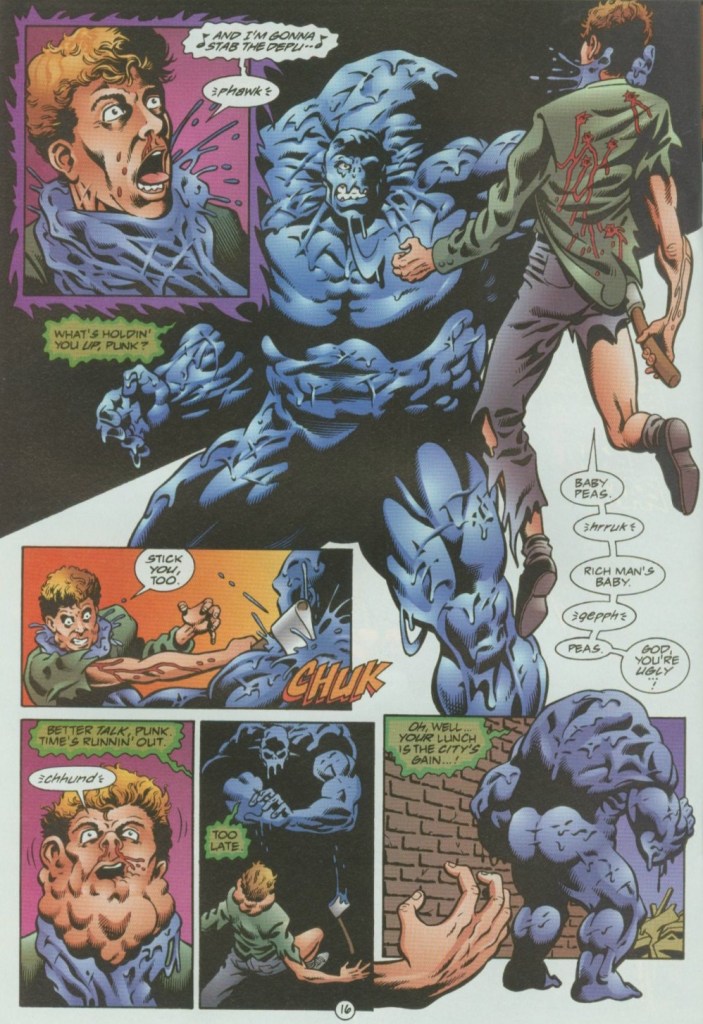
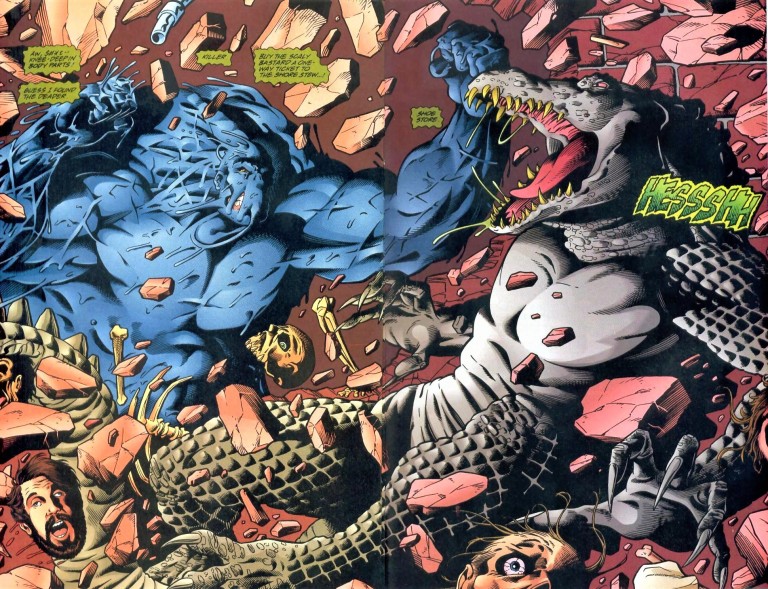
The battle between these two has a lot of stuff that should be seen.

In this comic book, I can see that the creative team of Steve Gerber and Aaron Lopresti decided to shake things up a bit when it comes to telling a new story of Sludge laced with elements of society, urban legends and journalism. The good news here is that this story is well-written and the visuals really brought the script to life for readers to be engaged with.

When it comes the elements that inspired this particular story, the concept about alligators occupying the sewers instantly reminds me of the 1980 film Alligator and along the way, Gerber-Lopresti went on pounce on the concept resulting in the introduction of a brand new Ultraverse villain in the form of a monstrous, human-like alligator named Veffir Voon Iyax which can also talk and reason like humans. This new villain is really interesting and its background about being part of a species of alligators worshipped by people from long ago sheds light on the idolatry which is both unholy and foolish.  

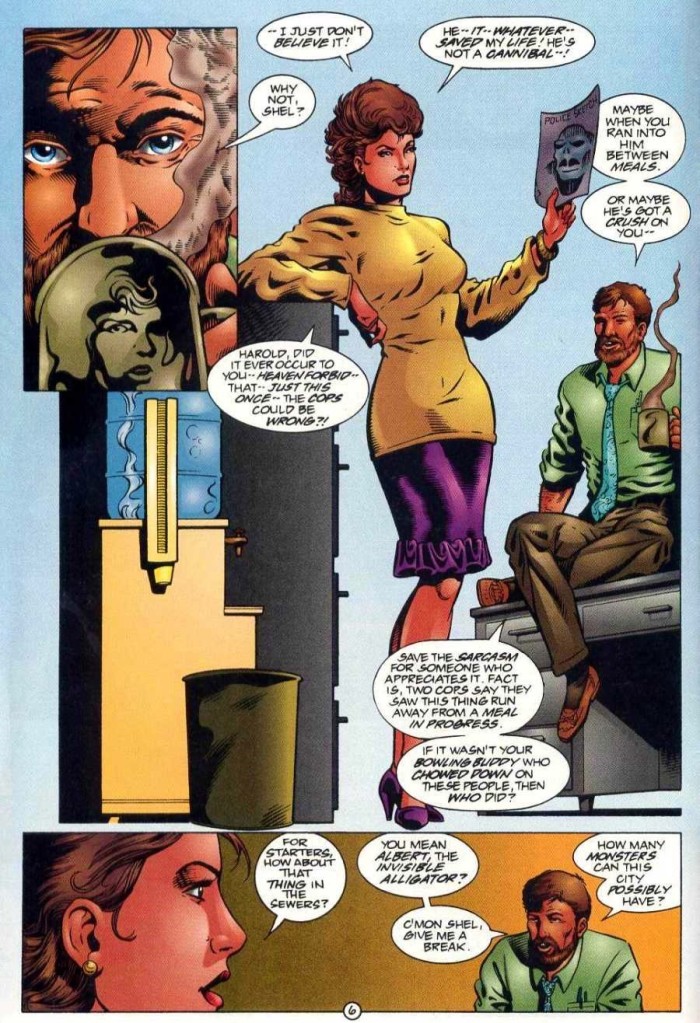
On the aspects of society and journalism, the story sheds light on how some people – even minors – would go to really unsafe places and do very risky jobs for a variety of reasons. The journalistic aspect of this comic book emphasizes how far journalists would go to write stories based on questionable data and that a newspaper would recklessly publish such stories even though they lacked solid evidence to prove the unbelievable is true. The newspaper journalist Shelley had quite an amount of the spotlight, she became a clear supporting character in this comic book.

In keeping up with the superhero flavor of the Ultraverse, there is a good amount of spectacle here as it has a big battle between Sludge and the monstrous alligator which is nicely presented. This is a battle between monsters that was carefully structured and executed well.

Conclusion

A look at what happens behind the scenes at a city newspaper.

Sludge #4 (1994) is both an intriguing and enjoyable read. The Gerber-Lopresti team succeeded in telling another Sludge tale that is fresh as it took inspiration from pop culture and society. At the same time, this comic book show that Sludge is clearly not the only monster in New York City’s sewers. As such, his place within the Ultraverse is really unique.

If you are seriously planning to buy an existing hard copy of Sludge #4 (1994) be aware that as of this writing, MileHighComics.com shows that the near-mint copy of the regular edition costs $16 while the near-mint copy of the newsstand edition costs $48.

Overall, Sludge #4 (1994) is recommended.

+++++

Thank you for reading. If you find this article engaging, please click the like button below and also please consider sharing this article to others. If you are looking for a copywriter to create content for your special project or business, check out my services and my portfolio. Feel free to contact me with a private message. Also please feel free to visit my Facebook page Author Carlo Carrasco and follow me on Twitter at  @HavenorFantasy as well as on Tumblr at https://carlocarrasco.tumblr.com/