Remember all the craziness that used to infect the United States during the term of the failed US President Joe Biden and his woke administration? Common sense in America continues to get restored as the Trump Administration will proceed with formally removing the Biden-era Title IX regulations and this includes restoring rules that were in place during the first term of President Donald J. Trump, according to a Breitbart news report.
To put things in perspective, posted below is the excerpt from the Breitbart news report. Some parts in boldface…
The Department of Education said Monday it will formally remove the Biden administration’s Title IX regulations and restore rules issued during President Donald Trump’s first term.
The change takes effect Tuesday.Under the final rule issued Monday, the Education Department’s anti-discrimination policy will recognize sex as male or female at birth. It formally removes Biden-era regulations that extended protections based on sexual orientation and gender identity to students and employees at federally funded schools.
The 2024 rules also forced schools to use transgender students’ pronouns and changed how schools handle harassment complaints. A federal court struck down the rules in January 2025.
The Education Department then told schools it would enforce the 2020 rules. Monday’s action puts that change into the published federal regulations; schools have already been operating under the earlier rules.
The department said the last lawsuits over the Biden rules were dismissed in August, clearing the way for it to formally remove them. Education Secretary Linda McMahon said the move would make the written regulations match the court rulings and the rules her department has been enforcing since Trump returned to office:
Today’s rulemaking clears the Biden Administration’s illegal rewrite of Title IX from the Code of Federal Regulations and restores the commonsense language promulgated in the first Trump Administration, which we have been enforcing since the first days of the Administration. Thanks to today’s action, the published Title IX regulations faithfully reflects court orders and Congressional intent—reducing confusion for parents, students, and educational institutions. We will continue to relentlessly champion equal opportunity for all Americans and hold accountable any school or college that violates the rights, privacy, or athletic opportunities of our women and girls.
Let me end this piece by asking you readers: What is your reaction to this development? Are you feeling glad that the Biden-era Title IX rules are no more? Does this development make you feel safer and more confident about your children or relatives in schools? Do you feel that this development ensures protection for women and girls in sports activities or events? What do you think the mob of SJWs, feminists, transgendered and LGBTQ will do in response to this breakthrough?
Recently in the City of Parañaque, an 18-year-old man from Pasay City got arrested for sexually assaulting a 13-year-old female, according to a news report by The Daily Tribune.
To put things in perspective, posted below is an excerpt from The Daily Tribune news report. Some parts in boldface…
An 18-year-old man was arrested for statutory rape inside a residence in Barangay Santo Niño, Parañaque City, on Saturday afternoon.
The suspectwas identified only by the alias Eric James, aresident of Pasay City.
At about 3:30 p.m. on 29 August,the suspect visited the victim’s residence and allegedly lured the 13-year-old female victim into the comfort room, where he sexually assaulted her. The victim’s father discovered the suspect inside the comfort room upon returning home, prompting the victim to disclose the assault to her parent.
The victim’s father immediately sought assistance from Barangay Santo Niño tanods, who swiftly apprehended the suspect with responding police officers.
The suspect was brought to the Parañaque City Police Station and turned over to the Women and Children Protection Desk (WCPD) for further investigation and proper disposition.
Let me end this post by asking you readers: What do you think about this recent development? If you are a resident of Parañaque, are you thankful to the barangay tanods and the local police for the arrest of the suspect? When was the last time an act of rape or sexual assault happened in your local community?
For more South Metro Manila community news and developments, come back here soon. Also say NO to fake news, NO to irresponsible journalism, NO to misinformation, NO to plagiarists, NO to reckless publishers and NO to sinister propaganda when it comes to news and developments. For South Metro Manila community developments, member engagement, commerce and other relevant updates, join the growing South Metro Manila Facebook group at https://www.facebook.com/groups/342183059992673
Welcome back my readers, YouTube viewers and all others who followed this series of articles focused on YouTube videos worth watching.
Have you been searching for something fun or interesting to watch on YouTube? Do you feel bored right now and you crave for something to see on the world’s most popular online video destination?
I recommend you check out the following videos I found.
#1 Focus on Kevin McHale – It has been more than thirty years since Kevin McHale retired from the NBA. McHale was one of the premier power forwards of the NBA in 1980s and even though he won the Sixth Man Award and three NBA championships with Celtics (he formed the nucleus with Larry Bird and Robert Parish), he has been overlooked in discussions about the most notable power forwards of the league. McHale was also declared as one of the greatest NBA players ever. That said, now is a good time to revisit NBA history with focus on McHale and what he achieved.
#2 NiGHTS into Dreams…revisited – Way back in 1996, Sega released NiGHTS into Dreams… which was a very ambitious Sega Saturn video game made by the same key creators behind the popular Sonic games on Sega Genesis. Back in the old days, Sega was in a bind as it faced tough competition from Nintendo and Sony. That said, the company really had to make an exclusive game that is of very high quality, fun-filled gameplay and ambitious creative designs. That said, I encourage you all to watch the retrospective video about NiGHTS into Dreams… below.
#3 Ashleigh Burton reacts to The Animatrix – When it comes to entertainment in the year of 2003, The Matrix entertainment franchise really left its mark with the two hyped sequels The Matrix Reloaded and The Matrix Revolutions but also with the video game Enter The Matrix and the animated anthology The Animatrix. Released between the two live-action movies, The Animatrix featured several animated short stories of the Matrix universe done by different creators and each had different styles of art and visual concepts. The Animatrix also was designed to expand and explain the lore that delighted the fans while helping newcomers get oriented efficiently. As of this writing, there are several YouTube reaction videos about The Animatrix and the one that entertained me the most was that of Ashleigh Burton. Go watch her reaction video below.
#4 Japan opposes Islamic immigration – Let us be very clear here. Massive Islamic immigration is causing a lot of trouble in countries that accepted it. In Japan there is an obvious rise of criminal acts, public nuisance and other forms of problems caused by Islamist foreigners there. There were already rape acts committed by Pakistani men, a dumping of garbage committed by a man from Turkey and more. It is also obvious that the Muslim foreigners in Japan have no respect for Japanese culture, rules and social norms. As such, the Japanese opposition against the Islamist foreigners is real and only growing. Watch and learn from the video below.
#5 You, Me and the Movies react to Alligator (1980) – As a very young boy, I saw the 1980 film Alligator on a rented Betamax tape. I saw it alone during my first viewing, and later got a few friends to watch it with me on my second viewing. Alligator was one of those monster movies (AKA creature features) inspired by Steven Spielberg’s Jaws as several movie producers hoped to cash-in on the 1975 film’s popularity and the box office trends of the time. Alligator has its own charm and entertainment value, and you can discover more by watching the reaction video of You, Me and the Movies below.
#6 Woke WNBA Slammed by NBA Legends – When the Women’s National Basketball Association (WNBA) first launched in 1997, there was excitement and hope for the development of women competing in professional basketball. Today, the WNBA remains an enduring financial failure as it never came close to the NBA in terms of mainstream importance. Worse, the WNBA has turned woke and it is very accepting towards biological males who identified themselves as women. The transgender and social justice diseases are deep in the minds of the people leading the WNBA which led to the growing madness. Recently, the WNBA’s hypocrisy has been exposed and already there were NBA legends who expressed their opinions against the screwed-up league. Watch and learn from the video below.
#7 Premium Corn Craze in Japan – Have you ever tasted corn imported from Japan? The Japanese love corn and the harvesting of corn in their country is a significant industry on its own. As such, it is not surprising that the selling of corn sourced directly from local farmers is highly pursued by locals. Japan also has several varieties of corn ensuring consumers with different tastes have something to enjoy. Watch and learn from the video below.
#8 1980s Cartoons Revisited – The way my life turned out, the 1980s will always be the most memorable decade of cartoon series (note: anime is exempted, including those that got translated for the West). The 1980s is the very decade that has significant cartoon titles like Teenage Mutant Ninja Turtles, G.I. Joe: A Real American Hero, The Transformers, and so much more. The said decade also has its share of other animated series that failed to attract a massive audience and ended up being obscured and forgotten. To enjoy the nostalgia of 1980s cartoons, watch the videos below.
The population of Japanese nationals has officially declined to less than one hundred twenty million which is the lowest figure in more than forty years, according to a news report by Kyodo News. Meanwhile, the number of foreign residents has surpassed four million.
To put things in perspective, posted below is an excerpt from the report of Kyodo News. Some parts in boldface…
The number of Japanese nationals fell below 120 million for the first time in 42 years to 119,736,483 at the start of this year, the government said Wednesday, underscoring the challenges faced by a nation battling declining birth rates.
The figure as of Jan. 1 showed a drop of 917,000 people from a year earlier, the largest fall since comparable data became available in 1968, according to data from the Ministry of Internal Affairs and Communications.
The number of foreign residents, meanwhile, rose 354,000 to a record 4,031,159. The ministry began compiling relevant data in 2013.
Despite government efforts to reverse the declining birth trend, the country recorded around 670,000 births, a record low, compared with around 1.59 million deaths.
Of Japan’s 47 prefectures, Tokyo was the only one that reported an increase in the number of Japanese nationals, up 0.09 percent.
Faced with labor shortages, Japan has been gradually opening its doors to foreign workers. The number of foreign residents rose for the fourth consecutive year as more people came to Japan in search of job opportunities.
The share of working-age people among foreign residents rose to 86.17 percent.
The prefecture with the largest increase in the number of foreign residents was Hokkaido, at 14.89 percent, followed by Okinawa at 14.36 percent and Oita at 13.90 percent.
Let me end this piece by asking you readers: What is your reaction to this development? What do you think the Japanese government should do to stop the decline of the Japanese population while limiting the growth of foreign residents? Should Japan implement a ban on Islamic immigration as well as a travel ban on nations like Pakistan and Bangladesh?
Thank you for reading. If you find this article engaging, please click the like button below, share this article to others and also please consider making a donation to support my publishing. If you are looking for a copywriter to create content for your special project or business, check out my services and my portfolio. Feel free to contact me with a private message. Also please feel free to visit my Facebook page Author Carlo Carrasco and follow me on Twitter at @CarloCarrascoPH as well as on Tumblr at https://carlocarrasco.tumblr.com/and on Instagram athttps://www.instagram.com/authorcarlocarrasco
In a serious effort to prevent stalkers from harming more people in their country, the Japanese government is seriously considering GPS tracking on stalkers by means of compelling the perpetrators to wear them and possibly require them to undergo counseling, according to a news report by Kyodo News. It should be noted that cases of stalking in Japan grew dramatically over the past several years.
To put things in perspective, posted below is an excerpt from the news article of Kyodo News. Some parts in boldface…
Japan on Tuesday compiled emergency countermeasures aimed to prevent further harm and protect victims from stalkers that would include having perpetrators wear GPS tracking devices.
The plans submitted to the ministerial meeting for measures against crime come as the government has been studying international cases where devices have been used to track sex offenders.
The government will also be investigating technologies that enable the miniaturization of said devices and may also revise the current anti-stalking law.
The GPS tracking devices would be utilized for people who have been handed down a restraining order intended to prevent them from stalking their victims, who would be notified if the stalker is close by.
Discussions will be further held to determine whether to limit the target of the devices to more dangerous cases.
Stalking has increasingly come under the spotlight in Japan in recent years, with 3,037 restraining orders in 2025, the highest since 2000 when the current anti-stalking law took effect.
The revisions may also include a requirement for stalkers to undergo counseling.
Let me end this piece by asking you readers: What is your reaction to this development? Do you think the Japanese government will come up with strong measures to prevent stalkers from harming more people in Japan? Are you aware that there are now foreign residents (who originated from Third World nations) in Japan who engaged in stalking, trespassing, and the assaulting of women?
Thank you for reading. If you find this article engaging, please click the like button below, share this article to others and also please consider making a donation to support my publishing. If you are looking for a copywriter to create content for your special project or business, check out my services and my portfolio. Feel free to contact me with a private message. Also please feel free to visit my Facebook page Author Carlo Carrasco and follow me on Twitter at @CarloCarrascoPH as well as on Tumblr at https://carlocarrasco.tumblr.com/and on Instagram athttps://www.instagram.com/authorcarlocarrasco
Another big victory for women in sports and common sense happened as the Women’s Tennis Association (WTA) officially updated its policy requiring applicants for competition to take a genetic test that screens for the SRY gene, according to a report by Breitbart News. The newly enacted rule effectively bans men who identify as women from joining women’s competition.
To put things in perspective, posted below is the excerpt of the Breitbart report. Some parts in boldface…
The Women’s Tennis Association has enacted a new rule banning men who identify as women from competition by requiring genetic testing to qualify to play in the women’s sport.
The WTA’s updated policy requires applicants for competition to take a genetic test that screens for the SRY gene, which is found on the male Y chromosome, according to the New York Post.
Potential players who test negative for SRY are immediately qualified to play in the women’s category. A positive result will trigger closer scrutiny before any possibility of becoming eligible, the tennis organization ruled.
Players who refuse testing will be required to sign a document acknowledging that their refusal could result in disciplinary action after any investigation into their application.
“The WTA’s women’s eligibility policy is designed to promote equal athletic opportunities in women’s professional tennis and maintain fair competition for all players participating in WTA tournaments,” the policy states.
“The WTA recognizes that this is a sensitive and complex issue and is committed to treating all players with dignity and implementing the policy in a respectful and thoughtful way,” the organization added after releasing the news.
The sport governing body said the change came after discussion with current members and a review of actions by other international women’s sport organizations.
The new rule seems to be a replacement for previous rules that allowed transgender athletes to compete if their testosterone was below 2.5 nmol/L for at least two years before competing.
Tennis legend Martina Navratilova hailed the WTA’s move, calling it a “step in the right direction.”
In another post on X, Navratilova wrote that she is “very happy that we at the WTA are clear that we are a women’s association and only women, as in females, can compete at the highest level of women’s tennis.”
Let me end this piece by asking you readers: What is your reaction to this development? Do you agree with the WTA’s new policy on ensuring fair competition in women’s category? Were there any women’s tennis competitions in your locality that allowed transgendered women to participate with the real women? Do you wish to see all sports competitions be free from identity politics and the toxic agenda of the woke, the social justice warriors (SJWs) and the LGBTQIA+ mob?
Disclaimer: This is my original work with details sourced from reading the comic book and doing personal research. Anyone who wants to use this article, in part or in whole, needs to secure first my permission and agree to cite me as the source and author. Let it be known that any unauthorized use of this article will constrain the author to pursue the remedies under R.A. No. 8293, the Revised Penal Code, and/or all applicable legal actions under the laws of the Philippines.
Welcome back superhero enthusiasts, 1980s arts and culture enthusiasts, Spider-Man fans and comic book collectors! Today we go back to the year 1985 to examine a small part of the Marvel Comics shared universe through a tale of the Peter Parker, The Spectacular Spider-Man monthly series.
As I was not a regular reader of Spectacular Spider-Man comics, I missed out on the Sin-Eater storyline. I first learned about the Sin-Eater while reading a key flashback in Amazing Spider-Man #300. That particular detail boggled me for some time, and it was only recently I decided to start reading the comic books about the Sin-Eater.
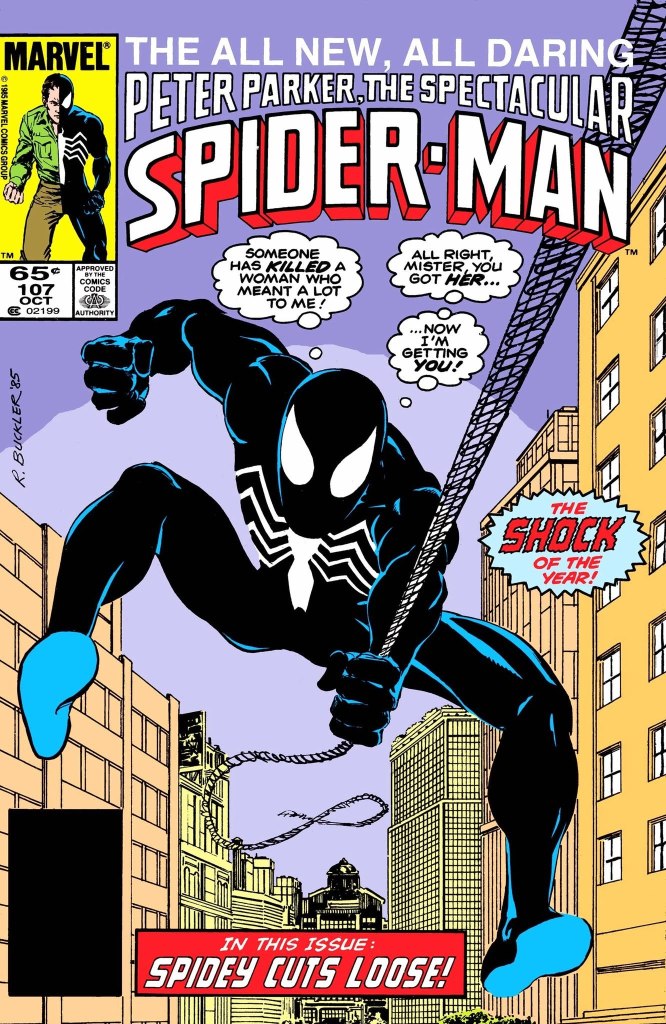
With those details laid down, here is a look back at Peter Parker, The Spectacular Spider-Man #107, published in 1985 by Marvel Comics with a story written by the late Peter David (Spider-Man 2099) and by the late Rich Buckler.
The cover.
Early story
The story begins with Jean DeWolff recalling several important details from her past as well as her family background. Her father was a police inspector who never forgave her mother for giving birth to her. She was only six months old when her parents split up. Sometime later, her mother married a patrolman named Carl Weatherby and Jean herself admired her stepfather.
As she grew into adulthood, Jean was very influenced by her patrolman stepfather and she went on to go into police academy and graduated. Jean went on to become a fast-rising policewoman.
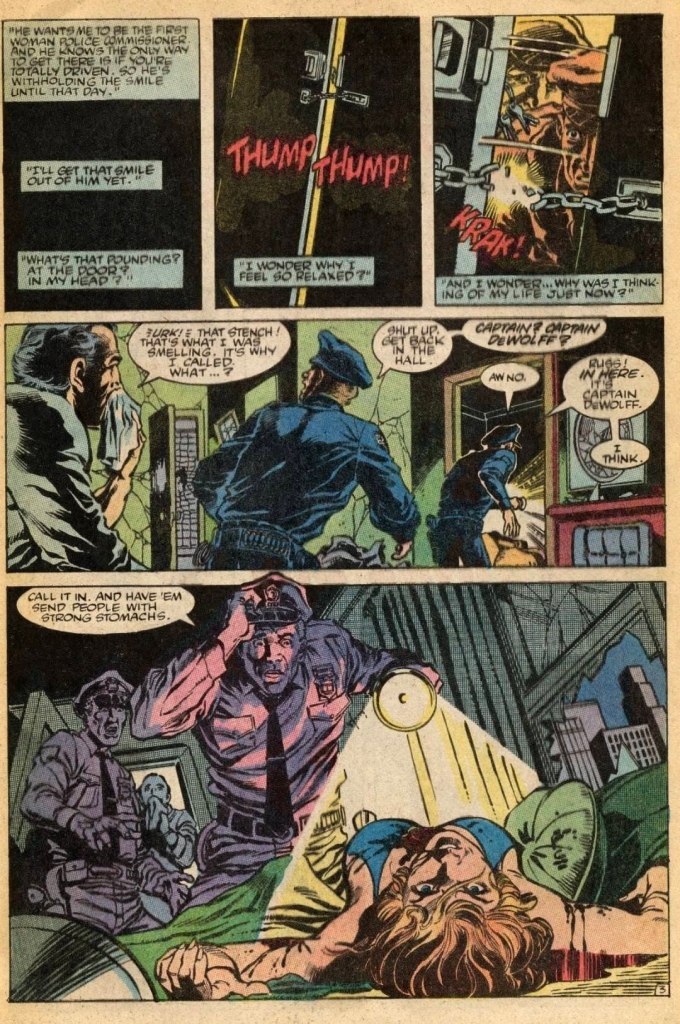
In the present day, New York police officers barged into a private residence searching for captain DeWolff and the place had bad odor. A dead woman was found inside a bedroom….
Quality
Spider-Man meets with Stan Carter on the road in the middle of New York City.
The first thing I will say about this comic book is that the writing done by Peter David is very grounded with reality and this resulted in a dark and gritty approach to storytelling. The heart of the story is the sudden murder of policewoman Jean DeWolff and its impact on the city of New York is strong and evident.
The story here is ultimately a detective story with a good amount of mystery, suspense and intrigue laced all over it. Along the way, Spider-Man here is barely the protagonist as the impact of Jean DeWolff’s murder has been dramatized through multiple characters in the city from J. Jonah Jameson to Matt Murdock (Daredevil).
This comic book also examines how the justice system in Marvel’s fictional portrayal of New York City works and it actually showed Peter Parker attending witnessing a court room arraignment to see how the bad guys he dealt with (as Spider-Man) were handled by the system. Again, this shows how grounded in reality the story is and the details should be seen. There is also a strong sense of local community dramatized.
The art by Rich Buckler is excellent and he really brought to life Peter David’s script with a heavy emphasis on realism. It seems to me that the illustrator took inspiration from TV shows and movies to achieve a unique visual style fitting for this particular tale.
Conclusion
This is a shocking and powerful way to start the story.
Peter Parker, The Spectacular Spider-Man #107 (1985) is indeed a very powerful tale that has to be seen if you want a gritty 1980s Spider-Man story. The David-Buckler creative duo delivered a very grounded story about murder in New York City that impacted its people which serves as a reminder that violent crime can cause waves of disturbance and disruption. That said, this first chapter of Sin-Eater storyline is pretty believable. As the creative team emphasized the murder’s impact on a wide scale, it is not surprising that Spider-Man’s share of the spotlight was sacrificed somewhat to achieve it. As of now, I am looking forward to the next chapter of the Sin-Eater storyline.
Overall, Peter Parker, The Spectacular Spider-Man #107 (1985)is recommended.
Recently in the City of Las Piñas, a male Korean national was apprehended after assaulting his Filipina partner, according to a news report by the Manila Bulletin.
To put things in perspective, posted below is an excerpt from the Manila Bulletin news report. Some parts in boldface…
A Korean man was arrested in Las Piñas City on Wednesday, July 2, after allegedly assaulting his Filipina partner during an argument sparked by a video discovered on his mobile phone.
Las Piñas Police chief Col. Fermin Armendarez identified the suspect only as “Sowi,” 39, residing in BF Resort, Barangay Talon Dos.
Armendarez said the 24-year-old victim confronted the suspect after discovering a video on his mobile phone showing him with another woman inside a hotel.
The confrontation escalated into a heated argument, during which the enraged suspect repeatedly slapped the victim.
Police said the victim attempted to flee, but the suspect allegedly chased her and repeatedly struck her on the head with his mobile phone.
Concerned residents who witnessed the incident immediately sought assistance from barangay watchmen who arrested the suspect. He was turned over to the Las Piñas Police Substation 4.
Let me end this piece by asking you readers: If you are a resident of Las Piñas City, what is your reaction to this development? When was the last time a foreigner assaulted a woman in your local community?
Thank you for reading. If you find this article engaging, please click the like button below, share this article to others and also please consider making a donation to support my publishing. If you are looking for a copywriter to create content for your special project or business, check out my services and my portfolio. Feel free to contact me with a private message. Also please feel free to visit my Facebook page Author Carlo Carrasco and follow me on Twitter at @CarloCarrascoPH as well as on Tumblr at https://carlocarrasco.tumblr.com/and on Instagram athttps://www.instagram.com/authorcarlocarrasco
For more South Metro Manila community news and developments, come back here soon. Also say NO to fake news, NO to irresponsible journalism, NO to misinformation, NO to plagiarists, NO to reckless publishers and NO to sinister propaganda when it comes to news and developments. For South Metro Manila community developments, member engagement, commerce and other relevant updates, join the growing South Metro Manila Facebook group at https://www.facebook.com/groups/342183059992673
Welcome back readers, fellow geeks and electronic gaming fans!
In this edition of the Retro Gaming Ads Blast (RGAB) series, we will take a look at another batch of retro gaming print ads from the 1980s to the 1990s.
For the newcomers reading this, Retro Gaming Ads Blast (RGAB) looks back at the many print ads of games (console, arcade, computer and handheld) that were published in comic books, magazines, flyers, posters and newspapers long before smartphones, social media, the worldwide web and streaming became popular. To put things in perspective, people back in the 1980s to the 1990s were more trusting of print media for information and images about electronic games and related products.
With those details laid down, here is the newest batch of retro gaming print ads for you to see and enjoy…
1. Taito’s 4-in-1 Print Ad
I remember seeing this ad in some comic books I read back in the 1980s.
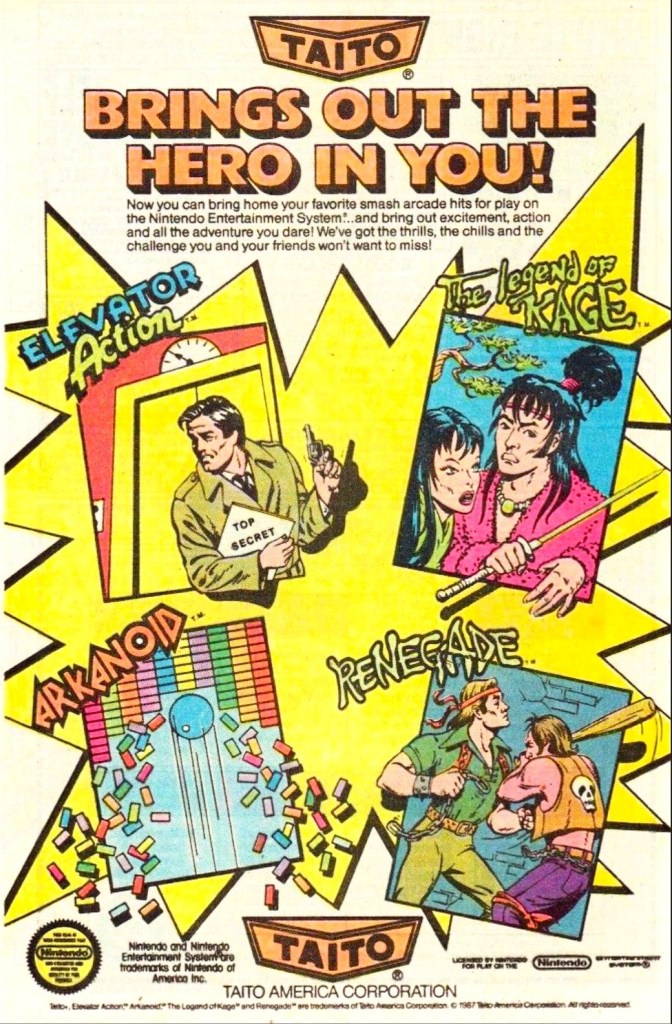
There is nothing like taking the clever approach of promoting multiple video games using only one single print ad in the size of a single page. Taito did exactly that in the 1980s when it promoted Elevator Action, The Legend of Kage, Arkanoid and Renegade for the Nintendo Entertainment System (NES) promising excitement as the mentioned games were making the jump from arcade to console. What is very notable in Taito’s single-page print ad was that it did not show any screenshots of the games. Instead, they used hand-drawn artwork to emphasize each game’s theme or setting, and leave it up to the viewers’ imagination as to how those games would look like on NES. This old ad is intriguing and amusing at the same time.
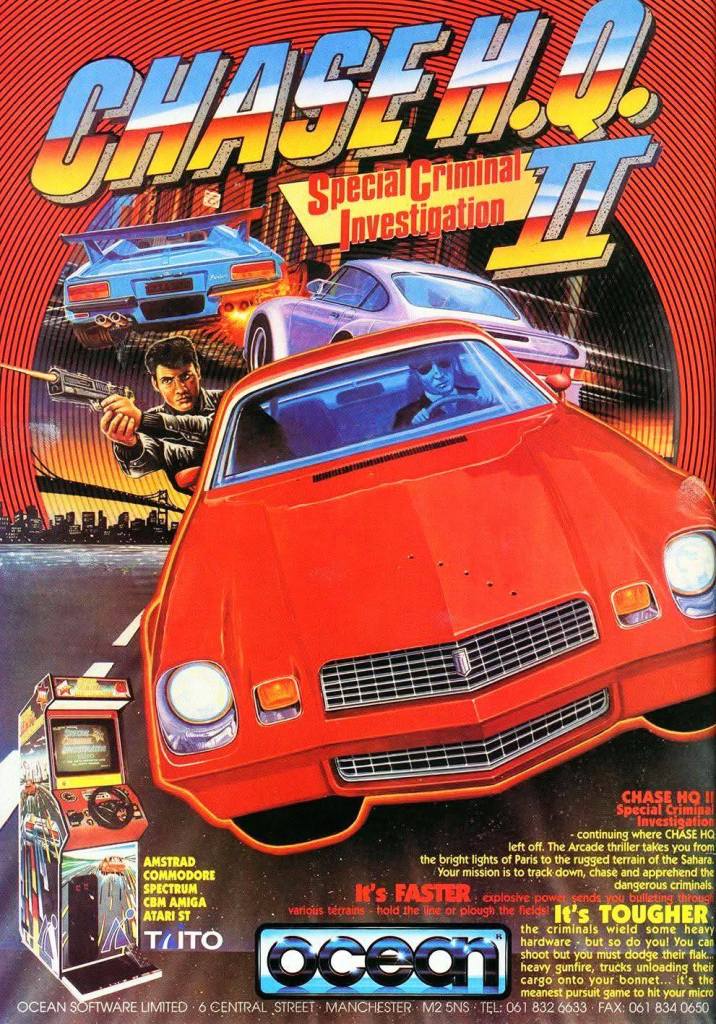
2. Chase H.Q. II: Special Criminal Investigation Print Ad
Cars and high-speed action emphasized in this ad.
Following the huge success of the original Chase H.Q. on both arcade and consoles in the late-1980s, the sequel Special Crime Investigation was released in the arcades in 1989 and ported to game consoles and computers in the early 1990s under the title Chase H.Q. II: Special Criminal Investigation. To promote Chase H.Q. II: Special Criminal Investigation for home computers, game publisher Ocean came up with a colorful print ad showcasing a few cars, a city background and elements of gun-related action presented in nice art. The ad has an image of the original arcade machine to remind gamers that they are playing the sequel to Chase H.Q.
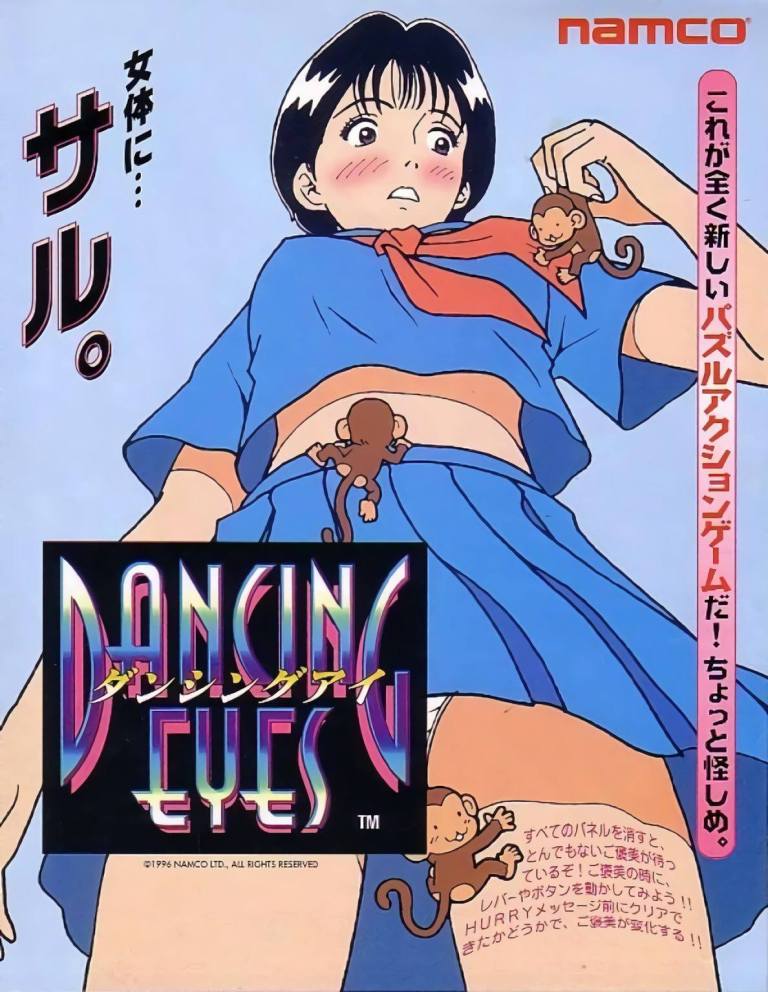
3. Dancing Eyes Japanese Arcade Flyer
The front.
The rear.
Released by Namco in Japan in 1996, Dancing Eyes is a puzzle arcade game that became notorious due to its overtly sexual nature. With the way it was designed, players control a small monkey called Urusu-San and crawl along a 3D grid mapped over characters (mostly ladies) or various objects. If the 3D grid is mapped over a young lady, any tile of the grid destroyed by the player exposes the lady’s underwear or skin. Such sexuality is reflected in the arcade flyer of Dancing Eyes which has a suggestive hand-drawn art on the front while the game’s mechanics are explained in the rear. Even the rear of the flyer shows sexual nature of the game with screenshots. While the game was officially released only in Japan, Dancing Eyes actually was made available for gamers to play at the arcade of X-Site amusement center inside Festival Mall in Alabang during the early 2000s and it attracted a lot of guys. I bet Namco did not know about that.
4. Sega Saturn North American Print Ad
This print ad always caught people’s attention.
When the Sega launched the Saturn console in America roughly four months ahead of schedule in 1995, the company suffered as the sales were disappointing, ties with business partners were strained and the available Saturn games were very few. By the fourth quarter of that year, more games became available for the Saturn and this gave Sega the opportunity to aggressively market the console as the one that gamers should get for their enjoyment. To promote the Saturn, Sega came up with a two-page print ad that had a dominant image of a naked woman whose private parts were cleverly covered by screenshots of the available games. Since most gamers were predominantly male from teenagers to adults, it made sense for Sega to come up with an eye-catching sexy ad to promote their console and the video games (including those from other companies). This old ad is considered by the woke and rabid feminists as very offensive today.
5. Blockbuster Video Print Ad
If you won the grand prize and wanted a lot of entertainment, you would not want to leave your home.
Back in the late 20th century, Blockbuster Video was the dominant retailer that offered customers movies in home video format for sale and for rent. Along the way, the company offered video game rentals and attracted millions of gamers around the nation. Given the tremendous growth of video gaming in America in the 1990s, Blockbuster got itself more involved by launching the Games of Summer Sweepstakes in 1996. Utilizing print ads, the sweepstakes offered the Ultimate Game Rooms – composed of a 41-inch big-screen TV, Surround Sound speakers, hi-fi VCR, NBA Jame Extreme arcade game, the Sega Saturn, the PlayStation, a gaming chair, Acclaim games for Saturn and PlayStation, and a 1-year free Blockbuster Video game rentals privilege – as the grand prizes. Do you know anyone who won in Blockbuster’s sweepstakes?
6. Independence Day (ID4) Print Ad
A nice looking ad for a game that was actually mediocre.
Remember how big a blockbuster Independence Day (ID4) was in cinemas in 1996? The film grossed over $800 million worldwide and it revived the disaster movie genre using modern filmmaking techniques and the latest technologies of the decade. Given the massive success of the movie, it was not surprising that an official video game adaptation was released in 1997. To promote the game, Fox Interactive (the video game company of the movie studio behind the film) came up with a 2-page print ad using official artwork from the movie showcasing the alien spaceship being attacked by a military fighter plane. The ad showed only 3 screenshots and the descriptive text was written to make gamers feel like they have the role to lead Earth’s fight against the aliens. While the art looks good, it can only go so far to hide the mediocrity of the game itself.
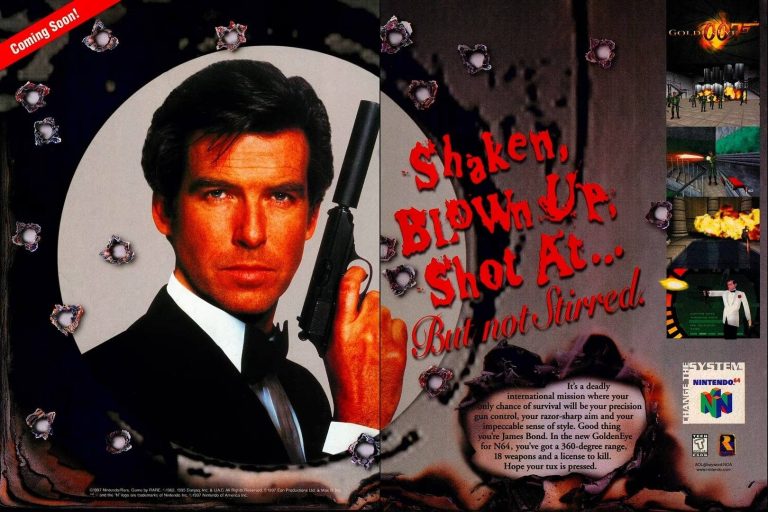
7. GoldenEye 007 Print Ad
Bond, James Bond.
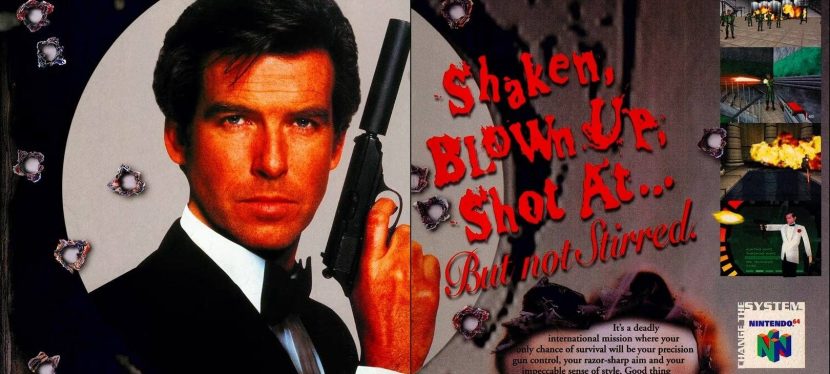
When GoldenEye achieved both critical and financial success in movies, it revived the James Bond movie franchise big-time and Pierce Brosnan was easily accepted by the public as the newest Agent 007. Several months before the movie was even released, an official video game adaptation started development. After much revisions and hard adjustments, the project evolved into a first-person shooting game for the Nintendo 64 console titled GoldenEye 007. To promote the game, Nintendo came up with a 2-page print ad that cleverly showed Brosnan as James Bond on the left and displayed the screenshots and other details on the right. This ad was easily eye-catching and it made lots of gamers excited. As history showed, GoldenEye 007 got released in 1997 and became a huge critical and commercial success while also proving that first-person shooters on game consoles can be a lot of fun.
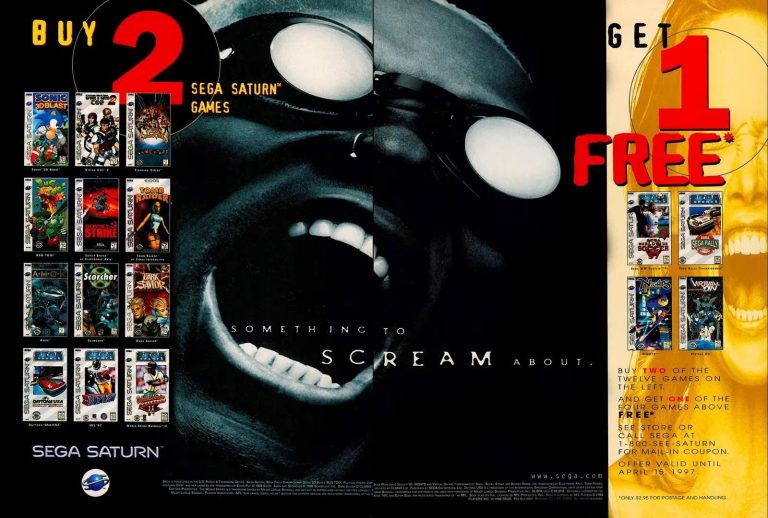
8. North American Sega Saturn Games Promo Print Ad
There definitely was something fun offered to gamers. Who could go wrong with titles like Tomb Raider, Nights into Dreams, Virtual On and Virtua Cop 2?
As mentioned earlier, the Sega Saturn had a bad launch in America in 1995 which caused a lot of problems for the company. In 1996, Sega of America went on the offensive to really capture gamers’ attention by launching their Saturn games promo. The message of this 2-page print ad was very clear…Sega offered one free first-party game (limited to four specific games including Nights into Dreams) to those who bought two games (from a lineup of twelve specific titles). It should be noted that the Christmas season of 1996 was the most successful sales period of the Sega Saturn in America as gamers really responded to the promo. Even though some called this promo an act of desperation, nothing changes the fact that Sega succeeded during the most critical sales season of 1996.
Welcome back my readers, YouTube viewers and all others who followed this series of articles focused on YouTube videos worth watching.
Have you been searching for something fun or interesting to watch on YouTube? Do you feel bored right now and you crave for something to see on the world’s most popular online video destination?
I recommend you check out the following videos I found.
#1 How To Get The Strongest And Most Optimized Spaceship Crew In Starfield – This year, Bethesda launched several important updates to make their 2023 science fiction role-playing game Starfield better and they also offered new DLC for those who crave for new content. One of the more defining aspects of the game is space travel and this includes setting up your own crew for your spaceship and there is impact on its functions and capabilities. If you want to learn how to get the stronger and most optimized crew for your ship, I encourage you watch the video below.
#2 Mari Iijima And The Defining Song of Macross: Do You Remember Love? –I really love watching the 1984 anime feature film Macross: Do You Remember Love? Apart from the great animation, the spectacle, the memorable characters and the solid storytelling, the movie also has a great soundtrack made to delight the long-time Macross fans. Still, the movie has its very own song performed by none other than Mari Iijima (Minmay) and it is a classic among Macross fans. In the videos below, you will see Mari Iijima perform the song live in a 1980s TV broadcast and the song playing with selected footage of Macross: Do You Remember Love? Enjoy these!
#3 The Tuna City In Japan Is Changing With Tourism In Mind – If you plan to visit Japan at all, you might want to discover Miura City located in Kanagawa Prefecture. Miura City is famous for its fresh tuna and in recent times there has been a series of changes as several room-only hotels and new trends have sprouted as the locality is finding new ways to turn visitors into overnight guests. This is a place I would like to visit someday if ever I get the opportunity to return to Japan. Watch and learn from the Nippon TV video below.
#4 Women’s Rights Activist Marries Islamist And Things Went Wrong – Did you notice that there is a gradual rising number of feminists and women’s rights activists who not embrace Islam (wicked and ugly) but also marry Islamists believing that things will be alright and they can just continue their activism. Of course, many of them activists and feminists do not fully understand Islam nor the full content of the Quran. As such, when things go very wrong, they are get into deep trouble. Watch and learn from the video below.
#5 Islamists Violate Hindu Women In India And Get Arrested – Let’s be very clear here. Islamists are oriented to conquer others even though they may not be numerous within a locality. Believe it or not, a group of such people who wielded power inside a business violated the Hindu women (plus at least one male employee) with regards to cultural norms and doing things that go against their faith. Even forced religious conversion happened. Watch and learn from the video below.
#6 Meatballs Reaction And Retrospective – When it comes to cinematic comedy, Bill Murray is iconic and his early work in 1979’s Meatballs already involved the late Harold Ramis and the late director Ivan Reitman. That said, there is something about Meatballs – produced for less than $2 million – that helped it achieve tremendous commercial success with ticket sales of $70 million. Remember, three of the creative minds behind the classic Ghostbusters are involved in this old movie and you will see how You, Me and The Movies react to it in the video below. Be aware that as of this writing, there are not too many movie reaction videos about Meatballs on YouTube. Also posted below is an in-depth retrospective about Meatballs by GoodBadFlicks.
#7 Ashleigh Burton Reacts To The Thin Man – Have you ever heard of The Thin Man? It’s not a UFO reference. It’s the 1934 American pre-Code comedy-mystery movie that was eventually named to the United States National Film Registry by the Library of Congress having been deemed “culturally, historically, or aesthetically significant” in 1997. Apart from its reputation in American film history, The Thin Man also resulted in five sequels. If you want to discover the 1934 movie but you don’t have the time nor resources to watch the movie, watch Ashleigh Burton’s reaction video and see how it impacts her.