Takuto Oshima and Manami Hayashi, both from Japan, take a crack at extending their hold on their respective titles in the NTT Asia Triathlon Cup Subic Bay, more commonly known as the Subic International Triathlon (SuBIT), at Subic Bay Freeport Zone on May 2 (Saturday).
SuBIT’s 33rd staging carries with it the NTT Asia Triathlon Junior Cup for first time and henceforth the official Philippine National Triathlon Championships and qualifier for National Training Pool.
While Oshima (ranked #88 male in the world) and Hayashi (#36 female) will enjoy strong support from their compatriots, Oshima will face the strongest challenge from Canadian Liam Donnelly who is ranked higher by 15 notches.
Hayashi on the other hand is top-ranked among the female entries and the closest to her who are non-Japanese are Turkey’s Sinem Servera (#87) and USA’s Michelle Magnani (#91).
Organized Triathlon Philippines in cooperation with Subic Bay Metropolitan Authority, the oldest and longest running triathlon event in Southeast Asia is sponsored by Philippine Sports Commission, NTT, Gatorade (official hydration partner), Western Guaranty Corporation, C-Vitt and Subic Bay Travelers Hotel (official race hotel).
One of the more popular triathlons in Asia, this year’s SuBIT drew 92 elite triathletes and 31 elite juniors from 24 countries including Australia, Brazil, Bahrain, Canada, Cambodia, Guam, Hongkong, Indonesia, India, Japan, Kazakhstan, South Korea, Qatar, Thailand, Taipei, Turkey, Ukraine, USA, Singapore, UAE, Bangladesh, Samoa and Philippines.
Looming as top bets from Southeast Asia include 2025 Southeast Asian Games champion Indonesian Rashif Amila Yaqin, also 2023 SEAG silver medalist, in the male division.
French Cambodian Margot Garabedian, 2023 SEAG gold medalist and runner-up in the 2026 Asian Beach Games aquathlon last April 24, lead the ASEAN campaign in the distaff side.
The non-elite athletes in the field of nearly 500 will display their wares in the second day of action.
+++++
Note: This post was sourced from the official press release of the event from Triathlon Philippines.
They finally did it! The United States Agency for International Development (USAID) –the independent agency of the American government responsible for administering civilian and foreign aid – was formally shut down by the Trump administration and has been incorporated into the State Department, according to a news report by Breitbart.
It should be remembered that USAID was heavily abused for a long time and a lot of taxpayers’ money was abused for questionable and wrongful purposes around the world such as funding LGBTQ projects, pushing abortion overseas, overseas tourism promotions, terrorist funding, creating a Sesame Street in Iraq, creating a mural in Parañaque City, and more.
As expected, there are high-profile figures who still want USAID to continue even though the abuses have been exposed. This new development with USAID is undeniably a major change decades in the making and United States Secretary of State Marco Rubio issued statements defending the move.
To put things in perspective, posted below is an excerpt from the Breitbart news report. Some parts in boldface.
The US foreign aid agency formally closed down Tuesday, with President Donald Trump’s administration trumpeting the end of the “charity-based model” despite predictions that millions of lives will be lost.
Founded in 1961 as John F. Kennedy sought to leverage aid to win over the developing world in the Cold War, the US Agency for International Development (USAID) has now been incorporated into the State Department — after Secretary of State Marco Rubio slashed 85 percent of its programming.
In a farewell to remaining staff on Monday, former presidents George W. Bush and Barack Obama — as well as U2 frontman Bono — saluted their work and said it was still needed.
Bush pointed to PEPFAR, the massive US effort to fight HIV/AIDS that he considers one of the top achievements of his 2001-2009 Republican presidency.
“This program shows a fundamental question facing our country — is it in our nation’s interest that 25 million people who would have died now live? I think it is,” Bush said in a video message seen by AFP.
Obama, who like Bush has been sparing in openly criticizing Trump, said that ending USAID was “inexplicable” and “will go down as a colossal mistake.”
“Gutting USAID is a travesty and it is a tragedy because it’s some of the most important work happening anywhere in the world,” the Democrat said.
A study published in the medical journal The Lancet predicted that more than 14 million people would die, a third of them small children, by 2030 due to the foreign aid cuts.
‘Little to show’ – Rubio painted a drastically different picture of USAID, which was an early target of a sweeping government cost-cutting drive led for Trump by billionaire Elon Musk.
Rubio said that USAID’s “charity-based model” fueled “addiction” by developing nations’ leaders and that trade was more effective.
“Beyond creating a globe-spanning NGO industrial complex at taxpayer expense, USAID has little to show since the end of the Cold War,” Rubio wrote in an essay.
He also complained that many recipients of US aid do not vote with the United States at the United Nations and that rival China often enjoys higher favorability among the public.
A senior State Department official, speaking on condition of anonymity, said that The Lancet study relied on “incorrect assumptions” and said the United States will continue aid but in a “more efficient” way.
He said that PEPFAR will remain, with a priority on stopping HIV transmission from mothers to children.
But he acknowledged the United States was no longer funding PrEP medication, which significantly reduces the rate of HIV transmission and has been encouraged by high-risk communities.
“No one is saying that gay men in Africa shouldn’t be on PrEP. That’s wonderful. It doesn’t mean that the United States has to pay for every single thing,” the official said.
He said the Trump administration was looking at “new and innovative solutions” and pointed to food deliveries in war-battered Gaza staffed by US military contractors and surrounded by Israeli troops.
Witnesses, the United Nations and local Gaza officials have reported that Israeli troops have repeatedly opened fire and killed Palestinians waiting for aid — although the US-backed initiative, the Gaza Humanitarian Foundation, denies any deadly incidents.
Let me end this piece by asking you readers: What is your reaction to this development? Are you satisfied with the formal end of USAID and its incorporation into the State Department? Do you think a lot of people’s lives around the world will suffer from the shutdown of assistance from USAID?
The United States Agency for International Development (USAID) – the independent agency of the American government responsible for administering civilian and foreign aid – was exposed big-time by the Trump administration revealing a growing list of overseas projects funded by American taxpayers’ money.
These projects were approved by the failed Biden-Harris administration and a lot of them are related with the toxic DEI (Diversity, Equity and Inclusion) and woke principles of the Satanic Left which explains why the Democrats are angry and outraged now.
To put things into perspective, posted below is the Sky News Australia news video plus the related news report (some parts in boldface)…
White House Press Secretary Karoline Leavitt has blasted the United States Agency for International Development for having “insane priorities”.
USAID was formed in the early 1960s to administer humanitarian aid programmes on behalf of the United States government around the world.
The United States spent around $US68 billion on international aid in 2023, according to government data. Ms Leavitt publicly took aim at the agency’s Diversity, Equity and Inclusion projects.
Some of the projects listed included $1.5 million to advance DEI in Serbia’s workplace, $70,000 for a production of a DEI Musical in Ireland, $47,000 for a transgender opera in Colombia and $32,000 for a transgender comic book in Peru.
For the newcomers reading this, USAID was founded in the 1960s which was the result of US Congress approving the Foreign Assistance Act in 1961 which mandated the agency’s creation and was followed with the executive order of then US President John F. Kennedy.
Going back to the USAID scandal, it is one thing for America to come up with taxpayer-funded overseas projects to help foreigners, it is completely another thing to have projects that emphasized the Satanic Leftist ideologies. Seriously, does the $32,000 for a transgender comic book in Peru and the $70,000 for a DEI musical production in Ireland have anything relevant with USAID’s traditional purposes of disaster relief, poverty relief, bilateral interests and socioeconomic development. USAID was also abused by the Democrats to fund Leftist news media outlets as well. For more insight, watch the videos below.
But there is still a lot more! The list of questionable overseas projects funded by USAID continues to grow and it includes funding for terrorism, contraception, opium growth, sex change and more. Posted below is the excerpt from the CBN News story (some parts in boldface).
Senator Joni Ernst (R-Iowa) published another list of projects and programs she says the agency has funded over the years until DOGE stepped in.
“From funneling tax dollars to risky research in Wuhan to sending Ukrainians to Paris Fashion Week, USAID is one of the worst offenders of waste in Washington… all around the world,” Ernst posted to X this week.
The Iowa senator gave more detail in a thread noting the organization spent millions on wasteful projects including:
* “A whopping $20 million to create a Sesame Street in Iraq
* $2 million for Moroccan pottery classes and promotion
* $2 million promoting tourism to Lebanon
* More than $9 million of USAID’s ‘humanitarian aid’ intended to feed civilians in Syria ended up in the hands of violent terrorists, including an affiliate of Al Qaeda in Iraq.“
Ernst points out that millions of dollars were sent to farmers in Afghanistan to get them to grow food crops instead of opium.
“The results: opium poppy cultivation across the country nearly doubled, according to the U.N.,” Ernst wrote.
“USAID has long been a reckless, out-of-control, unaccountable rogue agency,” she concluded. “USAID has failed to put the American people first and routinely tried to cloak its actions in secrecy. Those days are over.“
A White House fact sheet also contends that American taxpayer dollars were inadvertently used to fund terrorism.
It notes:
* As much as $10 million was used by an al Qaeda-linked group for meals.
* $78,000 to a non-profit linked to designated terrorist organizations including Pakistan’s Falah-e-Insaniat Foundation — even after an inspector general launched an investigation.
* $15 million in taxpayer funds to Taliban-controlled Afghanistan to help distribute ‘oral contraceptives and condoms.’
The fact sheet lists millions of dollars in additional wasteful spending, including:
* $6 million was used to fund tourism in Egypt
* $2.5 million for electric vehicles for Vietnam
* $1.5 million to ‘advance diversity equity and inclusion in Serbia’s workplaces and business communities.’
Here in my native Philippines, there were several projects and recipients of USAID as reported by the Philippine Star. Environmental – check, health – check, assistance for LGBT – check, a mural painting event – check.
Thank the Lord for the return of US President Donald Trump whose administration has been working hard to restore dignity and meritocracy in America. The Trump administration is focused on wiping away the Democrats’ corruption and waste of taxpayers’ funds.
Let me end this piece by asking you readers: What is your reaction to the USAID scandal? Did your local government participate in any USAID-related projects that were done locally in recent years? Are you tired of seeing wokeness, Leftist and DEI being emphasized in USAID projects that were launched during the years of the failed Biden-Harris administration? Do you think USAID should be abolished and the countries that benefited from it should move on and launch their own projects to help their respective people independently?
The 2025 edition of the prestigious FIVB Men’s Volleyball World Championship is all set to be hosted exclusively by the Philippines from September 12 to 28, 2025.
The event will have the top 32 men’s volleyball teams of the world competing for the championship title. Games will be staged at the Smart Araneta Coliseum in Quezon City and at the SM Mall of Asia Arena in Pasay City. Schedules of the games will be announced soon.
The 32 teams are divided into eight pools which are arranged in the following order: Pool A: Philippines, Iran, Egypt, Tunisia; Pool B: Poland, Netherlands, Qatar, Romania; Pool C: France, Argentina, Finland, Korea; Pool D: USA, Cuba, Portugal, Colombia; Pool E: Slovenia, Germany, Bulgaria, Chile; Pool F: Italy, Ukraine, Belgium, Algeria; Pool G: Japan, Canada, Türkiye, Libya; and Pool H: Brazil, Serbia, Czechia, China.
The Philippines is the exclusive host of the 2025 FIVB Men’s Volleyball World Championship. It is recalled that previous editions of the event were each co-hosted by multiple nations – Italy and Bulgaria in 2018, and Poland and Slovenia in 2018.
For the 2025 edition, the Philippines emerged as the successful bidder and the final decision was made following a rigorous evaluation process where the FIVB and Volleyball World found the Philippine bid to be particularly strong; with its emphasis on ensuring a continued growth of the event and the country’s commitment to the development of volleyball globally.
FIVB President Dr Ary S. Graça F° stated that their organization is confident that the Philippines “will host an extraordinary World Championship that will leave a lasting legacy.”
Meanwhile, Volleyball World CEO Finn Taylor stated that the Philippines “is well-positioned to deliver an exceptional championship that will showcase the best of the sport.”
As it continues to make predictions about different nations’ economies around the world, the World Bank (WB) revealed that it sees the Philippines achieving 5.4% economic growth in 2023, according to a BusinessWorld news report. The said forecast goes against the more optimistic 2023 target of the Philippine government.
To put things in perspective, posted below is the excerpt from the BusinessWorld news report. Some parts in boldface…
PHILIPPINE economic growth would probably slow to 5.4% this year, from an estimated 7.2% in 2022, amid a looming global recession, the World Bank (WB) said.
In its latest Global Economic Prospects report, it trimmed its gross domestic product (GDP) growth forecast for the Philippines from its 5.6% projection in June.
The World Bank’s latest GDP forecast is below the government’s 6-7% growth target for the year.
“After the strong rebound in 2022, growth in Malaysia, the Philippines and Vietnam is expected to moderate as the growth of exports to major markets slows,” it said.
In December, the World Bank upgraded its forecast for the Philippines to 7.2% for 2022 from 6.5%, amid a surge in private consumption and robust export growth.
The Philippine economy expanded by 7.6% in the third quarter, bringing the nine-month average to 7.7%. The strong third-quarter data prompted economic managers to say that full-year GDP growth would settle above the 6.5-7.5% target.
“The recovery from the pandemic-induced recession has been uneven across the region. Output surpassed pre-pandemic levels last year in Cambodia, the Philippines and Thailand,” the World Bank said.
However, a “sharp, long-lasting” slowdown in the global economy this year is expected to affect nearly all regions, particularly developing countries, World Bank President David Malpass said in a statement.
“Global growth is expected to decelerate sharply to 1.7% in 2023 — the third weakest pace of growth in nearly three decades, overshadowed only by the global recessions caused by the pandemic and the global financial crisis,” the multilateral lender said in the report, noting this is 1.3 percentage points below previous forecasts.
The World Bank said the latest estimate reflects “synchronous policy tightening aimed at containing very high inflation, worsening financial conditions and continued disruptions from Russia’s invasion of Ukraine.”
It said urgent global efforts are needed to mitigate the risks of a global recession and debt distress in emerging market and developing economies.
By the end of 2024, GDP levels in these markets will be about 6% below pre-pandemic levels, according to the report.
Let me end this piece by asking you readers: What is your reaction to this new development? Do you agree with the WB’s analysis about slower economic growth for the Philippines this year? What do you think will help the Philippines achieve the more optimistic targets set by the national government?
For more South Metro Manila community news and developments, come back here soon. Also say NO to fake news, NO to irresponsible journalism, NO to misinformation, NO to plagiarists, NO to reckless publishers and NO to sinister propaganda when it comes to news and developments. For South Metro Manila community developments, member engagements, commerce and other relevant updates, join the growing South Metro Manila Facebook group at https://www.facebook.com/groups/342183059992673
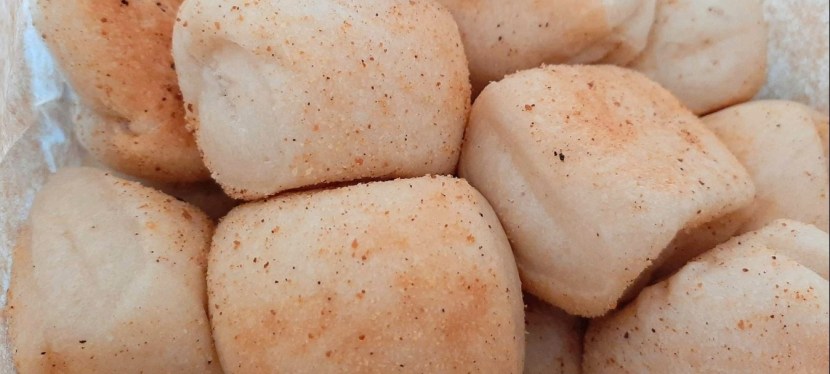
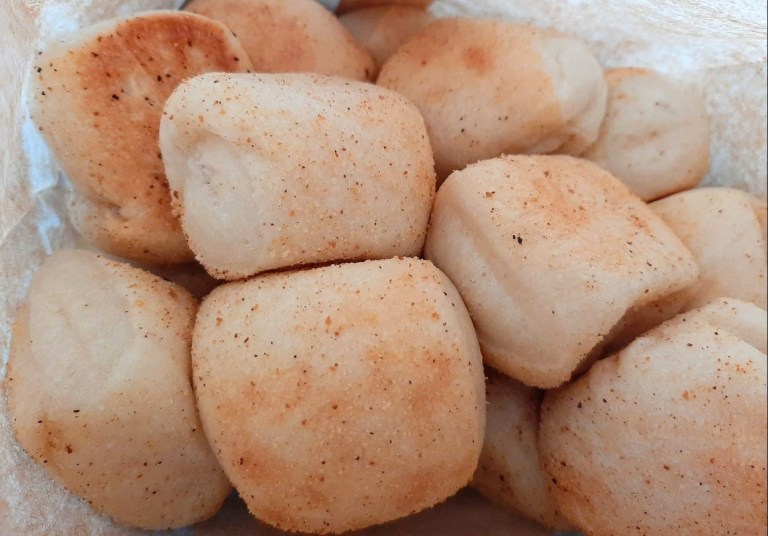
Have you been paying more for pandesal at your local bakery? In my experience, I love the pandesal of Mang Pandesal located along Tropical Avenue, BF International in Las Piñas City. When I first visited them in 2019, they sold pieces of pandesal at P2 each. That is no longer the case anymore. Two days ago, I visited Mang Pandesal ang bought 20 pieces of pandesal at P2.50 each. That’s a total of P50.
Do the math, P2.50 is a notable increase of 25% over the previous price of P2 per pandesal which lasted for years at Mang Pandesal. While I still will buy pandesal from Mang Pandesal (note: they’re still the best in the BF Homes community), I am more conscious about how many pieces to buy each time I visit them.
Even as our country continues to struggle to recover from the COVID-19 crisis socially and economically, we have no choice but to face the new normal of bread from the local bakeries…a new normal of higher prices and/or smaller sizes of bread. There are both internal and external economic forces that have been affecting the many local bakeries around the Philippines. High fuel prices are just the tip of the iceberg, literally.
Expect local bread to get smaller but become more expensive at the same time.
Albay 2nd district Rep. Joey Salceda made this rather depressing prediction as wheat, eggs, and sugar–all vital ingredients to breadmaking–have all shot up in price.
Salceda even has a clever word for it: “shrinkflation”.
“Bread will probably be the hardest hit by shrinkflation. Wheat prices have increased by 165 percent. At that point, breadmakers will probably both increase prices and shrink sizes,” the economist-solon said in a statement Sunday night, July 17.
Last March, Salceda warned of higher bread prices amid the Russia-Ukraine conflict, which affected the trade of wheat.
“Egg prices are also threatening to go out of control. Sugar supply is already problematic, noted the Bicolano.
“What we are likely to see us shrinkflation. Goods getting smaller instead of higher prices,” he noted.
Salceda said that while the government continues to try to control price hikes and resolve supply issues, manufacturers and millers can “fortify their products with vitamins and minerals”.
“Nutrition should be part of Science for Change, which is the DOST’s (Department of Science and Technology) flagship program. This should be one of the most relevant and immediate applications.
“Secretary [Fortunato] dela Pena also asked millers and breadmakers to consider other alternatives and additives to maintain nutritional value without increasing prices or reducing sizes significantly…So, in the meantime, while we solve the structural issues affecting price and supply, we can adapt,” the lawmaker said.
Community bakers have lost 20 percent of their members due to the twin effects of the pandemic and rising raw material prices.
Princess Lunar, director of the Asosasyon ng Panaderong Pilipino, told the Balitaan sa Maynila yesterday, the fair price of pandesal should be P4 per piece to maintain its quality but bakers continue to sell at P2 to P2.50 but the size has considerably shrank to 18 grams.
Lunar said at P4, pandesal size can be restored to 30 g.
While pandesal is not a regulated commodity, community bakers cannot increase their prices because of competition among themselves as well as with commercial and industrial bakers which have economies of scale.
She said the group plans to come up with variants of pandesal at a much bigger size enhanced with more nutritious ingredients from agricultural crops like potato, cassava and other starches. The group plans to sell this at P8 to P10 per piece.
The value-added product can help elevate the stature of the pandesal which Lunar has termed as the “pambansang tinapay.”
She appealed to government to assist the group in conducting trainings to improve further the quality of their breads especially pandesal and ensure its sustainability.
Lunar said prior to the pandemic, about 40 percent of the flour requirements for bread go to community bakers. This has since shrank to 19 percent.
Lunar said from P785 per bag, the price of flour has gone up to P1,000. Since January when the Russia-Ukraine crisis started, the price of flour has gone up by P100 to P150 per bag.
Let me end this piece by asking you readers: Have you been paying more for pandesal at your local bakery? Does each pandesal piece look smaller in terms of size and content in relation to what you paid for? Are you willing to pay P4 per piece of pandesal? Are there any bakeries in your local community that shut down recently? Apart from pandesal, what other types of bread do you buy from your local community bakery?
For more South Metro Manila community news and developments, come back here soon. Also say NO to fake news, NO to irresponsible journalism, NO to misinformation, NO to plagiarists, NO to reckless publishers and NO to sinister propaganda when it comes to news and developments. For South Metro Manila community developments, member engagements, commerce and other relevant updates, join the growing South Metro Manila Facebook group at https://www.facebook.com/groups/342183059992673
Disclaimer: This is my original work with details sourced from reading the comic book and doing personal research. Anyone who wants to use this article, in part or in whole, needs to secure first my permission and agree to cite me as the source and author. Let it be known that any unauthorized use of this article will constrain the author to pursue the remedies under R.A. No. 8293, the Revised Penal Code, and/or all applicable legal actions under the laws of the Philippines.
Welcome back, superhero enthusiasts, 1990s culture enthusiasts, X-Men fans and comic book collectors! Today we revisit the X-Men Adventures monthly series which was a literary adaptation of the famous X-Men animated series of the 1990s.
To be more specific, we examine a tale of the major X-Men villain Omega Red within the monthly series adaptation of the 2nd season of the animated series. Take note that I previously reviewed X-Men #4 (1991), X-Men #5 (1992) and X-Men #6 (1992) which told the first tale of Omega Red who turned out to have a history of conflict with Wolverine decades prior.
With those details laid down, here is a look back at X-Men Adventures Season II #4, published by Marvel Comics in 1994 with a story by Ralph Macchio and drawn by John Herbert.
The cover.
Early story
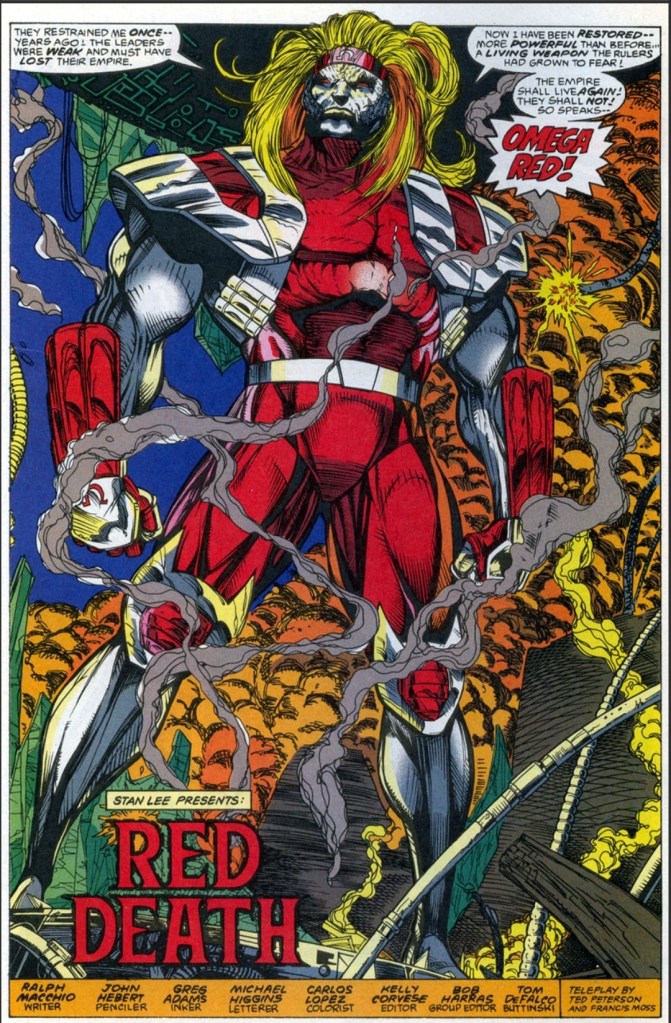
The story begins in the Caucasus located between Ukraine and Georgia. Inside, a group of people work on a scientific operation resulting a power surge. The surge then causes a stasis chamber’s glass to crack. Moments later, Omega Red emerges and he has clear knowledge about who restrained him, who the government leaders and what happened to the Russian empire. He declares that the Russian empire shall live again. In Moscow, three high ranking military officers discuss their secret plan on restoring the Soviet Union. It turns out, the return of Omega Red is the first step for their ambitious plan.
In America, Jubilee encounters a group of activists who hate mutants inside a convenience store. Peter Rasputin/Colossus, the Russian mutant who encountered the X-Men sometime prior, comes into the store to help Jubilee. Afterwards, Jubilee and Colossus travel to Charles Xavier’s mansion – Xavier’s School for Gifted Children – and discuss important matters. He tells her that Omega Red has emerged in Russia and he need to speak to Professor X. It turns out, Xavier disappeared some weeks prior.
As the situation is so desperate for Colossus, he asks Jubilee if she would help him in his struggle to save his nation. Jubilee makes a hasty decision to do so and leaves a handwritten note telling her teammates that she is off to Russia…
Quality
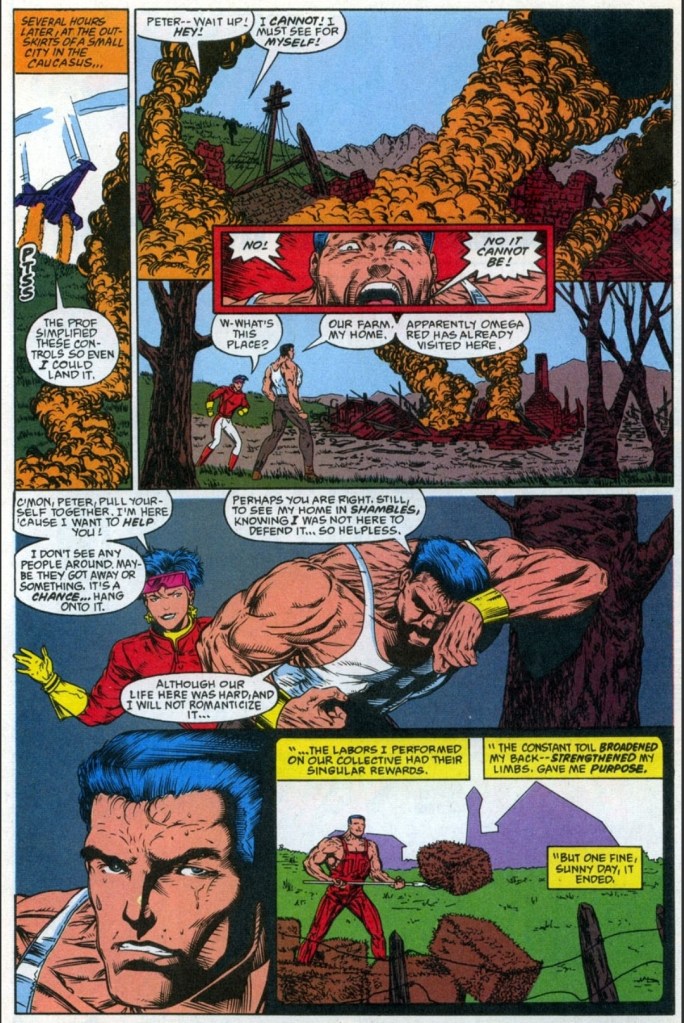
Colossus and Jubilee in Russia.
While this comic book’s cover art easily reminds me of the Wolverine-Omega Red confrontation on the cover of X-Men #5 (1992), the story here is more varied than that mentioned comic book drawn by Jim Lee. As this is an adaptation of the X-Men animated series episode titled “Red Dawn”, it is not surprising to see the spotlight being divided by many characters.
Omega Red, who has been declared as one of the greatest X-Men villains ever, has a somewhat strong presence serving as the main figure of opposition against Charles Xavier’s team as well as the surviving elite remnant of the Soviet Union. Quite amusingly, Omega Red is totally loyal to the Russian empire similar to how James Bond is very loyal to England and the queen. In comparison to issues #4 to #6 of the X-Men monthly series, the history of conflict between Omega Red and Wolverine was very lightly portrayed.
Wolverine and Omega Red in battle!
As mentioned earlier, the spotlight is shared a lot by many characters which results a lack of a true protagonist among the X-Men. This is not necessarily a problem as Omega Red’s presence had enough strength. The other Russian Colossus, who at the start of the story has not yet joined the X-Men, got a good share of the spotlight among the good guys and that results some quick and efficient exposition to get readers oriented with him, his family and how he became an outcast in his nation because of his mutation.
The plot itself is light on details which is not surprising due to the high amount of exposition which includes a geopolitical look at the remaining loyalists of the Soviet Union living in Russia which saw some of its regions transformed into republics. With regards to superhero spectacle, this one has a good amount of action and I can easily say the biggest attraction is the fight between Wolverine and Omega Red. Just don’t expect it to be as extensive nor as detailed as the ones Jim Lee drew in the adjective-less X-Men series.
Conclusion
John Herbert’s take on Omega Red was carefully crafted.
X-Men Adventures Season II #4 (1994) is a fun superhero story to read and I find its portrayal of the Wolverine-Omega Red conflict to be interesting knowing it was not part of comic book canon of the time. Apart from the mentioned conflict, there is something for X-Men fans to enjoy here such as Colossus’ return and his new interactions with the X-Men, how Omega Red’s presence causes danger in Russia, and the current whereabouts of Charles Xavier. Lastly, I should state that John Herbert’s art style is engaging to look at and he made Omega Red look intimidating.
Overall, X-Men Adventures Season II #4 (1994) is recommended!
Recently, a study (involving Russian scientists including representatives of the City Clinical Hospital No. 67 and the Gamaleya National Research Center of Epidemiology and Microbiology) revealed that the Russian vaccine Sputnik V demonstrated 97% efficacy against hospitalization caused by the Omicron variant following revaccination with Sputnik Light or Sputnik V, according to a press release published online.
To put things in perspective, posted below is the excerpt from the press release published by SputnikVaccine.com. Some parts in boldface…
The Gamaleya National Research Center of Epidemiology and Microbiology (Gamaleya Center) today announced that Vaccines, the leading peer-reviewed medical journal, has published the results of a joint study conducted by team of scientists including representatives of Moscow’s City Clinical Hospital No. 67 named after L.A. Vorokhobov and the Gamaleya Center showing the two-dose Sputnik V vaccine is 97% effective against hospitalisation caused by the Omicron variant of coronavirus (B.1.1.529) among those vaccinated with 3 or 4 components (re-vaccination with Sputnik Light or Sputnik V after Sputnik V).
The corresponding article has been peer-reviewed and is available at:
The study was conducted from 11 January to 21 February 2022 involving over 1,000 patients in Moscow. Sputnik V showed high efficacy against hospitalisation at 85.9% among patients vaccinated with at least one component. Efficacy among those vaccinated with 3 or 4 components (re-vaccination with Sputnik Light or Sputnik V after Sputnik V) rose to:
o 97% against any cases of hospitalisation;
o 97.7% against moderate-severe and more severe cases;
o 98.6% against severe and critical cases;
o 99.4% against critical cases.
As authors note, “the study shows that vaccination with Sputnik V and Sputnik Light has a high effectiveness for protection against hospitalisation. The reduction in the severity of COVID-19 regarding the Omicron variant was also observed. The greatest effectiveness was evident in protection against a critical course of the disease requiring patients to be admitted to the intensive care unit.”
I can only hope that the incoming administration of President-elect Ferdinand “Bongbong” Marcos, Jr., will consider acquiring more doses of Sputnik V and Sputnik Light even though the national authorities are trying to balance supply of COVID-19 vaccines with the rather slugging public response in terms of getting vaccinated or boosted at their local vaccination sites. The formulation behind Sputnik V and Sputnik Light should be strongly considered when it comes to immunizing as many Filipinos as possible from COVID-19, including the more infectious Omicron variant and its sub-variants.
Let me end this piece by asking you readers: What do you think about this new development? Have you ever been vaccinated or boosted with a Sputnik vaccine? Did you receive at least two doses of Sputnik V already? Does your local vaccination site have Sputnik V or Sputnik Light in supply right now? Did anyone from the anti-vaccine fanatics community turn violent against you because you refused to believe in them?
For more South Metro Manila community news and developments, come back here soon. Also say NO to fake news, NO to irresponsible journalism, NO to misinformation, NO to plagiarists, NO to reckless publishers and NO to sinister propaganda when it comes to news and developments. For South Metro Manila community developments, member engagements, commerce and other relevant updates, join the growing South Metro Manila Facebook group at https://www.facebook.com/groups/342183059992673
This past Saturday, Hillsong Church posted on its official Facebook page the latest update about their Ukraine Appeal. They have already raised hundreds of thousands of Dollars and their churches in Europe are also involved in the assistance for the people of Ukraine. To those who already donated to Hillsong’s Ukraine Appeal, I urge you to read the details closely.
To put things in perspective, posted below is the excerpt from the Hillsong Church FB post. Some parts in boldface…
Since Hillsong launched its Ukraine appeal 4 weeks ago across our churches globally, we have raised and distributed over $630,000 in supporting humanitarian aid within the region.
• We have secured several large warehouses in Ukraine and Poland with a steady flow of Humanitarian Aid, which is in the process of being established to ensure they are filled and distributed to those in need.
• As a first step, three tons of food supplies will be shipped to the Ukraine Warehouses this week.
• We have sent two thousand mattresses to Ukraine, helping people in bunkers and metropolitan stations.
• Our Hillsong Kyiv Staff and team have assisted those in our church, mostly women and children, who have fled to Warsaw in acquiring accommodation, food, supplies and military protection vests.
• Together with Hillsong Kyiv we set up close communication to our other European locations to connect more people fleeing to find a place where they can ‘call home’ and be taken care of through our Church and Churches that we are in relationship with. Due to the overcrowding of cities like Warsaw, this has been crucial and now the Hillsong team in Warsaw can host Women, Children & Seniors nights for fellowship and connection.
• Another praise report was the opportunity to host twenty of the women now in Warsaw for the opening night of Hillsong Colour Conference and spend precious moments worshipping and hearing God’s word together.
• In Hillsong Berlin, after three weeks of hosting families with people from our Church Community, an opportunity emerged through a Church member to utilise a Guest House which is no longer in use. This facility will accommodate forty spaces for the coming months with eight families living there now.
• The Hillsong Berlin community has supported these families with the registration process, basic supplies, process of applying for schooling and funding.
• Hillsong Sweden is assisting with a full project on the ground to house and serve refugees.
Thank you to our global Hillsong church for your generosity and giving in supporting these efforts through our Ukraine Appeal.
It is indeed delightful to read the above details. Hillsong Church did not just collect the donations but also coordinated with its churches in Europe to make the varied forms of assistance for the affected Ukrainians really progress and make positive impact.
If you intend to donate to Hillsong’s Ukraine Appeal and become part of the collective effort to help those in need, take a close look at the bible scriptures below…
When God’s people are in need, be ready to help them. Always be eager to practice hospitality.
Romans 12:13 (NLT)
Take a constant interest in the needs of God’s beloved people and respond by helping them. And eagerly welcome people as guests into your home.
Romans 12:13 (TPT)
Let your light so shine before men, that they may see your good works and glorify your Father in heaven.
Russia’s invasion of Ukraine and the other economic and geopolitical developments related to it caused oil prices to spike. Here in the Philippines, the latest round of fuel price hikes resulted in diesel averaging around P65 per liter while unleaded gasoline is now past the P70/liter mark. Inevitably, the spike in crude oil prices will lead to a series of increases on food, transportation, delivery services, electricity and more.
Inflation really affects everyone and as far as the Philippines is concerned, the timing is really bad because Metro Manila and other parts of the country under Alert Level 1 status is experiencing a revival of commerce and increased number of people moving around. Along the way, the national average of new COVID-19 cases has been averaging in the hundreds the past several days.
Times like these, major decisions on ensuring abundant, clean and affordable energy for the Philippines are needed. In relation to this, President Rodrigo Duterte recently signed a major executive order (EO) that includes nuclear power for the country’s energy mix, the Philippine News Agency (PNA) reported.
To put things in perspective, posted below is the excerpt from the PNA report. Some parts in boldface…
President Rodrigo Duterte has signed Executive Order (EO) 164 that now includes the potential of nuclear power in the country’s energy mix.
Released on Thursday, EO 164 was signed by the Chief Executive last February 28.
“This policy is the start of the national nuclear power program,” said Department of Energy (DOE) Undersecretary Gerardo Erguiza Jr. in a press conference.
Under the new policy, it stated that the country “shall ensure the peaceful use of nuclear technology anchored on critical tenets of public safety, national security, energy self-sufficiency, and environmental sustainability”.
Duterte issued the policy following the recommendation of the Nuclear Energy Program Inter-Agency Committee (NEP-IAC), which conducted a pre-feasibility study and public consultation on the matter.
Through EO 164, the Chief Executive has recognized that nuclear power can be a reliable, cost-competitive, and environment-friendly source of energy based on the experience of highly developed countries.
“For the country to achieve its sustained growth targets, it must ensure that it has a reliable, secure, sustainable, quality and affordable electricity supply, including sufficient reserve to guarantee that there will be no disruptions in the power supply,” the policy read.
It added the use of nuclear energy will address the increasing demand for clean energy, rising by 4.4 percent annually, or an additional capacity of 68 gigawatts by 2040.
The EO still included the Bataan Nuclear Power Plant (BNPP) in the national nuclear program, but other nuclear power installations will be pursued.
The BNPP was the only nuclear power plant in the region during the 1980s, as the Philippines was one of the first Southeast Asian countries to embark on a nuclear energy program.
However, the project was mothballed because of corruption allegations and safety concerns on the use of nuclear energy.
A study conducted by Russia State Atomic Energy Corporation (ROSATOM) in 2017 said the rehabilitation of BNPP will require around USD3 billion to USD4 billion.
The public is also becoming more open to the potential of nuclear energy.
“(A) Public Perception Survey on Nuclear Energy in 2019 indicated that almost 79 percent of Filipinos expressed approval or acceptability of the possible use or rehabilitation of an existing nuclear power plant,” the EO said.
The above report ended stating that 65% (of those who took the survey) approved the construction of new nuclear power plants and 78% are open to learning more about nuclear energy.
Of course, there is still this long-lasting fear and paranoia about nuclear power being too dangerous for the Philippines to have. Nuclear-related disasters like the one in Fukushima (2011) and Chernobyl (1986) are still remembered and there are also lots of anti-nuclear activists who continue to make noise.
No matter what those climate change extremists, social justice warriors (SJWs), modern day socialists and anti-nuclear power activists say, nothing changes the fact that nuclear power is the answer to meet nations’ constant demand for energy that is also clear, abundant and cost efficient. Watch and learn from the videos below…
Going back to the executive order Duterte signed, Albay Representative Joey Salceda (who is the chairman of the House Ways and Means Committee) and presidential candidate Ferdinand “Bongbong” Marcos, Jr. support nuclear power gave their respective reactions (click here and here).
Let me end this piece by asking you readers: What do you think about nuclear power as an added option for the Philippines energy mix? Are you still worried about nuclear power being too dangerous because the people who oppose it scared you? Are you able to tell if the anti-nuclear activists have been spreading lies and misinformation just to manipulate you to oppose nuclear power?
Thank you for reading. If you find this article engaging, please click the like button below and also please consider sharing this article to others. If you are looking for a copywriter to create content for your special project or business, check out my services and my portfolio. Feel free to contact me with a private message. Also please feel free to visit my Facebook page Author Carlo Carrasco and follow me on Twitter at @HavenorFantasy as well as on Tumblr at https://carlocarrasco.tumblr.com/