During the Luzon Economic Corridor Investment Forum recently held at the Best Western Hotel inside the Subic Bay Freeport Zone, representatives of several American companies expressed strong interest to invest in the Luzon Economic Corridor (LEC), the Subic Bay Metropolitan Authority (SBMA) revealed.
To put things in perspective, posted below is an excerpt from the SBMA announcement. Some parts in boldface…
Representatives from approximately 50 U.S. companies have expressed strong interest in investing in the Luzon Economic Corridor (LEC), a key economic zone recognized for its strategic role in the logistics sector.
Leading the delegation was Thomas R. Hardy, Deputy Director and Chief Operating Officer of the U.S. Trade and Development Agency (USTDA), during the Luzon Economic Corridor Investment Forum held at the Best Western Hotel, Subic Bay Freeport.
Joining thedelegation consisting not only of American businesses, were representatives from international companies, development partners, and major financial institutionsseeking to explore business opportunities within Subic Bay Freeport and the broader LEC region.
Subic Bay Metropolitan Authority (SBMA) Chairman and Administrator Eduardo Jose L. Aliño, together with other SBMA officials, warmly welcomed the delegates. They were joined by stakeholders from the Subic Bay International Terminal Corporation (SBITC) and other freeport investors aiming to engage in productive Business-to-Business (B2B) engagements, addressing inquiries from the visiting foreign companies.
“As the host of the Subic leg of the LEC Investment Forum, this delegation has a unique opportunity to participate in meaningful B2B discussions, tour Subic Freeport, and explore avenues for deepening economic integration across the Luzon Economic Corridor. Participants are highly encouraged to explore investment opportunities, pathways to collaborate, and how they can positively impact the success of the LEC initiative,” said Chairman Aliño.
Sponsored by the USTDA, Aliño emphasized that this visit highlights Subic Bay Freeport’s vital role in the LEC’s foundational tripartite partnership among the Philippines, the United States, and Japan.
He further noted that the LEC project has since expanded to include partners from Australia, Canada, Denmark, France, Italy, South Korea, Sweden, and the United Kingdom. “This is excellent news for Subic Bay as a critical western maritime gateway and strategic logistics hub, connecting major centers such as Clark, Manila, and Batangas. It underscores our commitment to advancing infrastructure, enhancing supply chain resilience, and attracting technology investments within the corridor,” Aliño added.
In line with these developments, the USTDA reaffirmed its support for secure, robust, and resilient supply chains by facilitating the expansion of port infrastructure at Subic Bay.
Let me end this post by asking you readers: What is your reaction to this recent development? Do you feel confident that the American companies that attended the important forum will indeed push through with investing in the Luzon Economic Corridor in the near future? Do you think their investment plans will create a lot new job opportunities for Filipinos?
Godzilla Minus Zero is the sequel to the excellent Godzilla Minus One (2023) and Takashi Yamazaki is back as director, writer and head of visual effects. Key members of the cast from the 2023 movie are returning as well. Feeling excited? Watch the official trailer below and pay attention to the details.
The official description of Godzilla Minus Zero from Toho is as follows: Godzilla Minus Zerois the highly anticipated new film from director, screenwriter and with VFX by Takashi Yamazaki, who won the Academy Award for Best Visual Effects for Godzilla Minus One.
The synopsis: War reduced Japan to zero, and Godzilla plunged it into minus. Two years have passed since then, and the country has faced agonizing struggles to achieve recovery and finally reclaim its daily life.
Just as humanity managed to cling to a hard-won peace, a new threat strikes, crushing hope in an instant.
There is no third time. Everything ends here.
Godzilla Minus One will open in cinemas in more than twenty countries on November 6, 2026. (photo source – Toho)
With regards to the scheduled global cinematic release, Godzilla Minus Zero will play in cinemas on the following dates and nations:
November 3, 2026 – Japan
November 4, 2026 – Belgium, France, Indonesia, Laos, Luxembourg, Philippines, Thailand,
November 5, 2026 – Albania, Argentina, Aruba, Australia, Bolivia, Bonaire, Bosnia, Brazil, Brunei, Central America, Chile, Colombia, Croatia, Curacao, Cyprus, Czech Republic, Denmark, Ecuador, Germany, Greece, Greenland, Hungary, Kosovo, Malaysia, Mexico, Montenegro, Netherlands, New Zealand, North Macedonia, Paraguay, Peru, Portugal, Serbia, Singapore, Slovakia, Switzerland, Uruguay, Venezuela,
November 6, 2026 – Austria, Bulgaria, Canada, Estonia, Finland, Iceland, Ireland, Latvia, Lithuania, Moldova, Mozambique, Norway, Poland, Romania, South Africa, Spain, Sweden, Taiwan, Turkey, United Kingdom (UK), United States of America, Vietnam, Zambia,
Looks like a tiny piece of Godzilla was recovered somehow.
I am glad that my native Philippines will have Godzilla Minus Zero officially screened on the 4th of November. Godzilla Minus One’s screening in the Philippines was limited to a film festival and I had to import the 4K Blu-ray copy of it. To be clear, I enjoyed watching Godzilla Minus One and remember the very end of its footage, I am not surprised that Godzilla Minus Zero materialized. With the sequel coming out in a few months’ time, I am eager to find out what will happen next in the story about a struggling Japan and what will happen next to the core characters.
Already Toho confirmed that Godzilla Minus Zero was filmed for IMAX. That said, I will make an effort to see it in a local IMAX cinema here in the Philippines.
Right now, Godzilla Minus Zero is my most anticipated movie this year. Do you plan to watch it? Let me know in the comments below.
Japan’s Gojira really looks fierce!
If you wish to join a group of movie enthusiasts and talk about cinema, the cinematic trends, Blu-ray releases and more relevant stuff, visit the Movie Fans Worldwide Facebook group by clicking https://www.facebook.com/groups/322857711779576
The tourism boom in Vietnam continued strongly as the nation successfully attracted almost sixteen million foreign tourists during the first eight months of 2026, according to a news report by VnExpress.
To put things in perspective, posted below is an excerpt from the news report of VnExpress. Some parts in boldface…
Vietnam welcomed nearly 2 million international visitors in August, up 19.7% from July and 18.4% year-on-year, according to the Vietnam National Authority of Tourism.
In the first eight months of this year, the country received nearly 16 million foreign visitors, an increase of 14.4% from the same period in 2025and equivalent to 63.6% of the full-year target.
The August figure is notable as the month is usually considered part of the low season for international tourism.
The result shows that the country’s tourism market continued to maintain and expand its appeal. Air travel remained the main mode of entry, accounting for 83% of international arrivals, while arrivals by road continued to increase, particularly from neighboring countries.
By region,Asia was still Vietnam’s largest source market, with about 11.8 million visitors in the eight-month period, making up nearly 74% of the total and increasing 7.4% year-on-year.
Europe recorded the strongest growth among major regions, at 53.4%, with about 2.68 million visitors.
Arrivals from the Americas reached around 887,000, up 20.7%, whilethose from Oceania rose 23.3% to nearly 489,000.Africa sent about 45,000 visitors to Vietnam, up 25.1%.
The tourism authority said the figures show that Vietnam is expanding its reach beyond nearby Asian markets, with strong growth from long-haul markets, helping diversify the visitor base and reduce dependence on individual markets.
By country, China remained Vietnam’s largest source market, with 3.54 million visitors, accounting for about 22.3% of the total. South Korea ranked second with approximately 2.76 million visitors, or 17.3%. Together, the two markets provided more than 6.3 million visitors, nearly 40% of the country’s total.
Russia ranked third with more than 1 million visitors, representing a year-on-year increase of about 165.7%, the highest growth among major source markets.
Other key markets also posted strong growth.Visitors from the U.S. increased 20.4%, Cambodia 41.5%, Japan 9.2%,the Philippines 58.8%andAustralia 23.3%.
European markets continued to perform well, with arrivals from the U.K. rising 9.8%, France 13.4%, Germany 15.1%, Sweden 25.1%, Switzerland 27%, Poland 51.2% and the Czech Republic 28.2%. In Southeast Asia, tourists from Malaysia grew 20.5%, Singapore 31.7%, and Indonesia 26.7%.
India was another fast-growing market. The number of Indian visitors rose from just 102,000 in 2019 to more than 612,000 in the first eight months of 2026.
The expansion of direct air services between major Indian cities and Hanoi, Ho Chi Minh City, and Da Nang has helped make Vietnam more accessible to Indian travelers.
Let me end this piece by asking you readers: What is your reaction to this development? Do you think Vietnam can attract at least 25 million foreign tourists by the end of this year? If you plan to visit Vietnam soon, what are your three main reasons for visiting?
Thank you for reading. If you find this article engaging, please click the like button below, share this article to others and also please consider making a donation to support my publishing. If you are looking for a copywriter to create content for your special project or business, check out my services and my portfolio. Feel free to contact me with a private message. Also please feel free to visit my Facebook page Author Carlo Carrasco and follow me on Twitter at @CarloCarrascoPH as well as on Tumblr at https://carlocarrasco.tumblr.com/and on Instagram at https://www.instagram.com/authorcarlocarrasco
With the Peso performing terribly in the global currency market, weakening economic growth, high inflation and fears of an economic recession growing, 2026 has not been good for the Philippines. There is a bright spot in tourism, however, as the Philippines saw its 2026 foreign tourist arrivals reach 4.11 million in the January-August period and the United States and South Korea combined for more than 1.5 million tourist arrivals, according to a news article by the Philippine News Agency (PNA).
To put things in perspective, posted below is an excerpt from the news report of BusinessWorld. Some parts in boldface…
The Philippines has recorded 4.11 million foreign arrivals from January to August, higher by 3.7 percent compared to the same period last year, the Department of Tourism (DOT) said on Tuesday.
The United States posted the highest number of share at 818,318, followed by South Korea at 727,379, Japan at 350,191, China at 310,088, and Australia at 234,156.
Also making it in the top 10 source markets are Canada with 231,972, Taiwan with 154,957, the United Kingdom with 132,370, Singapore with 126,812, and India with 77,883.
Tourism Secretary Dita Angara-Mathay said the Philippines targets to surpass its 2025 arrival figures to reach between 6.4 million and 6.8 million, or at least 7 million, by the end of 2026.
To achieve this, she said the DOT is intensifying its branding and promotions to reach more tourists in its key source markets.
The DOT is also in active talks with airlines to open up and establish more chartered flights between the Philippines and secondary cities of Korea and China.
DOT Assistant Secretary Ren Sapitan said the agency is also set to sign a contract with a creative agency in November to broaden the country’s marketing efforts and make the Philippines more visible worldwide.
Let me end this post by asking you readers: What is your reaction to this recent development? Do you think the Philippines will be able to exceed the 2025 foreign tourist arrivals number by the end of this year? Do you think the DOT is doing a good job to strengthen the Philippines’ attraction of foreign tourists? Considering the Top 10 markets of foreign tourists the Philippines attracted so far, are you convinced that the nation’s hosting of the Association of Southeast Asian Nations (ASEAN) Summit did not create any positive tourism results?
Thank you for reading. If you find this article engaging, please click the like button below, share this article to others and also please consider making a donation to support my publishing. If you are looking for a copywriter to create content for your special project or business, check out my services and my portfolio. Feel free to contact me with a private message. Also please feel free to visit my Facebook page Author Carlo Carrasco and follow me on Twitter at @CarloCarrascoPH as well as on Tumblr at https://carlocarrasco.tumblr.com/and on Instagram athttps://www.instagram.com/authorcarlocarrasco
Welcome back readers, fellow geeks and electronic gaming fans!
In this edition of the Retro Gaming Ads Blast (RGAB) series, we will take a look at another batch of retro gaming print ads from the 1980s to the early 2000s.
For the newcomers reading this, Retro Gaming Ads Blast (RGAB) looks back at the many print ads of games (console, arcade, computer and handheld) that were published in comic books, magazines, flyers, posters and newspapers long before smartphones, social media, the worldwide web and streaming became popular. To put things in perspective, people back in the 1980s to the 1990s were more trusting of print media for information and images about electronic games and related products.
With those details laid down, here is the newest batch of retro gaming print ads for you to see and enjoy…
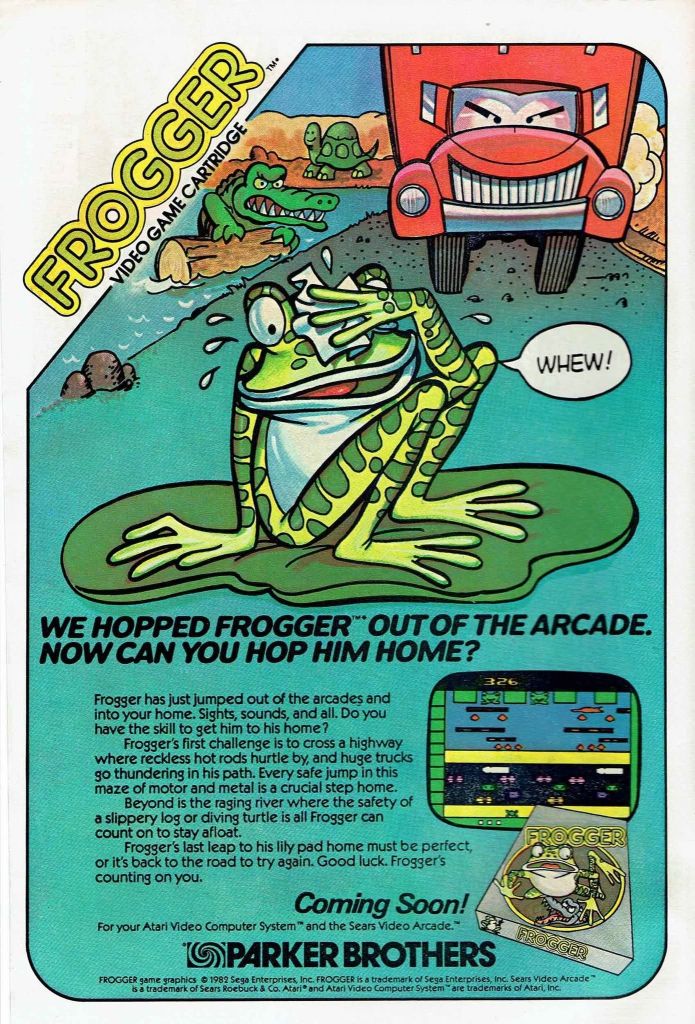
1. Frogger Print Ad
Do you find this old ad humorous?
When Frogger was first released in video arcades in 1981, it easily attracted countless gamers offering them bouts of fun and the video game critics were very impressed with it. Considering its massive arcade success, it was unsurprisingly ported to the game consoles and home computers of the time. Parker Brothers secured the license for cartridge versions and the company produced Frogger ports for not just the Atari 2600 but also the Atari 7800. This print ad they came up with had a deliberate cartoony artwork (with a touch of humor) and an artist created a hand-drawn illustration intentionally made to resemble a screenshot from the game. I saw this ad a number of times when I read comic books in 1982.
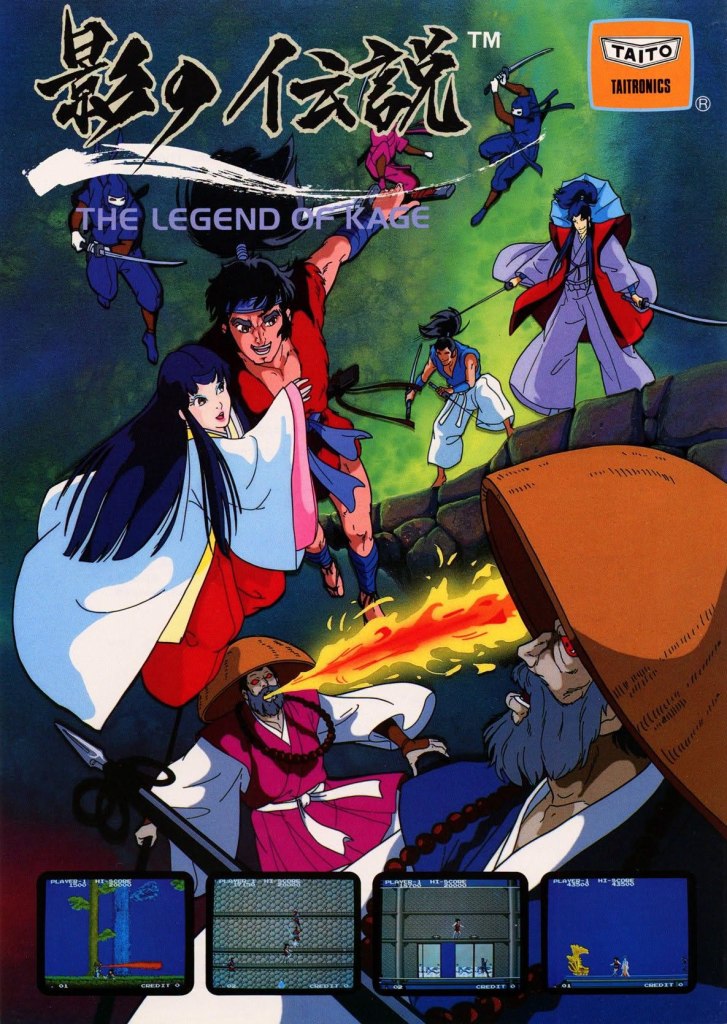
2. The Legend of Kage Japanese Arcade Flyer
Action and excitement in ancient Japan!
In my life, I never had the opportunity to play the original arcade version of The Legend of Kage and ended up playing only the Nintendo Family Computer (Famicom) port. Behind the scenes, Taito itself came close to preventing The Legend of Kage from being released in the arcades. The company placed it in a certain game show where it received praise by many which prompted Taito to give it a full arcade release. To promote the game, the Japanese arcade flyer had lively hand-drawn artwork that perfectly reflected what the game is about, who the playable hero is and what ancient Japanese setting was used. Fortunately for Taito, The Legend of Kage became a huge commercial hit and this led to the production of ports for different consoles and computers.
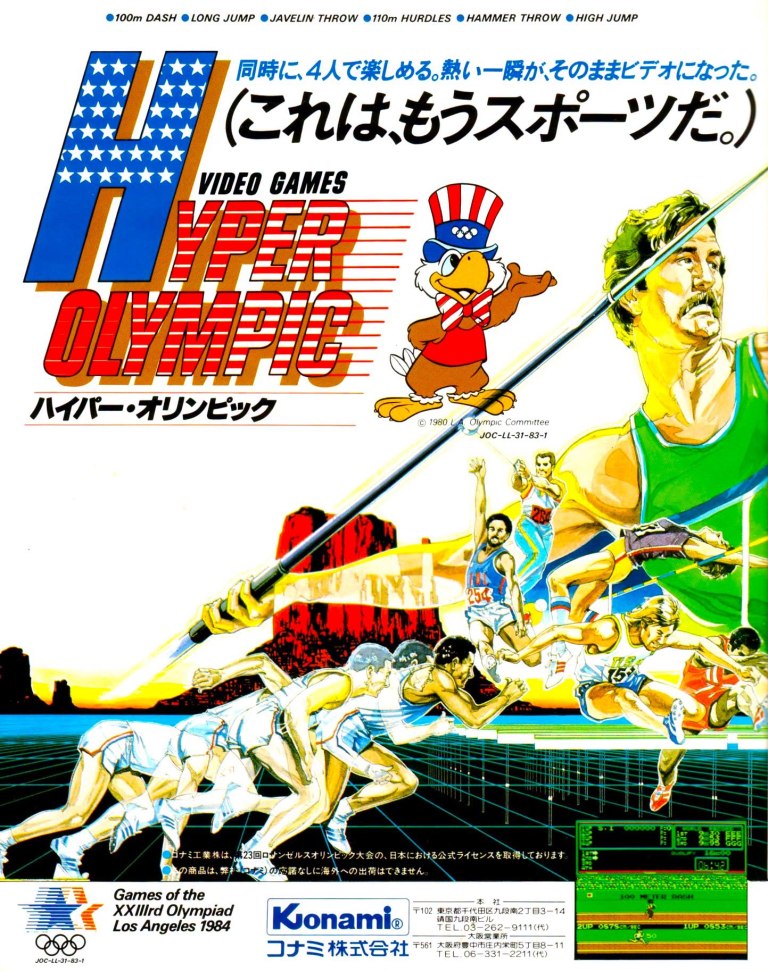
3. Hyper Olympic Japanese Arcade Flyer
Arguably the best track and field game ever made for the arcades.
In 1983, Konami released their summer Olympics-inspired arcade game Hyper Olympic (titled Track & Field in other parts of the world) which offered players the opportunities to compete in a series of events with emphasis on pressing the buttons as quickly as possible. The arcade flyer Konami came up with featured fine-looking hand-drawn artwork showing athletes competing in track and field events (with the types of events displayed at the top-most part of the flyer) while showing just one screenshot (lower right) and displaying the officially 1984 Los Angeles Olympics logo (lower left). In my view, this old arcade flyer does a good job promoting both the arcade game as well as the 1984 Olympics itself. Too bad nobody makes this kind of arcade flyer anymore.
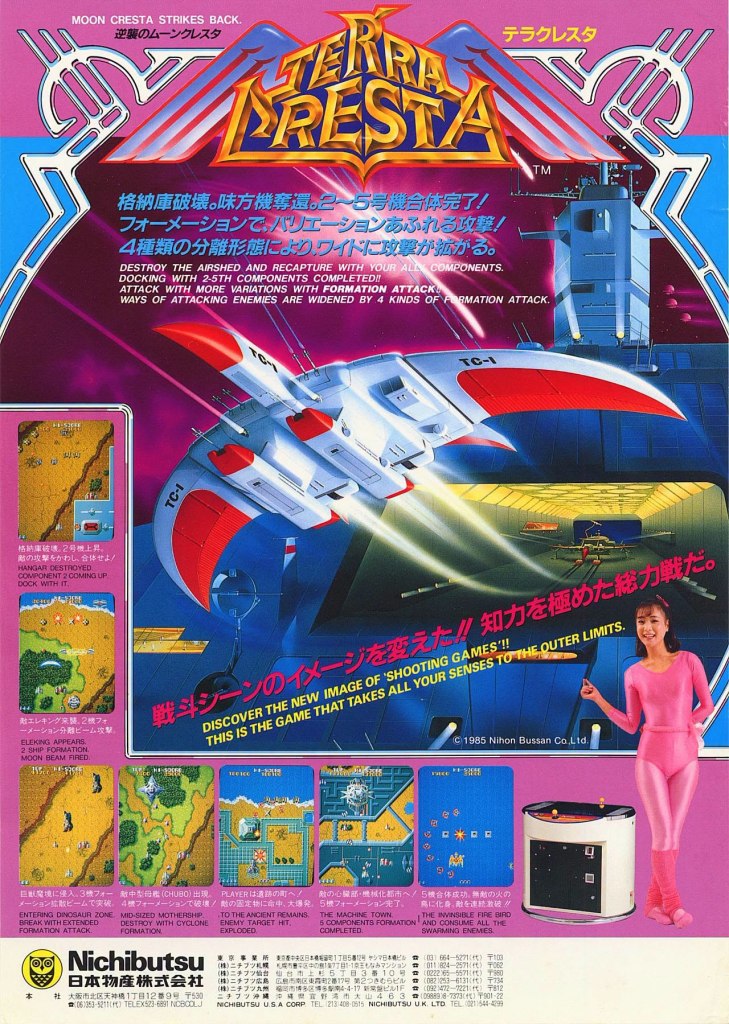
4. Terra Cresta Japanese Arcade Flyer
Did you ever play Terra Cresta in the arcades in Japan?
Nichibutsu, which produced a lot of arcade games that were released only in Japan, released Terra Cresta in Japanese arcades in 1985. It turns out Terra Cresta is a sequel to their 1980 game Moon Cresta which itself was their first big arcade hit game. Nichibutsu literally loaded the front of Terra Cresta’s arcade flyer with lots of visuals and details. As you can see, seven screenshots of the game were displayed (each with descriptive text), a fancy looking artwork that emphasized the science fiction setting, some English descriptive text, the cocktail table arcade machine and a pretty Japanese lady wearing an aerobics outfit with legwarmers (popular in the 1980s). This flyer truly has a strong 1980s flavor.
5. Sega Master System European Print Ad
From the early days of Sega’s console business.
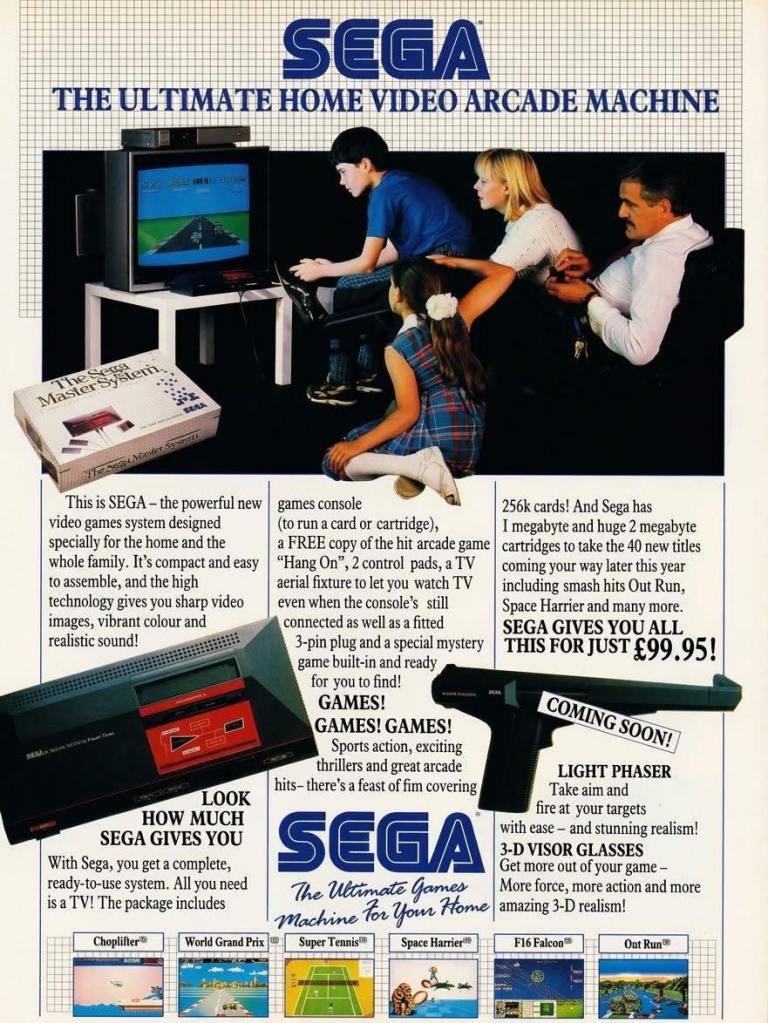
After many years doing arcade games, Sega made the bold decision to start competing in console gaming with the release of the SG-1000 in 1983 in Japan. Even though Nintendo was a very tough competitor with the best-selling Famicom, Sega did not give up and proceeded to launch their console in America and Europe referred to as the Master System. In a serious attempt to gain customers specifically in England, Sega made a print ad showcasing a family sitting in front of a TV set with the young boy playing a racing game on a Master System. Looking at how the descriptive text was presented, it was clear that Sega emphasized bringing the arcade game experience into the comfort of home while also promising that a lot more new games will be released in the near future. This is an eye-catching ad and also a fine example of aggressive marketing by Sega.
6. Ken Griffey Jr.’s Winning Run North American Print Ad
What was the best baseball video game you ever played?
Following the commercial success of the 1994 Super Nintendo Entertainment System (SNES) game Ken Griffey Jr. Presents Major League Baseball, Nintendo got Ken Griffey Jr. again as endorser and proceeded with the follow-up Ken Griffey Jr.’s Winning Run. With the highly talented Rare (Donkey Kong Country) chosen as game developer, Nintendo was highly confident with the baseball sequel and the 2-page print ad reflected that. The Ken Griffey Jr.’s Winning Run ad had a striking image of a broken baseball bat on one side while the game’s details, two screenshots and the creative description dominated the other side. While I am not so interested in baseball, I can say that this old print ad is indeed attention-grabbing.
7. 2Xtreme North American Print Ad
From the time when the X Games were wildly popular.
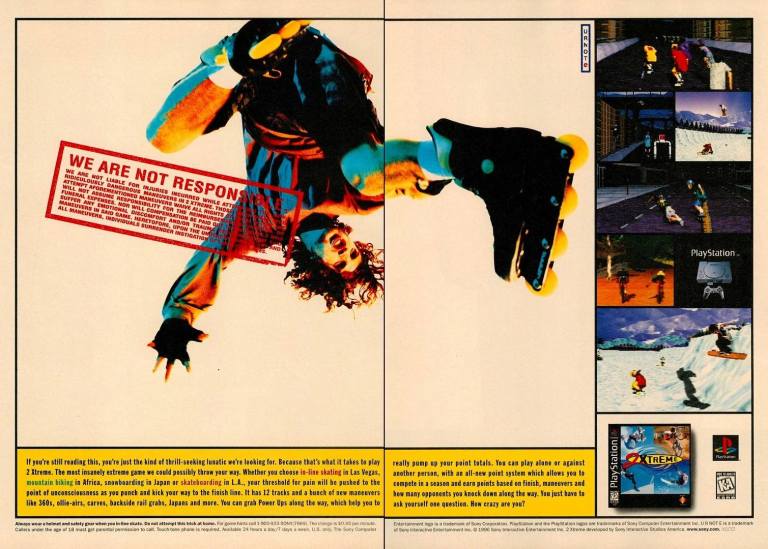
Remember how popular the X Games (Extreme Games) were back in the 1990s? Early in the life of the PlayStation console, Sony released ESPN Extreme Games which sold over a million copies worldwide. As expected, a follow-up titled 2Xtreme was approved for a 1996 release. Sony came up with a 2-page ad that had an upside-down X Games participant with roller blades dominating most of the space and six screenshots were displayed. The descriptive text in the lower part of the ad was deliberately written to be hip and cool.
8. Macross Plus Japanese Arcade Flyer
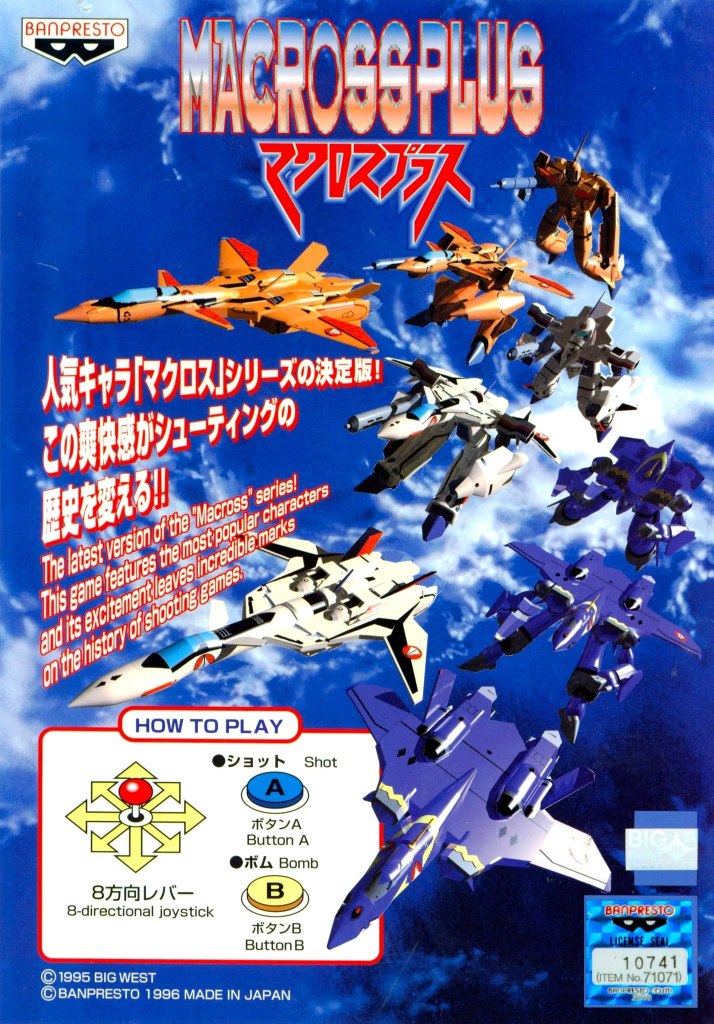
The front.
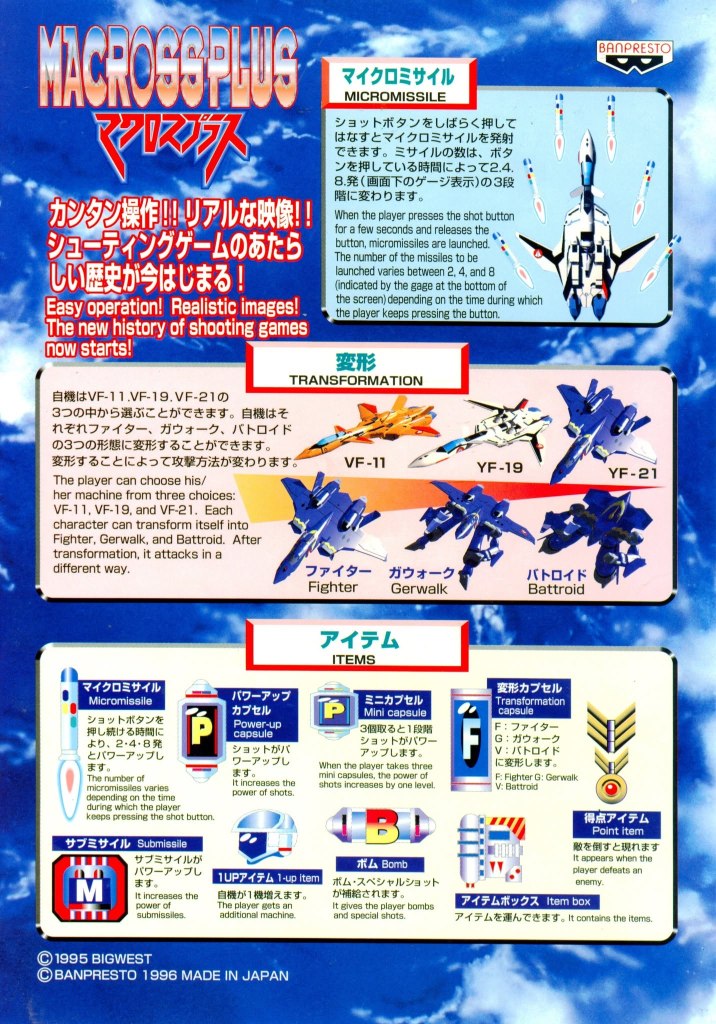
The rear.
Based on the mid-1990s anime OAV, the Macross Plus video game from Banpresto was designed as a vertical-scrolling 2D shooter that captures the feel and intensity of the anime’s spectacle. The front of the Japan-only arcade flyer showcased the YF-19 Excalibur, the YF-21 Sturmvogel and the VF-11 Thunderbolt (plus the basic arcade controls on the lower-left) which were all rendered in 3D polygons to delight Macross fans and gamers who are interested in new 2D shooting experiences. The rear of the flyer showed additional details and it even includes English text descriptions. Strangely, no screenshots of the game were displayed. Being a long-time Macross fan, I can say this old arcade flyer is still engaging to look at.
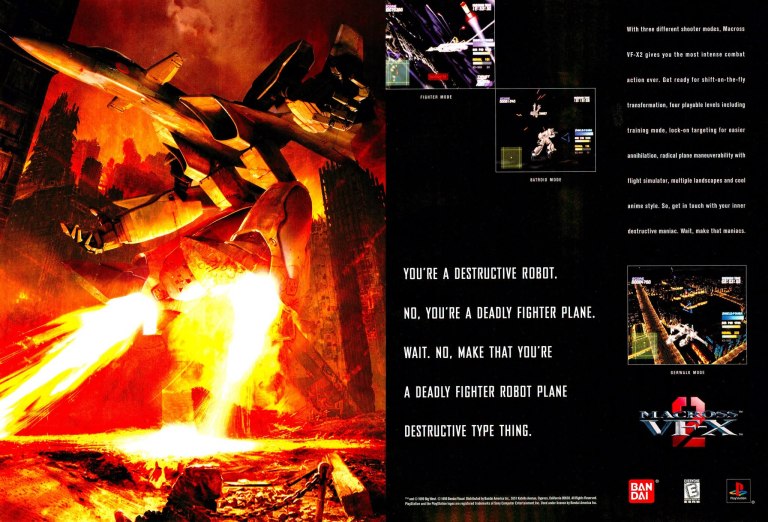
9. Macross VF-X2 North American Print Ad
An impressive looking print ad for a Macross video game that never got released in North America.
In the late 1990s, Bandai prepared to launch Macross VF-X2 (the sequel to 1997’s Macross Digital Mission VF-X) on the PlayStation console in North America. This was a very intriguing move because Bandai never brought the mentioned 1997 Macross game outside of Japan. Shortly after the official announcement of a North American release, Macross VF-X2 got featured in video game magazines, an English demo of the game (first mission only) was distributed through Official U.S. PlayStation Magazine, and Bandai came up with the 2-page print ad you see here. Unfortunately, Macross VF-X2’s North American release got cancelled because of copyright issues and legal obstacles (note: Harmony Gold held the Western rights to Robotech and actively blocked the release of genuine Macross products in America). As such, this impressive looking Macross VF-X2 print ad for North America ended up as a promotion for nothing!
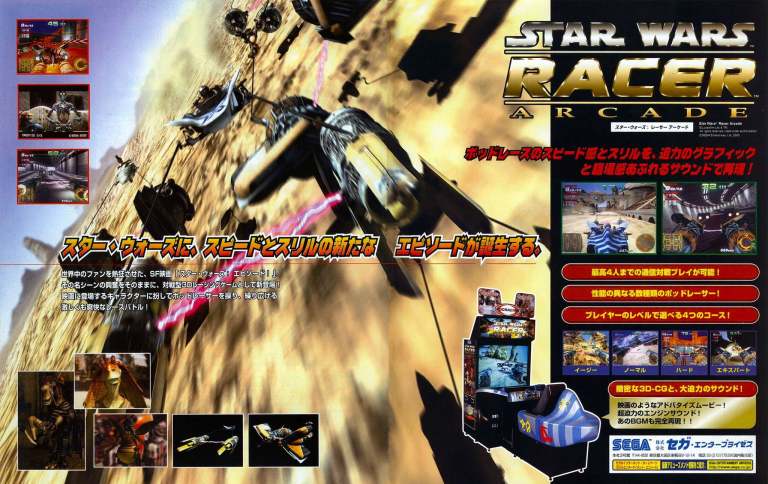
10. Star Wars: Racer Arcade Japanese Print Ad/Poster
This is one of the many video games based on Star Wars: The Phantom Menace.
In 1999, Star Wars Episode I: The Phantom Menace was a massive box office hit in theaters around the world and it marked a new era of Star Wars movies with digital effects available. Similar with 1993’s Jurassic Park, George Lucas’ movie also had a huge lineup of merchandise, action figures and video games. The pod racing from the movie became the basis for Star Wars: Racer Arcade which was released in Japan on June 2000, and then in America a month later. To help arcade operators attract gamers and Star Wars fans, a print ad and poster were released featuring a very dynamic image of pod racing from the game dominating the background, a few screenshots displayed and some computer-generated of characters and vehicles. At the lower right part of the ad/poster is the image of the arcade machine which has a huge screen, a seat and control panel. The descriptive Japanese text was written to excite both fans and gamers. Did you play this Sega-produced Star Wars game in the arcades?
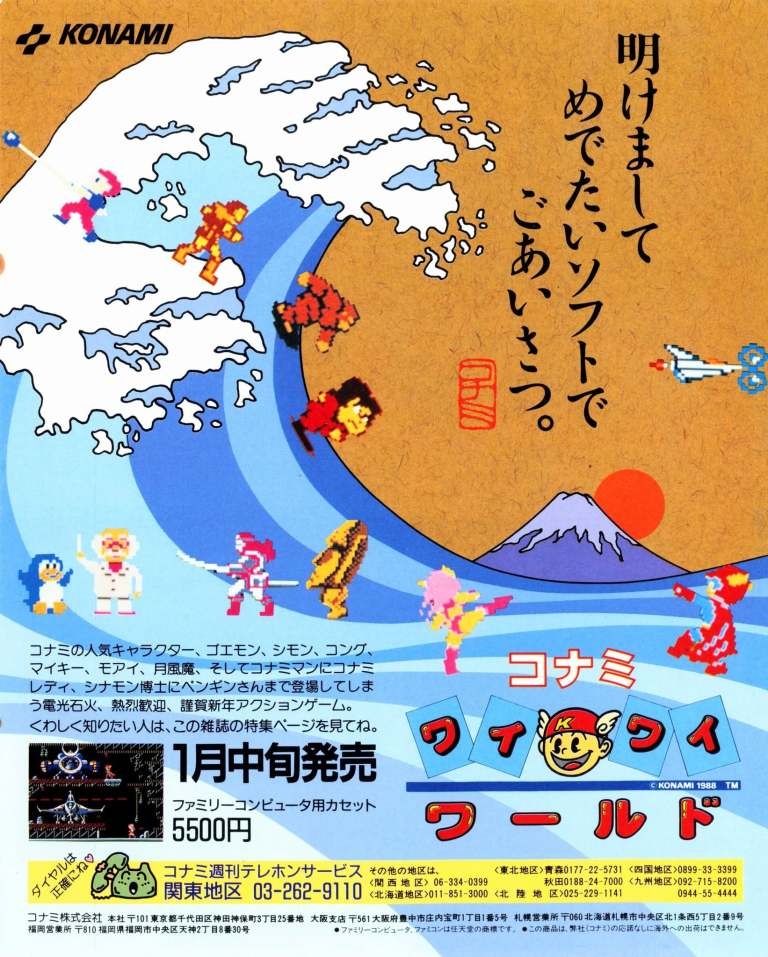
11. Konami Wai Wai World Japanese Print Ad
Can you spot Simon Belmont, Mikey Walsh and King Kong in this Japan-only print ad of Konami Wai Wai World?
Going back to the late-1980s, Konami released a 2D adventure game on the Famicom that was very ambitious as it featured side-scrolling treks, vertical-scrolling shooting sequences and, most notably, a cast of characters that emphasized crossovers between intellectual properties of gaming. I am talking about Konami Wai Wai World (sometimes called Konami World for short) which had characters, settings and elements of Konami’s own properties like Gradius, Castlevania and Twin Bee. Not only that, King Kong of King Kong 2: Ikari no Megaton Punch and Mikey Walsh of The Goonies were also featured which is astonishing because they represent entertainment intellectual properties that were licensed to Konami for video game adaptation. That said, the emphasis of crossovers and excitement was shown in the form of 2D character sprites in this Japanese print ad of Konami Wai Wai World. This is the kind of game that Konami itself will never be able to make again and to do a remake or an enhanced re-release of Konami Wai Wai World will require overcoming all the legal obstacles in the way.
The Bases Conversion and Development Authority (BCDA) recently announced that it will ensure the Philippines will benefit a lot from the ambitious Pax Silica project as they negotiate with the United States on the final framework, according to a GMA News report.
To put things in perspective, posted below is an excerpt from the report of GMA News. Some parts in boldface…
The Bases Conversion and Development Authority (BCDA) on Wednesday said it will ensure that the Philippine side, negotiating with the US on the final framework agreement to hit the ground running for the Pax Silica project in New Clark City, Tarlac, will push for a deal that would be most beneficial for the country.
At the Kapihan sa Manila Hotel, BCDA President and CEO Joshua “Jake” Bingcang said that the government is eyeing to sign the comprehensive framework agreement for the Pax Silica initiative with the US by November.
However, Bingcang admitted that “negotiations can always take longer,” noting that the target signing “is not cast in stone as long as the two [parties] will come up with mutually agreed arrangement.”
Nevertheless, the BCDA chief said the Philippines is pushing for terms that would “most beneficial sa’tin (to us)” as negotiations for the framework deal are ongoing.
“It’s a business contract, normally it is favorable to the host country,” he said.
Bingcang said the government has also made clear that the project will operate under the BCDA’s governing legal framework and applicable investment laws.
“It would be covered by two Philippine laws —the BCDA law and CREATE MORE so the incentives provided will be covered by these two laws,” he said.
“Never in that initial arrangement that we are going to adopt anything other than the two laws,” he added.
Pax Silica is the US Department of State’s flagship initiative on artificial intelligence and supply chain security, aimed at advancing a new economic security framework among allies and trusted partners.
The Philippines in April officially joined the Pax Silica initiative, cementing its place among other 23 global signatories, including the European Union, Japan, India, Singapore, South Korea, and the United Kingdom.
As part of the initiative, Manila and Washington are working to establish a 4,000-acre industrial hub that is envisioned as a new model for AI-focused investment within the Luzon Economic Corridor.
The BCDA chief earlier clarified that the Pax Silica hub is not envisioned as a cluster of hyperscale data centers but as an industrial hub that would include the manufacturing of semiconductors and microchips used in computers, laptops, electric vehicles, and other technologies.
Bingcang said that through Pax Silica, the Philippines and its partners see an opportunity to process raw materials domestically instead of exporting them in unprocessed form.
Let me end this post by asking you readers: What is your reaction to this recent development? Do you feel confident that the BCDA will be able to secure an agreement with the Americans to ensure the Philippines will benefit from Pax Silica economically? Do you realize Pax Silica’s potential to boost manufacturing jobs and the processing of raw of materials in the Philippines?
Thank you for reading. If you find this article engaging, please click the like button below, share this article to others and also please consider making a donation to support my publishing. If you are looking for a copywriter to create content for your special project or business, check out my services and my portfolio. Feel free to contact me with a private message. Also please feel free to visit my Facebook page Author Carlo Carrasco and follow me on Twitter at @CarloCarrascoPH as well as on Tumblr at https://carlocarrasco.tumblr.com/and on Instagram athttps://www.instagram.com/authorcarlocarrasco
For the first half of this year, the Philippines attracted 2.9 million foreign tourists and 1.13 million of that came from the United States and South Korea combined, according to a news report by Business Mirror. The figure does not include the 260,717 overseas Filipinos or balikbayan.
When compared to its Asian neighbors’ first-half foreign tourist numbers, the Philippines is still way behind Vietnam which attracted 12.3 million and Japan which attracted 21 million.
To put things in perspective, posted below is an excerpt from the Business Mirror report. Some parts in boldface…
MORE relaxed visa entry requirements have enabled the Philippines to attract an increasing number of foreign tourists, lifting total visitor arrivals by 5.41 percent in the first half of the year.
Data from the Department of Tourism (DOT) showed 3.16 million inbound tourists from January to June 2026, of which 2.9 million were foreign nationals and 260,717 were overseas Filipinos. The latter are described as Philippine passport holders permanently residing abroad. This year’s arrivals are 76.5 percent of the 4.13 million total in the first half of prepandemic 2019.
The DOT stressed that the data are based on e-travel records provided by the Department of Information and Communications Technology, and are not final until Bureau of Immigration records are taken into account. E-travel registration is mandatory for those arriving in the Philippines except foreign diplomats, dignitaries, foreign government officials and their delegation, visiting business executives and students sponsored by the Philippine government or international organizations, and their immediate family members (9e visa).
Of the total foreign nationals, which were up 6.3 percent from the 2.73 million year on year (yoy), tourists from China and India were the most improved by 64.54 percent and 43 percent, respectively. Residents from both countries have been allowed to enter the Philippines visa-free for tourism purposes for 14 days.
The top 12 source markets of visitors for the Philippines all recorded increases, except for South Korea, with long-haul markets like Germany even showing monthly increases yoy, despite the ongoing tensions in the Middle East, which had jacked up jet fuel prices.
S. Korea plunges 13.7%– The United States continues to be the top source market for the Philippines with arrivals at 581,565 in the first half of the year, an increase of some 6.9 percent from the same period in 2025. Most of the market continues to be composed of Americans of Filipino decent, or Filipino immigrants, who visit the Philippines usually during the holiday season in December and January.
Some 300 Filipino-Americans are currently in the country as part of government’s long-running Very Important Pinoy (VIP) tour, and visiting destinations other than Metro Manila such as Cebu, Dumaguete, and Siquijor.
In second place are tourists from South Korea at 552,860, slumping by 13.7 percent, yoy. This was followed by Japan at 581,565 (+6.87 percent); China at 219,796 (+64.54 percent); Australia at 174,257 (+12.3 percent); and Canada at 156,763 (+15.6 percent), another haven of Filipino immigrants. Air Canada began offering direct flights from Vancouver to Manila in April last year, while flag carrier Philippine Airlines offers nonstop flights between Manila and Vancouver, and Toronto.
Tourists from Taiwan were in seventh place at 111,134, an increase of 11.85 percent; folowed by the United Kingdom at 92,829 (+1.7 percent); Singapore at 78,069 (0.35 percent); India at 60,583 (43.03 percent); Malaysia at 53,437 (+11.5 percent); and Germany at 48,657 (+6.9 percent).
Under the General Appropriations Act of 2026, the DOT committed to attract 6.7 million foreign tourists this year.
Let me end this post by asking you readers: What is your reaction to this recent development? Do you think the Philippines will be able to attract 6.7 million foreign tourists by the end of this year? What do you think are the three most serious problems the Philippines has when it comes to attracting foreign tourists?
Thank you for reading. If you find this article engaging, please click the like button below, share this article to others and also please consider making a donation to support my publishing. If you are looking for a copywriter to create content for your special project or business, check out my services and my portfolio. Feel free to contact me with a private message. Also please feel free to visit my Facebook page Author Carlo Carrasco and follow me on Twitter at @CarloCarrascoPH as well as on Tumblr at https://carlocarrasco.tumblr.com/and on Instagram athttps://www.instagram.com/authorcarlocarrasco
As the military conflict between the United States and the Islamic terrorist state of Iran intensifies, the State Department announced that action has been taken to cut off the financial lifelines of the evil regime.
To put things in perspective, posted below is the entire announcement by the State Department. Some parts in boldface…
The United States is taking decisive action to cut off the financial lifelines sustaining Iran’s ruling elite. Today’s action targets Ali Ansari, a Dubai-based Iranian national who has built a sprawling global network of real estate and commercial holdings — spanning Germany, the United Kingdom, Spain, Cyprus, the UAE, and beyond — on behalf of Iranian Supreme Leader Mojtaba Khamenei and other regime insiders.
The United States also sanctioned three Iran-based currency exchange houses — Mohammad Darbani and Partners, Lavasani and Partners, and Mohsen Khandan and Partners — along with their managing partners and associated front companies. By targeting these networks, the United States is directly disrupting the regime’s ability to access foreign currency and conduct international financial activity.
These actions reflect the Trump Administration’s commitment to holding accountable all those who enable the regime’s corruption and regional aggression. The United States will continue to pursue sanctions against individuals, companies, and financial institutions — including foreign entities — that facilitate illicit Iranian commerce, and will not relent until the Iranian regime ends its destabilizing behavior and its exploitation of the Iranian people.
Today’s action is being taken pursuant to E.O. 13902, which targets persons operating in Iran’s financial and petroleum sectors, E.O. 13876, which focuses on the Supreme Leader of Iran and his affiliates, and the counterterrorism authority E.O. 13224, as amended by E.O. 13886. These designations build on a series of OFAC actions targeting Iranian shadow banking and currency exchange house networks
Let me end this piece by asking you readers: What is your reaction to this development? Do you think the US will be able to cut off Iran’s links to all financial sources around the world? Could it be possible that the sinister financiers behind LGBTQ and transgender mobs and human traffickers (involved with mass migration targeting Europe) could secretly be funding the Islamic terrorist regime of Iran?
Welcome back readers, fellow geeks and electronic gaming fans!
In this edition of the Retro Gaming Ads Blast (RGAB) series, we will take a look at another batch of retro gaming print ads from the 1980s to the early 2000s.
For the newcomers reading this, Retro Gaming Ads Blast (RGAB) looks back at the many print ads of games (console, arcade, computer and handheld) that were published in comic books, magazines, flyers, posters and newspapers long before smartphones, social media, the worldwide web and streaming became popular. To put things in perspective, people back in the 1980s to the 1990s were more trusting of print media for information and images about electronic games and related products.
With those details laid down, here is the newest batch of retro gaming print ads for you to see and enjoy…
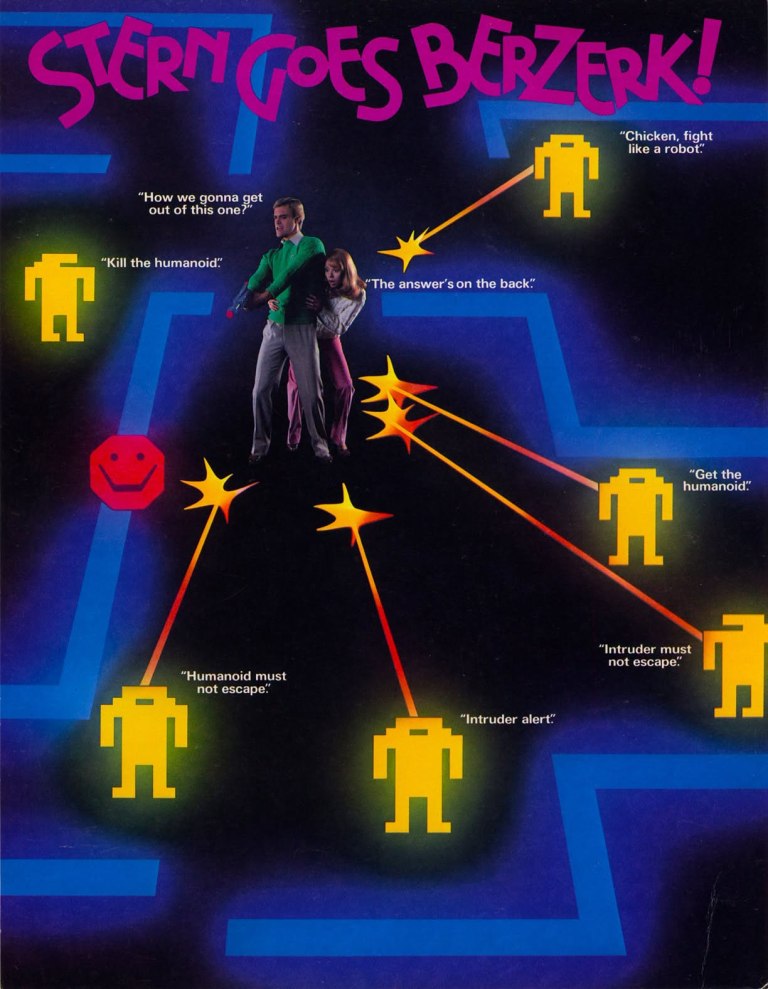
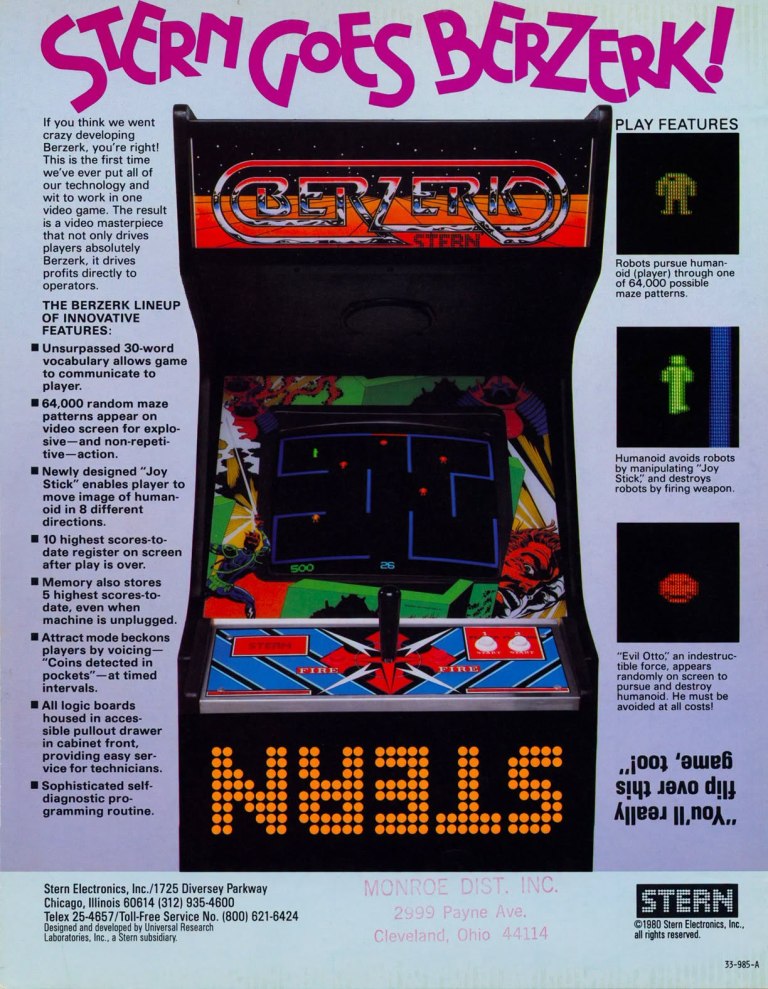
1. Berzerk Arcade Flyer
The front.
The rear.
Could you imagine being trapped deep within a maze surrounded by dangerous robots (plus one other unstoppable enemy) capable firing laser blasts at you? This was the concept behind the design of Berzerk, an arcade game released by Stern Electronics in 1980. Released at a time when science fiction became wildly popular in American entertainment, Berzerk was immersive for gamers and the multidirectional gameplay feature was captivating for many. To promote the game, Stern Electronics came up with a customized visual design that blended 2D sprite elements with a photograph of two people and some hand-drawn art pieces. The front of the flyer emphasized accurate the core concept of the game while the rear explained the technical details. They even played with their company name with the line “Stern goes berzerk!”
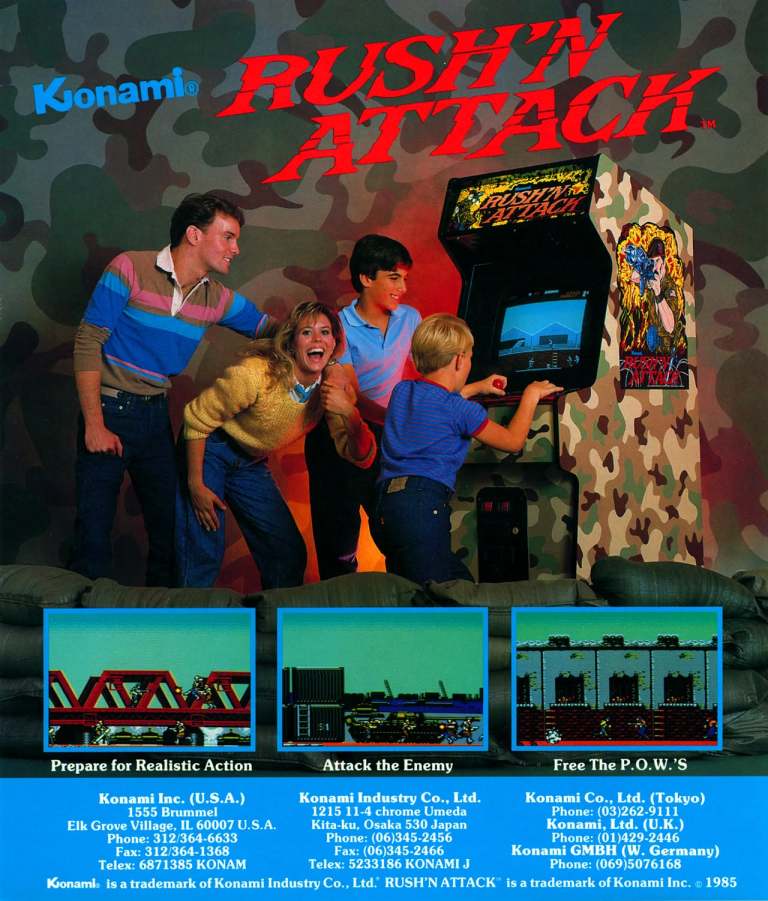
2. Rush’n Attack North American Arcade Flyer
The arcade flyer for North America
During the late stages of the Cold War, Konami made a lot of military-themed video games which resonated not only with those who were already aware about the global conflict but also with gamers who craved for action and excitement. One of those games was Rush’n Attack (alternative title: Green Beret) which was released in American arcades in late-1985. Konami came up with an arcade flyer showing four people (looking like an American family) having a good time in front of an arcade cabinet, and three screenshots of the game were displayed on the lower half. Rush’n Attack – which was deliberately titled to resemble the phrase “Russian attack” due to its obvious Cold War setting – went on to succeed commercially and critically. One notable game review compared Rush’n Attack favorably with the movie Rambo: First Blood Part II.
3. Turbo Out Run North American Arcade Flyer
The flyer.
Following the massive success Sega achieved with Out Run in 1986, the company went on to release the follow-up Turbo OutRun three years later. As seen in their North American flyer, Sega emphasized the in-game locations, the look of the machine with the driver’s seat and steering wheel, and the excitement they can expect. Turbo OutRun went on to become successful in the arcades worldwide and it got ported to a variety of consoles and computer systems in the years that followed. On its own, the arcade flyer sparked excitement for gamers.
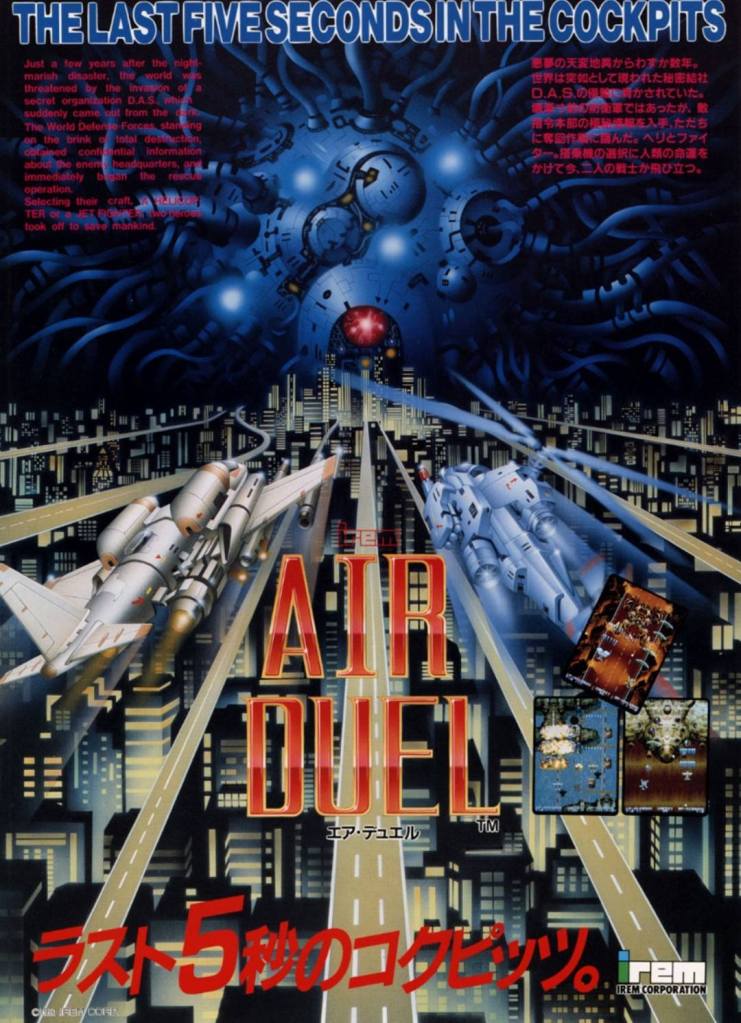
4. Air Duel Japanese Arcade Flyer
The artwork here is captivating to look at.
Released in Japanese arcades in 1990, Air Duel from Irem is an intense and fast-paced 2D sprite vertically scrolling shooter that attracted a lot of players. It had a war theme and its aesthetic has a mix of military and somewhat futuristic science fiction elements. The game’s arcade flyer featured a very intriguing artwork by Takashi Yamasaki showing two aircrafts flying over a city heading towards a massively large enemy in the distance. In my opinion, the artwork alone is pretty engaging to see and it’s more than enough to make me think about playing the game.
5. Spellbound Adaptor Print Ad
The Spellbound Adaptor print ad in Europe. UK design and manufacturing emphasized.
Remember back in the old days when there were hardware lockouts on game consoles that prevented users from playing games imported from different regions? In Europe, a special cheat and regional bypass cartridge called the Spellbound Adaptor was released and it allowed Super Nintendo Entertainment System (SNES) users to bypass the lockouts and play games from overseas. The Spellbound Adaptor was notably advertised in European print media showing two sexy ladies posing with the adaptor itself (on the SNES), the television and many SNES games. The ad even includes a promo of buying the adaptor with a game of choice for only £69.95. The ad is still impactful to look at.
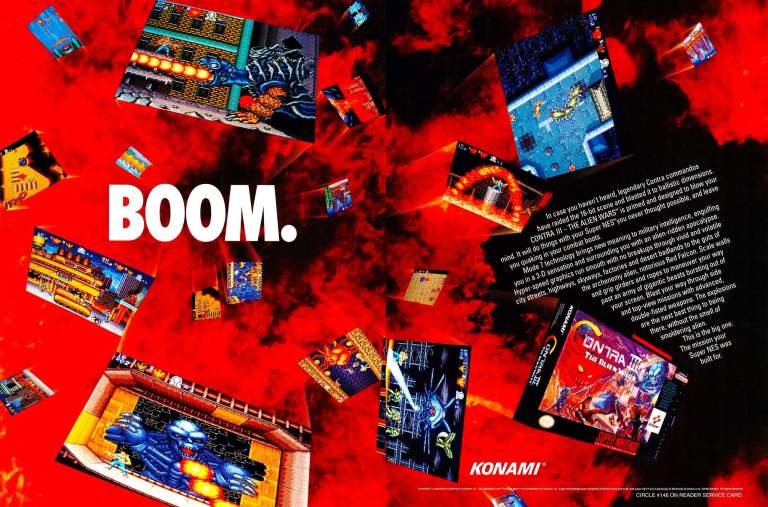
6. Contra III: The Alien Wars North American Print Ad
Konami’s made a huge impression visually with this 2-page print ad promoting Contra III: The Alien Wars.
By the time the SNES was launched in America in 1991, a lot of gamers who enjoyed Contra games on the Nintendo Entertainment System (NES) have been craving for a sequel on the newer console. Their dreams finally came through in early 1992 when Konami released Contra III: The Alien Wars on the SNES, and it was a lot more than visual upgrade as it had groundbreaking features connected with the game developers’ clever use of the console’s technology. Konami was already aware of Contra’s huge following in America, so they came up with an aggressive looking print ad promoting Contra III: The Alien Wars. With a red-and-black background, the ad had a variety of screenshots that were tilted to look 3D (showing what the game offered) and used a minor space for the descriptive text and image of the game box. This old print ad is one of the finest ways to promote a sequel while also emphasizing the next-generation experience fans can enjoy. This ad is a classic!
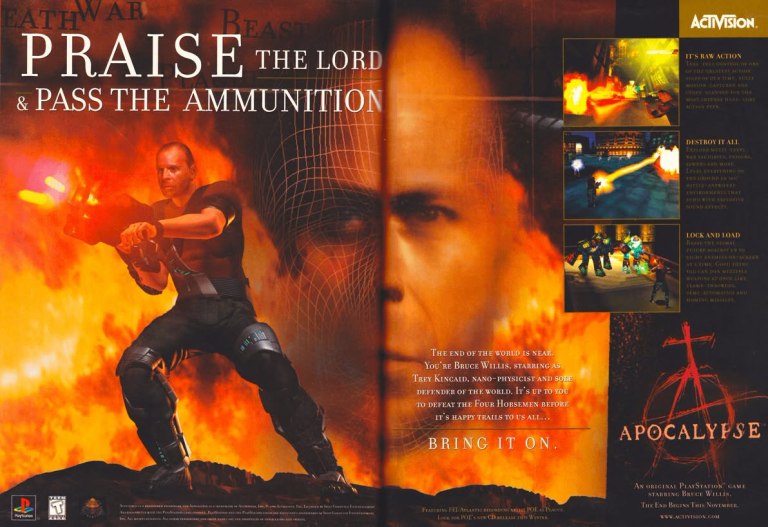
7. Apocalypse Print Ads
With Bruce Willis’ face, this 2-page Apocalypse print ad captured the attention of readers.
The more action-oriented 2-page print ad of Apocalypse. Bruce Willis is more visible here.
Believe it or not, Hollywood legend Bruce Willis actually starred in the ambitious video game titled Apocalypse. Before its 1998 released on PlayStation, Apocalypse started with the player character having an AI-controlled partner named Trey Kincaid to be played by Willis. Publisher Activision signed a multi-million Dollar deal with Bruce Willis to use his likeness and voice for the Trey character. Eventually the Trey Kincaid role was modified to be the playable character. Given the huge deal signed with the super star and the additional costs that came with game design revisions, Activision launched an aggressive marketing campaign for Apocalypse and they heavily used Bruce Willis’s name and imagery. Ultimately the game sold less than one million copies and yet Activision was satisfied with the sales which convinced them to go back to Apocalypse developer Neversoft for a new project.
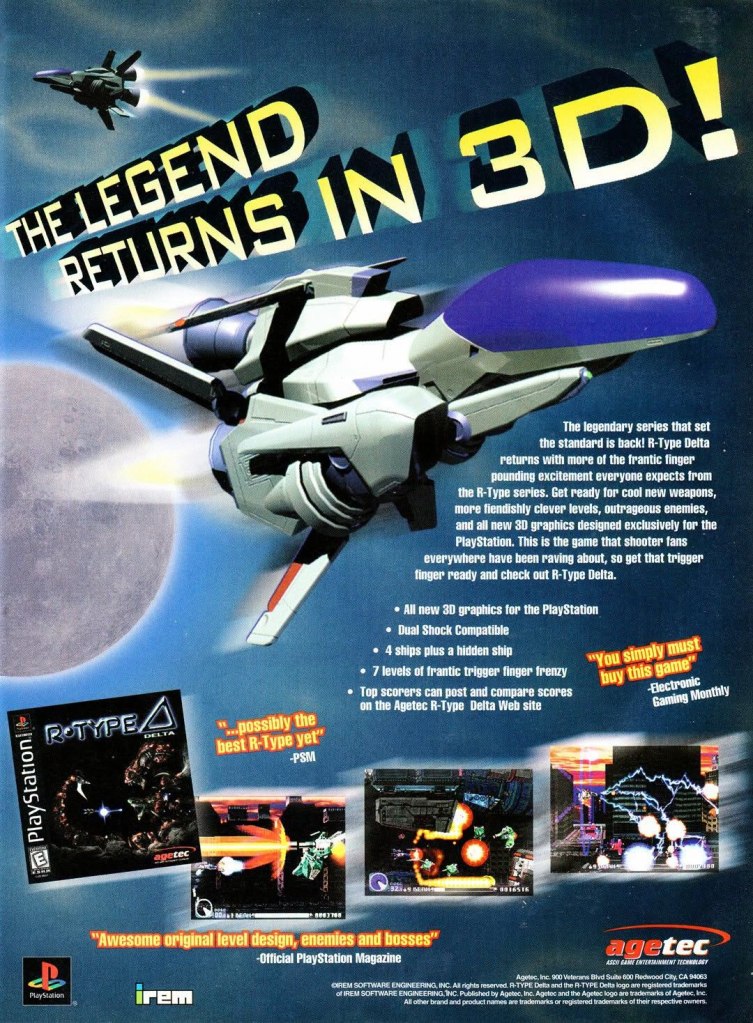
8. R-Type Delta North American Print Ad
R-Type Delta was the 4th game of the R-Type series and also the first to be made with 3D polygons.
R-Type, the long-running series of 2D side-scrolling shooters by Irem, fully embraced 3D polygons with R-Type Delta on PlayStation in 1998. To promote the game in North America, Irem and their partner Agetec went all-in emphasizing their series shift into 3D polygonal graphics while promising new in-game weapons. Very smartly, they included positive quotes from Electronic Gaming Monthly (EGM), PlayStation Magazine (PSM) and Official PlayStation Magazine (OPM) to show credibility. In recent times, an enhanced version of R-Type Delta (R-Type Delta: HD Boosted) was released on modern game console and PC.
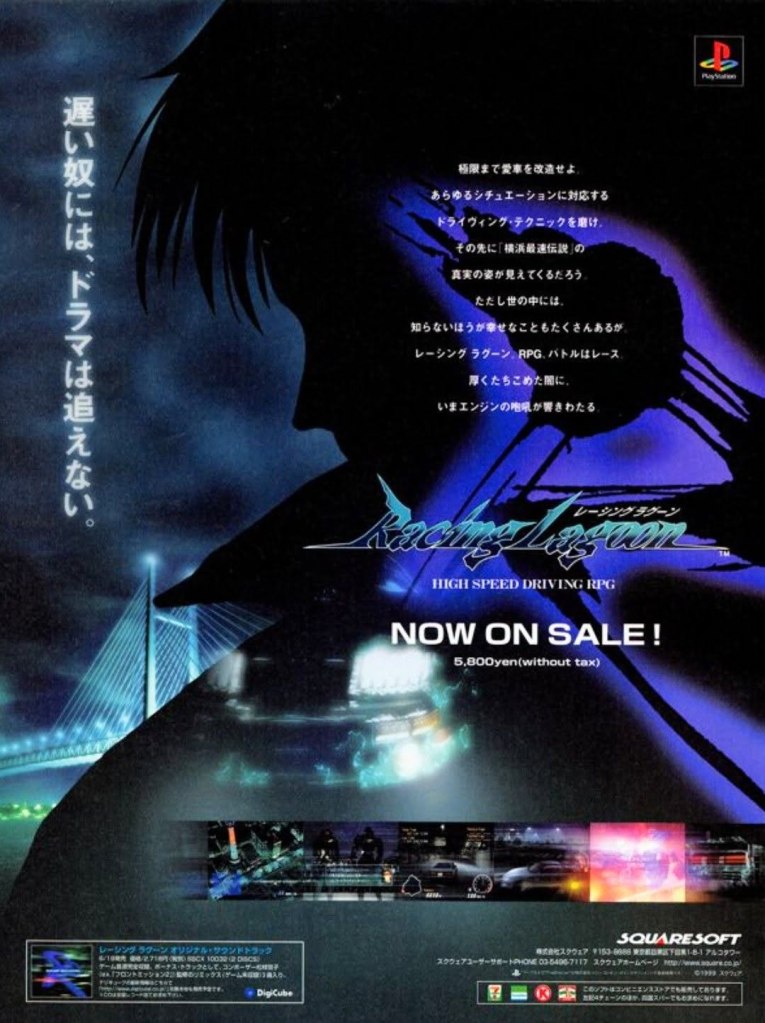
9. Racing Lagoon Japanese Print Ad
Have you ever played this game from SquareSoft?
Released in 1999 for PlayStation only in Japan, Racing Lagoon was one of many games SquareSoft made for a genre other than role-playing games (RPGs). Released at a time when the PlayStation already had lots of racing games available from around the world, Racing Lagoon was a racing game that had role-playing elements mixed in. To promote it, SquareSoft made a print ad that had a night-time city vibe and they showed some screenshots with a unique visual style. The in-game story was influenced by the illegal street racing trend that happened in Japan during the 1980s.
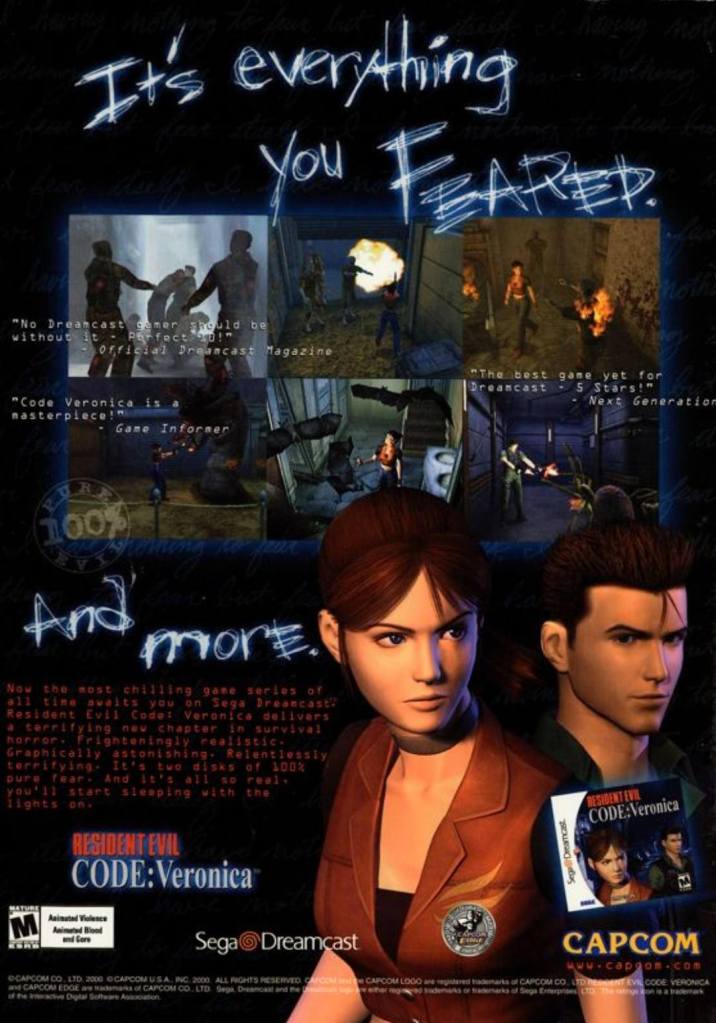
10. Resident Evil – Code: Veronica North America Print Ads
Truly a next-generation Resident Evil experience first launched on the Sega Dreamcast! I know some people who bought the console just to play Resident Evil – Code: Veronica.
The 2-page print ad of RE – Code: Veronica.
When Resident Evil – Code: Veronica was released on the Sega Dreamcast in Japan in February 2000, it delivered a next-generation survival horror experience to die-hard RE fans and it was easily one of the must-have games for Dreamcast owners of the time. Along the way, RE fans and Dreamcast owners in America were already anticipating the game. Capcom had an aggressive ad campaign for the game with US gamers in mind and this particular single-page print ad showed the fan-favorite characters Claire and Chris Redfield on one corner, six selected screenshots and quotes from the published game reviews of Game Informer, Next Generation and the Official Dreamcast Magazine. The 2-page print ad had the same elements but had the Redfield siblings on the 2nd page. I remember seeing these ads on a few gaming magazines and they made me think about buying a Dreamcast just to play RE – Code: Veronica. These old ads emphasized the strong business trust between Capcom and Sega (which itself lost a lot of money and credibility with the Sega Saturn consoles and many add-on devices released years prior).
In the latest development between the United States and the Philippines, the US Department of State announced that the two nations plan the launch of a historic economic security zone of four thousand acres which will shore up supply chains and it will be located in the main island of Luzon.
To put things in perspective, posted below is an excerpt from the fact sheet posted by the State Department. Some parts in boldface…
Under Secretary of State for Economic Affairs Jacob Helberg today announced the United States’ and the Philippines’ plans to establish a 4,000-acre industrial hub to secure inputs vital to American and global supply chains. The site is located in the Luzon Economic Corridor of the Philippines. The site—the first of its kind—is being designated by the Philippines as an Economic Security Zone, a new model for AI-native investment acceleration hubs being developed under the Pax Silica Initiative.
The Economic Security Zone is part of a broader strategy to surge production for inputs vital to U.S. supply chains. It is expected to serve as a purpose-built platform for allied manufacturing—an investment acceleration hub where the specific industrial activities are shaped by market demand, host-country comparative advantages, and the evolving needs of the allied network. Situated within the Luzon Economic Corridor, the Zone can leverage the Philippines’ geographic centrality in the Indo-Pacific, its young and technically skilled workforce, and its deepening alliance with the United States.
Structure and Planned Governance
Joint governance: The two governments intend to identify appropriate frameworks for the long-term development of the Zone that facilitate sovereign alignment and shared upside as it scales.
Enhanced Operational Certainty: The Economic Security Zone is intended to fuse American expertise in institutions and legal regimes – internationally enforceable contracts, transparent regulatory standards, and expert dispute resolution – with enhanced access to the Philippines’ outstanding workforce and talent, mineral endowments, energy resources, and strategic position at the crossroads of Indo-Pacific trade.
The Philippines and Pax Silica
Critical minerals: The Philippines holds significant reserves of nickel, copper, chromite, and cobalt—minerals increasingly vital to global supply chains.
Infrastructure: The Luzon Economic Corridor (LEC) is a coordinated, high-impact investment in key sectors, including in transportation, energy, digital infrastructure, and advanced manufacturing. The LEC will transform Luzon into a more prosperous and interconnected region while delivering value to American investors.
The Economic Security Zone
First of many: The Luzon hub is intended to be the first Zone in a broader industrial network—a constellation of integrated manufacturing sites, logistics corridors, and shared financial instruments spanning partner nations across multiple continents.
System transformation: This interconnection can transform Pax Silica industrial policy from a collection of bilateral projects into a genuine system capable of competing with—and ultimately displacing—the concentrated supply chains on which the world currently depends.
For insight, Pax Silica is the State Department’s flagship effort on artificial intelligence (AI) and supply chain security, advancing new economic security consensus among allies and trusted partners. To learn more, click here.
Meanwhile the Philippine News Agency (PNA) published its news article about this development revealing that the Philippines officially joined the Pax Silica Initiative described as a strategic coalition among fourteen states to create a secure supply for semiconductors and AI. To read the news article, click here.
Let me end this piece by asking you readers: What is your reaction to this development? Do you think both the Philippines and America will benefit from the planned 4,000-acre special economic security zone in the long-term?