Retro Gaming Ads Blast – Part 46

Welcome back readers, fellow geeks and electronic gaming fans!

In this edition of the Retro Gaming Ads Blast (RGAB) series, we will take a look at another batch of retro gaming print ads from the 1980s to the early 2000s.

For the newcomers reading this, Retro Gaming Ads Blast (RGAB) looks back at the many print ads of games (console, arcade, computer and handheld) that were published in comic books, magazines, flyers, posters and newspapers long before smartphones, social media, the worldwide web and streaming became popular. To put things in perspective, people back in the 1980s to the 1990s were more trusting of print media for information and images about electronic games and related products.

With those details laid down, here is the newest batch of retro gaming print ads for you to see and enjoy…

1. Frogger Print Ad
Do you find this old ad humorous?

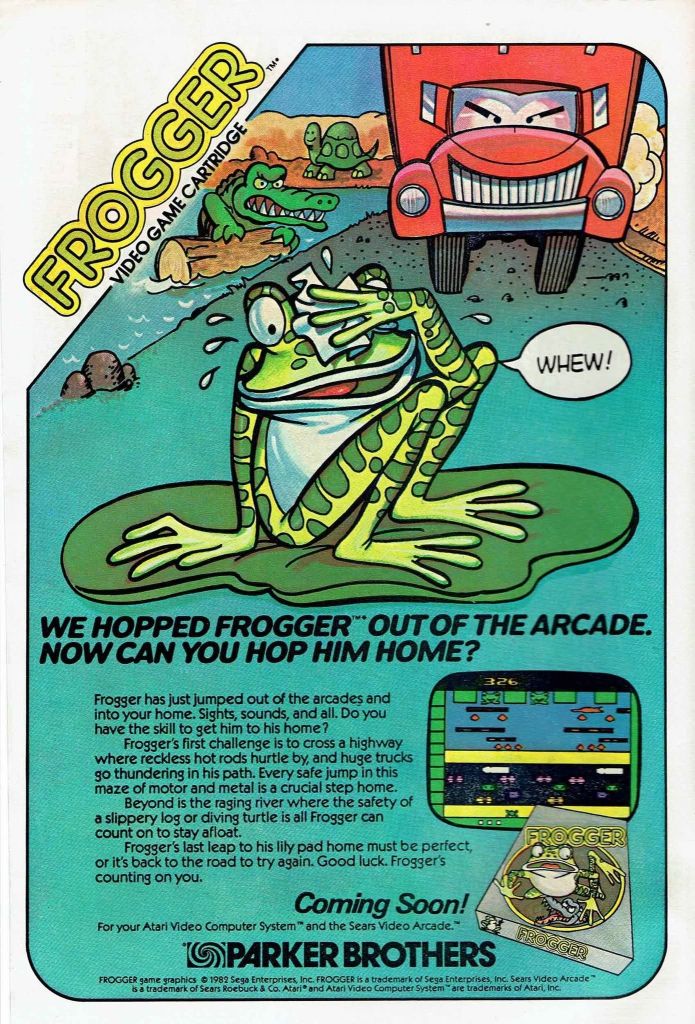
When Frogger was first released in video arcades in 1981, it easily attracted countless gamers offering them bouts of fun and the video game critics were very impressed with it. Considering its massive arcade success, it was unsurprisingly ported to the game consoles and home computers of the time. Parker Brothers secured the license for cartridge versions and the company produced Frogger ports for not just the Atari 2600 but also the Atari 7800. This print ad they came up with had a deliberate cartoony artwork (with a touch of humor) and an artist created a hand-drawn illustration intentionally made to resemble a screenshot from the game. I saw this ad a number of times when I read comic books in 1982.

2. The Legend of Kage Japanese Arcade Flyer
Action and excitement in ancient Japan!

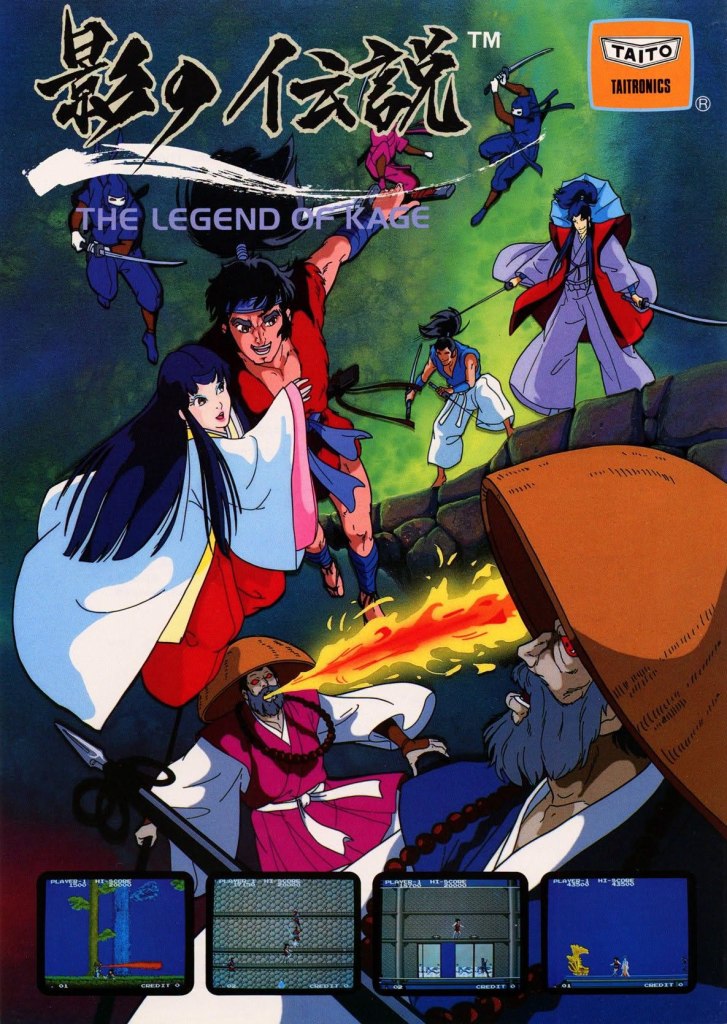
In my life, I never had the opportunity to play the original arcade version of The Legend of Kage and ended up playing only the Nintendo Family Computer (Famicom) port. Behind the scenes, Taito itself came close to preventing The Legend of Kage from being released in the arcades. The company placed it in a certain game show where it received praise by many which prompted Taito to give it a full arcade release. To promote the game, the Japanese arcade flyer had lively hand-drawn artwork that perfectly reflected what the game is about, who the playable hero is and what ancient Japanese setting was used. Fortunately for Taito, The Legend of Kage became a huge commercial hit and this led to the production of ports for different consoles and computers.

3. Hyper Olympic Japanese Arcade Flyer
Arguably the best track and field game ever made for the arcades.

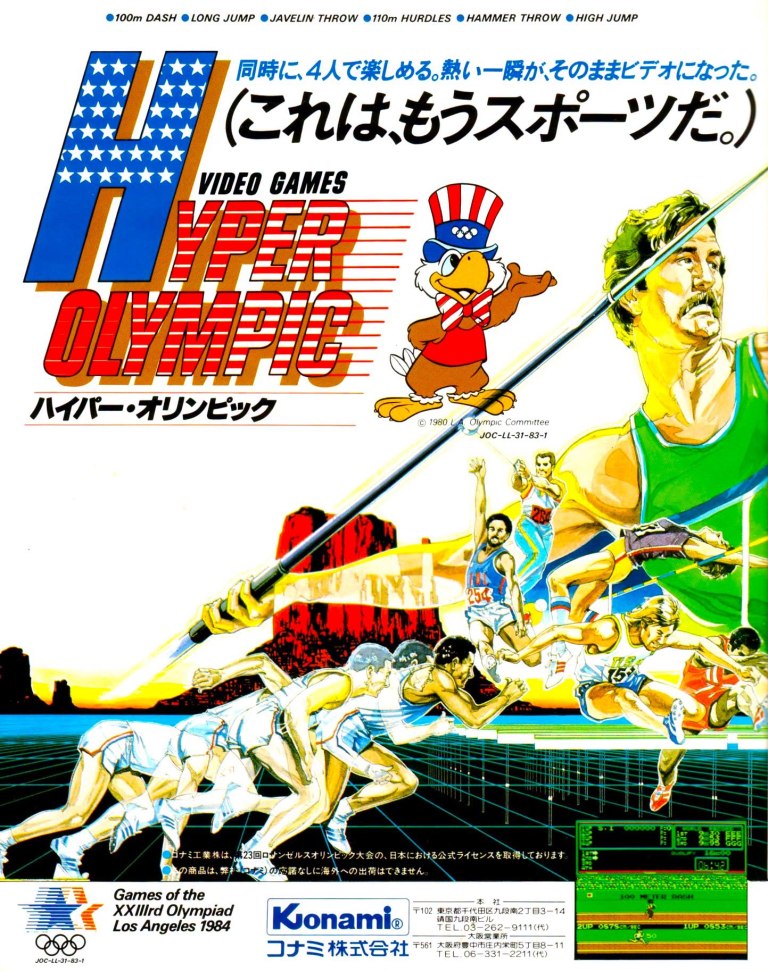
In 1983, Konami released their summer Olympics-inspired arcade game Hyper Olympic (titled Track & Field in other parts of the world) which offered players the opportunities to compete in a series of events with emphasis on pressing the buttons as quickly as possible. The arcade flyer Konami came up with featured fine-looking hand-drawn artwork showing athletes competing in track and field events (with the types of events displayed at the top-most part of the flyer) while showing just one screenshot (lower right) and displaying the officially 1984 Los Angeles Olympics logo (lower left). In my view, this old arcade flyer does a good job promoting both the arcade game as well as the 1984 Olympics itself. Too bad nobody makes this kind of arcade flyer anymore.

4. Terra Cresta Japanese Arcade Flyer
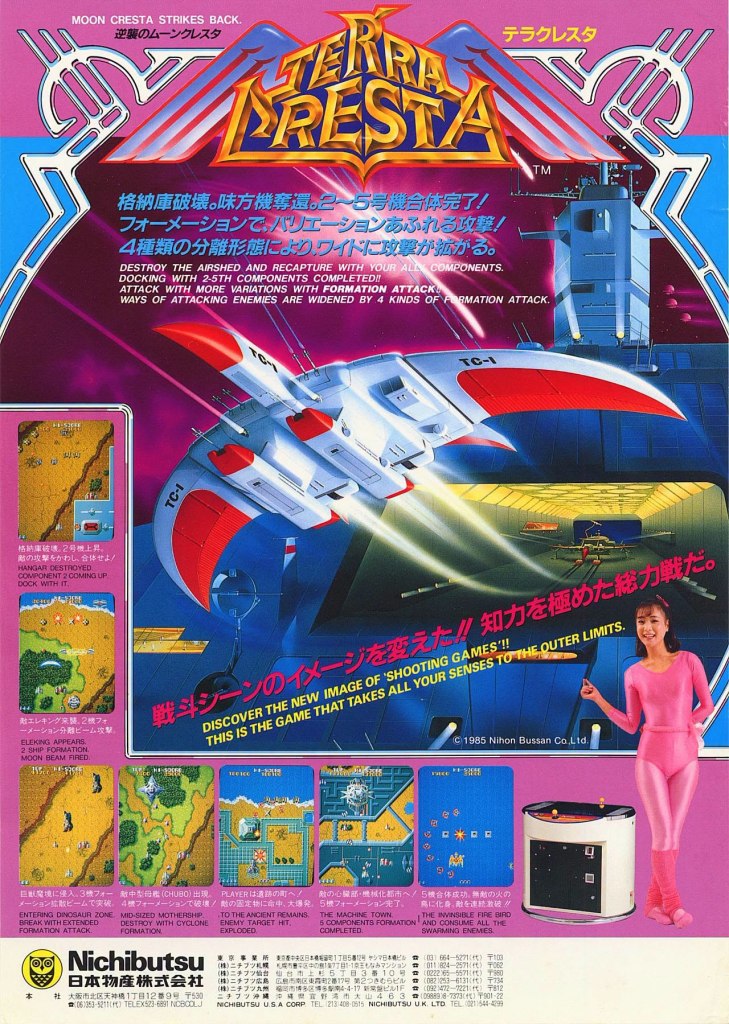
Did you ever play Terra Cresta in the arcades in Japan?

Nichibutsu, which produced a lot of arcade games that were released only in Japan, released Terra Cresta in Japanese arcades in 1985. It turns out Terra Cresta is a sequel to their 1980 game Moon Cresta which itself was their first big arcade hit game. Nichibutsu literally loaded the front of Terra Cresta’s arcade flyer with lots of visuals and details. As you can see, seven screenshots of the game were displayed (each with descriptive text), a fancy looking artwork that emphasized the science fiction setting, some English descriptive text, the cocktail table arcade machine and a pretty Japanese lady wearing an aerobics outfit with legwarmers (popular in the 1980s). This flyer truly has a strong 1980s flavor.  

5. Sega Master System European Print Ad
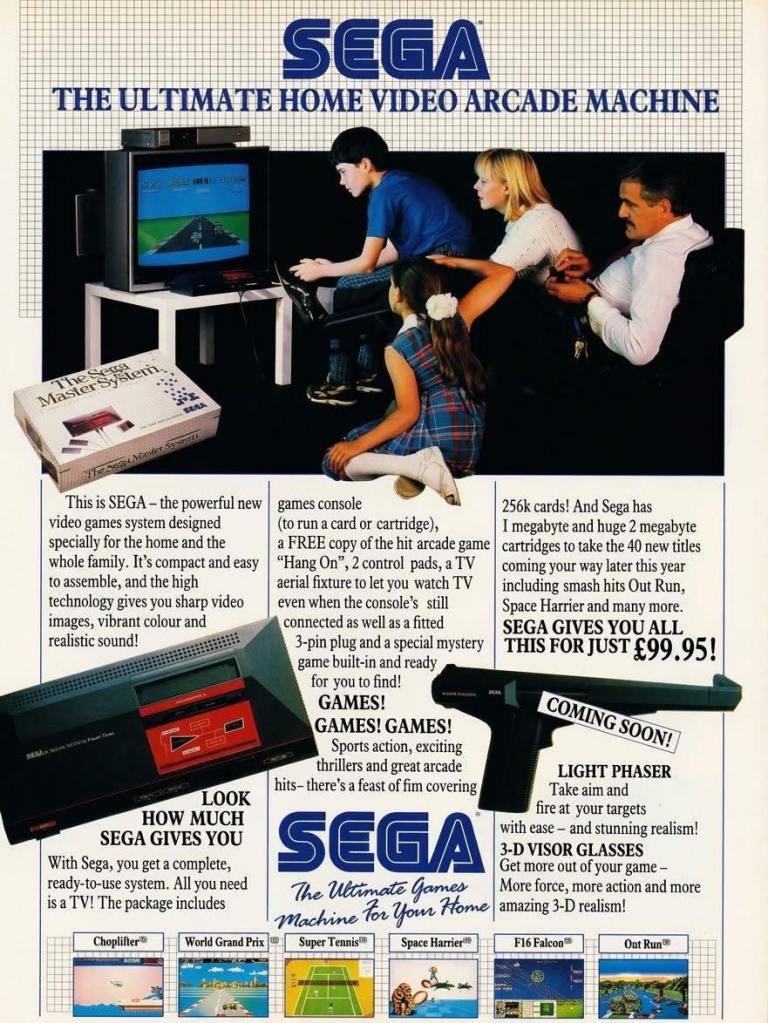
From the early days of Sega’s console business.

After many years doing arcade games, Sega made the bold decision to start competing in console gaming with the release of the SG-1000 in 1983 in Japan. Even though Nintendo was a very tough competitor with the best-selling Famicom, Sega did not give up and proceeded to launch their console in America and Europe referred to as the Master System. In a serious attempt to gain customers specifically in England, Sega made a print ad showcasing a family sitting in front of a TV set with the young boy playing a racing game on a Master System. Looking at how the descriptive text was presented, it was clear that Sega emphasized bringing the arcade game experience into the comfort of home while also promising that a lot more new games will be released in the near future. This is an eye-catching ad and also a fine example of aggressive marketing by Sega.

6. Ken Griffey Jr.’s Winning Run North American Print Ad
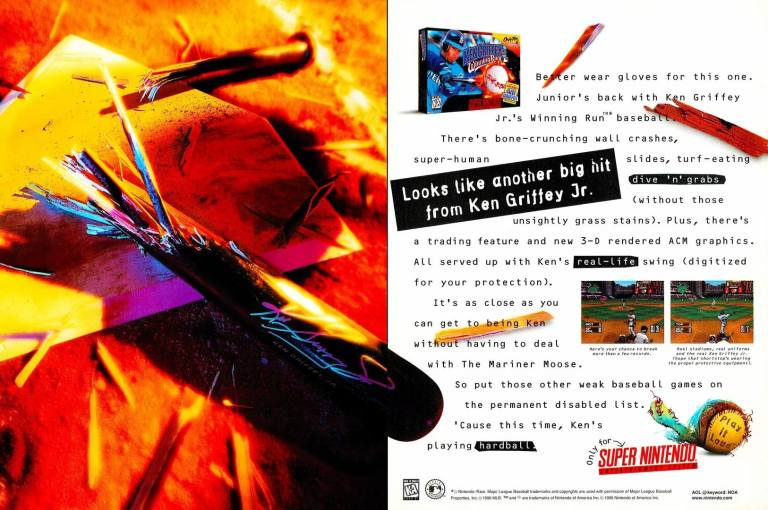
What was the best baseball video game you ever played?

Following the commercial success of the 1994 Super Nintendo Entertainment System (SNES) game Ken Griffey Jr. Presents Major League Baseball, Nintendo got Ken Griffey Jr. again as endorser and proceeded with the follow-up Ken Griffey Jr.’s Winning Run. With the highly talented Rare (Donkey Kong Country) chosen as game developer, Nintendo was highly confident with the baseball sequel and the 2-page print ad reflected that. The Ken Griffey Jr.’s Winning Run ad had a striking image of a broken baseball bat on one side while the game’s details, two screenshots and the creative description dominated the other side. While I am not so interested in baseball, I can say that this old print ad is indeed attention-grabbing.

7. 2Xtreme North American Print Ad
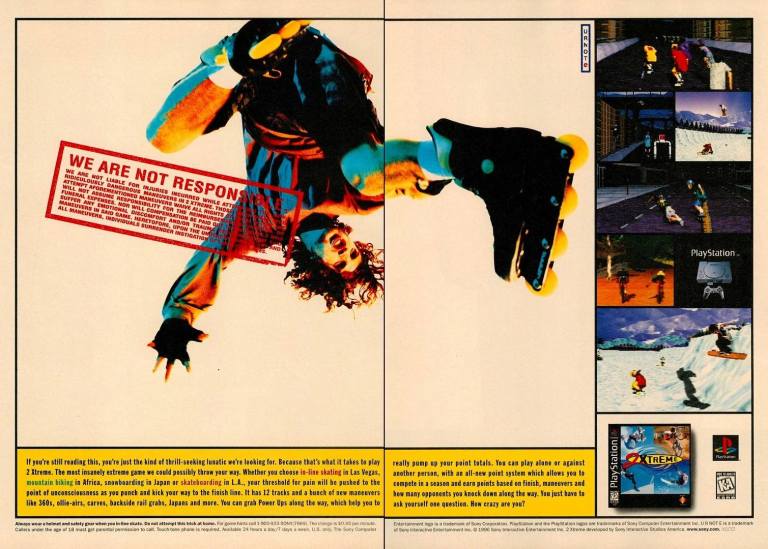
From the time when the X Games were wildly popular.

Remember how popular the X Games (Extreme Games) were back in the 1990s? Early in the life of the PlayStation console, Sony released ESPN Extreme Games which sold over a million copies worldwide. As expected, a follow-up titled 2Xtreme was approved for a 1996 release. Sony came up with a 2-page ad that had an upside-down X Games participant with roller blades dominating most of the space and six screenshots were displayed. The descriptive text in the lower part of the ad was deliberately written to be hip and cool.  

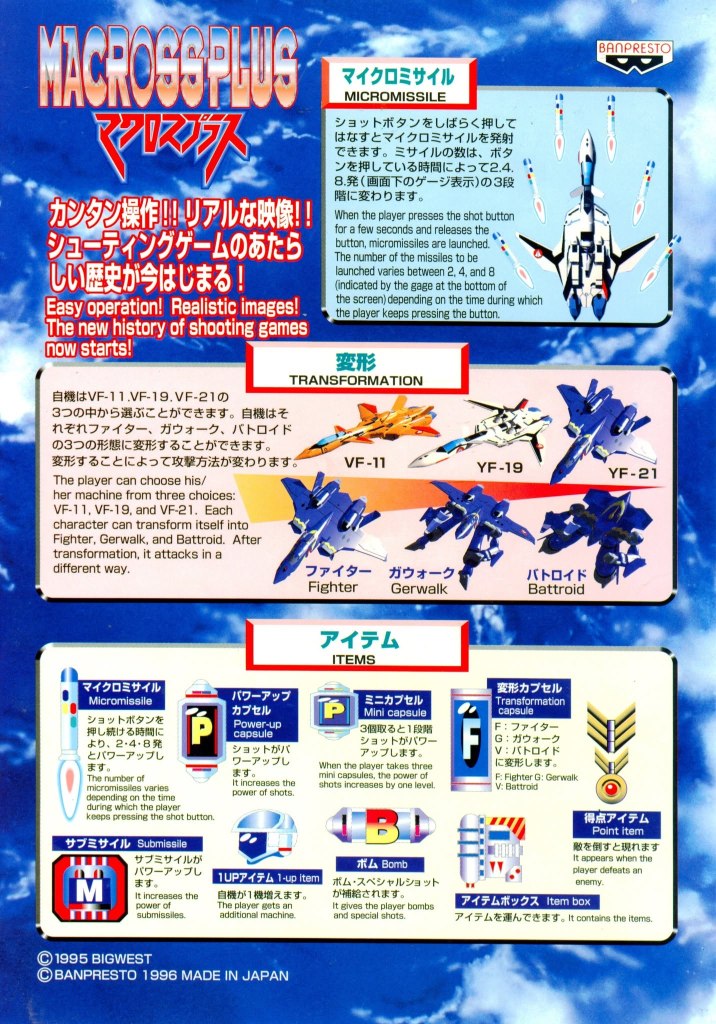
8. Macross Plus Japanese Arcade Flyer
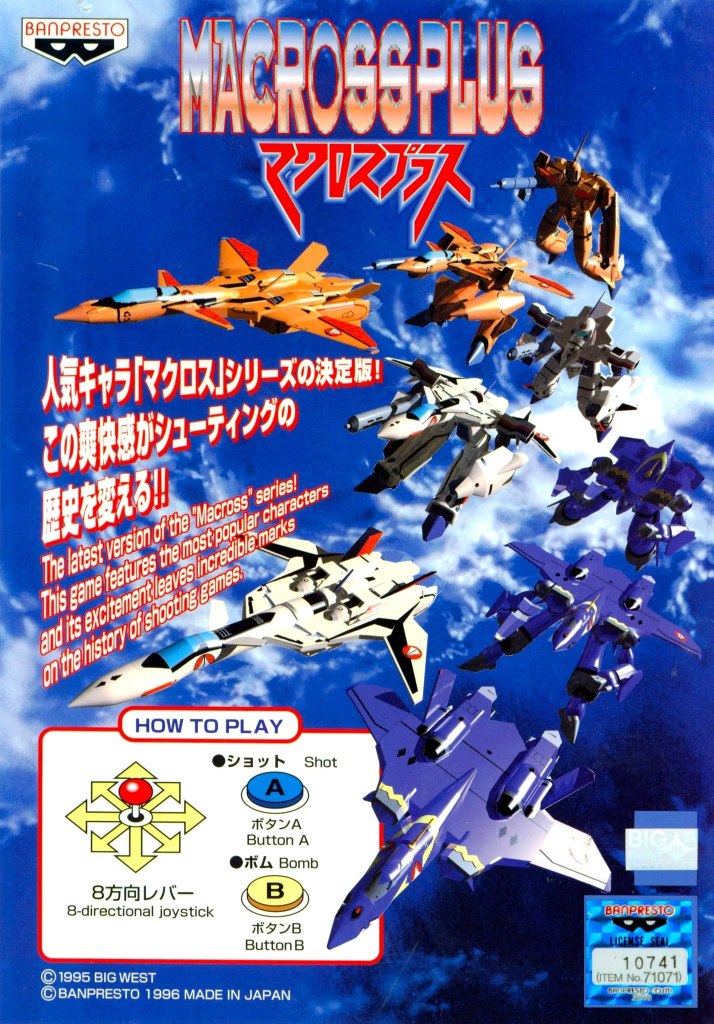
The front.
The rear.

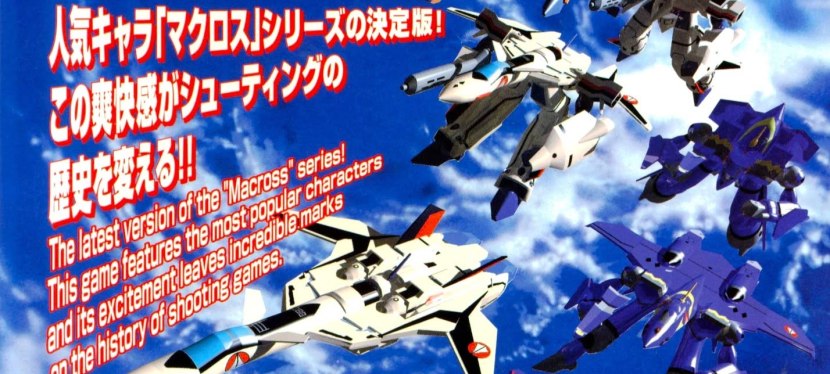
Based on the mid-1990s anime OAV, the Macross Plus video game from Banpresto was designed as a vertical-scrolling 2D shooter that captures the feel and intensity of the anime’s spectacle. The front of the Japan-only arcade flyer showcased the YF-19 Excalibur, the YF-21 Sturmvogel and the VF-11 Thunderbolt (plus the basic arcade controls on the lower-left) which were all rendered in 3D polygons to delight Macross fans and gamers who are interested in new 2D shooting experiences. The rear of the flyer showed additional details and it even includes English text descriptions. Strangely, no screenshots of the game were displayed. Being a long-time Macross fan, I can say this old arcade flyer is still engaging to look at.  

9. Macross VF-X2 North American Print Ad
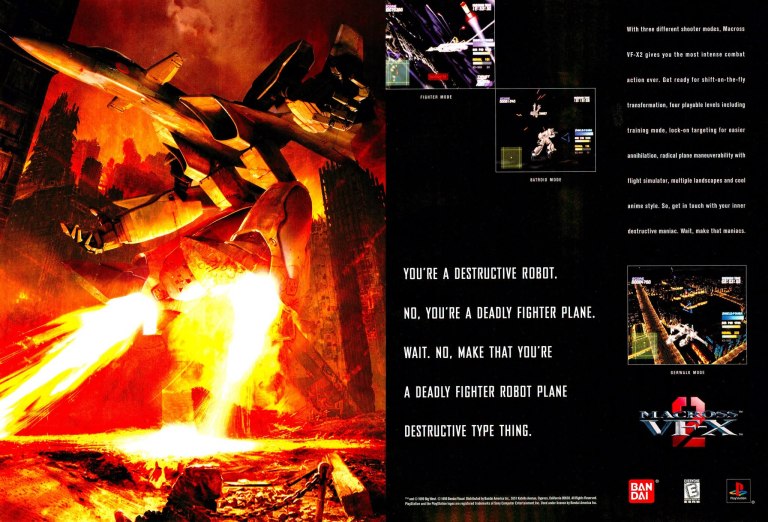
An impressive looking print ad for a Macross video game that never got released in North America.

In the late 1990s, Bandai prepared to launch Macross VF-X2 (the sequel to 1997’s Macross Digital Mission VF-X) on the PlayStation console in North America. This was a very intriguing move because Bandai never brought the mentioned 1997 Macross game outside of Japan. Shortly after the official announcement of a North American release, Macross VF-X2 got featured in video game magazines, an English demo of the game (first mission only) was distributed through Official U.S. PlayStation Magazine, and Bandai came up with the 2-page print ad you see here. Unfortunately, Macross VF-X2’s North American release got cancelled because of copyright issues and legal obstacles (note: Harmony Gold held the Western rights to Robotech and actively blocked the release of genuine Macross products in America). As such, this impressive looking Macross VF-X2 print ad for North America ended up as a promotion for nothing!

10. Star Wars: Racer Arcade Japanese Print Ad/Poster
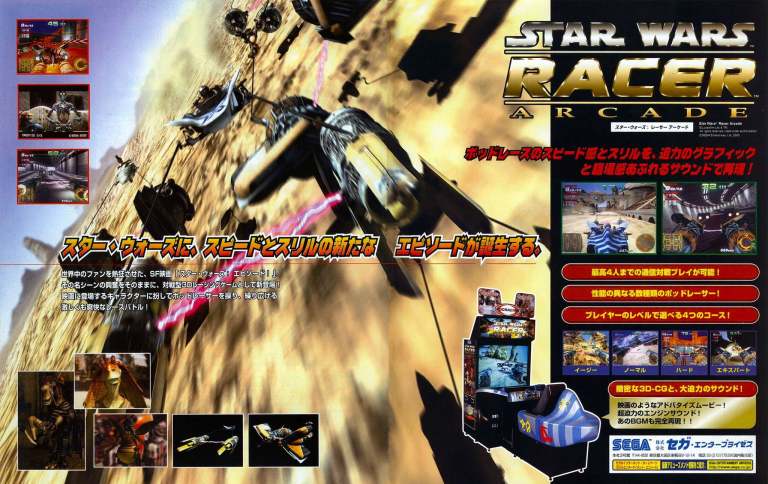
This is one of the many video games based on Star Wars: The Phantom Menace.

In 1999, Star Wars Episode I: The Phantom Menace was a massive box office hit in theaters around the world and it marked a new era of Star Wars movies with digital effects available. Similar with 1993’s Jurassic Park, George Lucas’ movie also had a huge lineup of merchandise, action figures and video games. The pod racing from the movie became the basis for Star Wars: Racer Arcade which was released in Japan on June 2000, and then in America a month later. To help arcade operators attract gamers and Star Wars fans, a print ad and poster were released featuring a very dynamic image of pod racing from the game dominating the background, a few screenshots displayed and some computer-generated of characters and vehicles. At the lower right part of the ad/poster is the image of the arcade machine which has a huge screen, a seat and control panel. The descriptive Japanese text was written to excite both fans and gamers. Did you play this Sega-produced Star Wars game in the arcades?

11. Konami Wai Wai World Japanese Print Ad
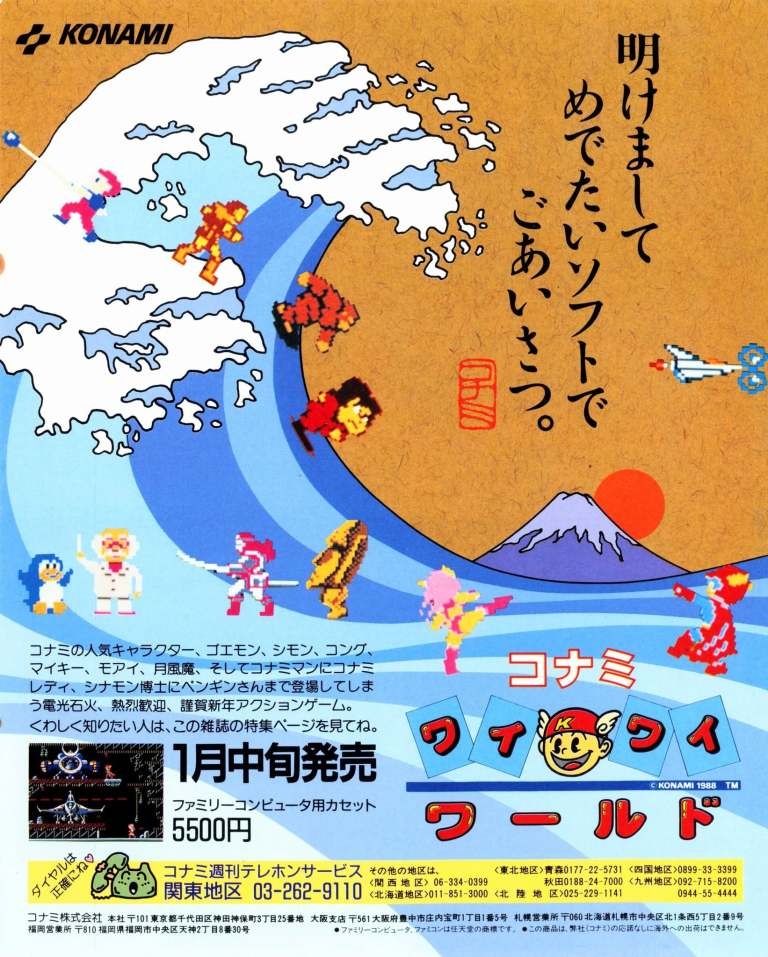
Can you spot Simon Belmont, Mikey Walsh and King Kong in this Japan-only print ad of Konami Wai Wai World?

Going back to the late-1980s, Konami released a 2D adventure game on the Famicom that was very ambitious as it featured side-scrolling treks, vertical-scrolling shooting sequences and, most notably, a cast of characters that emphasized crossovers between intellectual properties of gaming. I am talking about Konami Wai Wai World (sometimes called Konami World for short) which had characters, settings and elements of Konami’s own properties like Gradius, Castlevania and Twin Bee. Not only that, King Kong of King Kong 2: Ikari no Megaton Punch and Mikey Walsh of The Goonies were also featured which is astonishing because they represent entertainment intellectual properties that were licensed to Konami for video game adaptation. That said, the emphasis of crossovers and excitement was shown in the form of 2D character sprites in this Japanese print ad of Konami Wai Wai World. This is the kind of game that Konami itself will never be able to make again and to do a remake or an enhanced re-release of Konami Wai Wai World will require overcoming all the legal obstacles in the way.

+++++

Thank you for reading. If you find this article engaging, please click the like button below, share this article to others and also please consider making a donation to support my publishing. If you are looking for a copywriter to create content for your special project or business, check out my services and my portfolio. Feel free to contact me with a private message. Also please feel free to visit my Facebook page Author Carlo Carrasco and follow me on Twitter at @CarloCarrascoPH as well as on Tumblr at https://carlocarrasco.tumblr.com/ and on Instagram athttps://www.instagram.com/authorcarlocarrasco
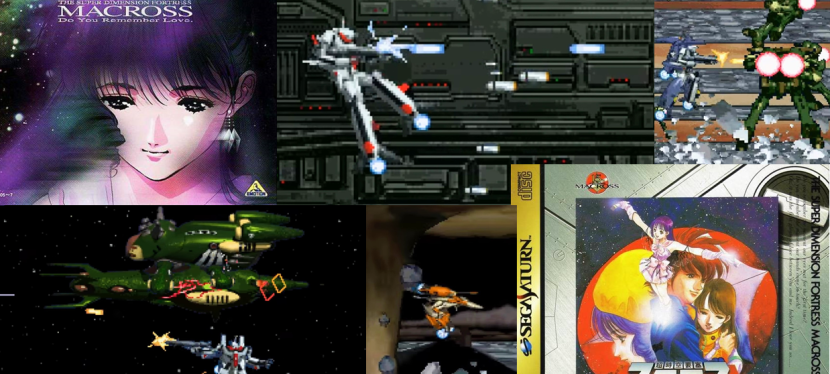
A Look Back at The Super Dimension Fortress Macross: Do You Remember Love? (Sega Saturn, PlayStation)

Disclaimer: This is my original work with details sourced from playing The Super Dimension Fortress Macross: Do You Remember Love? video game and doing personal research. Anyone who wants to use this article, in part or in whole, needs to secure first my permission and agree to cite me as the source and author. Let it be known that any unauthorized use of this article will constrain the author to pursue the remedies under R.A. No. 8293, the Revised Penal Code, and/or all applicable legal actions under the laws of the Philippines.

If you have been reading my Macross-related articles over the past few years, you should know already that I deeply love watching Macross: Do You Remember Love?, the classic anime feature film co-directed by Noboru Ishiguro and the legendary Shoji Kawamori.

Like many other entertainment franchises in Japan, Macross also has video games based on its stories and concepts. During the fifth generation of video game consoles, Bandai released in Japan the video game adaptation of the 1984 anime movie on the Sega Saturn in 1997 and the Sony PlayStation in 1999. That game was titled The Super Dimension Fortress Macross: Do You Remember Love? and I played that 2D side-scrolling shoot-them-up game a lot during the time when 3D polygons was already the standard.

Considering its age, it is easy to wonder if the game is still fun to play by today’s standards and if the game is something that Macross fans can enjoy a lot. We can all find out in this look back at The Super Dimension Fortress Macross: Do You Remember Love?

Sega Saturn version in 1997.
Sony PlayStation version in 1999.

Early story

The story begins at sea. A Valkyrie piloted by Hikaru Ichijyo (the late Arihiro Hase) launches from the aircraft carrier Prometheus to join his teammates Max and Kakizaki led by Roy Fokker (Akira Kamiya). Suddenly a powerful beam of energy from above hits the aircraft carrier clearly showing that their world is under attack by the Zentradi.

They proceed to South Attaria Island where they immediately engaged the Zentradi forces that ravaged the city and causing trouble for the SDF-1 (Macross). After defeating several Zentradi elements, the remaining Skull Squadron forces flew to the Macross (which just launched into the air) which executes a space fold just moments before even more laser blasts from the Zentradi destroyed the entire island.

Sometime later deep in space, thousands of civilians managed to adjust to living inside the Macross. As Lynn Minmay’s (Mari Iijima) first concert happens inside the fortress, Hikaru, his teammates and many other fighters engage in a mission against the Zentradi…

Quality

Just like in the movie!

To comment on the quality of this old video game, I’ll focus on gameplay and presentation.

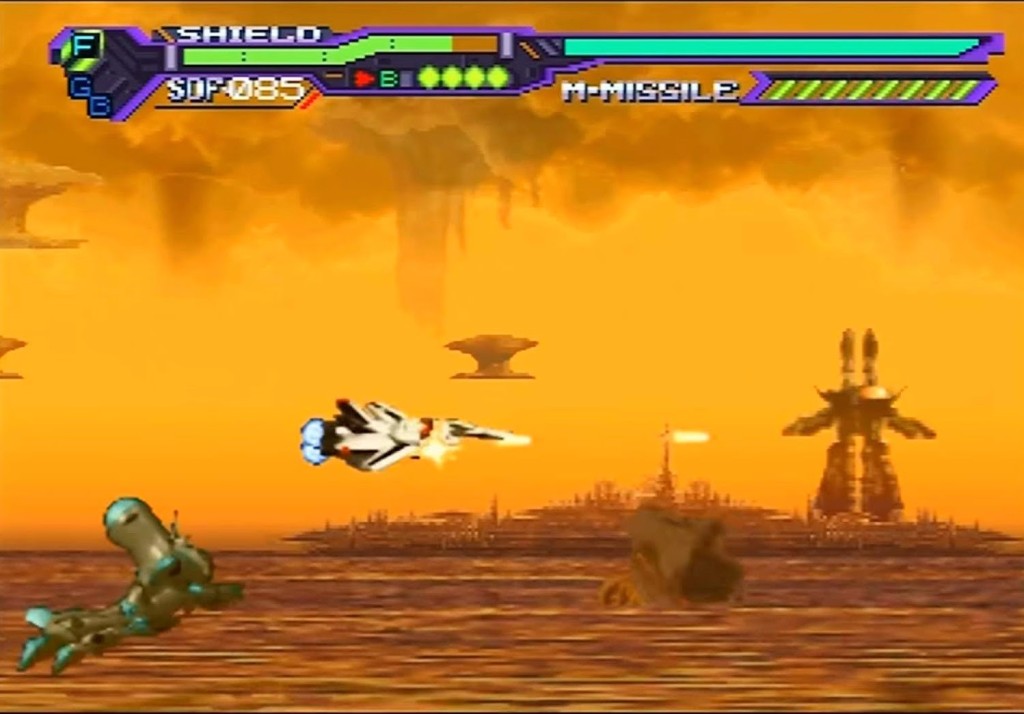
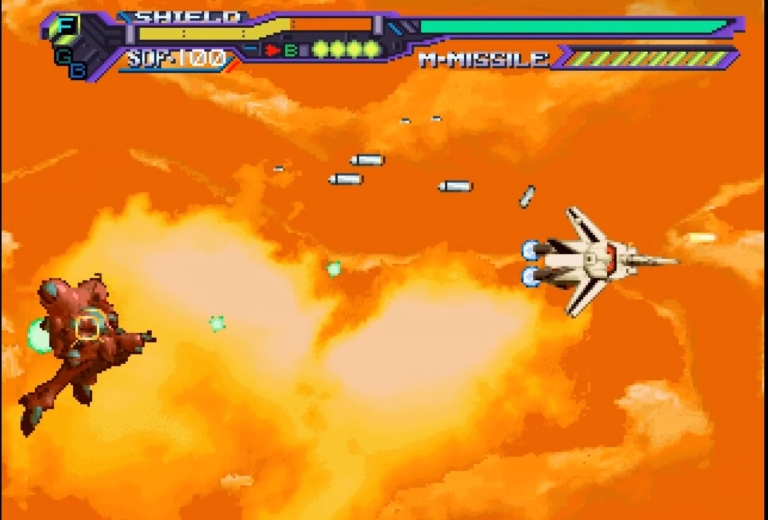
As far as gameplay goes, Macross: DYRL is essentially a 2D side-scrolling shooter literally designed to be grand not only for Macross fans but also for gamers who enjoy its design and its type of gameplay. You play as the hero Hikaru who pilots an advanced fighter plane that can also transform into an armed fighter with legs (GERWALK mode) and also into a full-sized, human-like robot (Battroid). In fighter mode, you move fast and are able to fire rockets or use your default gun. In GERWALK mode, your speed is slower but you have improved mobility that can be crucial for combat. In Battroid mode, your speed is reduced further but you are somewhat stronger and more precise when it comes to shooting enemies.

Still on gameplay, the game developers really pushed the envelope in terms if immersion as there are lots of moments in which the enemies will not only face you on your 2D plane but also move around you from the foreground to the background. Without having to do anything further, your character will be able to auto-aim and shoot at your enemy whether in the background or the foreground. Essentially, this makes the game a 2.5D shooter.

This is a fine example of you (in your 2D plane) firing at your enemy in the background.
In key parts of some levels in the game, the UN Spacy will send a shuttle to release supplies to help you replenish your shield meter.

The controls are relatively easy to learn and get adjusted to. More importantly, the controls are very responsive and they are ideal when it comes to precision on moving your character around as well as trying to shoot at specific targets.

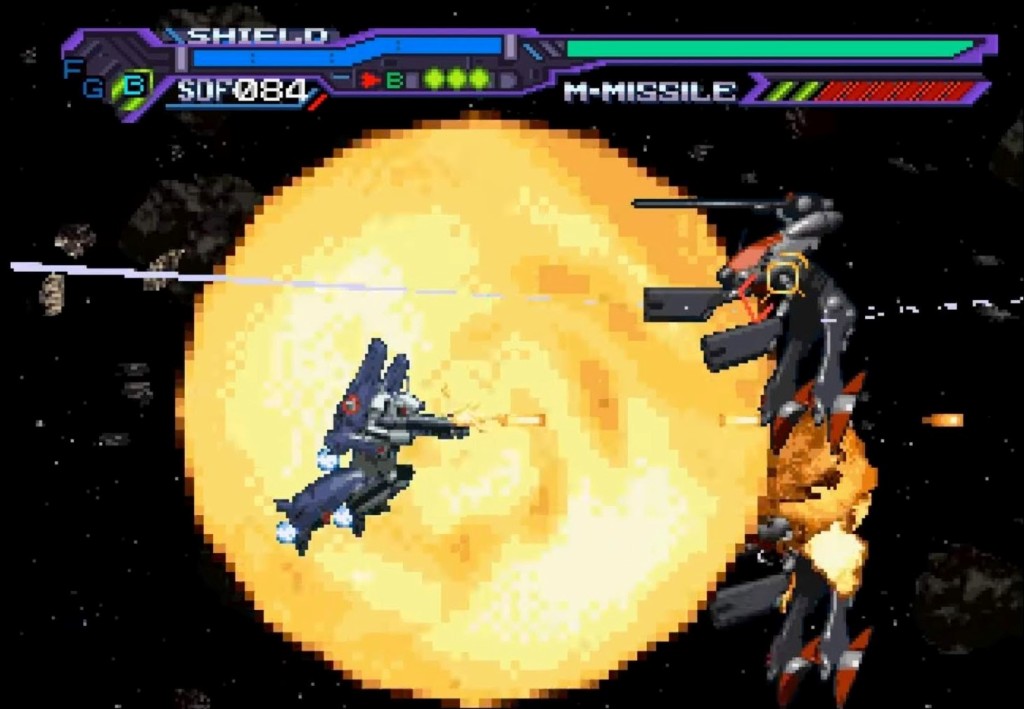
This game was designed with several levels for you to complete essentially moving from left to right. As evidence of the game developers taking liberties during its adaptation of elements from the 1984 animated movie, several levels have boss fights for you to participate in and win in order to progress. These boss-type enemies are noticeably absent from the movie and yet they were designed to integrate into the film’s concept and also expand the concept about how elaborate the Zentradi are when it comes to their war machines against Earth. The boss-type enemies (note: they are clearly polygonal and yet they fit in well with the 2D sprite elements) are huge machines designed for space battles and there were boss fights in which some of them move into the background (which sparks moments for your character to fighter towards the background). When it comes to artificial intelligence (AI), the boss-type enemies are not really that sophisticated with their movements although a few of them have attack patterns that will push you to be more evasive and more strategic.

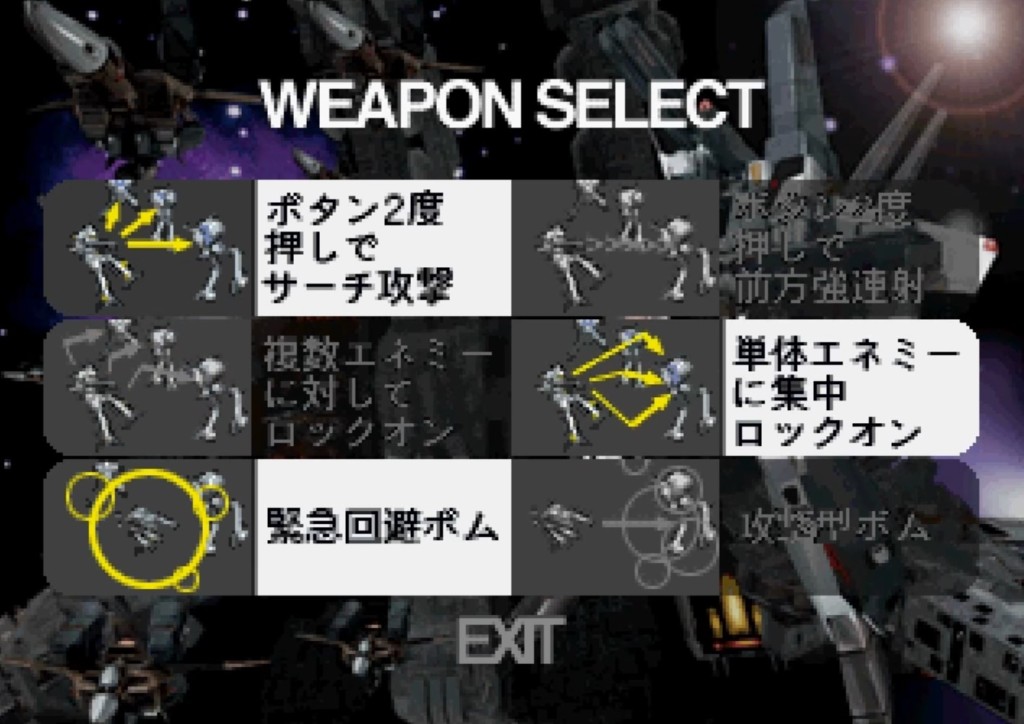
Before starting a level, you can select your weapons that can function depending on your personal preference on taking on the enemies.
Lots of great visual effects and 3D movement add to the challenge.

With regards to challenge, some parts of this game took me a few repeats before finally improving myself enough to make it to the next levels. The visual elements of the game also added to the overall challenge as seeing 2D sprites move around you 3-dimensionally.

Speaking of 2D sprites, it is clear that this game was designed to be heavy with 2D visual elements while 3D polygons are used sparingly (note: the boss battles mentioned above). As this is a side-scrolling game, the game makers clearly made lots of sprites of machines, space ships, Zentradi battle pods and other figures that Macross fans would easily recognize. The good news is that each 2D sprite was made with multiple frames of animation (complete with frames meant for 3D movement) and were made to really resemble the cinematic artworks which ultimately results making them really look lively to watch on-screen!

As for the presentation, I can see that the game developers Scarab paid great attention to the details of the animated movie to make The Super Dimension Fortress Macross: Do You Remember Love? fun and engaging for gamers in general while also becoming strongly relevant and delightful with the people who love Macross. For example, the game starts with a cinematic prologue composed of brand-new animation cels mixed with elements of 3D polygons and in my view, it fits in nicely leading to the actual cinematic opening of the movie from 1984. The cinematic prologue was meant to expand the film’s overall concept and other story expansions happened in subsequent parts of the game (such as the all-new mission told in two levels).

Observe the Zentradi surrounding Roy Fokker on his 2D plane, the foreground and background. This is a 2D sprite-heavy showcase!
The game developers paid close attention to the details of the movie and presented the visuals using video game graphics, 2D sprites and really nice in-game background artworks!
Surprise! You as Hikaru get to fight Milia temporarily before her memorable fight with Max happens!

The Super Dimension Fortress Macross: Do You Remember Love? came with selected animated sequences and still images from the 1984 movie’s very own footage meant for in-game storytelling (note: you still have to watch the movie for the best immersion). As there were some original scenes made for the game with expanding the film’s concept in mind, there are a few computer-generated animation sequences and even brand-new animated cels (note: very clearly they were drawn by people different from the ones who drew the film’s footage) showing some character moments.

When it comes to the audio, this game is clearly a labor of love with Macross fans in mind. Much of the music, songs and sound effects from the movie (as well as from the 1982-1983 anime TV series) were integrated into the game which made it very immersive for Macross fans. As for the voice actors, fans will hear the voices of their favorite Macross characters performed by the late Hase, Iijima, Kamiya, Mika Doi (Misa Hayase), Michio Hazama (Captain Global) and more. While some of their recorded lines from the movie were reused (especially Hase who died in 1996), others recorded new lines for their respective characters for the new cinematic footage as well as key parts in the game.

The art of Lynn Minmay for the new anime footage was clearly not drawn by the people behind the 1984 anime movie.

What I love best about the presentation is that the game developers replicated selected scenes from the 1984 movie using in-game graphics and art along with music, sound effects and the lines of dialogue! As a Macross fan myself, the immersion was pretty deep as I played the game and witnessed those special moments from the movie played within the in-game presentation.

Conclusion

Enjoy looking at this.

I can declare out loud that The Super Dimension Fortress Macross: Do You Remember Love? is indeed the best Macross video game I have ever played as well as the best adaptation (note: other than film) of the classic movie from 1984. This game, which excellently used 2D sprites and 3D polygons all throughout, was very clearly made to delight Macross fans while giving gamers something very enjoyable and memorable to experience. For the best immersion, it is highly recommended to watch the movie before playing this video game. Truly this video game has aged well!

Overall, The Super Dimension Fortress Macross: Do You Remember Love? (Sega Saturn, PlayStation) is highly recommended!

+++++

Thank you for reading. If you find this article engaging, please click the like button below and also please consider sharing this article to others. If you are looking for a copywriter to create content for your special project or business, check out my services and my portfolio. Feel free to contact me as well. Also please feel free to visit my Facebook page Author Carlo Carrasco and follow me at HavenorFantasy@twitter.com

Macross at Toycon 2019

Sorry for this late feature but I wish to share to you geeks and hobbyists that during the 2019 edition of the Toycon held this past June at the SMX Convention Center in Pasay City, I spotted the display of Macross.

I’m a Macross fan and I always make it a point to find stuff related to my favorite anime franchise whenever a convention happens. Here are some that I spotted during the Toycon.

20190629_105722.jpg
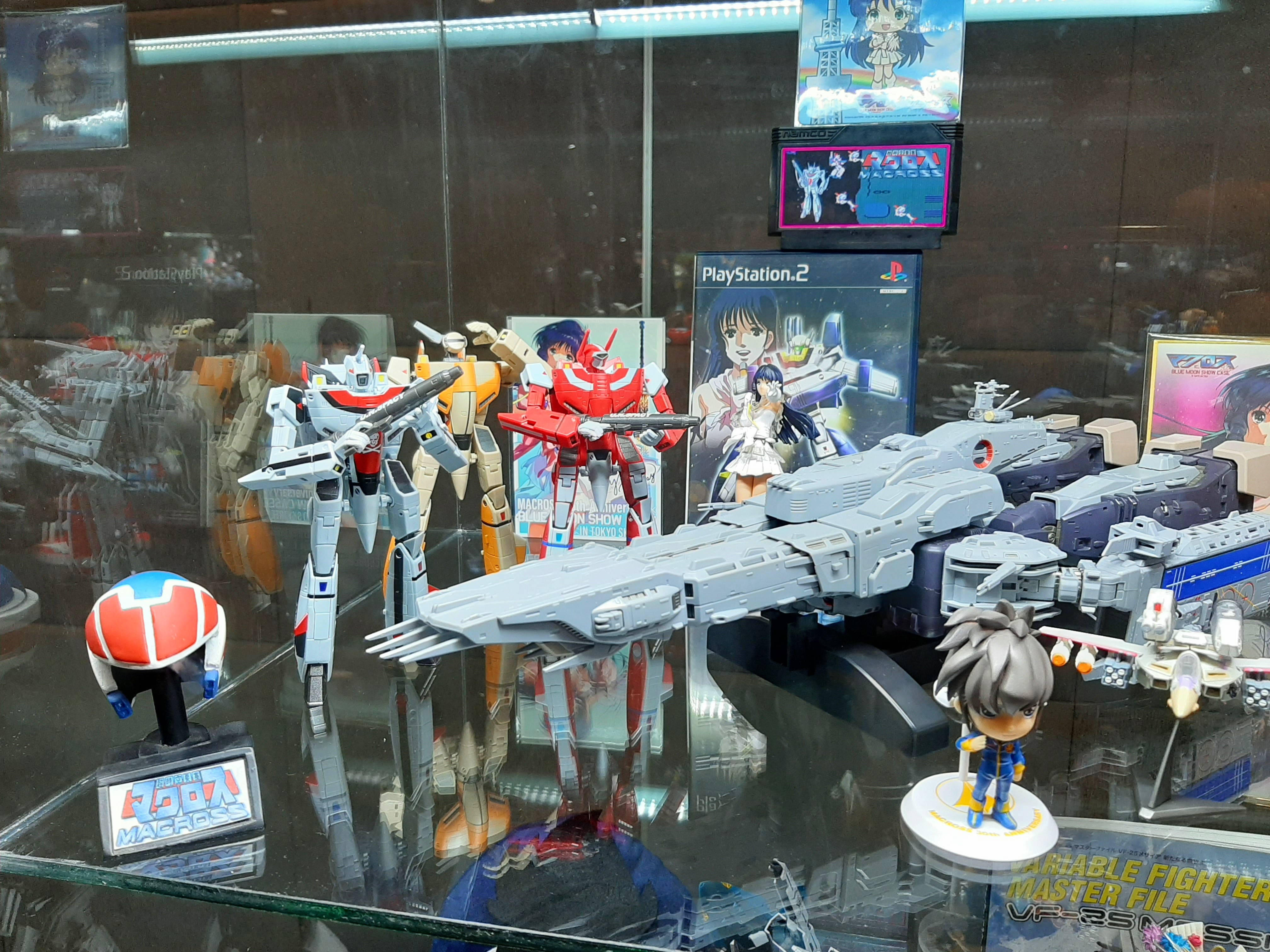
The YF-19 from Macross Plus and its weapons on display. Behind it are varied video games and manuals.

20190629_105754.jpg
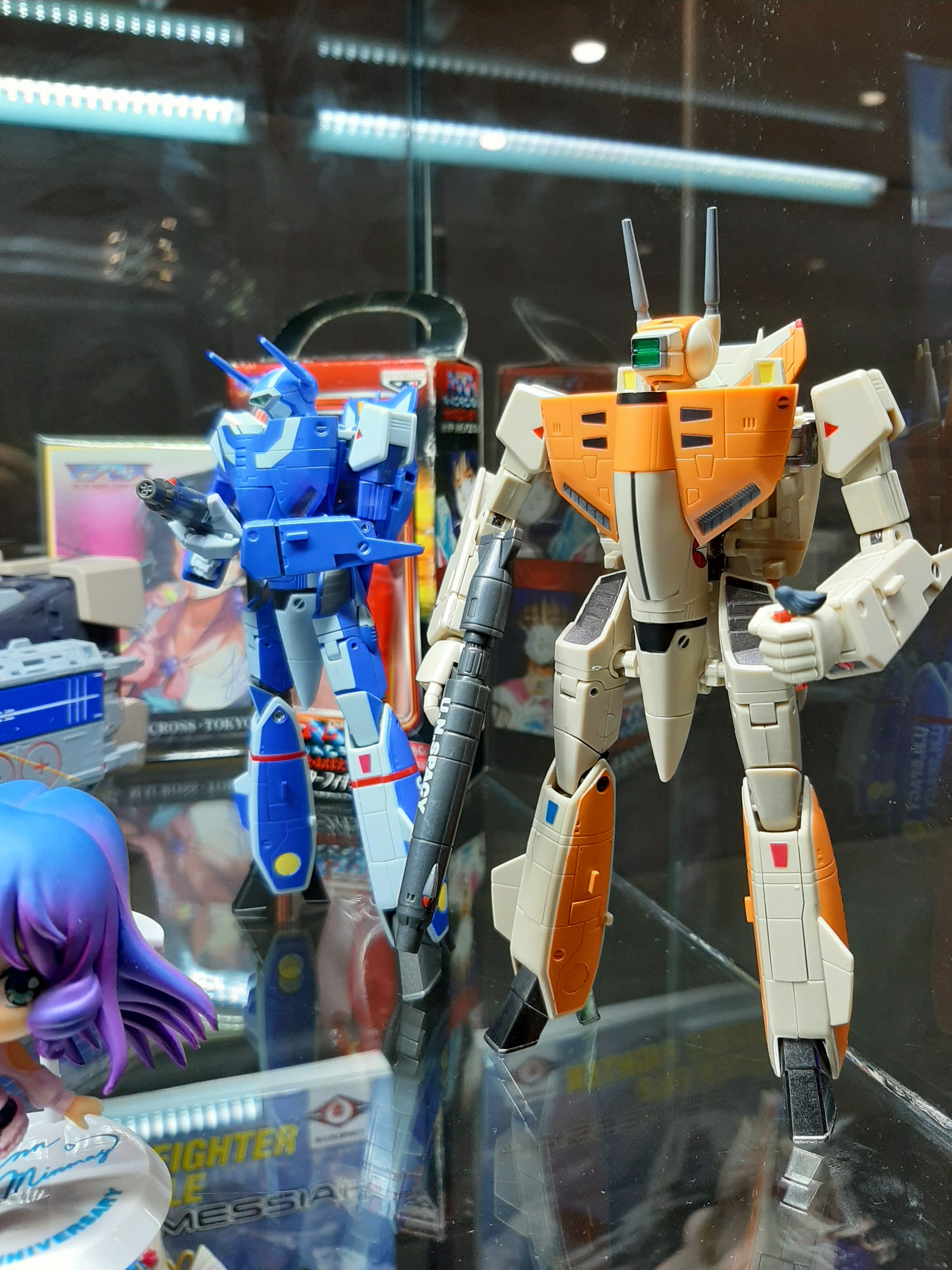
A close look at these mean machines. The one on the right reflects the model of used by Hikaru in the first few episodes of the 1980s Macross anime TV series complete with holding Lynn Minmay for safety.

At the 2nd level of the convention center was a function hall which has a large display of collected items of varied entertainment franchises. The one showcasing Macross had toys, action figures, plastic models, video games, music CDs and some printed materials.

What caught my attention was the display of the YF-19 from Macross Plus complete with its weapons in full view.

20190629_105744.jpg
Memories of the 1980s anime TV series as well as the 1984 classic movie Macross: Do You Remember Love? entered my mind.

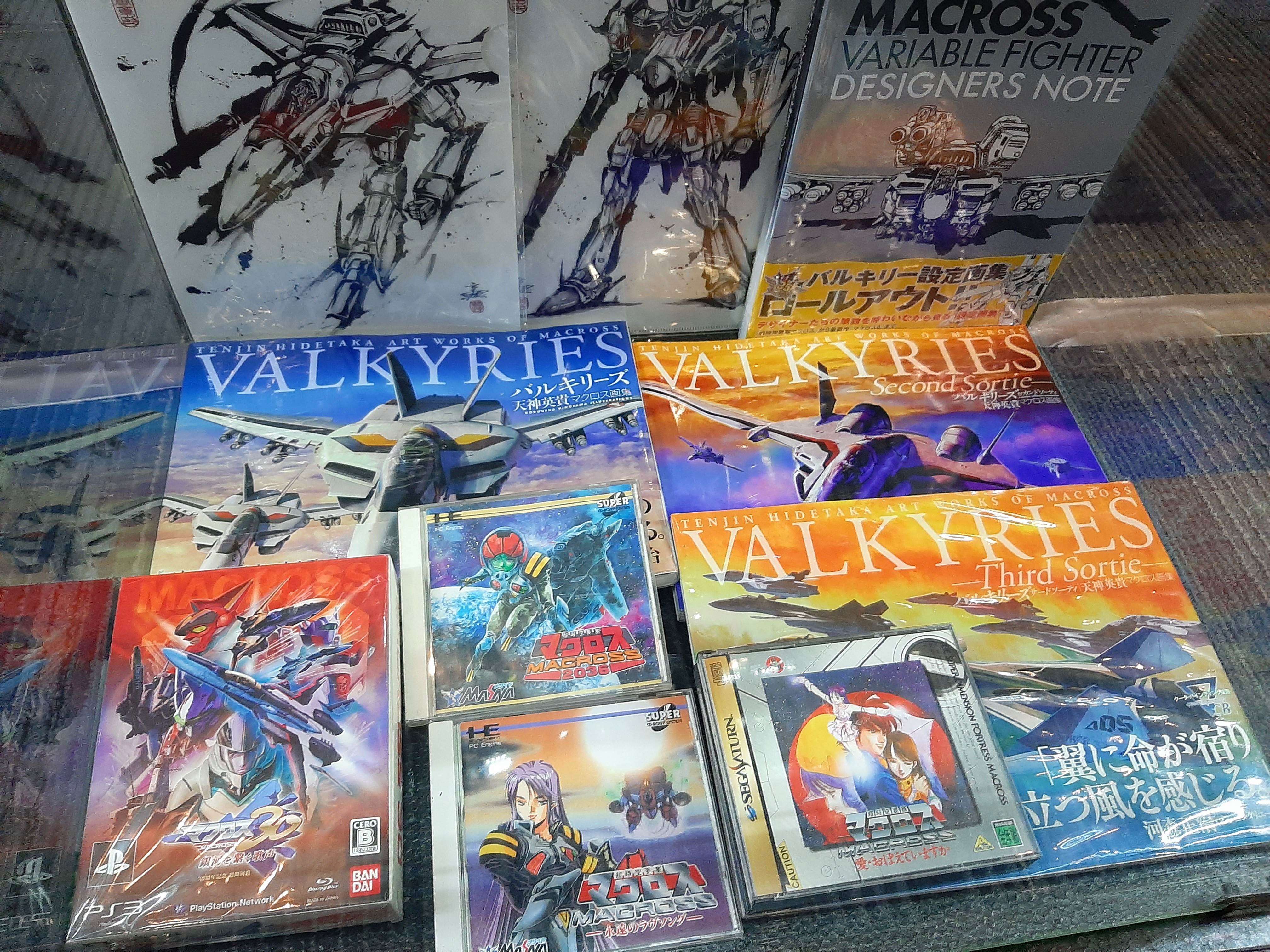
Also seeing an original copy of the 1990s Sega Saturn video game adaptation of Macross: Do You Remember Love? instantly made me remember playing and enjoying the PlayStation version of that game. The Sega Saturn game can be seen in the picture below.

20190629_105730.jpg
Art, books, soundtracks and the Sega Saturn video game.

As much as I enjoyed the display of Macross memorabilia, I regret to say that I was unable to find any more related collectibles or products for sale among the many vendors at the lower level during the Toycon. I searched for whatever Macross stuff I could find (t-shirts, comic books, action figures, models, cards and others) but ended up with nothing.

Then again, it should NOT be surprising at all. Macross as an entertainment franchise is not exactly popular here in the Philippines and Macross Mania in the country has ended long ago. To say the least, the popularity of Macross here in the Philippines is limited to older fans and collectors. Anime is a lot more popular among Filipinos in this modern age but that does not mean Macross found a new nor large audience.

If ever the legendary Shoji Kawamori (whom I met at AsiaPOP Comicon Manila in 2017) or any notable Macross-related talent comes here in the Philippines, only then will the Macross brand gain attention.

20190629_105810.jpg
Another close look.

If you love anime or Macross, then I invite you to read my retro movie review of Macross: Do You Remember Love? right here. I also wrote about the famous Lynn Minmay here.


Thank you for reading. If you find this article engaging, please click the like button below and also please consider sharing this article to others. Also my fantasy book The World of Havenor is still available in paperback and e-book format. If you are looking for a copywriter to create content for your special project or business, check out my services and my portfolio. Feel free to contact me as well. Also please feel free to visit my Facebook page Author Carlo Carrasco and follow me at HavenorFantasy@twitter.com