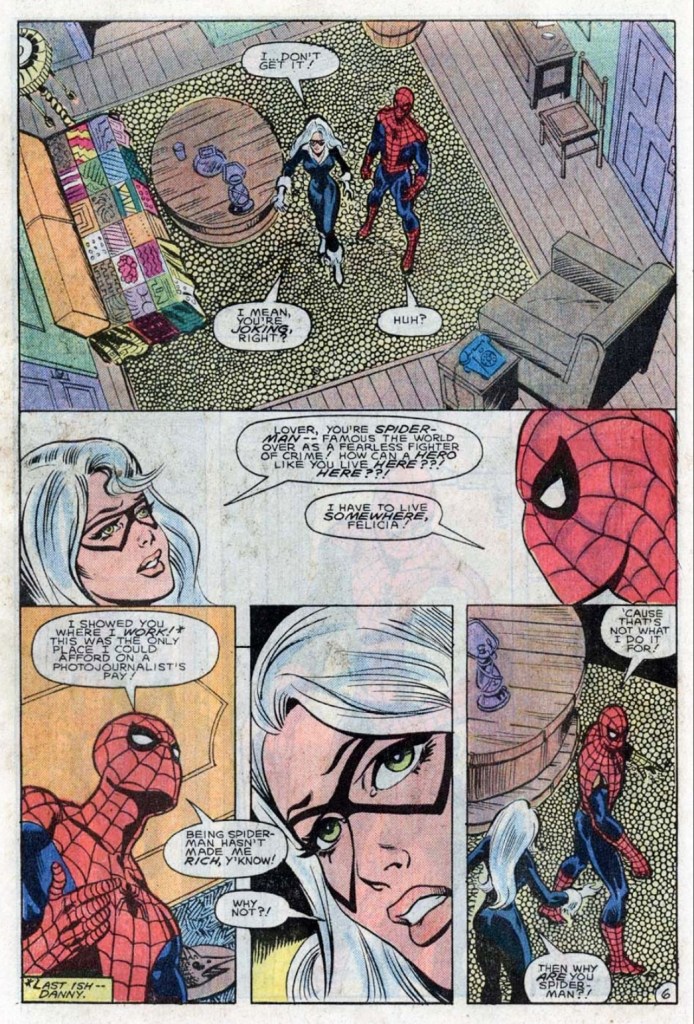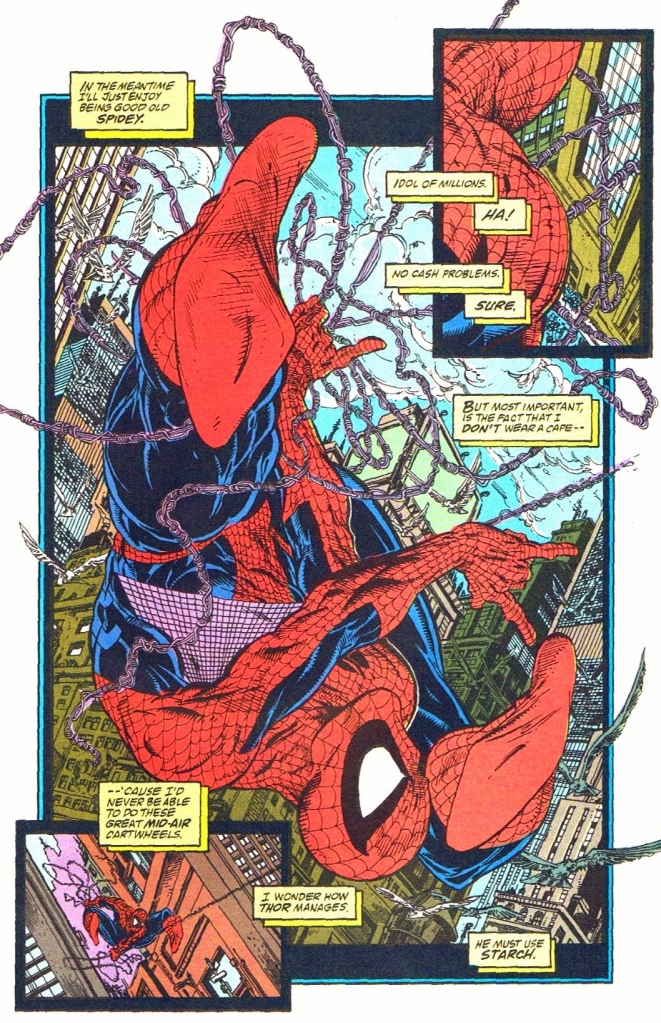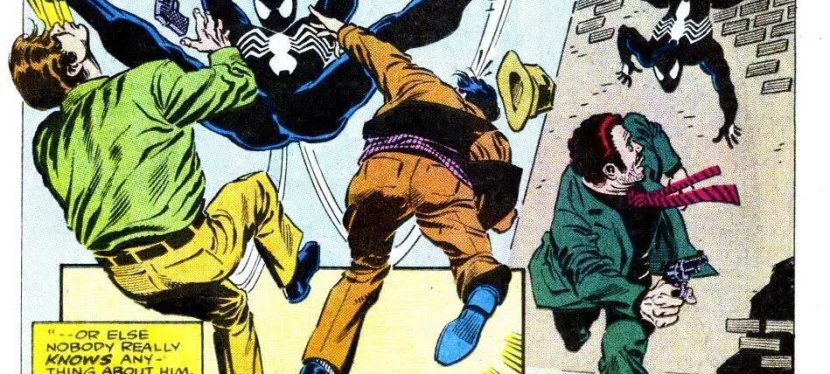
A Look Back at Amazing Spider-Man #389 (1994)

Welcome back superhero enthusiasts, 1990s arts and culture enthusiasts, Spider-Man fans and comic book collectors! Today we go back to the mid-1990s to examine a small part of the Marvel Comics shared universe through a tale of the Amazing Spider-Man monthly series.

We are finally here! I’m talking about the fourth chapter of the Pursuit storyline featuring a broke-hearted and revenge-obsessed Spider-Man who has been more violent in his search for the Chameleon. It should be noted that his marriage with Mary Jane has turned for the worse as time went on. For my previous retro comic book reviews about the Pursuit storyline, click here, here and here.

With those details laid down, here is a look back at Amazing Spider-Man #389, published in 1994 by Marvel Comics with a story written by David Michelinie and drawn by Mark Bagley.

Early story

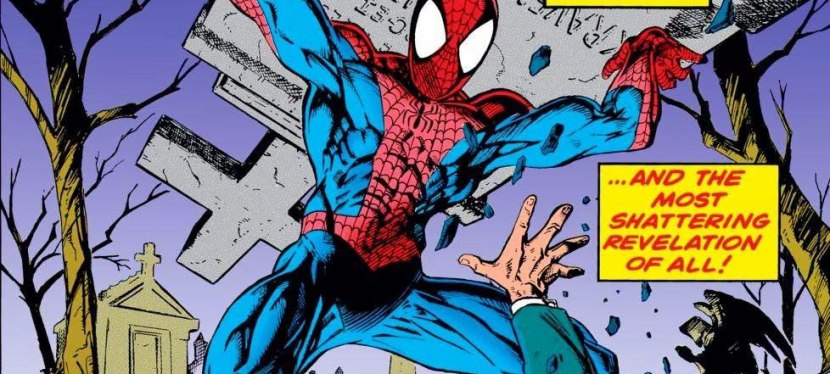
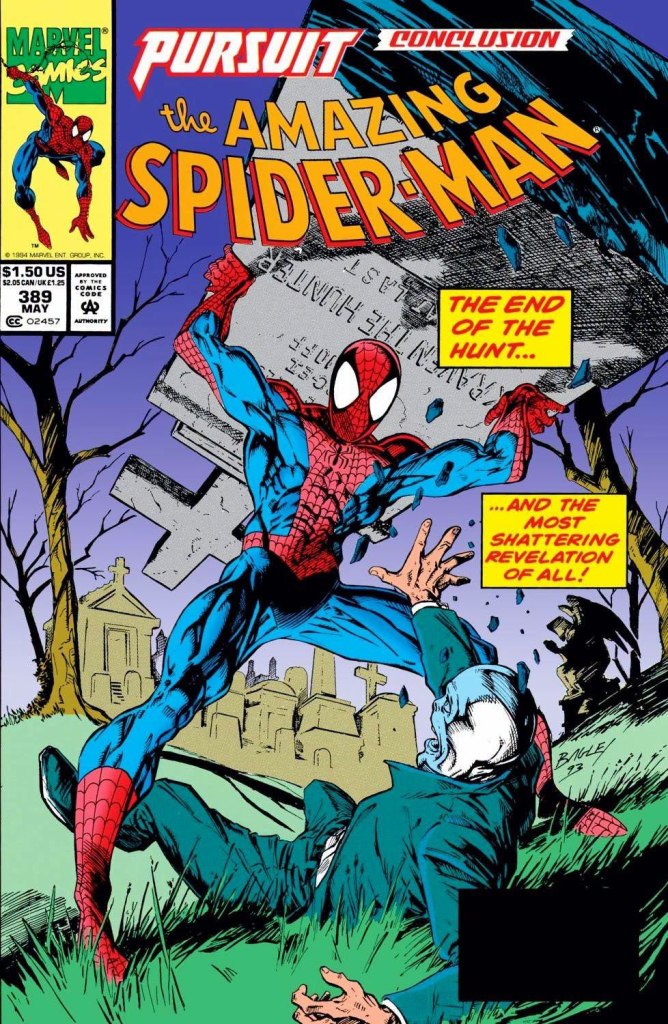
The story begins at a very familiar tomb stone. It marked the very spot where Spider-Man was once buried in (refer to Kraven’s Last Hunt). Nearby is the tomb stone referring to the late Kraven the hunter. Moments earlier, Spider-Man discovered the coffin is empty which shocked him. Even though he is burdened with stress fighting the Chameleon, memories of his past encounters with Kraven and the impostors (who posed as his late mother and father) flashed in his mind bringing back pain and anguish.

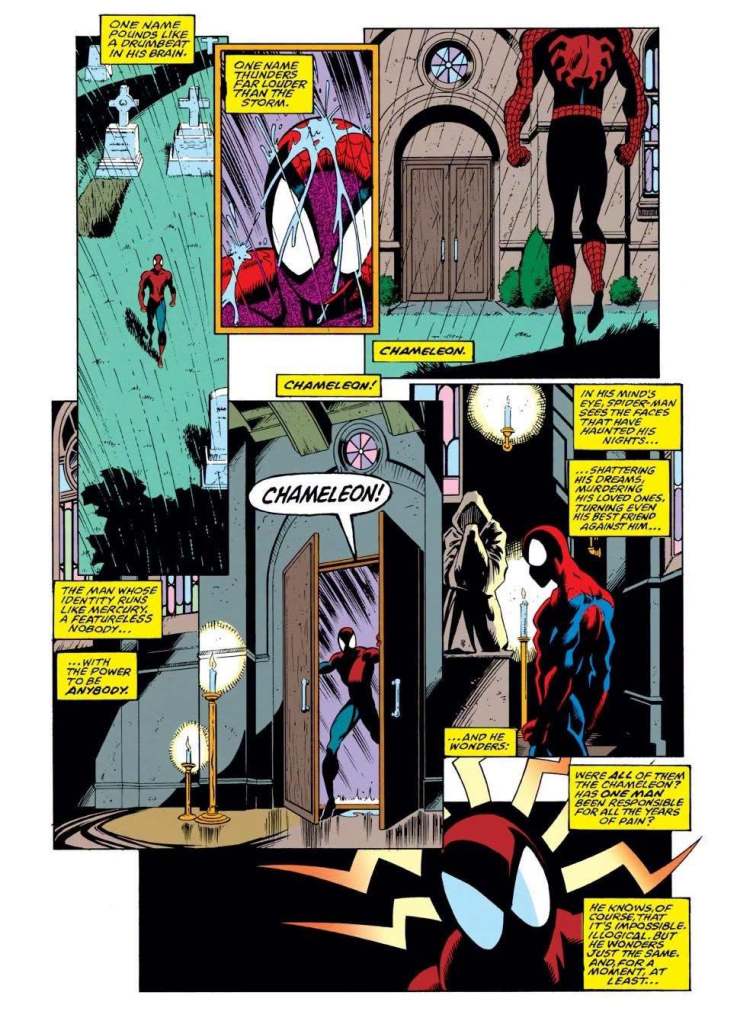
Spider-Man decides that the time of mourning (dating back to the day he lost his parents when he was little) has to stop and slowly makes his way into Kraven’s mansion. As soon as the door opens, he shouts the Chameleon’s name…

Quality

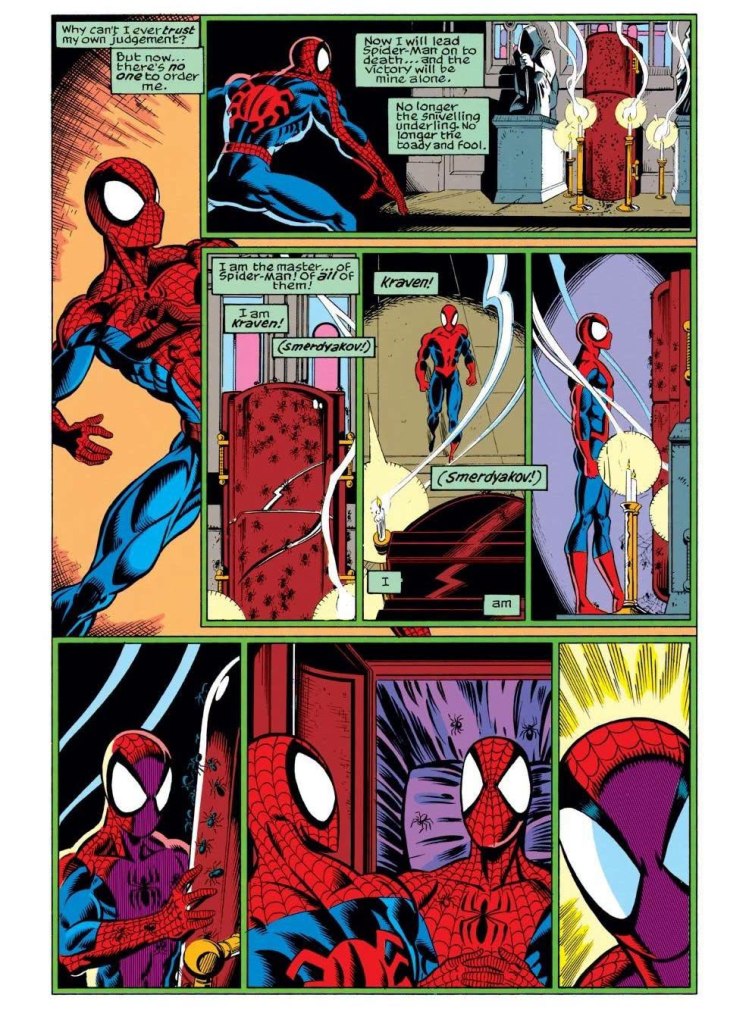
Spider-Man deals with a physical distraction set-up by the Chameleon inside the mansion of the late Kraven.

As the conclusion to the 4-part Pursuit storyline, this comic book is very intense and it is clear to me that the Michelinie-Bagley duo went all-in to pack it with a lot of punch and a startling revelation that really defined the Chameleon.

While previous chapters showed the broken and revenge-hungry Spider-Man getting more violent towards others as he pursued the Chameleon, this comic book has the webslinger fully unhinged within the setting of Kraven’s property. Spider-Man here goes through two so-called death traps before finally encountering the Chameleon in person. As he fought with the tigers and the mechanized set-ups (in the forms of the type of animals hunted by man), Spider-Man was truly determined to kill the master of disguise and he did not hold back with his violent attacks.

Readers will witness the moment when the spectrum of good and evil got twisted as the Chameleon becomes very fearful of Spider-Man who is so unrelenting he looked truly murderous. That said, the famous webslinger himself is a shadow of what he was and there were moments when I felt he was becoming evil. Indeed, the loss of beloved family members combined with the obsession for revenge against the responsible one can turn good people into destructive individuals moving towards evil. At this point of the Pursuit storyline, Michelinie and Bagley took huge creative risks as they worked to make a conclusion that is believable, intriguing and compelling at the same time.

But that is not all. The Chameleon himself got highly developed in this very late stage of the Pursuit storyline. His relationship with Kraven the hunter was revealed with lots of details pointing to their heritage in Russia with clear separate paths – Kraven was privileged while the Chameleon (Dmitri Smerdyakov) had a more painful life. Chameleon’s perception towards Kraven is complicated as he admires him while still harboring a deep resentment towards him. The revelations about the Chameleon’s past and connections with the late hunter really added dramatic value and tension in the story.

Conclusion

This is the calm before the storm (Spider-Man’s rage and obsession with revenge).

Amazing Spider-Man #389 (1994) is indeed a powerful conclusion to the Pursuit storyline. It went as far as showing Spider-Man as the unhinged force of destruction who was determined to really kill the Chameleon and is also succeeded on defining the super villain’s personality with revelations about his Russian heritage with the late Kraven. This comic book also sheds light as to why the Chameleon became proficient with impersonating people and changing his face physically. There will be times when you could feel pity for both Spider-Man and the master of disguise as their respective emotional states and obsessions were powerfully dramatized by the Michelinie-Bagley duo. When it comes to conclusions, the very ending of this comic book is startling and it does not have much to do with the Chameleon.  

Overall, Amazing Spider-Man #389 (1994) is recommended.

+++++

Thank you for reading. If you find this article engaging, please click the like button below, share this article to others and also please consider making a donation to support my publishing. If you are looking for a copywriter to create content for your special project or business, check out my services and my portfolio. Feel free to contact me with a private message. Also please feel free to visit my Facebook page Author Carlo Carrasco and follow me on Twitter at  @CarloCarrascoPH as well as on Tumblr at https://carlocarrasco.tumblr.com/ and on Instagram at https://www.instagram.com/authorcarlocarrasco

A Look Back at Web of Spider-Man #112 (1994)

Welcome back superhero enthusiasts, 1990s culture enthusiasts and comic book collectors! Today we go back to the year 1994 to explore a part of the Marvel Comics shared universe through the Web of Spider-Man monthly series.

In this review, we will be looking at the 3rd chapter of the Pursuit storyline. Spider-Man #45 showed a broken-hearted Spider-Man who starts his quest for vengeance against the Chameleon whom he holds responsible for the deception that happened in Amazing Spider-Man #388. As the webslinger continued his search for answers while hurting a lot of thugs, the Chameleon deceptively hires the service of a contractor to kill Spider-Man. That said, the tension really built-up a lot and we will find out what will happen next.

With those details laid down, here is a look back at Web of Spider-Man #112, published in 1994 by Marvel Comics with a story by Terry Kavanaugh and drawn by Alex Saviuk. This is the 3rd chapter of the Pursuit storyline.

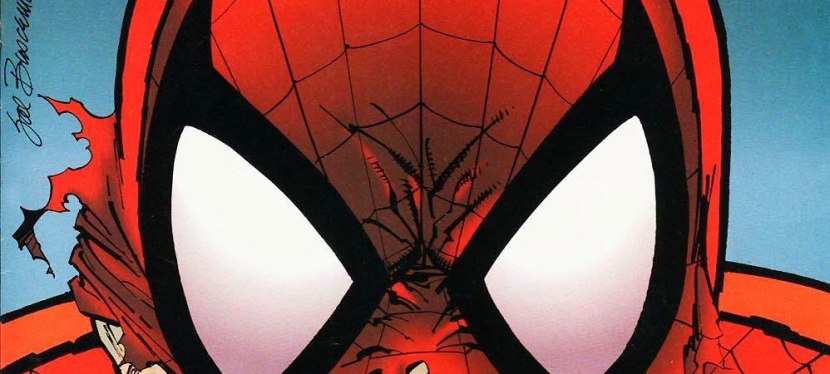
The cover.

Early story

The story begins deep within New York City. A bus full of prisoners and armed guards makes its way through the rough streets of the city. The guard notices that they are taking a long route and approached the bus driver – the Chameleon in disguise.

The Chameleon is aware that Spider-Man has been tracing him and he puts his sinister plan into action by suddenly hitting the brakes, helping the prisoners overcome the guards, and letting them loose in the city to spark chaos.

Spider-Man swings into action as prisoners get off the bus. Already stressed and obsessed with his search for the Chameleon, he lands on top of the bus and gains access through one of the windows. As the Chameleon fails to maintain his disguise, the webslinger notices him…

Quality

As if he does not have enough stress and tension, Spider-Man also has to deal with the Chameleon’s plan of terrorism.

Following the events of the first two chapters, the storytelling in this comic book really turned intense as the stakes were raised. As expected, Spider-Man is doing things the hard way as his obsession for revenge against the Chameleon continues to burn strongly, and his wife Mary Jane is suffering from the loneliness connected with it.

On the raising of stakes in the plot, there is a theme about terrorism here which is dramatized through the Chameleon’s elaborate plan of setting off bombs in several parts of New York. As such, the story has this emphasis on chaos which works well with the webslinger’s state of madness and desperation. Along the way, Spider-Man’s humanity remains as dramatized in key points of the comic book.

In connection with the chaos and terrorism elements, the action here looked grounded with reality and Alex Saviuk’s style made the tale look gritty.

One notable part of this comic book shows the development of a separate sub-plot in Washington, D.C., which reflects developments that took place in Web of Spider-Man #109 to #111. It has a touch of politics and was effectively a distraction from the main story.  

Conclusion

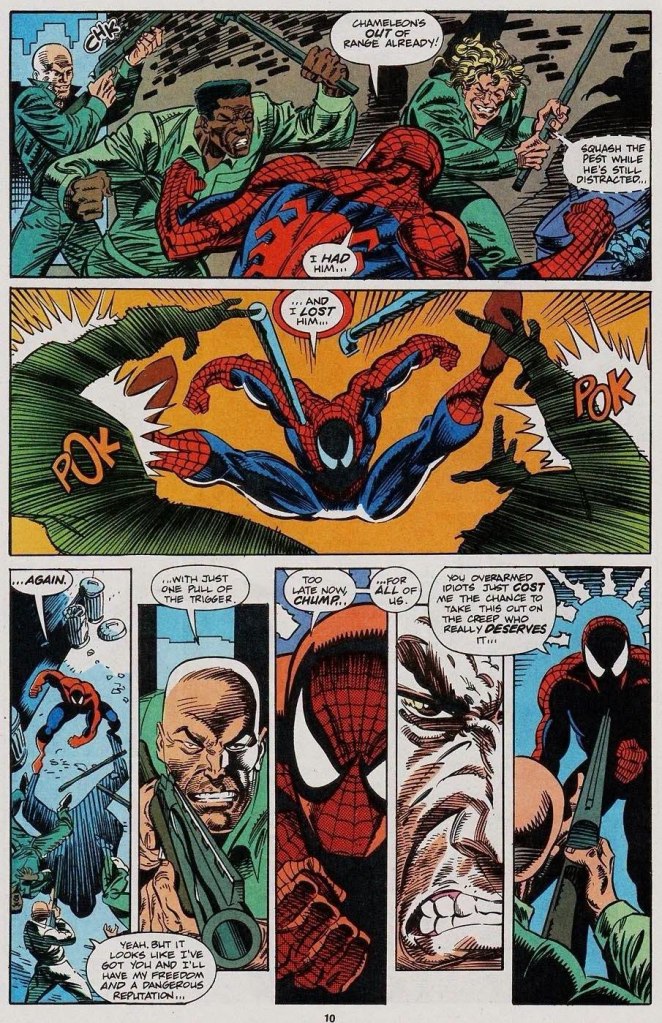
Spider-Man dealing with freed prisoners in the middle of New York City.

Web of Spider-Man #112 (1994) is easily the most intense and most action-packed chapter of the Pursuit storyline. The themes of chaos and terrorism here easily overshadowed Spider-Man’s obsessive state and yet the creative team succeeded in moving the plot forward. That said, the stage is all set for the conclusion of the Pursuit storyline and I am looking forward to it.

Overall, Web of Spider-Man #112 (1994) is recommended.

+++++

Thank you for reading. If you find this article engaging, please click the like button below, share this article to others and also please consider making a donation to support my publishing. If you are looking for a copywriter to create content for your special project or business, check out my services and my portfolio. Feel free to contact me with a private message. Also please feel free to visit my Facebook page Author Carlo Carrasco and follow me on Twitter at @CarloCarrascoPH as well as on Tumblr at https://carlocarrasco.tumblr.com/and on Instagram athttps://www.instagram.com/authorcarlocarrasco

A Look Back at Spectacular Spider-Man #211 (1994)

Welcome back superhero enthusiasts, 1990s arts and culture enthusiasts, Spider-Man fans and comic book collectors! Today we go back to the year 1994 to examine a small part of the Marvel Comics shared universe through a tale of the Spectacular Spider-Man monthly series.

Following the tragedy told in Amazing Spider-Man #388, Spider-Man got broken emotionally and he started lusting for revenge against the Chameleon in Spider-Man #45 which marked the beginning of the Pursuit storyline. Along the way, the webslinger became more intense, more violent and his marriage with Mary Jane got strained even more.

With those details laid down, here is a look back at Spectacular Spider-Man #211, published in 1994 by Marvel Comics with a story written by Mike Lackey and drawn by Sal Buscema. This is the 2nd chapter of the Pursuit storyline.

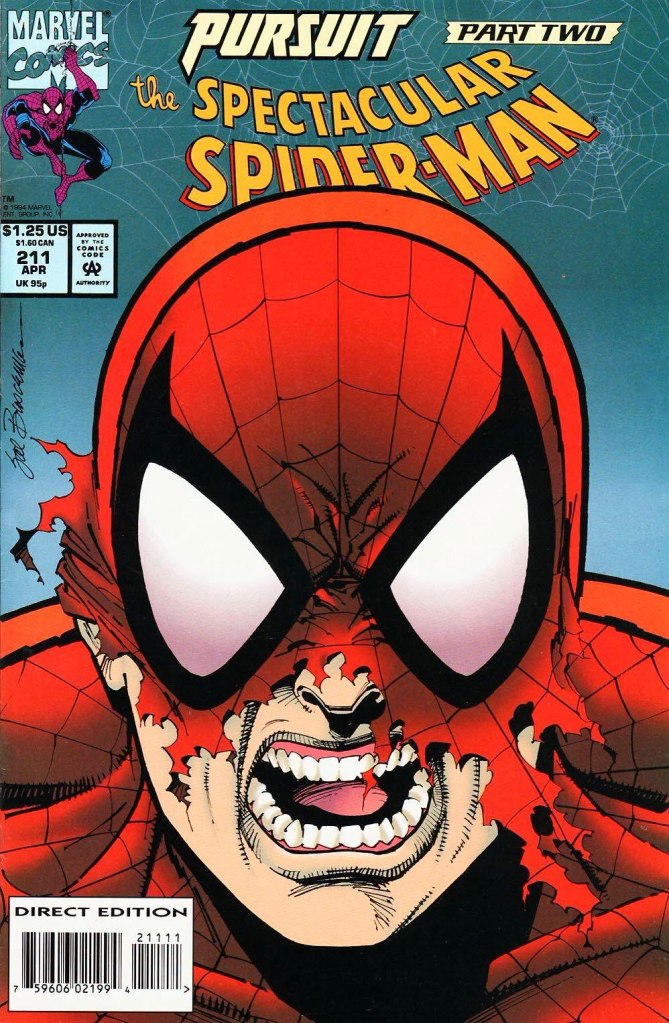
The cover.

Early story

The story begins with Spider-Man overwhelming an entire gang of dangerous men on the rooftop of a building. Even though they were armed dangerous, the obsessed webslinger successfully hurt each of them until they fell down on the floor. He beat them all as he obsessively searched for answers about the Chameleon. One of them told Spider-Man they don’t know where the Chameleon is but they heard that he offered a million Dollars to hit him (Spidey). Realizing that he just had another dead end for his search, the webslinger traps them all with his web and then swings away to another destination.

Meanwhile at one of the units of a residential tower in New York, the Chameleon cannot help but smash a lot of things as he struggles with his anger and hatred with Spider-Man. He knows that it is a matter of time before the webslinger finds him…

Quality

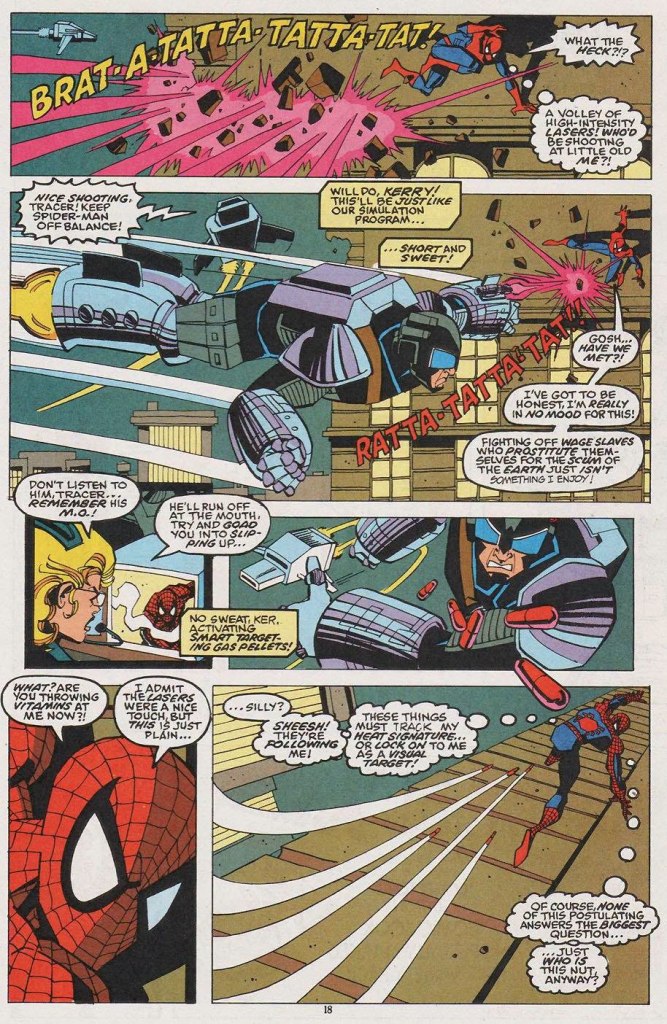
Spider-Man gets attacked by Tracer.

In this 2nd chapter of the Pursuit storyline, things really intensified as the plot unraveled. As Spider-Man does his search for the Chameleon and answers, the said super villain executed his strategies that involve deception and deep resources that go beyond money. As such, the webslinger became the target of Tracer who has a powered suit of armor and high-tech weaponry.

As anticipated, Spider-Man remains driven by revenge in his quest for the Chameleon and because of his broken emotional state, he has gotten more violent with his physical action. He also turned sarcastic in key moments which is a lively reminder that this Spider-Man is no longer the friendly neighborhood hero he used to be. The famous webslinger is not completely unhinged here as his concern for bystanders showed he still has some humanity left within him.

When it comes to the Chameleon, this comic book portrays him to be very cunning and resourceful. His deception towards others might draw emotions from you and might make you wish he will suffer a lot once Spider-Man finds him.

Conclusion

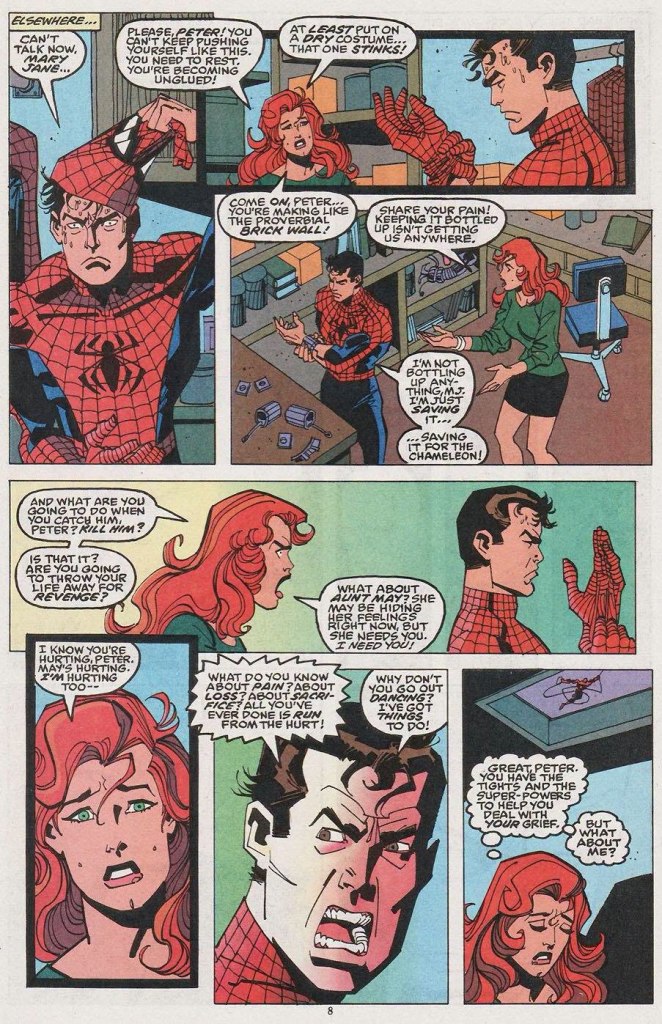
A sad look at the poor emotional state of Peter Parker and the sadness over his marriage with Mary Jane.

As the 2nd part of the Pursuit storyline, Spectacular Spider-Man #211 (1994) delivers a portrayal of a deeply hurt Spider-Man whose lust for revenge keeps him going no matter what obstacles he faces. As readers, we witness his intense search for the dreaded villain Chameleon as well as his emotional deterioration. That said, this comic book has a somewhat depressing tone as Spider-Man’s life gets worse and his wife Mary Jane is suffering too. Ultimately, this comic book convinced me to continue with the storyline.

Overall, Spectacular Spider-Man #211 (1994) is recommended.

+++++

Thank you for reading. If you find this article engaging, please click the like button below, share this article to others and also please consider making a donation to support my publishing. If you are looking for a copywriter to create content for your special project or business, check out my services and my portfolio. Feel free to contact me with a private message. Also please feel free to visit my Facebook page Author Carlo Carrasco and follow me on Twitter at @CarloCarrascoPH as well as on Tumblr at https://carlocarrasco.tumblr.com/ and on Instagram at https://www.instagram.com/authorcarlocarrasco

A Look Back at Peter Parker, The Spectacular Spider-Man #108 (1985)

Welcome back superhero enthusiasts, 1980s arts and culture enthusiasts, Spider-Man fans and comic book collectors! Today we go back to the year 1985 to examine a small part of the Marvel Comics shared universe through a tale of the Peter Parker, The Spectacular Spider-Man monthly series.

I found issue #107 – the first issue of the Sin-Eater storyline – a pretty engaging tale focused on the murder of Jean DeWolff. The sudden demise of DeWolff really impacted the city of New York and its tale involved not only Spider-Man but also Daredevil. The tale is really a murder mystery that is very grounded with reality.

With those details laid down, here is a look back at Peter Parker, The Spectacular Spider-Man #108, published in 1985 by Marvel Comics with a story written by the late Peter David and the late Rich Buckler.
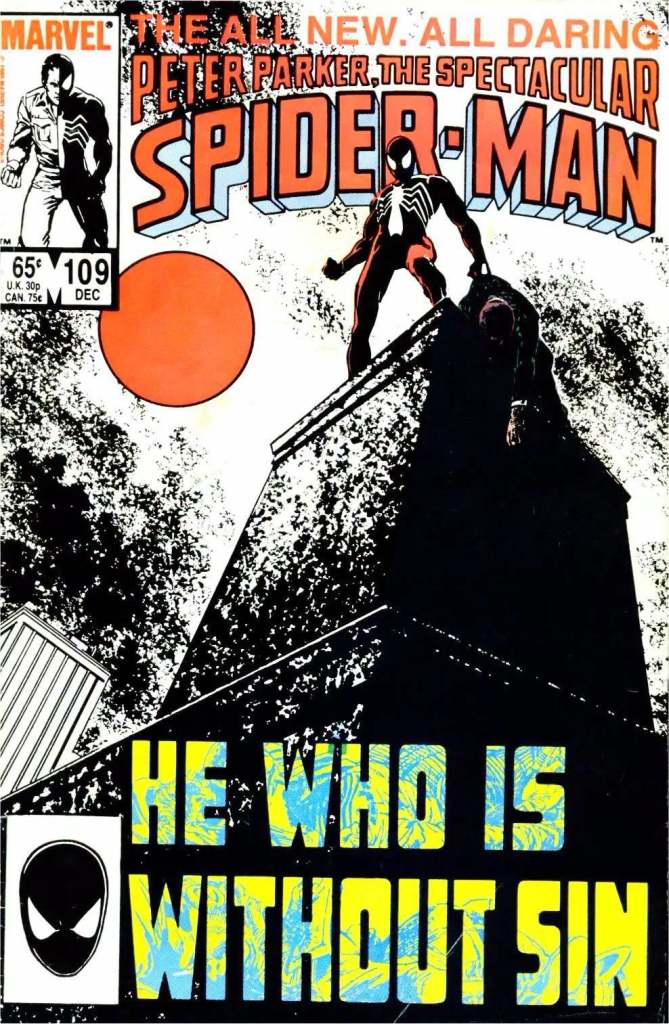
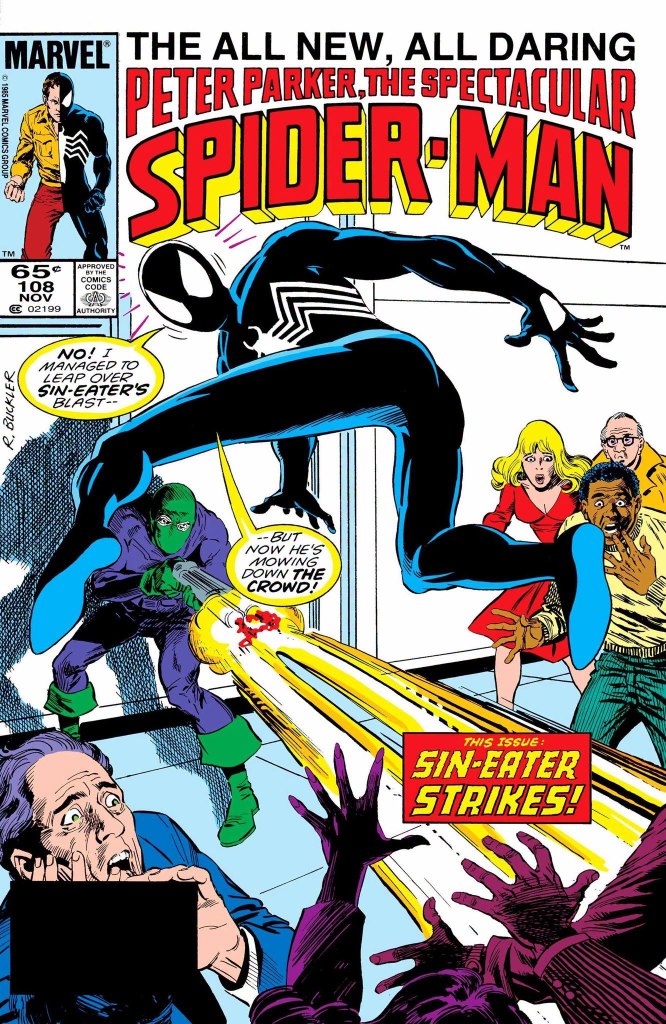
The cover.

Early story

The story begins with Judge Rosenthal lying dead on the floor in his office. Moments earlier, the judge was killed by the Sin-Eater who used a shotgun and in the same room was Matt Murdock (Daredevil). Some people entered the office and the local authorities were called. Murdock slowly makes his way out to discreetly go after the Sin-Eater.

In another part of the city, Peter Parker, Aunt May and the elderly friend named Ernie walk together coming from the courthouse. Ernie could not believe that Judge Rosenthal let go of the punks who mugged him.

As they walked further, people around them begin to panic and move around fast. Peter gets separated from his aunt and Ernie, and eventually he realizes that the Sin-Eater is several feet away armed with a shotgun. The Sin-Eater is speaking to the people even though he is causing a huge disturbance.

Moments later, Peter changed into Spider-Man and proceeds to confront the Sin-Eater in front of many witnesses…

Quality

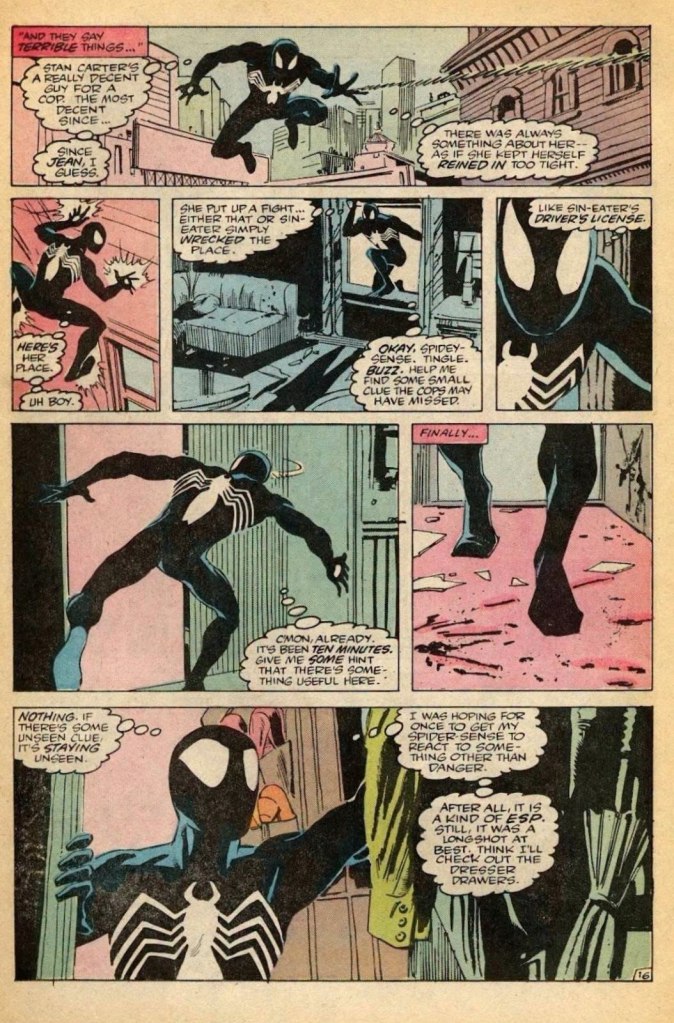
Spider-Man investigating the apartment of Jean DeWolff.

Following the events of issue #107, this comic book shows more of the Sin-Eater and the story emphasizes why he is very dangerous to everyone. The Sin-Eater is not a superbeing himself, and yet he is capable of killing people and causing chaos in public without the need of having multiple weapons and ammunition. That said, he is tremendous villain that Spider-Man has difficulty handling.

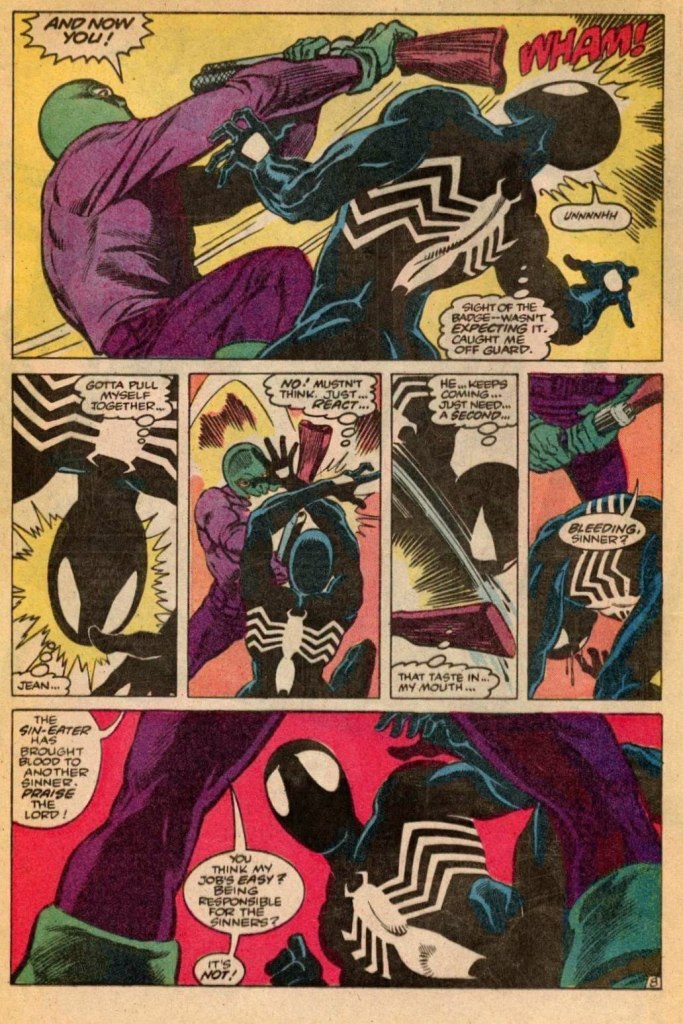
The physical encounter between Spider-Man and the Sin-Eater here is unsurprisingly ground in reality. The comic book action visualized by Rich Buckler has this raw action aesthetic and each time a physical blow was executed, impact is really felt. Don’t expect dynamic action here but a more realism and believability.

What makes the fight between the two unique is that it happened in front of a lot of people on New York City’s street. As the fight went on, Spider-Man struggles not only with fighting the Sin-Eater (a truly violent opponent) but also dealing with the risk of bystanders getting hurt and realizing what happened to his beloved Aunt May.

As expected, the detective story elements in this tale are very strong. Spider-Man, who is not a professional detective at all, gets to do detective work with a sheer determination to solve the mystery behind the death of Jean DeWolff. Along the way, I love how the David-Buckler duo invested a lot of details about the crime which are really worth paying attention to as you read.

Conclusion

The Sin-Eater and Spider-Man in a violent fight!

Peter Parker, The Spectacular Spider-Man #108 (1985) is a powerful follow-up in the Sin-Eater storyline. As it contains all the key elements that made issue #107 a very unique and engaging read, this comic book executed good pay-off to the build-up in the previous issue while consistently building-up the plot simultaneously which is typical of Peter David (read the Spider-Man 2099 comic books back-to-back). As of now, this Sin-Eater storyline is compelling and I am looking forward to what comes next.

Overall, Peter Parker, The Spectacular Spider-Man #108 (1985) is recommended.

+++++

Thank you for reading. If you find this article engaging, please click the like button below, share this article to others and also please consider making a donation to support my publishing. If you are looking for a copywriter to create content for your special project or business, check out my services and my portfolio. Feel free to contact me with a private message. Also please feel free to visit my Facebook page Author Carlo Carrasco and follow me on Twitter at @CarloCarrascoPH as well as on Tumblr at https://carlocarrasco.tumblr.com/ and on Instagram at https://www.instagram.com/authorcarlocarrasco
A Look Back at Peter Parker, The Spectacular Spider-Man #107 (1985)

Welcome back superhero enthusiasts, 1980s arts and culture enthusiasts, Spider-Man fans and comic book collectors! Today we go back to the year 1985 to examine a small part of the Marvel Comics shared universe through a tale of the Peter Parker, The Spectacular Spider-Man monthly series.

As I was not a regular reader of Spectacular Spider-Man comics, I missed out on the Sin-Eater storyline. I first learned about the Sin-Eater while reading a key flashback in Amazing Spider-Man #300. That particular detail boggled me for some time, and it was only recently I decided to start reading the comic books about the Sin-Eater.

With those details laid down, here is a look back at Peter Parker, The Spectacular Spider-Man #107, published in 1985 by Marvel Comics with a story written by the late Peter David (Spider-Man 2099) and by the late Rich Buckler.

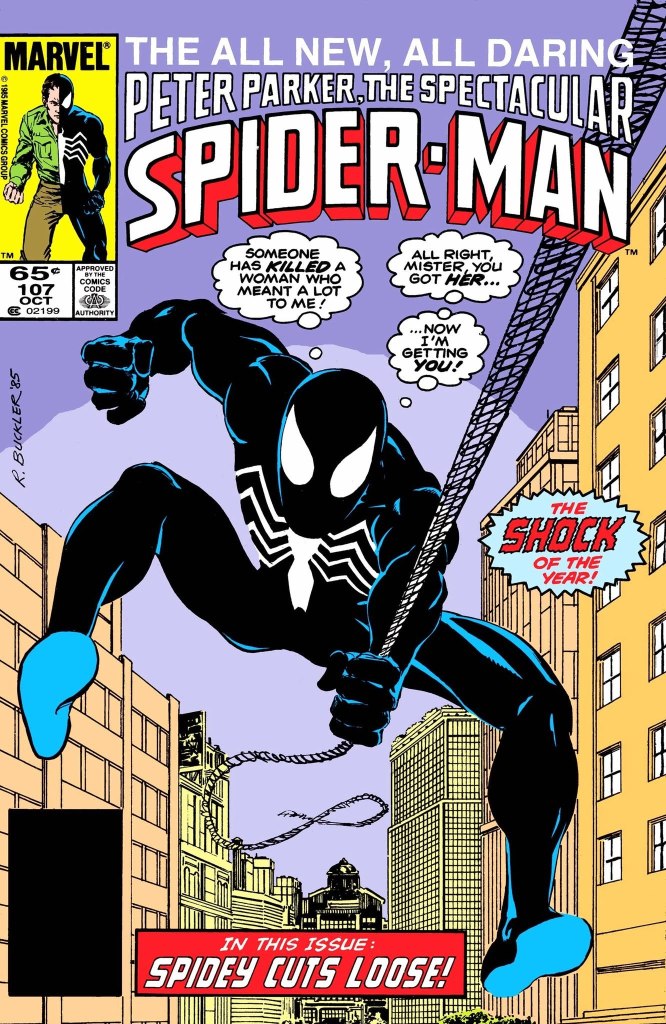
The cover.

Early story

The story begins with Jean DeWolff recalling several important details from her past as well as her family background. Her father was a police inspector who never forgave her mother for giving birth to her. She was only six months old when her parents split up. Sometime later, her mother married a patrolman named Carl Weatherby and Jean herself admired her stepfather.

As she grew into adulthood, Jean was very influenced by her patrolman stepfather and she went on to go into police academy and graduated. Jean went on to become a fast-rising policewoman.

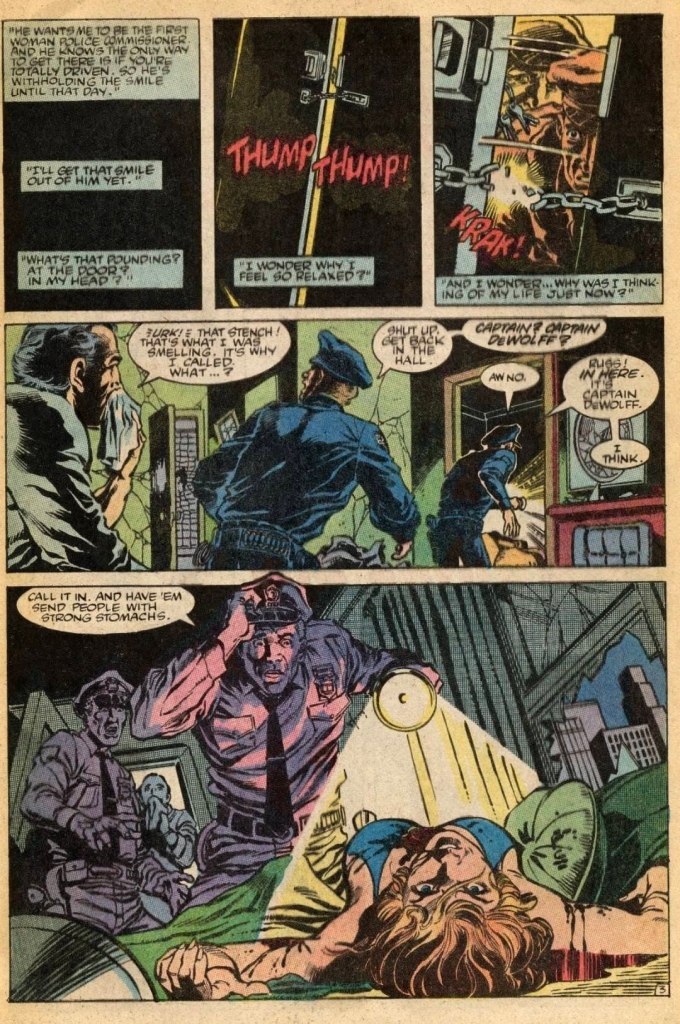
In the present day, New York police officers barged into a private residence searching for captain DeWolff and the place had bad odor. A dead woman was found inside a bedroom….

Quality

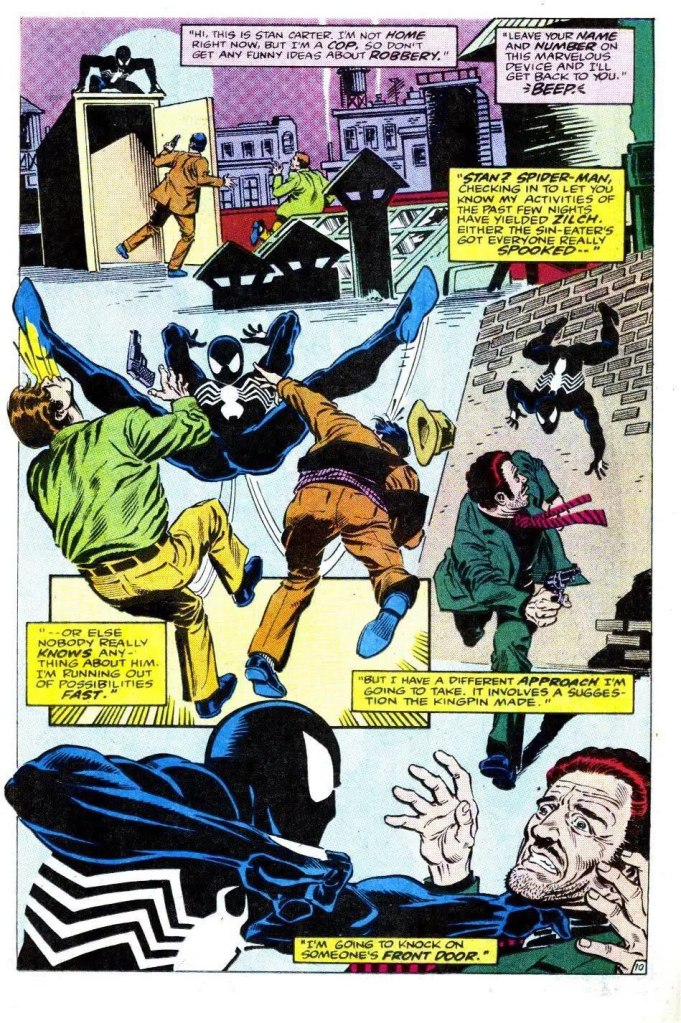
Spider-Man meets with Stan Carter on the road in the middle of New York City.

The first thing I will say about this comic book is that the writing done by Peter David is very grounded with reality and this resulted in a dark and gritty approach to storytelling. The heart of the story is the sudden murder of policewoman Jean DeWolff and its impact on the city of New York is strong and evident.

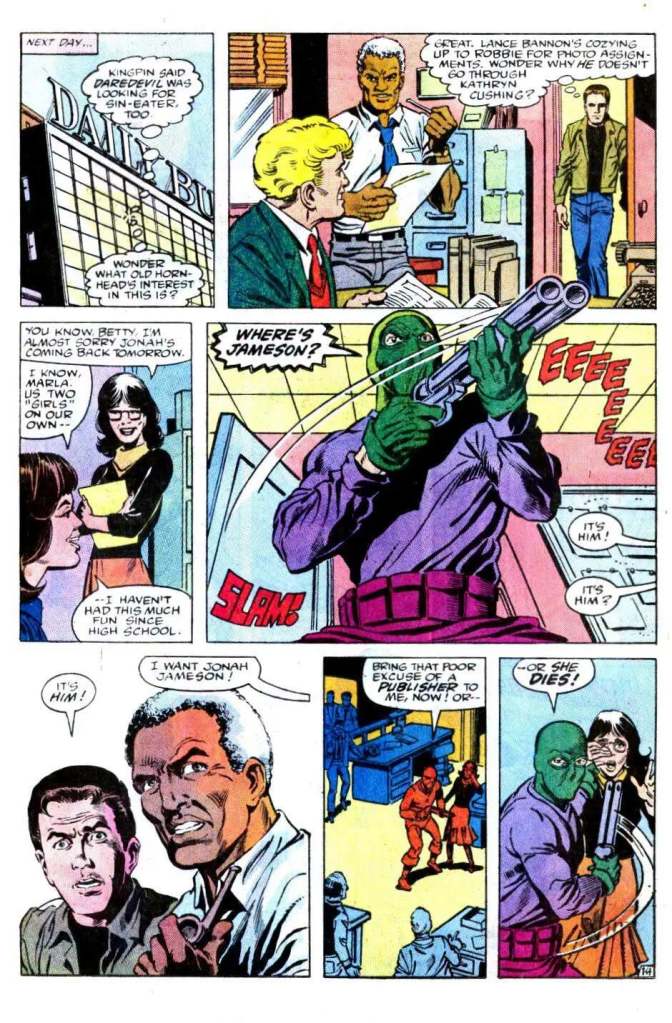
The story here is ultimately a detective story with a good amount of mystery, suspense and intrigue laced all over it. Along the way, Spider-Man here is barely the protagonist as the impact of Jean DeWolff’s murder has been dramatized through multiple characters in the city from J. Jonah Jameson to Matt Murdock (Daredevil).

This comic book also examines how the justice system in Marvel’s fictional portrayal of New York City works and it actually showed Peter Parker attending witnessing a court room arraignment to see how the bad guys he dealt with (as Spider-Man) were handled by the system. Again, this shows how grounded in reality the story is and the details should be seen. There is also a strong sense of local community dramatized.

The art by Rich Buckler is excellent and he really brought to life Peter David’s script with a heavy emphasis on realism. It seems to me that the illustrator took inspiration from TV shows and movies to achieve a unique visual style fitting for this particular tale.

Conclusion

This is a shocking and powerful way to start the story.

Peter Parker, The Spectacular Spider-Man #107 (1985) is indeed a very powerful tale that has to be seen if you want a gritty 1980s Spider-Man story. The David-Buckler creative duo delivered a very grounded story about murder in New York City that impacted its people which serves as a reminder that violent crime can cause waves of disturbance and disruption. That said, this first chapter of Sin-Eater storyline is pretty believable. As the creative team emphasized the murder’s impact on a wide scale, it is not surprising that Spider-Man’s share of the spotlight was sacrificed somewhat to achieve it. As of now, I am looking forward to the next chapter of the Sin-Eater storyline.

Overall, Peter Parker, The Spectacular Spider-Man #107 (1985) is recommended.

+++++

Thank you for reading. If you find this article engaging, please click the like button below, share this article to others and also please consider making a donation to support my publishing. If you are looking for a copywriter to create content for your special project or business, check out my services and my portfolio. Feel free to contact me with a private message. Also please feel free to visit my Facebook page Author Carlo Carrasco and follow me on Twitter at @CarloCarrascoPH as well as on Tumblr at https://carlocarrasco.tumblr.com/ and on Instagram at https://www.instagram.com/authorcarlocarrasco
A Look Back at Peter Parker, The Spectacular Spider-Man #131 (1987)

Welcome back superhero enthusiasts, 1980s arts and culture enthusiasts, Marvel Comics fans and comic book collectors! Today we go back to the year 1987 to examine a small part of the Marvel Comics shared universe through a tale of the Peter Parker, The Spectacular Spider-Man monthly series.

For this particular review, we will explore the 3nd chapter of classic storyline Kraven’s Last Hunt. The storyline started in Web of Spider-Man #31 (read my retro review by clicking here) and progressed further in Amazing Spider-Man #293 (read my retro review by clicking here) and creators J. M. DeMatteis and Mike Zeck crafted it to last six chapters.

With those details laid down, here is a look back at Peter Parker, The Spectacular Spider-Man #131, published in 1987 by Marvel Comics with a story written by J. M. DeMatteis and drawn by Mike Zeck.

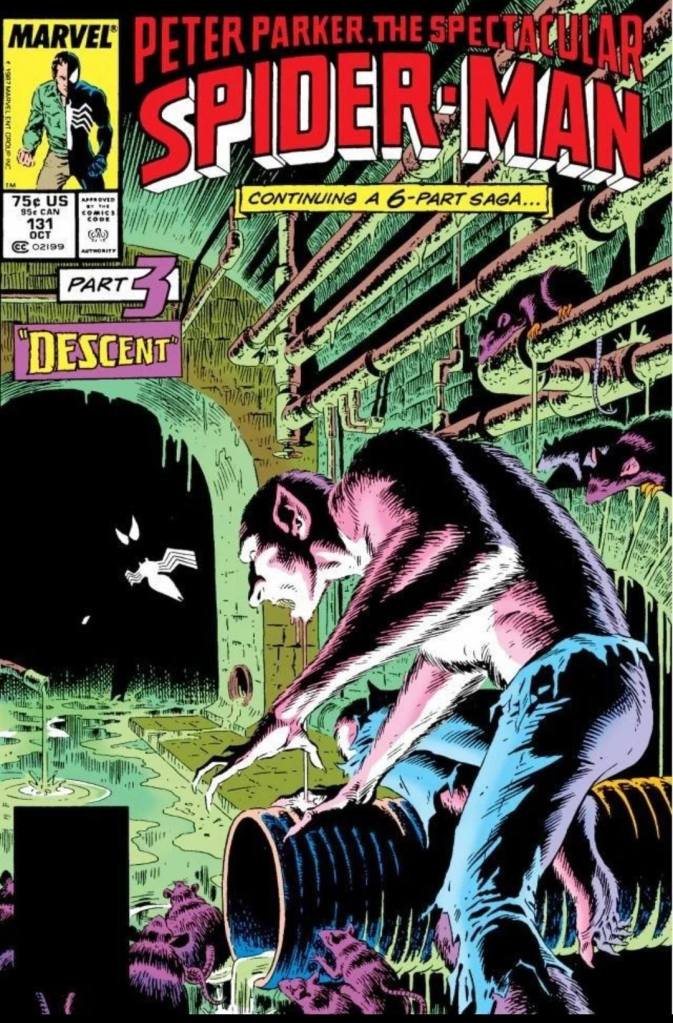
The cover.

Early story

The story begins inside a facility in New York City on a rainy night. Men inside work quietly moving heroin from one vehicle to another. Suddenly Kraven – wearing a black costume believing he is Spider-Man – breaks in and fearlessly attack the men who are already armed. Using very violent force, Kraven beats the men and killed the last one. Eventually, police officers and detectives broke into the facility which compels Kraven to get away fast and leaves them no opportunities to catch up. One of the detectives mentions that fifteen suspects have been hospitalized because of the individual they perceive as Spider-Man.

After climbing to the top of a building, Kraven takes his mask off. He thinks deeply about his victory over Spider-Man and becoming him. He believes he has consumed the spider’s prey and proved himself to be superior in every way. Regardless, Kraven’s obsession continues as he seeks the final proof.

Elsewhere in the city, Vermin pulls a woman into an alley and then comes out on the street as a police car approaches him…

Quality

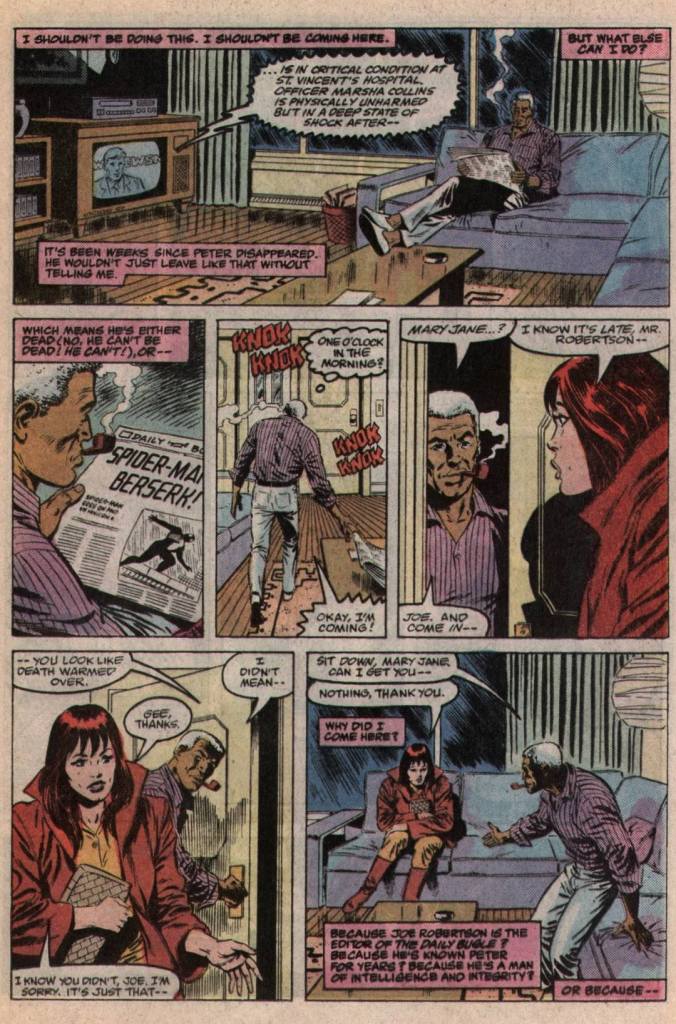
A key scene showing how Mary Jane and Joe Robertson react to the absence of Peter Parker who was buried alive by Kraven.

In this 3rd chapter of the Kraven’s Last Hunt storyline, the iconic Spider-Man is absent again but his presence is still felt through the way people perceive him and through two notable characters who personally knew Peter Parker. At this point in the storyline, Kraven truly believes he has not only replaced Spider-Man but became even more significant than him. Kraven’s obsession with achieving both greatness and significant placed him on a collision course with Vermin, and I can say that the conflict between the them is a powerful feature of the story. Once again, DeMatteis proved how compelling his script really is and Mike Zeck easily brought the said script to life with strong imagery.

As with the previous two chapters, the darkness and grittiness of the storyline are lively which resulted in a very atmospheric reading experience. The DeMatteis-Zeck duo knew exactly how to engage readers using a powerful script and images that range from being action-packed to looking very disturbing.

Speaking of character development, Mary Jane here shows how the continued absence of her husband is wearing herself down and making her even more worried. Mary Jane is a lively symbol about how we readers miss Spider-Man and how uncertain we feel about the future of comic book storytelling without the iconic superhero.

Conclusion

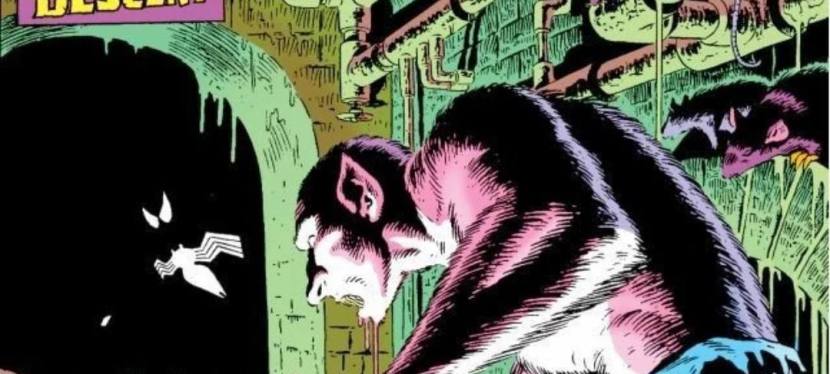
Without any concern whatsoever, Kraven’s Spider-Man brutally hits the criminals with powerful strikes.

Peter Parker, The Spectacular Spider-Man #131 (1987) is a powerful 3rd chapter of the Kraven’s Last Hunt storyline. At this point, Kraven continues to not only be Spider-Man but make others feel his impact as he strives to be greater than the genuine Spider-Man. Vermin has turned more prominent in this comic book and the big conflict between him and Kraven is a huge pay-off to what was built-up since Amazing Spider-Man #293. Right now, I am looking forward to the next chapter of Kraven’s Last Hunt.

Overall, Peter Parker, The Spectacular Spider-Man #131 (1987) is highly recommended.

+++++

Thank you for reading. If you find this article engaging, please click the like button below, share this article to others and also please consider making a donation to support my publishing. If you are looking for a copywriter to create content for your special project or business, check out my services and my portfolio. Feel free to contact me with a private message. Also please feel free to visit my Facebook page Author Carlo Carrasco and follow me on Twitter at  @HavenorFantasy as well as on Tumblr at https://carlocarrasco.tumblr.com/ and on Instagram at https://www.instagram.com/authorcarlocarrasco
A Look Back at Spectacular Spider-Man #88 (1984)

Welcome back superhero enthusiasts, 1980s arts and culture enthusiasts, Marvel Comics fans and comic book collectors! Today we go back to the year 1984 to examine a small part of the Marvel Comics shared universe through a tale of the Spectacular Spider-Man monthly series.

In issue #87, Spider-Man revealed his secret identity to Black Cat. That was a turning point on not just the romance between the two but also on their combined efforts of stopping crime and helping others in the city. This opens up opportunities for creative teams of Marvel to explore where Spidey and Black Cat’s relationship will go to next.

With those details laid down, here is a look back at Spectacular Spider-Man #88, published in 1984 by Marvel Comics with a story written by Bill Mantlo and drawn by Al Milgrom.

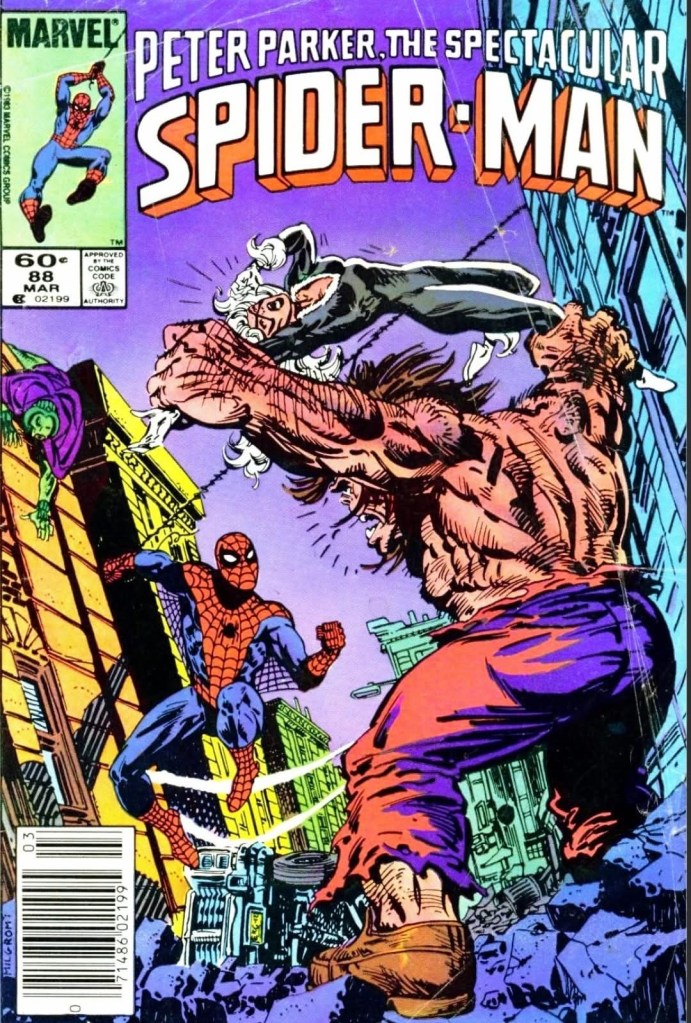
The cover.

Early story

The story begins inside a secret facility wherein several armed guards are preparing themselves for an unseen incoming force. They are guarding a convict known as The Cobra (Klaus Voorhees) who warns them that the one person after him will find some way of killing him.

Suddenly, Mister Hyde breaks through the metallic gate and demands that Cobra should be given to him. The guards used tranquilizer gas to take Hyde out but it turned out useless. Cobra and his handlers secretly moved to the rooftop of the facility to try to escape by helicopter. Suddenly, Hyde emerges, brings down a solid tower and crashes the helicopter with it. He then grabs Cobra who only slithered away.

Meanwhile in New York City, Spider-Man is inside the apartment of Felicia Hardy (Black Cat) and he feels that something dreadful is going to happen…

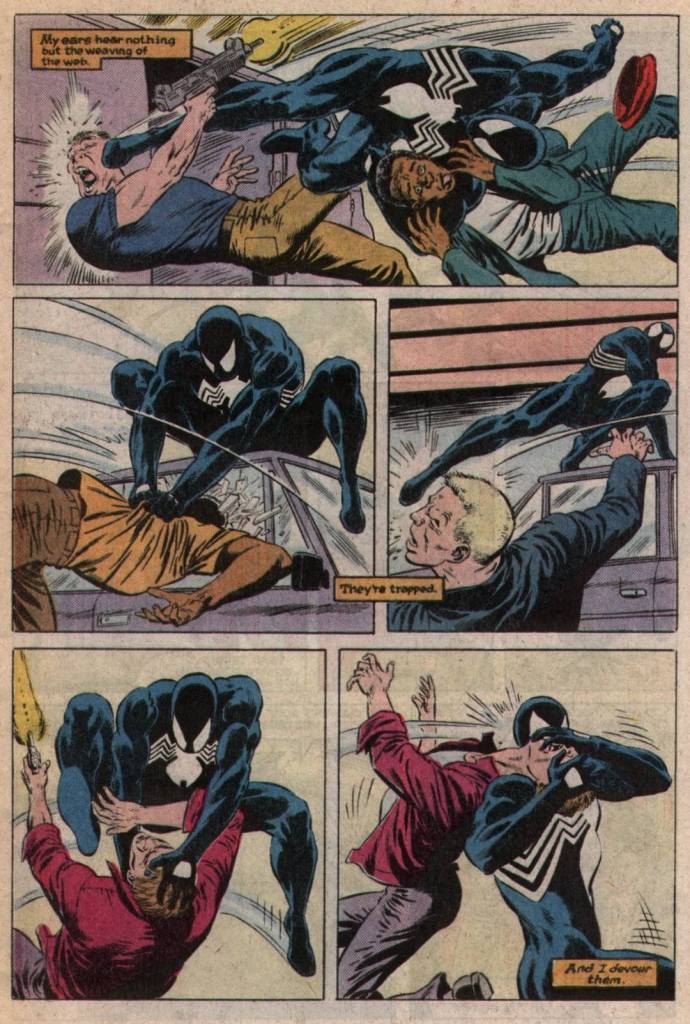
Quality

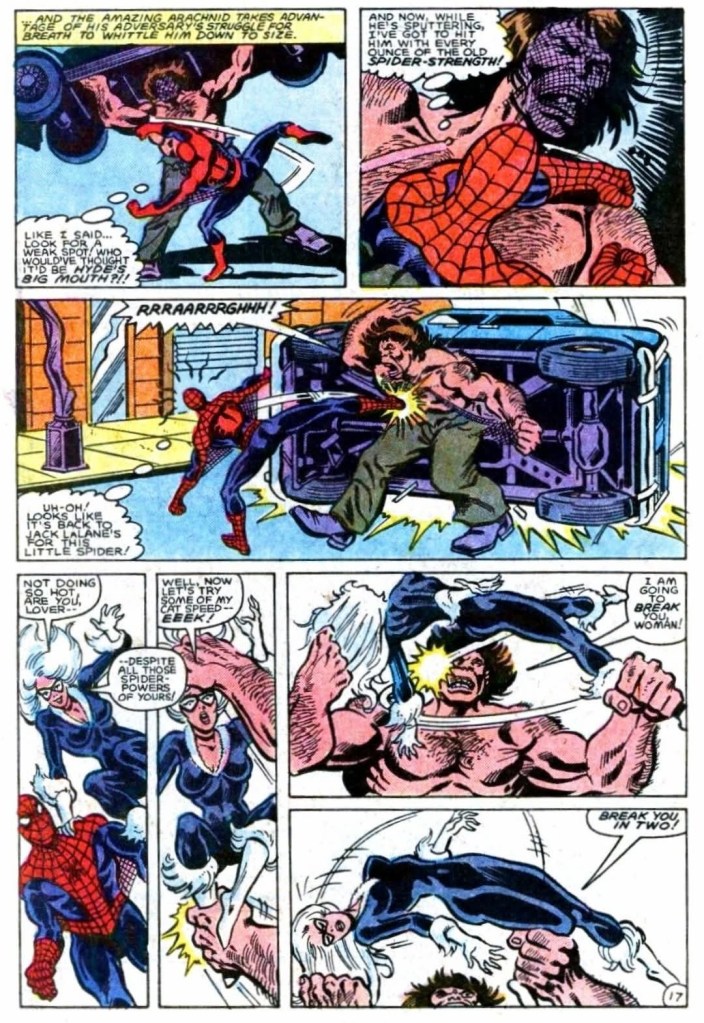
There is a lot of action scenes to enjoy here. Spider-Man and Black Cat have their own moments taking on Hyde.

I will go straight to the point here. This Spectacular Spider-Man tale sure is packed with a lot of action and intrigue balanced by the romance of Spider-Man and Black Cat (who is now living with the knowledge that Peter Parker is Spider-Man). The conflict between Mister Hyde and the Cobra here is preceded by their past collaboration of getting revenge upon Thor. In fact, Spider-Man had encountered both characters sometime prior and his personal knowledge of Thor’s encounter with them added some depth to the new conflict in this comic book. Spidey here became cautious as he knows the extent of the savagery of Hyde.

As this tale took place after Black Cat learned Spider-Man’s secret identity, the dynamics between the two during battle became intriguing when the former took the initiative to strike the dangerous Hyde even though she was told to protect Cobra. This forces the iconic webslinger to put himself at risk by aggressively hitting Hyde while keeping Black Cat out of the way.

The big battle involving the four notable characters is quite extensive and intense to follow. There are a few strong twists between the scenes and it is entertaining to read. When it comes to character development, I enjoyed how the creators portrayed Spidey being concerned about Black Cat’s wellbeing and her lack of super powers while simultaneously portraying her as being determined to so something significant on solving problems.  

Conclusion

The romance between the two is worth following.

Spectacular Spider-Man #88 (1984) is not only a good follow-up to the previous issue, it is also a worthy showcase of Spidey and Black Cat’s relationship as Cobra and Hyde engage in a new conflict. As this is an action-packed story, it is not surprising that the character development scenes are fewer. This is a fun read.

Overall, Spectacular Spider-Man #88 (1984) is recommended.

+++++

Thank you for reading. If you find this article engaging, please click the like button below, share this article to others and also please consider making a donation to support my publishing. If you are looking for a copywriter to create content for your special project or business, check out my services and my portfolio. Feel free to contact me with a private message. Also please feel free to visit my Facebook page Author Carlo Carrasco and follow me on Twitter at  @HavenorFantasy as well as on Tumblr at https://carlocarrasco.tumblr.com/ and on Instagram at https://www.instagram.com/authorcarlocarrasco
A Look Back at Spectacular Spider-Man #87 (1984)

Welcome back superhero enthusiasts, 1980s arts and culture enthusiasts, Marvel Comics fans and comic book collectors! Today we go back to the year 1984 to examine a small part of the Marvel Comics shared universe through a tale of the Spectacular Spider-Man monthly series.

For this particular review, we will explore a major development in the life of the iconic Spider-Man that was told outside of the Amazing Spider-Man series.  

With those details laid down, here is a look back at Spectacular Spider-Man #87, published in 1984 by Marvel Comics with a story written by Bill Mantlo and drawn by Al Milgrom.

The cover.

Early story

The story begins in New York City as Spider-Man and Black Cat (his romantic partner at the time) spend quality time together. Spider-Man tells her that it is time him to show her where he lives. Together, they swing across the city and even played along a few times.

They finally arrive at the rooftop of the building where Peter Parker (Spider-Man) lives and enter via the skylight. Black Cat is shocked to see how cheap the quality of the apartment is and asks him how can a famous hero like him live in such a place.

Spider-Man begins explaining that as a civilian he works as a photo journalist and he did not become a hero to be prosperous. As he keeps on revealing threads of his past, he slowly makes his move to reveal his secret identity to Black Cat…

Quality

The relationship of Spider-Man and Black Cat develops even more.

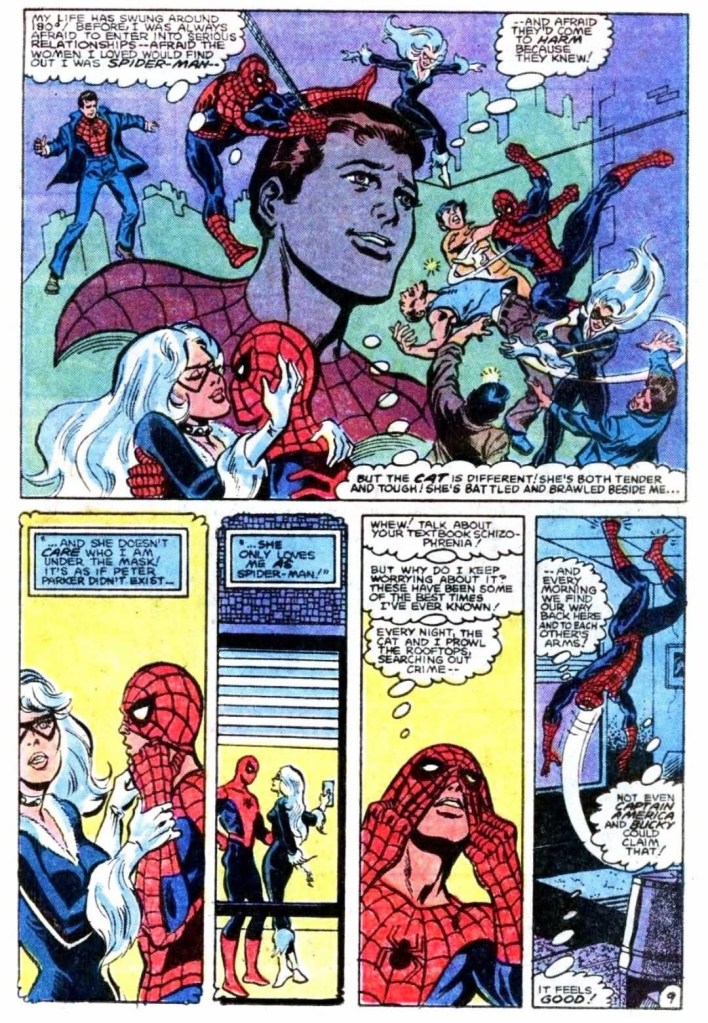
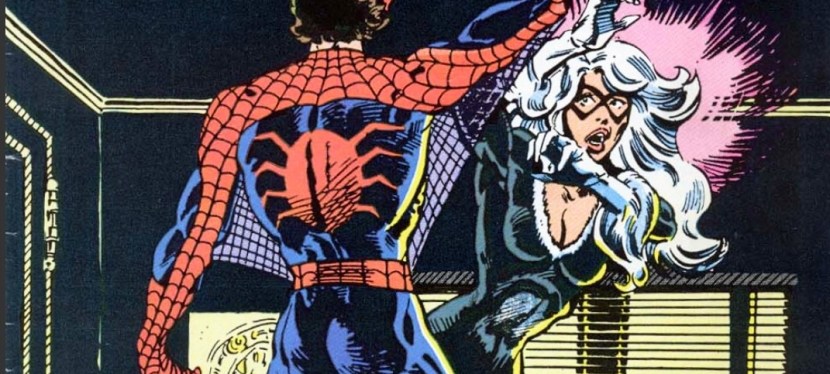
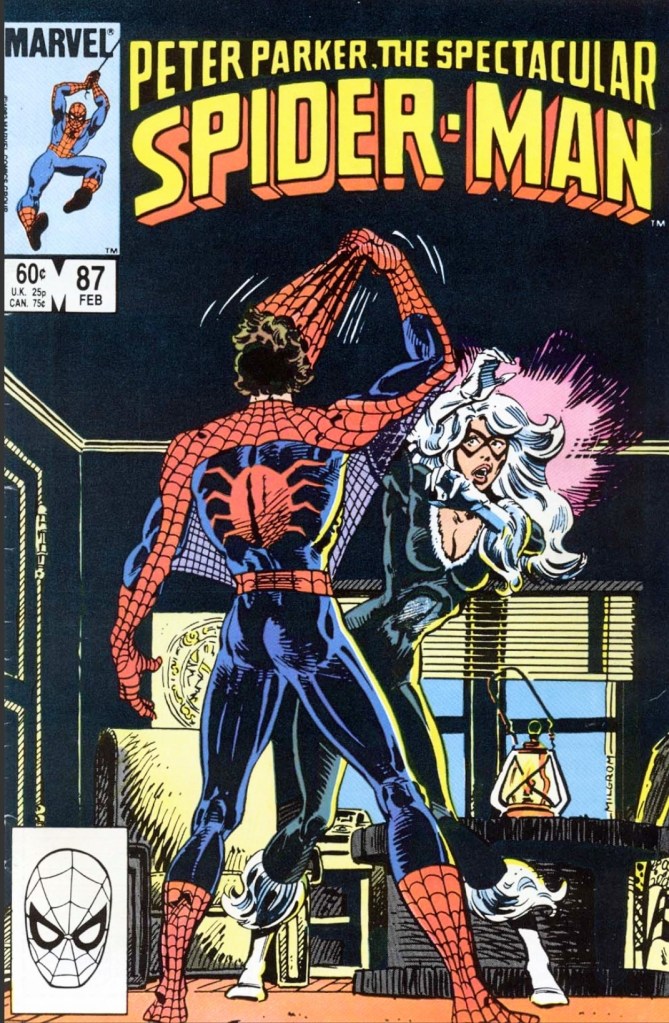
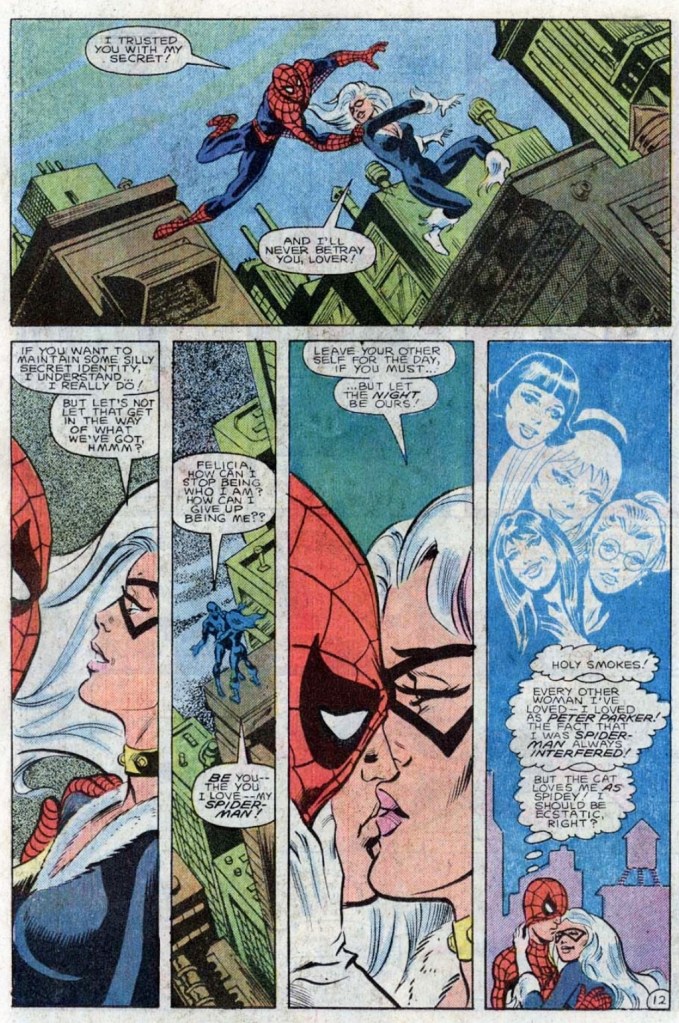
As the cover art revealed, this tale authored by Bill Mantlo is about Spider-Man revealing his secret identity to Black Cat who was his romantic partner at this point in Marvel Comics shared universe history. The revelation served as a key turning point in the life of the iconic webslinger as well as Peter Parker’s personal handling of his interactions with the women he loved. Mantlo’s writing of the dialogue between Spidey and Black Cat is really rich and there is also this sentimental touch with how the writer handled the hero’s emotions, especially with regards to the lady’s loving him more as the costumed hero than the civilian he is. I should also state that the impact of knowing Spider-Man’s true identity has subtle emotional effects on the part of Black Cat which must be seen.

While the cover showed what happened, this comic book is still worth reading because the creative duo of Mantlo and Milgrom carefully crafted scenes that gradually led to the big revelation backed with flashbacks of Peter Parker’s private life (as portrayed in Amazing Fantasy #15) and the build-up from his past romances with Black Cat. The pacing is very good and the pay-off to the build-up was worth every moment.

The conflict with the city thugs that took place near the end of the tale served as an additive to the new development of Black Cat and Spidey’s relationship.

Conclusion

Black Cat’s first-ever visit at Spider-Man residence.

Spectacular Spider-Man #87 (1984) is a very worthy read and the creators made daring moves to move the romantic link between Spider-Man and Black Cat forward while adding variety into Peter Parker’s personality. This is a character-driven story that must be read from start to finish.

Overall, Spectacular Spider-Man #87 (1984) is highly recommended.

+++++

Thank you for reading. If you find this article engaging, please click the like button below, share this article to others and also please consider making a donation to support my publishing. If you are looking for a copywriter to create content for your special project or business, check out my services and my portfolio. Feel free to contact me with a private message. Also please feel free to visit my Facebook page Author Carlo Carrasco and follow me on Twitter at  @HavenorFantasy as well as on Tumblr at https://carlocarrasco.tumblr.com/ and on Instagram at https://www.instagram.com/authorcarlocarrasco
A Look Back at Spider-Man #1 (1990)

Welcome back superhero enthusiasts, 1990s culture enthusiasts and comic book collectors! Today we go back to the early 1990s and explore a part of the Marvel Comics shared universe through a tale of the Spider-Man monthly series.

Back in the late 1980s, Todd McFarlane proved to be a highly talented artist who helped Marvel sell a lot of issues of the Amazing Spider-Man series. McFarlane was also highly involved with the creation of Venom which not only became Spider-Man’s deadliest foe but also an icon of Marvel’s. In the year 1990, a brand new monthly series of Spider-Man was launched and it had Todd McFarlane writing and illustrating the tales.

With those details laid down, here is a look back at Spider-Man #1, published in 1990 by Marvel Comics with a story written and drawn by Todd McFarlane. This marks the beginning of the Torment storyline.

The cover.

Early story

The story begins in New York City where countless people walk to their respective destinations not realizing that the local hero Spider-Man was swinging above them. In a dirty alley, Spider-Man prevents an armed thug from harming a woman and leaves him hanging covered with a lot of web.

Elsewhere in the city, a sinister figure conducts a ritual, prays to evil forces and begins using magic.

In yet another location, a hideous creature emerges from the water. It’s the Lizard…

Quality

This page is an example of Todd McFarlane creating a travel sequence that allowed him to draw something great. It’s a classic example of moving back into the comfort zone.

To make things very clear here, this comic book is pretty shallow and hollow mainly due to its storytelling as this was the writing of a very young Todd McFarlane. There is no denying that his art here is great to look at from start to finish. In fact, this was one of McFarlane’s finest visual works ever with Marvel.

But if you look beyond the great visuals, the writing is very weak all throughout the issue. At best, this comic book is a grand-looking yet shallow set-up for the conflict of the Torment storyline complete with shared emphasis on the iconic web-slinger, the Lizard (looking more menacing than before) and Calypso (the one behind the magic and rituals).

In fairness to McFarlane, he added his own touch on emphasizing the personalities of Peter Parker and wife Mary Jane simultaneously as a couple. If you were used to seeing in-depth character development and witty dialogue about the two major characters as portrayed in the Amazing Spider-Man, Web of Spider-Man and Spectacular Spider-Man series of 1990, you won’t find them in this comic book. Under McFarlane’s writing, Spider-Man in this issue showed signs of sarcasm and cockiness in the first scene, and with Mary Jane he (as Peter Parker) expressed himself philosophically. To say the least, the portrayal of Spider-Man here is noticeably different under McFarlane.

The Lizard, a long-time rival of Spider-Man’s, was presented to be very violent and murderous in this issue. This was clearly McFarlane’s approach on emphasizing the force of opposition that awaits the iconic web-slinger and he obviously went for a more adulterated approach with the visuals. That being said, the violent content in this comic book is very unique and clearly stood out from the rest of the Spider-Man-related comics published by Marvel in 1990. Lastly, I should say that McFarlane’s visual take on the Lizard is the best I have seen.  

Going back to the visuals, McFarlane implemented strong elements of horror, darkness and grittiness which went along well with the adulterated approach to violence.  These mixed elements, as they turned out in reality, became part of McFarlane’s future works past Spider-Man.

Conclusion

McFarlane’s vicious and horrifying approach on visualizing the Lizard can’t be ignored. This Lizard makes the cinematic Lizard of the 2012 movie The Amazing Spider-Man look cartoony.

Spider-Man #1 (1990) is a very mixed bag when it comes to literary enjoyment. It clearly has great artwork by McFarlane whose adulterated approach on expression and spectacle made it very unique. The writing by McFarlane (who was very young at the time of production) is clearly the big letdown although his own approach on portraying Spider-Man, MJ and the Lizard are very notable. Take note that this was Todd McFarlane starting with writing while doing the art (his true strength), and at this point in comic book history his talent on telling compelling stories would not be realized until a few years later (particularly with Spawn and Image Comics). Notably, his use of visual horror and darkness predates his work in Spawn which makes his Spider-Man take very distinct. Ultimately, this comic book served as a build-up for things to come in the Torment storyline. Don’t expect too much when acquiring this comic book.

Overall, Spider-Man #1 (1990) is satisfactory.

+++++

Thank you for reading. If you find this article engaging, please click the like button below, share this article to others and also please consider making a donation to support my publishing. If you are looking for a copywriter to create content for your special project or business, check out my services and my portfolio. Feel free to contact me with a private message. Also please feel free to visit my Facebook page Author Carlo Carrasco and follow me on Twitter at  @HavenorFantasy as well as on Tumblr at https://carlocarrasco.tumblr.com/ and on Instagram at https://www.instagram.com/authorcarlocarrasco
A Look Back at Spider-Man #26 (1992)

Disclaimer: This is my original work with details sourced from reading the comic book and doing personal research. Anyone who wants to use this article, in part or in whole, needs to secure first my permission and agree to cite me as the source and author. Let it be known that any unauthorized use of this article will constrain the author to pursue the remedies under R.A. No. 8293, the Revised Penal Code, and/or all applicable legal actions under the laws of the Philippines.

In 1992, Marvel Comics organized a big celebration of what was back then the 30th anniversary celebration of Spider-Man. Behind the scenes, the Spider-Man editorial team organized their creators to make something special worthy of the anniversary. Back then there were four monthly series of Spider-Man – Amazing Spider-Man, Spectacular Spider-Man, Web of Spider-Man and Spider-Man – and in keeping with the 30th anniversary bonanza, each of the monthly series would see one special issue with a hologram on the cover.

What I read recently was one of those 30th anniversary celebration special comic books – Spider-Man #26. This comic book had a green cover and a hologram of Spider-Man upside-down. Its cover price is $3.50.

Was this old comic book’s content really worth the high cover price and the hologram? Did the creative team at Marvel do their job on making something special in line with the 30th anniversary celebration? We can find out in this look back at Spider-Man #26, published in 1992 by Marvel Comics with the main story written by Tom DeFalco and drawn by Mark Bagley and Ron Frenz.

The cover with a hologram.

Early story

The story begins on the street of New York when a man wearing a device runs down the sidewalk distracting and unintentionally pushing a few people out of the way. He is glowing as he moves. Someone from behind him calls him Stewart.

Soon enough, Peter Parker/Spider-Man and Mary Jane cross paths with him. Peter immediately leaves Mary Jane behind and starts pursuing the glowing Stewart. In the middle of the street, Stewart sees a speeding motorcycle heading towards him. He dives for cover which incidentally shapes his glowing field into a makeshift ramp causing the motorcyclist go over him. Spider-Man sees the flying motorcycle and its driver, and struggles to decide which one to save…

Quality

From the 2nd story.

Let me start with the main story. It sure is heavily worded almost all throughout but that is understandable because Tom DeFalco really pushed hard to emphasize the theme of responsibility as Spider-Man struggles to tackle criminals while trying to find quality time for his wife. There was even a scene in which Peter Parker recalls key events from his past (his becoming Spider-Man, letting a certain criminal get away, the death of his Uncle Ben, etc.) which, in terms of presentation, was a clear attempt by the creative team to bring readers back to the recorded history of Marvel’s icon. The main story is a genuine, heart-filled attempt to go beyond showing Spider-Man beating the bad guys to do local society good. There was also effort exerted to show that there are a few guys who do bad things not because they are inherently evil but rather they are desperate and/or misguided. The problem with the main story is that the other characters – Stewart, Bill, the gang leader Maxwell and others – are not so interesting at all. Of course, we cannot expect to see Spider-Man go head-to-head with another one of his major villains but this story was part of the 30th anniversary celebration.

The 2nd story, if you can all it that, is pretty much an exposition-filled exercise designed to give readers – both new and old – a review of Spider-Man’s powers and capabilities. To prevent it from becoming a total bore, some characters from the Marvel Comics universe were visually added.

When it comes to the quality of the artwork, Ron Frenz’s work here is serviceable at best. Mark Bagley’s art here improves the quality but that’s not saying much.

Conclusion

From the main story.

As a 30th anniversary celebration issue, Spider-Man #26 does not have much when it comes to being truly special. You love spectacle? You won’t find much in it. You wanted to see something groundbreaking in terms of character development? There’s none. Gripping storytelling? None! There was also no conflict with any prominent villain from the Marvel universe here. What you will get here is nostalgic stuff plus exposition about key elements that define Spider-Man. Truly the only thing special here is the hologram on the gimmick cover.

If you are seriously planning to buy an existing hard copy of Spider-Man #26 (1992), be aware that as of this writing, MileHighComics.com shows that the near-mint copy of the regular edition costs $27 while the near-mint copy of the newsstand edition costs $90.

Overall, Spider-Man #26 (1992) is serviceable. If you really want to buy this old comic book, I recommend waiting for its price to fall below $5 and I’m referring to the near-mint copy.

+++++

Thank you for reading. If you find this article engaging, please click the like button below and also please consider sharing this article to others. If you are looking for a copywriter to create content for your special project or business, check out my services and my portfolio. Feel free to contact me as well. Also please feel free to visit my Facebook page Author Carlo Carrasco and follow me at HavenorFantasy@twitter.com