A Look Back at Spider-Man 2099 #27 (1995)

Welcome back superhero enthusiasts, 1990s culture enthusiasts and comic book collectors! Today we go back to the year 1995 to explore a part of the Marvel Comics shared universe through a tale of the Spider-Man 2099 monthly series.

Following the events of the dramatic Spider-Man 2099 #25, Miguel O’Hara knows that his father is none other than Tyler Stone (his superior at Alchemax) and this only adds more tension to his already troubled life and also to his fragile family. In issue #26, as Miguel struggles to live with the shocking truth about his heritage, Tyler frees Kasey Nash fulfilling Conchata O’Hara’s request.

With those details laid down, here is a look back at Spider-Man 2099 #27, published in 1995 by Marvel Comics with a story written by the late Peter David and drawn by Joe St. Pierre. 
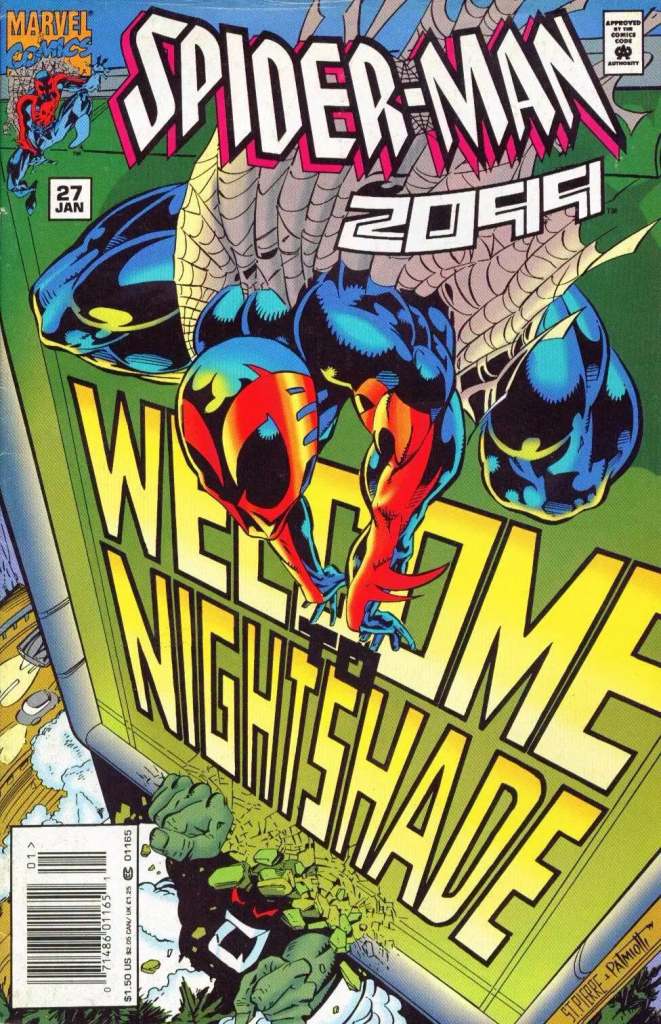
Comic book cover featuring Spider-Man swinging upside down above the bold title "When the Night Falls," with a cityscape and crashing debris below.
The cover.

Early story

The story begins with Miguel O’Hara and his ex-girlfriend Xina Kwan traveling far away from New York to have a vacation together. Their destination is Nightshade, an independent research community that is free from corporate influence. Miguel feels uneasy as Xina drives the car very fast. Suddenly, a hologram of Lyla (Miguel’s AI assistant) appears in front of them as the car moves on, surprising Miguel. Lyla informs him that he has received a message from his brother Gabriel. Being uninterested, Miguel tells Lyle to erase it.

Meanwhile at a talent search facility of Alchemax, an internal meeting of Tyler Stone’s “big guns” starts, and their agenda is about Nightshade…

Quality
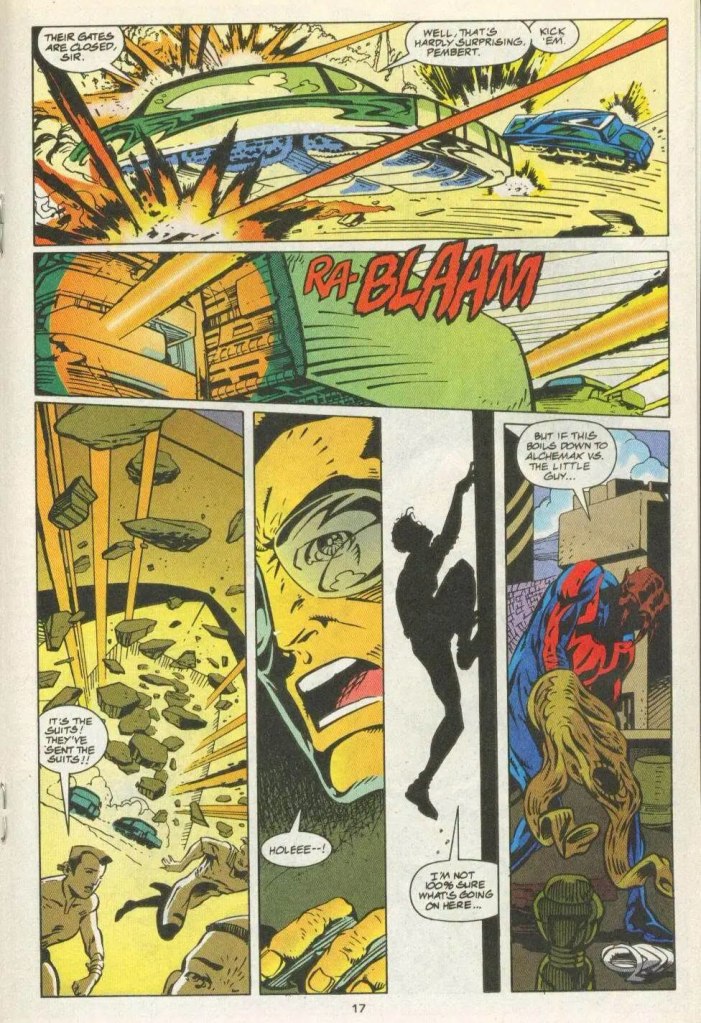
Comic book page showing cars crashing through a building, falling debris, a distressed character, and a silhouetted figure climbing beside Spider-Man and a long-haired companion.
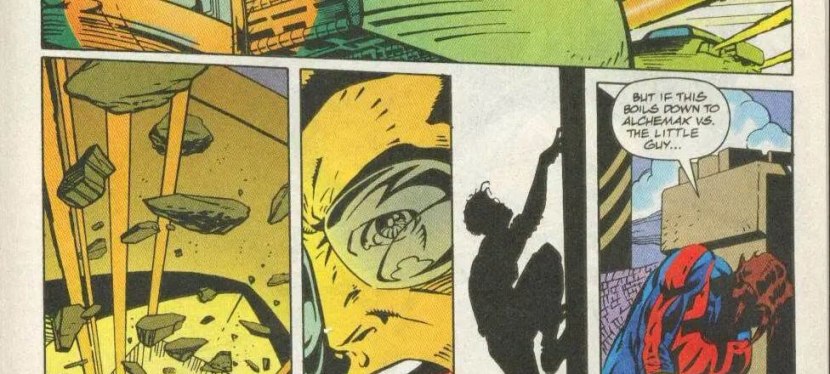
As trouble strikes Nightshade, Miguel O’Hara discreetly changes into Spider-Man 2099.

If there is anything I could describe about this particular tale of the futuristic Spider-Man, it is a blend of a road trip with corporate intrigue. Considering how short the main story is as this comic book contains a short story, this tale is clearly a build-up for something big set to happen that will eventually test Spider-Man soon.

This story has Miguel O’Hara spending quality time with an old flame on an out-of-town trip and together, they have a nice reunion with Angela Daskalakis who was their headmaster when they were very young. Given his status as an employee of Alchemax, Miguel is unsurprisingly restricted from entering Nightshade’s research and development facilities. The new setting and reunion allow the creative team to develop Spider-Man in unique ways which is welcome move.

The conflict really begins when the Corporate Raiders (a strike team deployed by Alchemax) organizes a corporate warfare strike at Nightshade triggering the independent place’s defenses. That said, Miguel is in a tough situation as he has to take on the armed raiders as Spider-Man while somehow ensuring that his ex-GF and their former headmaster are safe.

With regards to the shortness of the main story, the short story here took place several years in the past showing Miguel and Xina during their childhood. Kron Stone, the one who would later kill Punisher 2099’s family members and become Venom 2099 (click here, here and here), is also present as a youngling who got into conflict with Miguel. This short story also shows Miguel getting humiliated at an early age and has to decide between standing up for himself or allowing himself to be a victim for the rest of his life. This one is an OK read.

Conclusion
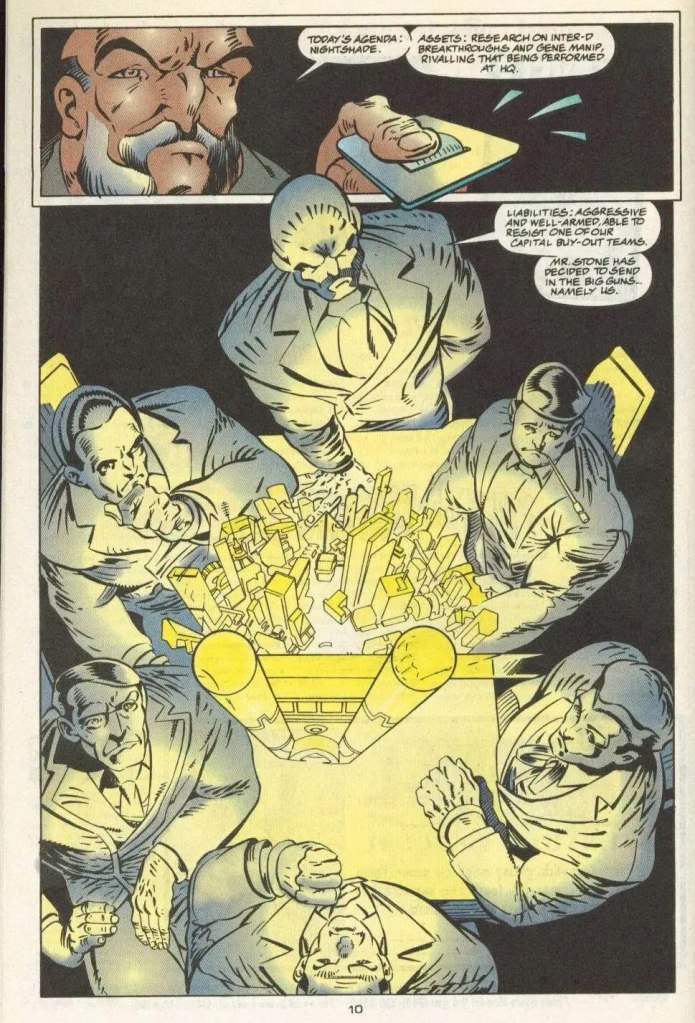
Comic book panel showing a group of suited men gathered around a model city, with speech bubbles outlining an agenda and identifying them as aggressive and powerful targets.
Alchemax’s enforcers.

Considering the shortness of the main story, Spider-Man 2099 #27 (1995) lacks substance and engagement but that does not mean the creative team did not give their best. The concept of Miguel O’Hara going all the way to a new destination which itself became the target of his company’s enforcers is itself fresh and intriguing. I just wish it had more content and the short story felt more like filler with some foreshadowing.

Overall, Spider-Man 2099 #27 (1995) is satisfactory.

+++++

Thank you for reading. If you find this article engaging, please click the like button below, share this article to others and also please consider making a donation to support my publishing. If you are looking for a copywriter to create content for your special project or business, check out my services and my portfolio. Feel free to contact me with a private message. Also please feel free to visit my Facebook page Author Carlo Carrasco and follow me on Twitter at @HavenorFantasy as well as on Tumblr at https://carlocarrasco.tumblr.com/ and on Instagram at https://www.instagram.com/authorcarlocarrasco
A Look Back at Spider-Man 2099 #12 (1993)

Welcome back superhero enthusiasts, 1990s culture enthusiasts and comic book collectors! Today we go back to the year 1993 to explore a part of the Marvel Comics shared universe through a tale of the Spider-Man 2099 monthly series.

By 1993, the 2099 lineup of comic books became popular with Marvel Comics readers and it was the series of the futuristic Spider-Man that engaged readers a lot thanks to the in-depth writing of the late Peter David. It should be stated that David also wrote a lot of stories of the classic Spider-Man (Peter Parker) years before Marvel even launched the 2099 franchise of comic books.

With those details laid down, here is a look back at Spider-Man 2099 #12, published in 1993 by Marvel Comics with a story written by Peter David and drawn by Rick Leonardi.

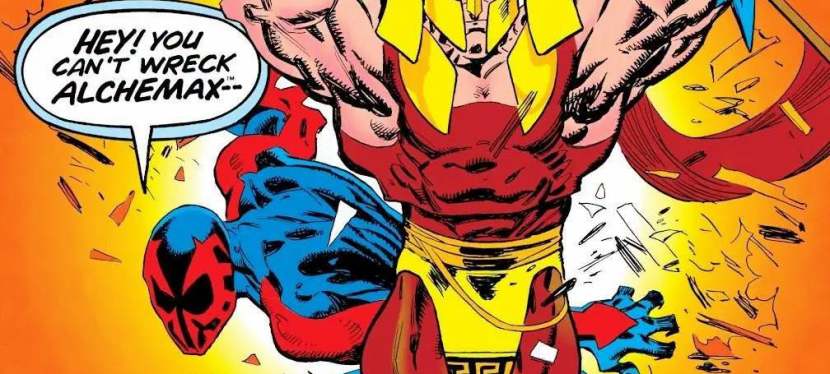
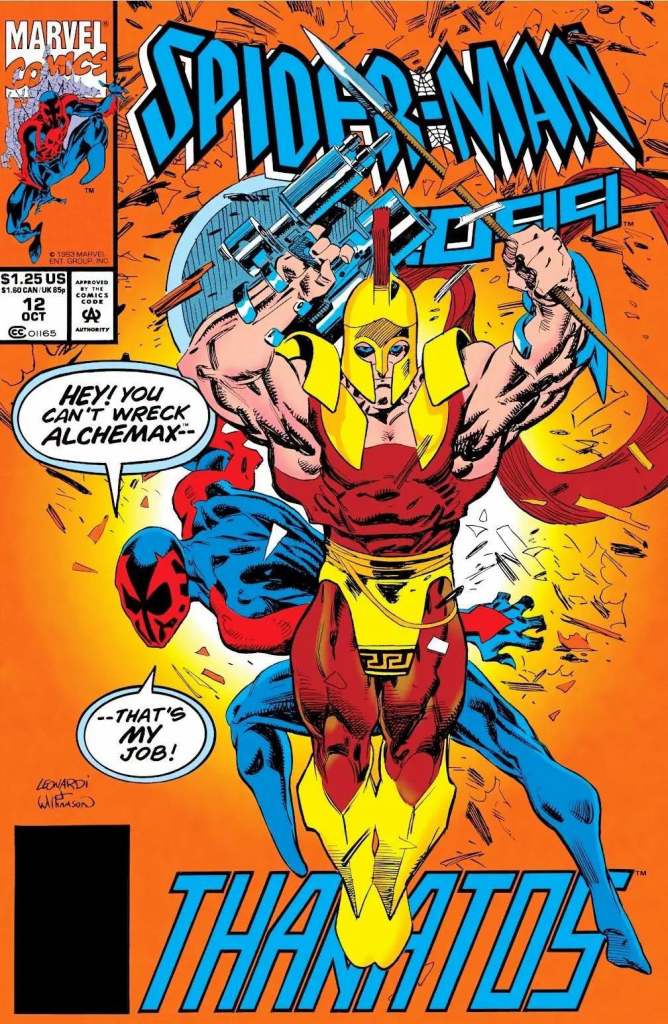
Comic book cover featuring Spider-Man and a character named Thanatos. Spider-Man is seen in a dynamic pose, while Thanatos, wearing a gold and red costume with a helmet, is prominently displayed. The background is orange with comic-style text.
The cover.

Early story

The story begins in an Alchemax facility with Tyler Stone talking with Dana at work. As Miguel O’Hara walks by the virtuality unreality office, a huge explosion sudden hits them. It turns out there was an experiment by Jordan Boone that went wrong and Miguel finds him. As the two talked, Jordan remains arrogant and sarcastic towards O’Hara.

Elsewhere, the mysterious man wearing armor and a helmet uses his device to scan the Alchemax facility and he spots Tyler Stone and Dana talking with each other. He listens to their conversation closely…

Quality

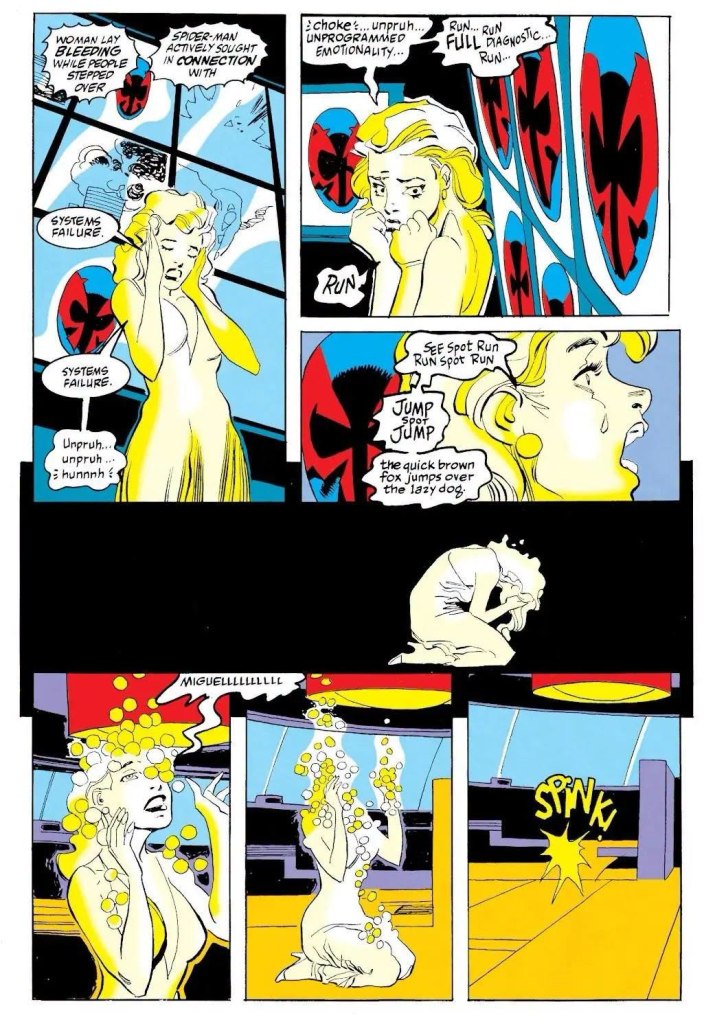
A comic strip featuring a distressed woman with long blonde hair expressing emotional turmoil amidst a backdrop of technological failure. The panels depict her hesitation, thoughts on running, and a call to someone named Miguel. The scene is vibrant with bright colors, emphasizing her emotional state.
Not even Miguel O’Hara’s AI assistant could handle the news.

This is a tale that has a careful mix of complexity and twists within. It technically is about the business of Alchemax getting disrupted from within and from the outside with the mysterious Thanatos pursuing something deep within the secrets of the company.

Miguel O’Hara is in a bind here as Dana (who is his fiancée) gets involved in a dangerous situation because of Thanatos’ sudden forced entry into Alchemax targeting Tyler Stone. At the same time, O’Hara values the company and prefers it does not collapse because of Thanatos. As expected, Miguel changes into the futuristic Spider-Man and carefully deals with Thanatos not by force but with strategic negotiation and discussion. Since he does not know what Thanatos is truly after, he has to play along while ensuring nobody from the company suffers (even though Alchemax itself has some very undesirable personalities within).

All throughout, this tale is heavy on the dialogue and there are a lot of details that you will need to absorb in order to understand the story and what Thanatos is pursuing. Along the way, this story reveals Alchemax has something valuable that has nothing to do with wealth. This is where the virtual unreality division of the company comes into place and Jordan Boone (who later becomes the fake Loki in the Fall of the Hammer storyline and also Halloween Jack in later X-Men 2099 tales) has a very notable role here. The story moves mostly in a medium pace and the build-up of the plot happens gradually. As such, there is some suspense and intrigue here.

Thanatos here is a pretty calculating antagonist. He is capable of killing others to get what he wants, but he prefers to do things patiently and strives get what he wants without using force as the primary option. There is richness in the dialogue here and his interactions with Spider-Man and Tyler have a cerebral touch throughout.

Conclusion

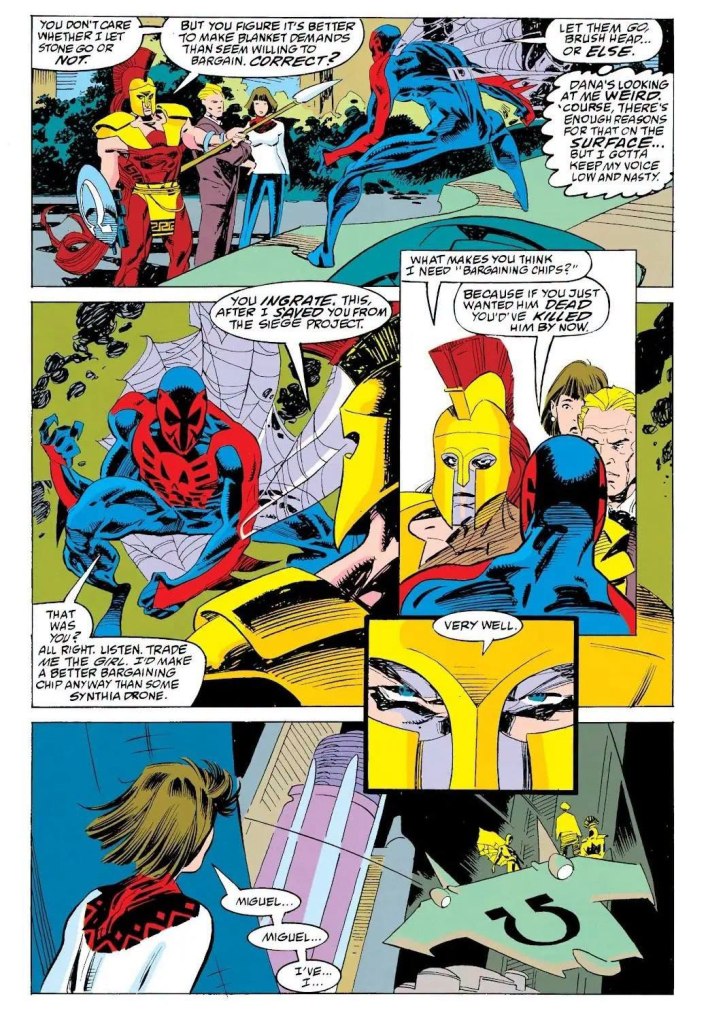
A comic book panel featuring characters in superhero costumes interacting, with one character in a red and black suit resembling Spider-Man, and another in a yellow and blue suit. Dialogue bubbles reveal a tense negotiation. The scene includes two other characters standing nearby, with a futuristic background.
Spider-Man carefully talks with Thanatos to let Dana go free. Dana does not know Miguel O’Hara and Spidey are one and the same person.

Spider-Man 2099 #12 (1993) is a really intriguing read filled with suspense and twists. This is not your typical superhero story about the hero fighting hard with the villain, and Thanatos is a pretty unique antagonist who puts Alchemax and others on the edge of danger. That said, this tale is the start of a new storyline and there is more that have yet to be revealed. 

Overall, Spider-Man 2099 #12 (1993) is recommended.

+++++

Thank you for reading. If you find this article engaging, please click the like button below, share this article to others and also please consider making a donation to support my publishing. If you are looking for a copywriter to create content for your special project or business, check out my services and my portfolio. Feel free to contact me with a private message. Also please feel free to visit my Facebook page Author Carlo Carrasco and follow me on Twitter at @HavenorFantasy as well as on Tumblr at https://carlocarrasco.tumblr.com/ and on Instagram at https://www.instagram.com/authorcarlocarrasco
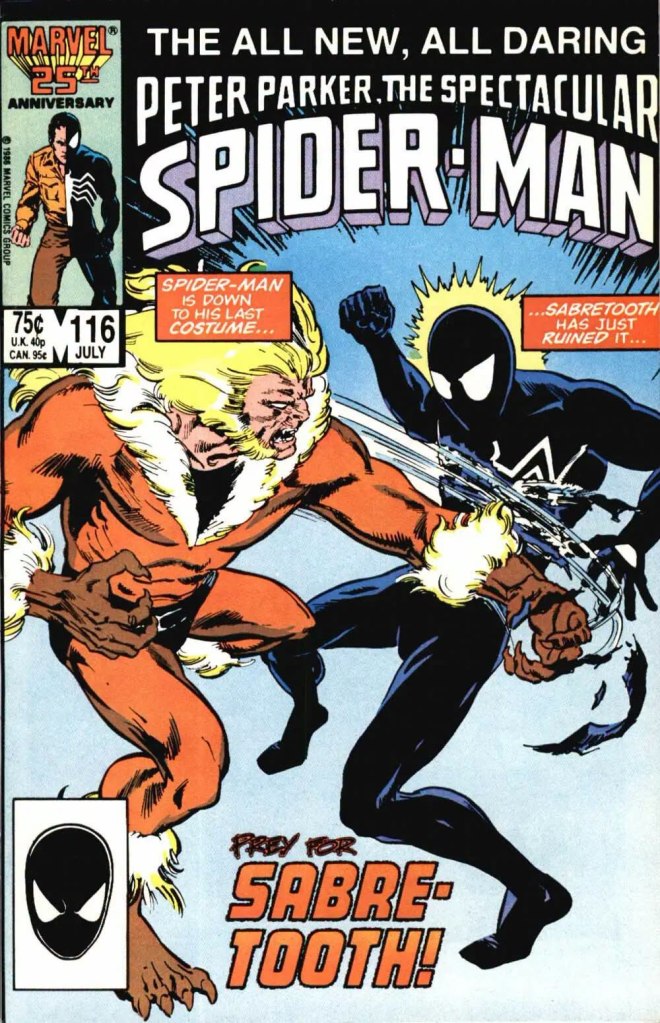
A Look Back at Peter Parker, The Spectacular Spider-Man #116 (1986)

Welcome back superhero enthusiasts, 1980s arts and culture enthusiasts, Spider-Man fans and comic book collectors! Today we go back to the year 1986 to examine a small part of the Marvel Comics shared universe through a tale of the Peter Parker, The Spectacular Spider-Man monthly series.

Within the shared universe of Marvel Comics, Sabretooth is a very notable super villain often associated with the X-Men, and has been portrayed as Wolverine’s rival. Sabretooth by nature is sadistic, savage and is violent driven by his beastly instincts. Like Venom, Sabretooth is also a murderer. Considering how popular the Wolverine-Sabretooth rivalry has been from comics to the movies, would you believe that the ferocious mutant actually encountered Spider-Man in comics long ago? Yes, they met and fought each other!

With those details laid down, here is a look back at Peter Parker, The Spectacular Spider-Man #116, published in 1986 by Marvel Comics with a story written by the late Peter David and the late Rich Buckler.

The cover.

Early story

The story begins with a gang of thugs who have cornered Black Cat who is suffering with a broken nose. It turns out, she broke into the office of their boss called the Foreigner. With her broken nose, Black Cat feels disoriented and helpless. She starts to hallucinate an image of Spider-Man replacing the thug who has her.

In another part of New York City, Spider-Man swings around wondering what Black Cat has been doing. He finds an empty alley and secretly changes into civilian clothes as Peter Parker and decides to visit his friend Mary Jane. As he approaches the building where MJ lives in, he spots Roderick Kingsley coming out of the place. He feels troubled and remembers Roderick for causing him aggravation.

Once he meets Mary Jane, he confronts her about Roderick…

Quality

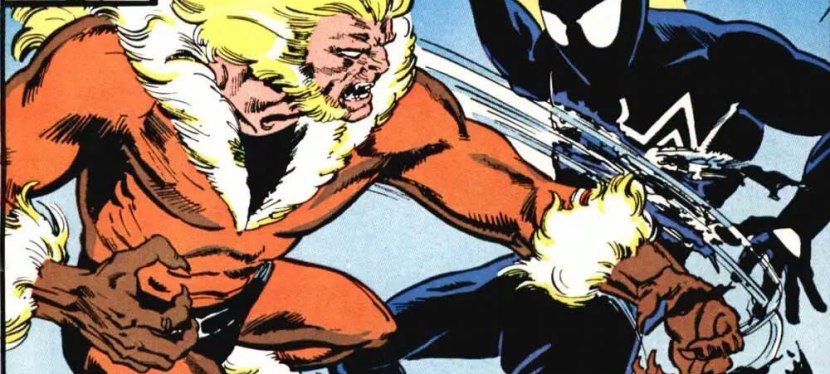
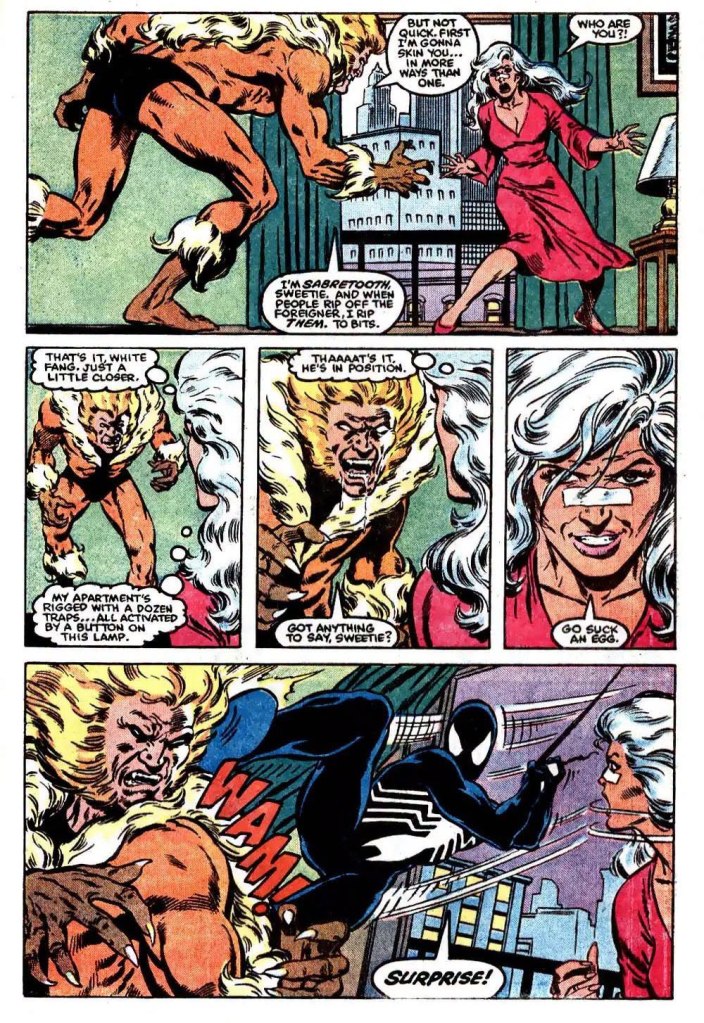
This page shows the very moment Spider-Man and Sabretooth met.

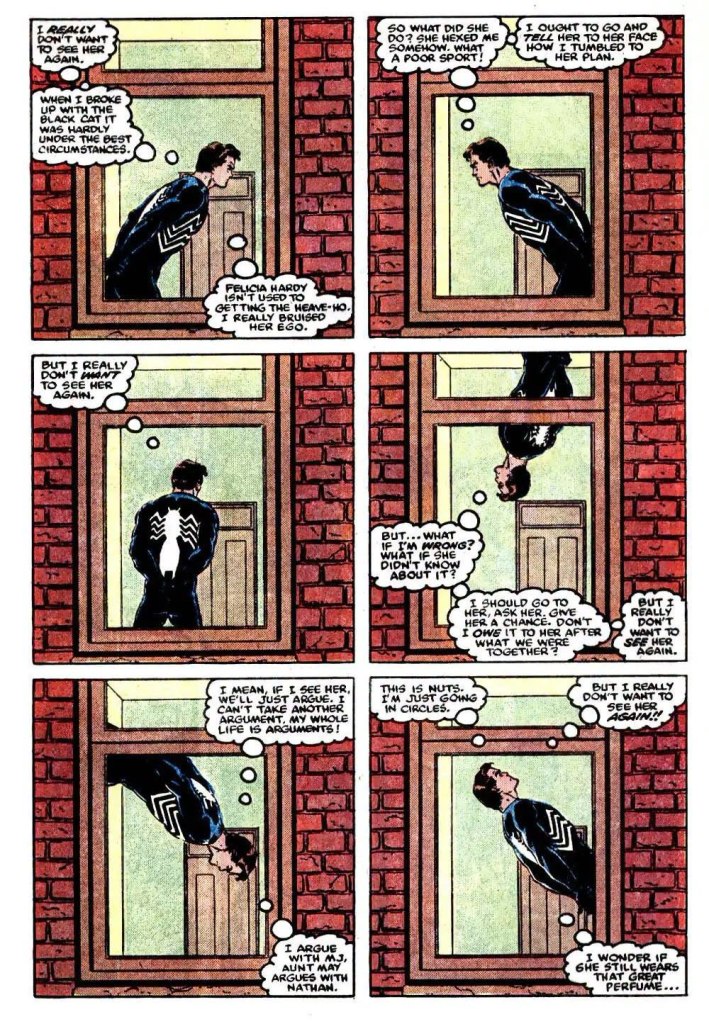
This is a story with a lot of details spread throughout. While the cover of this comic book prominently shows Spider-Man and Sabretooth together, the plot is divided into a few threads. That said, the Black Cat herself has a great share of the spotlight as this tale happened after Doctor Strange removed the remains of her hex. At this point of the monthly series, Peter Parker and Black Cat no longer have a love relationship as they broke up already. As such, Peter David loaded a lot of emotional stuff into the intense talks between the webslinger and Felicia Hardy. All of that is justified with the very rich dialogue David composed and the tension between the two is realistic and believable.

Spider-Man here is dealing with a lot of emotional baggage even as he keeps on persevering to get rid of the bad guys in New York. He is seriously having a troubled personal life and lacks a clear direction.

Sabretooth, on the other hand, has things in his own life going wrong since he broke prison. This led him to the Foreigner for potential opportunities to find work (read: violent tasks) and already he is itching to kill someone as he failed to achieve any over the previous two days.

That said, Spider-Man and Sabretooth encountered each other by circumstance and Black Cat is technically the bridge. Better temper your expectations because what the cover art does not tell you is that the first-ever encounter between the webslinger and the beastly murderer is not extensive. Still, I can say their battle is surprisingly satisfying and how it ended is very intriguing to see. As such, I am satisfied with their first encounter here.

Conclusion

With so much in his mind, Peter Parker walked on the different surfaces of the place.

Peter Parker, The Spectacular Spider-Man #116 (1986) is loaded with a lot of drama, intrigue and gritty stuff that preceded the Spider-Man/Sabretooth encounter. I should state that the art of the late Rich Buckler here is very impressive to look at and there is a good level of grittiness mixed with realism throughout. Buckler’s take on Sabretooth is menacing to see. This comic book is entertaining and intriguing to read, and I am interest now to search for other comic book encounters between Spider-Man and Sabretooth.

Overall, Peter Parker, The Spectacular Spider-Man #116 (1986) is recommended.

+++++

Thank you for reading. If you find this article engaging, please click the like button below, share this article to others and also please consider making a donation to support my publishing. If you are looking for a copywriter to create content for your special project or business, check out my services and my portfolio. Feel free to contact me with a private message. Also please feel free to visit my Facebook page Author Carlo Carrasco and follow me on Twitter at @CarloCarrascoPH as well as on Tumblr at https://carlocarrasco.tumblr.com/ and on Instagram at https://www.instagram.com/authorcarlocarrasco
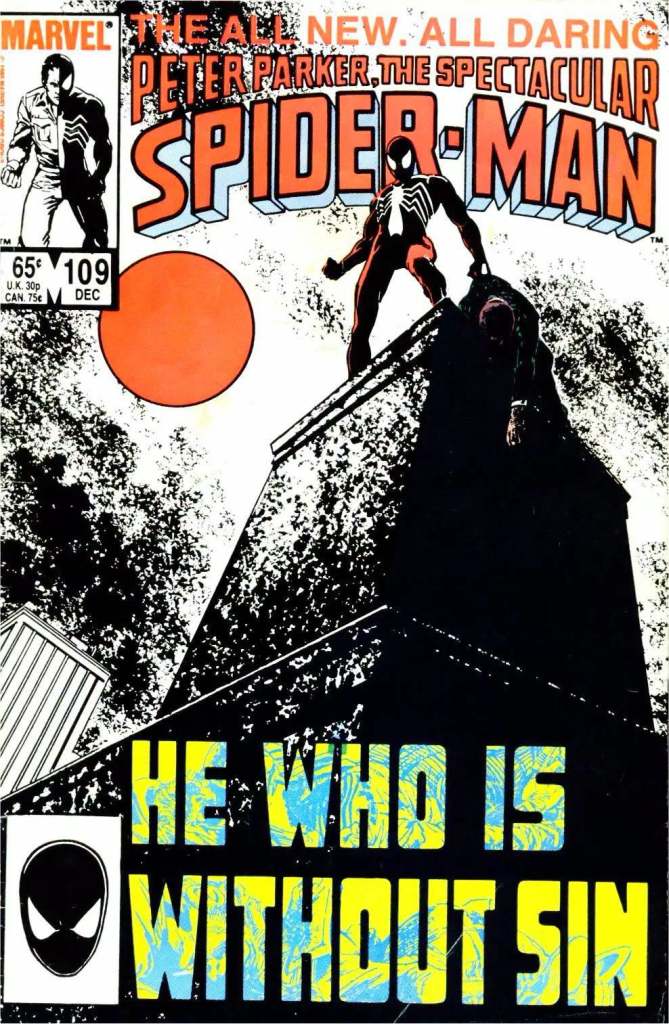
A Look Back at Peter Parker, The Spectacular Spider-Man #109 (1985)

Welcome back superhero enthusiasts, 1980s arts and culture enthusiasts, Spider-Man fans and comic book collectors! Today we go back to the year 1985 to examine a small part of the Marvel Comics shared universe through a tale of the Peter Parker, The Spectacular Spider-Man monthly series.

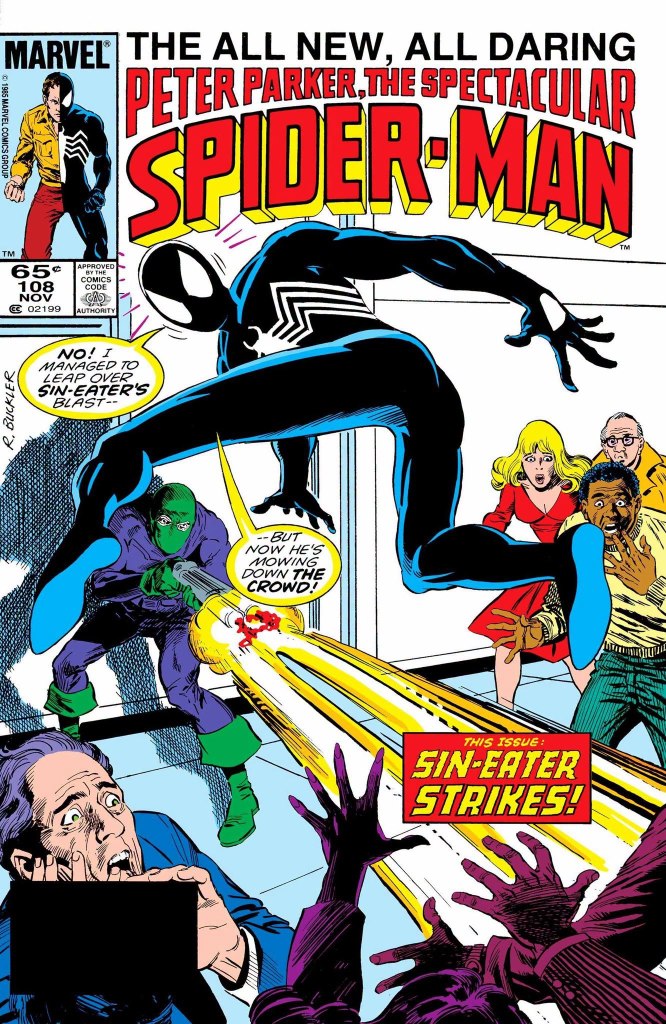
The first two chapters of the murder of Jean DeWolff really impacted not only Spider-Man but also Daredevil and the city of New York. Issue #107 was the start and the search for answers started with a good amount of mystery and suspense. In issue #108, the plot thickened somewhat and Spider-Man encountered the Sin-Eater with lots of bystanders nearby. Since the start, the creators crafted a compelling tale with a heavy touch of detective storytelling.

With those details laid down, here is a look back at Peter Parker, The Spectacular Spider-Man #109, published in 1985 by Marvel Comics with a story written by the late Peter David and the late Rich Buckler.

The cover.

Early story

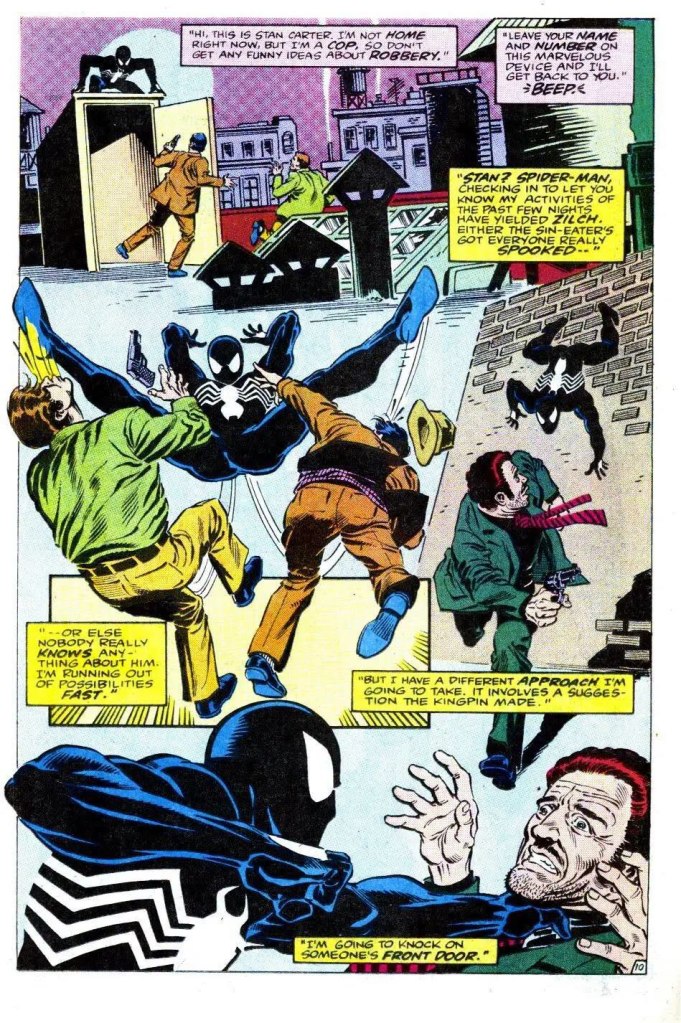
The story begins with the news of the violent death of a reverend being reported on television. The local authorities believe that the victim’s concern for criminals – a concern shared by the late judge Horace Rosenthal – marked him as a target of the Sin-Eater. While the news broadcast goes on, Peter Parker talks to Stan Carter as Spider-Man on the phone (with a cloth on the mouthpiece to distort the sound of his natural voice). Other people who saw the news broadcast are affected in different ways and there is the feeling of dread clouding the city.

In the evening, Wilson Grant Fisk (the Kingpin) dictates into his small recorder. While dictating and recording, the Kingpin knows Spider-Man is hiding in the dark very close to him. He fires a shot at Spider-Man who easily evades it. As the webslinger starts talking to him, the Kingpin reminds him that he is trespassing…

Quality

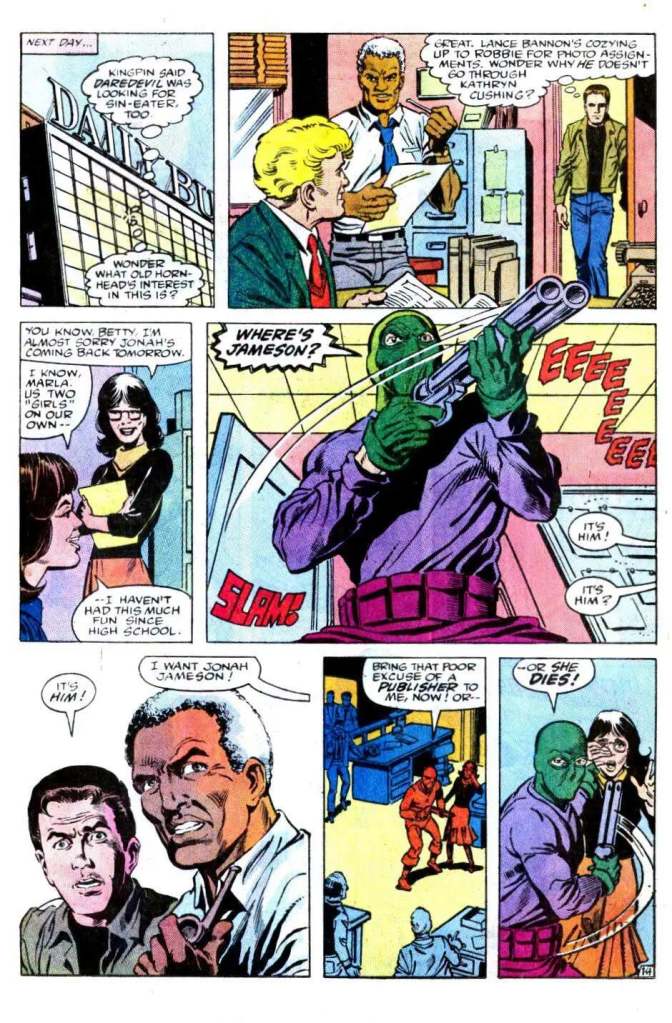
Danger inside the Daily Bugle!

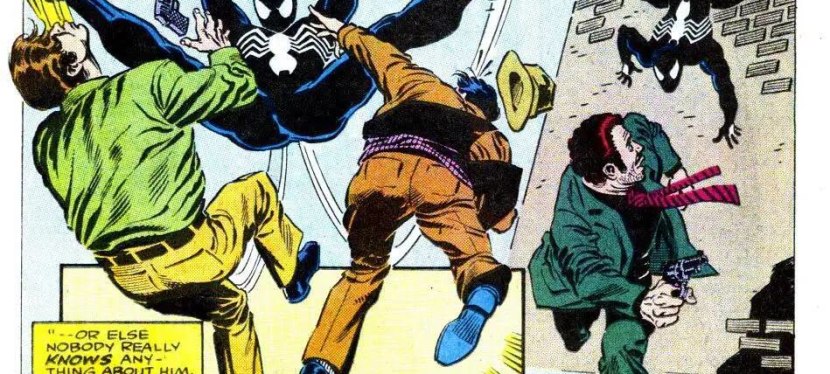
Right from the start, this tale not only maintained the gritty detective story tone since issue #107, it continued to build-up the tension and intrigue smoothly as the story went on. At this stage of the storyline, Spider-Man and Daredevil are both doing detective work to find out who the Sin-Eater really is and why precisely has he been killing people and causing chaos in the first place.

Both superheroes encountered different people in their respective searches for answers. Because he was not successful finding details as Daredevil, he decides to do it in his civilian form as Matt Murdock. Spider-Man, who is not a professional detective at all, continues his search with his limitations and with the only ways he knows how (including the use of violence, humiliation and threats).

Without spoiling the plot, I can say that there two notable plot turning points that are really fine payoffs to the build-up that started since issue #107. What happened here was finely dramatized by the David-Buckler duo and easily justified the cover price.

Conclusion

Spider-Man doing detective work the way he knows how.

Considering the very strong qualities of the writing and visuals combined with the two major plot developments, Peter Parker, The Spectacular Spider-Man #109 (1985) is easily the most compelling part of the death of Jean DeWolff storyline. I should also state that Spider-Man and Daredevil are the key detectives of the tale and the creative team succeeded again in shaping this detective story to be very grounded with reality. The superhero elements are still present but noticeably contained with the brooding detective story. As to the two plot turning points I mentioned earlier, I encourage you all to grab a copy of this comic book and find out for yourselves. I promise you, they are worth your time and attention

Overall, Peter Parker, The Spectacular Spider-Man #109 (1985) is highly recommended.

+++++

Thank you for reading. If you find this article engaging, please click the like button below, share this article to others and also please consider making a donation to support my publishing. If you are looking for a copywriter to create content for your special project or business, check out my services and my portfolio. Feel free to contact me with a private message. Also please feel free to visit my Facebook page Author Carlo Carrasco and follow me on Twitter at @CarloCarrascoPH as well as on Tumblr at https://carlocarrasco.tumblr.com/ and on Instagram at https://www.instagram.com/authorcarlocarrasco
A Look Back at Peter Parker, The Spectacular Spider-Man #108 (1985)

Welcome back superhero enthusiasts, 1980s arts and culture enthusiasts, Spider-Man fans and comic book collectors! Today we go back to the year 1985 to examine a small part of the Marvel Comics shared universe through a tale of the Peter Parker, The Spectacular Spider-Man monthly series.

I found issue #107 – the first issue of the Sin-Eater storyline – a pretty engaging tale focused on the murder of Jean DeWolff. The sudden demise of DeWolff really impacted the city of New York and its tale involved not only Spider-Man but also Daredevil. The tale is really a murder mystery that is very grounded with reality.

With those details laid down, here is a look back at Peter Parker, The Spectacular Spider-Man #108, published in 1985 by Marvel Comics with a story written by the late Peter David and the late Rich Buckler.

The cover.

Early story

The story begins with Judge Rosenthal lying dead on the floor in his office. Moments earlier, the judge was killed by the Sin-Eater who used a shotgun and in the same room was Matt Murdock (Daredevil). Some people entered the office and the local authorities were called. Murdock slowly makes his way out to discreetly go after the Sin-Eater.

In another part of the city, Peter Parker, Aunt May and the elderly friend named Ernie walk together coming from the courthouse. Ernie could not believe that Judge Rosenthal let go of the punks who mugged him.

As they walked further, people around them begin to panic and move around fast. Peter gets separated from his aunt and Ernie, and eventually he realizes that the Sin-Eater is several feet away armed with a shotgun. The Sin-Eater is speaking to the people even though he is causing a huge disturbance.

Moments later, Peter changed into Spider-Man and proceeds to confront the Sin-Eater in front of many witnesses…

Quality

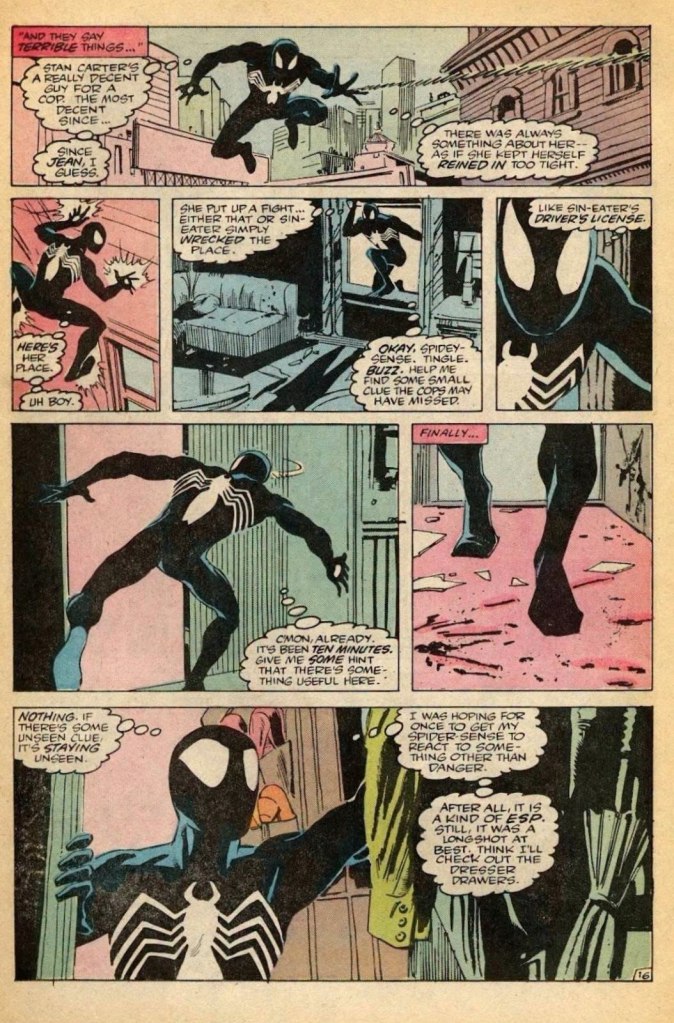
Spider-Man investigating the apartment of Jean DeWolff.

Following the events of issue #107, this comic book shows more of the Sin-Eater and the story emphasizes why he is very dangerous to everyone. The Sin-Eater is not a superbeing himself, and yet he is capable of killing people and causing chaos in public without the need of having multiple weapons and ammunition. That said, he is tremendous villain that Spider-Man has difficulty handling.

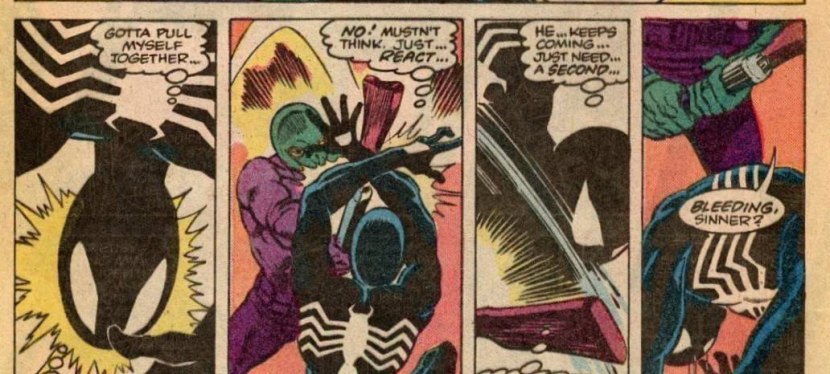
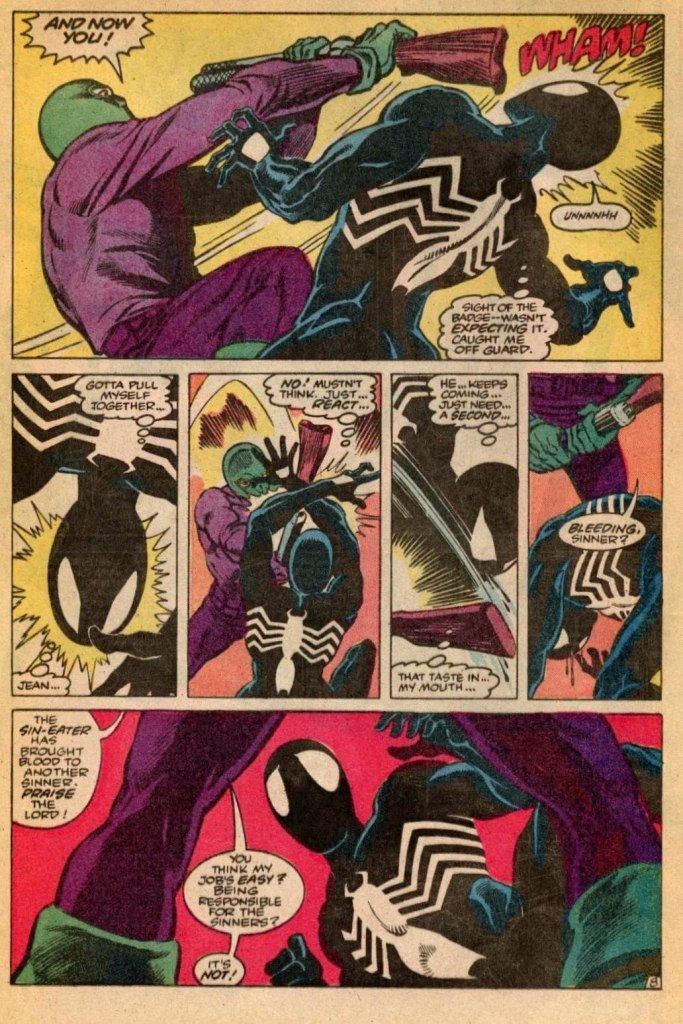
The physical encounter between Spider-Man and the Sin-Eater here is unsurprisingly ground in reality. The comic book action visualized by Rich Buckler has this raw action aesthetic and each time a physical blow was executed, impact is really felt. Don’t expect dynamic action here but a more realism and believability.

What makes the fight between the two unique is that it happened in front of a lot of people on New York City’s street. As the fight went on, Spider-Man struggles not only with fighting the Sin-Eater (a truly violent opponent) but also dealing with the risk of bystanders getting hurt and realizing what happened to his beloved Aunt May.

As expected, the detective story elements in this tale are very strong. Spider-Man, who is not a professional detective at all, gets to do detective work with a sheer determination to solve the mystery behind the death of Jean DeWolff. Along the way, I love how the David-Buckler duo invested a lot of details about the crime which are really worth paying attention to as you read.

Conclusion

The Sin-Eater and Spider-Man in a violent fight!

Peter Parker, The Spectacular Spider-Man #108 (1985) is a powerful follow-up in the Sin-Eater storyline. As it contains all the key elements that made issue #107 a very unique and engaging read, this comic book executed good pay-off to the build-up in the previous issue while consistently building-up the plot simultaneously which is typical of Peter David (read the Spider-Man 2099 comic books back-to-back). As of now, this Sin-Eater storyline is compelling and I am looking forward to what comes next.

Overall, Peter Parker, The Spectacular Spider-Man #108 (1985) is recommended.

+++++

Thank you for reading. If you find this article engaging, please click the like button below, share this article to others and also please consider making a donation to support my publishing. If you are looking for a copywriter to create content for your special project or business, check out my services and my portfolio. Feel free to contact me with a private message. Also please feel free to visit my Facebook page Author Carlo Carrasco and follow me on Twitter at @CarloCarrascoPH as well as on Tumblr at https://carlocarrasco.tumblr.com/ and on Instagram at https://www.instagram.com/authorcarlocarrasco
A Look Back at Peter Parker, The Spectacular Spider-Man #107 (1985)

Welcome back superhero enthusiasts, 1980s arts and culture enthusiasts, Spider-Man fans and comic book collectors! Today we go back to the year 1985 to examine a small part of the Marvel Comics shared universe through a tale of the Peter Parker, The Spectacular Spider-Man monthly series.

As I was not a regular reader of Spectacular Spider-Man comics, I missed out on the Sin-Eater storyline. I first learned about the Sin-Eater while reading a key flashback in Amazing Spider-Man #300. That particular detail boggled me for some time, and it was only recently I decided to start reading the comic books about the Sin-Eater.

With those details laid down, here is a look back at Peter Parker, The Spectacular Spider-Man #107, published in 1985 by Marvel Comics with a story written by the late Peter David (Spider-Man 2099) and by the late Rich Buckler.

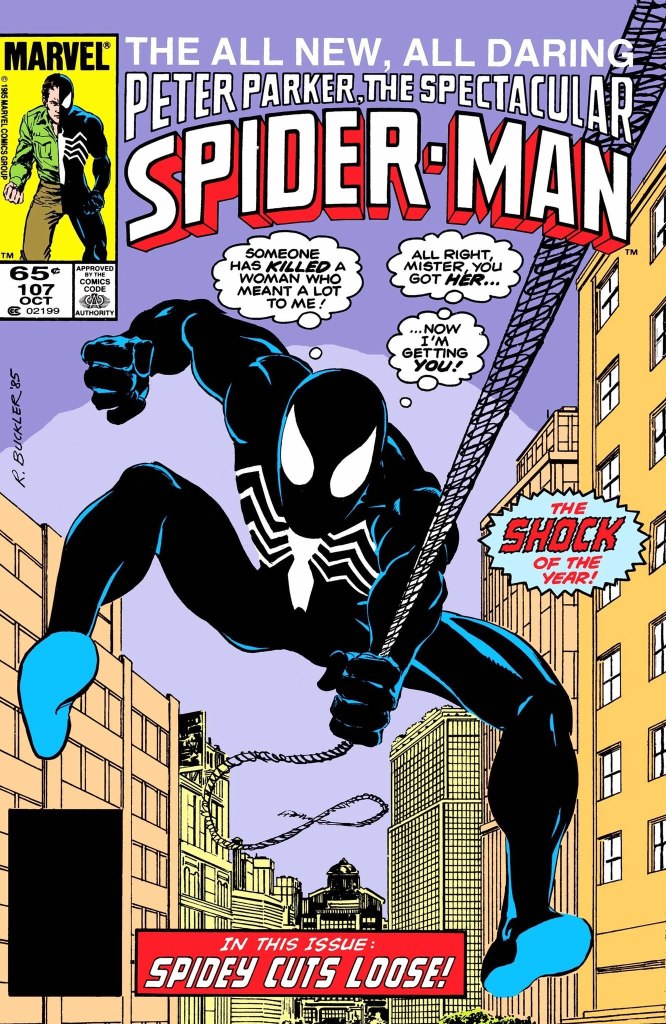
The cover.

Early story

The story begins with Jean DeWolff recalling several important details from her past as well as her family background. Her father was a police inspector who never forgave her mother for giving birth to her. She was only six months old when her parents split up. Sometime later, her mother married a patrolman named Carl Weatherby and Jean herself admired her stepfather.

As she grew into adulthood, Jean was very influenced by her patrolman stepfather and she went on to go into police academy and graduated. Jean went on to become a fast-rising policewoman.

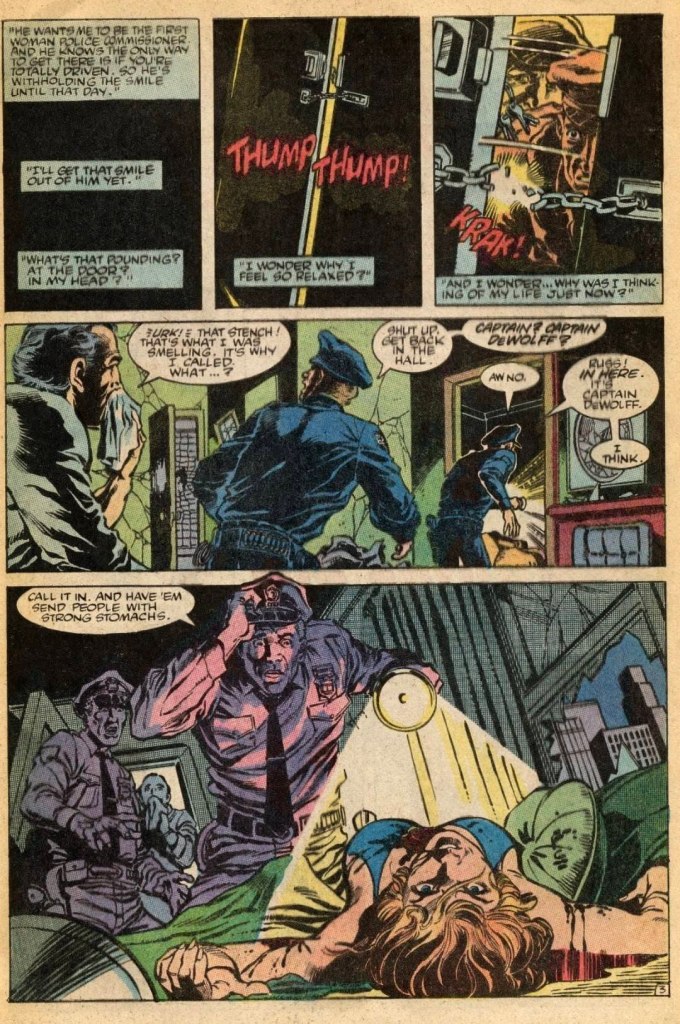
In the present day, New York police officers barged into a private residence searching for captain DeWolff and the place had bad odor. A dead woman was found inside a bedroom….

Quality

Spider-Man meets with Stan Carter on the road in the middle of New York City.

The first thing I will say about this comic book is that the writing done by Peter David is very grounded with reality and this resulted in a dark and gritty approach to storytelling. The heart of the story is the sudden murder of policewoman Jean DeWolff and its impact on the city of New York is strong and evident.

The story here is ultimately a detective story with a good amount of mystery, suspense and intrigue laced all over it. Along the way, Spider-Man here is barely the protagonist as the impact of Jean DeWolff’s murder has been dramatized through multiple characters in the city from J. Jonah Jameson to Matt Murdock (Daredevil).

This comic book also examines how the justice system in Marvel’s fictional portrayal of New York City works and it actually showed Peter Parker attending witnessing a court room arraignment to see how the bad guys he dealt with (as Spider-Man) were handled by the system. Again, this shows how grounded in reality the story is and the details should be seen. There is also a strong sense of local community dramatized.

The art by Rich Buckler is excellent and he really brought to life Peter David’s script with a heavy emphasis on realism. It seems to me that the illustrator took inspiration from TV shows and movies to achieve a unique visual style fitting for this particular tale.

Conclusion

This is a shocking and powerful way to start the story.

Peter Parker, The Spectacular Spider-Man #107 (1985) is indeed a very powerful tale that has to be seen if you want a gritty 1980s Spider-Man story. The David-Buckler creative duo delivered a very grounded story about murder in New York City that impacted its people which serves as a reminder that violent crime can cause waves of disturbance and disruption. That said, this first chapter of Sin-Eater storyline is pretty believable. As the creative team emphasized the murder’s impact on a wide scale, it is not surprising that Spider-Man’s share of the spotlight was sacrificed somewhat to achieve it. As of now, I am looking forward to the next chapter of the Sin-Eater storyline.

Overall, Peter Parker, The Spectacular Spider-Man #107 (1985) is recommended.

+++++

Thank you for reading. If you find this article engaging, please click the like button below, share this article to others and also please consider making a donation to support my publishing. If you are looking for a copywriter to create content for your special project or business, check out my services and my portfolio. Feel free to contact me with a private message. Also please feel free to visit my Facebook page Author Carlo Carrasco and follow me on Twitter at @CarloCarrascoPH as well as on Tumblr at https://carlocarrasco.tumblr.com/ and on Instagram at https://www.instagram.com/authorcarlocarrasco
A Look Back at Spider-Man 2099 #44 (1996)

Welcome back superhero enthusiasts, 1990s culture enthusiasts and comic book collectors! Today we go back to the year 1996 and explore a part of the Marvel Comics shared universe through a tale of the Spider-Man 2099 monthly series.

To put things in perspective, the original Spider-Man 2099 monthly series that launched in 1992 lasted a total of 46 issues. The prolific author Peter David wrote the first 44 issues as he resigned from his duty in relation to the sudden firing of Marvel 2099 editor Joey Cavalieri in 1996. The previous issue was a great read.

With those details laid down, here is a look back at Spider-Man 2099 #44, published in 1996 by Marvel Comics with a story written by Peter David and drawn by Ron Lim.

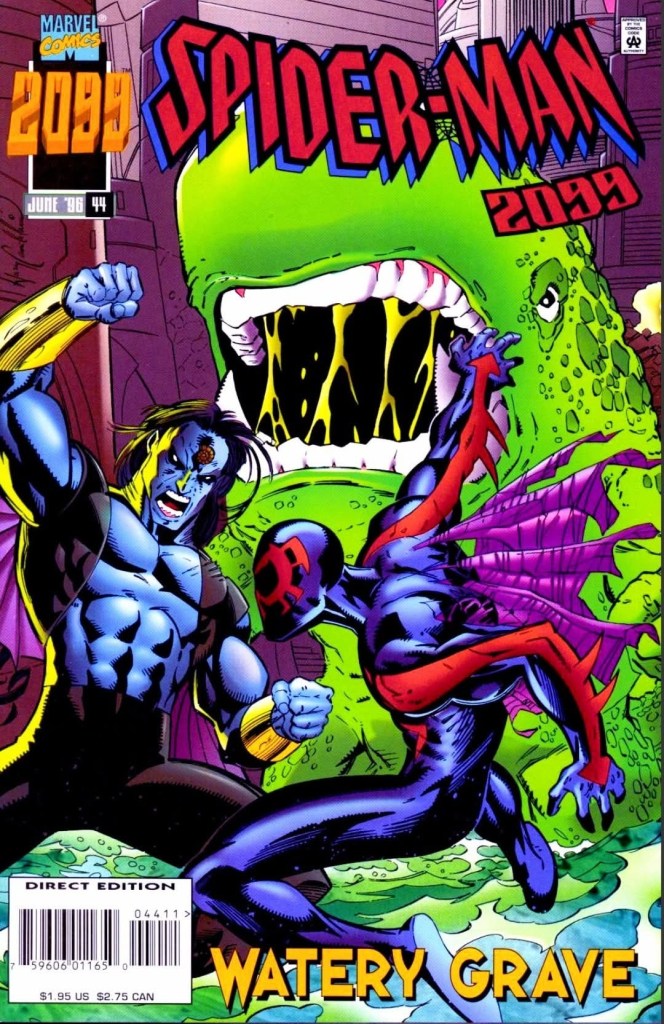
The cover.

Early story

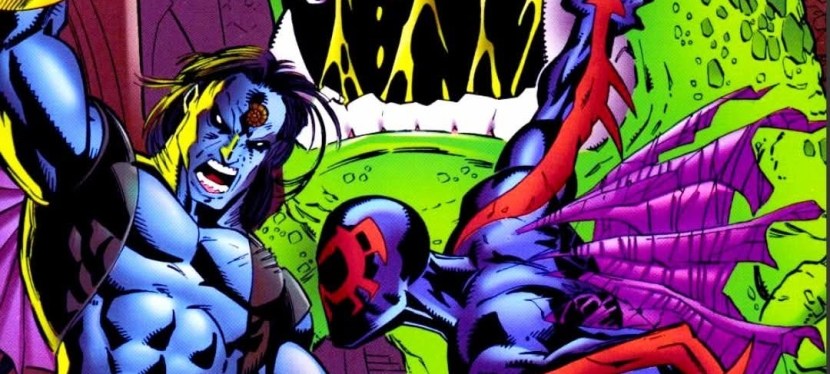
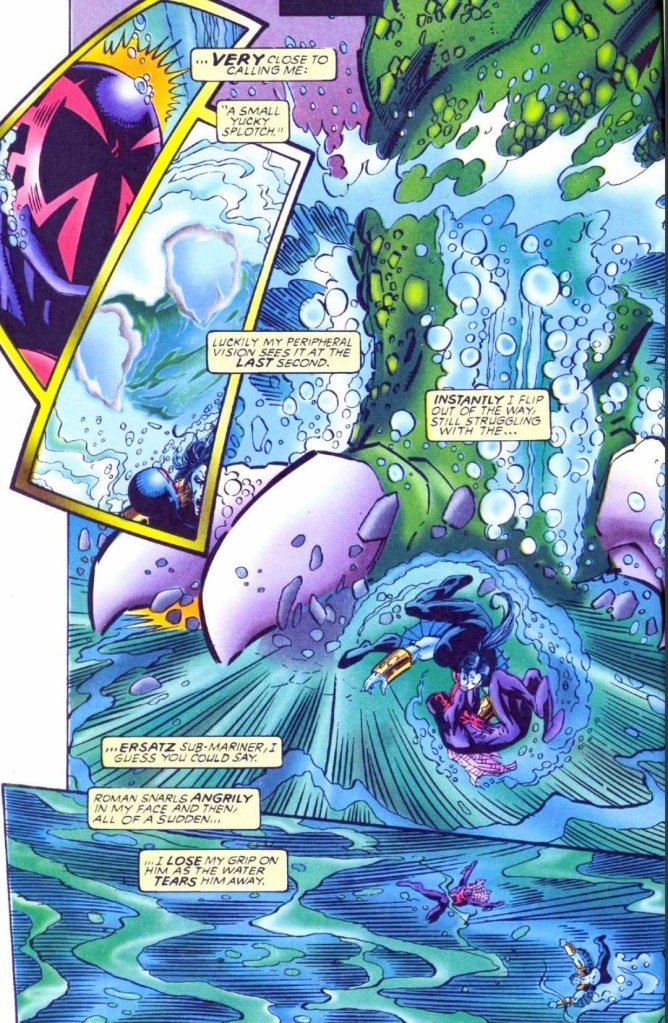
The story begins in the City of New York already flooded and infiltrated by lots of marine life. Under the water, Spider-Man and Roman the Sub-Mariner fight each other intensely as the foot of a gigantic sea monster is about to step in. At the last moment, Spider-Man saw the huge foot and instantly flipped away to survive with the Sub-Mariner.

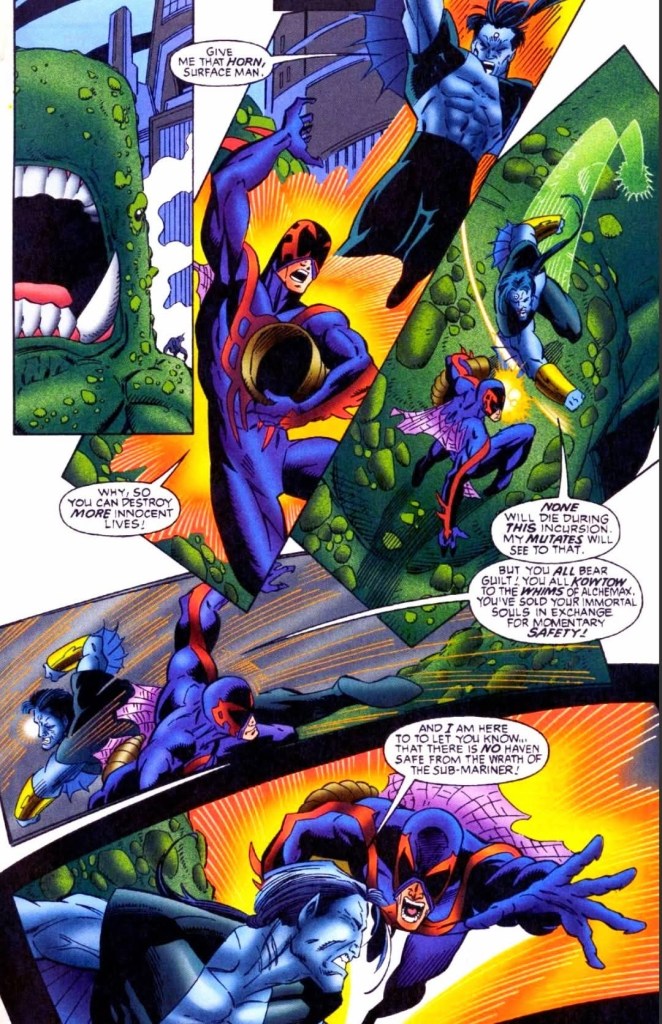
After getting separated, Spider-Man gets out of the water to breath and immediately spots an organic-looking horn that the Sub-Mariner used to control the huge monster. Suddenly, on the aquatic humanoids appears to get the horn. Spider-Man then used his web to get the horn first which triggered the aquatic humanoid to move fast towards him.

Quality

The intense battle between Sub-Mariner and Spider-Man went on even as the huge sea monster is very near them in the city.

Without spoiling the plot, this comic book is a tale about a massive disaster and also a tale about the complicated legacy of Miguel O’Hara whose personal life is even more connected with the corporation he works for.

The huge disaster of New York getting flooded (which started in the previous issue) and Spider-Man fighting the leader of the mutates (genetically designed sentient beings) concluded in a really satisfying way. The futuristic webslinger really found himself struggling with the determined Sub-Mariner (motivated by what Alchemax did to the aquatic world) while dealing with the fact that so many citizens got displaced or even got killed by not only the huge flood but also by the presence of the gigantic sea monster. The stakes were really raised high for Spider-Man and the pay-off was really good.

The rest of the comic book deals with the intense meeting between Conchata O’Hara and Tyler Stone, Xina’s time with the Net Prophet, Gabriel O’Hara’s time with “father” Jennifer. Among the three sub-plots, the conflict between Conchata and Tyler is very intense and dramatic to read. More importantly, it was crafted by Peter David to be really believable and it ultimately added tension to the background and even the future of Miguel O’Hara (now a powerful Alchemax executive). This particular sub-plot is easily the most important one this comic book has and it will compel fans to revisit the 25th issue of this monthly series as well as issue #10.

While the sub-plot of Xina and the Net Prophet does not generate enough depth for this comic book, there is a big revelation made in the sub-plot of Gabriel and “father” Jennifer which will compel fans to revisit issues #40 and #41. In fact, nothing is ever simple regarding the origin of a specific villain of the 2099 universe.

When it comes to the artwork, this comic book is a downgrade compared to what was presented in issue #43 (drawn by Andrew Wildman). I’m not saying that Ron Lim’s art is bad, it’s just nowhere as good as that of Wildman’s art. In fairness, Ron Lim managed to make the city disaster look intense and he managed to make the characters look recognizable. In fact, Lim successfully made the Conchata-Tyler scenes look intense and dramatic.

Conclusion

The giant monster aspect of this comic book added intensity to the battle and the disaster. There were a few Godzilla vibes here and there.

As the final Peter David-written issue of this monthly series, Spider-Man 2099 #44 (1996) is undeniably a very solid reading experience. There were strong pay-offs executed here to what was built-up in the previous issues, and in typical fashion, David kept building up the other sub-plots. The conclusion to the Conchata-Tyler sub-plot is actually more powerful than that of the city disaster. Clearly, Peter David kept track of the character developments and events that previously happened and dramatized them nicely here. In fact, you will feel some sympathy towards Miguel O’Hara knowing how unfortunately complicated his family legacy really is.  

Overall, Spider-Man 2099 #44 (1996) is highly recommended!

+++++

Thank you for reading. If you find this article engaging, please click the like button below, share this article to others and also please consider making a donation to support my publishing. If you are looking for a copywriter to create content for your special project or business, check out my services and my portfolio. Feel free to contact me with a private message. Also please feel free to visit my Facebook page Author Carlo Carrasco and follow me on Twitter at  @HavenorFantasy as well as on Tumblr at https://carlocarrasco.tumblr.com/ and on Instagram at https://www.instagram.com/authorcarlocarrasco
A Look Back at Spider-Man 2099 #43 (1996)

Welcome back superhero enthusiasts, 1990s culture enthusiasts and comic book collectors! Today we go back to the year 1996 and explore a part of the Marvel 2099 comics universe through a tale of the Spider-Man 2099 monthly series.

In my previous retro review, Miguel O’Hara learns how challenging it could be for him to direct the path of Alchemax which is symbolize with himself being surrounded by the managers. He recently stopped his father Tyler Stone from taking control of his office. As his office needs a secretary, someone very exceptional came in.

With those details laid down, here is a look back at Spider-Man 2099 #43, published in 1996 by Marvel Comics with a story written by Peter David and drawn by Andrew Wildman and Ron Lim.

The cover.

Early story

The story begins when one of the undersea bases of Alchemax explodes to the surface in heavily damaged form. Something terrible happened to it deep below and there is only one man (wearing a protective suit) still living floating on the sea. Just as he notices sharks coming his way, Spider-Man comes down to save him with the use of one of Alchemax’s floating vehicles. As Spider-Man pulls the helpless man up with his web, one of the sharks leaped high at them. The web breaks and both the man and Spidey fall into the sea.

Meanwhile at Alchemax, Gabriel O’Hara confronts his mother Conchata who very recently started working as the office secretary of Miguel. Gabriel asks how could she be working for Miguel as part of Alchemax which is the very corporation she hated. The mother answered back stating that she resolved her accumulated anger related to Miguel and has realized that he needs her…

Quality

The rise of the mutate rebel Roman and Miguel O’Hara’s corporate interactions dramatized efficiently in this single page.

Moving further away from what was dramatized in issues #40 and #41, Peter David crafted this tale focusing on a new threat that endangers not only Spider-Man but the people and their local society as a whole. To put things in perspective, it is recommend you revisit issue #8 and focus on Alchemax’s aquatic division called Atlantis which had been working on a major reclamation project under the sea with the objective of becoming a tourist attraction in the years to come. Right there, Tyler Stone mentioned Miguel’s involvement with the project which includes bio-engineered workers.

The key elements of Atlantis mentioned in issue #8 literally resurfaced in this comic book and Peter David heavily emphasized the related details and integrated it all in the plot which essentially justified the existence of the new opposition led by Roman who is the charismatic leader of the mutates (genetically designed sentient beings) who had long been working hard and long outside of the undersea bases which had humans living comfortably inside. Roman here is not related in any way to Marvel’s aquatic hero Namor the Sub-Mariner but he is an imitation of him (note: his name is Namor in reverse).

The conflict of Atlantis revives the business-laborers conflict but was twisted to show the conflict between humans and mutates, as well as Atlantis being symbolized as a physical project of Alchemax to exploit the aquatic life and resources deep under the sea. The build-up of the human-mutates conflict in this particular comic book is surprisingly beefy and was efficiently done.

As for Spider-Man himself, you will get to see him more involved with Alchemax just as he successfully keeps his civilian identity secret. Along the way, you will see more of Miguel O’Hara doing more corporate work and negotiations. As expected, his drive to lead Alchemax with his own perception of being compassionate encounters hurdles from the established order – both within and outside his company. His mother was portrayed to be more sympathetic than before and she shows lots of signs of having mellowed. The development on Miguel and Conchata here were deep and they made a lot of sense with the plot itself.

Conclusion

The futuristic Spidey interacts with a huge shark!

Spider-Man 2099 #43 (1996) is another tale that has aged well as its foundations and elements proved to be very solid until now. With regards to the big event that took place near the end of this comic book, it seems that Peter David took inspiration from what was portrayed in Fantastic Four #4 (1962) as well as from Namor the Sub-Mariner himself. I really enjoyed how this story became a huge pay-off to the minor build-up in issue #8.

Overall, Spider-Man 2099 #43 (1996) is highly recommended!

+++++

Thank you for reading. If you find this article engaging, please click the like button below, share this article to others and also please consider making a donation to support my publishing. If you are looking for a copywriter to create content for your special project or business, check out my services and my portfolio. Feel free to contact me with a private message. Also please feel free to visit my Facebook page Author Carlo Carrasco and follow me on Twitter at  @HavenorFantasy as well as on Tumblr at https://carlocarrasco.tumblr.com/ and on Instagram at https://www.instagram.com/authorcarlocarrasco
A Look Back at Spider-Man 2099 #42 (1996)

Welcome back superhero enthusiasts, 1990s culture enthusiasts and comic book collectors! Today we go back to the year 1996 and explore a part of the Marvel 2099 comics universe through a tale of the Spider-Man 2099 monthly series.

In my previous retro review, the futuristic webslinger encountered a group of dangerous people who are convinced that he betrayed them by becoming a corporate tool (note: the result of Goblin 2099 poisoning people’s minds). Not only that, the still-recovering Tyler Stone came back at Alchemax, saw his captured son Kron (Venom 2099 himself) and cold heartedly ordered his execution.

With those details laid down, here is a look back at Spider-Man 2099 #42, published in 1996 by Marvel Comics with a story written by Peter David and drawn by Andrew Wildman.

The cover.

Early story

The story begins with Miguel O’Hara now wielding tremendous corporate power at Alchemax where he is surrounded by managers. Some time had passed since he prevented Tyler Stone from returning to power and he made it known to him that he is aware that they are biologically father-and-son. Miguel then played “duck, duck, goose” on the managers while he stood up on his desk. He made clear to them that he is aware of their so-called game of “who can jerk the new boost and get the most for himself?”

Miguel then tells them that he will review their requests and address their concerns in his own time and his own way. They get dismissed by him. Miguel then meets someone who just arrived for the post of office secretary.

Meanwhile in the downtown section of New York, Raff and Kasey watch a union group composed of construction guys, watchdogs, sewer workers and truckers marching down the street and making noise. As Kasey wonders where the group was heading, she notices a man named Boru whom she previously heard was dead…

Quality

Spider-Man 2099 faces a tough opponent.

Storywise, this tale by Peter David moved away from the themes of issues #40 and #41 by focusing more on Miguel’s newest rise in Alchemax’s corporate hierarchy and how this adds more tension to his already troubled living as a secret superhero, an executive and as a person. By this stage, he knows Tyler Stone is his true father and the man known as Venom 2099 is his half-brother and relationships within his family are far from being normal or ideal. Still on the corporate aspect, a very notable person gets to work as Miguel’s new secretary which I won’t spoil here because I can say that the build-up and pay-off are well worth reading. The new secretary also added to the further development of specific characters and what was dramatized here will compel you to revisit earlier issues of the Spider-Man 2099 series. As always, Peter David’s writing is rich here.

Outside of Alchemax, the group led by Boru (who is symbolically a leader of hardened and desperate labor union members) emerges as an intimidating force of opposition for Miguel, the corporation he leads and even in his Spider-Man identity. Boru himself is quite a strong opponent for Spidey and the way their battle ended is something can intrigue readers or even frustrate die-hard fans of the protagonist. These conflicts, combined with Miguel’s struggle with all the tension hitting him from all angles, made this tale very intriguing and compelling to read.

Conclusion

While walking through the city, Miguel O’Hara spots members of Fantastic Four 2099 in conflict with Stark-Fujikawa.

Spider-Man 2099 #42 (1996) may not look like the expected continuation of what was built up in the previous two issues but its standalone story combined with strong twists, in-depth character development and sheer intrigue in key points of the story made this a must-read. I can also say that I am motivated to find out what happens next, especially given how this particular tale ended.

Overall, Spider-Man 2099 #42 (1996) is highly recommended!

+++++

Thank you for reading. If you find this article engaging, please click the like button below, share this article to others and also please consider making a donation to support my publishing. If you are looking for a copywriter to create content for your special project or business, check out my services and my portfolio. Feel free to contact me with a private message. Also please feel free to visit my Facebook page Author Carlo Carrasco and follow me on Twitter at  @HavenorFantasy as well as on Tumblr at https://carlocarrasco.tumblr.com/ and on Instagram at https://www.instagram.com/authorcarlocarrasco
A Look Back at Spider-Man 2099 #41 (1996)

Welcome back superhero enthusiasts, 1990s culture enthusiasts and comic book collectors! Today we go back to the year 1996 and explore a part of the Marvel 2099 comics universe through a tale of the Spider-Man 2099 monthly series.

In my previous retro review, the futuristic webslinger encountered Goblin 2099 (note: the futuristic take on Green Goblin) who proved to be very dangerous not with weapons nor physical attacks but with influence members of the local society to rebel against him believing that he is a corporate asset. How much influence Goblin had on the people at the expense of Spider-Man is just waiting to be discovered.

With those details laid down, here is a look back at Spider-Man 2099 #41, published in 1996 by Marvel Comics with a story written by Peter David and drawn by Andrew Wildman

The cover.

Early story

The story begins with Miguel O’Hara visiting a ruined place with armed personnel escorting him. It turns out the site was the White House and Doom 2099 has already fallen as President of the United States. Miguel seeks closure as he spends time at the ruins and eventually finds the name plate from the office of Tyler Stone (Miguel’s biological father).

Meanwhile at Alchemax, corporate personnel got surprised to see Tyler Stone return confined to a hovechair due to his fragile and weakened state. This turned out to be his first time to be at work since he got shot.

Inside the laboratory, Tyler sees his deranged son Kron (Venom 2099) contained behind solid glass like a mere scientific specimen for study. After learning key details about the symbiote and how it affected his son, Tyler gives the order to have Kron executed…

Quality

Even though Goblin 2099 was not present, this scene shows how much the said villain poisoned the minds of people to harm Spider-Man.

Let me start with the writing by Peter David. It is clear to me that David confidently wrote this story to maintain the flow of intrigue, emphasize how local society’s changing, how the external events affect others and, most notably, managing to push Spider-Man 2099 to the edge complete with a brewing conflict with the very powerful Tyler Stone.  

At this stage of the monthly series of the 1990s, Miguel O’Hara’s rise within the corporate structure of Alchemax got emphasized again and Peter David inserted growing tensions for the protagonist effectively blurring the boundary that separates personal life from the corporate career. That being said, the futuristic Spider-Man in his civilian identity literally entered a gray area which will compel readers to speculate if he was still in control of matters or if he was slowly becoming evil as he gains power (this makes him comparable with the tycoon Tyler).

Still on the character development aspect of this comic book, Miguel here still showed his fragile side as the death of Dana left him with a lot of pain deep inside (which was dramatically emphasized by Andrew Wildman through his art in one very particular page). This furthers adds to questions about the sanity and mental stability of the protagonist who already wields so much power as Spider-Man and as an Alchemax executive.

Speaking of Alchemax, Tyler Stone here appeared more sinister than before and being unable to stand did not hinder him at all. His cold-hearted move to have his own biological son Kron (the futuristic Venom and the same guy responsible for the deaths of Punisher 2099’s family) executed clearly shows not only his sadistic nature but also the fact that he is living with pure worldly beliefs. His believes are so worldly, he does not really care about his own offspring. Ironically, this suggests that Tyler could be as twisted and evil as his murderous son Kron. Lastly, the connections between the late Dana and Tyler and Miguel is indeed morally disturbing.

While the cover art showed Goblin 2099, the new antagonist is nowhere to be found in this comic book. However in a very symbolic fashion, Goblin’s influence remained lively through a number of people who condemned Spider-Man 2099 so much, they went as far as actually hurting an idolater of the webslinger. This part of the story is a strong reminder that idolatry is unholy and foolish, that religion is corrupted and will never lead believers to salvation, and that socialism attacking capitalism remained a social disease in the far future.

Conclusion

Tyler Stone and his son Kron (Venom 2099) are both very evil. They have different ways of being evil.

Spider-Man 2099 #41 (1996) is indeed a great comic book to read from start to finish. Not only will you get to see the futuristic Spidey struggle with the tension both personally and professionally, you will see the big impact of Dana’s death on him too. The portrayal of negative changes in the local society (at least the society Spider-Man is part of) is pretty dramatic and what Peter David imagined about Marvel 2099 still remains socially relevant to this day. Lastly, this comic book ended very powerfully and was enough to convince me to see what happens next.

Overall, Spider-Man 2099 #41 (1996) is highly recommended!

+++++

Thank you for reading. If you find this article engaging, please click the like button below, share this article to others and also please consider making a donation to support my publishing. If you are looking for a copywriter to create content for your special project or business, check out my services and my portfolio. Feel free to contact me with a private message. Also please feel free to visit my Facebook page Author Carlo Carrasco and follow me on Twitter at  @HavenorFantasy as well as on Tumblr at https://carlocarrasco.tumblr.com/ and on Instagram at https://www.instagram.com/authorcarlocarrasco