A Look Back at X-Men 2099 #15 (1994)

Welcome back, superhero enthusiasts, 1990s culture enthusiasts, X-Men fans and comic book collectors! Today we revisit the Marvel Comics shared universe through one of the many tales of the X-Men 2099 monthly series.  

Looking back at how early the members of the futuristic X-Men got separated and lost their leader Xi’an (who became sinister, pursued a quest of his own interest and joined the Theater of Pain), I can see what the creators did to develop the characters, tell new stories, introduce new characters and expand the lore of the 2099 in another part of the United States. That said, this series became consistently entertaining and intriguing at the same time.

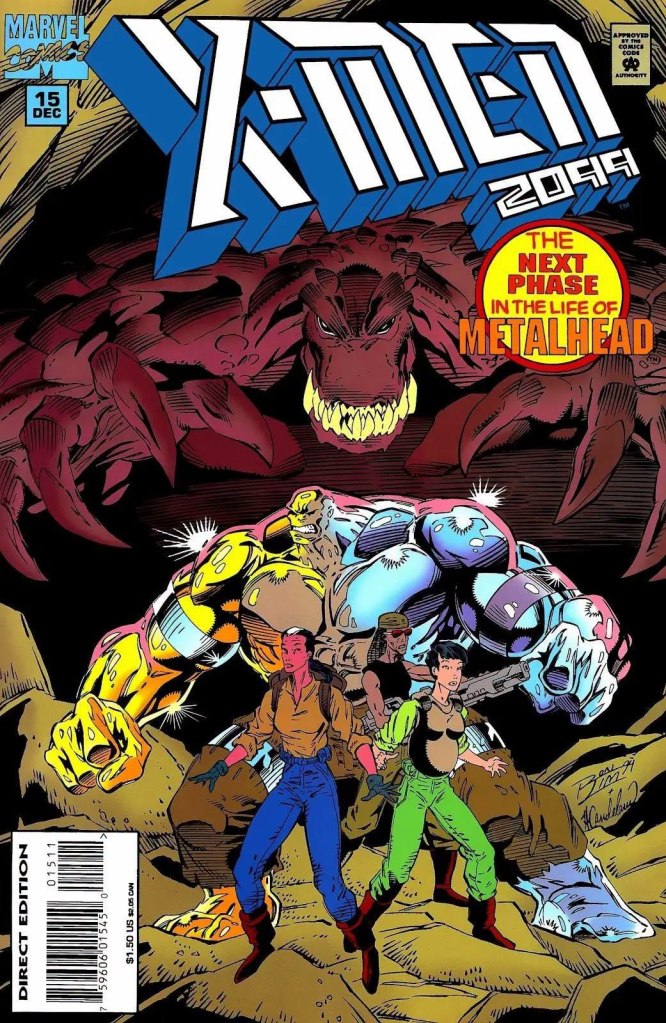
With those details laid down, here is a look back at X-Men 2099 #15, published by Marvel Comics in 1994 with a story written by John Francis Moore and drawn by Ron Lim.
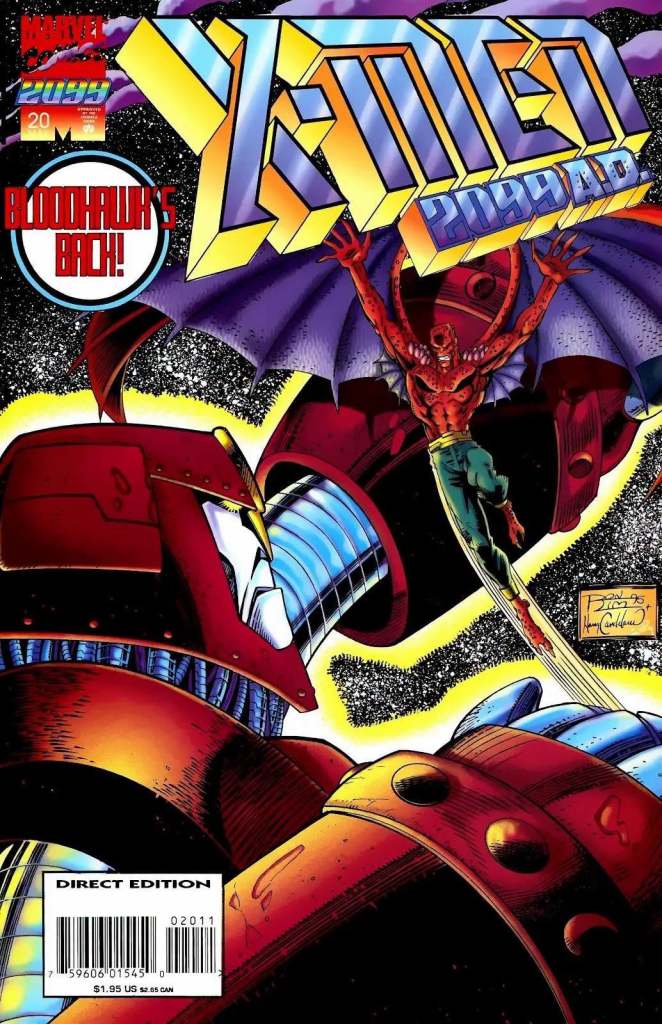
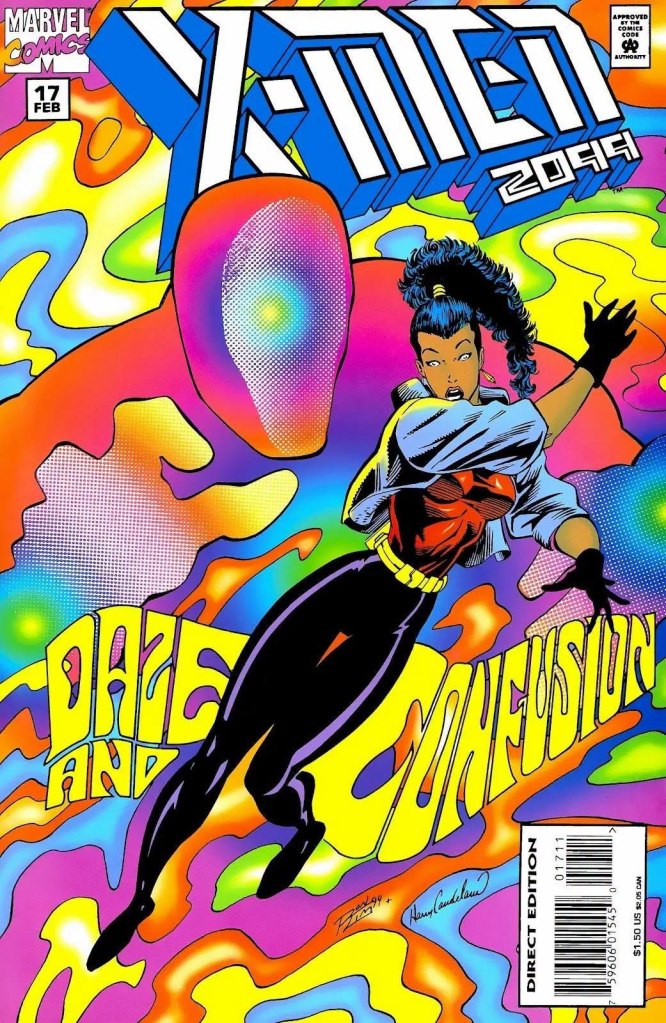
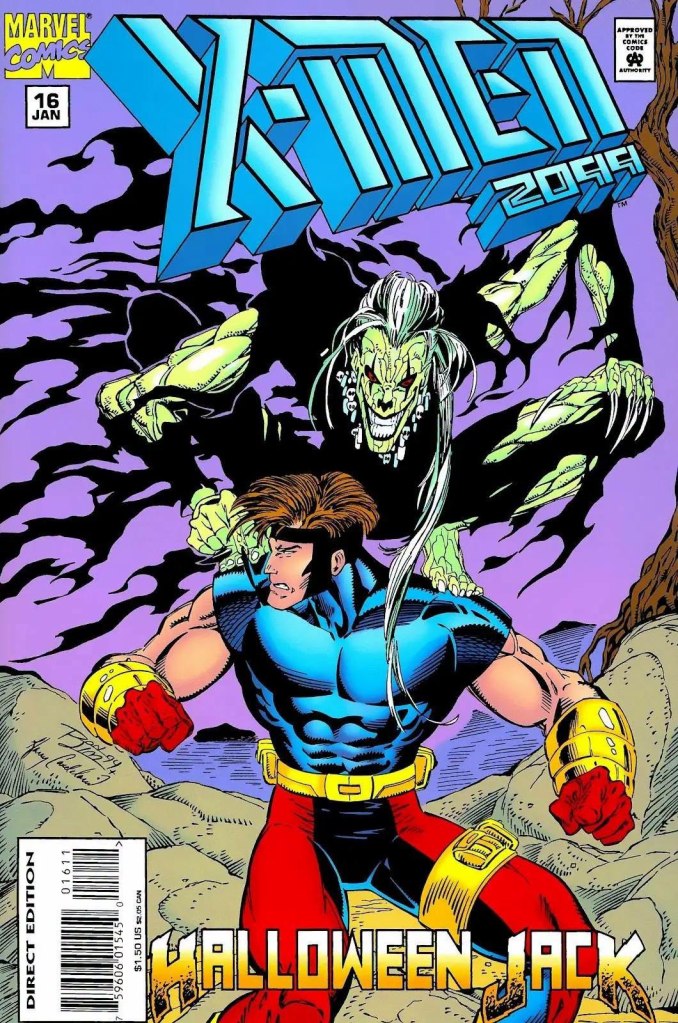
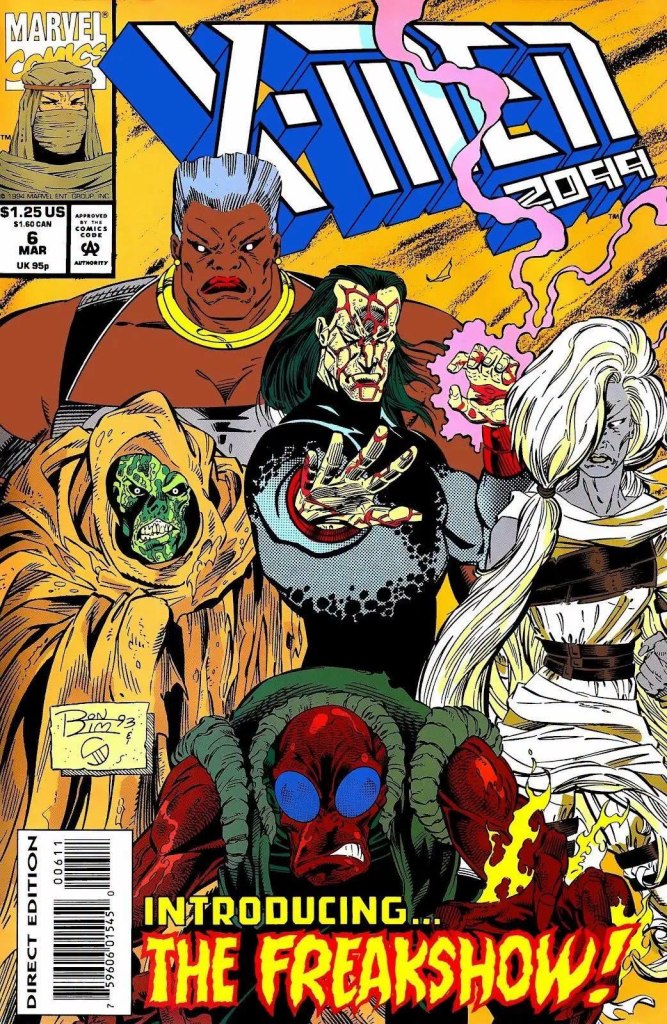
The cover.

Early story

The story begins in the Keewazi Nation in Oklahoma. Eddie/Metalhead is unconscious with Hurricane and her friend accompanying him. Their pregnant companion Rosa has been missing since Glitterspike (the man who impregnated Rosa) took her away from them. Metalhead wakes up and immediately asks where Rosa is.

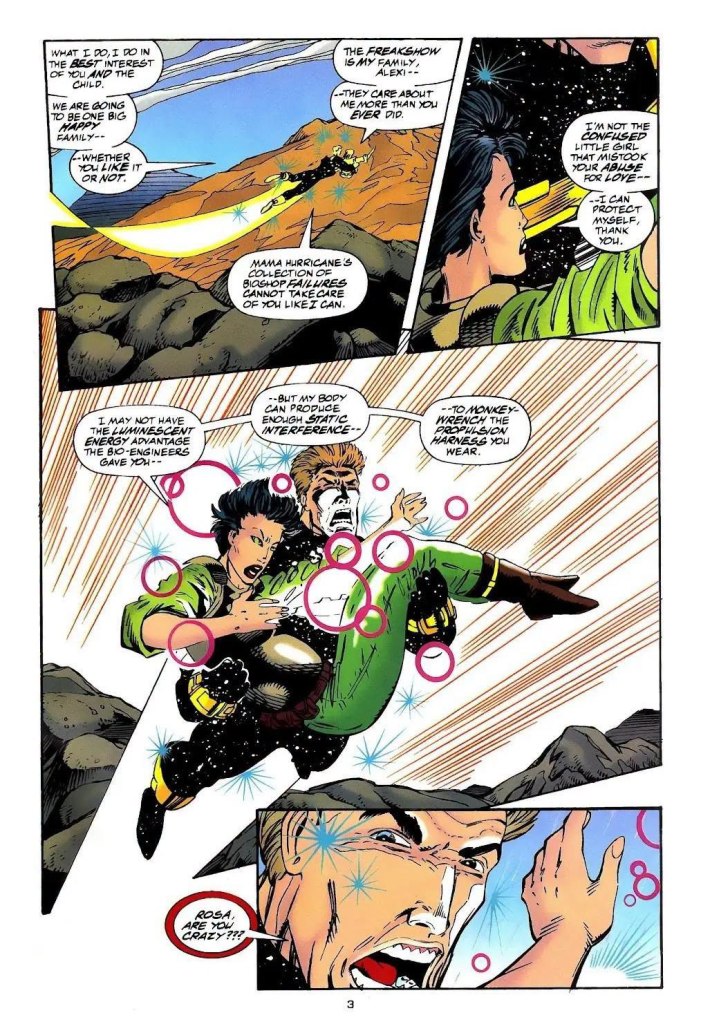
Far away, Rosa tells Alexi/Glitterspike to let go of her even though they are flying high above ground. Glitterspike tells her that he will do the best interest of her and their unborn child to become one big happy family. Rosa rejects him stating that the Freakshow is her family.

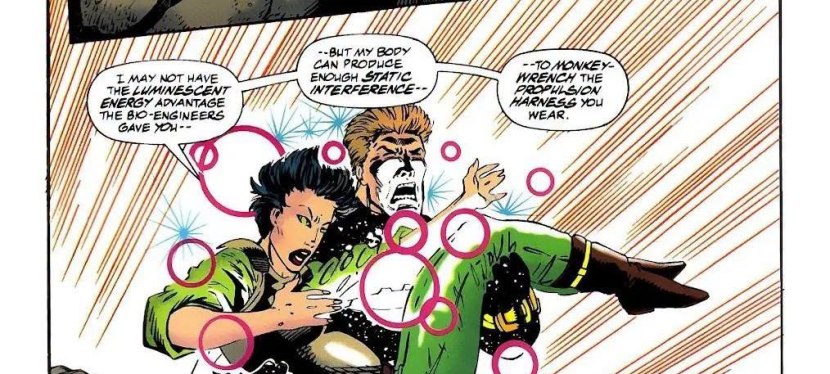
Even with the tremendous risk present, Rosa uses power of producing static interference on them. Soon enough, they start losing altitude…

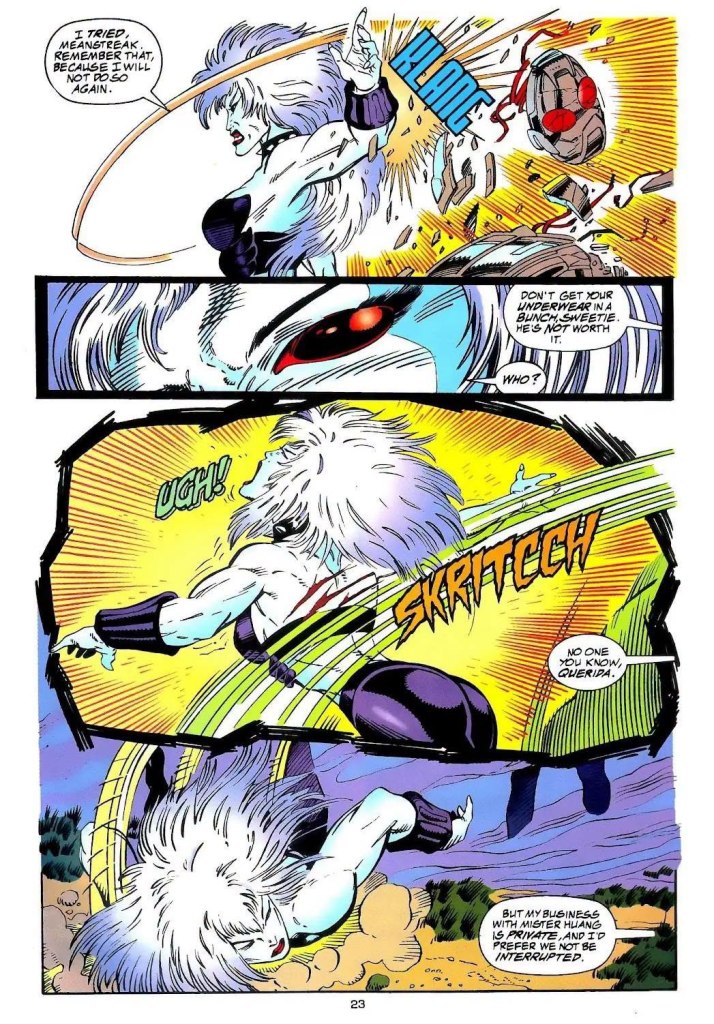
Quality

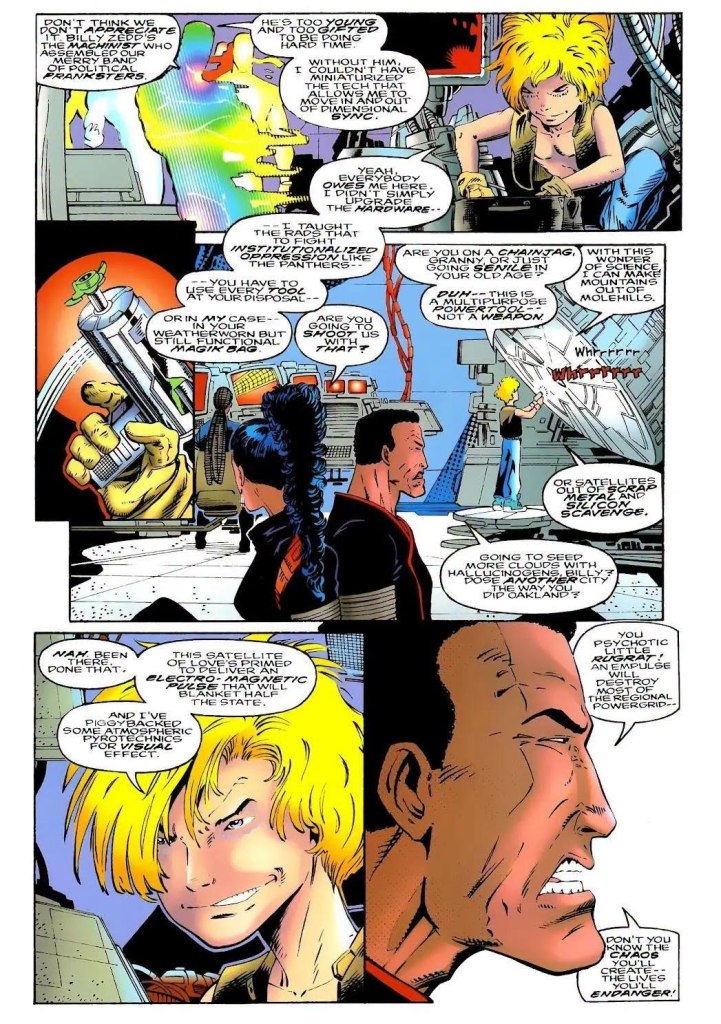
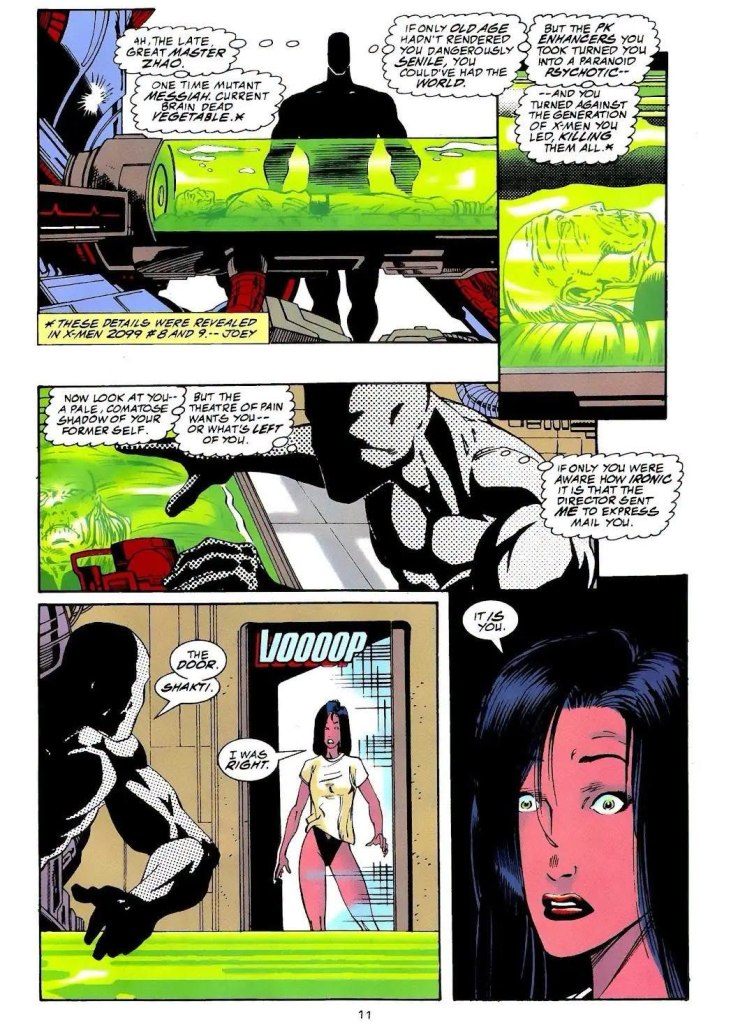
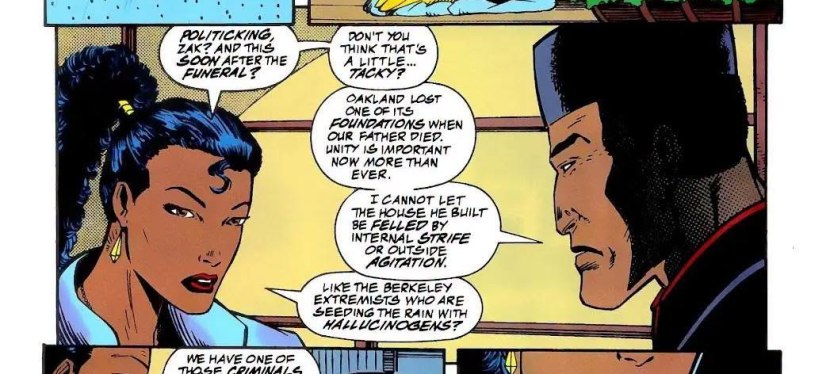
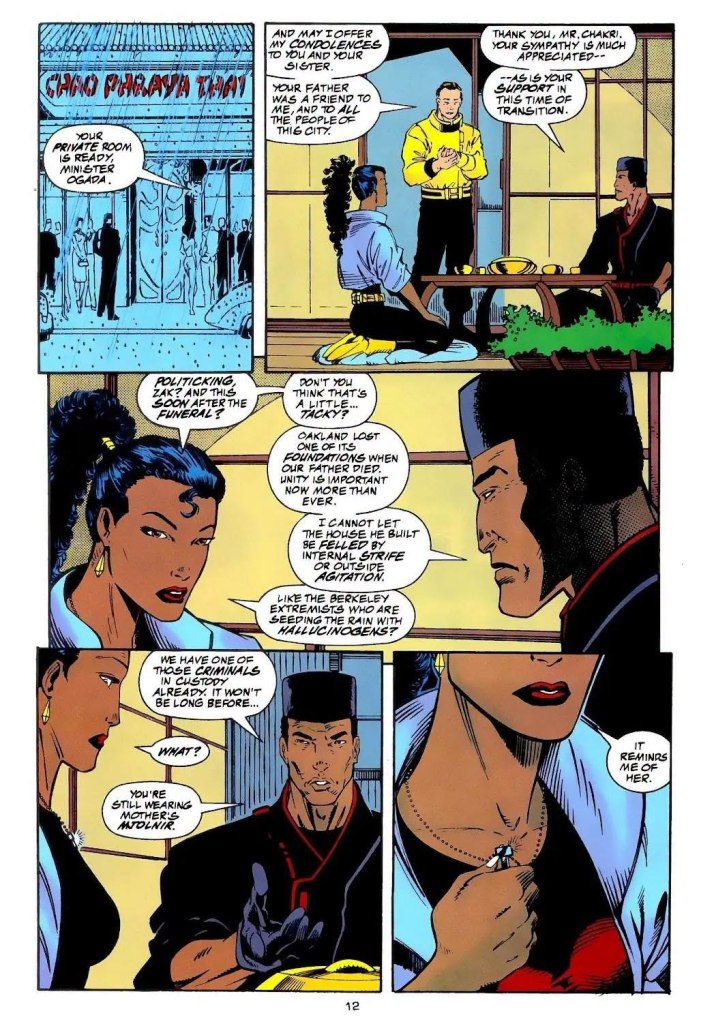
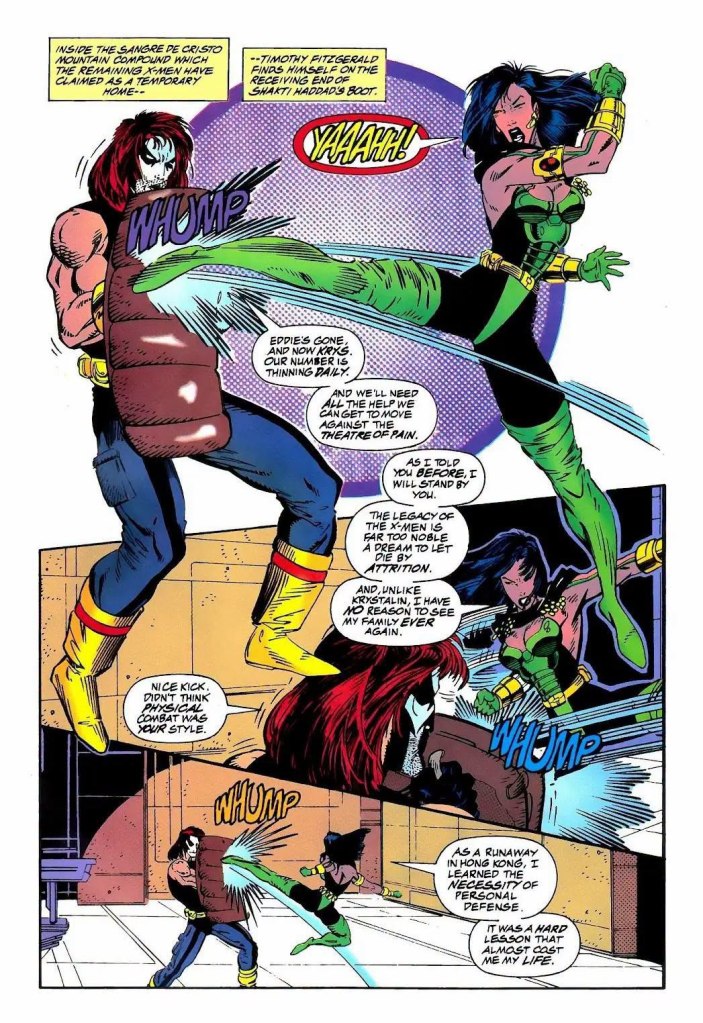
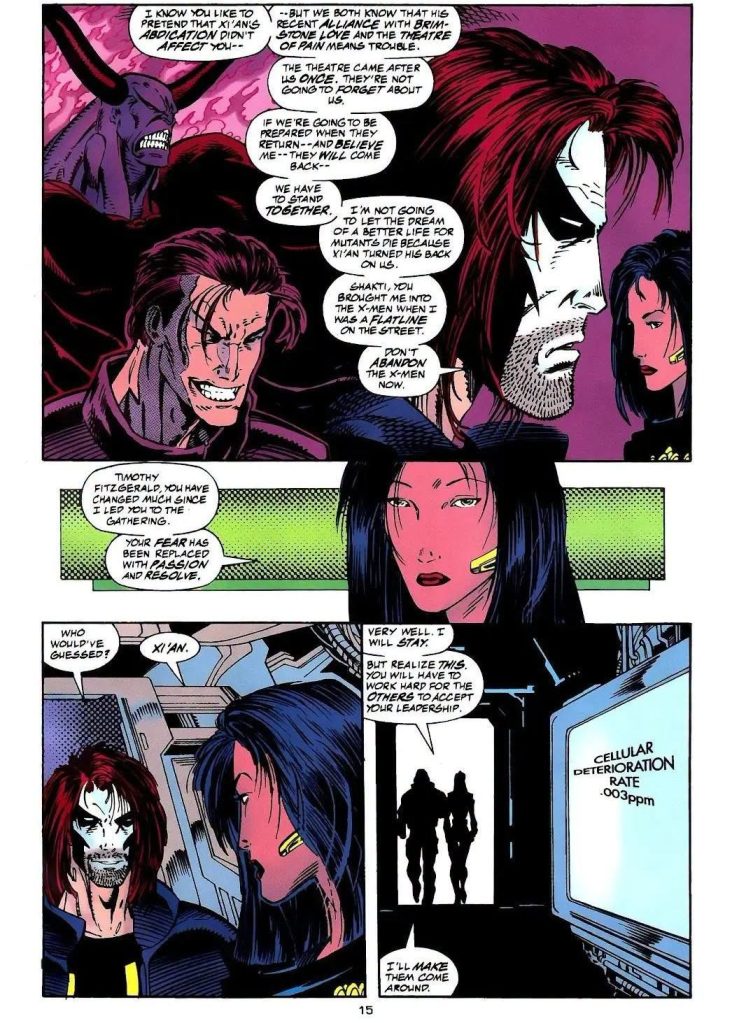
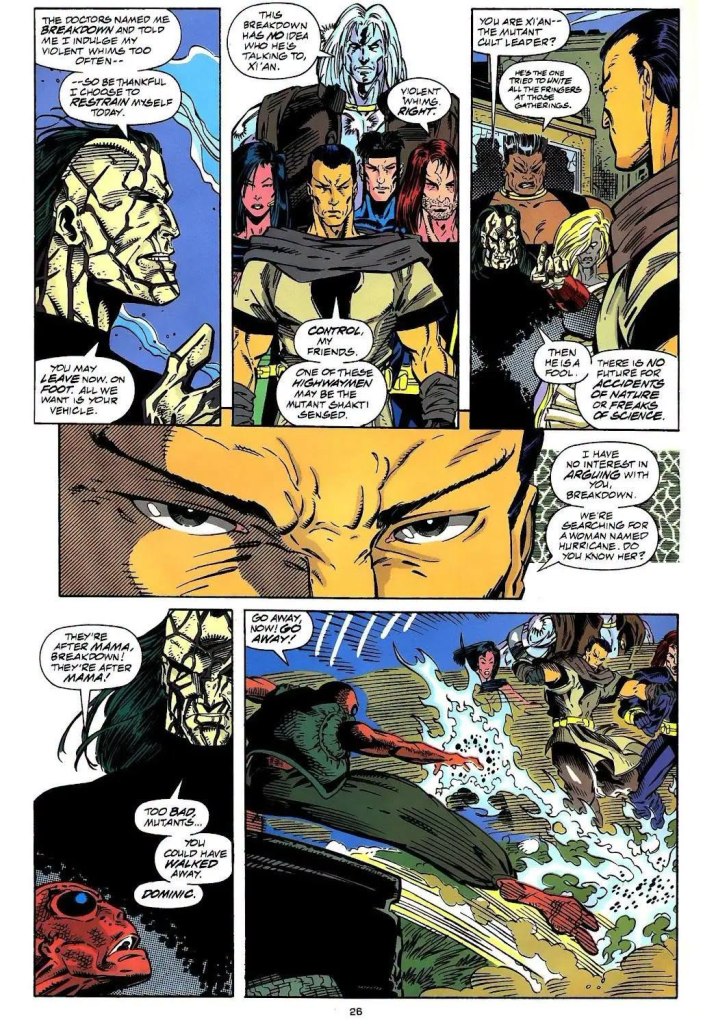
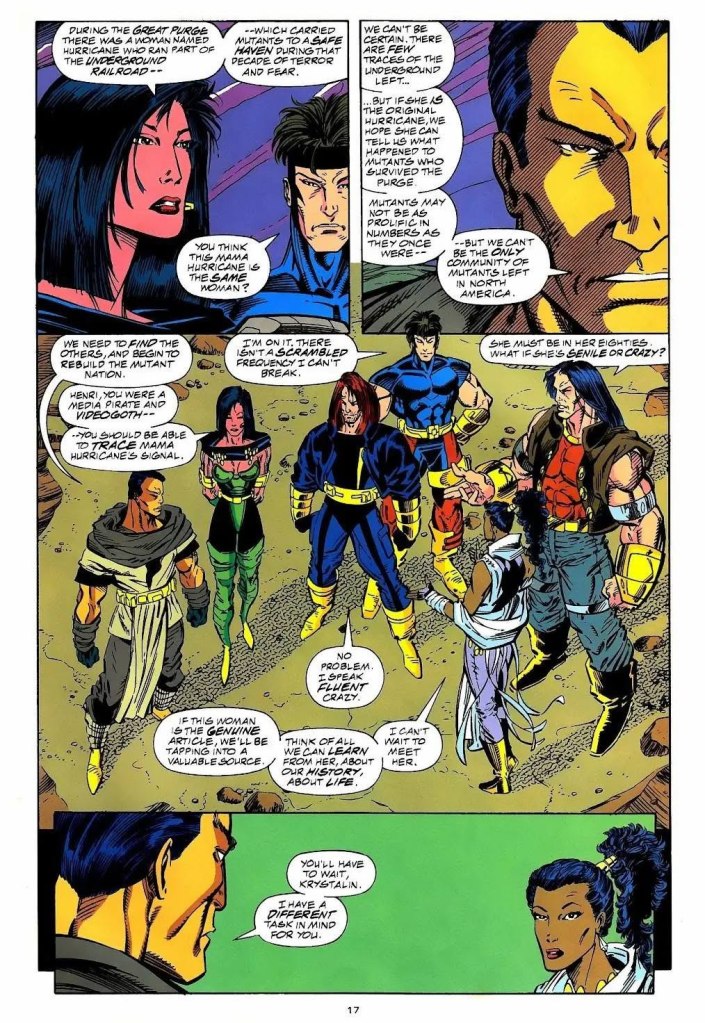
Serious talk between Shakti and a changed Skullfire about the X-Men and the situation they have now that their former leader Xi’an joined a gang of evil.

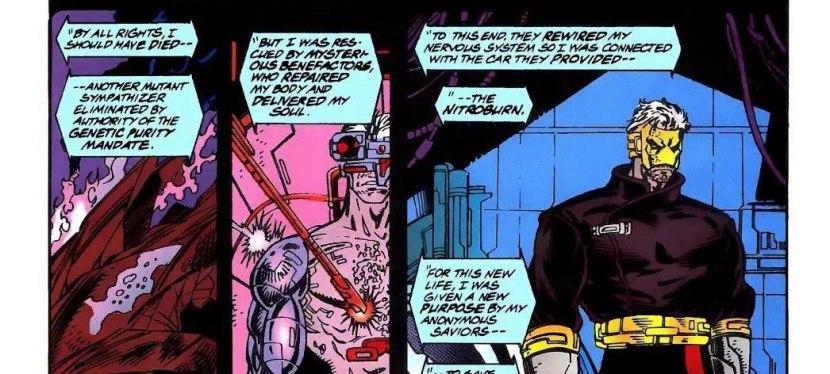
The story crafted by John Francis Moore here is strongly focused on the Freakshow with emphasis on former X-Men member Metalhead who at this point of the series has gotten very close with the pregnant member Rosa. This comic book marks the first time that Metalhead became a true major player in the series as he gradually adjusts with becoming a new member of the Freakshow.

Unsurprisingly, Rosa became a major player in the story too as she has no choice but to deal with someone from her past who is not just stubborn but also a cybernostra hitman who was genetically bred to process light into energy. Glitterspike went ballistic when Rosa left him some time prior and his obsession with her only grew.

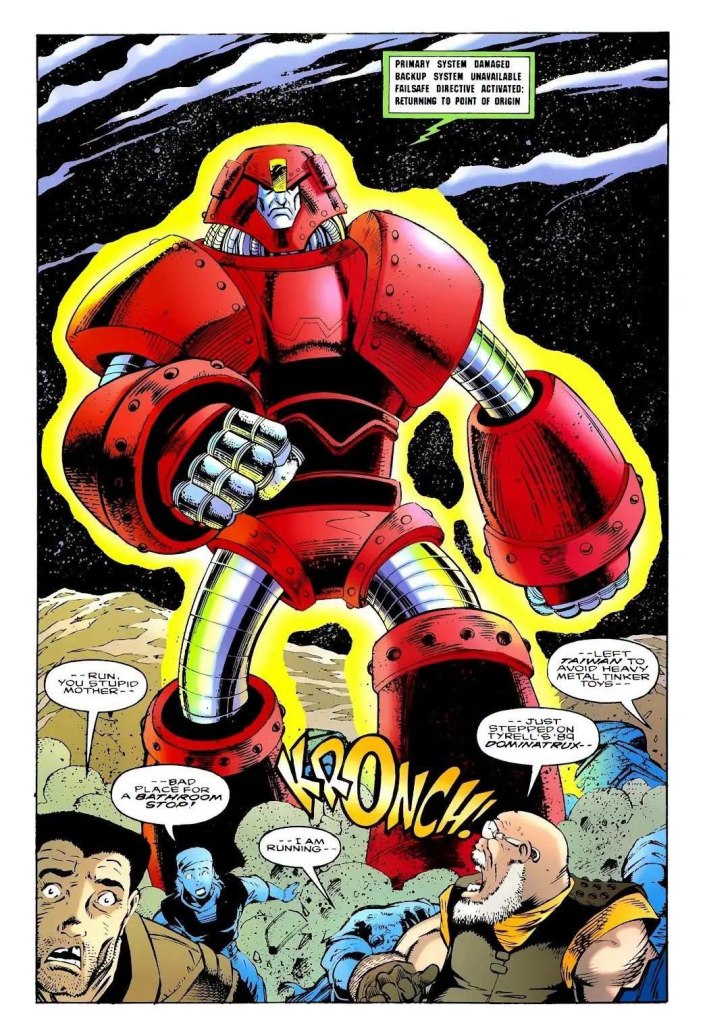
A major part of this story involved the presence of a fabled monster called the Shadow Dancer which has been lurking in the hills of the wasteland and already a lot of people got scared of it. Creatively, this monster serves as the obstacle that Metalhead, Rosa, and the others have to deal with.

What Moore and Ron Lim accomplished in this story is deeply developing the Freakshow, Metalhead and Rosa while expanding the lore of 2099’s American wasteland even further. They also gave readers a quick look at the remaining X-Men team members who are now dealing with the new reality that their former leader turned evil by joining Brimstone Love’s Theater of Pain. In addition, Skullfire – once a weak and unsure new member of the X-Men in the beginning – not only returned to Shakti and the remaining team members, his personality and view of reality have changed which reinvigorated his passion for the team.

Conclusion

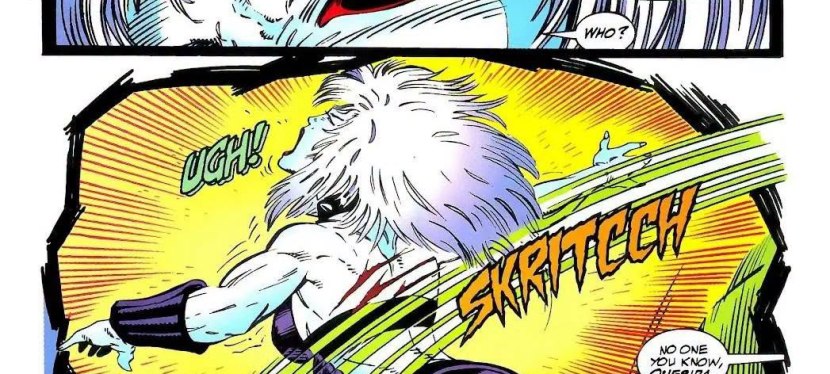
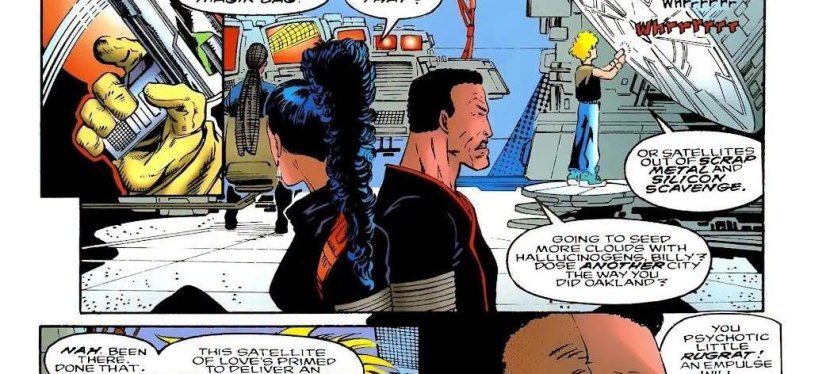
Rosa does something very risky as Glitterspike carries her in the air.

X-Men 2099 #15 (1994) was crafted to be compelling with strong focus on Metalhead and the Freakshow. It clearly marked the next phase in the life of Metalhead and it made the Freakshow an even more interesting team within the X-Men 2099 series. The story has lots of strong and intriguing moments, and character development is consistently strong. The tale also has some science fiction inspiration from the 1979 movie Alien mixed in. This is a good read.

Overall, X-Men 2099 #15 (1994) is recommended.

+++++

Thank you for reading. If you find this article engaging, please click the like button below and also please consider sharing this article to others. If you are looking for a copywriter to create content for your special project or business, check out my services and my portfolio. If you want to support my website, please consider making a donation. Feel free to contact me with a private message. Also please feel free to visit my Facebook page Author Carlo Carrasco and follow me on Twitter at  @HavenorFantasy as well as on Tumblr at https://carlocarrasco.tumblr.com/ and on Instagram at https://www.instagram.com/authorcarlocarrasco/.
A Look Back at X-Men 2099 #13 (1994)

Welcome back, superhero enthusiasts, 1990s culture enthusiasts, X-Men fans and comic book collectors! Today we revisit the Marvel Comics shared universe to examine one of the many tales of the X-Men 2099 monthly series.  

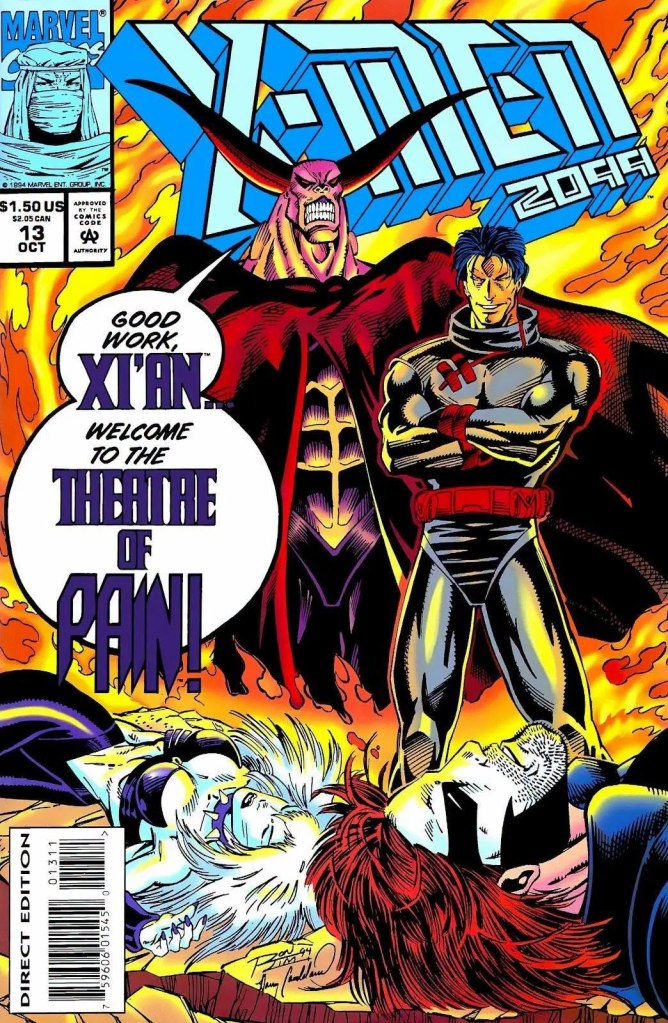
I enjoyed the way John Francis Moore put things into motion in issue #12 and other previous issues of X-Men 2099. During the 3-part storyline at the start of the series, the Synge business empire and its wing of enforcers looked like the definitive force of evil for the mutants led then by Xi’an. As the series progressed, the Theater of Pain (first introduced comprehensively in issue #4) and its leader Brimstone emerged as the new force of evil while the X-Men lost Xi’an and Skullfire became more unhinged and got more involved with Luna (the one who messed with his mind and emotions). Xi’an, who reverted back to his sinister mindset, is obsessed with finding the Driver. It should be noted that these characters are all in the middle of the wasteland in 2099’s America (for 2099 historical reference, click here).

With those details laid down, here is a look back at X-Men 2099 #13, published by Marvel Comics in 1994 with a story written by John Francis Moore and drawn by Ron Lim.

The cover.

Early story

The story begins with Brimstone Love making his way into the Garage, a secret high-tech facility of the Driver. He finds it interesting that his hunt for Luna led him into the strange structure in the desert and he know that she and her companions are inside.

Inside the structure, Junkpile is bound and tortured on a chair with Adamantium restraints holding him. With Junkpile is the Driver watching him while Xi’an, Skullfire and Luna are trapped nearby by a laser grid. Skullfire, who is aware that Xi’an has been pursuing the Driver ever since he learned key details from Hurricane, implied to the former X-Men leader that the Driver is more of a problem and antagonist while Luna added her own comments about their situation. Xi’an tells them they need to determine the severity of their situation.

Xi’an tells the Driver that Hurricane described him as a part of the mutant underground during the Purge. It turns out, the Driver has not heard about Hurricane for a long time and insisted to Xi’an that he mistook his actions as hostile.

The Driver begins to explain what he has been doing, why he continues to fight and protect the sacred mutant tribe and why he sought out hundreds of mutants to give them sanctuary…

Quality

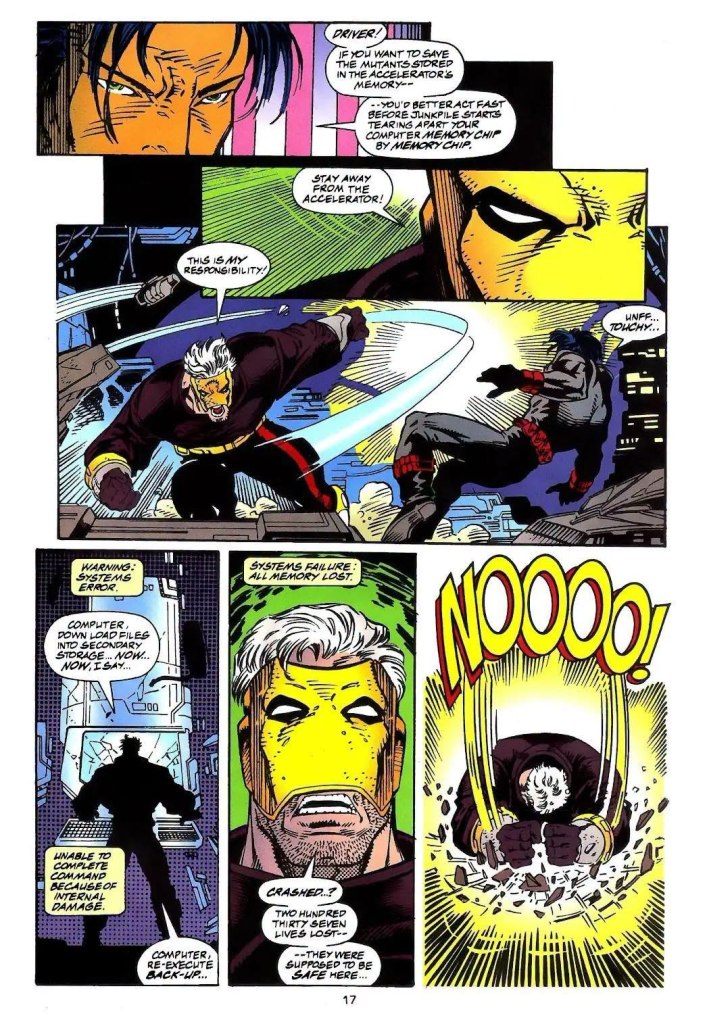
A lot of intriguing developments happened here and it concludes Xi’an’s pursuit of the Driver.

With regards to storytelling and revelations, I can say that the intensity from the previous continued smoothly in this comic book. While the Theater of Pain was first revealed in issue #4, it was in the previous issue and in this particular story that its actual scope was made clear, and the presence of Brimstone Love – obviously 2099’s walking symbol of Satan – added great tension and a new evil presence for the X-Men to deal with.

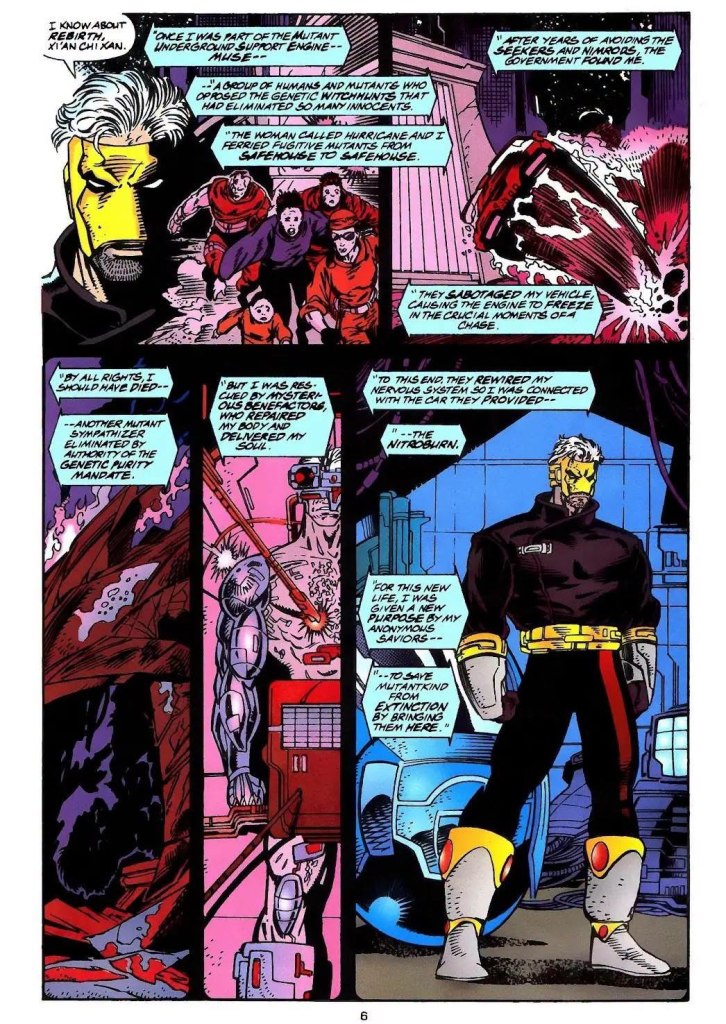
What I enjoyed most in the story crafted by John Francis Moore are the revelations. The Driver, who came close to death and witnessed the plight of mutants, has a personal mission of providing sanctuary to mutants who are still living in danger in 2099’s America which has been dominated by mega corporations (MegaCorps). Still, his specific methods of achieving his goals for mutantkind are intriguingly questionable and in someways they made him looked even sinister. That said, Xi’an’s pursuit of him (which started a few issues prior) really resulted in some shock value that has to be seen page by page.  

Very notably, Moore made the script even more dramatic which is clearly reflected in the dialogue of the characters and the art done by Ron Lim. I should also state that flashbacks of the mutants struggle for survival under the Driver and Hurricane are included and they are worth seeing.

Considering what this comic book has, it will make readers think deeply about the essence of X-Men 2099 as a team and the comic book series itself. At the same time, new mysteries about the direction of the series will be realized in ways that readers don’t expect.

Conclusion

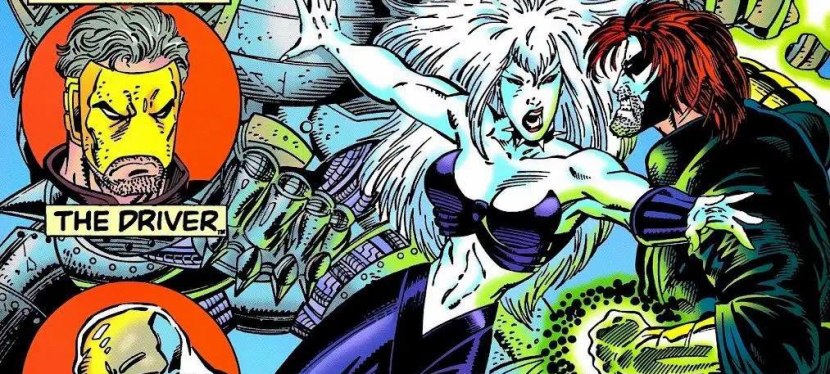
The Driver himself was part of the effort that saved desperate mutants decades prior and he came close to dying. This comic book heavily defines his existence and his mission on providing sanctuary to any mutants he finds.

If there is anything significant about X-Men 2099 #13 (1994), it is the fact that it changed the trajectory of the series and reshaped the concept of X-Men 2099 as a whole in dramatic fashion. The build-ups, the pay-offs and revelations in this comic book are powerful. Along the way, this will make you question even further the intentions of Xi’an (former X-Men leader) and Skullfire (the unhinged X-Men member who used to be so weak and unsure of himself). As for the Driver, he is very well defined by the Moore-Lim duo in this comic book and he has gotten even more significant by the end. If there is anything severely lacking here, it is the spotlight on the surviving X-Men team members (with Shakti as their new leader).

Overall, X-Men 2099 #13 (1994) is recommended.

+++++

Thank you for reading. If you find this article engaging, please click the like button below and also please consider sharing this article to others. If you are looking for a copywriter to create content for your special project or business, check out my services and my portfolio. If you want to support my website, please consider making a donation. Feel free to contact me with a private message. Also please feel free to visit my Facebook page Author Carlo Carrasco and follow me on Twitter at  @HavenorFantasy as well as on Tumblr at https://carlocarrasco.tumblr.com/ and on Instagram at https://www.instagram.com/authorcarlocarrasco/.
A Look Back at X-Men 2099 #12 (1994)

Welcome back, superhero enthusiasts, 1990s culture enthusiasts, X-Men fans and comic book collectors! Today we revisit the Marvel Comics shared universe to examine one of the many tales of the X-Men 2099 monthly series.  

Looking back at the X-Men 2099 series of the 1990s, so much has developed during the first eleven issues released from 1993 to 1994. When I first read issue #1 in 1993, I found the futuristic X-Men really intriguing to follow and there was the expectation that the team led by Xi’an would somehow grow and make breakthroughs happen in 2099’s America. Surprisingly, members of the team got separated from each other – such as losing Metalhead to the Freakshow – and Xi’an himself changed for the worse and eventually left the team. Tim Fitzgerald/Skullfire (the weak and unsure newcomer who joined the futuristic X-Men) himself changed radically becoming unhinged and he has gotten really close with Luna (the one who messed with his mind and triggered his emotions).

With those details laid down, here is a look back at X-Men 2099 #12, published by Marvel Comics in 1994 with a story written by John Francis Moore and drawn by Ron Lim.

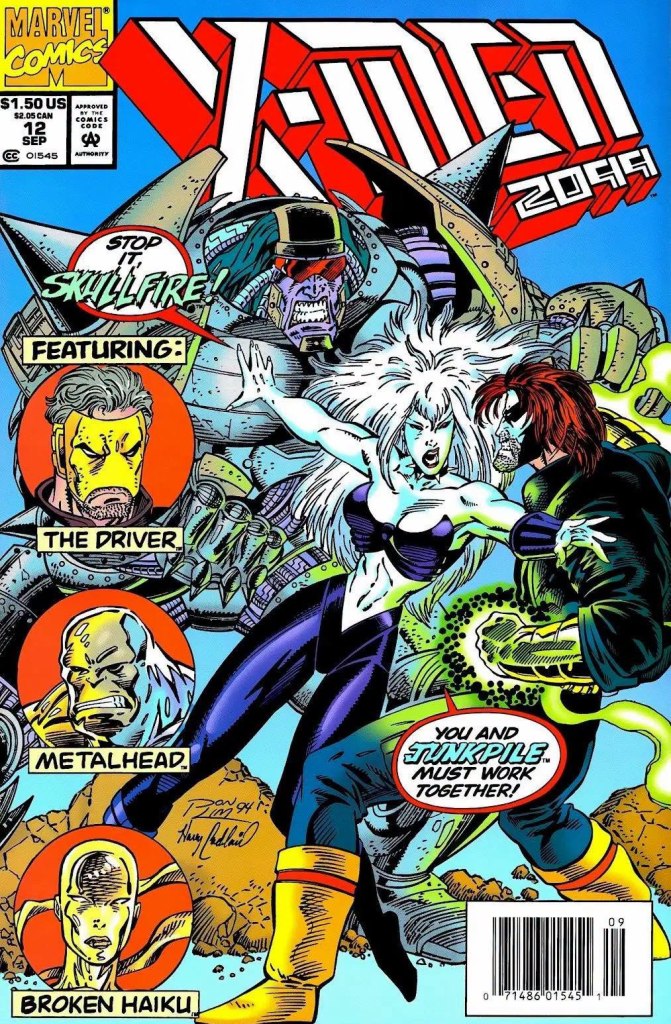
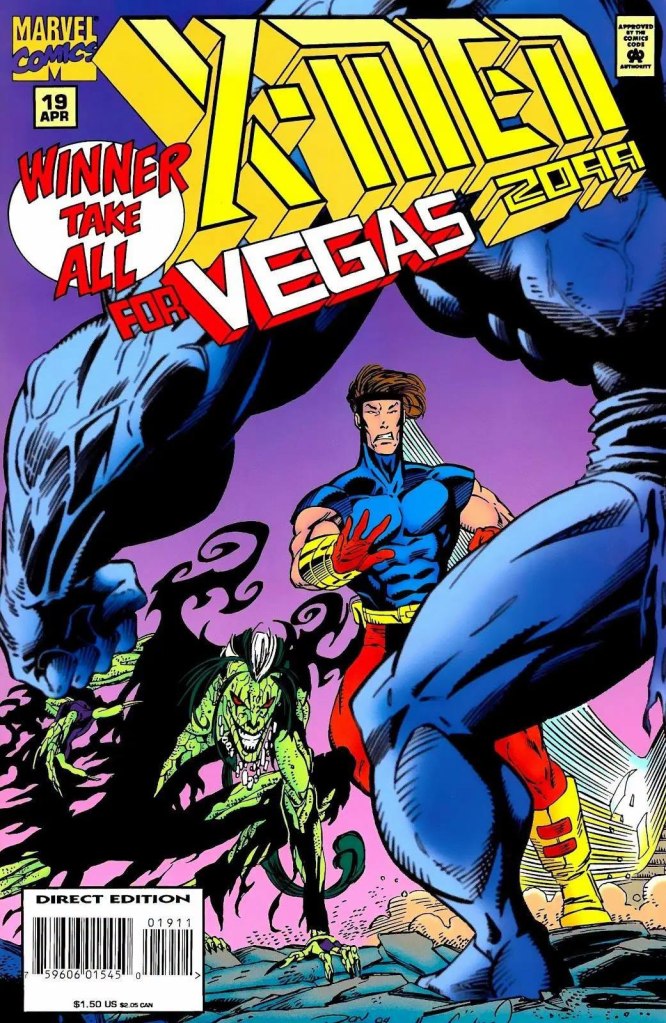
The cover.

Early story

The story begins in the black market mall with Luna struggling to separate Skullfire and Junkpile from each other. Skullfire hates Junkpile whom he holds responsible for killing his friend Serpentina (the one X-Men member who welcomed him at their sanctuary). Junkpile blames Skullfire and his teammates for causing him some serious grief in Las Vegas. Luna tells them both to shut up or she would do something on both of them.

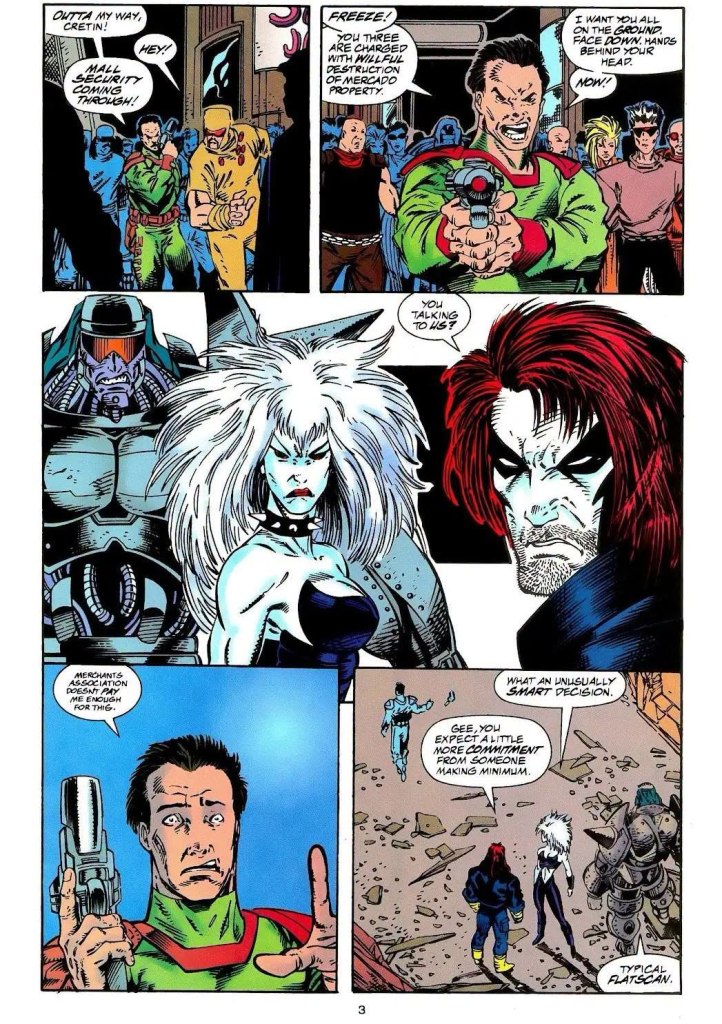
Moments later, the three of them are accused by the mall security for violating the market regulations. An armed mall security officer points his weapon at them accusing them of willful destruction of market property. The looks of Junkpile, Luna and Skullfire, however, scared him and convinced him to move away. Luna then reveals to Skullfire that she encountered Junkpile outside of Las Vegas shortly after the violent encounter with the X-Men. The three of them proceeded to a café to have a civil talk. Skullfire asks Luna about the Theater of Pain…

Quality

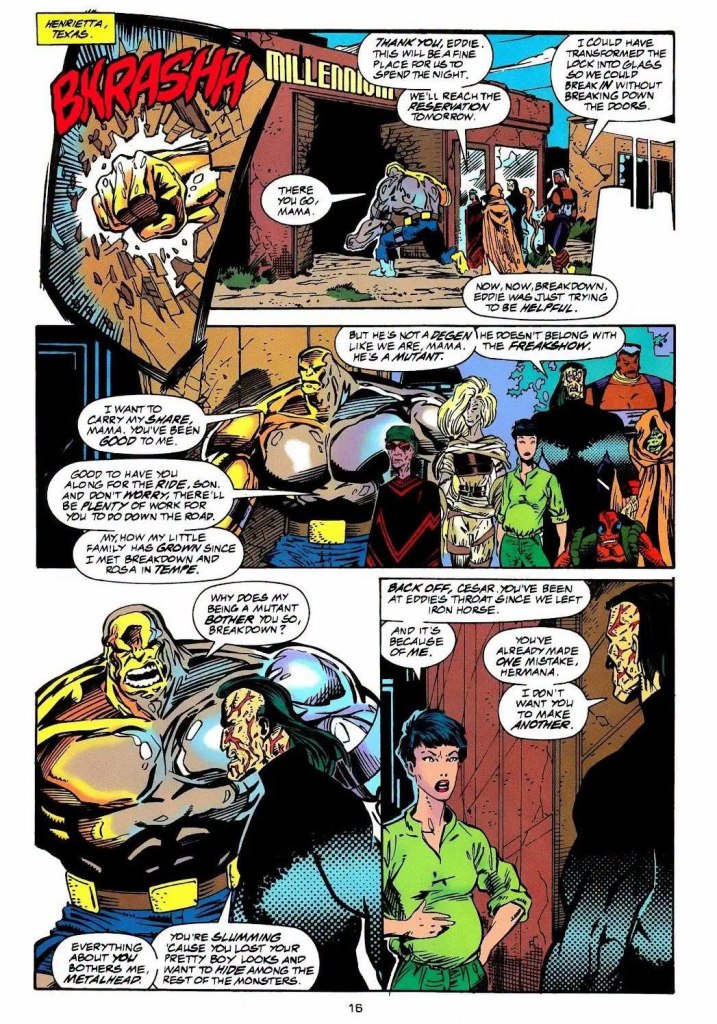
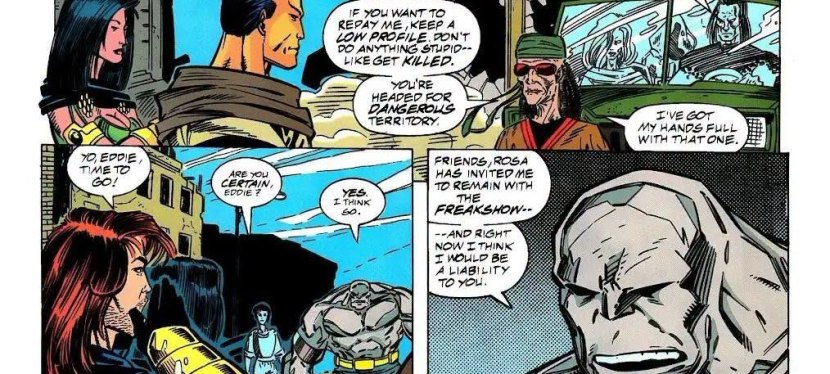
Former X-Men member Metalhead with the group of degenerates called the Freakshow. One of their members clearly rejects him given his status as a mutant.

Wow! The Moore-Lim team loaded this comic book with immense details that established the true force of opposition that awaits the X-Men. The story reveals to readers the Theater of Pain, its demonic leader Brimstone Love and what the theater’s purpose truly is. Brimstone Love and the theater were first revealed at the very end of issue #3 and this comic book offers readers a close look at them complete with very intriguing details that turned out to be worth discovering. That said, it was clear that John Francis Moore designed the Theater of Pain to be not just a planned force of evil the X-Men must face but also an actual threat to many living in 2099’s America. The Theater of Pain has a very sinister agenda and its operations involves the accumulating human misery which is a frightening concept on its own.

While Luna’s history and connection with the Theater of Pain is emphasized, Xi’an’s search for the Driver makes a lot more sense here as the former X-Men leader (now sinister and spiritually lost) communicates again with someone from his past. That said, the plot really thickened a lot in this comic book and that alone makes it engaging to follow.

As this issue follows Skullfire, Luna, Junkpile and Xi’an – plus a quick look at former X-Men member Metalhead now spending time with the Freakshow – the tone of the tale turned dark and gritty which I think was intentionally done by the creators as the Theater of Pain was strongly emphasized. That said, this is indeed inspired work.

Conclusion

Skullfire, Junkpile and Luna look so intimidating and creepy, the mall security guy got scared and abandoned his duty.

With a dark tale and an established force of evil rising in the horizon, X-Men 2099 #12 (1994) can be described as an inspired turn of events for the monthly series as a whole. At this stage, the direction of the series really started to take shape. It is also a lively reminder that the mutants struggling in 2099 have the wilderness and its violent elements as the least of their worries. The Theater of Pain itself is a reminder about sinister yet unseen forces that are operating while lots of people remain unaware of them (note: think about the World Economic Forum and what its core organization really do behind closed doors as time passes). Lastly, the twisted developments of Skullfire and Xi’an’s respective personalities will keep you in suspense as to how the futuristic X-Men can survive without them.

Overall, X-Men 2099 #12 (1994) is recommended.

+++++

Thank you for reading. If you find this article engaging, please click the like button below and also please consider sharing this article to others. If you are looking for a copywriter to create content for your special project or business, check out my services and my portfolio. If you want to support my website, please consider making a donation. Feel free to contact me with a private message. Also please feel free to visit my Facebook page Author Carlo Carrasco and follow me on Twitter at  @HavenorFantasy as well as on Tumblr at https://carlocarrasco.tumblr.com/ and on Instagram at https://www.instagram.com/authorcarlocarrasco/.
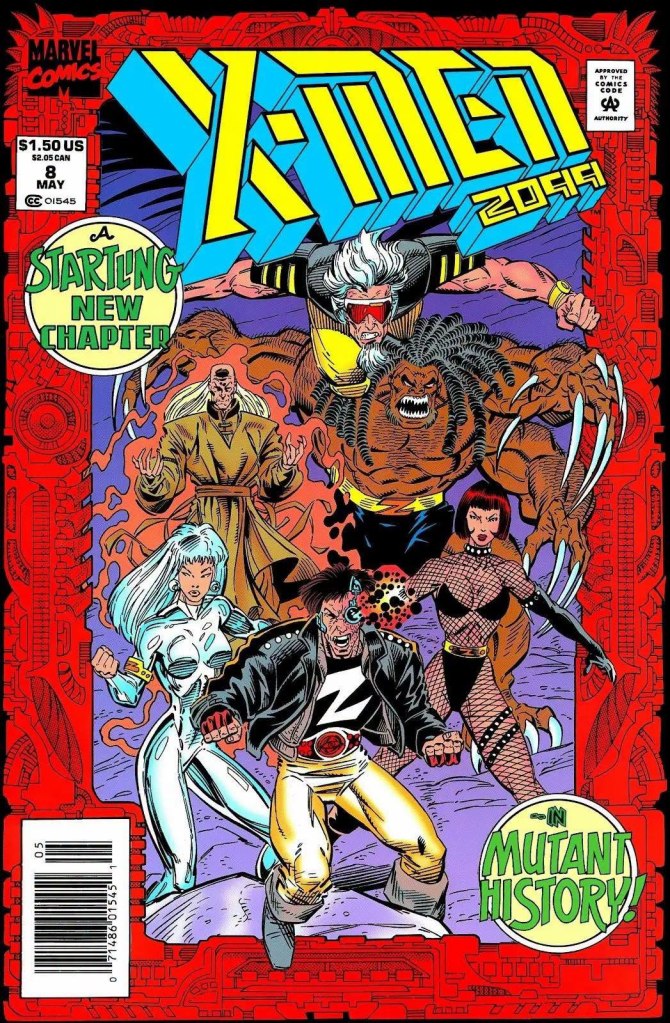
A Look Back at X-Men 2099 #8 (1994)

Welcome back, superhero enthusiasts, 1990s culture enthusiasts, X-Men fans and comic book collectors! Today we revisit the Marvel Comics shared universe to examine one of the many tales of the X-Men 2099 monthly series.  

After the first seven issues of the series, it is clear that the futuristic mutants under Xi’an have tough challenges to not only survive in the dangerous and unpredictable wasteland of 2099’s America but also help their leader fulfill the ultimate goal of protecting mutants from the evil corporations in accordance to the dream of Professor X (Charles Xavier). Unlike the X-Men of the 20th century, the team of 2099 does not have vast resources nor do they have a permanent place for living and development. Xi’an himself is still struggling with the elements from his past as a violent criminal.

With those details laid down, here is a look back at X-Men 2099 #8, published by Marvel Comics in 1994 with a story written by John Francis Moore and drawn by Ron Lim.

The cover.

Early story

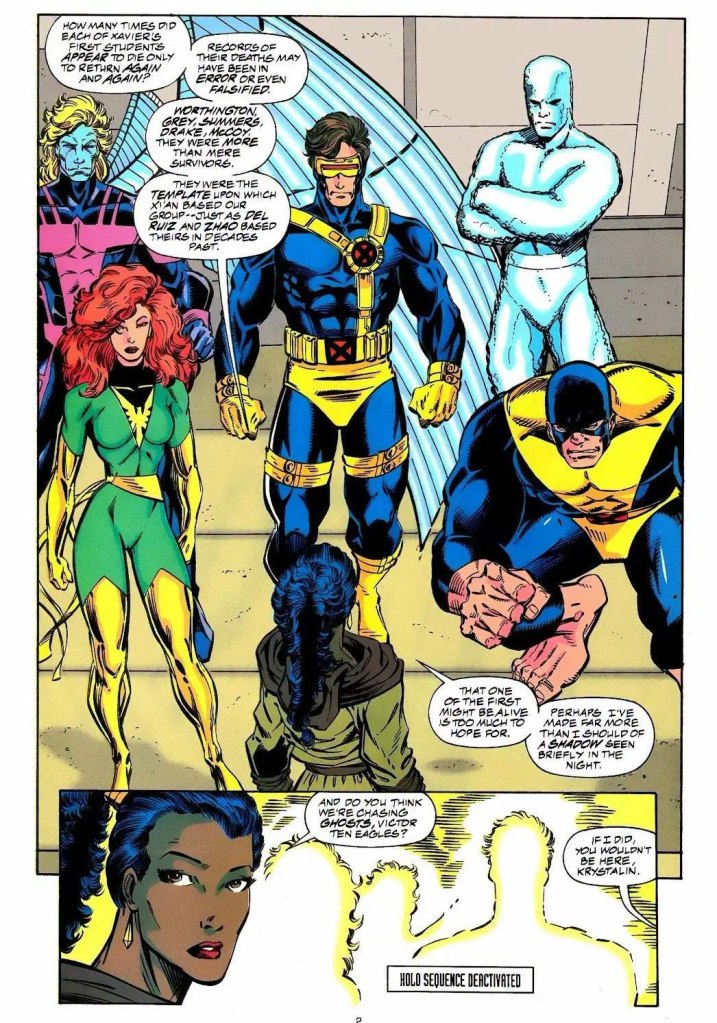
The story begins with Krystalin examining Archangel with amazement. Moments later, she sees Cyclops, Iceman, Beast and Jean Grey (in her Phoenix form). She wondered how many times did each of Professor X’s first students appear to die only to return again and again. She recalls that the records of their deaths may have been in error or even falsified. She also remembers the succeeding X-Men teams of Del Ruiz and Zhao.

It turns out the original X-Men members she saw were holograms as Victor Ten Eagles (who was a fellow outlaw with Xi’an in the old days) reveals that he opened his studio to few people and never to strangers. He allowed Krystalin in because he owes Xi’an a blood debt from their time together with the Lawless. As they talk, he explains to her his personal interest in the X-Men and the legacy.

Over at Iron Horse in Arizona, Hurricane talks with two trackers who were tied up. Meanstreak uses his super speed to dismantle the trackers’ suits of armor and examine the technologies within. He finds one Tetsuo Mark 6 signal beacon that was used to monitor armor in the field. He tells Hurricane she can use it as an advance warning the next time trackers are sent after her.

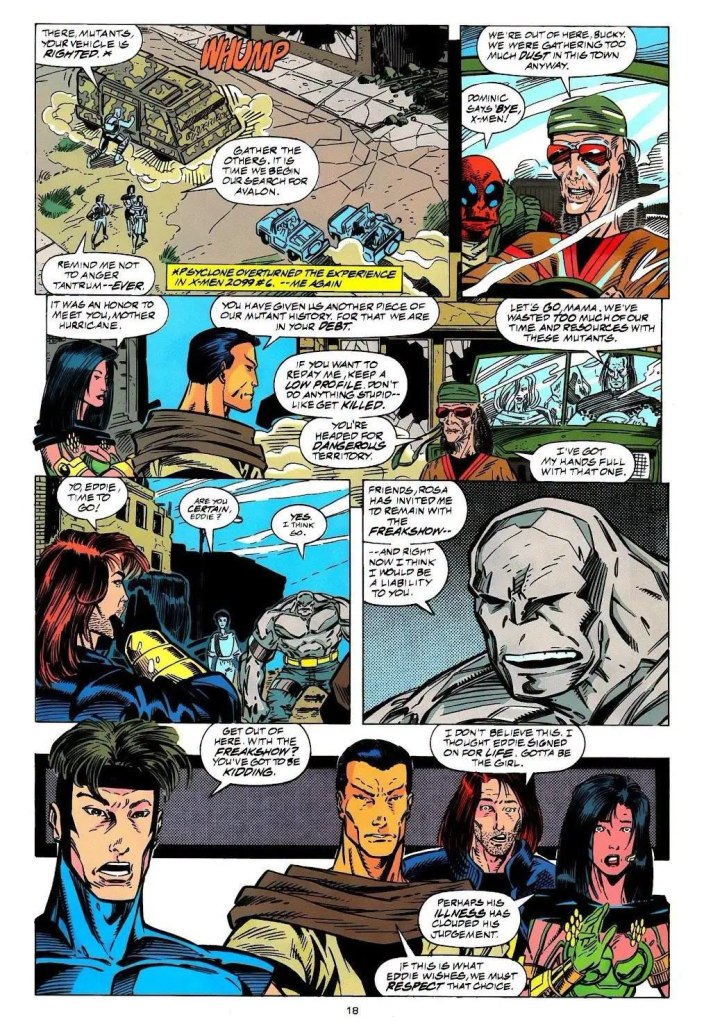
Hurricane tells the X-Men that she and the Freakshow never stay too long in one place. Moments later, the infected Metalhead tells Skullfire that he is trapped in his current metal form and could not change back…

Quality

As the Freakshow is about to leave, Metalhead surprises his fellow X-Men.

To make things clear, this X-Men 2099 comic book is very engaging to read as it is filled with a lot of details that further expanded the lore of the 2099 universe concerning mutants and legacy of the X-Men in the 21st century. As such, I really enjoyed learning about the “future history” of the X-Men, how mutants struggled to survive in a corporation-controlled America, and why the wasteland became the 21st century’s very own Old West where danger and uncertainty are constant.

If have an obsession about the 2099 universe, there is a lot to discover and enjoy here. Xi’an’s pursuit for knowledge about the mutant underground and Hurricane’s involvement is compelling to read and what was revealed is worth discovering. Meanwhile, Krystalin and Ten Eagles’ exploration of facilities as they search for answers reminds me a lot about a notable part of the story in Beneath the Planet of the Apes.

Conclusion

The closest thing to a crossover with the original X-Men.

X-Men 2099 #8 (1994) is a compelling read and it is one of the stronger references about the 2099 universe and the legacy of the X-Men from the time of Xavier to that of Zhao. The details revealed here are fine pay-offs to what was built up in the previous issues, and they connect well with the existence of Xi’an’s X-Men. This comic book will really help you understand the place of mutants in the 21st century and in my experience, the learning is enjoyable.

Overall, X-Men 2099 #8 (1994) is highly recommended.

+++++

Thank you for reading. If you find this article engaging, please click the like button below and also please consider sharing this article to others. If you are looking for a copywriter to create content for your special project or business, check out my services and my portfolio. If you want to support my website, please consider making a donation. Feel free to contact me with a private message. Also please feel free to visit my Facebook page Author Carlo Carrasco and follow me on Twitter at  @HavenorFantasy as well as on Tumblr at https://carlocarrasco.tumblr.com/ and on Instagram at https://www.instagram.com/authorcarlocarrasco/.
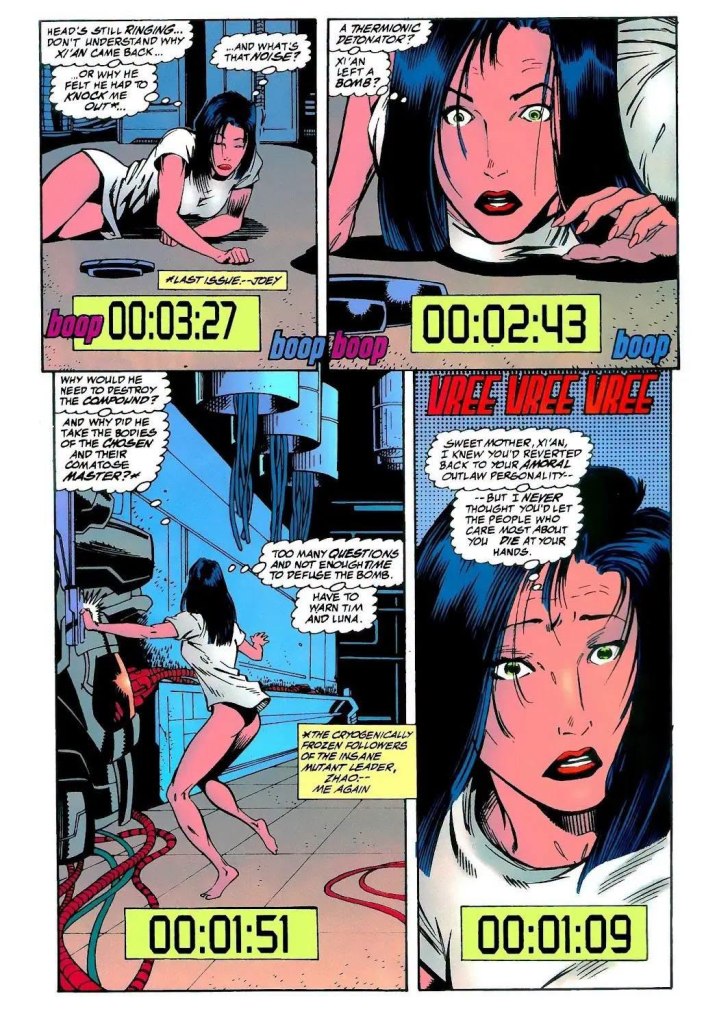
A Look Back at X-Men 2099 #6 (1994)

Welcome back, superhero enthusiasts, 1990s culture enthusiasts, X-Men fans and comic book collectors! Today we revisit the Marvel Comics shared universe to examine one of the many tales of the X-Men 2099 monthly series.  

In late-1993, Marvel Comics published the Fall of the Hammer crossover storyline highlighting the major figures of Marvel 2099 and the X-Men members involved were only Skullfire, Krystalin, Bloodhawk and Meanstreak. As told in Ravage 2099 #15, the said X-Men members made it to Valhalla with Ravage. After the events of Fall of the Hammer, the four X-Men members survived and eventually started traveling all the way back West in America to rejoin the rest of the team.

With those details laid down, here is a look back at X-Men 2099 #6, published by Marvel Comics in 1994 with a story written by John Francis Moore and drawn by Ron Lim.

The cover.

Early story

The story begins in Arizona when two fully armed personnel wearing suits of armor search for a monster-like mutant who tries to hide. The mutant is named Dominic and he eventually got corned by the two armored figures. As he is about to get shot, one of the armored guys got pushed by force somehow. The next moment, a gang of mutants called the Freakshow appears.

In the southern part of Nevada, Skullfire, Bloodhawk, Krystalin and Meanstreak travel in an aircraft going back to Xi’an and the rest of their teammates. As Bloodhawk jumps of after saying goodbye, Skullfire jumps off as well in a suicidal manner. He eventually grabs Bloodhawk by the ankle. Back at the aircraft, Krystalin and Meanstreak shared their respective observations about Skullfire’s sudden change of personality since the psychic vampire Luna messed with him… 

Quality

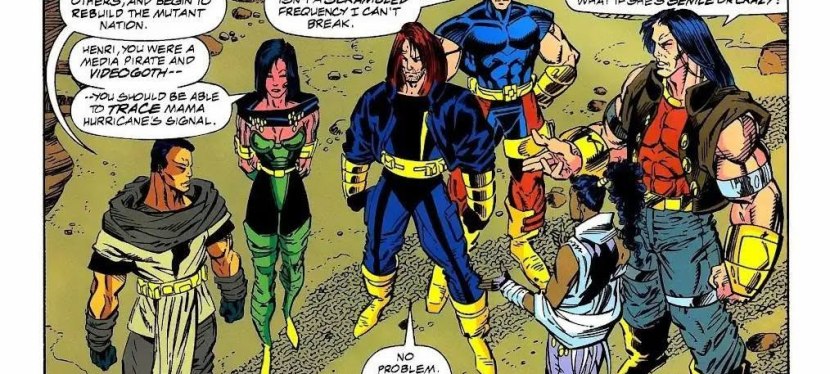
As the X-Men search for Hurricane, the Freakshow stands in their way.

The script of this comic book was finely crafted by John Francis Moore and it is amazing how efficient he got the X-Men team back (after Skullfire, Krystalin, Meanstreak returned) on track while ensuring a good amount of depth as reflected in the dynamics between the team members as the story went on. The storytelling felt natural and really believable.

Along the way, this comic book shed light on team leader Xi’an and the threads of the past that came back to haunt to him. This instantly added a new layer of development on Xi’an which established an element of uncertainty on the future of the X-Men under him (and his personal struggles). That said, Xi’an does not have the rock-solid stability of Professor X (Charles Xavier) which will remind readers how different the X-Men of 2099 are from the classic X-Men.

The X-Men are on the search for a mutant called Hurricane who has been active on resisting the corporations’ control on the nation and has long emphasized liberty and self-control on personal living. Historically, Hurricane led a part of the Underground Railroad which carried mutants to safe haven during a time of terror and fear. That said, X-Men’s search has a heavy purpose and the challenges they faced here is gripping and intriguing to follow. I should also state that Ron Lim’s delivery of dynamic action is really good to look at.

Conclusion

I really enjoyed the dynamics of the interactions between the members of the X-Men in this comic book. There is richness in John Francis Moore’s script here.

X-Men 2099 #6 (1994) is both a solid follow-up to the events of the Fall of the Hammer storyline and also a fine portrayal of how the team works under Xi’an’s leadership. More notably, it pushed the narrative of the series forward and gave us readers an in-depth exploration of the isolated places of America’s southwestern region in 2099 which is a sharp contrast to that era’s New York City dominated by Alchemax. More notably, this comic book implemented renewed focus on the state of mutants who have been living in fear, danger and uncertainty in America of 2099 which connects directly with the purpose of the X-Men as a team.

Overall, X-Men 2099 #6 is recommended. (1994)

+++++

Thank you for reading. If you find this article engaging, please click the like button below and also please consider sharing this article to others. If you are looking for a copywriter to create content for your special project or business, check out my services and my portfolio. If you want to support my website, please consider making a donation. Feel free to contact me with a private message. Also please feel free to visit my Facebook page Author Carlo Carrasco and follow me on Twitter at  @HavenorFantasy as well as on Tumblr at https://carlocarrasco.tumblr.com/ and on Instagram at https://www.instagram.com/authorcarlocarrasco/.
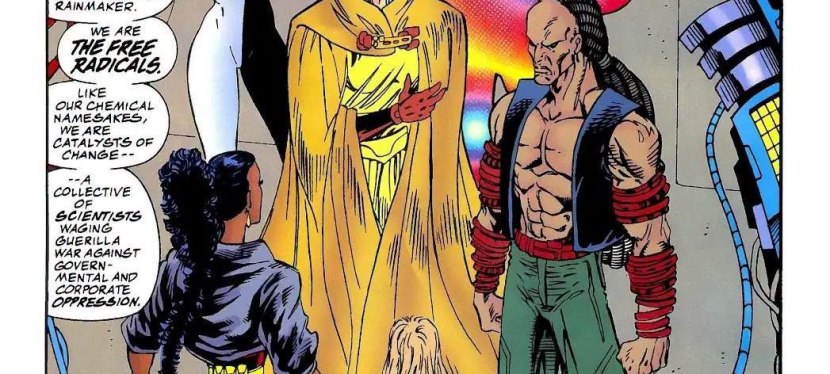
A Look Back at X-Men 2099 #11 (1994)

Welcome back, superhero enthusiasts, 1990s culture enthusiasts, X-Men fans and comic book collectors! Today we revisit the Marvel Comics shared universe to examine one of the many tales of the X-Men 2099 monthly series.  

If there is anything notable about the futuristic X-Men, it is the separation of the team members that started really early in the monthly series. Meanstreak left the team to pursue something personal. A few members of the team – including Meanstreak – got involved in the Fall of the Hammer crossover storyline (click here, here and here), Metalhead got infected and decides to leave the team to stay with another group, and their leader Xi’an lost his way.

With those details laid down, here is a look back at X-Men 2099 #11, published by Marvel Comics in 1994 with a story written by John Francis Moore and drawn by Ron Lim.

The cover.

Early story

The story begins with Tim Fitzgerald/Skullfire and Luna enjoying their time together outdoors. Tim, whose personality has changed into becoming radical and wild, tells her that he has not forgotten the anguish she put him in through the darkroom which made him relive the death of his beloved Reiko from some time ago.

As the tension between Tim and Luna intensifies, Xi’an tells him that they have to go to El Paso in Texas. It was Luna’s first time to meet Xi’an. The former leader of the X-Men states that they are closing in on the Driver…

Quality

Skullfire blasts Junkpile, the one responsible for the death of Sepertina (see X-Men 2099 #3).

Given the way the members of the X-Men got separated, the Moore-Lim duo succeeded in telling an intriguing story without even having a clear enemy for them to encounter. This is a tale about a drastically changed Xi’an (now arrogant and with an agenda of his own) develops into someone becoming more undesirable and dangerous with the passage of time. Similarly, Tim here is turning more unhinged and dangerous as he gradually turns into Skullfire (personally and visually) and Luna here is ironically the one keeping him stable.

On the other side, the remaining X-Men are still together but with a huge cloud of doubt over them. At this stage, Shakti/Cerebra – who was the faithful second-in-command when Xi’an still led the team – is taking more responsibilities as she gradually becomes the team leader. The writing done by John Francis Moore is rich when Shakti sticks strongly to principles during her interaction with Meanstreak who himself has turned uncertain about their status as a team. That said, there are certain traits of Xi’an visible in Shakti. Along the way, a few friends of the X-Men went away which added to the uncertainty that hounded them.

With regards to the reveal of the Driver on the cover of this comic book, the tale indeed reveals him and a new story thread about him was gradually built up. The Driver is Xi’an’s target and his act of helping one of the X-Men’s friends added to the suspense over what could happen next.

Conclusion

As the new leader of the X-Men, Shakti remains very principled. Her talk with Meanstreak in this scene is meaningful.

X-Men 2099 #11 (1994) is a very character-driven story from start to finish and the good news is that it is engaging and entertaining to read. The lack of a good-versus-evil conflict never hurt the story at all as Moore and Lim went deep to develop Tim, Xi’an and others while building up the pending encounter with the Driver. Not only that, having Tim and Xi’an more radicalized reflect the atmosphere of uncertainty and danger in the region (with lots of wilderness throughout and far away from the metropolis dominated by Alchemax) within America of 2099. It is a good read and I enjoyed the character development done by the creative duo.

Overall, X-Men 2099 #11 (1994) is recommended.

+++++

Thank you for reading. If you find this article engaging, please click the like button below and also please consider sharing this article to others. If you are looking for a copywriter to create content for your special project or business, check out my services and my portfolio. If you want to support my website, please consider making a donation. Feel free to contact me with a private message. Also please feel free to visit my Facebook page Author Carlo Carrasco and follow me on Twitter at  @HavenorFantasy as well as on Tumblr at https://carlocarrasco.tumblr.com/ and on Instagram at https://www.instagram.com/authorcarlocarrasco/.
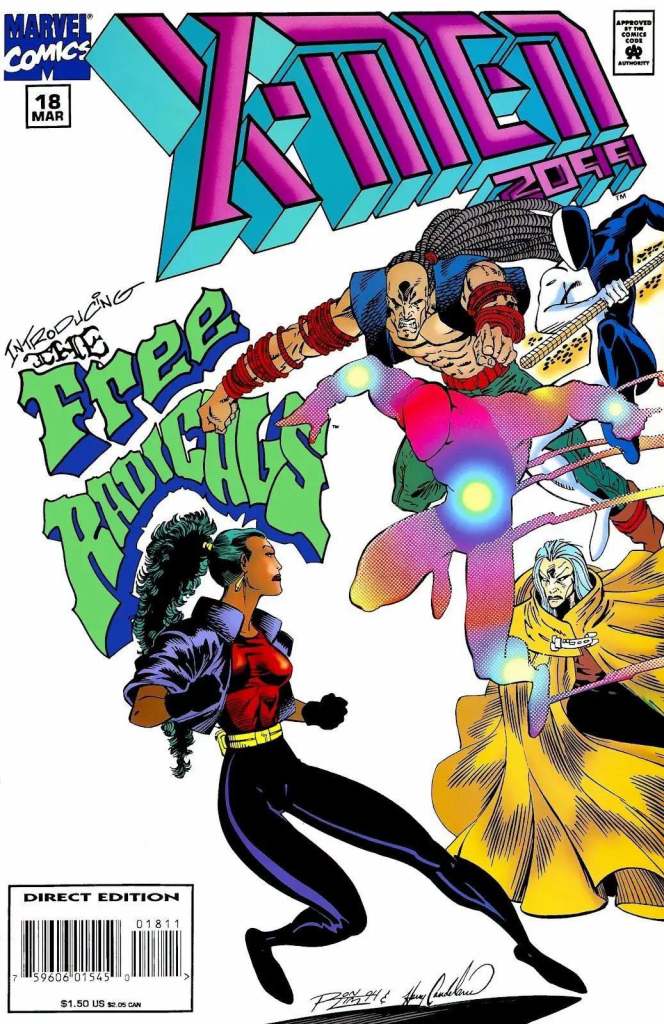
A Look Back at X-Men 2099 #2 (1993)

Welcome back, superhero enthusiasts, 1990s culture enthusiasts, X-Men fans and comic book collectors! Today we revisit the Marvel Comics shared universe to examine one of the many tales of the X-Men 2099 monthly series.  

Way back in 1993, I had a fun reading X-Men 2099 #1 as soon as it was released in the local comic book specialty store here in the Philippines. Back then, I was already into the 30th anniversary celebration of the X-Men while also reading more comic books about Marvel’s science fiction 2099 franchise of comic books. I love the way X-Men 2099 #1 ended as it was a powerful way of building up the tension and excitement that comes with waiting another 30 days for issue #2 to come out.

With those details laid down, here is a look back at X-Men 2099 #2, published by Marvel Comics in 1993 with a story written by John Francis Moore and drawn by Ron Lim.

The cover.

Early story

The story begins with the X-Men desperately trying to escape as the arcology has been invaded by enforcers (also referred to as the Greater Nevada Syndicate) of the Synge casino. Their leader Xi’an is in critical condition after getting shot during an assassination attempt that happened moments earlier. The X-Men are inside their van speeding away and Meanstreak (Henri Huang) uses his super speed to run ahead of them to quickly check what awaits them all. During the ride, Krystalin learned of the news that Noah Synge has died and Xi’an has been blamed for murder. Cerebra confirmed that Xi’an expressed hatred towards Synge.

When the van finally reaches the outdoor area, the X-Men find themselves facing a large tank and a helicopter of the syndicate which anticipated their arrival. The syndicate tells them to surrender Xi’an…

Quality

Cerebra shows their leader Xi’an with a biological cocoon forming over his body. Pay attention to the details.

As a follow-up to the impressive first issue, this one remains a very good read after all these decades. It is clear to me that John Francis Moore had carefully planned an engaging tale of the futuristic X-Men with Tim Fitzgerald (who will later be called Skullfire) as the symbolic reflection of the readers who get to discover more about the team, the situation they are in and why they exist in the first place.

As expected, the creative stuff that started in issue #1 progressed naturally as the story went on in this comic book. The X-Men of 2099 got away to find safety and get themselves organized as their leader remains in critical condition. Along the way, the syndicate itself gets adjusted as it has the son and daughter of Noah Synge taking over their evil empire suddenly. The syndicate is responsible for seven deaths, the wounding of nineteen people and the capture of over forty people as a result of their sudden invasion of the arcology and their attempt to assassinate Xi’an in retaliation of the death of Noah Synge. This was the creative duo’s way of telling readers who the bad guys are and why the X-Men are at a great disadvantage.

What I find engaging here is how the Moore-Lim duo emphasized Xi’an’s significance through flashbacks and background details (which further revealed more of the founding of the futuristic X-Men). This creative gamble worked wonders and clearly more than made up for the lack of dialogue and interactions from the X-Men’s leader. At the same time, the narrative has this flavor of conspiracy when the Synge empire was emphasized.

Conclusion

The futuristic X-Men encounter strong opposition from the syndicate.

X-Men 2099 #2 (1993) is clearly a very good read. As a follow-up to the very solid issue #1, it added to the build-up emphasizing the futuristic X-Men a lot more while still having enough room to develop the Synge empire and its syndicate. Along the way there were some nice pay-offs to certain build-ups in issue #1 and there was a fine balance between action scenes and the plot/character development scenes. That said, this comic book is a solid bridge between issue #1 and the conclusion in issue #3.

Overall, X-Men 2099 #2 (1993) is highly recommended.

+++++

Thank you for reading. If you find this article engaging, please click the like button below and also please consider sharing this article to others. If you are looking for a copywriter to create content for your special project or business, check out my services and my portfolio. If you want to support my website, please consider making a donation. Feel free to contact me with a private message. Also please feel free to visit my Facebook page Author Carlo Carrasco and follow me on Twitter at  @HavenorFantasy as well as on Tumblr at https://carlocarrasco.tumblr.com/ and on Instagram at https://www.instagram.com/authorcarlocarrasco/.
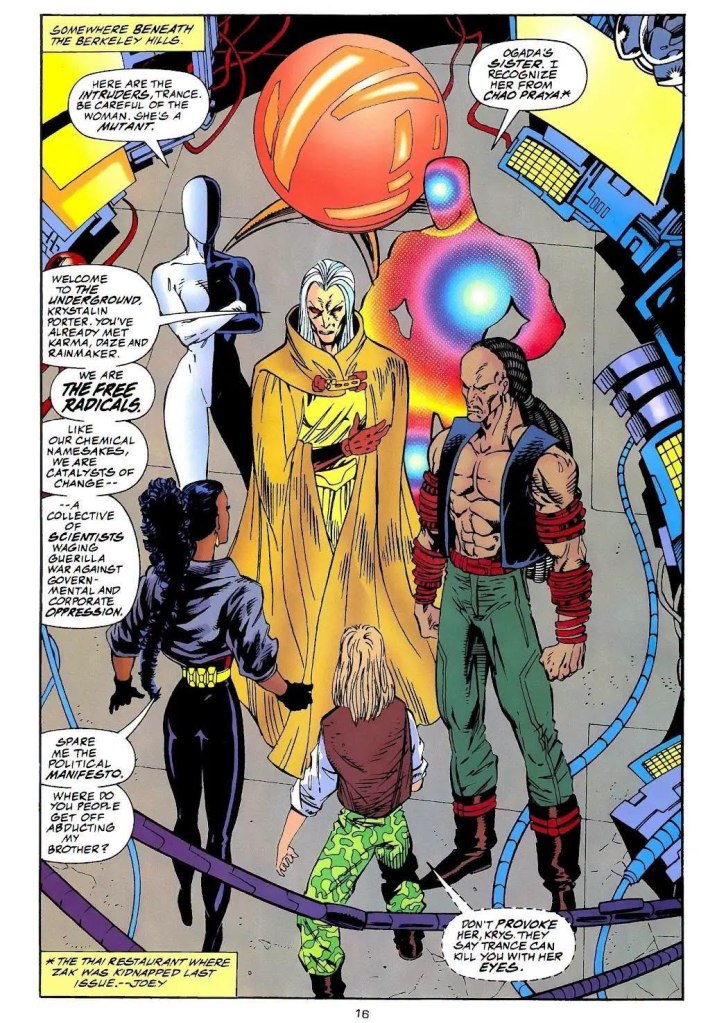
A Look Back at Spider-Man 2099 #44 (1996)

Welcome back superhero enthusiasts, 1990s culture enthusiasts and comic book collectors! Today we go back to the year 1996 and explore a part of the Marvel Comic shared universe through a tale of the Spider-Man 2099 monthly series.

To put things in perspective, the original Spider-Man 2099 monthly series that launched in 1992 lasted a total of 46 issues. The prolific author Peter David wrote the first 44 issues as he resigned from his duty in relation to the sudden firing of Marvel 2099 editor Joey Cavalieri in 1996. The previous issue was a great read.

With those details laid down, here is a look back at Spider-Man 2099 #44, published in 1996 by Marvel Comics with a story written by Peter David and drawn by Ron Lim.

The cover.

Early story

The story begins in the City of New York already flooded and infiltrated by lots of marine life. Under the water, Spider-Man and Roman the Sub-Mariner fight each other intensely as the foot of a gigantic sea monster is about to step in. At the last moment, Spider-Man saw the huge foot and instantly flipped away to survive with the Sub-Mariner.

After getting separated, Spider-Man gets out of the water to breath and immediately spots an organic-looking horn that the Sub-Mariner used to control the huge monster. Suddenly, on the aquatic humanoids appears to get the horn. Spider-Man then used his web to get the horn first which triggered the aquatic humanoid to move fast towards him.

Quality

The intense battle between Sub-Mariner and Spider-Man went on even as the huge sea monster is very near them in the city.

Without spoiling the plot, this comic book is a tale about a massive disaster and also a tale about the complicated legacy of Miguel O’Hara whose personal life is even more connected with the corporation he works for.

The huge disaster of New York getting flooded (which started in the previous issue) and Spider-Man fighting the leader of the mutates (genetically designed sentient beings) concluded in a really satisfying way. The futuristic webslinger really found himself struggling with the determined Sub-Mariner (motivated by what Alchemax did to the aquatic world) while dealing with the fact that so many citizens got displaced or even got killed by not only the huge flood but also by the presence of the gigantic sea monster. The stakes were really raised high for Spider-Man and the pay-off was really good.

The rest of the comic book deals with the intense meeting between Conchata O’Hara and Tyler Stone, Xina’s time with the Net Prophet, Gabriel O’Hara’s time with “father” Jennifer. Among the three sub-plots, the conflict between Conchata and Tyler is very intense and dramatic to read. More importantly, it was crafted by Peter David to be really believable and it ultimately added tension to the background and even the future of Miguel O’Hara (now a powerful Alchemax executive). This particular sub-plot is easily the most important one this comic book has and it will compel fans to revisit the 25th issue of this monthly series as well as issue #10.

While the sub-plot of Xina and the Net Prophet does not generate enough depth for this comic book, there is a big revelation made in the sub-plot of Gabriel and “father” Jennifer which will compel fans to revisit issues #40 and #41. In fact, nothing is ever simple regarding the origin of a specific villain of the 2099 universe.

When it comes to the artwork, this comic book is a downgrade compared to what was presented in issue #43 (drawn by Andrew Wildman). I’m not saying that Ron Lim’s art is bad, it’s just nowhere as good as that of Wildman’s art. In fairness, Ron Lim managed to make the city disaster look intense and he managed to make the characters look recognizable. In fact, Lim successfully made the Conchata-Tyler scenes look intense and dramatic.

Conclusion

The giant monster aspect of this comic book added intensity to the battle and the disaster. There were a few Godzilla vibes here and there.

As the final Peter David-written issue of this monthly series, Spider-Man 2099 #44 (1996) is undeniably a very solid reading experience. There were strong pay-offs executed here to what was built-up in the previous issues, and in typical fashion, David kept building up the other sub-plots. The conclusion to the Conchata-Tyler sub-plot is actually more powerful than that of the city disaster. Clearly, Peter David kept track of the character developments and events that previously happened and dramatized them nicely here. In fact, you will feel some sympathy towards Miguel O’Hara knowing how unfortunately complicated his family legacy really is.  

Overall, Spider-Man 2099 #44 (1996) is highly recommended!

+++++

Thank you for reading. If you find this article engaging, please click the like button below, share this article to others and also please consider making a donation to support my publishing. If you are looking for a copywriter to create content for your special project or business, check out my services and my portfolio. Feel free to contact me with a private message. Also please feel free to visit my Facebook page Author Carlo Carrasco and follow me on Twitter at  @HavenorFantasy as well as on Tumblr at https://carlocarrasco.tumblr.com/ and on Instagram at https://www.instagram.com/authorcarlocarrasco

A Look Back at Spider-Man 2099 #43 (1996)

Welcome back superhero enthusiasts, 1990s culture enthusiasts and comic book collectors! Today we go back to the year 1996 and explore a part of the Marvel 2099 comics universe through a tale of the Spider-Man 2099 monthly series.

In my previous retro review, Miguel O’Hara learns how challenging it could be for him to direct the path of Alchemax which is symbolize with himself being surrounded by the managers. He recently stopped his father Tyler Stone from taking control of his office. As his office needs a secretary, someone very exceptional came in.

With those details laid down, here is a look back at Spider-Man 2099 #43, published in 1996 by Marvel Comics with a story written by Peter David and drawn by Andrew Wildman and Ron Lim.

The cover.

Early story

The story begins when one of the undersea bases of Alchemax explodes to the surface in heavily damaged form. Something terrible happened to it deep below and there is only one man (wearing a protective suit) still living floating on the sea. Just as he notices sharks coming his way, Spider-Man comes down to save him with the use of one of Alchemax’s floating vehicles. As Spider-Man pulls the helpless man up with his web, one of the sharks leaped high at them. The web breaks and both the man and Spidey fall into the sea.

Meanwhile at Alchemax, Gabriel O’Hara confronts his mother Conchata who very recently started working as the office secretary of Miguel. Gabriel asks how could she be working for Miguel as part of Alchemax which is the very corporation she hated. The mother answered back stating that she resolved her accumulated anger related to Miguel and has realized that he needs her…

Quality

The rise of the mutate rebel Roman and Miguel O’Hara’s corporate interactions dramatized efficiently in this single page.

Moving further away from what was dramatized in issues #40 and #41, Peter David crafted this tale focusing on a new threat that endangers not only Spider-Man but the people and their local society as a whole. To put things in perspective, it is recommend you revisit issue #8 and focus on Alchemax’s aquatic division called Atlantis which had been working on a major reclamation project under the sea with the objective of becoming a tourist attraction in the years to come. Right there, Tyler Stone mentioned Miguel’s involvement with the project which includes bio-engineered workers.

The key elements of Atlantis mentioned in issue #8 literally resurfaced in this comic book and Peter David heavily emphasized the related details and integrated it all in the plot which essentially justified the existence of the new opposition led by Roman who is the charismatic leader of the mutates (genetically designed sentient beings) who had long been working hard and long outside of the undersea bases which had humans living comfortably inside. Roman here is not related in any way to Marvel’s aquatic hero Namor the Sub-Mariner but he is an imitation of him (note: his name is Namor in reverse).

The conflict of Atlantis revives the business-laborers conflict but was twisted to show the conflict between humans and mutates, as well as Atlantis being symbolized as a physical project of Alchemax to exploit the aquatic life and resources deep under the sea. The build-up of the human-mutates conflict in this particular comic book is surprisingly beefy and was efficiently done.

As for Spider-Man himself, you will get to see him more involved with Alchemax just as he successfully keeps his civilian identity secret. Along the way, you will see more of Miguel O’Hara doing more corporate work and negotiations. As expected, his drive to lead Alchemax with his own perception of being compassionate encounters hurdles from the established order – both within and outside his company. His mother was portrayed to be more sympathetic than before and she shows lots of signs of having mellowed. The development on Miguel and Conchata here were deep and they made a lot of sense with the plot itself.

Conclusion

The futuristic Spidey interacts with a huge shark!

Spider-Man 2099 #43 (1996) is another tale that has aged well as its foundations and elements proved to be very solid until now. With regards to the big event that took place near the end of this comic book, it seems that Peter David took inspiration from what was portrayed in Fantastic Four #4 (1962) as well as from Namor the Sub-Mariner himself. I really enjoyed how this story became a huge pay-off to the minor build-up in issue #8.

Overall, Spider-Man 2099 #43 (1996) is highly recommended!

+++++

Thank you for reading. If you find this article engaging, please click the like button below, share this article to others and also please consider making a donation to support my publishing. If you are looking for a copywriter to create content for your special project or business, check out my services and my portfolio. Feel free to contact me with a private message. Also please feel free to visit my Facebook page Author Carlo Carrasco and follow me on Twitter at  @HavenorFantasy as well as on Tumblr at https://carlocarrasco.tumblr.com/ and on Instagram at https://www.instagram.com/authorcarlocarrasco

A Look Back at Venom: Lethal Protector #4 (1993)

Disclaimer: This is my original work with details sourced from reading the comic book and doing personal research. Anyone who wants to use this article, in part or in whole, needs to secure first my permission and agree to cite me as the source and author. Let it be known that any unauthorized use of this article will constrain the author to pursue the remedies under R.A. No. 8293, the Revised Penal Code, and/or all applicable legal actions under the laws of the Philippines.

Welcome back superhero enthusiasts, 1990s arts and culture enthusiasts, Marvel Comics fans and comic book collectors! Today we go back to the year 1993 and explore a part of Marvel Comics’ universe through the first-ever limited comic book series featuring one of Marvel’s most iconic supervillains – Venom.

In my previous retro review, the core concept of the Lethal Protector limited series started to really take shape as issue #3’s plot got more intriguing and interesting to read while emphasizing other powerful forces Venom himself simply could not easily overwhelm. It is also the issue in which Venom’s past act of a certain murder comes to haunt him. The problem I had with that comic book was the creative team’s dramatization of Eddie Brock’s personal history which essentially ruined whatever mystery Venom had. Eventually, the comic book ended with Venom getting into trouble again.

With those details laid down, here is a look back at Venom: Lethal Protector #4 published in 1993 by Marvel Comics with a story written by David Michelinie and drawn by Ron Lim.  

The cover.

Early story

The story begins inside a high-tech facility in the Mojave Desert. Inside, Venom is in captivity floating off the floor with high-tech machines keeping him prisoner. He is a captive of the Life Foundation and they have successfully extracted another spawn from Venom’s symbiote which causes tremendous pain on the part of Eddie Brock. It turns out, a total of five “seeds” have been extracted and the organization has big plans with them.

Over at Sta. Cruz in California, Spider-Man spends some of his precious time to stop some local criminals from causing anymore danger to the people. During his telephone talk with Mary Jane, he admits that has not been able to track Venom down but he has a new lead about weird creatures that have been spotted locally. A short time later, Spider-Man arrives at a shopping mall where tremendous damage of property have happened. As soon as he catches a lady and prevents her from hitting the pavement, he is shocked to see a long-haired woman wearing a living alien costume with features that are so similar to that of Venom. The symbiote-wearing woman (Scream) tells Spider-Man directly that breaking him in half will make the “little exercise” a complete success…

Quality

Spider-Man takes on the “female Venom”

To start with what is very obvious and clear, this story has Spider-Man overshadowing Venom in terms of literary presence as the plot has the titular character limited to captivity under the tight grasp of the Life Foundation. Given Spider-Man’s previous appearances in this limited series serving as a convenient tool for exposition, you will easily feel the Amazing Spider-Man monthly series’ vibes taking over this comic book’s narrative as Marvel’s icon became the protagonist of the story complete with spectacle and problem solving that drive the plot forward. This is not surprising as David Michelinie was already the lead writer of the Amazing Spider-Man monthly series and it only makes sense to shift the focus on the famous webslinger since his deadliest enemy (who has this very distorted belief about protecting the innocent and keep on murdering people he finds antagonistic) could not contribute much to the story while in captivity.

As reflected in the nice cover of this comic book, it is also Spider-Man who faces off with the “female Venom” herself Scream which leads to yet another Spidey-versus-symbiote villain battle but with a catch – Scream is simply inexperienced in battle and does not have any real strategy to deal with New York’s webslinger. That battle noticeably does not last very long and the short amount of superhero spectacle here paved the way for the creative team to make Spider-Man sneak into enemy territory and closer to Venom.

In terms of visual quality, I can say that things went way down as Ron Lim replaced Mark Bagley here. Lim’s art style of drawing people has this generic aesthetic on the characters’ faces – Mary Jane and Eddie Brock are barely recognizable. While Lim’s artistic take on Venom is clearly a big letdown compared to Bagley’s Venom (note: always looking menacing and unique), he ironically did a decent job visualizing Scream. Lim’s most dynamic shots of superhero action lacked impact. Regardless, Lim’s art is not so appealing compared to Bagley’s. Also it is quite noticeable that Lim drew Venom to be much bulkier with exaggerated muscles.

Conclusion

The most notable concept in this comic book.

Considering all the details I mentioned above, Venom: Lethal Protector #4 (1993) is technically an Amazing Spider-Man comic book that just so happens to have Venom much less significant in this particular part of his own limited series. There really was not much room for the creative team use as far as Venom is concerned. Of course, this is all part of a build-up heading into the final two parts of this limited series and it is obvious that Venom would become prominent again. This comic book’s most notable feature was its concept about the Life Foundation extracting seeds from Venom’s living costume but considering what happened, there was not much room to really build-up on the idea that more symbiote-wearing people will emerge. Scream was essentially a warm-up. Ultimately, Spider-Man fans will have a lot to enjoy here while Venom fans will not have much to enjoy.

Overall, Venom: Lethal Protector #4 (1993) is serviceable.

+++++

Thank you for reading. If you find this article engaging, please click the like button below, share this article to others and also please consider making a donation to support my publishing. If you are looking for a copywriter to create content for your special project or business, check out my services and my portfolio. Feel free to contact me with a private message. Also please feel free to visit my Facebook page Author Carlo Carrasco and follow me on Twitter at  @HavenorFantasy as well as on Tumblr at https://carlocarrasco.tumblr.com/ and on Instagram at https://www.instagram.com/authorcarlocarrasco