A Look Back at Amazing Spider-Man #389 (1994)

Welcome back superhero enthusiasts, 1990s arts and culture enthusiasts, Spider-Man fans and comic book collectors! Today we go back to the mid-1990s to examine a small part of the Marvel Comics shared universe through a tale of the Amazing Spider-Man monthly series.

We are finally here! I’m talking about the fourth chapter of the Pursuit storyline featuring a broke-hearted and revenge-obsessed Spider-Man who has been more violent in his search for the Chameleon. It should be noted that his marriage with Mary Jane has turned for the worse as time went on. For my previous retro comic book reviews about the Pursuit storyline, click here, here and here.

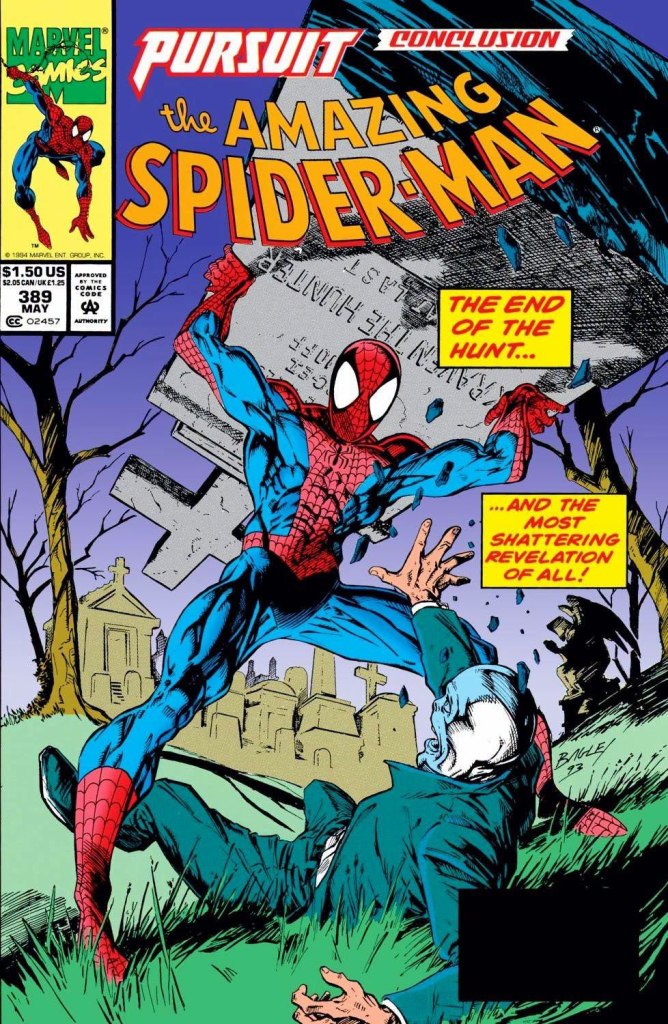
With those details laid down, here is a look back at Amazing Spider-Man #389, published in 1994 by Marvel Comics with a story written by David Michelinie and drawn by Mark Bagley.
Early story

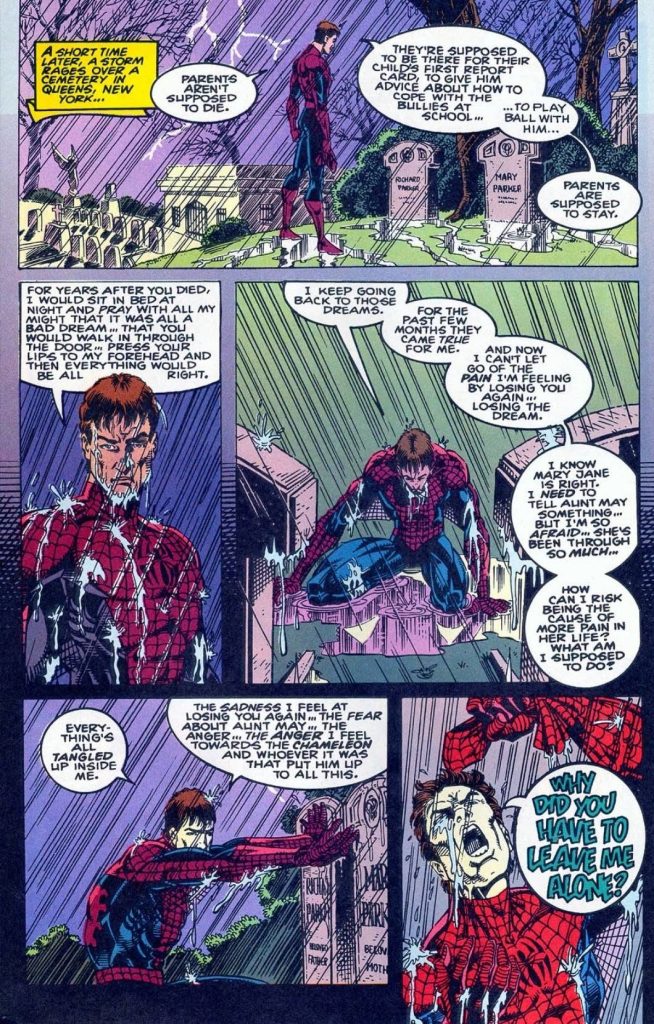
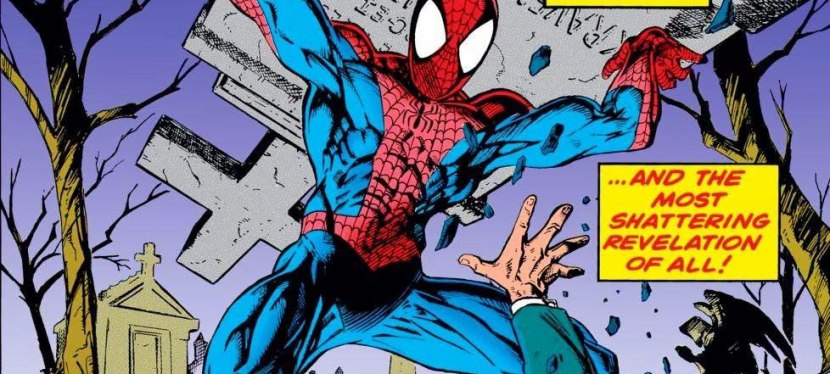
The story begins at a very familiar tomb stone. It marked the very spot where Spider-Man was once buried in (refer to Kraven’s Last Hunt). Nearby is the tomb stone referring to the late Kraven the hunter. Moments earlier, Spider-Man discovered the coffin is empty which shocked him. Even though he is burdened with stress fighting the Chameleon, memories of his past encounters with Kraven and the impostors (who posed as his late mother and father) flashed in his mind bringing back pain and anguish.

Spider-Man decides that the time of mourning (dating back to the day he lost his parents when he was little) has to stop and slowly makes his way into Kraven’s mansion. As soon as the door opens, he shouts the Chameleon’s name…

Quality
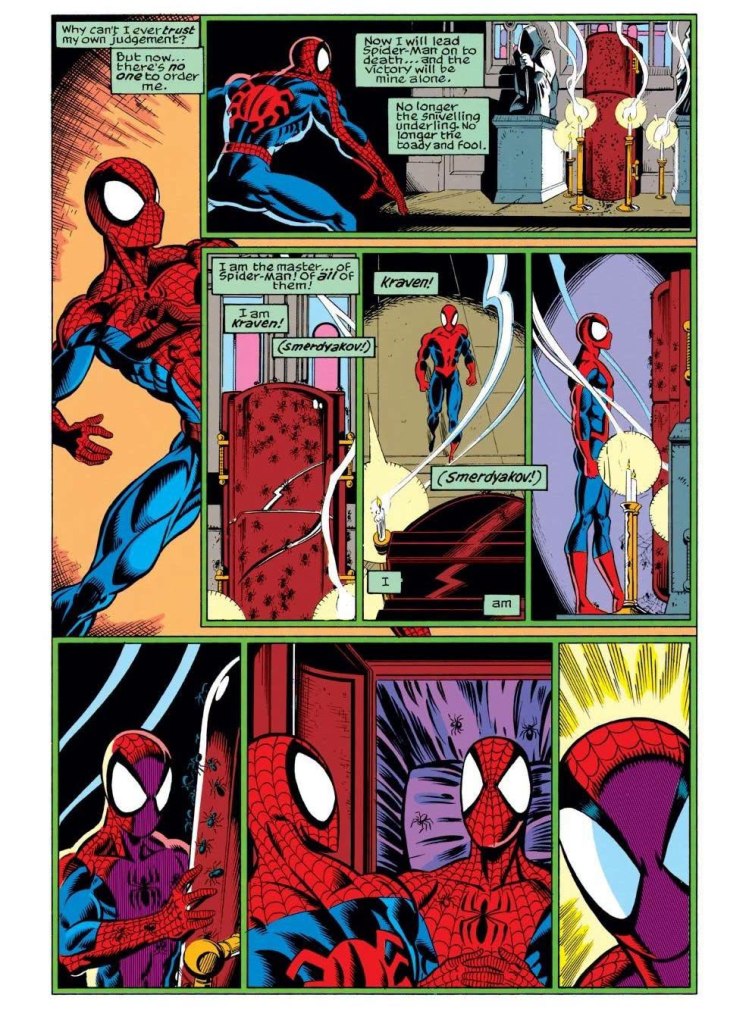
Spider-Man deals with a physical distraction set-up by the Chameleon inside the mansion of the late Kraven.

As the conclusion to the 4-part Pursuit storyline, this comic book is very intense and it is clear to me that the Michelinie-Bagley duo went all-in to pack it with a lot of punch and a startling revelation that really defined the Chameleon.

While previous chapters showed the broken and revenge-hungry Spider-Man getting more violent towards others as he pursued the Chameleon, this comic book has the webslinger fully unhinged within the setting of Kraven’s property. Spider-Man here goes through two so-called death traps before finally encountering the Chameleon in person. As he fought with the tigers and the mechanized set-ups (in the forms of the type of animals hunted by man), Spider-Man was truly determined to kill the master of disguise and he did not hold back with his violent attacks.

Readers will witness the moment when the spectrum of good and evil got twisted as the Chameleon becomes very fearful of Spider-Man who is so unrelenting he looked truly murderous. That said, the famous webslinger himself is a shadow of what he was and there were moments when I felt he was becoming evil. Indeed, the loss of beloved family members combined with the obsession for revenge against the responsible one can turn good people into destructive individuals moving towards evil. At this point of the Pursuit storyline, Michelinie and Bagley took huge creative risks as they worked to make a conclusion that is believable, intriguing and compelling at the same time.

But that is not all. The Chameleon himself got highly developed in this very late stage of the Pursuit storyline. His relationship with Kraven the hunter was revealed with lots of details pointing to their heritage in Russia with clear separate paths – Kraven was privileged while the Chameleon (Dmitri Smerdyakov) had a more painful life. Chameleon’s perception towards Kraven is complicated as he admires him while still harboring a deep resentment towards him. The revelations about the Chameleon’s past and connections with the late hunter really added dramatic value and tension in the story.

Conclusion
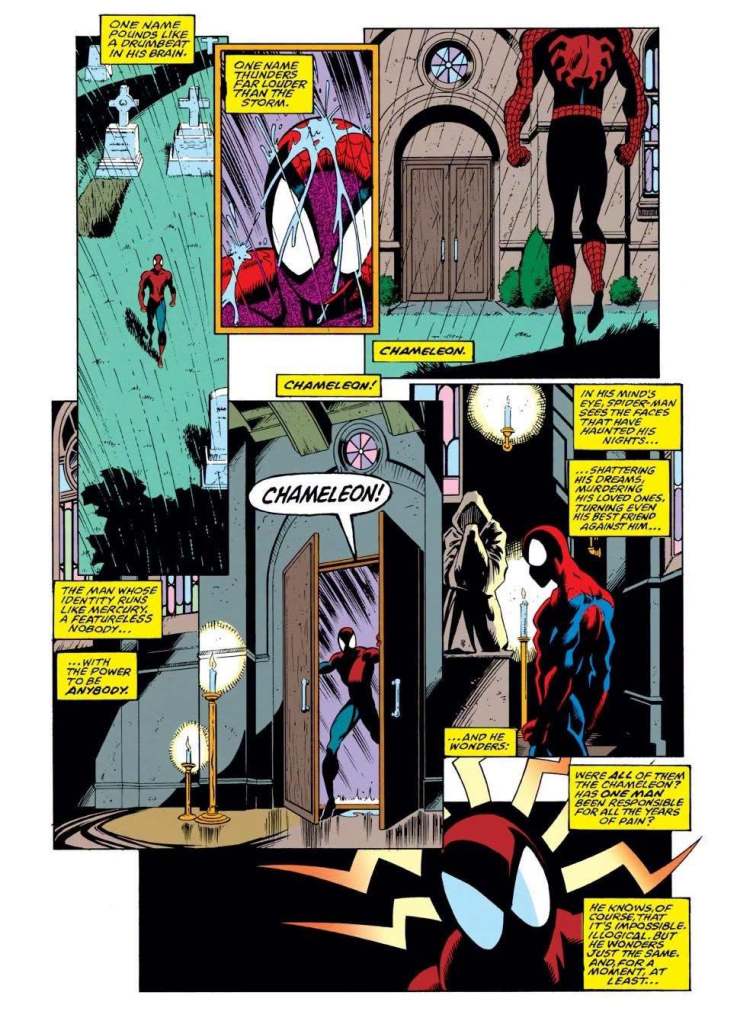
This is the calm before the storm (Spider-Man’s rage and obsession with revenge).

Amazing Spider-Man #389 (1994) is indeed a powerful conclusion to the Pursuit storyline. It went as far as showing Spider-Man as the unhinged force of destruction who was determined to really kill the Chameleon and is also succeeded on defining the super villain’s personality with revelations about his Russian heritage with the late Kraven. This comic book also sheds light as to why the Chameleon became proficient with impersonating people and changing his face physically. There will be times when you could feel pity for both Spider-Man and the master of disguise as their respective emotional states and obsessions were powerfully dramatized by the Michelinie-Bagley duo. When it comes to conclusions, the very ending of this comic book is startling and it does not have much to do with the Chameleon.  

Overall, Amazing Spider-Man #389 (1994) is recommended.

+++++

Thank you for reading. If you find this article engaging, please click the like button below, share this article to others and also please consider making a donation to support my publishing. If you are looking for a copywriter to create content for your special project or business, check out my services and my portfolio. Feel free to contact me with a private message. Also please feel free to visit my Facebook page Author Carlo Carrasco and follow me on Twitter at  @CarloCarrascoPH as well as on Tumblr at https://carlocarrasco.tumblr.com/ and on Instagram at https://www.instagram.com/authorcarlocarrasco
A Look Back at Spider-Man #45 (1994)

Welcome back superhero enthusiasts, 1990s culture enthusiasts, Spider-Man fans and comic book collectors! Today we go back to the mid-1990s and to explore a part of the Marvel Comics shared universe through a tale of the Spider-Man monthly series.

As revealed in Amazing Spider-Man #388, Richard and Mary Parker – who spent some time living with Peter Parker’s family after suddenly emerging from nowhere – were not Peter’s parents but androids designed to look, act and feel human. They were life model decoys (LFDs) programmed infiltrate Peter’s life until they learn Spider-Man’s true identity. As programmed, they reported to their master the Chameleon. Just seconds before Richard revealed the secret identity, Spider-Man suddenly interfered and this led to a series of violent acts.

With those details laid down, here is a look back at Spider-Man #45, published in 1994 by Marvel Comics with a story written by Howard Mackie and drawn by the late Tom Lyle. This is the first chapter of the Pursuit storyline.

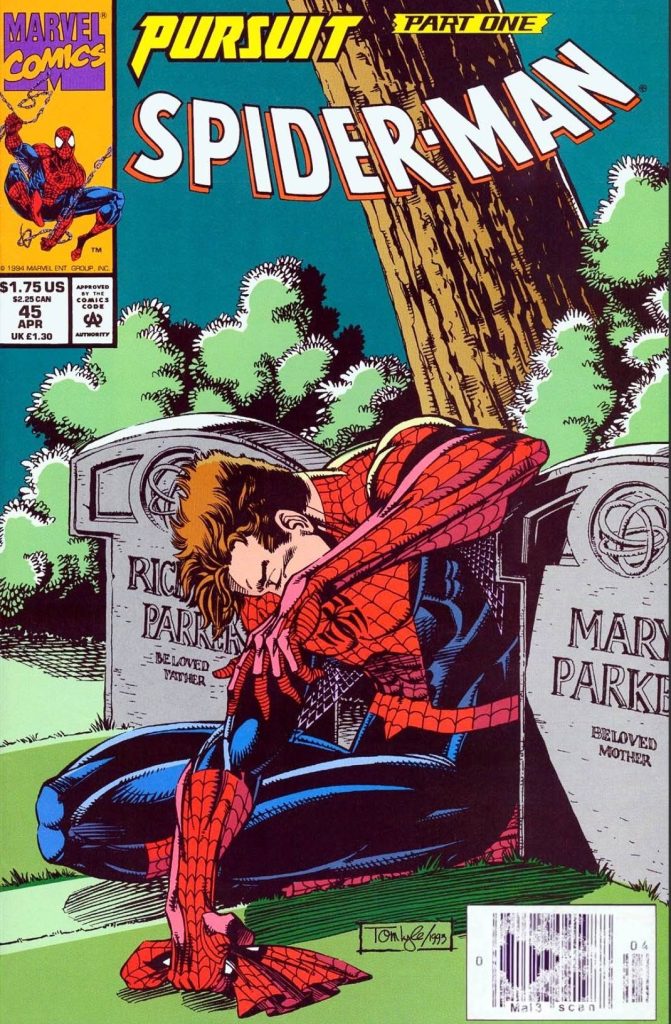
The cover.

Early story

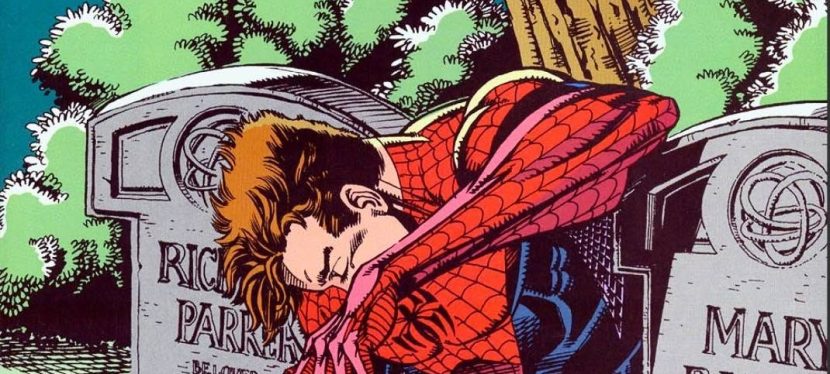
The story begins moments after the huge conflict that happened. A very broken-hearted Spider-Man realized that “Mary” and “Richard” were impostors and his actual parents have long been gone. He is also concerned about how his Aunt May will handle the truth about Richard and Mary. Deep inside him, a desire for vengeance against the Chameleon is growing.

As he swings from one building to another in New York City, Peter Parker begins to realize that his role as Spider-Man is turning into a farce. He begins his obsession of hunting down the Chameleon and stopping him until he keeps him out of his life for good…

Quality

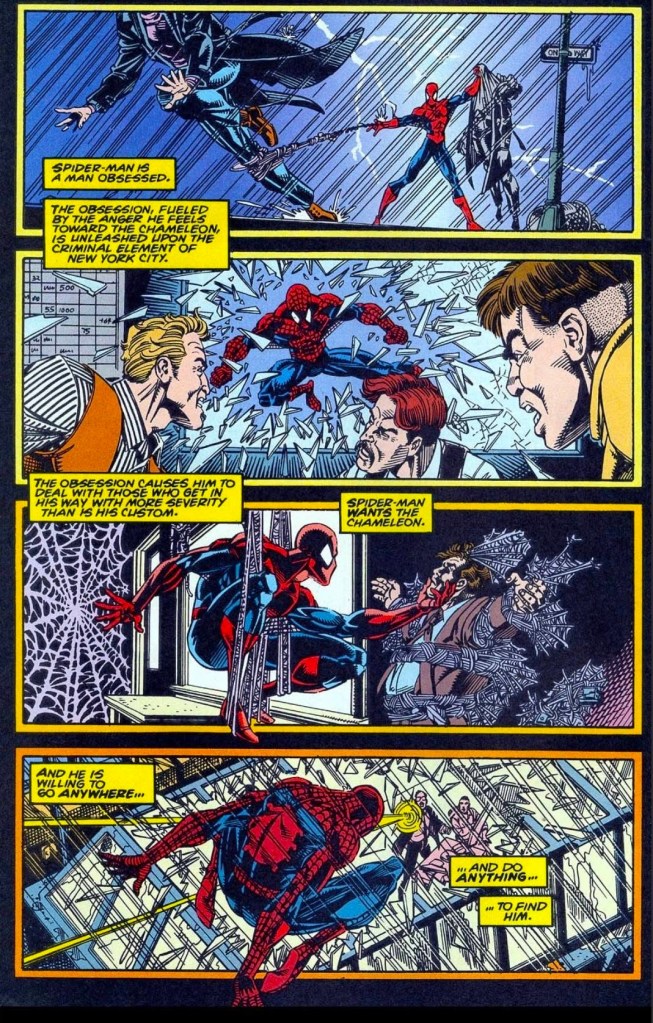
What you are seeing here is a very obsessive, aggressive and more violent Spider-Man. Vengeance is his motivation.

To make things clear to everyone, this tale does not have the long-running friendly neighborhood Spider-Man. Instead, we have the iconic webslinger who is deeply hurt and the pain he carries motivates him to pursue the Chameleon (who is responsible for reviving the deep pain Peter felt after his parents died). It is clearly a pursuit for vengeance and the writing by Howard Mackie is very believable.

That said, readers will not only see Peter Parker wanting vengeance but also his dark side emerge. Carrying over the tragedy that happened in Amazing Spider-Man #388, Mackie and Lyle precisely crafted a story that had a very dramatic and radically different Peter Parker. Peter even shouts at his wife Mary Jane and struggles with revealing the details of the tragedy to his beloved Aunt May. When he goes out as Spider-Man to find answers, he approaches crooks aggressively and with more violence than before. In short, Spider-Man here lacks restraint and really looks like he could become a public menace.

That said, the portrayal of a very broken Peter Parker here can be alienating even to long-time Spider-Man fans.

Along the way, the Mackie-Lyle duo managed to develop the Chameleon not only as Spider-Man’s target but also as his most cunning and very diabolical enemy yet. The Chameleon (first appearance in 1963’s Amazing Spider-Man #1) is very prominently shown here which is quite meaningful because he is the very first super villain to encounter the webslinger. The long-time villain is very organized and has set up a trap for Spider-Man. The Chameleon also has his own obsession versus Spider-Man and his personal connection with Kraven the Hunter has a lot of depth to the story. As such, there are common elements that the webslinger and the evil master of disguise share.

Conclusion

Great work by Howard Mackie and the late Tom Lyle on expressing Peter Parker’s sadness over the loss of his parents.

Spider-Man #45 (1994) is clearly a very engaging read even though its concept of Spider-Man wanting vengeance can be a turnoff to some readers. For one thing, the script Howard Mackie wrote has a lot of depth and Tom Lyle brought it to life with a fine art style. Having seen the 1989 movie Licence to Kill, I noticed the similarities Spider-Man has with Timothy Dalton’s James Bond when it comes to executing a private vendetta. That said, I enjoyed what was presented in this comic book. Indeed, this tale was published at a time when the dynamics of superhero storytelling in the 1990s changed dramatically moving towards tragedy, disaster and death. It is clearly a product of its time and anyone who wants to read a dark and gritty Spider-Man portrayal should go for this. As such, I am convinced to read on with the Pursuit storyline.

Overall, Spider-Man #45 (1994) is recommended.

+++++

Thank you for reading. If you find this article engaging, please click the like button below, share this article to others and also please consider making a donation to support my publishing. If you are looking for a copywriter to create content for your special project or business, check out my services and my portfolio. Feel free to contact me with a private message. Also please feel free to visit my Facebook page Author Carlo Carrasco and follow me on Twitter at @CarloCarrascoPH as well as on Tumblr at https://carlocarrasco.tumblr.com/ and on Instagram at https://www.instagram.com/authorcarlocarrasco
A Look Back at Amazing Spider-Man #374 (1993)

Welcome back superhero enthusiasts, 1990s arts and culture enthusiasts, Marvel Comics fans and comic book collectors! Today we go back to the year 1993 and examine a small part of the Marvel Comics universe through a tale of the Amazing Spider-Man monthly series.

In early 1993, the supervillain and murderer Venom was in very high demand among Marvel readers and comic collectors. The Venom: Lethal Protector mini-series launched with issue #1 selling a lot of copies and it portrayed Spider-Man’s greatest enemy as a very twisted and violent makeshift hero who dedicated himself to protecting what he (Eddie Brock specifically) to innocent people. As Venom was one of the few supervillains who knew Spider-Man’s true identity, the creative team behind the Amazing Spider-Man series decided to raise the stakes temporarily by having him encounter Peter Parker’s parents (the ones that appeared in Amazing Spider-Man #365).

With those details laid down, here is a look back at Amazing Spider-Man #374, published in 1993 by Marvel Comics with a story written by David Michelinie and drawn by Mark Bagley.

The cover.

Early story

The story begins inside the bunker beneath the grounds of the deserted Brooklyn amusement park. As Eddie Brock struggles to lift a very heavy piece of equipment, the symbiote forms over his body helping him lift it up above the head. Venom is obsessed with killing Spider-Man and Eddie Brock remains totally bitter over the webslinger’s responsibility on destroying his career. Eddie sees a page of the Daily Bugle on the wall and it contains a news photo of Peter Parker with his mother and father.

At New York’s famous Central Park, Peter, wife Mary Jane and his parents enjoy quality time skating on ice. Aunt May is standing on a wooden platform watching them…

Quality

Lots of intense action scenes in this comic book for fans and readers to be entertained with. The action scenes are not mindless as they serve as reflections of Venom’s powerful quest for revenge.

To begin with, I can say that this tale by David Michelinie is a very intense and dramatic read and it added a new layer of depth into the enduring rivalry between Spider-Man and Venom. At this point in Marvel Comics’ shared universe history, the two icons have encountered each other so many times, the time was right for Michelinie to raise the stakes and have the elderly Parkers (note: Aunt May excluded) as the new targets of Venom (already made obvious on the cover which in turn added tremendous stress on the part of Spider-Man and his wife.

For the newcomers reading this, Eddie Brock’s journalistic career was destroyed over the Sin-Eater story as a result of Spider-Man’s public revelation of Stanley Carter as the said figure (note: Brock’s Sin-Eater article series was based on interviews with Emil Gregg who actually turned out to be a delusional neighbor of Carter’s).

As Brock’s life went way downhill with his reputation destroyed, his hatred of Spider-Man grew and so did his quest for revenge. That being said, what happened in this particular comic book was a very reflective extension of what happened years prior. Anyone who has basic knowledge of the origin of Venom and early appearances of Brock in comics will be able to understand the intensified rivalry in this tale.  

Apart from the great story, this comic book has lots of superhero spectacle for readers to enjoy. That being said, the smashing action of the fight between Spider-Man and Venom was clearly made to be more violent which suitably reflected the supervillain’s lust for revenge. Spidey, meanwhile, had no choice but to avoid causing any more damage or harm as Venom goes after him in public surrounded with lots of bystanders. Along the way, you will see a key moment of the insanity of Venom which served as a useful pause of the fight. Finally, when it comes to the art, this comic book has some of the finest artworks I have seen from Mark Bagley.

Conclusion

At the time of this comic book’s publication, Venom was one of the few supervillains who knew Spider-Man and Peter Parker are one and the same person. The inclusion of Peter’s parents only added to the raising of the stakes.

Amazing Spider-Man #374 (1993) is undeniably a great read complete with intense action scenes, lots of intrigue and, most notably, a rock solid development of the Spider-Man-Venom rivalry. This is the kind of story that will compel long-time Spider-Man fans to revisit Venom’s origin as well as Spider-Man’s involvement with the Sin-Eater. At the same time, this tale will help readers understand the insanity and murderous mind of Venom that took place not only in the Venom: Lethal Protector mini-series in also other mini-series about the symbiotic killer that Marvel published throughout the 1990s.

Overall, Amazing Spider-Man #374 (1993) is highly recommended!

+++++

Thank you for reading. If you find this article engaging, please click the like button below, share this article to others and also please consider making a donation to support my publishing. If you are looking for a copywriter to create content for your special project or business, check out my services and my portfolio. Feel free to contact me with a private message. Also please feel free to visit my Facebook page Author Carlo Carrasco and follow me on Twitter at  @HavenorFantasy as well as on Tumblr at https://carlocarrasco.tumblr.com/ and on Instagram at https://www.instagram.com/authorcarlocarrasco