Disclaimer: This is my original work with details sourced from reading the comic book and doing personal research. Anyone who wants to use this article, in part or in whole, needs to secure first my permission and agree to cite me as the source and author. Let it be known that any unauthorized use of this article will constrain the author to pursue the remedies under R.A. No. 8293, the Revised Penal Code, and/or all applicable legal actions under the laws of the Philippines.
Welcome back, superhero enthusiasts, 1990s culture enthusiasts, X-Men fans and comic book collectors! Today we revisit the Marvel Comics shared universe through one of the many tales of the X-Men 2099 monthly series.
Looking back at how early the members of the futuristic X-Men got separated and lost their leader Xi’an (who became sinister, pursued a quest of his own interest and joined the Theater of Pain), I can see what the creators did to develop the characters, tell new stories, introduce new characters and expand the lore of the 2099 in another part of the United States. That said, this series became consistently entertaining and intriguing at the same time.
With those details laid down, here is a look back at X-Men 2099 #15, published by Marvel Comics in 1994 with a story written by John Francis Moore and drawn by Ron Lim.
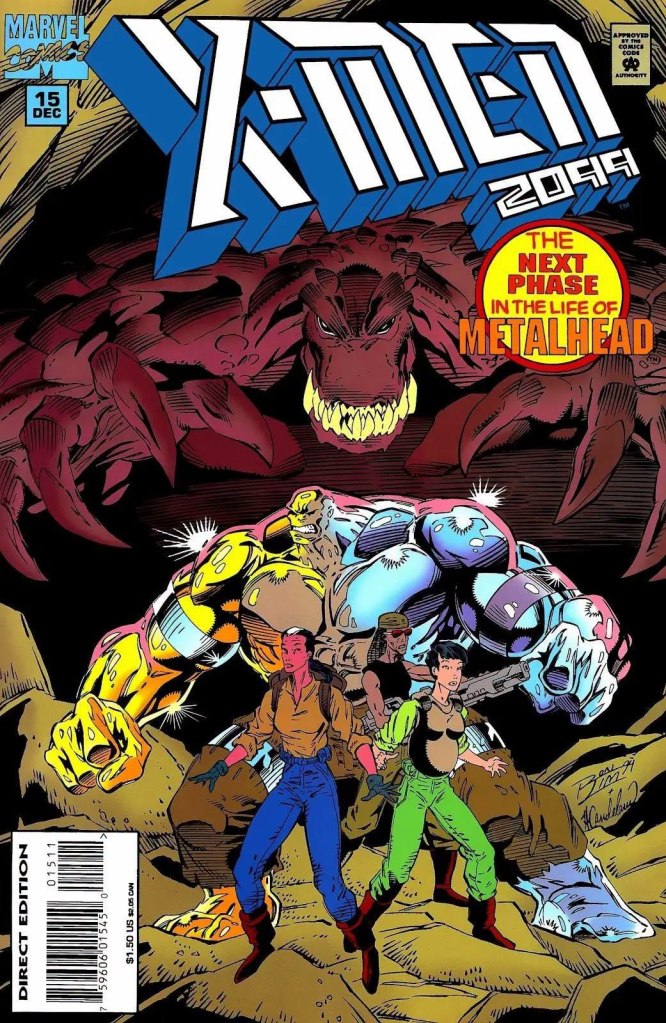
The cover.
Early story
The story begins in the Keewazi Nation in Oklahoma. Eddie/Metalhead is unconscious with Hurricane and her friend accompanying him. Their pregnant companion Rosa has been missing since Glitterspike (the man who impregnated Rosa) took her away from them. Metalhead wakes up and immediately asks where Rosa is.
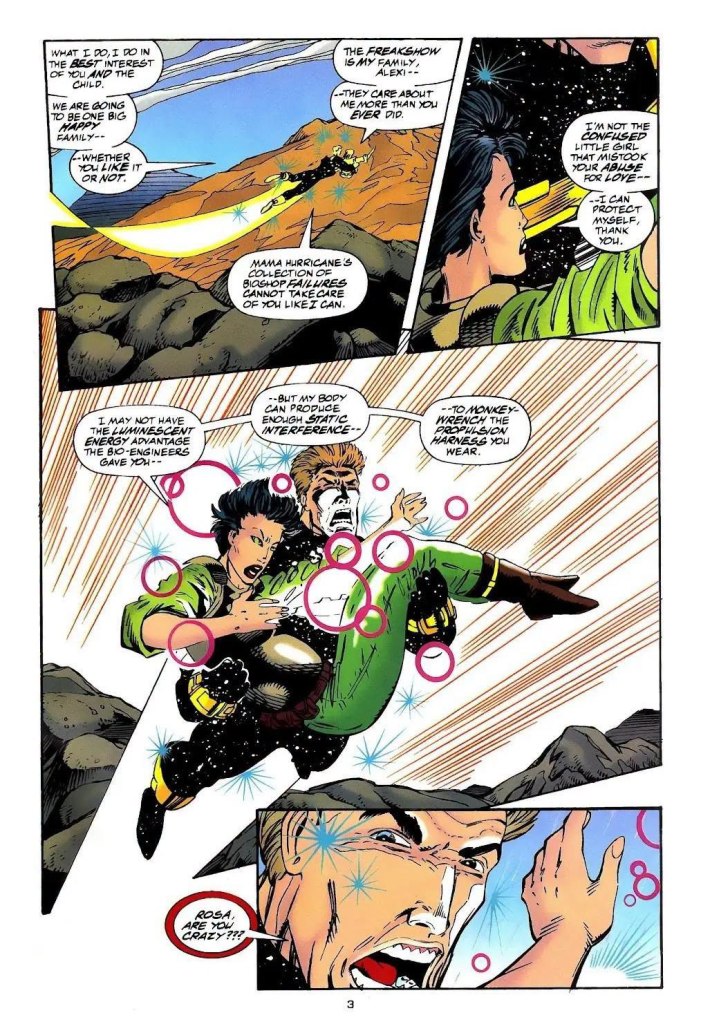
Far away, Rosa tells Alexi/Glitterspike to let go of her even though they are flying high above ground. Glitterspike tells her that he will do the best interest of her and their unborn child to become one big happy family. Rosa rejects him stating that the Freakshow is her family.
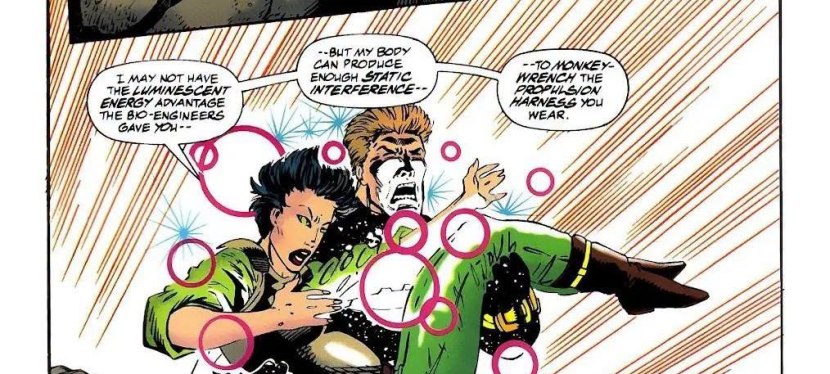
Even with the tremendous risk present, Rosa uses power of producing static interference on them. Soon enough, they start losing altitude…
Quality
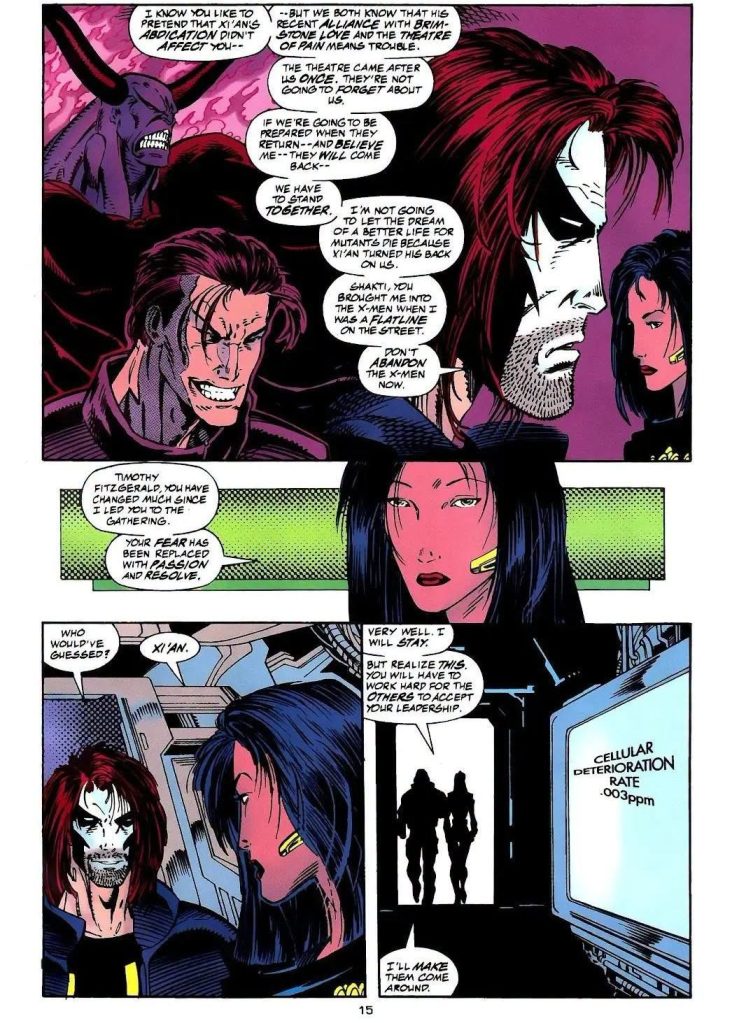
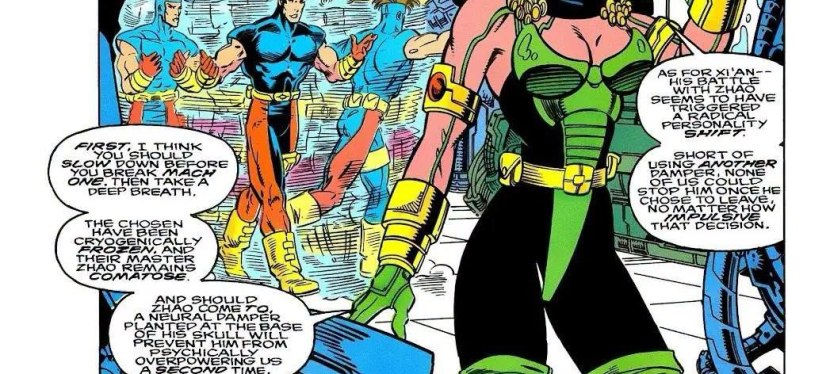
Serious talk between Shakti and a changed Skullfire about the X-Men and the situation they have now that their former leader Xi’an joined a gang of evil.
The story crafted by John Francis Moore here is strongly focused on the Freakshow with emphasis on former X-Men member Metalhead who at this point of the series has gotten very close with the pregnant member Rosa. This comic book marks the first time that Metalhead became a true major player in the series as he gradually adjusts with becoming a new member of the Freakshow.
Unsurprisingly, Rosa became a major player in the story too as she has no choice but to deal with someone from her past who is not just stubborn but also a cybernostra hitman who was genetically bred to process light into energy. Glitterspike went ballistic when Rosa left him some time prior and his obsession with her only grew.
A major part of this story involved the presence of a fabled monster called the Shadow Dancer which has been lurking in the hills of the wasteland and already a lot of people got scared of it. Creatively, this monster serves as the obstacle that Metalhead, Rosa, and the others have to deal with.
What Moore and Ron Lim accomplished in this story is deeply developing the Freakshow, Metalhead and Rosa while expanding the lore of 2099’s American wasteland even further. They also gave readers a quick look at the remaining X-Men team members who are now dealing with the new reality that their former leader turned evil by joining Brimstone Love’s Theater of Pain. In addition, Skullfire – once a weak and unsure new member of the X-Men in the beginning – not only returned to Shakti and the remaining team members, his personality and view of reality have changed which reinvigorated his passion for the team.
Conclusion
Rosa does something very risky as Glitterspike carries her in the air.
X-Men 2099 #15 (1994) was crafted to be compelling with strong focus on Metalhead and the Freakshow. It clearly marked the next phase in the life of Metalhead and it made the Freakshow an even more interesting team within the X-Men 2099 series. The story has lots of strong and intriguing moments, and character development is consistently strong. The tale also has some science fiction inspiration from the 1979 movie Alien mixed in. This is a good read.
Disclaimer: This is my original work with details sourced from reading the comic book and doing personal research. Anyone who wants to use this article, in part or in whole, needs to secure first my permission and agree to cite me as the source and author. Let it be known that any unauthorized use of this article will constrain the author to pursue the remedies under R.A. No. 8293, the Revised Penal Code, and/or all applicable legal actions under the laws of the Philippines.
Welcome back, superhero enthusiasts, 1990s culture enthusiasts, X-Men fans and comic book collectors! Today we revisit the Marvel Comics shared universe to examine one of the many tales of the X-Men 2099 monthly series.
I enjoyed the way John Francis Moore put things into motion in issue #12 and other previous issues of X-Men 2099. During the 3-part storyline at the start of the series, the Synge business empire and its wing of enforcers looked like the definitive force of evil for the mutants led then by Xi’an. As the series progressed, the Theater of Pain (first introduced comprehensively in issue #4) and its leader Brimstone emerged as the new force of evil while the X-Men lost Xi’an and Skullfire became more unhinged and got more involved with Luna (the one who messed with his mind and emotions). Xi’an, who reverted back to his sinister mindset, is obsessed with finding the Driver. It should be noted that these characters are all in the middle of the wasteland in 2099’s America (for 2099 historical reference, click here).
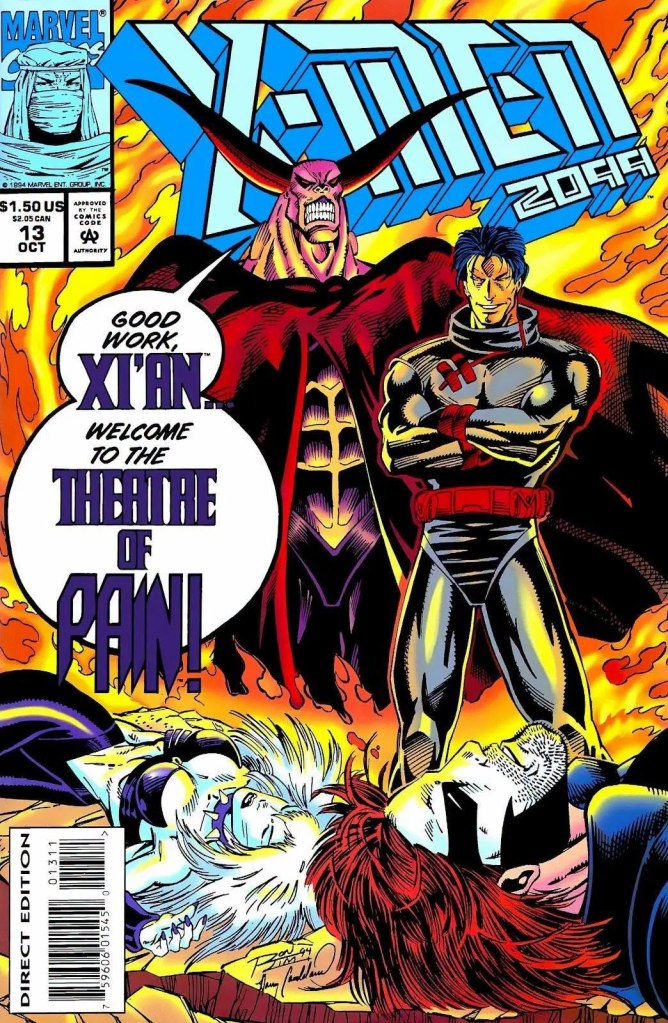
With those details laid down, here is a look back at X-Men 2099 #13, published by Marvel Comics in 1994 with a story written by John Francis Moore and drawn by Ron Lim.
The cover.
Early story
The story begins with Brimstone Love making his way into the Garage, a secret high-tech facility of the Driver. He finds it interesting that his hunt for Luna led him into the strange structure in the desert and he know that she and her companions are inside.
Inside the structure, Junkpile is bound and tortured on a chair with Adamantium restraints holding him. With Junkpile is the Driver watching him while Xi’an, Skullfire and Luna are trapped nearby by a laser grid. Skullfire, who is aware that Xi’an has been pursuing the Driver ever since he learned key details from Hurricane, implied to the former X-Men leader that the Driver is more of a problem and antagonist while Luna added her own comments about their situation. Xi’an tells them they need to determine the severity of their situation.
Xi’an tells the Driver that Hurricane described him as a part of the mutant underground during the Purge. It turns out, the Driver has not heard about Hurricane for a long time and insisted to Xi’an that he mistook his actions as hostile.
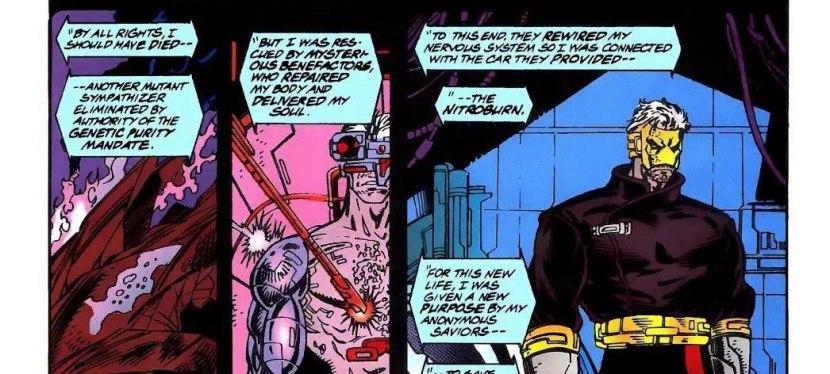
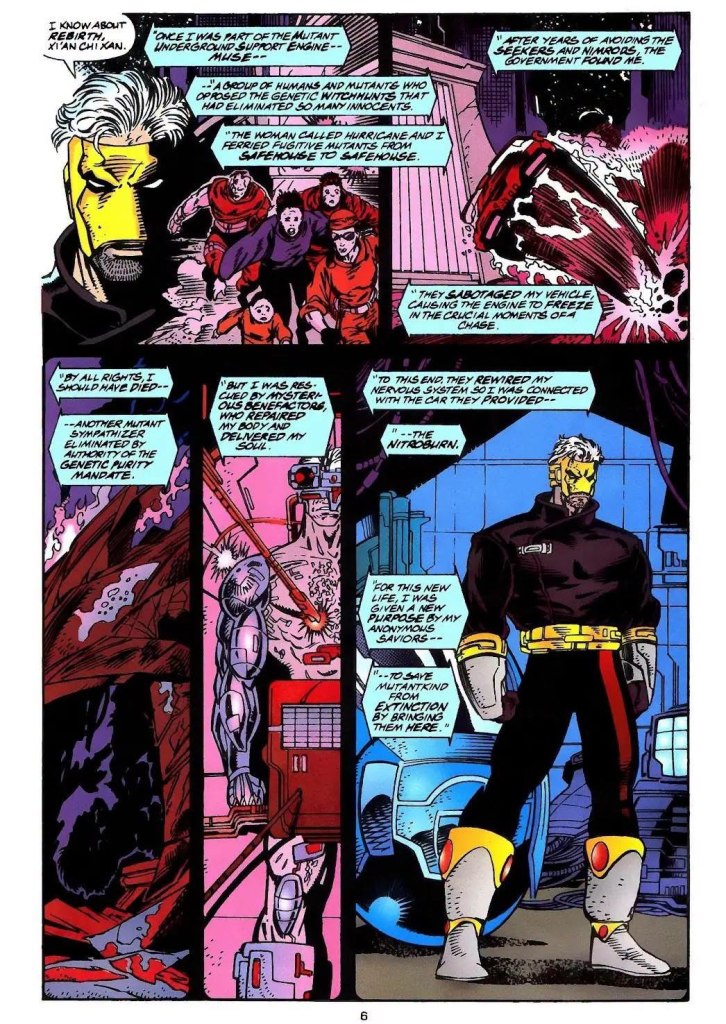
The Driver begins to explain what he has been doing, why he continues to fight and protect the sacred mutant tribe and why he sought out hundreds of mutants to give them sanctuary…
Quality
A lot of intriguing developments happened here and it concludes Xi’an’s pursuit of the Driver.
With regards to storytelling and revelations, I can say that the intensity from the previous continued smoothly in this comic book. While the Theater of Pain was first revealed in issue #4, it was in the previous issue and in this particular story that its actual scope was made clear, and the presence of Brimstone Love – obviously 2099’s walking symbol of Satan – added great tension and a new evil presence for the X-Men to deal with.
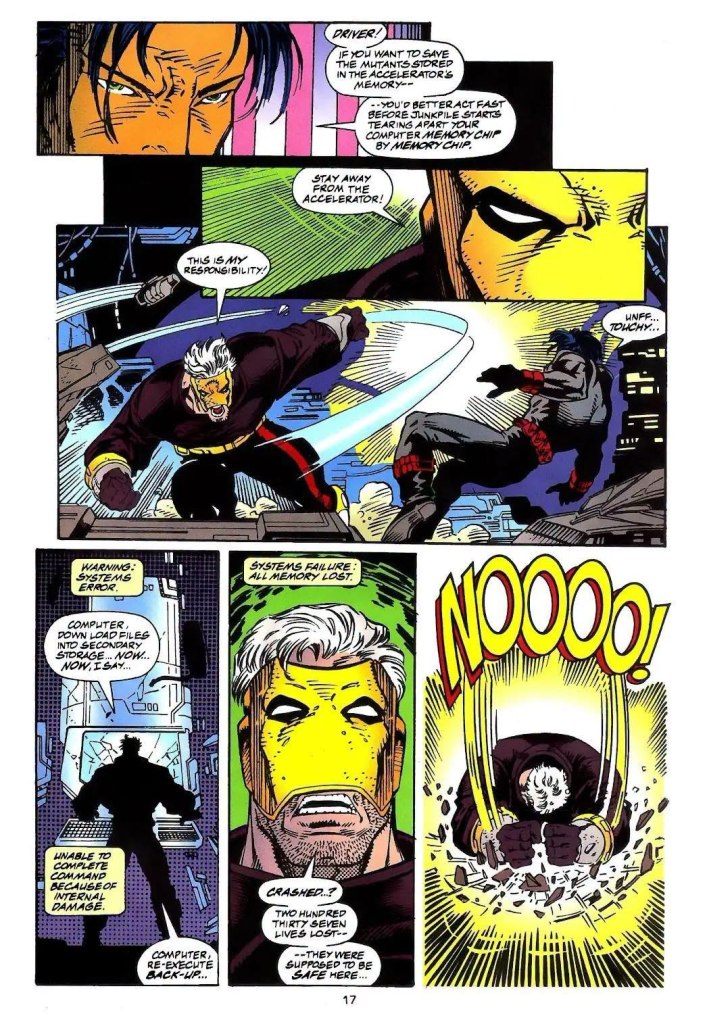
What I enjoyed most in the story crafted by John Francis Moore are the revelations. The Driver, who came close to death and witnessed the plight of mutants, has a personal mission of providing sanctuary to mutants who are still living in danger in 2099’s America which has been dominated by mega corporations (MegaCorps). Still, his specific methods of achieving his goals for mutantkind are intriguingly questionable and in someways they made him looked even sinister. That said, Xi’an’s pursuit of him (which started a few issues prior) really resulted in some shock value that has to be seen page by page.
Very notably, Moore made the script even more dramatic which is clearly reflected in the dialogue of the characters and the art done by Ron Lim. I should also state that flashbacks of the mutants struggle for survival under the Driver and Hurricane are included and they are worth seeing.
Considering what this comic book has, it will make readers think deeply about the essence of X-Men 2099 as a team and the comic book series itself. At the same time, new mysteries about the direction of the series will be realized in ways that readers don’t expect.
Conclusion
The Driver himself was part of the effort that saved desperate mutants decades prior and he came close to dying. This comic book heavily defines his existence and his mission on providing sanctuary to any mutants he finds.
If there is anything significant about X-Men 2099 #13 (1994), it is the fact that it changed the trajectory of the series and reshaped the concept of X-Men 2099 as a whole in dramatic fashion. The build-ups, the pay-offs and revelations in this comic book are powerful. Along the way, this will make you question even further the intentions of Xi’an (former X-Men leader) and Skullfire (the unhinged X-Men member who used to be so weak and unsure of himself). As for the Driver, he is very well defined by the Moore-Lim duo in this comic book and he has gotten even more significant by the end. If there is anything severely lacking here, it is the spotlight on the surviving X-Men team members (with Shakti as their new leader).
Disclaimer: This is my original work with details sourced from reading the comic book and doing personal research. Anyone who wants to use this article, in part or in whole, needs to secure first my permission and agree to cite me as the source and author. Let it be known that any unauthorized use of this article will constrain the author to pursue the remedies under R.A. No. 8293, the Revised Penal Code, and/or all applicable legal actions under the laws of the Philippines.
Welcome back, superhero enthusiasts, 1990s culture enthusiasts, X-Men fans and comic book collectors! Today we revisit the Marvel Comics shared universe to examine one of the many tales of the X-Men 2099 monthly series.
Looking back at the X-Men 2099 series of the 1990s, so much has developed during the first eleven issues released from 1993 to 1994. When I first read issue #1 in 1993, I found the futuristic X-Men really intriguing to follow and there was the expectation that the team led by Xi’an would somehow grow and make breakthroughs happen in 2099’s America. Surprisingly, members of the team got separated from each other – such as losing Metalhead to the Freakshow – and Xi’an himself changed for the worse and eventually left the team. Tim Fitzgerald/Skullfire (the weak and unsure newcomer who joined the futuristic X-Men) himself changed radically becoming unhinged and he has gotten really close with Luna (the one who messed with his mind and triggered his emotions).
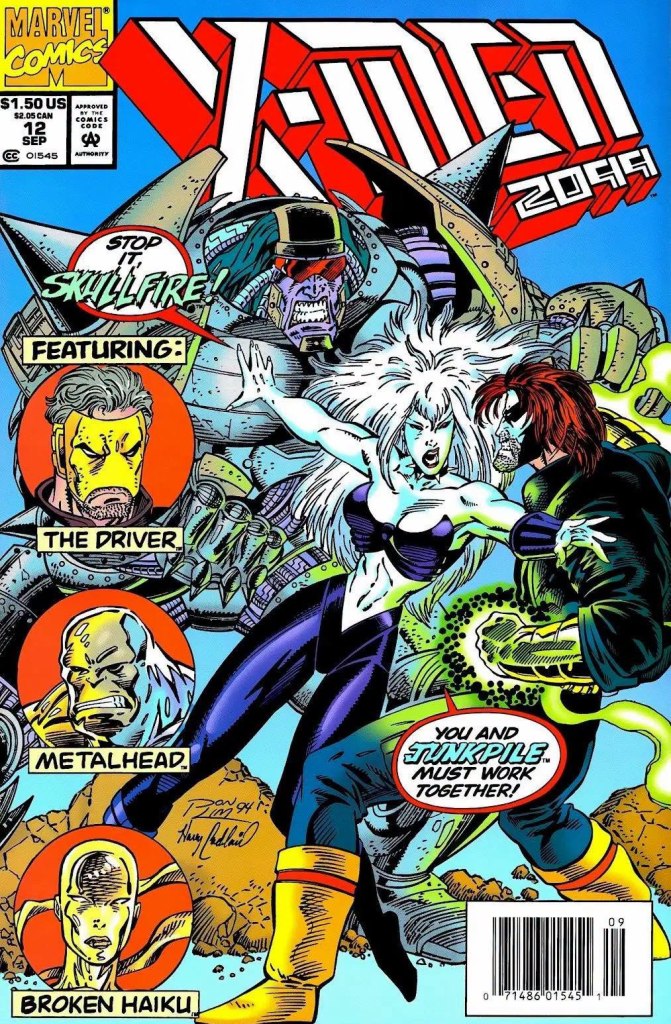
With those details laid down, here is a look back at X-Men 2099 #12, published by Marvel Comics in 1994 with a story written by John Francis Moore and drawn by Ron Lim.
The cover.
Early story
The story begins in the black market mall with Luna struggling to separate Skullfire and Junkpile from each other. Skullfire hates Junkpile whom he holds responsible for killing his friend Serpentina (the one X-Men member who welcomed him at their sanctuary). Junkpile blames Skullfire and his teammates for causing him some serious grief in Las Vegas. Luna tells them both to shut up or she would do something on both of them.
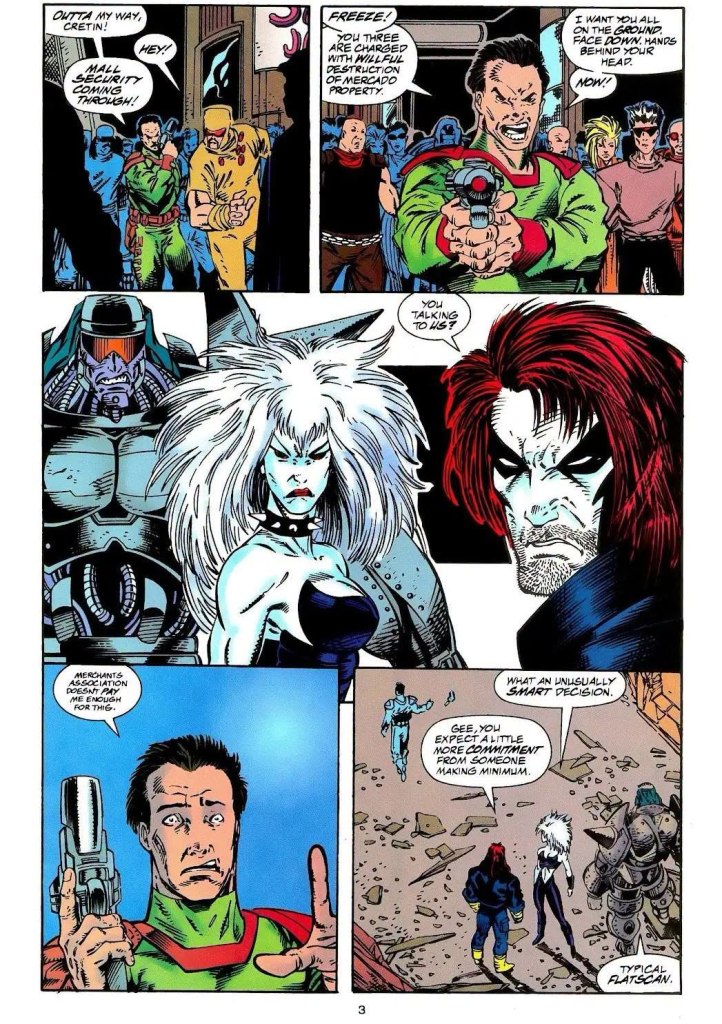
Moments later, the three of them are accused by the mall security for violating the market regulations. An armed mall security officer points his weapon at them accusing them of willful destruction of market property. The looks of Junkpile, Luna and Skullfire, however, scared him and convinced him to move away. Luna then reveals to Skullfire that she encountered Junkpile outside of Las Vegas shortly after the violent encounter with the X-Men. The three of them proceeded to a café to have a civil talk. Skullfire asks Luna about the Theater of Pain…
Quality
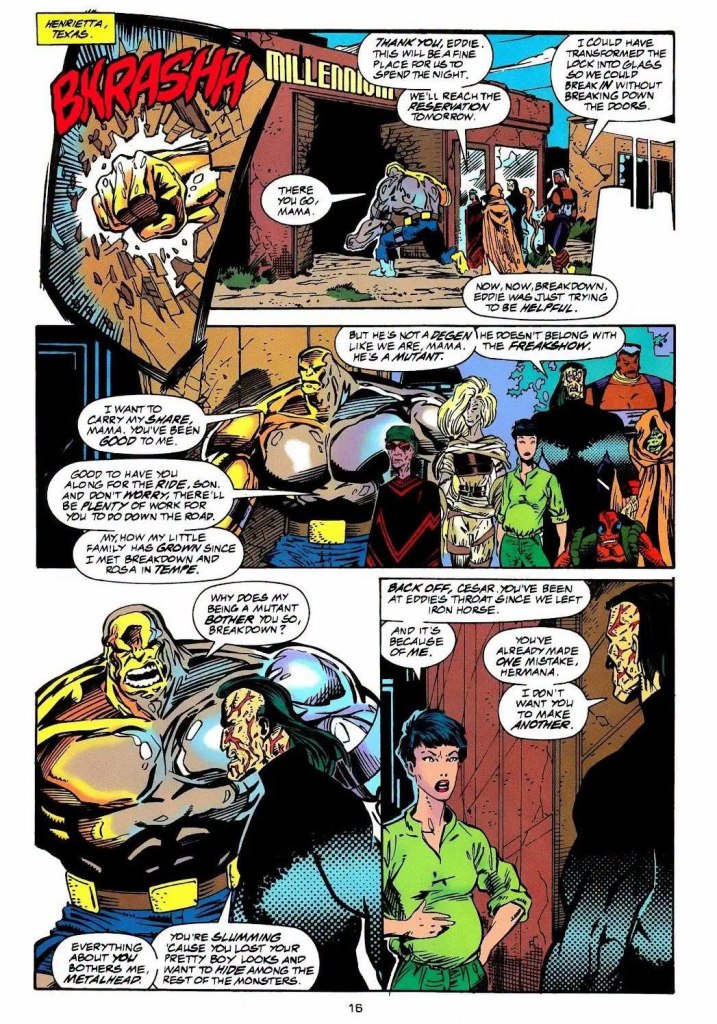
Former X-Men member Metalhead with the group of degenerates called the Freakshow. One of their members clearly rejects him given his status as a mutant.
Wow! The Moore-Lim team loaded this comic book with immense details that established the true force of opposition that awaits the X-Men. The story reveals to readers the Theater of Pain, its demonic leader Brimstone Love and what the theater’s purpose truly is. Brimstone Love and the theater were first revealed at the very end of issue #3 and this comic book offers readers a close look at them complete with very intriguing details that turned out to be worth discovering. That said, it was clear that John Francis Moore designed the Theater of Pain to be not just a planned force of evil the X-Men must face but also an actual threat to many living in 2099’s America. The Theater of Pain has a very sinister agenda and its operations involves the accumulating human misery which is a frightening concept on its own.
While Luna’s history and connection with the Theater of Pain is emphasized, Xi’an’s search for the Driver makes a lot more sense here as the former X-Men leader (now sinister and spiritually lost) communicates again with someone from his past. That said, the plot really thickened a lot in this comic book and that alone makes it engaging to follow.
As this issue follows Skullfire, Luna, Junkpile and Xi’an – plus a quick look at former X-Men member Metalhead now spending time with the Freakshow – the tone of the tale turned dark and gritty which I think was intentionally done by the creators as the Theater of Pain was strongly emphasized. That said, this is indeed inspired work.
Conclusion
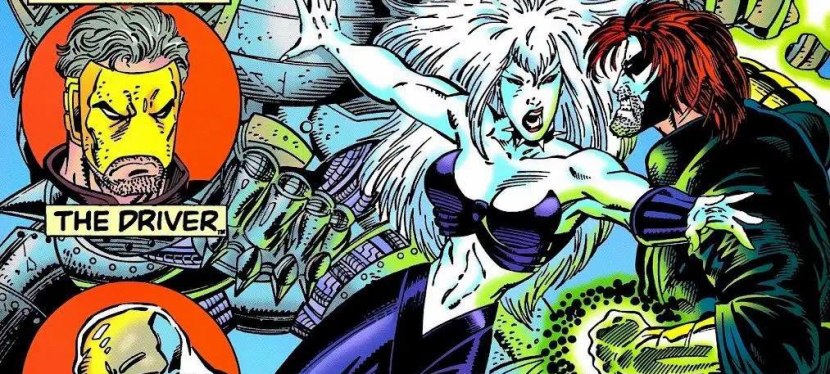
Skullfire, Junkpile and Luna look so intimidating and creepy, the mall security guy got scared and abandoned his duty.
With a dark tale and an established force of evil rising in the horizon, X-Men 2099 #12 (1994) can be described as an inspired turn of events for the monthly series as a whole. At this stage, the direction of the series really started to take shape. It is also a lively reminder that the mutants struggling in 2099 have the wilderness and its violent elements as the least of their worries. The Theater of Pain itself is a reminder about sinister yet unseen forces that are operating while lots of people remain unaware of them (note: think about the World Economic Forum and what its core organization really do behind closed doors as time passes). Lastly, the twisted developments of Skullfire and Xi’an’s respective personalities will keep you in suspense as to how the futuristic X-Men can survive without them.
Disclaimer: This is my original work with details sourced from reading the comic book and doing personal research. Anyone who wants to use this article, in part or in whole, needs to secure first my permission and agree to cite me as the source and author. Let it be known that any unauthorized use of this article will constrain the author to pursue the remedies under R.A. No. 8293, the Revised Penal Code, and/or all applicable legal actions under the laws of the Philippines.
Welcome back, superhero enthusiasts, 1990s culture enthusiasts, X-Men fans and comic book collectors! Today we revisit the Marvel Comics shared universe to examine one of the many tales of the X-Men 2099 monthly series.
After the first seven issues of the series, it is clear that the futuristic mutants under Xi’an have tough challenges to not only survive in the dangerous and unpredictable wasteland of 2099’s America but also help their leader fulfill the ultimate goal of protecting mutants from the evil corporations in accordance to the dream of Professor X (Charles Xavier). Unlike the X-Men of the 20th century, the team of 2099 does not have vast resources nor do they have a permanent place for living and development. Xi’an himself is still struggling with the elements from his past as a violent criminal.
With those details laid down, here is a look back at X-Men 2099 #8, published by Marvel Comics in 1994 with a story written by John Francis Moore and drawn by Ron Lim.
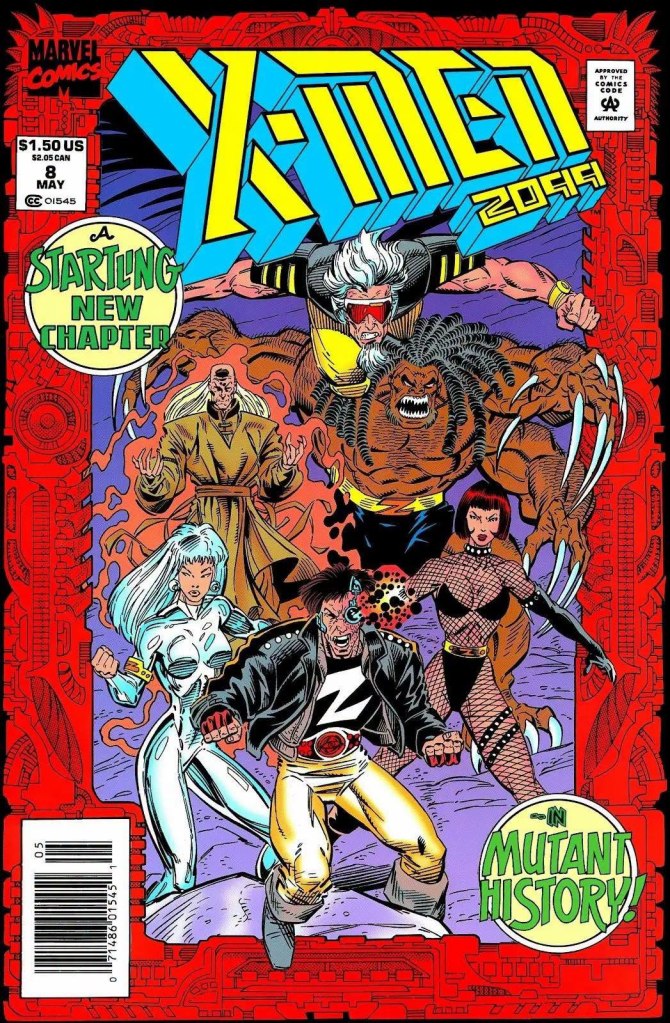
The cover.
Early story
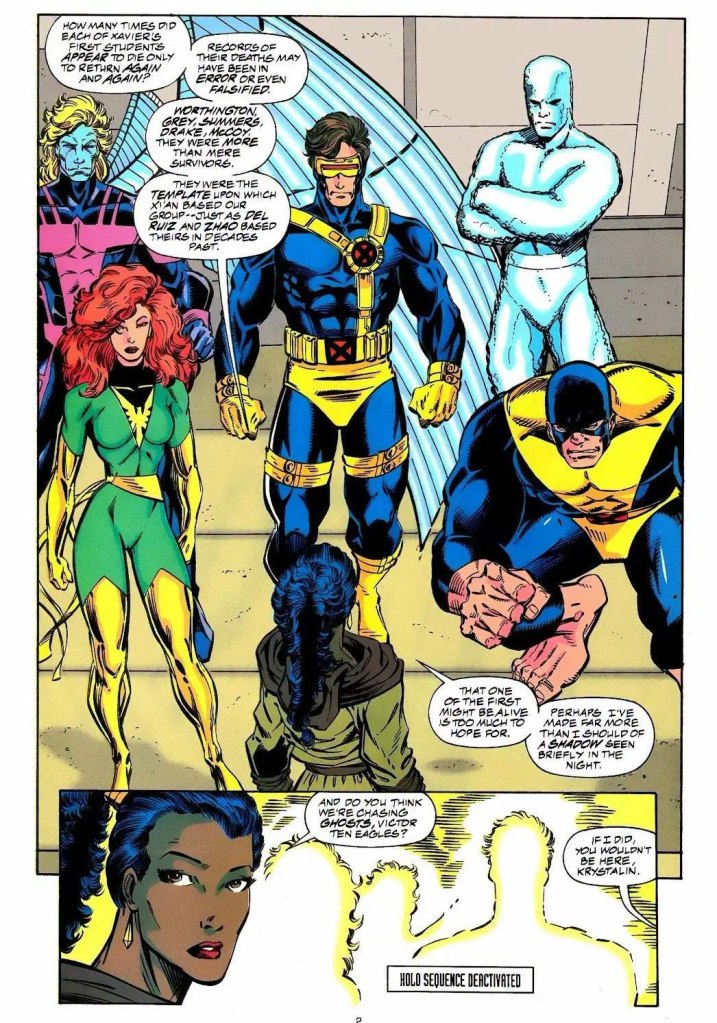
The story begins with Krystalin examining Archangel with amazement. Moments later, she sees Cyclops, Iceman, Beast and Jean Grey (in her Phoenix form). She wondered how many times did each of Professor X’s first students appear to die only to return again and again. She recalls that the records of their deaths may have been in error or even falsified. She also remembers the succeeding X-Men teams of Del Ruiz and Zhao.
It turns out the original X-Men members she saw were holograms as Victor Ten Eagles (who was a fellow outlaw with Xi’an in the old days) reveals that he opened his studio to few people and never to strangers. He allowed Krystalin in because he owes Xi’an a blood debt from their time together with the Lawless. As they talk, he explains to her his personal interest in the X-Men and the legacy.
Over at Iron Horse in Arizona, Hurricane talks with two trackers who were tied up. Meanstreak uses his super speed to dismantle the trackers’ suits of armor and examine the technologies within. He finds one Tetsuo Mark 6 signal beacon that was used to monitor armor in the field. He tells Hurricane she can use it as an advance warning the next time trackers are sent after her.
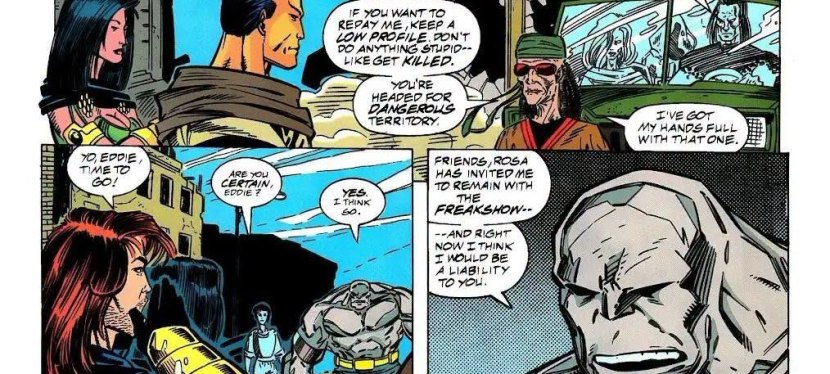
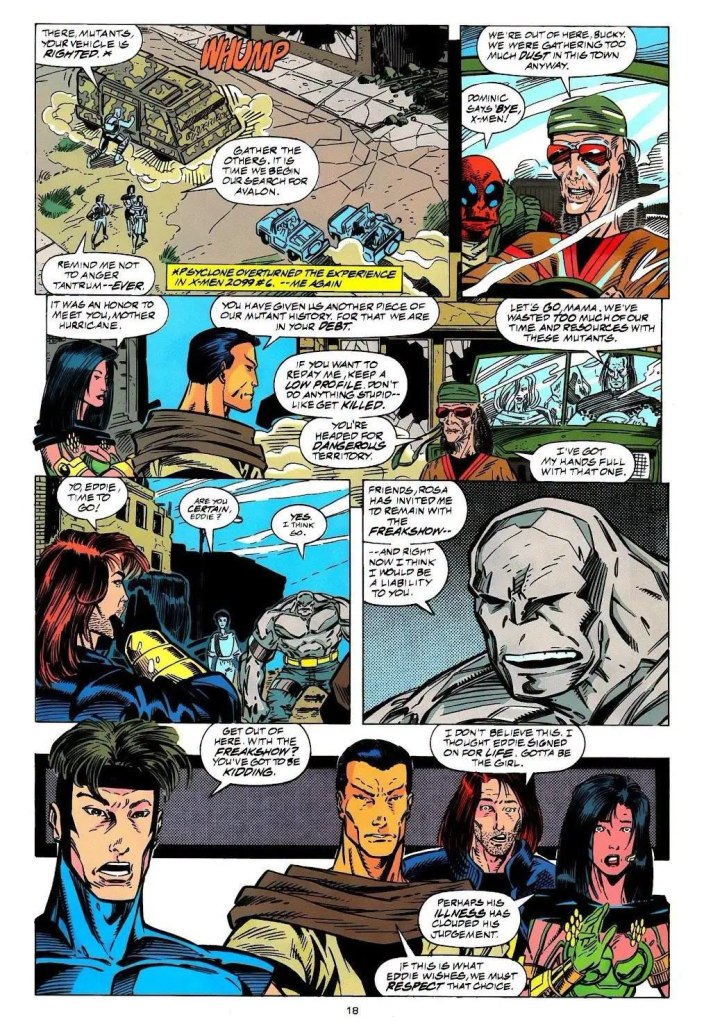
Hurricane tells the X-Men that she and the Freakshow never stay too long in one place. Moments later, the infected Metalhead tells Skullfire that he is trapped in his current metal form and could not change back…
Quality
As the Freakshow is about to leave, Metalhead surprises his fellow X-Men.
To make things clear, this X-Men 2099 comic book is very engaging to read as it is filled with a lot of details that further expanded the lore of the 2099 universe concerning mutants and legacy of the X-Men in the 21st century. As such, I really enjoyed learning about the “future history” of the X-Men, how mutants struggled to survive in a corporation-controlled America, and why the wasteland became the 21st century’s very own Old West where danger and uncertainty are constant.
If have an obsession about the 2099 universe, there is a lot to discover and enjoy here. Xi’an’s pursuit for knowledge about the mutant underground and Hurricane’s involvement is compelling to read and what was revealed is worth discovering. Meanwhile, Krystalin and Ten Eagles’ exploration of facilities as they search for answers reminds me a lot about a notable part of the story in Beneath the Planet of the Apes.
Conclusion
The closest thing to a crossover with the original X-Men.
X-Men 2099 #8 (1994) is a compelling read and it is one of the stronger references about the 2099 universe and the legacy of the X-Men from the time of Xavier to that of Zhao. The details revealed here are fine pay-offs to what was built up in the previous issues, and they connect well with the existence of Xi’an’s X-Men. This comic book will really help you understand the place of mutants in the 21st century and in my experience, the learning is enjoyable.
Overall, X-Men 2099 #8 (1994) is highly recommended.
Disclaimer: This is my original work with details sourced from reading the comic book and doing personal research. Anyone who wants to use this article, in part or in whole, needs to secure first my permission and agree to cite me as the source and author. Let it be known that any unauthorized use of this article will constrain the author to pursue the remedies under R.A. No. 8293, the Revised Penal Code, and/or all applicable legal actions under the laws of the Philippines.
Welcome back, superhero enthusiasts, 1990s culture enthusiasts, X-Men fans and comic book collectors! Today we revisit the Marvel Comics shared universe to examine one of the many tales of the X-Men 2099 monthly series.
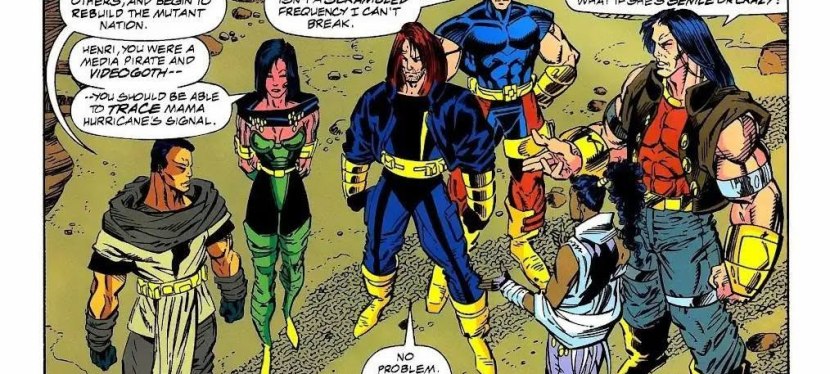
In late-1993, Marvel Comics published the Fall of the Hammer crossover storyline highlighting the major figures of Marvel 2099 and the X-Men members involved were only Skullfire, Krystalin, Bloodhawk and Meanstreak. As told in Ravage 2099 #15, the said X-Men members made it to Valhalla with Ravage. After the events of Fall of the Hammer, the four X-Men members survived and eventually started traveling all the way back West in America to rejoin the rest of the team.
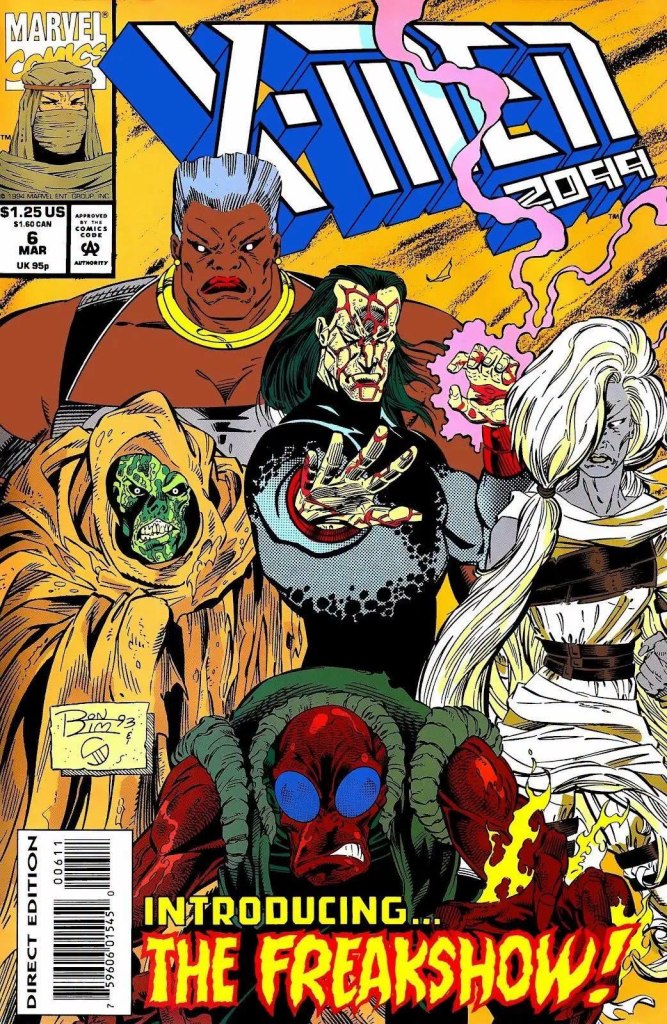
With those details laid down, here is a look back at X-Men 2099 #6, published by Marvel Comics in 1994 with a story written by John Francis Moore and drawn by Ron Lim.
The cover.
Early story
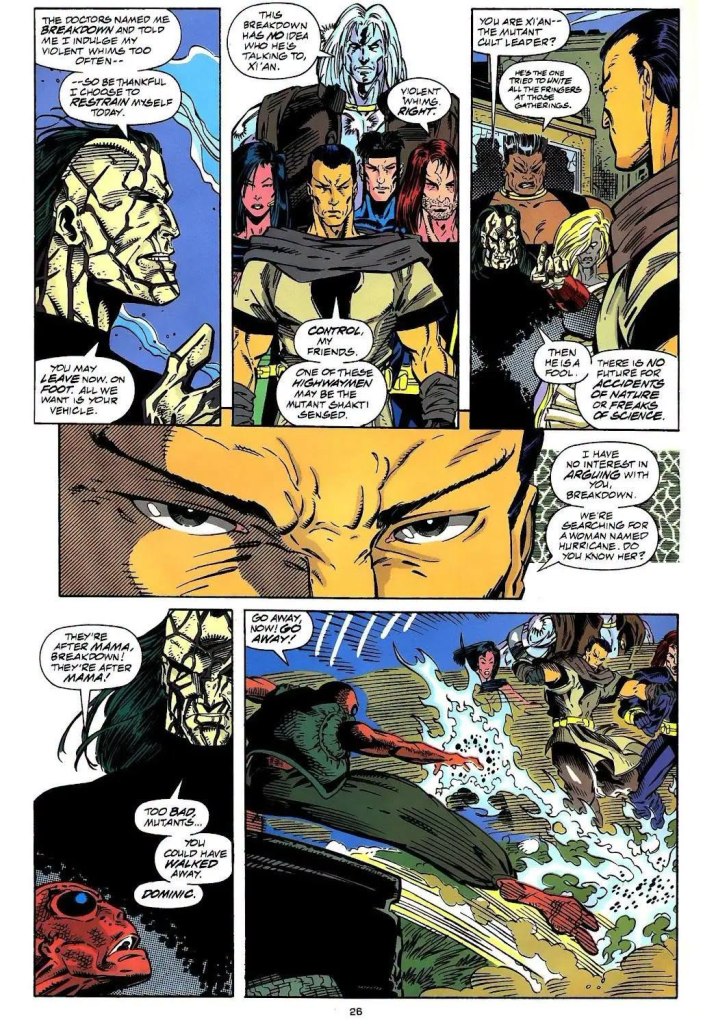
The story begins in Arizona when two fully armed personnel wearing suits of armor search for a monster-like mutant who tries to hide. The mutant is named Dominic and he eventually got corned by the two armored figures. As he is about to get shot, one of the armored guys got pushed by force somehow. The next moment, a gang of mutants called the Freakshow appears.
In the southern part of Nevada, Skullfire, Bloodhawk, Krystalin and Meanstreak travel in an aircraft going back to Xi’an and the rest of their teammates. As Bloodhawk jumps of after saying goodbye, Skullfire jumps off as well in a suicidal manner. He eventually grabs Bloodhawk by the ankle. Back at the aircraft, Krystalin and Meanstreak shared their respective observations about Skullfire’s sudden change of personality since the psychic vampire Luna messed with him…
Quality
As the X-Men search for Hurricane, the Freakshow stands in their way.
The script of this comic book was finely crafted by John Francis Moore and it is amazing how efficient he got the X-Men team back (after Skullfire, Krystalin, Meanstreak returned) on track while ensuring a good amount of depth as reflected in the dynamics between the team members as the story went on. The storytelling felt natural and really believable.
Along the way, this comic book shed light on team leader Xi’an and the threads of the past that came back to haunt to him. This instantly added a new layer of development on Xi’an which established an element of uncertainty on the future of the X-Men under him (and his personal struggles). That said, Xi’an does not have the rock-solid stability of Professor X (Charles Xavier) which will remind readers how different the X-Men of 2099 are from the classic X-Men.
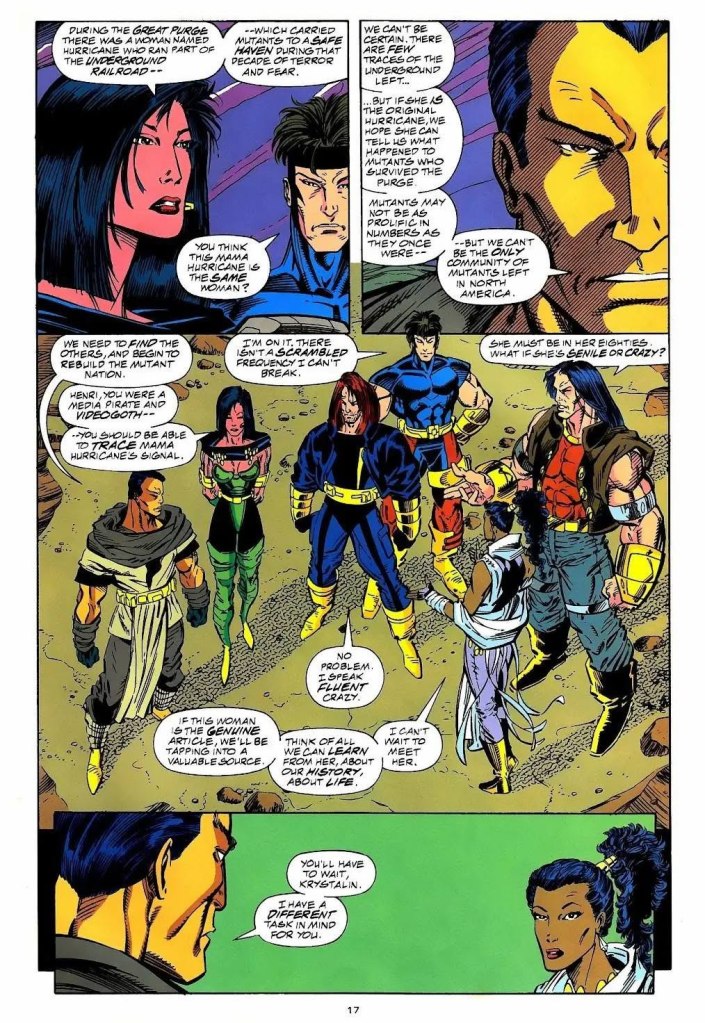
The X-Men are on the search for a mutant called Hurricane who has been active on resisting the corporations’ control on the nation and has long emphasized liberty and self-control on personal living. Historically, Hurricane led a part of the Underground Railroad which carried mutants to safe haven during a time of terror and fear. That said, X-Men’s search has a heavy purpose and the challenges they faced here is gripping and intriguing to follow. I should also state that Ron Lim’s delivery of dynamic action is really good to look at.
Conclusion
I really enjoyed the dynamics of the interactions between the members of the X-Men in this comic book. There is richness in John Francis Moore’s script here.
X-Men 2099 #6 (1994) is both a solid follow-up to the events of the Fall of the Hammer storyline and also a fine portrayal of how the team works under Xi’an’s leadership. More notably, it pushed the narrative of the series forward and gave us readers an in-depth exploration of the isolated places of America’s southwestern region in 2099 which is a sharp contrast to that era’s New York City dominated by Alchemax. More notably, this comic book implemented renewed focus on the state of mutants who have been living in fear, danger and uncertainty in America of 2099 which connects directly with the purpose of the X-Men as a team.
Disclaimer: This is my original work with details sourced from reading the comic book and doing personal research. Anyone who wants to use this article, in part or in whole, needs to secure first my permission and agree to cite me as the source and author. Let it be known that any unauthorized use of this article will constrain the author to pursue the remedies under R.A. No. 8293, the Revised Penal Code, and/or all applicable legal actions under the laws of the Philippines.
Welcome back, superhero enthusiasts, 1990s culture enthusiasts, X-Men fans and comic book collectors! Today we revisit the Marvel Comics shared universe to examine one of the many tales of the X-Men 2099 monthly series.
If there is anything notable about the futuristic X-Men, it is the separation of the team members that started really early in the monthly series. Meanstreak left the team to pursue something personal. A few members of the team – including Meanstreak – got involved in the Fall of the Hammer crossover storyline (click here, here and here), Metalhead got infected and decides to leave the team to stay with another group, and their leader Xi’an lost his way.
With those details laid down, here is a look back at X-Men 2099 #11, published by Marvel Comics in 1994 with a story written by John Francis Moore and drawn by Ron Lim.
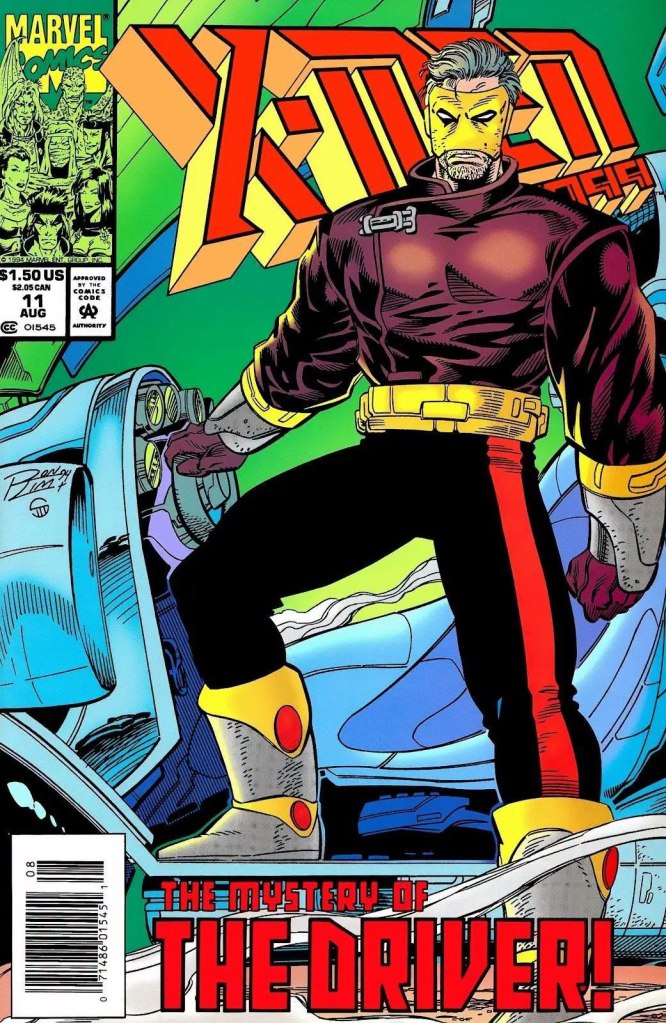
The cover.
Early story
The story begins with Tim Fitzgerald/Skullfire and Luna enjoying their time together outdoors. Tim, whose personality has changed into becoming radical and wild, tells her that he has not forgotten the anguish she put him in through the darkroom which made him relive the death of his beloved Reiko from some time ago.
As the tension between Tim and Luna intensifies, Xi’an tells him that they have to go to El Paso in Texas. It was Luna’s first time to meet Xi’an. The former leader of the X-Men states that they are closing in on the Driver…
Quality
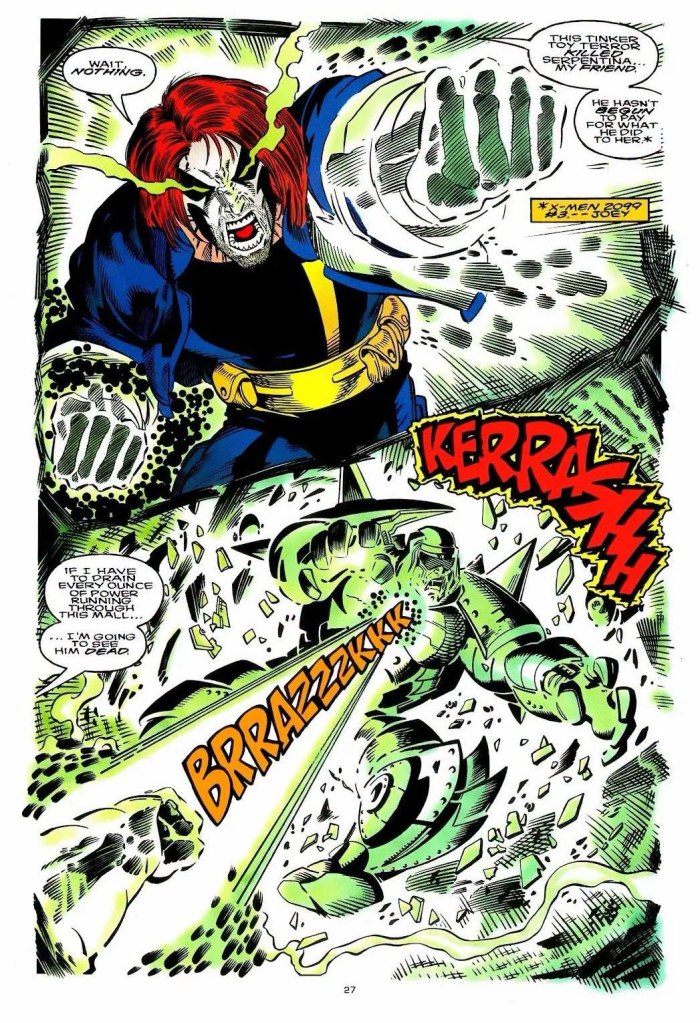
Skullfire blasts Junkpile, the one responsible for the death of Sepertina (see X-Men 2099 #3).
Given the way the members of the X-Men got separated, the Moore-Lim duo succeeded in telling an intriguing story without even having a clear enemy for them to encounter. This is a tale about a drastically changed Xi’an (now arrogant and with an agenda of his own) develops into someone becoming more undesirable and dangerous with the passage of time. Similarly, Tim here is turning more unhinged and dangerous as he gradually turns into Skullfire (personally and visually) and Luna here is ironically the one keeping him stable.
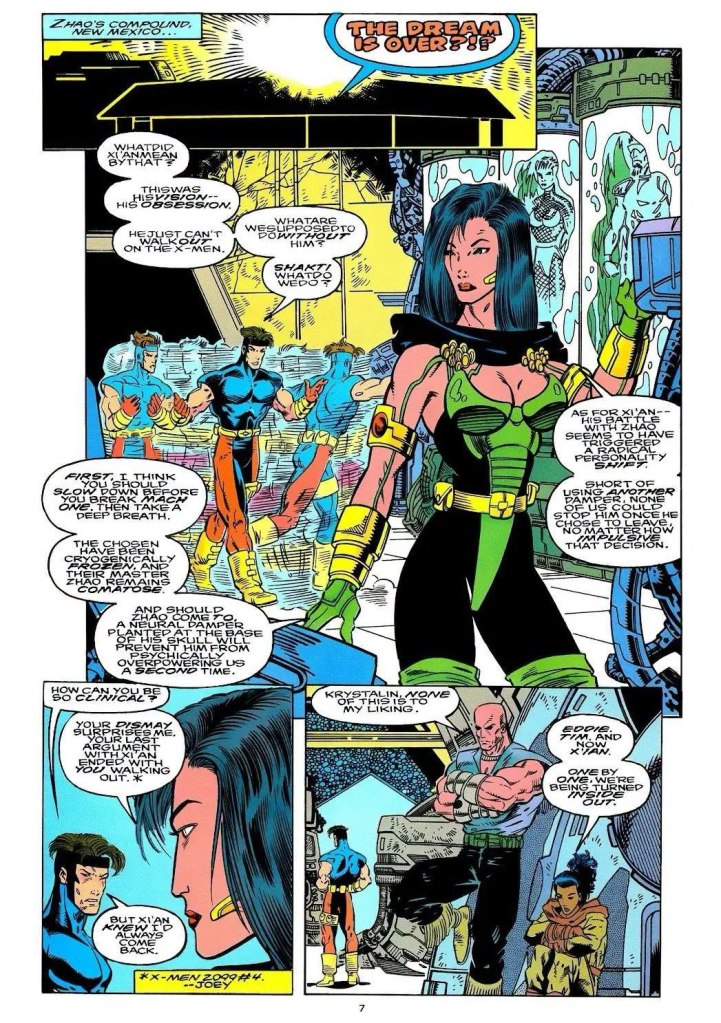
On the other side, the remaining X-Men are still together but with a huge cloud of doubt over them. At this stage, Shakti/Cerebra – who was the faithful second-in-command when Xi’an still led the team – is taking more responsibilities as she gradually becomes the team leader. The writing done by John Francis Moore is rich when Shakti sticks strongly to principles during her interaction with Meanstreak who himself has turned uncertain about their status as a team. That said, there are certain traits of Xi’an visible in Shakti. Along the way, a few friends of the X-Men went away which added to the uncertainty that hounded them.
With regards to the reveal of the Driver on the cover of this comic book, the tale indeed reveals him and a new story thread about him was gradually built up. The Driver is Xi’an’s target and his act of helping one of the X-Men’s friends added to the suspense over what could happen next.
Conclusion
As the new leader of the X-Men, Shakti remains very principled. Her talk with Meanstreak in this scene is meaningful.
X-Men 2099 #11 (1994) is a very character-driven story from start to finish and the good news is that it is engaging and entertaining to read. The lack of a good-versus-evil conflict never hurt the story at all as Moore and Lim went deep to develop Tim, Xi’an and others while building up the pending encounter with the Driver. Not only that, having Tim and Xi’an more radicalized reflect the atmosphere of uncertainty and danger in the region (with lots of wilderness throughout and far away from the metropolis dominated by Alchemax) within America of 2099. It is a good read and I enjoyed the character development done by the creative duo.
In what is perceived to be a move to enhance the Philippines’ military modernization program and improve its pilot training capability, the United States approved the $150 million sale of Bell 505 Jet Rangers X helicopters to the nation, according to a Manila Bulletin news report.
To put things in perspective, posted below is the news report of the Manila Bulletin. Some parts in boldface…
The United States approved a possible $150 million sale of Bell 505 Jet Ranger X helicopters to the Philippines, a move seen to strengthen Manila’s pilot training capability and support its military modernization program.
In a statement Tuesday, May 5, the US Department of State said it had “made a determination approving a possible Foreign Military Sale to the Government of the Philippines of Bell 505 Jet Ranger X Helicopters and related equipment” with an estimated total cost of $150 million.
The package included aircraft, spare parts, and training support, and it covered main and tail rotor blades, full-length trainer shoes, and pilot training for 22 personnel. The training would include ground and flight instruction, left seat orientation, and Instrument Meteorological Conditions and Helicopter Upset Recovery.
The deal also involved maintenance training for six students and specialized courses covering the Bell 505 Maintenance Officer Course, field maintenance, integrated avionics, component maintenance, and Safran engine training for 22 trainees.
The proposed acquisition also included Bell 505 Veris flight simulators, a five-year Integrated Logistics Support package, and one year of on-site field and logistics support representatives.
The US said the sale would “support the foreign policy and national security of the United States by helping to improve the security of a treaty Ally that continues to be an important partner for political stability, peace, and economic progress in the Southeast Asia.”
It added that the helicopters would address gaps in rotary-wing training.
“The proposed sale will improve the Philippines’ capability to meet current and future threats by addressing aircraft competency gaps in operating rotary wing aircraft,” the statement said.
The US also noted the aircraft would help prepare pilots for more advanced platforms.
“This enhanced capability will facilitate the smooth transition for pilots to more complex rotary aircraft within the Armed Forces Philippines, and it is a cost-effective solution for developing rotary wing pilots,” it stressed.
The principal contractor for the deal would be Bell Textron Inc. based in Fort Worth, Texas.
The approval came as defense ties between Manila and Washington continued to deepen. Forces from the two nations are training in Manila until May 8 under the auspices of the Exercise Balikatan, featuring top-level military equipment.
It also followed an earlier US approval of a $5.58 billion sale of 20 F-16 fighter jets to the Philippines. The proposal, cleared in 2025, covered F-16C/D Block 70/72 aircraft along with weapons and support systems.
The Department of National Defense (DND) and Armed Forces of the Philippines (AFP) had acknowledged the offer but did not immediately proceed with the purchase due to budget constraints.
DND Secretary Gilberto Teodoro Jr. said the country needed full funding to acquire a “minimum impact” fleet of multi-role fighter (MRF) jets under the Armed Forces modernization program, warning against partial purchases that could weaken capability and drive up costs.
He said the DND planned to acquire at least 40 jets for the Philippine Air Force but stressed that even this number remained limited compared with other countries, citing Ukraine’s planned 150 jets, Canada’s 200, and Thailand’s 50.
Teodoro warned that without sufficient congressional funding, the long-delayed multi-role fighter project could stall. He added that staggered buying would make prices “triple” over time.
For insight about the Bell 505 Jet Ranger X helicopter, watch the video below.
Let me end this piece by asking you readers: What is your reaction to this development? Do you think this latest move will enhance the Philippines’ capability to defend itself while also modernizing its military? What do you think America will come up next when it comes to selling military hardware to the Philippines?
In a new move against worldly evil and Islamic terrorism, United States President Donald Trump revealed his intention to officially declare the Muslim Brotherhood a terrorist organization and already the final documents are being prepared behind the scenes, according to a news report by Newsmax.
For starters, watch below the related news video from Sky News Australia.
To put things in perspective, posted below is an excerpt from the report Newsmax. Some parts in boldface…
President Donald Trump told Just The News on Sunday that he will designate the Muslim Brotherhood as a foreign terrorist organization.
Trump said “final documents are being drawn” and that “it will be done in the strongest and most powerful terms.“
Trump has weighed such a move since his first administration. The Muslim Brotherhood — an Islamist movement founded in Egypt almost a century ago with chapters, political parties, and affiliated groups around the world — has long been accused by critics of fueling extremism and destabilizing the Middle East.
Israeli Prime Minister Benjamin Netanyahu thanked Trump for his plans to designate the Muslim Brotherhood as a terror group, The Jerusalem Post reported.
“I commend President Trump for outlawing the Muslim Brotherhood,” he said. “This is an organization that endangers stability in the Middle East and beyond. That is why the State of Israel has outlawed parts of the organization and will continue to do so.“
Last week, Texas Gov. Greg Abbott designated both the Muslim Brotherhood and the Council on American-Islamic Relations (CAIR) as “foreign terrorist organizations and transnational criminal organizations,” according to Just The News.
Republicans in the House and the Senate, as well as some Democrats, have urged the State Department to designate the Muslim Brotherhood as a foreign terrorist organization.
Let me end this piece by asking you readers: What is your reaction to this development? Do you support Trump’s move to officially declare the Muslim Brotherhood a terrorist organization? Are you aware of the Muslim-majority nations that officially opposed the Muslim Brotherhood? Were there Islamists who intimidated you or invaded your local community over the past six months?
Welcome back readers, fellow geeks and electronic gaming fans!
In this edition of the Retro Gaming Ads Blast (RGAB) series, we will take a look at another batch of retro gaming print ads – including arcade flyers – from the 1980s and 1990s.
For the newcomers reading this, Retro Gaming Ads Blast (RGAB) looks back at the many print ads of games (console, arcade, computer and handheld) that were published in comic books, magazines, flyers, posters and newspapers long before smartphones, social media, the worldwide web and streaming became popular. To put things in perspective, people back in the 1980s and 1990s were more trusting of print media for information and images about electronic games and related products.
With those details laid down, here is the newest batch of retro gaming print ads for you to see and enjoy…
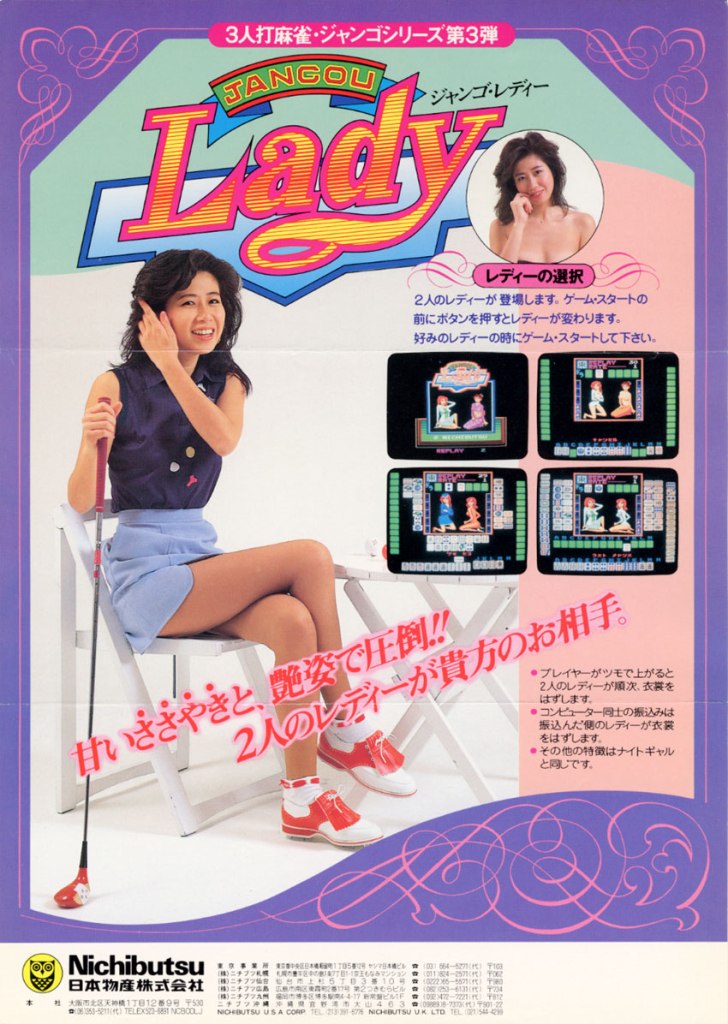
1. Jangou Lady arcade flyer
If you were to play Mahjong digitally, does sex appeal motivate you to do so?
Are you fond of playing the tile-based game Mahjong? Believe it or not, there were indeed ways to play Mahjong in digital form inside the arcade or in gambling joints in Japan. The game Jangou Lady allows users to play rounds of Mahjong but with a notable additive – the digital art of women which serves as an attraction. In the sex appeal is clearly evident on this arcade flyer from the 1980s.
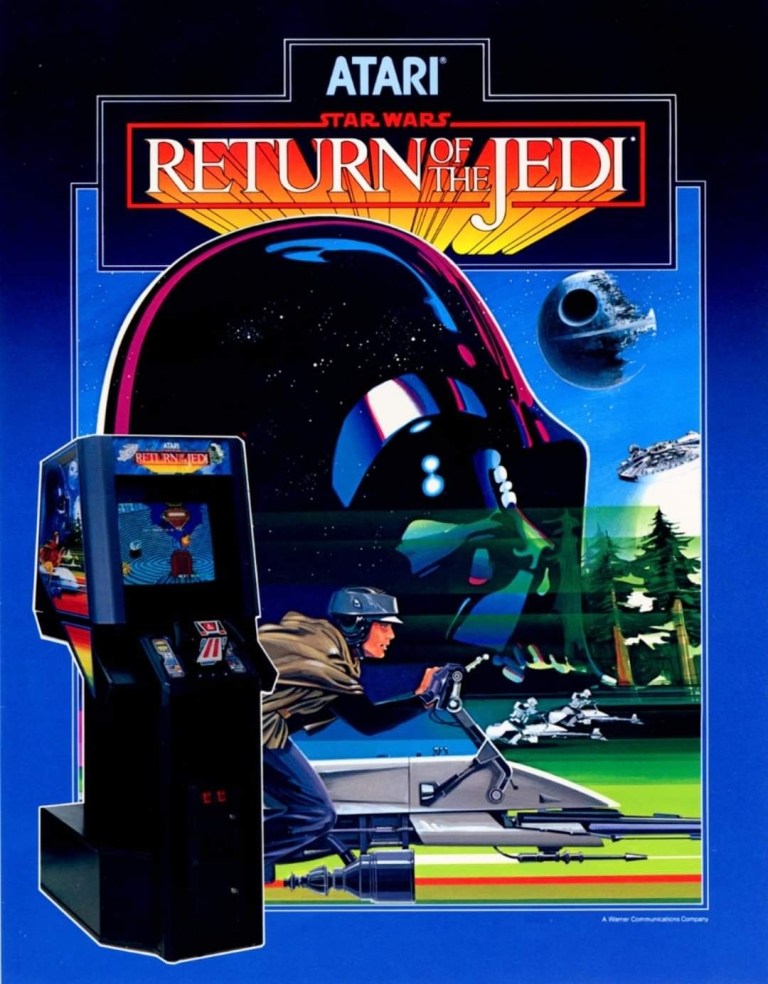
2. Star Wars: Return of the Jedi arcade flyer
Really nice art based on the movie.
Way back in 1983, Return of the Jedi delighted moviegoers in the cinemas throughout America. Behind the scenes, video game giant Atari acquired the movie license to make the 1984 arcade game Star Wars: Return of the Jedi. The arcade flyer’s front featured a highly detailed hand-drawn art of Darth Vader, the Death Star, Luke Skywalker and Storm Troopers on hover bikes, and the Millennium Falcon which reflect the selected elements of the movie that were turned into playable sections. The image of the arcade machine was understandably inserted as it came with an unusual controller. This flyer is still captivating to look at.
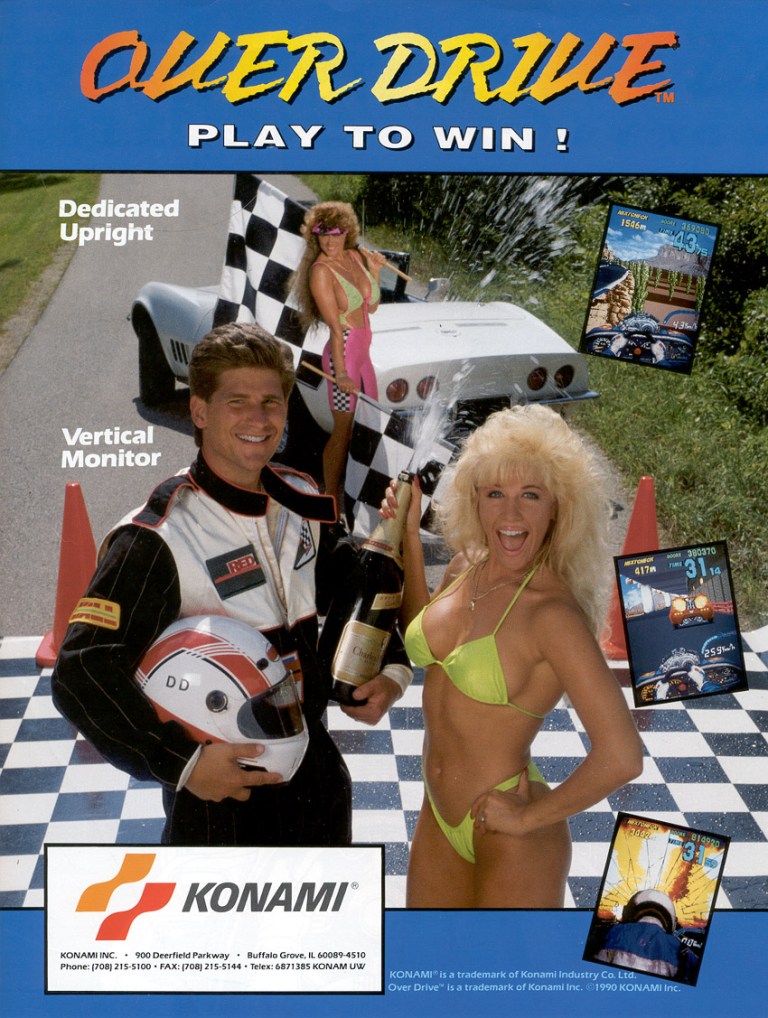
3. Over Drive arcade flyer
This arcade flyer is a reminder that Konami was notable for hiring pretty and sexy women for their print ads.
In 1990, Konami produced a racing game for the arcades with a unique style of presentation. That game was Over Drive and it stood out among the many racing games in the arcade mainly because of its first-person view (with a digital version of the steering wheel and driver’s hands at the bottom of the screen) and unique approach on sprite-scaling. To promote the game, Konami hired sexy models for photography for use in both the arcade flyer and the exterior images on the machine. Having sexy models posing with a winning driver added to the motorsport racing vibe needed to promote the game.
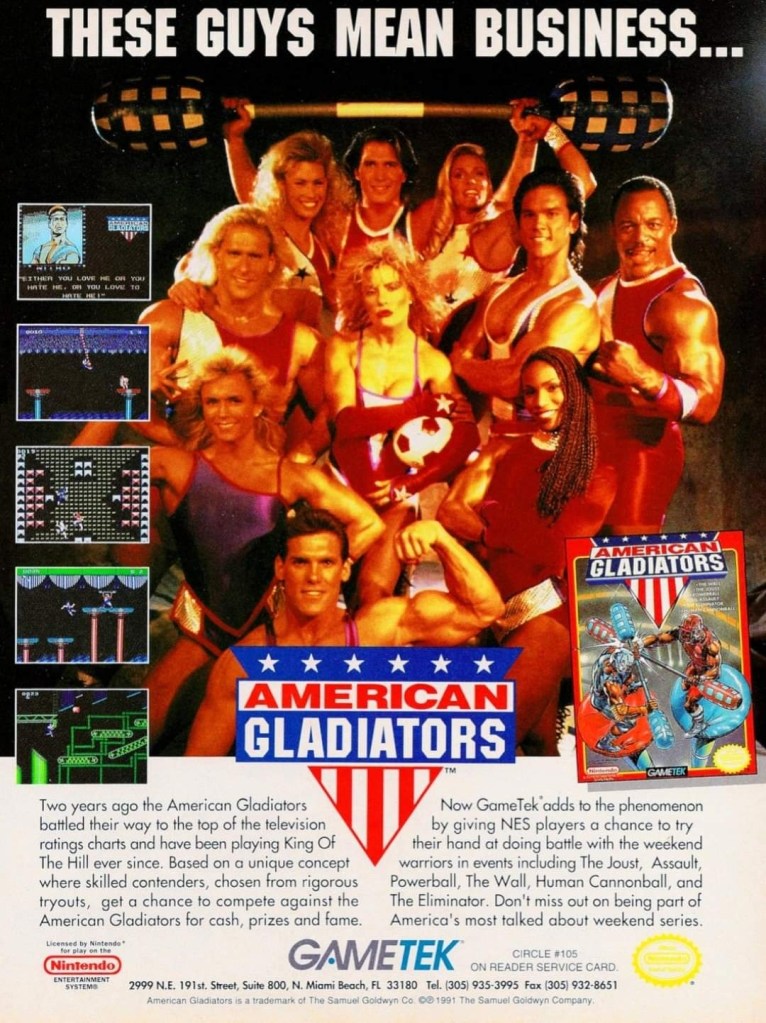
4. American Gladiators for NES print ad
I saw American Gladiators on TV but never played this game.
American Gladiators was a syndicated TV show that featured a variety of games in which amateur athletes compete with the established gladiators to succeed and become the next American Gladiator. Due to its success, it was not surprising that video game adaptations of the show were realized just a few years after its debut. In 1991, GameTek released the American Gladiators game on the Nintendo Entertainment System (NES) and promoted it with this print ad that showcased their established gladiators of the time. This ad’s design was made to catch the attention of the fans.
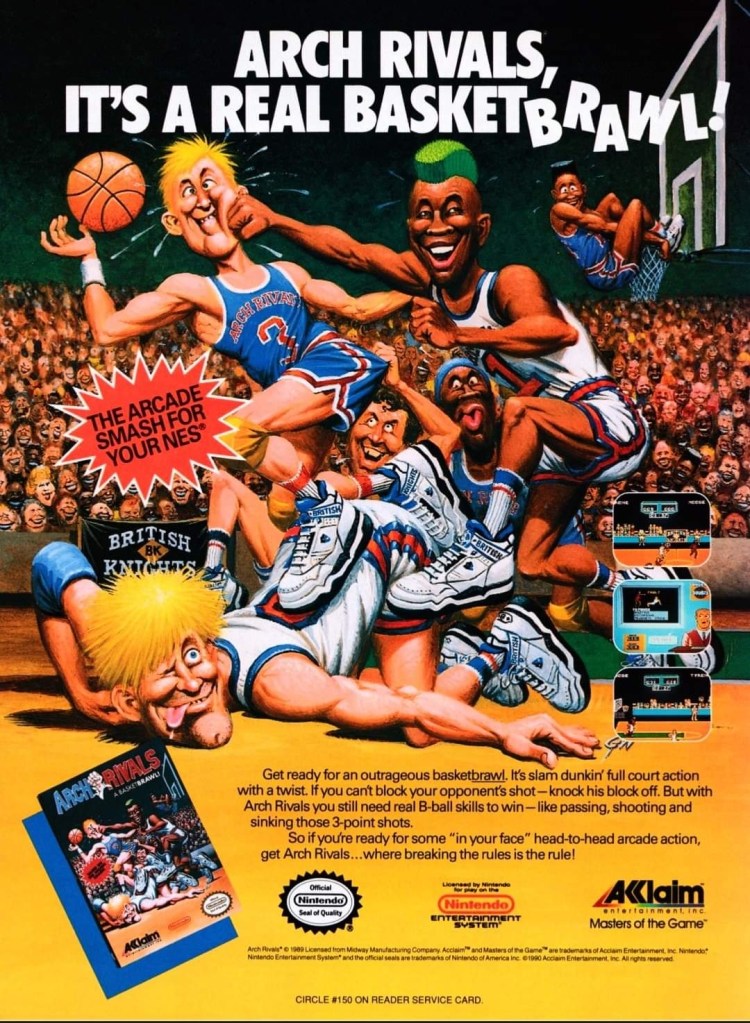
5. Arch Rivals for NES print ad
I remember seeing a lot of people crowding in front of an Arch Rivals machine in the local arcade long ago.
Years before NBA Jam, there was Arch Rivals. Arch Rivals was a full court basketball video game in which players are allowed to punch players from the opposition in order to steal the ball and score. Over a year after the game’s 1989 arcade debut, the NES version was released and the publisher came up with a print ad showcasing a hilarious and cartoony artwork (the same art used for the game’s box cover) which gave readers a clear idea of what to expect. The art used is timeless and it still is funny to see.
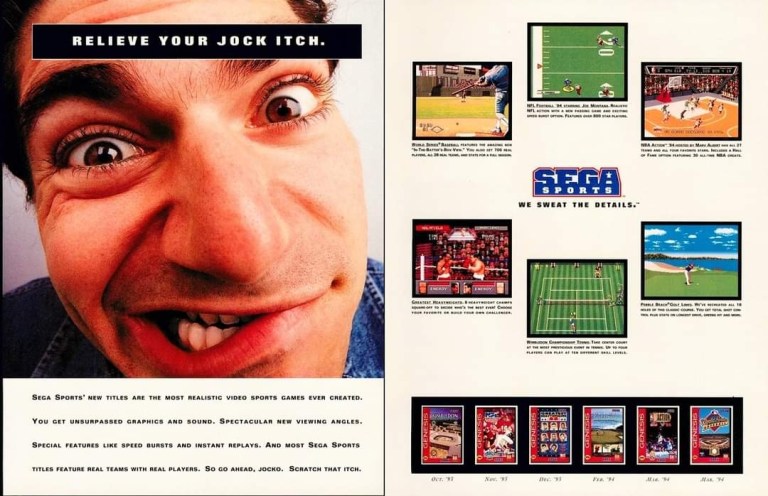
6. Sega Sports print ad
See any Sega Sports video game you like?
Back in the 1990s, Sega excelled with sports video games. They were so aggressive, they established their sub-brand Sega Sports and this particular print ad showed one page promoting assorted sports video games (basketball, golf, baseball, tennis, boxing and American football) for the Sega Genesis and the other page with an exaggerated image of a guy with the line “Relive your jock itch” posted. Historically, a lot of American players and owners of the Genesis are slightly older than those on NES and Super Nintendo Entertainment System (SNES) during the 1990s and the strong sports games approach is a key factor.
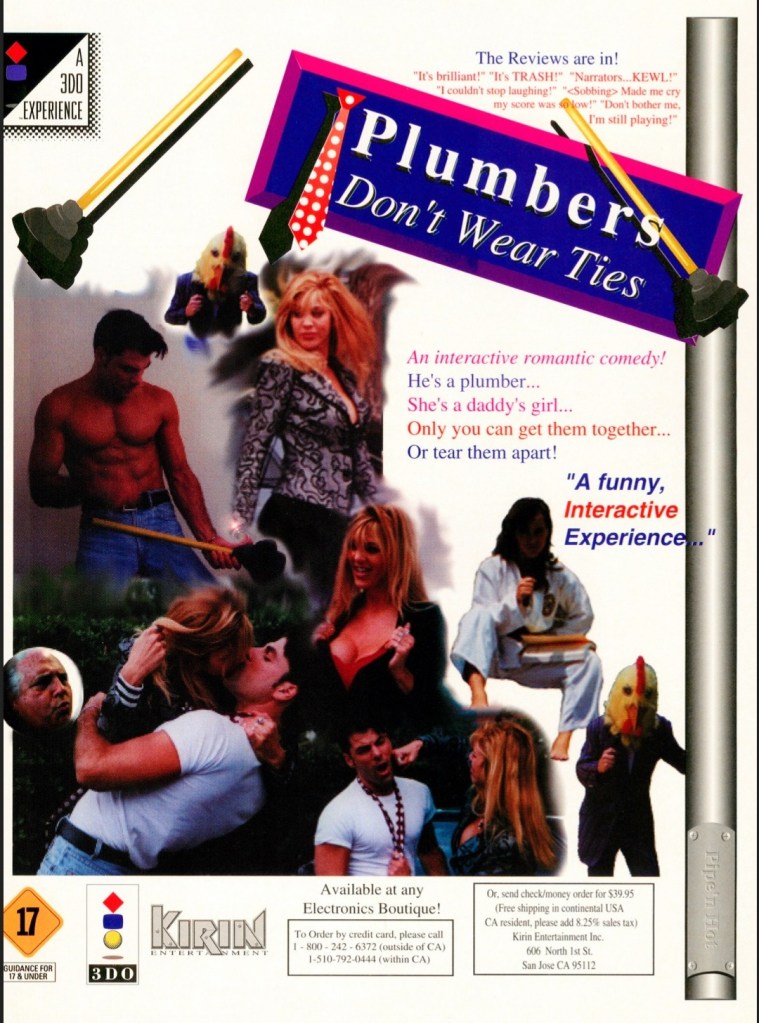
7. Plumbers Don’t Wear Ties print ad
When I first saw this print ad, it did not interest me as the presentation is lousy.
The 3DO console is remembered for having a lot of games that used full-motion videos and photo slides regardless of what game designs came with them. Back in the 1990s, games designed as visual novels or dating simulations were still new in console gaming in the West. Following the PC version’s release, a 3DO port of Plumbers Don’t Wear Ties came out in 1994 and it received overwhelmingly negative reviews. The print ad here promoted the game as “an interactive romantic comedy” and fake quotes were displayed to fool ignorant readers that the game was entertaining. The print ad’s visual design had a mess of poorly implemented images. Ironically, this ad accidentally gave readers the idea that it was a slideshow game.
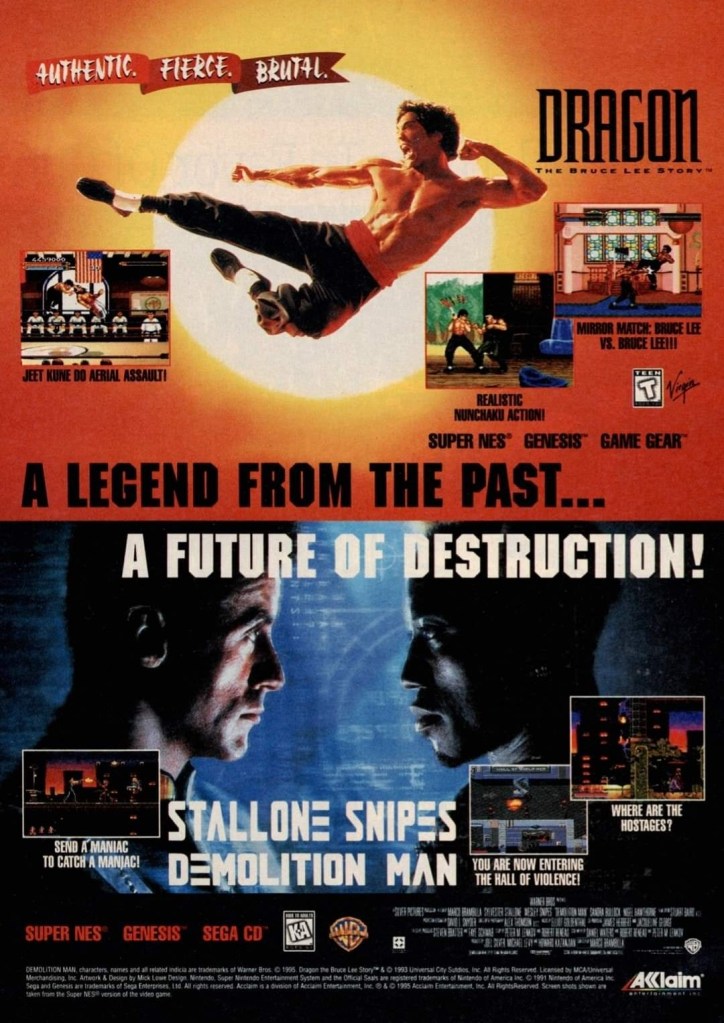
8. Dragon: The Bruce Lee Story and Demolition Man games print ad
If you saw the movies, did you play their respective video game adaptations?
The 1990s is remembered for the many movie-based video games that got released. Back in those days, a lot of Hollywood movie productions had video game adaptations as part of the business process and this is evident with the Dragon: The Bruce Lee Story and Demolition Man games released by Acclaim. For this particular print ad, the marketing team came up with a single-page ad to promote the two games with heavy emphasis on movie imagery leaving little room left for screenshots and other details. The way I look at this old print ad, it seems that Acclaim was aiming for not just movie fans but also gamers who like 2D fighting games and 2D action-adventure games.
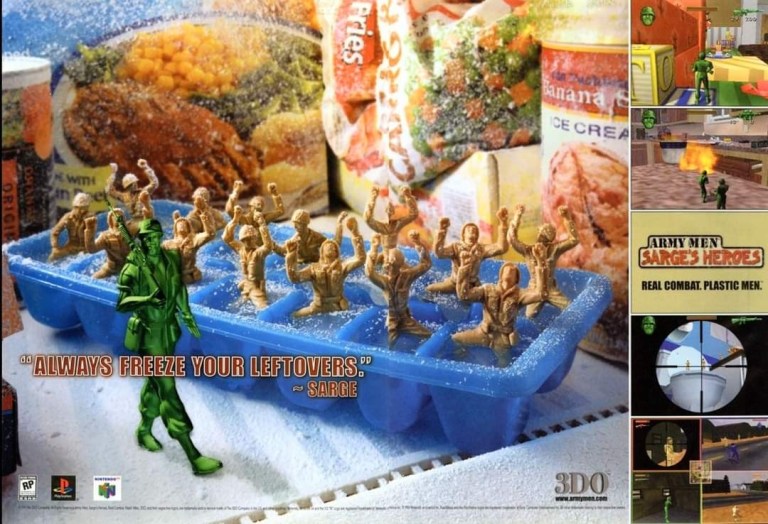
9. Army Men: Sarge’s Heroes print ad
This print ad by 3DO is still funny to see.
In the late 1990s, The 3DO Company focused mainly on producing video games on multiple platforms and they had their own video game franchise based on the green plastic figures with a military theme. In 1999, they released Army Men: Sarge’s Heroes for PlayStation and Nintendo 64 (N64). To market the game, they had a hilarious visual concept of several solders freezing on an ice tray as a long green soldier marching on. This print ad always caught my attention while reading game magazines and it still is funny to stare at.
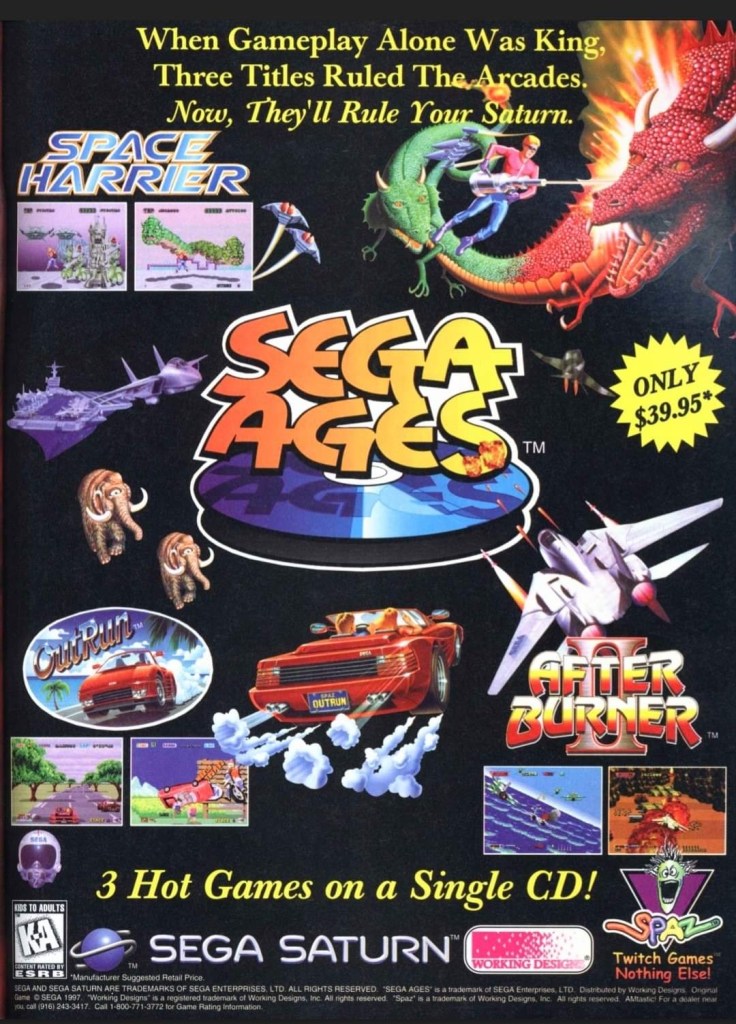
10. Sega Ages print ad
I can only speculate that Sega accepted Working Design’s financial offer for the publishing rights in North America.
Sega Ages is a series of ports and remakes of Sega’s own games (arcade and console) bundled together as compilations released on the modern consoles of the time. While Sega itself published Sega Ages on their Saturn console and Europe, the North American compilation was published by Working Designs under their separate brand Spaz which this particular print ad showed. While the classic Sega games of After Burner II, OutRun and Space Harrier often caught my attention, this ad made me wonder why did not Sega publish this compilation on the Saturn in North America themselves. Looking at this ad now remains awkward.
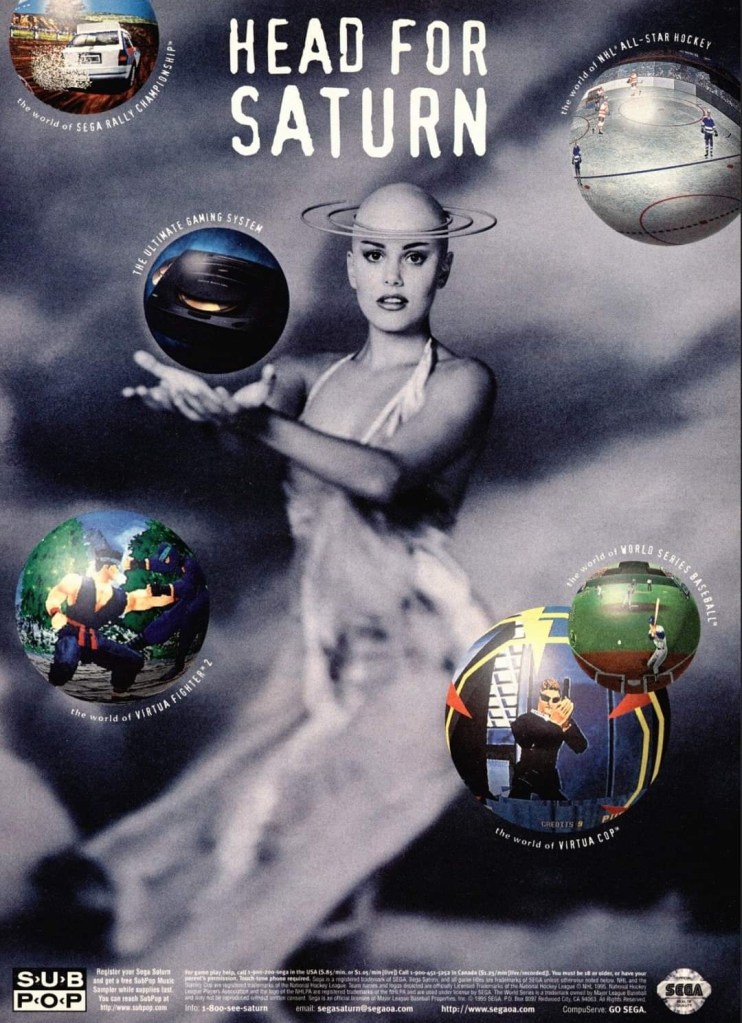
11. Sega Saturn North American print ad
Did you ever own a Sega Saturn in 1995?
While a lot of gamers and retailers were caught off-guard by Sega’s surprise early launch of the Saturn console in America, they still went ahead aggressively marketing the machine knowing they have a few months’ head start before the American launch of PlayStation. This print ad was designed to intrigue readers showing a bald lady whose head was made to look like the planet Saturn and next to her were images of Sega’s hottest games of the time – Virtua Fighter 2 and Virtua Cop. Sega relied strongly on imagery to promote their console with this print ad. It was somewhat weird yet eye-catching.
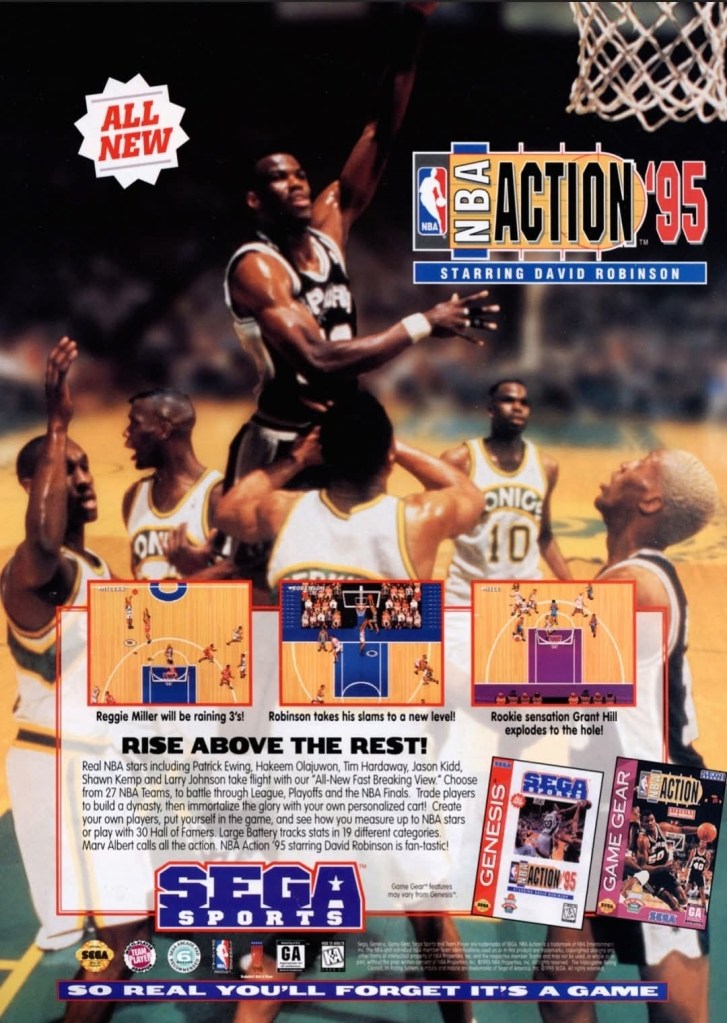
12. NBA Action ’95: Starring David Robinson print ad
David Robinson was the MVP of the NBA in 1995 but he failed to lead his team to the NBA championship back then. He would late win the NBA championship in the shortened 1999 season.
As mentioned early, Sega was aggressive the sports videos games and almost all of them were their own console exclusives. Their tradition of hiring professional athletes as endorsers continued during the age of the Genesis and Game Gear when they hired an NBA superstar as an endorser resulting in the Sega Sports basketball game titled as NBA Action ’95: Starring David Robinson. By the time the video game was released, Robinson was already the reigning Most Valuable Player (MVP) of the NBA. This print ad of Robinson in action still looks impressive but with a big catch – the superstar’s 1995 MVP achievement was arguably forgotten as he and his team (San Antonio Spurs) got eliminated by the Hakeem Olajuwon-led Houston Rockets in the Western Conference Finals. It did not help that Olajuwon outplayed Robinson a lot in that very playoff series. That is a sad reminder that also came with this Sega Sports print ad.
Welcome back readers, fellow geeks and electronic gaming fans!
In this edition of the Retro Gaming Ads Blast (RGAB) series, we will take a look at another batch of retro gaming print ads – including arcade flyers – from the 1980s and 1990s.
For the newcomers reading this, Retro Gaming Ads Blast (RGAB) looks back at the many print ads of games (console, arcade, computer and handheld) that were published in comic books, magazines, flyers, posters and newspapers long before smartphones, social media, the worldwide web and streaming became popular. To put things in perspective, people back in the 1980s and 1990s were more trusting of print media for information and images about electronic games and related products.
With those details laid down, here is the newest batch of retro gaming print ads for you to see and enjoy…
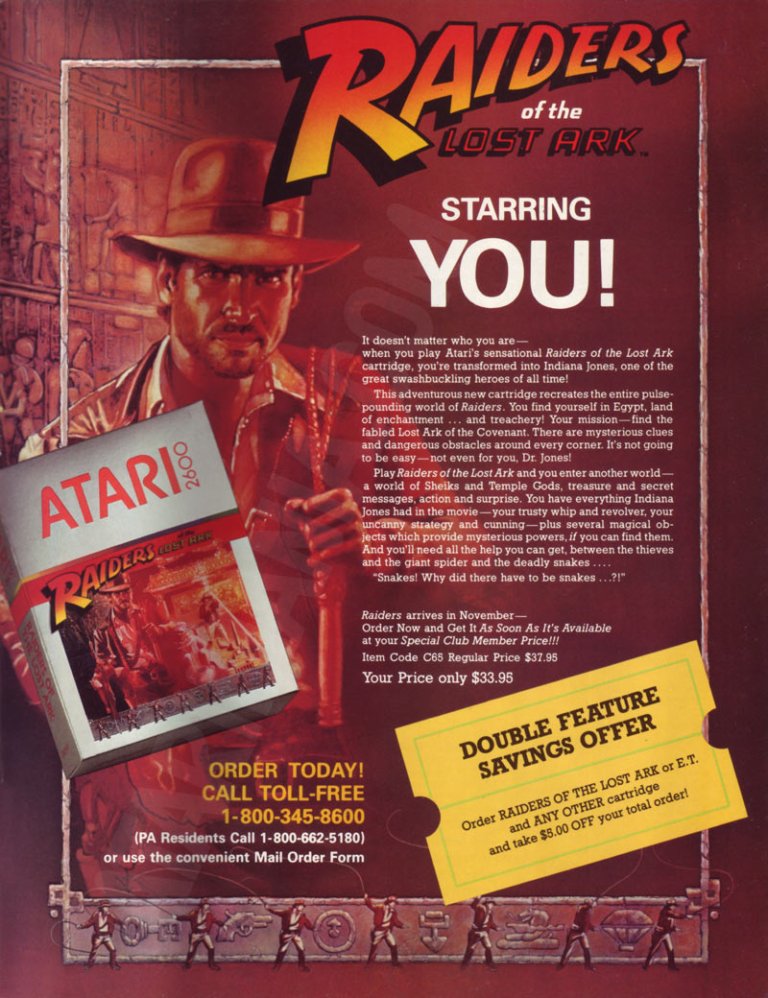
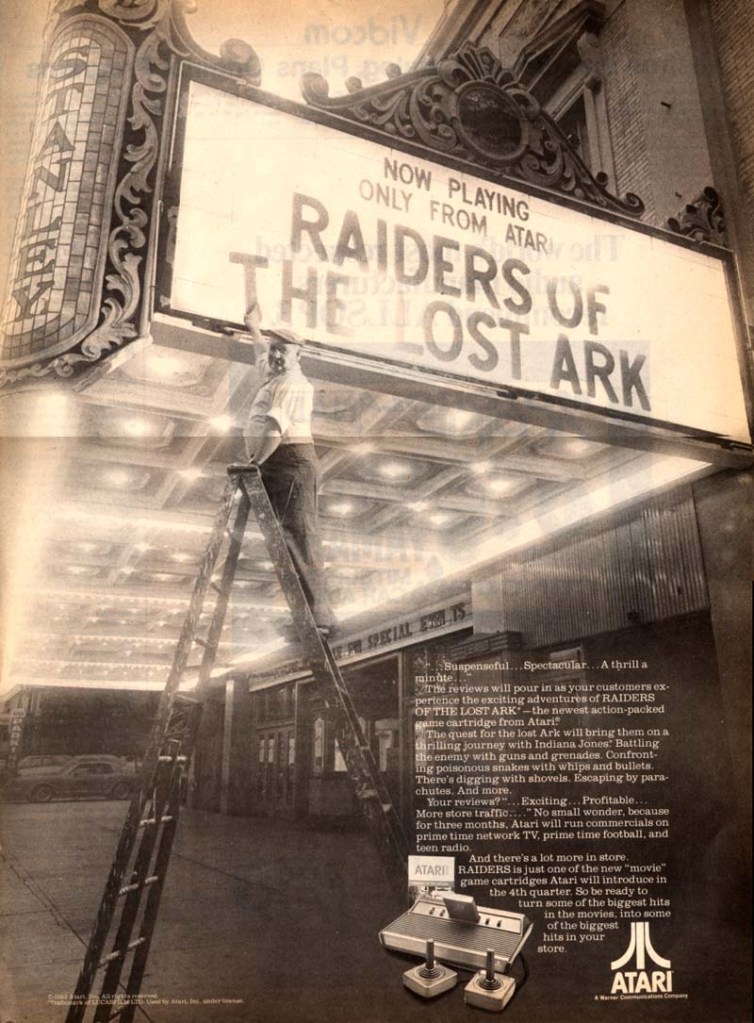
1. Raiders of the Lost Ark game print ads
The print ad with strong Indiana Jones imagery.
The print ad with the movie theater exterior image and the small image of the Atari 2600 console.
Directed by Steven Spielberg, Raiders of the Lost Ark was one of the best adventure movies ever made as well as the start of the iconic character Indiana Jones. Given its huge commercial success, an official video game adaptation for the Atari 2600 was released in 1982 and game designer Howard Scott Warshaw even met with Spielberg during the game’s development.
To promote the game, Atari released two print ads – one ad had a movie theater exterior visual concept to emphasize they have the official video game adaptation based on the movie while the other ad showed the game’s official artwork and game box cover while emphasizing a savings offer. Atari really did what they could to sell a game while riding on the success of Raiders of the Lost Ark.
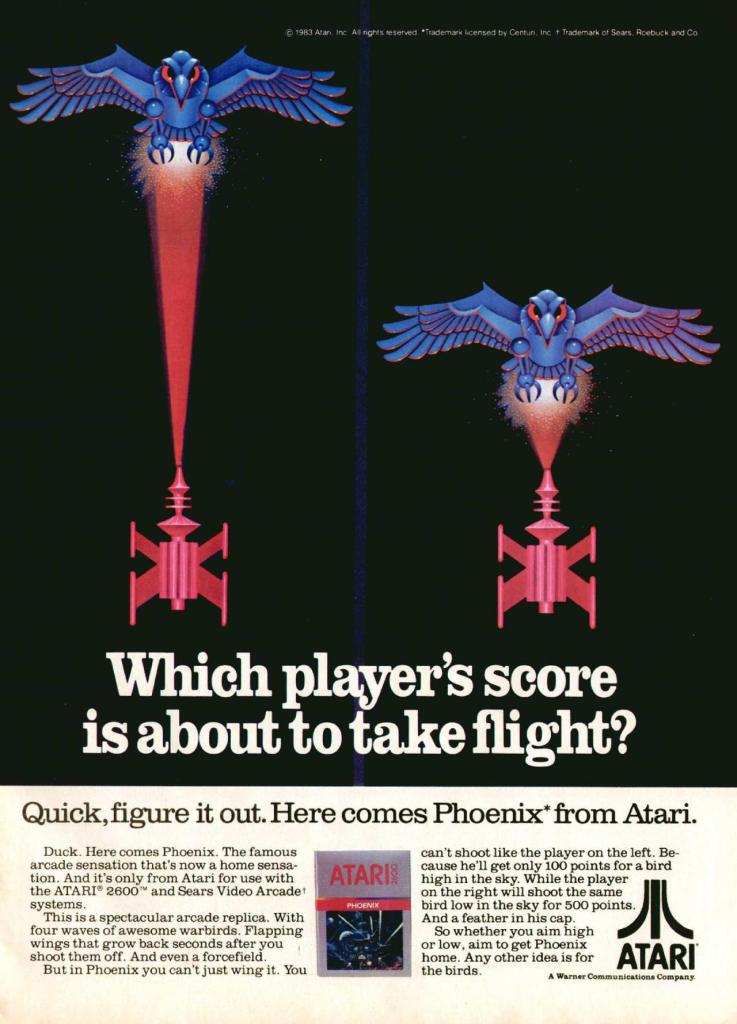
2. Phoenix print ad
Even without any screenshots, this print ad’s art still gives viewers a clear idea of what to expect.
Similar to what they did with Galaxian and Joust, Atari made this print ad promoting Phoenix which was a 2D sci-fi shooting game that was similar with Space Invaders in design. Colorized, hand-drawn artwork resembling the 2D sprites of the game was done to capture the attention of people. The art is so good, it made up for the lack screenshots of the game.
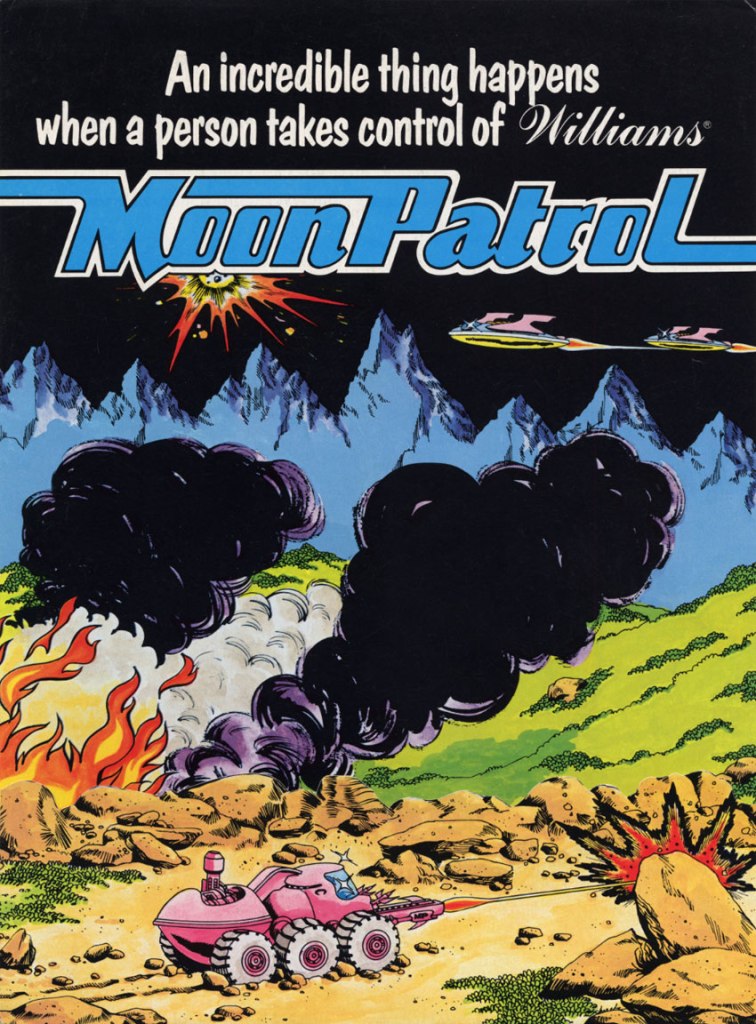
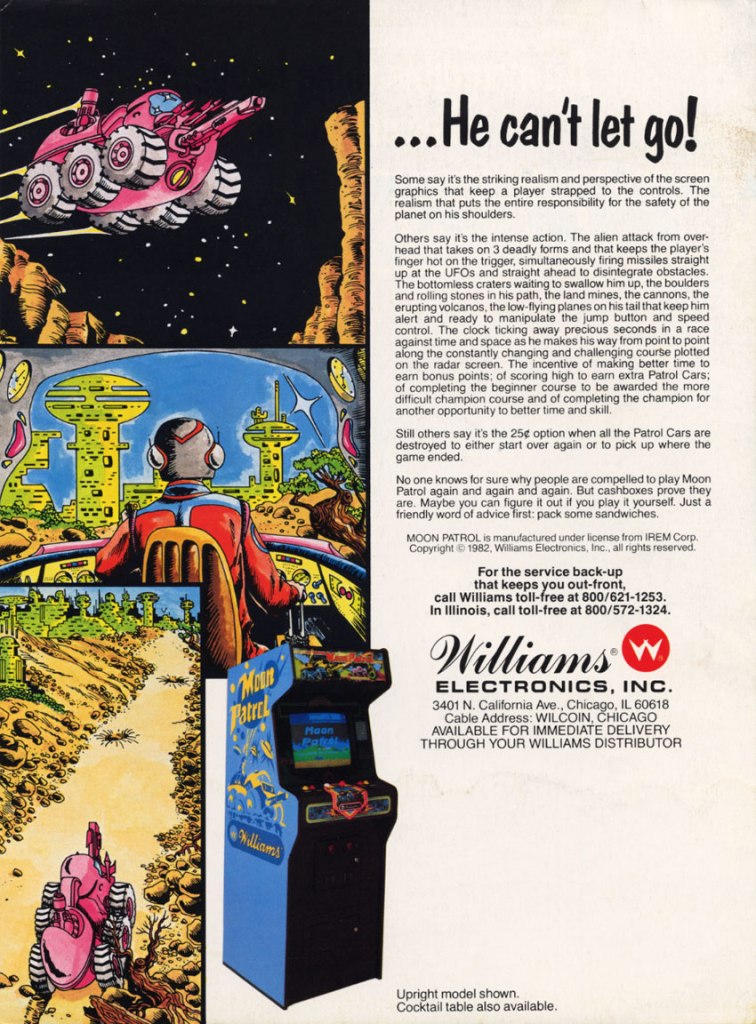
3. Moon Patrol arcade flyer
Front of the Moon Patrol flyer.
The other side of the arcade flyer.
Moon Patrol was a 2D sci-fi side-scrolling adventure game first released in the arcades in 1982. To sell the game to arcade operators, publisher Williams created the North American arcade flyer that heavily used hand-drawn comic book-style artworks on both sides while using available space on the other side for the descriptive text, contact details and the image of an arcade machine. What is very clear is that no screenshots of the game were shown to stand out which explains why a lot of hand-drawn art was used. The picture of the machine showing a screen of Moon Patrol was the closest thing to see a screenshot on this flyer. Personally, I really like the style and quality of the hand-drawn artwork as it made the flyer look lively.
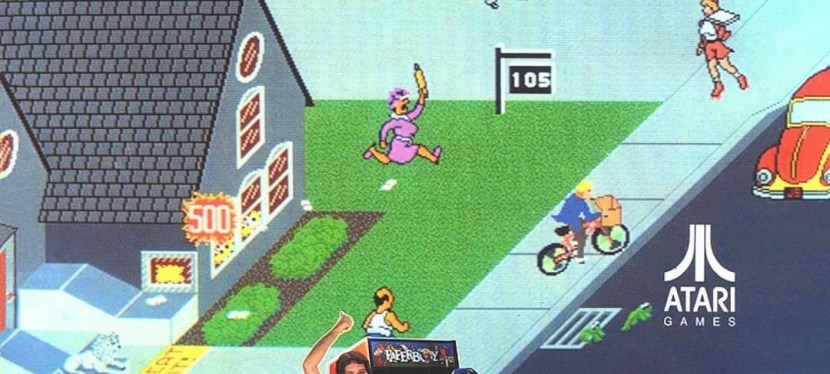
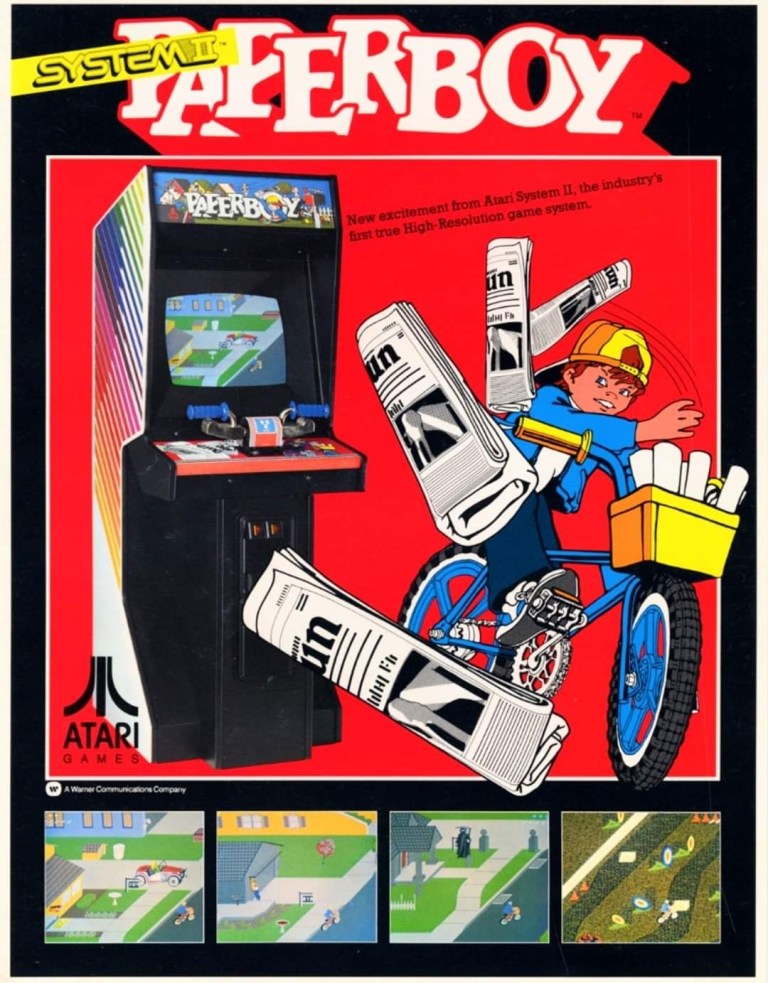
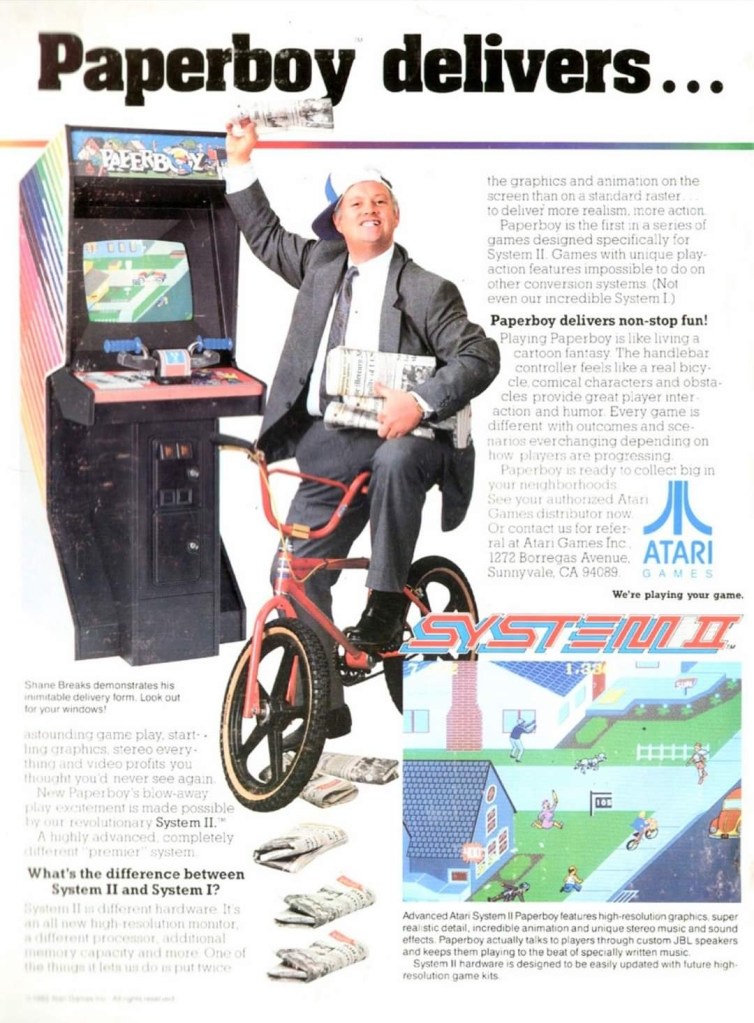
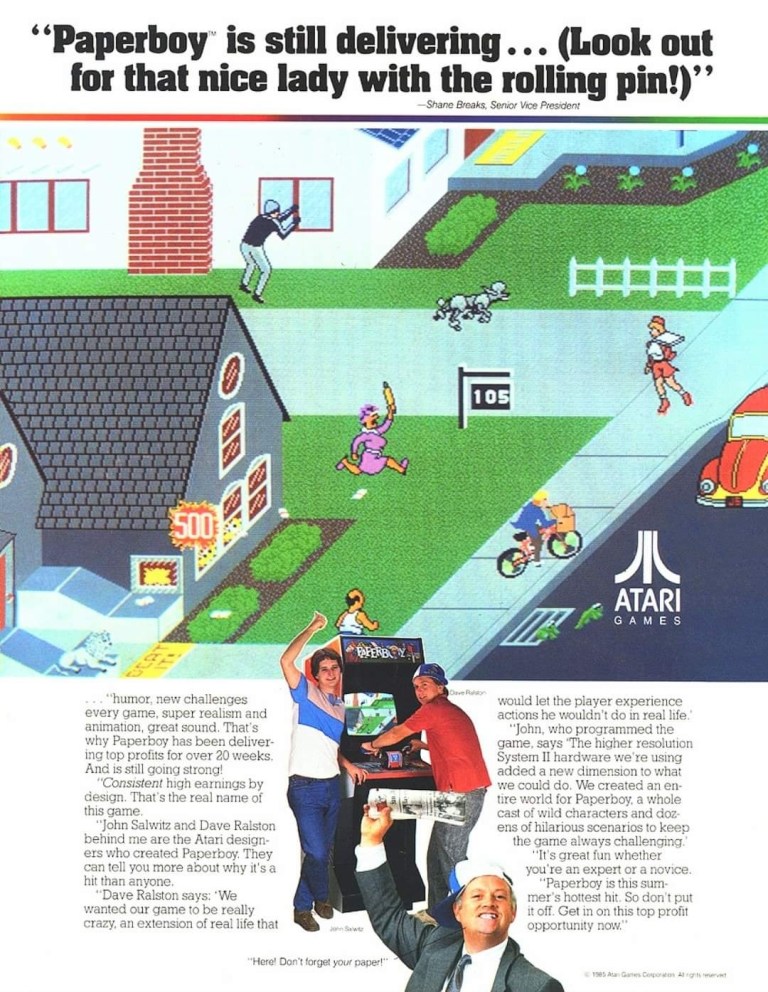
4. Paperboy arcade flyers
The arcade flyer showing the Paperboy machine and screenshots. The hand-drawn art is nice.
This one uses comedy showing a grown man riding a bike as a paper delivery “boy”.
I really like the stronger emphasis on the in-game graphics of Paperboy which dominates the space. What you see is what you get in the arcade.
The first time I ever played the classic Paperboy was in the arcade inside a Las Vegas hotel way back in 1989, and it sure was a challenging yet fun experience. Before its arcade debut in 1985, the developers took a lot of risks making the game which includes coming up with a bicycle handle bar for each machine to have. To promote the game, Atari made at least three arcade flyers that creatively emphasized what the game’s concept was about, how did it play, why does the machine have bicycle handlebars and why players can expect fun. Atari’s promotional efforts paid off as Paperboy became a huge hit in the arcades not only in America but also in Japan.
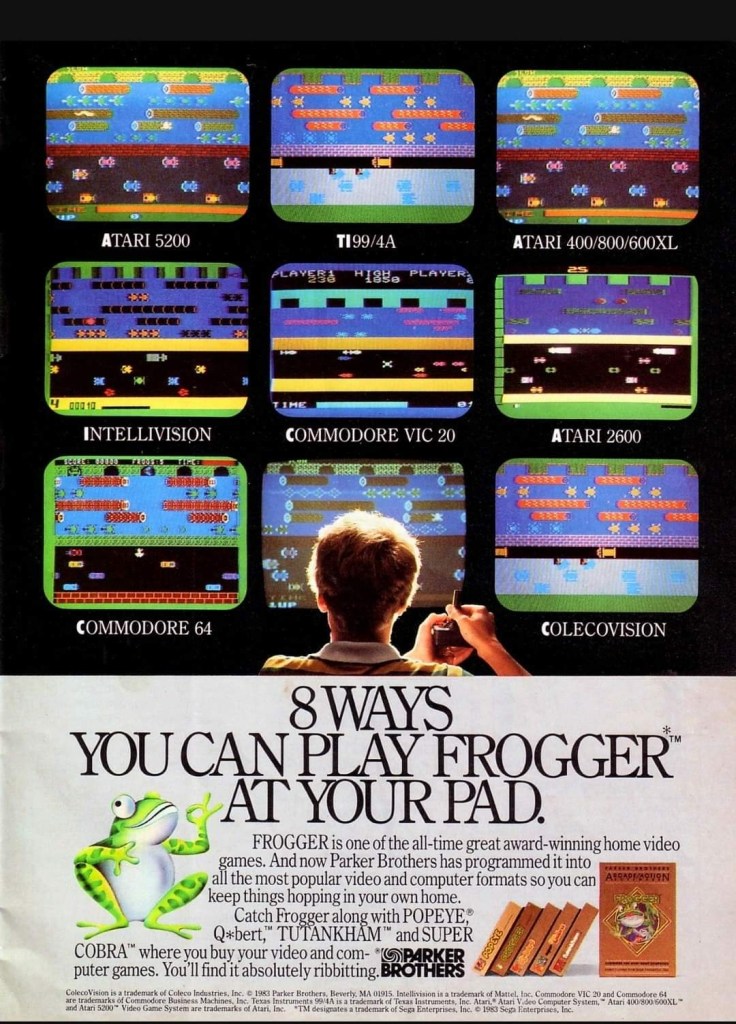
5. Frogger multi-platform print ad
This print ad is still amusing to look at.
After Frogger became a hit in the arcades, Parker Brothers secured the rights to port the game on Atari consoles, the Intellivision, TI-99/4A, vic-20, the Commodore computers and ColecoVision. To promote their Frogger ports, the single-page print ad was made showing a player in the foreground playing in front of screens that each showed what the game looked like on each platform. Parker Brothers found tremendous success selling 4 million copies of Atari 2600 version of Frogger at a time when there were only 13 million units of Atari 2600 in existence. By the year 2005, video game sales of Frogger reached 20 million worldwide across different platforms.
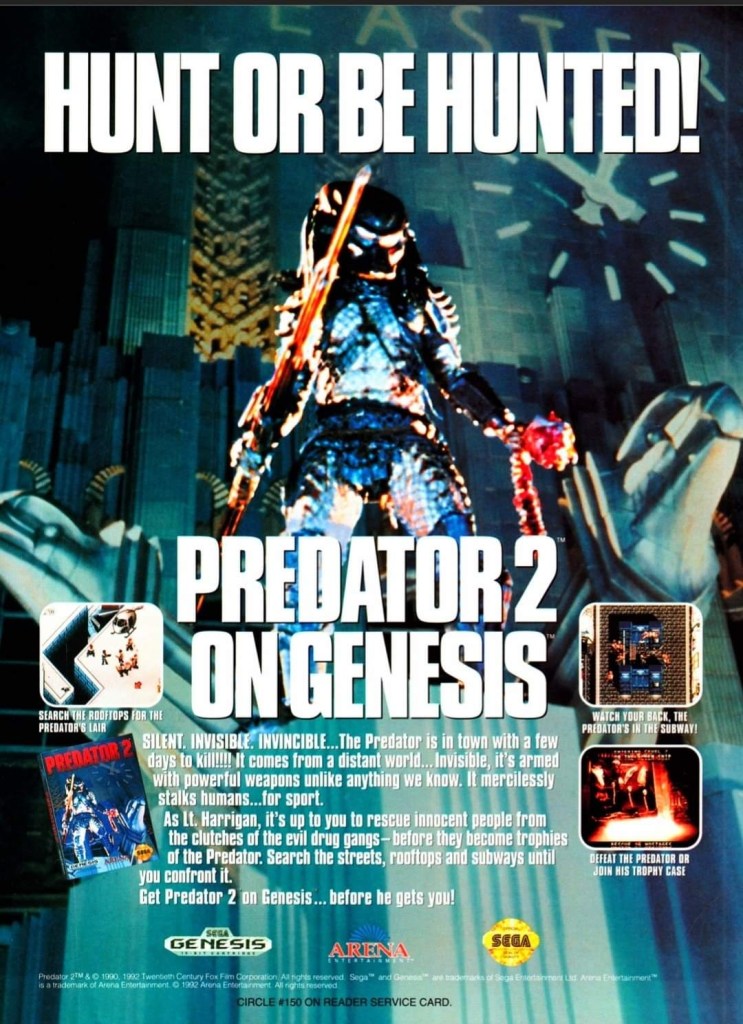
6. Predator 2 print ad
This is one very edgy print ad as used an official image from the movie.
If there is anything memorable about the 1990 film Predator 2, it is the fact that it had the story and the alien hunter itself within a metropolitan setting. That being said, the Sega Genesis Predator 2 video game had a suitable design of shooting and adventuring within the urban settings. This video game ad really captured the vibe of the movie (even showing the reddish human skull with spine on the Predator’s left hand) and clearly showed what gamers could expect. This old ad is still captivating to look at and its edgy approach is still intact.
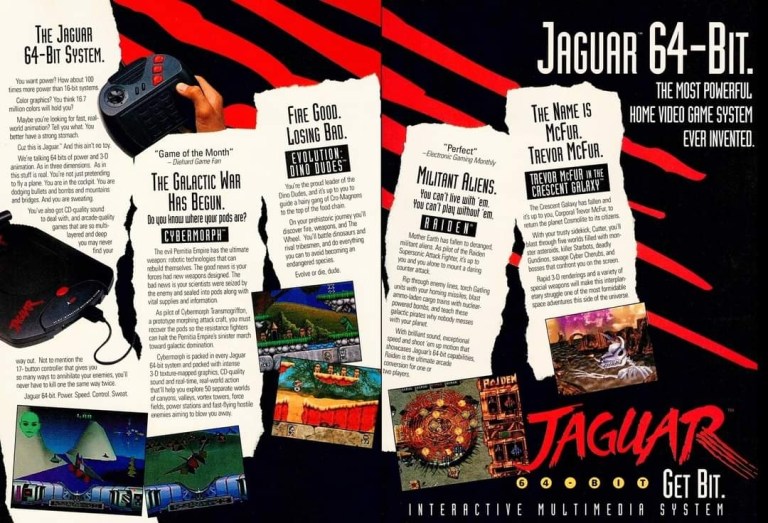
7. Atari Jaguar print ad
Did you ever own an Atari Jaguar console?
When I was reading video game magazines back in the 1990s, I always found print ads of the Atari Jaguar intriguing to look at. I was very young when I first played the Atari 2600 and its games at home, and later played some Atari games in the arcade. To me, seeing Atari Jaguar print ads like this one gave me moments of nostalgia and it made me wonder if Atari knew what it was doing with their so-called 64-bit game console. They did what they could to promote their console and the games within this 2-page print ad.
8. Vs. print ad
This print ad easily reminds me of the 1990s.
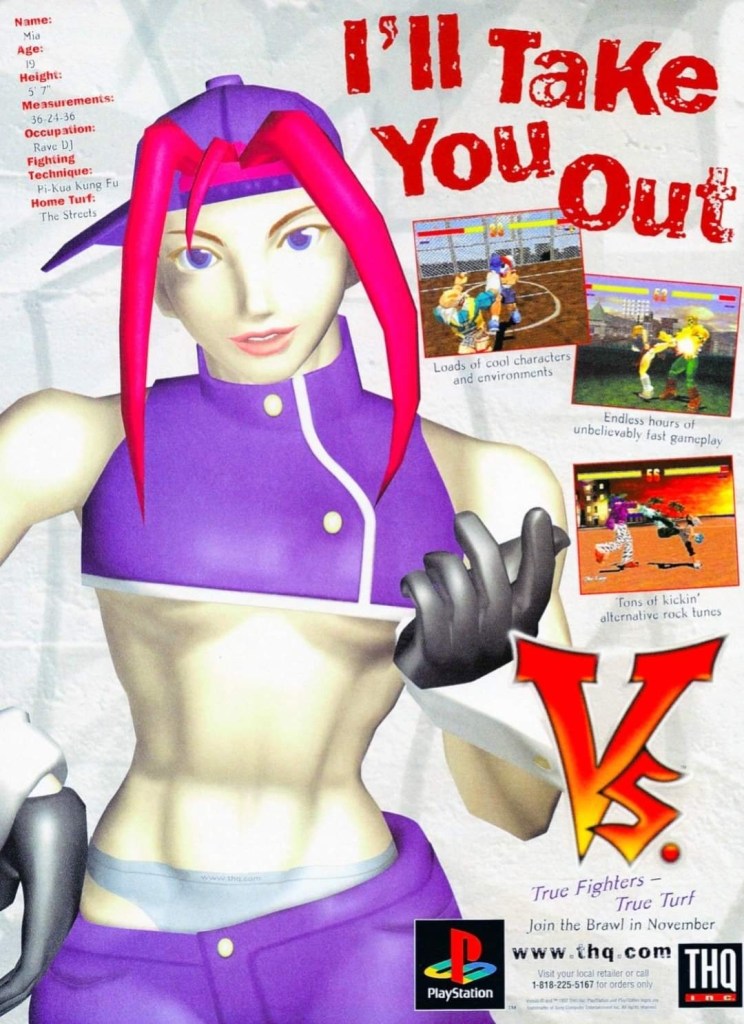
By 1997, both the arcades and the video game console market were filled with lots of 2D and 3D polygonal fighting games. Japan was the hot spot of the production of 3D polygon fighting games and the developer Polygon Magic (based in Japan) made Fighters’ Impact which Taito released in Japanese arcades and the PlayStation. The said game was picked up by THQ for a late-1997 release on the PlayStation in America under the title Vs. I never played this game but I heard that the game’s development included gang-oriented characters designed by Marvel Comics artist Kurtis Fujita. This Vs. ad is a lively reminder about the hip-hop fashion that made its way into video games.
9. GoldStar/LG Electronics 3DO print ad
This is a very weird way to market a video game machine.
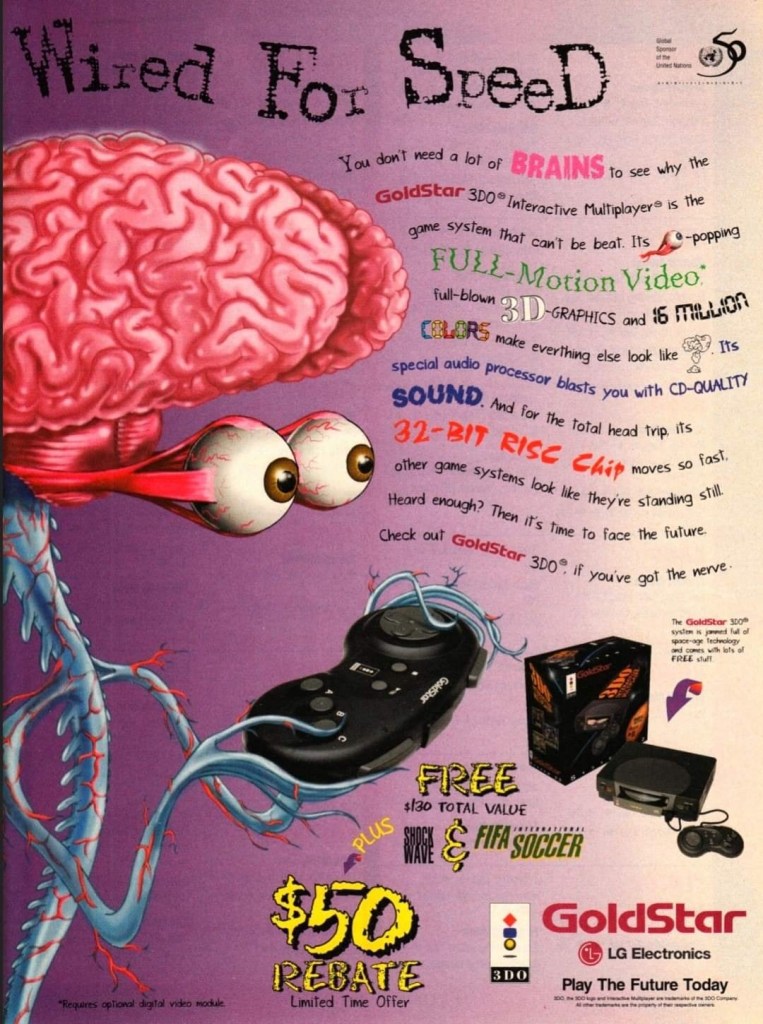
Back in the 1990s, the South Korean electronics company GoldStar (which was part of the umbrella of LG Electronics) had the license to produce 3DO game consoles with its own style. In some ways, the GoldStar 3DO console looked like a premium console on the outside. Unfortunately, the GoldStar 3DO print ad here had a very sloppy presentation as the ad makers used very weird art of a brain-with-eyes holding a 3DO controller leaving little space left to promote the console and games (without any screenshots). The text description was sloppily done. This is a bad example of promoting video game hardware and games.
10. Pandemonium 2 print ad
I saw this ad but never played the game.
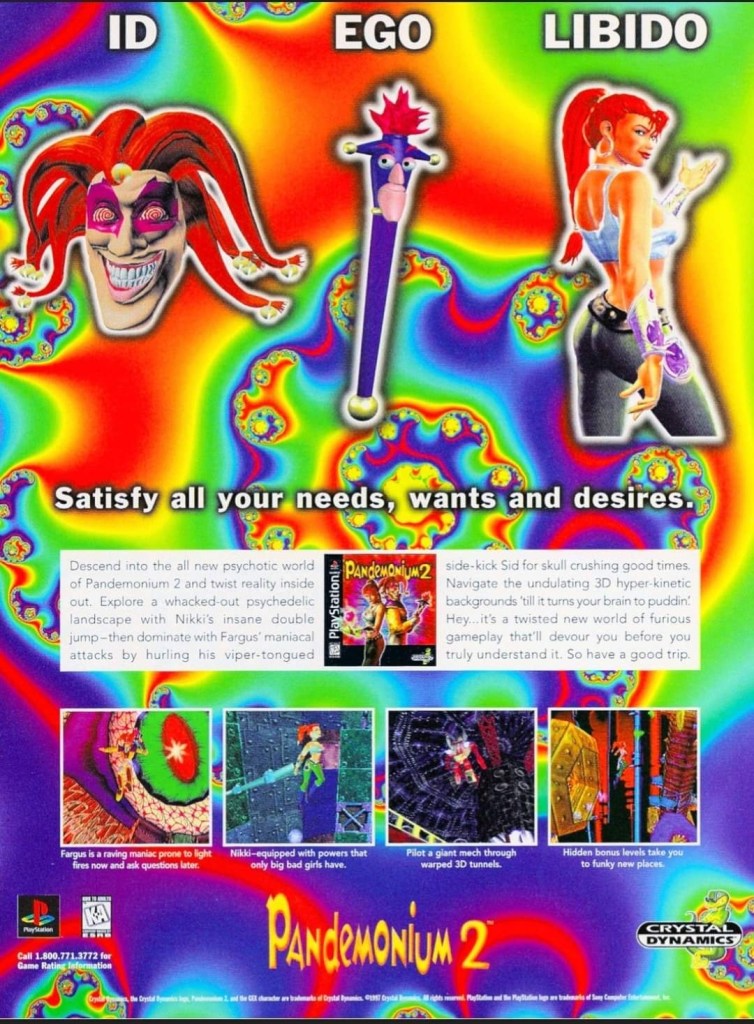
Looking back at 1997, I find it strange that I never got to play Pandemonium 2 on the PlayStation even though I saw its print ad in magazines. I had a lot of fun playing Pandemonium! on the console in 1996 but somehow missed out on its sequel. Looking back at the Pandemonium 2 print ad, I was surprised with how the game developers redesigned the two playable protagonists, especially Nikki who was clearly made to look very sexy. The word “libido” (meaning sexual drive) was deliberately placed above Nikki. The ad also had a hypnotizing mix of colors which I believe was also deliberately done by the ad makers. I can only wonder how the game played.
11. Mission: Impossible print ad
A captivating ad.
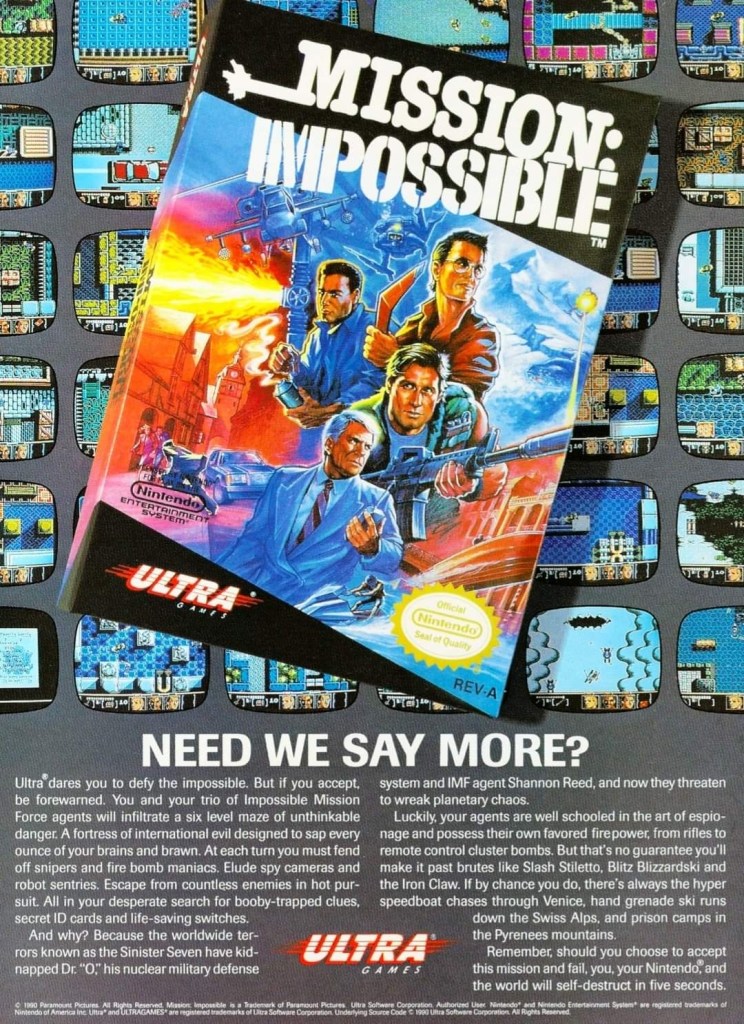
In 1990, Ultra Games (a label of Konami) released the Mission: Impossible video game on the Nintendo Entertainment System (NES) in America. Developed by Konami, the game was an adaptation of the 1988 TV series and it had an ambitious design with regards to level design and gameplay. To promote the game, the ad makers came up with a visual design showing the game’s box (which had a nice painted art on the cover) on the foreground and several screenshots resembling TV monitors on the background. Even by today’s standards, this print ad still looks good and captivating even if you are not too familiar with Mission: Impossible on TV.
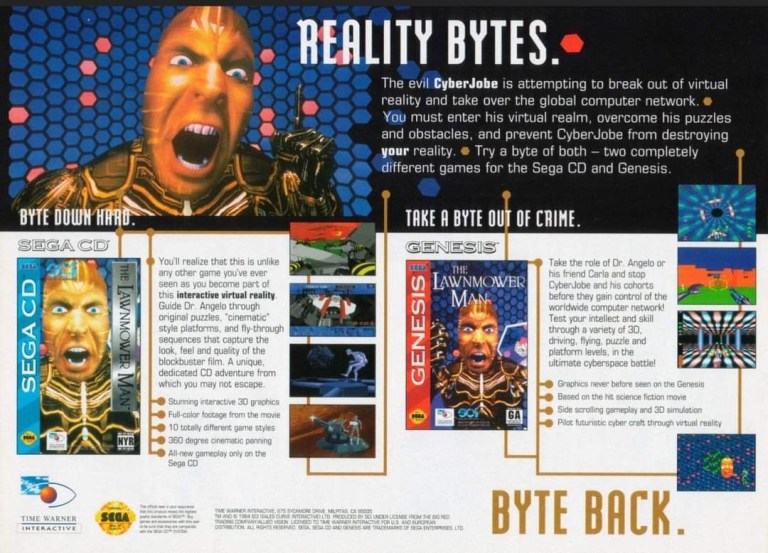
12. The Lawnmower Man Sega CD and Genesis print ad
Are you fan of The Lawnmower Man movie?
Back in 1992, there was a lot of buzz generated by the movie The Lawnmower Man as it had a disturbing concept that involved virtual reality and, more notably, author Stephen King sued the filmmakers to remove his name from the title because the film differed so much from the source material. Of course, those developments did not stop the production of video game adaptations of the movie. This print ad promoting the Sega CD and Sega Genesis versions of the game heavily used the images of CyberJobe which were among the most memorable images from the film. Looking at the ad, the ad makers could have made the screenshots look a little larger to really sell the games.
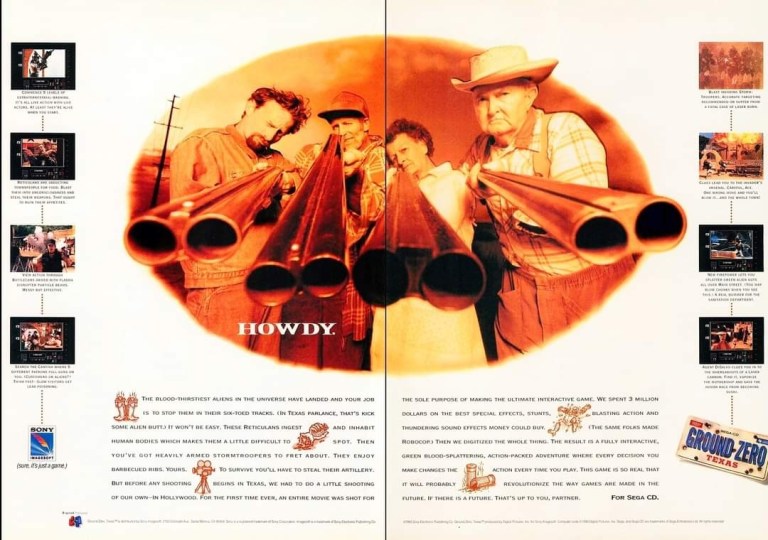
13. Ground Zero: Texas print ad
The shotguns really made this ad eye-catching.
I never played the Sega CD video game Ground Zero: Texas but I knew that it was one of those games that heavily relied on video footage while giving players moments to interact. Back in 1993, there was an increase in the number of video games that carried lots of live action footage to drive the narrative and players were given options in order to progress. What is very notable about the game is not the game design but the very 2-page ad used to promote it. The image showing four people pointing their shotguns towards the viewer was easily the most captivating part of the ad. Even though there was vacant space in between, the screenshots of the game were displayed to be really small.
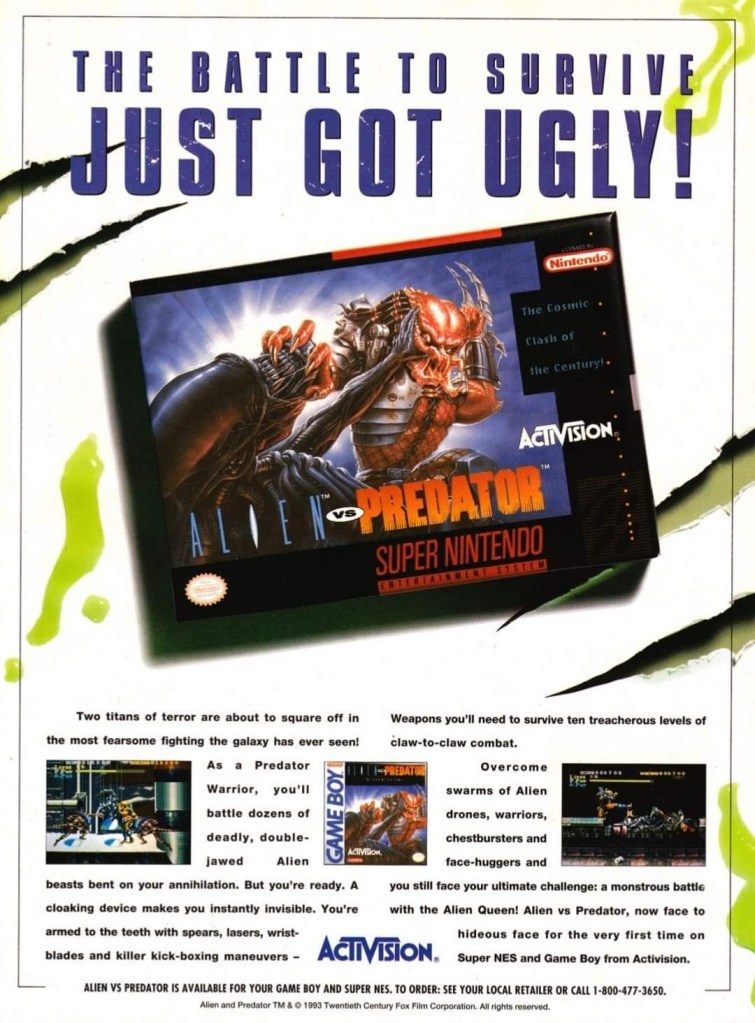
14. Alien vs. Predator for SNES and Game Boy print ad
This ad caught the attention of a lot of people back then.
Back in 1990, Dark Horse Comics launched the 4-issue mini-series of Aliens vs. Predator which turned out to be a very intriguing and engaging crossover comic book tale featuring two iconic sci-fi species of monsters. The success of the comic books led to the production of many video games which delighted both fans of Predator and Aliens. In 1993, Activision released Alien vs. Predator on the Super Nintendo Entertainment System (SNES) and the single-page print ad they came up with was engaging to look at. The SNES game box with the fine looking painted art was the main visual highlight leaving just enough space for the descriptive text, the Game Boy cover and two screenshots. Believe it or not, this video game was not related at all with the Alien vs. Predator arcade game and Atari Jaguar console game.