Welcome back, my readers, YouTube viewers and all others who followed this series of articles focused on YouTube videos worth watching. Have you been searching for something fun or interesting to watch on YouTube? Do you feel bored right now and you crave for something to see on the world’s most popular online video destination?
I recommend you check out the following topics and the related videos I found.
#1Donald Trump’s decades-long journey to becoming US President – No matter what your political views are, there is no denying that Donald Trump’s incredible 2016 election victory as President of the United States was the culmination of a very long journey that started since 1980s. As Trump kept doing lots of business, he observed what went wrong in America, what the nation lost to other countries with regards to trade or diplomacy, why many ordinary Americans became forgotten, and more. Watch Trump’s journey in the video below.
#2 A look back at Street Fighter II V (anime) – If you are a long-time gamer like me, chance are, you must have played one of the many games of Street Fighter II. If you have played the games, were you able to watch the short-lived anime series titled Street Fighter II V? Loosely based on Super Street Fighter II Turbo, the anime series started in 1995 and was directed by Gisaburō Sugii who was responsible for the anime movie of 1994. I found two YouTube videos revisiting Street Fighter II V posted below for your enjoyment.
#3 Fox News interview shows Kamala Fit is too dishonest and too out-of-touch to be US President – If there is anything notable with the incumbent United States Vice President Kamala Harris – the one woke candidate the Democrats nominated after pushing Joe Biden out of the way – is that she has a very distorted view of reality and she is very unfit to become US President. Her recent interview with Fox News is the worst yet and the consequences are still being felt as I write this down. Watch the selected videos below to find out.
#4 A look back at Koudelka – During the late stage of the first PlayStation console’s life, Japanese role-playing games (JRPGs) became really popular with gamers in Europe and America. Back in 1999, the role-playing game Koudelka was released on PlayStation in Japan and an international release followed in 2000. That game did not achieve critical acclaim and was never a big seller. As many old-time gamers have forgotten about its existence, Koudelka’s production history is rather intriguing and surprising to discover.
Koudelka was developed by Sacnoth which was founded by former Squaresoft employee Hiroki Kikuta (Secret of Mana, Trials of Mana, and Soukaigi). To find out why Koudelka had an unusual RPG concept and style of gameplay, I encourage you to watch the retro gaming video below.
#5 More Iranians need Israel’s help – It is a fact that the Islamic regime of Iran has a long record of brutalizing Iranians who do not follow their evil moves. In short, the people of Iran are not their wicked government. That being said, the dissenting Iranians are reaching out to Israel for help in the form of military action against the evil regime. Watch the video of The 700 Club below. It includes statements from Iran’s Crown Prince Reza Pahlavi.
#6. George Romero was hired to make a Resident Evil motion picture – Back in the late 1990s when the Resident Evil game franchise really soared in popularity and became bankable for Capcom, a movie project was approved and the late George A. Romero (Night of the Living Dead, Dawn of the Dead, Creepshow) was hired to write and direct it. It should be noted that Capcom hired Romero to make the Resident Evil 2 commercial which became very popular and contributed to the game’s big success. Eventually, Romero’s drafts of the script got rejected and Constantin Film replaced him with Paul W. S. Anderson resulting in the 2002 Resident Evil movie.
If you are fascinated with Romero’s short-lived involvement with the Resident Evil movie project, you should watch the related videos posted below…
#7. China’s Bonnie and Clyde – Have you been following the YouTube channel Dark Asia with Megan? Every week, there is always a new episode about true crime stories that took place within Asia and the host Megan is often great with her presentation and she clearly does a lot of research. Recently an episode about China’s very own Bonnie and Clyde was released. I saw it and it is very intriguing to watch. For the newcomers reading this, Bonnie and Clyde refers to real-life American bandits and serial killers who caused a lot of trouble from 1931 to 1934. Hollywood even released a movie in 1967 glorifying them. As for who exactly were China’s Bonnie and Clyde, and what had they done, I encourage you to watch Dark Asia with Megan’s episode below.
#8. Kamala Harris supporter shouts at toddler – Going back to the 2024 US Presidential campaign, a supporter of Communist Kamala Harris (the US Vice President since 2021) was caught on camera yelling at and traumatizing a toddler. I know for a fact that liberals, Leftists, Marxists, socialists and woke Americans can be quite wild but the die-hard Kamala supporter who screamed at the toddler clearly has crossed the line. It makes me wonder if the Democrats ever oriented their supporters to be civil and in control. Watch the Sky News Australia Lefties Losing It video below.
#9. Kamala Harris got booed at her own campaign rally! – The presidential campaign of Commie Kamala Harris is clearly failing not only because the opinion polls – most of which are Left-leaning and oversampling Democrat voters – are showing her falling further behind Donald Trump but also because unfortunate events have been happening at her campaign rallies. The new embarrassment this time is Harris getting booed at her own campaign rally! Watch the videos below.
Welcome back, my readers, YouTube viewers and all others who followed this series of articles focused on YouTube videos worth watching. Have you been searching for something fun or interesting to watch on YouTube? Do you feel bored right now and you crave for something to see on the world’s most popular online video destination?
I recommend you check out the following topics and the related videos I found.
#1Woke Disney’s discriminatory practices confirmed and caught on camera – Being woke means being foolish and wicked. What was discussed before about the woke Disney Company’s distorted approach on hiring workers as well as promoting their current workers was confirmed to be true as a Disney executive confirmed it openly on camera. A lot of footage has been recorded of him talking about Disney’s discrimination against white males as they empower people of minorities (colored people, the under-represented ethnic groups, etc.). You should watch the two videos I selected from Midnight’s Edge ad RK Outpost. Woke Disney should be brought to justice!
#2 Video documentary about Sega’s Streets of Rage franchise – YouTuber PatmanQC recently published another informative and entertaining look at the history of Sega’s popular Streets of Rage game franchise. This includes the behind-the-scenes development of the first game that hit the arcades, as well as the different versions that appeared on multiple platforms.
#3 Somewhere in Time videos – Somewhere in Time (1980) was a film that starred the late Christopher Reeve, Jane Seymour and Christopher Plummer. While it was never successful in movie theaters, it became a big hit on cable TV, public TV and home video. As its legacy lived on, it is not surprising that there are several movie reaction videos, video reviews and other features about it on YouTube. Posted below are some selected videos for those of you who wish to discover more of Somewhere in Time.
#4 A look at the rise and fall of the Orlando Magic – Back in the mid-1990s, a lot of my friends (who love basketball) became fans of the Orlando Magic which had Shaquille O’Neal, Penny Hardaway, Nick Anderson (the guy who missed 4 crucial free throws in specific NBA Finals game), Horace Grant and Dennis Scott. Their excitement really went overboard when the Magic of 1994-95 successfully won the Eastern Conference Finals and entered the NBA Finals to face off with the defending champion Houston Rockets. Of course, as recorded by history, the Magic got swept away by the Rockets even though they had the home court advantage. If you are nostalgic about 1990s NBA action or if you want to see how different the Orlando Magic was back in the 1990s, then you should watch the video below.
#5 Stockton to Malone (but still no NBA championship) – Still on the topic of basketball, do you remember the so-called golden age of the Utah Jazz when they had Karl Malone and John Stockton who together were among the very best players in the NBA back then? For the newcomers reading this, the Utah Jazz made it to the NBA Finals of 1997 and 1998 but lost each time to Michael Jordan and the Chicago Bulls. Long before those championship series happened, the Utah Jazz became a serious playoff contender in 1988 (pushing the LA Lakers to seven games in the Western Conference Semifinals) and went on to struggle in the years that followed. As for Stockton and Malone, they each had great basketball achievements but never won a championship. To learn more with a lot of details plus in-depth analysis, watch the video below.
#6 Heart of Darkness retrospective video – Way back in 1998, I played the video game Heart of Darkness on the PlayStation console but never got to finish it. While the cinematic cutscenes are not outstanding, the graphics used for gameplay was eye-catching thanks to the developers’ artistic and technical approach. This should not be surprising as the game was supervised by Eric Chahi who was best known for Another World. To learn more about Heart of Darkness’ production history, watch the video below.
#7 A look at Salamander (AKA Life Force) – Still on the topic of retro gaming, I had fun memories playing Salamander (titled Life Force in North America) on the Family Computer (Famicom) back in the late-1980s. It was a sci-fi 2D scrolling shooter that not only featured side-scrolling levels but also vertical levels. Developed and published by Konami, Salamander was a spin-off of Gradius (an acclaimed 2D side-scrolling shooter on its own) but it became successful in entertaining players with the two-player mode, unique challenges, fine gameplay features and outstanding visuals. To learn more about Salamander, watch the selected videos below.
#8 Friday The 13th Part 3 videos – If there is anything significant about Friday The 13th Part 3 (1982) other than being filmed in 3D, it is the fact that it marked a creative turning point for the franchise. It was in this movie that the film series really started to take shape with Jason Voorhees as its feature antagonist. That being said, it is not surprising that there are lots of retro reviews/reactions and feature videos about it. Watch the selected videos below.
Welcome back, fellow geeks, Blu-ray collectors and movie buffs!
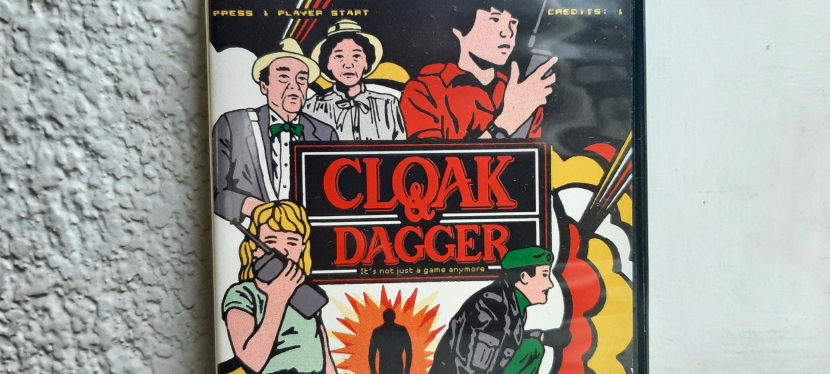
Decades ago, I saw on home video Cloak & Dagger (1984) which turned out to be an entertaining film to watch as I was already playing games on Atari 2600 and the arcades. After replaying by chance on cable TV years later, I finally bought myself the 4K Blu-ray and it sure was fun to watch it all over again. Check out my retro movie review of it by clicking here.
The front of my copy of Cloak & Dagger (1984) 4K Blu-ray.
The rear with the details that can be read.
For the newcomers reading this, Cloak & Dagger (1984) is a movie that involved then video game giant Atari in the creative process. The movie’s plot is not based on Atari’s arcade game of the same name (previously titled as Agent X).
Cloak & Dagger (1984) its own original plot of espionage about a young boy Davey (played by Henry Thomas, the star of Steven Spielberg’s E.T.: The Extra-Terrestrial) who witnesses a murder and receives an Atari 5200 cartridge of the game Cloak & Dagger that contains something very important. This in turn makes him a target of armed henchmen who won’t stop until they get him. Due to his reputation of being too playful and living with his wild imagination as a spy, people don’t believe Davey’s claim of witnessing a murder. This film happens to be inspired by the short story “The Boy Cried Murder” written by Cornell Woolrich.
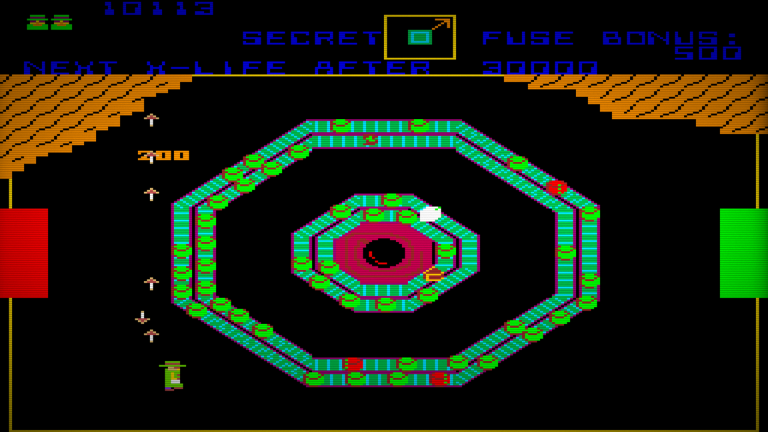
Cloak & Dagger in arcade form. Atari released it in the form of an arcade conversion kit aimed at arcade machines of certain games of its competitors.
The Cloak & Dagger arcade game can be played on your game console with the Atari 50 collection software (over 100 games). This screenshot I captured while playing it on my Xbox Series X console running Atari 50.
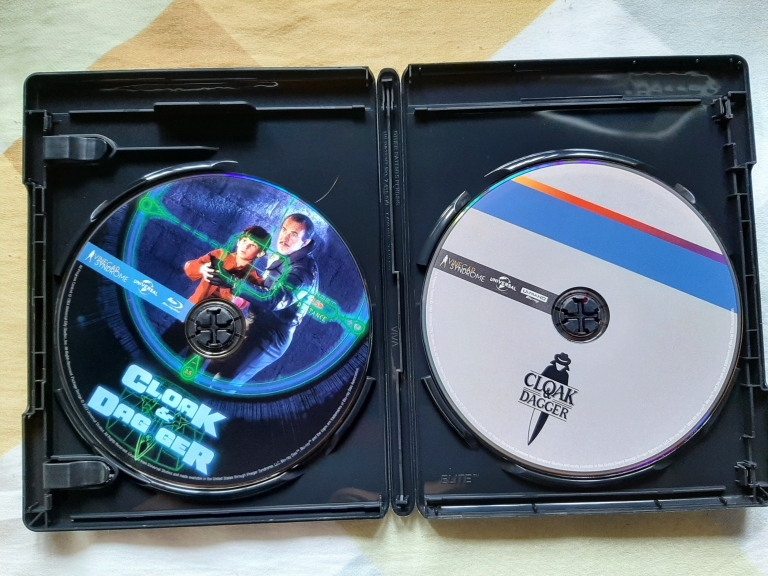
A few weeks ago, my copy of the Cloak & Dagger 4K Blu-ray arrived and it came with two discs: One 4K Blu-ray disc which contained the movie in native 4K (scanned in UHD from the 35mm film) resolution of 3840 x 2160p. The other disc has the same movie in HD (1920 x 1080p) plus the extra stuff which can provide viewers and Cloak & Dagger fans a good amount of important content which will help them learn what the video game elements in the film are, what inspired its creative process and why the film is very unique by today’s standards. There is also an informative new interview with Henry Thomas.
Since then, I saw Cloak & Dagger in 4K twice on my Xbox Series X and its 1080p version on a standalone Blu-ray disc player. Cloak & Dagger in 4K looks better than ever as the picture quality is better, images look sharper and clearer, the colors are vibrant, the small visual details (which were not visible in lower resolution before) are more noticeable now, and film grain structure has been preserved intact!
The two discs. The one on the right is Cloak & Dagger in 4K.
As for the story itself, I still find it engaging and enjoyable to watch from start to finish. Cloak & Dagger is clearly a production of its time as it carries clear Cold War references – the Soviet Union and Iran are the evil forces told in very subtle fashion – as well as video game elements and brands (note: ColecoVision even appeared in this Atari-influenced movie) that dominated America’s console gaming market long before PlayStation, Nintendo and Xbox arrived. For a movie aimed at parents and children, this one has really intense violence as it involves shooting and even some elements of terrorism.
Ultimately, I got a lot of enjoyment from my Cloak & Dagger (1984) 4K Blu-ray and I highly recommend it to Cloak & Dagger fans, gamers, physical media collectors and anyone who loves watching movies in the comfort of home. Cloak & Dagger (1984) is a very unique and fun movie that Hollywood does not make anymore. You really should see it.
In case you are interested or if you have made up your mind, you can order a copy of Cloak & Dagger (1984) 4K Blu-ray by clicking here.
Welcome back, my readers, YouTube viewers and all others who followed this series of articles focused on YouTube videos worth watching. Have you been searching for something fun or interesting to watch on YouTube? Do you feel bored right now and you crave for something to see on the world’s most popular online video destination?
I recommend you check out the following topics and the related videos I found.
#1The miraculous rescue of hostages – In case you missed the news, the Israel Defense Forces (IDF) successfully rescued four Israeli hostages, fought with the Palestinian terrorists and brought the hostages home safely. This not some high-risk operation turned lucky. This operation was a blessing from the Lord God whose covenant with the Jewish people has always been true and standing to this day. All the praise, honor, thanks and glory to Him! Ignore the lies of the Islamo-Leftist mainstream news media and focus on the truth by watching the selected videos below…
#2 European Union (EU) elections resulted in the fall of the Satanic Left – Very recently, a series of elections took place in Europe which determined the composition of the European Union (EU) parliament. European voters who have grown sick and tired of the policies of the Satanic Left (examples: mass migration, taking care of illegal aliens at taxpayers’ expense, fascist climate change policies, government corruption) made their choices by electing more conservative and more nationalistic/patriotic candidates. In Italy, Prime Minister Giorgia Meloni saw her party gain power while the President of France had no choice but to dissolve French parliament (National Assembly) and call for a snap election. Watch and learn more from the videos below…
#3 Documentary of the Houston Rockets’ amazing 1995 NBA championship defense – Never underestimate the heart of a sports champion. That is the moral lesson behind the unbelievable successful NBA championship defense the Houston Rockets achieved in 1995. For the newcomers reading this, the Rockets won the title in 1994 but ended up ranking only 6th place on the Western Conference the following season. This meant that the Rockets had no home court advantage through the NBA Playoffs of 1995. How they defied expectations and overcame tough obstacles to win a 2nd straight NBA championship must be seen in the selected NBA documentary video. Enjoy!
#4 A very deep look back at Lost Odyssey – Lost Odyssey is not just a very notable video game released only on Xbox 360 many years ago. It was arguably the most defining, traditional Japanese role-playing game (JRPG) that can be best described as a Final Fantasy game without the name. To be clear, Lost Odyssey involved the combined talents of Japanese greats Hironobu Sakaguchi (Final Fantasy creator), Takehiko Inoue (famous manga artist) and Nobuo Uematsu (musician always know for Final Fantasy), and it was an ambitious JRPG that also happened to be an Xbox-exclusive game. If you wish to know more about Lost Odyssey, what it has in common with Final Fantasy games and why it remains a very notable game, watch the documentary below…
#5 PatmanQC’s Ring King retrospective – Retro gaming YouTuber PatmanQC published recently his retrospective video about the 1980s game Ring King (also titled as King of Boxer) which is fun and informative to watch.
#6 You, Me and the Movies’ The Blob (1958) reaction – Recently the 1958 version of The Blob was featured by You, Me and the Movies in a movie reaction video which is entertaining to watch.
#7 RK Outpost examines woke Star Wars – It is no secret that under the umbrella of the woke Disney company and the Lucasfilm leadership of Kathleen Kennedy, the established entertainment franchises of Star Wars and Indiana Jones got ruined. Sad to say, Star Wars continues to be made with extreme wokeness and rabid feminism, reaching the point of completely ruining the sci-fi franchise as we know it. Watch and learn from RK Outpost’s videos below…
#8 The evil of Palestinian terrorist group Hamas – It cannot be denied that Palestinian terrorist group Hamas is pure evil. So pure is their evil, they want nothing less than committing complete genocide against Israel and its people. To his day, pro-Palestine zealots cannot even tell the difference between good and evil, and right and wrong. For the Palestinians and its brainwashed supporters (all supported secretly by terrorist state Iran), terrorism, violence and murder are the only ways to achieve what they want. Watch and learn from the videos below…
#9 2024 Xbox Games Showcase videos – Following the lackluster Sony State of Play and Summer Game Fest, Team Xbox and its partners came out blazing with the 2024 Xbox Games Showcase recently. In my view, it was a big improvement over last year’s showcase (which itself was quite good) and there were highlights that should not be ignored. Posted below are selected videos for your viewing pleasure.
Disclaimer: This is my original work with details sourced from reading the comic book and doing personal research. Anyone who wants to use this article, in part or in whole, needs to secure first my permission and agree to cite me as the source and author. Let it be known that any unauthorized use of this article will constrain the author to pursue the remedies under R.A. No. 8293, the Revised Penal Code, and/or all applicable legal actions under the laws of the Philippines.
Welcome back superhero enthusiasts, 1990s arts and culture enthusiasts, Marvel Comics fans and comic book collectors! Today we go back to the year 1990 to take a close look at the comic book adaptation of the movie RoboCop 2 (1990).
Before getting to the new retro comic book review, I should state that my friends and I had a fun time watching RoboCop 2 in the cinema shortly after it opened here in the Philippines. Back then, I was not yet a comic book collector and I rarely visited comic book specialty stores. That being said, I was unaware that Marvel Comics actually published an adaptation in the form of a 3-issue mini-series.
With those details laid down, here is a look back at RoboCop 2 #1, published in 1990 by Marvel with a story written by Alan Grant and drawn by Mark Bagley based on the movie screenplay by Frank Miller and Walon Green.
The cover.
Early story
The story begins in Detroit where the cops are run by corporations and the streets have turned into red-alert war zones. Crime is overwhelming the city and the highly addictive narcotic poses the greatest threat facing societies. The surgeon general who made the public warning about nuke was killed and the crime boss Cain (leader of a cult of nuke addicts and pushers) claims responsibility. Through the news media, Cain tells the public that nuke will make people’s problems go away and people want its paradise.
Under the management of Omni Consumer Products (OCP), several of Detroit’s police officers go on strike demanding better terms from their employer. The City Government of Detroit under Mayor Kuzak missed a payment (in relation to them owing $37 million) and OCP begins to move to foreclose the city and its assets in accordance to the terms of the contract. Mayor Kuzak accuses OCP of engineering the police strike which made crime rampant.
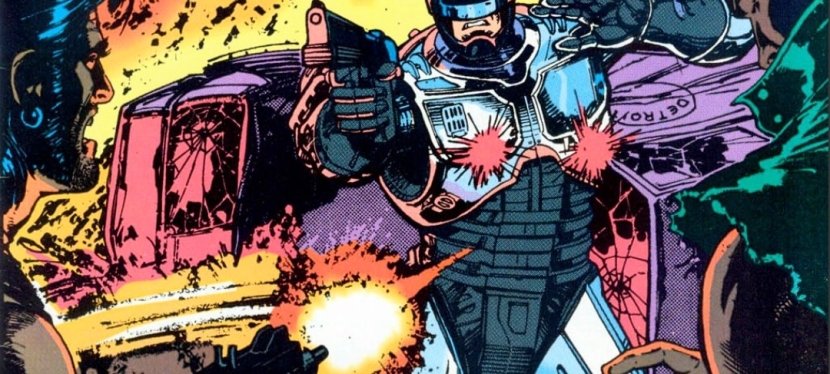
Elsewhere in the evening, the cruel activities of the thugs got disrupted by the arrival of a police car. Even though the police car got destroyed by the thugs, RoboCop emerges and begins to fight back…
Quality
There is simply no holding back for RoboCop when it comes to doing police work at a time when many police officers are on strike while crime has turned more rampant in Detroit.
This opening issue of the mini-series sticks close the basic plot of the movie (right until after Cain’s gang dismantled RoboCop) although there were a few notable differences with the sequence of events and there were scenes that showed the creative team took liberties to make the story suitable with the literary format in mind. That being said, don’t expect to see the key moments of the movie look exactly the same in this comic book and don’t expect to see the characters here looking like the actors who played them on the big screen. In terms of visual and literary presentation, this adaptation has a lot in common with the Total Recall comic book adaptation which coincidentally was released the same year.
For me, this is indeed a really readable comic book that has its stylized approach on telling the movie’s concept. OCP is the most powerful entity in the story while Cain and his gang are clearly the force of evil that strongly pose danger not only to Detroit’s people but even to the very divided police force. Nuke as the dangerous object of the plot clearly was inspired from elements of the real life war against drugs in 1980s America which made this story socially relevant.
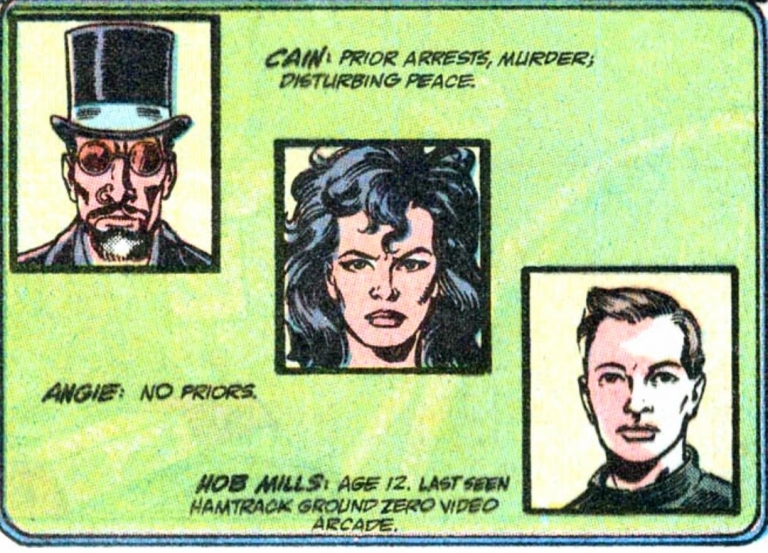
Very clearly these villains look nothing like actors Tom Noonan, Galyn Görg and Gabriel Damon.
Like in the movie, RoboCop here performs his law enforcement duty in an uncompromising manner even though memories of his past life as officer Murphy re-emerged deep inside. That being said, there are a few moments in which you might sympathize with the titular hero as this comic book pays close attention to the conflict between humanity and technology.
The action scenes here are sufficient but clearly don’t come anywhere close to the intensity of the film in terms of violence. Still, there is enough action for readers to enjoy.
When it comes to the visuals, the artwork done by Mark Bagley eerily looks comparable with Tom Lyle’s art in the Total Recall comic book of 1990. For the newcomers read this, Bagley became a popular artist through the Amazing Spider-Man monthly series and the Venom: Lethal Protector comic books that were released after years after this one. Having seen many of Bagley’s works published in 1992 to 1995, I can hardly recognize his art style in this comic book adaptation. The way he drew people’s faces in this comic book looks very different from those seen in Amazing Spider-Man issues. At the same time, Bagley’s own take on RoboCop has that balanced approach on depicting humanity with machinery while also making the hero look less bulky compared to the movie’s version.
Conclusion
Julie Faxx of OCP sure talks like a woke nut and rabid feminist in this scene.
RoboCop 2 #1 (1990) is clearly not a faithful adaptation of selected parts of the movie but that’s not necessarily a bad thing. This is more about the Grant-Bagley team doing their own visual presentation of the movie script copy they had and ultimately they succeeded in making this comic book a stylized and worthy reading experience. This is indeed a surprisingly entertaining read and I can say that I am looking forward to reading the next issue.
Have you been searching for something fun or interesting to watch on YouTube? Do you feel bored right now and you crave for something to see on the world’s most popular online video destination?
I recommend you check out the following topics and the related videos I found.
#1Debunking the lies of the Palestinians and the Satanic Left – Israel has been all over the news for over a month now as the Palestinian terrorist group Hamas attacked them on October 7, 2023, and committed acts of murder, kidnapping and torture of many innocent people (including foreign nationals). Israel responded by going into war with Hamas and already they have several soldiers operating inside the Gaza strip searching for the terrorists while trying to rescue the hostages.
Around the world, anti-Semitism has intensified as a lot of public rallies or protests events supporting the Palestinians and condemning Israel continues to happen. Unsurprisingly, the Satanic Leftist elements in governments, mainstream news media outlets and social media all organized a major misinformation campaign highlighting the Palestinians as victims while portraying Israel as the antagonists. Collectively these Communists, socialists, Marxists, liberal, diversity advocates and other anti-Semitic elements have been spreading lies repeatedly to attack Israel while lifting up the Palestinians.
Fortunately, YouTuber Oren who handles the channel travelingisrael.com published in-depth videos that debunked the Arab-Palestine-Hamas-Leftist propaganda complete with details and facts that the liars did not even bother to check. I stand with Israel and the Holy Bible confirms that Israel is the land that God designated to the Jewish people (read Genesis 12:1-3 and Genesis 35:10-12), not the Arabs and certainly not the Palestinians. There really never was an ancient Palestine and the Palestinian identity as a people did not even exist before the 20th century (not even during the time when the Ottoman Empire had authority over the land of Israel). That being said, I strongly recommend you watch the videos below and pay close attention to the details…
#2 Trustworthy look at Israel – Still on Israel, I want to tell you all that you cannot trust the mainstream news media outlets as they have an anti-Israel and anti-Semitic agenda in connection with their Leftist worldviews. You cannot trust CNN, MSNBC, The New York Times, BBC, Vox and others as they are laser-focused on smearing Israel and putting the lives of Jewish people in danger. Those abusers of media and information are spreading lies and hate! If you want a clearer and more credible look at Israel and the developments that happened, I recommend you follow CBN News (the news program of the Christian Broadcasting Network) and TBN Israel. Posted below are some of their YouTube videos for you to see…
#3 Macross nostalgia videos – And new we shift into the world of entertainment. When it comes to the world of anime, Macross is my favorite franchise. To be more specific, the Super Dimension Fortress Macross TV series, Macross: Do You Remember Love? (read my retro movie review by clicking here), Macross Plus and Macross Zero are the ones I enjoyed replaying and there were some video game adaptations released along the way (read my retro game review by clicking here). If you share my Macross passion or if you are simply interested with anime and related video games, I recommend you watch the videos below…
#4 Cloak & Dagger (1984) nostalgia – A few months ago, I published my retro review of the 1984 movie Cloak & Dagger which remains a very unique film by today’s standards. For one thing, the film was the 4th cinematic adaptation of the short story “The Boy Cried Murder” written by Cornell Woolrich. It also had Henry Thomas (the same kid in Steven Spielberg’s E.T.: The Extra-Terrestrial) as the protagonist, a plot filled with strong elements of espionage, a video game as a key item in the story, and most notably, a very intense tone complete with shooting and killings. Cloak & Dagger, which is now available on 4K Blu-ray format, is the kind of movie that Hollywood does not make anymore. Of course, I do understand that Hollywood has so many Commies and SJWs (social justice warriors) among its screenwriters, actors and directors who could not understand Cloak & Dagger. To learn about the 1984 movie, watch the videos below…
#5Friday The 13th Part 3 reaction and retro review videos – Some time ago I declared in my retro review that Friday The 13th Part 3 is the 2nd best film of its franchise (note: Friday The 13th: The Final Chapter is still #1). Sure, it was flawed and the filmmakers struggled to make the movie as they intended to film it with 3D cinema viewing in mind, but the way things turned out it marked a crucial turning point in Friday The 13th’s general formula on storytelling and the presentation with Jason Voorhees as the enduring antagonist. This is the very movie when Jason first got his hockey mask and the actor’s muscular build gave him a more intimidating look than in Part 2. That being said, it is no surprise that the 1982 movie became the subject of multiple movie reaction videos and retro reviews on YouTube and you can watch some of them (plus one trivia video by Minty Comedic Arts) below…
Disclaimer: This is my original work with details sourced from watching the movie Cloak & Dagger (1984) and doing personal research. Anyone who wants to use this article, in part or in whole, needs to secure first my permission and agree to cite me as the source and author. Let it be known that any unauthorized use of this article will constrain the author to pursue the remedies under R.A. No. 8293, the Revised Penal Code, and/or all applicable legal actions under the laws of the Philippines.
Welcome back my readers, fellow movie buffs and 20th century pop culture enthusiasts! Decades ago, I got to watch the movie Cloak & Dagger when it was first released on home video. As time passed by, I got to replay it on cable TV and DVD. I have yet to see its 4K Blu-ray disc version (note: you can order it here) Starring Henry Thomas (the star of Steven Spielberg’s E.T.: The Extra-Terrestrial) and Dabney Coleman, Cloak & Dagger was one of those American movies that did not succeed in movie theaters but found its audience on home video, cable TV and free TV.
The 1984 movie was released at a time when video games gradually made its way into motion pictures in varied ways just before Nintendo started reshaping video gaming. Back then, I was very young and already got into playing games on console and at the arcade which helped me relate with the video game elements of Cloak & Dagger. In case you are wondering, the filmmakers and Atari, Inc. itself collaborated together. There may be some among you who never saw this 1980s flick and some of you may be wondering what is significant about Cloak & Dagger and why is it the topic of this retro movie review.
With those details laid down, here is a look back at Cloak & Dagger (1984) directed by Richard Franklin and written by Tom Holland and Nancy Dowd inspired by the short story “The Boy Cried Murder” written by Cornell Woolrich. This movie is the 4th cinematic adaptation of the said short story.
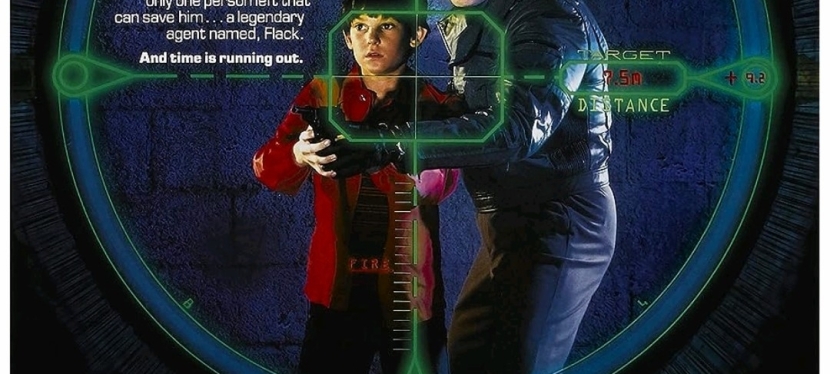
The movie poster of Cloak & Dagger (1984)
Early story
The story begins with Jack Flack (Dabney Coleman) overcoming Soviet guards to enter a place to retrieve top secret documents from incoming people. It turns out that Jack Flack is nothing more than a fictional character imagined by a young boy named Davey (Henry Thomas) who keeps on immersing himself with flights of fantasies, loves playing games and believes that real life is filled with enough opportunities and places to play. In the presence of game store owner Morris (William Forsythe) and his little blonde neighbor Kim (Christina Nigra), Davey boasts a lot about Jack Flack as if he was a real-life hero and even talks to him as his imaginary companion that no one else could see nor hear. Inspired by the said character and the world of espionage he always imagined, the boy carries with him a black water pistol for a “gun” and a softball for a “grenade”.
Morris then sends Davey and Kim out to do a real assignment – an errand to travel within the city going to a certain company and retrieve something for him. Afterwards, the two commuted and entered a building which Davey does with his fantasy of espionage and infiltration burning in his mind. Leaving Kim on the ground floor, he climbs up the stairs until he reaches a certain window and sees something sinister going on in the next level as reflected on one of the windows outside.
Suddenly a door opens near him and a wounded man slowly hands him an Atari 5200 cartridge titled Cloak & Dagger, tells him to bring it to the FBI, and mentions “one million three hundred twenty nine.”
The door near them suddenly opens with two armed men emerging. Right in the presence of Davey, they opened fire at the wounded man who fell down to his death. Davey just became the witness of an actual murder and becomes the target of the two gunmen…
Quality
Henry Thomas and Christina Nigra as Davey and Kim respectively.
To get to straight to the point, I can declare that this movie is very clearly a spy thriller designed to engage both children and adults. It took the key concept of the short story “The Boy Cried Murder” and implemented it into its very own tale that happens to be set during Ronald Reagan’s America (the 1980s) with elements of video games, espionage and even murder mixed together.
The story told through Davey was crafted to be entertaining while keeping viewers in suspense as to how the overly imaginative young boy would deal with real-life danger and consequences as he became the target of murderous men who would not stop at all. Davey is clearly in danger for much of the movie and you will get to sympathize with him and wish he should stop being obsessed with fantasy so he could overcome the trials that were happening. This is, indeed, a well structure and nicely directed work by Richard Franklin who seem to be inspired by past works of Alfred Hitchcock (note: Franklin directed the sequel to Hitchcock’s classic Psycho).
As mentioned earlier, this movie was made to engage both children and adults. Cloak & Dagger is not exactly a wholesome viewing experience as its presentation has always been quite intense because of on-screen violence that was executed carfully. There are guns, shooting and even killing in this flick which proved to be integral to the overall presentation and clearly added to the thrill factor. You will get to see getting Davey shot at by the armed henchmen (Eloy Casados and Tim Rossovich) who clearly do not give a damn of shooting a minor as they are so focused on their mission. Looking at the henchmen in this film, I can imagine them as traitorous Americans conspiring with their nation’s foreign enemies such as the Soviets, the Iranians and the Palestinians. Along the way, there is the clear villain named Rice (Michael Murphy) who has this subtle touch of evil as well as a good amount of sleaziness in him. While the violence is intense, it does not necessarily push this film into rated R territory.
Michael Murphy as the sleazy villain who is willing to kill Davey even though he is a minor.
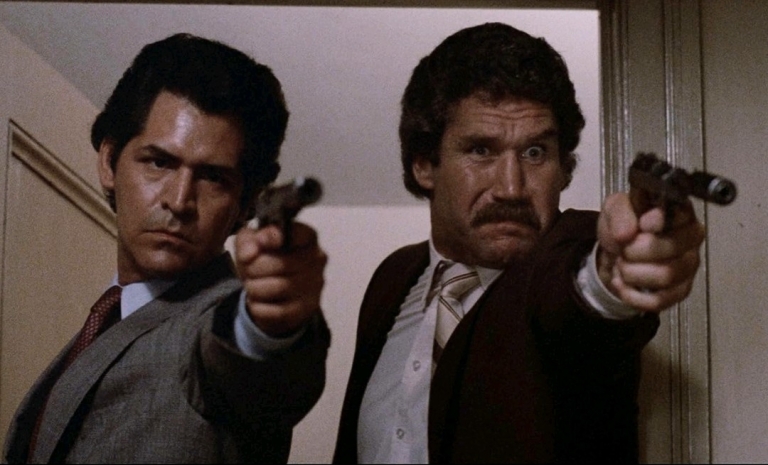
The two henchmen about to commit murder in the presence of Davey. There is evil visible in their faces.
Henry Thomas really shines as the protagonist here. While Davey here shares a few elements with E.T.’s Elliot – struggling to move forward with the absence of one parent and adjusting his life with what he perceives to be the best ways possible – he truly dramatizes how weird and wild he could be living his life with a very loose grip on reality. For him, local society in San Antonio, Texas, provides him a huge playground for his spy game and he sure distracts people as he walks by them talking to his imaginary friend Jack Flack. Still, there are key parts of the story in which Henry Thomas convincingly dramatizes Davey who feels lonely inside as he misses his late mother and is unable to spend quality time with his father. Thomas also acted with intensity in the scene in which he makes a trade with the villain and also during his last face-off with him in the 2nd half of the film. Henry Thomas really was a good youth actor and his performance here is often overshadowed by his role in Spielberg’s E.T.
Dabney Coleman on the other hand plays both Jack Flack and Davey’s father Hal. Coleman is quite versatile playing different characters here. As Jack Flack, he fits in excellently into Davey’s uncontrolled belief of espionage as he gives him advise which were taken seriously leading into danger. Of course, advising Davey does not really mean the fictional spy cares for him on a personal level and you will eventually Flack’s true value before the film ends. Flack’s final moments could inspire you to re-examine the true meaning of heroism. As Hal, Coleman convincingly plays the father who has been so busy working in the Air Force as an air traffic controller, he has been unable to spend quality time with his son and the recent death of his wife really took its toll on their family. Compared to Jack Flack, Hal is indeed caring towards his son but his hectic work schedule prevents him from bonding closely with him. Coleman delivered a fine performance during the scene when Hal explains to Davey what real-world heroism is and that not all heroes just shoot bad guys. There definitely are helpful values on parenting within Hal.
Henry Thomas and Dabney Coleman are really convincing as son and father.
Thomas and Coleman artistically have really fine chemistry together as the father and son (Hal and Davey) and as the wannabe adventurer spending lots of time with his action hero (Davey and Jack Flack). Considering Davey’s obsession with fantasy and the attention he pays so much to Jack Flack, he was practically living with idolatry and foolishness. If you observe closely, Davey is very lively with Flack and not so lively with his father.
Even though this movie is fictional, it still dramatizes that parenting will never be easy. That being said, this should inspire parents and also incoming parents to prepare themselves on nurturing their children and ensure they help them understand the differences between reality and fantasy.
Video game elements
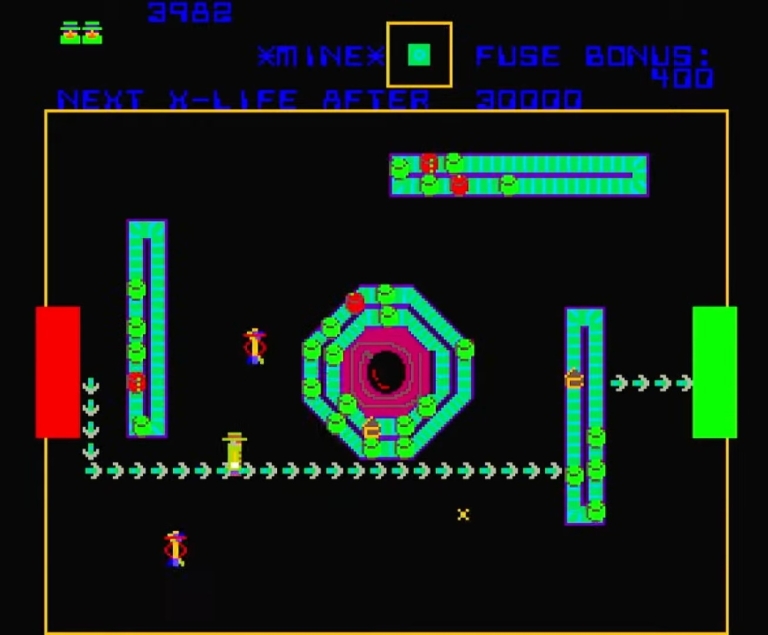
Screenshot from the Cloak & Dagger arcade game. This game can be played nowadays through Antstream Arcade on Xbox consoles.
To make things very clear, Cloak & Dagger (1984) is not an adaptation of the electronic game that was released the same year. Rather it has the Cloak & Dagger game as a key plot element in the form of an Atari 5200 game cartridge (referred to as a “tape”) which the movie dramatizes to be real.
As a kid, I got to play arcade and console games a lot. As such, seeing Davey play the Cloak & Dagger game on his Atari 5200 as well as gameplay footage was a very entertaining viewing experience for me the first time I ever saw this movie. It was a scene I personally related with.
In real life, however, the Cloak & Dagger game from Atari, Inc. was released only in the arcades as the efforts to create a port for the Atari 5200 never got fulfilled. That being said, it was through very clever film editing that video footage of the arcade version were inserted into the scene in which Davey played the Cloak & Dagger cartridge on his console in the presence of his father. To clarify things, the Atari 5200 was a commercial failure in real life and it seems that making a console version of the arcade game did not make business sense to Atari, Inc. at all.
If you want to play the Cloak & Dagger arcade game in your home right now, you will need an Xbox console and Antstream Arcade ($30 for 1-year subscription, $80 for lifetime pass). Cloak & Dagger is just one of over a thousand games available through Antstream Arcade and you can learn more by clicking here and here.
Conclusion
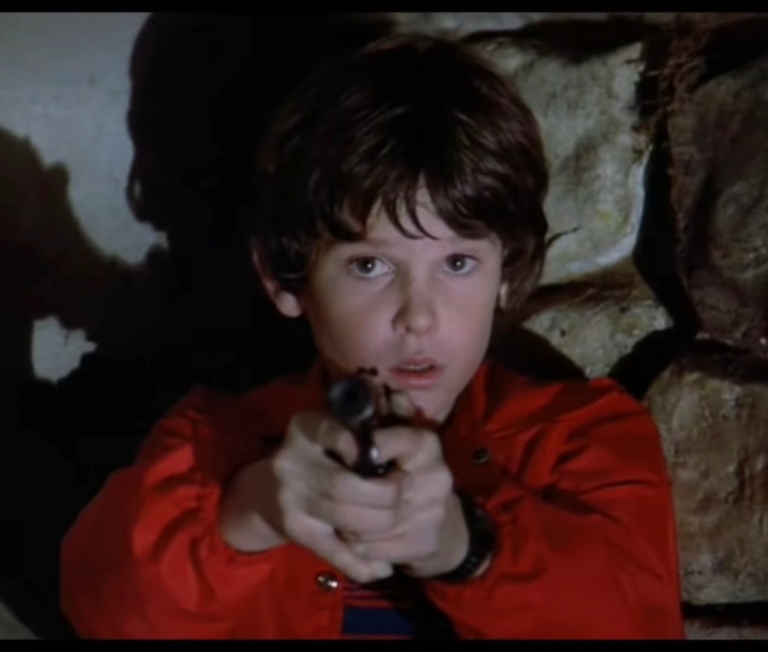
Henry Thomas as an armed Davey.
I have seen Cloak & Dagger (1984) many times throughout my life from childhood and to adulthood. I can clearly say that this 1980s movie is still really good to watch as its appeal to both children and adults remains strong and intact. It is a medium-paced spy thriller that not only follows a young boy who witnesses and murder and gets into danger (note: even his neighbor gets involved) but also dramatizes (in entertaining ways) how dangerous situations can get when you are living with uncontrolled personal fantasy and interacting with a heroic friend who does not really exist. Considering the time this movie was released, I am delighted to tell you cautious readers that there definitely is no wokeness nor were there any traces of political correctness that got in the way of its presentation. Going back to the parenting aspect of this film, it is made clear that children need their parents for moral support and there is absolutely no way that games, fictional heroes and geek culture could ever be good alternatives. Like the adults, children should never lose their grip on reality and should be taught that uncontrolled fantasy can lead to real-life danger. Very clearly, director Richard Franklin and the crew did a fine job telling a solid story and emphasizing the main characters while also providing suspense, action and thrills.
Considering all the mixed elements it has, Cloak & Dagger (1984) can be engaging towards parents, their children, fans of espionage and people who love video games. Finally, I should state that the City of San Antonio in the Lone Star State of Texas is indeed a great location for filmmaking and viewing.
Disclaimer: This is my original work with details sourced from reading the comic book and doing personal research. Anyone who wants to use this article, in part or in whole, needs to secure first my permission and agree to cite me as the source and author. Let it be known that any unauthorized use of this article will constrain the author to pursue the remedies under R.A. No. 8293, the Revised Penal Code, and/or all applicable legal actions under the laws of the Philippines.
Welcome back superhero enthusiasts, 1990s culture enthusiasts and comic book collectors! Today we go back to the early 1990s and explore a part of the Valiant Comics shared universe through the Harbinger monthly series.
In my previous retro review, Sting, his teammates and Solar left the Harbinger facility in Texas after having an intense talk. As far as Solar is concerned, Sting is dangerous and irresponsible. He also advises the powered teenagers to abandon their mission of crushing Toyo Harada. As soon as Solar leaves, Sting decides to lead his teammates back to the Harbinger facility to resume their quest without any real preparation nor analysis. This led to a series of unfortunate events.
With those details laid down, here is a look back at Harbinger #7, published in 1992 by Valiant Comics with a story written by Jim Shooter and drawn by David Lapham.
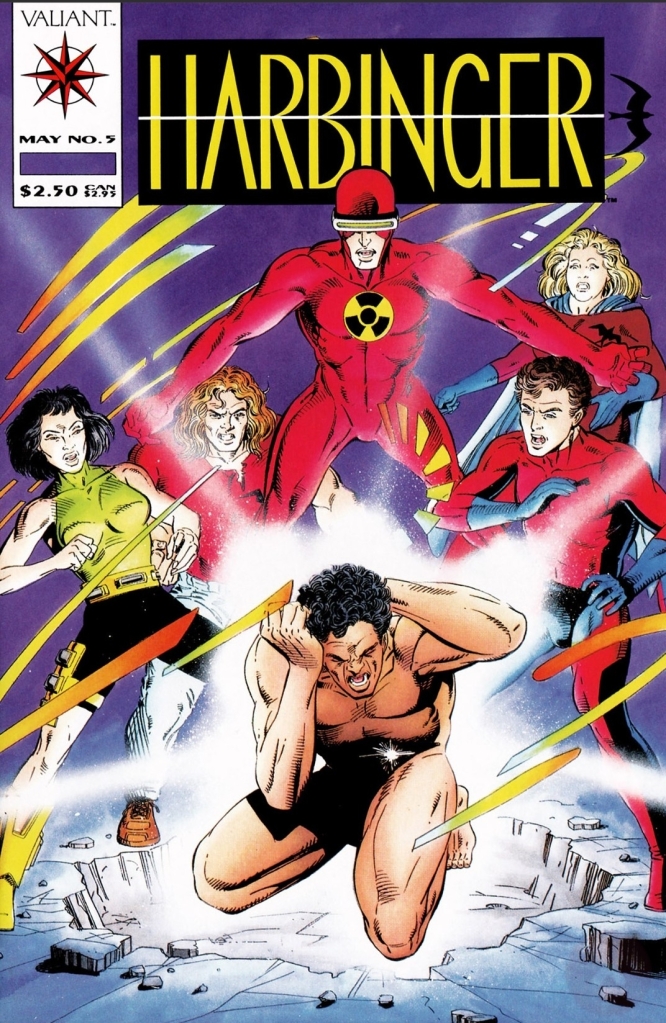
The cover.
Early story
The story begins late one evening on a road in Louisiana. Sting, Kris, Faith and Flamingo are agonizing over the sight of Torque who was just been killed by an insider while inside an ambulance.
As Flamingo starts the model prayer, Sting reveals to them that he was inside Torque’s mind and witnessed him bidding goodbye. As the police suddenly arrive, Sting and his teammates quickly climb up a tree and watched from a distance. As the cops check on the wreckage and Torque’s dead body, Sting says that the ambulance was probably registered to Eight Day or some phony front for Harbinger. Faith, Sting, Flamingo and Kris discreetly fly away to get some rest and reorganize themselves.
Elsewhere, a team of powered young adults receive much-needed assistance from the Eight Day crew and truck that arrived. They have a few teammates who got seriously injured during their battle with Sting’s team. Harada’s limousine arrives and the head of Harbinger talks with Weasel and Rock. While the two young adult tell Harada they eliminated Torque whom they identified as priority number two, the powerful boss tells them of their personal weak points and that they lost their focus on eliminating Sting who is the number one priority as he is perceived to be the greatest threat to Harbinger. Harada declares Weasel and Rock placed on probation…
Quality
Sting and his team commit another crime for the sake of their departed friend Torque.
The best way to describe this story is that it is essentially the aftermath of the hard battles they went through in issues #5 and #6. The main theme in this comic book is the loss of a friend (as opposed to the loss of a super human) and Jim Shooter used the loss to redevelop the main characters in varying ways. That being said, Shooter showed what the false sense of maturity among teenagers is like and why such young people lose self-control and let their emotions overwhelm their ability to reason. The pain of Torque’s death conveniently kept Sting, Faith, Flamingo and Kris from feeling any guilt about the crimes they committed (as seen in issue #2) as their leader’s obsession with beating Harada remained unchallenged. For those who love dramatics, the funeral scene is a must-see.
Apart from the story of Sting and his teammates, this comic book sheds light further on the Harbinger foundation’s use of powered young adults who were trained to use violence without any regret nor restraint. In relation to this, I find the dialogue of Toyo Harada during his interaction with Weasel and Rock to be richly layered as it emphasizes his authority and insight about priorities as well as his own in-depth knowledge on each member of his personnel. This makes Harada even more intimidating as this series’ primary super villain.
Conclusion
The impact of Torque’s death is felt strongly.
While it lacks spectacle as it was focused more on character development related to the loss of an established main character, Harbinger #7 (1992) is a dramatic character study that was compelling to read from start to finish. While the previous few issues subtly showed that the boundary between good and evil was blurred away, this comic book dramatized Sting, Faith, Flamingo and Kris to be more human and emotional. The death of Torque in the previous issue really showed its impact on his teammates realistically. Readers who enjoy dramatics will enjoy this.
Overall, Harbinger #7 (1992) is highly recommended!
Disclaimer: This is my original work with details sourced from reading the comic book and doing personal research. Anyone who wants to use this article, in part or in whole, needs to secure first my permission and agree to cite me as the source and author. Let it be known that any unauthorized use of this article will constrain the author to pursue the remedies under R.A. No. 8293, the Revised Penal Code, and/or all applicable legal actions under the laws of the Philippines.
Welcome back superhero enthusiasts, 1990s culture enthusiasts and comic book collectors! Today we go back to the early 1990s and explore a part of the Valiant Comics shared universe through the Harbinger monthly series.
In my previous retro review, Peter/Sting, Kris, Faith/Zephyr, Charlene/Flamingo and John/Torque plus Ax returned from space. Due to his traitorous act against them, Ax was dropped by the team with a sense of rejection. It turns out, months had passed by on Earth which really shocked Sting and his teammates.
With those details laid down, here is a look back at Harbinger #5, published in 1992 by Valiant Comics with a story written by Jim Shooter and Janet Jackson, and drawn by David Lapham.
The cover.
Early story
The story begins on March 5, 1992 in New Orleans, Louisiana. Sting, Fatih, Flamingo, Kris and Torque are on vacation together. With hours to spare before having a group dinner, the team decide to split up and have fun discovering the local places individually.
That evening, while having a nice dinner together, Kris notices Sting looking tense. Sting reveals that he senses the presence of Toyo Harada and moments later, he and his teammates saw the TV news about the terrible explosion on a building in Dallas, Texas.
Over at the airport in Dallas, Toyo Harada arrives from Louisiana. He and his personnel travel together to the site of the explosion…
Quality
Harada arrives in Dallas, Texas.
I really liked the story here. Without spoiling the plot, the writers crafted a tale about a major incident that affected not only Sting and his teammates but also the Harbinger foundation (including Toyo Harada himself) and even Valiant’s major figure Solar. Along the way, the creative team slightly expanded the lore of Harbinger within Valiant’s shared comic book universe further (specifically through the Harbinger foundation) before the crossover with Solar happened.
The story started in a really interesting way. I really enjoyed the way Sting, Faith, Kris, Torque and Flamingo were portrayed when they were not doing any superhero-related stuff as they enjoyed their vacation New Orleans. That being said, I felt like I was watching scenes of American teenagers from the 1980s movies written or directed by John Hughes. The scene in which Faith surprised Torque in the city zoo was amusing and believable to read.
Conclusion
Flamingo, Kris, Torque and Faith on vacation in New Orleans.
With a fine balance of spectacle, characterization, exposition and the obvious crossover with Solar, Harbinger #5 (1992) is yet another solid Valiant comic book to read. The progression of the development of Sting and his teammates moved forward some more while simultaneously building up the presence of the Harbinger foundation as the most antagonistic non-military organization in the entire Valiant comic book universe of the era. This is a must-read!
Overall, Harbinger #5 (1992) is highly recommended!
8-million-strong Christians United for Israel produce cutting-edge documentary — ‘Never Again?’
SAN ANTONIO, Texas — From Pittsburgh to Poway anti-Semitism is increasing in both prevalence and violence in the U.S. and around the world. But the nation’s largest pro-Israel organization – Christians United for Israel – is fighting back and has produced NEVER AGAIN?, a cutting-edge, feature-length documentary to expose and combat increasing violence and bigotry.
NEVER AGAIN? premieres in 800 theaters nationwide for two nights only Oct. 13 and 14 at 7 p.m., local time. The documentary is distributed through Fathom Events.
“Violent anti-Semitism is rising across the country, and people of conscience cannot sit idly by,” said CUFI founder and Chairman Pastor John Hagee. “Anti-Semites have used the fertile ground of ignorance to grow their malicious ideology. If we are to stem the tide, we must inoculate the next generation against the world’s oldest hatred by empowering them with knowledge and reaching them with a message of unity. If we are to fulfill the promise of Never Again, we cannot allow the memory of the Holocaust to fade.”
The film from the 8-million member CUFI could not be more timely. Just this month, 200 survivors of the infamous Auschwitz Nazi extermination camp gathered for Holocaust Remembrance Day. At almost the same time, Pew Research showed 45 percent of Americans did not know 6 million Jews died in the Holocaust.
“Viewers of the film will be guided by a Holocaust Survivor and a former radical Islamist,” said Producer Rick Eldridge, CEO of ReelWorks Studios. “They will learn about the history of anti-Semitism and come to understand why all of us, regardless of faith or political persuasion, have a responsibility to keep the promise of Never Again.”
NEVER AGAIN? will engage contemporary audiences with the horrific events of 75 years ago and demonstrate why they must be understood and remembered by the coming generation.
“This is not your parents’ documentary,” said CUFI co-executive director Shari Dollinger. “It meets the audience where they are, engaging them in a modern and cutting-edge manner. If we’re not to see history repeat itself, we must ensure the next generation learns the lessons of the past.”
About Christians United for Israel (CUFI)
As the largest pro-Israel grassroots organization in the United States, Christians United for Israel is also the only Christian organization devoted to transforming millions of pro-Israel Christians into an educated, empowered, and effective force for Israel. For more information, visit https://www.cufi.org
+++++
This is an official press release sourced from CUFI.org.