With growing demand for high-quality protein realized, the Philippines will keep importing more dairy products from the United States, according to a news report by the Manila Bulletin. It should be noted that the Philippines does not have a huge dairy production and local consumption of dairy (and other products that require dairy to be made) kept on growing.
To put things in perspective, posted below is an excerpt from the Manila Bulletin news report. Some parts in boldface…
The Philippines is expected to increase its imports of dairy products from the United States (US), driven by growing demand for high-quality protein and limited local dairy production, according to the US Dairy Export Council (USDEC).
USDEC Regional Director Dali Ghazalay said US dairy exports to the Philippines are on track to remain strong this year, as demand for dairy products continues to expand.
She said the demand is particularly strong when it comes to meeting the country’s nutrition needs, with dairy playing a crucial role in nutritionally adequate diets.
“The demand for dairy will still be very strong because of nutrition and what dairy can contribute to the nutrition needs of the Philippines,“ Ghazalay said on the sidelines of USDEC’s trade seminar on Thursday, Aug. 13.
Based on USDEC data, US dairy exports to the Philippines are estimated at around 143,000 metric tons (MT). Top exports include skim milk powder, buttermilk powder, and dairy permeate.
Currently, the Philippines is the top export destination for US dairy goods in Southeast Asia, according to USDEC.
Increased demand this year is expected to be driven by dairy products with high-quality nutritional protein, such as skim milk powder.
Ghazalay said demand is also on the rise for whey proteins and milk proteins, which are usually integrated into high-value-added products such as protein powder for fitness purposes.
Ultimately, she noted that increased dairy demand from the US is also a direct result of the country’s subpar domestic output, which remains unable to meet local demand.
“Local dairy production is still very small. And you do need to supplement that with different dairy ingredients to meet all these different products that the consumers here need,” said Ghazalay.
Let me end this post by asking you readers: What is your reaction to this recent development? Do you feel confident that nuclear energy will be realized in the Philippines in your lifetime? Did you encounter a lot of people living with nuclear fear?
Thank you for reading. If you find this article engaging, please click the like button below, share this article to others and also please consider making a donation to support my publishing. If you are looking for a copywriter to create content for your special project or business, check out my services and my portfolio. Feel free to contact me with a private message. Also please feel free to visit my Facebook page Author Carlo Carrasco and follow me on Twitter at @CarloCarrascoPH as well as on Tumblr at https://carlocarrasco.tumblr.com/and on Instagram athttps://www.instagram.com/authorcarlocarrasco
The Philippines, which has been struggling with weak economic growth and high inflation, attracted 3.7 million international visitors in the first 7 months of this year, according to a news report by BusinessWorld.
Be mindful that the words “international visitors” includes both foreign tourists as well as Filipinos who are based abroad who happened to return to the country as “balikbayan”. For insight, the Philippines attracted 5.9 million foreign tourists in 2025 plus over half-a-million Filipinos from overseas which combines for 6.4 million international visitors for the year. For the first half of 2026, the nation attracted 2.9 million foreign tourists.
To put things in perspective, posted below is an excerpt from the BusinessWorld news report. Some parts in boldface…
The number of Philippine international visitors grew to around 3.7 million as of July, buoyed by more relaxed visa policies, with growing markets seen in China, India, and Taiwan, according to the Department of Tourism (DoT) on Friday.
DoT Undersecretary Verna Esmeralda C. Buensuceso cited the figure, noting a 4.25% increase in tourist arrivals compared to last year.
“From January to July this year, the Philippines welcomed approximately 3.7 million international visitors, representing a 4.25% increase in visitor arrivals compared to the same period last year,” Ms. Buensuceso said during the launch of the 4th Travel Sale Expo 2026.
“We are seeing good growth from markets like China at 67%, India at 34%, and Taiwan at 11.21% growth, buoyed in large part by more liberal visa policies,” she added.
The tourism Undersecretary also noted sustained growth trajectories from the country’s traditional foreign markets such as the United States of America, Canada, and Japan, driven by additional flights.
The country is also experiencing double-digit to triple-digit growth in international arrivals from our Southeast Asian peers, such as Indonesia, Vietnam, Myanmar, Cambodia, Laos, and Timor-Leste, due to the ongoing ASEAN Summit 2026 where the Philippines serves as the host country.
“These are encouraging signs, but let me emphasize that our goal is not simply to increase the number of arrivals,” Ms. Buensuceso said.
“Our real goal is to increase the value of tourism. We want tourism to create more jobs, attract more investments, and generate more opportunities that reach communities across the country,” she added.
The tourism industry contributed 8.1% to the country’s gross domestic product (GDP) in 2025, down from 8.7% in the previous year, according to the Philippine Statistics Authority (PSA). It also employed around 7.70 million Filipinos in 2025.
Let me end this post by asking you readers: What is your reaction to this recent development? Do you think the DOT is padding the numbers on tourist arrivals to avoid embarrassment in the near future? Do you think the Philippines will be able to surpass 2025’s 5.9 million foreign tourist count by the end of this year? Do you believe that hosting the ASEAN Summit is actually helping the Philippine attract more tourists from its Southeast Asian neighbors?
Thank you for reading. If you find this article engaging, please click the like button below, share this article to others and also please consider making a donation to support my publishing. If you are looking for a copywriter to create content for your special project or business, check out my services and my portfolio. Feel free to contact me with a private message. Also please feel free to visit my Facebook page Author Carlo Carrasco and follow me on Twitter at @CarloCarrascoPH as well as on Tumblr at https://carlocarrasco.tumblr.com/and on Instagram athttps://www.instagram.com/authorcarlocarrasco
Disclaimer: This is my original work with details sourced from reading the comic book and doing personal research. Anyone who wants to use this article, in part or in whole, needs to secure first my permission and agree to cite me as the source and author. Let it be known that any unauthorized use of this article will constrain the author to pursue the remedies under R.A. No. 8293, the Revised Penal Code, and/or all applicable legal actions under the laws of the Philippines.
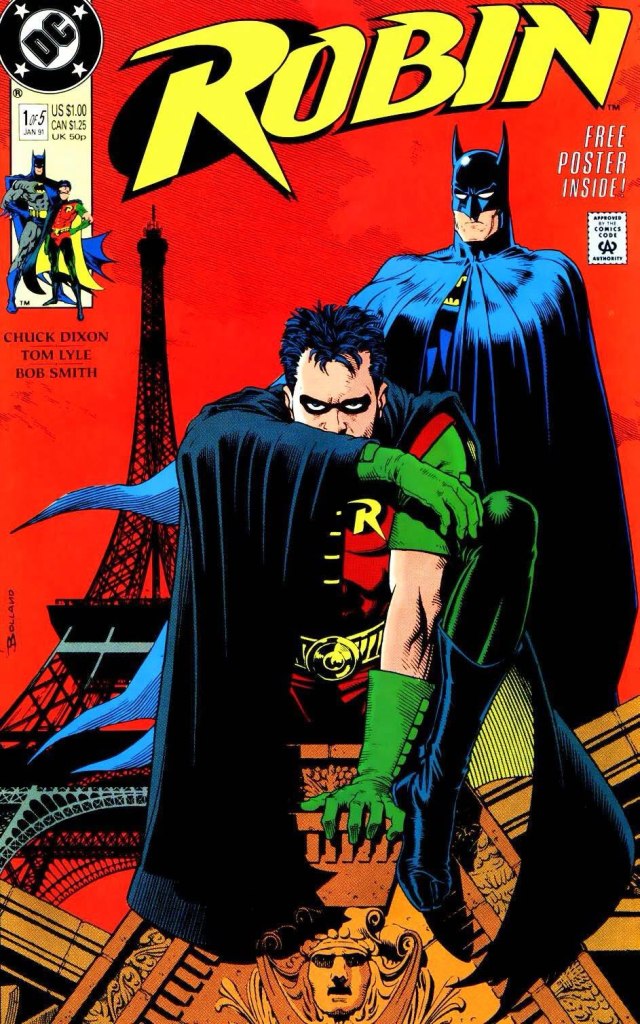
Welcome back superhero enthusiasts, 1990s culture enthusiasts and comic book collectors! Today we go back to the year 1991 to explore a part of the DC Comics shared universe through one very notable comic book featuring Batman’s sidekick Robin.
For decades, the Caped Crusader Batman (who is business tycoon Bruce Wayne during the day) had Robin as his skilled teenage partner fighting countless waves of criminals in many comic books published through the decades. The most notable fact about Robin is that there are three different characters who took the role as Batman’s sidekick…Dick Grayson (who later joined the Teen Titans and became Nightwing), Jason Todd (who died as a result of a warehouse explosion set up by the Joker who beat him mercilessly) and Tim Drake. Behind the scenes at DC Comics, a decision was made to publish a comic book mini-series featuring Tim Drake Robin.
With those details laid down, here is a look back at Robin #1, published in 1991 by DC Comics with a story written by Chuck Dixon and drawn by the late Tom Lyle.
Early story
The story begins inside the Batcave. Tim Drake is still adjusting in his new role as Robin and right in front of Bruce Wayne (wearing his Batman costume), he feels uneasy deep inside even though he got the role after wanting it so badly. He just could not tell him how much it scares him.
Even though Tim admits he feels unsure and needs more time, Bruce tells him he is ready to be his partner. Still the new Boy Wonder says he is not sure if he has what it takes. Bruce reminds Tim that he has proven to be smart after figuring out correctly his secret identity as Batman. He tells him that he needs to develop himself more to gain his edge.
Meanwhile in Japan, the deadly assassin Lady Shiva meets the martial artist Koroshi and discovers he has been paralyzed and limited on a wheelchair…
Quality
Tim Drake undergoes training in Paris. Bruce Wayne sent him there to improve himself by learning from a master.
As a tale strongly focused on Robin, this comic book has a fine blend of action, discovery, intrigue and even elements of culture clash. It gradually dramatizes Tim Drake’s development into Robin showing moments of trial-and-error, getting himself educated far away from home, experiencing humiliation and overcoming the odds while having limitations.
The script written by Chuck Dixon is not limited to presenting how the newest Robin came to be. I enjoyed how Dixon crafted Tim Drake’s private talks with Batman and the butler Alfred Pennyworth. Each interaction with the established characters were rich in details and there is that sense of the new Robin looking up to Batman as his mentor and to Alfred as a guidance councilor.
The new Robin learns valuable lessons from Alfred at Wayne’s residence.
By going all the way to France to learn from an Asian master, Tim Drake’s journey has some similarities with how Bruce Wayne developed himself into becoming Batman. It should be noted that this tale took place sometime after the death of his predecessor Jason Todd (beaten by the Joker who eventually became the Islamic terrorist regime of Iran’s ambassador to the United Nations) and it is indeed a part of Batman becoming more stable after overcoming the trauma of Todd’s demise.
For those who still find Robin as an unbelievable teenage crime fighter simply because of his youth, there are young gangsters in this tale that symbolically are the opposites of Batman’s sidekick. This was Chuck Dixon’s way of reminding people that there are indeed teenage criminals or youth gangs that exist around the world. Such young criminals or abusers still exist to this day and Robin’s status as a teenage crime fighter is clearly justified.
As a standalone tale, this comic book is pretty good and there is clear coordination between Chuck Dixon and Tom Lyle who did a fine job visualizing the script. Lyle’s art has this fine balance visualizing character development scenes, transition scenes and dynamic action. Historically, Lyle went on to draw the Robin II and Robin III mini-series for DC Comics before moving to Marvel Comics to work on Spider-Man comic books. In this very comic book, you can see how talented Lyle really was on illustrations.
Conclusion
Batman and Robin in an early scene in this comic book. Pay attention to the details.
Even though I am not a fan of Robin, I can say that the Dixon-Lyle duo succeeded in making Robin #1 (1991) a really entertaining and engaging read. It definitely is a strong start to a Robin mini-series and also serves as a defining moment for Batman’s sidekick who also got modernized at the time.
Disclaimer: This is my original work with details sourced from reading the comic book and doing personal research. Anyone who wants to use this article, in part or in whole, needs to secure first my permission and agree to cite me as the source and author. Let it be known that any unauthorized use of this article will constrain the author to pursue the remedies under R.A. No. 8293, the Revised Penal Code, and/or all applicable legal actions under the laws of the Philippines.
Welcome back superhero enthusiasts, 1980s arts and culture enthusiasts, Spider-Man fans and comic book collectors! Today we go back to the year 1985 to examine a small part of the Marvel Comics shared universe through a tale of the Peter Parker, The Spectacular Spider-Man monthly series.
The first two chapters of the murder of Jean DeWolff really impacted not only Spider-Man but also Daredevil and the city of New York. Issue #107 was the start and the search for answers started with a good amount of mystery and suspense. In issue #108, the plot thickened somewhat and Spider-Man encountered the Sin-Eater with lots of bystanders nearby. Since the start, the creators crafted a compelling tale with a heavy touch of detective storytelling.
With those details laid down, here is a look back at Peter Parker, The Spectacular Spider-Man #109, published in 1985 by Marvel Comics with a story written by the late Peter David and the late Rich Buckler.
The cover.
Early story
The story begins with the news of the violent death of a reverend being reported on television. The local authorities believe that the victim’s concern for criminals – a concern shared by the late judge Horace Rosenthal – marked him as a target of the Sin-Eater. While the news broadcast goes on, Peter Parker talks to Stan Carter as Spider-Man on the phone (with a cloth on the mouthpiece to distort the sound of his natural voice). Other people who saw the news broadcast are affected in different ways and there is the feeling of dread clouding the city.
In the evening, Wilson Grant Fisk (the Kingpin) dictates into his small recorder. While dictating and recording, the Kingpin knows Spider-Man is hiding in the dark very close to him. He fires a shot at Spider-Man who easily evades it. As the webslinger starts talking to him, the Kingpin reminds him that he is trespassing…
Quality
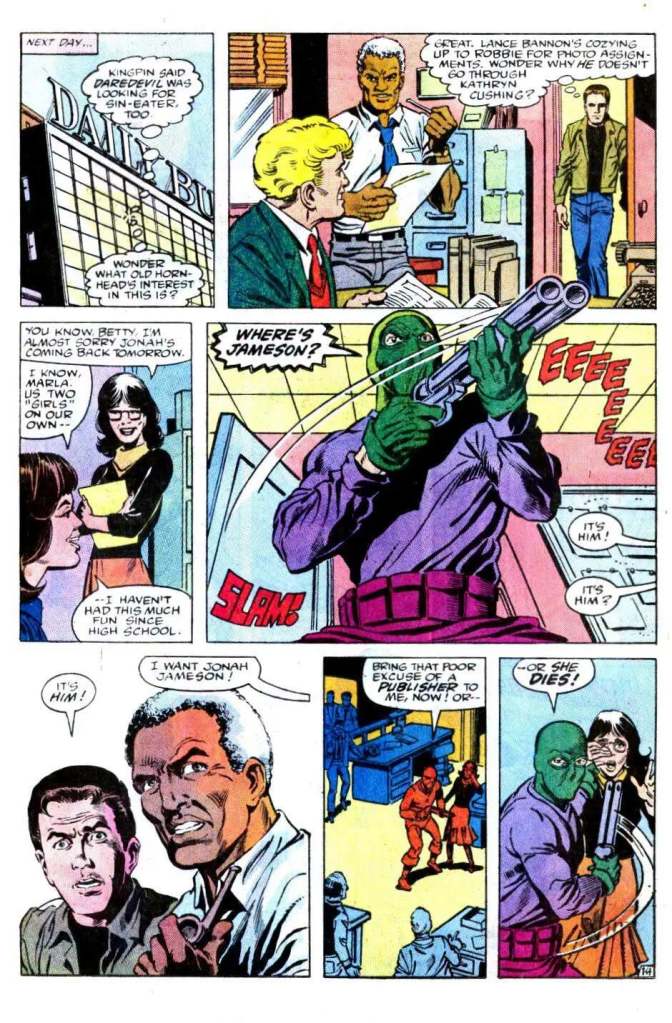
Danger inside the Daily Bugle!
Right from the start, this tale not only maintained the gritty detective story tone since issue #107, it continued to build-up the tension and intrigue smoothly as the story went on. At this stage of the storyline, Spider-Man and Daredevil are both doing detective work to find out who the Sin-Eater really is and why precisely has he been killing people and causing chaos in the first place.
Both superheroes encountered different people in their respective searches for answers. Because he was not successful finding details as Daredevil, he decides to do it in his civilian form as Matt Murdock. Spider-Man, who is not a professional detective at all, continues his search with his limitations and with the only ways he knows how (including the use of violence, humiliation and threats).
Without spoiling the plot, I can say that there two notable plot turning points that are really fine payoffs to the build-up that started since issue #107. What happened here was finely dramatized by the David-Buckler duo and easily justified the cover price.
Conclusion
Spider-Man doing detective work the way he knows how.
Considering the very strong qualities of the writing and visuals combined with the two major plot developments, Peter Parker, The Spectacular Spider-Man #109 (1985) is easily the most compelling part of the death of Jean DeWolff storyline. I should also state that Spider-Man and Daredevil are the key detectives of the tale and the creative team succeeded again in shaping this detective story to be very grounded with reality. The superhero elements are still present but noticeably contained with the brooding detective story. As to the two plot turning points I mentioned earlier, I encourage you all to grab a copy of this comic book and find out for yourselves. I promise you, they are worth your time and attention
Overall, Peter Parker, The Spectacular Spider-Man #109 (1985)is highly recommended.
During the first half of 2026, Japan’s exports of food and farm products grew by a huge 10.9% which is a huge economic achievement for the nation and its government, according to a news report by Kyodo News.
To put things in perspective, posted below is an excerpt from the report of Kyodo News. Some parts in boldface…
Japan’s exports of agricultural, forestry and fishery products and food products in the first half of 2026 rose 10.9 percent from a year earlier to 897.7 billion yen ($5.7 billion), a record high for the period, the government said Tuesday.
Shipments to all of Japan’s top 10 destinations, including the United States and Hong Kong, exceeded year-before levels, pushing the overall total to a new January-June peak for the second straight year.
By product, green tea posted a notable gain, supported by a global matcha boom, with the Ministry of Agriculture, Forestry and Fisheries saying that growing inbound tourism has raised overseas awareness of Japanese food.
Rising health consciousness also contributed, while new sales channels expanded at supermarkets and restaurants abroad that had not previously handled Japanese food. But the pace of export growth slowed from 15.5 percent in the first half of 2025.
Among the top 10 destinations by export value, eight countries and regions, apart from second-ranked Hong Kong and third-ranked China, marked first-half records. Exports to Hong Kong increased 3.0 percent, while those to China grew 4.3 percent.
Exports to South Korea rose 20.5 percent, with yellowtail and beer showing solid gains, while those to Vietnam jumped 35.4 percent on strong demand for scallops and mackerel. The United States ranked first, up 15.3 percent to 162.6 billion yen.
Green tea, beef, apples, and sauces and mixed seasonings registered record highs for the January-June period. Green tea surged 83.5 percent to 48.2 billion yen, while yellowtail surged 69.0 percent to 43.4 billion yen.
Let me end this piece by asking you readers: What is your reaction to this development? Considering the massive number of foreign tourists in Japan, are you convinced that the greater awareness of Japanese food somehow contributed to the huge demand (for Japanese products) in countries around the world? How much food and beverages imported from Japan are being offered in your local groceries or convenience stores right now?
Thank you for reading. If you find this article engaging, please click the like button below, share this article to others and also please consider making a donation to support my publishing. If you are looking for a copywriter to create content for your special project or business, check out my services and my portfolio. Feel free to contact me with a private message. Also please feel free to visit my Facebook page Author Carlo Carrasco and follow me on Twitter at @CarloCarrascoPH as well as on Tumblr at https://carlocarrasco.tumblr.com/and on Instagram athttps://www.instagram.com/authorcarlocarrasco
Following the unfortunate decision made the by Supreme Court of the United States (SCOTUS) regarding birthright citizenship, US President Donald J. Trump signed two new Executive Orders to formally end birth tourism while also protecting the meaning and value of American citizenship.
To put things in perspective, posted below is the News24 (formerly Sky News Australia) video covering the Oval Office. Watch it and pay close attention to the details.
In America, birth tourism is already a huge problem that has yet to be full resolved. If it is left unchecked, it will negatively impact and even deform democracy in the US. That said, President Trump signed the Executive Order ending birth tourism. To understand it fully, posted below is the entire content of the said Executive Order sourced from the White House website. Some parts in boldface…
By the authority vested in me as President by the Constitution and the laws of the United States of America, it is hereby ordered:
Section 1. Purpose. United States citizenship is among the greatest inheritances the Nation can bestow. It embodies a sacred bond between the American people and the Nation in which they live, and carries profound rights, privileges, and responsibilities reflective of the enduring allegiance of citizens to the United States and our Constitution. Citizenship is not a commodity to be acquired through calculated exploitation and evasion of the immigration laws, such as by entering the United States on a nonimmigrant visa for the purpose of giving birth within the Nation’s borders.
Birth tourism operators use deceptive advertisements and inducements to entice foreign nationals to travel to the United States for the purpose of giving birth on American soil. They promise citizenship; access to public benefits; and short-term stays in specialized facilities, hotels, or rentals, but often fail to deliver on these promises. These operators coach their clients to misrepresent the purpose and duration of their travel to consular and border officials to obtain visas authorizing entry into the United States. Failure to appropriately combat these schemes has resulted in thriving industries around the world that profit by enabling the evasion of American immigration laws to obtain citizenship and other immigration benefits for foreign visitors, and the exploitation of the women who travel here for purposes of giving birth.
The immigration laws of the United States establish discrete categories of temporary nonimmigrant visas to allow foreign visitors into the United States for study, exchange, temporary employment, tourism, and other transitory activities that are now exploited by birth tourism operators. Participants in birth tourism schemes abuse these categories to establish a permanent foothold in the United States by securing the advantage of citizenship for their children and then potentially for themselves.
Birth tourism, defined in section 3 of this order, undermines the integrity of the Nation’s immigration system by enabling foreign nationals to exploit their temporary admission to obtain permanent immigration-related benefits. Birth tourism also diverts limited consular inspection and enforcement resources away from legitimate visa applicants, erodes public confidence in the faithful enforcement of the immigration laws, and impairs the executive branch’s ability to protect the national security.
The United States has a compelling interest in ensuring that each visa category is used only for the purpose for which it was established. Foreign nationals seeking temporary admission into the United States must adhere to the purposes for which the Congress has authorized their temporary admission, and cannot be permitted to circumvent the immigration laws in an attempt to vest themselves and their children with lasting benefits that are irreconcilable with their nonimmigrant status.
It is therefore the policy of the United States to promote the integrity of its immigration system, to ensure that nonimmigrant visa classifications are used only for their lawful and intended purposes, and to prevent the exploitation of those classifications by persons engaging in birth tourism.
Sec. 2. Authorities. Pursuant to section 301 of title 3, United States Code, the authority granted to the President under section 215(a) of the Immigration and Nationality Act, 8 U.S.C. 1185(a), is hereby delegated to the Secretary of State and the Secretary of Homeland Security to the extent necessary to implement this order, including the authority to issue or adopt rules, policies, operational guidance, or other guidance to carry out this order.
Sec. 3. Definition. For purposes of this order, “birth tourism” is defined as:
(a) the entry of any foreign national into the United States via a nonimmigrant visa for the purpose of giving birth on American soil; or
(b) any effort by any foreign national to facilitate the entry of any foreign national into the United States via a nonimmigrant visa for the purpose of giving birth on American soil.
Sec. 4. Scope and Implementation. (a) The Secretary of State and the Secretary of Homeland Security shall take such actions and update any rules, policies, operational guidance, or other guidance as necessary to effectuate the policy set forth in this order. Such actions may include, within the Secretaries’ respective discretion and authority, appropriate action to prevent the entry into the United States of, or the granting of any visa or other travel authorization to, any alien entering or attempting to enter the United States for the purpose of engaging in birth tourism; revoking the visa or travel authorization and permanently barring entry of any alien who enters or attempts to enter the United States for the purpose of engaging in birth tourism; denial of entry to, or removal of, any alien who previously engaged or plans to engage in birth tourism; or other appropriate action against entities, organizations, or individuals, within or outside of the United States, responsible for facilitating or enabling birth tourism in any manner.
(b) All other relevant executive departments and agencies shall provide such records and information as are necessary for the Secretary of State and the Secretary of Homeland Security to implement the terms of this order and the rules, policies, operational guidance, or other guidance issued pursuant to it, subject to applicable law.
Sec. 5. Exemptions. Notwithstanding the restrictions imposed by this order, the Secretary of State or the Secretary of Homeland Security may exempt a foreign national from actions taken pursuant to this order on humanitarian grounds or when the foreign national’s entry is in the national interest, as determined by the Secretary of State or the Secretary of Homeland Security.
Sec. 6. General Provisions. (a) Nothing in this order shall be construed to impair or otherwise affect:
(i) the authority granted by law to an executive department or agency, or the head thereof; or
(ii) the functions of the Director of the Office of Management and Budget relating to budgetary, administrative, or legislative proposals.
(b) This order shall be implemented consistent with applicable law and subject to the availability of appropriations.
(c) This order is not intended to, and does not, create any right or benefit, substantive or procedural, enforceable at law or in equity by any party against the United States, its departments, agencies, or entities, its officers, employees, or agents, or any other person.
(d) If any provision of this order, or the application of any provision to any person or circumstances, is held to be invalid, the remainder of this order and the application of any of its other provisions to any other persons or circumstances shall not be affected thereby.
(e) The costs for publication of this order shall be borne by the Department of Homeland Security.
DONALD J. TRUMP
Let me end this piece by asking you readers: What is your reaction to this development? Do you think the two new Executive Orders signed by Trump will effectively end birth tourism while protecting the value of American citizenship? What kind of responses do you think the Democrats will come up with to oppose the Executive Orders. Do you think Islamist states like Iran, Pakistan, Qatar and Bangladesh are deliberately sending their citizens to America with birth tourism in mind? Did you spot any Chinese nationals engaging in birth tourism in America lately?
The Subic Bay Metropolitan Authority (SBMA) has officially launched the Swiss challenge for the P7 billion proposal for the upgrading and management of the Subic Bay International Airport (SBIA) and this opened the field for entities to submit their proposals challenging the existing proposal of Cerberus Asia Pacific Investments LLC, according to a Manila Bulletin news report.
For previous blog posts about the SBIA project, click here, here and here.
To put things in perspective, posted below is an excerpt from the report of the Manila Bulletin. Some parts in boldface…
The Subic Bay Metropolitan Authority (SBMA) has formally started the Swiss challenge for the ₱7-billion proposal to manage and upgrade the Subic Bay International Airport (SBIA), as it issued a call to potential challengers to submit competing offers.
In a bid bulletin dated July 31, theSBMA invited firms to submit their comparative proposals for the project proposed by United States (US)-based Cerberus Asia Pacific Investments LLC.
SBMA saidinterested firms have until Oct. 29 to submit their proposals, with thebid opening scheduled to take place on the same day. A pre-bid conference to clarify the requirements and address queries from participating firms is set for Sept. 14.
Under a Swiss challenge, also known as a comparative challenge, the SBMA is allowing other companies to match the unsolicited proposal for the SBIA submitted by Cerberus, which was approved in April last year.
Cerberus has been granted original proponent (OP) status by the SBMA for its unsolicited proposal to upgrade, expand, operate, and maintain the SBIA. As the OP, Cerberus will have the right to match the best offer during the challenge process.
Cerberus is seeking to manage the SBIA under a 25-year operate-rehabilitate-add-transfer scheme to develop the gateway into a strategic cargo and logistics hub that would help ease congestion at Ninoy Aquino International Airport (NAIA).
“Currently underutilized, SBIA requires substantial investment and comprehensive operational improvements to realize its full potential over the concession period,” SBMA said.
Cerberus is planning to invest ₱7 billion to develop the project, nearly 13 percent higher than the initial project cost pegged at around ₱6.2 billion.
The investment will focus on upgrading existing airport facilities to align them with international benchmarks, alongside the development of new facilities to transform the airport into a higher-capacity logistics hub.
SBMA noted that the airport’s location and air-to-sea access pose a significant opportunity to develop it into a hub for commercial cargo and warehousing.
“This highlights a growing demand for air cargo services, driven by the need for industrial supplies and the transportation of finished products,” it said.
In addition, SBMA noted that the ongoing development of the Luzon Economic Corridor (LEC) further increases the need for improved air connectivity.
The LEC is an initiative led by the Philippines, the US, and Japan aimed at accelerating high-impact investments to enhance connectivity between Subic Bay, Clark, Manila, and Batangas.
“All these factors lead to the conclusion that the manufacturing industry in the Philippines, and particularly Central Luzon, is highly likely to significantly grow in the upcoming decade, both in terms of size of current facilities, and additional factories,” SBMA said.
“This leads to demand for air cargo in terms of industrial supplies, as well as output products, and attracts population growth and consumer wealth, leading to consumption increase and related air cargo demand,” it added.
By developing the SBIA, SBMA said it is ensuring that Clark International Airport will not be the only alternative once NAIA reaches its cargo capacity limit in the future.
The agency said an upgraded SBIA can ensure competitive pricing and provide additional options for airlines operating or planning to set up shop in Manila.
With this, Subic Bay is expected to help accommodate an additional 200,000 tons of cargo by 2035.
Let me end this post by asking you readers: What is your reaction to this recent development? Do you think there will be a lot of corporations locally and overseas that will submit their Subic Bay International Airport proposals to the SBMA? When was the last time you arrived at the international airport in the Subic Bay Freeport Zone?
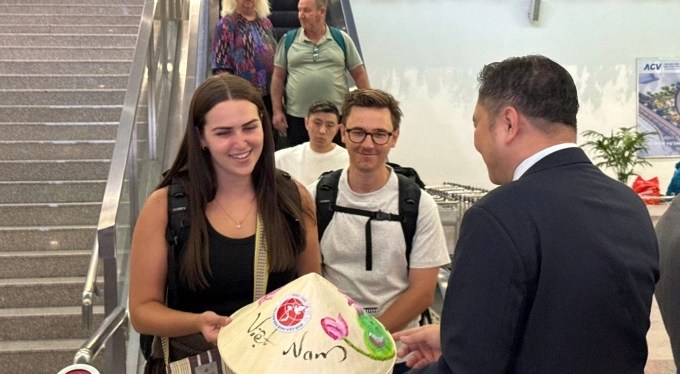
With tourism industry of Vietnam is undeniably growing rapidly as almost fourteen million foreign tourists arrived there during the first seven months of 2026, according to report by VnExpress.
To put things in perspective, posted below is an excerpt from the news report of VnExpress. Some parts in boldface…
Vietnam welcomed 13.9 million international arrivals during the first seven months this year, up 13.8% from a year earlier, as the country’s image as a safe and stable destination continued to attract travelers amid geopolitical tensions worldwide.
In July alone, the number of foreign visitors to Vietnam reached 1.67 million,down 0.7% year-on-year, according to the General Statistics Office (GSO).
Mainland China remained the largest source of visitors so far this year with 3.08 million, followed by South Korea with 2.38 million.
The rest of the top 10 were Russia, Taiwan, the U.S., Cambodia, India, Japan, the Phillippines and Australia.
Let me end this piece by asking you readers: What is your reaction to this development? Considering how many foreign tourists it attracted so far this year, do you think Vietnam will eventually hit 24 million foreign tourist arrivals by the end of 2026? Do you think the new Long Thanh International Airport will somehow help attract a large number of overseas travelers once it starts operating this December?
Thank you for reading. If you find this article engaging, please click the like button below, share this article to others and also please consider making a donation to support my publishing. If you are looking for a copywriter to create content for your special project or business, check out my services and my portfolio. Feel free to contact me with a private message. Also please feel free to visit my Facebook page Author Carlo Carrasco and follow me on Twitter at @CarloCarrascoPH as well as on Tumblr at https://carlocarrasco.tumblr.com/and on Instagram athttps://www.instagram.com/authorcarlocarrasco
In this age of artificial intelligence (AI), the rising use of drones in military operations and Communist China’s disturbing presence at sea, the Defense Ministry of Japan sees the urgent need to prepare the nation for the new ways of warfare, according to a news article by Jiji Press.
To put things in perspective, posted below is an excerpt from the news article of Jiji Press. Some parts in boldface…
Japan’s Defense Ministry emphasized the urgent need to prepare for what it calls new ways of warfare leveraging drones and artificial intelligence technology in an annual white paper adopted Tuesday.
The 2026 report, submitted by Defense Minister Shinjiro Koizumi to the day’s cabinet meeting, also displayed vigilance over the Chinese military’s expanding activities in the Pacific, saying Japan should respond with its “comprehensive national power.”
The white paper said that large-scale attacks combining low-cost unmanned equipment and conventional missiles have been conducted on the battlefields of Ukraine fighting Russia’s aggression.
Acknowledging that preparing for prolonged conflicts has become a key issue, the government stressed the importance of securing adequate stockpiles and ensuring sustained operational capability.
Let me end this piece by asking you readers: What is your reaction to this development? Do you support the idea of Japan tremendously modernizing itself militarily to defend itself while pushing back against Communist China’s military presence at sea? Would you like to see Japan become more sophisticated in the new ways of warfare using whatever state-of-the-art technologies it has? Do you think Japan should approach the United States for more advanced military hardware?
Thank you for reading. If you find this article engaging, please click the like button below, share this article to others and also please consider making a donation to support my publishing. If you are looking for a copywriter to create content for your special project or business, check out my services and my portfolio. Feel free to contact me with a private message. Also please feel free to visit my Facebook page Author Carlo Carrasco and follow me on Twitter at @CarloCarrascoPH as well as on Tumblr at https://carlocarrasco.tumblr.com/and on Instagram athttps://www.instagram.com/authorcarlocarrasco
For the first time in fifteen years, Japan and the United States conducted a joint buying of Yen following the Japanese currency’s continued weakness to the U.S. Dollar which Finance Minister Satsuki Katayama confirmed yesterday, according to a Kyodo News report. The Yen fell to almost 164 to the U.S. Dollar on July 23.
To put things in perspective, posted below is an excerpt from the report of Kyodo News. Some parts in boldface…
Japan and the United States conducted coordinated yen buying Friday, Finance Minister Satsuki Katayama said, their first joint market intervention in 15 years, with the two nations ready to act again if necessary.
The intervention during New York trading on Friday came after the yen hit 163.99 to the U.S. dollar on July 23, its weakest level in around 40 years, amid mounting fears about Prime Minister Sanae Takaichi’s expansionary but vaguely funded fiscal policy.
“This joint action was taken pursuant to the U.S.-Japan Finance Ministers’ Joint Statement issued in September 2025 and countered the excessive volatility and disorderly movements of the Japanese yen in recent months,” Katayama said in a statement on Monday.
“The Japanese Ministry of Finance remains attentive and in close communication with our counterparts at the U.S. Treasury. We will not hesitate to conduct a further joint intervention,” she added.
After warnings by Katayama and U.S. Treasury Secretary Scott Bessent of additional action to prevent the Japanese currency from depreciating, the yen briefly surged to the lower 155 level from the upper 157 range on Monday morning.
While joint currency interventions by the countries are usually reserved for emergencies, Japan has been struggling with the yen’s depreciation, which has increased import costs, threatening to accelerate inflation and jack up yields on long-term Japanese government bonds.
Washington is also believed to be wary of rising long-term Japanese interest rates pushing up U.S. rates before the congressional midterm elections in the fall, analysts said.
The previous Japan-U.S. intervention was carried out to stem the yen’s rise after the massive earthquake and tsunami in northeastern Japan in March 2011.
Katayama told reporters in Tokyo that Friday’s coordination between Japan and the United States was aimed at linking Tokyo’s “economic security to its unwavering alliance” with Washington.
She stressed the countries’ “close coordination” since the release of their joint statement last September, which confirmed interventions should be reserved for combating excessive volatility as well as “disorderly depreciation or appreciation.”
Japanese and U.S. authorities have pledged to take decisive action “against disorderly moves at any time,” Katayama said.
Atsushi Mimura, Japan’s top currency diplomat, called the latest coordinated intervention a “completed form” of the Japan-U.S. currency alliance, emphasizing the two countries would continue to respond “without missing a beat.”
Saying Japan “wanted a little bit of help,” President Donald Trump indicated Sunday in the United States that Washington had conducted a yen-buying intervention at the request of Takaichi’s government. He told reporters the action would benefit his nation economically.
He added, “We’re always there for Japan. Japan’s been very good to us, with the exception, of course, of Pearl Harbor,” referring to Japan’s 1941 surprise aerial attack on a naval base in Hawaii that resulted in the U.S. entry into World War II.
In New York on Friday, the yen surged to the lower 157 level against the dollar, with Japanese government sources confirming a yen-buying intervention by currency authorities.
The move came after the yen briefly soared to the 157 range Thursday, gaining nearly 5 yen in about 50 minutes before dropping back to the 160 level, as a result of a currency intervention by Japan later confirmed by market and government sources.
On Sunday, Bessent wrote on social media that the intervention “countered disorderly yen movements,” adding the United States would “not hesitate” to conduct further joint currency intervention with Japan, echoing Katayama.
He also said, “We strongly support Japan’s decisive market and monetary steps to correct the substantial undervaluation of the yen.”
Let me end this piece by asking you readers: What is your reaction to this development? What do you think the joint buying of Yen by the US and Japan will lead to further stabilization economically in the short term? Do you think this joint move will somehow boost both nation’s economies?
Thank you for reading. If you find this article engaging, please click the like button below, share this article to others and also please consider making a donation to support my publishing. If you are looking for a copywriter to create content for your special project or business, check out my services and my portfolio. Feel free to contact me with a private message. Also please feel free to visit my Facebook page Author Carlo Carrasco and follow me on Twitter at @CarloCarrascoPH as well as on Tumblr at https://carlocarrasco.tumblr.com/and on Instagram athttps://www.instagram.com/authorcarlocarrasco