In this age of artificial intelligence (AI), the rising use of drones in military operations and Communist China’s disturbing presence at sea, the Defense Ministry of Japan sees the urgent need to prepare the nation for the new ways of warfare, according to a news article by Jiji Press.
To put things in perspective, posted below is an excerpt from the news article of Jiji Press. Some parts in boldface…
Japan’s Defense Ministry emphasized the urgent need to prepare for what it calls new ways of warfare leveraging drones and artificial intelligence technology in an annual white paper adopted Tuesday.
The 2026 report, submitted by Defense Minister Shinjiro Koizumi to the day’s cabinet meeting, also displayed vigilance over the Chinese military’s expanding activities in the Pacific, saying Japan should respond with its “comprehensive national power.”
The white paper said that large-scale attacks combining low-cost unmanned equipment and conventional missiles have been conducted on the battlefields of Ukraine fighting Russia’s aggression.
Acknowledging that preparing for prolonged conflicts has become a key issue, the government stressed the importance of securing adequate stockpiles and ensuring sustained operational capability.
Let me end this piece by asking you readers: What is your reaction to this development? Do you support the idea of Japan tremendously modernizing itself militarily to defend itself while pushing back against Communist China’s military presence at sea? Would you like to see Japan become more sophisticated in the new ways of warfare using whatever state-of-the-art technologies it has? Do you think Japan should approach the United States for more advanced military hardware?
Thank you for reading. If you find this article engaging, please click the like button below, share this article to others and also please consider making a donation to support my publishing. If you are looking for a copywriter to create content for your special project or business, check out my services and my portfolio. Feel free to contact me with a private message. Also please feel free to visit my Facebook page Author Carlo Carrasco and follow me on Twitter at @CarloCarrascoPH as well as on Tumblr at https://carlocarrasco.tumblr.com/and on Instagram athttps://www.instagram.com/authorcarlocarrasco
For the first time in fifteen years, Japan and the United States conducted a joint buying of Yen following the Japanese currency’s continued weakness to the U.S. Dollar which Finance Minister Satsuki Katayama confirmed yesterday, according to a Kyodo News report. The Yen fell to almost 164 to the U.S. Dollar on July 23.
To put things in perspective, posted below is an excerpt from the report of Kyodo News. Some parts in boldface…
Japan and the United States conducted coordinated yen buying Friday, Finance Minister Satsuki Katayama said, their first joint market intervention in 15 years, with the two nations ready to act again if necessary.
The intervention during New York trading on Friday came after the yen hit 163.99 to the U.S. dollar on July 23, its weakest level in around 40 years, amid mounting fears about Prime Minister Sanae Takaichi’s expansionary but vaguely funded fiscal policy.
“This joint action was taken pursuant to the U.S.-Japan Finance Ministers’ Joint Statement issued in September 2025 and countered the excessive volatility and disorderly movements of the Japanese yen in recent months,” Katayama said in a statement on Monday.
“The Japanese Ministry of Finance remains attentive and in close communication with our counterparts at the U.S. Treasury. We will not hesitate to conduct a further joint intervention,” she added.
After warnings by Katayama and U.S. Treasury Secretary Scott Bessent of additional action to prevent the Japanese currency from depreciating, the yen briefly surged to the lower 155 level from the upper 157 range on Monday morning.
While joint currency interventions by the countries are usually reserved for emergencies, Japan has been struggling with the yen’s depreciation, which has increased import costs, threatening to accelerate inflation and jack up yields on long-term Japanese government bonds.
Washington is also believed to be wary of rising long-term Japanese interest rates pushing up U.S. rates before the congressional midterm elections in the fall, analysts said.
The previous Japan-U.S. intervention was carried out to stem the yen’s rise after the massive earthquake and tsunami in northeastern Japan in March 2011.
Katayama told reporters in Tokyo that Friday’s coordination between Japan and the United States was aimed at linking Tokyo’s “economic security to its unwavering alliance” with Washington.
She stressed the countries’ “close coordination” since the release of their joint statement last September, which confirmed interventions should be reserved for combating excessive volatility as well as “disorderly depreciation or appreciation.”
Japanese and U.S. authorities have pledged to take decisive action “against disorderly moves at any time,” Katayama said.
Atsushi Mimura, Japan’s top currency diplomat, called the latest coordinated intervention a “completed form” of the Japan-U.S. currency alliance, emphasizing the two countries would continue to respond “without missing a beat.”
Saying Japan “wanted a little bit of help,” President Donald Trump indicated Sunday in the United States that Washington had conducted a yen-buying intervention at the request of Takaichi’s government. He told reporters the action would benefit his nation economically.
He added, “We’re always there for Japan. Japan’s been very good to us, with the exception, of course, of Pearl Harbor,” referring to Japan’s 1941 surprise aerial attack on a naval base in Hawaii that resulted in the U.S. entry into World War II.
In New York on Friday, the yen surged to the lower 157 level against the dollar, with Japanese government sources confirming a yen-buying intervention by currency authorities.
The move came after the yen briefly soared to the 157 range Thursday, gaining nearly 5 yen in about 50 minutes before dropping back to the 160 level, as a result of a currency intervention by Japan later confirmed by market and government sources.
On Sunday, Bessent wrote on social media that the intervention “countered disorderly yen movements,” adding the United States would “not hesitate” to conduct further joint currency intervention with Japan, echoing Katayama.
He also said, “We strongly support Japan’s decisive market and monetary steps to correct the substantial undervaluation of the yen.”
Let me end this piece by asking you readers: What is your reaction to this development? What do you think the joint buying of Yen by the US and Japan will lead to further stabilization economically in the short term? Do you think this joint move will somehow boost both nation’s economies?
Thank you for reading. If you find this article engaging, please click the like button below, share this article to others and also please consider making a donation to support my publishing. If you are looking for a copywriter to create content for your special project or business, check out my services and my portfolio. Feel free to contact me with a private message. Also please feel free to visit my Facebook page Author Carlo Carrasco and follow me on Twitter at @CarloCarrascoPH as well as on Tumblr at https://carlocarrasco.tumblr.com/and on Instagram athttps://www.instagram.com/authorcarlocarrasco
Welcome back readers, fellow geeks and electronic gaming fans!
In this edition of the Retro Gaming Ads Blast (RGAB) series, we will take a look at another batch of retro gaming print ads from the 1980s to the 1990s.
For the newcomers reading this, Retro Gaming Ads Blast (RGAB) looks back at the many print ads of games (console, arcade, computer and handheld) that were published in comic books, magazines, flyers, posters and newspapers long before smartphones, social media, the worldwide web and streaming became popular. To put things in perspective, people back in the 1980s to the 1990s were more trusting of print media for information and images about electronic games and related products.
With those details laid down, here is the newest batch of retro gaming print ads for you to see and enjoy…
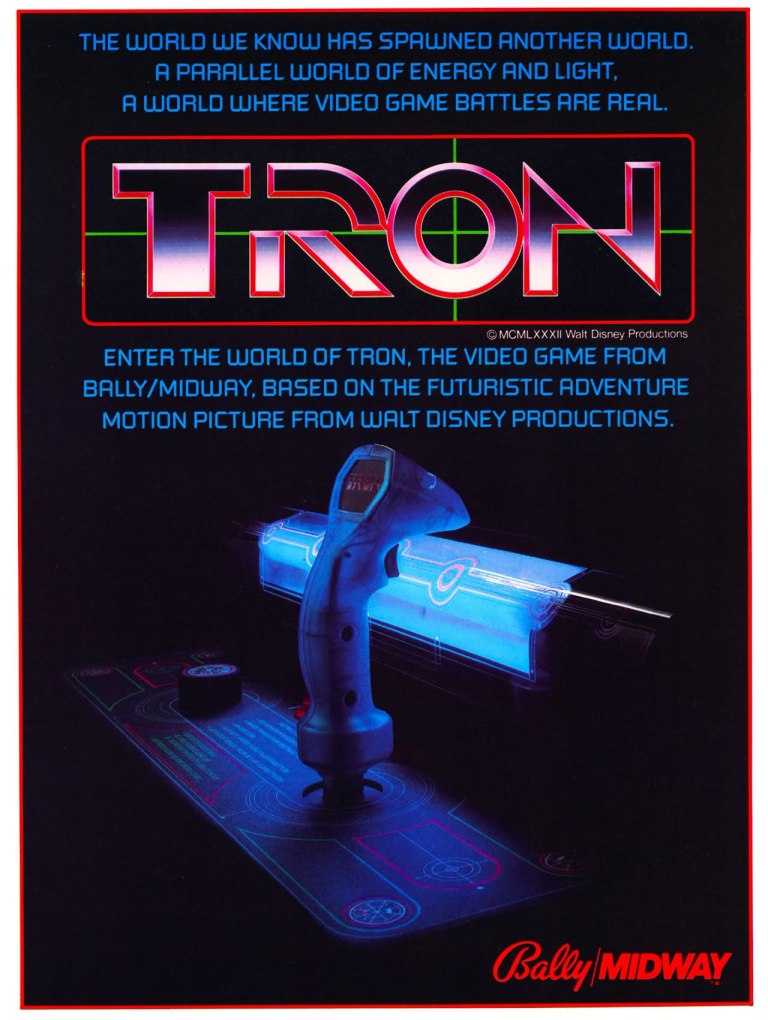
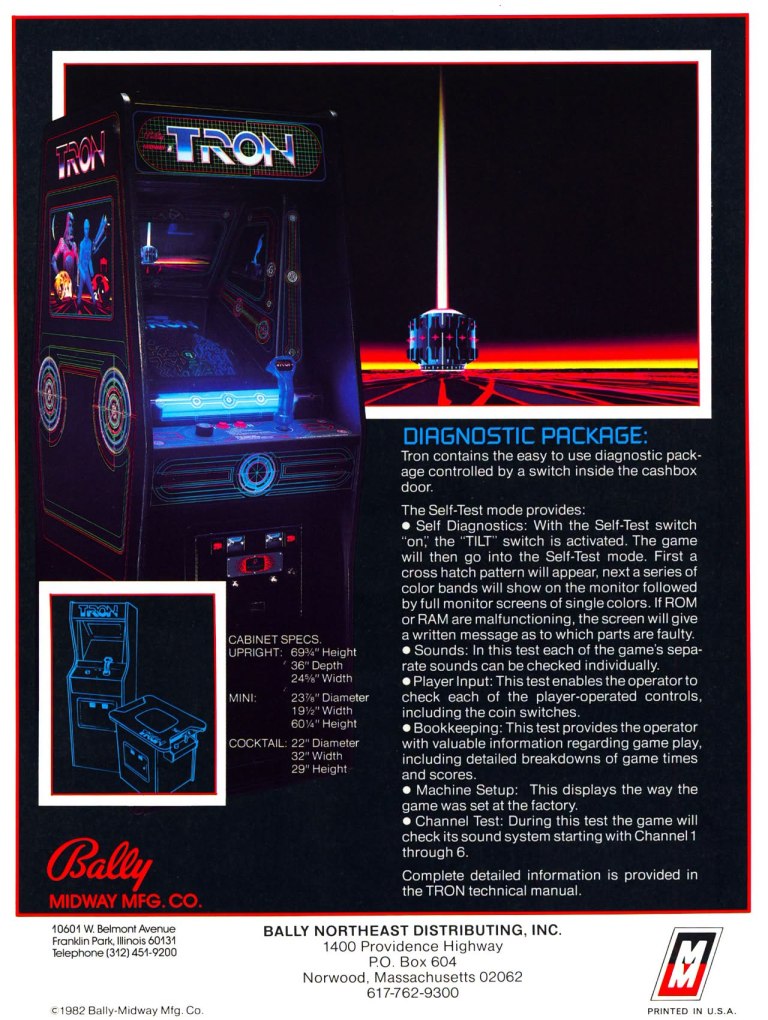
1. Tron Arcade Flyer
The front.
The rear. The details were clearly written for arcade operators.
Remember how dazzling the 1982 movie Tron was when you first saw it? That film had groundbreaking computer-generated graphics and the filmmakers worked very hard to tell a story covering both the real and digital worlds. Along the way, the movie had strong video game vibes which resonated with gamers at a time when arcade gaming was wildly popular in America. Believe it or not, an official arcade game of Tron was released the same year as the movie and it was a massive success. The arcade flyer perfectly captured the vibe and look from the movie and the machine itself had a control stick the same with what was shown to viewers. This old flyer is still great to look at.
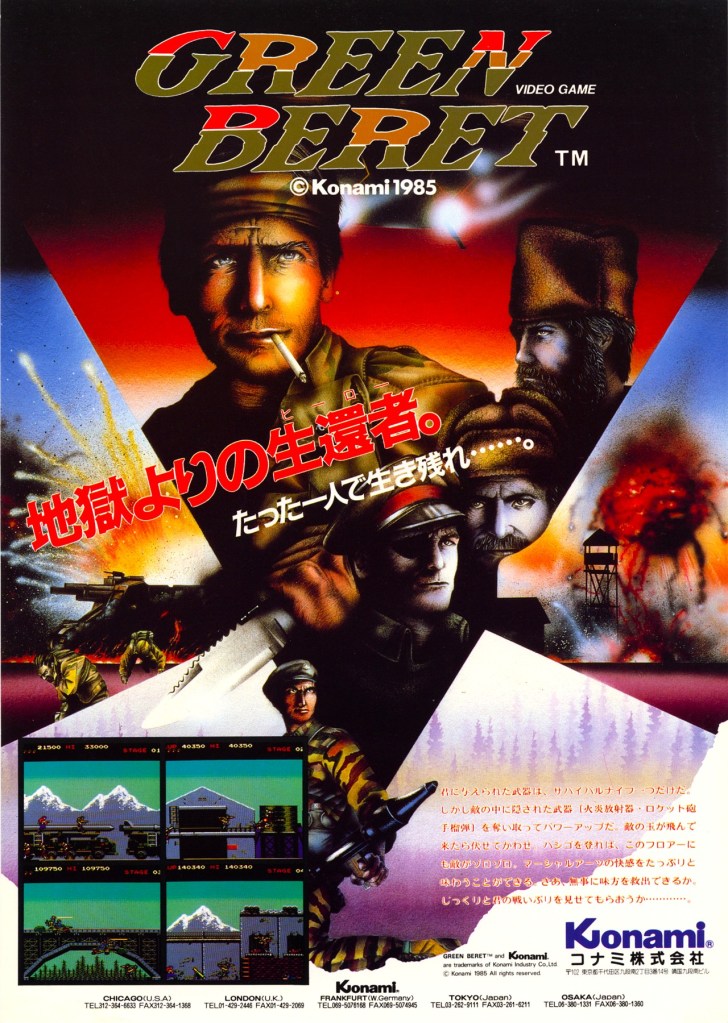
2. Green Beret Japanese Arcade Flyer
This is a very stylish flyer.
Konami was a highly prolific game publisher in the 1980s and it had lots of games that became huge blockbusters. During the decade, their game developers were strongly influenced by both Hollywood action movies and the Cold War. In 1985, Konami released the militaristic game Green Beret in Japanese arcades and to promote it, they created an arcade flyer featuring a very stylish artwork highlighting military images of soldiers (including a guy smoking) and warfare. This ad still looks great and it was not surprising it helped the game achieve huge commercial success. Green Beret was released in America as Rush’n Attack.
3. Darius Japanese And North American Arcade Flyers
The Japanese flyer.
The North American flyer.
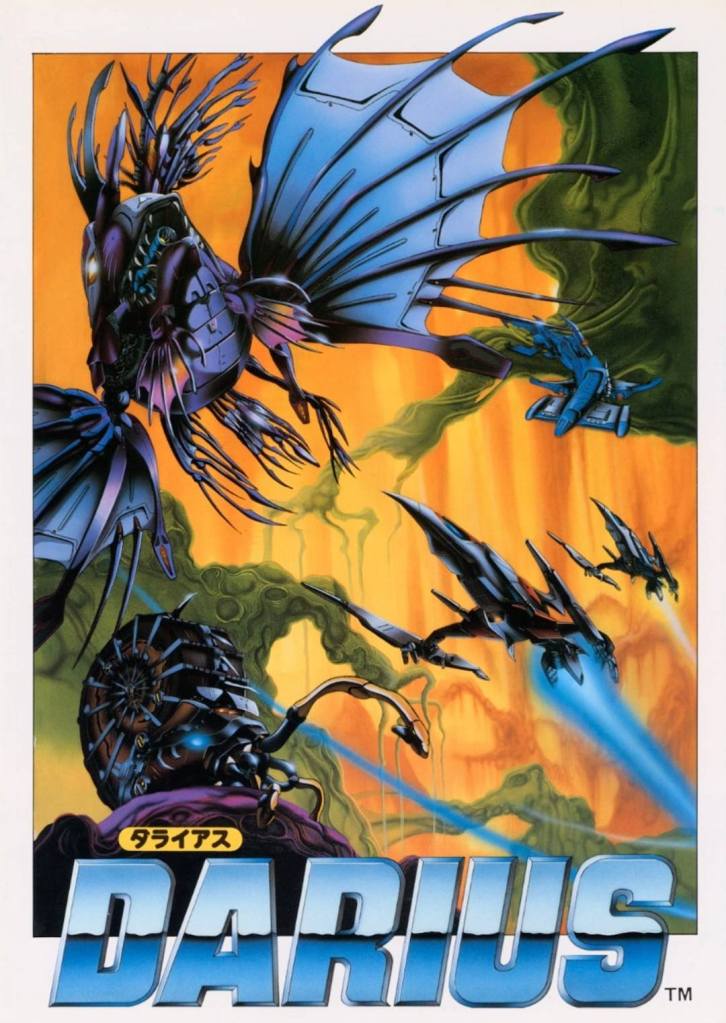
Released in arcades worldwide in 1987, Darius is a 2D side-scrolling shooter game from Taito which had a science fiction concept of the starship Silver Hawk (piloted by players) which sets on a mission to destroy an evil empire before it could destroy the world called Darius. The game was successful, most notably in Japan and it eventually led to sequels being released later. What I find intriguing is how the arcade game was promoted in Japan and in North America. The Japanese arcade flyer had this intriguing artwork that reflected a blend of sci-fi with a touch of horror. The North American flyer had a strong sci-fi touch with a male and female model wearing costumes (that made them look futuristic) standing beside the Darius machine. Which flyer looks more appealing to you?
4. Data East’s Arcade Alley Print Ad
Fun and excitement emphasized in this print ad.
There is nothing like porting arcade hits to computer systems for gamers to enjoy. In 1988 there in Europe, U.S. Gold released Data East’s Arcade Alley for computer systems and it included ports of popular Data East games like Kung Fu Master, Express Raider, Breakthru, Tag Team Wrestling, Last Mission and Karate Champ. U.S. Gold’s print ad showed a guy in the middle of a video arcade looking on both sides to pick which game to play which strongly emphasized the essence of the game collection (offered in cassettes and disk). This old ad is still amusing to look at.
5. Blasteroids European Print Ad
Blasteroids for the Europeans.
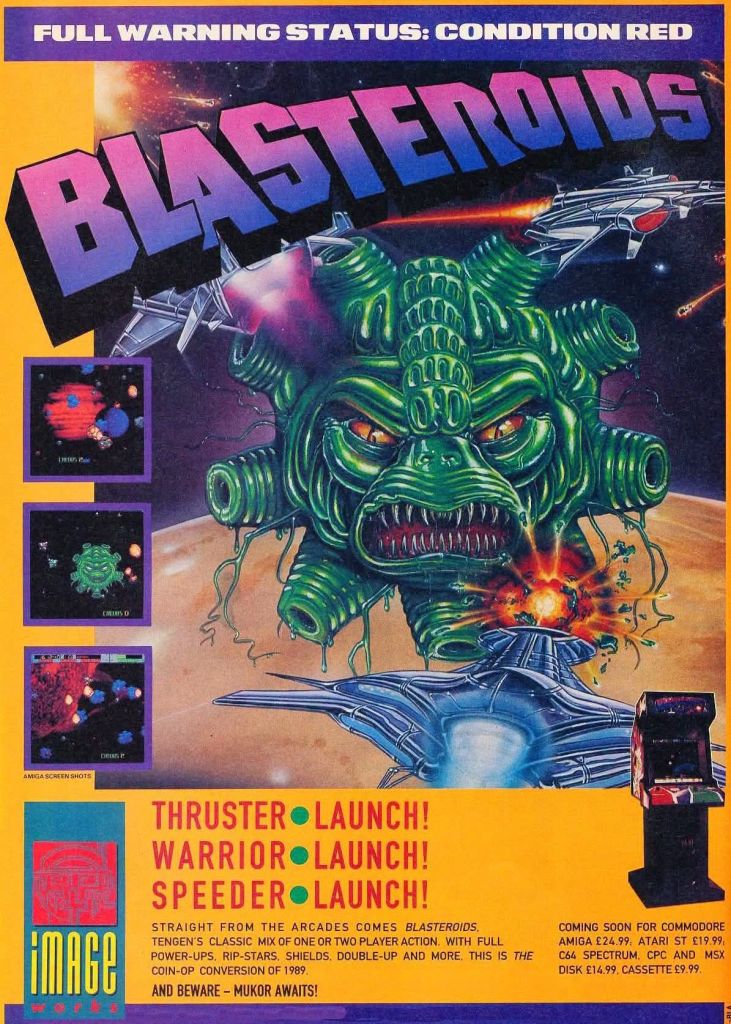
Blasteroids, the third entry in Atari’s popular Asteroids games series, was released in European arcades by Image Works and eventually landed on computer systems there. For Europe, the ad makers came up with artwork showing a creepy, green space monster surrounded by a few spaceships to emphasize the game’s concept. The said monster eventually appeared on the game covers of the computer ports of Blasteroids later. This ad shows creative adjustments taken to promote games in different parts of the world.
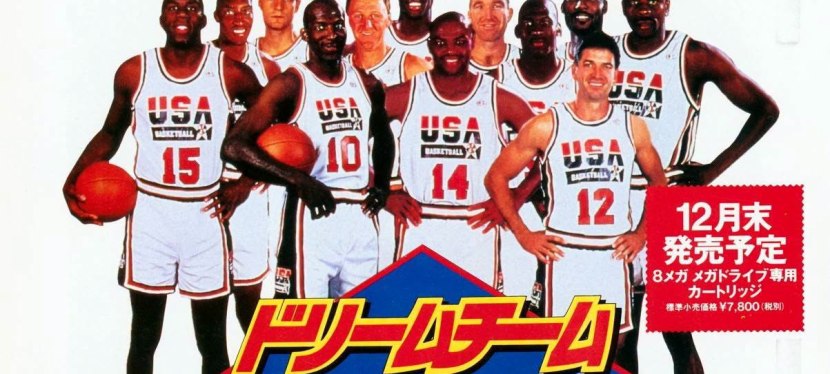
6. Dream Team USA Japanese Print Ad
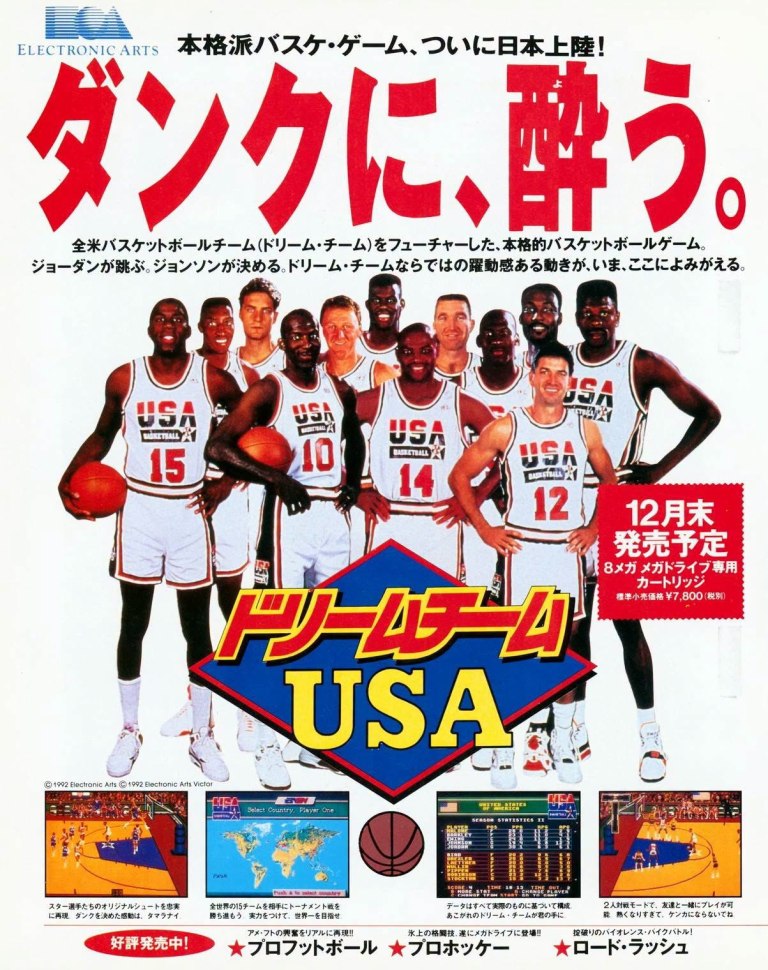
The legends of the NBA in the Japanese version of EA’s Team USA Basketball. Retitling the game as Dream Team USA made more sense because “Dream Team” was a much more popular reference than “Team USA Basketball”.
Remember how wildly popular the Dream Team (Team USA in Olympic basketball) was in 1992? With NBA legends Larry Bird, Michael Jordan, Magic Johnson, Charles Barkley, Karl Malone, John Stockton and more representing America in the basketball tournament of the Olympic Summer Games in Barcelona, Spain, the Dream Team (a media-led reference for the team) was easily the main attraction not only for basketball fans worldwide but also those who craved for excitement in international sports events. That said, Electronic Arts secured the license to make an official video game about the Dream Team and actually released the game Team USA Basketball within 1992 for the Sega Genesis. As basketball is popular also in Japan, EA released the game there titled as Dream Team USA and came up with a Japanese print ad to seriously capture gamers’ attention. This ad is still effective in delighting both basketball and video game enthusiasts.
7. Super Star Wars: The Empire Strikes Back And Return Of The Jedi Print Ad
No screenshots of games used. Just the official images from the posters of the two movies.
Back in the 1990s, there was a resurgence of the original Star Wars trilogy across different forms of media. Apart from the VHS re-releases of Star Wars, The Empire Strikes Back and Return of the Jedi, there was a slew of video games of Star Wars released during the decade and the fans had new stuff to entertain themselves with. Along the way, the company THQ secured the rights to Super Star Wars: The Empire Strikes Back and Super Star Wars: Return of the Jedi for re-release to coincide with the 1997 “Special Edition” theatrical releases of their respective movies. THQ’s print ad simply used official images of Return of the Jedi and inserted a tiny bit of The Empire Strikes Back, and they did not show any screenshots that could have been helpful for Super Nintendo Entertainment System (SNES) and Game Boy users. Still, it was smart for THQ to print two excerpts of game reviews to sell the games.
8. Super Mario RPG North American Print Ad
A mesmerizing ad for the acclaimed Super Mario RPG.
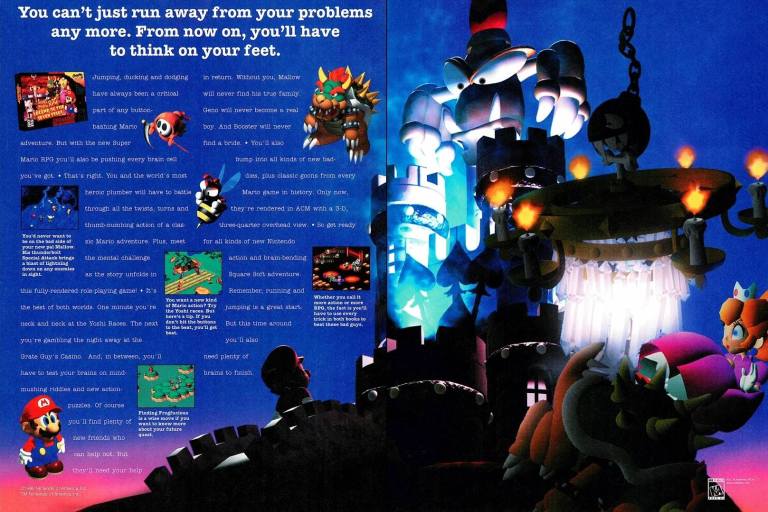
Remember back in the 1990s when Nintendo and role-playing game giant SquareSoft had a very healthy business relationship that proved successful? Before their eventual breakup (related to Square signing with Sony for PlayStation development), the two companies joined forces to make a fully featured role-playing game for the SNES featuring Super Mario and related characters…Super Mario RPG: Legend of the Seven Stars. To promote the game, Nintendo (the publisher) created a mesmerizing 2-page print ad highlighting their characters while emphasizing the role-playing and fantasy aspects of the game. At the time of its release, Super Mario was often identified with platform games and the Super Mario RPG print ad was a serious attempt to lure fans into RPGs which the SNES was already rich with. This ad, which I first saw in gaming magazines in 1996, still looks great.
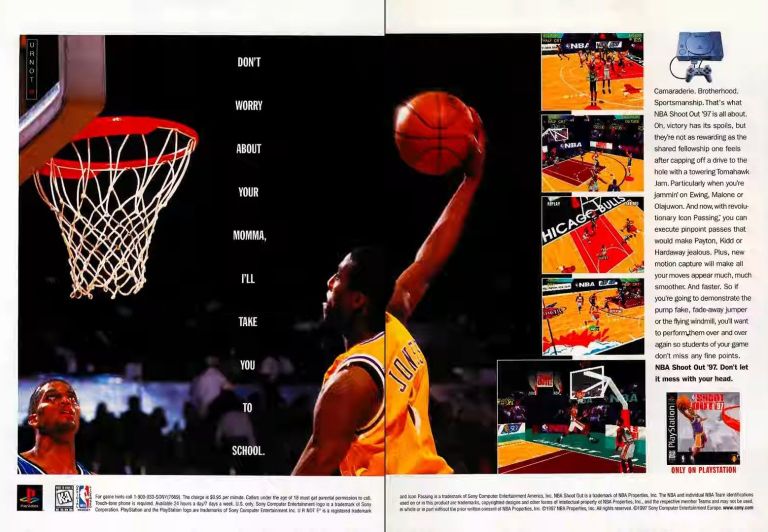
9. NBA Shootout ’97 Print Ad
Did you play this on PlayStation in 1997?
If there is anything I miss about 1990s console gaming, it is the fact that there were a lot of NBA-licensed video games that were offered to players with different tastes in basketball gaming. Sony had its own exclusive NBA games series called NBA Shootout and they were pretty aggressive selling its own basketball games along with the PlayStation going up against the likes of Electronic Arts (NBA Live), Sega and others. This is reflected in this 2-page print ad of NBA Shootout ’97 which was a PlayStation-exclusive release. They featured a photograph of Lakers’ Eddie Jones about to dunk and showed screenshots as well as the descriptive text written with excitement. Since it first started, NBA Shootout was basketball in full 3D polygonal graphics backed with motion-captured moves and dunks that players could enjoy only PlayStation. This ad is a reminder that Sony used to make official NBA games and there is a lack of variety and players’ choice of NBA gaming in today’s world.
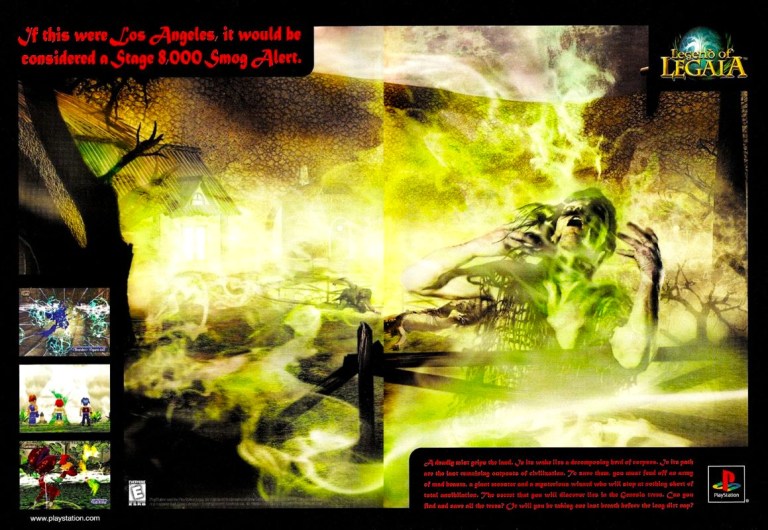
10. Legend of Legaia North American Print Ad
Perhaps someone at Sony Computer Entertainment America (SCEA) thought Legend of Legaia was a horror video game.
There was a time when Sony produced Japanese RPGs (JRPGs) exclusive for PlayStation consoles. One of them was Legend of Legaia which had a combat system that emphasized martial arts and it had an interesting fantasy concept. For its 1999 North American release, Sony came up with a very bizarre 2-page print ad that had digital artwork with a very strong horror vibe and the visual designs within the three screenshots shown were clearly not related with it. How this ad was made remains unclear. This is easily one of the most misguided gaming ads of the 1990s.
The Subic Bay Metropolitan Authority (SBMA) announced that it has released almost P220 million in revenue shares to the City Government of Olongapo and seven other local government units (LGUs).
To put things in perspective, posted below is an excerpt from the SBMA’s official announcement. Some parts in boldface…
The Subic Bay Metropolitan Authority (SBMA) released a total of PHP 218,115,671.26 in revenue shares to eight local government units (LGUs) contiguous to this premier freeport zone.
SBMA Chairman and Administrator Eduardo Jose L. Aliño said that this amount released on Tuesday, July 21, 2026,represents the revenue shares for the first semester of 2026, which is 10.24 percent higher than that of last year’s comparative period.
The recipient LGUs areOlongapo City,the municipalities of Subic, San Marcelino, Castillejos, and San Antonio in Zambales, and the towns of Dinalupihan, Hermosa, and Morong in Bataan.
Taking into account the population and land area,Olongapo was allocated the largest amount of PHP 50,420,165.72, received by Olongapo City Mayor Atty. Rolen Paulino, Jr. This was followed by Subic, Zambales, which received PHP 32,871,521.46, accepted on behalf of Mayor Jonathan John Khonghun.
The remaining LGUs received their allocations as follows: Dinalupihan, Bataan, with PHP 27,438,313.68, accepted on behalf of Mayor German Santos, Jr.; San Marcelino, Zambales, with PHP 26,272,445.97, received by Mayor Elvis Soria; Hermosa, Bataan, with PHP 23,422,520.27, accepted on behalf of Mayor Atty. Anne Adorable-Inton; Castillejos, Zambales, with PHP 19,817,470.23, received on behalf of Mayor Jeffrey Khonghun; Morong, Bataan, with PHP 19,340,287.10, received on behalf of Mayor Leila Linao-Muñoz; and San Antonio, Zambales, with PHP 18,532,946.83, received by Mayor Dr. Arvin Antipolo.
TheLGU shares are sourced from five percent corporate taxes paid by business locators in the Subic Bay Freeport. They aredistributed among LGUs based on population (50%), land area (25%), and equal sharing (25%).
OIC-Deputy Administrator for Finance Editha Marzal, along with the finance team, led the distribution of the LGU shares.
Marzal noted that the net shares distributed to the LGUs include not only the current collection period’s allocations but also the 10 percent retention withheld during the first semester of the 2024 distribution.
Let me end this post by asking you readers: What is your reaction to this recent development? Do you see the increased amount of revenue shares as a sign of better economic activities and finances within the Subic Bay Freeport Zone? Do you think the revenue shares would be higher once the Luzon Economic Corridor (LEC) and Pax Silica activities finally start economic activities in the near future?
In a serious effort to weaken the fighting capability and severing the resources (financially and militarily) of the Islamic terrorist regime of Iran, the United States sanctioned entities and individuals in four nations that enabled the Islamic Revolutionary Guard Corps (IRGC), according to the official announcement of the Department of State.
To put things in perspective, posted below is the entire announcement of the State Department. Some parts in boldface…
The United States today sanctioned six entities and individuals in China, India, Russia, and Iran that enable the Iranian regime’s Islamic Revolutionary Guard Corps (IRGC).
These include entities that support Mahan Air, the IRGC’s airline of choice for moving weapons, military personnel, and equipment. Today’s action also targets DadeNegar Startup Studio, an IRGC-affiliated front company supporting Iranian military targeting by soliciting locations of American and Israeli equipment in the Middle East.
The United States calls on the international community, particularly companies and individuals doing business with Mahan Air or any other sanctioned Iranian carrier, to recognize the serious risks raised by continuing such engagement.
The United States will continue to expose and disrupt entities providing the IRGC with the tools and information it uses to threaten American personnel, our partners, and regional stability.
Let me end this piece by asking you readers: What is your reaction to this development? Do you think this new move by the US will cripple the Islamic terrorist regime of Iran financial and militarily? Do you think members of the international community will follow America’s initiative? Do you think other nations like Pakistan, Malaysia and Bangladesh have entities or individuals who are supporting the Islamic terrorist regime of Iran?
Welcome back my readers, YouTube viewers and all others who followed this series of articles focused on YouTube videos worth watching.
Have you been searching for something fun or interesting to watch on YouTube? Do you feel bored right now and you crave for something to see on the world’s most popular online video destination?
I recommend you check out the following videos I found.
#1 Heaven’s Gate Revisited – What is there to be said about the 1980 historical epic Heaven’s Gate apart from the facts that it failed spectacularly and brought down United Artists a lot? To its credit, it has a grand look that required a massive amount of money to be spent and the sheer depth of authenticity implemented under the direction of Michael Cimino (The Deer Hunter) is eye-catching. The film also had fine performances by Kris Kristofferson, Jeff Bridges, Christopher Walken and Isabelle Huppert. Historically, the massive failure of the movie impacted Hollywood as a whole and movie studios rarely grant the final cut privilege to movie directors. That said, there is a lot more to learn about Heaven’s Gate and I encourage you all to watch the video below.
#2 Moments That Destroyed Political Careers – Imagine yourself working so hard to get elected into public office in America followed by efforts to solidify the trust of voters who helped you win. With huge expectations, there obviously is pressure on you (the elected official) to serve them and fulfill your promises. Then one day, you committed a blunder or a very embarrassing moment that eventually leads you into a painful downfall. In America, there are Democrats and Republics who saw their political careers get destroyed because of the moments gone wrong. Watch and learn from the video below.
#3 History Of Sega And Its Impact On Video Gaming – Remember long ago when Sega was a highly prolific and innovative maker of games for arcades and consoles? Remember seeing consoles and add-ons with Sega branded on them? Decades ago, Sega was a gaming titan and it was a powerful competitor with Nintendo during the so-called 16-bit wars of the 1990s. Today, Sega is still operating but it is a shadow of what it used to be. To find out what happened, watch the very informative video game documentary below. It also has interviews with Tom Kalinske and other important video game personalities.
#4 Totally Whatever Reacts To Deep Impact – Back in 1998, I encountered some people who claimed to have cried while watching Deep Impact inside the movie theaters. When I saw it in the cinema, I saw a few other moviegoers near me having tears flowing from their eyes. Indeed, Deep Impact was made to move viewers emotionally with its themes of family, strained ties, and the struggle to remain intact before a massive tragedy happens. That said, you must see how the movie impacts the YouTubers in the video below.
#5 Tuna In Japan – Whenever I visited Japan, I always made the effort to enjoy a meal with tuna on it. I enjoy eating sashimi (specifically raw tuna), sushi and cooked meals that have tuna in different forms in them. If you love eating tuna and if you plan to visit Japan soon, watch the video below. Learn the details.
#6 Child’s Play 3 Reaction/Review Videos – Believe it or not, the 1991 movie Child’s Play 3 was released less than a year after Child’s Play 2. The movie followed the character Andy Barclay again, only this time he was portrayed as a troubled teenager who enters a military school. Unsurprisingly, the evil Chucky was revived and pursued Andy once more. Having seen Child’s Play and Child’s Play 3 on home video just months apart from each other, the viewing experience was unique given each film’s differences in terms of casts and settings. When Child’s Play 3 came to an end, there was this feeling among many moviegoers that the film series concluded solidly. To see what kind of reactions the 1991 movie attracted from YouTubers, watch the videos below.
#7 The Legend Of The Lone Ranger’s Failure Explained – As a young boy, I saw The Legend of the Lone Ranger on home video and enjoyed it. Back then, I was completely unaware about the controversy regarding past Lone Ranger actor Clayton Moore who was legally barred from appearing in public wearing the trademark black mask. That controversy alone hounded the movie and was arguably the single biggest factor behind its failure. By the way, the film’s star Klinton Spilsbury was dubbed over as the Long Ranger and he never acted again. To learn more, watch the video below.
#8 Minty Comedic Arts Examines Tales From The Crypt – When you hear the title Tales From The Crypt, do you think about the about the horror anthology TV series or the original comic book series published by EC Comics in the 1950s? I myself read several reprints of EC Comics – including Tales From The Crypt – and saw some episodes of the TV series. That said, both the TV series and the comic books delivered a very unique kind of entertainment that is sadly missing today. In his video, Minty Comedic Arts revealed a lot of interesting details about the TV series as well as EC Comics. I encourage you to watch his video now.
#9 The Unification Church Exposed – When former Japanese Prime Minister Shinzo Abe was assassinated in 2022, the killer Tetsuya Yamagami committed the act not because of politics but because of the perceived connections the politician had with the controversial Unification Church which he blames for financial ruining his family and his own life. The killer’s own mother was a member of the Unification Church and because she donated so much money to it, her own family ended up lacking money for survival, education and other needs. The murder investigation eventually unraveled decades of allegations about financial exploitation, shattered families and the immense influence the said church had on its members from Japan to South Korea and the United States. There are a lot of very intriguing details in Dark Asia with Megan’s video below and I encourage you all to watch it.
Fresh potatoes from the United States could potentially enter Japan’s markets this year as the authorities are assessing the quarantine risks and the concerns raised by Japanese potato farmers, according to a news report by NHK World. The Japanese authorities received a request from Washington regarding American potatoes which led to the ongoing assessment.
To put things in perspective, posted below is the excerpt of the NHK World report. Some parts in boldface…
Japan is taking steps that could lead to it fully opening its market to fresh US potatoes, following a request from Washington.
Japan bans imports of raw potatoes due to concerns over pests and disease, except for some sourced from the United States to be used exclusively for potato chips.
The agriculture ministry is currently assessing the quarantine risks posed by American potatoes, the third step in an 11-stage process before all restrictions can be lifted.
Officials plan to complete the risk assessment as early as this summer, and move on to identifying the pests and diseases that need to be dealt with.
Demand for fresh potatoes is rising in Japan, as domestic production has been on the decline.
Let me end this piece by asking you readers: What is your reaction to this development? Do you think Japan’s agriculture ministry will even allow full market opening to fresh potatoes from the United States? What do you think is the reason why Japan’s domestic production of fresh potatoes has declined?
The Philippines, which is already experiencing slower economic growth, higher inflation and having trouble attracting foreign investment, saw its exports to the United States subject to a higher 12.5% tariff as the Trump administration is convinced that the country failed to prevent the entry of goods produced with forced labor, according to a news report by the Manila Bulletin.
To put things in perspective, posted below is an excerpt from the Manila Bulletin news report. Some parts in boldface…
The country’s exports to the United States (US) are now subject to a higher 12.5-percent tariff after the Trump administration determined that the Philippines has failed to prevent the entry of goods produced with forced labor.
In a notice on Friday morning, July 24 (Philippine time), the Office of the US Trade Representative (USTR) said it is imposing a 12.5-percent tariff on the Philippines, in accordance with the directive of US President Donald Trump.
The USTR earlier included the Philippines in its investigation into the US’ top 60 trading partners as it sought to crack down on imports made with forced labor that were found to be harmful to American commerce.
In a report on the probe’s findings, the USTR said the Philippines “has failed to impose and effectively enforce a forced labor import prohibition.”
Apart from the Philippines, 40 other economies are subject to the 12.5-percent tariff.
“The US has had a forced labor import ban for nearly a century, and rigorously enforces it. It’s well past time for our trading partners to do the same,” said USTR Ambassador Jamieson Greer.
“Today’s action will begin to correct what is both a human rights abuse and distortive trade practice to improve the welfare of workers everywhere,” he added.
The USTR said it would exempt certain products from the tariff, including goods that cannot be produced in sufficient quantities or at reasonable prices in the US, and products that could cause economy-wide disruptions if they were subjected to the tariffs.
Philippine goods exempt from the 12.5-percent tariff include most of the country’s major exports to the US, including semiconductors, its top export commodity. Also exempted are agricultural commodities such as coconuts, pineapples, and bananas, as well as raw minerals such as nickel ores and concentrates.
The US remains the Philippines’ largest export market, accounting for $13.46 billion, or 15.9 percent, of the country’s total exports in 2025.
Let me end this post by asking you readers: What is your reaction to this recent development? Do you think the Philippines has been negligent on monitoring the entry of goods produced with forced labor? Does this new economic development dampen your trust in the government of the Philippines?
Thank you for reading. If you find this article engaging, please click the like button below, share this article to others and also please consider making a donation to support my publishing. If you are looking for a copywriter to create content for your special project or business, check out my services and my portfolio. Feel free to contact me with a private message. Also please feel free to visit my Facebook page Author Carlo Carrasco and follow me on Twitter at @CarloCarrascoPH as well as on Tumblr at https://carlocarrasco.tumblr.com/and on Instagram athttps://www.instagram.com/authorcarlocarrasco
For the first half of this year, the Philippines attracted 2.9 million foreign tourists and 1.13 million of that came from the United States and South Korea combined, according to a news report by Business Mirror. The figure does not include the 260,717 overseas Filipinos or balikbayan.
When compared to its Asian neighbors’ first-half foreign tourist numbers, the Philippines is still way behind Vietnam which attracted 12.3 million and Japan which attracted 21 million.
To put things in perspective, posted below is an excerpt from the Business Mirror report. Some parts in boldface…
MORE relaxed visa entry requirements have enabled the Philippines to attract an increasing number of foreign tourists, lifting total visitor arrivals by 5.41 percent in the first half of the year.
Data from the Department of Tourism (DOT) showed 3.16 million inbound tourists from January to June 2026, of which 2.9 million were foreign nationals and 260,717 were overseas Filipinos. The latter are described as Philippine passport holders permanently residing abroad. This year’s arrivals are 76.5 percent of the 4.13 million total in the first half of prepandemic 2019.
The DOT stressed that the data are based on e-travel records provided by the Department of Information and Communications Technology, and are not final until Bureau of Immigration records are taken into account. E-travel registration is mandatory for those arriving in the Philippines except foreign diplomats, dignitaries, foreign government officials and their delegation, visiting business executives and students sponsored by the Philippine government or international organizations, and their immediate family members (9e visa).
Of the total foreign nationals, which were up 6.3 percent from the 2.73 million year on year (yoy), tourists from China and India were the most improved by 64.54 percent and 43 percent, respectively. Residents from both countries have been allowed to enter the Philippines visa-free for tourism purposes for 14 days.
The top 12 source markets of visitors for the Philippines all recorded increases, except for South Korea, with long-haul markets like Germany even showing monthly increases yoy, despite the ongoing tensions in the Middle East, which had jacked up jet fuel prices.
S. Korea plunges 13.7%– The United States continues to be the top source market for the Philippines with arrivals at 581,565 in the first half of the year, an increase of some 6.9 percent from the same period in 2025. Most of the market continues to be composed of Americans of Filipino decent, or Filipino immigrants, who visit the Philippines usually during the holiday season in December and January.
Some 300 Filipino-Americans are currently in the country as part of government’s long-running Very Important Pinoy (VIP) tour, and visiting destinations other than Metro Manila such as Cebu, Dumaguete, and Siquijor.
In second place are tourists from South Korea at 552,860, slumping by 13.7 percent, yoy. This was followed by Japan at 581,565 (+6.87 percent); China at 219,796 (+64.54 percent); Australia at 174,257 (+12.3 percent); and Canada at 156,763 (+15.6 percent), another haven of Filipino immigrants. Air Canada began offering direct flights from Vancouver to Manila in April last year, while flag carrier Philippine Airlines offers nonstop flights between Manila and Vancouver, and Toronto.
Tourists from Taiwan were in seventh place at 111,134, an increase of 11.85 percent; folowed by the United Kingdom at 92,829 (+1.7 percent); Singapore at 78,069 (0.35 percent); India at 60,583 (43.03 percent); Malaysia at 53,437 (+11.5 percent); and Germany at 48,657 (+6.9 percent).
Under the General Appropriations Act of 2026, the DOT committed to attract 6.7 million foreign tourists this year.
Let me end this post by asking you readers: What is your reaction to this recent development? Do you think the Philippines will be able to attract 6.7 million foreign tourists by the end of this year? What do you think are the three most serious problems the Philippines has when it comes to attracting foreign tourists?
Thank you for reading. If you find this article engaging, please click the like button below, share this article to others and also please consider making a donation to support my publishing. If you are looking for a copywriter to create content for your special project or business, check out my services and my portfolio. Feel free to contact me with a private message. Also please feel free to visit my Facebook page Author Carlo Carrasco and follow me on Twitter at @CarloCarrascoPH as well as on Tumblr at https://carlocarrasco.tumblr.com/and on Instagram athttps://www.instagram.com/authorcarlocarrasco
The Subic Bay Metropolitan Authority (SBMA) announced that it has sealed a formal agreement with the Bases Conversion and Development Authority (BCDA) to make the Port of Subic Bay the preferred maritime gateway for Pax Silica.
Launched in late-2025, Pax Silica is a United States-led strategic coalition to secure the global supply chains for artificial intelligence and semiconductors. Pax Silica was designed to counter China’s dominance in technology manufacturing and earth minerals.
To put things in perspective, posted below is an excerpt from the SBMA’s official announcement. Some parts in boldface…
The Subic Bay Metropolitan Authority (SBMA) and the Bases Conversion and Development Authority (BCDA) have agreed to make the Port of Subic Bay the preferred maritime gateway for the Pax Silica initiative.
Thepartnership was confirmed in the signing of the Memorandum of Understanding (MOU) between SBMA Chairman and Administrator Eduardo Jose L. Aliño and BCDA President and CEO Joshua M. Bingcangat the Bonifacio Technology Center in BGC, Taguig City, on July 20, 2026.
“Having the Port of Subic Bay as the preferred maritime gateway for Pax Silica Operations within the Luzon Economic Corridor is a great honor for the SBMA. It is, in fact, a crowning recognition of the invaluable role the Port of Subic Bay can play, on par with the initiatives to support the National Government regarding Pax Silica,” Aliño said.
“As part of the Luzon Economic Corridor, Subic Bay’s deep-water port and shipyard facilities are designed to transport raw materials like nickel and copper quickly, and processed tech goods between the port and the AI-native Economic Security Zone, or ESZ, in New Clark City,” he added. Meanwhile,Bingcang highlighted that the Port of Subic Bay offers a strategic advantage for the Pax Silica initiative. It serves asa critical gateway that enables the efficient movement of raw materials into the country and the timely delivery of finished products to customers,” PCEO Bingcang said. It serves as a critical gateway, enabling the efficient movement of raw materials into the country and the timely delivery of finished products to customers.
He added that the partnership advances the Marcos administration’s whole-of-government approach to infrastructure development and investment promotion, while reinforcing the Luzon Economic Corridor through stronger integration of ports, industrial hubs, and emerging technology ecosystems that will generate quality jobs and long-term economic opportunities for Filipinos.
Also present during the signing ceremony were SBMA Senior Deputy Administrator for Operations Ronnie Yambao and BCDA Senior Vice President for Legal Services Atty. Diana Joyce N. Basco-Galera.
This partnership requires the SBMA to identify and evaluate specific land and port areas under its jurisdiction that can be strategically leveraged for the Pax Silica initiative. It also involves evaluating the infrastructure, utilities, logistics, and port support requirements for Pax Silica.
The partnership would also include the assessment of land use compatibility and traffic connectivity with existing and planned master development plans of both economic zones; exchange of non-confidential information relevant to infrastructure planning and operational coordination.
Both the BCDA and the SBMA would also conduct market sounding, logistics demand analysis, potential development phasing, and explore possible modes of cooperation or future project structures, subject to applicable laws and policies.
Let me end this post by asking you readers: What is your reaction to this recent development? Were you surprised the SBMA and BCDA sealed the agreement on designating the Port of Subic for Pax Silica as a maritime gateway?