Disclaimer: This is my original work with details sourced from reading the comic book and doing personal research. Anyone who wants to use this article, in part or in whole, needs to secure first my permission and agree to cite me as the source and author. Let it be known that any unauthorized use of this article will constrain the author to pursue the remedies under R.A. No. 8293, the Revised Penal Code, and/or all applicable legal actions under the laws of the Philippines.
Welcome back, superhero fans, 1990s arts and culture enthusiasts, Ultraverse fans and comic book collectors! Today we go back to the mid-1990s to examine one of the many tales of the Ultraverse through the Elven mini-series.
Having read the first two issues (click here and here), I can say that there is indeed progressive development of the personality of Elvia and her fantasy inspired identity as Elven. At the same time, the fantasy elements of the Ultraverse itself were portrayed in lively fashion. Clearly, Elven’s own corner of the Ultraverse has been established and there is some excitement to find out what would happen next and how it could affect others within the UV.
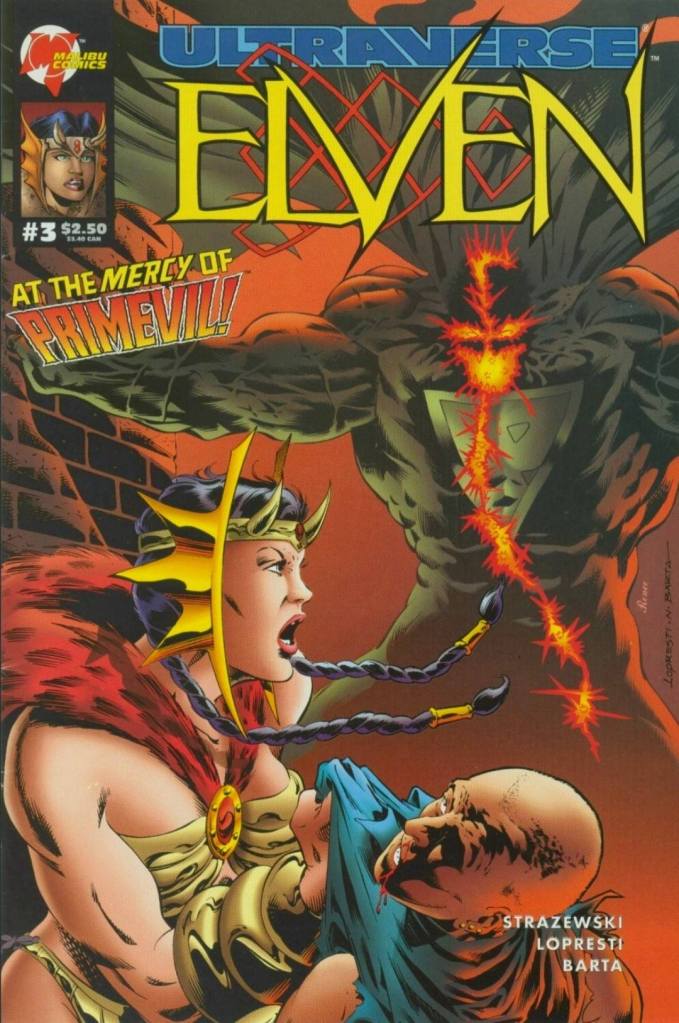
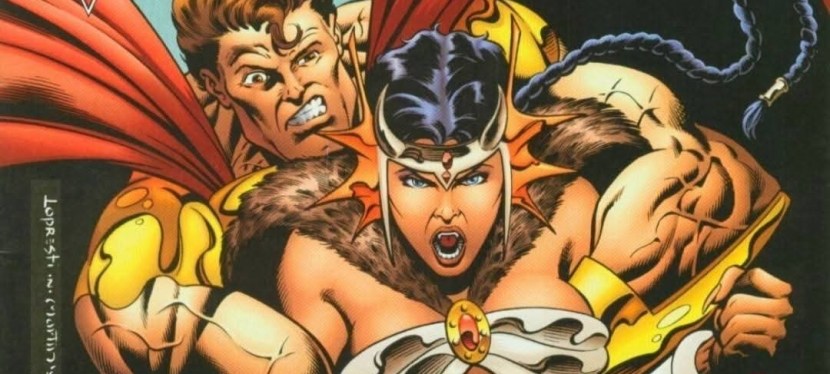
With those details laid down, here is a look back at Elven #3, published by Malibu Comics in 1995 with a story written by Len Strazewski and illustrated by Aaron Lopresti (Sludge).
The cover.
Early story
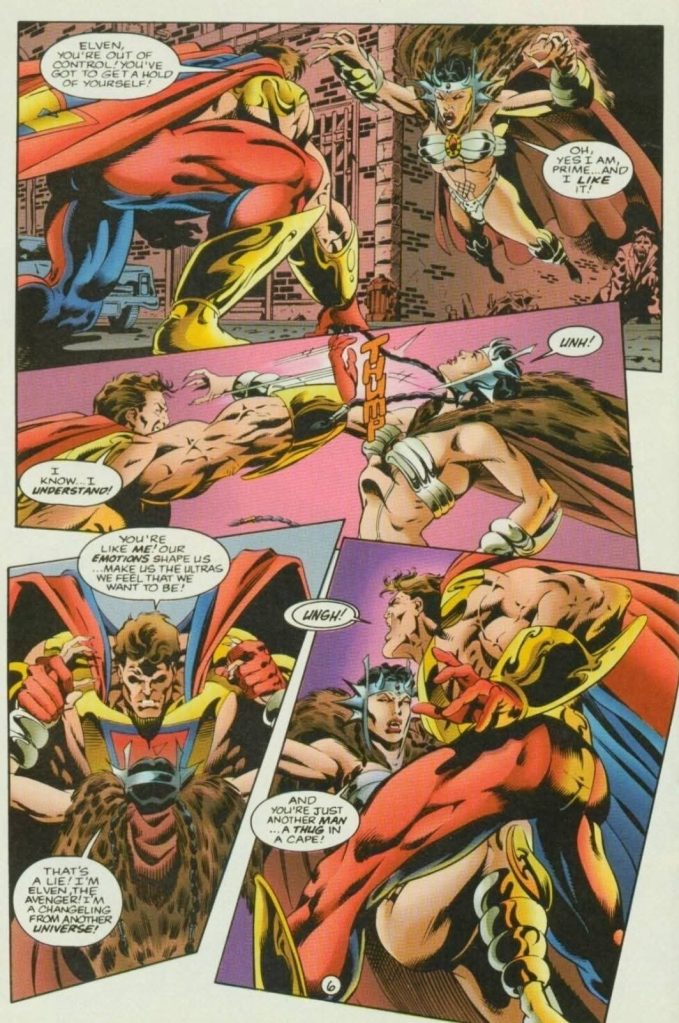
The story begins on top of the building with Elven and Prime meeting again. Tensions are high as Elven accuses him of lying. By this time, she learned a lot of details about her origin from the demon she fought with which convinced her that Prime lied to her about their genetic connections with each other (note: Doctor Vincent Gross was involved as he wanted to create ultras).
Elven rejects the science as she is strong convinced she is of magical origin from a mystical world and happens to be trapped on Earth. As Prime tries to put sense into her, Elven strikes him with a blast of energy to push him back. The blast turned to be of biological energy instead of magic.
As Elven reveals that she learned crucial information from the demon she fought with, Prime realizes it is none other than the one enemy he fought with some time ago…
Quality
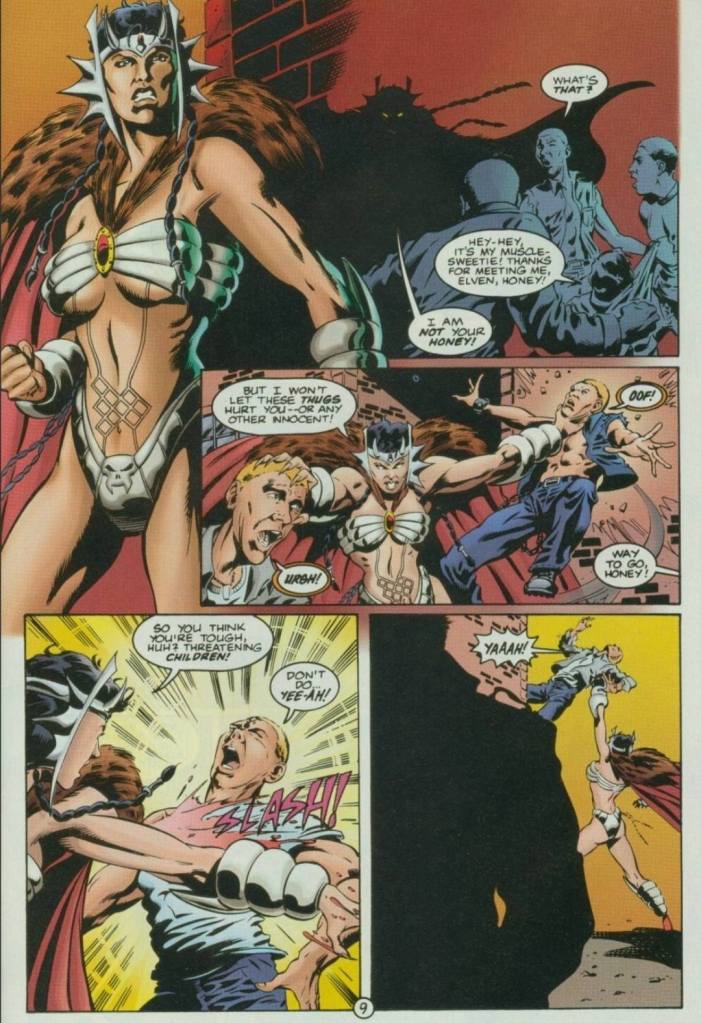
Once again, Elven impulsively uses violence on individuals to help Bruno.
Following the events of issue #2, Elven here remains confused and even lost as she has a lot of trouble figuring out the facts. Of course, being a fanatic of fantasy and Elfquest, Elven clings on to the belief that the fantasy realm is real and that she is of magical origin (which conflicts with the biology and science of her abilities and physical transformation). This is evident in the early part of the comic book when she has a tense reunion with Prime who did his best to explain details and help her understand.
When it comes to the very conflict of the story itself, the stakes were raised when Strazewski has Prime-Evil and elements of unethical science present during the later stage. Apart from abducting Elven, Prime-Evil has his own agenda pursuing Mantra (who in turn has an evil version called Necro Mantra) and a lot of arrogance within. Literally, Prime-Evil’s presence added intrigue to the plot and only made Elven’s struggle to realize the truth of her origin – both the scientific and fantasy aspects – even more complicated.
Bruno, who was a significant and surprising factor behind the conflict in issue #2, gets his nice share of the spotlight. Without spoiling the plot, I can say that he is a lot more than what he seems and has more to add to the conflict.
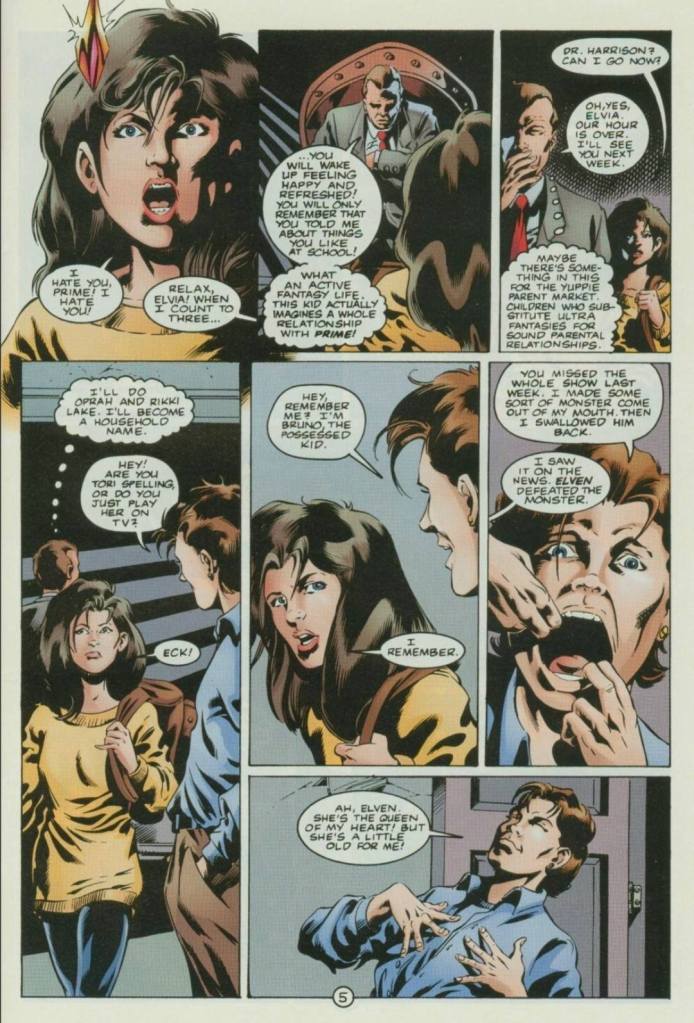
Considering the intensity of the conflict in issue #2, I find it very weird that Bruno and Elvia were not even reported to the local authorities for questioning and accountability. Perhaps the psychiatrist did not bother to do what is right since he was so fascinated with the fantastic conflict and unexplained moments that happened in his office (note: his own office assistant even became naked suddenly), and he has ambitions to become America’s next big name with his knowledge.
Conclusion
Elvia with Bruno and their psychiatrist.
At this particular stage of the mini-series, Elven #3 (1995) had an even more intriguing story to tell while gradually moving forward with Elven’s quest for the truth of her origin and her own purpose. The Strazewski-Lopresti duo did fine work in this comic book for the most part and ultimately the story convinced me to look forward to the next issue. I can say that the ending of this comic book is more suspenseful than that of issue #2.
Welcome back my readers, YouTube viewers and all others who followed this series of articles focused on YouTube videos worth watching. Have you been searching for something fun or interesting to watch on YouTube? Do you feel bored right now and you crave for something to see on the world’s most popular online video destination?
I recommend you check out the following videos I found.
#1 Timecop Revisited – I am not a fan of Jean-Claude Van Damme but his 1994 movie Timecop managed to entertain me when I first saw it on home video. After watching it, I learned that it was based on the Timecop literary property and stories published by Dark Horse Comics. Directed by Peter Hyams, Timecop ended up as one of the better movies of JCVD and it even has its own fanbase. If you want to discover more about the cinematic Timecop, watch the videos posted below.
#2 Inhumanoids Revisited –I remember seeing some episodes of the animated TV series Inhumanoids on local TV and I can say it was easily the most bizarre and even shocking thing to watch. Inhumanoid has a very dark and even cynical tone, and it had gruesome scenes which were really disturbing to see. Behind the scenes, Inhumanoids was animated by Japan-based Toei and involved Hasbro, Sunbro and even Marvel Productions. To find out what made Inhumanoids so disturbing, watch the video below and pay attention to the details.
#3 Luxurious Breakfast Spots In Tokyo – Have you ever thought about having a luxurious breakfast while traveling overseas? In Tokyo, Japan’s most famous city, there are indeed places where visitors can have breakfast with the premium experience. These luxurious places have something unique to offer to customers who have more than enough money to spend for the morning meal. Watch and learn from the Nippon TV video below.
#4 Remember The Rotoscoped Lord Of The Rings – Decades before Peter Jackson and his team rocked the world of moviegoers with memorable Lord of the Rings film trilogy, an animated LOTR was actually made. I am talking about the 1978 rotoscoped animated film The Lord of The Rings directed by Ralph Bakshi which I first saw on home video after seeing Peter Jackson’s LOTR. I found the 1978 LOTR a really unique animated viewing experience and it definitely involved a lot of production work without any use of computers. To find out more about the animated LOTR film, watch the video below.
#5 You, Me and The Movies React To Can’t Hardly Wait – When Can’t Hardly Wait was shown in cinemas in 1998, it faded away as not enough moviegoers were attracted watch it. However, the movie did not fade into obscurity and it actually got new fans as it was discovered on home video, cable TV, pay-per-view and streaming. More importantly, the movie itself was pretty funny the cast led by Jennifer Love Hewitt delivered fine performances as teenagers. Slowly but surely, new retrospective videos about Can’t Hardly Wait are emerging on YouTube and the most entertaining video is the reaction by You, Me and The Movies which I encourage you to watch right now.
#6 Square Enix In The 2000s – Back in the 1990s, Squaresoft and Enix were separate Japanese gaming companies that released a lot of Japanese role-playing games (KRPGs) which entertained many millions of gamers. Square was famous for the best-selling Final Fantasy games while Enix had the wildly popular Dragon Quest franchise. In the 2000s, a series of changes happened in the video game industry and the two companies merged into Square Enix. Since then, a lot of Final Fantasy and Dragon Quest games with evolved designs and styles of presentation were released under a single publisher. There is a lot more to discover what happened behind the scenes as documented in the in-depth video below from Gaming Broductions.
Disclaimer: This is my original work with details sourced from reading the comic book and doing personal research. Anyone who wants to use this article, in part or in whole, needs to secure first my permission and agree to cite me as the source and author. Let it be known that any unauthorized use of this article will constrain the author to pursue the remedies under R.A. No. 8293, the Revised Penal Code, and/or all applicable legal actions under the laws of the Philippines.
Welcome back, superhero fans, 1990s arts and culture enthusiasts, Ultraverse fans and comic book collectors! Today we go back to the mid-1990s to examine one of the many tales of the Ultraverse through the Elven mini-series.
When I grabbed a copy of Elven #1, I did not expect much entertainment and surprise. But as I started reading it and witnessed Elven’s interactions with Prime, the narrative became even more engaging to read. In addition, Len Strazewski’s writing clearly defined the personality of fantasy fanatic and confused girl Elvia Swanson and established Elven as a twisted female parallel to Prime. Along the way, Aaron Lopresti’s art showed a lot of details, emotions and dynamism (on the action).
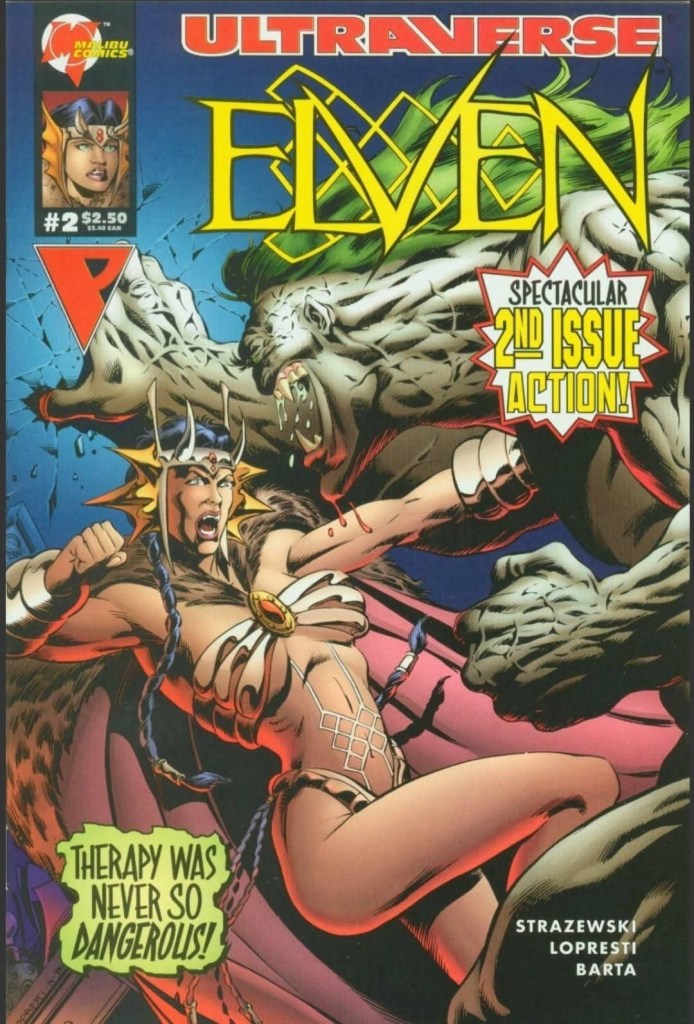
With those details laid down, here is a look back at Elven #2, published by Malibu Comics in 1995 with a story written by Len Strazewski and illustrated by Aaron Lopresti (Sludge).
The cover.
Early story
The story begins inside the office of a psychiatrist where Elven encounters a demon which just came out of the teenage boy Bruno. As the two fight each other violently, the psychiatrist watches them obsessively and writes down the notable details for a potential advancement in his career. Bruno, who carried the demon in him some time prior, watches the fight from a distance marveling at Elven while also observing how chaotic the demon is.
Elven fights the demon hard while maintaining a mindset of pride and even being superior. The demon reveals his link with Boneyard (for reference, click here) confirming he came from a distant world.
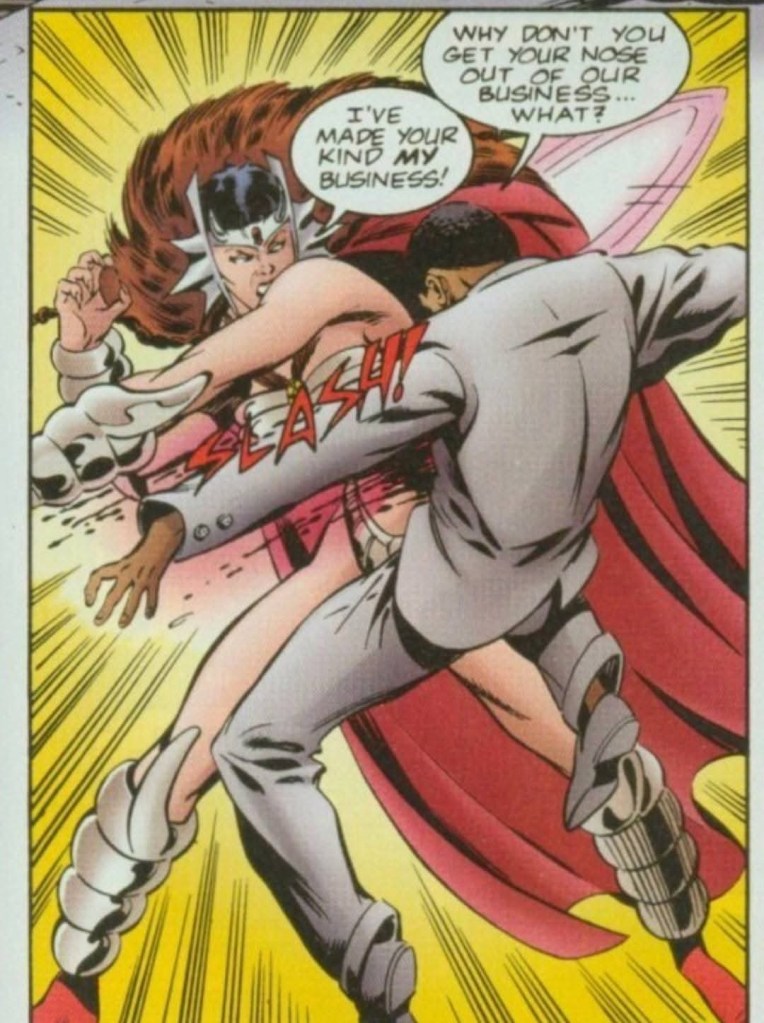
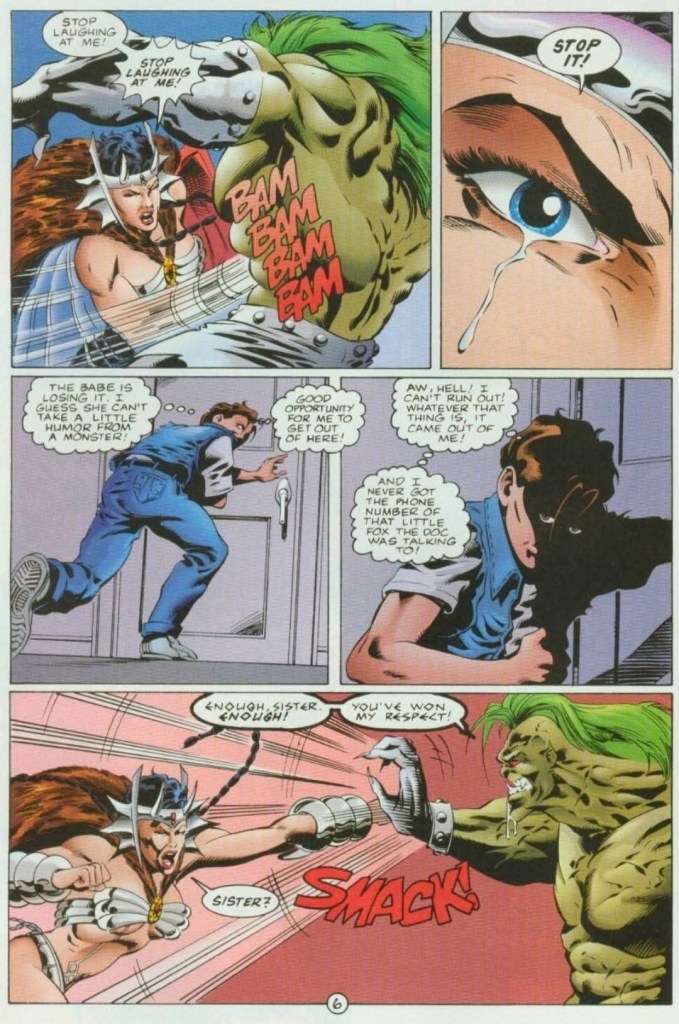
After getting hit by Elven’s elf-fire, the demon begins to laugh at her. Elven gets triggered and starts hitting the demon more…
Quality
By giving in to her impulses, Elven commits a very violent move on a man. This also shows her inability to restrain herself.
While issue #1 established Elvia Swenson personality and her super-powered, fantasy inspired Elven identity who has a genetic connection with Prime, this comic book emphasizes the deeper fantasy aspects of the Ultraverse while expanding the lore within Elven’s part of the shared comic book universe.
Similar to Prime (Kevin Green in disguise), Elven gets triggered emotionally which is the result of the youth and obvious lack of maturity of Elvia. That being said, the moments of Elven getting more violent and shedding a few tears after getting laughed at by the demon deserve any reader’s attention.
Len Strazewski’s writing is pretty rich here and he pulled of some clever moves with the narrative. As the battle between Elven and the demon intensified, there were signs that the conflict would turn into an even bigger and more destructive battle. Instead, there were these deep revelations that happened (note: for relevance, you will have to read Prime #5 which I reviewed some time ago) and even the arrogant boy Bruno has his own share of what has been going on. Even the psychiatrist turned out to be a pretty significant bystander during the battle which suggests a build-up for a sub-plot.
As such, Strazewski wrote the story to be very intriguing and the plot threads are not limited to Elven and the demon. The way I see it, something is being built up and to grasp the relevance, you will have to read some issues of the Prime and Mantra comic book series.
If there is any weakness in the storytelling, it is the fact that the psychiatrist and his office assistant very easily forgot the moments of Bruno turning evil during the late part of issue #1. The way they reacted in this comic book after the end of the battle between Elven and the demon, they did not make any moves to hold Bruno accountable nor did they question Elven’s way of handling matters (which includes the eventual ruining of the office).
Conclusion
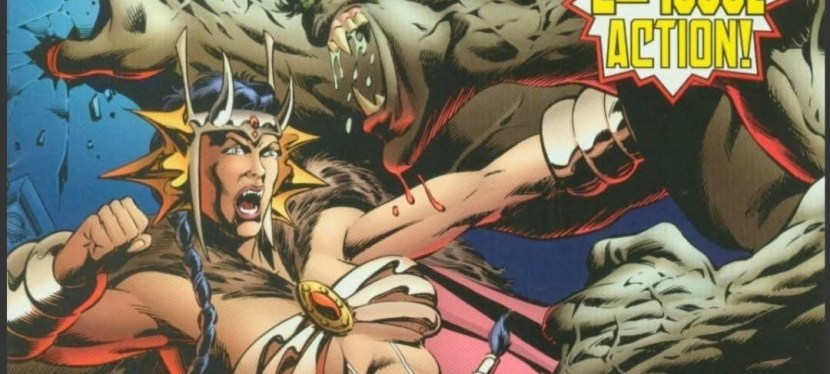
After getting triggered (being laughed at by the demon), Elven acted move violently and impulsively.
While there were a few weak spots in certain parts of the story, Elven #2 (1995) is another solid read from the Strazewski-Lopresti duo. Elven got developed even more through conflict with the demon, and her own search for the truth about her origin. Aside from that, the fantasy elements implemented in the story expanded the lore of the Ultraverse in a very unique way. Ultimately, I am looking forward to reading the next chapter of this mini-series.
Disclaimer: This is my original work with details sourced from reading the comic book and doing personal research. Anyone who wants to use this article, in part or in whole, needs to secure first my permission and agree to cite me as the source and author. Let it be known that any unauthorized use of this article will constrain the author to pursue the remedies under R.A. No. 8293, the Revised Penal Code, and/or all applicable legal actions under the laws of the Philippines.
Welcome back, superhero fans, 1990s arts and culture enthusiasts, Ultraverse fans and comic book collectors! Today we go back to the mid-1990s to examine one of the many tales of the Ultraverse.
For the newcomers to the Ultraverse, Prime is one of its most definitive heroes and his true identity is the teenager Kevin Green who can transform into an overly muscular caped adult superhero. The Prime monthly series of comic books ran for two years and the title character appeared in many other Ultraverse comic books.
Considering the prominence of Prime, it is not surprising that Malibu Comics proceeded to create comic books featuring a female counterpart to Prime. That counterpart is called Elven who appeared in a few early issues of the Ultraverse Premiere series and eventually Prime interacted with her.
With those details laid down, here is a look back at Elven #1, published by Malibu Comics in 1995 with a story written by Len Strazewski and illustrated by Aaron Lopresti (Sludge).
The cover.
Early story
The story begins deep within a city when a beautiful blonde woman got hurt by a very angry man named Billy. With the lady down on the floor, the man raises his metallic weapon intending to strike her not realizing that someone is emerging from behind. He turns and sees a scantily clad caped woman who immediately hits him hard. The caped woman is Elven who believes she is helping the blonde woman.
To Elven’s surprise, the blonde woman tells her to stop and not hurt the man who was violent towards her. The man hits Elven on the face with his weapon but ended up getting hit hard again in retaliation. Elven then uses an optic blast at the wall as she tells the blonde woman to leave.
With the violent man down and hurt, Elven decides to kill him but is prevented by Prime from behind. After telling Prime that she told him not to interfere with her, she hits him with an energy blast…
Quality
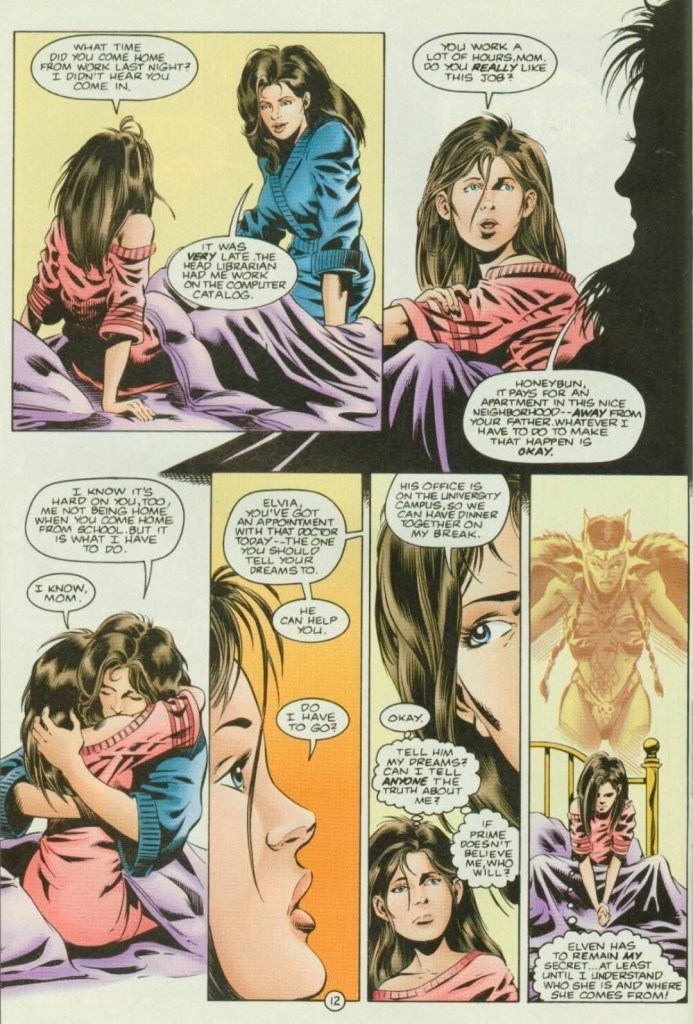
Elvia with her hard-working mother. The lack of a loving father affected Elvia deeply.
Being written by Prime co-creator and series co-author Len Strazewski, this Ultraverse tale about Elven is very good and there is a lot of depth in the plot. You will meet Elven and the true human behind her named Elvia Swenson, a teenage girl who has a painful past, has an obsession with fantasy tales, and was created through the very same secret government fertility research program as Kevin Green/Prime. Elven’s disturbing look (with elvish features) reflects Elvia’s fantasy obsession and personally belief of using violence against men. She and Prime are genetically related due to the top secret project.
This comic book examines Elvia whose life lacks direction and her abusive father really impacted her negatively. With her mother’s love and guidance remaining in her life, Elvia is literally in a quest to find purpose, happiness and friendship. Unfortunately, the young guy Bruno is in the neighborhood and he is actually a demon. Bruno’s presence literally raised the stakes of the story which justifies Elvia’s transformation into Elven for the eventually good-versus-evil conflict. All throughout, there is tension and drama which got balanced with superhero spectacle. The way Elven is portrayed here makes her comparable with the arrogant, man-bashing, rabid feminists of modern society.
When it comes to Prime himself, this comic book features a really mature portrayal of him. I am talking about the early part of the story when Prime did his best to calm Elven down, restrain her and convince her to think first as a way to prevent her recklessness. Long-time Ultraverse readers should now that Prime is actually teenager Kevin Green inside all that muscle and he often has an awkward or a tense way of communicating with others (note: imagine the teenager pretending to think and act like an adult). That said, Prime here really interacts maturely and his attempt to put a lot of sense into the impulsive Elven is very believable. This is clever writing by Strazewski and it is one of the more notable portrayals of Prime.
When it comes to the visual side, artist Aaron Lopresti’s style worked smoothly in this comic book. I have seen his works in the Sludge series and he really excels with facial expressions, spectacle and the monsters looking very creepy. Strangely enough, Lopresti’s take on Elven is noticeable smaller and less muscular when compared to how the character appeared in Elven #0 and Ultraverse Premiere drawn by Greg Luzniak.
Conclusion
Prime struggles to calm the impulsive and reckless Elven down. Without Prime’s intervention, Elven definitely would have committed murder against a man who harmed a woman moments earlier.
Elven #1 (1995) is clearly a very solid read and easily one of the best spin-off comic books of the Ultraverse. Strazewski and Lopresti crafted a tale that was intense and dramatic while successfully defining Elven and her true identity as the teenage Elvia. Considering her painful background and current situation, Elvia is sympathetic although things got twisted when she becomes Elven which brings out her violent side, her recklessness and distorted view about helping women by using violence. That being said, Elven at this stage in the Ultraverse is not really a likable lead character and that only makes her more unique when compared to Prime. Will Elven become as terrible as the evil ones? There is more to discover as this comic book is part of the limited series.
The specific portrayals of Elvia and Elven is very tricky to write down and Strazewski succeeded in making it work. Ultimately, this comic book added strong fantasy elements within the Ultraverse.
Disclaimer: This is my original work with details sourced from reading the comic book and doing personal research. Anyone who wants to use this article, in part or in whole, needs to secure first my permission and agree to cite me as the source and author. Let it be known that any unauthorized use of this article will constrain the author to pursue the remedies under R.A. No. 8293, the Revised Penal Code, and/or all applicable legal actions under the laws of the Philippines.
Welcome back, superhero fans, 1990s arts and culture enthusiasts, Ultraverse fans and comic book collectors! Today we revisit the Ultraverse to take a look at one of the many tales of Prime from the monthly series that first launched in 1993.
In recent times, I’ve been reading and reviewing Prime comic books I missed out before. For my most recent Prime retro reviews, click here, here and here. For the newcomers reading this, Prime is one of the most definitive heroes of the entire Ultraverse and his true identity is the teenager Kevin Green. Prime is also one of three major Ultraverse figures in the team UltraForce.
With those details laid down, here is a look back at Prime #20, published by Malibu Comics in 1995 with a story written by Len Strazewski and Gerard Jones, and illustrated by Greg Luzniak.
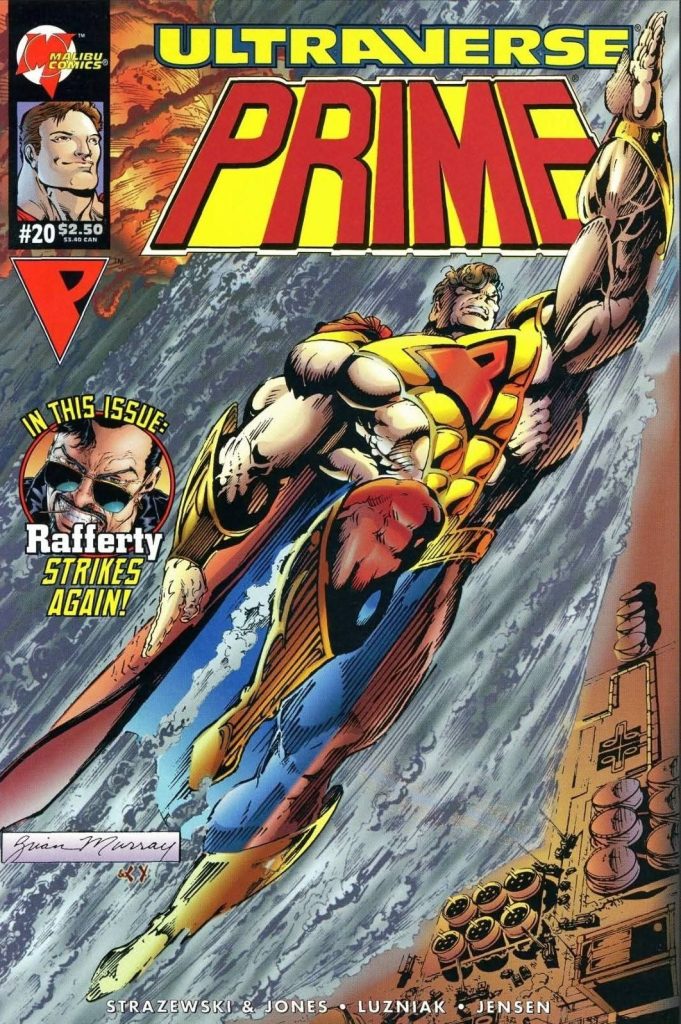
The cover.
Early story
The story begins with a man and a woman on bed. They just made love with each other. As the woman goes to the bathroom to fix herself, the man tells her she will be perfect in a new project and they will be together all the time even though he is already married. He tells her that will be a real ultra-heroine and already a lot of things are being prepared for her such. She will also have a new partner and already they found a way to get him to Washington.
Feeling terrible, the woman lowers herself on the bathroom floor, pulls a piece of hardware very hard, and an explosion suddenly happens.
In New York City, Kevin and his mother attend an opera. Kevin still has trouble adjusting to life in New York and misses his friends and the community of Canoga Park. He still has feelings for Kelly but remains confused as he still struggles with managing his personal life being himself and being Prime…
Quality
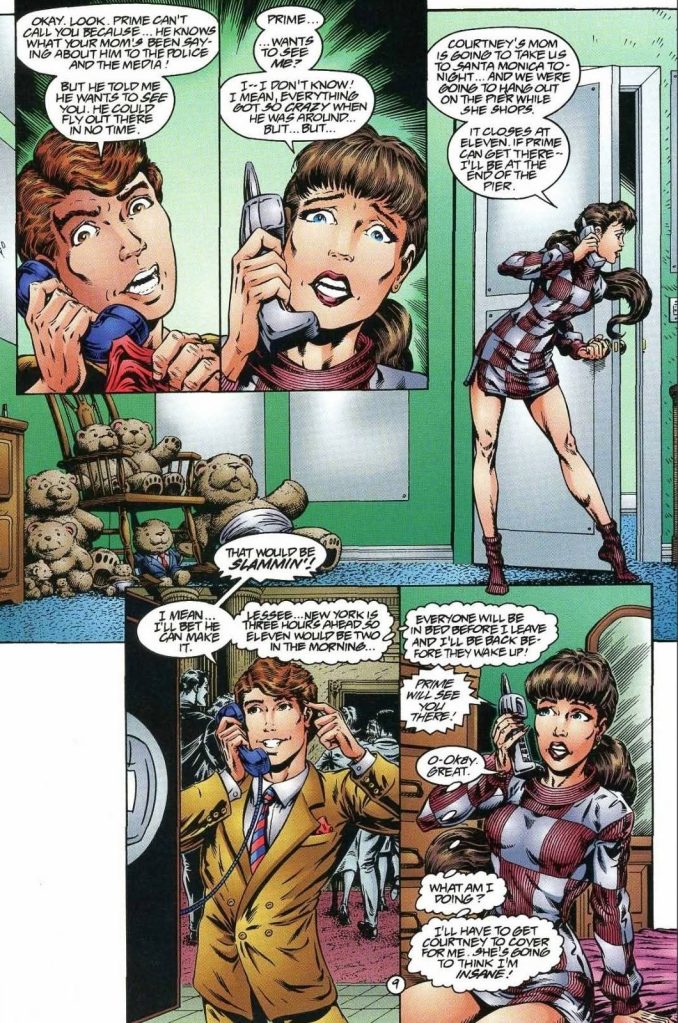
Kevin and Kelly talking to each other via a long distance call.
I really enjoyed this issue of Prime mainly because the writing done by Len Strazewski and Gerard Jones is really rich with depth. To make things clear, this is another Prime tale made to emphasize the title hero’s personality particularly with his personal life as Kevin Green who at this stage has turned into a really confused teenager. Not only is Kevin so far away from Kelly, he has not seen his father for a long time already, his mother has been working and is about to move to Washington for a new job, and public perception towards Prime has been tense.
As the cover already confirmed, the deadly villain Rafferty is indeed here although the traditional good-versus-evil conflict is not a major part of the story. Rafferty previously encountered Freex and The Strangers (click here, here and here) and it was only right to set him up for conflict with Prime.
When it comes to the art, I enjoyed Greg Luzniak’s style on Prime and the other characters. Luzniak is really good with the dynamic approach on visualizing superhero spectacle and acts. The way he shows facial expressions resulted in a wide range of looks and emotions.
Conclusion
Kevin in New York with his mother. His father has been away for a long time at this point in the series.
The character-driven approach done by the Strazewski-Jones duo made Prime #20 (1995) a very solid read. The story has a firm structure designed to open opportunities to emphasize Kevin Green’s development which in turn reflects his struggle with the changes of his life. This comic book also explores Kelly’s speculation that Prime and Kevin are one and the same, and the creators pulled off the right moves to add weight to that. By the time I reached the ending, I am convinced to go on to the next issue.
Disclaimer: This is my original work with details sourced from reading the comic book and doing personal research. Anyone who wants to use this article, in part or in whole, needs to secure first my permission and agree to cite me as the source and author. Let it be known that any unauthorized use of this article will constrain the author to pursue the remedies under R.A. No. 8293, the Revised Penal Code, and/or all applicable legal actions under the laws of the Philippines.
Welcome back, superhero fans, 1990s arts and culture enthusiasts, Ultraverse fans and comic book collectors! Today we revisit the Ultraverse to take a look at one of the many tales of Prime from the monthly series that first launched in 1993.
In recent times, I’ve been reading and reviewing Prime comic books I missed out before. For my most recent Prime retro reviews, click here and here. For the newcomers reading this, Prime is one of the most definitive heroes of the entire Ultraverse and his true identity is the teenager Kevin Green.
With those details laid down, here is a look back at Prime #14, published by Malibu Comics in 1994 with a story written by Len Strazewski and Gerard Jones, and illustrated by the Darick Robertson with ink work done by Barbara Kaalberg.
The cover.
Early story
The story begins with Prime flying and deeply thinking about the group of powered social outcasts…Freex. Prime, who recently spent time with Freex and helped them fight monsters (click here and here). He wished to help them more but does not want to be like them. He wants to show the whole world that it cannot push him around only because of his youth.
Moments later, Prime arrives at Venice Beach in California to meet members and agents of the media…
Quality
This should remind you to always behave yourself in front of any family member of your friend. Prime ends up being disrespectful to Kelly’s mother due to Kevin’s lack of maturity.
As a long-time Ultraverse comic book reader, there is a lot to like in this tale of Prime. For one thing, it is a pure character-driven story with a strong emphasis on how Kevin Green’s personal views develop, why he keeps on struggling to understand society and why his way (in the form of Prime) of interacting with ordinary people remains awkward.
There is so much stuff here, it can be challenging to realize the main themes of the story written by Jones and Strazewski. To make things clear, at this point in the Ultraverse, worldly authorities are very aware of the Ultras who seem to want to help people with problems but they are compelled to use force to confront them as those super powered beings are capable of making their own rules, violate laws with impunity and cause trouble in societies.
Prime is already in the middle of a troubled American society and the government as well as secret societies have other Ultras to deal with. Being a teenager himself, Kevin Green is able to relate with members of Freex who have no families to return to and are always on the run being chased by the authorities and being hated by the world. Along the way, Prime is acting impulsively with the adults and members of the media since Kevin himself lacks maturity and has yet to fully understand society and its norms. Kevin also forgets how to behave properly as he fails to control his emotional impulse.
When it comes to the art, Darick Robertson did a really fine job visualizing Prime and in most pages of the comic book, he uses dynamism to make the reading experience look very lively. He also did a good job with the facial expressions.
Conclusion
Prime recalls the time he spent with Freex.
It is very clear that the writing in Prime #14 (1994) done by the Jones-Strazewski duo is rich and deeply layered. Being a self-declared fighter and supporter of young people in this issue puts Prime into deeper trouble as he does not realize yet the consequence of the moves he made. The creative team really excelled in dramatizing Kevin Green – in the physical form of Prime – being impulsive and immature to adults while acting as a helpful adult to teenagers he meets. This story also sheds light on broken families which will instantly remind readers about poverty, vices and long-lasting negativity in unchecked parts of American society. That being said, this Prime story is a great read and its social commentary remains very relevant. This is also a great development of Prime’s personality.
Welcome back my readers, YouTube viewers and all others who followed this series of articles focused on YouTube videos worth watching. Have you been searching for something fun or interesting to watch on YouTube? Do you feel bored right now and you crave for something to see on the world’s most popular online video destination?
I recommend you check out the following videos I found.
#1 Minty Comedic Arts examines Not Another Teen Movie – As it is undeniably true that Hollywood produced a lot of teen movies from the 1980s into the 1990s, it was inevitable that a parody movie referencing them would get released. 2001’s Not Another Teen Movie did exactly that and by today’s standards, the parody production itself has lots of interesting details to explore which you can see in Minty Comedic Arts’ video below.
#2 Michael Jordan’s memorable moves in Game 6 of the 1998 NBA Finals – Remember when Michael Jordan led the Chicago Bulls to its 6th NBA championship in 1998? It took him and his team a lot of effort to win over the revenge-hungry Utah Jazz (which had the homecourt advantage) in the NBA Finals of that year. But there’s more! Before the 1997-98 season even started, there was a lot of intrigue and tension behind the scenes within the Chicago Bulls. Not only that, the Indiana Pacers pushed the Bulls to a full seven games in the Eastern Conference Finals. These developments only added more to the build-up of Jordan’s successful leading of his team to the championship and you can discover more by watching the retrospective video of YouTuber Post2k below.
#3 Slope’s Game Room examines Radiant Silvergun and Ikaruga – Have you ever played Radiant Silvergun or its spiritual sequel Ikaruga? Both games were shooters developed by Treasure, and each of them were widely praised by gamers – especially fans of arcade shooters – around the world. Radiant Silvergun arguably revived the shoot-them-up genre in arcades while Ikaruga had more puzzle-inspired elements to its gameplay. To find out who made the games and what were the inspirations behind the game designs, watch the retrospective video of Slope’s Game Room below.
#4 Reaction videos of Jurassic Park III – When Jurassic Park III opened in cinemas in 2001, I was not too excited about it because The Lost World: Jurassic Park was a major disappointment, and my interest in cinematic dinosaurs was weak. I eventually saw the movie at a time when the lineup of movies screened in cinemas was really weak (note: Jurassic Park III was already over a month old in the cinemas) and I got barely entertained. To this day, some Jurassic Park franchise fans are divided over the 3rd movie’s quality – some found it faster-paced and more fun than its 1997 predecessor while others viewed it as a very rushed side story pretending to be a sequel. That being said, if you want to see how Jurassic Park III impacted YouTubers, watch the reaction videos (and video review) below.
#5 You, Me and the Movies react to The Thing (1982) – When The Thing was first released in 1982, the reception from movie critics was negative and the film ended up grossing less than $20 million in the American box office. The movie found its audience on home video, cable TV and television and through the decades, its reputation with moviegoers improved dramatically. Some even called it one of the best science fiction and horror films of all time. If you are wondering how The Thing impacts today’s YouTubers, watch the reaction video of You, Me and the Movies.
Welcome back my readers, YouTube viewers and all others who followed this series of articles focused on YouTube videos worth watching. Have you been searching for something fun or interesting to watch on YouTube? Do you feel bored right now and you crave for something to see on the world’s most popular online video destination?
I recommend you check out the following topics and the related videos I found.
#1 The next Xbox will include Steam and PlayStation? – The vibe of the next-generation of console gaming is only intensifying by the day. When it comes to Xbox itself, there is speculation that the next-generation Xbox will not only be a hybrid PC console but also include access to Steam games and even those of PlayStation. I know it sound crazy but if it is clear that Microsoft is doing its own approach on the next-generation Xbox in radically different way compared with PlayStation and Nintendo. If you want to know more details, watch Colteastwood’s video below.
#2 PatmanQC examines NBA Jam – Were you able to play basketball videos in the arcades way back in the 1990s? Back then, NBA Jam was a massive excess attracting so many players and generating lots of income for arcade operators. The game also sold a lot on many game consoles as well. NBA Jam is a 2-on-2 arcade-style basketball game with emphasis on fast-paced scoring without the hindrance of normal basketball rules. To discover more about the history of NBA Jam and who were the people behind its production, watch the video of PatmanQC.
#3 Slope’s Game Room examines the Strike games franchise – Remember back long ago when Electronic Arts (EA) released a series of military themed shooter games on game consoles? I’m referring to the Strike series of games that include Desert Strike, Jungle Strike, Urban Strike, Soviet Strike and Nuclear Strike. Those games were released across two console generations in the 1990s and the series has not been revived until now. To look back at EA’s Strike games, watch the video by Slope’s Game Room.
#4 VKunia reacts to Batman v. Superman: Dawn of Justice – I recently browsed through the many videos of YouTuber VKunia and took time to watch her reaction video of Batman v. Superman: Dawn of Justice. The film directed by Zack Snyder is significant not in a positive way but because of its very dark approach on storytelling and spectacle involving DC Comics’ icons Superman, Batman and Wonder Woman. The way it was presented, not even the combined talents of Henry Cavill, Gal Gadot, Ben Affleck and others could spare the film from negative reception. I think by today’s standards, this is a superhero film that can only entertain a limited type of people. Still, I find VKunia’s reactions to it a must-watch.
#5 Woke garbage in comic books exposed and explained – As a geek, I really hate it when these modern day Leftists – Communists, socialists, Marxists, liberals, diversity zealots, inclusion zealots, LGBTQ activists and Islamo-Leftists – ruin movies and video games by emphasizing their radical agenda through them. The same has happened in comic books and it is clear that the Leftists working for the publishers made established superhero icons look terrible. These unfortunate developments will remind you that comic books are meant for escapism and not political agenda which comic book legends Jim Shooter and Stan Lee confirmed long ago. Watch and learn from the video of YouTuber Ranting for Vengeance right now.
#6 The free speech solution against DEI poison – In this John Stossel video I recently saw, the topic of diversity, equity and inclusion (DEI) was discussed and it turns out there is a free speech solution against the woke virus. This is about the ongoing information war between the Satanic Left and the ones who believe in common sense and reality.
#7 Ashleigh Burton reacts to The Breakfast Club – Were you able to watch any movies written or directed by the late John Hughes? A lot of people considered Hughes’ works collectively defined the cinematic American teenagers of the 1980s. One of the more popular works of Hughes was The Breakfast Club and Ashleigh Burton’s reaction video is a must-see.
Welcome back readers, fellow geeks and electronic gaming fans!
In this edition of the Retro Gaming Ads Blast (RGAB) series, we will take a look at another batch of retro gaming print ads – including arcade flyers – from the 1980s and 1990s.
For the newcomers reading this, Retro Gaming Ads Blast (RGAB) looks back at the many print ads of games (console, arcade, computer and handheld) that were published in comic books, magazines, flyers, posters and newspapers long before smartphones, social media, the worldwide web and streaming became popular. To put things in perspective, people back in the 1980s and 1990s were more trusting of print media for information and images about electronic games and related products.
With those details laid down, here is the newest batch of retro gaming print ads for you to see and enjoy…
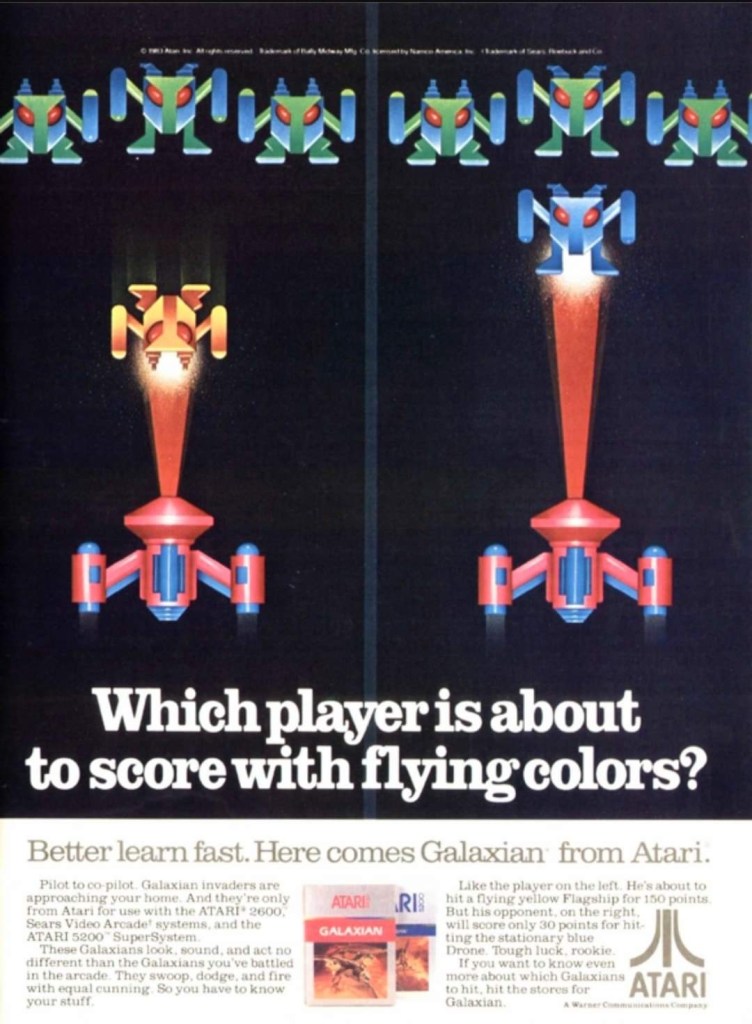
1. Galaxian for Atari print ad
A unique approach to the art done by the advertisers.
Developed by Namco, Galaxian was a 2D sci-fi shooter that debuted in arcades in 1979. It was so successful and widely acclaimed, it got ported to varied game consoles and home computers as the years passed by. For its release on the Atari 2600 and Atari 5200, this print ad was created to catch the attention of fans and gamers by utilizing artwork that resembled the look of 2D sprites from the game. That being said, no screenshots of Galaxian on the Atari consoles were shown because the artwork used looked detailed and were attention-grabbing already.
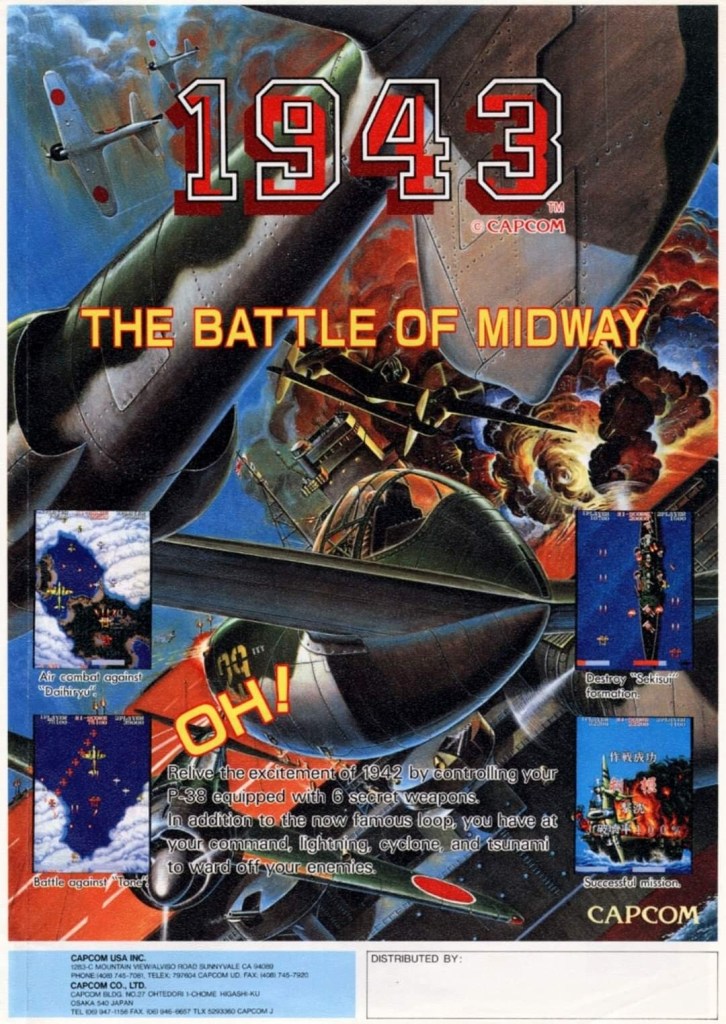
2. 1943: The Battle of Midway arcade flyer
This is a fine looking flyer.
In 1987, Capcom released in the arcades 1943: The Battle of Midway which was their follow-up to 1942. The arcade flyer itself was designed to strongly promote the game using a combination of screenshots, short-but-clear text descriptions and the great looking piece of artwork which really emphasized the World War II concept. Behind it all, this game was made by Japanese developers with the Western markets in mind and the irony is that the game has players control Americans fighting the Japanese fleet.
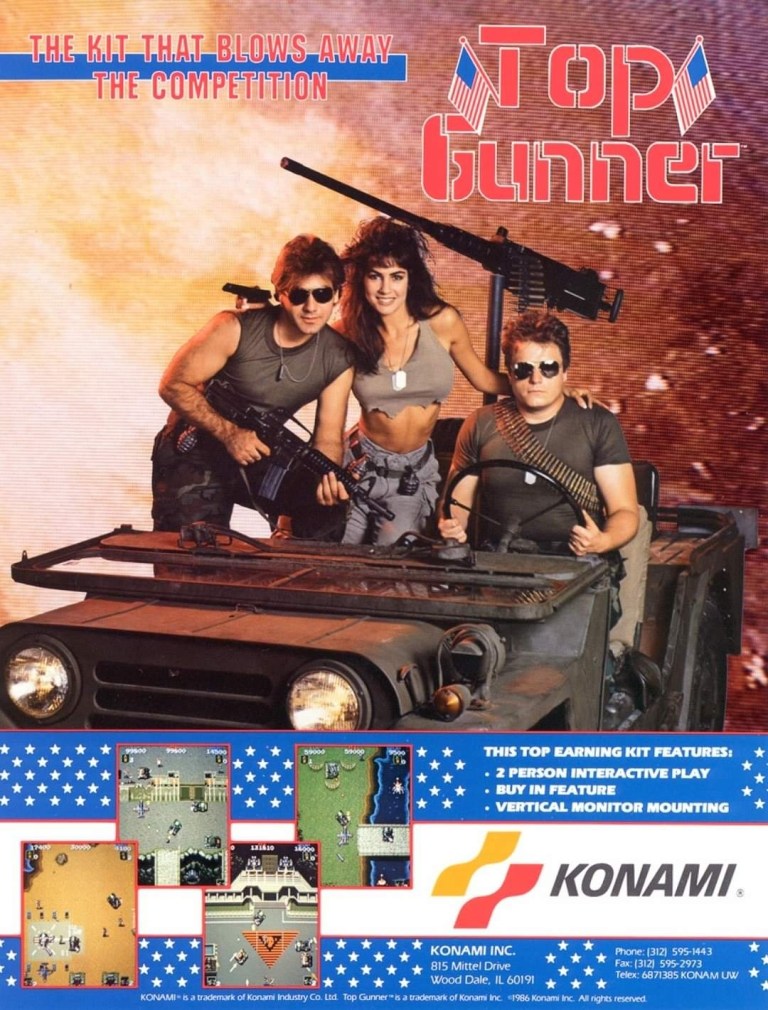
3. Top Gunner arcade conversion kit flyer
Show this nice looking image to the woke nut or modern day Communist near you. Watch and observe his or her reaction.
To make things clear, Top Gunner is actually the run-and-gun game Jackal and the alternative titles was mainly used in North American arcade distribution and also reflected Konami’s move of coming up with titles inspired by blockbuster movies of the time. To promote its 1986 arcade release in America as a conversion kit, the advertisers had three models playing soldiers on a military jeep to immerse gamers into the core concept of the game – moving armed military jeeps from one location to another while fighting bad guys. The approach used for the visual concept is indeed inspiring, especially during the Cold War. Top Gunner/Jackal became a hit in both arcades and consoles.
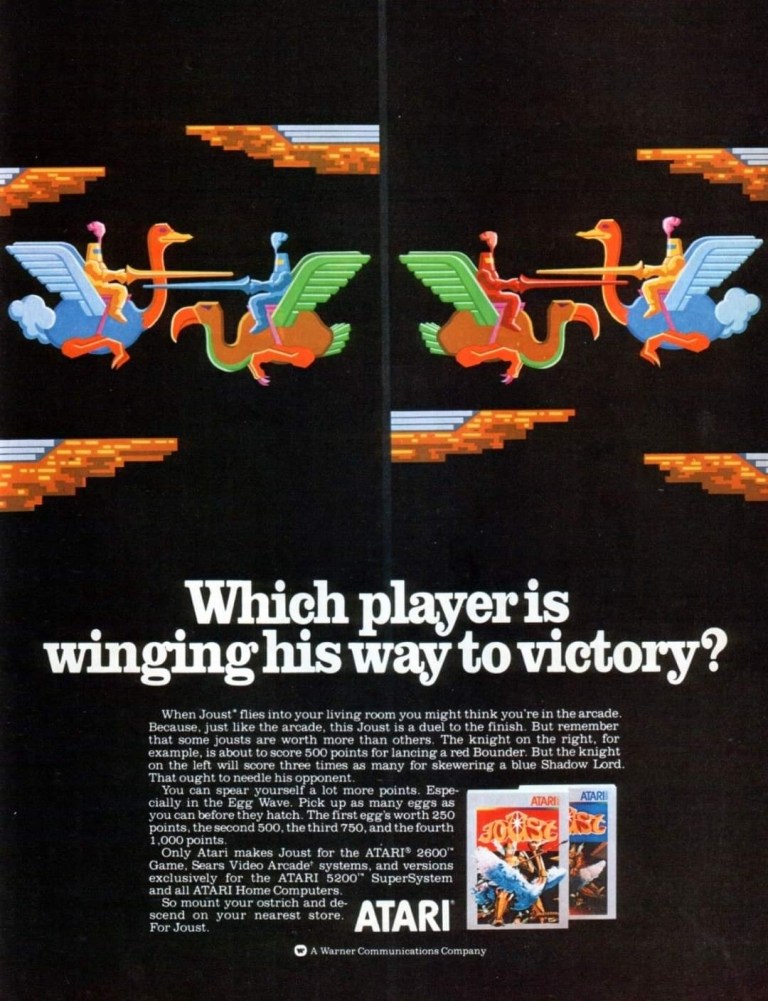
4. Joust for Atari print ad
While I played Joust on console, I don’t remember seeing this print ad before.
Made by Williams Electronics, Joust was one of those early 1980s arcade games that eventually made its way to the Atari 2600 console which was massively popular in North America. Strangely enough, the artistic approach Atari’s advertising came up with for the console version of Joust was similar with that of the ad of the Atari version of Galaxian (see item #1 above) in which artwork was used to resemble the 2D sprites of the game. Regardless, the images of this ad showed what a joust looked like – a martial game between two armed combatants going against each other while riding an animal.
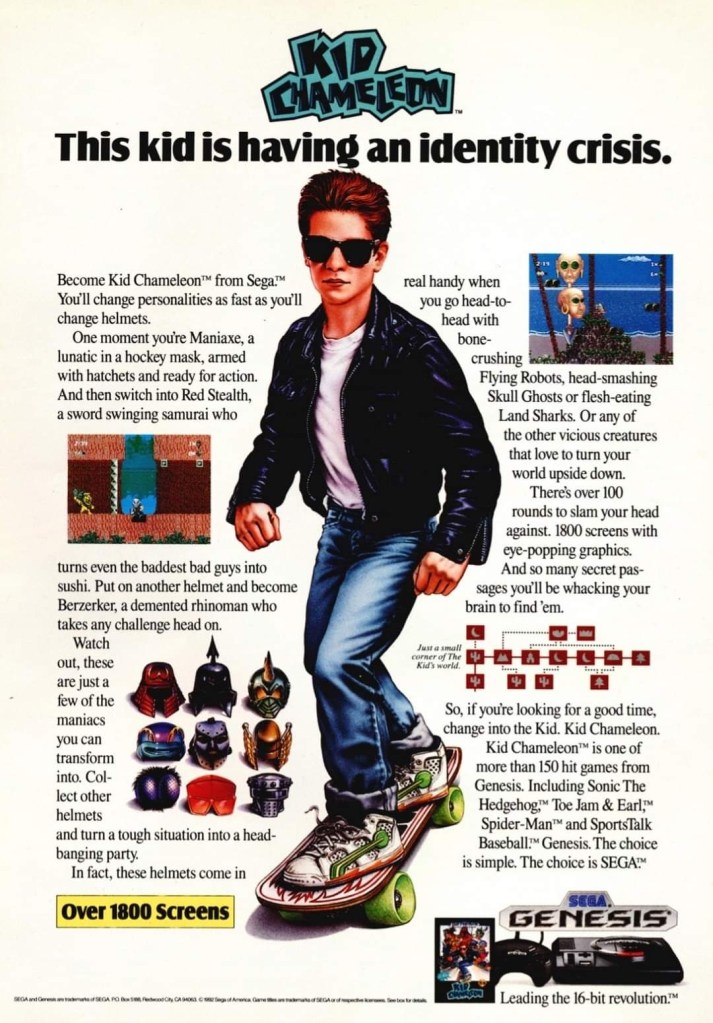
5. Kid Chameleon print ad
Can you relate with Kid Chameleon’s identity crisis?
During the early years of the Sega Genesis, Sega of America exerted efforts to make new games that were not only exclusive to their console but also stand out among the many 2D side-scrolling adventure games by coming up with a protagonist with a unique personality that could somehow resonate with young kids and teenagers.
Developed by their internal experts (Sega Technical Institute), the company released Kid Chameleon in 1992 and they came up with the above print ad that had detailed hand-drawn art of the lead character as well as a wordy text description which was a clear attempt to help young gamers (including teenagers) get connected with both the game and the protagonist. The advertisers even had space to spare to accommodate two screenshots of the game.
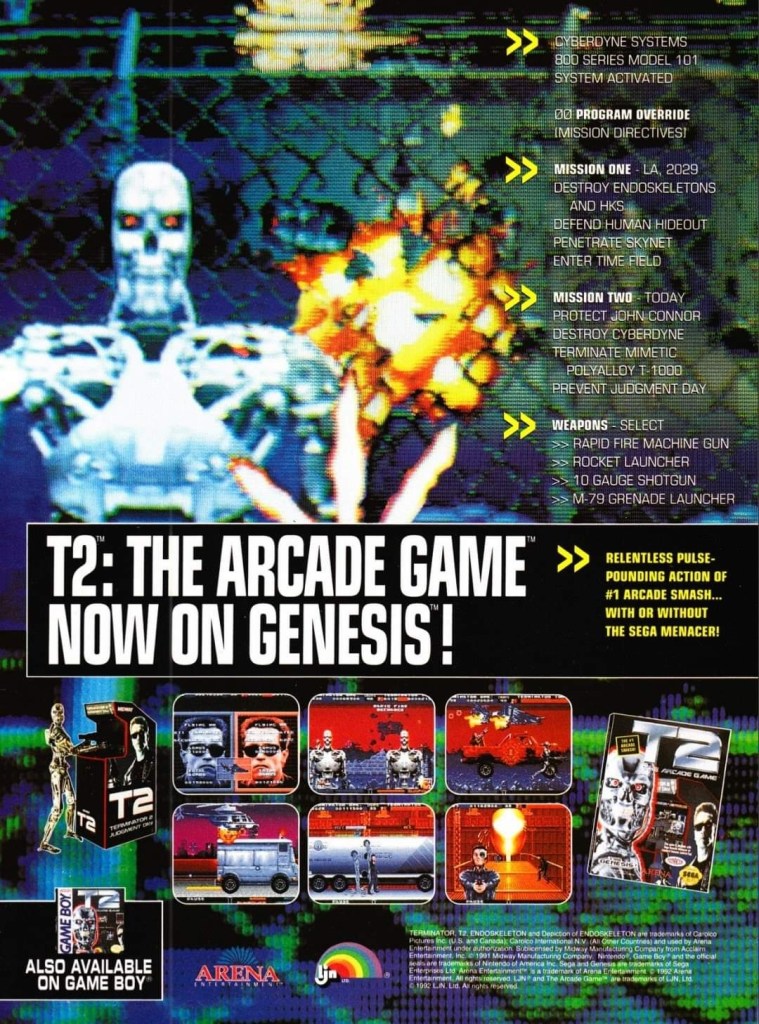
6. Terminator 2: Judgment Day (AKA T2: The Arcade Game) for Sega Genesis print ad
This print ad appeared on the many comic books I read long ago.
Back in the early 1990s, Terminator 2: Judgment Day was a massive success in the global box office and this resulted in Arnold Schwarzenegger’s popularity to soar very high while also establishing the Terminator as an essential pop culture figure. Apart from comic books and merchandise, video games based on the movie were made and the one that stood out the most was the arcade shooter game initially titled Terminator 2: Judgment Day (later retitled as T2: The Arcade Game).
The arcade mega hit eventually got ported to the Sega Genesis and this print ad really looked flashy with its visual presentation showing screenshots and a zoomed-in look at how the Terminator T-800 looked like in the Genesis version complete with a few explosions in the background. It should be noted that this flashy print ad cleverly concealed the visual downgrades and the redrawn images as the Genesis itself could never come close to matching the high quality visuals of the arcade version.
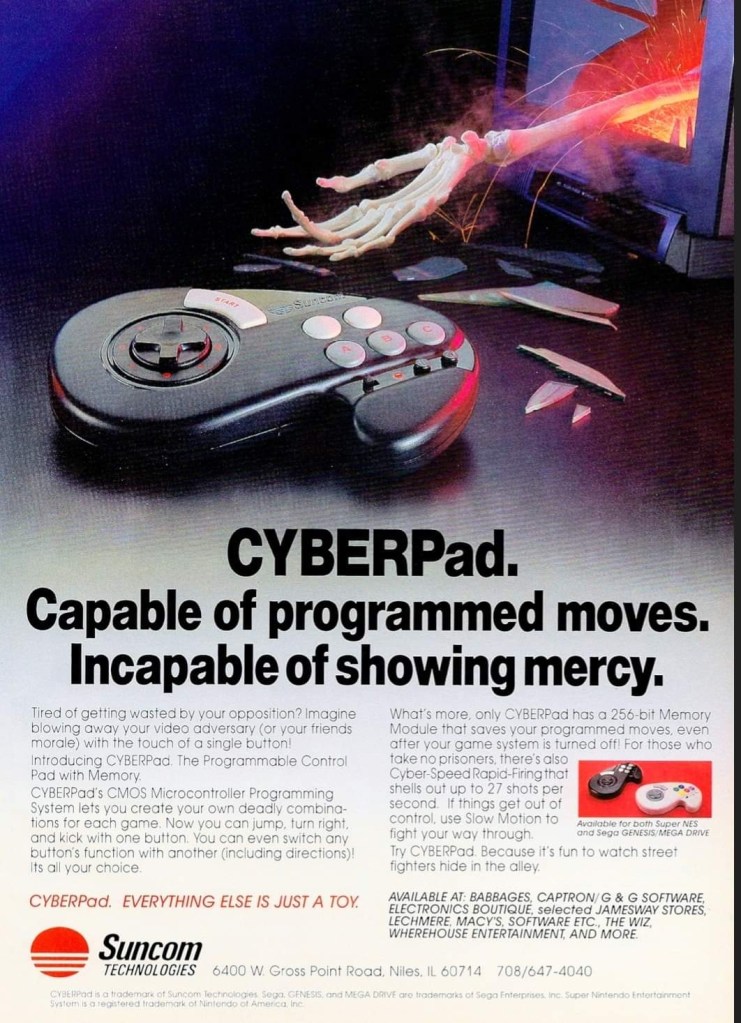
7. CYBERPad print ad
I never owned the CYBERPad, nor have I ever used one.
During the so-called 16-bit console generation (actually the 4th console generation), there were lots of licensed console peripherals made by independent companies in support of the Sega Genesis and Super Nintendo Entertainment System (SNES). The company Suncom Technologies came up with the CYBERPad controller for the two consoles and they boasted in their print ad that the product had a programmable control pad that allowed users to create combinations for each game with convenience in mind. The CYBERPad also allowed the saving of the programmable moves and it had a rapid-fire feature and even a slow-motion function. The CYBERPad was made to make the gameplay experience more user-friendly.
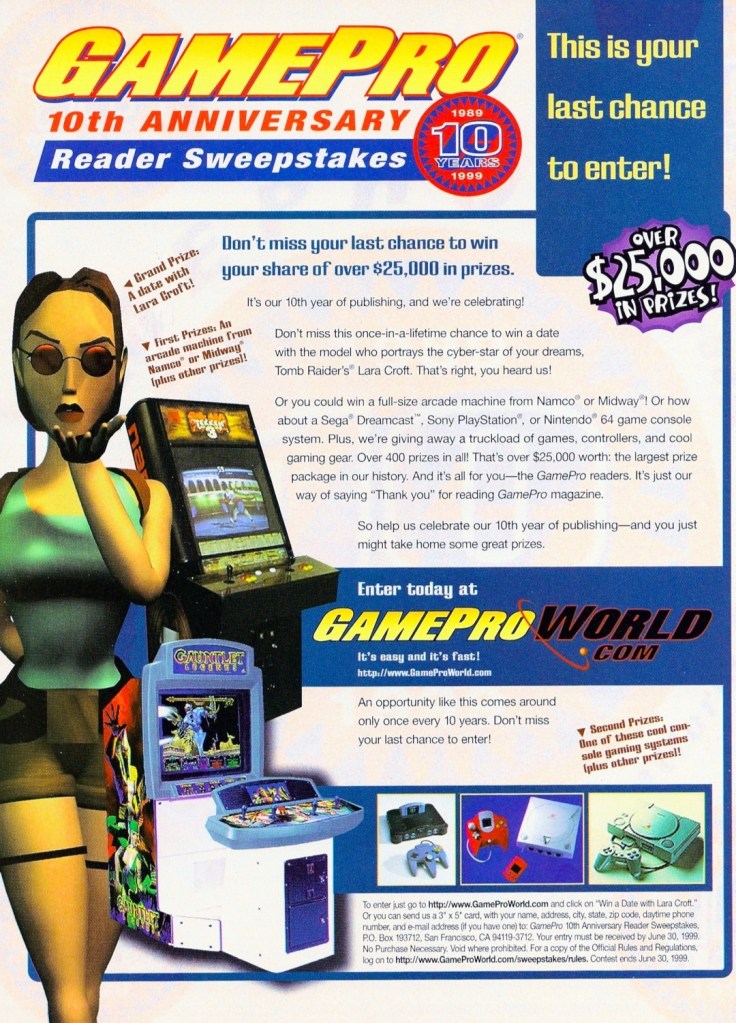
If you look closely, this print announcement by GamePro technically advertised the game consoles, the arcade game and Lara Croft to its readers.
In 1999, GamePro magazine celebrated its 10th anniversary and to keep on resonating with gamers and maintaining the loyalty of their fans, they organized a reader sweepstakes with prizes worth over $25,000 to be won by the few winners. GamePro boasted a date with an unnamed model who played the iconic Lara Croft (Tomb Raider). Certain arcade machines plus the modern consoles of the time – including the brand-new Sega Dreamcast – were also at stake. The way it was presented, this GamePro print announcement was enticing to read.
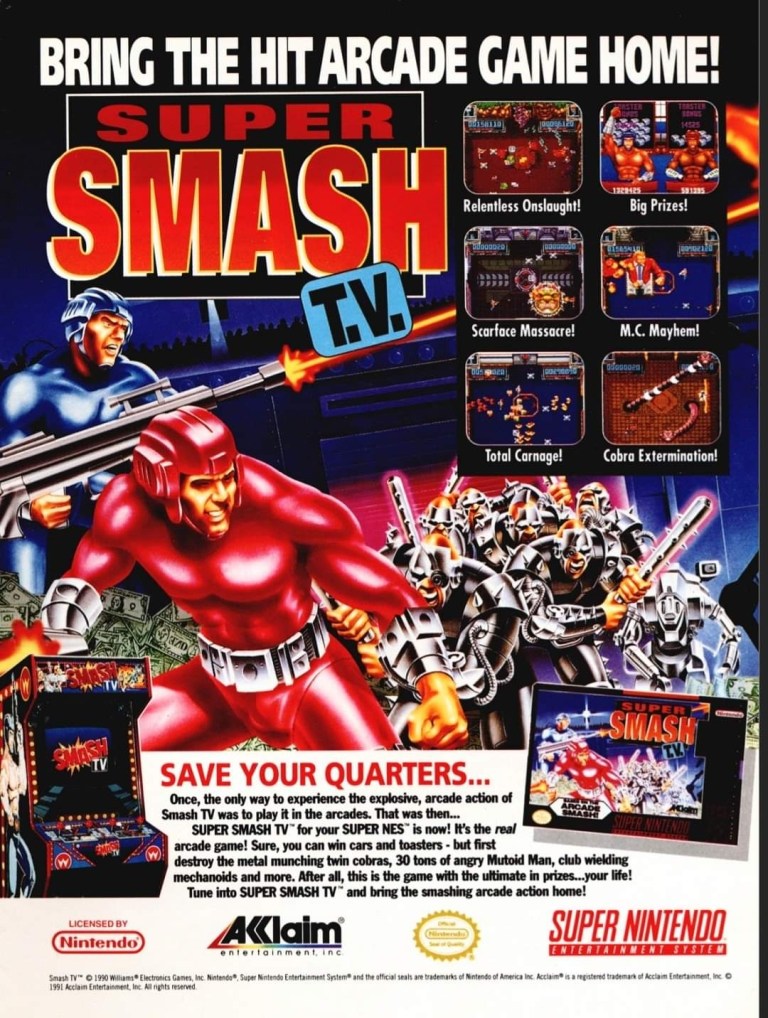
9. Smash T.V. for SNES print ad
Smash T.V. was a lot of fun on both arcade and console.
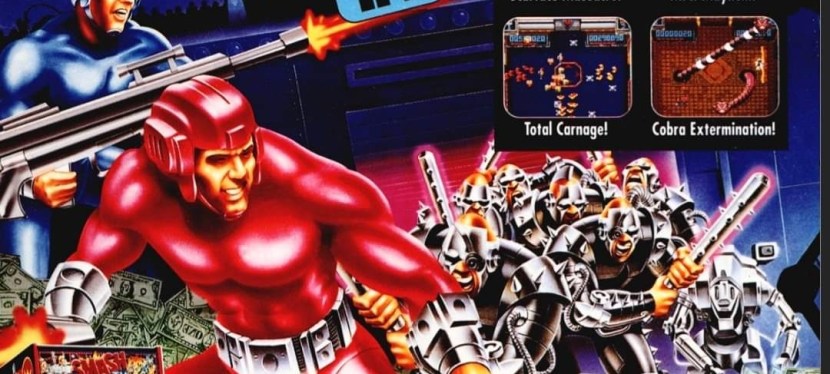
The arcade hit Smash T.V. made its way to the Super Nintendo Entertainment System (SNES) in 1992 and the publisher came up with a print ad that had captivating artwork, six screenshots and a text description that emphasized that a lot of fun awaits gamers on the console version. In my view, this old ad is still amusing to look at.
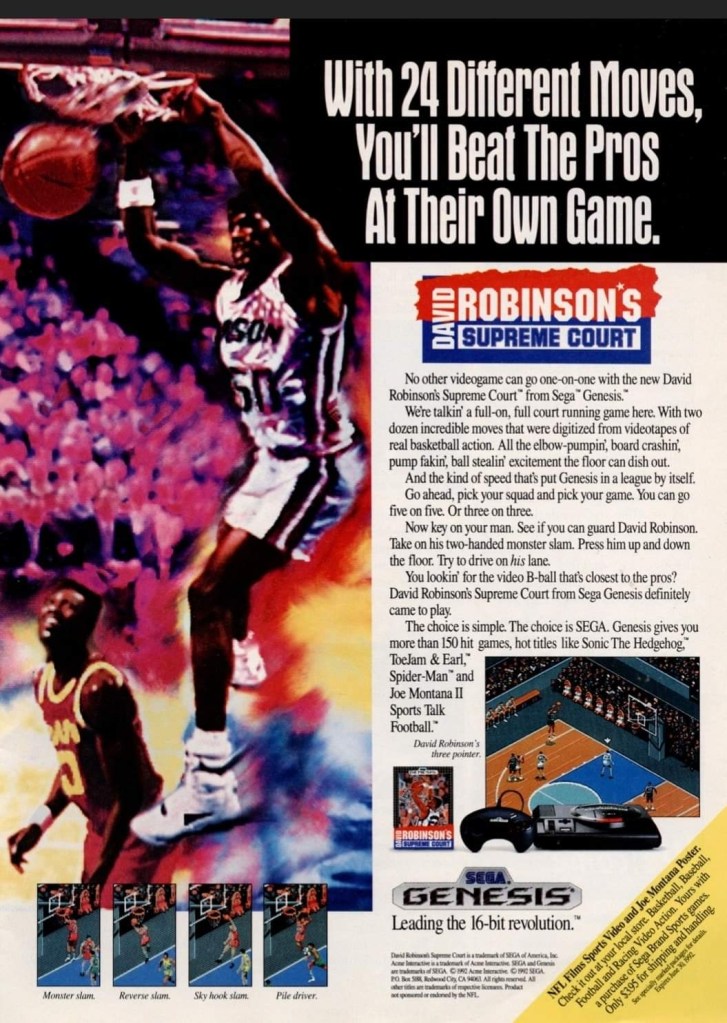
10. David Robinson’s Supreme Court print ad
It was a smart move by Sega to get NBA superstar David Robinson as the endorser of this basketball video game exclusive on the Sega Genesis. This ad was published many years before Robinson finally won an NBA championship.
As part of its strategy in competing with Nintendo during the 4th console generation, Sega of America was focused on producing exclusive sports video games for the Genesis console backed by endorsements of sports professionals. In 1992, they released David Robinson’s Supreme Court on the Genesis and unsurprisingly their print ad used a large, stylized image of the NBA superstar dunking backed with an exciting text description plus screenshots showing the game’s use of the isometric view for gameplay. This is still worth looking at.
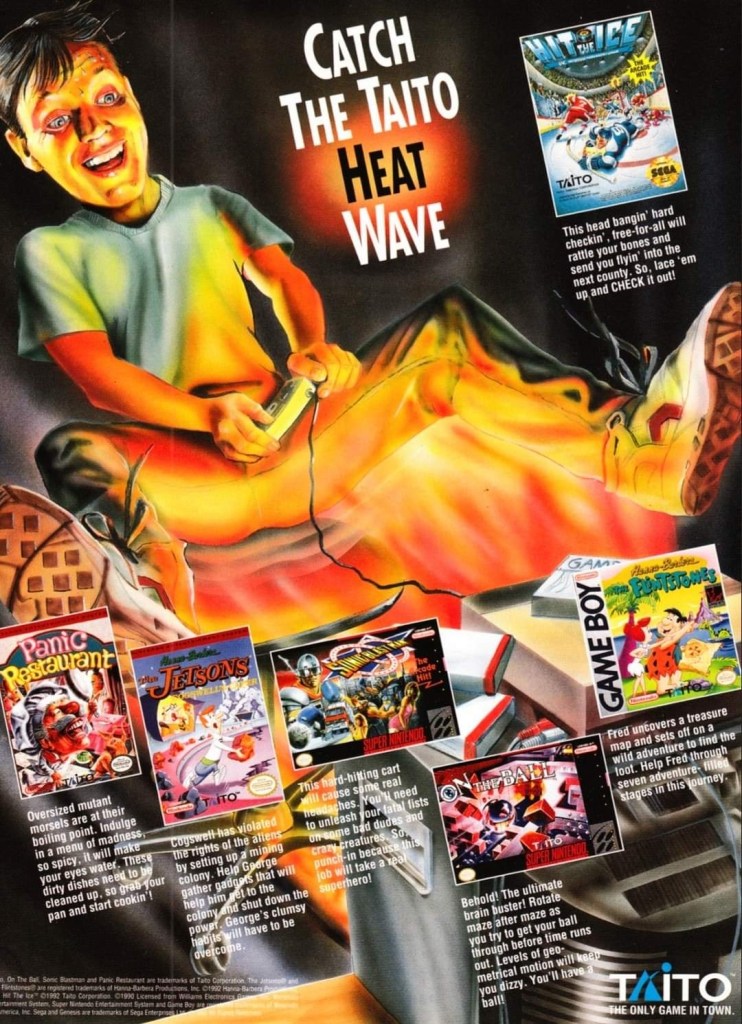
11. Taito’s “heat wave” print ad
An amusing and creative way to sell video games.
If your company lacks money to effectively market your video games individually, you can try making a single ad promoting them together. This is what Taito did in this print ad which showcases multiple games for different platforms and they used artwork of a player experiencing the so-called heat wave. This is a nice stroke of creativity on the part of Taito.
12. Jurassic Park Interactive print ad
This was a creepy print ad promoting the 3DO-exclusive Jurassic Park Interactive.
When it comes to video game consoles, having exclusive games is essential as long as they are of high quality, highly playable and enjoyable. The 3DO company acquired a license of the Jurassic Park movie and made the exclusive game Jurassic Park Interactive hoping it would sell a lot and lift up 3DO hardware sales.
This print ad, which features a zoomed-in image of the Raptor from the game, was more focused on selling the 3DO console than the video game as seen on the descriptive text. 3DO ran a promo selling the console which would entitle the buyer to get Jurassic Park Interactive and another game free. Nothing was done to describe the console’s multimedia capabilities of showing videos, images and graphics of the game (which was essentially a collection of mini-games). This print ad shows ignorance on the part of the 3DO company and the ad maker as it showed desperation happening really early in the console’s life. Notably, Jurassic Park Interactive was the only video game adaptation to use actual footage (note: the faces of the actors were edited out) and music from the film.
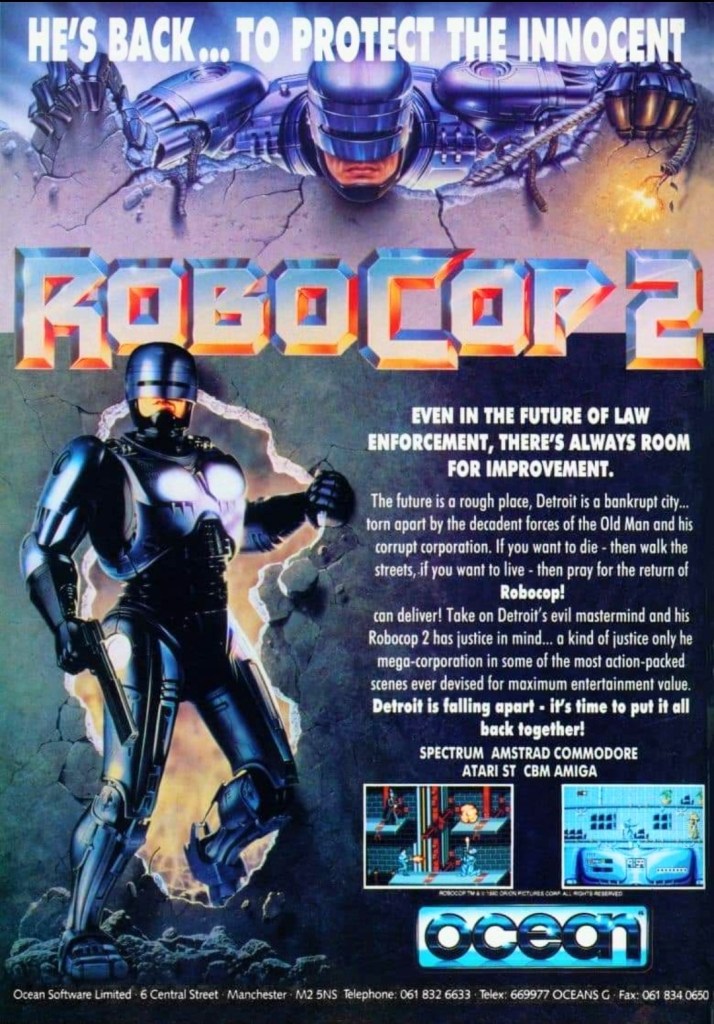
13. RoboCop 2 print ad
You want to become RoboCop to save the city of Detroit from criminals?
Way back in 1990, RoboCop 2 was a big hit in cinemas here in the Philippines and in some places around the world. As typical of the time, licenses to make video games based on the movie were released resulting in RoboCop 2 games for multiple platforms. The print ad featured two different images of RoboCop – one from the movie poster and the other from an official artwork. The descriptive text does a fine job to immerse readers into the story concept of the game but showing only two screenshots was a lackluster effort to sell the game.
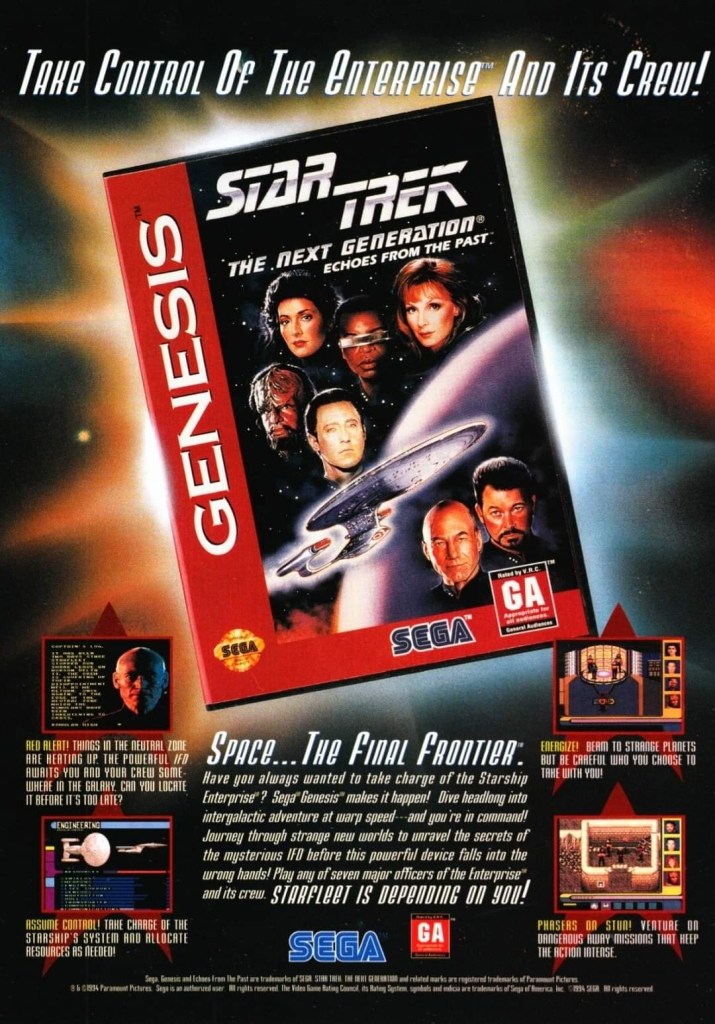
14. Star Trek: The Next Generation – Echoes from the Past print ad
Space…the final frontier waiting for Sega Genesis gamers.
Released in 1994, Star Trek: The Next Generation – Echoes from the Past delivered the Star Trek TNG adventure experience to Sega Genesis gamers. In fact, it is the exact same experience that SNES gamers got the same year. In reality, Star Trek: The Next Generation – Echoes from the Past is actually a port of Star Trek: The Next Generation – Future’s Past on the SNES and the screenshots on the print ad are giveaways about it. In fairness to the ad makers, this print ad never attempted to deceive gamers that it promoted a totally different Star Trek TNG game.
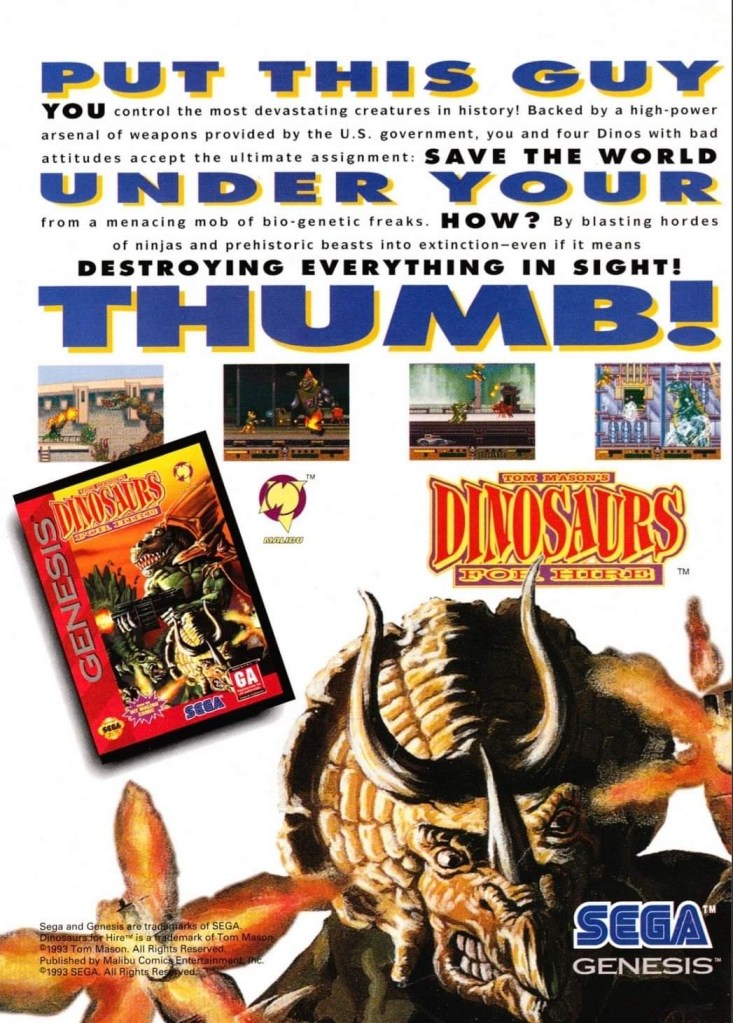
15. Dinosaurs for Hire print ad
This print ad caught my attention and made me interested in the game and the comic book series. Even though it was small, Malibu Comics’ logo was still recognizable.
Dinosaurs for Hire (sometimes referred to as Tom Mason’s Dinosaurs for Hire) was a 2D side-scrolling platform adventure game based on the comic book series of Tom Mason. Published by Sega, it was a Genesis-exclusive game and this print ad had a catchy text description, a few screenshots and the eye-catching artwork of a triceratops facing the viewer. This print ad is still good to look at. If you’re thinking about searching for existing copies of the game, I encourage you to also read some Dinosaurs for Hire comic books before playing. By the way, Tom Mason also wrote several comic books of the Ultraverse.
Recently in the City of Las Piñas, two teenagers were apprehended by the local police for robbing a pedestrian, according to a Manila Bulletin news report. One other suspect, however, remains at large and is now the subject of a manhunt.
To put things in perspective, posted below is an excerpt from the news report of the Manila Bulletin. Some parts in boldface…
Two teenagers were arrested by police Thursday morning, June 6, three hours after they robbed a pedestrian in Las Piñas City.
Las Piñas City police chief Col. Sandro Tafalla reported the arrest of the suspects identified as alias Gielyn and alias Nico, both 16 years old.
Tafalla said the third suspect identified as alias Rusty is now the subject of a police manhunt.
The victim, alias Nikkos, 19, sought police assistance from Las Pinas Police Zapote Substation after he was held up by the three suspects while walking near a gasoline station along C5 Extension in Barangay Manuyo Dos, Las Piñas City at around 2:30 a.m. on Thursday, June 6.
The victim claimed that he was confronted by the three suspects riding a motorcycle. One of them, who was armed with a pellet gun, forcibly took his personal belongings, cellular phone worth P21,800, and wallet containing P50 cash.
The police said the suspects were arrested during a follow-up operation conducted at around 5:30 a.m. at C5 Extnesion, Barangay Pulanglupa Uno, Las Piñas City.
Recovered from the arrested suspects were one pellet gun, one 13-inch kitchen knife, one black Yamaha Mio 125 motorcycle, and one OPPO cellular phone.
Let me end this piece by asking you readers: If you are a resident of Las Piñas City, what is your reaction to this development? Are you concerned that there could be more teenagers in your city who could be engaging in criminal activities?
For more South Metro Manila community news and developments, come back here soon. Also say NO to fake news, NO to irresponsible journalism, NO to misinformation, NO to plagiarists, NO to reckless publishers and NO to sinister propaganda when it comes to news and developments. For South Metro Manila community developments, member engagements, commerce and other relevant updates, join the growing South Metro Manila Facebook group at https://www.facebook.com/groups/342183059992673









 Author Carlo Carrasco