Welcome back my readers, YouTube viewers and all others who followed this series of articles focused on YouTube videos worth watching. Have you been searching for something fun or interesting to watch on YouTube? Do you feel bored right now and you crave for something to see on the world’s most popular online video destination?
I recommend you check out the following videos I found.
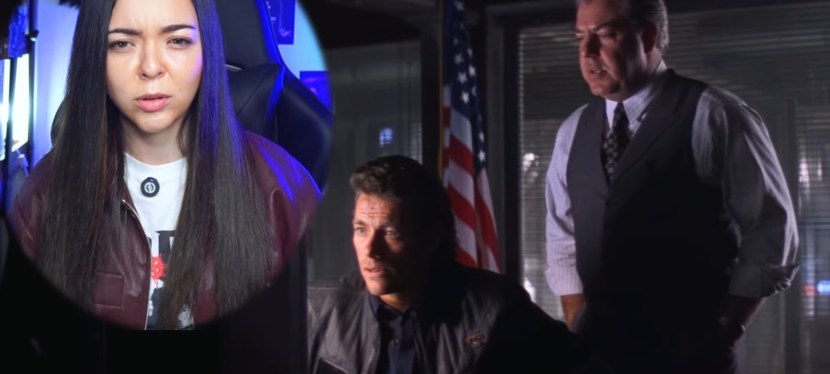
#1 Timecop Revisited – I am not a fan of Jean-Claude Van Damme but his 1994 movie Timecop managed to entertain me when I first saw it on home video. After watching it, I learned that it was based on the Timecop literary property and stories published by Dark Horse Comics. Directed by Peter Hyams, Timecop ended up as one of the better movies of JCVD and it even has its own fanbase. If you want to discover more about the cinematic Timecop, watch the videos posted below.
#2 Inhumanoids Revisited –I remember seeing some episodes of the animated TV series Inhumanoids on local TV and I can say it was easily the most bizarre and even shocking thing to watch. Inhumanoid has a very dark and even cynical tone, and it had gruesome scenes which were really disturbing to see. Behind the scenes, Inhumanoids was animated by Japan-based Toei and involved Hasbro, Sunbro and even Marvel Productions. To find out what made Inhumanoids so disturbing, watch the video below and pay attention to the details.
#3 Luxurious Breakfast Spots In Tokyo – Have you ever thought about having a luxurious breakfast while traveling overseas? In Tokyo, Japan’s most famous city, there are indeed places where visitors can have breakfast with the premium experience. These luxurious places have something unique to offer to customers who have more than enough money to spend for the morning meal. Watch and learn from the Nippon TV video below.
#4 Remember The Rotoscoped Lord Of The Rings – Decades before Peter Jackson and his team rocked the world of moviegoers with memorable Lord of the Rings film trilogy, an animated LOTR was actually made. I am talking about the 1978 rotoscoped animated film The Lord of The Rings directed by Ralph Bakshi which I first saw on home video after seeing Peter Jackson’s LOTR. I found the 1978 LOTR a really unique animated viewing experience and it definitely involved a lot of production work without any use of computers. To find out more about the animated LOTR film, watch the video below.
#5 You, Me and The Movies React To Can’t Hardly Wait – When Can’t Hardly Wait was shown in cinemas in 1998, it faded away as not enough moviegoers were attracted watch it. However, the movie did not fade into obscurity and it actually got new fans as it was discovered on home video, cable TV, pay-per-view and streaming. More importantly, the movie itself was pretty funny the cast led by Jennifer Love Hewitt delivered fine performances as teenagers. Slowly but surely, new retrospective videos about Can’t Hardly Wait are emerging on YouTube and the most entertaining video is the reaction by You, Me and The Movies which I encourage you to watch right now.
#6 Square Enix In The 2000s – Back in the 1990s, Squaresoft and Enix were separate Japanese gaming companies that released a lot of Japanese role-playing games (KRPGs) which entertained many millions of gamers. Square was famous for the best-selling Final Fantasy games while Enix had the wildly popular Dragon Quest franchise. In the 2000s, a series of changes happened in the video game industry and the two companies merged into Square Enix. Since then, a lot of Final Fantasy and Dragon Quest games with evolved designs and styles of presentation were released under a single publisher. There is a lot more to discover what happened behind the scenes as documented in the in-depth video below from Gaming Broductions.
Disclaimer: This is my original work with details sourced from reading the comic book and doing personal research. Anyone who wants to use this article, in part or in whole, needs to secure first my permission and agree to cite me as the source and author. Let it be known that any unauthorized use of this article will constrain the author to pursue the remedies under R.A. No. 8293, the Revised Penal Code, and/or all applicable legal actions under the laws of the Philippines.
Welcome back superhero enthusiasts, 1990s arts and culture enthusiasts, Marvel Comics fans and comic book collectors! Today we go back to the year 1991 to explore one of the many tales of the Marvel shared universe through the Uncanny X-Men series.
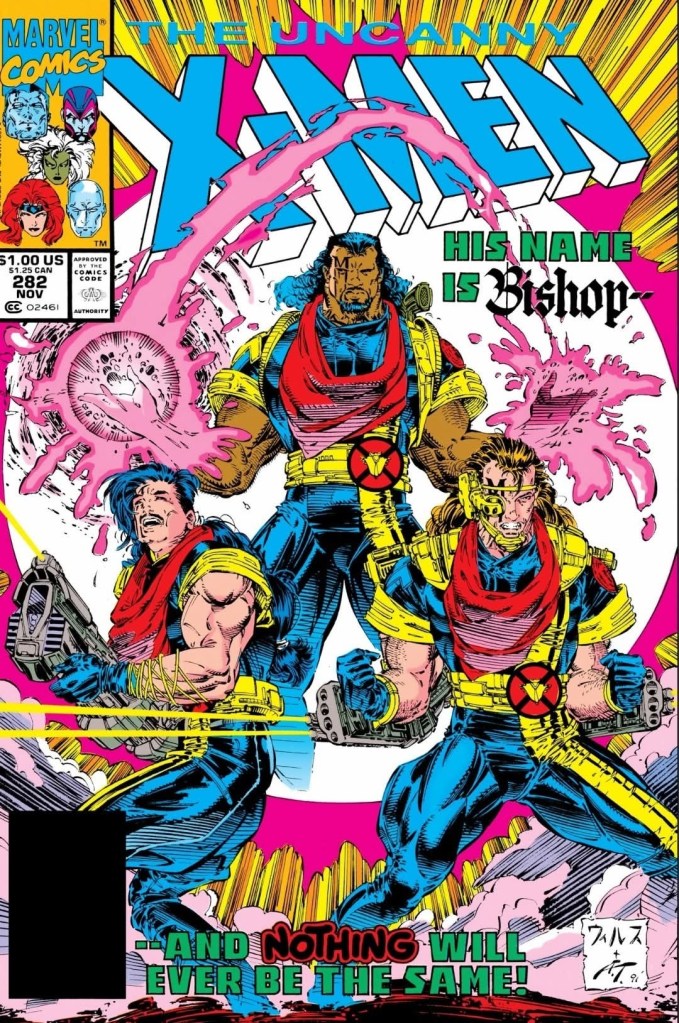
Uncanny X-Men #282 marked the continuing conflict between the X-Men and Trevor Fitzroy’s group, and the arrival of one of the most notable additions to Marvel’s Mutants…Bishop. To be clear, Bishop was not alone when arrived from the future through one of Fitzroy’s portals. In relation to everything that happened in the comic book, the arrival was a very powerful conclusion to read.
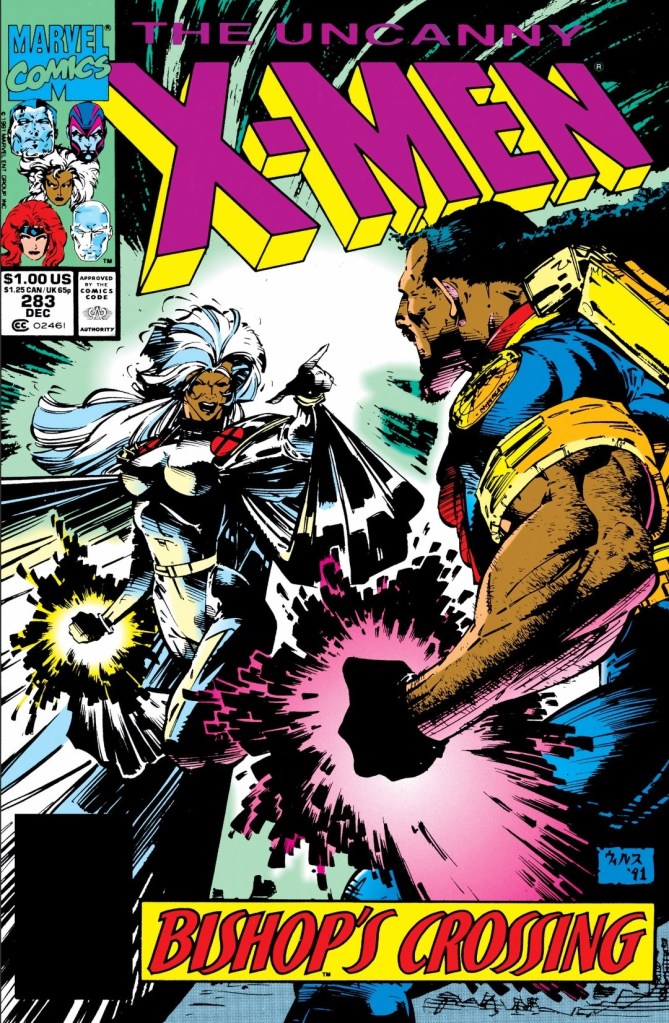
With those details laid down, here is a look back at Uncanny X-Men #283, published in 1991 by Marvel Comics with a story co-written by Whilce Portacio and by John Byrne (script). The art was done by Portacio with ink work by Art Thibert.
The cover.
Early story
The story begins in the arctic lair of Trevor Fitzroy. The arrival of Bishop and his two mutant companions – Malcolm and Randall – from the future caught everyone by surprise (including the X-Men). Bishop, who has Trevor Fitzroy subdued, tells his companions to throw their takes (members of Fitzroy’s force) into the portal.
Bishop intends to have Fitzroy go first which draws a loud reaction from the mutant madman. Fitzroy, who had been using the life force of captive mutants to open portals, knows exactly what would happen if he goes first. His exchange of words with Bishop shows they have a history together.
When Bishop’s companion moved a subdued person into the portal, it tore him apart. Fitzroy reveals to Bishop that the portals he created only function one-way and he tells him that he and his companions are stuck in the 20th century.
In response, Bishop assumes complete judicial authority and tells Malcolm and Randall to standby for termination sweep. The X-Men begin to react…
Quality
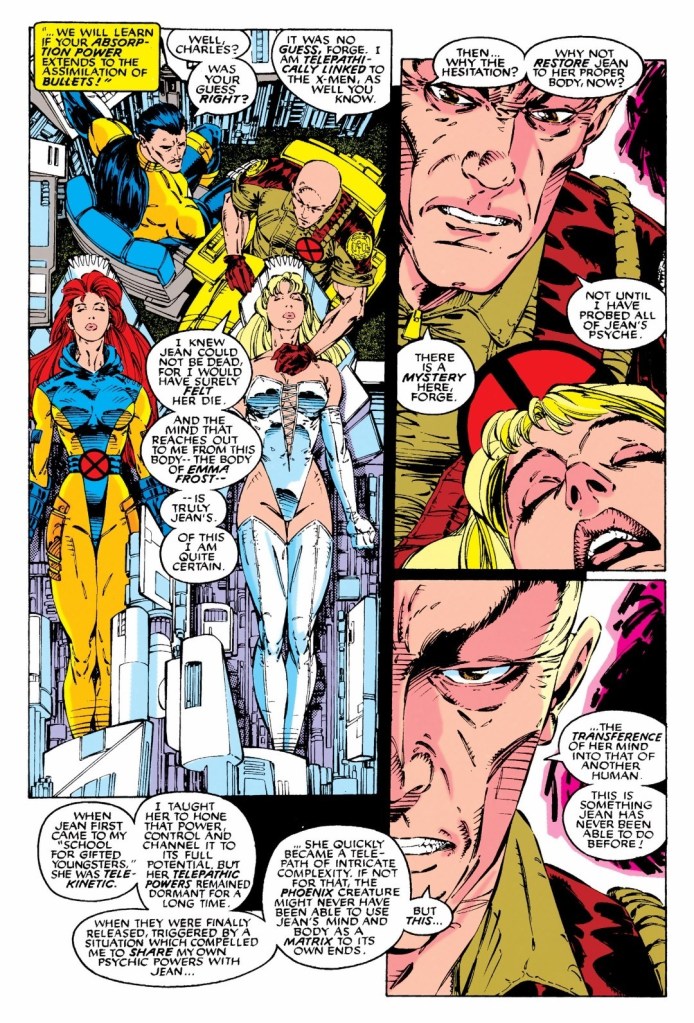
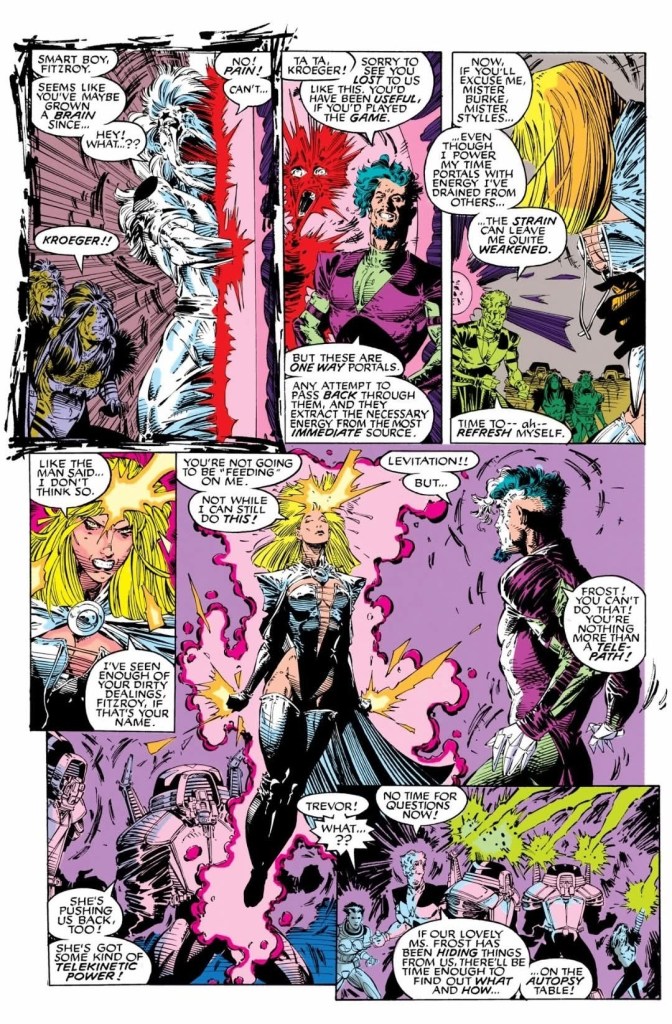
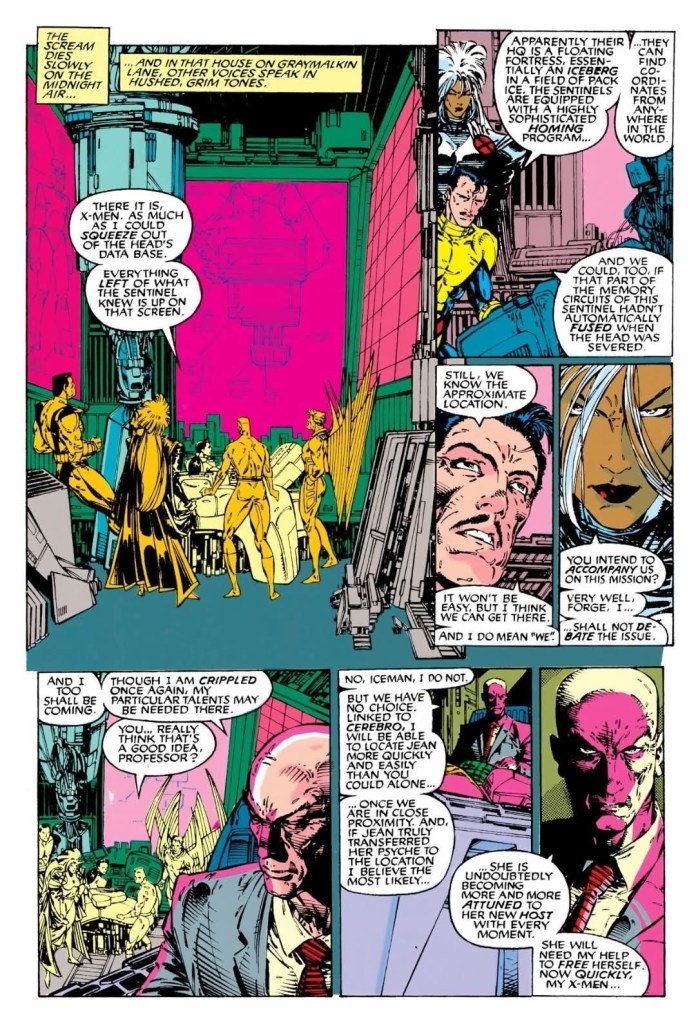
Professors takes a huge risk to help Jean Grey who recently occupied the body of Emma Frost.
When it comes to the creativity, this comic book is both a strong pay-off to the build-up of issues #281 and #282 while also serving as a new build-up focusing on Bishop’s arrival. At the heart of this tale is Bishop’s first-ever personal encounter with the X-Men which instantly expanded the lore of Marvel’s mutants a lot.
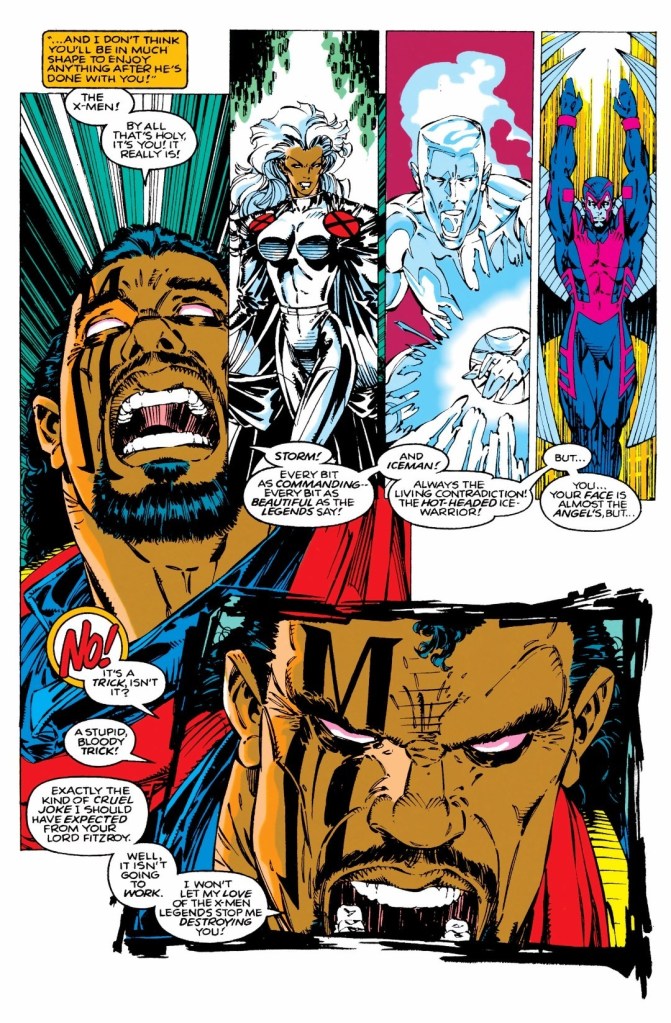
Bishop is a mutant from one possible future (of the Marvel Comics shared universe) in which Storm, Iceman, Archangel, Charles Xavier and others are remembered as legacy figures of the X-Men. In this comic book, you will see there is a good amount of depth with the way Bishop is dramatized and with many notable details on the dialogue prepared for him. Co-created by Whilce Portacio and John Byrne, Bishop is really an inspired work and clearly is not a mere addition. There is Filipino inspiration behind the creation of Bishop (click here and here) with some elements of John Ford and Prince mixed in (click here).
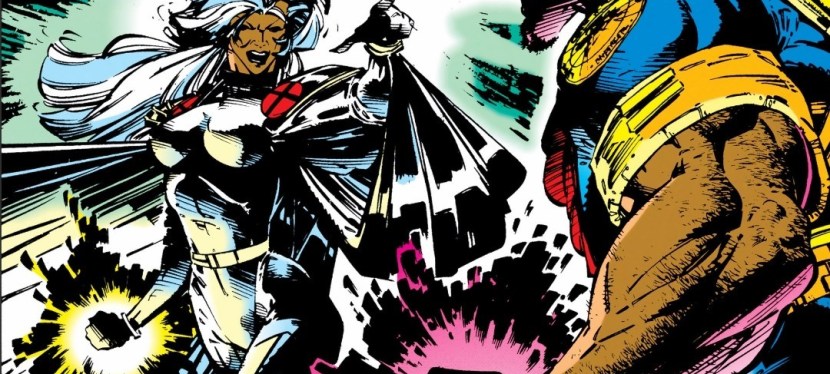
As far as the storytelling is concerned, there is notable shift of tone here as Bishop, Malcolm and Randall received much of the spotlight and yet there was still some room left for focus on the X-Men and Fitzroy’s group respectively. What makes this comic book an intriguing read is the first-ever personal encounters between Bishop and the X-Men which involved the temporary blurring of the boundary between good and evil. The interactions between Storm and Bishop are easily the most dramatic to see, and you will witness how their respective toughness (plus leadership) collide intensively.
Along the way, there is a lot superhero action to enjoy here. In fact, there are many forms action that served as extensions or pay-offs to the exchange of words between Bishop and a few specific X-Men members. Even a non-action scene like Professor X helping Jean Grey (who was in Emma Frost’s body temporarily) resulted in some visual spectacle.
Conclusion
Bishop’s first-ever encounter with the X-Men not only challenged his perception but also brought out traits of his attitude.
Uncanny X-Men #283 (1991) is another very compelling, intriguing and entertaining read from the Portacio-Byrne duo. The X-Men lore has been expanded more and Bishop’s first encounter with the X-Men is easily the most engaging aspect of the story. At the same time, the conflict between the X-Men’s Gold Team and Trevor Fitzroy took a twist that really turned the plot to an unexpected new direction which is not surprising as Bishop’s presence made a huge impact (even on Storm herself). This is one of the best superhero stories of 1991 I have read so far.
Overall, Uncanny X-Men #283 (1991) is highly recommended!
Disclaimer: This is my original work with details sourced from reading the comic book and doing personal research. Anyone who wants to use this article, in part or in whole, needs to secure first my permission and agree to cite me as the source and author. Let it be known that any unauthorized use of this article will constrain the author to pursue the remedies under R.A. No. 8293, the Revised Penal Code, and/or all applicable legal actions under the laws of the Philippines.
Welcome back superhero enthusiasts, 1990s arts and culture enthusiasts, Marvel Comics fans and comic book collectors! Today we go back to the year 1991 to explore one of the many tales of the Marvel shared universe through the Uncanny X-Men series.
Uncanny X-Men #281 was a great read. For most of the early 1990s, I read more X-Men stories about the Blue Team than the Gold Team. In Uncanny X-Men #281 – which took place after X-Men #5 – the spotlight was on the Gold Team which showed the strategic leadership of Storm, the X-Men revisiting the headquarters of the Hellfire Club, Jean Grey’s own recollections of past events and the new threat of Trevor Fitzroy and the Sentinels.
With those details laid down, here is a look back at Uncanny X-Men #282, published in 1991 by Marvel Comics with a story co-written by Whilce Portacio and by John Byrne (script). The art was done by Portacio with ink work by Art Thibert.
The cover.
Early story
The story begins inside the School For Gifted Youngsters when the Gold Team arrives (with Colossus carrying the inactive body of Jean Grey) and disrupts the chess game between Professor X and Forge. Charles Xavier mentally examines Jean and notices that her psyche survives and has been displaced. He realizes Jean is alive but not in her body.
In New York City, Trevor Fitzroy (who is carrying the body of an inactive Emma Frost) and his Sentinels surprise Shinobi Shaw showing what is left of the cyborg of Pierce. Trevor boasted to Shinobi that he won claiming that he has terminated one of the founders of the inner circle, captured a small band of Hellions and has Emma Frost as a trophy. Very slowly, Jean Grey – now occupying Frost’s body – wakes up…
Quality
Trevor Fitzroy does not know who is inside Emma Frost’s body.
I can say out loud that this is a great follow-up to the previous issue (which itself is a great read) as it has a lot of hefty payoffs to the build-up from before. With the story concept already established in issue #281, the progression continued strongly, the narrative is clearer and the stakes were raised even higher.
In this issue, Trevor Fitzroy still has extreme tendencies and he might look insane or unhinged to you. Still, Fitzroy really has diabolical plans to execute and those plans involves his ability to open portals to bring in his reinforcements from far away, including the “denizens of the future.” Adding to Fitzroy’s merciless and arrogant personality is his use of the captives’ life force to energize himself to open portals. Really, he does not care much about the lives of captives as he treats them as nothing more than bodies of energy for his use. Whilce Portacio really excels in not only bringing the script to life but also showcasing the personality and expressions of Fitzroy who at this point in comic book history was a brand new villain for the X-Men.
As for the X-Men’s Gold Team, not having Jean Grey was really disadvantageous to them which compels Professor X to actually join them on their mission. This is a notable development as Xavier is very close with Jean (his original student and fellow telepath) and he knows that great odds await their team. Xavier’s involvement added a lot to the plot itself and I love the way John Byrne and Portacio portrayed him here.
When it comes to the storytelling, the pace noticeably moved faster as a lot of payoffs to the build-up were executed here. The X-Men themselves each got their respective share of the spotlight and all of them were portrayed consistently in character. The stakes were raised here this time and the handling of all the details and developments was very solid.
Conclusion
Knowing great odds await them, Charles Xavier joins the X-Men on their mission to save Jean Grey.
Even with the stakes raised higher, the creative team delivered the great stuff Uncanny X-Men #282 (1991) is a very worthy follow-up to the previous issue. In fact, I find this comic book more entertaining and more intriguing to read from start to finish. Fitzroy is indeed a very worthy new enemy for the X-Men’s Gold Team, and there is much that long-time X-Men fans can enjoy here.
Overall, Uncanny X-Men #282 (1991) is highly recommended!
Disclaimer: This is my original work with details sourced from reading the comic book and doing personal research. Anyone who wants to use this article, in part or in whole, needs to secure first my permission and agree to cite me as the source and author. Let it be known that any unauthorized use of this article will constrain the author to pursue the remedies under R.A. No. 8293, the Revised Penal Code, and/or all applicable legal actions under the laws of the Philippines.
Welcome back superhero enthusiasts, 1980s arts and culture enthusiasts, Marvel Comics fans and comic book collectors! Today we go back to the year 1982 to examine alternate stories of the Marvel Comics shared universe chronicled through the original What If monthly series.
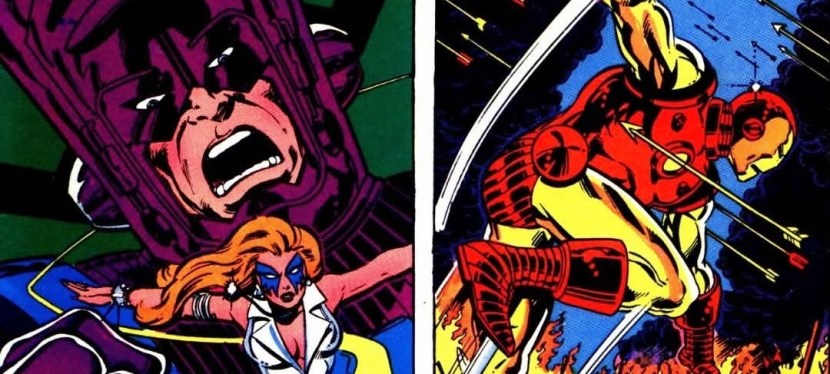
Back in the early 1980s, Dazzler quickly became popular among comic book readers and a standalone monthly series was launched no so long after her debut in Uncanny X-Men #130. Earl on in her monthly series, Dazzler eventually encountered Galactus (the classic nemesis of the Fantastic Four) in a wild tale involving the galaxy. On the other hand, Marvel Comics published a wild tale of the conflict of Iron Man and Dr. Doom (also the nemesis of the Fantastic Four) involving time travel and the presence of King Arthur in Iron Man #150. Eventually, Marvel decided to make alternate tales of the mentioned stories of Dazzler and Iron Man and publish them through an issue of What If.
With those details laid down, here is a look back at What If #33, published in 1982 by Marvel Comics with a Dazzler story written by Dan Fingeroth and drawn by Mike Vosburg, and the Iron Man story written by Steven Grant and drawn by Don Perlin.
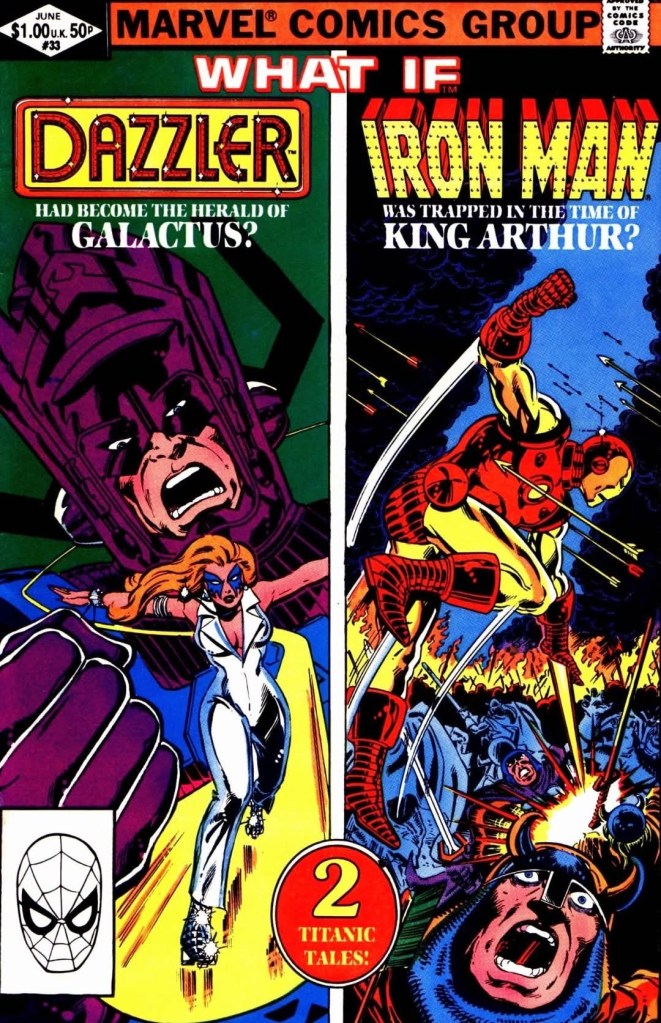
The cover.
Early story
What if Dazzler had become the herald of Galactus? – The story begins with Dazzler standing in the presence of Galactus, Terrax and Drone R-II. After Galactus renders his judgment on Terrax by banishing him to the depths of a black hole, he tells Dazzler she has proven herself worthy to become his new herald. As Drone R-II reminded his superior of the fact that previous heralds were forced to leave service due to their own moral codes and added that Dazzler will do the same, she questions them and stated that she does not belong in deep space and wants to go home. Galactus tells her that Earth is a planet he has sworn to devour and by becoming his herald, he will perhaps spare her home world. Dazzler finds herself cornered and reluctantly joins Galactus as his new herald. Immediately, Galactus sends her out to deep space for her first task…
What if Iron Man had been trapped in King Arthur’s time? – The story begins in the past wherein Doctor Doom and Iron Man found themselves during the time of King Arthur. After separating themselves by taking different sides – Iron Man with King Arthur and Doom with Morgana LeFay – they decide to set their differences aside for the common goal of creating a crude time machine to return to the future. Instead, Doom takes advantage of the time machine by shocking Iron Man and leaving him behind in the past. With Doom back in the future, Iron Man struggles moving on the ground only to encounter Morgana LeFay. Believing that there is no pleasure in breaking a helpless man, Morgana spares Iron Man and tells him to return to King Arthur with her pledge…
Quality
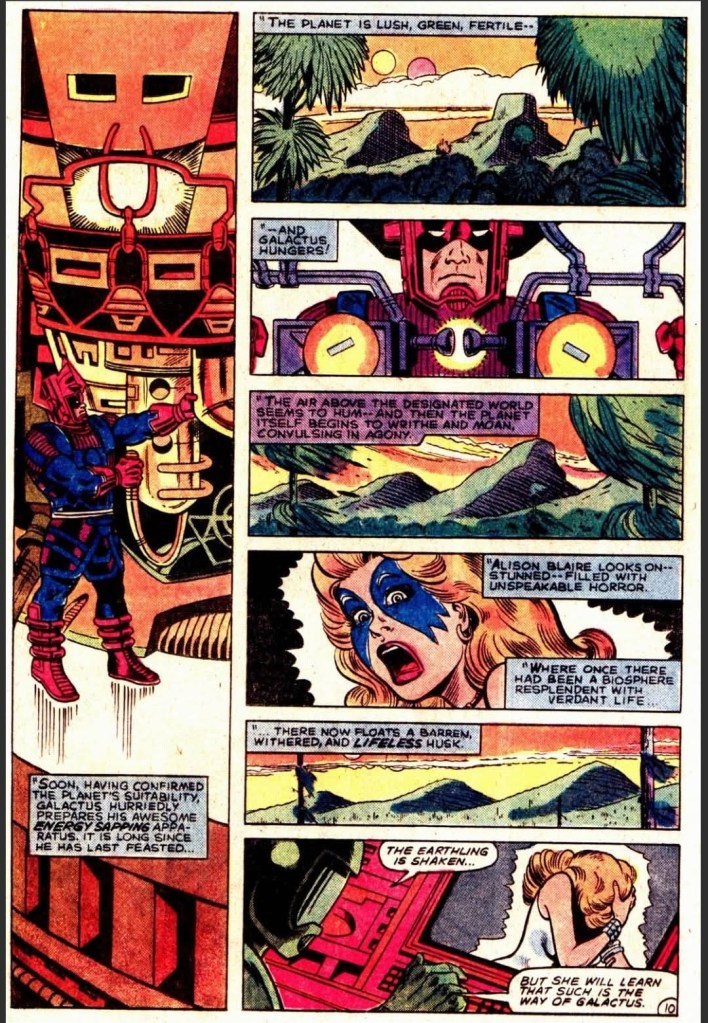
After doing advanced work, Dazzler can only watch and witness the loss of life as her master Galactus consumes the planet.
I can start with the good news for you all…the two featured stories in this What If comic book are great to read from start to finish!
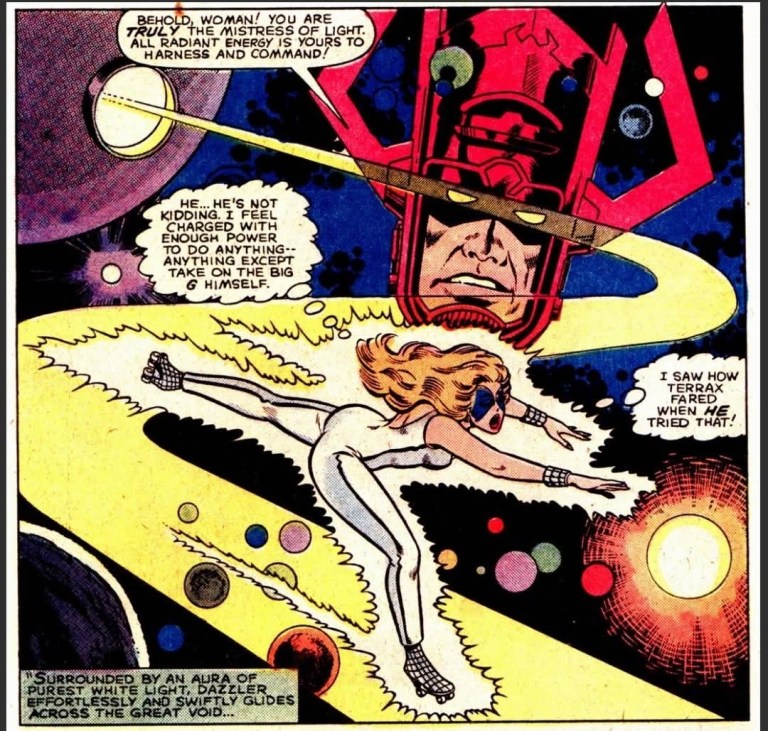
With the Dazzler tale, I enjoyed how Danny Fingeroth told the alternate reality story of the dazzling heroine becoming Galactus’ herald and working immediately to serve him. Not only does Dazzler carried tremendous powers she did not have before, she was able to quickly travel through deep space and visit planets that are suitable for her master’s consumption. Even as she wielded tremendous power, Dazzler still retains her conscience and does some analyzing of situations.
Of course, she still retained her human nature throughout and there are moments when she felt defeated or shocked which alone made her a questionable herald. Galactus himself is pretty much in character in this tale and it is very engaging to see how his actions impact not only the beings of the cosmic realm of the Marvel universe but also on Dazzler herself. Without spoiling the plot, I can say the ending is captivating and truly is worth the build-up.
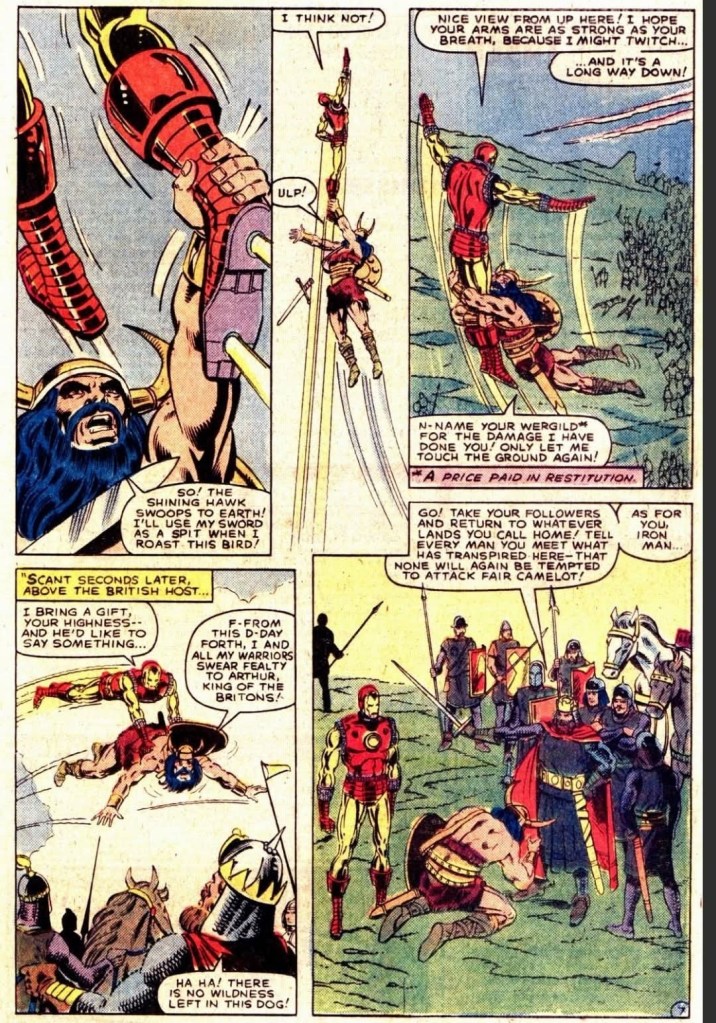
The stranded Iron Man makes an impact on a battle favoring King Arthur.
Regarding the Iron Man tale, the creative team came up with the concept of having the armored superhero actually stranded in time (left behind by Doctor Doom) and getting burdened by many factors. With Doom gone early in the plot, this effectively made Iron Man the main focus and his involvement in the conflict between King Arthur and Morgana really raised the stakes.
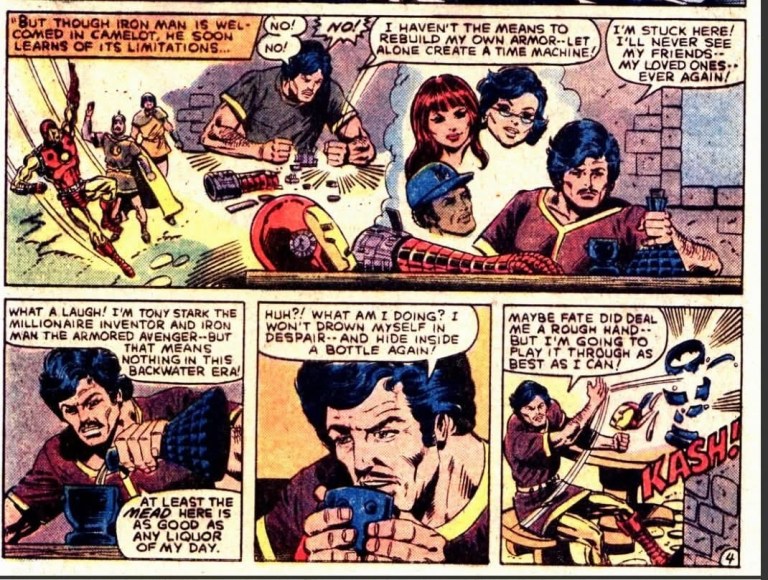
Not only does Iron Man have to deal with conflicts, he also became vulnerable as the era of King Arthur had very low forms of technology which made the superhero’s desire to return to the future an effort against the impossible. As the story went on, Iron Man makes impact on the conflicts between the forces of King Arthur and Morgana and the good news here is that the creative duo of Steve Grant and Don Perlin made it all believable and serious to follow.
Conclusion
Dazzler the new herald of Galactus.
Tony Stark struggles initially with being stranded in the past.
I can say that What If #33 (1982) is a great read! The respective tales of Dazzler and Iron Man are captivating, intriguing and enjoyable to read. The creative teams of each story succeeded in building up their respective concepts, moved the established superhero to daring creative directions, and delivered powerful conclusions. This issue of the old What If series has to read as it is a true escape from reality!
Overall, What If #33 (1982) is highly recommended!
Welcome back, my readers, YouTube viewers and all others who followed this series of articles focused on YouTube videos worth watching. Have you been searching for something fun or interesting to watch on YouTube? Do you feel bored right now and you crave for something to see on the world’s most popular online video destination?
I recommend you check out the following topics and the related videos I found.
#1Woke Disney’s discriminatory practices confirmed and caught on camera – Being woke means being foolish and wicked. What was discussed before about the woke Disney Company’s distorted approach on hiring workers as well as promoting their current workers was confirmed to be true as a Disney executive confirmed it openly on camera. A lot of footage has been recorded of him talking about Disney’s discrimination against white males as they empower people of minorities (colored people, the under-represented ethnic groups, etc.). You should watch the two videos I selected from Midnight’s Edge ad RK Outpost. Woke Disney should be brought to justice!
#2 Video documentary about Sega’s Streets of Rage franchise – YouTuber PatmanQC recently published another informative and entertaining look at the history of Sega’s popular Streets of Rage game franchise. This includes the behind-the-scenes development of the first game that hit the arcades, as well as the different versions that appeared on multiple platforms.
#3 Somewhere in Time videos – Somewhere in Time (1980) was a film that starred the late Christopher Reeve, Jane Seymour and Christopher Plummer. While it was never successful in movie theaters, it became a big hit on cable TV, public TV and home video. As its legacy lived on, it is not surprising that there are several movie reaction videos, video reviews and other features about it on YouTube. Posted below are some selected videos for those of you who wish to discover more of Somewhere in Time.
#4 A look at the rise and fall of the Orlando Magic – Back in the mid-1990s, a lot of my friends (who love basketball) became fans of the Orlando Magic which had Shaquille O’Neal, Penny Hardaway, Nick Anderson (the guy who missed 4 crucial free throws in specific NBA Finals game), Horace Grant and Dennis Scott. Their excitement really went overboard when the Magic of 1994-95 successfully won the Eastern Conference Finals and entered the NBA Finals to face off with the defending champion Houston Rockets. Of course, as recorded by history, the Magic got swept away by the Rockets even though they had the home court advantage. If you are nostalgic about 1990s NBA action or if you want to see how different the Orlando Magic was back in the 1990s, then you should watch the video below.
#5 Stockton to Malone (but still no NBA championship) – Still on the topic of basketball, do you remember the so-called golden age of the Utah Jazz when they had Karl Malone and John Stockton who together were among the very best players in the NBA back then? For the newcomers reading this, the Utah Jazz made it to the NBA Finals of 1997 and 1998 but lost each time to Michael Jordan and the Chicago Bulls. Long before those championship series happened, the Utah Jazz became a serious playoff contender in 1988 (pushing the LA Lakers to seven games in the Western Conference Semifinals) and went on to struggle in the years that followed. As for Stockton and Malone, they each had great basketball achievements but never won a championship. To learn more with a lot of details plus in-depth analysis, watch the video below.
#6 Heart of Darkness retrospective video – Way back in 1998, I played the video game Heart of Darkness on the PlayStation console but never got to finish it. While the cinematic cutscenes are not outstanding, the graphics used for gameplay was eye-catching thanks to the developers’ artistic and technical approach. This should not be surprising as the game was supervised by Eric Chahi who was best known for Another World. To learn more about Heart of Darkness’ production history, watch the video below.
#7 A look at Salamander (AKA Life Force) – Still on the topic of retro gaming, I had fun memories playing Salamander (titled Life Force in North America) on the Family Computer (Famicom) back in the late-1980s. It was a sci-fi 2D scrolling shooter that not only featured side-scrolling levels but also vertical levels. Developed and published by Konami, Salamander was a spin-off of Gradius (an acclaimed 2D side-scrolling shooter on its own) but it became successful in entertaining players with the two-player mode, unique challenges, fine gameplay features and outstanding visuals. To learn more about Salamander, watch the selected videos below.
#8 Friday The 13th Part 3 videos – If there is anything significant about Friday The 13th Part 3 (1982) other than being filmed in 3D, it is the fact that it marked a creative turning point for the franchise. It was in this movie that the film series really started to take shape with Jason Voorhees as its feature antagonist. That being said, it is not surprising that there are lots of retro reviews/reactions and feature videos about it. Watch the selected videos below.
Disclaimer: This is my original work with details sourced from reading the comic book and doing personal research. Anyone who wants to use this article, in part or in whole, needs to secure first my permission and agree to cite me as the source and author. Let it be known that any unauthorized use of this article will constrain the author to pursue the remedies under R.A. No. 8293, the Revised Penal Code, and/or all applicable legal actions under the laws of the Philippines.
Welcome back superhero enthusiasts, 1990s arts and culture enthusiasts, Marvel Comics fans and comic book collectors! Today we go back to the mid-1990s to explore the adaptation of the second season of the famous X-Men: The Animated Series (X-Men TAS) in the form of the X-Men Adventures comic book series.
Before getting to the new retro comic book review, I should state that it is indeed very challenging to implement the concepts of time travel and timeline conflicts into the narrative of an established X-Men universe. As far as the X-Men TAS narrative goes, Bishop and Cable are mutants who each came from different points in the future and in different ways they each made impact with the present day X-Men as portrayed in the comics (the literary X-Men specifically).
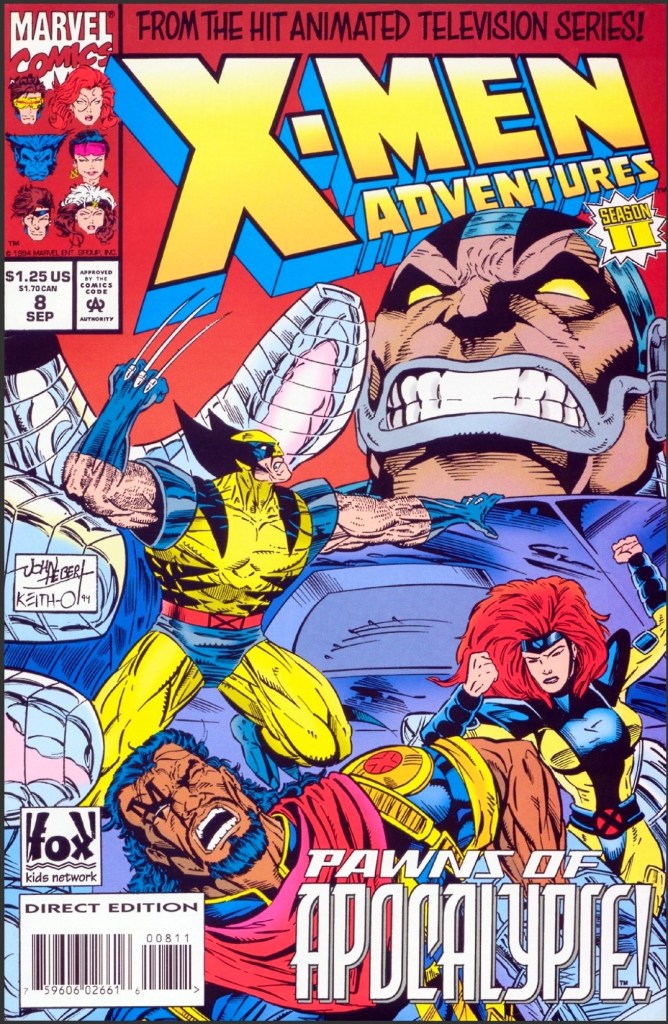
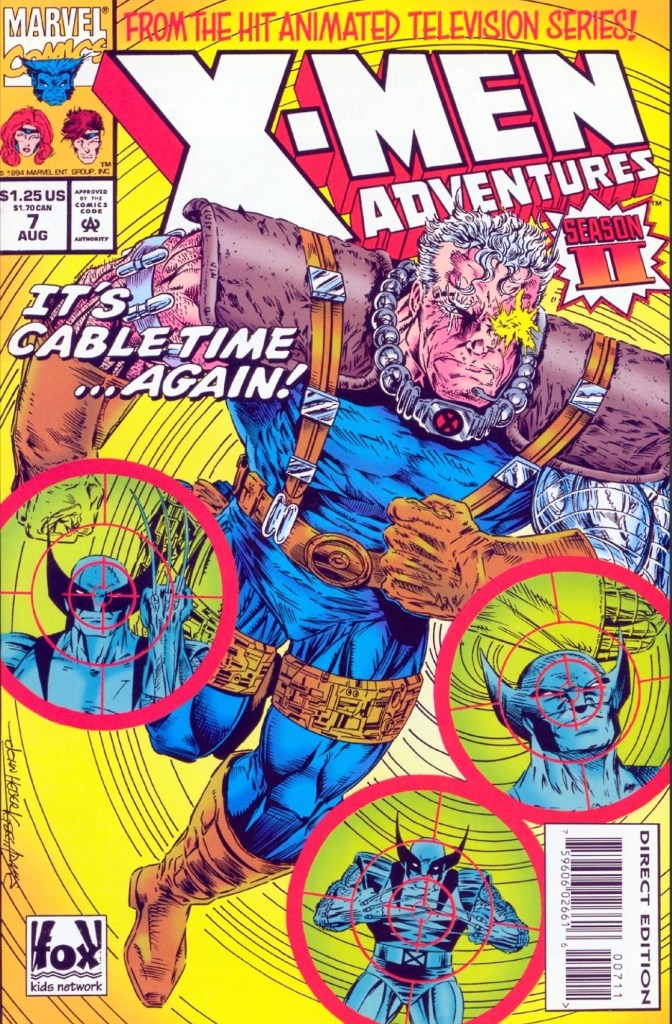
With those details laid down, here is a look back at X-Men Adventures Season II #8, published in 1994 by Marvel with a story written by Ralph Macchio and drawn by John Hebert. The is the 2nd chapter of the Time Fugitives storyline.
The cover.
Early story
The story begins on Earth in the far future of 3999 AD. Cable, who has been leading the fight against Apocalypse, is receiving information from his cube-shaped computer which informs him that a temporal storm has wreaked havoc with the time stream and their present is reconfiguring in response to the existence of a new past. Once realignment gets completed, everyone in the current timeline will cease to exist. Cable then learns that Bishop (who returned to the X-Men in the previous issue) is the primary chronal component of the time readjustment.
Meanwhile in the present day inside Xavier’s mansion, the X-Men listen to Bishop who explains that mutants will be blamed for the plague that a certain virus will precipitate and that the fear of the virus will make things much worse for many people. He states that the virus was not brought into being by mutants.
Beast then shares that his investigation of a viral-ridden cell sample was convincing and discovered that the virus was genetically engineered. He reveals that once the little germs spread to the mutant population and combine with mutant DNA, it could turn out incredibly deadly…
Quality
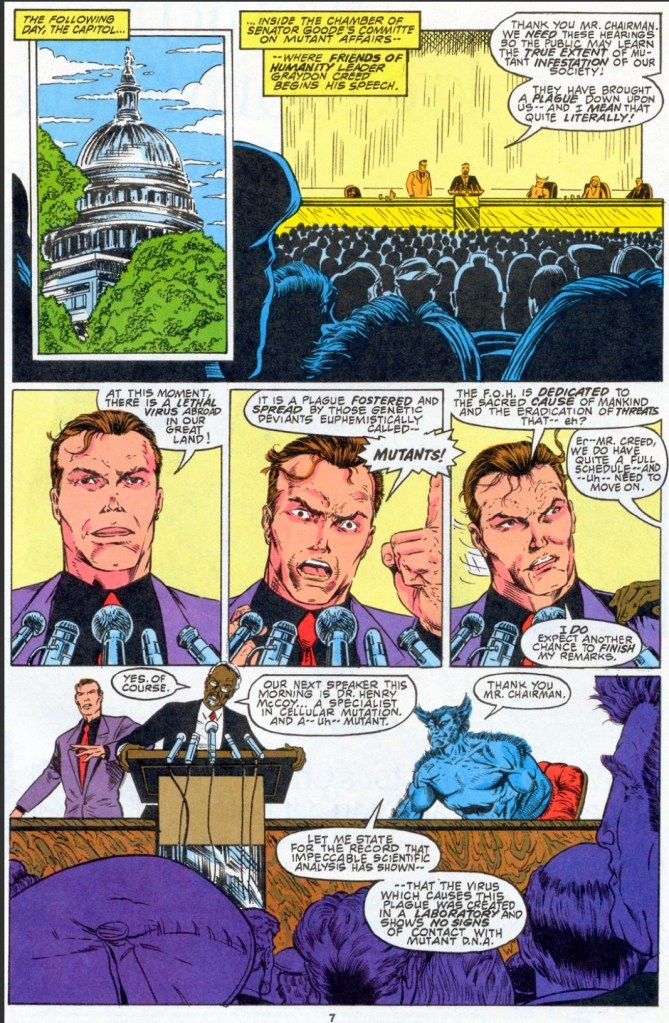
Conflict brewing in front of a huge audience.
To be straight to the point, what the creative team started in issue #7 got strongly concluded here. With the animated episode’s teleplay being the primary reference, writer Ralph Macchio successfully crafted a script that raised the stakes of the 2-part Time Fugitives story while tying closely the gaps with regards to the time travel and timeline conflicts concepts. Without spoiling the plot, I can say that one development that took place in the present day clearly set off the stage for another futuristic mutant to not only get involved but also make a huge impact on the narrative.
As with the previous issue, this story has elements of xenophobia as well as fear of viruses and potential massive infections which added a good layer of depth to the plot. Macchio’s writing is very strong and no matter how intense the tale got as more details got presented, it still remained very readable and efficient to follow. Also, I should say that Apocalypse’s presence turned out very powerful and it should inspire readers to search for comic books of the supervillain’s conflict with the X-Men and X-Factor for insight.
John Hebert returned on the visual department and his art style really works well with both the sci-fi concept of the story and the presentation of the X-Men plus Bishop and Cable. I really admire Hebert’s stylized take on Wolverine, Cable and Bishop as he made each them look even grittier than before. There is also this creepy vibe with the way Hebert drew some of the X-Men members’ faces. Herbert is also very good with visualizing sci-fi elements such as energy forms, futuristic machines, techno-virus forms on the skin, and more. His presentation of dynamic superhero action is great to look at. This is clearly one of the best looking issues of Season II of the X-Men Adventures series.
Conclusion
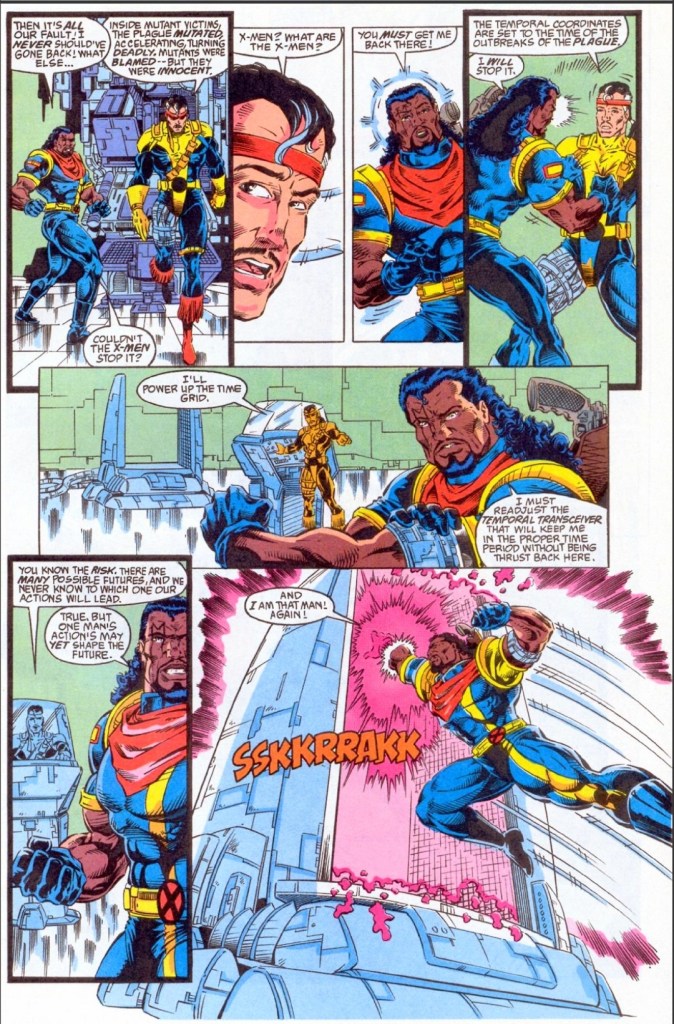
Bishop explains things to the X-Men and Beast confirms key details.
X-Men Adventures Season II #8 (1994) is a rock-solid comic book in terms of quality and impact. It concluded the 2-part story with a powerful resolution, it tied the loose ends in a very timely fashion and I really enjoyed the way how the X-Men were dramatized as Bishop and Cable got involved with them in their present day setting. So far, this is the most satisfying and more impactful issue of Season II I have read in this series.
Overall, X-Men Adventures Season II #8 (1994) is highly recommended.
Disclaimer: This is my original work with details sourced from reading the comic book and doing personal research. Anyone who wants to use this article, in part or in whole, needs to secure first my permission and agree to cite me as the source and author. Let it be known that any unauthorized use of this article will constrain the author to pursue the remedies under R.A. No. 8293, the Revised Penal Code, and/or all applicable legal actions under the laws of the Philippines.
Welcome back superhero enthusiasts, 1990s arts and culture enthusiasts, Marvel Comics fans and comic book collectors! Today we go back to the mid-1990s to explore the adaptation of the second season of the X-Men animated series in the form of the X-Men Adventures comic book series.
Before getting to the new retro comic book review, I should state that decades ago, the use of future timelines was implemented on the X-Men comics. I’m talking about the possible future where Cable and Stryfe came from, another possible future where Phoenix/Rachel Summers came from, and the more established future of the classic Days of Future Past storyline. Time travel and possible future timelines are the themes in the next X-Men Adventures comic book I reviewed recently.
With those details laid down, here is a look back at X-Men Adventures Season II #7, published in 1994 by Marvel with a story written by Ralph Macchio and drawn by Scott Rosema.
The cover.
Early story
The story begins on Earth in the far future of 3999 AD. Cable, who is fighting for the rebels, battles the deadly forces of the powers that be. It turns out, he and his teammates have been struggling a lot and their team suffered several deaths already. Even though they are very tired and heavily outnumbered, Cable refuses to give up and bravely calls for a frontal assault against their enemies.
Suddenly, Apocalypse appears on the battlefield and commands his robotic troops to destroy Cable and his fellow rebels. To Apocalypse’s surprise, a temporal storm appears and Cable notices it appearing so close to them. One of his teammates got caught by the storm which pushes Cable away. After receiving computer updates, Cable decides to get away from the robotic troops.
Meanwhile in another time period and place, Bishop returns from his mission (his interactions with the X-Men of the 20th century – click here and here) only to discover from Forge that nothing has changed and the plague still rages on…
Quality
The X-Men have a new problem to deal with.
Having read X-Men Adventures #13 and #14 of season 1, I found this particular tale (clearly a sequel to Bishop’s interaction with the X-Men after traveling through time) relatable and enjoyable. There is a strong science fiction vibe here and the time travel aspect added a lot to the build-up of tension.
Bishop here is almost the protagonist as the story showed an altered future in which Forge has no memory of the X-Men and only made a reference to a plague that has lasted for a long time. This compels Bishop to go back to the 20th century again hoping to meet the X-Men and somehow prevent the plague from bringing down society.
The impact of the mysterious virus is tremendous as so many people got infected and authorities suspect mutants to be the carriers. At this stage, the social aspects inserted by the creators really started to grow stronger within the narrative and you will see the X-Men struggling with not only the increased scrutiny on mutants but also with the manipulative tactics of anti-mutant activists who can’t help but see golden opportunities to wipe out mutants in a more clever fashion.
The dialogue here is noticeably gripping to read and the dramatization worked accordingly. There is also a good amount of superhero spectacle to enjoy here even though the X-Men have no super villains to fight with.
Conclusion
Forge has no memory of the X-Men.
X-Men Adventures Season II #7 (1994) looks like a repeat or even a remake of what happened in X-Men Adventures #13 (Season I) but its concept turned out to be not only unique with strong social commentary and sci-fi elements, but also became really engaging thanks to the fine execution by the creative team. On the aspect of social relevance, this comic book will remind you about the internment of Japanese Americans in America (1942-1946) and the COVID-19 restrictions and the quarantine on communities imposed by governments that disrupted people’s lives. As this comic book marks the first part of the Time Fugitives, I can say that I enjoyed it and I’m looking forward to the next chapter.
Overall, X-Men Adventures Season II #7 (1994) is recommended.
inXile Entertainment, the Xbox studio behind Wasteland 3, is back with their brand new Xbox-exclusive game Clockwork Revolution which turned out to be one of the biggest reveals of the Xbox Games Showcase 2023/Starfield Directdouble feature. While no release date has been set, the game will be released on Xbox Series X, Xbox Series S and Windows PC with availability on Xbox Game Pass, PC Game Pass and Steam.
To put things in perspective, posted below is the excerpt from the official Xbox.com article describing Clockwork Revolution. Some parts in boldface…
This is a fantastical, first-person action RPG, with dynamic time-bending combat, deep interconnected roleplaying systems, and the ability to create your own unique character from the ground up. The project is led by Game Director Chad Moore and Principal Designer Jason Anderson, who just happen to have created one of the greatest steampunk RPGs of all time—Arcanum.
Setting and Story – Clockwork Revolution takes place in the vibrant Victorian-era metropolis of Avalon, where steam trains fly overhead, wealthy industrialists replace their limbs with ornate clockwork prosthetics, and mechanical servants fulfill their masters’ every whim.
A vibrant steampunk society with a legacy waiting to be discovered in Clockwork Revolution.
But this new age of wonders holds a dark secret—it’s been carefully constructed by the ruthless Lady Ironwood. Through use of a time travel device, she’s changed key moments in Avalon’s history, keeping the working class struggling in the slums and factories, while bringing herself immense wealth and power. That’s where you come in…
Time Travel and The Chronometer – Discovering Ironwood’s scheme, you’ll use a wondrous device known as the Chronometer to travel back in time, choose how to influence the past, and then return to the present to experience the effects of your decisions. Through unprecedented and complex visual and narrative depth, the choices you make on your trips into the past will change the people, the stories, and the city of Avalon itself in extraordinary and (very often) unexpected ways. In Clockwork Revolutionwe’re pushing roleplaying reactivity to new heights, infused with the unique texture and personality that you’ve come to expect from our games.
Looks like a huge boss you will have to fight.
This is an exciting project for us at inXile. Not only is Clockwork Revolution our first fully-fledged Xbox Game Studios release, but from start to finish we’re utilizing the resources and support of Microsoft and Xbox to create our studio’s first AAA first-person action RPG.
What inXile is doing with Clockwork Revolution is very ambitious. What they showed during the Xbox Games Showcase made lots of gamers online make quick comparisons with BioShock Infinite as they are both first-person games that involve shooting, exploration, intense action and interaction with fantasy settings that are eerily similar between them. While it is not clear how far inXile has gone with the progress of game development, the Clockwork Revolution unveiling last week showed signs of high production values here and there, and it is clear that the developers have a clear vision of what they want to achieve and bring to players in due time.
Always make sure your weapons are fully loaded before going on a mission.
Right now, I am excited for Clockwork Revolution and I can only hope that the high production values inXile showed during the showcase will be maintained until they finish making the game. I really want to explore the game’s world, see how the time-traveling feature will deepen the gameplay and experience how much fun the Xbox-exclusive game will turn out. Not only that, I want to see how inXile will implement role-playing and what they could do with the steampunk concept in relation to the storytelling and gameplay.
Clockwork Revolution is most likely a few years away from release. We can only hope that inXile won’t be hampered during the development. Right now they have a lot of resources and a long development process ahead of them.
In concluding this post, posted below are Xbox-related videos for your enjoyment.
Disclaimer: This is my original work with details sourced from watching the movie and doing personal research. Anyone who wants to use this article, in part or in whole, needs to secure first my permission and agree to cite me as the source and author. Let it be known that any unauthorized use of this article will constrain the author to pursue the remedies under R.A. No. 8293, the Revised Penal Code, and/or all applicable legal actions under the laws of the Philippines.
We all know that the 20th Century Fox franchise of X-Men movies has ended and everything cinematic about Marvel’s famous mutants are now in the hands of Marvel Studios. From the year 2000 to 2020, the original X-Men cinematic universe produced a whole bunch of movies (including spinoffs) which ultimately led to uneven results with regards to commercial success, critical feedback, artistry, production values and cultural impact. Even so, 20th Century Fox-produced X-Men movies generated more than $6 billion in ticket sales worldwide.
When it comes to the spinoff movies, I like Logan the best (sorry, Deadpool).
For the main X-Men movies, the one film that really delivered the great stuff and tons of fun for me was none other than X-Men: Days of Future Past (2014). For one thing, the movie had two generations of X-Men cinematic performers (the original team led by Patrick Stewart and the newer ones from X-Men: First Class led by James McAvoy) and its story literally had them linked together with Hugh Jackman’s Wolverine as the living bridge between them. To put it short, it was a cinematic crossover story made with X-Men fans in mind. That film scored highly with critics and most moviegoers, and it grossed almost $750 million worldwide which makes it the highest-grossing X-Men movie ever until now.
It has been years since X-Men: Days of Future Past made waves in the cinemas and through post-theater businesses like Blu-ray, cable TV, pay-per-view, streaming and the like. Along the way, movies like Wonder Woman, Aquaman, Avengers: Infinity War and Avengers: Endgame collectively raised the standards of Hollywood superhero movies in varied ways. I should state that X-Men (2000), X2: X-Men United and X-Men: The Last Stand did not age well.
To find out if the 2014 X-Men film aged well or not, here is my retro review of X-Men: Days of Future Past directed by Bryan Singer with a screenplay written by Simon Kinberg with a story done by Kinberg, Jane Goldman and Matthew Vaughn.
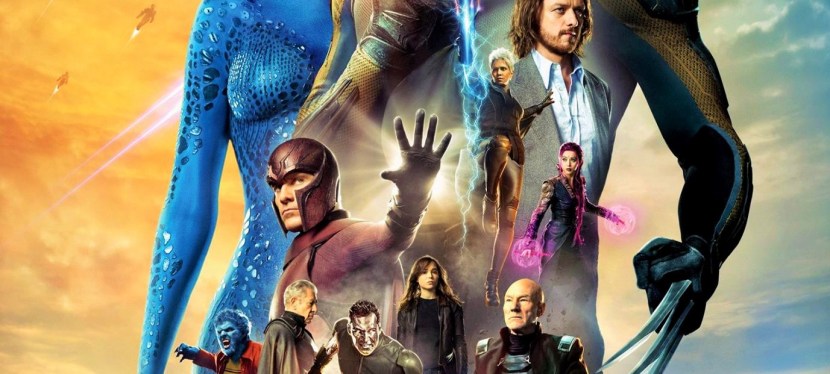
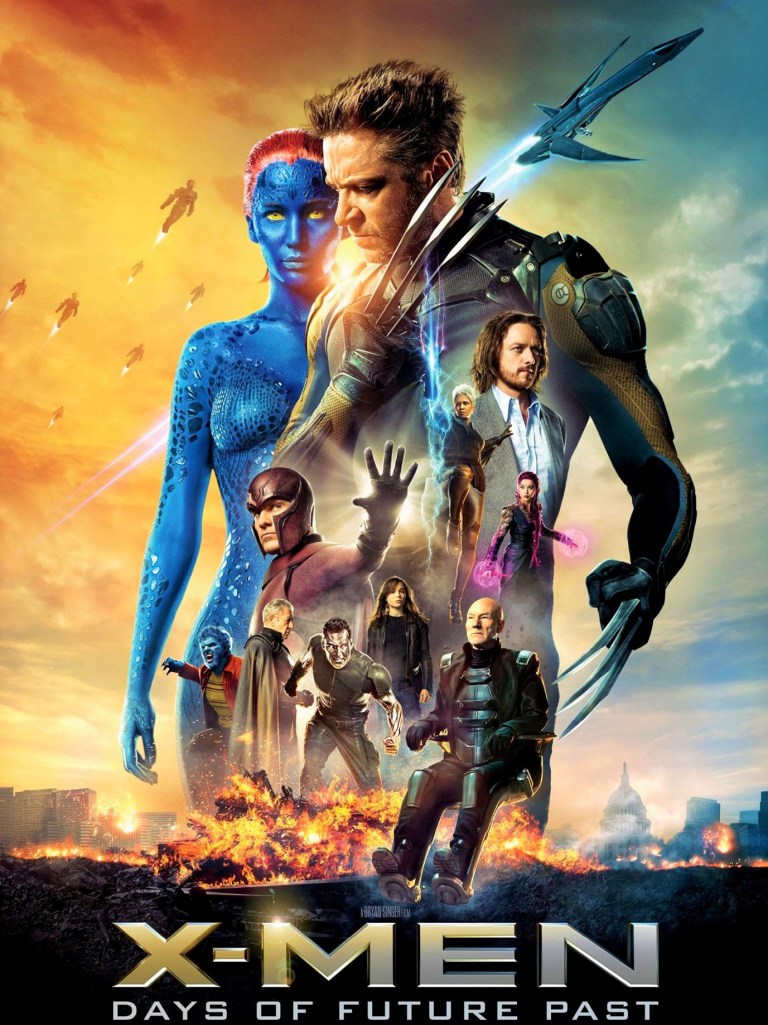
A great image of the cinematic X-Men, both the old and newer cast.
Early story
The story begins in the dark future. Countless mutants and human allies have been caught and imprisoned by very sophisticated Sentinels (operating for an unnamed authority that also has armed human personnel as watchers) which continue to hunt more of them down along with any humans caught aiding them. In Russia, a small X-Men team composed of Colossus, Kitty Pryde, Iceman, Sunspot, Bishop, Warpath and Blink take action when they realized that the Sentinels found their hideout. Kitty Pryde, who by this time gained the new ability to send a person’s consciousness back through time, runs along with Bishop to hide in a vault to send his consciousness into the past. Fortunately for them, their teammates delayed the unstoppable Sentinels enough to succeed.
Some time later at another location, an aging Charles Xavier, Magneto, Wolverine and Storm arrive to meet with Kitty Pryde and her teammates. Xavier gives the team an in-depth history lesson about the Sentinels which were created decades earlier by the late Bolivar Trask who was assassinated by Mystique (who believed she could make a difference for her fellow mutants). After the assassination, Mystique got caught by the authorities and became a live experiment for scientists working for the government. Her DNA helped accelerate the development of the Sentinel program which made them able to adapt to most mutant attacks and powers.
A plan gets formed for Kitty Pryde to send Xavier back through time to his younger self in 1973 to prevent the assassination from happening. Kitty states it’s too risky for the old Xavier to go through time as it may kill him. Wolverine volunteers to take Xavier’s place as his healing factor (regeneration) will ensure his survival with the process. Xavier presses Wolverine to convince the 1973 Charles Xavier to help prevent the assassination given the fact that he was a broken man at the time.
Wolverine arrives in his younger self’s body in New York of 1973. He makes his way to the mansion of Charles Xavier. As it turns out, Xavier’s school has been closed for some time and has been decaying…
Quality
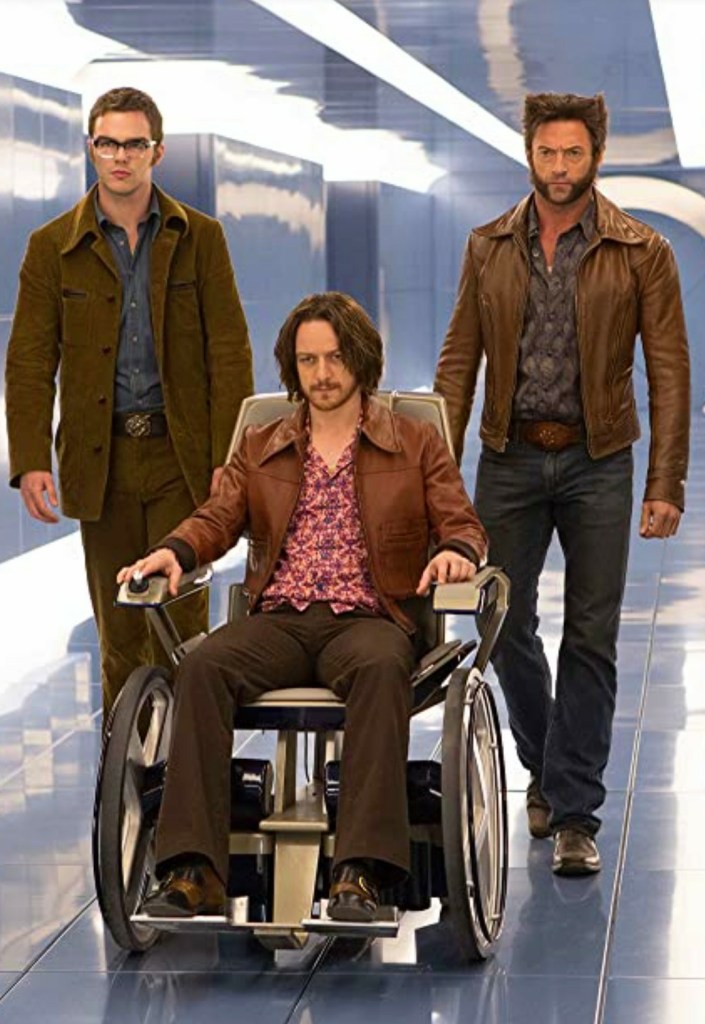
Nicholas Hoult, James McAvoy and Hugh Jackman as Beast, Charles Xavier and Wolverine respectively.
Considering what was made and what were presented through this movie, the creative team and the cast of X-Men: Days of Future Past literally scored a home run here resulting true greatness! Bryan Singer, whose previous X-Men directorial job was 2003’s X2, finally struck gold with regards to storytelling, directing and, finally, spectacle (previous his big weakness).
In terms of storytelling, this movie, first and foremost, is not a faithful adaptation of the classic Days of Future Past storyline at all. In fact, there was no need for it to be faithful. What the screenwriters came up with was a loose adaptation which allowed them to craft a more original story that involved the established X-Men characters (from the early movies) and the other X-Men characters (who started in 2011’s X-Men: First Class) and have them set apart in terms of time periods (similar to what was done in 1994’s Star Trek: Generations, but much better and more compelling in writing). The result is a crossover tale with Wolverine being the traveler through time.
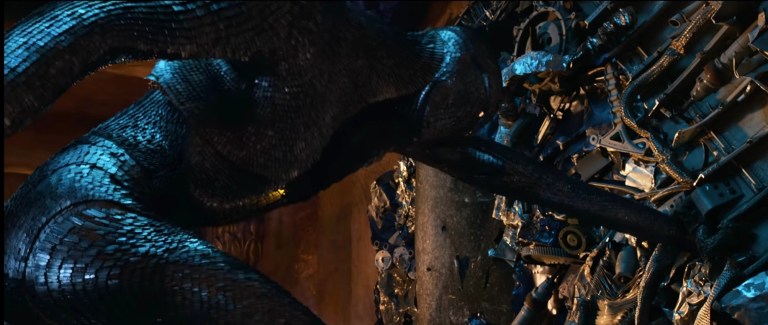
The Sentinels are clearly terrifying and unstoppable!
The great news here is that the script has very strong structuring done and even had enough space to briefly acknowledge events and characters from the first three X-Men films plus 2009’s X-Men Origins: Wolverine as canon. All of these add to the narrative very well and when the stakes were raised, the overall plot made sense. Let me add that it was a smart move for the writers to raise the stakes in the two time periods during the final act of the movie, which really made the story more engaging to viewers. I should state that having two conflicts happening simultaneously on screen in this X-Men movie was done efficiently and without ever becoming confusing nor messy.
Apart from the narrative, the portrayal of the X-Men was, indeed, spot-on. Noticeably, the major characters here were Charles Xavier (both old and young), Wolverine (both old and young), Mystique, Magneto (specifically the young version), Beast and Bolivar Trask. Strong writing was evident in the dialogue of the mentioned characters, as well as in those with minor roles. Through dialogue alone, I easily recognized these cinematic characters.
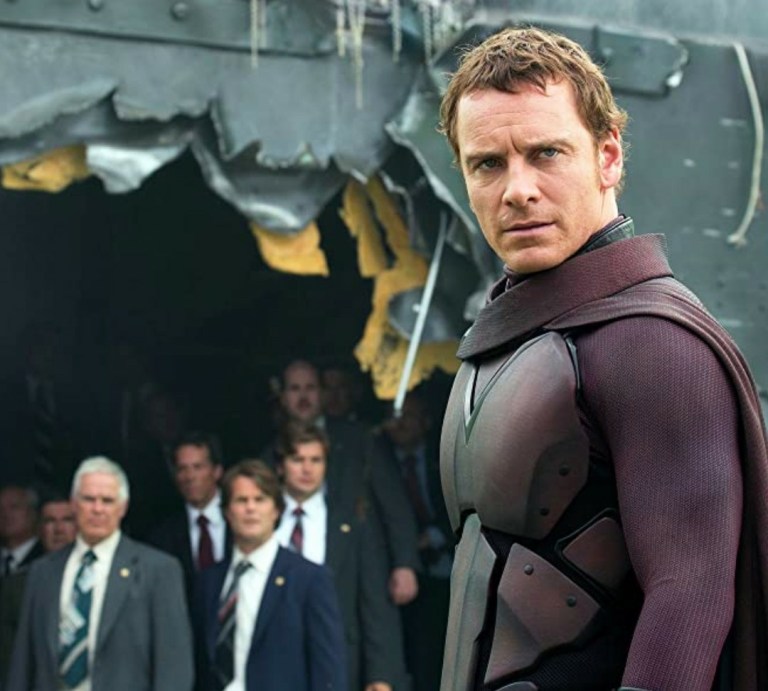
Michael Fassbender delivered his best performance as young Magneto.
Given his strength in telling stories, I should say that Bryan Singer succeeded in executing the script into cinematic narrative. Not only that, he succeeded in getting really good performances from the cast. James McAvoy (young Xavier), Jennifer Lawrence (Mystique), Michael Fassbender (young Magneto) and Nicholas Hoult (Beast) were evidently more confident and more comfortable in reprising their characters (note: they debuted together in X-Men: First Class).
The old cast composed of Patrick Stewart (old Xavier), Ian McKellen (old Magneto), Ellen Page (Kitty Pryde), Halle Berry (Storm), Shawn Ashmore (Iceman) and Daniel Cudmore (Colossus) all made a very welcome return. To be specific, it was only Patrick Stewart among them who had the most engaging dialogue with Ian McKellen being a distant second to him. As most of the film was set in the past, it was understandable that the old cast’s dialogue would not be that rich which translates to limited performance. The filmmakers tried bouncing back with mutant variety by having Bingbing Fan as Blink, Adan Canto as Sunspot and Booboo Stewart as Warpath, who all provided nicely in the action scenes and special effects use.
Bingbing Fan and Booboo Stewart as Blink and Warpath.
Hugh Jackman’s performance as Wolverine in this movie is the most unique of them all. Not only does he have to play TWO versions of his character, he as the only member of the old X-Men cast spent a great deal of time interacting with the newer X-Men players. The great news here is that Jackman has great chemistry with James McAvoy, Nicholas Hoult and Michael Fassbender, which ultimately justified the crossover! Speaking of McAvoy, his scene with the older version of his character is very memorable and a highlight! Peter Dinklage as Bolivar Trask is excellent but to my surprise, he is not exactly villainous nor did he express cruelty. He’s more of an obsessed scientist and as such, Michael Fassbender’s Magneto easily overshadows him when it comes to being the main antagonist. This is surprising but not exactly a problem.
More on the anti-hero factor of the movie, I should say that the Sentinels in this movie are the most dangerous and the most intimidating non-sentient, scientific antagonists since the Terminator. Being programmed to deal with mutants, the Sentinels are unrelenting and often used violence to complete their objectives. The futuristic Sentinels, which are evolved versions thanks to Mystique’s DNA, are so formidable the mutants cannot simply defeat them. Even the 1970s Sentinels are quite formidable.
As mentioned earlier, I do confirm that Bryan Singer really outdid himself on delivering the spectacle back with support from the special effects team, the stunt team and the like. The action scenes involving the X-Men are top-notch, in fact they make the action in Singer’s previous X-Men films look minor in terms of creativity, quality and fun! The computer-generated effects in this movie still look great by today’s standard, although some CGI used in the floating stadium sequence looked rushed. Also it was quite a marvel to see Wolverine and Beast face-off with a 1970s Sentinel in the final act. I should mention that the slow-motion sequence involving Quicksilver (played by Evan Peters) is one great and funny spectacle to watch, well worth replaying!
Conclusion
Jennifer Lawrence in her best-ever performance as Mystique.
I declare that X-Men: Days of Future Past (2014) is the best-ever X-Men movie I have seen and it has aged very well! Its overall quality is very great and the combined talents of director Singer, the cast, the writers and all the technical teams justified it all. By today’s standards, this X-Men movie still stands very high among all superhero movies of Hollywood ever released! As an X-Men film, this one is truly epic and the true highlight of all X-Men movies under 20th Century Fox. As a time-travel film, this one has a very unique approach and it should be noted that director Bryan Singer approached James Cameron to talk about time travel, parallel universes and the like.
More on personal viewing, I can say that this film greatly entertained me in the cinema back in 2014, and it still succeeds in doing so whenever I replayed it on Blu-ray in the comfort of home. If there is anything I regret, it’s the fact that I never saw this movie in the IMAX cinema.
If you are seriously planning to buy an existing hard copy of X-Men: Days of Future Past (2014), visit Amazon for the Blu-ray release as well as the 4K Blu-ray combo release. There is also the Rogue Cut of the movie also on Blu-ray.
Overall, X-Men: Days of Future Past (2014) is highly recommended!
+++++
Thank you for reading. If you find this article engaging, please click the like button below and also please consider sharing this article to others. If you are looking for a copywriter to create content for your special project or business, check out my services and my portfolio. Feel free to contact me as well. Also please feel free to visit my Facebook page Author Carlo Carrasco and follow me at HavenorFantasy@twitter.com
Disclaimer: This is my original work with details sourced from reading the comic book and doing personal research. Anyone who wants to use this article, in part or in whole, needs to secure first my permission and agree to cite me as the source and author. Let it be known that any unauthorized use of this article will constrain the author to pursue the remedies under R.A. No. 8293, the Revised Penal Code, and/or all applicable legal actions under the laws of the Philippines.
It’s funny how adaptations of adaptations turn out in real life. Long before the first live-action X-Men movie was released, an animated TV series (popularly referred to as X-Men: The Animated Series or X-Men TAS) was produced and arguably brought together the fans of both the X-Men comic books along with the animated X-Men followers.
Along the way, Marvel Comics went on to publish a monthly comic book series called X-Men Adventures which themselves were adaptations of the animated series (which itself adapted stories and concepts from the comic books).
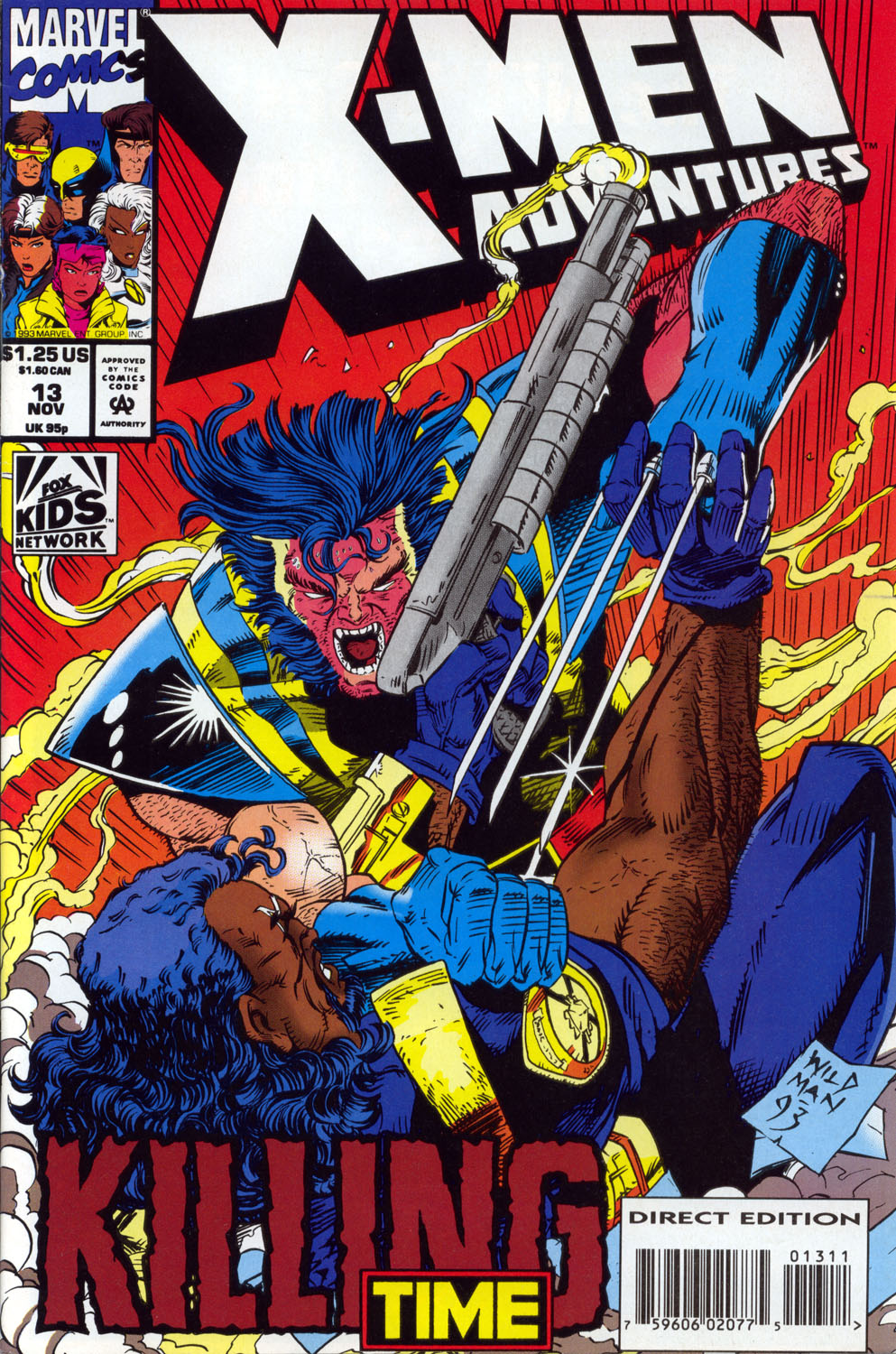
The adaptation-of-an-adaptation approach went deep further when the animated series adapted loosely the story of the classic X-Men comic book storyline Days of Future Past (by legends Chris Claremont and John Byrne) which resulted a story told in two episodes on TV. And then there was also a comic book adaptation that followed starting with X-Men Adventures #13 which is the subject of this retro comic book review.
The cover.
Early story
Written by Ralph Macchio and drawn by Andrew Wildman, the comic book begins in the dark future of 2055 in New York. The city is in ruins and mutants on the loose are being hunted by Sentinels. A very old Wolverine appears to help two loose mutants but ends up getting stunned with them by Bishop who turns out to be helping the automated authority of the Sentinels.
As he turns over the captured mutants, the Sentinels betray Bishop telling him that they no longer required him. Afterwards, Bishop and Wolverine (who woke up) each carry a person under the watch of a Sentinel. Suddenly, the two other mutants use their powers to attack the Sentinel and Wolverine followed to back up their efforts. The Sentinel however grabbed Wolverine.
Quality
A very old Wolverine in the dark future of 2055.
With the exception of some liberties, this comic book closely followed what was told in the first of the 2-episode Days of Future Past animated adaptation. As a comic book story, the story was heavily loaded with details and exposition designed to orient readers about the setting and why the future became a time of darkness in relation to the rise of machines having ultimate power over people.
While the time travel concept of the literary classic involved the mind of Kitty Pryde going into the past, this comic book used the more common concept of having Bishop travel back through time physically which easily reminds me of Kyle Reese arriving from the future in 1984’s The Terminator.
The build-up leading to Bishop’s move to travel back through time was nicely done by the creative team. There was a lot of exposition followed by an incoming attack complete with explosions happening just as Bishop is about to leave. In short, the pay-off was worth it.
The engagement did not end there. In fact, it continued nicely as Bishop meets the X-Men in 1993 with the details of his mission carefully unveiled. Professor Charles Xavier’s reaction to future history (Sentinels taking control of the world) was dramatic and worth re-reading.
As with his other works in the X-Men Adventures comic book series, Andrew Wildman’s art is very good to look at and he knows how to make each scene look engaging whether it’s just an exchange of dialogue between characters or an action scene loaded with a lot of impact.
Conclusion
While it is only half of a 2-issue adaptation of a 2-episode animated adaptation of the Days of Future Past literary classic, X-Men Adventures #13 is still a fun-filled reading experience complete with a lot of engaging moments.
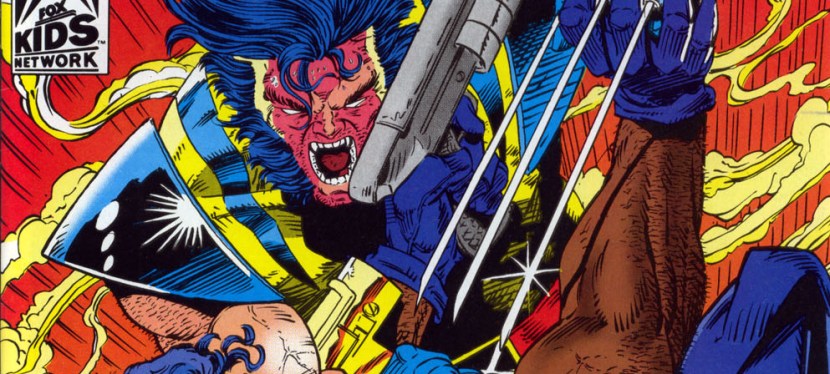
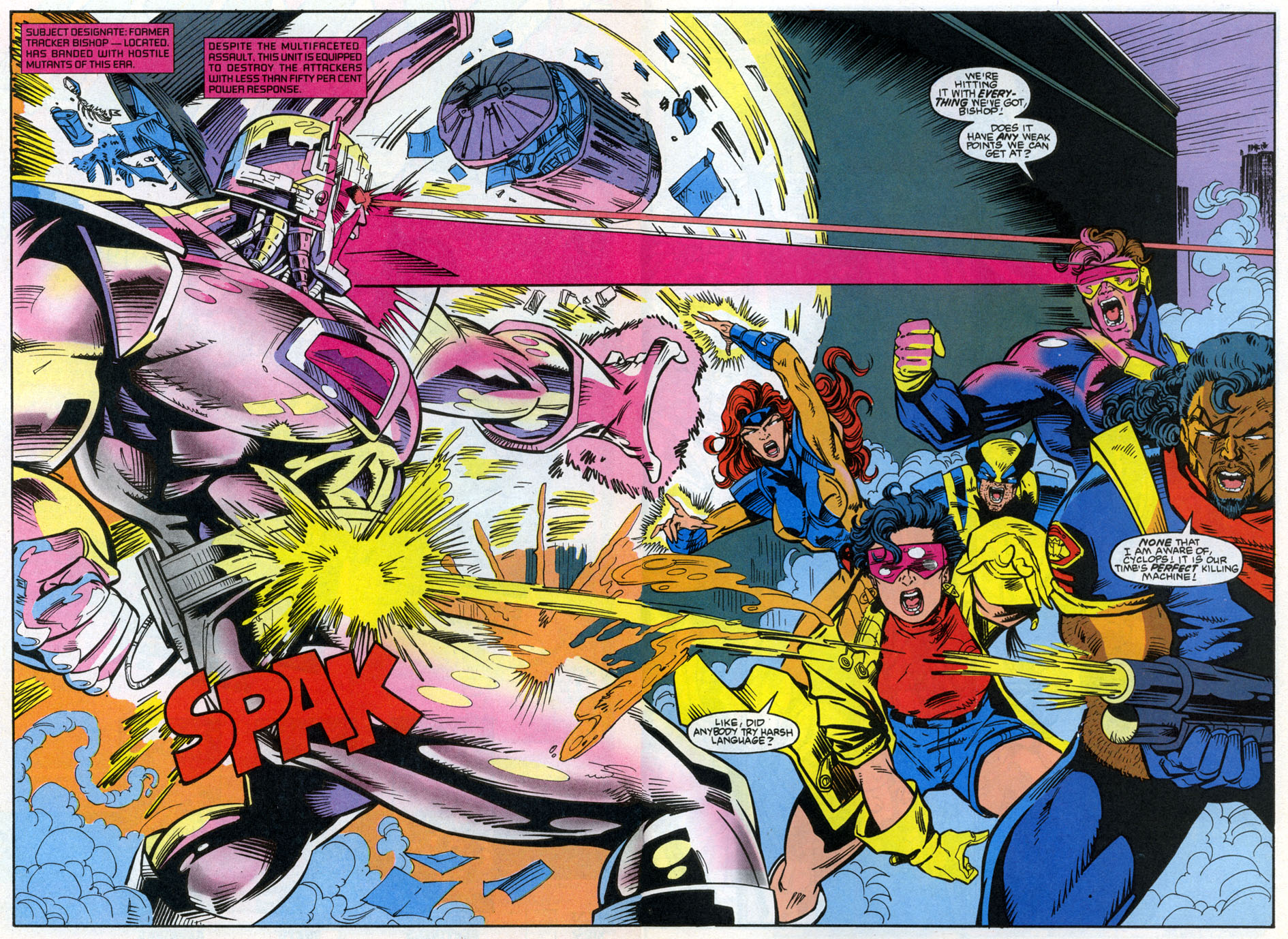
The money shot by Andrew Wildman!
If you are a serious collector of comic books, be aware that, as of this writing, a near-mint copy of X-Men Adventures #13 costs $6 while its newsstand edition copy is worth $21 in near-mint condition according to Mile High Comics.
Overall, X-Men Adventures #13 is highly recommended. Both dedicated X-Men fans as well as newcomers will have something a lot to enjoy with it.
Thank you for reading. If you find this article engaging, please click the like button below and also please consider sharing this article to others. If you are looking for a copywriter to create content for your special project or business, check out my services and my portfolio. Feel free to contact me as well. Also please feel free to visit my Facebook page Author Carlo Carrasco and follow me at HavenorFantasy@twitter.com












 Author Carlo Carrasco