Vietnam, a nation previously ravaged by war which eventually emerged as a major tourism destination in Southeast Asia, imported a lot more fruits and vegetables from the United States of America resulting in a jump of 67% to US$900 million, according to a news report by VnExpress. Vietnam’s exports to America, however, were not too great which resulted in a trade surplus of more than $350 million for America on fruits and vegetables.
To put things in perspective, posted below is an excerpt from the VnExpress news report. Some parts in boldface…
U.S. fruits and vegetables are pouring into Vietnam, with 2025 imports rising by nearly 67% to US$900 million, but Vietnamese exports to the U.S. are not keeping pace.
This marked a 10-fold jump in imports from the U.S. from a decade ago, with cherries, apples, grapes, and oranges being among the top fruits bought, according to Vietnam Customs.
Vietnam’s vegetable and fruit exports to the U.S. were worth $546 million last year, a minuscule 1.49% share in a market is dominated by suppliers such as Mexico, Canada and South American countries.
Dang Phuc Nguyen, general secretary of the Vietnam Fruit and Vegetable Association, said the U.S. is a very large market but also one marked by stringent technical standards and also long geographical distance for Vietnam.
Vietnam’s position as the 13 largest fruit and vegetable supplier to the U.S. is owed to the great efforts made by businesses in recent years, he added.
There is room for growth as the list of fresh fruits permitted for export to the U.S. continues to expand, and now includes pomelo, mango, dragon fruit, longan, lychee, star apple, rambutan and, most recently, coconut.
Consumer trends in the U.S. are shifting toward novel fruits, health-oriented products and more deeply processed items such as frozen fruit, dried fruits and juices, with Vietnamese products like coconut, durian and pomelo becoming increasingly popular.
But exports do face many challenges. Starting this month the U.S. began tightening regulations on traceability and food safety, particularly with respect to pesticide residues.
Vietnamese oversight of planting area codes and packing facilities remains uneven, which threatens to bring warnings or even temporary import suspensions by the U.S.
The high logistics costs due to the distance make it difficult for Vietnamese fruits and vegetables to compete on price with suppliers close to the U.S. such as in Mexico, Peru or Thailand.
Let me end this piece by asking you readers: What is your reaction to this development? Do you consider Vietnam’s heavy importing of American fruits and vegetables in 2025 big economic victories for Trump’s America? What do you think is the main reason as to why Vietnam purchases so much fruits and vegetables from the United States? Do you think Trump’s tariffs are already helping American producers of fruits and vegetables?
Welcome back readers, fellow geeks and electronic gaming fans!
In this edition of the Retro Gaming Ads Blast (RGAB) series, we will take a look at another batch of retro gaming print ads – including arcade flyers – from the 1980s and 1990s.
For the newcomers reading this, Retro Gaming Ads Blast (RGAB) looks back at the many print ads of games (console, arcade, computer and handheld) that were published in comic books, magazines, flyers, posters and newspapers long before smartphones, social media, the worldwide web and streaming became popular. To put things in perspective, people back in the 1980s and 1990s were more trusting of print media for information and images about electronic games and related products.
With those details laid down, here is the newest batch of retro gaming print ads for you to see and enjoy…
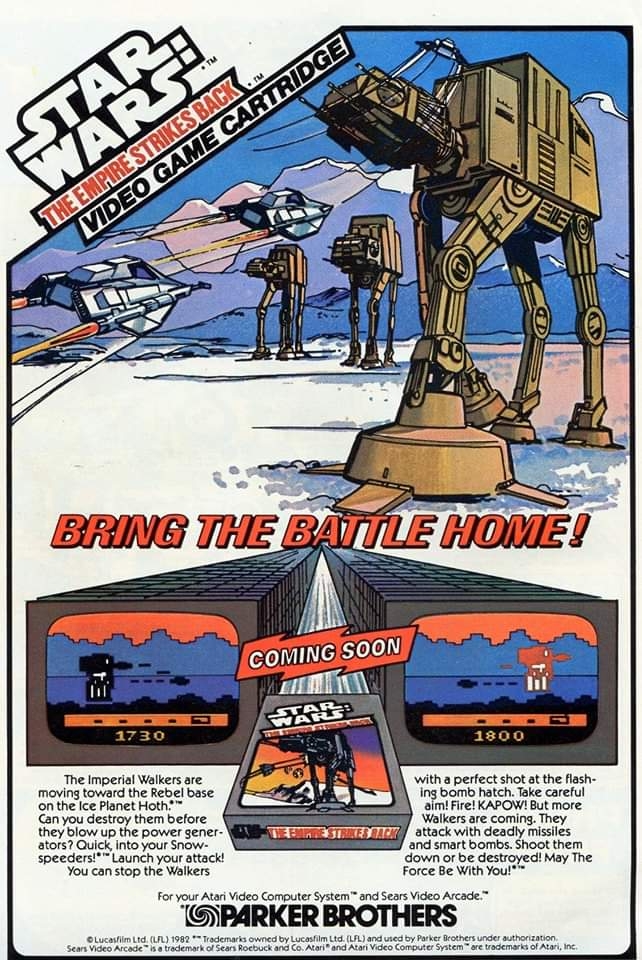
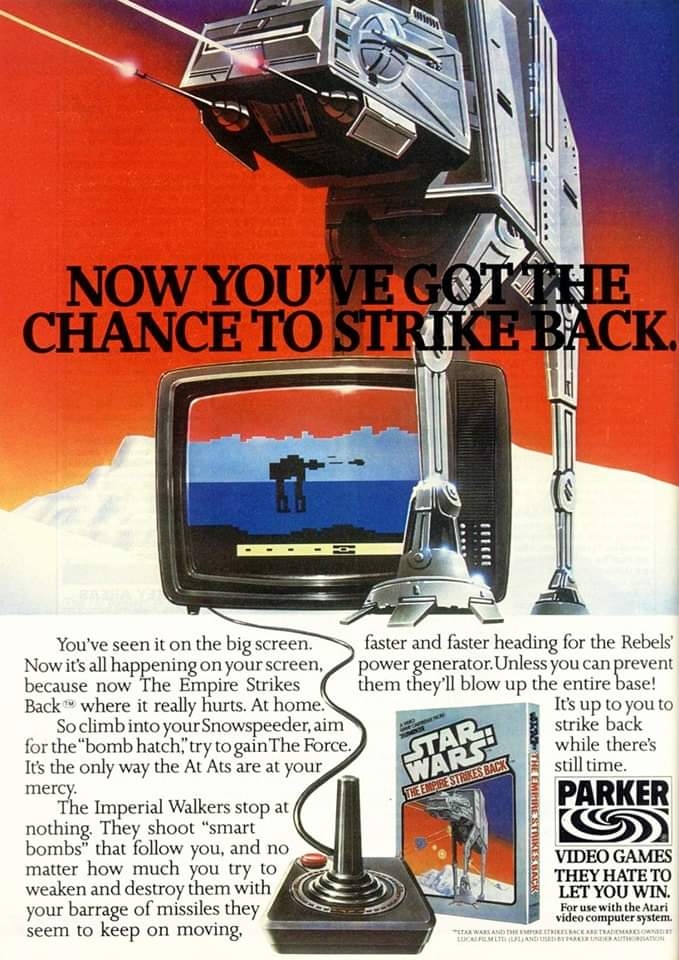
1. Star Wars: The Empire Strikes Back Atari print ads
I could not forget the first time I saw this print ad while reading a comic book.
This ad showed the Atari 2600 controller.
Even during its early years under George Lucas, the Star Wars entertainment franchise made its way into video games due to its massive popularity and Parker Brothers really made moves to cash in. This resulted in the Atari 2600 video game adaptation (1982) of The Empire Strikes Back which focused mainly on the memorable Hoth battles between Rebel fighters and the Empire’s AT-AT walkers. Parker Brothers came up with two print ads and each had a different visual concept: one had nicely drawn art along with two screenshots shown while the other had painted art of the AT-AT while showing the Atari joystick. These old print ads still look great and exciting.
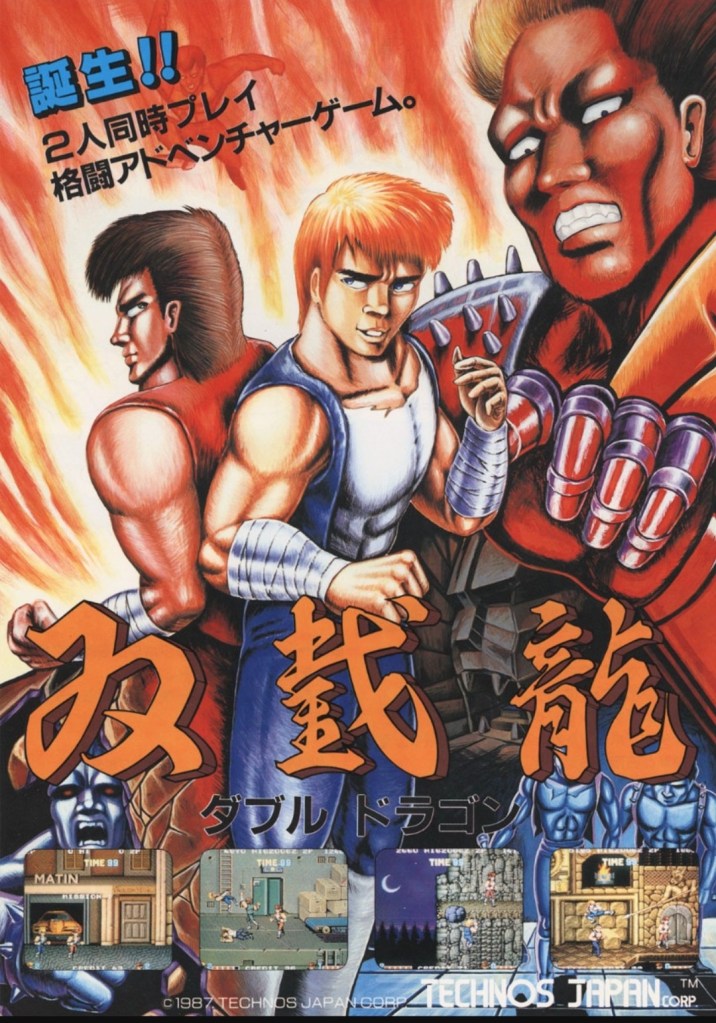
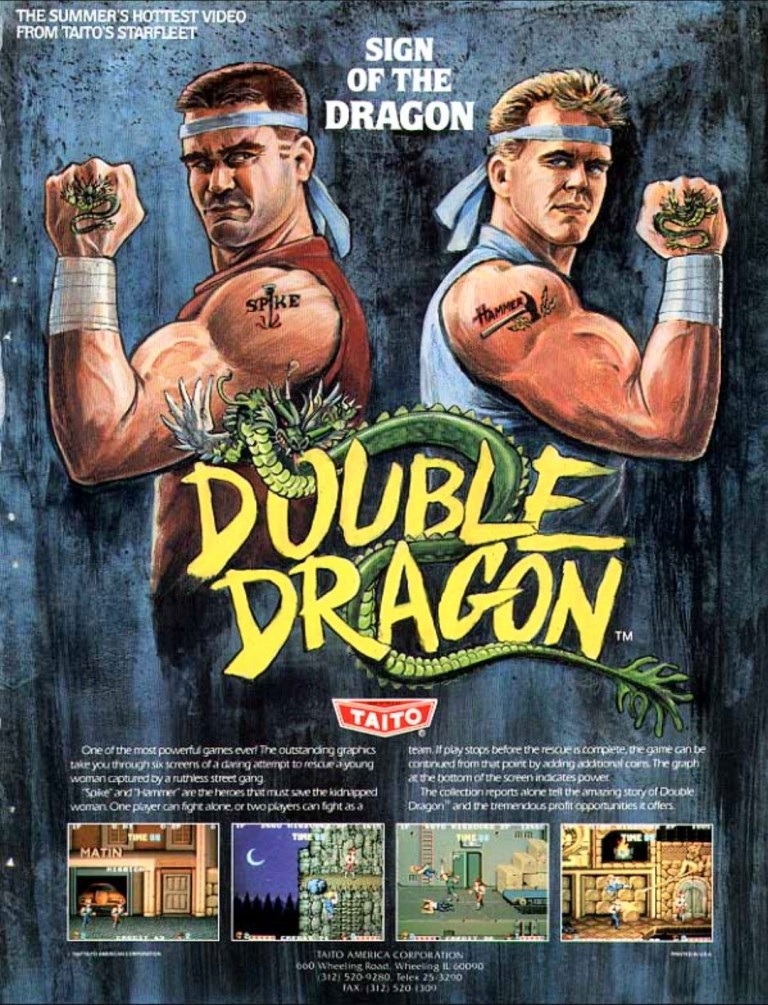
2. Double Dragon Japanese and North American arcade flyers
If you read manga (Japanese comics) in Japan, then the art style of this arcade flyer should look familiar to you.
The character designs seem inspired by 1980s Hollywood action cinema.
Released in 1987, Double Dragon became a huge hit in the arcades of Japan, America and Europe resulting in financial gains for developer Technōs Japan and publisher Taito. What I find intriguing was the fact that the Double Dragon arcade flyers for Japan and North America had drastically different art styles used to promote it. The Japanese flyer had art style that is more common with manga while the North American had artwork that seemed inspired by Hollywood action movies (as well as the rise of martial arts films in America during the 1980s). The American flyer even had the two characters identified as Hammer and Spike and they both looked American. This is a classic example of using different approaches to promote a game in each market.
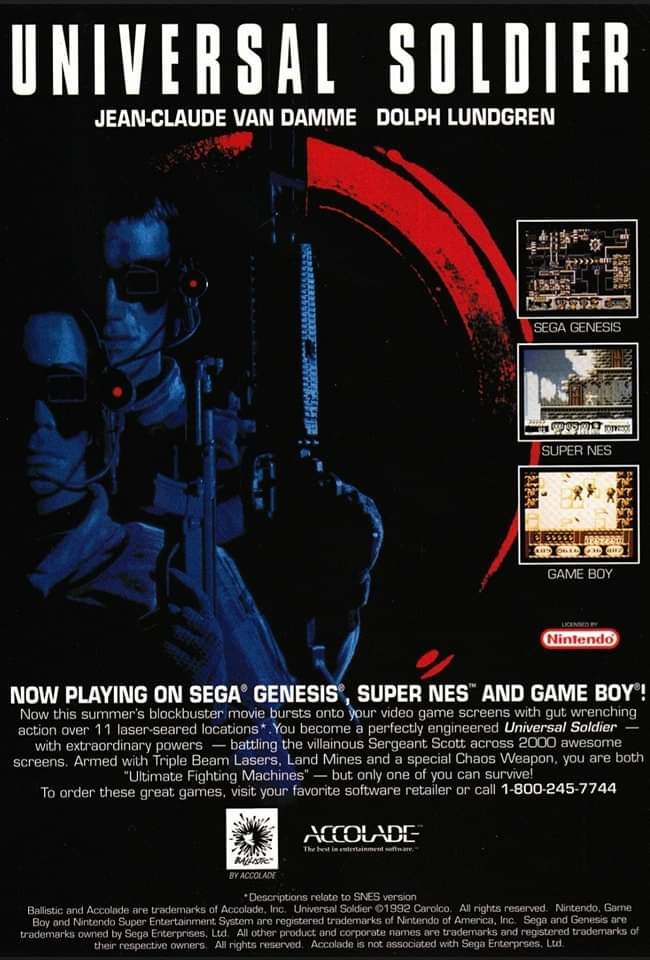
3. Universal Soldier print ad
The people who made this print ad made sure to use the names of the stars to help sell the game.
Even though its worldwide ticket sales did not reach $100 million, the 1992 movie Universal Soldier still caught a lot of attention from moviegoers simply because it had Jean-Claude Van Damme and Dolph Lundgren as the stars. Unsurprisingly, the movie had a video game adaptation and because publisher Accolade wanted to cash-in on the film’s hype, they made some deceptive moves by rebranding one of its games (already development) as a tie-in. Advertised as an official adaptation, Universal Soldier was actually a rushed conversion of Turrican II: The Final Fight. This print ad – which even showed the stars’ names – is a reminder of the deception Accolade pulled off.
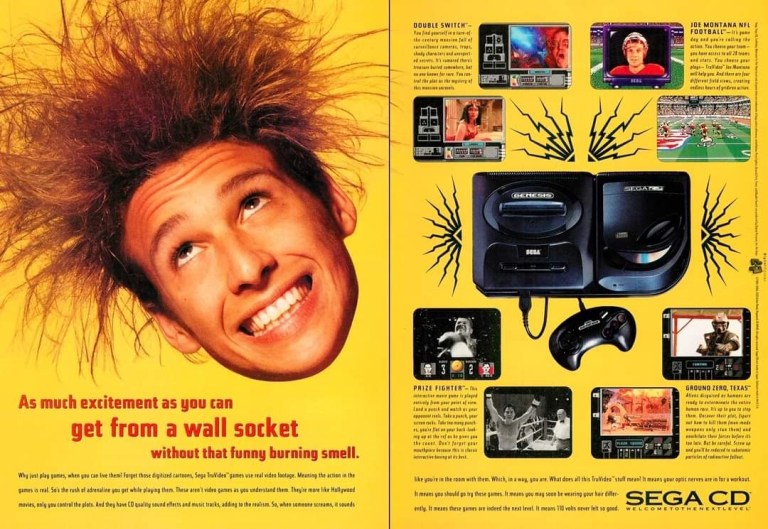
4. Sega CD print ad
Do you find this Sega CD print ad hilarious?
When Sega was making waves with its Sega Genesis (Sega Mega Drive in Japan), the company was quick to react to the growing use of the compact disc (CD) format as a useful storage medium for video games. The Sega CD (Mega CD in Japan) was released as an add-on device to work with the Genesis console and Sega’s American team came up with a series of promotions. This print ad is just one of the promotions and ad makers came up with a “crazed” or “electrified” gamer dominating one page while showing the Genesis, the Sega CD and screenshots of games (running on CD) on the other page. By today’s standards, the Sega CD print ad is funny and catchy to look at.
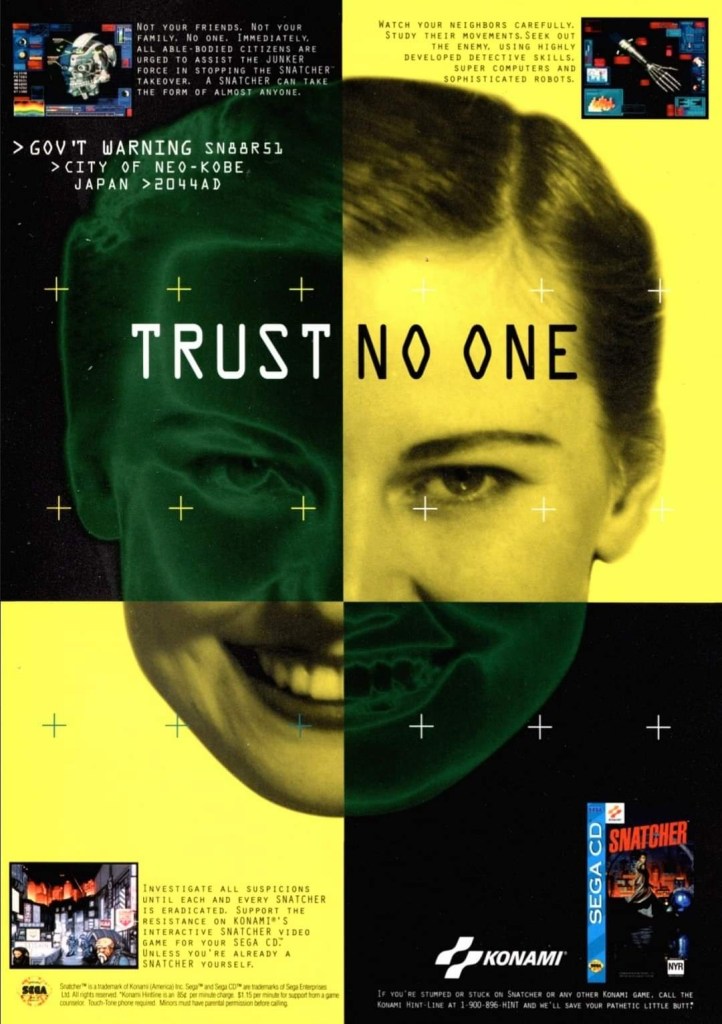
5. Snatcher for Sega CD print ad
I find this Snatch print ad looking odd. The ad makers could have done more to focus on the game itself.
First released in Japan in 1988, Snatcher was a cyberpunk visual adventure game that was one of the early works of the famous Hideo Kojima (Metal Gear series). Due to its design and approach on visuals to tell a story, it was not surprising that a Sega CD version of it got released in 1994. To promote the game to the growing number of North American Sega CD gamers at the time, Konami came up with this rather unusual print ad showing the face of a smiling lady dominating the space leaving little room to show the screenshots and the game’s cover. The visual concept is engaging but it takes effort to notice it was promoting the Sega CD version of the video game. This old ad would have worked better had the ad makers increased the sizes of the screenshots and the game cover.
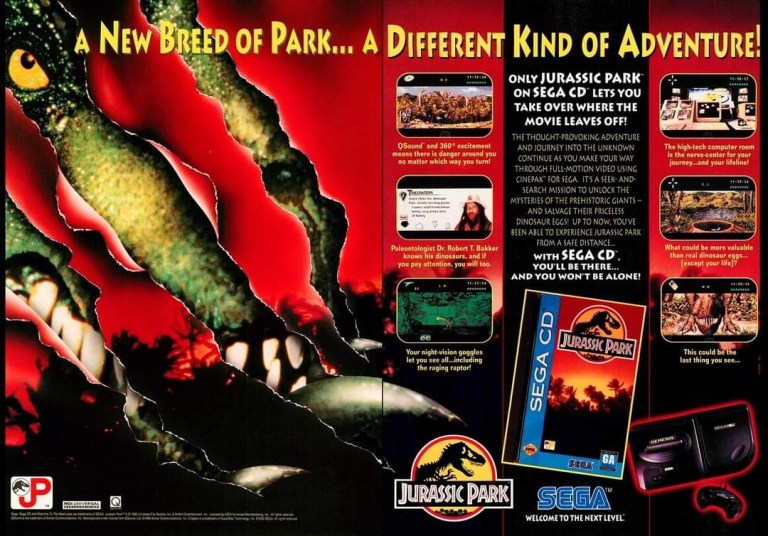
6. Jurassic Park for Sega CD print ad
Does the T. Rex look scary to you?
As part of its drive to add more games to the Sega CD add-on and help it sell more units, Sega acquired the Jurassic Park license and went on to produce an adaptation utilizing the technological features of the Sega CD. To aggressively promote the game, Sega came up with this print ad that had a Tyrannosaurs Rex (looking through spaces) on one page and then several screenshots plus text descriptions on the other. For a click-and-point Jurassic Park game, this ad was really exciting and intriguing to look at.
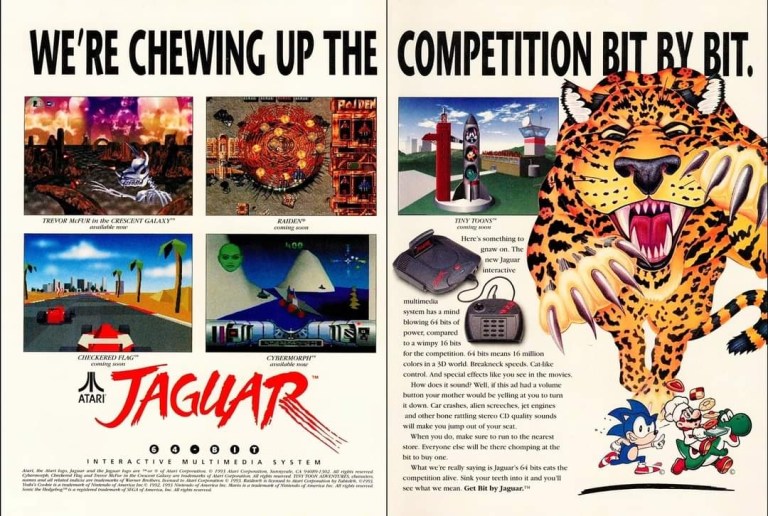
7. Atari Jaguar print ad
This was indeed an eye-catching ad.
In the early 1990s, Atari made an aggressive move to compete in the arena of video game consoles which they used to dominate from the late 1970s until 1983. This time around, they came up with the Jaguar console which had some pretty advanced technologies for the time. As part of their North American marketing campaign, Atari unleashed an ad showing game screenshots on the first page and huge artwork of a jaguar coming after Sonic, Mario and Yoshi (mascots of Sega and Nintendo respectively) symbolizing that the Atari Jaguar had more power and better technology than the Genesis and the Super Nintendo Entertainment System (SNS). While it was engaging to look at early on, this print ad is now an embarrassment as the Jaguar console failed terribly. Lastly, the marketing of the Jaguar as a 64-bit machine was never real.
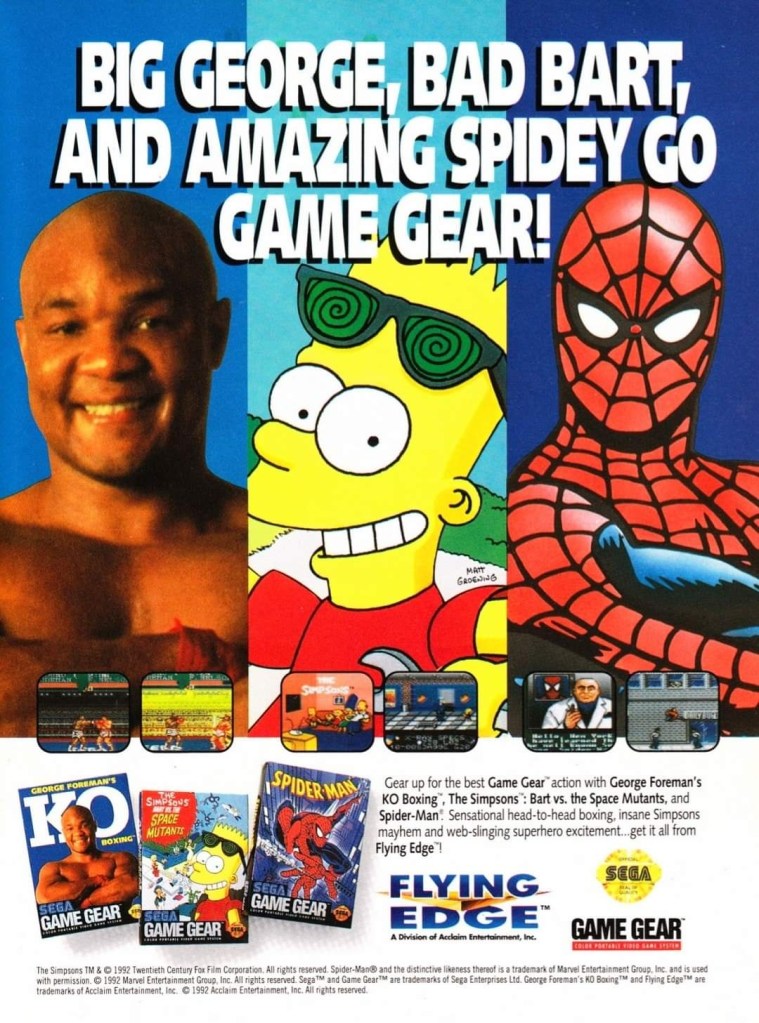
8. George Foreman, The Simpsons and Spider-Man Game Gear print ad
This ad appeared in a lot of comic books in the 1990s.
In the early 1990s, Sega released the Game Gear handheld gaming device which instantly placed them in competition with Nintendo’s Game Boy. Through its Flying Edge label, Acclaim Entertainment promoted George Foreman’s KO Boxing, The Simpsons: Bart vs. the Space Mutants, and Spider-Man for the Game Gear hoping to sell well. This 3-game print ad highlighted the popular figures who had a lot of space for attracting attention. The ad maker managed to insert two screenshots per game, the game covers and a text description to inform consumers what they were being offered. A good ad to look at.
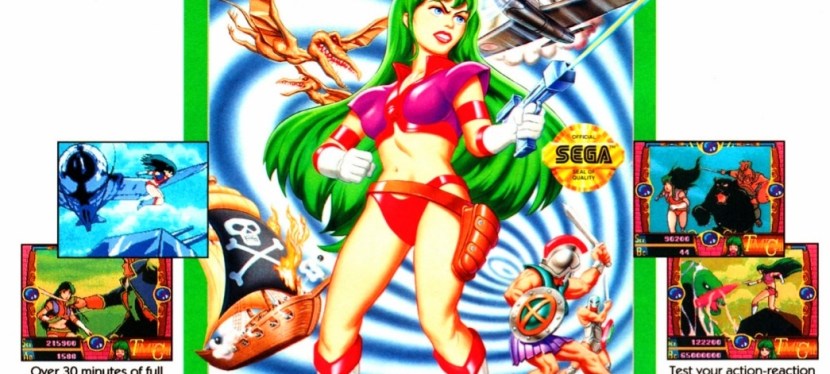
9. Time Gal for Sega CD print ad
The presentation here looks nice but Time Gal herself looked like she was drawn by a different artist.
Originally released in the arcades in Japan in 1985, Time Gal made its way to the Sega CD add-on in the early 1990s. It was a highly unusual video game as it was an interactive movie (with lots of anime footage) made with the use of Laserdisc technology for its arcade version. It played lots of anime scenes and players must choose the on-screen options to execute the character’s next action in order to progress. For the Sega CD version for North America, this print was made to capture the attention of consumers using the protagonist’s sex appeal on the cover art with four screenshots placed on the sides to show what to expect. I noticed that Time Gal on the cover art looked different from how she appeared in the anime sequences. At least the ad makers tried hard to sell the game.
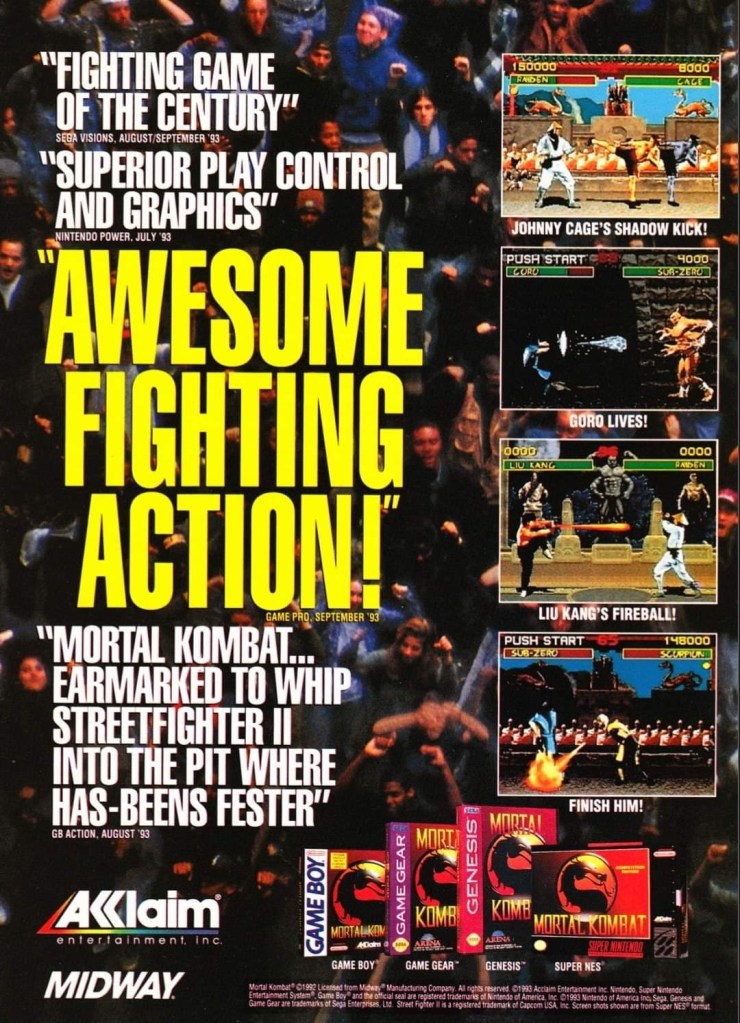
10. Mortal Kombat print ad
Still an effective ad to promote a blockbuster game and make people informed it was coming to multiple platforms.
Considering how successful it was in the arcades, the 1993 release of Mortal Kombat for game consoles and handhelds was unsurprisingly highly anticipated and publisher acclaim came up with this single-page ad. The presentation involved the use of a photographic background of many spectators (to emphasize excitement and popularity), media quotes and screenshots to effectively promote the game.
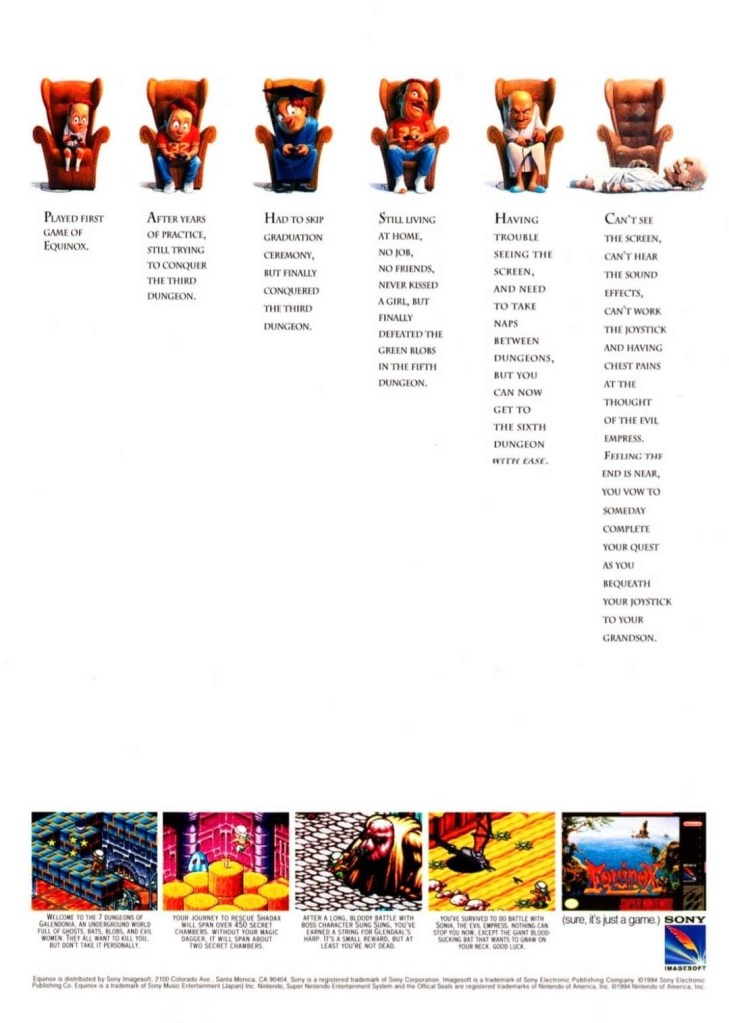
11. Equinox print ad
Take a close look. Tell me if you find it funny.
I never played Equinox but I heard the loud buzz about its design as a 3D isometric game that had elements of exploration, platform play and puzzle solving. The people responsible for this print ad emphasized the concept that the game is so addicting to play, players will still play it as they get older. This ad has a subtle yet effective approach with humor.
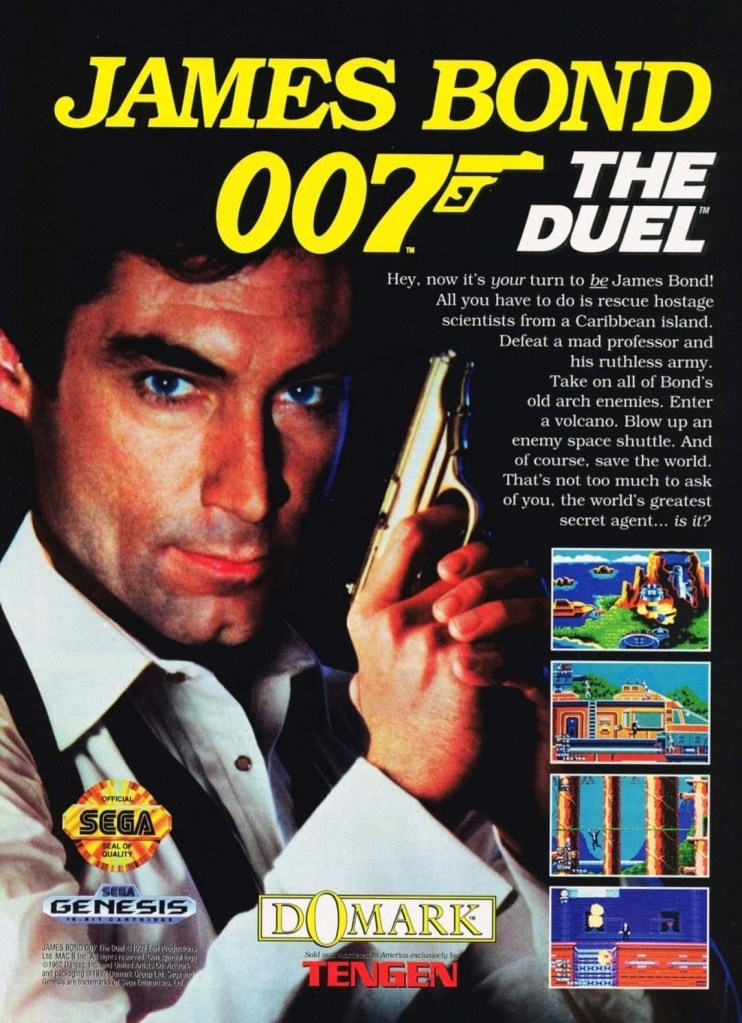
12. James Bond 007: The Duel print ad
Timothy Dalton’s image as James Bond was sourced from Licence to Kill for this game’s ad.
Here is another decades-old James Bond video game print ad I found. Released a few years after Licence to Kill, James Bond 007: The Duel was notable not for its gameplay nor game design but for the fact that it used the image of Timothy Dalton as 007 for its print ad and the opening scenes in the game itself. Dalton’s Bond image here was never new nor originally taken for the game as it came directly from Licence to Kill’s publicity library. Each time I saw this ad, I was only reminded of the 1989 movie which I still enjoy watching.
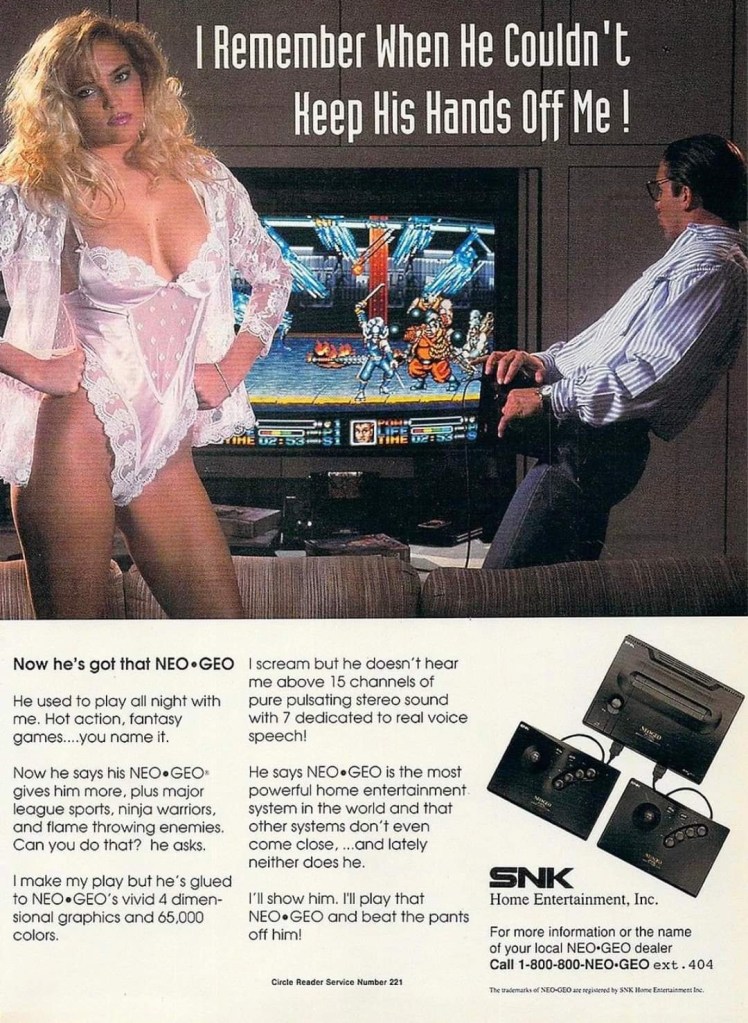
13. Neo Geo AES console print ad
Do you find this ad both sexy and funny?
Decades ago, SNK made a huge splash in the arcades with lots of really fun games released with their Neo Geo (stylized as NEO GEO) hardware. In 1990, they released the cartridge-based Neo Geo AES console in Japan and America and it carried the same technology as the arcade hardware. To promote the console in North America (note: the Neo Geo console and its games were very expensive), SNK came up with this catchy and funny print ad showing a sexy woman feeling annoyed that her man spends more time with Neo Geo gaming than with her. This was a clever way of emphasizing the arcade-perfect experience in the comfort of home, and it was funny to look at.
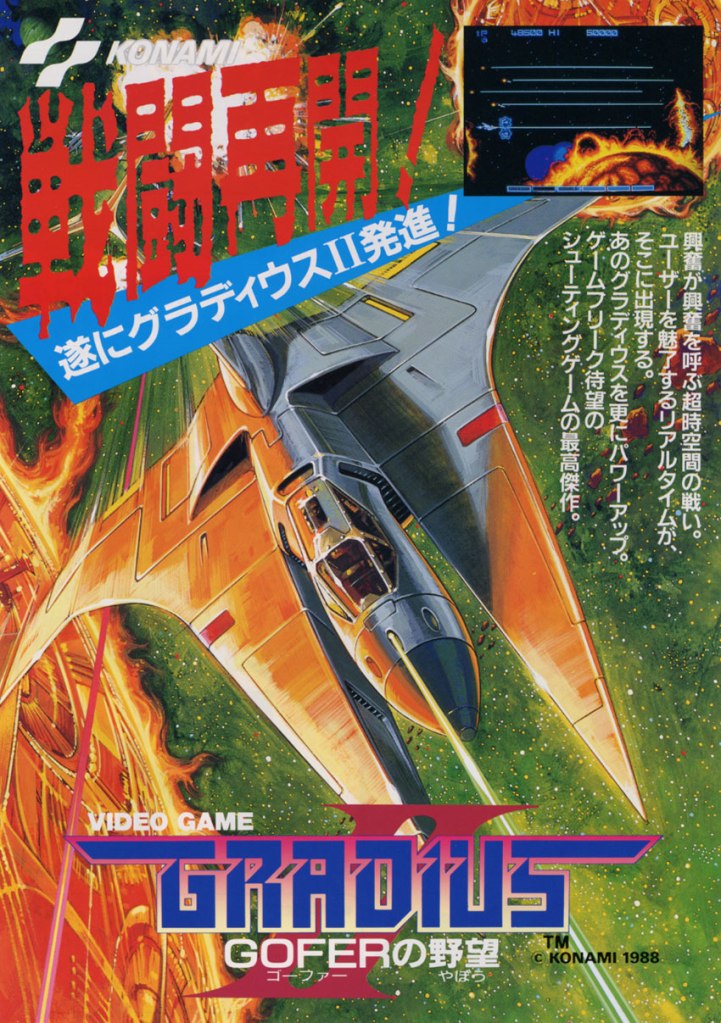
14. Gradius II Japanese arcade flyer
Great looking painted art was used for this 1988 arcade game.
Since the original Gradius was a big hit in arcades in Japan in 1985, it was not surprising that Konami released Gradius II three years later. With regards to the use of painted art, the artist showed the game’s spaceship in a dominating position emphasizing high-speed travel and excitement. The image, which also looks more colorful, is a complete reversal of the painted art used in the flyer of the previous which showed the rear of the spaceship as it moves towards a larger spaceship (the opposition). This arcade flyer art still looks great as it has a timeless charm.
Welcome back readers, fellow geeks and electronic gaming fans!
In this edition of the Retro Gaming Ads Blast (RGAB) series, we will take a look at another batch of retro gaming print ads – including arcade flyers – from the 1980s and 1990s.
For the newcomers reading this, Retro Gaming Ads Blast (RGAB) looks back at the many print ads of games (console, arcade, computer and handheld) that were published in comic books, magazines, flyers, posters and newspapers long before smartphones, social media, the worldwide web and streaming became popular. To put things in perspective, people back in the 1980s and 1990s were more trusting of print media for information and images about electronic games and related products.
With those details laid down, here is the newest batch of retro gaming print ads for you to see and enjoy…
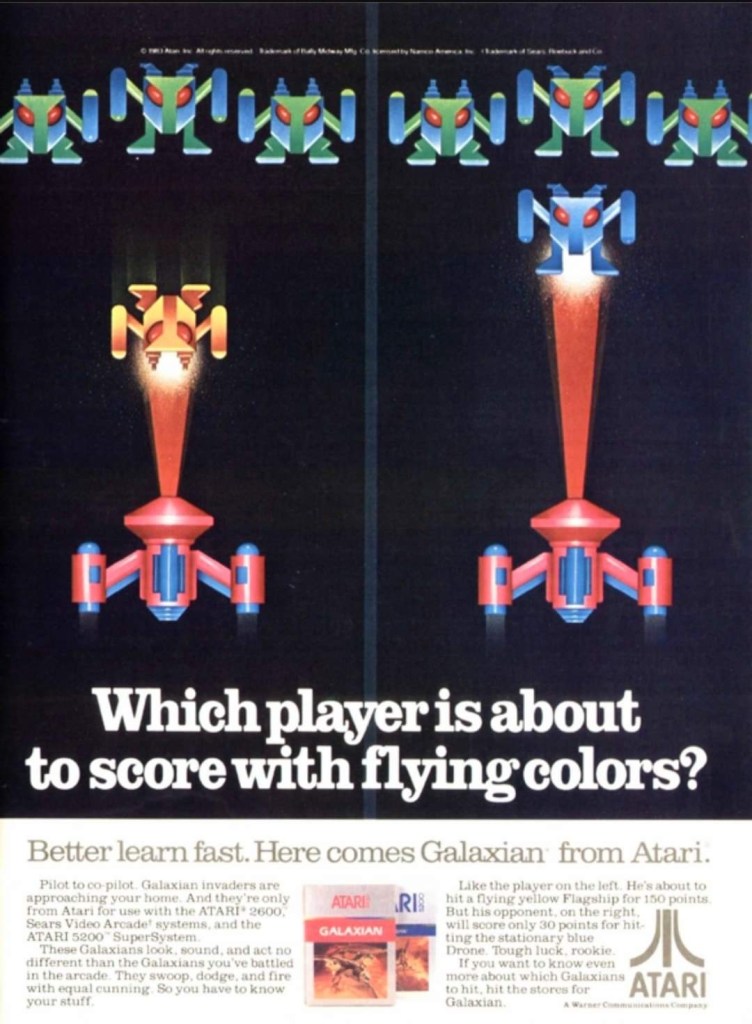
1. Galaxian for Atari print ad
A unique approach to the art done by the advertisers.
Developed by Namco, Galaxian was a 2D sci-fi shooter that debuted in arcades in 1979. It was so successful and widely acclaimed, it got ported to varied game consoles and home computers as the years passed by. For its release on the Atari 2600 and Atari 5200, this print ad was created to catch the attention of fans and gamers by utilizing artwork that resembled the look of 2D sprites from the game. That being said, no screenshots of Galaxian on the Atari consoles were shown because the artwork used looked detailed and were attention-grabbing already.
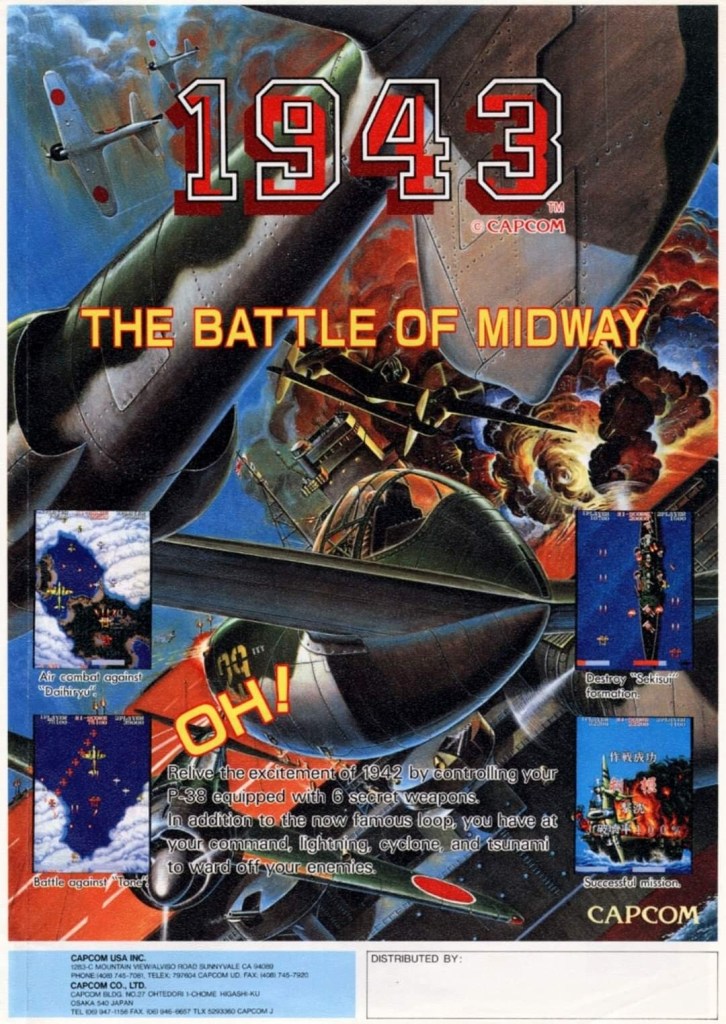
2. 1943: The Battle of Midway arcade flyer
This is a fine looking flyer.
In 1987, Capcom released in the arcades 1943: The Battle of Midway which was their follow-up to 1942. The arcade flyer itself was designed to strongly promote the game using a combination of screenshots, short-but-clear text descriptions and the great looking piece of artwork which really emphasized the World War II concept. Behind it all, this game was made by Japanese developers with the Western markets in mind and the irony is that the game has players control Americans fighting the Japanese fleet.
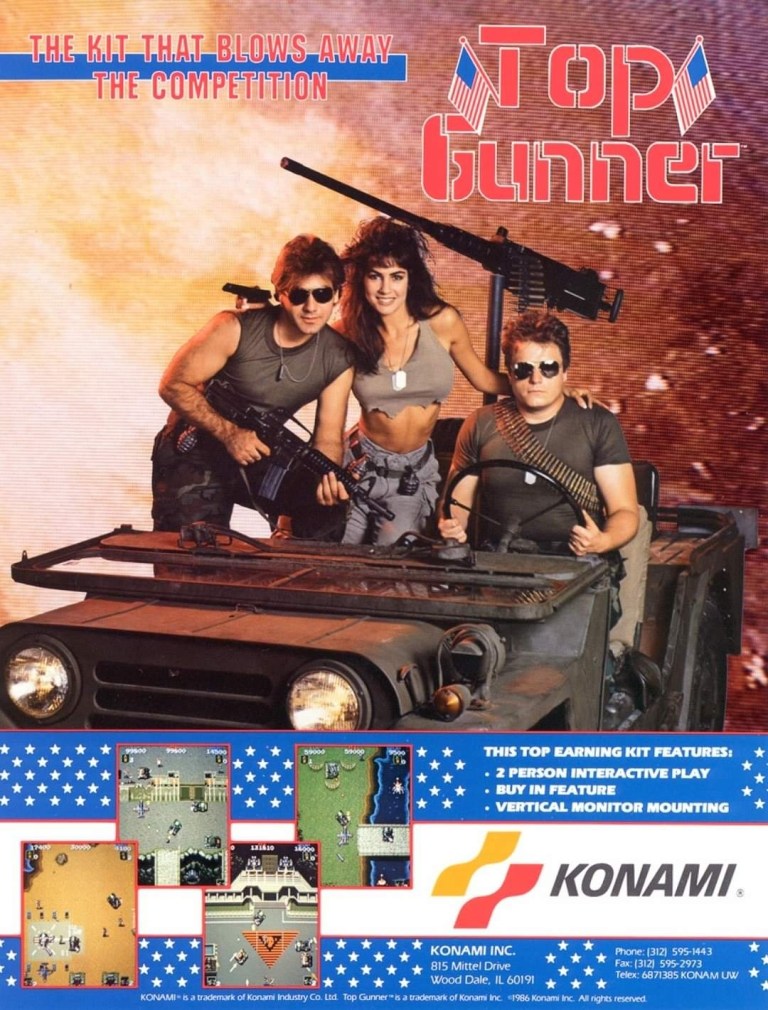
3. Top Gunner arcade conversion kit flyer
Show this nice looking image to the woke nut or modern day Communist near you. Watch and observe his or her reaction.
To make things clear, Top Gunner is actually the run-and-gun game Jackal and the alternative titles was mainly used in North American arcade distribution and also reflected Konami’s move of coming up with titles inspired by blockbuster movies of the time. To promote its 1986 arcade release in America as a conversion kit, the advertisers had three models playing soldiers on a military jeep to immerse gamers into the core concept of the game – moving armed military jeeps from one location to another while fighting bad guys. The approach used for the visual concept is indeed inspiring, especially during the Cold War. Top Gunner/Jackal became a hit in both arcades and consoles.
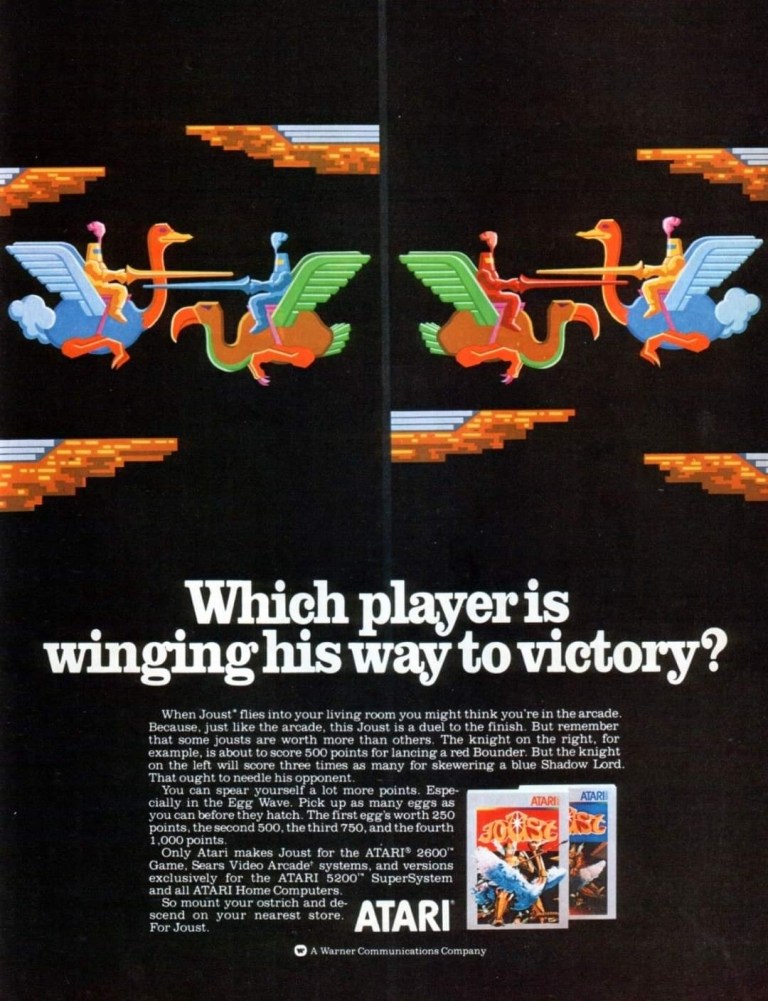
4. Joust for Atari print ad
While I played Joust on console, I don’t remember seeing this print ad before.
Made by Williams Electronics, Joust was one of those early 1980s arcade games that eventually made its way to the Atari 2600 console which was massively popular in North America. Strangely enough, the artistic approach Atari’s advertising came up with for the console version of Joust was similar with that of the ad of the Atari version of Galaxian (see item #1 above) in which artwork was used to resemble the 2D sprites of the game. Regardless, the images of this ad showed what a joust looked like – a martial game between two armed combatants going against each other while riding an animal.
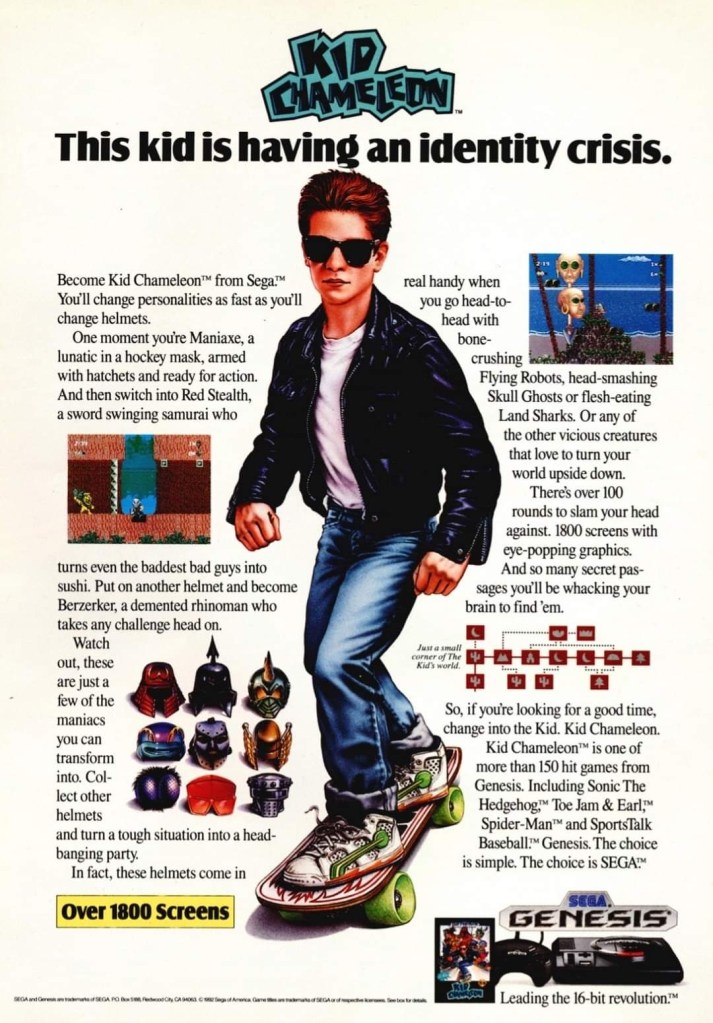
5. Kid Chameleon print ad
Can you relate with Kid Chameleon’s identity crisis?
During the early years of the Sega Genesis, Sega of America exerted efforts to make new games that were not only exclusive to their console but also stand out among the many 2D side-scrolling adventure games by coming up with a protagonist with a unique personality that could somehow resonate with young kids and teenagers.
Developed by their internal experts (Sega Technical Institute), the company released Kid Chameleon in 1992 and they came up with the above print ad that had detailed hand-drawn art of the lead character as well as a wordy text description which was a clear attempt to help young gamers (including teenagers) get connected with both the game and the protagonist. The advertisers even had space to spare to accommodate two screenshots of the game.
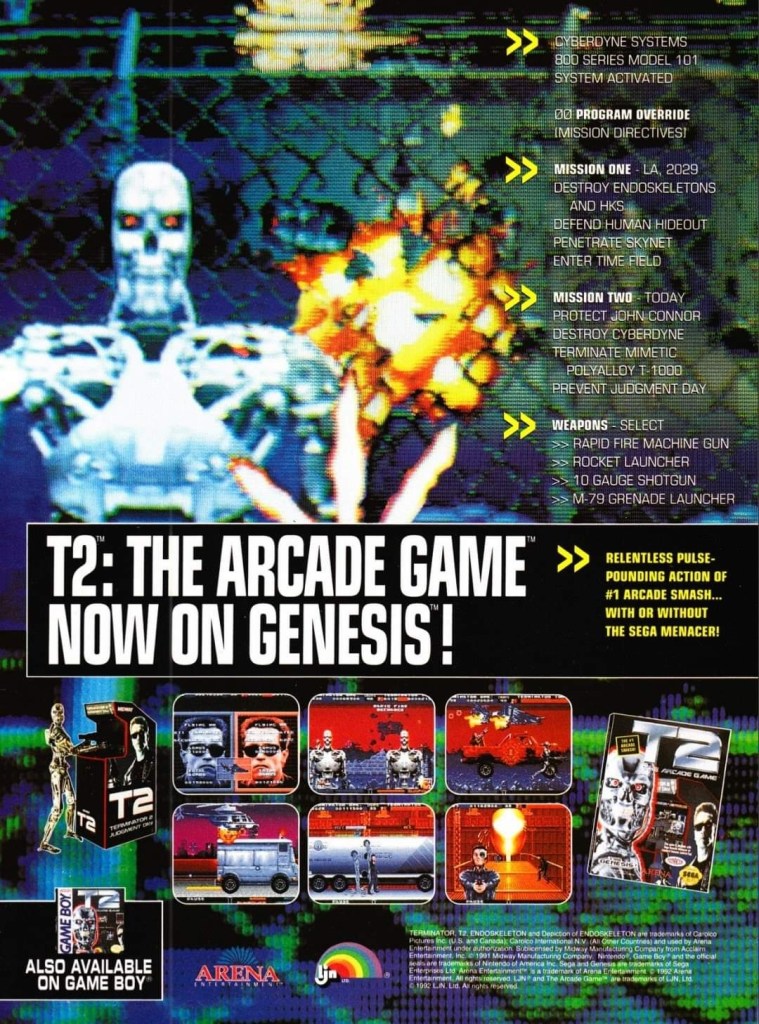
6. Terminator 2: Judgment Day (AKA T2: The Arcade Game) for Sega Genesis print ad
This print ad appeared on the many comic books I read long ago.
Back in the early 1990s, Terminator 2: Judgment Day was a massive success in the global box office and this resulted in Arnold Schwarzenegger’s popularity to soar very high while also establishing the Terminator as an essential pop culture figure. Apart from comic books and merchandise, video games based on the movie were made and the one that stood out the most was the arcade shooter game initially titled Terminator 2: Judgment Day (later retitled as T2: The Arcade Game).
The arcade mega hit eventually got ported to the Sega Genesis and this print ad really looked flashy with its visual presentation showing screenshots and a zoomed-in look at how the Terminator T-800 looked like in the Genesis version complete with a few explosions in the background. It should be noted that this flashy print ad cleverly concealed the visual downgrades and the redrawn images as the Genesis itself could never come close to matching the high quality visuals of the arcade version.
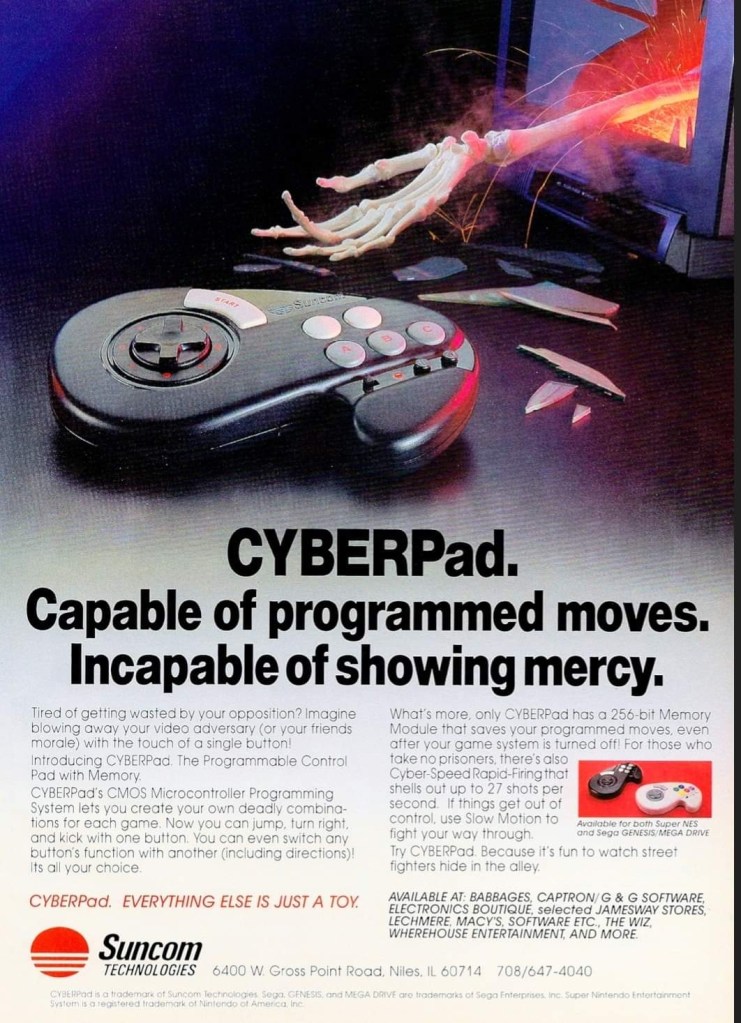
7. CYBERPad print ad
I never owned the CYBERPad, nor have I ever used one.
During the so-called 16-bit console generation (actually the 4th console generation), there were lots of licensed console peripherals made by independent companies in support of the Sega Genesis and Super Nintendo Entertainment System (SNES). The company Suncom Technologies came up with the CYBERPad controller for the two consoles and they boasted in their print ad that the product had a programmable control pad that allowed users to create combinations for each game with convenience in mind. The CYBERPad also allowed the saving of the programmable moves and it had a rapid-fire feature and even a slow-motion function. The CYBERPad was made to make the gameplay experience more user-friendly.
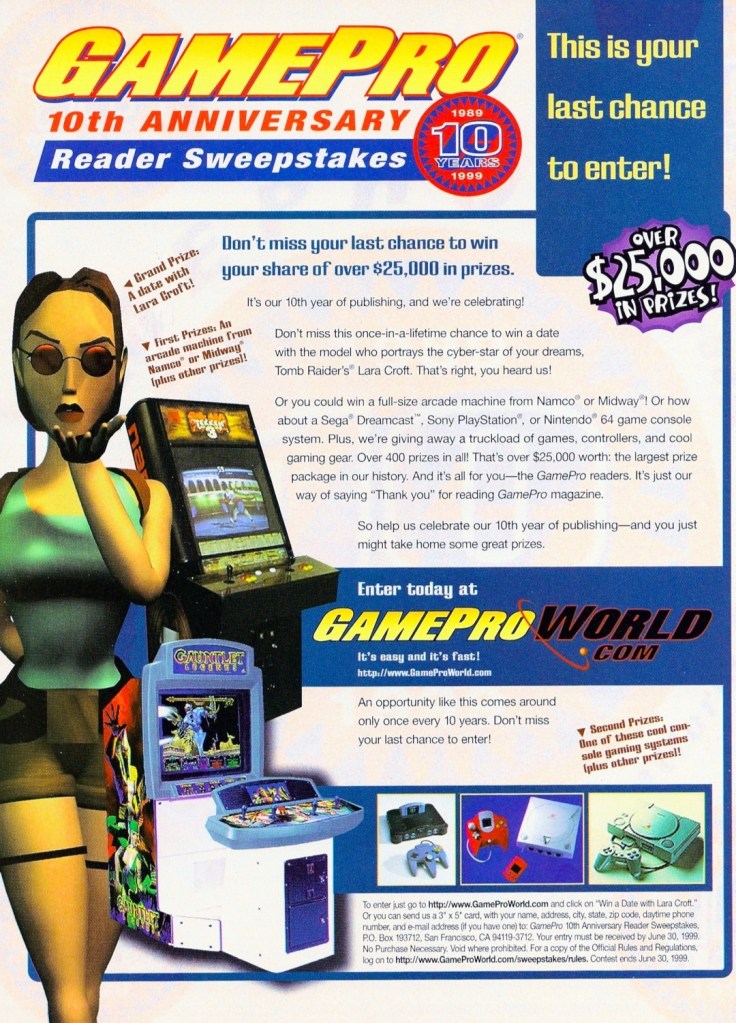
If you look closely, this print announcement by GamePro technically advertised the game consoles, the arcade game and Lara Croft to its readers.
In 1999, GamePro magazine celebrated its 10th anniversary and to keep on resonating with gamers and maintaining the loyalty of their fans, they organized a reader sweepstakes with prizes worth over $25,000 to be won by the few winners. GamePro boasted a date with an unnamed model who played the iconic Lara Croft (Tomb Raider). Certain arcade machines plus the modern consoles of the time – including the brand-new Sega Dreamcast – were also at stake. The way it was presented, this GamePro print announcement was enticing to read.
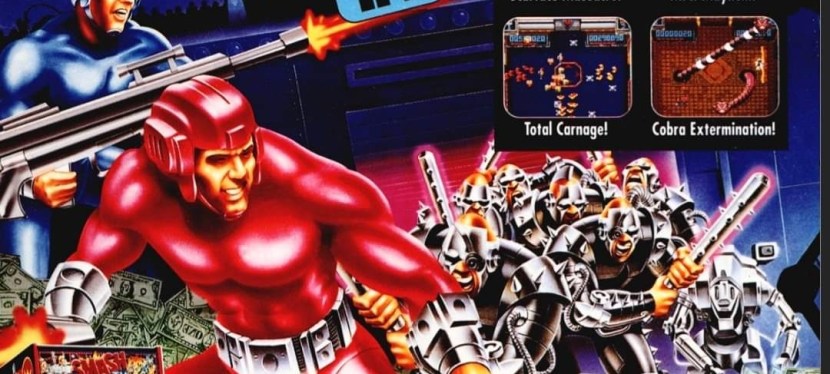
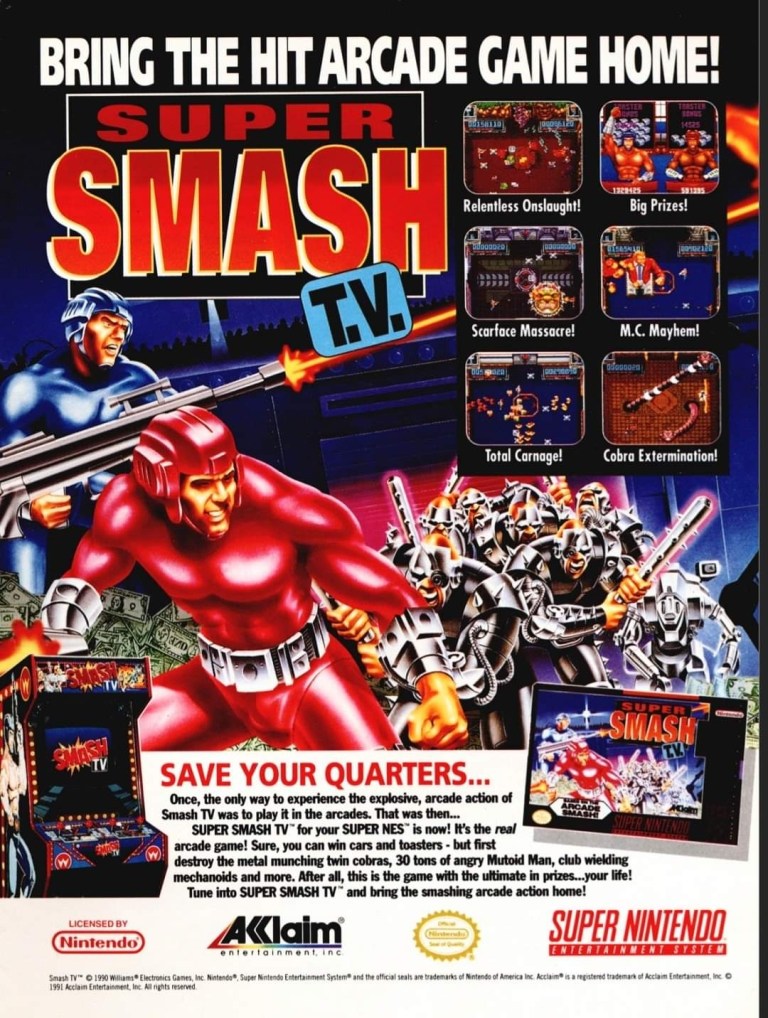
9. Smash T.V. for SNES print ad
Smash T.V. was a lot of fun on both arcade and console.
The arcade hit Smash T.V. made its way to the Super Nintendo Entertainment System (SNES) in 1992 and the publisher came up with a print ad that had captivating artwork, six screenshots and a text description that emphasized that a lot of fun awaits gamers on the console version. In my view, this old ad is still amusing to look at.
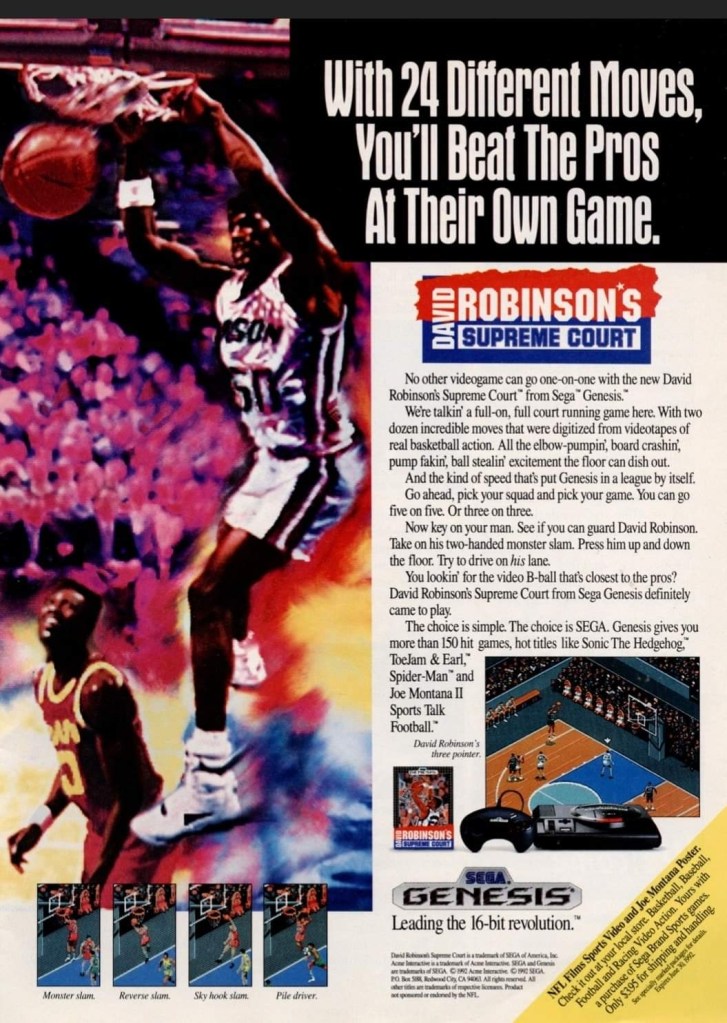
10. David Robinson’s Supreme Court print ad
It was a smart move by Sega to get NBA superstar David Robinson as the endorser of this basketball video game exclusive on the Sega Genesis. This ad was published many years before Robinson finally won an NBA championship.
As part of its strategy in competing with Nintendo during the 4th console generation, Sega of America was focused on producing exclusive sports video games for the Genesis console backed by endorsements of sports professionals. In 1992, they released David Robinson’s Supreme Court on the Genesis and unsurprisingly their print ad used a large, stylized image of the NBA superstar dunking backed with an exciting text description plus screenshots showing the game’s use of the isometric view for gameplay. This is still worth looking at.
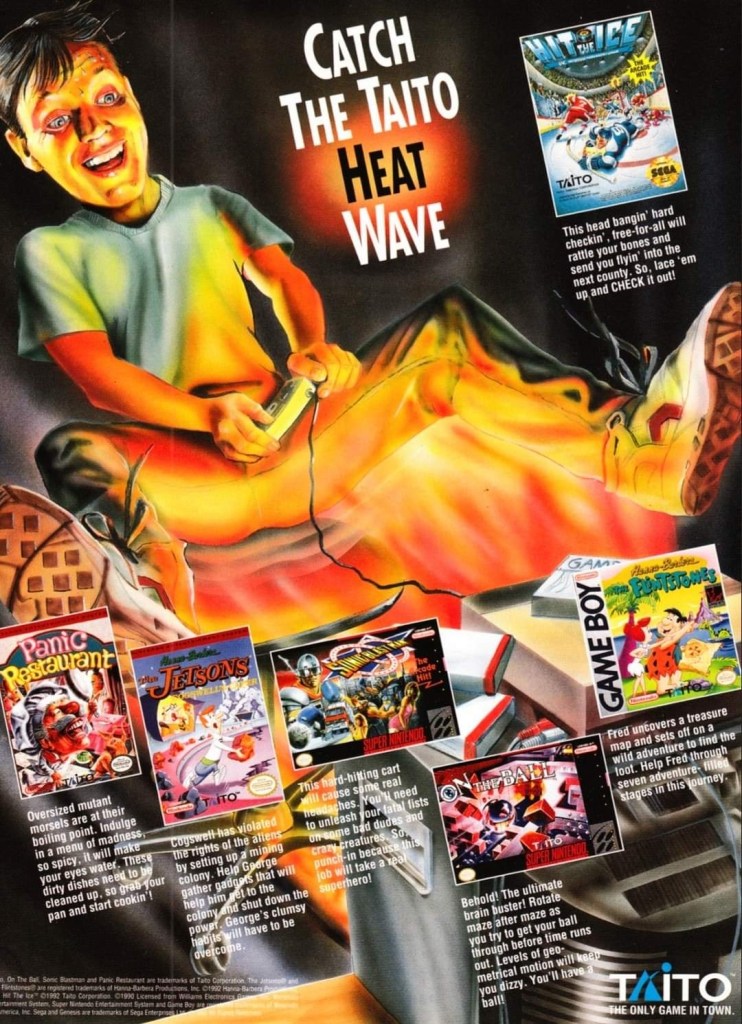
11. Taito’s “heat wave” print ad
An amusing and creative way to sell video games.
If your company lacks money to effectively market your video games individually, you can try making a single ad promoting them together. This is what Taito did in this print ad which showcases multiple games for different platforms and they used artwork of a player experiencing the so-called heat wave. This is a nice stroke of creativity on the part of Taito.
12. Jurassic Park Interactive print ad
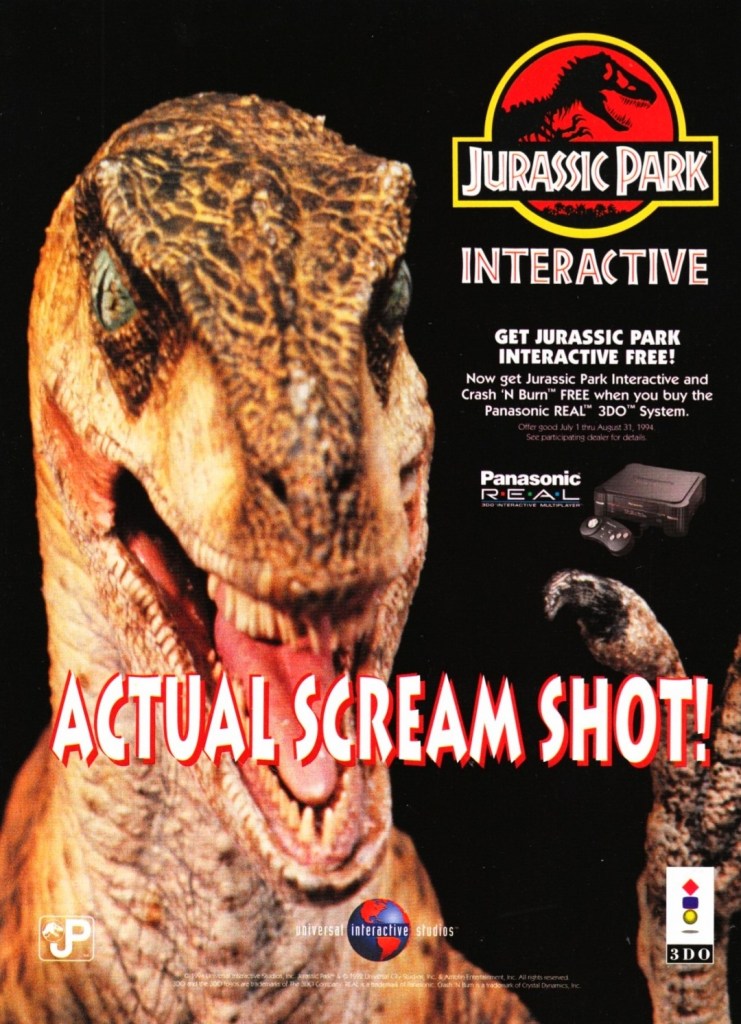
This was a creepy print ad promoting the 3DO-exclusive Jurassic Park Interactive.
When it comes to video game consoles, having exclusive games is essential as long as they are of high quality, highly playable and enjoyable. The 3DO company acquired a license of the Jurassic Park movie and made the exclusive game Jurassic Park Interactive hoping it would sell a lot and lift up 3DO hardware sales.
This print ad, which features a zoomed-in image of the Raptor from the game, was more focused on selling the 3DO console than the video game as seen on the descriptive text. 3DO ran a promo selling the console which would entitle the buyer to get Jurassic Park Interactive and another game free. Nothing was done to describe the console’s multimedia capabilities of showing videos, images and graphics of the game (which was essentially a collection of mini-games). This print ad shows ignorance on the part of the 3DO company and the ad maker as it showed desperation happening really early in the console’s life. Notably, Jurassic Park Interactive was the only video game adaptation to use actual footage (note: the faces of the actors were edited out) and music from the film.
13. RoboCop 2 print ad
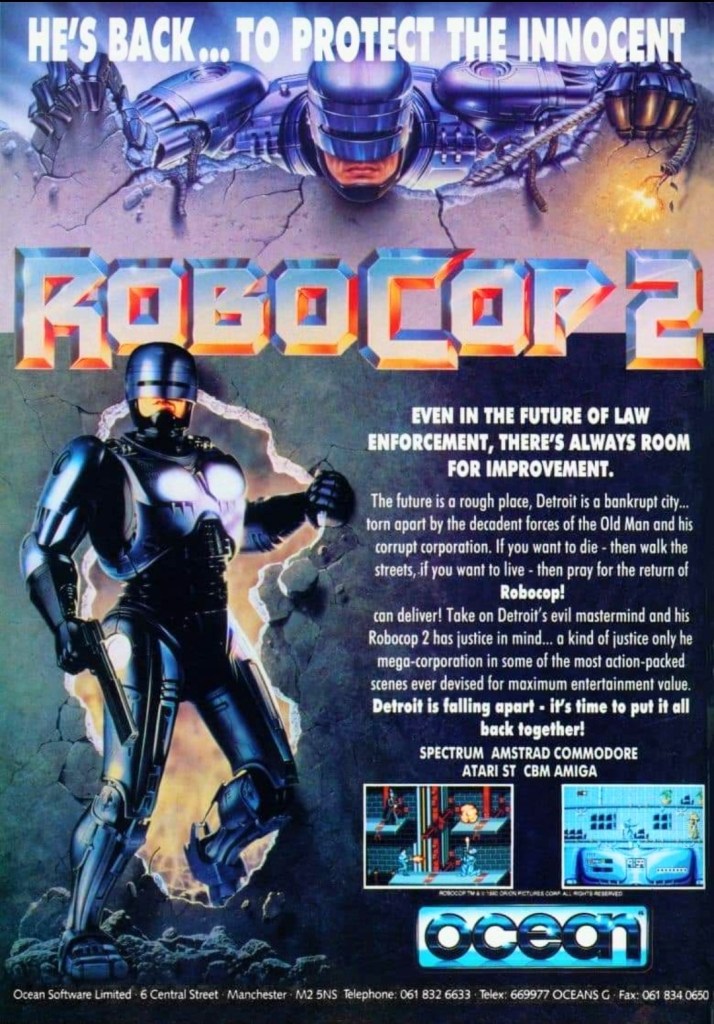
You want to become RoboCop to save the city of Detroit from criminals?
Way back in 1990, RoboCop 2 was a big hit in cinemas here in the Philippines and in some places around the world. As typical of the time, licenses to make video games based on the movie were released resulting in RoboCop 2 games for multiple platforms. The print ad featured two different images of RoboCop – one from the movie poster and the other from an official artwork. The descriptive text does a fine job to immerse readers into the story concept of the game but showing only two screenshots was a lackluster effort to sell the game.
14. Star Trek: The Next Generation – Echoes from the Past print ad
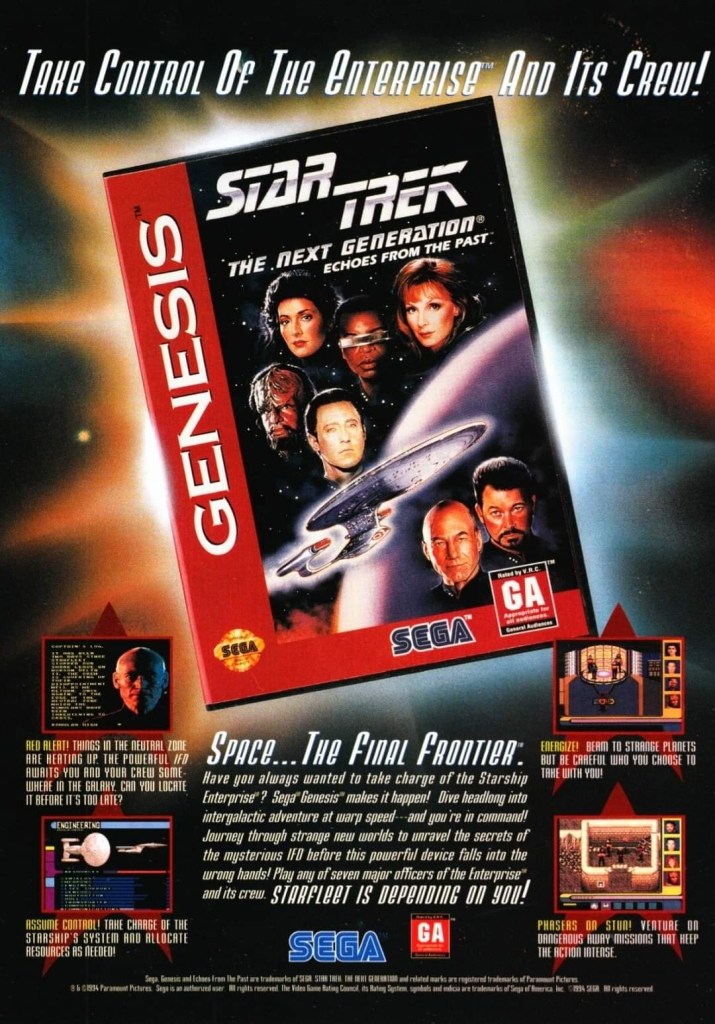
Space…the final frontier waiting for Sega Genesis gamers.
Released in 1994, Star Trek: The Next Generation – Echoes from the Past delivered the Star Trek TNG adventure experience to Sega Genesis gamers. In fact, it is the exact same experience that SNES gamers got the same year. In reality, Star Trek: The Next Generation – Echoes from the Past is actually a port of Star Trek: The Next Generation – Future’s Past on the SNES and the screenshots on the print ad are giveaways about it. In fairness to the ad makers, this print ad never attempted to deceive gamers that it promoted a totally different Star Trek TNG game.
15. Dinosaurs for Hire print ad
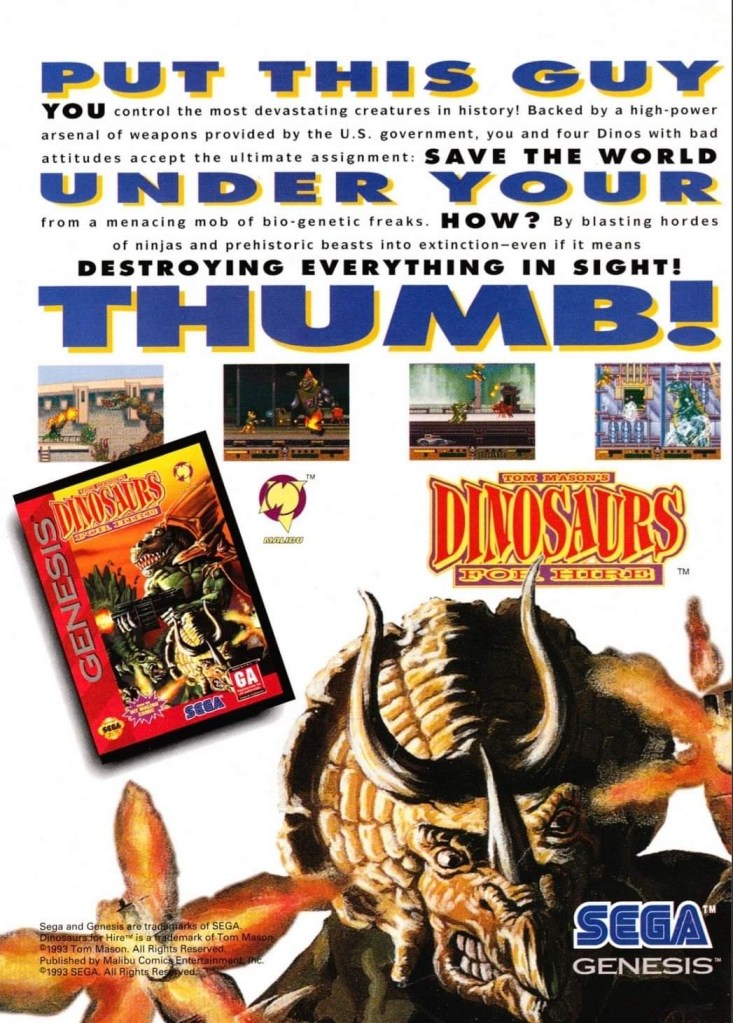
This print ad caught my attention and made me interested in the game and the comic book series. Even though it was small, Malibu Comics’ logo was still recognizable.
Dinosaurs for Hire (sometimes referred to as Tom Mason’s Dinosaurs for Hire) was a 2D side-scrolling platform adventure game based on the comic book series of Tom Mason. Published by Sega, it was a Genesis-exclusive game and this print ad had a catchy text description, a few screenshots and the eye-catching artwork of a triceratops facing the viewer. This print ad is still good to look at. If you’re thinking about searching for existing copies of the game, I encourage you to also read some Dinosaurs for Hire comic books before playing. By the way, Tom Mason also wrote several comic books of the Ultraverse.
Welcome back readers, fellow geeks and electronic gaming fans!
In this edition of the Retro Gaming Ads Blast (RGAB) series, we will take a look at another batch of retro gaming print ads – including arcade flyers – from the 1980s and 1990s.
For the newcomers reading this, Retro Gaming Ads Blast (RGAB) looks back at the many print ads of games (console, arcade, computer and handheld) that were published in comic books, magazines, flyers and newspapers long before smartphones, social media, the worldwide web and streaming became popular. To put things in perspective, people back in the 1980s and 1990s were more trusting of print media for information and images about electronic games and related products.
With those details laid down, here is the newest batch of retro gaming print ads for you to see and enjoy…
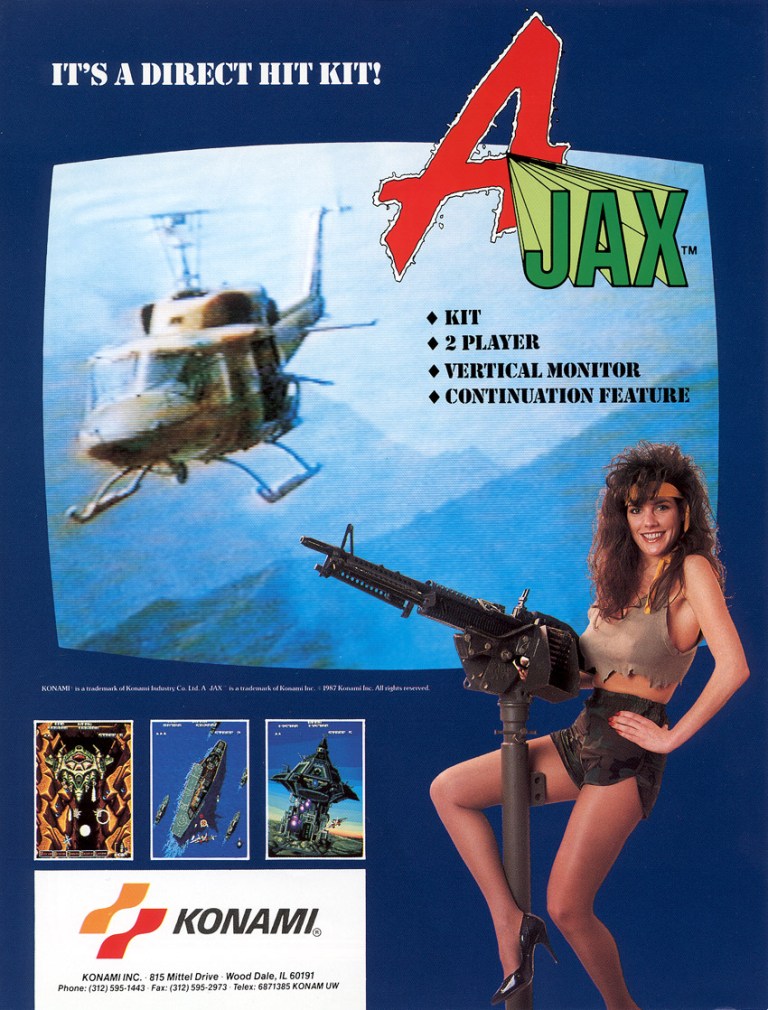
1. A-Jax North American arcade flyer
Another one of Konami’s arcade flyers showing a pretty fashion model with a touch of militarism.
A-Jax (also referred to as Ajax) is another one of the many military themed games Konami released for the arcades in the 1980s. It was a 2D vertically scrolling shooter in which players use aircrafts to shoot enemies both in the air and on the ground. The game was a hit in Japanese arcades and Konami came up with the North American arcade flyer showing three screenshots, an archive footage shot of a military helicopter and a sexy lady (with a light military look) with a machine gun. The style of presentation was similar in style with the North American arcade flyers of Contra and M.I.A.: Missing in Action.
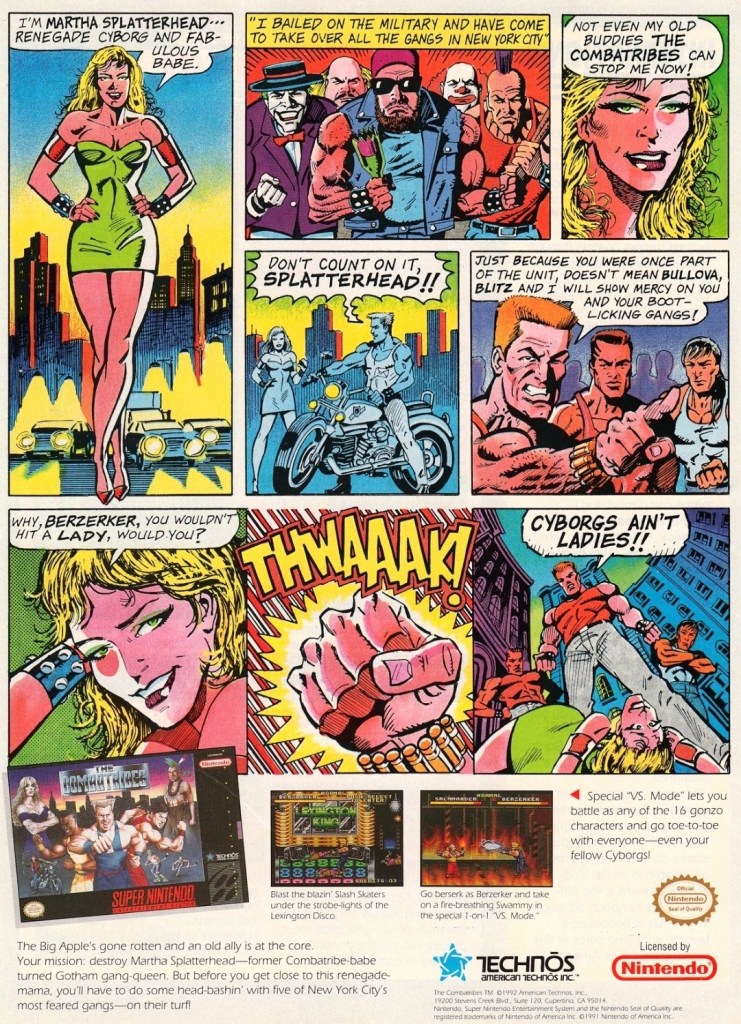
2. The Combatribes print ad
The short comic book approach was used to emphasize the setting and concept of the video game.
Technos, the Japanese company behind the wildly popular Double Dragon games franchise, proved to be successful with the arcade release of The Combatribes. In an attempt to keep the wave of success moving, Technos released The Combatribes on the Super Nintendo Entertainment System (SNES) in 1992 and someone involved with the North American marketing came up with the idea of creating a comic book-style presentation for the print ad. Creatively speaking, the comic book approach was done to emphasize the story and visual concepts of the game, and entice readers to play it. By today’s standards of video game marketing, this print ad’s approach is both unusual and notable.
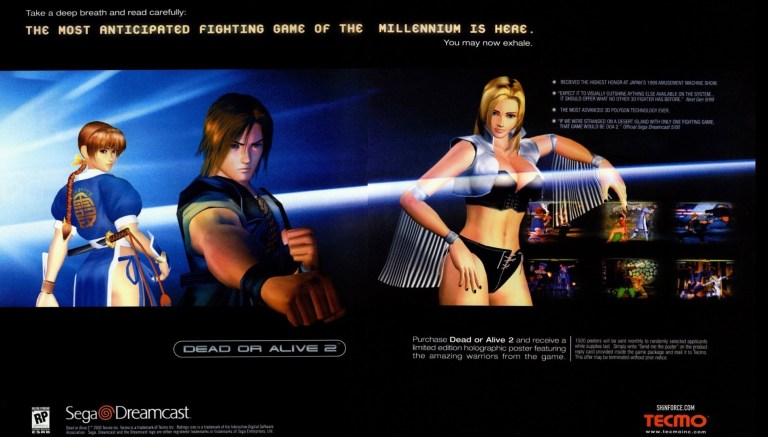
3. Dead or Alive 2 Dreamcast port print ad
This was a wide print ad that appeared on magazines and it sure was eye-catching. It was an effective way to promote the game and inform people of the Sega Dreamcast’s presence in the market.
When Dead or Alive 2 was released in the arcades in 1999, a lot of gamers were astounded by it as developer Team Ninja (led by Tomonobu Itagaki) made it much bigger and a lot better than its 1996 predecessor. Team Ninja really went all out making the sequel utilizing Sega’s NAOMI arcade technology, inviting martial artists to do motion-capture, and having a very ambitious game design. Since the game was developed with the NAOMI hardware, porting the game for the Sega Dreamcast was reportedly convenient and smooth for the developers who went on to add more gameplay features and modes. Publisher Tecmo came up with this wide print ad (promoting the Dreamcast release) showcasing three characters, six screenshots and text descriptions emphasizing the universal acclaim the game received. The promotional approach was simple yet effective.
4. Jet Moto (PC version) print ad
From PlayStation to PC.
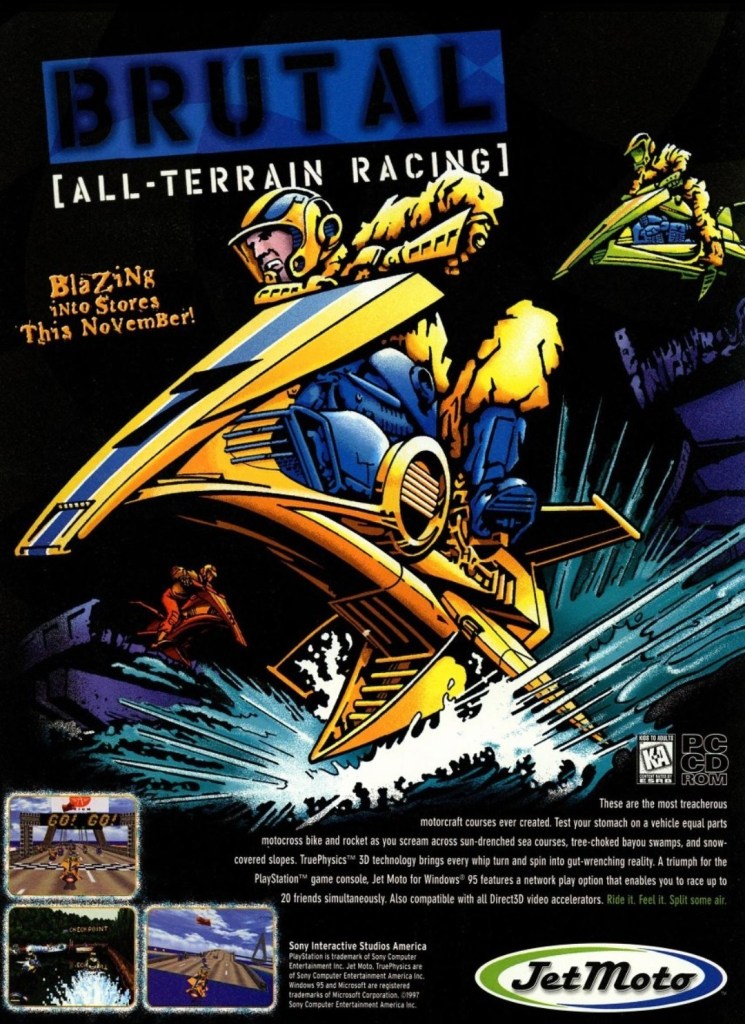
In November 1996, the futuristic all-terrain hoverbikes racing game Jet Moto was released on the PlayStation which went on to sell well and attract mostly positive reviews. Sony Computer Entertainment eventually released a version of the game for the personal computer (PC) in November 1997. As seen in the above print ad, the network play option and compatibility with Direct3D video accelerators were emphasized as such features resonated with the interests of PC gamers of the era. This print ad showed how willing Sony was to release PlayStation hits on PC back then.
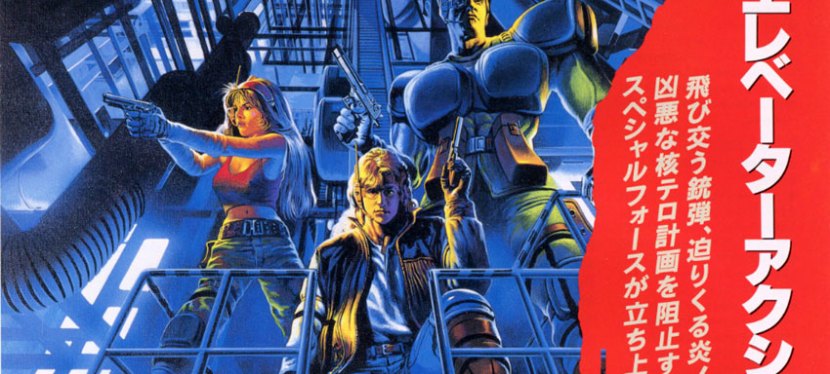
5. Elevator Action Returns Japanese arcade flyer
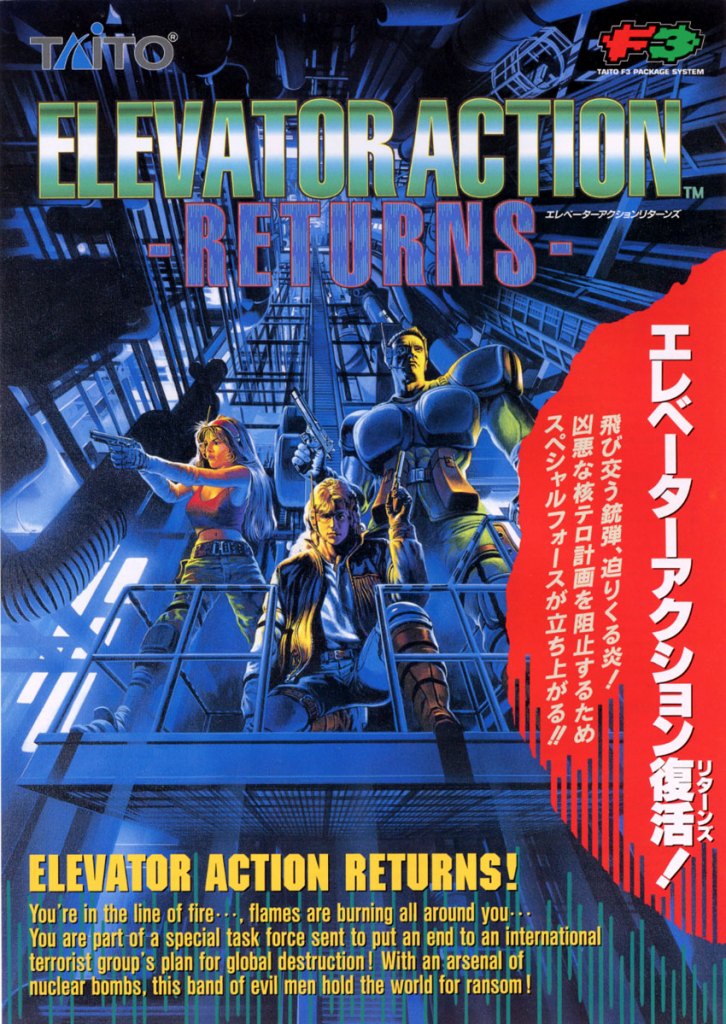
Great looking art on the front.
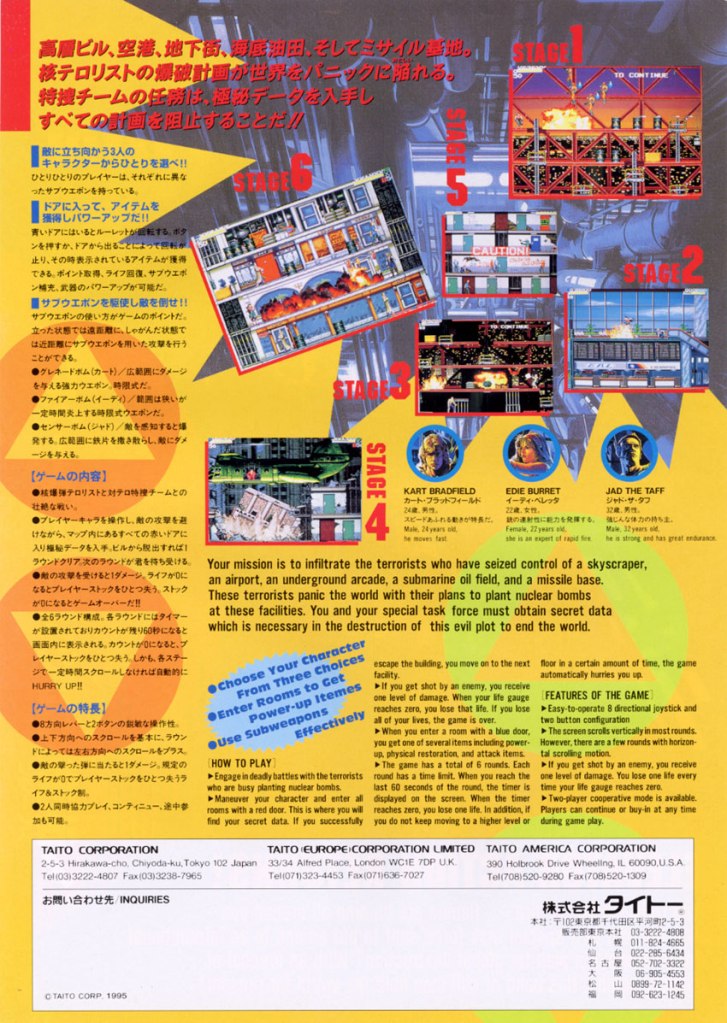
The rear of the flyer.
When Taito released Elevator Action Returns (also titled as Elevator Action II in other nations) in the arcades in 1994, it became a hit as gamers enjoyed its action-packed gameplay, ambitious 2D visual presentation and varied level designs that clearly went beyond its 1983 predecessor. The front of the Japanese arcade flyer has really nice art showing the three playable protagonists on an elevator on their way to do their mission. The back of the flyer shows screenshots (which emphasized the varied level designs), text descriptions explaining how the game played (English version printed), and what the features are. Another text description confirmed that terrorists are the antagonists that players will be dealing with which was reflective of the rise of Islamic terrorism in the 1990s. Oh yes, if you look closely you will the word “item” misspelled as “items”.
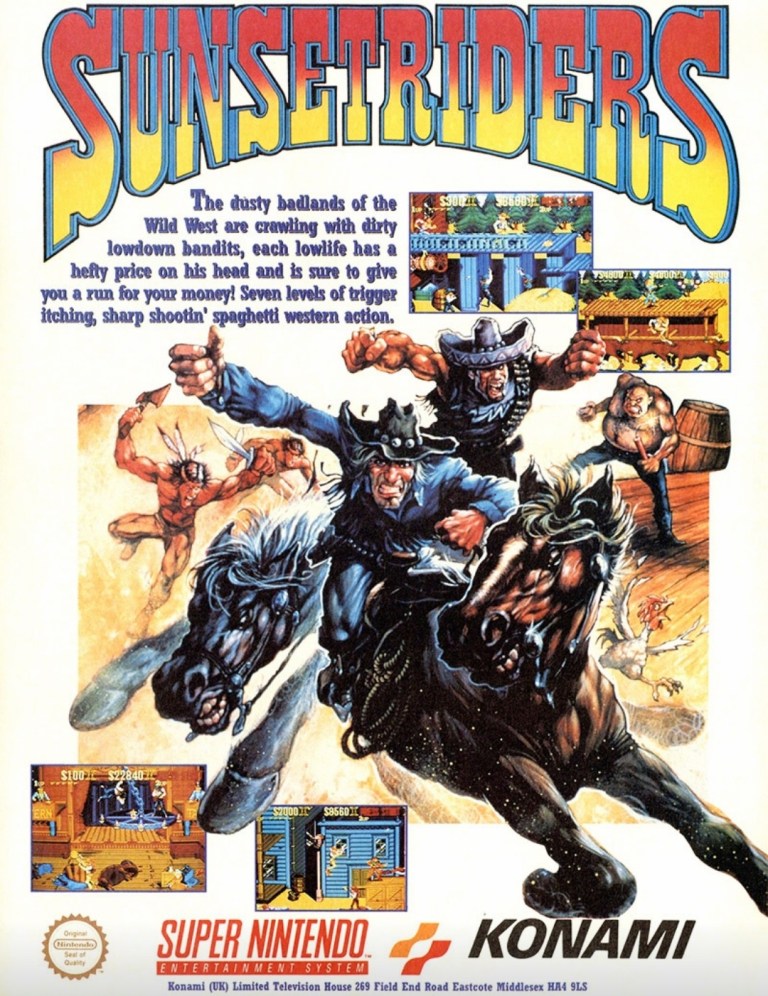
6. Sunset Riders print ads
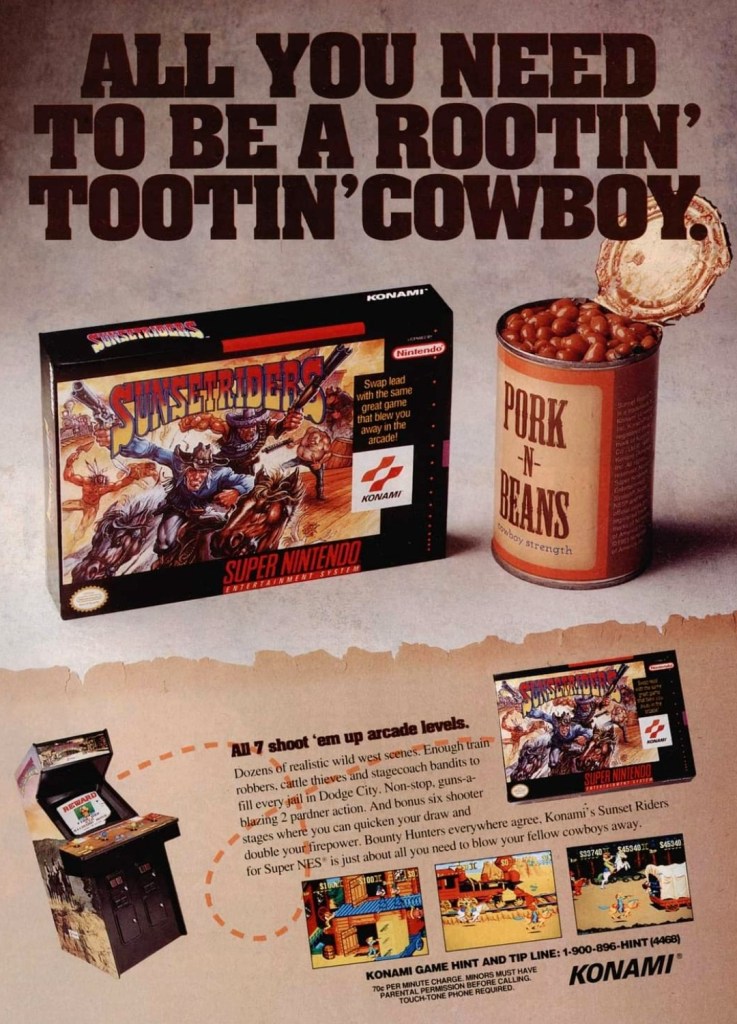
The Sunset Riders arcade machine, the SNES version, screenshots and a can of pork-and-beans on this ad.
This print ad appeared in some comic books I read long ago.
After enjoying a lot of success in the arcades with their 1991 game Sunset Riders, Konami went on to release ports of it to the Sega Genesis in 1992 and the Super Nintendo Entertainment System (SNES) in 1993. With regards to conversions and procedural/artistic changes between the arcade and console ports, the SNES version had few changes implemented compared to the one released on the Genesis. As seen in one of the print ads of Sunset Riders on SNES, it came with 7 arcade levels, 2-player mode and additional shooter stages. What the print ads did not reveal were notable replacements of specific characters in key parts of the game such as the dynamite-tossing female bandits getting replaced by male bandits, North American Indian villains getting replaced with outlaws, etc.
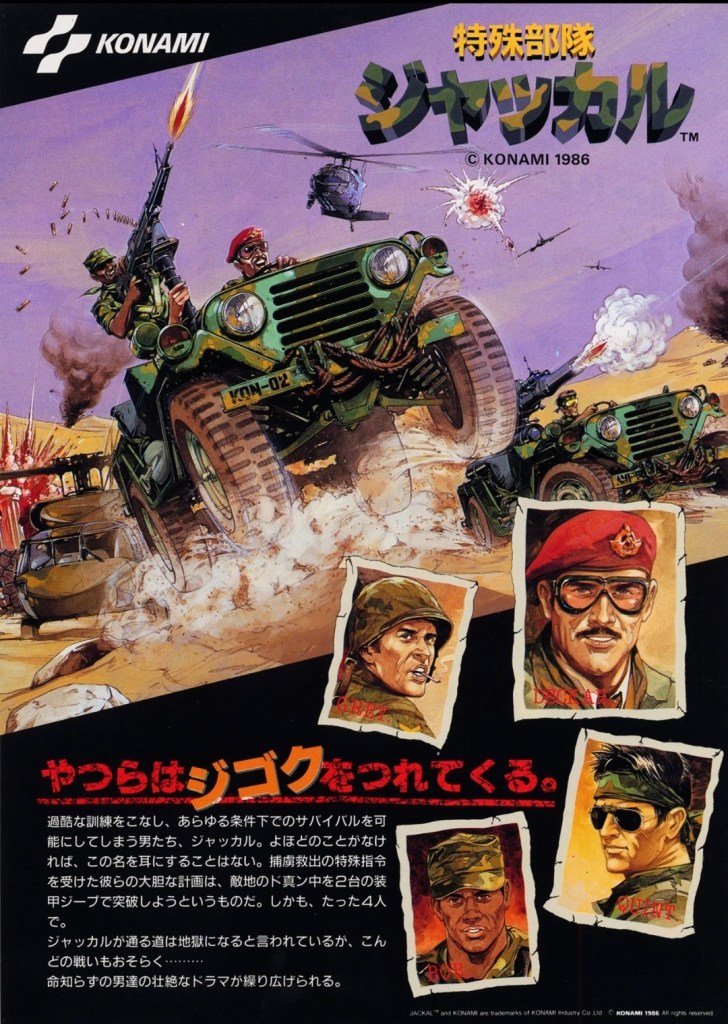
7. Jackal Japanese arcade flyer
Whoever was the artist Konami hired truly delivered great-looking art!
Konami’s military themed game Jackal (Japanese title: Tokushu Butai Jackal) debuted in Japanese arcades in October 1986 and became a hit. The Japanese market arcade flyer had great looking artwork on the front that strongly emphasized the very concept of the game (players move military jeeps to shoot at enemies as they move into enemy territory). One of the characters (the one wearing the red beret) somewhat resembles the late Sean Connery which only shows that someone within Konami’s development team took inspiration from movies. This arcade flyer’s front still looks great.
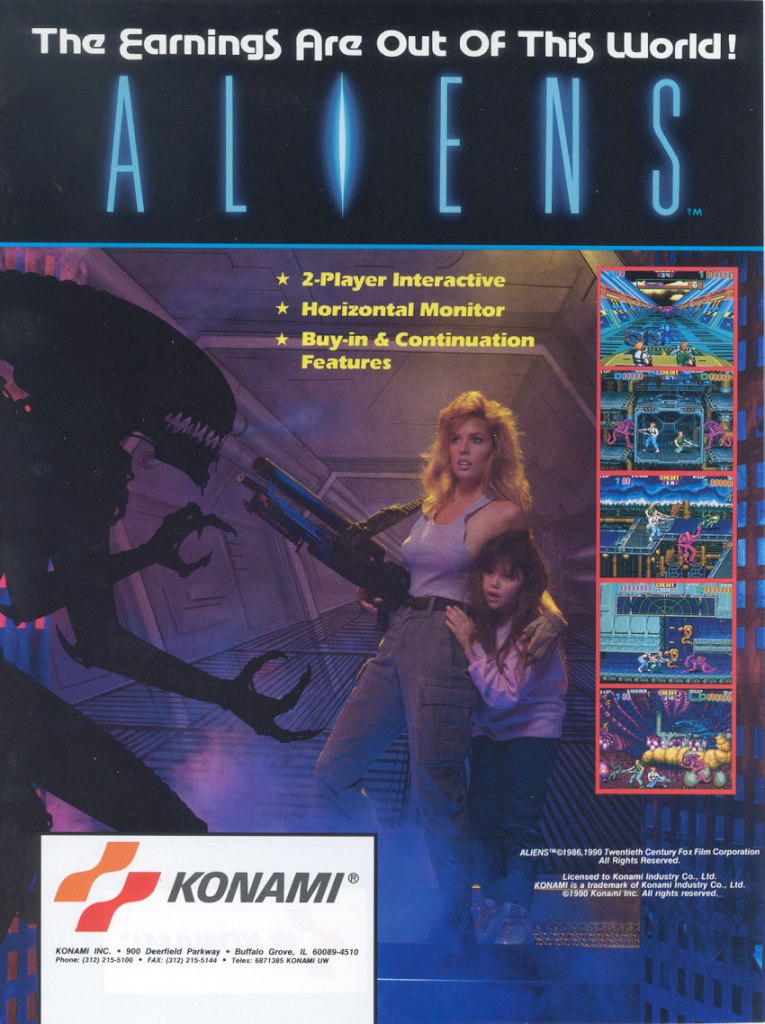
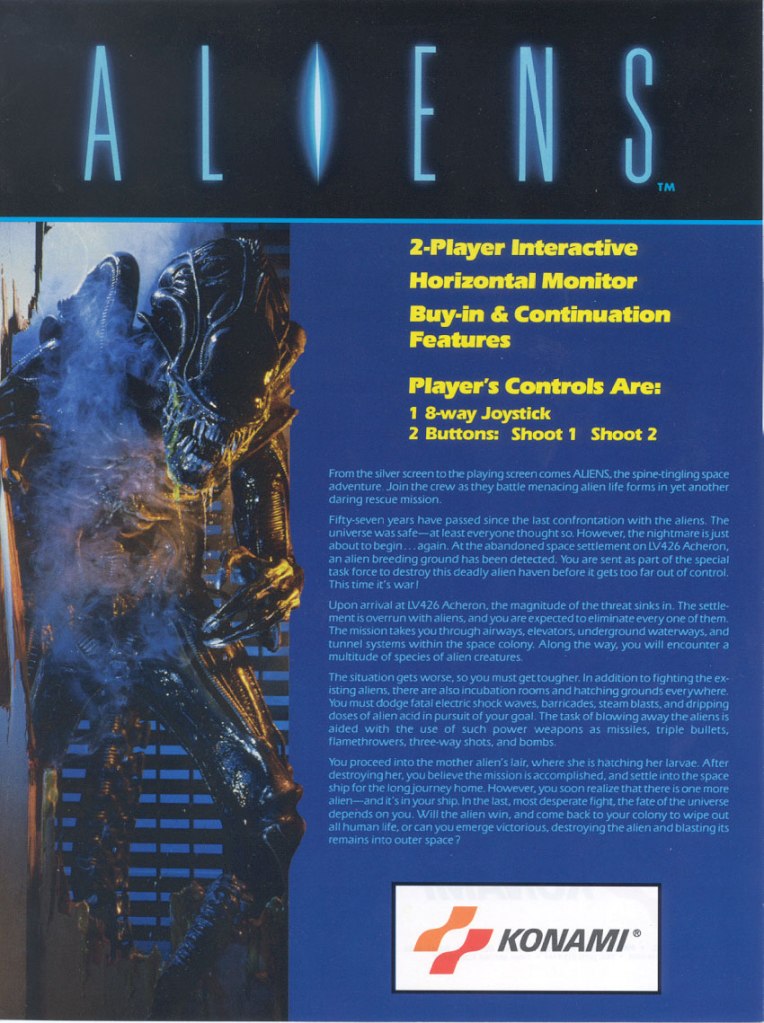
8. Aliens North American arcade flyer
A good amount of effort was done to truly capture Aliens’ concept using hired models (as Ripley and Newt), a Xenomorph physical model and a suitable background.
The key details presented on the rear of the flyer. The Xenomorph’s presence adds tension.
In 1990, Konami released their ambitious arcade game Aliens which was loosely based on the 1986 movie that starred Sigourney Weaver and was directed by James Cameron. As Konami’s Aliens license was only temporary and the movie was so highly regarded, the Japanese company’s marketing team really had to exert extra effort to truly capture the film’s sci-fi horror concept in order to make a strong presentation towards arcade operators and their paying customers (the gamers).
Apart from showing screenshots on the front, the creative team hired a blonde model as Ellen Ripley holding a gun and a young girl as the character Newt, and have them pose convincingly in front of a Xenomorph model (darkened in the foreground). On the back of the flyer, the team heavily revealed the details using the text description to emphasize the gaming experience and story concept. The technical details, meanwhile, were presented in simplistic, easy-to-follow fashion. Aliens was a smash hit in the arcades and there are long-time gamers who regard it as one of the best game adaptations of the 1986 movie. This arcade flyer is a strong reminder that the featured game was never ever ported to any game console nor to any personal computer.
Welcome back, my readers, YouTube viewers and all others who followed this series of articles focused on YouTube videos worth watching. Have you been searching for something fun or interesting to watch on YouTube? Do you feel bored right now and you crave for something to see on the world’s most popular online video destination?
I recommend you check out the following topics and the related videos I found.
#1John List true crime documentaries – In America, the late John List is one of the most notorious criminals ever in their history. At a very desperate point in his life, List murdered his own family members in 1971 and it took some time for the local authorities to find out what he left behind in their huge home. Having left his home and investigators behind, List traveled across the nation, came up with a fake identity and lived away from the law for almost twenty years. How the law enforcers tracked him down (involving America’s Most Wanted TV show) and arrested him is a great story to follow. All of these are documented in the two videos below.
#2 The Stepfather explanatory video by GoodBadFlicks – Believe it or not, the story of John List inspired the creation of the 1987 psychological horror film The Stepfather. This video by YouTuber GoodBadFlicks is a must-see.
#3 The assassination attempt on US President Donald Trump – I really cannot ignore the assassination attempt on US President Donald Trump which resulted in the injury on his right ear, the death of a campaign rally attendee and one other person getting injured. Whatever your political views are, this is a tragedy and it clearly was not staged. It was indeed an attempt to kill and already the Satanic Leftist mainstream news media are distorting the facts and lying to you. To get clear insight on what happened and who the suspect (a very young guy who was a registered Republican voter who also donated money to support Democrats and far-left movement), watch the selected videos below.
#4 HolyLandSite’s Mount of Olives video – Recently, the YouTube channel HolyLandSite published their newest video featuring the Mount of Olives in Israel. I personally visited some of the sites at the Mount of Olives featured in this video and in my experience, I witnessed the Holy Bible come to life and gained insight on what the place was like during the time of Lord Jesus. Mount of Olives was where Lord Jesus last stepped on before ascending into Heaven and He will arrive there sometime in the future. Watch the video below.
#5 Capcom’s failed case against Data East over Fighter’s History – Remember how popular Street Fighter II was in the arcades in the 1990s? Capcom made tons of profit from SFII which led to the production of sequels, spin-offs and other 2D fighting games that followed. Of course, as the fighting game genre became tremendously popular, there were other fighting games that competed with Capcom’s creations. Believe it or not, Capcom sued Data East alleging that their competitor’s game Fighter’s History infringed the copyright of Street Fighter II. To find out what happened, watch the video from Top Hat Gaming Man below.
6. Donald Trump nominated again by Republicans for President of the United States– By the time you are reading this, the 2024 Republican National Convention has concluded a few days ago. Donald Trump has been nominated again for US President by the party, only this time the Republicans are very united and they were reinvigorated arguably because of the failed assassination attempt on their candidate. The Democrats meanwhile are divided and already their powerful members stopped supporting the re-election campaign of Joe Biden. The contrasts between the two parties are so great during the last week. If you want to see all the Republican speeches and the nomination acceptance speech of Trump (whose running mate is US Senator J.D. Vance), watch the Republican National Convention (night 4) below.
Disclaimer: This is my original work with details sourced from playing the video game and doing personal research. Anyone who wants to use this article, in part or in whole, needs to secure first my permission and agree to cite me as the source and author. Let it be known that any unauthorized use of this article will constrain the author to pursue the remedies under R.A. No. 8293, the Revised Penal Code, and/or all applicable legal actions under the laws of the Philippines.
Welcome back retro gaming fans and readers!
Today, we will go back to the late 1980s to examine one of the most significant console games of the decade…Konami’s Contra. To put things in perspective, Contra started in the arcades in 1987 and went on to become a big hit. Konami went on to make a version of the game for Nintendo Entertainment System (NES) in the West and the Family Computer (Famicom) in Japan that resulted in different looking graphics (both artistically and technically), reworked stages, and different and extended level designs that were done within the consoles’ limitations. In short, the home version of Contra was pretty different from the arcade version but still was made to be fun and exciting on its own.
In my personal experience, my discovery of Contra has always been on the Famicom and some time later on the NES. For this retro review, I replayed Contra (both Famicom and NES versions) via the Contra Anniversary Collection on my Xbox Series X.
With those details laid down, here is a look back at Contra, developed and published by Konami for the NES and Famicom in 1988. The NES version was released one week ahead of the Famicom version in February 1988.
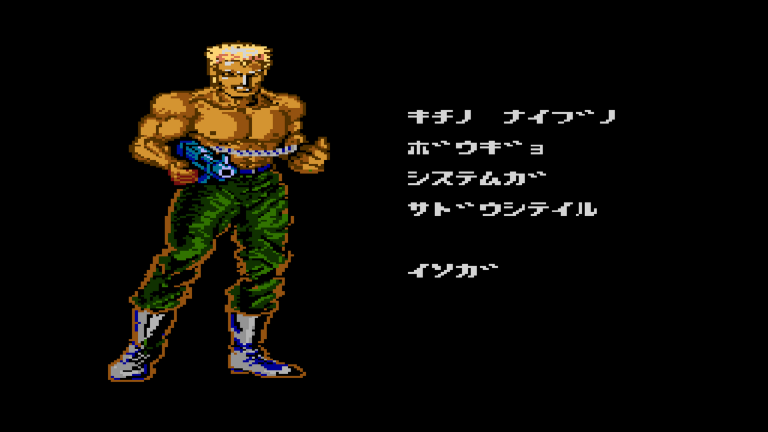
The start screen of the NES version of Contra. The commando with dark hair was deliberately made to resemble Sylvester Stallone somewhat.
Game concept
In the far future, an alien army from space – Red Falcon – arrived on Earth inside a meteorite that landed on the Galuga archipelago. There, Red Falcon established an extensive high-tech base for their operations and eventually brainwashed a local human army to do what they want. Red Falcon plots to wipe out human civilization on the planet.
With the information about Red Falcon collected, the Earth Marine Corps send Contra unit members Bill Rizer and Lance Bean to the island to destroy the opposition and find out what Red Falcon has been doing…
Gameplay and quality
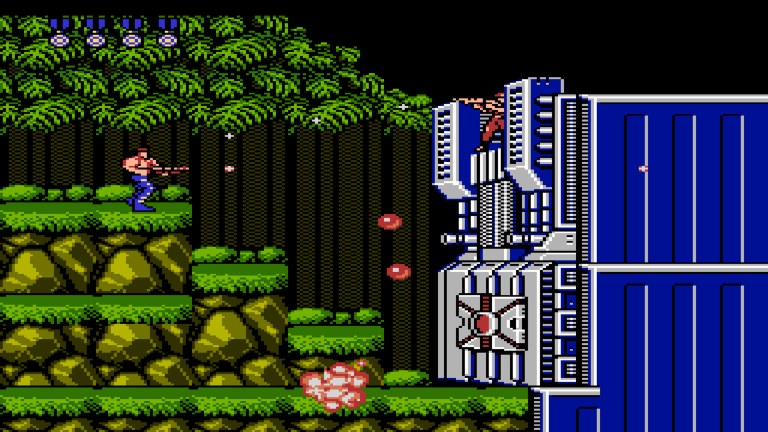
Contra is an action-packed 2D side-scrolling game with strong sci-fi and military influences.
To begin with, Contra of 1988 was made to be a nicely-paced, action-packed, side-scrolling adventure game that has some 3D-like levels in between. The game design and levels Konami came up with was done to immerse gamers into actual participation in the military campaign against the aliens and their brainwashed human soldiers. This campaign not only includes battles through the forest of the Galuga archipelago but also through the interiors of Red Falcon’s high-tech facilities, going up an elevated location with waterfalls, the snowy area and further deep into the rest of the enemy’s mechanical base.
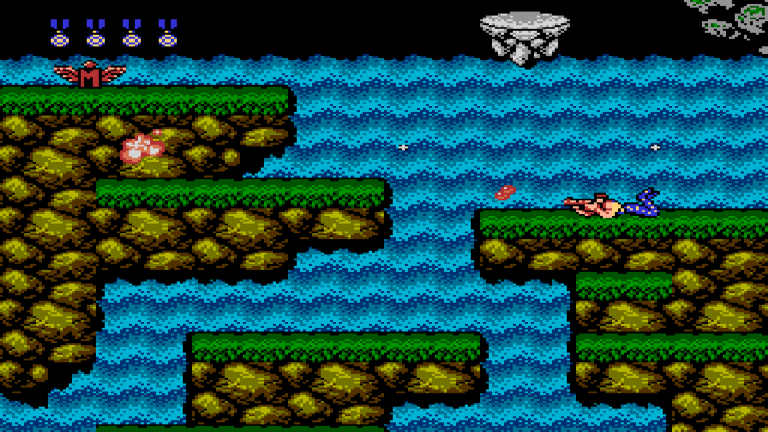
For the most part, you play as a commando armed with a rifle with unlimited ammunition. As you shoot enemies and make your way through the 2D side-scrolling level, there will be the occasional flying capsules that you can shoot down to gain new weapons/ammunition (S for Spread Shot, M for Machine Gun, L for Laser) or some power-up (temporary invincibility or the rare ability to eliminate all enemies present on-screen) to help yourself as the wave of opposition from Red Falcon is relentless (which is reason enough to compel you to keep progressing and fighting). There are also times when the mentioned enhancements suddenly pop out after killing an enemy.
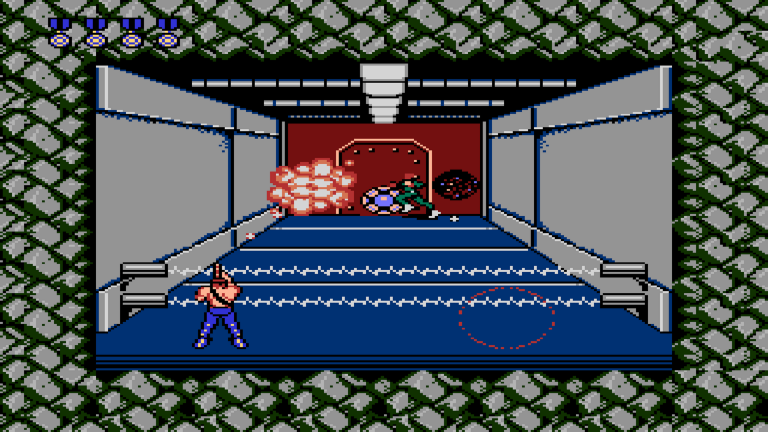
To prevent the game from getting too old with side-scrolling, Konami implemented these stages in which players face the front to attack enemies, overcome obstacles and move forward with 3D-like effects going into the next place.
By default, this game is brutally hard. Not only do the enemies keep appearing (with some of their teammates being strategically placed to fire at you), the obstacles will compel you to take your time overcoming them. In this game, one-hit death is the norm and there are many moments in which falling to your death becomes a huge risk. You get hit, you not only lose one life, you will lose whatever powerful weapons you gained.
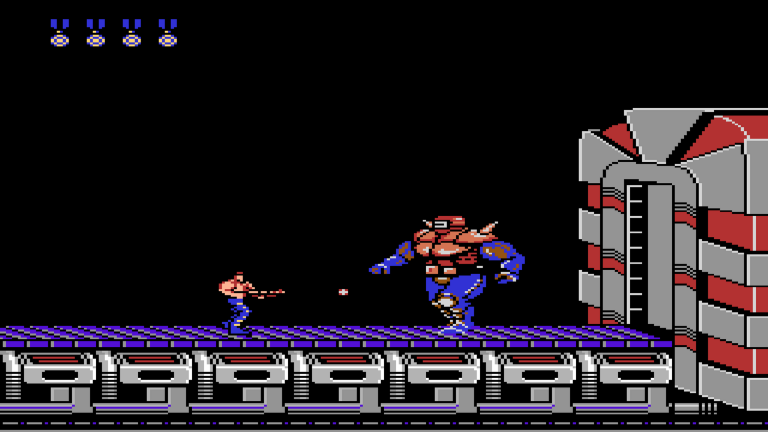
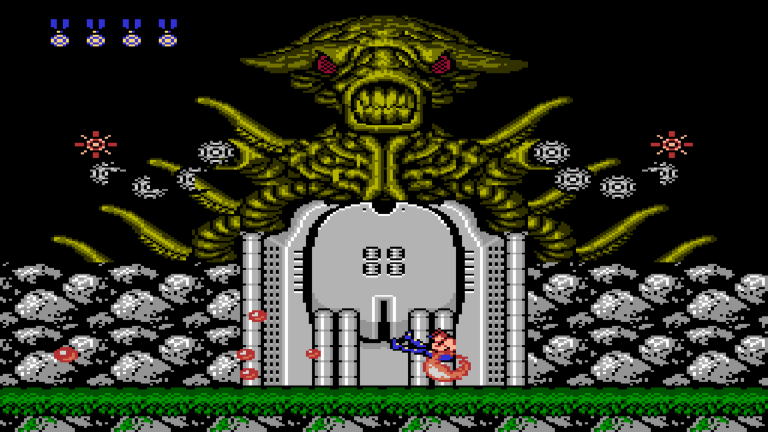
There are also stage bosses (powerful enemies that await you at the end of a level) that will challenge you so much, you will have to adjust your strategy, pay attention to the movements and timing of the enemy, and then adjust your way fighting.
Only the Famicom version of Contra has this sequence.
I really love the sci-fi elements the game developers came up with for this classic game. There are lots of high-tech stuff to see here and this robotic enemy is just one of them.
Fortunately for us players, the controls are really tight and very responsive. You can move your characters to overcome obstacles, avoid getting hit by enemies and even move down from one platform if the space below is safer. I still remember how precise and responsive the controls were on the NES and Famicom versions, and I can say that all the responsiveness made it on the Xbox controller when I replayed Contra on Xbox Series X with the Contra Anniversary Collection I downloaded. In fact, the high precision of the controls added to the fun of shooting enemies or obstacles with the Spread Shot while moving to the right as it was meant to be.
Considering the intense difficulty of the game, players who do the famous Konami Code (Up, Up, Down, Down, Left, Right, Left, Right, B, A, and Start) will be reward with 30 lives when they start playing Contra. For Xbox gamers reading this, there is a slight difference with the Konami Code when playing Contra on Xbox consoles.
Apart from shooting, there are lots of platform gaming elements to experience here. The difficulty is very brutal and the famous Konami Code will grant you 30 lives when you do the code correctly.
This cut-scene is only available in the Famicom version.
With regards to game design, the Konami developers did a really fine job creating the levels, placing the challenges and setting up memorable boss battles for action/adventure-hungry gamers to indulge in. The developers also cleverly implemented the fictional/fantasy concepts into the game design which resulted in me getting immersed in the Contra team’s mission against the Red Falcon at their secret base.
Another highlight with playing Contra is the 2-player option and the above-mentioned Konami Code added to the fun and accessibility of. I still remember the old days of playing in a 2-player session (cooperative play essentially) of Contra at a friend’s house on a Famicom. Since my friends and I were already enthusiasts of 1980s Hollywood action movies, playing Contra was enjoyable even though the difficulty was brutal.
This is one of the touch stage bosses you will encounter in the game.
If there are any notable differences between the two versions of Contra of 1988, it would be the fact that the Japanese (Famicom) version has storytelling emphasized through cutscenes (with Japanese text displayed), a technical overview of the Red Falcon base at Galuga with maps displayed before you start a new level, in-game art, an additional scene that spiced up the ending and, most notably, more background/environmental animation. The additional animation on the Famicom version made the adventuring look and feel more lively and this is most evident in the final stage (lair of the alien).
Conclusion
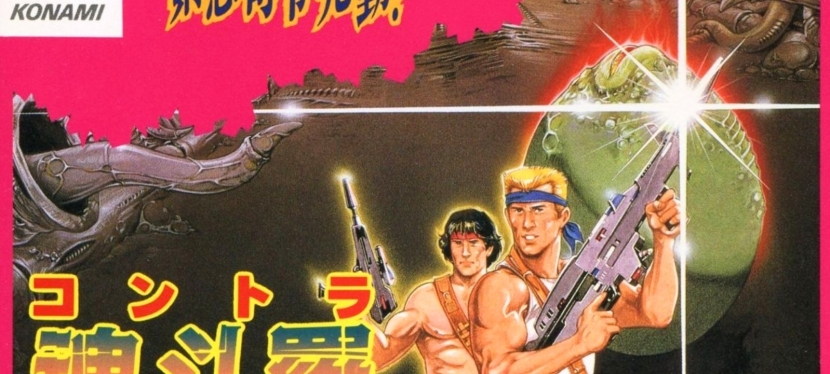
The Japanese cover art of Contra on Famicom. The Rambo-like character and the alien egg are obvious inspirations from Hollywood action movies of the 1980s.
There is no doubt in my view that after all the decades that passed since I first played it, Contra (1988) is still very engaging and a lot of fun to play whether you choose the Famicom version or the NES version. The developers who made this game succeeding in making something very enjoyable for millions of gamers and it is very clear that the makers were inspired by Hollywood action movies of the decade. In my view, the most obvious military inspirations are Aliens (1986), Commando (1985) and Rambo: First Blood Part II (1985).
Historically speaking, Contra (1988) was released at a time when militarism inspired many other game designers to come up with enjoyable games in different forms such as Cabal, Jackal, Rush’n Attack, Operation Wolf, Operation Thunderbolt to name some. Considering the overall quality and high fun factor Konami established, it is safe to say that this game is one of the finest among its militaristic gaming counterparts of its decade.
I had a grand time replaying Contra (1988) on my Xbox Series X in preparation for this review. Having played both NES and Famicom versions, I can say that the latter is the more complete and more immersive version to play. That does not necessarily mean the NES version is totally inferior. In fact, the NES version is more straightforward with the pick-up-and-play approach, and the gameplay itself is nearly identical (note: Famicom version is slightly more challenging) and very much fun to experience. If you are the player who really wants to be more immersed into the lore of Contra and absorb the military sci-fi concept Konami prepared, then the Famicom version is the one to play. That being said, now is a good time to purchase and download Contra Anniversary Collection.
Overall, Contra (1988) is highly recommended! It truly is a retro gaming gem!
Welcome back readers, fellow geeks and electronic gaming fans!
In this edition of the Retro Gaming Ads Blast (RGAB) series, we will take a look at another batch of retro gaming print ads from the 1980s and 1990s.
For the newcomers reading this, Retro Gaming Ads Blast (RGAB) looks back at the many print ads of games (console, arcade, computer and handheld) that were published in comic books, magazines, flyers and newspapers long before smartphones, social media, the worldwide web and streaming became popular. To put things in perspective, people back in the 1980s and 1990s were more trusting of print media for information and images about electronic games and related hardware.
With those details laid down, here is the newest batch of retro gaming print ads for you to see and enjoy…
1. Enemy Zero print ad
I should say Sega did a solid job by making this intriguing and eye-catching print ad for Enemy Zero.
The first time I saw this print ad of Enemy Zero in the late 1990s, I was intrigued by its visual concept and it got me interested to learning more about the game. Enemy Zero was a sci-fi video game developed by Warp and released as a console-exclusive on the Sega Saturn. Since I never owned a Saturn, I never got to play the game but I was inspired to learn more about Warp (which developed the hit game D). As it turns out, Enemy Zero started as a project for PlayStation but because of Sony’s failure to fulfill the pre-orders of D on PlayStation (100,000 copies ordered but less than 30,000 copies printed by Sony), Warp’s head Kenji Eno decided to make Enemy Zero exclusive to the Sega Saturn. Enemy Zero was published by Sega worldwide while Warp published it in Japan, and the game sold between 500,000 to 700,000 copies (based on Eno’s claim).
2. Bionic Commando print ad
For the American market, Capcom showed what the game box and front cover art would look like, then added the details and two screenshots for readers to examine.
Back in the late 1980s, I played Bionic Commando and managed to finish it after enduring lots of challenges along the way. It was a very unique adventure game as it used a highly unusual method of moving from one platform to the next by means of a futuristic grappling gun. This particular print ad showcased what the game’s actual box looked like (with cover artwork made for North America) and used two screenshots from the game. This ad hardly captures the excitement and intensity that awaited gamers and yet it manages to give people a clear look at the grappling concept. While the North American version of the game has certain content altered, it still had the same gory ending (and Adolf Hitler as the main villain) as the Japanese version.
3. RoboCop print ad
This served as an extension of the impact of the very violent 1987 movie.
RoboCop made huge impact on moviegoers as well as people who love science fiction and the R-rated action films Hollywood studios released in the 1980s. That being said, it was not surprising that a video game of RoboCop was released on the Nintendo Entertainment System (Family Computer in Japan) by Data East and the print ad they came up with cleverly used imagery from the movie poster and the screenshots showed exactly what RoboCop fans expected to see such as the enemy robot ED-209 and thugs. This game strongly reflects the business trend of the 1980s when companies made merchandise and adaptations of R-rated blockbuster films to sell to kids and teenagers.
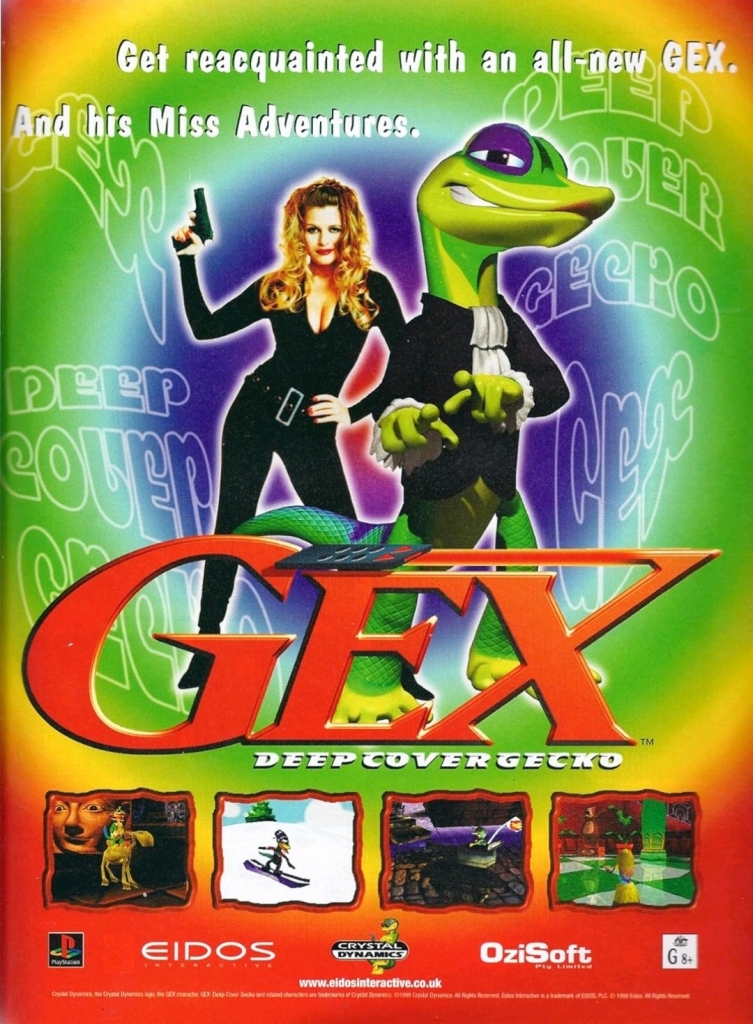
4. Gex 3: Deep Cover Gecko print ads
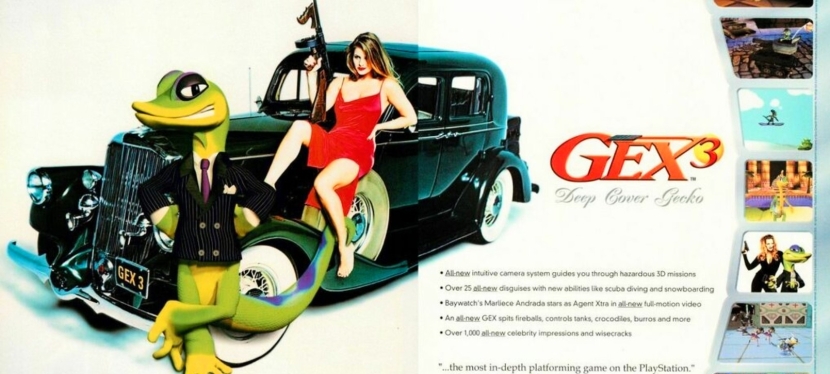
This print ad for Europe had a James Bond vibe.
March 1998 Playmate of the Month on the hood of the car looking at Gex.
The 2-page print ad of Gex 3: Deep Cover Gecko.
In 1999, Eidos Interactive – the company behind the wildly popular Tomb Raider games of the decade – became aggressive marketing Gex 3: Deep Cover Gecko for PlayStation and Nintendo 64. They were so aggressive, they featured actress and Playboy’s Playmate of the Month (March 1998) Marliece Andrada alongside their star character Gex in the marketing which was not limited to America. For the newcomers reading this, a multimedia approach was implemented on the narrative of the game’s PlayStation version which explains why it has full-motion video sequences featuring Andrada as the character Agent Xtra. As seen in these print ads, Eidos Interactive had Andrada looking pretty and sexy to really sell the game.
5. Barkley Shut Up and Jam! print ad
Anyone here a Charles Barkley fan?
I remember the many types of basketball video games that were released on game consoles back in the 1990s. While there were NBA video games that had in-depth rosters of players with seasonal gaming in mind, there were other basketball-related video games that were not about the said league but featured an NBA star. In this print ad, publisher Accolade prominently featured NBA star Charles Barkley to promote the game Barkley Shut Up and Jam!, posted some words emphasizing sports intensity, and showed one screenshot to assure gamers that this is a basketball game. While the critical reception was mixed, the game must have sold enough to convince Accolade to release a sequel two years later with Barkley still the endorser.
6. The Death and Return of Superman print ad
This print ad clearly aimed for the fans of the comic books as well as gamers looking for an action-packed game to play.
Now this is one very eye-catching print ad that appeared in comic books and magazines in the 1990s. Anyone who knows comics would recognize the grey fist (with sharp bones protruding on the knuckles) belonging to Doomsday who killed Superman in Superman #75 (1993), and the bloody presentation on the famous S was very aggressive for its time. The game itself was an adaptation of the two storylines (published in 1992 and 1993 respectively) that saw Superman’s death, his return and the appearances of new Supermen. While sales figures are not available, The Death and Return of Superman eventually attracted mixed reviews from the critics.
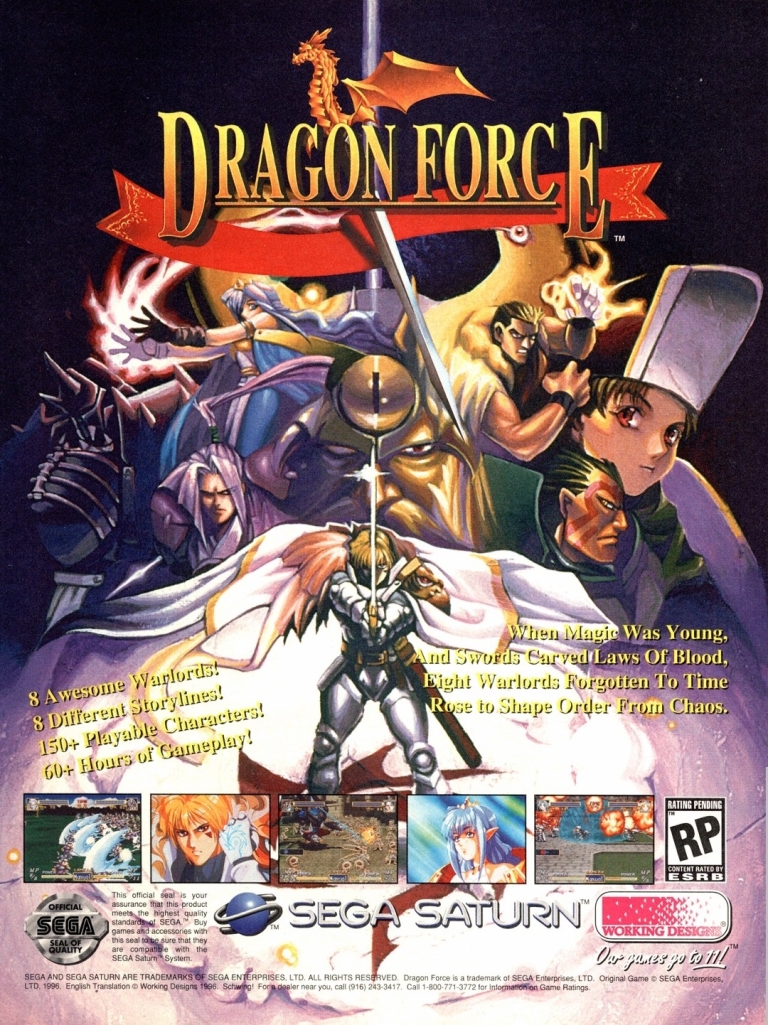
7. Dragon Force print ad
This was printed in magazines at a time when Working Designs had a strong business relationship with Sega.
While the Sega Saturn was undeniably a huge commercial disappointment in North America, the console still had some great games that was widely praised by game critics and heavily bought by gamers. One of those outstanding games on the console was Dragon Force (developed by Sega and J-Force in Japan, localized in America by Working Designs) which received great critical acclaim and achieved commercial success both in Japan and in America. The popular magazine Electronic Gaming Monthly named Dragon Force as the Saturn Game of the Year as well as Strategy Game of the Year in 1996. As a Working Designs release, this print ad has an ambitious fantasy concept visually emphasized, detailed lines of descriptions and screenshots that strongly appealed to the gamers, anime enthusiasts and those who love fantasy. This ad is also a sad reminder that the business relationship between Sega and Working Designs went downhill afterwards (read: Bernie Stolar) and the sequel Dragon Force II was never released outside of Japan.
Welcome back readers, fellow geeks and electronic gaming fans!
In this edition of the Retro Gaming Ads Blast (RGAB) series, we will examine print ads of Sega from the 1990s which was a notable period of time when they went from being a prominent video game company into a desperate, struggling entity by the end of the decade. All the Sega ads in this edition are promotions of their own video games that were exclusive to their consoles during the 1990s.
For the newcomers reading this, Retro Gaming Ads Blast (RGAB) looks back at the many print ads of games (console, arcade, computer and handheld) that were published in comic books, magazines, flyers and newspapers long before smartphones, social media, the worldwide web and streaming became popular. To put things in perspective, people back in the 1980s and 1990s were more trusting of print media for information and images about electronic games and related hardware.
With those details laid down, here is the newest batch of retro gaming print ads for you to see and enjoy…
1. Phantasy Star IV print ad
This was the last single-player Phantasy Star game released. There is no sign of Sega revisiting the franchise for another single-player experience.
Long before the emergence of online console gaming that involved a high number of players, Sega released Phantasy Star IV for the Genesis console in America in 1994 which was praised by gamers and critics. This one also turned out to be the last single-player role-playing game (RPG) of the Phantasy Star series as Sega eventually turned it into a series of online RPGs since the year 2000.
This print ad is significant because a lot of gamers today are not aware that Phantasy Star started as a series of single-player RPGs the same year Final Fantasy debuted in Japan. Anyone interested to play Phantasy Star IV on a modern console should buy the Sega Genesis Classics collection.
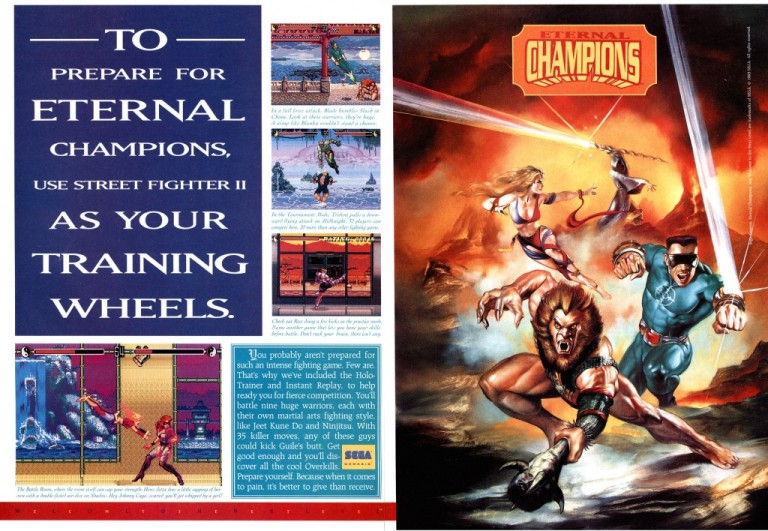
2. Eternal Champions print ad
This 2-page print ad appeared in many comic books and some magazines that I read long ago.
Back in the 1990s, the fighting game genre became wildly popular with gamers at the arcades and on consoles at home. Capcom literally sparked a wild fire with the Street Fighter II game and its upgraded editions, and other companies went on to make their own 2D fighting games to cash in. Sega was one of them and they released their own 2D fighting game Eternal Champions for the Sega Genesis console.
Unsurprisingly, the game was marketed aggressively and this 2-page print ad really stood out as it had the great looking painted art on the right, screenshots and details of the game, and most notably made a sarcastic reference to Street Fighter II. Eternal Champions sold enough copies, it led to the release of the sequel Eternal Champions: Challenge from the Dark Side and two spin-off games. I can only guess that referencing Street Fighter II was helpful in achieving commercial success.
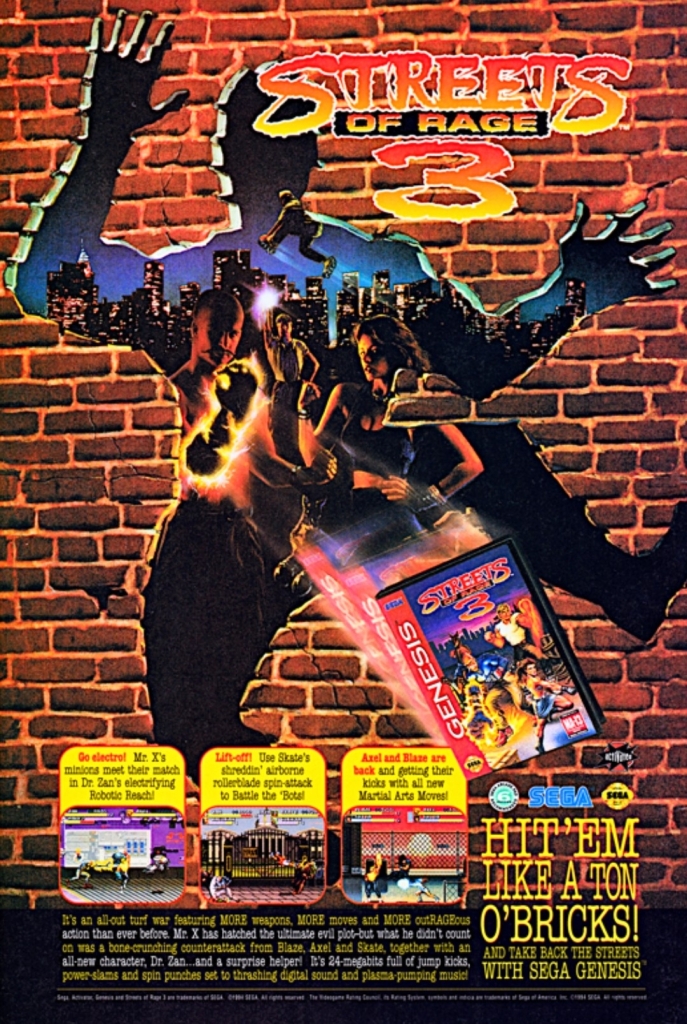
3. Streets of Rage 3 print ad
This ad caught my attention easily when I saw it in comic books I read.
Streets of Rage (Japanese title: Bare Knuckle) was one of the most defining game franchises Sega came up with and it started on the Sega Genesis console. It was a series of side-scrolling, 2D beat-them-up games that ensured action and excitement for gamers. As the first two games were critically and commercially successful, Sega was confident in aggressively marketing Streets of Rage 3 and the print ad seen had a very attention-grabbing artwork.
The artistic style emphasized power and intensity as it shows a damaged wall with the shape of a human body (symbolizing that someone was thrown through it) and then there were images of people on the other side. The game went on to attract mostly positive reviews although it paled in comparison to its predecessors in terms of sales.
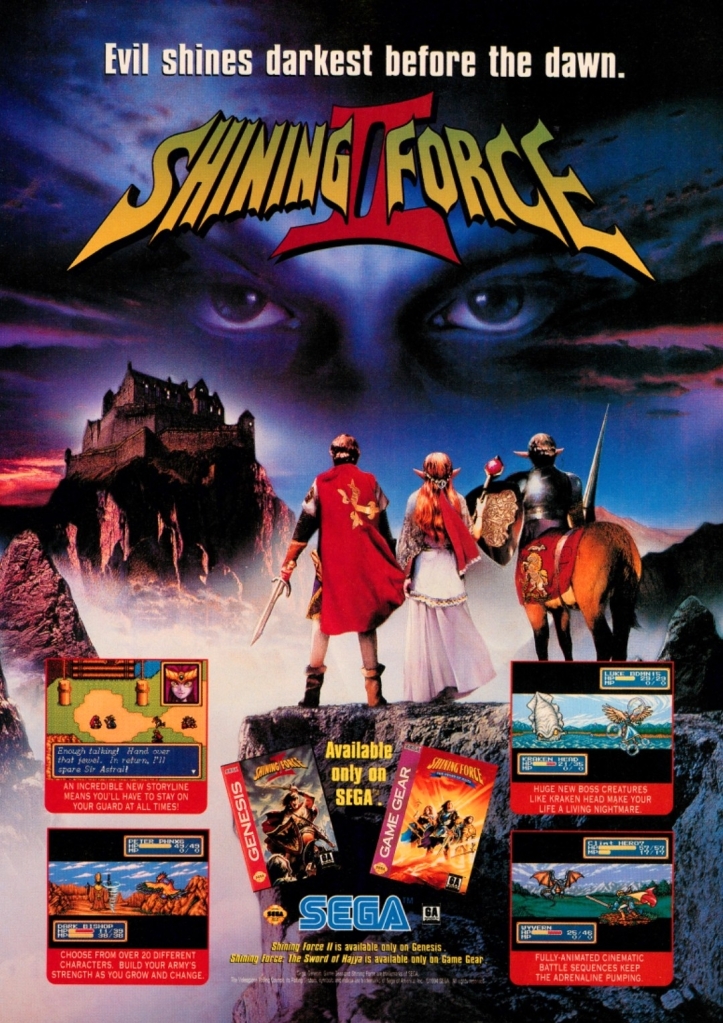
4. Shining Force II print ad
The first time I saw this ad, it made me interested to buy a Sega Genesis console to play it.
As Sega was so prolific with making and releasing games across different genres, they had their own tactical role-playing game series with Shining Force and the first game released on the Sega Genesis was a critical and commercial success. That being said, the company was confident with releasing Shining Force II on the same console more than a year later achieving critical and commercial success.
The North American print ad of the game had a visual presentation that closely captured the foreground-background style (characters facing the distance) used in-game, and the advertising team use photographic imagery to achieve a fantasy look. Very cleverly, Sega inserted the Sega Game Gear title Shining Force Shining Force: The Sword of Hajya into the ad. This print ad made me interested in acquiring a Sega Genesis for Shining Force II.
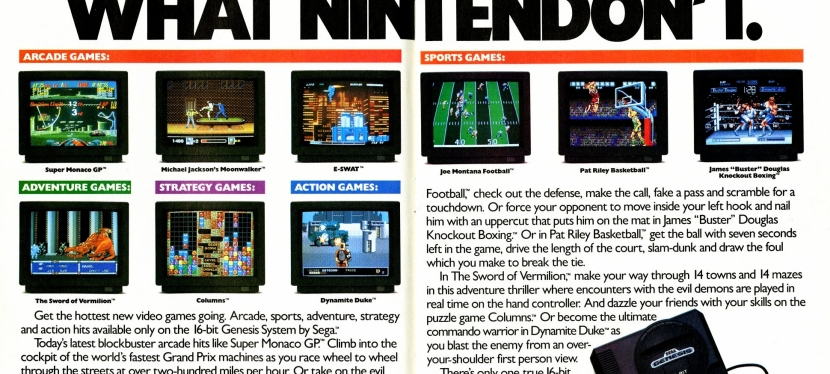
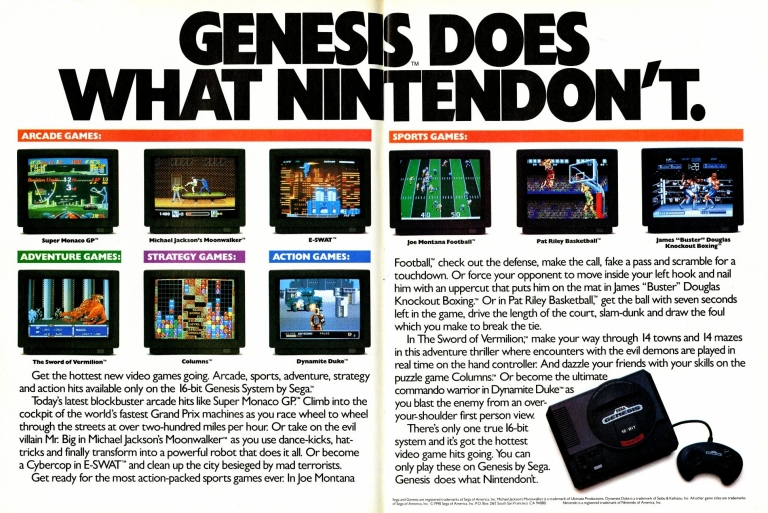
5. Genesis does what Nintendon’t print ad
With the famous line heavily emphasized, this print ad showed how bullish Sega really was in competing with Nintendo.
Now this print ad of Sega’s has the most definitive and best-known advertising line in the so-called 16-bit console generation: Genesis does what Nintendon’t. This was Sega’s aggressive marketing push to convince gamers to buy the Genesis console to play games and experience thrills of fun that they would not find on a Nintendo console at the time. Genesis was launched in America in 1989 with “16-bit” emphasized a lot, and the technological rival Super Nintendo Entertainment System (SNES) was released in the same market more than two years later.
The 2-year advantage helped Sega establish the Genesis as the next-gen machine for gaming at home and there were years in the 1990s when Sega’s console outsold Nintendo’s in America during the so-called 16-bit war. The Genesis also had lots of exclusive games plus strong software support from third-parties. While the SNES would eventually outsell the Genesis in other parts of the world, it was in America where Sega proved to be very competitive and successful.
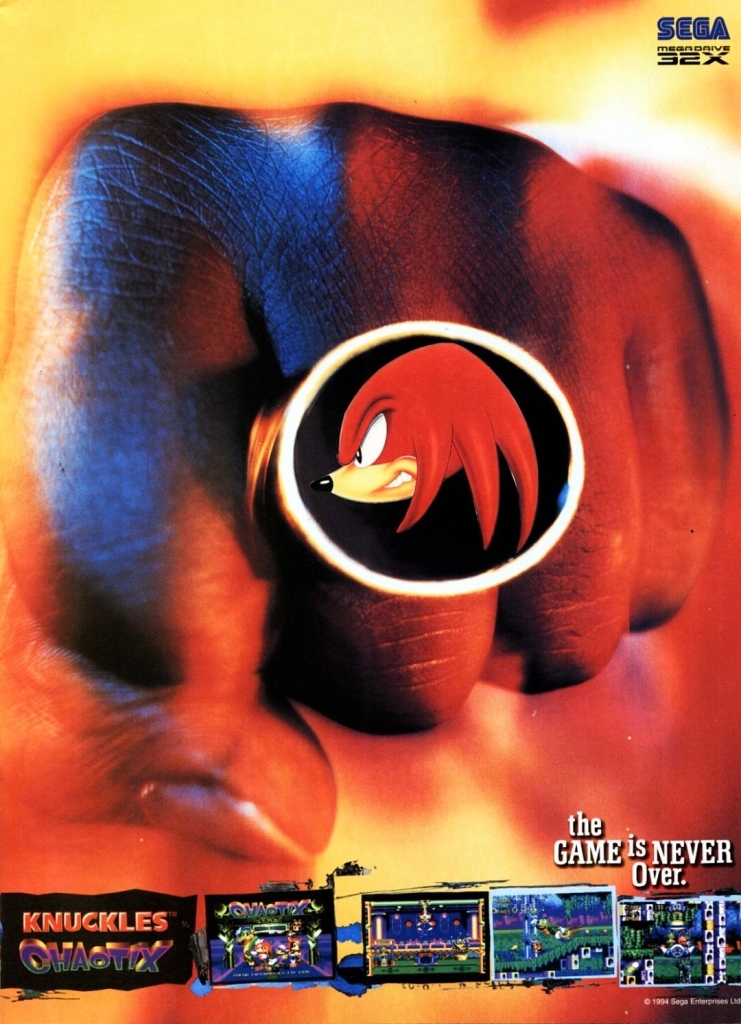
6. Knuckles’ Chaotix print ad
Sega was aggressive with marketing this game for the 32X.
In late 1994, Sega released in America and in Japan the 32X which was an add-on device for the Sega Genesis designed enhance its power while serving as a transition (a warm-up) into the so-called 32-bit era of console gaming. The 32X was the result of corporate decisions involving the American and Japanese executives of the company.
To keep 32X customers happy and boost hardware sales, Sega adjusted the development of Knuckles’ Chaotix (a Sonic spin-off) from being a Sonic project 32-bit console Sega Saturn into a standalone game for the add-on device. Even though Sega knew the game’s development was rushed, they went on to strongly promote the game and the print ad shown here was quite eye-catching.
The image of a fist with a ring showing the character Knuckles (a character from the Sonic games) emphasizes power and the colors used seem to express intensity. Then there were the selected screenshots shown without descriptive text. Although Sega tried hard, Knuckles’ Chaotix (launched in 1995) received mixed-to-positive reviews and sadly sold poorly. Unsurprisingly, the sales of the 32X dropped further and by then a lot of consumers knew that the Sega Saturn (the true successor to the Genesis) was all set to launch in America and Europe within 1995.
7. Sonic 3D Blast for Sega Saturn print ad
Too bad Sega and its teams failed to make the true Saturn Sonic game.
Back in the 1980s and 1990s, having a high-quality, console-exclusive game featuring a company mascot was crucial to sell game consoles while keeping dedicated fans happy. Like what Nintendo did with their icon Mario, Sega achieved great commercial success with the three Sonic the Hedgehog games they released exclusively on the Sega Genesis console and this naturally created expectations they would make new Sonic games on the Saturn console. Unfortunately, Sega and its teams failed to complete development of the Saturn-exclusive game Sonic X-treme and the company cancelled it which sent shockwaves through the games industry news.
With the 1996 holiday shopping season too crucial to ignore, Sega commissioned a Saturn version of the game Sonic 3D Blast which was originally made for the Genesis console. Sonic 3D Blast on the Saturn took seven weeks to make and there were some graphical enhancements implemented. While Sonic 3D Blast’s Genesis version attracted a positive reception from critics (and sold 700,000 copies), the reception for the Saturn version was mixed. This print ad of Sonic 3D Blast on Sega Saturn is a reminder of the company’s failed attempt to take their icon to the next-generation. They never replicated the big success they had with Sonic on the Genesis.
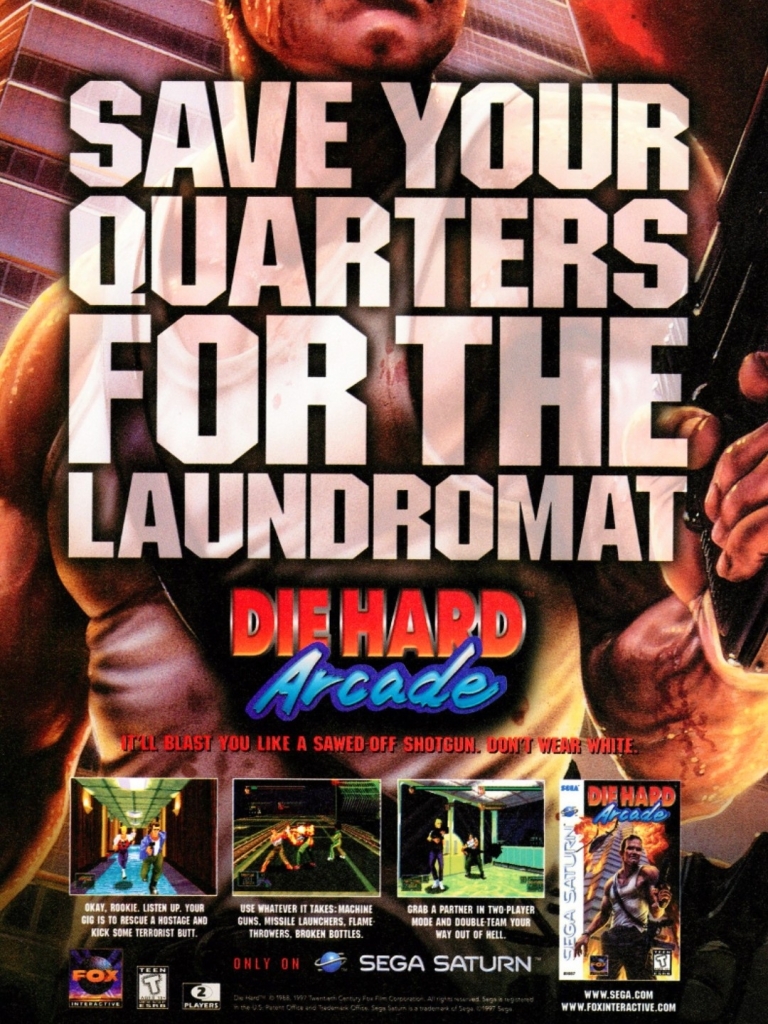
8. Die Hard Arcade print ad
Each time I saw this print ad, it easily reminded me of the classic action film of 1988.
Like many other movie franchises, Die Hard has many video game adaptations released through the decades. In 1997, Sega released Die Hard Arcade (Japanese title: Dynamite Deka) on the Sega Saturn and the game critics praised it for its fun gameplay as well as its flawless conversion of the arcade version (released in 1996). To say the least, the development history of Die Hard Arcade is not as straightforward as many would think. To get the details and explanations of the development of the game, click here.
As for the print ad itself, this one cleverly used official game art as the background with imagery which instantly reminded me of what I saw in the classic 1988 movie that starred Bruce Willis. This ad made me interested to buy a Sega Saturn or find a place to rent it to play the game.
9. Shenmue Japanese print ad
Simplistic with presentation and yet engaging to look at. The Dreamcast-exclusive Shenmue sold over a million copies in Japan alone.
When Shenmue was released exclusively on the Sega Dreamcast in Japan on December 29, 1999, it turned out to be a very mind-blowing experience for many gamers due to its ambitious game design, the intense attention to detail implemented, very high production values, in-depth exploration and very immersive gameplay.
It was the open-world game released at a time when “open-world” was not even a standard gaming term. Often called the masterpiece of the legendary game designer Yu Suzuki, Shenmue sold over 1.2 million copies in Japan and went on to be released worldwide in the months that followed. Sadly, the game failed to make a profit due to its very high budget of $70 million (which Suzuki himself said in English during an interview) and the fact that the number of Dreamcast units already sold to gamers was not massively high.
The Japanese print ad of Shenmue had a simplistic looking visual concept and yet it was engaging to look at because the way the characters appeared was how they appeared in the game during gameplay which was astounding. Take note that back in the 1990s, it was common for video game marketing materials to show human characters in high detail but in reality the polygonal models of those characters appeared looking blocky and much less detailed during gameplay.
Disclaimer: This is my original work with details sourced from reading the comic book and doing personal research. Anyone who wants to use this article, in part or in whole, needs to secure first my permission and agree to cite me as the source and author. Let it be known that any unauthorized use of this article will constrain the author to pursue the remedies under R.A. No. 8293, the Revised Penal Code, and/or all applicable legal actions under the laws of the Philippines.
Welcome back superhero enthusiasts, 1990s arts and culture enthusiasts, Marvel Comics fans and comic book collectors! Today we go back to the mid-1990s to explore the adaptation of the second season of the X-Men animated series in the form of the X-Men Adventures comic book series.
Before getting to the new retro comic book review, I should state that I visited Canada only once. Even before my one and only visit there, I knew through the comic books that famous character Wolverine is a native of Canada and a former member of Alpha Flight (Canadian government-sponsored team of mutant operatives). Somewhere in his past, he was live test subject of Weapon X. I have to mention this because the X-Men Adventures about to be reviewed here is focused on Wolverine.
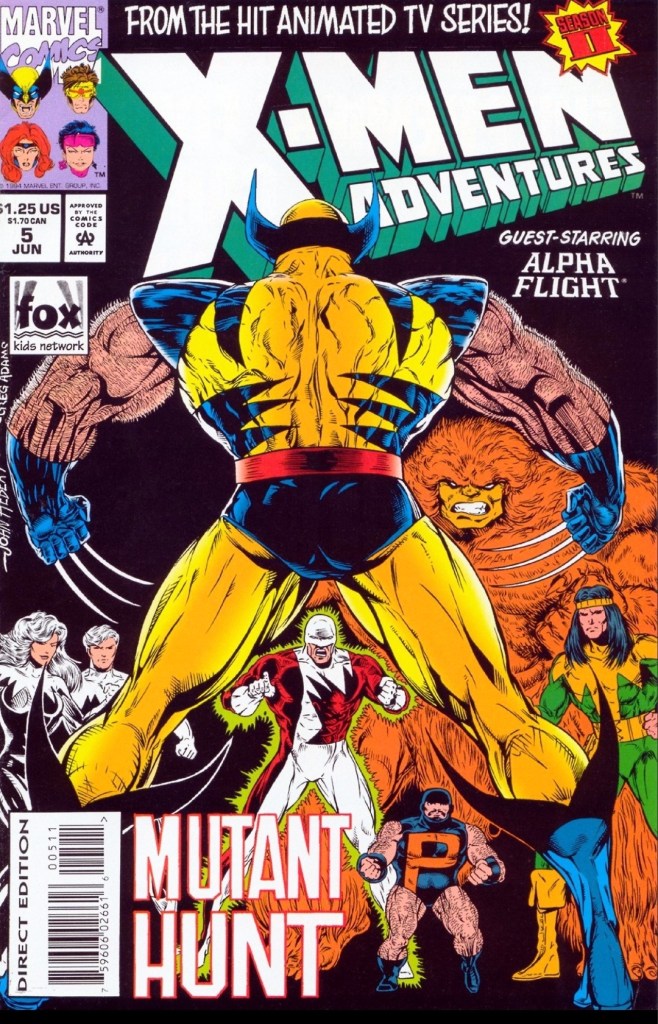
With those details laid down, here is a look back at X-Men Adventures Season II #5, published in 1994 by Marvel with a story written by Ralph Macchio and drawn by John Hebert.
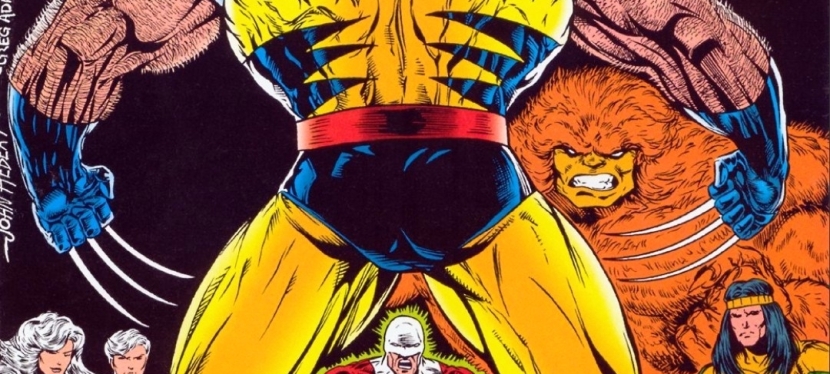
The cover.
Early story
The story somewhere in the wilderness in Canada where Wolverine helps free an animal that was stuck. Suddenly, Alpha Flight’s Vindicator appears and reminds Wolverine of the fact that he deserted them to work of Charles Xavier. It turns out, Wolverine is back in Canada to visit Heather.
Moments later, he finds himself surrounded by Vindicator’s teammates Puck, Shaman and Sasquatch, and tells them that he is never coming back to Alpha Flight. Even though two more members of the Canadian team joined in, Wolverine manages to avoid defeat in battle and hides away.
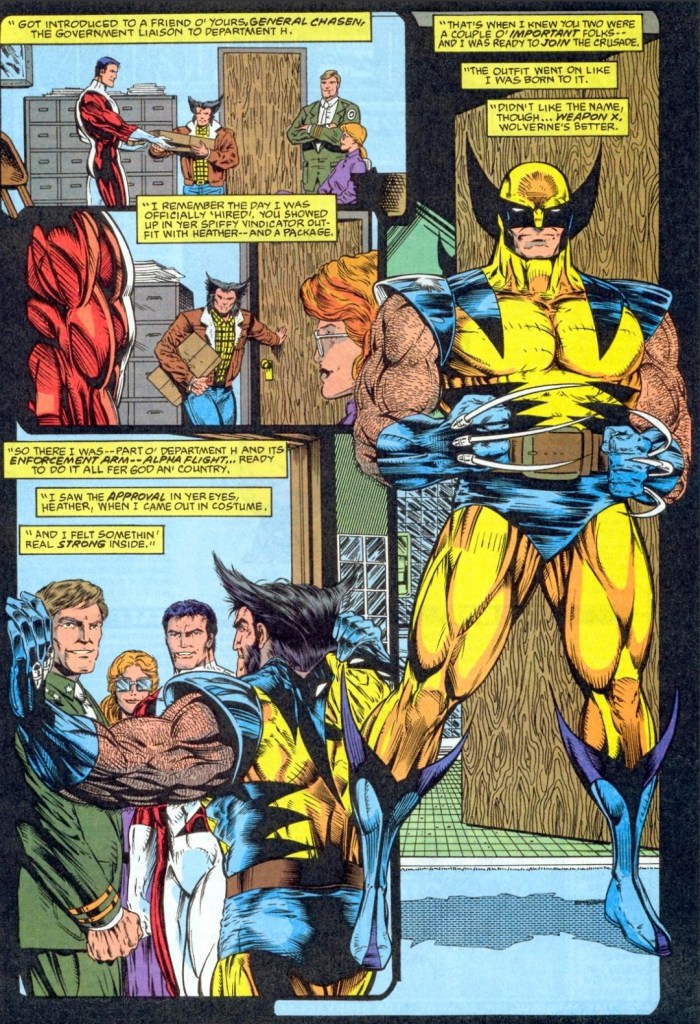
As he listens to Alpha Flight from a distance, he hears Vindicator mentioning that a certain lab is expecting their team. This causes Wolverine to remember the traumatic time he had as a live test subject of Weapon X…
Quality
A look back at the time Wolverine joined the Canadian government-sponsored superhero team Alpha Flight. Would you want to join a unit serving the woke Canadian government of Justin Trudeau in real life?
I should mention first that the teleplay by the late Len Wein contains a very solid and sensible interpretation of Wolverine’s Weapon X origin (with a modern touch for the 1990s) which turned out to be a detailed reference for Ralph Macchio to adapt into this comic book.
That being said, this comic book’s plot of Wolverine going to Canada for a solid purpose and encountering challenges – both from his past with Alpha Flight and others – while bringing back his painful Weapon X past turned out to be a really engaging read. The Weapon X flashback scenes added a depth to the story as well as Wolverine’s portrayal in this adaptation. You will see the clawed X-Men member being tough and gritty as usual, and yet you will witness his fragile side as he becomes personally troubled about the past.
The appearance of Alpha Flight here was put to good use. Apart from the revelation of Wolverine’s past membership with them, you will see the team truly operate with a clear goal as mandated by their government (note: this is clearly not the ultra-woke, Islamo-Leftist government of Justin Trudeau). In fact, this tale gives readers a glimpse of how the Canadian government analyzes and decides what to do with Canadians who are very exceptional and are more valuable than many other citizens. Alpha Flight is the government’s tool which is strongly emphasized here.
Apart from the plot focused on Wolverine, this comic book managed to move the sub-plot of Magneto and Charles Xavier forward a bit.
Conclusion
A Weapon X flashback.
X-Men Adventures Season II #5 (1994) has a very engaging and fun tale focused on Wolverine who encounters his fellow Canadians. Anyone who loves the clawed X-Men member will have a lot to enjoy here. The appearance of Alpha Flight here (as well as in the X-Men TAS episode) added a good layer of depth to the plot while also emphasizing the shared Marvel universe in a controlled manner. Lastly, artist John Hebert’s artwork on Wolverine is really good and his high level of visual detail on other characters and locations should be seen.
Overall, X-Men Adventures Season II #5 (1994) is recommended.
Disclaimer: This is my original work with details sourced from reading the comic book and doing personal research. Anyone who wants to use this article, in part or in whole, needs to secure first my permission and agree to cite me as the source and author. Let it be known that any unauthorized use of this article will constrain the author to pursue the remedies under R.A. No. 8293, the Revised Penal Code, and/or all applicable legal actions under the laws of the Philippines.
Welcome back superhero enthusiasts, 1990s culture enthusiasts and comic book collectors! Today we go back to the early 1990s and explore a part of the Valiant Comics shared universe through a tale of a very notable illustrated literature character named Turok.
I say very notable because Turok, an Indian (North American native), started in comics in the 1950s published by Western Publishing through its licensee Dell Comics. The comic book series Turok: Son of Stone started from 1956 until the early 1980s. In 1989, Valiant Comics was established by former Marvel Comics editor-in-chief Jim Shooter and business partner Steven Massarsky which was the result of a failed 1988 attempt to purchase Marvel Entertainment. In 1991, Valiant published Magnus: Robot Fighter and Solar: Man of the Atom as its early titles which is notable because both characters were licensed properties from Gold Key Comics (which itself was involved in the original Turok series).
Then in 1992, a newer version of Turok was introduced by Valiant Comics in the 12th issue of Magnus: Robot Fighter and subsequently the character (along with established side-kick Andar) became involved in the Unity storyline which was Valiant’s first major crossover comics event. By the time Unity ended, the road was cleared for Valiant to further emphasize Turok for the modern comic book readers of the time.
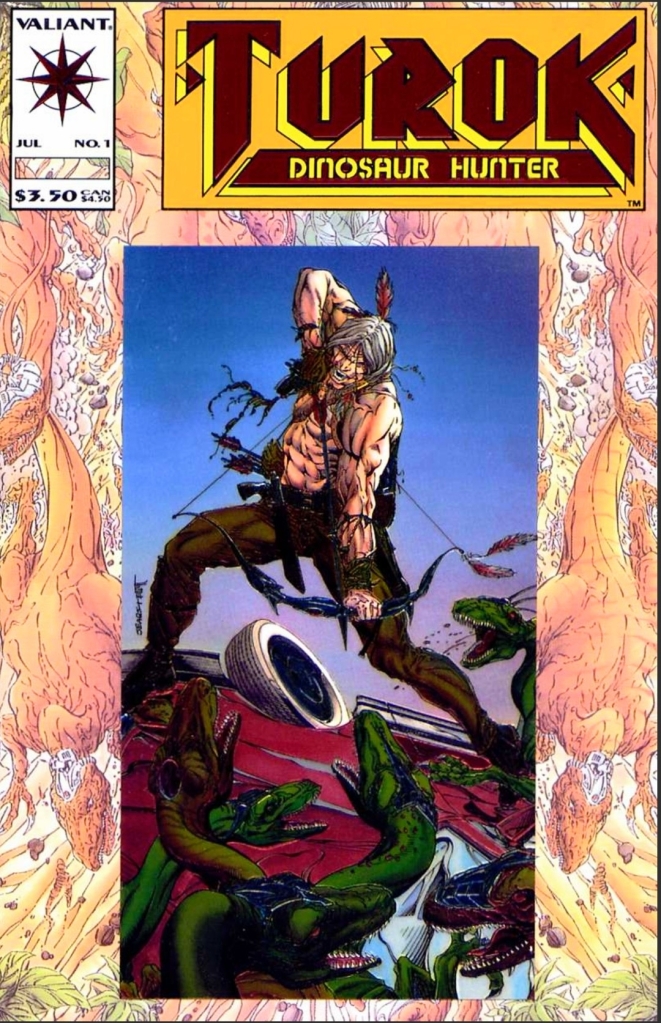
With those details laid down, here is a look back at Turok: Dinosaur Hunter #1, published in 1993 by Valiant Comics with a story written by David Michelinie and drawn by Bart Sears.
The cover.
Early story
The story begins in Colombia (note: written as Columbia in the comic book) in South America in the year 1987. Deep in the forest, Turok performs a ritual believing that his spirit is getting cleansed and purified. He remembers the times when he and Andar discovered a land – filled with dinosaurs and other animals they never encountered previously – where time no longer held much meaning.
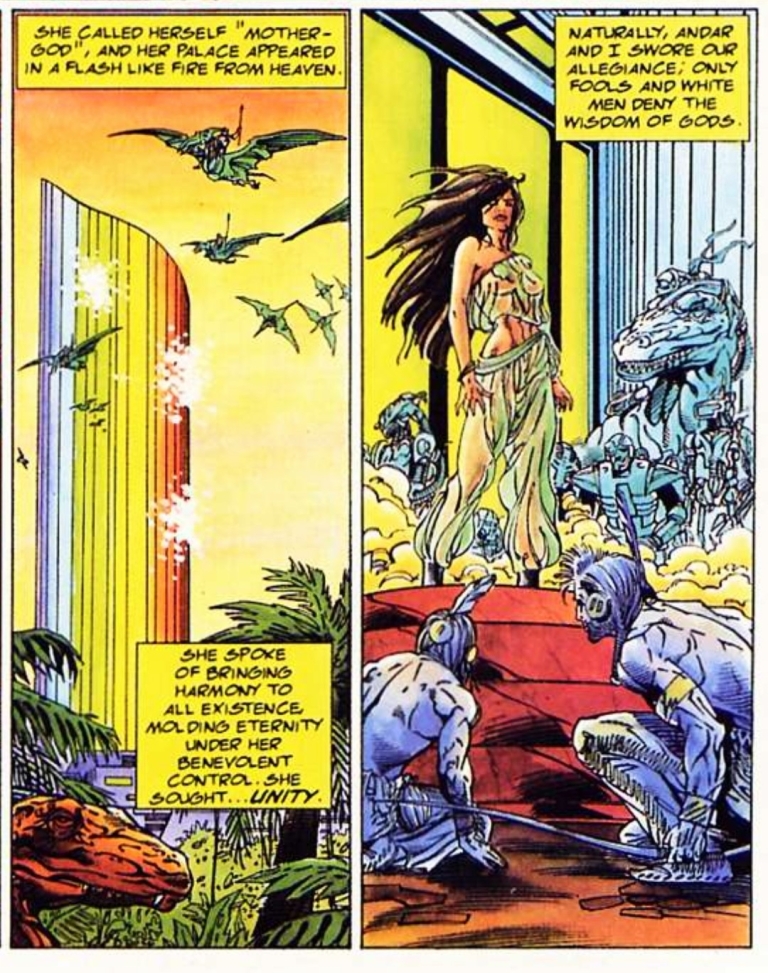
He and Andar got involved in an armed conflict with invaders who arrived with advanced technologies. The robot fighter Magnus then got involved and helped Turok and their side turn the tide of battle. Eventually a stunning phenomenon happened as a woman who called herself Mothergod appeared. Turok and Andar foolishly submitted themselves to her and soon, they started operating in her service with violence against those who opposed her.
After encountering Archer and Armstrong, Turok realized the error of his devotion to Mothergod and eventually joined forces with Rai, X-O Manowar and others who waged battle against her.
Back in the present, an intelligent, cybernetically enhance dinosaur attacks Turok…
Quality
Very intense violence drawn by Bart Sears which reflected the high intensity of Turok’s fight with the dinosaurs.
To get straight to the point here, when it comes to emphasizing a new version of Turok for comic book readers in the early 1990s, the creative team was quite successful in achieving that goal. By the time I reached the end of this comic book, Turok’s place within the huge shared universe of Valiant got established solidly and the Michelinie-Sears duo dramatized the Indian’s struggle (being lost in time and far away from where he belongs) in South America in the late 1980s.
Being lost in time and having to deal with deadly, intelligent dinosaurs brought not only the warrior within Turok but also the determine survivor in him as well. There is a good amount of character emphasis of Turok which served as an effective balance to all the spectacle (read: uncompromised bloody violence) the creative duo prepared. Instead of using thought balloons, you will read Turok’s thoughts through narration boxes all throughout which made an effective and interesting reading experience.
Considering his great skills in hunting and fighting, Turok is not really a super protagonist. He is as vulnerable as any other person and you will get to see him suffer and become so helpless, he has no choice but to avail of assistance from South American villagers who lived by the land but are themselves very vulnerable to the savagery of the intelligent dinosaurs. The symbolism regarding vulnerability as well as the ramifications of the Unity crossover on this tale is very strong. This is indeed very solid writing by Michelinie.
As for the art, Sears’ work here is very unique and his style on drawing people, monsters and locations made this comic book a visual standout among 1993 comic books. When it comes to the graphic violence, it is clear to me that Sears enjoyed the creative freedom he got and he really emphasized his imagination as to how gruesome violence caused by dinosaurs on human beings would be. That being said, there are lots of violent action scenes and images of physical damage (damage on the flesh specifically) that remain visually disturbing to this day.
Conclusion
Very foolishly, Turok and Andar submitted themselves to a walking, evil idol. This should remind you that idolatry is both foolish and unholy.
Turok: Dinosaur Hunter #1 (1993) works nice as modern portrayal of Turok and it succeeds in establishing his place within Valiant’s comic book universe thanks primarily to the Michelinie-Sears duo. Turok himself is not exactly an interesting protagonist to me but I can say it is the creators’ way of portraying him that makes the plot and the comic book work as an entertainment piece. I also liked the way Turok was emphasized as a character who got lost not only in time but also dimensionally lost as he has to live within a whole new world while focusing on survival as well as his desire to kill his rival Mon-Ark (the intelligent dinosaur). If you know your American pop culture history, you will realize that this comic book incidentally paved the way for the Turok video games (starting with 1997’s Turok: Dinosaur Hunter of Nintendo 64) that happened years later.
Overall, Turok: Dinosaur Hunter #1 (1993) is recommended.

















 Author Carlo Carrasco