Welcome back my readers, YouTube viewers and all others who followed this series of articles focused on YouTube videos worth watching. Have you been searching for something fun or interesting to watch on YouTube? Do you feel bored right now and you crave for something to see on the world’s most popular online video destination?
I recommend you check out the following videos I found.
#1 Dawn Of The Dead Remake Revisited – Back in 2004, I saw the Dawn of the Dead remake inside a cinema located inside a shopping mall here in the Philippines. The Zack Snyder-directed film only inspired me to look for the 1978 original version of Dawn of the Dead directed by the late George Romero. The only thing the two films have in common is the concept of desperate people taking refuge inside a shopping mall during a zombie apocalypse. Zack Snyder’s film was more about violent action with horror elements blended with it. As Snyder went on to direct high-profile DC Comics superhero movies and produced other such projects of Warner Bros., it was natural for film buffs to gravitate to 2004’s Dawn of Dead which was his directorial debut. To learn more about the said remake and see the cinematic elements that formed the style of Snyder, watch the videos below.
#2 Premium Sushi, Hearty Tempura And Wagyu Beef For Breakfast In Japan –If you were traveling overseas, how hungry do you get when you start the day? Would you go for a simple and affordable breakfast or would you want something special in the morning? In Tokyo, there are these food joints that offer customers a luxurious breakfast with Wagyu beef, special tempura and premium sushi to name some. Already, local and foreign tourists are flocking to such food joints for the premium breakfast experience and you can learn more from the Nippon TV videos below.
#3 The Different Versions Of Final Fantasy VI – Among all the many Final Fantasy games released since 1987, Final Fantasy VI is still my favorite of them all. I first played the classic Japanese role-playing game (JRPG) on Super Nintendo Entertainment System (SNES) in 1994 which was titled “Final Fantasy III”, and it has a great epic story, a huge cast of playable characters, lots of unique gameplay features and great game design. Through the decades, Final Fantasy VI was ported to many consoles, mobile devices and even on personal computer. You might be wondering which version of Final Fantasy VI is the best in terms of visual quality, which one is the most available and which one is the most updated version. That said, you can find out by watching the video below.
#4 Castlevania II: Simon’s Quest Revisited – When Castlevania II: Simon’s Quest was first released on the Nintendo Entertainment System (NES) in 1987, many fans who enjoyed the first game were alienated by how different the sequel felt, looked and played. It still was horror-themed 2D adventure game with Simon Belmont as the playable protagonist again but the creative team of Konami implemented role-playing elements and open-world exploration into the gameplay. Major game design changes aside, Castlevania II still has a lot more than meets the eye and you can find out by watching the video below. Surely it will challenge what you know about Simon Belmont and the Castlevania lore.
#5 Why Feminists Support Islam – Let’s be very clear here. Islam is a truly ugly religion and it is incompatible not only with Western democracy and values, but also with several other cultures around the world. The strange thing is that modern-day feminists actually support Islam even though the ugly religion itself goes against women’s rights, against personal liberty and against freedom as we know it. In the video below, Ayaan Hirsi Ali explains in detail why mainstream feminists today support Islam, why feminism today is very twisted and why feminists even aligned themselves with Islamic terrorists.
Welcome back readers, fellow geeks and electronic gaming fans!
In this edition of the Retro Gaming Ads Blast (RGAB) series, we will take a look at another batch of retro gaming print ads – including arcade flyers – from the 1980s to the 1990s.
For the newcomers reading this, Retro Gaming Ads Blast (RGAB) looks back at the many print ads of games (console, arcade, computer and handheld) that were published in comic books, magazines, flyers, posters and newspapers long before smartphones, social media, the worldwide web and streaming became popular. To put things in perspective, people back in the 1980s to the 1990s were more trusting of print media for information and images about electronic games and related products.
With those details laid down, here is the newest batch of retro gaming print ads for you to see and enjoy…
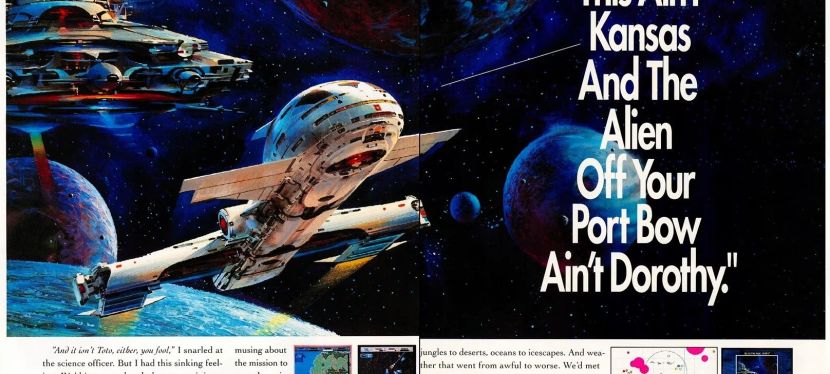
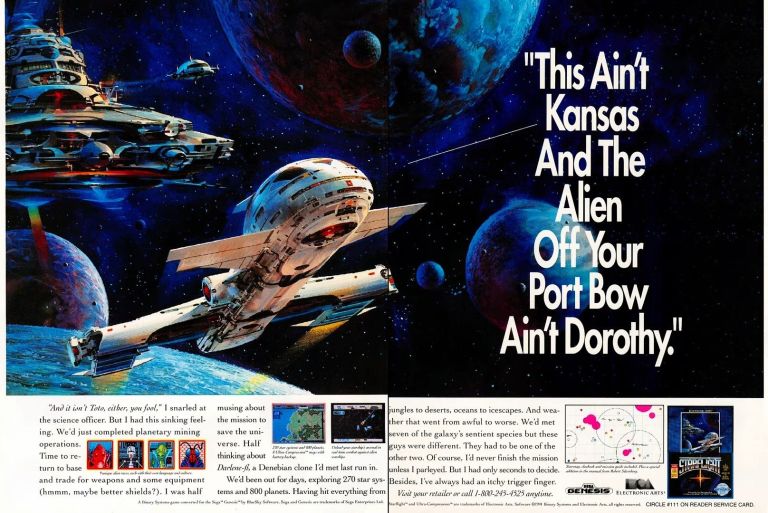
1. Starflight Sega Genesis Print Ad
Sometimes the very detailed artwork made gamers imagine Starflight as a sci-fi movie waiting to happen.
By the time it was released on the Sega Genesis in 1991, Starflight was already popular as it was released on varied computer systems and entertained a lot of gamers several years prior. To promote the Sega Genesis version, a 2-page print ad of Starflight was made with a grand-looking artwork of space, spaceships and planets dominating the space. The ad makers managed to utilize the remaining space below the artwork to show selected images, the descriptive text and the game’s box cover to make it clear to gamers that Starflight on Genesis is real and made to be playable. The artwork itself remains a powerful grabber of attention even to this day.
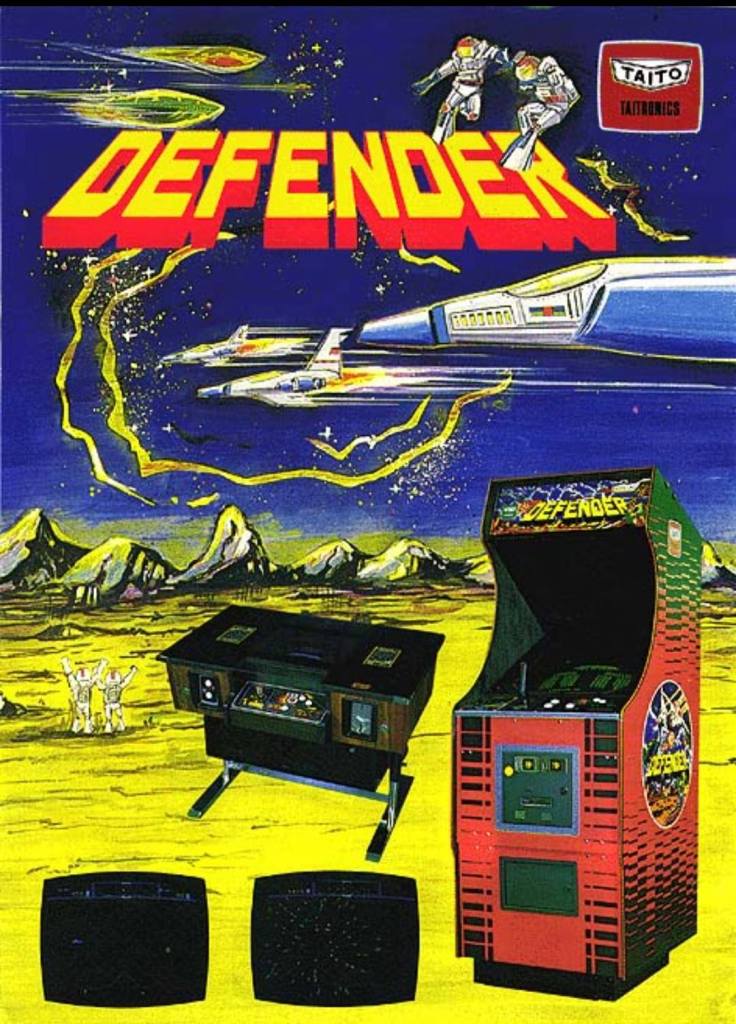
2. Defender Japanese Arcade Flyer
The front.
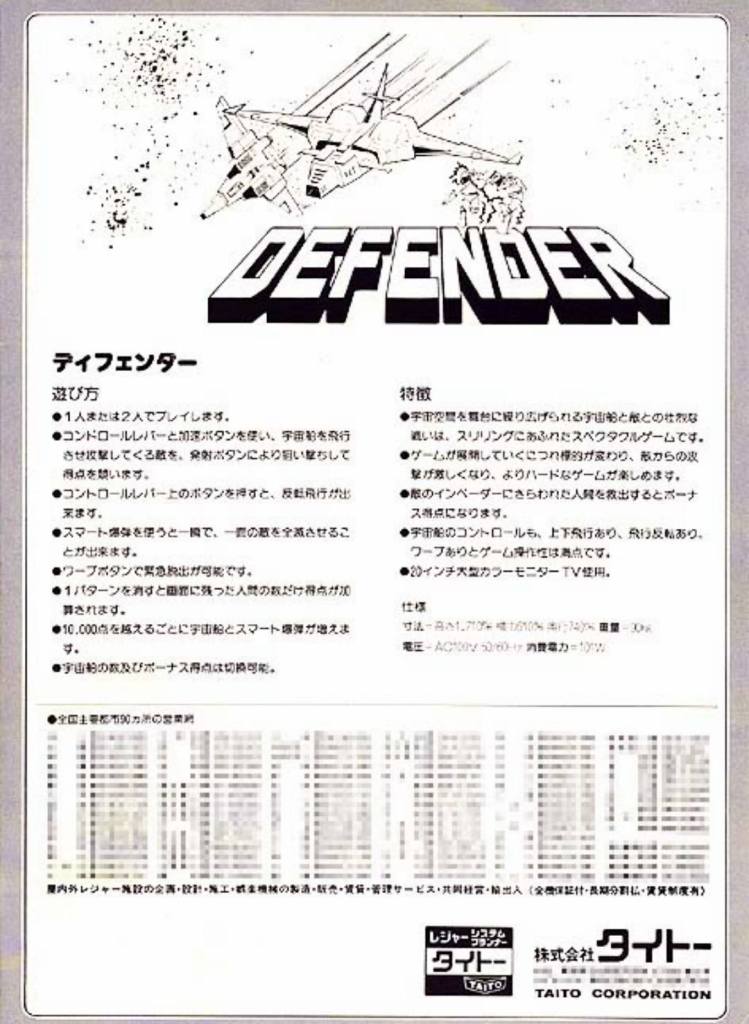
The rear.
Defender is one of my favorites among the many games of Midway. In recent times, I’ve been playing the arcade version of Defender on my Xbox Series X using the Midway Arcade Origins digital copy I purchased online. As Defender became a massive hit in America, it was released in Japanese arcades with Taito handling the distribution. The arcade flyer Taito came up with used hand-drawn art for the background on the front along with pictures of the arcade cabinet and the arcade cocktail table versions of the game. While the rear of the flyer looks very simplistic, the front remains attractive to look at.
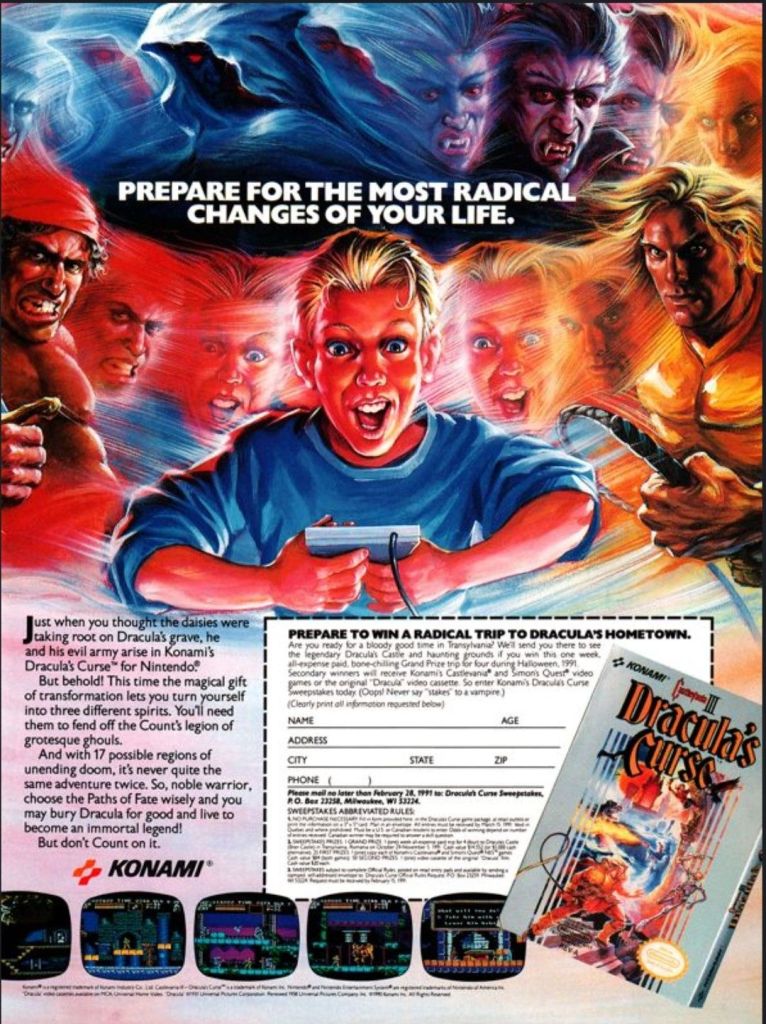
3. Castlevania III: Dracula’s Curse Print Ad
Some people found the artwork looking creepy or even terrifying.
By the year 1990, the Nintendo Entertainment System (NES) was present in several millions of households all over America and there were lots of great games available. Among the NES gamers were fans of the Castlevania game series and Konami went on to release Castlevania III: Dracula’s Curse in America. As part of the company’s aggressive promotion, a single-page ad featuring a detailed looking artwork of a gamer getting immersed with the game’s fantasy elements (look at the creepy looking characters, monsters and the game’s hero present) was done. While the artwork was a strong attention grabber, what stood out was the sweepstakes form for gamers to cut out, fill it with their information and mail it for the chance to win a trip to the hometown of Dracula. Do you personally know anyone who won in the sweepstakes?
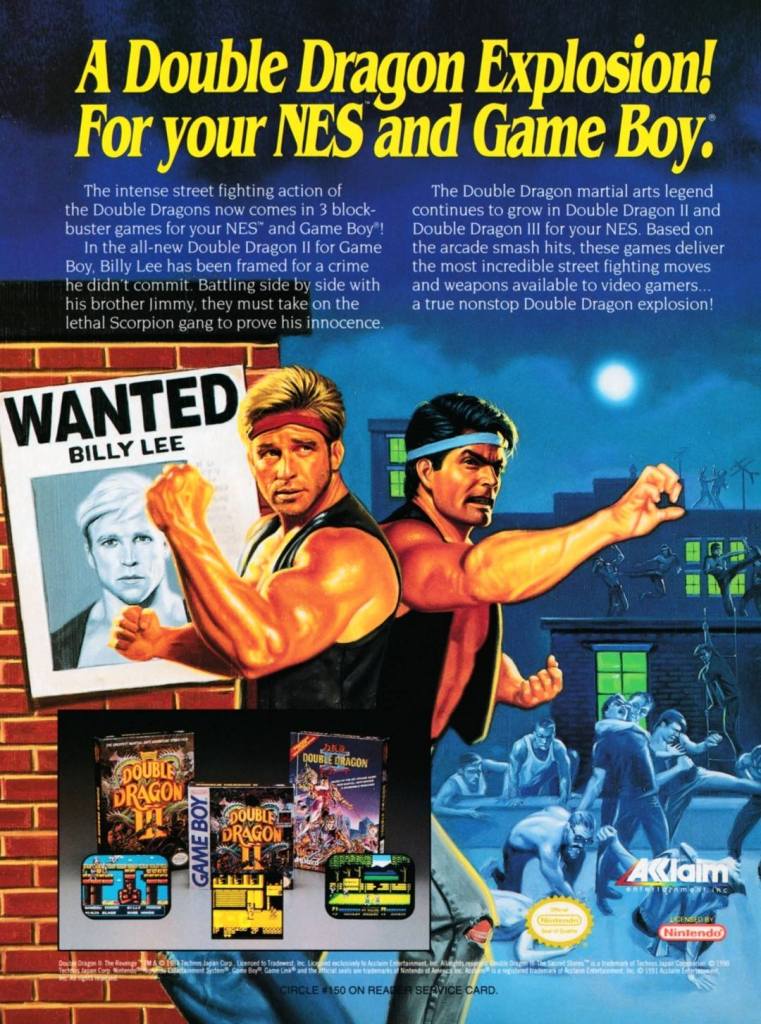
4. Double Dragon Games Print Ad
Print ad made with Double Dragon fans in mind.
When it comes to the console and handheld presence of the Double Dragon games franchise, it was on Nintendo hardware – specifically the NES and the Game Boy – where gamers and the fans could find them. Acclaim Entertainment knew how popular Double Dragon games were with Nintendo gamers and they aggressively marketed Double Dragon III: The Sacred Stones and Double Dragon II with a single-page print ad that had great looking painted artwork. Very clearly, this early 1990s ad was made to connect strongly with Double Dragon fans and its presentation still looks very solid even with today’s standards.
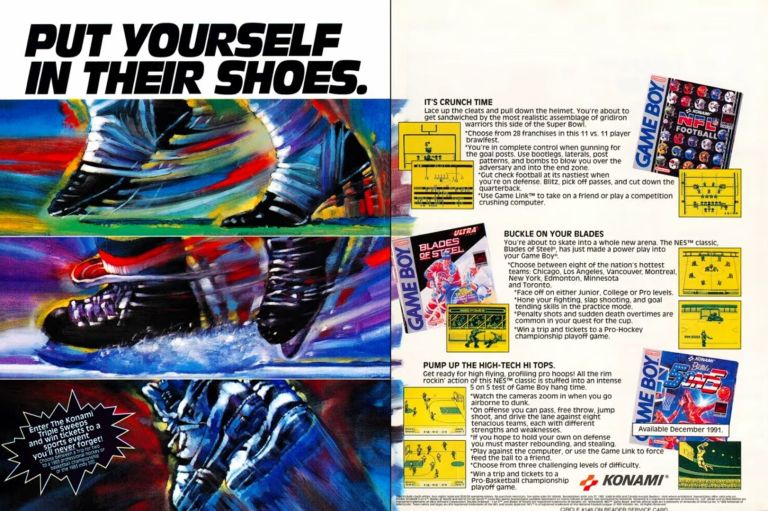
5. Konami 3-in-1 Game Boy Games Print Ad
The excitement of sports is clearly shown in this old ad.
From the mid-1980s to the early 1990s, Konami published a lot of games on Nintendo’s wildly popular platform the NES and among them were classics like Contra, Castlevania and Metal Gear. Konami’s support also made it to Nintendo’s Game Boy handheld device (first released in 1989) which itself sold strongly and became the leading platform for portable gaming. As such, Konami made a 2-page print ad promoting NFL Football, Blades of Steel and Double Dribble: 5 on 5 for Game Boy. Cleverly, the ad makers used fancy artworks on the left (reflecting the different sports) side while using the space on the right side for descriptive text, screenshots and game box covers. This fine looking ad has a strong appeal towards Game Boy users and sports enthusiasts.
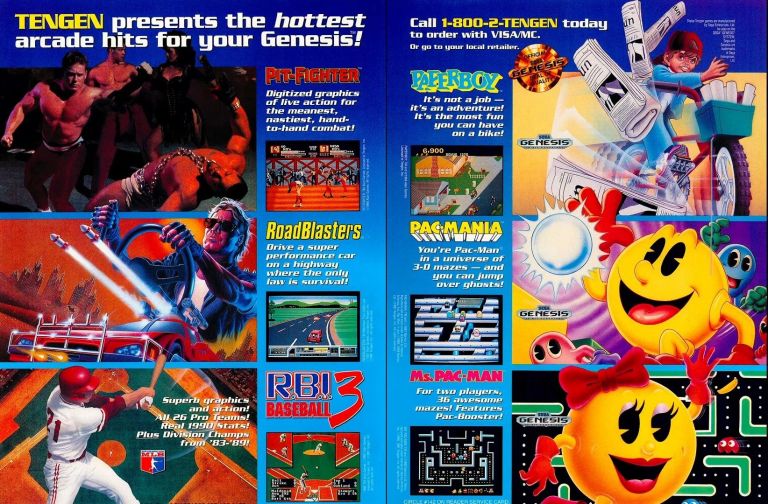
6. Tengen 6-in-1 Print Ad
This old print ad is a delight for those who owned a Sega Genesis.
Back in the 1980s, Atari formed the company Tengen to not only develop games but also publish game for computers and game consoles. During that decade, Tengen published games on the NES but they had trouble working within the strict licensing terms of Nintendo. The two companies would later get into court battles over a series of events within the gaming business. Eventually, Tengen started doing business with Sega and published games on the Genesis console. As part of their aggressive publishing of games on Sega’s console, Tengen came up with this 2-page print ad promoting six different games emphasizing that the fun arcade experiences are coming to gamers’ homes.
7. Dig Dug Print Ad
Are you aware of the business relationship and trust between Atari and Namco?
When Atari opened its branch in Japan – called Atari Japan – in the 1970s, they established a partnership with Namco to distribute arcade games there. As they experienced trouble penetrating the Japanese market, Atari eventually sold Atari Japan to Namco which paved the way for their Japanese partner to get into video games. Just a few years later, Namco developed its own original arcade game Dig Dug which became a massive hit in Japan. As a licensing deal was already in effect, Atari distributed Dig Dug in American arcades which the above magazine print ad clearly shows.
8. Sega Genesis Over SNES Print Ad
Sega directly attacked Nintendo by emphasizing the larger quantity of games andvaried game experiences that can only be found on the Genesis back then.
By the time Nintendo released the Super Nintendo Entertainment System (SNES) in 1991, the Sega Genesis console has been in the video game market for a few years already. In America, Tom Kalinske led Sega and his approach to marketing and resonating with gamers was essentially aggressive. The aggressive approach includes naming their competition and showing why Sega is superior. Given the lead time they had on the North American market, Sega came up with this print ad showing their Genesis consoles having a lot more games than the SNES. Competitive console gaming was very different back then.
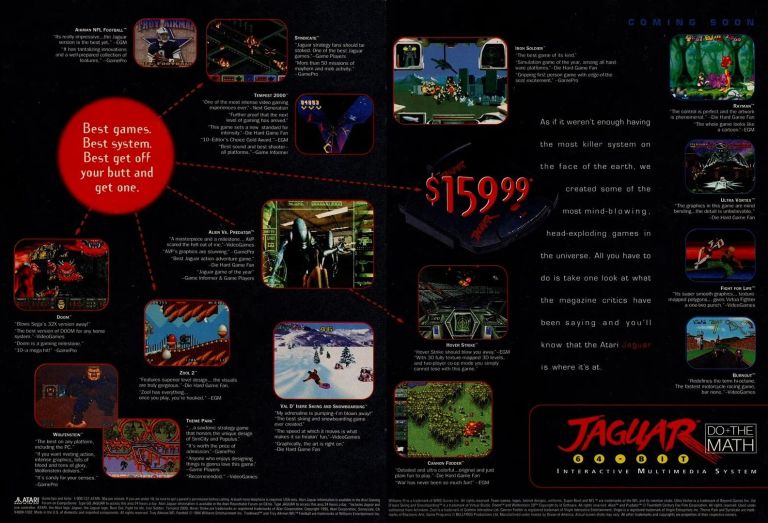
9. Atari Jaguar Print Ad
Did you spend $159.99 on an Atari Jaguar console back in the 1990s?
In the 1990s, Atari attempted a comeback in console gaming with the Atari Jaguar console. Early on, their marketing emphasized the so-called 64-bit capabilities of the Jaguar to convince gamers theirs is the most powerful console on the market. Sadly, the console failed to achieve strong sales and a huge price cut was executed. To attract customers, Atari came up with this 2-page print ad to inform them of the cheaper $159.99 price while reminding them of the “most mind-blowing, head-exploding games” they can have with the Jaguar. Obviously this ad campaign failed as the Atari Jaguar never achieved commercial success.
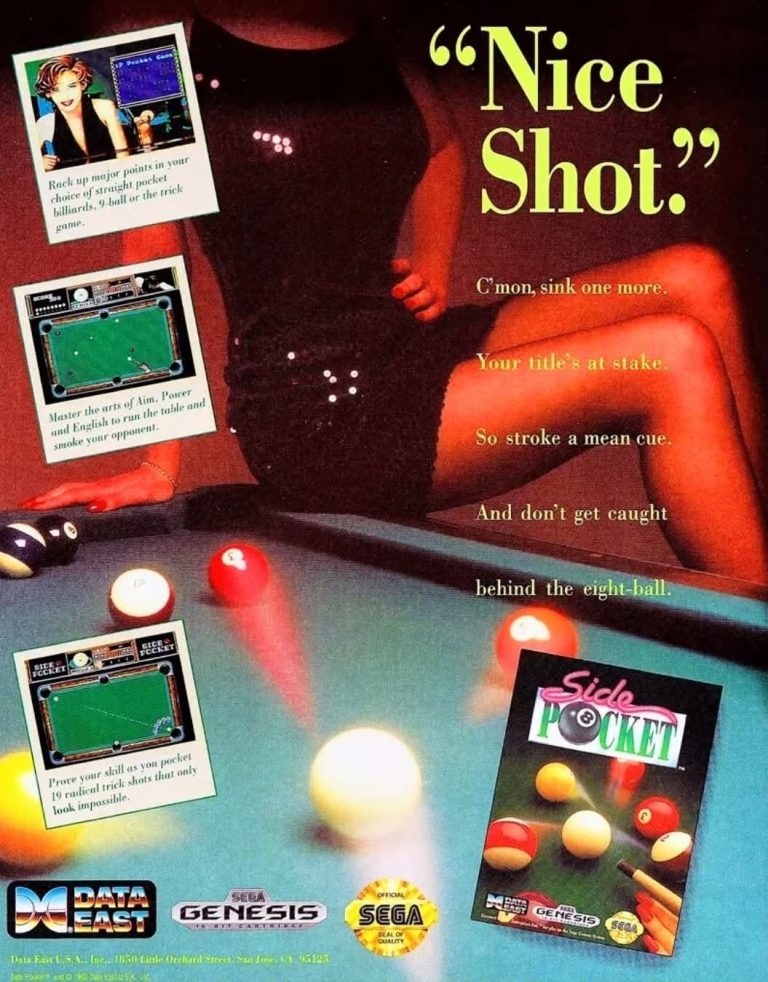
10. Side Pocket Print Ad
The Side Pocket print ad with a subtle touch of sexiness.
After its original release in the arcades in 1986, Side Pocket was ported by Data East to many consoles and handheld devices in the 1990s. When it comes to promoting the Sega Genesis version, Data East came up with this print ad showing a lady in a sexy dress in the background (head hidden) which instantly created a sexy aesthetic. The large text displayed emphasized the game of billiards supported by the screenshots shown. The screenshot at the upper-left corner shows artwork of a pretty lady smiling at the viewer which added to the sexy aesthetic of the ad.
Welcome back my readers, YouTube viewers and all others who followed this series of articles focused on YouTube videos worth watching. Have you been searching for something fun or interesting to watch on YouTube? Do you feel bored right now and you crave for something to see on the world’s most popular online video destination?
I recommend you check out the following videos I found.
#1 Popcorn in Bed react to Man of Steel – It has been over twelve years since I first saw Man of Steel in the cinema. Directed by Zack Snyder, the 2013 Superman movie had a mixed reception but managed to gross $670 million worldwide and led Warner Bros. to releasing more DC Comics superhero movies in a shared universe (ended in 2023). Recently, Popcorn in Bed finally posted its reaction video of Man of Steel and I can say it is worth the wait. Watch it now.
#2 Where to buy onigiri in Tokyo – Have you tried eating onigiri lately? Onigiri is a rice ball (rice wrapped in nori) popular in Japan and it is eaten by hand. While there is a growing number of convenience stores selling onigiri, there is still nothing like buying freshly made onigiri in dedicated stores or restaurants in Tokyo. Watch and learn from the video below.
#3 Faked presentation of starvation in Gaza exposed! – You might have seen all the news and images about starvation in Gaza through mainstream news outlets such as CNN, MSNBC, The New York Times, Reuters, Associated Press, Agence France-Presse, The Washington Post and more. Countless reports and images were published showing Gaza residents (Palestinians) desperate for food made gullible people sympathetic for the hungry while also becoming angry towards Israel. The truth of the matter is that the portrayal of Palestinian starvation is fake, staged and deliberately crafted by the Islamic terrorists who have lots of mainstream news media partners-in-crime with them. There is no real famine in Gaza at all and it is undeniable that Palestinian terrorist group Hamas (loved by the Islamo-Leftist media) stole humanitarian aid to feed themselves leaving nothing for their fellow Gaza residents. Watch and learn from the videos below.
#4 Full Metal Jacket reaction videos – Released in 1987, Stanley Kubrick’s Full Metal Jacket succeeded in intriguing or even shocking moviegoers whose perception of the Vietnam War got shaken. To be clear, the movie (which starred Matthew Modine, R. Lee Ermey, Vincent D’Onofrio, Adam Baldwin, and Arliss Howard) was more than just about war. It also showed the dehumanizing effects of war preparation, the dark humor that happens during war time and how people react when their emotional limits and sanity were really pushed hard. That being said, you should see how the movie draws reactions from the following YouTubers through their respective reaction videos.
#5 Slope’s Game Room examines Castlevania game franchise – Since the 1980s, Konami and its talented developers produced a whole lot of Castlevania video games ranging from 2D side-scrolling adventures into 3D polygonal escapades. Considering how significant Castlevania is as a game franchise, now is a good time to examine the history of Castlevania through the in-depth videos of Slope’s Game Room below.
Welcome back readers, fellow geeks and electronic gaming fans!
In this edition of the Retro Gaming Ads Blast (RGAB) series, we will take a look at another batch of retro gaming print ads – including arcade flyers – from the 1980s and 1990s.
For the newcomers reading this, Retro Gaming Ads Blast (RGAB) looks back at the many print ads of games (console, arcade, computer and handheld) that were published in comic books, magazines, flyers, posters and newspapers long before smartphones, social media, the worldwide web and streaming became popular. To put things in perspective, people back in the 1980s and 1990s were more trusting of print media for information and images about electronic games and related products.
With those details laid down, here is the newest batch of retro gaming print ads for you to see and enjoy…
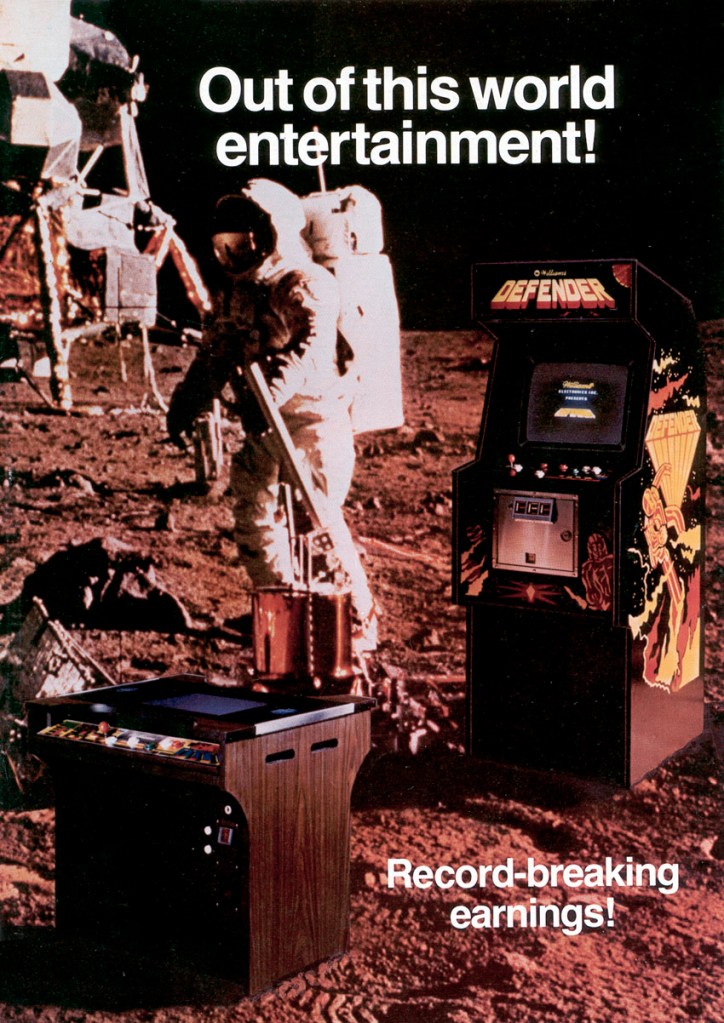
1. Defender arcade flyer
Perhaps Atari did not have enough original artwork of Defender to be used in this arcade flyer. So they ended up using footage of an astronaut on the moon.
Very long ago, I played the classic game Defender a lot on the Atari 2600. Strangely enough, I never played its arcade version as my visits to arcades were quite limited as I was so young back then. When it comes to the arcade flyer of Defender, I find the use of stock footage of an astronaut on the moon as the artistic backdrop baffling because the game’s concept was all about fighting back alien invaders and protecting the citizens. Ironically, the image blended well with the photos of two arcade machines showcased.
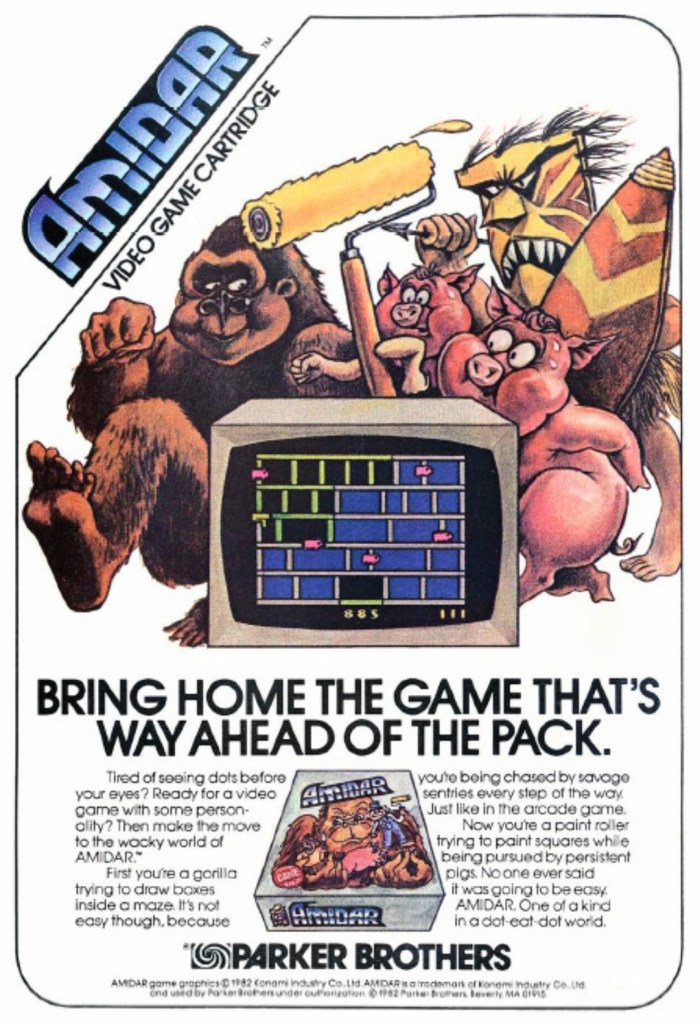
2. Amidar Atari 2600 print ad
Does this ad make you think about King Kong or animals?
When I was a young boy, I saw this Parker Brothers print ad of Amidar appear in many superhero comic books I read. I never played the game on the Atari 2600 nor in the arcades. Each time I saw this ad, I always wondered how the game played and what its creative concept was all about. The constant showing of a giant gorilla on the game box cover reminded me of King Kong.
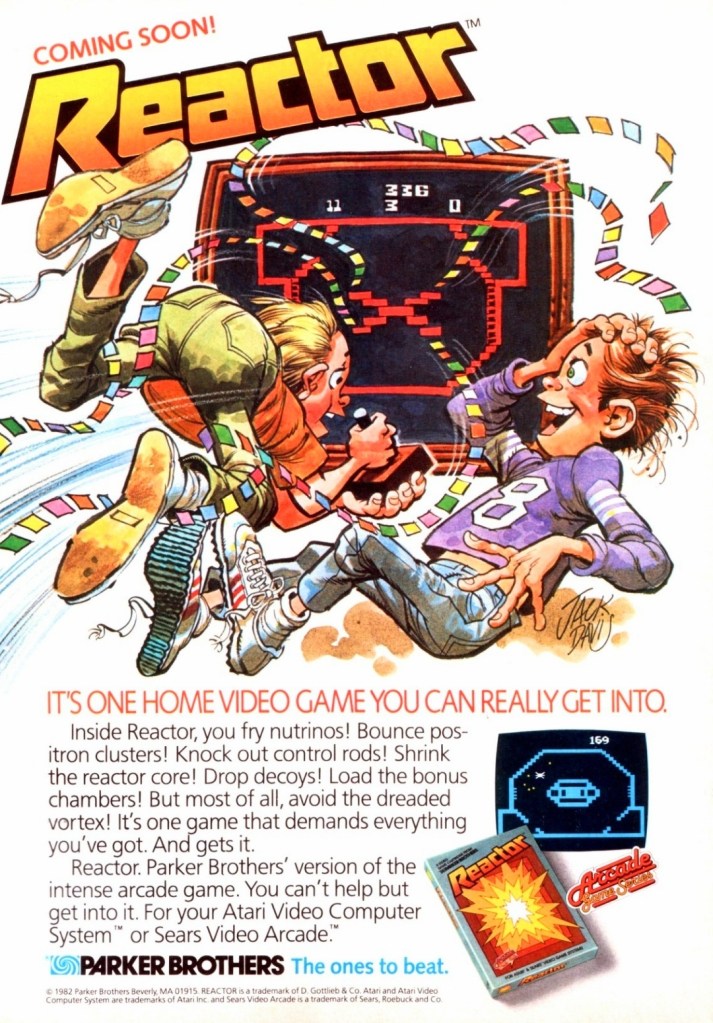
3. Reactor Atari 2600 print ad
Parker Brothers made this ad imagining gamers getting very engaged with reactor once they start playing it.
Reactor was one of those video games that was somewhat influenced by the subject of nuclear technology, particularly about the nuclear reactors. This is another game I never played on console nor in the arcades. This Reactor print ad by Parker Brothers for the Atari 2600 has a visual style and creative concept that I still find fascinating to look at.
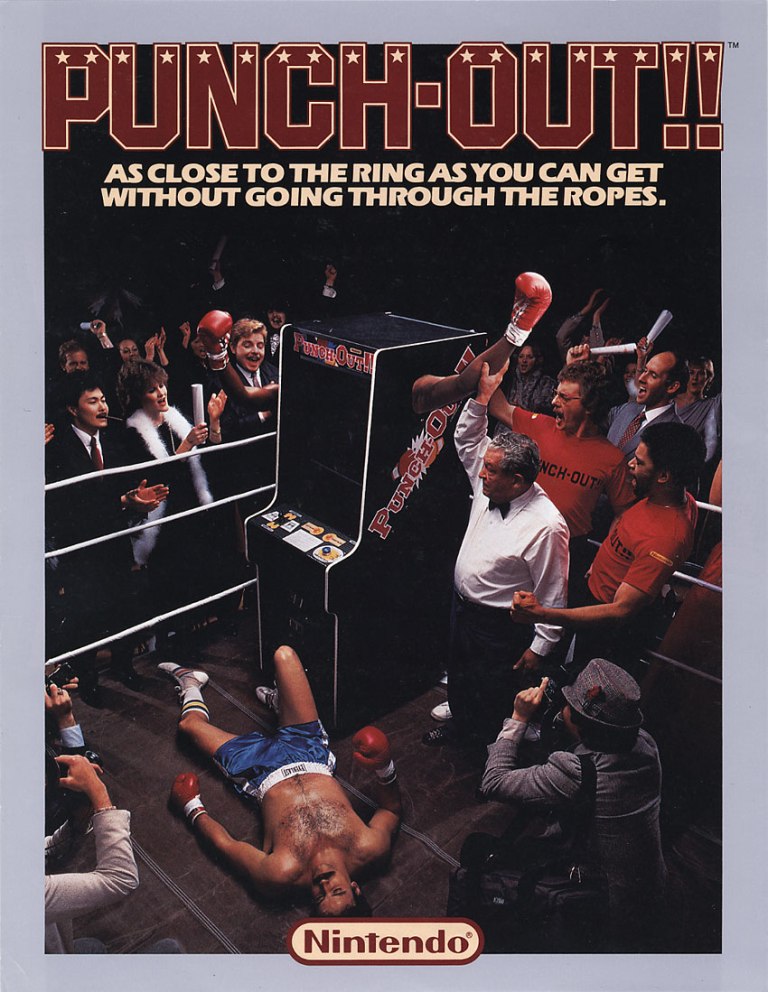
4. Punch-Out!! arcade flyer
This was years before Nintendo hired Mike Tyson to endorse the console version of Punch-Out!!
In 1984, Nintendo released the original Punch-Out!! game in the arcades and literally punched its way through to the top of American arcades that year while also scoring big in other arcades around the world. While the game proved to be very playable and a lot of fun, it could be argued that the intriguing image Nintendo used for the North American arcade flyer – a boxer down after literally getting beaten by the Punch-Out!! machine – made an impact on both gamers and arcade operators.
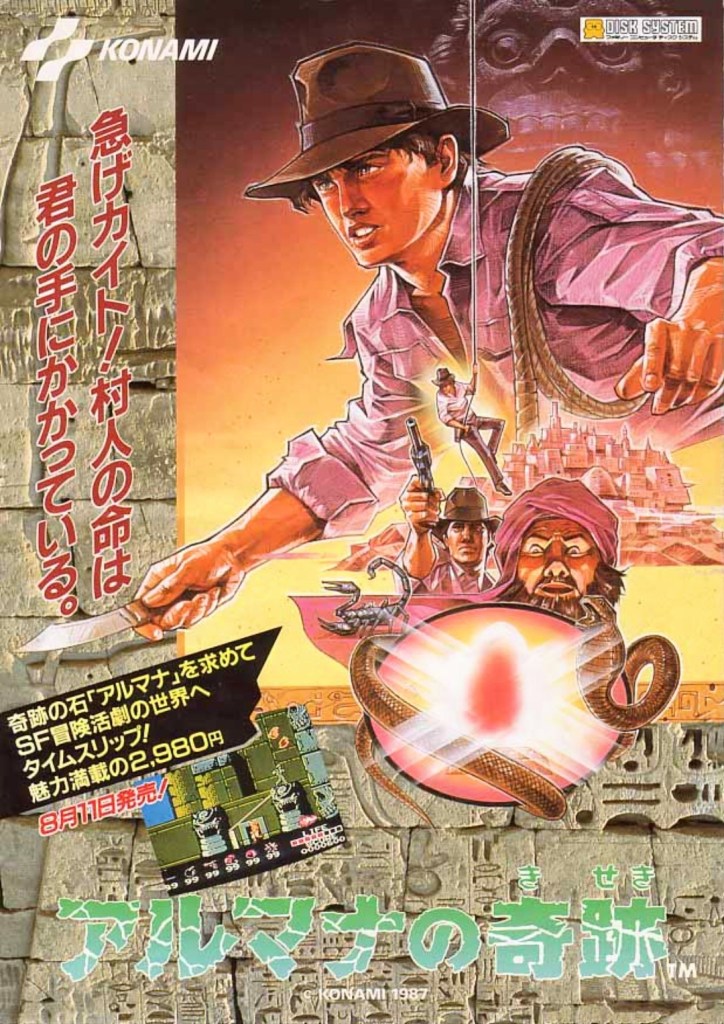
5. Arumana no Kiseki flyer
Is the famous Indiana Jones theme music playing inside your mind right now as you look at this art?
Released in 1987 on the Disk System of the Nintendo Family Computer (Famicom) in Japan, Arumana no Kiseki was one of the many 2D adventure games Konami released that entertained gamers. When compared to Castlevania – strongly influenced by American horror movies – this game was very influenced by the Indiana Jones movies of Steven Spielberg which is very evident in this promotional flyer.
In fact, some gamers who could not read the Japanese title actually thought this was an official Indiana Jones video game because the artwork was so suggestive. Having played and finished the game myself, I can say that Arumana no Kiseki was simply an Indiana Jones-inspired adventure game that had its own creative concept and unique settings and characters.
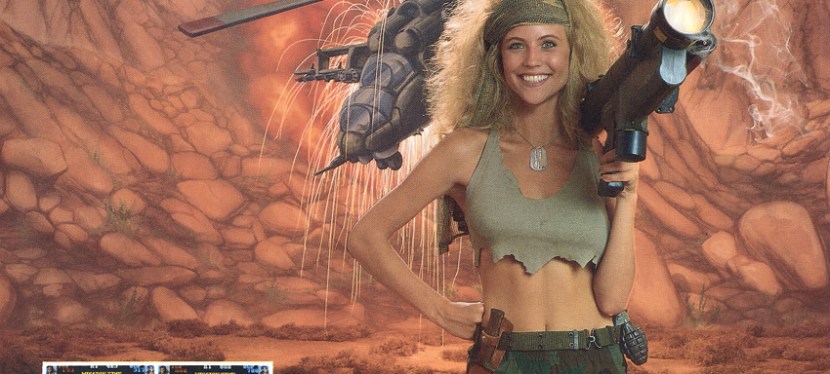
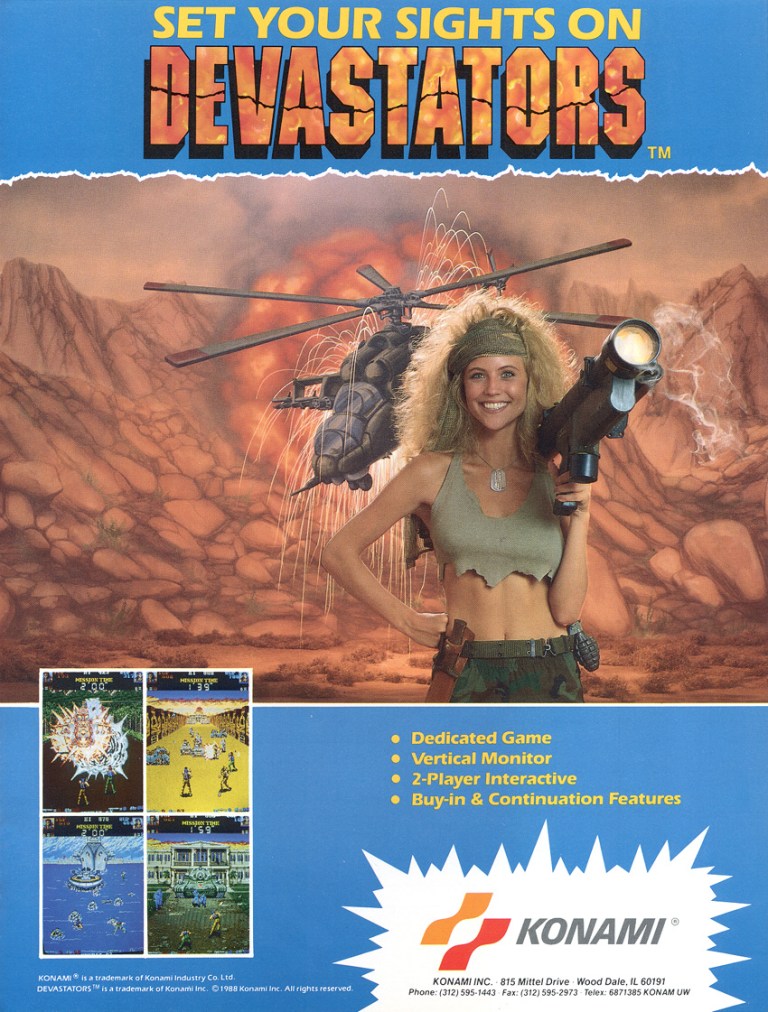
6. Devastators arcade flyer
The 1980s female Rambo smiling towards you.
By looking at the track record of Konami closely, you will notice that many of their games in the 1980s were influenced by Hollywood movies and they hired pretty or sexy models for their arcade flyers. This arcade flyer of Devastators is no exception and you can clearly see the Rambo-inspired lady smiling while carrying a weapon. Devastators itself had strong Rambo vibes for its concept.
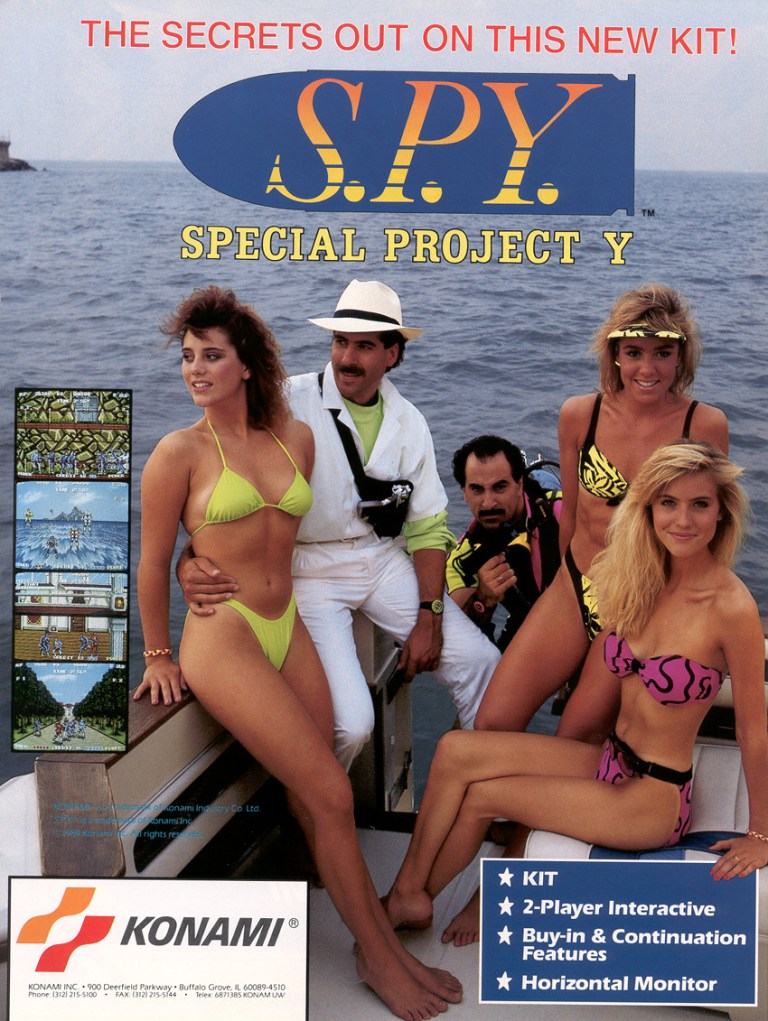
7. S.P.Y. Special Project Y arcade flyer
Somehow the picture of this flyer reminds me of Miami Vice.
Still with Konami, S.P.Y. Special Project Y is 1989 arcade game that featured action sequences in which players fight against countless enemies in order to progress with the minimal story. This game had certain spy movie elements and to promote it, Konami came up with this arcade flyer showcasing three sexy women wearing swimwear accompanied by two men who looked more like operators or schemers. Can you imagine yourself as an arcade operator looking at this flyer trying to decide to buy the game?
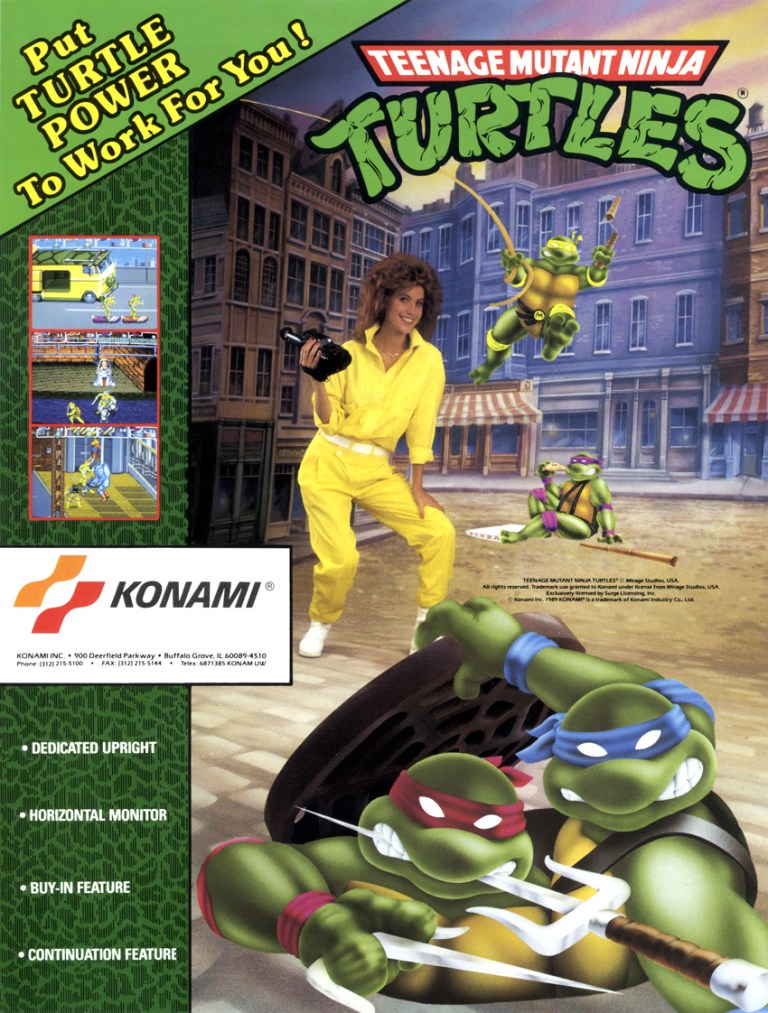
This arcade flyer is still great and exciting to look at, even if your not a TMNT fan.
Now this is one of the most definitive arcade games Konami ever made. Released in late 1989, Teenage Mutant Ninja Turtles became a massive arcade hit in North America constantly attracting lots of fans and casual gamers to play at each machine. The demand was so great, Konami had no choice but to hire a company to manufacture more machines. When it comes to promoting the game, Konami cleverly used a mix of artworks for the TMNT characters and fantasy environment while having a hired model playing April O’Neil blending in smoothly.
Having seen the 1980s animated series myself, I can say that the ad makers struck gold when it came to making a promotional image that Teenage Mutant Ninja Turtle fans can easily recognize and go to the arcade to play the game.
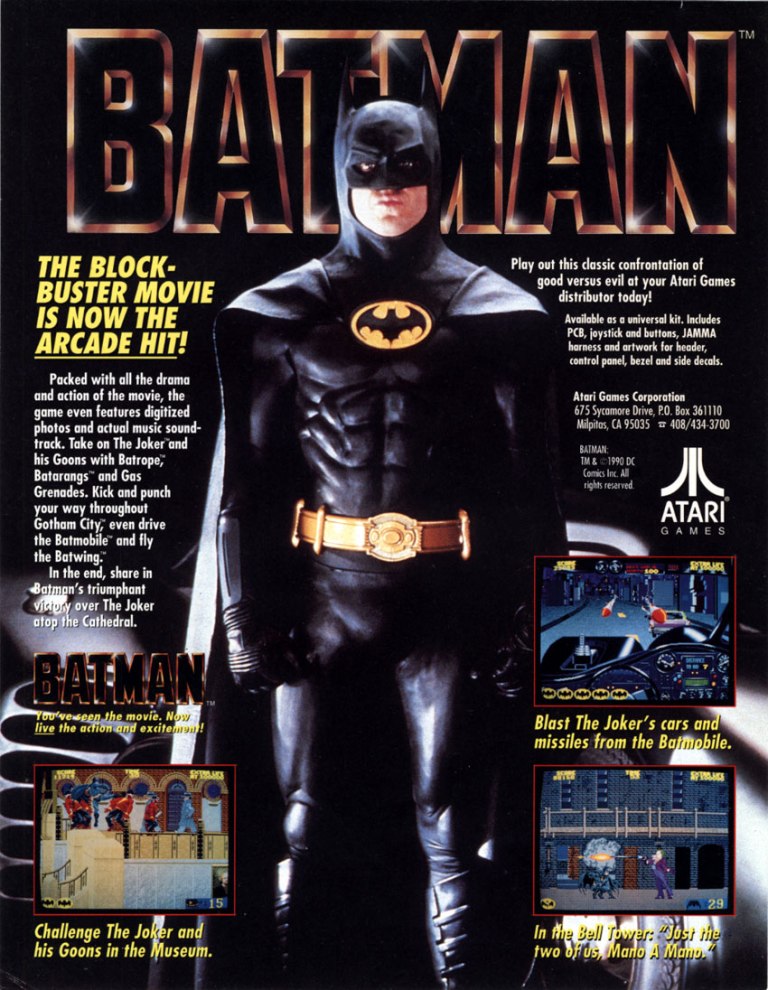
9. Batman arcade flyer
If you saw the 1989 movie, did you play this in the arcade?
The live-action Batman movie of 1989 was simply inescapable as there was so much hype, merchandising and promos connected with it. When it came to video games, it was not surprising that a lot of companies talked with Warner Bros. and eventually Atari made the official arcade game based on the movie (for insight on the production, watch PatmanQC’s video by clicking here). This early-1990s arcade flyer had a simplistic approach showing a few screenshots and descriptive text while having the live-action Batman (note: Michael Keaton in costume) dominating in the middle. Simplistic yet effective in telling gamers and arcade operators what to expect.
10. Xevious arcade flyer
This arcade flyer is exciting and creative to focus on.
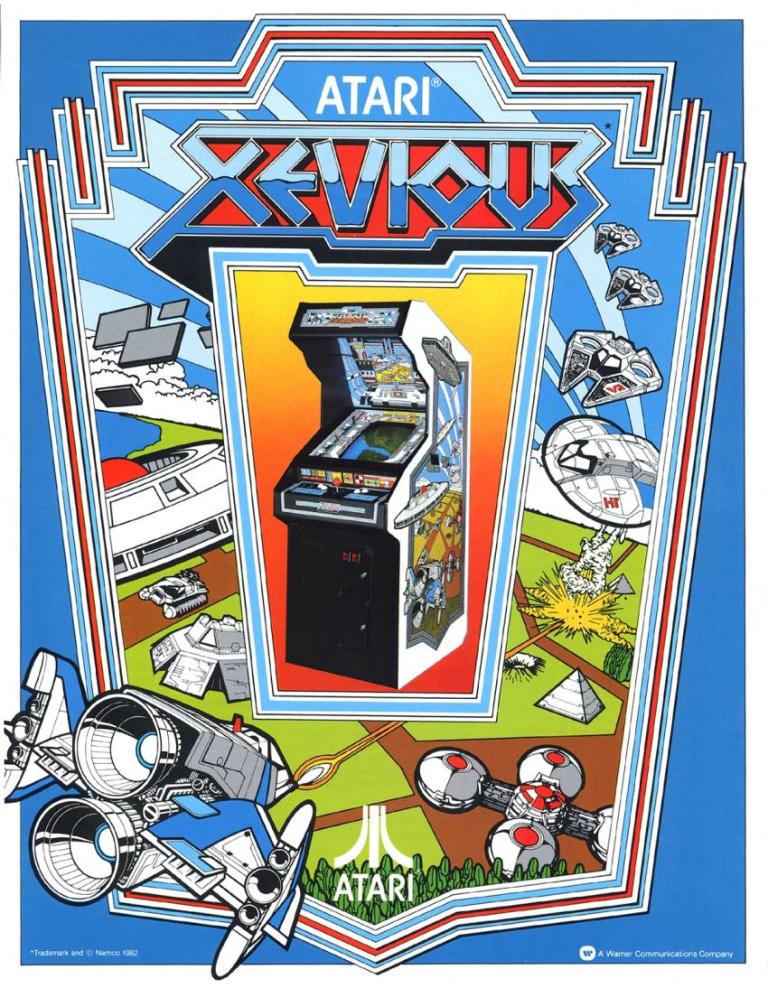
Xevious is a long-running series of video games owned by Namco. Since the early 1980s, several Xevious video games were released on arcades, consoles and mobile devices. Believe it or not, the original Xevious game was published by Atari for North American arcades and the company came up with this dynamic looking flyer to promote it. The arcade flyer really looks dynamic due to the hand-drawn art surrounding the photo of the machine. Even by today standards, this flyer still looks modern and energetic.
11. Robin Hood: Prince of Thieves print ads
Tell me if this ad makes you want to play the game.
Original artwork here was meant to immerse viewers into the fantasy setting of the game based on the movie.
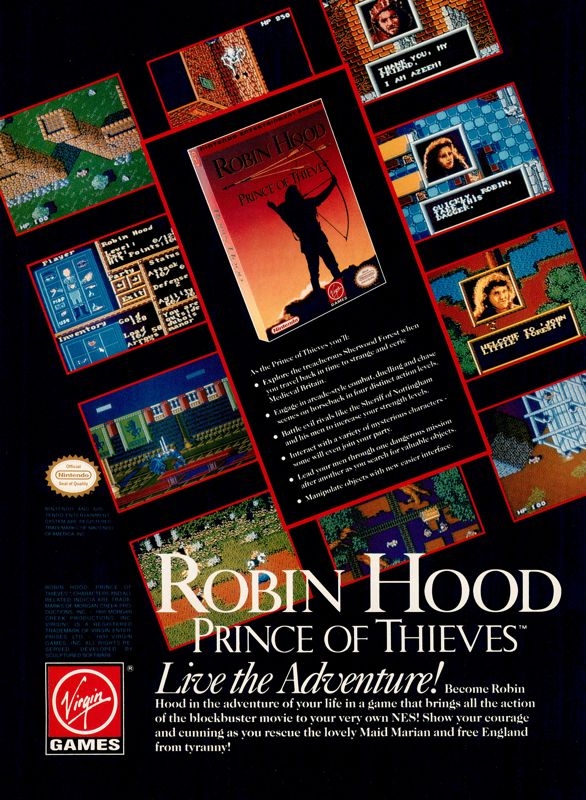
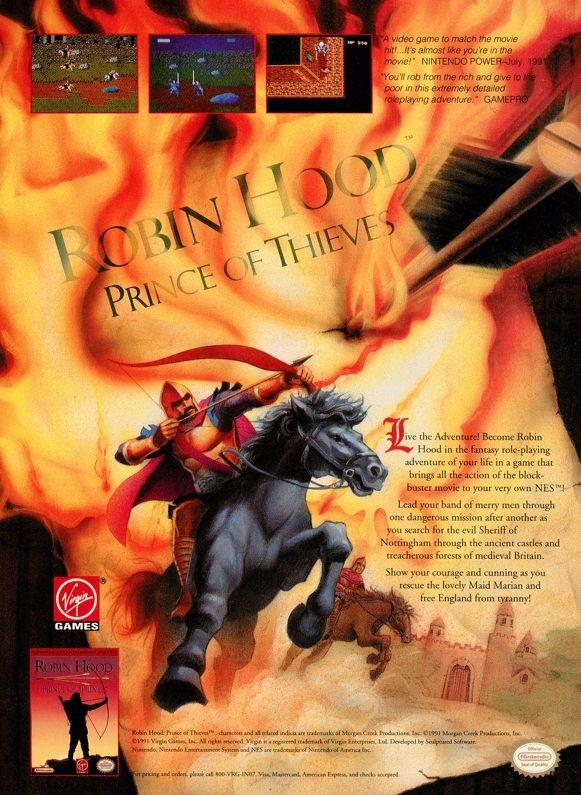
If you saw the 1991 movie Robin Hood: Prince of Thieves, were you able to play the video game adaptation? Robin Hood: Prince of Thieves on the Nintendo Entertainment System (NES) was notable for being specially featured in the Nintendo Power magazine and its game design was truly ambitious at the time. To promote the game and take advantage of the movie’s popularity, Virgin Games came out with two print ads targeting movie fans and NES gamers.
The first print ad above had lots of selected screenshots surrounding the game’s box and crammed the descriptive text. The 2nd print ad had original artwork to emphasize the fictional setting and used only three screenshots. Looking at both print ads, it was clear that the ad makers had no permission to use the likeness of Kevin Costner as Robin Hood. The same with other actors and their characters. Regardless, the ads still reminded me enough of the movie while keeping me informed about the video game.
Welcome back, my readers, YouTube viewers and all others who followed this series of articles focused on YouTube videos worth watching. Have you been searching for something fun or interesting or informative to watch on YouTube? Do you feel bored right now and you crave for something to see on the world’s most popular online video destination?
I recommend you check out the following topics and the related videos I found.
#1Germany is suffering from the acceptance of so many so-called refugees – I want to make clear to all of you that I personally reject illegal immigration and mass migration as I truly believe that nations should always secure their borders, prioritize their citizens, protect their national sovereignty and deport all foreigners who committed crime in their country. That being said, there are lots of YouTube videos about Germany’s suffering which is the result of the huge acceptance (open-borders approach) of so many foreigners in 2015 perceived by the administration of then Chancellor Angela Merkel as so-called refugees. Merkel eventually expressed regret about the big move.
To be clear, allowing so many foreigners to enter your country as migrants or asylum seekers often leads to new waves of crime, cultural tensions and a tremendous drain of taxpayer-funded resources. Also, think carefully about how many asylum seekers lied to German immigration officials about their backgrounds and situations just to enter? Is each and every asylum seeker a genuine victim of war, poverty and crime in their home country? How many people among the asylum seekers are actually terrorists and crooks? Do these asylum seekers seriously believe in reshaping Germany based on their selfish interests and impulses? How many of these migrants are willing to integrate themselves into German society and norms? For your enlightenment, posted below is a video from The Journeyman Pictures about what happened in Germany when the specially treated migrants were already in.
#2 Sega Saturn vs. Arcade videos by Sega Lord X – I never owned a Sega Saturn console. There were times when I wish I owned one as I was fond of arcade games and wanted to play them in the comfort of home. For your retro gaming interest, the Sega Saturn had ports of arcade games and there were some that were released only in Japan. Watch the selected videos of Sega Lord X below.
#3 Ashleigh Burton’s Sean Connery James Bond videos – If you are a fan of Sean Connery and his James Bond movies, then you would be interested to see Asheigh Burton’s movie reaction videos of Dr. No, From Russia with Love, Goldfinger, Thunderball, You Only Live Twice, and Diamonds Are Forever. Each of her videos are entertaining to watch.
#4 A look back at Asteroids – Way back in the early 1980s, I played the classic video game Asteroids on the Atari 2600 a lot. I never got to play it in the arcades but I played the arcade version on my Xbox Series X using the Atari 50 Collection software. If you want to know the history and impact of Asteroids, watch this video by PatmanQC.
#5 A look back at Konami Wai Wai World – Way back in 1988, my friends and I played Konami Wai Wai World (called Konami World for short) on the Family Computer (Famicom) and no matter how challenging it was to write down and input Japanese text for the passwords, we persevered to play and complete it. Konami Wai Wai World was a 2D, side-scrolling adventure game that had this ambitious concept of a crossover gathering of playable original Konami characters plus the characters from licensed games – Mikey Walsh (The Goonies and The Goonies II) and the iconic King Kong (King Kong 2: Ikari no Megaton Punch). The video by RetroGamingKnight is a must-watch for those who intend to really learn a lot about Konami Wai Wai World.
#6 You, Me and the Movies’ Creepshow reaction video – The 1982 film Creepshow is one of those horror movies made to provide viewers horror and fun. It was a film that featured the combined talents of author Stephen King and director George A. Romero. This reaction video by You, Me and the Movies is a must-watch.
#7 Minty Comedic Arts’ X2: X-Men United trivia video – I saw X2: X-Men United in the cinema here in the Philippines on its opening day on April 30, 2003. Sometimes referred to as X-Men 2, the movie was clearly an improvement over its predecessor and the filmmakers took inspiration from a very notable sci-fi movie for its storytelling and character development. This and a lot more await you all in Minty Comedic Arts’ trivia video of X2: X-Men United.
Welcome back readers, fellow geeks and electronic gaming fans!
In this edition of the Retro Gaming Ads Blast (RGAB) series, we will take a look at another batch of retro gaming print ads from the 1980s and 1990s. In addition, there will be a few flyers of arcade games as well as promotional posters of a notable console game that was released only in Japan.
For the newcomers reading this, Retro Gaming Ads Blast (RGAB) looks back at the many print ads of games (console, arcade, computer and handheld) that were published in comic books, magazines, flyers and newspapers long before smartphones, social media, the worldwide web and streaming became popular. To put things in perspective, people back in the 1980s and 1990s were more trusting of print media for information and images about electronic games and related products.
With those details laid down, here is the newest batch of retro gaming print ads for you to see and enjoy…
1. M.I.A.: Missing in Action arcade flyer
This is an effective way of catching the attention of both players and arcade operators. I can imagine the woke, the SJWs and rabid feminists getting easily offended by this.
Konami was a very prominent producer of games back in the 1980s. Not only did the company produce high-quality and enjoyable military-themed games on consoles and computers, Konami also made its presence felt in the highly competitive sector of arcade games. In 1989, they released the arcade conversion kit of M.I.A.: Missing in Action and this flyer is the best know promotion of it. M.I.A.: Missing in Action is the follow-up to Konami’s hit game Rush’n Attack.
Visually, the flyer’s display of four screenshots combined with a dominating photographic image of prisoners of war (POWs) getting delightfully released by an attractive female Rambo-type rescuer were designed to catch the attention of young adult and adult gamers. The text descriptions (note: there were more details on the back of the flyer), however, were geared towards arcade operators who were looking for new games to acquire without the hassle of having to buy an entire arcade cabinet. That being said, this flyer was a clever way to appeal to arcade operators and the people who love playing arcade games.
2. Fonz arcade flyer
Simplistic yet effective to look at. If you are an arcade operator, this flyer conveniently has key information displayed.
Believe it or not, Sega was already active in arcade games way back in the 1970s. In this particular flyer, Sega’s arcade game Fonz (also called Moto-Cross, Man T.T.) offered players the unique experience of driving a digital vehicle using actual handlebars on the machine that were meant to create an immersive and realistic feel. If you look closely, the flyer has lots of details written with arcade operators and players in mind.
3. Haunted Castle arcade flyer
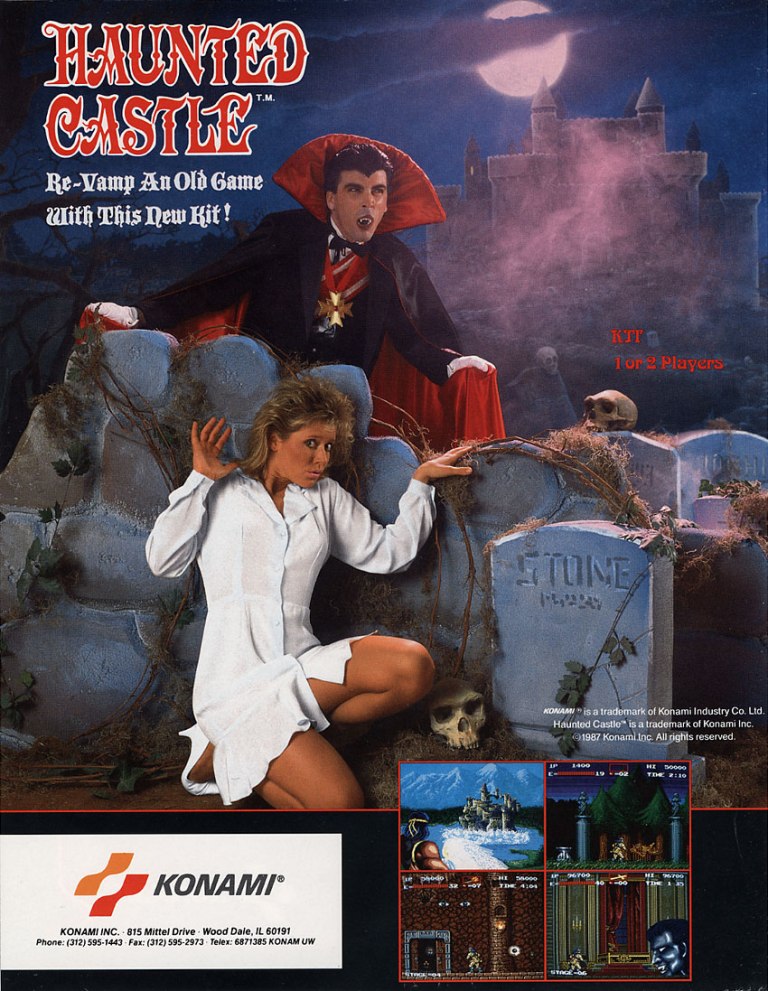
Indeed, this game is part of the Castlevania game franchise. It was one of the first Castlevania games released for arcades.
Arguably, Konami is best known for the Castlevania game series which covered handheld gaming devices, personal computers, video game consoles and even arcades. Haunted Castle (Japanese title: Akumajō Dracula) is the 2nd arcade game of the Castlevania franchise and it is not a port of any console game. Like the arcade flyer of M.I.A.: Missing in Action, this one was crafted to lure the attention (and money) of arcade operators looking for conversion kits to replace their old games. The visual presentation is eye-catching and even though the Castlevania brand was nowhere to be seen, Castlevania fans could tell this this arcade offering was part of their favorite game franchise.
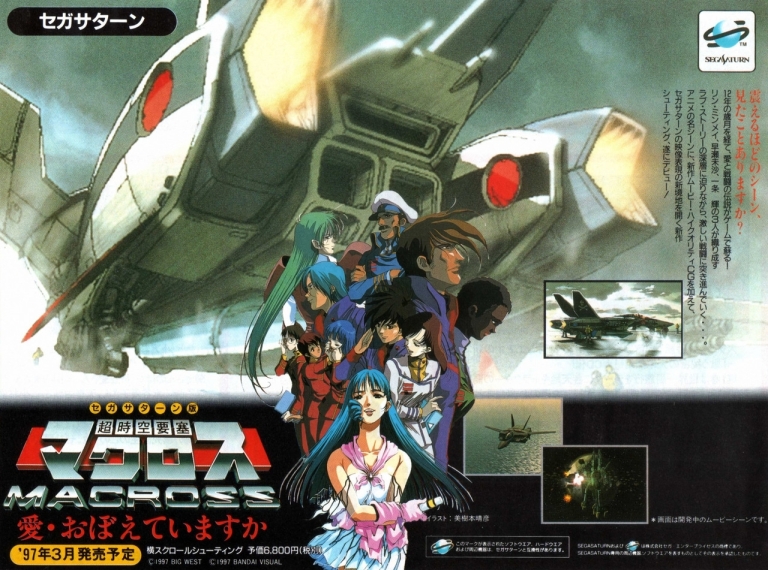
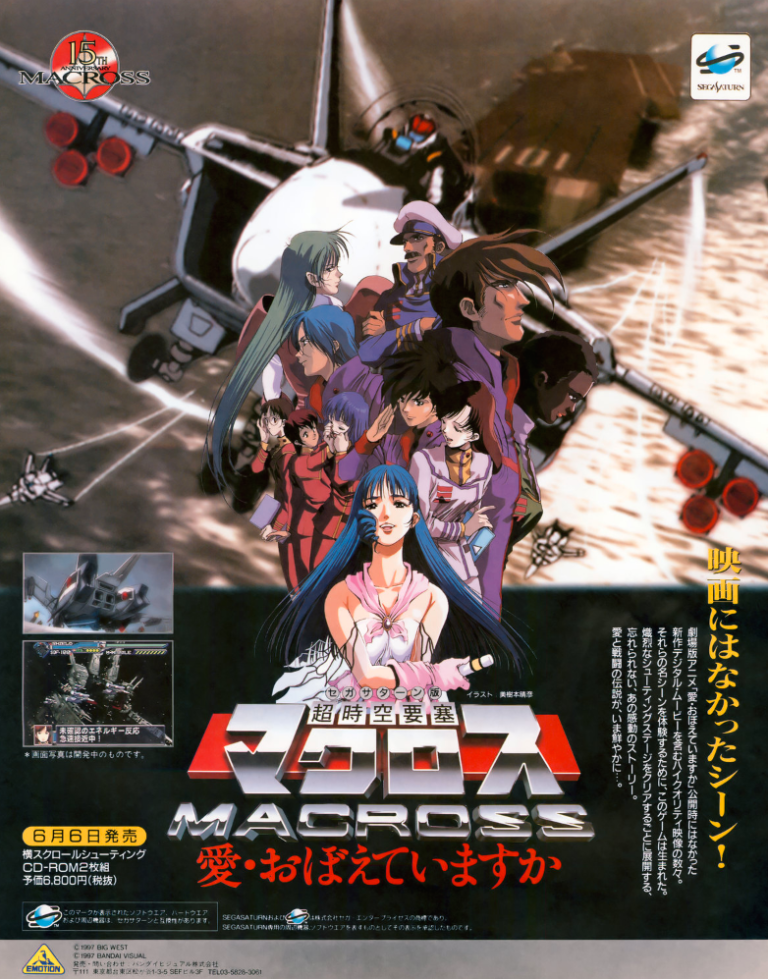
4. The Super Dimension Fortress Macross: Do You Remember Love? flyer and poster
The poster promoting the release of the game for Sega Saturn in Japan.
The flyer promoting the Sega Saturn game’s 1997 release as well as the 15th anniversary of Macross.
In 1997, the 15th anniversary of the Macross multimedia franchise was celebrated in Japan and among the highlights was the release of The Super Dimension Fortress Macross: Do You Remember Love? on the Sega Saturn. To promote the game and the franchise itself, lots of flyers and posters were released in Japan. If you look at the illustrated images on the promotional materials closely, you will realize that they are not from the original 1982-83 Macross anime TV series but rather from the The Super Dimension Fortress Macross: Do You Remember Love? animated movie of 1984 (read my retro movie review by clicking here).
While it might be baffling to some as to why the original anime TV series was not used as the source material for the 15th anniversary celebration through gaming, the 1984 anime feature film was actually more adaptable for a video game project (read my retro review by clicking here). It is so obvious, you just have to ask yourselves this question – how can the game developers compress the entire concepts of the 36-episode Macross anime series into one game while ensuring fun gameplay? Regardless, the game was a lot of fun to play and I enjoyed playing the PlayStation version in 1999.
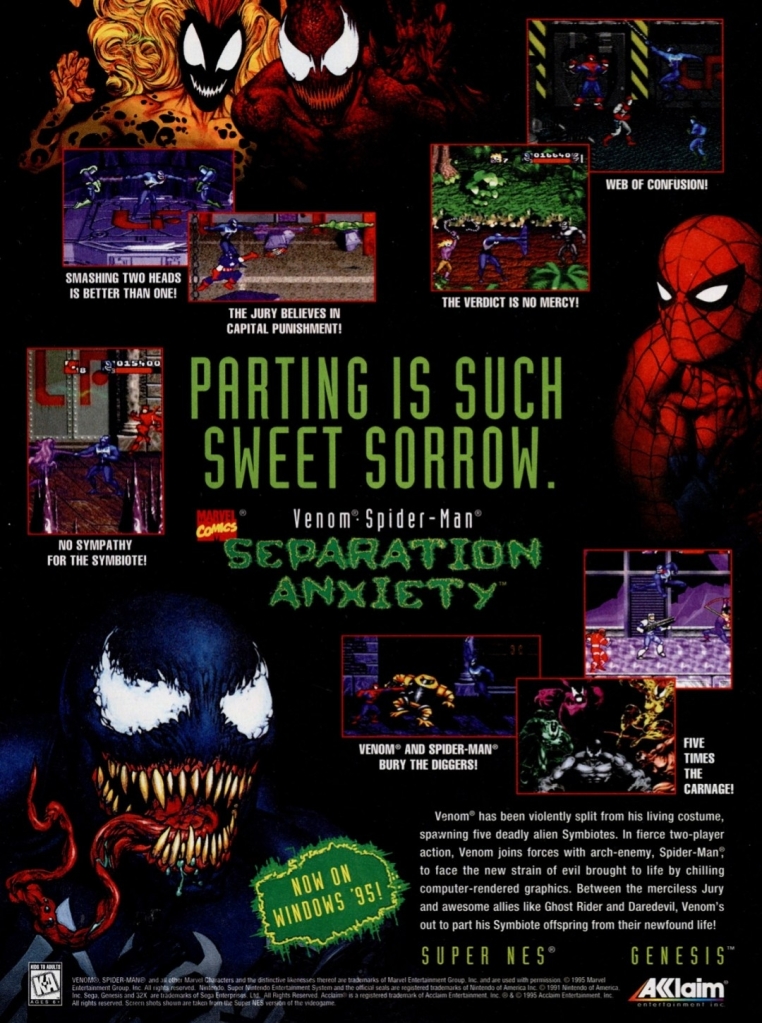
5. Venom/Spider-Man: Separation Anxiety print ad
A clear effort to sell the game to gamers as well as fans of Spider-Man and Venom.
In 1994, Acclaim released Spider-Man and Venom: Maximum Carnage (based on the 1993 comic book storyline Maximum Carnage) on Super Nintendo Entertainment System (SNES) and Sega Genesis ultimately becoming popular with comic book fans and gamers who enjoyed sidescrolling beat-them-up games.
Subsequently, Acclaim and develop Software Creations reunited to release the sequel Venom/Spider-Man: Separation Anxiety a year later on the two leading 16-bit consoles as well as on personal computer (PC). If there is anything notable about this eye-catching print ad, it is the fact that its visual presentation (with graphics on-par with the previous year’s game) cleverly hides the fact that it did not have much new to offer gamers with regards to gameplay and story cutscenes (which the previous game prominently had). Eventually, this game attracted weaker reviews from game critics and has since been forgotten.
6. Tecmo Super Bowl SNES print ad
From the time when Tecmo was still a strong producer of sports video games.
In 1991, Tecmo Super Bowl was released on the aging Nintendo Entertainment System (NES) and because its game design greatly entertained gamers, it became a tremendous commercial success. Not even the very high launch price of $54.99 stopped it from selling a lot.
To keep the commercial success and public interest going, Tecmo announced a new version of the game for the more powerful SNES console with the simple title of Tecmo Super Bowl. If you look closely at the print ad, you will notice that gameplay screenshots were not used at all. Instead, they showed images of the nicely illustrated art works they prepared as eye candy for the game with the intention of making it look cinematic. This is very curious because gameplay itself was the main selling factor of the NES version of Tecmo Super Bowl. I can only guess that Tecmo was not ready to show gameplay images by the time this print ad was made.
7. X-Men 2: Clone Wars print ad
The art used is too alienating for promoting this game.
During the age of the 16-bit consoles, there was a variety of X-Men video games released and produced by different companies. In 1993, an X-Men game published by Sega was released exclusively on the Genesis console which turned out to be fun for gamers and received mostly positive reviews from the critics. Sega went on to publish the sequel X-Men 2: Clone Wars and this print ad caught my attention because of how exaggerated the characters looked. It’s so strange, it’s as if the artist took visual reference from a somewhat blocky 3D polygonal portrait then tried to make them look hand-drawn. I wonder if anyone from Sega regretted this.
Welcome back readers, fellow geeks and electronic gaming fans!
In this edition of the Retro Gaming Ads Blast (RGAB) series, we will examine print ads from the 1980s and the 1990s that caught my attention and I will explain why they are worth look back at.
For the newcomers reading this, Retro Gaming Ads Blast (RGAB) looks back at the many print ads of games (console, arcade, computer and handheld) that were published in comic books, magazines, flyers and newspapers long before smartphones, social media, the worldwide web and streaming became popular. To put things in perspective, people back in the 1980s and 1990s were more trusting of print media for information and images about electronic games.
With those details laid down, here is the newest batch of retro gaming print ads for you to see and enjoy…
1. Star Wars: Rebel Assault print ad
This print ad was strong enough to capture Star Wars fans’ attention and make them interested with the Sega CD.
If there is anything notable about the Sega CD (Mega CD in other parts of the world) platform, it is the fact that the machine was an add-on to be connected with the Sega Genesis (Sega Mega Drive elsewhere) console. That being said, LucasArts included the Sega CD as one of several platforms for the multiplatform release of their 1993 game Star Wars: Rebel Assault. The above print ad caught my attention with its use of 9 screenshots (emphasizing a wide look at the game’s Star Wars concept) and text description (emphasizing multi-media features connected with gameplay), and for a time it made me interested in the Sega CD. Looking back at the game’s marketing, Star Wars: Rebel Assault was designed to not only give gamers sessions of play to enjoy but also opportunities to immerse themselves deeper into the realm of Star Wars. The game even had selected video clips from the original Star Wars trilogy movies.
2. Cloak & Dagger print ad
This print ad could have used at least two screenshots from the arcade game…
In 1984, there was a movie titled Cloak & Dagger (read my retro movie review by clicking here) which was not only the 4th cinematic adaptation of the short story “The Boy Cried Murder” (written by Cornell Woolrich) but also had the real-life electronic game Cloak & Dagger as a crucial plot element. To make things clear, there was a Cloak & Dagger game released in the arcades (as emphasized in the above print ad) from Atari. Behind the scenes, the filmmakers and Atari worked together which explains the video game tie-in with the movie. While the above arcade conversion kit print ad does not show screenshots of gameplay, the four images of the playable protagonist Agent X shown were from the game’s short transition sequences (moving from one level to another) which were also displayed in the 1984 movie. Those images were enough to remind me about the movie I enjoyed.
More on the Atari connection, the movie had a cleverly presented short scene showing the young protagonist Davey (played by Henry Thomas) playing Cloak & Dagger on his Atari 5200 console with spliced gameplay footage of the arcade version shown within cuts. In real life, however, Atari never released a version of Cloak & Dagger for any console nor computer in the 1980s. Today, you can play the game on the Atari 50 collection on consoles.
3. BurgerTime print ad
This BurgerTime print ad was entertaining to look at and easily reminded viewers about food and the popular game coming home.
Back in 1982, BurgerTime (Japanese title: Hamburger) was released in the video arcades and turned out to be a big hit in both Japan and America. Seeking to capitalize on the game’s success, Mattel Electronics acquired the rights of the game from Data East and went on to release versions of it for the Intellivision, Atari 2600, Apple II and the IBM personal computer. Mattel went on to market the game for consoles and computers by coming up with a print ad (the one above) that had comic book-style hand drawn art of the playable protagonist chef Peter Pepper running away from walking versions (anthropomorphic figures) a hotdog, an egg, and a pickle. The ad showed a single screenshot which was sufficient enough to show readers the concept of the game clearly. In my experience, I never got to play BurgerTime in the arcades but I first learned about its existence thanks to the eye-catching print ad above which appeared in comic books I read. In addition, the print ad also does an effective job to remind readers about food.
4. SOS print ad
This print ad made me interested in the game as I was already aware of the historical sinking of the Titanic, and I already saw the disaster film The Poseidon Adventure.
Moving back to the 1990s, I saw the above print ad of the video game SOS for the Super Nintendo Entertainment System (SNES) while reading a comic book. The nice artwork caught my attention as it easily reminded me of the disaster movie The Poseidon Adventure (1972) as well as the real-life tragedy of the Titanic. Then I saw the screenshots on the print ad and they made me interested on the game which I later played on a rent-by-the-hour game joint. Looking back at the text description of the print ad, it did not describe what the technical and graphical features of SOS were. That being said, I was surprised to experience the game’s use of the SNES Mode 7 effects which enabled the scaling and rotating of the in-game environment which affected gameplay in many ways. Read my retro review of SOS by clicking here.
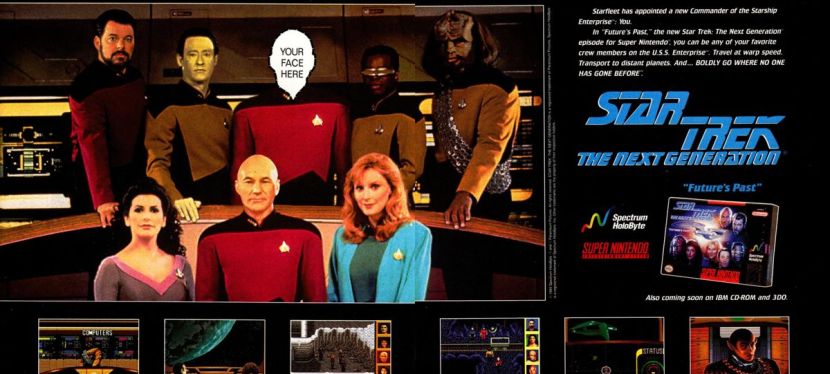
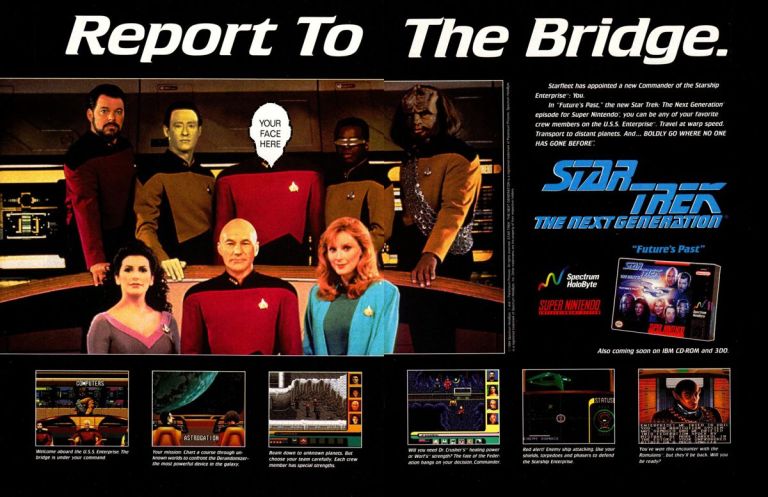
5. Star Trek: The Next Generation – Future’s Past print ad
This 2-page print ad was strong enough to invite readers to literally join the Star Trek: TNG crew and go where no man has gone before. By the way, when was the last time you saw Marina Sirtis or Gates McFadden on a video game ad?
Long before wokeness ruined Star Trek in this modern age, the sci-fi franchise reached a tremendous high in popularity and projects in the 1990s as that decade had Star Trek: The Next Generation (most of its TV seasons and three movies were released within the decade), Star Trek: Deep Space Nine and Star Trek: Voyager that kept fans entertained.
Considering its high popularity, it was not surprising that a video game adaptation of Star Trek: TNG was released in 1994 titled Star Trek: The Next Generation – Future’s Past (the version for Super Nintendo Entertainment System) and I saw the above print ad while reading a gaming magazine. Using a slightly altered version of the TNG group photo, the print ad emphasized its concept that the player will be able to lead the crew of the Starship Enterprise and take part in a series of missions in different parts of space with the likes of Captain Picard, Commander Riker, Data, Worf, Dr. Crusher, Deanna Troi and La Forge. While I was never a Star Trek fan, the above print ad caught my attention with its concept, the group photo and the screenshots gave me an idea of what the game has to offer. It should be noted that Star Trek: The Next Generation – Future’s Past was released between the end of Star Trek: TNG’s final season and the theatrical release of Star Trek: Generations.
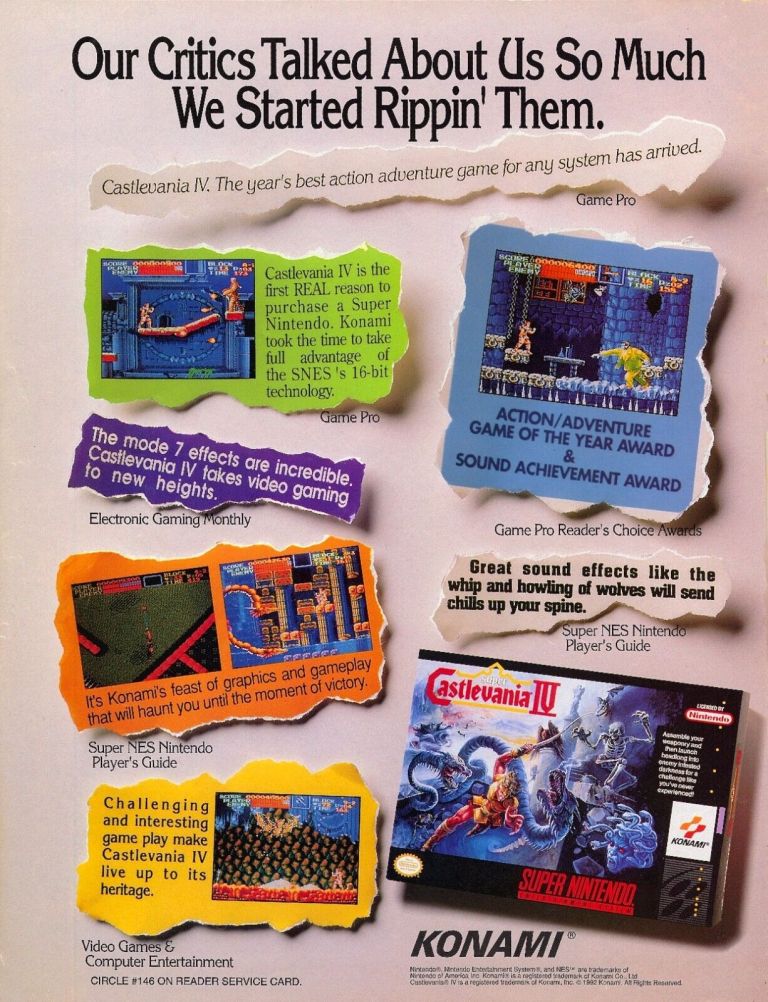
6. Super Castlevania IV print ad
This was one of the most eye-catching print ads I’ve seen about a Konami video game.
The jump in technology from one console generation to the next can be beneficial for gamers if game developers harnessed the advantages of new technologies to make new games that turned out to be more engaging and more enjoyable. Such was the case with Super Castlevania IV for the Super Nintendo Entertainment System (SNES) in 1991. The above print showed Konami highlighting the positive feedback their game received from different gaming media outlets and used screenshots to give gamers and long-time Castlevania fans exciting stuff to see. I got to play the game on the mini SNES console and I can say that in terms of visuals, controls and gameplay, Super Castlevania IV truly lived up to its title and it remains fun to play to this day.
Welcome back readers, fellow geeks and retro gaming fans!
In this edition of the Retro Gaming Ads Blast (RGAB) series, we will examine print ads from the 1990s that caught my attention and I will explain why they are worth look back at. In retrospect, the 1990s was a decade of serious changes in the world of electronic gaming as the industry saw the shift of graphics from 2D sprites and flat backgrounds to 3D polygons, the shift from cartridges to CDs for software distribution, and more.
For the newcomers reading this, Retro Gaming Ads Blast (RGAB) looks back at the many print ads of games (console, arcade, computer and handheld) that were published in comic books, magazines, flyers and newspapers long before smartphones, social media, the worldwide web and streaming became popular. To put things in perspective, people back in the 1980s and 1990s were more trusting of print media for game details and images.
With those details laid down, here is the newest batch of retro gaming print ads for you to see and enjoy…
1. Castlevania: Bloodlines print ad
Creepy looking but not horrific. The simplistic approach turned out to be effective on making Sega Genesis gamers excited for this Castlevania release.
During the early stage of the so-called 16-bit console wars, Konami’s Castelvania series made the huge next-generation leap with Super Castlevania IV on the Super Nintendo Entertainment System (SNES) which gave gamers loads of fun challenges along with technological improvements that added to the gameplay. Being a prolific multiplatform game maker, Konami knew it could not abandon its fans who own the 16-bit console of Sega and this led them to making a unique Castlevania experience with the Sega Genesis in mind – Castlevania: Bloodlines.
The above print ad of Castlevania: Bloodlines was very eye-catching as it showed a photographic presentation of the grave of the Belmont family (note: Simon Belmont is arguably the most known hero of the series) backed with a detailed text description as well as screenshots that showed exactly what Castlevania fans expected with gameplay and presentation. While the visual style of the ad had a subtle approach to horror, it succeeded in informing the public that another fun-filled Castlevania experience was coming. The game went on to be a hit among gamers and critics.
2. The Granstream Saga print ad
THQ really tried hard to sell The Granstream Saga in North America at a time when a lot more Japanese RPGs started coming into the market.
Back in the late 1990s, there was a slew of Japanese role-playing games (JRPGs) that got released on the PlayStation console in North America arguably because of the massive sales success of Final Fantasy VII in 1997. In 1998, THQ (note: then a newcomer in video gaming) made the daring move to release The Granstream Saga in North America and it was part of the company’s plan of releasing more RPGs. With regards to the 1998 print ad, THQ marketing team wisely emphasized the fact that the game launched at #1 in Japan (published by Sony) although, strangely, the rest of the short descriptive text did not emphasize the fact that the game was one of the first fully polygonal RPGs ever released. The ad had one image of an animated cut scene while there were two gameplay images. When I first saw the print ad, I became interested with The Granstream Saga as I was fond of both RPGs and anime. I never got to play it due to a lack of time and money back then.
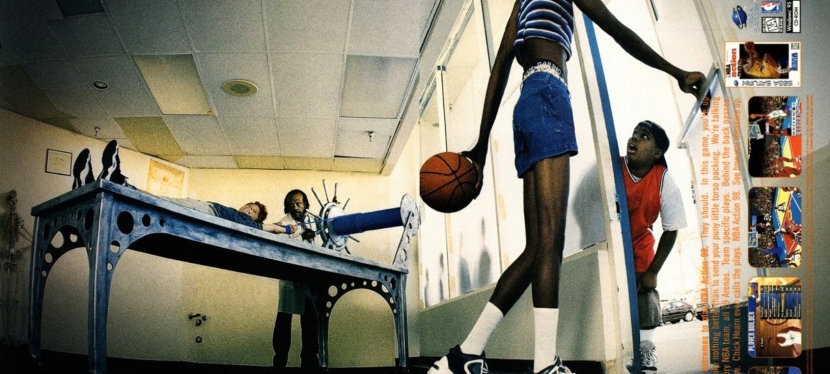
3. NBA Action 98 print ad
Do you find this print ad funny or disturbing or both?
The first time I saw Sega’s print ad of NBA Action 98 (a polygonal NBA basketball video game for the Sega Saturn), it caught my attention quickly mainly because of the concept of the imagery showing a really tall guy leaving the place after getting stretched to be tall (as emphasized by an adult operating a machine to stretch another kid’s body to get taller) as a kid from outside looks on. While it looked hilarious at first, the photographic imagery also had an unintentional dark tone as the adult operating the machine looked like he was torturing the kid. This print ad was really eye-catching in a rather disturbing fashion to me, so much so I did not have any interest left to check out the advertised game. The small size of the screenshots and the hard-to-read descriptive text did not help at all. In my view, this was a marketing misfire by Sega.
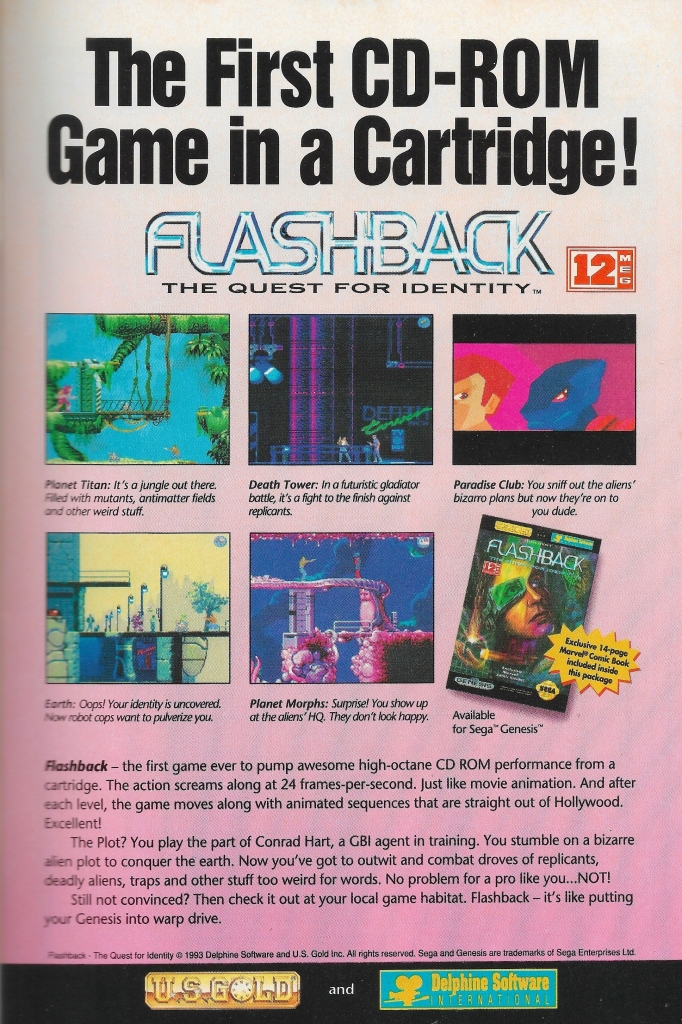
4. Flashback: The Quest for Identity print ad
This was indeed an eye-catching print ad.
Back in the 1990s, the CD-ROM was cutting edge technology in the world of computing and CDs (compact discs) helped game companies have their game content as well as multimedia files (example: full motion videos or animated scenes) released together conveniently. In the middle of the decade, a version of the game Flashback: The Quest for Identity (note: a game with computer-generated animation scenes previously released on PC) was released in cartridge format for the Sega Genesis as well as the Super Nintendo Entertainment System (SNES). This was a big deal back in the days of the so-called 16-bit console war and the above print ad clearly emphasized it with the description “The First CD-ROM Game in a Cartridge!” The advertisers also assured consumers that the in-game 24 frames-per-second frame rate, the Hollywood-inspired high-quality visuals and related gameplay elements were intact for consoles. When I saw this particular ad, I became convinced to buy the game for my SNES (read my retro review by clicking here). To see how Flashback looks like on Sega Genesis, watch this.
5. Albert Odyssey: Legend of Eldean print ad
To make things clear, Albert Odyssey: Legend of Eldean is not based on any anime property. It was the 3rd game of its series and the first and only one to be released in English.
There is no denying the fact that Working Designs (closed since 2005) contributed a lot to console gaming by localizing and releasing several Japanese role-playing games (JRPGs) in America at a time when such games were not yet popular. Apart from the Lunar RPGs and Dragon Force, the company brought Albert Odyssey: Legend of Eldean to the Sega Saturn console in America and they had a very eye-catching print ad promoting it. Like their ads for Lunar RPGs, the Albert Odyssey: Legend of Eldean print ad had a dominating anime-style artwork that highlighted the fantasy concept and characters, plus screenshots and in-game animated (note: not anime but detailed pixel artworks) sequences that were meant to attract RPG enthusiasts and gamers looking for the next-generation console gaming experiences. It should be noted that Albert Odyssey: Legend of Eldean was actually the 3rd game of its franchise that started in Japan, and it was the first and only Albert Odyssey game to ever be released in English. To this day, Albert Odyssey: Legend of Eldean still has not been re-released nor remastered for other consoles and original Sega Saturn copies of the game are very expensive to acquire. That being said, this particular print ad is a lively reminder of Albert Odyssey’s only Western release.
6. Resident Evil 3: Nemesis print ad
Capcom efficiently showed the new monster Nemesis, screenshots of the game and the return of Jill Valentine in this 1999 print ad.
After the release of the best-selling and acclaimed Resident Evil 2, Capcom approved the production of several Resident Evil projects that include sequels and spin-offs. Along the way, Sony announced in 1999 that the PlayStation 2 console will come out in 2000 and this had an impact on Capcom’s RE projects as many of them were being developed for the aging PlayStation (PS1) console. Before the PS2 announcement, Capcom had a PS1 RE game project with its story set on a cruise ship. That project was abandoned following the PS2 announcement and because Capcom did not want to leave its fans to wait too long for another Resident Evil adventure on PS1, they reviewed their list of proposed spin-off games and went ahead making Resident Evil 3: Nemesis (Japanese title: Biohazard 3: Last Escape) for a late 1999 release while the PS1 console was still in good demand.
In the above 1999 print ad, Resident Evil 3: Nemesis was shown with 3 screenshots assuring RE fans that the game has the tried-and-tested design of polygonal characters/monsters moving within pre-rendered environments, the action, the horror and adventure elements of the previous games. More notably, the new monster Nemesis had the biggest image and he rightfully became the main antagonist until the very end.
Lastly, the RE3 print ad featured the return of Jill Valentine (one of the protagonists of the first Resident Evil) and this time she had a clear sexualized look wearing a tube top and a mini-skirt. As I mentioned in my RE3 retro game review, I believe that the sexualized look of Jill was done by the game developers who were most likely influenced by the sexy appeal and iconography of the character Lara Croft from the Tomb Raider series of games. Like Lara Croft, Jill is sexy and capable of fighting with guns and other weapons. Whatever the intention of Capcom and the development behind the game, the print ad (which even had wrongful details about the timing of the story) clearly worked on getting RE fans and gamers’ attention as Resident Evil 3: Nemesis sold more than 3 million copies on PS1.
I will get straight to the point here – Eiyuden Chronicle: Hundred Heroesis my most wanted Japanese role-playing game (JRPG) of this current console generation and it is one of the main reasons why I subscribed to Xbox Game Pass (XGP) as soon as I bought my Xbox Series X console late last year. While a release date was not yet announced as of this writing, I am looking forward to this upcoming JRPG on my Xbox Series X sometime in 2023. Check out the official Xbox listing of Eiyuden Chronicle: Hundred Heroes by clicking here.
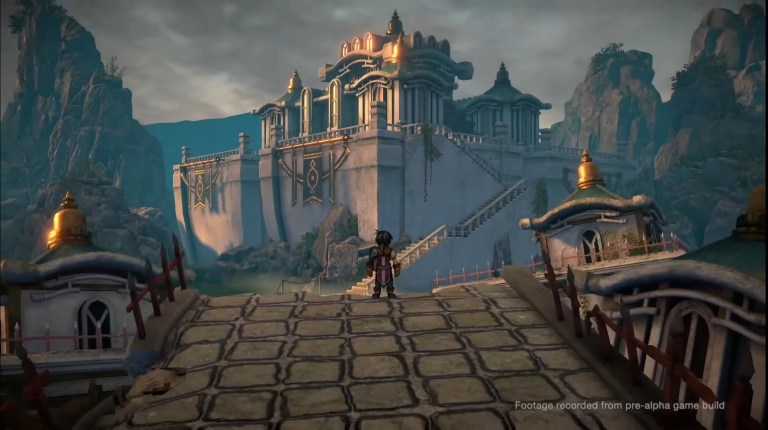
During the recent Tokyo Game Show (TGS), publisher 505 Games and Rabbit & Bear Studios executives – including studio head Yoshitaka Murayama (the Suikoden series creator) and Junko Kawano (who worked on Suikoden and Suikoden IV) – had their own presentation and made announcements. During the TGS, the newest trailer of Eiyuden Chronicle: Hundred Heroes was unveiled and it sure looks really good even though the footage shown was from pre-alpha build. Watch the newest trailer below…
As I mentioned earlier, no release date was announced during the TGS which I found baffling since that event drew a lot of viewers and gamers’ attention worldwide. Could it be possible that Konami’s surprise announcement of Suikoden I&II HD Remaster Gate Rune and Dunan Unification Wars coming to multiple platforms (including Xbox) in 2023 might have something to do with the lack of a firm release date for Eiyuden Chronicle: Hundred Heroes? At least in my view, developer Rabbit & Bear is still working on finishing their JRPG.
Perhaps publisher 505 Games is doing a wait-and-see approach about the many video games expected to fill the market in 2023 with anticipated heavy hitters like Starfield, Forza Motorsport (2023) and Redfall to name a few. 505 Games will have to select soon a firm 2023 release date for Eiyuden Chronicle: Hundred Heroes based on market competition and the development status of the game.
Exploration in the game will be a mix of 2D sprites, polygonal environments and some artistic backgrounds.
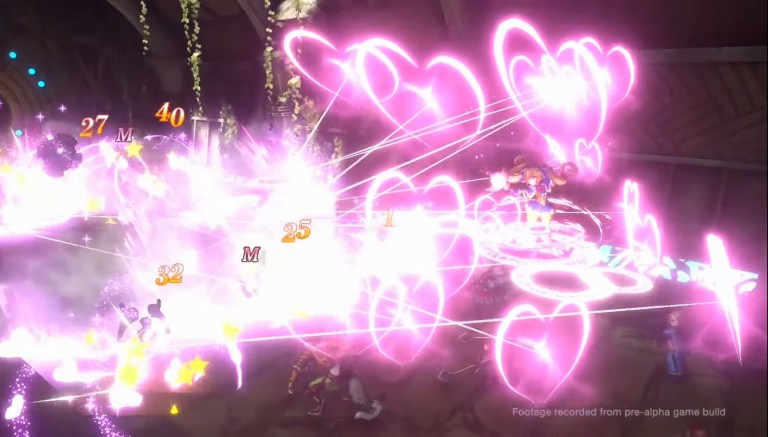
The battles in Eiyuden Chronicle: Hundred Heroes have that dynamic touch and multiple playable characters can fill your party and engage the enemies.
For the newcomers reading this, Eiyuden Chronicle: Hundred Heroes is a turn-based fantasy JRPG which has a design and style similar to what was seen in the first two Suikoden video games. As seen in the above trailer, the upcoming JRPG has the combined talents of game creators such as Yoshitaka Murayama, Junko Kawano and Junichi Murakami (Castlevania: Aria of Sorrow) plus musicians Motoi Sakuraba (Star Ocean series, Tales of series) and Michiko Naruke (Wild Arms series).
Eiyuden Chronicle: Hundred Heroes has a story set in one corner of Allraan, a tapestry of nations with diverse cultures and values. On Xbox.com, 505 Games released the first set of character profiles introducing: Nowa, Seign, Marisa, Lian and Garr. Their respective descriptions are as follows…
Nowa – When the League of Nations recruits warriors to assist in a joint expedition with the Galdean Empire, our protagonist answers the call and leaves his remote village to test his skills. On the mission, he finds an ancient rune-lens, unaware that the discovery will spark a war between the League and the Empire. After the conflict begins, he joins a unit in the League’s border guard. The protagonist is the “leap before you look” type. He doesn’t always weigh the pros and cons before springing to action, and while his constant need to involve himself in other people’s problems sometimes creates headaches for his companions, they like him for it and know his heart is in the right place. After all, if they ever got into trouble, he’d be the first person there.
Seign – The second-born son to House Kesling, a powerful imperial family. His older brother died on the battlefield. Seign is exceptionally gifted; after achieving outstanding grades at military academy, he was placed in command of a company of his peers and sent on the expedition to find the ancient rune-lens. During the mission, he meets the protagonist. The two warm to each other as they overcome adversity, and they learn of one another’s ambitions. Seign’s strategic mind allows him to analyze things from a broad perspective and make sound decisions. People often confuse his clear mind for a cold heart, but he is guided by strong ideals and a deep passion to fulfill them. After his brother’s death during a border rebellion, Seign began to think long and hard about what it means to fight.
Marisa– A young member of the Guardians, a clan that hallows and protects the forest. Since Marisa was very little her family has instilled their ways and traditions in her. She has a warm, affable smile — except on the battlefield, where she wears the countenance of a warrior.
Although the Guardians live as one with the forest, they have respect for the outside world’s culture and technology, and they are not against integrating the parts of it that make sense to them. Marisa is particularly forward-thinking in this regard and loves new things — especially cute things.
Lian – After the Empire’s forces invade league lands, Lian is infuriated and runs away from home without even the slightest semblance of a plan. She decides the first thing to do is hoof it to the biggest town she can find, and luckily that’s where she meets the protagonist and his companions. Lian was born in a dojo, and her father wasted no time in teaching her. She was doing roundhouse kicks before she even learned to walk properly.
Garr– A veteran beastman warrior. He and his clan make their living as mercenaries, and their vast experience and sheer brutality put them in high demand. War is all Garr has known, and to him life is one battlefield after the other until you die.
To date, Rabbit & Bear Studios already released the side-scrolling spin-off game Eiyuden Chronicle: Rising and has been working hard to complete Hundred Heroes. The shared game design elements between the early Suikoden games and Eiyuden Chronicle: Hundred Heroes such has having over 100 playable characters, a story of war, in-depth world exploration, heavy use of 2D sprites for the characters along with their acts during battles, and dynamic group battles are not surprising given Murayama’s history of leading the development of the Suikoden JRPG franchise (until the 3rd game) during his time with Konami. Murayama also is a proven fantasy storyteller with the Suikoden games. Personally, I really loved playing Suikoden II which in my opinion is not only the best of the Suikoden game franchise but also one of the very best JRPGs of the 1990s that I have ever played as well as one of the best JRPGs that was not made by Square Enix.
Now this is one very dazzling moment shown during the latest Eiyuden Chronicle: Hundred Heroes trailer.
Seign and Nowa going head to head with each other in this captured moment from the latest trailer.
Knowing that Murayama, Kawano and other notable Japanese creators are working together in making Eiyuden Chronicle: Hundred Heroes, I have reasons to be confident about it. On my end, my taste on video games has changed a lot over the past fifteen years and that goes the same with my interest in JRPGs. Along the way, I really miss the fun I had with the first two Suikoden games as they had gameplay elements that were not only uniquely fun but also aged well. For me, Eiyuden Chronicle: Hundred Heroes could become the most delightful surprise among JRPGs in this current console generation. It is my most-wanted JRPG of this console generation and I believe it will fit in nicely with the Xbox ecosystem which is already becoming an ideal haven for fantasy RPGs and RPG fans in general.
Watch out for Eiyuden Chronicle: Hundred Heroes on Xbox Series X, Xbox Series S, Xbox One, Windows PC and Xbox Game Pass in 2023.



















 Author Carlo Carrasco