Welcome back my readers, YouTube viewers and all others who followed this series of articles focused on YouTube videos worth watching. Have you been searching for something fun or interesting to watch on YouTube? Do you feel bored right now and you crave for something to see on the world’s most popular online video destination?
I recommend you check out the following videos I found.
#1 Tremors Revisited And Explained – By today’s standards, Tremors is a classic among monster movies (AKA creature features) Hollywood released. With the way it was written and presented, Tremors is always fun to watch again. I have seen it many times and yet it is worth repeating from start to finish. Behind the scenes, there were a lot of stuff, adjustments and unexpected developments that happened during production. If you wish to see such stuff, watch and learn from the Tremors videos of Represent This below.
#2 A Look At Excalibur In Las Vegas –I never had the opportunity to visit Excalibur in Las Vegas. During its first several years of operation, Excalibur welcomed countless tourists with its fantasy-themed atmosphere, designs, facilities and entertainment. Imagine having a meal while watching two knights riding horses and performing a joust in front of you. Imagine seeing members of the hotel staff wearing fantasy costumes. Like Circus Circus Hotel and Casino, Excalibur was a fine hotel that catered to families while still having casinos for gamblers. To learn more about what Excalibur was and what made it stand out among the hotels of Las Vegas, watch the video below.
#3 Meals At The Expressway In Japan – How often do you stop for a meal when traveling along a major highway? In many parts of the world, highways or expressways have clusters of gas stations, convenience stores, groceries and restaurants for travelers who need some relief from the stress of long travel. For many travelers, traveling far while being hungry can be a problem. In recent times, Nippon TV posted a video about meals and food items that travelers can find along expressways and the variety is interesting to see. Watch and learn from the video below.
#4 Cleopatra Movie Revisited – Way back in 1963, the movie Cleopatra starring Elizabeth Taylor and Richard Burton was released. The historical epic was made at a staggering cost of $44 million which was almost three times more expensive than 1959’s Ben-Hur. Behind the scenes, 20th Century Fox was in very deep financial trouble and many hard business risks were taken to make Cleopatra. Elizabeth Taylor, who signed a record-setting $1 million contract for the film, had health problems that added to the delay of the production. The film even lost its original movie director. To learn more about the history and the behind-the-scenes intrigue of Cleopatra, watch the video below.
#5 Innerspace Revisited – Innerspace (stylized as InnerSpace) from 1987 is a fun movie to watch and it has fine performances from Dennis Quaid, Meg Ryan and Martin Short. That said, it is not surprising to see Innerspace featured in reaction videos and retrospective videos by YouTubers. For your enjoyment, watch the videos below.
#6 Breath Of Fire Retrospective – When Breath of Fire was first released in 1993, it was a surprising Japanese role-playing game (JRPG) as it had a somewhat fresh concept and it was released by Capcom (already famous for fighting games). The first game was successful enough to convince Capcom to make sequels (released on other game consoles as technology evolved) achieving varying degrees of critical and commercial success. Going back to the original game, some wondered what made it notable and how the game came to be. To find out the history of Breath of Fire and what its story was about, watch the video below.
Welcome back my readers, YouTube viewers and all others who followed this series of articles focused on YouTube videos worth watching. Have you been searching for something fun or interesting to watch on YouTube? Do you feel bored right now and you crave for something to see on the world’s most popular online video destination?
I recommend you check out the following videos I found.
#1 Demolition Man Revisited – Way back in 1993, I completely missed out on Demolition Man in the local cinemas. The first time I saw it was on a rented laserdisc in 1995 and the film (starring Sylvester Stallone and Wesley Snipes) turned out to be entertaining in a unique way. By today’s standards, Demolition Man is considered by many as a film ahead of its time as it accidentally predicted self-driving cars, video conferencing, heavy dependence on computers for solutions and more. As such, it is not surprising that a lot of retrospective and reaction videos of Demolition Man have filled YouTube. Posted below are the more entertaining videos to watch about the 1993 movie.
#2 Soy Milk Becomes More Popular In Japan – Soy milk is a dairy-free, plant-based drink made from water and ground soybeans. In recent times, soy milk has gotten tremendously more popular in Japan. Not only is it being consumed by the Japanese in its beverage form, soy milk also made its way into food items and snacks. There is a lot to learn about soy milk’s popularity in Japan in the video below.
#3 Resident Evil Illustrated Tales – Believe it or not, there was a time when comic books and illustrated tales about the Resident Evil games were published from the late 1990s to the early 2000s. Back then, WildStorm (WildCATs, StormWatch, Wetworks) was licensed to make comic adaptations of Resident Evil starting with the Resident Evil: The Official Comic Magazine (published through Image Comics, 1998-1999) which featured varied short stories that expanded the lore but not necessarily counted as canon with the games. YouTube ScorePN posted a video showcasing the Resident Evil illustrated tales so you don’t have to go to all the trouble of finding the comic books and magazines. Watch and enjoy the video below.
#4 Zaxxon Revisited – In the early 1980s, Sega made a huge splash in the arcades and game consoles with Zaxxon which is now considered a classic by many gamers. I only played it on the personal computer back in the 1980s. While my enjoyment of the game was very limited because of the not-so-friendly keyboard controls, I found Zaxxon an intriguing experience due to its isometric visual design and the illusion of 3D space that came with it. Sometimes I wished that Zaxxon would get remastered for the current console generation. That said, it’s now a good time to look back at the game in the two retrospective videos below.
#5 Ashleigh Burton Reacts To Lethal Weapon – Among all the Lethal Weapon movies released by Hollywood, the first film from 1987 is still the best in my view. Apart from having a strong script, the directing by Richard Donner got fine performances from Mel Gibson and Danny Glover, and the spectacle was executed with a lot of power while never feeling outlandish. That said, it is fun to replay the movie from time to time. To see how it impacts YouTuber Ashleigh Burton, watch her reaction video below.
Welcome back readers, fellow geeks and electronic gaming fans!
In this edition of the Retro Gaming Ads Blast (RGAB) series, we will take a look at another batch of retro gaming print ads – including arcade flyers – from the 1970s to the 1990s.
For the newcomers reading this, Retro Gaming Ads Blast (RGAB) looks back at the many print ads of games (console, arcade, computer and handheld) that were published in comic books, magazines, flyers, posters and newspapers long before smartphones, social media, the worldwide web and streaming became popular. To put things in perspective, people back in the 1970s and 1990s were more trusting of print media for information and images about electronic games and related products.
With those details laid down, here is the newest batch of retro gaming print ads for you to see and enjoy…
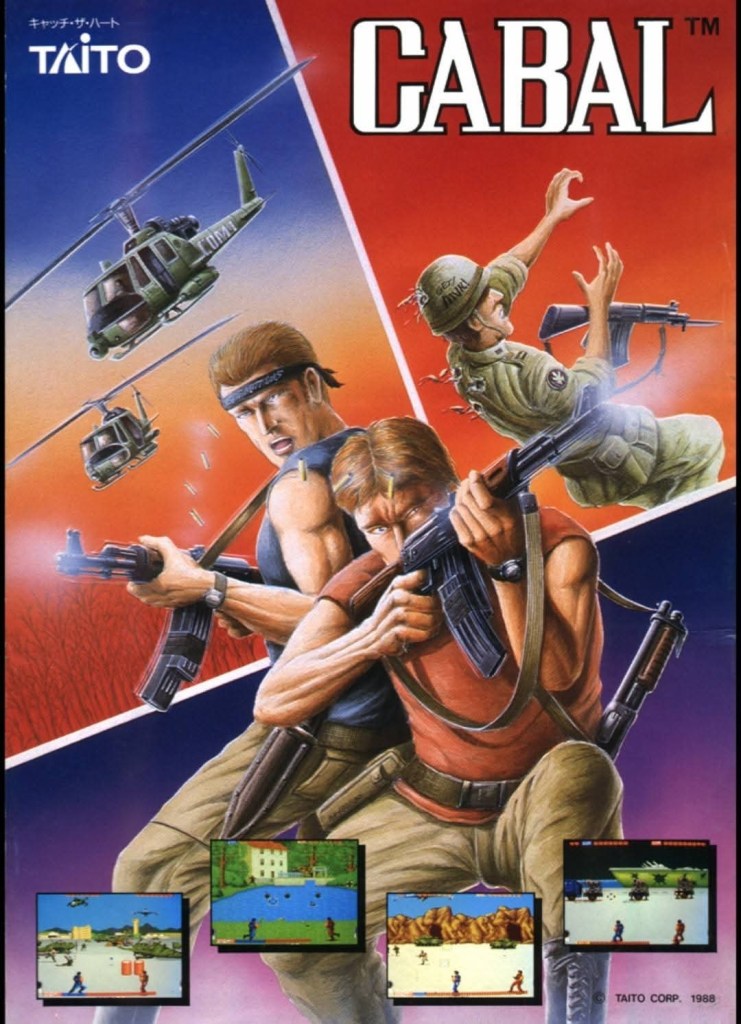
1. Cabal Japanese arcade flyer/poster
Can you feel the action and intensity here?
When it was first released in video arcades in Japan in late 1988, Cabal was another game inspired by military action movies of Hollywood which explains the art work done for the arcade flyer and poster shown above. The Vietnam War was still fresh in people’s minds and the concept of having one or two players firing their weapons against enemy soldiers resonated with gamers who saw Hollywood’s military action flicks. That said, it is not surprising that Cabal became a huge hit in Japan before getting released in arcades around the world.
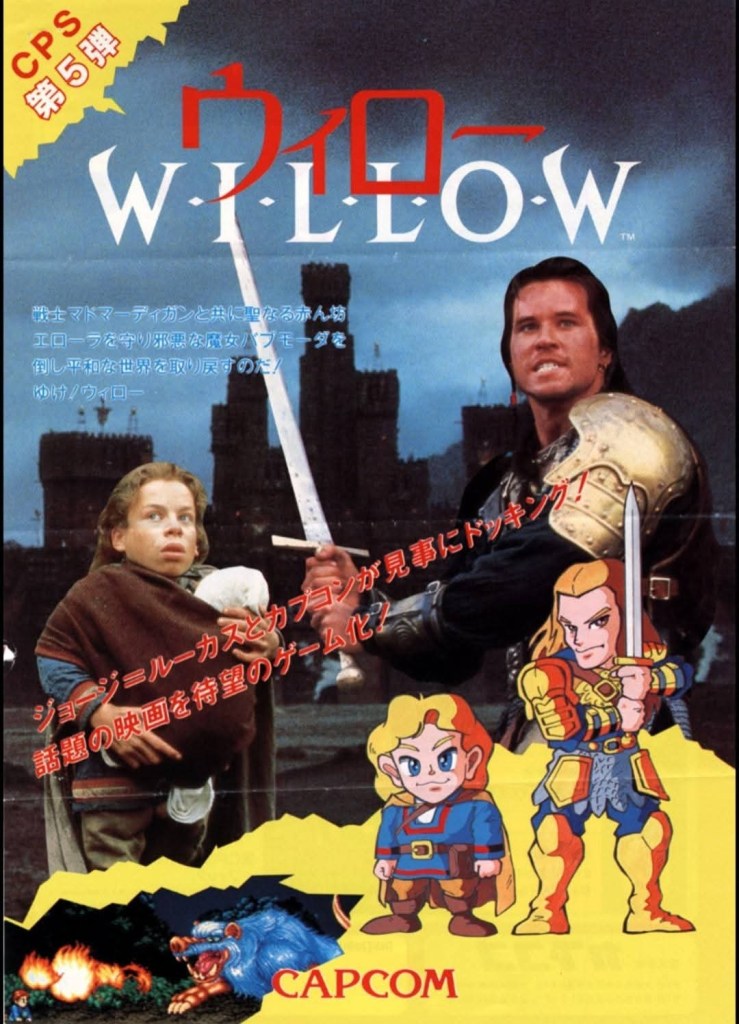
2. Willows Japanese arcade flyer
The front.
The rear.
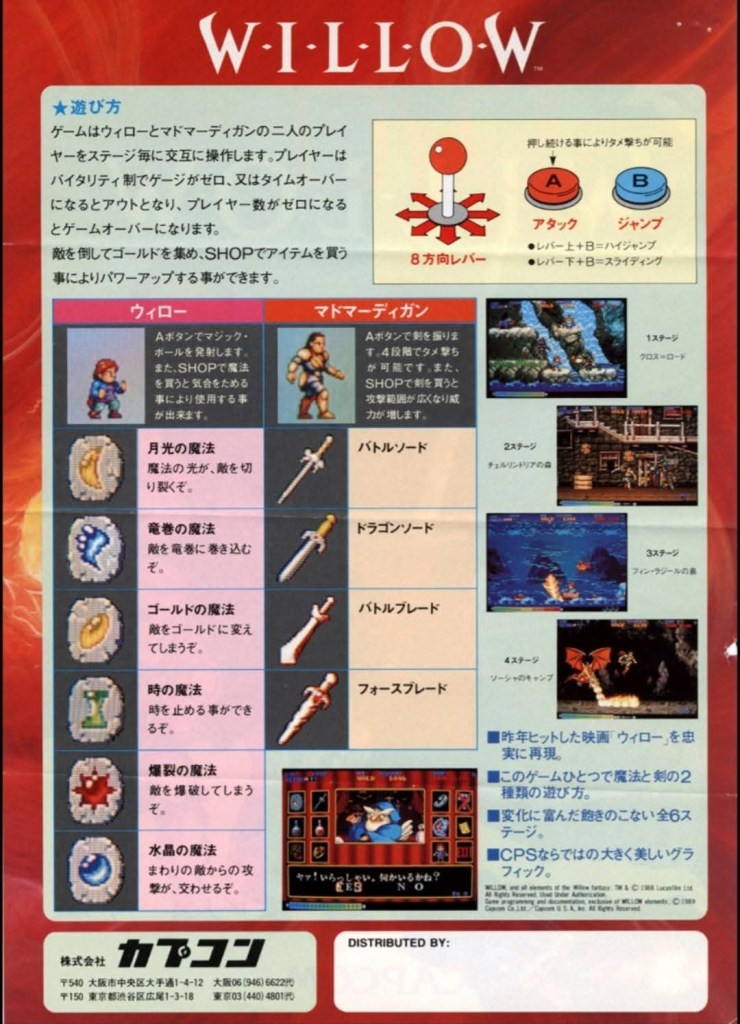
Remember the 1988 high fantasy adventure film Willow? That film was produced by George Lucas and was a bold new production of Lucasfilm shifting away from Star Wars. Believe it or not, an official arcade game adaptation of Willow was made by Capcom and they promoted it by having images of Val Kilmer and Warwick Davis on the front of the arcade flyer (opposite the illustrated versions of their characters). The game, which was a side-scrolling platform game with run-and-gun elements, went on to be an arcade hit in Japan and eventually pleased gamers worldwide.
3. Super Punch-Out!! North American print ad
This is funny to look at.
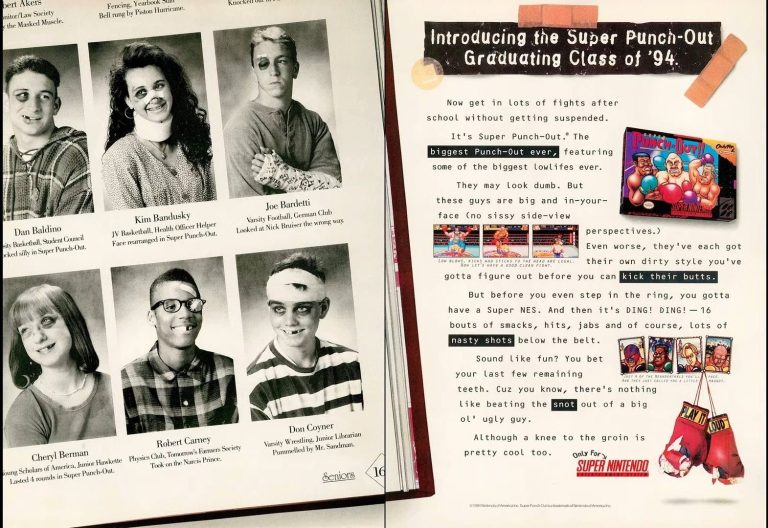
Historically, Nintendo’s Punch-Out!! series started in the arcade in 1984 and the first game was the result of the company’s effort to make a new game using arcade cabinets with two screens. The 2nd game – Mike Tyson’s Punch-Out!! – became a huge critical and commercial hit (over 2 million copies sold in 1988) on console and it made great business sense for Nintendo for release another Punch-Out!! for its console gamers to enjoy in the comfort of home. In 1994, Super Punch-Out!! was released on the Super Nintendo Entertainment System (SNES) in America and to promote it, the company came up with a hilarious 2-page ad that showed fictional high school graduates with boxing-related injuries. The imagery creatively connected with the words “biggest Punch-Out ever” and “Graduating Class of ‘94”.
4. EA Sports 3-in-1 SNES games print ad
EA Sports games on the SNES.
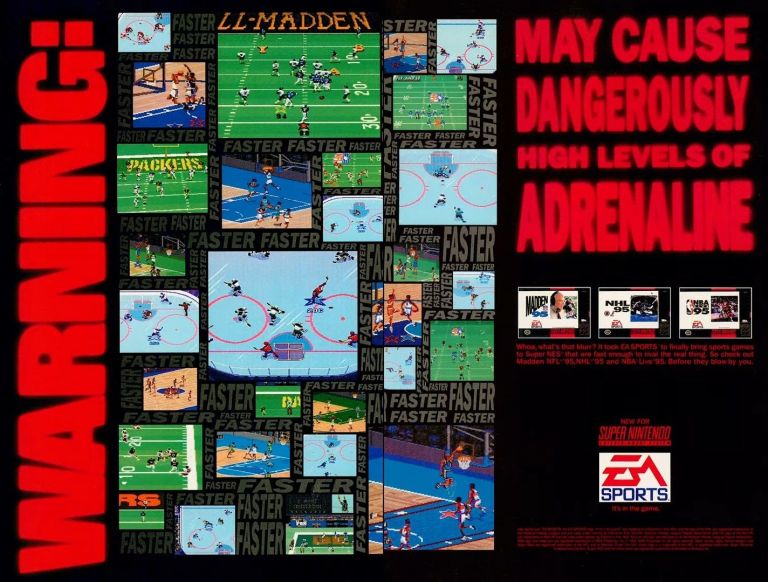
In 1994, Electronic Arts (EA) released their sports games NBA Live 95, NHL 95 and Madden NFL 95 for consoles at the time. Even though the Sega Genesis sold better than Super Nintendo Entertainment System (SNES) in America at the time, EA went on to aggressively market their 3 sports video games on Nintendo’s console using a 3-in-1 games print ad. In retrospect, the SNES for the most part had better graphics and sounds than the Genesis which is reflected clearly on EA Sports games of the time. This print ad still looks fun and exciting.
5. Atari Jaguar CD print ad
Were you able to play any game on the Atari Jaguar with the CD add-on included?
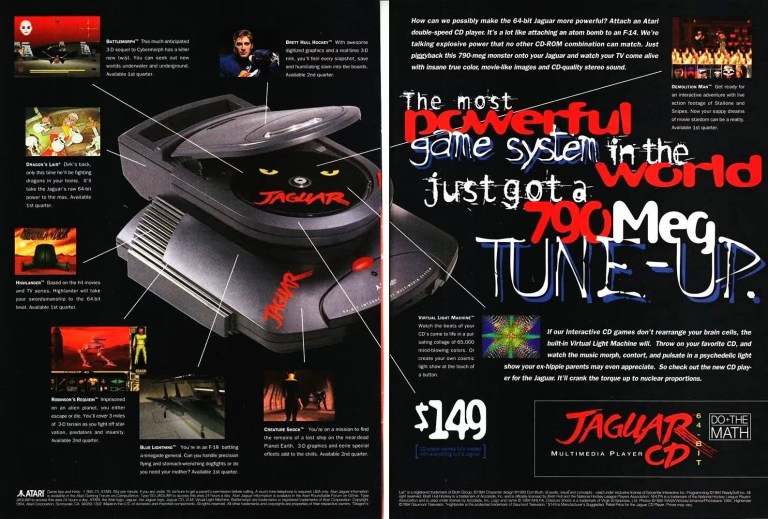
Apart from the obvious advances of technology that impacted video games, the 1990s is also known for the rise of CD-ROM as a medium for gaming. In an effort to boost sales of the Atari Jaguar console (launched in America in 1993 for around $250) and capitalize on the trust of the fans and console owners, Atari launched a CD-ROM add-on device for about $150 in 1995. To promote it, the company went aggressive with the 2-page ad showing the add-on fully connected on top of the main console, showing off some games and posting a text description emphasizing hardware power and the advantages that come with the CD technology. Even in the captured image, the Atari Jaguar CD still resembled a toilet. This is an aggressive ad campaign that failed as less than 20,000 Atari Jaguar CD units were sold by the time it was discontinued in 1996.
6. 3DO print ad
While it lacks intensity, this 3DO ad emphasized the games.
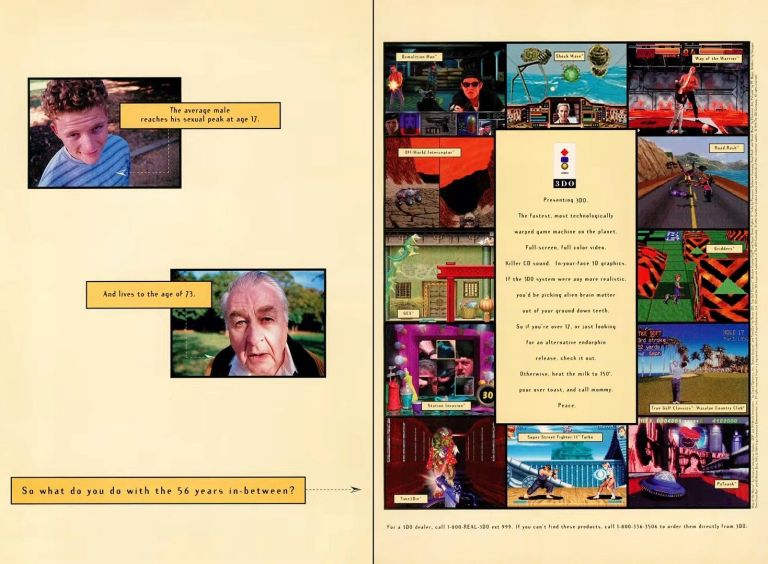
Without showing any hardware, the 3DO Company came up with this 2-page print ad that had a slightly adulterated tone (look at the left page) and aggressively marketed the 3DO console games available at the time. Games like Demolition Man, Shock Wave, Road Rash and Super Street Fighter II Turbo were the standout titles which clearly showed the company made the effort to emphasize gaming more than multimedia features. This 1990s ad tackled the generations with a touch of humor.
7. Lethal Enforcers II: Gun Fighters Sega Genesis print ad
This is a fun ad to look at.
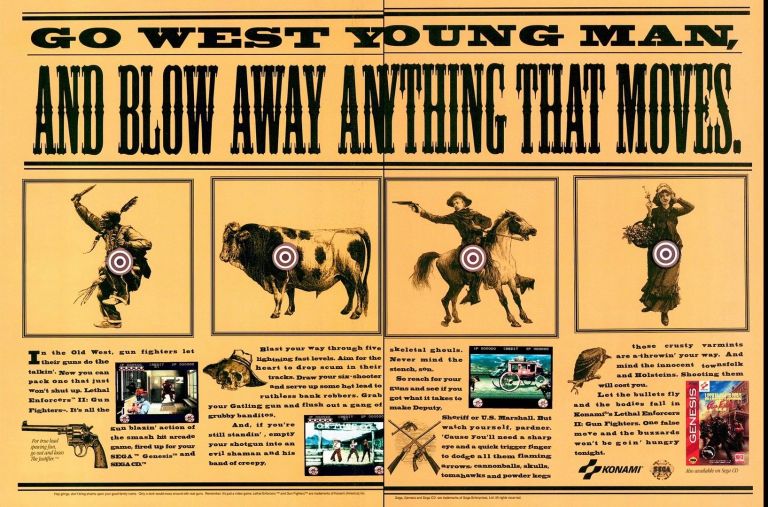
When Lethal Enforcers II: Gun Fighters was released in the arcades in 1994, it became a commercial success for Konami which went on to announce it would port the game to consoles of Nintendo and Sega at the time. While the port for the Super Nintendo Entertainment System (SNES) was never released, Lethal Enforcers II: Gun Fighters made its way to the Sega Genesis and Sega CD. The print ad of the Sega Genesis version (Sega CD mentioned in small text) had an inspired design emphasizing the Old West, shooting and the conflict between cowboys and Indians. The screenshots gave people the clear idea that Old West was the setting (versus modern day in the previous game). This is still fun to look at.
8. Syphon Filter
Syphon Filter went on to become a surprise hit game in 1999.
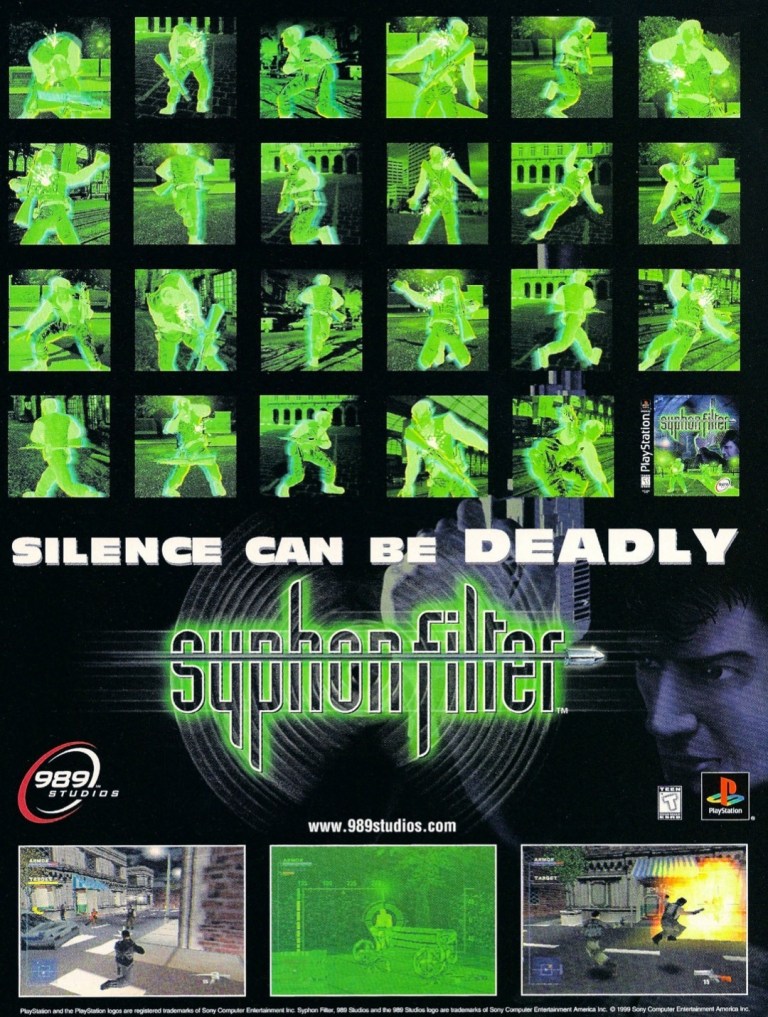
In 1999, Sony’s 989 Studios released Syphon Filter exclusively on the PlayStation console. This single-page print ad showed a few screenshots on the bottom and several action snippets with a night vision touch ultimately emphasizing the stealth aspect within the gameplay. The marketing proved to be effective as the game sold a lot at retail and went on to establish a new game franchise exclusive to PlayStation consoles.
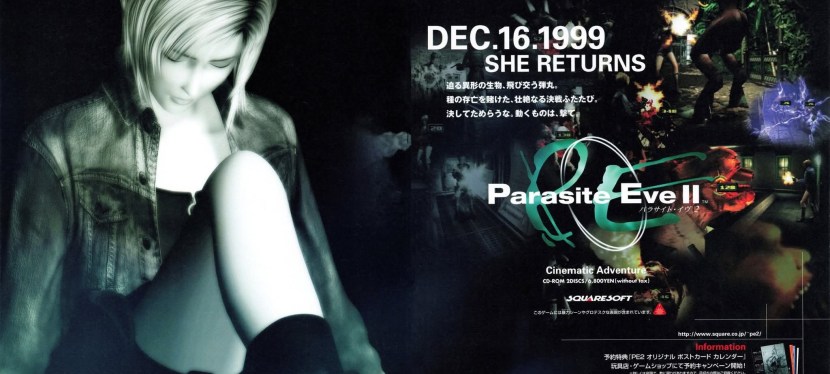
9. Parasite Eve II Japanese print ad
Were you a big fan of Aya Brea and the Parasite Eve franchise in the late 1990s?
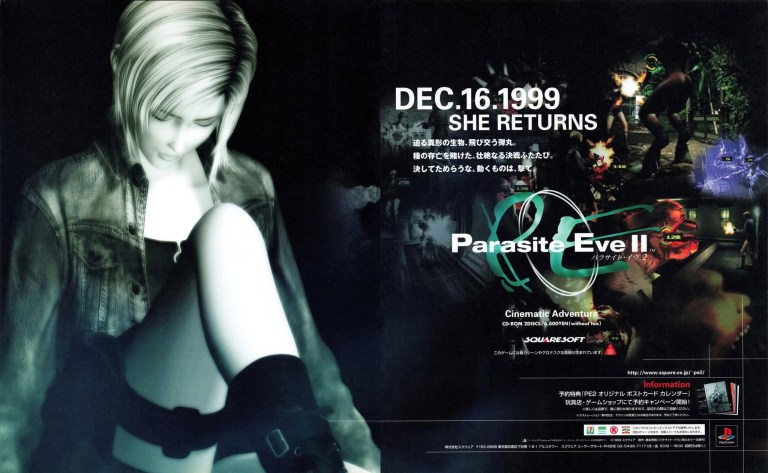
Following the critical and commercial success of Parasite Eve in 1998, SquareSoft proceeded with Parasite Eve II and the production (note: initially for a spin-off game before becoming a sequel) did not even involve the main creators of the first game. Instead the company had a different team of developers – including those who previously worked on Resident Evil games for Capcom – in Osaka to make the sequel. This explains why Parasite Eve II had stronger survival horror gameplay resembling a Resident Evil game. As major changes were made during the production, it was decided that Aya Brea would become the main protagonist and already the character was already popular with gamers. That being said, the marketing of Parasite Eve II for the Japanese market heavily featured Aya Brea with subtle sexiness, beauty and action in mind. The marketing intensified leading to its eventual December 16, 1999 release in Japan.
Welcome back my readers, YouTube viewers and all others who followed this series of articles focused on YouTube videos worth watching. Have you been searching for something fun or interesting to watch on YouTube? Do you feel bored right now and you crave for something to see on the world’s most popular online video destination?
I recommend you check out the following videos I found.
#1 Christine Grace Smith discusses gender differences and major UK Supreme Court decision – I like watching Christine Grace Smith’s commentary about society as well as her ways on pointing out the wrong and the twisted. Recently the United Kingdom’s (UK) Supreme Court delivered its major decision on the legal definition of the term woman in relation to human biology. Christine Grace Smith not only calls the UK Supreme Court decision a win for women (read: men who believe they are women are clearly NOT women at all), she also explains a lot of relevant stuff and details as well. It’s a win for women and a defeat for the transgender mob. Watch and learn from her video below.
#2 Predator reaction videos by Ashleigh Burton, VKunia, Popcorn in Bed and You, Me and the Movies – The 1980s was a memorable decade of R-rated action movies from Hollywood. Among them was the action-packed science fiction film Predator that starred Arnold Schwarzenegger and the movie itself had a careful blend of elements from specific genres under the direction of John McTiernan. By today’s standards, Predator is a classic and now is a good time to see how it impacts YouTubers like Ashleigh Burton, VKunia, Popcorn in Bed and You, Me and the Movies through their respective reaction videos.
#3 PatmanQC examines the Alien vs. Predator arcade game – In 1994, Capcom released Alien vs. Predator in video arcades around the world. In addition to being well received by game critics, the game became a big hit commercially and added to Capcom’s credibility as an arcade industry player. If you are wondering how the arcade game first started, who the developers were and why the game was never ported to any console, watch and learn from PatmanQC’s in-depth video below.
#4 Decker Shado’s review of The Fifth Element – Back in 1997, The Fifth Element was released in cinemas and it attracted the attention of a lot of people mainly because of Bruce Willis’ fame. With its style of presentation, the movie impressed local moviegoers and there were some who found it a zany film experience. Some time ago, Decker Shado posted his video review of The Fifth Element and it is entertaining to watch.
#5 Slope’s Game Room examines the history of Pac-Man – Do you still remember playing Pac-Man long ago? As a little boy, I only played the Atari 2600 port of Pac-Man and managed to play the original arcade game on different platforms much later. There is a lot of history behind Pac-Man and it involves the growth of its game franchise and reach towards cartoons and merchandise. To have an in-depth look at Pac-Man’s history, watch the extensive video by Slope’s Game Room below.
#6 Tron revisited – You must have heard the news about the newly announced Tron sequel called Tron: Ares. Honestly, I am not too confident about it and 2010’s Tron: Legacy left me unsatisfied. That being said, the original Tron movie from 1982 remains special and memorable, and now is a good time to take a look back at it through the selected videos below. Watch, learn and enjoy!
Welcome back readers, fellow geeks and electronic gaming fans!
In this edition of the Retro Gaming Ads Blast (RGAB) series, we will take a look at another batch of retro gaming print ads – including arcade flyers – from the 1980s and 1990s.
For the newcomers reading this, Retro Gaming Ads Blast (RGAB) looks back at the many print ads of games (console, arcade, computer and handheld) that were published in comic books, magazines, flyers, posters and newspapers long before smartphones, social media, the worldwide web and streaming became popular. To put things in perspective, people back in the 1980s and 1990s were more trusting of print media for information and images about electronic games and related products.
With those details laid down, here is the newest batch of retro gaming print ads for you to see and enjoy…
1. Asteroids Deluxe arcade flyer
The arcade flyer for North America.
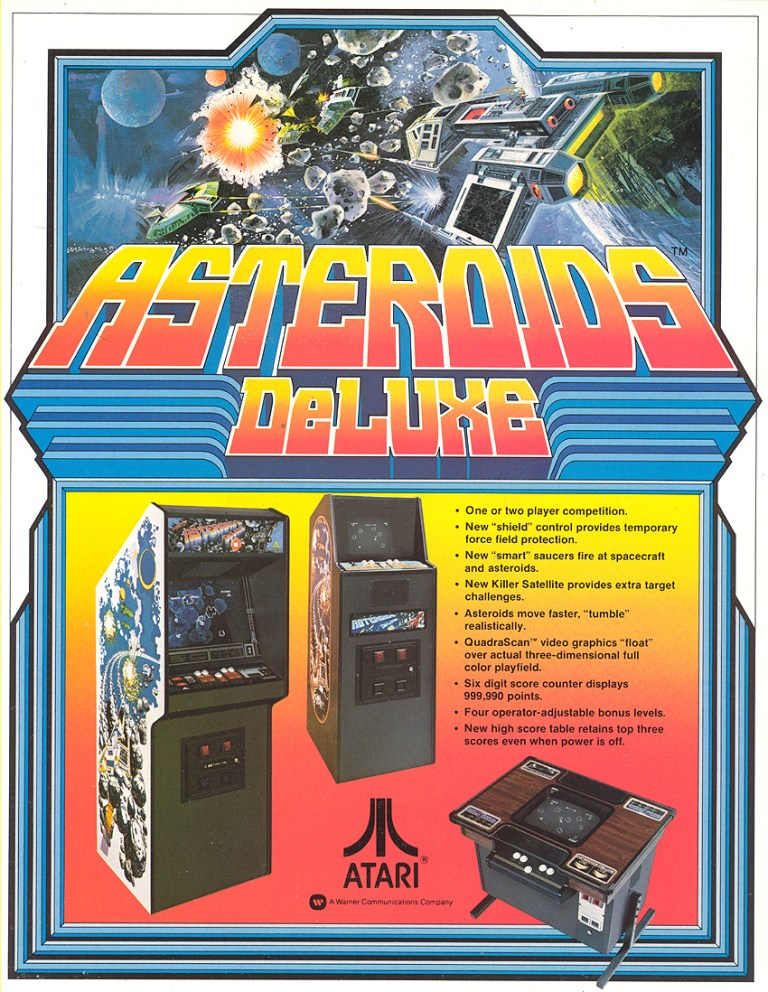
Given the fact that Asteroids was a massive hit for Atari in the arcades, it was not surprising that a sequel was made called Asteroids Deluxe. In preparation for its 1981 release, Atari made this Asteroids Deluxe arcade flyer showing three machine that arcade operators can choose from complete with technical details displayed. They even emphasized the QuadraScan video graphics as a technological advancement with regards to graphics. By today’s standards, this arcade flyer is still sensible with regards to promoting the game to both arcade operators and players.
2. Missile Command arcade flyer
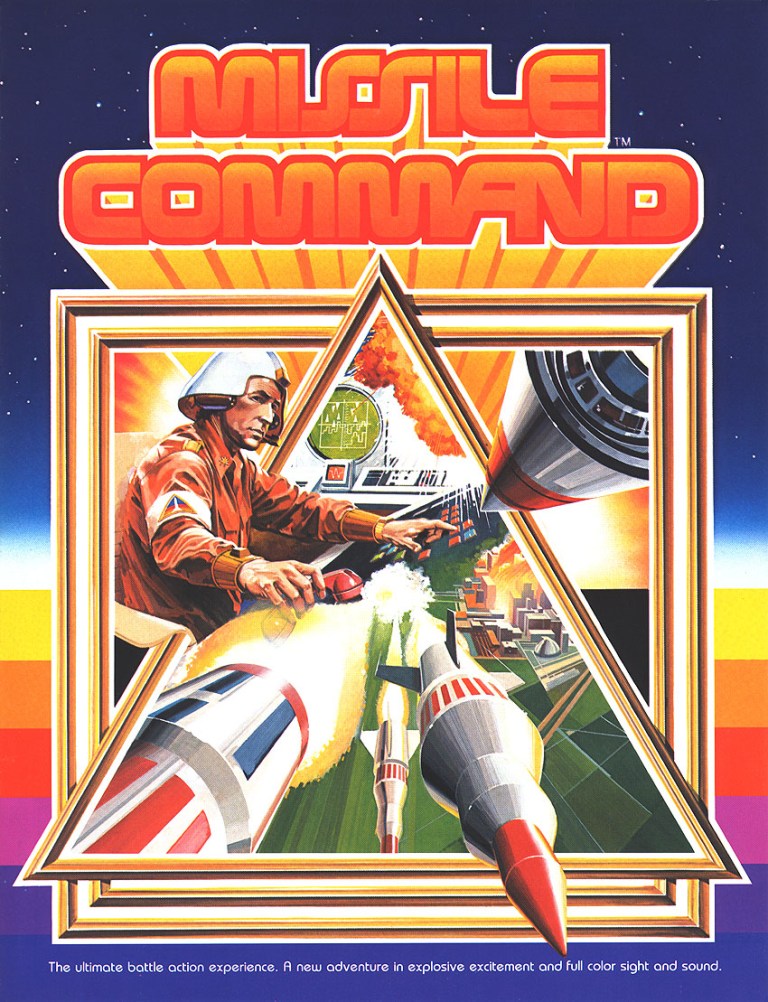
Engaging art work on display at the front of the arcade flyer.
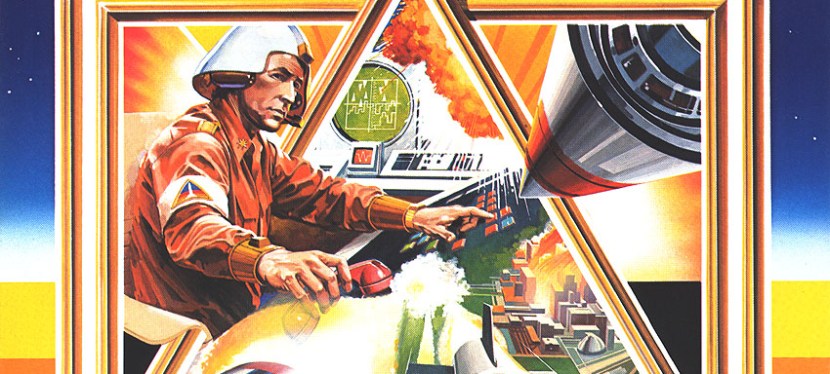
Released in the arcades in 1980, Missile Command is a classic game from Atari and its concept of defending cities from incoming enemy missiles proved to be relevant with people living with the fear of a nuclear missile attack during the days of the Cold War. In my experience, I mainly played the Atari 2600 version and it was only recently I finally started playing the arcade classic on my Xbox Series X using the Atari 50 Collection software. As for the arcade flyer itself, Atari simply used highly detailed painted art for the front which clearly emphasized the science fiction portrayal of a military officer using a console inside a base to come up with defensive response to incoming ballistic missiles. The game was a massive hit in the arcades and in my view, Atari’s simply yet direct way of promoting the concept of Missile Command with the arcade flyer remains compelling to look at.
3. Gun.Smoke European arcade flyer
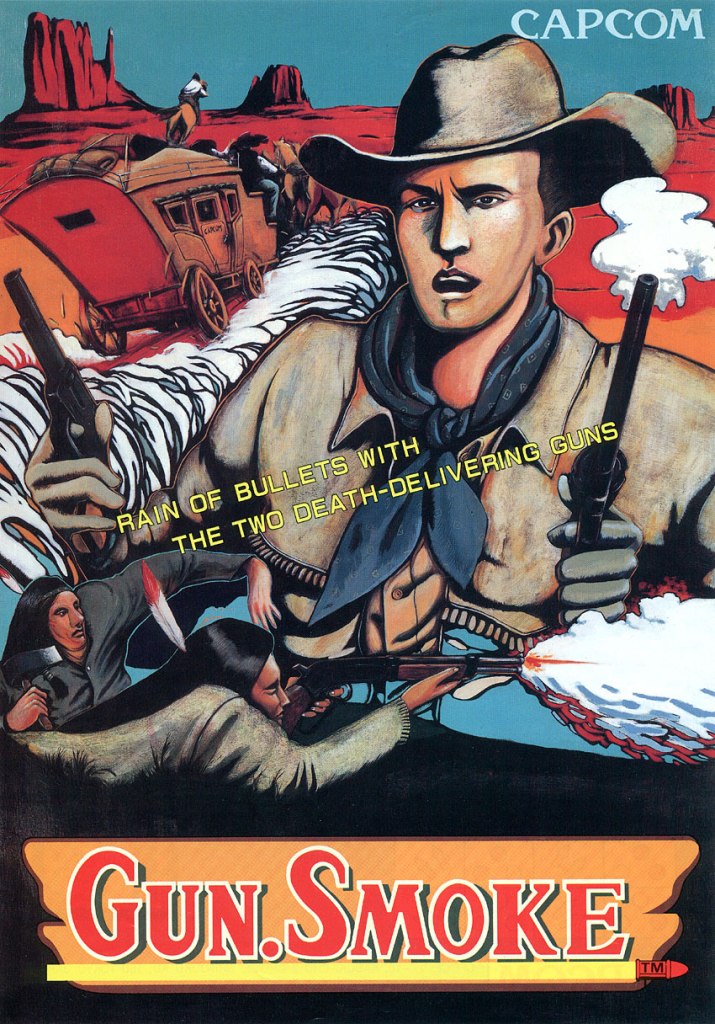
Nice art on the front of this arcade flyer for the European market.
Long before they struck gold with Street Fighter II, Japanese company Capcom scored a hit with gamers in the arcades with 1985’s Gun.Smoke. It was a vertically scrolling run-and-gun game with an Old West setting and it was designed by Yoshiko Okamoto (Final Fight and Street Fighter II). To promote the game for European arcades, Capcom simply used hand-drawn artwork for the arcade flyer’s front which emphasized the Wild West setting, and an American Cowboy and bounty hunter named Billie Bob who is the playable character gamers got to play. In my view, the artwork gave the game a strong Wild West image that is also memorable.
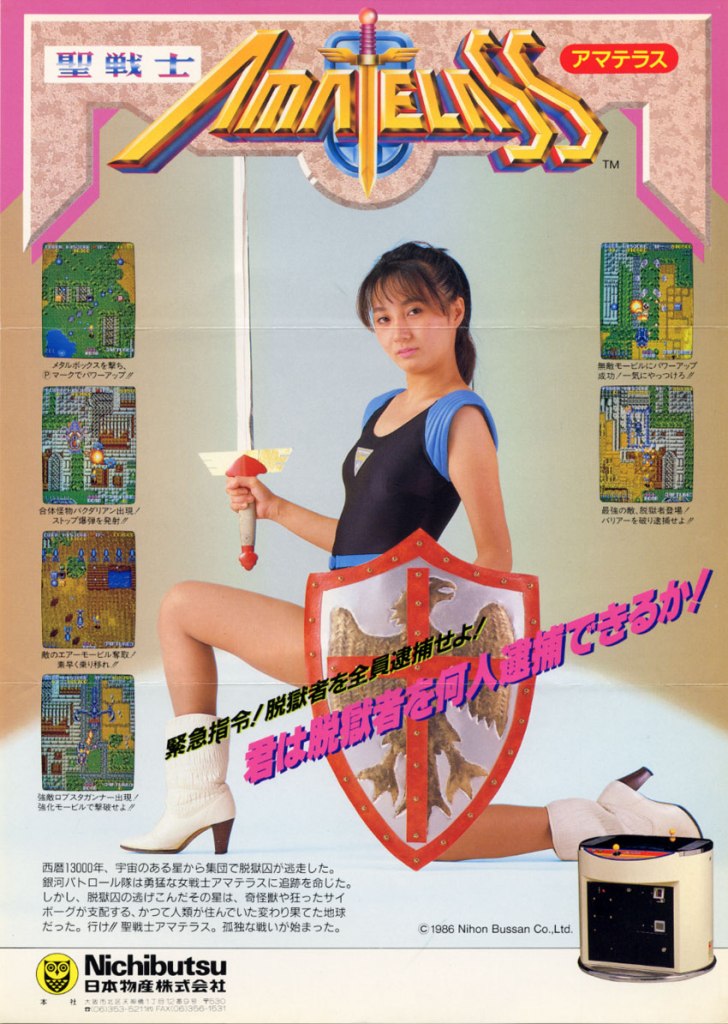
4. Sei Senshi Amatelass arcade flyer
Does the model look sexy or tough?
Released in Japanese arcades in 1986 by Nichibutsu, Sei Senshi Amatelass is a vertical scrolling run-and-gun game with a science fantasy concept. To promote the game and really sell its concept, Nichibutsu hired a model posing with a sword and a shield in fantasy inspired costume. Using the remaining spaces of the flyer, some screenshots and an image of the arcade machine were displayed. This flyer showed the company exerting effort to sell Sei Senshi Amatelass with a touch of beauty and subtle sexiness.
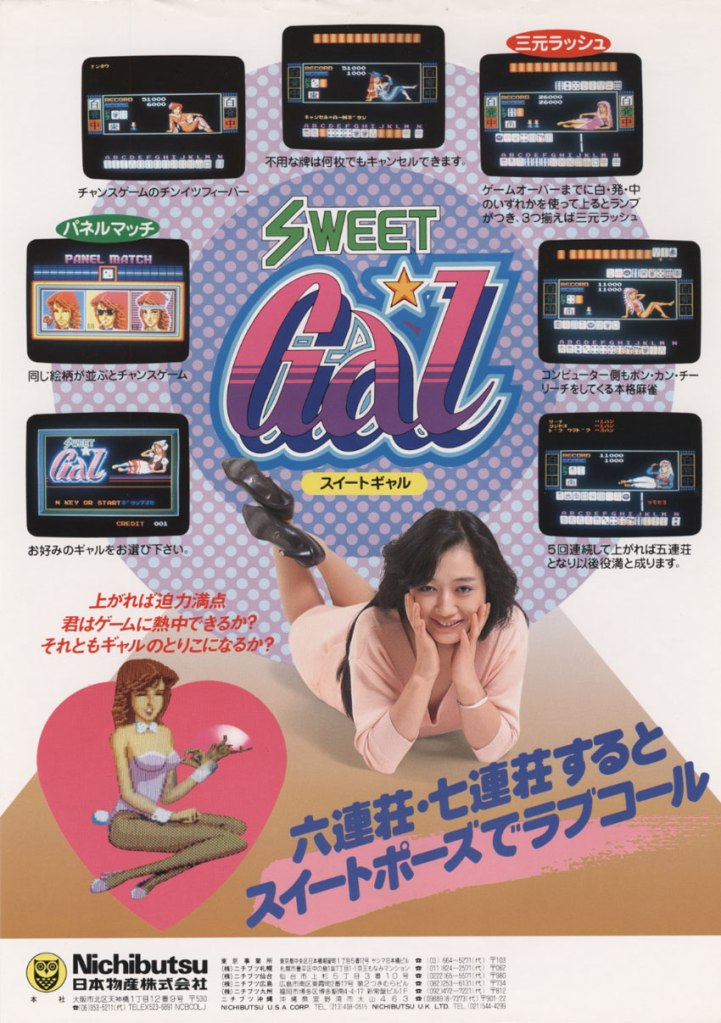
5. Sweet Gal arcade flyer
Seriously, are you interested in playing mahjong in digital form?
Here is another digital mahjong arcade game from Nichibutsu…Sweet Gal. As typical of the company, a model was hired to add subtle sexiness into the promotion of the game and they even added a digital image of a sexy girl. Sweet Gal clearly was promoted to attract men who enjoy playing mahjong in electronic format and there were some arcade spots in Japan that catered to such mahjong enthusiasts.
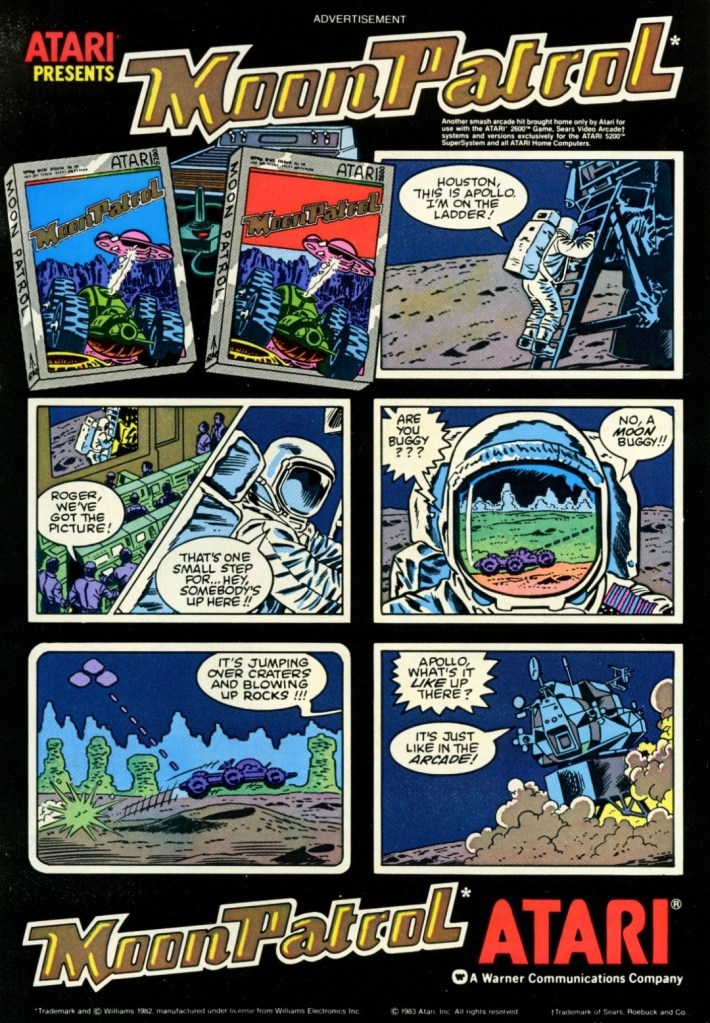
6. Moon Patrol print ad
This is a fun-looking, comic book style way of promoting a video game.
Here is one of those video game print ads I saw while reading comic books back in the early 1980s. Moon Patrol is a sci-fi, side-scrolling game by Atari known for introducing full parallax scrolling in side-scrolling games. Instead of showing screenshots of the console versions of the game, this print ad used nice looking hand-drawn artworks presented with a comic book-inspired style to emphasize the concept. I still remember how captivating this ad and its super short story was the first time I saw it. It was enough to make me interested in the game.
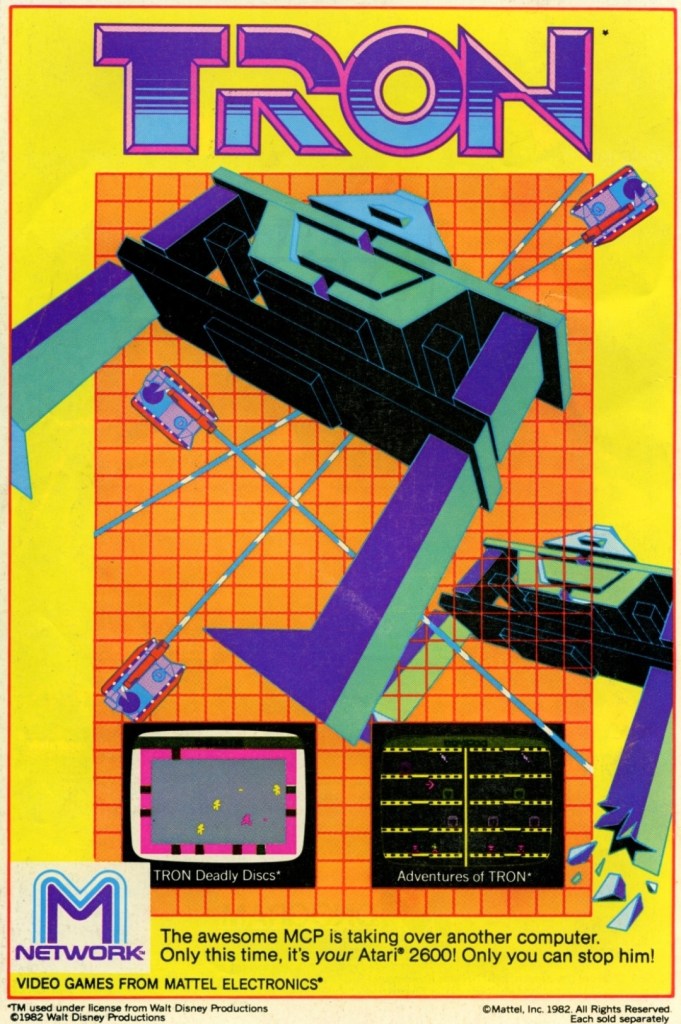
7. Tron Atari 2600 games print ad
Calling all Tron fans to look at this.
I was very captivated by the 1982 sci-fi movie Tron which I saw on home video. It had very flashy computer-generated visuals, a very memorable story and the fine performance by Jeff Bridges. Tron was also very reflective about the video game culture of its time. When I first saw this print ad while reading a comic book, I was really excited. If you look closely, it had nice artwork dominating the space and screenshots that each promoted the games Tron: Deadly Discs and Adventures of Tron. Even though the graphics were primitive, I still recognized the Tron-related images which added to my excitement.
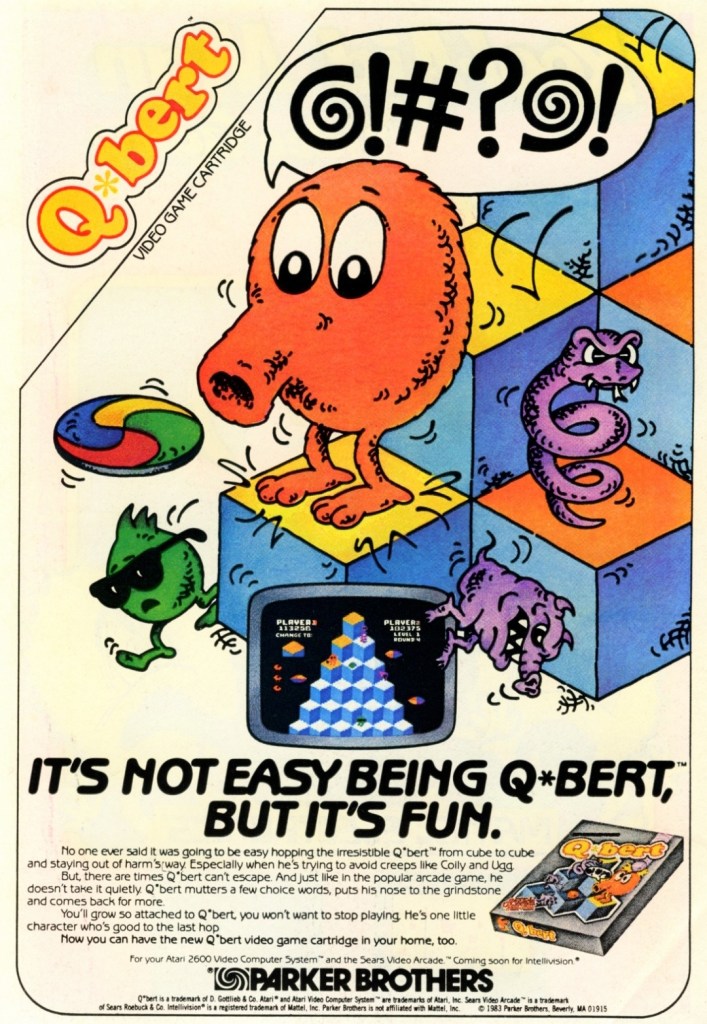
8. Q*bert print ad
This print ad by Parker Brothers really captured the essence of the game.
The puzzle-oriented 2D action game Q*bert became an arcade hit in America shortly after its 1982 release and even went on to become one of the highest grossing arcade games in 1983. Q*bert is one of those 2D games that cleverly blended puzzle play with 3D-like movement and avoidance of both obstacles and enemies. As expected, the game made its way into gaming console and this particular print ad had artwork that strongly captured the very essence of the game complete with the very catchy line “It’s not easy being Q*bert, but it’s fun.”
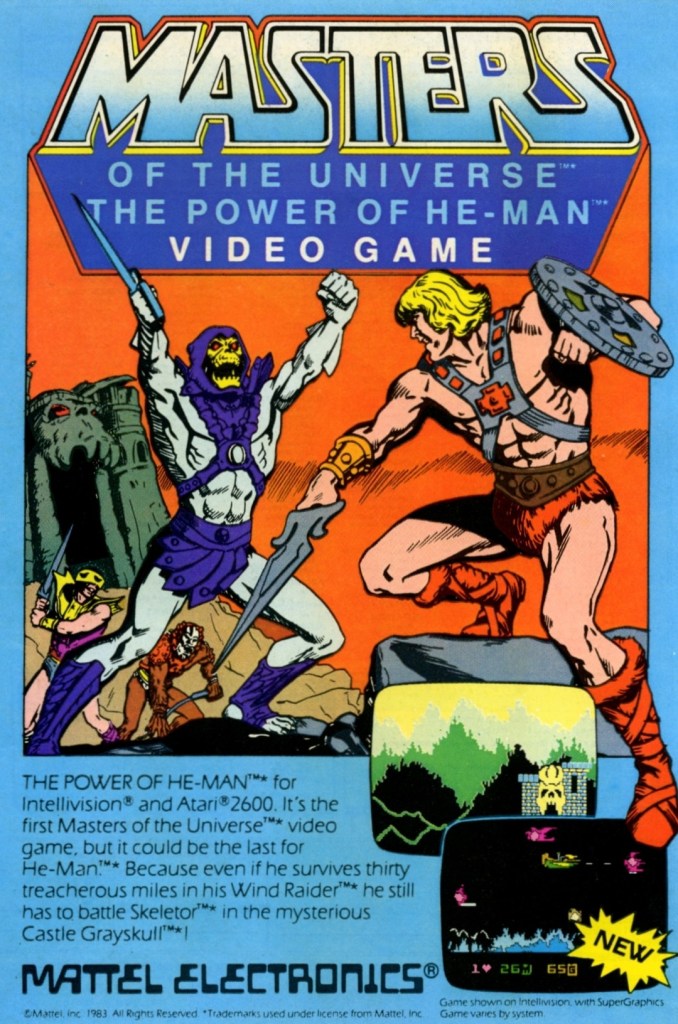
9. Masters of the Universe: The Power of He-Man print ad
Calling all He-Man fans.
I saw this print ad of Masters of the Universe: The Power of He-Man (for Atari 2600 and Intellivision) while reading a comic book long ago. Like the Tron games ad, this made me excited as I was fond of watching the He-Man cartoon series of the 1980s. While the selected screenshots caught my attention, it was the hand-drawn art of He-Man facing off with Skeletor and his minions that captivated me simply because it reminded me of the animated series. This is a fine example of promoting a video game that would instantly resonate with fans of He-Man and the Masters of the Universe franchise.
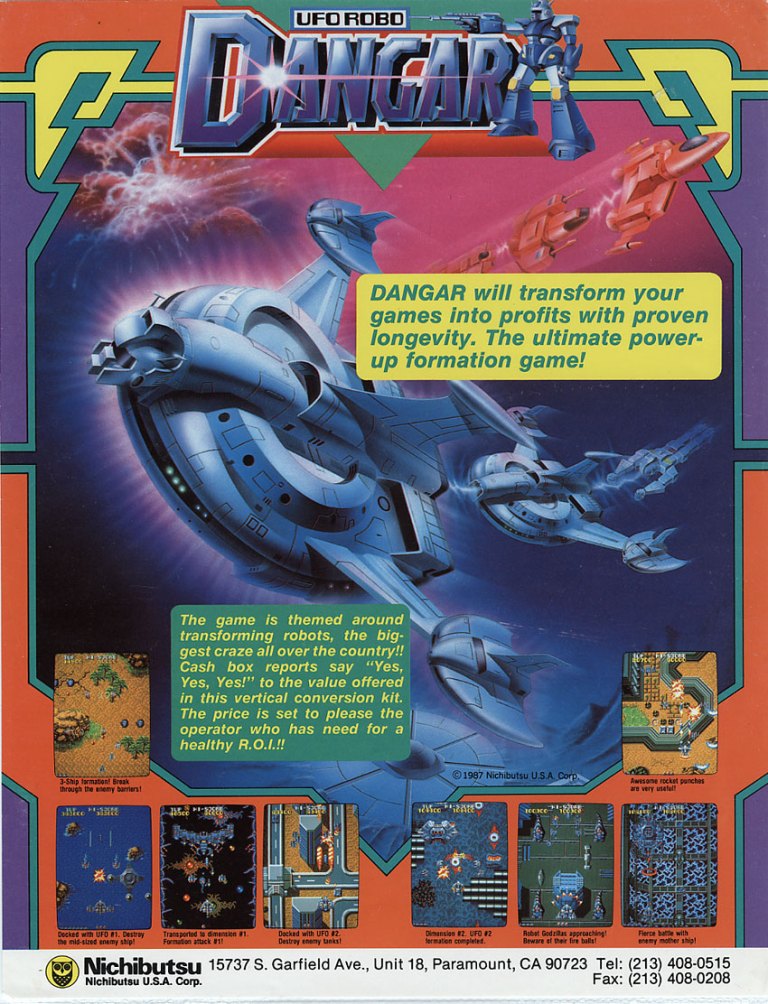
10. UFO Robo Dangar North American arcade flyer
The giant robot concept of this game gave some viewers the impression that it was based on some giant robot anime series from Japan even though the art work used does not suggest it.
Here is another arcade game from Nichibutsu but for the North American market and without the use of a model and without the subtle sexiness. UFO Robo Dangar is a 2D vertically scrolling science fiction shooting game and players get to control a giant robot (composed of flying vehicles that merged into one mechanical body) that has to go through countless waves of enemies in order to advance from one level to another. The arcade flyer used nice looking sci-fi art of ships with the game’s title having a robot and several screenshots of the game. The flyer even made a hard pitch towards arcade operators that UFO Robo Danger will transform their games into profits with proven longevity.
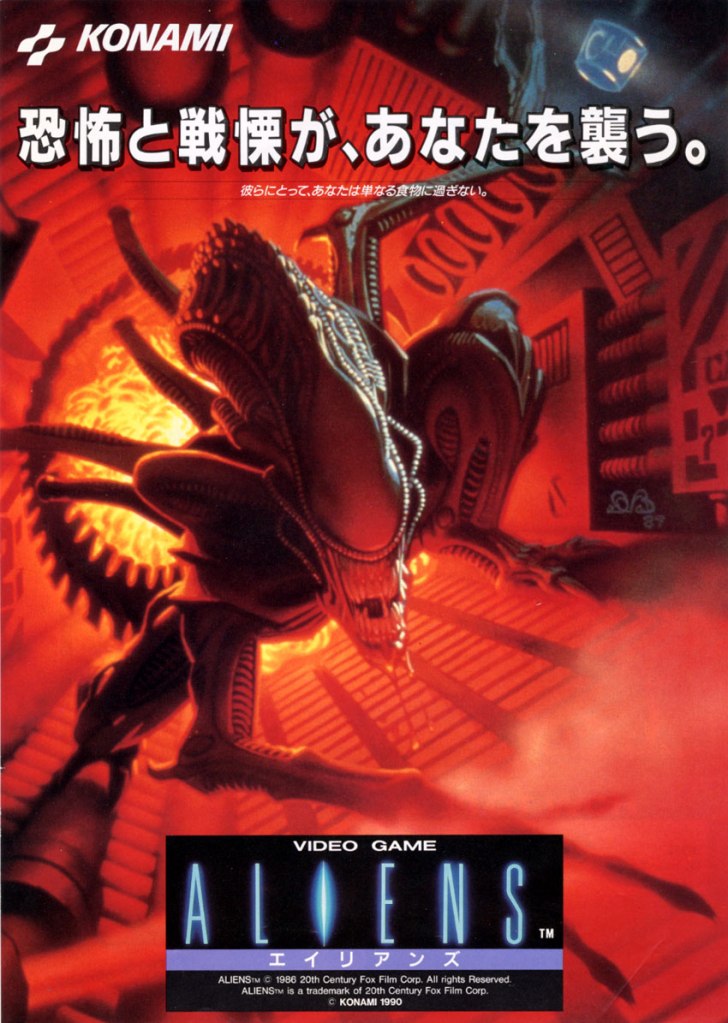
11. Aliens Japanese arcade flyer
The front.
The other side of the flyer of the 1990 arcade hit Aliens.
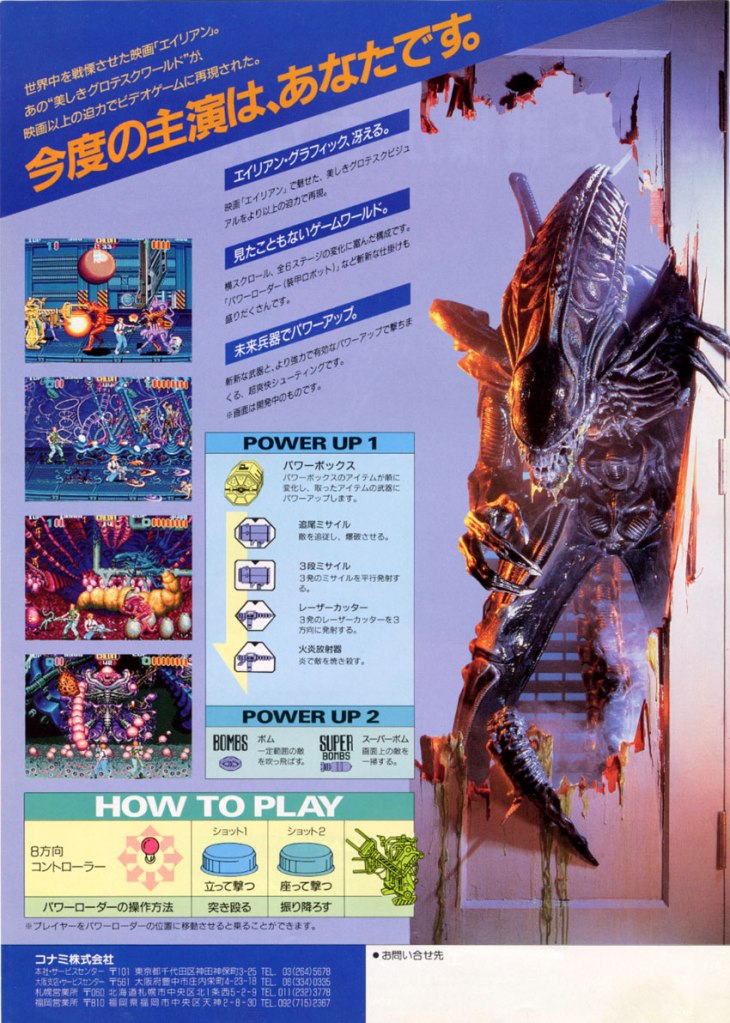
Quite arguably, Konami’s 1990 arcade hit Aliens is the best video game of any game design to be based on the 1986 film directed by James Cameron. Not only was Aliens a big hit in the arcades, it also won an award from the American Amusement Machine Association (AAMA). Aliens was released in Japanese arcades in February of 1990 and Konami released an arcade flyer that was much more visually striking than its North American arcade flyer. The front had detailed artwork of the Xenomorph while the rear had the instructions and screenshots presented in an orderly manner. The photograph of the Xenomorph alien was added intensity on selling the game. This is still a great looking arcade flyer.
Happy New Year to all my readers, YouTube viewers and all others who followed this series of articles focused on YouTube videos worth watching. Have you been searching for something fun or interesting to watch on YouTube? Do you feel bored right now and you crave for something to see on the world’s most popular online video destination?
I recommend you check out the following topics and the related videos I found.
#1 You, Me and the Movies react to The Tower (2012) –The Tower (2012) is a South Korean disaster film that drew huge audiences in its country and found some success overseas. Its concept will remind long-time movie buffs about 1974’s The Towering Inferno which itself was an inspiration for director Kim Ji-hoon. If you want to discover The Tower but you are not willing to spend time and money to see it, I encourage to watch You, Me and the Movies’ reaction video.
#2Alien versus Predator games history examined by Slope’s Game Room – I really enjoy watching the retro gaming videos of YouTuber Slope’s Game Room. This time around, Slope examines the history of video games featuring one of the most memorable sci-fi crossovers ever: Alien versus Predator. For the newcomers reading this, there was a time when Alien and Predator were separate sci-fi film franchises. How a crossover between them happened and what video games were made are explained in detail in the video below.
#3 The rise of cold coffee in America – Do you like drinking coffee that is actually cold? Over the past several years in America, spending on cold coffee skyrocketed and outpaced hot coffee. To be clear, cold coffee includes iced coffee, cold brew and frozen coffee drinks. Already, cold coffee sales really grew for certain businesses that sell coffee. To find out why Americans are buying more cold coffee and what possibly started the trend, watch the video below.
#4 Changing the Middle East – There is no denying the fact that Israel will be remembered for significant gains against Iran-sponsored terrorists in 2024. They did not have much support from Biden-led America but Israel still succeeded in eliminating Yahya Sinwar (Hamas) and Hassan Nasrallah (Hezbollah). Israel also succeeded in hitting military targets in terrorist state Iran which crippled them significantly. Also the collapse of the wicked Assad regime in Syria proved to be a huge loss for Iran which had a sinister alliance with Bashar al-Assad (who abandoned Syria).
With Donald Trump set to return as United States President on January 20, 2025, Israeli Prime Minister Benjamin Netanyahu expressed confidence of changing the Middle East. Netanyahu talked with Trump recently and you can learn more by watching CBN News’ video.
If you have accepted Jesus as your Lord and Savior, I encourage you to pray to Him in support of Israel and the new Trump administration to change the Middle East in 2025. Pray to Him for the Christians in Syria who will soon be affected negatively by the new regime’s plan to impose Sharia Law. Pray to Him for the rescue or release of the hostages of the October 7, 2023 attacks.
#5 Lefties losing it – In case you did not notice, the Democrats in America don’t just have wicked and dishonest leaders. They also have Hollywood celebrities as Democrat activists who are actually phony intellectuals who love to fool their fellow Americans. A lot of Democrat leaders and activists are actually out of touch with the people and reality in general, which is what this Lefties Losing It video from Sky News Australia emphasized clearly. Watch and learn from start to finish.
#6 PatmanQC examines Gun.Smoke – Developed by Capcom, Gun.Smoke debuted in the arcades in 1985 and eventually got ported to different platforms. I never played the arcade version but I had fun with Gun.Smoke on the Nintendo Family Computer (Famicom) Disk System. It was a run-and-gun shooter with an Old West setting and its designer was Yoshiki Okamoto (1942, Street Fighter II and Resident Evil). The production history of the game is quite interesting and you can find out more in PatmanQC’s video.
#7 Ashleigh Burton reacts to The Naked Gun 2½: The Smell of Fear – I love watching Ashleigh Burton’s movie reaction videos, especially the ones that has her laughing a lot. She’s a jolly YouTuber and often entertaining. That being said, you have to watch her reaction to 1991’s The Naked Gun 2½: The Smell of Fear.
#8 Popcorn in Bed reacts to Star Trek: Nemesis – Were you able to watch the entire Star Trek: The Next Generation (Star Trek: TNG) series from 1987 to 1994? I never had the privilege to watch all seven seasons but I managed to watch several random episodes of it and got to know the characters enough before proceeding to watch all four Star Trek: TNG movies from 1994 to 2002. Star Trek: Nemesis (2002) was released in American theaters right in the middle of intense box office competition with a Harry Potter movie, a James Bond movie and a Lord of the Rings movie. Apart from its box office failure, there was something wrong that happened behind the scenes during Star Trek: Nemesis’ production which explains its disappointing quality. If you want to discover the movie but you don’t want to spend too much time nor money on it, I encourage you to watch Popcorn in Bed’s reaction video.
Welcome back, my readers, YouTube viewers and all others who followed this series of articles focused on YouTube videos worth watching. Have you been searching for something fun or interesting to watch on YouTube? Do you feel bored right now and you crave for something to see on the world’s most popular online video destination?
I recommend you check out the following topics and the related videos I found.
#1 You, Me and the Movies react to 1984’s Runaway – When it comes to the works of the late Michael Crichton, you might be familiar with Jurassic Park, The Andromeda Strain, Congo, Sphere and Westworld. Way back in 1984, Runaway was released in cinemas and it was directed by Crichton himself. The result was a very unique way of telling a crime story with a heavy touch of techno thriller. Hollywood has not made another movie like Runaway. To discover more about Runaway, watch the reaction video of You, Me and the Movies.
#2 Minty Comedic Arts’ look at The Indian in the Cupboard – I remember way back in the mid-1990s when I was inside a local movie theater anticipating a movie to start playing. As I waited, a few movie trailers were shown and the one trailer that really caught my attention was that of The Indian in the Cupboard. Apart from having an interesting concept (based on the 1980 children’s book), the trailer even showed a few but special seconds of Darth Vader and RoboCop in motion. I never saw the movie but there is a lot of interesting stuff to learn about it. Watch the video by Minty Comedic Arts.
#3 The incompetence and delusions of super woke Canadian Prime Minister Justin Trudeau – Let’s be very clear here. Justin Trudeau, who has been Canada’s Prime Minister since 2015, is living with a very distorted view of reality and his fellow Canadians are already suffering economically and socially. A proud feminist, Trudeau recently attacked Americans for rejecting his fellow Communist and American counterpart Kamala Harris in the 2024 US Presidential Election. Trudeau’s recent speech only proved his delusional views and lack of common sense. Most likely, he is panicking already over US President-elect Donald Trump’s plan to impose tariffs on Canada. Watch the Sky News Australia video to find out more.
#4 The sinister truth about the Electric Vehicle (EV) industry that the mainstream news media is not telling you – I already said it before – electric vehicles (EVs) are dangerous and can harm you and your local community. There really is a conspiracy between the electric vehicle industry players, the mainstream news media and the climate change zealots. Together, those sinister forces are hiding the dark truth about EVs and they will do anything to get your money. Watch the Piston Pundit video now.
#5 More videos about Planet of the Apes (1968) – Did you notice that every time a new Planet of the Apes movie got released, there is the temporary revival of interest in the original movie of 1968? By today’s standards, Planet of the Apes of 1968 has little spectacle as it was more philosophical, more suspenseful and more about shock. If you want to discover more about the Planet of the Apes film that starred Charlton Heston, watch the selected videos below.
#6 PatmanQC’s look back at The Combatribes – The Combatribes was a hit in the arcades both in Japan and America way back in 1990. Unsurprisingly, the game was ported to the Super Nintendo Entertainment System (SNES) in 1992. Believe it or not, the company behind The Combatribes also made the Double Dragon games. If you wish to learn more about the history of The Combatribes, watch PatmanQC’s in-depth video.
#7 Decker Shado’s video review of City Hunter (1993) – Believe it or not, the 1993 Jackie Chan-led action comedy movie City Hunter was a live-action adaptation of the City Hunter manga series (which was adapted into an anime TV series). I never saw City Hunter when it was played in cinemas here in the Philippines in 1993 but I heard so much feedback from my friends as the claimed to laughing so hard inside the cinema. Years ago, YouTuber Decker Shado had a series of retro video reviews of Jackie Chan films and his City Hunter video review is entertaining.
#8 Slope’s Game Room’s Dino Crisis series retrospective – I can hardly believe it has been 25 years since I first played Dino Crisis on the PlayStation which was a memorable game as it was directed by Resident Evil creator Shinji Mikami. A lot of gamers called Dino Crisis “Resident Evil meets Jurassic Park” but in my view, it was daring creative choice by Mikami who led a team that worked so hard to animate dinosaurs while using a game engine that rendered full polygonal environments for players to explore. To my surprise, Dino Crisis 2 was released a little over year later and it had radically different gameplay that emphasized more of speed, shooting and scoring. A few years later, I played Dino Crisis 3 on a rented Xbox console and it was a very disappointing experience. To find out more about the history of the Dino Crisis games, watch Slope’s Game Room’s retrospective.
Welcome back, my readers, YouTube viewers and all others who followed this series of articles focused on YouTube videos worth watching. Have you been searching for something fun or interesting to watch on YouTube? Do you feel bored right now and you crave for something to see on the world’s most popular online video destination?
I recommend you check out the following topics and the related videos I found.
#1Konami’s failed fighting games of the 1990s – Remember back in the 1990s when a lot of fighting games were released on the arcades and game consoles? Japanese game companies Namco and Capcom released a lot of memorable fighting games of different styles such as Street Fighter II, Tekken, Marvel vs. Capcom, Tekken 3, Soulcalibur, X-Men: Children of the Atom, X-Men vs. Street Fighter and so on. Sega released Virtua Fighter games while Midway released Mortal Kombat games, and SNK had Fatal Fury, King of Fighters and Art of Fighting games. Looking back at the fighting game craze of the 1990s, I noticed that Konami – best known for Metal Gear, Contra, Gradius and Suikoden – released their own fighting games but never achieved the tremendous success that its competitors had. The retro gaming video is a must-see.
#2 Calvin Dyson’s lengthy review of The World is Not Enough – I can hardly believe that it has been twenty-five years since the James Bond movie The World Is Not Enough was released in cinemas as the 20th century was ending. The 3rd film of Pierce Brosnan as Agent 007 received mixed reviews from the critics and some fans found it to be really brainless and excessive with action which negatively affected the cinematic narrative. To find out if the 1999 Bond movie aged well or not, YouTuber Calvin Dyson recently posted his lengthy retro review and you can watch it now.
#3 In-depth documentary of Smash TV – Remember way back in 1990 when Smash T.V. (also referred to as Smash TV) was released in the arcades and attracted a lot of players with its enjoyable game design and concept? The game was a hit and went on to be ported to many platforms afterwards, and I played its Super Nintendo Entertainment System (SNES) version a lot. To find out how hit game started and who were the key people behind its production, watch the video documentary of PatmanQC now.
#4 Defeated Kamala Harris, Sharon Stone, Alec Baldwin and others highlighted in Lefties Losing It episode – It has been a few weeks since Donald Trump pulled off the greatest American comeback by winning again the US presidential election. Even until now, the Leftists are still agonizing over Trump’s victory and many of them cannot accept the reality of what happened. In the latest Lefties Losing It episode below, you will see a drunk-like Kamala Harris talking to her supporters, Sharon Stone bashing others and more. Watch it!
#5 Electric vehicles sparked into fire disasters as a result of salt water caused by Hurricane Helene – This news video should convince you not to buy and drive an electric car or any type of electric vehicle for that matter. Salt water touching the ion batteries of electric vehicles spark flame and this leads into fire incidents that simply could not be solved quickly. Hurricane Helene’s powerful wind brought salt water into affected communities and not even electric vehicles parked inside the garage were spared. Avoid electric vehicles and stick with vehicles that run on fossil fuel.
#6 Ashleigh Burton’s Fantastic Four (2005) reaction video – Back in 2005, I never saw Fantastic Four in the local cinema. I was never a Fantastic Four fan nor did the team-up of Stan Lee and Jack Kirby starting the said superhero team interested me. Believe it or not, I finally saw the movie on home video in 2009. In recent times, YouTuber Ashleigh Burton posted her reaction video of Fantastic Four and it is fun to watch.
#7 Phantasy Star IV retrospective – Thanks to my physical copy of Sega Genesis Classics, I was able to play Phantasy Star IV: The End of the Millennium on my Xbox Series X console. For the newcomers reading this, Phantasy Star IV was a sci-fi Japanese role-playing game (JRPG) released on the Sega Genesis (Mega Drive in other markets) in Japan in 1993 followed by released in America and Europe in 1995. The production side of the game has very interesting details and you can learn all about it in GTV Japan’s retrospective video below.
#8 A look at Disney’s The Black Hole – Long before the Walt Disney Company became the super woke entity of modern times, they released the expensive sci-fi film The Black Hole. As far as the Disney legacy is concerned, the 1979 movie is significant as it marked a serious change of direction the company took with its movies. Disney was already known for wholesome and family oriented movies and TV shows and eventually entered a period of uncertainty. The Black Hole was both Disney’s attempt to cash-in on the sci-fi and disaster film craze of the 1970s and attract more adult moviegoers. You can learn more about this forgotten movie by watching the videos below.
#9 Popcorn in Bed’s What Lies Beneath reaction video – I saw What Lies Beneath inside a crowded cinema here in the Philippines way back in 2000. Directed by Robert Zemeckis, the film was an inspired work of suspense and horror mainly told through Michelle Pfeiffer’s character. I still remember some comments of disappointment over Harrison Ford’s lack of screen time compared with Pfeiffer’s. Regardless, you have to see Popcorn in Bed’s reaction video right here.
Welcome back, my readers, YouTube viewers and all others who followed this series of articles focused on YouTube videos worth watching. Have you been searching for something fun or interesting to watch on YouTube? Do you feel bored right now and you crave for something to see on the world’s most popular online video destination?
I recommend you check out the following topics and the related videos I found.
#1Ashleigh Burton’s Logan reaction video – Finally, after posting several X-Men-related reaction videos on her YouTube channel, YouTuber Ashleigh Burton posted her reaction to the great movieLogan. As it is a great film, you must watch it entirely first. If you have seen it already, then I urge you to watch Burton’s reaction video below.
#2 Woke Hollywood continues to freak out over Donald Trump’s comeback as US President – Remember all those many Hollywood elitists who went all out to fool Americans to vote for Commie Kamala Harris for US President? A lot of them plus Hollywood media are still freaking out over Harris’ loss to Donald Trump (who pulled off the greatest American comeback ever). Watch the videos from Midnight’s Edge and RK Outpost below. Pay close attention to the details.
#3 1990s explanatory video about the Fighter’s History – Street Fighter II case – Back in the 1990s, Capcom USA sued Data East over the video game Fighter’s History for infringing on Street Fighter II. As part of its efforts defending Fighter’s History, Data East released to the media an explanatory video (lawsuit exhibit video) which was recently posted on YouTube for millions of people to watch for the first time ever. Watch it now.
#4 Examining Final Exam – Have you ever seen the 1981 movie Final Exam? It was a low-budget, independently made slasher horror movie that looks inspired by Halloween (1978), Friday The 13th (1980) and even National Lampoon’s Animal House (1978). While it is a fact that the movie faded away into obscurity for decades, it suddenly gained attention among film buffs arguably because of its 2023 release on 4K Blu-ray format. Apart from that, Final Exam has a very interesting story of production and execution, and you can learn more about it in the two videos below.
#5 Spotlight on Predator 2 – While it is clear that the 1990 sci-fi action movie Predator 2 does not match the greatness of its predecessor, it still aged well and clearly succeeded in expanding the lore of the Predator entertainment franchise. It also established very creatively the link between Predator and the Alien film franchise. That being said, it is not surprising that the movie became the subject of several YouTubers’ retro movie review videos and movie reaction videos. Before you watch the selected videos below, I encourage you to watch the film first in case you have not seen it. Otherwise, enjoy the selected videos below.
#6 Halo 2 remembered – Twenty years ago this month, Microsoft launched Halo 2 on the original Xbox console with massive hype and success. I could never forget the excitement leading towards its launch followed by the fun I had playing the single-player campaign. The only problem I had with Halo 2 was the abrupt ending. Regardless, Halo 2 is still memorable and if you feel nostalgic about it, watch the video below. Remember, this is a look back at the time when Team Xbox invested a lot not only on Halo 2 but also on making Xbox fans happy with exclusive content.
Welcome back readers, fellow geeks and electronic gaming fans!
In this edition of the Retro Gaming Ads Blast (RGAB) series, we will take a look at another batch of retro gaming print ads – including arcade flyers – from the 1980s and 1990s.
For the newcomers reading this, Retro Gaming Ads Blast (RGAB) looks back at the many print ads of games (console, arcade, computer and handheld) that were published in comic books, magazines, flyers, posters and newspapers long before smartphones, social media, the worldwide web and streaming became popular. To put things in perspective, people back in the 1980s and 1990s were more trusting of print media for information and images about electronic games and related products.
With those details laid down, here is the newest batch of retro gaming print ads for you to see and enjoy…
1. Galaxian for Atari print ad
A unique approach to the art done by the advertisers.
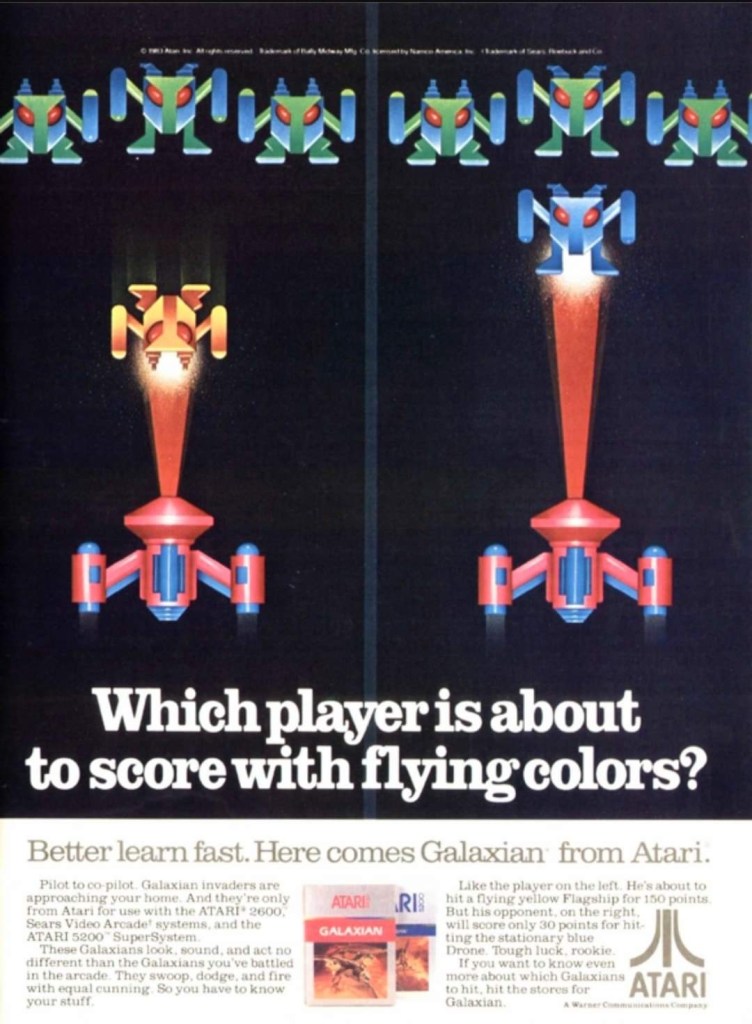
Developed by Namco, Galaxian was a 2D sci-fi shooter that debuted in arcades in 1979. It was so successful and widely acclaimed, it got ported to varied game consoles and home computers as the years passed by. For its release on the Atari 2600 and Atari 5200, this print ad was created to catch the attention of fans and gamers by utilizing artwork that resembled the look of 2D sprites from the game. That being said, no screenshots of Galaxian on the Atari consoles were shown because the artwork used looked detailed and were attention-grabbing already.
2. 1943: The Battle of Midway arcade flyer
This is a fine looking flyer.
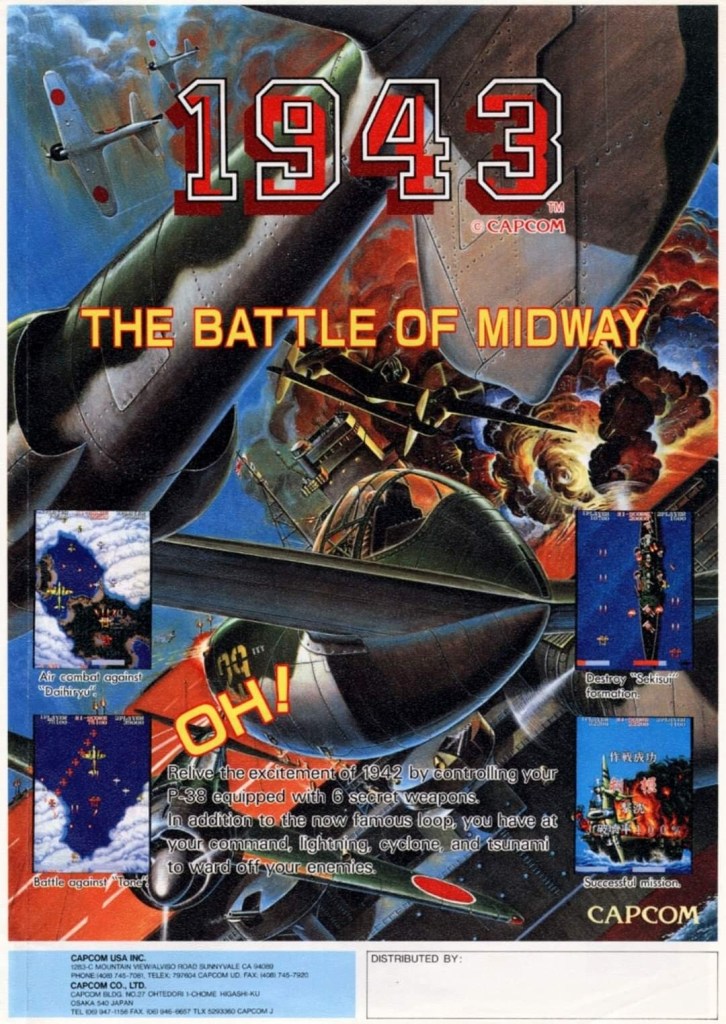
In 1987, Capcom released in the arcades 1943: The Battle of Midway which was their follow-up to 1942. The arcade flyer itself was designed to strongly promote the game using a combination of screenshots, short-but-clear text descriptions and the great looking piece of artwork which really emphasized the World War II concept. Behind it all, this game was made by Japanese developers with the Western markets in mind and the irony is that the game has players control Americans fighting the Japanese fleet.
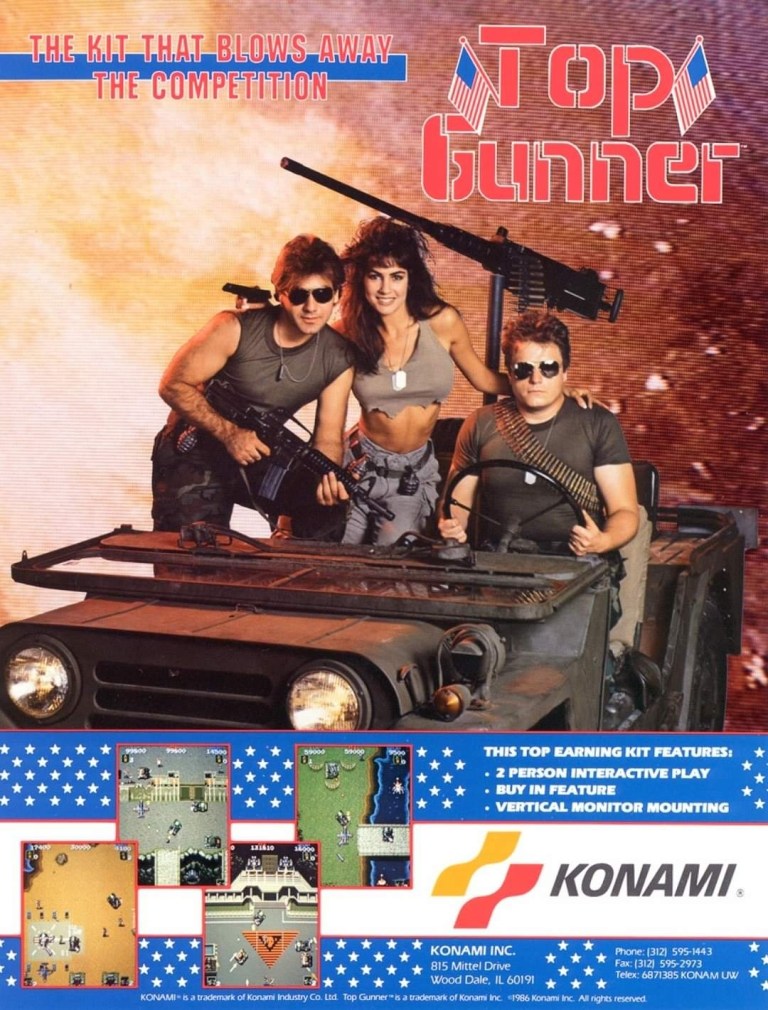
3. Top Gunner arcade conversion kit flyer
Show this nice looking image to the woke nut or modern day Communist near you. Watch and observe his or her reaction.
To make things clear, Top Gunner is actually the run-and-gun game Jackal and the alternative titles was mainly used in North American arcade distribution and also reflected Konami’s move of coming up with titles inspired by blockbuster movies of the time. To promote its 1986 arcade release in America as a conversion kit, the advertisers had three models playing soldiers on a military jeep to immerse gamers into the core concept of the game – moving armed military jeeps from one location to another while fighting bad guys. The approach used for the visual concept is indeed inspiring, especially during the Cold War. Top Gunner/Jackal became a hit in both arcades and consoles.
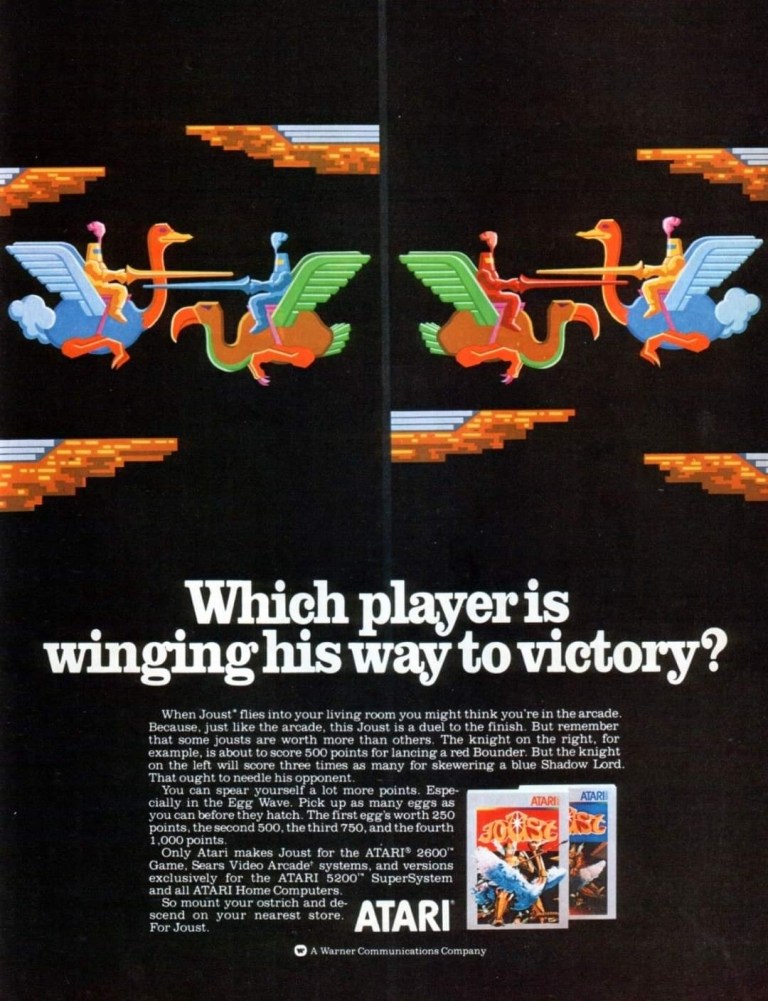
4. Joust for Atari print ad
While I played Joust on console, I don’t remember seeing this print ad before.
Made by Williams Electronics, Joust was one of those early 1980s arcade games that eventually made its way to the Atari 2600 console which was massively popular in North America. Strangely enough, the artistic approach Atari’s advertising came up with for the console version of Joust was similar with that of the ad of the Atari version of Galaxian (see item #1 above) in which artwork was used to resemble the 2D sprites of the game. Regardless, the images of this ad showed what a joust looked like – a martial game between two armed combatants going against each other while riding an animal.
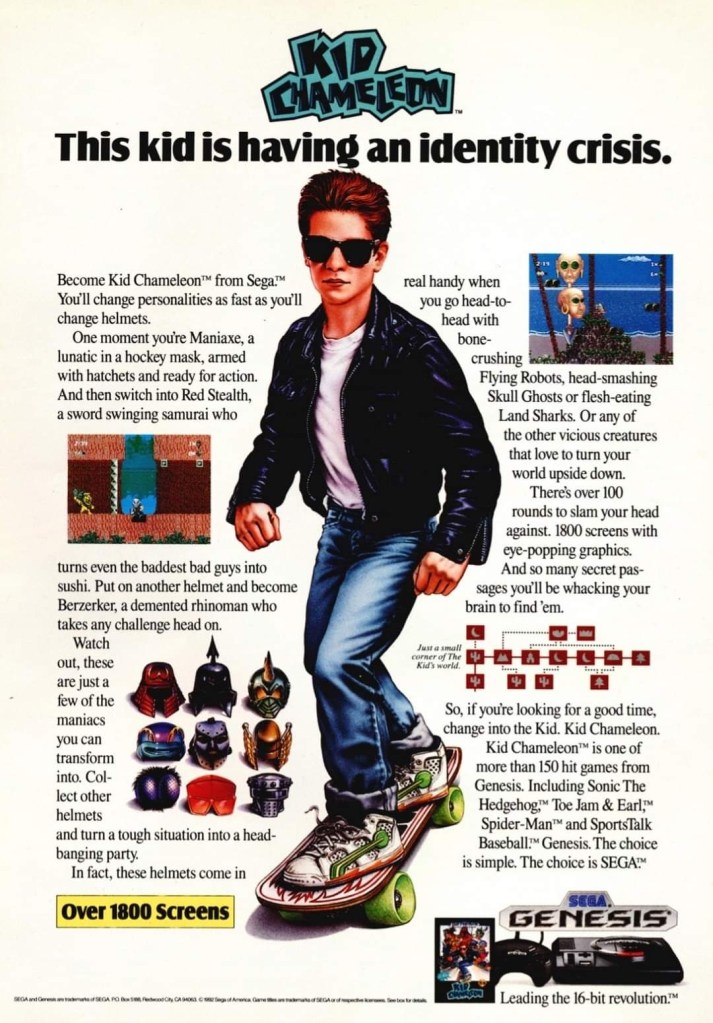
5. Kid Chameleon print ad
Can you relate with Kid Chameleon’s identity crisis?
During the early years of the Sega Genesis, Sega of America exerted efforts to make new games that were not only exclusive to their console but also stand out among the many 2D side-scrolling adventure games by coming up with a protagonist with a unique personality that could somehow resonate with young kids and teenagers.
Developed by their internal experts (Sega Technical Institute), the company released Kid Chameleon in 1992 and they came up with the above print ad that had detailed hand-drawn art of the lead character as well as a wordy text description which was a clear attempt to help young gamers (including teenagers) get connected with both the game and the protagonist. The advertisers even had space to spare to accommodate two screenshots of the game.
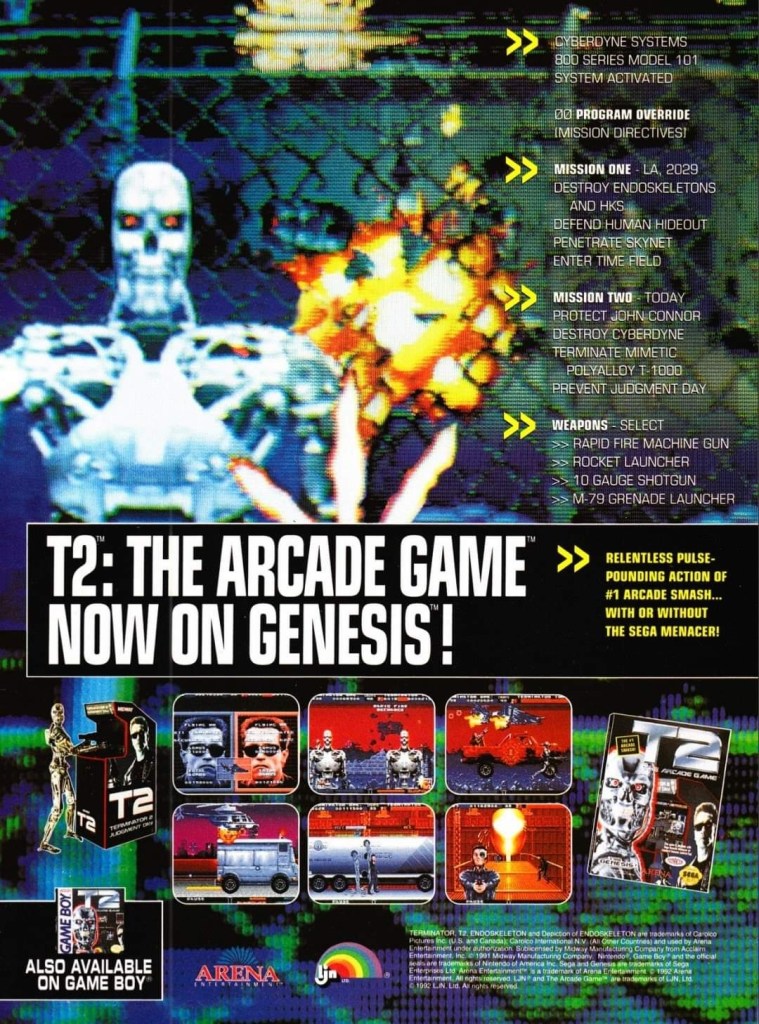
6. Terminator 2: Judgment Day (AKA T2: The Arcade Game) for Sega Genesis print ad
This print ad appeared on the many comic books I read long ago.
Back in the early 1990s, Terminator 2: Judgment Day was a massive success in the global box office and this resulted in Arnold Schwarzenegger’s popularity to soar very high while also establishing the Terminator as an essential pop culture figure. Apart from comic books and merchandise, video games based on the movie were made and the one that stood out the most was the arcade shooter game initially titled Terminator 2: Judgment Day (later retitled as T2: The Arcade Game).
The arcade mega hit eventually got ported to the Sega Genesis and this print ad really looked flashy with its visual presentation showing screenshots and a zoomed-in look at how the Terminator T-800 looked like in the Genesis version complete with a few explosions in the background. It should be noted that this flashy print ad cleverly concealed the visual downgrades and the redrawn images as the Genesis itself could never come close to matching the high quality visuals of the arcade version.
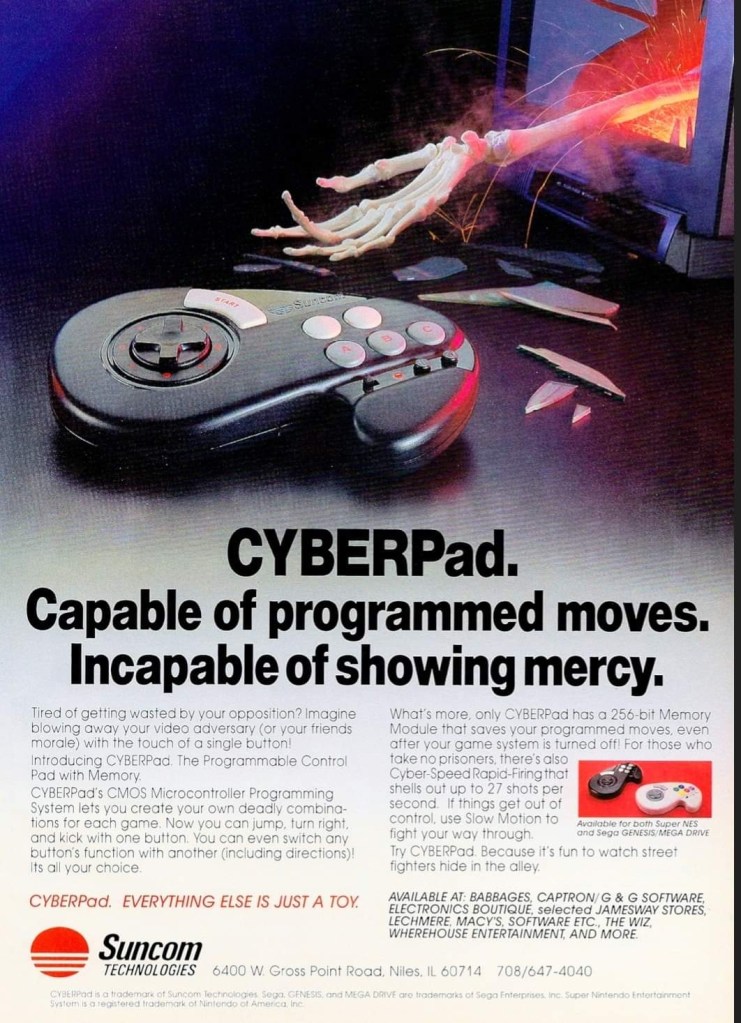
7. CYBERPad print ad
I never owned the CYBERPad, nor have I ever used one.
During the so-called 16-bit console generation (actually the 4th console generation), there were lots of licensed console peripherals made by independent companies in support of the Sega Genesis and Super Nintendo Entertainment System (SNES). The company Suncom Technologies came up with the CYBERPad controller for the two consoles and they boasted in their print ad that the product had a programmable control pad that allowed users to create combinations for each game with convenience in mind. The CYBERPad also allowed the saving of the programmable moves and it had a rapid-fire feature and even a slow-motion function. The CYBERPad was made to make the gameplay experience more user-friendly.
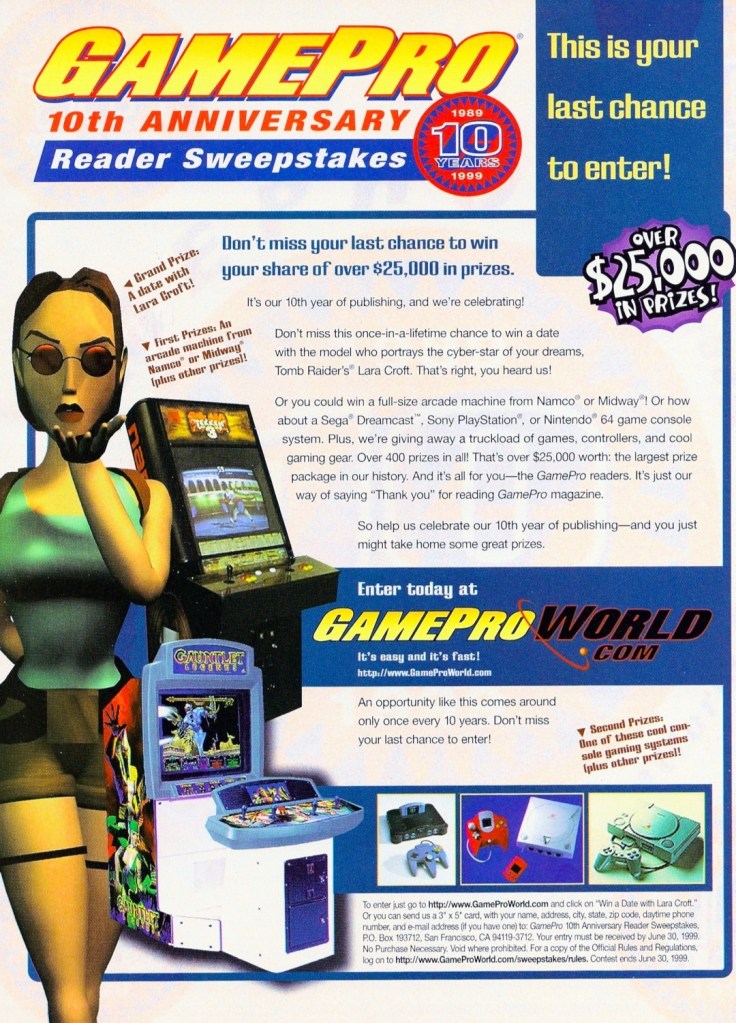
If you look closely, this print announcement by GamePro technically advertised the game consoles, the arcade game and Lara Croft to its readers.
In 1999, GamePro magazine celebrated its 10th anniversary and to keep on resonating with gamers and maintaining the loyalty of their fans, they organized a reader sweepstakes with prizes worth over $25,000 to be won by the few winners. GamePro boasted a date with an unnamed model who played the iconic Lara Croft (Tomb Raider). Certain arcade machines plus the modern consoles of the time – including the brand-new Sega Dreamcast – were also at stake. The way it was presented, this GamePro print announcement was enticing to read.
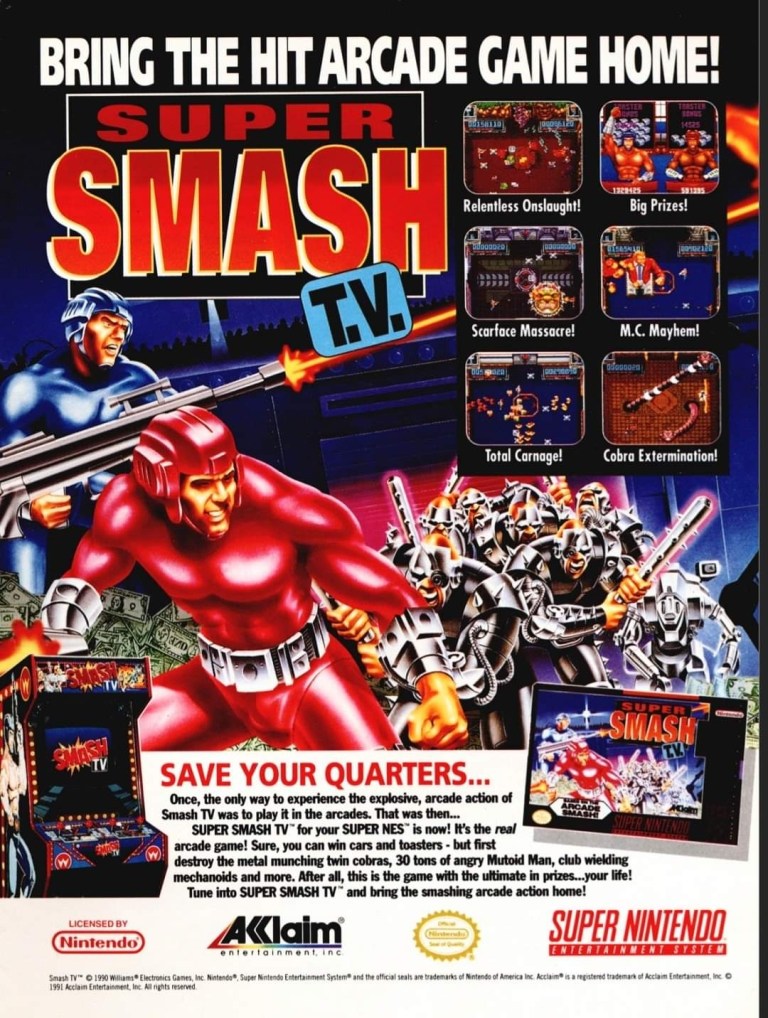
9. Smash T.V. for SNES print ad
Smash T.V. was a lot of fun on both arcade and console.
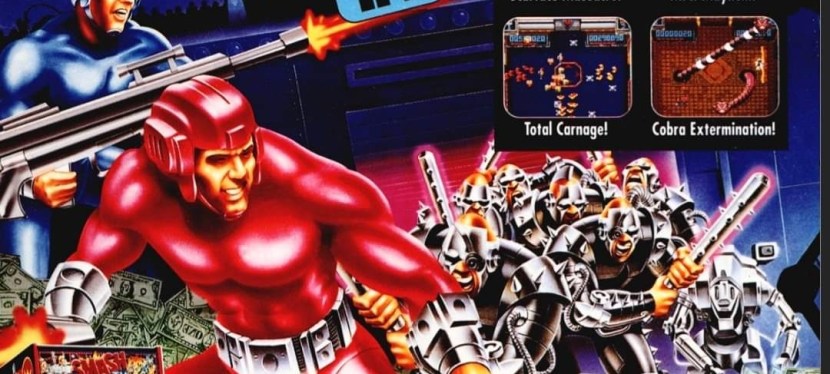
The arcade hit Smash T.V. made its way to the Super Nintendo Entertainment System (SNES) in 1992 and the publisher came up with a print ad that had captivating artwork, six screenshots and a text description that emphasized that a lot of fun awaits gamers on the console version. In my view, this old ad is still amusing to look at.
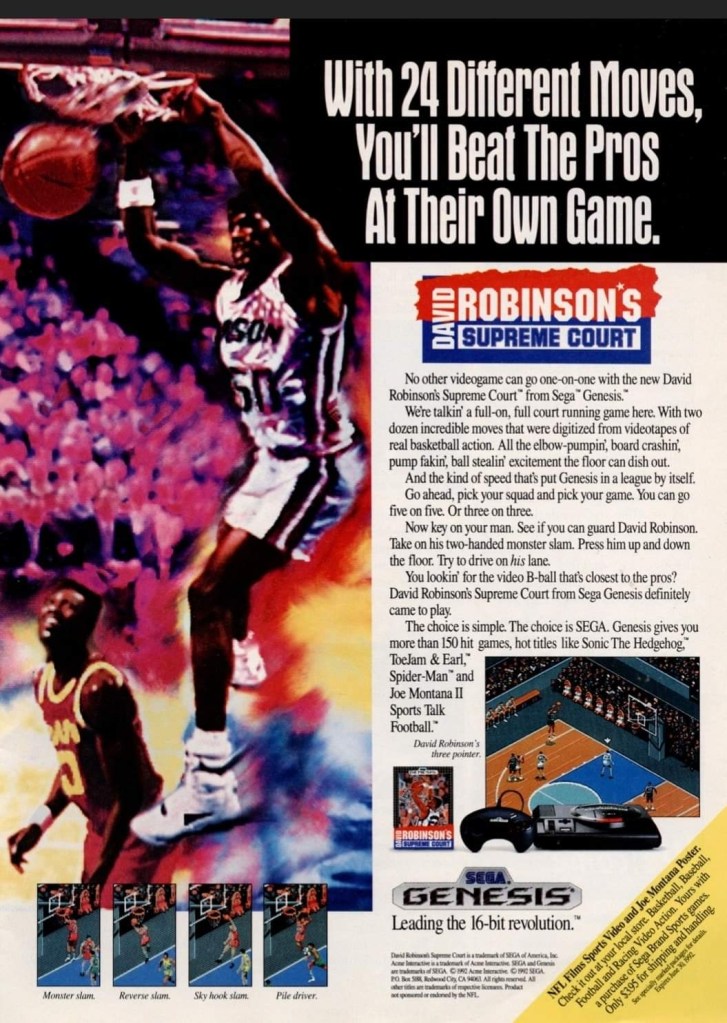
10. David Robinson’s Supreme Court print ad
It was a smart move by Sega to get NBA superstar David Robinson as the endorser of this basketball video game exclusive on the Sega Genesis. This ad was published many years before Robinson finally won an NBA championship.
As part of its strategy in competing with Nintendo during the 4th console generation, Sega of America was focused on producing exclusive sports video games for the Genesis console backed by endorsements of sports professionals. In 1992, they released David Robinson’s Supreme Court on the Genesis and unsurprisingly their print ad used a large, stylized image of the NBA superstar dunking backed with an exciting text description plus screenshots showing the game’s use of the isometric view for gameplay. This is still worth looking at.
11. Taito’s “heat wave” print ad
An amusing and creative way to sell video games.
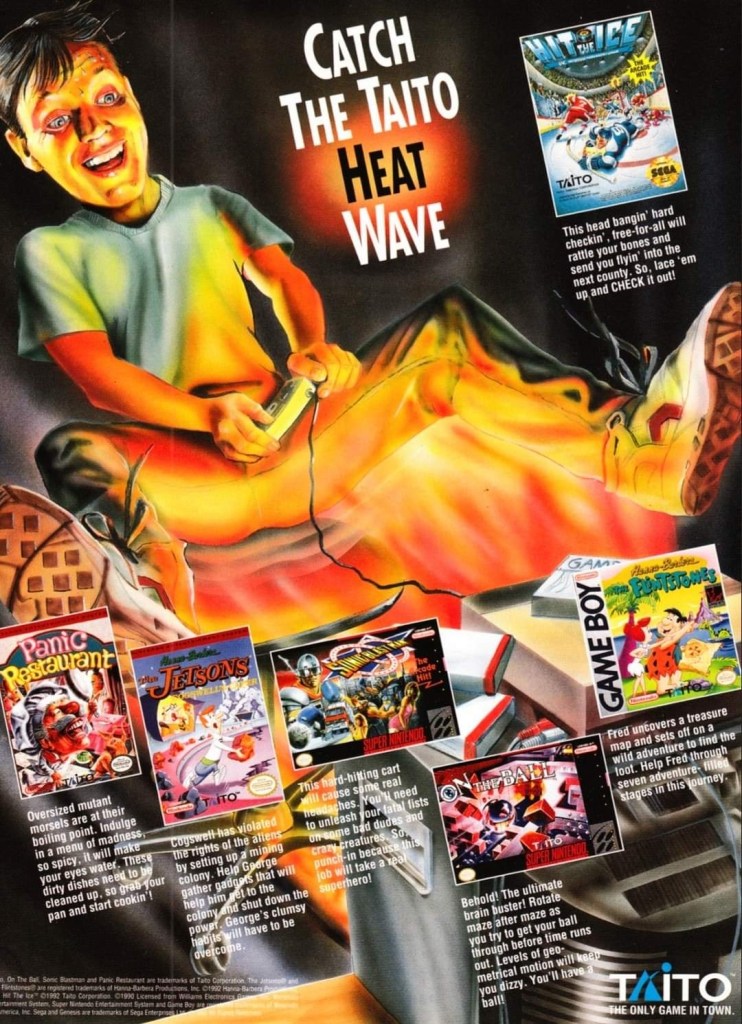
If your company lacks money to effectively market your video games individually, you can try making a single ad promoting them together. This is what Taito did in this print ad which showcases multiple games for different platforms and they used artwork of a player experiencing the so-called heat wave. This is a nice stroke of creativity on the part of Taito.
12. Jurassic Park Interactive print ad
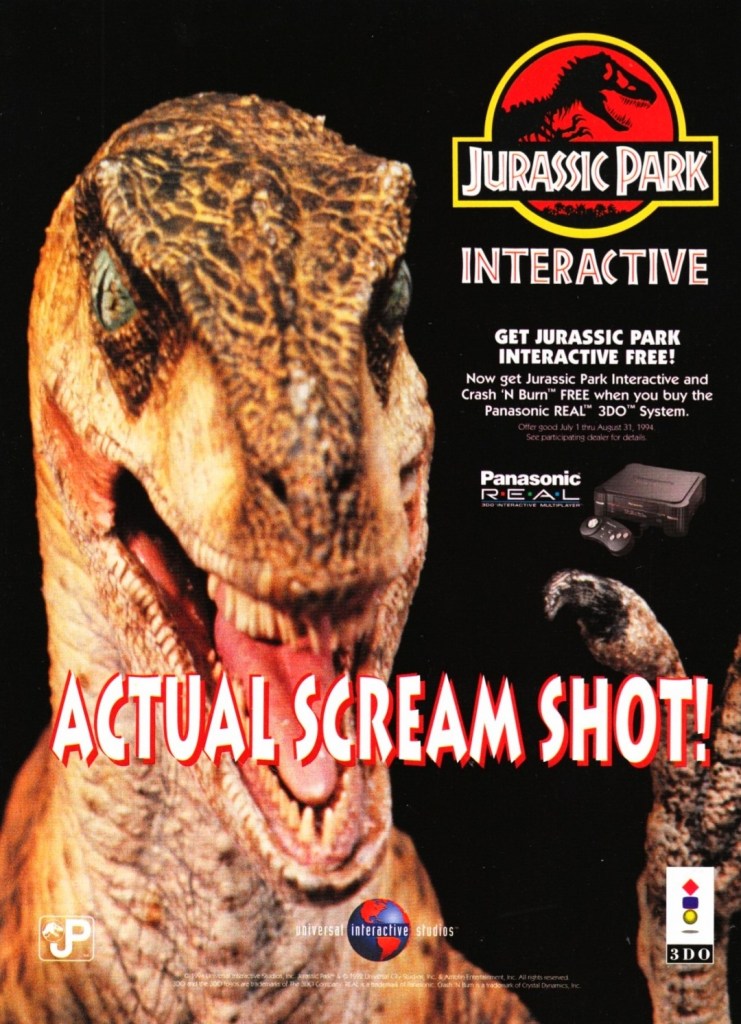
This was a creepy print ad promoting the 3DO-exclusive Jurassic Park Interactive.
When it comes to video game consoles, having exclusive games is essential as long as they are of high quality, highly playable and enjoyable. The 3DO company acquired a license of the Jurassic Park movie and made the exclusive game Jurassic Park Interactive hoping it would sell a lot and lift up 3DO hardware sales.
This print ad, which features a zoomed-in image of the Raptor from the game, was more focused on selling the 3DO console than the video game as seen on the descriptive text. 3DO ran a promo selling the console which would entitle the buyer to get Jurassic Park Interactive and another game free. Nothing was done to describe the console’s multimedia capabilities of showing videos, images and graphics of the game (which was essentially a collection of mini-games). This print ad shows ignorance on the part of the 3DO company and the ad maker as it showed desperation happening really early in the console’s life. Notably, Jurassic Park Interactive was the only video game adaptation to use actual footage (note: the faces of the actors were edited out) and music from the film.
13. RoboCop 2 print ad
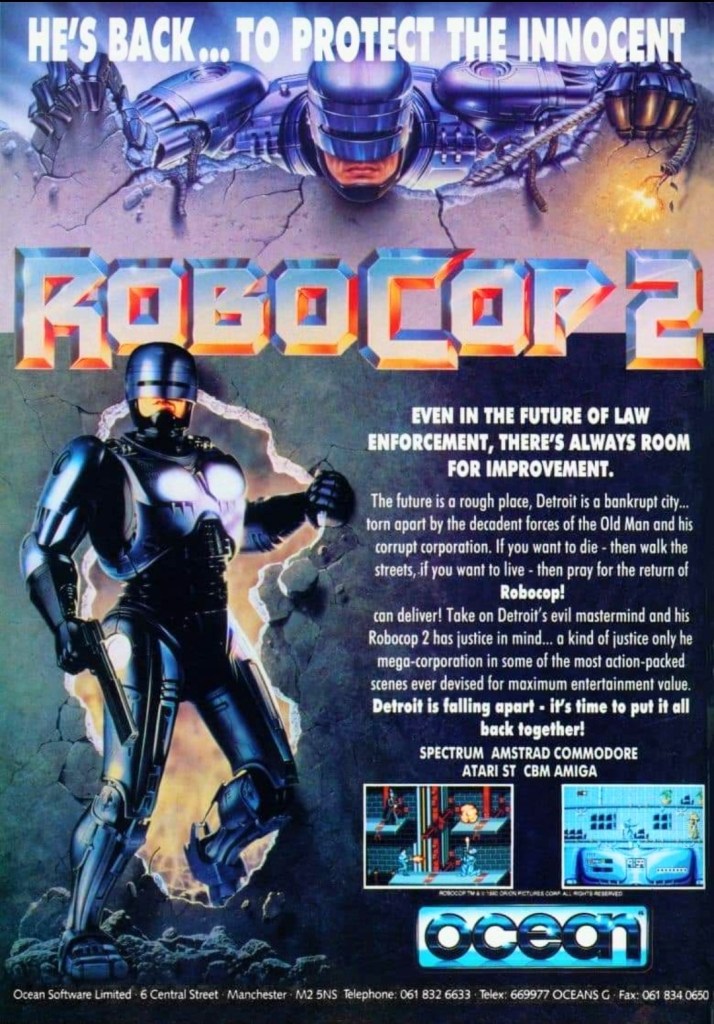
You want to become RoboCop to save the city of Detroit from criminals?
Way back in 1990, RoboCop 2 was a big hit in cinemas here in the Philippines and in some places around the world. As typical of the time, licenses to make video games based on the movie were released resulting in RoboCop 2 games for multiple platforms. The print ad featured two different images of RoboCop – one from the movie poster and the other from an official artwork. The descriptive text does a fine job to immerse readers into the story concept of the game but showing only two screenshots was a lackluster effort to sell the game.
14. Star Trek: The Next Generation – Echoes from the Past print ad
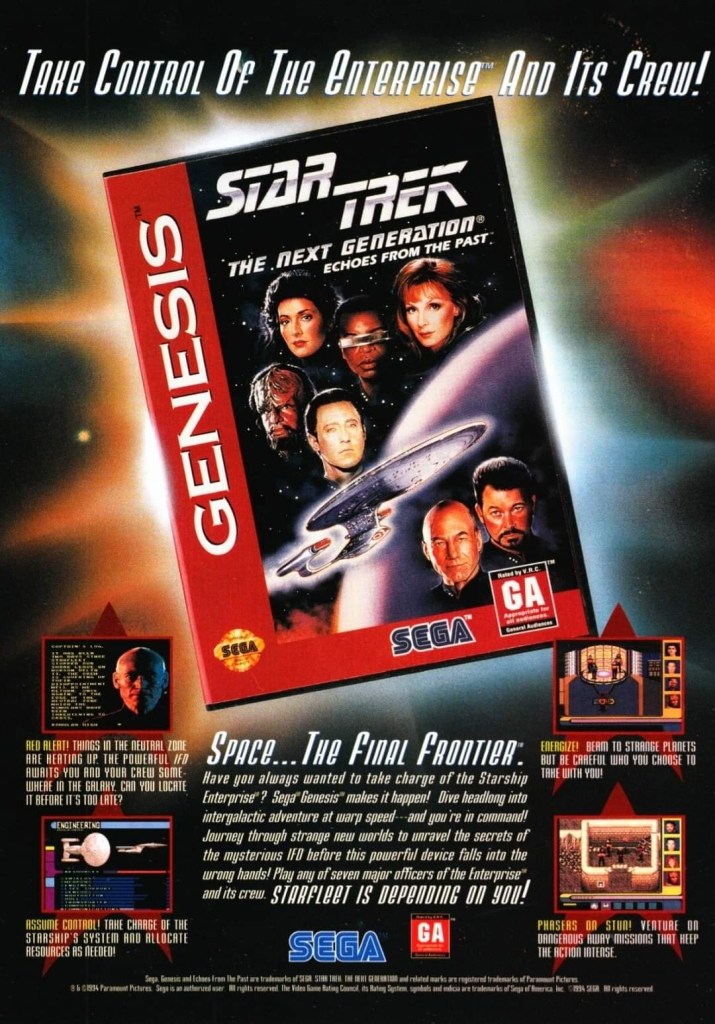
Space…the final frontier waiting for Sega Genesis gamers.
Released in 1994, Star Trek: The Next Generation – Echoes from the Past delivered the Star Trek TNG adventure experience to Sega Genesis gamers. In fact, it is the exact same experience that SNES gamers got the same year. In reality, Star Trek: The Next Generation – Echoes from the Past is actually a port of Star Trek: The Next Generation – Future’s Past on the SNES and the screenshots on the print ad are giveaways about it. In fairness to the ad makers, this print ad never attempted to deceive gamers that it promoted a totally different Star Trek TNG game.
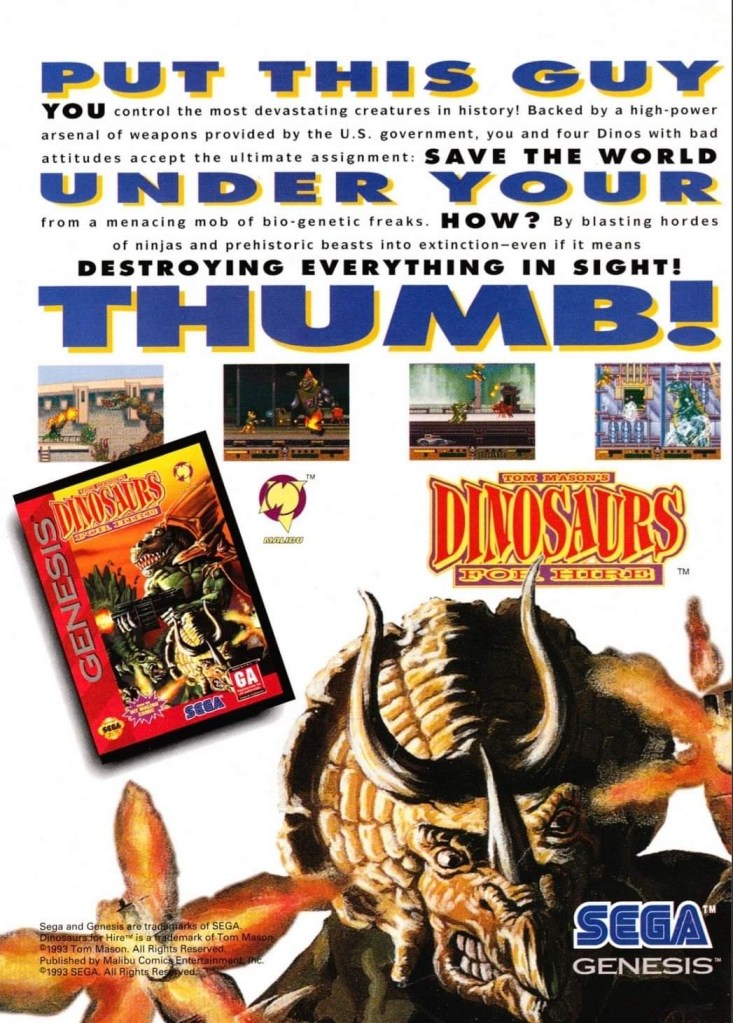
15. Dinosaurs for Hire print ad
This print ad caught my attention and made me interested in the game and the comic book series. Even though it was small, Malibu Comics’ logo was still recognizable.
Dinosaurs for Hire (sometimes referred to as Tom Mason’s Dinosaurs for Hire) was a 2D side-scrolling platform adventure game based on the comic book series of Tom Mason. Published by Sega, it was a Genesis-exclusive game and this print ad had a catchy text description, a few screenshots and the eye-catching artwork of a triceratops facing the viewer. This print ad is still good to look at. If you’re thinking about searching for existing copies of the game, I encourage you to also read some Dinosaurs for Hire comic books before playing. By the way, Tom Mason also wrote several comic books of the Ultraverse.








 Author Carlo Carrasco