Welcome back, my readers, YouTube viewers and all others who followed this series of articles focused on YouTube videos worth watching. Have you been searching for something fun or interesting to watch on YouTube? Do you feel bored right now and you crave for something to see on the world’s most popular online video destination?
I recommend you check out the following topics and the related videos I found.
#1When Atari invaded Japan – Here in the Philippines, me and my friends played video games on the Atari 2600 consoles in our respective homes during the first half of the 1980s. What I did not know back then was the fact that Atari did its best to sell its console and video games in nearby Japan. It turns out, their console in Japan was the Atari 2800. Watch and learn about this particular part of video game history with the video of GTV Japan below.
#2 A look back at Superman: The Animated Series – When it comes to animated series of the 1990s related to superheroes, X-Men: The Animated Series, Batman: The Animated Series and Spider-Man: The Animated Series are often remembered by long-time fans and geeks. The animated series of Superman, however, does not get remembered as much even though it had good quality animation and presentation. Of course, it should be remembered that the 1990s was the same decade when DC Comics had Superman killed, introduced the Supermen, brought Superman back to life and even had the Clark Kent identity destroyed which probably overshadowed the animated series. To discover more of Superman: The Animated Series, watch the video below.
#3 Examining the original 2099 comics franchise of Marvel Comics – You might have heard about 2099 among the many comic books Marvel published through the decades. The futuristic of Marvel’s shared universe originally started in late 1992 when the comic book speculator boom was still intense. It started strongly with Spider-Man 2099 followed by Ravage 2099, Doom 2099 and Punisher 2099. In the 2nd half of 1993, X-Men 2099 followed and even more related comic books got released. Of course, the 2099 franchise of the 1990s eventually ended. How and why it all happened like that, you can learn by watching Owen likes Comics’ video below.
#4 You, Me and the Movies’ Excalibur reaction – Excalibur is an epic medieval fantasy movie about the legend of King Arthur and his knights released in 1981. I first saw the film on TV in 1988 and it was an intriguing viewing experience. I replayed it on physical disc format in 2003 and eventually recognized Patrick Stewart, Helen Mirren, Liam Neeson and Gabriel Byrne looking much younger. If you want to discover more of Excalibur through the reaction of You, Me and the Movies, watch the video posted below. It’s a fun watch.
#5 Assorted videos about Planet of the Apes (1968) – Planet of the Apes of 1968 is considered by many as a great science fiction film as well as a philosophical and intelligent viewing experience. While it is an engaging viewing experience, I find the concept of human evolution and the so-called genetic links between humans and apes to be nothing more than fantasies. Considering its fame, it is no surprise that a lot of YouTubers made their own videos about it and you can watch the selected videos below.
#6 A look back at Robotron: 2084 – Robotron: 2084 is a 2D, multi-directional shooting game first released in arcades way back in 1982. I never played the arcade version but managed to play it on an IBM PC around the mid-1980s. The history behind the game is quite rich in details and you can enjoy learning about it by watching the video of PatmanQC below.
Welcome back readers, fellow geeks and electronic gaming fans!
In this edition of the Retro Gaming Ads Blast (RGAB) series, we will take a look at another batch of retro gaming print ads – including arcade flyers – from the 1980s and 1990s.
For the newcomers reading this, Retro Gaming Ads Blast (RGAB) looks back at the many print ads of games (console, arcade, computer and handheld) that were published in comic books, magazines, flyers, posters and newspapers long before smartphones, social media, the worldwide web and streaming became popular. To put things in perspective, people back in the 1980s and 1990s were more trusting of print media for information and images about electronic games and related products.
With those details laid down, here is the newest batch of retro gaming print ads for you to see and enjoy…
1. Star Wars: The Empire Strikes Back Atari print ads
I could not forget the first time I saw this print ad while reading a comic book.
This ad showed the Atari 2600 controller.
Even during its early years under George Lucas, the Star Wars entertainment franchise made its way into video games due to its massive popularity and Parker Brothers really made moves to cash in. This resulted in the Atari 2600 video game adaptation (1982) of The Empire Strikes Back which focused mainly on the memorable Hoth battles between Rebel fighters and the Empire’s AT-AT walkers. Parker Brothers came up with two print ads and each had a different visual concept: one had nicely drawn art along with two screenshots shown while the other had painted art of the AT-AT while showing the Atari joystick. These old print ads still look great and exciting.
2. Double Dragon Japanese and North American arcade flyers
If you read manga (Japanese comics) in Japan, then the art style of this arcade flyer should look familiar to you.
The character designs seem inspired by 1980s Hollywood action cinema.
Released in 1987, Double Dragon became a huge hit in the arcades of Japan, America and Europe resulting in financial gains for developer Technōs Japan and publisher Taito. What I find intriguing was the fact that the Double Dragon arcade flyers for Japan and North America had drastically different art styles used to promote it. The Japanese flyer had art style that is more common with manga while the North American had artwork that seemed inspired by Hollywood action movies (as well as the rise of martial arts films in America during the 1980s). The American flyer even had the two characters identified as Hammer and Spike and they both looked American. This is a classic example of using different approaches to promote a game in each market.
3. Universal Soldier print ad
The people who made this print ad made sure to use the names of the stars to help sell the game.
Even though its worldwide ticket sales did not reach $100 million, the 1992 movie Universal Soldier still caught a lot of attention from moviegoers simply because it had Jean-Claude Van Damme and Dolph Lundgren as the stars. Unsurprisingly, the movie had a video game adaptation and because publisher Accolade wanted to cash-in on the film’s hype, they made some deceptive moves by rebranding one of its games (already development) as a tie-in. Advertised as an official adaptation, Universal Soldier was actually a rushed conversion of Turrican II: The Final Fight. This print ad – which even showed the stars’ names – is a reminder of the deception Accolade pulled off.
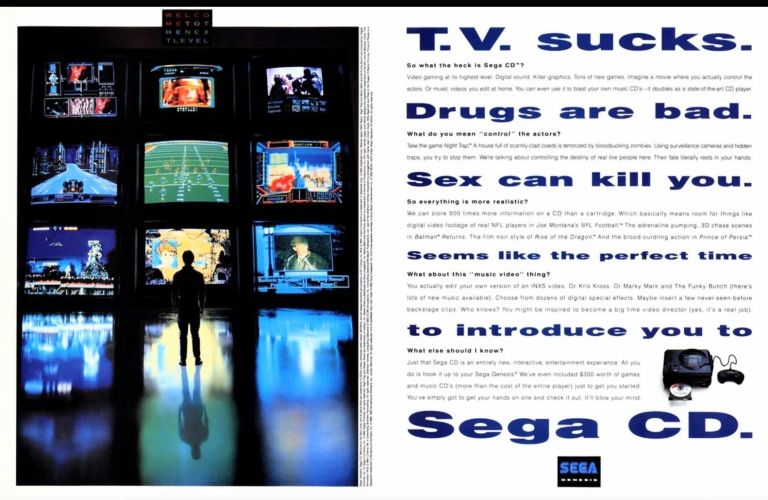
4. Sega CD print ad
Do you find this Sega CD print ad hilarious?
When Sega was making waves with its Sega Genesis (Sega Mega Drive in Japan), the company was quick to react to the growing use of the compact disc (CD) format as a useful storage medium for video games. The Sega CD (Mega CD in Japan) was released as an add-on device to work with the Genesis console and Sega’s American team came up with a series of promotions. This print ad is just one of the promotions and ad makers came up with a “crazed” or “electrified” gamer dominating one page while showing the Genesis, the Sega CD and screenshots of games (running on CD) on the other page. By today’s standards, the Sega CD print ad is funny and catchy to look at.
5. Snatcher for Sega CD print ad
I find this Snatch print ad looking odd. The ad makers could have done more to focus on the game itself.
First released in Japan in 1988, Snatcher was a cyberpunk visual adventure game that was one of the early works of the famous Hideo Kojima (Metal Gear series). Due to its design and approach on visuals to tell a story, it was not surprising that a Sega CD version of it got released in 1994. To promote the game to the growing number of North American Sega CD gamers at the time, Konami came up with this rather unusual print ad showing the face of a smiling lady dominating the space leaving little room to show the screenshots and the game’s cover. The visual concept is engaging but it takes effort to notice it was promoting the Sega CD version of the video game. This old ad would have worked better had the ad makers increased the sizes of the screenshots and the game cover.
6. Jurassic Park for Sega CD print ad
Does the T. Rex look scary to you?
As part of its drive to add more games to the Sega CD add-on and help it sell more units, Sega acquired the Jurassic Park license and went on to produce an adaptation utilizing the technological features of the Sega CD. To aggressively promote the game, Sega came up with this print ad that had a Tyrannosaurs Rex (looking through spaces) on one page and then several screenshots plus text descriptions on the other. For a click-and-point Jurassic Park game, this ad was really exciting and intriguing to look at.
7. Atari Jaguar print ad
This was indeed an eye-catching ad.
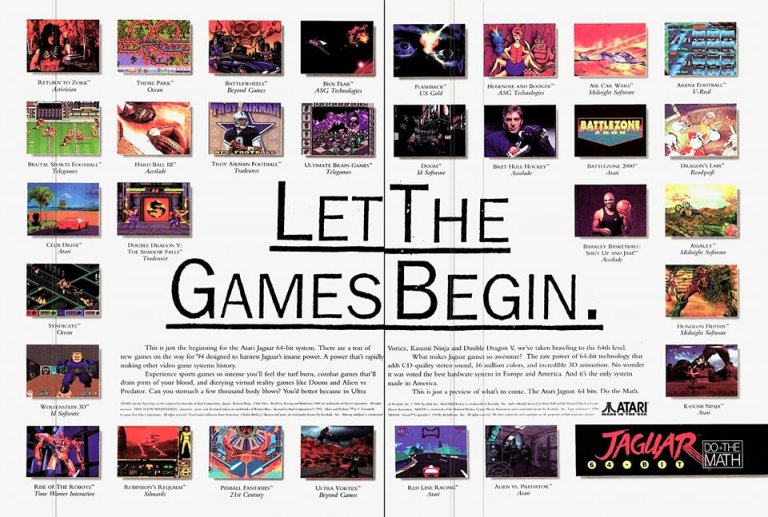
In the early 1990s, Atari made an aggressive move to compete in the arena of video game consoles which they used to dominate from the late 1970s until 1983. This time around, they came up with the Jaguar console which had some pretty advanced technologies for the time. As part of their North American marketing campaign, Atari unleashed an ad showing game screenshots on the first page and huge artwork of a jaguar coming after Sonic, Mario and Yoshi (mascots of Sega and Nintendo respectively) symbolizing that the Atari Jaguar had more power and better technology than the Genesis and the Super Nintendo Entertainment System (SNS). While it was engaging to look at early on, this print ad is now an embarrassment as the Jaguar console failed terribly. Lastly, the marketing of the Jaguar as a 64-bit machine was never real.
8. George Foreman, The Simpsons and Spider-Man Game Gear print ad
This ad appeared in a lot of comic books in the 1990s.
In the early 1990s, Sega released the Game Gear handheld gaming device which instantly placed them in competition with Nintendo’s Game Boy. Through its Flying Edge label, Acclaim Entertainment promoted George Foreman’s KO Boxing, The Simpsons: Bart vs. the Space Mutants, and Spider-Man for the Game Gear hoping to sell well. This 3-game print ad highlighted the popular figures who had a lot of space for attracting attention. The ad maker managed to insert two screenshots per game, the game covers and a text description to inform consumers what they were being offered. A good ad to look at.
9. Time Gal for Sega CD print ad
The presentation here looks nice but Time Gal herself looked like she was drawn by a different artist.
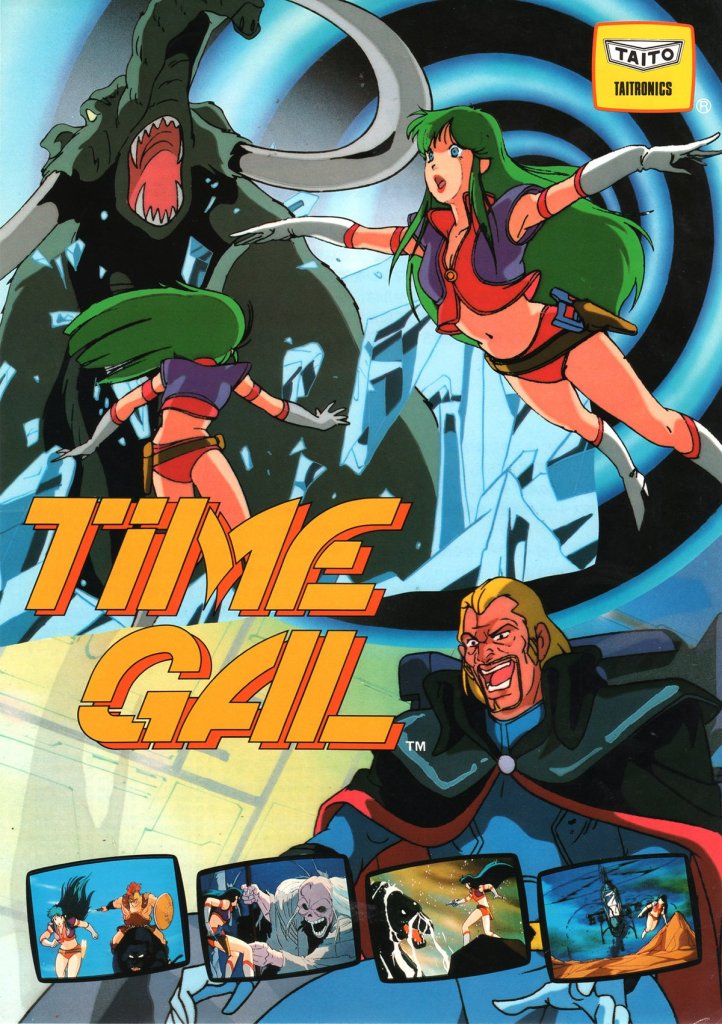
Originally released in the arcades in Japan in 1985, Time Gal made its way to the Sega CD add-on in the early 1990s. It was a highly unusual video game as it was an interactive movie (with lots of anime footage) made with the use of Laserdisc technology for its arcade version. It played lots of anime scenes and players must choose the on-screen options to execute the character’s next action in order to progress. For the Sega CD version for North America, this print was made to capture the attention of consumers using the protagonist’s sex appeal on the cover art with four screenshots placed on the sides to show what to expect. I noticed that Time Gal on the cover art looked different from how she appeared in the anime sequences. At least the ad makers tried hard to sell the game.
10. Mortal Kombat print ad
Still an effective ad to promote a blockbuster game and make people informed it was coming to multiple platforms.
Considering how successful it was in the arcades, the 1993 release of Mortal Kombat for game consoles and handhelds was unsurprisingly highly anticipated and publisher acclaim came up with this single-page ad. The presentation involved the use of a photographic background of many spectators (to emphasize excitement and popularity), media quotes and screenshots to effectively promote the game.
11. Equinox print ad
Take a close look. Tell me if you find it funny.
I never played Equinox but I heard the loud buzz about its design as a 3D isometric game that had elements of exploration, platform play and puzzle solving. The people responsible for this print ad emphasized the concept that the game is so addicting to play, players will still play it as they get older. This ad has a subtle yet effective approach with humor.
12. James Bond 007: The Duel print ad
Timothy Dalton’s image as James Bond was sourced from Licence to Kill for this game’s ad.
Here is another decades-old James Bond video game print ad I found. Released a few years after Licence to Kill, James Bond 007: The Duel was notable not for its gameplay nor game design but for the fact that it used the image of Timothy Dalton as 007 for its print ad and the opening scenes in the game itself. Dalton’s Bond image here was never new nor originally taken for the game as it came directly from Licence to Kill’s publicity library. Each time I saw this ad, I was only reminded of the 1989 movie which I still enjoy watching.
13. Neo Geo AES console print ad
Do you find this ad both sexy and funny?
Decades ago, SNK made a huge splash in the arcades with lots of really fun games released with their Neo Geo (stylized as NEO GEO) hardware. In 1990, they released the cartridge-based Neo Geo AES console in Japan and America and it carried the same technology as the arcade hardware. To promote the console in North America (note: the Neo Geo console and its games were very expensive), SNK came up with this catchy and funny print ad showing a sexy woman feeling annoyed that her man spends more time with Neo Geo gaming than with her. This was a clever way of emphasizing the arcade-perfect experience in the comfort of home, and it was funny to look at.
14. Gradius II Japanese arcade flyer
Great looking painted art was used for this 1988 arcade game.
Since the original Gradius was a big hit in arcades in Japan in 1985, it was not surprising that Konami released Gradius II three years later. With regards to the use of painted art, the artist showed the game’s spaceship in a dominating position emphasizing high-speed travel and excitement. The image, which also looks more colorful, is a complete reversal of the painted art used in the flyer of the previous which showed the rear of the spaceship as it moves towards a larger spaceship (the opposition). This arcade flyer art still looks great as it has a timeless charm.
Welcome back, my readers, YouTube viewers and all others who followed this series of articles focused on YouTube videos worth watching. Have you been searching for something fun or interesting to watch on YouTube? Do you feel bored right now and you crave for something to see on the world’s most popular online video destination?
I recommend you check out the following topics and the related videos I found.
#1Dance Away behind-the-scenes video – Way back in 1994, I saw the Japanese anime feature film Project A-ko (1986) on Laserdisc format (dubbed in Japanese with English subtitles). As I viewed it, I noticed there were three English language songs that played in the background and the one I enjoyed most was the song Dance Away which was performed by Annie Livingstone (with supporting vocals by Samantha Newark and the late Valerie Stevenson). Project A-ko’s behind-the-scenes information revealed the three singers working together on Dance Away which you can watch in the video below. These singers have beautiful voices and were really talented to watch.
#2 AI and automation are taking over grocery stores and drive-thru lanes – In America, inflation spiked so much under the Biden administration which contributed a lot to higher prices of food and the suffering of consumers who need food. That being said, the food industry has invested a lot on artificial intelligence (AI) and automation so that they can lower labors costs and somehow improve sales to keep the businesses alive. In fact, technology is becoming much more integrated in places where people buy food and that also means making orders not in front of a human worker but in front of a computer (example: a touch-screen monitor where you choose what to order). Watch and learn from the video below.
#3 Assorted videos about The Last Starfighter – Released way back in 1984, The Last Starfighter was a memorable movie that carefully blended science fiction concepts, adventure, fine performances and video game elements together. It was also one of the early movies Hollywood made that extensively used computer-generated imagery (CGI) which defied the era’s standard of using practical and optical effects. Now available on 4K Blu-ray format, The Last Starfighter is a popular subject of varied YouTube videos and I selected some for your enjoyment below. However, if you have not seen The Last Starfighter yet, I urge you watch it first before seeing any of the movie reaction videos featuring it. You make the decision.
#4 HolyLandSite’s Capernaum to Bethsaida walking tour video – I love Israel and I will always stand with it. For the newcomers reading this, Israel is where the Holy Land is and it has always been the land that the Lord God designated to the Jewish people. Recently HolyLandSite released another video showcasing a walking tour in the Galilee region specifically from Capernaum to Bethsaida. If you have not read the Holy Bible extensively, Lord Jesus spent a great deal of his ministry in Galilee. I myself had been to the Galilee region and many times during the pilgrimage tour there and in other parts of Israel, I witnessed the Holy Bible come to life on-location. Watch the video below.
#5More people in Iran coming to Lord Jesus– It is not a fantasy to say that the current regime of Iran (in power since 1979) made their nation a terrorist state. Iran is truly sponsoring terrorist groups in the Middle East and they have Hamas, Hezbollah and other terrorists doing their work to destroy Israel. While the Iranian regime is clearly evil and murderous (note: their leaders declared in their own language death towards America, Israel and England), there are many Iranians who do not follow their government. In fact, there are Iranians who even left Islam behind to come to Jesus whom they accepted as their Lord and savior. Be aware that the Iranian government had harmed their fellow Iranians many times and this includes human rights violations. That being said, the people in Iran who desired Lord Jesus and freedom from their oppressive government need our prayers of support. Watch and learn from the video below.
#6 Rocky II (1978) reaction/review videos – If you have been watching movies for decades and if you have been following the career of Sylvester Stallone, then you would be already aware of the significance of the 1976 film Rocky. Considering its success, Rocky spawned several sequels and a few spin-off movies through the decades. Going back to the late 1970s, Sylvester Stallone came up with the effort to make the sequel Rocky II (1979) which itself became featured in several movie reaction/review videos and retrospectives. Watch the videos I selected for you all below.
Welcome back readers, fellow geeks and electronic gaming fans!
In this edition of the Retro Gaming Ads Blast (RGAB) series, we will take a look at another batch of retro gaming print ads – including arcade flyers – from the 1980s and 1990s.
For the newcomers reading this, Retro Gaming Ads Blast (RGAB) looks back at the many print ads of games (console, arcade, computer and handheld) that were published in comic books, magazines, flyers and newspapers long before smartphones, social media, the worldwide web and streaming became popular. To put things in perspective, people back in the 1980s and 1990s were more trusting of print media for information and images about electronic games and related products.
With those details laid down, here is the newest batch of retro gaming print ads for you to see and enjoy…
1. Lufia & The Fortress of Doom for Sega Genesis print ad
Considering the eventual scrapping of the Sega Genesis port of Lufia & The Fortress of Doom, this old print ad might as well serve like a tomb stone.
I want to start with this mostly black print ad about the Japanese role-playing game (JRPG) Lufia & The Fortress of Doom coming to the Sega Genesis console. This game was released on the Super Nintendo Entertainment System (SNES) in America and on the Super Famicom in Japan in 1993 and achieved commercial success for the Japan-based publisher Taito. In an attempt to keep on building up the success, a port of the game for the Sega Genesis (Sega Megadrive in other countries) was announced but ultimately it got canceled. It should be noted that Taito’s American division close down in 1995 and the sequel Lufia II: Rise of the Sinistrals was released in America by a different publisher. That being said, this particular print ad is a sad reminder of a broken promise for Sega Genesis gamers as well as Lufia and JRPG fans who wanted to play the 1993 RPG on a different console.
2. Cloak & Dagger arcade flyer
The front of the arcade flyer. There is even a mention of the Cloak & Dagger movie.
Details of the game explained with arcade operators in mind. I find it odd that there is a vacant amount of blank space on this side of the flyer.
Cloak & Dagger, the Atari arcade game that appeared in the 1984 movie of the same name (read my retro movie review by clicking here), has always been an arcade conversion kit as this arcade flyer showed. For the newcomers reading this, an arcade conversion kit allows the arcade operator to replace an old game without having to buy a brand-new arcade machine. Very cleverly, Atari targeted arcade machines of Robotron: 2084, Defender, Stargate and Joust (all were from the competitor Williams Electronics) with Cloak & Dagger. The Cloak & Dagger flyer’s front shows a picture of the pieces of hardware (for insertion into the arcade cabinet plus some physical adjustments) plus decorations for the exterior of the arcade cabinet. The other side of the flyer contains the technical details that make it convenient for arcade operators to understand on how to convert the older games (limited to the above-mentioned Williams games).
3. NBA Live 95 for Sega Genesis print ad
This print ad is still exciting to look at, especially when you are still passionate with basketball.
Back in late 1994, Electronic Arts (EA) revamped their NBA-licensed basketball game franchise with NBA Live 95 which came with a major game redesign that includes the isometric on-court perspective, T-meter for free throw shooting and more. NBA Live 95 was also the first entry of the NBA Live franchise and brand which lasted for decades. This print ad of the Sega Genesis version of NBA Live 95 has the clever display of several screenshots along with pics of the shot clock emphasizing suspense. The basketball action images themselves are not only eye-catching but strong enough to get gamers excited. This is still a solid print ad to look at.
4. X-Men: Mutant Apocalypse print ad
An X-Men game by Capcom.
If there is anything significant about X-Men: Mutant Apocalypse, it is the fact that it was Capcom’s first-ever X-Men-based production that was also released a month before their own hit arcade game X-Men: Children of the Atom came out. Setting aside Capcom’s involvement, this game contains notable elements from the comic books that strongly resonated with dedicated X-Men fans. Apart from the two screenshots and the game box cover, this print ad has X-Men artwork by Andy Kubert who already was the regular artist of the X-Men monthly series.
5. Space Ace multi-platform print ad
Anyone who is a fan of Don Bluth’s works in animation should be able to recognize the art style of this ad.
First released in the mid-1980s, Space Ace was a LaserDisc video game that was designed and produced by the legendary animator Don Bluth (An American Tail, The Land Before Time, Anastasia). After achieving success in the arcades, new versions of Space Ace were subsequently released on many other platforms, including the consoles and computers that used disc drives in the mid-1990s which this print ad emphasized. By looking at the lower part of the print ad, you will see Sega CD, 3DO, Macintosh and PC as targeted platforms. The most notable visual feature of the ad was, unsurprisingly, official art of Space Ace.
6. BurgerTime arcade flyer
The front of this flyer could make you crave for burgers.
The technical and creative details on the rear of the flyer.
Bally/Midway came up with this arcade flyer of BurgerTime which itself went on to become a beloved classic game. The front showed a very enticing looking hamburger that looked like it could fill a person’s belly and tingle his or her taste buds. Then they showed the hand-drawn in-game characters looking like they really are interacting with the hamburger. The back of the flyer shows details that emphasize what the game is about, why it could be a fun arcade addition and what the specs are. This is an engaging arcade flyer.
7. NCAA Final Four Basketball print ad
Do you know anyone who played this college basketball video game?
If there is anything notable about video gaming in the 1990s that is missing today, that would be the presence of multiple basketball video games released by different game publishers. Along the way, there were some college basketball video games such as NCAA Final Four Basketball developed by Bitmasters and published by Mindscape. This print ad had enough screenshots to show what the game looked like and how it played. The ad also mentioned that the game had 64 real NCAA teams and logos as well. This 1994 video game did not have a strong reception from game critics although it received a very high rating by GamePro magazine. NCAA Final Four Basketball has long been forgotten.
8. Indiana Jones’ Greatest Adventures print ad
An eye-catching print ad from a more memorable time when the Indiana Jones franchise was still under the full control of George Lucas and his enterprise.
Indiana Jones’ Greatest Adventures was an ambitious 2D side-scrolling adventure game that also served as an adaptation of the first three Indiana Jones movies (1981-1989) of Steven Spielberg and George Lucas. Like the Super Star Wars trilogy of games that preceded, this one was a challenging and lengthy game filled with lots of action. This print ad only showed Indy’s whip and hat but the screenshots, the text description and the game box cover (which has a young Harrison Ford as the iconic Jones) were more than enough to convince viewers that this was an Indiana Jones game.
Welcome back readers, fellow geeks and electronic gaming fans!
In this edition of the Retro Gaming Ads Blast (RGAB) series, we will take a look at another batch of retro gaming print ads from the 1980s and 1990s. In addition, there will be a few flyers of arcade games.
For the newcomers reading this, Retro Gaming Ads Blast (RGAB) looks back at the many print ads of games (console, arcade, computer and handheld) that were published in comic books, magazines, flyers and newspapers long before smartphones, social media, the worldwide web and streaming became popular. To put things in perspective, people back in the 1980s and 1990s were more trusting of print media for information and images about electronic games and related products.
With those details laid down, here is the newest batch of retro gaming print ads for you to see and enjoy…
1. Japanese Contra arcade flyer
The front of the Japanese arcade flyer of Contra.
The other side of the flyer.
As mentioned before, Konami’s long-running Contra games franchise first started in the arcades in Japan. As seen in the Japanese arcade flyer, it was clear that the company not only had a clear vision of Contra’s visual concepts but also was pretty organized with explaining lots of details (examples: the 8-direction controls, types of weapons or ammunition available, level design differences) that both players and arcade operators can learn from. If you look closely at the rear of the flyer, you will see the two characters already identified as Lance and Bill which clearly showed the Japanese creators had the creative details really organized.
2. Virtual Bart print ad
Anyone who loved The Simpsons would easily recognize the characters of this print ad.
Decades ago, The Simpsons made big waves on television and quickly emerged as a fine addition to American pop culture. That being said, it was not surprising at all that video games based on the show got made and Virtual Bart was one of them. This Virtual Bart print ad appeared in some comic books I read in 1994 and the ad makers made efficient use of the single-page layout showing that the game was not a mere 2D side-scroller as its concept emphasized Bart Simpson’s virtual reality escapades. This game, which had mini-games and different gameplay styles, received review scores ranging from negative to positive.
3. Wild Arms 2 print ad
This is NOT an effective way to promote a video game.
Now this is one of the most weird and the most uninteresting game print ads of the 1990s. For the newcomers reading this, Wild Arms 2 was a sequel to the 1997 hit game Wild Arms released on the original PlayStation console. Due to the 1997 game’s success, a fan base of Wild Arms was established and the 1999 sequel was anticipated by the fans. In a very odd and illogical move, Sony Computer Entertainment came up with the Times Square setting for Wild Arms 2’s North American print ad and because they allowed so much other text and images (appearing as billboard ads) on the buildings in the background, details about the game itself got overshadowed. By simply looking at this print ad, it is simply too easy to overlook Wild Arms 2 as the featured game. Can you see the references to Wild Arms 2 here?
4. RollerGames arcade flyer
Pretty ladies posing on the front of the flyer.
Clearly the details were prepared with arcade operators in mind.
Based on the competition-oriented TV show, the RollerGames arcade game from Konami was both unique and fun to play. As with their other arcade flyers, Konami hired models to emphasize RollerGames’ core concept by appearing in full costume (as roller-skating participants), and then inserted screenshots of the game. The rear of the flyer had the technical details in simplistic fashion and they were clearly written with arcade operators in mind. The 3-paragraph text descriptions emphasized what players could expect, what options are available and how the game connects with the TV program it was based on.
5. The Jetsons: Invasion of the Planet Pirates print ad
Anyone among you is a Jetsons fan?
Based on the animated series, The Jetsons: Invasion of the Planet Pirates was released on the Super Nintendo Entertainment System (SNES) in America as well as on the Super Famicom in Japan in the mid-1990s. This game’s print ad had eye-catching artwork, carefully laid down key details (including the promise of cartoon quality graphics) and showed a few screenshots. The game attracted mixed reviews from critics and I don’t know any fellow gamer who played it.
6. Sega Saturn games print ad
An aggressive single-page ad promoting the exclusive games on Sega Saturn.
If you are a game console manufacturer that also owns several game development teams, you really have to promote your hardware and software aggressively. This is exactly what Sega did in the North American market sometime after the embarrassing launch of the Saturn console there. As seen in this print ad, Sega aggressively promoted their Saturn-exclusive games – including their juggernaut Virtua Fighter 2 – to make it clear to their fans (and Saturn console owners) that they are focused to entertain them. The ad also served as Sega’s effort to lure in new gamers and potential Saturn owners given the fact that Virtua Fighter 2, Virtua Cop and Sega Rally Championship were already big arcade hits. As history turned out, the Saturn ended up a commercial disappointment in America but still succeeded in Japan.
7. Galaxian arcade flyer
Have you ever played Galaxian in the arcades?
In September 1979, Namco released Galaxian in the arcades in Japan and it became a big hit there eventually finishing as the nation’s 2nd highest-earning arcade game of the year. Before the year even ended, Namco approached Midway of releasing Galaxian outside of Japan and this led to the game appearing in American arcades in November. Unsurprisingly, Galaxian drew lots of American players and their money which really helped Midway selling 50,000 arcade units in a few years’ time. This arcade flyer from Midway clearly showed what the Galaxian arcade unit looked like and how the controls were physically set up. I like the way the details and images were organized and how the limited page space was put to good use.
8. Heavy Barrel print ad
A really eye-catching and amusing print ad to look at.
Originally released in the arcades by Data East, Heavy Barrel was released on the Nintendo Entertainment System (NES) in 1990. Similar with Contra and Jackal, this game had a strong military theme and shooting-oriented gameplay complete with missions that instantly reminded players about war. The military aesthetic and the showing of guns are easily the most eye-catching part of this print ad geared towards the NES userbase which had lots of young children among the players. To say the least, Heavy Barrel’s print ad was entertaining to look at.
Welcome back readers, fellow geeks and electronic gaming fans!
In this edition of the Retro Gaming Ads Blast (RGAB) series, we will take a look at another batch of retro gaming print ads from the 1980s and 1990s. In addition, there will be a few flyers of arcade games.
For the newcomers reading this, Retro Gaming Ads Blast (RGAB) looks back at the many print ads of games (console, arcade, computer and handheld) that were published in comic books, magazines, flyers and newspapers long before smartphones, social media, the worldwide web and streaming became popular. To put things in perspective, people back in the 1980s and 1990s were more trusting of print media for information and images about electronic games and related products.
With those details laid down, here is the newest batch of retro gaming print ads for you to see and enjoy…
1. Contra arcade flyer
A clever visual concept by Konami towards gamers and arcade operators.
Details on the other side of the flyer.
Before it established itself as a popular gaming franchise with console gamers, Contra truly started in the arcades in 1987. First released in Japan on February 1987, Konami went on to release the game in arcades in the United States a month later and the flyer you see here was the Americanized promotion they came up with. Instead of hiring male actors or models to play soldiers, they hired a slim lady to appear with a female Rambo look standing in front of a Contra arcade machine. On the other side of the flyer are details that players and arcade operators can learn from. By today’s standards, this arcade flyer of Contra is still eye-catching and even amusing to look at.
2. College Football’s National Championship print ad
This ad has a strong visual appeal to gamers who like football.
This is another one of those video game ads I saw while reading comic books in the 1990s. College Football’s National Championship was a Sega Genesis-exclusive American football video game published by Sega (with the Sega Sports brand) to capitalize on gamers who want college football to play with at home. This print ad has a nice visual presentation of the college teams’ logos, screenshots and details of what gamers could expect when they buy and play the game. College Football’s National Championship received mostly positive reviews and it must have sold well because Sega went on to release a sequel to this game.
3. Robotron X print ad
This Robotron game was made at a time when 3D polygons became common for making video games.
Having played the classic game Robotron: 2084 on PC back in the 1980s, I was very surprised to see this print ad in 1996 promoting a brand new Robotron game for PlayStation as well as Windows PC. For the newcomers reading this, Robotron: 2084 was a classic which heavily influenced game designers who went on make other fan-favorite games like Smash TV and Llamatron. What makes Robotron X notable apart from being an official follow-up to the classic game was the fact that it was made at a time when game developers did their stuff to modernize gaming with 3D polygons for visuals while trying to come up with gameplay inspired by the classics. While Robotron X did not make a major impact on gaming, the classic Robotron: 2084 went on to be released in several multi-platform compilations such as Williams Arcade’s Greatest Hits, Midway’s Greatest Arcade Hits, and Midway Arcade Treasures.
4. Space Jam game print ad
If you saw the movie in 1996, were you able to play this video game adaptation?
What makes 1996 a memorable year for basketball fans was the Michael Jordan’s return to prominence (having previously retired for less than two years before returning to the NBA in 1995) and leading a very powerful Chicago Bulls team to what was their 4th NBA championship title. In that same year, Jordan starred in the live-action/animated movie Space Jam which grossed an impressive $250 million worldwide. On the same month the movie came out, the Space Jam video game adaptation was also released on PlayStation and Sega Saturn. This print ad was part of the multimedia hype of the movie and the game itself had a very similar design and visuals concept with NBA Jam but ultimately it failed to become a hit with critics and gamers. Not even the combined visual might of Jordan and Warner Bros. characters could achieve success.
5. Magic Johnson’s Fast Break print ad
Still on basketball video gaming, the side-scrolling Magic Johnson’s Fast Break game was released on the Nintendo Entertainment System (NES) for console gamers to enjoy. Unsurprisingly, this ad had nice black-and-white art work of Magic Johnson as the dominant figure while leaving little space left to show the game box and only one screenshot. The real meat of this print ad are the details laid down in text description.
6. Virtua Fighter 2 for Sega Genesis print ad
Clearly a late effort by Sega to sell something to its many Genesis owners/fans in America at a time when PlayStation and Nintendo 64 started dominating 5th console generation sales.
In the history of arcade gaming and fighting games, Virtua Fighter 2 was a worthy follow-up to its groundbreaking predecessor. VF2 also made its way on the Sega Saturn which essentially maintained the great gameplay and 60 frames-per-second animation even though the 3D polygonal graphics were noticeably lower in quality compared to its arcade version. With VF2 in the arcades and on Saturn selling well, I was surprised to see this print ad of Sega releasing a totally different version of the game on the aging Sega Genesis console. Virtua Fighter 2 on Genesis had 2D graphics, sprites for the characters and a side-scrolling visual design. In fairness, the game developers exerted effort to recapture some of the gameplay elements within the Genesis limitations and 2D graphics. This print ad is a reminder of Sega’s American division selling a product to the remaining active Genesis owners.
7. Ring King print ad
Ring King itself clearly lacked promotional space in this ad.
In 1987, Data East released their arcade hit game Ring King on the Nintendo Entertainment System (NES) and prepared this print ad involving Ray Leonard, Jr. (on the foreground in boxing gear) and conveniently with the famous Sugar Ray Leonard and Thomas Hearns (with the promo of their first fight together in the background). Also conveniently, the company inserted their other games on the lowest part of the ad. Ultimately, the presence of Ring King itself was minimized only showing the game cover and two screenshots. This is clearly an eye-catching ad but there was not enough emphasis on the game itself.
8. Super Spacefortress Macross arcade flyer
The arcade flyer released only in Japan.
Have you ever seen the classic anime movie Macross: Do You Remember Love? I really love watching that movie and I played and finished the video game adaptation on PlayStation in 1999. What I never got to play was the arcade game adaptation of it which was released by Banpresto in Japan in 1992. This flyer promoting the game has a strong visual presentation thanks to the artwork made for it. Only one screenshot was shown as well as a clip from 1984 the animated movie (note: the arcade game itself has some images directly from the film plus some newly created ones added) but this ad still had what it takes to capture the attention of the many Macross fans in Japan. This arcade game was eventually released with an English translation in America and Australia.
9. 2-in-1 print ad featuring Super C and Snake’s Revenge
A memorable and intriguing print ad from Konami promoting sequels.
This is one of the ads that Konami came up with to promote at least two games using a single-page ad format. I saw this ad in many comic books I read decades ago and its visual concept always caught my attention especially since I played the console game Contra a lot. At the high end of the ad were two fictional newspaper headlines highlighting the respective conflicts of Snake’s Revenge (with a nuclear danger concept) and Super C (with emphasis on alien invaders). These two games were sequels to the classics Metal Gear and Contra, and Konami clearly knew how to take advantage of the older games’ success and do their best to sell the sequels to gamers who love action-packed gaming as well as fantasized armed conflicts. Like the 2-in-1 ad showcasing Contra and Jackal, this was Konami’s aggressive move to sell war-inspired games to the NES userbase which was mostly composed of children and teenagers.
10. True Lies game print ad
There is nothing like taking advantage of the imagery of a Hollywood superstar to promote a video game based on the related movie.
Here is a video game ad I saw in many comic books I read in 1994-1995. True Lies (starring Arnold Schwarzenegger) was one of the big summer season movie hits of 1994 and the video game was part of the business tie-ins with the film. The people who made this print ad made the smart moves of showing not just one but three images of Schwarzenegger to promote the game while leaving some space to show what the game looked like. The True Lies game even had stills from the movie to emphasize the flow of the plot.
Disclaimer: This is my original work with details sourced from reading the comic book and doing personal research. Anyone who wants to use this article, in part or in whole, needs to secure first my permission and agree to cite me as the source and author. Let it be known that any unauthorized use of this article will constrain the author to pursue the remedies under R.A. No. 8293, the Revised Penal Code, and/or all applicable legal actions under the laws of the Philippines.
Welcome back superhero enthusiasts, 1990s arts and culture enthusiasts, Marvel Comics fans and comic book collectors! Today we go back to the mid-1990s to explore the adaptation of the second season of the famous X-Men: The Animated Series (X-Men TAS) in the form of the X-Men Adventures comic book series.
Before getting to the new retro comic book review, I should state that the subject X-Men Adventures comic book will involve Carol Danvers in a supporting role (in rather creative ways). Yes, I’m talking about the one character who in the history of the Marvel Comics shared universe was identified (in no particular order) as Ms. Marvel, Binary, Warbird and as Captain Marvel. As the subject comic book was published in 1994, Carol Danvers here is obviously not the woke garbage version played by Brie Larson in the movies.
With those details laid down, here is a look back at X-Men Adventures Season II #9, published in 1994 by Marvel Comics with a story written by Ralph Macchio and drawn by John Herbert.
The cover.
Early story
The story begins at night in New York City. There, Mystique and Mister Sinister have a serious talk. Sinister believes that without Charles Xavier’s presence, the X-Men are very vulnerable and they will eventually become disorganized and fall down quickly.
Over at the mansion of Xavier, Rogue wakes up from a very intense nightmare which prompts Cyclops and Gambit to calm her down. Rogue reveals that she has been having very disturbing visions ever since Professor X disappeared. It turns out, Xavier helped her previously by using his mental abilities to block out the unpleasant memories of hers.
Jean Grey enters the room and she reveals (in response to Cyclops’ question) that she ran a computer search on the woman Rogue saw the other day and came up with several pictures. As soon as Rogue examines the pictures, she then remembers who the woman is which causes her to be consumed by another vision from deep inside her mind. She sees Ms. Marvel…
Quality
There is a lot of stuff here that Rogue fans will enjoy.
The first obvious thing about this comic book is that it is a character-driven tale told mainly through Rogue. In fact, this is actually a creative portrayal of Rogue’s origin written for TV by Marty Isengerg and Robert Skir, and Macchio’s adaptation here made a really solid reading experience for me.
Without going too much into spoiler territory, I can say that this origin story of Rogue was not only written for TV viewers in mind but also crafted to cater to what was back then the modern tastes of X-Men fans in general. I’m talking about 1990s X-Men and society specifically and the thing is, everything here aged well. Nothing here feels out of place. I should also state that Rogue’s upbringing are well worth exploring here.
The writing by Macchio and art by Hebert are of high quality and this comic book is really worth reading again from start to finish. The emotions channeled through Rogue are very intense without ever reaching to the point of showing her insane. Hebert’s art, meanwhile, fills every page with a good amount of visual details complete with strong facial expressions (including some very scary faces from Mystique and Ms. Marvel) and some dynamic superhero action that really spiced up the reading experience.
As mentioned earlier, Carol Danvers appears in a supporting role and the creative team came up with clever ways to emphasize the character both visually and through dramatics. The way Danvers is portrayed here should inspire readers to go out and read Marvel’s published comic books of her as Ms. Marvel. The same thing can be said about Rogue whose origin and gradual rise from an occasional character (a super villainess no less) to a prominent superhero told through Marvel Comics’ shared universe are worth revisiting.
Conclusion
A very disturbed Rogue in the presence of her teammates.
X-Men Adventures Season II #9 (1994) is indeed a very powerful and gripping character-driven comic book that will appeal to fans of Rogue, the X-Men and Carol Danvers. Considering the wholesome aesthetic of the X-Men animated series TV episode, this comic book has a much darker presentation that will strongly appeal to X-Men fans who want a more serious portrayal to read. As it was mainly focused on Rogue, I can say that the conflict was nicely built up and the resolution was a strong pay-off. Very clearly, the Macchio-Hebert creative duo really delivered great stuff.
Overall, X-Men Adventures Season II #9 (1994) is highly recommended.
Disclaimer: This is my original work with details sourced from reading the comic book and doing personal research. Anyone who wants to use this article, in part or in whole, needs to secure first my permission and agree to cite me as the source and author. Let it be known that any unauthorized use of this article will constrain the author to pursue the remedies under R.A. No. 8293, the Revised Penal Code, and/or all applicable legal actions under the laws of the Philippines.
Welcome back superhero enthusiasts, 1990s arts and culture enthusiasts, Marvel Comics fans and comic book collectors! Today we go back to the mid-1990s to explore the adaptation of the second season of the X-Men animated series in the form of the X-Men Adventures comic book series.
Before getting to the new retro comic book review, I should state that decades ago, the use of future timelines was implemented on the X-Men comics. I’m talking about the possible future where Cable and Stryfe came from, another possible future where Phoenix/Rachel Summers came from, and the more established future of the classic Days of Future Past storyline. Time travel and possible future timelines are the themes in the next X-Men Adventures comic book I reviewed recently.
With those details laid down, here is a look back at X-Men Adventures Season II #7, published in 1994 by Marvel with a story written by Ralph Macchio and drawn by Scott Rosema.
The cover.
Early story
The story begins on Earth in the far future of 3999 AD. Cable, who is fighting for the rebels, battles the deadly forces of the powers that be. It turns out, he and his teammates have been struggling a lot and their team suffered several deaths already. Even though they are very tired and heavily outnumbered, Cable refuses to give up and bravely calls for a frontal assault against their enemies.
Suddenly, Apocalypse appears on the battlefield and commands his robotic troops to destroy Cable and his fellow rebels. To Apocalypse’s surprise, a temporal storm appears and Cable notices it appearing so close to them. One of his teammates got caught by the storm which pushes Cable away. After receiving computer updates, Cable decides to get away from the robotic troops.
Meanwhile in another time period and place, Bishop returns from his mission (his interactions with the X-Men of the 20th century – click here and here) only to discover from Forge that nothing has changed and the plague still rages on…
Quality
The X-Men have a new problem to deal with.
Having read X-Men Adventures #13 and #14 of season 1, I found this particular tale (clearly a sequel to Bishop’s interaction with the X-Men after traveling through time) relatable and enjoyable. There is a strong science fiction vibe here and the time travel aspect added a lot to the build-up of tension.
Bishop here is almost the protagonist as the story showed an altered future in which Forge has no memory of the X-Men and only made a reference to a plague that has lasted for a long time. This compels Bishop to go back to the 20th century again hoping to meet the X-Men and somehow prevent the plague from bringing down society.
The impact of the mysterious virus is tremendous as so many people got infected and authorities suspect mutants to be the carriers. At this stage, the social aspects inserted by the creators really started to grow stronger within the narrative and you will see the X-Men struggling with not only the increased scrutiny on mutants but also with the manipulative tactics of anti-mutant activists who can’t help but see golden opportunities to wipe out mutants in a more clever fashion.
The dialogue here is noticeably gripping to read and the dramatization worked accordingly. There is also a good amount of superhero spectacle to enjoy here even though the X-Men have no super villains to fight with.
Conclusion
Forge has no memory of the X-Men.
X-Men Adventures Season II #7 (1994) looks like a repeat or even a remake of what happened in X-Men Adventures #13 (Season I) but its concept turned out to be not only unique with strong social commentary and sci-fi elements, but also became really engaging thanks to the fine execution by the creative team. On the aspect of social relevance, this comic book will remind you about the internment of Japanese Americans in America (1942-1946) and the COVID-19 restrictions and the quarantine on communities imposed by governments that disrupted people’s lives. As this comic book marks the first part of the Time Fugitives, I can say that I enjoyed it and I’m looking forward to the next chapter.
Overall, X-Men Adventures Season II #7 (1994) is recommended.
Disclaimer: This is my original work with details sourced from reading the comic book and doing personal research. Anyone who wants to use this article, in part or in whole, needs to secure first my permission and agree to cite me as the source and author. Let it be known that any unauthorized use of this article will constrain the author to pursue the remedies under R.A. No. 8293, the Revised Penal Code, and/or all applicable legal actions under the laws of the Philippines.
Welcome back superhero enthusiasts, 1990s arts and culture enthusiasts, Marvel Comics fans and comic book collectors! Today we go back to the mid-1990s to explore the adaptation of the second season of the X-Men animated series in the form of the X-Men Adventures comic book series.
Before getting to the new retro comic book review, I should state that I visited Canada only once. Even before my one and only visit there, I knew through the comic books that famous character Wolverine is a native of Canada and a former member of Alpha Flight (Canadian government-sponsored team of mutant operatives). Somewhere in his past, he was live test subject of Weapon X. I have to mention this because the X-Men Adventures about to be reviewed here is focused on Wolverine.
With those details laid down, here is a look back at X-Men Adventures Season II #5, published in 1994 by Marvel with a story written by Ralph Macchio and drawn by John Hebert.
The cover.
Early story
The story somewhere in the wilderness in Canada where Wolverine helps free an animal that was stuck. Suddenly, Alpha Flight’s Vindicator appears and reminds Wolverine of the fact that he deserted them to work of Charles Xavier. It turns out, Wolverine is back in Canada to visit Heather.
Moments later, he finds himself surrounded by Vindicator’s teammates Puck, Shaman and Sasquatch, and tells them that he is never coming back to Alpha Flight. Even though two more members of the Canadian team joined in, Wolverine manages to avoid defeat in battle and hides away.
As he listens to Alpha Flight from a distance, he hears Vindicator mentioning that a certain lab is expecting their team. This causes Wolverine to remember the traumatic time he had as a live test subject of Weapon X…
Quality
A look back at the time Wolverine joined the Canadian government-sponsored superhero team Alpha Flight. Would you want to join a unit serving the woke Canadian government of Justin Trudeau in real life?
I should mention first that the teleplay by the late Len Wein contains a very solid and sensible interpretation of Wolverine’s Weapon X origin (with a modern touch for the 1990s) which turned out to be a detailed reference for Ralph Macchio to adapt into this comic book.
That being said, this comic book’s plot of Wolverine going to Canada for a solid purpose and encountering challenges – both from his past with Alpha Flight and others – while bringing back his painful Weapon X past turned out to be a really engaging read. The Weapon X flashback scenes added a depth to the story as well as Wolverine’s portrayal in this adaptation. You will see the clawed X-Men member being tough and gritty as usual, and yet you will witness his fragile side as he becomes personally troubled about the past.
The appearance of Alpha Flight here was put to good use. Apart from the revelation of Wolverine’s past membership with them, you will see the team truly operate with a clear goal as mandated by their government (note: this is clearly not the ultra-woke, Islamo-Leftist government of Justin Trudeau). In fact, this tale gives readers a glimpse of how the Canadian government analyzes and decides what to do with Canadians who are very exceptional and are more valuable than many other citizens. Alpha Flight is the government’s tool which is strongly emphasized here.
Apart from the plot focused on Wolverine, this comic book managed to move the sub-plot of Magneto and Charles Xavier forward a bit.
Conclusion
A Weapon X flashback.
X-Men Adventures Season II #5 (1994) has a very engaging and fun tale focused on Wolverine who encounters his fellow Canadians. Anyone who loves the clawed X-Men member will have a lot to enjoy here. The appearance of Alpha Flight here (as well as in the X-Men TAS episode) added a good layer of depth to the plot while also emphasizing the shared Marvel universe in a controlled manner. Lastly, artist John Hebert’s artwork on Wolverine is really good and his high level of visual detail on other characters and locations should be seen.
Overall, X-Men Adventures Season II #5 (1994) is recommended.
Welcome back, fellow geeks, Blu-ray collectors and movie buffs! Decades ago, animator and director Ralph Bakshi made significant contributions to the art of hand-drawn animation with features that made it to cinemas such as The Lord of the Rings (1978), Wizards (1977), and Fire and Ice (1983) to name a few.
Along the way, Bakshi became identified with rotoscoping which is a technique that involves drawing or painting over an element in live-action footage frame by frame (as to create a matte or a realistic animation).
Speaking of Bakshi’s past work as well as rotoscoped animation, Sony Pictures recently released the film American Pop (1981) on Blu-ray disc format and I am happy to say that I now have a copy of it for my Blu-ray collection. This is also my first-ever Blu-ray of a Bakshi-directed animated movie.
A close look at the cover of my Blu-ray copy of American Pop.
To begin with, posted below are the specs from the Blu-ray.com page…
Video
Codec: MPEG-4 AVC
Resolution: 1080p
Aspect ratio: 1.85:1
Original aspect ratio: 1.85:1
Audio
English: DTS-HD Master Audio 2.0 (48kHz, 24-bit)
Subtitles –English SDH
Discs -Blu-ray Disc, Single Disc (1 BD-25)
Playback – Blu-ray: Region A
In my personal experience, the first time I ever saw American Pop was not in the cinema but on TV here in the Philippines way back in 1993. Back then, I found the film’s combination of music with mostly rotoscoped animated scenes (there were also some live-action shots, archived footage and some very unique pieces of art shown). I was not able to replay Bakshi’s movie until recently.
So after more than thirty long years, I finally got to replay American Pop on Blu-ray and I can say I enjoyed it even more. To see the rotoscoped animation and varied music play in front of me in high-definition is an even more immersive viewing experience than the previous time I saw this film. Another advantage of high definition is being able to see tiny visual details that I was unable to spot long ago. Oh yes, the fine artworks used on the backgrounds in specific parts of the movie now look a lot more engaging to look at.
A look at the rear of American Pop Blu-ray.
What I regret to say here is that American Pop Blu-ray absolutely has no special features included. Not even a movie trailer! I can only guess that Sony Pictures did not bother to exert efforts to conduct new interviews with Ralph Bakshi and the cast members, nor did they even try to secure any media features or previews of the movie before its theatrical release. It’s not clear if Sony will someday come up with a collector’s edition Blu-ray of this 1981 Bakshi film.
For the dedicated Ralph Bakshi fans as well as enthusiastic film buffs and collectors of movies on physical media, American Pop Blu-ray is recommended as the film itself is more than enough to outweigh the lack of special features. American Pop is more lively than ever to watch and listen as it is now in high-definition.