As the Philippines continues to use energy from renewable sources, it is also gradually moving forward to adapting nuclear power for its energy needs which was confirmed by the secretary of the Department of Energy (DOE), according to a news article by BusinessMirror.
To put things in perspective, posted below is an excerpt from the BusinessMirror news article. Some parts in boldface…
THE Philippines maintains aggressive targets to shift its energy portfolio toward green power. To provide clean, stable baseload power generation that complements renewables, the country has stepped on the gas to advance its nuclear goals.
“I think nuclear is the next step because we are already maturing on renewables and it’s difficult to be dependent on imported fuel. That’s really very painful for us when things don’t go well around the world,” said Department of Energy (DOE) Secretary Sharon Garin in an interview.
The energy chief is leading the Philippines’ push to integrate nuclear energy into the national power mix, targeting 1,200 megawatts (MW) of nuclear capacity by 2032 and scaling up to 4,800MW by 2050. This timeline is heavily anchored on the commercial rollout of small nuclear reactors (SMRs). The agency is looking at locations including Bataan, Batangas, Masbate, Pangasinan, Palawan, and Camarines Norte as potential nuclear sites.
“All the companies are interested: Meralco, Aboitiz, San Miguel, Prime Infra. All of them are interested because they know that with nuclear, it’s not a matter of if, but when,” said Garin, adding that since the law does not allow the government to be involved in the power generation, “maybe the government can have a minimal stake only.”
Meralco’s power generation arm, Meralco PowerGen Corp. (MGEN), agrees that nuclear power provides a reliable, low-carbon baseload source that reduces exposure to volatile global fossil fuel prices.
“As I said, it’s an option, right? And if you really want energy independence with a baseload profile, then nuclear is one of the clear options,” said MGEN president Emmanuel Rubio in an interview.
The Pangilinan-led Meralco is among the major industry players driving this transition. It has engaged a US-based engineering firm, Sargent & Lundy, and AMH Philippines, Inc. to conduct a feasibility study on deploying SMRs in the Philippines.
The comprehensive study is expected to be completed by the fourth quarter of 2027. The study marks the next step in the $2.8-million technical assistance program funded by the US Trade and Development Agency (USTDA).
Aboitiz Power Corporation (AboitizPower) and Korea Hydro & Nuclear Power Co., Ltd. (KHNP) also agreed to pursue joint pre-feasibility studies, information sharing, and capacity-building activities related to nuclear technologies.
Let me end this post by asking you readers: What is your reaction to this recent development? Do you think the Philippines will succeed in achieving its nuclear goals over the next several years? Are members of your local community still afraid of nuclear power?
Thank you for reading. If you find this article engaging, please click the like button below, share this article to others and also please consider making a donation to support my publishing. If you are looking for a copywriter to create content for your special project or business, check out my services and my portfolio. Feel free to contact me with a private message. Also please feel free to visit my Facebook page Author Carlo Carrasco and follow me on Twitter at @CarloCarrascoPH as well as on Tumblr at https://carlocarrasco.tumblr.com/ and on Instagram at https://www.instagram.com/authorcarlocarrasco
Welcome back readers, fellow geeks and electronic gaming fans!
In this edition of the Retro Gaming Ads Blast (RGAB) series, we will take a look at another batch of retro gaming print ads from the 1980s to the 1990s.
For the newcomers reading this, Retro Gaming Ads Blast (RGAB) looks back at the many print ads of games (console, arcade, computer and handheld) that were published in comic books, magazines, flyers, posters and newspapers long before smartphones, social media, the worldwide web and streaming became popular. To put things in perspective, people back in the 1980s to the 1990s were more trusting of print media for information and images about electronic games and related products.
With those details laid down, here is the newest batch of retro gaming print ads for you to see and enjoy…
1. Broderbund British print ad
An American-themed promotion of games for the British market in the 1980s.
Back in the 1980s, home computer systems were already popular platforms for playing electronic games. The American company Broderbund was one of the dominant forces of home computer gaming back then with lots of hit games (a mix of their own productions and the publishing of ports of games from other companies) that entertained many. When it came to England, Broderbund was aggressive on marketing its games there and the above print ad is a fine example of it. They came up with an American theme on their ad promoting the Lode Runner games, Choplifter, Spelunker and Stealth to British computer gamers. The imagery of a burger and the display of the American flag made the ad eye-catching.
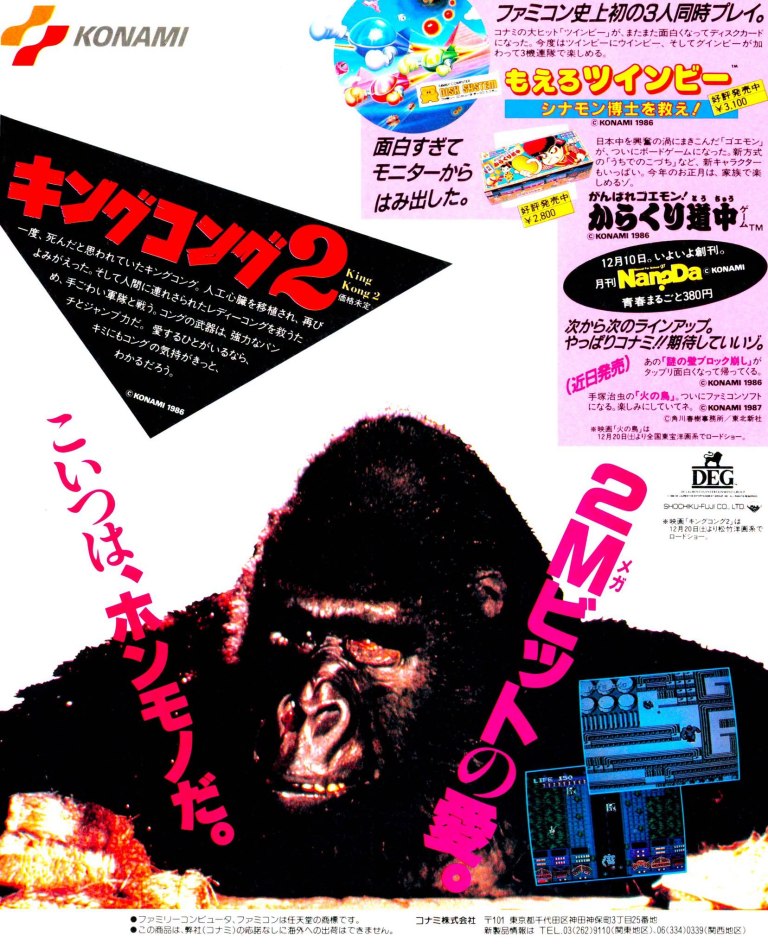
2. King Kong 2: Ikari no Megaton Punch Japanese print ad
A print ad of King Kong 2 and two other Konami games for Japanese gamers.
Believe it or not, Konami had the license to create the 1986 adventure game King Kong 2: Ikari no Megaton Punch which was very loosely based on the 1986 movie King Kong Lives. To promote its release for the Nintendo Family Computer (Famicom), Konami came up with the above print ad that had an actual movie photo of King Kong, inserted two screenshots and showed some creative writings. Conveniently, Konami also inserted two of its other games for promotions.
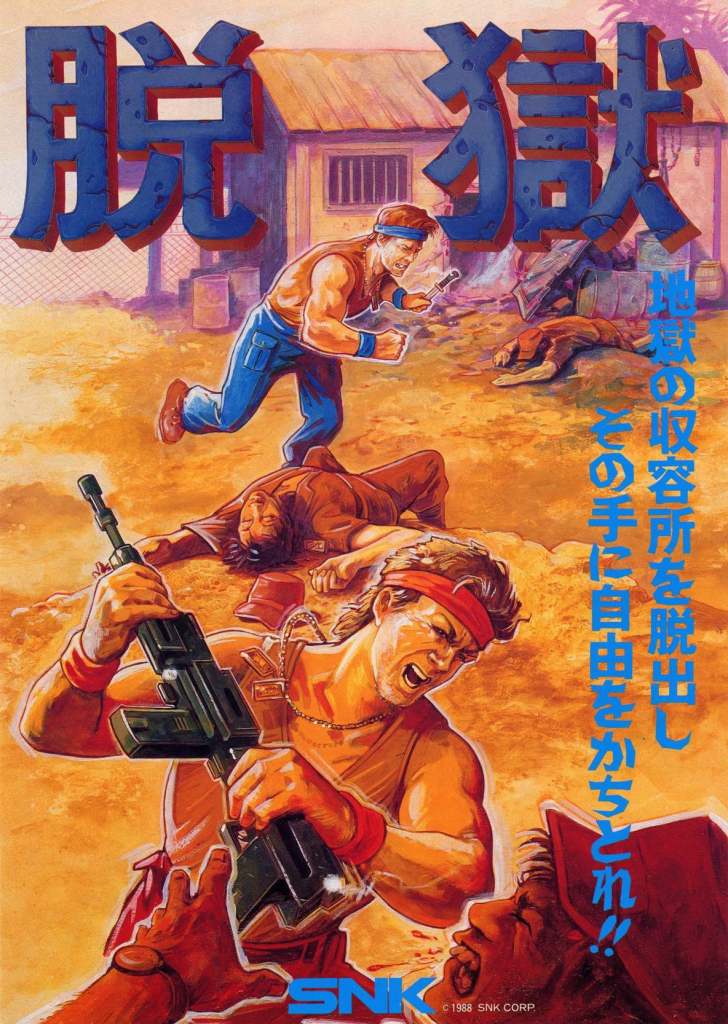
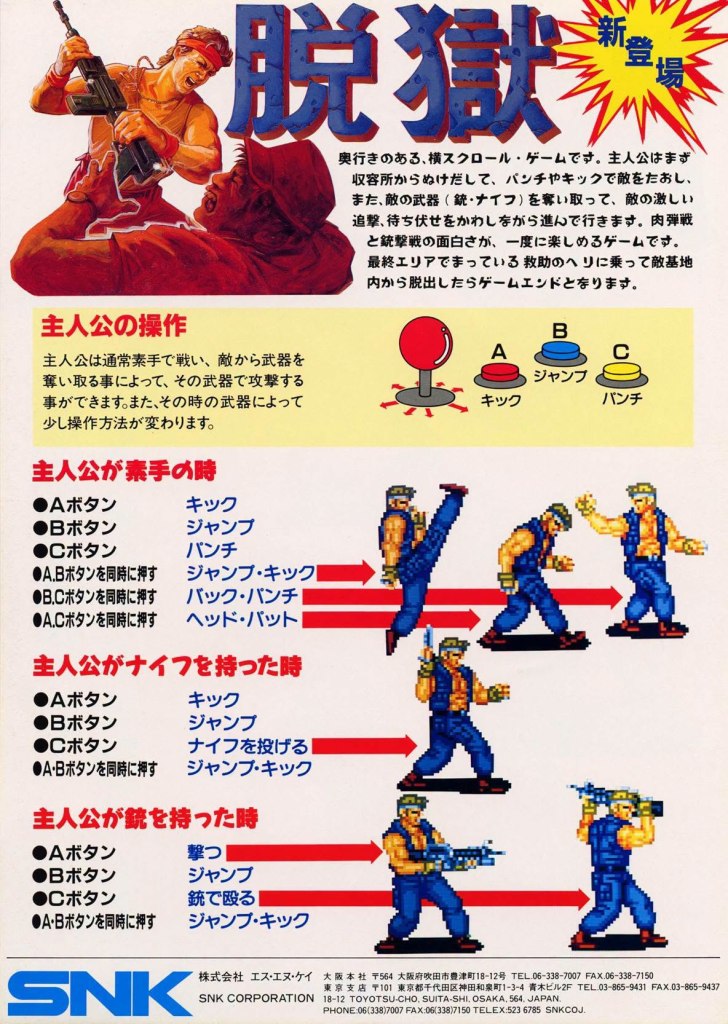
3. Datsugoku Japanese arcade flyer
The front.
The rear.
In 1988, SNK released Datsugoku in Japanese arcades and it became a commercial success for them long before they transitioned to their Neo Geo hardware. As you can see in the Japanese arcade flyer, the game has a war theme about prisoners of war struggling to fight their way out of enemy territory. This is not surprising because of the popularity of Hollywood’s military themed action movies and the Cold War itself had influenced game designers. The arcade flyer has fine-looking art of war. This game was eventually released in other parts of the world under the title P.O.W.: Prisoners of War.
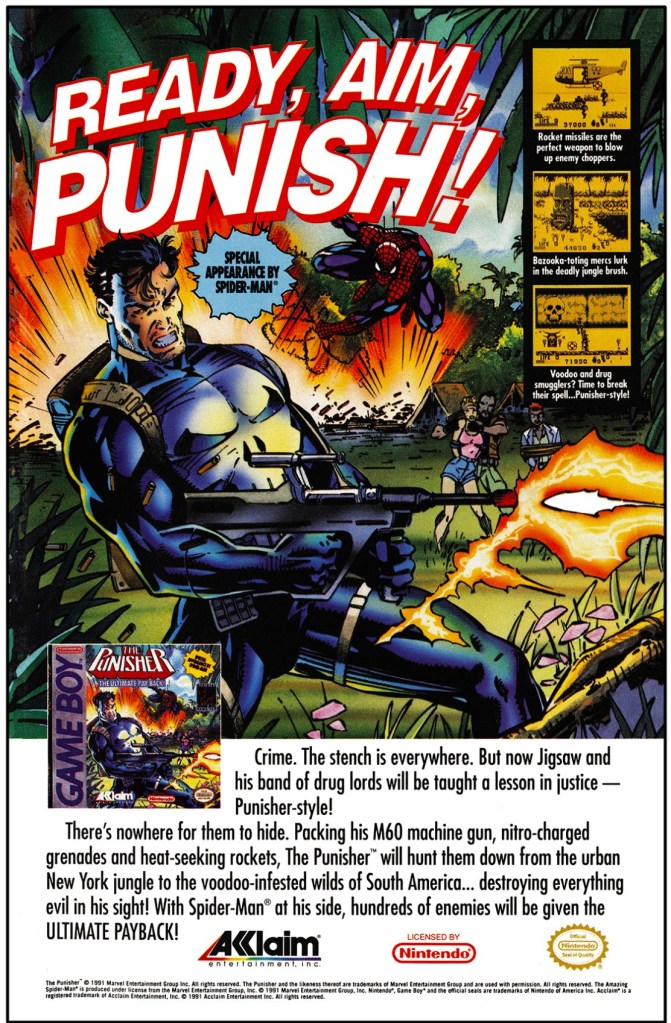
4. The Punisher: The Ultimate Payback! North American print ad
The Punisher with Spider-Man in this action-oriented print ad.
In the early 1990s, Nintendo’s Game Boy was the dominant handheld gaming device and it was not surprising that a lot of companies released games on it. Along the way, the Punisher became one of Marvel Comics’ most popular characters and there were two monthly comic book series about the character. Acclaim produced The Punisher: The Ultimate Payback! for Game Boy featuring not only the Punisher but also Spider-Man (in the background) which was enough to get the attention of comic book fans. The descriptive text they came up with has this obvious anti-crime theme and it emphasized action. I saw this print ad in some 1991 comic books I read and it remains eye-catching until now.
5. Star Wars: The Empire Strikes Back Japanese print ad
This is one captivating print ad.
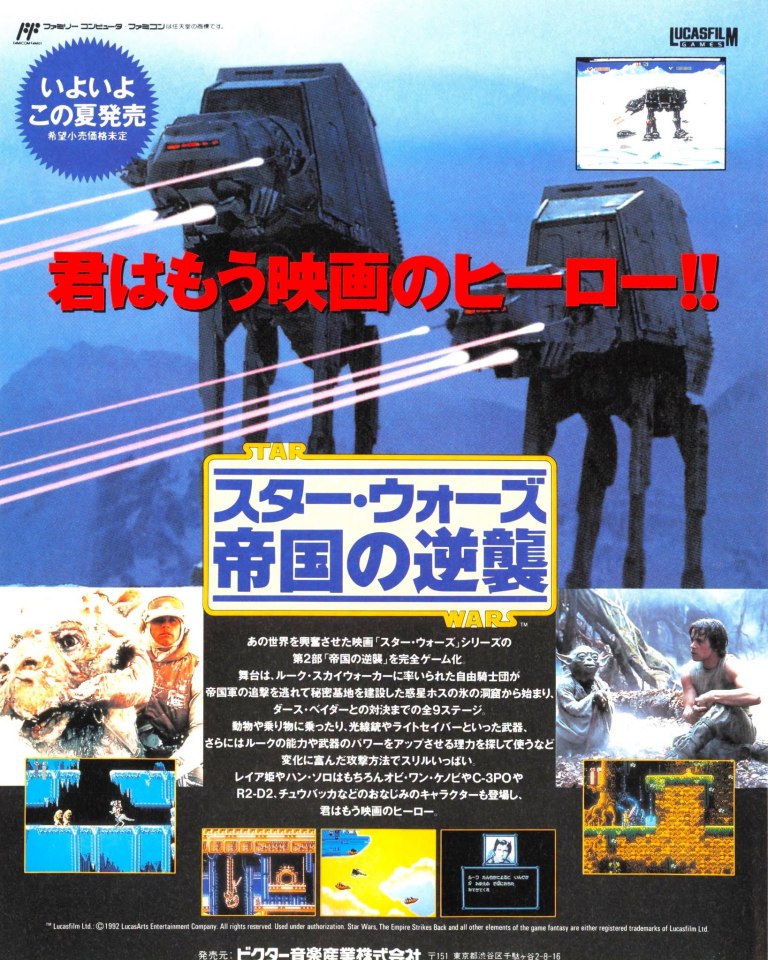
In the early 1990s, Victor/JVC published Star Wars games developed by Lucasfilm Games for the Nintendo Entertainment System (NES). Following the 1992 release of Star Wars: The Empire Strikes Back on the NES in the West, they released a port of it for the Famicom in Japan in 1993. To promote the game, they made a print ad that highlighting the memorable Battle of Hoth (using art and one screenshot) as well as iconic photos of Luke Skywalker in Hoth and Dagobah (with Yoda). The ad makers strategically inserted screenshots showing the in-game Hoth and Dagobah settings plus two of Cloud City. I played the game myself and it was very punishing. Still, this ad looks great. It also motivated me to replay The Empire Strikes Back on home video back then.
6. Contra: The Hard Corps Japanese print ad
This Contra: The Hard Corps print ad for Japan still looks exciting.
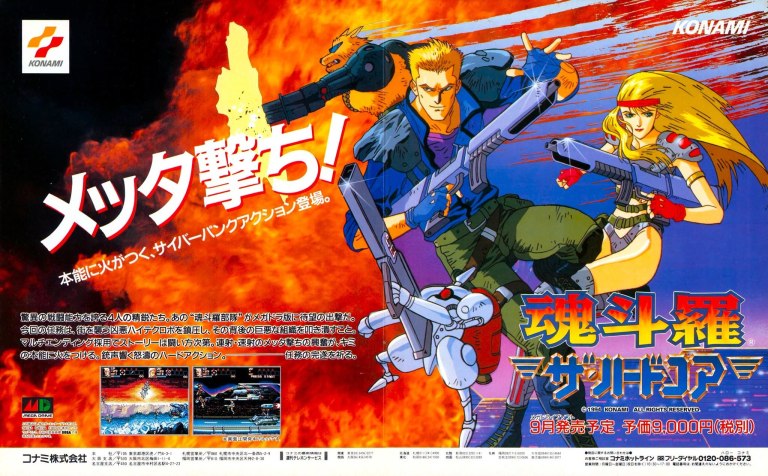
In 1994, gamers in Japan who owned the Sega Mega Drive (Sega Genesis in America) were highly engaged when Konami released Contra: The Hard Corps specifically for the said console. Konami aggressively marketed the game and one of the ads they made for Japan was the above 2-page print ad that had dynamic looking hand-drawn artwork that had strong anime aesthetics. They inserted two screenshots of the game and posted a text description to get gamers excited. Apart from bringing Contra excitement for Sega gamers and Contra fans who happened to own the Mega Drive, this print ad clearly shows Konami went all-in with doing business with Sega.
7. Skimaxx North American and British arcade flyers
Skimaxx arcade flyer for England. Does anyone know who the pretty model is?
Skimaxx arcade flyer for North America.
I never played Skimaxx in the local arcades. Did you? Released in 1996 by Innovative Concepts in Entertainment, Skimaxx is very notable for having a truly unique physical cabinet design featuring a pivoting hydraulic footboard which brings to players the simulation of rock motions, twists and more. Two arcade flyers – for North America and England – were respectively published and both featured a pretty blonde lady wearing a swimsuit playing the Skimaxx machine, highlighting the use of the footboard. Apart from the technical features, a Skimaxx machine can be linked with another machine for head-to-head competition. These arcade flyers are very cool and mesmerizing to look at and they contain enough details to make arcade operators interested.
8. Genso Suikoden II Japanese print ad
This is truly an epic-looking print ad promoting Genso Suikoden II. A lot of images were shown but they did not spoil the plot.
When Konami released the original Suikoden (Genso Suikoden in Japan) fantasy RPG on the PlayStation in the mid-1990s, the game achieved positive feedback from gamers and critics which boosted sales. In late-1998, the sequel Genso Suikoden II was released for PlayStation in Japan and Konami became aggressive on promoting it as it became aware of the many dedicated Suikoden fans. They came up with an epic-looking 2-page print ad that had a collage of official artworks, screenshots of in-game cutscenes, and some of the fancy looking visual effects to sell the game. The images and descriptive text informed gamers of the new conflict following the events of the original game. I played Suikoden II a lot and it is easily bigger and better than its predecessor. That said, this epic-looking print ad truly highlights the great stuff Suikoden II offered gamers and it made the Suikoden II print ads in America look inferior. Too bad Konami did not use the approach of the Japanese print ad in the Western markets because Suikoden II truly is epic fantasy.
9. Einhänder North American print ad
The 2-page print ad of Einhänder for North America.
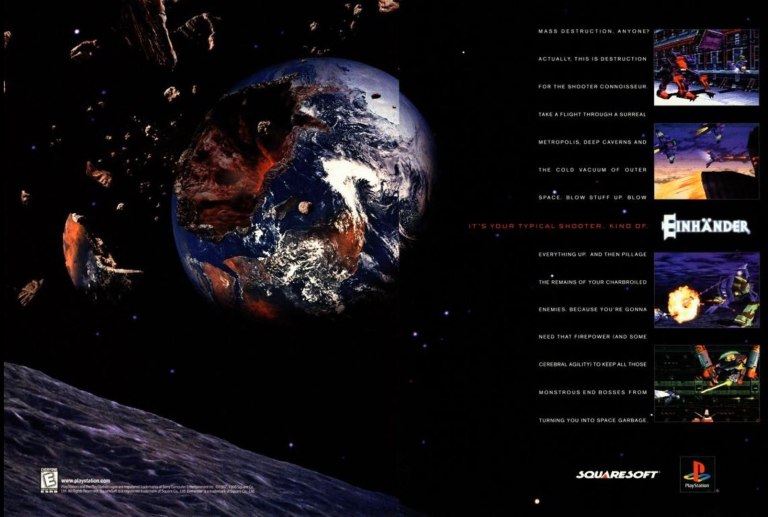
Back in the late-1990s, SquareSoft became a more prominent game developer and publisher by releasing new games that not only had 3D polygonal visuals but also tackled gameplay styles beyond role-playing games (RPGs). In the case of their game Einhänder, they made a serious gamble on the shooter genre of gaming while moving forward with 3D polygons and some unique gameplay features of their own. In preparation for the game’s North American launch in 1998 for PlayStation, the company came up with a wide print ad with a dominant artwork that showed a planet with a huge part torn off and drifting into space. Even a small part of the planet’s core got exposed. This ad pounded hard on the expression of “Earth shattering”, and it showed SquareSoft was serious on making an impact on the shooter genre. When I saw this ad in a magazine, the planet caught my attention and then I focused on the right section which had the descriptive text and screenshots of Einhänder. This is still an engaging print ad to look at.
With their struggling tourism industry and long-haul tourism in mind, Thailand is considering a 15-day visa exemption for travelers from a few specific nations, according to a news article by VnExpress.
To put things in perspective, posted below is an excerpt from the article of VnExpress. Some parts in boldface…
Thailand is considering a 15-day visa exemption for travelers from Colombia, Mexico and Uzbekistan to ease visa processing delays and attract more long-haul visitors.
The Ministry of Tourism and Sports will submit a proposal to the visa policy committee on Nov. 9, Tourism and Sports Minister Surasak Phancharoenworakul said on Monday, as reported by The Nation Thailand.
The proposal comes amid growing concerns that visa-processing delays are disrupting Thailand’s long-haul tourism market, particularly travel from Latin America, with passenger show-up rates on some flights falling by 20% to 30%, Khaosod English news site reported.
Emirates recently filed a complaint with the Tourism Authority of Thailand after 20-30 passengers per flight from Mexico failed to show up because they had not received their visas in time, local media reported.
Surasak said the ministry was seeking a long-term solution to persistent visa delays affecting Mexico and other Latin American markets. The committee will assess the proposal’s security and economic implications, with the ministry seeking exemptions for countries considered to pose low security risks.
Chiravadee Khunsub, deputy governor of the Tourism Authority of Thailand overseeing international markets in Europe, the Americas, the Middle East and Africa, said visa procedures had also affected arrivals from Uzbekistan, Thai Examiner reported.
Uzbek travelers previously had to apply for Thai e-visas through the Royal Thai Embassy in Russia, a process that travel agents in Uzbekistan considered cumbersome.
Some travelers subsequently canceled their Thailand holiday packages and chose competing destinations, including Vietnam.
The proposed exemption aims to simplify entry procedures, reduce disruptions to travel plans and restore confidence among international tour operators and airline partners.
Let me end this piece by asking you readers: What is your reaction to this development? Do you think Thailand’s move to grant visa exemptions to travelers from Colombia, Mexico and Uzbekistan makes a lot of sense? Do you think Thailand will be able to match its 2025 foreign tourist arrival numbers before the end of this year? What was single biggest problem you had when it came to visiting Thailand?
Thank you for reading. If you find this article engaging, please click the like button below, share this article to others and also please consider making a donation to support my publishing. If you are looking for a copywriter to create content for your special project or business, check out my services and my portfolio. Feel free to contact me with a private message. Also please feel free to visit my Facebook page Author Carlo Carrasco and follow me on Twitter at @CarloCarrascoPH as well as on Tumblr at https://carlocarrasco.tumblr.com/ and on Instagram at https://www.instagram.com/authorcarlocarrasco
To put things in perspective, posted below is an excerpt from the article of VnExpress. Some parts in boldface…
Long Thanh International Airport is expected to open to commercial flights at midnight on Dec. 24, initially handling up to 366 flights a week, 322 of them domestic and 44 international.
The Airports Corporation of Vietnam (ACV) gave the date in a notice sent to the Dong Nai People’s Committee. It asked the city to have relevant agencies help the corporation finish preparations so the launch runs smoothly and safely.
Domestic airlines will start operating at the new airport in stages. Vietnam Airlines is expected to fly the Long Thanh-Hanoi route and several international routes, while Vietjet plans domestic services linking Long Thanh with major economic and tourism centers nationwide.
Management agencies, airport operators and airlines are jointly drawing up flight allocations and operating plans, taking into account slot coordination and schedules at both Long Thanh and Tan Son Nhat International Airport.
Many international airlines have also voiced interest in and support for flying to Long Thanh, ACV said. Spanning 5,000 hectares in Dong Nai, about 40 km from Ho Chi Minh City, Long Thanh is Vietnam’s largest airport by area.
For other previous blog posts about the Long Thanh International Airport, click here and here.
Let me end this piece by asking you readers: What is your reaction to this development? Do you think the new Long Thanh International Airport will be able to launch on December 24 as planned? Do you think the local authorities and the strategic partners of the new airport have done enough to ensure a proper preparation for the opening to commercial flights? If you are planning to visit Vietnam on or after December 24, has this new development impacted your flight plans?
Thank you for reading. If you find this article engaging, please click the like button below, share this article to others and also please consider making a donation to support my publishing. If you are looking for a copywriter to create content for your special project or business, check out my services and my portfolio. Feel free to contact me with a private message. Also please feel free to visit my Facebook page Author Carlo Carrasco and follow me on Twitter at @CarloCarrascoPH as well as on Tumblr at https://carlocarrasco.tumblr.com/ and on Instagram at https://www.instagram.com/authorcarlocarrasco
Disclaimer: This is my original work with details sourced from reading the comic book and doing personal research. Anyone who wants to use this article, in part or in whole, needs to secure first my permission and agree to cite me as the source and author. Let it be known that any unauthorized use of this article will constrain the author to pursue the remedies under R.A. No. 8293, the Revised Penal Code, and/or all applicable legal actions under the laws of the Philippines.
Welcome back superhero enthusiasts, 1990s arts and culture enthusiasts, Spider-Man fans and comic book collectors! Today we go back to the early 1990s to examine a small part of the Marvel Comics shared universe through a tale of the Amazing Spider-Man monthly series.
Back in 1992, Marvel Comics organized the celebration of what was back then the 30th anniversary of their most famous icon Spider-Man. Each Spider-Man monthly series that year had an anniversary celebration issue that had hologram covers and page content that was higher than usual. I previously reviewed Web of Spider-Man #90 and Spider-Man #26. The purest Spider-Man monthly series – Amazing Spider-Man – also had the anniversary treatment.
With those details laid down, here is a look back at Amazing Spider-Man #365, published in 1994 by Marvel Comics with the main story “Fathers and Sins” written by David Michelinie and drawn by Mark Bagley. Other stories here include “How I Created Spider-Man” by Michelinie and Aaron Lopresti; “I Remember Gwen” by Stan Lee, Tom DeFalco and John Romita; and “A Friend in Need” by DeFalco.
The cover.
Early story(main story)
The story begins with the Lizard (Dr. Connors) prowling from one building to another during the night in New York City. He secretly stays outside the windows of the apartment of his wife Martha and their son. A birthday celebration is happening inside the apartment and among the guests are Peter Parker and his wife Mary Jane. Peter knows that growing up without a father is rough and he remembers that no one has seen Curt Connors since he last turned into the Lizard (refer to the Spider-Man: Torment storyline written and drawn by Todd McFarlane).
As the celebration goes on, the Lizard silently sneaks into the apartment through an open window. This alarms Peter through his spider sense which compels him to decide to secretly change into Spider-Man.
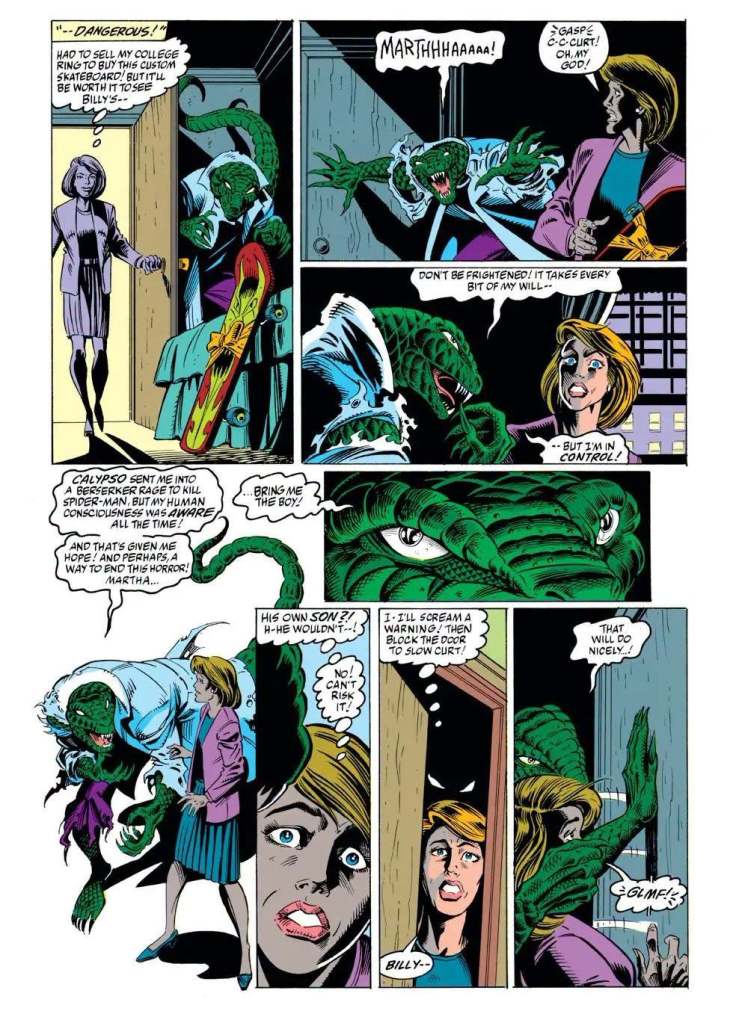
As Martha Connors enters a dark room to get a prepared gift for her son Billy, the Lizard shuts the door and confronts her. In his reptilian form, the Lizard communicates to his wife in English and assures her that he (Dr. Connors) is in control. He tells her that the evil sorceress Calypso sent her into a berserker rage to kill Spider-Man but his human consciousness was aware all the time. He tells her to bring to him their son. Martha is frightened and she knows that there is too much risk to grant her husband’s command…
Quality
The main story has a rematch between Spidey and the Lizard. Unlike Todd McFarlane’s Torment, the story and visuals here have more subtlety, suspense and balance.
The main story “Fathers and Sins” is the anticipated rematch between Spider-Man and the Lizard following the very violent events that happened in the Torment storyline. Unlike that tale authored by McFarlane, this one has more depth and subtlety balanced with superhero spectacle.
David Michelinie carefully crafted the tale with clear progression in mind for the enduring rivalry between Spider-Man and the Lizard. He also took the opportunities to develop the characters whenever possible, and he did so with Dr. Connor’s wife and son. In fact, there are family dynamics within this story and the Lizard – portrayed here with multiple personality disorder (MPD) switching from Dr. Connor and the wild animal itself – is simply not the murderous entity seen in Torment. That said, this tale opens up questions such as how Dr. Connors will live on knowing the murders he committed as the Lizard, does he have any chance of keeping his family intact, and more.
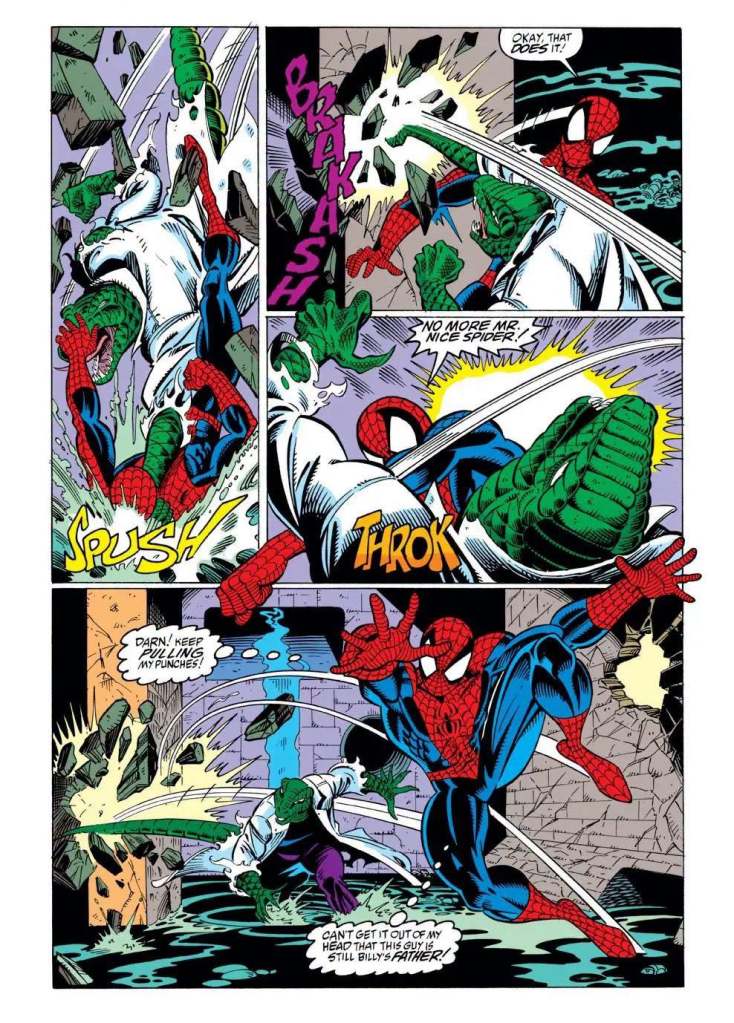
More on Spider-Man himself, he was portrayed as a sensible and caring superhero. Even though he had traumatic encounters with the Lizard in Torment, he engaged his rival with reason instead of head-on violent action. He consistently believes that he could overcome the Lizard and somehow get Dr. Connors back intact knowing that the family needs him. When it comes to problems related with science and technology, Spider-Man here makes efforts to solve them using the knowledge he gained in university. The iconic webslinger here is pretty versatile, strategic and calculating. I should state that Mark Bagley has really fine artworks here and it is clear he truly captured the essence of Michelinie’s script.
The short story “How I Created Spider-Man” follows J. Jonah Jameson’s recollection of Spider-Man. This was cleverly written by Michelinie to revisit key moments from the origin and early superhero days of Spider-Man through Jameson’s memories, his own perception of the hero and his history of abusing his publishing power to make him look like a menace to society. The nostalgia and related details are easily the main attractions of this short story. This is something that fans of Spidey will enjoy.
There is absolutely nothing like encountering a family member who has turned into a large, dangerous reptilian!
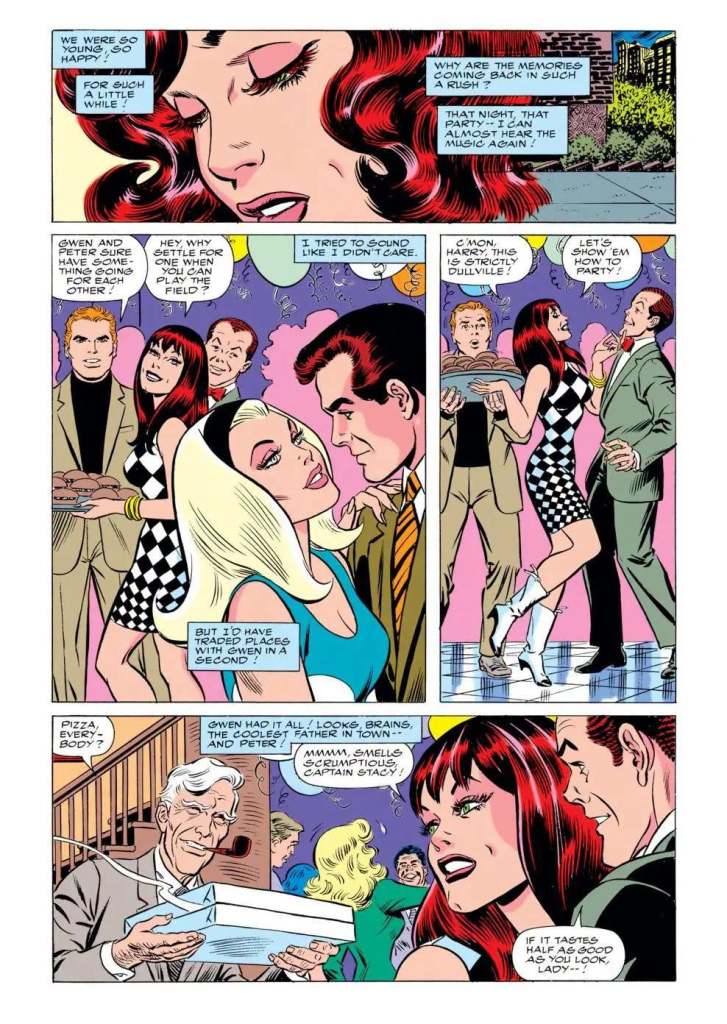
The short story “I Remember Gwen” is a great way of revisiting the past of Spider-Man, Mary Jane and Gwen Stacy. The art by the late John Romita is great to see!
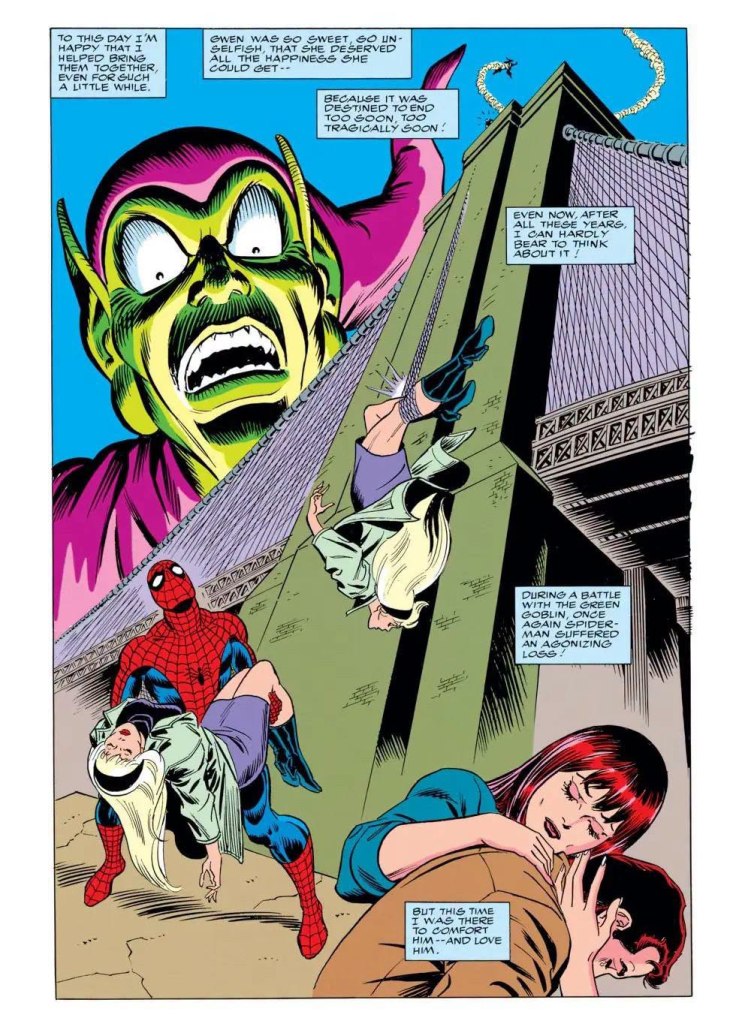
The Spider-Man nostalgia intensified in the 2nd short story “I Remember Gwen” which features artwork by the late John Romita. This one is about Mary Jane Parker recalling her friendship with the late Gwen Stacy (who back then was romantically linked with Peter Parker) and key moments she remembered from Spider-Man. This short story has fine art by Romita and this resulted in a retro visual ride that captured the 1970s aesthetics. As this tale revisited Spider-Man’s past relationship with Gwen, it also offered readers a close look at the MJ-Gwen friendship. That said, long-time fans of Spidey will enjoy this.
The final short story “A Friend in Need” is easily the weakest part of this anniversary celebration comic book. It features the Prowler and does not have much to do with Spider-Man. This one is a shallow filler-type of story.
Conclusion
This page drawn by John Romita should compel you to read Amazing Spider-Man #121.
As of now, I can say that Amazing Spider-Man #365 (1992) is easily the best of the 30th anniversary celebration comic books I have read so far. It has a very solid main story that moved the Spider-Man-Lizard rivalry forward (and also has a conclusion that tapped directly into the icon’s origin with a good element of surprise) and two of the three short stories are great offerings for the very dedicated Spider-Man fans. It also has short articles/special messages that highlight the importance of Spidey’s 30th anniversary, and a Spider-Man 2099 preview! In short, this anniversary celebration comic book is the complete package for the fans and is also one of the most defining Amazing Spider-Man comic books of the 1990s. It truly is worth having in your collection!
Thank you for reading. If you find this article engaging, please click the like button below, share this article to others and also please consider making a donation to support my publishing. If you are looking for a copywriter to create content for your special project or business, check out my services and my portfolio. Feel free to contact me with a private message. Also please feel free to visit my Facebook page Author Carlo Carrasco and follow me on Twitter at @CarloCarrascoPH as well as on Tumblr at https://carlocarrasco.tumblr.com/ and on Instagram at https://www.instagram.com/authorcarlocarrasco
Let me start by saying that Halloween should never be celebrated as it is inherently evil and it makes the participating celebrants vulnerable to evil forces. Apart from the evil that comes with it, the celebration of Halloween also causes major disruptions such as overcrowding, littering, trespassing, bumping, noise pollution, theft, physical violence and more. Over there in Japan, Halloween is not a traditional festivity but rather an urban event that attracted a lot of people as participants. Because each Halloween celebration there resulted in many incidents, the Japanese municipalities have ramped up a series of measures against disruptions, according to a news report by Kyodo News.
To put things in perspective, posted below is the excerpt from the report of Kyodo News. Some parts in boldface…
With Halloween approaching, Japanese municipalities are stepping up measures against disruptive celebrations in major entertainment districts as larger crowds are expected this year with the event falling on a Saturday.
Halloween is not a traditional festivity in Japan, but has evolved into a major urban event in recent years, particularly in Tokyo’s Shibuya district, where revelers in costumes gather for street celebrations.
The festivities have increasingly become associated with public disorder, with revelers drinking on the streets, littering and causing disturbances. Concerns intensified after crowds overturned a small truck in Shibuya during Halloween celebrations in 2018.
Shibuya, which has introduced restrictions on street drinking and imposed a 2,000 yen ($13) fine for littering, also plans to deploy additional patrols. Elsewhere, Tokyo’s Shinjuku district as well as Nagoya and Fukuoka are also tightening restrictions such as on alcohol consumption or access to crowded areas.
The peak crowd around Shibuya Center-Gai, a popular shopping area near Shibuya Station and one of the main gathering spots for revelers, on Halloween fell from about 20,000 in 2024 to about 4,500 in 2025, partly also due to rain.
“I hope Shibuya’s Halloween fever is gradually dying down. This year is an important turning point,” Shibuya Mayor Ken Hasebe said.
Nagoya has blocked access to parts of a downtown commercial complex at night since 2021 after fights and thefts were reported there during Halloween celebrations. The city plans to implement similar measures this year.
Let me end this piece by asking you readers: What is your reaction to this development? Do you think the celebration of Halloween should be banned all over Japan? What do you think caused Halloween to gain a lot of popularity among the Japanese over the past several years? Do you think Halloween participants in Japan even know what exactly are they celebrating? If you have children, have you ever thought them to reject Halloween?
Thank you for reading. If you find this article engaging, please click the like button below, share this article to others and also please consider making a donation to support my publishing. If you are looking for a copywriter to create content for your special project or business, check out my services and my portfolio. Feel free to contact me with a private message. Also please feel free to visit my Facebook page Author Carlo Carrasco and follow me on Twitter at @CarloCarrascoPH as well as on Tumblr at https://carlocarrasco.tumblr.com/ and on Instagram at https://www.instagram.com/authorcarlocarrasco
Japan, which attracted over 42 million foreign tourists in 2025, counted 7.06 trillion Yen (US$45 billion) spent by foreign visitors during the first nine months of 2026, according to a recent news report by Kyodo News. The number of foreign visitors during the same time period has reached 30.73 million.
To put things in perspective, posted below is the excerpt from the report of Kyodo News. Some parts in boldface…
Spending by foreign visitors to Japan hit a record 7.06 trillion yen ($45 billion) in the nine months through September, the Japan Tourism Agency said Wednesday.
The spending, which includes shopping and accommodation costs, rose 1.9 percent from the same period a year earlier.
Spending from July through September increased 3.2 percent from a year earlier to 2.2 trillion yen. By country and region, Taiwan topped the list with 382 billion yen, followed by China with 358 billion yen.
For the three months through September, average spending per visitor was 233,677 yen, up 6.1 percent.
The number of foreign visitors during the nine months, meanwhile, fell 2.9 percent to 30.73 million, according to the Japan National Tourism Organization. It was the first decline for the January-September period since 2021, during the novel coronavirus pandemic.
Visitors from China dropped 55.5 percent amid strained relations with Japan following Prime Minister Sanae Takaichi’s remarks in November suggesting that a Chinese attack on Taiwan could prompt a response by the Self-Defense Forces in support of the United States.
South Korea topped the list with 8.3 million visitors, up 21.6 percent during the three quarters from January, followed by Taiwan with 6 million, up 19.1 percent, China with 3.3 million, the United States with 2.5 million, up 5.2 percent, and Hong Kong with 2 million, up 7.7 percent.
Let me end this piece by asking you readers: What is your reaction to this development? Do you think Japan could attract at least 43 million foreign visitors by the end of the year? What do you think explains the higher spending of foreign visitors in Japan this year?
Thank you for reading. If you find this article engaging, please click the like button below, share this article to others and also please consider making a donation to support my publishing. If you are looking for a copywriter to create content for your special project or business, check out my services and my portfolio. Feel free to contact me with a private message. Also please feel free to visit my Facebook page Author Carlo Carrasco and follow me on Twitter at @CarloCarrascoPH as well as on Tumblr at https://carlocarrasco.tumblr.com/ and on Instagram at https://www.instagram.com/authorcarlocarrasco
During the ASEAN-United States Defense Ministers’ Informal Meeting held here in the Philippines yesterday, US Secretary of War Pete Hegseth proposed a new US-ASEAN defense cooperation framework to guide regional partnerships for the next several years, according to a Manila Bulletin news report. It should be noted that next year marks the 50th anniversary of the relations between the United States and the Association of Southeast Asian Nations (ASEAN).
To put things in perspective, posted below is the excerpt from the news report of the Manila Bulletin. Some parts in boldface…
The United States on Wednesday, Oct. 28, proposed developing a new framework for defense cooperation with Southeast Asian nations as Washington seeks to strengthen military partnerships and maintain regional stability amid security challenges in the Indo-Pacific region.
US Secretary of War Pete Hegseth announced the proposal during the ASEAN-United States Defense Ministers’ Informal Meeting in Lapu-Lapu City, Cebu, held on the sidelines of the 20th ASEAN Defense Ministers’ Meeting (ADMM) under the Philippines’ 2026 ASEAN (chairmanship).
“Next year marks the 50th anniversary formally of US-ASEAN relations, an important milestone, and in recognition of this milestone, we propose that we work together to develop a US-ASEAN framework for defense cooperation, a practical framework that guides our cooperation over the next several years,” Hegseth said.
Details of the said defense frameworks have yet to be specifically discussed by ASEAN defense leaders and Hegseth although he said Washington was ready to begin work on the proposal with Singapore as it prepares to assume the ADMM-Plus chairmanship from the Philippines.
Hegseth described the US approach to regional security as “strong, quiet, and clear,” saying Washington wanted to deter aggression without provoking unnecessary escalation.
“Strong enough to deter coercion and aggression, quiet enough to avoid needless escalation or public theatrics, and to let our actions speak for themselves, but are clear enough that our friends, our partners, and potential adversaries understand precisely where the United States stands and that we will defend our interests and the interests of our allies and partners,” he said.
He said the approach was based on “peace through strength” and emphasized that the United States was willing to work with ASEAN members according to their circumstances, priorities and shared interests.
Hegseth identified maritime domain awareness, interoperability and cooperation among navies as key areas for practical collaboration.
“These are not symbolic things. They are concrete demonstrations of what serious partners do,” he said, adding that joint training and planning could build the confidence and competence needed to prevent conflict.
He also cited cooperation to sustain the ceasefire along the Cambodia-Thailand border as an example of regional coordination, saying ASEAN’s leadership had demonstrated what the bloc could achieve when it acted with purpose and resolve.
Valuable ally– Meanwhile, Department of National Defense (DND) Secretary Gilberto Teodoro Jr. welcomed the US engagement, saying a sustained American presence was necessary for peace and stability in Southeast Asia and the wider Indo-Pacific.
“We value the United States’ sustained engagement with the defense establishments of ASEAN as a robust US presence is necessary for peace and stability in Southeast Asia and in the broader Indo-Pacific region,” Teodoro said.
The DND chief also thanked Washington for supporting ASEAN centrality and participating in ASEAN-led mechanisms, including the ADMM-Plus, which brings together ASEAN defense ministers and their eight dialogue partners.
Teodoro cited the second ASEAN-US maritime exercise, in which the Philippine Navy participated in Indonesia in December 2025, and Washington’s support for the Philippines and Japan as co-chairs of the current ADMM-Plus Experts’ Working Group on Maritime Security.
He also welcomed the participation of the US Navy and Air Force in a joint cooperative activity hosted by the Philippines in Subic last month. Teodoro said Manila hopes to build on these initiatives as he stressed the importance of freedom of navigation to regional security and prosperity.
Let me end this piece by asking you readers: What is your reaction to this development? Do you believe that the proposed new defense cooperation with ASEAN will lead to breakthroughs pertaining to regional stability and freedom of movement at sea? Do you think Communist China will feel the heat of America’s cooperation with ASEAN? What do you think US President Donald Trump will announce about regional cooperation when he attends the ASEAN Summit in the Philippines?
As far as one economist is concerned, the Philippines has crossed into stagflation pointing to factors like domestic government spending reductions, soaring costs of food, high price of oil and more, according to a news report by the Manila Bulletin.
To put things in perspective, posted below is an excerpt from the Manila Bulletin report. Some parts in boldface…
The Philippines has crossed the line from a standard cyclical slowdown into genuine stagflation, driven by global energy price shocks, domestic government spending cuts, and soaring food costs, according to a regional economist.
Speaking at “CFME Talks Macro Outlook: Global, Australia, New Zealand, and the Philippines” briefing hosted by Center for Financial and Monetary Economics (CFME) on Wednesday, Oct. 21, David G. Fernandez, senior fellow at CFME and visiting professor at Philippine Center for Economic Development (PCED), warned that consensus growth forecasts for 2026 have plummeted from more than five percent to around 3.2 percent.
When asked what markers signal the shift to genuine stagflation, Fernandez said: “Well, I think that we’ve crossed the line. The revisions indicate that that’s what markets are expecting.”
He added that near-term growth could fall below already lowered forecasts while inflation could exceed expectations, emphasizing that this outlook “has to do with—not [the] fault of the Philippines—but the oil prices and potentially significantly higher food prices.”
“Growth could even be below the lowered forecasts and that inflation could be even higher than the higher forecasts that people have,” Fernandez added. “I worry about is that the optimism or the consensus forecast that we get back to five percent growth and you see inflation come down could be too optimistic themselves.”
Stagflation is generally understood as the simultaneous occurrence of elevated inflation, stagnant economic growth, and high unemployment, although economists do not have universally accepted numerical thresholds for determining when an economy has entered such a period.
In his presentation, Fernandez said inflation projections have shifted sharply upward, from an initial 2.6 percent toward six percent, with headline consumer price index (CPI) inflation already reaching 7.2 percent.
He described the country’s near-term trajectory as an extreme stagflation story, with forecast revisions becoming increasingly severe and the Philippines remaining firmly “under the radar” for international investors.
The economic slowdown was reflected in second-quarter gross domestic product (GDP) growth, which fell to a post-pandemic low of 2.3 percent.
Fernandez cautioned that growth was cushioned by inventory stockpiling and a doubling of government fuel subsidies even as underlying domestic demand weakened.
He said public investment plunged by nearly 14 percent following public sector retrenchment linked to the flood control scandal, while private consumption growth dropped below three percent as family incomes were eroded by rising transport and food costs.
Fernandez said it remained very difficult to build a narrative for a strong recovery. While growth may have reached its floor, he projected that any subsequent rebound would remain shallow and well below the economy’s six-percent potential trend growth.
Compounding the energy crisis, he said, is a rapid acceleration of second-round effects, with businesses passing higher input costs on to consumers faster than in previous shock cycles.
Headline inflation reached 7.2 percent in both April and September, with Fernandez pointing to rice prices surging by more than 20 percent and transport costs climbing nearly 15 percent.
He also flagged the possibility of a “Godzilla El Niño” pushing food prices even higher, warning that consumers and policymakers may have to endure headline inflation hovering around seven percent for an extended period.
Meanwhile, Fernandez said the widening economic fallout has pushed the Philippines’ current account deficit forecast to more than four percent of GDP, underscoring the country’s vulnerability to imported energy shocks.
Let me end this post by asking you readers: What is your reaction to this recent development? Do you think the economist is correct that the Philippines has crossed over into stagflation? Do you think there is nothing the national government can do to lower the prices of oil, fuel and other things that are essential for Filipinos? Do you think the national economy will fall into a recession by early 2028?
Thank you for reading. If you find this article engaging, please click the like button below, share this article to others and also please consider making a donation to support my publishing. If you are looking for a copywriter to create content for your special project or business, check out my services and my portfolio. Feel free to contact me with a private message. Also please feel free to visit my Facebook page Author Carlo Carrasco and follow me on Twitter at @CarloCarrascoPH as well as on Tumblr at https://carlocarrasco.tumblr.com/ and on Instagram at https://www.instagram.com/authorcarlocarrasco
Disclaimer: This is my original work with details sourced from reading the comic book and doing personal research. Anyone who wants to use this article, in part or in whole, needs to secure first my permission and agree to cite me as the source and author. Let it be known that any unauthorized use of this article will constrain the author to pursue the remedies under R.A. No. 8293, the Revised Penal Code, and/or all applicable legal actions under the laws of the Philippines.
Welcome back, superhero enthusiasts, 1990s culture enthusiasts, X-Men fans and comic book collectors! Today we revisit the Marvel Comics shared universe through one of the many tales of the X-Men 2099 monthly series.
One of the things I enjoyed the most about the X-Men 2099 series was its expansion of the 2099 universe lore as well as the portrayal of uncertainty that mutants deal with in the more desolate parts of America (far away from Spider-Man 2099 and Punisher 2099). Along the way, the futuristic X-Men themselves were really torn down by a series of unfortunate events that includes the departure of their founder and leader Xi’an (eventually Controller X of the Theater of Pain). With the team members separated by circumstances, they were given their own tales and character development periods.
With those details laid down, here is a look back at X-Men 2099 #24, published by Marvel Comics in 1995 with a story written by John Francis Moore and drawn by Ron Lim.
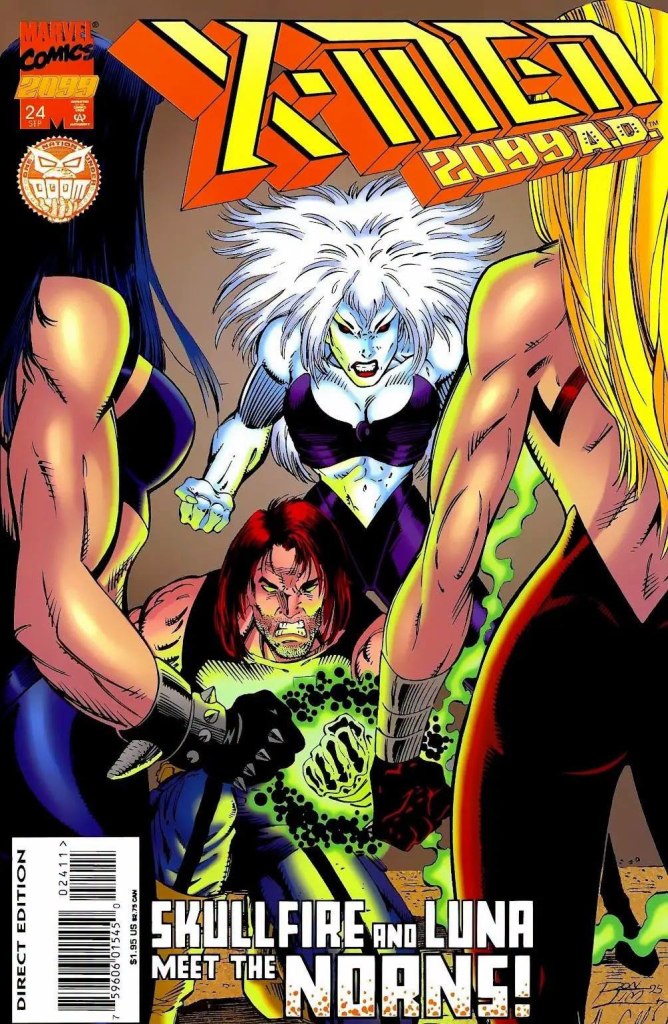
The cover.
Early story
The story begins in southern California where the Slaughterhouse gets shaken by the force of a gamma bomb that detonated far away. Inside the facility, Quiver and Sham struggle as they sneak carefully. They intend to escape even though the odds are against them.
Nearby, the demonic Theater of Pain leader Brimstone Love strikes Junkpile (now with SHIELD serving the new President Doom 2099) hard and seriously damages him. With Junkpile down, the evil leader believes that Doom’s best is a failure and the Theater of Pain has nothing to fear from him. Brimstone Love issues an order to have Junkpile disposed.
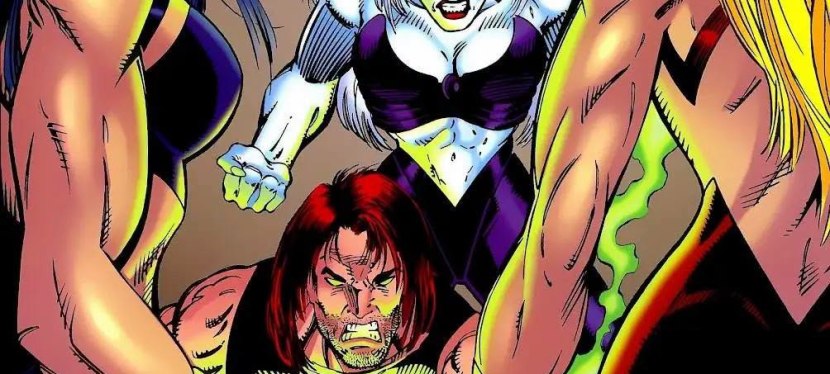
Several feet below the ground, Skullfire and Luna find themselves contained after getting captured. For Luna, Xi’an is a lost cause and she prefers to find Shakti and escape. Skullfire, however, insists on pursuing Xi’an even though their situation looks very hopeless. As the two try to escape, they end up facing the muses of the Theater of Pain’s bloodsport arenas…Euphoria, Felicity and Bliss. Luna was previously one of them…
Quality
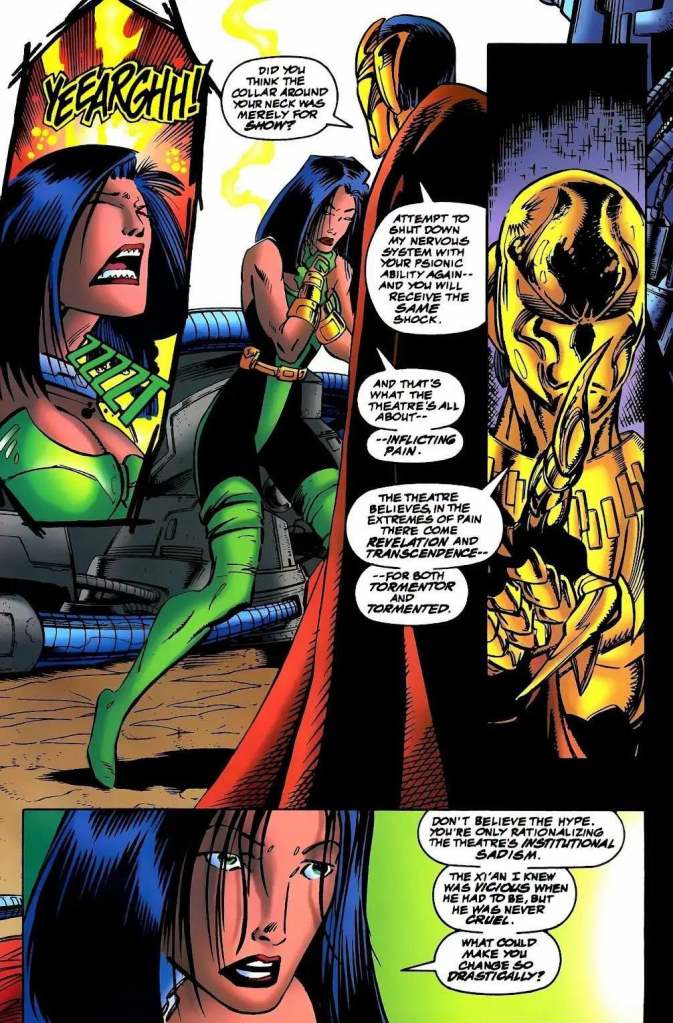
Shakti represents the remaining X-Men while her former superior Xi’an has fully sided with the evil Theater of Pain as Controller X.
Being the comic book that immediately precedes issue #25, there is a lot of creative stuff here that X-Men 2099 fans will enjoy. The Moore-Lim duo took their time in setting up the eventual restoration of the futuristic X-Men as a team while carefully telling the dangerous events they will face with the Theater of Pain standing in their way.
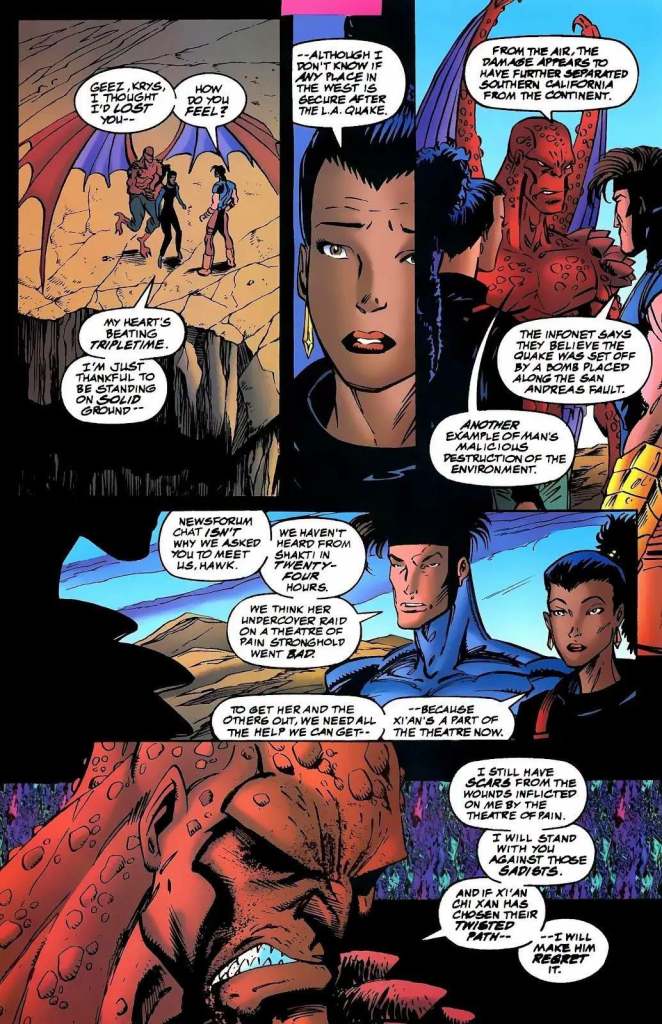
Fans can find small moments that can be enjoyable or even intriguing to discover such as Luna facing off with her Theater of Pain “sisters” of long ago, the reuniting of Bloodhawk with Meanstreak and Krystalin followed by the justification behind their decision to get involved, and more. What I find very compelling to read is Shakti’s interaction with Controller X (Xi’an behind the mask obsessively serving the Theater of Pain) and the rising danger the Theater’s operation is brewing. There is richness in the dialogue between Shakti and Xi’an, and the symbolic division between them – Shakti representing the X-Men and their former leader Xi’an now serving the evil ones – is really powerful to see.
The storytelling as a whole has a lot of depth behind it, and the build-up of the events is undeniably powerful. As the story progressed, the tension also grew stronger and you can feel the danger that awaits the futuristic X-Men.
Conclusion
Bloodhawk is back with Meanstreak and Krystalin.
X-Men 2099 #24 (1995) succeeds a lot on setting-up the big conflict of issue #25 and it also sets in motion the eventual reuniting of the X-Men. Along the way, there are small details here and there that will compel you to revisit previous X-Men 2099 issues. Brimstone Love’s evil was emphasized more here and Controller X/Xi’an’s determination to serve him and make a lot of people suffer under the Theater’s operation added a lot of tension to the plot. Consider this a very important read before reading X-Men 2099 #25.