

When Donkey Kong Country (DKC) was released on the Super Nintendo Entertainment System (SNES) in 1994, a lot of gamers were blown away by the visuals and its enjoyable game design. The game also made the character Donkey Kong – who was originally a villain in the 1981 arcade game – very popular. Donkey Kong Country was developed by the European game studio Rare. To find out more about DKC, read Old School Gamer Magazine’s retro gaming article.
Tag: Retrospective
Lunar Remastered Collection scheduled for release on Xbox Series X|S and Xbox One on April 18, 2025
Welcome back Xbox fans, geeks, retro gaming enthusiasts, RPG enthusiasts and gamers!
GungHo Online recently announced the release date of the anticipated retro Japanese role-playing games (JRPGs) collection Lunar Remastered Collection which is April 18, 2025.
For the newcomers reading this, the said collection contains the two memorable fantasy role-playing games (fantasy RPGs) which are Lunar: Silver Star Story Complete (enhanced version of Lunar: The Silver Star) and Lunar 2: Eternal Blue Complete (enhanced version of Lunar: Eternal Blue). Since the releases of the original versions in the 1990s, the Lunar RPGs have been released on a variety of consoles such as Sega CD, PlayStation and Sega Saturn.
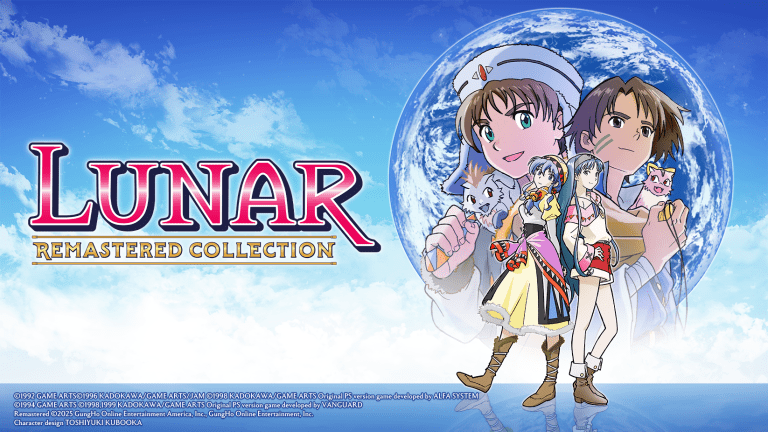
For the JRPG-loving Xbox fans, the said Lunar Remastered Collection is indeed coming to Xbox Series X|S and the aging Xbox One. Strangely enough, as of this writing, the said collection has yet to appear on the Xbox online store.
While GungHo confirmed there will be physical copies of Lunar Remastered Collection coming out, it is uncertain if such copies of the Xbox version will be released. The press release mentioned that physical editions “will be available exclusively through Amazon for $54.99 USD” for the North American market. As for the European market, only the PlayStation 4 (PS4) and Nintendo Switch will have physical copies through Clear River Games.
If you are an Xbox fan who loves Lunar and JRPGs in general, are you discouraged about the potential lack of physical copies of Lunar Remastered Collection? If you really want it badly, better express your opinions and questions directly to Team Xbox and GungHo via Twitter, or by email.
For updates about Lunar Remastered Collection, visit https://www.lunarremastered.com/
+++++
Thank you for reading. If you find this article engaging, please click the like button below, share this article to others and also please consider making a donation to support my publishing. If you are looking for a copywriter to create content for your special project or business, check out my services and my portfolio. Feel free to contact me with a private message. Also please feel free to visit my Facebook page Author Carlo Carrasco and follow me on Twitter at @HavenorFantasy as well as on Tumblr at https://carlocarrasco.tumblr.com/ and on Instagram athttps://www.instagram.com/authorcarlocarrasco

What to watch on YouTube right now – Part 53
Welcome back my readers, YouTube viewers and all others who followed this series of articles focused on YouTube videos worth watching. Have you been searching for something fun or interesting to watch on YouTube? Do you feel bored right now and you crave for something to see on the world’s most popular online video destination?
I recommend you check out the following topics and the related videos I found.
#1 Popcorn in Bed reacts to An Officer and a Gentleman – Released in 1982, An Officer and a Gentleman is a romantic drama film with a militaristic flavor showing a young Richard Gere and Louise Gosset, Jr., in a very memorable role. Some parts of the movie were filmed on location here in my native Philippines. While I am not exactly a fan of the movie, I can say that it still has some shining moments as well as some memorable dramatic scenes. Recently, YouTuber Popcorn in Bed posted its reaction video of the movie, and I can say it is worth watching.
#2 When hackers made ATMs release so much money – Recently, YouTuber fern published a new video explaining a certain financial crime that resulted in physical activities that was hard to imagine – automatic teller machines (ATMs) shooting out multiple bills of cash for thieves to collect. What happened, what can financial institutions do to prevent their system from getting hacked, and how the events turned out are explained in detail by fern.
#3 Criterion Collection shows how to restore and remaster very old films – The Criterion Collection (AKA Criterion) is a company that specializes on licensing, restoring and releasing selected films that movie buffs, fans and new film enthusiasts could enjoy. I myself own the Criterion Blu-ray discs of The Blob (1958) and Gojira, and I can say that the company did a great job restoring the said films while adding stuff for collectors and fans to enjoy. When it comes to restoring decades-old films and making them presentable with quality in mind, Criterion really works hard and you can learn a lot from them by watching the videos below.
#4 VKunia reacts to Man of Steel – Do you movie fans enjoy watching Zack Snyder’s Man of Steel? The 2013 Superman movie remains divisive among fans and superhero movie enthusiasts to this day. I’ve seen the movie many times from the local cinemas to my Blu-ray copy, and I can say it truly is a mixed bag when it comes to providing viewers fun and defining Superman in the 21st century. Still, there is a chance that the Man of Steel reaction video by YouTuber VKunia could spark your interest in the film as well as in Zack Snyder’s visceral vision of DC Comics superheroes. I encourage you to watch her reaction video below.
#5 Commie Kamala Harris proves herself pathetic yet again during California wildfire briefing – By the time you are reading this, Donald Trump has officially returned as United States President. That being said, even during times of disaster, the defeated Commie Kamala Harris proved to be pathetic and worthless during the recent briefing about the wildfire in California. She is so pathetic and worthless, Harris proved she is not trustworthy. Imagine all the amounts of American taxpayers’ money that got wasted by Harris during her 4 years as US Vice President.
#6 Battlezone revisited – Released by Atari in 1980, Battlezone was a groundbreaking game both visually and with game design. It gave gamers an immersive experience of driving a tank with 3D graphics, fun gameplay and a first-person view. If you wish to learn about the history of Battlezone, who the creators were and how were they able to produce the game, watch the video of gaming history expert PatmanQC.
#7 Minty Comedic Arts and the 1980s – I really enjoy watching the videos of Minty Comedic Arts. His series of “10 things you didn’t know about…” videos on pop culture (mostly movies) is fun to watch and he often entertains with his delivery of trivia information. In recent times, he posted trivia videos about certain films from the 1980s – each one being memorable in their own ways – namely Fast Times at Ridgemont High, The Breakfast Club, The Blue Brothers, Beverly Hills Cop and Indiana Jones and the Temple of Doom. Watch Minty’s videos now!
#8 The failure of Segway remembered – Remember decades ago when the Segway was first launched and heavily featured through the media? Invented by Dean Kamen, the Segway was a 2-wheeled personal transporter which was released looking fantastic but ended up as a failure. The Segway also ended up looking very bad in media reports about accidents with it. To find out what led to the Segway’s debut and how it failed, watch the video below.
#9 GoodBadFlicks examines five major flops – When it comes to movies that failed miserably, were those really terrible to watch or were they actually decent productions that failed to attract enough moviegoers? There are factors as to why movies fail. There are films that generated so much negative press, the moviegoers were convinced to avoid them. There are movies that were really badly made and there are others that got promoted or distributed very poorly. GoodBadFlicks recently post a video examining five major flops and it might convince you to watch The 13th Warrior, Final Fantasy: The Spirits Within, Titan A.E., The Chronicles of Riddick and Cutthroat Island.
+++++
Thank you for reading. If you find this article engaging, please click the like button below, share this article to others and also please consider making a donation to support my publishing. If you are looking for a copywriter to create content for your special project or business, check out my services and my portfolio. Feel free to contact me with a private message. Also please feel free to visit my Facebook page Author Carlo Carrasco and follow me on Twitter at @HavenorFantasy as well as on Tumblr at https://carlocarrasco.tumblr.com/ and on Instagram athttps://www.instagram.com/authorcarlocarrasco
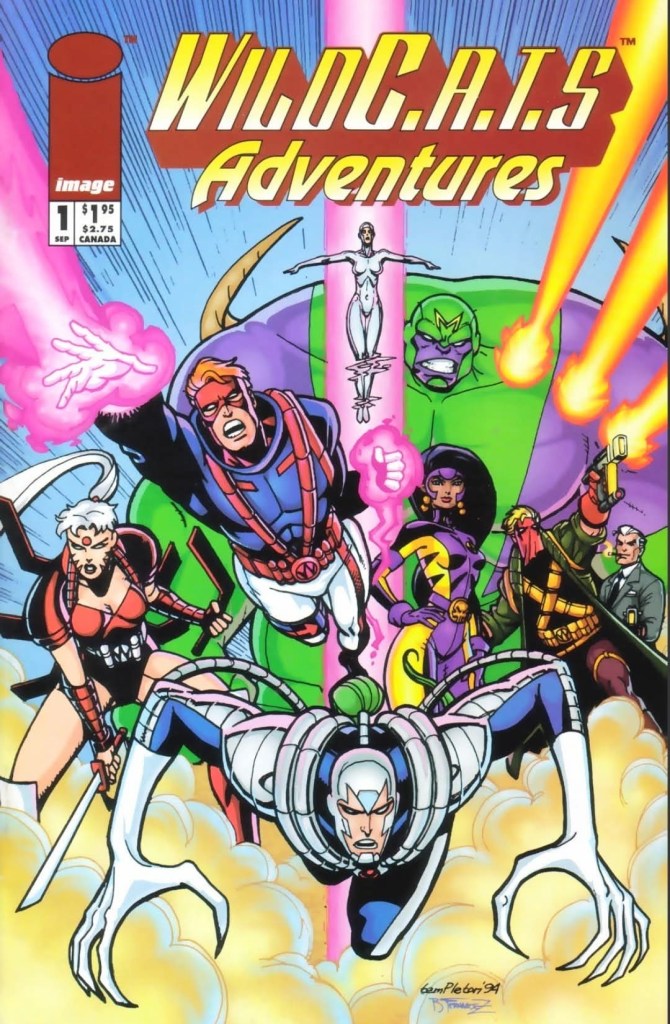
A Look Back at WildC.A.T.s Adventures #1 (1994)
Disclaimer: This is my original work with details sourced from reading the comic book and doing personal research. Anyone who wants to use this article, in part or in whole, needs to secure first my permission and agree to cite me as the source and author. Let it be known that any unauthorized use of this article will constrain the author to pursue the remedies under R.A. No. 8293, the Revised Penal Code, and/or all applicable legal actions under the laws of the Philippines.
Welcome back superhero enthusiasts, 20th century pop culture enthusiasts and comic book collectors! Today we go back to the mid-1990s to take a close look at the launch issue of the comic book series that was an adaptation of the WildC.A.T.S: Covert Action Teams animated series.
To put things into perspective, Jim Lee and several creators left Marvel Comics to establish Image Comics. In 1992, Lee launched his creator-owned project WildC.A.T.s: Covert Action Teams #1 which also was a part of the creative foundation of the WildStorm universe. Just a little over two years later, an animated series of WildC.A.T.S. was launched on TV. Similar to what Marvel Comics did in relation to adapting stories of the X-Men animated series, Image Comics launched a comic book series based on the WildC.A.T.S. animated series.
With those details laid down, here is a look back at WildC.A.T.s Adventures #1, published in 1994 by Image Comics with a story written by Jeff Mariotte (adapting the animated story by David Wise) and drawn by Ty Templeton.
Early story
The story begins one night inside an office where Reno Bryce (Warblade) works obsessively on a circuit board. He is surrounded by the technology he knows and loves. As he works, three armed men wearing coats and hats enter his office and ask him for his identity. One of the men grabs a circuit board and destroys it, which triggers Reno to react with violence.
Knowing he is outnumbered, he quickly runs out of the office for safety. He heard one of the men referred to him as a crossbreed whelp. As soon as he finally leaves the building, Reno sees the WildCATS team composed of Grifter, Spartan, Zealot, Voodoo and Maul. Thinking that the WildCATS are out to kill him like the armed men, Reno keeps on running away.
Suddenly, a group of people are rushing towards the WildCATs. Powered with the Sight, Voodoo realizes that the mob is composed of Daemonites disguised as humans. The WildCATs and the mob engage in battle.
From high above, Reno see the battle happening. Suddenly, the three armed men appeared behind him telling him that he has no escape from them…
Quality
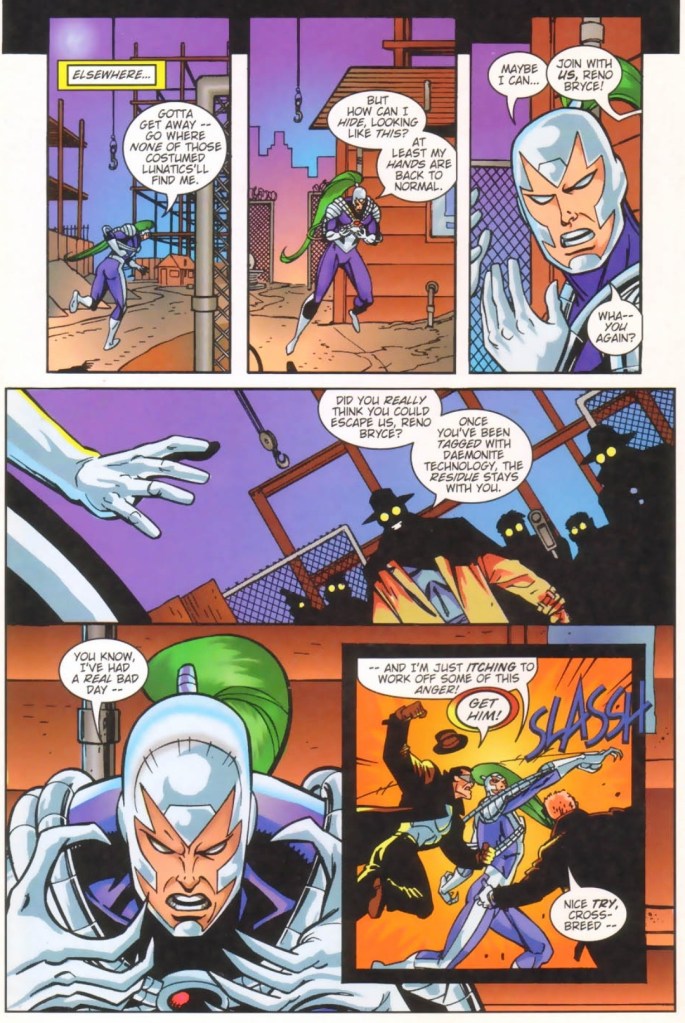
Having seen the first episode myself, I can say that this comic book is actually a faithful adaptation and the creative team did their jobs well.
As an alternate introductory story of the WildCATs, this one obviously has the violence and visceral essence of the comic book series toned down due to the fact that the animated series was made with a younger audience in mind. There is still plenty of action here and the creative team’s focus on telling the story was consistently strong.
Within one story, the creative teams of both the animated episode and this comic book succeeded in gradually emphasizing the lore of WildCATS which had strong sci-fi elements (example: the long conflict between the Kherubim and the Daemonites), introducing the characters and the super villain, showcase the capabilities of the characters, emphasizing the purposes of each side, and having Reno Bryce as the newcomer who is about to discover his real role in the conflict (which reminds me of Jubilee in the opening episode of the X-Men animated series).
Conclusion
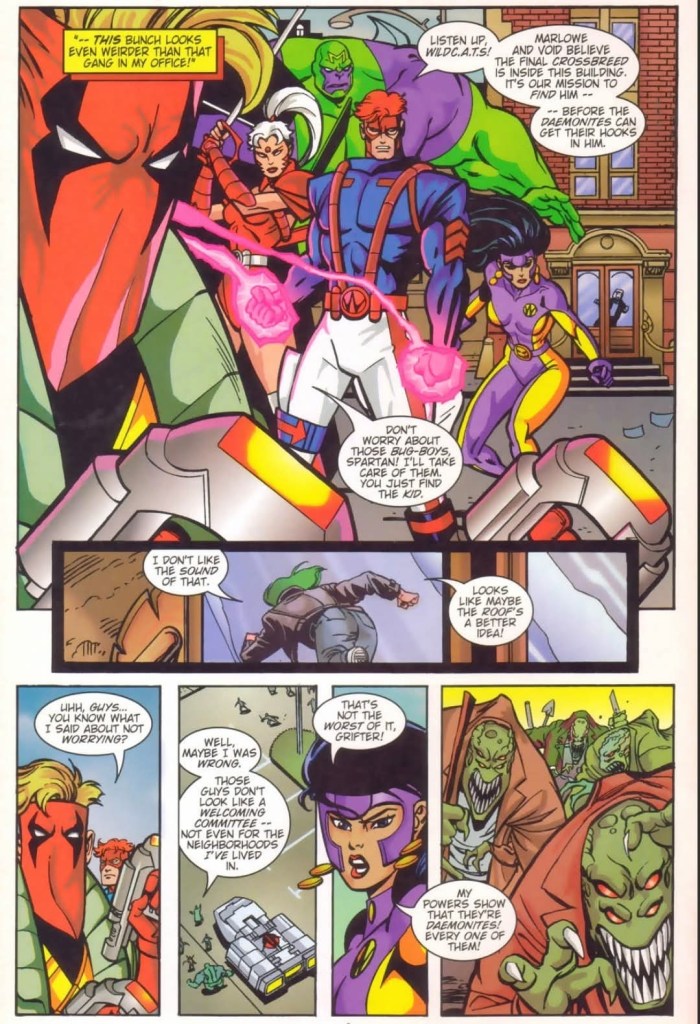
Like its animated source, WildC.A.T.s Adventures #1 (1994) is enjoyable and the creators did a very good job translating the story and essence from animation into literary format. Having read the Jim Lee-drawn issue #1 of 1992, this one worked well as an alternate introduction of the WildCATS and their conflict with the Daemonites. Like the animated TV episode, the presentation was done in a wholesome manner without ever becoming childish. I can say that there is still enough good stuff of WildCATS to enjoy here, and the characters are recognizable (both in looks and portrayals). Right now, I’m looking forward to reading the next issue.
Overall, WildC.A.T.s Adventures #1 (1994) is highly recommended.
+++++
Thank you for reading. If you find this article engaging, please click the like button below, share this article to others and also please consider making a donation to support my publishing. If you are looking for a copywriter to create content for your special project or business, check out my services and my portfolio. Feel free to contact me with a private message. Also please feel free to visit my Facebook page Author Carlo Carrasco and follow me on Twitter at @HavenorFantasy as well as on Tumblr at https://carlocarrasco.tumblr.com/ and on Instagram at https://www.instagram.com/authorcarlocarrasco
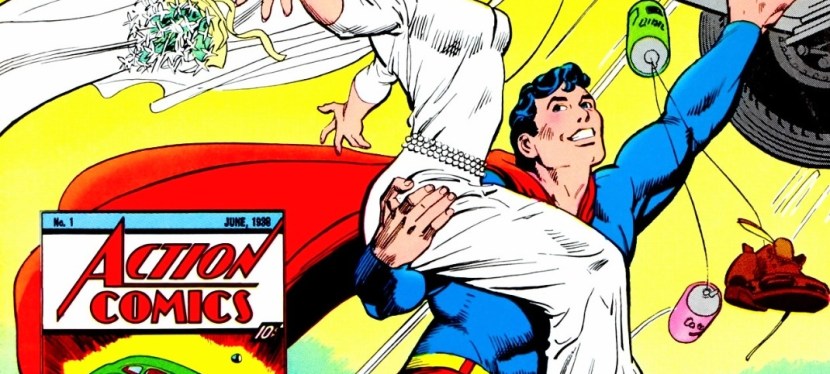
A Look Back at Action Comics #484 (1978)
Disclaimer: This is my original work with details sourced from reading the comic book and doing personal research. Anyone who wants to use this article, in part or in whole, needs to secure first my permission and agree to cite me as the source and author. Let it be known that any unauthorized use of this article will constrain the author to pursue the remedies under R.A. No. 8293, the Revised Penal Code, and/or all applicable legal actions under the laws of the Philippines.
Welcome back superhero enthusiasts, 20th century pop culture enthusiasts and comic book collectors! Today we go back to the year 1978 to take a close look at one of the many tales published through the original Action Comics monthly series (launched in 1938).
Long before Crisis on Infinite Earths happened, DC Comics had its convoluted multiverse. For the newcomers reading this, this meant that there were actually different versions of Superman and other DC superheroes, plus different universes or parallel worlds existing with each other. This particular Action Comics issue features a certain version of Superman and what happened to him and the related characters.
With those details laid down, here is a look back at Action Comics #484, published in 1978 by DC Comics with a story written by Cary Bates and drawn by Curt Swan.
Early story
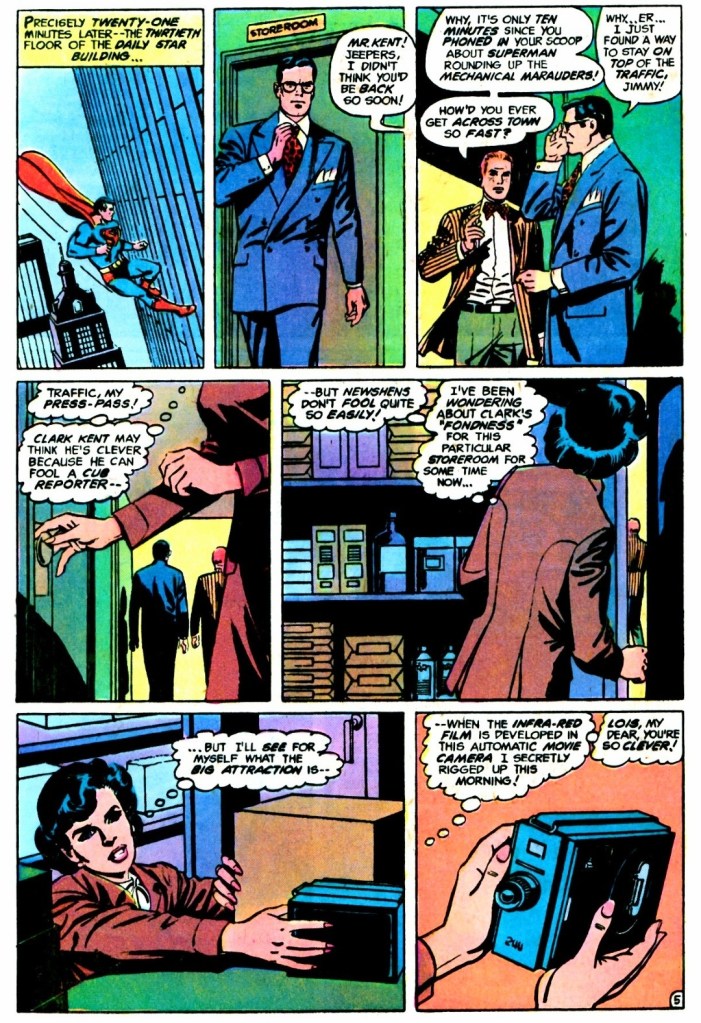
The story begins in Metropolis of Earth-Two when four mechanical marauders fly through the city carrying bags of money taken from a bank. Superman (of Earth-Two) quickly flew after the mechanical marauders and uses his powers to beat them all. From a distance, Colonel Future (leader of the C-F Gang) observes Superman and analyzes his moves. It turns out, the gang is responsible for the mechanical marauders and Colonel Future believes that he can wipe out the Man of Steel.
Superman returns quietly into the Daily Star Building and changes into civilian clothing as Clark Kent. His office mate Jimmy Olsen approaches him and together they walk and talk about what has been going on.
Behind them, Lois Lane silently enters the store room where Clark came out of. It turns out, she prepared a hidden camera inside hoping to capture evidence about Clark using the room. She has been suspecting that Superman and Clark Kent are one and the same person…
Quality
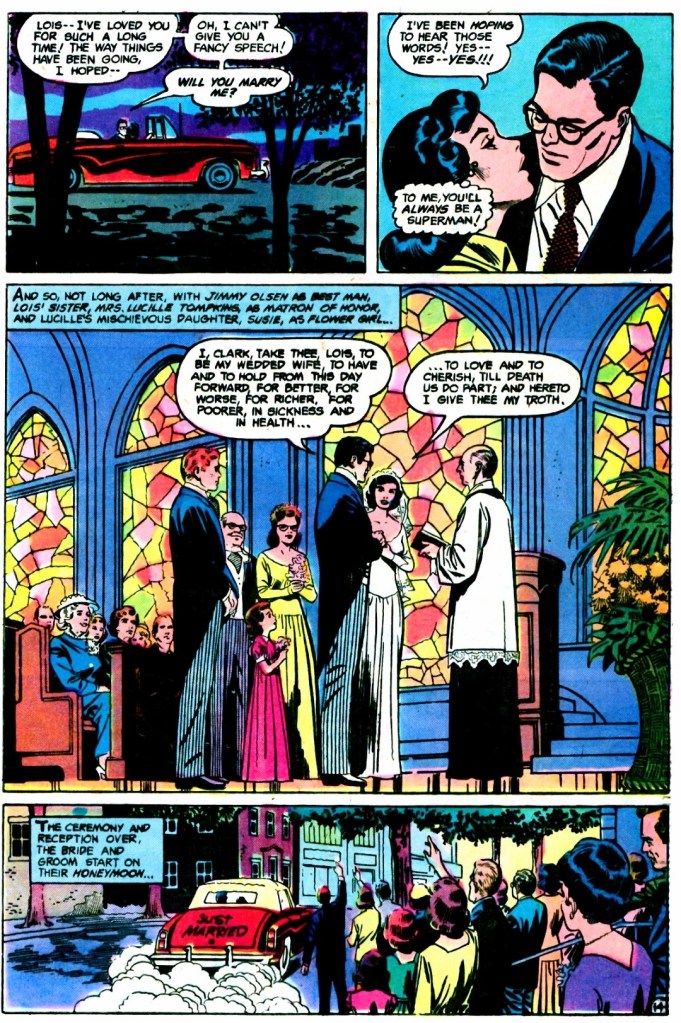
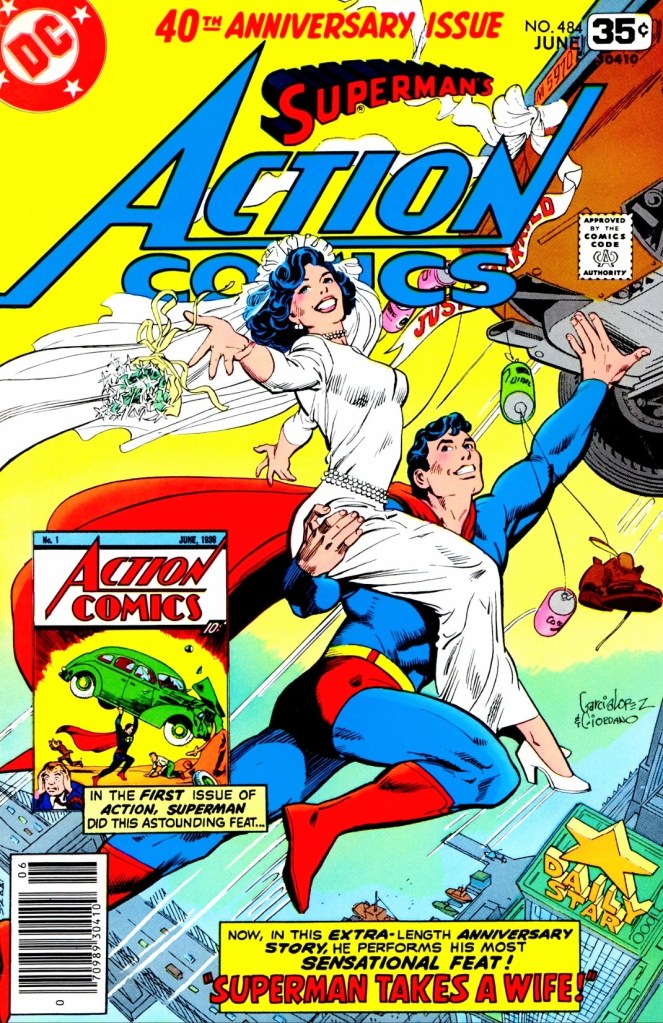
I really like this pre-Crisis Superman story which is specifically set in Earth-Two of the DC multiverse. To make things clear, this is a tale showing Superman getting married to Lois Lane without impacting the mainstream version of DC’s icon at the time. Confused? That’s the consequence of having different versions of Superman complete with detailed parallel universes for each.
More on the core concept of this comic book, there is a lot more at stake – storywise and creatively – than meets the eye. Without spoiling the plot details, I can clearly say that the concept of Superman and Lois Lane getting married involves a daring plot which was executed nicely by the Bates-Swan duo resulting in a really intriguing reading experience for me. In other words, there is nothing simple with the presentation as the fantasy elements are really strong and the creative team took creative risks to emphasize the story while developing the key characters in new ways.
Still on the storytelling, the conflict between good and evil is emphasized not by struggle but rather the consequences which ultimately affect Superman and Lois Lane. The main opposition used by the Bate-Swan duo involves magic as a creative way to impact the Man of Steel and the narrative in general. There are some really intriguing moments about Superman (including his civilian identity as Clark Kent) and Lois Lane that await readers.
Conclusion
Action Comics #484 (1978) is undoubtedly a very intriguing and surprising read. The creative team came up with ideas that subverted expectations and the execution was well done which made this a powerful and twisting read. Having read lots of Superman comic books through the decades, this comic book is one of the more surprising ones I have read. Finally, this one has a believable presentation about what married life between Superman and Lois Lane would be like reflecting the social norms at the time of publication.
Overall, Action Comics #484 (1978) is highly recommended.
+++++
Thank you for reading. If you find this article engaging, please click the like button below, share this article to others and also please consider making a donation to support my publishing. If you are looking for a copywriter to create content for your special project or business, check out my services and my portfolio. Feel free to contact me with a private message. Also please feel free to visit my Facebook page Author Carlo Carrasco and follow me on Twitter at @HavenorFantasy as well as on Tumblr at https://carlocarrasco.tumblr.com/ and on Instagram at https://www.instagram.com/authorcarlocarrasco
What to watch on YouTube right now – Part 52
Welcome back my readers, YouTube viewers and all others who followed this series of articles focused on YouTube videos worth watching. Have you been searching for something fun or interesting to watch on YouTube? Do you feel bored right now and you crave for something to see on the world’s most popular online video destination?
I recommend you check out the following topics and the related videos I found.
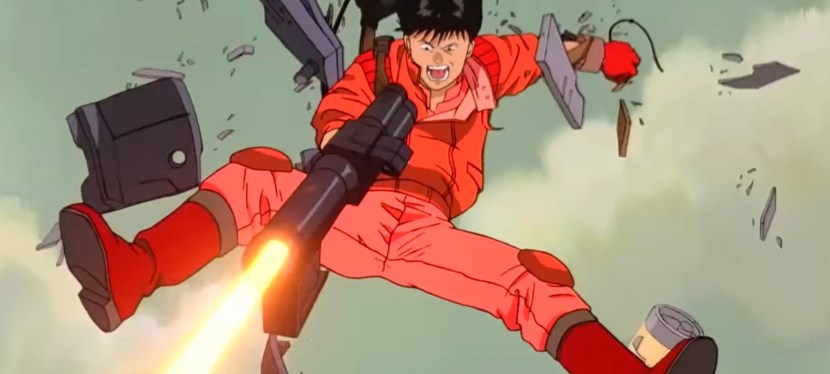
#1 Akira revisited – The 1988 anime feature film Akira has often been cited as a masterpiece and some pointed it for making anime more popular in the West. For the newcomers reading this, Akira actually started in Japan as a manga/comic book series before getting adapted into anime. Strangely enough, the literary Akira was still publishing when the 1988 feature film was released. As of this writing, there are two English-dubbed versions of it in existence and the Blu-ray copy I own has them both.
It is not surprising that the animated Akira got featured by many YouTubers in the form of retro reviews, reaction videos, documentaries and video analysis. If you have not seen Akira, I encourage you to watch it on Blu-ray first. Otherwise, enjoy the selected videos below.
#2 Universal City Studios, Inc. v. Nintendo Co., Ltd. (the Donkey Kong case) – Have you ever played Donkey Kong back in the 1980s? That is a classic game from Nintendo. It was a hit in the arcades and made its way to multiple platforms in the years that followed. Believe it or not, Univeral Studios sued Nintendo alleging that Donkey Kong was a trademark infringement of King Kong. The video below will explain the details as to what happened and I can say it is also amusing to watch.
#3 PatmanQC examines Q*bert – Released in the arcades in 1982, Q*bert became a hit in America and went on to become one of the highest grossing arcade games in 1983. A very fun game, it is remembered for cleverly blending puzzle play with 3D-like movement and avoidance of both obstacles and enemies. You might be wondering who came up with Q*bert, what led to its production and what inspired the game creators to design it. To find out, watch PatmanQC’s detailed examination of Q*bert below…
#4 The Terminator’s connection with The Outer Limits explored – Remember watching 1984’s The Terminator? That was the memorable sci-fi action movie from director James Cameron which went on to become a multimedia franchise of movies, a TV series, comic books, video games and more. If you truly believe that the story is a purely original work written by Cameron (and by those who were involved behind the scenes), you will have to think twice because The Terminator’s sci-fi concept shares some notable similarities with a certain episode of The Outer Limits written by Harlan Ellison. To find out more, watch the video below…
#5 Al Jazeera is the terrorist news network and Qatar’s tool of deception – I will say it out loud right here: Al Jazeera is absolutely not a professional news outlet. Al Jazeera is, in fact, the Islamic terrorist news network and also the tool of Qatar which itself has sinister plans. Qatar may be a small nation but its ambitions for greater influence on the Middle East are very big and they have sinister intentions to grow big. Be aware that Qatar funded anti-Israel movements through American universities. That being said, I urge you all to boycott Al Jazeera. To take a close look at the evil of Al Jazeera and why Qatar should be held accountable, watch the video below.
#6 Ashleigh Burton reacts to The Amazing Spider-Man 2 – Back in 2014, I saw The Amazing Spider-Man 2 in the local cinema which was fully crowded. Even though I had modest expectations, I still left the cinema feeling disappointed. I was convinced that Sony Pictures, Andrew Garfield and director Marc Webb really had nowhere else to go with the way they were handling the Spider-Man film franchise. The Amazing Spider-Man 2 remains a divisive film and yet I had more fun with it by watching Ashleigh Burton’s reaction video. Watch it now.
#7 Popcorn in Bed reacts to Million Dollar Baby – When was the last time you saw YouTuber Popcorn in Bed get emotional and cry during a movie reaction video? If you have already seen Clint Eastwood’s Million Dollar Baby, then you should be aware of its very heartbreaking moments directly related to its very tragic concept. Popcorn in Bed recently reacted to the film and how it impacted her on an emotional level is a must-watch.
#8 SHIFT’s 2024 King of Thong video (Miami Swim Week) – A thong is “an article of swimwear or underwear with the back portion consisting of a narrow strip of cloth that passes between the buttocks and connects with a waistband.” Several months ago, the swimsuit fashion YouTube channel SHIFT posted a video of its coverage of the 2024 Miami Swim Week focusing on a show of King of Thong. For almost nine minutes, you’ll see lots of women appear in thongs showing lots of skin with carefully selected tunes playing. It’s a must-watch for those who enjoy women’s swimwear fashion and thongs. Also, there might be some fashion models you could recognize.
+++++
Thank you for reading. If you find this article engaging, please click the like button below, share this article to others and also please consider making a donation to support my publishing. If you are looking for a copywriter to create content for your special project or business, check out my services and my portfolio. Feel free to contact me with a private message. Also please feel free to visit my Facebook page Author Carlo Carrasco and follow me on Twitter at @HavenorFantasy as well as on Tumblr at https://carlocarrasco.tumblr.com/ and on Instagram athttps://www.instagram.com/authorcarlocarrasco
Retro Gaming Ads Blast – Part 26
Welcome back readers, fellow geeks and electronic gaming fans!
In this edition of the Retro Gaming Ads Blast (RGAB) series, we will take a look at another batch of retro gaming print ads – including arcade flyers – from the 1980s and 1990s.
For the newcomers reading this, Retro Gaming Ads Blast (RGAB) looks back at the many print ads of games (console, arcade, computer and handheld) that were published in comic books, magazines, flyers, posters and newspapers long before smartphones, social media, the worldwide web and streaming became popular. To put things in perspective, people back in the 1980s and 1990s were more trusting of print media for information and images about electronic games and related products.
With those details laid down, here is the newest batch of retro gaming print ads for you to see and enjoy…
1. Asteroids Deluxe arcade flyer
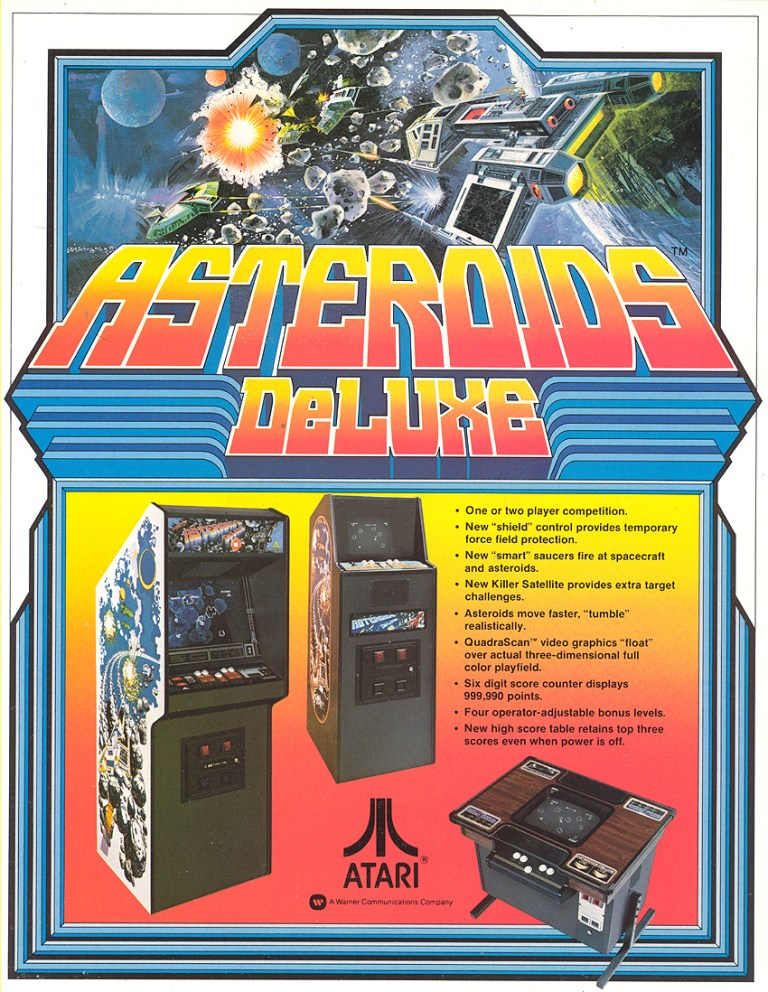
Given the fact that Asteroids was a massive hit for Atari in the arcades, it was not surprising that a sequel was made called Asteroids Deluxe. In preparation for its 1981 release, Atari made this Asteroids Deluxe arcade flyer showing three machine that arcade operators can choose from complete with technical details displayed. They even emphasized the QuadraScan video graphics as a technological advancement with regards to graphics. By today’s standards, this arcade flyer is still sensible with regards to promoting the game to both arcade operators and players.
2. Missile Command arcade flyer
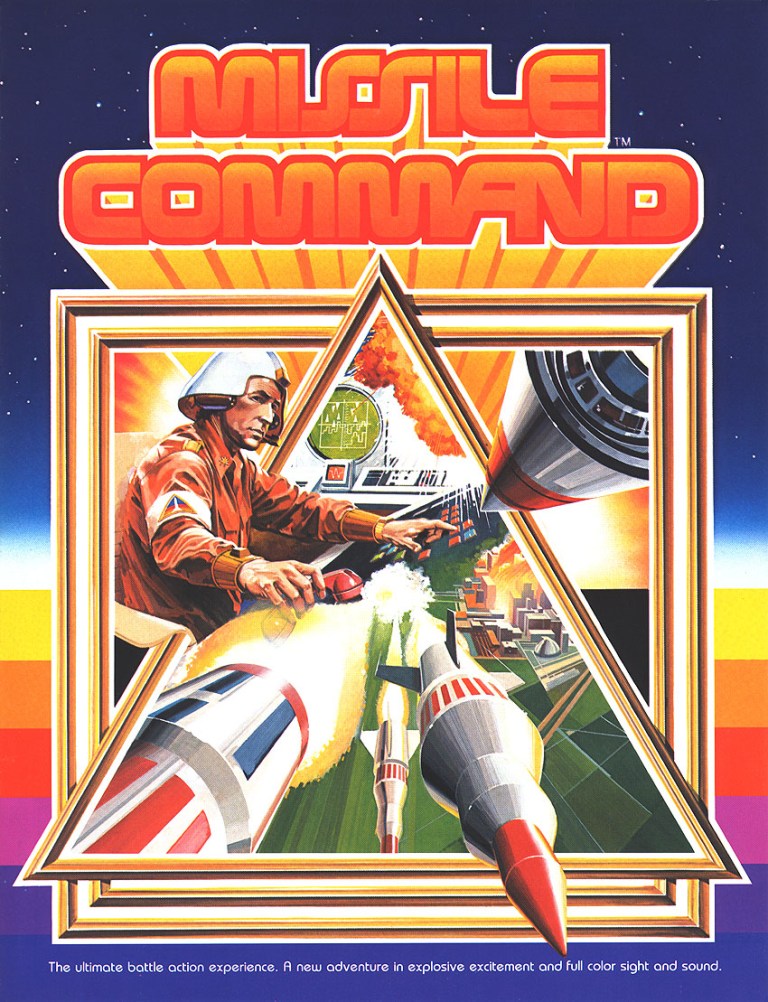
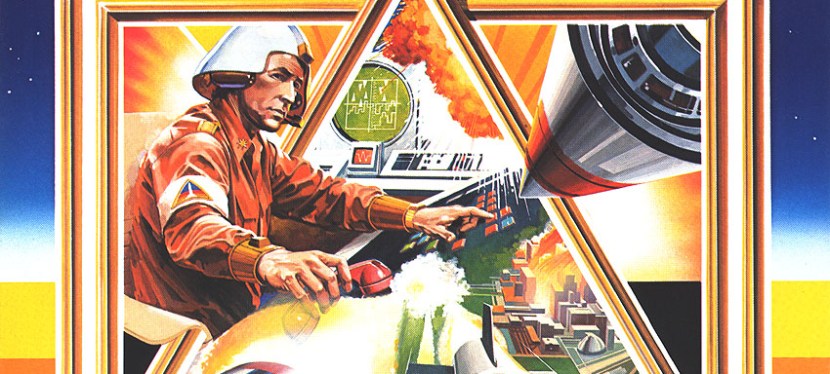
Released in the arcades in 1980, Missile Command is a classic game from Atari and its concept of defending cities from incoming enemy missiles proved to be relevant with people living with the fear of a nuclear missile attack during the days of the Cold War. In my experience, I mainly played the Atari 2600 version and it was only recently I finally started playing the arcade classic on my Xbox Series X using the Atari 50 Collection software. As for the arcade flyer itself, Atari simply used highly detailed painted art for the front which clearly emphasized the science fiction portrayal of a military officer using a console inside a base to come up with defensive response to incoming ballistic missiles. The game was a massive hit in the arcades and in my view, Atari’s simply yet direct way of promoting the concept of Missile Command with the arcade flyer remains compelling to look at.
3. Gun.Smoke European arcade flyer
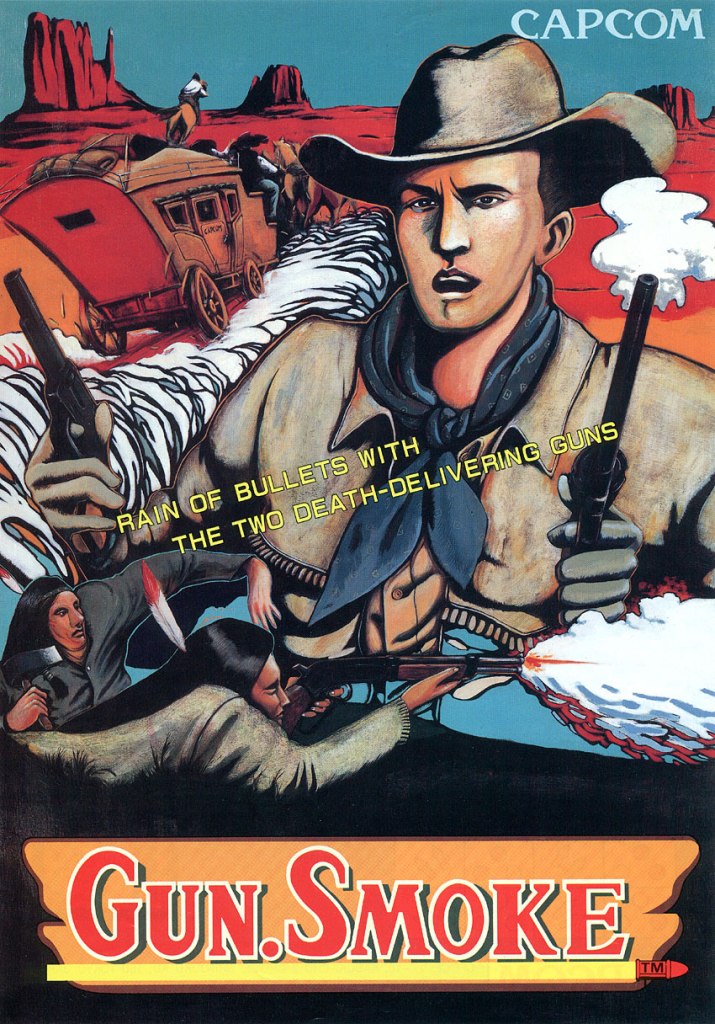
Long before they struck gold with Street Fighter II, Japanese company Capcom scored a hit with gamers in the arcades with 1985’s Gun.Smoke. It was a vertically scrolling run-and-gun game with an Old West setting and it was designed by Yoshiko Okamoto (Final Fight and Street Fighter II). To promote the game for European arcades, Capcom simply used hand-drawn artwork for the arcade flyer’s front which emphasized the Wild West setting, and an American Cowboy and bounty hunter named Billie Bob who is the playable character gamers got to play. In my view, the artwork gave the game a strong Wild West image that is also memorable.
4. Sei Senshi Amatelass arcade flyer
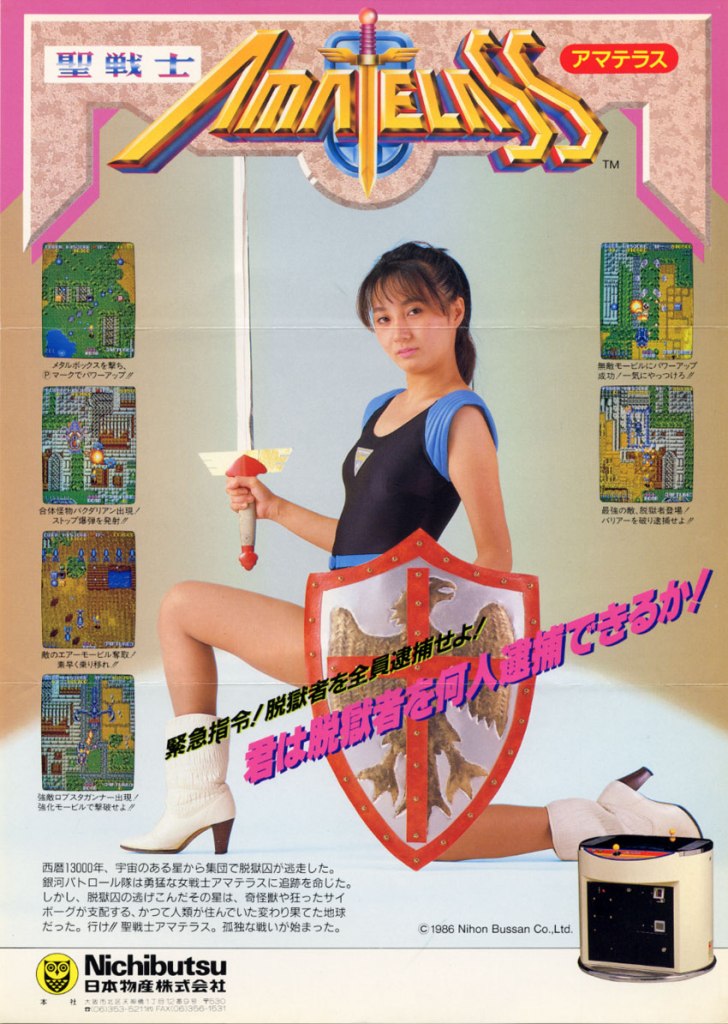
Released in Japanese arcades in 1986 by Nichibutsu, Sei Senshi Amatelass is a vertical scrolling run-and-gun game with a science fantasy concept. To promote the game and really sell its concept, Nichibutsu hired a model posing with a sword and a shield in fantasy inspired costume. Using the remaining spaces of the flyer, some screenshots and an image of the arcade machine were displayed. This flyer showed the company exerting effort to sell Sei Senshi Amatelass with a touch of beauty and subtle sexiness.
5. Sweet Gal arcade flyer

Here is another digital mahjong arcade game from Nichibutsu…Sweet Gal. As typical of the company, a model was hired to add subtle sexiness into the promotion of the game and they even added a digital image of a sexy girl. Sweet Gal clearly was promoted to attract men who enjoy playing mahjong in electronic format and there were some arcade spots in Japan that catered to such mahjong enthusiasts.
6. Moon Patrol print ad
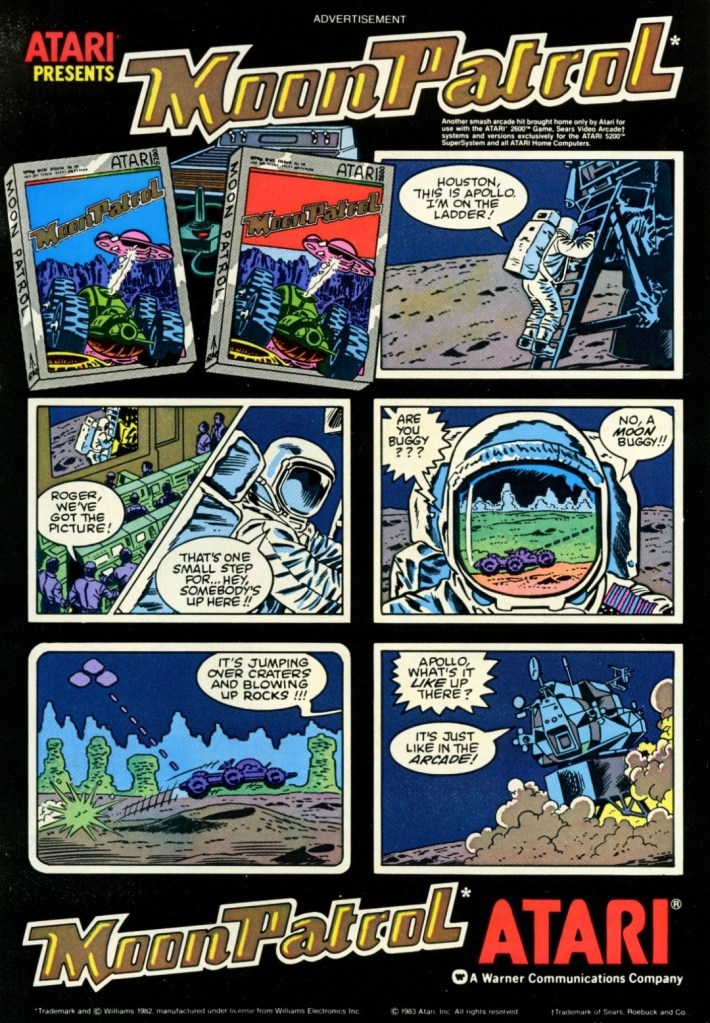
Here is one of those video game print ads I saw while reading comic books back in the early 1980s. Moon Patrol is a sci-fi, side-scrolling game by Atari known for introducing full parallax scrolling in side-scrolling games. Instead of showing screenshots of the console versions of the game, this print ad used nice looking hand-drawn artworks presented with a comic book-inspired style to emphasize the concept. I still remember how captivating this ad and its super short story was the first time I saw it. It was enough to make me interested in the game.
7. Tron Atari 2600 games print ad
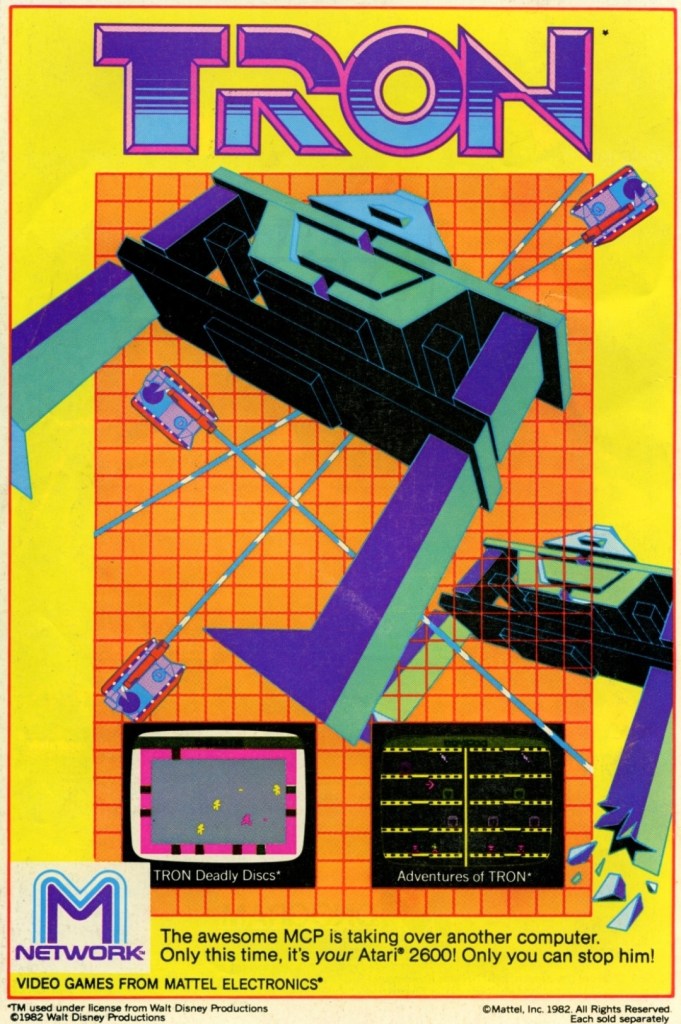
I was very captivated by the 1982 sci-fi movie Tron which I saw on home video. It had very flashy computer-generated visuals, a very memorable story and the fine performance by Jeff Bridges. Tron was also very reflective about the video game culture of its time. When I first saw this print ad while reading a comic book, I was really excited. If you look closely, it had nice artwork dominating the space and screenshots that each promoted the games Tron: Deadly Discs and Adventures of Tron. Even though the graphics were primitive, I still recognized the Tron-related images which added to my excitement.
8. Q*bert print ad
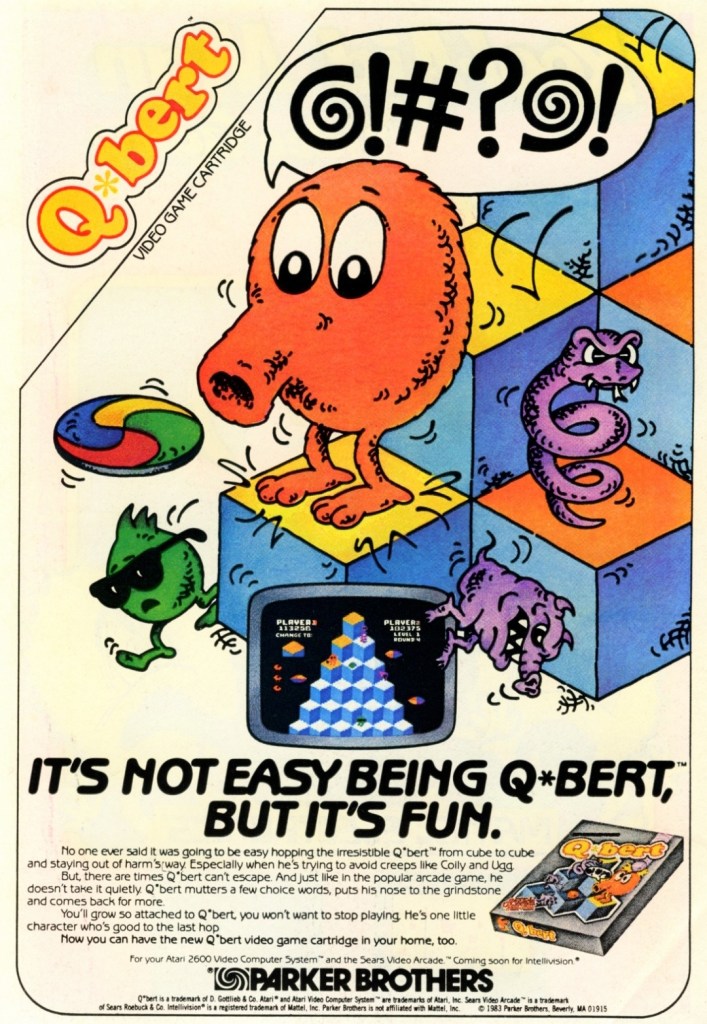
The puzzle-oriented 2D action game Q*bert became an arcade hit in America shortly after its 1982 release and even went on to become one of the highest grossing arcade games in 1983. Q*bert is one of those 2D games that cleverly blended puzzle play with 3D-like movement and avoidance of both obstacles and enemies. As expected, the game made its way into gaming console and this particular print ad had artwork that strongly captured the very essence of the game complete with the very catchy line “It’s not easy being Q*bert, but it’s fun.”
9. Masters of the Universe: The Power of He-Man print ad
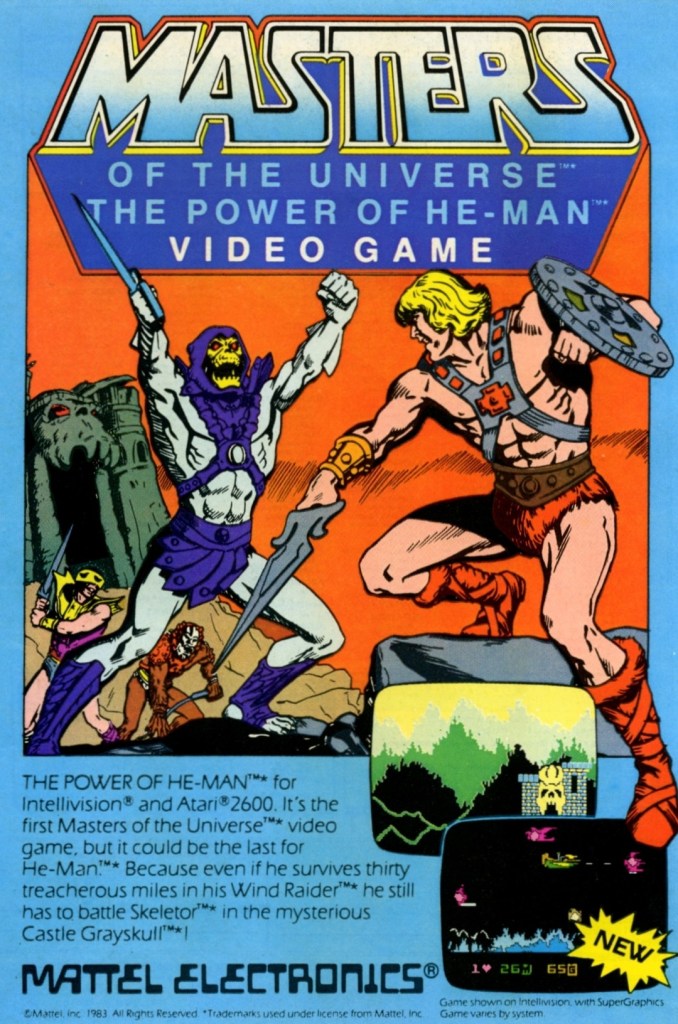
I saw this print ad of Masters of the Universe: The Power of He-Man (for Atari 2600 and Intellivision) while reading a comic book long ago. Like the Tron games ad, this made me excited as I was fond of watching the He-Man cartoon series of the 1980s. While the selected screenshots caught my attention, it was the hand-drawn art of He-Man facing off with Skeletor and his minions that captivated me simply because it reminded me of the animated series. This is a fine example of promoting a video game that would instantly resonate with fans of He-Man and the Masters of the Universe franchise.
10. UFO Robo Dangar North American arcade flyer
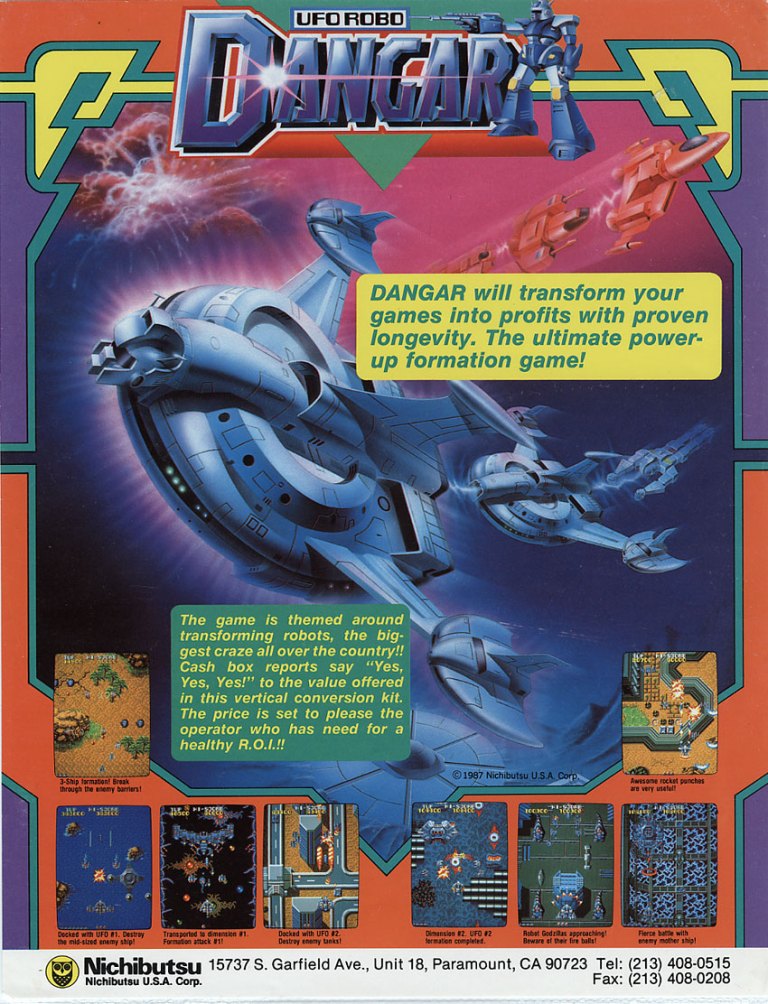
Here is another arcade game from Nichibutsu but for the North American market and without the use of a model and without the subtle sexiness. UFO Robo Dangar is a 2D vertically scrolling science fiction shooting game and players get to control a giant robot (composed of flying vehicles that merged into one mechanical body) that has to go through countless waves of enemies in order to advance from one level to another. The arcade flyer used nice looking sci-fi art of ships with the game’s title having a robot and several screenshots of the game. The flyer even made a hard pitch towards arcade operators that UFO Robo Danger will transform their games into profits with proven longevity.
11. Aliens Japanese arcade flyer
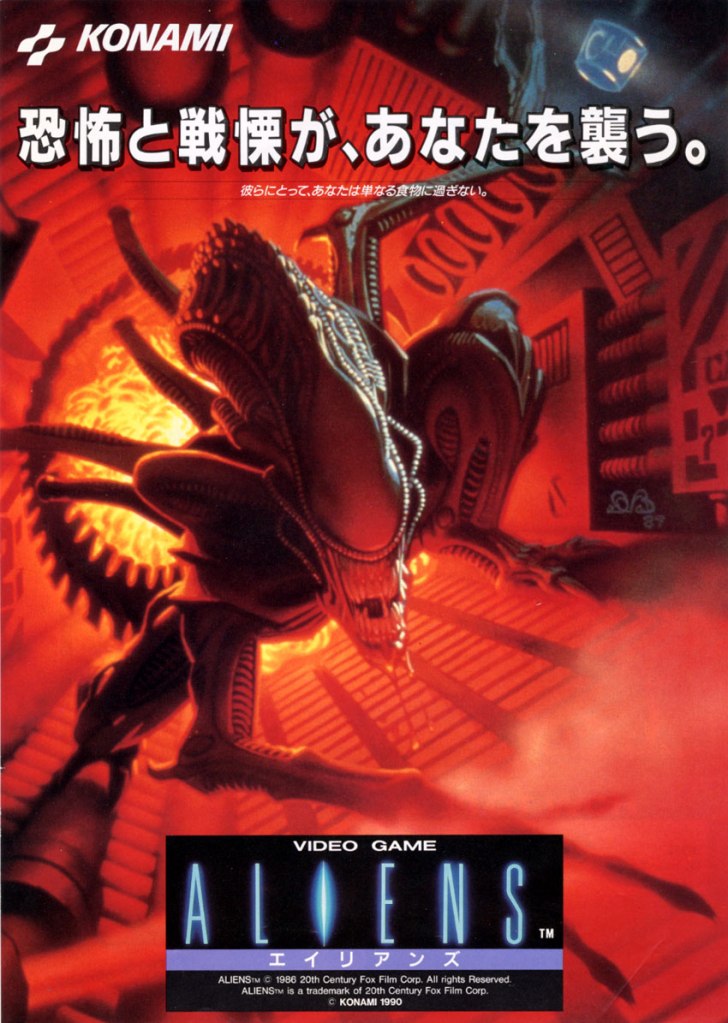
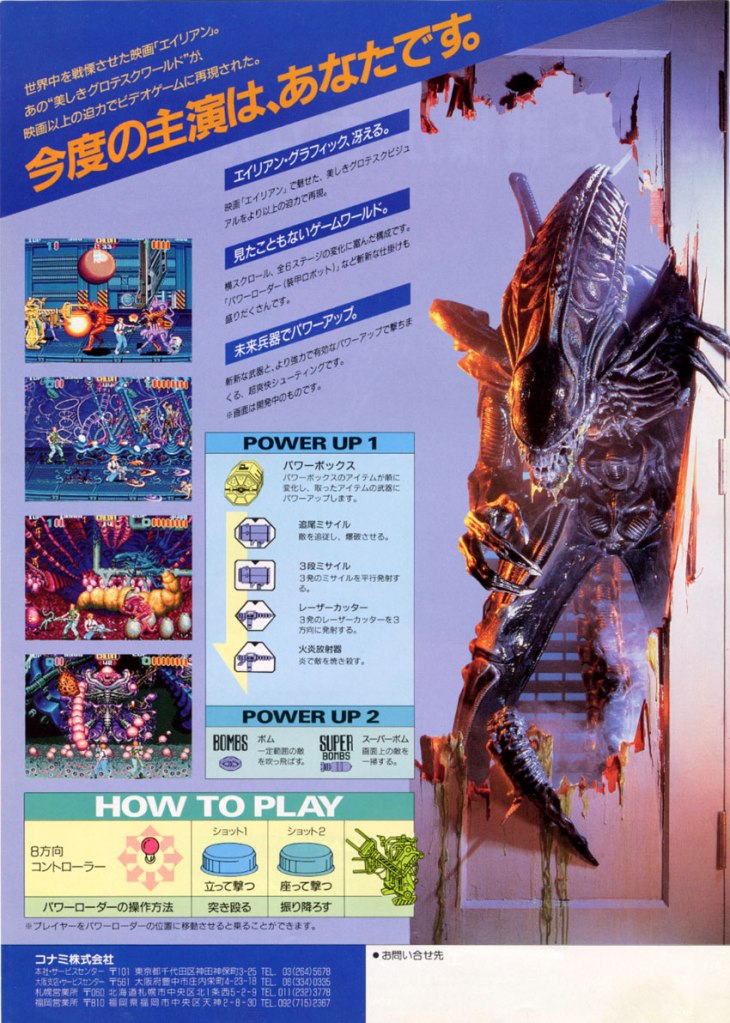
Quite arguably, Konami’s 1990 arcade hit Aliens is the best video game of any game design to be based on the 1986 film directed by James Cameron. Not only was Aliens a big hit in the arcades, it also won an award from the American Amusement Machine Association (AAMA). Aliens was released in Japanese arcades in February of 1990 and Konami released an arcade flyer that was much more visually striking than its North American arcade flyer. The front had detailed artwork of the Xenomorph while the rear had the instructions and screenshots presented in an orderly manner. The photograph of the Xenomorph alien was added intensity on selling the game. This is still a great looking arcade flyer.
+++++
Thank you for reading. If you find this article engaging, please click the like button below, share this article to others and also please consider making a donation to support my publishing. If you are looking for a copywriter to create content for your special project or business, check out my services and my portfolio. Feel free to contact me with a private message. Also please feel free to visit my Facebook page Author Carlo Carrasco and follow me on Twitter at @HavenorFantasy as well as on Tumblr at https://carlocarrasco.tumblr.com/ and on Instagram at https://www.instagram.com/authorcarlocarrasco

What to watch on YouTube right now – Part 51
Welcome back my readers, YouTube viewers and all others who followed this series of articles focused on YouTube videos worth watching. Have you been searching for something fun or interesting to watch on YouTube? Do you feel bored right now and you crave for something to see on the world’s most popular online video destination?
I recommend you check out the following topics and the related videos I found.
#1 The dirty business behind Caffeine – Have you been drinking coffee, or sodas or energy drinks a lot over the past twelve months? Chances are, you are dependent on caffeine for your livelihood and your own lifestyle. Sadly, a lot of people out there are not even aware about the subject of caffeine in American history, in business and health studies. YouTuber fern has this in-depth look at caffeine and why there dirty business behind it. Watch and learn.
#2 You, Me and the Movies react to Ace Ventura: Pet Detective – Despite being negatively received by movie critics in 1994, Ace Ventura: Pet Detective still went on to become a surprise hit in the cinemas grossing over $107 million worldwide and establishing Jim Carrey as an effective cinematic comedian. The film has an effective formula on making viewers laugh with Carrey’s performance, the jokes, the unfortunate turn of events, the funny one-liners and the like. I saw the film on home video in 1995 and I revisited it by watching the reaction video of You, Me and the Movies. If you have not seen Ace Ventura: Pet Detective, go watch it first. Otherwise, the reaction video below is entertaining to watch.
#3 The hunt for Ted Bundy explained by fern – Way back in 1989, I saw The Deliberate Stranger on local TV here in the Philippines. It was an engaging portrayal of the very notorious serial killer Ted Bundy (executed in 1989) who was responsible for the kidnapping, rape and murders of several young women and girls. While a lot of documentaries about Bundy have been released, fern’s visual presentation and explanatory observation of the killer’s story is a must-see.
#4 A look at the history of the Ikari Warriors trilogy – Back in the mid-1980s, I played Ikari Warriors (Japanese title: Ikari) on the Nintendo Family Computer (Famicom) and it was a fun game and even relatable. Why relatable? Because at the time of its release, the fictional character Rambo (played by Sylvester Stallone) and the Cold War were still present in our minds. As it turned out, Ikari Warriors was originally intended to be an official video game adaptation of Rambo: First Blood Part II but no agreement was made. Regardless, the game still had Rambo-inspired designs for the playable characters, an obvious Vietnam-inspired environment and lots of shooting-oriented action. It became so successful commercially, it eventually spawned two sequels. To know more about the history of the Ikari Warriors trilogy, watch PatmanQC’s video below.
#5 A look at 50 underrated arcade games from the 1990s – The 1990s was a wild time for people who love playing games in the arcades. While the decade was often perceived to be all about fighting games defining the arcade experience, there still was a greater variety of arcade games of different genres or game designs. This retro gaming video from Marvelous Gamers is a fun look back at the 1990s arcade games that got overlooked.
#6 Ashleigh Burton reacts to National Lampoon’s Vacation – If you are looking for a 1980s comedic viewing experience with a theme about going on holiday, then you should focus on National Lampoon’s Vacation directed by the late Harold Ramis and starring Chevy Chase. Released in cinemas in 1983, the movie became a box office hit grossing over $60 million in the American box office and it won a lot of rave reviews from the critics. If you have seen the movie and want to revisit it without the need to spend time watching it all over again, you should watch the reaction video by the jolly YouTuber Ashleigh Burton.
#7 Popcorn in Bed reacts to Quantum of Solace – I will say it clearly – Quantum of Solace was a very disappointing follow-up to Casino Royale (2006) as it was so negatively impacted by the strike of the Writers Guild of America as well as the lack of focus within the production. By the time I left the cinema, Quantum of Solace left me feeling numb and unsatisfied. That being said, I encourage you to see the reaction video of Popcorn in Bed (who also reacted to Casino Royale) and witness how the 2008 James Bond movie affected their viewing experience.
#8 Justin Trudeau officially resigns from office – I really do not like Justin Trudeau. As Prime Minister of Canada, he has been very out of touch with his people and does not seem concerned with them. Under the super woke and feminist Trudeau, the costs of living in Canada has gone way up, housing is too expensive and crime has gone up. There is also division and infighting within his Liberal Party which is not helping Canadians at all. Trudeau’s failed leadership should be a lesson to everyone that woke nuts, Satanic Leftists and outrageous liberals should not be voted to lead the government. Liberals do not care about common sense at all. Watch and learn from the videos below.
+++++
Thank you for reading. If you find this article engaging, please click the like button below, share this article to others and also please consider making a donation to support my publishing. If you are looking for a copywriter to create content for your special project or business, check out my services and my portfolio. Feel free to contact me with a private message. Also please feel free to visit my Facebook page Author Carlo Carrasco and follow me on Twitter at @HavenorFantasy as well as on Tumblr at https://carlocarrasco.tumblr.com/ and on Instagram athttps://www.instagram.com/authorcarlocarrasco

What to watch on YouTube right now – Part 50
Welcome back, my readers, YouTube viewers and all others who followed this series of articles focused on YouTube videos worth watching. Have you been searching for something fun or interesting to watch on YouTube? Do you feel bored right now and you crave for something to see on the world’s most popular online video destination?
I recommend you check out the following topics and the related videos I found.
#1 HolyLandSite’s examination of Kursi and Lord Jesus’ power over the demonic realm – Kursi is a place in the east side of the Sea of Galilee in the region of Gerasenes (or Gadarenes) in Israel where two men possessed by demons stayed at. HolyLandSite produced this video to emphasize the biblical relevance of the place, what happened and, most of all, the immense power Lord Jesus had over the demonic forces that caused huge problems for people back then. This is a biblical examination of the place and a lively reminder of the light and authority of Lord Jesus, the Savior and Hope of ALL nations. Grab a copy of the Holy Bible and then watch the video from start to finish.
#2 GTV Japan examines Nintendo’s crisis – Remember back in the late 1980s when a shortage of ROM chips prevented Nintendo from releasing games on time? Back in those days, microchips were essential for manufacturing cartridges of games for consoles. A lot of people believed that Nintendo, which already had several restrictions on game publishing and business with 3rd party game companies, deliberately created the shortage for their advantage. There is a lot more details and developments that happened beyond the perceived shortage and the video by GTV Japan has a very in-depth look at it in the video below.
#3 What the hard drive of terrorist Bin Laden contained – Remember when America found and eliminated the mass murderer and terrorist Osama Bin Laden in 2011? YouTuber fern published a video focused on one particular aspect related to the operation that took Bin Laden down – the sensitive information contained in his hard drive. The video also has a key analyst interviewed who provided a lot of insight. Watch the video now.
#4 Wokeness in Japan exposed – Believe it or not, there definitely is wokeness in Japan and it was exposed a lot during their news media coverage of the 2024 US Presidential Election which Donald Trump won. In fact, a certain Japanese professor who was included in the media outlet’s coverage (being in the studio with others) was so liberal, he got frustrated as Commie Kamala Harris lost and he even reiterated the Democrats’ buzz words like “threat to democracy”. Think about it very carefully. The Democrats and their Satanic Left pawns have been spreading their distorted views in Japan and influenced some people there. The woke-minded in Japan may not realize it but they are looking and sounding awkward (if not pathetic). Perhaps some woke nuts of Japan love Islamic terrorists and I know they have pro-Palestine zealots. Watch and learn from the video below.
#5 Controversial Alice Guo featured in episode of Dark Asia with Megan – Alice Guo (AKA Guo Hua Ping), the controversial former mayor of Bamban who has been detained for various charges, is now the subject of a new episode of Dark Asia with Megan. For the newcomers reading this, Alice Guo is notorious in the Philippines not only for her links with POGOs (Philippine Offshore Gaming Operators) but also for her very questionable background with regards to citizenship, family and origin. She even escaped the Philippines temporarily before getting brought back. In fact, Alice Guo’s case raises a lot of questions about national security, espionage and foreign infiltration into the systems of governance in the Philippines. Watch and learn from the Dark Asia with Megan video.
#6 PatmanQC examines Donkey Kong – Long before Donkey Kong Country became a massive critical and commercial hit with gamers around the world, there was the original Donkey Kong in 1981. I never played the arcade version but I played Donkey Kong on the Atari 2600 back in the early 1980s and it was a fun game. A short time later, I played the ColecoVision version and was impressed to see the graphical improvements. The production history of Donkey Kong is really interesting and PatmanQC produced not just one but two documentary videos about the game.
#7 Popcorn in Bed and You, Me and the Movies react to Vertigo – Vertigo, the classic film directed by Alfred Hichcock, was one of the first twenty-five films selected for preservation in the US National Film Registry for being “culturally, historically, or aesthetically significant”. That being said, it is not surprising that it has been the subject of several movie reaction videos on YouTube. If you have not seen it, I encourage you to watch it entirely first when you have the chance. Otherwise, I encourage you to watch the reaction videos of Popcorn in Bed, and You, Me and the Movies below.
#8 Ashleigh Burton reacts to Signs – Back in 2002, I saw Signs inside a packed local cinema during the evening. The film directed by M. Night Shyamalan and starring Mel Gibson kept moviegoers in suspense and occasionally pulled off some sudden scary moments. That being said, you have to see Ashleigh Burton react to it.
+++++
Thank you for reading. If you find this article engaging, please click the like button below, share this article to others and also please consider making a donation to support my publishing. If you are looking for a copywriter to create content for your special project or business, check out my services and my portfolio. Feel free to contact me with a private message. Also please feel free to visit my Facebook page Author Carlo Carrasco and follow me on Twitter at @HavenorFantasy as well as on Tumblr at https://carlocarrasco.tumblr.com/ and on Instagram athttps://www.instagram.com/authorcarlocarrasco
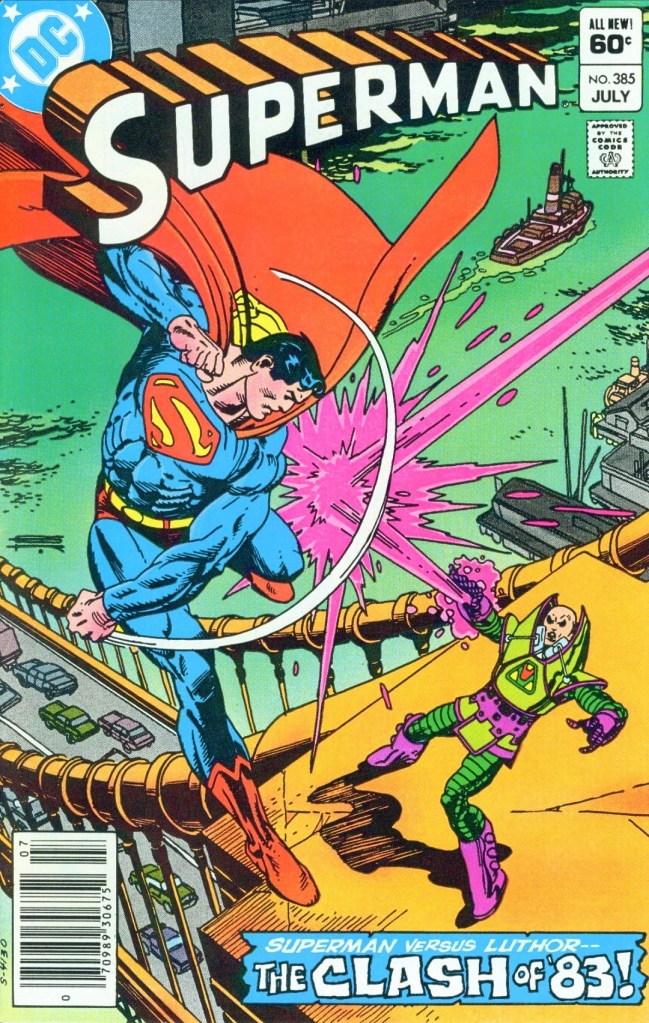
A Look Back at Superman #385 (1983)
Disclaimer: This is my original work with details sourced from reading the comic book and doing personal research. Anyone who wants to use this article, in part or in whole, needs to secure first my permission and agree to cite me as the source and author. Let it be known that any unauthorized use of this article will constrain the author to pursue the remedies under R.A. No. 8293, the Revised Penal Code, and/or all applicable legal actions under the laws of the Philippines.
Welcome back superhero enthusiasts, 20th century pop culture enthusiasts and comic book collectors! Today we go back to the year 1983 to take a close look at one of the many tales published through the original Superman monthly series (first launched in 1939).
Back in 1983, DC Comics published Action Comics #544 which marked the 45th anniversary of Superman and celebrated it by executing things very differently – introducing the new look of Lex Luthor in battle armor and showing Brainiac in a more robotic body. I really loved reading Action Comics #544 for its very rich storytelling and modernizing the two classic super villains. With regards to what happened in Lex Luthor’s story in the comic book, his tale actually continued with the Superman monthly series afterwards.
With those details laid down, here is a look back at Superman #385, published in 1983 by DC Comics with a story written by Cary Bates and drawn by Curt Swan.
Early story
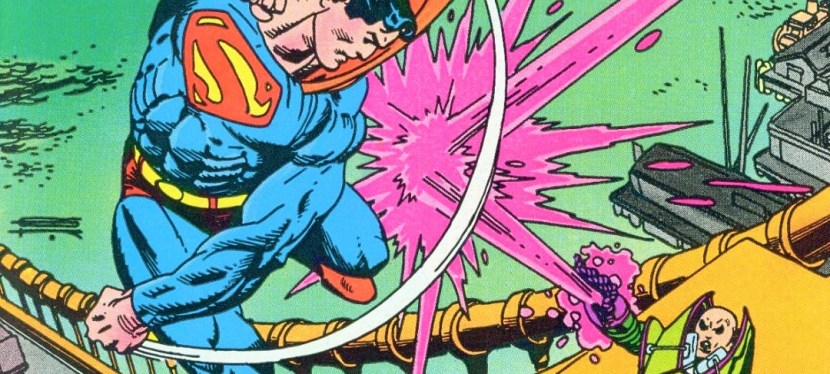
The story begins with the armored Lex Luthor alone and grieving in deep space surrounded by floating rocks. His world Lexor just got destroyed and his wife and child are gone. He blames Superman for being responsible of the massive destruction. He remembers the moment when he fired an energy blast at Superman which got deflected towards the neutrarod (a device Luthor made to shoot a steady stream of stabilizing neutrons into the planet’s unstable core) which started a chain reaction transmitted directly into the core. Lexor detonated but Superman and Luthor survived.
Using the intense power and technologies of his armor, Luthor moves an island-sized rock (a remaining piece of Lexor) towards planet Earth. He is determined to have his revenge against Superman and will stop at nothing to make it happen…
Quality
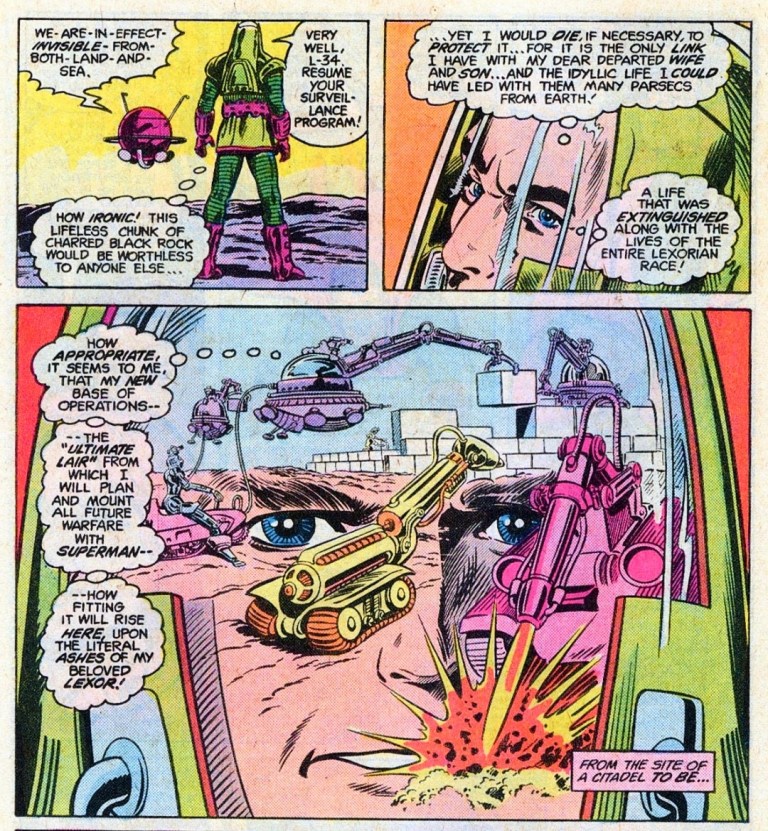
Through the decades, I have read lots of Superman comic books that involved Lex Luthor as the main antagonist. This particular story of good-versus-evil is actually very unique thanks to the approach taken by the Bates-Swan duo. To be clear, this is actually a build-up type of story done with the next conflict between Superman and Luthor in mind.
Without spoiling the plot, I can say that Luthor – following the events of Action Comics #544 which really hurt him deeply – got a nice share of the spotlight and deservedly so. He is determined to get back at Superman whom he holds responsible for the destruction of Lexor and its many inhabitants (including Luthor’s wife and child). Luthor does not rush things as he is very focused on preparing himself first which reminds me of Batman’s approach to preparations. In some ways, Luthor has his own principles and he is not just being evil for the sake of it. There is this very human portrayal of him and Bates’ writing could make you even forget that he is a madman.
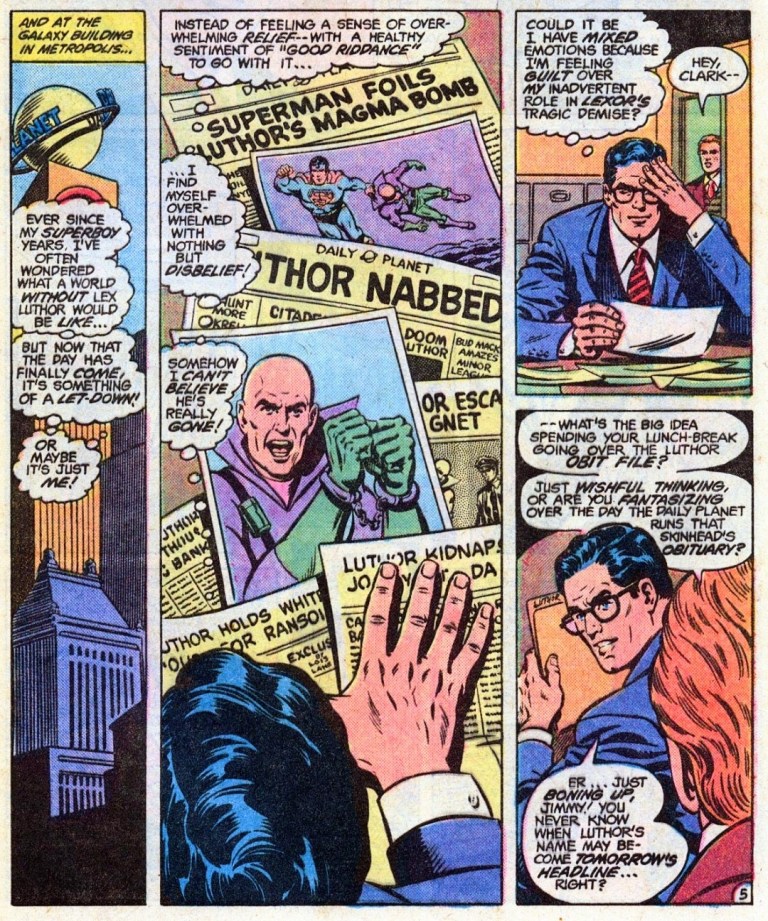
As for the Man of Steel himself, Bates wrote him to be really burdened by having his share of the responsibility of the billions of deaths of the people of Lexor. Instead of the focused Superman dedicated to doing good, you will see him feeling really uneasy and even distracted. He even commits huge blunders! This is a Superman who is showing signs of internal weakness and not even his civilian life as journalist Clark Kent could relieve the tension he is experiencing. I really like this portrayal of DC Comics’ icon.
But there is more! There is the sub-plot of Lois Lane taking a much-needed break from work to relieve herself and it sure is a really interesting portrayal of her. Even Perry White has his own share of the spotlight. There is also the spotlight on some obscure DC villains which actually added to the plot.
Conclusion
Superman #385 (1983) is clearly a very engaging read and it is a worthy follow-up to what happened in Action Comics #544. I really like the way the armored Lex Luthor is portrayed here and the build-up for his upcoming conflict with Superman is really powerful. I’m really glad to have read this particular Superman-Luthor story and I can say that I am looking forward to the next issue to see what will happen.
Overall, Superman #385 (1983) is highly recommended.
+++++
Thank you for reading. If you find this article engaging, please click the like button below, share this article to others and also please consider making a donation to support my publishing. If you are looking for a copywriter to create content for your special project or business, check out my services and my portfolio. Feel free to contact me with a private message. Also please feel free to visit my Facebook page Author Carlo Carrasco and follow me on Twitter at @HavenorFantasy as well as on Tumblr at https://carlocarrasco.tumblr.com/ and on Instagram at https://www.instagram.com/authorcarlocarrasco

