The Trump administration’s enduring efforts to bring down the number of illegal aliens still present in America achieved a huge breakthrough deportations as twenty nations have formally agreed to accept the said illegals, according to a Newmax news report. This development could lead to an acceleration of deportations.
To put things in perspective, posted below is the excerpt from the Newsmax report. Some parts in boldface…
Secretary of State Marco Rubio said Wednesday that the United States has secured agreements with 20 countries to accept migrants living in the U.S. illegally who refuse to return to their home nations, describing the deals as a key part of the Trump administration’s immigration enforcement strategy.
Rubio said the agreements allow the United States to deport certain illegal aliens to so-called “safe” third countries when returning them directly to their countries of origin is not possible.
“A part of securing our border is dealing with the people that are in this country unlawfully, many of whom do not want to go back to the country that they originally came from,” Rubio said during a Cabinet meeting at the White House.
He said in some cases deportations are blocked because the migrants’ home countries refuse to accept them or because court rulings delay removals.
“One of the key things we have achieved is now 20 countries have signed third-country national agreements,” Rubio said. “These are safe countries where individuals who refuse to go back to their country of origin can be sent to that country instead.”
The agreements mark a significant expansion of the administration’s deportation efforts as President Donald Trump pushes forward with a broad immigration crackdown focused on border security and removal of illegal aliens living in the country illegally.
Rubio said the administration has worked closely with the Department of Homeland Security to implement the policy. He did not identify the countries that have signed the agreements or specify when the deals were finalized.
According to Rubio, the threat of deportation to a third country has also encouraged some illegal aliens to voluntarily return to their home countries.
“What often happens when you go to the person who’s here unlawfully and say, ‘We’re going to send you to this third country,’ is all of a sudden they decide they’d rather go back to their home country instead,” Rubio said.
Immigration enforcement and deportation policies have remained central priorities for the Trump administration, which has argued tougher enforcement measures are necessary to deter illegal immigration and strengthen border security.
Let me end this piece by asking you readers: What is your reaction to this development? Do you think this breakthrough will lead to more deportations of illegal aliens soon? How many illegal immigrants are living within your local community right now?
To put things in perspective, posted below is an excerpt from the news report of VnExpress. Some parts in boldface…
Little Caesars, the world’s third-largest pizza chain only after Domino’s and Pizza Hut, has opened its first outlet in Malaysia, marking the brand’s global expansion.
The new outlet was launched on May 24 in Damansara Utama, a suburb of Petaling Jaya in Selangor.
The outlet serves Little Caesars’ signature Hot-N-Ready classic pepperoni pizza and crazy puffs pepperoni, while also incorporating localized offerings such as Chicken Hawaiian, 3 Cheese Edge to Edge, and Classic Veggie pizza, the chain said in a statement.
The chain is known globally for its affordable pizzas, Crazy Bread, and quick grab-and-go style meals.
Little Caesars, billed as the “Best Value in Pizza,” was founded by Mike Ilitch and Marian Ilitch as a single family-owned restaurant in 1959 and is headquartered in Michigan. It has since grown into the world’s third-largest pizza chain, operating restaurants across all 50 U.S. states and 31 countries and territories.
Let me end this piece by asking you readers: What is your reaction to this development? If you were to visit Malaysia today, would you make an effort to visit Little Caesars and have a meal there? If you have dined at Little Caesars before, what is your favorite among their food offerings? Do you think Little Caesars will be able to do good business in Southeast Asia?
Thank you for reading. If you find this article engaging, please click the like button below, share this article to others and also please consider making a donation to support my publishing. If you are looking for a copywriter to create content for your special project or business, check out my services and my portfolio. Feel free to contact me with a private message. Also please feel free to visit my Facebook page Author Carlo Carrasco and follow me on Twitter at @CarloCarrascoPH as well as on Tumblr at https://carlocarrasco.tumblr.com/and on Instagram athttps://www.instagram.com/authorcarlocarrasco

Pax Silica – the United States’ Pax Silica flagship effort on artificial intelligence (AI) and supply chain security that includes the Philippines – prompted the P7 billion investment of the National Grid Corporation of the Philippines (NGCP) to ensure a stable power supply for New Clark City in Tarlac province, according to a news report by the Manila Bulletin.
To put things in perspective, posted below is an excerpt from the Manila Bulletin report. Some parts in boldface…
The National Grid Corporation of the Philippines (NGCP) plans to invest nearly ₱7 billion in a dedicated substation to guarantee a stable power supply for New Clark City in Capas, Tarlac, anticipating a surge in demand from a planned artificial intelligence (AI) industrial hub.
Joshua Bingcang, president and chief executive officer of the Bases Conversion and Development Authority (BCDA), said the investment promotion agency is currently in talks with NGCP to finalize the project’s details. The grid operator is drafting the alignment plan for the substation, which Bingcang noted should be finalized “soon.”
“Our target with them is by [the] end of 2028, the dedicated power connection should be already installed in New Clark City,” he told reporters last week.
Bingcang added that the BCDA initially offered to fund the project to jump-start construction, with NGCP reimbursing the agency later. However, NGCP declined the offer because the substation is already integrated into its capital expenditures.
Under its Transmission Development Plan 2024 to 2050, NGCP outlined plans to construct the Capas 230-kilovolt (kV) substation to meet the growing power needs of the emerging metropolis. According to the plan, NGCP will allocate ₱6.95 billion to develop the facility.
To facilitate the project, Bingcang said the BCDA is offering land along the Subic-Clark-Tarlac Expressway (SCTEX) to ensure an unimpeded route for the transmission line into New Clark City. Once operational, the substation is expected to give locators in the AI hub the confidence to manufacture high-value inputs without risking operational pauses due to power shortages.
The AI hub will span more than 1,600 hectares within New Clark City as part of the United States-led Pax Silica partnership, which aims to encourage investment among member countries to bolster the global AI supply chain.
To meet the site’s massive energy requirements, Bingcang said the BCDA expects a foreign investor to build a solar energy project capable of generating up to 500 megawatts. Furthermore, the agency is drafting plans for an embedded power plant to secure baseload power and enhance the hub’s overall energy reliability.
In a separate interview with Business 360, Bingcang disclosed that the BCDA is also negotiating with US investors to construct a dedicated pipeline to transport jet fuel from Subic Bay to Clark International Airport, supporting the logistics needs of companies within the AI hub. The agency is also exploring a separate pipeline along SCTEX to deliver fuel or liquefied natural gas.
Additionally, the BCDA is advancing a public-private partnership (PPP) project for New Clark City’s information and communications technology (ICT) infrastructure. According to a bid bulletin published by the PPP Center, the agency aims to conclude the procurement process for a joint venture partner to lay fiber-optic cables across the city by August.
Bingcang noted that all of these infrastructure projects were requested by the US during preliminary talks for the AI hub. Following a visit to the 1,600-hectare site last week, the US will send engineering personnel next month to conduct a site assessment and design a concept plan for the industrial zone.
“Parallel to these technical studies, we will also finalize the commercial arrangement and contractual framework for the project. Within the year, we will be announcing a definitive contract arrangement [with the US],” Bingcang said.
Let me end this post by asking you readers: What is your reaction to this recent development? Do you think Pax Silica will prompt further infrastructure and energy developments related with New Clark City as the initiative develops further? Do you think there is room for nuclear power to considered in the years to come?
Thank you for reading. If you find this article engaging, please click the like button below, share this article to others and also please consider making a donation to support my publishing. If you are looking for a copywriter to create content for your special project or business, check out my services and my portfolio. Feel free to contact me with a private message. Also please feel free to visit my Facebook page Author Carlo Carrasco and follow me on Twitter at @CarloCarrascoPH as well as on Tumblr at https://carlocarrasco.tumblr.com/and on Instagram athttps://www.instagram.com/authorcarlocarrasco
Disclaimer: This is my original work with details sourced from reading the comic book and doing personal research. Anyone who wants to use this article, in part or in whole, needs to secure first my permission and agree to cite me as the source and author. Let it be known that any unauthorized use of this article will constrain the author to pursue the remedies under R.A. No. 8293, the Revised Penal Code, and/or all applicable legal actions under the laws of the Philippines.
Welcome back superhero enthusiasts, 1990s arts and culture enthusiasts, Marvel Comics fans and comic book collectors! Today we go back to the early 1990s to examine a small part of the Marvel Comics shared universe through a tale of the Amazing Spider-Man monthly series.
When it comes to the argument as to who is the most evil or the deadliest foe Spider-Man ever has, many point towards Venom (Eddie Brock and the alien costume from Secret Wars) who is murderous, filled with revenge against Spider-Man, is physically formidable and knows Peter Parker and his family members. In the early 1990s, the creative guys behind the Amazing Spider-Man series made the key decision to create another symbiote-wearing super villain like Venom but much more violent, more murderous and truly insane.
With those details laid down, here is a look back at Amazing Spider-Man #361, published in 1992 by Marvel Comics with a story written by David Michelinie and drawn by Mark Bagley.
The cover.
Early story
The story begins inside the agro-lab of the Empire State University where an awful figure in black-and-blood intimidates a male worker. The awful figure is Carnage and he decides to play with the worker a bit before fulfilling his intention to kill him. The worker tries to escape but ends up failing as Carnage throws a huge piece of hardware at the door. Carnage grabs the man, slams him on the wall and uses sharp makeshift blades that suddenly stretched to murder the him.
At the a certain home in Forest Hills, Peter Parker spends quality time his aunt May Parker as he repairs an important machine in the basement. Moments later, the phone rings and May goes up to answer it. Peter follows and learns that the call was meant for him.
Upon using the phone, Peter learns the tragic news that his friend Chip at the university was murdered. He excuses himself from May to go outside to secretly change into Spider-Man and make his way to Empire State University. Struck by the tragic news, Spider-Man is aware that there have been a dozen brutal murders in New York City over the last week. He is also aware that a message was written in blood by someone called Carnage…
Quality
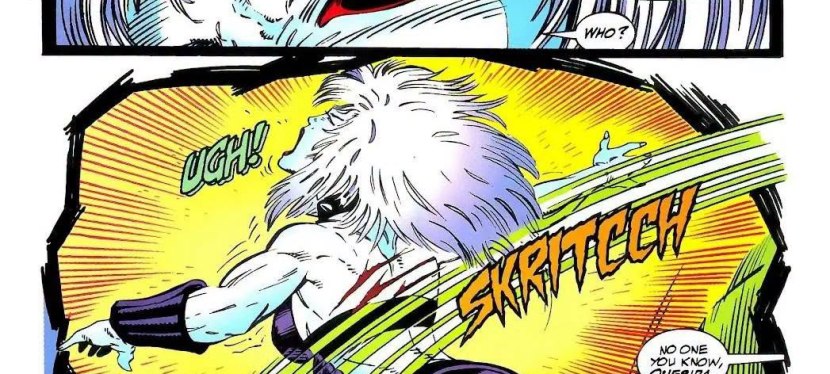
The first-ever battle between Spider-Man and Carnage is very intense to look at.
To make things very clear, this comic book has the first full appearance of Carnage which is Cletus Kasady with a living costume spawned from Venom’s symbiote. Kasady himself first appeared in Amazing Spider-Man #344 in 1991, and it is very clear that the creators deliberately modeled him after DC Comics’ super villain the Joker to have the psychopath appearance (distinctive messy hair, crazed facial expressions, slim body frames and the unusual jawline). Kasady and the Joker also have a nihilistic view of the world focused on spreading chaos while enjoying unrestrained violence.
David Michelinie was really methodical when it came to build-up the tension, presenting key details and pacing the narrative when showing Carnage (who actually appears on the first page) and emphasizing the details about him (including Kasady’s background history and personality as observed by the witnesses who knew him). The appearance of Carnage in the first half was deliberately limited to ten panels and as the story moved on, details of him were revealed especially when Peter Parker did his own detective work. By the time Spider-Man and Carnage finally faced off with each other, the spectacle (action scenes) really ramped up high and the Michelinie-Bagley duo succeeded in showing Carnage being deadlier and unrelenting towards the webslinger.
Spider-Man doing detective work in costume and in civilian form as Peter Parker. This is also one of the finest pieces of Spider-Man art done by Mark Bagley.
More on the iconic hero, Peter Parker here was portrayed as being highly disturbed by the recent murders of the city and the loss of his friend which compelled him to do very serious detective work leading up to his discovering of Kasady (and the eventual face-off in a ruined property where Carnage took refuge in). Parker also felt uneasy about remembering his recent encounter with Venom and the details of the murder reminded him of the old nemesis. The pacing here is excellent and as the narrative went on, the tension really intensified.
Spider-Man’s encounter with Carnage – which the cover art obviously emphasized without restraint – is really intense to look at. As he is completely unprepared as to what Carnage was capable of doing, the webslinger really struggled and was in danger in key moments. Carnage also has unique capabilities using the symbiote such as forming sharp blades and shooting small but sharp projectiles. If you want super villain-led moments of action that really challenged the superhero, you will find a good amount of that here. Also, I can say that Mark Bagley is very good in presenting the action scenes with dynamism, danger and intensity mixed together well.
Conclusion
The news image of Cletus Kasady on the lower-right corner is obviously patterned after Batman’s nemesis the Joker. That image really looks like it was ripped out of a Batman comic book.
Amazing Spider-Man #361 (1992) marks the very intense debut of Carnage and the way he was presented as the newest super villain for Spider-Man to deal with, he is nastier and deadlier than Venom (who would eventually have the delusion of protecting the innocent while remaining murderous). In fact, the way the battle between the two was executed here made me forget about Venom temporarily which shows the Michelinie-Bagley duo pulled the right moves in making this comic book. To be clear, Carnage is pure evil laced with insanity and with absolute disregard towards people. Both Carnage and Venom are murderers and they should be condemned always. It happens that Carnage is more disastrous and has no regard for human life, which ironically makes Venom looking a bit less evil by comparison.
As for Spider-Man, his portrayal here is really dramatic and his superhero pursuits only added to the trouble of his marriage with Mary Jane. As such, you could end up feeling sorry for MJ even though Peter Parker himself wants to solve problems while protecting not only their lives but also the lives of the innocent.
The United States Citizenship and Immigration Services (USCIS) formally announced a major change that will compel aliens seeking the adjustment of status to return to their respective countries and go through the consular processing via the Department of State. The change marks the USCIS’ return to the law’s original intent to ensure that aliens navigate America’s immigration system properly.
To put things in perspective, posted below is the excerpt from the USCIS’ official announcement. Some parts in boldface…
U.S. Citizenship and Immigration Services today announced a new policy memo reiterating the fact that, consistent with long-standing immigration law and immigration court decisions, aliens seeking adjustment of status must do so through consular processing via the Department of State outside of the country.
Officers are directed to consider all relevant factors and information on a case-by-case basis when determining whether an alien warrants this extraordinary form of relief.
“We’re returning to the original intent of the law to ensure aliens navigate our nation’s immigration system properly. From now on, an alien who is in the U.S. temporarily and wants a Green Card must return to their home country to apply, except in extraordinary circumstances. This policy allows our immigration system to function as the law intended instead of incentivizing loopholes. When aliens apply from their home country, it reduces the need to find and remove those who decide to slip into the shadows and remain in the U.S. illegally after being denied residency,” said USCIS Spokesman Zach Kahler.
“Nonimmigrants, like students, temporary workers, or people on tourist visas, come to the U.S. for a short time and for a specific purpose. Our system is designed for them to leave when their visit is over. Their visit should not function as the first step in the Green Card process. Following the law allows the majority of these cases to be handled by the State Department at U.S. consular offices abroad and frees up limited USCIS resources to focus on processing other cases that fall under its purview, including visas for victims of violent crime and human trafficking, naturalization applications, and other priorities. The law was written this way for a reason, and despite the fact that it has been ignored for years, following it will help make our system fairer and more efficient.”
Let me end this piece by asking you readers: What is your reaction to this development? If you are an American citizen, do you agree with the USCIS’ change of policy and processes with regards to aliens who are already present in the United States while seeking to adjust their respective statuses? Do you think this latest change will somehow bring down the number of illegal immigrants/aliens present in America? Do you think it makes sense for aliens in America to go back home to their respective countries to apply for change of status at the U.S. consular?
Disclaimer: This is my original work with details sourced from reading the comic book and doing personal research. Anyone who wants to use this article, in part or in whole, needs to secure first my permission and agree to cite me as the source and author. Let it be known that any unauthorized use of this article will constrain the author to pursue the remedies under R.A. No. 8293, the Revised Penal Code, and/or all applicable legal actions under the laws of the Philippines.
Welcome back, superhero fans, 1990s arts and culture enthusiasts, Street Fighter fans, retro gamers, Malibu Comics enthusiasts and comic book collectors! Today we go back to the year 1993 to examine the official comic book adaptation of the wildly popular video game Street Fighter II.
While the original Street Fighter game of 1987 did not achieve huge success in the arcades and on consoles, it literally started the ball rolling for Capcom as the game itself influence other arcade game developers to focus more on making beat-them-up games and the use of special moves appealed to others. Capcom went on to release Street Fighter II in the arcades and it came with a dedicated fighting game design that strongly lured in gamers to play it in huge numbers. After selling 200,000 arcade cabinets, SFII went on to become a huge seller on game consoles. Capcom even went on to produce new versions of the game – popularly referred to as upgrades – culminating with Super Street Fighter II Turbo in 1994.
As Street Fighter II kept on attracting countless players into the arcades worldwide, Capcom approached Malibu Comics (publisher of the Ultraverse).
“Capcom came to Malibu because we know how to do it—we’ve handled licensed properties before and done very well,” said Tom Mason in the opening message of the first issue of the Street Fighter comic book adaptation.
With those details laid down, here is a look back at Street Fighter 1, published by Malibu Comics in 1993 with a story written by the late Len Strazewski and drawn by Don Hillsman. This was the first issue of a planned mini-series.
The cover.
Early story
The story begins some time in the past when Ryu permanently scars Sagat on the chest with his Dragon Punch during street fight in front of many. Enraged, Sagat tries hard to retaliate against Ryu who happens to be the champion among street fighters. The Japanese fighter hits the tall Thai kickboxer with a barrage of kicks.
The past fight was played on home video and viewed by Sagat and Balrog. Embarrassed by the video, Sagat destroys the TV and asked his companion why must he be humiliated. After Balrog tells him not to talk that tone with their superior Bison, Sagat hits the American boxer. As the fight between the two intensifies, Bison arrives and stops the violence. He tells Sagat that he is an embarrassment to his organization.
Bison reminds them that he took them into his criminal network and still have not redeemed themselves in front of him. He tells the two that they must beat Ryu and regain the street fighter championship.
As Balrog and Sagat express difficulty in finding and fighting Ryu, Bison tells them the Japanese fighter’s friends are Chun Li and Ken…
Quality
Once a dedicated, well-trained martial arts competitor, Ken Masters has been doing his moves in productions of commercials. He does not enjoy the product he endorsed.
Back in 1993, I even contemplated buying a copy of this comic book locally when it was brand new. I’m glad I chose not to buy it back then as this one has bad quality in its presentation from start to finish. Dedicated Street Fighter II fans should be warned.
For starters, the storytelling is not faithful to the lore of Street Fighter II even though the creators derived key elements of characters from the game itself. That said, it looks like liberties were taken in order to form a narrative that can be told in comic book format.
Chun Li here is correctly described as an agent of Interpol and is motivated by revenge over the loss of her father who was killed by M. Bison. And yet, she is portrayed here as having a romantic relationship with Ryu and has been training with him along with Ken in the past. The romantic relationship between the two never existed in the popular video game and it is established in Street Fighter II lore that Chun Li came from a different martial arts background while Ken and Ryu trained together under the same master.
Contrary to what was established in Street Fighter II lore, Ken and Chun Li were portrayed as having trained together and have romance with each other.
Ryu in this comic book is the defending street fighter champion (reflecting the canonical story of Street Fighter and Street Fighter II) who is responsible for the huge scar on Sagat’s chest. While Ryu is the wandering warrior who travels around the world with only a duffel bag as he seeks the true way of the fighter, in this adaptation he is a reigning champion who starts having doubts when Chun Li lectures him over his devotion to fighting as life changes for others around him.
While the liberties are notable and could be insulting to dedicated Street Fighter II fans, the story of this comic book is surprisingly readable. As Ryu is the target of Bison and his criminal network, it made sense for dangerous pawns Sagat and Balrog to go after Ken to get to the Japanese fighter. There definitely is a plot here and if readers can ignore the actual lore of Street Fighter II, it can be followed and the classic concept of good versus evil will be realized.
As for the art, the work done by Don Hillsman is lackluster. While he excelled in making Balrog look scary early in the story, his visual takes on the other Street Fighter II characters range from bad to passable. Ken, Ryu, Sagat, Bison, Vega and Chun Li all have that rough look on their faces and bodies. Hillsman even tried to emulate special moves from the game but ended up looking sub-par. Lackluster artworks like these only add to the perception of the fans and other people obsessed with Japanese culture and the arts that Western illustrators should not draw Street Fighter characters.
Conclusion
Balrog on the offensive against Ken.
I am glad that I never bought Street Fighter #1 (1993) brand new decades ago. Its quality is really bad and clearly it has not aged well. Street Fighter fans – especially those obsessed with Street Fighter II games – should look elsewhere to enjoy the tale and concepts of Street Fighter II. This comic book from Malibu Comics is a creative failure and was the start of the eventual collapse of the publishing deal made with Capcom. Can you just imagine the shock the Capcom executives had when they first read this comic book? Ultimately, this comic book adaption was creative catastrophe which is a shame because Malibu Comics had a good record of licensed projects and the late Strazewski (died on April 27, 2026) was one of the finest writers and creators on the Ultraverse line of comic books.
The first half of the message about the Street Fighter II adaptation and the deal between Capcom and Malibu Comics.
The 2nd half of the message. The Capcom-Malibu deal and the production of this adaptation started in mid-1992. Street Fighter II was already dominating the arcades at the time.
Overall, Street Fighter #1 (1993) should be avoided.
It should be noted that the economy of the Philippines has been slowing down and this new development could be the key to reinvigorating economic growth and attracting more investments from the United States.
To put things in perspective, posted below is the excerpt from the GMA News report. Some parts in boldface…
A planned “economic security zone” in New Clark City is being positioned as part of broader efforts by the United States to build more reliable supply chains for emerging technologies, including artificial intelligence.
During a visit to the Philippines, US Under Secretary for Economic Affairs Jacob Helberg said the proposed zone aims to combine “predictability and certainty” with Asia’s manufacturing speed and scale, as global firms reassess supply chain risks.
“This is the site of a planned Economic Security Zone to fuse together the predictability and certainty of American law to the speed and scale of Asia,” Helberg said in prepared remarks delivered in New Clark City.
The initiative comes as US firms seek to reduce dependence on highly concentrated supply chains, particularly for critical components used in artificial intelligence and advanced manufacturing.
Helberg said that while semiconductor chips often dominate discussions, the broader AI supply chain relies on a wide range of inputs—from rare earth elements and metals to motors, packaging, and testing systems.
“For each of those parts, our position today is unacceptably overconcentrated,” he said, warning that disruptions, from export restrictions to sudden regulatory changes—have already caused production delays and uncertainty for companies.
He added that when a large share of critical inputs comes from a single source, “you do not have a supply chain,” but rather a vulnerable system exposed to external shocks.
The planned economic security zone is part of efforts under what he described as the US government’s push to treat economic security as a strategic priority, particularly as demand surges alongside the rapid development of artificial intelligence technologies.
Helberg also highlighted the Philippines’ role as a long-standing US partner in the region, calling the project a “partnership of a kind that has not been tried before.”
Let me end this piece by asking you readers: What is your reaction to this development? Do you think this latest initiative will help the Philippines attract investors and technology firms from the United States? Do you think this will help the Philippines reduce its dependence on Chinese involvement when it comes to long-term, major economic developments within the country? What is your opinion about the AI supply chain?
The Subic Bay Metropolitan Authority (SBMA) announced the United States Ambassador to the Philippines Heather Variava and her delegation composed of many representatives of the U.S. economic team recently visited the Subic Bay Freeport Zone and met with Chairman and Administrator Eduardo Jose L. Aliño for high-level discussions about the Luzon Economic Corridor (LEC).
To put things in perspective, posted below is an excerpt from the SBMA’s official announcement. Some parts in boldface…
The United States Embassy delegation for the Luzon Economic Corridor Steering Committee visited this premier Freeport on May 13, 2026, seeking to create more investment opportunities.
US Ambassador Heather Variava, Senior Advisor for Economic, Energy, and Business Affairs, and Head of Delegation for the committee, together with several representatives of the US economic team, arrived here as part of the mission to work on US-Philippines growth through a series of coordination with government officials and business leaders.
The ambassador met with officials of the Subic Bay Metropolitan Authority (SBMA), led by Chairman and Administrator Eduardo Jose L. Aliño, to discuss economic growth efforts for the Luzon Economic Corridor (LEC).
The LEC is a multi-billion-dollar economic partnership designed to supercharge infrastructure, logistics, and supply-chain connectivity between four primary hubs in the Philippines: Subic Bay, Clark, Manila, and Batangas.
Chairman Aliño said that the trilateral initiative with the US, Japan, and the Philippines has now expanded to include Australia, Denmark, France, Italy, South Korea, Sweden, and the United Kingdom.
“This ambitious venture will strengthen infrastructure, supply chains, and green energy across Subic, Clark, Manila, and Batangas. It is most timely that Her Excellency Heather Variava and her delegation visit us now, as the Luzon Economic Corridor gains momentum through international partnerships and expanded economic engagement,” he added.
The SBMA top official said that with upcoming projects in railway connectivity, port modernization, clean energy, and semiconductor supply chains, “Subic Bay’s role as a premier logistics and manufacturing hub grows even stronger.”
Initially launched in April 2024 as a trilateral project between the Philippines, the United States, and Japan under the G7’s Partnership for Global Infrastructure and Investment (PGI), the initiative has rapidly scaled into a powerful 10-nation coalition.
The said visit is part of her travel to coordinate strategic infrastructure and investments alongside the Philippine government and business leaders, as the ambassador advocates for streamlining complex regulations to increase investor confidence.
In the official press release issued by U.S. Embassy in the Philippines, the Luzon Economic Corridor’s partners share a commitment to a free and open Indo-Pacific and pledge to promote fair and transparent economic development. The partners will contribute through technical assistance, financing, and facilitation of private sector investments, while actively participating in working groups focused on transport, energy, and digital infrastructure.
“The expansion of the Luzon Economic Corridor partnership shows what we can accomplish when likeminded nations unite around strategic infrastructure and shared prosperity. This initiative is creating real opportunities for U.S. business, our Philippine partners, and investors across the Indo-Pacific while countering exploitative infrastructure practices with a better alternative,” said U.S. Senior Advisor for Economic, Energy, and Business Affairs Ambassador Heather Variava.
The official Luzon Economic Corridor map released by the U.S. Embassy.
Let me end this post by asking you readers: What is your reaction to this recent development? Do you consider the US Embassy delegation’s Subic Bay visit a strong move to convince foreign investors to be part of the Luzon Economic Corridor? Do you expect to see more economic cooperation and meetings between America and the Philippines over the next twelve months?
Disclaimer: This is my original work with details sourced from reading the comic book and doing personal research. Anyone who wants to use this article, in part or in whole, needs to secure first my permission and agree to cite me as the source and author. Let it be known that any unauthorized use of this article will constrain the author to pursue the remedies under R.A. No. 8293, the Revised Penal Code, and/or all applicable legal actions under the laws of the Philippines.
Welcome back, superhero fans, 1990s arts and culture enthusiasts, Image Comics and comic book collectors! Today we go back to the mid-1990s to examine one of the many tales of the WildStorm universe through The Kindred mini-series.
After reading the first three issues of this WildStorm mini-series, Grifter and Backlash were well defined as two former teammates of Team 7 who are at great odds with each other. Adding more emphasis to the Team 7 legacy and the dirty history of International Operations (IO) was IO officer John Lynch (who became a captive in this mini-series) and the revealed leader of the Kindred. The stage is set for the conclusion of this mini-series.
With those details laid down, here is a look back at The Kindred #4, published by Image Comics in 1994 with a story written by Jim Lee, Brandon Choi, Sean Ruffner and the illustrator himself, Brett Booth.
The cover.
Early story
The story begins some time after the leader of the Kindred revealed himself to Lynch, Grifter, Backlash and Alicia Turner. It has been former IO operative and Team 7 member Roberto Diaz all along and he blamed Backlash for leaving him for dead more than twenty years prior during a desperate situation in South America.
On the orders of Diaz, a few of the beastly Kindred servants carried the severely damaged body of Backlash to a waterfall and threw him down. Elsewhere, Grifter is naked and contained in a water container with oxygen and a communication device attached to him. Roberto Diaz watches and communicates with him. Diaz tells Grifter that the his old identity is no more and the only thing he requires from him are gen samples which are crucial to better understand the genesis drug.
Diaz reveals to him that duplicating the genesis drug is crucial for the Kindred to create more life and be able to overwhelm the world and force it to recognize the might of the Kindred society. Grifter tries to reason with his former teammate by telling him that the genesis serum is something that is not meant to be tampered as it will lead to destruction…
Quality
Backlash in action!
This early, I can say that Jim Lee, Brandon Choi, Sean Ruffner and Brett Booth gave their best effort to make this final chapter very intriguing, dramatic and explosive to read at the same time. Along the way, they expanded the lore of the original WildStorm universe while building up anticipation for the Team 7 original mini-series (released in the 4th quarter of 1994).
The writing got even stronger in this final issue in terms of storytelling and character development. Roberto Diaz is not a one-dimensional super villain. In fact, he strongly believes that he was betrayed not only by Team 7 and IO, but by humanity in general. As such, he found purpose with the Kindred during his survival days and injected himself with the genesis drug which enhanced him but also turned him into an addict (this alone added drug addiction as a key theme). As far as Roberto Diaz is concerned, he is on a path of no return and his obsession with vengeance against humanity justifies his leadership of the Kindred and the master plan to overwhelm humanity someday. In terms of geopolitics, this reminds me a lot about Islamic terrorists going up against Western civilization using violence while having their fellow Islamists migrate into different nations worldwide to overwhelm those societies from within. Of course, the concept of Diaz and the Kindred plotting against many billions of humans here is high fantasy mixed with unethical science, terrorism, infiltration and terrorism.
The creators managed to develop Grifter, Backlash and John Lynch even more. Lynch here is portrayed as very stressed and struggling with being responsible over the deaths of many men IO sent to rescue him. He even believed for a while that Backlash is dead and he knows fully well that the Kindred are not crazy but rather intelligent and are obsessed with seeking justice. In some ways, Lynch is also responsible for the Kindred and he reflects on what he did for decades for IO while serving as a Team 7 member with a leadership role.
John Lynch in the prison cell with Colby.
Grifter and Backlash, who are often visually featured in the promos of this mini-series, also have their fair share of the spotlight. Both heroes are severely beaten and not even their special talents or powers were enough to overcome the violent opposition of the Kindred. I like the way the creators emphasized Grifter’s (civilian identity: Cole Cash) personality as he got into the same prison cell with Alicia Turner who turned out to be involved with him several years prior. Grifter here is uneasy about the past not only as member of Team 7 but also as a person. As for Backlash, I’ll say that he has the classic heroic comeback in this issue and things got really tense between him and Roberto Diaz.
When it comes to superhero spectacle, this one is really packed with action and Brett Booth delivered some dynamic artworks to make the story look entertaining. When he draws the Kindred – those animalistic loyalists of Roberto Diaz – he makes them look horrific and intimidating from time to time. When it comes to drawing Backlash and Grifter, Booth’s take has some rough edges as this mini-series was produced before the start of the Backlash series.
Conclusion
A dynamic action shot of a battered Grifter with Alicia Turner.
I can say that The Kindred #4 (1994) is a worthy end to the mini-series. By the time the plot concluded, the lore and the paramilitary concepts of the original WildStorm universe got expanded a lot with emphasis on the legacy left behind by Team 7 and IO. Grifter, Backlash and John Lynch – all former teammates of Team 7 – got nicely developed here and their significance within the WildStorm universe got stronger. This comic book delivered intrigue, surprises and a good amount of spectacle from start to finish. It also succeeded in setting the stage for the late-1994 launch of Team 7.
Crime is absolutely a disease. When the wrong people are in power, crime can not only cause harm on the citizens and bring down property values, but also cause economic depression, social deterioration and spread immorality. Even worse, there were foreign terrorists and illegal immigrants who escalated crime in many parts of America during the years of the failed US President Joe Biden.
Fortunately, Donald Trump returned as US President and his unwavering support for law enforcement continues to create results with making America safe again.
To put things in perspective, posted below is the excerpt from the official announcement by the White House. Some parts in boldface…
This National Police Week, America honors the brave men and women of law enforcement who risk their lives daily to protect our communities. Under President Donald J. Trump, these heroes are respected, empowered, and supported — not defunded, demonized, or betrayed by the Radical Left.
After four years of Democrats’ war on police, President Trump has delivered decisive leadership that puts officers back in control — and the results are undeniable:
In 2025, the U.S. murder rate posted its largest single-year drop on record — plummeting to the lowest level in 125 years — with sharp declines across all violent crimes. Major cities saw massive homicide reductions, while rapes, robberies, assaults, shootings, officer deaths (an 80-year low), traffic fatalities, and overdoses all plunged. These historic gains are accelerating into 2026 — especially in cities like Washington, D.C., and Memphis, where President Trump deployed federal support to restore order and back local police.
These victories are the direct result of the Trump Administration’s unbreakable commitment to law and order:
Imposing the death penalty for cop killers: President Trump directed the Department of Justice to aggressively seek capital punishment for those who murder police officers.
Scrapping Democrats’ soft-on-crime mandates: The Trump Administration rescinded radical Biden-era orders pushing “alternatives to arrest” for violent offenders and restrictions that tied officers’ hands when using lawful force to make arrests.
Empowering cities to clear the streets: States and localities now have stronger tools to remove disorderly vagrants and direct them toward treatment instead of enabling chaos.
Restoring critical funding and delivering relief: The Working Families Tax Cuts Act restored and expanded Byrne JAG and COPS grants to fight violent crime — while delivering No Tax on Overtime for America’s hardworking officers so they can keep more of what they earn protecting us.
Ending cashless bail: The Trump Administration halted federal support for the Radical Left’s “cashless bail” scheme that turned streets into revolving doors for dangerous criminals — and imposed consequences on jurisdictions that refused to act.
Dismissing anti-police lawsuits and DEI mandates: Biden-era DOJ actions targeting local police and fire departments and weakening hiring standards were dropped to protect public safety — not political correctness.
Reclaiming law enforcement’s authority: President Trump took bold action to promote aggressive, proactive policing based on proven best practices — while shielding officers from unjust expenses and liabilities so they can enforce the law without fear.
Deploying backup to high-crime cities: The Trump Administration surged federal resources into high-crime Democrat-run cities — standing shoulder-to-shoulder with local police to crush chaos, restore order, and rescue communities long victimized by Democrat failures.
Giving police the equipment they need: The Department of Justice reversed Biden-era restrictions and restored access to critical surplus military assets so local law enforcement has the tools to win.
Targeting criminal illegal aliens: Federal agents are now empowered to support local police in removing violent criminal illegals, resulting in hundreds of thousands of arrests and removals that make communities safer.
Slashing restrictive consent decrees: The Trump Administration launched an overhaul of federal consent decrees that micromanaged and hindered effective policing in cities across America.
Let me end this piece by asking you readers: What is your reaction to this development? What is your opinion about the current state of crime in the United States today? Are you satisfied with the Trump administration’s support for law enforcement and police forces? Did you witness any violent crime in your local community committed by foreigners or Islamic terrorists? Do you consider the Democrats as the party of criminals, murderers and terrorists?