The tourism boom in Vietnam continued strongly as the nation successfully attracted almost sixteen million foreign tourists during the first eight months of 2026, according to a news report by VnExpress.
To put things in perspective, posted below is an excerpt from the news report of VnExpress. Some parts in boldface…
Vietnam welcomed nearly 2 million international visitors in August, up 19.7% from July and 18.4% year-on-year, according to the Vietnam National Authority of Tourism.
In the first eight months of this year, the country received nearly 16 million foreign visitors, an increase of 14.4% from the same period in 2025and equivalent to 63.6% of the full-year target.
The August figure is notable as the month is usually considered part of the low season for international tourism.
The result shows that the country’s tourism market continued to maintain and expand its appeal. Air travel remained the main mode of entry, accounting for 83% of international arrivals, while arrivals by road continued to increase, particularly from neighboring countries.
By region,Asia was still Vietnam’s largest source market, with about 11.8 million visitors in the eight-month period, making up nearly 74% of the total and increasing 7.4% year-on-year.
Europe recorded the strongest growth among major regions, at 53.4%, with about 2.68 million visitors.
Arrivals from the Americas reached around 887,000, up 20.7%, whilethose from Oceania rose 23.3% to nearly 489,000.Africa sent about 45,000 visitors to Vietnam, up 25.1%.
The tourism authority said the figures show that Vietnam is expanding its reach beyond nearby Asian markets, with strong growth from long-haul markets, helping diversify the visitor base and reduce dependence on individual markets.
By country, China remained Vietnam’s largest source market, with 3.54 million visitors, accounting for about 22.3% of the total. South Korea ranked second with approximately 2.76 million visitors, or 17.3%. Together, the two markets provided more than 6.3 million visitors, nearly 40% of the country’s total.
Russia ranked third with more than 1 million visitors, representing a year-on-year increase of about 165.7%, the highest growth among major source markets.
Other key markets also posted strong growth.Visitors from the U.S. increased 20.4%, Cambodia 41.5%, Japan 9.2%,the Philippines 58.8%andAustralia 23.3%.
European markets continued to perform well, with arrivals from the U.K. rising 9.8%, France 13.4%, Germany 15.1%, Sweden 25.1%, Switzerland 27%, Poland 51.2% and the Czech Republic 28.2%. In Southeast Asia, tourists from Malaysia grew 20.5%, Singapore 31.7%, and Indonesia 26.7%.
India was another fast-growing market. The number of Indian visitors rose from just 102,000 in 2019 to more than 612,000 in the first eight months of 2026.
The expansion of direct air services between major Indian cities and Hanoi, Ho Chi Minh City, and Da Nang has helped make Vietnam more accessible to Indian travelers.
Let me end this piece by asking you readers: What is your reaction to this development? Do you think Vietnam can attract at least 25 million foreign tourists by the end of this year? If you plan to visit Vietnam soon, what are your three main reasons for visiting?
Thank you for reading. If you find this article engaging, please click the like button below, share this article to others and also please consider making a donation to support my publishing. If you are looking for a copywriter to create content for your special project or business, check out my services and my portfolio. Feel free to contact me with a private message. Also please feel free to visit my Facebook page Author Carlo Carrasco and follow me on Twitter at @CarloCarrascoPH as well as on Tumblr at https://carlocarrasco.tumblr.com/and on Instagram at https://www.instagram.com/authorcarlocarrasco
Welcome back my readers, YouTube viewers and all others who followed this series of articles focused on YouTube videos worth watching.
Have you been searching for something fun or interesting to watch on YouTube? Do you feel bored right now and you crave for something to see on the world’s most popular online video destination?
I recommend you check out the following videos I found.
#1 Reaction Videos of The Transformers: The Movie – I can hardly believe it has been forty years since The Transformers: The Movie was first released. Following its disappointing theatrical run, the animated feature film became highly pursued by Transformers fans as soon as it was released on home video, and me and my friends enjoyed it a lot. It’s theatrical disappointment never stopped it from becoming a classic for Transformers fans and its importance in pop culture has been established solidly. By today’s standards, The Transformers: The Movie is a showcase of not only high-quality animation and a great lineup of characters, it also has the fine vocal performances of entertainment legends Orson Welles, Peter Cullen (who died recently), Leonard Nimoy, Scatman Crothers, Robert Stack, and Frank Welker. That said, it is not surprising that the 1986 animated film is featured in many movie reaction videos and I found the most entertaining ones for you to enjoy.
#2 Summer Bargains in Japan – Are there a lot of bargains offered by your local grocery or department stores during the summer season? In Japan, as captured by Nippon TV, a grocery store organized “all-you-can-stuff” events that offered customers the golden opportunities to accumulate as many fresh vegetables (sourced from the summer produce of local farms) as they can for a fixed rate per attempt. Watching this Nippon TV video is entertaining and informative. I encourage you all to watch it from start to finish.
#3 1978 Interview Clip of Ingrid Bergman – If you have seen the classic movie Casablanca, you would remember the radiant beauty of Ingrid Bergman and her on-screen romance with Humphrey Bogart’s character. A few years before she passed away, Bergman was interviewed on TV and I posted below a short video excerpt for you to see. Not only will you learn from Bergman a notable revelation about her co-star’s presence behind the scenes of Casablanca’s production, you will see how intellectual and insightful she was. Go watch the video below.
#4 The Indiana Jones Game Konami Was Never Allowed to Make – Time for retro gaming! Back in the 1980s, Konami was a very prolific producer of video games for both arcades and consoles. In 1987, Konami released Arumana no Kiseki for the Nintendo Family Computer (Famicom) disk system. What struck me when I first played the game was the many creative elements it shared with the 1984 film Indiana Jones and the Temple of Doom. The playable action hero was designed with close resemblance to Indiana Jones (complete with the fedora). The game even had locations that looked like they were ripped off from the 1984 movie. To learn more about Arumana no Kiseki, who created it and why it had lots of Indiana Jones-related elements in it, watch the video below.
#5 Roger Moore Technically Played James Bond in The Cannonball Run – Released in 1981, The Cannonball Run was an all-star comedy film with an emphasis on racing and stunts. It was heavily inspired by a real-life illegal cross-country motor race that happened in America in the 1970s and the movie had the very popular celebrities of the time like Burt Reynolds, Dom DeLuise, Farrah Fawcett and Roger Moore. Moore, who was already famous as the cinematic James Bond, technically played Agent 007 in The Cannonball Run. If you are curious and you want to know more, go watch Calvin Dyson’s retrospective of the movie and Moore’s presence.
#6 Jerusalem Walk Video – During the day-off of the Israel pilgrimage tour I joined in 2023, I took the rare opportunity to explore the city of Jerusalem on foot. I started the day at the Old City of Jerusalem where I visited the Temple Mount, the Western Wall and other holy sites before marching all the way to the modern part of Jerusalem going as far as the famous Mahane Yehuda market. This Jerusalem walk video brings back memories to me and if you love world travel, I encourage you to watch it.
Ever since US President Donald Trump returned to office, the immigration crackdown and tightening implemented by the current administration not only brought illegal crossings down and deported a lot of illegal immigrants/aliens but also made the migrant shelters along Mexico’s northern border getting emptied, according to a news report by Newsmax.
To put things in perspective, posted below is an excerpt from the Newsmax report. Some parts in boldface…
Migrant shelters along Mexico’s northern border are emptying as fewer migrants head to the United States following President Donald Trump’s tighter immigration enforcement and expanded deportation efforts.
For Salome Villena, an Ecuadorean migrant who once planned to cross into the U.S. with her husband and two children, aged 4 and 6, the shifting landscape of U.S. immigration policy helped change those plans. Instead, the family has decided to remain in Ciudad Juarez, where they are among the few people still staying at a local shelter.
“Our intention was to cross into the United States, but because of what Trump did, we couldn’t,” Villena said, referring to changes in U.S. immigration and asylum policies.
The family also considered paying a smuggler to take them across the border, but abandoned the idea after they said the man began stealing their money.
After returning to office, Trump ended one of the main pathways migrants had used to seek entry to the U.S., ending the CBP One app that allowed asylum seekers to schedule appointments at ports of entry. The change left thousands of migrants in border cities such as Ciudad Juarez and prompted Mexican authorities to prepare for a surge in deportees by opening emergency shelters.
Many of those facilities, however, remained largely empty as migrant arrivals fell and deportations were often carried out by air to southern Mexico or other countries.
The drop in migrant flows has been felt across Ciudad Juarez’s shelter network. Juan Fierro, who heads the city’s Good Samaritan shelter, said Trump’s policies had sharply reduced the number of new arrivals.
“It’s becoming increasingly complicated and difficult for people to reach Mexico’s northern border and cross into the United States,” he said.
The shift has altered the makeup of the city’s migrant population, said Dirvan Garcia of the state population council, Coespo.
“We are living something completely different,” Garcia said. “There are a large number of people who initially intended to cross the border but are now putting down roots in the city.“
Let me end this piece by asking you readers: What is your reaction to this development? Are you pleased with the ongoing immigration crackdown in America under the Trump administration? Are there still a lot of illegal immigrants/aliens still living in your local community? Do you think the number of foreigners who planned to illegally enter the United States but ended up staying in Mexico will settle in Mexican towns/cities permanently?
Tomoko Akane, the incumbent president of the International Criminal Court, called her organization in The Hague the “last bastion of the rule of law” as she labeled America’s sanctions against her illegal and unacceptable, according to a news article by Jiji Press.
To put things in perspective, posted below is the entire Jiji Press news article. Some parts in boldface…
International Criminal Court President Tomoko Akane, under U.S. sanctions, on Sunday called The Hague-based organization the last bastion of the rule of law in the world.
Support from people around the world is necessary for the continuation of the ICC, she said in an event held by a nongovernmental organization in Tokyo.
Akane, who attended the event online, expressed her sincere gratitude for assistance from Japan, such as a signature campaign.
The U.S. sanctions are illegal and unacceptable, she said, calling them a move to suppress justice through external force.
Akane said she has been able to receive her salaries through a local bank while facing problems remitting money. Companies have rejected transactions with her due to the sanctions, she added.
Let me end this piece by asking you readers: What is your reaction to this development? Do you find Akane’s words about the American sanctions on her rather twisted given the fact that the ICC itself threatened American sovereignty and even interfered Philippine sovereignty and justice system? Are you convinced that Akane is simply pretending to be a victim? Do you want to see the ICC come to an end soon?
Disclaimer: This is my original work with details sourced from reading the comic book and doing personal research. Anyone who wants to use this article, in part or in whole, needs to secure first my permission and agree to cite me as the source and author. Let it be known that any unauthorized use of this article will constrain the author to pursue the remedies under R.A. No. 8293, the Revised Penal Code, and/or all applicable legal actions under the laws of the Philippines.
Welcome back, superhero enthusiasts, 1990s culture enthusiasts, X-Men fans and comic book collectors! Today we revisit the Marvel Comics shared universe through one of the many tales of the X-Men 2099 monthly series.
Looking back at how early the members of the futuristic X-Men got separated and lost their leader Xi’an (who became sinister, pursued a quest of his own interest and joined the Theater of Pain), I can see what the creators did to develop the characters, tell new stories, introduce new characters and expand the lore of the 2099 in another part of the United States. That said, this series became consistently entertaining and intriguing at the same time.
With those details laid down, here is a look back at X-Men 2099 #15, published by Marvel Comics in 1994 with a story written by John Francis Moore and drawn by Ron Lim.
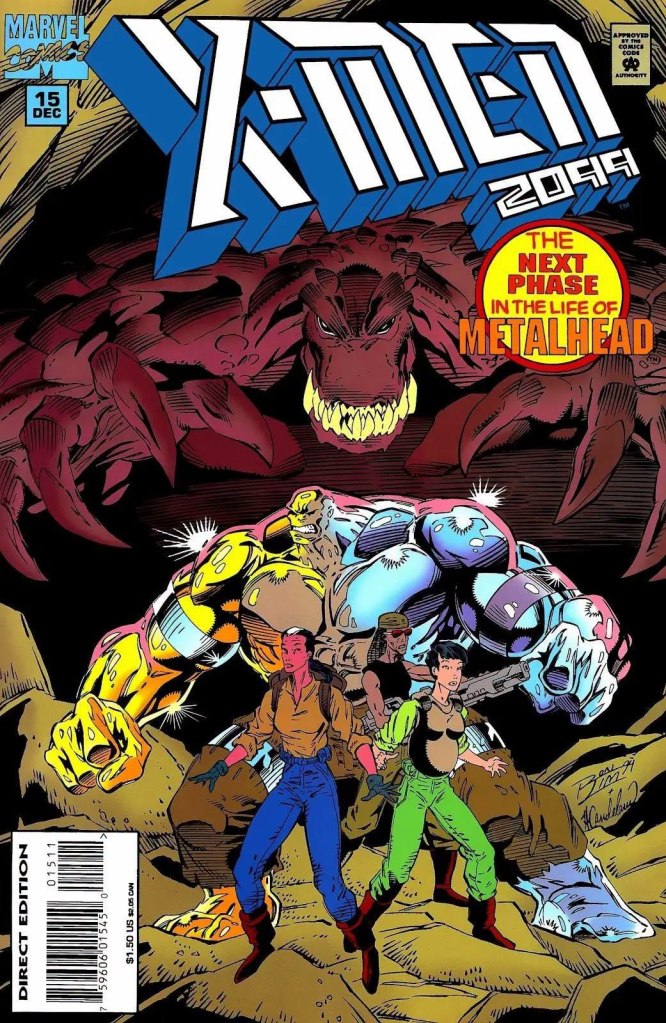
The cover.
Early story
The story begins in the Keewazi Nation in Oklahoma. Eddie/Metalhead is unconscious with Hurricane and her friend accompanying him. Their pregnant companion Rosa has been missing since Glitterspike (the man who impregnated Rosa) took her away from them. Metalhead wakes up and immediately asks where Rosa is.
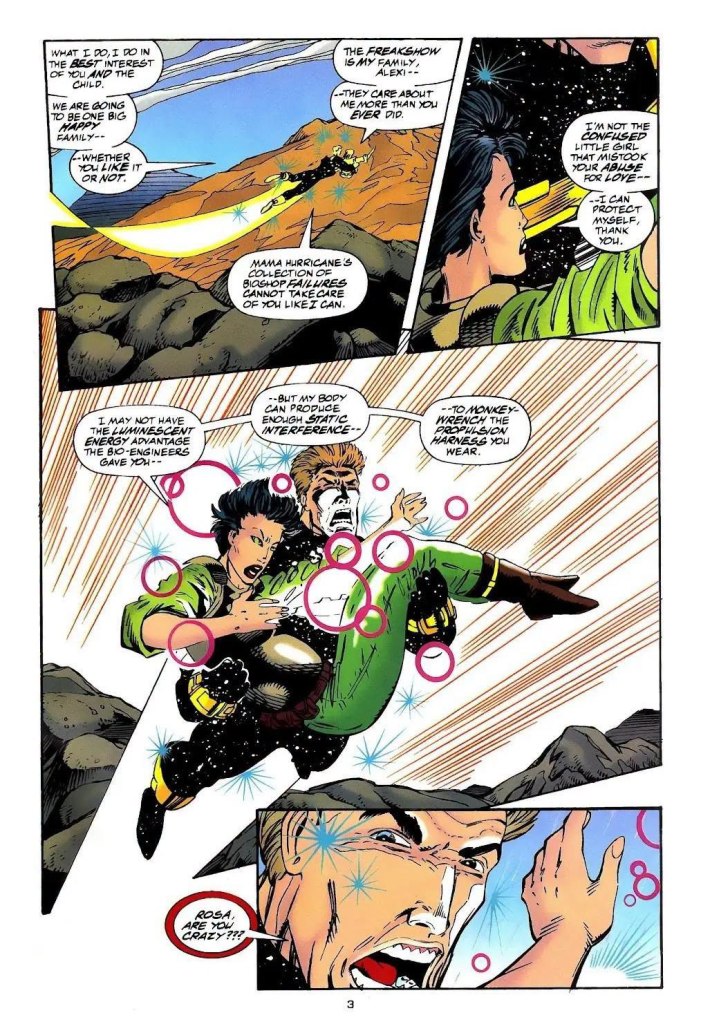
Far away, Rosa tells Alexi/Glitterspike to let go of her even though they are flying high above ground. Glitterspike tells her that he will do the best interest of her and their unborn child to become one big happy family. Rosa rejects him stating that the Freakshow is her family.
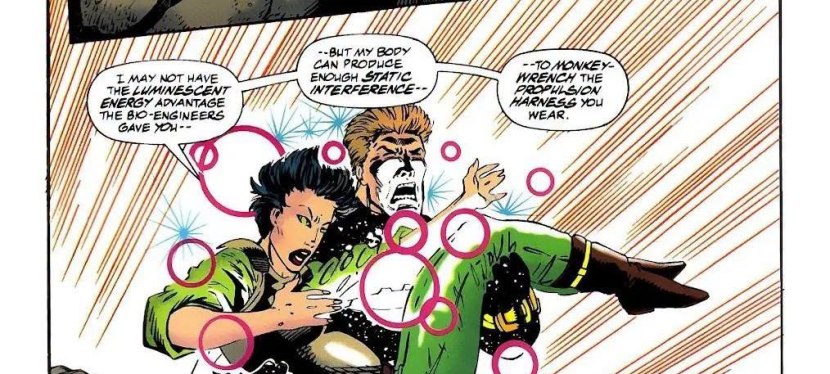
Even with the tremendous risk present, Rosa uses power of producing static interference on them. Soon enough, they start losing altitude…
Quality
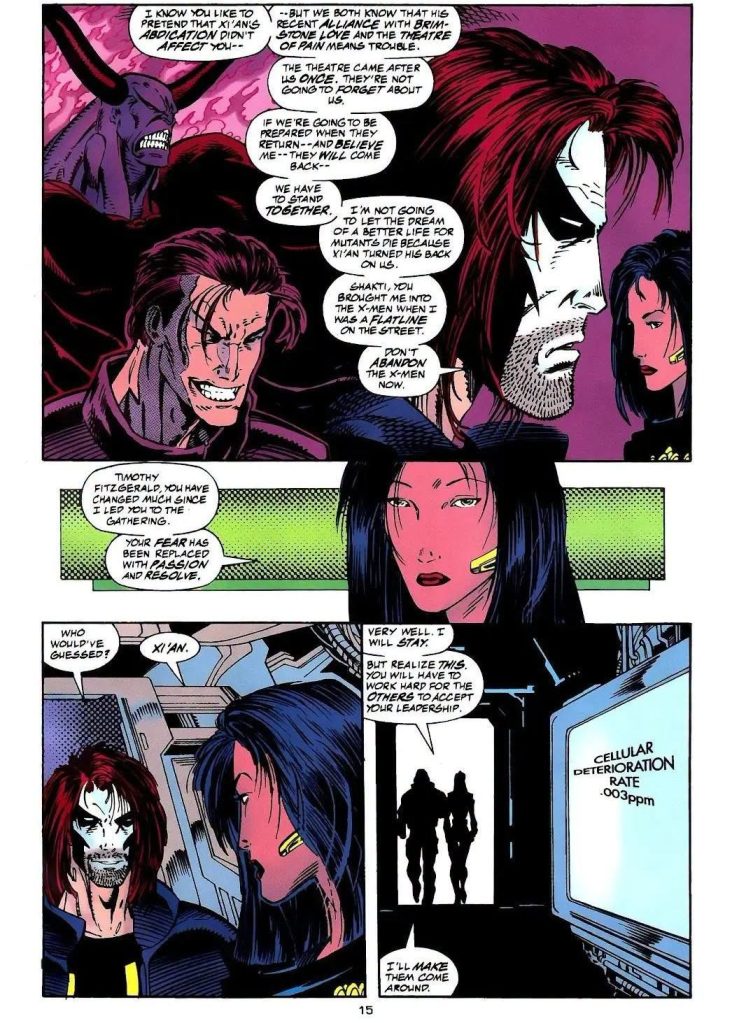
Serious talk between Shakti and a changed Skullfire about the X-Men and the situation they have now that their former leader Xi’an joined a gang of evil.
The story crafted by John Francis Moore here is strongly focused on the Freakshow with emphasis on former X-Men member Metalhead who at this point of the series has gotten very close with the pregnant member Rosa. This comic book marks the first time that Metalhead became a true major player in the series as he gradually adjusts with becoming a new member of the Freakshow.
Unsurprisingly, Rosa became a major player in the story too as she has no choice but to deal with someone from her past who is not just stubborn but also a cybernostra hitman who was genetically bred to process light into energy. Glitterspike went ballistic when Rosa left him some time prior and his obsession with her only grew.
A major part of this story involved the presence of a fabled monster called the Shadow Dancer which has been lurking in the hills of the wasteland and already a lot of people got scared of it. Creatively, this monster serves as the obstacle that Metalhead, Rosa, and the others have to deal with.
What Moore and Ron Lim accomplished in this story is deeply developing the Freakshow, Metalhead and Rosa while expanding the lore of 2099’s American wasteland even further. They also gave readers a quick look at the remaining X-Men team members who are now dealing with the new reality that their former leader turned evil by joining Brimstone Love’s Theater of Pain. In addition, Skullfire – once a weak and unsure new member of the X-Men in the beginning – not only returned to Shakti and the remaining team members, his personality and view of reality have changed which reinvigorated his passion for the team.
Conclusion
Rosa does something very risky as Glitterspike carries her in the air.
X-Men 2099 #15 (1994) was crafted to be compelling with strong focus on Metalhead and the Freakshow. It clearly marked the next phase in the life of Metalhead and it made the Freakshow an even more interesting team within the X-Men 2099 series. The story has lots of strong and intriguing moments, and character development is consistently strong. The tale also has some science fiction inspiration from the 1979 movie Alien mixed in. This is a good read.
Disclaimer: This is my original work with details sourced from reading the comic book and doing personal research. Anyone who wants to use this article, in part or in whole, needs to secure first my permission and agree to cite me as the source and author. Let it be known that any unauthorized use of this article will constrain the author to pursue the remedies under R.A. No. 8293, the Revised Penal Code, and/or all applicable legal actions under the laws of the Philippines.
Welcome back, superhero enthusiasts, 1990s culture enthusiasts, X-Men fans and comic book collectors! Today we revisit the Marvel Comics shared universe to examine one of the many tales of the X-Men 2099 monthly series.
I enjoyed the way John Francis Moore put things into motion in issue #12 and other previous issues of X-Men 2099. During the 3-part storyline at the start of the series, the Synge business empire and its wing of enforcers looked like the definitive force of evil for the mutants led then by Xi’an. As the series progressed, the Theater of Pain (first introduced comprehensively in issue #4) and its leader Brimstone emerged as the new force of evil while the X-Men lost Xi’an and Skullfire became more unhinged and got more involved with Luna (the one who messed with his mind and emotions). Xi’an, who reverted back to his sinister mindset, is obsessed with finding the Driver. It should be noted that these characters are all in the middle of the wasteland in 2099’s America (for 2099 historical reference, click here).
With those details laid down, here is a look back at X-Men 2099 #13, published by Marvel Comics in 1994 with a story written by John Francis Moore and drawn by Ron Lim.
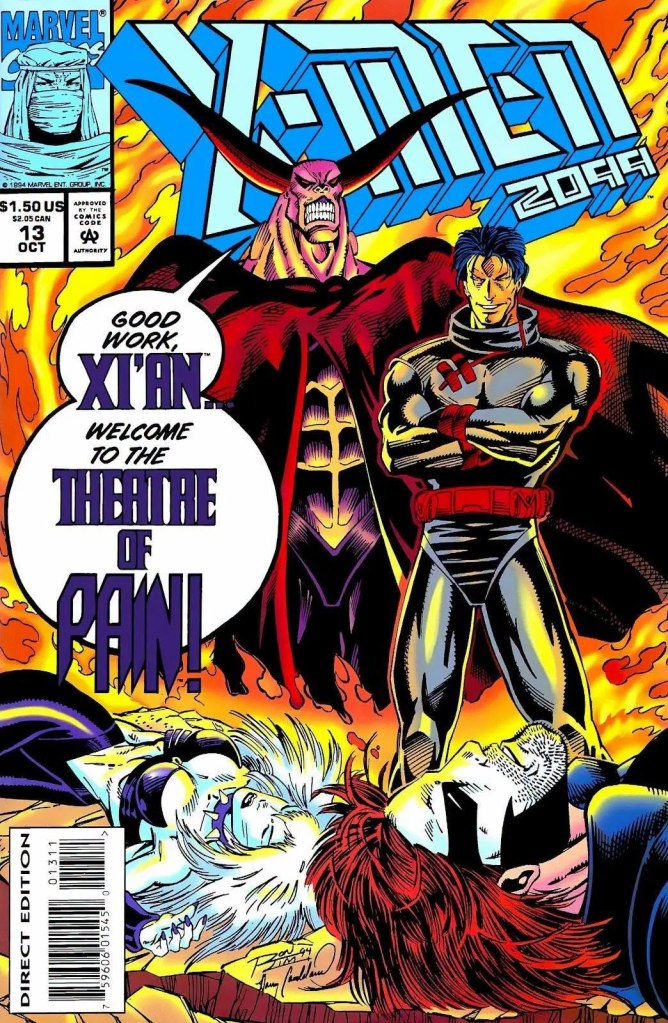
The cover.
Early story
The story begins with Brimstone Love making his way into the Garage, a secret high-tech facility of the Driver. He finds it interesting that his hunt for Luna led him into the strange structure in the desert and he know that she and her companions are inside.
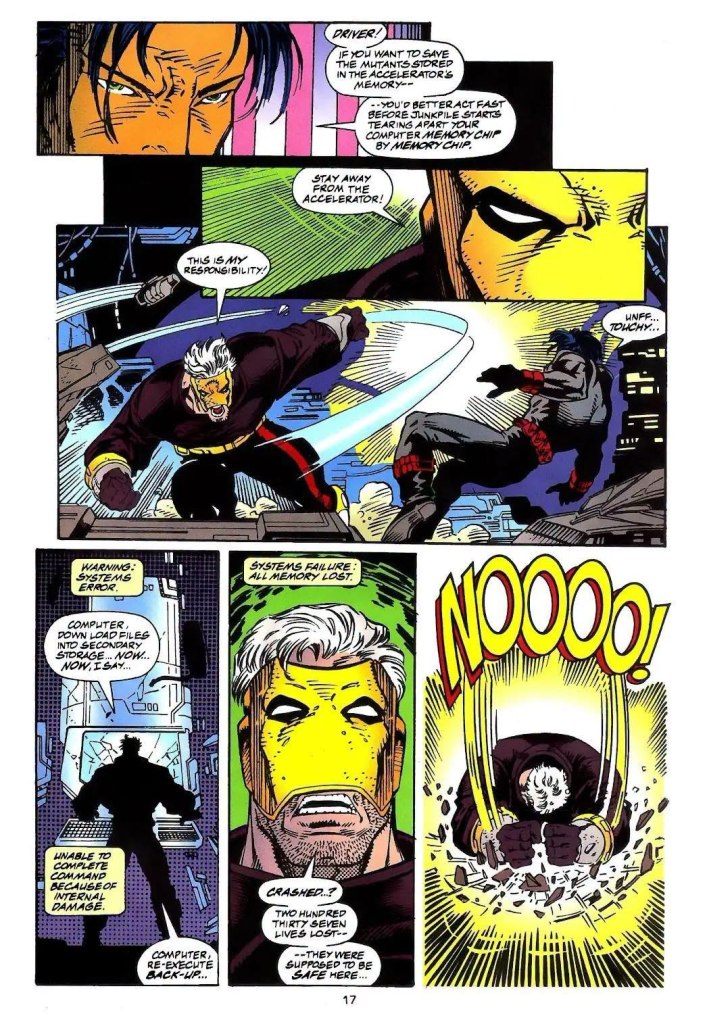
Inside the structure, Junkpile is bound and tortured on a chair with Adamantium restraints holding him. With Junkpile is the Driver watching him while Xi’an, Skullfire and Luna are trapped nearby by a laser grid. Skullfire, who is aware that Xi’an has been pursuing the Driver ever since he learned key details from Hurricane, implied to the former X-Men leader that the Driver is more of a problem and antagonist while Luna added her own comments about their situation. Xi’an tells them they need to determine the severity of their situation.
Xi’an tells the Driver that Hurricane described him as a part of the mutant underground during the Purge. It turns out, the Driver has not heard about Hurricane for a long time and insisted to Xi’an that he mistook his actions as hostile.
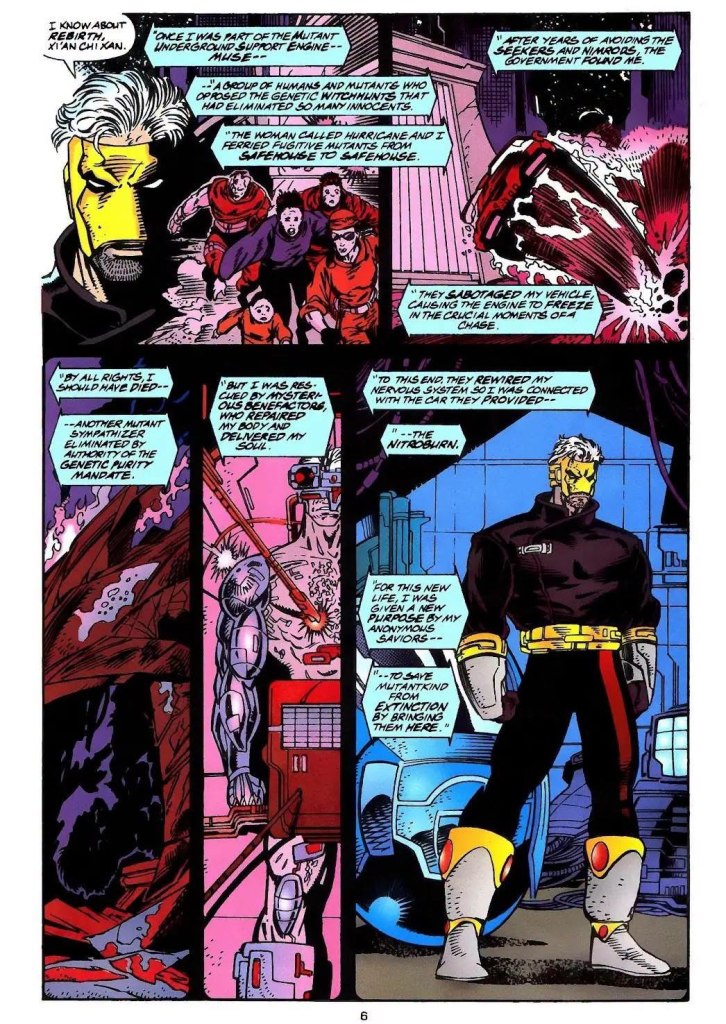
The Driver begins to explain what he has been doing, why he continues to fight and protect the sacred mutant tribe and why he sought out hundreds of mutants to give them sanctuary…
Quality
A lot of intriguing developments happened here and it concludes Xi’an’s pursuit of the Driver.
With regards to storytelling and revelations, I can say that the intensity from the previous continued smoothly in this comic book. While the Theater of Pain was first revealed in issue #4, it was in the previous issue and in this particular story that its actual scope was made clear, and the presence of Brimstone Love – obviously 2099’s walking symbol of Satan – added great tension and a new evil presence for the X-Men to deal with.
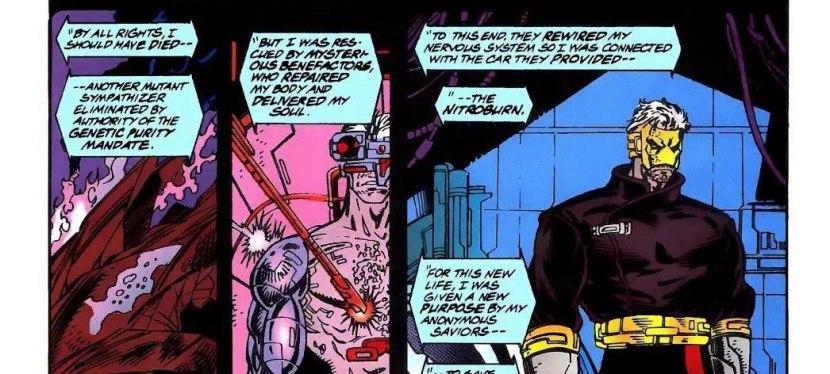
What I enjoyed most in the story crafted by John Francis Moore are the revelations. The Driver, who came close to death and witnessed the plight of mutants, has a personal mission of providing sanctuary to mutants who are still living in danger in 2099’s America which has been dominated by mega corporations (MegaCorps). Still, his specific methods of achieving his goals for mutantkind are intriguingly questionable and in someways they made him looked even sinister. That said, Xi’an’s pursuit of him (which started a few issues prior) really resulted in some shock value that has to be seen page by page.
Very notably, Moore made the script even more dramatic which is clearly reflected in the dialogue of the characters and the art done by Ron Lim. I should also state that flashbacks of the mutants struggle for survival under the Driver and Hurricane are included and they are worth seeing.
Considering what this comic book has, it will make readers think deeply about the essence of X-Men 2099 as a team and the comic book series itself. At the same time, new mysteries about the direction of the series will be realized in ways that readers don’t expect.
Conclusion
The Driver himself was part of the effort that saved desperate mutants decades prior and he came close to dying. This comic book heavily defines his existence and his mission on providing sanctuary to any mutants he finds.
If there is anything significant about X-Men 2099 #13 (1994), it is the fact that it changed the trajectory of the series and reshaped the concept of X-Men 2099 as a whole in dramatic fashion. The build-ups, the pay-offs and revelations in this comic book are powerful. Along the way, this will make you question even further the intentions of Xi’an (former X-Men leader) and Skullfire (the unhinged X-Men member who used to be so weak and unsure of himself). As for the Driver, he is very well defined by the Moore-Lim duo in this comic book and he has gotten even more significant by the end. If there is anything severely lacking here, it is the spotlight on the surviving X-Men team members (with Shakti as their new leader).
The Ministry of Agriculture in Japan is advancing procedures that could lead to the full lifting of the import ban on fresh potatoes from the United States as a crucial briefing will happen this month, according to a news article by Jiji Press.
To put things in perspective, posted below is the entire news article of Jiji Press. Some parts in boldface…
Japan is advancing procedures that could lead to the full lifting of its ban on imports of fresh potatoes from the United States, even as concerns persist about quarantine issues and the impact on Japanese farmers’ livelihoods.
Last Friday, the agriculture ministry announced that it would hold a briefing this month on pests and diseases identified as possibly posing a threat to domestic agriculture if they arrive in the country on potatoes. It plans to then begin considering specific quarantine measures before making a final decision on whether to allow imports.
While lifting the import ban could take several years, many are wary about allowing potatoes from the United States, one of the world’s biggest producers.
“We will approach the discussions with resolve,” agriculture minister Norikazu Suzuki told a press conference Friday.
Japan in principle bans imports of fresh potatoes to prevent pest infestations. However, an exemption to the ban was granted in 2006 for U.S. potatoes used to make potato chips.
Let me end this piece by asking you readers: What is your reaction to this development? Do you think chances are good that Japan will lift the ban on the importation of fresh potatoes from the United States? Do you think having more American fresh potatoes in the Japan market will seriously disrupt the livelihoods of Japanese farmers? Do you think Japan’s farmers have what it takes to significantly boost potato production by hundreds of thousands in metric tons per year in the short term?
Thank you for reading. If you find this article engaging, please click the like button below, share this article to others and also please consider making a donation to support my publishing. If you are looking for a copywriter to create content for your special project or business, check out my services and my portfolio. Feel free to contact me with a private message. Also please feel free to visit my Facebook page Author Carlo Carrasco and follow me on Twitter at @CarloCarrascoPH as well as on Tumblr at https://carlocarrasco.tumblr.com/and on Instagram at https://www.instagram.com/authorcarlocarrasco
With the Peso performing terribly in the global currency market, weakening economic growth, high inflation and fears of an economic recession growing, 2026 has not been good for the Philippines. There is a bright spot in tourism, however, as the Philippines saw its 2026 foreign tourist arrivals reach 4.11 million in the January-August period and the United States and South Korea combined for more than 1.5 million tourist arrivals, according to a news article by the Philippine News Agency (PNA).
To put things in perspective, posted below is an excerpt from the news report of BusinessWorld. Some parts in boldface…
The Philippines has recorded 4.11 million foreign arrivals from January to August, higher by 3.7 percent compared to the same period last year, the Department of Tourism (DOT) said on Tuesday.
The United States posted the highest number of share at 818,318, followed by South Korea at 727,379, Japan at 350,191, China at 310,088, and Australia at 234,156.
Also making it in the top 10 source markets are Canada with 231,972, Taiwan with 154,957, the United Kingdom with 132,370, Singapore with 126,812, and India with 77,883.
Tourism Secretary Dita Angara-Mathay said the Philippines targets to surpass its 2025 arrival figures to reach between 6.4 million and 6.8 million, or at least 7 million, by the end of 2026.
To achieve this, she said the DOT is intensifying its branding and promotions to reach more tourists in its key source markets.
The DOT is also in active talks with airlines to open up and establish more chartered flights between the Philippines and secondary cities of Korea and China.
DOT Assistant Secretary Ren Sapitan said the agency is also set to sign a contract with a creative agency in November to broaden the country’s marketing efforts and make the Philippines more visible worldwide.
Let me end this post by asking you readers: What is your reaction to this recent development? Do you think the Philippines will be able to exceed the 2025 foreign tourist arrivals number by the end of this year? Do you think the DOT is doing a good job to strengthen the Philippines’ attraction of foreign tourists? Considering the Top 10 markets of foreign tourists the Philippines attracted so far, are you convinced that the nation’s hosting of the Association of Southeast Asian Nations (ASEAN) Summit did not create any positive tourism results?
Thank you for reading. If you find this article engaging, please click the like button below, share this article to others and also please consider making a donation to support my publishing. If you are looking for a copywriter to create content for your special project or business, check out my services and my portfolio. Feel free to contact me with a private message. Also please feel free to visit my Facebook page Author Carlo Carrasco and follow me on Twitter at @CarloCarrascoPH as well as on Tumblr at https://carlocarrasco.tumblr.com/and on Instagram athttps://www.instagram.com/authorcarlocarrasco
In due time, space will be the new frontier of engaging in business and the transportation of people, cargo and the different forms of hardware. That said, the United States and Japan are moving towards that new frontier as they signed the memorandum of cooperation on space transportation business, according to news report by Kyodo News.
To put things in perspective, posted below is the entire news report of Kyodo News. Some parts in boldface…
Japan and the United States have agreed to further enhance cooperation in the space transportation business by standardizing part of the review procedures when Japanese firms launch rockets from U.S. sites and vice versa, Japan’s Cabinet Office said Tuesday.
Japan’s National Space Policy Secretariat and the U.S. Federal Aviation Administration signed a memorandum of cooperationon Monday, also aimed at streamlining regulations and intensifying information sharing.
“We would like to build a system adaptable to space business, which is widely expanding in a variety of forms,” said Takatsugu Ryuzaki, director general of the secretariat in charge of the country’s space development and utilization, after the signing.
With several spaceport projects underway in Japan, including in Kochi and Oita prefectures, the two sides will discuss guidelines for space business operators setting out specific requirements for spaceports.
In addition to rocket launches, the two security allies are considering connecting Japanese and U.S. cities via suborbital flights at an altitude of around 100 kilometers.
Let me end this piece by asking you readers: What is your reaction to this development? Do you think this new agreement by Japan and America will lead to breakthroughs of space transportation business within your lifetime? Do you think other nations will follow the standards of America and Japan on space business? Does your country have any existing spaceports?
Thank you for reading. If you find this article engaging, please click the like button below, share this article to others and also please consider making a donation to support my publishing. If you are looking for a copywriter to create content for your special project or business, check out my services and my portfolio. Feel free to contact me with a private message. Also please feel free to visit my Facebook page Author Carlo Carrasco and follow me on Twitter at @CarloCarrascoPH as well as on Tumblr at https://carlocarrasco.tumblr.com/and on Instagram athttps://www.instagram.com/authorcarlocarrasco
Welcome back readers, fellow geeks and electronic gaming fans!
In this edition of the Retro Gaming Ads Blast (RGAB) series, we will take a look at another batch of retro gaming print ads from the 1980s to the early 2000s.
For the newcomers reading this, Retro Gaming Ads Blast (RGAB) looks back at the many print ads of games (console, arcade, computer and handheld) that were published in comic books, magazines, flyers, posters and newspapers long before smartphones, social media, the worldwide web and streaming became popular. To put things in perspective, people back in the 1980s to the 1990s were more trusting of print media for information and images about electronic games and related products.
With those details laid down, here is the newest batch of retro gaming print ads for you to see and enjoy…
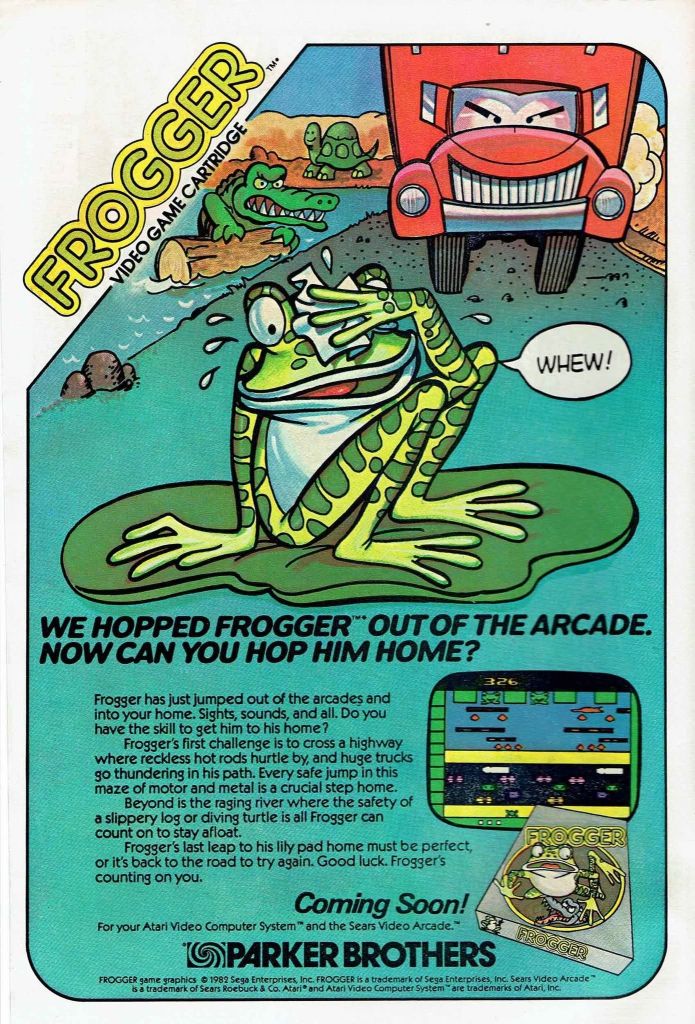
1. Frogger Print Ad
Do you find this old ad humorous?
When Frogger was first released in video arcades in 1981, it easily attracted countless gamers offering them bouts of fun and the video game critics were very impressed with it. Considering its massive arcade success, it was unsurprisingly ported to the game consoles and home computers of the time. Parker Brothers secured the license for cartridge versions and the company produced Frogger ports for not just the Atari 2600 but also the Atari 7800. This print ad they came up with had a deliberate cartoony artwork (with a touch of humor) and an artist created a hand-drawn illustration intentionally made to resemble a screenshot from the game. I saw this ad a number of times when I read comic books in 1982.
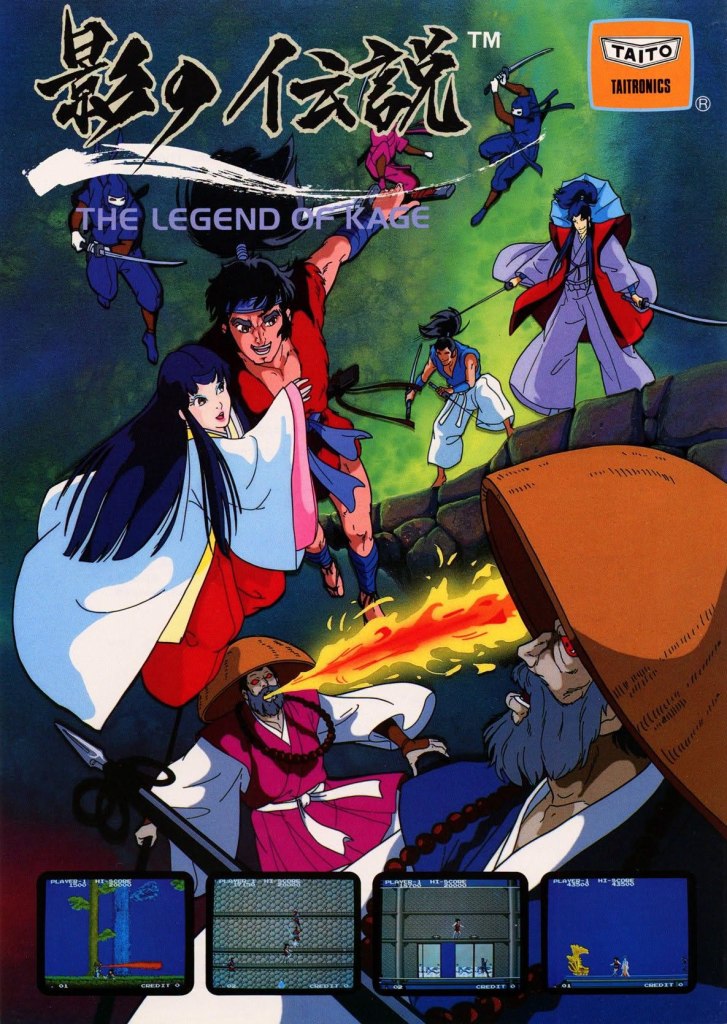
2. The Legend of Kage Japanese Arcade Flyer
Action and excitement in ancient Japan!
In my life, I never had the opportunity to play the original arcade version of The Legend of Kage and ended up playing only the Nintendo Family Computer (Famicom) port. Behind the scenes, Taito itself came close to preventing The Legend of Kage from being released in the arcades. The company placed it in a certain game show where it received praise by many which prompted Taito to give it a full arcade release. To promote the game, the Japanese arcade flyer had lively hand-drawn artwork that perfectly reflected what the game is about, who the playable hero is and what ancient Japanese setting was used. Fortunately for Taito, The Legend of Kage became a huge commercial hit and this led to the production of ports for different consoles and computers.
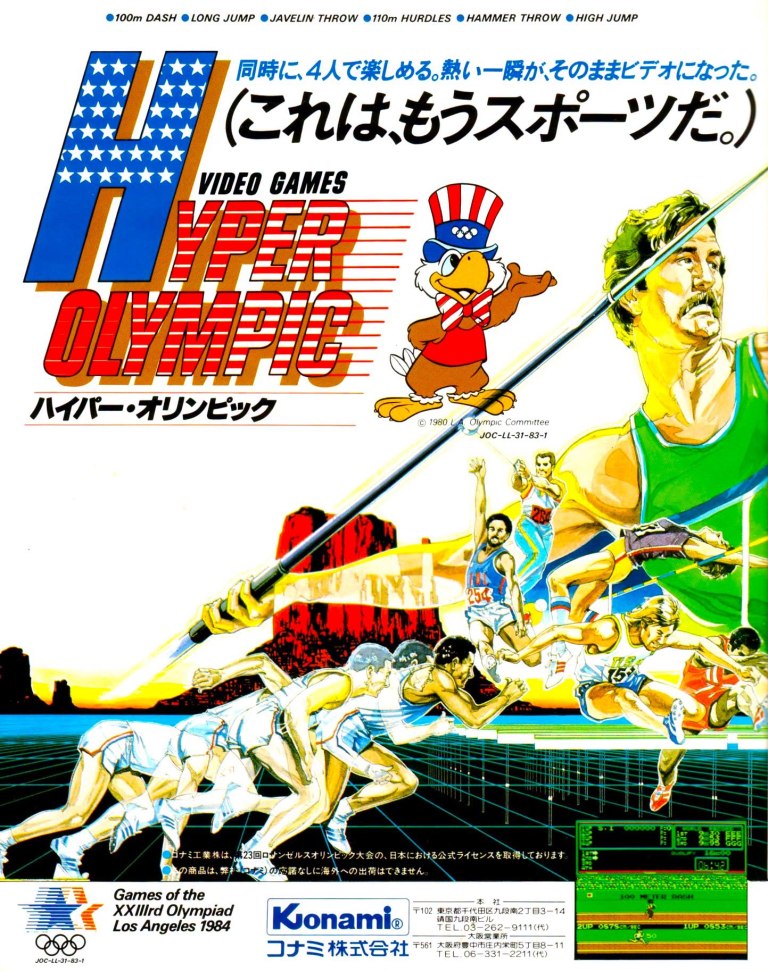
3. Hyper Olympic Japanese Arcade Flyer
Arguably the best track and field game ever made for the arcades.
In 1983, Konami released their summer Olympics-inspired arcade game Hyper Olympic (titled Track & Field in other parts of the world) which offered players the opportunities to compete in a series of events with emphasis on pressing the buttons as quickly as possible. The arcade flyer Konami came up with featured fine-looking hand-drawn artwork showing athletes competing in track and field events (with the types of events displayed at the top-most part of the flyer) while showing just one screenshot (lower right) and displaying the officially 1984 Los Angeles Olympics logo (lower left). In my view, this old arcade flyer does a good job promoting both the arcade game as well as the 1984 Olympics itself. Too bad nobody makes this kind of arcade flyer anymore.
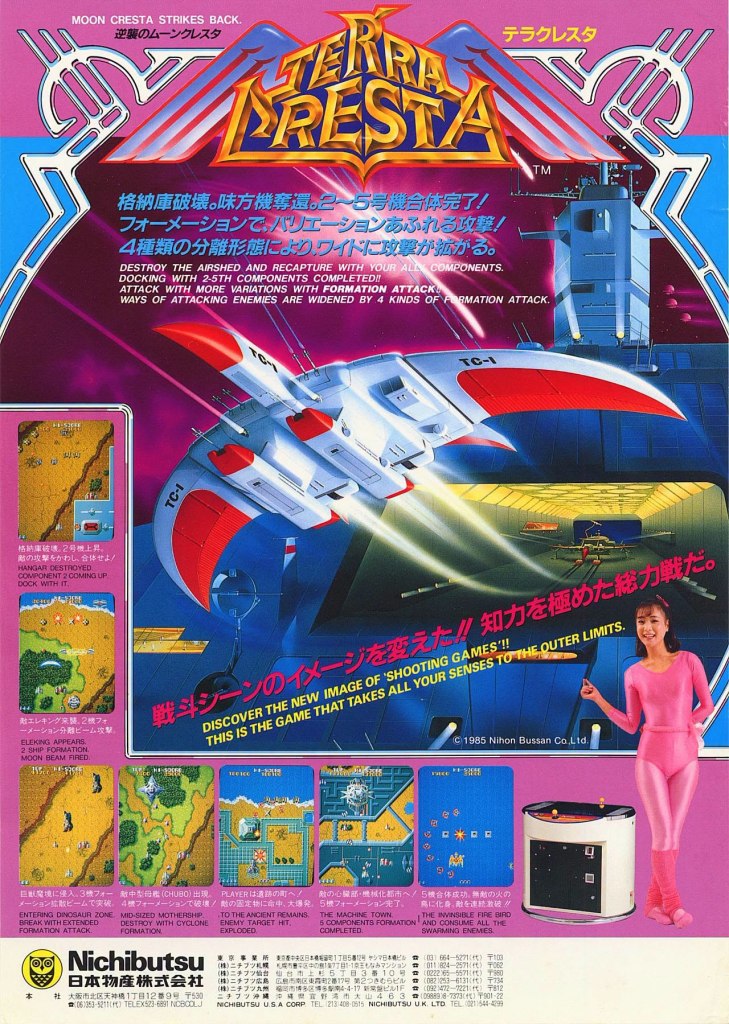
4. Terra Cresta Japanese Arcade Flyer
Did you ever play Terra Cresta in the arcades in Japan?
Nichibutsu, which produced a lot of arcade games that were released only in Japan, released Terra Cresta in Japanese arcades in 1985. It turns out Terra Cresta is a sequel to their 1980 game Moon Cresta which itself was their first big arcade hit game. Nichibutsu literally loaded the front of Terra Cresta’s arcade flyer with lots of visuals and details. As you can see, seven screenshots of the game were displayed (each with descriptive text), a fancy looking artwork that emphasized the science fiction setting, some English descriptive text, the cocktail table arcade machine and a pretty Japanese lady wearing an aerobics outfit with legwarmers (popular in the 1980s). This flyer truly has a strong 1980s flavor.
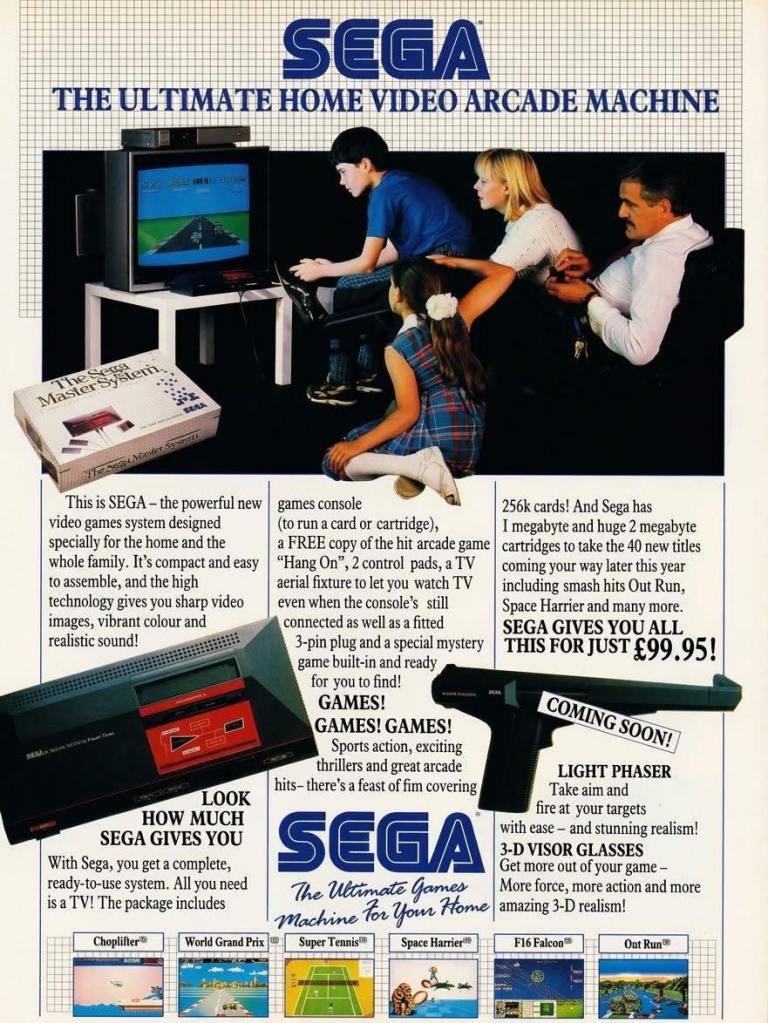
5. Sega Master System European Print Ad
From the early days of Sega’s console business.
After many years doing arcade games, Sega made the bold decision to start competing in console gaming with the release of the SG-1000 in 1983 in Japan. Even though Nintendo was a very tough competitor with the best-selling Famicom, Sega did not give up and proceeded to launch their console in America and Europe referred to as the Master System. In a serious attempt to gain customers specifically in England, Sega made a print ad showcasing a family sitting in front of a TV set with the young boy playing a racing game on a Master System. Looking at how the descriptive text was presented, it was clear that Sega emphasized bringing the arcade game experience into the comfort of home while also promising that a lot more new games will be released in the near future. This is an eye-catching ad and also a fine example of aggressive marketing by Sega.
6. Ken Griffey Jr.’s Winning Run North American Print Ad
What was the best baseball video game you ever played?
Following the commercial success of the 1994 Super Nintendo Entertainment System (SNES) game Ken Griffey Jr. Presents Major League Baseball, Nintendo got Ken Griffey Jr. again as endorser and proceeded with the follow-up Ken Griffey Jr.’s Winning Run. With the highly talented Rare (Donkey Kong Country) chosen as game developer, Nintendo was highly confident with the baseball sequel and the 2-page print ad reflected that. The Ken Griffey Jr.’s Winning Run ad had a striking image of a broken baseball bat on one side while the game’s details, two screenshots and the creative description dominated the other side. While I am not so interested in baseball, I can say that this old print ad is indeed attention-grabbing.
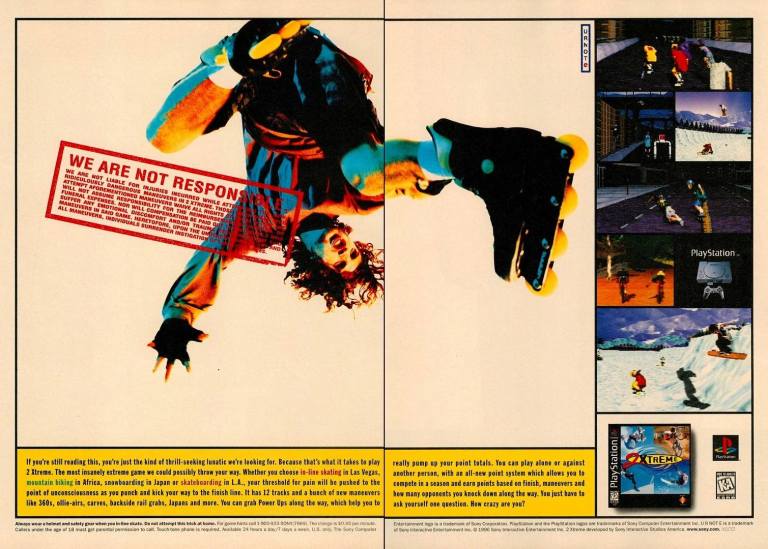
7. 2Xtreme North American Print Ad
From the time when the X Games were wildly popular.
Remember how popular the X Games (Extreme Games) were back in the 1990s? Early in the life of the PlayStation console, Sony released ESPN Extreme Games which sold over a million copies worldwide. As expected, a follow-up titled 2Xtreme was approved for a 1996 release. Sony came up with a 2-page ad that had an upside-down X Games participant with roller blades dominating most of the space and six screenshots were displayed. The descriptive text in the lower part of the ad was deliberately written to be hip and cool.
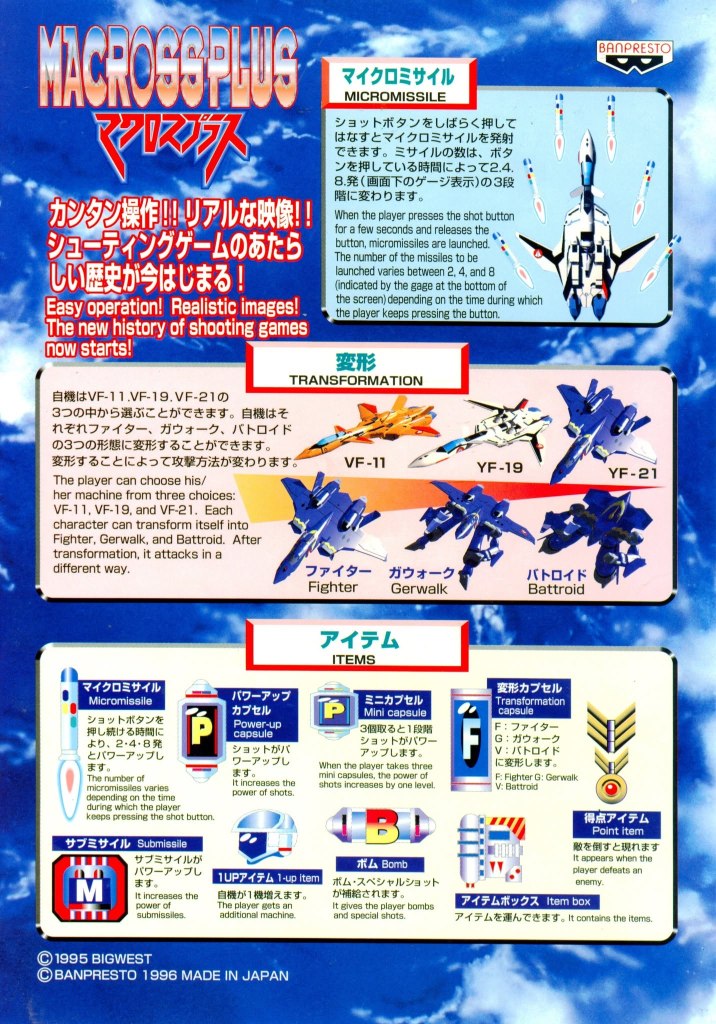
8. Macross Plus Japanese Arcade Flyer
The front.
The rear.
Based on the mid-1990s anime OAV, the Macross Plus video game from Banpresto was designed as a vertical-scrolling 2D shooter that captures the feel and intensity of the anime’s spectacle. The front of the Japan-only arcade flyer showcased the YF-19 Excalibur, the YF-21 Sturmvogel and the VF-11 Thunderbolt (plus the basic arcade controls on the lower-left) which were all rendered in 3D polygons to delight Macross fans and gamers who are interested in new 2D shooting experiences. The rear of the flyer showed additional details and it even includes English text descriptions. Strangely, no screenshots of the game were displayed. Being a long-time Macross fan, I can say this old arcade flyer is still engaging to look at.
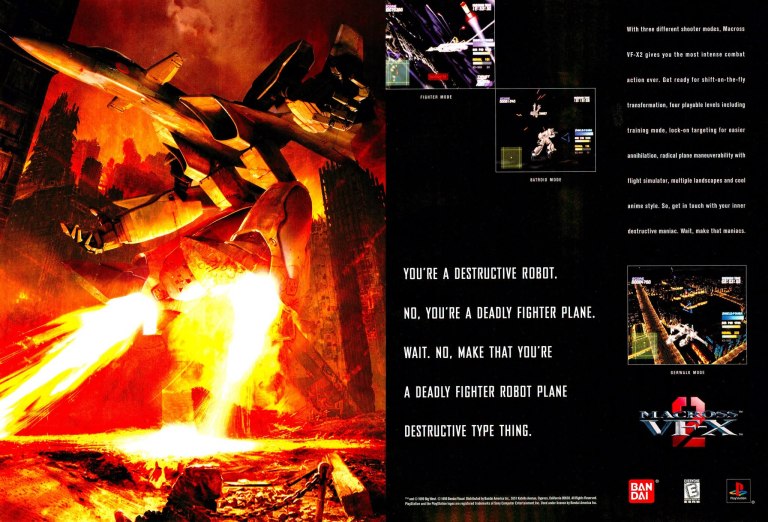
9. Macross VF-X2 North American Print Ad
An impressive looking print ad for a Macross video game that never got released in North America.
In the late 1990s, Bandai prepared to launch Macross VF-X2 (the sequel to 1997’s Macross Digital Mission VF-X) on the PlayStation console in North America. This was a very intriguing move because Bandai never brought the mentioned 1997 Macross game outside of Japan. Shortly after the official announcement of a North American release, Macross VF-X2 got featured in video game magazines, an English demo of the game (first mission only) was distributed through Official U.S. PlayStation Magazine, and Bandai came up with the 2-page print ad you see here. Unfortunately, Macross VF-X2’s North American release got cancelled because of copyright issues and legal obstacles (note: Harmony Gold held the Western rights to Robotech and actively blocked the release of genuine Macross products in America). As such, this impressive looking Macross VF-X2 print ad for North America ended up as a promotion for nothing!
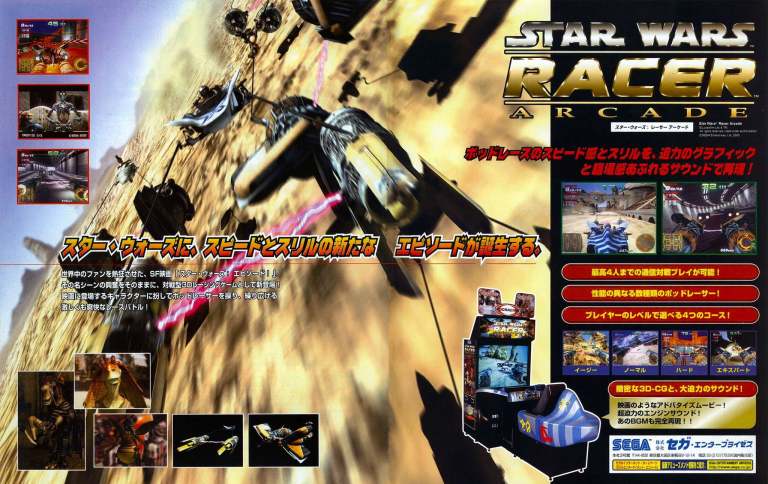
10. Star Wars: Racer Arcade Japanese Print Ad/Poster
This is one of the many video games based on Star Wars: The Phantom Menace.
In 1999, Star Wars Episode I: The Phantom Menace was a massive box office hit in theaters around the world and it marked a new era of Star Wars movies with digital effects available. Similar with 1993’s Jurassic Park, George Lucas’ movie also had a huge lineup of merchandise, action figures and video games. The pod racing from the movie became the basis for Star Wars: Racer Arcade which was released in Japan on June 2000, and then in America a month later. To help arcade operators attract gamers and Star Wars fans, a print ad and poster were released featuring a very dynamic image of pod racing from the game dominating the background, a few screenshots displayed and some computer-generated of characters and vehicles. At the lower right part of the ad/poster is the image of the arcade machine which has a huge screen, a seat and control panel. The descriptive Japanese text was written to excite both fans and gamers. Did you play this Sega-produced Star Wars game in the arcades?
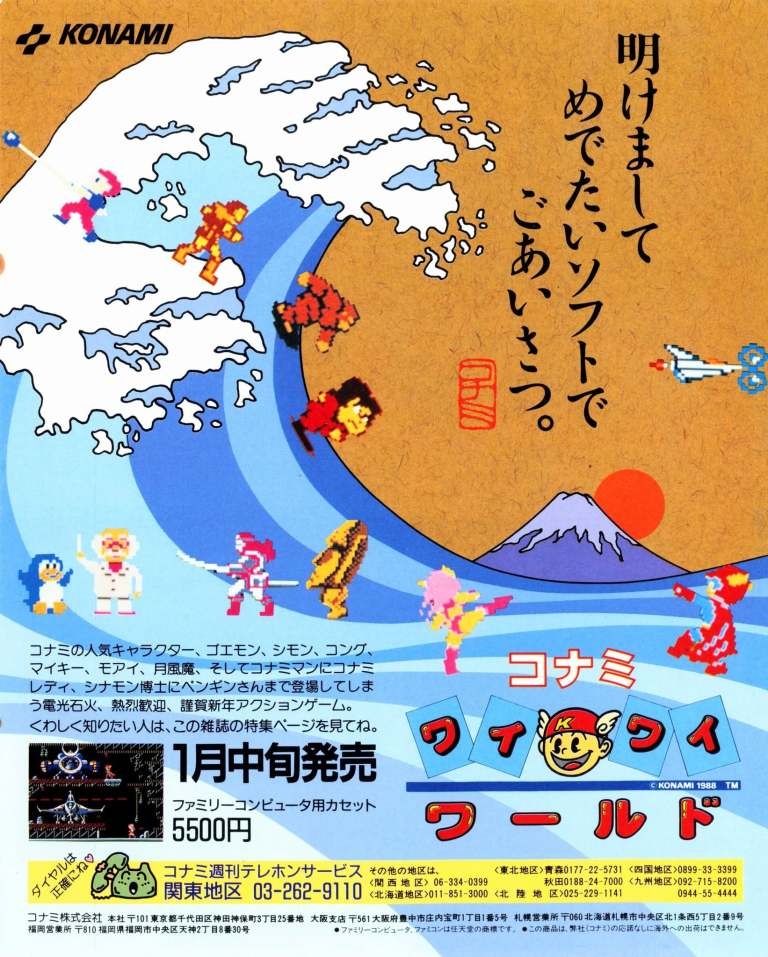
11. Konami Wai Wai World Japanese Print Ad
Can you spot Simon Belmont, Mikey Walsh and King Kong in this Japan-only print ad of Konami Wai Wai World?
Going back to the late-1980s, Konami released a 2D adventure game on the Famicom that was very ambitious as it featured side-scrolling treks, vertical-scrolling shooting sequences and, most notably, a cast of characters that emphasized crossovers between intellectual properties of gaming. I am talking about Konami Wai Wai World (sometimes called Konami World for short) which had characters, settings and elements of Konami’s own properties like Gradius, Castlevania and Twin Bee. Not only that, King Kong of King Kong 2: Ikari no Megaton Punch and Mikey Walsh of The Goonies were also featured which is astonishing because they represent entertainment intellectual properties that were licensed to Konami for video game adaptation. That said, the emphasis of crossovers and excitement was shown in the form of 2D character sprites in this Japanese print ad of Konami Wai Wai World. This is the kind of game that Konami itself will never be able to make again and to do a remake or an enhanced re-release of Konami Wai Wai World will require overcoming all the legal obstacles in the way.