Welcome back, my readers, YouTube viewers and all others who followed this series of articles focused on YouTube videos worth watching. Have you been searching for something fun or interesting to watch on YouTube? Do you feel bored right now and you crave for something to see on the world’s most popular online video destination?
I recommend you check out the following topics and the related videos I found.
#1A look at Donald Trump’s amazing comeback as US President – I already blogged about the amazing comeback of Donald Trump who won the 2024 US Presidential Election decisively. While that blog post had lots of videos about the victory, I added some more below for your enlightenment.
#2 The engineering of the F-117 Nighthawk – Do you still remember the F-117 Nighthawk? It was the sophisticated stealth fighter America used against Iraq during the Gulf War in 1991. I personally could not forget the first time I ever saw it on TV (news broadcast of the 1991 war) as a teenager. The F-117 is no longer in use but its engineering and the history of its development should be seen in the video below. Watch and learn!
#3 Dragon Age: The Veilguard’s wokeness – It is a sad fact that very similar with Communist-filled Hollywood (Commiewood), wokeness and identity politics are ruining video games. Recently, EA released Dragon Age: The Veilguard which was the first new Dragon Age game they released in ten long years. The big problem here is that woke activists at BioWare inserted their poison into the game. Watch RK Outpost’s videos below.
#4 The blunders of Kamala Harris, her allies and the Democrats – Kamala Harris, who has been US Vice President for almost four years now, lost the US Presidential Election to Donald Trump convincingly. She led a campaign that was dishonest, pretentious and even turned to hatred by comparing Trump with Adolf Hitler. No matter Kamala did, she and her woke allies failed miserably to connect with voters. Instead of discussing policies and plans to serve the people in the near future, Kamala emphasized identity politics and vibes. Is it any wonder why she lost and why are the Democrats so unpopular? Watch the selected videos to find out why and how she lost.
#5 Kamala Harris supporters freaking out – Losing an election is always painful and embarrassing. So much so, there were supporters of Kamala Harris who could do nothing but record/stream themselves freaking out. Some supporters working in the media or in government just keep on spreading their distorted views and lies to as many people as possible. They also had trouble containing their emotions. I can only wonder if the Democrats themselves care to calm down their devastated supporters. Watch and learn from these videos.
In what is obviously the greatest political comeback in the history of the United States, Donald Trump (Republican) once again won the Office of US President after crushing the woke Kamala Harris (Democrats) in the 2024 US Presidential election!
Trump (US President from 2017 to 2021), whose running mate is US Senator JD Vance, won 286 out of 538 electoral votes as of this writing, according to the official results. 270 electoral votes are required to win the Presidency. As of now, the election results of Michigan and Arizona have yet to be finalized but Trump is leading in both of them.
When it comes to the popular vote, Trump won 70,900,447 votes while Harris got 66,434,997 votes as of this writing. These results proved many polls wrong as they predicted Harris would win more votes nationally than Trump.
For the newcomers reading this, the election of the US President and Vice President are not determined by popular vote nationwide. Rather it is through the Electoral College that determines the winner of the US Presidential Election. By January 20, 2025, Trump and Vance will formally take office as President and Vice President of the United States.
For insight, watch the selected YouTube videos below.
Below are the different YouTube livestreams that covered the elections.
To say that Donald Trump’s delayed re-election is significant is an understatement. He almost lost his life when someone tried to assassinate him. Before that happened, the Democrats and their allies abused government power to attack him and the Trump family. Questionable cases were filed against him in court. And then the Satanic Leftist mainstream news media became the Democrats’ attack dogs against him. Of course, Trump fought back hard and won this year’s Presidential Election decisively! Now that he won again, Trump as the incoming 47th President will tackle a lot of problems that affected America both domestically and overseas.
American families have been suffering from effects of rapid inflation and the reckless economic policies of Joe Biden and Kamala Harris. American society is gradually being dismantled by the LGBTQ and transgender movements, Critical Race Theory extremists, Islamo-Leftists, illegal aliens and the woke mobs which are clearly connected with the Democrats. The cost of living in America has skyrocketed so much, there are individuals who had to work with two jobs just to make ends meet. The Biden-Harris economic plans and post-pandemic measures made life a lot worse for Americans and their families. Meanwhile, illegal immigrants have added a lot to criminal cases around the country.
Once in office, Trump will eventually reposition America to push back hard against terrorist state Iran, Russia and China. I should mention that the Republicans won back control of the US Senate and eventually they will retain the majority in the US House of Representatives which will be helpful for Trump to fulfill his agenda for the people. I anticipate that the first batch of new pieces of legislation in 2025 will be written with the economy, inflation, and illegal immigration in mind.
If there is anything spiritually significant about Trump’s 2024 Presidential victory, I share with you the bible verse below…
“No weapon formed against you shall prosper,
And every tongue which rises against you in judgment
The victories of Trump-Vance and the Republicans this year formed a powerful push back against the Satanic Left, corrupted people, illegal immigration and other wicked forces. The American people have spoken through voting and the 2024 elections will be remembered for a very long time. The people wanted Trump back and they clearly want to join him to make America great again.
Let me end this piece by asking you readers: How did you react when you first learned about the re-election of Donald Trump? Did you let the Leftist mainstream news media fool you into believing Kamala Harris is best for America? Do you think life in America improved a lot under the Biden-Harris administration?
With the exception of a certain 3rd party games that turned out to be a creative misfires respectively, the 2024 Xbox Games Showcase (also referred to as Xbox Showcase) was clearly a powerful showcase of future games on the Xbox ecosystem and the 1st party games of Team Xbox displayed is the most exciting bunch yet!
As mentioned before, we are now living in the age of Microsoft-owned Activision, Blizzard, King and Bethesda, and Team Xbox has many game studios as a result. The 2024 Xbox Games Showcase is just the taste of many exciting and fun 1st party games coming out in the near future (including the Game Pass services for Xbox and PC) with titles like the Perfect Dark reboot, the Fable reboot, South of Midnight, Call of Duty: Black Ops 6 and more.
Among the many 1st party games showcased was Gears of War: E-Day which turned out to be the most pleasant surprise as many people heavily anticipated Gears of War 6 and the Marcus Fenix Collection. On my part, I anticipated GOW6 and a Gears Tactics sequel to be announced but what was unveiled officially was both intriguing and captivating. To find out more what Gears of War: E-Day is about, watch the official unveiling below…
Being made by The Coalition using the Unreal 5 engine (the same engine used in Senua’s Saga: Hellblade II), Gears of War: E-Day is the origin story that depicts the horror of Locust invasion on Emergence Day through the eyes of the iconic Marcus Fenix. For the newcomers reading this, Emergence Day refers to the event when the Locus Horde emerged from the depths of the planet Sera and started major assaults on human cities causing massive counts of deaths. Chronologically, Gears of War: E-Day is set fourteen years before the events of the original Gears of War game.
As seen in the above trailer, Marcus Fenix looks younger and you can see him struggling in what seems to be his first-ever personal and physical fight with one of the Locusts. There is also a subtle reference in the video that sends gamers a message – the MK1 Lancer is here and it is NOT the chainsaw-equipped gun that became the iconic weapon of choice in the Gears of War franchise. Again, the story of this upcoming game is set more than a decade before the first GOW and The Coalition developers have planned some changes that will impact not only the interactive experience but also the storytelling.
Do you recognize the eyes of Marcus Fenix in this image? The high level of detail of Unreal Engine 5 combined with the digital artistry of The Coalition make a great combination!
Gears of War: E-Day is looking like a very welcome addition to not only its franchise but also for future releases on Xbox Series X, Xbox Series S and Windows PC, as well as for Game Pass subscribers among Xbox and PC gamers. I doubt that a version of the game will be released on aging Xbox One consoles. As to when will the new game be released, I am speculating it would be in November 2026 as that month would mark the 20th anniversary of the release of the original GOW. It is also possible that Microsoft will release the next-generation Xbox console on that same month as well.
Gears 5 was the last main Gears of War game I played during the final months of the existence of my old Xbox One console. I played Gears Tactics on my Xbox Series X a few years ago which was fun experience. That being said, Gears of War: E-Day is the next GOW game to look forward to.
I certainly hope that The Coalition will STOP implementing wokeness, identity politics and foolish feminism (present in Gears of War 4 and Gears 5) into the new game and just make Gears of War: E-Day be much more like the original Gears of War of 2006…a war story about a band of brothers (the grunts) who risked their lives to accomplish mission objectives. The original Gears of War had the vibe of 1980s Hollywood action cinema – specifically from Predator (1987) – and I want to see that implemented in the new game.
Here is hoping that this prequel will be released within two years’ time. Xbox fans have waited long for 1st party exclusive games to be released in this current console generation.
Welcome back, my readers, YouTube viewers and all others who followed this series of articles focused on YouTube videos worth watching. Have you been searching for something fun or interesting to watch on YouTube? Do you feel bored right now and you crave for something to see on the world’s most popular online video destination?
I recommend you check out the following topics and the related videos I found.
#1The fall of Humza Yousaf and vindication of author J.K. Rowling – In case you missed the news, Humza Yousaf (born in Scotland to Pakistani immigrants) stepped down as First Minister of Scotland as he faced imminent votes of no confidence in himself and in his government. This vindicated Harry Potter author J.K. Rowling who opposed Scotland’s new hate crime laws (which extends to people who identified as transgendered and yet ignored biological women) and pointed out Humza Yousaf’s contempt for women. For more details, watch the video below.
#2 PatmanQC’s video documentary of P.O.W.: Prisoners of War – P.O.W.: Prisoners of Wars was one of those classic arcade games that I never got to play. It was made by SNK which is the same company behind the popular fighting game franchises King of Fighters, Fatal Fury and Art of Fighting. P.O.W.: Prisoners of War was a Cold War-inspired side-scrolling beat-them-up game that achieved big success in Japan. In PatmanQC’s video, you will learn a lot about SNK’s arcade game, what elements of real life inspired it, what other arcade games influenced the game designers to create it, and more.
#3 The significance of Rik Smits in the NBA – When it comes to the NBA, one has to take a look at the contributions of retired player Rik Smits (the Dunking Dutchman). Smits’ name may not have the big attraction of other centers of his era such as Hakeem Olajuwon, Shaquille O’Neal, Patrick Ewing and Robert Parish, but still he was a really solid center as well as a huge factor behind the rise of the Indiana Pacers in the 1990s. By the time he retired, the Pacers made it to the NBA Finals of 2000. Watch these selected videos of Rik Smits. You will learn a lot and be entertained with Smits’ basketball action!
#4 X-Men: The Last Stand movie reaction videos – For a movie declared as an inferior or disappointing follow-up to 2003’s X2: X-Men United, X-Men: The Last Stand still became a popular film subject in several movie reaction videos on YouTube. Just type the keywords on YouTube’ search engine and you will find a lot of movie reaction videos of the Brett Ratner-directed superhero movie. For your entertainment, the most enjoyable movie reaction videos have been posted below.
#5 You, Me and the Movies’ reaction video of Clash of the Titans (1981) – As a young boy, I saw Clash of the Titans (1981) and it was an entertaining ride of its time. This was one of those many fantasy movies that were released in the 1980s and it was the final work of stop-motion visual effects legend Ray Harryhausen. Recently, You, Men and the Movies published their reaction video of it which is entertaining and you can watch it below.
#6 PatmanQC’s Super Pac-Man retrospective video – I first learned about Super Pac-Man way back in the 1980s by seeing it on TV but I never got to play it in the arcades. In recent times, I downloaded Pac-Man Museum+ through Xbox Game Pass (XGP) and finally got to play Super Pac-Man on my Xbox Series X. I had fun playing it as I adjusted with the gameplay which had notable differences compared to the original Pac-Man arcade game. To learn more about Super Pac-Man, watch PatmanQC’s retrospective video below.
#7 Extensive look back at Sega Saturn games – YouTuber Sega Lord X recently published this extensive video looking back at the Sega Saturn and its games. This is a must-see video because the Sega Saturn had numerous games and many of them were actually fun to play. Ignore those articles that called the Saturn a bad console and just focus on the games by watching the video below.
#8 FilmComicsExplained’s video about how to survive Deep Impact – In relation to my previous post highlighting the movie reaction video of Deep Impact (by YouTuber Popcorn in Bed), posted below is FilmComicsExplained’s video is focused on survival within the context of the 1998 film. There are some sensible and notable points of discussion made which should encourage people to replay Deep Impact and even question the way governments deal with disaster management on a massive scale. You will possibly think twice about depending on the government for your survival. Watch the video below now.
Welcome back Xbox fans, geeks and gamers! I want to share with you that in recent times, I played and finished Tomb Raider: Definitive Edition (2014) on my Xbox Series X console.
This is not a retro review of the said game. I want to share with you all that I played Tomb Raider (2013) on my Xbox 360 a long time ago. While the game was indeed fun, I never actually replayed it. That being said, Tomb Raider: Definitive Edition was my way of replaying it except that I have a more modern console to enjoy it with plus more gaming content. I accumulated over 300 Microsoft points (Xbox achievements) along the way.
The very intense action sequence in Tomb Raider: Definitive Edition.
The overall game design by Crystal Dynamics is still fun to interact with and the game’s production values are still of good quality. What I liked most with Crystal Design’s work is the way they designed the tale to immerse players into the action-packed settings while also succeeding in redefining the iconic Lara Croft with both long-time fans and new gamers in mind. Achieving these two goals together is very challenging for most game developers.
For the newcomers reading this, the Tomb Raider reboot of 2013 has a story concept filled with chains of unfortunate events that players will experience as Lara Croft who in turn has to overcome tremendous obstacles to survive and help her companions live on.
The new Lara Croft that Crystal Dynamics came up with is a young British woman (played by Camilla Luddington) who is about to become the Tomb Raider (the brave explorer). Early in the 2013 game, Lara learned a lot about archaeology from her travels with her parents (note: her father is an established explorer) who went on several expeditions. In different times, she eventually lost her parents which led to her inheriting the family fortune while receiving care from Conrad Roth. Lara joins a group in what turned out to be her first-ever expedition with the goal to find the lost kingdom of Yamatai.
Crystal Dynamics’ revision of Lara Croft is radically different from the original version of the early Tomb Raider games that I played on PlayStation in the 1990s. The modern Lara – as defined in the 2013 reboot and the two sequels released in 2015 and 2018 – is a survivor who went through lots of pain and killing as she faced armed opposition (the group Trinity is the antagonistic force in Rise of the Tomb Raider and Shadow of the Tomb Raider) that got in her way. By comparison, the original Lara Croft of the 1990s was a rich and very talented explorer who negotiates with prominent clients to do jobs (adventures around the world) that they can’t do.
Going back to the 2013 game, Lara Croft was portrayed to be vulnerable as the odds are so strong against her. Crystal Dynamics designed the game to make players relate with Lara’s gradual development into a fighter, survivor and hunter. This includes gameplay elements that were introduced from one stage to the next. That being said, by the time I reached the final stages of the game, I became experienced with the new capabilities Lara gained such as climbing, jumping great distances, shooting, firing with arrows, skinning the hunted animals, solving environmental puzzles and finding ancient artifacts.
Whether you play the 2013 game or the Definitive Edition, it is clear that Crystal Dynamics’ work on Tomb Raider is an undeniable success as they strongly redefined Lara Croft while establishing rock-solid gameplay. Crystal Dynamics hit their creative peak in Rise of the Tomb Raider (which I finished on Xbox One) before giving way to Eidos-Montreal (as lead developer) and provided support in Shadow of the Tomb Raider (I also finished this on Xbox One).
Screenshot captured from the very late stage of Tomb Raider: Definitive Edition.
Personally, I like the 2013 modernization of Lara Croft. While she is not the eroticized figure the original Lara of the 1990s was, she still has a strong sex appeal and the way she was portrayed in the three games (2013-2018) made sense as her personally kept developing in a believable fashion with each new game. That being said, I just hope that Crystal Dynamics and its partners will not ruin the gaming icon with wokeness, identity politics and the garbage of the Leftists in future big-budget Tomb Raider games. Lara Croft is well defined with adventuring, exploration, survival and a fighter against evil forces.
Elements of wicked Iran (wicked since 1979) would serve as fitting enemies of Lara Croft in a future big-budget Tomb Raider game. This one is from Tomb Raider #1 (1999). Iran is a terrorist state and the chief sponsor of terrorists.
I am watching your moves, Crystal Dynamics. Don’t forget you have a responsibility to the fans. Please avoid falling into the temptation of turning the Tomb Raider franchise and Lara Croft herself into woke agenda vehicles. Going woke means betrayal towards fans and doing things the very wrong way.
Disclaimer: This is my original work with details sourced from reading the comic book and doing personal research. Anyone who wants to use this article, in part or in whole, needs to secure first my permission and agree to cite me as the source and author. Let it be known that any unauthorized use of this article will constrain the author to pursue the remedies under R.A. No. 8293, the Revised Penal Code, and/or all applicable legal actions under the laws of the Philippines.
Welcome back superhero enthusiasts, 1990s culture enthusiasts and comic book collectors! Today we go back to the early 1990s and look at the official comic book adaptation of the 1992 superhero movie Batman Returns.
Way back in 1992, I managed to watch Batman Returns in a movie theater here in the Philippines. It was entertaining but I noticed it had an even darker tone, more violence (although the quality of physical action went down) and was more adulterated compared, at least, with its 1989 predecessor. What really stood out for me in the Tim Burton-directed movie were the great performances of Danny DeVito as the Penguin and Michelle Pfeiffer as Catwoman.
Even though I was already visiting comic book stores back then, I was not even aware that an official comic book adaptation of the movie was released by DC Comics. It was only recently I finally got to read a copy.
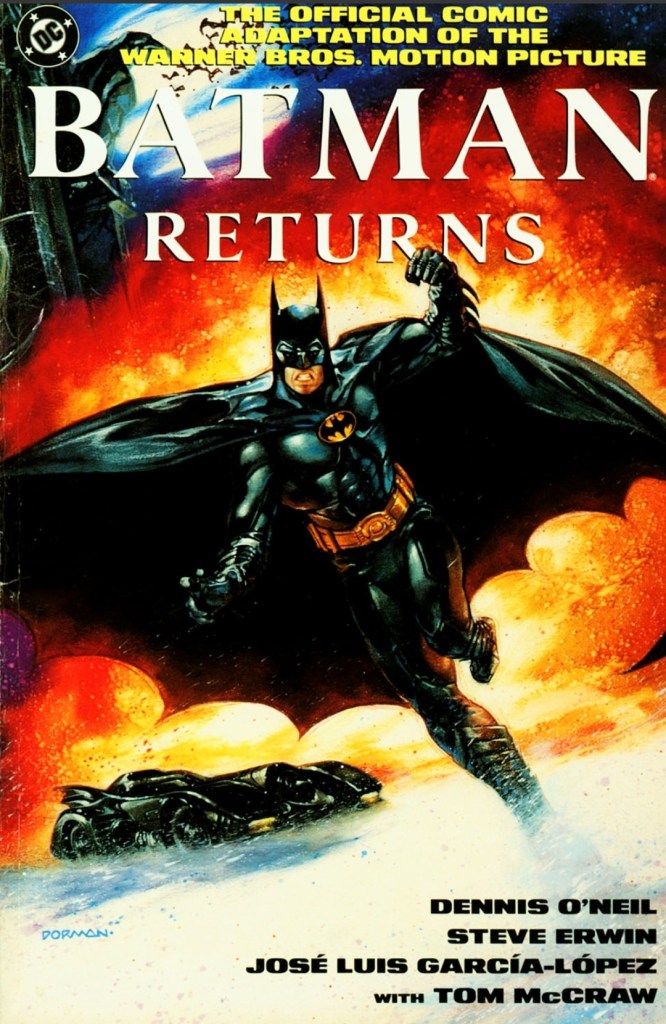
With those details laid down, here is a look back at Batman Returns: The Official Comic Book Adaptation of the Warner Bros. Motion Pictured published in 1992 by DC Comics with the adapted story written by Dennis O’Neil and drawn by Steve Erwin.
The cover.
Early story
The story begins decades into the past in Gotham City. A wealthy couple (Cobblepot family) decide to reject and abandon their infant son (Oswald/Penguin) as he was born with freakish features. They placed their son into a metal container (which itself is contained in a large makeshift basket) and dropped it on a local waterway that leads deep into the city’s sewers. At the end of the journey, large penguins find the container.
Decades later in Gotham City, tycoon Max Schreck talks to the mayor about his planned power plant project that needs permits and tax incentives from the local government to be realized. The mayor is doubtful about the project as he believes that the city has more than enough energy sources to sustain growth into the next century. Schreck insists that the local government’s analysts don’t realize the big picture about energy and economic growth. Then Chip Schreck (Max’s only heir) arrives with Selina Kyle (Catwoman) carrying coffee near him.
Minutes later, Max, Chip and the mayor arrive at Gotham Plaza for the local Christmas tree lighting. Even though he forgot to bring his speech, Max Schreck delivers remarks pretending to be caring and charitable to others. As his speech ends, two over-sized objects looking like giant gift boxes arrived nearby giving the mayor the false impression that those are clever gimmicks by Schreck.
As soon as Schreck says that those objects were not his, the oversized gift box opens violently as thugs wearing circus costumes and masks suddenly come out causing violence and hysteria to the unprepared people.
The local police activate the Bat Signal to call Batman for his assistance. Nearby, the Penguin sees it and says, “Ooh, Batman. I’m trembling…”
Quality
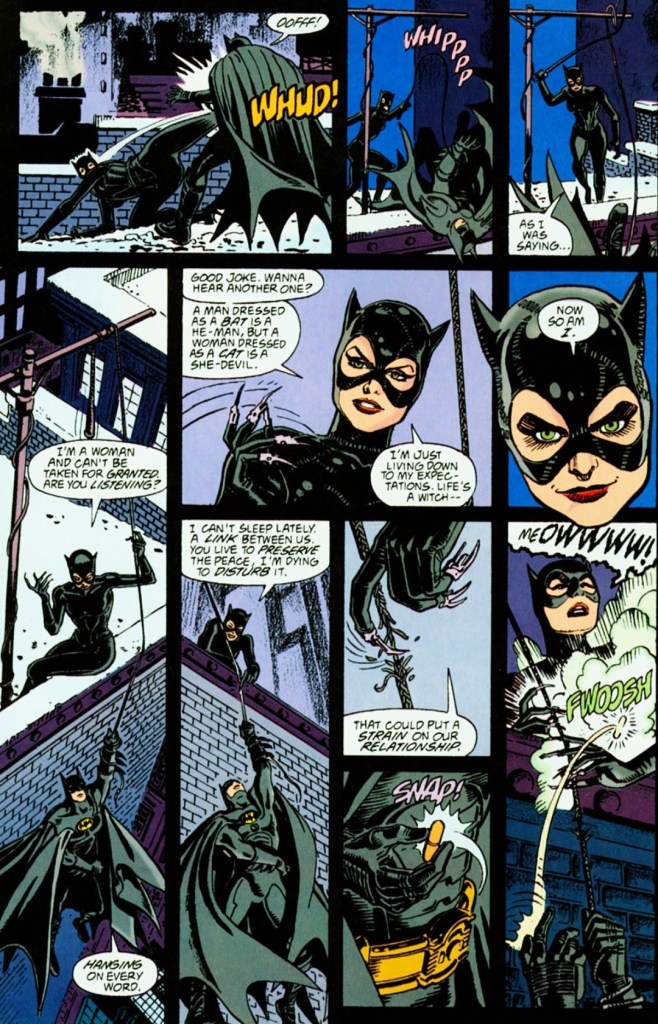
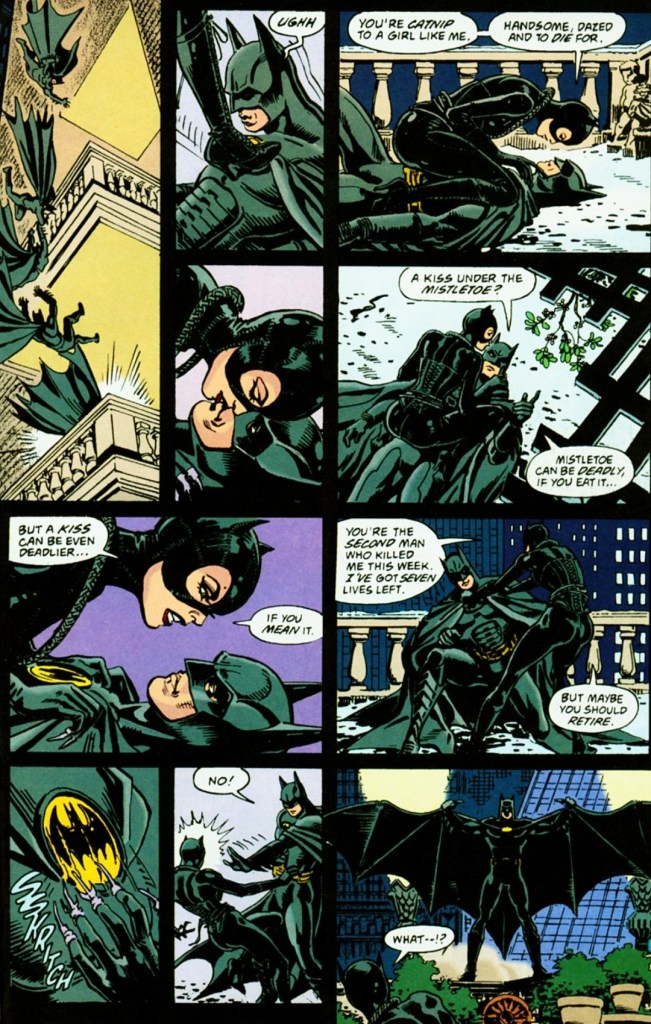
Moments from Batman’s first fight with Catwoman.
To get straight to the point regarding the narrative, this comic book adaptation does have the same basic plot and concept of the movie but with noticeable differences (whether technical or creative) that happened here and there. For the most part, Dennis O’Neil captured the concept of the movie but with less of the flavor of Tim Burton’s creative touches (which should not be surprising).
Having seen the movie, it is clear that the comic book creators reduced the dialogue and took shortcuts on adapting scenes from the film not just for the sake of brevity but to ensure they could fill the limited amount of pages to work with. That being said, I can say that the reduced dialogue from the first conversation between Penguin and Max Schreck severely weakened the impact when compared to what was executed in the film. Speaking of dialogue, the comic creators had to down key words (think of it as creative censorship) to avoid offending readers.
This is a unique, alternate portrayal at the aftermath of Selina Kyle’s fall from the high window. When compared to the movie itself, this adaptation emphasizes how far the Schrecks would go to avoid being held accountable for crimes committed.
This particular scene did not appear in the movie at all. Perhaps it was based on an older version of the film script.
When it comes to scenes between the film and this comic book adaptation, I can say that the date between Bruce Wayne and Selina Kyle inside Wayne Manor does not appear in literary form at all. Ironically, there is one scene that appeared in this adaptation (the Penguin plotting chaos in Gotham while Catwoman mentions “An orgy of sex and violence,”) that never made the final cut in the movie itself. With regards to the aftermath of Max Schreck’s violent push of Selina Kyle through the high window, this adaptation showed Max’s son Chip present (implying he witnessed his father’s act just steps away) and he goes along with his father to ensure that none of them would be held accountable for Kyle’s fall (caused by “stress” and being “depressed”).
With the way the narrative was completed, this adaptation works well but much less of the theatrical touches of Tim Burton and without the power of the respective performances of Danny DeVito, Michelle Pfeiffer and Christopher Walken (Max Schreck). Ironically, I can easily imagine Bruce Wayne/Batman sounding like Michael Keaton through dialogue.
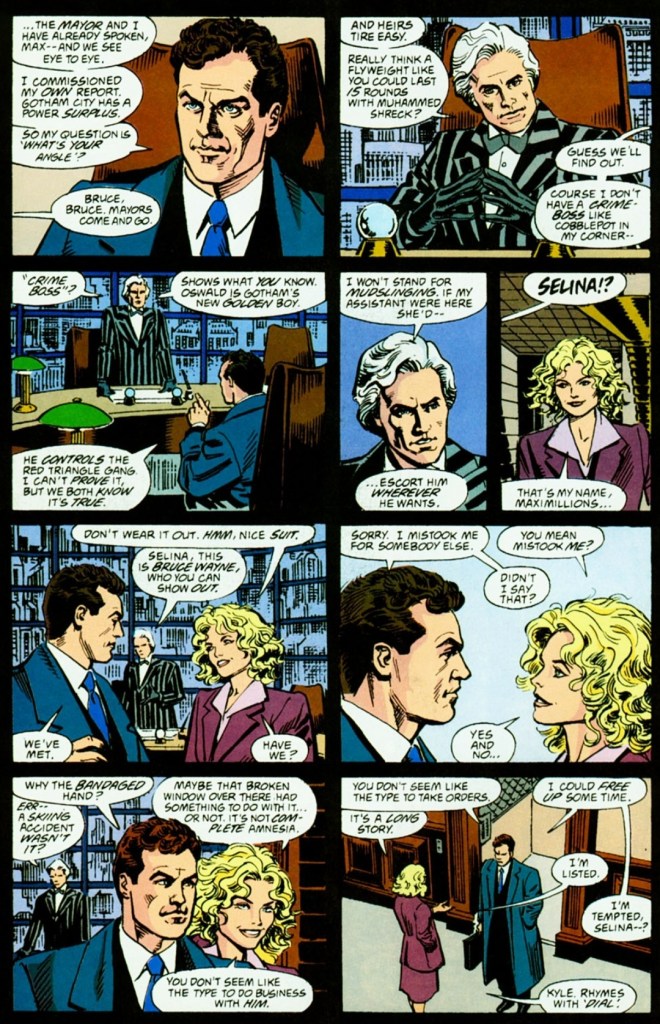
While artist Steve Erwin did not come close to capturing the likenesses of Christopher Walken as Max Schreck, and Michael Keaton as Bruce Wayne, his take on Selina Kyle is better as she somewhat resembles Michelle Pfeiffer.
With regards to the visuals by Steve Erwin, he does a good job drawing the locations and help establish geography (albeit in limited scopes) for readers to grasp. In fact, there were drawings in which Erwin literally copied location spots, objects and even camera angles from the film which suggests he had confidential access to the footage. When it comes to visualizing action, Erwin’s approach is pretty simplistic and limited. There simply was no dynamism with the action which theoretically means he had no artistic freedom (sticking closely to script while working within the limits of images per page) or he simply had no intention to make the action look spectacular.
With regards to violence connected with the action, the comic creators had to resort to creative censorship apparently to make this adaptation more acceptable with younger readers. The fall of Selina Kyle from the high window had severely reduced intensity in comic form and the horrific moments of her being surrounded by cats in the film were completely gone. Oh yes, Batman’s use of the Batarang against multiple thugs on the street was executed with a simplistic and not-so-violent (read: little impact) manner by Erwin.
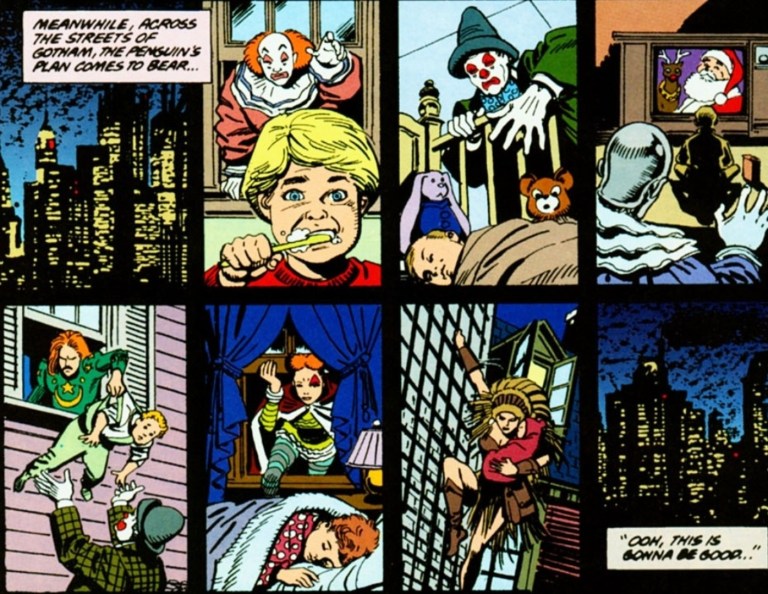
Consider this as a late-20th century portrayal of diversity and inclusion in America. By today’s standards, there are hordes of SJWs (social justice warriors), woke nuts, socialists, Communists, Marxists, and liberals who believe in diversity (racism in reverse) and inclusion (exclusion actually) so much, they intend to destroy families starting with the children.
When it comes to drawing the major characters, Erwin really falls short here. His Bruce Wayne never came close to resembling Michael Keaton and the same can be said about Max Schreck (does not look much like Walken) and the Penguin (does not resemble Danny DeVito at all and with reduced facial details, he looks nowhere as scary as the cinematic villain). Ironically, Erwin’s take on Selina Kyle comes a bit close to looking like Michelle Pfeiffer. Erwin does, however, did a good job drawing Batman and Catwoman in their fully costumed, masked appearances.
Conclusion
Very clearly, Steve Erwin had access to footage of the movie when making this adaptation.
Considering its flaws and compromises, Batman Returns: The Official Comic Adaptation of the Warner Bros. Motion Picture (1992) still works as an entertaining read and I myself have seen the movie many times. It captures the plot and several shots of the 1992 movie, but it certainly lacks Burton’s theatrical flavor and the powerful performances of DeVito and Pfeiffer. To its credit, this adaptation has several visual and literary differences compared with the movie which adds to its entertainment value. If you really want the full impact, full fun factor and artistry of Batman Returns at all, watching the movie itself is the best way. That being said, consider this adaptation as a cheaper accessible counterpart.
Overall, Batman Returns: The Official Comic Adaptation of the Warner Bros. Motion Picture (1992) is satisfactory.
Welcome back readers, fellow geeks and electronic gaming fans!
Today I am launching a brand-new series of articles titled Retro Gaming Ads Blast (RGAB) which will explore the many print ads and promotions of video games, computer games, arcade games and handheld games that were published through the decades.
For the newcomers reading this, print ads of games were widely popular and heavily relied on by gamers/players long before smartphones, social media, the worldwide web and online videos even started. Back in the old days, print media was the most common method for companies to market their games while also helping hardware (machines which played the games) reach potential buyers. Such ads appeared in magazines, comic books and newspapers. Not only that, there were several print ads of games that were made to look creative, compelling and even intriguing.
With those details laid down, here is the first batch of retro gaming print ads for you to see and enjoy…
1. Parker Brothers’ Spider-Man-led print ad
Does this ad look amusing?
Remember Parker Brothers? That was a company that started way back in 1883 founded with a strong focus on the enjoyment of games in the form of board games, cards and toys. In the late 1970s, Parker Brothers started making electronic versions of their popular board games and engaged in the video game development and publishing. They also went on to make home ports of popular arcade games in the early 1980 for several gaming platforms.
Parker Brothers was very active with making games for the Atari 2600 console which became the dominant machine for home gaming in North America in 1982. In the above print ad, their marketing heavily emphasize the Spider-Man video game for Atari 2600 and added two others games they also published – Tutankham and Amidar – which was a clever move to market multiple games. The ad’s focus on Spider-Man was amusing and even without showing a single screenshot of the game, it was enough to entice people to watch out for it. Be aware that the Spider-Man game’s development was done by Laura Nikolich who was hired by Parker Brothers at a job fair. Nikolich had full creative control on making the game and had no contact whatsoever with Marvel Comics.
2. Advanced Dungeons & Dragons: Cloudy Mountain print ad
An ad like this was strong enough to motivate gamers’ imagination and interest.
Back in 1982, Advanced Dungeons & Dragons: Cloudy Mountain was released on the Intellivision game console and I was fortunate enough to watch my next-door neighbor play it repeatedly. The above print ad – which simply referred to the game as Advanced Dungeons & Dragons – only had a few words which directly pointed to the main objective of the game…the golden crown. While only one screenshot of the game was displayed, the advertisers heavily relied on hand-drawn, comic book-style fantasy art work to sell the game.
For those who were born long after the 1980s, let me share with you that ads like these were really impressive for their time. It was common for advertisers to use art works (even though they may not accurately reflect the gameplay or game design) and post at least one screenshot to catch the viewer’s attention with the hope that it would even encourage him/her to anticipate the game. It should be noted that ads like these were strong enough to make gamers’ imagination or curiosity grow stronger.
3. Konami’s collective military video games advertising
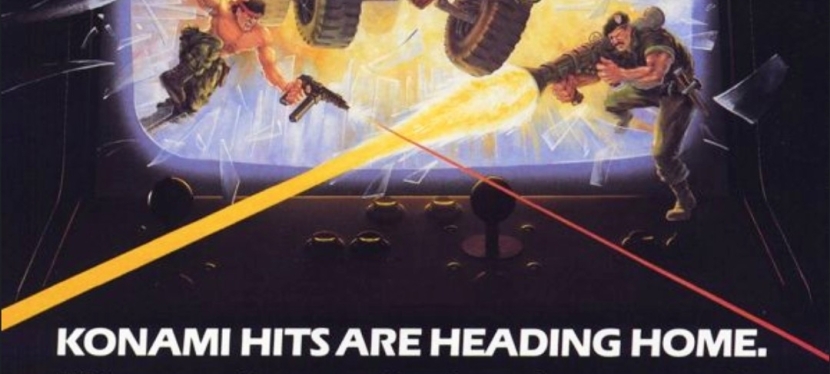
Print ad of four games for IBM, Amiga and Commodore.
Print ad of Jackal and Contra for the NES.
Konami, the Japanese company that has long been known for Metal Gear, Suikoden and the controversial sacking of famous game designer Hideo Kojima, was aggressive in the gaming business in the 1980s and arguably the aggressiveness was reflected in their publishing of several games that emphasized militarism during the late stages of the Cold War. In short, they made the military look cool and their activities fun to do in digital form.
While Konami has always been identified with console gaming, they actually released Rush’n Attack, Contra, Jackal and Boot Camp on IBM, Amiga and Commodore computers (as seen in the first print ad above) which were popular in the 1980s. The said ad also have a very amusing visual concept emphasizing the excitement and fun of military action games coming to gamers at home for their computers.
The 2nd print ad above – Jackal and Contra for the Nintendo Entertainment System (NES) – was very intriguing to see. It was very clear back in the 1980s that the NES always had a wholesome audience (note: a lot of buyers were parents who wanted to entertain their kids at home) and that includes a lot of very young players. To see the collective ad of Jackal and Contra (for the NES platform) having battle-hardened men in military gear holding guns was openly aggressive to perceive and instantly reminded people about the Cold War (and the menace of Communists, socialists, Marxists and terrorists) and the cultural impact of the mega blockbuster film Rambo: First Blood Part II. This is the kind of ad that would drive today’s woke-minded people crazy and even cause them to panic and pretend to be victims of militarism and patriotism. If you look at the ad closely, you will realize there is simply no room for the garbage of political correctness and wokeness.
Lastly, I myself had played Contra and Jackal with my friends on the Nintendo Family Computer (the Japanese counterpart of the NES) and both military games were a lot of fun to play from start to finish!
4. Batman Returns SNES game ad
This print ad appeared in some comic books I read in the early 1990s.
Way back in 1992, Batman Returns (the sequel to the mega blockbuster Batman movie of 1989) was released in cinemas with intense marketing and merchandising reflecting Warner Bros. intention to replicate the commercial success they had in 1989. Along the way, there were several video game adaptations of Batman Returns that were released on different platforms. Among those many video games was the Super Nintendo Entertainment System (SNES) game of Batman Returns which was developed and published by Konami in 1993 the form of a side-scrolling beat-them-up game.
The above ad was visually appealing with hand-drawn, comic book-style art dominating the spaces while leaving room for some screenshots and a written description of the game. Having seen this ad on multiple comic books I read back then, I can say that the ad was entertaining to see and was effective in making me interested in the game. I played Batman Returns on the SNES but never got to finish it. Oh yes, the game’s audio were really good and there were also digitized images from the movie for the in-game narrative.
5. Flashy Sonic the Hedgehog Japanese print ad
A dazzling approach by Sega on selling Sonic the Hedgehog.
1991 will always be remembered as the year of Sonic who eventually became not only Sega’s most defining mascot but also a video game industry icon. That same year, Sega released Sonic the Hedgehog on the Sega Genesis (referred to as Sega Megadrive in other parts of the world) console and it became a massive success with consumers and the game critics.
In the above Japanese print ad, a very captivating display of light and energy rays dominated the space leaving a minority share left for Sega’s console, screenshots and even a UFO Catcher arcade machine picture. While I could not understand the Japanese text, it seems to me that the flashy visual concept of the ad reflected Sega’s high ambitions with Sonic. How many gamers in Japan bought a copy of Sonic the Hedgehog because of this ad remains undetermined.
6. Japanese Super Star Wars print ad
A long time ago in a galaxy far, far away…
Before Nintendo released its 16-bit game console (referred to as Super Nintendo Entertainment System in America, and Super Famicom in Japan), there were lots of Star Wars video games released on varied platforms and the arcade.
With Nintendo’s 16-bit gaming platform realized, lots of game designers and business partners saw opportunities to make new games with gameplay concepts and designs using the technological advantages of the time. For LucasArts and its partners, taking Star Wars gaming into the next level was inevitable and they made it all come true in 1992’s Super Star Wars video game.
Published in Japan by JVC Musical Industries for the Super Famicom, Super Star Wars was a major leap forward in game design, visuals, sound and enjoyment. Apart from the 2D side-scrolling run-and-gun gameplay, gamers were deeply immersed into Star Wars’ universe with the Mode 7 landspeeder and X-Wing fighter sequences, as well as the first-person trench run sequence.
The Japanese print ad above cleverly presented screenshots from the game while using official imagery from the Star Wars movie poster of 1977 (look at how young Harrison Ford, Mark Hammill and the late Carrie Fisher were back then). The ad is a fine example of combining the greatness of the classic George Lucas-directed film with the highly enjoyable design of Super Star Wars. Lastly, these should remind you that there was a time when Star Wars was not yet tainted by wokeness and the garbage values of the Satanic Leftists (read: woke Disney).
Have you been searching for something fun or interesting to watch on YouTube? Do you feel bored right now and you crave for something to see on the world’s most popular online video destination?
I recommend you check out the following topics and the related videos I found.
#1Xbox-related announcements at The Game Awards 2023 – The Game Awards 2023 edition took place recently and like many of its previous editions, it was a spectacle of video game awards as well as announcements of upcoming games. Team Xbox, which now has giant publishers Activision-Blizzard-King and Bethesda under its umbrella, came out with very notable video game announcements that not only includes Hideo Kojima’s Xbox project but also a brand new game (the licensed property of a very popular entertainment brand) which I never anticipated coming. I should also state that Square Enix’s announcement of Visions of Mana includes the Xbox Series X and Xbox Series S for future release. Watch the videos (including one from a YouTuber) below…
#2 Godzilla Minus One makes impact in America – While its current theatrical distribution in America is not too great, the Japanese-made Godzilla Minus One movie managed to make an impact with moviegoers and critics there. In fact, Toho’s newest Godzilla film even topped the American box office on specific days during the week (click here and here) even though it came with English subtitles (with original Japanese voices throughout) that had to be read by moviegoers. Why is Godzilla Minus One making an impact in America? Watch the videos below…
#3 The evil of the Islamo-Left – It is not surprising at all that Leftist elements continue to take sides with the Palestinian terrorist group Hamas while opposing Israel’s war efforts in the Gaza strip (Israel’s response to Hamas’ October 7 terrorist attacks and abduction of hostages). If you do your research of history, you will realize that the unholy alliance between Islamic terrorists and Leftists actually go a long way back. That alliance is referred to as the Islamo-Left which is composed of Islamists and Leftists who are united by their hatred for Israel and their desire to commit genocide against the Jewish people. The Islamo-Left is the evil force that needs to be rejected and defeated. I also want to state again that the Palestinians are NOT the indigenous people of Israel, the Palestinians have no right to the land of Israel, and the Palestinians are still living under the wickedness of their leaders (Hamas and the Palestinian Authority). Learn more by watching the video below…
#4 Beware of charismatic criminals – In this divided world we live in, there are certain charismatic individuals who wield so much power, they managed to deceive people and commit crimes believing they could simply get away with it all. The charismatic criminals of recent times are specifically Elizabeth Holmes (convicted), Sam Bankman-Fried (convicted) and Charlie Javice. To find out who the charismatic crooks are, what happened to them and why you must never let them deceive you, watch the videos below…
#5 Unite with the Right to push back against the Satanic Left – Shifting to geopolitics, Sky News Australia published two videos that must be seen. The first one is about the political Right gaining significant ground in the Netherlands and Argentina (following the very inspired political shift related to Giorgia Meloni’s rise to power in Italy in 2022). The 2nd video shows why the Satanic Left often leads people to social, political and economic ruin as seen in Argentina. Let these two videos inspire you and members of your community to rise up against the Leftists and be united with the Right in future elections as well as with ongoing developments of the current government. Never let the Satanic Left take even the slightest space away from you. Communists, socialists, Marxists, liberals, diversity fanatics, inclusion fanatics, LGBT activists, the woke nuts, pro-Palestine zealots and all those other wicked Leftist elements are simply too chaotic to be given power.
Disclaimer: This is my original work with details sourced from reading the comic book and doing personal research. Anyone who wants to use this article, in part or in whole, needs to secure first my permission and agree to cite me as the source and author. Let it be known that any unauthorized use of this article will constrain the author to pursue the remedies under R.A. No. 8293, the Revised Penal Code, and/or all applicable legal actions under the laws of the Philippines.
Welcome back superhero enthusiasts, 1980s culture enthusiasts and comic book collectors! Today we go back to the early 1980s to explore Marvel Comics’ launch of a comic book series based on the wildly popular military-themed franchise of toys – G.I. Joe: A Real American Hero.
For the newcomers reading this, Hasbro launched the G.I. Joe: A Real American Hero toyline in 1982 which was actually a revival of the original G.I. Joe series of toys (sized 12 inches) in the 1960s and 1970s. G.I. Joe: A Real American Hero toys had a new format for its action figures influenced by the success of the Micronauts and Star Wars toys. Veteran writer Larry Hama (the same guy behind the memorable Wolverine #75 of 1993) was already working for Marvel and was developing the concept of a new comic book about elite commandos fighting terrorists. Such development happened before the 1982 relaunch of G.I. Joe, and eventually Marvel’s editor-in-chief Jim Shooter approached Hama for a new comic book project based on Hasbro’s military toyline. Eventually a series of developments followed that saw the creation of the evil organization Cobra, the core villain Cobra Commander and more.
The impact of G.I. Joe as a licensed comic book series turned out positively as it helped attract new readers at the newsstands and it developed a strong following with young readers who were not highly interested with superheroes.
With those details laid down, here is a look back at G.I. Joe: A Real American Hero #1 published in 1982 by Marvel Comics with the main story written by Larry Hama and drawn by Herb Trimpe.
The cover.
Early story
The story begins with an Amtrak train traveling between New York City and Washington, D.C. Inside the nuclear physicist Dr. Adele Burkhart who previously served as one of the brains behind the Doomsday Project. It turns out, Burkhart was declared a traitor for denouncing the military claiming that she was misled by them to work on the said project. Inside the train, she has several security personnel guarding her as she is on her way to testify in front of a certain congressional committee.
As she speaks during a press conference inside one of the train’s cars, several flying soldiers of Cobra attacked the exterior of the train. In front of Burkhart, a few of the journalists turned out to be elements of Cobra led by the Baroness. The Baroness and her companions succeed in defeating the bodyguards and kidnapped Burkhart by means of flight.
At the Pentagon, the kidnapping of Burkhart compels the military to call in their special counter-terrorist group called G.I. Joe for a rescue operation. The stakes are high as they know that they cannot let Cobra keep Burkhart long enough to use her and they cannot let her die as the whole world is aware that they considered her an embarrassment. They ordered Colonel Clayton Abernathy (code name: Hawk) to assemble the Joe Team composed of Clutch, Flash, Breaker, Rock ‘n Roll, Scarlett, Stalker, Short-Fuse and Snake-Eyes…
Quality
Dr. Burkhart held hostage by Cobra and in the presence of Cobra Commander, the Baroness and many terrorists.
To get straight to the point, the main story (Operation: Lady Doomsday) was carefully structured by Hama to tell a story engagingly while also functioning to introduce readers to the characters and immersing them into the illustrated literary universe of G.I. Joe that is noticeably separated from the popular cartoon series. It is a classic portrayal of good versus evil laced with militarism and espionage.
The story moved at a medium pace and the approach on build-up and pay-off was executed carefully. There were scenes that had a sufficient amount of details regarding the plot or character moments (as opposed to development) that made the reading experience immersive. In short, there was no rush in the narrative while the pace never slowed down to a halt (no boring moments).
That being said, you will get to see lots of scenes that focus on the side of G.I. Joe as well as on the side of Cobra which is led by Cobra Commander (who is obsessed and scheming) followed by the Baroness (who is more focused on achieving goals but cannot do so without authority). You will see a certain gap between Cobra Commander and the Baroness which shows something seems off within their terrorist organization. This served as a creative contrast with G.I. Joe being more straightforward with the way they organize themselves.
The only weakness this comic book has is the fact that with so many characters from both the good and the bad sides, identifying them was pretty challenging especially when their military uniforms obscured their looks. Characters like Cobra Commander, Snake-Eyes, Scarlett, Rock ‘n Roll, Stalker and the Baroness are instantly recognizable.
As the main story remains a really good read, the 2nd story (Hot Potato) also written by Hama but drawn by Perlin served as a nice additive to this comic book.
Conclusion
G.I. Joe starts getting ready for the high-stakes rescue mission.
G.I. Joe: A Real American Hero #1(1982) is indeed a very solid reading experience. This is a strong introduction of the literary version of G.I. Joe and its portrayal of good versus evil remains believable and compelling. I also enjoyed the way the creators balanced the build-up of tension, plot and character moments with spectacle or twists utilized as pay-off. Lastly, I should say that this comic book has lots of action for you to enjoy and the execution of the action scenes made sense within the context of the stories. Remember that this marked the beginning of a memorable long run of G.I. Joe comics that reached into the 1990s. This one is a true classic and it should remind you that there was a time when political correctness and wokeness did not get in America’s way of fighting terrorists.
Overall, G.I. Joe: A Real American Hero #1(1982) is highly recommended!
Disclaimer: This is my original work with details sourced from watching the movie Cloak & Dagger (1984) and doing personal research. Anyone who wants to use this article, in part or in whole, needs to secure first my permission and agree to cite me as the source and author. Let it be known that any unauthorized use of this article will constrain the author to pursue the remedies under R.A. No. 8293, the Revised Penal Code, and/or all applicable legal actions under the laws of the Philippines.
Welcome back my readers, fellow movie buffs and 20th century pop culture enthusiasts! Decades ago, I got to watch the movie Cloak & Dagger when it was first released on home video. As time passed by, I got to replay it on cable TV and DVD. I have yet to see its 4K Blu-ray disc version (note: you can order it here) Starring Henry Thomas (the star of Steven Spielberg’s E.T.: The Extra-Terrestrial) and Dabney Coleman, Cloak & Dagger was one of those American movies that did not succeed in movie theaters but found its audience on home video, cable TV and free TV.
The 1984 movie was released at a time when video games gradually made its way into motion pictures in varied ways just before Nintendo started reshaping video gaming. Back then, I was very young and already got into playing games on console and at the arcade which helped me relate with the video game elements of Cloak & Dagger. In case you are wondering, the filmmakers and Atari, Inc. itself collaborated together. There may be some among you who never saw this 1980s flick and some of you may be wondering what is significant about Cloak & Dagger and why is it the topic of this retro movie review.
With those details laid down, here is a look back at Cloak & Dagger (1984) directed by Richard Franklin and written by Tom Holland and Nancy Dowd inspired by the short story “The Boy Cried Murder” written by Cornell Woolrich. This movie is the 4th cinematic adaptation of the said short story.
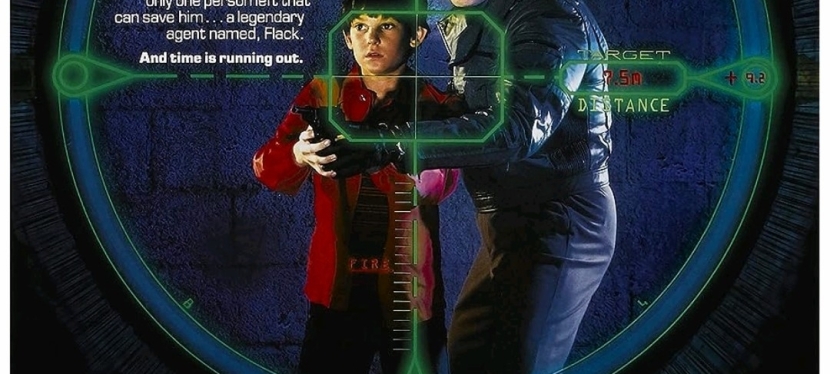
The movie poster of Cloak & Dagger (1984)
Early story
The story begins with Jack Flack (Dabney Coleman) overcoming Soviet guards to enter a place to retrieve top secret documents from incoming people. It turns out that Jack Flack is nothing more than a fictional character imagined by a young boy named Davey (Henry Thomas) who keeps on immersing himself with flights of fantasies, loves playing games and believes that real life is filled with enough opportunities and places to play. In the presence of game store owner Morris (William Forsythe) and his little blonde neighbor Kim (Christina Nigra), Davey boasts a lot about Jack Flack as if he was a real-life hero and even talks to him as his imaginary companion that no one else could see nor hear. Inspired by the said character and the world of espionage he always imagined, the boy carries with him a black water pistol for a “gun” and a softball for a “grenade”.
Morris then sends Davey and Kim out to do a real assignment – an errand to travel within the city going to a certain company and retrieve something for him. Afterwards, the two commuted and entered a building which Davey does with his fantasy of espionage and infiltration burning in his mind. Leaving Kim on the ground floor, he climbs up the stairs until he reaches a certain window and sees something sinister going on in the next level as reflected on one of the windows outside.
Suddenly a door opens near him and a wounded man slowly hands him an Atari 5200 cartridge titled Cloak & Dagger, tells him to bring it to the FBI, and mentions “one million three hundred twenty nine.”
The door near them suddenly opens with two armed men emerging. Right in the presence of Davey, they opened fire at the wounded man who fell down to his death. Davey just became the witness of an actual murder and becomes the target of the two gunmen…
Quality
Henry Thomas and Christina Nigra as Davey and Kim respectively.
To get to straight to the point, I can declare that this movie is very clearly a spy thriller designed to engage both children and adults. It took the key concept of the short story “The Boy Cried Murder” and implemented it into its very own tale that happens to be set during Ronald Reagan’s America (the 1980s) with elements of video games, espionage and even murder mixed together.
The story told through Davey was crafted to be entertaining while keeping viewers in suspense as to how the overly imaginative young boy would deal with real-life danger and consequences as he became the target of murderous men who would not stop at all. Davey is clearly in danger for much of the movie and you will get to sympathize with him and wish he should stop being obsessed with fantasy so he could overcome the trials that were happening. This is, indeed, a well structure and nicely directed work by Richard Franklin who seem to be inspired by past works of Alfred Hitchcock (note: Franklin directed the sequel to Hitchcock’s classic Psycho).
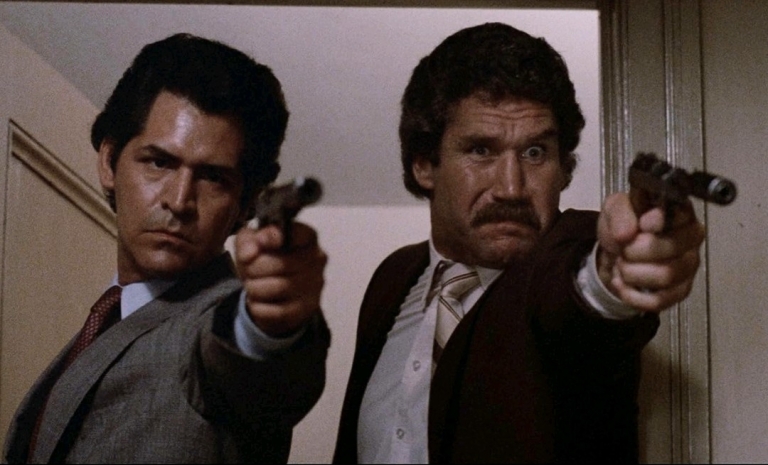
As mentioned earlier, this movie was made to engage both children and adults. Cloak & Dagger is not exactly a wholesome viewing experience as its presentation has always been quite intense because of on-screen violence that was executed carfully. There are guns, shooting and even killing in this flick which proved to be integral to the overall presentation and clearly added to the thrill factor. You will get to see getting Davey shot at by the armed henchmen (Eloy Casados and Tim Rossovich) who clearly do not give a damn of shooting a minor as they are so focused on their mission. Looking at the henchmen in this film, I can imagine them as traitorous Americans conspiring with their nation’s foreign enemies such as the Soviets, the Iranians and the Palestinians. Along the way, there is the clear villain named Rice (Michael Murphy) who has this subtle touch of evil as well as a good amount of sleaziness in him. While the violence is intense, it does not necessarily push this film into rated R territory.
Michael Murphy as the sleazy villain who is willing to kill Davey even though he is a minor.
The two henchmen about to commit murder in the presence of Davey. There is evil visible in their faces.
Henry Thomas really shines as the protagonist here. While Davey here shares a few elements with E.T.’s Elliot – struggling to move forward with the absence of one parent and adjusting his life with what he perceives to be the best ways possible – he truly dramatizes how weird and wild he could be living his life with a very loose grip on reality. For him, local society in San Antonio, Texas, provides him a huge playground for his spy game and he sure distracts people as he walks by them talking to his imaginary friend Jack Flack. Still, there are key parts of the story in which Henry Thomas convincingly dramatizes Davey who feels lonely inside as he misses his late mother and is unable to spend quality time with his father. Thomas also acted with intensity in the scene in which he makes a trade with the villain and also during his last face-off with him in the 2nd half of the film. Henry Thomas really was a good youth actor and his performance here is often overshadowed by his role in Spielberg’s E.T.
Dabney Coleman on the other hand plays both Jack Flack and Davey’s father Hal. Coleman is quite versatile playing different characters here. As Jack Flack, he fits in excellently into Davey’s uncontrolled belief of espionage as he gives him advise which were taken seriously leading into danger. Of course, advising Davey does not really mean the fictional spy cares for him on a personal level and you will eventually Flack’s true value before the film ends. Flack’s final moments could inspire you to re-examine the true meaning of heroism. As Hal, Coleman convincingly plays the father who has been so busy working in the Air Force as an air traffic controller, he has been unable to spend quality time with his son and the recent death of his wife really took its toll on their family. Compared to Jack Flack, Hal is indeed caring towards his son but his hectic work schedule prevents him from bonding closely with him. Coleman delivered a fine performance during the scene when Hal explains to Davey what real-world heroism is and that not all heroes just shoot bad guys. There definitely are helpful values on parenting within Hal.
Henry Thomas and Dabney Coleman are really convincing as son and father.
Thomas and Coleman artistically have really fine chemistry together as the father and son (Hal and Davey) and as the wannabe adventurer spending lots of time with his action hero (Davey and Jack Flack). Considering Davey’s obsession with fantasy and the attention he pays so much to Jack Flack, he was practically living with idolatry and foolishness. If you observe closely, Davey is very lively with Flack and not so lively with his father.
Even though this movie is fictional, it still dramatizes that parenting will never be easy. That being said, this should inspire parents and also incoming parents to prepare themselves on nurturing their children and ensure they help them understand the differences between reality and fantasy.
Video game elements
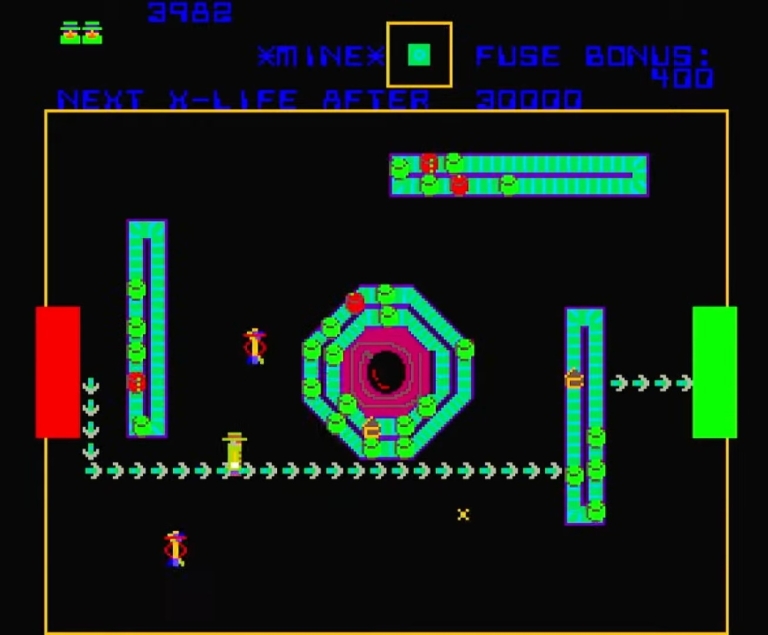
Screenshot from the Cloak & Dagger arcade game. This game can be played nowadays through Antstream Arcade on Xbox consoles.
To make things very clear, Cloak & Dagger (1984) is not an adaptation of the electronic game that was released the same year. Rather it has the Cloak & Dagger game as a key plot element in the form of an Atari 5200 game cartridge (referred to as a “tape”) which the movie dramatizes to be real.
As a kid, I got to play arcade and console games a lot. As such, seeing Davey play the Cloak & Dagger game on his Atari 5200 as well as gameplay footage was a very entertaining viewing experience for me the first time I ever saw this movie. It was a scene I personally related with.
In real life, however, the Cloak & Dagger game from Atari, Inc. was released only in the arcades as the efforts to create a port for the Atari 5200 never got fulfilled. That being said, it was through very clever film editing that video footage of the arcade version were inserted into the scene in which Davey played the Cloak & Dagger cartridge on his console in the presence of his father. To clarify things, the Atari 5200 was a commercial failure in real life and it seems that making a console version of the arcade game did not make business sense to Atari, Inc. at all.
If you want to play the Cloak & Dagger arcade game in your home right now, you will need an Xbox console and Antstream Arcade ($30 for 1-year subscription, $80 for lifetime pass). Cloak & Dagger is just one of over a thousand games available through Antstream Arcade and you can learn more by clicking here and here.
Conclusion
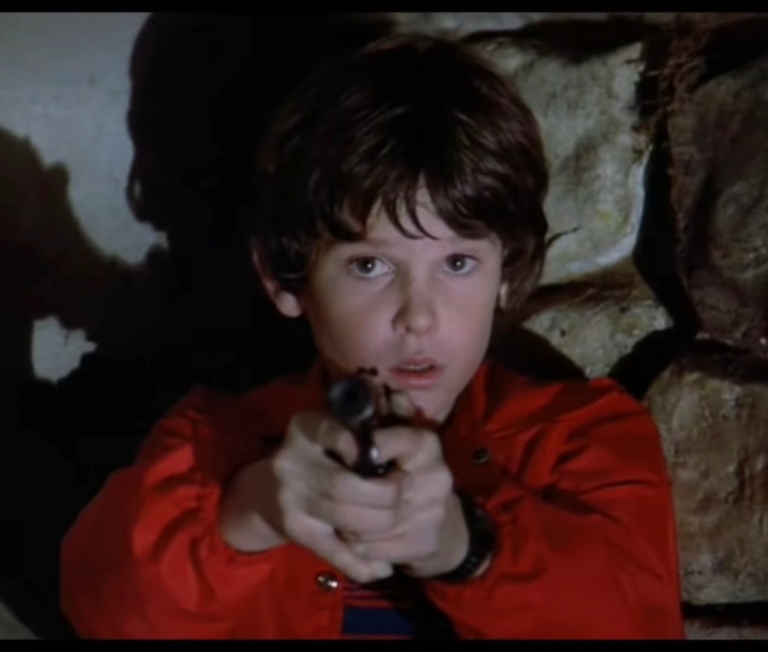
Henry Thomas as an armed Davey.
I have seen Cloak & Dagger (1984) many times throughout my life from childhood and to adulthood. I can clearly say that this 1980s movie is still really good to watch as its appeal to both children and adults remains strong and intact. It is a medium-paced spy thriller that not only follows a young boy who witnesses and murder and gets into danger (note: even his neighbor gets involved) but also dramatizes (in entertaining ways) how dangerous situations can get when you are living with uncontrolled personal fantasy and interacting with a heroic friend who does not really exist. Considering the time this movie was released, I am delighted to tell you cautious readers that there definitely is no wokeness nor were there any traces of political correctness that got in the way of its presentation. Going back to the parenting aspect of this film, it is made clear that children need their parents for moral support and there is absolutely no way that games, fictional heroes and geek culture could ever be good alternatives. Like the adults, children should never lose their grip on reality and should be taught that uncontrolled fantasy can lead to real-life danger. Very clearly, director Richard Franklin and the crew did a fine job telling a solid story and emphasizing the main characters while also providing suspense, action and thrills.
Considering all the mixed elements it has, Cloak & Dagger (1984) can be engaging towards parents, their children, fans of espionage and people who love video games. Finally, I should state that the City of San Antonio in the Lone Star State of Texas is indeed a great location for filmmaking and viewing.


















 Author Carlo Carrasco