Retro Gaming Ads Blast – Part 47

Welcome back readers, fellow geeks and electronic gaming fans!

In this edition of the Retro Gaming Ads Blast (RGAB) series, we will take a look at another batch of retro gaming print ads from the 1980s to the 1990s.

For the newcomers reading this, Retro Gaming Ads Blast (RGAB) looks back at the many print ads of games (console, arcade, computer and handheld) that were published in comic books, magazines, flyers, posters and newspapers long before smartphones, social media, the worldwide web and streaming became popular. To put things in perspective, people back in the 1980s to the 1990s were more trusting of print media for information and images about electronic games and related products.

With those details laid down, here is the newest batch of retro gaming print ads for you to see and enjoy…

1. Atari Console and Games Print Ad
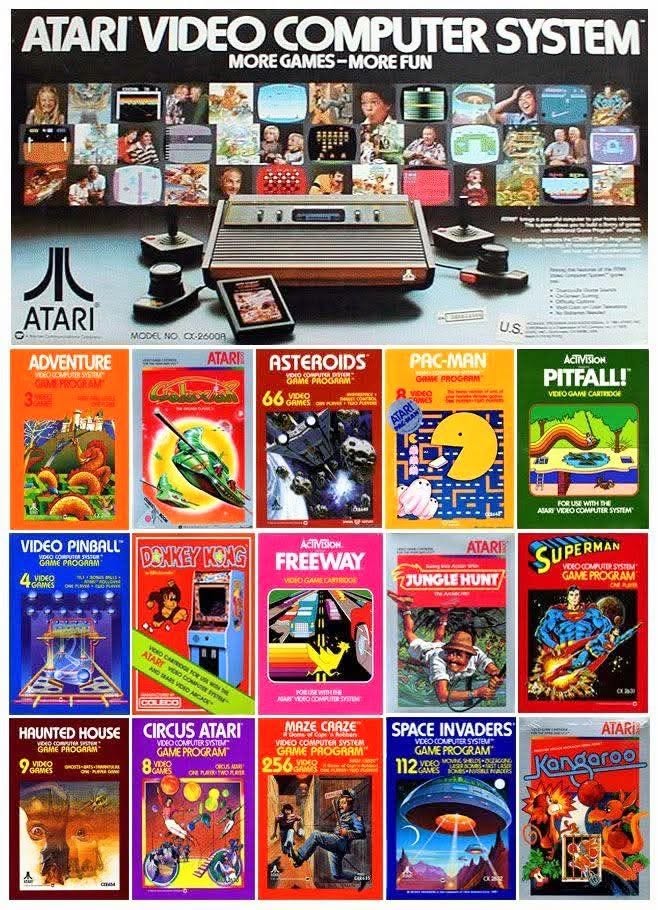
Atari video game console advertisement featuring various game titles and cover art.
Back in the 1980s, this was simple and yet exciting to look at.

Back in the 1980s, the styles of video game advertising were very different. Back then, Atari was the market leader on console gaming with the Atari 2600 and they had a lot of video games made for it. As such, the above print ad showing the console and the video games (with the front covers of the game boxes) was typical of the era and it was captivating to look at. By today’s standards, the ad looks simple but it still has the appeal to lure gamers.

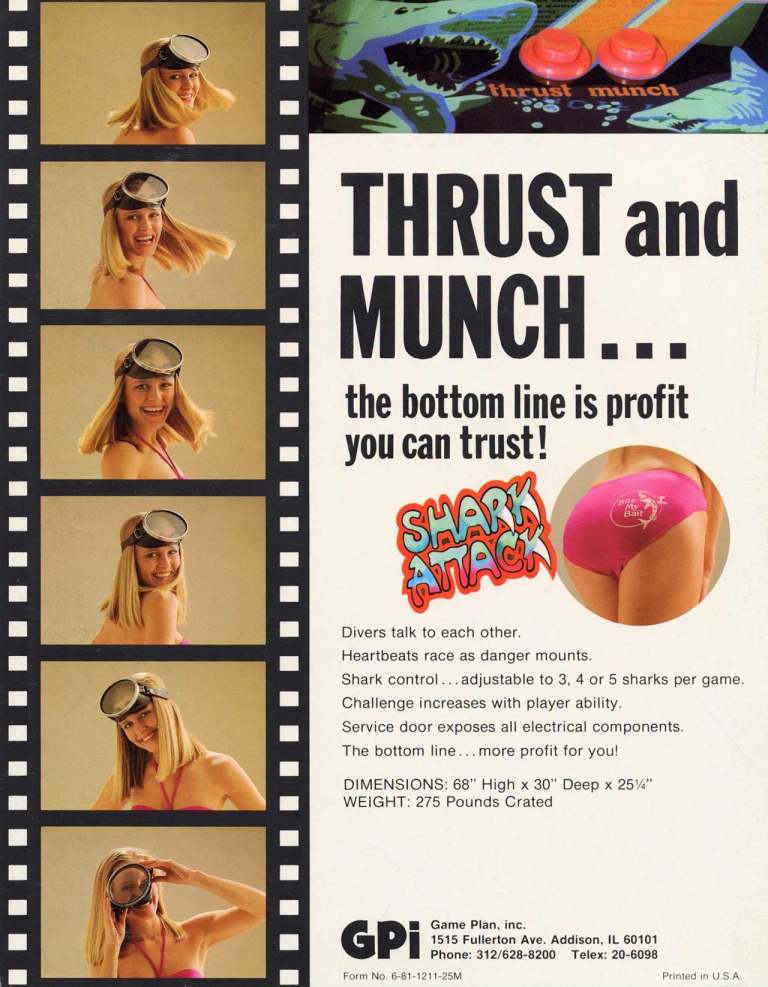
2. Shark Attack North American Arcade Flyer
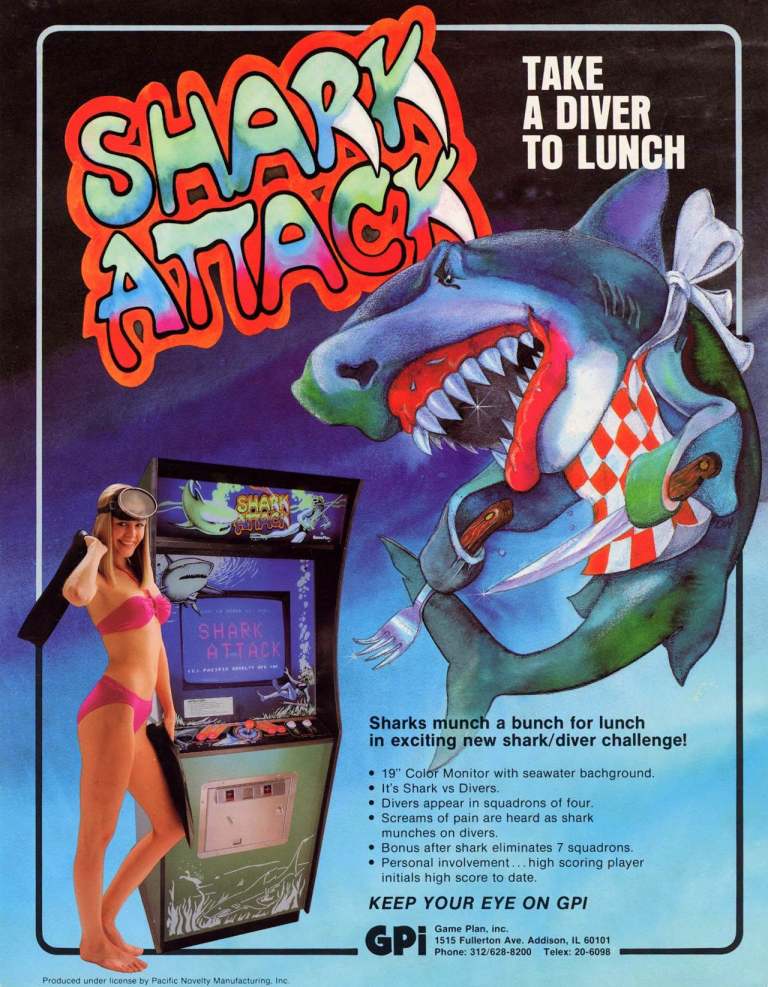
An advertisement for the arcade game 'Shark Attack', featuring a cartoon shark and a woman in swim gear, promoting gameplay where players experience a shark diver challenge.
The front.
Promotional image for an arcade game called 'Thrust and Munch' featuring a woman wearing a diver's mask, smiling. The background includes text highlighting game features like shark control and dimensions.
The rear.

Remember long ago when Steven Spielberg’s Jaws made some people afraid of sharks and the sea? Jaws was a massive blockbuster, and it was influential to the public. A few years later, Universal Pictures pushed through with Jaws 2 without Spielberg, and it also was a huge commercial hit. By the start of the 1980s, creature feature films inspired by Jaws were released and pop culture itself was influenced. In 1981, the obscure arcade outfit Pacific Novelty Manufacturing released their game Shark Attack in arcades. To promote the game, the company came up with an arcade flyer that had a comedic touch on the text descriptions while featuring a pretty blonde fashion model posing as the diver. The front of the flyer had the arcade cabinet, the model and an exaggerated artwork of a shark holding a knife and a fork. On the rear, the sexiness was ramped up with a shot of the model’s behind (plus more pictures of the model herself). This is indeed an amusing and funny arcade flyer.

3. Centipede North American Arcade Flyer
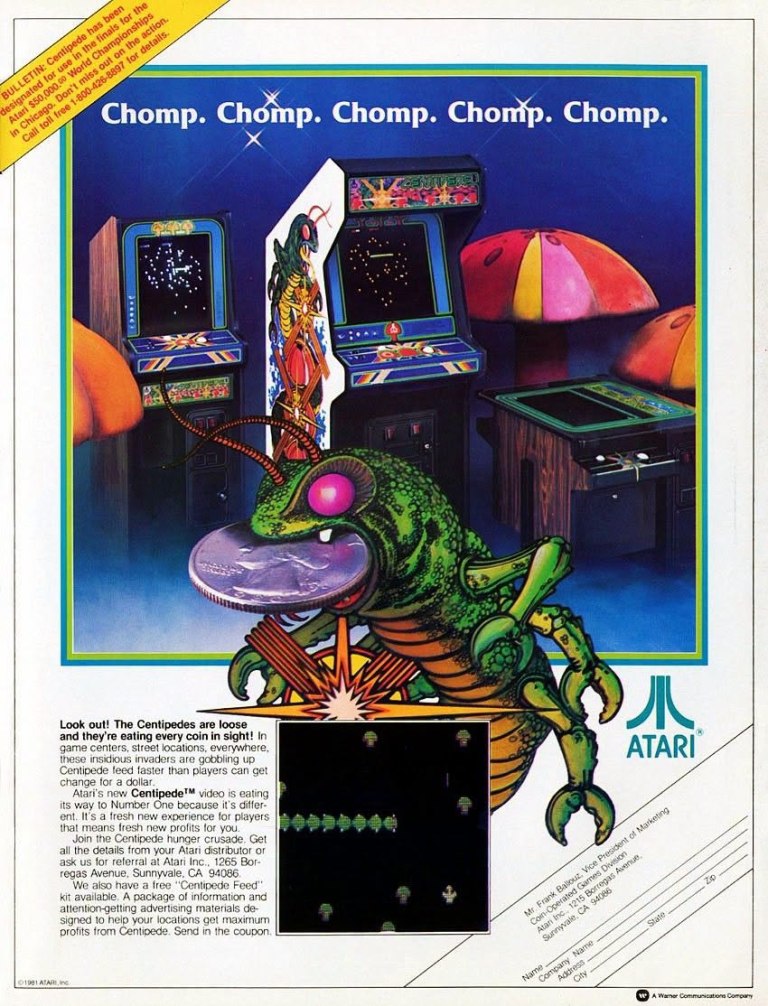
Promotional poster for Atari's Centipede video game featuring colorful artwork of a centipede character and arcade game machines in the background.
This was designed with arcade operators in mind.

When Atari released Centipede in arcades in 1981, it attracted a lot of gamers and became a huge commercial hit. Part of its success is linked with the strategic promotions Atari committed, and the above arcade flyer is one of the variants of Centipede flyers. The one above shows an illustrated centipede carrying a coin in its mouth and in the background are two different arcade cabinets plus a cocktail table machine (for those who want to play Centipede while sitting down). This particular arcade flyer of Centipede emphasizes the popularity of the game and there are different types of machines that arcade operators can choose from. At the same time, this old flyer remains amusing to look at.

4. Rambo Famicom Japanese Print Ad
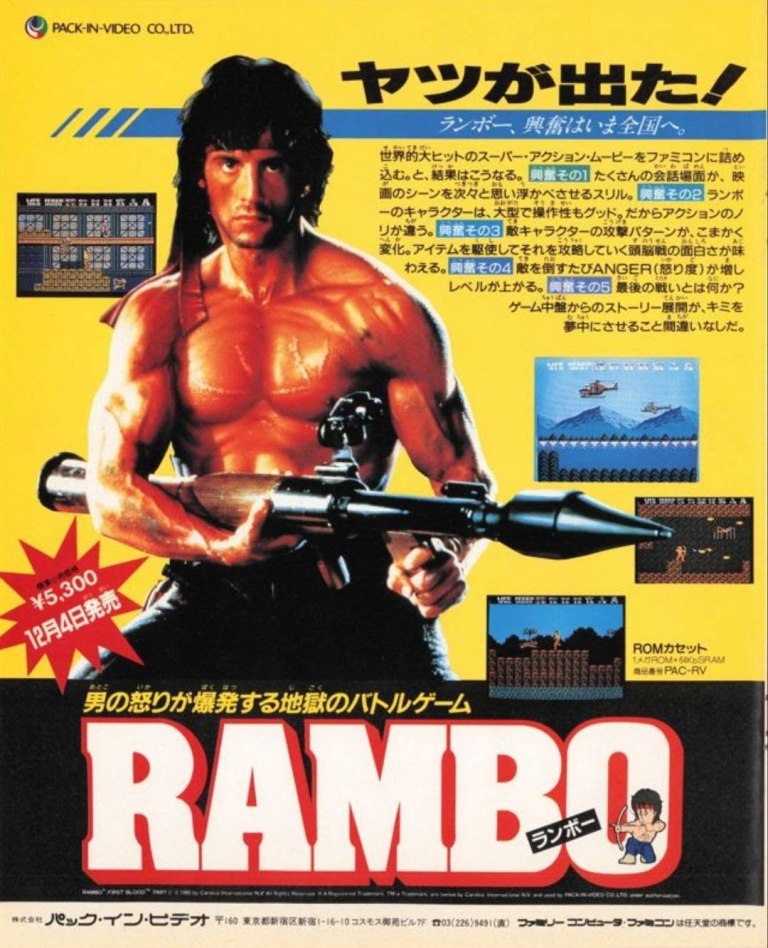
A promotional poster for a Rambo video game featuring a muscular man holding a weapon. The background is yellow with text in Japanese and images of the game on the right side. The large text reads 'RAMBO' in bold letters at the bottom.
Using this iconic imagery of Sylvester Stallone as Rambo was a very smart move.

When it comes to Hollywood action movies of the 1980s, Sylvester Stallone was highly successful, and he impacted American pop culture with the Rocky and Rambo films. By 1985, Stallone struck gold with Rambo: First Blood Part II which made over $300 million worldwide. Considering the Cold War theme and ambitious action scenes of the movie, it was clear for Japanese game developer Pack-In-Video to make an official video game adaptation of Rambo: First Blood Part II for the Nintendo Family Computer (Famicom) in the form of a 2D side-scrolling adventure game. The said game was simply titled Rambo and to promote it, the company came up with the above Japanese print ad that had the iconic Rambo image of Stallone holding the rocket launcher, and a few screenshots of the game itself. If you look closely at the lower-right corner, you will see a cartoonish hand-drawn art of the Rambo character with a bow and arrow. Considering how very popular Stallone, his character and the movie were, it made a lot of sense to promote the Rambo Famicom game like this in Japan. 

5. Gyruss Family Computer Disk System Japanese Print Ad
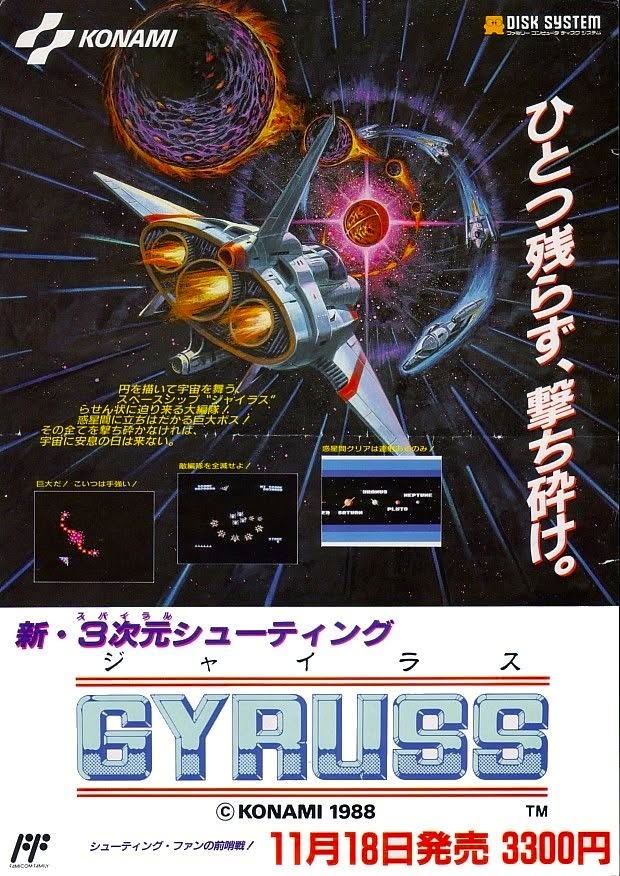
A retro video game advertisement for 'Gyruss' by KONAMI, featuring a spaceship amidst a colorful space backdrop with planets and swirling galaxies. The poster includes gameplay screenshots and promotional text in Japanese, with the release date and price displayed.
Gyruss was Konami’s first-ever game developed for the Famicom Disk System of Nintendo.

In 1983, Konami released Gyruss, a science fiction tube shooter designed by Yoshiko Okamoto. The game was a huge arcade hit and it really attracted a lot of players who enjoyed the unique game design and spaceship shooting. Konami licensed the game to a few companies which resulted in the creation and release of Gyruss ports for different consoles and home computer systems. In 1988, Konami released an enhanced Gyruss port for the Family Computer Disk System of Nintendo. To promote the Famicom Disk System port, Konami came up with a print ad that had a nicely detailed painted artwork of a spaceship (representing the player) about to hit incoming enemies deep in space, 3 screenshots and the official price and release date displayed. The artwork is still captivating to look at and the port itself features major overhauls that arguably made it better than the arcade original. Konami really went the extra mile for this Gyruss port.

6. Operation Thunderbolt Japanese Arcade Flyer
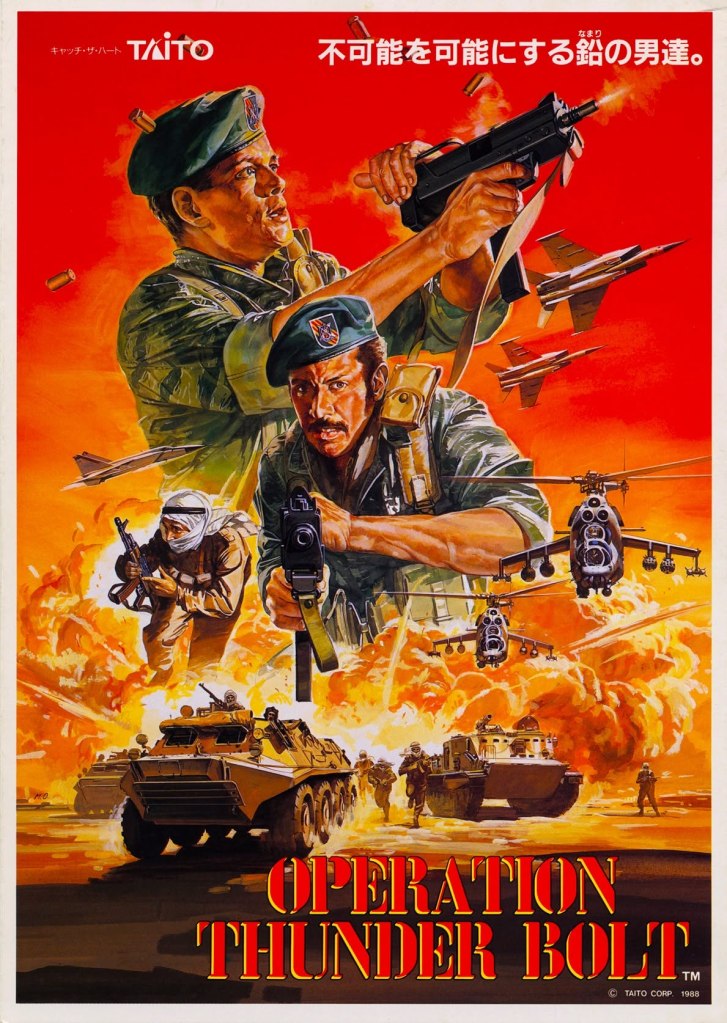
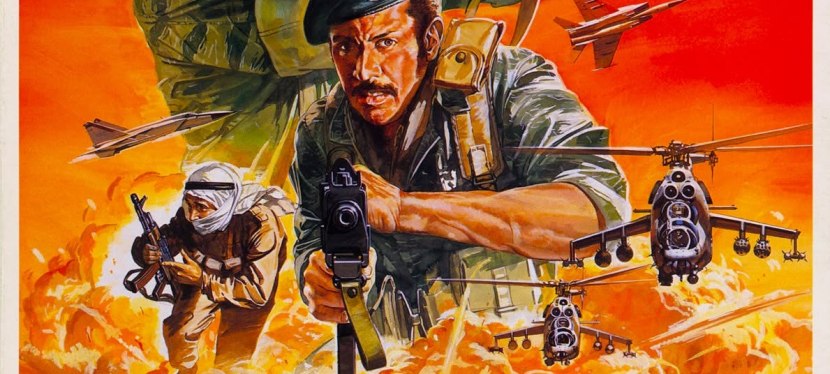
An illustrative movie poster for 'Operation Thunderbolt', featuring military characters in action with explosions, tanks, and aircraft in a dramatic background.
Great looking artwork on the front.
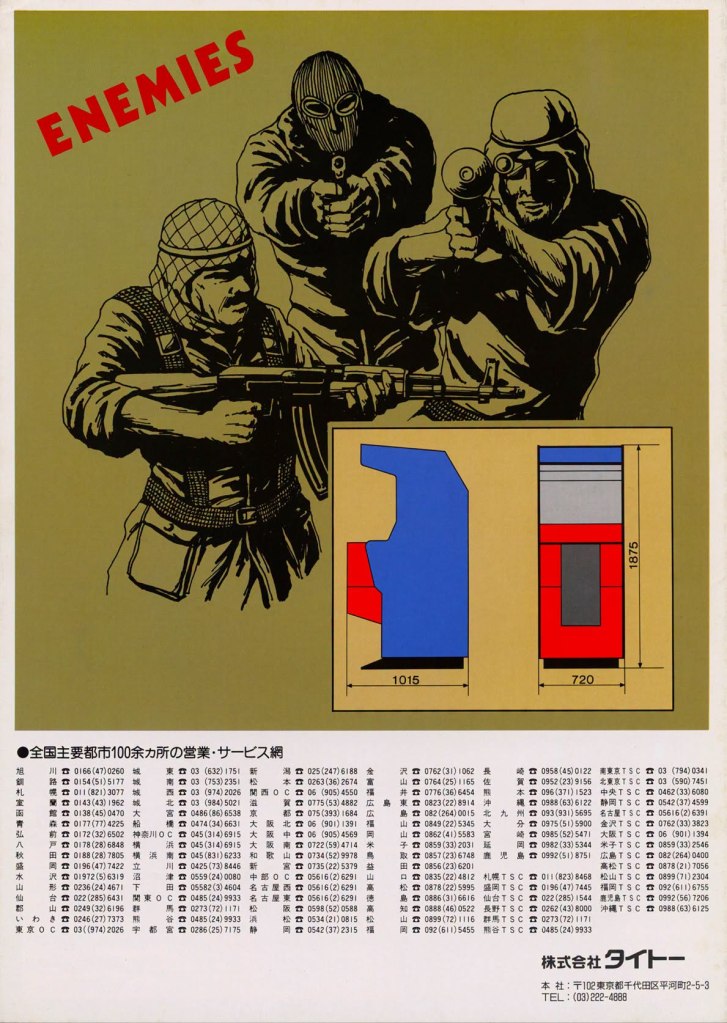
Illustration of two masked figures holding firearms against a plain background, with the word 'ENEMIES' displayed prominently at the top. Below, there are technical drawings and measurements of objects in blue and red colors.
The rear.

Following the huge success of Operation Wolf, Taito went on to make the sequel military shooter Operation Thunderbolt which was named after the 1977 movie that itself was based on the real-life Entebbe raid of 1976. To promote the game, the company came up with a pretty compelling arcade flyer for the Japanese market. The front has a detailed painted artwork that emphasizes the conflict between soldiers and Islamic terrorists in the Middle East. The rear has technical details of the arcade cabinet, several phone numbers and hand-drawn art of the terrorists (they easily remind me of Palestinian terrorists) clearly called the enemies. While the listing of phone numbers on the rear was very unusual, this old arcade flyer still looks great. Operation Thunderbolt went on to achieve huge commercial success in the arcades and later on consoles. It was one of the highest grossing arcade games in Japan in 1989.

7. Batman Returns North American Print Ad
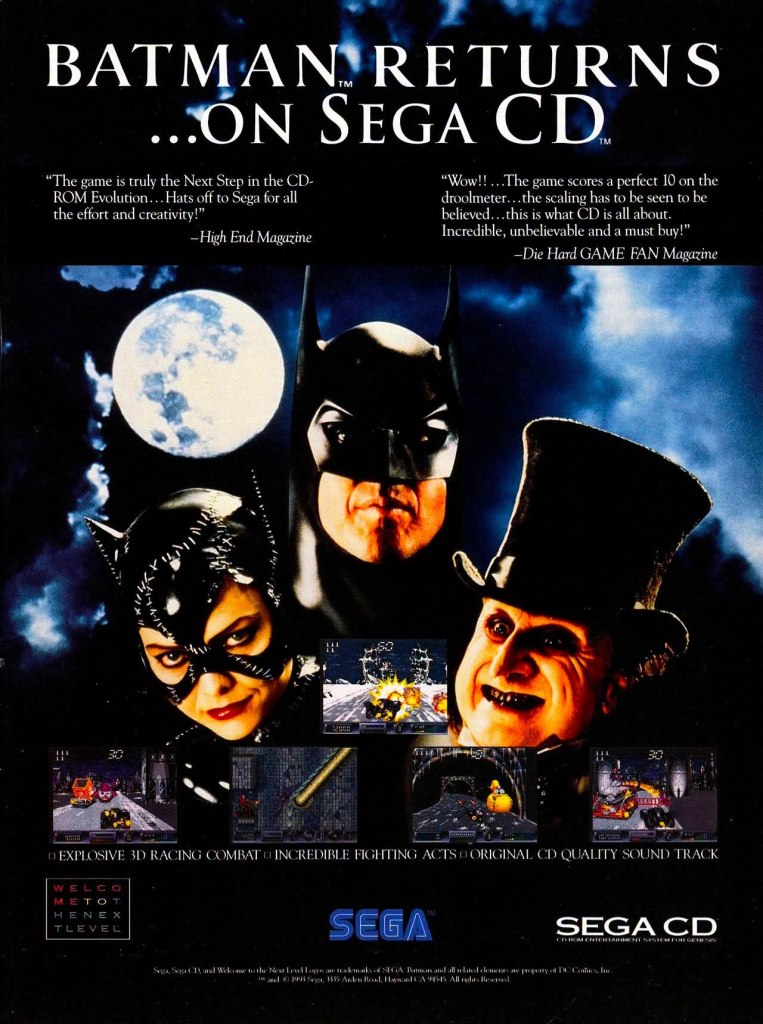
Promotional advertisement for 'Batman Returns' on Sega CD, featuring Batman and Catwoman with game screenshots and reviews.
Sega’s clever print ad promoting the Sega CD game of Batman Returns.

Batman Returns was a big hit in cinemas in 1992 although it never came close to matching the success of its 1989 predecessor. When it comes to video games, Batman Returns was even more ambitious as there were different game adaptations on different platforms. For the Sega CD Batman Returns game, Sega came up with the above ad that strongly featured photos of Michael Keaton as Batman, Michelle Pfeiffer as Catwoman and Danny DeVito as the Penguin with a stylish dark background and four screenshots of the game. The line “Batman Returns…on Sega CD” was really catchy and ultimately the game itself was very notably an expanded version of the Sega Genesis version with selected video footage from the film. As Sega had the license to make Batman Returns games for its platforms, this print ad is absolutely an attention-grabber.

8. Super Star Wars: Return of the Jedi North American Print Ad
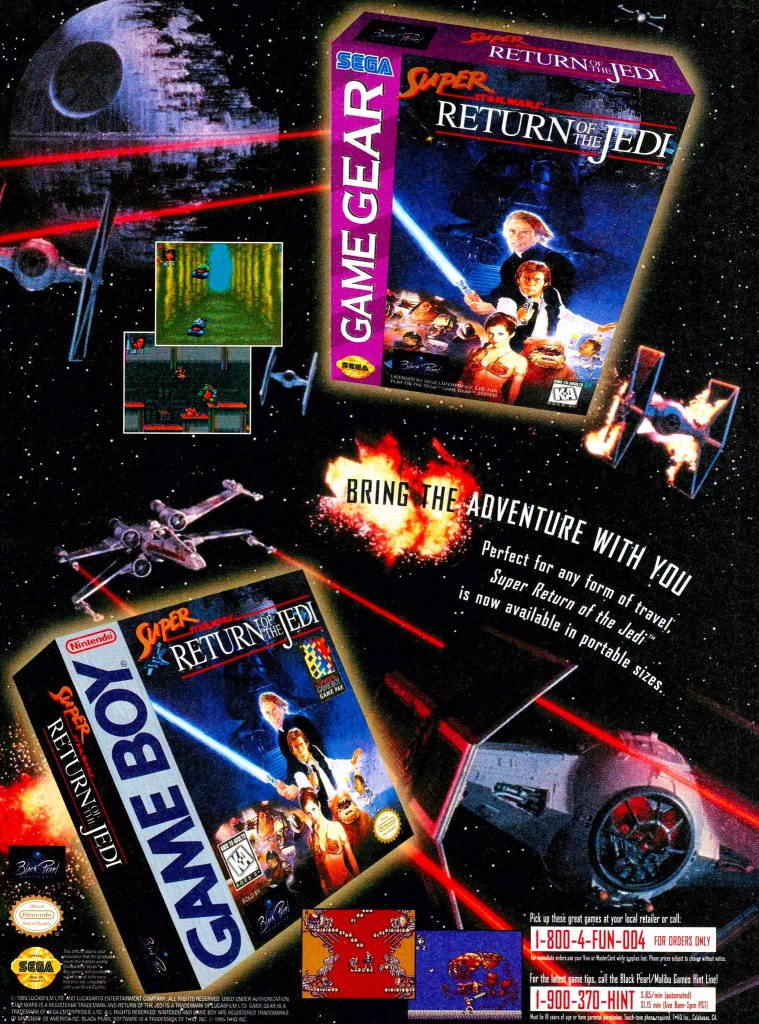
Vintage advertisement for 'Super Return of the Jedi' video game featuring Sega Game Gear and Nintendo Game Boy packaging, with space-themed background and game screenshots.
The Force is with the handheld gamers.

If there is anything notable about Star Wars in the 1990s, it is the fact that there is a lot of merchandise, comic books, video games, books and other licensed products released long after 1983’s Return of the Jedi which itself was perceived to be the last of the film franchise. In the mid-1990s, ports of Super Star Wars: Return of the Jedi were released on the competing handheld platforms Nintendo Game Boy and Sega Game Gear. This particular single-page ad has a nice visual design that captured the vibe of the movie (which I saw as a young boy in 1983) and it made handheld gaming look cool.

9. Elevator Action Returns Japanese Print Ad
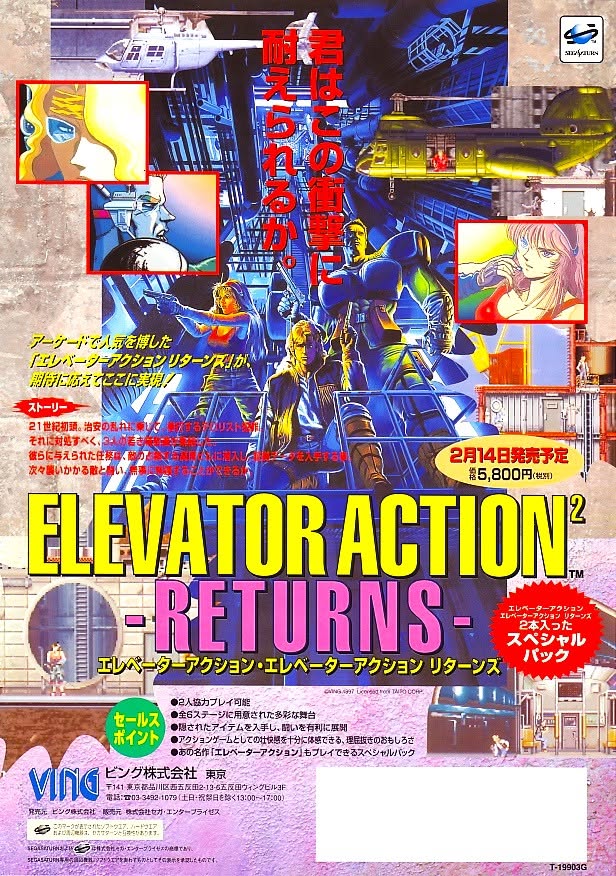
Retro video game cover for 'Elevator Action Returns' featuring illustrations of characters and a helicopter, with bold yellow title text and release date information.
Did you play Elevator Action Returns on the Sega Saturn?

In 1994, Taito struck gold with the release of Elevator Action Returns in Japanese arcades. The sequel was a big hit for the company and they eventually released a console port on the Sega Saturn only in Japan. For promotion, a print ad was made using the official painted artwork while also showing the screenshots and other details about it running on the Saturn (which itself was a powerful 2D sprite machine). Just looking at this old ad brings back the excitement of Elevator Action Returns and I now have a digital copy of it on my Xbox Series X.

10. Jade Cocoon: Story of the Tamamayu North American Print Ad
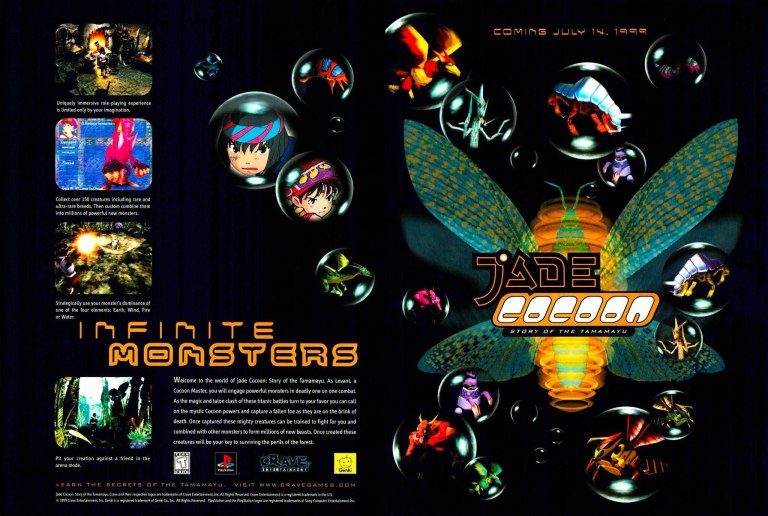
Promotional image for the video game 'Jade Cocoon: Story of the Tamamayu' featuring various characters and creatures within bubbles, showcasing the game's fantasy theme and release date of July 14, 1999.
A very ambitious print ad promoting Jade Cocoon in North America.

By the late 1990s, Japanese role-playing games (JRPG) really became popular on gaming consoles in America which arguably was the result of the massive global success of Final Fantasy VII. In 1999, there were a lot of JRPGs that got released on PlayStation and publisher Crave Entertainment literally pounced on American gamers’ interest on JRPGs by releasing Jade Cocoon: Story of the Tamamayu. Crave aggressively promoted the game and the result was this 2-page print ad that emphasized the game concept (developed by Genki), showed screenshots of the game, and displayed artworks that fans of Studio Ghibli anime productions can recognize. While Jade Cocoon: Story of the Tamamayu never became a massive commercial hit because of the low print run, there is no denying that its print ad was one of the most visually appealing ads of 1999. The ad alone made it look very ambitious.

11. Konami LaserScope North American print ad
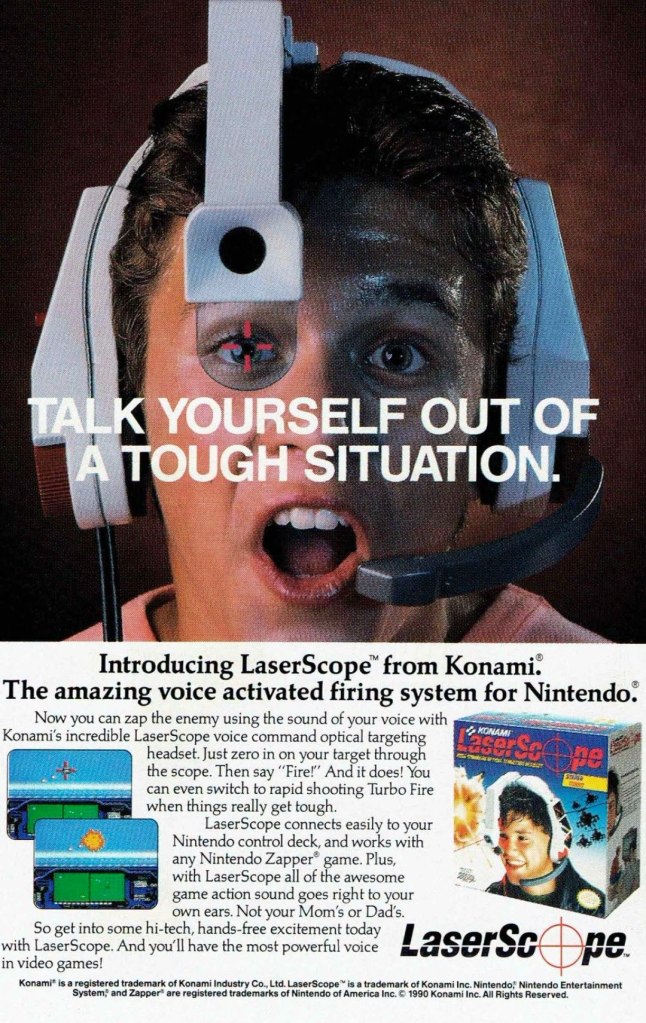
Did you get excited after seeing this Konami LaserScope print ad? Do you know anyone who bought the peripheral?

In 1990, this print ad of Konami’s LaserScope appeared in comic books and several other publications. The LaserScope was a gaming peripheral designed for use on the Nintendo Entertainment System (NES) complete with compatibility with existing games that were made to support the NES Zapper. The ad even boasted a voice-activated firing feature and a hands-free approach on playing NES games. While the ad boasted that players will have the most powerful voice in video games, the LaserScope itself was a very flawed and badly optimized device. Apart from having a built-in microphone that was oversensitive, tracking targets was a chore requiring constant head-turning which in turn made the gameplay experience very tiring and frustrating. This old ad promised a lot and the LaserScope was a catastrophe. When was the last time you bought hardware from Konami?

+++++

Thank you for reading. If you find this article engaging, please click the like button below, share this article to others and also please consider making a donation to support my publishing. If you are looking for a copywriter to create content for your special project or business, check out my services and my portfolio. Feel free to contact me with a private message. Also please feel free to visit my Facebook page Author Carlo Carrasco and follow me on Twitter at @CarloCarrascoPH as well as on Tumblr at https://carlocarrasco.tumblr.com/ and on Instagram at https://www.instagram.com/authorcarlocarrasco

Retro Gaming Ads Blast – Part 29

Welcome back readers, fellow geeks and electronic gaming fans!

In this edition of the Retro Gaming Ads Blast (RGAB) series, we will take a look at another batch of retro gaming print ads – including arcade flyers – from the 1980s and 1990s.

For the newcomers reading this, Retro Gaming Ads Blast (RGAB) looks back at the many print ads of games (console, arcade, computer and handheld) that were published in comic books, magazines, flyers, posters and newspapers long before smartphones, social media, the worldwide web and streaming became popular. To put things in perspective, people back in the 1980s and 1990s were more trusting of print media for information and images about electronic games and related products.

With those details laid down, here is the newest batch of retro gaming print ads for you to see and enjoy…

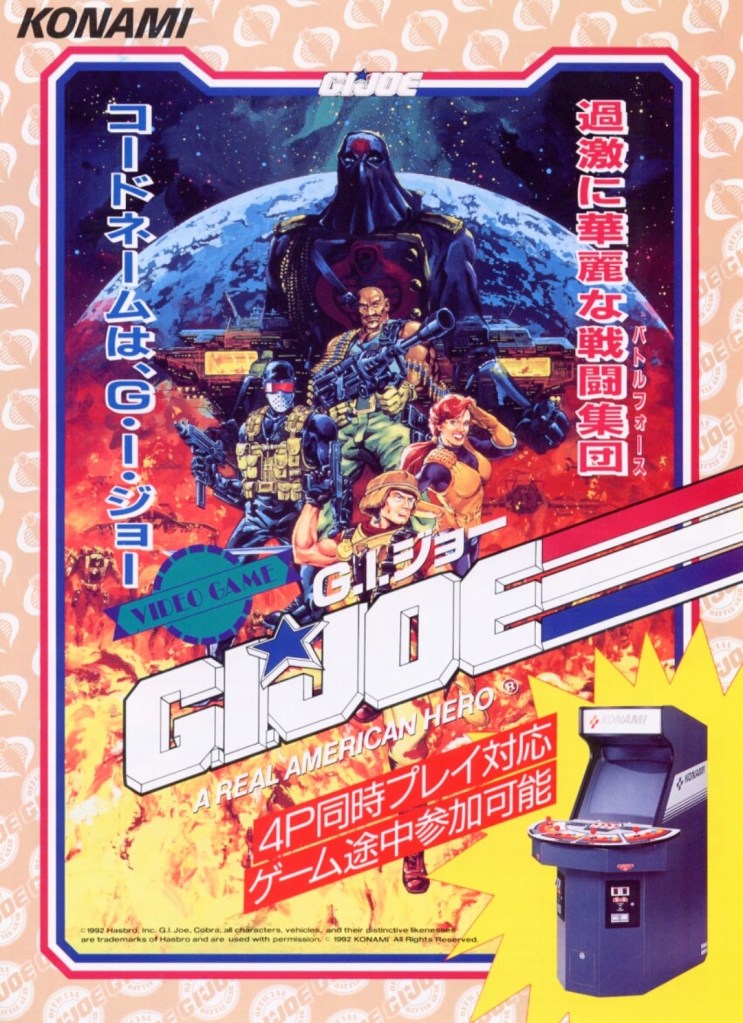
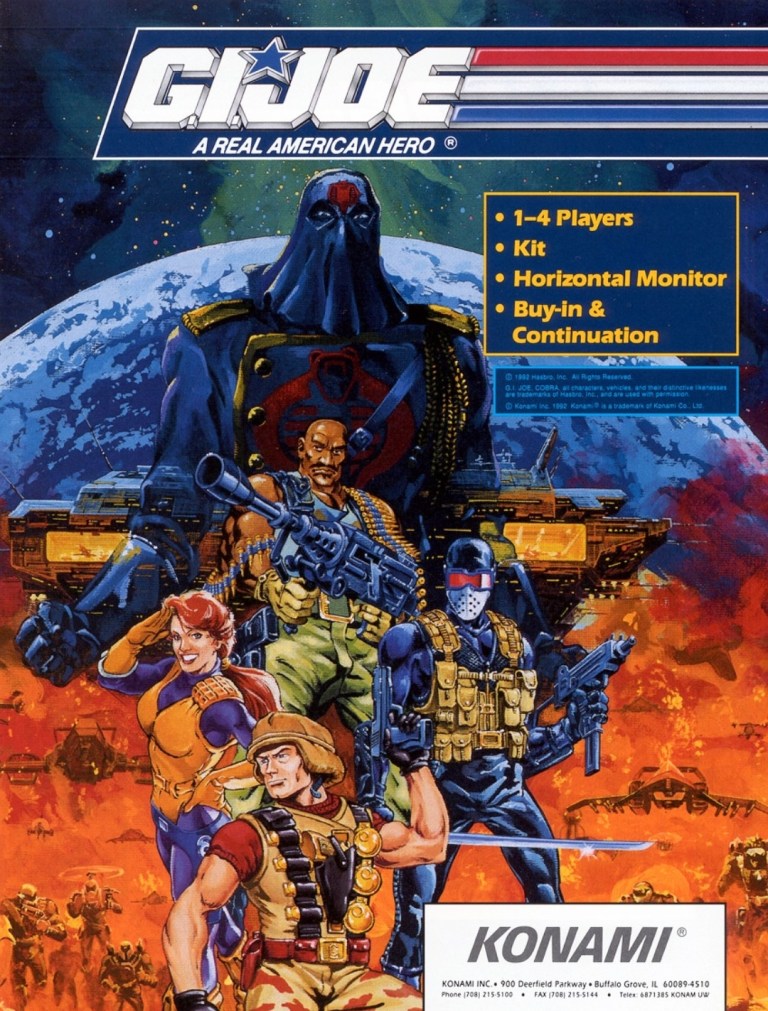
1. G.I. Joe: A Real American Hero arcade flyers

G.I. Joe: A Real American Hero arcade flyer for the Japanese market.
The North American arcade flyer of G.I. Joe.

Back in the 1980s, my friends and I saw lots of episodes of G.I. Joe: A Real American Hero on TV and there were lets of toys of it available. I also read some comic books of G.I. Joe. While there were G.I. Joe video games, I never got to play its early 1990s arcade game from Konami. By comparing the two arcade flyers of G.I. Joe: A Real American Hero, the American flyer excels visually showing the characters with a powerful war-themed background. The Japanese flyer had smaller space for the same artwork and displayed the arcade cabinet (take note of the controls laid out to accommodate up to four players). Between the two, I prefer the American arcade flyer.

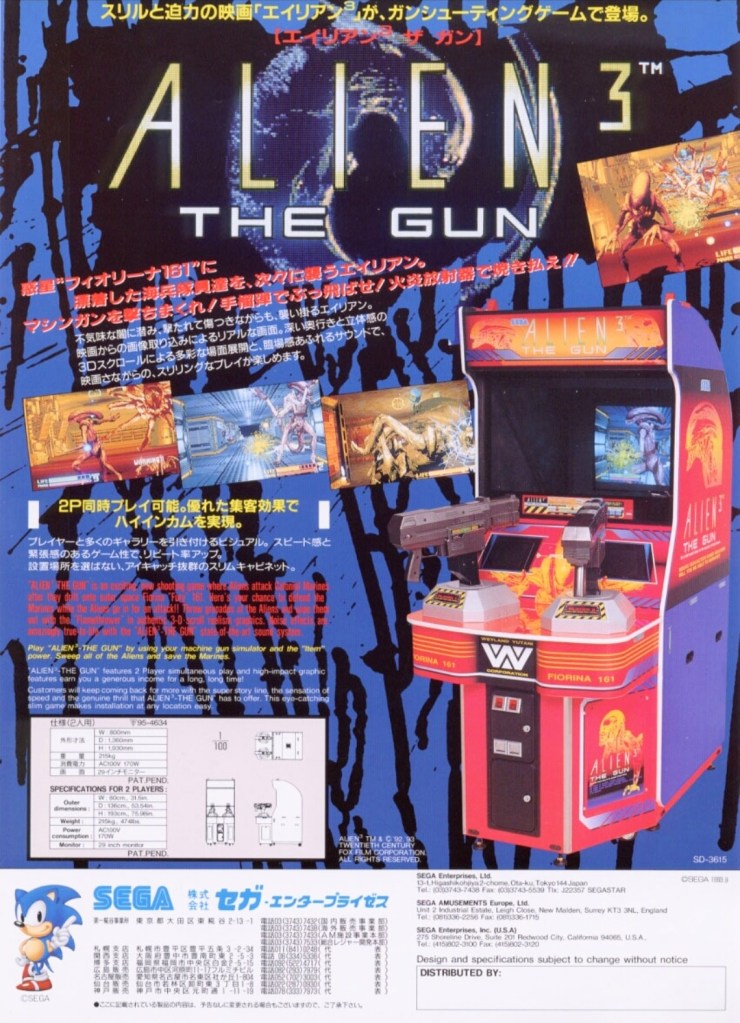
2. Alien 3 Japanese arcade flyer

With this arcade flyer, Sega clearly showed arcade operators what to expect when ordering machines of Alien 3: The Gun.

Watching Alien 3 inside the cinema in 1992 was one of the worst moviegoing experiences I ever had. By the time video games based on the movie were released, I was surprised to see how action-packed and entertaining they looked. The one Alien 3 game that captivated me was Sega’s Alien 3: The Gun in the arcades as its design and concept contradicted the essence of the film. The Japanese arcade flyer has this aggressive approach on laying down the details, displaying the arcade machine and displaying carefully selected screenshots to excite both gamers and arcade operators. This arcade flyer still looks good today.  

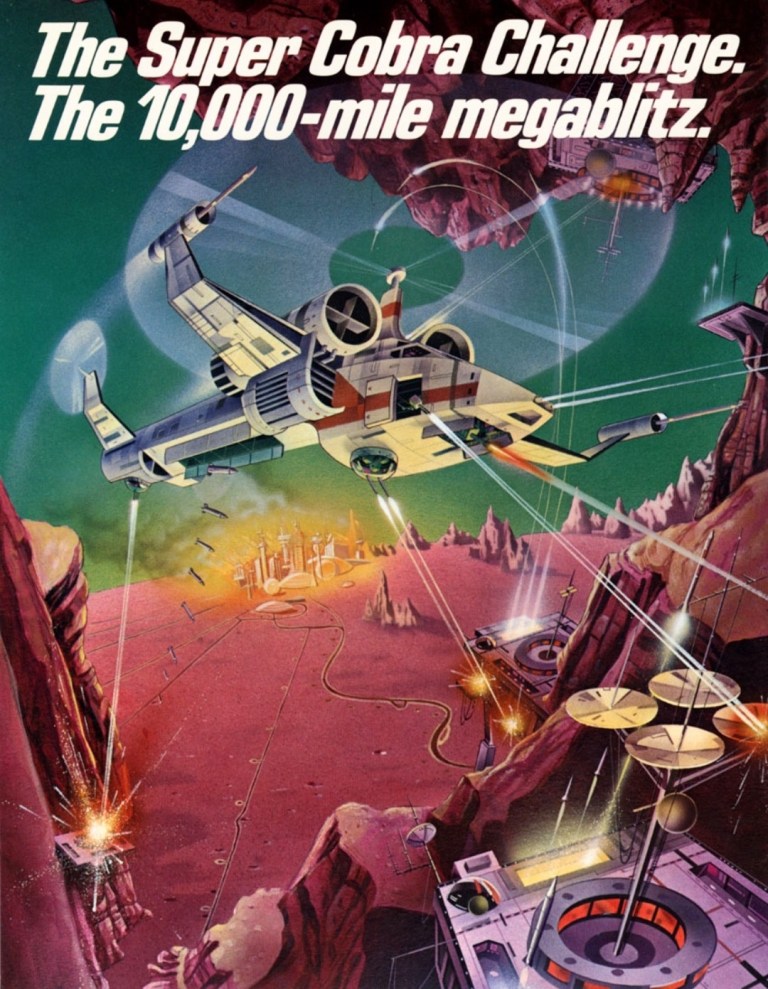
3. Super Cobra arcade flyer

A great artwork emphasizing the concept of Super Cobra.

First released in Japanese and America arcades in 1981, Super Cobra is a 2D side-scrolling shooter in which players pilot an armed helicopter through tight caverns while facing enemies capable of firing. The American arcade flyer has great artwork that almost perfectly captures the essence of the game. This is another old arcade flyer that has aged well.

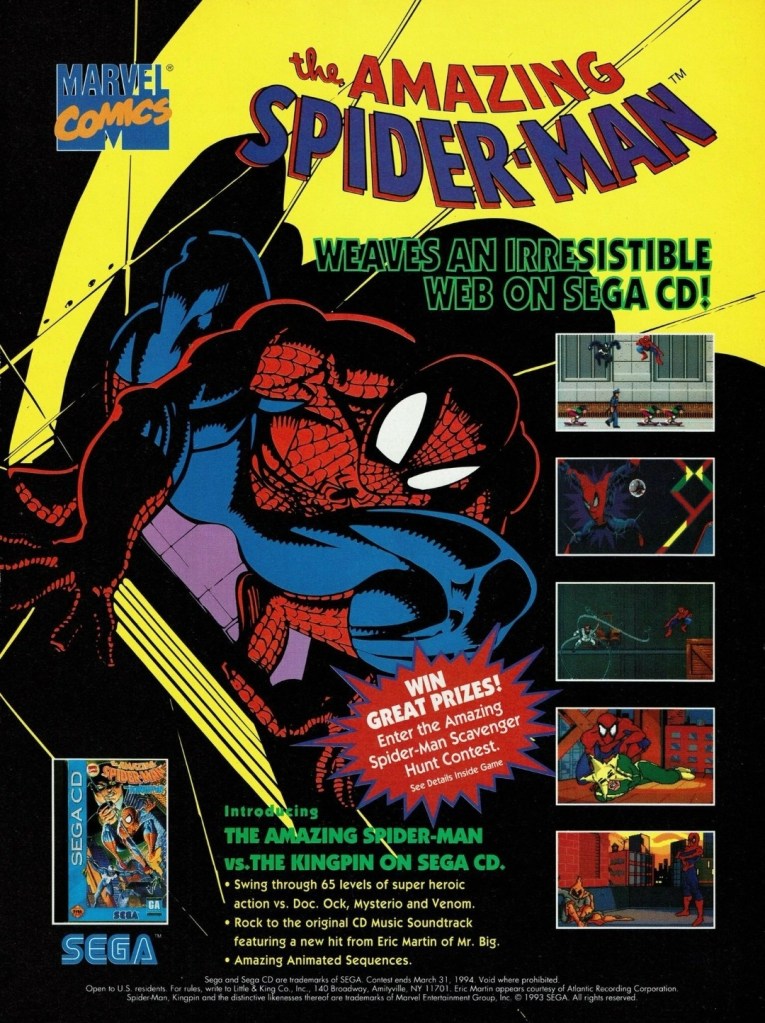
4. The Amazing Spider-Man vs. The Kingpin print ad

Back in 1993, animated sequences included in video games were still new and even exciting.

Moving forward to the year 1993, gamers in America who owned a Sega Genesis console were being motivated by Sega to upgrade their gaming experience with the Sega CD add-on. Along the way, Sega really ramped up efforts to have more games supporting the Sega CD and one of them was The Amazing Spider-Man vs. The Kingpin. The Amazing Spider-Man vs. The Kingpin on Sega CD was actually an updated version of the original 1991 game and Sega’s team included several improvements to take advantage of the CD-ROM technology of the add-on. This print ad showed Sega’s hard work on selling the game.

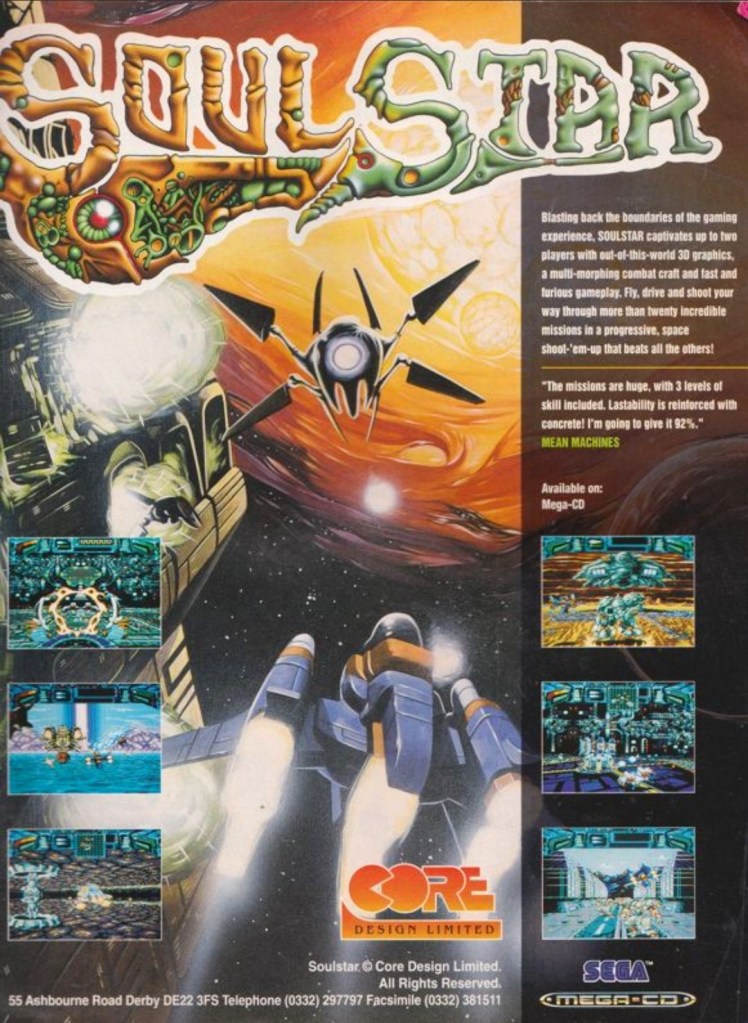
5. Soulstar print ad

The artwork of this print ad has very strong sci-fi vibes.

Released in 1994 for the Sega CD (Mega CD in other markets), Soulstar was sci-fi 3rd-person shooter that delivered amazing visuals, fun gameplay and an immersive experience of space travel to gamers. This European market print ad is a very effective way to promote the game using carefully selected screenshots, amazing artwork and a cleverly written text description. Still a fine print ad to look at.

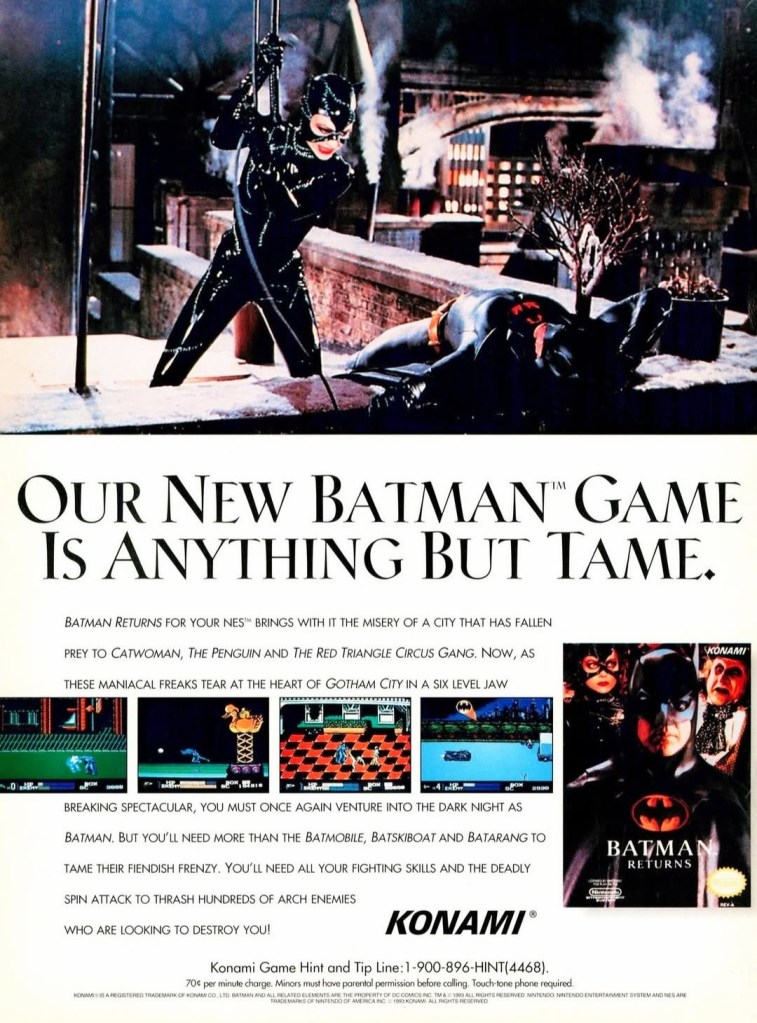
6. Batman Returns print ad

This print ad effectively promoted both the game and the movie. In retrospect, the line “Our new Batman game is anything but tame” turned out to be true as lot of parents who brought their kids to the cinemas for Batman Returns were turned off by the adulterated elements.

In 1992, Batman Returns played in a lot of cinemas but its very dark tone and adulterated elements prevented it from matching the huge box office success of its 1989 predecessor. Regardless, a lot of licensed video games based on the movie were released and in early 1993, Konami released a Batman Returns video game on the aging Nintendo Entertainment System (NES). This print ad used a photograph from the filming of an scene that actually had Michelle Pfeiffer as Catwoman, dominating over the iconic Batman. Also displayed were screenshots, the game’s box cover (showing Pfeiffer, Michael Keaton and Danny DeVito as their respective characters) and the text description. Even if you did not like the movie, this old print ad is a solid way of promoting both the game and the movie. The line “Our new Batman game is anything but tame” strangely turned out very true.

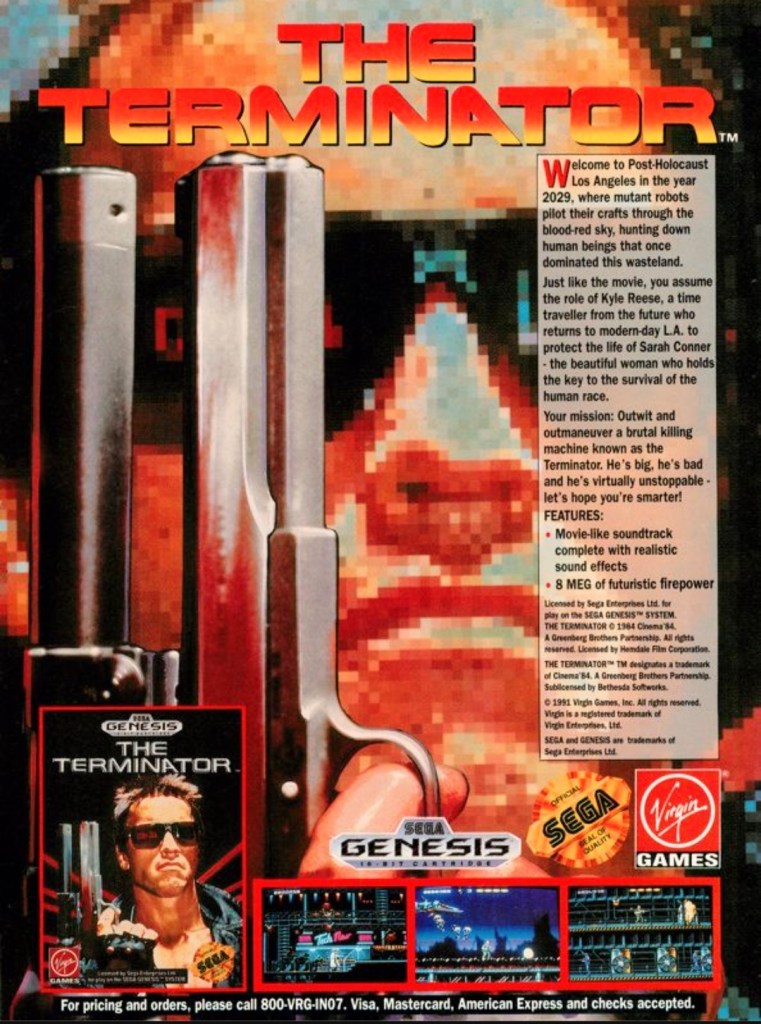
7. The Terminator games print ads

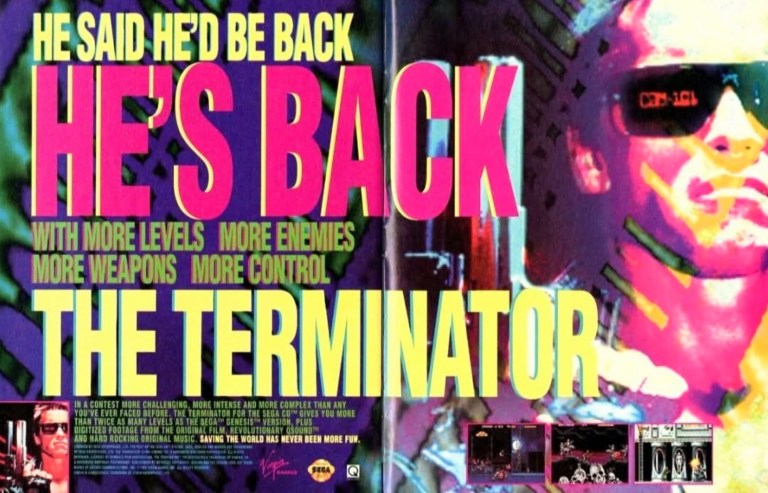
The Terminator for Sega Genesis.
The Terminator for Sega CD.

Released in cinemas in 1984, The Terminator was a surprise hit as well as a career-booster for Arnold Schwarzenegger and James Cameron. What is very notable is the fact that several video game adaptations of The Terminator were released on consoles in the early 1990s. I can only guess this was done to capitalize on the resurgence of the Terminator franchise in connection with Terminator 2: Judgement Day’s much-anticipated release in cinemas. The Sega Genesis version print ad features a digitized close-up of Schwarzenegger’s Terminator while the 2-page Sega CD version print ad used a lot of the space for large text (with an incomplete shot of Schwarzenegger’s Terminator on the edge of the 2nd page) emphasizing “He’s Back” and “The Terminator” while leaving little space for text descriptions and screenshots. Between the two, I find the Sega Genesis ad more effective with its promotion of the game.

8. Defender arcade flyer

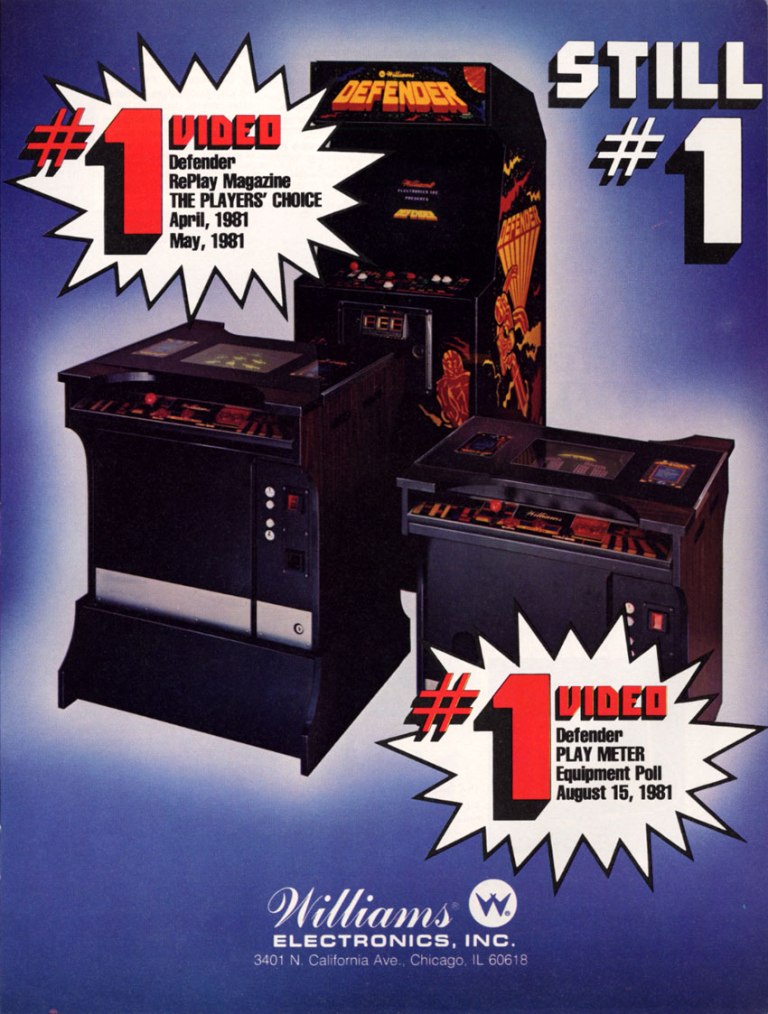
More choices of a very successful game for arcade operators also means more ways for players to play it.

Even though it had a soft start in the early 1980s, the classic game Defender went on to become a massive commercial success in the arcades. Being a major attraction in America’s video game industry, Williams unsurprisingly went on to release this particular arcade flyer to sell to operators different types of Defender arcade machines that could fit into their respective joints while providing gamers choices on how to play the game. Some players preferred to stand in-front of a tall arcade cabinet while others prefer to play the game looking down on the screen. This flyer is an example as to how a company can keep their biggest success moving on while offering business clients more choices.  

+++++

Thank you for reading. If you find this article engaging, please click the like button below, share this article to others and also please consider making a donation to support my publishing. If you are looking for a copywriter to create content for your special project or business, check out my services and my portfolio. Feel free to contact me with a private message. Also please feel free to visit my Facebook page Author Carlo Carrasco and follow me on Twitter at  @HavenorFantasy as well as on Tumblr at https://carlocarrasco.tumblr.com/ and on Instagram at https://www.instagram.com/authorcarlocarrasco
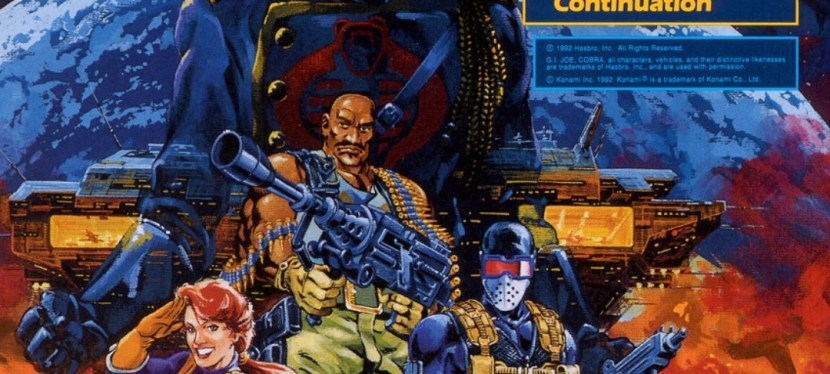
A Look Back at Batman Returns: The Official Comic Adaptation of the Warner Bros. Motion Picture (1992)

Welcome back superhero enthusiasts, 1990s culture enthusiasts and comic book collectors! Today we go back to the early 1990s and look at the official comic book adaptation of the 1992 superhero movie Batman Returns.  

Way back in 1992, I managed to watch Batman Returns in a movie theater here in the Philippines. It was entertaining but I noticed it had an even darker tone, more violence (although the quality of physical action went down) and was more adulterated compared, at least, with its 1989 predecessor. What really stood out for me in the Tim Burton-directed movie were the great performances of Danny DeVito as the Penguin and Michelle Pfeiffer as Catwoman.

Even though I was already visiting comic book stores back then, I was not even aware that an official comic book adaptation of the movie was released by DC Comics. It was only recently I finally got to read a copy.

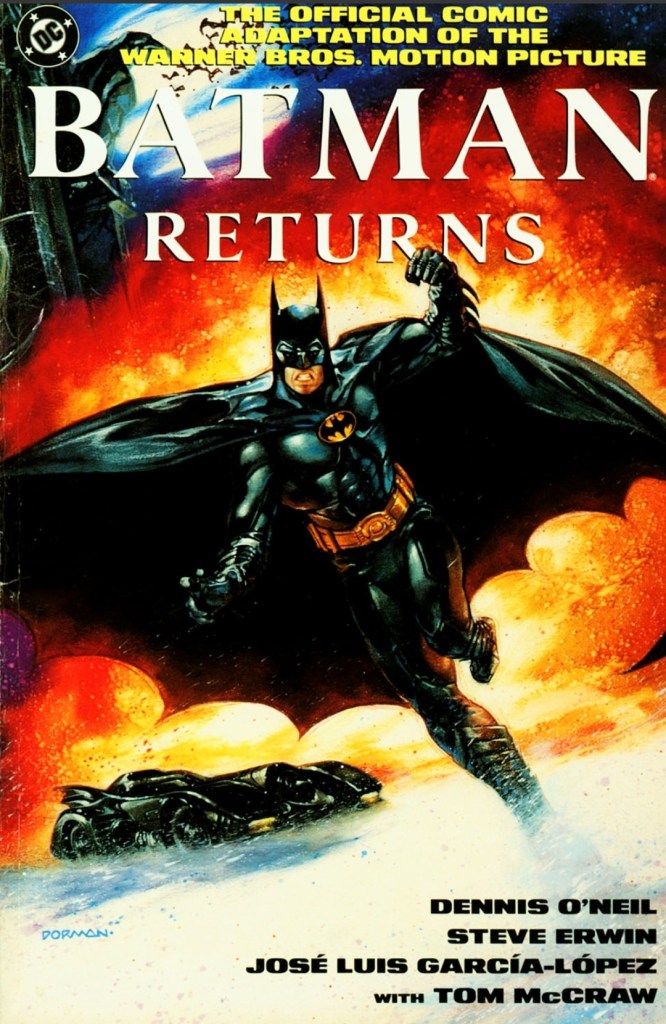
With those details laid down, here is a look back at Batman Returns: The Official Comic Book Adaptation of the Warner Bros. Motion Pictured published in 1992 by DC Comics with the adapted story written by Dennis O’Neil and drawn by Steve Erwin.

The cover.

Early story

The story begins decades into the past in Gotham City. A wealthy couple (Cobblepot family) decide to reject and abandon their infant son (Oswald/Penguin) as he was born with freakish features. They placed their son into a metal container (which itself is contained in a large makeshift basket) and dropped it on a local waterway that leads deep into the city’s sewers. At the end of the journey, large penguins find the container.

Decades later in Gotham City, tycoon Max Schreck talks to the mayor about his planned power plant project that needs permits and tax incentives from the local government to be realized. The mayor is doubtful about the project as he believes that the city has more than enough energy sources to sustain growth into the next century. Schreck insists that the local government’s analysts don’t realize the big picture about energy and economic growth. Then Chip Schreck (Max’s only heir) arrives with Selina Kyle (Catwoman) carrying coffee near him.

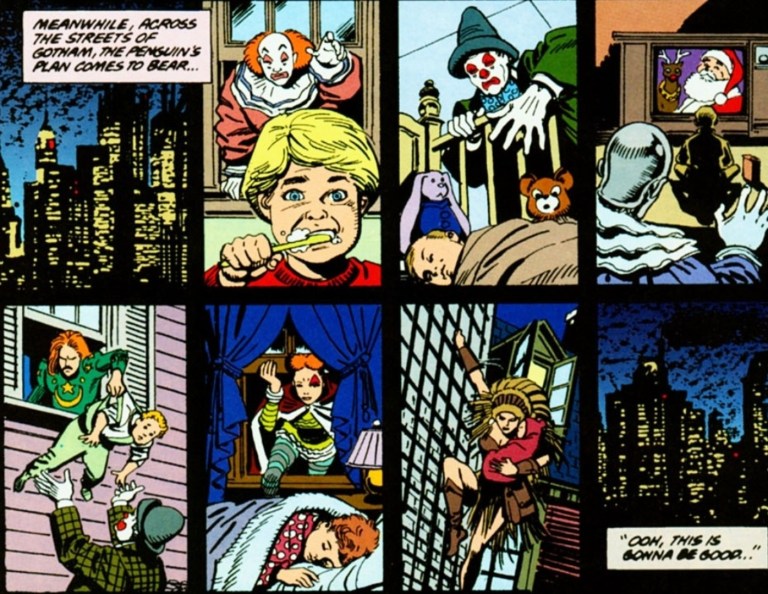
Minutes later, Max, Chip and the mayor arrive at Gotham Plaza for the local Christmas tree lighting. Even though he forgot to bring his speech, Max Schreck delivers remarks pretending to be caring and charitable to others. As his speech ends, two over-sized objects looking like giant gift boxes arrived nearby giving the mayor the false impression that those are clever gimmicks by Schreck.

As soon as Schreck says that those objects were not his, the oversized gift box opens violently as thugs wearing circus costumes and masks suddenly come out causing violence and hysteria to the unprepared people.

The local police activate the Bat Signal to call Batman for his assistance. Nearby, the Penguin sees it and says, “Ooh, Batman. I’m trembling…”

Quality

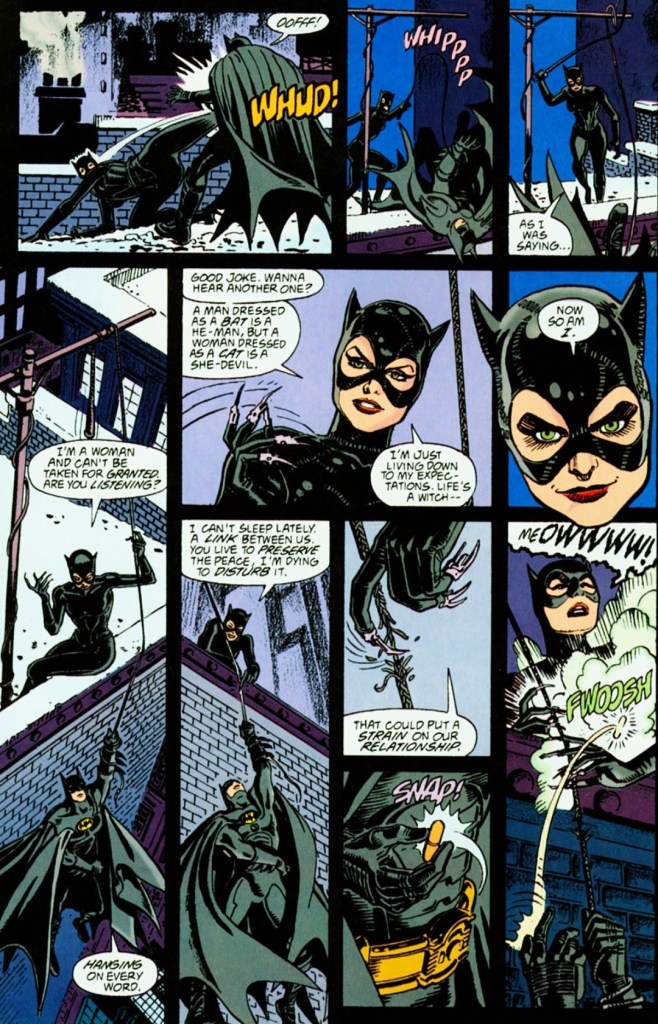
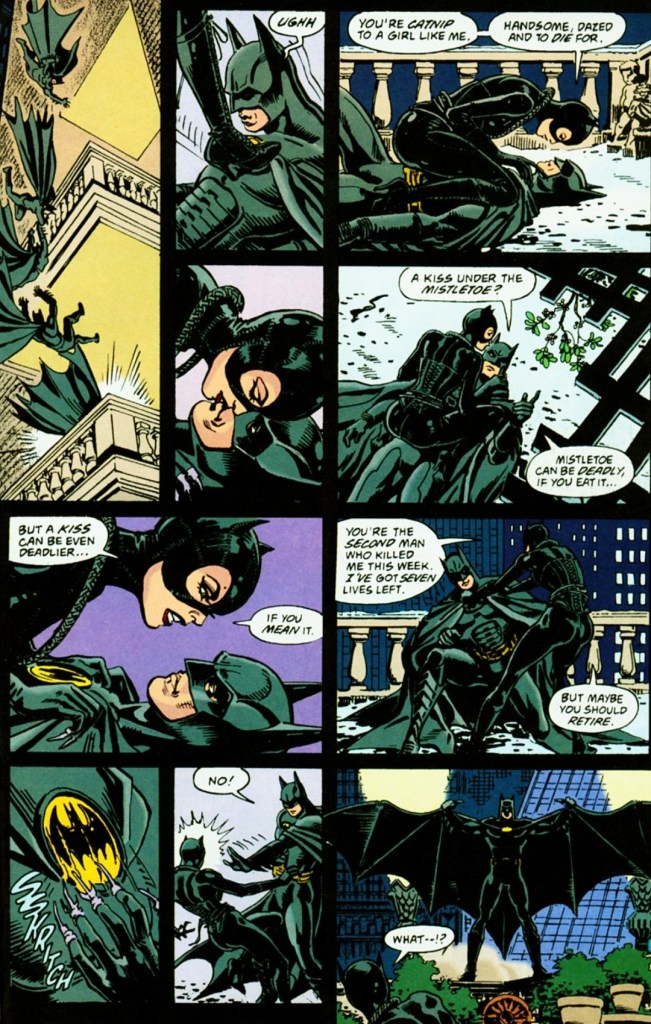
Moments from Batman’s first fight with Catwoman.

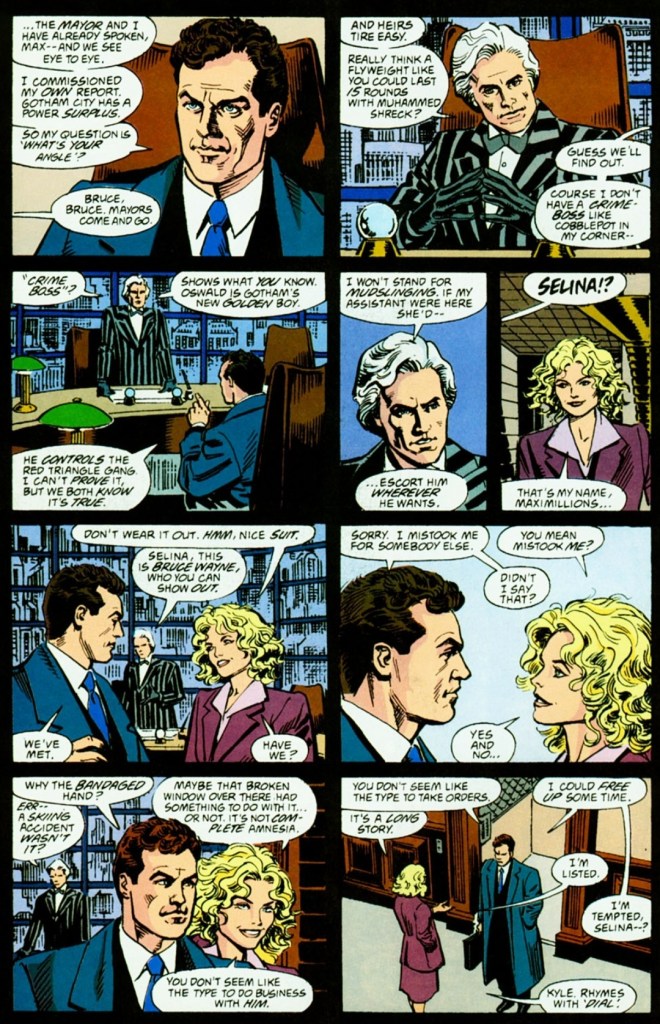
To get straight to the point regarding the narrative, this comic book adaptation does have the same basic plot and concept of the movie but with noticeable differences (whether technical or creative) that happened here and there. For the most part, Dennis O’Neil captured the concept of the movie but with less of the flavor of Tim Burton’s creative touches (which should not be surprising).

Having seen the movie, it is clear that the comic book creators reduced the dialogue and took shortcuts on adapting scenes from the film not just for the sake of brevity but to ensure they could fill the limited amount of pages to work with. That being said, I can say that the reduced dialogue from the first conversation between Penguin and Max Schreck severely weakened the impact when compared to what was executed in the film. Speaking of dialogue, the comic creators had to down key words (think of it as creative censorship) to avoid offending readers.

This is a unique, alternate portrayal at the aftermath of Selina Kyle’s fall from the high window. When compared to the movie itself, this adaptation emphasizes how far the Schrecks would go to avoid being held accountable for crimes committed.
This particular scene did not appear in the movie at all. Perhaps it was based on an older version of the film script.

When it comes to scenes between the film and this comic book adaptation, I can say that the date between Bruce Wayne and Selina Kyle inside Wayne Manor does not appear in literary form at all. Ironically, there is one scene that appeared in this adaptation (the Penguin plotting chaos in Gotham while Catwoman mentions “An orgy of sex and violence,”) that never made the final cut in the movie itself. With regards to the aftermath of Max Schreck’s violent push of Selina Kyle through the high window, this adaptation showed Max’s son Chip present (implying he witnessed his father’s act just steps away) and he goes along with his father to ensure that none of them would be held accountable for Kyle’s fall (caused by “stress” and being “depressed”).  

With the way the narrative was completed, this adaptation works well but much less of the theatrical touches of Tim Burton and without the power of the respective performances of Danny DeVito, Michelle Pfeiffer and Christopher Walken (Max Schreck). Ironically, I can easily imagine Bruce Wayne/Batman sounding like Michael Keaton through dialogue.

While artist Steve Erwin did not come close to capturing the likenesses of Christopher Walken as Max Schreck, and Michael Keaton as Bruce Wayne, his take on Selina Kyle is better as she somewhat resembles Michelle Pfeiffer.

With regards to the visuals by Steve Erwin, he does a good job drawing the locations and help establish geography (albeit in limited scopes) for readers to grasp. In fact, there were drawings in which Erwin literally copied location spots, objects and even camera angles from the film which suggests he had confidential access to the footage. When it comes to visualizing action, Erwin’s approach is pretty simplistic and limited. There simply was no dynamism with the action which theoretically means he had no artistic freedom (sticking closely to script while working within the limits of images per page) or he simply had no intention to make the action look spectacular.

With regards to violence connected with the action, the comic creators had to resort to creative censorship apparently to make this adaptation more acceptable with younger readers. The fall of Selina Kyle from the high window had severely reduced intensity in comic form and the horrific moments of her being surrounded by cats in the film were completely gone. Oh yes, Batman’s use of the Batarang against multiple thugs on the street was executed with a simplistic and not-so-violent (read: little impact) manner by Erwin.

Consider this as a late-20th century portrayal of diversity and inclusion in America. By today’s standards, there are hordes of SJWs (social justice warriors), woke nuts, socialists, Communists, Marxists, and liberals who believe in diversity (racism in reverse) and inclusion (exclusion actually) so much, they intend to destroy families starting with the children.

When it comes to drawing the major characters, Erwin really falls short here. His Bruce Wayne never came close to resembling Michael Keaton and the same can be said about Max Schreck (does not look much like Walken) and the Penguin (does not resemble Danny DeVito at all and with reduced facial details, he looks nowhere as scary as the cinematic villain). Ironically, Erwin’s take on Selina Kyle comes a bit close to looking like Michelle Pfeiffer. Erwin does, however, did a good job drawing Batman and Catwoman in their fully costumed, masked appearances.

Conclusion

Very clearly, Steve Erwin had access to footage of the movie when making this adaptation.

Considering its flaws and compromises, Batman Returns: The Official Comic Adaptation of the Warner Bros. Motion Picture (1992) still works as an entertaining read and I myself have seen the movie many times. It captures the plot and several shots of the 1992 movie, but it certainly lacks Burton’s theatrical flavor and the powerful performances of DeVito and Pfeiffer. To its credit, this adaptation has several visual and literary differences compared with the movie which adds to its entertainment value. If you really want the full impact, full fun factor and artistry of Batman Returns at all, watching the movie itself is the best way. That being said, consider this adaptation as a cheaper accessible counterpart.

Overall, Batman Returns: The Official Comic Adaptation of the Warner Bros. Motion Picture (1992) is satisfactory.

+++++

Thank you for reading. If you find this article engaging, please click the like button below, share this article to others and also please consider making a donation to support my publishing. If you are looking for a copywriter to create content for your special project or business, check out my services and my portfolio. Feel free to contact me with a private message. Also please feel free to visit my Facebook page Author Carlo Carrasco and follow me on Twitter at  @HavenorFantasy as well as on Tumblr at https://carlocarrasco.tumblr.com/ and on Instagram at https://www.instagram.com/authorcarlocarrasco
What to watch on YouTube right now – Part 12

Have you been searching for something fun or interesting to watch on YouTube? Do you feel bored right now and you crave for something to see on the world’s most popular online video destination?

I recommend you check out the following topics and the related videos I found.

#1 The 6-minute explanatory gameplay trailer of Eiyuden Chronicle: Hundred Heroes – Eiyuden Chronicle: Hundred Heroes, the upcoming Japanese role-playing game (Japanese RPG) set for a global release on April 23, 2024, was in the spotlight recently as publisher 505 Games released a 6-minute trailer that showcases and explain to gamers what to expect in terms of game play and features. What long-time gamers enjoyed so much about Suikoden and Suikoden II can find them also in Eiyuden Chronicle: Hundred Heroes. Watch the whole trailer below…

#2 Lord Jesus lived as a Jewish man and NEVER was a Palestinian – There is so much chaos in this world and you can see that through the Palestinians (a displaced people whose leaders have long engaged in terrorism and hatred against Israel and the Jewish people) and their brainwashed supporters (the pro-Palestine freaks). In many parts of the world, a lot of pro-Palestinian believers (activists who are often rowdy, arrogant, violent and ignorant at the same time) kept shouting the big lie that Lord Jesus was a Palestinian (an overblown fantasy that spreads wickedness and deception). To push back against the lies of the pawns of the enemy (Satan), watch Israeli YouTuber Oren explain in detail the truth that Lord Jesus truly lived as a Jewish man, was born into an existing Jewish society and had Jewish people as His believers/followers (the early Christians).

#3 2023 Batman Returns reaction videos and more – For some time now, I’ve been watching varied movie reaction videos from YouTubers Ashleigh Burton, TBR Schmitt, Jen Murray and EOM Reacts. What I found very surprising was the fact that each of them published reaction videos of the 1992 superhero movie Batman Returns this year, and three of those videos were just weeks apart from each other. I posted those Batman Returns reaction videos below and I added two more related videos that should orient you about the movie.

#4 Get to know the Temple Mount in Jerusalem, Israel – This past February, I visited Israel on a pilgrimage tour. It was indeed the greatest overseas travel experience in my entire life as it was blessed and anointed by the Lord who answered my prayers to visit Israel to deepen my faith in Him. I also visited the Temple Mount in Jerusalem which is one of the most significant places to visit in the entire world. That being said, I posted below the Christian Broadcast Network’s Temple Mount special video and my personal video of my first-ever moments at the holy site.

#5 Pro-Palestine believer exposed as a LIAR! – The people who support the wicked causes of the Palestinians are clearly ignorant, misled, pretentious and dishonest. A lot of pro-Palestine people have posted videos on varied networks to spread lies and misinformation regarding history, and some of them are very young people (Generation Z) who clearly do NOT know all the details, who were fed lies by their Islamo-Leftists superiors and they are clearly not intelligent. The Palestinians are truly a displaced people and they were NEVER the indigenous people of the land of Israel! Watch the video below and enjoy.

+++++

Thank you for reading. If you find this article engaging, please click the like button below, share this article to others and also please consider making a donation to support my publishing. If you are looking for a copywriter to create content for your special project or business, check out my services and my portfolio. Feel free to contact me with a private message. Also please feel free to visit my Facebook page Author Carlo Carrasco and follow me on Twitter at  @HavenorFantasy as well as on Tumblr at https://carlocarrasco.tumblr.com/ and on Instagram athttps://www.instagram.com/authorcarlocarrasco