Disclaimer: This is my original work with details sourced from reading the comic book and doing personal research. Anyone who wants to use this article, in part or in whole, needs to secure first my permission and agree to cite me as the source and author. Let it be known that any unauthorized use of this article will constrain the author to pursue the remedies under R.A. No. 8293, the Revised Penal Code, and/or all applicable legal actions under the laws of the Philippines.
Welcome back movie fans, 1990s arts and culture enthusiasts, and comic book collectors! Today we go back to the year 1993 to examine the first issue of a comic book mini-series that served as the official adaptation of the movie Demolition Man.
Believe it or not, I completely missed out on Demolition Man’s theatrical run here in the Philippines. I only heard about the movie from feedback from my friends who saw it and they often mentioned the virtual reality sex scene. Strangely, they did not talk much about the match-up between Sylvester Stallone and Wesley Snipes.
The first time I saw the movie was on a rented laserdisc in 1995. As it was a Joel Silver production, the movie really had very high production values and it also had that subtle balance between hard action, science fiction and comedy. I enjoyed watching Demolition Man and its unique presentation about the future was memorable to me. Recently, I finally read the first issue of the comic book mini-series based on the movie.
With those details laid down, here is a look back at Demolition Man #1, published in 1993 by DC Comics with a story written by Gary Cohn (based on the screenplay by Daniel Waters, Robert Reneau and Peter M. Lenkov) and drawn by Rod Whigham. This is the first of a 4-issue mini-series.
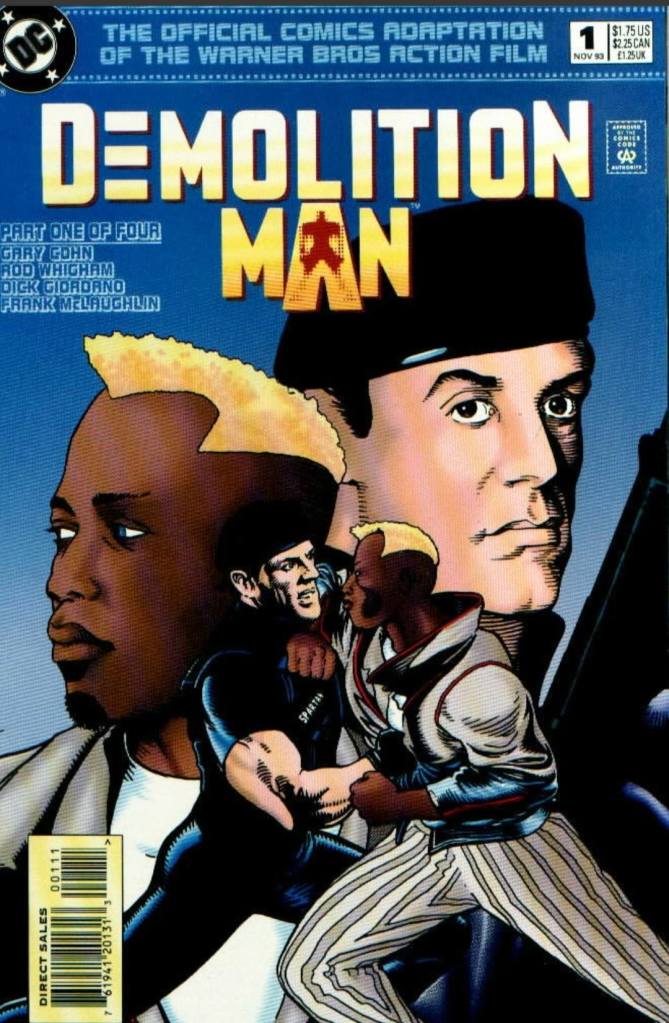
The cover.
Early story
The story begins in 1996. Los Angeles has turned into a city of violent crime with a lot of areas left in ruin. A police department helicopter flies over the Hollywood sign bringing John Spartan (Demolition Man) to a wide, old building filled with some armed criminals. Spartan suspects that Simon Phoenix is responsible for hijacking a bus of thirty people and they all could be inside the building. The thermogram scan on the building only shows seven people and no signs of the passengers.
Determined to find the passengers, Spartan does a bungee jump to safely land on the rooftop of the building. He takes down a few thugs as he gradually infiltrates the place.
Elsewhere, Simon Phoenix sees Spartan via security camera. As Spartan eventually breaks into a large room, Phoenix releases a large amount of gasoline on the floor. Spartan and Phoenix encounter each other and an intense talk about missing passengers begins. As the Demolition Man presses for answers with guns aimed, Phoenix prepares to spark a sudden fire…
Quality
This scene never appeared in the movie. If it made it the final cut, it definitely would have slowed the film’s pace down a lot.
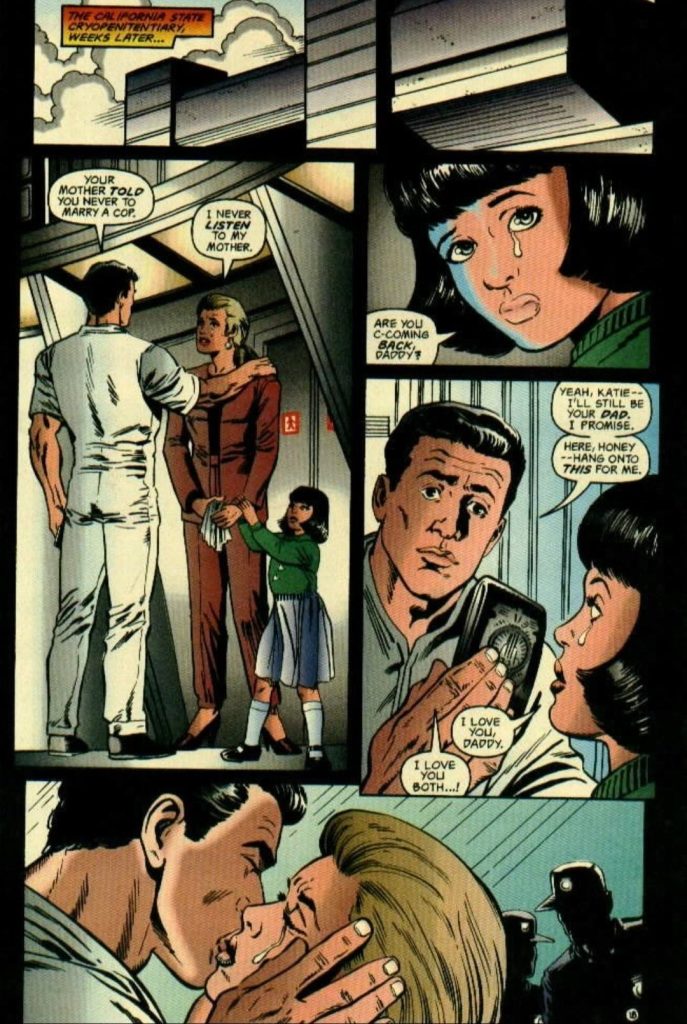
Having seen the movie a number of times, this comic book covers the opening and closes with a notable scene that took place after the shocking revelation about the passengers. The good news here is that the comic book creators did a really fine adaptation of the scenes from the movie. Certain moments looked and felt like they were adapted from an older version of the script (note: Spartan bidding goodbye to his wife and little daughter is the obvious scene) while some moments seem to be creative additions or expansion by the creators.
The pacing of the story is pretty good and even the slowest scenes never felt boring. This is because the writing by Gary Cohn is quite engaging and there is always some interesting or something important to read as the story goes on. That said, when the spectacle happens, the pay-off to the build-up is truly worth it.
Still on the writing, Cohn inserted a good amount of details into the dialogue as well as the moments revealing what John Spartan is thinking. This ultimately gives readers a clearer look into Spartan’s personality as well as what were the elements from his past defined him as the Demolition Man to many.
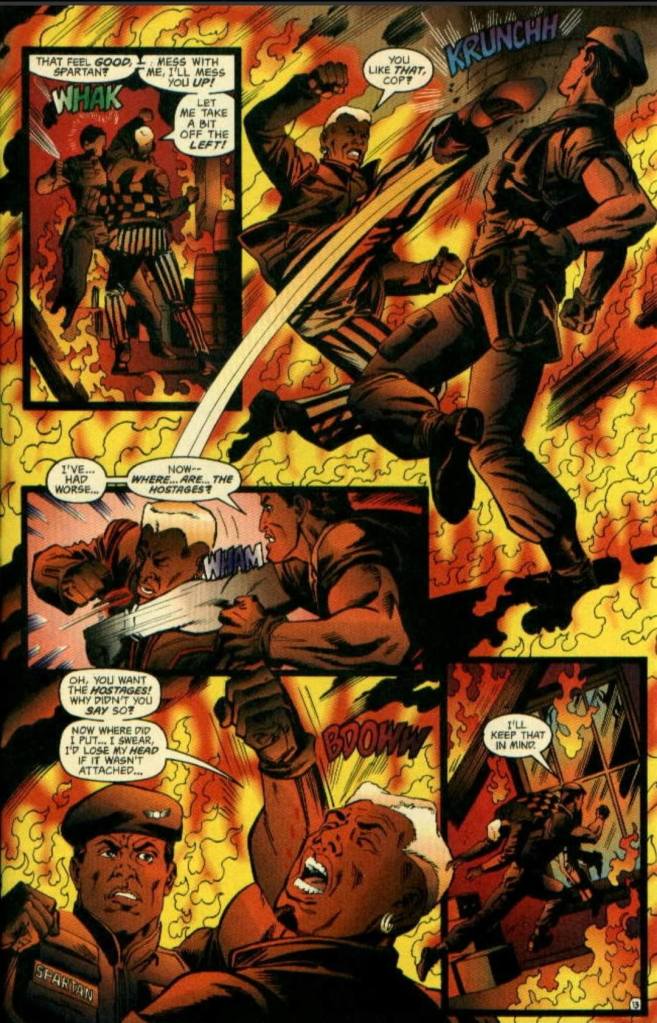
Rod Whigham is very good with visualizing the script. For one thing, he does a good job capturing the likeness of Stallone and Snipes in specific pages of the comic book. When it comes to spectacle (action, explosions and stunts), Whigham’s work ranges from efficiency to dynamic depending on what happens. This is a good looking comic book!
Conclusion
Like in the movie, John Spartan and Simon Phoenix fight surrounded by flames.
Demolition Man #1 (1993) is a very solid adaptation and it is also a great way to start its mini-series. The comic book essentially captured the elements of several scenes from the movie and whenever the spotlight is focused on John Spartan or Simon Phoenix, I could senses Stallone and Snipes in them. The narrative flows smoothly and I had a very good reading experience. I am looking forward to the next issue.
Welcome back my readers, YouTube viewers and all others who followed this series of articles focused on YouTube videos worth watching. Have you been searching for something fun or interesting to watch on YouTube? Do you feel bored right now and you crave for something to see on the world’s most popular online video destination?
I recommend you check out the following videos I found.
#1 Demolition Man Revisited – Way back in 1993, I completely missed out on Demolition Man in the local cinemas. The first time I saw it was on a rented laserdisc in 1995 and the film (starring Sylvester Stallone and Wesley Snipes) turned out to be entertaining in a unique way. By today’s standards, Demolition Man is considered by many as a film ahead of its time as it accidentally predicted self-driving cars, video conferencing, heavy dependence on computers for solutions and more. As such, it is not surprising that a lot of retrospective and reaction videos of Demolition Man have filled YouTube. Posted below are the more entertaining videos to watch about the 1993 movie.
#2 Soy Milk Becomes More Popular In Japan – Soy milk is a dairy-free, plant-based drink made from water and ground soybeans. In recent times, soy milk has gotten tremendously more popular in Japan. Not only is it being consumed by the Japanese in its beverage form, soy milk also made its way into food items and snacks. There is a lot to learn about soy milk’s popularity in Japan in the video below.
#3 Resident Evil Illustrated Tales – Believe it or not, there was a time when comic books and illustrated tales about the Resident Evil games were published from the late 1990s to the early 2000s. Back then, WildStorm (WildCATs, StormWatch, Wetworks) was licensed to make comic adaptations of Resident Evil starting with the Resident Evil: The Official Comic Magazine (published through Image Comics, 1998-1999) which featured varied short stories that expanded the lore but not necessarily counted as canon with the games. YouTube ScorePN posted a video showcasing the Resident Evil illustrated tales so you don’t have to go to all the trouble of finding the comic books and magazines. Watch and enjoy the video below.
#4 Zaxxon Revisited – In the early 1980s, Sega made a huge splash in the arcades and game consoles with Zaxxon which is now considered a classic by many gamers. I only played it on the personal computer back in the 1980s. While my enjoyment of the game was very limited because of the not-so-friendly keyboard controls, I found Zaxxon an intriguing experience due to its isometric visual design and the illusion of 3D space that came with it. Sometimes I wished that Zaxxon would get remastered for the current console generation. That said, it’s now a good time to look back at the game in the two retrospective videos below.
#5 Ashleigh Burton Reacts To Lethal Weapon – Among all the Lethal Weapon movies released by Hollywood, the first film from 1987 is still the best in my view. Apart from having a strong script, the directing by Richard Donner got fine performances from Mel Gibson and Danny Glover, and the spectacle was executed with a lot of power while never feeling outlandish. That said, it is fun to replay the movie from time to time. To see how it impacts YouTuber Ashleigh Burton, watch her reaction video below.
Welcome back readers, fellow geeks and electronic gaming fans!
In this edition of the Retro Gaming Ads Blast (RGAB) series, we will take a look at another batch of retro gaming print ads – including arcade flyers – from the 1970s to the 1990s.
For the newcomers reading this, Retro Gaming Ads Blast (RGAB) looks back at the many print ads of games (console, arcade, computer and handheld) that were published in comic books, magazines, flyers, posters and newspapers long before smartphones, social media, the worldwide web and streaming became popular. To put things in perspective, people back in the 1970s and 1990s were more trusting of print media for information and images about electronic games and related products.
With those details laid down, here is the newest batch of retro gaming print ads for you to see and enjoy…
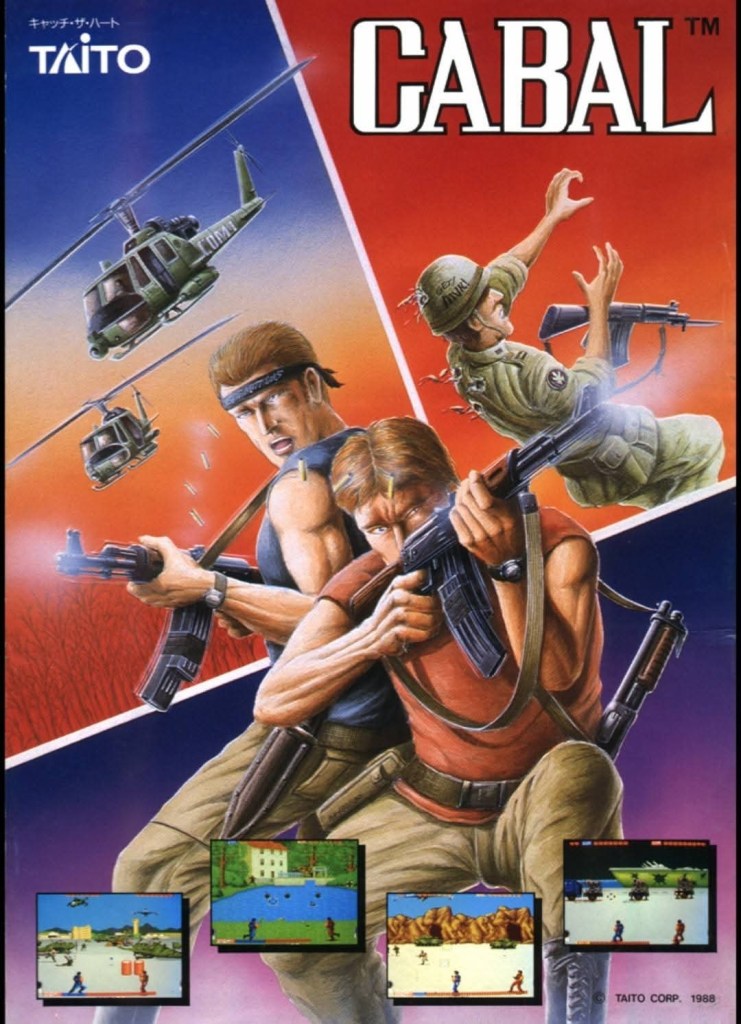
1. Cabal Japanese arcade flyer/poster
Can you feel the action and intensity here?
When it was first released in video arcades in Japan in late 1988, Cabal was another game inspired by military action movies of Hollywood which explains the art work done for the arcade flyer and poster shown above. The Vietnam War was still fresh in people’s minds and the concept of having one or two players firing their weapons against enemy soldiers resonated with gamers who saw Hollywood’s military action flicks. That said, it is not surprising that Cabal became a huge hit in Japan before getting released in arcades around the world.
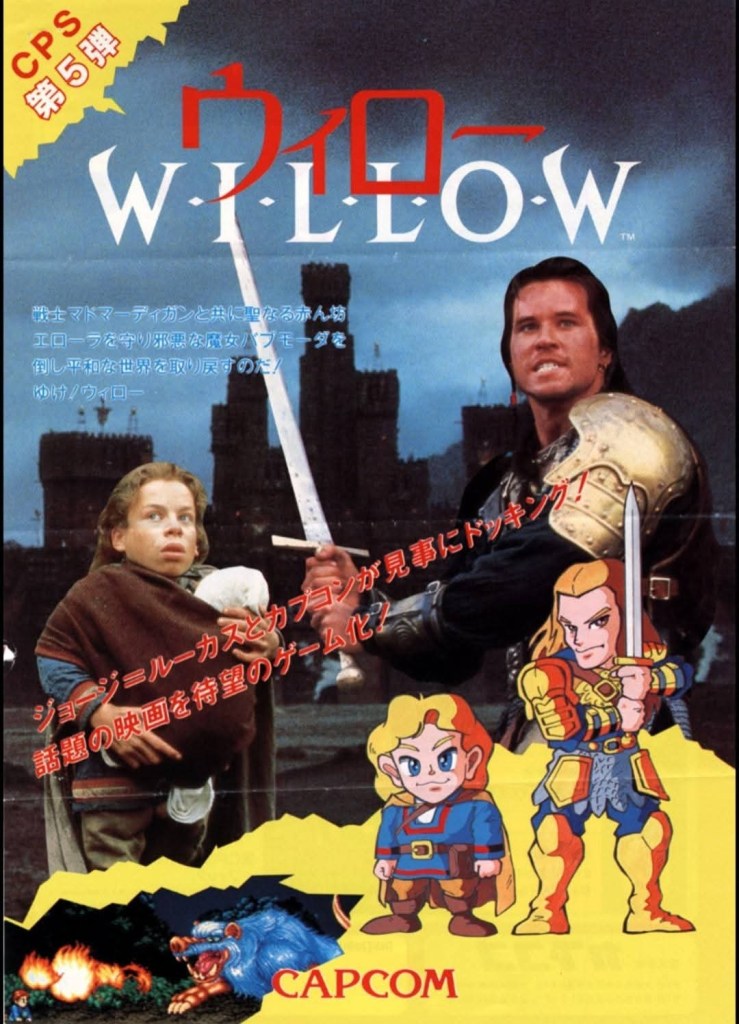
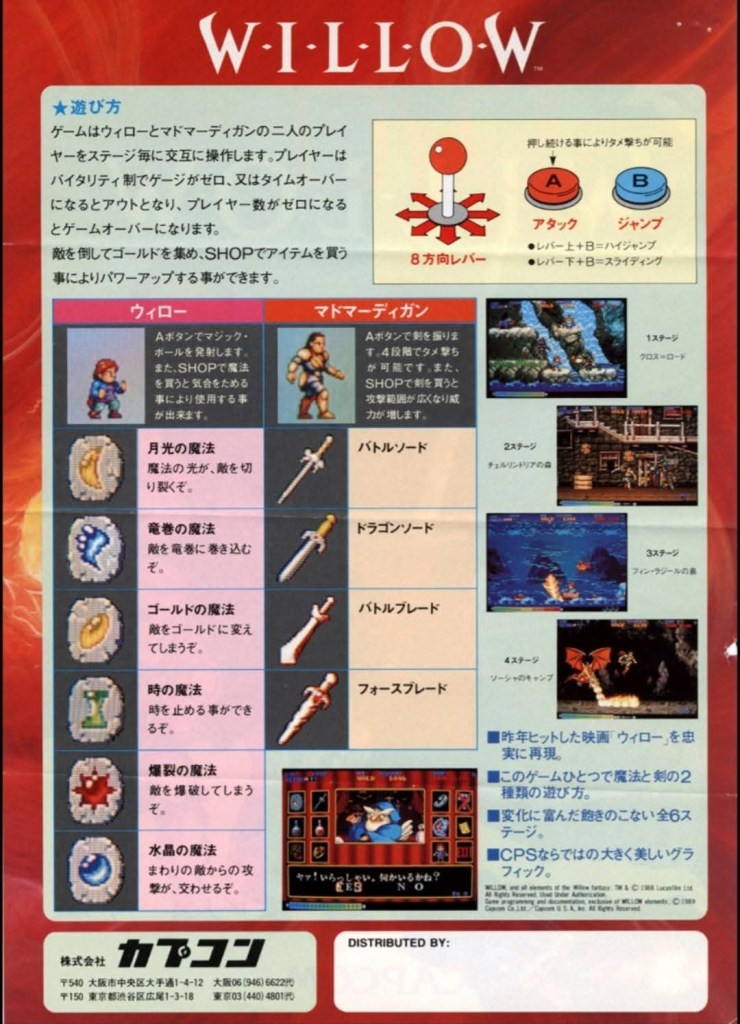
2. Willows Japanese arcade flyer
The front.
The rear.
Remember the 1988 high fantasy adventure film Willow? That film was produced by George Lucas and was a bold new production of Lucasfilm shifting away from Star Wars. Believe it or not, an official arcade game adaptation of Willow was made by Capcom and they promoted it by having images of Val Kilmer and Warwick Davis on the front of the arcade flyer (opposite the illustrated versions of their characters). The game, which was a side-scrolling platform game with run-and-gun elements, went on to be an arcade hit in Japan and eventually pleased gamers worldwide.
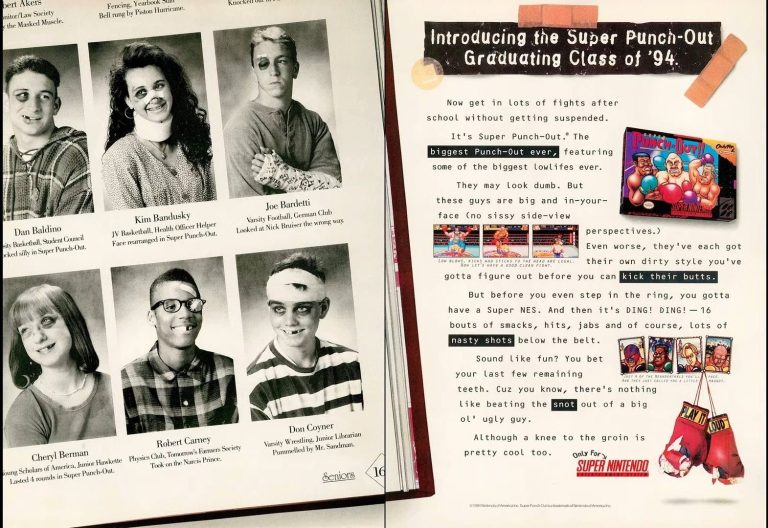
3. Super Punch-Out!! North American print ad
This is funny to look at.
Historically, Nintendo’s Punch-Out!! series started in the arcade in 1984 and the first game was the result of the company’s effort to make a new game using arcade cabinets with two screens. The 2nd game – Mike Tyson’s Punch-Out!! – became a huge critical and commercial hit (over 2 million copies sold in 1988) on console and it made great business sense for Nintendo for release another Punch-Out!! for its console gamers to enjoy in the comfort of home. In 1994, Super Punch-Out!! was released on the Super Nintendo Entertainment System (SNES) in America and to promote it, the company came up with a hilarious 2-page ad that showed fictional high school graduates with boxing-related injuries. The imagery creatively connected with the words “biggest Punch-Out ever” and “Graduating Class of ‘94”.
4. EA Sports 3-in-1 SNES games print ad
EA Sports games on the SNES.
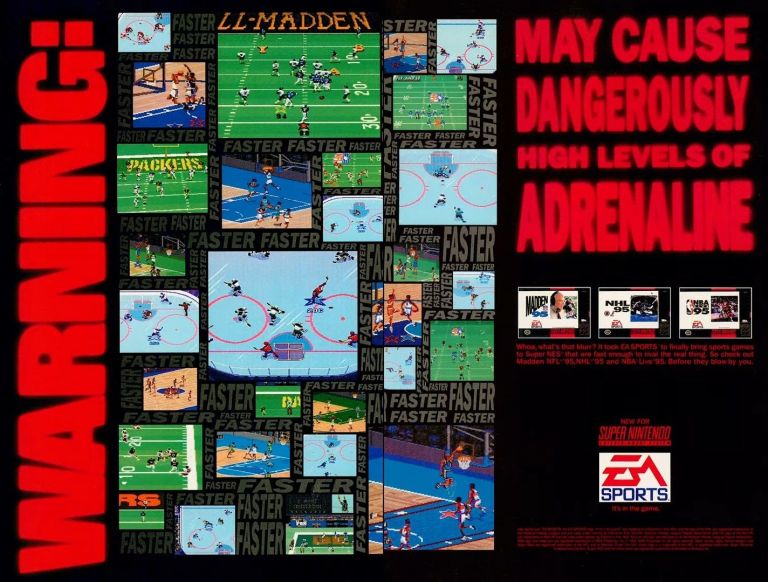
In 1994, Electronic Arts (EA) released their sports games NBA Live 95, NHL 95 and Madden NFL 95 for consoles at the time. Even though the Sega Genesis sold better than Super Nintendo Entertainment System (SNES) in America at the time, EA went on to aggressively market their 3 sports video games on Nintendo’s console using a 3-in-1 games print ad. In retrospect, the SNES for the most part had better graphics and sounds than the Genesis which is reflected clearly on EA Sports games of the time. This print ad still looks fun and exciting.
5. Atari Jaguar CD print ad
Were you able to play any game on the Atari Jaguar with the CD add-on included?
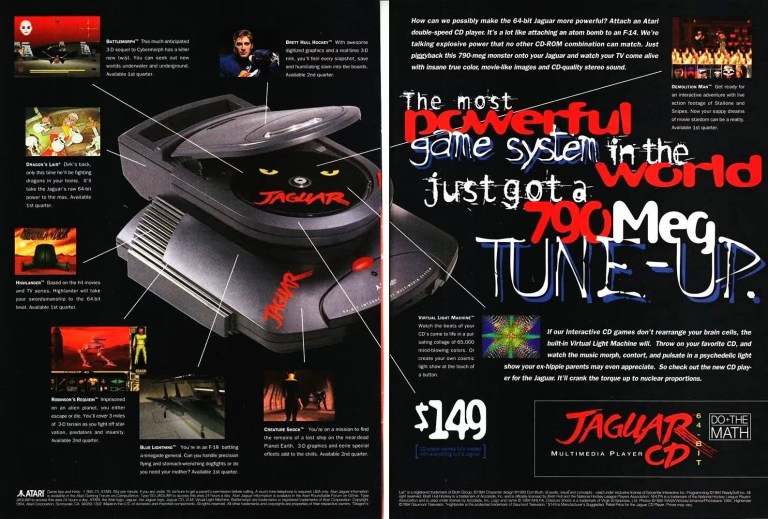
Apart from the obvious advances of technology that impacted video games, the 1990s is also known for the rise of CD-ROM as a medium for gaming. In an effort to boost sales of the Atari Jaguar console (launched in America in 1993 for around $250) and capitalize on the trust of the fans and console owners, Atari launched a CD-ROM add-on device for about $150 in 1995. To promote it, the company went aggressive with the 2-page ad showing the add-on fully connected on top of the main console, showing off some games and posting a text description emphasizing hardware power and the advantages that come with the CD technology. Even in the captured image, the Atari Jaguar CD still resembled a toilet. This is an aggressive ad campaign that failed as less than 20,000 Atari Jaguar CD units were sold by the time it was discontinued in 1996.
6. 3DO print ad
While it lacks intensity, this 3DO ad emphasized the games.
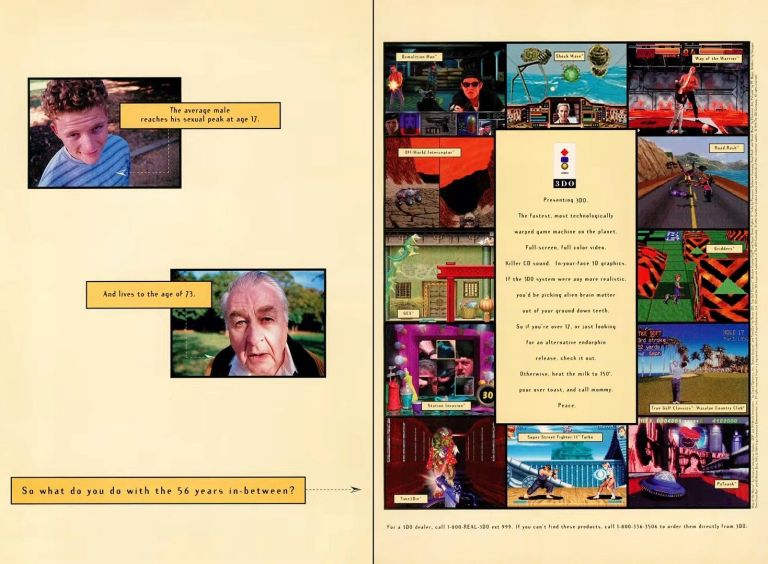
Without showing any hardware, the 3DO Company came up with this 2-page print ad that had a slightly adulterated tone (look at the left page) and aggressively marketed the 3DO console games available at the time. Games like Demolition Man, Shock Wave, Road Rash and Super Street Fighter II Turbo were the standout titles which clearly showed the company made the effort to emphasize gaming more than multimedia features. This 1990s ad tackled the generations with a touch of humor.
7. Lethal Enforcers II: Gun Fighters Sega Genesis print ad
This is a fun ad to look at.
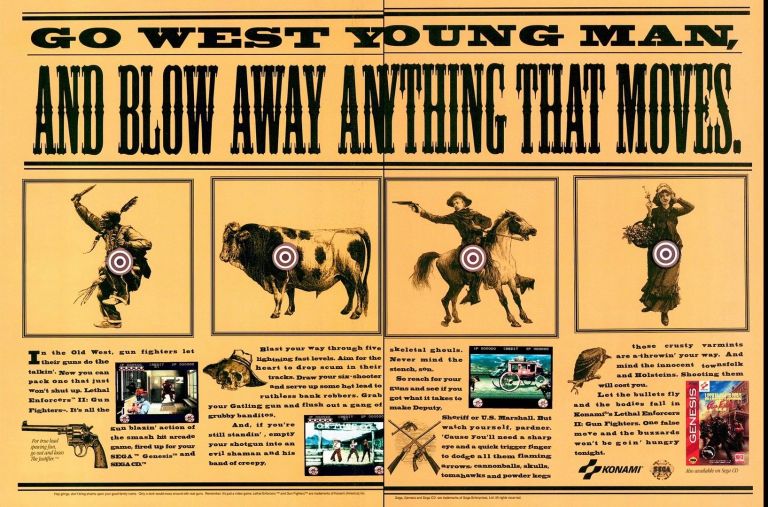
When Lethal Enforcers II: Gun Fighters was released in the arcades in 1994, it became a commercial success for Konami which went on to announce it would port the game to consoles of Nintendo and Sega at the time. While the port for the Super Nintendo Entertainment System (SNES) was never released, Lethal Enforcers II: Gun Fighters made its way to the Sega Genesis and Sega CD. The print ad of the Sega Genesis version (Sega CD mentioned in small text) had an inspired design emphasizing the Old West, shooting and the conflict between cowboys and Indians. The screenshots gave people the clear idea that Old West was the setting (versus modern day in the previous game). This is still fun to look at.
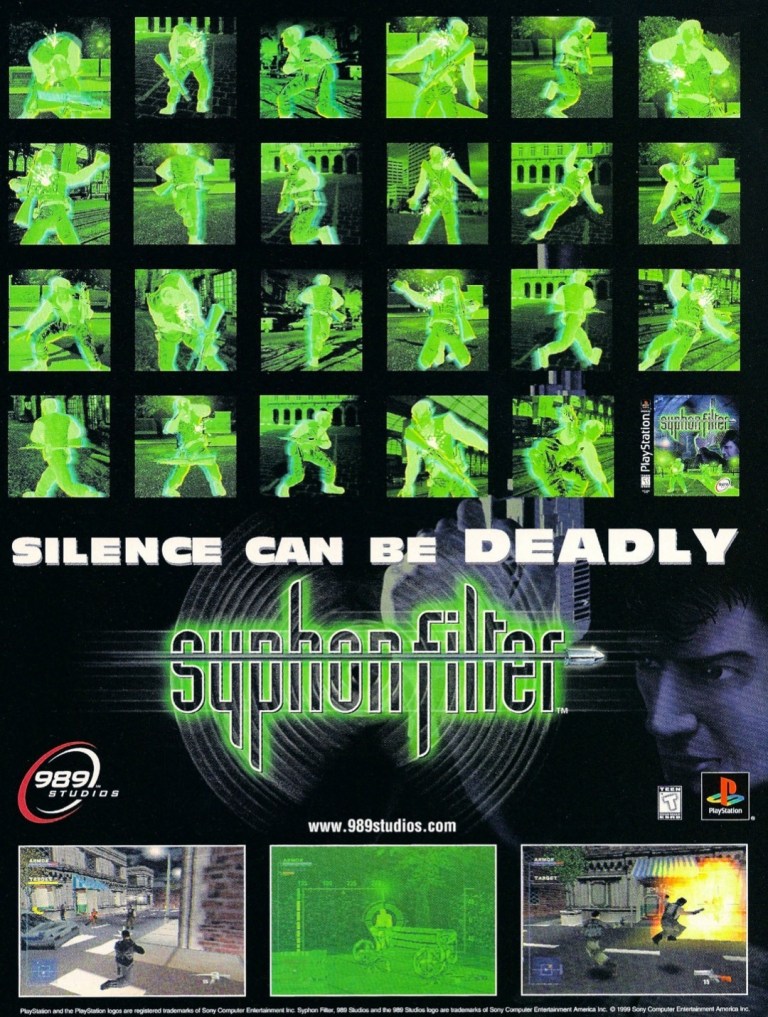
8. Syphon Filter
Syphon Filter went on to become a surprise hit game in 1999.
In 1999, Sony’s 989 Studios released Syphon Filter exclusively on the PlayStation console. This single-page print ad showed a few screenshots on the bottom and several action snippets with a night vision touch ultimately emphasizing the stealth aspect within the gameplay. The marketing proved to be effective as the game sold a lot at retail and went on to establish a new game franchise exclusive to PlayStation consoles.
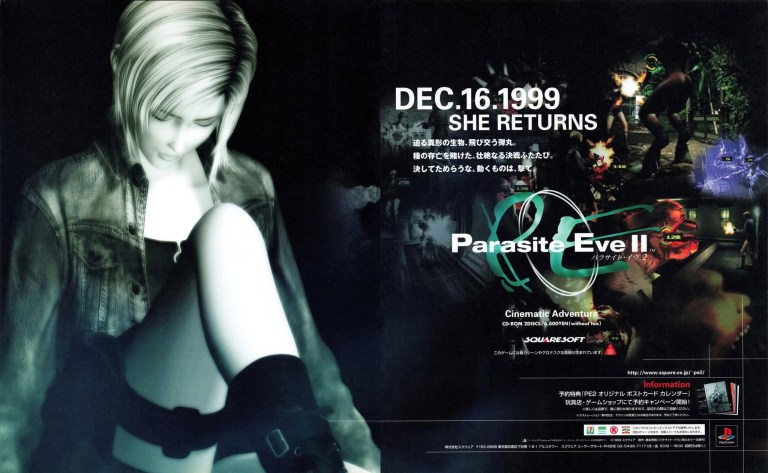
9. Parasite Eve II Japanese print ad
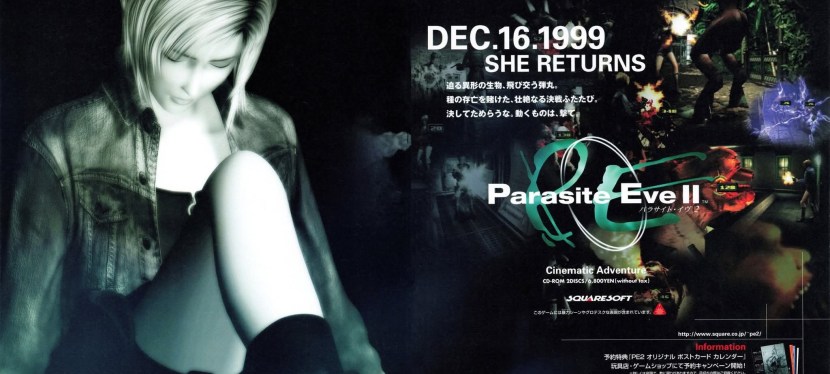
Were you a big fan of Aya Brea and the Parasite Eve franchise in the late 1990s?
Following the critical and commercial success of Parasite Eve in 1998, SquareSoft proceeded with Parasite Eve II and the production (note: initially for a spin-off game before becoming a sequel) did not even involve the main creators of the first game. Instead the company had a different team of developers – including those who previously worked on Resident Evil games for Capcom – in Osaka to make the sequel. This explains why Parasite Eve II had stronger survival horror gameplay resembling a Resident Evil game. As major changes were made during the production, it was decided that Aya Brea would become the main protagonist and already the character was already popular with gamers. That being said, the marketing of Parasite Eve II for the Japanese market heavily featured Aya Brea with subtle sexiness, beauty and action in mind. The marketing intensified leading to its eventual December 16, 1999 release in Japan.
Welcome back readers, fellow geeks and electronic gaming fans!
In this edition of the Retro Gaming Ads Blast (RGAB) series, we will take a look at another batch of retro gaming print ads – including arcade flyers – from the 1980s and 1990s.
For the newcomers reading this, Retro Gaming Ads Blast (RGAB) looks back at the many print ads of games (console, arcade, computer and handheld) that were published in comic books, magazines, flyers, posters and newspapers long before smartphones, social media, the worldwide web and streaming became popular. To put things in perspective, people back in the 1980s and 1990s were more trusting of print media for information and images about electronic games and related products.
With those details laid down, here is the newest batch of retro gaming print ads for you to see and enjoy…
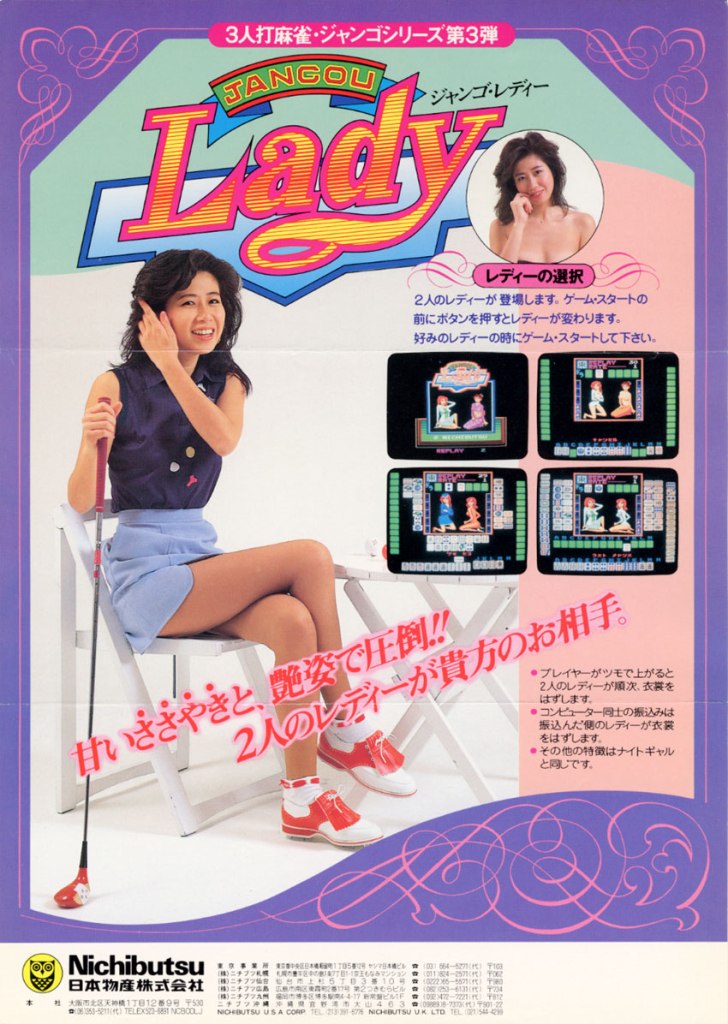
1. Jangou Lady arcade flyer
If you were to play Mahjong digitally, does sex appeal motivate you to do so?
Are you fond of playing the tile-based game Mahjong? Believe it or not, there were indeed ways to play Mahjong in digital form inside the arcade or in gambling joints in Japan. The game Jangou Lady allows users to play rounds of Mahjong but with a notable additive – the digital art of women which serves as an attraction. In the sex appeal is clearly evident on this arcade flyer from the 1980s.
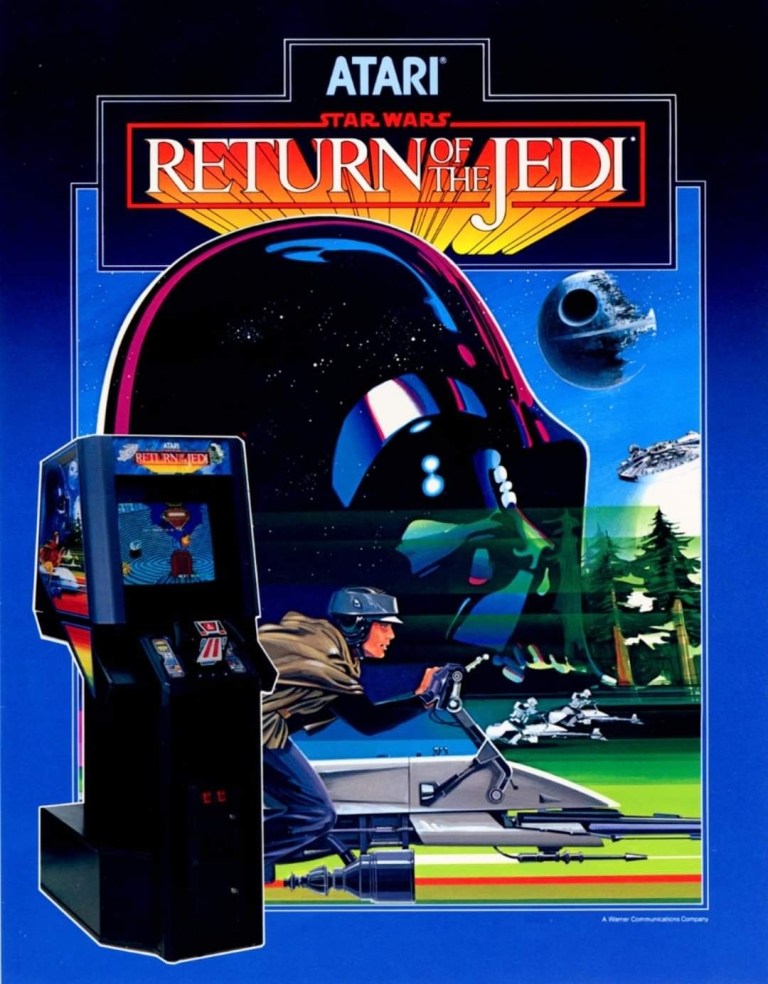
2. Star Wars: Return of the Jedi arcade flyer
Really nice art based on the movie.
Way back in 1983, Return of the Jedi delighted moviegoers in the cinemas throughout America. Behind the scenes, video game giant Atari acquired the movie license to make the 1984 arcade game Star Wars: Return of the Jedi. The arcade flyer’s front featured a highly detailed hand-drawn art of Darth Vader, the Death Star, Luke Skywalker and Storm Troopers on hover bikes, and the Millennium Falcon which reflect the selected elements of the movie that were turned into playable sections. The image of the arcade machine was understandably inserted as it came with an unusual controller. This flyer is still captivating to look at.
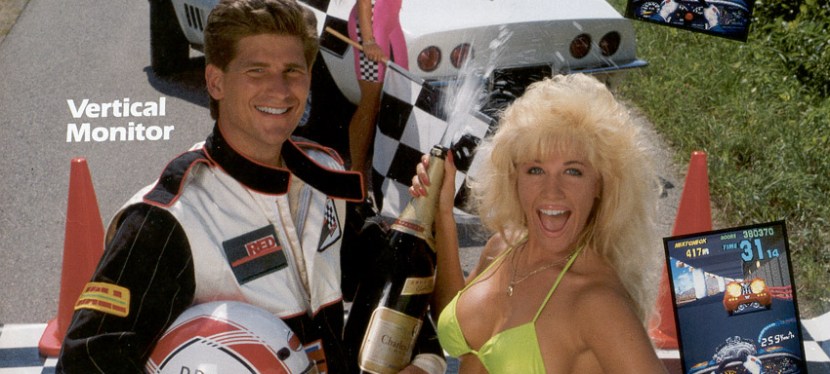
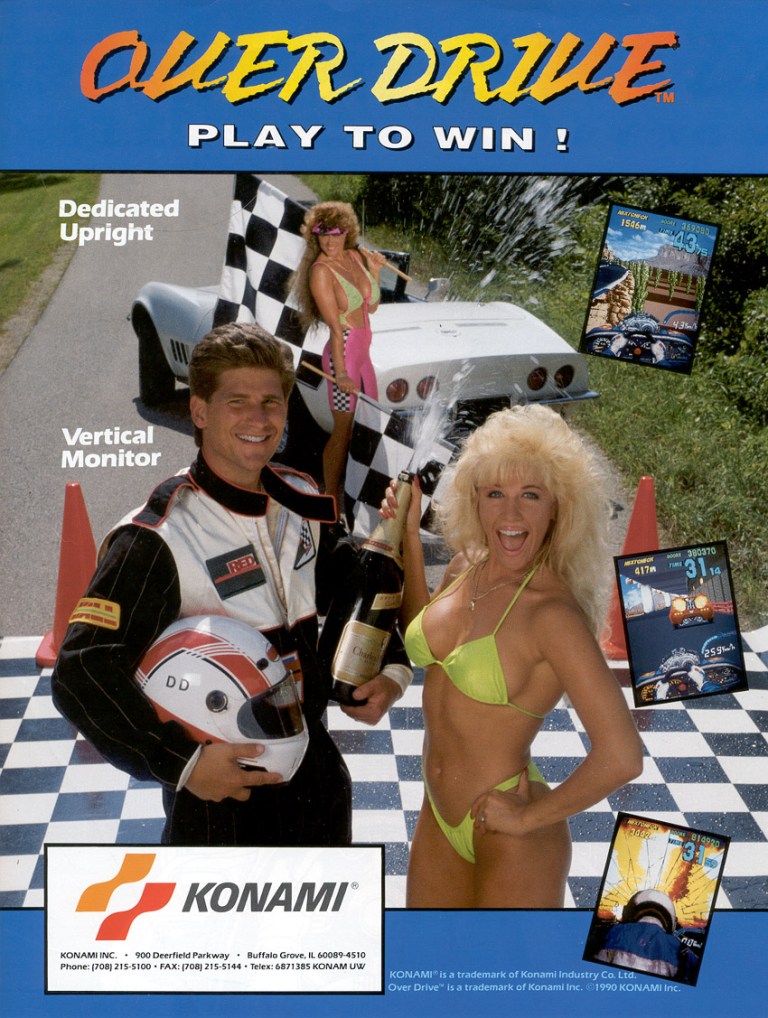
3. Over Drive arcade flyer
This arcade flyer is a reminder that Konami was notable for hiring pretty and sexy women for their print ads.
In 1990, Konami produced a racing game for the arcades with a unique style of presentation. That game was Over Drive and it stood out among the many racing games in the arcade mainly because of its first-person view (with a digital version of the steering wheel and driver’s hands at the bottom of the screen) and unique approach on sprite-scaling. To promote the game, Konami hired sexy models for photography for use in both the arcade flyer and the exterior images on the machine. Having sexy models posing with a winning driver added to the motorsport racing vibe needed to promote the game.
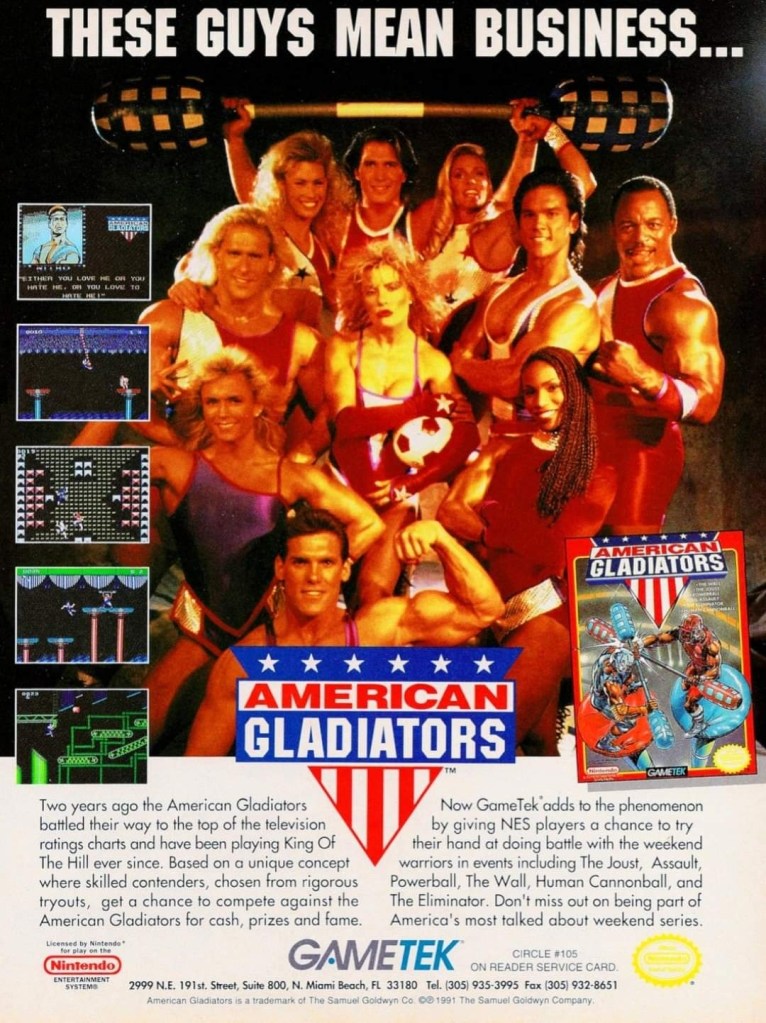
4. American Gladiators for NES print ad
I saw American Gladiators on TV but never played this game.
American Gladiators was a syndicated TV show that featured a variety of games in which amateur athletes compete with the established gladiators to succeed and become the next American Gladiator. Due to its success, it was not surprising that video game adaptations of the show were realized just a few years after its debut. In 1991, GameTek released the American Gladiators game on the Nintendo Entertainment System (NES) and promoted it with this print ad that showcased their established gladiators of the time. This ad’s design was made to catch the attention of the fans.
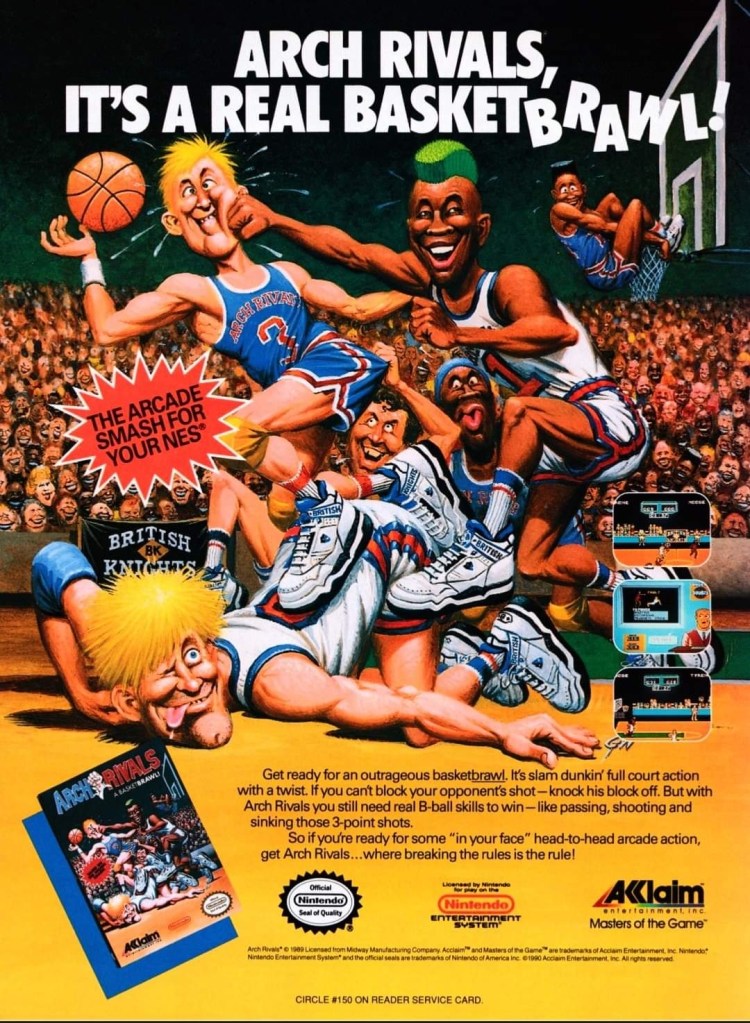
5. Arch Rivals for NES print ad
I remember seeing a lot of people crowding in front of an Arch Rivals machine in the local arcade long ago.
Years before NBA Jam, there was Arch Rivals. Arch Rivals was a full court basketball video game in which players are allowed to punch players from the opposition in order to steal the ball and score. Over a year after the game’s 1989 arcade debut, the NES version was released and the publisher came up with a print ad showcasing a hilarious and cartoony artwork (the same art used for the game’s box cover) which gave readers a clear idea of what to expect. The art used is timeless and it still is funny to see.
6. Sega Sports print ad
See any Sega Sports video game you like?
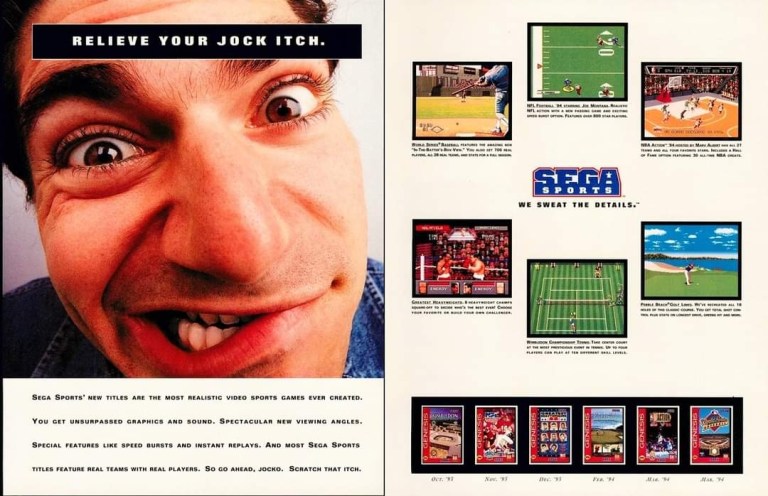
Back in the 1990s, Sega excelled with sports video games. They were so aggressive, they established their sub-brand Sega Sports and this particular print ad showed one page promoting assorted sports video games (basketball, golf, baseball, tennis, boxing and American football) for the Sega Genesis and the other page with an exaggerated image of a guy with the line “Relive your jock itch” posted. Historically, a lot of American players and owners of the Genesis are slightly older than those on NES and Super Nintendo Entertainment System (SNES) during the 1990s and the strong sports games approach is a key factor.
7. Plumbers Don’t Wear Ties print ad
When I first saw this print ad, it did not interest me as the presentation is lousy.
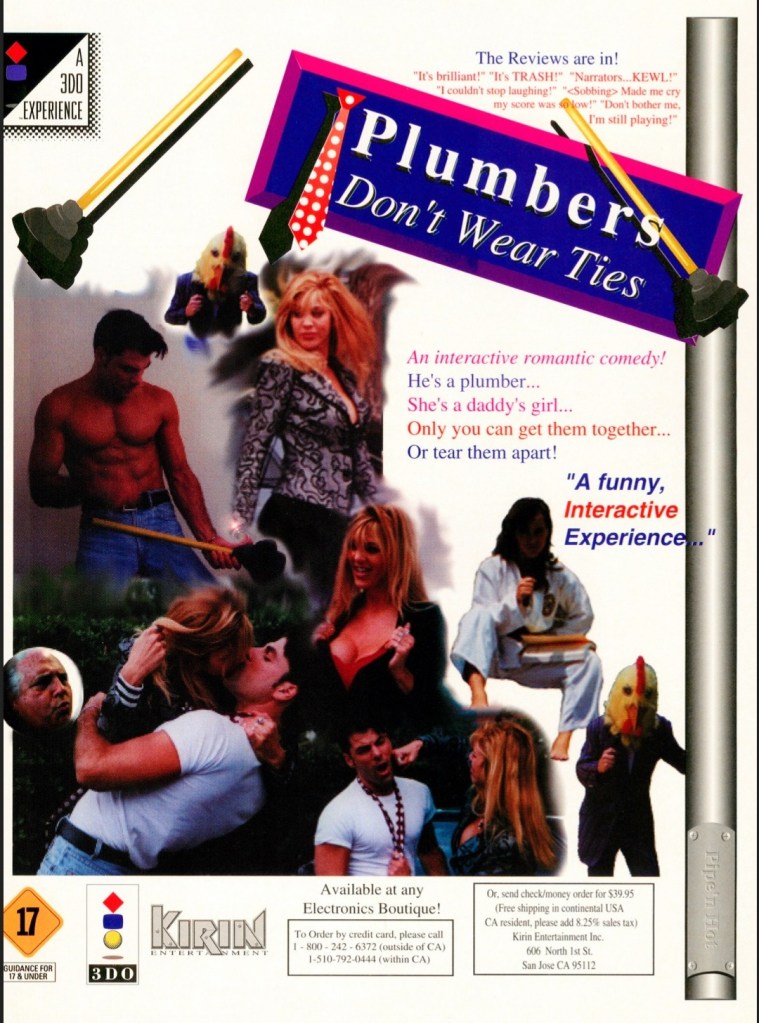
The 3DO console is remembered for having a lot of games that used full-motion videos and photo slides regardless of what game designs came with them. Back in the 1990s, games designed as visual novels or dating simulations were still new in console gaming in the West. Following the PC version’s release, a 3DO port of Plumbers Don’t Wear Ties came out in 1994 and it received overwhelmingly negative reviews. The print ad here promoted the game as “an interactive romantic comedy” and fake quotes were displayed to fool ignorant readers that the game was entertaining. The print ad’s visual design had a mess of poorly implemented images. Ironically, this ad accidentally gave readers the idea that it was a slideshow game.
8. Dragon: The Bruce Lee Story and Demolition Man games print ad
If you saw the movies, did you play their respective video game adaptations?
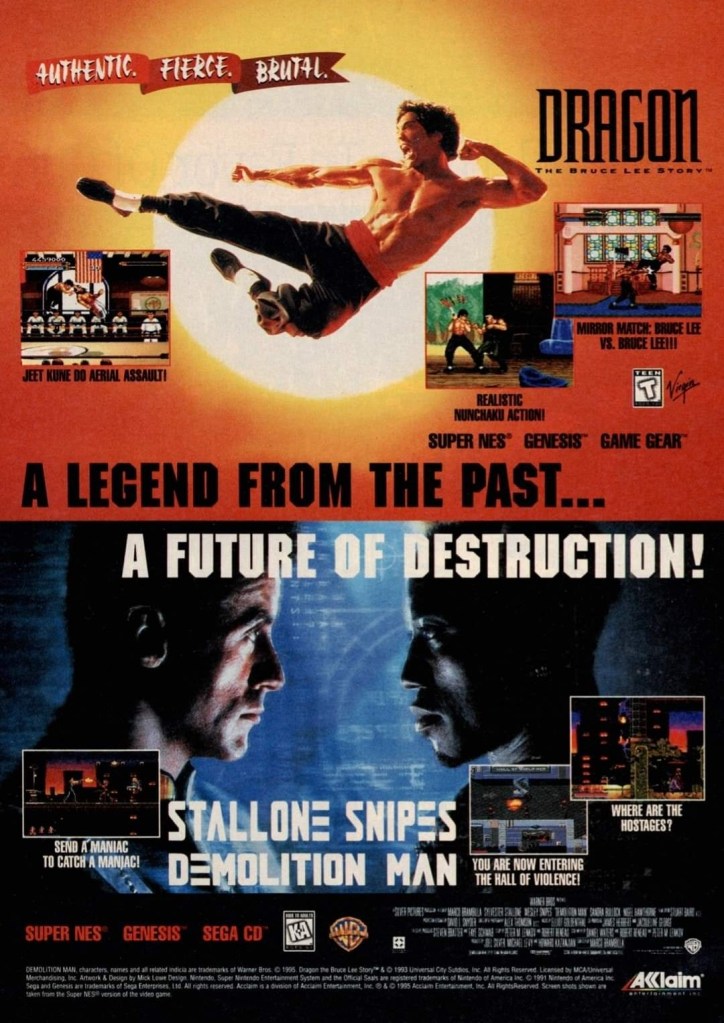
The 1990s is remembered for the many movie-based video games that got released. Back in those days, a lot of Hollywood movie productions had video game adaptations as part of the business process and this is evident with the Dragon: The Bruce Lee Story and Demolition Man games released by Acclaim. For this particular print ad, the marketing team came up with a single-page ad to promote the two games with heavy emphasis on movie imagery leaving little room left for screenshots and other details. The way I look at this old print ad, it seems that Acclaim was aiming for not just movie fans but also gamers who like 2D fighting games and 2D action-adventure games.
9. Army Men: Sarge’s Heroes print ad
This print ad by 3DO is still funny to see.
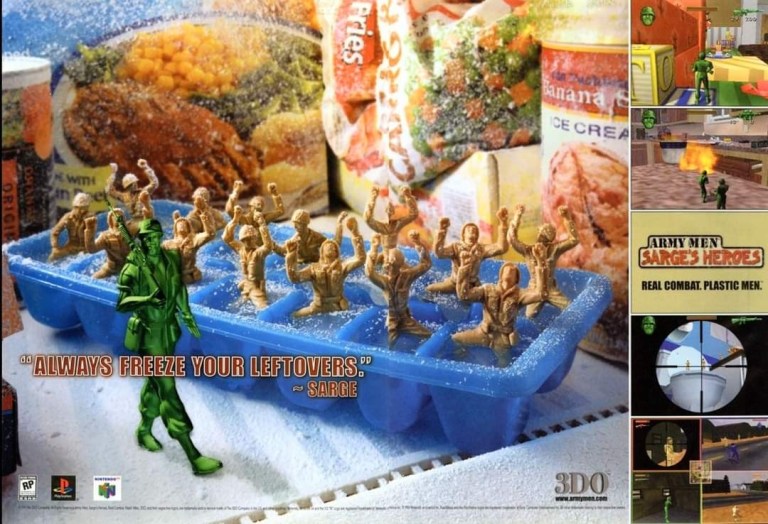
In the late 1990s, The 3DO Company focused mainly on producing video games on multiple platforms and they had their own video game franchise based on the green plastic figures with a military theme. In 1999, they released Army Men: Sarge’s Heroes for PlayStation and Nintendo 64 (N64). To market the game, they had a hilarious visual concept of several solders freezing on an ice tray as a long green soldier marching on. This print ad always caught my attention while reading game magazines and it still is funny to stare at.
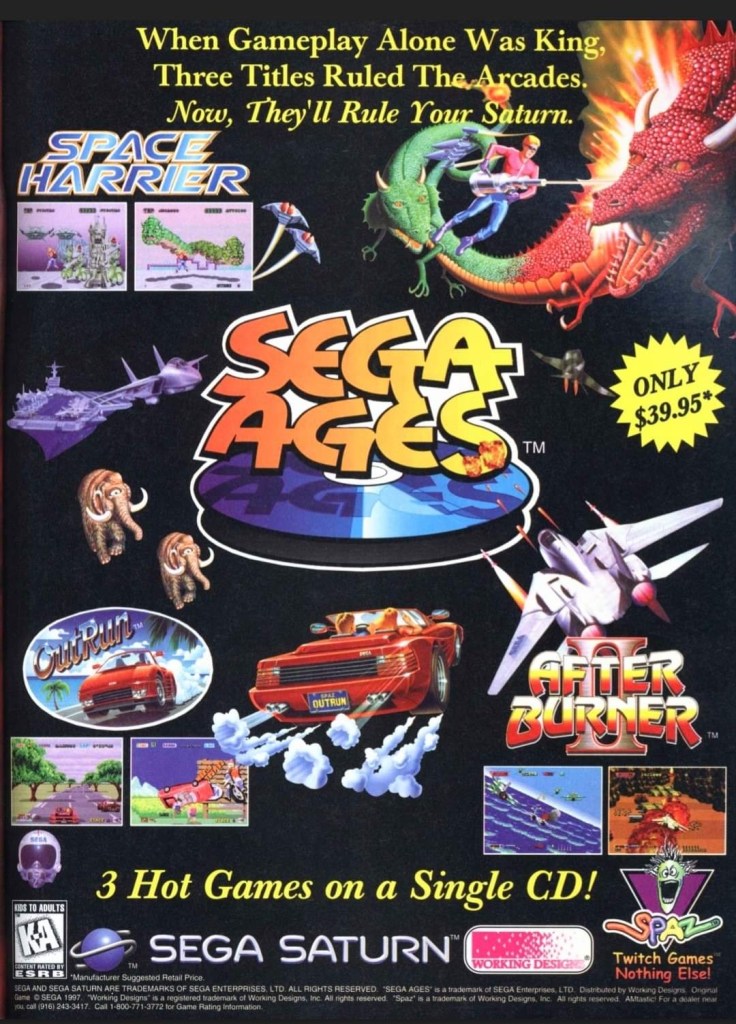
10. Sega Ages print ad
I can only speculate that Sega accepted Working Design’s financial offer for the publishing rights in North America.
Sega Ages is a series of ports and remakes of Sega’s own games (arcade and console) bundled together as compilations released on the modern consoles of the time. While Sega itself published Sega Ages on their Saturn console and Europe, the North American compilation was published by Working Designs under their separate brand Spaz which this particular print ad showed. While the classic Sega games of After Burner II, OutRun and Space Harrier often caught my attention, this ad made me wonder why did not Sega publish this compilation on the Saturn in North America themselves. Looking at this ad now remains awkward.
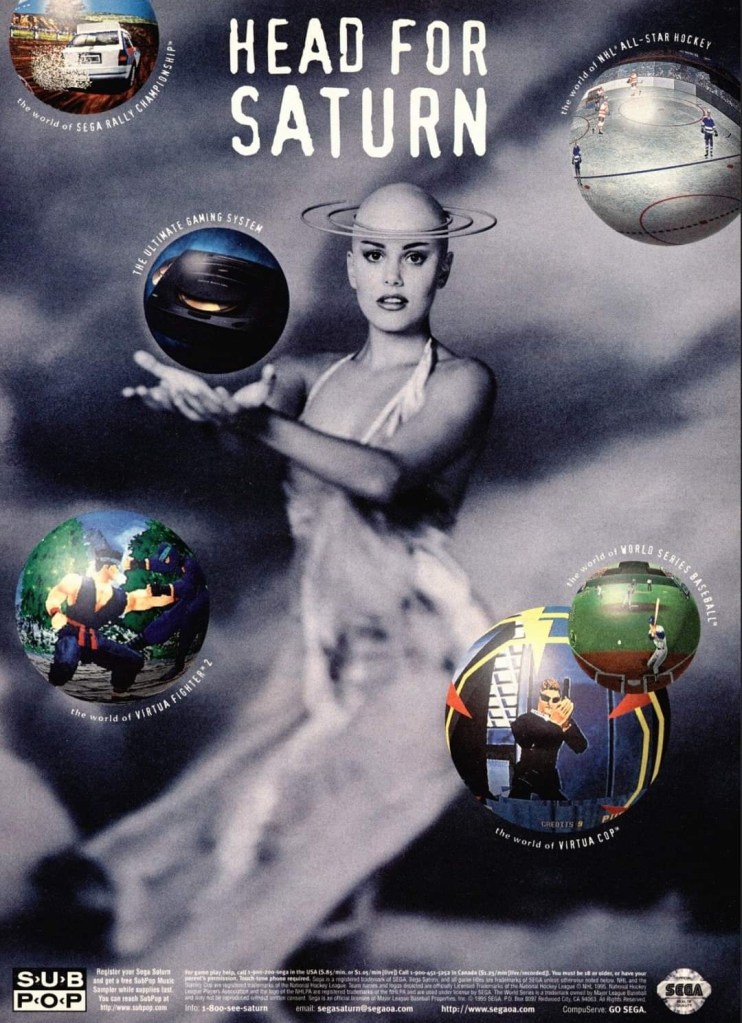
11. Sega Saturn North American print ad
Did you ever own a Sega Saturn in 1995?
While a lot of gamers and retailers were caught off-guard by Sega’s surprise early launch of the Saturn console in America, they still went ahead aggressively marketing the machine knowing they have a few months’ head start before the American launch of PlayStation. This print ad was designed to intrigue readers showing a bald lady whose head was made to look like the planet Saturn and next to her were images of Sega’s hottest games of the time – Virtua Fighter 2 and Virtua Cop. Sega relied strongly on imagery to promote their console with this print ad. It was somewhat weird yet eye-catching.
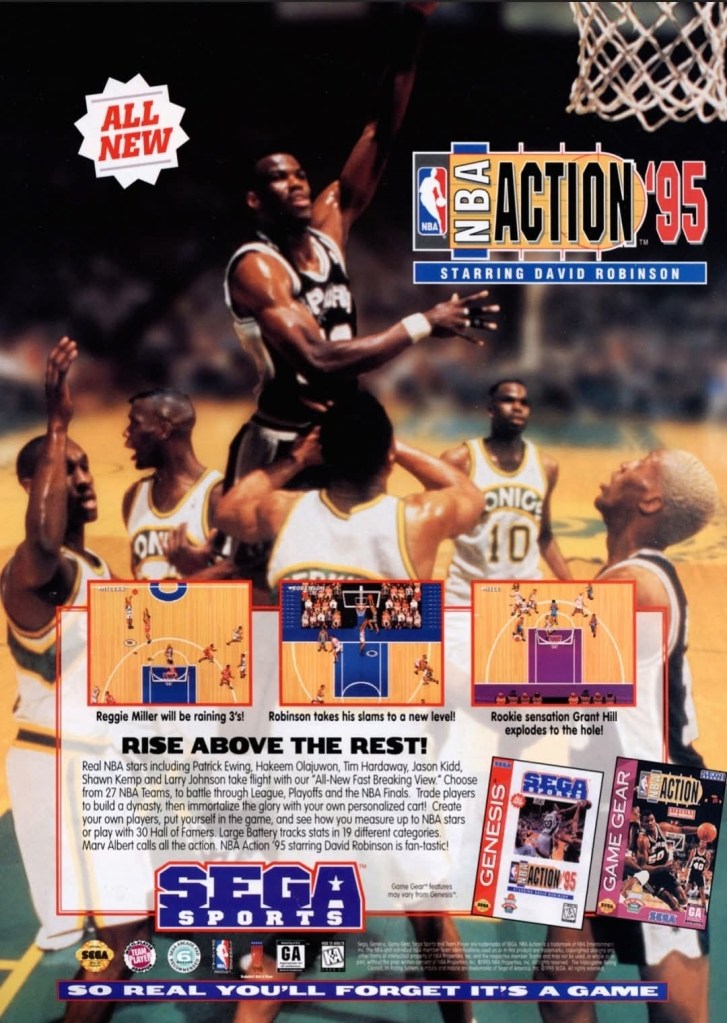
12. NBA Action ’95: Starring David Robinson print ad
David Robinson was the MVP of the NBA in 1995 but he failed to lead his team to the NBA championship back then. He would late win the NBA championship in the shortened 1999 season.
As mentioned early, Sega was aggressive the sports videos games and almost all of them were their own console exclusives. Their tradition of hiring professional athletes as endorsers continued during the age of the Genesis and Game Gear when they hired an NBA superstar as an endorser resulting in the Sega Sports basketball game titled as NBA Action ’95: Starring David Robinson. By the time the video game was released, Robinson was already the reigning Most Valuable Player (MVP) of the NBA. This print ad of Robinson in action still looks impressive but with a big catch – the superstar’s 1995 MVP achievement was arguably forgotten as he and his team (San Antonio Spurs) got eliminated by the Hakeem Olajuwon-led Houston Rockets in the Western Conference Finals. It did not help that Olajuwon outplayed Robinson a lot in that very playoff series. That is a sad reminder that also came with this Sega Sports print ad.
Welcome back readers, fellow geeks and electronic gaming fans!
In this edition of the Retro Gaming Ads Blast (RGAB) series, we will take a look at another batch of retro gaming print ads – including arcade flyers – from the 1980s and 1990s.
For the newcomers reading this, Retro Gaming Ads Blast (RGAB) looks back at the many print ads of games (console, arcade, computer and handheld) that were published in comic books, magazines, flyers, posters and newspapers long before smartphones, social media, the worldwide web and streaming became popular. To put things in perspective, people back in the 1980s and 1990s were more trusting of print media for information and images about electronic games and related products.
With those details laid down, here is the newest batch of retro gaming print ads for you to see and enjoy…
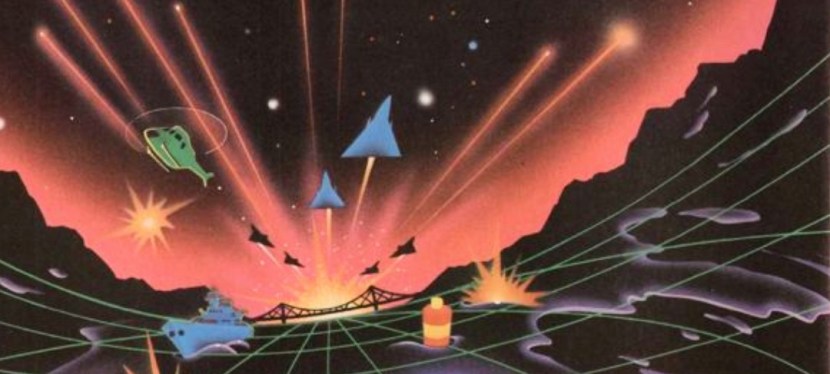
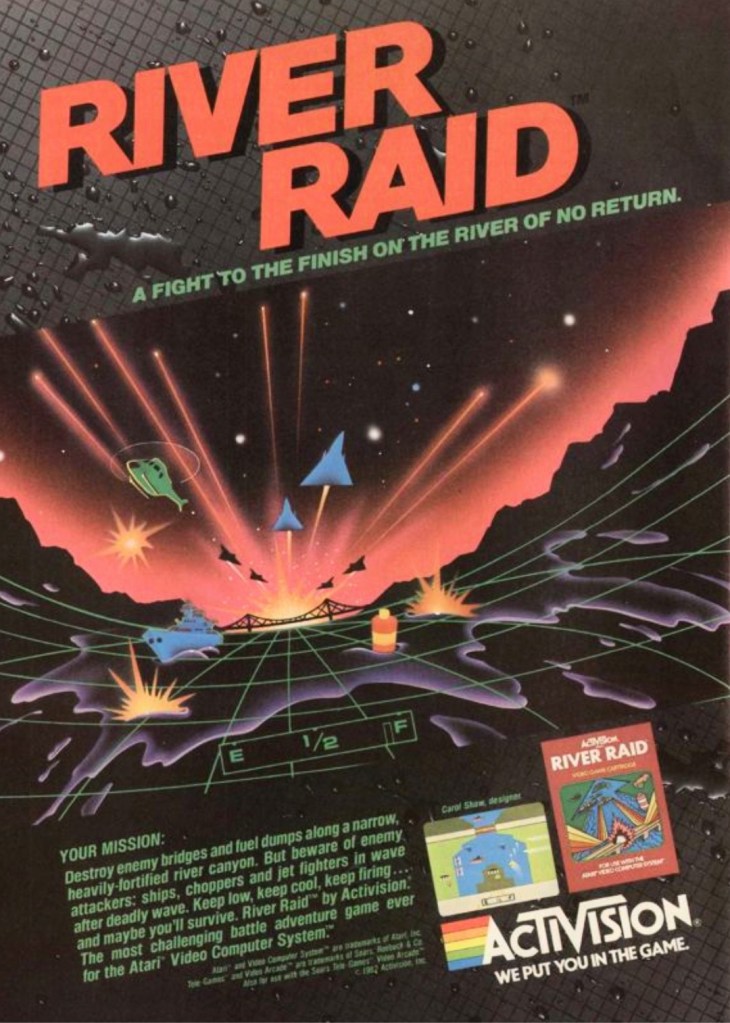
1. River Raid print ad
This River Raid print ad appeared on comic books and magazines long ago.
Decades before it became an industry giant with the best-selling Call of Duty games, Activision became a standout publisher in the early 1980s with River Raid on the Atari 2600. Designed by Carol Shaw, River Raid was a huge success ending up as the 2nd best-seller on the Atari 2600 as well as Activision’s best-selling game for the year 1983. Apart from showing one screenshot and the box cover of the game, the print ad of River Raid had this mesmerizing 3D image that caught many gamers’ attention and helped them feel like they will pilot on dangerous missions. The 3D image was futuristic in its own style became forward-moving 3D sequences in video games became reality many years later.
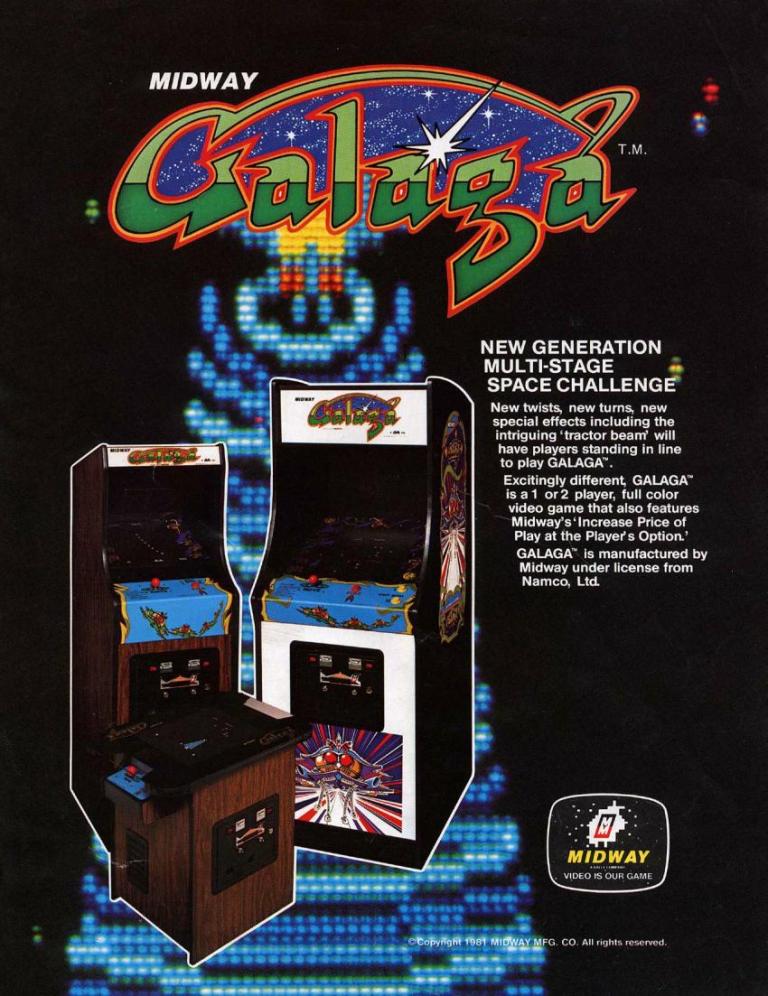
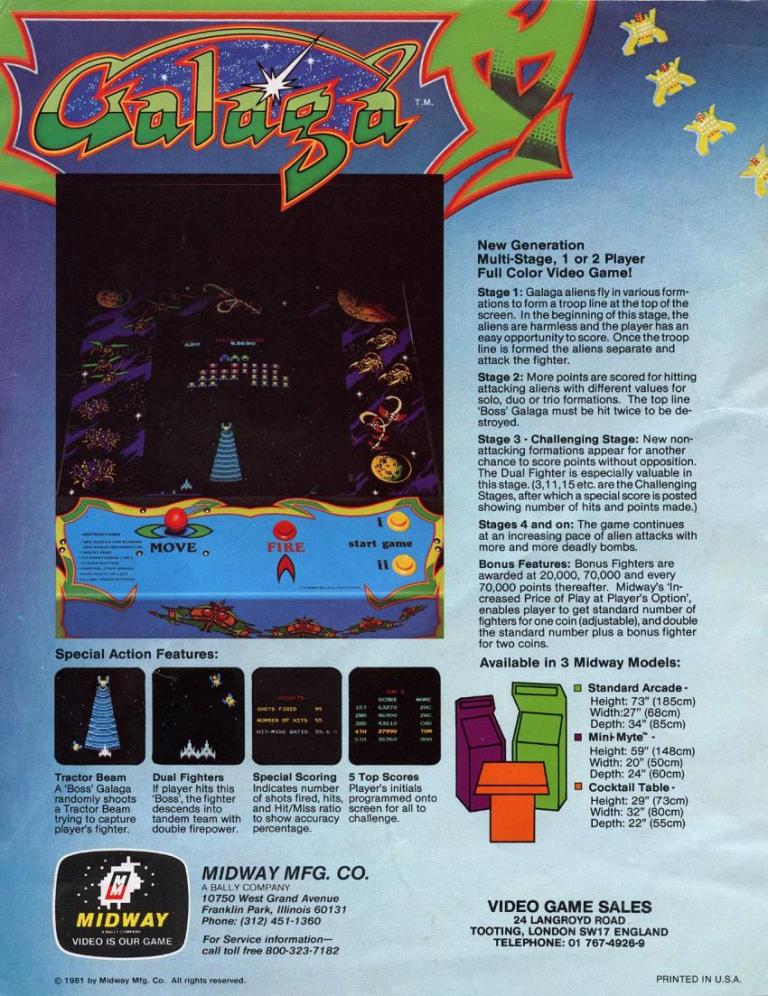
2. Galaga North American arcade flyer
The front of the flyer showing three Galaga machines that arcade operators can choose from.
Key details about Galaga were nicely presented on the rear of the flyer.
In the history of gaming, Namco’s Galaga was played by countless millions of gamers and it is still highly regarded as an arcade classic as well as one of the most enjoyable arcade games ever made. In preparation for the North American launch (October 1981), Midway prepared the arcade flyer showing the three types of machine on the front that arcade operators can choose from. On the rear is the really neat approach of explaining the details of the game, what kind of gameplay is to be expected, and how to play. Whether you are an individual player or the manager of an arcade joint, this flyer suits your needs.
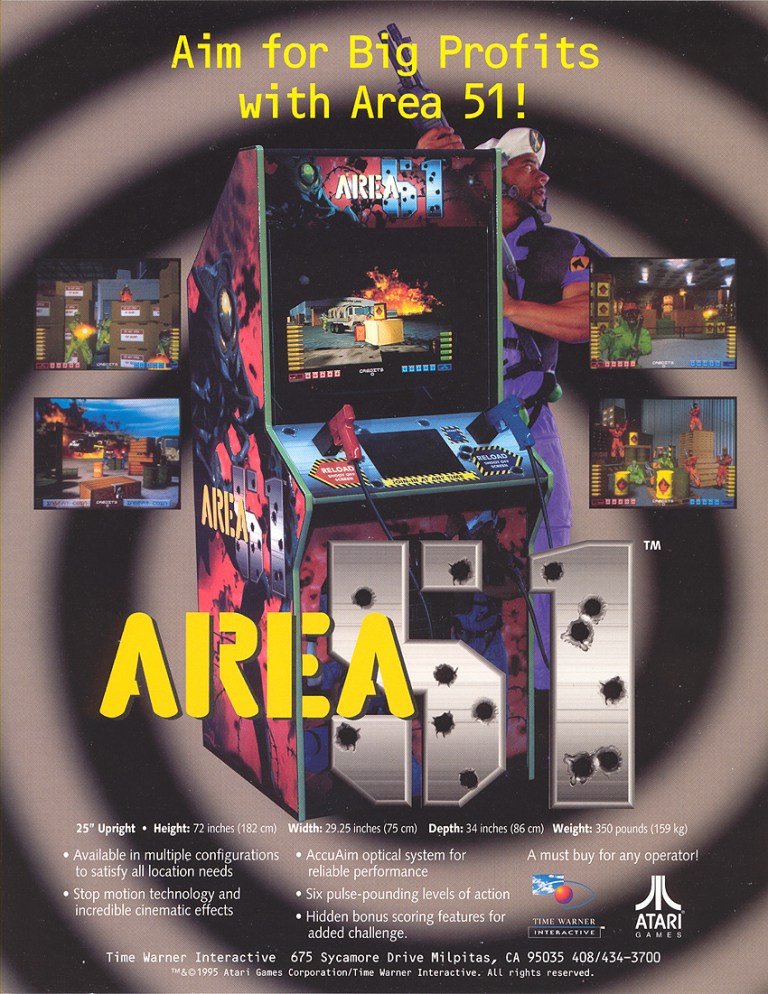
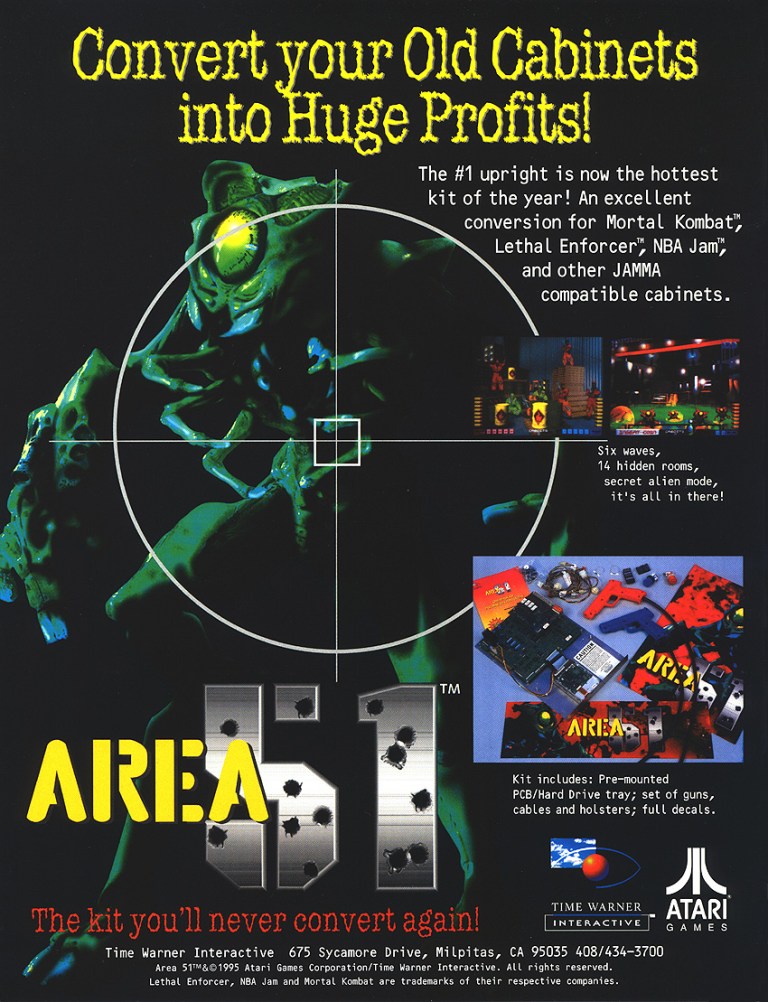
3. Area 51 arcade flyer and conversion kit flyer
The front of this Area 51 flyer had an enticing message for arcade operators as well as other business owners/managers who are interested in having a machine to add value to their business joints. Atari was already in deep money problems by the time they started making this game.
The Area 51 arcade conversion kit is a cheaper alternative for businesses who want the game.
Moving on to the 1990s, Atari was already struggling financially and desperately needed a hit to lift them up fast. A light gun shooter project was approved as arcade shooters were in good demand and after overcoming serious hurdles during production internally, Atari hired independent team Mesa Logic to take charge of development. After being granted extra time and more creative freedom, the project under Mesa Logic’s handling became a sci-fi shooter titled Area 51. The game became a huge hit in the arcades for Atari resulting in sales of more than 20,000 arcade cabinets as well as a major financial boost for the company (note: Atari still exists today). Atari went on to release Atari 51 versions for PlayStation, Sega Saturn and PC in America in 1996. The Atari 51 flyers you see here are still captivating to look at and were crucial in generating buzz among arcade operators, business joints that had space for arcade cabinets and gamers.
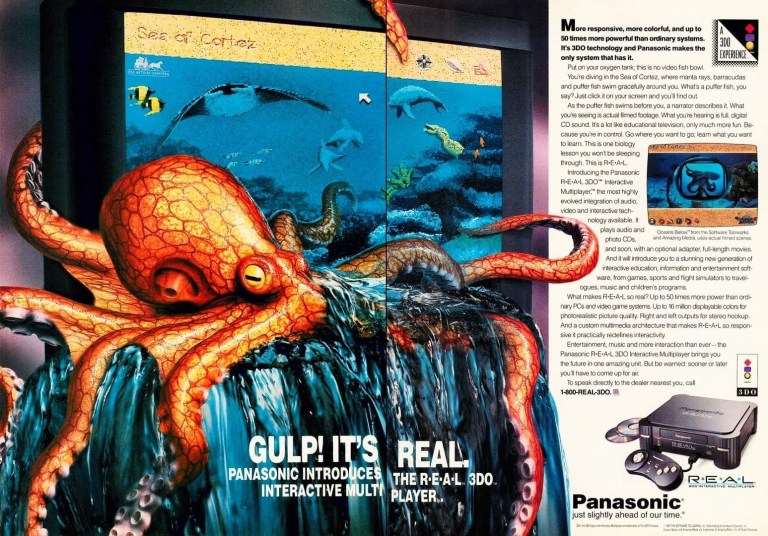
4. Panasonic 3DO print ad
The makers of this print ad forgot to mention the 3DO is also a game machine.
Back in 1993, the 3DO Interactive Multiplayer console manufactured by Panasonic (a licensee of the 3DO Company) was launched with a CD-ROM drive, multimedia features and gaming capabilities (with a 3-button control pad). This print ad strongly emphasized the 3DO’s ability to play high-quality sound and full-motion videos using the Sea of Cortez software which functioned as an interactive movie. Obviously, this did not resonate well with people who loved to play games and by the time the 3DO Company and its partners started marketing games, they could not save the 3DO console from fading to obscurity. The console shown in the ad is specifically model Panasonic FZ-1 R·E·A·L 3DO Interactive Multiplayer. Panasonic was one of five companies that were licensed by the 3DO Company.
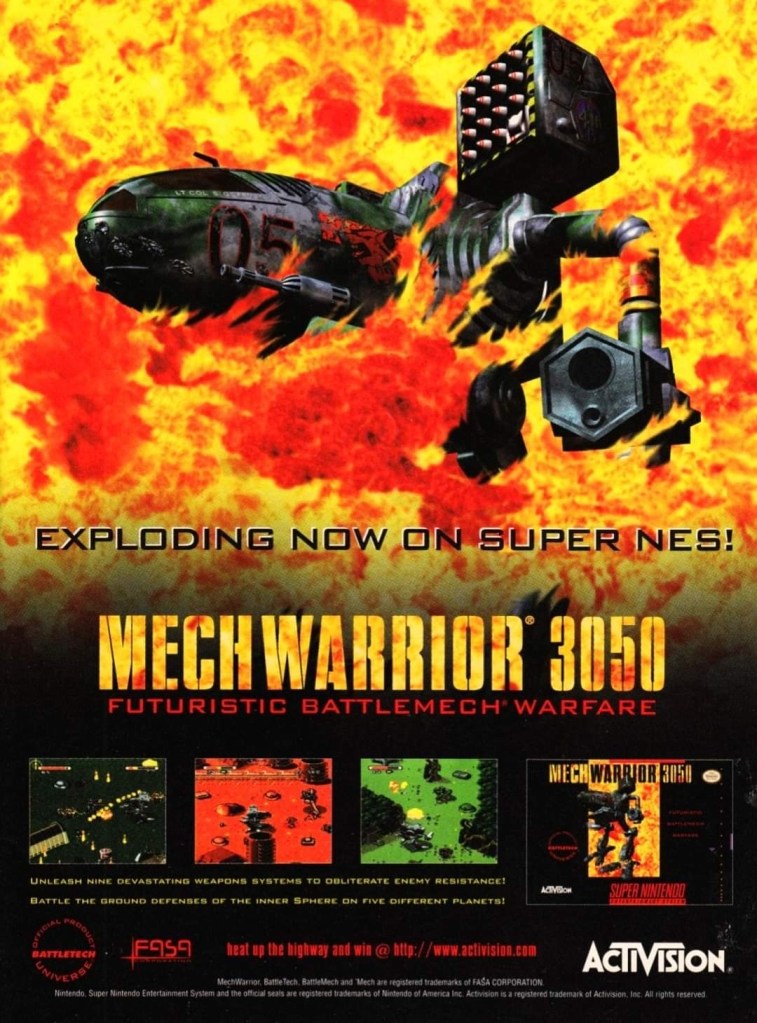
5. MechWarrior 3050 SNES print ad
If you were unaware of the 1994 game BattleTech, then this ad would have fooled you into thinking it is promoting a brand new game.
In 1995, the popular BattleTech entertainment franchise arrived on the Super Nintendo Entertainment (SNES) system with MechWarrior 3050 and its print ad had a really blazing artwork of an armed mech in fire which gave readers the illusion of a new and original game. In reality, MechWarrior 3050 was actually a port of BattleTech which was released on the Sega Genesis in 1994. The Genesis game was published by Extreme Entertainment Group while the SNES game was published by the more famous Activision. If you look closely at the MechWarrior print ad, you can tell how hard they tried to sell the game like it was brand new and all-original.
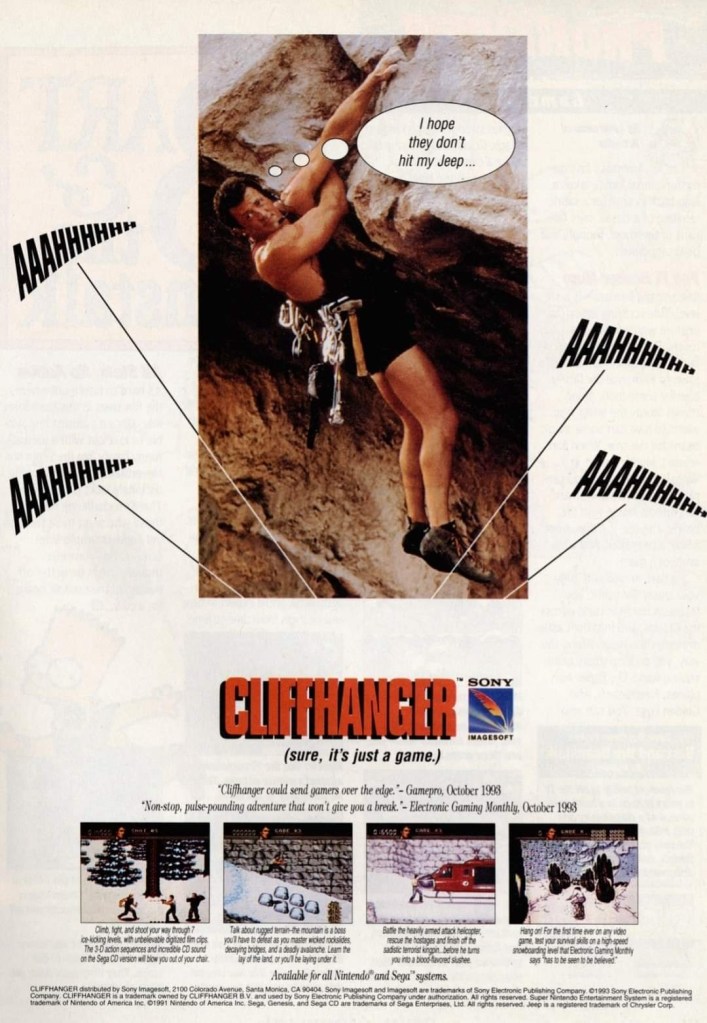
6. Cliffhanger video game print ad
This print ad had Sylvester Stallone hanging on a cliff to be relevant with the title of both the film and the game. They could not show images of Stallone in hard action scenes.
For fans of Sylvester Stallone, 1993 was a big and exciting year as the Hollywood icon appeared in two major action films – Cliffhanger and Demolition Man. Cliffhanger was released first and there were video game adaptations of it released on game consoles, handhelds and computers. This print ad of the Cliffhanger video game had an image of Stallone hanging on a cliff to emphasize the title. The ad makers cleverly posted selected gameplay screenshots and quoted GamePro and Electronic Gaming Monthly (EGM) to make the game look credible and worthy of purchasing. The marketing led to nowhere as the game received mostly negative reviews from critics and it faded to obscurity. Lastly, the Cliffhanger game ad had a noticeable amount of space wasted. They could have made the screenshots and text look somewhat bigger to sell the game.
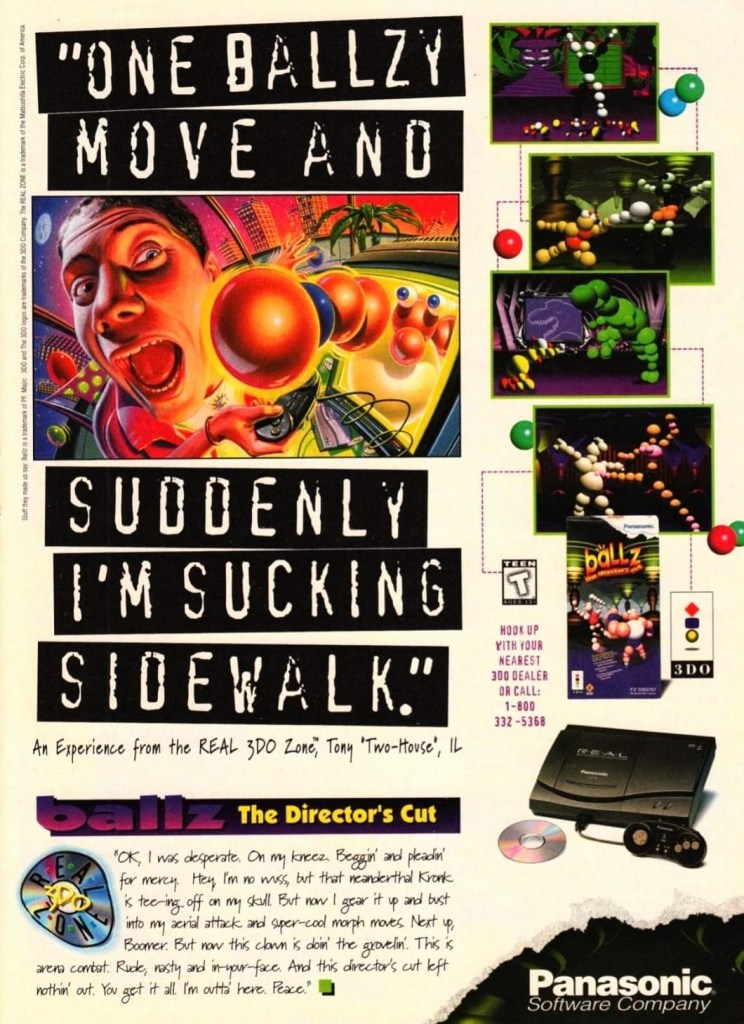
7. Ballz: The Director’s Cut print ad
I never got to play this game on the 3DO.
Here is another ad of the video game released on the failed 3DO console. As its title made obvious, Ballz: The Director’s Cut is an enhanced version of the original Ballz game of 1994 that was released on other consoles. The print ad had an eye-catching piece of artwork and posted beside it were selected shots of the gameplay. Strangely enough, the creative writing on the lower part of the ad does not make any sense and did nothing to convince gamers to play the game. As Ballz: The Director’s Cut was released in 1995, this ad shows the revised 3DO console from Panasonic (model: Panasonic FZ-10 R·E·A·L 3DO Interactive Multiplayer).
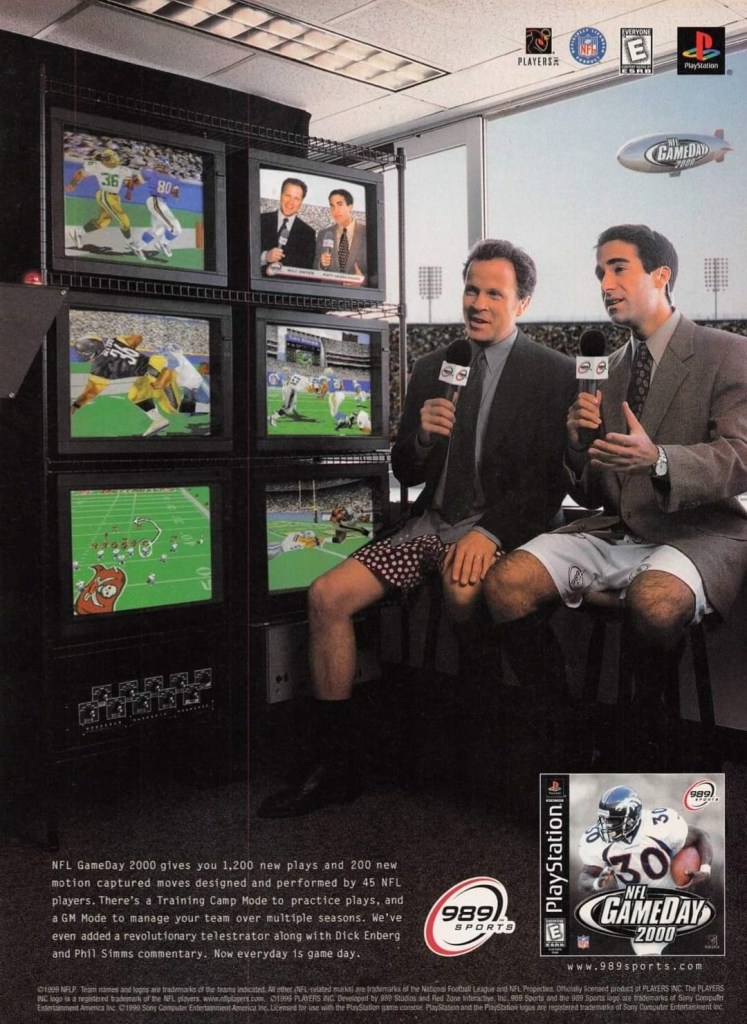
8. NFL GameDay 2000 print ad
Did you find this ad funny to look at in 1999?
To promote the PlayStation-exclusive NFL GameDay 2000, Sony publisher 989 Sports and the ad makers decided to implement a humorous look at football TV coverage by having two sportscasters wearing shorts in front of a TV camera that was only showing their heads and upper bodies. The TV sets on the side show screenshots from the game to emphasize the sports gaming experience. Ultimately the game scored mostly positive review from the critics.
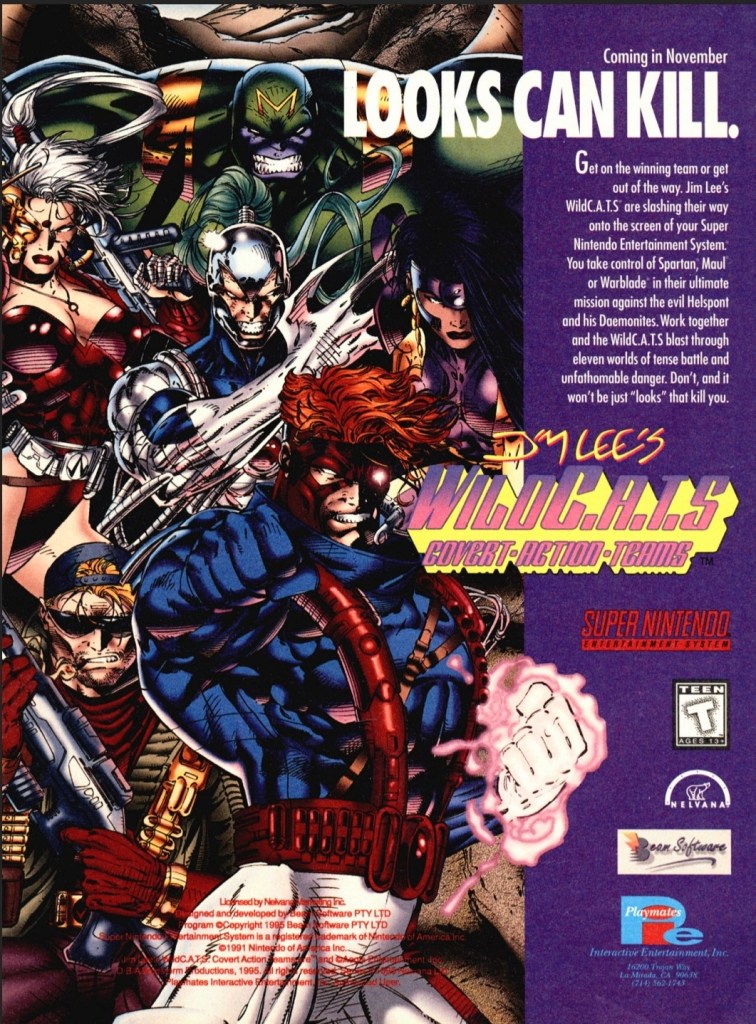
9. WildC.A.T.S: Covert Action Teams print ad
WildC.A.T.S. art by Jim Lee was used to promote the SNES video game.
When Image Comics launched in 1992, WildC.A.T.S: Covert Action Teams was Jim Lee’s creator-owned comic book franchise and its launch issue was a big seller. Years later, WildC.A.T.S. grew in popularity with comic book fans and the franchise achieved multi-media status by venturing into TV (with an animated series) and video games. This print ad promoting the video game adaptation had no screenshots to show which kept fans and gamers guessing how the game will turn out in terms of gameplay and game design. It was obvious that the people who made this print ad had to rely on the best WildC.A.T.S. artwork they could find drawn by Jim Lee. This ad made me laugh back in the old days because if you did not look closely, it might fool you into thinking it was more about comic books than the game on the SNES.
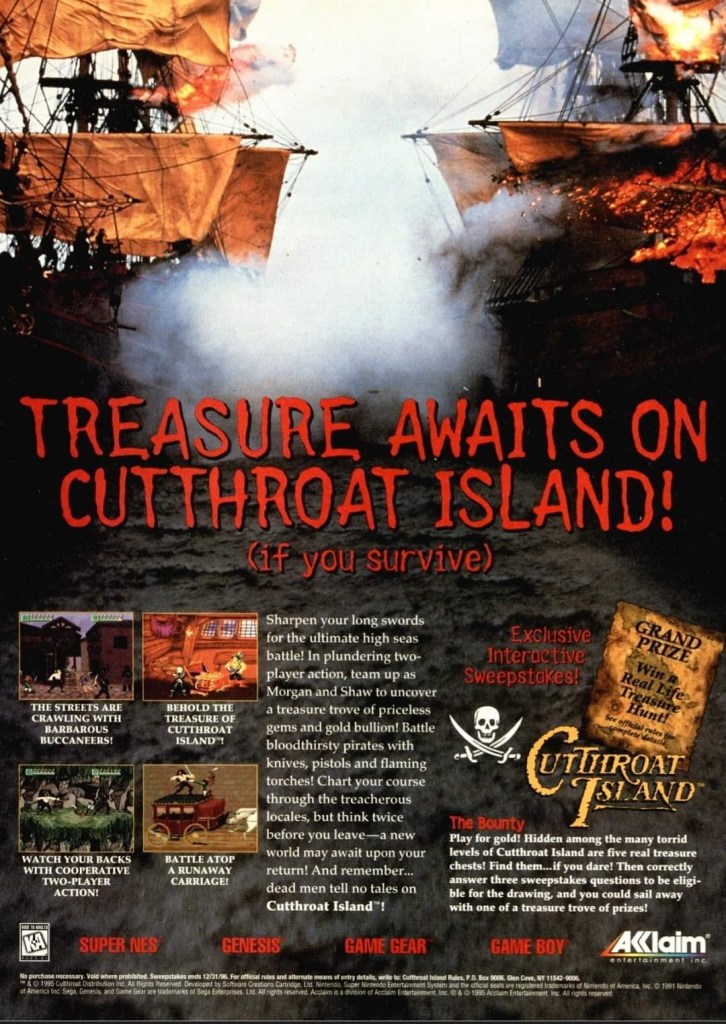
10. Cutthroat Island print ad
Exciting imagery without Geena Davis and Matthew Modine was used to promote the video game adaptation.
I never saw the Hollywood mega-flop Cutthroat Island nor have I ever played any of its multiple video game adaptations (released on SNES, Sega Genesis, Sega Game Gear and Game Boy). The video game print ad, however, caught my attention back in 1995 because the ad makers cleverly used a photograph from one the many expensive movie sequences filmed and the hard, physical work by the filmmakers was clearly visible. Then the ad makers had four screenshots placed on the lower-left part and inserted descriptive text that sounded exciting. Lastly, the ad mentioned a sweepstakes promo.
Without using any images of stars Geena Davis and Matthew Modine, this ad was a strong attempt to get gamers excited for the video game adaptation. Like the movie itself, this game flopped and has faded away to the land of the forgotten.
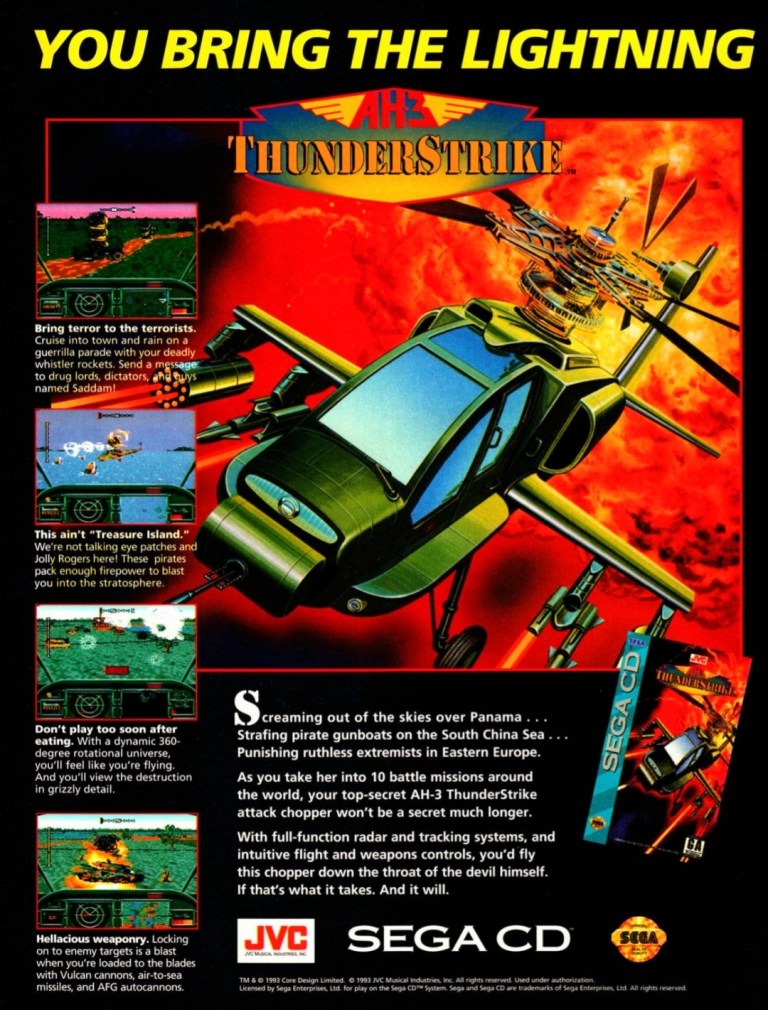
11. AH-3 Thunderstrike print ad
Captivating artwork, vibrant colors and orderly text descriptions made this an effective ad.
AH-3 Thunderstrike is one of the better games that was released on the Sega CD add-on (requires the Sega Genesis console) in 1993. Similar with MechWarrior 3050, the game was actually a port of Thunderhawk which itself was released on the Amiga and MS-DOS PC in 1992. The print ad showcased a captivating artwork (which was also used on the game’s box cover), a few screenshots and strategically placed text descriptions to sell the game. This ad still looks good.
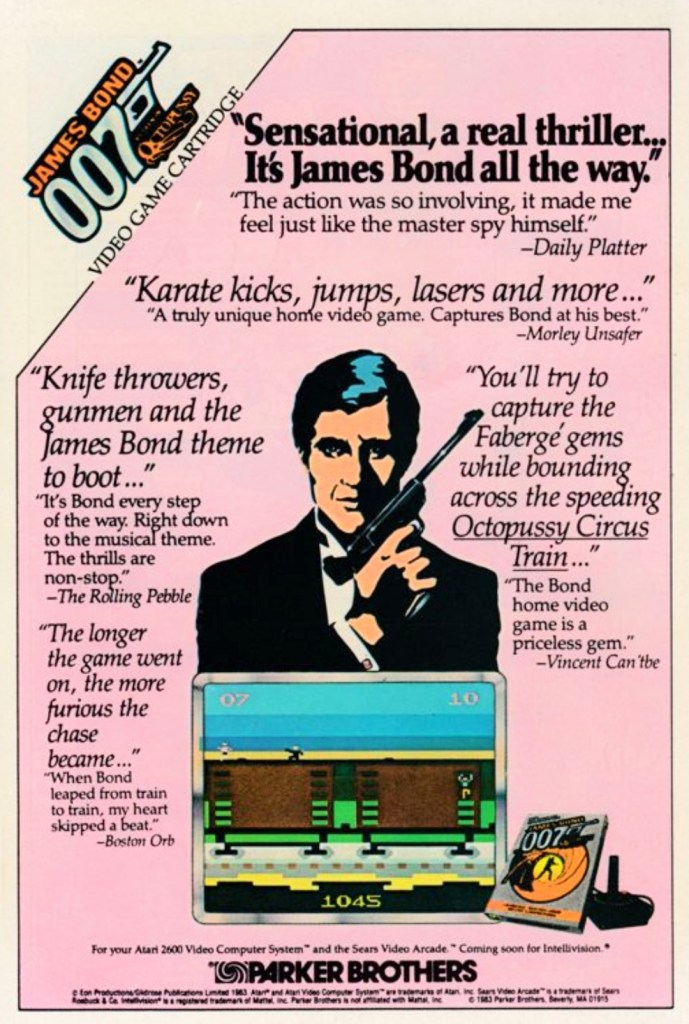
12. James Bond 007 print ad
This print ad appeared in many comic books in 1984.
This is a print ad I saw many times while reading comic books in 1984. James Bond 007 for Atari 2600 was an ambitious licensed video game as it featured levels that were inspired by missions in the James Bond movies Diamonds are Forever, The Spy Who Loved Me, Moonraker and For Your Eyes Only. Keep in mind that programmers back then had to deal with memory limitations and primitive tools to make games.
To promote the game, original art of Agent 007 was used which did not resemble the James Bond star of the time – Roger Moore. Strangely enough, the illustrated James Bond slightly resembled Timothy Dalton whose debut as 007 happened in 1987. Adding further zest to the add was the use of fictionalized quotes pointing to fantasized critics as sources (example: Vincent Can’tbe is a reference to real life critic Vincent Canby). The use of a pink background made this catchy ad look really odd.
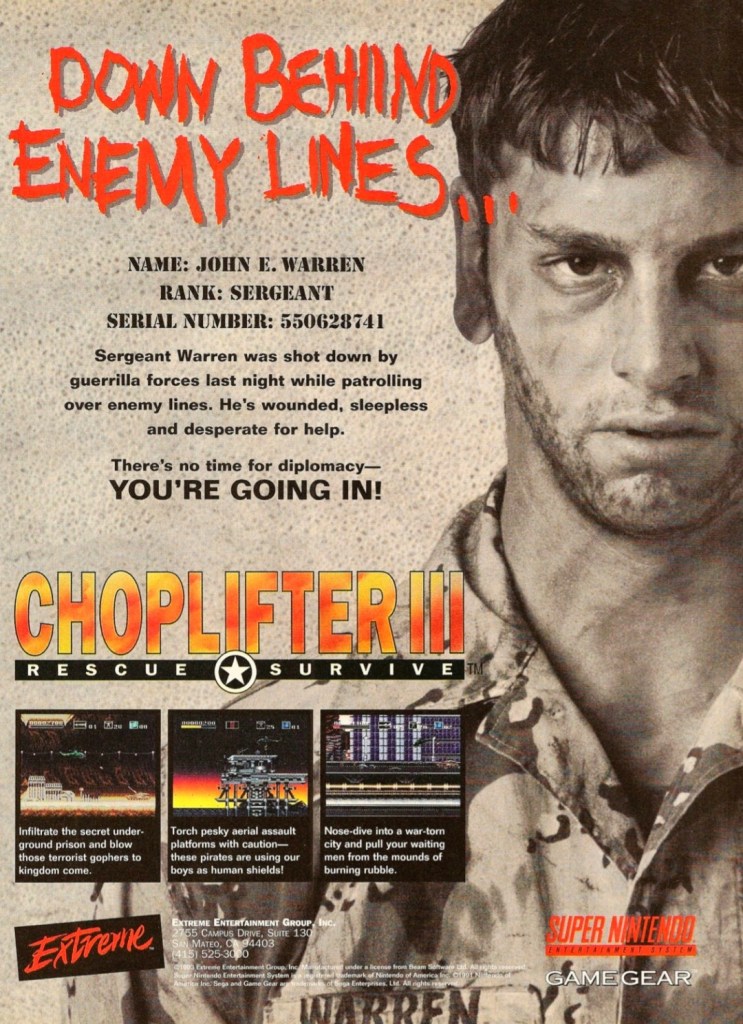
13. Choplifter III: Rescue Survive print ad
A captivating print ad that brought gamers’ attention to the Choplifter series again.
This print ad of Choplifter III: Rescue Survive has a striking look showing a military officer who needs your help as he has been stranded behind enemy lines. The presentation reflects the long-time tradition of the Choplifter game franchise which has been about piloting an armed helicopter to the opposition’s territory, shooting at bad guys and then rescuing the hostages or prisoners-of-war (POWs). The game eventually gathered mostly positive feedback from video game critics.
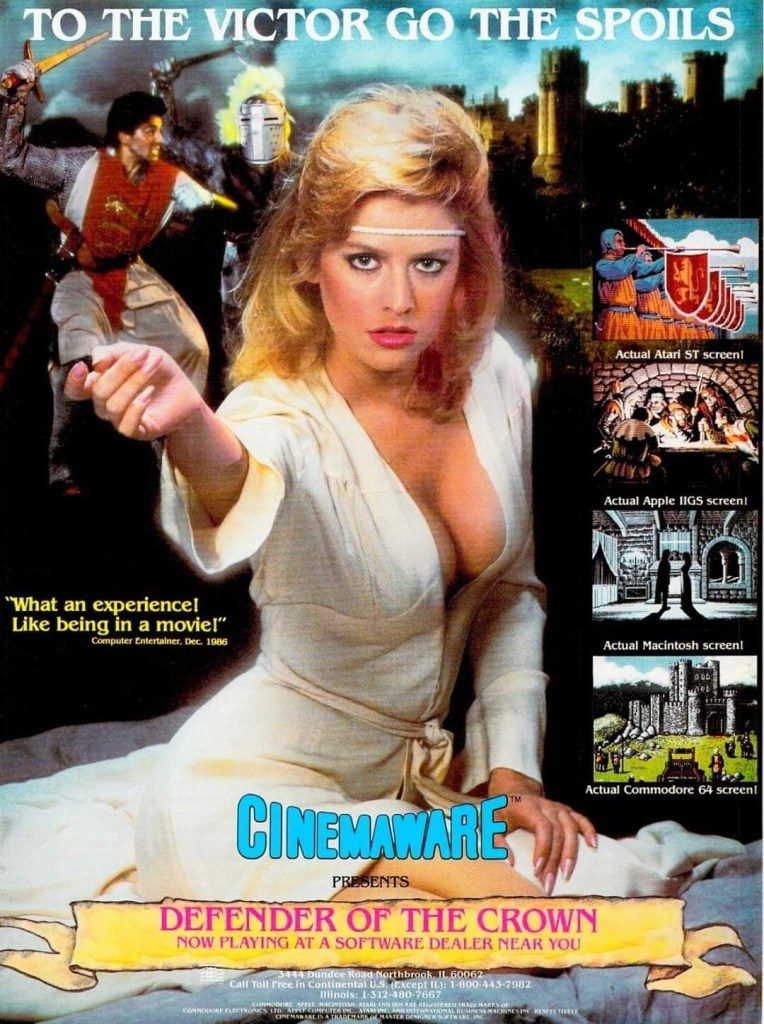
14. Defender of the Crown print ad
Cinemaware took a gamble with the visual concept of this print ad.
Released in 1986 for home computers, Defender of the Crown was made with a high level of quality backed with solid artistry. To capture gamers’ attention, Cinemaware came up with this print ad showcasing a pretty model looking somewhat seductive which reflects what happens in the game when players rescue a damsel in distress. The selected screenshots showed what the game looked like on different platforms, and the lower part of the ad made the game feel like it was a historical epic waiting to be discovered. Defender of the Crown eventually became a big hit with computer gamers.
Welcome back, my readers, YouTube viewers and all others who followed this series of articles focused on YouTube videos worth watching. Have you been searching for something fun or interesting to watch on YouTube? Do you feel bored right now and you crave for something to see on the world’s most popular online video destination?
I recommend you check out the following topics and the related videos I found.
#1NHK World’s Game Planet Documentary – If you are very passionate about video games and you want to see gaming through the views of the Japanese and the Chinese, then you should see NHK World’s documentary here. This video documentary is also a must-see for those who love playing the Street Fighter video games. Lots of creative talents from Capcom and Tencent interviewed.
#2 Square Enix decides to drop PlayStation exclusivity and go multiplatform with their business – It was indeed bound to happen and I was not surprised about it. In case you missed the news, Square Enix announced it will drop PlayStation exclusivity in favor of going aggressive with a multiplatform strategy. This is because there was a massive 70% profit drop on the part of Square Enix and sales of the PlayStation 5-exclusive Final Fantasy VII Rebirth were undeniably disappointing. To understand the details better, posted below is one analytical video and one critical video.
#3 Nick Anderson’s notorious 4 missed free throws and disrespect towards Michael Jordan – If you are long-time basketball fan, you would at least be aware of significant events during the NBA Playoffs and the Finals in 1995. I am talking about Nick Anderson who is still remembered as the guy who missed four free throws as his team (Orlando Magic) was already leading by three points ahead of the Houston Rockets (defending champions) during Game 1 of the 1995 NBA Finals. As history recorded, the Houston Rockets swept the Magic 4-0 to win their 2nd straight NBA championship. Going back to Anderson, he is also the same guy who disrespected Michael Jordan during the Eastern Conference semifinals. Posted below are three videos for you to watch.
#4 Reggie Miller’s 8 points in 8.9 seconds – Still with the 1995 NBA Playoffs, here is a look back at the miraculous achievement of Reggie Miller scoring eight points in less than nine seconds during a game against the New York Knicks at the Madison Square Garden. For the newcomers reading this, the playoff rivalry between the Knicks and Indiana Pacers started in 1994 and by the time their rematch in 1995 was realized, collective fan anticipation was already high. There was no better way to raise the stakes in the rematch than Miller’s unexpected 8 points in 8.9 seconds. Watch the video below.
#5 Popcorn in Bed’s reaction video of Deep Impact – In 1998 here in the Philippines, I saw the sci-fi film Deep Impact in a cinema during its first week of release. It was entertaining to watch given the sci-fi spectacle, the concept and, of course, the wide cast of actors that includes the legendary Robert Duvall in a really solid supporting role. What is most notable about Deep Impact is the fact that it was made to spark emotion from viewers and that is most inevitable in the movie reaction video by Popcorn in Bed. With the current number of Deep Impact reaction videos available on YouTube as of this writing, the best one is viewable right below…
#6 HolyLandSite’s video of the tour of the Oaks of Mamre in Israel– Recently HolyLandSite released their newest Holy Land video focused on the Oaks of Mamre in Israel which is the historical and biblical site where the Abrahamic Covenant was given. Oaks of Mamre is filled with evidence that it is indeed the very place where Abraham met God. God’s covenant has always been with the Jewish people (read Genesis 17:15-21 in the Holy Bible). This video also has biblical lessons for those who follow Lord Jesus and the Word of God. May this also remind you that the ties between Jews and Christians are biblical.
#7 Retrospective video about Konami’s X-Men arcade game – Just a few years before Capcom and Marvel Comics teamed up for the production of arcade games featuring superheroes and the publisher’s own characters, Konami literally rocked the arcades with a lot of fun with the X-Men arcade game of 1992. Using the established character designs from the 1989 cartoon X-Men: Pryde of the X-Men, the arcade game allowed players to choose one of six superheroes to play as (listed were Cyclops, Wolverine, Dazzler, Storm, Colossus and Nightcrawler) and engage in side-scrolling beat-them-up action fighting the many minions of Magneto. The X-Men arcade game was undeniably successful and impacted the way people enjoyed multiplayer sessions in the arcades. You can learn more from this in-depth retro gaming video by PatmanQC.
#8 FilmComicsExplained’s Demolition Man video analysis – When I first saw Demolition Man (1993), I perceived it as a Sylvester Stallone action movie laced with futuristic science fiction (sci-fi) concepts. I noticed the film’s portrayal of what future society could become and what futuristic technologies could be used by people. By today’s standards, Demolition Man is perceived to be prophetic with its presentation and the video by FilmComicsExplained takes an in-depth look into it. It is a must-see!
#9 The death of wicked Iran’s president – Since 1979, Iran became wicked and its government has officially been sponsoring terrorists and terrorism activities in the Middle East for far too long. In case you missed the news, the president of Iran died in a helicopter crash recently and there were other fatalities with him. The president of Iran not only publicly called for the destruction of Israel, he is also responsible for harming minorities and political opponents, hurting protesters in Iran and more. There are reasons why the dead president has been called the Butcher of Tehran. For a clear view and analysis over the death of the president of Iran, watch the selected videos below. Do not trust Islamo-Leftist mainstream news media as they support terrorism.





 Author Carlo Carrasco