Disclaimer: This is my original work with details sourced from reading the comic book and doing personal research. Anyone who wants to use this article, in part or in whole, needs to secure first my permission and agree to cite me as the source and author. Let it be known that any unauthorized use of this article will constrain the author to pursue the remedies under R.A. No. 8293, the Revised Penal Code, and/or all applicable legal actions under the laws of the Philippines.
Welcome back, superhero enthusiasts, 1990s culture enthusiasts, X-Men fans and comic book collectors! Today we revisit the Marvel Comics universe to examine one of the many tales of the X-Men monthly series.
Since issue #5, Omega Red was introduced and the creative team of the series inserted flashbacks showing Wolverine, Sabretooth and Maverick as paramilitary teammates from several years prior. It was also revealed that Wolverine and Omega Red encountered each other before, and their present day encounter resulted in the capture of the Canadian mutant. Wolverine managed to escape only to be recaptured by Sabretooth. Logan’s teammates were also captured by the same sinister group that has Omega Red.
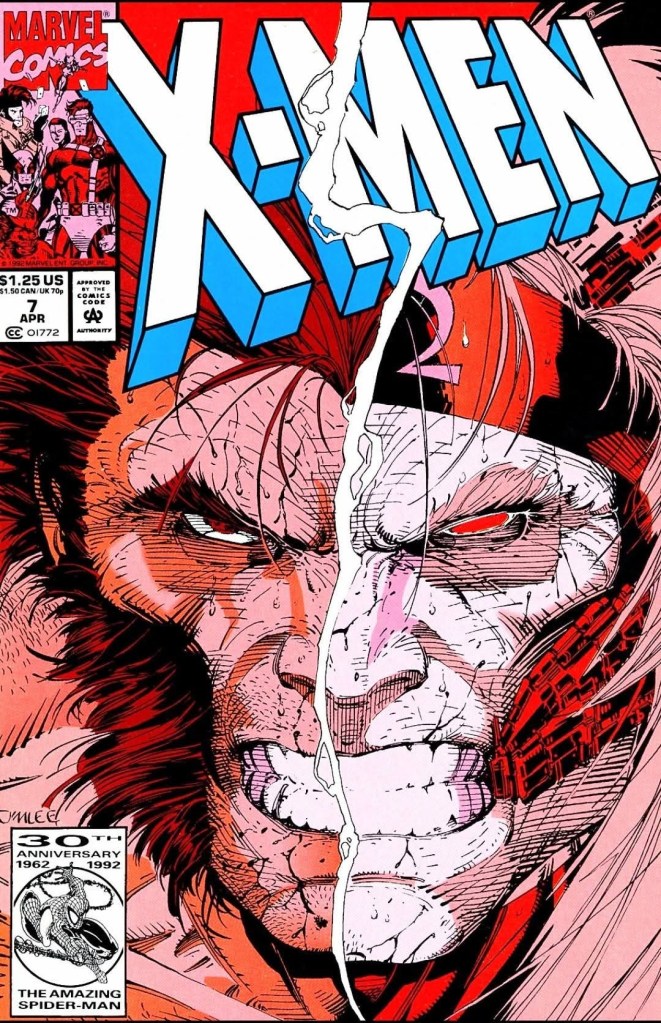
With those details laid down, here is a look back at X-Men #7, published by Marvel Comics in 1992 with a story plotted and drawn by Jim Lee, scripted by Scott Lobdell and inked by Art Thibert.
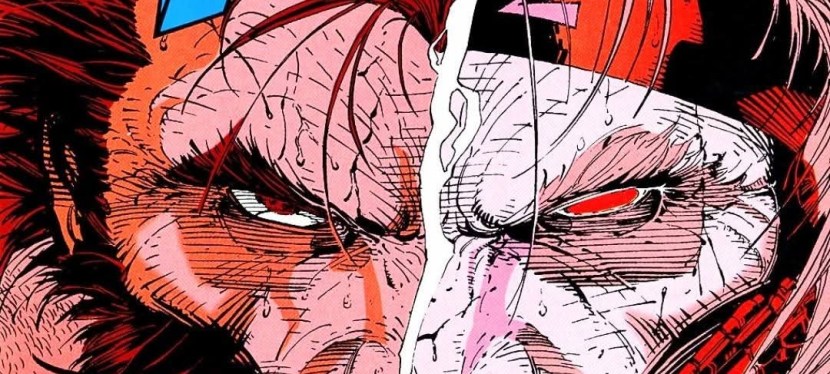
The cover.
Early story
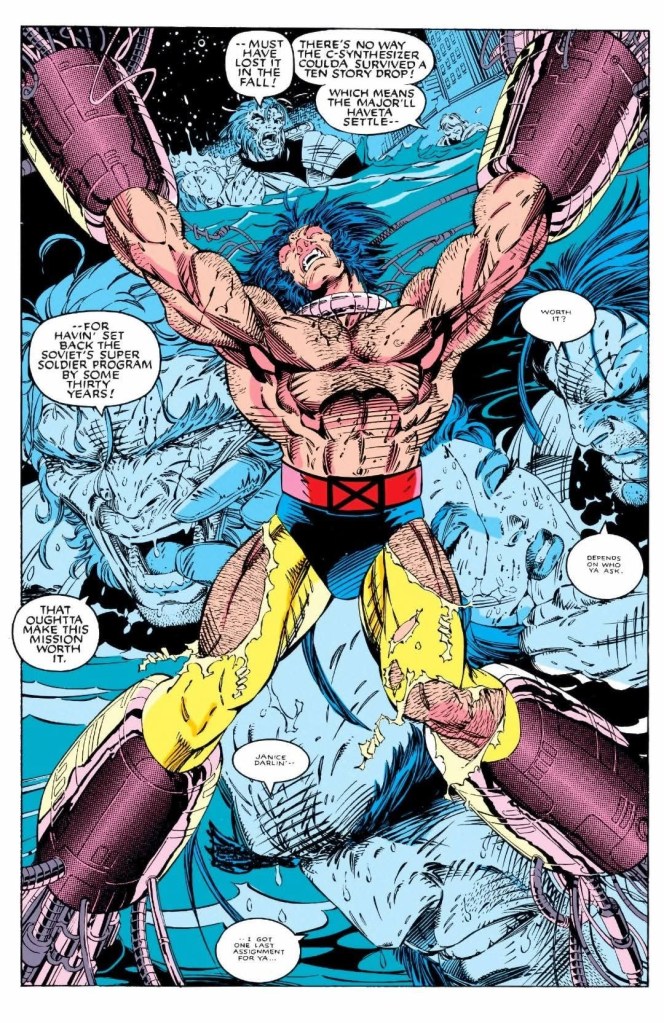
The story begins with Wolverine heavily restrained and his healing factor has been pushed to its limits. In the presence of Matsu’o Tsurayaba, Psylocke and others, Omega Red presses Wolverine for information about the carbonadium synthesizer. Matsu’o advises the Russian to not let the Canadian mutant bait him, and he shares the realization that it is impossible to mass produce his healing factor.
Matsu’o tells Omega Red that his only chance for survival rests in completing the process that was started thirty years prior. The Russian replied saying that he realizes he is dependent upon synthesizing the only metal capable of negating his death factor.
Not wanting to top, Omega Red says that he would rather pry the information from Wolverine’s brain by hand…
Quality
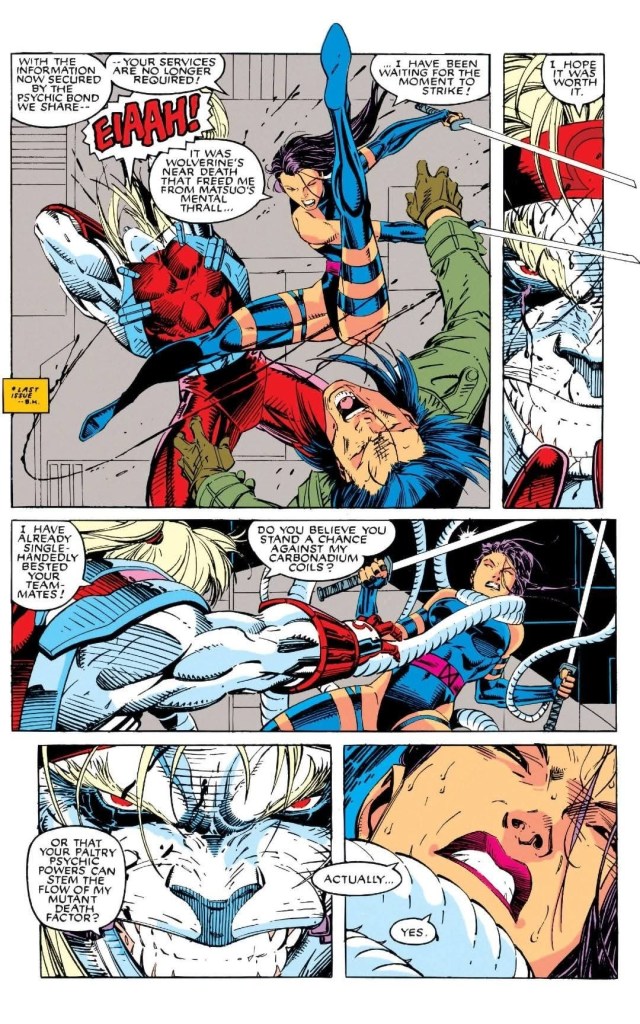
Psylocke in action versus Matsu’o and Omega Red.
To begin with, this is the conclusion to the storyline that started with issue #5. It is a cleverly paced story that had a good amount of build-up followed by big pay-offs with Jim Lee’s dynamic touch with the visuals.
Wolverine is once again vulnerable and Matsu’o’s gang already has the advantage. Matsu’o is determined to discover information about the C-Synthesizer no matter the cost (note: at the expense of Wolverine’s life). Omega Red’s death factor is much more emphasized in this issue and the goals behind the operations of the gang is made clearer here. As the story moved on, there were these clever twists that were entertaining to see leading to the chain of action-packed sequences. Without spoiling the plot, I can say that the creative team came up with a very solid conclusion in this short storyline and Maverick’s own presence has been justified as well.
As with the previous issue, scenes of Mojoworld were inserted giving readers updates about Dazzler and Longshot. Very clearly, this was the build-up leading into the 10th issue of the comic book series.
For those who enjoy visual spectacle, there is a lot to enjoy from Jim Lee here. As always, Lee draws action dynamically and made sure they are exciting to look at. Particularly, I found Lee’s carefully chosen action moments – particularly Sabretooth’s strike on Maverick and Wolverine’s strike against Omega Red – really impactful to look at.
Conclusion
Wolverine in a very vulnerable and painful state.
X-Men #7 (1992) is a very enjoyable read. It is a great conclusion to its 3-part storyline that started in issue #5 and by the time I read the end, Omega Red was clearly established as a very formidable foe of the X-Men even though he was a new addition to the lore. The writing of this comic book is very solid and the same thing can be said about the structure of the plot. Considering the time of its release, this comic book was clearly part of Jim Lee’s way of modernizing the X-Men.
Disclaimer: This is my original work with details sourced from reading the comic book and doing personal research. Anyone who wants to use this article, in part or in whole, needs to secure first my permission and agree to cite me as the source and author. Let it be known that any unauthorized use of this article will constrain the author to pursue the remedies under R.A. No. 8293, the Revised Penal Code, and/or all applicable legal actions under the laws of the Philippines.
Welcome back, superhero enthusiasts, 1990s culture enthusiasts, X-Men fans and comic book collectors! Today we revisit the 2nd series of X-Men Adventures which was the literary adaptation of the popular X-Men animated series of the 1990s.
First introduced in 1990s comics published by Marvel, Gambit (Remy LeBeau) quickly emerged as one of the most popular members of the X-Men. He always looked cool, his power to charge cards (and other objects) into dangerous weapons, and his combat styling were really fascinating to see. He also has a personality that is very unique and mysterious at the same time. Eventually Gambit got his own spotlight in one of the episodes of the animated series.
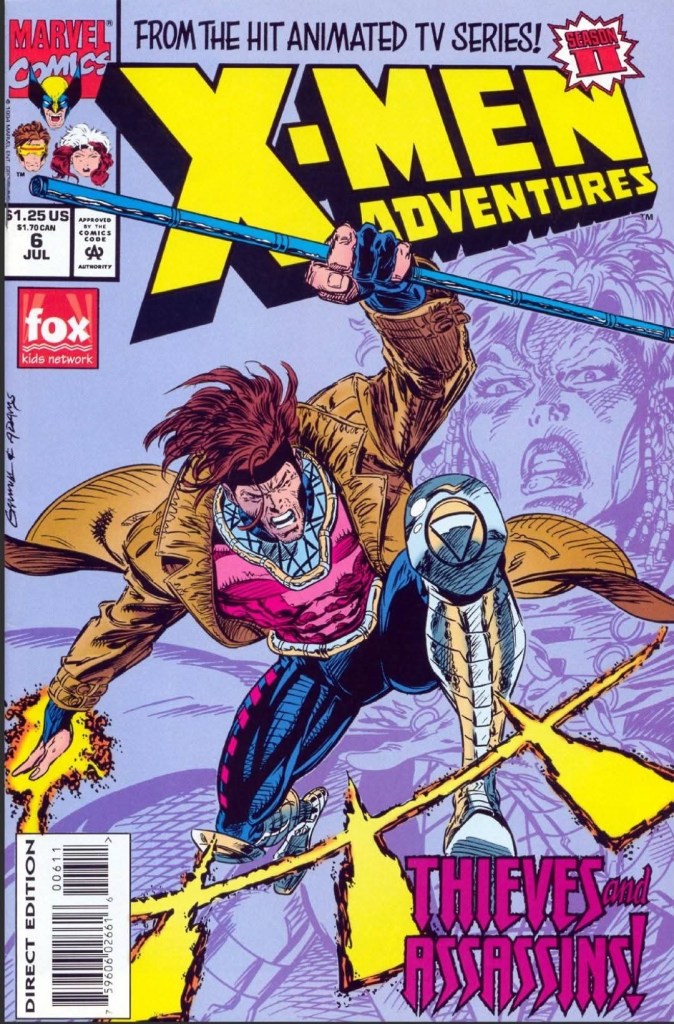
With those details laid down, here is a look back at X-Men Adventures Season II #6, published by Marvel Comics in 1994 with a story written by Ralph Macchio and drawn by John Hebert.
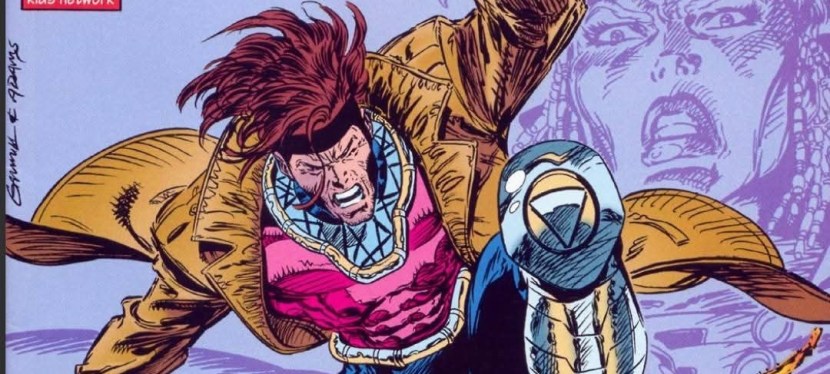
The cover.
Early story
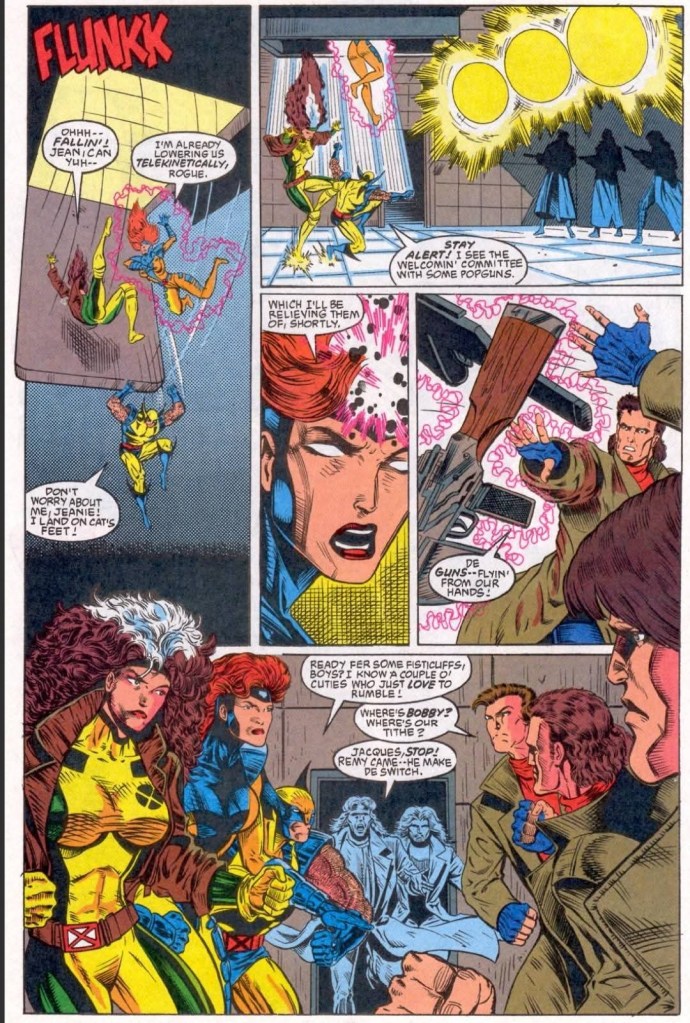
The story begins with Gambit flying away from X-Men headquarters using a mini-aircraft. He is clearly on the pursuit for something. Rogue tells Wolverine and Jean Grey that their teammate received a message from New Orleans and he has to help a certain sibling who is in trouble. While speeding through the air, Gambit remembers what happened several years prior when he was part of the thieves guild. He remembered the moment Bobby became the chosen one among the thieves…
Quality
Wolverine, Rogue and Jean Grey fall down and encounter the thieves.
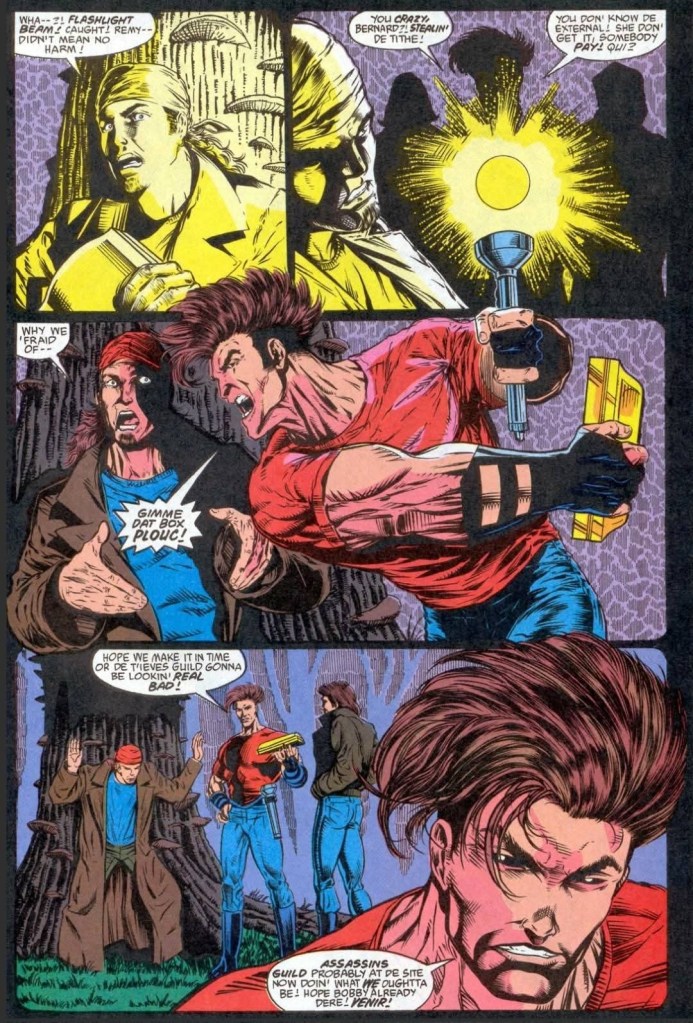
Anyone who followed the stories of Gambit in the X-Men comic books should be aware that there is a lot more to the past of the character than meets the eye. This comic book is a dramatization – which the animated series did – of Gambit’s involvement with a guild of thieves in Louisiana and what happens when the threads and personalities from his past return.
Upon returning to Louisiana, Gambit learns that the feud between the thieves and assassins has turned violent. Complicating matters further is an exchange the assassins want involving Bobby, the sacred tithe the thieves have and Gambit himself.
As expected, Gambit’s personality develops deeply as the story went on. The changes in him manifest when he encounters key characters from his past (example: Bella Donna) and how unfortunate events from the prior years impact him in the present. In short, this is a portrayal of Gambit that is clearly the most intriguing yet in the animated series.
Visually, John Hebert performed a good job visualizing the characters. While the X-Men are recognizable as before, Hebert’s art style gave the other characters a unique look that is gritty and sometimes creepy to see. I should mention that Hebert’s visual interpretation of Rogue reaction’s about Bella Donna described as Gambit’s woman is a great touch.
Conclusion
Young Gambit/Remy as a thief in Louisiana.
X-Men Adventures Season II #6 (1994) is a good read and it will delight X-Men fans who are avid followers of Gambit. This one has a nice mix of twists, action, suspense and the theme about the so-called ghosts from the past coming back to haunt some. To see more of Gambit and his Louisiana legacy, you have to read the official X-Men comic books (example: the X-Men/Ghost Rider crossover tale during the time of Jim Lee) plus the Gambit mini-series of the early 1990s. Consider this X-Men Adventures comic book a creative appetizer that happens to be fun to read.
Overall, X-Men Adventures Season II #6 (1994) is recommended.
Disclaimer: This is my original work with details sourced from reading the comic book and doing personal research. Anyone who wants to use this article, in part or in whole, needs to secure first my permission and agree to cite me as the source and author. Let it be known that any unauthorized use of this article will constrain the author to pursue the remedies under R.A. No. 8293, the Revised Penal Code, and/or all applicable legal actions under the laws of the Philippines.
Welcome back, superhero ans, 1990s arts and culture enthusiasts, X-Men fans and comic book collectors! Today we revisit the X-Men Adventures monthly series – the first series specifically – which was the literary adaptation of the popular X-Men animated series of the 1990s.
If you are familiar with the classic lore of X-Men literature, you will remember Warren Worthington as Angel who is one of the original members of the X-Men introduced in 1963. That same character would eventually get involved with the super villain Apocalypse and gain a deadlier form as Archangel.
With those details laid down, here is a look back at X-Men Adventures #12, published by Marvel Comics in 1993 with a story written by Ralph Macchio and drawn by Andrew Wildman.
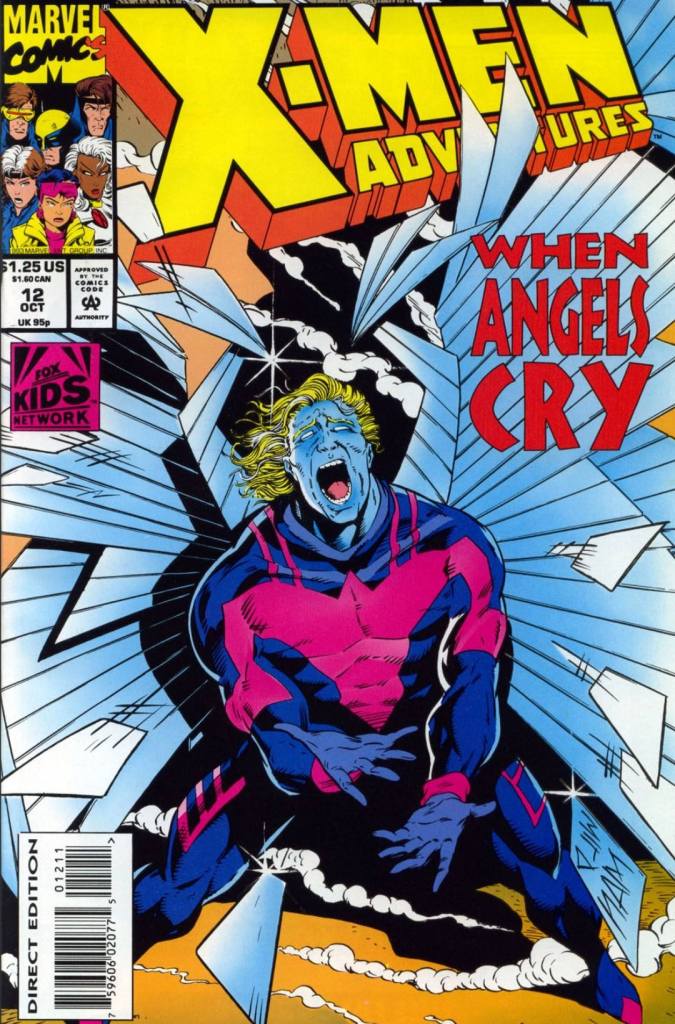
The cover.
Early story
The story begins inside a facility on Muir Island where genetic experimentation happens and draws mutants who seek a cure for the curse that makes them different. Already four mutants have arrived and were ready to undergo a grand experiment. The doctor in charge of the facility – Gottfried Adler – has already disappeared and in his place is the very powerful mutant Apocalypse.
Apocalypse succeeded in turning four mutants into his Four Horsemen composed of Archangel, War, Famine and Pestilence. For Apocalypse, the age of chaos is at hand.
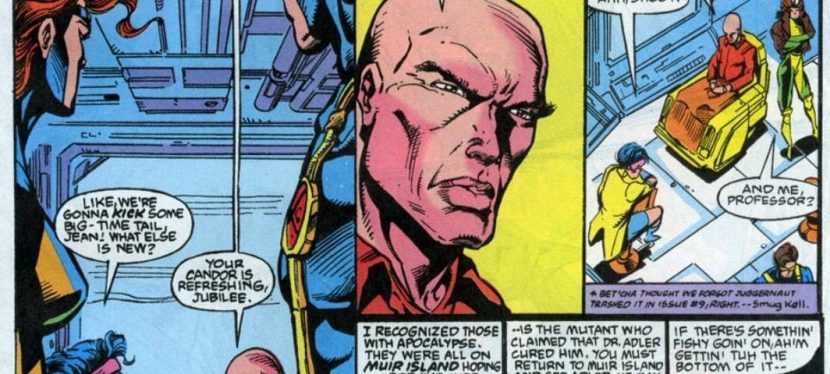
Meanwhile at Charles Xavier’s School For Gifted Youngsters, the leisure session of Jubilee, Gambit, Jean Grey and Rogue suddenly ends when Storm grabs their attention and shows them TV footage that Professor X wants them to see.
TV news footage shows an important meeting happening in France for the conventional weapons disarmament. Moments later, Apocalypse crashes into the meeting with his Four Horsemen causing harm…
Quality
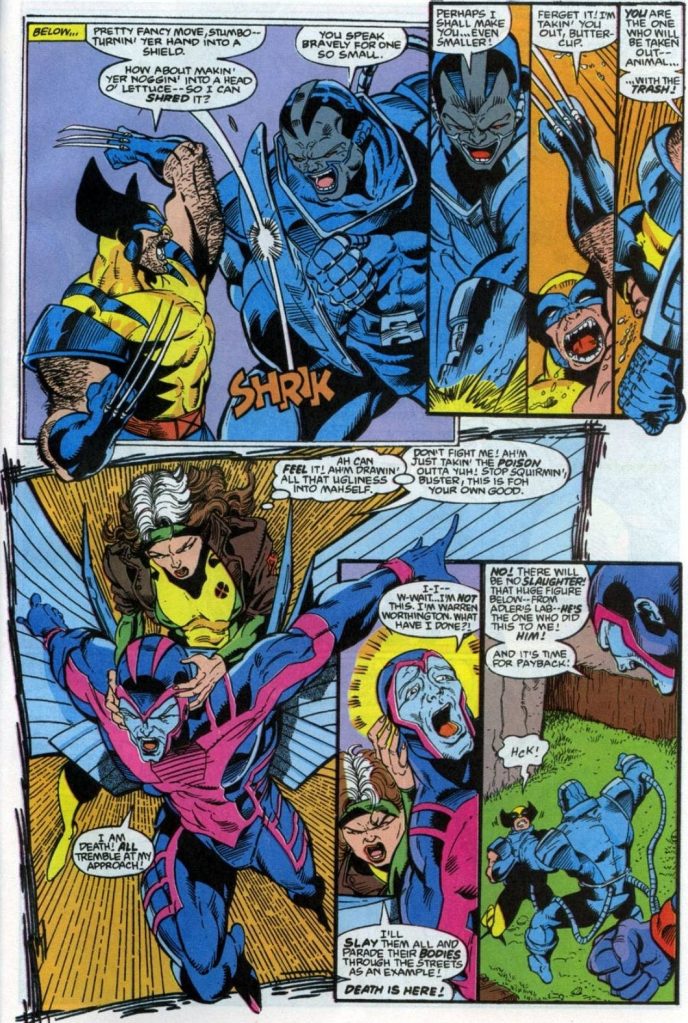
Rogue takes on Archangel while Wolverine is busy dealing with Apocalypse.
This comic book marks the emergence of Apocalypse as a tremendous force of evil following his series debut in issue #10 and short appearance in issue #11. As the main antagonist, Apocalypse – who is obsessed with survival and progress – really comes out in full force against humanity with his Four Horsemen as his deadly enforcers.
The threat of Apocalypse and his Four Horsemen towards humanity is clearly the main feature of this comic book and Macchio’s script has a good structure for the narrative. This makes the story easy to follow while still presenting a lot of details that can be absorbed efficiently. Apocalypse’s presence not only drew the X-Men to spring into action, it also drew Charles Xavier’s own fear that they would face an enemy more dangerous than Magneto.
While the main plot is consistently intense, this comic book also serves as a continuation of Rogue’s personal pursuits since issue #10 which is worth reading. Along the way, Archangel (whose new appearance started at the end of issue #11) notably got enough share of the spotlight and is easily the more captivating member of the Four Horsemen. The way Warren Worthington is portrayed here is clearly different from his literary version and that means you should not expect Professor X to claim him as one of his original X-Men members.
When it comes to the visuals, Andrew Wildman’s artistic style is present but many of the drawings here look rushed. In fairness, Wildman succeeded in making Apocalypse and the Four Horsemen look really threatening to human civilization thanks to his nice execution of visual dynamism in certain pages.
Conclusion
Professor X reveals his fear of Apocalypse to his team during their meeting.
X-Men Adventures #12 (1993) is a pretty good read thanks to the strong script by Macchio based on the teleplay from the animated series. It concluded the Muir Island saga in a very satisfying manner which includes putting Rogue’s subplot with solid closure (complete with a moral lesson about accepting her team as her family). By the time I reached the end of the comic book, it was clear that Apocalypse is a major antagonist with the long-term in mind.
Overall, X-Men Adventures #12 (1993) is recommended.
Welcome back readers, fellow geeks and electronic gaming fans!
In this edition of the Retro Gaming Ads Blast (RGAB) series, we will take a look at another batch of retro gaming print ads – including arcade flyers – from the 1970s to the 1990s.
For the newcomers reading this, Retro Gaming Ads Blast (RGAB) looks back at the many print ads of games (console, arcade, computer and handheld) that were published in comic books, magazines, flyers, posters and newspapers long before smartphones, social media, the worldwide web and streaming became popular. To put things in perspective, people back in the 1980s and 1990s were more trusting of print media for information and images about electronic games and related products.
With those details laid down, here is the newest batch of retro gaming print ads for you to see and enjoy…
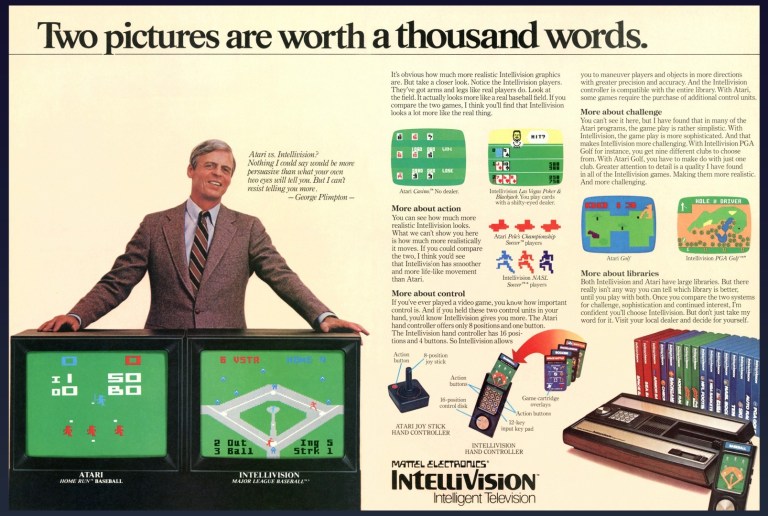
1. Intellivision print ad
Were you able to play a game on the Intellivision long ago?
In 1979, Mattel launched their Intellivision game console in America which instantly placed them in competition with Atari’s 2600 console. In a bid to convince gain market share, Mattel daringly came up with a competitive print ad like the one above showing two TV sets (with an Atari 2600 baseball game and a similar game on Intellivision), descriptive text that explained why the intellivision and its games are better, and even mentioned Atari by name several times. Obviously the tactic did not lead Mattel to ultimate market victory but the above print ad showed it was okay for a newcomer to mention their competitor and aggressively attack it to gain customers (both newcomers and active gamers).
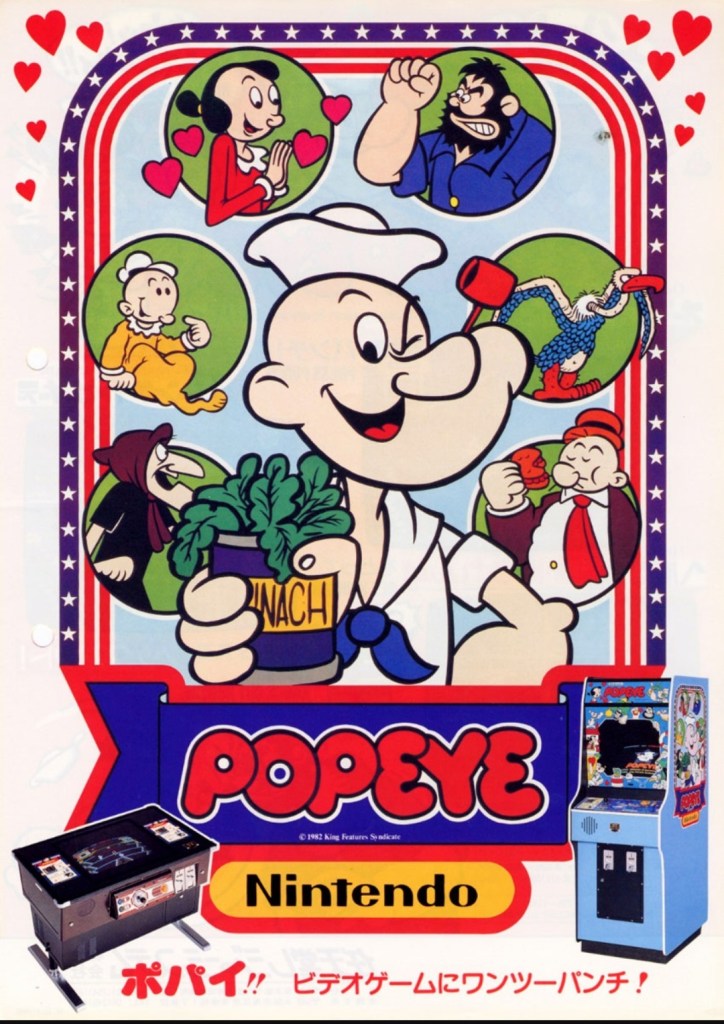
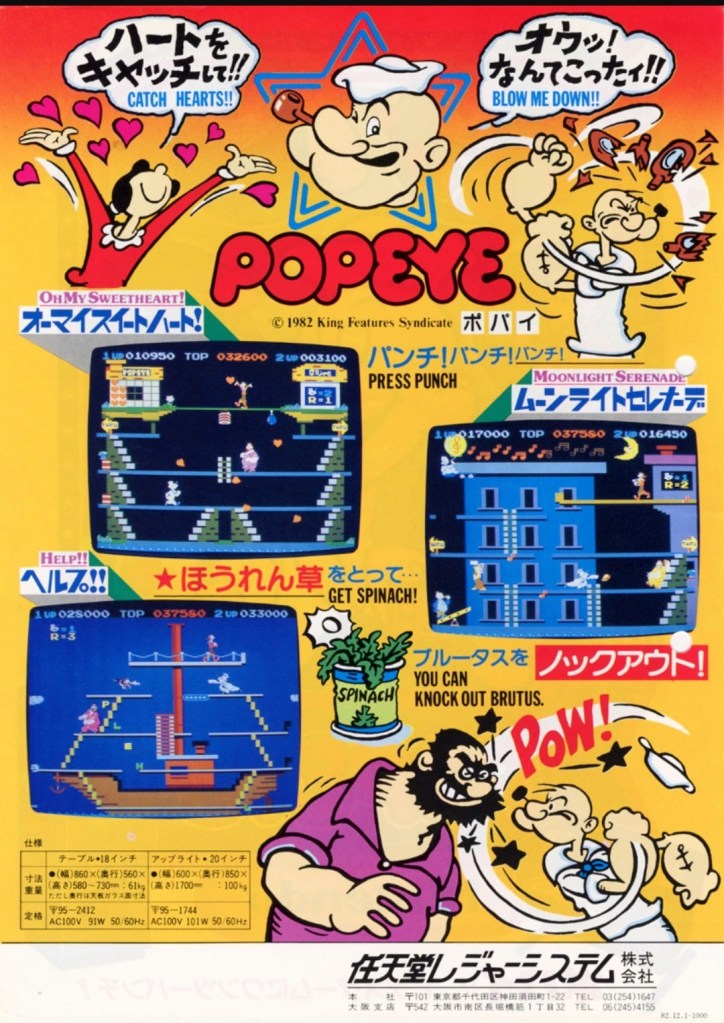
2. Popeye Japanese arcade flyer
The front of the flyer.
The rear.
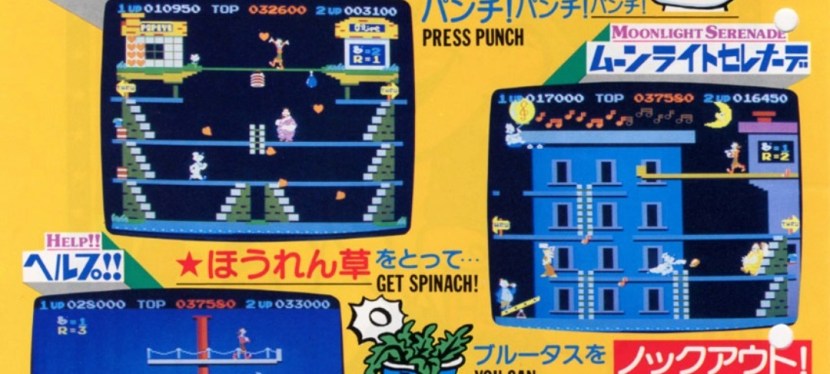
In 1982, Nintendo released the Popeye arcade game which was incidentally the result of the success of their original Donkey Kong arcade game. To promote the game, Nintendo came up with an arcade flyer that had a very lively front (note: the characters were instantly recognizable thanks to the great art used) and the rear having easy-to-read instructions on how to play the game, what levels to expect and what must be done when playing. Popeye was an arcade hit in Japan, but an even bigger hit in America. This old arcade flyer still looks nice.
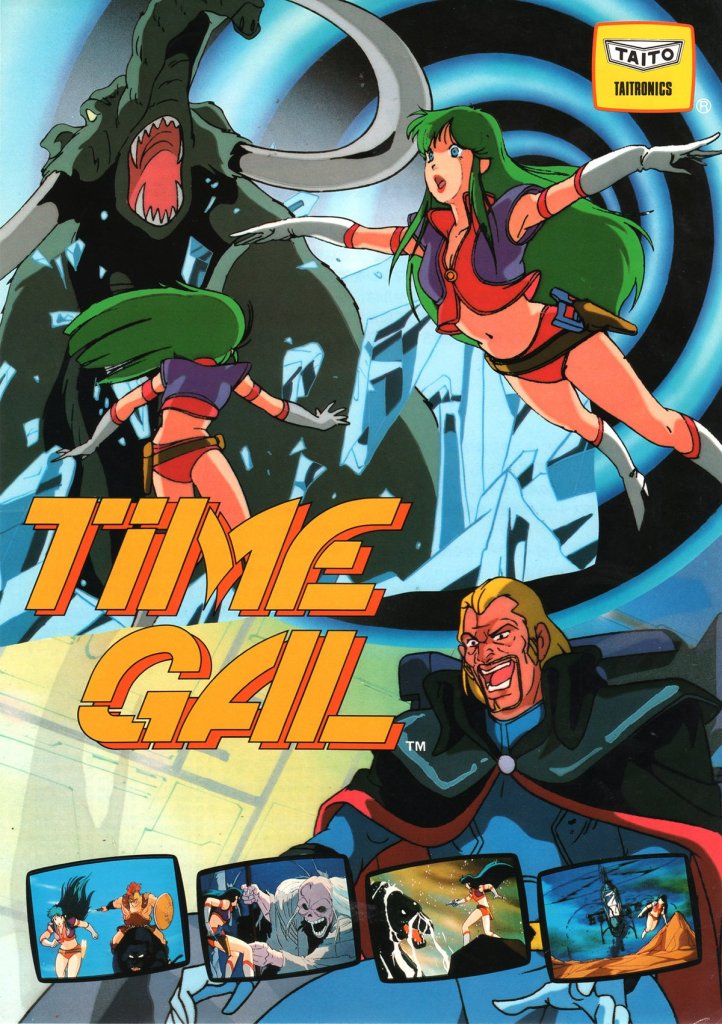
3. Time Gal arcade flyer
On face value, this one looks more like an anime promo since gameplay elements were missing.
Released in Japanese arcades in 1985, Time Gal is one of those games that used the expensive LaserDisc technology to stream pre-recorded animation (made by Toei) and challenged gamers to react quickly (using the joystick and button for commands) in order to progress in real-time. The arcade flyer has a very lively visual design making it clear to players and arcade operators that a lot of anime awaits those who play Time Gal. Technically, players watch anime cutscenes happen and react using the controls. Time Gal was an arcade hit and it made its way outside of Japan by getting ported for the Sega CD.
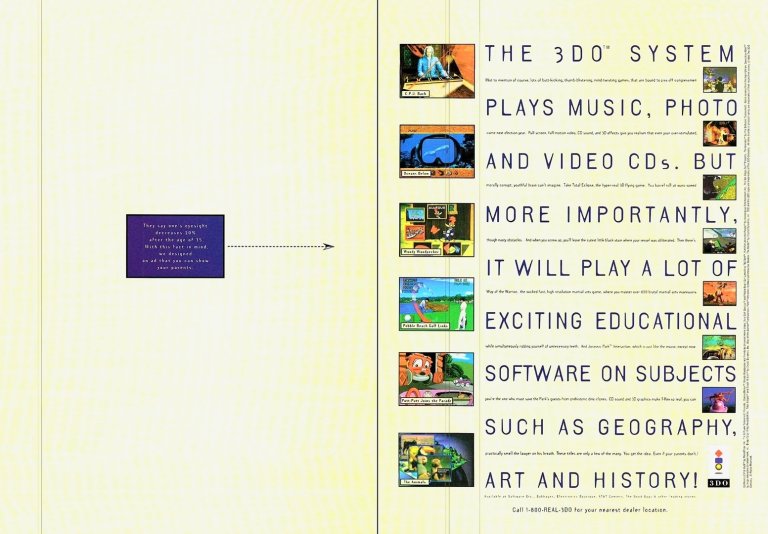
4. 3DO print ad
If you bought a 3DO long ago, was it for gaming or for home entertainment purposes?
Remember the 3DO? Developed by the 3DO Company and launched in 1993, the 3DO was designed to not only play video games but also function with multimedia features. In fact, the 3DO was initially marketed as a machine that allows users to watch videos, play music, browse digital photographs, and even immerse themselves with software focused on different topics. This is exactly what the above 3DO print ad emphasized. In retrospect, it was so odd for me to see the print ad inside video gaming magazines I read.
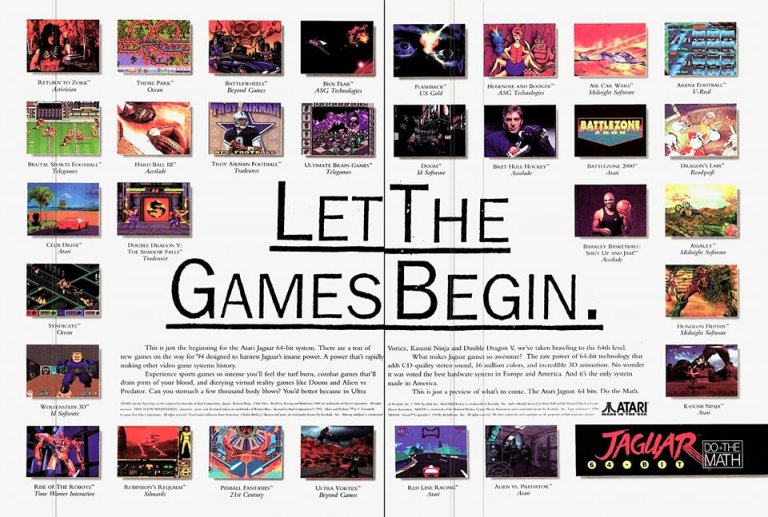
5. Atari Jaguar print ad
The strong focus on gaming was clear with Atari for the Jaguar.
Over a month after the launch of the 3DO, Atari launched its Jaguar console with a strong focus on video gaming. As console sales slowly grew in 1994, Atari came up with the above print ad – showing lots of games for the Jaguar – to lure in customers aggressively. If you look closely at the descriptive text of the ad, it mentions the Atari Jaguar as 64-bit system emphasizing that it is more powerful than other video game machines of the time. The bit count controversy harmed Atari and eventually the Jaguar failed.
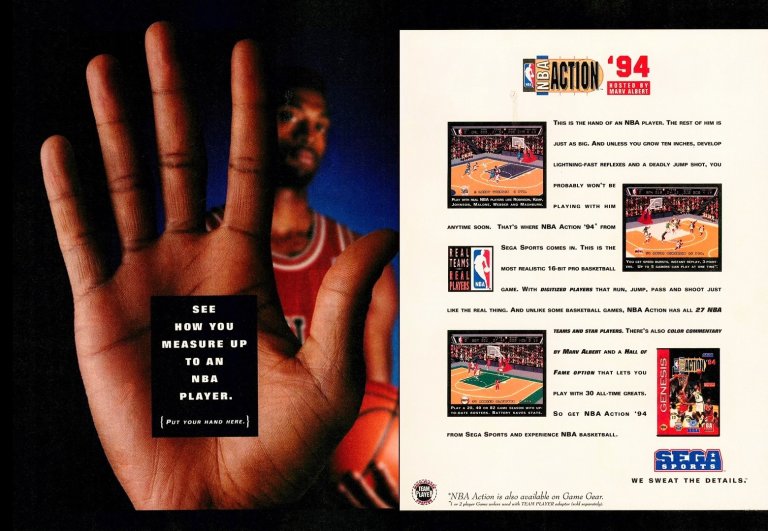
6. NBA Action ’94 print ad
Remember when Sega made NBA basketball video games that were exclusive to the Genesis console?
Remember when there were a lot of basketball video games licensed by the NBA in the 1990s? Through its own sports games brand – Sega Sports – Sega was dedicated to making exclusive sports video games for its customers and their NBA games were under the NBA Action brand. In 1994, they released NBA Action ’94 for the Genesis console and this two-page print ad they came up with had a catchy visual design (a supposed basketball player showing his palm and message to the camera on one side of the ad). Looking closely at the descriptive text, the ad mentions “most realistic 16-bit pro basketball”, “digitized players” and having all 27 NBA teams and star players. Sega Sports is no more but it’s legacy still lives on among Sega fans.
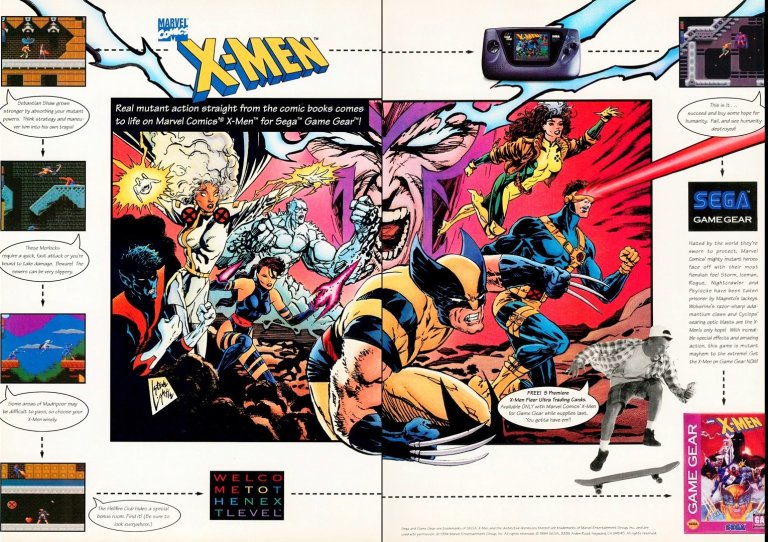
7. X-Men Sega Game Gear print ad
For X-Men fans!
Similar to its approach with the Sega Sports brand, Sega developed exclusive games for the Game Gear. The company secured from Marvel the license to make an original X-Men game and to promote it, this 2-page print ad showcased original art of the established X-Men characters of the time while using the remaining spaces for the screenshots and descriptive text. This old print ad still looks attractive and will easily resonate with X-Men fans as well as 1990s superhero comics enthusiasts.
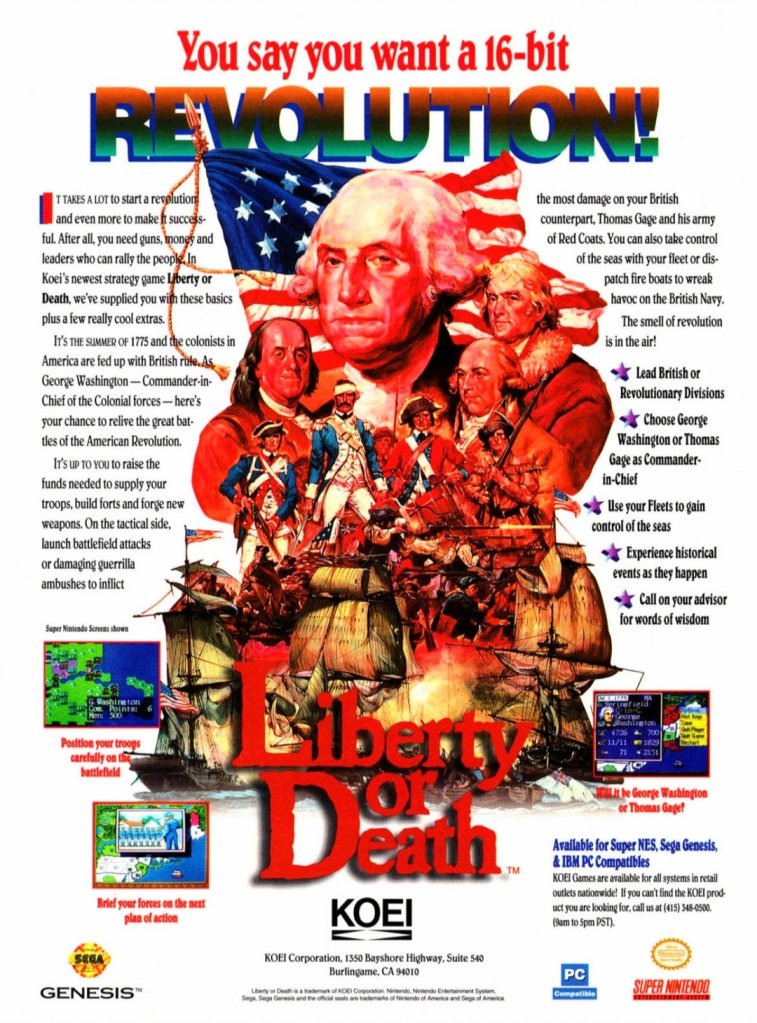
8. Liberty or Death print ad
American history is the core concept of this strategy game by Koei.
If there is anything notable about the Japanese company Koei, it is the fact that it released strategy and simulation games that tackled varied topics while making each game distinct and playable regardless of platform. In my experience, I had a lot of fun playing their business simulation Aerobiz Supersonic on the Super Nintendo Entertainment System (SNES). In 1993, Koei released their turn-based strategy game Liberty or Death which tackled American history for its setting (note: Koei already established itself with historical simulations). To sell the game, Koei came up with a print ad that had a very eye-catching historical art (George Washington, Thomas Jefferson, and Benjamin Franklin among the figures), a few selected screenshots and descriptive text that emphasized the essence of the game. This print ad is a reminder that no video game company today would make a historical simulation due to geopolitics (note: there are a lot of woke activists among video game employees today) and for business reasons.
Disclaimer: This is my original work with details sourced from reading the comic book and doing personal research. Anyone who wants to use this article, in part or in whole, needs to secure first my permission and agree to cite me as the source and author. Let it be known that any unauthorized use of this article will constrain the author to pursue the remedies under R.A. No. 8293, the Revised Penal Code, and/or all applicable legal actions under the laws of the Philippines.
Welcome back superhero enthusiasts, 1990s arts and culture enthusiasts, Marvel Comics fans and comic book collectors! Today we go back to the year 1996 and explore a part of Marvel Comics’ universe through the reimagined tales emphasized in the What If monthly series.
Back in 1993 – the year that Marvel Comics celebrated the 30th anniversary of the X-Men – the definitive rival of the X-Men, Magneto, made a major comeback and he was so resourceful as a threat to everyone. With the massive space station Avalon as his lair, Magneto sent out Exodus to lure mutants to join him. As time passed, Magneto’s own force grew and arrogantly disrupted the funeral of Illyana Rasputin in the presence of the X-Men, X-Force, Excalibur and X-Factor (as told in Uncanny X-Men #304). As the conflict went on, Colossus betrayed the X-Men to join Magneto.
Can you just imagine what would it be like had Magneto became the ruler of mutants?
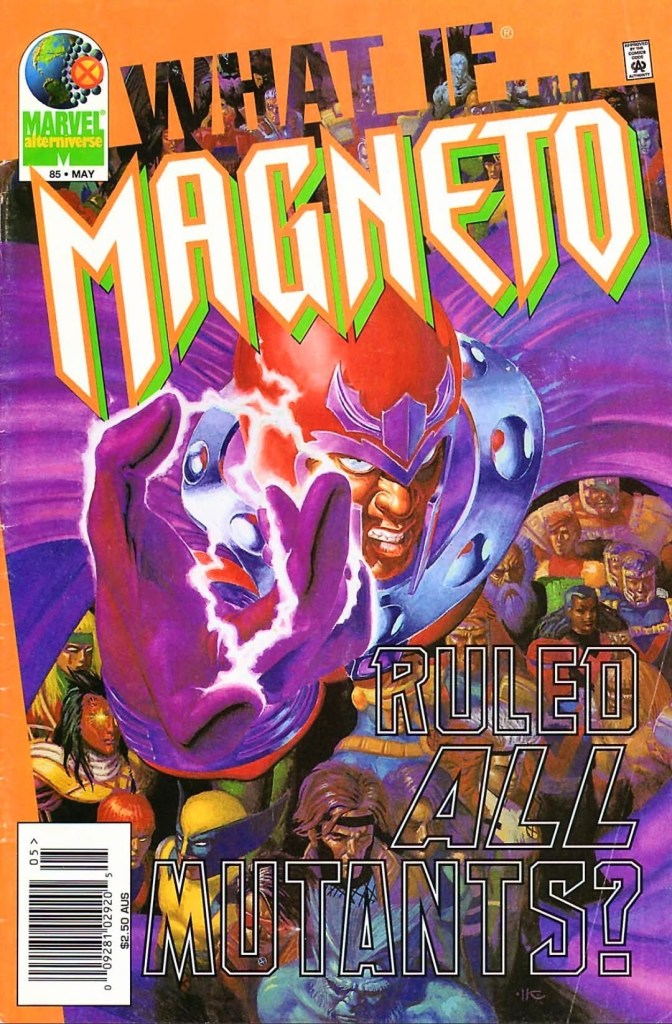
With those details laid down, here is a look back at What If #85, published in 1996 by Marvel Comics with a story written by David Michelinie and drawn by Arnie Jorgensen.
The cover.
Early story
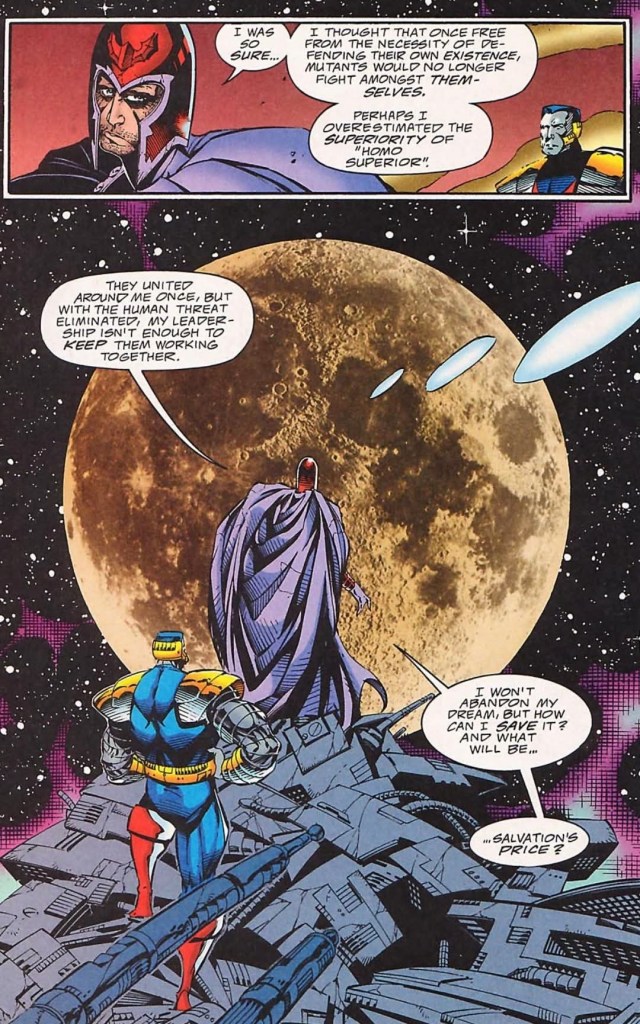
The story begins inside Avalon with Magneto and Colossus watching recorded footage of Charles Xavier announcing his decision to stop opposing the ascension of Avalon. It turns out, Xavier’s decision paved the way for mutants to relocate to Avalon (orbiting Earth) in return for assurance that those who remain in it will do so unmolested. With the intention to let Avalon’s residents achieve their full and glorious potential, Magneto allowed the mutants to rule themselves without any dictatorship by him.
Through the years, division between Avalon’s mutants – Acolytes who believe in isolation and the Acolytes who believe in annihilation – intensified and proved that the spirit of mutant unity has faded away. As violence between the mutants went on, the number of explosions inside Avalon kept increasing…
Quality
A magnificent view for Magneto, Colossus and the readers.
What I like most about this What If tale is its core concept exploring what would have happened had Magneto ruled the mutants specifically those living in his own realm (Avalon). Writer David Michelinie (best known for writing Amazing Spider-Man stories) wrote a really inspired script that emphasized Magneto’s vision of mutant utopia isolated from the twisted and complicated societies of Earth (which still has lots of people who are afraid of and hostile towards mutants) while leaving room for conflict in the form of ideological division between mutants on Avalon. As the growing division and violence are shattering Magneto’s vision of mutant utopia, the birth of an infant whose presence adds to the tension and fear of Avalon’s inhabitants.
The good news here is that Michelinie’s script is pretty solid and Arnie Jorgensen did a good enough job visualizing it all. The characters, mainly Magneto, Colossus and Beast, were portrayed clearly in character and to see the master of magnetism struggling with maintaining order on Avalon is a nice portrayal of his human side which makes him have a lot more in common with his opposite Professor X when it comes mutant matters. Considering Magneto’s long history of intense evil and obsession with leading humanity, his portrayal of insecurity, doubt and weakness is very believable to read.
Colossus, whose betrayal of the X-Men in Uncanny X-Men #304 remains unforgettable, is the loyal and sensible servant of Magneto. Beast, meanwhile, remains the very bright and insightful mutant scientist as he has always been which makes Michelinie’s writing really impressive.
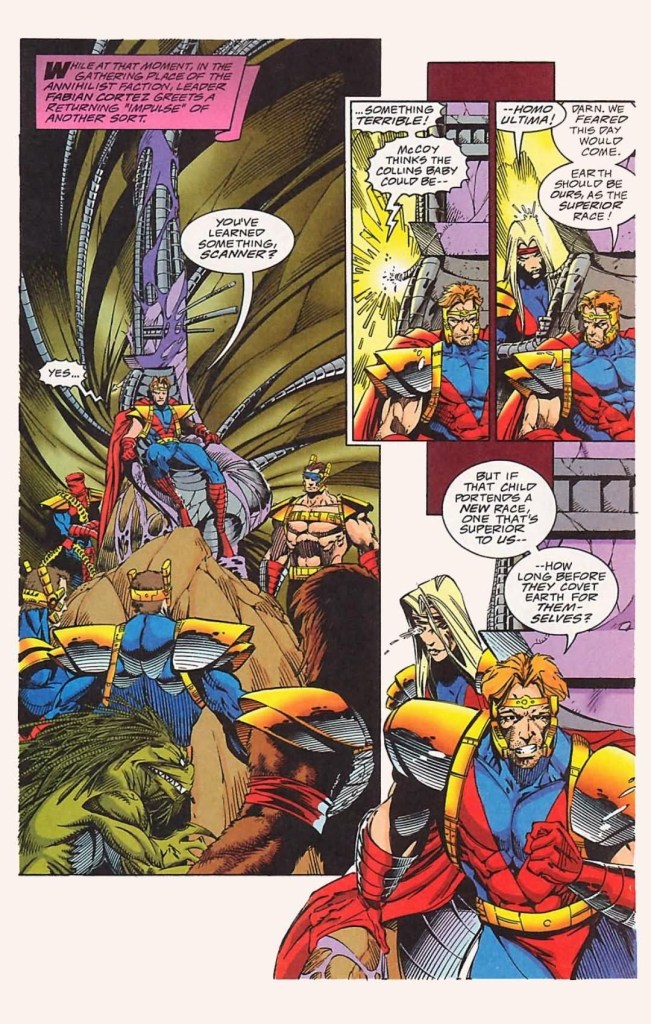
Also at the heart of the story is mutant order. Apart from the division between Avalon mutants who want full separation from humanity and those who want to conquer Earth by eliminating all human beings, the very fabric of mutant society got shaken all because of an infant who was born there on Avalon (Avalon’s first natural birth ever). I like the way this sub-plot added tension to the mutant division because it is, in some ways, socially relevant to this day. It will remind you that certain groups of people out there who would go as far as committing murder only because they are so obsessed with their foolish, worldly beliefs. Look at the Palestinian terrorists, the Iranian terrorists and the woke mobs in many parts of the world.
Conclusion
Remember Fabian Cortez and the Acolytes?
With a very solid script filled with intrigue, social relevance and portrayals, What If #85 (1996) is a pretty engaging read. As it is strongly focused on Magneto and his mutants on Avalon, this comic book gives readers a fine dramatization of its core concept as well as developments on what would have happened had mutant utopia been realized far away from human society. I should state that for every build-up in the story, the payoff is fortunately solid. Consider this comic book a dramatic portrayal of mutants of Magneto without the involvement of the X-Men.
Disclaimer: This is my original work with details sourced from reading the comic book and doing personal research. Anyone who wants to use this article, in part or in whole, needs to secure first my permission and agree to cite me as the source and author. Let it be known that any unauthorized use of this article will constrain the author to pursue the remedies under R.A. No. 8293, the Revised Penal Code, and/or all applicable legal actions under the laws of the Philippines.
Welcome back superhero enthusiasts, 1990s arts and culture enthusiasts, Marvel Comics fans and comic book collectors! Today we go back to the year 1991 and explore a part of Marvel Comics’ universe through the reimagined tales emphasized in the What If monthly series.
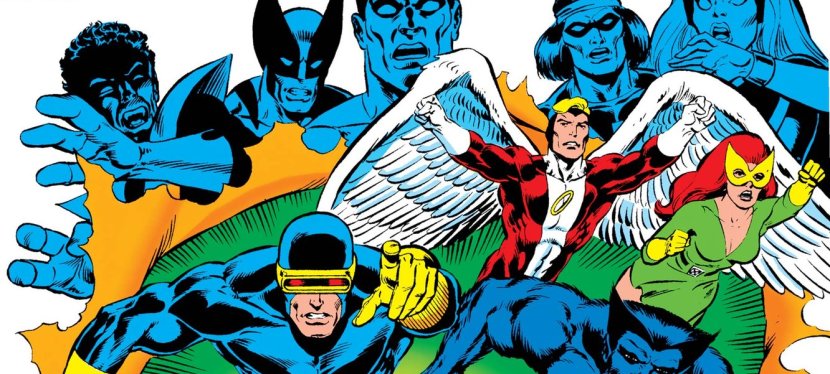
If you are not aware of the extensive literary history of the X-Men, the mutant franchise of Marvel Comics had its turning point in the mid-1970s with the release of the 68-page Giant-Size X-Men #1 which introduced a newer lineup of mutants (Wolverine, Cyclops, Nightcrawler, Thunderbird and Storm). It has been argued that Giant-Size X-Men #1 marked the starting point of the bronze age of comics in America and creatively it sparked a new chain of X-Men stories that captivated the fans and attracted new readers.
But what would have happened had the newer lineup of the X-Men did not even exist?
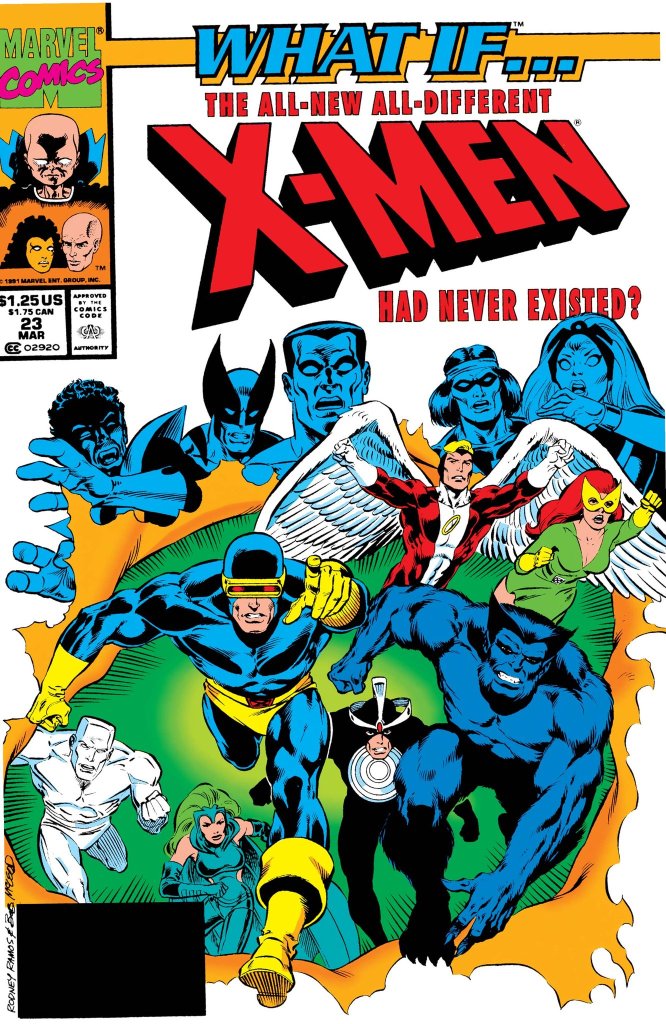
With those details laid down, here is a look back at What If #23, published in 1991 by Marvel Comics with a story written by Kurt Busiek and drawn by Rodney Ramos.
The cover.
Early story
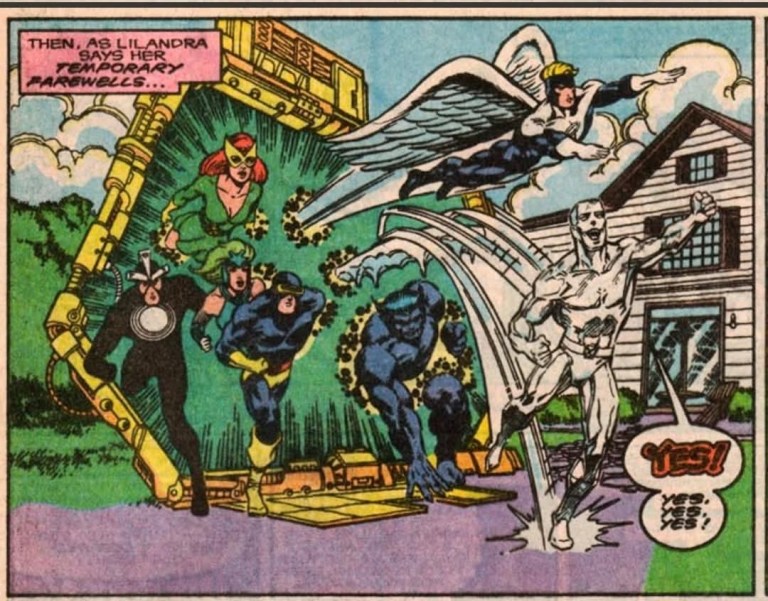
The story begins when the original X-Men (Cyclops, Jean Grey, Angel, Beast and Iceman) members, Havok and Polaris arrive on the island of Krakoa. A huge green monster suddenly appears and attacks them. Guided by Professor X’s mind, Marvel Girl/Jean Grey helps Polaris by overriding the mental blocks that prevented her from using her full magnetic might. With a lot more power in her, Polaris takes action and helps the X-Men not only overwhelm the monster but also hurled the entire island of Krakoa into space.
As the X-Men were never captured by Krakoa, there was no reason to recruit a new team. The X-Men returned home and proceeded with other matters. On the other hand, Charles Xavier experiences a series of intense nightmares of conflict in outer space. As the nightmares took its toll on him, Professor X decides to take a vacation. Before he could leave, the X-Men are suddenly attacked by Eric the Red, Proudstar and Nightcrawler…
Quality
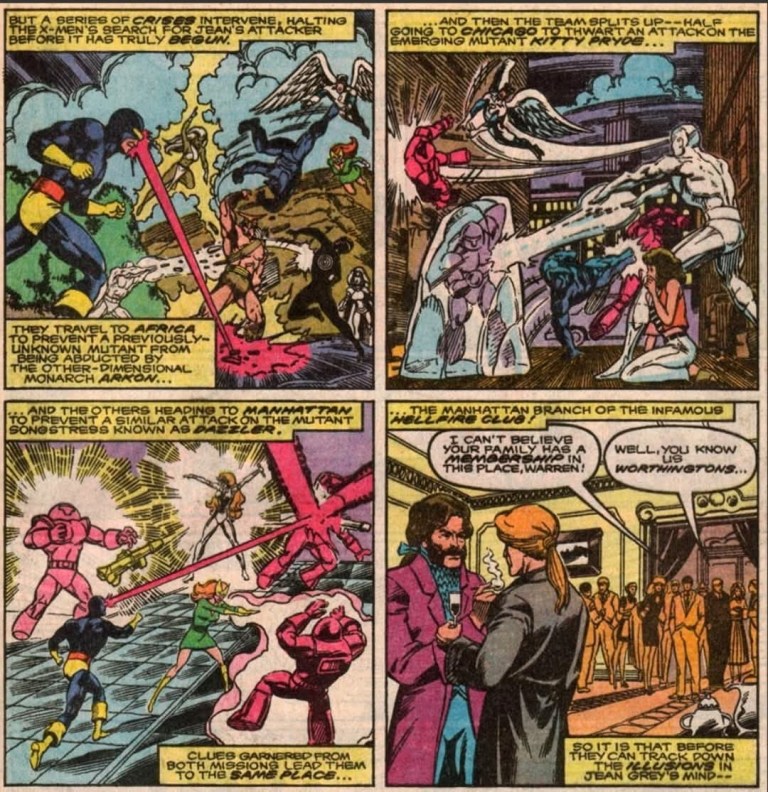
Without the existence of the 2nd X-Men team (from Giant-Size X-Men #1), the original X-Men’s first encounters with Dazzler, Kitty Pryde and the Hellfire Club turned out totally different.
This What If tale exploring an alternate chain of events involving only the original X-Men is not only a daring piece of work by the creators but it is also highly ambitious as seen through the scope of the plot. I’m not just talking about the non-existence of the 2nd X-Men lineup of Giant-Size X-Men #1 but also alternate realities of real X-Men developments such as the encounter with the Phoenix, Lilandra and Professor X’s first encounter, the X-Men’s encounter with the Hellfire Club, and more. Truly, the alterations were executed and the consequences were quite intense.
By focusing on the concept of the original X-Men proceeding as the 2nd X-Men team did not materialize, the Busiek-Ramos team really went all-in exploring the different possibilities and most of them were intriguing and entertaining to follow. The reading experience can be jarring because of the sudden change of scope that happens when the narrative suddenly shifted from one plot development (of local conflict) to another (a conflict on a galactic scale). Indeed, the narrative can be challenging to follow and to really enjoy it, you should pay strong attention to the details as you read on.
When it comes to character development, there is very little to find here which is not surprising given the way the script was written and also because the spotlight had to be shared by so many characters. Still, I enjoyed the character moments between Cyclops and Jean Grey, particularly during important points in the 2nd half of the story.
If there were any weak spots in the presentation, it is the fact that a lot of exposition had to be done and there were certain parts of the narrative that felt crammed with an excessive amount of details. Not only that, there is also an excessive amount of characters that go beyond the X-Men such as Lilandra of the Shi’ar Empire, the Starjammers, Alpha Flight, the Avengers and other beings of science fiction mixed in which make following the narrative challenging at certain points.
Conclusion
The original X-Men team plus Polaris and Havok.
What If #23 (1991) has more than enough advantages that outweigh the disadvantages. It’s story is very intriguing and enjoyable to read even though there were some bumpy parts on the narrative. Still, it is great to see what would have happened had the newer X-Men team never materialized and this comic book’s ending is very impactful to see.
Welcome back fellow geeks, Blu-ray collectors and movie buffs!
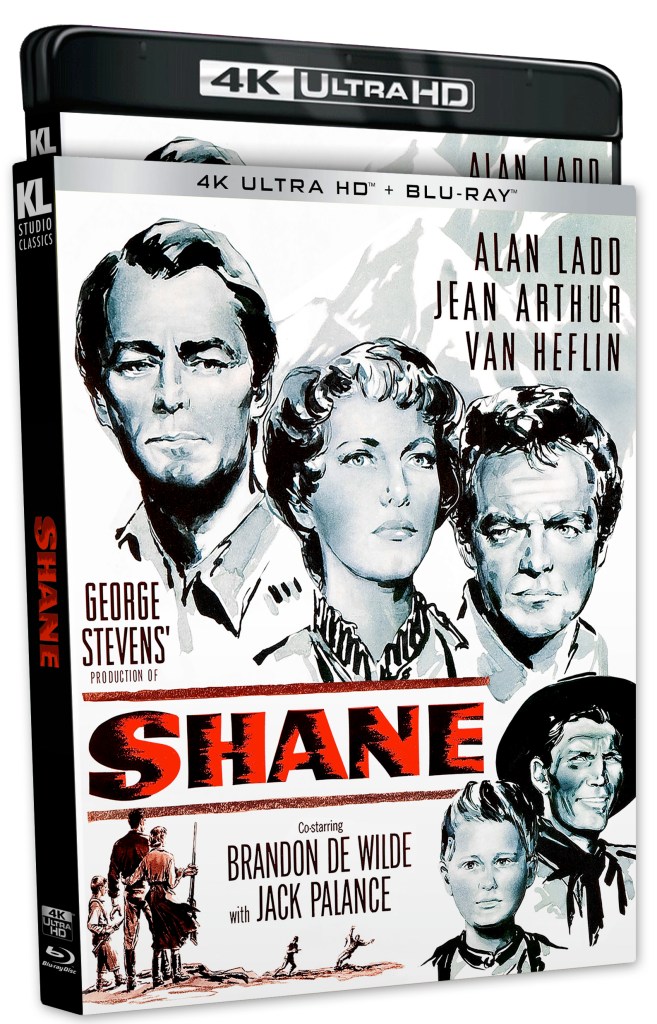
Shane, the classic Western film from 1953 directed by George Stevens, is all set for a 4K Blu-ray release on July 15, 2025 and already the publisher Kino Lorber is already accepting orders online.
Shane 4K Blu-ray from Kino Lorber.
Posted below are the technical details of the Shane 4K Blu-ray sourced from its Blu-ray.com page. For the 4K visuals enthusiasts reading this, Shane will be in native 4K resolution.
Discs – 4K Ultra HD, Blu-ray Disc, Single disc (1 BD-100, 1 BD-50), Digital – Digital copy included
Packaging – Slipcover in original pressing
Playback – 4K Blu-ray: Region free, 2K Blu-ray: Region A
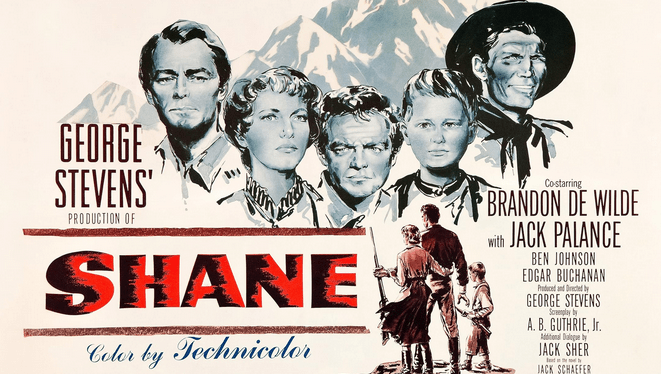
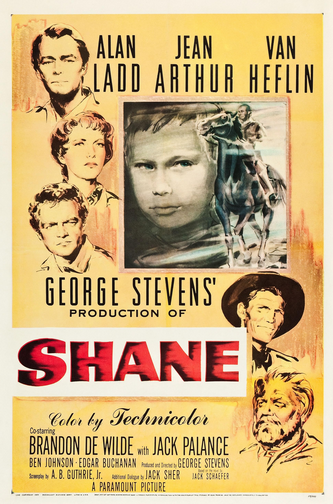
The movie poster of Shane.
Personally, I have not seen Shane in full. Apart from seeing selected scenes of it within the 2017 superhero film Logan, I saw Shane partially on cable TV a few times. I am personally interested to watch Shane entirely in native 4K and for this reason alone, Shane 4K Blu-ray is a future purchase for me. I am also aware that the 1953 film was based on the novel from 1949, and in 1993 the movie was selected for preservation in America’s National Film Registry by the Library of Congress as being “culturally, historically, or aesthetically significant”.
As for the Western genre of American films, my interest in Westerns from the 1950s, 1960s and 1970s has grown over time. I am not interested anymore in modern movies pumped out by Commiewood (note: woke stuff here and there) and I did not even see a single new movie in the cinemas in 2024. That being said, Shane is something I want to watch in 4K in the comfort of home soon. Here is hoping that the film restoration and remastering will be of top-notch quality.
If you have decided already to order Shane 4K Blu-ray this early, you can do it through Kino Lorber by clicking here.
Welcome back my readers, YouTube viewers and all others who followed this series of articles focused on YouTube videos worth watching. Have you been searching for something fun or interesting to watch on YouTube? Do you feel bored right now and you crave for something to see on the world’s most popular online video destination?
I recommend you check out the following topics and the related videos I found.
#1 The next Xbox will include Steam and PlayStation? – The vibe of the next-generation of console gaming is only intensifying by the day. When it comes to Xbox itself, there is speculation that the next-generation Xbox will not only be a hybrid PC console but also include access to Steam games and even those of PlayStation. I know it sound crazy but if it is clear that Microsoft is doing its own approach on the next-generation Xbox in radically different way compared with PlayStation and Nintendo. If you want to know more details, watch Colteastwood’s video below.
#2 PatmanQC examines NBA Jam – Were you able to play basketball videos in the arcades way back in the 1990s? Back then, NBA Jam was a massive excess attracting so many players and generating lots of income for arcade operators. The game also sold a lot on many game consoles as well. NBA Jam is a 2-on-2 arcade-style basketball game with emphasis on fast-paced scoring without the hindrance of normal basketball rules. To discover more about the history of NBA Jam and who were the people behind its production, watch the video of PatmanQC.
#3 Slope’s Game Room examines the Strike games franchise – Remember back long ago when Electronic Arts (EA) released a series of military themed shooter games on game consoles? I’m referring to the Strike series of games that include Desert Strike, Jungle Strike, Urban Strike, Soviet Strike and Nuclear Strike. Those games were released across two console generations in the 1990s and the series has not been revived until now. To look back at EA’s Strike games, watch the video by Slope’s Game Room.
#4 VKunia reacts to Batman v. Superman: Dawn of Justice – I recently browsed through the many videos of YouTuber VKunia and took time to watch her reaction video of Batman v. Superman: Dawn of Justice. The film directed by Zack Snyder is significant not in a positive way but because of its very dark approach on storytelling and spectacle involving DC Comics’ icons Superman, Batman and Wonder Woman. The way it was presented, not even the combined talents of Henry Cavill, Gal Gadot, Ben Affleck and others could spare the film from negative reception. I think by today’s standards, this is a superhero film that can only entertain a limited type of people. Still, I find VKunia’s reactions to it a must-watch.
#5 Woke garbage in comic books exposed and explained – As a geek, I really hate it when these modern day Leftists – Communists, socialists, Marxists, liberals, diversity zealots, inclusion zealots, LGBTQ activists and Islamo-Leftists – ruin movies and video games by emphasizing their radical agenda through them. The same has happened in comic books and it is clear that the Leftists working for the publishers made established superhero icons look terrible. These unfortunate developments will remind you that comic books are meant for escapism and not political agenda which comic book legends Jim Shooter and Stan Lee confirmed long ago. Watch and learn from the video of YouTuber Ranting for Vengeance right now.
#6 The free speech solution against DEI poison – In this John Stossel video I recently saw, the topic of diversity, equity and inclusion (DEI) was discussed and it turns out there is a free speech solution against the woke virus. This is about the ongoing information war between the Satanic Left and the ones who believe in common sense and reality.
#7 Ashleigh Burton reacts to The Breakfast Club – Were you able to watch any movies written or directed by the late John Hughes? A lot of people considered Hughes’ works collectively defined the cinematic American teenagers of the 1980s. One of the more popular works of Hughes was The Breakfast Club and Ashleigh Burton’s reaction video is a must-see.
Welcome back, my readers, YouTube viewers and all others who followed this series of articles focused on YouTube videos worth watching. Have you been searching for something fun or interesting to watch on YouTube? Do you feel bored right now and you crave for something to see on the world’s most popular online video destination?
I recommend you check out the following topics and the related videos I found.
#1Ashleigh Burton’s Logan reaction video – Finally, after posting several X-Men-related reaction videos on her YouTube channel, YouTuber Ashleigh Burton posted her reaction to the great movieLogan. As it is a great film, you must watch it entirely first. If you have seen it already, then I urge you to watch Burton’s reaction video below.
#2 Woke Hollywood continues to freak out over Donald Trump’s comeback as US President – Remember all those many Hollywood elitists who went all out to fool Americans to vote for Commie Kamala Harris for US President? A lot of them plus Hollywood media are still freaking out over Harris’ loss to Donald Trump (who pulled off the greatest American comeback ever). Watch the videos from Midnight’s Edge and RK Outpost below. Pay close attention to the details.
#3 1990s explanatory video about the Fighter’s History – Street Fighter II case – Back in the 1990s, Capcom USA sued Data East over the video game Fighter’s History for infringing on Street Fighter II. As part of its efforts defending Fighter’s History, Data East released to the media an explanatory video (lawsuit exhibit video) which was recently posted on YouTube for millions of people to watch for the first time ever. Watch it now.
#4 Examining Final Exam – Have you ever seen the 1981 movie Final Exam? It was a low-budget, independently made slasher horror movie that looks inspired by Halloween (1978), Friday The 13th (1980) and even National Lampoon’s Animal House (1978). While it is a fact that the movie faded away into obscurity for decades, it suddenly gained attention among film buffs arguably because of its 2023 release on 4K Blu-ray format. Apart from that, Final Exam has a very interesting story of production and execution, and you can learn more about it in the two videos below.
#5 Spotlight on Predator 2 – While it is clear that the 1990 sci-fi action movie Predator 2 does not match the greatness of its predecessor, it still aged well and clearly succeeded in expanding the lore of the Predator entertainment franchise. It also established very creatively the link between Predator and the Alien film franchise. That being said, it is not surprising that the movie became the subject of several YouTubers’ retro movie review videos and movie reaction videos. Before you watch the selected videos below, I encourage you to watch the film first in case you have not seen it. Otherwise, enjoy the selected videos below.
#6 Halo 2 remembered – Twenty years ago this month, Microsoft launched Halo 2 on the original Xbox console with massive hype and success. I could never forget the excitement leading towards its launch followed by the fun I had playing the single-player campaign. The only problem I had with Halo 2 was the abrupt ending. Regardless, Halo 2 is still memorable and if you feel nostalgic about it, watch the video below. Remember, this is a look back at the time when Team Xbox invested a lot not only on Halo 2 but also on making Xbox fans happy with exclusive content.
Welcome back readers, fellow geeks and electronic gaming fans!
In this edition of the Retro Gaming Ads Blast (RGAB) series, we will take a look at another batch of retro gaming print ads – including arcade flyers – specifically about fighting games that were released in the 1990s. The said decade marked the time when Street Fighter II became a massive hit in the video arcades (and on game consoles) which sparked a wave of new fighting games from business competitors. In that same decade, 3D polygonal fighting games were also released which added greater choices of fighting games at the arcades and on game consoles that players could choose from.
For the newcomers reading this, Retro Gaming Ads Blast (RGAB) looks back at the many print ads of games (console, arcade, computer and handheld) that were published in comic books, magazines, flyers, posters and newspapers long before smartphones, social media, the worldwide web and streaming became popular. To put things in perspective, people back in the 1980s and 1990s were more trusting of print media for information and images about electronic games and related products.
With those details laid down, here is the newest batch of retro gaming print ads for you to see and enjoy…
1. Dead or Alive Japanese arcade flyer
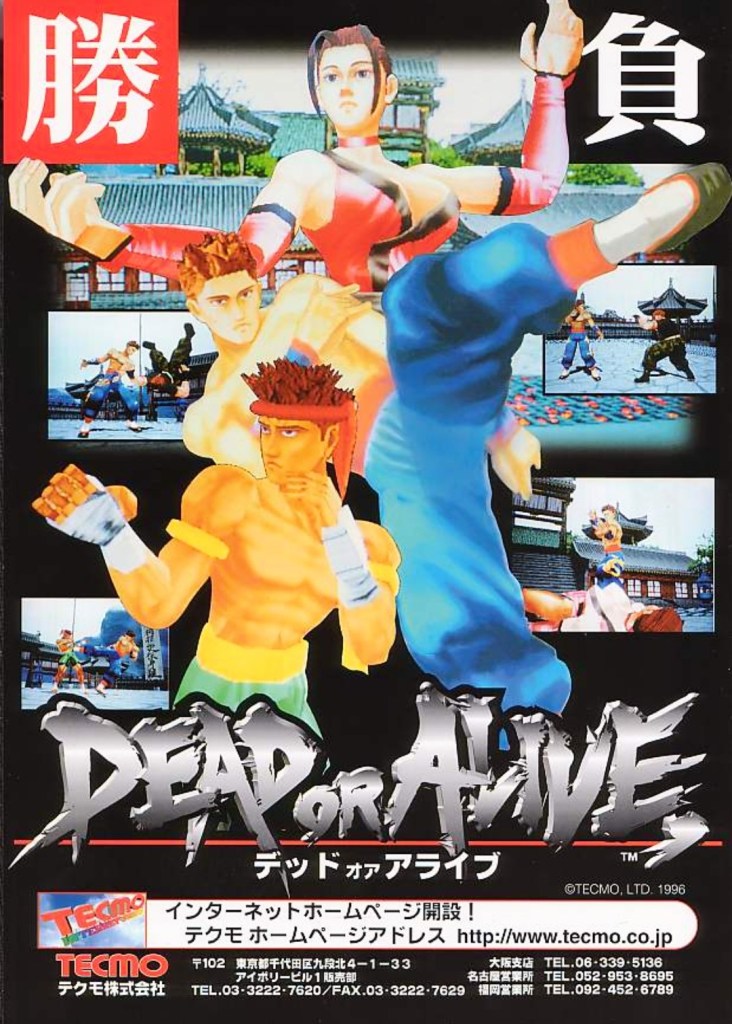
Dead or Alive was the start of new success that impacted the direction of Tecmo in the gaming industry.
The above arcade flyer of Dead or Alive gave Japanese arcade operators and gamers a taste of what to expect with the game. While the screenshots showed some resemblance with what gamers saw in Virtua Fighter 2, the character designs Tecmo and its developers came up with were unique.
Before Dead or Alive was released in Japanese arcades in 1996, company Tecmo was in financial trouble and they asked Tomonobu Itagaki to make a fighting game similar to Sega’s polygonal blockbuster Virtua Fighter. A breakthrough for Tecmo happened when Sega announced they were licensing their Model 2 arcade to third-party companies which paved the way for Itagaki’s team to make Dead or Alive with it. The game became a big hit and it paved the way for Tecmo to release it on Sega Saturn and PlayStation, and the sequels that followed years later.
2. North American Soulcalibur Dreamcast version print ad
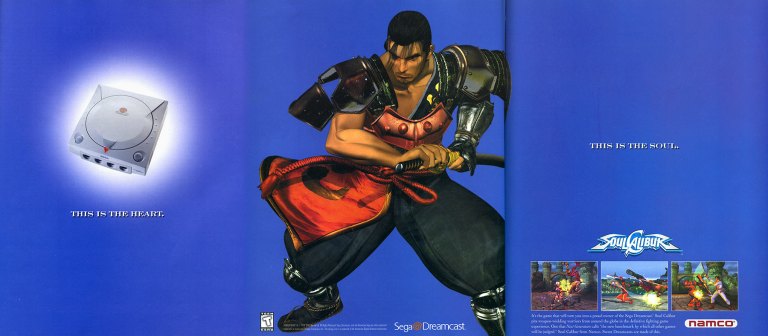
Namco came up with a creative approach to emphasize heart-and-soul promoting their game and the Dreamcast.
On September 9, 1999, Sega launched their Dreamcast console in America. With a gap of around ten months between the Japanese launch (November 1998) and the American launch, Sega had time to prepare Dreamcast’s release to American gamers with a huge lineup of games (both Sega’s games and from other publishers). Fortunately for Sega, they had Namco (their rival on arcade games) supporting their console.
Behind the scenes, Namco’s developers worked hard to not only port their arcade hit Soulcalibur to the Dreamcast, but to enhance the graphics using the console’s more advanced technology. The visual enhancements include rendering all of the games stages (and backgrounds) into full 3D polygonal environments. Namco also implemented different game modes and added even more content to ensure satisfaction to Dreamcast gamers.
The above 3-page print ad of Soulcalibur on Dreamcast was undeniably strategic and captivating to look at. The ad described the console as the heart, showed Soulcalibur character Mitsurugi (one of the game’s most popular characters) in the middle and then described the game (with 3 screenshots of game rendered with Dreamcast graphics) as the soul. It was a strong way to promote both the game and the console. In the years that followed, Soulcalibur grew into a popular fighting game franchise and the Dreamcast version will always be remembered as the crucial turning point.
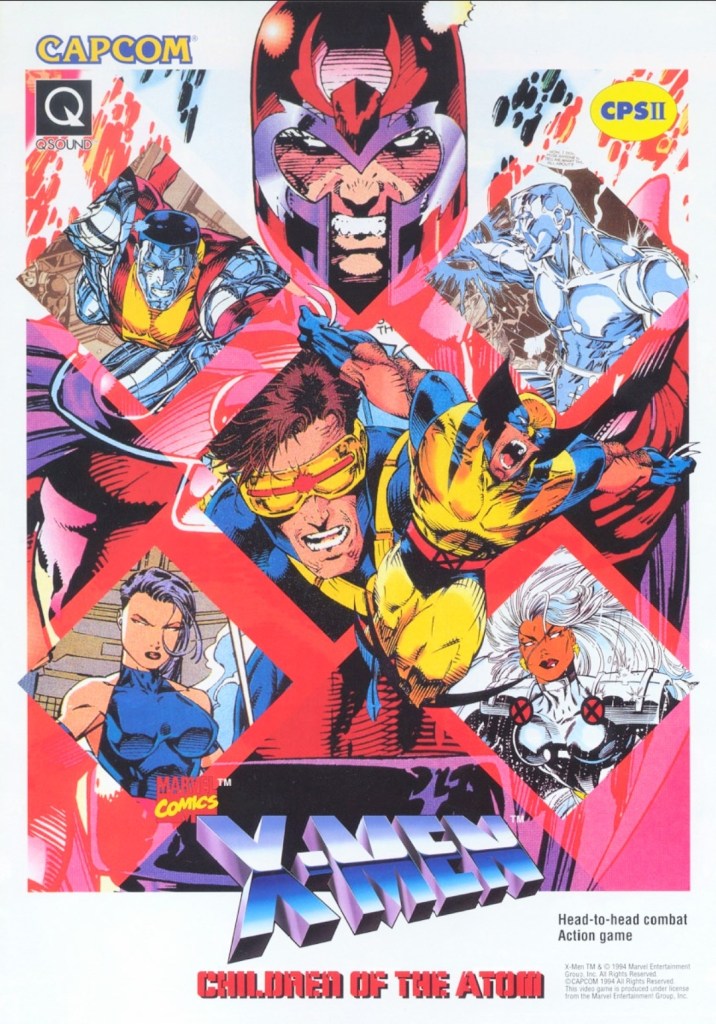
3. X-Men: Children of the Atom arcade flyer
Anyone who read lots of X-Men comic books in the 1990s should be able to tell which character was drawn by which artist.
When Capcom first released X-Men: Children of the Atom in the arcades in the mid-1990s, I was surprised because I did not anticipate the day would come when the company behind Street Fighter II would actually make a 2D fighting game showcasing the Marvel’s mutants. Even more intriguing was the X-Men art Capcom used for the arcade flyer to promote the game. I recognize Jim Lee’s artworks of Magneto, Cyclops and Colossus. The art of Wolverine shown was drawn by Andy Kubert. It was a wise move for Capcom (with Marvel as a business partner) to use established X-Men comic book artworks instead of having their internal illustrator draw the characters. That being said, this arcade flyer still looks great and captivating to look at.
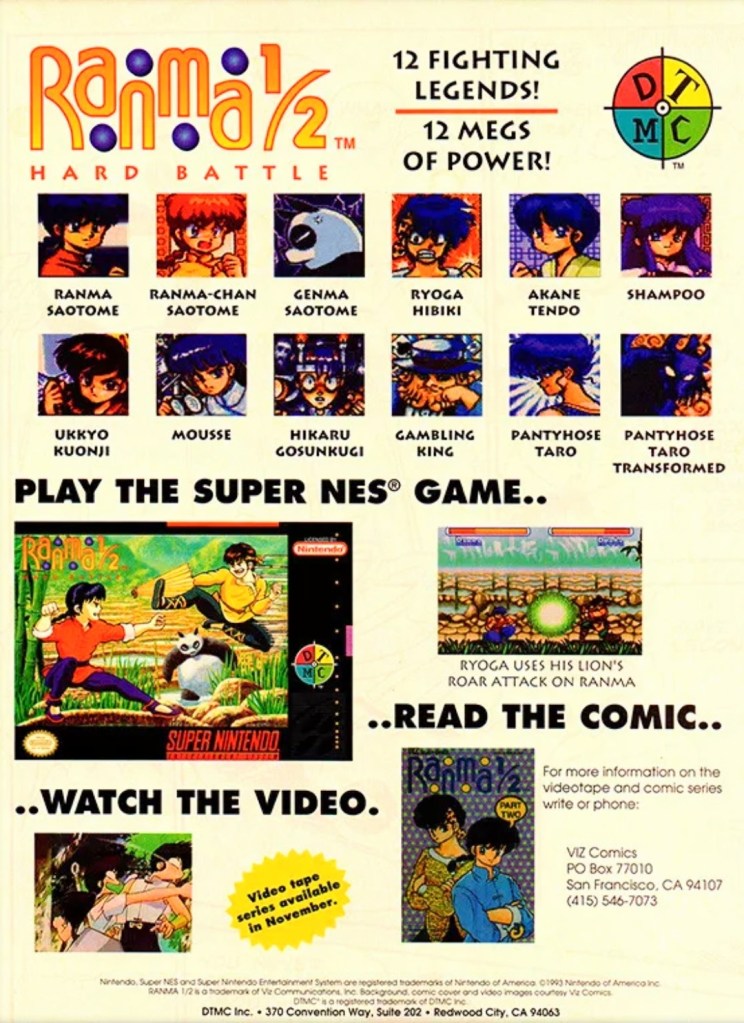
4. North American Ranma ½: Hard Battle print ad
A print ad promoting the game while saving some space to promote the anime and comic books.
By 1993, Street Fighter II and its upgraded follow-ups were wildly popular both in the arcades and on game consoles around the world. At the same time, there were many other 2D fighting games released to compete with and cash-in on Street Fighter II’s success. Believe it or not, the established anime franchise Ranma ½ saw a video game adaptation in the form of a 2D fighting game – Ranma ½: Hard Battle.
The North American print ad above published by DTMC (in cooperation with Viz Communications) promoted the game (one screenshot, the SNES game box and images of the characters as they appeared in the game) as well as Ranma ½ on anime videos and comic books. The way it was presented, the print ad promoted Ranma ½: Hard Battle without much heart nor passion.
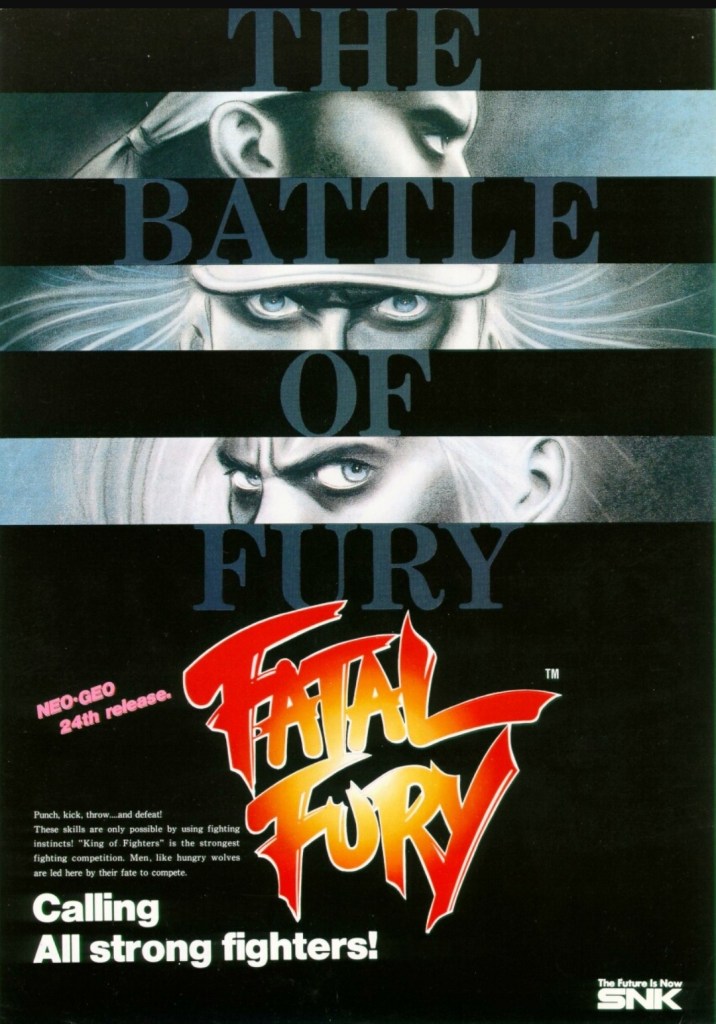
5. Fatal Fury: King of Fighters arcade flyer
An intriguing visual presentation on the front.
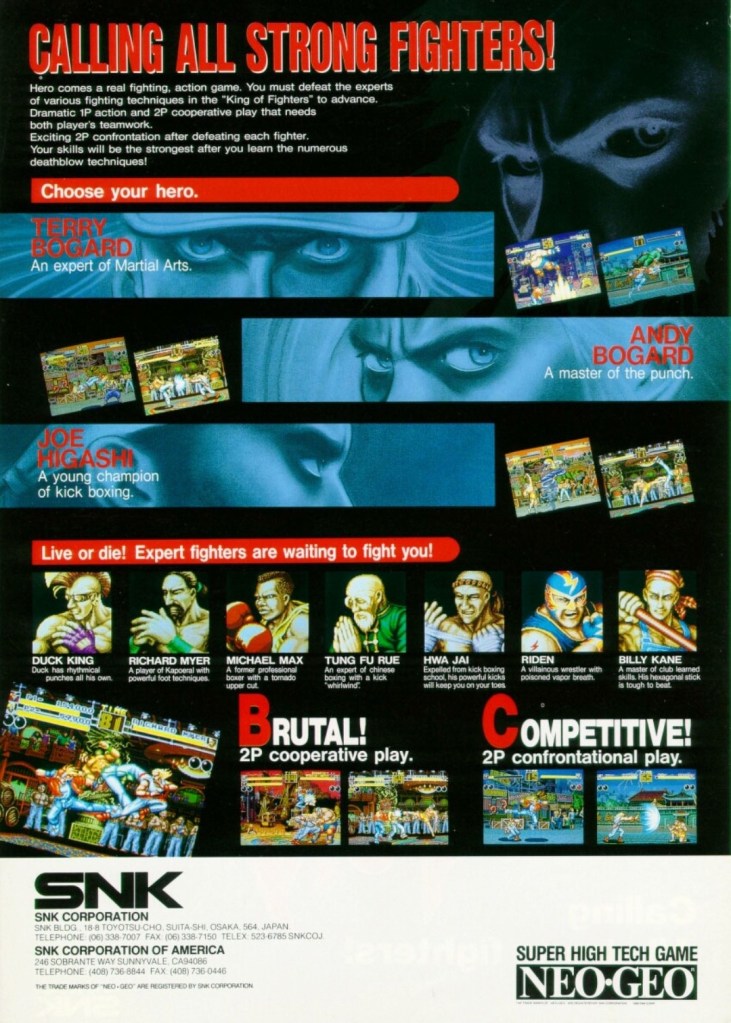
You get to know the characters and what the game features are.
There is no doubt that Fatal Fury: King of Fighters is the most significant game that SNK made. Apart from being the company’s first fighting game for the Neo Geo system, it established the fictional “king of fighters” tournament that became the core concept for The King of Fighters series of games in the years that followed. Fatal Fury itself is notable for being designed by Takashi Nishiyama, a former Capcom employee who created the original Street Fighter game. What Nishiyama could not do with Street Fighter, he accomplished while making SNK’s fighting game. Compared with the combo-oriented approach of Street Fighter II, Fatal Fury was designed to emphasize the timing of special moves, confrontational play, cooperative play and the 3D-like spacing between characters (background row and foreground row in each stage) while telling a story in a solid way.
The above arcade flyer of Fatal Fury has this unique looking artwork on the front showing stylized rectangular shots of the major characters Terry Bogard, Andy Bogard and Joe Higashi. On the other side of the flyer are the details that emphasized the creative concept of the game, who the characters are and what they could expect with regards to gameplay features. This flyer is still captivating to look at and it could entice you to try playing the original Fatal Fury game before trying out the sequels and spin-offs.
6. Marvel vs. Capcom: Clash of Super Heroes arcade flyer
This is NOT a comic book crossover.
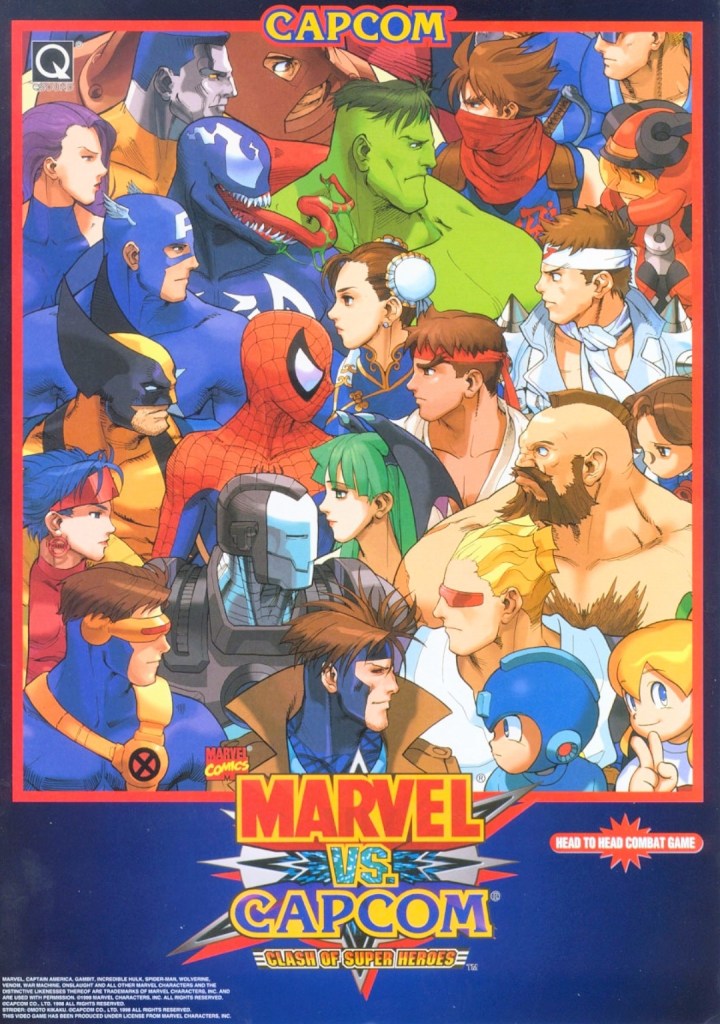
If there is anything that truly emphasizes the essence of a fictional crossover in terms of visuals, it’s the art that Capcom and Marvel agreed to for Marvel vs. Capcom: Clash of Superheroes which is evident on the front of the above arcade flyer. By looking at how the Marvel characters were drawn, it looks like someone at Capcom illustrated the artwork as the Capcom characters still maintained that particular art style seen in the artworks of the Japanese company’s other games like Street Fighter, Darkstalkers, Mega Man and Strider. Regardless, the artwork still is amusing to look at.
7. Art of Fighting arcade flyer
The front of the flyer.
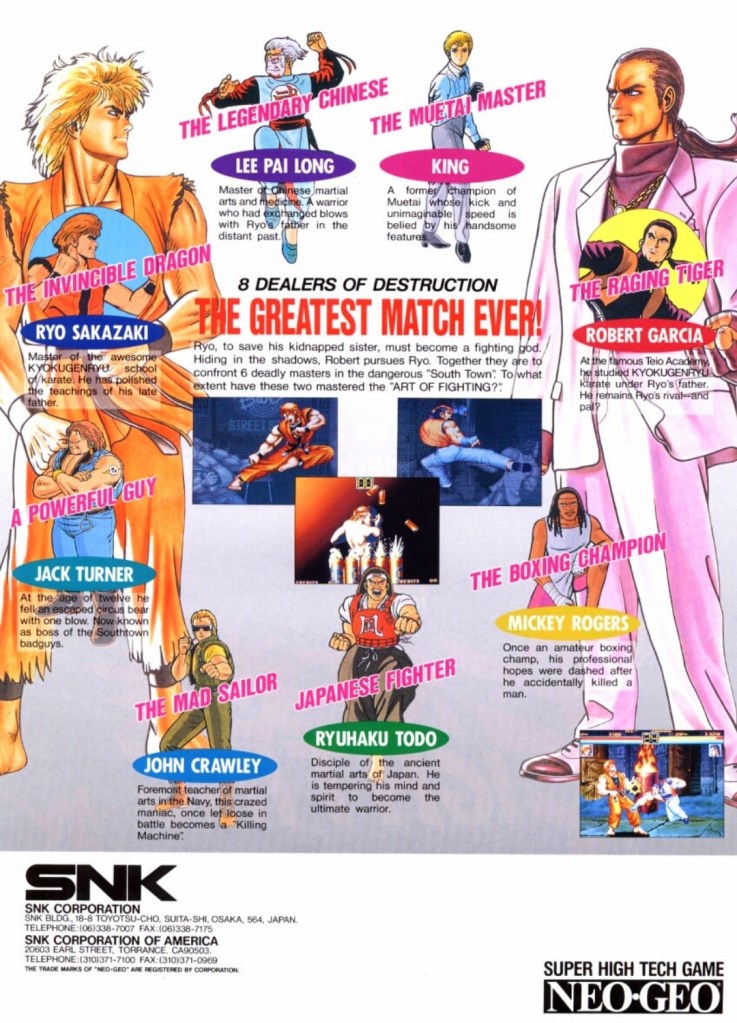
The cast of characters showcased on the other side of the flyer.
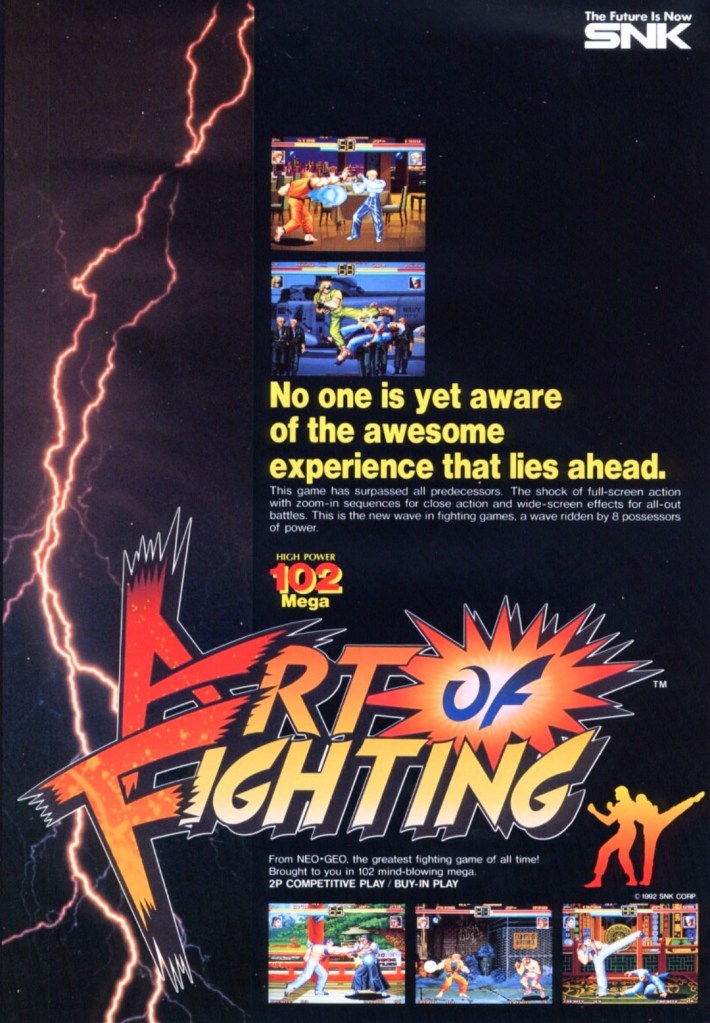
Following the success of Fatal Fury, SNK went on to release Art of Fighting in arcades in 1992 and it became successful enough for the company to make sequels. With regards to the realm of fantasy, Art of Fighting was part of the same fictional universe as Fatal Fury and The King of Fighters, and there were times when its own characters appeared in other SNK games.
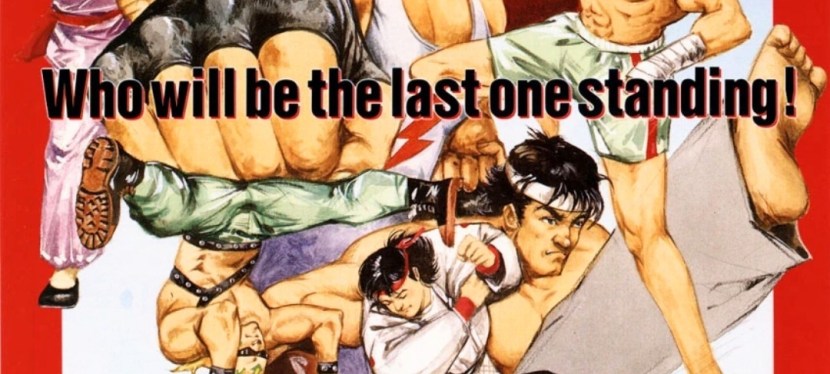
Art of Fighting’s arcade flyer had an energetic visual concept on the front with a rectangular lightning portion on the left balanced with five screenshots of the game itself. Once you get to the other side of the flyer, you will see really nice art of the characters with Ryo Sakazaki and Robert Garcia as the most dominating figures. Sakazaki and Garcia are the major characters of the Art of Fighting series. This flyer confidently introduced the characters and succeeded in making them look interesting.
8. Fighter’s History arcade flyer and print ad
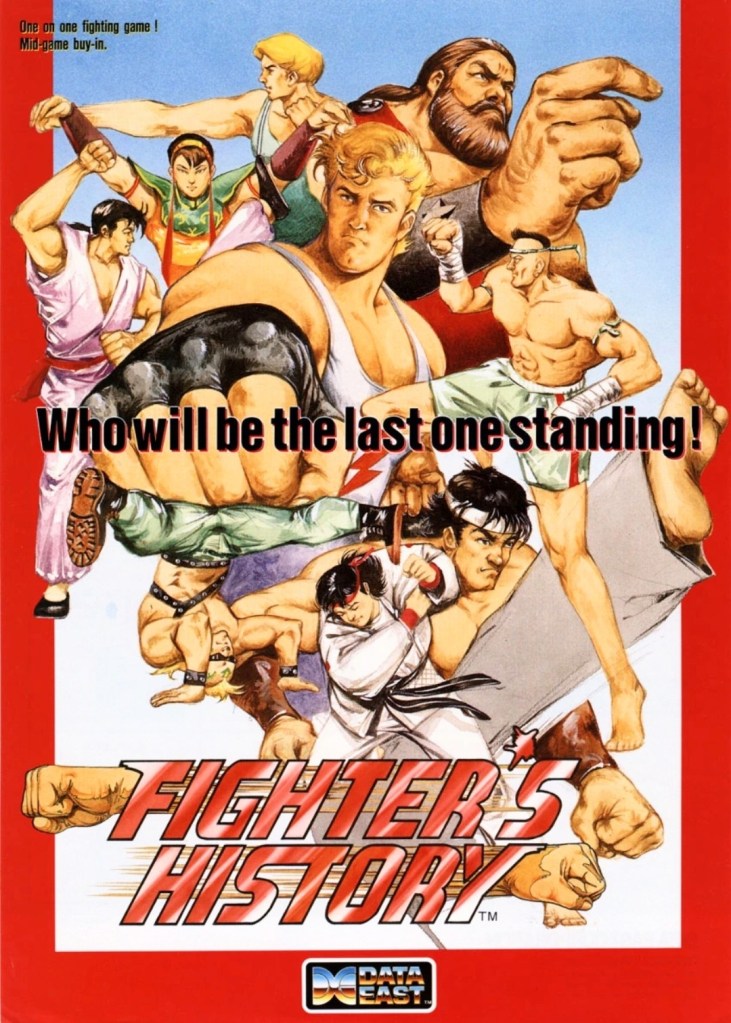
Great looking front artwork showing the game’s characters, posing and some action.
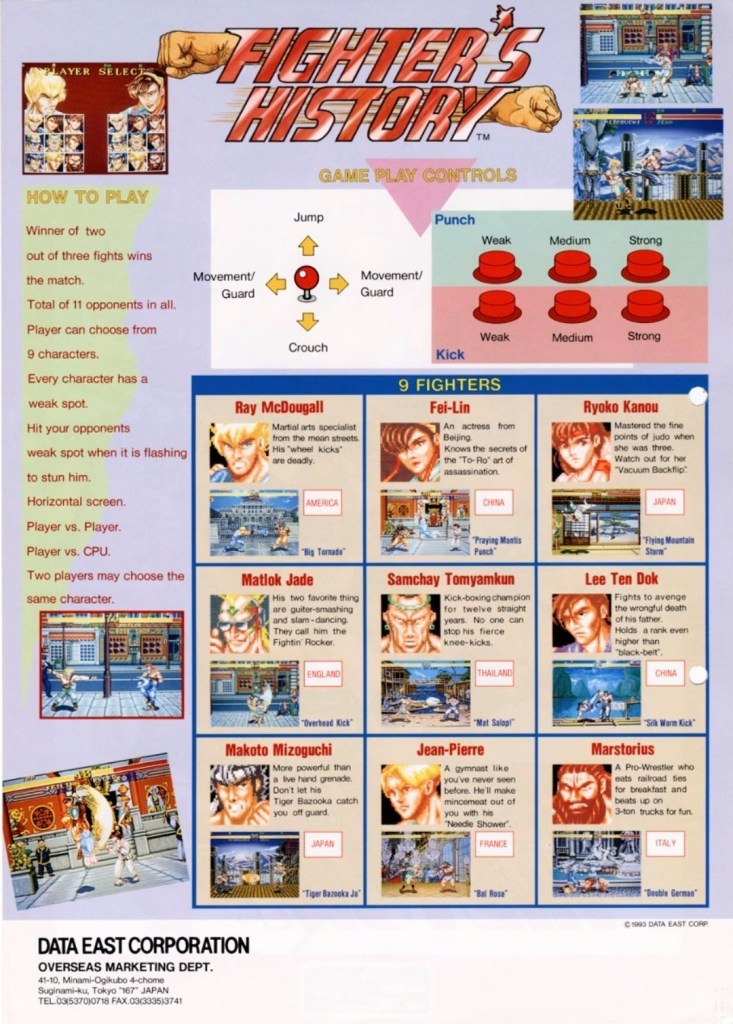
If you look closely at the controls, you will see the six-button layout and functions which are the same with those used in Street Fighter II.
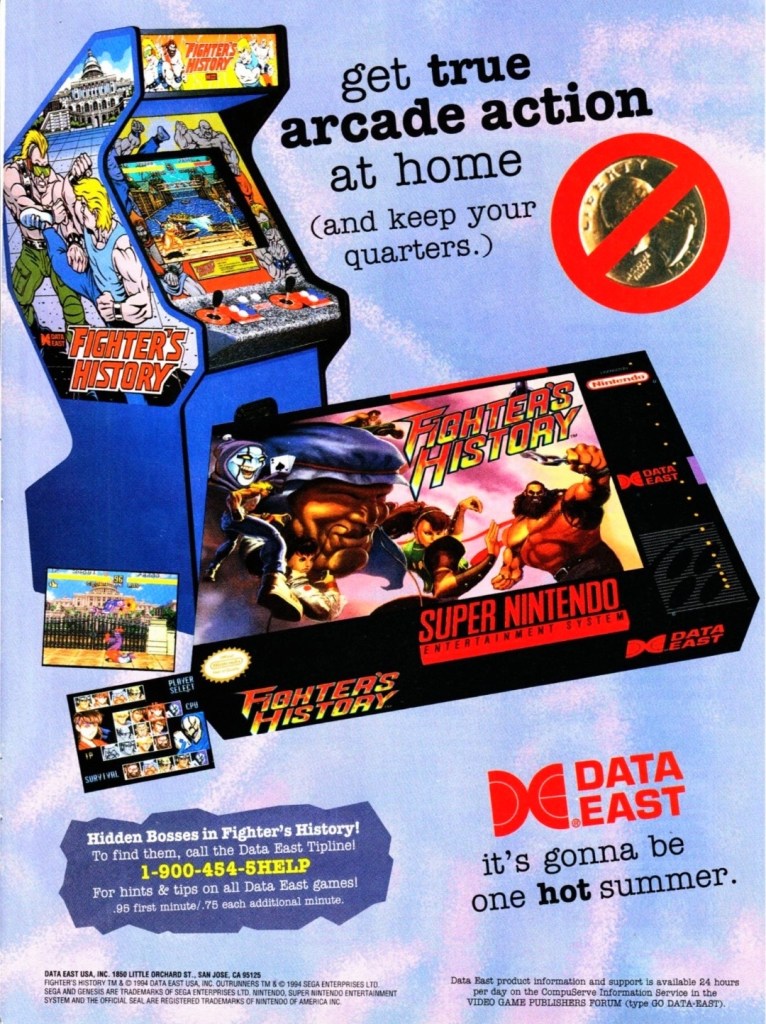
Data East offered two ways for gamers to enjoy Fighter’s History – pay a high price for the SNES version or gamers can go play the game in the arcade by dropping a few coins.
In 1993, Data East released their fighting game Fighter’s History in the arcades around the world. Along the way, the company released their arcade flyer which had a very captivating art work on the front featuring their characters and some action. The other side of the flyer showed the technical details on how to play, how the control works and who the characters are. Fighter’s History was nicely received in the arcades and the success led Data East into porting the game for the Super Nintendo Entertainment System (SNES). If you look at the print ad above, you can see how clever Data East was promoting the SNES version of the game while keeping an image of the arcade machine which serves like a subtle reminder that the same game is still available in video arcades.
Shortly after the release of Fighter’s History in the arcades, there were gamers who noticed that it had certain visual and gameplay elements that made it so familiar with what Street Fighter II had. When Capcom became aware of the similarities, they sued Data East claiming that Fighter’s History was too similar to their game and that copyright infringement was committed. Capcom lost the case ultimately and Data East went on to release two more Fighter’s History games.
9. Virtua Fighter 3 arcade flyer
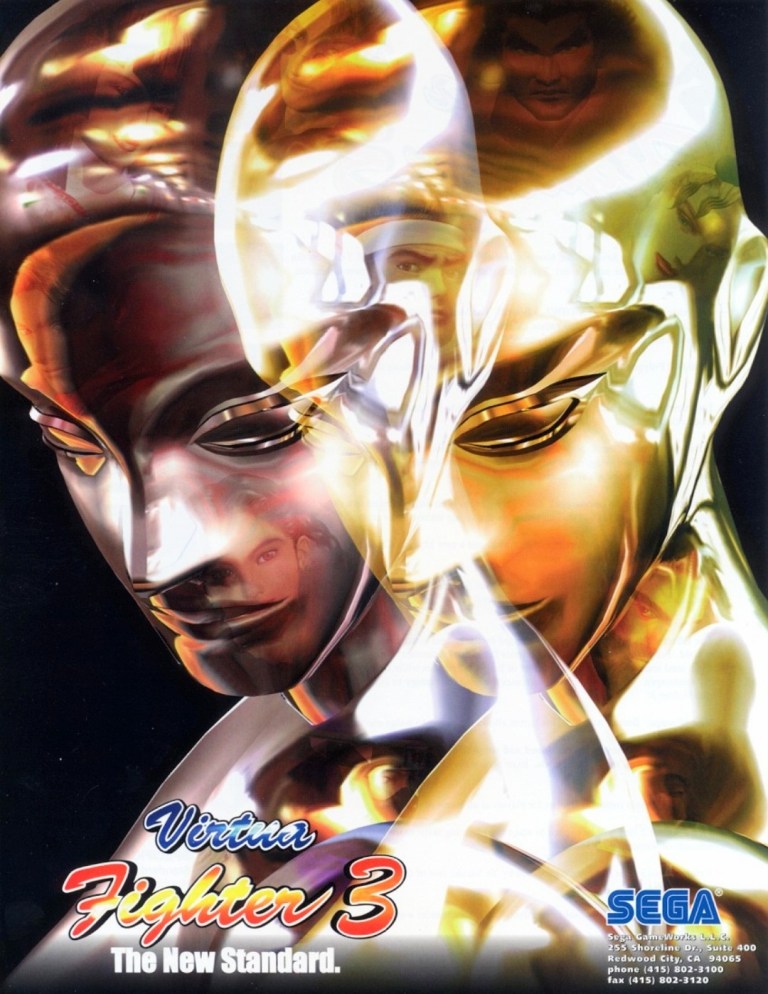
Virtua Fighter 3 truly raised the standards for arcade game graphics back in 1996.
When it comes to gaming innovation and standing out among the rest, Sega did exactly those when they released Virtua Fighter 3 in arcades in 1996 and it had the best-looking and really mind-blowing graphics at the time. Developed by AM2 (led by Yu Suzuki) on the very expensive Model 3 arcade hardware, Virtua Fighter 3 broke new ground on graphics as it moved over 1 million polygons per second, had highly detailed visuals on the characters and surroundings, realistic reflection effects, detailed shining, parallel lighting and high-specular Gouraud shading to name some. Even the characters’ eyes followed the opponent’s position.
The Virtua Fighter 3 arcade flyer showcased their reflective, metallic character Dural who in turn was part of the graphical showcase (emphasizing reflections, smooth animation and liquid metal effects) when the game was previewed in the 1996 AOU event in Japan. The words “The New Standard” written on the lower-left corner of the front of the flyer was justified and truthful.
10. Teenage Mutant Ninja Turtles: Tournament Fighters print ad
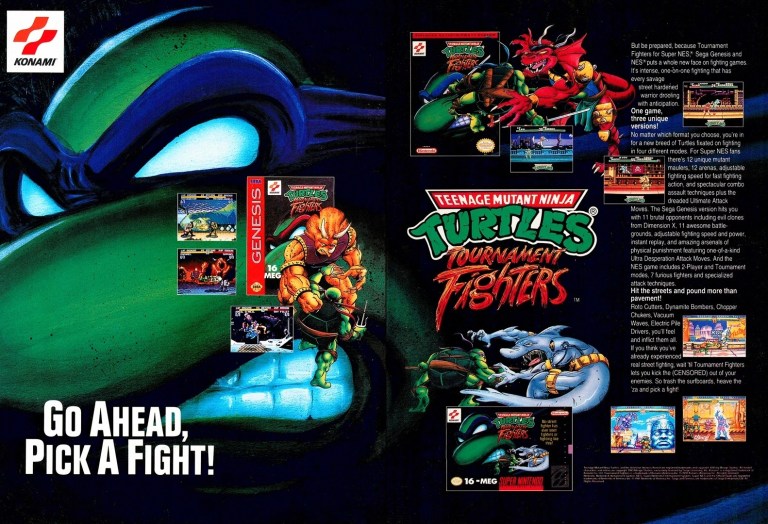
This print ad had a nice visual presentation and was easily recognizable to the many TMNT fans.
In 1989, the Teenage Mutant Ninja Turtles (TMNT) franchise made quite a splash on video games which is not surprising as the multimedia franchise was already a popular in the West. More video game adaptation of TMNT were released in the early 1990s providing fans and gamers a lot of fun gameplay at the arcades (click here) and on consoles. Konami had the video game rights of TMNT and in a clear response to the sudden popularity of fighting games, they released Teenage Mutant Ninja Turtles: Tournament Fighters on the most popular game consoles of the time achieving varying levels of success critically and commercially (note: the SNES version stood out as the best). This print ad of the fighting game was effective in visually promoting the three console versions and the displayed text contained enough information to lure the attention of both fans and gamers.




 Author Carlo Carrasco