What to watch on YouTube right now – Part 100

Welcome back my readers, YouTube viewers and all others who followed this series of articles focused on YouTube videos worth watching. Have you been searching for something fun or interesting to watch on YouTube? Do you feel bored right now and you crave for something to see on the world’s most popular online video destination?

I recommend you check out the following videos I found.

Christine Grace Smith Reacts To A Video About Society Impacted When No Men Are Working – There is something new and engaging to learn about society whenever Christine Grace Smith posts a new video. Recently, she shared her own reaction to a video that explores what would happen to society if men stopped working. This is something that the woke and rabid modern-day feminists do not want you to see. I urge you all to watch her video now.

Metal Gear Games Revisited – In connection with the recent release of Metal Gear Solid Δ: Snake Eater, it was not surprising that a lot of YouTube videos revisiting past Metal Gear games got published by different YouTubers. Some of those videos I found were entertaining to watch while others were reflective or even intriguing. For the newcomers reading this. The Metal Gear game franchise of Konami started in the late 1980s under Hideo Kojima when he was very young. That being said, I urge you all to take a look at the selected Metal Gear-related videos I shared below.

#3 How Alan Moore And Watchmen Spread The Wokeness Disease In Comics – YouTuber Ranting for Vengeance is back, and this time he strikes hard at author Alan Moore not personally but for sowing the seeds of wokeness in superhero comics with Watchmen as the turning point. By today’s standards, wokeness is the unfortunate new normal in superhero comics and it is a fact that Alan Moore is an anarchist and a Leftist as well. Watch and learn from the video below.

Robin Hood: Men in Tights Revisited – Long ago, there were several comedy films made by Mel Brooks which delivered bouts of humor to moviegoers and raked in varying amounts in ticket sales. In the 1990s, he directed Robin Hood: Men in Tights which my friends enjoyed watching inside the movie theater. While the film is not a classic by any means – not even within the comedy genre – it still managed to entertain YouTubers through their reaction videos. Watch the selected reaction videos below.

The Traditional Types of Food of Japan  – While you may have enjoy varied types of food of Japan served through the many Japanese restaurants around the world, are you aware that there certain meals or delicacies of the nation that were simply not made available through those places? That being said, it would be enlightening – and even tasty – for you to visit Japan and try out the more traditional types of food the nation has to offer. Indeed, there are the 100-year food declared in Japan and you can learn more about them by watching the video below.

+++++

Thank you for reading. If you find this article engaging, please click the like button below, share this article to others and also please consider making a donation to support my publishing. If you are looking for a copywriter to create content for your special project or business, check out my services and my portfolio. Feel free to contact me with a private message. Also please feel free to visit my Facebook page Author Carlo Carrasco and follow me on Twitter at  @HavenorFantasy as well as on Tumblr at https://carlocarrasco.tumblr.com/ and on Instagram athttps://www.instagram.com/authorcarlocarrasco

What to watch on YouTube right now – Part 44

Welcome back, my readers, YouTube viewers and all others who followed this series of articles focused on YouTube videos worth watching. Have you been searching for something fun or interesting to watch on YouTube? Do you feel bored right now and you crave for something to see on the world’s most popular online video destination?

I recommend you check out the following topics and the related videos I found.

Konami’s failed fighting games of the 1990s – Remember back in the 1990s when a lot of fighting games were released on the arcades and game consoles? Japanese game companies Namco and Capcom released a lot of memorable fighting games of different styles such as Street Fighter II, Tekken, Marvel vs. Capcom, Tekken 3, Soulcalibur, X-Men: Children of the Atom, X-Men vs. Street Fighter and so on. Sega released Virtua Fighter games while Midway released Mortal Kombat games, and SNK had Fatal Fury, King of Fighters and Art of Fighting games. Looking back at the fighting game craze of the 1990s, I noticed that Konami – best known for Metal Gear, Contra, Gradius and Suikoden – released their own fighting games but never achieved the tremendous success that its competitors had. The retro gaming video is a must-see.

Calvin Dyson’s lengthy review of The World is Not Enough – I can hardly believe that it has been twenty-five years since the James Bond movie The World Is Not Enough was released in cinemas as the 20th century was ending. The 3rd film of Pierce Brosnan as Agent 007 received mixed reviews from the critics and some fans found it to be really brainless and excessive with action which negatively affected the cinematic narrative. To find out if the 1999 Bond movie aged well or not, YouTuber Calvin Dyson recently posted his lengthy retro review and you can watch it now.

In-depth documentary of Smash TV – Remember way back in 1990 when Smash T.V. (also referred to as Smash TV) was released in the arcades and attracted a lot of players with its enjoyable game design and concept? The game was a hit and went on to be ported to many platforms afterwards, and I played its Super Nintendo Entertainment System (SNES) version a lot. To find out how hit game started and who were the key people behind its production, watch the video documentary of PatmanQC now.

Defeated Kamala Harris, Sharon Stone, Alec Baldwin and others highlighted in Lefties Losing It episode – It has been a few weeks since Donald Trump pulled off the greatest American comeback by winning again the US presidential election. Even until now, the Leftists are still agonizing over Trump’s victory and many of them cannot accept the reality of what happened. In the latest Lefties Losing It episode below, you will see a drunk-like Kamala Harris talking to her supporters, Sharon Stone bashing others and more. Watch it!

Electric vehicles sparked into fire disasters as a result of salt water caused by Hurricane Helene – This news video should convince you not to buy and drive an electric car or any type of electric vehicle for that matter. Salt water touching the ion batteries of electric vehicles spark flame and this leads into fire incidents that simply could not be solved quickly. Hurricane Helene’s powerful wind brought salt water into affected communities and not even electric vehicles parked inside the garage were spared. Avoid electric vehicles and stick with vehicles that run on fossil fuel. 

Ashleigh Burton’s Fantastic Four (2005) reaction video – Back in 2005, I never saw Fantastic Four in the local cinema. I was never a Fantastic Four fan nor did the team-up of Stan Lee and Jack Kirby starting the said superhero team interested me. Believe it or not, I finally saw the movie on home video in 2009. In recent times, YouTuber Ashleigh Burton posted her reaction video of Fantastic Four and it is fun to watch.

Phantasy Star IV retrospective – Thanks to my physical copy of Sega Genesis Classics, I was able to play Phantasy Star IV: The End of the Millennium on my Xbox Series X console. For the newcomers reading this, Phantasy Star IV was a sci-fi Japanese role-playing game (JRPG) released on the Sega Genesis (Mega Drive in other markets) in Japan in 1993 followed by released in America and Europe in 1995. The production side of the game has very interesting details and you can learn all about it in GTV Japan’s retrospective video below.

A look at Disney’s The Black Hole – Long before the Walt Disney Company became the super woke entity of modern times, they released the expensive sci-fi film The Black Hole. As far as the Disney legacy is concerned, the 1979 movie is significant as it marked a serious change of direction the company took with its movies. Disney was already known for wholesome and family oriented movies and TV shows and eventually entered a period of uncertainty. The Black Hole was both Disney’s attempt to cash-in on the sci-fi and disaster film craze of the 1970s and attract more adult moviegoers. You can learn more about this forgotten movie by watching the videos below.

#9 Popcorn in Bed’s What Lies Beneath reaction video – I saw What Lies Beneath inside a crowded cinema here in the Philippines way back in 2000. Directed by Robert Zemeckis, the film was an inspired work of suspense and horror mainly told through Michelle Pfeiffer’s character. I still remember some comments of disappointment over Harrison Ford’s lack of screen time compared with Pfeiffer’s. Regardless, you have to see Popcorn in Bed’s reaction video right here.

+++++

Thank you for reading. If you find this article engaging, please click the like button below, share this article to others and also please consider making a donation to support my publishing. If you are looking for a copywriter to create content for your special project or business, check out my services and my portfolio. Feel free to contact me with a private message. Also please feel free to visit my Facebook page Author Carlo Carrasco and follow me on Twitter at  @HavenorFantasy as well as on Tumblr at https://carlocarrasco.tumblr.com/ and on Instagram athttps://www.instagram.com/authorcarlocarrasco

Retro Gaming Ads Blast – Part 22

Welcome back readers, fellow geeks and electronic gaming fans!

In this edition of the Retro Gaming Ads Blast (RGAB) series, we will take a look at another batch of retro gaming print ads – including arcade flyers – from the 1980s and 1990s.

For the newcomers reading this, Retro Gaming Ads Blast (RGAB) looks back at the many print ads of games (console, arcade, computer and handheld) that were published in comic books, magazines, flyers, posters and newspapers long before smartphones, social media, the worldwide web and streaming became popular. To put things in perspective, people back in the 1980s and 1990s were more trusting of print media for information and images about electronic games and related products.

With those details laid down, here is the newest batch of retro gaming print ads for you to see and enjoy…

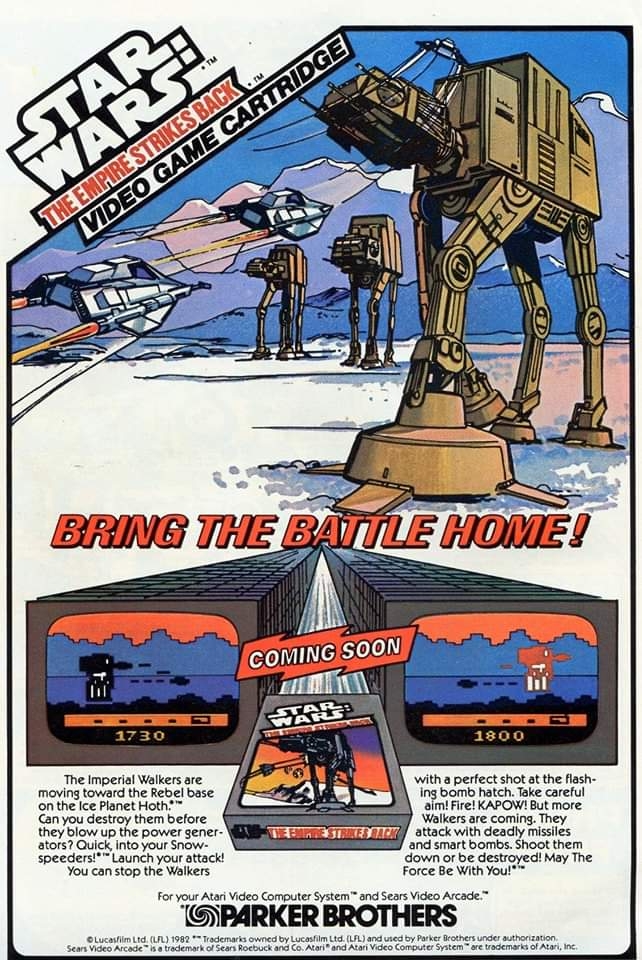
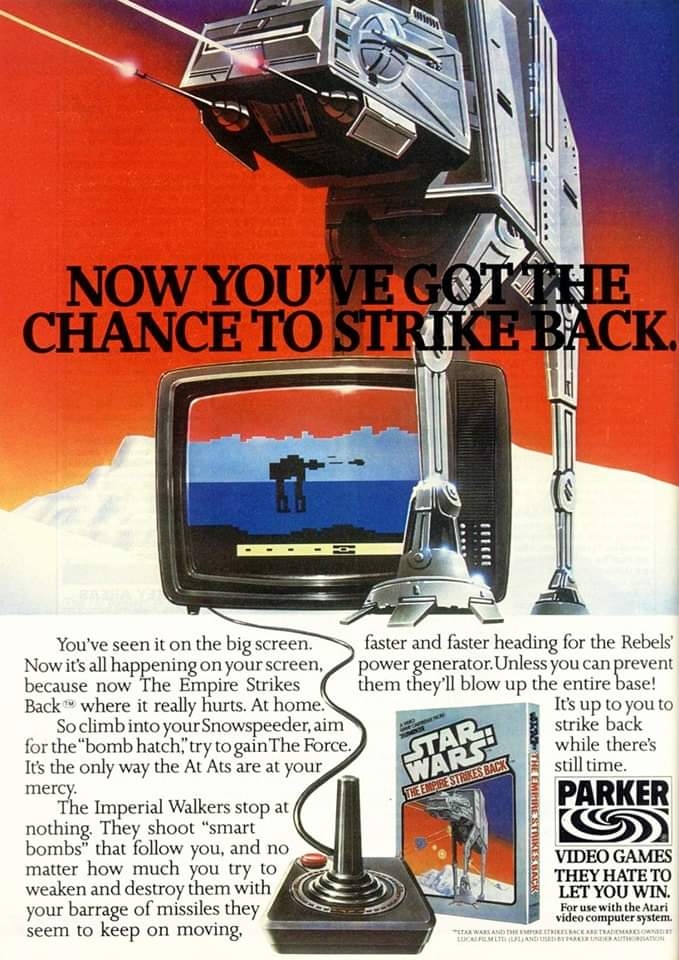
1. Star Wars: The Empire Strikes Back Atari print ads

I could not forget the first time I saw this print ad while reading a comic book.
This ad showed the Atari 2600 controller.

Even during its early years under George Lucas, the Star Wars entertainment franchise made its way into video games due to its massive popularity and Parker Brothers really made moves to cash in. This resulted in the Atari 2600 video game adaptation (1982) of The Empire Strikes Back which focused mainly on the memorable Hoth battles between Rebel fighters and the Empire’s AT-AT walkers. Parker Brothers came up with two print ads and each had a different visual concept: one had nicely drawn art along with two screenshots shown while the other had painted art of the AT-AT while showing the Atari joystick. These old print ads still look great and exciting.

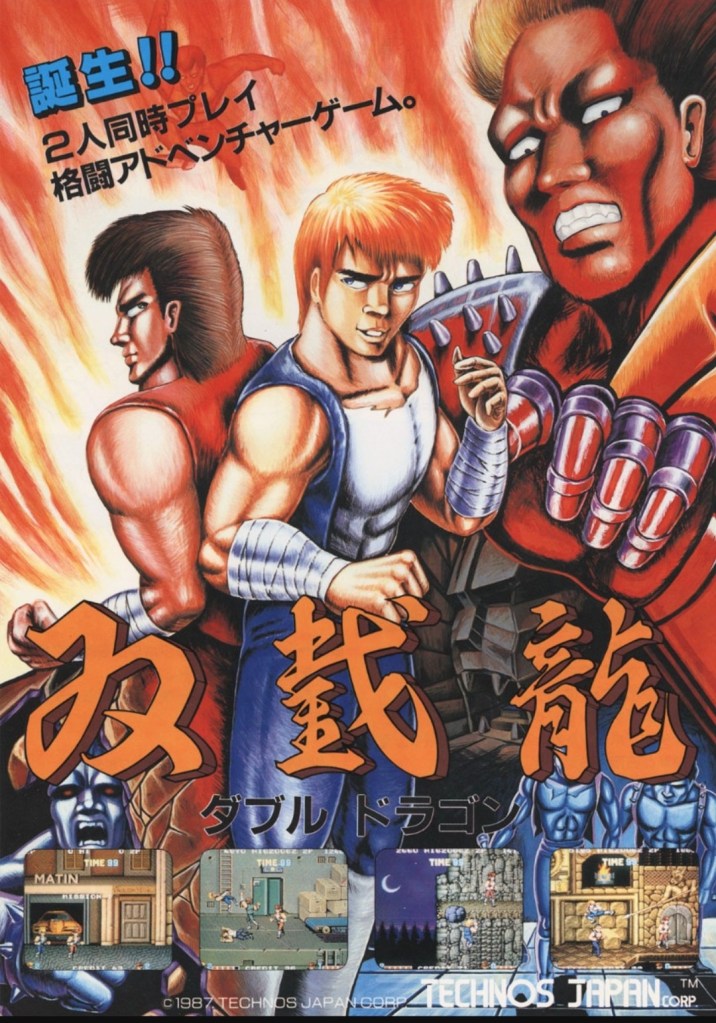
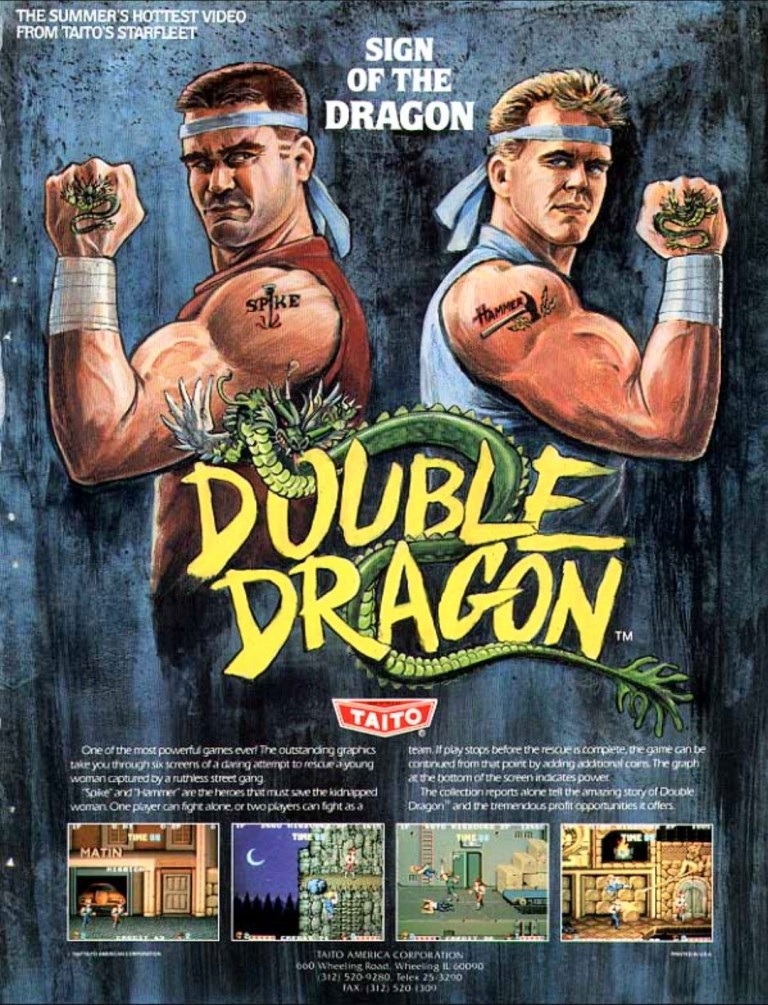
2. Double Dragon Japanese and North American arcade flyers

If you read manga (Japanese comics) in Japan, then the art style of this arcade flyer should look familiar to you.
The character designs seem inspired by 1980s Hollywood action cinema.

Released in 1987, Double Dragon became a huge hit in the arcades of Japan, America and Europe resulting in financial gains for developer Technōs Japan and publisher Taito. What I find intriguing was the fact that the Double Dragon arcade flyers for Japan and North America had drastically different art styles used to promote it. The Japanese flyer had art style that is more common with manga while the North American had artwork that seemed inspired by Hollywood action movies (as well as the rise of martial arts films in America during the 1980s). The American flyer even had the two characters identified as Hammer and Spike and they both looked American. This is a classic example of using different approaches to promote a game in each market.

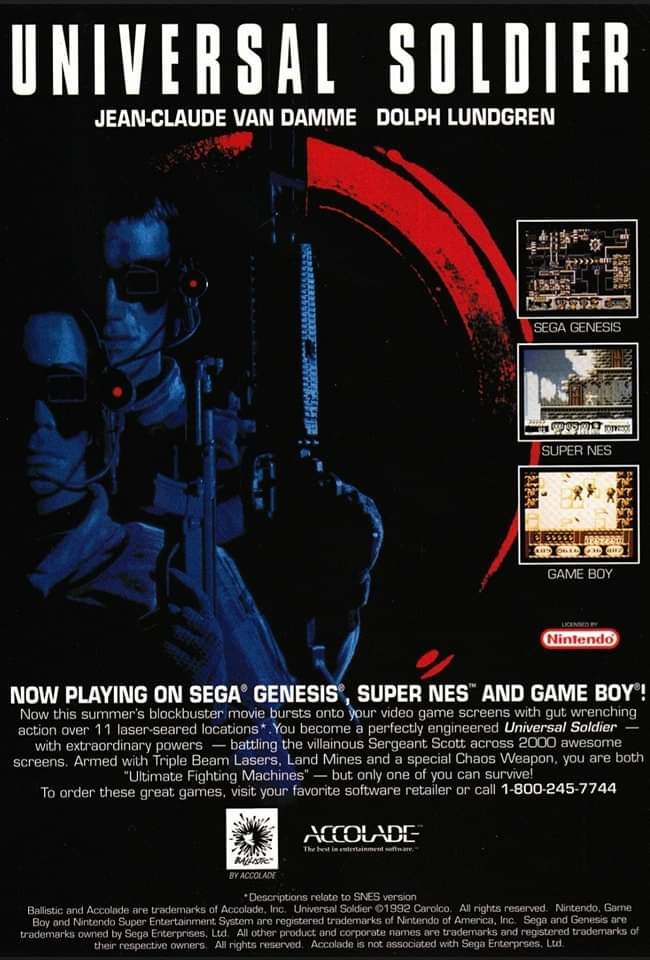
3. Universal Soldier print ad

The people who made this print ad made sure to use the names of the stars to help sell the game.

Even though its worldwide ticket sales did not reach $100 million, the 1992 movie Universal Soldier still caught a lot of attention from moviegoers simply because it had Jean-Claude Van Damme and Dolph Lundgren as the stars. Unsurprisingly, the movie had a video game adaptation and because publisher Accolade wanted to cash-in on the film’s hype, they made some deceptive moves by rebranding one of its games (already development) as a tie-in. Advertised as an official adaptation, Universal Soldier was actually a rushed conversion of Turrican II: The Final Fight. This print ad – which even showed the stars’ names – is a reminder of the deception Accolade pulled off.

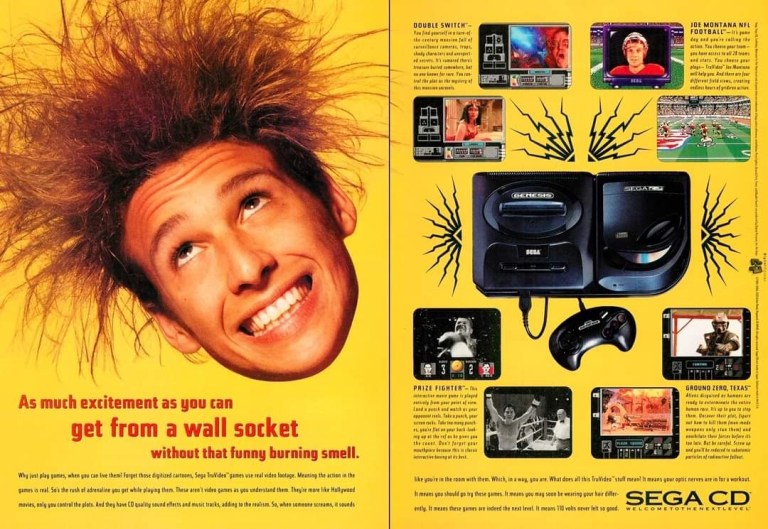
4. Sega CD print ad

Do you find this Sega CD print ad hilarious?

When Sega was making waves with its Sega Genesis (Sega Mega Drive in Japan), the company was quick to react to the growing use of the compact disc (CD) format as a useful storage medium for video games. The Sega CD (Mega CD in Japan) was released as an add-on device to work with the Genesis console and Sega’s American team came up with a series of promotions. This print ad is just one of the promotions and ad makers came up with a “crazed” or “electrified” gamer dominating one page while showing the Genesis, the Sega CD and screenshots of games (running on CD) on the other page. By today’s standards, the Sega CD print ad is funny and catchy to look at.

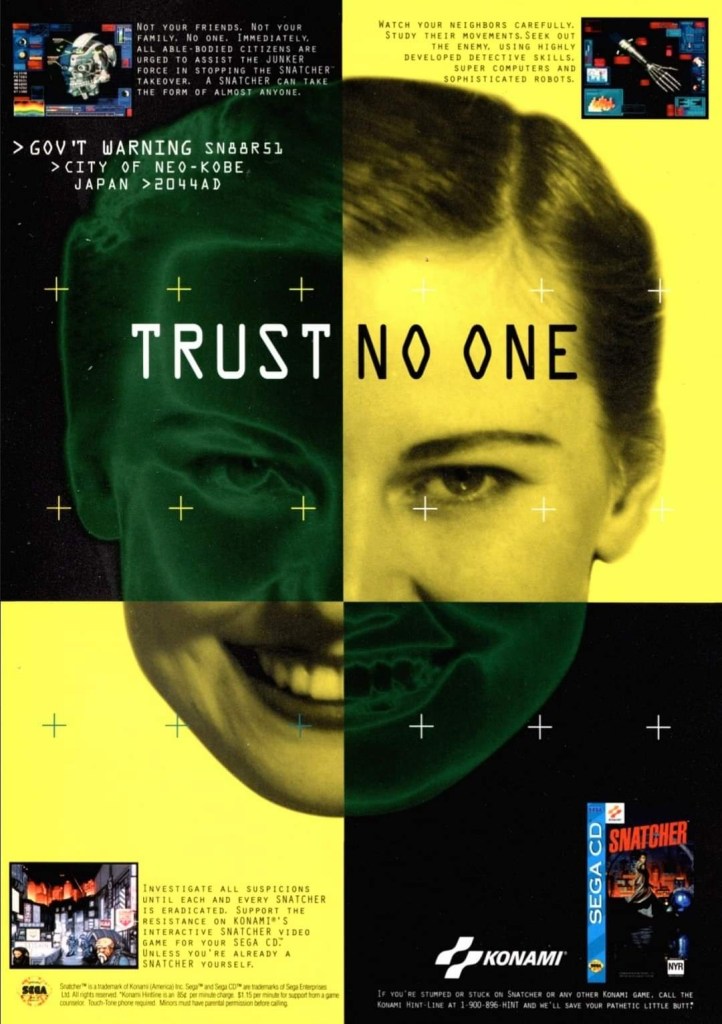
5. Snatcher for Sega CD print ad

I find this Snatch print ad looking odd. The ad makers could have done more to focus on the game itself.

First released in Japan in 1988, Snatcher was a cyberpunk visual adventure game that was one of the early works of the famous Hideo Kojima (Metal Gear series). Due to its design and approach on visuals to tell a story, it was not surprising that a Sega CD version of it got released in 1994. To promote the game to the growing number of North American Sega CD gamers at the time, Konami came up with this rather unusual print ad showing the face of a smiling lady dominating the space leaving little room to show the screenshots and the game’s cover. The visual concept is engaging but it takes effort to notice it was promoting the Sega CD version of the video game. This old ad would have worked better had the ad makers increased the sizes of the screenshots and the game cover.

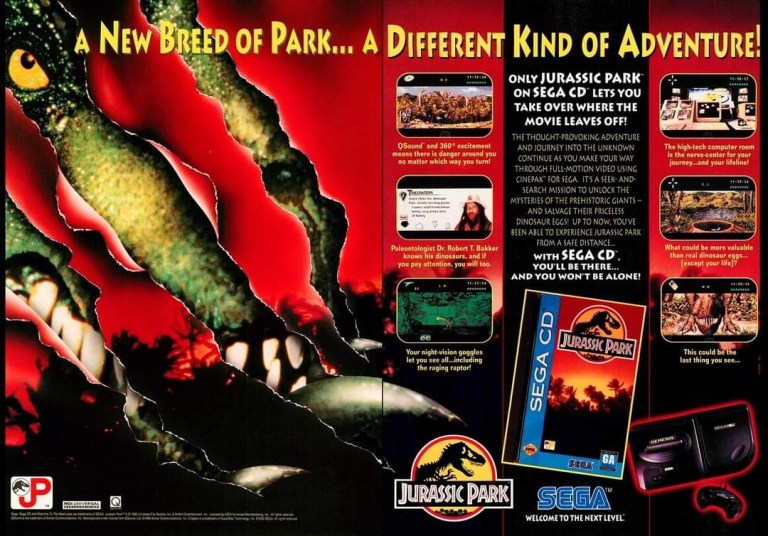
6. Jurassic Park for Sega CD print ad

Does the T. Rex look scary to you?

As part of its drive to add more games to the Sega CD add-on and help it sell more units, Sega acquired the Jurassic Park license and went on to produce an adaptation utilizing the technological features of the Sega CD. To aggressively promote the game, Sega came up with this print ad that had a Tyrannosaurs Rex (looking through spaces) on one page and then several screenshots plus text descriptions on the other. For a click-and-point Jurassic Park game, this ad was really exciting and intriguing to look at.  

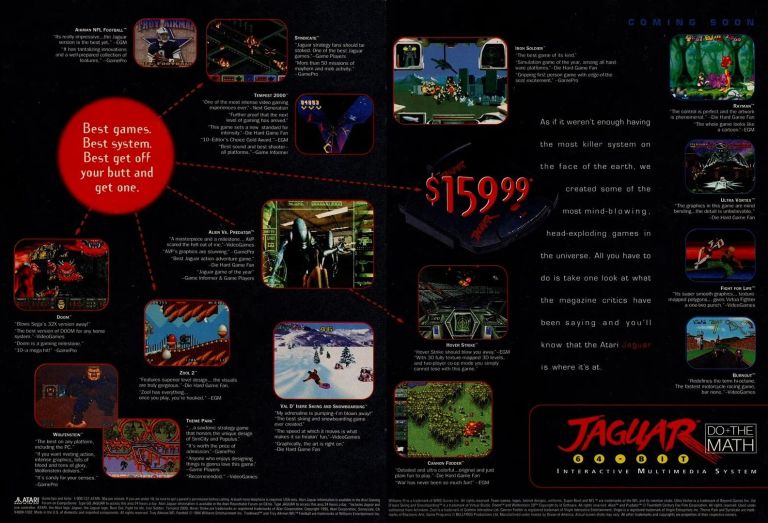
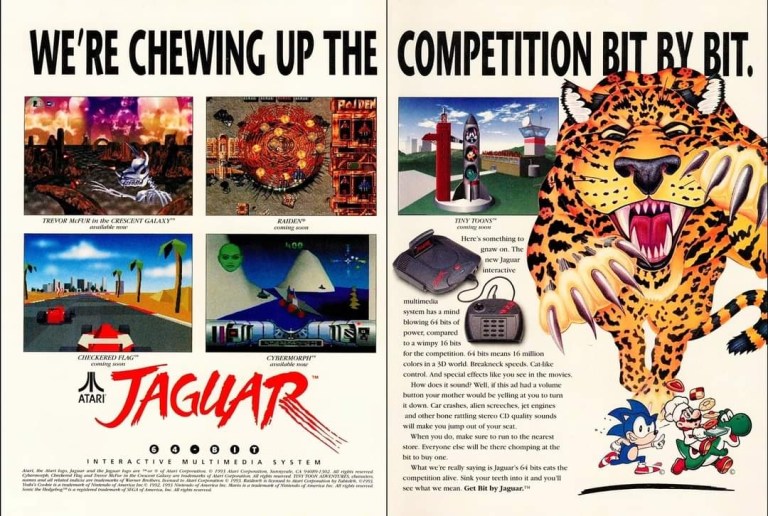
7. Atari Jaguar print ad

This was indeed an eye-catching ad.

In the early 1990s, Atari made an aggressive move to compete in the arena of video game consoles which they used to dominate from the late 1970s until 1983. This time around, they came up with the Jaguar console which had some pretty advanced technologies for the time. As part of their North American marketing campaign, Atari unleashed an ad showing game screenshots on the first page and huge artwork of a jaguar coming after Sonic, Mario and Yoshi (mascots of Sega and Nintendo respectively) symbolizing that the Atari Jaguar had more power and better technology than the Genesis and the Super Nintendo Entertainment System (SNS). While it was engaging to look at early on, this print ad is now an embarrassment as the Jaguar console failed terribly. Lastly, the marketing of the Jaguar as a 64-bit machine was never real.

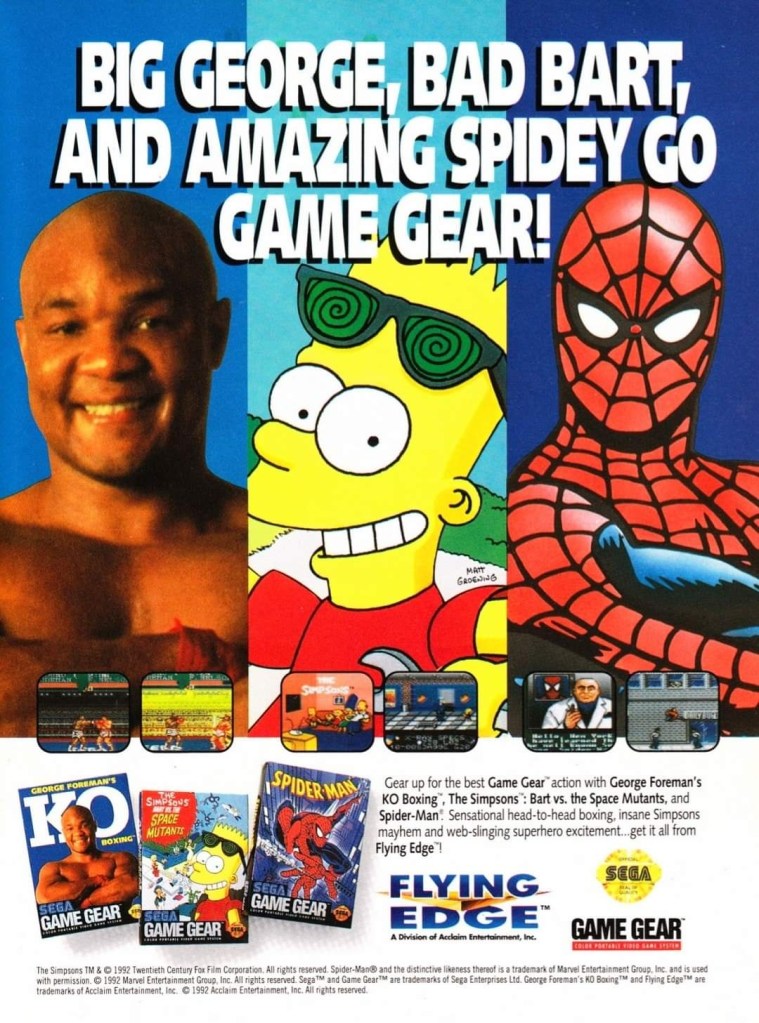
8. George Foreman, The Simpsons and Spider-Man Game Gear print ad

This ad appeared in a lot of comic books in the 1990s.

In the early 1990s, Sega released the Game Gear handheld gaming device which instantly placed them in competition with Nintendo’s Game Boy. Through its Flying Edge label, Acclaim Entertainment promoted George Foreman’s KO Boxing, The Simpsons: Bart vs. the Space Mutants, and Spider-Man for the Game Gear hoping to sell well. This 3-game print ad highlighted the popular figures who had a lot of space for attracting attention. The ad maker managed to insert two screenshots per game, the game covers and a text description to inform consumers what they were being offered. A good ad to look at.   

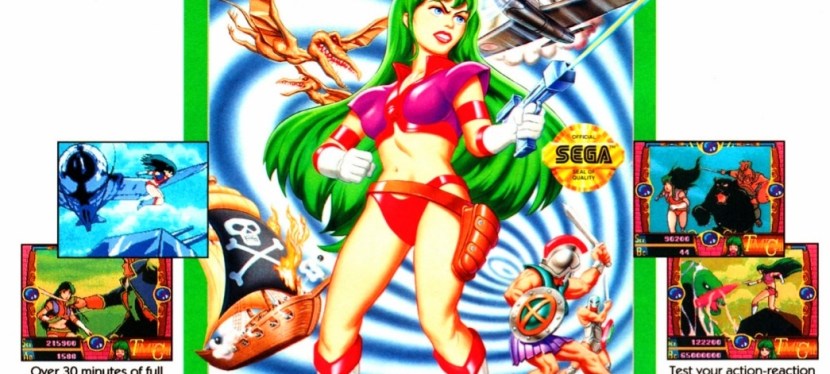
9. Time Gal for Sega CD print ad

The presentation here looks nice but Time Gal herself looked like she was drawn by a different artist.

Originally released in the arcades in Japan in 1985, Time Gal made its way to the Sega CD add-on in the early 1990s. It was a highly unusual video game as it was an interactive movie (with lots of anime footage) made with the use of Laserdisc technology for its arcade version. It played lots of anime scenes and players must choose the on-screen options to execute the character’s next action in order to progress. For the Sega CD version for North America, this print was made to capture the attention of consumers using the protagonist’s sex appeal on the cover art with four screenshots placed on the sides to show what to expect. I noticed that Time Gal on the cover art looked different from how she appeared in the anime sequences. At least the ad makers tried hard to sell the game.

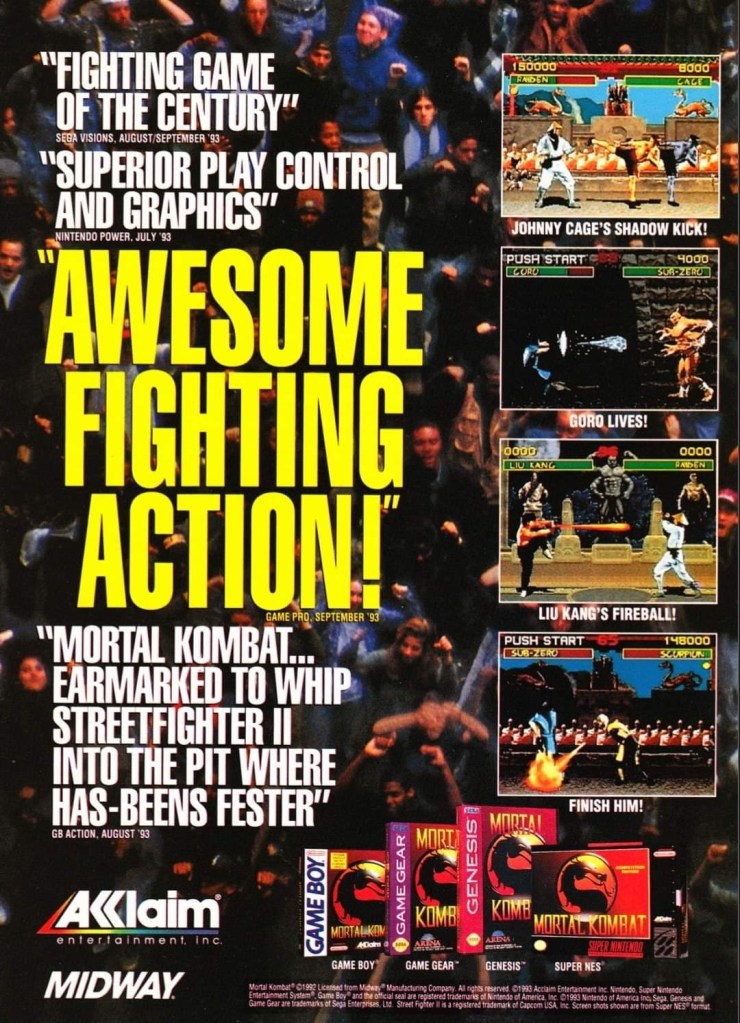
10. Mortal Kombat print ad

Still an effective ad to promote a blockbuster game and make people informed it was coming to multiple platforms.

Considering how successful it was in the arcades, the 1993 release of Mortal Kombat for game consoles and handhelds was unsurprisingly highly anticipated and publisher acclaim came up with this single-page ad. The presentation involved the use of a photographic background of many spectators (to emphasize excitement and popularity), media quotes and screenshots to effectively promote the game.

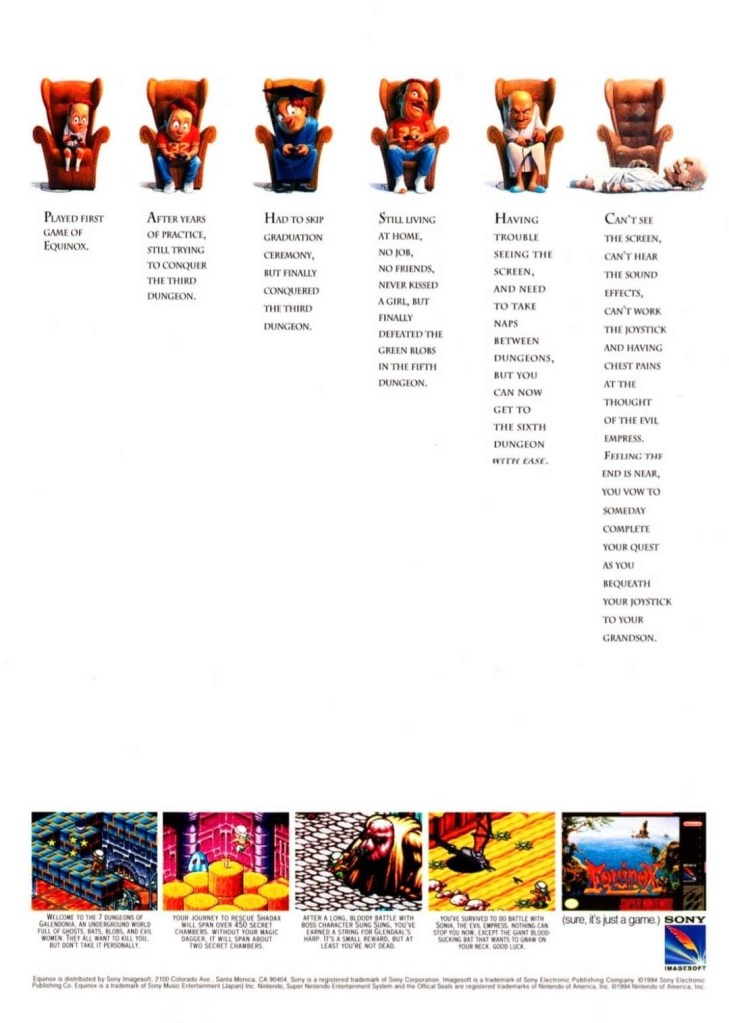
11. Equinox print ad

Take a close look. Tell me if you find it funny.

I never played Equinox but I heard the loud buzz about its design as a 3D isometric game that had elements of exploration, platform play and puzzle solving. The people responsible for this print ad emphasized the concept that the game is so addicting to play, players will still play it as they get older. This ad has a subtle yet effective approach with humor.

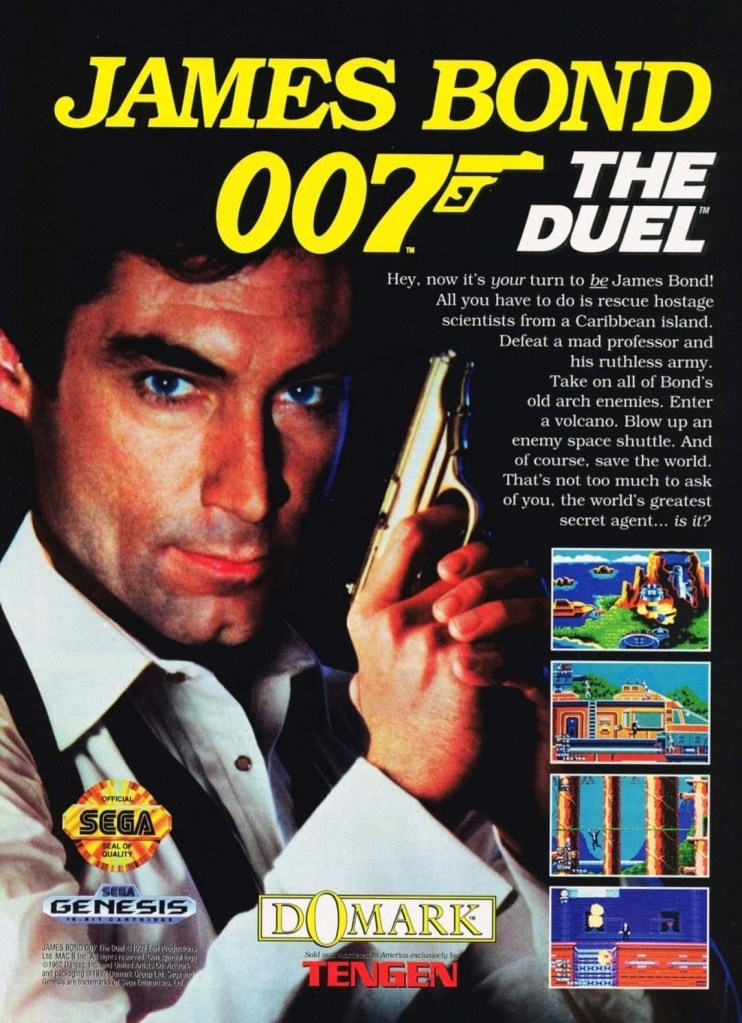
12. James Bond 007: The Duel print ad

Timothy Dalton’s image as James Bond was sourced from Licence to Kill for this game’s ad.

Here is another decades-old James Bond video game print ad I found. Released a few years after Licence to Kill, James Bond 007: The Duel was notable not for its gameplay nor game design but for the fact that it used the image of Timothy Dalton as 007 for its print ad and the opening scenes in the game itself. Dalton’s Bond image here was never new nor originally taken for the game as it came directly from Licence to Kill’s publicity library. Each time I saw this ad, I was only reminded of the 1989 movie which I still enjoy watching.

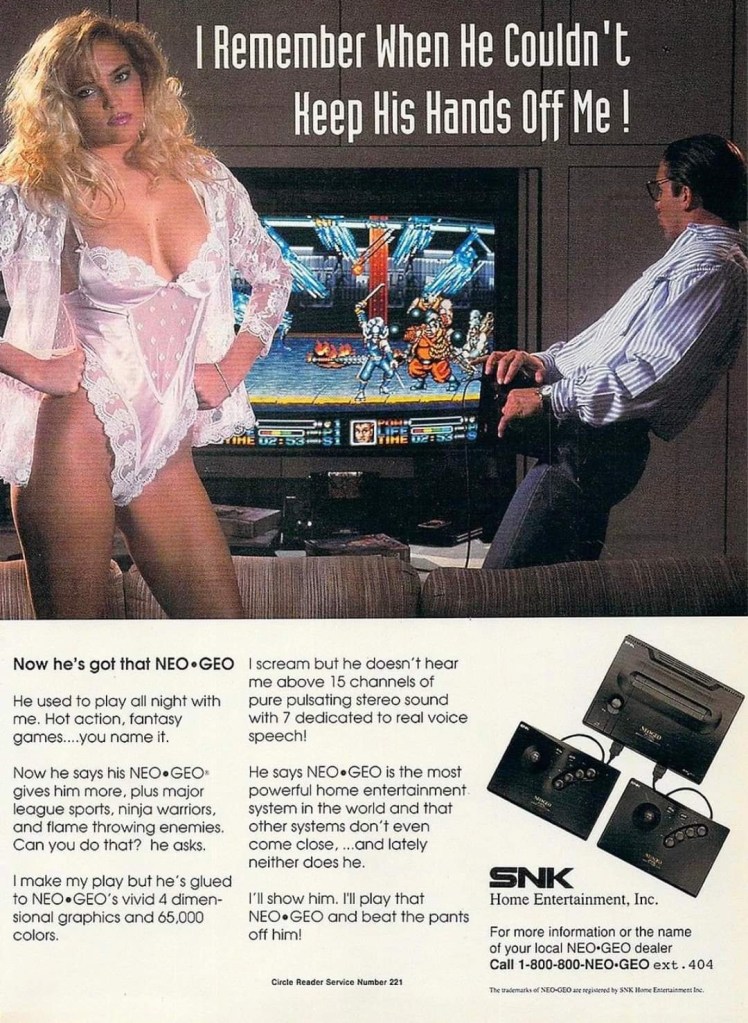
13. Neo Geo AES console print ad

Do you find this ad both sexy and funny?

Decades ago, SNK made a huge splash in the arcades with lots of really fun games released with their Neo Geo (stylized as NEO GEO) hardware. In 1990, they released the cartridge-based Neo Geo AES console in Japan and America and it carried the same technology as the arcade hardware. To promote the console in North America (note: the Neo Geo console and its games were very expensive), SNK came up with this catchy and funny print ad showing a sexy woman feeling annoyed that her man spends more time with Neo Geo gaming than with her. This was a clever way of emphasizing the arcade-perfect experience in the comfort of home, and it was funny to look at.

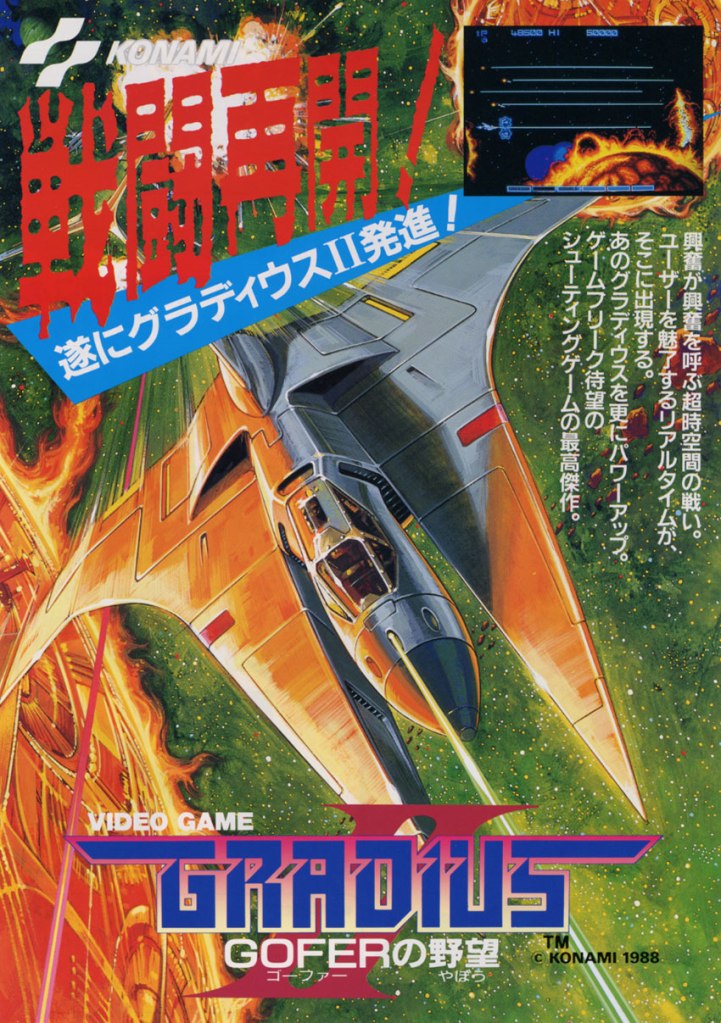
14. Gradius II Japanese arcade flyer

Great looking painted art was used for this 1988 arcade game.

Since the original Gradius was a big hit in arcades in Japan in 1985, it was not surprising that Konami released Gradius II three years later. With regards to the use of painted art, the artist showed the game’s spaceship in a dominating position emphasizing high-speed travel and excitement. The image, which also looks more colorful, is a complete reversal of the painted art used in the flyer of the previous which showed the rear of the spaceship as it moves towards a larger spaceship (the opposition). This arcade flyer art still looks great as it has a timeless charm.

+++++

Thank you for reading. If you find this article engaging, please click the like button below, share this article to others and also please consider making a donation to support my publishing. If you are looking for a copywriter to create content for your special project or business, check out my services and my portfolio. Feel free to contact me with a private message. Also please feel free to visit my Facebook page Author Carlo Carrasco and follow me on Twitter at  @HavenorFantasy as well as on Tumblr at https://carlocarrasco.tumblr.com/ and on Instagram at https://www.instagram.com/authorcarlocarrasco


Retro Gaming Ads Blast – Part 12

Welcome back readers, fellow geeks and electronic gaming fans!

In this edition of the Retro Gaming Ads Blast (RGAB) series, we will take a look at another batch of retro gaming print ads from the 1980s and 1990s. In addition, there will be a few flyers of arcade games.

For the newcomers reading this, Retro Gaming Ads Blast (RGAB) looks back at the many print ads of games (console, arcade, computer and handheld) that were published in comic books, magazines, flyers and newspapers long before smartphones, social media, the worldwide web and streaming became popular. To put things in perspective, people back in the 1980s and 1990s were more trusting of print media for information and images about electronic games and related products.

With those details laid down, here is the newest batch of retro gaming print ads for you to see and enjoy…

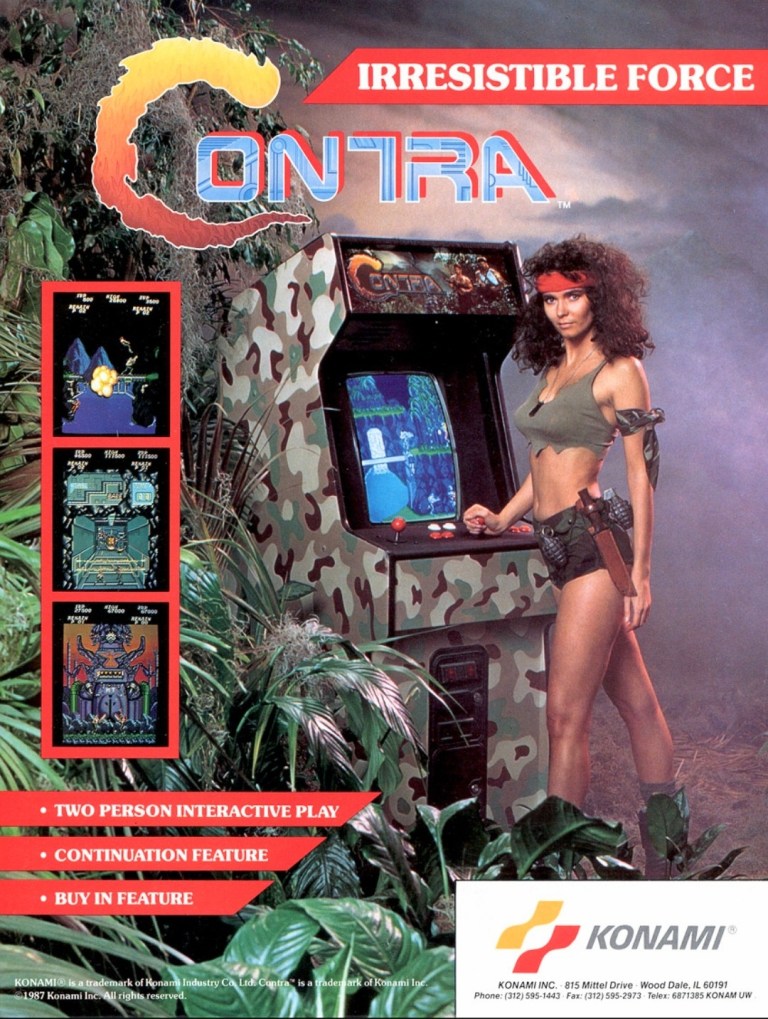
1. Contra arcade flyer

A clever visual concept by Konami towards gamers and arcade operators.
Details on the other side of the flyer.

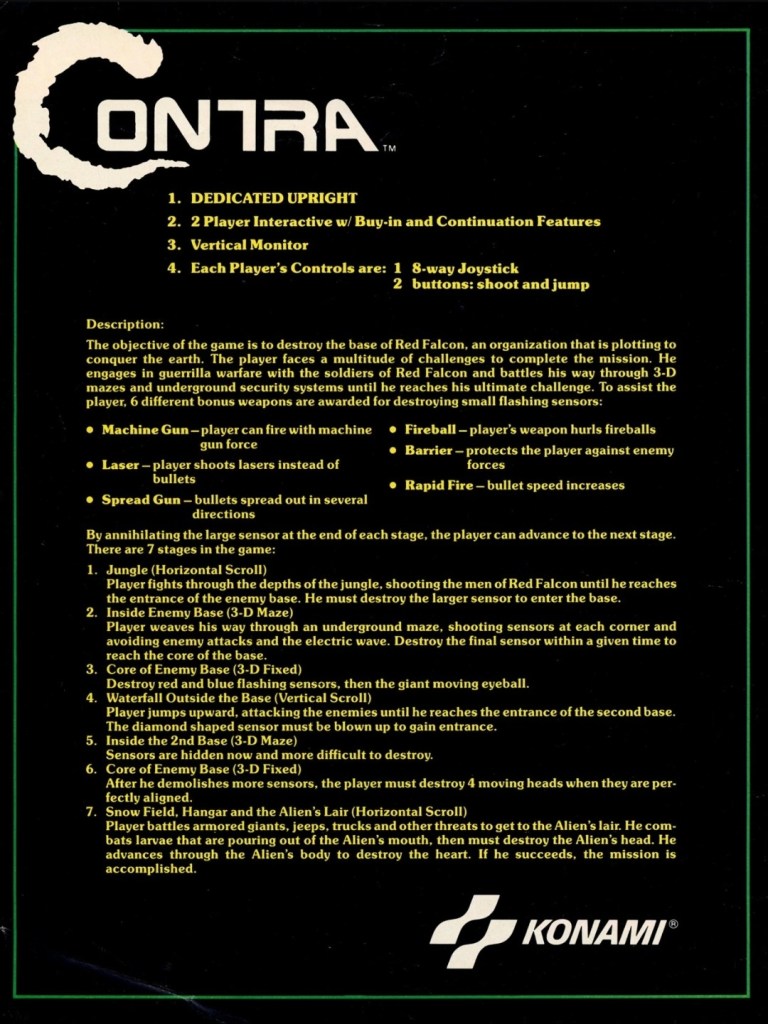
Before it established itself as a popular gaming franchise with console gamers, Contra truly started in the arcades in 1987. First released in Japan on February 1987, Konami went on to release the game in arcades in the United States a month later and the flyer you see here was the Americanized promotion they came up with. Instead of hiring male actors or models to play soldiers, they hired a slim lady to appear with a female Rambo look standing in front of a Contra arcade machine. On the other side of the flyer are details that players and arcade operators can learn from. By today’s standards, this arcade flyer of Contra is still eye-catching and even amusing to look at.

2. College Football’s National Championship print ad

This ad has a strong visual appeal to gamers who like football.

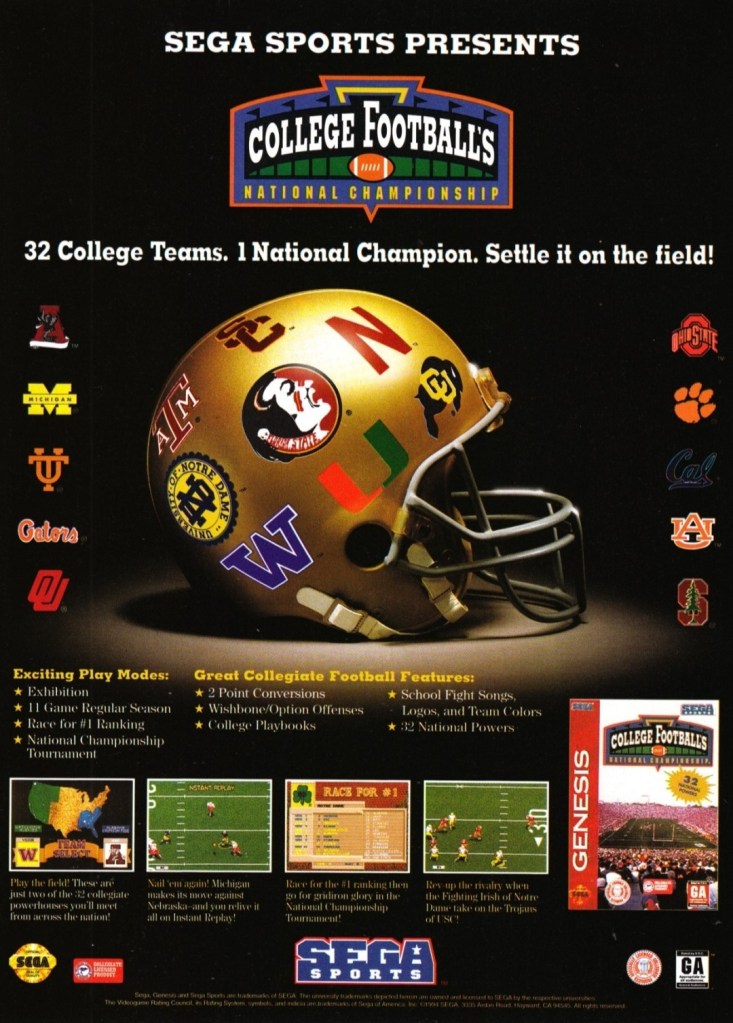
This is another one of those video game ads I saw while reading comic books in the 1990s. College Football’s National Championship was a Sega Genesis-exclusive American football video game published by Sega (with the Sega Sports brand) to capitalize on gamers who want college football to play with at home. This print ad has a nice visual presentation of the college teams’ logos, screenshots and details of what gamers could expect when they buy and play the game. College Football’s National Championship received mostly positive reviews and it must have sold well because Sega went on to release a sequel to this game.

3. Robotron X print ad

This Robotron game was made at a time when 3D polygons became common for making video games.

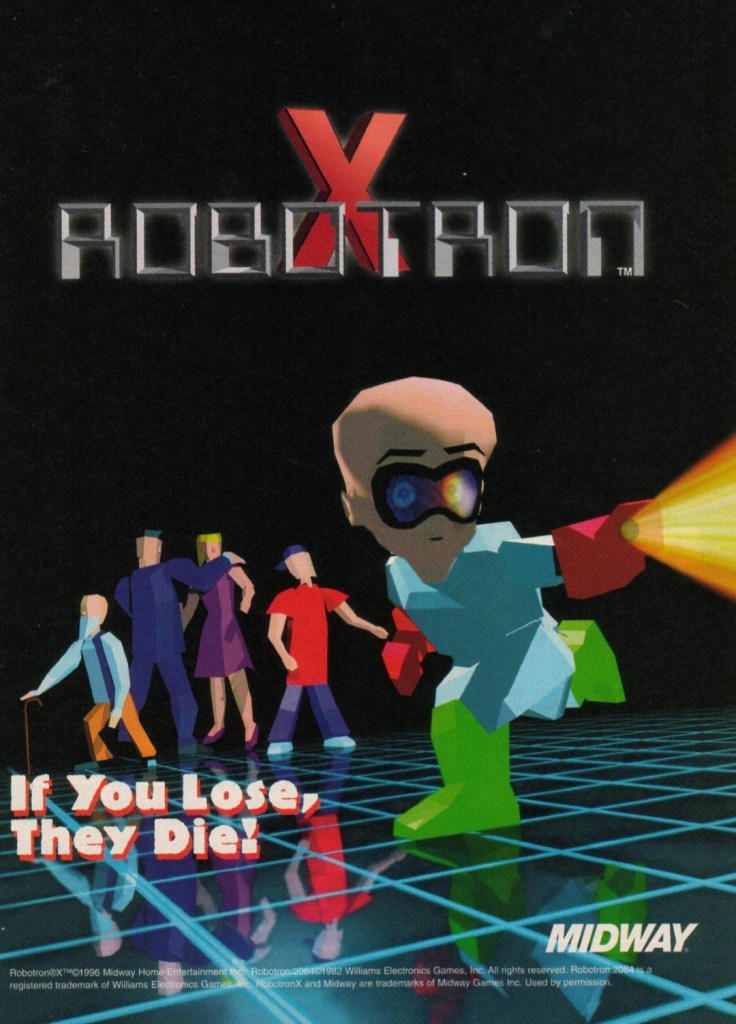
Having played the classic game Robotron: 2084 on PC back in the 1980s, I was very surprised to see this print ad in 1996 promoting a brand new Robotron game for PlayStation as well as Windows PC. For the newcomers reading this, Robotron: 2084 was a classic which heavily influenced game designers who went on make other fan-favorite games like Smash TV and Llamatron. What makes Robotron X notable apart from being an official follow-up to the classic game was the fact that it was made at a time when game developers did their stuff to modernize gaming with 3D polygons for visuals while trying to come up with gameplay inspired by the classics. While Robotron X did not make a major impact on gaming, the classic Robotron: 2084 went on to be released in several multi-platform compilations such as Williams Arcade’s Greatest Hits, Midway’s Greatest Arcade Hits, and Midway Arcade Treasures.

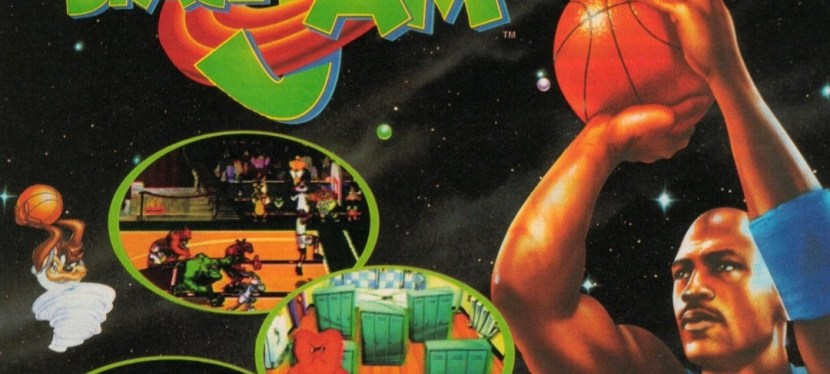
4. Space Jam game print ad

If you saw the movie in 1996, were you able to play this video game adaptation?

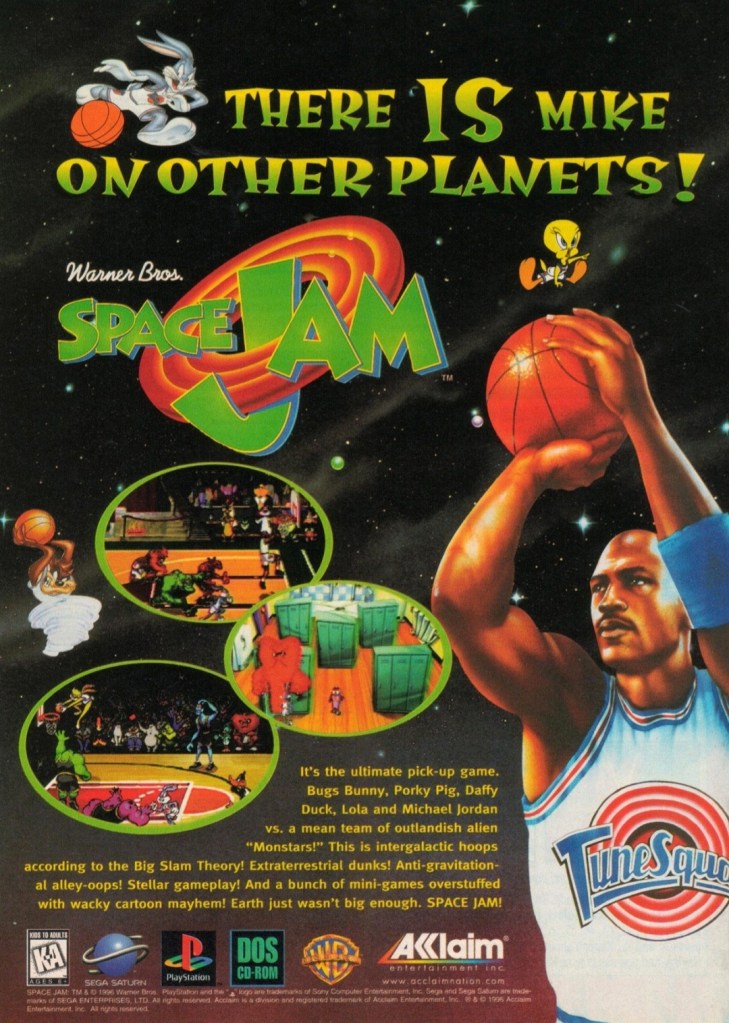
What makes 1996 a memorable year for basketball fans was the Michael Jordan’s return to prominence (having previously retired for less than two years before returning to the NBA in 1995) and leading a very powerful Chicago Bulls team to what was their 4th NBA championship title. In that same year, Jordan starred in the live-action/animated movie Space Jam which grossed an impressive $250 million worldwide. On the same month the movie came out, the Space Jam video game adaptation was also released on PlayStation and Sega Saturn. This print ad was part of the multimedia hype of the movie and the game itself had a very similar design and visuals concept with NBA Jam but ultimately it failed to become a hit with critics and gamers. Not even the combined visual might of Jordan and Warner Bros. characters could achieve success.  

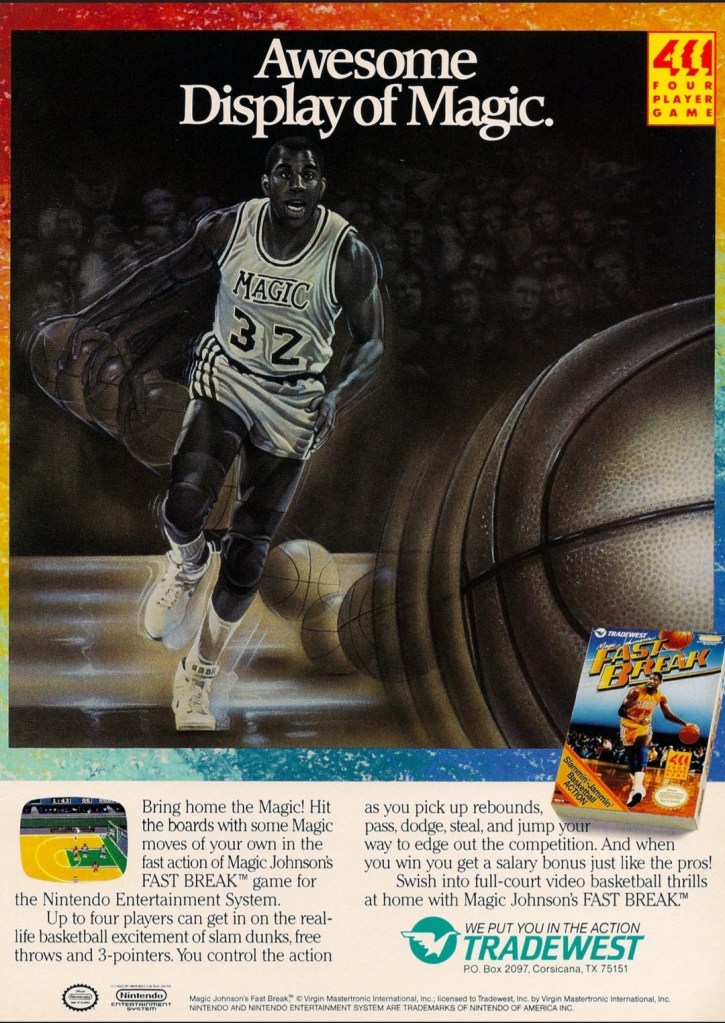
5. Magic Johnson’s Fast Break print ad

Still on basketball video gaming, the side-scrolling Magic Johnson’s Fast Break game was released on the Nintendo Entertainment System (NES) for console gamers to enjoy. Unsurprisingly, this ad had nice black-and-white art work of Magic Johnson as the dominant figure while leaving little space left to show the game box and only one screenshot. The real meat of this print ad are the details laid down in text description.

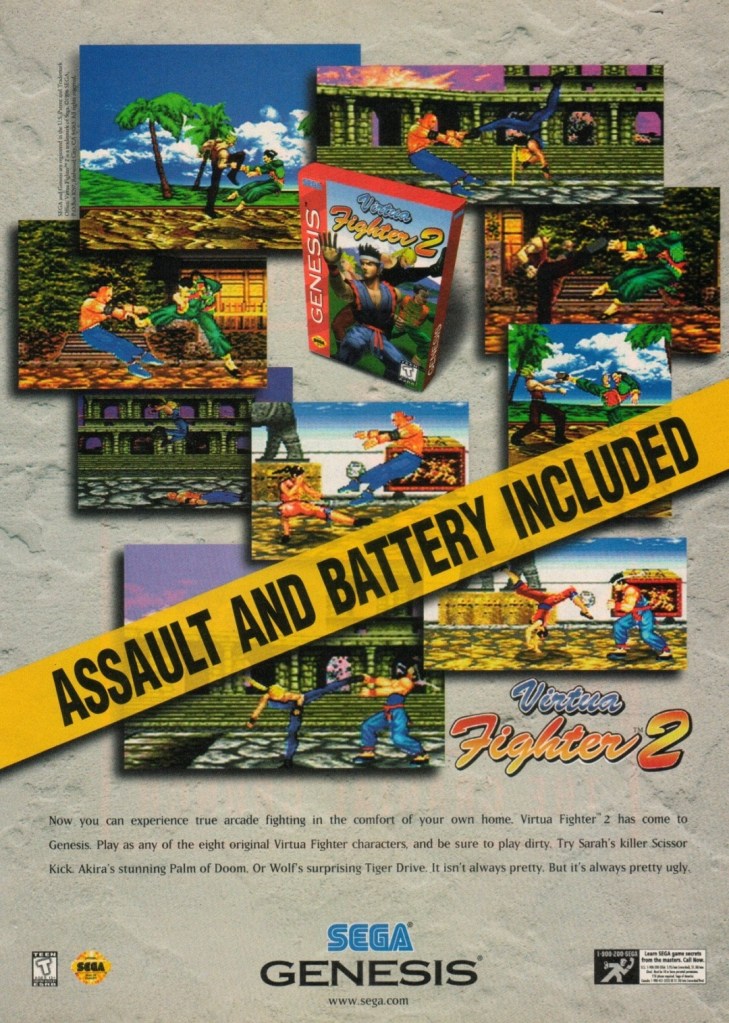
6. Virtua Fighter 2 for Sega Genesis print ad

Clearly a late effort by Sega to sell something to its many Genesis owners/fans in America at a time when PlayStation and Nintendo 64 started dominating 5th console generation sales.

In the history of arcade gaming and fighting games, Virtua Fighter 2 was a worthy follow-up to its groundbreaking predecessor. VF2 also made its way on the Sega Saturn which essentially maintained the great gameplay and 60 frames-per-second animation even though the 3D polygonal graphics were noticeably lower in quality compared to its arcade version. With VF2 in the arcades and on Saturn selling well, I was surprised to see this print ad of Sega releasing a totally different version of the game on the aging Sega Genesis console. Virtua Fighter 2 on Genesis had 2D graphics, sprites for the characters and a side-scrolling visual design. In fairness, the game developers exerted effort to recapture some of the gameplay elements within the Genesis limitations and 2D graphics. This print ad is a reminder of Sega’s American division selling a product to the remaining active Genesis owners.

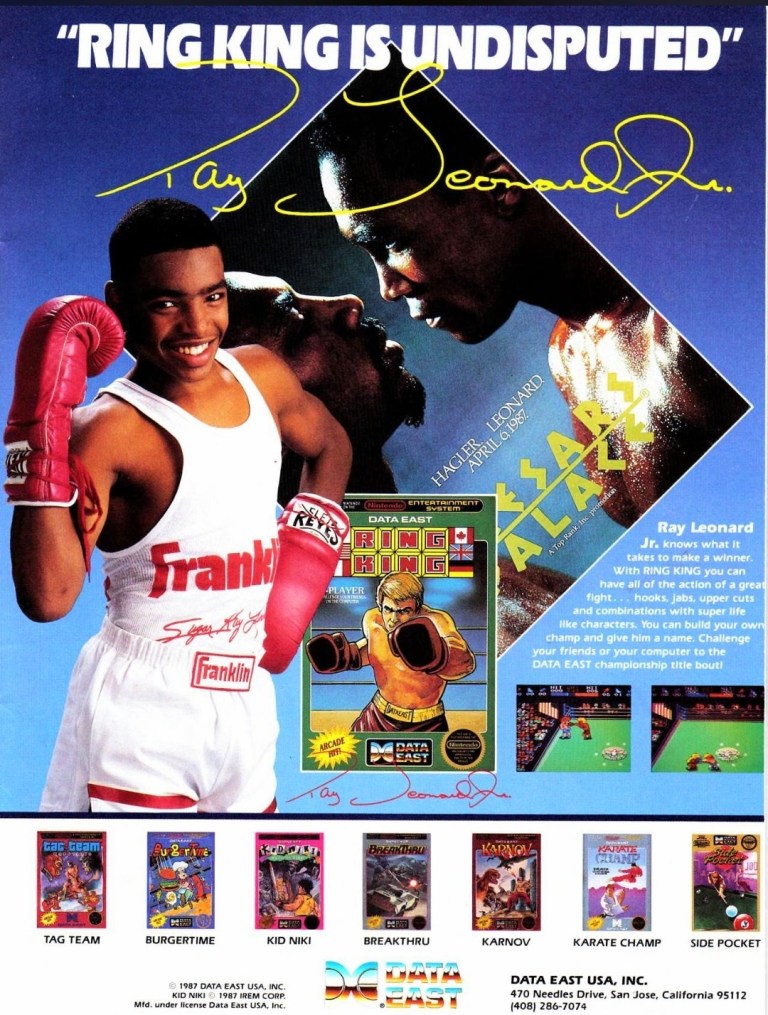
7. Ring King print ad

Ring King itself clearly lacked promotional space in this ad.

In 1987, Data East released their arcade hit game Ring King on the Nintendo Entertainment System (NES) and prepared this print ad involving Ray Leonard, Jr. (on the foreground in boxing gear) and conveniently with the famous Sugar Ray Leonard and Thomas Hearns (with the promo of their first fight together in the background). Also conveniently, the company inserted their other games on the lowest part of the ad. Ultimately, the presence of Ring King itself was minimized only showing the game cover and two screenshots. This is clearly an eye-catching ad but there was not enough emphasis on the game itself.

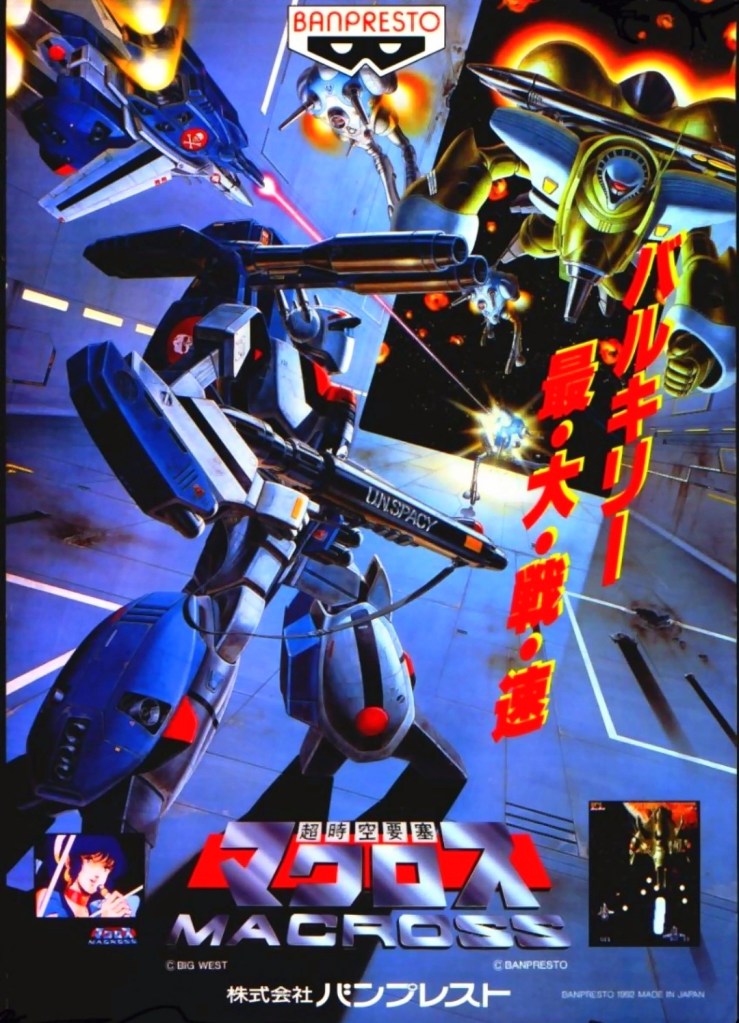
8. Super Spacefortress Macross arcade flyer

The arcade flyer released only in Japan.

Have you ever seen the classic anime movie Macross: Do You Remember Love? I really love watching that movie and I played and finished the video game adaptation on PlayStation in 1999. What I never got to play was the arcade game adaptation of it which was released by Banpresto in Japan in 1992. This flyer promoting the game has a strong visual presentation thanks to the artwork made for it. Only one screenshot was shown as well as a clip from 1984 the animated movie (note: the arcade game itself has some images directly from the film plus some newly created ones added) but this ad still had what it takes to capture the attention of the many Macross fans in Japan. This arcade game was eventually released with an English translation in America and Australia.   

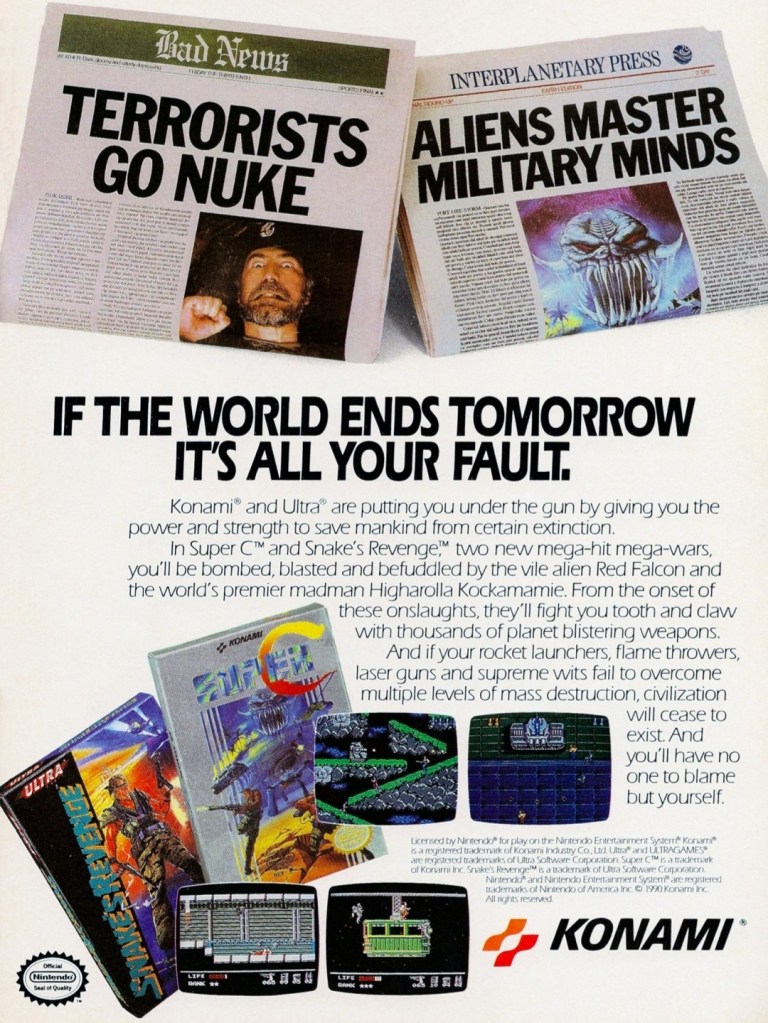
9. 2-in-1 print ad featuring Super C and Snake’s Revenge

A memorable and intriguing print ad from Konami promoting sequels.

This is one of the ads that Konami came up with to promote at least two games using a single-page ad format. I saw this ad in many comic books I read decades ago and its visual concept always caught my attention especially since I played the console game Contra a lot. At the high end of the ad were two fictional newspaper headlines highlighting the respective conflicts of Snake’s Revenge (with a nuclear danger concept) and Super C (with emphasis on alien invaders). These two games were sequels to the classics Metal Gear and Contra, and Konami clearly knew how to take advantage of the older games’ success and do their best to sell the sequels to gamers who love action-packed gaming as well as fantasized armed conflicts. Like the 2-in-1 ad showcasing Contra and Jackal, this was Konami’s aggressive move to sell war-inspired games to the NES userbase which was mostly composed of children and teenagers.

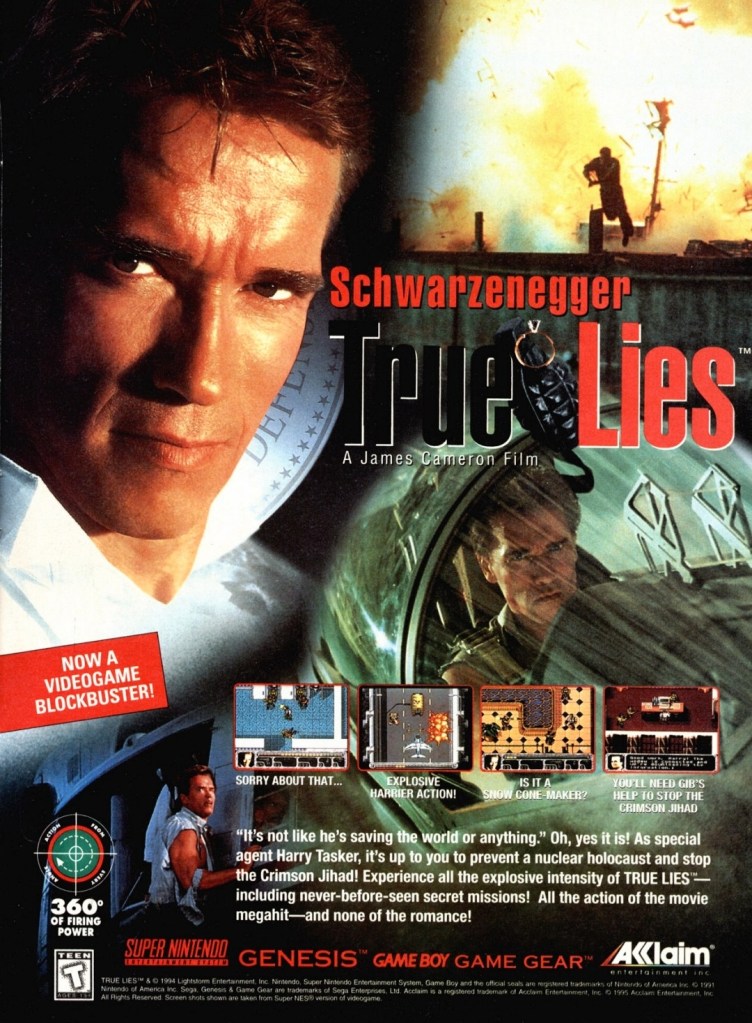
10. True Lies game print ad

There is nothing like taking advantage of the imagery of a Hollywood superstar to promote a video game based on the related movie.

Here is a video game ad I saw in many comic books I read in 1994-1995. True Lies (starring Arnold Schwarzenegger) was one of the big summer season movie hits of 1994 and the video game was part of the business tie-ins with the film. The people who made this print ad made the smart moves of showing not just one but three images of Schwarzenegger to promote the game while leaving some space to show what the game looked like. The True Lies game even had stills from the movie to emphasize the flow of the plot.

+++++

Thank you for reading. If you find this article engaging, please click the like button below, share this article to others and also please consider making a donation to support my publishing. If you are looking for a copywriter to create content for your special project or business, check out my services and my portfolio. Feel free to contact me with a private message. Also please feel free to visit my Facebook page Author Carlo Carrasco and follow me on Twitter at  @HavenorFantasy as well as on Tumblr at https://carlocarrasco.tumblr.com/ and on Instagram at https://www.instagram.com/authorcarlocarrasco
Commandos: Origins announced for Xbox consoles, Windows PC and Game Pass

Welcome back Xbox fans, geeks and gamers! During the recent IGN x ID@Xbox Digital Showcase, several new games were shown and the one that stood out the most for me was Commandos: Origins which will be released on Xbox Series X, Xbox Series S, Xbox One, Windows PC and Game Pass sometime in the near future.

To get yourselves oriented, watch this teaser trailer of Commandos: Origins.

While no firm release date has been announced, there are lots of details about the real-time tactical stealth game developed by Claymore Game Studios under publisher Kalpyso Media. To put things in perspective, posted below is an excerpt from the official game details sourced from the Xbox online store page. Some parts in boldface…

A huge and detailed environment that players will have to infiltrate and beat the bad guys.
An explosive sequence with a tank.

Having seen the trailer of Commandos: Origins, I had these XCOM vibes. Then the game showed that action sequences can be executed with a good amount of detail supposedly to ensure satisfaction for players who love strategy backed with militaristic stuff. While the game design emphasizes 3D space, turn-based gameplay and strategy, Commandos: Origins still managed to remind me of past military games such as Operation Wolf, Cabal, Rush’n Attack and original Metal Gear.

Watch out for the release of Commandos: Origins on Xbox Series X, Xbox Series S, Xbox One, Windows PC and Game Pass in the near future. For more information, click https://www.xbox.com/en-US/games/store/commandos-origins/9nnrcr6mbndr

+++++

Thank you for reading. If you find this article engaging, please click the like button below, share this article to others and also please consider making a donation to support my publishing. If you are looking for a copywriter to create content for your special project or business, check out my services and my portfolio. Feel free to contact me with a private message. Also please feel free to visit my Facebook page Author Carlo Carrasco and follow me on Twitter at  @HavenorFantasy as well as on Tumblr at https://carlocarrasco.tumblr.com/ and on Instagram athttps://www.instagram.com/authorcarlocarrasco

Retro Gaming Ads Blast – Part 6

Welcome back readers, fellow geeks and electronic gaming fans!

In this edition of the Retro Gaming Ads Blast (RGAB) series, we will examine print ads from the 1980s and the 1990s that caught my attention and I will explain why they are worth look back at.

For the newcomers reading this, Retro Gaming Ads Blast (RGAB) looks back at the many print ads of games (console, arcade, computer and handheld) that were published in comic books, magazines, flyers and newspapers long before smartphones, social media, the worldwide web and streaming became popular. To put things in perspective, people back in the 1980s and 1990s were more trusting of print media for information and images about electronic games.

With those details laid down, here is the newest batch of retro gaming print ads for you to see and enjoy…

1. Operation Wolf print ad

Even though there were screenshots from the game, this was still an eye-catching print promoting Operation Wolf for the Nintendo Entertainment System.

Looking back at the history of pop culture, the 1980s saw the surge of Hollywood action movies that emphasized or even glorified militarism. Arnold Schwarzenegger, Sylvester Stallone and Tom Cruise were just a few Hollywood stars who found success playing military figures. It was not surprising that there were game developers in Japan who noticed the Hollywood military trend and were inspired to make games that had similar themes. The Japan-based company Taito developed and released the light gun shooter arcade game Operation Wolf which became a huge commercial success worldwide. Unsurprisingly, versions of Operation Wolf were eventually made for the existing home computers and game consoles of the time.

The above print ad of the Nintendo Entertainment System (NES) version of Operation Wolf only showed the official artwork, descriptive text and noticeably no gameplay screenshots. While the ad made the NES version of the game look exciting to look forward to, the actual game looked and felt nothing like the arcade version as the console’s limitations resulted in really small 2D sprites (which made shooting tough) and the 2D art used were rather ugly to see. I can only speculate that the people at Taito knew their product for the NES had sub-par quality and only hoped for the best trying to fool gamers to buy it.

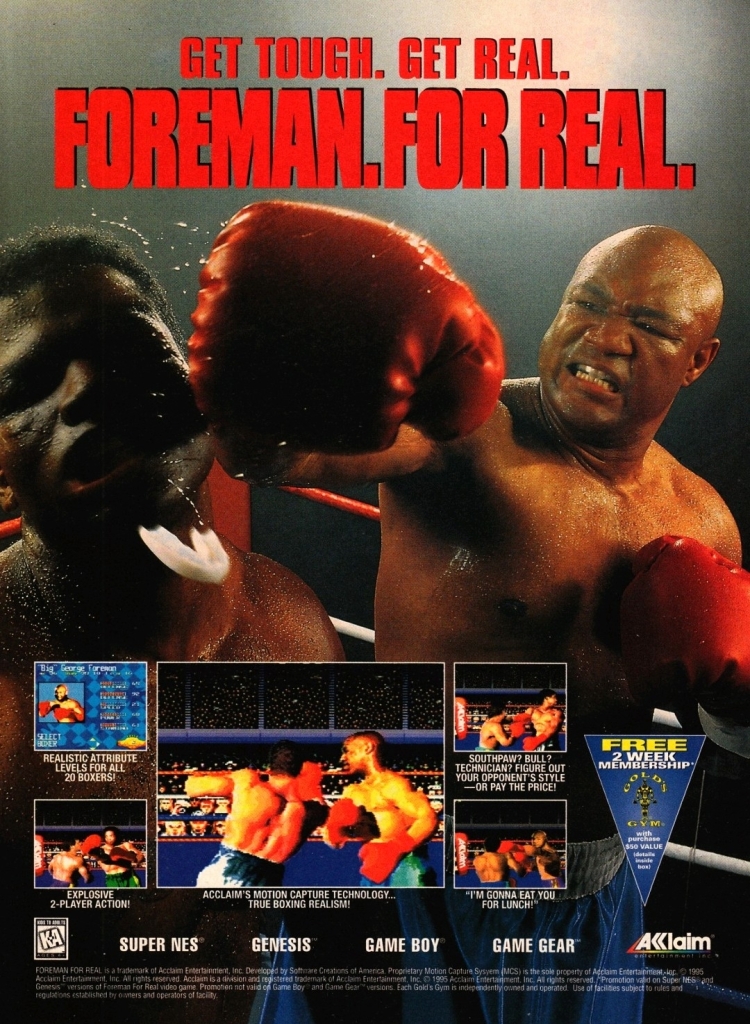
2.  Foreman For Real print ad

Apart from boxing and endorsing grills, are you aware that George Foreman is also a worship leader and preacher of God’s Word?

In late-1994, George Foreman knocked out Michael Moorer to reclaim the heavyweight boxing title and the last time he had it was way back in 1974. For the newcomers reading this, Foreman halted his professional boxing in 1977, established his connection with God, preached His Word, opened a youth center and became a major product endorser. Foreman came back into fighting in 1987 and stunned everyone when he became heavyweight champion seven years later.

That being said, it was no surprise that game publisher Acclaim (which already released a video game with the boxer in 1992) quickly returned to Foreman to get him as the titular endorser in the 1995 video game Foreman For Real which was released on multiple gaming platforms less than a year after his championship victory. Apart from showing Foreman’s dominating image and screenshots from the game, the ad even had a promo of a free 2-week membership with Gold’s Gym. This ad was a lively reminder of the significance of Foreman’s presence in professional sports and it was instantly eye-catching.

3. BurgerTime print ad

Arcade hits like BurgerTime also made it into personal computers.

Previously, I showed an eye-catching print ad of the arcade classic BurgerTime. This time, the BurgerTime print ad shown here focused more on the IBM and Apple computer versions. This print ad had a photograph of an actor playing chef Peter Pepper carrying a huge burger bun running away two eggs and a hotdog, and near them were the respective boxes of BurgerTime for IBM and Apple. This is a sharp change of visual style away from the comic book-style art used in the other BurgerTime print ad. I can only imagine how excited IBM and Apple computer users became after seeing this ad back in the 1980s.

4. Shining Wisdom print ad

Even though this was a very eye-catching ad that appeared in several publications, Shining Wisdom went on to become a forgotten game after receiving mixed reviews from game review writers.

Here is another print ad of Working Designs from the 1990s. Released only on the Sega Saturn in 1996, Shining Wisdom was a fantasy action-adventure game from Japan that publisher Working Designs localized with North Americans in mind. This meant taking lots of creative liberties with the story, name changes, insertions of pop culture jokes and even altered the personalities of the characters. Developed by Sonic Software Planning and Camelot Software Planning, Shining Wisdom started as a project for the 16-bit console Mega Drive (Sega Genesis in America) that was revised for the more powerful Saturn console. While this print ad caught the attention of gamers and readers, Shining Wisdom received mixed reviews from critics upon release. Sadly, not too many gamers talk about this game anymore.

5. Cabal print ad

Military action and shooting strongly emphasized in this print ad for the Nintendo Entertainment System version of the arcade smash Cabal.

Like many games released in the 1980s, Cabal had a strong military theme and allowed players to engage in bouts of shooting playing soldiers who have to fight entire armies of bad guys. This print ad about the Nintendo Entertainment System (NES) version of the game had really nice art dominating the page, the packaging of the game plus three screenshots showing what gamers could expect. This was a very eye-catching print ad that made Cabal look both exciting and enticing.

6. Metal Gear print ad

Wow! So many weapons and pieces of equipment displayed in this Metal Gear (NES version) ad.

Back in the late 1980s, the NES port of Metal Gear had a notable promotion in America thanks to this cleverly designed print ad. When it comes to emphasizing “gear” from the title, the marketing team emphasized the words “Gear up” and literally filled the ad spaces with lots of pieces of equipment that was not only eye-catching but also gave readers the idea that a huge adventure awaits them in Metal Gear. As for the game box on the lower left corner of the print, the cover art highlighting the character Snake was an artistic copy of a still image of actor Michael Biehn as Kyle Reese in The Terminator (1984). This print ad was both entertaining and intriguing to look at.

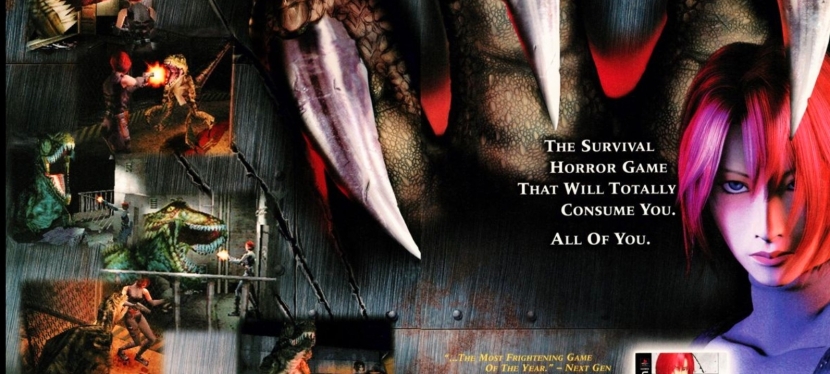
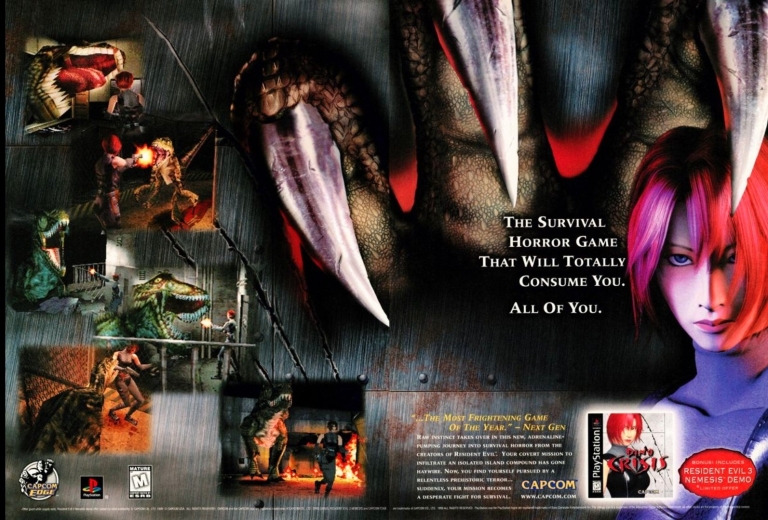
7. Dino Crisis print ad

For many gamers, Dino Crisis was like a combination of Resident Evil and Jurassic Park and this visceral looking print ad really got lots of people interested in the game.

In 1999, Capcom released Dino Crisis for PlayStation in America and the timing was almost perfect as millions of gamers who owned the console enjoyed the releases of Resident Evil and Resident Evil 2 (both games from Capcom) firmly establishing the survival horror genre as a popular one. That being said, a lot of RE fans anticipated the release of Dino Crisis due to the fact that the game shared several elements with Resident Evil games in terms of exploration, survival, control and shooting. Not only that, Resident Evil creator and original game director Shinji Mikami was in charge of the making of Dino Crisis. Mikami pointed to the films The Lost World: Jurassic Park (1997) and Aliens (1986) as influences on making the game which for most gamers was perceived as “Resident Evil filled with dinosaurs.”

The print ad above had a very engaging visual design that symbolized action, horror and tension well. Mikami clearly wanted gamers to experience the intense violence of encountering dinosaurs and this ad gave viewers a small sample of that. It’s safe to say that this print ad was effective as Dino Crisis went on to sell millions of copies and established Regina (the red-haired lady in the ad) as another memorable character from Capcom.  

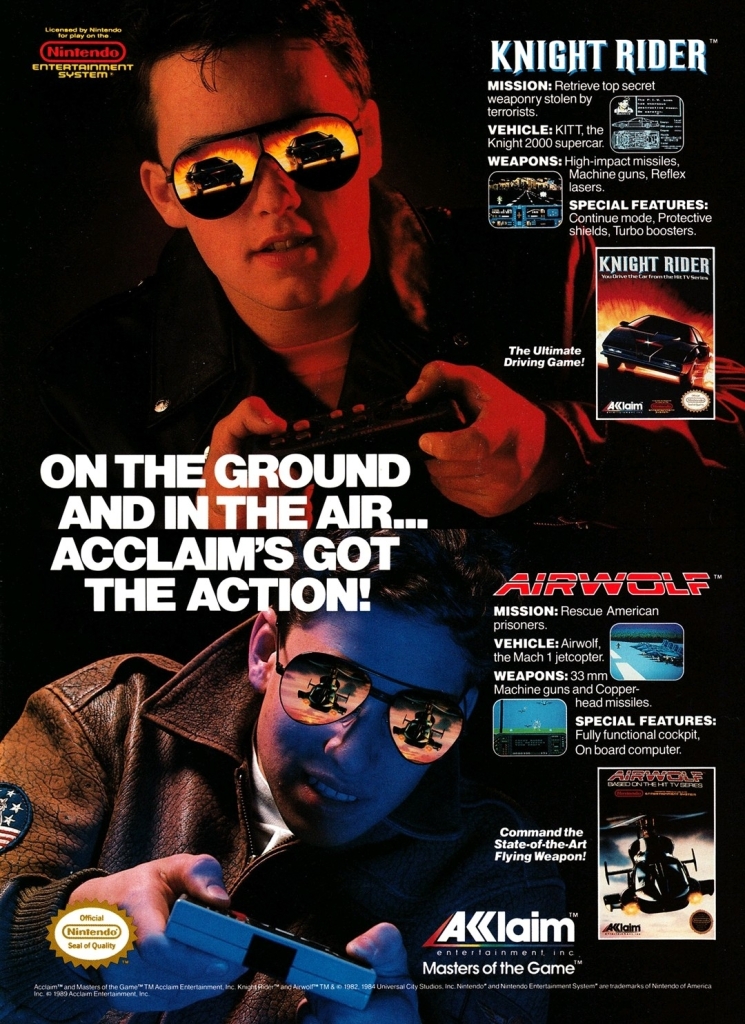
8. Airwolf/Knight Rider games print ad

Very clearly, the advertiser focused on the cool look to sell the games of Airwolf and Knight Rider.

Back in the 1980s, Airwolf and Knight Rider were wildly popular TV series that each had winning formulas to entertain millions of viewers with action, suspense and storytelling. It was not surprising that video game adaptations of them were produced on the Nintendo Entertainment System (NES). This particular print ad was an efficient way of promoting the Airwolf and Knight Rider games which featured two players looking cool with jackets and sunglasses. Acclaim clearly aimed for the TV series’ fans and slightly older players among the NES owners/users.

+++++

Thank you for reading. If you find this article engaging, please click the like button below, share this article to others and also please consider making a donation to support my publishing. If you are looking for a copywriter to create content for your special project or business, check out my services and my portfolio. Feel free to contact me with a private message. Also please feel free to visit my Facebook page Author Carlo Carrasco and follow me on Twitter at  @HavenorFantasy as well as on Tumblr at https://carlocarrasco.tumblr.com/ and on Instagram at https://www.instagram.com/authorcarlocarrasco
Retro Gaming Ads Blast

Welcome back readers, fellow geeks and electronic gaming fans!

Today I am launching a brand-new series of articles titled Retro Gaming Ads Blast (RGAB) which will explore the many print ads and promotions of video games, computer games, arcade games and handheld games that were published through the decades.

For the newcomers reading this, print ads of games were widely popular and heavily relied on by gamers/players long before smartphones, social media, the worldwide web and online videos even started. Back in the old days, print media was the most common method for companies to market their games while also helping hardware (machines which played the games) reach potential buyers. Such ads appeared in magazines, comic books and newspapers. Not only that, there were several print ads of games that were made to look creative, compelling and even intriguing.

With those details laid down, here is the first batch of retro gaming print ads for you to see and enjoy…

1. Parker Brothers’ Spider-Man-led print ad

Does this ad look amusing?

Remember Parker Brothers? That was a company that started way back in 1883 founded with a strong focus on the enjoyment of games in the form of board games, cards and toys. In the late 1970s, Parker Brothers started making electronic versions of their popular board games and engaged in the video game development and publishing. They also went on to make home ports of popular arcade games in the early 1980 for several gaming platforms.

Parker Brothers was very active with making games for the Atari 2600 console which became the dominant machine for home gaming in North America in 1982. In the above print ad, their marketing heavily emphasize the Spider-Man video game for Atari 2600 and added two others games they also published – Tutankham and Amidar – which was a clever move to market multiple games. The ad’s focus on Spider-Man was amusing and even without showing a single screenshot of the game, it was enough to entice people to watch out for it. Be aware that the Spider-Man game’s development was done by Laura Nikolich who was hired by Parker Brothers at a job fair. Nikolich had full creative control on making the game and had no contact whatsoever with Marvel Comics.

2. Advanced Dungeons & Dragons: Cloudy Mountain print ad

An ad like this was strong enough to motivate gamers’ imagination and interest.

Back in 1982, Advanced Dungeons & Dragons: Cloudy Mountain was released on the Intellivision game console and I was fortunate enough to watch my next-door neighbor play it repeatedly. The above print ad – which simply referred to the game as Advanced Dungeons & Dragons – only had a few words which directly pointed to the main objective of the game…the golden crown. While only one screenshot of the game was displayed, the advertisers heavily relied on hand-drawn, comic book-style fantasy art work to sell the game.

For those who were born long after the 1980s, let me share with you that ads like these were really impressive for their time. It was common for advertisers to use art works (even though they may not accurately reflect the gameplay or game design) and post at least one screenshot to catch the viewer’s attention with the hope that it would even encourage him/her to anticipate the game. It should be noted that ads like these were strong enough to make gamers’ imagination or curiosity grow stronger.  

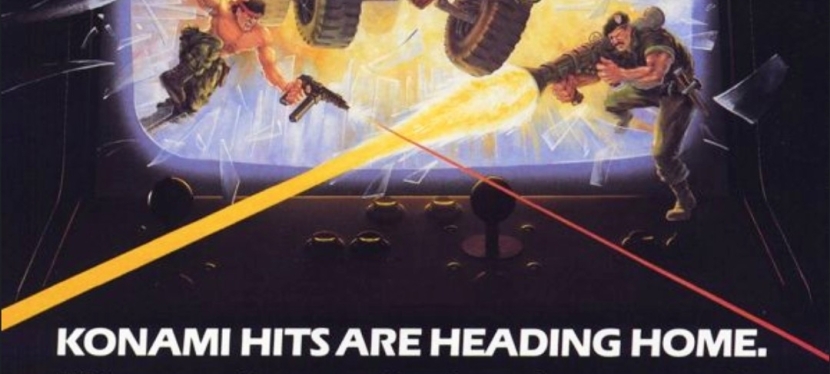
3. Konami’s collective military video games advertising

Print ad of four games for IBM, Amiga and Commodore.
Print ad of Jackal and Contra for the NES.

Konami, the Japanese company that has long been known for Metal Gear, Suikoden and the controversial sacking of famous game designer Hideo Kojima, was aggressive in the gaming business in the 1980s and arguably the aggressiveness was reflected in their publishing of several games that emphasized militarism during the late stages of the Cold War. In short, they made the military look cool and their activities fun to do in digital form.

While Konami has always been identified with console gaming, they actually released Rush’n Attack, Contra, Jackal and Boot Camp on IBM, Amiga and Commodore computers (as seen in the first print ad above) which were popular in the 1980s. The said ad also have a very amusing visual concept emphasizing the excitement and fun of military action games coming to gamers at home for their computers.

The 2nd print ad above – Jackal and Contra for the Nintendo Entertainment System (NES) – was very intriguing to see. It was very clear back in the 1980s that the NES always had a wholesome audience (note: a lot of buyers were parents who wanted to entertain their kids at home) and that includes a lot of very young players. To see the collective ad of Jackal and Contra (for the NES platform) having battle-hardened men in military gear holding guns was openly aggressive to perceive and instantly reminded people about the Cold War (and the menace of Communists, socialists, Marxists and terrorists) and the cultural impact of the mega blockbuster film Rambo: First Blood Part II. This is the kind of ad that would drive today’s woke-minded people crazy and even cause them to panic and pretend to be victims of militarism and patriotism. If you look at the ad closely, you will realize there is simply no room for the garbage of political correctness and wokeness.

Lastly, I myself had played Contra and Jackal with my friends on the Nintendo Family Computer (the Japanese counterpart of the NES) and both military games were a lot of fun to play from start to finish!

4. Batman Returns SNES game ad

This print ad appeared in some comic books I read in the early 1990s.

Way back in 1992, Batman Returns (the sequel to the mega blockbuster Batman movie of 1989) was released in cinemas with intense marketing and merchandising reflecting Warner Bros. intention to replicate the commercial success they had in 1989. Along the way, there were several video game adaptations of Batman Returns that were released on different platforms. Among those many video games was the Super Nintendo Entertainment System (SNES) game of Batman Returns which was developed and published by Konami in 1993 the form of a side-scrolling beat-them-up game.

The above ad was visually appealing with hand-drawn, comic book-style art dominating the spaces while leaving room for some screenshots and a written description of the game. Having seen this ad on multiple comic books I read back then, I can say that the ad was entertaining to see and was effective in making me interested in the game. I played Batman Returns on the SNES but never got to finish it. Oh yes, the game’s audio were really good and there were also digitized images from the movie for the in-game narrative.

5. Flashy Sonic the Hedgehog Japanese print ad

A dazzling approach by Sega on selling Sonic the Hedgehog.

1991 will always be remembered as the year of Sonic who eventually became not only Sega’s most defining mascot but also a video game industry icon. That same year, Sega released Sonic the Hedgehog on the Sega Genesis (referred to as Sega Megadrive in other parts of the world) console and it became a massive success with consumers and the game critics.

In the above Japanese print ad, a very captivating display of light and energy rays dominated the space leaving a minority share left for Sega’s console, screenshots and even a UFO Catcher arcade machine picture. While I could not understand the Japanese text, it seems to me that the flashy visual concept of the ad reflected Sega’s high ambitions with Sonic. How many gamers in Japan bought a copy of Sonic the Hedgehog because of this ad remains undetermined.

6. Japanese Super Star Wars print ad

A long time ago in a galaxy far, far away…

Before Nintendo released its 16-bit game console (referred to as Super Nintendo Entertainment System in America, and Super Famicom in Japan), there were lots of Star Wars video games released on varied platforms and the arcade.

With Nintendo’s 16-bit gaming platform realized, lots of game designers and business partners saw opportunities to make new games with gameplay concepts and designs using the technological advantages of the time. For LucasArts and its partners, taking Star Wars gaming into the next level was inevitable and they made it all come true in 1992’s Super Star Wars video game.

Published in Japan by JVC Musical Industries for the Super Famicom, Super Star Wars was a major leap forward in game design, visuals, sound and enjoyment. Apart from the 2D side-scrolling run-and-gun gameplay, gamers were deeply immersed into Star Wars’ universe with the Mode 7 landspeeder and X-Wing fighter sequences, as well as the first-person trench run sequence.

The Japanese print ad above cleverly presented screenshots from the game while using official imagery from the Star Wars movie poster of 1977 (look at how young Harrison Ford, Mark Hammill and the late Carrie Fisher were back then). The ad is a fine example of combining the greatness of the classic George Lucas-directed film with the highly enjoyable design of Super Star Wars. Lastly, these should remind you that there was a time when Star Wars was not yet tainted by wokeness and the garbage values of the Satanic Leftists (read: woke Disney).   

+++++

Thank you for reading. If you find this article engaging, please click the like button below, share this article to others and also please consider making a donation to support my publishing. If you are looking for a copywriter to create content for your special project or business, check out my services and my portfolio. Feel free to contact me with a private message. Also please feel free to visit my Facebook page Author Carlo Carrasco and follow me on Twitter at  @HavenorFantasy as well as on Tumblr at https://carlocarrasco.tumblr.com/ and on Instagram at https://www.instagram.com/authorcarlocarrasco
Hideo Kojima’s Xbox project is OD (Overdose)

Since the initial announcement of the Xbox Game Studios partnership with Kojima Productions (led by legendary game creator Hideo Kojima who is known by many for his Metal Gear works) was made, a lot of gamers could not figure out what kind of game will be realized. The long wait and speculation ended as the two entities announced during The Game Awards 2023 the new game (designed by Hideo Kojima) titled OD (Overdose).

To begin, watch the official teaser trailer of the Xbox-exclusive OD below…

To add punch to the announcement, Kojima himself appeared on-stage during The Game Awards 2023 which you can see below…

To learn more details about OD (Overdose), posted below is an excerpt from the official press release issued by Kojima Productions. Some parts in boldface…

While there were little details about OD unveiled and the teaser trailer showcased what the production team is doing with the technologies they have, the Xbox-exclusive project is intriguing to say the least. Sure, there was no gameplay footage shown nor plot elements but the unveiling showed that OD was aiming for a new experience with horror, suspense, emotion and immersion in mind.

Kojima Productions’ utilization of cloud gaming technology and Unreal Engine could result in something new and fresh from Hideo Kojima whom I believe must have been experimenting a lot with designs not only for video gaming but also for interactive viewing. It is also interesting to see that OD will involve the talents of selected actors and director Jordan Peele. I can only speculate that, in relation to Kojima’s quote in the press release, the game will be cinematic and will somehow get the gamer/viewer involved in ways not seen before.

A lot of questions about the Xbox-exclusive OD remain particularly on how exactly will it be playable, what the plot is, will the game push photo-realism to the next level, how will it immerse gamers/viewers into it, when will it be released on Xbox Game Pass (XGP), when will it be released and more.

Whatever OD (Overdose) will be, we can only hope that Hideo Kojima and his team will create something groundbreaking and great. Stay tuned for future updates about OD here.

+++++

Thank you for reading. If you find this article engaging, please click the like button below, share this article to others and also please consider making a donation to support my publishing. If you are looking for a copywriter to create content for your special project or business, check out my services and my portfolio. Feel free to contact me with a private message. Also please feel free to visit my Facebook page Author Carlo Carrasco and follow me on Twitter at  @HavenorFantasy as well as on Tumblr at https://carlocarrasco.tumblr.com/ and on Instagram athttps://www.instagram.com/authorcarlocarrasco