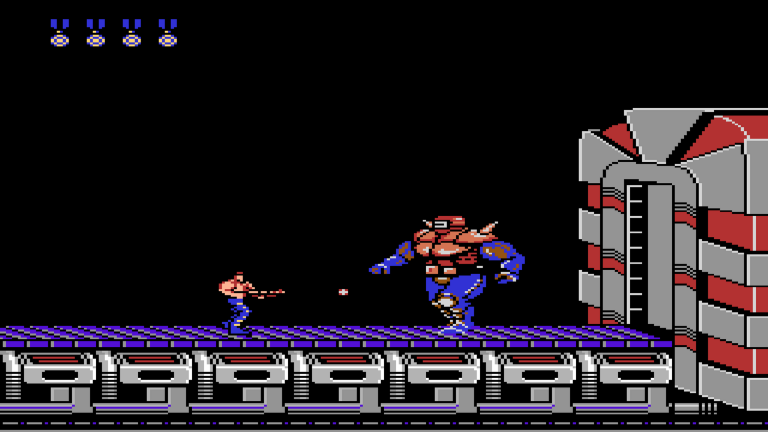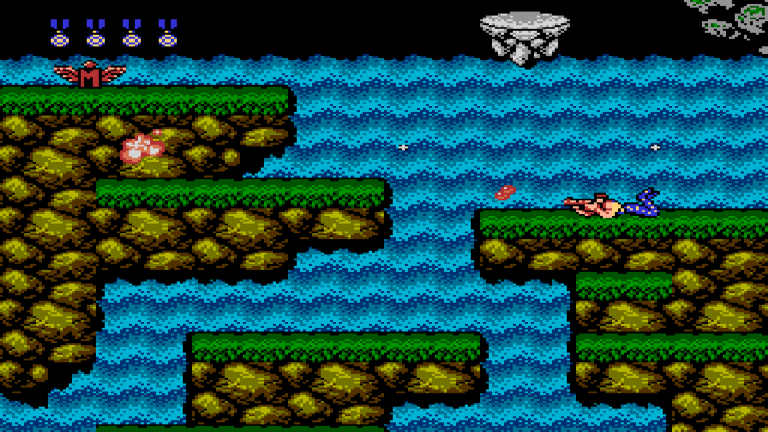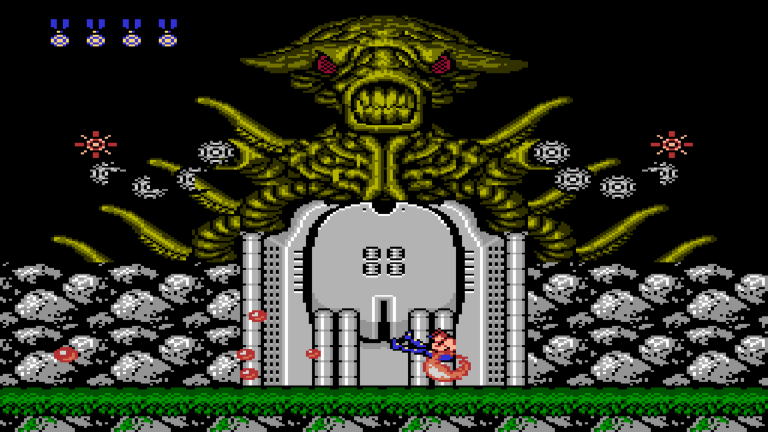
Retro Gaming Ads Blast – Part 36

Welcome back readers, fellow geeks and electronic gaming fans!

In this edition of the Retro Gaming Ads Blast (RGAB) series, we will take a look at another batch of retro gaming print ads – including arcade flyers – from the 1970s to the 1990s.

For the newcomers reading this, Retro Gaming Ads Blast (RGAB) looks back at the many print ads of games (console, arcade, computer and handheld) that were published in comic books, magazines, flyers, posters and newspapers long before smartphones, social media, the worldwide web and streaming became popular. To put things in perspective, people back in the 1980s and 1990s were more trusting of print media for information and images about electronic games and related products.

With those details laid down, here is the newest batch of retro gaming print ads for you to see and enjoy…

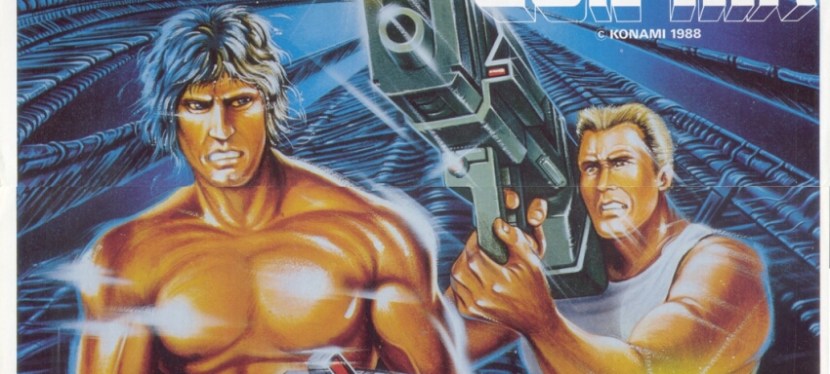
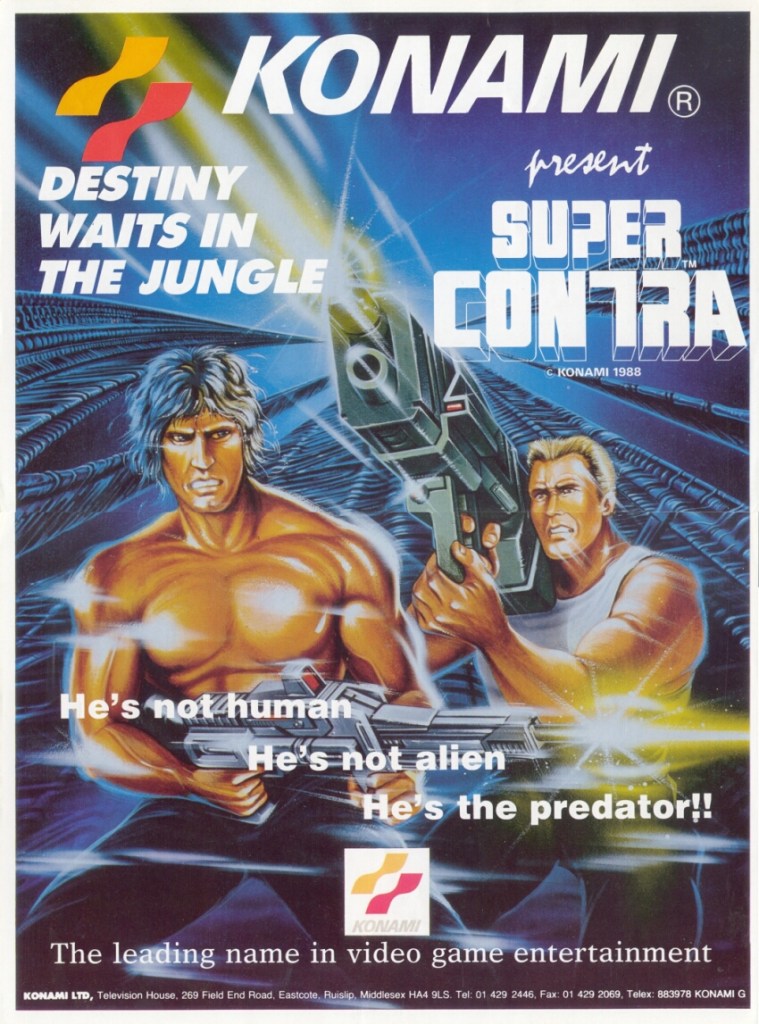
1. Super Contra North American arcade flyer

Have you seen many Hollywood action movies of the 1980s? Does this arcade flyer remind you of something?

After Konami struck gold with Contra in 1987, it was inevitable that sequels and spin-offs will be made. In 1988, they released the follow-up Super Contra in the arcades and to promote it in America, the company came up with artwork that easily gave gamers the impression they are seeing Sylvester Stallone as a fantasized Rambo and another armed guy who might remind them of Arnold Schwarzenegger’s character in Commando or Dutch in Predator. To capitalize on the movie references even more, the American arcade flyer had the line “He’s not human. He’s not alien. He’s the predator!!” As it was the 1980s, this creative approach to promotion was not surprising as Konami and its game makers were influenced by Hollywood movies.

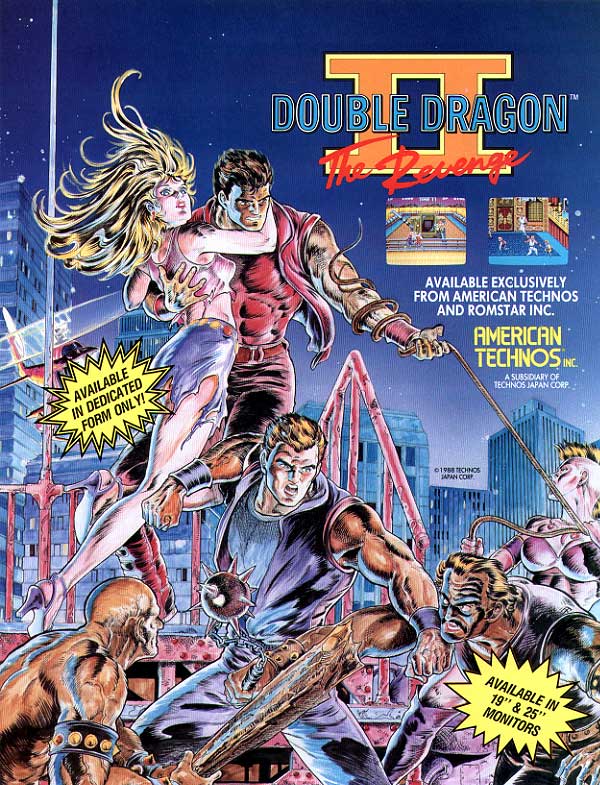
2. Double Dragon II: The Revenge North American arcade flyer

The artwork used in this arcade flyer remains intriguing to look at.

I never played Double Dragon II: The Revenge in the arcade, but I played it on the Nintendo Entertainment System (NES). That being said, I was surprised to see how this old North American arcade flyer has the same hand-drawn artwork used on the cover of the NES version. Take note that the arcade game was released in 1988 while the NES port was released in early 1990. I can only guess that Technos decided to use the same artwork not only for convenience but to have a definitive image emphasizing Double Dragon II to gamers wherever they are.

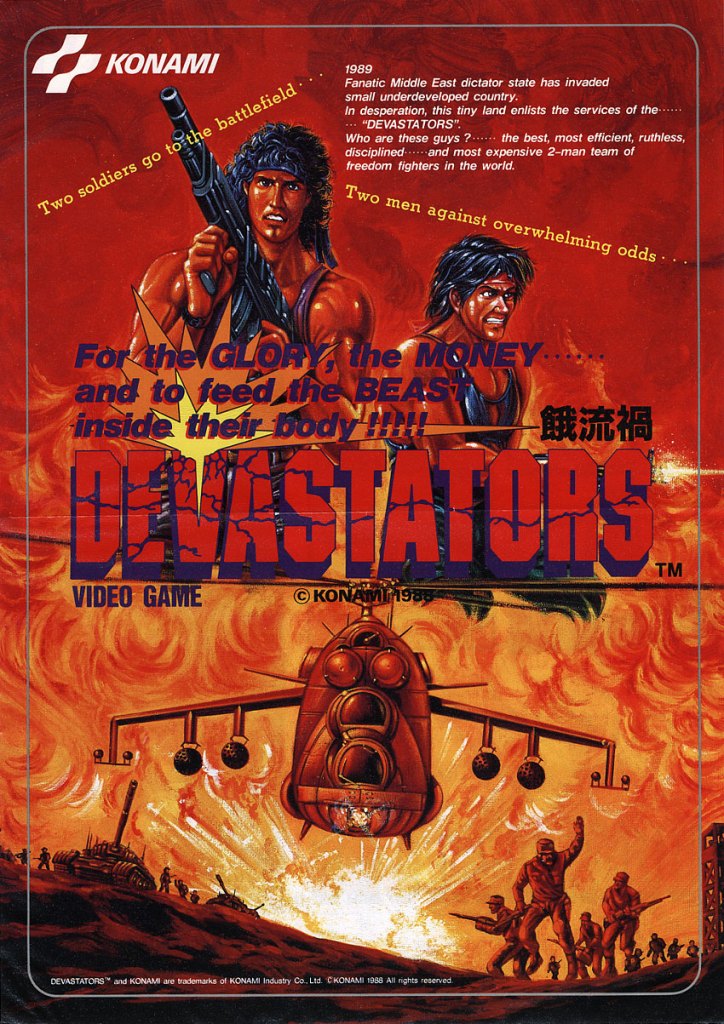
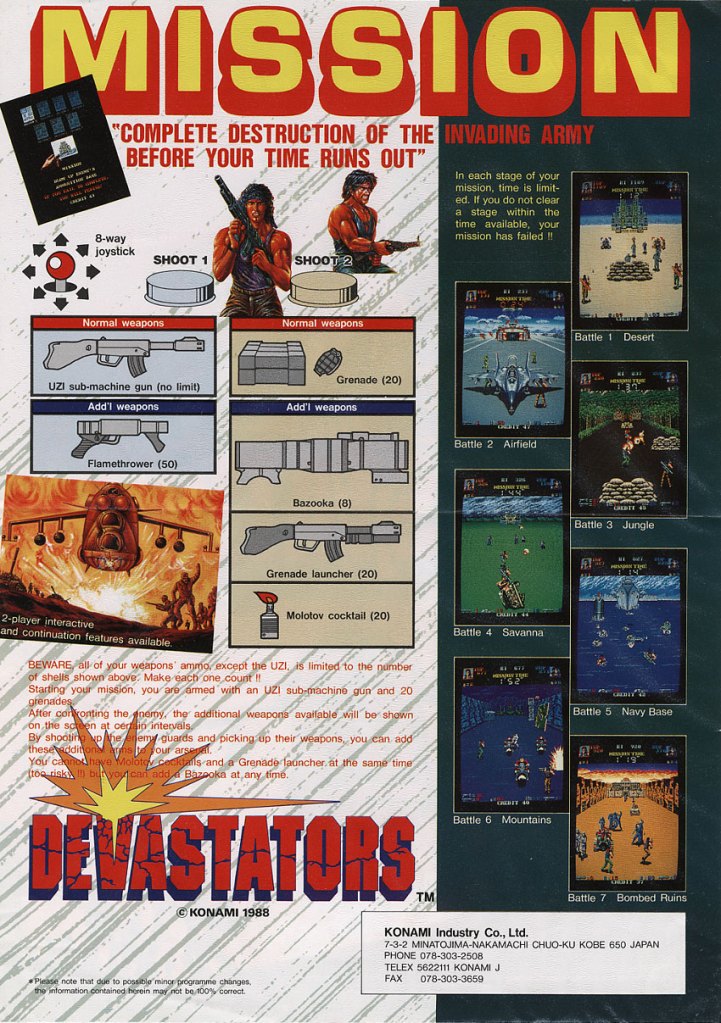
3. Devastators North American arcade flyer

The front.
The rear.

Devastators is another Konami arcade game that had a strong war theme and it was influenced by Hollywood action films of the 1980s. This particular arcade flyer for the North American market is almost identical with the Japanese arcade flyer as both have the same artwork on the front and almost the same visual layout on the rear. The most obvious difference is the use of English text for the North American flyer.

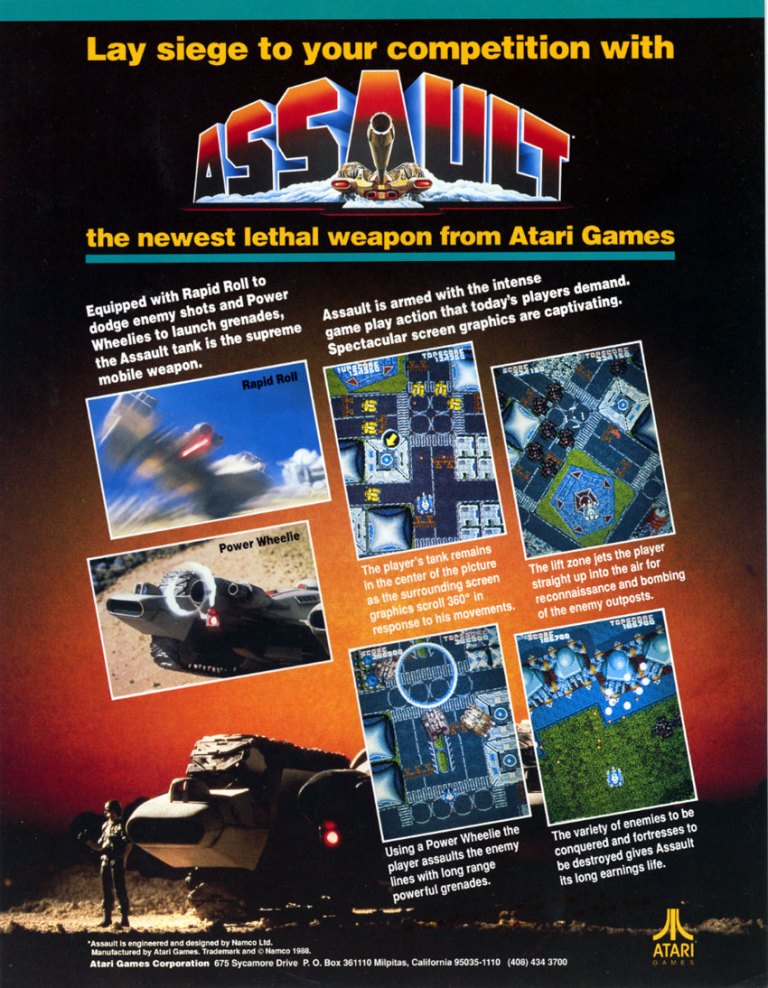
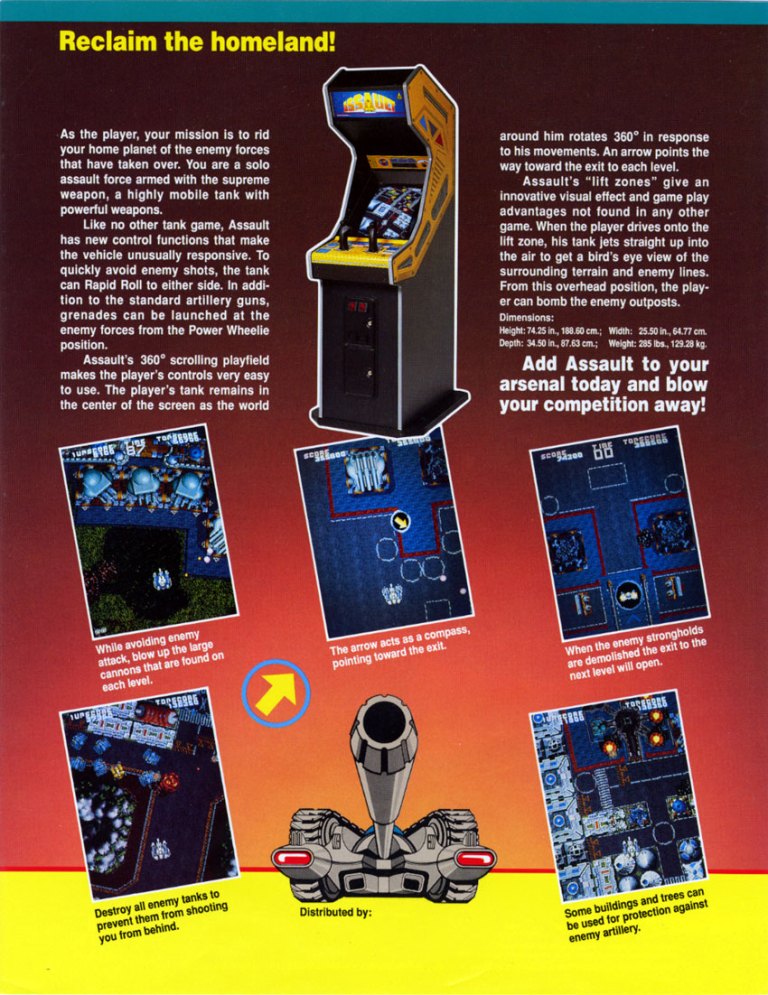
4. Assault North American arcade flyer

The front.
The rear.

Released in American arcades by Atari, Assault is a multi-directional shooter that had a twin-stick control layout (similar with the classic Battlezone) and players experienced intense battles as well as immersive visual effects such as sprite scaling and environment rotation of up to 360 degrees. To promote the game (this originated in Japan by Namco), Atari came up with this arcade flyer that had selected screenshots and descriptive text on both the front and the rear (which showed the arcade cabinet). Assault was a hit with gamers at the arcades and it was not released on consoles until 2009.

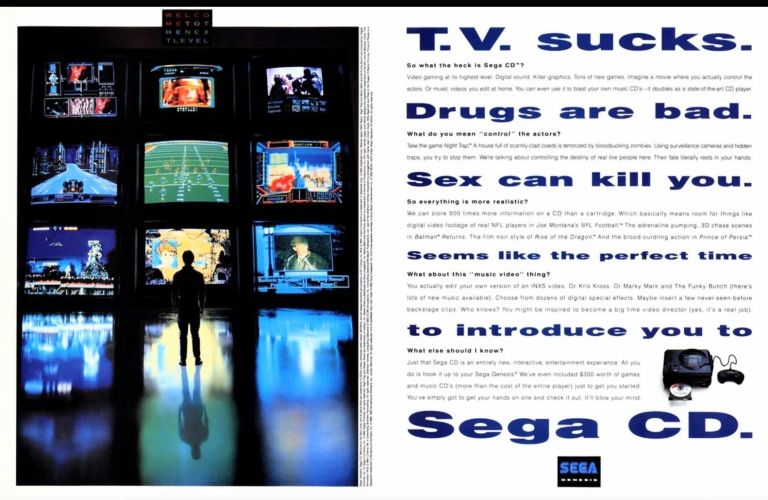
5. Sega CD print ad

Having a socially relevant message can be catchy but it leaves little room for excitement.

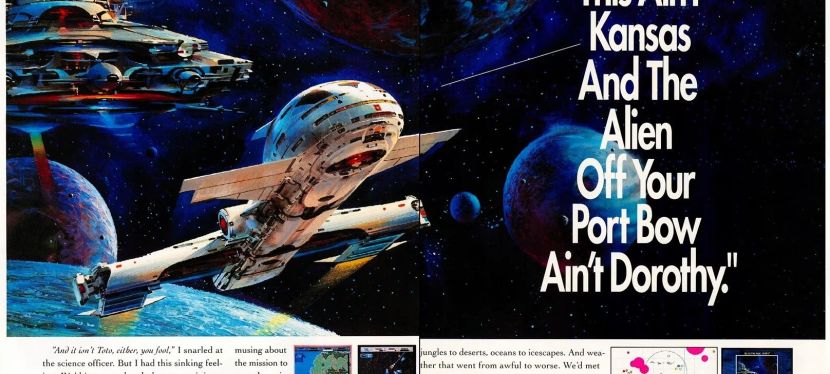
As the Sega Genesis console became a huge commercial success in North America, Sega itself became ambitious about what CD-ROM technology would do for video games. Sega in Japan tasked its Consumer Products Research and Development Labs to create a CD-ROM add-on which resulted in the Sega CD (Mega-CD in other parts of the world) which launched in America in 1992. To promote the add-on towards existing Genesis console owners as well as potential new customers, Sega of America came up with the above 2-page print ad that had a social message on the right and an image of a man standing in front of large monitors (showing Sega CD game footage) on the left. While it looked like an odd way of promoting video game hardware, it still remains catchy to see.

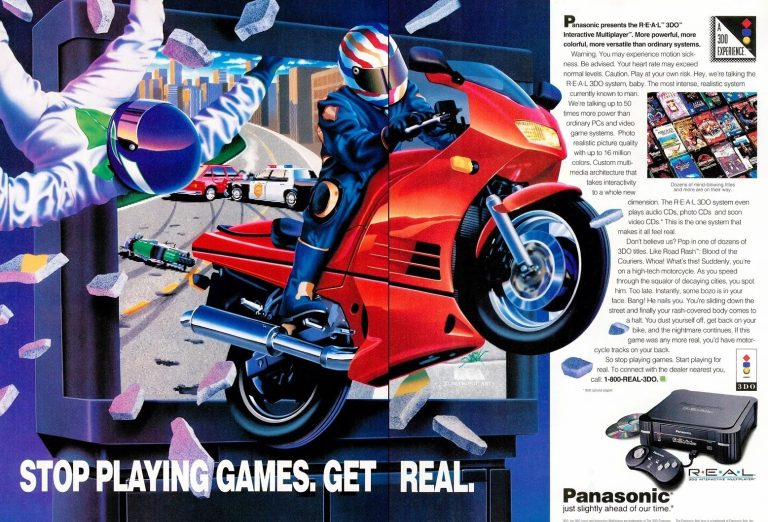
6. Panasonic 3DO print ad

Panasonic knows how to promote entertainment hardware for people’s homes.

Still in the field of CD-ROM gaming, Panasonic had competitive presence in video gaming when its Panasonic FZ-1 R.E.A.L. 3DO Interactive Multiplayer (with technology licensed by The 3DO Company) was launched in America in 1993. If you look at the print ad closely, you will notice that the descriptive text emphasized the multimedia entertainment aspect more than video gaming. The dominating artwork used does not come from a particular video game as it was made to emphasize home entertainment in general. It’s not surprising that the Panasonic 3DO and other 3DO machines from other manufacturers failed commercially.

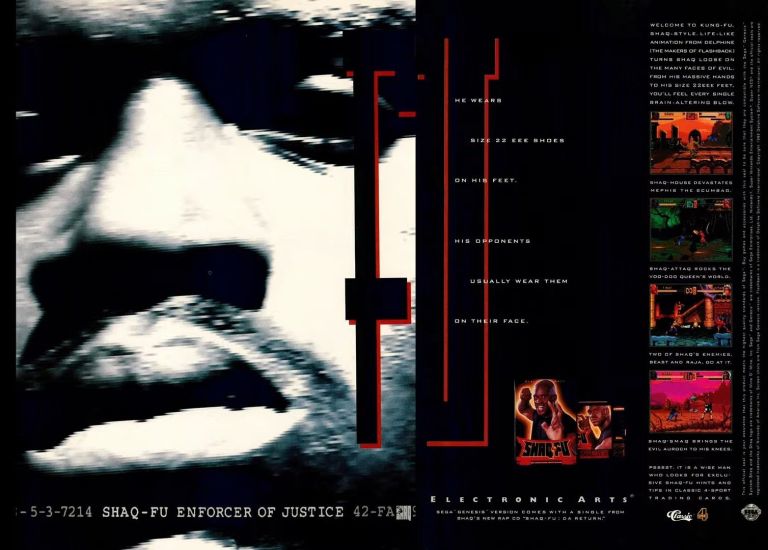
7. Shaq Fu print ad

The close-up of Shaquille O’Neal’s face on the left made him looked less recognizable.

Yes, it is true! There was indeed a video game endorsed by Shaquille O’Neal and it was not a basketball game. Shaq Fu is a 1994 2D fighting game with adventure elements and a story in which gamers play O’Neal as martial artist (note: O’Neal himself participated in the game’s production). To promote the game, Electronic Arts came up with a 2-page print ad that had a very odd black-and-white close-up image of O’Neal’s face on the left leaving small screenshots and hard-to-read text on the right (even though there was some vacant space remaining. I remember seeing this ad while reading a video game magazine and the ad ended up looking more like a promotion of O’Neal (already an NBA superstar) than the game itself. By today’s standards, this print ad is an example of a marketing misfire.

8. Kasumi Ninja print ad

Do you even remember seeing this print ad in magazines?

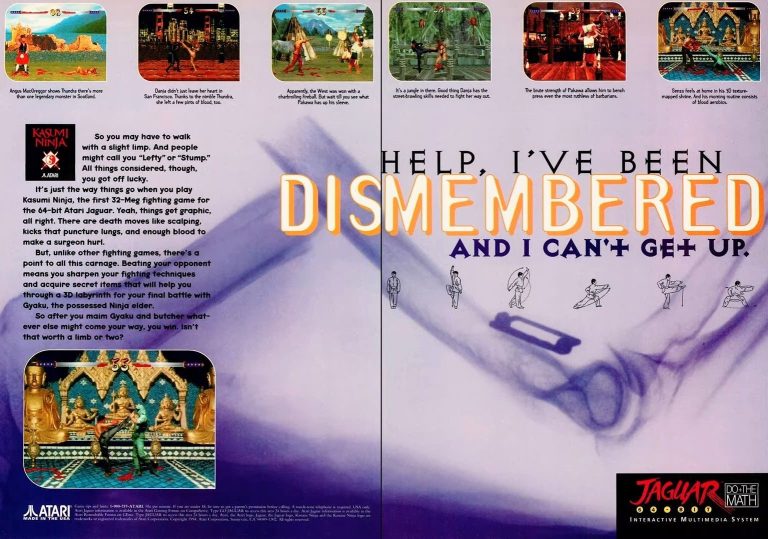
Remember the 1990s video game trends of digitized human images and disturbingly violent 2D fighting games sparked by Mortal Kombat? The Atari Jaguar-exclusive game Kasumi Ninja was made to capitalize on those trends and it failed badly. Apart from the low sales of the Jaguar console, Atari as publisher came up with the above 2-page print ad that was not appealing to gamers’ eyes and it had almost no excitement overall. This is another marketing misfire.

9. Parasite Eve North American and Japanese print ads

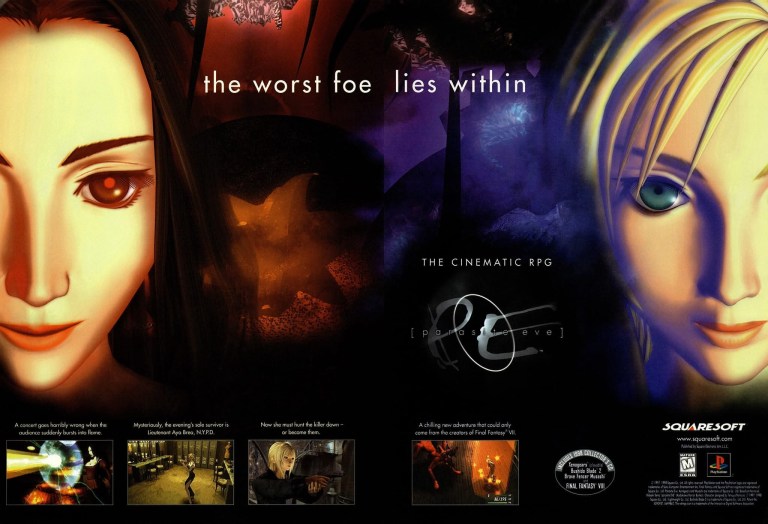
Following the successful release of Final Fantasy VII, this ad excited PlayStation gamers and JRPG enthusiasts for Parasite Eve’s 1998 release in America.
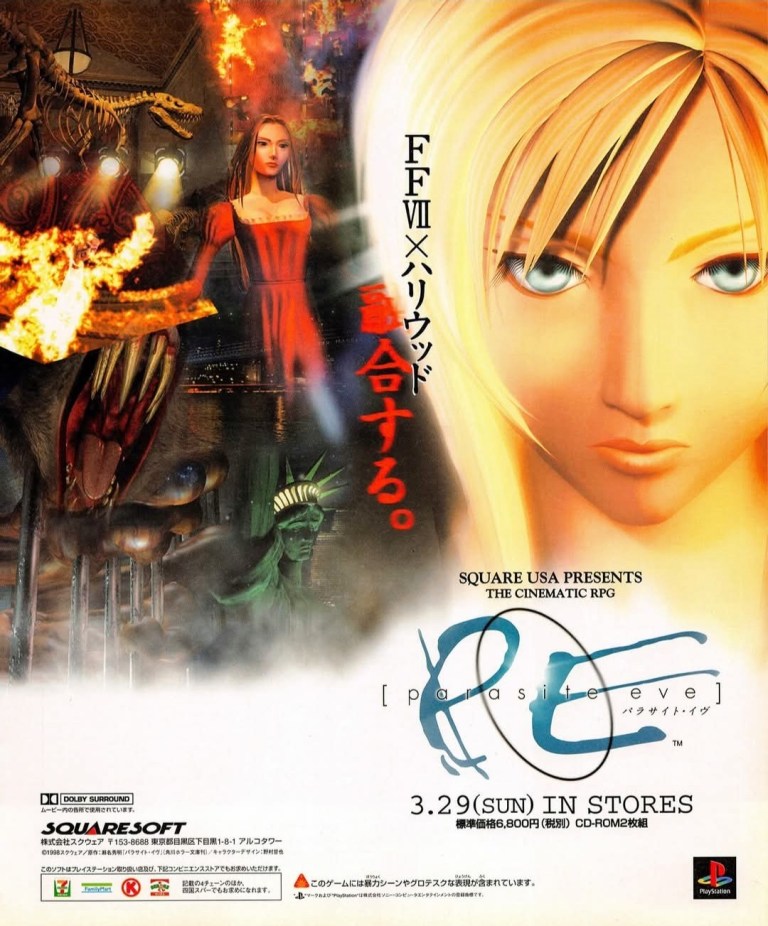
A stronger horror presentation in this print ad for the Japanese market. There were already a lot of people in Japan who enjoyed horror.

Starting in the mid-1990s, Squaresoft (now Square Enix) really became aggressive with video game creativity and experimentation as they launched several new projects that eventually got released on PlayStation in the late 1990s until 2000. One of those daring new projects was Parasite Eve which was a role-playing game (RPG) that had visual elements – particularly pre-rendered backgrounds – and a style of exploration that reminded gamers of Resident Evil. The game was a sequel to the Japanese science fiction horror novel of the same name and it involved the creativity of Final Fantasy creator Hironobu Sakaguchi (credited as producer). To promote the game, the 2-page North American print ad had protagonist Aya Brea on the right and the enemy on the left with a cryptic line placed strategically between them. The North American ad clearly stated that the game is a cinematic RPG. By comparison, the Japanese print ad of Parasite Eve has a strong horror vibe which is not surprising because of the novel’s horror elements and the fact that Squaresoft was capitalizing on the popularity of horror-related entertainment in Japan. By today’s standards, Parasite Eve is truly a product of the late-1990s and it has a dedicated fanbase.

+++++

Thank you for reading. If you find this article engaging, please click the like button below, share this article to others and also please consider making a donation to support my publishing. If you are looking for a copywriter to create content for your special project or business, check out my services and my portfolio. Feel free to contact me with a private message. Also please feel free to visit my Facebook page Author Carlo Carrasco and follow me on Twitter at  @HavenorFantasy as well as on Tumblr at https://carlocarrasco.tumblr.com/ and on Instagram at https://www.instagram.com/authorcarlocarrasco
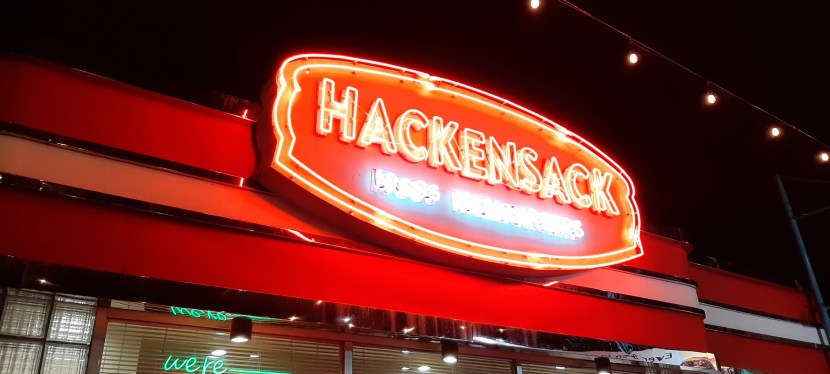
For burgers and arcade fun in BF Homes, visit Hackensack

Along the stretch of Aguirre Avenue inside BF Homes subdivision, Barangay BF Homes, Parañaque City is the 1950s-inspired diner Hackensack. To be clear, it is the BF Homes branch of the business whose other branch is located in Quezon City.

I had my first-ever visit there this past February for a lunch reunion and meeting with a dear friend of mine. We both had rice meals and drinks, and we had a nice chat while seating comfortably.

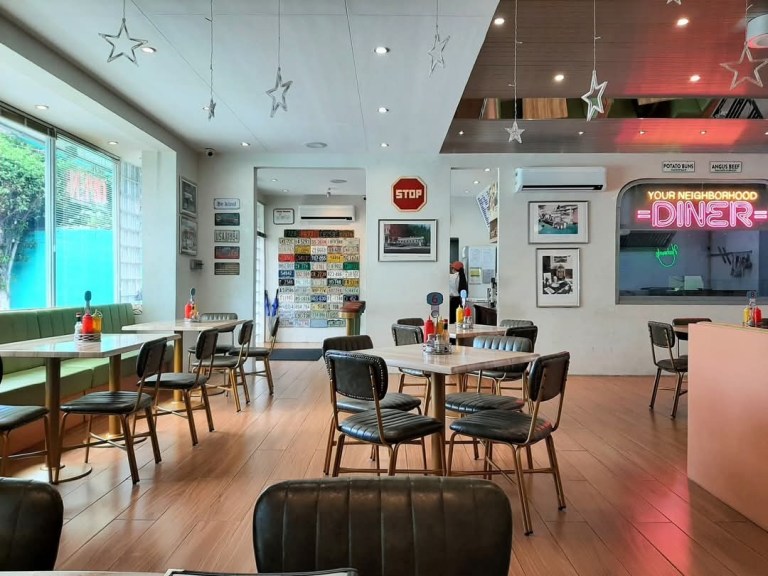
Daytime shot of a portion of the interior at Hackensack’s BF Homes branch. Comfortable seats and sufficient space for customers.
Through the window, customers can watch their food getting cooked.

I carefully examined Hackensack as it was my first time back then. I noticed they have sufficient parking spaces – spacious enough to allow double-parking – for motorists outside. Upon entering, the 1950s vibe was clearly present through the interior design and the carefully placed decorations. With the nice interiors, cool aircon system and sufficient walking space between the chairs and tables, Hackensack’s BF Homes branch is nice and comfortable to be in.

Recently, I had a 2nd visit at Hackensack in BF Homes and this time it was dinner with my family.

Food

This is the Deluxe “Smashed” Cheeseburger and Fries Combo. The cheeseburger had two Angus beef patties.

During my 2nd visit, I had the Deluxe “Smashed” Cheeseburger (double-patty) and Fries Combo and a Chocolate Milkshake. The cheeseburger itself came with two Angus beef patties, two wide tomato slices, lettuce and cheese, and it tasted really good. I’m glad I had the cheeseburger as I was getting tired of the cheeseburgers from the more popular burger-and-fries fast food restaurants. Meanwhile, the fries were well cooked and satisfying to eat.

As mentioned above, I had the Chocolate Milkshake although I ordered at least 30 minutes after I finished my cheeseburger and fries combo meal. Hackensack’s milkshake tasted mildly sweet (given the chocolate flavor) but more importantly, it also tasted freshly made.

The chocolate milkshake was tasty and satisfying.

Other food that my family enjoyed include the 1950s Onion-steamed Cheeseburger and Fries Combo, the Fried Onion Strings, Fries, the Philly Cheesesteak, Chicken Wings, and the Classic BLT (Bacon, Lettuce and Tomato). I can clearly say that my family enjoyed the food and what was served exceeded expectations.

The Fried Onion Strings was a delicious appetizer and also ideal when eating with a group of companions.
A standalone service of Fries.
The 1950s Onion-steamed Cheeseburger and Fries Combo.

Hackensack’s menu offers lots of food and drink options that customers can choose from such as the Chicken Salad Sandwich with Chips combo meal, Clubhouse Sandwich with Chips combo meal, Waffle Fries, New York Frank and Fries combo meal, Mom’s Baked Spaghetti, Monty Brewster and Fries combo meal, Homemade Apple Pie, Steak and Eggs rice meal, Rootbeer Float and more.

Arcade games plus notable comic book artworks

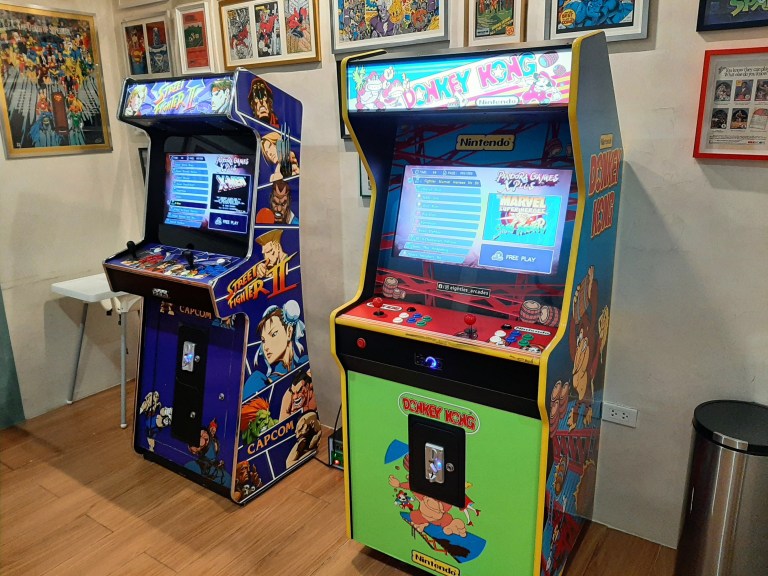
While Hackensack has a strong 1950s vibe with its food, interiors and atmosphere, the place with the two arcade cabinets (where players can stand in front of and play games) is something else. If you know your entertainment history, you should be aware already that arcade games in America (electronic games played on machines) did not exist during the 1950s.

That being said, the two arcade cabinets allow users to pick games from a wide selection of titles from the 1970s to the 1990s. The beauty about have these arcade cabinets is that you can play games absolutely free! No need to insert coins or tokens at all!

The two arcade cabinets inside Hackensack. Each machine contains lots of classic arcade games and the great thing is that customers can play those games for free. Simply select the game, press the button and start enjoying retro gaming fun.
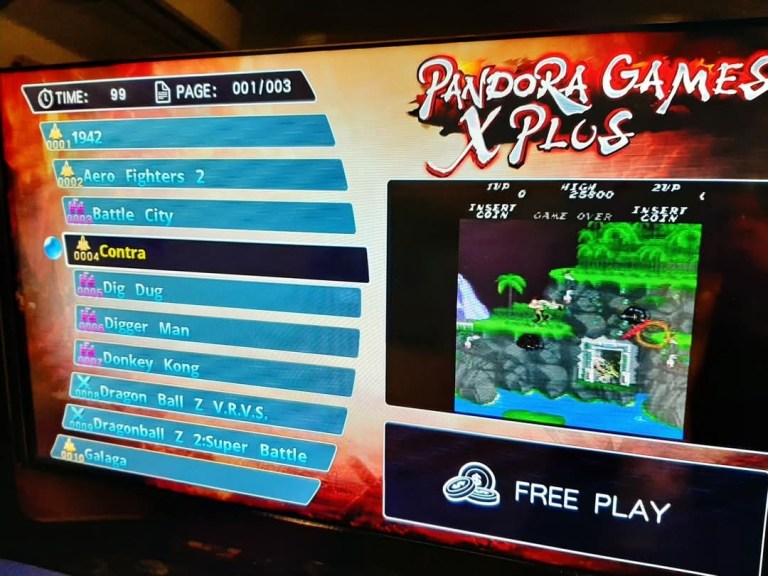
A few of the many retro games to choose from.

During my two visits at Hackensack in BF Homes, I had retro gaming fun with Galaga, Elevator Action, X-Men vs. Street Fighter, Pac-Man, the X-Men arcade game from Konami, and Donkey Kong to name some. Other arcade classic available for gamers to choose from include Street Fighter II, Battle City, 1942, Contra, Rambo III and RoboCop to name a few.

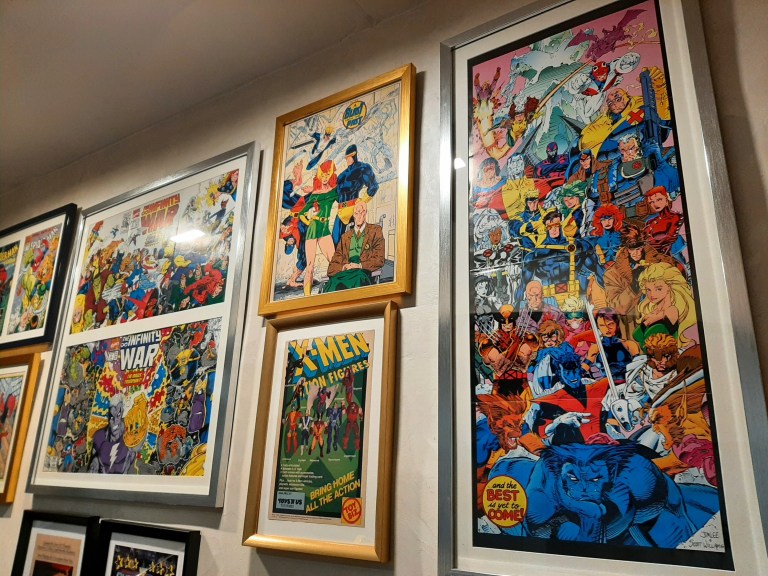
In addition to the existing retro gaming vibe the arcade cabinets provided, there were these very notable comic book covers and artworks displayed on the walls near them. Having read and collected superhero comic books in the 1990s, I recognized a lot of notable artworks there such as WetWorks by Whilce Portacio, X-Men by Jim Lee, Youngblood by Rob Liefeld, Spider-Man by Todd McFarlane, and Superman by Dan Jurgens.

Are you a 1990s comic book enthusiast? Check out the selected comic book materials displayed as decorations.

With good food, a comfortable retro place and retro gaming fun, Hackensack really stands out nicely among the many food joints inside BF Homes. As of now, it is the one place in the entire South Metro Manila where you can enjoy meals and arcade games together.

To learn more about Hackensack, visit their Facebook page by clicking https://www.facebook.com/hackensack.ph. To visit their BF Homes branch right now, click the Google Maps location link at https://maps.app.goo.gl/EHAAteZTZXwgeggw9

+++++

Thank you for reading. If you find this article engaging, please click the like button below, share this article to others and also please consider making a donation to support my publishing. If you are looking for a copywriter to create content for your special project or business, check out my services and my portfolio. Feel free to contact me with a private message. Also please feel free to visit my Facebook page Author Carlo Carrasco and follow me on Twitter at  @HavenorFantasy as well as on Tumblr at https://carlocarrasco.tumblr.com/ and on Instagram at https://www.instagram.com/authorcarlocarrasco
For more South Metro Manila community news and developments, come back here soon. Also say NO to fake news, NO to irresponsible journalism, NO to misinformation, NO to plagiarists, NO to reckless publishers and NO to sinister propaganda when it comes to news and developments. For South Metro Manila community developments, member engagement, commerce and other relevant updates, join the growing South Metro Manila Facebook group at https://www.facebook.com/groups/342183059992673

Retro Gaming Ads Blast – Part 16

Welcome back readers, fellow geeks and electronic gaming fans!

In this edition of the Retro Gaming Ads Blast (RGAB) series, we will take a look at another batch of retro gaming print ads – including arcade flyers – from the 1980s and 1990s.

For the newcomers reading this, Retro Gaming Ads Blast (RGAB) looks back at the many print ads of games (console, arcade, computer and handheld) that were published in comic books, magazines, flyers and newspapers long before smartphones, social media, the worldwide web and streaming became popular. To put things in perspective, people back in the 1980s and 1990s were more trusting of print media for information and images about electronic games and related products.

With those details laid down, here is the newest batch of retro gaming print ads for you to see and enjoy…

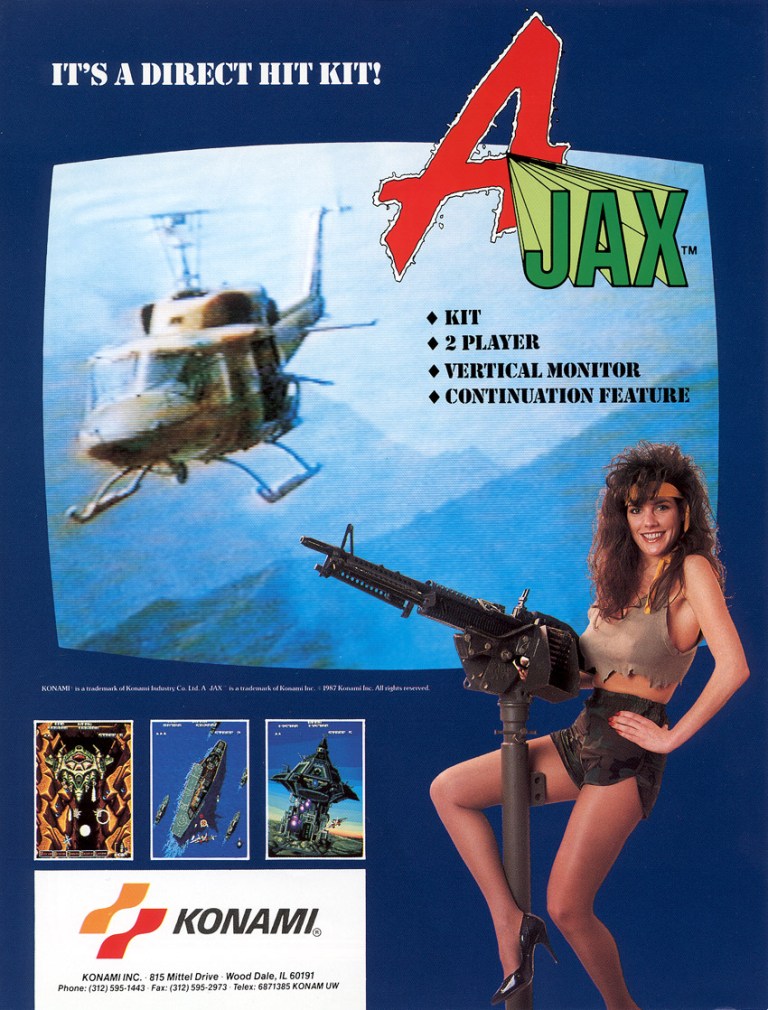
1. A-Jax North American arcade flyer

Another one of Konami’s arcade flyers showing a pretty fashion model with a touch of militarism.

A-Jax (also referred to as Ajax) is another one of the many military themed games Konami released for the arcades in the 1980s. It was a 2D vertically scrolling shooter in which players use aircrafts to shoot enemies both in the air and on the ground. The game was a hit in Japanese arcades and Konami came up with the North American arcade flyer showing three screenshots, an archive footage shot of a military helicopter and a sexy lady (with a light military look) with a machine gun. The style of presentation was similar in style with the North American arcade flyers of Contra and M.I.A.: Missing in Action.

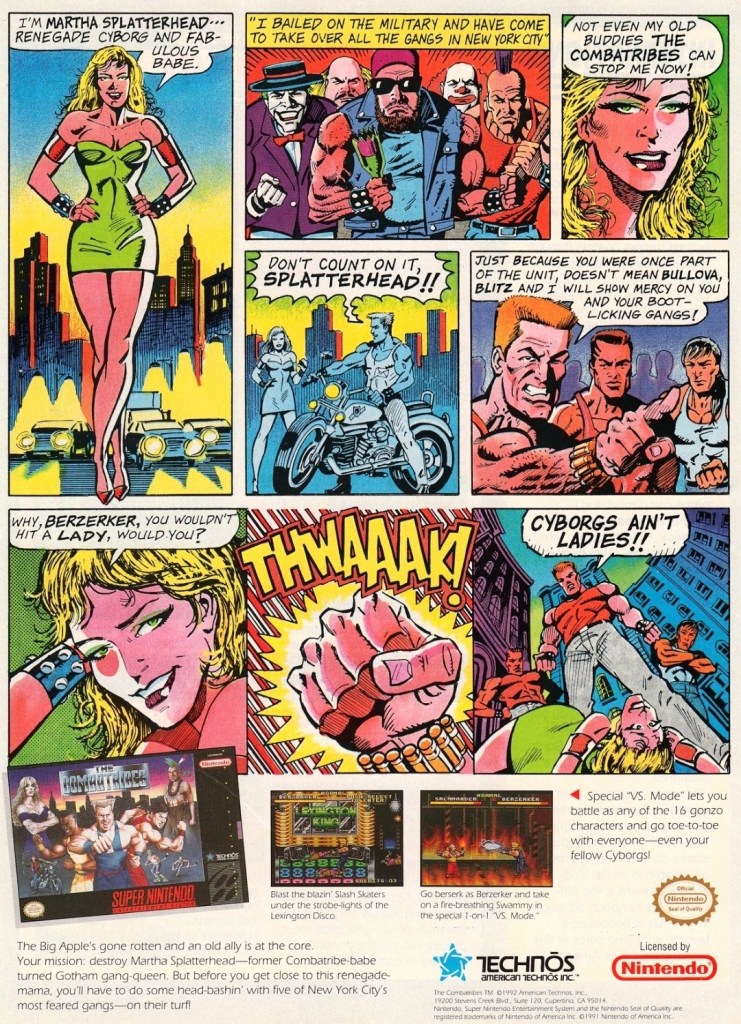
2. The Combatribes print ad

The short comic book approach was used to emphasize the setting and concept of the video game.

Technos, the Japanese company behind the wildly popular Double Dragon games franchise, proved to be successful with the arcade release of The Combatribes. In an attempt to keep the wave of success moving, Technos released The Combatribes on the Super Nintendo Entertainment System (SNES) in 1992 and someone involved with the North American marketing came up with the idea of creating a comic book-style presentation for the print ad. Creatively speaking, the comic book approach was done to emphasize the story and visual concepts of the game, and entice readers to play it. By today’s standards of video game marketing, this print ad’s approach is both unusual and notable.

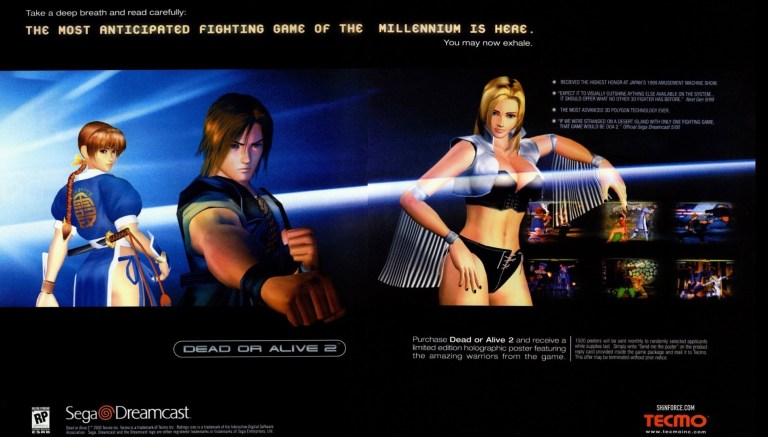
3. Dead or Alive 2 Dreamcast port print ad

This was a wide print ad that appeared on magazines and it sure was eye-catching. It was an effective way to promote the game and inform people of the Sega Dreamcast’s presence in the market.

When Dead or Alive 2 was released in the arcades in 1999, a lot of gamers were astounded by it as developer Team Ninja (led by Tomonobu Itagaki) made it much bigger and a lot better than its 1996 predecessor. Team Ninja really went all out making the sequel utilizing Sega’s NAOMI arcade technology, inviting martial artists to do motion-capture, and having a very ambitious game design. Since the game was developed with the NAOMI hardware, porting the game for the Sega Dreamcast was reportedly convenient and smooth for the developers who went on to add more gameplay features and modes. Publisher Tecmo came up with this wide print ad (promoting the Dreamcast release) showcasing three characters, six screenshots and text descriptions emphasizing the universal acclaim the game received. The promotional approach was simple yet effective.  

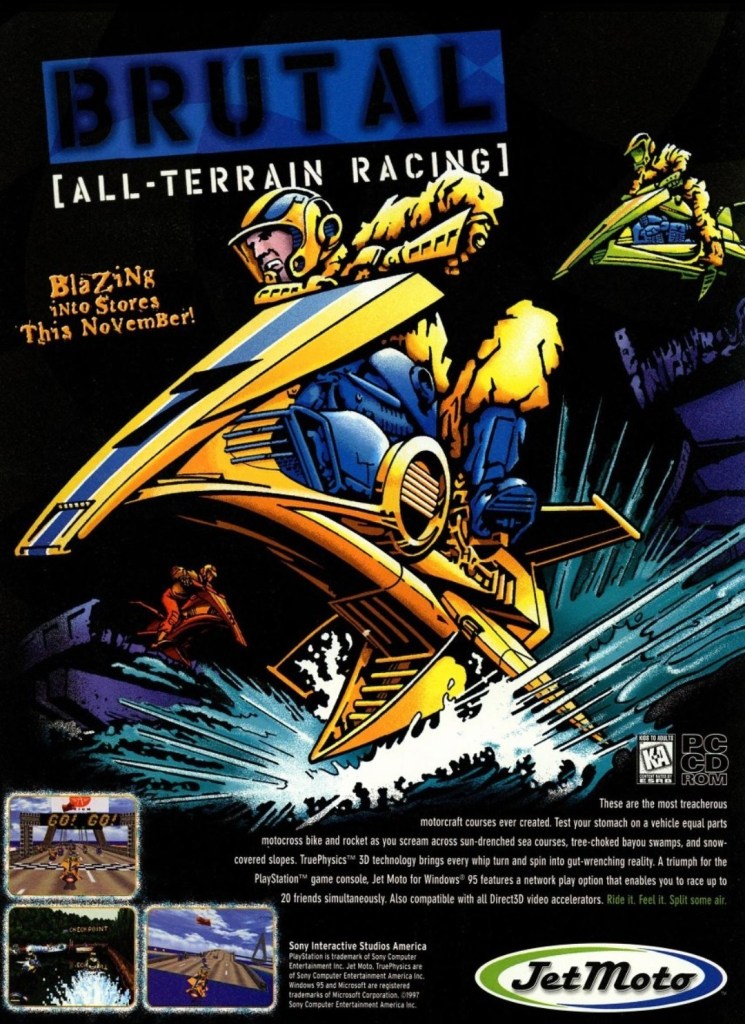
4. Jet Moto (PC version) print ad

From PlayStation to PC.

In November 1996, the futuristic all-terrain hoverbikes racing game Jet Moto was released on the PlayStation which went on to sell well and attract mostly positive reviews. Sony Computer Entertainment eventually released a version of the game for the personal computer (PC) in November 1997. As seen in the above print ad, the network play option and compatibility with Direct3D video accelerators were emphasized as such features resonated with the interests of PC gamers of the era. This print ad showed how willing Sony was to release PlayStation hits on PC back then.

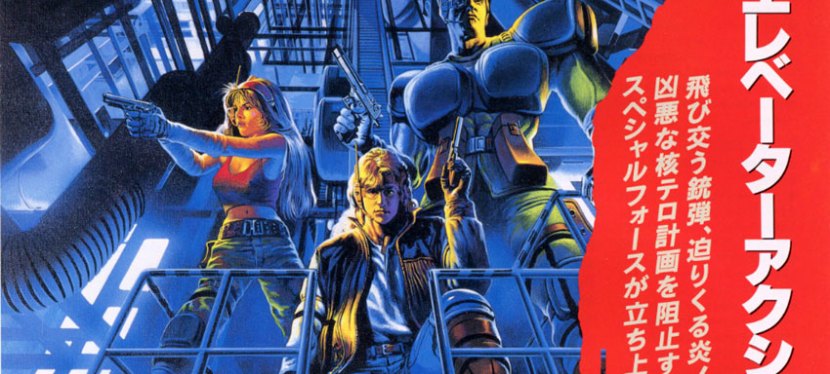
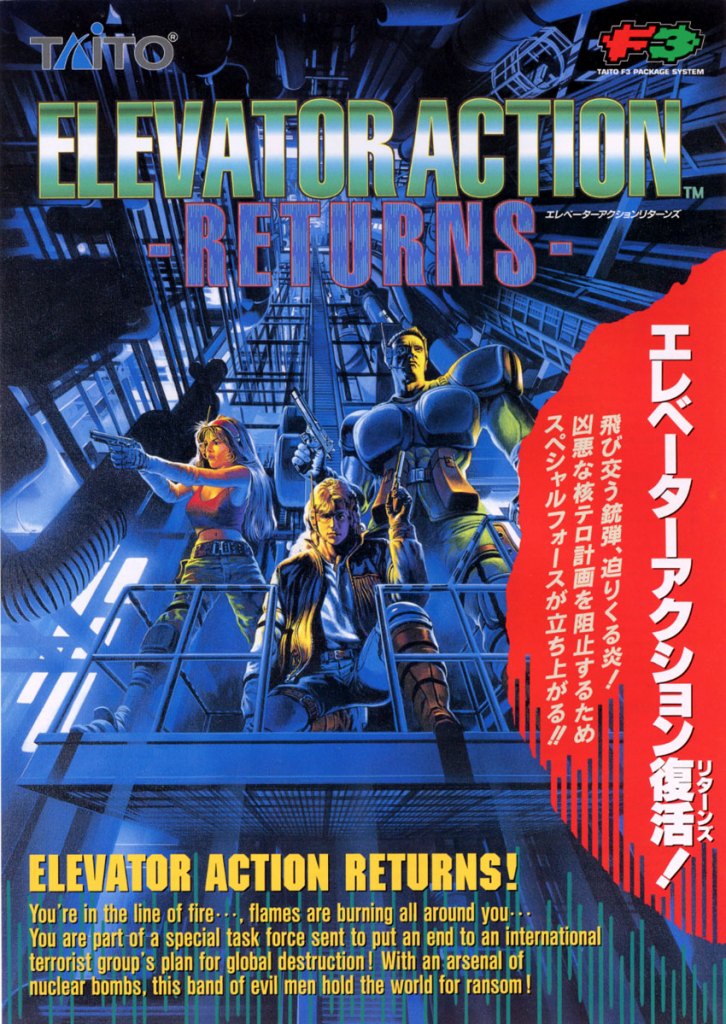
5. Elevator Action Returns Japanese arcade flyer

Great looking art on the front.
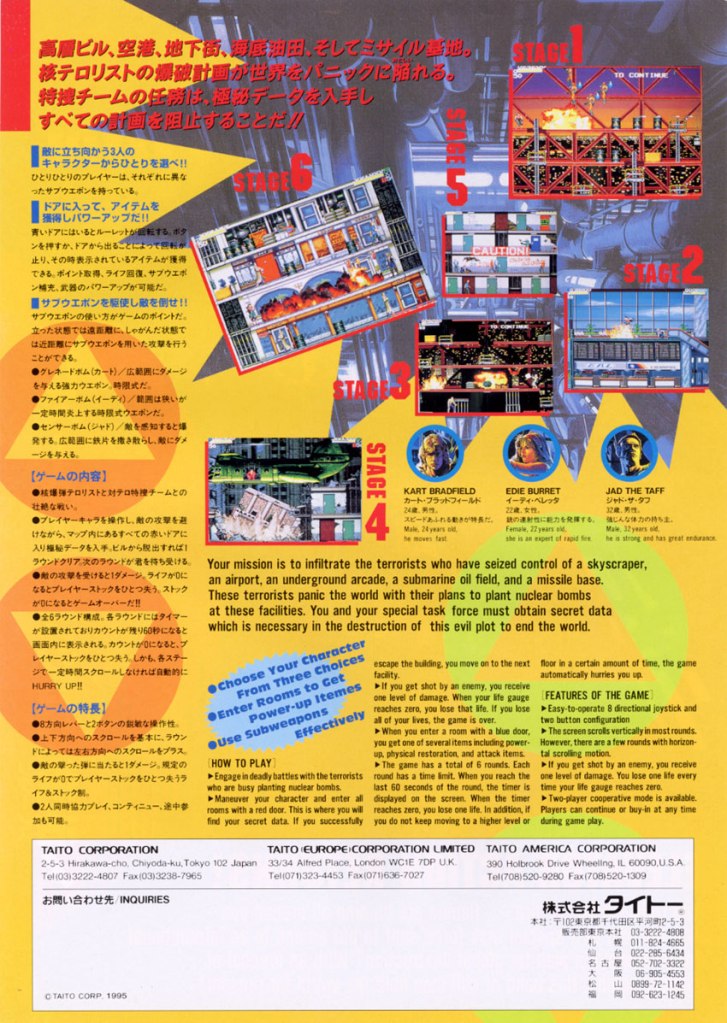
The rear of the flyer.

When Taito released Elevator Action Returns (also titled as Elevator Action II in other nations) in the arcades in 1994, it became a hit as gamers enjoyed its action-packed gameplay, ambitious 2D visual presentation and varied level designs that clearly went beyond its 1983 predecessor. The front of the Japanese arcade flyer has really nice art showing the three playable protagonists on an elevator on their way to do their mission. The back of the flyer shows screenshots (which emphasized the varied level designs), text descriptions explaining how the game played (English version printed), and what the features are. Another text description confirmed that terrorists are the antagonists that players will be dealing with which was reflective of the rise of Islamic terrorism in the 1990s. Oh yes, if you look closely you will the word “item” misspelled as “items”.

6. Sunset Riders print ads

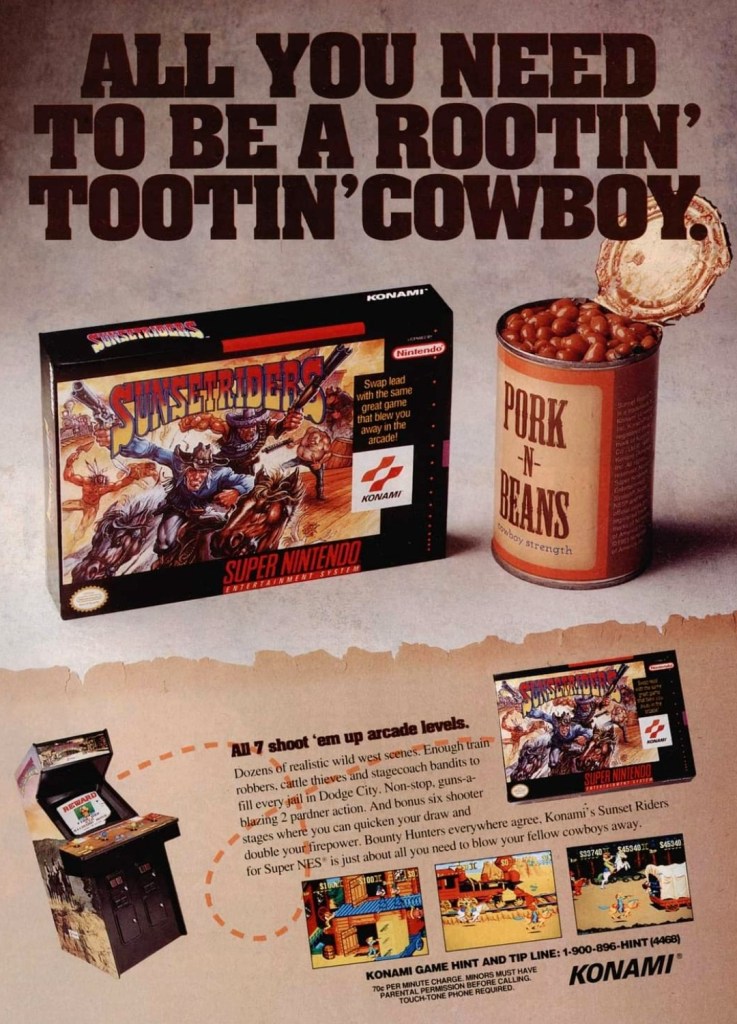
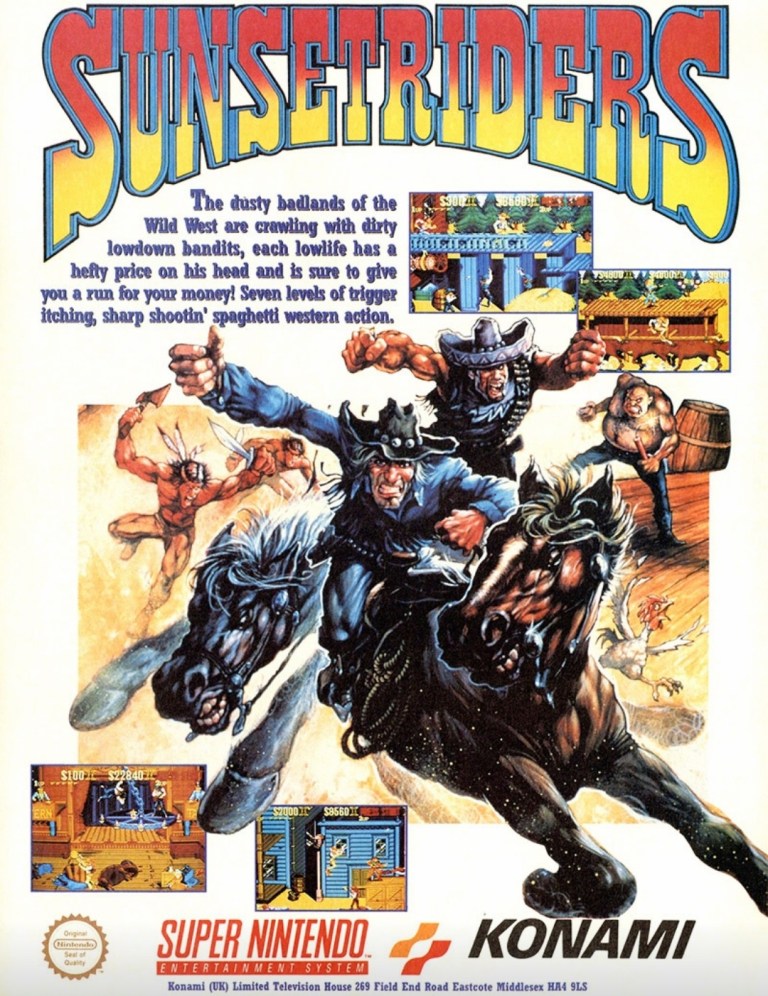
The Sunset Riders arcade machine, the SNES version, screenshots and a can of pork-and-beans on this ad.
This print ad appeared in some comic books I read long ago.

After enjoying a lot of success in the arcades with their 1991 game Sunset Riders, Konami went on to release ports of it to the Sega Genesis in 1992 and the Super Nintendo Entertainment System (SNES) in 1993. With regards to conversions and procedural/artistic changes between the arcade and console ports, the SNES version had few changes implemented compared to the one released on the Genesis. As seen in one of the print ads of Sunset Riders on SNES, it came with 7 arcade levels, 2-player mode and additional shooter stages. What the print ads did not reveal were notable replacements of specific characters in key parts of the game such as the dynamite-tossing female bandits getting replaced by male bandits, North American Indian villains getting replaced with outlaws, etc.  

7. Jackal Japanese arcade flyer

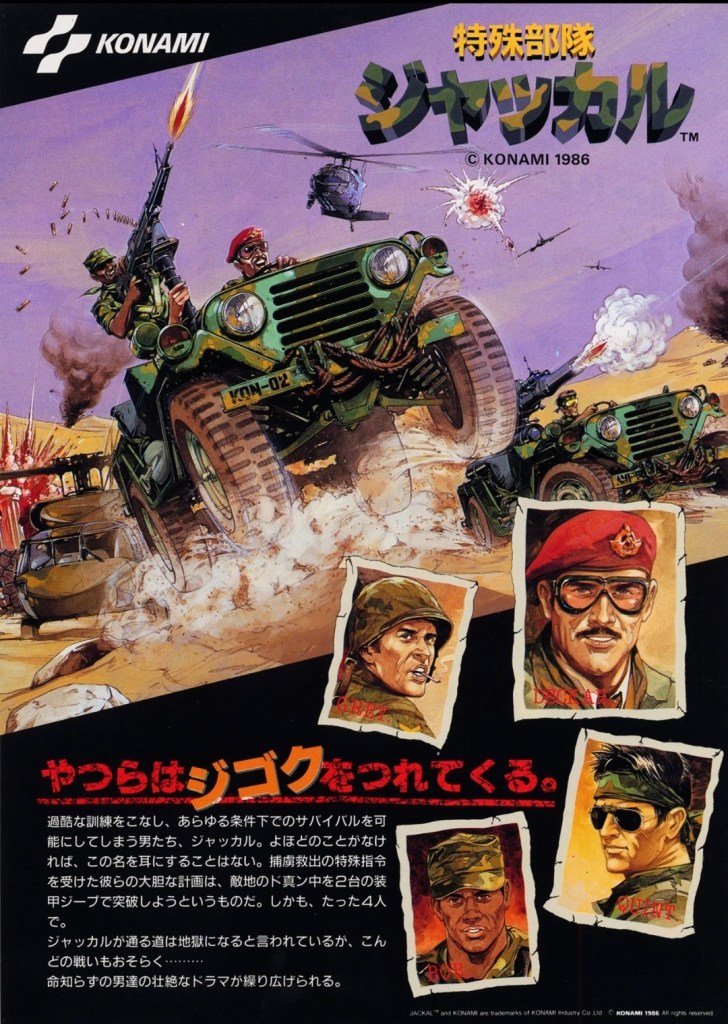
Whoever was the artist Konami hired truly delivered great-looking art!

Konami’s military themed game Jackal (Japanese title: Tokushu Butai Jackal) debuted in Japanese arcades in October 1986 and became a hit. The Japanese market arcade flyer had great looking artwork on the front that strongly emphasized the very concept of the game (players move military jeeps to shoot at enemies as they move into enemy territory). One of the characters (the one wearing the red beret) somewhat resembles the late Sean Connery which only shows that someone within Konami’s development team took inspiration from movies. This arcade flyer’s front still looks great.

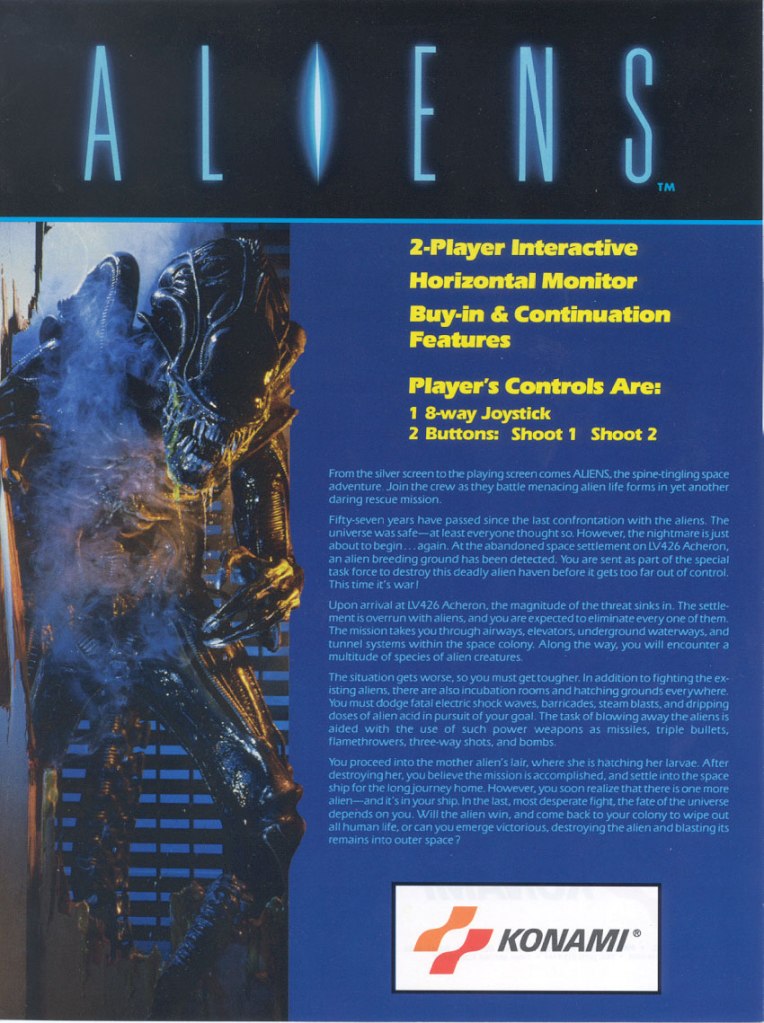
8. Aliens North American arcade flyer

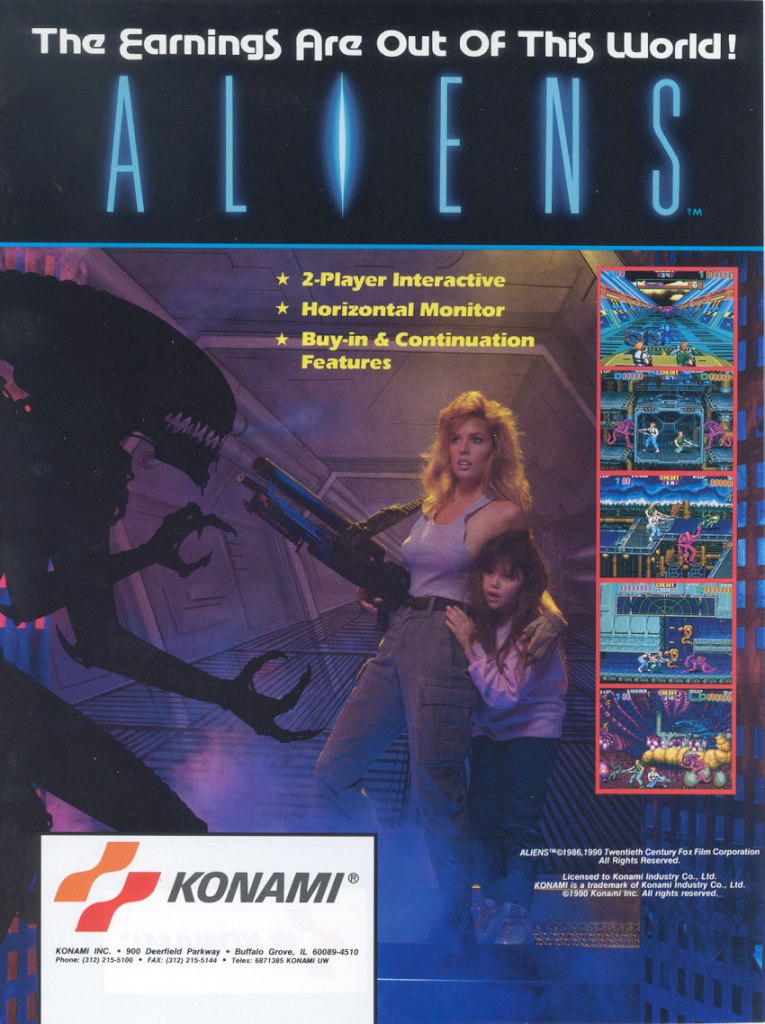
A good amount of effort was done to truly capture Aliens’ concept using hired models (as Ripley and Newt), a Xenomorph physical model and a suitable background.
The key details presented on the rear of the flyer. The Xenomorph’s presence adds tension.

In 1990, Konami released their ambitious arcade game Aliens which was loosely based on the 1986 movie that starred Sigourney Weaver and was directed by James Cameron. As Konami’s Aliens license was only temporary and the movie was so highly regarded, the Japanese company’s marketing team really had to exert extra effort to truly capture the film’s sci-fi horror concept in order to make a strong presentation towards arcade operators and their paying customers (the gamers).

Apart from showing screenshots on the front, the creative team hired a blonde model as Ellen Ripley holding a gun and a young girl as the character Newt, and have them pose convincingly in front of a Xenomorph model (darkened in the foreground). On the back of the flyer, the team heavily revealed the details using the text description to emphasize the gaming experience and story concept. The technical details, meanwhile, were presented in simplistic, easy-to-follow fashion. Aliens was a smash hit in the arcades and there are long-time gamers who regard it as one of the best game adaptations of the 1986 movie. This arcade flyer is a strong reminder that the featured game was never ever ported to any game console nor to any personal computer.

+++++

Thank you for reading. If you find this article engaging, please click the like button below, share this article to others and also please consider making a donation to support my publishing. If you are looking for a copywriter to create content for your special project or business, check out my services and my portfolio. Feel free to contact me with a private message. Also please feel free to visit my Facebook page Author Carlo Carrasco and follow me on Twitter at  @HavenorFantasy as well as on Tumblr at https://carlocarrasco.tumblr.com/ and on Instagram at https://www.instagram.com/authorcarlocarrasco
Retro Gaming Ads Blast – Part 15

Welcome back readers, fellow geeks and electronic gaming fans!

In this edition of the Retro Gaming Ads Blast (RGAB) series, we will take a look at another batch of retro gaming print ads – including arcade flyers – from the 1980s and 1990s.

For the newcomers reading this, Retro Gaming Ads Blast (RGAB) looks back at the many print ads of games (console, arcade, computer and handheld) that were published in comic books, magazines, flyers and newspapers long before smartphones, social media, the worldwide web and streaming became popular. To put things in perspective, people back in the 1980s and 1990s were more trusting of print media for information and images about electronic games and related products.

With those details laid down, here is the newest batch of retro gaming print ads for you to see and enjoy…

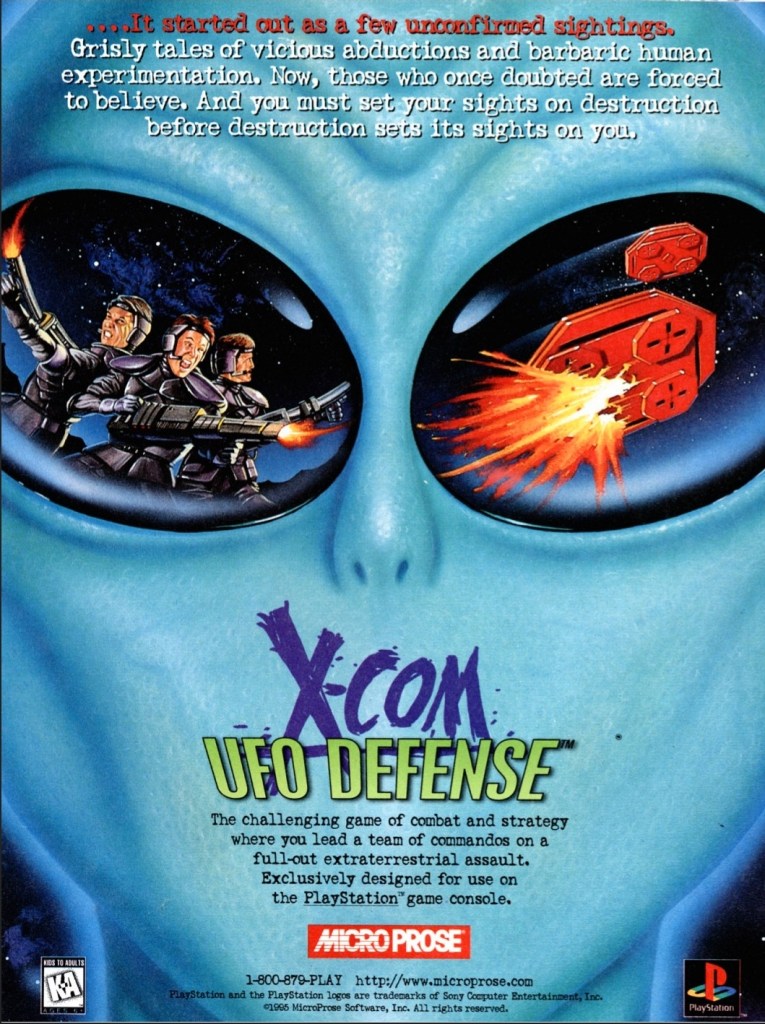
1. X-COM: UFO Defense print ad

While there were no screenshots of the game for PlayStation, the art here was enough to catch your attention.

Back in 1994, X-COM: UFO Defense (original European title: UFO: Enemy Unknown) became an unexpected hit with PC gamers as it gathered lots of positive reviews from the critics and sold a lot on the PC DOS (disk operating system) format. In an obvious attempt to continue the commercial success, a port of the game was released for the PlayStation console in 1995. Publisher MicroProse and its marketing partners came up with this eye-catching print ad to promote the PlayStation version. While no screenshots were shown, the artwork used turned out to be effective in catching attention while emphasizing the sci-fi concept of the game.

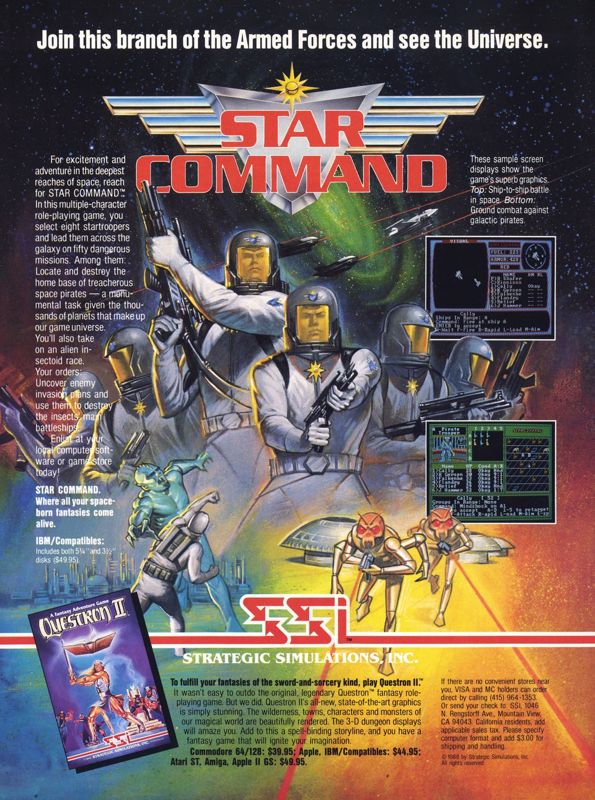
2. Star Command print ad

Long before Starfield, there was Star Command.

Way back in 1988, I first saw my friends play the sci-fi role-playing game (sci-fi RPG) Star Command on the PC DOS format. A short time later, I played the game on our home computer and finished the single-player campaign. This print ad, which has lots of descriptive text, has a strong visual presentation that entices players to play the game and discover the vast amount of content (space travel, missions, battles, encounters with aliens) that the game developers prepared. For its time, the Star Command print ad was captivating to look at.  

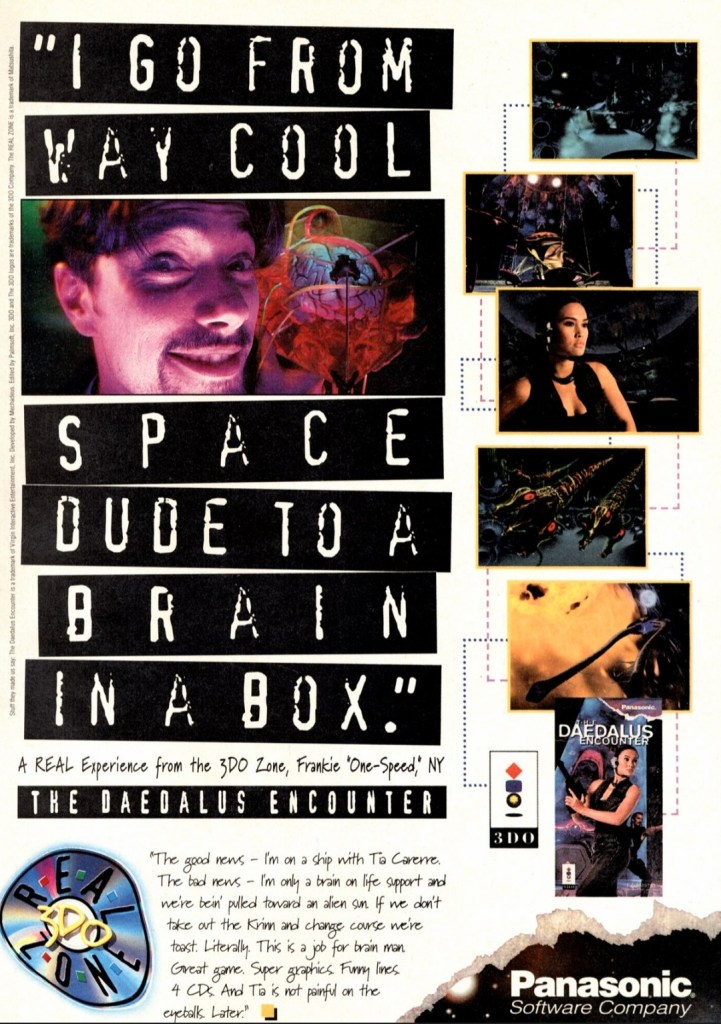
3. The Daedalus Encounter print ad

This print ad was an attempt to catch the attention of both gamers and people who want to watch live-action spectacle.

Released on PC, Macintosh and the 3DO game console in 1995, The Daedalus Encounter was a sci-fi video game that worked as an interactive movie (with puzzles) starring Tia Carrere. To promote the 3DO version, publisher Panasonic came up with an ad that emphasized the sci-fi concept and the cinematic experience (including a few stills of cutscenes) leaving little room about how the game plays. Take note that this game was released at a time when the CD-ROM format started gaining popularity as a reliable optic media format which opened opportunities for game companies to include full-motion videos.

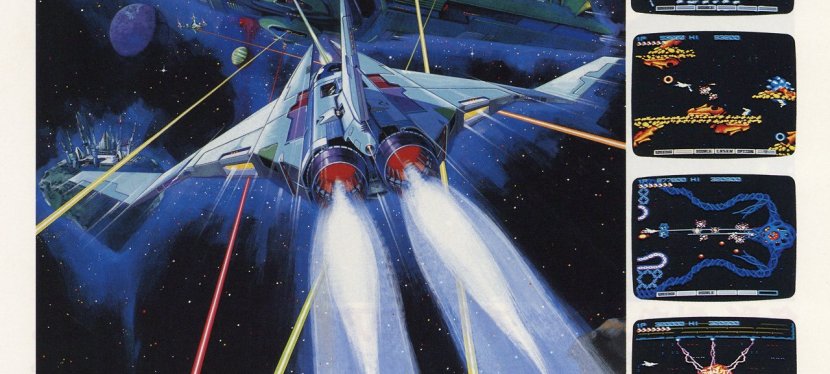
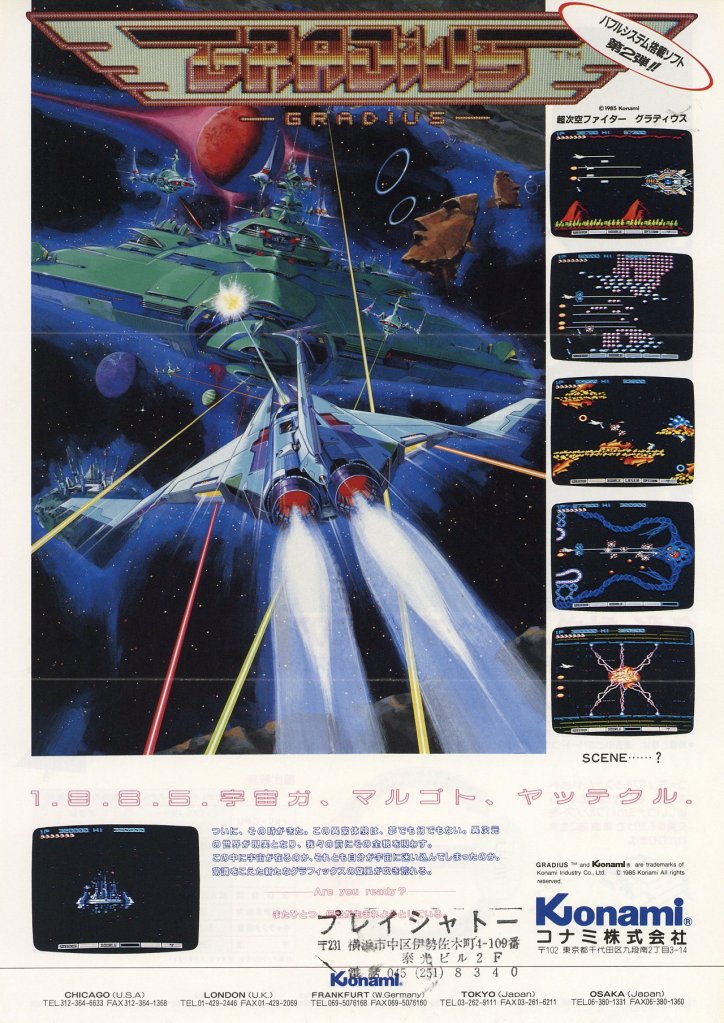
4. Gradius Japanese arcade flyer

The original Gradius has always been fun to play and the enjoyment also made it on game consoles as more games were released.

Still on the realm of sci-fi, Konami launched their 2D side-scrolling shooter Gradius in the arcades in Japan in 1985. The arcade flyer here used a huge amount of space for the game’s official artwork which is very captivating to look at as it clearly emphasized the sci-fi concept. On the side are five screenshots that tell gamers what to expect when playing. The promotions paid off nicely for Konami as Gradius became an instant hit in Japanese arcades and eventually found strong commercial success in the arcades in Europe and America. By today’s standards, this game is a classic and the Gradius game franchise has produced several sequels and spin-offs released on multiple platforms.

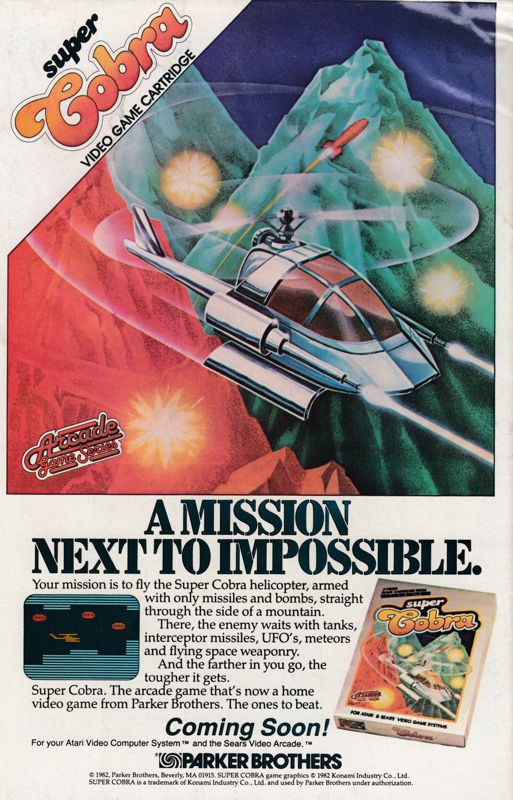
5. Super Cobra print ad

This ad I saw while reading comic books long ago. The game itself was fun.

Here is a game I played on the Atari 2600 over forty years ago. Super Cobra was a 2D side-scrolling game in which players control an armed helicopter that has to move from left to right, attacking enemies, and avoiding enemy projectiles while maintaining the fuel supply. This ad, which appeared on some comic books I read, utilized the game art that was used on the box cover although the single screenshot displayed looks exaggerated when compared to what I saw and played.

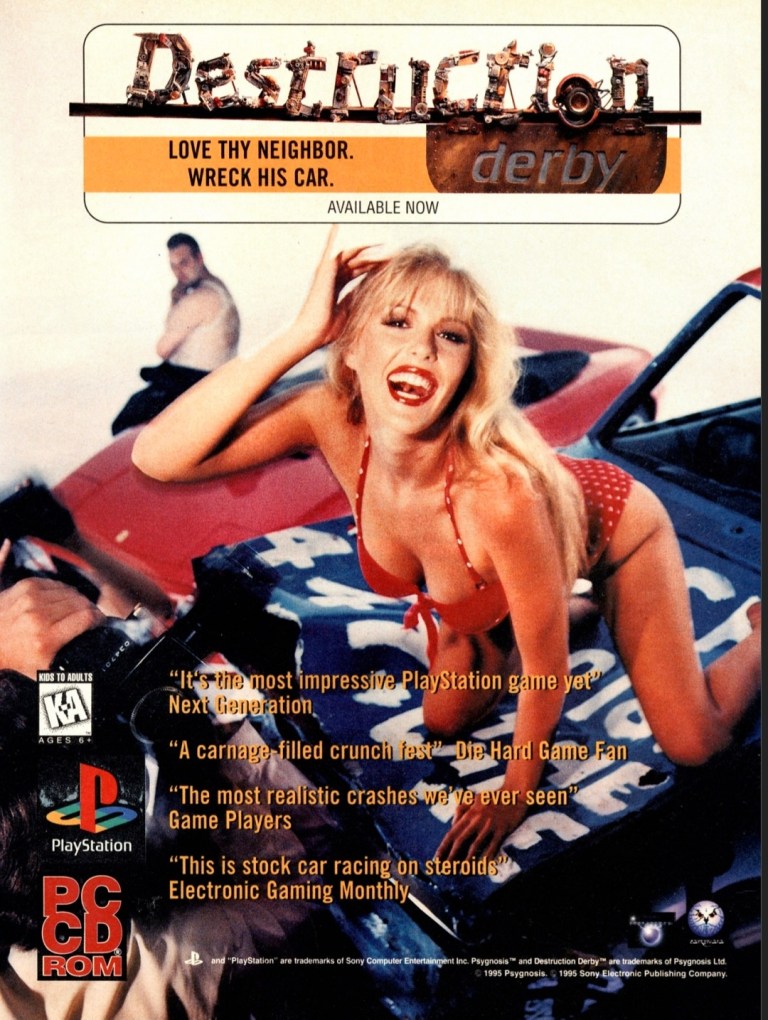
6. Destruction Derby print ad

The Destruction Derby print ad that had no screenshots of the game.

In 1995, Sony launched the PlayStation console in America and in Europe. In Europe, publisher Psygnosis promoted their ambitious game Destruction Derby (a 3D polygonal racing game that emphasized vehicular damage) for both PlayStation and the PC that same year. As this Destruction Derby print ad did not show any screenshots, Psygnosis and their marketing team or partner decided to pounce on positive gaming media quotes and the sexy model to promote their game. Their marketing move paid off nicely as over a million copies of Destruction Derby were sold by August 1996.

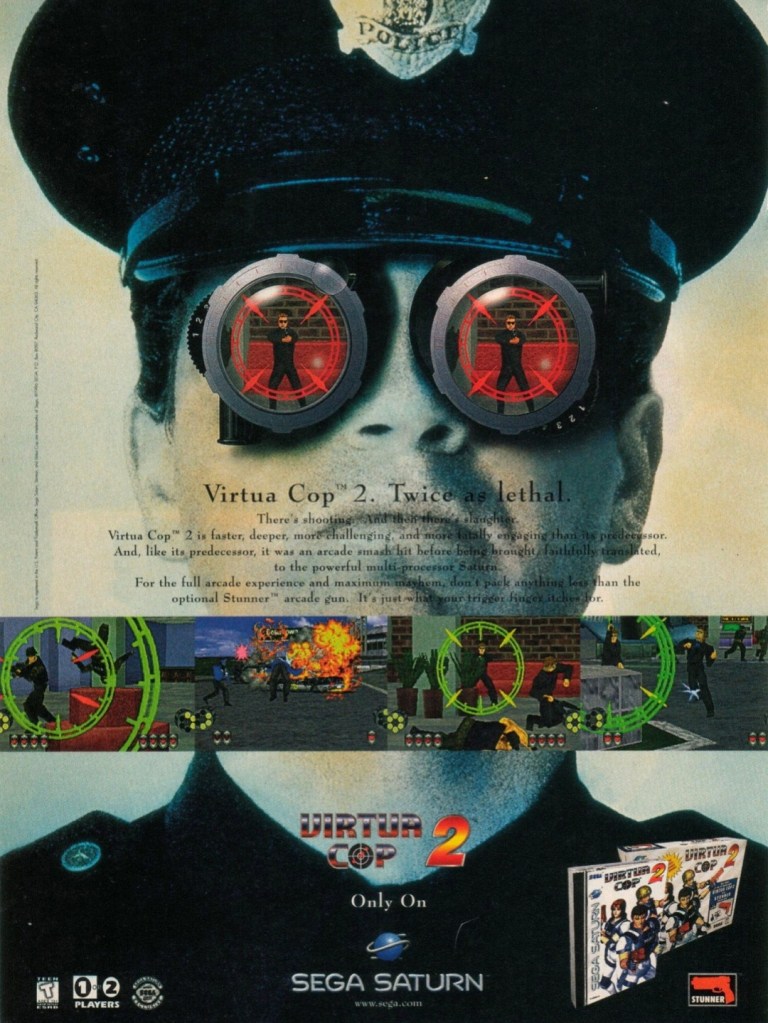
7. Virtua Cop 2 print ad

A lot of people found this Virtua Cop 2 print ad looking very weird.

When Sega of Japan forced its American division to launch the Sega Saturn console in the United States in 1995 without any pre-release marketing, it resulted in a series of disappointments that include low sales, too few games launched and strained ties with their business partners. In 1996, Sega started to become more aggressive to sell more Saturn units and more 1st party exclusive games such as Virtua Cop 2 (for the Saturn) which itself was a big hit arcade hit. As the company clearly aimed to make the console version of Virtua Cop 2 a hit, they approved this print ad which had a very intriguing visual concept showing video game images reflected on the glasses on the police man. As Virtua Cop 2 required a light-gun peripheral to be played accurately like in the arcade, this print ad utilized very little space for the Sega Saturn Stunner.

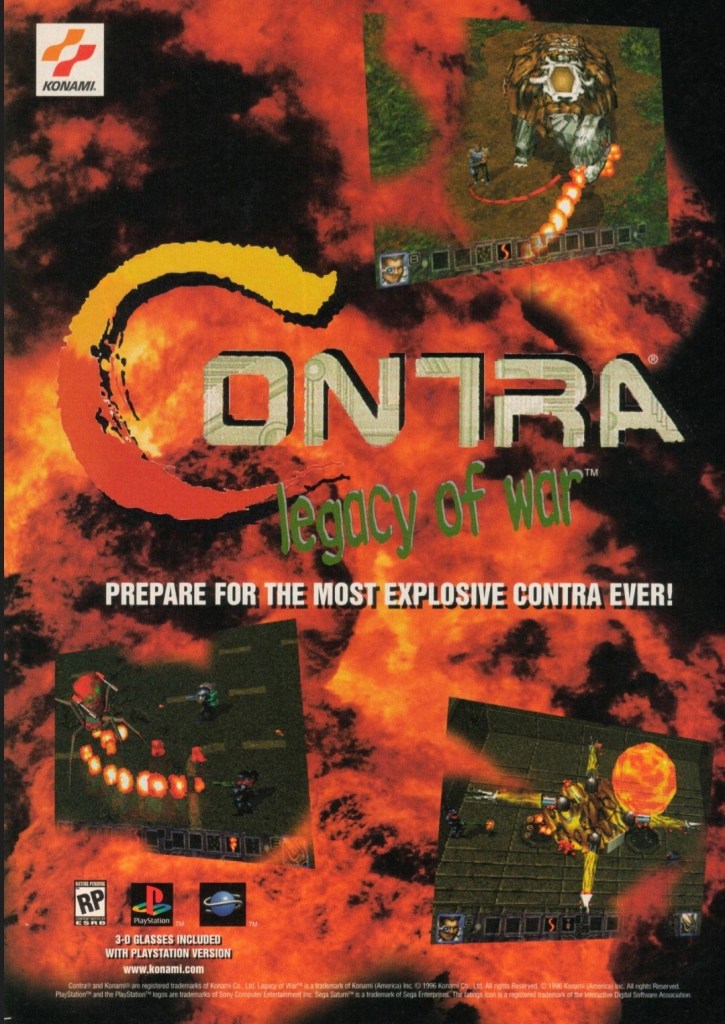
8. Contra: Legacy of War print ad

The print ad of Contra: Legacy of War.

When I first heard that a brand new game of Contra would be released on the still-new PlayStation and Sega Saturn in the mid-1990s, I was excited as I always enjoyed the original game I played on the Family Computer. This print ad of Contra: Legacy of War brought my excitement way down as it showed that the game no longer utilized the 2D side-scrolling design and came up with a design that emphasized 3-dimensional environments and polygons. The change in design was too alienating for me as all the previous Contra games had the 2D side-scrolling format as the main designs (leaving little room for the occasional sprite-scaling 3D sequences in some games). I finally played Contra: Legacy of War on PlayStation on November 1996 and it was a huge letdown!

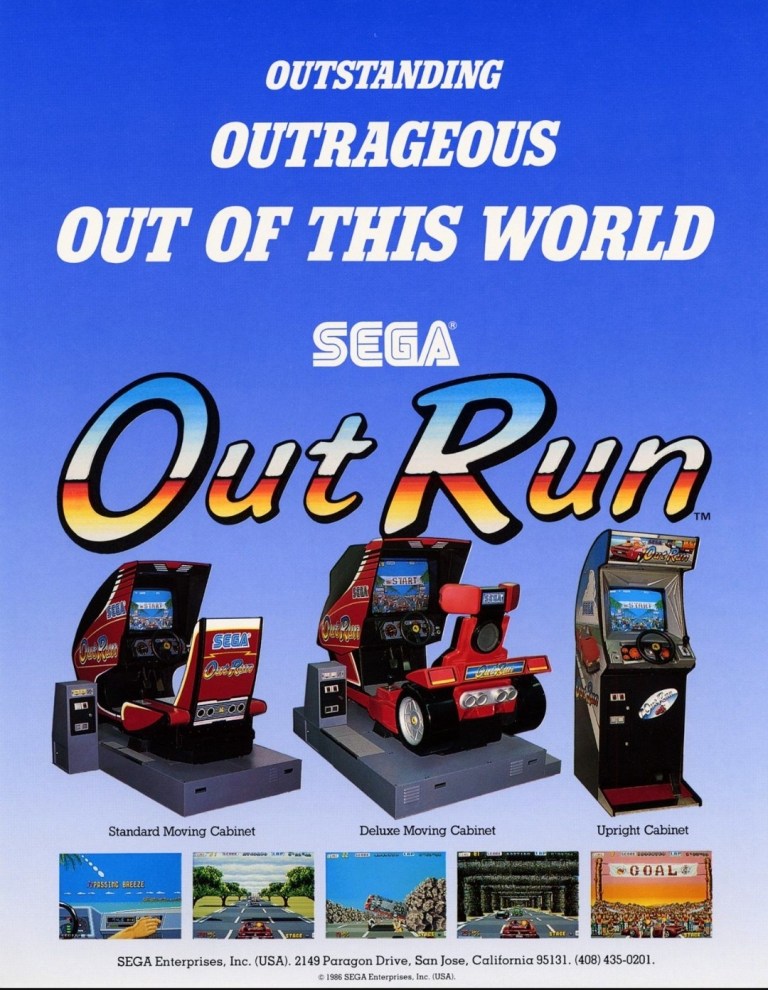
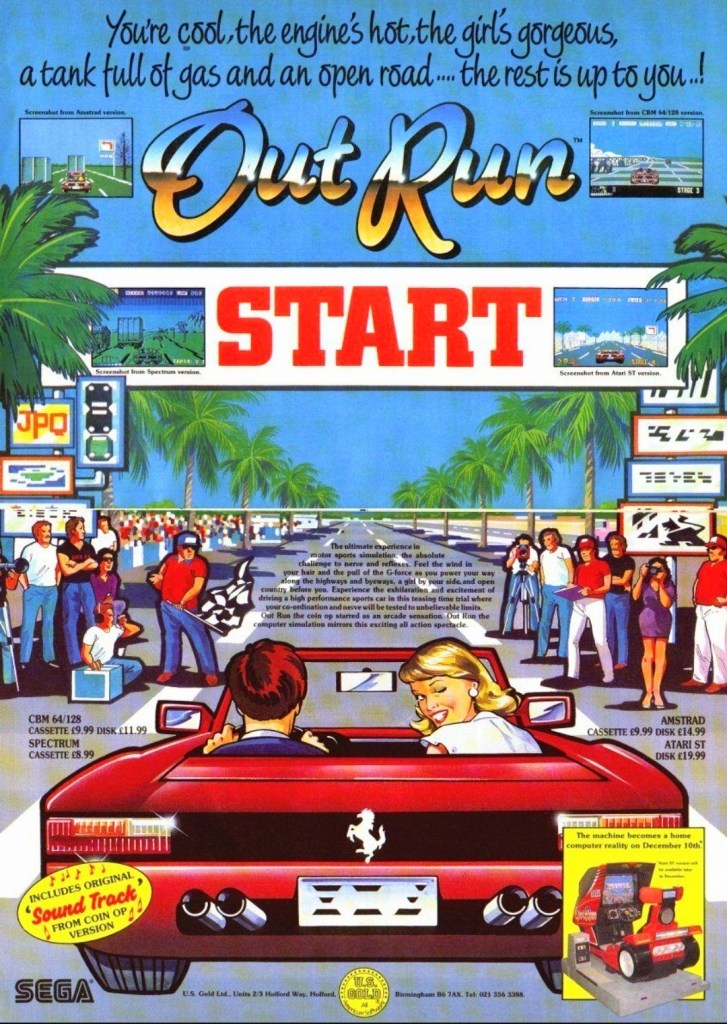
9. Out Run arcade flyers

Sega Out Run arcade machines in different forms.
This Out Run flyer really has nice art.

In the history of arcade games, Sega’s Out Run was a massive success not only in Japan but also in America and Europe. Designed by Yu Suzuki (Virtua Fighter, Shenmue), Out Run was a pseudo-3D driving game in which players get to drive a Ferrari Testarossa convertible (which is always visible to the player) from one scenic destination to the next avoiding traffic as much as possible. This was indeed a labor of love on the part of Yu Suzuki who himself spent time in Europe to gain inspiration on designing the game. As Out Run was a hit, Sega made different types of machines of the game that arcade operators can choose from depending on how much space their respective arcades have left and how the local players prefer to play it. It should be noted that in one of the flyers above, the original sound track was promoted as well.

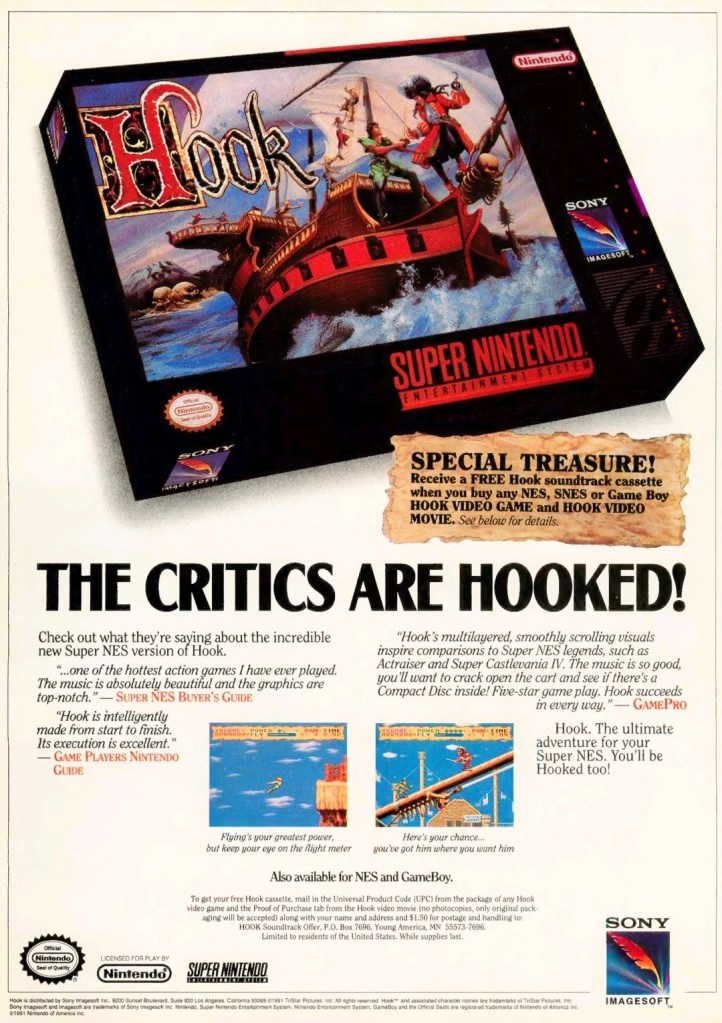
10. Hook SNES version print ad

If you look closely at the SNES box front cover art, you will notice that Peter Pan and Captain Hook looking nothing like the actors who portrayed them in Steven Spielberg’s movie.

In late-1991, Steven Spielberg’s movie Hook was released in cinemas and revived public interest in the fairy tale of Peter Pan. Typical of the entertainment business of the time, video games based on the movie were released on different platforms in 1992 and among them was a version on the Super Nintendo Entertainment System (SNES). Apart from showing the game’s box, the print ad of Hook on SNES cleverly included positive quotes from GamePro, Game Players Nintendo Guide and the Super NES Buyer’s Guide to convince readers that the game is worth their time.

+++++

Thank you for reading. If you find this article engaging, please click the like button below, share this article to others and also please consider making a donation to support my publishing. If you are looking for a copywriter to create content for your special project or business, check out my services and my portfolio. Feel free to contact me with a private message. Also please feel free to visit my Facebook page Author Carlo Carrasco and follow me on Twitter at  @HavenorFantasy as well as on Tumblr at https://carlocarrasco.tumblr.com/ and on Instagram at https://www.instagram.com/authorcarlocarrasco
Retro Gaming Ads Blast – Part 13

Welcome back readers, fellow geeks and electronic gaming fans!

In this edition of the Retro Gaming Ads Blast (RGAB) series, we will take a look at another batch of retro gaming print ads from the 1980s and 1990s. In addition, there will be a few flyers of arcade games.

For the newcomers reading this, Retro Gaming Ads Blast (RGAB) looks back at the many print ads of games (console, arcade, computer and handheld) that were published in comic books, magazines, flyers and newspapers long before smartphones, social media, the worldwide web and streaming became popular. To put things in perspective, people back in the 1980s and 1990s were more trusting of print media for information and images about electronic games and related products.

With those details laid down, here is the newest batch of retro gaming print ads for you to see and enjoy…

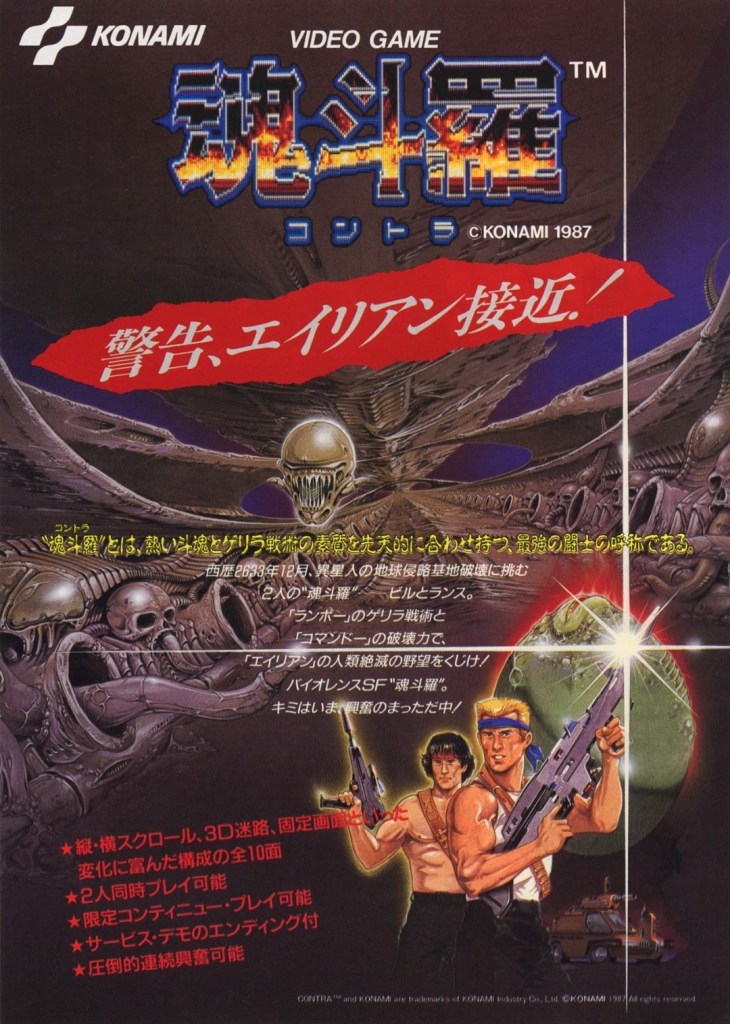
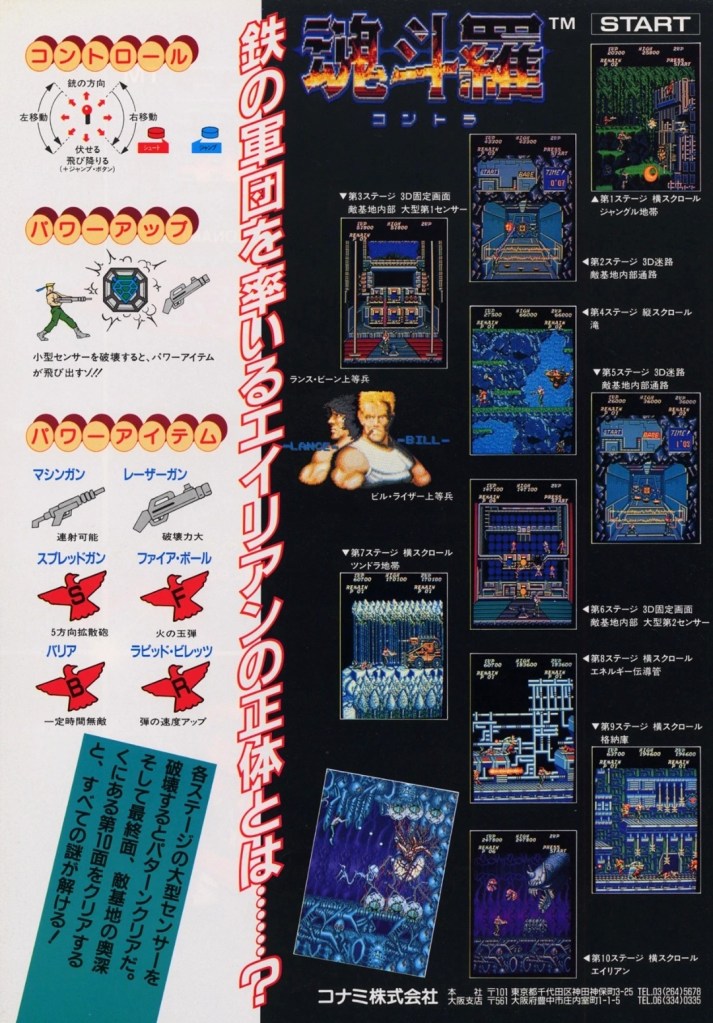
1. Japanese Contra arcade flyer

The front of the Japanese arcade flyer of Contra.
The other side of the flyer.

As mentioned before, Konami’s long-running Contra games franchise first started in the arcades in Japan. As seen in the Japanese arcade flyer, it was clear that the company not only had a clear vision of Contra’s visual concepts but also was pretty organized with explaining lots of details (examples: the 8-direction controls, types of weapons or ammunition available, level design differences) that both players and arcade operators can learn from. If you look closely at the rear of the flyer, you will see the two characters already identified as Lance and Bill which clearly showed the Japanese creators had the creative details really organized.

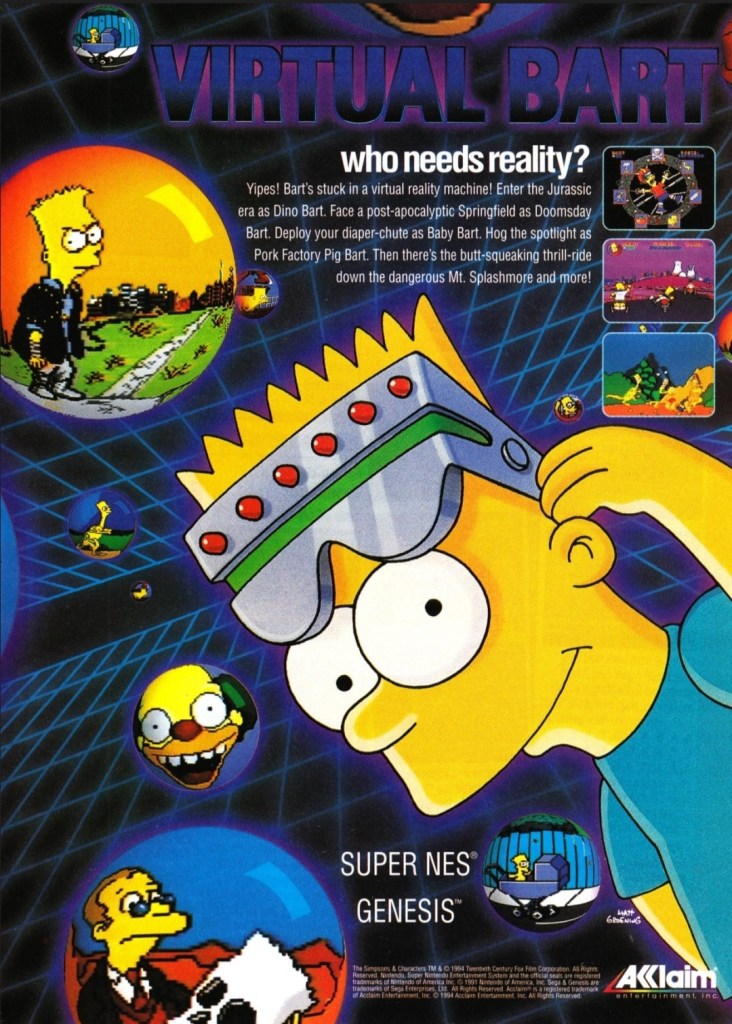
2. Virtual Bart print ad

Anyone who loved The Simpsons would easily recognize the characters of this print ad.

Decades ago, The Simpsons made big waves on television and quickly emerged as a fine addition to American pop culture. That being said, it was not surprising at all that video games based on the show got made and Virtual Bart was one of them. This Virtual Bart print ad appeared in some comic books I read in 1994 and the ad makers made efficient use of the single-page layout showing that the game was not a mere 2D side-scroller as its concept emphasized Bart Simpson’s virtual reality escapades. This game, which had mini-games and different gameplay styles, received review scores ranging from negative to positive.

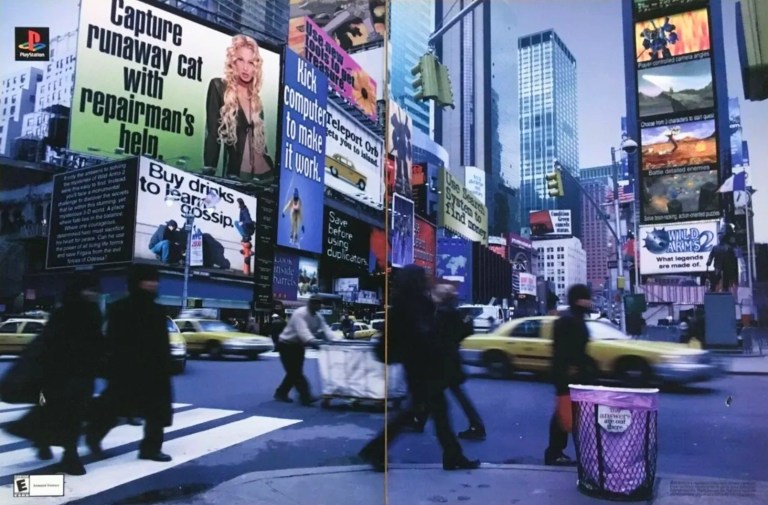
3. Wild Arms 2 print ad

This is NOT an effective way to promote a video game.

Now this is one of the most weird and the most uninteresting game print ads of the 1990s. For the newcomers reading this, Wild Arms 2 was a sequel to the 1997 hit game Wild Arms released on the original PlayStation console. Due to the 1997 game’s success, a fan base of Wild Arms was established and the 1999 sequel was anticipated by the fans. In a very odd and illogical move, Sony Computer Entertainment came up with the Times Square setting for Wild Arms 2’s North American print ad and because they allowed so much other text and images (appearing as billboard ads) on the buildings in the background, details about the game itself got overshadowed. By simply looking at this print ad, it is simply too easy to overlook Wild Arms 2 as the featured game. Can you see the references to Wild Arms 2 here?

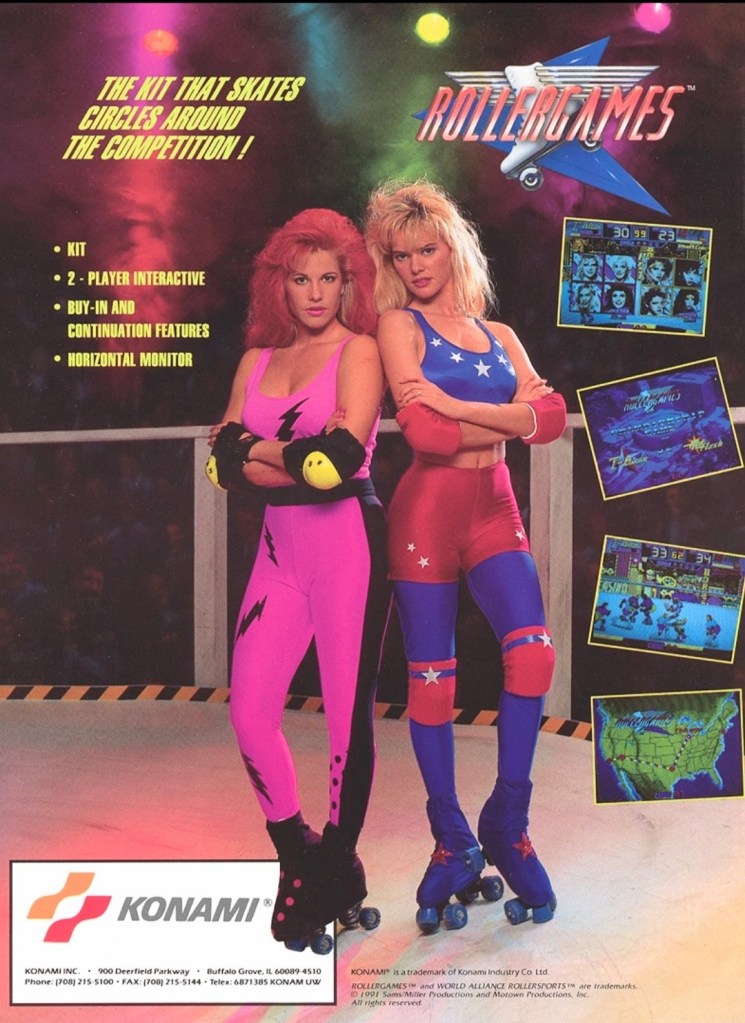
4. RollerGames arcade flyer

Pretty ladies posing on the front of the flyer.
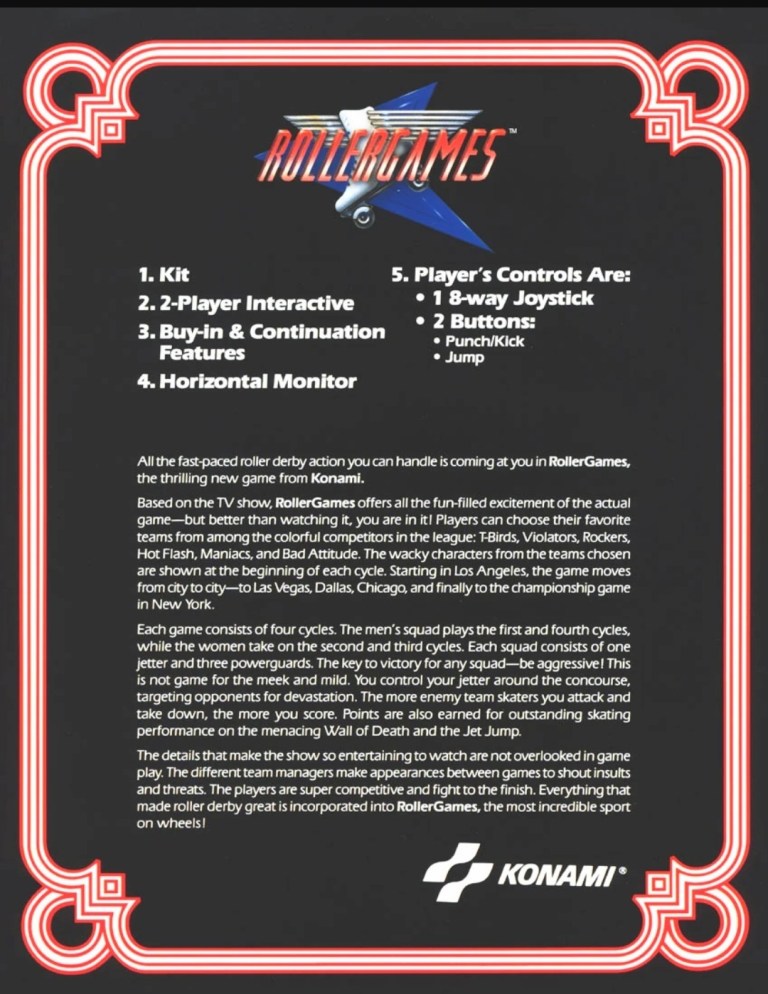
Clearly the details were prepared with arcade operators in mind.

Based on the competition-oriented TV show, the RollerGames arcade game from Konami was both unique and fun to play. As with their other arcade flyers, Konami hired models to emphasize RollerGames’ core concept by appearing in full costume (as roller-skating participants), and then inserted screenshots of the game. The rear of the flyer had the technical details in simplistic fashion and they were clearly written with arcade operators in mind. The 3-paragraph text descriptions emphasized what players could expect, what options are available and how the game connects with the TV program it was based on.

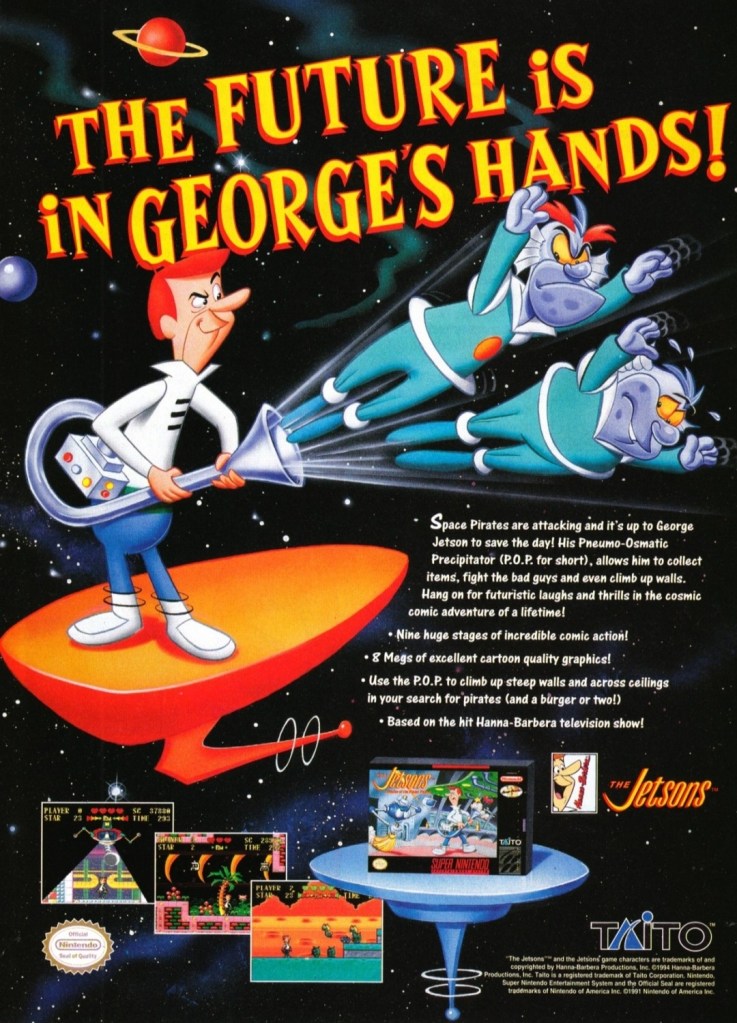
5. The Jetsons: Invasion of the Planet Pirates print ad

Anyone among you is a Jetsons fan?

Based on the animated series, The Jetsons: Invasion of the Planet Pirates was released on the Super Nintendo Entertainment System (SNES) in America as well as on the Super Famicom in Japan in the mid-1990s. This game’s print ad had eye-catching artwork, carefully laid down key details (including the promise of cartoon quality graphics) and showed a few screenshots. The game attracted mixed reviews from critics and I don’t know any fellow gamer who played it.

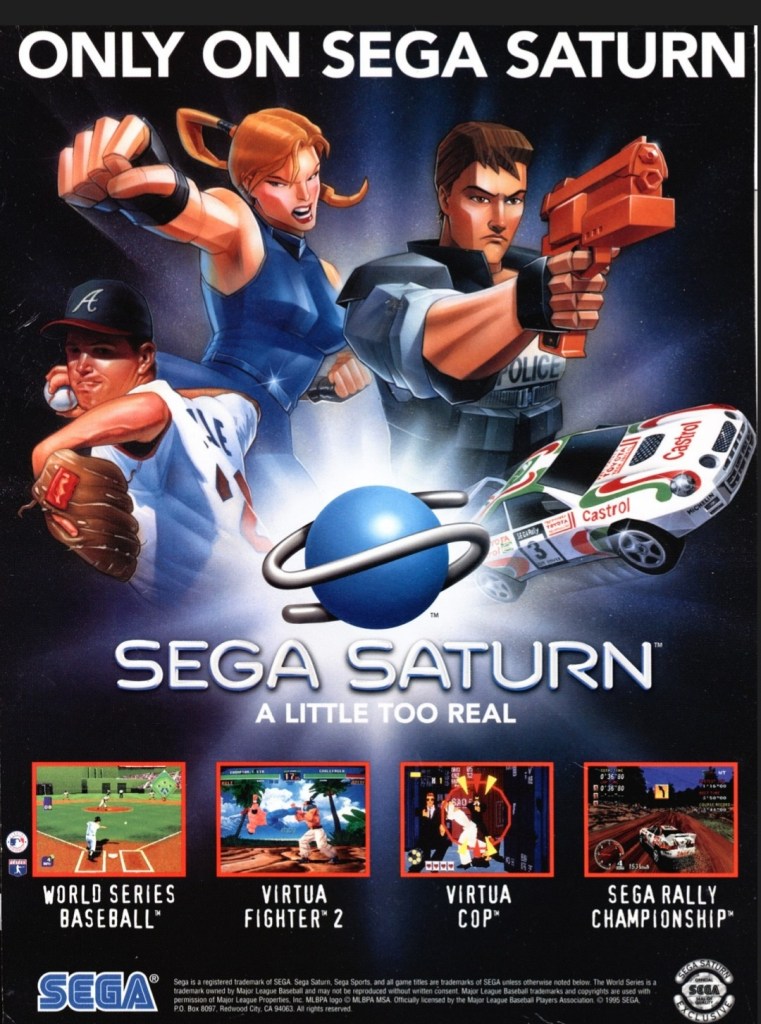
6. Sega Saturn games print ad

An aggressive single-page ad promoting the exclusive games on Sega Saturn.

If you are a game console manufacturer that also owns several game development teams, you really have to promote your hardware and software aggressively. This is exactly what Sega did in the North American market sometime after the embarrassing launch of the Saturn console there. As seen in this print ad, Sega aggressively promoted their Saturn-exclusive games – including their juggernaut Virtua Fighter 2 – to make it clear to their fans (and Saturn console owners) that they are focused to entertain them. The ad also served as Sega’s effort to lure in new gamers and potential Saturn owners given the fact that Virtua Fighter 2, Virtua Cop and Sega Rally Championship were already big arcade hits. As history turned out, the Saturn ended up a commercial disappointment in America but still succeeded in Japan.

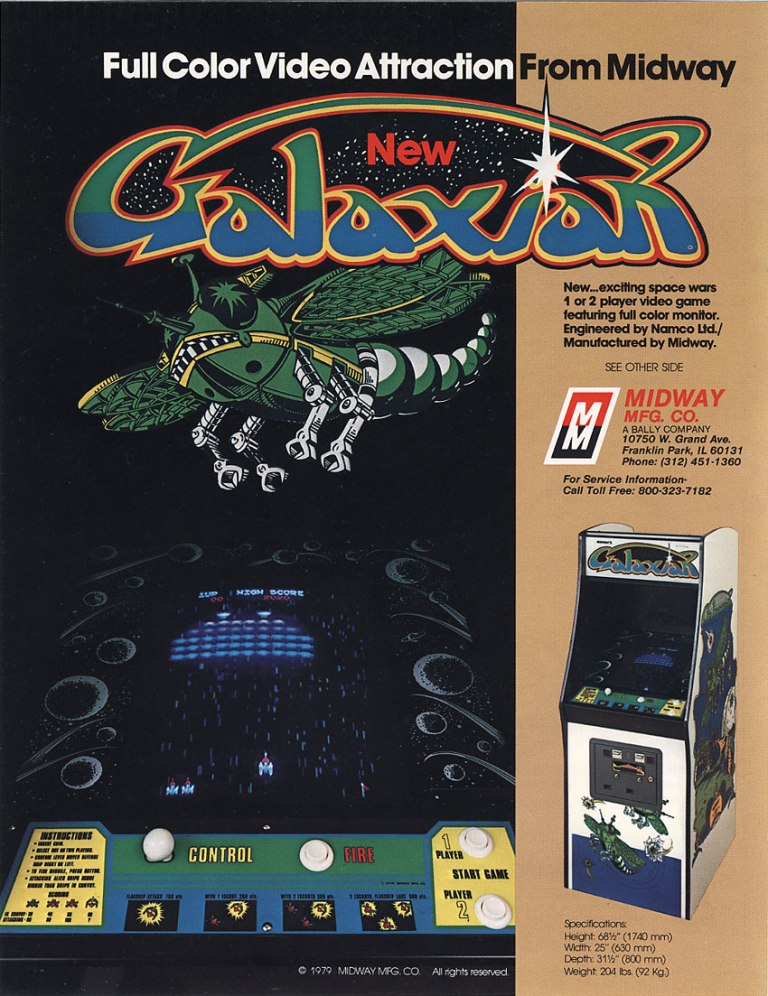
7. Galaxian arcade flyer

Have you ever played Galaxian in the arcades?

In September 1979, Namco released Galaxian in the arcades in Japan and it became a big hit there eventually finishing as the nation’s 2nd highest-earning arcade game of the year. Before the year even ended, Namco approached Midway of releasing Galaxian outside of Japan and this led to the game appearing in American arcades in November. Unsurprisingly, Galaxian drew lots of American players and their money which really helped Midway selling 50,000 arcade units in a few years’ time. This arcade flyer from Midway clearly showed what the Galaxian arcade unit looked like and how the controls were physically set up. I like the way the details and images were organized and how the limited page space was put to good use.

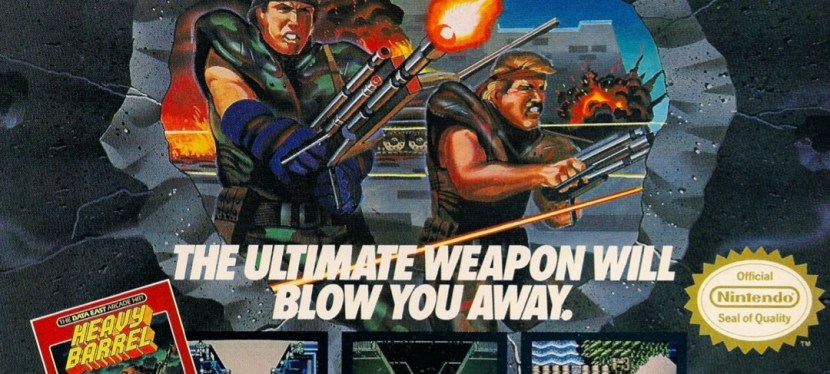
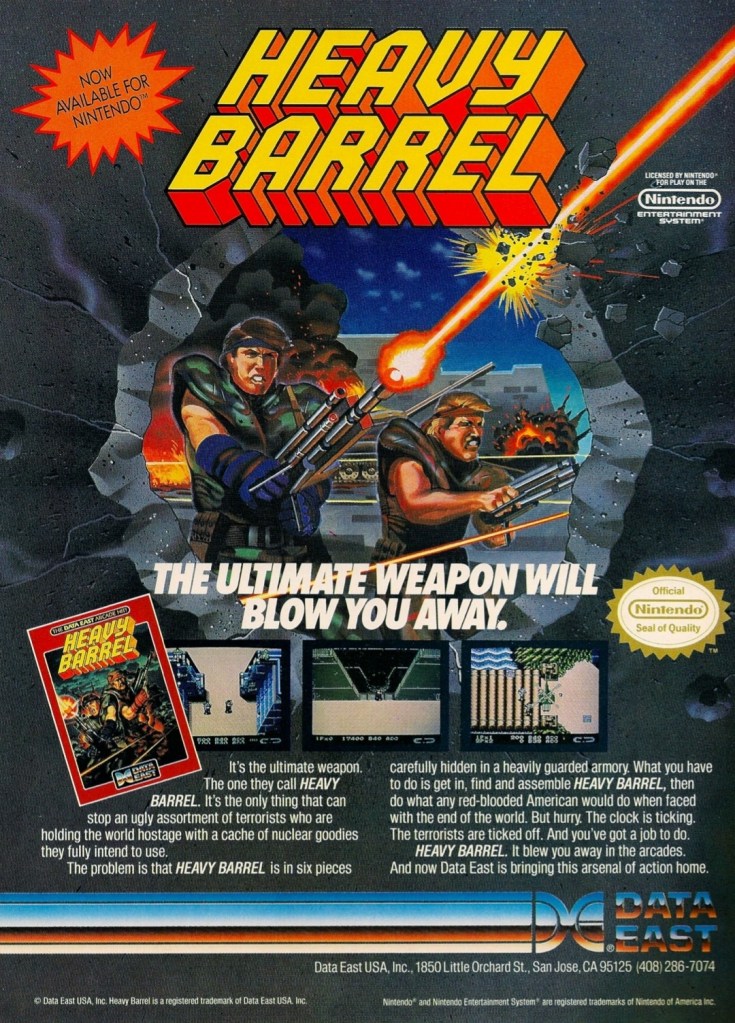
8. Heavy Barrel print ad

A really eye-catching and amusing print ad to look at.

Originally released in the arcades by Data East, Heavy Barrel was released on the Nintendo Entertainment System (NES) in 1990. Similar with Contra and Jackal, this game had a strong military theme and shooting-oriented gameplay complete with missions that instantly reminded players about war. The military aesthetic and the showing of guns are easily the most eye-catching part of this print ad geared towards the NES userbase which had lots of young children among the players. To say the least, Heavy Barrel’s print ad was entertaining to look at.

+++++

Thank you for reading. If you find this article engaging, please click the like button below, share this article to others and also please consider making a donation to support my publishing. If you are looking for a copywriter to create content for your special project or business, check out my services and my portfolio. Feel free to contact me with a private message. Also please feel free to visit my Facebook page Author Carlo Carrasco and follow me on Twitter at  @HavenorFantasy as well as on Tumblr at https://carlocarrasco.tumblr.com/ and on Instagram at https://www.instagram.com/authorcarlocarrasco
Retro Gaming Ads Blast – Part 12

Welcome back readers, fellow geeks and electronic gaming fans!

In this edition of the Retro Gaming Ads Blast (RGAB) series, we will take a look at another batch of retro gaming print ads from the 1980s and 1990s. In addition, there will be a few flyers of arcade games.

For the newcomers reading this, Retro Gaming Ads Blast (RGAB) looks back at the many print ads of games (console, arcade, computer and handheld) that were published in comic books, magazines, flyers and newspapers long before smartphones, social media, the worldwide web and streaming became popular. To put things in perspective, people back in the 1980s and 1990s were more trusting of print media for information and images about electronic games and related products.

With those details laid down, here is the newest batch of retro gaming print ads for you to see and enjoy…

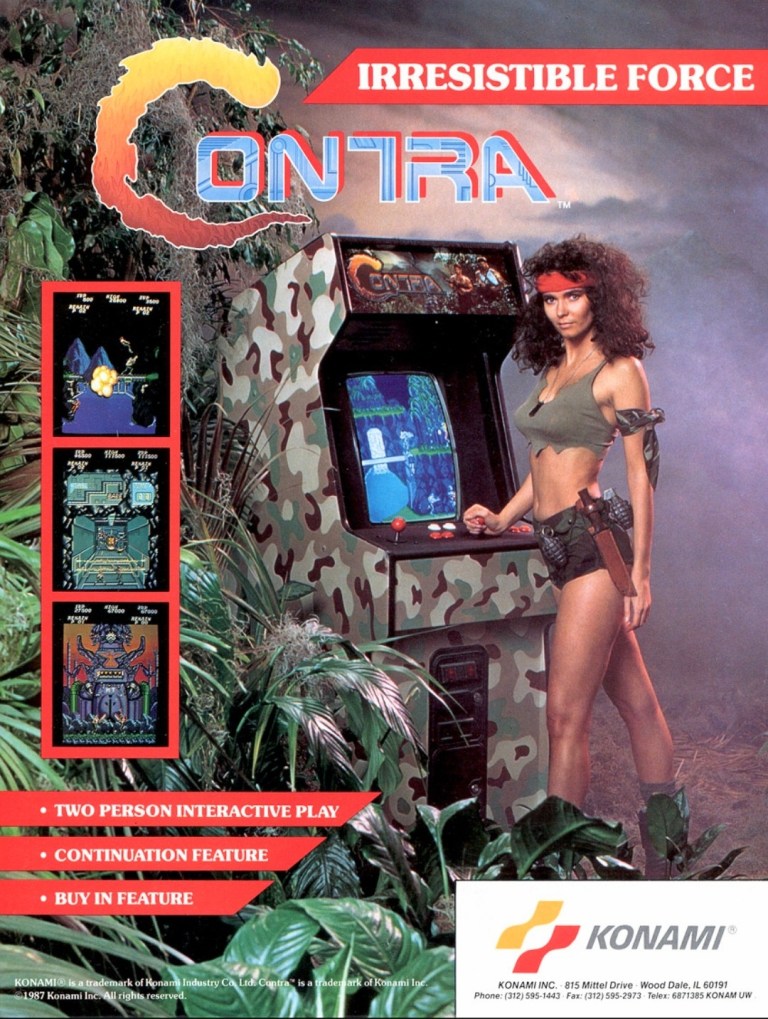
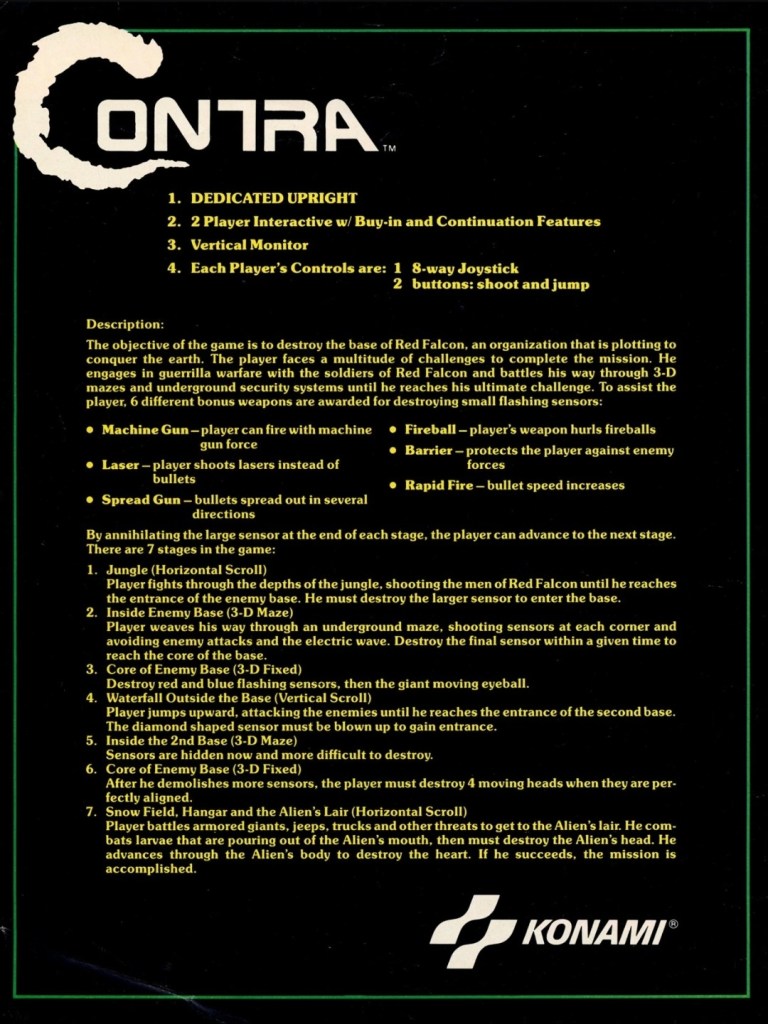
1. Contra arcade flyer

A clever visual concept by Konami towards gamers and arcade operators.
Details on the other side of the flyer.

Before it established itself as a popular gaming franchise with console gamers, Contra truly started in the arcades in 1987. First released in Japan on February 1987, Konami went on to release the game in arcades in the United States a month later and the flyer you see here was the Americanized promotion they came up with. Instead of hiring male actors or models to play soldiers, they hired a slim lady to appear with a female Rambo look standing in front of a Contra arcade machine. On the other side of the flyer are details that players and arcade operators can learn from. By today’s standards, this arcade flyer of Contra is still eye-catching and even amusing to look at.

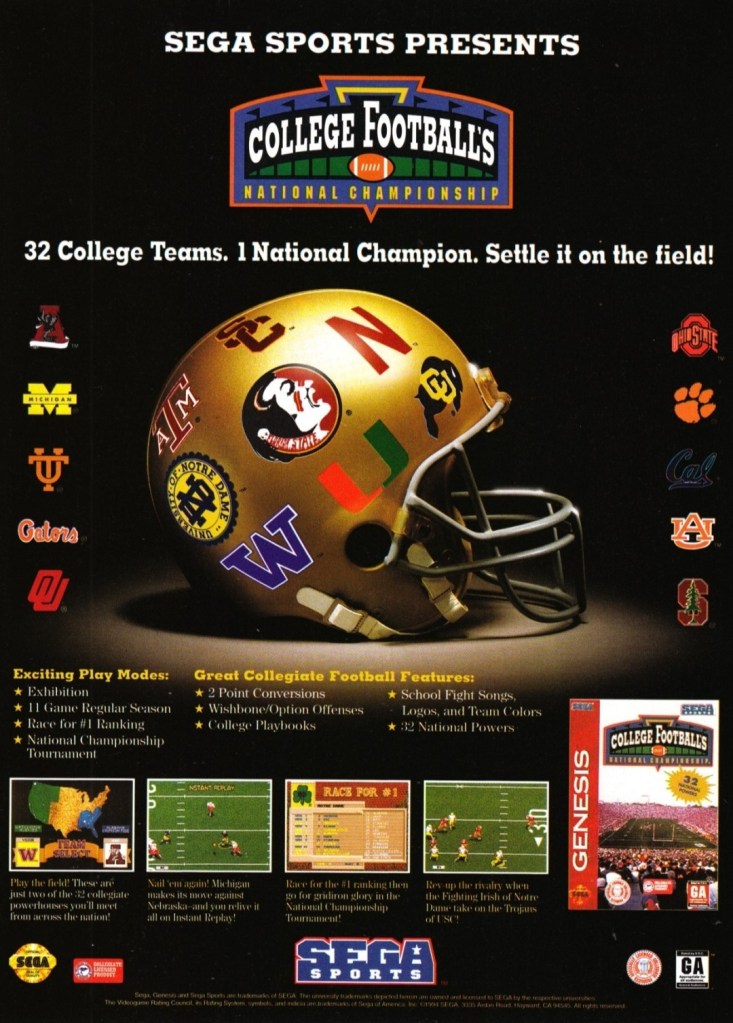
2. College Football’s National Championship print ad

This ad has a strong visual appeal to gamers who like football.

This is another one of those video game ads I saw while reading comic books in the 1990s. College Football’s National Championship was a Sega Genesis-exclusive American football video game published by Sega (with the Sega Sports brand) to capitalize on gamers who want college football to play with at home. This print ad has a nice visual presentation of the college teams’ logos, screenshots and details of what gamers could expect when they buy and play the game. College Football’s National Championship received mostly positive reviews and it must have sold well because Sega went on to release a sequel to this game.

3. Robotron X print ad

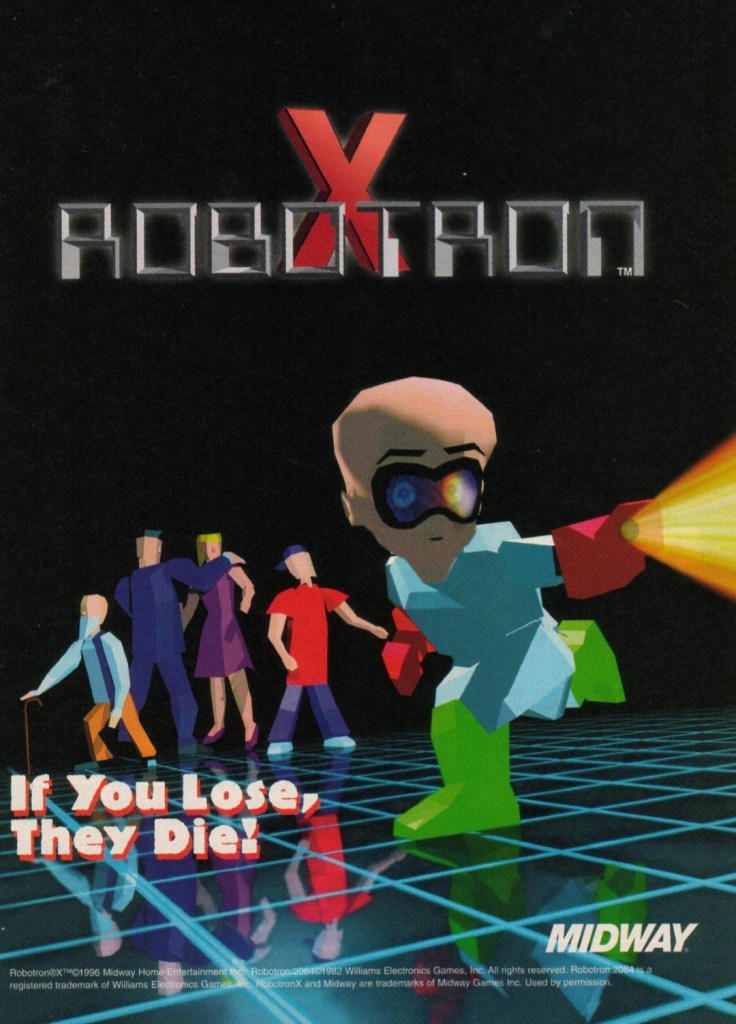
This Robotron game was made at a time when 3D polygons became common for making video games.

Having played the classic game Robotron: 2084 on PC back in the 1980s, I was very surprised to see this print ad in 1996 promoting a brand new Robotron game for PlayStation as well as Windows PC. For the newcomers reading this, Robotron: 2084 was a classic which heavily influenced game designers who went on make other fan-favorite games like Smash TV and Llamatron. What makes Robotron X notable apart from being an official follow-up to the classic game was the fact that it was made at a time when game developers did their stuff to modernize gaming with 3D polygons for visuals while trying to come up with gameplay inspired by the classics. While Robotron X did not make a major impact on gaming, the classic Robotron: 2084 went on to be released in several multi-platform compilations such as Williams Arcade’s Greatest Hits, Midway’s Greatest Arcade Hits, and Midway Arcade Treasures.

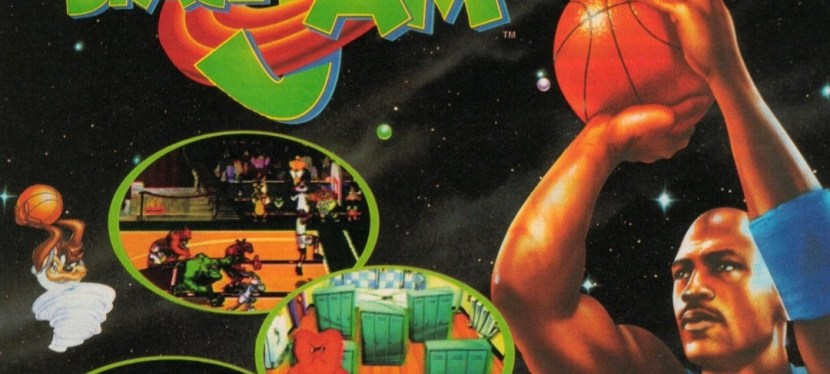
4. Space Jam game print ad

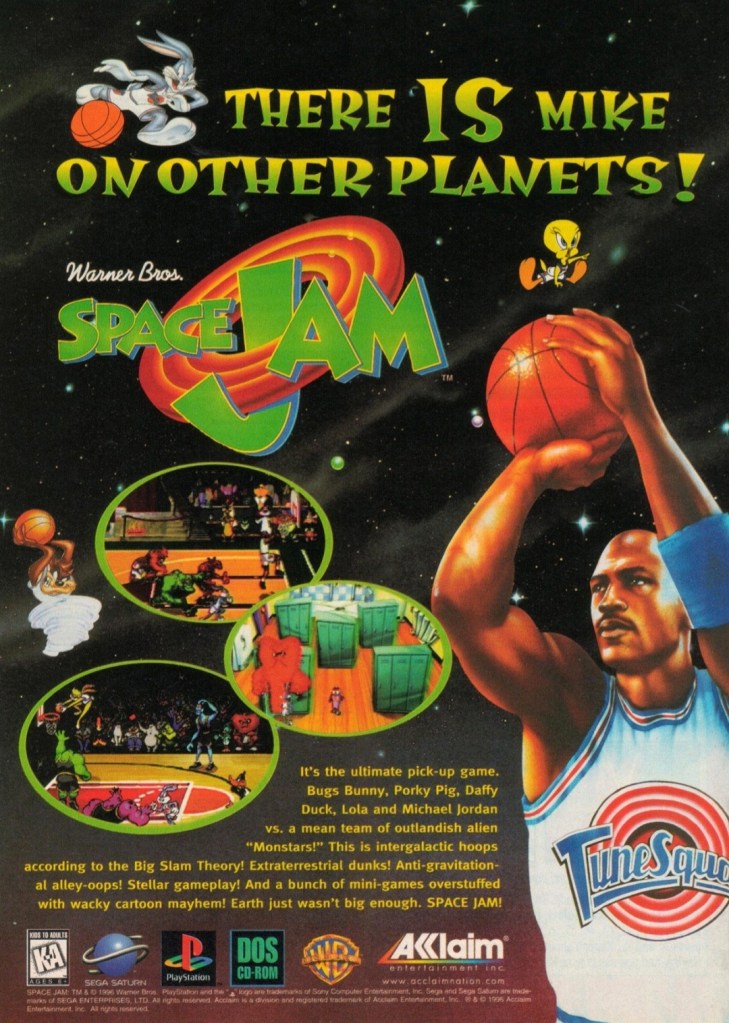
If you saw the movie in 1996, were you able to play this video game adaptation?

What makes 1996 a memorable year for basketball fans was the Michael Jordan’s return to prominence (having previously retired for less than two years before returning to the NBA in 1995) and leading a very powerful Chicago Bulls team to what was their 4th NBA championship title. In that same year, Jordan starred in the live-action/animated movie Space Jam which grossed an impressive $250 million worldwide. On the same month the movie came out, the Space Jam video game adaptation was also released on PlayStation and Sega Saturn. This print ad was part of the multimedia hype of the movie and the game itself had a very similar design and visuals concept with NBA Jam but ultimately it failed to become a hit with critics and gamers. Not even the combined visual might of Jordan and Warner Bros. characters could achieve success.  

5. Magic Johnson’s Fast Break print ad

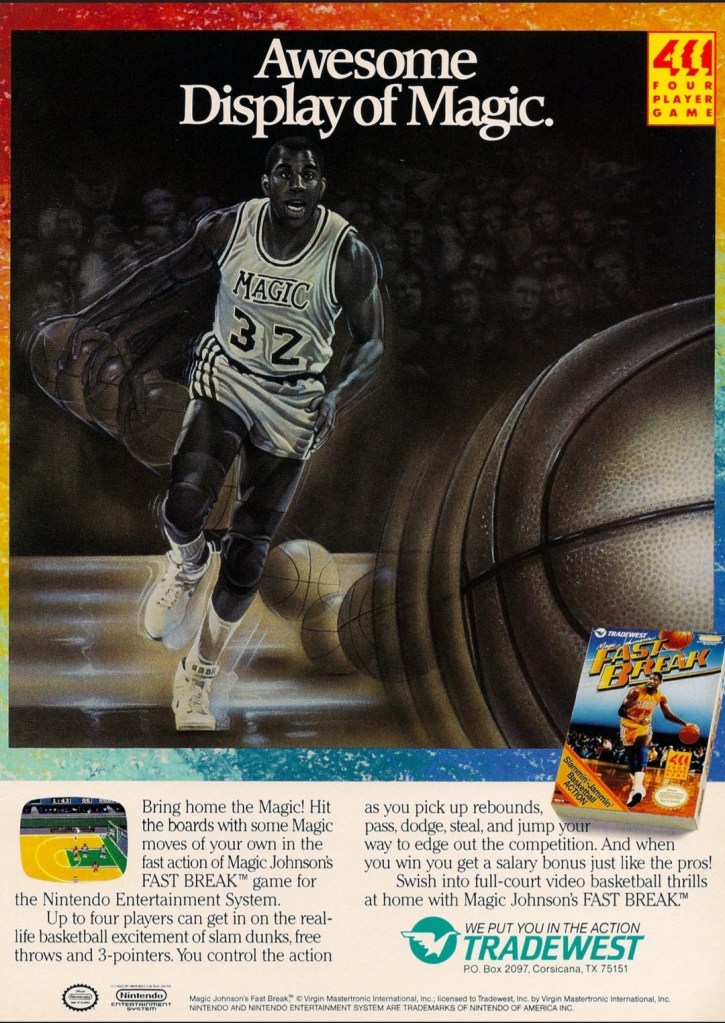
Still on basketball video gaming, the side-scrolling Magic Johnson’s Fast Break game was released on the Nintendo Entertainment System (NES) for console gamers to enjoy. Unsurprisingly, this ad had nice black-and-white art work of Magic Johnson as the dominant figure while leaving little space left to show the game box and only one screenshot. The real meat of this print ad are the details laid down in text description.

6. Virtua Fighter 2 for Sega Genesis print ad

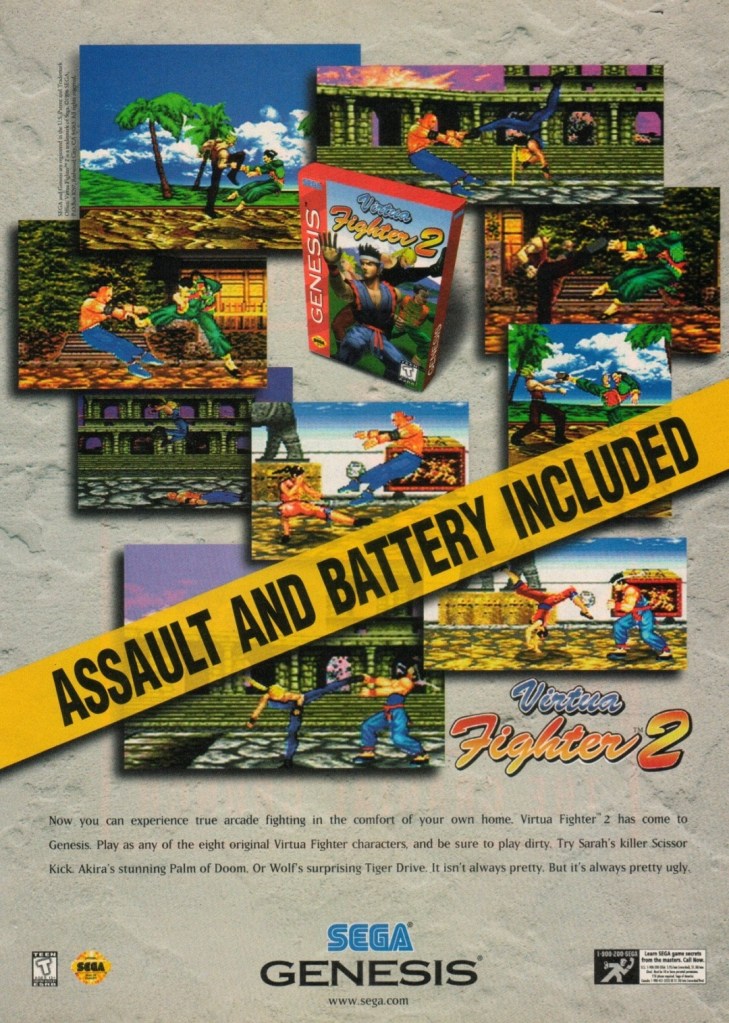
Clearly a late effort by Sega to sell something to its many Genesis owners/fans in America at a time when PlayStation and Nintendo 64 started dominating 5th console generation sales.

In the history of arcade gaming and fighting games, Virtua Fighter 2 was a worthy follow-up to its groundbreaking predecessor. VF2 also made its way on the Sega Saturn which essentially maintained the great gameplay and 60 frames-per-second animation even though the 3D polygonal graphics were noticeably lower in quality compared to its arcade version. With VF2 in the arcades and on Saturn selling well, I was surprised to see this print ad of Sega releasing a totally different version of the game on the aging Sega Genesis console. Virtua Fighter 2 on Genesis had 2D graphics, sprites for the characters and a side-scrolling visual design. In fairness, the game developers exerted effort to recapture some of the gameplay elements within the Genesis limitations and 2D graphics. This print ad is a reminder of Sega’s American division selling a product to the remaining active Genesis owners.

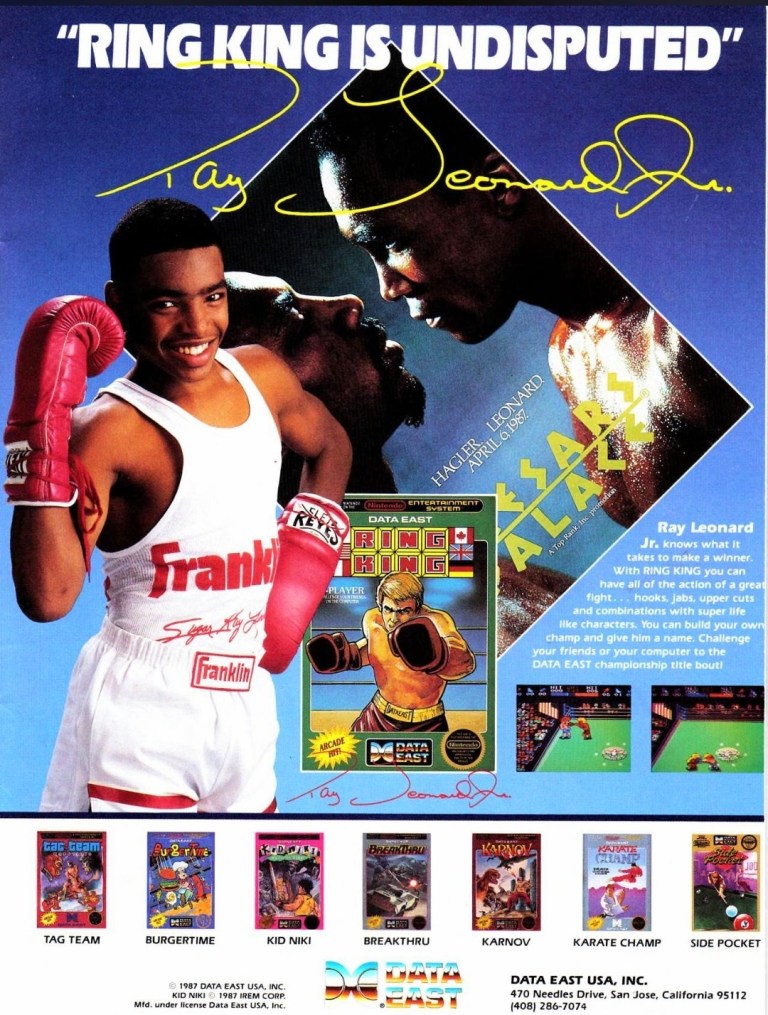
7. Ring King print ad

Ring King itself clearly lacked promotional space in this ad.

In 1987, Data East released their arcade hit game Ring King on the Nintendo Entertainment System (NES) and prepared this print ad involving Ray Leonard, Jr. (on the foreground in boxing gear) and conveniently with the famous Sugar Ray Leonard and Thomas Hearns (with the promo of their first fight together in the background). Also conveniently, the company inserted their other games on the lowest part of the ad. Ultimately, the presence of Ring King itself was minimized only showing the game cover and two screenshots. This is clearly an eye-catching ad but there was not enough emphasis on the game itself.

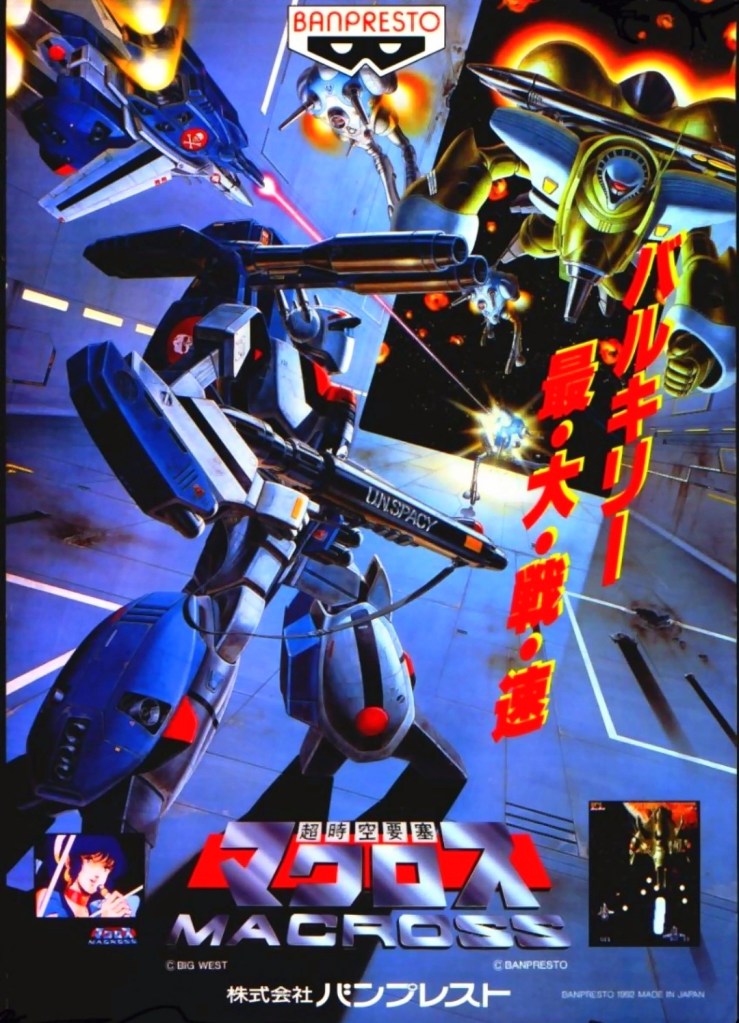
8. Super Spacefortress Macross arcade flyer

The arcade flyer released only in Japan.

Have you ever seen the classic anime movie Macross: Do You Remember Love? I really love watching that movie and I played and finished the video game adaptation on PlayStation in 1999. What I never got to play was the arcade game adaptation of it which was released by Banpresto in Japan in 1992. This flyer promoting the game has a strong visual presentation thanks to the artwork made for it. Only one screenshot was shown as well as a clip from 1984 the animated movie (note: the arcade game itself has some images directly from the film plus some newly created ones added) but this ad still had what it takes to capture the attention of the many Macross fans in Japan. This arcade game was eventually released with an English translation in America and Australia.   

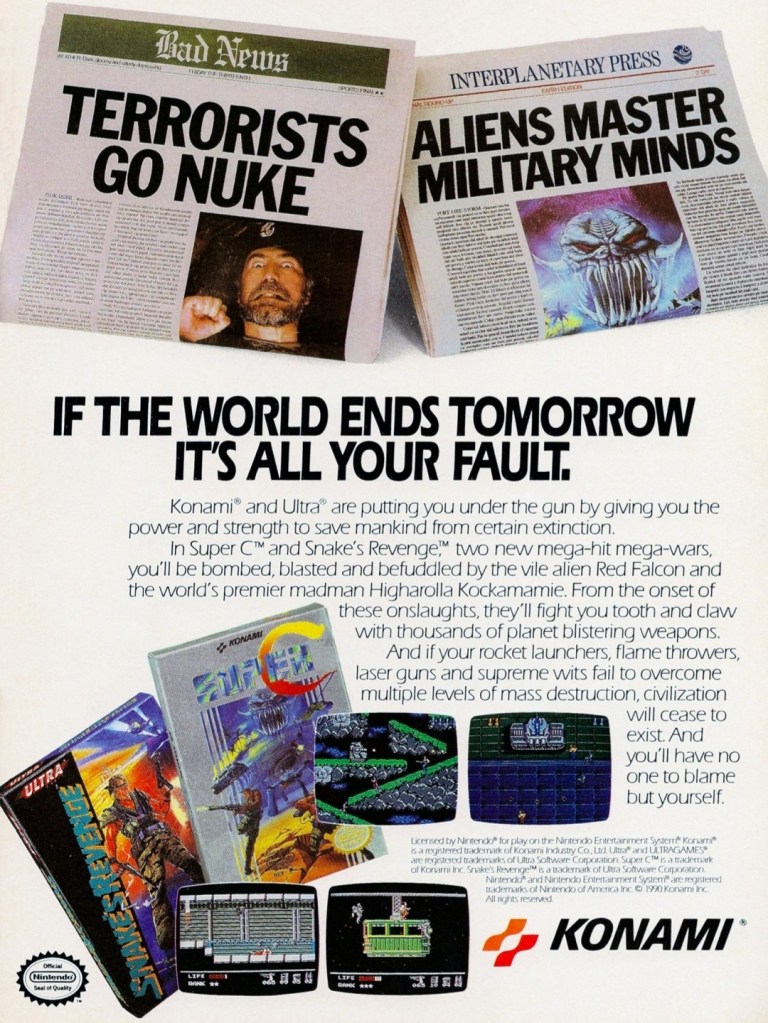
9. 2-in-1 print ad featuring Super C and Snake’s Revenge

A memorable and intriguing print ad from Konami promoting sequels.

This is one of the ads that Konami came up with to promote at least two games using a single-page ad format. I saw this ad in many comic books I read decades ago and its visual concept always caught my attention especially since I played the console game Contra a lot. At the high end of the ad were two fictional newspaper headlines highlighting the respective conflicts of Snake’s Revenge (with a nuclear danger concept) and Super C (with emphasis on alien invaders). These two games were sequels to the classics Metal Gear and Contra, and Konami clearly knew how to take advantage of the older games’ success and do their best to sell the sequels to gamers who love action-packed gaming as well as fantasized armed conflicts. Like the 2-in-1 ad showcasing Contra and Jackal, this was Konami’s aggressive move to sell war-inspired games to the NES userbase which was mostly composed of children and teenagers.

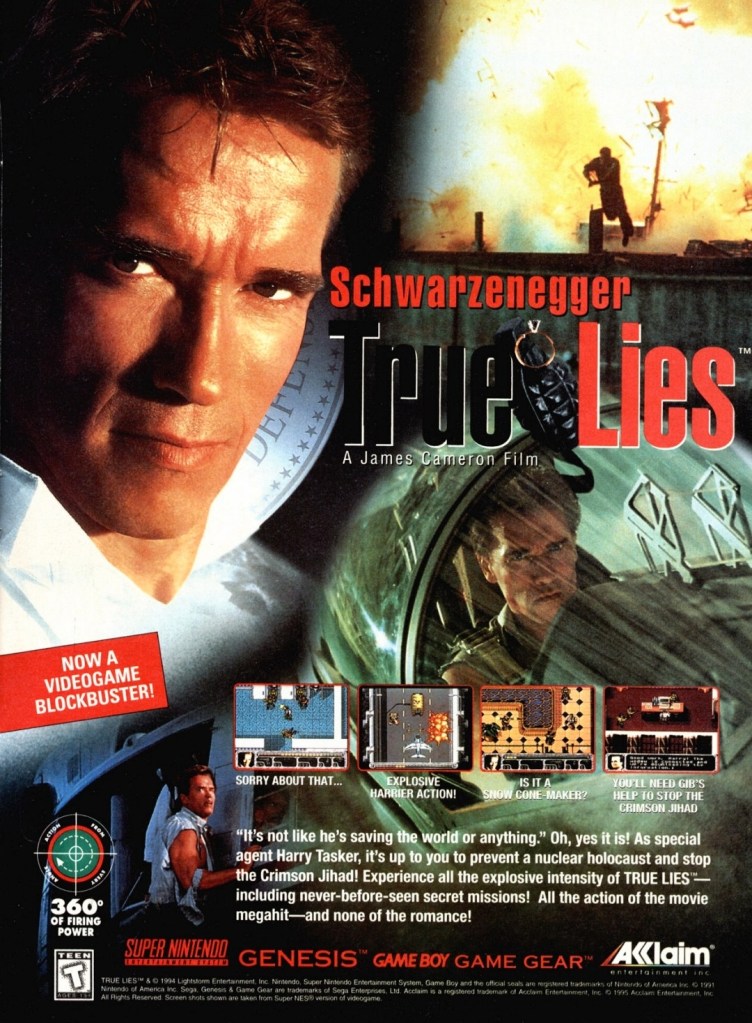
10. True Lies game print ad

There is nothing like taking advantage of the imagery of a Hollywood superstar to promote a video game based on the related movie.

Here is a video game ad I saw in many comic books I read in 1994-1995. True Lies (starring Arnold Schwarzenegger) was one of the big summer season movie hits of 1994 and the video game was part of the business tie-ins with the film. The people who made this print ad made the smart moves of showing not just one but three images of Schwarzenegger to promote the game while leaving some space to show what the game looked like. The True Lies game even had stills from the movie to emphasize the flow of the plot.

+++++

Thank you for reading. If you find this article engaging, please click the like button below, share this article to others and also please consider making a donation to support my publishing. If you are looking for a copywriter to create content for your special project or business, check out my services and my portfolio. Feel free to contact me with a private message. Also please feel free to visit my Facebook page Author Carlo Carrasco and follow me on Twitter at  @HavenorFantasy as well as on Tumblr at https://carlocarrasco.tumblr.com/ and on Instagram at https://www.instagram.com/authorcarlocarrasco
Retro Gaming Ads Blast – Part 10

Welcome back readers, fellow geeks and electronic gaming fans!

In this edition of the Retro Gaming Ads Blast (RGAB) series, we will take a look at another batch of retro gaming print ads from the 1980s and 1990s.

For the newcomers reading this, Retro Gaming Ads Blast (RGAB) looks back at the many print ads of games (console, arcade, computer and handheld) that were published in comic books, magazines, flyers and newspapers long before smartphones, social media, the worldwide web and streaming became popular. To put things in perspective, people back in the 1980s and 1990s were more trusting of print media for information and images about electronic games and related products.

With those details laid down, here is the newest batch of retro gaming print ads for you to see and enjoy…

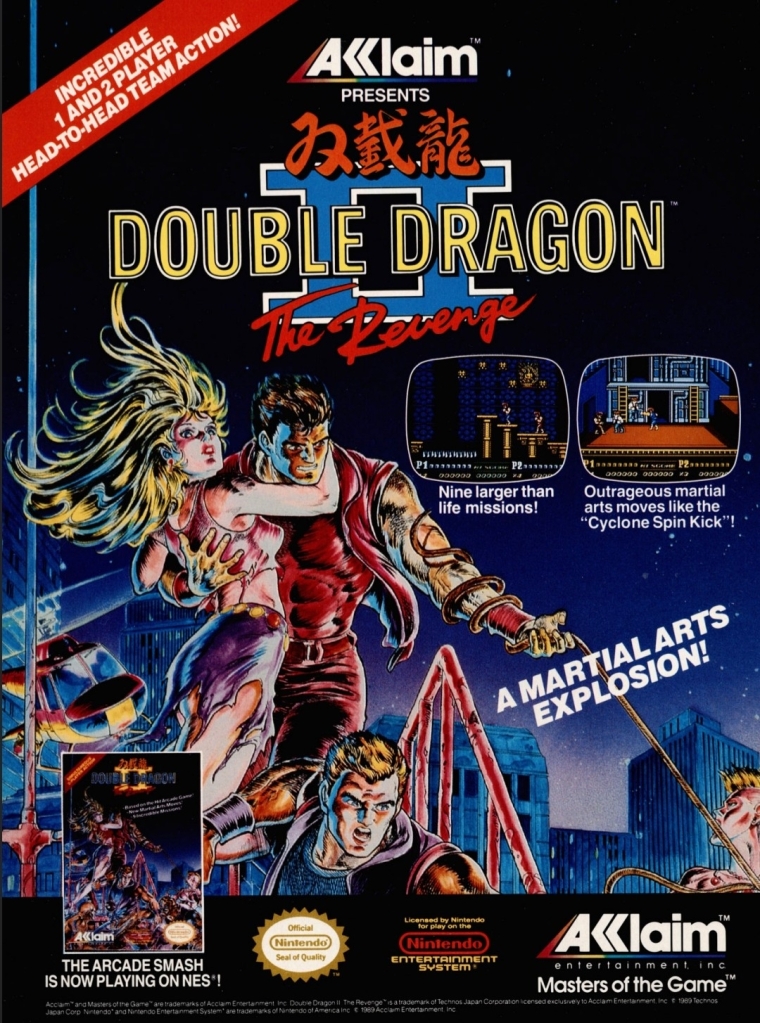
1. Double Dragon II: The Revenge print ad

Nice looking art used to promote the game.

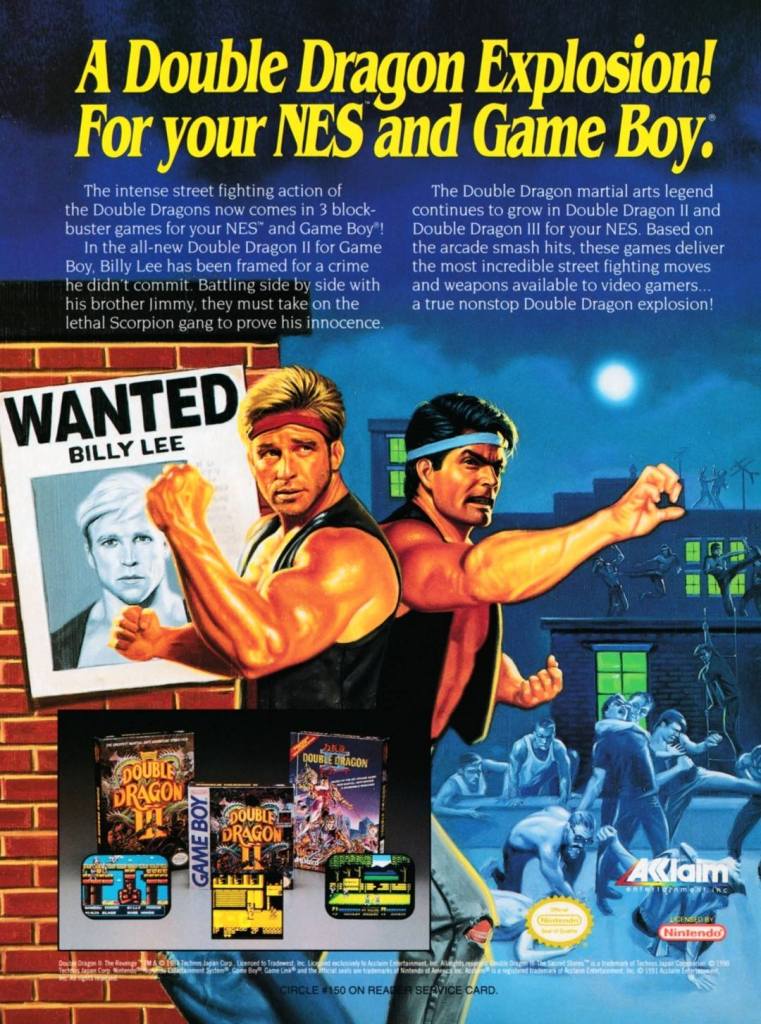
The beat-them-up sub-genre of gaming was already popular in the 1980s and one of the most defining game franchises of this type of game was the Double Dragon series which proved to be popular with Nintendo Entertainment System (NES in America) and Family Computer (Famicom in Japan) gamers. As the first game was a very big hit on Nintendo’s consoles, the sequel Double Dragon II: The Revenge was promoted in America with strong confidence on the part of publisher Acclaim that it would become another massive hit. This print ad had a very nice looking comic books-style art that not only captured the concept of the game but also visualized the heroes Billy and Jimmy with enough details to focus on. I can say this was an eye-catching ad.

2. X-Men: Children of the Atom print ad

Great looking ad but the line “100% direct conversion” is not true at all.

Developed by Capcom in cooperation with Marvel, X-Men: Children of the Atom was a huge hit in the video arcades and it was not surprising that it got released on the Sega Saturn by Acclaim. Acclaim organized an aggressive promotional campaign by pouncing on the fans’ love and knowledge of the X-Men and the high fun factor of Capcom’s game. What this print ad got wrong, however, was the line “100% direct conversion of the arcade smash!” which was wrong and misleading. In reality, the Sega Saturn version of the game had about one-third of the animation frames cut due to the console’s smaller RAM capacity.

As the years passed by, the Sega Saturn became the more suitable console for home ports of Capcom’s further 2D fighting games as Sony’s PlayStation had even more severe limitations and a graphics processor that was not suitable for 2D graphics. By the end of 2000, Capcom’s 2D fighting games on PlayStation all were inferior to the Sega Saturn versions.

3. Sky Shark NES print ad

This is an effective looking ad.

Released in Japan as Flying Shark, Sky Shark was released on multiple platforms in 1988 and there was an NES version of it which this particular print ad promoted. The American branch of Taito wisely used positive quotes from media outlets to promote the game while coming up with an engaging text description and displayed NES screenshots. And then there was that very engaging painted cover art that gave this print ad a lot of punch. An effective ad overall.

4. Conflict print ad

This is a very captivating artwork for advertising.

There is no denying the fact that the Cold War was a strong influence on arcade games and video games. Titles like Contra, Jackal, Metal Gear, Operation Wolf, Cabal and Rush’n Attack were militaristic games that entertained millions of gamers from the young adults to the little children. In 1990, Vic Tokai released the game Conflict on the NES which had a military theme but an unusual game design composed of digital maps with hexagons in which gamers will play with strategy to win battles. That being said, this print ad’s visual concept was very captivating yet also misleading. If you see how the game is played, you will know what I mean.

5. College Slam print ad

Were you ever interested in college basketball video games?

This is one of the more eye-catching print ads I’ve seen due to the artist’s illustration of a basketball with a mouth biting the basketball rim which dominates the space. For the newcomers reading this, College Slam was a basketball video game that was actually a repacked version of the popular NBA Jam with focus on NCAA basketball players. With the biting basketball at the center, it was easily an attraction and the screenshots implemented were larger than usual which easily gave gamers a clear look at what the game looked like. While this print ad is eye-catching, it did not help sell College Slam and there never was a follow-up.

6. Tecmo Super Baseball print ad

From the time when Tecmo was prolific with video games about sports.

Long before it started the Dead or Alive game franchise, Tecmo was once heavily invested in making sports video games. Tecmo Super Baseball was their first American pro baseball video game released for Super Nintendo Entertainment System (SNES) and Sega Genesis, and it was notable that the publisher secured only the Major League Baseball Players Association (MLBPA) which resulted in the game featuring real-life players but the teams had no names and no logos. Regardless, this print ad showed how aggressive Tecmo was in trying to attract consumers’ attention by showing ten screenshots with short text descriptions each. The ad’s write-up boasted realism as well as the promise of gaming quality.

7. The Punisher print ad

Marvel’s vigilante firing at someone.

In the early 1990s, Capcom and Marvel Comics started their partnership resulting in the releasing of the arcade game The Punisher. Developed by Capcom, the said arcade game became a big hit with gamers as it featured fun gameplay, multiple enemies appearing on screen simultaneously and other fun elements. Unsurprisingly, the game was ported (note: Sculptured Software was the lead developer) to the Sega Genesis with significant downgrades in terms of graphics, sound, enemy variety and other related elements due to technical limitations. That being said, this print ad used detailed art of the Punisher (with Col. Fury in the background) in a clever way to promote the Sega Genesis version while keeping their attention away from the obvious visual downgrades of the two screenshots displayed. The Punisher on Genesis was poorly received.

8. Stargate print ad

If you did not enjoy the movie, were you able to play the video game adaptation on Sega Genesis or Super NES?

Remember the sci-fi movie Stargate (1994)? The film was a surprise box office hit and eventually video game adaptations of it were made for the SNES, Sega Genesis, Game Gear and the GameBoy. This particular print ad, however, showed screenshots of the SNES and Genesis versions which is made obvious with the side-scrolling adventure plus 3D flying sequence (one screenshot showed it). Combined with images sourced from the movie poster plus an insert of the movie in home video format (lower-right corner), this print ad was obviously an aggressive way to promote the film with the post-theatrical business in mind. In case you are wondering, the cinematic Stargate is not related at all with the early 1980s video game (a follow-up to the classic game Defender) of the same name.  

9. Aerobiz Supersonic print ad

For a simulation game released on consoles, Aerobiz Supersonic is pretty deep and a lot of fun to play.

The airline simulation game Aerobiz Supersonic is a highly addictive and surprisingly fun game that I enjoyed playing on the SNES (read my retro review by clicking here) and strangely enough I first learned about not through its print ad but by reading a preview published by Electronic Gaming Monthly (EGM) magazine. As for this print ad made by Koei’s American team, this is really odd to look at due to the ad makers’ choice of showing a not-so-attractive flight meal. In contrast to that, the ad makers did a good job describing the game creatively and showed three screenshots that were strategically selected in my view. Having played the game many times, I can say that this print ad is very truthful.

+++++

Thank you for reading. If you find this article engaging, please click the like button below, share this article to others and also please consider making a donation to support my publishing. If you are looking for a copywriter to create content for your special project or business, check out my services and my portfolio. Feel free to contact me with a private message. Also please feel free to visit my Facebook page Author Carlo Carrasco and follow me on Twitter at  @HavenorFantasy as well as on Tumblr at https://carlocarrasco.tumblr.com/ and on Instagram at https://www.instagram.com/authorcarlocarrasco
A Look Back at Contra (1988)

Welcome back retro gaming fans and readers!

Today, we will go back to the late 1980s to examine one of the most significant console games of the decade…Konami’s Contra. To put things in perspective, Contra started in the arcades in 1987 and went on to become a big hit. Konami went on to make a version of the game for Nintendo Entertainment System (NES) in the West and the Family Computer (Famicom) in Japan that resulted in different looking graphics (both artistically and technically), reworked stages, and different and extended level designs that were done within the consoles’ limitations. In short, the home version of Contra was pretty different from the arcade version but still was made to be fun and exciting on its own.

In my personal experience, my discovery of Contra has always been on the Famicom and some time later on the NES. For this retro review, I replayed Contra (both Famicom and NES versions) via the Contra Anniversary Collection on my Xbox Series X.

With those details laid down, here is a look back at Contra, developed and published by Konami for the NES and Famicom in 1988. The NES version was released one week ahead of the Famicom version in February 1988.

The start screen of the NES version of Contra. The commando with dark hair was deliberately made to resemble Sylvester Stallone somewhat.

Game concept

In the far future, an alien army from space – Red Falcon – arrived on Earth inside a meteorite that landed on the Galuga archipelago. There, Red Falcon established an extensive high-tech base for their operations and eventually brainwashed a local human army to do what they want. Red Falcon plots to wipe out human civilization on the planet.

With the information about Red Falcon collected, the Earth Marine Corps send Contra unit members Bill Rizer and Lance Bean to the island to destroy the opposition and find out what Red Falcon has been doing…

Gameplay and quality

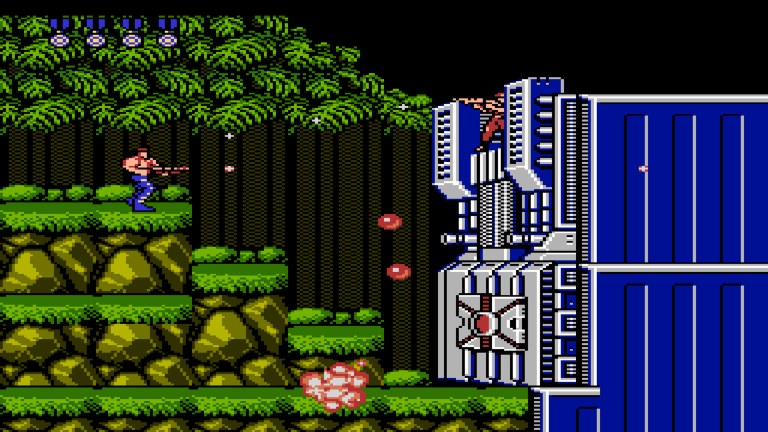
Contra is an action-packed 2D side-scrolling game with strong sci-fi and military influences.

To begin with, Contra of 1988 was made to be a nicely-paced, action-packed, side-scrolling adventure game that has some 3D-like levels in between. The game design and levels Konami came up with was done to immerse gamers into actual participation in the military campaign against the aliens and their brainwashed human soldiers. This campaign not only includes battles through the forest of the Galuga archipelago but also through the interiors of Red Falcon’s high-tech facilities, going up an elevated location with waterfalls, the snowy area and further deep into the rest of the enemy’s mechanical base.

For the most part, you play as a commando armed with a rifle with unlimited ammunition. As you shoot enemies and make your way through the 2D side-scrolling level, there will be the occasional flying capsules that you can shoot down to gain new weapons/ammunition (S for Spread Shot, M for Machine Gun, L for Laser) or some power-up (temporary invincibility or the rare ability to eliminate all enemies present on-screen) to help yourself as the wave of opposition from Red Falcon is relentless (which is reason enough to compel you to keep progressing and fighting). There are also times when the mentioned enhancements suddenly pop out after killing an enemy.

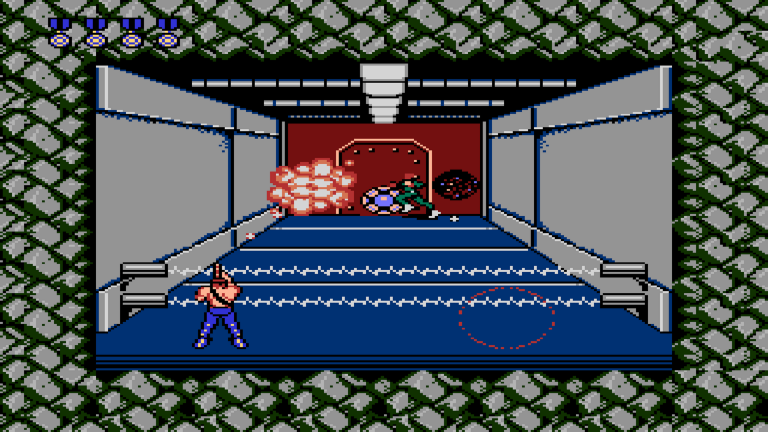
To prevent the game from getting too old with side-scrolling, Konami implemented these stages in which players face the front to attack enemies, overcome obstacles and move forward with 3D-like effects going into the next place.

By default, this game is brutally hard. Not only do the enemies keep appearing (with some of their teammates being strategically placed to fire at you), the obstacles will compel you to take your time overcoming them. In this game, one-hit death is the norm and there are many moments in which falling to your death becomes a huge risk. You get hit, you not only lose one life, you will lose whatever powerful weapons you gained.

There are also stage bosses (powerful enemies that await you at the end of a level) that will challenge you so much, you will have to adjust your strategy, pay attention to the movements and timing of the enemy, and then adjust your way fighting.

Only the Famicom version of Contra has this sequence.
I really love the sci-fi elements the game developers came up with for this classic game. There are lots of high-tech stuff to see here and this robotic enemy is just one of them.

Fortunately for us players, the controls are really tight and very responsive. You can move your characters to overcome obstacles, avoid getting hit by enemies and even move down from one platform if the space below is safer. I still remember how precise and responsive the controls were on the NES and Famicom versions, and I can say that all the responsiveness made it on the Xbox controller when I replayed Contra on Xbox Series X with the Contra Anniversary Collection I downloaded. In fact, the high precision of the controls added to the fun of shooting enemies or obstacles with the Spread Shot while moving to the right as it was meant to be.

Considering the intense difficulty of the game, players who do the famous Konami Code (Up, Up, Down, Down, Left, Right, Left, Right, B, A, and Start) will be reward with 30 lives when they start playing Contra. For Xbox gamers reading this, there is a slight difference with the Konami Code when playing Contra on Xbox consoles.

Apart from shooting, there are lots of platform gaming elements to experience here. The difficulty is very brutal and the famous Konami Code will grant you 30 lives when you do the code correctly.
This cut-scene is only available in the Famicom version.

With regards to game design, the Konami developers did a really fine job creating the levels, placing the challenges and setting up memorable boss battles for action/adventure-hungry gamers to indulge in. The developers also cleverly implemented the fictional/fantasy concepts into the game design which resulted in me getting immersed in the Contra team’s mission against the Red Falcon at their secret base.

Another highlight with playing Contra is the 2-player option and the above-mentioned Konami Code added to the fun and accessibility of. I still remember the old days of playing in a 2-player session (cooperative play essentially) of Contra at a friend’s house on a Famicom. Since my friends and I were already enthusiasts of 1980s Hollywood action movies, playing Contra was enjoyable even though the difficulty was brutal.

This is one of the touch stage bosses you will encounter in the game.

If there are any notable differences between the two versions of Contra of 1988, it would be the fact that the Japanese (Famicom) version has storytelling emphasized through cutscenes (with Japanese text displayed), a technical overview of the Red Falcon base at Galuga with maps displayed before you start a new level, in-game art, an additional scene that spiced up the ending and, most notably, more background/environmental animation. The additional animation on the Famicom version made the adventuring look and feel more lively and this is most evident in the final stage (lair of the alien).

Conclusion

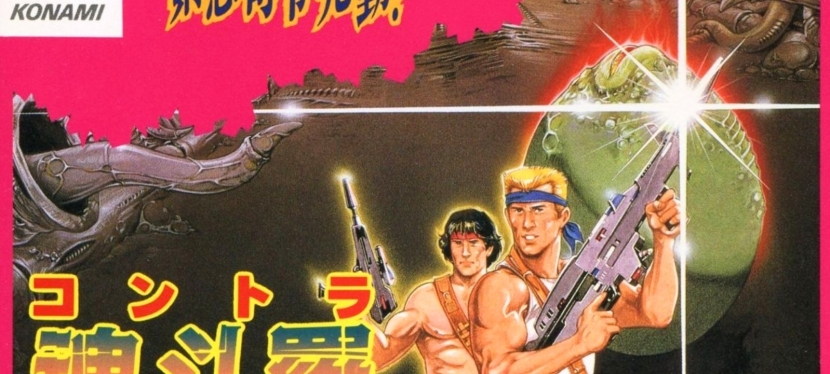
The Japanese cover art of Contra on Famicom. The Rambo-like character and the alien egg are obvious inspirations from Hollywood action movies of the 1980s.

There is no doubt in my view that after all the decades that passed since I first played it, Contra (1988) is still very engaging and a lot of fun to play whether you choose the Famicom version or the NES version. The developers who made this game succeeding in making something very enjoyable for millions of gamers and it is very clear that the makers were inspired by Hollywood action movies of the decade. In my view, the most obvious military inspirations are Aliens (1986), Commando (1985) and Rambo: First Blood Part II (1985).

Historically speaking, Contra (1988) was released at a time when militarism inspired many other game designers to come up with enjoyable games in different forms such as Cabal, Jackal, Rush’n Attack, Operation Wolf, Operation Thunderbolt to name some. Considering the overall quality and high fun factor Konami established, it is safe to say that this game is one of the finest among its militaristic gaming counterparts of its decade.

I had a grand time replaying Contra (1988) on my Xbox Series X in preparation for this review. Having played both NES and Famicom versions, I can say that the latter is the more complete and more immersive version to play. That does not necessarily mean the NES version is totally inferior. In fact, the NES version is more straightforward with the pick-up-and-play approach, and the gameplay itself is nearly identical (note: Famicom version is slightly more challenging) and very much fun to experience. If you are the player who really wants to be more immersed into the lore of Contra and absorb the military sci-fi concept Konami prepared, then the Famicom version is the one to play. That being said, now is a good time to purchase and download Contra Anniversary Collection.

Overall, Contra (1988) is highly recommended! It truly is a retro gaming gem!

+++++

Thank you for reading. If you find this article engaging, please click the like button below, share this article to others and also please consider making a donation to support my publishing. If you are looking for a copywriter to create content for your special project or business, check out my services and my portfolio. Feel free to contact me with a private message. Also please feel free to visit my Facebook page Author Carlo Carrasco and follow me on Twitter at  @HavenorFantasy as well as on Tumblr at https://carlocarrasco.tumblr.com/ and on Instagram at https://www.instagram.com/authorcarlocarrasco
What to watch on YouTube right now – Part 17

Welcome back, my readers, YouTube viewers and all others who followed this series of articles focused on YouTube videos worth watching. Have you been searching for something fun or interesting to watch on YouTube? Do you feel bored right now and you crave for something to see on the world’s most popular online video destination?

I recommend you check out the following topics and the related videos I found.

The Garden of Eden location video – Let me start first by stating that everything in the Holy Bible (the Word of God) is absolutely true. I truly believe in the Bible and the ancient record of the creation of the world, Adam and Eve, and the Garden of Eden existed and there is nothing that science could do to refute them. Recently, YouTube channel HolyLandSite posted a video about the most likely location of the Garden of Eden, explaining in detail how it came to be, where it existed and how to properly understand what is written in the Holy Bible which truly describes it as a genuine place created by God.

Mosab Hassan Yousef (son of a Hamas co-founder) proves the North American pro-Palestine believers to be very wrong, ignorant, foolish and delusional on Dr. Phil show – Mosab Hassan Yousef is the son of a Hamas co-founder, was raised with hateful teachings against Jewish people, was a Hamas member who fought against Israel, stopped being evil, repented and submitted to Lord Jesus, is now a strong supporter of Israel and has been working against the terrorists. Considering his upbringing and background, it is not surprising that he proved the pro-Palestine believers/activists to be wrong, ignorant, brainwashed and foolish! The pro-Palestine believers here are so brainwashed by Islamo-Leftists superiors, they failed to see the evil of their movement, and they do not care about the victims of the October 7, 2023 terrorist attacks on Israel committed by Hamas. Watch the videos below…

To all the pro-Palestine believers, Bill and Hillary Clinton idolaters, the woke zealots, the Satanic Democrats, the LGBTQ people, the illegal aliens, the Islamo-Leftists and those who love terrorist Yasser Arafat reading this…you are all on the wrong side of history!

If you want to truly change yourselves for good, stop being evil, repent to Lord Jesus and submit to Him with all your heart. You still have time.

Contra games comparison videos plus an explanatory video – Recently, I took advantage of the Xbox online store sale to purchase the digital copy of Contra Anniversary Collection for roughly $4 and I started playing the Nintendo Entertainment System (NES) and the Family Computer (Famicom) versions of the classic game Contra on my Xbox Series X console. Indeed, there were notable differences between the two versions with regards to graphics and storytelling presentations. Not only that, Contra Anniversary Collection also contains the original arcade version of Contra (meant to be compared to the NES/Famicom ports) as well as the European version of Contra called Probotector. Even Contra III: The Alien Wars also had a different version in Europe. I also added one explanatory video titled Contra: From Arcade to NES & Beyond. Watch the videos below…

Poltergeist movie reaction videos plus another two other related videos – Let me make it clear to all of you that I am not a fan of the 1982 supernatural horror movie Poltergeist. As a film buff, I do give Steven Spielberg, director Tobe Hooper and their production team for the creative stuff they came up with (including the visual effects) to making it stand out among the many horror movies Hollywood made over the past 40+ years. That being said, it is not surprising that Poltergeist became a popular film featured in multiple movie reaction videos by different YouTubers. Watch their reaction videos plus two related others (from Minty Comedic Arts) below…  

A close look at the classic game Paperboy – Way back in 1989, I visited the United States of America for the first time and I could not forget the time I spent playing in a huge video arcade in one of the fancy hotels of Las Vegas. One of the first arcade games I played back then was Paperboy which I quickly found to be a lot of fun. I liked the game so much, I kept playing it in that same arcade and years later, I played versions of it on PC and the Nintendo Entertainment System. That being said, if you have not played or discovered the classic game, you can learn all about it in this video by YouTuber PatmanQC.

Caught on camera: Electric bike (e-bike) hits elderly woman who later died – Recently here in the Philippines, a major TV network reported an accident in which an elderly woman got hit hard by a moving electric bike (e-bike) driven by a man who was distracted (as caught on video and witnessed by bystanders). The elderly woman eventually died while the suspect has since been apprehended facing a charge of reckless imprudence resulting in homicide. For the newcomers reading this, there are already many cases of careless or reckless driving committed by people who drove electric bikes (e-bikes) or electric tricycles (e-trikes) on public roads along with cars, vans, buses and trucks. This latest incident does not help the case of e-bike/e-trike drivers and owners at all. Posted below is the news video about the e-bike that hit the elderly woman.

Wicked Iran’s assault against Israel – I cannot stay silent about this. Iran and its terrorist proxies launched missiles and drones against Israel (which had the support of America, Jordan and others for defense). Almost 100% of the enemy projectiles were shot down. For the newcomers reading this, the conflict between Israel and Iran (the chief sponsor and source of terrorists in the Middle East) goes a long way back. The wicked regime of Iran (in power since 1979) made clear its intentions to not only destroy Israel but also other Western democracies/societies. Iran’s terrorist network also reached South America. In light of all of these, if you want truthful and accurate reports about Israel’s fight against the terrorists, rely on the content and updates of TBN Israel, CBN News, TravelingIsrael and the official Israel Defense Forces (IDF) channel. Watch the videos below and do not forget to pray to the Lord in support of Israel, the fall of their enemies, the rescue of the hostages and the peace of Jerusalem.

+++++

Thank you for reading. If you find this article engaging, please click the like button below, share this article to others and also please consider making a donation to support my publishing. If you are looking for a copywriter to create content for your special project or business, check out my services and my portfolio. Feel free to contact me with a private message. Also please feel free to visit my Facebook page Author Carlo Carrasco and follow me on Twitter at  @HavenorFantasy as well as on Tumblr at https://carlocarrasco.tumblr.com/ and on Instagram athttps://www.instagram.com/authorcarlocarrasco
Retro Gaming Ads Blast

Welcome back readers, fellow geeks and electronic gaming fans!

Today I am launching a brand-new series of articles titled Retro Gaming Ads Blast (RGAB) which will explore the many print ads and promotions of video games, computer games, arcade games and handheld games that were published through the decades.

For the newcomers reading this, print ads of games were widely popular and heavily relied on by gamers/players long before smartphones, social media, the worldwide web and online videos even started. Back in the old days, print media was the most common method for companies to market their games while also helping hardware (machines which played the games) reach potential buyers. Such ads appeared in magazines, comic books and newspapers. Not only that, there were several print ads of games that were made to look creative, compelling and even intriguing.

With those details laid down, here is the first batch of retro gaming print ads for you to see and enjoy…

1. Parker Brothers’ Spider-Man-led print ad

Does this ad look amusing?

Remember Parker Brothers? That was a company that started way back in 1883 founded with a strong focus on the enjoyment of games in the form of board games, cards and toys. In the late 1970s, Parker Brothers started making electronic versions of their popular board games and engaged in the video game development and publishing. They also went on to make home ports of popular arcade games in the early 1980 for several gaming platforms.

Parker Brothers was very active with making games for the Atari 2600 console which became the dominant machine for home gaming in North America in 1982. In the above print ad, their marketing heavily emphasize the Spider-Man video game for Atari 2600 and added two others games they also published – Tutankham and Amidar – which was a clever move to market multiple games. The ad’s focus on Spider-Man was amusing and even without showing a single screenshot of the game, it was enough to entice people to watch out for it. Be aware that the Spider-Man game’s development was done by Laura Nikolich who was hired by Parker Brothers at a job fair. Nikolich had full creative control on making the game and had no contact whatsoever with Marvel Comics.

2. Advanced Dungeons & Dragons: Cloudy Mountain print ad

An ad like this was strong enough to motivate gamers’ imagination and interest.

Back in 1982, Advanced Dungeons & Dragons: Cloudy Mountain was released on the Intellivision game console and I was fortunate enough to watch my next-door neighbor play it repeatedly. The above print ad – which simply referred to the game as Advanced Dungeons & Dragons – only had a few words which directly pointed to the main objective of the game…the golden crown. While only one screenshot of the game was displayed, the advertisers heavily relied on hand-drawn, comic book-style fantasy art work to sell the game.

For those who were born long after the 1980s, let me share with you that ads like these were really impressive for their time. It was common for advertisers to use art works (even though they may not accurately reflect the gameplay or game design) and post at least one screenshot to catch the viewer’s attention with the hope that it would even encourage him/her to anticipate the game. It should be noted that ads like these were strong enough to make gamers’ imagination or curiosity grow stronger.  

3. Konami’s collective military video games advertising

Print ad of four games for IBM, Amiga and Commodore.
Print ad of Jackal and Contra for the NES.

Konami, the Japanese company that has long been known for Metal Gear, Suikoden and the controversial sacking of famous game designer Hideo Kojima, was aggressive in the gaming business in the 1980s and arguably the aggressiveness was reflected in their publishing of several games that emphasized militarism during the late stages of the Cold War. In short, they made the military look cool and their activities fun to do in digital form.

While Konami has always been identified with console gaming, they actually released Rush’n Attack, Contra, Jackal and Boot Camp on IBM, Amiga and Commodore computers (as seen in the first print ad above) which were popular in the 1980s. The said ad also have a very amusing visual concept emphasizing the excitement and fun of military action games coming to gamers at home for their computers.

The 2nd print ad above – Jackal and Contra for the Nintendo Entertainment System (NES) – was very intriguing to see. It was very clear back in the 1980s that the NES always had a wholesome audience (note: a lot of buyers were parents who wanted to entertain their kids at home) and that includes a lot of very young players. To see the collective ad of Jackal and Contra (for the NES platform) having battle-hardened men in military gear holding guns was openly aggressive to perceive and instantly reminded people about the Cold War (and the menace of Communists, socialists, Marxists and terrorists) and the cultural impact of the mega blockbuster film Rambo: First Blood Part II. This is the kind of ad that would drive today’s woke-minded people crazy and even cause them to panic and pretend to be victims of militarism and patriotism. If you look at the ad closely, you will realize there is simply no room for the garbage of political correctness and wokeness.

Lastly, I myself had played Contra and Jackal with my friends on the Nintendo Family Computer (the Japanese counterpart of the NES) and both military games were a lot of fun to play from start to finish!

4. Batman Returns SNES game ad

This print ad appeared in some comic books I read in the early 1990s.

Way back in 1992, Batman Returns (the sequel to the mega blockbuster Batman movie of 1989) was released in cinemas with intense marketing and merchandising reflecting Warner Bros. intention to replicate the commercial success they had in 1989. Along the way, there were several video game adaptations of Batman Returns that were released on different platforms. Among those many video games was the Super Nintendo Entertainment System (SNES) game of Batman Returns which was developed and published by Konami in 1993 the form of a side-scrolling beat-them-up game.

The above ad was visually appealing with hand-drawn, comic book-style art dominating the spaces while leaving room for some screenshots and a written description of the game. Having seen this ad on multiple comic books I read back then, I can say that the ad was entertaining to see and was effective in making me interested in the game. I played Batman Returns on the SNES but never got to finish it. Oh yes, the game’s audio were really good and there were also digitized images from the movie for the in-game narrative.

5. Flashy Sonic the Hedgehog Japanese print ad

A dazzling approach by Sega on selling Sonic the Hedgehog.

1991 will always be remembered as the year of Sonic who eventually became not only Sega’s most defining mascot but also a video game industry icon. That same year, Sega released Sonic the Hedgehog on the Sega Genesis (referred to as Sega Megadrive in other parts of the world) console and it became a massive success with consumers and the game critics.

In the above Japanese print ad, a very captivating display of light and energy rays dominated the space leaving a minority share left for Sega’s console, screenshots and even a UFO Catcher arcade machine picture. While I could not understand the Japanese text, it seems to me that the flashy visual concept of the ad reflected Sega’s high ambitions with Sonic. How many gamers in Japan bought a copy of Sonic the Hedgehog because of this ad remains undetermined.

6. Japanese Super Star Wars print ad

A long time ago in a galaxy far, far away…

Before Nintendo released its 16-bit game console (referred to as Super Nintendo Entertainment System in America, and Super Famicom in Japan), there were lots of Star Wars video games released on varied platforms and the arcade.

With Nintendo’s 16-bit gaming platform realized, lots of game designers and business partners saw opportunities to make new games with gameplay concepts and designs using the technological advantages of the time. For LucasArts and its partners, taking Star Wars gaming into the next level was inevitable and they made it all come true in 1992’s Super Star Wars video game.

Published in Japan by JVC Musical Industries for the Super Famicom, Super Star Wars was a major leap forward in game design, visuals, sound and enjoyment. Apart from the 2D side-scrolling run-and-gun gameplay, gamers were deeply immersed into Star Wars’ universe with the Mode 7 landspeeder and X-Wing fighter sequences, as well as the first-person trench run sequence.

The Japanese print ad above cleverly presented screenshots from the game while using official imagery from the Star Wars movie poster of 1977 (look at how young Harrison Ford, Mark Hammill and the late Carrie Fisher were back then). The ad is a fine example of combining the greatness of the classic George Lucas-directed film with the highly enjoyable design of Super Star Wars. Lastly, these should remind you that there was a time when Star Wars was not yet tainted by wokeness and the garbage values of the Satanic Leftists (read: woke Disney).   

+++++

Thank you for reading. If you find this article engaging, please click the like button below, share this article to others and also please consider making a donation to support my publishing. If you are looking for a copywriter to create content for your special project or business, check out my services and my portfolio. Feel free to contact me with a private message. Also please feel free to visit my Facebook page Author Carlo Carrasco and follow me on Twitter at  @HavenorFantasy as well as on Tumblr at https://carlocarrasco.tumblr.com/ and on Instagram at https://www.instagram.com/authorcarlocarrasco