Welcome back my readers, YouTube viewers and all others who followed this series of articles focused on YouTube videos worth watching. Have you been searching for something fun or interesting to watch on YouTube? Do you feel bored right now and you crave for something to see on the world’s most popular online video destination?
I recommend you check out the following videos I found.
#1 Reactions and retro review of Friday The 13th: The Final Chapter – If you have seen at least a majority of the many Friday The 13th movies, which one do you think is the best of them all? For me, it is the fourth movie Friday The 13th: The Final Chapter and you can read my retro movie review of it by clicking here. Already there are many movie reaction and retro review videos about the 1984 film on YouTube, and I selected the entertaining ones for you to see below.
#2 The failure of BuzzFeed – I never relied on BuzzFeed for updates nor entertainment stuff. As I was browsing YouTube, I noticed this video by It’s Blanko focused on BuzzFeed which has been in trouble for some time now (click here, here and here). Recently, BuzzFeed, Inc. tapped into AI (artificial intelligence) for audience engagement and growth. The video below is quite comprehensive with its examination of BuzzFeed’s culture, business practices and how it struggled years later.
#3 PatmanQC examines the history of Atari’s Star Wars arcade game – Now on to retro gaming! Way back in 1989 in a Las Vegas hotel, I played the Star Wars arcade game produced by Atari. It was an enjoyable experience as the game design was pretty immersive, fun and responsive. It was also one of the early first-person view games that I experienced as a gamer. Storywise, the game was set during the Rebels’ attack on the Death Star. To find out more about the history and making of the arcade classic, watch PatmanQC’s in-depth video below.
#4 Retrospective on Parasite Eve – Back in 1998, Square released Parasite Eve, a role-playing game (RPG) that emphasized horror over fantasy, and a story that had some grittiness related with its police story concept. I finished the game on PlayStation and ultimately I was not too impressed with the game nor was there any incentive for me to replay it. While it was commercially successful enough to spawn two sequels, Parasite Eve has been pretty much forgotten by the public and Square Enix showed no signs of reviving its franchise. That being said, I found a retrospective that should interest both Parasite Eve fans and younger gamers who are interested in the 1998 game.
#5 The Denver Nuggets’ memorable 1994 elimination of the Seattle Supersonics – If you are fond of basketball and if you are interested to discover a great upset in the history of the NBA Playoffs, you should check out the shocking fall of the Seattle Supersonics to the Denver Nuggets in the elimination round of the 1994 NBA Playoffs. Back then, Seattle was #1 in the Western Conference while the Nuggets were at #8. Dikembe Mutombo led the Nuggets and their team was fortunate to have talented supporting players to help them outclass Shawn Kemp and the Sonics. To learn all the details, watch the video below.
Welcome back fellow geeks, Blu-ray collectors and movie buffs!
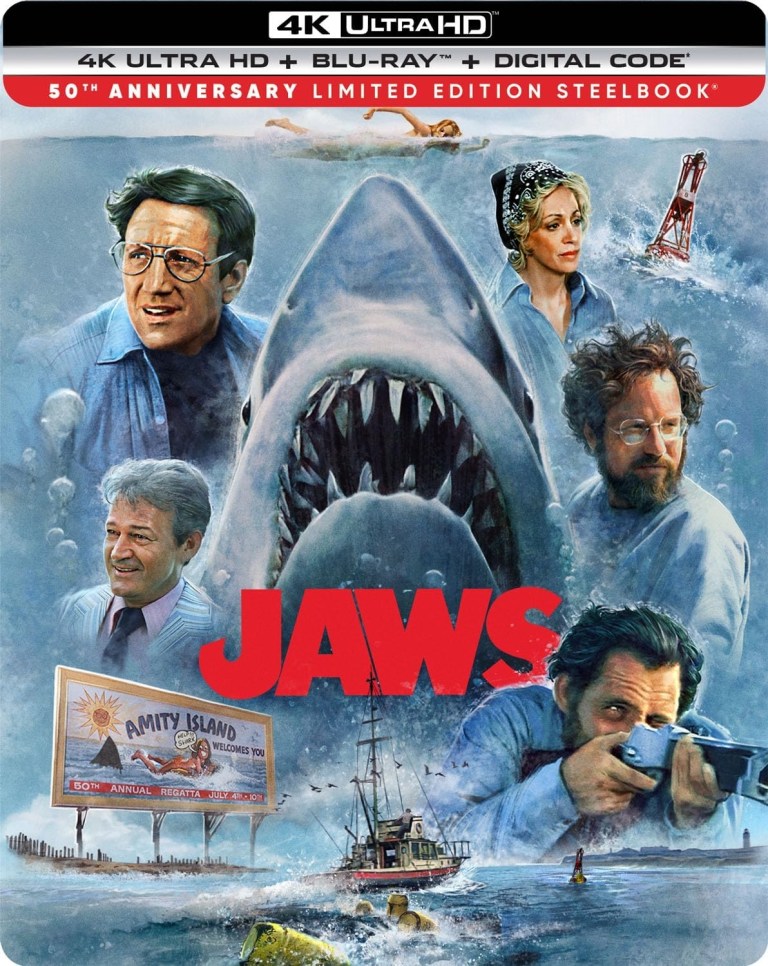
If you love Steven Spielberg’s classic film Jawsand if you are determined to collect the latest thing about it, be aware that the Jaws 50th Anniversary 4K Blu-ray SteelBookwill be released commercially on June 17, 2025. In relation to that, customers are welcome to order it in advance by clicking here.
This is the 4K Blu-ray SteelBook set of Jaws. (photo source – Amazon)
Posted below are the technical details of the Jaws 50th Anniversary 4K Blu-ray SteelBook sourced from its Blu-ray.com page,
Video
Codec: HEVC / H.265 (70.80 Mbps)
Resolution: Native 4K (2160p)
HDR: Dolby Vision, HDR10+
Aspect ratio: 2.35:1
Original aspect ratio: 2.39:1
Audio
English: Dolby Atmos
English: Dolby TrueHD 7.1 (48kHz, 24-bit)
English: DTS 2.0 Mono
French: DTS-HD HR 7.1
Spanish: DTS 5.1
Subtitles – English SDH, French, Spanish
Discs – 4K Ultra HD, Blu-ray Disc, Three-disc set (1 BD-100, 2 BD-50), Bonus View (PiP), BD-Live
D-Box, Social network features
Digital – Digital copy included
Packaging – SteelBook, inner print
Playback – 4K Blu-ray: Region free, 2K Blu-ray: Region A
Although I never saw Jaws inside the movie theater, I saw it multiple times from local TV to cable TV, and DVD. It truly still is one of Steven Spielberg’s best works to this day and it should be stated that filmmakers encountered a lot of problems during production at the time. To animate the killer shark, they used physical stuff while shooting on the ocean extensively. Computer-generated graphics and digital editing were not the standard back then. I have yet to view the classic film on high-definition and it should be stated that the Jaws 4K Blu-ray has been available for years now.
Mark your calendars for June 17, 2025. (photo source – Amazon)
If you have decided already to order the more affordable and simpler 4K Blu-ray copy of Jaws, click here. If you really want the upcoming 4K Blu-ray SteelBook edition, click here.
Welcome back Xbox fans, geeks, retro gaming enthusiasts and other gamers!
There is nothing like having fun with retro gaming on a modern console. With regards to my Xbox gaming experience, when Team Xbox falls short on delivering great fun with their latest releases, retro gaming fills the gap nicely. The good news here is that there are a lot of collections of old games or remastered releases available on the Xbox online store.
Right now, I am having fun playing for the first time ever Zombies Ate My Neighbors on my Xbox Series X. I recently purchased online the remastered collection Zombies Ate My Neighbors and Ghoul Patrol (fully titled as Lucasfilm Classic Games: Zombies Ate My Neighbors and Ghoul Patrol) for that 1990s, 2D adventuring gaming experience. The remastered collection was released in 2021.
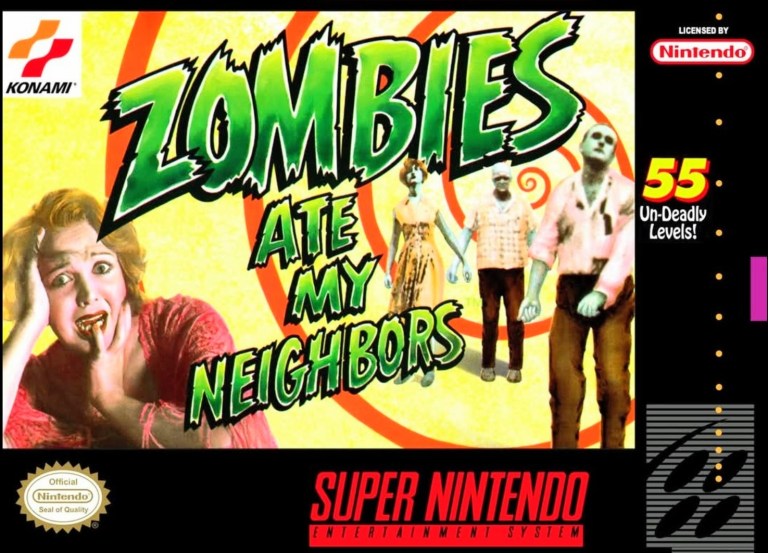
The game’s box cover for the SNES.
Back in 1993, I was playing games on the Super Nintendo Entertainment System (SNES) but I never had the opportunity to rent nor purchase Zombies Ate My Neighbors. Back then, the 2-page print ad of the game that appeared in comic books and gaming magazines really caught my attention as well as my interest.
Zombies Ate My Neighbors – the SNES version specifically – is fun, charming and has a unique type of challenge when played on my Xbox console. The game developers did a fine job remastering the game without drastically altering the 2D graphics design. The 2D sprites looked unaltered and because of the high definition visuals, I can see them looking pretty detailed. This is pixel art that was preserved and looking lively in HD. The game controls are responsive enough on the Xbox controller and you only need to use a few buttons along the way.
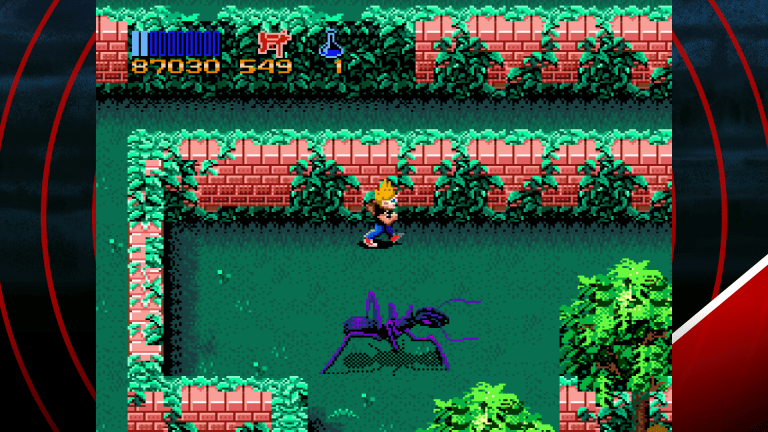
There is nothing like encountering a giant ant in the local community.
Imagine making your way through the local grocery only to encounter a zombies and a masked man armed with a chainsaw.
Zombies Ate My Neighbors has a creative concept that combines elements of the sci-fi, horror and adventure genres of pop culture. Don’t let the cover art and the title of the game fool you. Zombies are definitely not the only monsters you will encounter. In fact, there are werewolves, spiders, evil dolls, vampires, blobs, giant ants, mummies and even UFOs!
This is a game that puts the player in the middle of an American city (composed of suburbs, commercial joints, museums and parks to name some) filled with monsters. Your mission is not only to survive but also to save at least a few surviving neighbors in order to proceed to the next level (by means of a door appearing out of thin air near you).
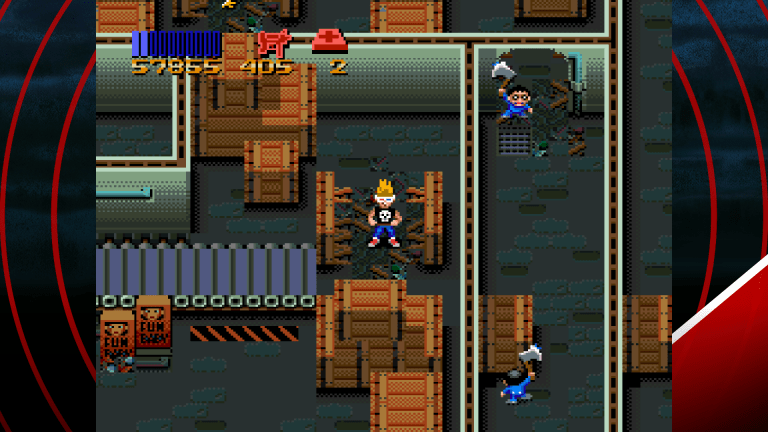
Those little ones carrying axes are mechanical dolls, not little kids.
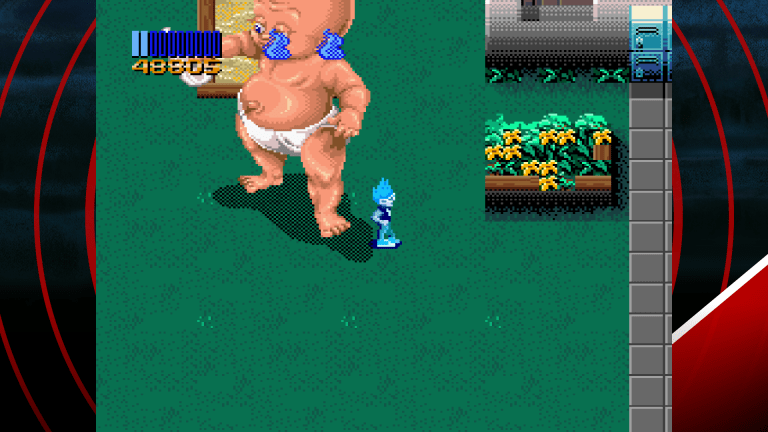
You better have a lot of weapons and some med kits when encountering the giant baby.
As this is an adventure game, there is a unique touch on the action made by the developers. The action is about attacking monsters with varied weapons such as the Uzi water gun, bazookas, explosive soda cans (makeshift grenades), ice pops, fire extinguishers and silverware to name some. Since the game was made with a wholesome audience in mind, the violence is unsurprisingly cartoony to look at.
The exploration aspect of the game involves collecting useful items for your survival and your ability to fight monsters. In fact, there is an abundance of weapons and ammunition. Getting medkits is essential and there are simply not enough of them which should remind you to be more strategic where you go and what you encounter. The game allows you to save anywhere.
Zombies Ate My Neighbors will keep gamers busy not just because of the adventure and the action, but also due to the fact that the developers created so many levels (50+) for you to explore and make your way through! Had I played this game on the SNES back in 1993, I definitely would have gotten a lot of value for my money with its content and length.
Conclusion
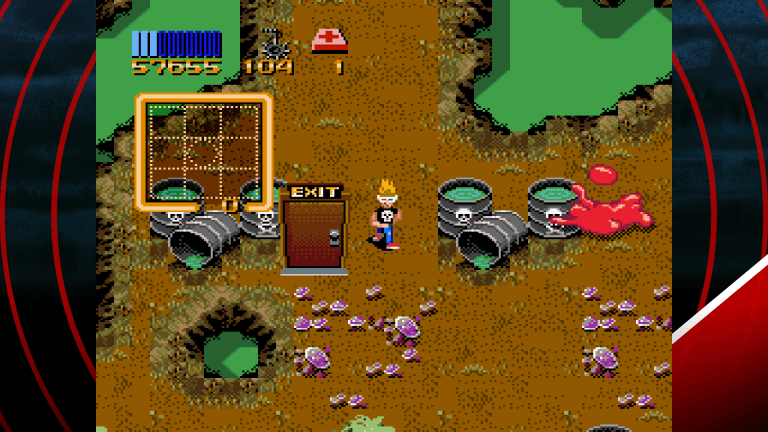
If you saved at least one surviving neighbor, this door will appear for you to exit. This will end the current level.
I can say clearly that Zombies Ate My Neighbors is pretty enjoyable. I made it through a lot of the levels and there’s not a moment of frustration as I played. This game from 1993 is a playable gem and already I’ve gotten a lot of entertainment value from my purchase of the Zombies Ate My Neighbors and Ghoul Patrol remastered collection (which also includes extra stuff and retrospective fun). I will play Ghoul Patrol as soon as I’m done with Zombies Ate My Neighbors. This is indeed retro gaming fun that Xbox gamers should check out.
Welcome back my readers, YouTube viewers and all others who followed this series of articles focused on YouTube videos worth watching. Have you been searching for something fun or interesting to watch on YouTube? Do you feel bored right now and you crave for something to see on the world’s most popular online video destination?
I recommend you check out the following topics and the related videos I found.
#1 Revisiting the Ultraverse – When it comes to 1990s comics, the short-lived Ultraverse is the one franchise that defined the decade the most as it had lots of engaging concepts, solid stories and captivating characters to follow such as Prime, Mantra, Harcase, Prototype, The Strangers, The Solution and more! Behind the scenes, publisher Malibu Comics had a great creative team who brainstormed and developed the Ultraverse a lot prior to its 1993 launch. To learn more about the Ultraverse, watch the following videos below.
#2The 1993 debate between Peter David and Todd McFarlane – Way back in 1993, I learned bits of information about a certain debate between the prolific writer Peter David (The Incredible Hulk, Spider-Man 2099) and Todd McFarlane (Spider-Man and Spawn) through word-of-mouth and comics-related print media. Of course, Internet access here in the Philippines was not yet available back then but there was local awareness about the David-McFarlane verbal battle. Fortunately for us, an actual video of the entire debate was uploaded to YouTube and the YouTuber Strange Brain Parts posted an analytical video about it. The videos are now available for your viewing pleasure.
#3 Lefties Losing It (Trump, Richard Gere, Taylor Swift booed and more) – In this recent episode of Lefties Losing It hosted by Rita Panahi, you will see how demented the current congressional Democrats have gotten, US President Donald Trump being cheered and how Taylor Swift was booed during the recent NFL Super Bowl, Richard Gere failing to accept reality and much more. Seriously, a lot of Leftists are still bitter over Trump’s return as President and they prefer to move on with their distorted view of reality. Wokeness truly is living wrongly. Watch and enjoy the video below.
#4 VKunia reacts to Poltergeist (1982) – A lot of people find 1982’s Poltergeist (directed by Tobe Hooper and produced by Steven Spielberg) a scary viewing experience. It has been the subject of many documentaries or reaction or retro reviews on YouTube. YouTuber VKunia posted her own reaction video of it and you can how it affects her in the video below.
#5 PatmanQC explains the history of The House of the Dead – The House of the Dead is a horror-themed series of video games that Sega first launched in 1996. During that year, there were The House of the Dead machines that suddenly appeared in local arcades here in the Philippines. Due to its horror theme and high level of violence, it caused some disturbance to concerned parents whose children saw or even played it. Regardless, the newer The House of the Dead games made its way to the local arcades as the years passed by. If you want to know who created the said Sega franchise and what were the inspirations for each game, watch the in-depth video by PatmanQC now.
#6 Dawn of the Dead reaction videos – To make things clear, I was never a fan of Zack Snyder’s Dawn of the Dead remake. I saw it in the local cinema back in 2004 at a time when the new movies released were not so interesting. Even with modest expectations, I was not so entertained by it. Still the movie is popular with YouTubers who posted their own reactions to it. Watch and learn from the selected videos below.
Welcome back my readers, YouTube viewers and all others who followed this series of articles focused on YouTube videos worth watching. Have you been searching for something fun or interesting to watch on YouTube? Do you feel bored right now and you crave for something to see on the world’s most popular online video destination?
I recommend you check out the following topics and the related videos I found.
#1 VKunia’s Akira reaction video – In recent times, I published blog post that had several videos of reviews, analysis and exploration of the 1988 anime feature film Akira. This time around, I posted for your viewing pleasure the Akira reaction video of VKunia. What I like about it is that VKunia herself is quite reactive to what was shown. Watch her reaction video below…
#2Royal Space Force: The Wings of Honnêamise reviewed and analyzed by Cinemology 101 – Way back in 1985, the ambitious anime feature film Royal Space Force: The Wings of Honnêamise was released in theaters and eventually made its way into the West with English translation in the cinemas in 1988 and on home video a few years later. While I was not exactly entertained by it on home video, I still was left intrigued by its highly imaginative world, art and animation quality that was comparable in some ways with Akira. YouTuber Cinemology 101 (AKA The Cinemologists) posted its review and explanatory video of the film which is very comprehensive to watch.
#3 Hong Kong Action cinema of the 1980s revisited – If there is anything I miss from the 1980s, it is the dynamic action that came in different styles from the Hong Kong action movies of the time. By comparison, I am disgusted with Hollywood’s so-called modern approach of recording action that involves shaky camera handling and the quick cuts on editing. In Hong Kong action movies, the filmmakers recorded action with stable camera handling and using the right angles to capture the action visibly and clearly. Watch and learn from the video below…
#4 PatmanQC examines Teenage Mutant Ninja Turtles: Turtles in Time arcade – Back in 1991, Teenage Mutant Ninja Turtles: Turtles in Time was released in the arcades and it became a big hit for Konami as it earned the approval of the critics and the coins of many gamers who paid for bouts of fun. The game was designed to be very playful and it also had a lot of stuff that resonated with TMNT fans. To find out who were responsible for the game and what inspired their work, watch the in-depth video by PatmanQC.
#5 Lunar games retrospective by Xygor Gaming – In case you missed the news, the first two Japanese role-playing games (JRPGs) of the Lunar series – Lunar: Silver Star Story Complete and Lunar 2: Eternal Blue – will be released for modern consoles in a package on April 18, 2025 called Lunar Remastered Collection. If you are fond of Japanese RPGs of the 1990s or if you want to discover what the Lunar series is about, watch the in-depth retro gaming retrospective video by Xygor Gaming.
#6 Sorority House Massacre explored by GoodBadFlicks – Recently, it was revealed that the 1986 horror movie Sorority House Massacre will be released on 4K Blu-ray this coming April. I never saw the movie but heard that it was criticized for being too familiar with a certain slasher horror movie from 1978. Regardless, you can learn about it by watching GoodBadFlicks’ explanatory video and perhaps it can provide insight as to why the movie is being released on 4K Blu-ray.
#7 US President Trump’s efforts against illegal immigration make waves overseas – Even though I am not an American citizen, I personally oppose illegal immigration. I simply believe that no government should ever let lots of foreigners to trespass into the country, violate the national sovereignty and consume taxpayer-funded resources. It is a great thing that Donald Trump is officially back as US President and this early, his efforts fighting illegal immigration is making a lot of impact even overseas. The Leftist leader of Colombia gave in to Trump in humiliating fashion, and you can learn all about it in the Sky News Australia video below. Lastly, let me remind you all that illegal aliens are criminals by default, and they certainly are NOT refugees.
#8 Palestinian discredited! – By now, many of you should know that I will always stand with Israel and the Jewish state. Let me tell you the truth that Palestine never started as country, never started as people but rather it started as a name imposed by the evil Roman empire on Israel centuries ago. The Palestinian identity only started in the 1920s, and the Palestinians have a history of chaos, violence and disruption. History and the facts are on the side of Israel, not the Palestinians. Watch and learn from the video below…
#9 Assorted videos of The Matrix – If have seen 1999’s The Matrix, do you personally consider it to be the most revolutionary action movie of all time? Was it the most definitive movie of 1999? Or have you forgotten much about it? If you are feeling nostalgic about the movie, watch the videos below.
Welcome back, my readers, YouTube viewers and all others who followed this series of articles focused on YouTube videos worth watching. Have you been searching for something fun or interesting to watch on YouTube? Do you feel bored right now and you crave for something to see on the world’s most popular online video destination?
I recommend you check out the following topics and the related videos I found.
#1Ashleigh Burton’s Logan reaction video – Finally, after posting several X-Men-related reaction videos on her YouTube channel, YouTuber Ashleigh Burton posted her reaction to the great movieLogan. As it is a great film, you must watch it entirely first. If you have seen it already, then I urge you to watch Burton’s reaction video below.
#2 Woke Hollywood continues to freak out over Donald Trump’s comeback as US President – Remember all those many Hollywood elitists who went all out to fool Americans to vote for Commie Kamala Harris for US President? A lot of them plus Hollywood media are still freaking out over Harris’ loss to Donald Trump (who pulled off the greatest American comeback ever). Watch the videos from Midnight’s Edge and RK Outpost below. Pay close attention to the details.
#3 1990s explanatory video about the Fighter’s History – Street Fighter II case – Back in the 1990s, Capcom USA sued Data East over the video game Fighter’s History for infringing on Street Fighter II. As part of its efforts defending Fighter’s History, Data East released to the media an explanatory video (lawsuit exhibit video) which was recently posted on YouTube for millions of people to watch for the first time ever. Watch it now.
#4 Examining Final Exam – Have you ever seen the 1981 movie Final Exam? It was a low-budget, independently made slasher horror movie that looks inspired by Halloween (1978), Friday The 13th (1980) and even National Lampoon’s Animal House (1978). While it is a fact that the movie faded away into obscurity for decades, it suddenly gained attention among film buffs arguably because of its 2023 release on 4K Blu-ray format. Apart from that, Final Exam has a very interesting story of production and execution, and you can learn more about it in the two videos below.
#5 Spotlight on Predator 2 – While it is clear that the 1990 sci-fi action movie Predator 2 does not match the greatness of its predecessor, it still aged well and clearly succeeded in expanding the lore of the Predator entertainment franchise. It also established very creatively the link between Predator and the Alien film franchise. That being said, it is not surprising that the movie became the subject of several YouTubers’ retro movie review videos and movie reaction videos. Before you watch the selected videos below, I encourage you to watch the film first in case you have not seen it. Otherwise, enjoy the selected videos below.
#6 Halo 2 remembered – Twenty years ago this month, Microsoft launched Halo 2 on the original Xbox console with massive hype and success. I could never forget the excitement leading towards its launch followed by the fun I had playing the single-player campaign. The only problem I had with Halo 2 was the abrupt ending. Regardless, Halo 2 is still memorable and if you feel nostalgic about it, watch the video below. Remember, this is a look back at the time when Team Xbox invested a lot not only on Halo 2 but also on making Xbox fans happy with exclusive content.
Welcome back, my readers, YouTube viewers and all others who followed this series of articles focused on YouTube videos worth watching. Have you been searching for something fun or interesting to watch on YouTube? Do you feel bored right now and you crave for something to see on the world’s most popular online video destination?
I recommend you check out the following topics and the related videos I found.
#1Varied videos of Friday The 13th Part 2 – While it is a fact that Friday The 13th Part 2 is not exactly a great slasher horror movie, it is still an improvement over its predecessor and first established Jason Voorhees as the deadly antagonist. Its production values were also better as well. Believe it or not, there are lots of retro movie video reviews and movie reaction videos about it and I posted below the best ones you can enjoy.
#2 When people push science too far (dramatized with XCOM games) – Science can be helpful but if scientists allow it to overwhelm and control them, science can be disastrous. In fact, science can make someone much less human. The YouTuber Woahvi made the video below to make a point about going extreme with science while using footage and concepts of the popular video game XCOM: Enemy Unknown (and the sequel) which I myself played a lot. There is a lot of engaging stuff to see in the video and I encourage you to watch it now.
#3 Commiewood in chaos over Donald Trump’s amazing comeback – It is a known fact that Hollywood has too many Commies, woke nuts and other Leftists. Unsurprisingly, Commiewood blindly supported the Democrats and their presidential candidate Kamala Harris. Because Donald Trump pulled off the greatest American comeback by winning the US Presidential Election, Commiewood elements are agonizing and falling apart. Watch and learn from the videos below.
#4 A look at Undercover Cops – I never played Undercover Cops on the arcade nor on console. In fact, I don’t even remember seeing it anywhere back in the 1990s. I recently visited the YouTube channel of PatmanQC and decided to watch his retrospective video about Undercover Cops. It is a fun video to watch to discover what the game is about and what I missed out on. Watch it!
#5 Critical Drinker’s Production Hell videos about Star Trek V: The Final Frontier and Full Metal Jacket – Apart from his reviews and analytical videos about movies, I find Critical Drinker’s Production Hell series engaging to watch. He clearly does his own research about the troubled productions of movies as well as conflicts between certain people involved. I encourage to watch his videos about Star Trek V: The Final Frontier and Full Metal Jacket. Each video is loaded with details and Critical Drinker’s presentation is great.
#6 The reckless spending and debt of Kamala Harris and the Democrats – If you want a modern look at spending done so recklessly that it led to debt and division, look at the failed US Presidential campaign of Commie Kamala Harris. To say the least, Harris and the Democrats raised over a billion Dollars and spent massively to literally buy the endorsements of celebrities, pay to have Harris in shows and podcasts, transport die-hard supporters from state to state to create the illusions of massive attendance, and more. Watch and learn from the detailed, explanatory video of Sky News Australia below.
Welcome back, my readers, YouTube viewers and all others who followed this series of articles focused on YouTube videos worth watching. Have you been searching for something fun or interesting to watch on YouTube? Do you feel bored right now and you crave for something to see on the world’s most popular online video destination?
I recommend you check out the following topics and the related videos I found.
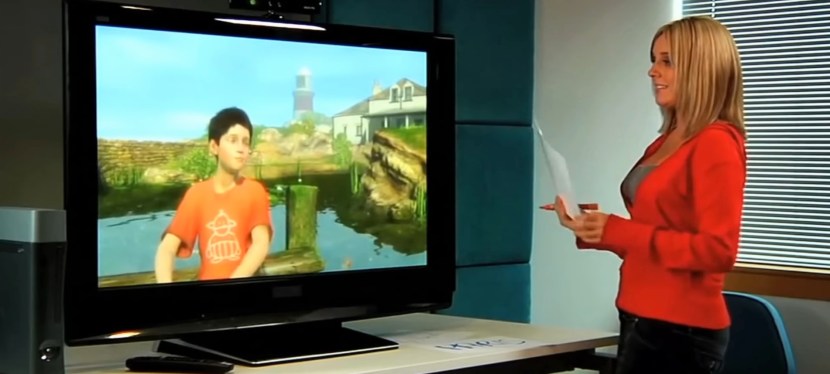
#1. Microsoft’s Project Milo – When Microsoft introduced the Kinect motion-sensing device (then called Project Natal) during the 2009 edition of E3 (Electronic Entertainment Expo), they had Peter Molyneux introduce Project Milo which really intrigued viewers. Even though the video presentation of Project Milo was scripted, it showed its potential as an interactive software using Kinect on Xbox 360. There are lots of details behind the scenes as Project Milo really was a project developed by Lionhead Studios which worked in a limited fashion and ended up never getting released. Watch and learn from the video below.
#2. The story of The Hershey Company and its founder – Do you often eat chocolate bars of Hershey’s? The Hershey Company is gigantic with a global presence of products, billions of Dollars in annual revenue, the operation of Hershey’s Chocolate World and even a theme park of its own called Hersheypark. Hershey’s was started by its founder Milton S. Hershey who came from a really difficult life. You can learn more about the founder and how The Hershey Company came to be by watching the video below.
#3. The kids who hacked Xbox – You do know that hacking is illegal and there is simply no excuse to do it. Believe it or not, Xbox got hacked by a group of very young gamers and they even got themselves an early build of the blockbuster game Gears of War 3. Not only that, the group also hacked many other gaming-related companies. Watch and learn from the video posted below.
#4. The Democrats are the problem for Americans – Apart from being a very corrupted political party, the Democrats are guilty of hypocrisy, lying, censorship, and distorting the facts to suit themselves. Now they have Communist Kamala Harris as their candidate for US President and that only means the party wants more of the same negative elements under Joe Biden to continue. This explanatory video shows exactly what went wrong under Biden and the Democrats, why the Democrats are not the party of common sense and why Kamala Harris is wrong for the nation’s future.
#5 Donald Trump’s Never Quit video – The 2024 US Presidential election is about to happen. In recent times, the campaign of Donald Trump released the Never Quit video which is a lot more than just political advertising. It is a stark reminder of how much life in America turned for the worse under the Biden-Harris administration. Remember the tax cuts and other reforms Trump approved as US President which really made America stronger and greater? Watch the video below and share it to others. This is about making America great again.
#6. Minty Comedic Arts’ Innerspace video – I first saw the 1987 sci-fi adventure movie Innerspace on home video. Starring Dennis Quaid, Martin Short and Meg Ryan, it was an entertaining film that had a nice mix of adventure, comedy and spectacle. Recently, Minty Comedic Arts published a trivia video about it which is fun to watch.
#7. You, Me and the Movies react to Night of the Creeps – Some of you might be aware that I enjoyed watching the 1986 mix-genre film Night of the Creeps. It was the directorial debut of Fred Dekker and it was clever blend of science fiction, horror, 1950s romance, 1980s teen comedy and detective storytelling. Recently You, Me and the Movies posted their video reaction which I find enjoyable.
#8. Beneath the Planet of the Apes examined and analyzed closely – Released in 1970, Beneath the Planet of the Apes was the sequel to the classic film Planet of the Apes. While it is easy to think that the sequel was made simply because the movie studio wanted to make more money by capitalizing on the success of the previous film, there was a lot of developments, twists and even intrigue that happened behind the scenes before filming even started. The two videos below from YouTuber Represent This should be seen and for those who have seen Beneath the Planet of the Apes, it will impact your perception about the movie’s quality and creative direction.
Before I end this post, I should say that the concept of humans evolving from apes is pure fantasy. The scientists and fantasy writers got it all wrong.
Welcome back, my readers, YouTube viewers and all others who followed this series of articles focused on YouTube videos worth watching. Have you been searching for something fun or interesting to watch on YouTube? Do you feel bored right now and you crave for something to see on the world’s most popular online video destination?
I recommend you check out the following topics and the related videos I found.
#1Donald Trump’s decades-long journey to becoming US President – No matter what your political views are, there is no denying that Donald Trump’s incredible 2016 election victory as President of the United States was the culmination of a very long journey that started since 1980s. As Trump kept doing lots of business, he observed what went wrong in America, what the nation lost to other countries with regards to trade or diplomacy, why many ordinary Americans became forgotten, and more. Watch Trump’s journey in the video below.
#2 A look back at Street Fighter II V (anime) – If you are a long-time gamer like me, chance are, you must have played one of the many games of Street Fighter II. If you have played the games, were you able to watch the short-lived anime series titled Street Fighter II V? Loosely based on Super Street Fighter II Turbo, the anime series started in 1995 and was directed by Gisaburō Sugii who was responsible for the anime movie of 1994. I found two YouTube videos revisiting Street Fighter II V posted below for your enjoyment.
#3 Fox News interview shows Kamala Fit is too dishonest and too out-of-touch to be US President – If there is anything notable with the incumbent United States Vice President Kamala Harris – the one woke candidate the Democrats nominated after pushing Joe Biden out of the way – is that she has a very distorted view of reality and she is very unfit to become US President. Her recent interview with Fox News is the worst yet and the consequences are still being felt as I write this down. Watch the selected videos below to find out.
#4 A look back at Koudelka – During the late stage of the first PlayStation console’s life, Japanese role-playing games (JRPGs) became really popular with gamers in Europe and America. Back in 1999, the role-playing game Koudelka was released on PlayStation in Japan and an international release followed in 2000. That game did not achieve critical acclaim and was never a big seller. As many old-time gamers have forgotten about its existence, Koudelka’s production history is rather intriguing and surprising to discover.
Koudelka was developed by Sacnoth which was founded by former Squaresoft employee Hiroki Kikuta (Secret of Mana, Trials of Mana, and Soukaigi). To find out why Koudelka had an unusual RPG concept and style of gameplay, I encourage you to watch the retro gaming video below.
#5 More Iranians need Israel’s help – It is a fact that the Islamic regime of Iran has a long record of brutalizing Iranians who do not follow their evil moves. In short, the people of Iran are not their wicked government. That being said, the dissenting Iranians are reaching out to Israel for help in the form of military action against the evil regime. Watch the video of The 700 Club below. It includes statements from Iran’s Crown Prince Reza Pahlavi.
#6. George Romero was hired to make a Resident Evil motion picture – Back in the late 1990s when the Resident Evil game franchise really soared in popularity and became bankable for Capcom, a movie project was approved and the late George A. Romero (Night of the Living Dead, Dawn of the Dead, Creepshow) was hired to write and direct it. It should be noted that Capcom hired Romero to make the Resident Evil 2 commercial which became very popular and contributed to the game’s big success. Eventually, Romero’s drafts of the script got rejected and Constantin Film replaced him with Paul W. S. Anderson resulting in the 2002 Resident Evil movie.
If you are fascinated with Romero’s short-lived involvement with the Resident Evil movie project, you should watch the related videos posted below…
#7. China’s Bonnie and Clyde – Have you been following the YouTube channel Dark Asia with Megan? Every week, there is always a new episode about true crime stories that took place within Asia and the host Megan is often great with her presentation and she clearly does a lot of research. Recently an episode about China’s very own Bonnie and Clyde was released. I saw it and it is very intriguing to watch. For the newcomers reading this, Bonnie and Clyde refers to real-life American bandits and serial killers who caused a lot of trouble from 1931 to 1934. Hollywood even released a movie in 1967 glorifying them. As for who exactly were China’s Bonnie and Clyde, and what had they done, I encourage you to watch Dark Asia with Megan’s episode below.
#8. Kamala Harris supporter shouts at toddler – Going back to the 2024 US Presidential campaign, a supporter of Communist Kamala Harris (the US Vice President since 2021) was caught on camera yelling at and traumatizing a toddler. I know for a fact that liberals, Leftists, Marxists, socialists and woke Americans can be quite wild but the die-hard Kamala supporter who screamed at the toddler clearly has crossed the line. It makes me wonder if the Democrats ever oriented their supporters to be civil and in control. Watch the Sky News Australia Lefties Losing It video below.
#9. Kamala Harris got booed at her own campaign rally! – The presidential campaign of Commie Kamala Harris is clearly failing not only because the opinion polls – most of which are Left-leaning and oversampling Democrat voters – are showing her falling further behind Donald Trump but also because unfortunate events have been happening at her campaign rallies. The new embarrassment this time is Harris getting booed at her own campaign rally! Watch the videos below.
Welcome back, my readers, YouTube viewers and all others who followed this series of articles focused on YouTube videos worth watching. Have you been searching for something fun or interesting to watch on YouTube? Do you feel bored right now and you crave for something to see on the world’s most popular online video destination?
I recommend you check out the following topics and the related videos I found.
#1In-depth look at the making of Silent Hill – It has been over twenty-five years since Konami released Silent Hill on PlayStation. That horror-themed adventure game added to the evolution of horror gaming and it stood out differently from Capcom’s Resident Evil series of survival horror games. I recently viewed a very in-depth video by thegamingmuse who spent a lot of effort researching the game development history of Silent Hill, who the creators were and what challenges came along the way leading to the game’s eventual release. The video is over a hundred minutes long but I assure you it is full of details that will give you insight about how the game materialized.
#2 Electric cars are still very dangerous and deadly – I mentioned before that no matter how nice the promotions are, electric cars are still dangerous to have as they can spark fire randomly, damage properties nearby and even kill you. In recent times, there were these two electric cars in different locations that sparked into flames randomly. One of them was not even charging at all while being parked in a residential community’s parking area. That electric car suddenly caused a huge fire that destroyed many cars parked nearby while also forcing many residents to leave their units. The fact is electric vehicles are not safe and are not reliable. The future of the automobile is absolutely NOT electric. Watch and learn from the videos below.
#3 Star Trek: Generations reaction video by Popcorn in Bed (PIB) – Before I first saw Star Trek: Generations in the cinema in 1995, I was excited over the promised cinematic crossover between the iconic captain James T. Kirk and captain Jean Luc Picard. Having seen a mix of movies of the original Star Trek crew plus episodes of Star Trek: The Next Generation, the concept of a crossover was really intriguing. After watching Star Trek: Generations, I left the cinema disappointed not only because the Kirk-Picard crossover (William Shatner and Patrick Stewart together on-screen) was not so great but also because the pacing and direction were not cinematic in execution. In fact, I find Star Trek: Generations’ concept more suitable in comic book format.
Of course, the flawed movie has its fans and slowly it is being discovered by YouTubers for the first time in their lives. Popcorn in Bed (PIB) recently posted the reaction video of Star Trek: Generations and she previously spent months watching all the seven TV seasons of Star Trek TNG. How would she react to the movie and how it impacted her, you have to watch it below.
#4 Terrorist state Iran’s hatred towards Israel explained – With its evil regime that started in 1979, Iran is both a terrorist state as well as the center of evil in the entire Middle East. No matter how many times a Democrat-led United States bowed to them and made desperate deals with them, Iran’s top leaders kept cheering (in their local language) death to America, England and Israel. In other words, Western ideals and democracy are completely unacceptable to Iran’s evil regime. The Ayatollah regime of Iran is so wicked, their government even brutalizes Iranians who do not follow their ways.
For Iran, the existence of Israel (the land that God designated to the Jewish people) unacceptable and their hatred towards them is so powerful, they sponsored terrorist groups like Hamas and Hezbollah to launch waves of attacks to destroy the Jewish state. Terrorist state Iran is doing what Satan always wanted and the evil regime is still obsessing with dominating the Middle East with destruction and the imposition of their religious beliefs on others. Iran is also obsessed with world domination and they will also attack Europe and America. To find out more, watch TBN Israel’s compelling video explaining Iran’s hatred towards Israel.
#5 The high number of deaths caused by electric cars that went wrong – Going back to electric cars, I posted a video that discusses in detail a hot issue that electric vehicle fanatics and the mainstream news media do not want to talk about – the high number of deaths caused by electric cars that went wrong. Watch it now.
#6. Kamala Harris simply cannot be trusted – In recent times, Kamala Harris appeared in several TV shows to reach out to as many voters as she could as the US Presidential Election gets closer. Harris has huge problems: dishonesty, inconsistency and a distorted view of reality. In other words, the Democrats’ presidential nominee is very out of touch with reality and she does not seem to care much about the American people who have been suffering from rising crime, the higher costs of living, the deterioration of public order in connection with the rising number of illegal aliens in America, and much more.
In short, Harris is so woke, she has no real solutions for the American people. She cannot even define herself clearly as she is obsessed with identity politics, vibes and wokeness. She cannot even focus on policy and governance. Kamala Harris is clearly unfit to become President of the United States (the Democrats will have to CHEAT AGAIN to elect her). Watch and learn from the selected videos below.
#7. Understanding America’s Electoral College – In light of the US Presidential Election happening on November 5, 2024, now is a good time to learn about the Electoral College and how it works on electing the next President. Contrary to popular belief, the popular vote does not determine the winner of the election as there is a state-by-state mechanism and the ones who actually determine the winner are the electors. Confused? Watch the two PragerU videos below.
#8 Dragonslayer reaction video by You, Me and the Movies – I was a very young boy when I first saw Dragonslayer inside the cinema back in 1981 here in the Philippines. Being so young, I was not yet aware that the fantasy movie was a Disney-Paramount joint effort. The public word of mouth back then was that the movie was a visual spectacle as it had Industrial Light and Magic (ILM) work on the special effects while the Go Motion effects were handled by Phil Tippett. To make things clear, I am NOT a fan of Dragonslayer but I should say that YouTuber You, Me and the Movies recently posted their movie reaction of it which is entertaining to watch.
#9 The elimination of Hamas terrorist leader Sinwar plus the attempted attack against Israel’s PM Netanyahu – In recent times, I posted about the unexpected elimination of Yahya Sinwar who was the leader of the Iran-sponsored Palestinian terrorist group Hamas and the mastermind of the October 7, 2023 terrorist attacks against Israel. Sinwar was a mass murderer and a real-life demon who always hated Israel and the Jewish people. He was also one of the favorite terrorist allies of Iran. Apart from Sinwar, Iran had its Lebanon proxies Hezbollah attempt to assassinate Israeli Prime Minister Benjamin Netanyahu only to fail. The war against Islamic terrorism continues and the TBN Israel news video explains the details for you all.