Disclaimer: This is my original work with details sourced from reading the comic book and doing personal research. Anyone who wants to use this article, in part or in whole, needs to secure first my permission and agree to cite me as the source and author. Let it be known that any unauthorized use of this article will constrain the author to pursue the remedies under R.A. No. 8293, the Revised Penal Code, and/or all applicable legal actions under the laws of the Philippines.
Welcome back superhero enthusiasts, 1990s arts and culture enthusiasts, Marvel Comics fans and comic book collectors! Today we go back to the early 1990s to explore one of the many tales of the Marvel shared universe through the Uncanny X-Men series.
What happened in issue #284 was a turning point in storytelling and it is only a part of the early period of the X-Men – Gold Team’s operation. The X-Men were on the way home (with Jean Grey successfully retrieved and restored) following their encounters with Fitzroy’s gang and the mutant from the future Bishop only to proceed to a specific island in response to a distress call. By the end of it, something significant happened which separated the X-Men from Professor X and Forge.
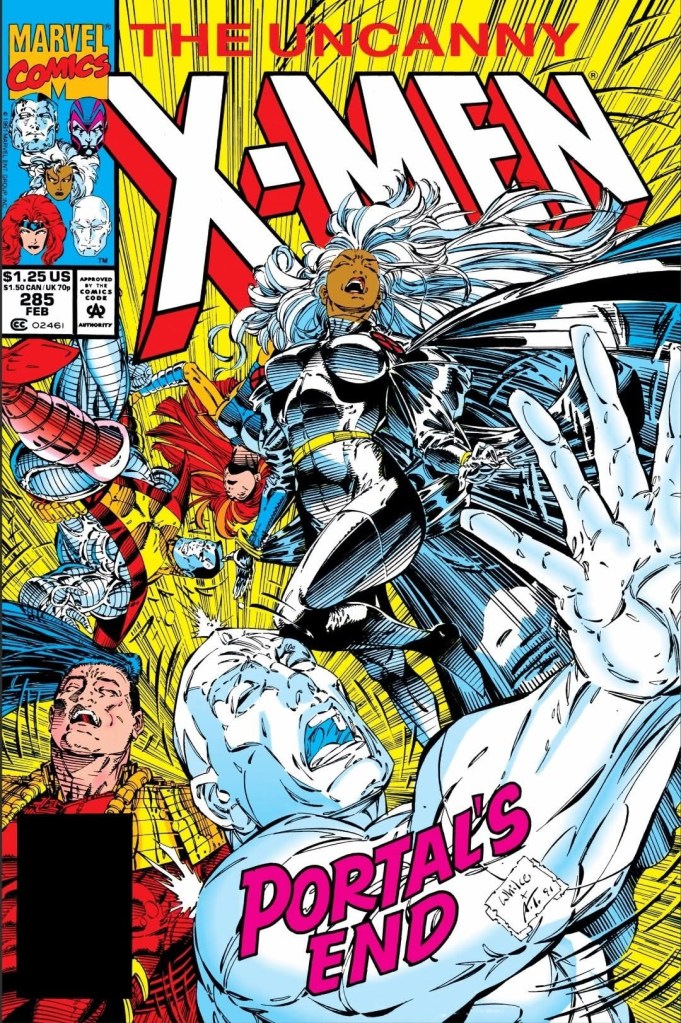
With those details laid down, here is a look back at Uncanny X-Men #285, published in 1992 by Marvel Comics with a story co-written by Whilce Portacio, Jim Lee and John Byrne (who worked on the script). The art was done by Portacio with ink work by Art Thibert.
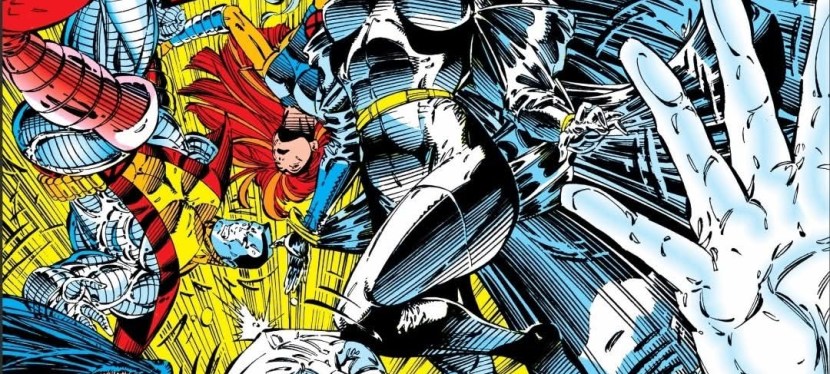
The cover.
Early story
The story begins with Jean Grey and Colossus (carrying a female primate) who find themselves not only disoriented but also separated from their teammates Iceman, Archangel and Storm. A unknown amount of time has passed since they were sucked forcefully into a void which turned out to be a portal into a new world of unknown origin.
As soon as they land, several primates (humans wearing armor and futuristic gadgets) immediately ganged up on them, knocking Jean Grey out successfully while ramping up their attacks on Colossus. With Colossus down after intense hits, the Russian X-Men member does not fight back and eventually saw his metallic skin turn into flesh fully exposing his human identity. The primates suddenly changed their attitude as they referred to Colossus as a returned savior who has fulfilled the prophecy they grew up with.
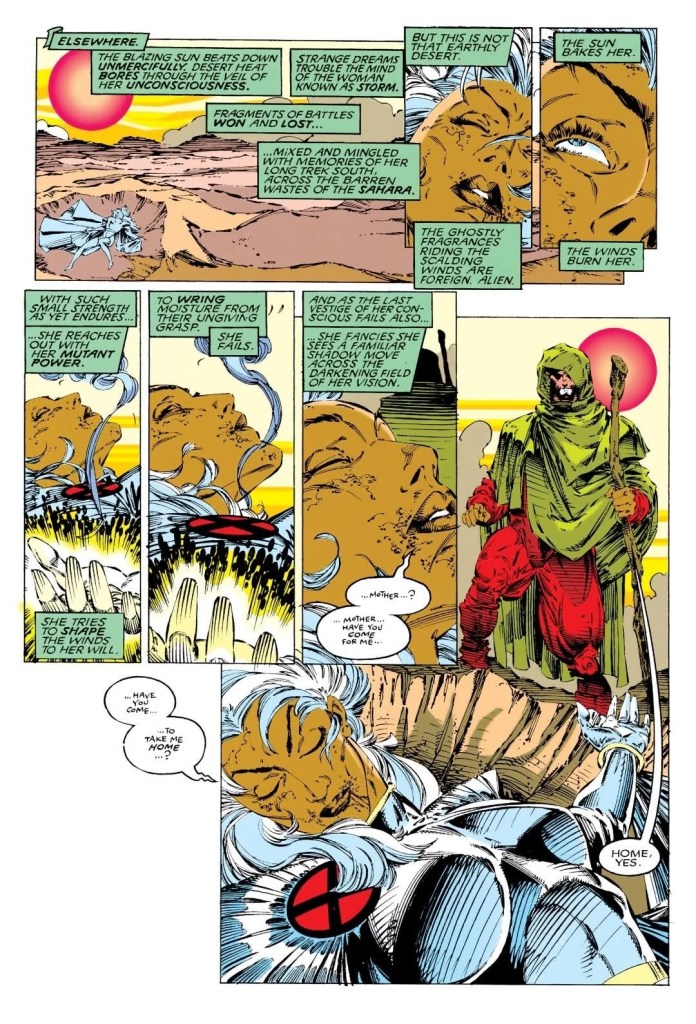
Elsewhere, in the middle of a hot desert, Storm is down on the sand feeling weak and groggy. She tries to alter the wind but fails. Suddenly, a man arrives with the intention of carrying Storm to his home…
Quality
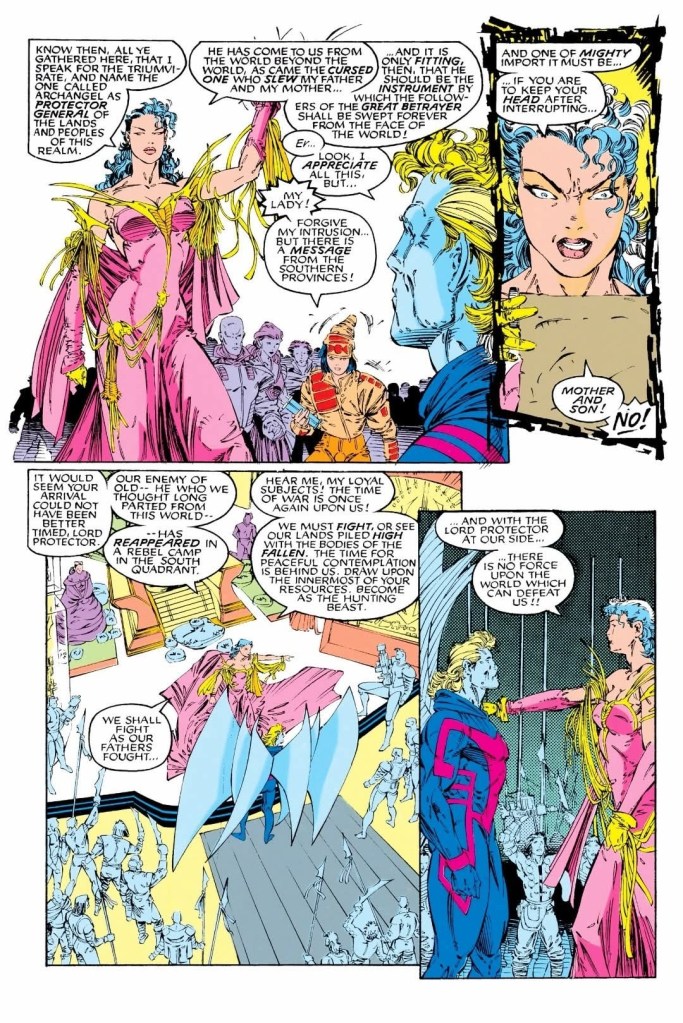
The natives in this page, Archangel is not only accepted by the leader but also perceived to be a great figure of destiny in connection with their beliefs.
This particular X-Men tale is the result of the turning point that happened in the previous issue. In this comic book, the X-Men’s Gold Team members are separated from each other and the world they are in is alien in nature and yet filled with unusual looking humans who clearly have a long-lasting culture, history and cultural norms formed through generations. This concept the creative team came up with has strong vibes of the 1980s American science fiction TV series Otherworld which I saw a very long time ago. In fact, I find the overall concept of this comic book an inspired piece of work.
Like in Otherworld, the X-Men are in a totally new and unknown world that somewhat looks like Earth but then it is not as the natives they encountered are totally unlike anything they encountered before. Like in The Empire Strikes Back, the X-Men here are separated from each other which opened up opportunities for the creators to develop the characters, show particular threads of their respective personalities (or their talents) and emphasize how they perceive new people and the new world they are in.
Without spoiling the plot, I can say that the natives of the unknown world are living with the foolishness of idolatry which can be seen at least in how they believe Colossus (in the flesh) is their savior and the fulfillment of the prophecy they were oriented with. The idolatry aspect of the tale serves as the twist on the primates’ (specifically the few who went to Earth willing to fight to the death) who first appeared to the X-Men as very daring opponents and it adds depth to the X-Men’s struggle on understanding the new world they are in.
When it comes to character development, Colossus and Jean Grey are strongly emphasized by the creative team who also managed to do the same with Iceman, Storm and Archangel. This tale also serves as a relief from the back-to-back good-versus-evil battles that took place since issue #281 and I can say the writing is solid.
Conclusion
A very helpless Storm is approached by a man in the middle of the desert.
While it lacks the usual conflict between Marvel’s mutants and evildoers, Uncanny X-Men #285 (1992) is an inspired piece of work filled with sci-fi concepts, the overwhelming power of discovering a new world and established natives, and a lot of character development on Colossus, Storm, Jean Grey, Ice Man and Archangel. As I read the story, the mystery builds up and there were these subtle pay-offs that happened along the way. Overall, this comic book is a huge pay-off to what was established in issue #284 and the notable thing is that the X-Men Gold Team (who have Sunfire with them) are just getting started in the unknown world.
Overall, Uncanny X-Men #285 (1992) is highly recommended!
Welcome back readers, fellow geeks and electronic gaming fans!
In this edition of the Retro Gaming Ads Blast (RGAB) series, we will take a look at another batch of retro gaming print ads – including arcade flyers – from the 1970s to the 1990s.
For the newcomers reading this, Retro Gaming Ads Blast (RGAB) looks back at the many print ads of games (console, arcade, computer and handheld) that were published in comic books, magazines, flyers, posters and newspapers long before smartphones, social media, the worldwide web and streaming became popular. To put things in perspective, people back in the 1980s and 1990s were more trusting of print media for information and images about electronic games and related products.
With those details laid down, here is the newest batch of retro gaming print ads for you to see and enjoy…
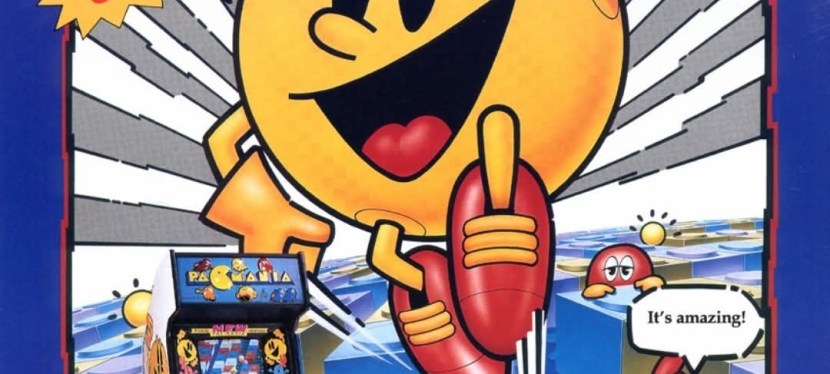
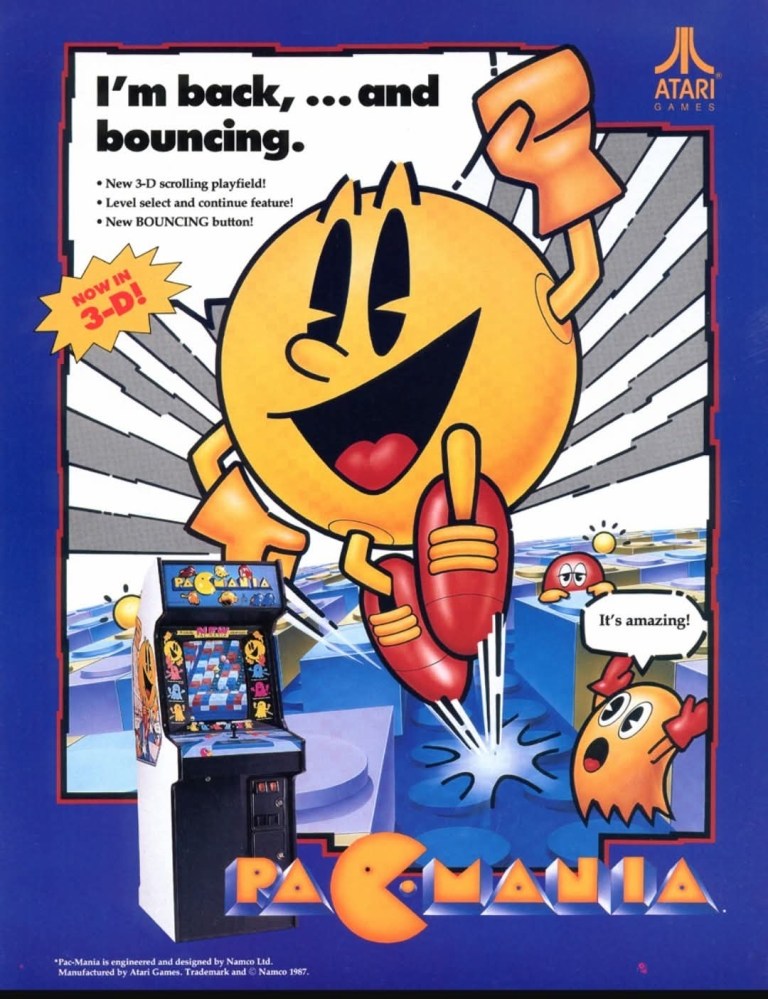
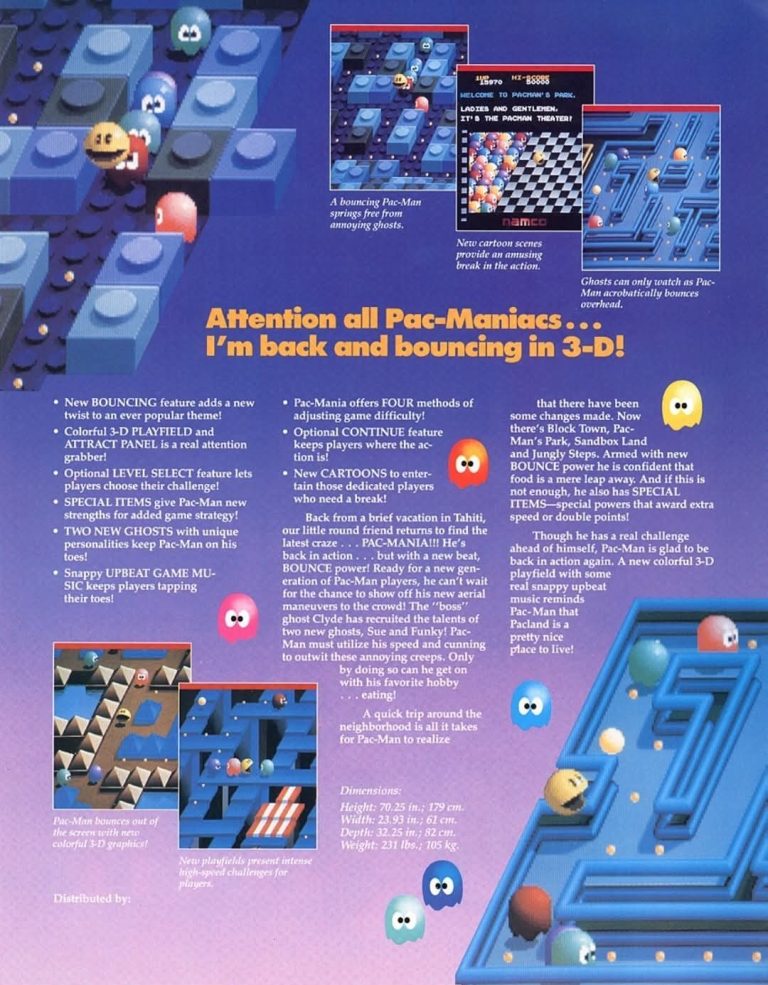
1. North American Pac-Mania arcade flyer
The front.
The rear.
Released in 1987, Pac-Mania became a big hit among critics, fans and casual arcade gamers which added a lot to the enduring popularity of the Pac-Man game franchise. As it featured a new game design with an oblique perspective and a more 3D feel, Pac-Mania was a very serious attempt on reinventing the Pac-Man formula. For the American market, Namco licensed the game to Atari which in turn came up with the above arcade flyer that had a pretty eye-catching front cover artwork showcasing the iconic Pac-Man jumping out from a maze with the line “I’m back,…and bouncing.” The arcade cabinet was also shown and a clear message about the 3D feature of the game was shown. The other side of the flyer showed screenshots and details that are worth reading. This arcade flyer still looks attractive and informative by today’s standards.
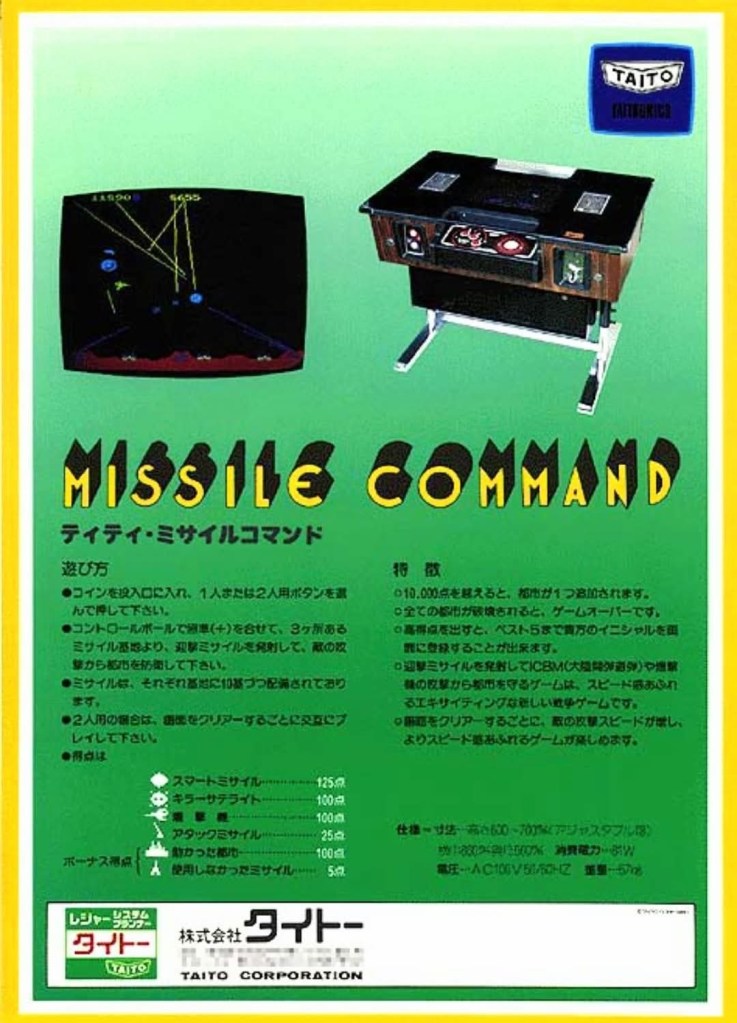
2. Japanese Missile Command arcade flyer
Cocktail arcade tables were popular in Japan and Taito brought Missile Command with the format.
Missile Command is a true arcade classic which I always enjoy replaying (read my retro review by clicking here). It was an instant hit in arcades in America and after Atari licensed the game to Sega and Taito for the arcades of Japan, it also achieved huge success there. Along the way, Taito released Missile Command with an cocktail arcade table format which is common in Japan. The arcade flyer Taito came up with had a very simplistic presentation of details, an image of the cocktail arcade table and one screenshot of the game. The Japanese arcade flyer clearly lacks excitement but at least it gave gamers and arcade operators a clear idea of what to expect with Missile Command.
3. Atari 2600 print ad
The 1978 print ad.
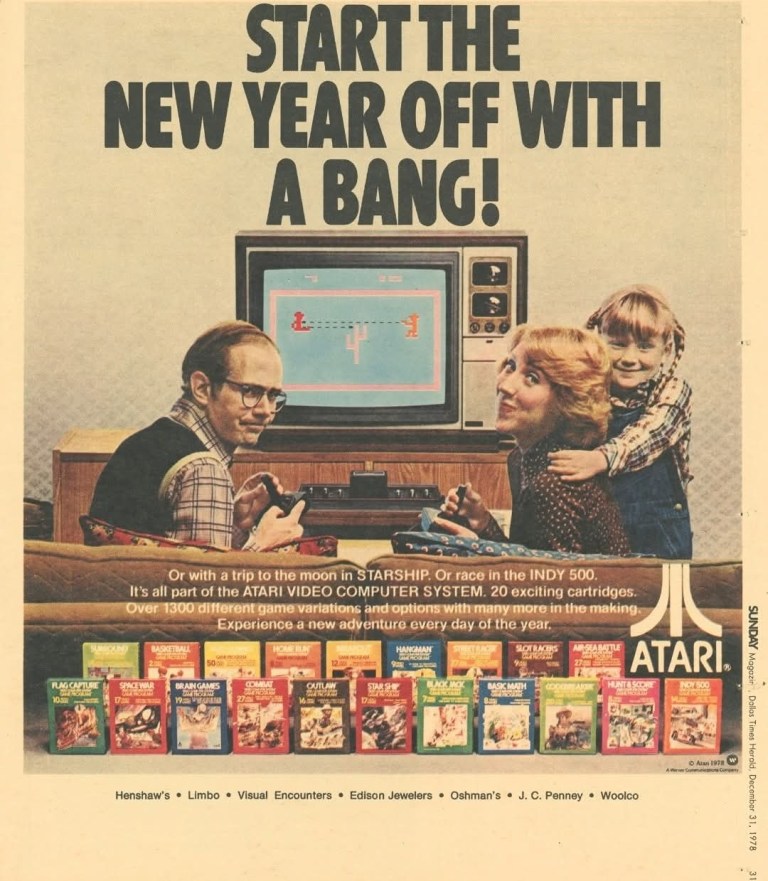
When the Atari 2600 was first launched in 1977, it was officially called the Atari Video Computer System (Atari VCS). The Atari company really aimed high to sell a lot of consoles to as many households as possible and they came up with a print ad like this one from 1978. While the Atari 2600 and its games were displayed, the image of a father, mother and daughter showed that the company not only targeted American families but also want to change home entertainment to be more interactive. This old ad is truly an inspired piece of work.
4. Kool-Aid Man video game print ad
I never played the Kool-Aid Man video game.
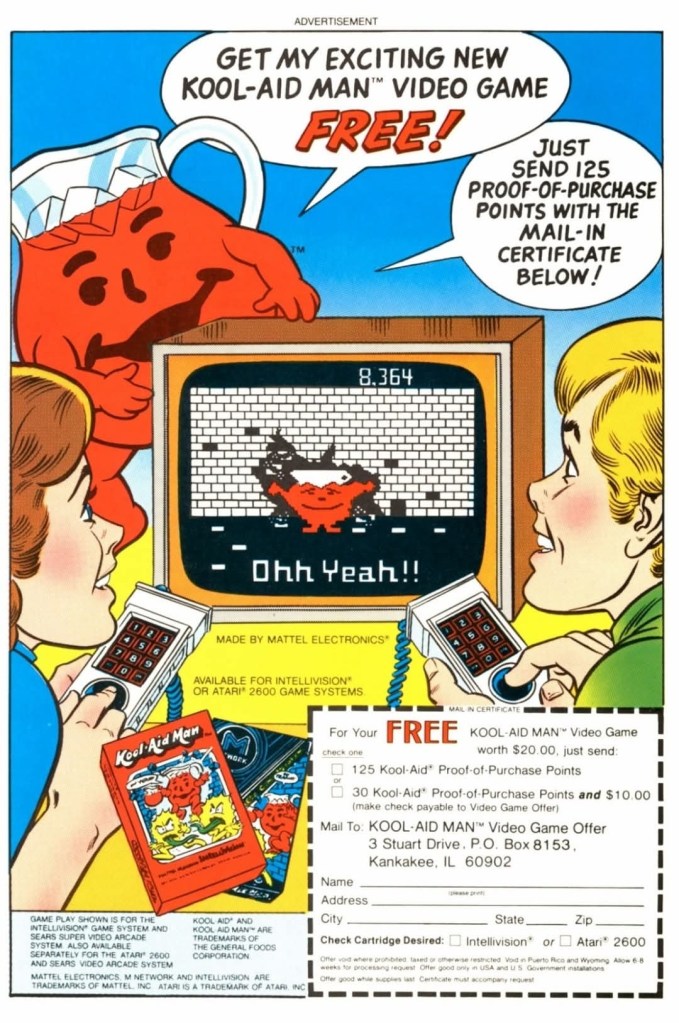
There was a time when Kool-Aid was such a popular drink, the character Kool-Aid Man debuted in 1974 after initially starting as the Pitcher Man. A short time later, merchandising featuring the character followed and in 1983 the official Kool-Aid Man video game was released on the Atari 2600 and the Intellivision. This particular print ad appeared in some comic books I read a very long time ago and it offered customers the opportunity to get the game free by sending 125 proof-of-purchase points to the company by mail. This old ad was visually striking and was a creative way to boost sales of the drink.
5. Spider-Man Atari 2600 game print ad
Spider-Man and Green Goblin with the Atari 2600 and the TV.
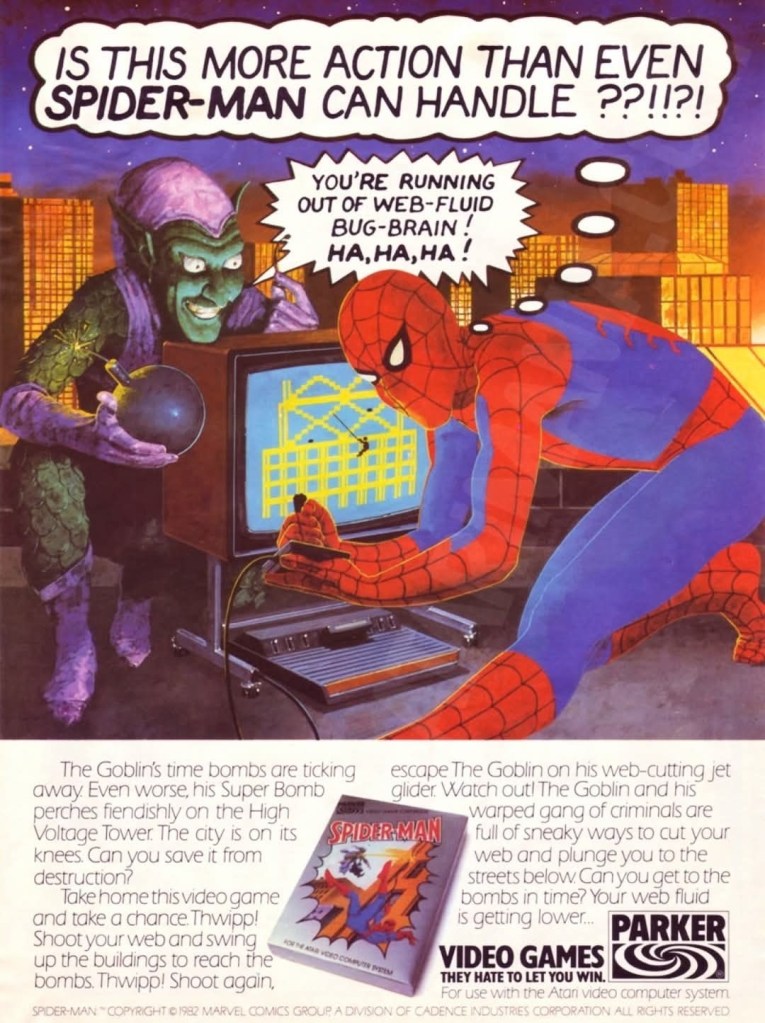
Even though the controls were rough and the game’s difficulty really went high with each new session, my friends and I still enjoyed playing the Spider-Man video game on Atari 2600 from Parker Brothers. Apart from the comic book-style print ads they came up with to promote the game, Parker Brothers went on to make this particular ad featuring Spider-Man and the Green Goblin with a TV set, the game and the Atari 2600 together all presented with a totally different art style. This is still a fun ad to look at.
6. Phoenix game print ad
This is still an impressive print ad.
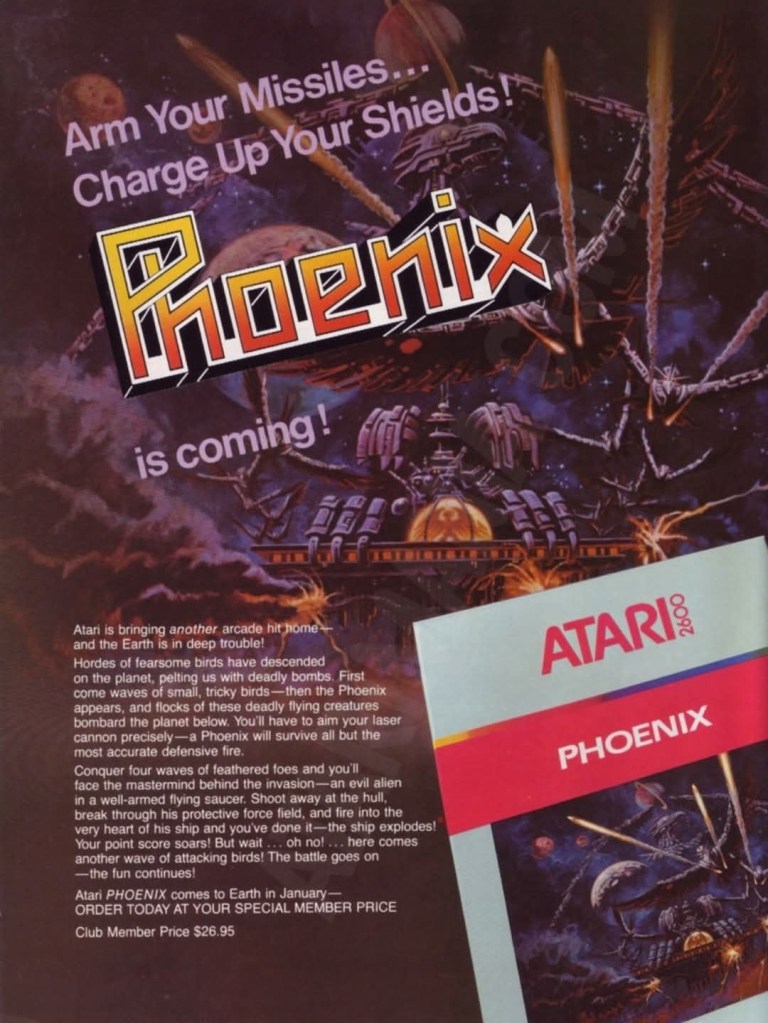
After playing shooter-type games like Space Invaders and Centipede on the Atari 2600, my friends and I experienced something familiar yet fresh with Phoenix. Atari secured from Taito the rights to make the Atari 2600 port of the game, and they came up with a dark print ad that showcased the official painted art work, a portion of the video game’s box and the line “Arm Your Missiles…Charge Up Your Shields! Phoenix is coming!” Having played the game many times, those highlighted words really captured the essence of Phoenix gameplay.
7. Sunset Riders North American arcade flyer
The front.
The rear.
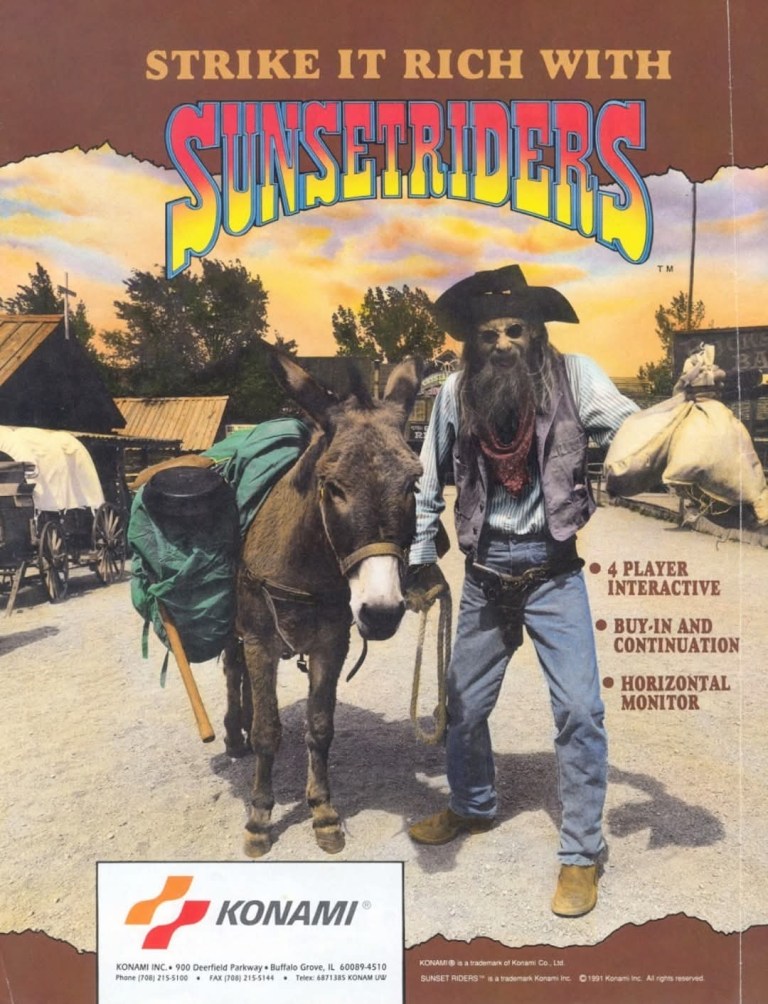
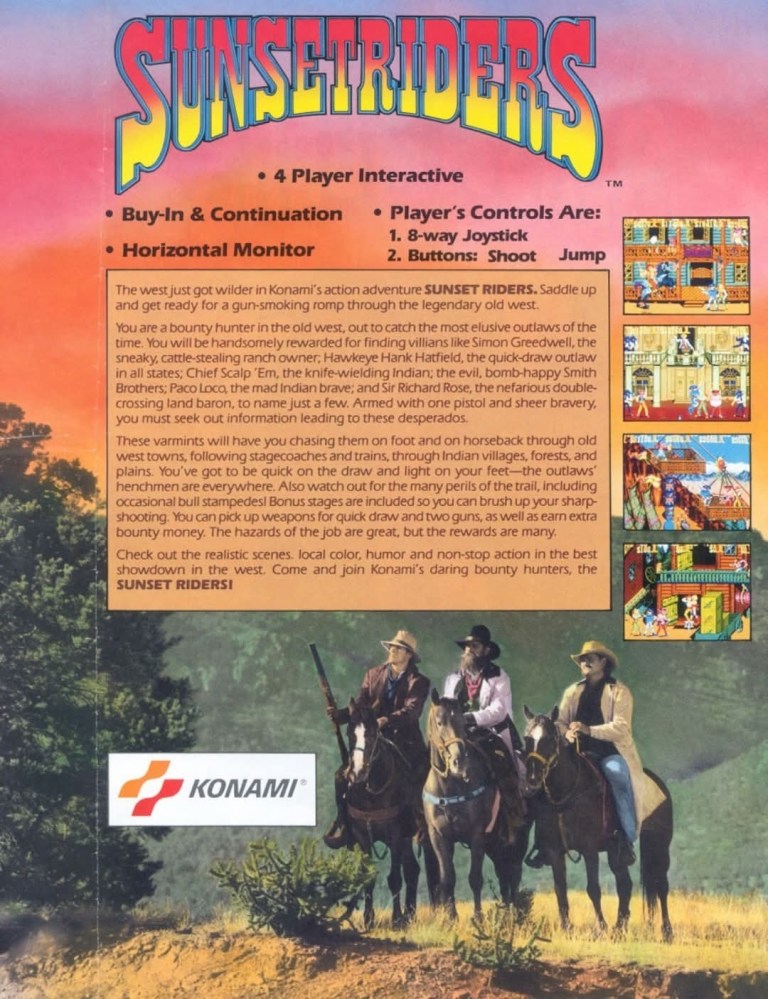
Released in arcades in 1991, Sunset Riders was a critical and commercial hit raking in more success to Konami. For the American arcades, Konami came up with this print ad showing a creepy looking cowboy carrying a bag of money (related to the “strike it rich” line) with his donkey with him. The rear of the ad shows another photograph of 3 cowboys on their horses, the four screenshots and the creative text description. Too bad we don’t see flyers like this anymore.
8. Parker Brothers’ 6-game print ad
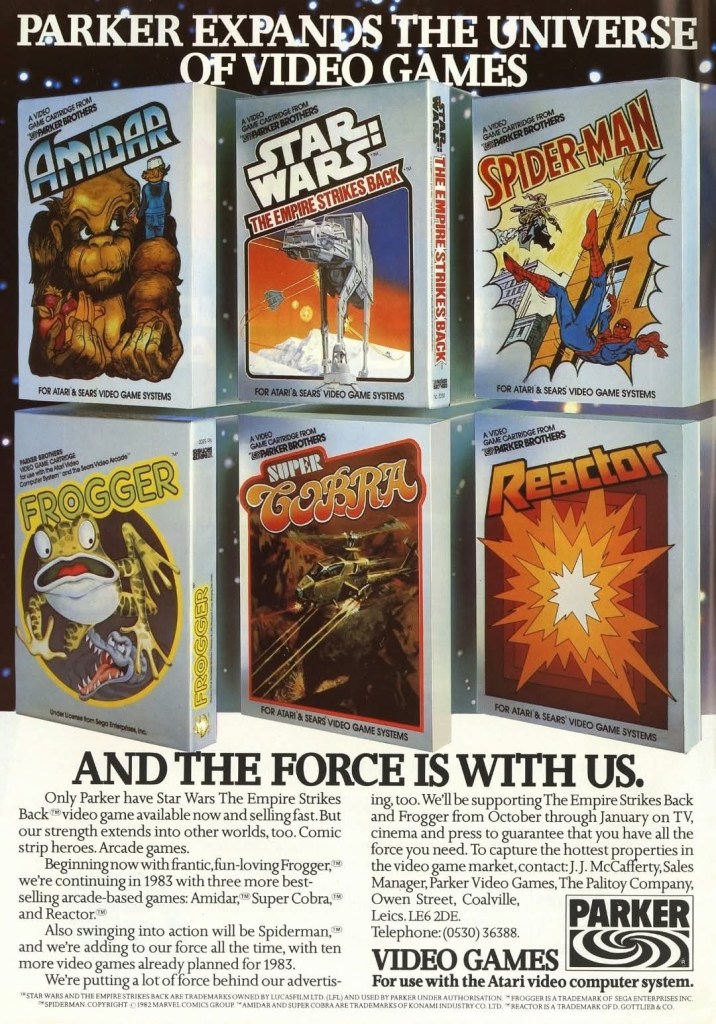
Parker Brothers 6-game print ad.
Quite arguably, Parker Brothers was the 2nd most prominent publisher of video games on the Atari 2600 console next to Atari itself. Out of the six games presented in this old print ad, I only played Spider-Man and Super Cobra. Each game’s box had a unique art style and collectively they made this ad look exciting. Times were really different back in the 1980s.
Welcome back readers, fellow geeks and electronic gaming fans!
In this edition of the Retro Gaming Ads Blast (RGAB) series, we will take a look at another batch of retro gaming print ads – including arcade flyers – from the 1980s and 1990s but with focus on Star Wars games that were released during the era of George Lucas. This is the Star Wars Special of RGAB.
For the newcomers reading this, Retro Gaming Ads Blast (RGAB) looks back at the many print ads of games (console, arcade, computer and handheld) that were published in comic books, magazines, flyers, posters and newspapers long before smartphones, social media, the worldwide web and streaming became popular. To put things in perspective, people back in the 1980s and 1990s were more trusting of print media for information and images about electronic games and related products.
With those details laid down, here is the newest batch of retro gaming print ads for you to see and enjoy…
1. 1983 Star Wars arcade game flyer
The front of the flyer.
The rear of the flyer.
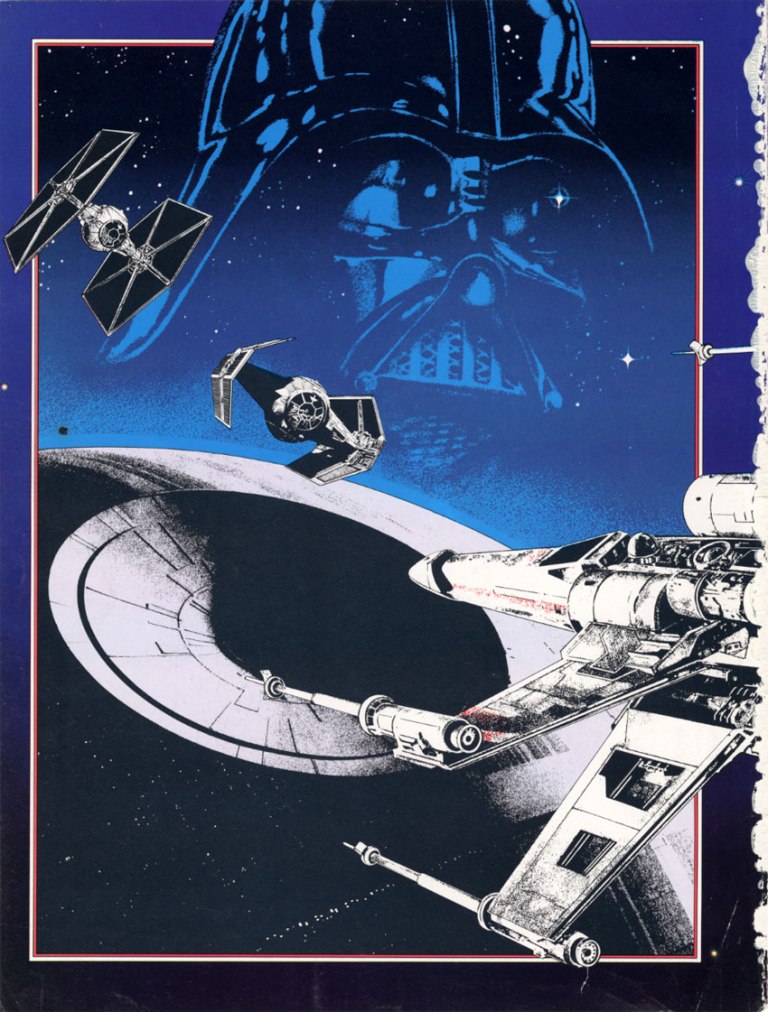
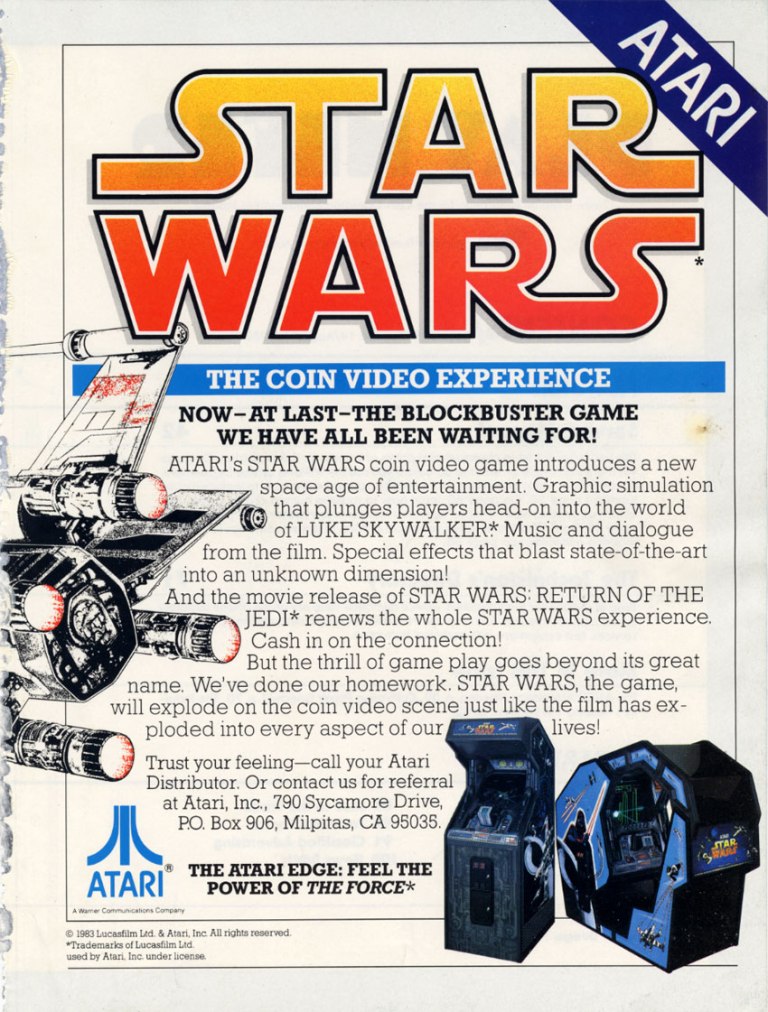
Just weeks before the Star Wars movie Return of the Jedi was released in cinemas in 1983, Atari released the Star Wars arcade game which became a tremendous hit around the world. Both Star Wars fans and gamers of the time loved the game as it provided a very immersive and fun-filled arcade experience. The print ad Atari released has a nice artwork on the front (showing a portion of the Death Star, two TIE Fighters, a Rebel X-Wing Fighter and Darth Vader’s image) and the text description plus the pictures of two arcade machines on the back. While no screenshots were shown, the print ad still had strong visual impact to catch the attention of players and arcade operators. This arcade flyer still looks great!
2. Star Wars: Return of the Jedi – Death Star Battle Atari 2600 print ad
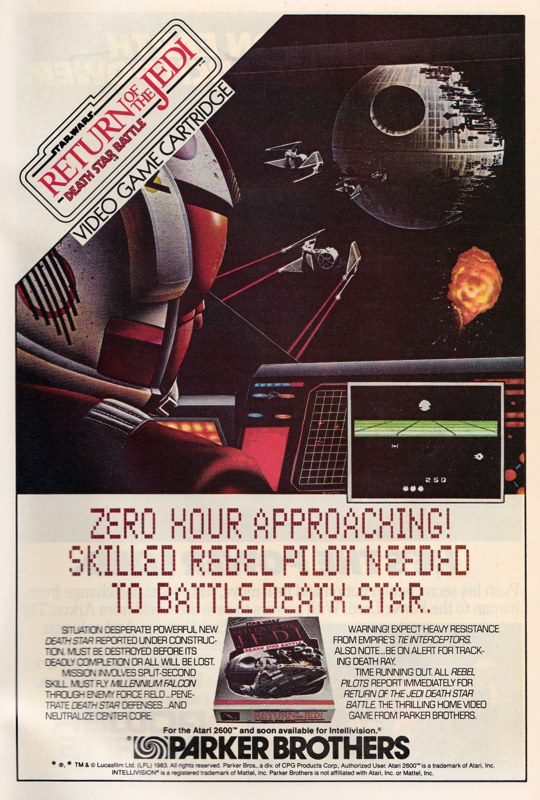
Parker Brothers really stood out among publishers of games on the Atari 2600 and they even had the Star Wars license.
Considering the massive success that Star Wars and The Empire Strikes Back had in cinemas, merchandising and other entertainment media, it was not surprising that games based on Return of the Jedi were produced. For the Atari 2600, Parker Brothers produced Star Wars: Return of the Jedi – Death Star Battle which my friends and I played a lot in 1983. The print ad Parker Brothers came up with has a very eye-catching design showing a Rebel pilot flying a space ship (supposedly the Millennium Falcon which is the only playable ship in the game) towards the Death Star. The visual design is a stroke of genius because it appeals strongly to Star Wars fans while highlighting a major battle in the film which influenced the core concept of the game. This is a classic Star Wars game ad.
3. Star Wars Arcade Japanese market flyer
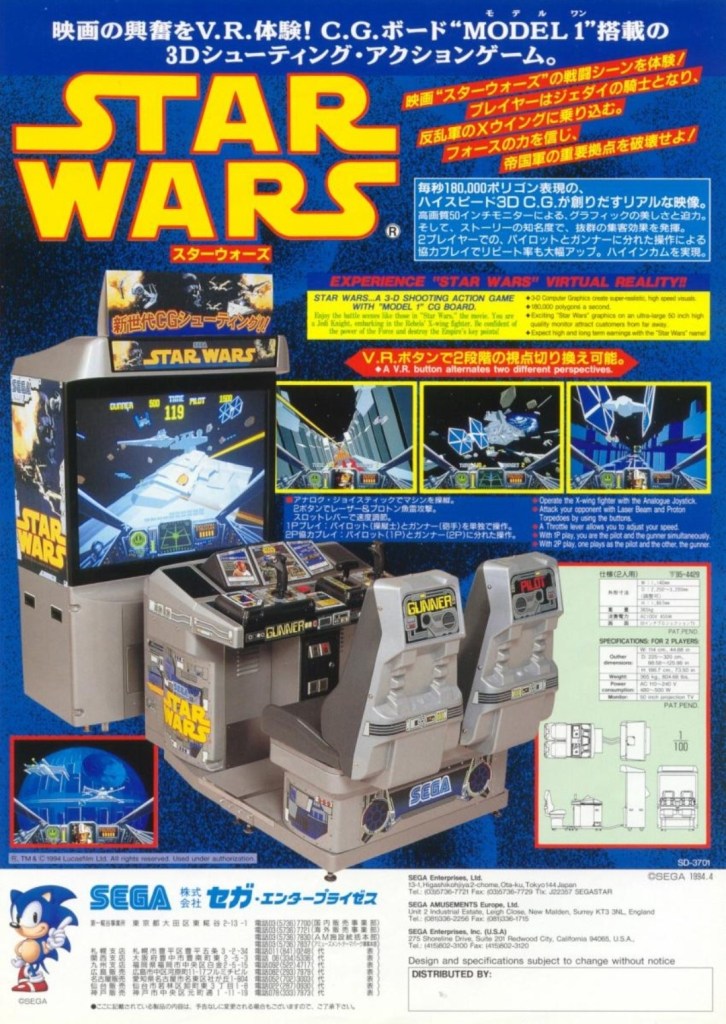
This arcade game was one of the first fully polygonal Star Wars games released.
In the 1990s, Sega acquired the license to produce Star Wars games for the arcades and they had the hardware for polygonal graphics. In 1993, the released Star Wars Arcade which is a space shooter that offered gamers the freedom to fly their Rebel space ship in 3D space with environments and huge space ships rendered in polygons. As you can see in the arcade flyer for the Japanese market, Sega went hard with their presentation showing 3 carefully selected screenshots (amazing for the time) and a picture of the arcade machine which had an elaborate control set-up, seats and decorations. As Star Wars Arcade was released more than a year before the polygonal game consoles Sega Saturn and Sony PlayStation hit the market, this arcade flyer was mind-blowing to gamers who were on the verge of playing video games with polygonal visuals.
4. Super Star Wars print ad
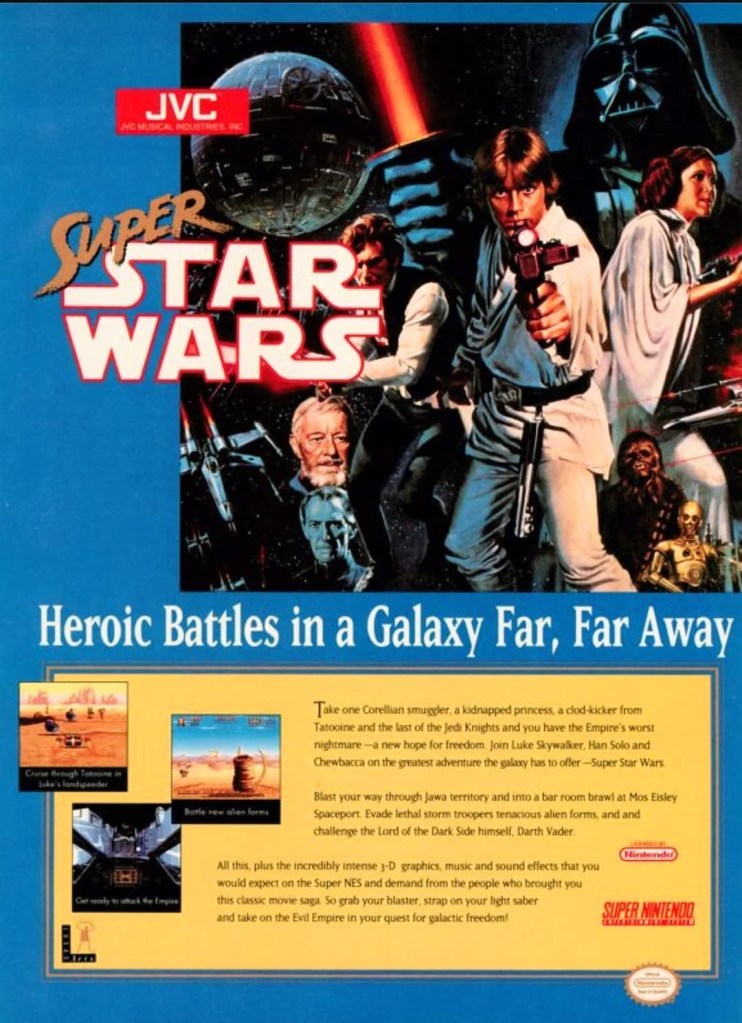
Yes, JVC was involved with the Super Star Wars trilogy starting with this one.
In 1992, Star Wars fans who enjoyed playing 2D side-scrolling games saw their dream of the next great Star Wars console experience come true when Super Star Wars was released on the Super Nintendo Entertainment System (SNES). With the SNES technology, more detailed visuals and improved audio brought the Star Wars universe to life and the addition of 3D-like playable sequences (made possible by Mode 7 effects) made Super Star Wars a very unique console experience. The print ad only showed three screenshots and three paragraphs of descriptive text but the use of images from the 1977 movie poster added a lot of punch to the visual presentation. This ad is both eye-catching to gamers and long-time Star Wars fans.
5. Star Wars: TIE Fighter print ad
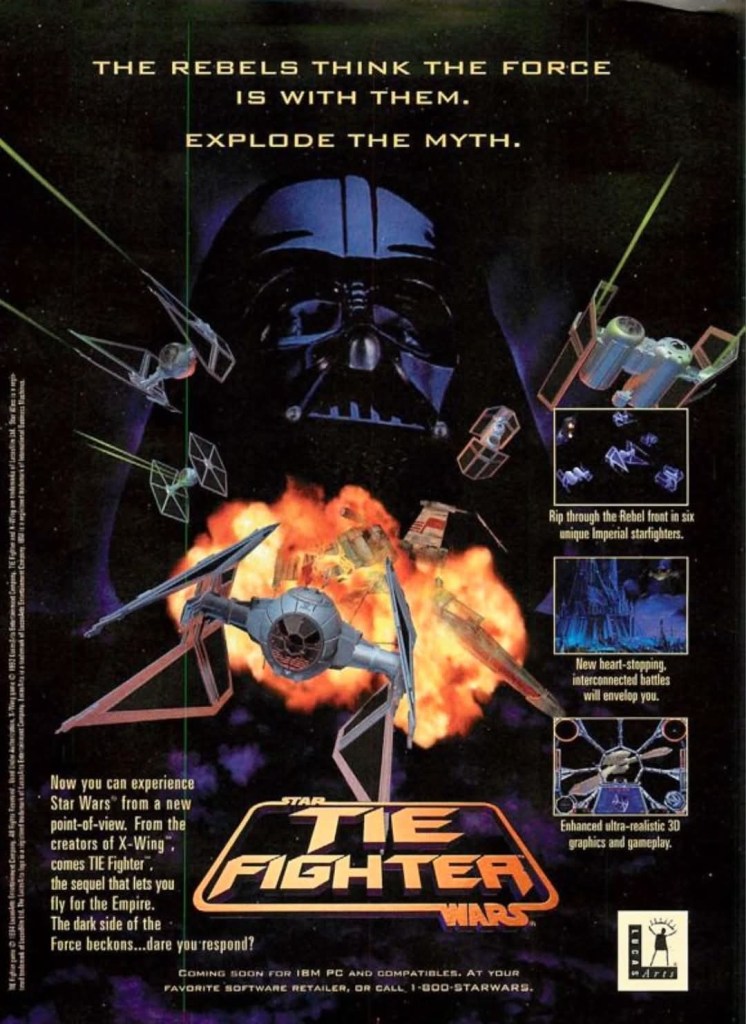
This game offered gamers the opportunities to be with the dark side.
In 1994, LucasArts released Star Wars: TIE Fighter which offered gamers the opportunity to play an Imperial pilot serving Darth Vader on missions set between The Empire Strikes Back and Return of the Jedi. This print ad has a sharp visual design enhanced by Darth Vader’s iconic look in the background. The selected screenshots shown were good to look at but the artwork used to present the TIE Fighters really stood out. This solid looking print ad does come with a bit of disturbance as the Galactic Empire in Star Wars lore are evil.
6. Super Star Wars: Return of the Jedi print ads
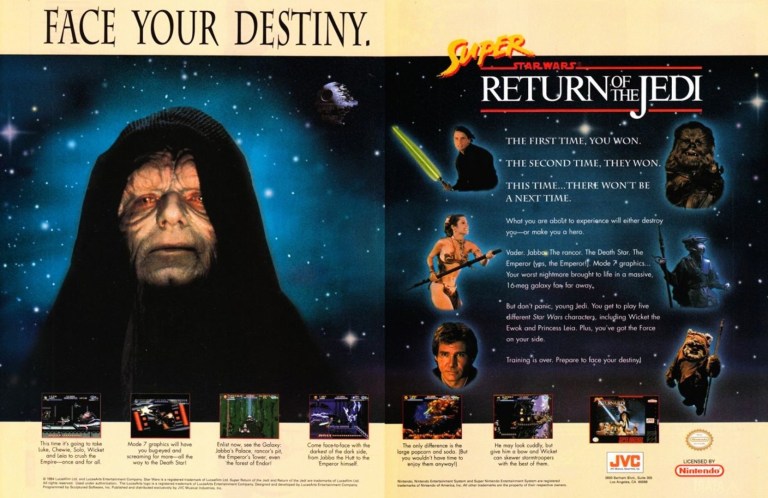
Nothing like seeing Harrison Ford, Carrie Fisher and Mark Hamill as the Star Wars icons on a video game ad.
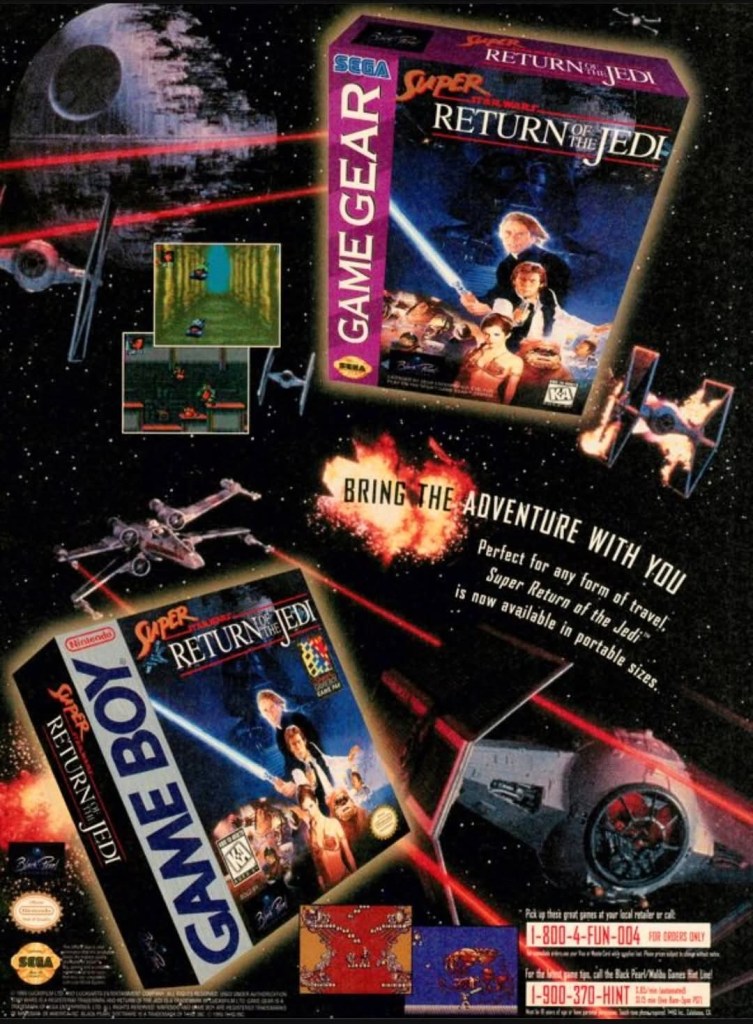
I never played the portable editions of Super Star Wars: Return of the Jedi. Have you?
As far as gaming on the SNES was concerned, the Super Star Wars trilogy of games really kept fans and casual gamers busy. By the time Super Star Wars: Return of the Jedi was released in 1994 on the SNES, there was already immense speculation about the Star Wars prequel trilogy and George Lucas himself started writing them that same year. The 2-page print ad of the game on SNES had a creepy photo of Emperor Palpatine on one side, the other characters on the other side, and six selected screenshots displayed on the lower part. The way the print ad was design reflects that the game is the end of the trilogy like the 1983 film itself. Super Star Wars: Return of the Jedi was also released on Game Gear and Game Boy and the ad makers made the right decision to use the Death Star and space battle image as the background so that the portable games would stand out.
7. Star Wars: Masters of Teräs Käsi print ad
I wonder if George Lucas ever regretted approving this Star Wars fighting game. It was so rough and unpolished with its quality.
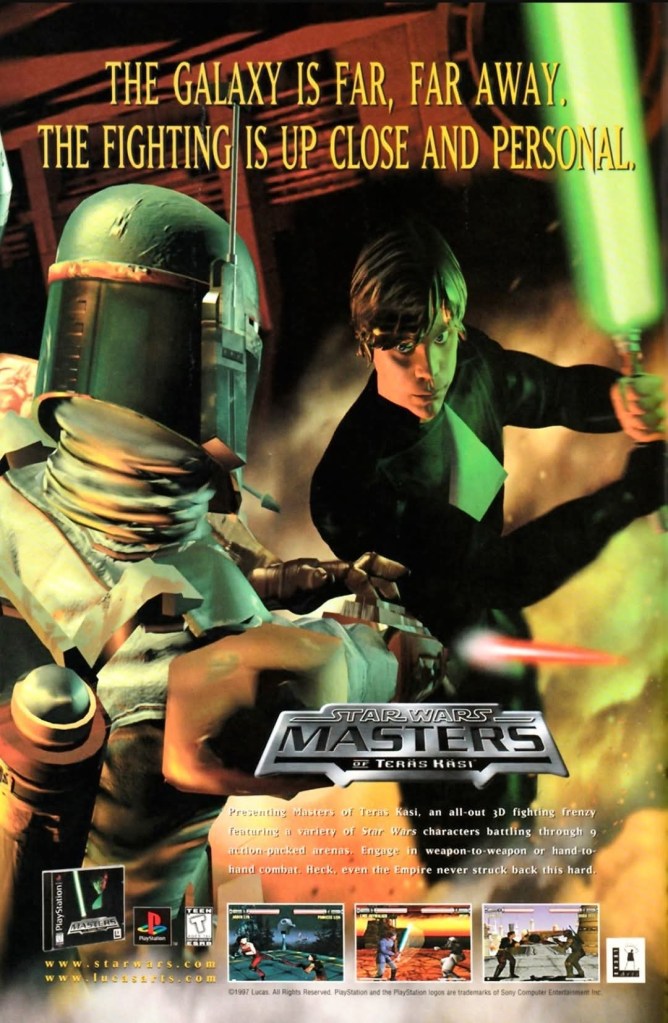
If there is any sub-par Star Wars game released in the 1990s, it is none other than Star Wars: Masters of Teräs Käsi on the PlayStation. The 1997 game was LucasArts’ attempt to cash in on the booming fighting games genre and they took a huge risk of making it entirely polygonal. Instead of using photographs or hand-drawn art, the ad makers used a fully rendered 3D polygonal models of Luke Skywalker and Boba Fett which was alienating to look at. In fact, those polygonal models looked very different from the in-game polygonal models of Skywalker and Boba Fett presented during gameplay. This print ad is a sad reminder about an ill-conceived concept for Star Wars that materialized into an actual product.
8. Star Wars: Shadows of the Empire print ad
If you have read the novel, were you able to play this video game?
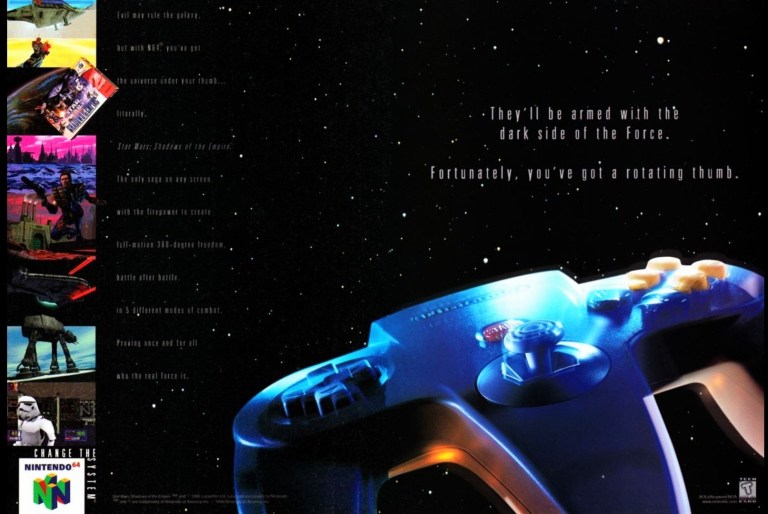
LucasArts and Nintendo teamed up with something ambitious – a video game adaptation of Star Wars: Shadows of the Empire that was released exclusively to the Nintendo 64 (N64). Released in late 1996, Star Wars: Shadows of the Empire was part of the multimedia entertainment project of the same name and it is the result of LucasArts’ decision to be an early adopter of the N64 for business-related reasons. The 2-page print ad shown here has a dark, star-filled background which captivating screenshots on the left and the N64 controller standing out. This print ad strongly expresses that gamers would need the N64 in order to play Star Wars: Shadows of the Empire in the comfort of home.
9. Star Wars Trilogy arcade flyer
The front.
The other side.
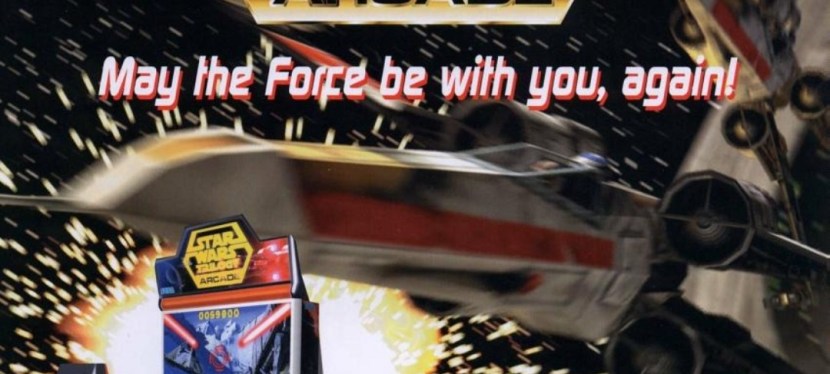
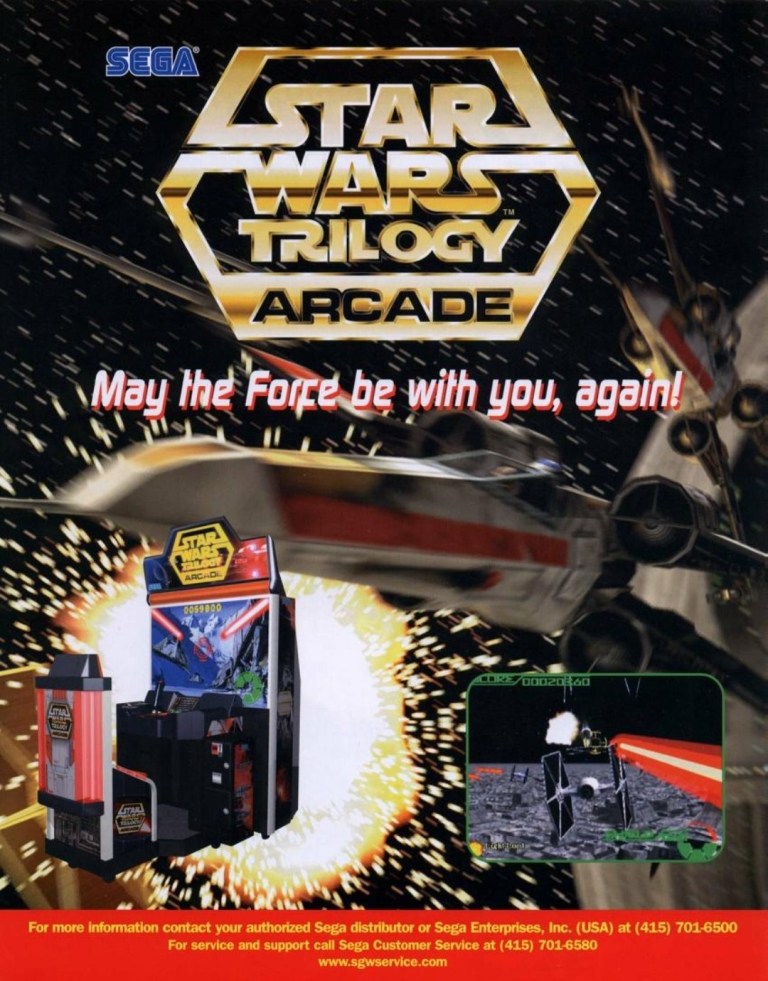
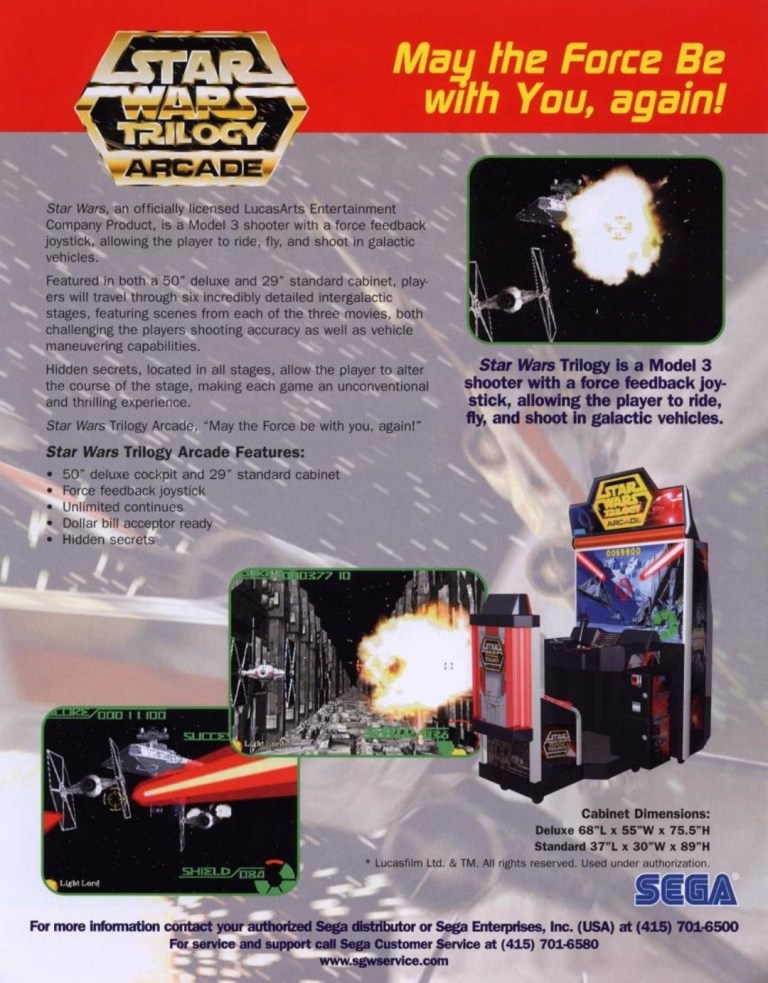
Before the Star Wars Prequel trilogy started with The Phantom Menace, Sega came out strongly by releasing Star Wars Trilogy Arcade in arcades around the world. Released in 1998, the game was arguably Sega’s most ambitious Star Wars-licensed game ever as it was made with the powerful Model 3 hardware, it came with unique controls and the game was designed as a polygonal rail shooter focused on key segments from the original trilogy of films. Sega wisely used dynamic artwork for the front of the flyer giving viewers the impression that the X-Wing fighter was approaching them closely. At the rear, three screenshots only showed space battles which was a wise decision by Sega to keep the surprise intact for gamers until they play the game. Having played this in the arcade myself, I can assure you that Star Wars Trilogy Arcade has more varied types of gameplay and challenges. It’s a lot more than flying and shooting in space, and it has a lot of stuff that Star Wars fans will love.
Disclaimer: This is my original work with details sourced from reading the comic book and doing personal research. Anyone who wants to use this article, in part or in whole, needs to secure first my permission and agree to cite me as the source and author. Let it be known that any unauthorized use of this article will constrain the author to pursue the remedies under R.A. No. 8293, the Revised Penal Code, and/or all applicable legal actions under the laws of the Philippines.
Welcome back science fiction enthusiasts, 20th century pop culture enthusiasts, Star Wars fans and comic book collectors! Today we go back to the year 1996 to examine the 2nd tale of a notable Star Wars storyline that took place between the films The Empire Strikes Back and Return of the Jedi…Shadows of the Empire!
For the newcomers reading this, Star Wars: Shadows of the Empire was a huge multimedia Star Wars event launched in the mid-1990s without a movie. Apart from exploring what happened in between the 1980 and 1983 classic Star Wars movies, Shadows of the Empire expands the lore by introducing new characters, Luke Skywalker’s gradual recovery from what he suffered from in The Empire Strikes Back, and the Galactic Empire’s ties with criminals who turned out to be resourceful. Back then, Star Wars was still fully under the control of George Lucas and his businesses. I already reviewed the first issue and enjoyed it.
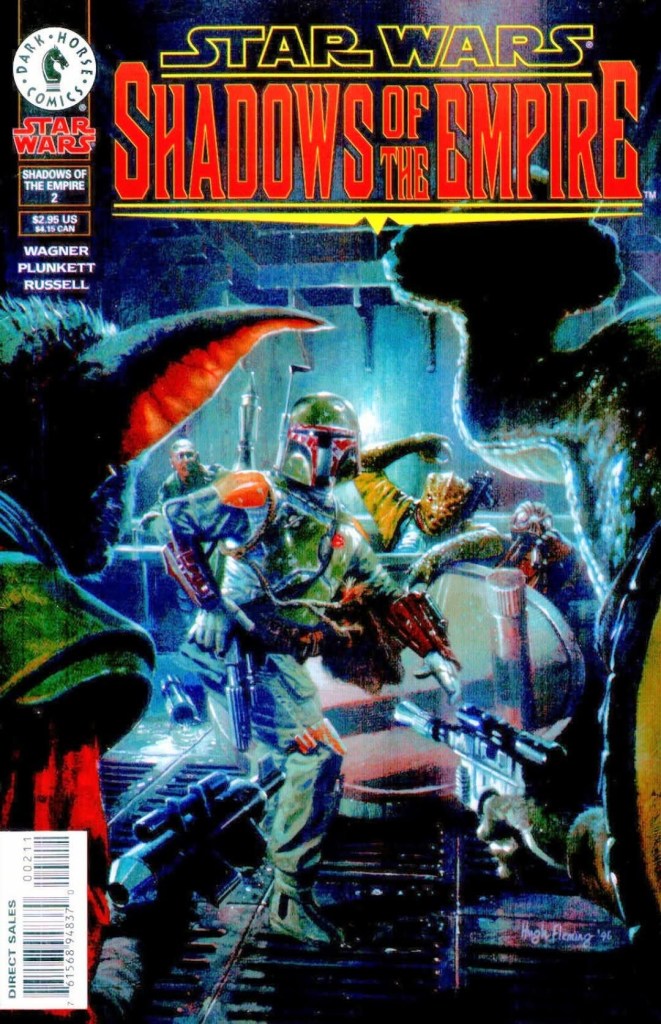
With those details laid down, here is a look back at Star Wars: Shadows of the Empire #2, published in 1996 by Dark Horse Comics with a story written by John Wagner and drawn by Kilian Plunkett. This is the 2nd chapter of a 6-issue mini-series.
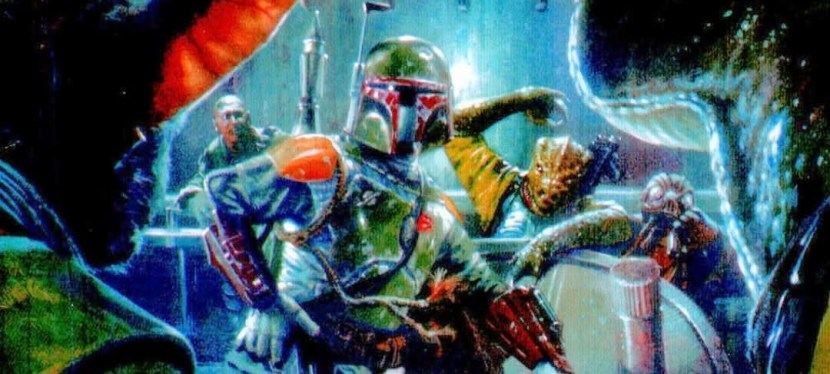
The cover.
Early story
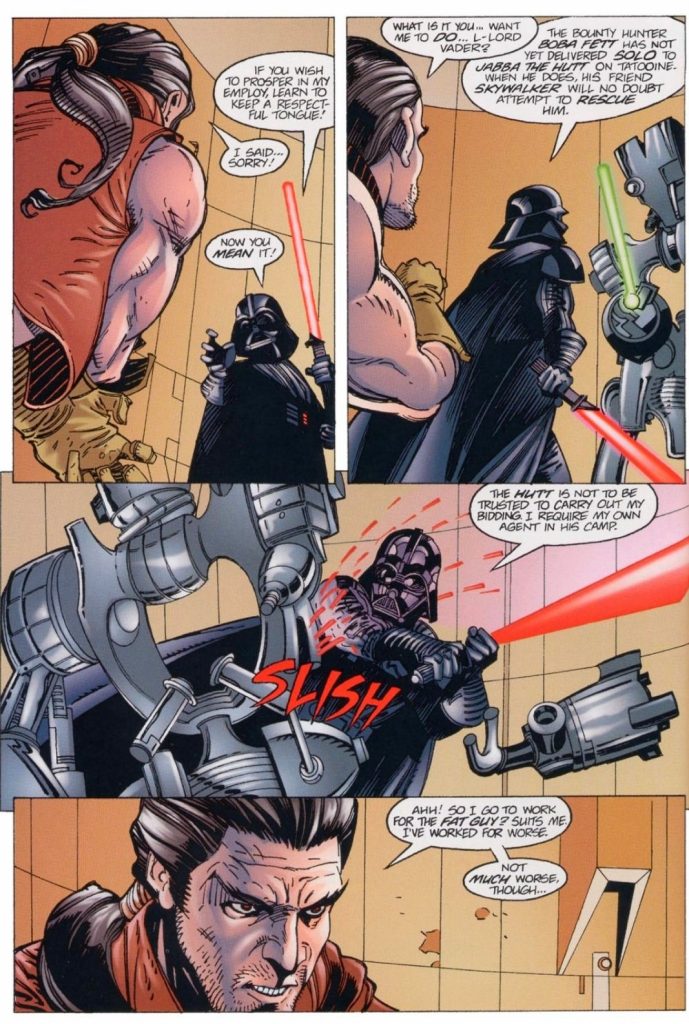
The story begins with Darth Vader in the middle of a lightsaber sparring session with a droid. As he makes his fighting moves, he issues instructions to a thug named Jix who was standing and watching. Vader tells him that the bounty hunter Boba Fett still has not yet delivered the captured Han Solo (in carbonite) to Jabba the Hutt in Tatooine, and he anticipates that Luke Skywalker will make an attempt to rescue him. Vader wants Jix to insinuate himself into Jabba’s swoop gang.
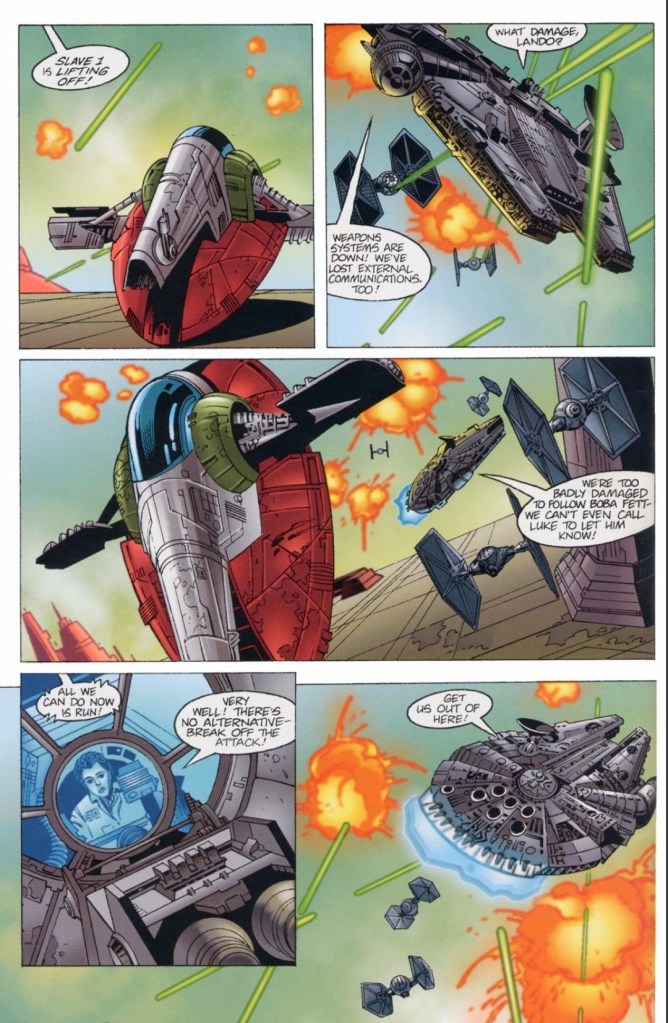
On another part of the galaxy, several Rebel X-Wing fighters (led by Luke Skywalker), the Millennium Falcon (with Princess Leia, Chewbacca, C3PO and Lando Calrissian) and the Outrider (Dash Rendar) travel together approaching the planet Gall with different objectives: the Rogue Squadrom will go draw out the imperial fighters while both the Falcon and the Outrider will sneak in to find the damaged Slave-1 (Boba Fett) and rescue Han Solo…
Quality
The Millennium Falcon and Slave-1 in the same encounter.
When compared to its predecessor, this comic book has a lot of plot developments moving forward. It is in this story where you will see Leia, Lando and Chewbacca really pull off their first-ever attempt to rescue Han Solo and the way it was presented by the creative duo Wagner-Plunkett was worth the anticipation. Even though the odds are against them, Prince Leia is clearly determined to get Han back not for her love for him but for the Rebel Alliance’s need.
With Darth Vader having lesser spotlight and none of Emperor Palpatine, the creative team was able to shift more of the spotlight on the galactic criminals. The introduction of Jabba’s Swoop Gang was nicely done and the portrayal of them as a rowdy and very sinister bunch is very notable.
Anyone who enjoyed playing the Shadows of the Empire video game on Nintendo 64 (N64) will be pleased to see Dash Rendar and his Outrider space ship here even though the spotlight lasted only briefly. As expected, Dash is creatively a smuggler-type substitute for Han Solo and I have the feeling that he will re-appear in the remaining issues of this mini-series.
As for the famous hero Luke Skywalker, you won’t see him wielding his lightsaber nor see him using his Jedi powers. Instead, you will see him taking action as an X-Wing Fighter pilot and you will see even more of his ability to lead his Rogue Squadron teammates. The way Luke was portrayed here was pretty accurate compared to his cinematic portrayal which proves the writing done was really solid.
In fact, the writing by Wagner remained consistently high in quality particularly with dramatizing Princess Leia, Lando, C3PO, R2D2 and Darth Vader. It is through Dash Rendar, Jix and the Swoop Gang where you will see Wagner push his creativity as he expands the lore of Star Wars to emphasize the galactic crime world and smugglers.
Lastly, Wagner really went all-in in developing the iconic bad guy Boba Fett in this comic book. You will really see how Boba Fett uses violence not just to overwhelm any opposition but also to protect the high bounty with the frozen Han Solo who is easily wanted by other bounty hunters and scum. When it comes to the visuals, expect to see similar quality Plunkett delivered in the first issue right here. Plunkett is very good with visualizing space ship battles, space travel, machines and locations, but showed weakness on drawing the humans. In fairness, Plunkett came up with very original styles and designs for the Swoop Gang and Jix, making them look really distinct.
Conclusion
Darth Vader and the thug named Jix.
Star Wars: Shadows of the Empire #2 (1996) is a solid follow-up to issue #1 and it managed to have the main plot and sub-plots move forward significantly. The storytelling is consistently good and the engagement was pretty strong. I can say I am convinced to look forward to finding out more in the next issue.
Overall, Star Wars: Shadows of the Empire #2 (1996) is recommended.
Welcome back my readers, YouTube viewers and all others who followed this series of articles focused on YouTube videos worth watching. Have you been searching for something fun or interesting to watch on YouTube? Do you feel bored right now and you crave for something to see on the world’s most popular online video destination?
I recommend you check out the following videos I found.
#1 Ashleigh Burton reacts to Top Secret! and The Naked Gun 2½: The Smell of Fear – Being a jolly person, YouTuber Ashleigh Burton can be entertaining to watch during her movie reaction videos. This is more evident when she reacts to a comedy film and she has made reaction videos of comedies that involved Zucker-Abrahams-Zucker (ZAZ) in varying ways. I enjoyed watching her reaction videos of Top Secret! (directed by ZAZ) and The Naked Gun 2½: The Smell of Fear (directed by David Zucker of ZAZ). Before watching those videos, I encourage you to watch first the two mentioned movies if you still have not seen them. If you have seen them and want to revisit them through Ashleigh Burton, watch the videos below.
#2 You, Me and the Movies reacts to David Lynch’s Dune – Way back in 1984, the sci-fi movie Dune was released but it never became the big hit the producers hoped it would be. Even though it had a mostly lavish production, director David Lynch’s creative approach on telling the story was found by many as weird or hard to understand. That being said, take a close look at the video below and see how David Lynch’s Dune draws reactions from You, Me and the Movies.
#3 Ranting for Vengeance explains Alan Moore’s Marxism and why the author is not a genius at all – Have you ever read Watchmen, V for Vendetta or The League of Extraordinary Gentlemen? All those were authored by Alan Moore and months ago he was interviewed and he revealed his political thoughts. The interview gave YouTuber Ranting for Vengeance an opportunity to analyze what Moore said, explain the Communism and Marxism of the author, and why he perceives Moore as a writer who sucks. Find out now by watching the video below.
#4 Slope’s Game Room examines BurgerTime games – Recently Slope’s Game Room posted its in-depth video examining the history of the classic game BurgerTime and the many it games it spawned through the decades. Produced by Data East, BurgerTime was first released in arcades in 1982 and it became a big hit with players eventually getting ported to multiple platforms to keep up with demand. I should also state that BurgerTime is one of those games that constantly reminded players about food. Watch the video below.
#5 Minty Comedic Arts presents trivia about Die Hard with a Vengeance – Almost thirty years ago, Die Hard with a Vengeance was released in cinemas around the world and it was even titled as “Die Hard 3” here in the Philippines. The film had Bruce Willis as John McClane and John McTiernan returned as director. This time around, the setting was much more open and massive with New York City and surrounding areas as locations. If you love the movie and you want to know a lot more details about its production, watch the trivia video by Minty Comedic Arts below.
#6 Represent This’ in-depth examination of The Empire Strikes Back – Having seen all the Star Wars movies – including the trash from woke Disney – I can say that the best of them all is still The Empire Strikes Back which itself was not even directed by creator George Lucas. The Star Wars sequel from 1980 stood the test of time and when it came to creative or technical revisions through the decades, it is the one that had the least number of revisions. That being said, if you want to know lots of intricate details about The Empire Strikes Back, I recommend watching the two analytical and explanatory videos by Represent This.
Welcome back my readers, YouTube viewers and all others who followed this series of articles focused on YouTube videos worth watching. Have you been searching for something fun or interesting to watch on YouTube? Do you feel bored right now and you crave for something to see on the world’s most popular online video destination?
I recommend you check out the following videos I found.
#1 A look back at the 1998 showdown between Reggie Miller and Michael Jordan – Remember way back in 1998 when Reggie Miller pushed Michael Jordan out of the way to free himself and score the crucial 3-point shot during an Eastern Conference Finals game between the Indiana Pacers and the Chicago Bulls? There was a lot of build-up between the Pacers and the Bulls before that memorable play happened, and many other players were factors as well. Watch and learn from the Secret Base video below.
#2 Looking back at Super Star Wars: The Empire Strikes Back – Among all the many Star Wars video games I played in the 1990s, it was Super Star Wars: The Empire Strikes Back on the Super Nintendo Entertainment System (SNES) that I enjoyed the most (read my retro review by clicking here). That was the 2nd of three side-scrolling Star Wars games released on the SNES based on the original Star Wars trilogy of films. In today’s gaming landscape, I can only wish that the SNES Super Star Wars games would someday get re-released for modern consoles. To understand what Super Star Wars: The Empire Strikes Back is about, watch the videos below.
#3 PatmanQC examines Sega’s Star Wars arcade games – Still on the topics of Star Wars and retro gaming, I enjoyed watching another video from YouTuber PatmanQC focused on the Star Wars arcade games released by Sega. For the newcomers reading this, a lot of licensed video games of Star Wars got released from varied companies through the decades. The Sega-produced Star Wars arcade games of the 1990s were notably of high quality and a lot of fun to play with. To learn more, watch PatmanQC’s video below.
#4 Christine Grace Smith reacts to video of average men competing with really fit women – Here is another analytical video by Christine Grace Smith. This time, she’s reacting to a video about a few average men competing with really fit women in a series of physical contests. Watch and learn, and pay close attention to the details.
#5 The truth about Dwayne Johnson – You might not have seen him in professional wrestling and you most likely saw him in the movies. I’m talking about Dwayne Johnson and there are lots of things about him that turned off people. He had some commercial success as an actor but after seeing It’s Blanko video of him, your perception of Johnson will be impacted. Watch the video below and pay close attention to the details.
#6 Minty Comedic Arts examines the lost scenes of Cobra – Way back in 1986, the action film Cobra was released in cinemas and it had Sylvester Stallone as a cop who has to protect a woman from a gang of killers who targeted her. The film was a commercial success mainly due to big ticket sales outside of America. For decades, it was speculated that the film that was released was a shortened version and there were lots of footage that ended up being deleted. Minty Comedic Arts’ video below confirms that there are indeed lost scenes and had they been used, they would have altered the overall tone of the movie. Watch the video below.
#7 You, Me and the Movies reacts to Commando – Commando of 1985 is an action movie starring Arnold Schwarzenegger and it had absolutely nothing to do with the 1985 video game of the same name. Not only was Schwarzenegger younger, you get to see him play a soldier completely different from his role in Predator. The video reaction of You, Me and the Movies is enjoyable to watch.
Welcome back readers, fellow geeks and electronic gaming fans!
In this edition of the Retro Gaming Ads Blast (RGAB) series, we will take a look at another batch of retro gaming print ads – including arcade flyers – from the 1980s and 1990s.
For the newcomers reading this, Retro Gaming Ads Blast (RGAB) looks back at the many print ads of games (console, arcade, computer and handheld) that were published in comic books, magazines, flyers, posters and newspapers long before smartphones, social media, the worldwide web and streaming became popular. To put things in perspective, people back in the 1980s and 1990s were more trusting of print media for information and images about electronic games and related products.
With those details laid down, here is the newest batch of retro gaming print ads for you to see and enjoy…
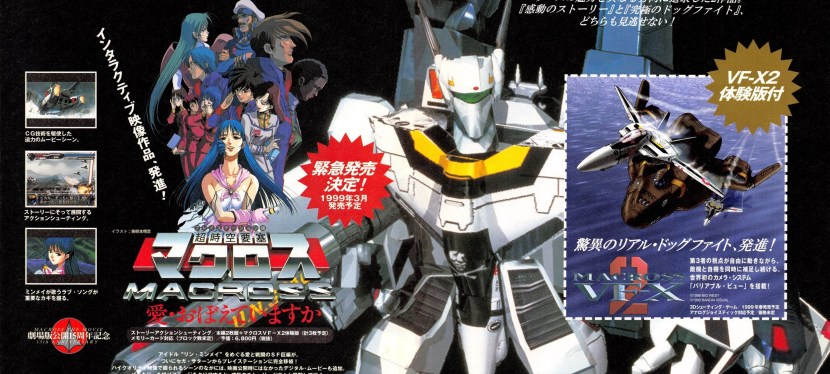
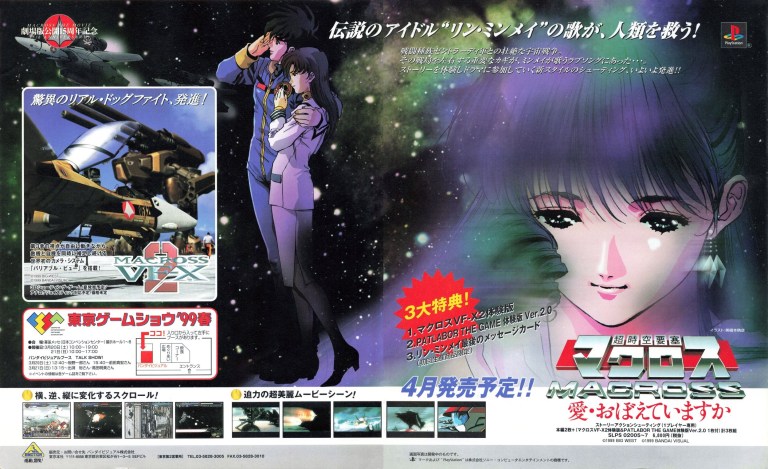
1. Japanese Macross video games print ads
This 2-page ad had Minmay, Misa and Hikaru.
Computer-generated image of the Skull Leader Battroid was used here.
Looking at the history of Macross video games released only in Japan, there were these notable games that catered to the fans with different tastes during the period of 1997 to 1999. The two Japanese print ads here promoted the PlayStation version of The Super Dimension Fortress Macross: Do You Remember Love? (read my retro review by clicking here) and Macross: VF-X2 (only on PlayStation). 1997 marked the 15th anniversary of the entire Macross franchise and game publisher Bandai Visual kept the excitement for fans on high gear by aggressively promoting the two advertised games for their respective releases in 1999. These two print ads still resonate with long-time fans as each were clearly made to emphasize the games (with details, screenshots and original artworks) while using the right images of the Macross franchise for relevance.
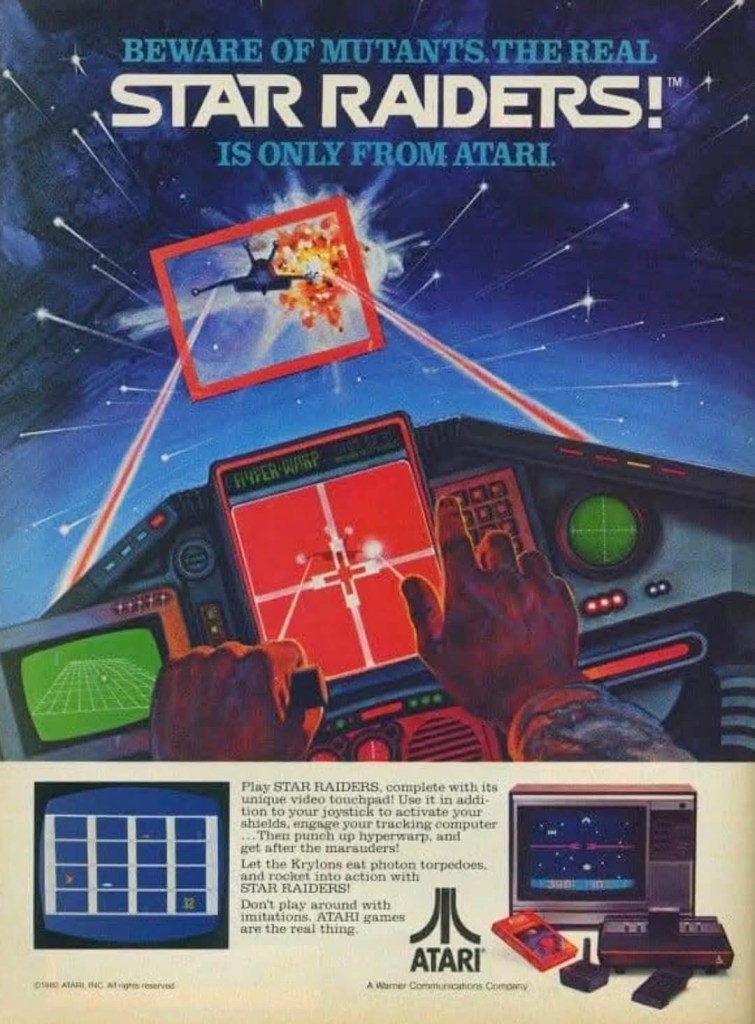
2. Star Raiders print ad
This Star Raiders print ad made me interested enough to play the game on Atari 2600.
I remember the old days of play Star Raiders on the Atari 2600 back in the early 1980s. Strangely enough, I don’t remember seeing this old print ad. Regardless, I really like the way the ad makers used hand-drawn art work to dominate the space while leaving enough space for text description, a screenshot and the picture of the Atari console with the TV set. In my view, this old ad is both amusing and attention-grabbing.
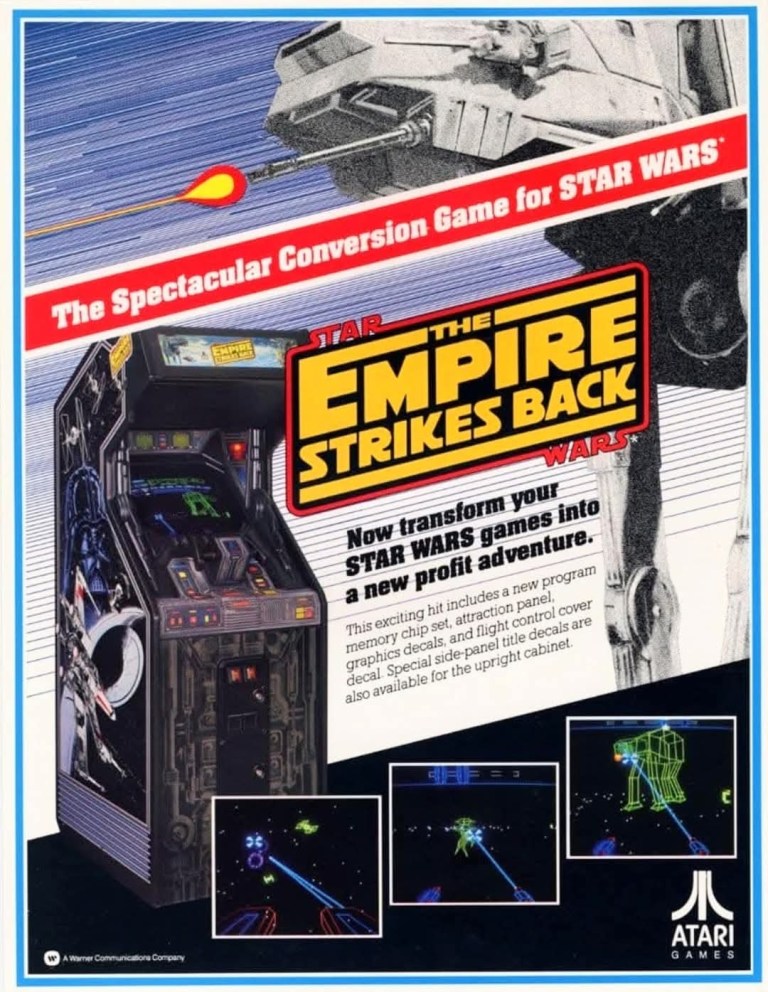
3. The Empire Strikes Back arcade flyer
This is still a great looking arcade flyer.
Here is a Star Wars game I never played but managed to play it on a home computer. Released by Atari in 1985, The Empire Strikes Back (full title: Star Wars: The Empire Strikes Back) arcade game was the follow-up to the very popular Star Wars arcade game. Like its predecessor, it used vector graphics and certain sounds from the 1980 film for immersion. This arcade flyer is well designed showing three selected screenshots, a picture of the arcade cabinet and a portion of the AT-AT walker from the movie. The flyer truly showed gamers and arcade operators what they would get by selecting The Empire Strikes Back.
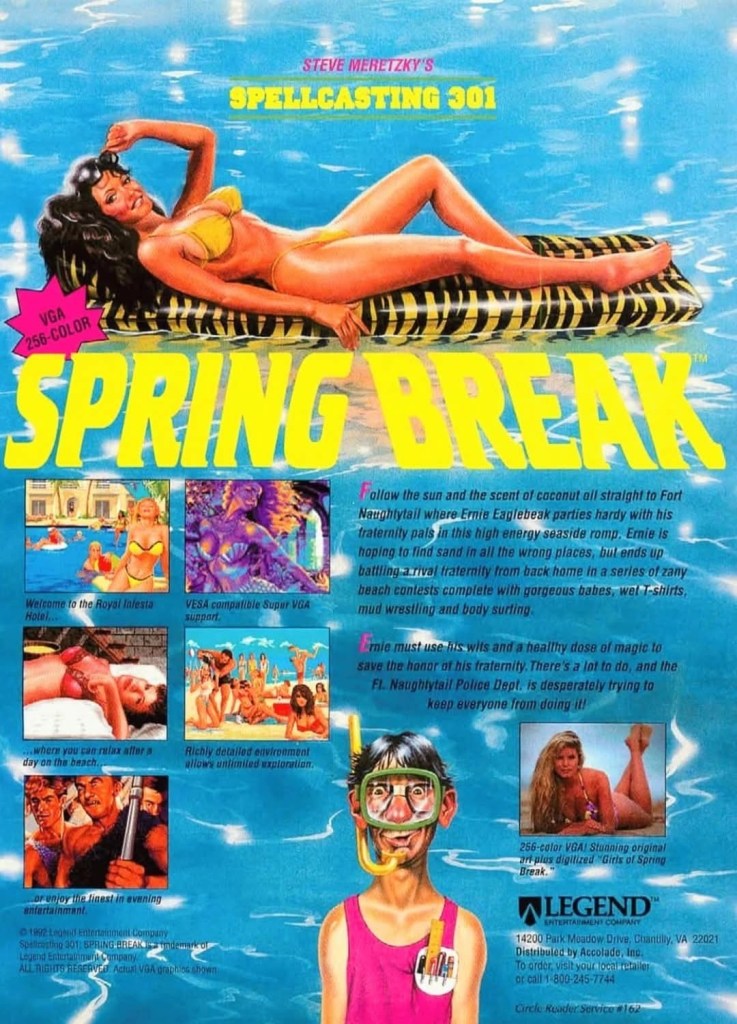
4. Steve Meretzky’s Spellcasting 301: Spring Break print ad
Clearly the promoted game is for adult players only.
In the realm of computer gaming, there were certain games that catered to the more mature players. One example is Steve Meretzky’s Spellcasting 301: Spring Break which was released on for personal computers running on DOS (Disk Operating System) in 1992. This print ad clearly shows the adulterated nature of the game emphasizing sexy women with a paradise setting. This is the kind of print ad that you only in computer gaming magazines which had predominantly adult readers.
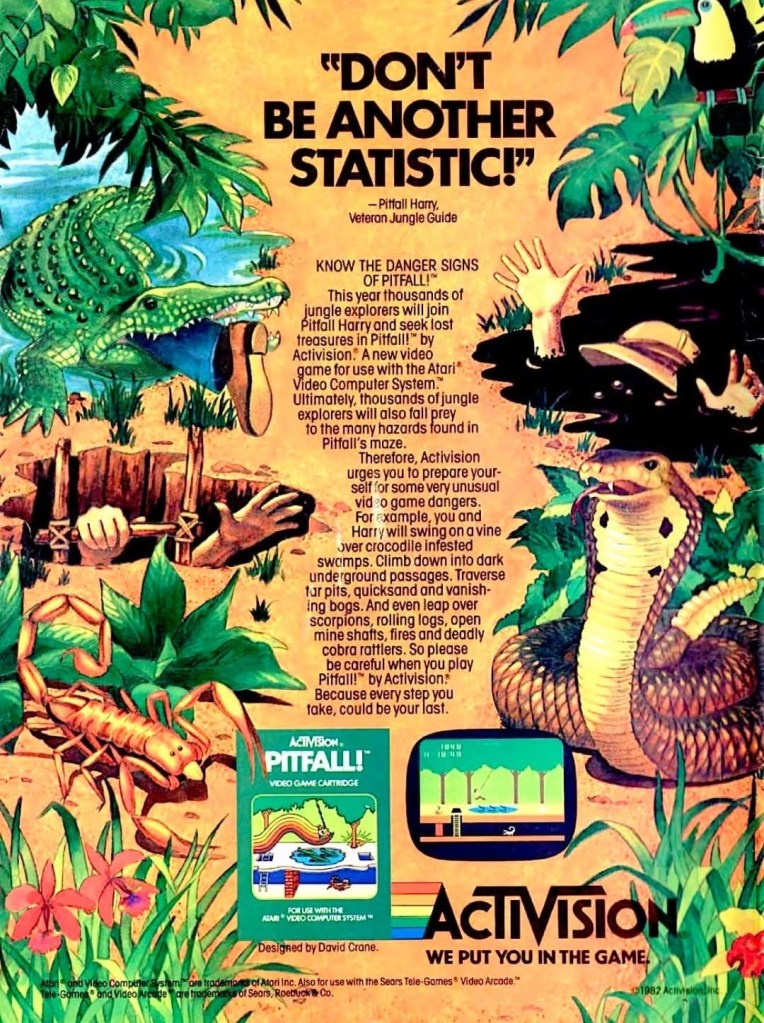
5. Pitfall! print ad
Still a great looking print ad.
Back in 1982, 2D adventuring on the Atari 2600 reached new heights when Pitfall! was released. The game garnered wide praise for its gameplay and graphics, and because it was so enjoyable, it sold millions of copies and its success spread across other platforms. A key factor to its commercial success and strong identity with the Atari 2600 was this colorful print ad. The ad makers daringly used original artwork to emphasize the jungle, wilderness and adventure concept while leaving some space left to show a screenshot and the Atari 2600 game cover. Pitfall! is a video game classic.
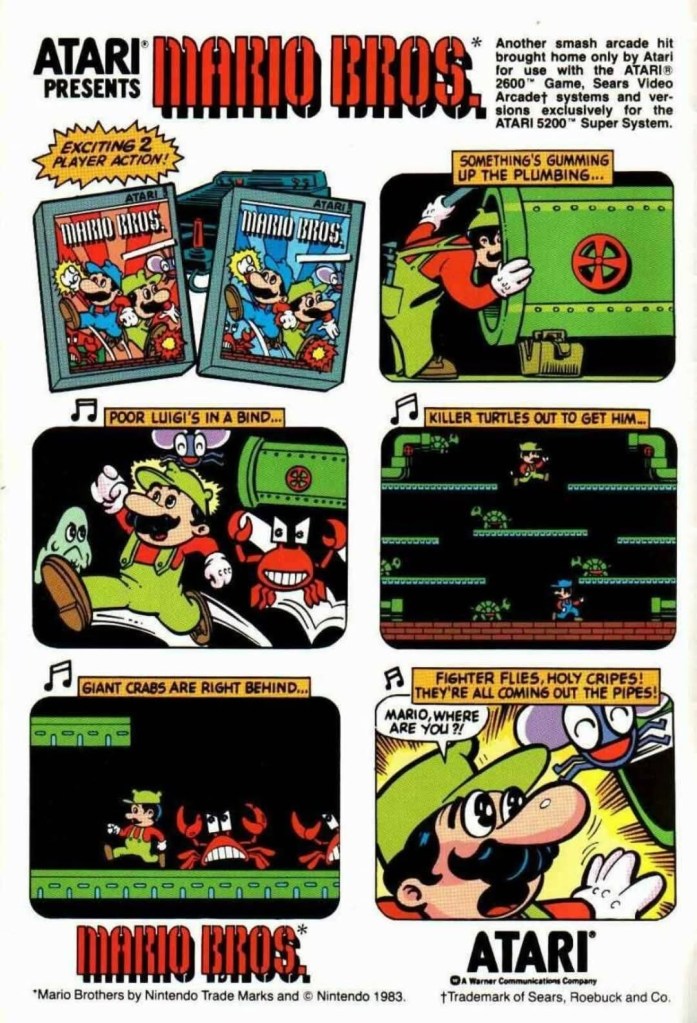
6. Mario Bros. print ad
I saw this comic-style print ad while reading a comic book.
A few years before Nintendo skyrocketed with the massive success of Super Mario Bros., there was Mario Bros. on the Atari 2600 and Atari 5200. Published by Atari on their consoles, Mario Bros. was already a hit in the arcades. To capitalize on the popularity of the game, Atari came up with this comic-style print ad to capture people’s attention with the hope that the Atari 2600 and Atari 5200 ports will sell a lot. I first saw this ad while reading a comic book and it remains entertaining to see.
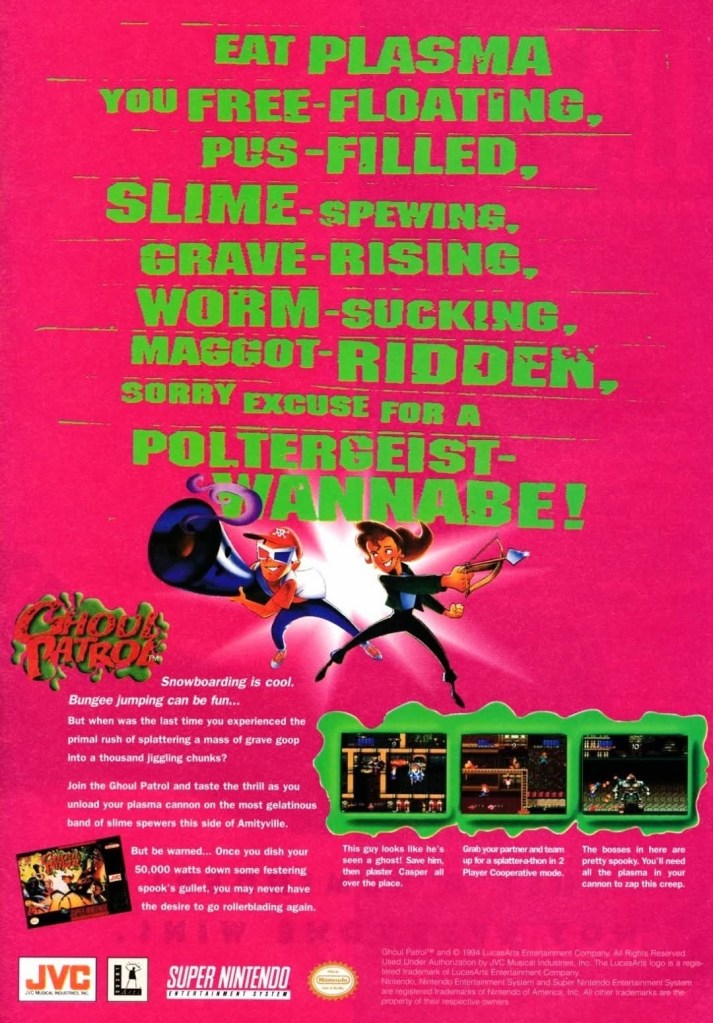
7. Ghoul Patrol print ad
Too bad the screenshots, the game box cover and white descriptive text were too small to look at.
Released in 1994 on the Super Nintendo Entertainment System (SNES), Ghoul Patrol is the accidental sequel to Zombies Ate My Neighbors. This was because the game did not start as a sequel but rather as an unrelated project that used the same gameplay engine of its predecessor. Since Zombies Ate My Neighbors already had a dedicated fanbase, a decision to turn the game into a sequel followed. Ghoul Patrol’s print ad took a different creative approach on its presentation by trying to look cool and catchy with a dominating pink background and slightly adulterated descriptions in green leaving little space left for screenshots and the white descriptive text. The print ad of Zombies Ate My Neighbors remains more engaging and more eye-catching than this one.
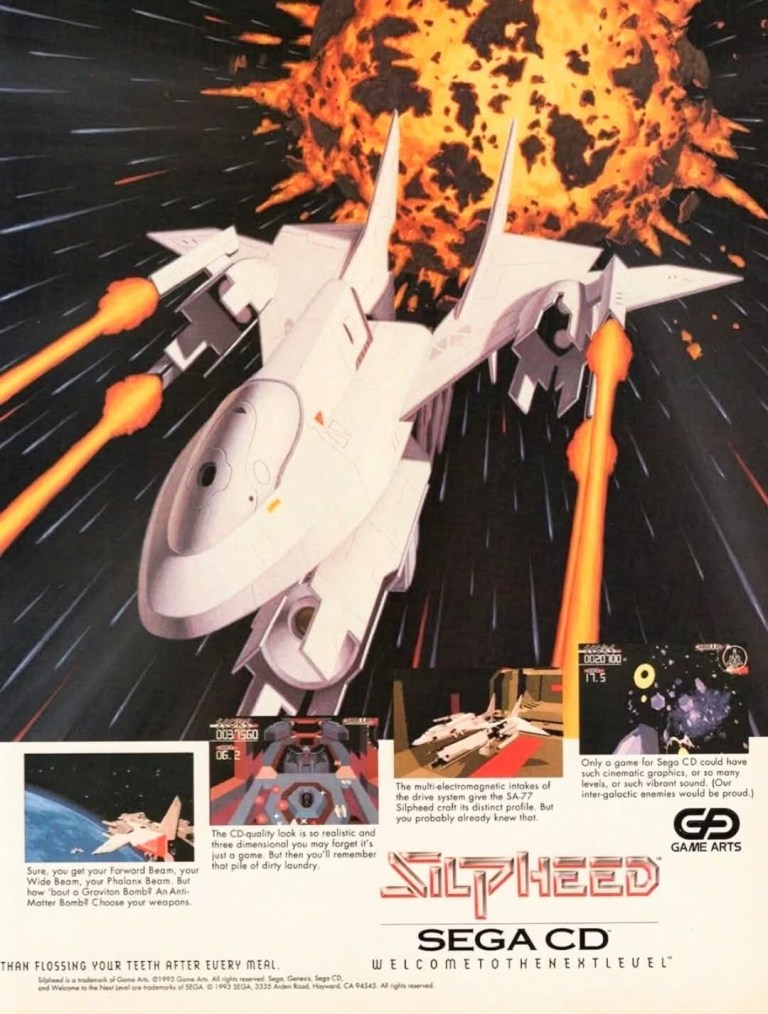
8. Silpheed print ad
This ad caught my attention and even made me interested on the Sega CD.
Released in 1993, Silpheed on Sega CD was a remake of the original game of 1986. Like its predecessor, the Sega CD had 3D effects but used pre-rendered computer animation for a background that actually was full motion video. The print ad of this game had this fantastic looking computer-generated artwork and displayed four screenshots that looked really exciting back in 1993. If you look closely at the captions, the ad emphasized the CD-quality look and the cinematic graphics the game had. This old ad has aged well.
Welcome back readers, fellow geeks and electronic gaming fans!
In this edition of the Retro Gaming Ads Blast (RGAB) series, we will take a look at another batch of retro gaming print ads – including arcade flyers – from the 1980s and 1990s.
For the newcomers reading this, Retro Gaming Ads Blast (RGAB) looks back at the many print ads of games (console, arcade, computer and handheld) that were published in comic books, magazines, flyers, posters and newspapers long before smartphones, social media, the worldwide web and streaming became popular. To put things in perspective, people back in the 1980s and 1990s were more trusting of print media for information and images about electronic games and related products.
With those details laid down, here is the newest batch of retro gaming print ads for you to see and enjoy…
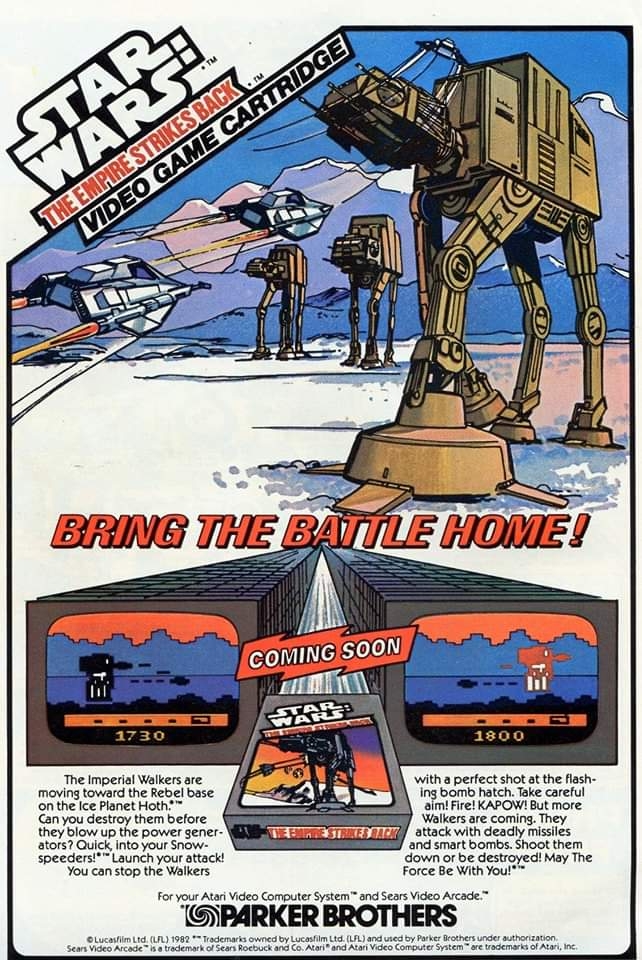
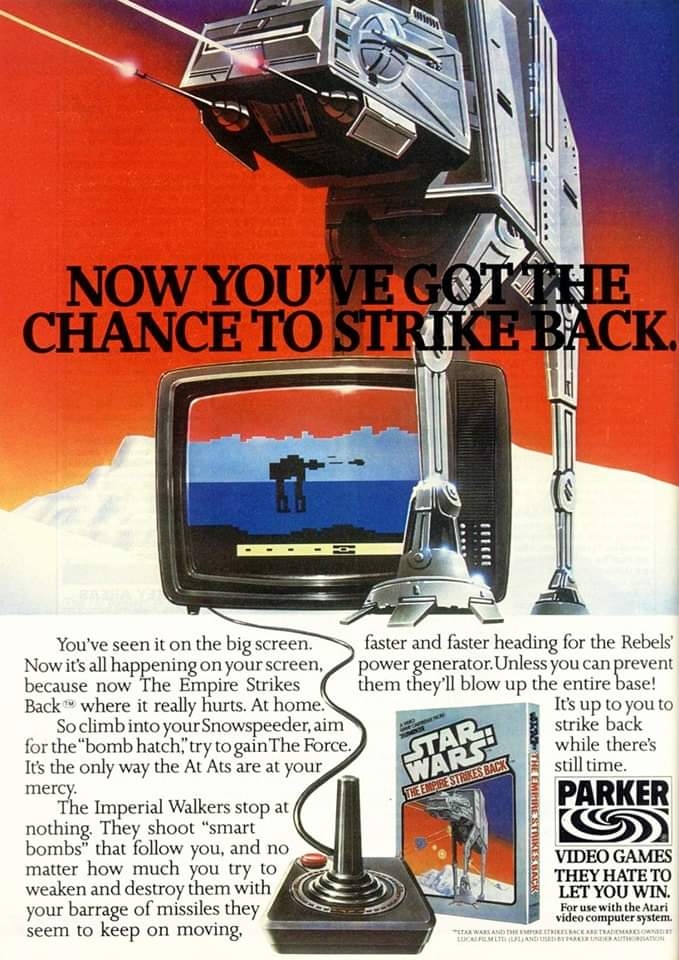
1. Star Wars: The Empire Strikes Back Atari print ads
I could not forget the first time I saw this print ad while reading a comic book.
This ad showed the Atari 2600 controller.
Even during its early years under George Lucas, the Star Wars entertainment franchise made its way into video games due to its massive popularity and Parker Brothers really made moves to cash in. This resulted in the Atari 2600 video game adaptation (1982) of The Empire Strikes Back which focused mainly on the memorable Hoth battles between Rebel fighters and the Empire’s AT-AT walkers. Parker Brothers came up with two print ads and each had a different visual concept: one had nicely drawn art along with two screenshots shown while the other had painted art of the AT-AT while showing the Atari joystick. These old print ads still look great and exciting.
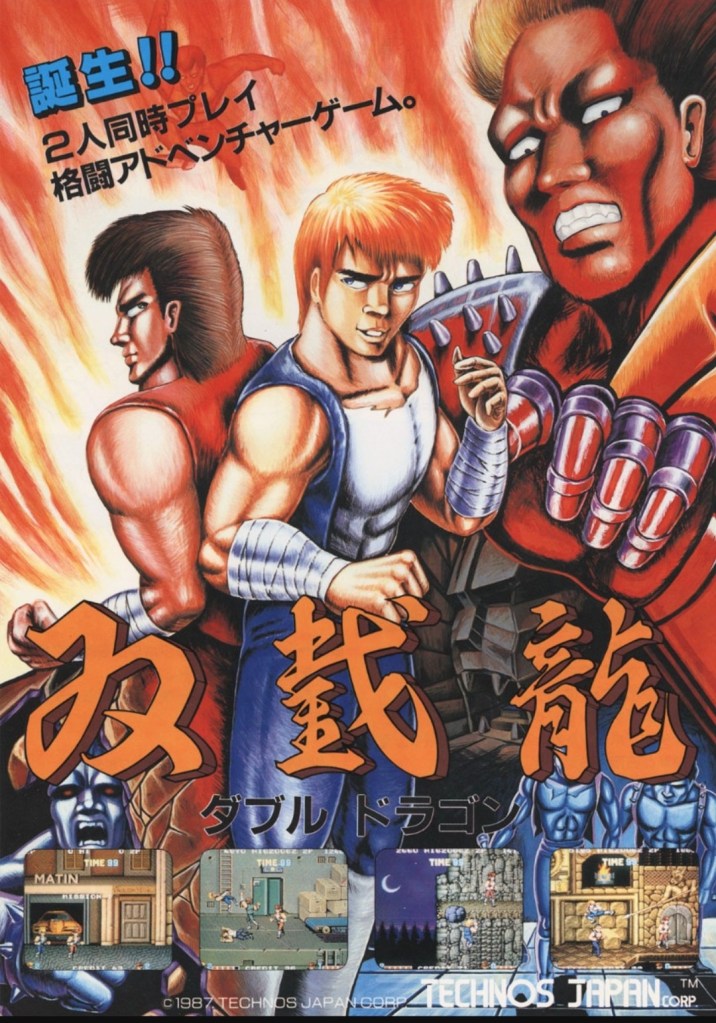
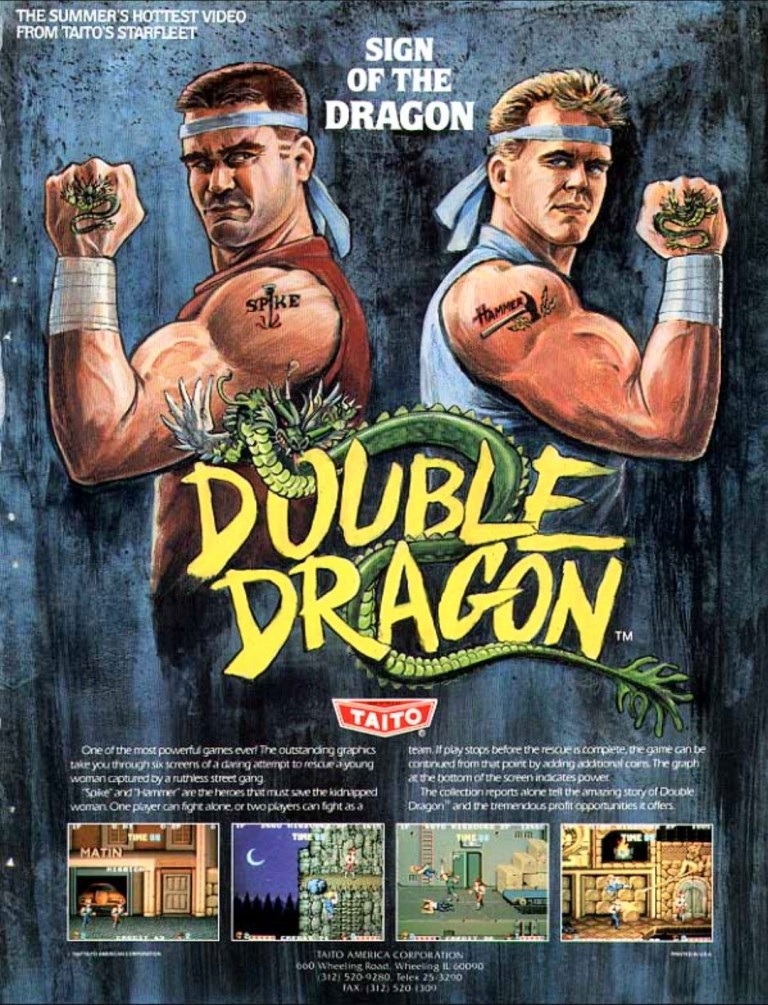
2. Double Dragon Japanese and North American arcade flyers
If you read manga (Japanese comics) in Japan, then the art style of this arcade flyer should look familiar to you.
The character designs seem inspired by 1980s Hollywood action cinema.
Released in 1987, Double Dragon became a huge hit in the arcades of Japan, America and Europe resulting in financial gains for developer Technōs Japan and publisher Taito. What I find intriguing was the fact that the Double Dragon arcade flyers for Japan and North America had drastically different art styles used to promote it. The Japanese flyer had art style that is more common with manga while the North American had artwork that seemed inspired by Hollywood action movies (as well as the rise of martial arts films in America during the 1980s). The American flyer even had the two characters identified as Hammer and Spike and they both looked American. This is a classic example of using different approaches to promote a game in each market.
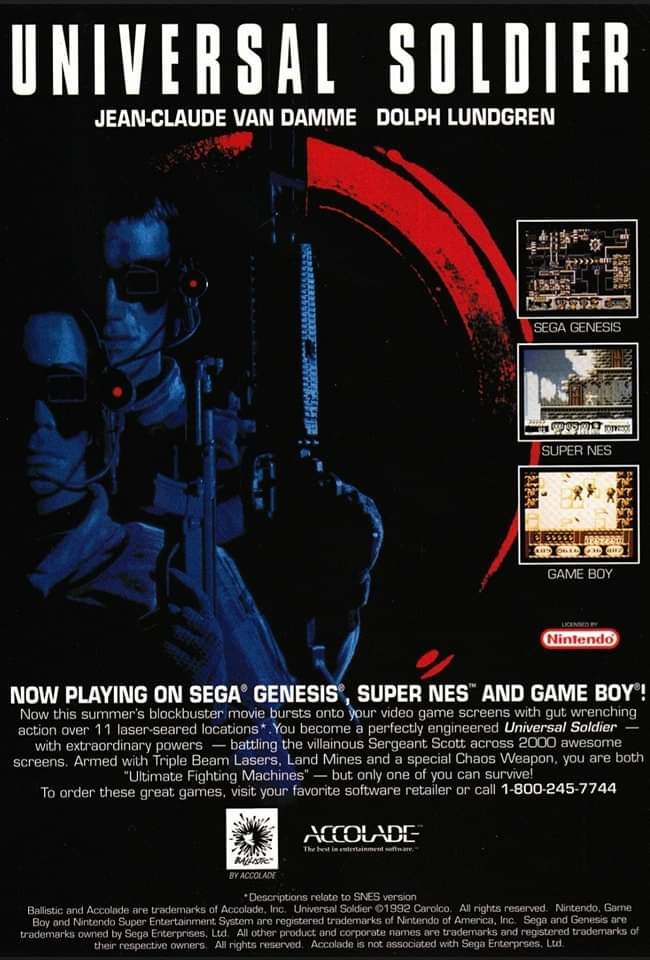
3. Universal Soldier print ad
The people who made this print ad made sure to use the names of the stars to help sell the game.
Even though its worldwide ticket sales did not reach $100 million, the 1992 movie Universal Soldier still caught a lot of attention from moviegoers simply because it had Jean-Claude Van Damme and Dolph Lundgren as the stars. Unsurprisingly, the movie had a video game adaptation and because publisher Accolade wanted to cash-in on the film’s hype, they made some deceptive moves by rebranding one of its games (already development) as a tie-in. Advertised as an official adaptation, Universal Soldier was actually a rushed conversion of Turrican II: The Final Fight. This print ad – which even showed the stars’ names – is a reminder of the deception Accolade pulled off.
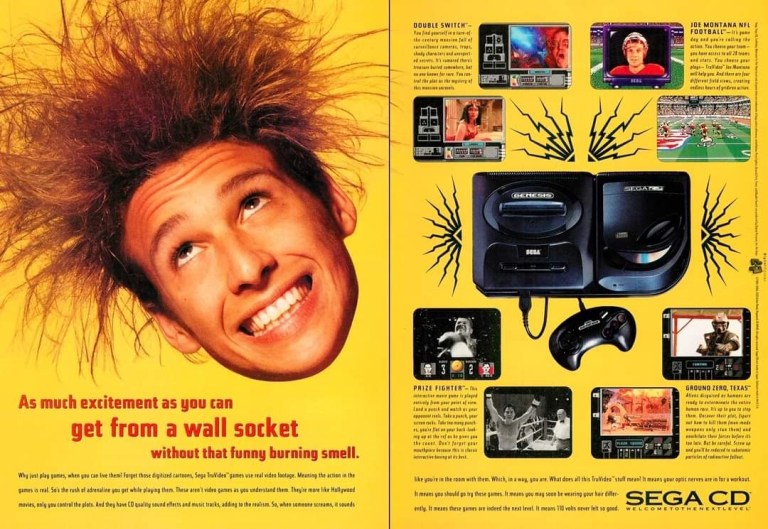
4. Sega CD print ad
Do you find this Sega CD print ad hilarious?
When Sega was making waves with its Sega Genesis (Sega Mega Drive in Japan), the company was quick to react to the growing use of the compact disc (CD) format as a useful storage medium for video games. The Sega CD (Mega CD in Japan) was released as an add-on device to work with the Genesis console and Sega’s American team came up with a series of promotions. This print ad is just one of the promotions and ad makers came up with a “crazed” or “electrified” gamer dominating one page while showing the Genesis, the Sega CD and screenshots of games (running on CD) on the other page. By today’s standards, the Sega CD print ad is funny and catchy to look at.
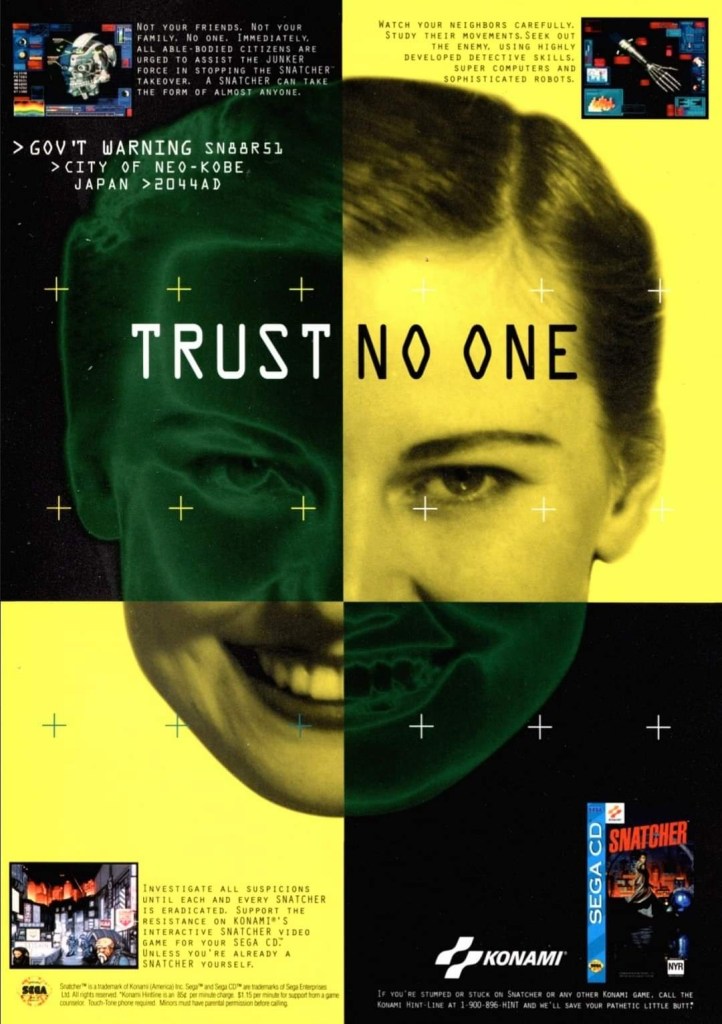
5. Snatcher for Sega CD print ad
I find this Snatch print ad looking odd. The ad makers could have done more to focus on the game itself.
First released in Japan in 1988, Snatcher was a cyberpunk visual adventure game that was one of the early works of the famous Hideo Kojima (Metal Gear series). Due to its design and approach on visuals to tell a story, it was not surprising that a Sega CD version of it got released in 1994. To promote the game to the growing number of North American Sega CD gamers at the time, Konami came up with this rather unusual print ad showing the face of a smiling lady dominating the space leaving little room to show the screenshots and the game’s cover. The visual concept is engaging but it takes effort to notice it was promoting the Sega CD version of the video game. This old ad would have worked better had the ad makers increased the sizes of the screenshots and the game cover.
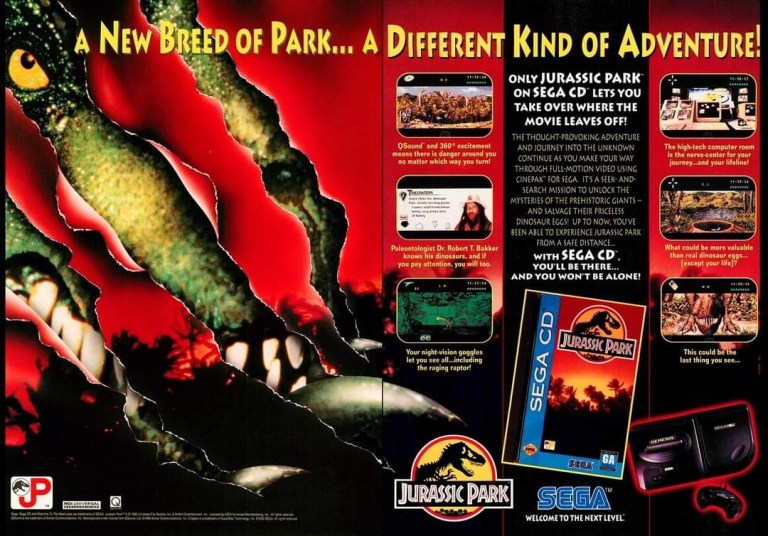
6. Jurassic Park for Sega CD print ad
Does the T. Rex look scary to you?
As part of its drive to add more games to the Sega CD add-on and help it sell more units, Sega acquired the Jurassic Park license and went on to produce an adaptation utilizing the technological features of the Sega CD. To aggressively promote the game, Sega came up with this print ad that had a Tyrannosaurs Rex (looking through spaces) on one page and then several screenshots plus text descriptions on the other. For a click-and-point Jurassic Park game, this ad was really exciting and intriguing to look at.
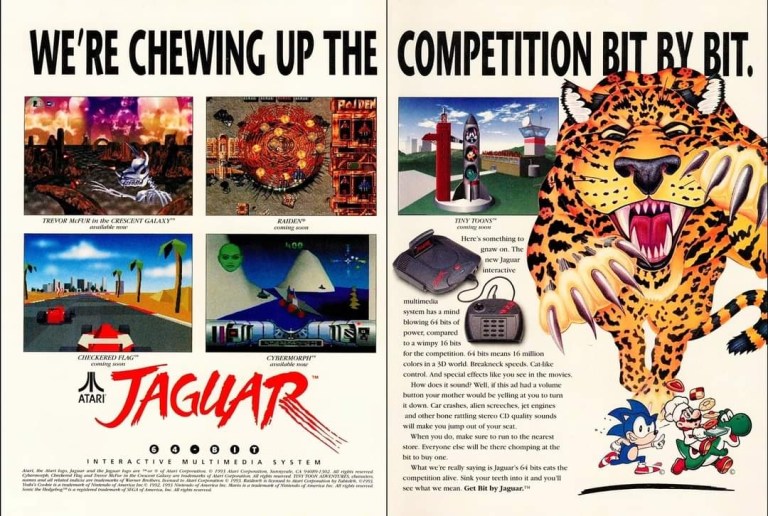
7. Atari Jaguar print ad
This was indeed an eye-catching ad.
In the early 1990s, Atari made an aggressive move to compete in the arena of video game consoles which they used to dominate from the late 1970s until 1983. This time around, they came up with the Jaguar console which had some pretty advanced technologies for the time. As part of their North American marketing campaign, Atari unleashed an ad showing game screenshots on the first page and huge artwork of a jaguar coming after Sonic, Mario and Yoshi (mascots of Sega and Nintendo respectively) symbolizing that the Atari Jaguar had more power and better technology than the Genesis and the Super Nintendo Entertainment System (SNS). While it was engaging to look at early on, this print ad is now an embarrassment as the Jaguar console failed terribly. Lastly, the marketing of the Jaguar as a 64-bit machine was never real.
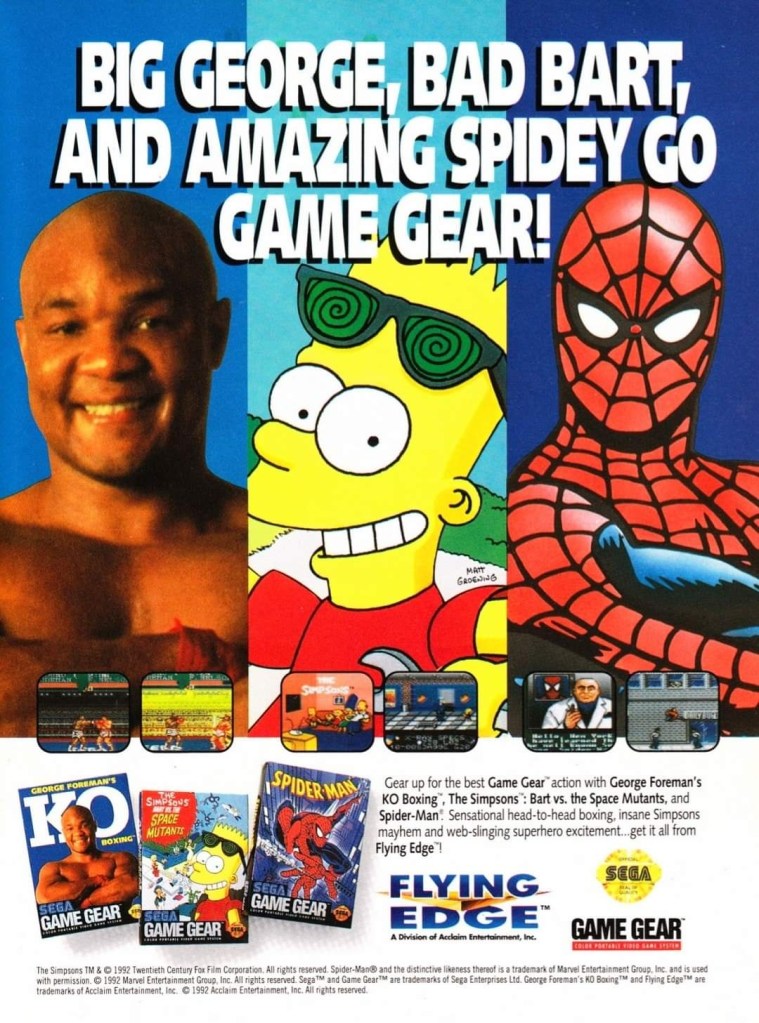
8. George Foreman, The Simpsons and Spider-Man Game Gear print ad
This ad appeared in a lot of comic books in the 1990s.
In the early 1990s, Sega released the Game Gear handheld gaming device which instantly placed them in competition with Nintendo’s Game Boy. Through its Flying Edge label, Acclaim Entertainment promoted George Foreman’s KO Boxing, The Simpsons: Bart vs. the Space Mutants, and Spider-Man for the Game Gear hoping to sell well. This 3-game print ad highlighted the popular figures who had a lot of space for attracting attention. The ad maker managed to insert two screenshots per game, the game covers and a text description to inform consumers what they were being offered. A good ad to look at.
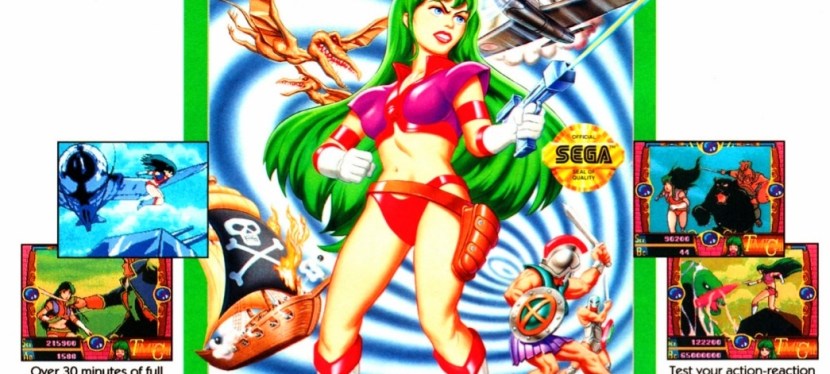
9. Time Gal for Sega CD print ad
The presentation here looks nice but Time Gal herself looked like she was drawn by a different artist.
Originally released in the arcades in Japan in 1985, Time Gal made its way to the Sega CD add-on in the early 1990s. It was a highly unusual video game as it was an interactive movie (with lots of anime footage) made with the use of Laserdisc technology for its arcade version. It played lots of anime scenes and players must choose the on-screen options to execute the character’s next action in order to progress. For the Sega CD version for North America, this print was made to capture the attention of consumers using the protagonist’s sex appeal on the cover art with four screenshots placed on the sides to show what to expect. I noticed that Time Gal on the cover art looked different from how she appeared in the anime sequences. At least the ad makers tried hard to sell the game.
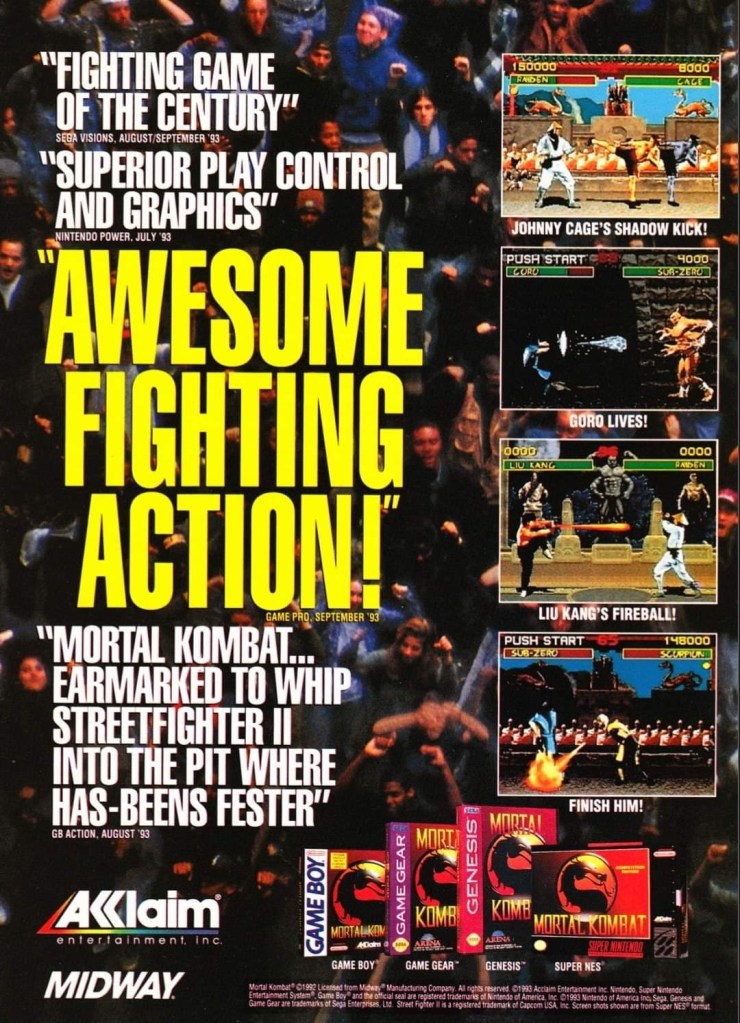
10. Mortal Kombat print ad
Still an effective ad to promote a blockbuster game and make people informed it was coming to multiple platforms.
Considering how successful it was in the arcades, the 1993 release of Mortal Kombat for game consoles and handhelds was unsurprisingly highly anticipated and publisher acclaim came up with this single-page ad. The presentation involved the use of a photographic background of many spectators (to emphasize excitement and popularity), media quotes and screenshots to effectively promote the game.
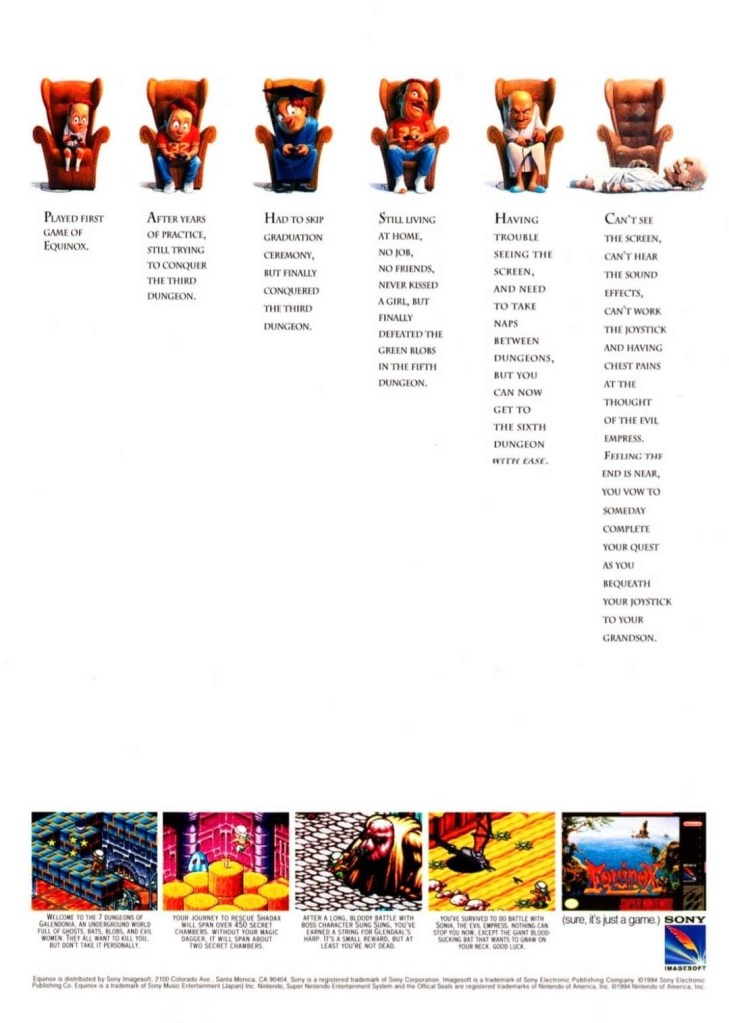
11. Equinox print ad
Take a close look. Tell me if you find it funny.
I never played Equinox but I heard the loud buzz about its design as a 3D isometric game that had elements of exploration, platform play and puzzle solving. The people responsible for this print ad emphasized the concept that the game is so addicting to play, players will still play it as they get older. This ad has a subtle yet effective approach with humor.
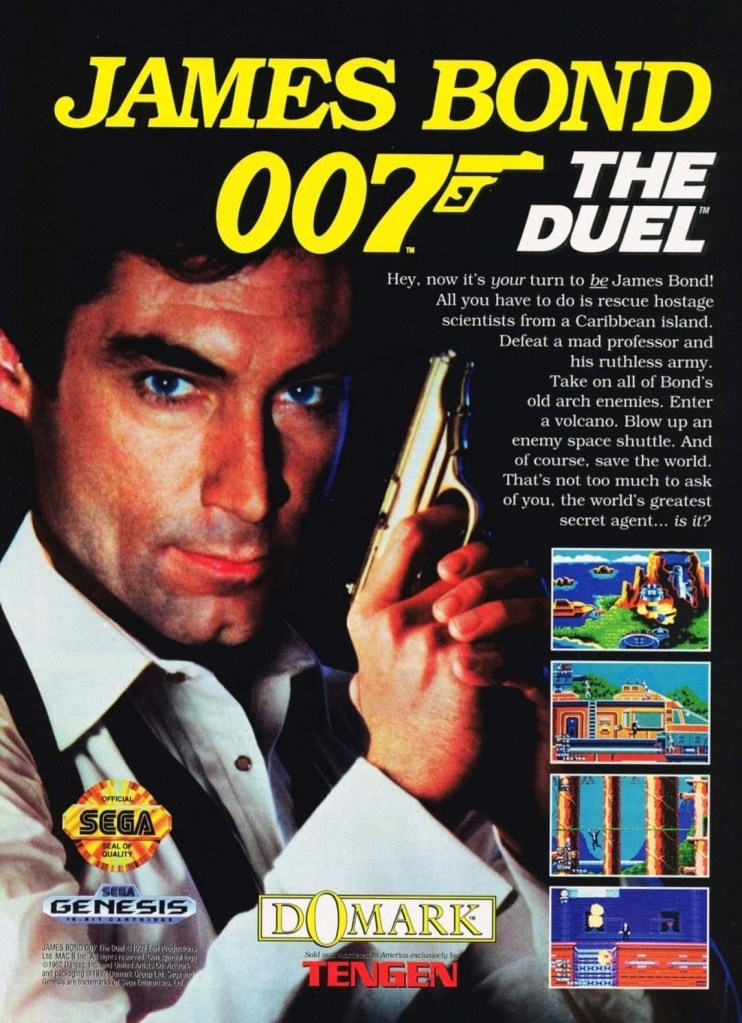
12. James Bond 007: The Duel print ad
Timothy Dalton’s image as James Bond was sourced from Licence to Kill for this game’s ad.
Here is another decades-old James Bond video game print ad I found. Released a few years after Licence to Kill, James Bond 007: The Duel was notable not for its gameplay nor game design but for the fact that it used the image of Timothy Dalton as 007 for its print ad and the opening scenes in the game itself. Dalton’s Bond image here was never new nor originally taken for the game as it came directly from Licence to Kill’s publicity library. Each time I saw this ad, I was only reminded of the 1989 movie which I still enjoy watching.
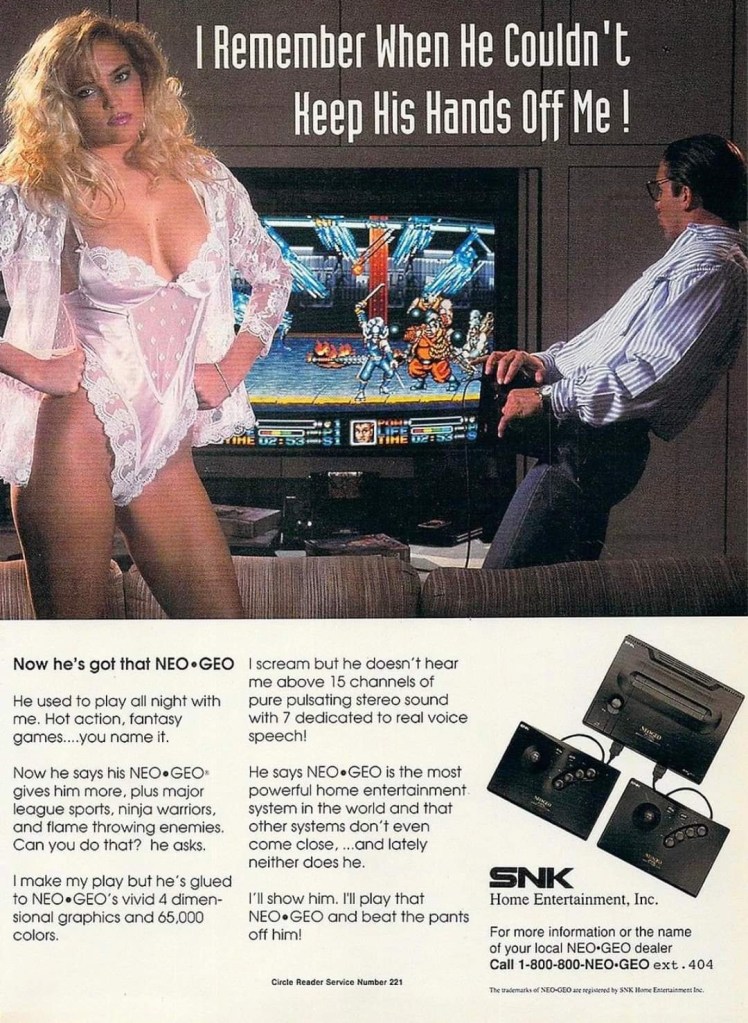
13. Neo Geo AES console print ad
Do you find this ad both sexy and funny?
Decades ago, SNK made a huge splash in the arcades with lots of really fun games released with their Neo Geo (stylized as NEO GEO) hardware. In 1990, they released the cartridge-based Neo Geo AES console in Japan and America and it carried the same technology as the arcade hardware. To promote the console in North America (note: the Neo Geo console and its games were very expensive), SNK came up with this catchy and funny print ad showing a sexy woman feeling annoyed that her man spends more time with Neo Geo gaming than with her. This was a clever way of emphasizing the arcade-perfect experience in the comfort of home, and it was funny to look at.
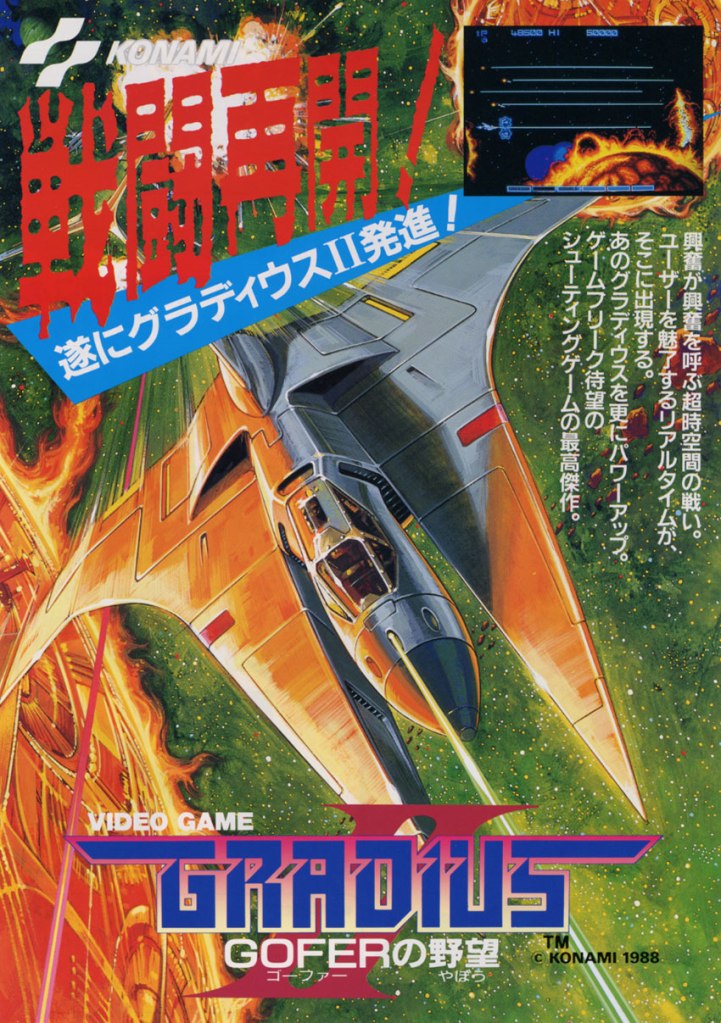
14. Gradius II Japanese arcade flyer
Great looking painted art was used for this 1988 arcade game.
Since the original Gradius was a big hit in arcades in Japan in 1985, it was not surprising that Konami released Gradius II three years later. With regards to the use of painted art, the artist showed the game’s spaceship in a dominating position emphasizing high-speed travel and excitement. The image, which also looks more colorful, is a complete reversal of the painted art used in the flyer of the previous which showed the rear of the spaceship as it moves towards a larger spaceship (the opposition). This arcade flyer art still looks great as it has a timeless charm.
Welcome back readers, fellow geeks and electronic gaming fans!
In this edition of the Retro Gaming Ads Blast (RGAB) series, we will examine print ads from the 1980s and 1990s that caught my attention and I will explain why they are worth look back at.
For the newcomers reading this, Retro Gaming Ads Blast (RGAB) looks back at the many print ads of games (console, arcade, computer and handheld) that were published in comic books, magazines, flyers and newspapers long before smartphones, social media, the worldwide web and streaming became popular. To put things in perspective, people back in the 1980s and 1990s were more trusting of print media for game details and images.
With those details laid down, here is the newest batch of retro gaming print ads for you to see and enjoy…
1. Japanese print ad of Super Star Wars: The Empire Strikes Back
Do you know any Star Wars fan who is aware of the error in this Japanese print ad of Super Star Wars: The Empire Strikes Back?
Back in 1993, the sequel Super Star Wars: The Empire Strikes Back was released on the Super Nintendo Entertainment System (SNES) in the West and on the Super Famicom in Japan. Having played all three Super Star Wars game, I can say that this sequel was a huge improvement over its predecessor technically and also with gameplay (read my retro review by clicking here).
Like its predecessor, the game was released in Japan by JVC Musical Industries and in the above Japanese market print ad, the marketing team wisely used the game’s official artwork to give gamers a clear view of the concept derived from the 1980 movie plus a few screenshots showing gameplay. What I find hilarious to read is the line (highlighted in red and all capitalized no less): MAY THE FORCE WITH YOU. Clearly someone from the Japanese marketing team who prepared that line lacked English proficiency or might not have watched the movies dubbed in English. In the 1977 movie, Han Solo said to Luke, “May the Force be with you.”
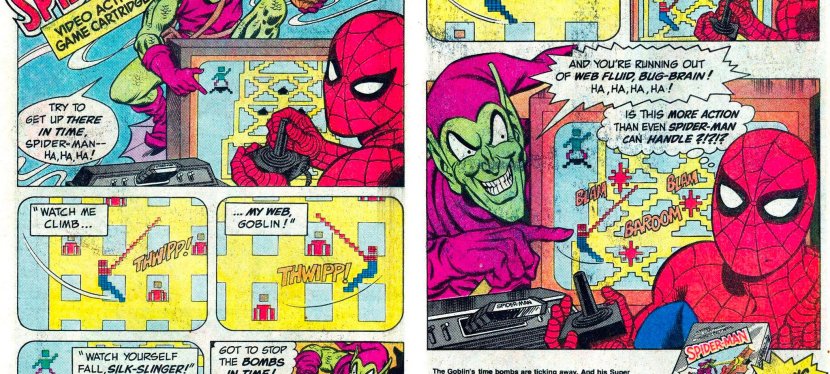
2. Spider-Man (Atari 2600) print ad
This is an entertaining way to promote a video game based on a comic book icon.
We are back again with the Parker Brothers company and their promotion of the Spider-Man video game for the Atari 2600 which I myself played long ago. Unlike before, the print ad this time was mainly about the Spider-Man game and somehow Parker Brothers coordinated with Marvel Comics to make a comic book-inspired ad. In the above print ad, Spider-Man was shown playing the game about him with an Atari 2600 controller and console, and the Green Goblin taunts him as he plays. This type of ad is a stroke of genius because it shows the Marvel Comics’ icon as a player and the gameplay was emphasized accurately. Even if viewers are not too fond of video games, they can still find themselves interested in reading the literary adventures of Spider-Man.
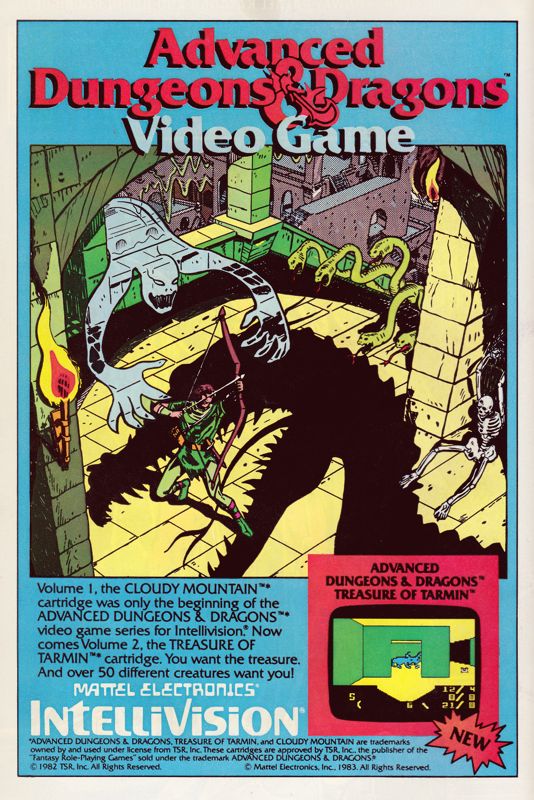
3. Advanced Dungeons & Dragons: Treasure of Tarmin print ad
Apart from emphasizing the fantasy concept of the Dungeons & Dragons franchise, this print ad’s hand-drawn art was strong enough to spark viewers’ curiosity and make them interested in the game or even in the Intellivision console.
Here is a print ad I saw many times while reading comic books in 1983. The game at hand is Advanced Dungeons & Dragons: Treasure of Tarmin released on the Intellivision, and it is the sequel to Cloudy Mountain. Like the ad of its predecessor, the above print ad relied heavily on the spectacle of fantasy (and even a bit of horror) by having hand-drawn art as the eye candy promoting Advanced Dungeons & Dragons: Treasure of Tarmin. If you look closely, only one screenshot from the game was shown and it was enough to tell gamers that the new game has a completely different visual presentation from that of Cloudy Mountain. Considering the primitive nature of computer graphics and game design of the era, having detailed comic book-inspired artwork was effective to grab viewers’ attention with the intention to make them interested in buying the game. In today’s age of computer graphics and social media, this type of ad for video games is rare to see.
4. G.I. Joe: Cobra Strike print ad
The G.I. Joe: A Real American Hero franchise’s early entry into video games.
Going back to Parker Brothers, the company developed and published the first-ever licensed game of the G.I. Joe franchise – G.I. Joe: Cobra Strike for the Atari 2600. In promoting the game, a 2-page ad was released with comic book-style art work (featuring Cobra Commander and Duke representing different sides) dominating the space, with descriptive text and a hand-drawn illustration of the gameplay (read: not a real screenshot) as well as the game box flling the remaining space. In my personal experience, I saw this ad before I even got to watch an episode of the popular G.I. Joe: A Real American Hero animated TV series, and before I got to read an issue the related comic book series (which started before the TV series). Looking back at the above print ad, I can still remember the time when I was puzzled by the two characters simply because I was not yet familiar with them. Take note that the video game and the ad were released at a time when the G.I. Joe: A Real American Hero started rising quickly in popularity on toys, comic books and animation.
5. Alien 3 (SNES) print ad
This print ad appeared in several comic books I read in 1993.
Way back in 1992, I had one of the most depressing cinema viewing experiences with Alien 3 which had a very troublesome production and lacked a solid foundation behind its creativity. Then in the summer of 1993, print ads of the video game Alien 3 for Super Nintendo Entertainment System (SNES) appeared in several comic books I read at the time. The above print ad was actually entertaining to look at. For one thing, the ad makers used three wide layers of screenshots from the game depicting different areas. Then I noticed the details which showed there were more aliens for gamers to encounter (versus only one in the movie) and the playable lead character Ellen Ripley was armed with guns (versus no guns in the movie) being able to fight the monsters. Not only that, the ad makers knew the specific details from the Alien film franchise which is reflected in the ad referencing the Face-hugger aliens, the acid from the creatures and, of course, the alien eggs. To this day, there are old-time gamers who found the Alien 3 SNES game more entertaining than the movie.
Disclaimer: This is my original work with details sourced from playing Flashback: The Quest for Identity and doing personal research. Anyone who wants to use this article, in part or in whole, needs to secure first my permission and agree to cite me as the source and author. Let it be known that any unauthorized use of this article will constrain the author to pursue the remedies under R.A. No. 8293, the Revised Penal Code, and/or all applicable legal actions under the laws of the Philippines.
We live in an age in which software exclusivity defines not only the relevance of game consoles but also nature of the entire video game industry right down to the many varied communities of very avid fans (and fanboys).
While the Super Nintendo Entertainment System (SNES or Super NES) and Sega Genesis each had their own exclusive games back in the 1990s, there was one particular game that was made for and released on not just one, not two but rather on more than fifteen different platforms – both consoles and computers – starting with Amiga way back in 1992. That game is none other than Flashback: The Quest for Identity which I first played on our Super NES back in 1994.
The cover of the game box.
For the newcomers reading this, Flashback was a 2D side-scrolling adventure game in the form of a cinematic platformer (note: similar to Prince of Persia and Out of This World) with a strong flavor of science fiction. It was cinematic in the sense that all the in-game animation were rotoscoped resulting unique smoothness combined with hand-drawn backgrounds and the computer-generated cutscenes were used in key parts of the game as the story progressed. Flashback on SNES in America even came with a Marvel Comics-published Flashback comic book and on the rear of the SNES game box were the words “The first CD-ROM game in a cartridge!”
A Flashback remake was released in 2013, followed by a port of the original game released on Sega Dreamcast in 2017, and a remastered version got released for varied platforms in 2018.
I got to play that game at a time when I have not even started playing Final Fantasy II (AKA Final Fantasy IV), Final Fantasy III (AKA Final Fantasy VI) and other great role-playing games (RPGs) of the Super NES. I also remember that Flashback was a nice change of pace for me after playing Super Star Wars: The Empire Strikes Back.
With those details laid down, here is a look back at Flashback: The Quest for Identity, released on Super NES in 1993 by U.S. Gold and developed by Delphine Software International.
The start and options screen.
Early story
The story begins with Conrad running away from two armed persons chasing him. He flies away riding a solo vehicle but those chasing him (riding a huge vehicle) managed to get close and blast his vehicle causing to crash into the forest.
Sometime later, he wakes up and accidentally pushes a mechanical cube to fall down. He climbs down to reach it and activates it. The cube displays a holographic video of himself telling him that he recorded it without remembering it. As Conrad watches, he learns that he must contact a friend named Ian who can explain important things to him.
After viewing the message, Conrad sets off to find his way out of the jungle and somehow get to Ian in New Washington…
Game design and quality
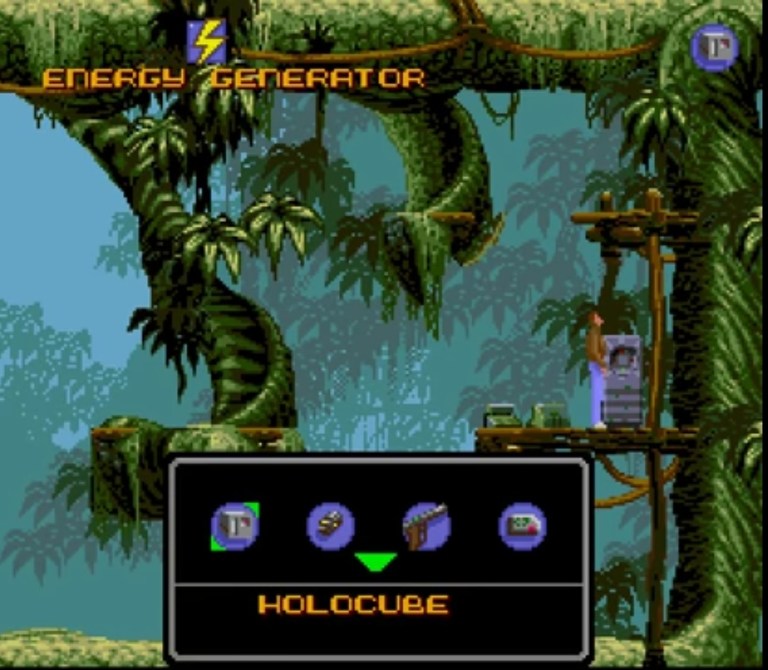
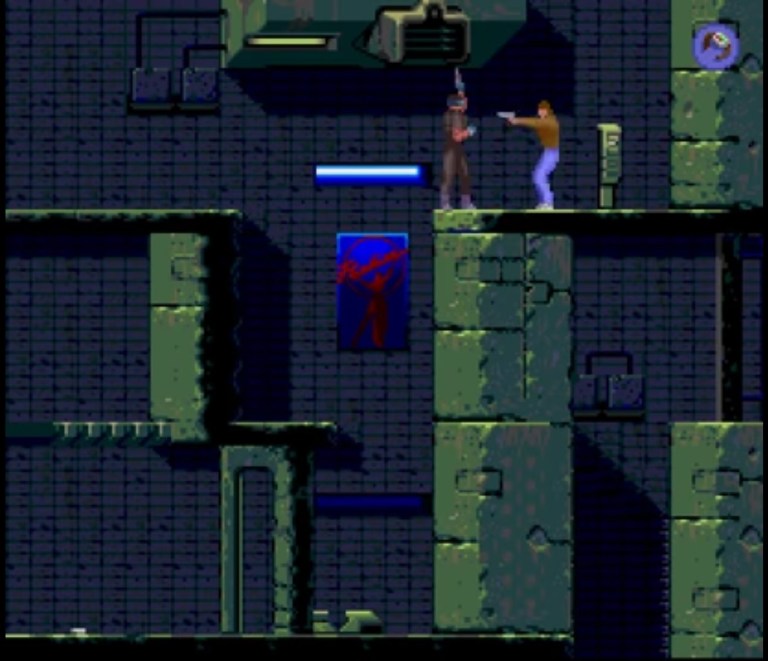
You have to pay close attention to what’s going on, what items do you have and what the in-game prompts tell you.
This game is not your typical fast-paced, action-oriented 2D side-scrolling adventure in which you move from left to right to progress. As it is a cinematic platform game by design complete with very specific controls, players will have to be patient, adaptive and strategic in order to learn how exactly you can control your character, what moves will be executed (and when to execute). For one thing, the very fluid 24 frames-per-second animation on your character limits you in terms of control as timing is required.
To do things properly, you have to execute specific controls. To ascend on a lift, you press Up and the Y button. To do a small jump, have your character stand still and then press Up and Y button. To go down on level (on foot, no lift), stand by the edge of a level then press Down and Y button. To run and hang on to a higher floor automatically, have your character stand still, press Right and Y button, press Y button (once your character moves) and watch him pull it off. With controls like these, the usual 2D platforming approach is out of the question. In my experience, these controls are indeed challenging but never impossible to learn and eventually I got proficient with the controls as I played more.
The in-game animation for the characters are very good and there is also a sensation of weight with your character. Falling straight down from a very high place is a big no-no.
Apart from character controls, you don’t just move Conrad from one screen to the next…you also should do key objectives along the way apart from engaging in action scenes (read: shooting). That being said, you must watch out for icons that appear on screen when your character steps on a particular spot that requires interaction. For example, if you stop by a terminal, an icon will appear serving as a prompt to start the interaction. Another example is when your character steps on the same spot as an item located at which you can pick up once prompted.
More on the action on the screen, you will encounter armed enemies as well as high-tech machines (including floating drones). To overcome them, doing straightforward shooting is not recommended as you have to be strategic before firing a shot. You have to learn how each enemy or machine moves, how much physical space is available right there and how you can maximize your limited time and space to overcome them. In fact, you will also be compelled to take advantage of whatever seconds you have while the enemies’ animation (between moves) take place. There will also be times when you need to have your character armed with the gun before jumping to a lower level where an armed enemy is located and on the lookout. Coming down armed gives you an advantage to shoot first at the enemy who
Considering the 24 frames-per-second animation, you will have to time your moves carefully, especially during moments when you face an armed enemy.
Apart from shooting, you can also use grenades which requires opening your inventory to select a grenade and then do your timing and calculation of the distance in order to pull of a successful throw and explosion. You can also throw stones to distract enemies or to apply weight on key platforms in order to open mechanical doors.
With regards to the quality of gameplay, Flashback is enjoyable but only if you get over its rather high learning curve with regards to the controls which themselves serve as the game’s advantage and even as a disadvantage. In addition to being patient and strategic, you will really have to pace yourself, think more and get used to the rather slow pace of the game in relation to its cinematic platformer design. I should state that as you keep progressing, there will be places, or new obstacles or new enemies that will compel you to change your tactics in order to overcome them. Anyone who is used to playing 2D side-scrolling games the fast and easy way might find the high learning curve and pacing of Flashback a turnoff but if they are willing to learn, adjust and pace themselves, only then can this game’s gameplay be really enjoyed.
Cut scenes like this move at a sluggish pace which shows the limitations of the SNES and cartridge technology.
As for the visuals, the obvious highlight here is the 24 FPS animation which is the result of rotoscoping and careful visualizing (note: observe those alien humanoids who morph into moving blobs). The rotoscoped animation, however, would not have been that effective had the quality of the art used for the backgrounds been made of lower quality. I can say that the background artworks here look pretty good even by today’s standards. The standout among them were the background artworks of Morph’s home planet which really looked very alien and creepy at the same time. What hurts this particular version of Flashback is the lackluster (read: choppy) frame rate whenever the computer-generated cinematic cutscenes (obviously they were meant for more powerful PCs) play which, in my experience, took me out of the story. There were also bouts of slowdown during the gameplay, especially when you encounter enough enemies that were animated sophistically.
With regards to narrative, Conrad is literally your avatar to learn, discover and interact with the many elements of the universe he is part of. There is obvious influence that the game makers took from the movie Total Recall as they crafted Conrad to be someone who lost his memory, moves on to regain it and do a lot of things as he realizes his true purpose and what is really at stake. Unlike Total Recall’s protagonist, Conrad himself is not too interesting mainly due to the way the in-game story was structured. Just play as Conrad and do what needs to be done to complete the game.
When it comes to understanding the narrative, you will have to do lots of reading. You will spot and read the short description of the prompts that appear. You’ll also have to read the on-screen text whenever your character talks with someone during the levels of the game. And there are the captions shown during the slow animated cutscenes.
Conclusion
The background artworks during the late stage of the game are great and truly creative with science fiction in mind.
I can clearly say that Flashback: The Quest for Identity on Super NESis fun and engaging mainly to those who are willing to adjust themselves to it. If you don’t have patience, if you are not willing to think while playing, if you cannot pace yourself and if you are not willing to learn all the specific controls of the game, then you should not be playing Flashback. It is a cinematic platformer and that should tell you that you will need to adjust to enjoy it.
Overall, Flashback: The Quest for Identity on SNES is recommended.
+++++
Thank you for reading. If you find this article engaging, please click the like button below and also please consider sharing this article to others. If you are looking for a copywriter to create content for your special project or business, check out my services and my portfolio. Feel free to contact me as well. Also please feel free to visit my Facebook page Author Carlo Carrasco and follow me at HavenorFantasy@twitter.com













 Author Carlo Carrasco