Welcome back Xbox fans, geeks, RPG players, retro gaming enthusiasts and other gamers!
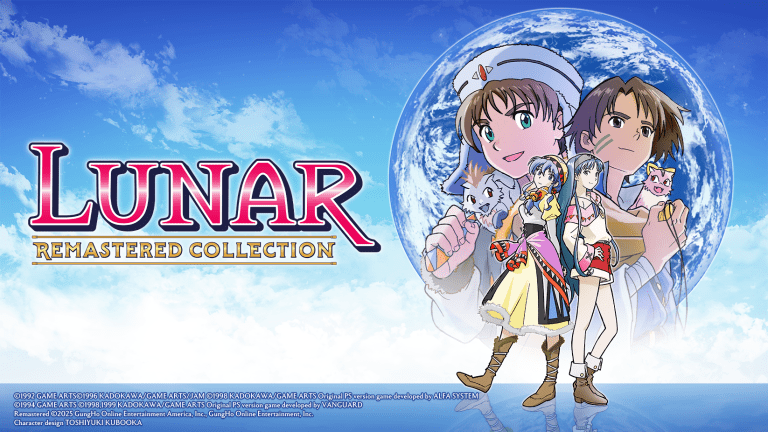
Published GungHo Online fulfilled what they promised before…Lunar Remastered Collection is now available for gamers to enjoy on Xbox Series X|S and the aging Xbox One console. Xbox gamers who love Japanese role-playing games (JRPGs) and retro games can order a digital copy of Lunar Remastered Collection by clicking here or the physical copy by clicking here.
To get things started, watch the official launch trailer of Lunar Remastered Collection below.
For the newcomers reading this, Lunar Remastered Collection’s release marks the first time ever that the Lunar role-playing game (RPG) series appeared on any Xbox console. The series developed by Game Arts first started way back in 1992 with Lunar: The Silver Star on the Sega CD (Mega CD in other markets) which was an add-on device on the Sega Genesis (Mega Drive). Lunar: Eternal Blue was released also on Sega CD in 1994.
During the 5th console generation, both games were remade – Lunar: Silver Star Story Complete and Lunar 2: Eternal Blue – were released on Sega Saturn and the PlayStation, taking advantage of each console’s capabilities for better presentations technically and artistically. The remade Lunar games each had technical enhancements and animated cutscenes. In case you are wondering, the stories of the two games are set around one thousand years apart.
As seen in the launch trailer above, Lunar Remastered Collection includes a lot of features to suit the tastes of gamers such as the option to choose between classic and remastered modes, adjustable battle speed, the option to choose between English and Japanese voice-overs, and more.
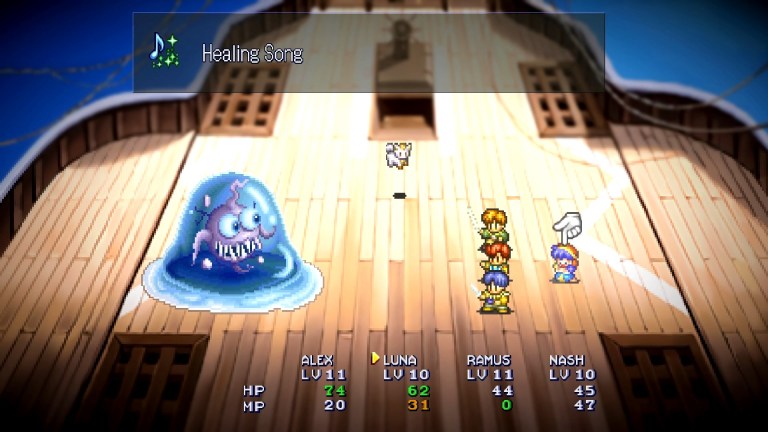
Remember this battle from Lunar: Silver Star Story Complete?
For those who want the best quality for viewing anime cutscenes, the remastered mode features enhanced visuals that make the anime footage look more presentable on HDTV. As for the English voice-overs, be aware that the voices of the characters and enemies are all new. This means that the previous English voice-over works produced by Working Designs (defunct since 2005) for the North American versions of Lunar: Silver Star Story Complete and Lunar 2: Eternal Blue are simply not available.
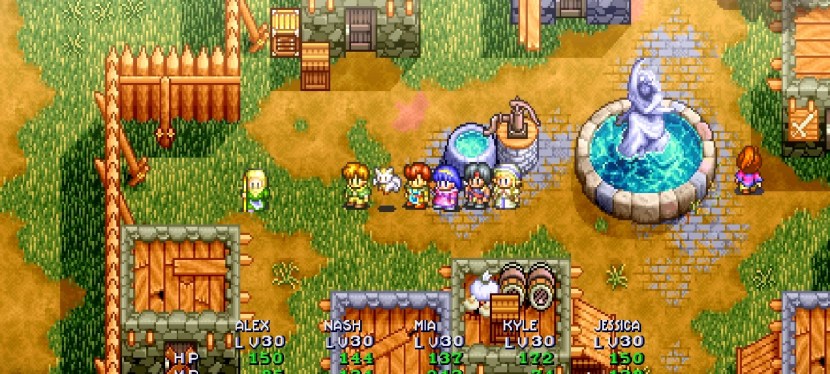
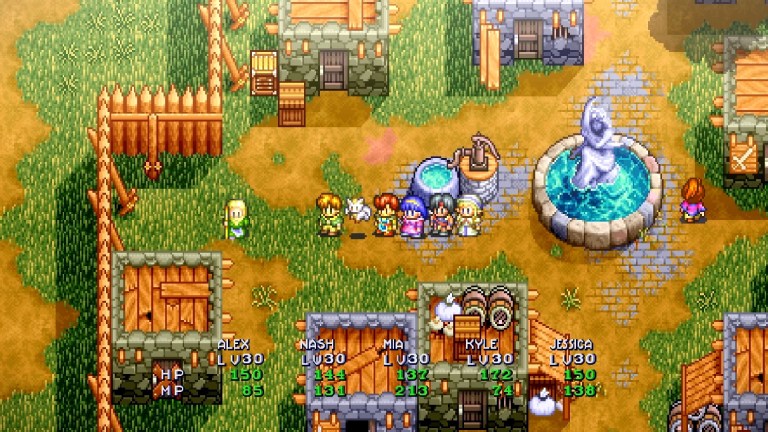
Unlike what happened in the Grandia HD Collection, the 2D sprites in the Lunar remastered games were not filtered. Their organic sprite look was maintained.
If you are a long-time JRPG enthusiast, or if you are an avid retro gamer, or if you are a long-time Lunar RPG fan who already owns a modern Xbox console, Lunar Remastered Collection is worth checking out. It is the latest retro gaming release this year that Xbox gamers can enjoy. Watch the YouTube video below for reference as to how the game looks on Xbox.
Welcome back my readers, YouTube viewers and all others who followed this series of articles focused on YouTube videos worth watching. Have you been searching for something fun or interesting to watch on YouTube? Do you feel bored right now and you crave for something to see on the world’s most popular online video destination?
I recommend you check out the following videos I found.
#1 President Marcos talks about troublesome Russian vlogger Vitaly Zdorovetskiy – It has been weeks since Russian vlogger and live streamer Vitaly Zdorovetskiy caused trouble and harassed people here in the Philippines which resulted in his arrest. While he is in prison as the local authorities prepare to press charges against him, no less than President Ferdinand “Bongbong” Marcos, Jr., noticed Vitaly during an official vlog via the Bongbong Marcos YouTube channel. Marcos begins to talk about Vitaly during the 2nd half of his video. The mere fact that the President of the Philippines notices and shares his views about Vitaly should send a strong signal to troublesome live streamers/vloggers overseas that they will be punished here in the Philippines if they cause trouble for the sake of entertaining a live audience.
#2 In-depth analysis of the interrogation scene in 1984’s The Terminator – The Terminator from 1984 is the subject of multiple video reviews, reaction videos, retrospective and film analysis on YouTube. After digging through several analysis videos, I found one that is very focused on the interrogation scene of Kyle Reese and the YouTuber shared some really compelling views about it. Watch the video below.
#3 Why Tron still looks great explained – I saw Tron many times in my life from the first time seeing it on home video in 1983, on cable TV and on DVD. Even until now, the 1982 film – which used computer-generated graphics mixed with other forms of cinematic visualizing – still looks great and has aged like fine wine. The video below explains exactly why and it is a must-see.
#4 VKunia and Ashleigh Burton react to Captain America: Civil War – Back in 2016, there was a local cinema that actually organized an unusual gimmick to accommodate moviegoers…by playing Captain America: Civil War on a 24-hour basis. I saw the movie at a 5:30 AM showing back then. While it definitely was the third Captain America movie (note: I will not count the fake Captain America movie subtitled Brave New World), it was actually more of a mini-Avengers movie which clearly took some of the spotlight away from the titular character. It was fun to watch and I encourage you to see how it impacted VKunia and Ashleigh Burton in their respective reaction videos below.
#5 PatmanQC examines the history of Batman Returns video games – Batman Returns was a big hit in cinemas around the world, although it never came close to matching the global ticket sales of its 1989 predecessor. Regardless, there was a lot of merchandising related with the movie as well as several video game adaptations. I played the Konami-developed Batman Returns game on the Super Nintendo Entertainment System (SNES) but never got to play the movie-based games on the Sega Genesis and Sega CD. To know more about the games based on the 1992 movie, watch PatmanQC’s in-depth video below.
#6 Minty Comedic Arts’ trivia video about What About Bob? – Back in 1991, the comedy film What About Bob? was released in cinemas and it attracted mostly positive reviews from the critics. Many people were impressed by the performances delivered by Bill Murray and Richard Dreyfuss. Recently, Minty Comedic Arts posted a trivia video about the film which you can watch below.
Welcome back readers, fellow geeks and electronic gaming fans!
In this edition of the Retro Gaming Ads Blast (RGAB) series, we will take a look at another batch of retro gaming print ads – including arcade flyers – from the 1980s and 1990s.
For the newcomers reading this, Retro Gaming Ads Blast (RGAB) looks back at the many print ads of games (console, arcade, computer and handheld) that were published in comic books, magazines, flyers, posters and newspapers long before smartphones, social media, the worldwide web and streaming became popular. To put things in perspective, people back in the 1980s and 1990s were more trusting of print media for information and images about electronic games and related products.
With those details laid down, here is the newest batch of retro gaming print ads for you to see and enjoy…
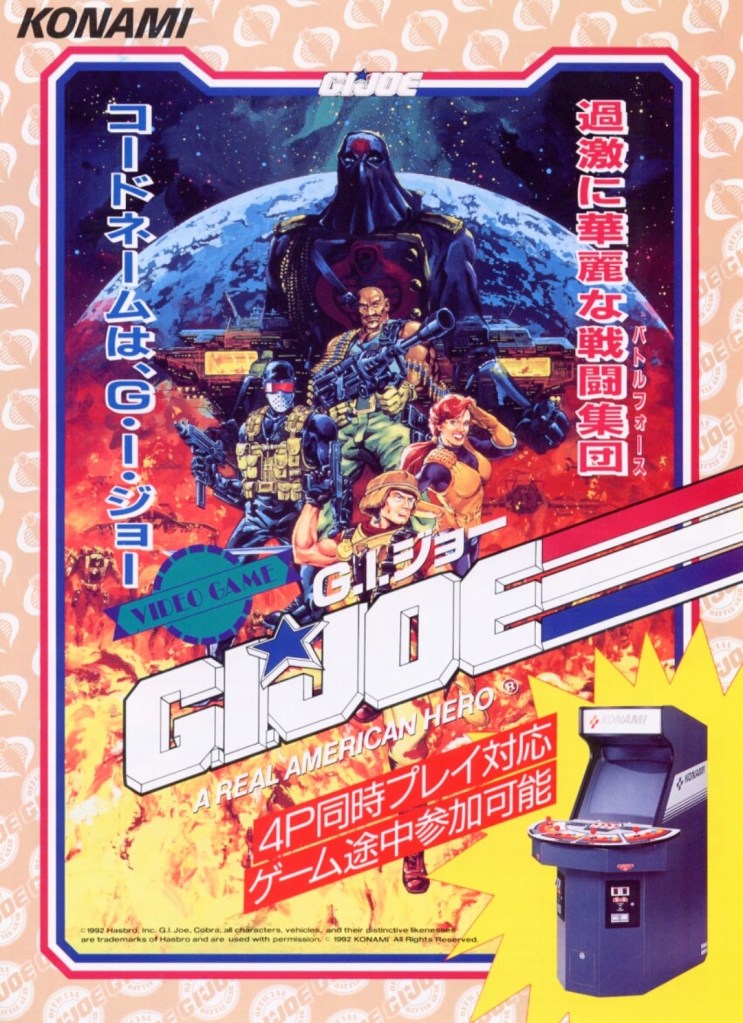
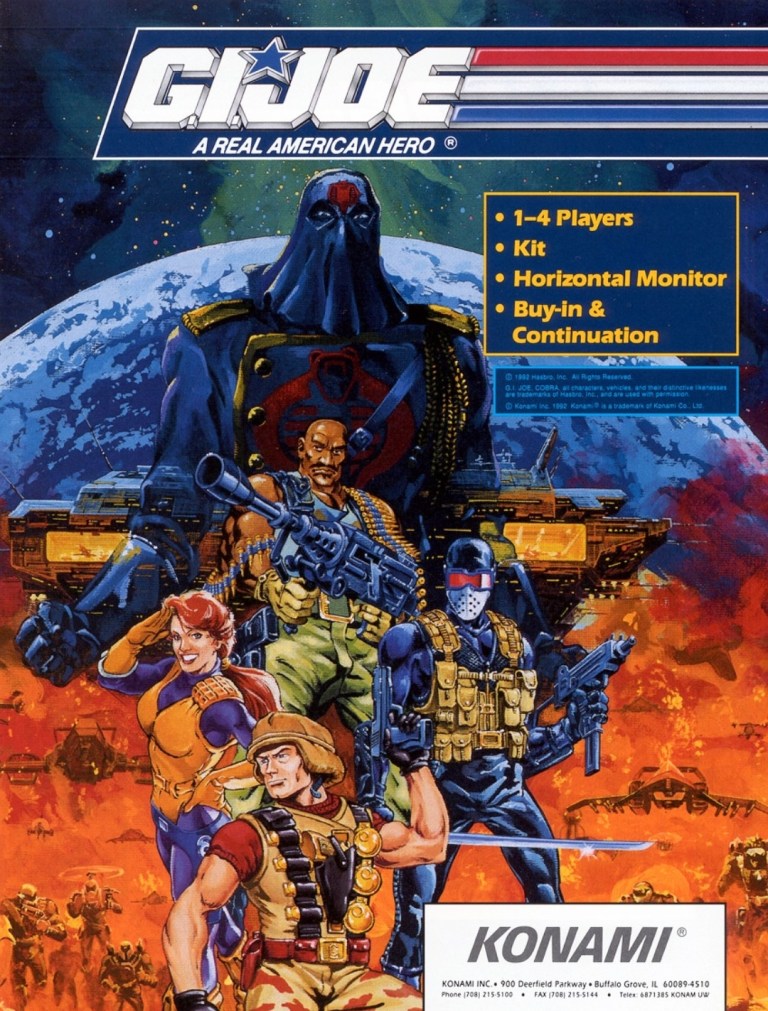
1. G.I. Joe: A Real American Hero arcade flyers
G.I. Joe: A Real American Hero arcade flyer for the Japanese market.
The North American arcade flyer of G.I. Joe.
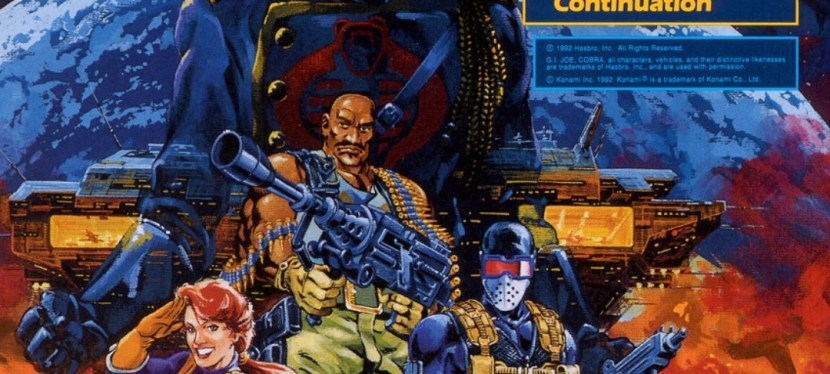
Back in the 1980s, my friends and I saw lots of episodes of G.I. Joe: A Real American Hero on TV and there were lets of toys of it available. I also read some comic books of G.I. Joe. While there were G.I. Joe video games, I never got to play its early 1990s arcade game from Konami. By comparing the two arcade flyers of G.I. Joe: A Real American Hero, the American flyer excels visually showing the characters with a powerful war-themed background. The Japanese flyer had smaller space for the same artwork and displayed the arcade cabinet (take note of the controls laid out to accommodate up to four players). Between the two, I prefer the American arcade flyer.
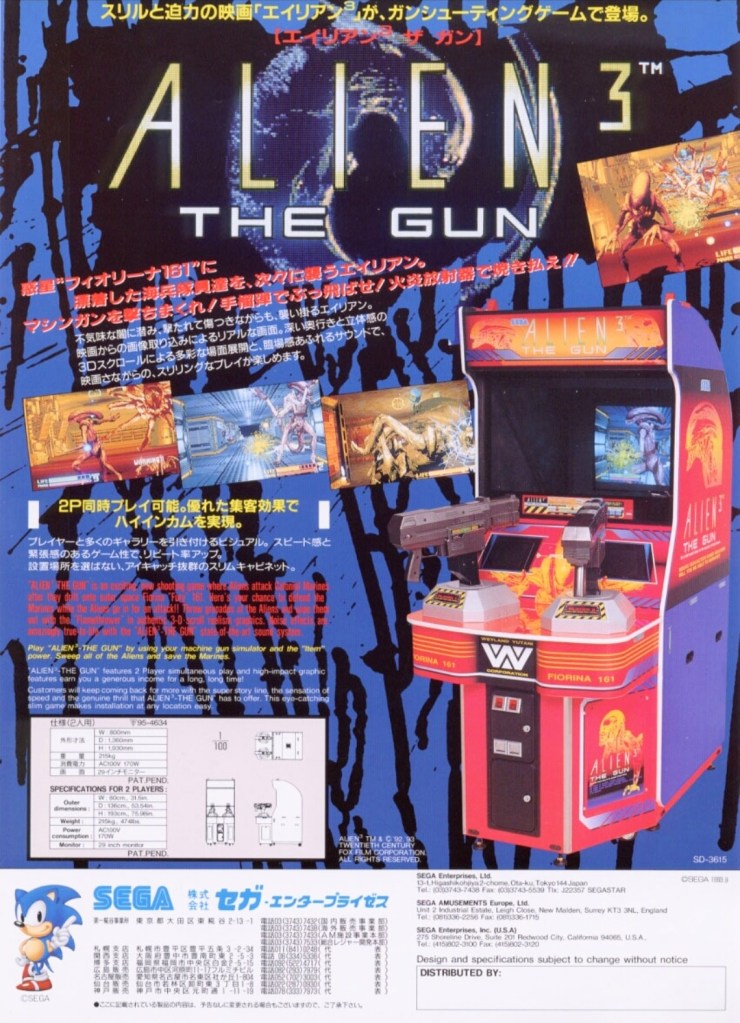
2. Alien 3 Japanese arcade flyer
With this arcade flyer, Sega clearly showed arcade operators what to expect when ordering machines of Alien 3: The Gun.
Watching Alien 3 inside the cinema in 1992 was one of the worst moviegoing experiences I ever had. By the time video games based on the movie were released, I was surprised to see how action-packed and entertaining they looked. The one Alien 3 game that captivated me was Sega’s Alien 3: The Gun in the arcades as its design and concept contradicted the essence of the film. The Japanese arcade flyer has this aggressive approach on laying down the details, displaying the arcade machine and displaying carefully selected screenshots to excite both gamers and arcade operators. This arcade flyer still looks good today.
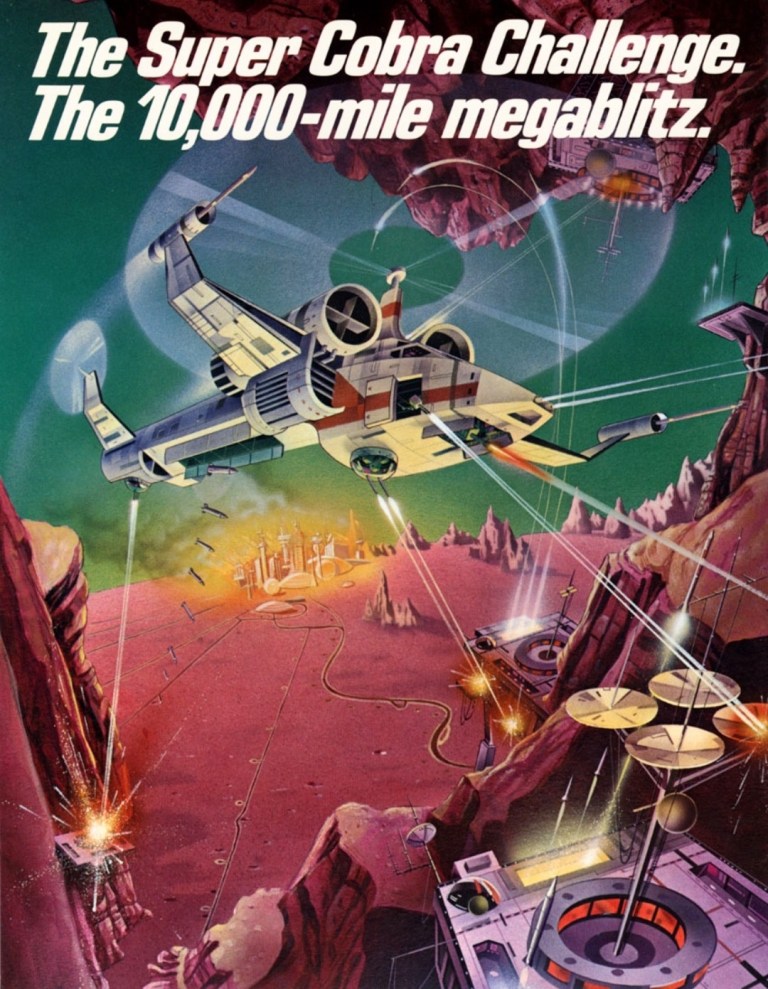
3. Super Cobra arcade flyer
A great artwork emphasizing the concept of Super Cobra.
First released in Japanese and America arcades in 1981, Super Cobra is a 2D side-scrolling shooter in which players pilot an armed helicopter through tight caverns while facing enemies capable of firing. The American arcade flyer has great artwork that almost perfectly captures the essence of the game. This is another old arcade flyer that has aged well.
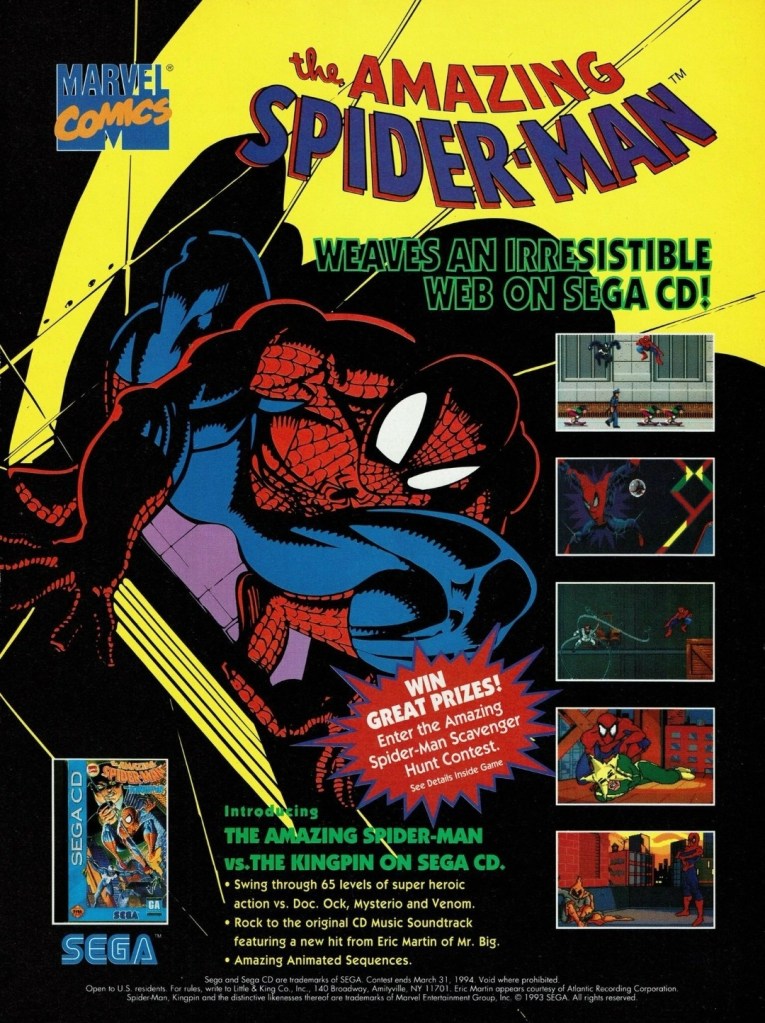
4. The Amazing Spider-Man vs. The Kingpin print ad
Back in 1993, animated sequences included in video games were still new and even exciting.
Moving forward to the year 1993, gamers in America who owned a Sega Genesis console were being motivated by Sega to upgrade their gaming experience with the Sega CD add-on. Along the way, Sega really ramped up efforts to have more games supporting the Sega CD and one of them was The Amazing Spider-Man vs. The Kingpin. The Amazing Spider-Man vs. The Kingpin on Sega CD was actually an updated version of the original 1991 game and Sega’s team included several improvements to take advantage of the CD-ROM technology of the add-on. This print ad showed Sega’s hard work on selling the game.
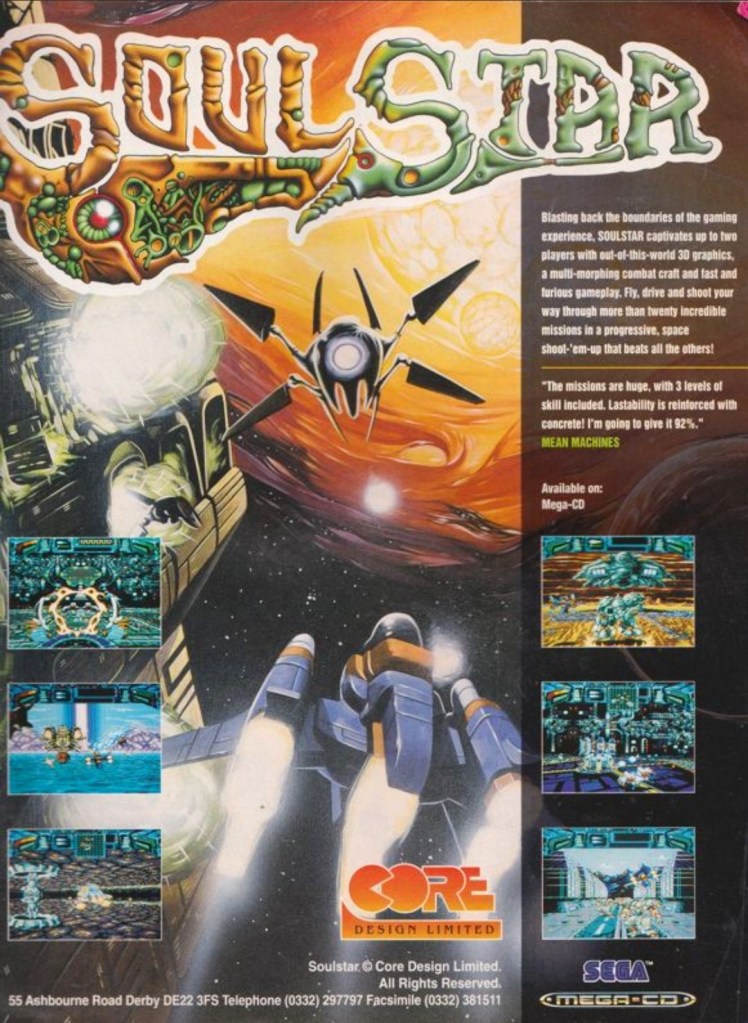
5. Soulstar print ad
The artwork of this print ad has very strong sci-fi vibes.
Released in 1994 for the Sega CD (Mega CD in other markets), Soulstar was sci-fi 3rd-person shooter that delivered amazing visuals, fun gameplay and an immersive experience of space travel to gamers. This European market print ad is a very effective way to promote the game using carefully selected screenshots, amazing artwork and a cleverly written text description. Still a fine print ad to look at.
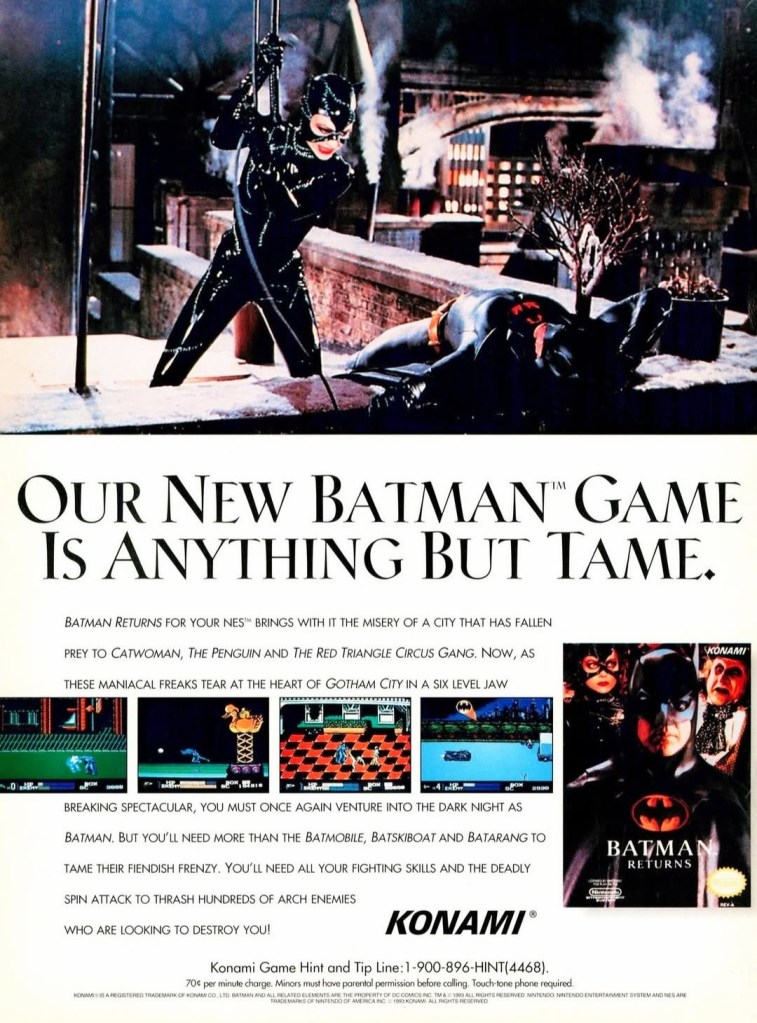
6. Batman Returns print ad
This print ad effectively promoted both the game and the movie. In retrospect, the line “Our new Batman game is anything but tame” turned out to be true as lot of parents who brought their kids to the cinemas for Batman Returns were turned off by the adulterated elements.
In 1992, Batman Returns played in a lot of cinemas but its very dark tone and adulterated elements prevented it from matching the huge box office success of its 1989 predecessor. Regardless, a lot of licensed video games based on the movie were released and in early 1993, Konami released a Batman Returns video game on the aging Nintendo Entertainment System (NES). This print ad used a photograph from the filming of an scene that actually had Michelle Pfeiffer as Catwoman, dominating over the iconic Batman. Also displayed were screenshots, the game’s box cover (showing Pfeiffer, Michael Keaton and Danny DeVito as their respective characters) and the text description. Even if you did not like the movie, this old print ad is a solid way of promoting both the game and the movie. The line “Our new Batman game is anything but tame” strangely turned out very true.
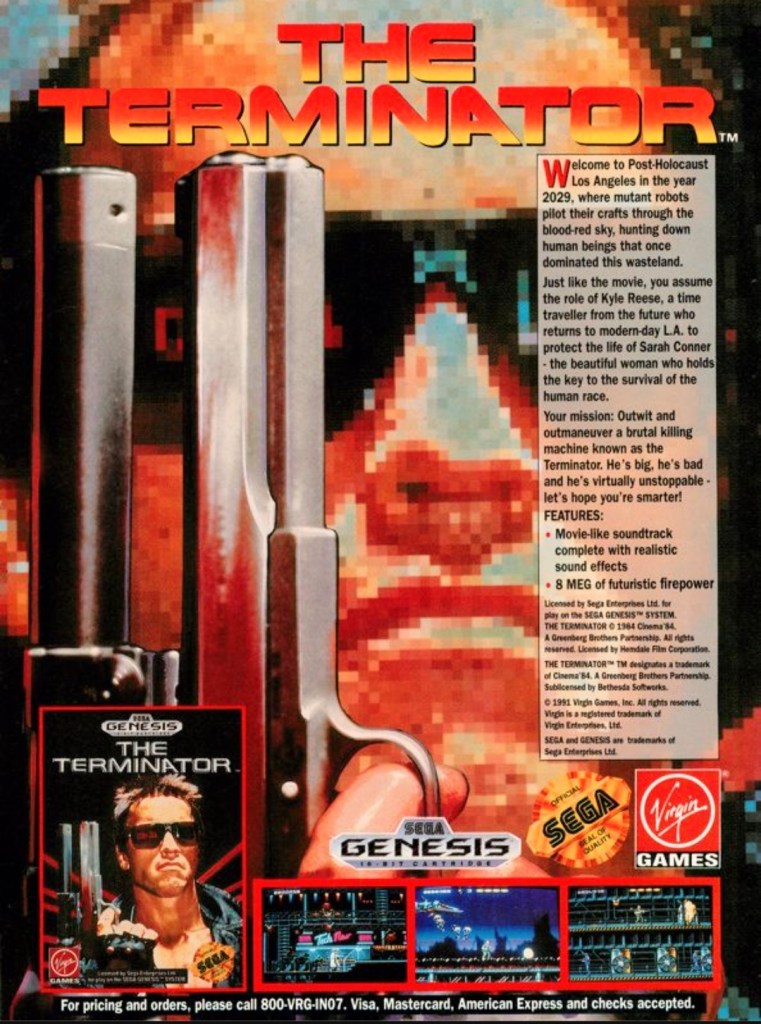
7. The Terminator games print ads
The Terminator for Sega Genesis.
The Terminator for Sega CD.
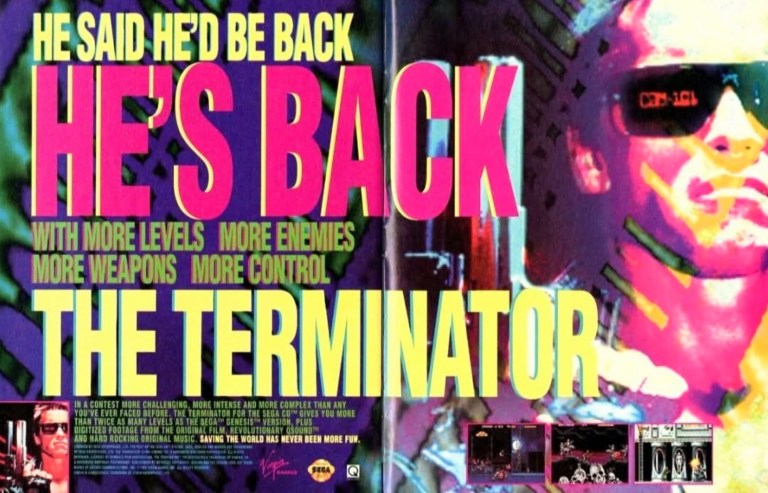
Released in cinemas in 1984, The Terminator was a surprise hit as well as a career-booster for Arnold Schwarzenegger and James Cameron. What is very notable is the fact that several video game adaptations of The Terminator were released on consoles in the early 1990s. I can only guess this was done to capitalize on the resurgence of the Terminator franchise in connection with Terminator 2: Judgement Day’s much-anticipated release in cinemas. The Sega Genesis version print ad features a digitized close-up of Schwarzenegger’s Terminator while the 2-page Sega CD version print ad used a lot of the space for large text (with an incomplete shot of Schwarzenegger’s Terminator on the edge of the 2nd page) emphasizing “He’s Back” and “The Terminator” while leaving little space for text descriptions and screenshots. Between the two, I find the Sega Genesis ad more effective with its promotion of the game.
8. Defender arcade flyer
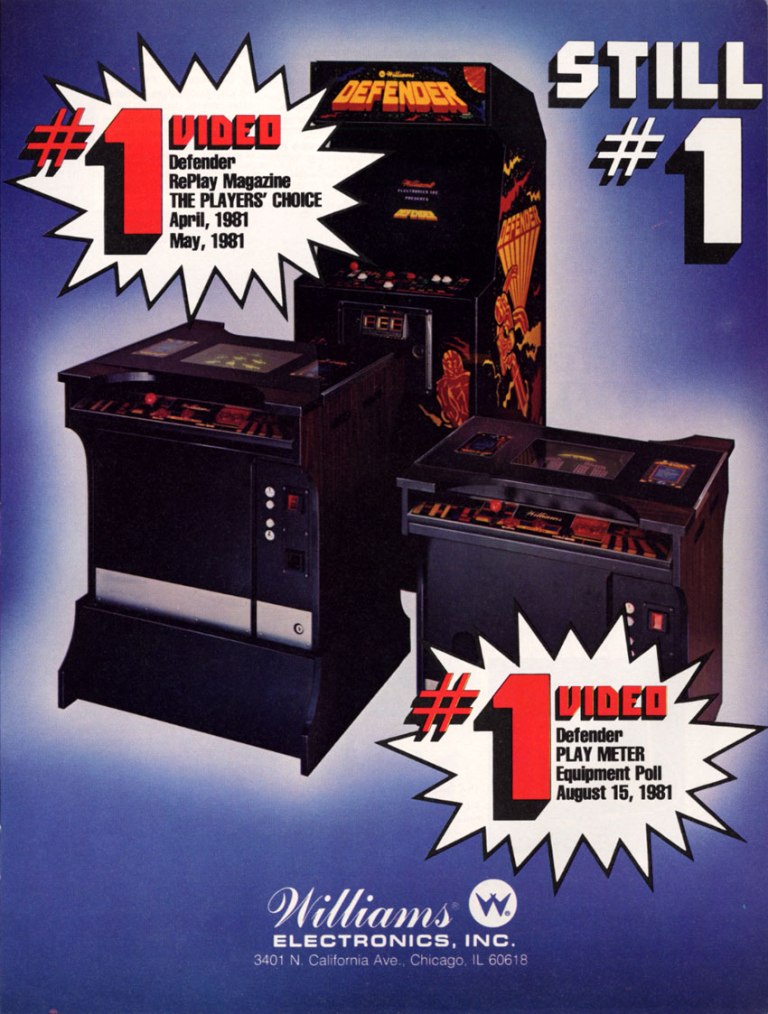
More choices of a very successful game for arcade operators also means more ways for players to play it.
Even though it had a soft start in the early 1980s, the classic game Defender went on to become a massive commercial success in the arcades. Being a major attraction in America’s video game industry, Williams unsurprisingly went on to release this particular arcade flyer to sell to operators different types of Defender arcade machines that could fit into their respective joints while providing gamers choices on how to play the game. Some players preferred to stand in-front of a tall arcade cabinet while others prefer to play the game looking down on the screen. This flyer is an example as to how a company can keep their biggest success moving on while offering business clients more choices.
Welcome back my readers, YouTube viewers and all others who followed this series of articles focused on YouTube videos worth watching. Have you been searching for something fun or interesting to watch on YouTube? Do you feel bored right now and you crave for something to see on the world’s most popular online video destination?
I recommend you check out the following topics and the related videos I found.
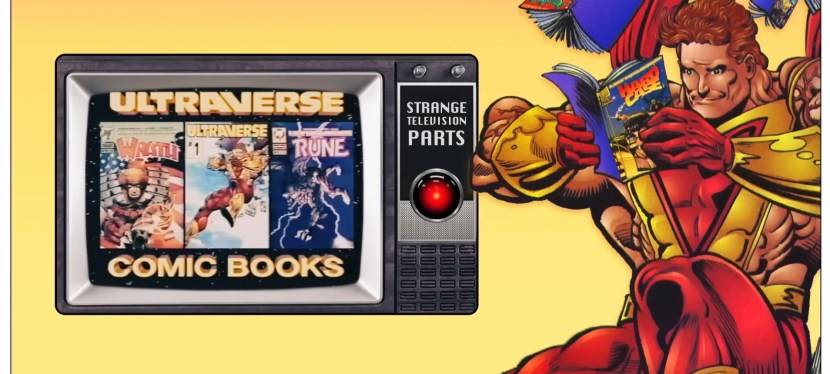
#1 Revisiting the Ultraverse – When it comes to 1990s comics, the short-lived Ultraverse is the one franchise that defined the decade the most as it had lots of engaging concepts, solid stories and captivating characters to follow such as Prime, Mantra, Harcase, Prototype, The Strangers, The Solution and more! Behind the scenes, publisher Malibu Comics had a great creative team who brainstormed and developed the Ultraverse a lot prior to its 1993 launch. To learn more about the Ultraverse, watch the following videos below.
#2The 1993 debate between Peter David and Todd McFarlane – Way back in 1993, I learned bits of information about a certain debate between the prolific writer Peter David (The Incredible Hulk, Spider-Man 2099) and Todd McFarlane (Spider-Man and Spawn) through word-of-mouth and comics-related print media. Of course, Internet access here in the Philippines was not yet available back then but there was local awareness about the David-McFarlane verbal battle. Fortunately for us, an actual video of the entire debate was uploaded to YouTube and the YouTuber Strange Brain Parts posted an analytical video about it. The videos are now available for your viewing pleasure.
#3 Lefties Losing It (Trump, Richard Gere, Taylor Swift booed and more) – In this recent episode of Lefties Losing It hosted by Rita Panahi, you will see how demented the current congressional Democrats have gotten, US President Donald Trump being cheered and how Taylor Swift was booed during the recent NFL Super Bowl, Richard Gere failing to accept reality and much more. Seriously, a lot of Leftists are still bitter over Trump’s return as President and they prefer to move on with their distorted view of reality. Wokeness truly is living wrongly. Watch and enjoy the video below.
#4 VKunia reacts to Poltergeist (1982) – A lot of people find 1982’s Poltergeist (directed by Tobe Hooper and produced by Steven Spielberg) a scary viewing experience. It has been the subject of many documentaries or reaction or retro reviews on YouTube. YouTuber VKunia posted her own reaction video of it and you can how it affects her in the video below.
#5 PatmanQC explains the history of The House of the Dead – The House of the Dead is a horror-themed series of video games that Sega first launched in 1996. During that year, there were The House of the Dead machines that suddenly appeared in local arcades here in the Philippines. Due to its horror theme and high level of violence, it caused some disturbance to concerned parents whose children saw or even played it. Regardless, the newer The House of the Dead games made its way to the local arcades as the years passed by. If you want to know who created the said Sega franchise and what were the inspirations for each game, watch the in-depth video by PatmanQC now.
#6 Dawn of the Dead reaction videos – To make things clear, I was never a fan of Zack Snyder’s Dawn of the Dead remake. I saw it in the local cinema back in 2004 at a time when the new movies released were not so interesting. Even with modest expectations, I was not so entertained by it. Still the movie is popular with YouTubers who posted their own reactions to it. Watch and learn from the selected videos below.
Welcome back readers, fellow geeks and electronic gaming fans!
In this edition of the Retro Gaming Ads Blast (RGAB) series, we will take a look at another batch of retro gaming print ads – including arcade flyers – from the 1980s and to the year 2000.
For the newcomers reading this, Retro Gaming Ads Blast (RGAB) looks back at the many print ads of games (console, arcade, computer and handheld) that were published in comic books, magazines, flyers, posters and newspapers long before smartphones, social media, the worldwide web and streaming became popular. To put things in perspective, people back in the 1980s and 1990s were more trusting of print media for information and images about electronic games and related products.
With those details laid down, here is the newest batch of retro gaming print ads for you to see and enjoy…
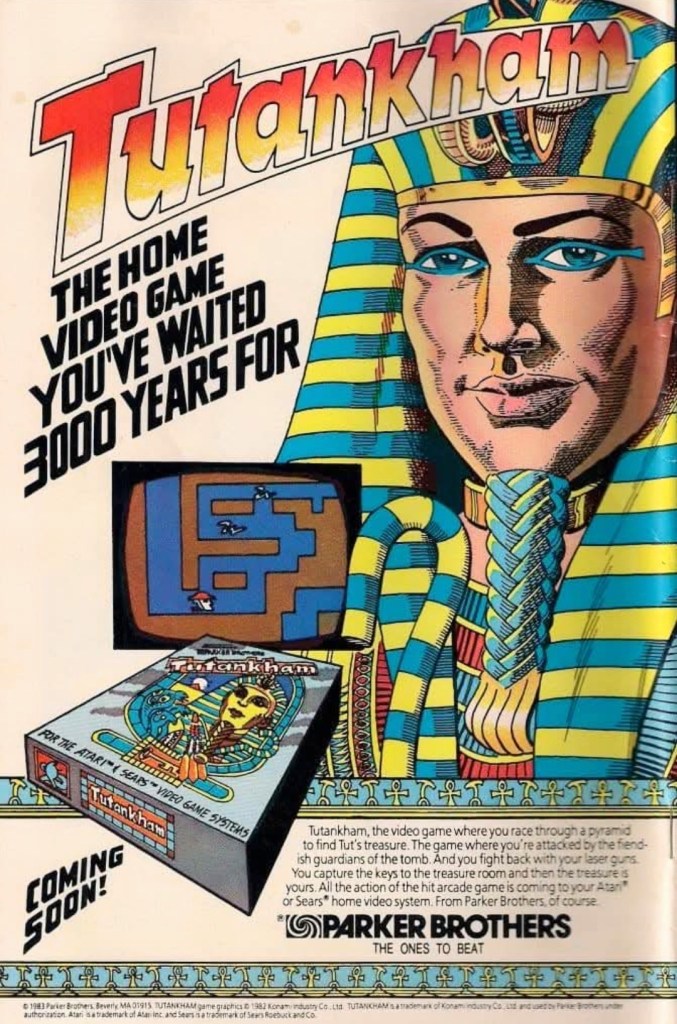
1. Tutankham print ad
This print ad appeared in several comic books in 1983.
First released in the arcades in 1982, Tutankham is a 2D adventure game that had a mix of shooting, maze exploration and puzzle-solving with Egyptian settings and concepts. It made its way to the Atari 2600 published by Parker Brother, and it was this specific version I played. This game print ad appeared in comic books I read in 1983, and the people who made it implemented a hand-drawn art of the Egyptian pharaoh Tutankhamun dominating the space to emphasize the Egyptian setting. In fact, this ad made me think more of Egypt and left little to give me an idea of the game design.
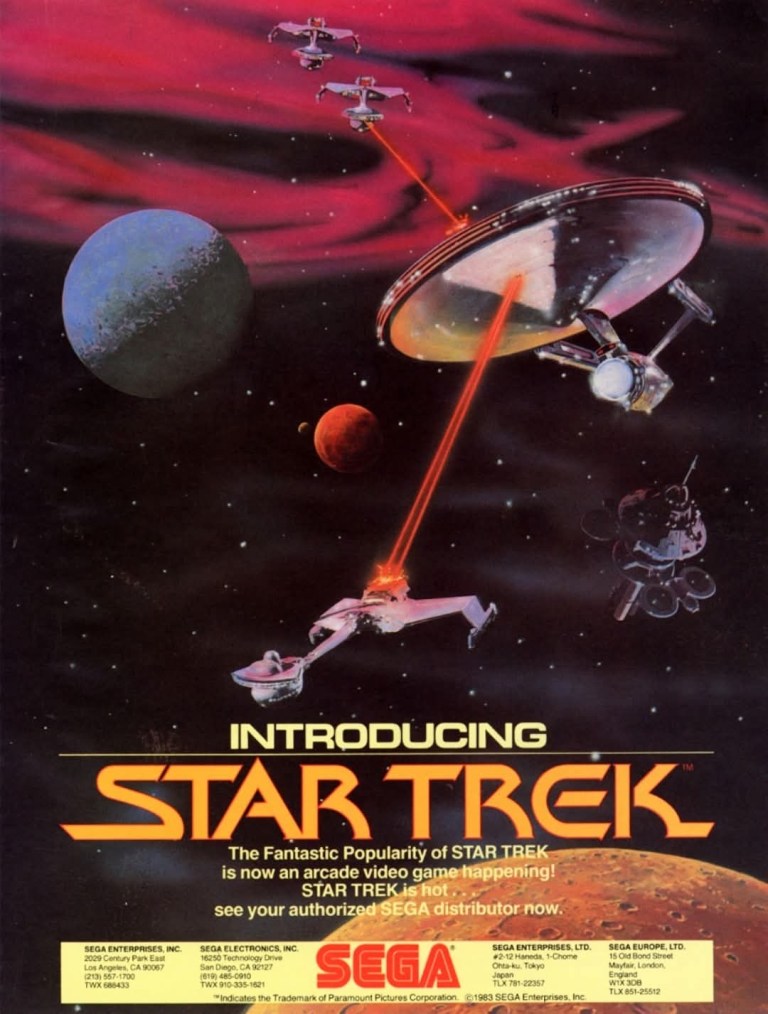
2. Star Trek arcade flyer
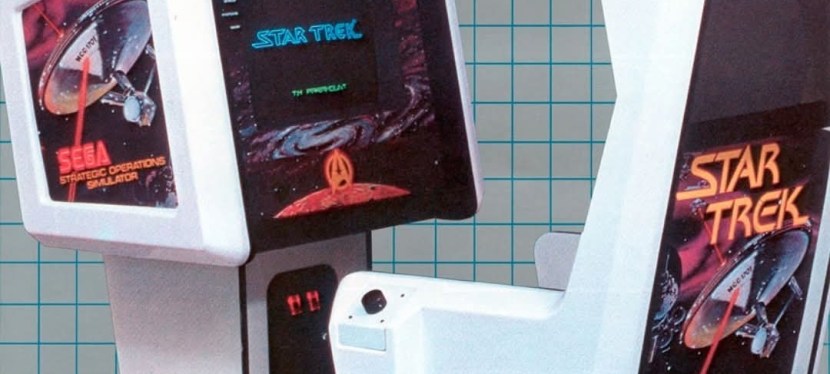
The clever use of classic Star Trek imagery was used in this initial flyer by Sega.
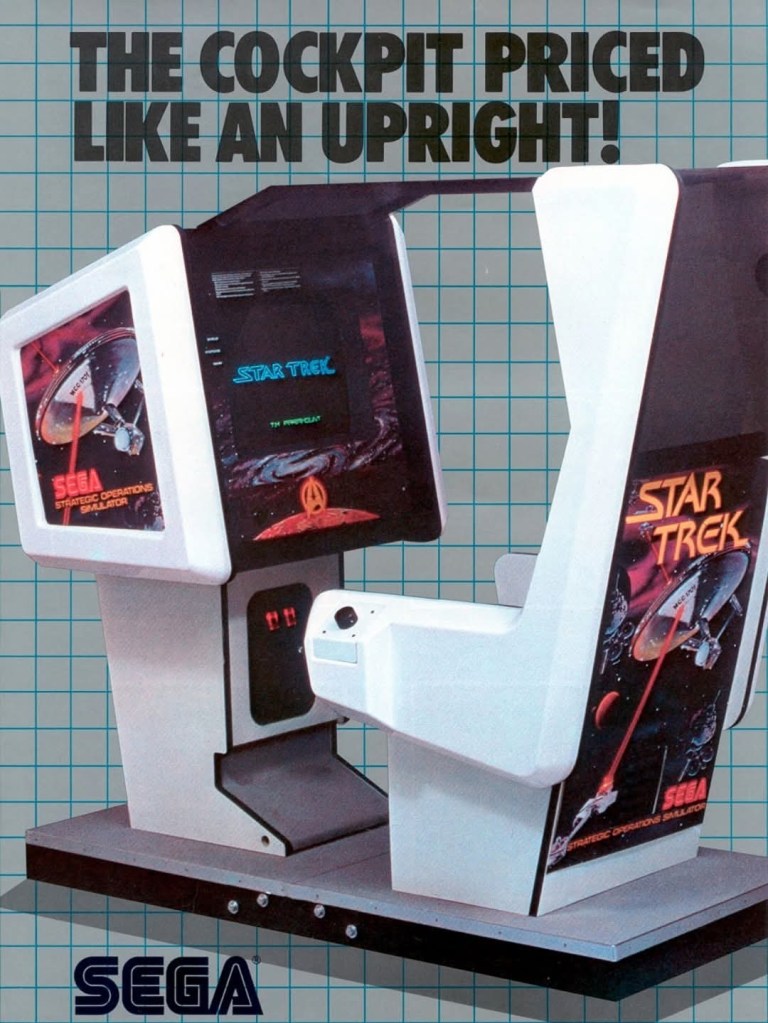
Back in the 1980s, a futuristic design for an arcade machine like this one was mind-blowing.
I never played the Star Trek arcade game (full title: Star Trek: Strategic Operations Simulator) Sega released in 1983. I only saw its graphics and gameplay during an episode of Starcade. With its game design and visual presentation, Star Trek was a very ambitious arcade project for its time and Sega really went in to promote it. The initial arcade flyer (first one above) was meant to grab the attention of both gamers and arcade operators. The next arcade flyer (2nd one above) showed the ambitious design of the arcade machine made with player immersion in mind.
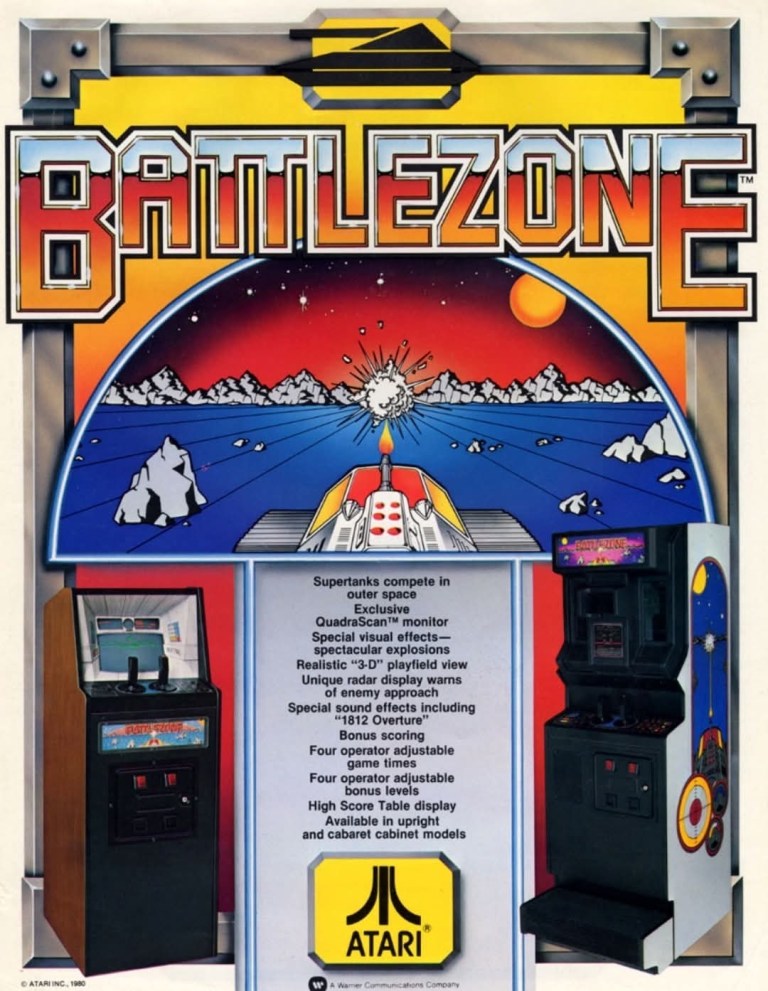
3. Battlezone arcade flyer
While the hand-drawn artwork was too detailed for the arcade game’s graphics, it still emphasized strongly the concept of the game.
In the history of video games, Battlezone was a groundbreaking game both visually and with game design. It was designed to give gamers an immersive experience of driving a tank with 3D graphics, fun gameplay and a first-person view. Its own history is worth researching. Atari knew it had to heavily promote their ambitious game and the arcade flyer above featured nice hand-drawn artwork while also showing the two types of Battlezone machines that arcade operators can choose from. Battlezone went on to become a highly influential arcade game.
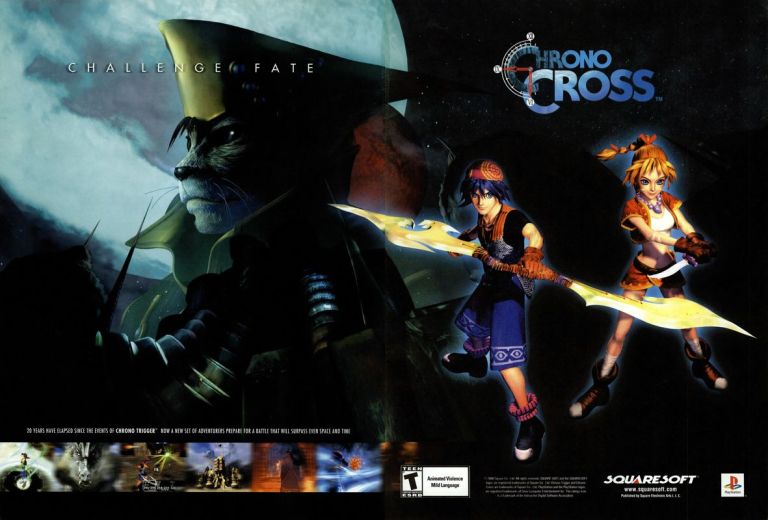
4. Chrono Cross North American print ad
Arguably, this print ad was aimed at RPG enthusiasts, Chrono Trigger fans and gamers looking for something adventurous to play.
First released on PlayStation in Japan, Chrono Cross made its way to the said console in America just a few months before the PlayStation 2 launched there. While there was a risk that came with releasing the ambitious follow-up to the classic Chrono Trigger so late in the PlayStation’s life, Squaresoft (now Square Enix) still went on to aggressively promote Chrono Cross in America. This 2-page print ad that appeared in many gaming magazines remains captivating to look at. As typical of the time, 3D polygonal models and the epic-looking art were used in dominating fashion leaving the small space (lower-left corner) to display a few gameplay screenshots and other 3D art. Still it a fun game to play and this should remind you that Chrono Cross was recently remastered for modern consoles.
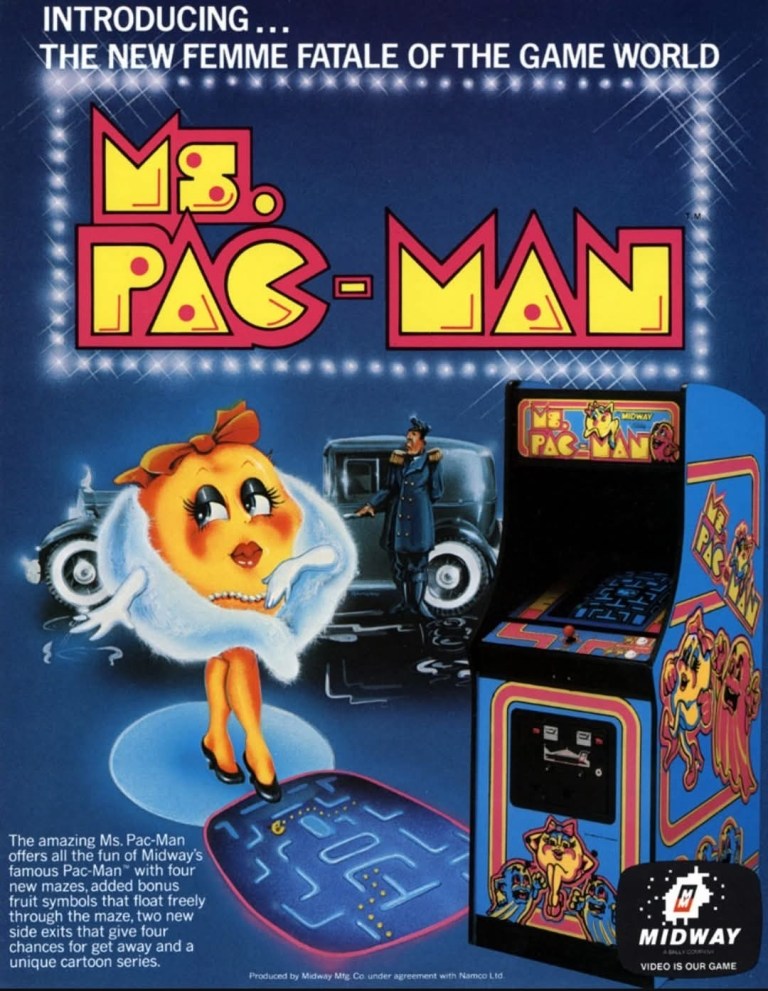
5. Ms. Pac-Man arcade flyer
The wife of Pac-Man and the machine.
Given the fact that Pac-Man was so massively successful, it was not surprising that a sequel had to be made and released on as many arcades as possible. Ms. Pac-Man was the sequel and it was released in arcades in 1982 eventually achieving huge commercial and critical success. To promote the game, Midway’s ad makers came up with an ad showing unique art of Pac-Man’s wife looking glamorous (with a driver and a vehicle in the background) and a photograph of the arcade machine on the right. This also was one of the early arcade flyers to use the words “femme fatale”.
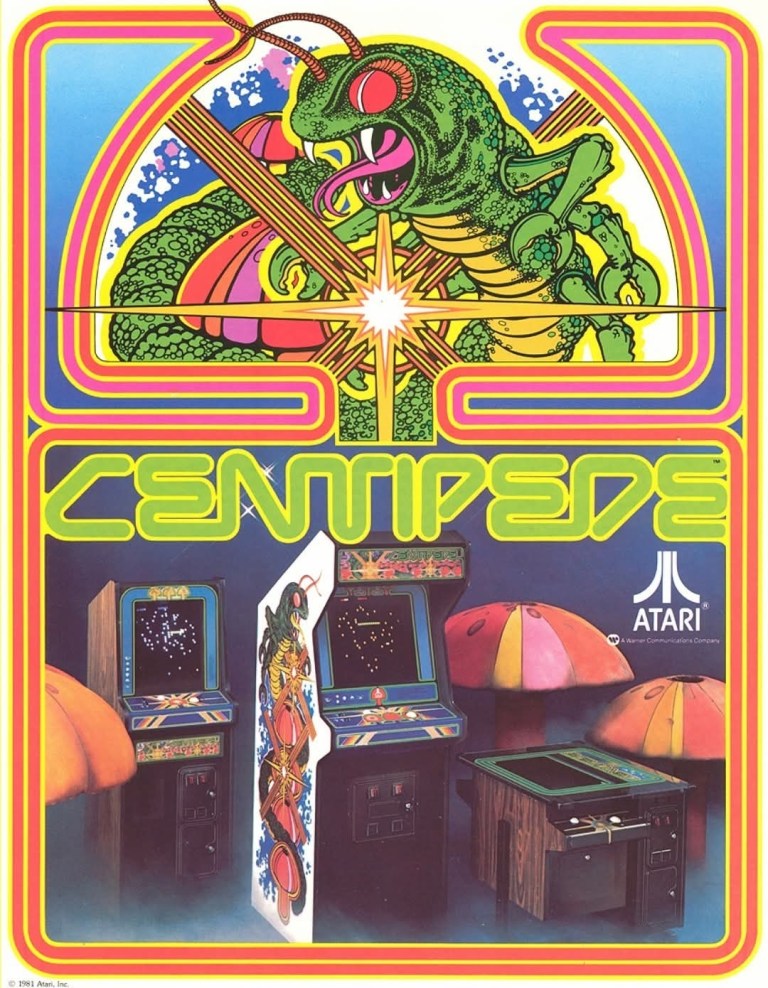
6. Centipede arcade flyer
Three machines of Centipede for arcade operators to choose from.
Centipede is another arcade classic from Atari. Released in 1981, a lot of players enjoyed the game’s simplistic and yet addicting design of shooting an incoming centipede and its remaining portions that move down the field. Similar to the Battlezone arcade flyer, this game’s flyer had nice art of a centipede on the top and images arcade machines. Even by today’s standards, this flyer remains eye-catching.
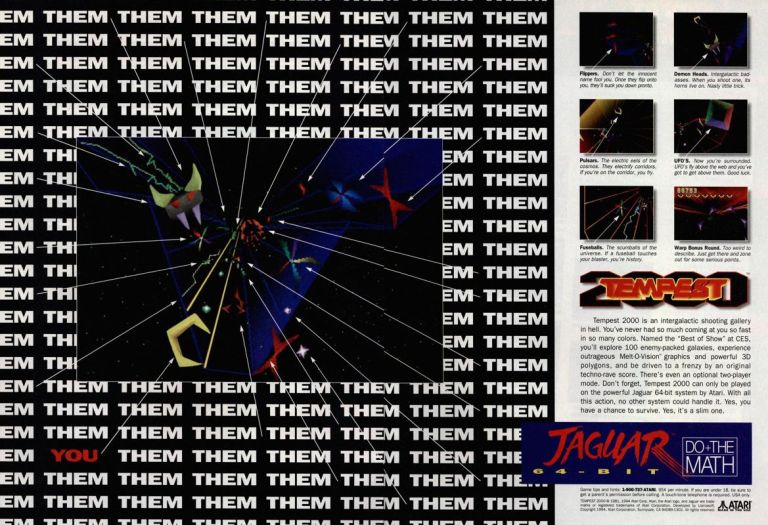
7. Tempest 2000 print ad
This 2-page print ad of Tempest 2000 is still captivating to look at.
Back in the 1990s, Atari went on to release their Jaguar console which was promoted as a 64-bit machine. At a gaming convention, the company met with prospective game developers over Jaguar projects and one of the developers volunteered to do Tempest (a memorable Atari arcade game). This resulted in the development of Tempest 2000 which was a remake of the classic.
As a Jaguar-exclusive game, Atari came up with an eye-catching 2-page ad showing off the 3D visual presentation (6 gameplay screenshots and one original artwork) while boasting in the text description that Tempest 2000 was named the “Best of Show” at the Consumer Electronics Show (CES). The game was released in 1994 attracting mostly positive reviews from game critics and was one of the best-selling Jaguar games (note: Tempest 2000 can now be played in the Atari 50 collection). With the Atari legacy and presentation combined, this print ad remains captivating to look at.
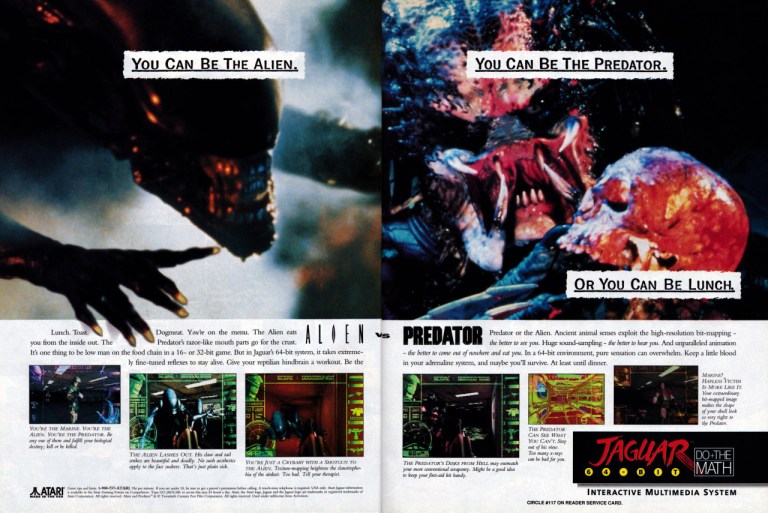
8. Alien vs Predator print ad
Arguably the most defining and most entertaining game on the Atari Jaguar.
If there is any game that truly defined enjoyment and the technological features of the Atari Jaguar, it is the 1994 first-person shooter Alien vs Predator. At the time of its release, it was one of the most immersive games of the Alien vs. Predator crossover franchise and it allowed players to experience what fighting the Predator or the Xenomorph was like. The game also allowed gamers to play as a Colonial Marine (human soldier).
To sell the game, Atari came up with a 2-page ad highlighting the Aliens on one page and the Predator on the other. As the Predator was shown with a grotesque human skull, the use of photographs (most likely sourced from the movies) strongly emphasize the game was aimed at the mature audience among gamers. Six screenshots of gameplay were displayed by the ad makers who were clearly aware of the high popularity of first-person shooting games. Alien vs Predator was a critical and commercial success, and its print ad is arguably the most memorable one of any Atari Jaguar game ever made.
Welcome back my readers, YouTube viewers and all others who followed this series of articles focused on YouTube videos worth watching. Have you been searching for something fun or interesting to watch on YouTube? Do you feel bored right now and you crave for something to see on the world’s most popular online video destination?
I recommend you check out the following topics and the related videos I found.
#1 The return of US President Donald Trump – Donald Trump is officially back as President of the United States. Officially speaking, he has been counted as the 45th and now the 47th US President. Within the first day of his new administration, President Trump proceeded with the reforms by signing them with his approval. Indeed, America is back with Trump and this means removing the woke trash left behind by the failed Biden-Harris administration. The following videos were selected for your interest and enlightenment.
#2TBR Schmitt reacts to 1997’s Air Force One – I don’t know with you readers but I enjoy watching the movie reaction videos of YouTuber TBR Schmitt (a couple who enjoy movies together). In light of Donald Trump’s return as US President, I posted below TBR Schmitt’s reaction video of 1997’s Air Force One (note: for other YouTube reaction videos of the said movie, click here) which is entertaining to watch. If you have not seen Air Force One, watch the movie first before seeing the reaction video.
#3 The rise of Vietnam – It cannot be denied that Vietnam truly progressed economically over the decades. Previously ravaged by war, Vietnam is now in a position to replace China as the manufacturing hub of Asia and they already have tech giants like Samsung and Apple on their side. This video by ColdFusion explains in details the historical background and the astronomic rise of Vietnam. It’s a must-watch.
#4 VKunia reacts to Rocky – Have you been watching the movie reaction videos of YouTuber VKunia? She has lots of reaction videos and most of them are enjoyable to watch. For this post, I am sharing with you her reaction video of the one movie that made Sylvester Stallone a movie star – Rocky. Not only that, VKunia herself used to live in Philadelphia (Rocky’s city). Watch VKunia’s Rocky reaction and observe how Stallone’s film draws her reactions.
#5 PatmanQC examines the Atari Jaguar – Back in the early to the mid-1990s, console gaming was already dominated by the Japanese, particularly by Sega (with the Genesis) and Nintendo (with the SNES). Along the way, while reading a video game magazine, I was very surprised to see the announcement of the Atari Jaguar console. Back in those days, a lot of people thought Atari faded away in the console business. The Jaguar eventually failed commercially but it still made its mark in video gaming history, and already a lot of YouTubers posted retrospective videos about the said Atari console. If you want an in-depth look at the history of Atari Jaguar and what its games were, watch PatmanQC’s video below.
#6 You, Me and the Movies react to Mac and Me – Have you ever been interested in a movie geared towards children with a creative mix of Coca-Cola, McDonald’s and a story that has similarities with E.T. the Extra-Terrestrial? Such a movie exists and it is called Mac and Me. You, Me and the Movies recently posted their reaction video about it and you have to see it.
For the newcomers reading this, the said collection contains the two memorable fantasy role-playing games (fantasy RPGs) which are Lunar: Silver Star Story Complete(enhanced version of Lunar: The Silver Star) and Lunar 2: Eternal Blue Complete (enhanced version of Lunar: Eternal Blue). Since the releases of the original versions in the 1990s, the Lunar RPGs have been released on a variety of consoles such as Sega CD, PlayStation and Sega Saturn.
Lunar Remastered Collection will be the first-time the Lunar RPGs will be released on Xbox consoles. It will launch on April 18, 2025.
For the JRPG-loving Xbox fans, the said Lunar Remastered Collection is indeed coming to Xbox Series X|S and the aging Xbox One. Strangely enough, as of this writing, the said collection has yet to appear on the Xbox online store.
While GungHo confirmed there will be physical copies of Lunar Remastered Collection coming out, it is uncertain if such copies of the Xbox version will be released. The press release mentioned that physical editions “will be available exclusively through Amazon for $54.99 USD” for the North American market. As for the European market, only the PlayStation 4 (PS4) and Nintendo Switch will have physical copies through Clear River Games.
If you are an Xbox fan who loves Lunar and JRPGs in general, are you discouraged about the potential lack of physical copies of Lunar Remastered Collection? If you really want it badly, better express your opinions and questions directly to Team Xbox and GungHo via Twitter, or by email.
Welcome back readers, fellow geeks and electronic gaming fans!
In this edition of the Retro Gaming Ads Blast (RGAB) series, we will take a look at another batch of retro gaming print ads – including arcade flyers – from the 1980s and 1990s.
For the newcomers reading this, Retro Gaming Ads Blast (RGAB) looks back at the many print ads of games (console, arcade, computer and handheld) that were published in comic books, magazines, flyers, posters and newspapers long before smartphones, social media, the worldwide web and streaming became popular. To put things in perspective, people back in the 1980s and 1990s were more trusting of print media for information and images about electronic games and related products.
With those details laid down, here is the newest batch of retro gaming print ads for you to see and enjoy…
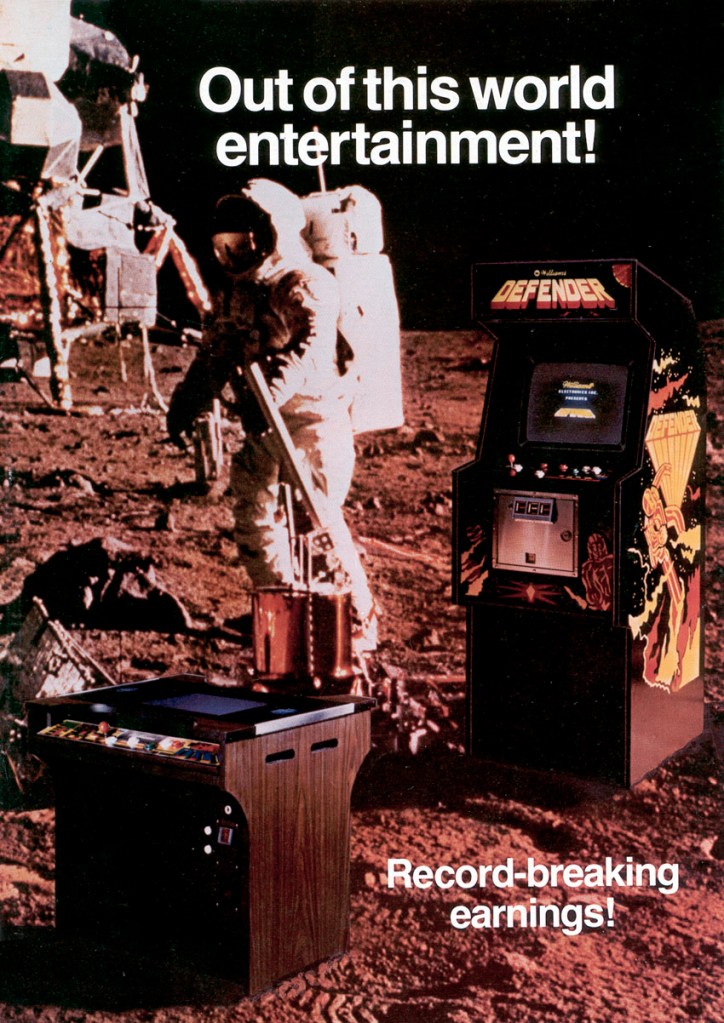
1. Defender arcade flyer
Perhaps Atari did not have enough original artwork of Defender to be used in this arcade flyer. So they ended up using footage of an astronaut on the moon.
Very long ago, I played the classic game Defender a lot on the Atari 2600. Strangely enough, I never played its arcade version as my visits to arcades were quite limited as I was so young back then. When it comes to the arcade flyer of Defender, I find the use of stock footage of an astronaut on the moon as the artistic backdrop baffling because the game’s concept was all about fighting back alien invaders and protecting the citizens. Ironically, the image blended well with the photos of two arcade machines showcased.
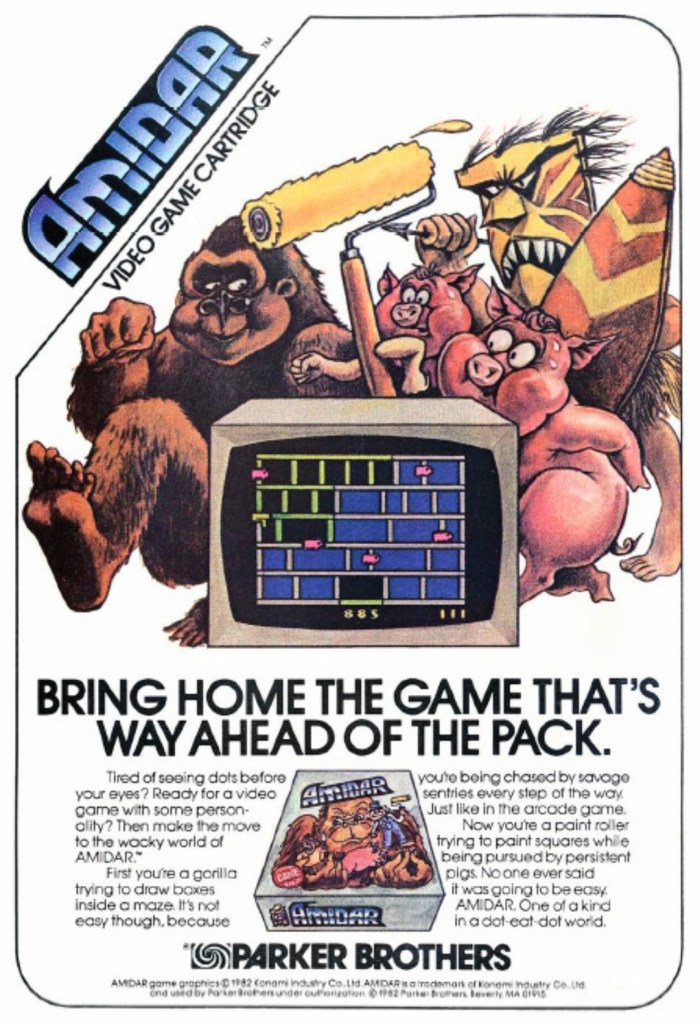
2. Amidar Atari 2600 print ad
Does this ad make you think about King Kong or animals?
When I was a young boy, I saw this Parker Brothers print ad of Amidar appear in many superhero comic books I read. I never played the game on the Atari 2600 nor in the arcades. Each time I saw this ad, I always wondered how the game played and what its creative concept was all about. The constant showing of a giant gorilla on the game box cover reminded me of King Kong.
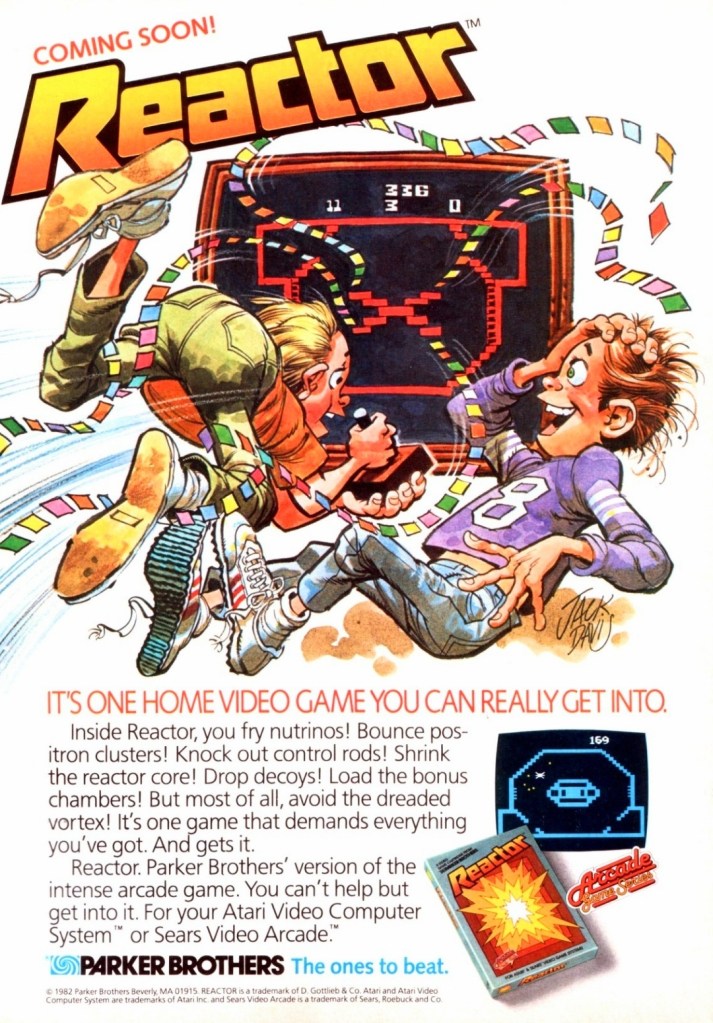
3. Reactor Atari 2600 print ad
Parker Brothers made this ad imagining gamers getting very engaged with reactor once they start playing it.
Reactor was one of those video games that was somewhat influenced by the subject of nuclear technology, particularly about the nuclear reactors. This is another game I never played on console nor in the arcades. This Reactor print ad by Parker Brothers for the Atari 2600 has a visual style and creative concept that I still find fascinating to look at.
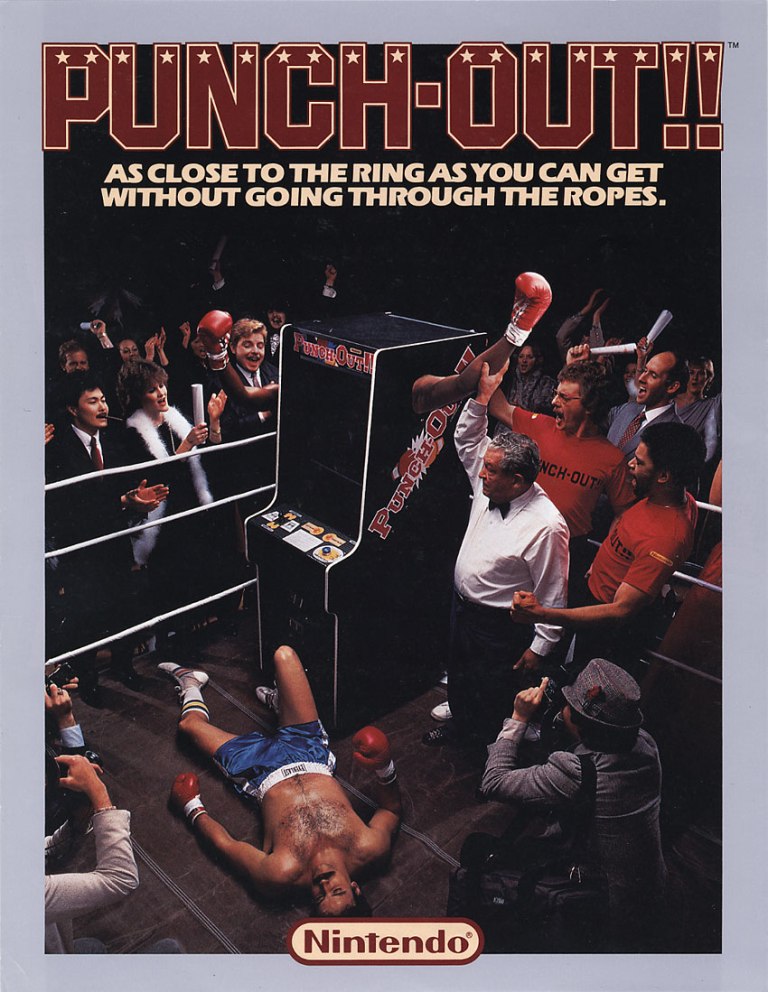
4. Punch-Out!! arcade flyer
This was years before Nintendo hired Mike Tyson to endorse the console version of Punch-Out!!
In 1984, Nintendo released the original Punch-Out!! game in the arcades and literally punched its way through to the top of American arcades that year while also scoring big in other arcades around the world. While the game proved to be very playable and a lot of fun, it could be argued that the intriguing image Nintendo used for the North American arcade flyer – a boxer down after literally getting beaten by the Punch-Out!! machine – made an impact on both gamers and arcade operators.
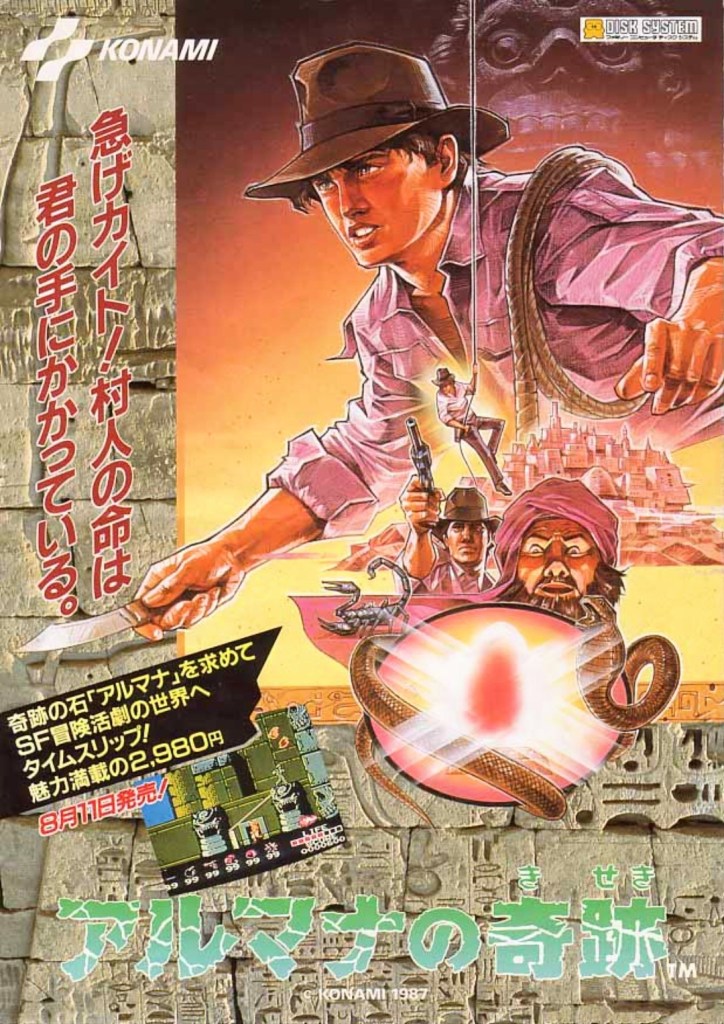
5. Arumana no Kiseki flyer
Is the famous Indiana Jones theme music playing inside your mind right now as you look at this art?
Released in 1987 on the Disk System of the Nintendo Family Computer (Famicom) in Japan, Arumana no Kiseki was one of the many 2D adventure games Konami released that entertained gamers. When compared to Castlevania – strongly influenced by American horror movies – this game was very influenced by the Indiana Jones movies of Steven Spielberg which is very evident in this promotional flyer.
In fact, some gamers who could not read the Japanese title actually thought this was an official Indiana Jones video game because the artwork was so suggestive. Having played and finished the game myself, I can say that Arumana no Kiseki was simply an Indiana Jones-inspired adventure game that had its own creative concept and unique settings and characters.
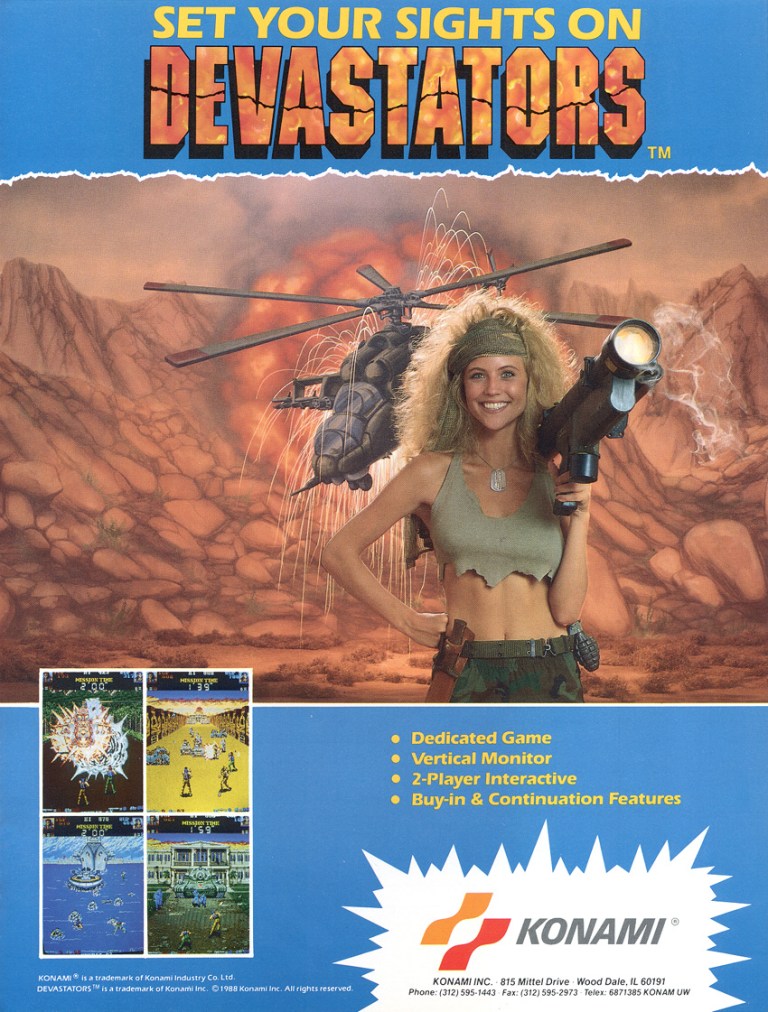
6. Devastators arcade flyer
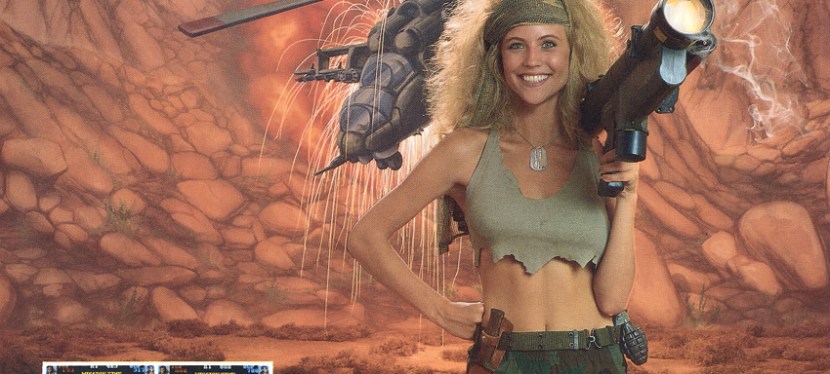
The 1980s female Rambo smiling towards you.
By looking at the track record of Konami closely, you will notice that many of their games in the 1980s were influenced by Hollywood movies and they hired pretty or sexy models for their arcade flyers. This arcade flyer of Devastators is no exception and you can clearly see the Rambo-inspired lady smiling while carrying a weapon. Devastators itself had strong Rambo vibes for its concept.
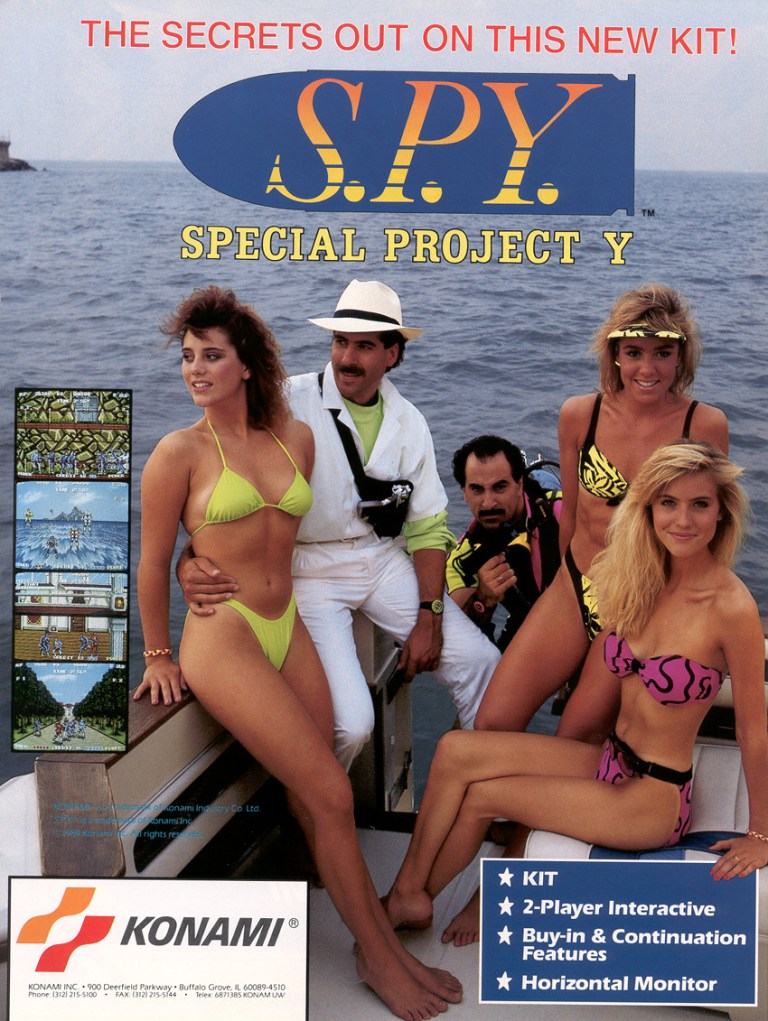
7. S.P.Y. Special Project Y arcade flyer
Somehow the picture of this flyer reminds me of Miami Vice.
Still with Konami, S.P.Y. Special Project Y is 1989 arcade game that featured action sequences in which players fight against countless enemies in order to progress with the minimal story. This game had certain spy movie elements and to promote it, Konami came up with this arcade flyer showcasing three sexy women wearing swimwear accompanied by two men who looked more like operators or schemers. Can you imagine yourself as an arcade operator looking at this flyer trying to decide to buy the game?
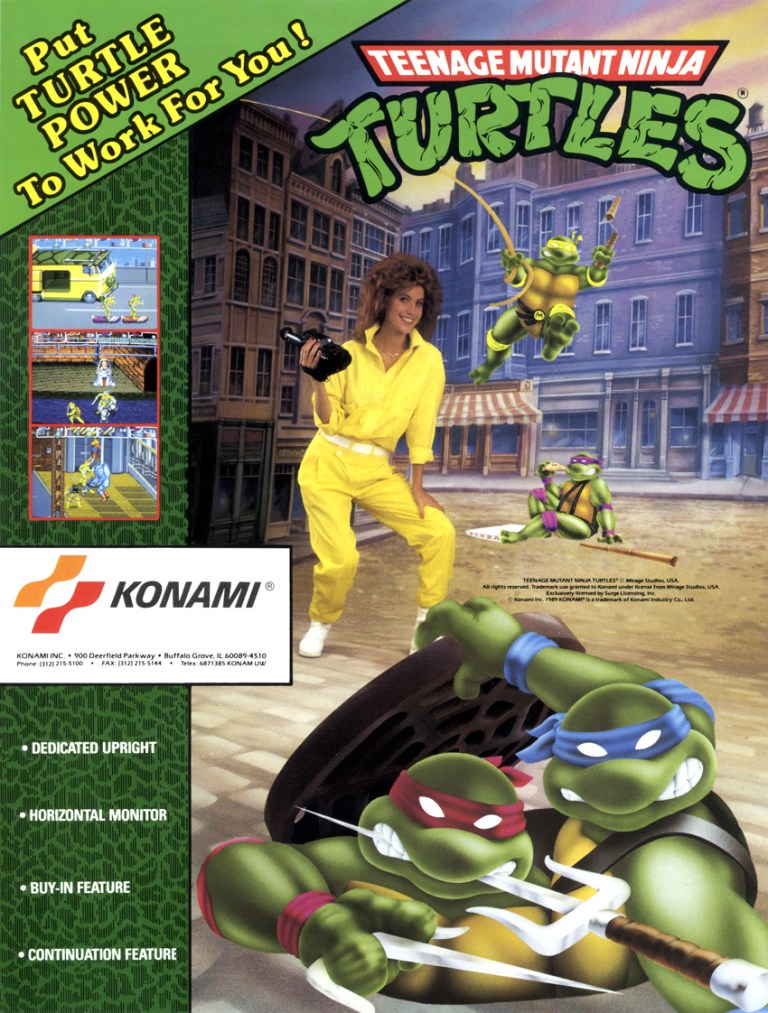
This arcade flyer is still great and exciting to look at, even if your not a TMNT fan.
Now this is one of the most definitive arcade games Konami ever made. Released in late 1989, Teenage Mutant Ninja Turtles became a massive arcade hit in North America constantly attracting lots of fans and casual gamers to play at each machine. The demand was so great, Konami had no choice but to hire a company to manufacture more machines. When it comes to promoting the game, Konami cleverly used a mix of artworks for the TMNT characters and fantasy environment while having a hired model playing April O’Neil blending in smoothly.
Having seen the 1980s animated series myself, I can say that the ad makers struck gold when it came to making a promotional image that Teenage Mutant Ninja Turtle fans can easily recognize and go to the arcade to play the game.
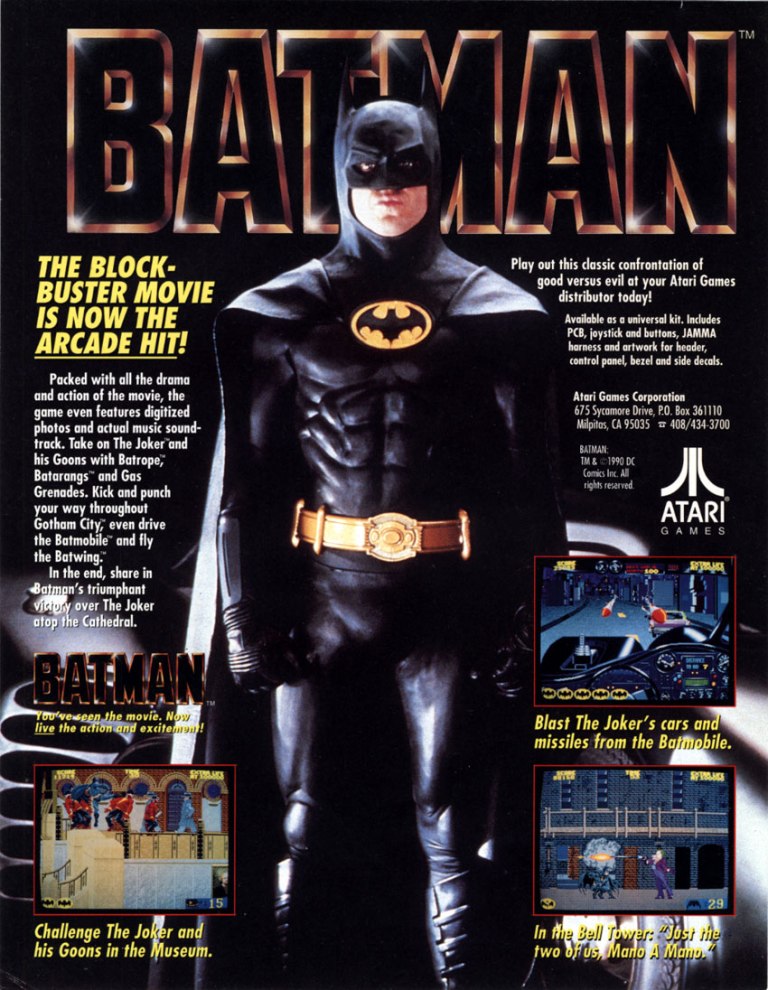
9. Batman arcade flyer
If you saw the 1989 movie, did you play this in the arcade?
The live-action Batman movie of 1989 was simply inescapable as there was so much hype, merchandising and promos connected with it. When it came to video games, it was not surprising that a lot of companies talked with Warner Bros. and eventually Atari made the official arcade game based on the movie (for insight on the production, watch PatmanQC’s video by clicking here). This early-1990s arcade flyer had a simplistic approach showing a few screenshots and descriptive text while having the live-action Batman (note: Michael Keaton in costume) dominating in the middle. Simplistic yet effective in telling gamers and arcade operators what to expect.
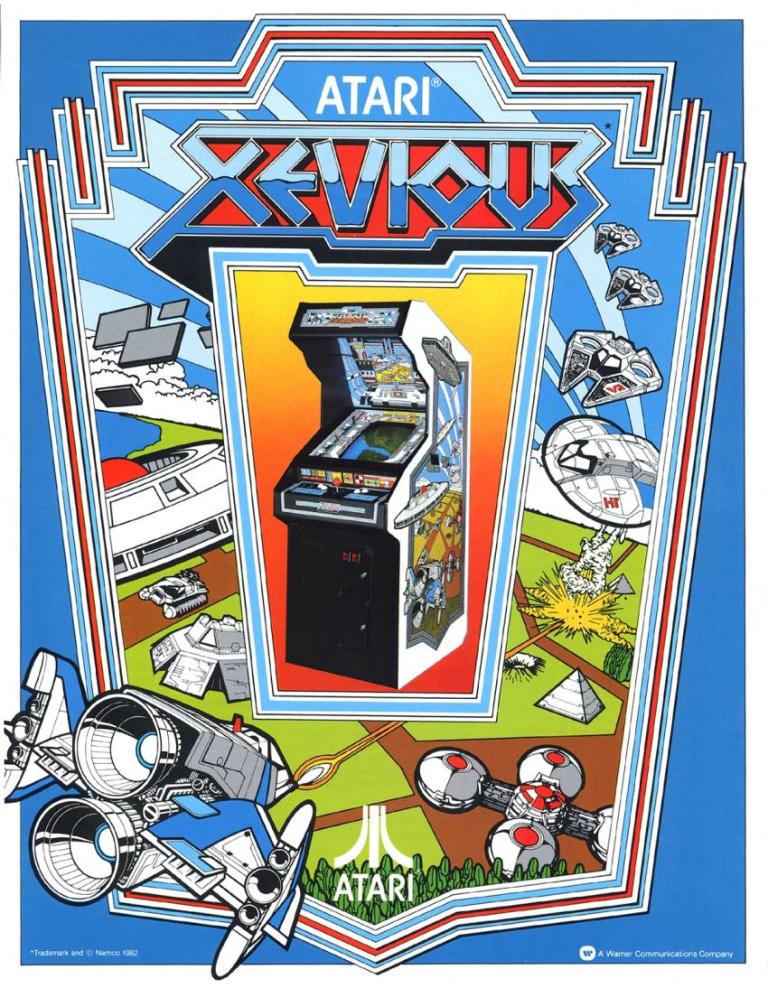
10. Xevious arcade flyer
This arcade flyer is exciting and creative to focus on.
Xevious is a long-running series of video games owned by Namco. Since the early 1980s, several Xevious video games were released on arcades, consoles and mobile devices. Believe it or not, the original Xevious game was published by Atari for North American arcades and the company came up with this dynamic looking flyer to promote it. The arcade flyer really looks dynamic due to the hand-drawn art surrounding the photo of the machine. Even by today standards, this flyer still looks modern and energetic.
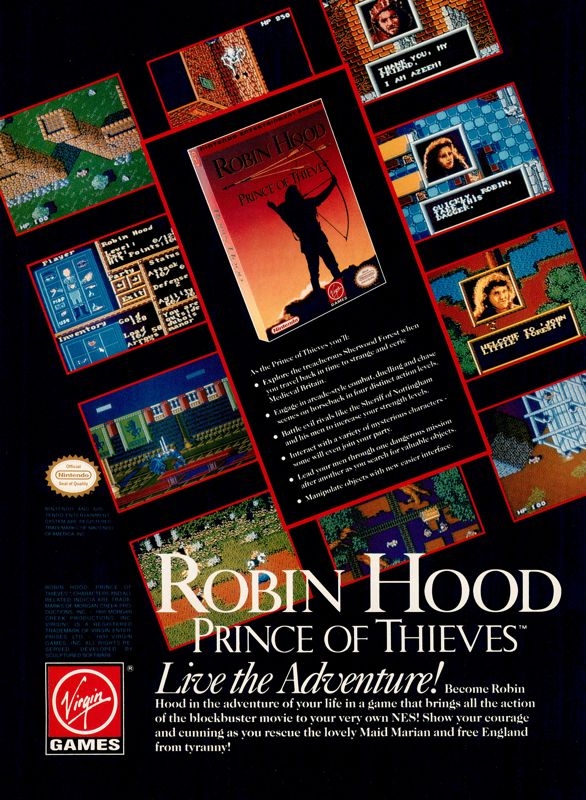
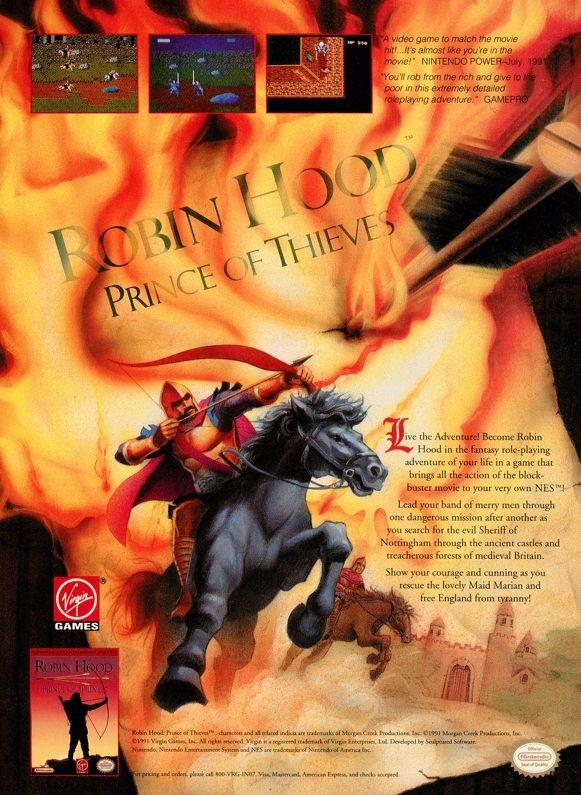
11. Robin Hood: Prince of Thieves print ads
Tell me if this ad makes you want to play the game.
Original artwork here was meant to immerse viewers into the fantasy setting of the game based on the movie.
If you saw the 1991 movie Robin Hood: Prince of Thieves, were you able to play the video game adaptation? Robin Hood: Prince of Thieves on the Nintendo Entertainment System (NES) was notable for being specially featured in the Nintendo Power magazine and its game design was truly ambitious at the time. To promote the game and take advantage of the movie’s popularity, Virgin Games came out with two print ads targeting movie fans and NES gamers.
The first print ad above had lots of selected screenshots surrounding the game’s box and crammed the descriptive text. The 2nd print ad had original artwork to emphasize the fictional setting and used only three screenshots. Looking at both print ads, it was clear that the ad makers had no permission to use the likeness of Kevin Costner as Robin Hood. The same with other actors and their characters. Regardless, the ads still reminded me enough of the movie while keeping me informed about the video game.
Welcome back readers, fellow geeks and electronic gaming fans!
In this edition of the Retro Gaming Ads Blast (RGAB) series, we will take a look at another batch of retro gaming print ads – including arcade flyers – from the 1980s and 1990s.
For the newcomers reading this, Retro Gaming Ads Blast (RGAB) looks back at the many print ads of games (console, arcade, computer and handheld) that were published in comic books, magazines, flyers, posters and newspapers long before smartphones, social media, the worldwide web and streaming became popular. To put things in perspective, people back in the 1980s and 1990s were more trusting of print media for information and images about electronic games and related products.
With those details laid down, here is the newest batch of retro gaming print ads for you to see and enjoy…
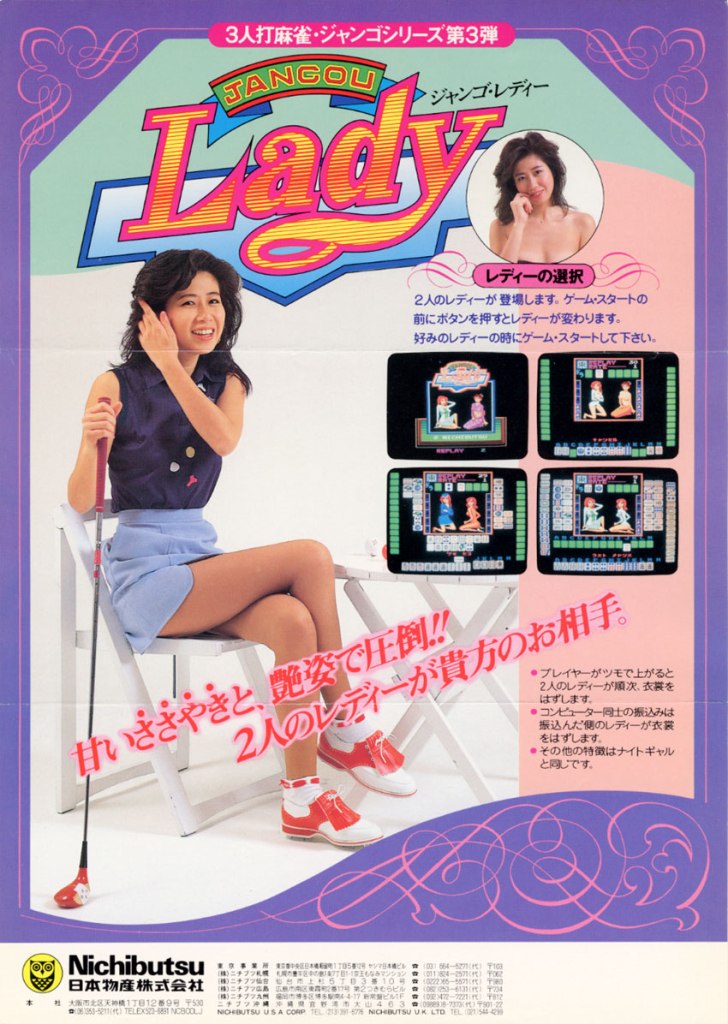
1. Jangou Lady arcade flyer
If you were to play Mahjong digitally, does sex appeal motivate you to do so?
Are you fond of playing the tile-based game Mahjong? Believe it or not, there were indeed ways to play Mahjong in digital form inside the arcade or in gambling joints in Japan. The game Jangou Lady allows users to play rounds of Mahjong but with a notable additive – the digital art of women which serves as an attraction. In the sex appeal is clearly evident on this arcade flyer from the 1980s.
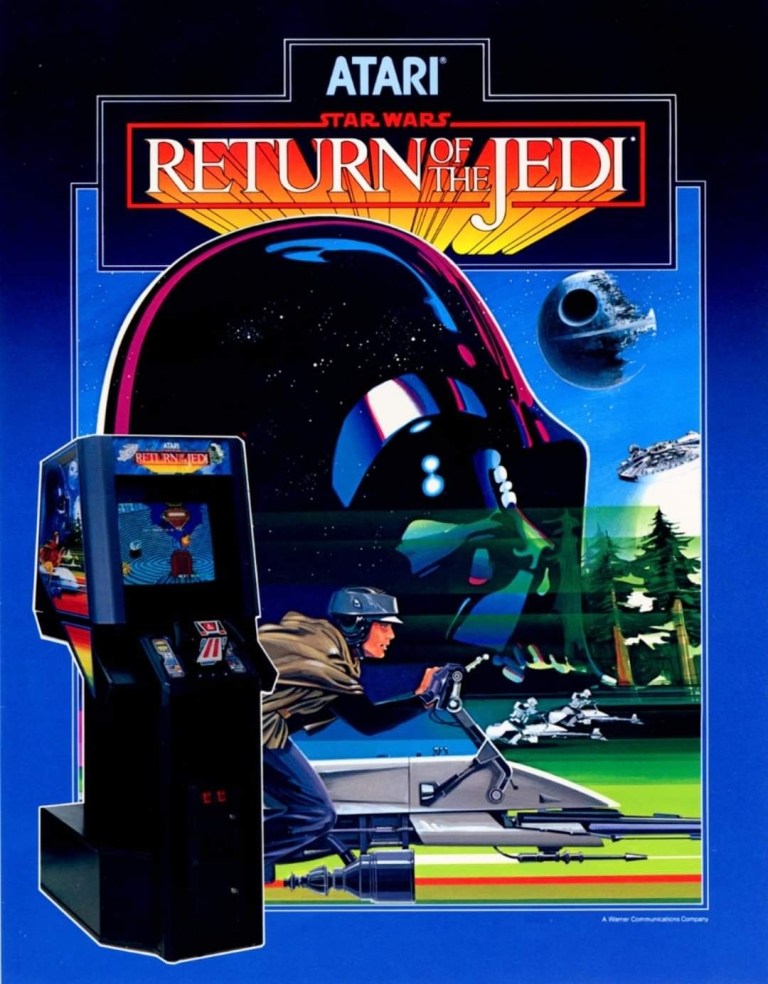
2. Star Wars: Return of the Jedi arcade flyer
Really nice art based on the movie.
Way back in 1983, Return of the Jedi delighted moviegoers in the cinemas throughout America. Behind the scenes, video game giant Atari acquired the movie license to make the 1984 arcade game Star Wars: Return of the Jedi. The arcade flyer’s front featured a highly detailed hand-drawn art of Darth Vader, the Death Star, Luke Skywalker and Storm Troopers on hover bikes, and the Millennium Falcon which reflect the selected elements of the movie that were turned into playable sections. The image of the arcade machine was understandably inserted as it came with an unusual controller. This flyer is still captivating to look at.
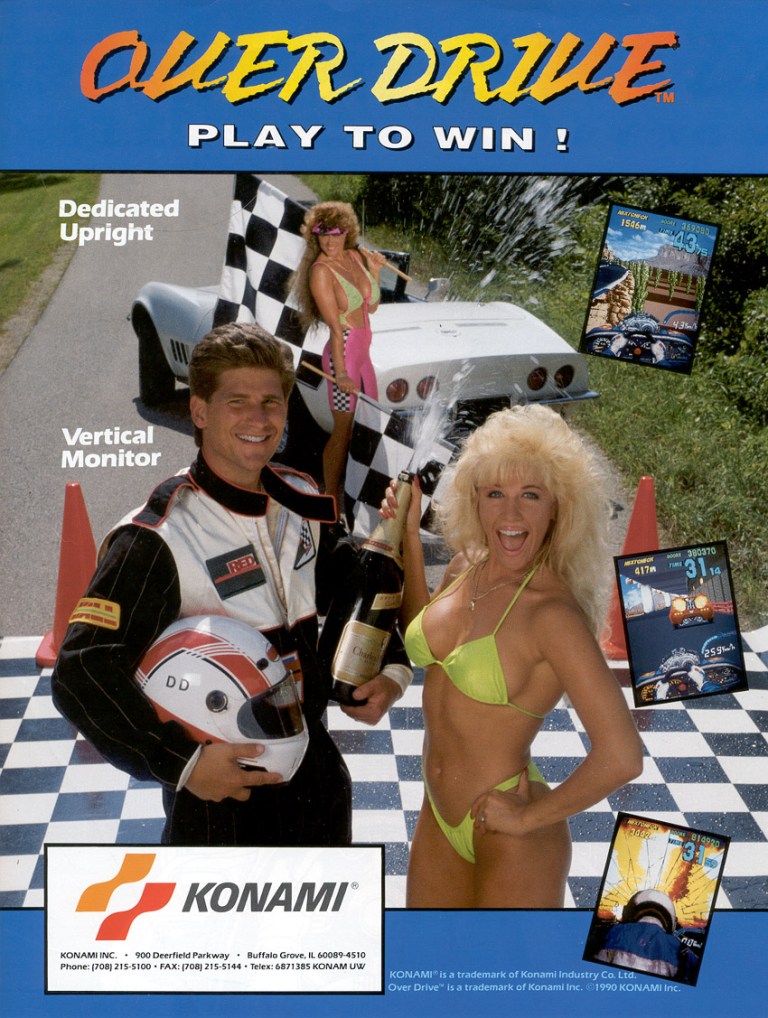
3. Over Drive arcade flyer
This arcade flyer is a reminder that Konami was notable for hiring pretty and sexy women for their print ads.
In 1990, Konami produced a racing game for the arcades with a unique style of presentation. That game was Over Drive and it stood out among the many racing games in the arcade mainly because of its first-person view (with a digital version of the steering wheel and driver’s hands at the bottom of the screen) and unique approach on sprite-scaling. To promote the game, Konami hired sexy models for photography for use in both the arcade flyer and the exterior images on the machine. Having sexy models posing with a winning driver added to the motorsport racing vibe needed to promote the game.
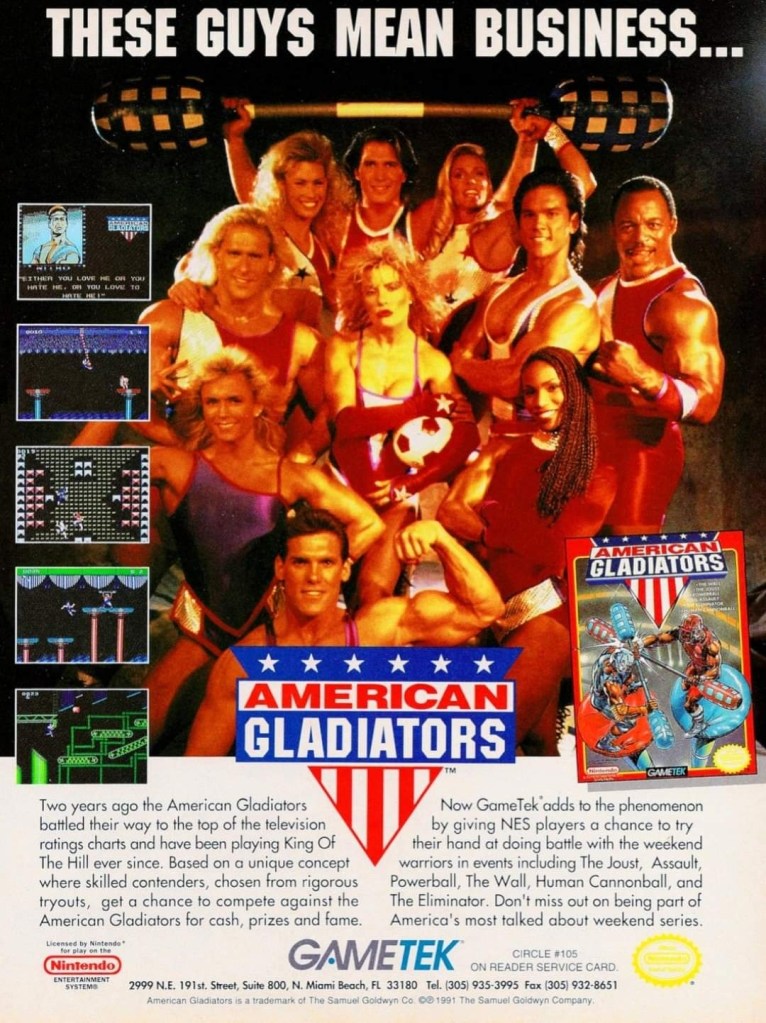
4. American Gladiators for NES print ad
I saw American Gladiators on TV but never played this game.
American Gladiators was a syndicated TV show that featured a variety of games in which amateur athletes compete with the established gladiators to succeed and become the next American Gladiator. Due to its success, it was not surprising that video game adaptations of the show were realized just a few years after its debut. In 1991, GameTek released the American Gladiators game on the Nintendo Entertainment System (NES) and promoted it with this print ad that showcased their established gladiators of the time. This ad’s design was made to catch the attention of the fans.
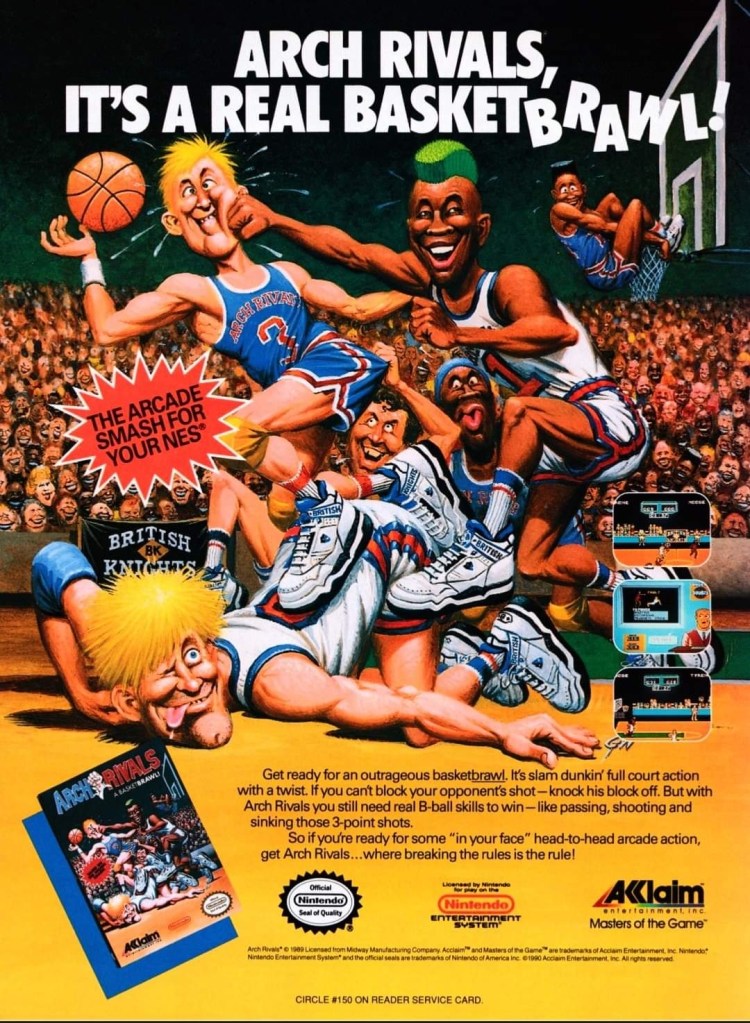
5. Arch Rivals for NES print ad
I remember seeing a lot of people crowding in front of an Arch Rivals machine in the local arcade long ago.
Years before NBA Jam, there was Arch Rivals. Arch Rivals was a full court basketball video game in which players are allowed to punch players from the opposition in order to steal the ball and score. Over a year after the game’s 1989 arcade debut, the NES version was released and the publisher came up with a print ad showcasing a hilarious and cartoony artwork (the same art used for the game’s box cover) which gave readers a clear idea of what to expect. The art used is timeless and it still is funny to see.
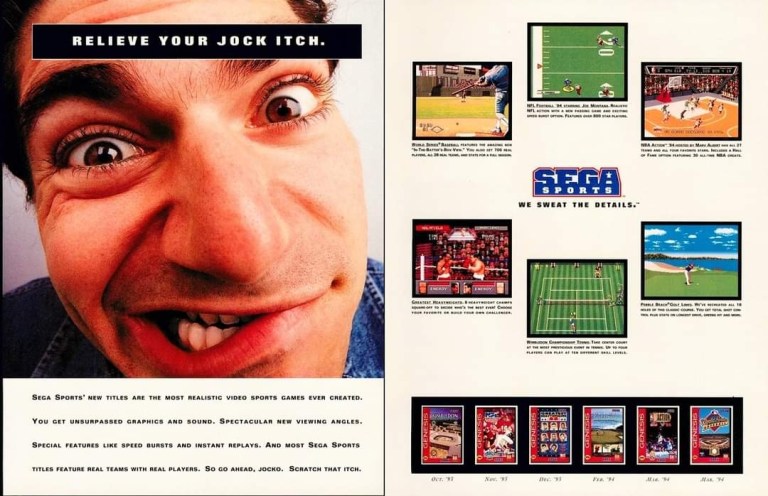
6. Sega Sports print ad
See any Sega Sports video game you like?
Back in the 1990s, Sega excelled with sports video games. They were so aggressive, they established their sub-brand Sega Sports and this particular print ad showed one page promoting assorted sports video games (basketball, golf, baseball, tennis, boxing and American football) for the Sega Genesis and the other page with an exaggerated image of a guy with the line “Relive your jock itch” posted. Historically, a lot of American players and owners of the Genesis are slightly older than those on NES and Super Nintendo Entertainment System (SNES) during the 1990s and the strong sports games approach is a key factor.
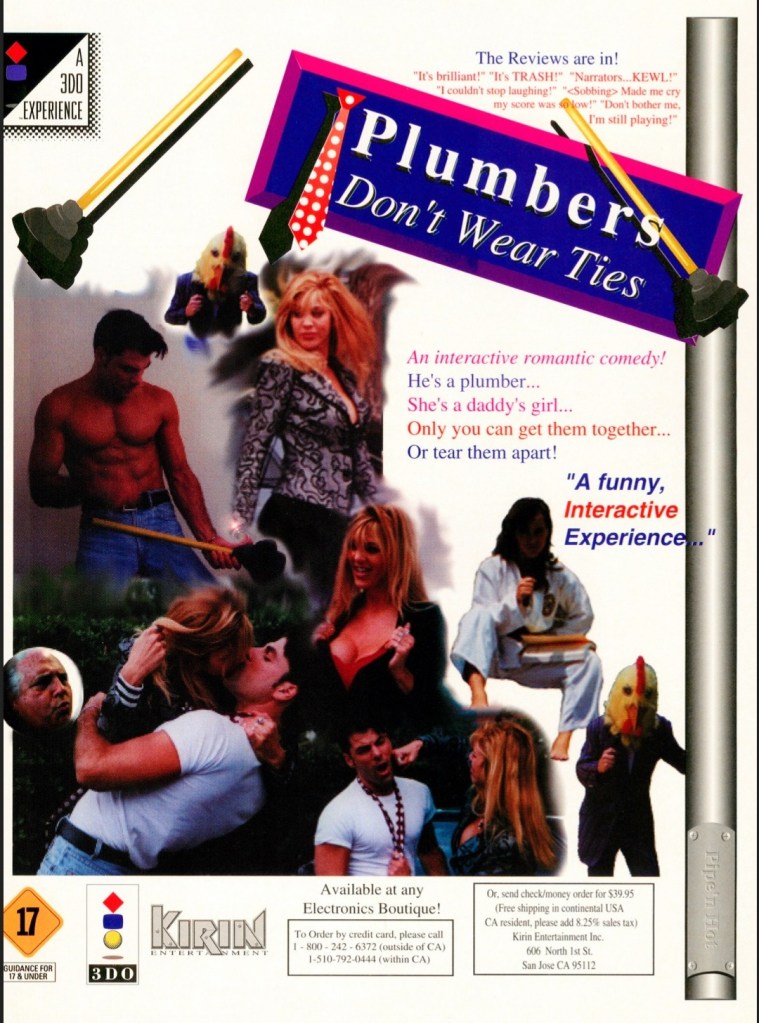
7. Plumbers Don’t Wear Ties print ad
When I first saw this print ad, it did not interest me as the presentation is lousy.
The 3DO console is remembered for having a lot of games that used full-motion videos and photo slides regardless of what game designs came with them. Back in the 1990s, games designed as visual novels or dating simulations were still new in console gaming in the West. Following the PC version’s release, a 3DO port of Plumbers Don’t Wear Ties came out in 1994 and it received overwhelmingly negative reviews. The print ad here promoted the game as “an interactive romantic comedy” and fake quotes were displayed to fool ignorant readers that the game was entertaining. The print ad’s visual design had a mess of poorly implemented images. Ironically, this ad accidentally gave readers the idea that it was a slideshow game.
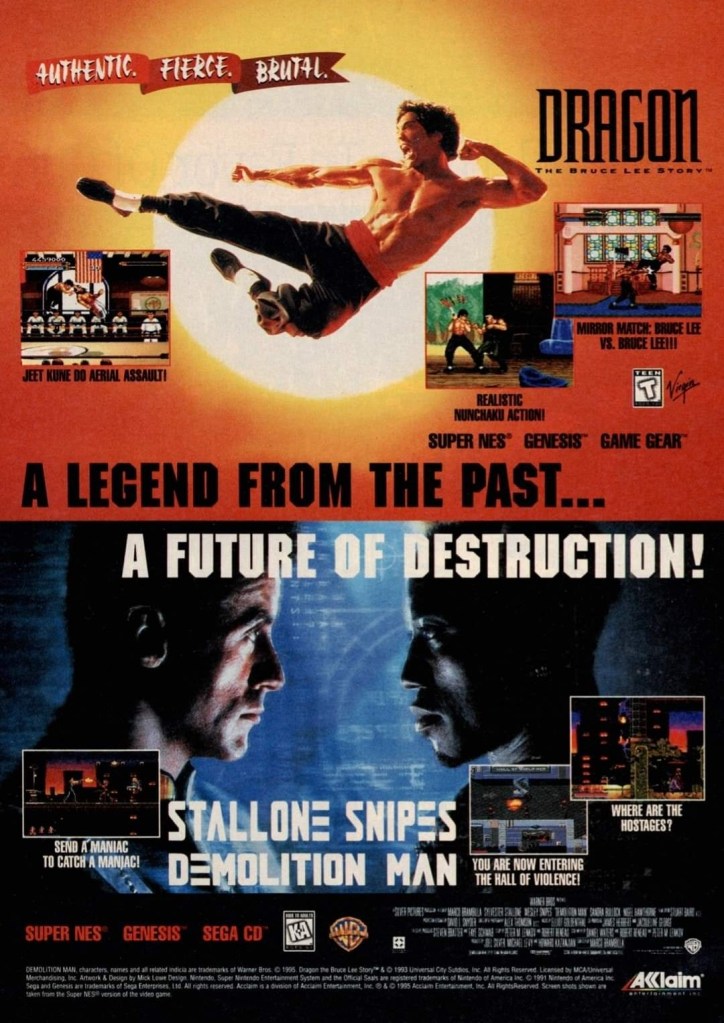
8. Dragon: The Bruce Lee Story and Demolition Man games print ad
If you saw the movies, did you play their respective video game adaptations?
The 1990s is remembered for the many movie-based video games that got released. Back in those days, a lot of Hollywood movie productions had video game adaptations as part of the business process and this is evident with the Dragon: The Bruce Lee Story and Demolition Man games released by Acclaim. For this particular print ad, the marketing team came up with a single-page ad to promote the two games with heavy emphasis on movie imagery leaving little room left for screenshots and other details. The way I look at this old print ad, it seems that Acclaim was aiming for not just movie fans but also gamers who like 2D fighting games and 2D action-adventure games.
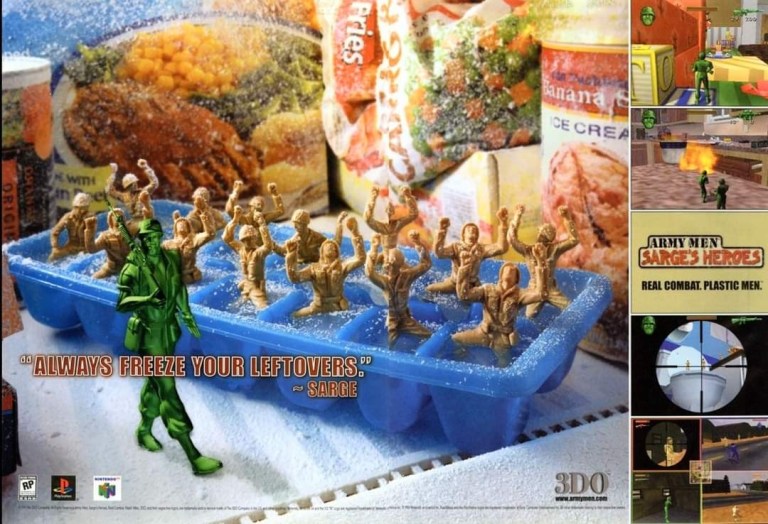
9. Army Men: Sarge’s Heroes print ad
This print ad by 3DO is still funny to see.
In the late 1990s, The 3DO Company focused mainly on producing video games on multiple platforms and they had their own video game franchise based on the green plastic figures with a military theme. In 1999, they released Army Men: Sarge’s Heroes for PlayStation and Nintendo 64 (N64). To market the game, they had a hilarious visual concept of several solders freezing on an ice tray as a long green soldier marching on. This print ad always caught my attention while reading game magazines and it still is funny to stare at.
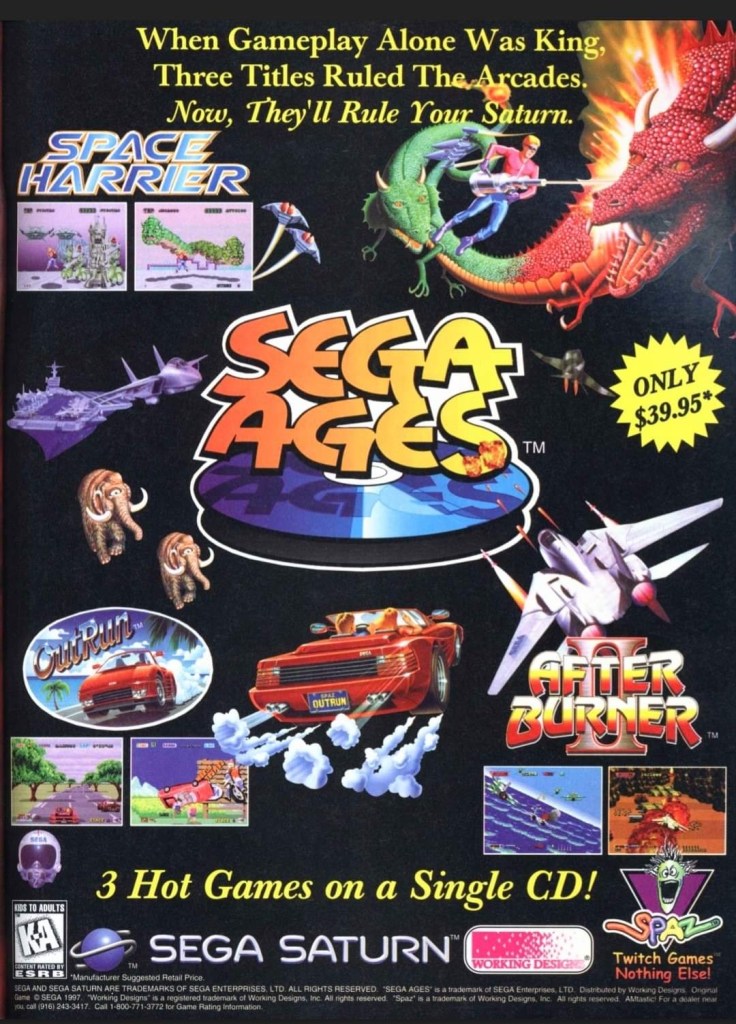
10. Sega Ages print ad
I can only speculate that Sega accepted Working Design’s financial offer for the publishing rights in North America.
Sega Ages is a series of ports and remakes of Sega’s own games (arcade and console) bundled together as compilations released on the modern consoles of the time. While Sega itself published Sega Ages on their Saturn console and Europe, the North American compilation was published by Working Designs under their separate brand Spaz which this particular print ad showed. While the classic Sega games of After Burner II, OutRun and Space Harrier often caught my attention, this ad made me wonder why did not Sega publish this compilation on the Saturn in North America themselves. Looking at this ad now remains awkward.
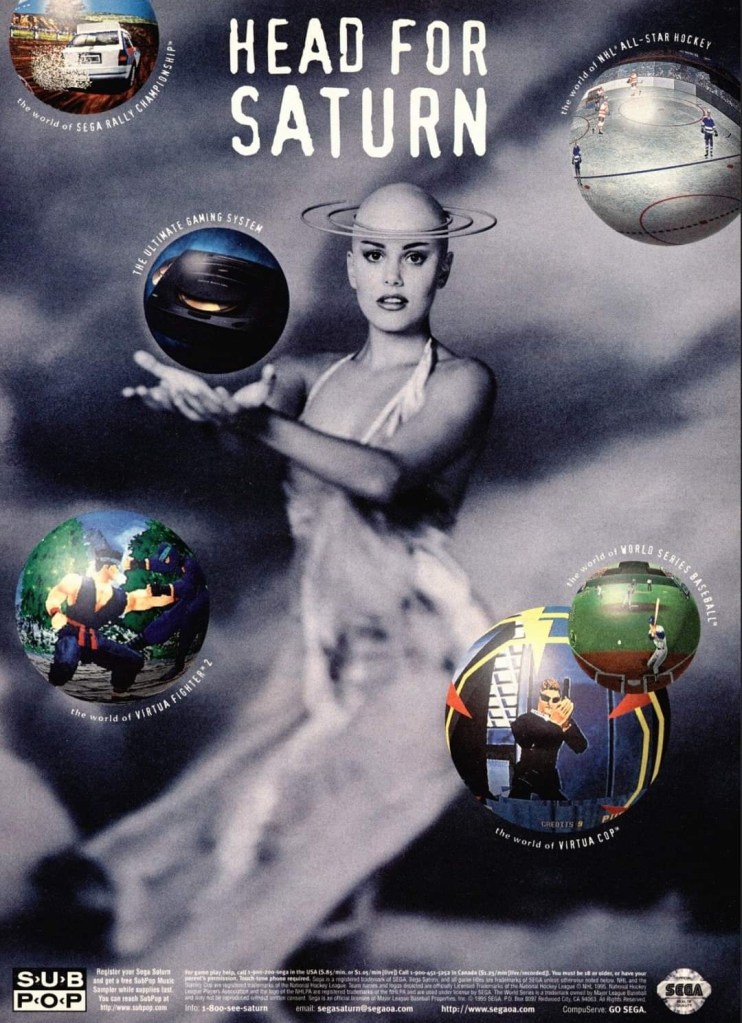
11. Sega Saturn North American print ad
Did you ever own a Sega Saturn in 1995?
While a lot of gamers and retailers were caught off-guard by Sega’s surprise early launch of the Saturn console in America, they still went ahead aggressively marketing the machine knowing they have a few months’ head start before the American launch of PlayStation. This print ad was designed to intrigue readers showing a bald lady whose head was made to look like the planet Saturn and next to her were images of Sega’s hottest games of the time – Virtua Fighter 2 and Virtua Cop. Sega relied strongly on imagery to promote their console with this print ad. It was somewhat weird yet eye-catching.
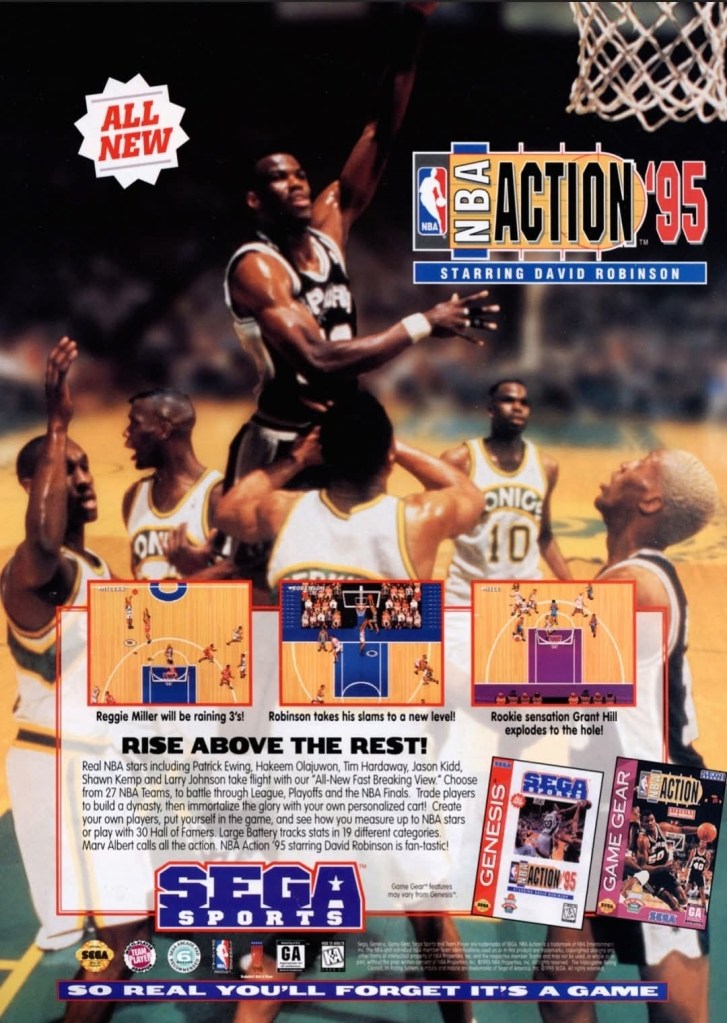
12. NBA Action ’95: Starring David Robinson print ad
David Robinson was the MVP of the NBA in 1995 but he failed to lead his team to the NBA championship back then. He would late win the NBA championship in the shortened 1999 season.
As mentioned early, Sega was aggressive the sports videos games and almost all of them were their own console exclusives. Their tradition of hiring professional athletes as endorsers continued during the age of the Genesis and Game Gear when they hired an NBA superstar as an endorser resulting in the Sega Sports basketball game titled as NBA Action ’95: Starring David Robinson. By the time the video game was released, Robinson was already the reigning Most Valuable Player (MVP) of the NBA. This print ad of Robinson in action still looks impressive but with a big catch – the superstar’s 1995 MVP achievement was arguably forgotten as he and his team (San Antonio Spurs) got eliminated by the Hakeem Olajuwon-led Houston Rockets in the Western Conference Finals. It did not help that Olajuwon outplayed Robinson a lot in that very playoff series. That is a sad reminder that also came with this Sega Sports print ad.
Welcome back, my readers, YouTube viewers and all others who followed this series of articles focused on YouTube videos worth watching. Have you been searching for something fun or interesting to watch on YouTube? Do you feel bored right now and you crave for something to see on the world’s most popular online video destination?
I recommend you check out the following topics and the related videos I found.
#1Konami’s failed fighting games of the 1990s – Remember back in the 1990s when a lot of fighting games were released on the arcades and game consoles? Japanese game companies Namco and Capcom released a lot of memorable fighting games of different styles such as Street Fighter II, Tekken, Marvel vs. Capcom, Tekken 3, Soulcalibur, X-Men: Children of the Atom, X-Men vs. Street Fighter and so on. Sega released Virtua Fighter games while Midway released Mortal Kombat games, and SNK had Fatal Fury, King of Fighters and Art of Fighting games. Looking back at the fighting game craze of the 1990s, I noticed that Konami – best known for Metal Gear, Contra, Gradius and Suikoden – released their own fighting games but never achieved the tremendous success that its competitors had. The retro gaming video is a must-see.
#2 Calvin Dyson’s lengthy review of The World is Not Enough – I can hardly believe that it has been twenty-five years since the James Bond movie The World Is Not Enough was released in cinemas as the 20th century was ending. The 3rd film of Pierce Brosnan as Agent 007 received mixed reviews from the critics and some fans found it to be really brainless and excessive with action which negatively affected the cinematic narrative. To find out if the 1999 Bond movie aged well or not, YouTuber Calvin Dyson recently posted his lengthy retro review and you can watch it now.
#3 In-depth documentary of Smash TV – Remember way back in 1990 when Smash T.V. (also referred to as Smash TV) was released in the arcades and attracted a lot of players with its enjoyable game design and concept? The game was a hit and went on to be ported to many platforms afterwards, and I played its Super Nintendo Entertainment System (SNES) version a lot. To find out how hit game started and who were the key people behind its production, watch the video documentary of PatmanQC now.
#4 Defeated Kamala Harris, Sharon Stone, Alec Baldwin and others highlighted in Lefties Losing It episode – It has been a few weeks since Donald Trump pulled off the greatest American comeback by winning again the US presidential election. Even until now, the Leftists are still agonizing over Trump’s victory and many of them cannot accept the reality of what happened. In the latest Lefties Losing It episode below, you will see a drunk-like Kamala Harris talking to her supporters, Sharon Stone bashing others and more. Watch it!
#5 Electric vehicles sparked into fire disasters as a result of salt water caused by Hurricane Helene – This news video should convince you not to buy and drive an electric car or any type of electric vehicle for that matter. Salt water touching the ion batteries of electric vehicles spark flame and this leads into fire incidents that simply could not be solved quickly. Hurricane Helene’s powerful wind brought salt water into affected communities and not even electric vehicles parked inside the garage were spared. Avoid electric vehicles and stick with vehicles that run on fossil fuel.
#6 Ashleigh Burton’s Fantastic Four (2005) reaction video – Back in 2005, I never saw Fantastic Four in the local cinema. I was never a Fantastic Four fan nor did the team-up of Stan Lee and Jack Kirby starting the said superhero team interested me. Believe it or not, I finally saw the movie on home video in 2009. In recent times, YouTuber Ashleigh Burton posted her reaction video of Fantastic Four and it is fun to watch.
#7 Phantasy Star IV retrospective – Thanks to my physical copy of Sega Genesis Classics, I was able to play Phantasy Star IV: The End of the Millennium on my Xbox Series X console. For the newcomers reading this, Phantasy Star IV was a sci-fi Japanese role-playing game (JRPG) released on the Sega Genesis (Mega Drive in other markets) in Japan in 1993 followed by released in America and Europe in 1995. The production side of the game has very interesting details and you can learn all about it in GTV Japan’s retrospective video below.
#8 A look at Disney’s The Black Hole – Long before the Walt Disney Company became the super woke entity of modern times, they released the expensive sci-fi film The Black Hole. As far as the Disney legacy is concerned, the 1979 movie is significant as it marked a serious change of direction the company took with its movies. Disney was already known for wholesome and family oriented movies and TV shows and eventually entered a period of uncertainty. The Black Hole was both Disney’s attempt to cash-in on the sci-fi and disaster film craze of the 1970s and attract more adult moviegoers. You can learn more about this forgotten movie by watching the videos below.
#9 Popcorn in Bed’s What Lies Beneath reaction video – I saw What Lies Beneath inside a crowded cinema here in the Philippines way back in 2000. Directed by Robert Zemeckis, the film was an inspired work of suspense and horror mainly told through Michelle Pfeiffer’s character. I still remember some comments of disappointment over Harrison Ford’s lack of screen time compared with Pfeiffer’s. Regardless, you have to see Popcorn in Bed’s reaction video right here.






 Author Carlo Carrasco