Welcome back my readers, YouTube viewers and all others who followed this series of articles focused on YouTube videos worth watching. Have you been searching for something fun or interesting to watch on YouTube? Do you feel bored right now and you crave for something to see on the world’s most popular online video destination?
I recommend you check out the following videos I found.
#1 Timecop Revisited – I am not a fan of Jean-Claude Van Damme but his 1994 movie Timecop managed to entertain me when I first saw it on home video. After watching it, I learned that it was based on the Timecop literary property and stories published by Dark Horse Comics. Directed by Peter Hyams, Timecop ended up as one of the better movies of JCVD and it even has its own fanbase. If you want to discover more about the cinematic Timecop, watch the videos posted below.
#2 Inhumanoids Revisited –I remember seeing some episodes of the animated TV series Inhumanoids on local TV and I can say it was easily the most bizarre and even shocking thing to watch. Inhumanoid has a very dark and even cynical tone, and it had gruesome scenes which were really disturbing to see. Behind the scenes, Inhumanoids was animated by Japan-based Toei and involved Hasbro, Sunbro and even Marvel Productions. To find out what made Inhumanoids so disturbing, watch the video below and pay attention to the details.
#3 Luxurious Breakfast Spots In Tokyo – Have you ever thought about having a luxurious breakfast while traveling overseas? In Tokyo, Japan’s most famous city, there are indeed places where visitors can have breakfast with the premium experience. These luxurious places have something unique to offer to customers who have more than enough money to spend for the morning meal. Watch and learn from the Nippon TV video below.
#4 Remember The Rotoscoped Lord Of The Rings – Decades before Peter Jackson and his team rocked the world of moviegoers with memorable Lord of the Rings film trilogy, an animated LOTR was actually made. I am talking about the 1978 rotoscoped animated film The Lord of The Rings directed by Ralph Bakshi which I first saw on home video after seeing Peter Jackson’s LOTR. I found the 1978 LOTR a really unique animated viewing experience and it definitely involved a lot of production work without any use of computers. To find out more about the animated LOTR film, watch the video below.
#5 You, Me and The Movies React To Can’t Hardly Wait – When Can’t Hardly Wait was shown in cinemas in 1998, it faded away as not enough moviegoers were attracted watch it. However, the movie did not fade into obscurity and it actually got new fans as it was discovered on home video, cable TV, pay-per-view and streaming. More importantly, the movie itself was pretty funny the cast led by Jennifer Love Hewitt delivered fine performances as teenagers. Slowly but surely, new retrospective videos about Can’t Hardly Wait are emerging on YouTube and the most entertaining video is the reaction by You, Me and The Movies which I encourage you to watch right now.
#6 Square Enix In The 2000s – Back in the 1990s, Squaresoft and Enix were separate Japanese gaming companies that released a lot of Japanese role-playing games (KRPGs) which entertained many millions of gamers. Square was famous for the best-selling Final Fantasy games while Enix had the wildly popular Dragon Quest franchise. In the 2000s, a series of changes happened in the video game industry and the two companies merged into Square Enix. Since then, a lot of Final Fantasy and Dragon Quest games with evolved designs and styles of presentation were released under a single publisher. There is a lot more to discover what happened behind the scenes as documented in the in-depth video below from Gaming Broductions.
Disclaimer: This is my original work with details sourced from reading the comic book and doing personal research. Anyone who wants to use this article, in part or in whole, needs to secure first my permission and agree to cite me as the source and author. Let it be known that any unauthorized use of this article will constrain the author to pursue the remedies under R.A. No. 8293, the Revised Penal Code, and/or all applicable legal actions under the laws of the Philippines.
Welcome back science fiction enthusiasts, 20th century pop culture enthusiasts, Star Wars fans and comic book collectors! Today we go back to the year 1996 to examine the 2nd tale of a notable Star Wars storyline that took place between the films The Empire Strikes Back and Return of the Jedi…Shadows of the Empire!
For the newcomers reading this, Star Wars: Shadows of the Empire was a huge multimedia Star Wars event launched in the mid-1990s without a movie. Apart from exploring what happened in between the 1980 and 1983 classic Star Wars movies, Shadows of the Empire expands the lore by introducing new characters, Luke Skywalker’s gradual recovery from what he suffered from in The Empire Strikes Back, and the Galactic Empire’s ties with criminals who turned out to be resourceful. Back then, Star Wars was still fully under the control of George Lucas and his businesses. I already reviewed the first issue and enjoyed it.
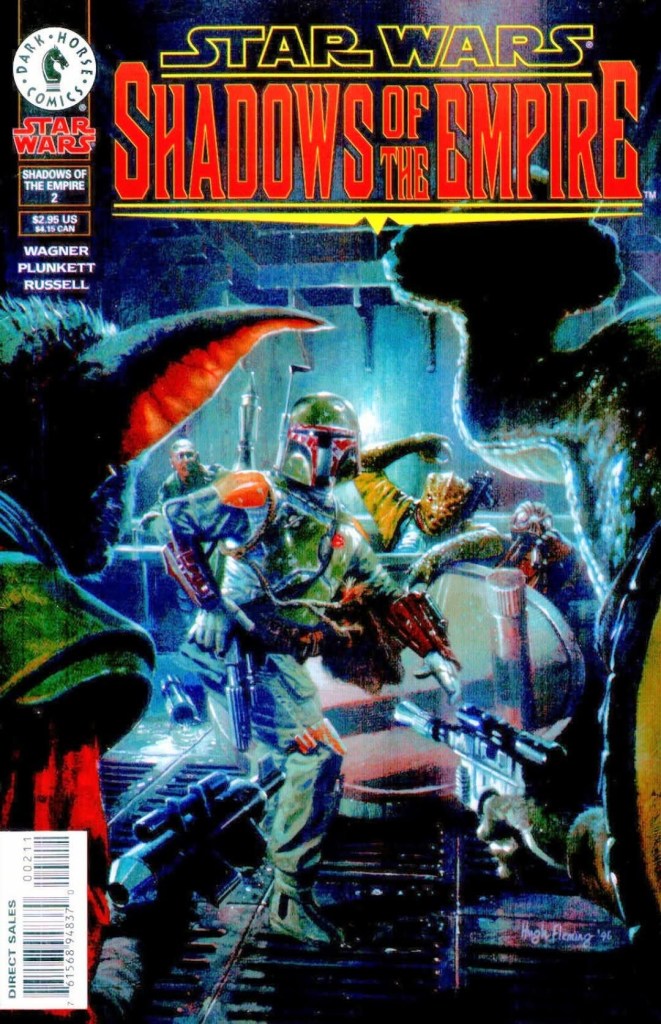
With those details laid down, here is a look back at Star Wars: Shadows of the Empire #2, published in 1996 by Dark Horse Comics with a story written by John Wagner and drawn by Kilian Plunkett. This is the 2nd chapter of a 6-issue mini-series.
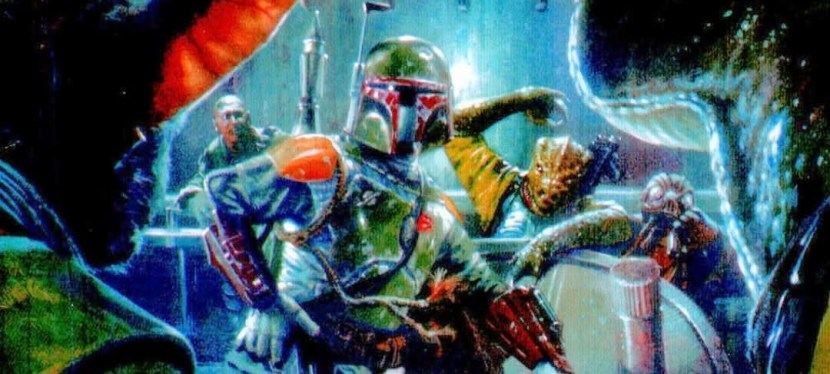
The cover.
Early story
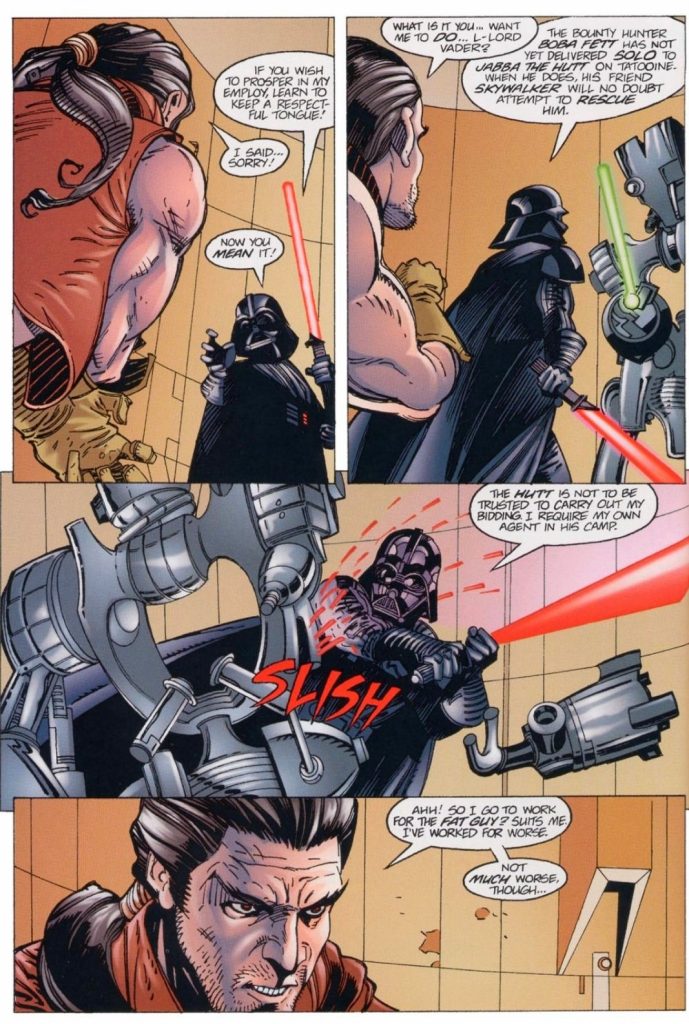
The story begins with Darth Vader in the middle of a lightsaber sparring session with a droid. As he makes his fighting moves, he issues instructions to a thug named Jix who was standing and watching. Vader tells him that the bounty hunter Boba Fett still has not yet delivered the captured Han Solo (in carbonite) to Jabba the Hutt in Tatooine, and he anticipates that Luke Skywalker will make an attempt to rescue him. Vader wants Jix to insinuate himself into Jabba’s swoop gang.
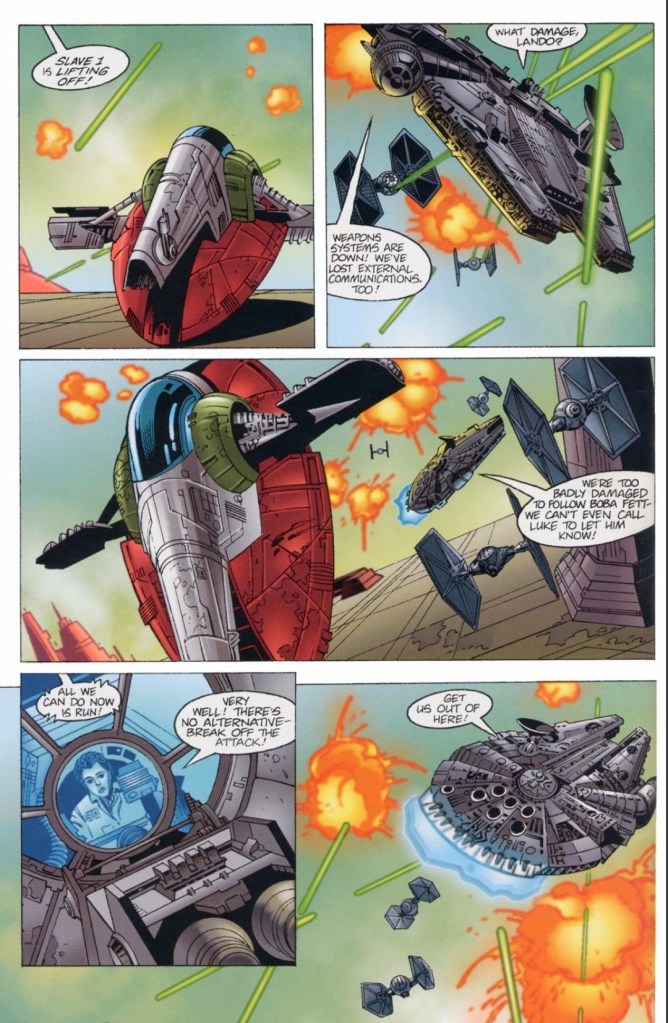
On another part of the galaxy, several Rebel X-Wing fighters (led by Luke Skywalker), the Millennium Falcon (with Princess Leia, Chewbacca, C3PO and Lando Calrissian) and the Outrider (Dash Rendar) travel together approaching the planet Gall with different objectives: the Rogue Squadrom will go draw out the imperial fighters while both the Falcon and the Outrider will sneak in to find the damaged Slave-1 (Boba Fett) and rescue Han Solo…
Quality
The Millennium Falcon and Slave-1 in the same encounter.
When compared to its predecessor, this comic book has a lot of plot developments moving forward. It is in this story where you will see Leia, Lando and Chewbacca really pull off their first-ever attempt to rescue Han Solo and the way it was presented by the creative duo Wagner-Plunkett was worth the anticipation. Even though the odds are against them, Prince Leia is clearly determined to get Han back not for her love for him but for the Rebel Alliance’s need.
With Darth Vader having lesser spotlight and none of Emperor Palpatine, the creative team was able to shift more of the spotlight on the galactic criminals. The introduction of Jabba’s Swoop Gang was nicely done and the portrayal of them as a rowdy and very sinister bunch is very notable.
Anyone who enjoyed playing the Shadows of the Empire video game on Nintendo 64 (N64) will be pleased to see Dash Rendar and his Outrider space ship here even though the spotlight lasted only briefly. As expected, Dash is creatively a smuggler-type substitute for Han Solo and I have the feeling that he will re-appear in the remaining issues of this mini-series.
As for the famous hero Luke Skywalker, you won’t see him wielding his lightsaber nor see him using his Jedi powers. Instead, you will see him taking action as an X-Wing Fighter pilot and you will see even more of his ability to lead his Rogue Squadron teammates. The way Luke was portrayed here was pretty accurate compared to his cinematic portrayal which proves the writing done was really solid.
In fact, the writing by Wagner remained consistently high in quality particularly with dramatizing Princess Leia, Lando, C3PO, R2D2 and Darth Vader. It is through Dash Rendar, Jix and the Swoop Gang where you will see Wagner push his creativity as he expands the lore of Star Wars to emphasize the galactic crime world and smugglers.
Lastly, Wagner really went all-in in developing the iconic bad guy Boba Fett in this comic book. You will really see how Boba Fett uses violence not just to overwhelm any opposition but also to protect the high bounty with the frozen Han Solo who is easily wanted by other bounty hunters and scum. When it comes to the visuals, expect to see similar quality Plunkett delivered in the first issue right here. Plunkett is very good with visualizing space ship battles, space travel, machines and locations, but showed weakness on drawing the humans. In fairness, Plunkett came up with very original styles and designs for the Swoop Gang and Jix, making them look really distinct.
Conclusion
Darth Vader and the thug named Jix.
Star Wars: Shadows of the Empire #2 (1996) is a solid follow-up to issue #1 and it managed to have the main plot and sub-plots move forward significantly. The storytelling is consistently good and the engagement was pretty strong. I can say I am convinced to look forward to finding out more in the next issue.
Overall, Star Wars: Shadows of the Empire #2 (1996) is recommended.
Welcome back readers, fellow geeks and electronic gaming fans!
In this edition of the Retro Gaming Ads Blast (RGAB) series, we will take a look at another batch of retro gaming print ads – including arcade flyers – from the 1980s and 1990s.
For the newcomers reading this, Retro Gaming Ads Blast (RGAB) looks back at the many print ads of games (console, arcade, computer and handheld) that were published in comic books, magazines, flyers, posters and newspapers long before smartphones, social media, the worldwide web and streaming became popular. To put things in perspective, people back in the 1980s and 1990s were more trusting of print media for information and images about electronic games and related products.
With those details laid down, here is the newest batch of retro gaming print ads for you to see and enjoy…
1. Raiders of the Lost Ark game print ads
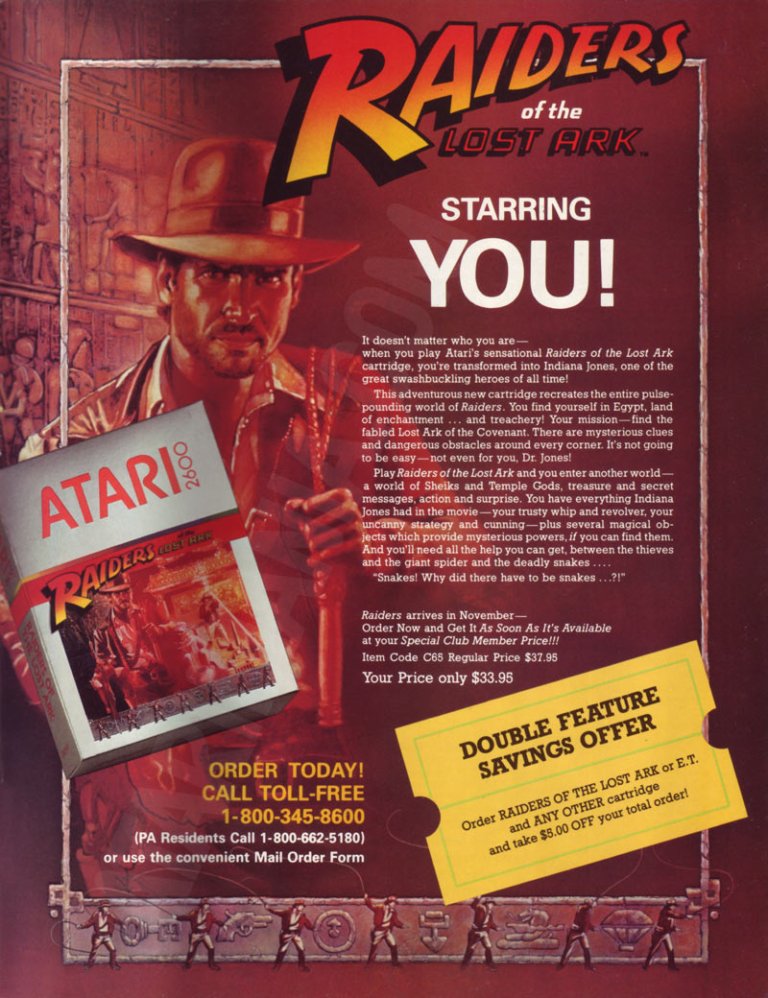
The print ad with strong Indiana Jones imagery.
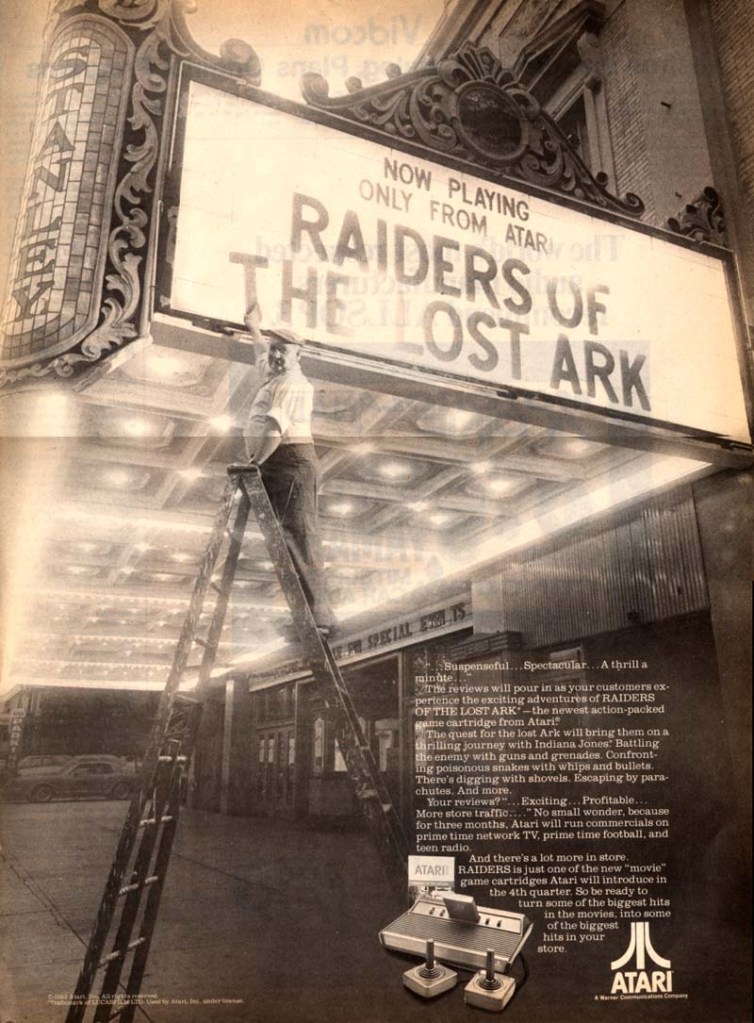
The print ad with the movie theater exterior image and the small image of the Atari 2600 console.
Directed by Steven Spielberg, Raiders of the Lost Ark was one of the best adventure movies ever made as well as the start of the iconic character Indiana Jones. Given its huge commercial success, an official video game adaptation for the Atari 2600 was released in 1982 and game designer Howard Scott Warshaw even met with Spielberg during the game’s development.
To promote the game, Atari released two print ads – one ad had a movie theater exterior visual concept to emphasize they have the official video game adaptation based on the movie while the other ad showed the game’s official artwork and game box cover while emphasizing a savings offer. Atari really did what they could to sell a game while riding on the success of Raiders of the Lost Ark.
2. Phoenix print ad
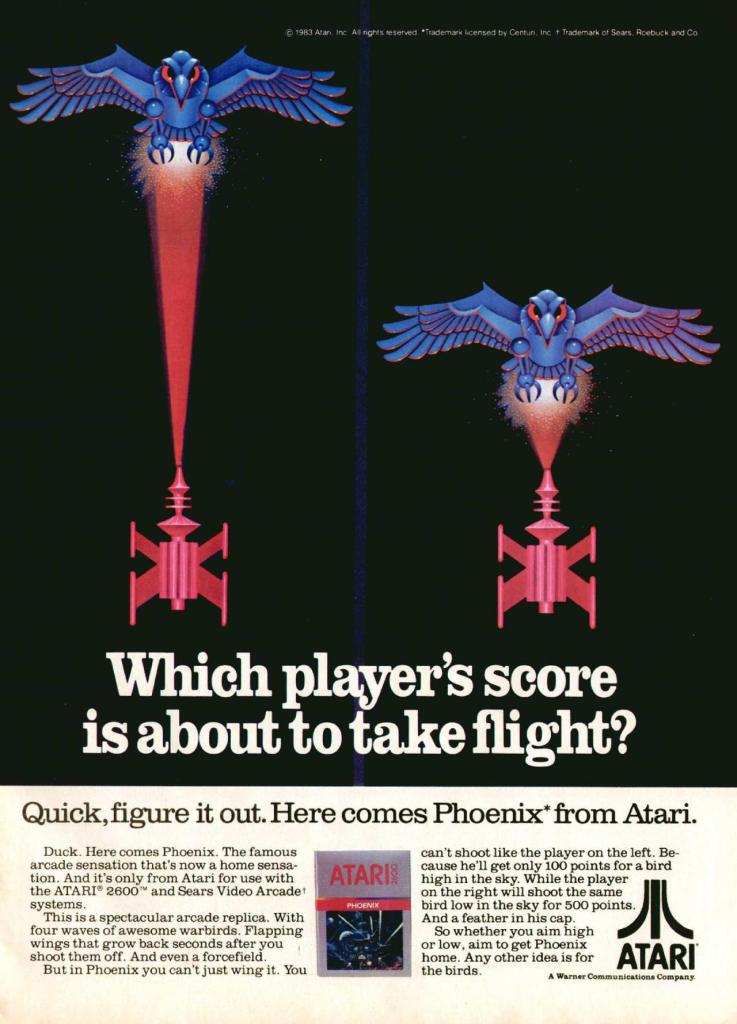
Even without any screenshots, this print ad’s art still gives viewers a clear idea of what to expect.
Similar to what they did with Galaxian and Joust, Atari made this print ad promoting Phoenix which was a 2D sci-fi shooting game that was similar with Space Invaders in design. Colorized, hand-drawn artwork resembling the 2D sprites of the game was done to capture the attention of people. The art is so good, it made up for the lack screenshots of the game.
3. Moon Patrol arcade flyer
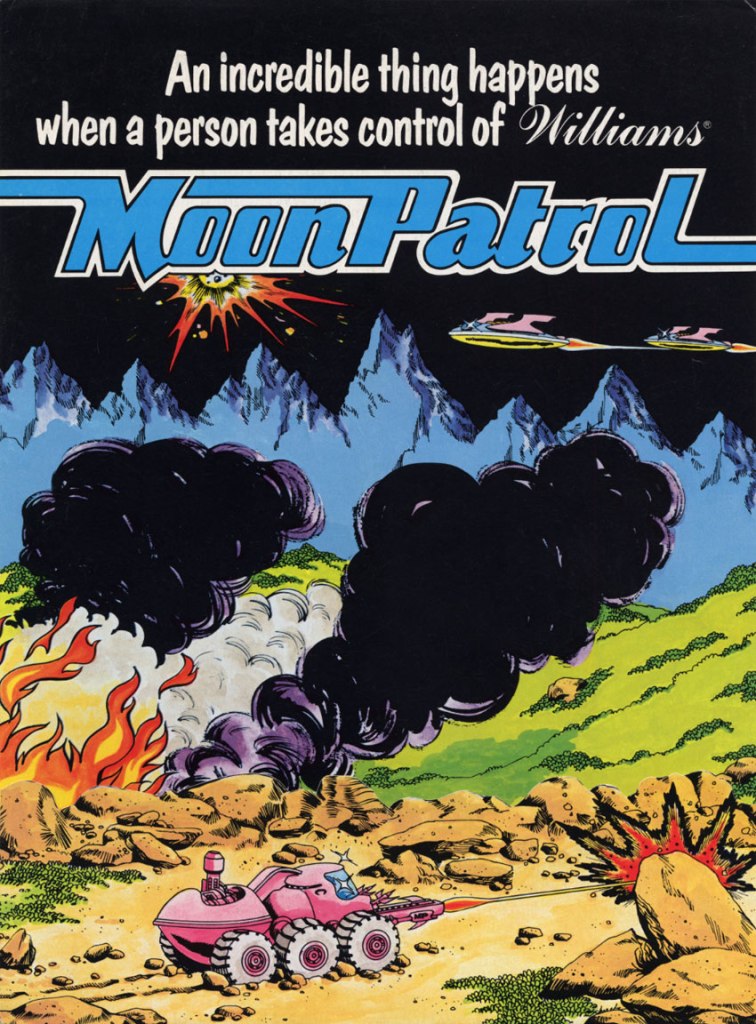
Front of the Moon Patrol flyer.
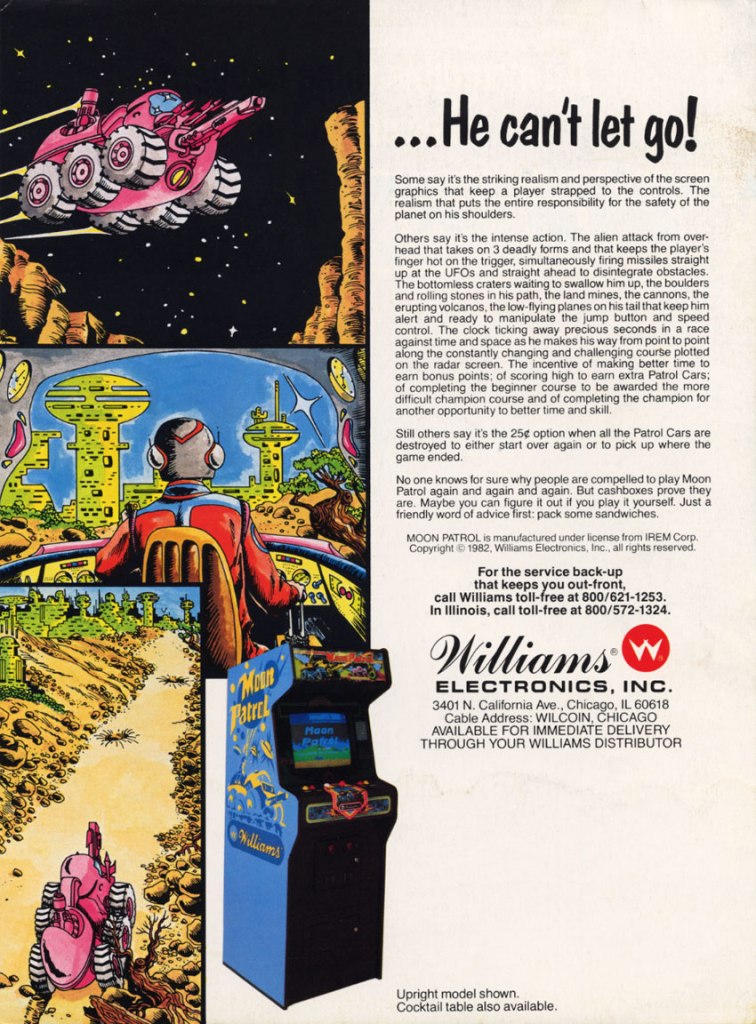
The other side of the arcade flyer.
Moon Patrol was a 2D sci-fi side-scrolling adventure game first released in the arcades in 1982. To sell the game to arcade operators, publisher Williams created the North American arcade flyer that heavily used hand-drawn comic book-style artworks on both sides while using available space on the other side for the descriptive text, contact details and the image of an arcade machine. What is very clear is that no screenshots of the game were shown to stand out which explains why a lot of hand-drawn art was used. The picture of the machine showing a screen of Moon Patrol was the closest thing to see a screenshot on this flyer. Personally, I really like the style and quality of the hand-drawn artwork as it made the flyer look lively.
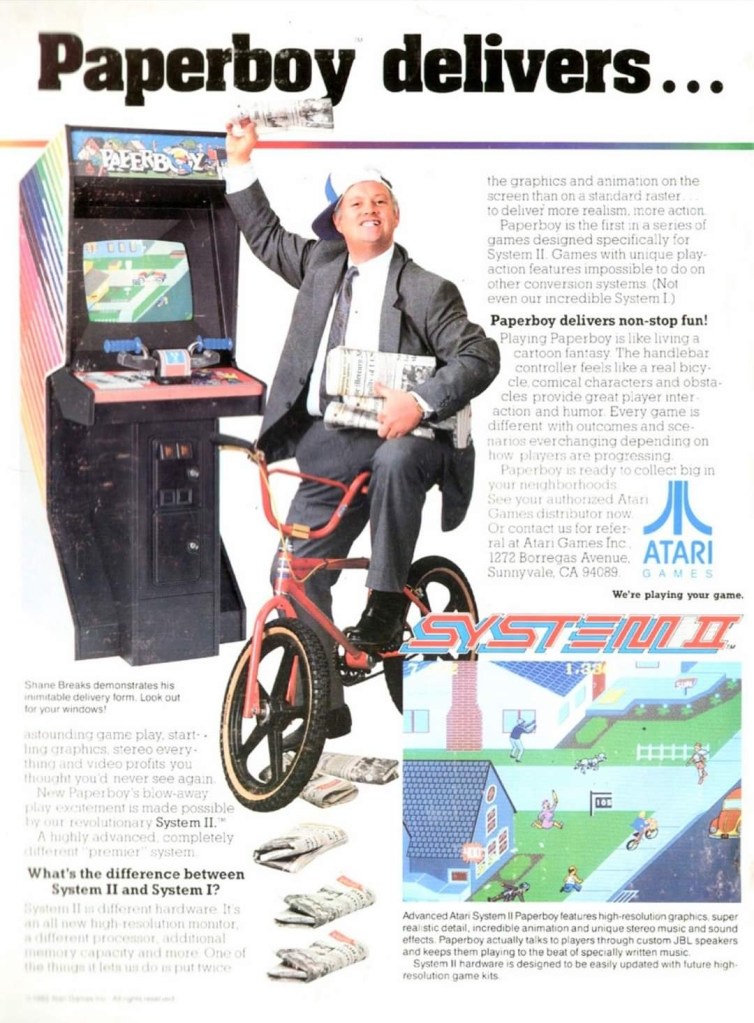
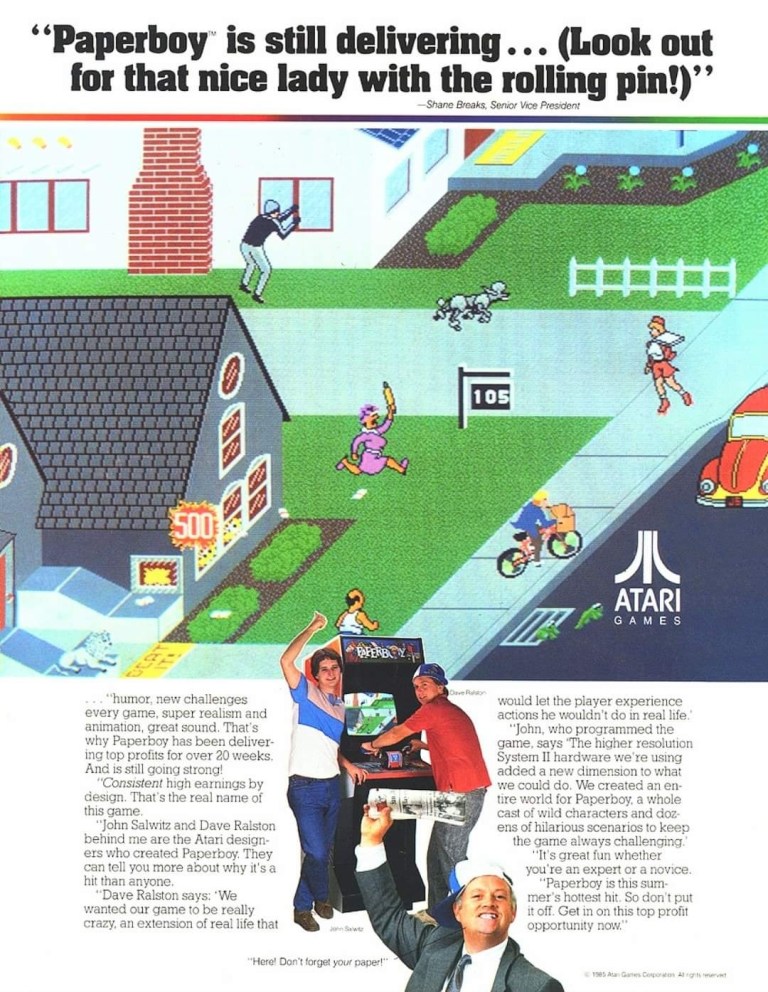
4. Paperboy arcade flyers
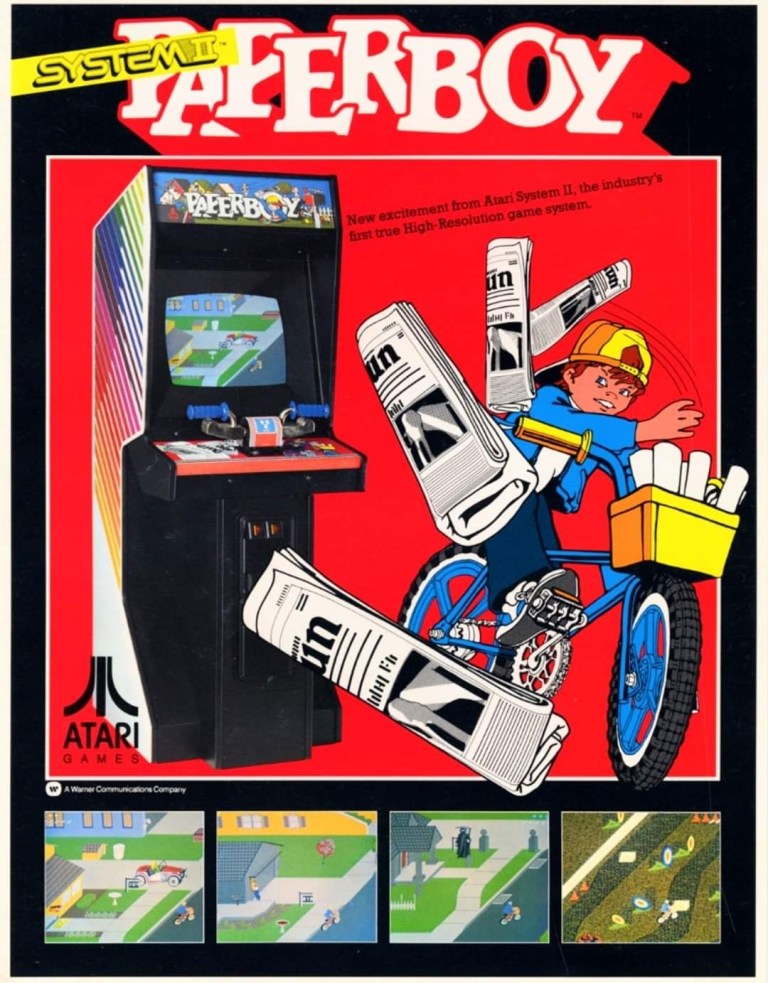
The arcade flyer showing the Paperboy machine and screenshots. The hand-drawn art is nice.
This one uses comedy showing a grown man riding a bike as a paper delivery “boy”.
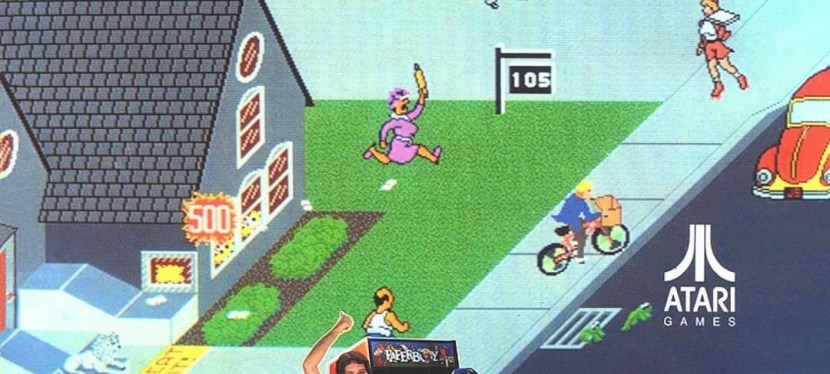
I really like the stronger emphasis on the in-game graphics of Paperboy which dominates the space. What you see is what you get in the arcade.
The first time I ever played the classic Paperboy was in the arcade inside a Las Vegas hotel way back in 1989, and it sure was a challenging yet fun experience. Before its arcade debut in 1985, the developers took a lot of risks making the game which includes coming up with a bicycle handle bar for each machine to have. To promote the game, Atari made at least three arcade flyers that creatively emphasized what the game’s concept was about, how did it play, why does the machine have bicycle handlebars and why players can expect fun. Atari’s promotional efforts paid off as Paperboy became a huge hit in the arcades not only in America but also in Japan.
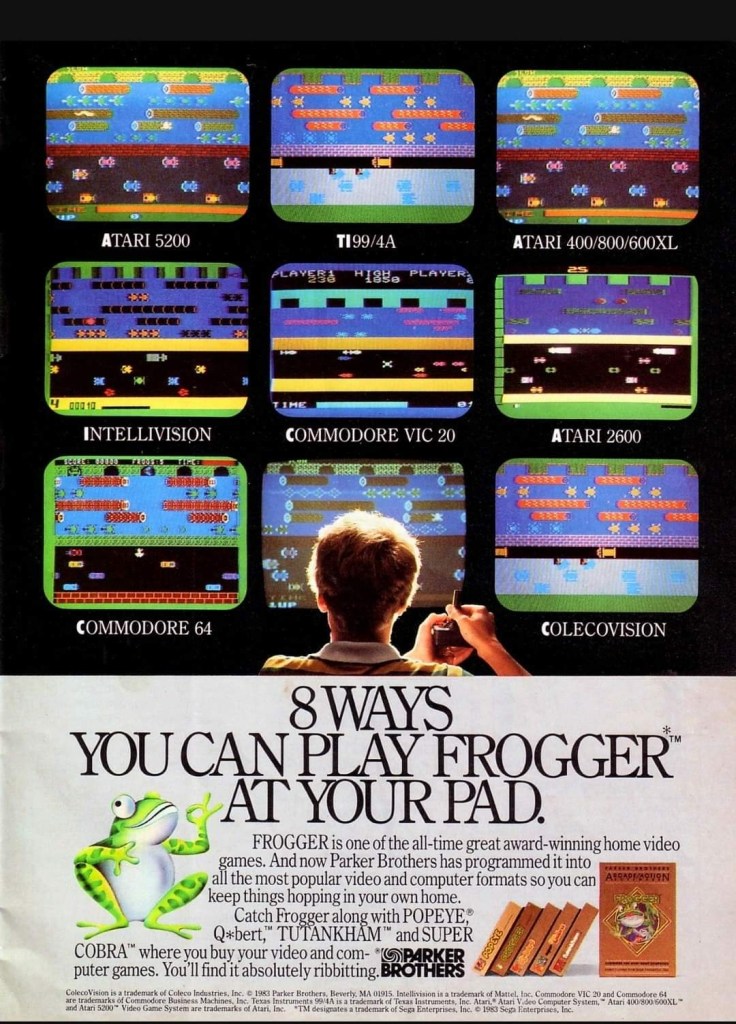
5. Frogger multi-platform print ad
This print ad is still amusing to look at.
After Frogger became a hit in the arcades, Parker Brothers secured the rights to port the game on Atari consoles, the Intellivision, TI-99/4A, vic-20, the Commodore computers and ColecoVision. To promote their Frogger ports, the single-page print ad was made showing a player in the foreground playing in front of screens that each showed what the game looked like on each platform. Parker Brothers found tremendous success selling 4 million copies of Atari 2600 version of Frogger at a time when there were only 13 million units of Atari 2600 in existence. By the year 2005, video game sales of Frogger reached 20 million worldwide across different platforms.
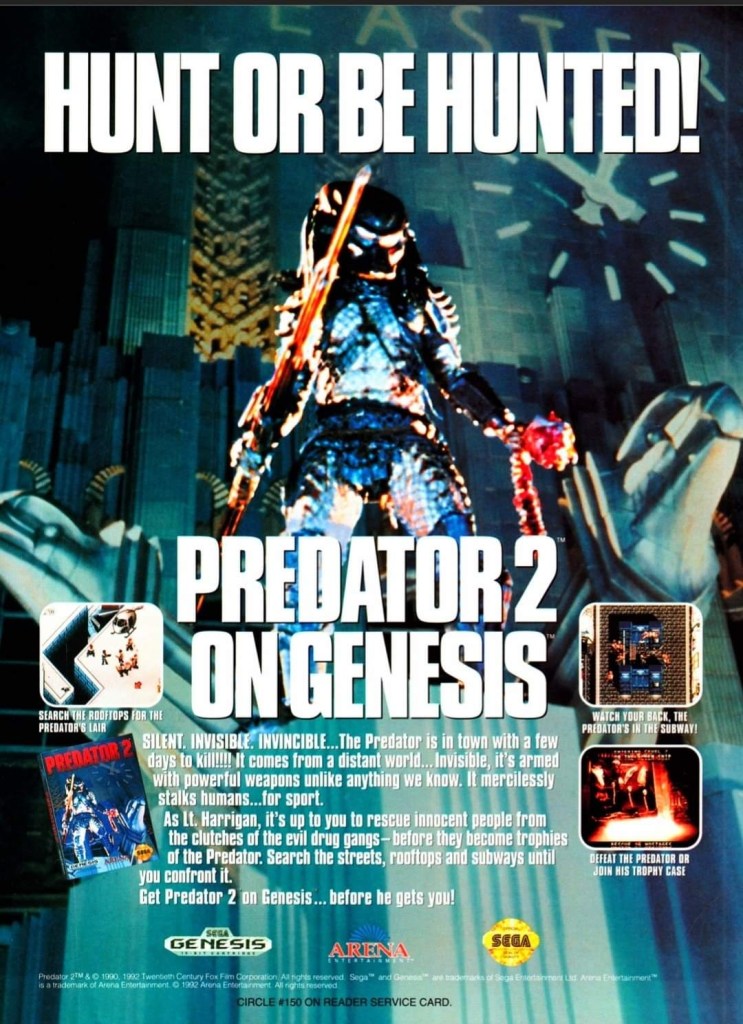
6. Predator 2 print ad
This is one very edgy print ad as used an official image from the movie.
If there is anything memorable about the 1990 film Predator 2, it is the fact that it had the story and the alien hunter itself within a metropolitan setting. That being said, the Sega Genesis Predator 2 video game had a suitable design of shooting and adventuring within the urban settings. This video game ad really captured the vibe of the movie (even showing the reddish human skull with spine on the Predator’s left hand) and clearly showed what gamers could expect. This old ad is still captivating to look at and its edgy approach is still intact.
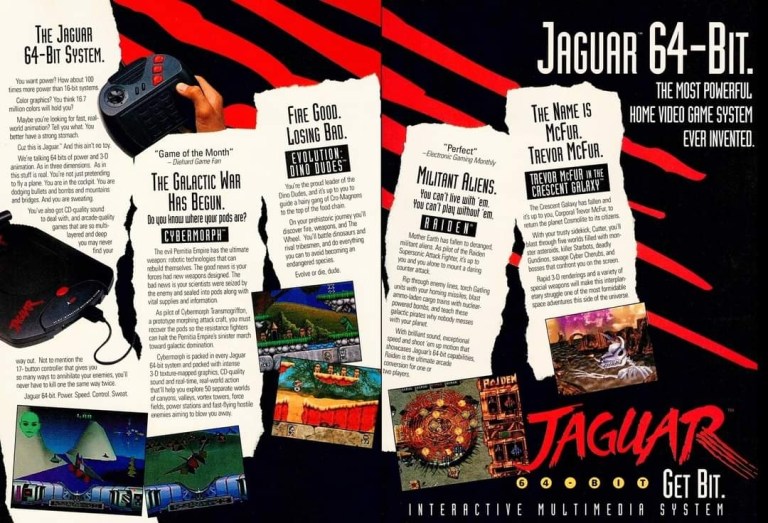
7. Atari Jaguar print ad
Did you ever own an Atari Jaguar console?
When I was reading video game magazines back in the 1990s, I always found print ads of the Atari Jaguar intriguing to look at. I was very young when I first played the Atari 2600 and its games at home, and later played some Atari games in the arcade. To me, seeing Atari Jaguar print ads like this one gave me moments of nostalgia and it made me wonder if Atari knew what it was doing with their so-called 64-bit game console. They did what they could to promote their console and the games within this 2-page print ad.
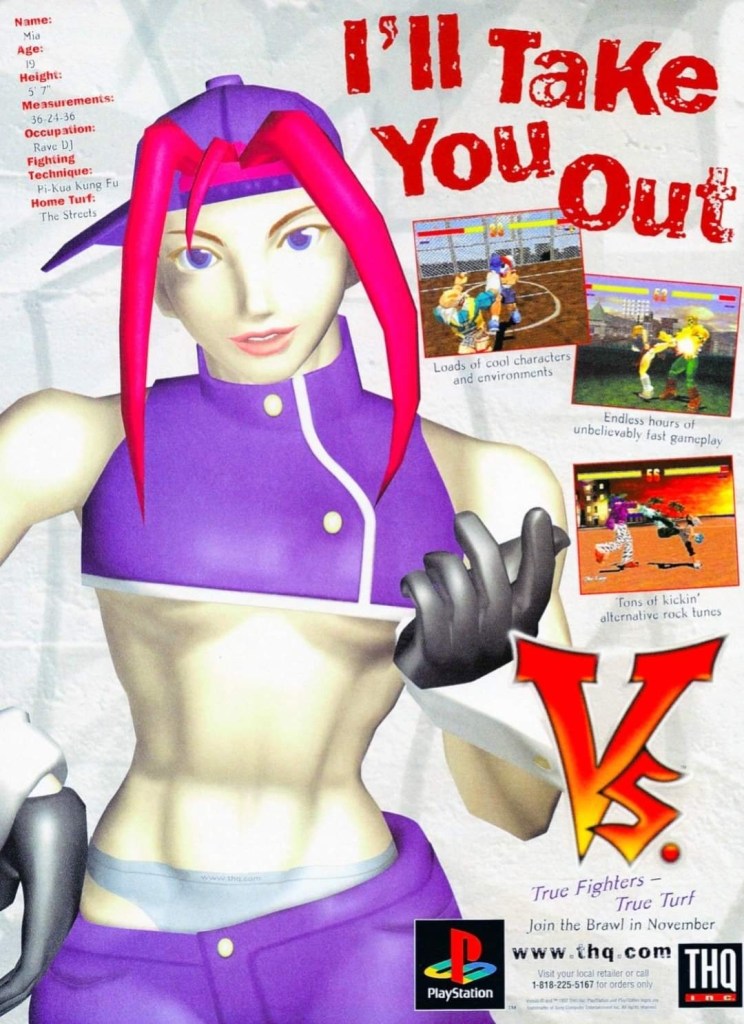
8. Vs. print ad
This print ad easily reminds me of the 1990s.
By 1997, both the arcades and the video game console market were filled with lots of 2D and 3D polygonal fighting games. Japan was the hot spot of the production of 3D polygon fighting games and the developer Polygon Magic (based in Japan) made Fighters’ Impact which Taito released in Japanese arcades and the PlayStation. The said game was picked up by THQ for a late-1997 release on the PlayStation in America under the title Vs. I never played this game but I heard that the game’s development included gang-oriented characters designed by Marvel Comics artist Kurtis Fujita. This Vs. ad is a lively reminder about the hip-hop fashion that made its way into video games.
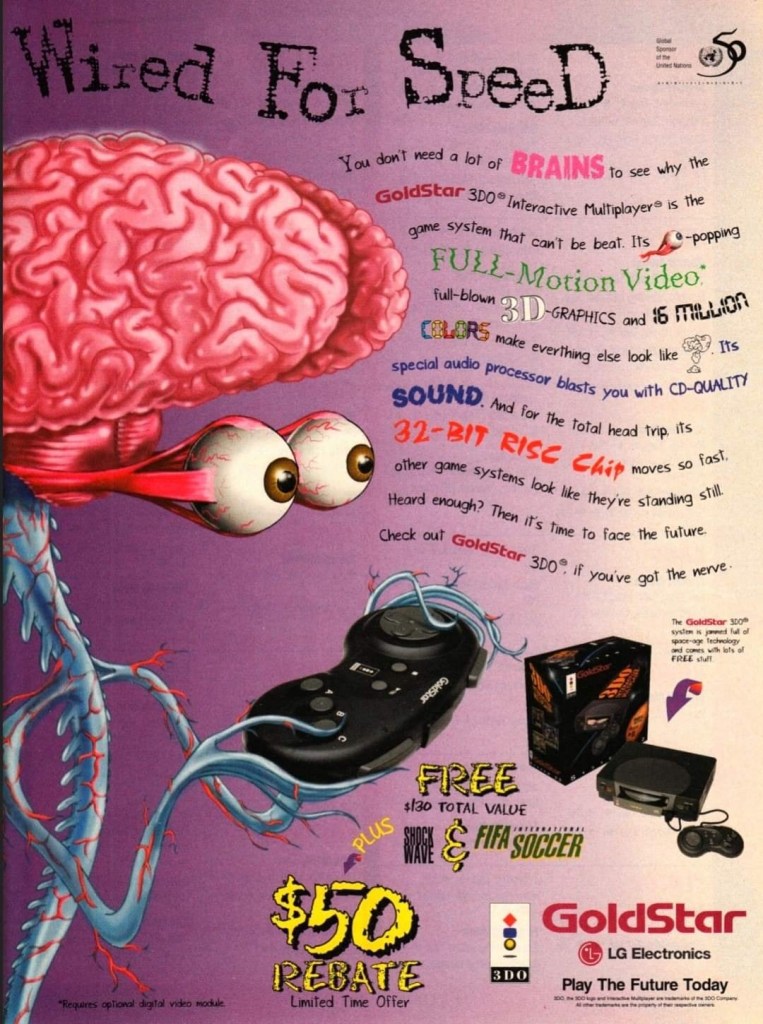
9. GoldStar/LG Electronics 3DO print ad
This is a very weird way to market a video game machine.
Back in the 1990s, the South Korean electronics company GoldStar (which was part of the umbrella of LG Electronics) had the license to produce 3DO game consoles with its own style. In some ways, the GoldStar 3DO console looked like a premium console on the outside. Unfortunately, the GoldStar 3DO print ad here had a very sloppy presentation as the ad makers used very weird art of a brain-with-eyes holding a 3DO controller leaving little space left to promote the console and games (without any screenshots). The text description was sloppily done. This is a bad example of promoting video game hardware and games.
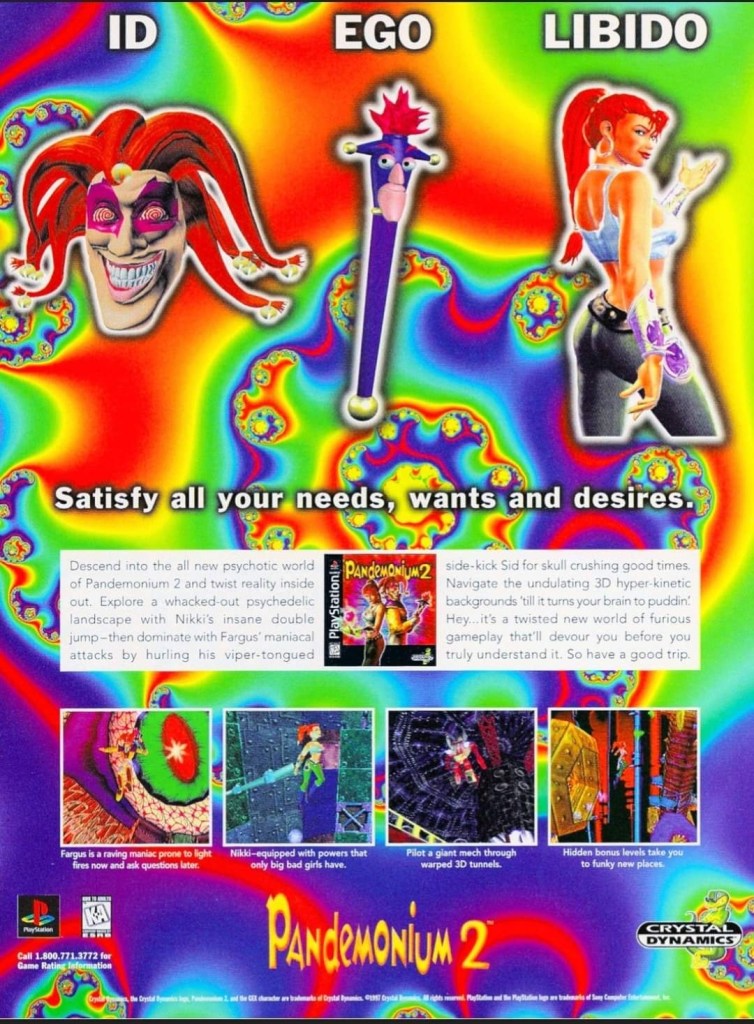
10. Pandemonium 2 print ad
I saw this ad but never played the game.
Looking back at 1997, I find it strange that I never got to play Pandemonium 2 on the PlayStation even though I saw its print ad in magazines. I had a lot of fun playing Pandemonium! on the console in 1996 but somehow missed out on its sequel. Looking back at the Pandemonium 2 print ad, I was surprised with how the game developers redesigned the two playable protagonists, especially Nikki who was clearly made to look very sexy. The word “libido” (meaning sexual drive) was deliberately placed above Nikki. The ad also had a hypnotizing mix of colors which I believe was also deliberately done by the ad makers. I can only wonder how the game played.
11. Mission: Impossible print ad
A captivating ad.
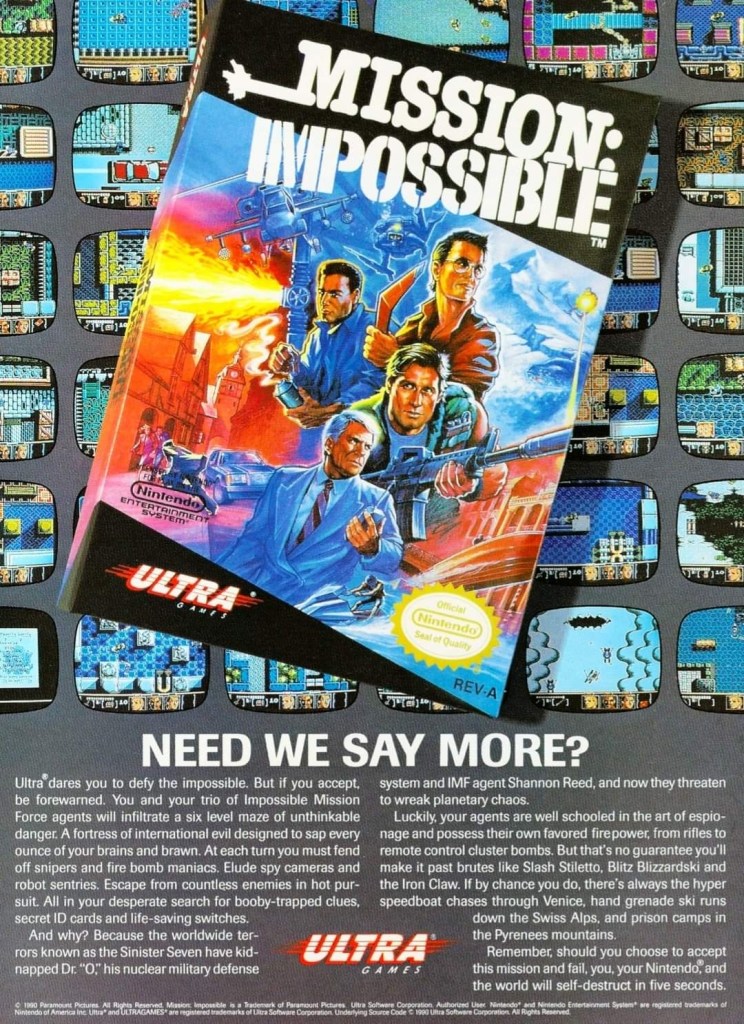
In 1990, Ultra Games (a label of Konami) released the Mission: Impossible video game on the Nintendo Entertainment System (NES) in America. Developed by Konami, the game was an adaptation of the 1988 TV series and it had an ambitious design with regards to level design and gameplay. To promote the game, the ad makers came up with a visual design showing the game’s box (which had a nice painted art on the cover) on the foreground and several screenshots resembling TV monitors on the background. Even by today’s standards, this print ad still looks good and captivating even if you are not too familiar with Mission: Impossible on TV.
12. The Lawnmower Man Sega CD and Genesis print ad
Are you fan of The Lawnmower Man movie?
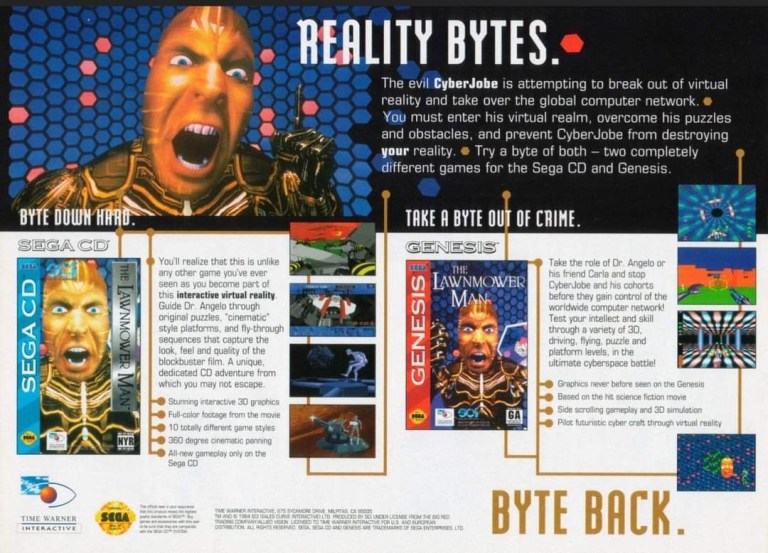
Back in 1992, there was a lot of buzz generated by the movie The Lawnmower Man as it had a disturbing concept that involved virtual reality and, more notably, author Stephen King sued the filmmakers to remove his name from the title because the film differed so much from the source material. Of course, those developments did not stop the production of video game adaptations of the movie. This print ad promoting the Sega CD and Sega Genesis versions of the game heavily used the images of CyberJobe which were among the most memorable images from the film. Looking at the ad, the ad makers could have made the screenshots look a little larger to really sell the games.
13. Ground Zero: Texas print ad
The shotguns really made this ad eye-catching.
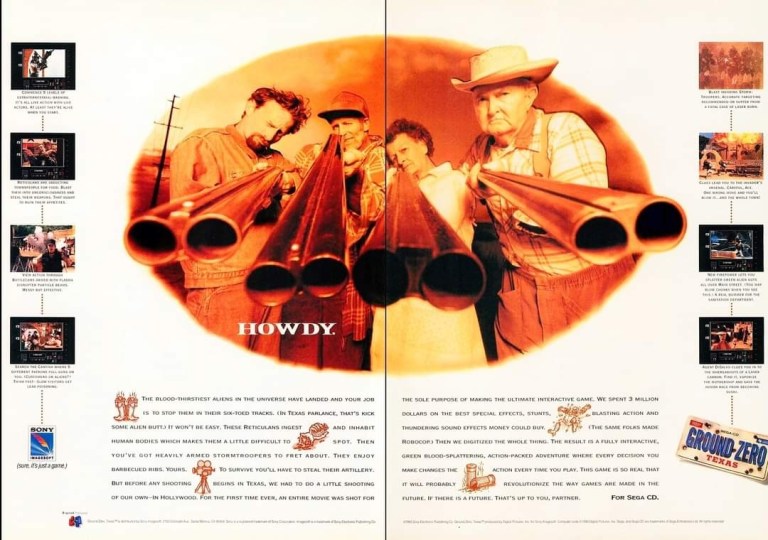
I never played the Sega CD video game Ground Zero: Texas but I knew that it was one of those games that heavily relied on video footage while giving players moments to interact. Back in 1993, there was an increase in the number of video games that carried lots of live action footage to drive the narrative and players were given options in order to progress. What is very notable about the game is not the game design but the very 2-page ad used to promote it. The image showing four people pointing their shotguns towards the viewer was easily the most captivating part of the ad. Even though there was vacant space in between, the screenshots of the game were displayed to be really small.
14. Alien vs. Predator for SNES and Game Boy print ad
This ad caught the attention of a lot of people back then.
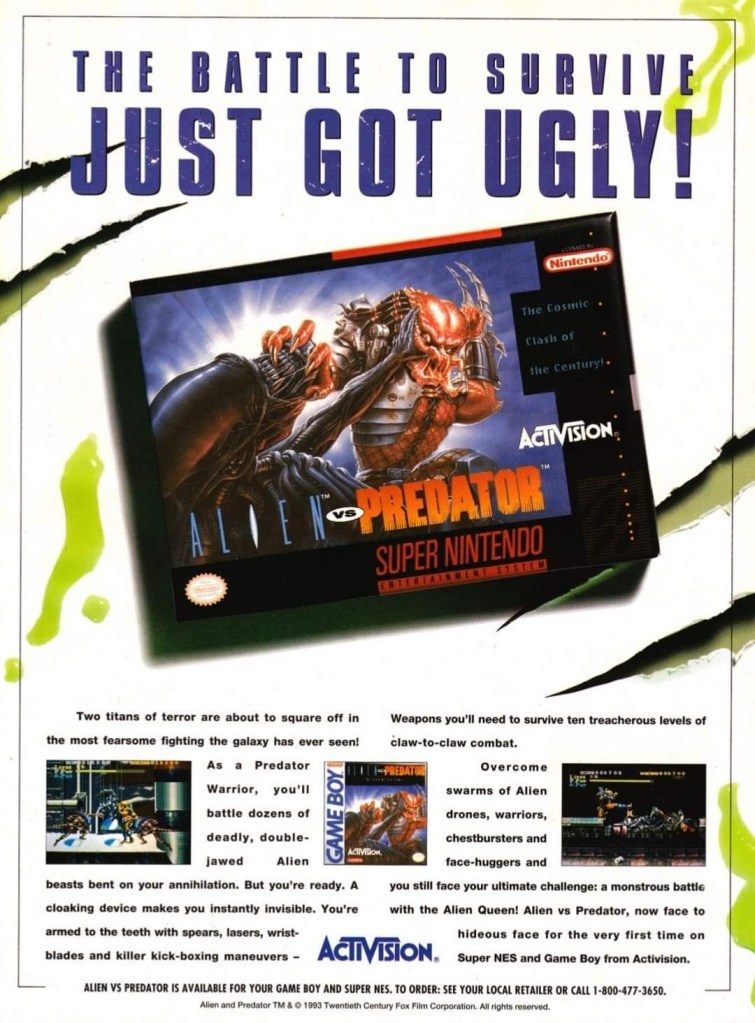
Back in 1990, Dark Horse Comics launched the 4-issue mini-series of Aliens vs. Predator which turned out to be a very intriguing and engaging crossover comic book tale featuring two iconic sci-fi species of monsters. The success of the comic books led to the production of many video games which delighted both fans of Predator and Aliens. In 1993, Activision released Alien vs. Predator on the Super Nintendo Entertainment System (SNES) and the single-page print ad they came up with was engaging to look at. The SNES game box with the fine looking painted art was the main visual highlight leaving just enough space for the descriptive text, the Game Boy cover and two screenshots. Believe it or not, this video game was not related at all with the Alien vs. Predator arcade game and Atari Jaguar console game.
Disclaimer: This is my original work with details sourced from reading the comic book and doing personal research. Anyone who wants to use this article, in part or in whole, needs to secure first my permission and agree to cite me as the source and author. Let it be known that any unauthorized use of this article will constrain the author to pursue the remedies under R.A. No. 8293, the Revised Penal Code, and/or all applicable legal actions under the laws of the Philippines.
Welcome back superhero enthusiasts, 1990s arts and culture enthusiasts, movie fans and comic book collectors! Today we go back to the year 1990 to take a look at the official comic book adaptation of the movie Predator 2 (1990).
For the newcomers reading this, Predator 2 is the sequel to the 1987 movie directed by John McTiernan (Die Hard) and starring Arnold Schwarzenegger. As the movie became a huge commercial success, it started a chain of events that led to the rise of the Predator entertainment franchise covering merchandising, comic books and video games to name a few. Of course, the development of a cinematic sequel happened and both the movie studio and filmmakers took their time to make it. Predator 2 was directed by Stephen Hopkins and it starred Danny Glover, Gary Busey and Bill Paxton.
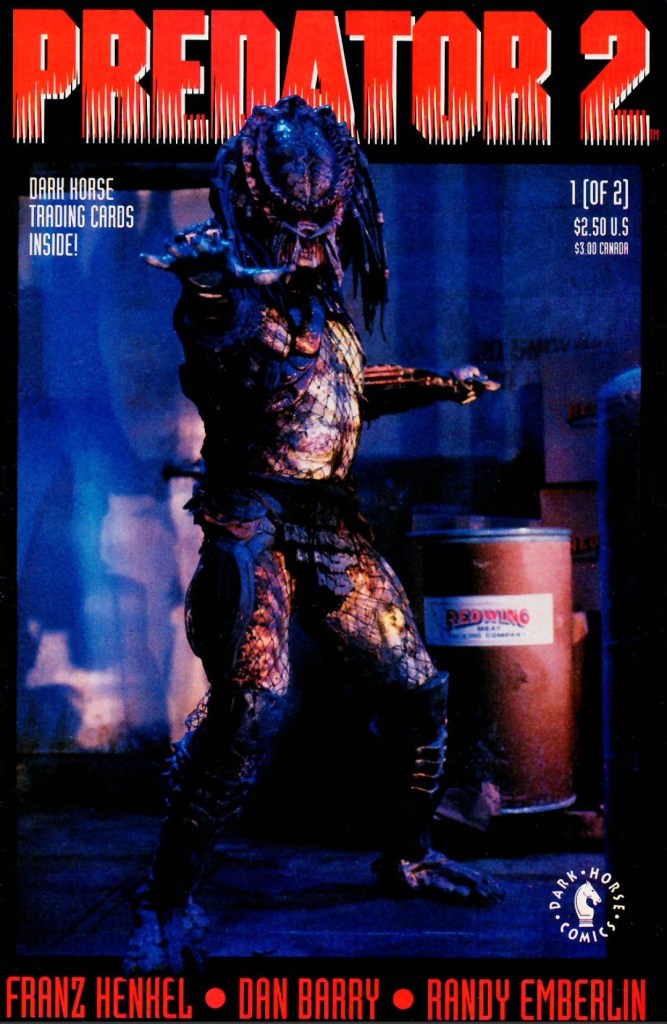
With those details laid down, here is a look back at Predator 2 #1, published in 1990 by Dark Horse Comics with a story written by Frank Henkel (based on the screenplay by Jim Thomas and John Thomas) and drawn by Dan Barry. Mark Verheiden (writer of 1989’s Predator #1) was acknowledged with special thanks. This comic book is the first of a 2-part comic book adaptation of the movie.
The cover.
Early story
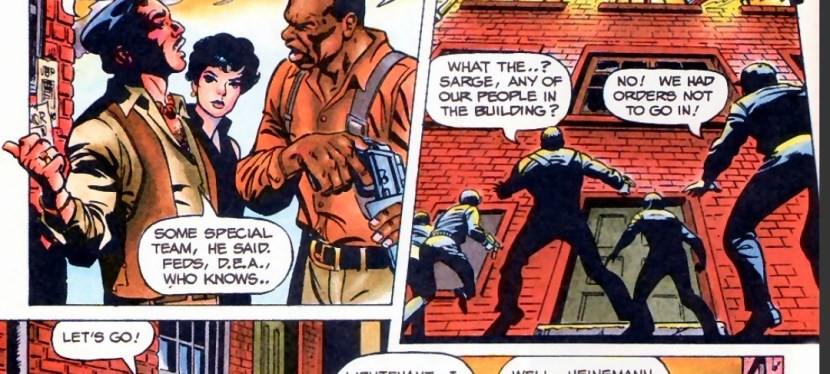
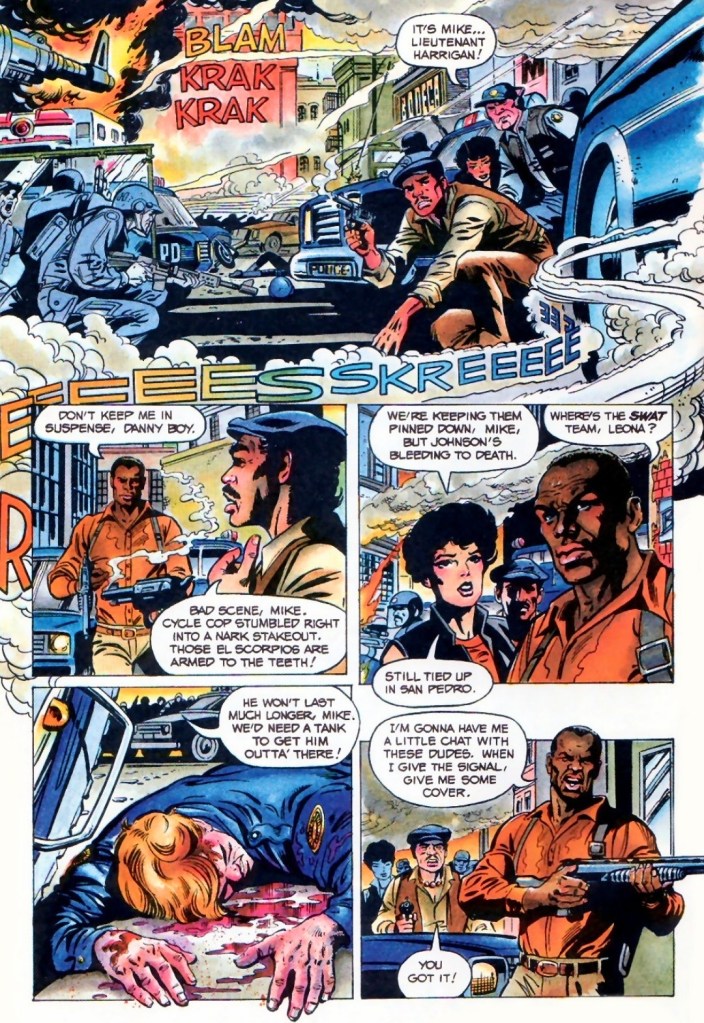
The story begins during a very hot day in 1997 Los Angeles. Police office Mike Harrigan rushes to the site of a major shootout between heavily armed gangs (Colombians and Jamaicans). The police managed to corner a gang to a building that was occupied by the foreigners. Knowing that a fellow cop is slowly bleeding to death and the SWAT (Special Weapons and Tactics) team are still stuck in traffic, Harrigan decides to take action against the armed gangsters with the support of his teammates and some police personnel.
After managing to get close to the gangsters by the building using his car, Harrigan manages to shoot them all and pave the way for his teammates to get closer. Harrigan does not realize that a camouflaged Predator is watching him from above.
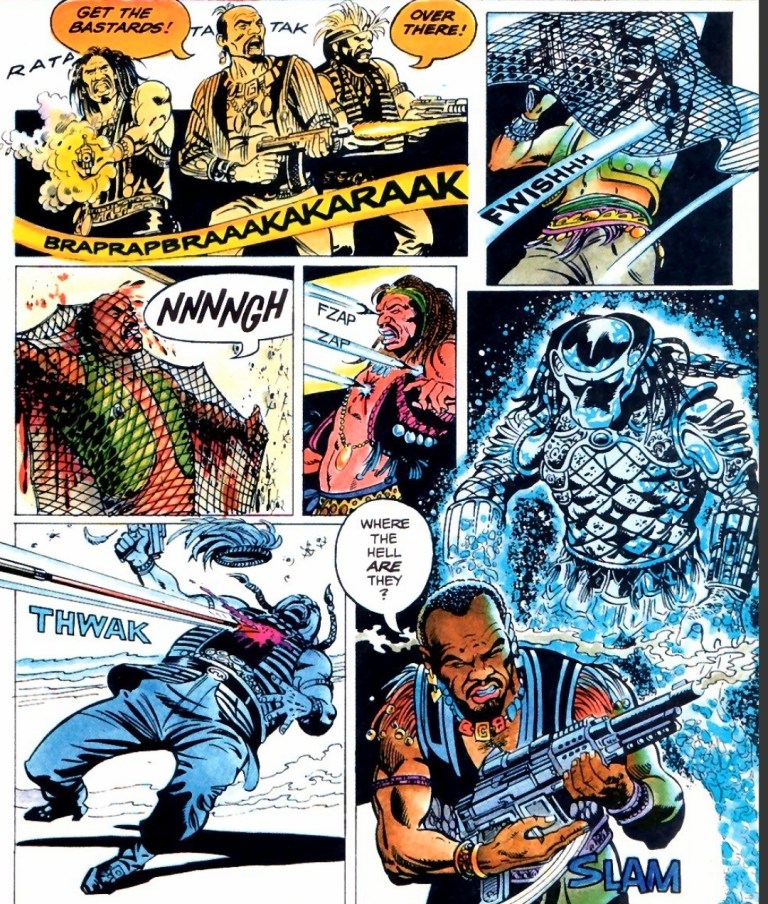
At one of the higher floors of the building, the rest of the foreign gangsters prepare themselves for the arrival of the cops by gathering guns and ammunition. Suddenly, the camouflaged Predator crashes in on them…
Quality
The Predator here is quite aggressive and even arrogant enough to suddenly fight the Jamaican gang alone.
I am surprised how entertaining this first chapter of the 2-part comic book adaptation of Predator 2 turned out to be. While the accuracy is understandably less than 100% with regards to translation from cinema to literature, this comic book’s narrative is quite faithful to the events of the movie (from the start until the King Willie scene) and the film’s vibe was strongly captured. In fact much of the dialogue spoken in the film were mostly recaptured here, and the same can be said about the way the characters were portrayed.
For brevity and the maximizing of the pages made available, creative liberties or shortcuts were taken by the creators. This means that the presentation of details was carefully done to keep readers properly informed while managing to keep the fun factor and level of intrigue strong. Indeed, writer Frank Henkel did a very good job keeping things together to make the reading experience fun and engaging.
If there is anything that this comic book exceeds the movie on, it is the graphic violence. Artist Dan Barry really ramped up the bloody scenes and gore (examples: Mike Harrigan’s killing of two foreign gangsters with a shotgun, and the scene when Harrigan and his team were stunned by the sight of the many ruined dead bodies of gangsters who were just eliminated by the Predator before they arrived) as he used his own style to make the action scenes as intense as the ones filmed by Stephen Hopkins and crew. It was obvious he saw the movie.
Barry also had his own style on visualizing the characters without the authority to use the likeness of any actor from the film. Mike Harrigan looks nothing like Danny Glover while Peter Keyes does not resemble Gary Busey. Barry’s visual take on the Predator itself has a really distinctive look when compared to how other artists drew Predators.
Barry did not aim to achieve photo realism at all with the characters (who appear with a slightly cartoonish aesthetic), the locations and action scenes but I don’t find anything problematic with his work here. In fact, I enjoyed his way of translating the movie’s visual presentation into literary format.
Conclusion
Mike Harrigan, Danny and Leona make their moves.
Predator 2 #1 (1990) is a very enjoyable read. It strongly captured the vibe of the movie complete with the dialogue and the way the characters were presented. Very clearly, the Henkel-Barry duo did really fine work in this comic book adaptation and I am convinced to move on to issue #2.
Overall, Predator #2 (1990) is highly recommended!
Disclaimer: This is my original work with details sourced from reading the comic book and doing personal research. Anyone who wants to use this article, in part or in whole, needs to secure first my permission and agree to cite me as the source and author. Let it be known that any unauthorized use of this article will constrain the author to pursue the remedies under R.A. No. 8293, the Revised Penal Code, and/or all applicable legal actions under the laws of the Philippines.
Welcome back science fiction enthusiasts, 1980s arts and culture enthusiasts, movie fans and comic book collectors! Today we go back to the year 1989 to take a look at a significant event of the Predator entertainment franchise – the comic book launch of Predator.
For the newcomers reading this, Predator started as a sci-fi action movie in 1987 directed by John McTiernan (Die Hard) and starring Arnold Schwarzenegger, Carl Weathers, and Jesse Ventura to name some. The writers and creators were Jim Thomas and John Thomas. As the movie became a huge commercial success, it led to the start of its own multi-media entertainment franchise covering video games, toys, novels and comic books. It also led to the release of more movies including a crossover film with the Alien franchise.
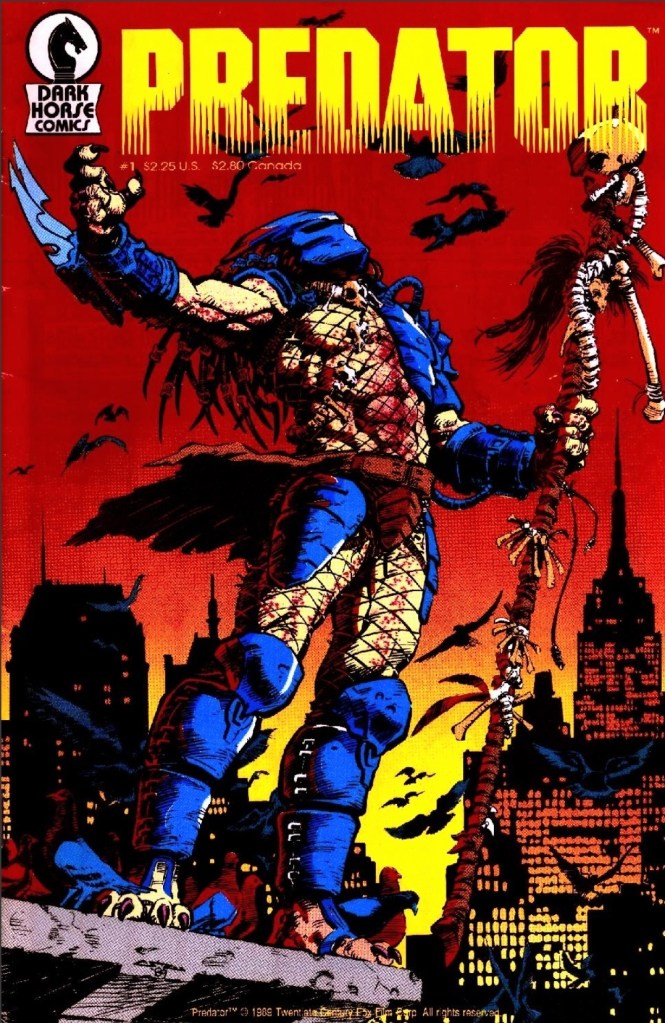
With those details laid down, here is a look back at Predator #1, published in 1989 by Dark Horse Comics with a story written by Mark Verheiden and drawn by Chris Warner. The is the first chapter of a 4-issue mini-series and it would later be referred to as Predator: Concrete Jungle.
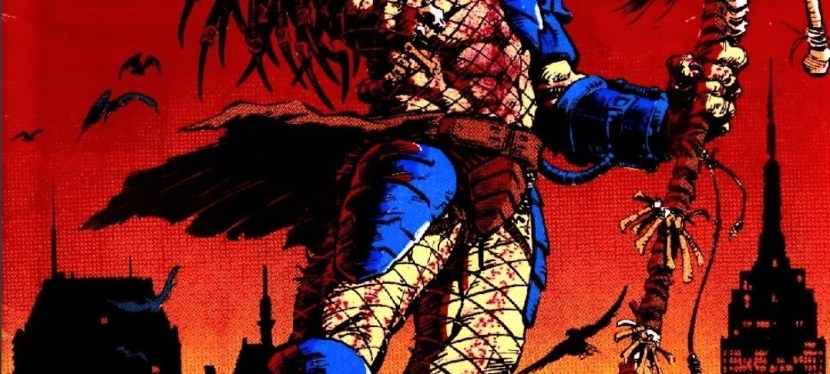
The cover.
Early story
The story begins during a very hot summer day in 1991 New York City. A man killed his own wife using a shotgun which eventually leads to the arrival of cops, medics and his arrest. The two detectives Errol Rasche and John Schaefer (brother of Dutch) have been working together in the local war against crime and they have a tendency to do things that violate their superiors’ orders.
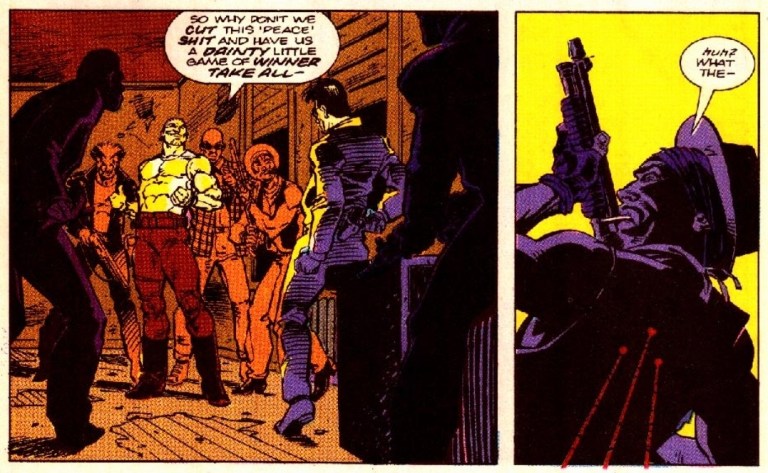
In one of the rundown buildings of New York, a secret meeting between two gangs got terribly disrupted by a Predator who attacked from the outside. Chaos and destruction followed.
Shortly after, Rasche and Schaefer arrive outside the same building which has been surrounded and isolated by the local police. When a man suddenly fell out of the building and crashed on top of a police car, the two detectives decide to enter willfully violating the order to stay out.
Once they enter the room where the secret gang meeting was held, Rasche and Schaefer are shocked to see many skinned and dead bodies inside. Schaefer is convinced that what happened was not the result of a gang war…
Quality
A gang meeting about to be disrupted by the unseen Predator.
This comic book – written as a not-too-obvious sequel to the 1987 movie – is absolutely very intriguing to read from start to finish. Mark Verheiden clearly wrote a crime story that happens to involve the species of deadly hunters from outer space. In fact, this comic book has very notable elements that also made it into the core concept of the 1990 movie Predator 2.
Story is set within a massive city that happens to be suffering from a heat wave – check! There is rampant crime and conflicts between gangs – check! The Predator causes huge disruptions on the criminals – check! The detectives willingly violate protocol to solve cases – check! One of the detectives is gradually getting closer to retiring and his pension – check. It’s almost as if this comic book was a huge influence on the people who made Predator 2.
Going back to the story, this is a strong tale of crime and urban war told through the exploits of detectives Schaefer and Rasche who have worked many years together, they treat each other like brothers (similar to Predator 2’s Mike Harrigan and Danny Archuleta).
With their record of disobeying orders, Schaefer and Rasche simply involve themselves in cases believing they have the right know the details on the spot and to solve problems their way even though their superiors don’t need them. This is the anti-authoritarian portrayal of law enforcers that easily reminded me of certain TV shows and movies of the 1980s.
All throughout, the story by Verheiden is nicely structured, has lots of engaging details to follow and carefully blends sci-fi elements with detective storytelling. Verheiden clearly knows how to build up tension, keep the narrative progressing and use action or spectacle with precise timing.
When it comes to the visuals, Chris Warner’s style is very good. His approach on drawing the characters made them look exquisite and visceral at the same time. In fact, there were some shots of people in this comic book which reminded me of Todd McFarlane’s way of drawing people during his early works in comics. Lastly, I should say that Warner’s approach on hard action and his way of drawing of the Predator must be seen.
Conclusion
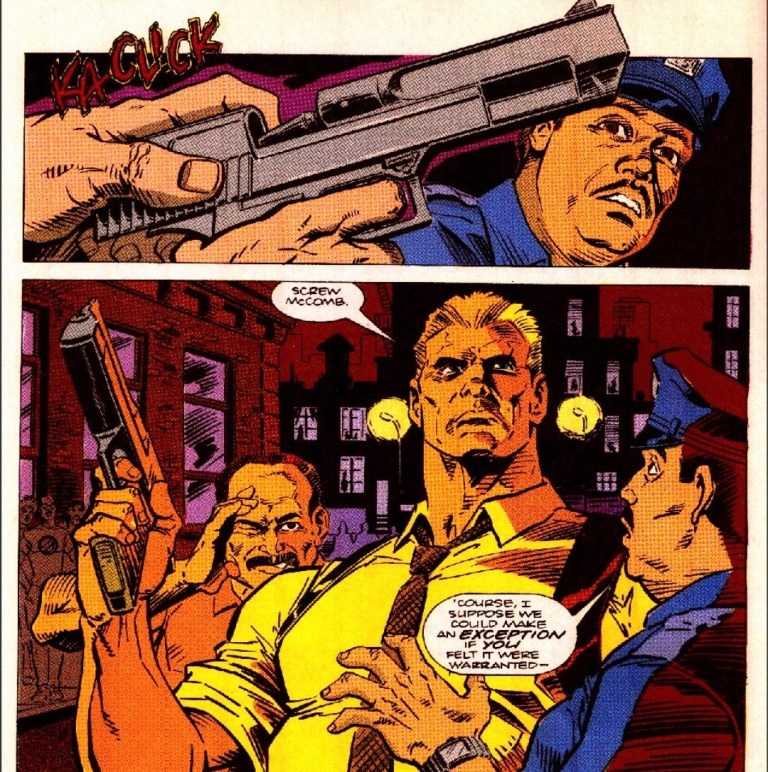
Rasche and Schaefer defy orders. Schaefer (holding the gun) is the brother of Arnold Schwarzenegger’s character in the Predator movie of 1987.
I really enjoyed reading Predator #1 (1989). This is indeed really fine work by the Verheiden-Warner team and as far as building up the lore of the Predator goes, they clearly succeeded and their contributions here strongly influenced the creation of Predator 2 which opened in cinemas in late 1990. This comic book has the visceral touch and violence that make it comparable with both the 1987 and 1990 movies.
Overall, Predator #1 (1989) is highly recommended!
Disclaimer: This is my original work with details sourced from reading the comic book and doing personal research. Anyone who wants to use this article, in part or in whole, needs to secure first my permission and agree to cite me as the source and author. Let it be known that any unauthorized use of this article will constrain the author to pursue the remedies under R.A. No. 8293, the Revised Penal Code, and/or all applicable legal actions under the laws of the Philippines.
Welcome back superhero enthusiasts, 1990s culture enthusiasts and comic book collectors! Today we go back to the year 1990 to take a close look at one of the more significant non-superhero crossover comic book events ever published – Aliens vs. Predator!
In my previous review, things changed for the worse for the humans as their colonial community gets overwhelmed by the presence of Aliens and Predators. Risking her own life, Machiko Noguchi does what she could to protect her constituents. Along the way, one certain Predator that was restrained and examined in the laboratory eerily decides to help the humans.
With those details laid down, here is a look back at Aliens vs. Predator #4, published in 1990 by Dark Horse Comics with a story written by Randy Stradley and drawn by Phill Norwood. This is the final issue of the mini-series.
The cover.
Early story
The story begins with Noguchi and Miriam flying in a Copter and right below them is the chaos composed of a cattle stampede and the ongoing conflict between Alien Xenomorphs and the armed Predators. While flying, Noguchi and Miriam spot a lone Predator climbing up a tower while fighting off several Xenomorphs chasing him unrelentingly. It turns out the said Predator was Miriam’s own patient at the laboratory and she urges Noguchi to help him.
As part of the tower separates itself, the Predator is about to fall down and the Copter piloted by Noguchi comes closer to help him. Miriam uses a communicator to help the Predator realize they are helping him. As the Predator hangs on to one part of the Copter, an Alien jumps towards the vehicle causing Noguchi to react instinctively by jerking the controls. The Copter then spins on its axis as the nearby tower collapses.
The Copter begins to fall down on the street below…
Quality
Even as this comic book is packed with lots of action scenes, thrills, and Aliens-Predator fights, the creative team succeeded in emphasizing the narrative all throughout.
I am delighted to say that the Stradley-Norwood duo succeeded with maintaining the high quality works of this mini-series and concluded it with impact. At the heart of the story is the theme of survival with the humans being symbolized as casualties of a raging conflict between the fully determined and instinctive Aliens and the strategic and technological Predators.
Through the protagonist Machiko Noguchi, readers will realize that as a species, humans can survive not only by having a powerful will to progress backed with focus, but also by communicating and cooperating with an intelligent non-human species that shares their traits. In this case, the non-human species I’m referring to are the Predators. That being said, the Aliens are the non-human species with limited intelligence, fully determined to hunt anyone or anything, and absolutely do not care about morals nor the existence of any species they find different from themselves. All the symbolism about the three species got portrayed powerfully and creatively throughout the story here.
As before, the plot moved at a medium pace and details are emphasized through dialogue, visuals and narrations without ever dragging the pace down. This shows how the creative team proved to be efficient with explaining the details as they focused on telling the story in ways to keep readers engaged.
I should mention that the protagonist Machiko Noguchi became even more significant in this comic book. Without spoiling the details, I can say she blossomed into a heroic figure who risks her life to help many even as she faces tremendous odds. In case you are wondering, Noguchi is NOT a rip-off of Ellen Ripley as she is the colonial overseer dedicated to the corporation. It just so happens that Noguchi shares common traits with the cinematic icon such as bravery, the refusal to give up and having the will to help others even while risking her own life. I can only imagine Ripley and Noguchi conflicting with each other if they were together under normal circumstances.
Noguchis’s short but intense union with the cooperative Predator was told very believably which added depth to the story as well as impact on the conclusion.
As this is the final issue of the mini-series, the creative team really ramped up the big-payoff to what was built up before. In fact, the final conflict here seems to show that Stradley and Norwood were aware about what made the cinematic final conflicts of Aliens (1986) and Predator (1987) entertaining and memorable to moviegoers. That being said, I can say that certain action and sci-fi elements from those movies were implemented in this comic book’s final conflict which I found really engaging, inspired and fun to read.
Conclusion
The union between Machiko Noguchi and this particular Predator is a must-read!
Aliens vs. Predator #4 (1990) is truly a great comic book as well as a powerful conclusion to this very significant comic book mini-series. The creative team not only told the whole storyline with great quality, a steady pace and strong engagement all throughout. It is also here where you will get to see Machiko Noguchi become very significant not only within the Aliens-Predator comic book universe of Dark Horse Comics but in sci-fi comics in general. The ending of this comic book is very powerful and served also as a big pay-off to what preceded it. This is a genuine sci-fi comic book classic!
Overall, Aliens vs. Predator #4 (1990) is highly recommended!
Disclaimer: This is my original work with details sourced from reading the comic book and doing personal research. Anyone who wants to use this article, in part or in whole, needs to secure first my permission and agree to cite me as the source and author. Let it be known that any unauthorized use of this article will constrain the author to pursue the remedies under R.A. No. 8293, the Revised Penal Code, and/or all applicable legal actions under the laws of the Philippines.
Welcome back superhero enthusiasts, 1990s culture enthusiasts and comic book collectors! Today we go back to the year 1995 to examine another chapter of the Superman vs. Aliens mini-series.
In my previous retro review, an object from space on Earth and Superman (who previously as Clark Kent learned of the Kryptonian language from the signals transmitted by the object) intervened the discovery of it in the presence of Lexcorp. After much talk and an agreement, Superman went into space with one of Lexcorp’s space ships (under the watch of Dr. Kimble who leads the corporation’s space division) leaving behind Lois Lane at the space station with Kimble. Deep in space, Superman arrives and discovers a ruined city with physical signs of struggle. What he does not realize is the presence of eggs and the Xenomorphs lurking within the new environment.
With those details laid down, here is a look back at Superman vs. Aliens #2, published in 1995 by Dark Horse Comics and DC Comics with a story written and drawn by Dan Jurgens with ink work done by Kevin Nowlan.
The cover.
Early story
The story begins in space when a space ship sent home by Superman is about to collide with the space station near Earth. As one of the crew members failed to take remote control of the incoming ship, a very determined Dr. Kimble takes over the controls and eventually took command of the said ship. Lois Lane, who showed signs of self-restraint and deterioration of her professionalism as a journalist, watches. As Kimble, Lane and the crew members approach the ship at the station’s docking bay, one passenger was found dead (a Chestburster alien came out of him) while three others were still alive.
As Dr. Kimble and personnel brought the surviving passengers in the infirmary, Lois Lane takes advantage of the situation by climbing up the ship to examine it closely. She knows that without the ship, her beloved Clark Kent/Superman is stranded in space. She is completely unaware of the presence of a fully grown Xenomorph alien watching her from a dark corner.
Meanwhile at the ruined city on the other side of the galaxy, a blindfolded Superman is carefully guided by the armed Kara going to a place that has medical equipment and supplies…
Quality
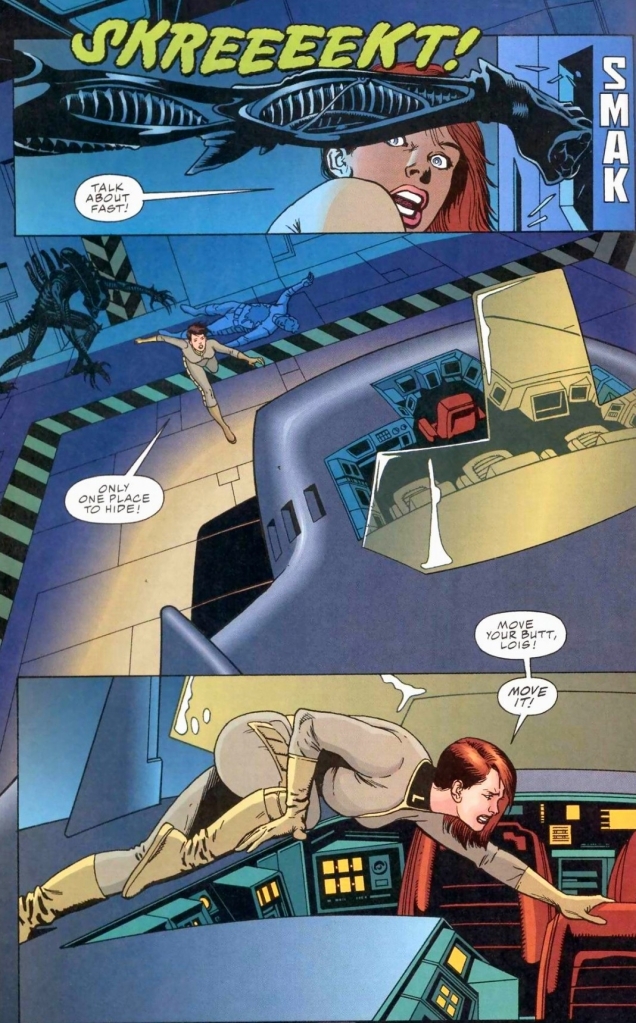
Lois Lane during her encounter with the Xenomorph inside the space station.
This is a solid follow-up to what was established in issue #1. In this comic book, the creative team gradually raised the stakes as two sides of the story were told extensively in alternating fashion – the side of Superman and Kara in deep space, and the other side of Lois Lane and Dr. Kimble (clearly the 3rd most important character in this mini-series) inside the space station.
As the story went on, Superman became even more vulnerable not only because he grew weaker as he has been cut off from the sun (a primary source of energy for him), but also because struggling with the aliens wore him down a lot and he still insists on avoiding any acts of killing due to what happened to him previously. As the Man of Steel became more vulnerable, Kara (who is experienced already in fighting the Xenomorphs which she referred to as the uglies) became an even more significant character (next to Dr. Kimble) and she became a highly essential partner for the icon.
Even for us readers, Kara creatively became even more engaging as she shared memories of events (note: exposition) that happened sometime prior which explains why her city got ruined and how the Aliens arrived and made her people’s problems even worse. The visualization of the said events were efficiently done for a good immersion into the past.
While the Superman-Kara thread emphasized survival facing tremendous odds, the Lois-Kimble thread became a more significant part of this mini-series as the space station became the new place for Xenomorph attacks. While Dr. Kimble remained obsessed with achieving results with scientific discoveries and corporate interests in mind, Lois Lane became the hunted similar in the style of Ellen Ripley in 1979’s Alien.
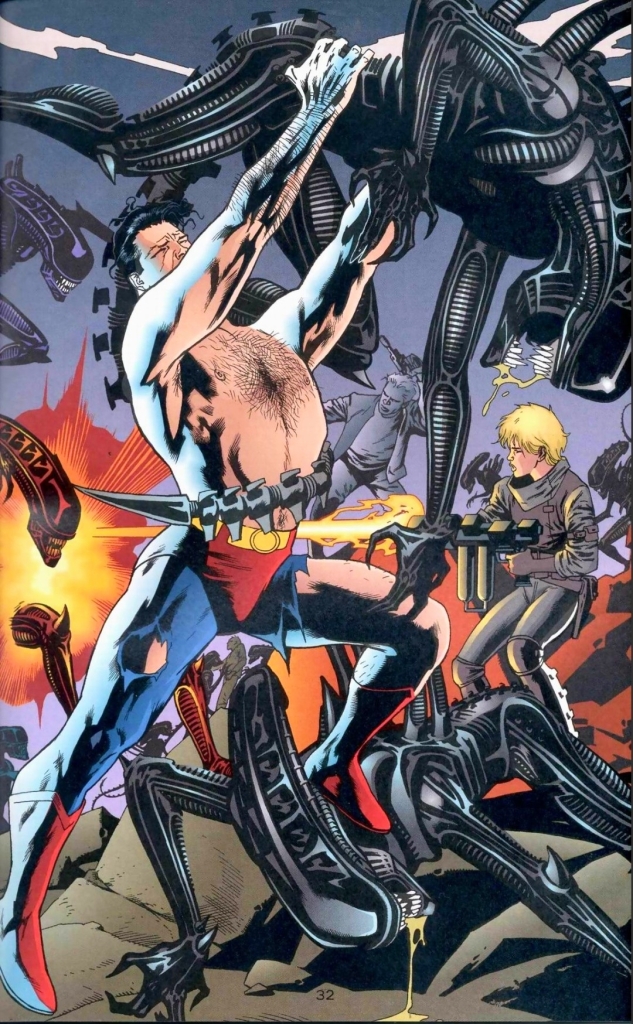
If you are looking for action, you will find a lot of them in both threads of the story. While just one Xenomorph on the space station led to some incidental action moments, a lot more action happened on Superman-Kara’s side of the story as they (along with a few human survivors on the ruined city) faced a huge horde of aliens that kept on attacking them from all sides. If you are looking for superhero spectacle, you won’t find it here as the action is more grounded with sci-fi’s interpretation of reality and Superman here is weaker and a lot more worn down physically. Then again, this is not surprising given the tone and concept the creators aimed for.
Conclusion
Superman and Kara struggling hard as they are surrounded by lots of Aliens. One of Kara’s fellow people is present in this shot.
Superman vs. Aliens #2 (1995) is really engaging to read and there were lots of fun moments along the way. Even as the creators were building up something for the third and final issue, they managed to pull off big pay-offs to what was built up in issue #1. While the lack of superhero-style spectacle is clear, it is not a problem at all as there is a lot of action involving the many Xenomorphs in the ruined city plus the bouts of suspense and incidental action executed during Lois Lane’s encounter with a single but deadly Alien. Considering how much fun and engagement this comic book has, it remains to be seen how the next issue will live up to it.
Overall, Superman vs. Aliens #2 (1995) is highly recommended!
Disclaimer: This is my original work with details sourced from reading the comic book and doing personal research. Anyone who wants to use this article, in part or in whole, needs to secure first my permission and agree to cite me as the source and author. Let it be known that any unauthorized use of this article will constrain the author to pursue the remedies under R.A. No. 8293, the Revised Penal Code, and/or all applicable legal actions under the laws of the Philippines.
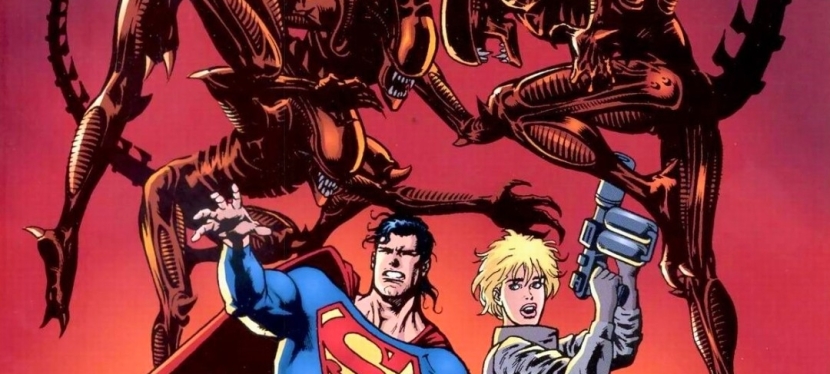
Welcome back superhero enthusiasts, 1990s culture enthusiasts and comic book collectors! Today we go back to the year 1995 to examine what was back then one of the most unthinkable comic book crossovers to ever happen – Superman vs. Aliens (also referred to as Superman/Aliens).
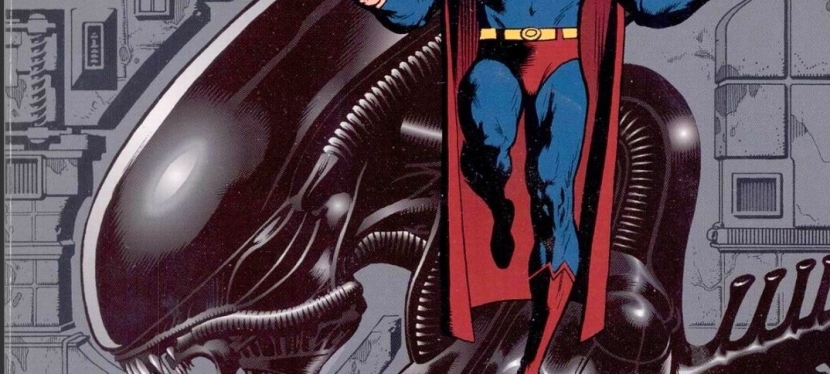
I remember sometime back in 1994, I bought a new superhero comic book from the local comic book retailer and what caught my attention was the print ad on the back – an Alien chestburster crashing through the iconic Superman S logo. A few of my friends who saw the same print ad chuckled at the concept of having the Man of Steel together with the monsters from the movie franchise that first started in 1979 with Ridley Scott’s Alien. Then came 1995 and eventually the first issue of the Superman vs. Aliens mini-series made it on the shelves of local comic book stores. Its cover easily attracted the attention of many and I saw the image of Superman being smaller to the Xenomorph alien in the background, the concept of the crossover started to intrigue me.
With those details laid down, here is a look back at Superman vs. Aliens #1, published in 1995 by Dark Horse Comics and DC Comics with a story written and drawn by Dan Jurgens with ink work done by Kevin Nowlan.
The cover.
Early story
The story begins in space when a fast moving object from nowhere heads towards Earth which was detected by a satellite of Lex Luthor’s corporation. Behind the scenes, personnel initiated an alert for a certain Dr. Kimble.
Clark Kent (Superman) and Lois Lane arrive at the headquarters of Lexcorp. It turns out they were suddenly called for by the corporation due to what happened in space. As they ride the elevator heading towards the rooftop, Clark and Lois talk about Lexcorp’s space program and Dr. Kimble who happens to lead the said program.
At the roof, they meet Dr. Cheryl Kimble and immediately ride with her in the helicopter going to a certain destination in anticipation of the probe’s estimated arrival. During the trip, Kimble reveals that they received radio signals from the incoming probe which were garbled almost unintelligible. She then plays an excerpt of the radio signals for Clark and Lois to listen to.
For Clark, he cannot help but feel shocked as he finds the audio sounding like Kryptonian…
Quality
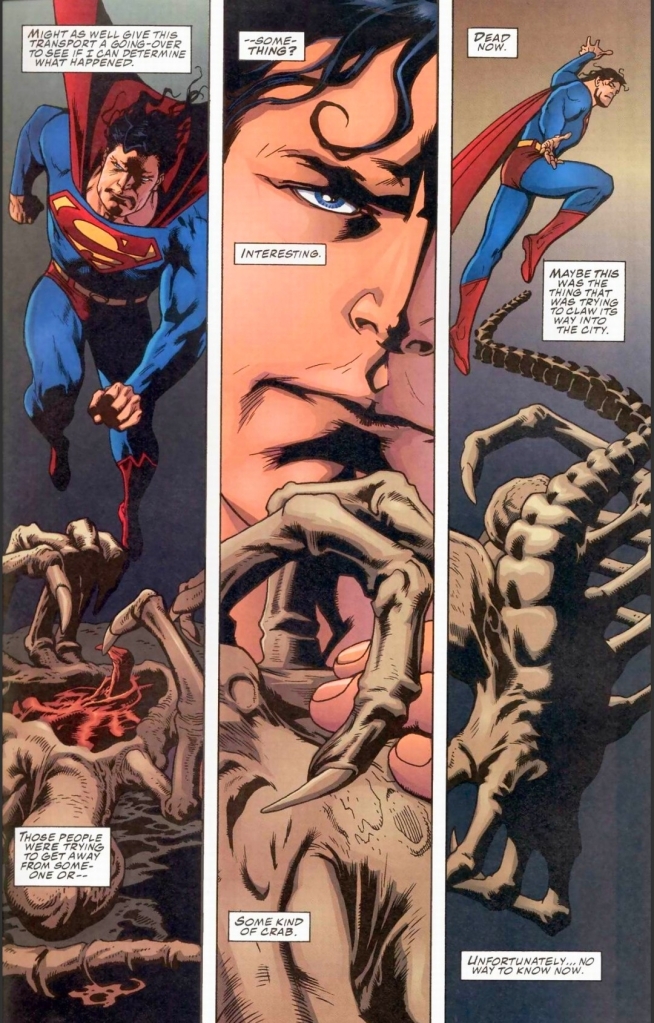
Superman finds a dead Facehugger alien.
Firstly, I can say without any hesitation that the creative team succeeded in making the crossover between Superman and the Aliens believable within this very comic book. For one thing, Dan Jurgens came up with a script and visual design that radically different from what was shown in Superman comic books of the time. The script had this somewhat adulterated tone that made the comic book move away from superhero fantasy and move into the realm of cinematic science fiction. For setting the tone and the look, the creative team scored a home run.
Secondly, the script was properly structured to immerse readers with the tale initially following Superman, Lois Lane and Dr. Kimble which ultimately served as a build-up. The good news here is that readers don’t have to wait too long for the pay-off to be executed. In fact, the pay-off itself (which happens when the Man of Steel finally encounters the Xenomorph for the first time) is huge and immediately the tension and depth of the plot really shifted into high-gear which I enjoyed. Along the way, the expository dialogue or the presentation of details (to help readers understand) was nicely balanced.
Thirdly, I love the way how Dan Jurgens presented Superman as being more troubled and more vulnerable than usual. To see the American icon go into personal obsession over the Kryptonian details was a really unique way to presenting his human side. Also having Superman deep in space far away from any sun or star (the essential source for his powers) really made him truly vulnerable as he actually got weaker even before facing off with a Xenomorph. Being in a vulnerable state, you will see the Man of Steel in real danger which truly goes against type (note: being super strong and invulnerable all the time). As such, the danger of the Aliens against him is believable and intense. What I do find weird, however, is how awkward it is for me to see Superman actually trying to reason with the first Xenomorph he encounters. Of course, he has no previous knowledge about the violent nature of the Aliens but we readers – and millions of people who saw any of the movies – know better than him.
As part of the build-up, Dan Jurgens inserted details and flashbacks that recalled previous tales that were published during the early stage of the post-Crisis era of DC Comics. This not only includes Superman’s arrival on Earth but also his strategic killing of General Zod, Zaora and Quex-Ul using green Kryptonite (as published in Superman #22 of 1988). As such, Superman’s deep regret of taking life away from others serves as a build-up for his avoidance of killing in this crossover. This actually races the stakes for his upcoming encounters with the Aliens.
Even though the story is told through Superman, Dan Jurgens still had enough room to develop Lois Lane and Dr. Kimble. Kimble symbolizes the driven corporate executive who is in-charge of operations that could help her make claims on scientific discoveries and new technologies. Lois Lane here served as the intellectual opposite of Kimble without ever going into the extremes of gaining something for her journalistic career.
Conclusion
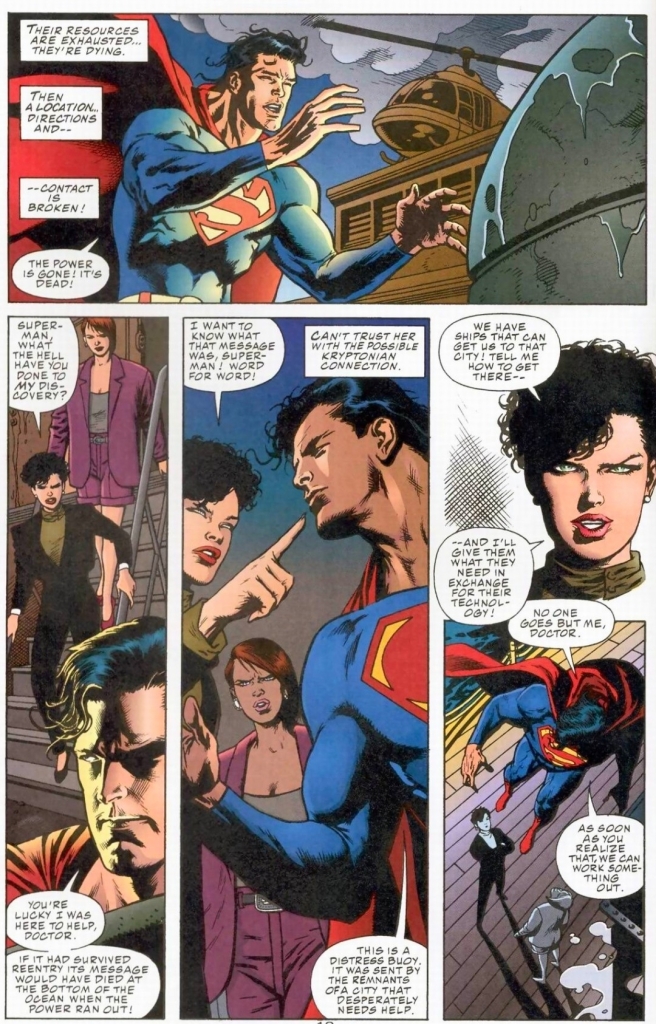
Superman with Lois Lane and Dr. Kimble.
Very clearly, Superman vs. Aliens #1 (1995) is indeed a great comic book as well as great opener for its mini-series. Dan Jurgens established a tale that had sufficient build-up and when the pay-off started, the crossover aspect really made the story more compelling to read. Ultimately, this one made the crossover between Superman and the Xenomorphs believable, engaging and intriguing. This comic book is a great start and I am eager to find out what happens next.
Overall, Superman vs. Aliens #1 (1995) is highly recommended!
Disclaimer: This is my original work with details sourced from reading the comic book and doing personal research. Anyone who wants to use this article, in part or in whole, needs to secure first my permission and agree to cite me as the source and author. Let it be known that any unauthorized use of this article will constrain the author to pursue the remedies under R.A. No. 8293, the Revised Penal Code, and/or all applicable legal actions under the laws of the Philippines.
Welcome back superhero enthusiasts, 1990s culture enthusiasts and comic book collectors! Today we go back to the year 1990 to take a close look at one of the more significant non-superhero crossover comic book events ever published – Aliens vs. Predator!
In my previous review, the humans of Prosperity Wells begin to get impacted by the presence of the Predators and the Aliens. A family got killed by Predator hunters at their home in the wilderness and only a young boy was able to get away and catch people’s attention in the outpost. Machiko Noguchi and her team initiate defensive measures in response to what has been happening. Two people even brought back a living Predator with them from the ruins of a Predator ship they inspected in the wilderness.
With those details laid down, here is a look back at Aliens vs. Predator #3, published in 1990 by Dark Horse Comics with a story written by Randy Stradley and drawn by Phill Norwood.
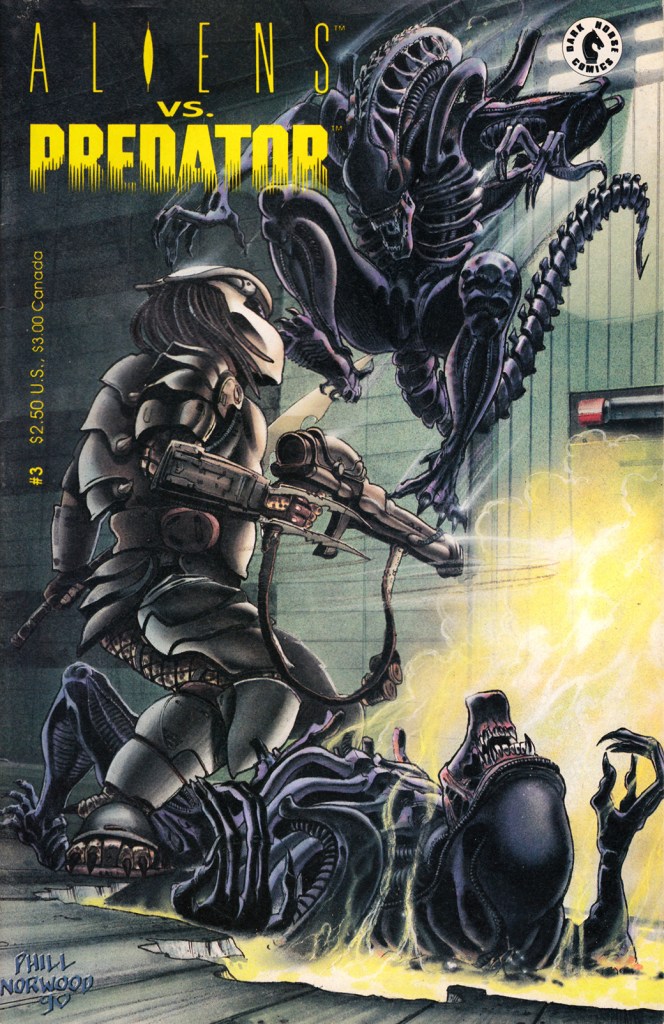
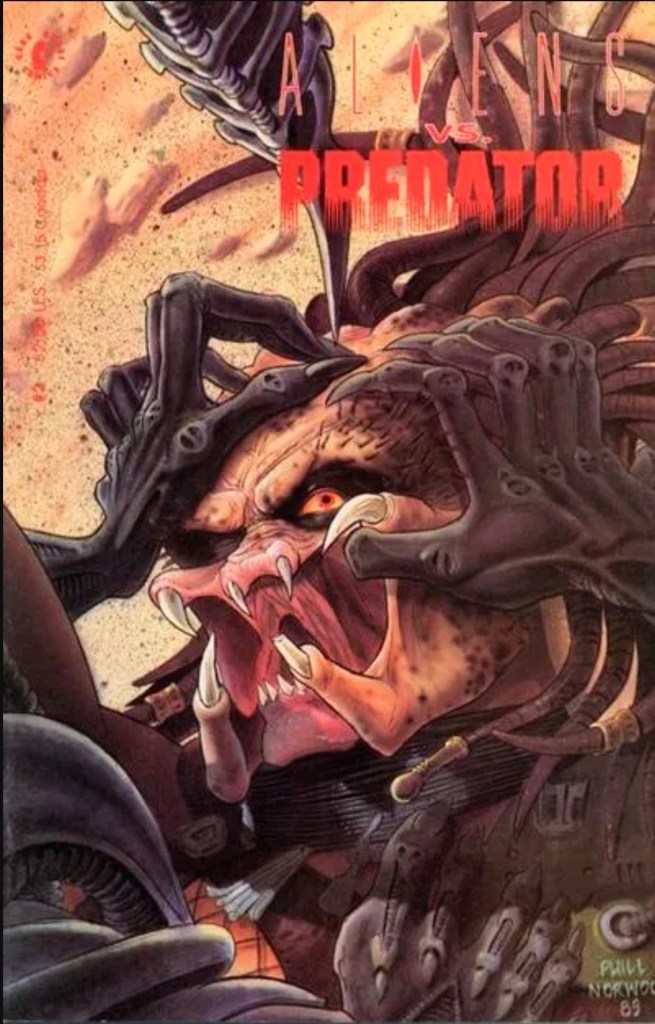
The cover.
Early story
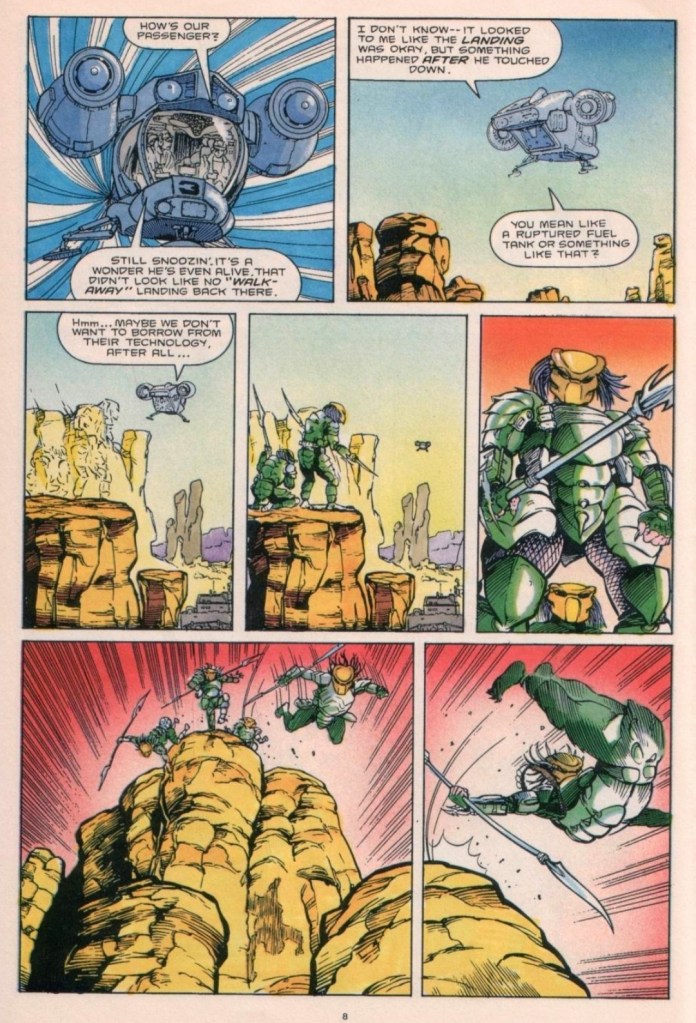
The story begins with Noguchi who finds herself in a dangerous position. In front of her is a horde of Xenomorphs and behind her is one Predator warrior who even assisted her a few moments prior. Armed with futuristic weapons, the armored warrior suddenly jumps above her and right into the Xenomorphs. The Predator efficiently slashed off the parts of a few Aliens using a bladed weapon and blew up one of them using another weapon.
The warrior eventually gets overwhelmed by more Aliens that came into the action. As the Xenomorphs focused strongly on the downed Predator, Noguchi takes advantage of the situation to run away and somehow get back to protecting the people as the outpost has been clearly invaded by two deadly non-human species.
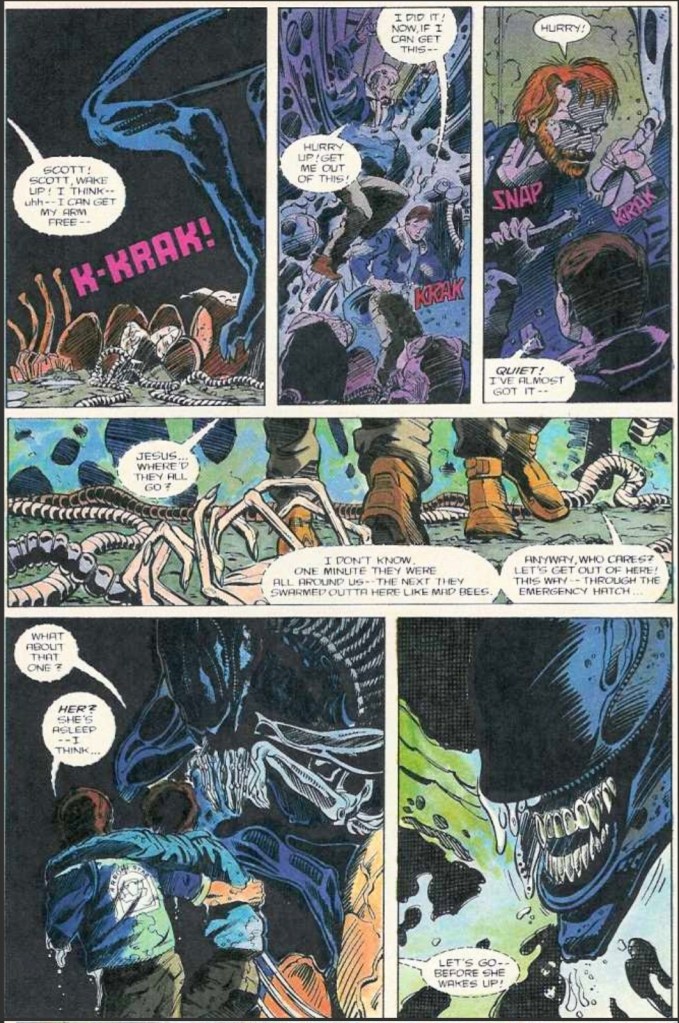
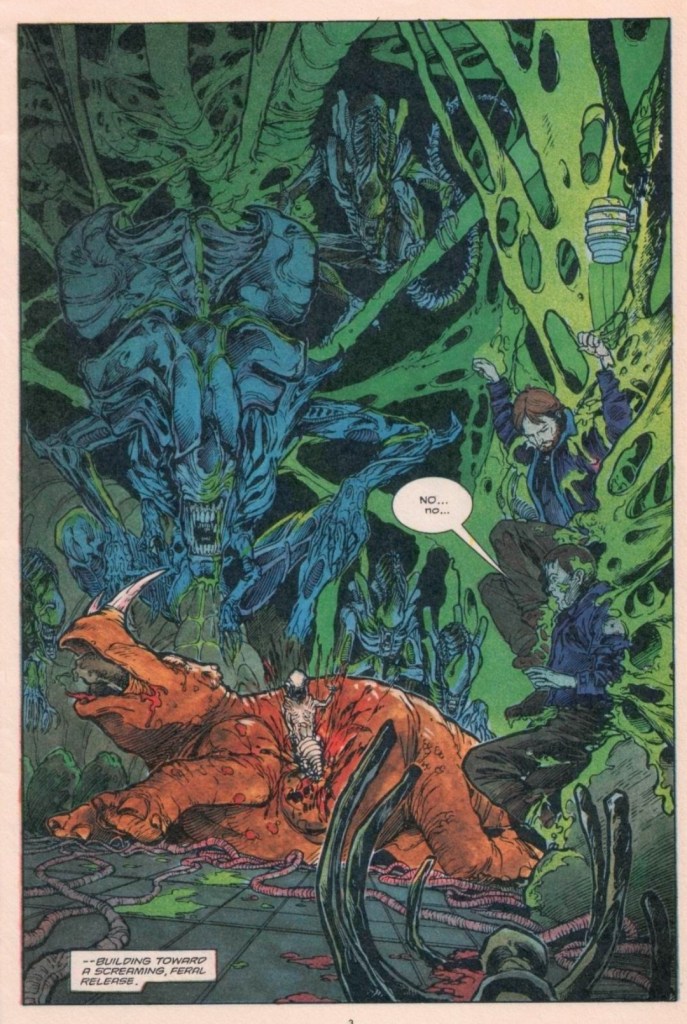
Meanwhile inside the huge cargo ship that did not launch, two crew members freed themselves from the Xenomorphs’ restraints and try to sneak by the Alien Queen which they perceived to be sleeping…
Quality
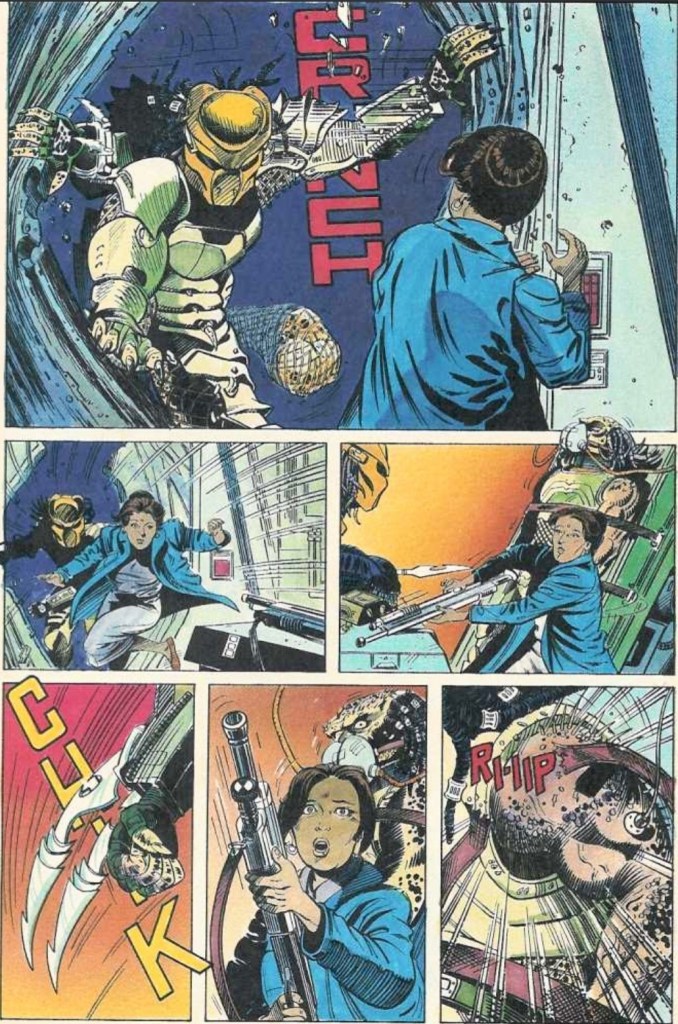
This is a fine example by the creative team on telling a sequence of intense moments without a single word of dialogue.
From a storytelling point-of-view, this one is a huge pay-off to the build-up established in the first two issues and I can say I enjoyed this one. At this stage of the 4-issue mini-series, the human colony has turned into a battle zone between the Predators and the Xenomorphs and this obviously results in a lot of action scenes and other wild turns of events. It is also in this story where you will get to see Machiko Noguchi at her bravest yet, as well as her uncompromising way of protecting her people and solving the crisis at hand. As she and her fellow humans are in the middle of a crisis, nothing straightforward could happen nor could they make solid plans with any real chance of succeeding. The decisions Noguchi made here came with risks and through her struggles, you will be able to relate with her and you will also witness how the series of unfortunate events turn out with unpredictable ways which added some suspense and surprise to the narrative.
The spectacle here, unsurprisingly, are the battles between the Aliens and Predators. Such conflicts happened mostly in the background which is effective enough to establish the chaos that the humans have to endure. One of the Predators – which does not have a name – became a notable additional supporting player to the cast and his presence and actions added some intensity to storytelling even as the narrative consistently focused on Noguchi.
The way the story is told, this one maintains the natural progression of details from issue #1 and even though the action has been ramped up, there were still plenty of opportunities for readers to understand the details and grasp the plot. There is also rising tension as the narrative moves forward.
Conclusion
There is nothing like trying to sneak past an Alien Queen in an area surrounded by multiple eggs laid by her.
Being a big pay-off to the huge build-up of issues #1 and #2, Aliens vs. Predator #3 (1990) is highly entertaining and compelling to read! The action scenes and chain of incidents were ramped up a lot and yet this comic book never turned into a brainless fest of violence. The creative team managed to add some breathing space to not only let readers absorb the story details but also to immerse themselves with the situations. By the time I reached the end, I experienced this great satisfaction as well as further motivation to discover how the story will conclude in the next issue.
Overall, Aliens vs. Predator #3 (1990) is highly recommended!
Disclaimer: This is my original work with details sourced from reading the comic book and doing personal research. Anyone who wants to use this article, in part or in whole, needs to secure first my permission and agree to cite me as the source and author. Let it be known that any unauthorized use of this article will constrain the author to pursue the remedies under R.A. No. 8293, the Revised Penal Code, and/or all applicable legal actions under the laws of the Philippines.
Welcome back superhero enthusiasts, 1990s culture enthusiasts and comic book collectors! Today we go back to the year 1990 to take a close look at one of the more significant non-superhero crossover comic book events ever published – Aliens vs. Predator!
In my previous review, most of the humans living and working in Prosperity Wells are unaware about the creeping danger coming at them. Alien eggs were laid in the wilderness while a ship carrying multiple Predator hunters has landed. At the human outpost, the leader Machiko Noguchi remains disrespected as the staffers and ranchers still trust her predecessor Hiroki Shimura.
With those details laid down, here is a look back at Aliens vs. Predator #2, published in 1990 by Dark Horse Comics with a story written by Randy Stradley and drawn by Phill Norwood.
The cover.
Early story
The story begins with the huge spaceship still at the launch platform of Prosperity Wells. The ship should have launched already with a huge cargo of indigenous animals – the Rynth – for export. It turns out that the two human pilots were captured by the Xenomorphs and in the presence of the Alien queen inside the ship, they witness one rynth (part of the herd from the ranching) die as a Chestburster alien comes out of its body.
Meanwhile, Machiko wakes up as her respected predecessor Shimura arrives and tells her that Dr. Revna still has not returned. During her talk with the wife (also a doctor), Machiko learns that the missing doctor was on his way to Iwa Gorge to find more aliens (note: the Facehugger alien) and that a lady worker (who made the first discovery of a Facehugger) informed him of the place.
As Machiko and Shimura analyze what they know, two outpost personnel discover the remains of a destroyed Predator space ship and, more notably, one unconscious Predator hunter…
Quality
The Predators looks really odd with the colors implemented on them by the creative team of this comic book.
If you were deeply engaged in issue #1, then you will have a lot to be engaged with in this issue. The script by Stradley is very solid and with a medium pace, details were consistently laid out for readers’ understanding while the build-up for the inevitable chaos – between Xenomorphs and Predators with humans in the middle literally – is strongly felt.
Machiko Noguchi’s management and ability to analyze situations really get tested in this story and along the way, you will see how much the outpost changes reflecting the moves made by her administration which is ultimately a response to a brewing crisis. At this stage of the comic book mini-series, the danger of the two galactic species begin to make impact on innocent humans in violent ways. The scene showing the home of people (located some distance away from the main complex of the outpost) getting invaded by the Predators has uncompromising violence which makes the incidental action look really disturbing.
More on the human characters, this comic book has very rich dialogue backed with special attention to details implemented by Stradley. This is very evident in the scene in which Machiko, Roth, Ackland and Shimura talk intensely about what happened and what factors caused those things to happen. Through the verbal exchange, you will witness Machiko’s bravery and leadership come to life as she confronts a rebellious rancher (who insulted her in a very personal way) over the truth about what happened. Not only that, you will also feel the stress she experiences as she manages the outpost at a time of crisis.
For the fans of Predators and Aliens reading this, you will see a lot more of them in this issue and I can assure you that Norwood is really great in visualizing them and showing them with violent action that will remind you of the movies. As with the previous issue, the colors implemented on the Predators remains very odd to look at.
Conclusion
Live humans helplessly watching an animal die as a Chestburster alien comes out of it in the presence of the Alien queen.
Aliens vs. Predator #2 (1990) is a great follow-up to issue #1. As expected, the stakes were raised higher and the tension really intensified as the narrative went on. The creative team really should be admired for not only crafting this high-quality chapter of the mini-series, but also for their believable and engaging build-up of the plot, the characters and conflict altogether. This comic book is a lively reminder of how great a non-superhero comic book crossover could be.
Overall, Aliens vs. Predator #2 (1990) is highly recommended!






 Author Carlo Carrasco