Welcome back, fellow gamers, geeks, Japanese role-playing games (JRPGs) enthusiasts and fantasy lovers! As many of you are already aware, the much-awaited JRPG Eiyuden Chronicle: Hundred Heroes is set for release on April 23, 2024 on Xbox Series X, Xbox Series S, Xbox One, Windows PC and the Xbox Game Pass (XGP) subscription service.
Having enjoyed the 1990s JRPGs Suikoden and Suikoden II, I really am eager to play Eiyuden Chronicle: Hundred Heroes on my Xbox Series X as that new game’s developers include Suikoden creator Yoshitaka Murayama and other talents who also worked on the Suikoden series. Having played so many Japanese RPGs for decades, I can clearly say that there is no JRPG that has the fun and clever mix of gameplay and features of the early Suikoden games Murayama worked on and we can experience the creator’s RPG magic in Eiyuden Chronicle: Hundred Heroes.
Recently, game publisher 505 Games published a new 6-minute gameplay trailer of Eiyuden Chronicle: Hundred Heroes designed to orient gamers what they can expect in terms of characters, story, gameplay and other features. Watch the gameplay trailer below…
As you can see in the above trailer, Eiyuden Chronicle: Hundred Heroes has a lot in common with Suikoden and Suikoden II in terms of gameplay, art style and variety. There will be group battles, large-scale army battles, fantasy world exploration, mini-games, headquarters expansion, character recruitment (which build up your army and affect the expansion of your headquarters) and more. Eiyuden Chronicle: Hundred Heroes is looking very much like a Suikoden game but just without the name (and without Konami).
This one strongly reminds me of the cooking contest in Suikoden II.
A high-stakes meeting about to take place within the game.
Some of the many characters you can recruit throughout Eiyuden Chronicle: Hundred Heroes.
If Eiyuden Chronicle: Hundred Heroes can achieve tremendous commercial success, it just might spark a revival of the heavy use of pixel art in role-playing games (RPGs) and influence the way other game developers implement mini-games and features (common with the early Suikoden RPGs) into their RPGs.
Watch out for Eiyuden Chronicle: Hundred Heroes on Xbox Series X, Xbox Series S, Xbox One and Windows PC plus Xbox Game Pass on April 23, 2024. For more about the JRPG, visit https://www.xbox.com/en-US/games/eiyuden-chronicle
Disclaimer: This is my original work with details sourced from reading the comic book and doing personal research. Anyone who wants to use this article, in part or in whole, needs to secure first my permission and agree to cite me as the source and author. Let it be known that any unauthorized use of this article will constrain the author to pursue the remedies under R.A. No. 8293, the Revised Penal Code, and/or all applicable legal actions under the laws of the Philippines.
Welcome back superhero enthusiasts, 1990s culture enthusiasts and comic book collectors! Today we go back to the early 1990s and explore a part of the Marvel Comics shared universe through a tale of the Spider-Man monthly series.
Back in the late 1980s, Todd McFarlane proved to be a highly talented artist who helped Marvel sell a lot of issues of the Amazing Spider-Man series. McFarlane was also highly involved with the creation of Venom which not only became Spider-Man’s deadliest foe but also an icon of Marvel’s. In the year 1990, a brand new monthly series of Spider-Man was launched and it had Todd McFarlane writing and illustrating the tales.
With those details laid down, here is a look back at Spider-Man #1, published in 1990 by Marvel Comics with a story written and drawn by Todd McFarlane. This marks the beginning of the Torment storyline.
The cover.
Early story
The story begins in New York City where countless people walk to their respective destinations not realizing that the local hero Spider-Man was swinging above them. In a dirty alley, Spider-Man prevents an armed thug from harming a woman and leaves him hanging covered with a lot of web.
Elsewhere in the city, a sinister figure conducts a ritual, prays to evil forces and begins using magic.
In yet another location, a hideous creature emerges from the water. It’s the Lizard…
Quality
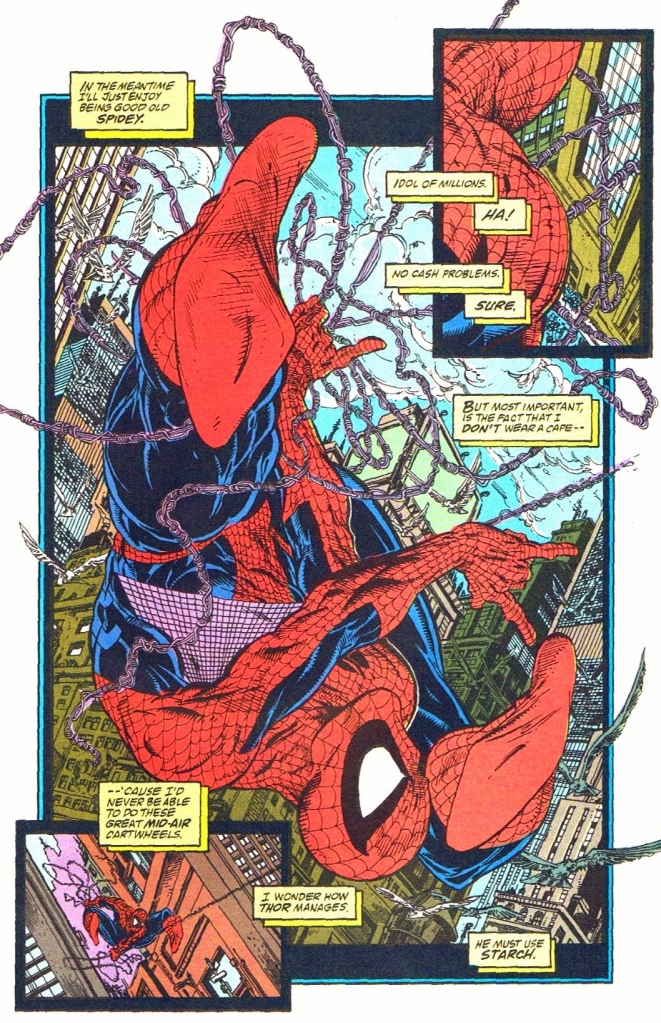
This page is an example of Todd McFarlane creating a travel sequence that allowed him to draw something great. It’s a classic example of moving back into the comfort zone.
To make things very clear here, this comic book is pretty shallow and hollow mainly due to its storytelling as this was the writing of a very young Todd McFarlane. There is no denying that his art here is great to look at from start to finish. In fact, this was one of McFarlane’s finest visual works ever with Marvel.
But if you look beyond the great visuals, the writing is very weak all throughout the issue. At best, this comic book is a grand-looking yet shallow set-up for the conflict of the Torment storyline complete with shared emphasis on the iconic web-slinger, the Lizard (looking more menacing than before) and Calypso (the one behind the magic and rituals).
In fairness to McFarlane, he added his own touch on emphasizing the personalities of Peter Parker and wife Mary Jane simultaneously as a couple. If you were used to seeing in-depth character development and witty dialogue about the two major characters as portrayed in the Amazing Spider-Man, Web of Spider-Man and Spectacular Spider-Man series of 1990, you won’t find them in this comic book. Under McFarlane’s writing, Spider-Man in this issue showed signs of sarcasm and cockiness in the first scene, and with Mary Jane he (as Peter Parker) expressed himself philosophically. To say the least, the portrayal of Spider-Man here is noticeably different under McFarlane.
The Lizard, a long-time rival of Spider-Man’s, was presented to be very violent and murderous in this issue. This was clearly McFarlane’s approach on emphasizing the force of opposition that awaits the iconic web-slinger and he obviously went for a more adulterated approach with the visuals. That being said, the violent content in this comic book is very unique and clearly stood out from the rest of the Spider-Man-related comics published by Marvel in 1990. Lastly, I should say that McFarlane’s visual take on the Lizard is the best I have seen.
Going back to the visuals, McFarlane implemented strong elements of horror, darkness and grittiness which went along well with the adulterated approach to violence. These mixed elements, as they turned out in reality, became part of McFarlane’s future works past Spider-Man.
Conclusion
McFarlane’s vicious and horrifying approach on visualizing the Lizard can’t be ignored. This Lizard makes the cinematic Lizard of the 2012 movie The Amazing Spider-Man look cartoony.
Spider-Man #1 (1990) is a very mixed bag when it comes to literary enjoyment. It clearly has great artwork by McFarlane whose adulterated approach on expression and spectacle made it very unique. The writing by McFarlane (who was very young at the time of production) is clearly the big letdown although his own approach on portraying Spider-Man, MJ and the Lizard are very notable. Take note that this was Todd McFarlane starting with writing while doing the art (his true strength), and at this point in comic book history his talent on telling compelling stories would not be realized until a few years later (particularly with Spawn and Image Comics). Notably, his use of visual horror and darkness predates his work in Spawn which makes his Spider-Man take very distinct. Ultimately, this comic book served as a build-up for things to come in the Torment storyline. Don’t expect too much when acquiring this comic book.
Disclaimer: This is my original work with details sourced from reading the comic book and doing personal research. Anyone who wants to use this article, in part or in whole, needs to secure first my permission and agree to cite me as the source and author. Let it be known that any unauthorized use of this article will constrain the author to pursue the remedies under R.A. No. 8293, the Revised Penal Code, and/or all applicable legal actions under the laws of the Philippines.
Welcome back superhero enthusiasts, 1990s culture enthusiasts and comic book collectors! Today we go back to the early 1990s and explore a part of the Valiant Comics shared universe through the Armorines monthly series.
During the said decade, Valiant Comics was notable for having crossovers that some readers found to be tightly executed in relation to continuity. The armored U.S. Marines (Armorines) and the powerful individual X-O Manowar have the spider aliens as a common enemy.
With those details laid down, here is a look back at Armorines #6, published in 1994 by Valiant Comics with a story written by Jorge Gonzalez and drawn by Jim Calafiore.
The cover.
Early story
The story begins in space when the spider aliens (located inside a huge space ship) are organizing themselves to get back to their home world.
Meanwhile above the Earth, X-O Manowar significantly helps the Armorines with repairing their space shuttle. It turns out that they have been spending a long time in space and the crew has gotten exhausted after the big battle with the spider aliens. Going back home was their next objective.
Just as the crew prepares to return to Earth, the same huge space ship of the spider aliens suddenly approaches them…
Quality
The spider aliens.
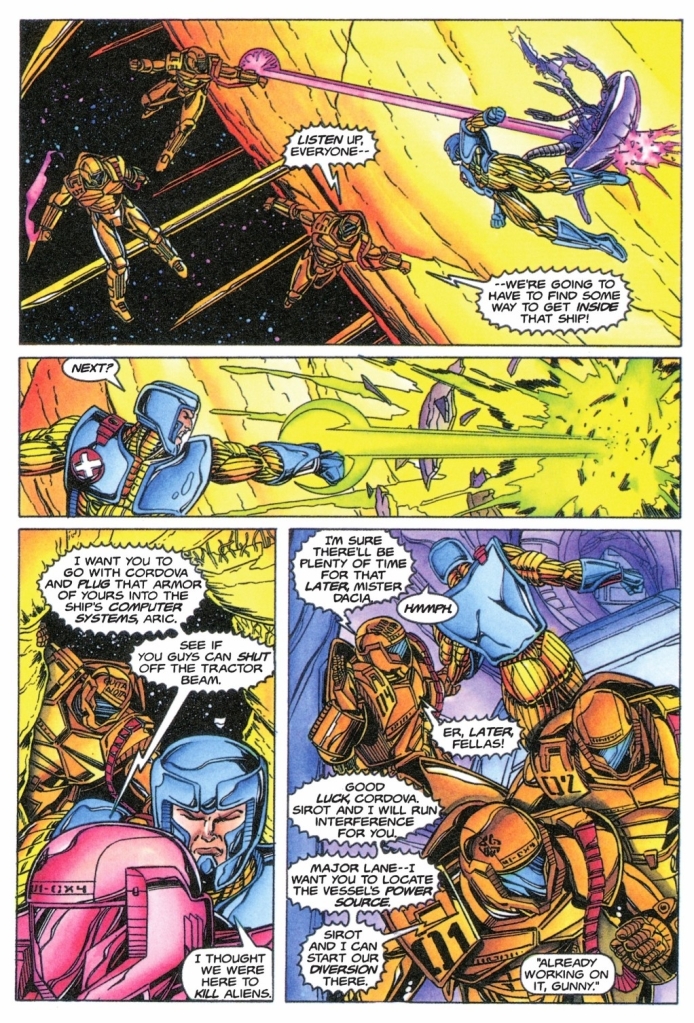
Set after the crossover tale about the humans’ battle with the spider aliens in space, this tale served as a creative extension of those events utilizing space travel and sci-fi action concepts. The Armorines once again fight the spider aliens and X-O Manowar (a major Valiant character) gets heavily involved as he has a personal grudge against them. Without spoiling the plot, I can say that themes of freeing yourself from the enemy and getting back home are evident.
There is plenty of action to enjoy here and the sci-fi settings (including the interiors of the spider aliens ship) are nicely presented. I also like the fact that the tension gradually built-up as the story went on. Still, at this particular stage of this series, I could not help but feel that the Armorines have been in conflict with the spider aliens for too long.
Conclusion
There is a lot of sci-fi action to enjoy here.
Armorines #6 (1994) is a pretty good read but I was getting tired of seeing the Armorines remaining in conflict with the spider aliens. What added strong value to the comic book was the heavy involvement (and crossover) of X-O Manowar and his interactions with the Armorines was well executed. To be clear, the story was not conclusive and at this stage, I still am interested to see what would happen next. Here is hoping that the Armorines conflict with the spider aliens will improve somehow.
Disclaimer: This is my original work with details sourced from reading the comic book and doing personal research. Anyone who wants to use this article, in part or in whole, needs to secure first my permission and agree to cite me as the source and author. Let it be known that any unauthorized use of this article will constrain the author to pursue the remedies under R.A. No. 8293, the Revised Penal Code, and/or all applicable legal actions under the laws of the Philippines.
Welcome back superhero enthusiasts, 1990s arts and culture enthusiasts, and comic book collectors! Today we go back to the mid-1990s to explore the comic book launch of a notable fictional team co-created by the Whilce Portacio and Brandon Choi…Wetworks.
For the newcomers reading this, Whilce Portacio was one of the highly talented illustrators who left Marvel Comics and co-founded Image Comics in the early 1990s. While his fellow co-founders Todd McFarlane, Jim Lee, Rob Liefeld, Marc Silvestri, Jim Valentino and Erik Larsen were able to launch their respective dream projects (creator-owned properties) during Image’s first year of publishing, the launch of Wetworks was delayed by two years due to a death in Portacio’s family.
As a very young comic book reader in those days, I remember hearing rumors about Wetworks inside comic book stores I visited. There were rumors of business negotiations, solicitations and scheduled launches (ranging from October 1993 to January 1994). I also noticed some comic book enthusiasts who bought old copies of X-Factor and Uncanny X-Men that Portacio illustrated while waiting for Wetworks to debut.
In the middle of 1994, Wetworks was finally launched under the Image Comics label and I still remember the day when I saw lots of copies of issue #1 displayed on the shelves and windows of comic book stores.
With those details laid down, here is a look back at Wetworks #1, published in 1994 by Image Comics with a story written by Whilce Portacio and Brandon Choi. The art was done by Portacio with ink work by Scott Williams.
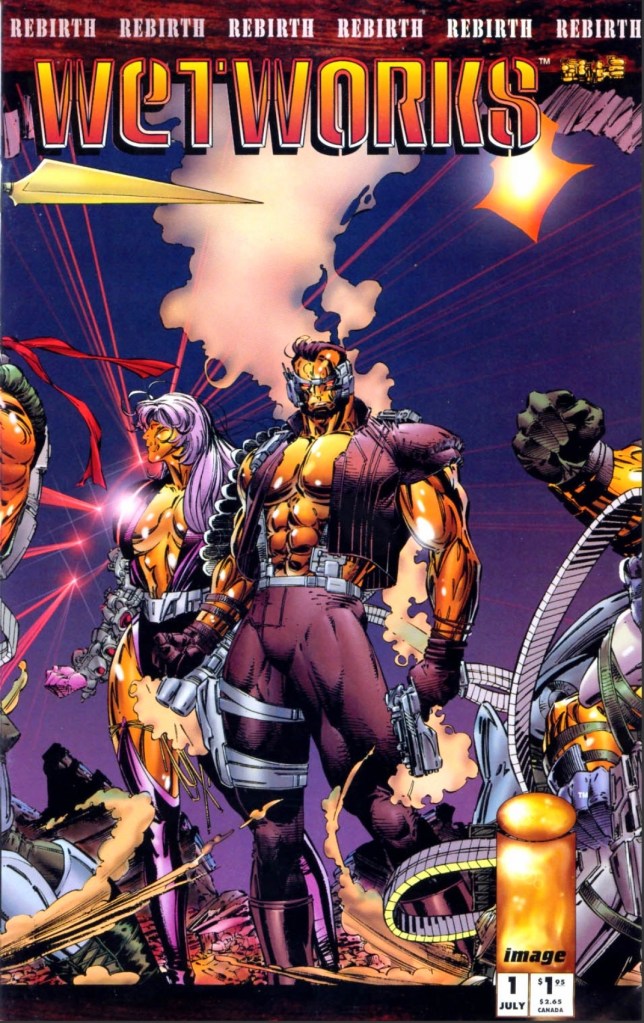
The cover.
Early story
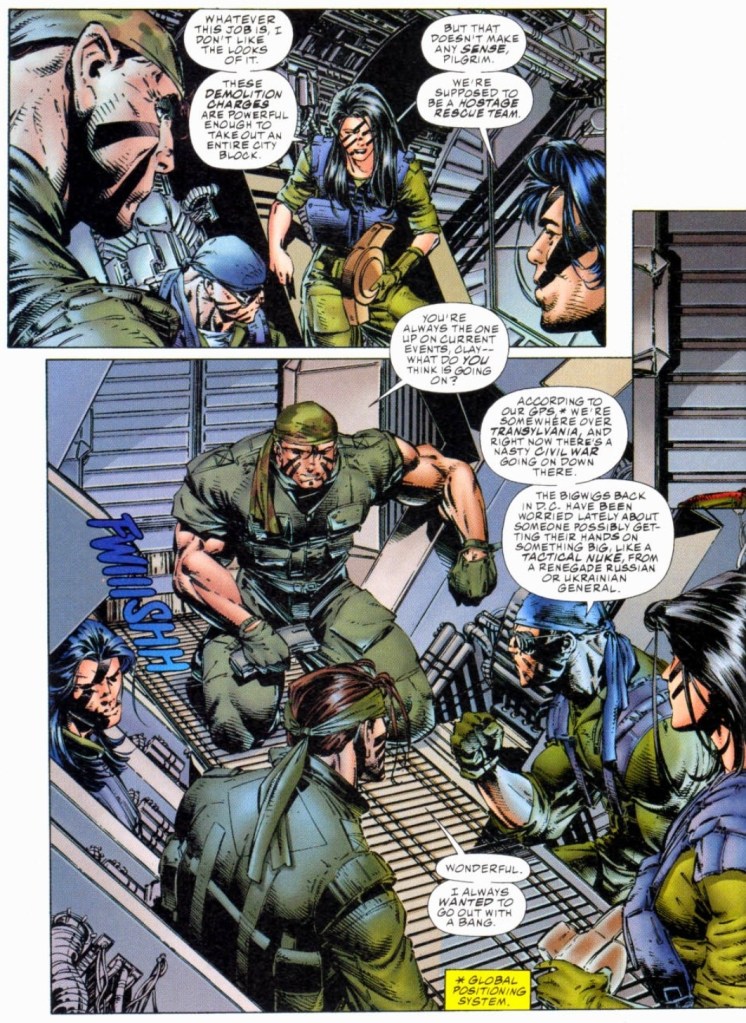
The story begins when a covert operations team working under International Operations (IO) travels to eastern Europe to infiltrate and destroy the base of operations of a certain warring faction and retrieve a biological agent (highly contagious) no matter what the cost. As it turns out, this new mission for the team (led by Colonel Jackson Dane, one of the pioneers of Team 7) started less than twenty four houses after their previous mission and their female member Pilgrim (reconnaissance specialist) pointed out that the demolition charges they are carrying are strong enough to wipe out an entire city block. Another teammate called Grail (the Filipino named Salvador Joel Alonday) stated that they are supposed to be a hostage rescue team.
Meanwhile deep inside the command center of IO in Washington, D.C., Admiral Halsey tells Miles Craven that Team 7 (the team led by Dane) are under his command and states that his sources tell him that there is more to the mission than just a group of ethnic nationalists obsessed on a biological terror campaign. It turns out, Craven sent the team to eastern Europe without fully informing them of what they are going up against. Craven insists that Team 7 are paid to put their lives on the line and to die if necessary just to get the job done. Craven then reveals to Halsey the true nature of the mission. The admiral then realizes Craven is right and certain sacrifices must be made for the greater good.
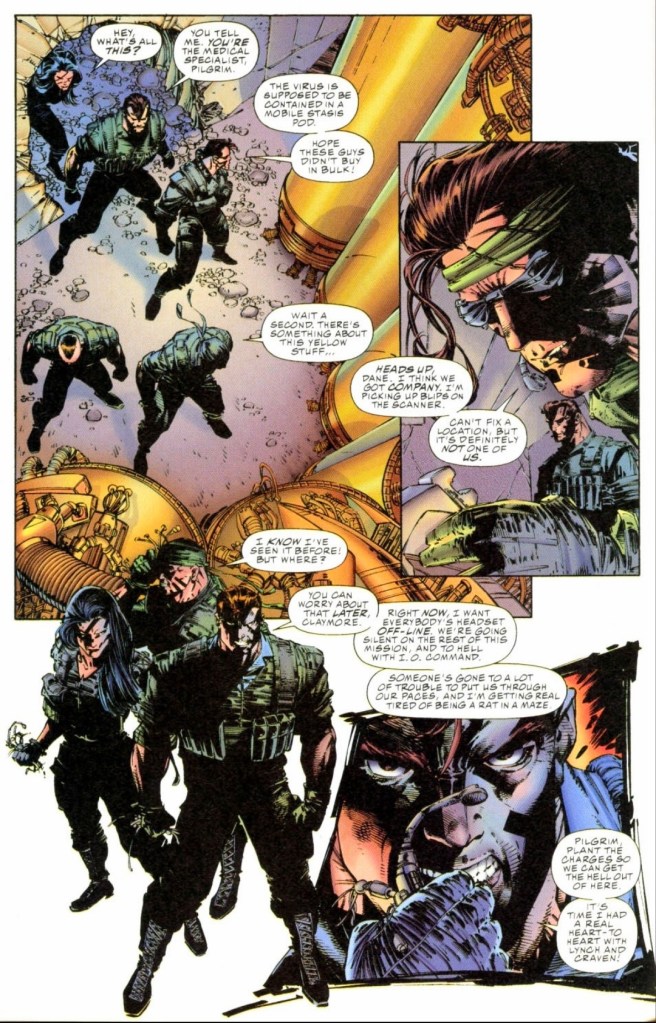
Craven and his team arrived at the location in Transylvania. They started seeing signs that someone else arrived ahead of them…
Quality
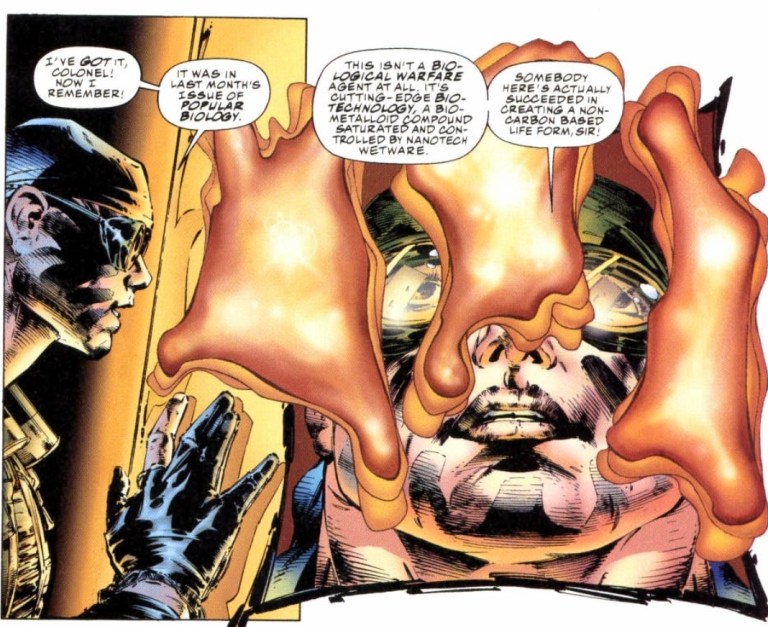
One of the team members looks at a symbiote.
I’ll start first with the fantasy concept and the storytelling. Whilce Portacio and Brandon Choi’s joint creation of Wetworks is indeed an inspired move with connections to real-life military influences the creators had. The Wetworks team – initially referred to as Team 7 – started looking and acting like typical military squad in the world of fiction but the major twist that happened drastically redefined and refined them into the most unique military team in the world of superhero comics. It’s the closest thing to seeing G.I. Joe fused with living symbiotes (another inspired move most likely influenced by a certain Marvel murderer with a symbiote whose origin is linked with one of the most iconic superheroes ever) there is and I can say Wetworks remains relevant and stands out nicely among superhero comic book teams to this day.
With regards to the plot, it looks cliched on face value. I’m talking about the trope in which a team is sent by their powerful superiors on a mission without knowing all the crucial details needed (because the superiors hid it from them) and they eventually encounter immense danger. As mentioned earlier, the major twist in the plot not only completed a major transformation of Dane and his teammates but also ramped up the fantasy aspect of the tale to much higher levels.
Still on the plot, Portacio and Choi came up with a solid structure for the narrative. The build-up of details and tension was very good and the pay-offs (lots of spectacle plus twists) were great. As the story moved on, the suspense grew stronger and the narrative succeeded in making me care about the team led by Dane.
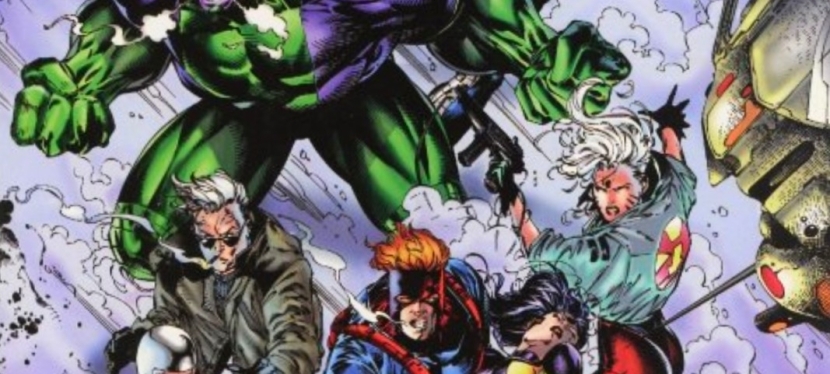
Meet the team members who would later become Wetworks.
When it comes to the art, Portacio’s work here (with ink by Scott Williams) still looks great and, more notably, it is a fine departure from the superhero visuals he worked in years prior. As with his past works, you will see the artist’s stylized approach on visualizing the narrative related to how he implements the panels per page.
Portacio did a very good job with the military look of Wetworks and he drew their guns with a high amount of detail that should be seen (you should try using a magnifying glass on this comic book). Not only that, his art on military hardware such as the gunships, the interiors plus equipment all have that detailed appearance. When it comes to action, I believe that Portacio took a lot inspiration from Hollywood action flicks (most notably Predator) on portraying Wetworks members using their guns and positioning during battle.
Of course, the spectacle is not totally limited to military stuff. There is a touch of fantasy and horror visuals involved which is directly related to what was set-up for Wetworks to encounter in the near future. To realize what I am saying here, you must read this comic book until the intense end.
Conclusion
Wetworks #1 from 1994 is still great to read!
I can say without a doubt that Wetworks #1 (1994) remains as gripping and as entertaining as when I first read it decades ago. In short, it has aged well and reading it all over again today is compelling and a lot of fun to do. If you ask me, this is one of the finest works ever by Whilce Portacio in terms of art and storytelling. As one of the many comic books Image published during its first few years in the industry, Wetworks #1 (1994) clearly stands out with its military theme and fantasy concept. Lastly, Wetworks is set within the WildStorm universe as dramatically symbolized with the presence of International Operations (the team’s superiors).
Disclaimer: This is my original work with details sourced from reading the comic book and doing personal research. Anyone who wants to use this article, in part or in whole, needs to secure first my permission and agree to cite me as the source and author. Let it be known that any unauthorized use of this article will constrain the author to pursue the remedies under R.A. No. 8293, the Revised Penal Code, and/or all applicable legal actions under the laws of the Philippines.
Welcome back superhero enthusiasts, 1990s arts and culture enthusiasts, Marvel Comics fans and comic book collectors! Today we go back to the mid-1990s to explore another notable chapter of Jim Lee’s WildC.A.T.S.: Covert Action Teams during the creator’s time with Image Comics.
For any fan, witnessing a change of creative direction can either be alienating or engaging to follow. As clearly done in the WildC.A.T.S.-Huntsman storyline done by Chris Claremont and Lee, there was a serious change of direction of the team as it involved in-depth redevelopment of Zealot, the introduction of Claremont’s creation (Huntsman), the introduction of new characters and moving certain WildC.A.T.S. members into the background. Read my retro reviews by clicking here, here, here and here.
After the publication of Erik Larsen’s creative handling of WildC.A.T.S.: Covert Action Teams with issue #14, a new creative team came into the picture with several new stories and the further redevelopment of the titular team in mind.
With those details laid down, here is a look back at WildC.A.T.S.: Covert Action Teams #15, published in 1994 by Image Comics with a story written by James Robinson and drawn by Travis Charest.
The cover.
Early story
The story begins at Jacob Marlowe’s high-end place in Aspen, Colorado. In presence of Spartan, Grifter, Void, Zealot, Voodoo, Maul and Warblade, Marlowe tells them he has important matters to attend to as he, along with other heads of corporations, has been asked by the new government to run an energy commission. The said commission is part of the government’s plan to repair the damage that was done by the possessed US Vice President Dan Quayle.
Suddenly a heavily armed helicopter arrives out of nowhere and fires at them causing a lot of damage. During the attack, Voodoo gets hit and suffers a serious injury. Grifter fires a barrage of bullets at the helicopter which causes it to explode and crash. With Voodoo out of commission, the team just lost its advantage to spot Daemonites.
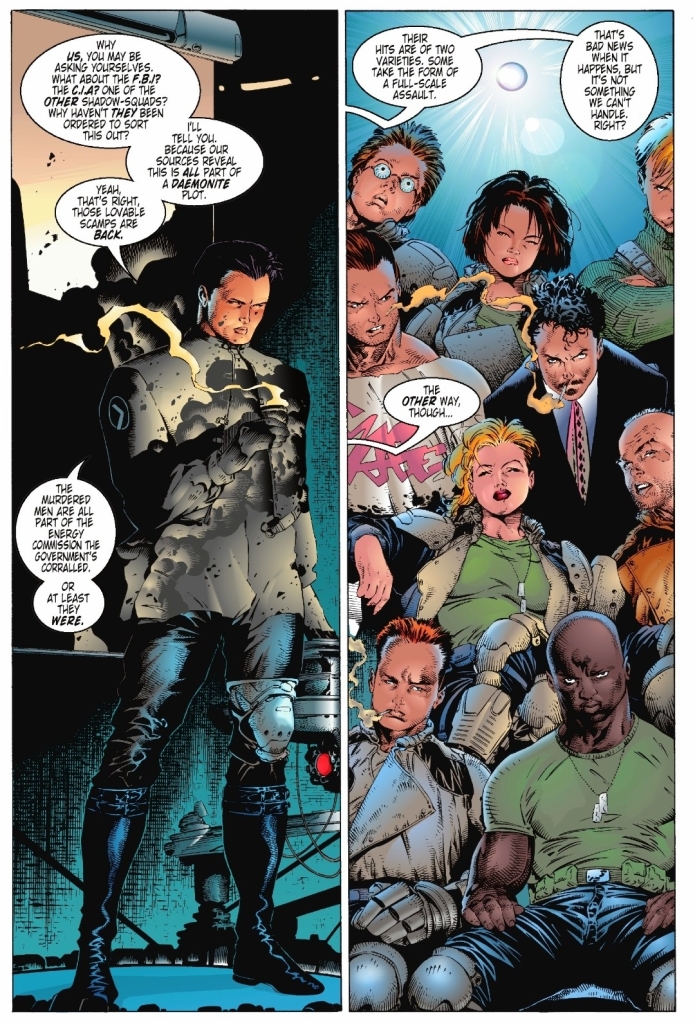
The next day at the headquarters of IO (International Operations), the team Black Razors hold a meeting as their member Ben Santini has been elevated as their new leader. He leads the briefing and informs the members of the assassination attempts on the members of the commission…
Quality
Meet Ben Santini (left), the new leader of the Black Razors. At right are the members.
When I first read this story way back in 1994, I was alienated a bit by the creative team’s approach to emphasize the Black Razors at the expense of the titular team. And yet, I was pleasantly surprised by the Robinson-Charest creative direction as the Black Razors turned out to be a sensible and strong parallel team to the WildC.A.T.S. without becoming another force of evil. While it is clear that the Daemonite threat is strong with several of the aliens hidden among members of human populations, there clearly had to be another force of opposition for the titular team to face-off with and the Black Razors (which serve IO) clearly fit in well with the concept.
Any dedicated fan of this franchise will realize that the Black Razors first appeared in the original 1992 mini-series but it was only in this issue when Ben Santini (who was shot on the knee by Jacob Marlowe) was realized as a character.
Ben Santini’s introduction here was engaging and his motivations to lead the team were made clear while other Black Razor members had their own small slices of the spotlight. Santini is not exactly evil but he has a clearly defined goal in serving his superiors at IO. This means he intends to make an impact as he struggles with the responsibilities of leading the team even as the other members are not so trusting towards him.
While the paramilitary influence within the WildC.A.T.S. series has often been present, it was noticeably revived strongly by the Robinson-Charest duo in this comic book. The story also served as a creative update of IO for readers to absorb complete with elements of espionage and geo-political developments. In some ways, this comic book made the series more grounded with reality while still maintaining some fantasy concepts to keep readers entertained.
Conclusion
Grifter successfully defeated the armed helicopter but Voodoo remained seriously injured from the attack.
I can say out loud that WildC.A.T.S.: Covert Action Teams #15 (1994) is still great to read and the debut of James Robinson and Travis Charest as handlers of the comic book series remains rock solid in terms of quality and creativity. While the titular team and fan-favorite characters had a very limited presence in this comic book, the introduction of Ben Santini and the stronger emphasis on the Black Razors as a group of trained members (as opposed to being faceless during their appearance in the mini-series) more than made up for it. In fact, the build-up of the Black Razors has a lot of variety and nice quality work by Robinson and Charest. Ultimately, I was entertained with this comic book and it proved effective to make me look forward to the next issue.
Overall, WildC.A.T.S.: Covert Action Teams #15 (1994)is highly recommended!
For decades now, I have been living in Alabang and I witnessed how much Muntinlupa City modernized along the way. Bordering Barangay Ayala Alabang is Filinvest City (formerly called Filinvest Corporate City) which itself is home to several business or facilities such as the Filinvest Tent, Commercenter, Acacia Hotel Manila, Crimson Hotel, Westgate and, of course, the wildly popular place to be in – Festival Mall.
For the newcomers reading this, Festival Mall opened in May 1998 with its initial name Festival Supermall. Way back then, out of pure curiosity, I entered the mall for the first-time ever during its soft opening on May 1, 1998 (Labor Day here in the Philippines) as I was already looking for a new place and new discoveries at a time when I got tired of Alabang Town Center (ATC).
Being very new back then, Festival Mall’s presence of retailers or tenants was not yet dynamic as there were still businesses inside that could not open in time for the mall’s opening. I do remember walking down seeing lots of vacant retail spots covered with signs such as “opening soon”, “coming soon” and the like. Back in those days, the Philippine economy and society itself were dampened by the 1997 Asian Financial Crisis.
As the months passed by, more businesses opened and Festival Mall’s early attractions include the X-Site Amusement Center (which already had the indoor roller coaster) and, of course, the brand new cinemas which had several screens operating at a very spacious area on the top floor. I still remember seeing lots of people lining up for tickets and seats to watch Armageddon which ended up as the highest grossing movie of the world in 1998.
Indeed, for more than a decade, Festival Mall’s original cinemas became a favorite destination of mine to watch movies in Alabang and I definitely was not alone. I also remember the times when the said cinemas attracted a whole lot of moviegoers when the annual Metro Manila Film Festival’s (MMFF) opening day (every December 25) happened resulting in long lines. Watch the YouTube videos below…
As you can see in the above videos, Festival Mall’s original cinemas was a hot spot for moviegoers. It should be noted that the mall is strategically located in close proximity to the Alabang Viaduct and the South Luzon Expressway (SLEX) which ensures visibility to motorists and accessibility to commuters on a daily basis. The old cinemas were also a hot spot for a variety of small businesses selling different kinds of food and drinks to moviegoers and others who just passed by.
Festival Mall at 25
This past May, Festival Mall turned 25 and its anniversary was highlighted with special events as well and publicity through the media. There were these Festival Mall 25th anniversary feature articles that got published in different newspapers almost simultaneously. In the commemorative article that got published in the Manila Bulletin, President and CEO of Filinvest Development Corporation Josephine Gotianun Yap was quoted which goes as follows in the excerpt below. Some parts in boldface…
“We would not be where we are today without the unwavering support of our customers, merchants, suppliers, and employees who have journeyed with us through the years. It is humbling to think that when we first opened the mall, we only had 30 stores and no anchor supermarket. But thousands of visitors came on our first day, attracted by our amusement centers, cinemas, and food court. And now the mall has 800 tenants and eight leading anchor stores. We value our collaboration with major retailers, which has enabled us to bring together SaveMore, Ace Hardware, Robinson’s Department Store, Handyman, Shopwise, H&M, Decathlon, and Landmark all under one roof. As we build on its strong foundations for the future, we see Festival Mall continuing to serve as a place where time stops for making memories with family and friends,”
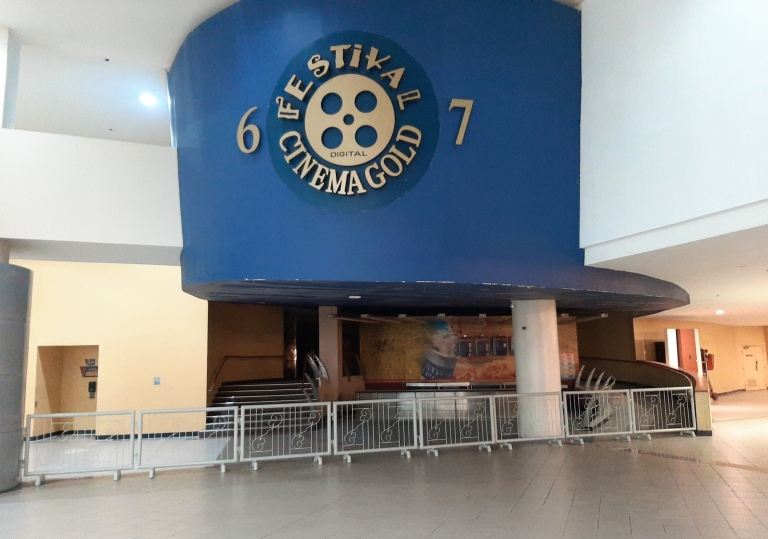
As seen above, the Filinvest Development Corporation executive clearly referred to the original cinemas which was one of the early attractions of Festival Mall way back in 1998. As mentioned earlier, Festival Mall today has more modern cinemas located at the expanded area on the same floor but several meters away from the original cinemas. So how does Festival Mall’s original cinemas look like nowadays? Watch the video below…
Yes, indeed the mall’s original cinemas have turned depressing. There are much less customers who pass by the area and many of the businesses that operated within have closed down! As I personally found out, Festival Mall is still using a few screens at the old cinemas for moviegoers while leaving the many others closed and left in the dark. If you think about it carefully, what does the mall management have in mind with regards to all of those cinema seats, sound systems, projectors, screens and other pieces of equipment inside each and every closed screen of the original cinemas?
A closed screen at one end of the original cinemas of Festival Mall. Just imagine what is left of all the hardware (examples: projectors and speakers) and seats inside.
This was a premium place to watch movies at. It had more comfortable seats and better equipment that made the cinematic experience more immersive. It was here where I saw 2001’s Final Fantasy: The Spirits Within.
This is where I used to buy movie tickets for many years. For some time now, the selling of movie tickets here has stopped. To buy tickets, you have to go to the modern cinemas of the mall several meters away by foot at the same floor.
Apart from seeing more of the screens of the original cinemas closed down, the number of small-time businesses that sold different kinds of food and drinks are also gone which is depressing. Those businesses offered moviegoers different choices of what to eat or drink apart from the usual popcorn and drinks sold by the cinema’s concessionaires. I do remember a certain business joint that sold really good coffee (both hot and cold) that is also affordable.
There used to be different kinds of small business joints that sold a variety of food and drinks located on the floor spots at the original cinemas area. Those businesses have since closed down and left.
I remember the times I bought popcorn and drinks at this place before watching a movie. Now there are no food, no drinks and no people selling to customers anymore.
With the way things are right now, walking through the original cinemas area of Festival Mall is lonely and depressing to do. The area is almost lifeless and it easily is the saddest place inside the mall which itself has become a major attraction for shoppers and families. I can only wonder if Festival Mall’s management has any plan to revive the original cinemas area. Will they someday renovate at least a few of the screens and install brand new seats and other equipment to accommodate more moviegoers? Do they plan to attract new businesses to occupy the vacant commercial spaces and floor spaces near the old cinemas?
It would be nice to know if Festival Mall’s management or Filinvest itself has any plan to revive commerce at the original cinemas area which is now the saddest and loneliest part of the mall.
To be very clear with you all reading this, I never worked for a shopping mall nor have I ever worked in the movie theater business. I am a long-time resident of Alabang who often visits Festival Mall for purchasing needed items, dining and availing of services. Watching movies at Festival Mall used to be a big reason for me to spend time at the mall. I know for a fact that operating movie theaters is difficult and attracting people to watch movies on the big screen is tougher because of streaming. It does not help that the COVID-19 pandemic convinced people that watching new movies at home via streaming is the new standard which also made them think that movie theaters are unnecessary.
As a movie enthusiast, I can say out loud that watching a movie inside the cinema is still the best and most definitive way to enjoy watching. The movie theater experience can never be matched by streaming nor could the biggest HDTV at home could ever come close to the size and visual impact of a cinema screen. That being said, I can only hope that Festival Mall could someday revive the movie experience and commerce at their original cinemas area. They already have the modern cinemas at the expanded area but those are only 4 screens.
If you are living here in South Metro Manila and you have been to Festival Mall several times before, what do you think the mall management should do about their old cinemas? Is Festival Mall your favorite place to watch movies in? Do you think that hosting multiple film festivals – both foreign and domestic – each year would justify renovating the old cinemas of the mall?
Have you been searching for something fun or interesting to watch on YouTube? Do you feel bored right now and you crave for something to see on the world’s most popular online video destination?
I recommend you check out the following topics and the related videos I found.
#1Godzilla videos in preparation for the new Japanese Godzilla movie
In case you missed the news due to the excessive amount of entertainment developments, there is indeed a brand new Japanese-produced movie of Godzilla (Gojira in Japan) titled Godzilla Minus One which will open in cinemas in Japan this November and in America this December. You can check out my post about Godzilla Minus One by clicking here.
With renewed interest in Toho’s Godzilla sparked in moviegoers’ minds, here are some videos that can help you get to know Japan’s iconic giant monster better before the new movie comes out.
#2 Forza Motorsport (2023)
The much awaited big-budget simulation racing game Forza Motorsport (2023) is coming out on Xbox Series X, Xbox Series S, Windows PC plus Xbox Game Pass and PC Game Pass within a few days from now for its general release. The big-budget Xbox-exclusive racing game is actually available via early access to those who paid extra for the privilege via the Premium Edition. As with tradition, gaming media outlets produced several video previews and updates of the game recently as the release date came closer and here are the videos you must watch on YouTube. Already Forza Motorsport (2023) received acclaim from critics (click here, here, here and here). Take note that this is the first new Forza Motorsport video game since 2017.
#3 Stay away electric vehicles (EVs) as they could kill you
No matter what the Leftists and climate change extremists do, I personally reject electric vehicles (EVs) and the elimination of fossil fuel and the lessening of energy choices for consumers. No matter what flashy publicity and loud talking points were made, I am not convinced that electric vehicles are safe enough to use for daily travel. In fact, many EV makers don’t want you to know that when their vehicles spark into flames, the fire is much harder to put out and often requires a higher amount of water to do so. Why is that EVs spark and become major fire hazards on the street (and even burn down homes) can be realized in the videos below.
#4 Music video of New Life Music’s worship song Testimony
The music team of New Life Philippines released the official music video (note: backstage sessions specifically) of their newest worship song Testimony. Written by Nash Soliven, Camille Cuna, Erican Reyes, Timothy Mena, Charity Patricio, Josiah Patricio and Sam Mokamad, Testimony reflects the meaning of Revelation 19:10 in the Holy Bible and it was made to strengthen people’s faith in the Lord and believe He is still moving no matter how bad things are around us in this very divided world we live in. The song will remind you about having the testimony of our Lord and Savior Jesus. Watch the official music video by New Life Music below.
#5 Visit the Pool of Siloam in Israel
As some of you may have known by now, I went to Israel on a pilgrimage tour with my local church which was hosted by a very good Israeli strategic partner who ensured everything was in order. Among the many sites we visited in the Holy Land was the Pool of Siloam which was the very place where a blind man (born with blindness) got healed because he followed the instructions of our Lord and Savior Jesus without hesitation. For reference, read John 9:1-11 in the Holy Bible.
You can read my Pool of Siloam feature article by clicking here. I also have several other Israel 2023 articles on this website and I hope they will inspire you to visit the Holy Land in Israel to deepen your faith in the Lord. It is in Israel where the Holy Bible comes to life!
Watch the videos – including my very own video at the place – about the Pool of Siloam below.
Recently here in the Philippines, GMA Network made waves to boost their sports coverage by unveiling their artificial intelligence (AI) sportscasters named Maia and Marco which drew varied reactions from Filipinos online. Check out the official video unveiling of the AI sportscasters from GMA Integrated News’ YouTube channel below…
If you look at Maia and Marco’s unveiling, you probably would have been impressed with how photo-realistic they look and how almost human they sounded (including being able to speak Tagalog). They were made to look like Filipinos convincingly You might be saying to yourself that this is a shining example of Filipino achievement in the world of technology and be totally accepting of it. But make no mistake as Maia and Marco are indeed not real people (fake Filipinos) and most notably, they have no souls at all.
This bring me to the fact that AI has no soul and we humans must take action to prevent artificial intelligence from overwhelming us. Overseas, the development of AI is moving at a rapid face and the competing tech giants (which invested heavily on AI) involved are so focused on outmaneuvering and outdoing each other, they don’t seem to care about the possibilities that AI could turn into a rebellious force that could harm people around the world in multiple ways. Already, artificial intelligence and robotics are emerging as threats to humanity. To put things in perspective, watch the CBN News YouTube videos below…
With AI and robots left unchecked, a new form of religion that has nothing to do with God, Lord Jesus and the Holy Spirit is emerging already. There are those who pulled themselves away from the Lord to dedicate themselves to intelligent robots, human-like AI-driven characters and other aspects of technology. I would not be surprised if I find out that GMA’s Maia and Marco are being idolized by some people right now (note: idolatry is both foolish and unholy).
In the world of entertainment, AI is already being used as a tool for visuals (combined with computer-generated imaging or CGI) which includes the process of recreating the likenesses of actors (both the living and the dead) to make characters on-screen look as real as possible. In relation, the digital ways of resurrecting dead actors to portray their respective characters is morally disturbing to say the very least. It should also be stated that AI itself is being used to make articles, essays and even scripts – literary pieces that were not composed by the human user himself/herself. Has it occurred to you that the movie or streaming show you watched used a script that was partially made with AI because the screenwriter took shortcuts when working? Learn from the YouTube videos of Dave Cullen below…
Going back to GMA Network and its AI sportscasters, a lot of Filipinos have been questioning how artificial intelligence will affect not only journalism but also Philippine sports broadcasting (a lively sector) and job opportunities (which millions nationwide need badly). No matter how life-like and charismatic they look on-screen, Maia and Marco are still fake Filipinos created with AI and CGI. They are characters, not human beings. Did GMA Network even try to search for talented and charismatic prospects for their sports broadcasting needs among the many living and breathing Filipinos present in the country? The Philippines has a population of over 100 million people and that includes many young adults and adults who can be employed.
Way back in 1992, in a response to Marvel Comics’ expression that creative people (their employees) are secondary to their comic book characters, Image Comics co-founder Rob Liefeld emphasized the need for a living and breathing work force to keep the company and the business moving.
“Without your creative people, there would be no Batman, there would be no Spider-Man, there would be no Hulk. That’s short-sighted as far as I am concerned. You will need warm bodies, warm creative bodies to create properties to keep your company going,” said Liefeld.
While he specifically did not talk about AI at all, what Liefeld said long ago is still highly relevant which companies and organizations here in the Philippines can learn from before going all-in with artificial intelligence (which will deprive job seekers the opportunities). At least in my view, AI is unnecessary with sports broadcasting. There is nothing like watching a live sports event happen in which the human broadcaster makes powerful or exciting verbal expressions whenever a fun moment happens during the game. That being said, do you seriously think an AI sportscaster can pull off such human reactions in natural and believable fashion for the millions of viewers watching? In case you did not notice, Maia and Marco of GMA still have that robotic tone with the ways they talked – undeniable proof that AI has no soul. Humans who work have souls.
In fairness, GMA Network is aware of the public’s concerns about AI with regards to ethics, human labor, journalism and more. Watch the GMA YouTube news video (mostly in Tagalog) below…
Regardless of how AI develops and make impact on Filipinos, what is clear to me is that measures must be taken to ensure that humans will always have an advantage over artificial intelligence. I am talking about the need for kill switches covering all AI applications and projects to ensure that human users will have the edge in the event that AI turns rogue against humanity. That being said, I encourage you readers to contact your congressional representative and tell him or her to make laws that will make kill switches on AI a requirement all over the Philippines, and that includes requiring all AI providers/makers (including the foreign entities) to comply. Users of AI should be prioritized always! Do you want ChatGPT to control you or destroy you and your family? Do you want robots with AI to be a major part of your household and your lifestyle? I don’t think so.
Once again, AI has no soul. If you want to cook, do it yourself. If you want to write a letter or an article, do it yourself. If you want to compose a teaching module or a new prayer for a bible-focused session in your local church, push AI out of the way to follow the lead of the Holy Spirit and then proceed with the Lord’s command. By the way, artificial intelligence and technology could never understand the Holy Spirit and you definitely should never let them be part of your Christianity. No matter how many people around you worshipAI, robots, science and technology, you should never let them pull you away from the Lord.
Let me end this piece by asking you readers: What is your reaction to this latest development? Do you think GMA Network has set a bad example with their AI sportscasters Maia and Marco with regards to Philippine sports coverage and journalism in general? Why do you think the network wanted their AI sportscaster to look human? Do you think the technology of artificial intelligence will be abused by those who possess it here in the Philippines? Do you think Philippine Congress should come up with a new law requiring kill switches on all AI projects and applications within the country to ensure that users will still have an advantage in case AI goes rogue? Do you think a rogue AI can bring down the security and economy of the Philippines?
Disclaimer: This is my original work with details sourced from reading the comic book and doing personal research. Anyone who wants to use this article, in part or in whole, needs to secure first my permission and agree to cite me as the source and author. Let it be known that any unauthorized use of this article will constrain the author to pursue the remedies under R.A. No. 8293, the Revised Penal Code, and/or all applicable legal actions under the laws of the Philippines.
Welcome back superhero enthusiasts, 1990s culture enthusiasts and comic book collectors! Today we go back to the year 1994 to explore the official comic book adaptation of the movie Star Trek: Generations.
Star Trek: Generations was a cinematic production that symbolically served as the passing-of-the-torch from the original Star Trek crew (led by Captain Kirk) to the Star Trek: The Next Generation crew (led by Captain Picard). The most highlighted feature of the movie was the crossover between Kirk and Picard followed by working together to stop the villain. It was a crossover that fans wanted for some time prior to the film’s release.
In my experience, Star Trek: Generations was a disappointing movie as there were lots of flaws here and there. Most notably, the Kirk-Picard crossover (with William Shatner and Patrick Stewart in their most iconic roles) was nothing special as its payoff to all the build-up that preceded it was so small.
Unsurprisingly, there was comic book adaptation of Star Trek: Generations that appeared in the local comic book stores which I intentionally avoided reading back in 1994 as I anticipated the movie. Recently, I finally got to read it.
With those details laid down, here is a look back at the Star Trek: Generations comic book adaptation, published in 1994 by DC Comics with a story written by Michael Jan Friedman and drawn by Gordon Purcell based on the cinematic story by Rick Berman, Ronald D. Moore and Brannon Braga.
The cover.
Early story
The story begins with a retired James T. Kirk landing from his orbital skydiving activity in the presence of his long-time crew members and friends Pavel Chekov and Montgomery “Scotty” Scott. In response to Chekov’s reminder that they are to attend the launch ceremony of the USS Enterprise B (NCC-1701-B), Kirk as he is enjoying retirement and prefers to do other things like tri-elliptical jumping. Kirk also states that he swore he would never set foot on a starship again.
The next day, Kirk, Scotty and Chekov attend the ceremony at the Enterprise B greeted by journalists. Captain John Harriman personally tells Kirk that he read about his missions when he was in grade school.
Not so long after the Enterprise B launched into space, a distress call was received from a transport ship helplessly caught in some kind of energy distortion (with one other ship near it)…
Quality
The crossover encounter between Star Trek’s two most iconic captains – Kirk and Picard.
As an adaptation, this comic book is surprisingly faithful to the source material for the most part. While this adaptation does not contain 100% of all the details and scenes of the movie and there were some scenes that were shortened for brevity but it certainly has quite a lot of content for readers to absorb. In fact, it will take two full readings to truly grasp the story, get to know the characters and understand the sci-fi details that Michael Jan Friedman brought from the movie script into literary format.
Like the movie, this adaptation tackles the themes of destiny, time and loss which were emphasized through Picard and Soran. While Picard would not dare to make alterations to cope with the deaths of two relatives he loved, Soran (who previously lost family members in a tragedy and temporarily made it to the a very desired realm) willingly makes tremendous acts to fulfill his goal even it means costing tremendous death and destruction along the way.
Worf, Riker, Troi and Data on the bridge of the Enterprise during their encounter with the Klingons’ Bird of Prey.
When it comes to storytelling, this one is more about the Star Trek: The Next Generation crew facing a crisis. The scenes of Kirk and his original crew members served as a glorified prologue designed to give moviegoers (as opposed to readers) one final act of heroism by the iconic captain. Kirk doing the heroic stuff early in the story was pretty much a tribute to his past while conveniently serving as a subtle build-up for the Picard-Soran conflict and the Nexus (Star Trek’s distorted version of Heaven) leaving not much left for the Kirk-Picard crossover.
Anyone who loves Star Trek: TNG will be delighted to see their favorite characters like Picard, Data, Riker, Deanna Troi, Dr. Beverly Crusher, Geordi La Forge and Worf here as they each had good chunks of the spotlight. If you saw the movie before reading this comic book adaptation, you will be able to spot the notable lines of dialogue they said on the big screen. As details from the movie had to be compressed for this adaptation, those who got turned off by the excessive screen comedy by Brent Spiner as Data (note: this reflects the emotion chip activated in the character) will be delighted to see the funny acts were heavily toned down in favor of maintaining the narrative.
More on the quality, this adaptation also exposes many of the weakness and flaws of the movie itself. I am talking about the film’s lack of consistency when it comes to emphasizing the most important concepts of the story. Throughout the story, Kirk’s early heroic act had no real impact when the narrative focused on Star Trek: TNG nor was it a solid build-up for the crossover with Picard. The script emphasized the Nexus quite a lot but in different points as the narrative switched between focusing on Picard and Soran. That being said, the way the story was told made it easy to forget about Kirk and Picard coming together. Like in the movie, the Kirk-Picard crossover failed here too.
While the movie is indeed a very flawed source for this comic book, the adaptation spared readers from the monotony of the many pointless moments and sequences that moviegoers went through. This is understandable because brevity was needed to capture the cinematic story into literary format with the limited number of pages allocated.
If there is anything consistently good here, it is the art of Gordon Purcell who proved to be capable of capturing enough of the actors’ likenesses to make the characters recognizable. To be clear, the replication of the actors’ unique looks happened from time to time only.
Purcell did a great job making Scotty (close-up at right) look so much like actor James Doohan.
You will see certain parts of the comic book showing Captain James T. Kirk looking like William Shatner and Captain Picard looking like Patrick Stewart. There were certain pages in which Soran had Malcolm McDowell’s face, Scotty looked so much like James Doohan and more. Ironically, Purcell fell short of capturing likenesses of Marina Sirtis as Troi and Gates McFadden as Dr. Crusher.
Apart from drawing the characters, Purcell nicely visualized the look of the film and his own take of the memorable saucer crash of the TNG crew’s Enterprise had a of power and impact worth seeing. Lastly, he the artist did a good job drawing the starships.
At the very end of this adaptation were a few pages that emphasized the challenges of adapting the movie into literary format which was worth reading.
Conclusion
The scene of Picard revealing to Deanna Troi the deaths of his two relatives (obviously without Patrick Stewart’s emotional moment).
The Star Trek: Generations (1994)comic book adaptation is clearly flawed like the movie it was based on. Many of the movie’s weaknesses (including the ever disappointing Kirk-Picard crossover) made it in this comic book but the ironic thing is that the story in literary format flowed with a better pace and Gordon Purcell’s art was really attractive to look at. In fact, I can clearly say that Star Trek: Generations works better as a comic book than as a film.
Overall, the Star Trek: Generations (1994)comic book adaptationis satisfactory.
Disclaimer: This is my original work with details sourced from reading the comic book and doing personal research. Anyone who wants to use this article, in part or in whole, needs to secure first my permission and agree to cite me as the source and author. Let it be known that any unauthorized use of this article will constrain the author to pursue the remedies under R.A. No. 8293, the Revised Penal Code, and/or all applicable legal actions under the laws of the Philippines.
Welcome back superhero enthusiasts, 1990s culture enthusiasts and comic book collectors! Today we go back to the year 1996 and explore a part of the Marvel 2099 comics universe through a tale of the Spider-Man 2099 monthly series.
In my previous retro review, Miguel O’Hara learns how challenging it could be for him to direct the path of Alchemax which is symbolize with himself being surrounded by the managers. He recently stopped his father Tyler Stone from taking control of his office. As his office needs a secretary, someone very exceptional came in.
With those details laid down, here is a look back at Spider-Man 2099 #43, published in 1996 by Marvel Comics with a story written by Peter David and drawn by Andrew Wildman and Ron Lim.
The cover.
Early story
The story begins when one of the undersea bases of Alchemax explodes to the surface in heavily damaged form. Something terrible happened to it deep below and there is only one man (wearing a protective suit) still living floating on the sea. Just as he notices sharks coming his way, Spider-Man comes down to save him with the use of one of Alchemax’s floating vehicles. As Spider-Man pulls the helpless man up with his web, one of the sharks leaped high at them. The web breaks and both the man and Spidey fall into the sea.
Meanwhile at Alchemax, Gabriel O’Hara confronts his mother Conchata who very recently started working as the office secretary of Miguel. Gabriel asks how could she be working for Miguel as part of Alchemax which is the very corporation she hated. The mother answered back stating that she resolved her accumulated anger related to Miguel and has realized that he needs her…
Quality
The rise of the mutate rebel Roman and Miguel O’Hara’s corporate interactions dramatized efficiently in this single page.
Moving further away from what was dramatized in issues #40 and #41, Peter David crafted this tale focusing on a new threat that endangers not only Spider-Man but the people and their local society as a whole. To put things in perspective, it is recommend you revisit issue #8 and focus on Alchemax’s aquatic division called Atlantis which had been working on a major reclamation project under the sea with the objective of becoming a tourist attraction in the years to come. Right there, Tyler Stone mentioned Miguel’s involvement with the project which includes bio-engineered workers.
The key elements of Atlantis mentioned in issue #8 literally resurfaced in this comic book and Peter David heavily emphasized the related details and integrated it all in the plot which essentially justified the existence of the new opposition led by Roman who is the charismatic leader of the mutates (genetically designed sentient beings) who had long been working hard and long outside of the undersea bases which had humans living comfortably inside. Roman here is not related in any way to Marvel’s aquatic hero Namor the Sub-Mariner but he is an imitation of him (note: his name is Namor in reverse).
The conflict of Atlantis revives the business-laborers conflict but was twisted to show the conflict between humans and mutates, as well as Atlantis being symbolized as a physical project of Alchemax to exploit the aquatic life and resources deep under the sea. The build-up of the human-mutates conflict in this particular comic book is surprisingly beefy and was efficiently done.
As for Spider-Man himself, you will get to see him more involved with Alchemax just as he successfully keeps his civilian identity secret. Along the way, you will see more of Miguel O’Hara doing more corporate work and negotiations. As expected, his drive to lead Alchemax with his own perception of being compassionate encounters hurdles from the established order – both within and outside his company. His mother was portrayed to be more sympathetic than before and she shows lots of signs of having mellowed. The development on Miguel and Conchata here were deep and they made a lot of sense with the plot itself.
Conclusion
The futuristic Spidey interacts with a huge shark!
Spider-Man 2099 #43 (1996) is another tale that has aged well as its foundations and elements proved to be very solid until now. With regards to the big event that took place near the end of this comic book, it seems that Peter David took inspiration from what was portrayed in Fantastic Four #4 (1962) as well as from Namor the Sub-Mariner himself. I really enjoyed how this story became a huge pay-off to the minor build-up in issue #8.
Overall, Spider-Man 2099 #43 (1996) is highly recommended!

















 Author Carlo Carrasco