Disclaimer: This is my original work with details sourced from reading the comic book and doing personal research. Anyone who wants to use this article, in part or in whole, needs to secure first my permission and agree to cite me as the source and author. Let it be known that any unauthorized use of this article will constrain the author to pursue the remedies under R.A. No. 8293, the Revised Penal Code, and/or all applicable legal actions under the laws of the Philippines.
Welcome back superhero enthusiasts, 1990s culture enthusiasts and comic book collectors! Today we go back to the early 1990s and explore a part of the Marvel Comics shared universe through a tale of the Spider-Man monthly series.
In my previous retro review, Todd McFarlane told a tale of the iconic web-slinger with intense build-up leading to another rematch with his old nemesis the Lizard (Dr. Connors). While the writing was pretty weak, McFarlane still managed to tell a tale with a strong element of horror and supernatural stuff. McFarlane’s approach with visual violence and graphic stuff was clearly adulterated. What was presented daringly tested the limits allowed under the Comics Code Authority (CCA).
With those details laid down, here is a look back at Spider-Man #2, published in 1990 by Marvel Comics with a story written and drawn by Todd McFarlane. This is also the 2nd chapter of the Torment storyline.
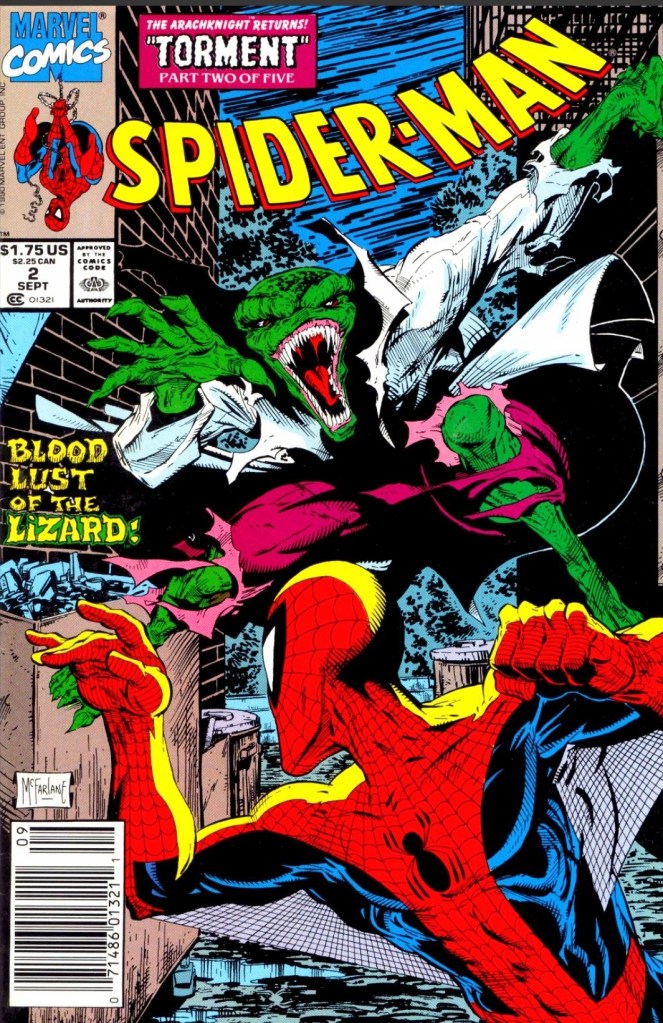
The cover.
Early story
The story begins in New York City where two men got suddenly murdered by the Lizard in an alley during the night. The next morning Peter Parker reads the newspaper (showing the photograph and the news story of the Lizard’s murder of the two men) while having a breakfast moment with his wife Mary Jane. As soon as his wife mentions the word “monster”, Peter takes a 2nd look at the newspaper’s photograph and finally notices the bloody writing “CNNR” on the alley wall which makes him realize that the Lizard is back again.
Feeling very troubled, Peter leaves Mary Jane quietly and dresses up as Spider-Man to go out once again.
Elsewhere in the city, a sorceress uses her evil method of crafting a potion which creates an unrelenting sound of disturbance which Spider-Man hears. As the sound goes on, his focus and Spider Sense get overwhelmed…
Quality
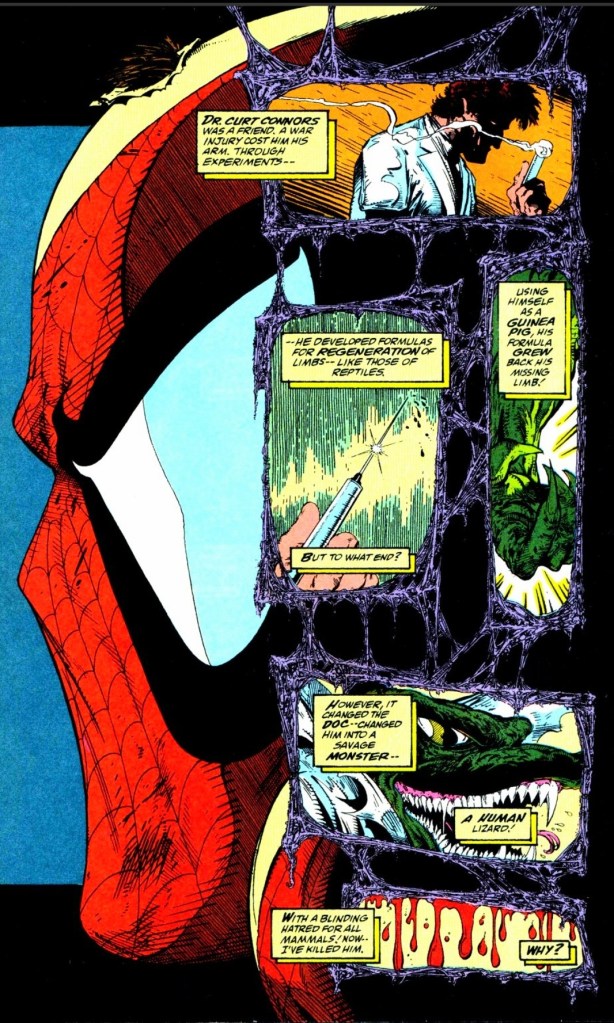
A quick look at the origin of the Lizard by McFarlane.
While the writing by McFarlane remains weak, he still succeeded in making this story a marginal improvement over the previous issue in terms of moving the plot forward, paying off a good chunk of the build-up in issue #1, and establishing his own visual corner (inspired by horror and adulterated stuff) within the Spider-Man franchise of comics of the time.
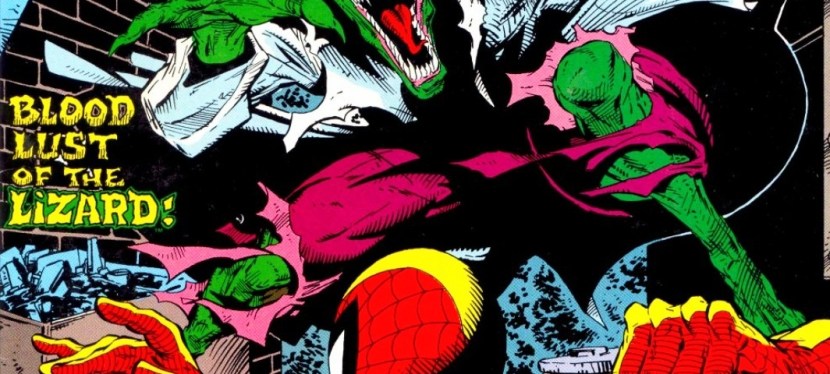
The biggest feature here is the physical conflict between Spider-Man and the Lizard. As expected, McFarlane drew the big fight with a lot of intense action, powerful violence (note: it was clear the editorial team recommended moves to tone down the graphic violence), suspense and a good amount of horror. Not only does the big fight move the story forward, it allowed McFarlane to dramatize Spider-Man as a vulnerable hero who not only has to cope with the disturbance from the sorceress far away, but also deal with the poison he got from the Lizard. That being said, Spidey also struggles with his sanity and the new fact that the Lizard has turned into a murder machine which disturbs him a lot as he personally knew Dr. Connors.
Considering what happened here and in the previous issue, there is still a greater force of evil that awaits Spider-Man and the Lizard happens to be an ultra-violent tool.
Conclusion
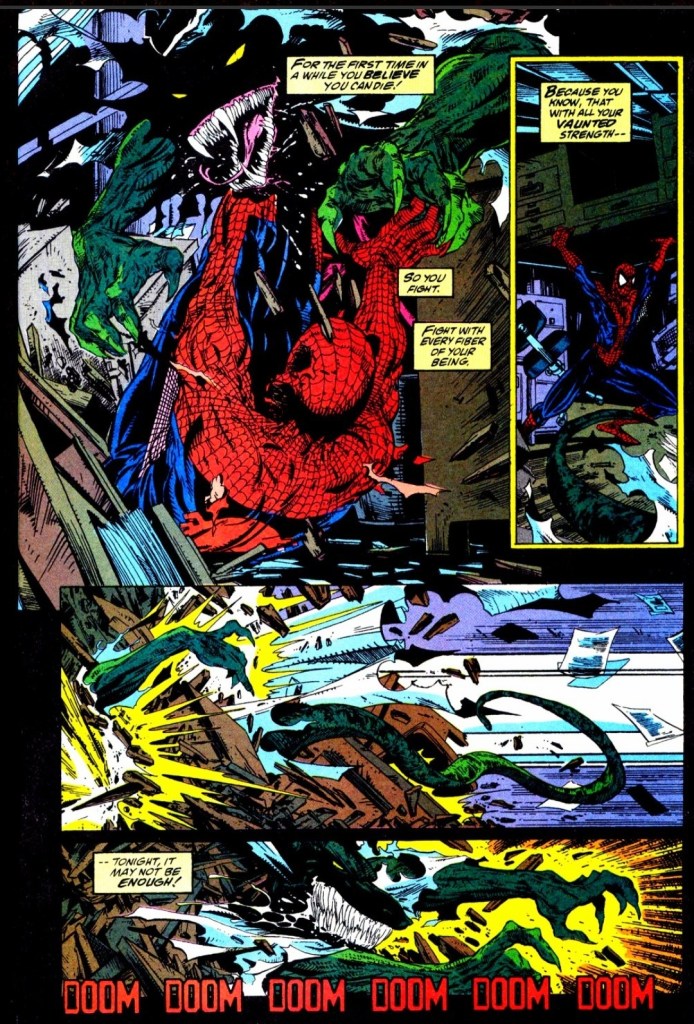
Many times Spider-Man finds himself in a disadvantage while fighting the Lizard.
Being the 2nd chapter of the Torment storyline, Spider-Man #2 (1990) is a slight improvement over the previous issue in terms of moving the story forward, spectacle and dramatization. While the big fight between Spider-Man and the murderous Lizard is clearly the big feature of the story, McFarlane does a good job portraying Spider-Man as vulnerable and on the edge towards defeat. McFarlane’s writing here is still weak but the other positive elements achieved outweighed the weakness.
Once the anticipated Japanese role-playing game (Japanese RPG) Eiyuden Chronicle: Hundred Heroes finally comes out on April 23, 2024, the absence of the main creator will be felt by many players as the Japan-based Rabbit & Bear Studio announced very recently that its head Yoshitaka Murayama passed away on February 6. For the newcomers reading this, Murayama is also the creator of the Suikoden RPG series of Konami where he used to work at. For my previous blog posts of Eiyuden Chronicle: Hundred Heroes, click here, here, here and here).
To put things in perspective, posted below is the excerpt from the official announcement by Rabbit & Bear Studios. Some parts in boldface…
Hello everyone,
It’s with a heavy heart and deep sadness we must inform you that the scenario writer and head of Rabbit& Bear Studios, Yoshitaka Murayama, has passed away on February 6th due to complications with an ongoing illness.
Murayama first began this journey of the creation of Eiyuden Chronicle: Hundred Heroes in 2020
through the support of his very loving fans on Kickstarter. Throughout the three-plus-year-development of the game, it was always the passion from his fans that continued to drive his creative vision and motivate him to put his all into the project.
His hard work on Eiyuden Chronicle as scenario writer was finished but as his co-workers and friends, it saddens us to know that he won’t get to see the reactions from his fans.
However, even with those feelings we need to accept the reality that he is no longer with us and continue to push his dream forward by releasing Eiyuden Chronicle to the world.
We want to maintain his legacy and vision with this game and know that he would have wanted the rich world he has created with Eiyuden Chronicle to live on.
His family sincerely appreciates your prayers and support but asks for privacy and that no flowers, mail, or other offerings be sent.
We will have more information on organizational changes to Rabbit & Bear as well as changes to some of the Kickstarter rewards in the near future.
So there you have it. The developer behind Eiyuden Chronicle: Hundred Heroes made it clear that they will not give up with fulfilling the dream of the late Murayama and there is no stopping the launch of the game (which was supposed to have been released in 2023).
More on the previous works of the late Murayama, I played Suikoden and Suikoden II (read my retro review by clicking here) on the PlayStation console in the 1990s and I had enjoyable times with them. For me, Suikoden II was the not only the best Suikoden RPG of the 1990s but also one of the best RPGs on any platform during the decade. It’s just too bad that the 1999 North American launch of Suikoden II was overshadowed by another company’s JRPG on PlayStation that same year. Considering the many Japanese RPGs that were released on PlayStation in 1999, Suikoden II was the most enjoyable one I played.
Even during his days as a young man working for Konami in the 1990s, Murayama had a very unique vision for digital role-playing and adventuring, as well as fantasy storytelling.
“Eiyuden Chronicle is really (an) evolution of my many design experiences. The many games I’ve made have helped create the foundation for this title. Since I draw my experience from previous games I’ve worked on, of course you will see a little bit of those elements in Eiyuden Chronicle,” Murayama said in response to a question that mentioned Eiyuden Chronicle and Suikoden titles.
With Murayama gone, the spotlight on the April 2024 launch of Eiyuden Chronicle: Hundred Heroes will be more crucial than before. I myself will be playing the RPG on my Xbox Series X console as soon as it launches. To get yourselves oriented with the said JRPG, watch the videos below (the last one shows Murayama and his fellow creators as special guests at an event in Taipei)…
Watch out for Eiyuden Chronicle: Hundred Heroes on Xbox Series X, Xbox Series S, Xbox One and Windows PC plus Xbox Game Pass (XGP) on April 23, 2024. For more about the JRPG, visit https://www.xbox.com/en-US/games/eiyuden-chronicle
Welcome back readers, fellow geeks and electronic gaming fans!
In this edition of the Retro Gaming Ads Blast (RGAB) series, we will examine print ads from the 1980s and 1990s that caught my attention and I will explain why these are worth look back at.
For the newcomers reading this, Retro Gaming Ads Blast (RGAB) looks back at the many print ads of games (console, arcade, computer and handheld) that were published in comic books, magazines, flyers and newspapers long before smartphones, social media, the worldwide web and streaming became popular. Back in the old days, many gamers trusted the print media a lot for information and images about games.
With those details laid down, here is the latest batch of retro gaming print ads for you to see and enjoy…
1. Popeye multiplatform print ad
A fine example of promoting the Popeye video game on multiple platforms visually.
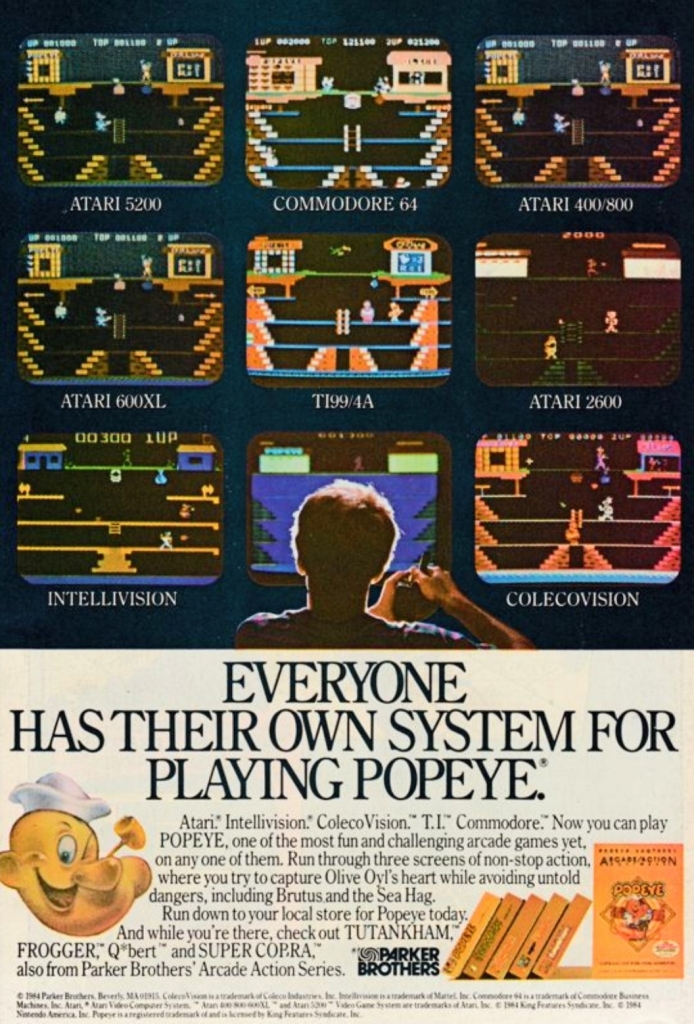
During the early 1980s, an arcade game based on Popeye was released and it became a hit with gamers who lined up and inserted coins to play. That game, which had three stages, was eventually ported by Parker Brothers to multiple platforms of Atari, ColecoVision, Intellivision, T.I. and Commodore.
The print ad you see above is a classic display of how one particular game appeared as a multiplatform release. The screenshots showed different versions of the Popeye game on multiple Atari platforms plus the others. See how different the game looks on each platform? The level of visual details and elements varied from one another as each machine had different specs that Parker Brothers had to adjust to. This is a fine example of promoting one game for different machines for those who love video games.
2. Kool-Aid Man Video Game print ad
I never got to play this Kool-Aid Man video game.
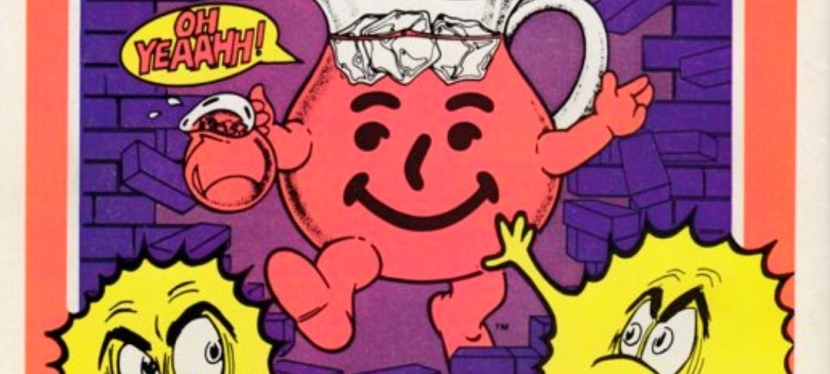
Remember Kool-Aid? For the newcomers reading this, Kool-Aid was a very popular product line of flavored juice drinks sold in powdered form. I myself used to mix Kool-Aid with ice-cold water and enjoyed drinking it. In 1954, a promotion of Kool-Aid with a touch of entertainment happened by highlighting the character Kool-Aid Man (famously known as the walking and talking pitcher filled with Kool-Aid juice). In later years, the Kool-Aid Man was often shown breaking through walls saying the line “Oh yeah!”.
The Kool-Aid Man gained tremendous attention as a pop culture figure in the 1980s when a new series of advertisements and promotions happened branching into video games and even comic books. The above print ad was a clever move to promote Kool-Aid as a drink as well as a video game for the Intellivision and the Atari 2600 consoles. Even if you were not too fond of video games in the 1980s, the Kool-Aid game ad would still make you think about the drink. Clever and entertaining!
3. Zombies Ate My Neighbors game print ad
I saw the 2-page ad many times in comic books and video game magazines.
Going into the 1990s, Konami’s print ad of the video game Zombies Ate My Neighbors (for Super Nintendo Entertainment System and Sega Genesis) appeared a lot in the comic books I read when I was much younger. Having seen lots of horror movies – including zombie flicks – the ad easily caught my attention not because of the screenshots but because of the visual style used. For one thing, there was this 1950s America-inspired imagery on the photo of the scared woman with three zombies slowly approaching her. As for the game itself, there were plenty of small-sized screenshots that had lots of interesting details and pixel art (note: 3D polygons in video games were not yet common back then) which gave me a clear idea that it was a humor and horror-laced 2D adventure. Not only that, the text descriptions combined with the fake quotes added zest into the presentation. After having examined all the details carefully, I really felt like Zombies Ate My Neighbors would be a fun-filled game to play on the SNES.
4. Lunar: The Silver Star print ad
With anime artwork used, it was easy to have the impression that the original Lunar game was based on an existing anime series or movie.
In the early 1990s, Game Arts developed and released the Japanese role-playing game (JRPG) Lunar: The Silver Star on the Mega CD platform in Japan which in some ways was also a technological breakthrough – the game came with full motion video (for short videos), animated images, and CD-quality sound (that really made the soundtrack lively to listen to). After achieving critical and commercial success in Japan, the game was picked-up by Working Designs to be localized and released in the North American market for the Sega CD (the American counterpart of the Mega CD) platform. In promoting the game for American Sega CD owners as well as American gamers in general, a print ad highlighting anime images with five screenshots and only a few words was published on both comic books and magazines.
Even though Lunar: The Silver Star’s core concept was never described in the ad, the anime imagery was still eye-catching and the chosen screenshots gave viewers a preview of the gameplay and the animated images. That being said, it was no surprise that gamers who happened to be a bit interested in anime noticed the print ad. At the same time, the ad gave some gamers the impression that Lunar was a game based on an existing anime franchise. This approach on game advertising was daring and it happened at a time when Japanese RPGs had a limited audience among gamers in North America.
5. Lunar: Silver Star Story Complete print ad
In the 2nd half of the 1990s, a remake of Lunar: The Silver Star was released in Japan titled Lunar: Silver Star Story for Sega Saturn (1996), Sony PlayStation (1998) and Windows PC (1998). While it still maintained the 2D visuals for presentation, gameplay and exploration, the remake had smooth anime sequences, new artworks, better sound effects and music. Working Designs pounced on the opportunity to localize the game in America for PlayStation and released it in 1999 with the title Lunar: Silver Star Story Complete. Not only did Working Designs work hard on localizing the game (the English dubbing and singing of the game’s songs were meticulously done), they released it with a very lavish packaging with the dedicated fans and collectors in mind.
By looking at the above print ad that magazines published, Working Designs highlighted the positive feedback quotes from EGM, Gamers’ Republic, PSM and Official U.S. PlayStation Magazine to convince gamers Lunar: Silver Star Story Complete is a great game. While the screenshots showed what kind of eye candy gamers could expect, Working Designs made sure that they would know that the lavish package includes 4 discs (2 game discs, 1 music CD and 1 CD that had video documentary of the making of Lunar), a full-color map in the form of a cloth, and a hardbound art book and instruction manual.
Considering the dynamism of the Lunar: Silver Star Story Complete print ad and the game’s packaging, I can only speculate that Working Designs had to do it aggressively because the gaming landscape changed dramatically as 3D polygonal graphics became the standard while lots of other Japanese RPGs from different publishers were released in 1999 (including the sequels Suikoden II and Final Fantasy VIII) and many of them had more elaborate game designs and visual presentations. Eventually market forces and unfortunate business events led Working Designs to closing down permanently in 2005.
6. Star Wars: Jedi Arena print ad
Remember when Luke Skywalker tested his lightsaber skills with the floating Seeker in the 1977 movie?
Back in the early 1980s, Parker Brothers was very active releasing games on the Atari 2600 console which my family had. At that same time, Star Wars was very popular (and without the wokeness and identity politics garbage of Kathleen Kennedy and woke Disney) and any new game based on the sci-fi franchise was something to be excited for. In the above print ad of Star Wars: Jedi Arena, an artwork showing the iconic her Luke Skywalker testing his lightsaber skills with the floating Seeker ball was displayed and located between Luke’s legs is a monitor showing the screenshot of the game. Looking at the text description, Parker Brothers creatively focused on the aspect of the Jedi way of using the lightsaber interacting with the Seeker ball. Having played the game myself, I can say the ad was creative and pretty much captured the core concept of the game.
Disclaimer: This is my original work with details sourced from reading the comic book and doing personal research. Anyone who wants to use this article, in part or in whole, needs to secure first my permission and agree to cite me as the source and author. Let it be known that any unauthorized use of this article will constrain the author to pursue the remedies under R.A. No. 8293, the Revised Penal Code, and/or all applicable legal actions under the laws of the Philippines.
Welcome back superhero enthusiasts, 1990s culture enthusiasts and comic book collectors! Today we go back to the mid-1990s to explore a part of the Ultraverse through a tale of Mantra, the male eternal warrior Lukasz who died during battle then returned in the body of a woman named Eden.
It has been a few years since the last time I reviewed a Mantra comic book. For the newcomers reading this, the Ultraverse was a franchise of superhero comic books launched by Malibu Comics in 1993 which produced a lot of fun, intriguing and memorable tales made by a variety of really talented creators. Mantra was one of the pioneering characters of the Ultraverse and the related comic book series lasted more than twenty issues. Along the way, a standalone story of Mantra was published in the form of a 2-part mini-series.
With those details laid down, here is a look back at Mantra: Spear of Destiny #1 published in 1995 by Malibu Comics with a story written by Mike W. Barr and drawn by Paul Abrams.
The cover.
Early story
The story begins when Mantra arrives at a museum to start her attempt (in her civilian identity as Eden Blake) to obtain the Spear of Destiny. While wearing a revealing outfit to distract the men, Mantra gets close to the highly prized spear to observe it and see how the security personnel guard it.
At a different spot within the museum, Mantra decides to start obtaining the spear in magical outfit and with a mask. As Mantra arrives at the room where the Spear of Destiny, already there are monsters overwhelming the men guarding the Spear of Destiny…
Quality
Eden Blake/Mantra reporting to work at Aladdin.
Having read most of the stories of the Mantra comic book series, I can say that Mike W. Barr came up with a fresh concept that emphasizes the quest to gain possession of a highly valuable item while also creating a new approach on presenting Mantra…by engaging in espionage (spying and infiltration).
As I am already used to seeing the eternal warrior Lukasz/Mantra using magic in many struggles or missions, the concept of having the protagonist getting disguised and becoming an impostor on a spy mission is a very inspired move by the writer. The preparations taken by Mantra to becoming a certain blonde woman for the mission were nicely structured and detailed enough to make the transformation. As if that was not enough, a certain piece of technology was implemented which made using magic a huge risk for the eternal warrior. That being said, the story smoothly transitioned from magic-filled fantasy into a convincing spy thriller
Along the way, this comic book also emphasizes the darkness of the secret society Aladdin which Mantra (as Eden Blake) works for. Aladdin’s operations were dramatized several times in other Ultraverse comic books but this one has a more explicit portrayal of them.
Conclusion
Mantra got hold of the Spear of Destiny but for how long?
Mantra: Spear of Destiny #1 (1995) is really entertaining and compelling to read. This is easily one of the more creative and more unique tales of the Ultraverse character ever told and I can say that I am eager to find out what would happen next. This is also the one tale in which Mantra became a spy and gets into a dangerous mission in which the use of magic is too risky. The writing by Mike W. Barr is really strong with this one.
Overall, Mantra: Spear of Destiny #1 (1995) is recommended.
Welcome back readers, fellow geeks and electronic gaming fans!
Today I am launching a brand-new series of articles titled Retro Gaming Ads Blast (RGAB) which will explore the many print ads and promotions of video games, computer games, arcade games and handheld games that were published through the decades.
For the newcomers reading this, print ads of games were widely popular and heavily relied on by gamers/players long before smartphones, social media, the worldwide web and online videos even started. Back in the old days, print media was the most common method for companies to market their games while also helping hardware (machines which played the games) reach potential buyers. Such ads appeared in magazines, comic books and newspapers. Not only that, there were several print ads of games that were made to look creative, compelling and even intriguing.
With those details laid down, here is the first batch of retro gaming print ads for you to see and enjoy…
1. Parker Brothers’ Spider-Man-led print ad
Does this ad look amusing?
Remember Parker Brothers? That was a company that started way back in 1883 founded with a strong focus on the enjoyment of games in the form of board games, cards and toys. In the late 1970s, Parker Brothers started making electronic versions of their popular board games and engaged in the video game development and publishing. They also went on to make home ports of popular arcade games in the early 1980 for several gaming platforms.
Parker Brothers was very active with making games for the Atari 2600 console which became the dominant machine for home gaming in North America in 1982. In the above print ad, their marketing heavily emphasize the Spider-Man video game for Atari 2600 and added two others games they also published – Tutankham and Amidar – which was a clever move to market multiple games. The ad’s focus on Spider-Man was amusing and even without showing a single screenshot of the game, it was enough to entice people to watch out for it. Be aware that the Spider-Man game’s development was done by Laura Nikolich who was hired by Parker Brothers at a job fair. Nikolich had full creative control on making the game and had no contact whatsoever with Marvel Comics.
2. Advanced Dungeons & Dragons: Cloudy Mountain print ad
An ad like this was strong enough to motivate gamers’ imagination and interest.
Back in 1982, Advanced Dungeons & Dragons: Cloudy Mountain was released on the Intellivision game console and I was fortunate enough to watch my next-door neighbor play it repeatedly. The above print ad – which simply referred to the game as Advanced Dungeons & Dragons – only had a few words which directly pointed to the main objective of the game…the golden crown. While only one screenshot of the game was displayed, the advertisers heavily relied on hand-drawn, comic book-style fantasy art work to sell the game.
For those who were born long after the 1980s, let me share with you that ads like these were really impressive for their time. It was common for advertisers to use art works (even though they may not accurately reflect the gameplay or game design) and post at least one screenshot to catch the viewer’s attention with the hope that it would even encourage him/her to anticipate the game. It should be noted that ads like these were strong enough to make gamers’ imagination or curiosity grow stronger.
3. Konami’s collective military video games advertising
Print ad of four games for IBM, Amiga and Commodore.
Print ad of Jackal and Contra for the NES.
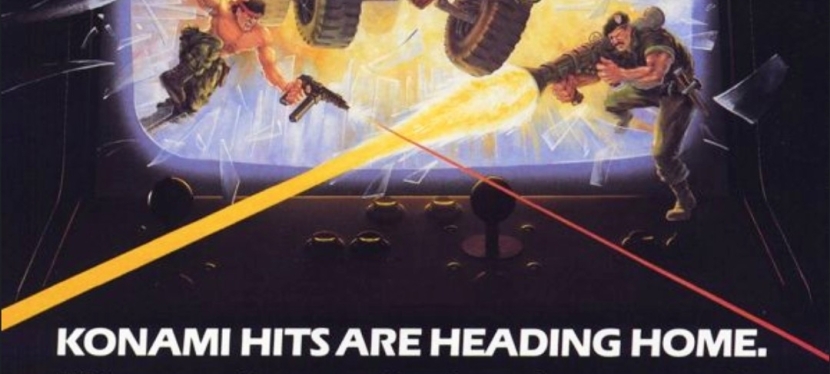
Konami, the Japanese company that has long been known for Metal Gear, Suikoden and the controversial sacking of famous game designer Hideo Kojima, was aggressive in the gaming business in the 1980s and arguably the aggressiveness was reflected in their publishing of several games that emphasized militarism during the late stages of the Cold War. In short, they made the military look cool and their activities fun to do in digital form.
While Konami has always been identified with console gaming, they actually released Rush’n Attack, Contra, Jackal and Boot Camp on IBM, Amiga and Commodore computers (as seen in the first print ad above) which were popular in the 1980s. The said ad also have a very amusing visual concept emphasizing the excitement and fun of military action games coming to gamers at home for their computers.
The 2nd print ad above – Jackal and Contra for the Nintendo Entertainment System (NES) – was very intriguing to see. It was very clear back in the 1980s that the NES always had a wholesome audience (note: a lot of buyers were parents who wanted to entertain their kids at home) and that includes a lot of very young players. To see the collective ad of Jackal and Contra (for the NES platform) having battle-hardened men in military gear holding guns was openly aggressive to perceive and instantly reminded people about the Cold War (and the menace of Communists, socialists, Marxists and terrorists) and the cultural impact of the mega blockbuster film Rambo: First Blood Part II. This is the kind of ad that would drive today’s woke-minded people crazy and even cause them to panic and pretend to be victims of militarism and patriotism. If you look at the ad closely, you will realize there is simply no room for the garbage of political correctness and wokeness.
Lastly, I myself had played Contra and Jackal with my friends on the Nintendo Family Computer (the Japanese counterpart of the NES) and both military games were a lot of fun to play from start to finish!
4. Batman Returns SNES game ad
This print ad appeared in some comic books I read in the early 1990s.
Way back in 1992, Batman Returns (the sequel to the mega blockbuster Batman movie of 1989) was released in cinemas with intense marketing and merchandising reflecting Warner Bros. intention to replicate the commercial success they had in 1989. Along the way, there were several video game adaptations of Batman Returns that were released on different platforms. Among those many video games was the Super Nintendo Entertainment System (SNES) game of Batman Returns which was developed and published by Konami in 1993 the form of a side-scrolling beat-them-up game.
The above ad was visually appealing with hand-drawn, comic book-style art dominating the spaces while leaving room for some screenshots and a written description of the game. Having seen this ad on multiple comic books I read back then, I can say that the ad was entertaining to see and was effective in making me interested in the game. I played Batman Returns on the SNES but never got to finish it. Oh yes, the game’s audio were really good and there were also digitized images from the movie for the in-game narrative.
5. Flashy Sonic the Hedgehog Japanese print ad
A dazzling approach by Sega on selling Sonic the Hedgehog.
1991 will always be remembered as the year of Sonic who eventually became not only Sega’s most defining mascot but also a video game industry icon. That same year, Sega released Sonic the Hedgehog on the Sega Genesis (referred to as Sega Megadrive in other parts of the world) console and it became a massive success with consumers and the game critics.
In the above Japanese print ad, a very captivating display of light and energy rays dominated the space leaving a minority share left for Sega’s console, screenshots and even a UFO Catcher arcade machine picture. While I could not understand the Japanese text, it seems to me that the flashy visual concept of the ad reflected Sega’s high ambitions with Sonic. How many gamers in Japan bought a copy of Sonic the Hedgehog because of this ad remains undetermined.
6. Japanese Super Star Wars print ad
A long time ago in a galaxy far, far away…
Before Nintendo released its 16-bit game console (referred to as Super Nintendo Entertainment System in America, and Super Famicom in Japan), there were lots of Star Wars video games released on varied platforms and the arcade.
With Nintendo’s 16-bit gaming platform realized, lots of game designers and business partners saw opportunities to make new games with gameplay concepts and designs using the technological advantages of the time. For LucasArts and its partners, taking Star Wars gaming into the next level was inevitable and they made it all come true in 1992’s Super Star Wars video game.
Published in Japan by JVC Musical Industries for the Super Famicom, Super Star Wars was a major leap forward in game design, visuals, sound and enjoyment. Apart from the 2D side-scrolling run-and-gun gameplay, gamers were deeply immersed into Star Wars’ universe with the Mode 7 landspeeder and X-Wing fighter sequences, as well as the first-person trench run sequence.
The Japanese print ad above cleverly presented screenshots from the game while using official imagery from the Star Wars movie poster of 1977 (look at how young Harrison Ford, Mark Hammill and the late Carrie Fisher were back then). The ad is a fine example of combining the greatness of the classic George Lucas-directed film with the highly enjoyable design of Super Star Wars. Lastly, these should remind you that there was a time when Star Wars was not yet tainted by wokeness and the garbage values of the Satanic Leftists (read: woke Disney).
Disclaimer: This is my original work with details sourced from reading the comic book and doing personal research. Anyone who wants to use this article, in part or in whole, needs to secure first my permission and agree to cite me as the source and author. Let it be known that any unauthorized use of this article will constrain the author to pursue the remedies under R.A. No. 8293, the Revised Penal Code, and/or all applicable legal actions under the laws of the Philippines.
Welcome back superhero enthusiasts, 1990s culture enthusiasts and comic book collectors! Today we go back to the early 1990s and explore a part of the Valiant Comics shared universe through a tale of the Turok: Dinosaur Hunter series.
Previously, Turok went on exploring Colombia after leaving the village of his romantic interest Serita. The village was decimated by the intelligent dinosaurs (also referred to as bionisaurs) that served Mon-ark, a fierce enemy of Turok’s. Eventually Turok got involved with the Colombian drug lord Comacho who has gang of armed men and lots of resources. Ever the dedicated hunter, Turok makes a deal with the drug lord to pursue dinosaurs.
With those details laid down, here is a look back at Turok: Dinosaur Hunter #3, published in 1993 by Valiant Comics with a story written by David Michelinie and drawn by Bernard Chang.
The cover.
Early story
The story begins in Colombia in 1987. Turok tries to sell the severed head of a bionisaur to a local buyer (collector of hunt-related trophies) who offers him only three hundred Pesos.
After concluding a disappointing deal, Turok leaves the local joint only to encounter a lady driving a jeep…the scientist Maria Cortez. She tells him that the drug lord Comacho is planning a raid against the dinosaurs very soon and the gang wants Turok to come along. Cortez, who is obsessed with researching dinosaurs, tells him her single condition that one dinosaur should be spared for scientific study. After some thinking, Turok agrees to join…
Quality
The evil of Mon-ark emphasized.
Starting first with the plot, I can say that David Michelinie’s script is well-written and never lost focus on the inevitable encounter between Turok and his vicious dinosaur rival Mon-Ark. Right from the start, it is clear that the stakes have been raised higher which is the result of Turok’s successful killing of Mon-ark’s mate. Like in the previous issue, Mon-ark here was portrayed again to be very evil and even abusive to his fellow dinosaurs.
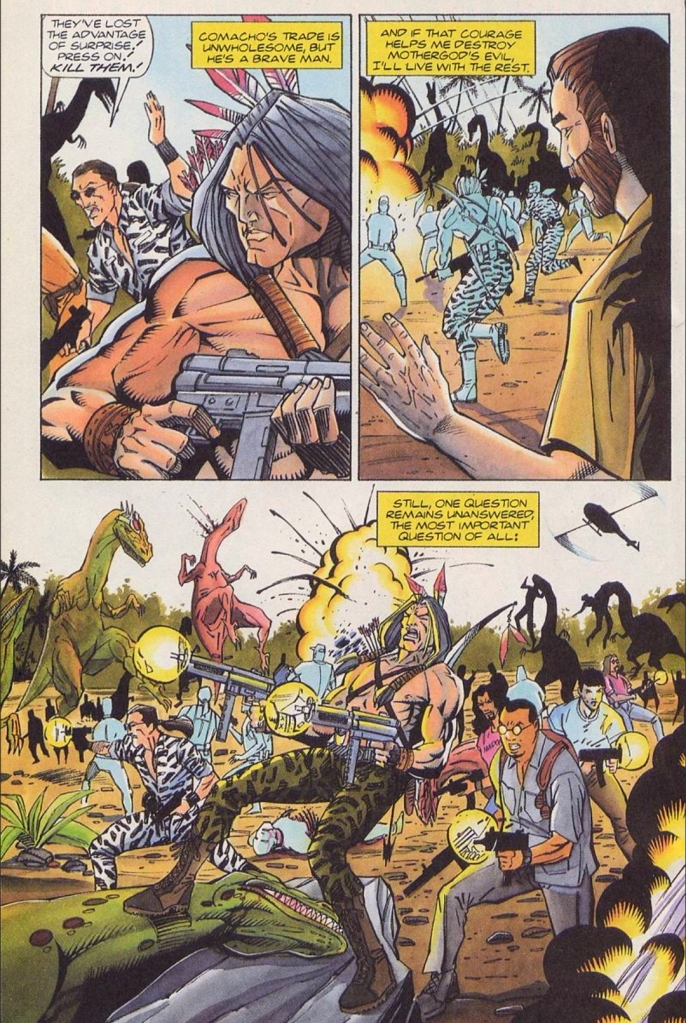
The raid mentioned early in the story is easily the action-packed highlight and it has some notable forms of symbolism. For one thing, the raid was organized by Comacho not because of concern towards Mon-ark nor Turok, but because he wants to stop the disruptions on his illegal drug business caused by the dinosaurs. Cortez meanwhile sees the dinosaurs as animals meant to be studied for the sake of science. And then there is a certain photographer who wants to record everything visually no matter what happens. I can say the raid scenes are entertaining to follow.
As this comic book was not drawn by Bart Sears, I can say that the visual quality and style went way down. I’m not saying that Bernard Chang is a terrible artist at all. It’s just that Chang’s art style does not live up to the gritty, exquisite and intense visuals of the first two issues which clearly defined how Turok stories should look. Along the way, there are several instances wherein Chang’s art style made some characters and facial expressions look somewhat cartoony. The dinosaurs themselves also looked cartoony at times and the heavy loss of visual details on them is very clear.
Conclusion
The armed raid against the dinosaurs with Turok as a willing participant looking like Rambo.
Similar to its predecessor, Turok: Dinosaur Hunter #3 (1993) has enough stuff worth following to be entertained even though the visual quality went down several notches. For one thing, the promised battle between Turok and Mon-ark happened and the way it was written was strong on its own. At the same time, the Indian hunter of dinosaurs got more involved Comacho’s gang which raises questions about his ability to differentiate right from wrong, and good from evil. At this stage of the series, Turok’s direction remains clouded.
Overall, Turok: Dinosaur Hunter #3 (1993) is recommended.
Disclaimer: This is my original work with details sourced from reading the comic book and doing personal research. Anyone who wants to use this article, in part or in whole, needs to secure first my permission and agree to cite me as the source and author. Let it be known that any unauthorized use of this article will constrain the author to pursue the remedies under R.A. No. 8293, the Revised Penal Code, and/or all applicable legal actions under the laws of the Philippines.
Welcome back superhero enthusiasts, 1990s culture enthusiasts and comic book collectors! Today we go back to the early 1990s and explore a part of the Valiant Comics shared universe through a tale of the Turok: Dinosaur Hunter series.
While issue #1 turned out to be entertaining enough, the Indian protagonist Turok was not too engaging. The story worked primarily due to the combined creative works of David Michelinie and Bart Sears.
With those details laid down, here is a look back at Turok: Dinosaur Hunter #2, published in 1993 by Valiant Comics with a story written by David Michelinie and drawn by Bart Sears.
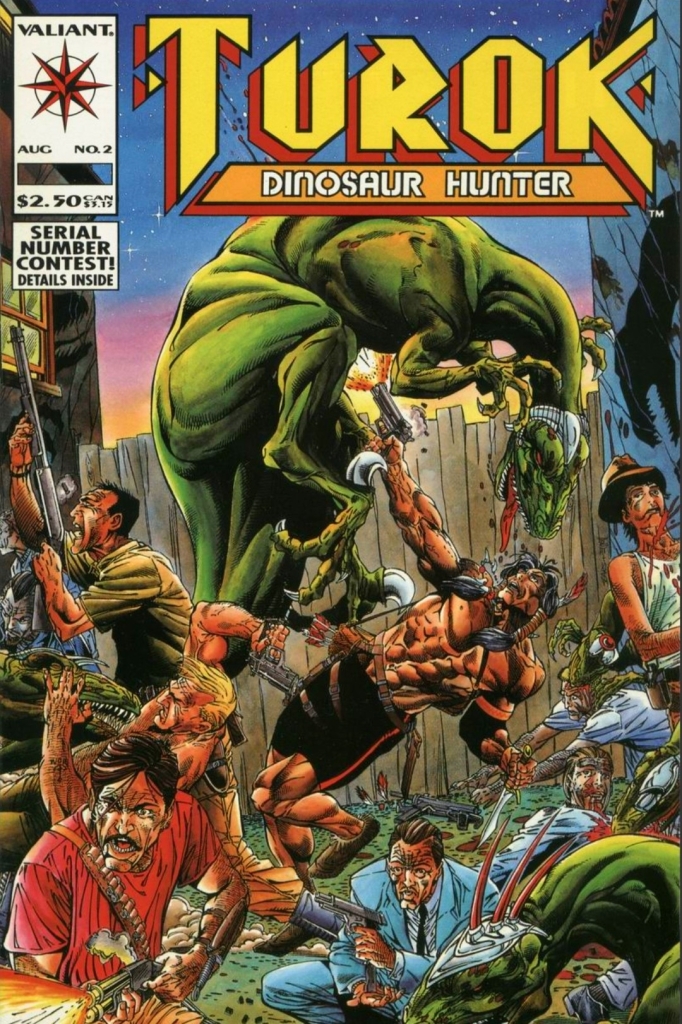
The cover.
Early story
The story begins in Colombia in 1987. Set some time after he left the village of Serita (a Colombian lady he connected with), Turok finds himself in the middle of a fight with multiple intelligent dinosaurs that serve his rival and target Mon-ark. Turok recently started using locally produced poison for his arrows as part of his unrelenting hunt for dinosaurs.
Meanwhile in another part of Colombia, the drug lord Comacho holds a private meeting and express his frustration over the decimation of his drug shipments. It turns out, the couriers were slaughtered and eaten by the dinosaurs. Upon learning of the presence of an Indian who makes it his business to hunt dinosaurs, Comacho gives an order to find him…
Quality
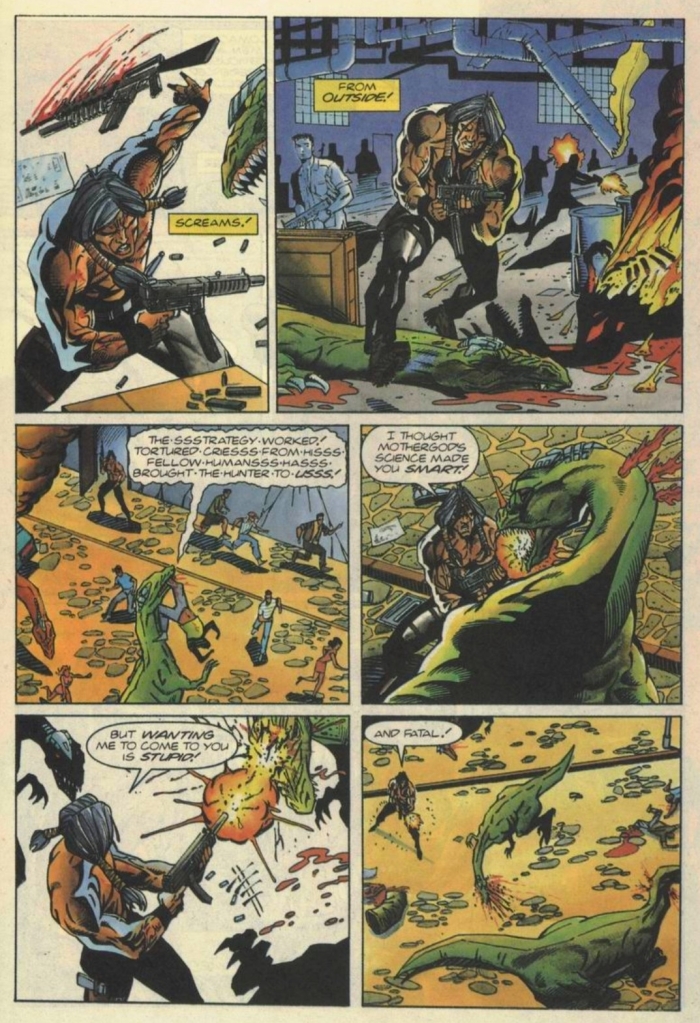
You will see Turok in a lot of action scenes fighting these intelligent and savage dinosaurs.
As the follow-up to the 1st issue, this is a story about Turok really hunting dinosaurs as part of his effort to get to Mon-ark (the leader of a pack of dinosaurs present in Colombia) in relation to what happened during the Unity storyline. In addition, you will get to see the protagonist get involved the Colombia drug lord who really needs him as the dinosaurs tremendously disrupted the shipment of illegal substances. As a newcomer in this particular time and place within the shared universe of Valiant Comics, Turok here does not care much about the reputation of Comacho as he is obsessed with hunting dinosaurs.
Speaking of the dinosaurs (who were granted human-like intelligence by the Mothergod), you will get to see Mon-ark have his own share of the spotlight and see him being a leader of his fellow dinosaurs. The showcase of his ruthlessness was expectedly done here to symbolize the element of evil in a violent way.
The plot by Michelinie is nicely structured and the narrative moved in a smooth enough pace leading to an obvious new direction.
Like in the previous issue, Bart Sears drew the art but with the involvement of Bernard Chang. For the most part, I recognized Sears’ work and there were some subtle visual differences here and there. The good news here is that if you enjoyed the gritty look as well as the uncompromised approach to violence in issue #1, then you will find those here as well.
Conclusion
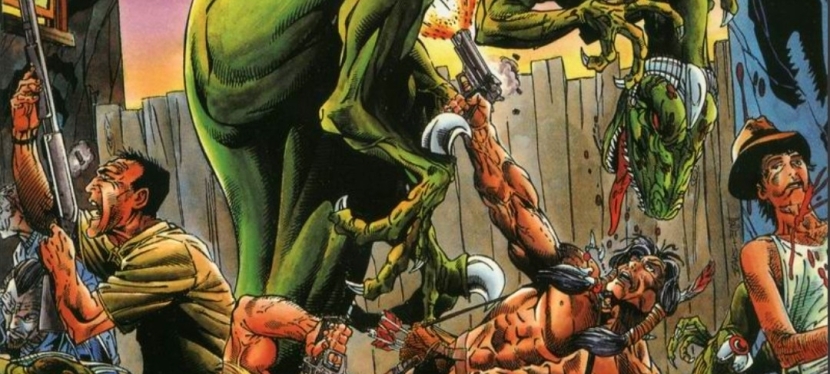
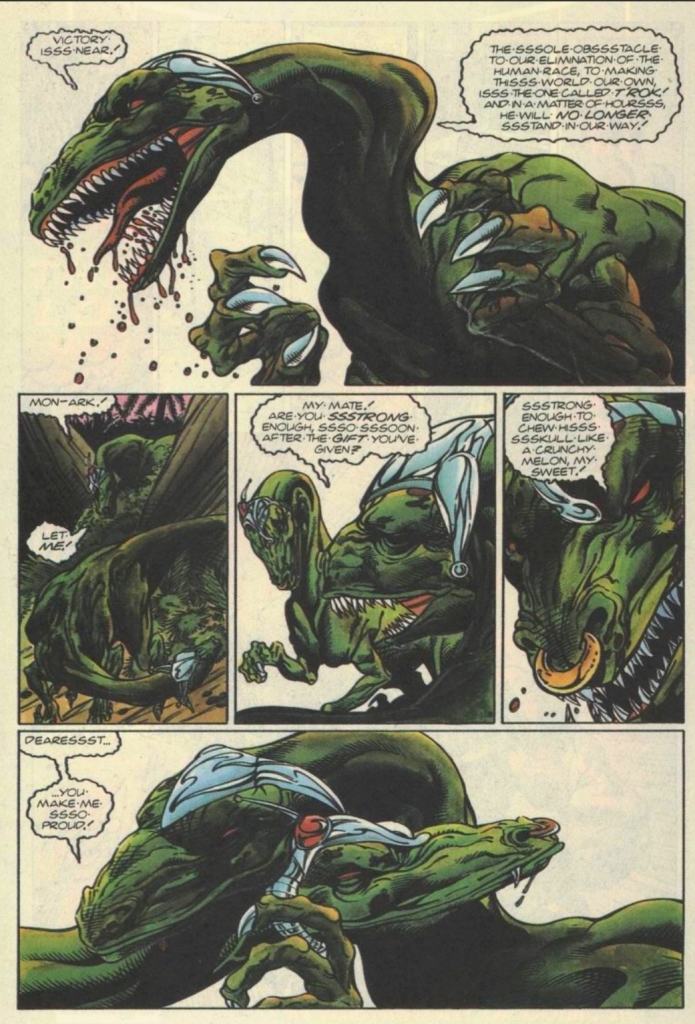
A look at the intelligence and interaction between these two evil dinosaurs in love. There’s no homosexuality here nor anything related to transgender or the disease called wokeness.
Turok: Dinosaur Hunter #2 (1993) is entertaining and compelling enough to read. It further explores Turok’s story as a man lost in time who simply would not run away from the dinosaurs as he is obsessed with eliminating Mon-ark. The tale, however, involves a Colombian drug lord as well as his private army which adds depth to the narrative as well as Turok’s place within Valiant’s shared universe of the time. Lastly, this one nicely sets up a big conflict between the Indian and his dinosaur rival.
Overall, Turok: Dinosaur Hunter #2 (1993) is recommended.
Have you been searching for something fun or interesting to watch on YouTube? Do you feel bored right now and you crave for something to see on the world’s most popular online video destination?
I recommend you check out the following topics and the related videos I found.
#1The precise differences between Christianity and Islam, Lord Jesus and Muhammad, and the Holy Bible and the Quran explained – The YouTube channel HolyLandSite is a favorite of mine as it has published a lot of very credible and detailed explanatory videos about the Holy Land in Israel, Christianity, the Jews and how everything is connected with the Holy Bible (the Word of God). In the recent video they published recently, the precise differences between Christianity and Islam, between Lord Jesus and Muhammad, and between the Holy Bible and the Quran are explained in detail by Pastor Todd. I strongly recommend watching the video below…
#2 The deep hatred of the Palestinians towards Israel explained – There is no doubt that hatred, violence and murder are core values that the Palestinians have been oriented with while living under very evil leaders (murderer/terrorist Yasser Arafat is just one of them). To date, there are very few Palestinians who overcame their evil orientation and pushed back against their evil leaders to become good people. In the video below, YouTuber Oren explains in detail why so many Palestinians grew up with hate and live by hate towards Israel and its people. Lastly, I should state once again that the Palestinians are a displaced people, are NOT natives of the land of Israel and they caused trouble when they occupied Jordan and Kuwait.
#3 Remembering the past video game company Working Designs – It has been almost twenty years since American game company Working Designs closed down and ended their business. For the newcomers reading this, Working Designs is best known for localizing several video games from different Japanese companies for the North American market and among their best known releases were Lunar: The Silver Star Story, Lunar: Eternal Blue, Dragon Force and Magic Knight Rayearth. Their business history is very interesting to examine and for your viewing pleasure, posted below is one video about Working Designs’ legacy and another video about their games released across different platforms.
#4 Man of Steel video reviews, analysis, trivia and reaction videos – The cinematic universe of DC Comics superheroes that started in 2013’s Man of Steel is officially over and the newest film Aquaman and the Lost Kingdom won’t match its predecessor’s massive commercial success. Unofficially referred to as the DCEU (DC Extended Universe), the past cinematic universe of Warner Bros. had a very inconsistent record of commercial and critical results. That being said, it is high time to go all the way back to the very beginning with Man of Steel (starring Henry Cavill as Superman) through a series of varied videos I found for you to watch.
#5 DeepStar Six videos – Believe it or not, way back in 1989 there was not one, not two, but three movies that had underwater settings. One of them was DeepStar Six which was directed by original Friday The 13th movie director Sean S. Cunningham and, for some reason, was released in cinemas here in the Philippines with the title “Alien from the Deep.” While it grossed less than Leviathan and was made for a fraction of the budget of James Cameron’s The Abyss, DeepStar Six still has a long-lasting following and different kinds of videos about it were made. You can watch what I found below…
Disclaimer: This is my original work with details sourced from reading the comic book and doing personal research. Anyone who wants to use this article, in part or in whole, needs to secure first my permission and agree to cite me as the source and author. Let it be known that any unauthorized use of this article will constrain the author to pursue the remedies under R.A. No. 8293, the Revised Penal Code, and/or all applicable legal actions under the laws of the Philippines.
Welcome back superhero enthusiasts, 1990s culture enthusiasts and comic book collectors! Today we go back to the early 1990s and explore a part of the Valiant Comics shared universe through a tale of a very notable illustrated literature character named Turok.
I say very notable because Turok, an Indian (North American native), started in comics in the 1950s published by Western Publishing through its licensee Dell Comics. The comic book series Turok: Son of Stone started from 1956 until the early 1980s. In 1989, Valiant Comics was established by former Marvel Comics editor-in-chief Jim Shooter and business partner Steven Massarsky which was the result of a failed 1988 attempt to purchase Marvel Entertainment. In 1991, Valiant published Magnus: Robot Fighter and Solar: Man of the Atom as its early titles which is notable because both characters were licensed properties from Gold Key Comics (which itself was involved in the original Turok series).
Then in 1992, a newer version of Turok was introduced by Valiant Comics in the 12th issue of Magnus: Robot Fighter and subsequently the character (along with established side-kick Andar) became involved in the Unity storyline which was Valiant’s first major crossover comics event. By the time Unity ended, the road was cleared for Valiant to further emphasize Turok for the modern comic book readers of the time.
With those details laid down, here is a look back at Turok: Dinosaur Hunter #1, published in 1993 by Valiant Comics with a story written by David Michelinie and drawn by Bart Sears.
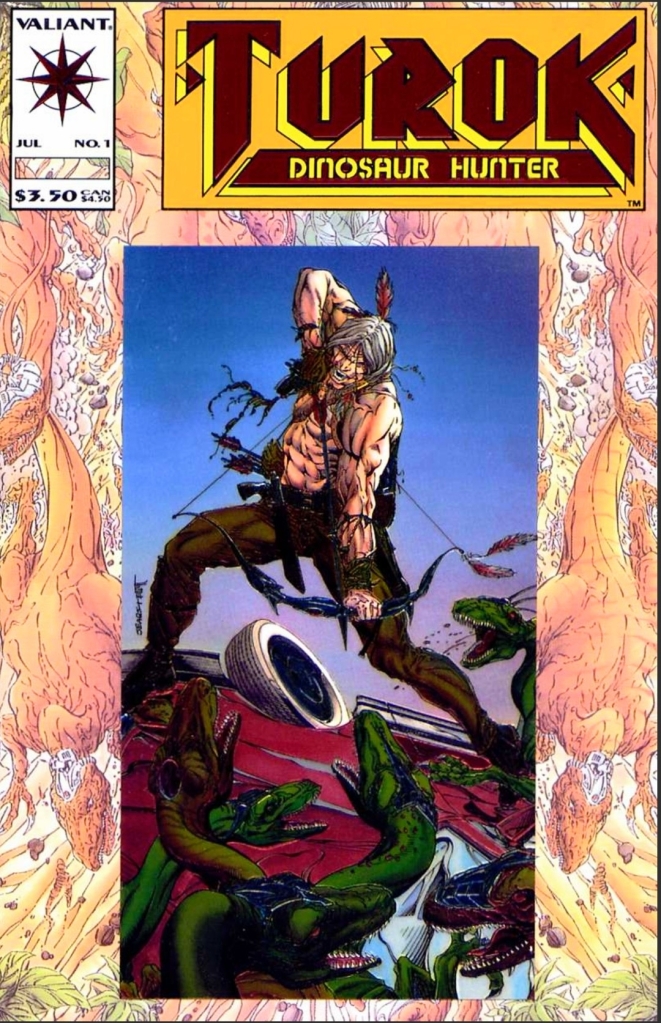
The cover.
Early story
The story begins in Colombia (note: written as Columbia in the comic book) in South America in the year 1987. Deep in the forest, Turok performs a ritual believing that his spirit is getting cleansed and purified. He remembers the times when he and Andar discovered a land – filled with dinosaurs and other animals they never encountered previously – where time no longer held much meaning.
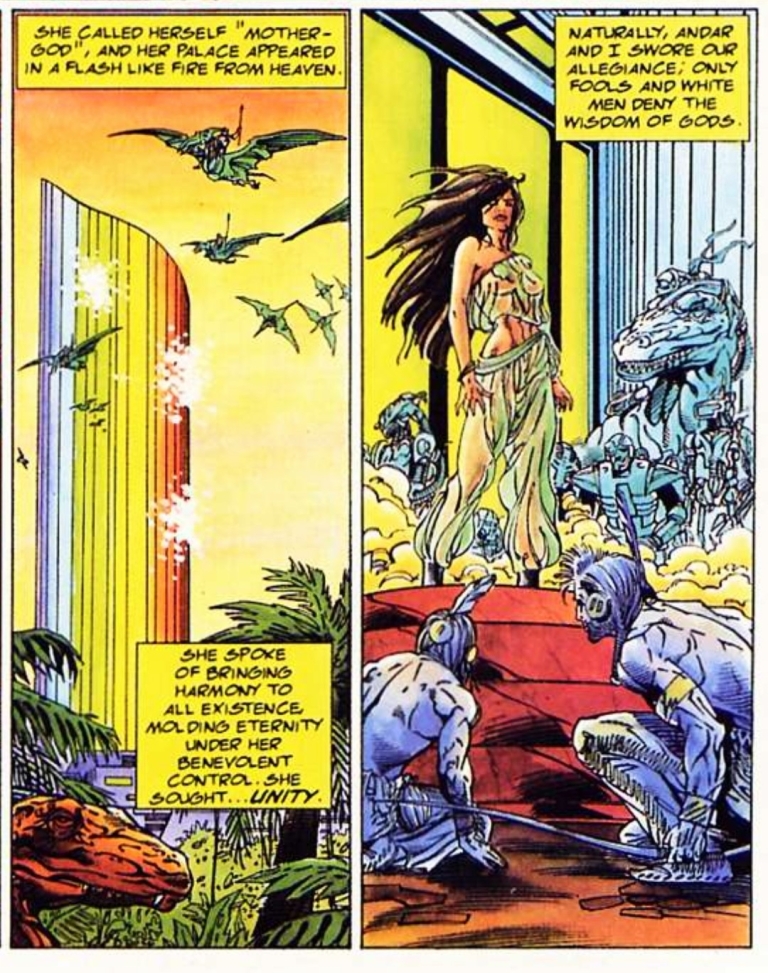
He and Andar got involved in an armed conflict with invaders who arrived with advanced technologies. The robot fighter Magnus then got involved and helped Turok and their side turn the tide of battle. Eventually a stunning phenomenon happened as a woman who called herself Mothergod appeared. Turok and Andar foolishly submitted themselves to her and soon, they started operating in her service with violence against those who opposed her.
After encountering Archer and Armstrong, Turok realized the error of his devotion to Mothergod and eventually joined forces with Rai, X-O Manowar and others who waged battle against her.
Back in the present, an intelligent, cybernetically enhance dinosaur attacks Turok…
Quality
Very intense violence drawn by Bart Sears which reflected the high intensity of Turok’s fight with the dinosaurs.
To get straight to the point here, when it comes to emphasizing a new version of Turok for comic book readers in the early 1990s, the creative team was quite successful in achieving that goal. By the time I reached the end of this comic book, Turok’s place within the huge shared universe of Valiant got established solidly and the Michelinie-Sears duo dramatized the Indian’s struggle (being lost in time and far away from where he belongs) in South America in the late 1980s.
Being lost in time and having to deal with deadly, intelligent dinosaurs brought not only the warrior within Turok but also the determine survivor in him as well. There is a good amount of character emphasis of Turok which served as an effective balance to all the spectacle (read: uncompromised bloody violence) the creative duo prepared. Instead of using thought balloons, you will read Turok’s thoughts through narration boxes all throughout which made an effective and interesting reading experience.
Considering his great skills in hunting and fighting, Turok is not really a super protagonist. He is as vulnerable as any other person and you will get to see him suffer and become so helpless, he has no choice but to avail of assistance from South American villagers who lived by the land but are themselves very vulnerable to the savagery of the intelligent dinosaurs. The symbolism regarding vulnerability as well as the ramifications of the Unity crossover on this tale is very strong. This is indeed very solid writing by Michelinie.
As for the art, Sears’ work here is very unique and his style on drawing people, monsters and locations made this comic book a visual standout among 1993 comic books. When it comes to the graphic violence, it is clear to me that Sears enjoyed the creative freedom he got and he really emphasized his imagination as to how gruesome violence caused by dinosaurs on human beings would be. That being said, there are lots of violent action scenes and images of physical damage (damage on the flesh specifically) that remain visually disturbing to this day.
Conclusion
Very foolishly, Turok and Andar submitted themselves to a walking, evil idol. This should remind you that idolatry is both foolish and unholy.
Turok: Dinosaur Hunter #1 (1993) works nice as modern portrayal of Turok and it succeeds in establishing his place within Valiant’s comic book universe thanks primarily to the Michelinie-Sears duo. Turok himself is not exactly an interesting protagonist to me but I can say it is the creators’ way of portraying him that makes the plot and the comic book work as an entertainment piece. I also liked the way Turok was emphasized as a character who got lost not only in time but also dimensionally lost as he has to live within a whole new world while focusing on survival as well as his desire to kill his rival Mon-Ark (the intelligent dinosaur). If you know your American pop culture history, you will realize that this comic book incidentally paved the way for the Turok video games (starting with 1997’s Turok: Dinosaur Hunter of Nintendo 64) that happened years later.
Overall, Turok: Dinosaur Hunter #1 (1993) is recommended.
Have you been searching for something fun or interesting to watch on YouTube? Do you feel bored right now and you crave for something to see on the world’s most popular online video destination?
I recommend you check out the following topics and the related videos I found.
#1The 6-minute explanatory gameplay trailer of Eiyuden Chronicle: Hundred Heroes – Eiyuden Chronicle: Hundred Heroes, the upcoming Japanese role-playing game (Japanese RPG) set for a global release on April 23, 2024, was in the spotlight recently as publisher 505 Games released a 6-minute trailer that showcases and explain to gamers what to expect in terms of game play and features. What long-time gamers enjoyed so much about Suikoden and Suikoden II can find them also in Eiyuden Chronicle: Hundred Heroes. Watch the whole trailer below…
#2 Lord Jesus lived as a Jewish man and NEVER was a Palestinian – There is so much chaos in this world and you can see that through the Palestinians (a displaced people whose leaders have long engaged in terrorism and hatred against Israel and the Jewish people) and their brainwashed supporters (the pro-Palestine freaks). In many parts of the world, a lot of pro-Palestinian believers (activists who are often rowdy, arrogant, violent and ignorant at the same time) kept shouting the big lie that Lord Jesus was a Palestinian (an overblown fantasy that spreads wickedness and deception). To push back against the lies of the pawns of the enemy (Satan), watch Israeli YouTuber Oren explain in detail the truth that Lord Jesus truly lived as a Jewish man, was born into an existing Jewish society and had Jewish people as His believers/followers (the early Christians).
#3 2023 Batman Returns reaction videos and more – For some time now, I’ve been watching varied movie reaction videos from YouTubers Ashleigh Burton, TBR Schmitt, Jen Murray and EOM Reacts. What I found very surprising was the fact that each of them published reaction videos of the 1992 superhero movie Batman Returns this year, and three of those videos were just weeks apart from each other. I posted those Batman Returns reaction videos below and I added two more related videos that should orient you about the movie.
#4 Get to know the Temple Mount in Jerusalem, Israel – This past February, I visited Israel on a pilgrimage tour. It was indeed the greatest overseas travel experience in my entire life as it was blessed and anointed by the Lord who answered my prayers to visit Israel to deepen my faith in Him. I also visited the Temple Mount in Jerusalem which is one of the most significant places to visit in the entire world. That being said, I posted below the Christian Broadcast Network’s Temple Mount special video and my personal video of my first-ever moments at the holy site.
#5 Pro-Palestine believer exposed as a LIAR! – The people who support the wicked causes of the Palestinians are clearly ignorant, misled, pretentious and dishonest. A lot of pro-Palestine people have posted videos on varied networks to spread lies and misinformation regarding history, and some of them are very young people (Generation Z) who clearly do NOT know all the details, who were fed lies by their Islamo-Leftists superiors and they are clearly not intelligent. The Palestinians are truly a displaced people and they were NEVER the indigenous people of the land of Israel! Watch the video below and enjoy.










 Author Carlo Carrasco