Welcome back my readers, YouTube viewers and all others who followed this series of articles focused on YouTube videos worth watching. Have you been searching for something fun or interesting to watch on YouTube? Do you feel bored right now and you crave for something to see on the world’s most popular online video destination?
I recommend you check out the following topics and the related videos I found.
#1 The return of US President Donald Trump – Donald Trump is officially back as President of the United States. Officially speaking, he has been counted as the 45th and now the 47th US President. Within the first day of his new administration, President Trump proceeded with the reforms by signing them with his approval. Indeed, America is back with Trump and this means removing the woke trash left behind by the failed Biden-Harris administration. The following videos were selected for your interest and enlightenment.
#2TBR Schmitt reacts to 1997’s Air Force One – I don’t know with you readers but I enjoy watching the movie reaction videos of YouTuber TBR Schmitt (a couple who enjoy movies together). In light of Donald Trump’s return as US President, I posted below TBR Schmitt’s reaction video of 1997’s Air Force One (note: for other YouTube reaction videos of the said movie, click here) which is entertaining to watch. If you have not seen Air Force One, watch the movie first before seeing the reaction video.
#3 The rise of Vietnam – It cannot be denied that Vietnam truly progressed economically over the decades. Previously ravaged by war, Vietnam is now in a position to replace China as the manufacturing hub of Asia and they already have tech giants like Samsung and Apple on their side. This video by ColdFusion explains in details the historical background and the astronomic rise of Vietnam. It’s a must-watch.
#4 VKunia reacts to Rocky – Have you been watching the movie reaction videos of YouTuber VKunia? She has lots of reaction videos and most of them are enjoyable to watch. For this post, I am sharing with you her reaction video of the one movie that made Sylvester Stallone a movie star – Rocky. Not only that, VKunia herself used to live in Philadelphia (Rocky’s city). Watch VKunia’s Rocky reaction and observe how Stallone’s film draws her reactions.
#5 PatmanQC examines the Atari Jaguar – Back in the early to the mid-1990s, console gaming was already dominated by the Japanese, particularly by Sega (with the Genesis) and Nintendo (with the SNES). Along the way, while reading a video game magazine, I was very surprised to see the announcement of the Atari Jaguar console. Back in those days, a lot of people thought Atari faded away in the console business. The Jaguar eventually failed commercially but it still made its mark in video gaming history, and already a lot of YouTubers posted retrospective videos about the said Atari console. If you want an in-depth look at the history of Atari Jaguar and what its games were, watch PatmanQC’s video below.
#6 You, Me and the Movies react to Mac and Me – Have you ever been interested in a movie geared towards children with a creative mix of Coca-Cola, McDonald’s and a story that has similarities with E.T. the Extra-Terrestrial? Such a movie exists and it is called Mac and Me. You, Me and the Movies recently posted their reaction video about it and you have to see it.
When Donkey Kong Country (DKC) was released on the Super Nintendo Entertainment System (SNES) in 1994, a lot of gamers were blown away by the visuals and its enjoyable game design. The game also made the character Donkey Kong – who was originally a villain in the 1981 arcade game – very popular. Donkey Kong Country was developed by the European game studio Rare. To find out more about DKC, read Old School Gamer Magazine’s retro gaming article.
Welcome back readers, fellow geeks and electronic gaming fans!
In this edition of the Retro Gaming Ads Blast (RGAB) series, we will take a look at another batch of retro gaming print ads – including arcade flyers – from the 1980s and 1990s.
For the newcomers reading this, Retro Gaming Ads Blast (RGAB) looks back at the many print ads of games (console, arcade, computer and handheld) that were published in comic books, magazines, flyers, posters and newspapers long before smartphones, social media, the worldwide web and streaming became popular. To put things in perspective, people back in the 1980s and 1990s were more trusting of print media for information and images about electronic games and related products.
With those details laid down, here is the newest batch of retro gaming print ads for you to see and enjoy…
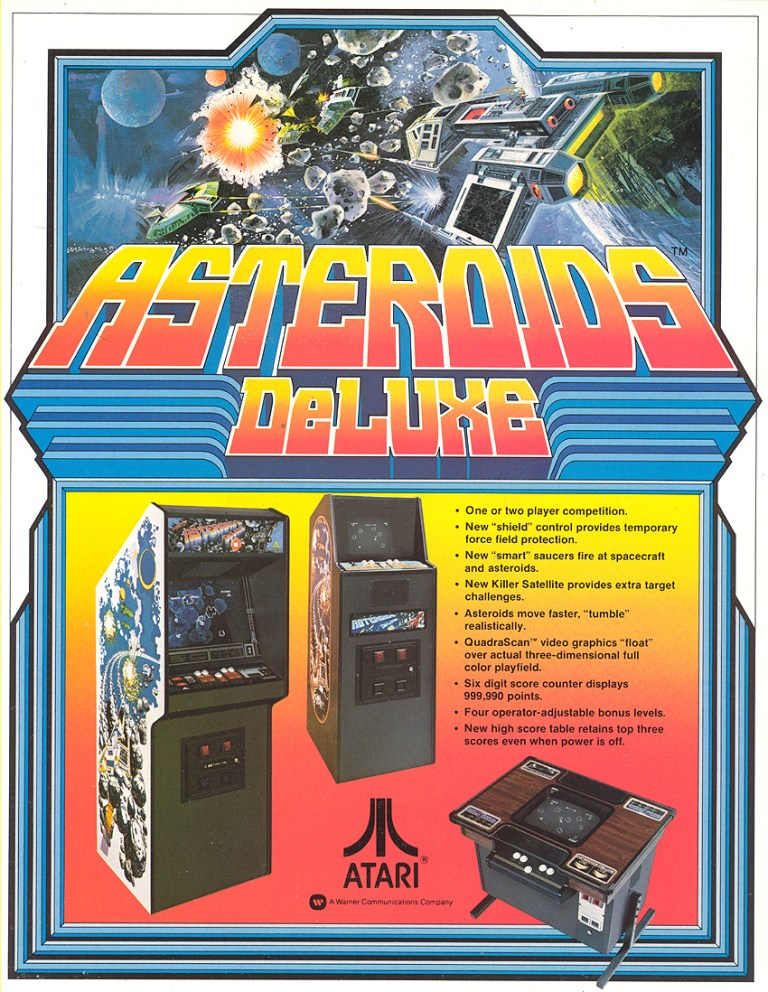
1. Asteroids Deluxe arcade flyer
The arcade flyer for North America.
Given the fact that Asteroids was a massive hit for Atari in the arcades, it was not surprising that a sequel was made called Asteroids Deluxe. In preparation for its 1981 release, Atari made this Asteroids Deluxe arcade flyer showing three machine that arcade operators can choose from complete with technical details displayed. They even emphasized the QuadraScan video graphics as a technological advancement with regards to graphics. By today’s standards, this arcade flyer is still sensible with regards to promoting the game to both arcade operators and players.
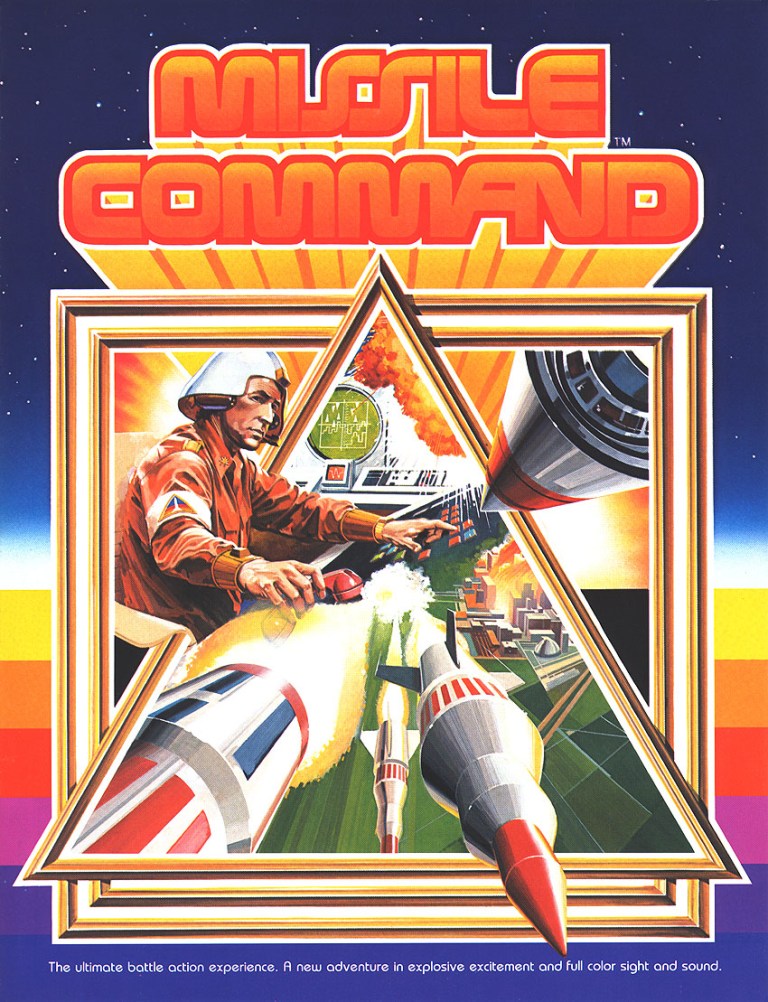
2. Missile Command arcade flyer
Engaging art work on display at the front of the arcade flyer.
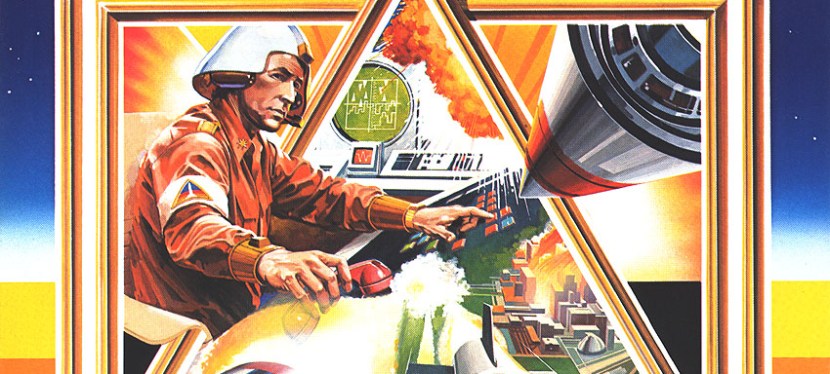
Released in the arcades in 1980, Missile Command is a classic game from Atari and its concept of defending cities from incoming enemy missiles proved to be relevant with people living with the fear of a nuclear missile attack during the days of the Cold War. In my experience, I mainly played the Atari 2600 version and it was only recently I finally started playing the arcade classic on my Xbox Series X using the Atari 50 Collection software. As for the arcade flyer itself, Atari simply used highly detailed painted art for the front which clearly emphasized the science fiction portrayal of a military officer using a console inside a base to come up with defensive response to incoming ballistic missiles. The game was a massive hit in the arcades and in my view, Atari’s simply yet direct way of promoting the concept of Missile Command with the arcade flyer remains compelling to look at.
3. Gun.Smoke European arcade flyer
Nice art on the front of this arcade flyer for the European market.
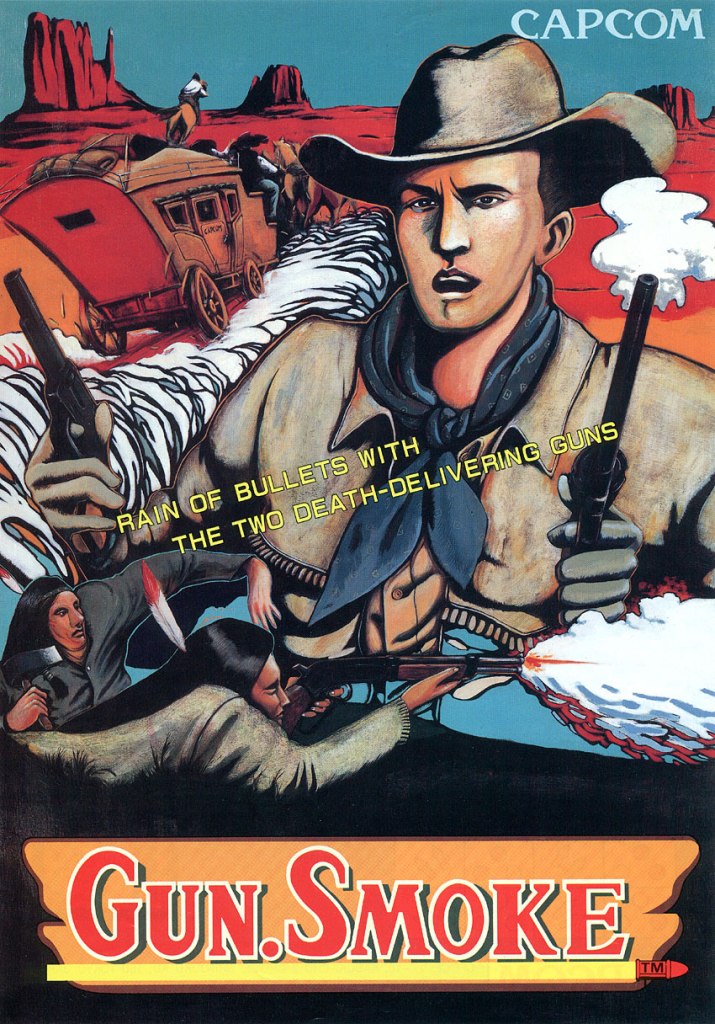
Long before they struck gold with Street Fighter II, Japanese company Capcom scored a hit with gamers in the arcades with 1985’s Gun.Smoke. It was a vertically scrolling run-and-gun game with an Old West setting and it was designed by Yoshiko Okamoto (Final Fight and Street Fighter II). To promote the game for European arcades, Capcom simply used hand-drawn artwork for the arcade flyer’s front which emphasized the Wild West setting, and an American Cowboy and bounty hunter named Billie Bob who is the playable character gamers got to play. In my view, the artwork gave the game a strong Wild West image that is also memorable.
4. Sei Senshi Amatelass arcade flyer
Does the model look sexy or tough?
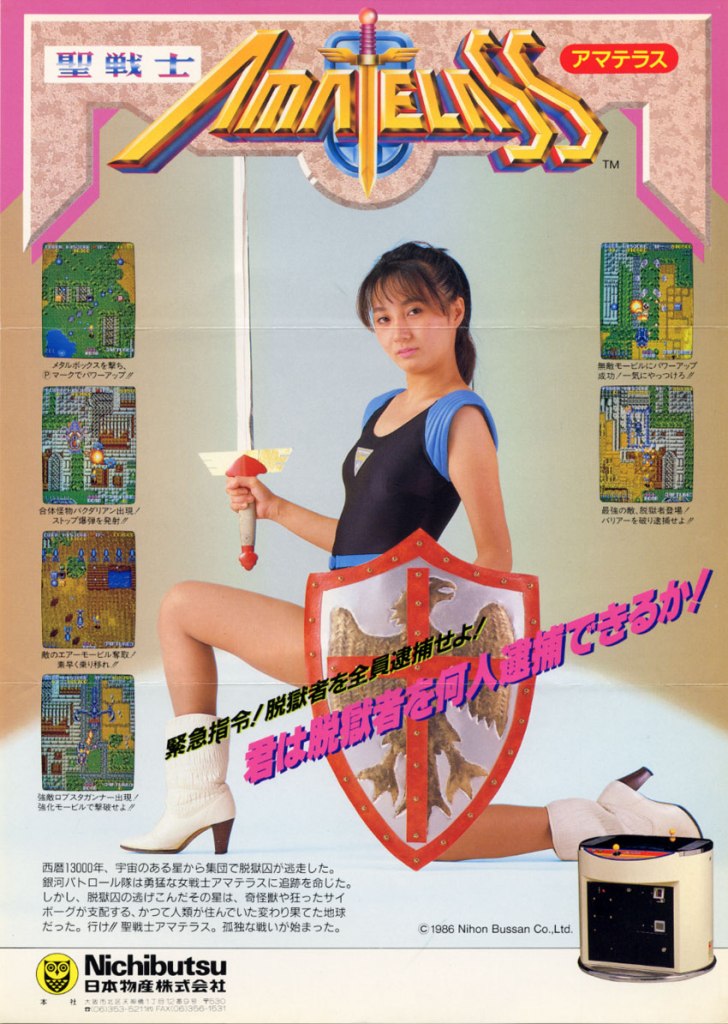
Released in Japanese arcades in 1986 by Nichibutsu, Sei Senshi Amatelass is a vertical scrolling run-and-gun game with a science fantasy concept. To promote the game and really sell its concept, Nichibutsu hired a model posing with a sword and a shield in fantasy inspired costume. Using the remaining spaces of the flyer, some screenshots and an image of the arcade machine were displayed. This flyer showed the company exerting effort to sell Sei Senshi Amatelass with a touch of beauty and subtle sexiness.
5. Sweet Gal arcade flyer
Seriously, are you interested in playing mahjong in digital form?
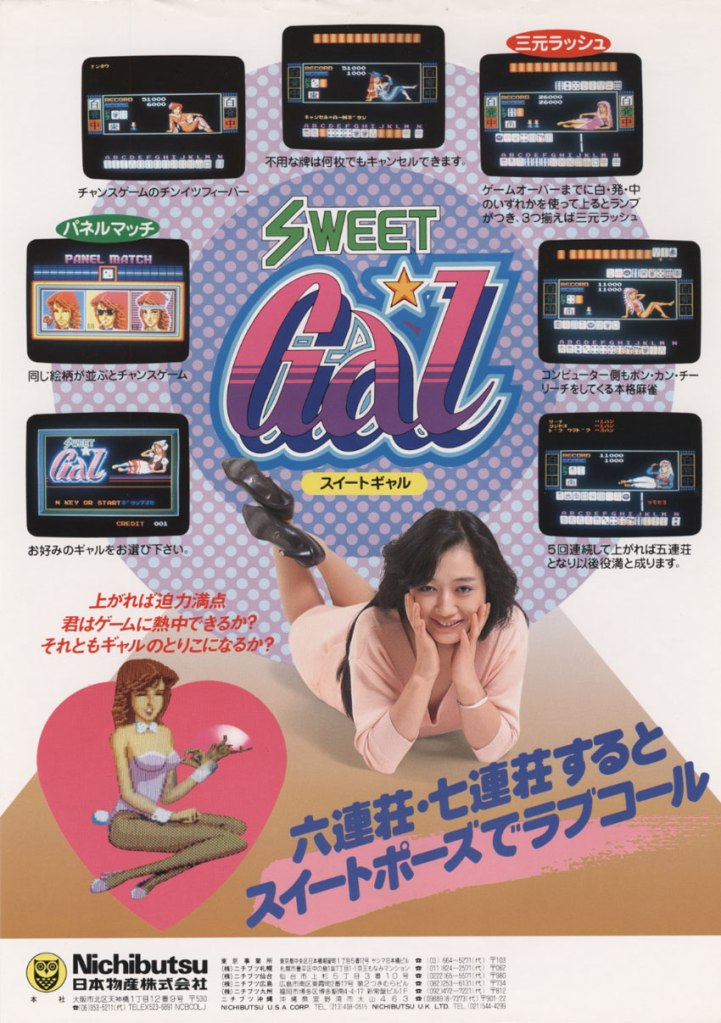
Here is another digital mahjong arcade game from Nichibutsu…Sweet Gal. As typical of the company, a model was hired to add subtle sexiness into the promotion of the game and they even added a digital image of a sexy girl. Sweet Gal clearly was promoted to attract men who enjoy playing mahjong in electronic format and there were some arcade spots in Japan that catered to such mahjong enthusiasts.
6. Moon Patrol print ad
This is a fun-looking, comic book style way of promoting a video game.
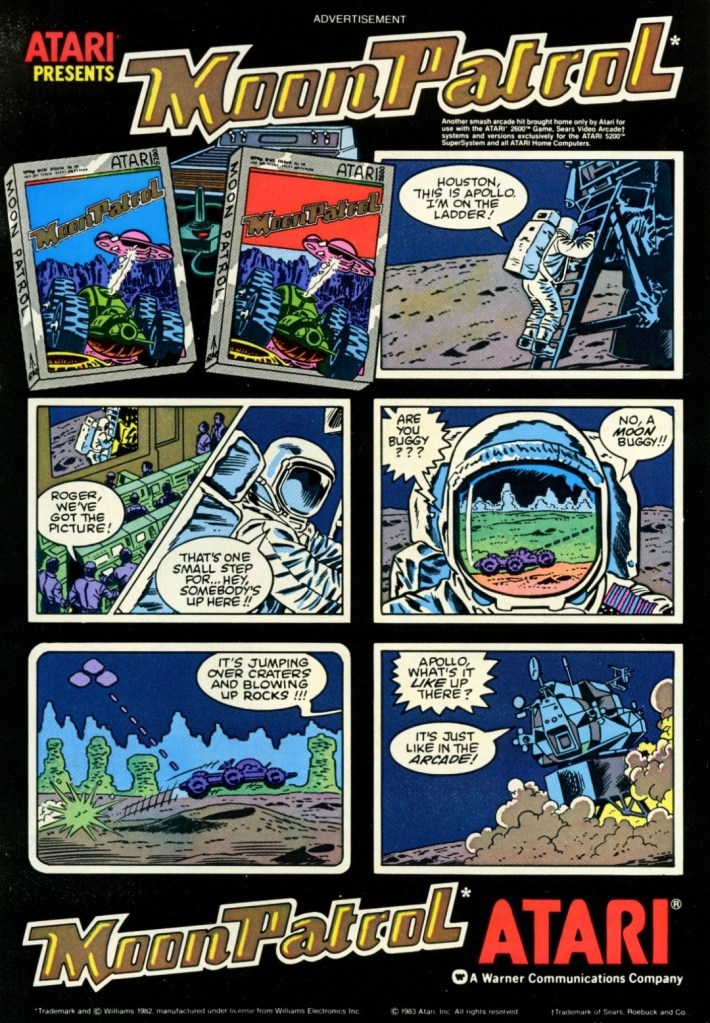
Here is one of those video game print ads I saw while reading comic books back in the early 1980s. Moon Patrol is a sci-fi, side-scrolling game by Atari known for introducing full parallax scrolling in side-scrolling games. Instead of showing screenshots of the console versions of the game, this print ad used nice looking hand-drawn artworks presented with a comic book-inspired style to emphasize the concept. I still remember how captivating this ad and its super short story was the first time I saw it. It was enough to make me interested in the game.
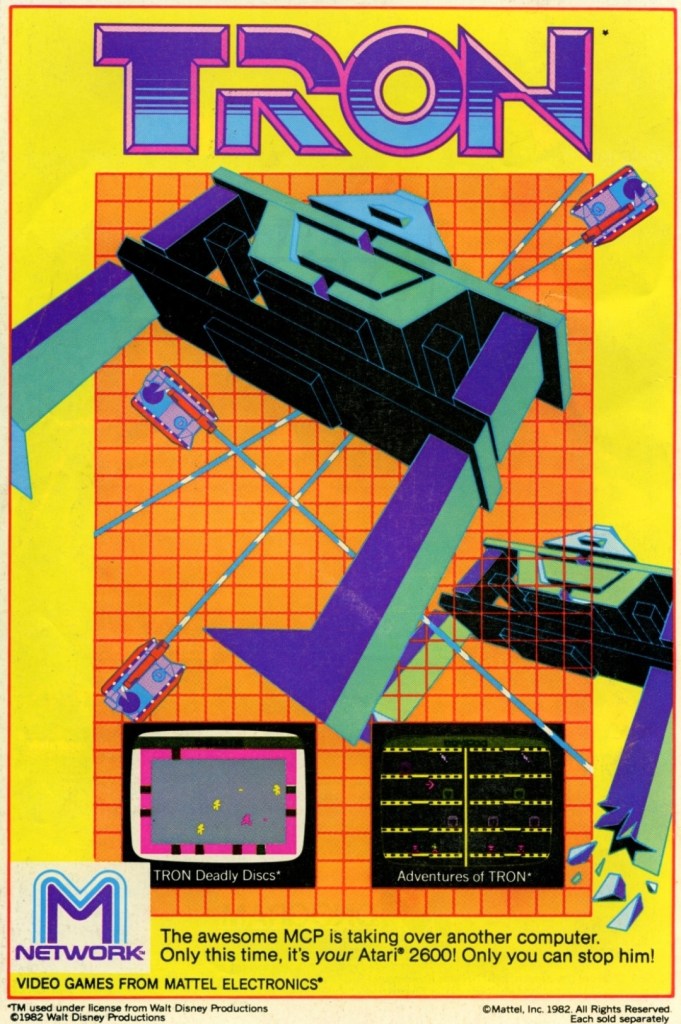
7. Tron Atari 2600 games print ad
Calling all Tron fans to look at this.
I was very captivated by the 1982 sci-fi movie Tron which I saw on home video. It had very flashy computer-generated visuals, a very memorable story and the fine performance by Jeff Bridges. Tron was also very reflective about the video game culture of its time. When I first saw this print ad while reading a comic book, I was really excited. If you look closely, it had nice artwork dominating the space and screenshots that each promoted the games Tron: Deadly Discs and Adventures of Tron. Even though the graphics were primitive, I still recognized the Tron-related images which added to my excitement.
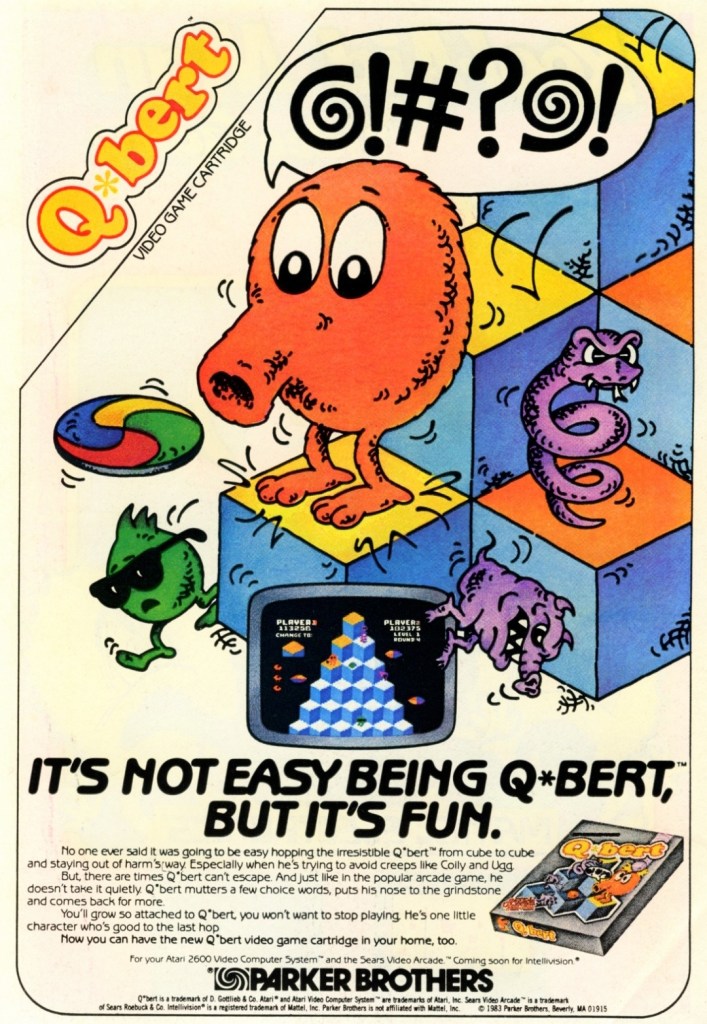
8. Q*bert print ad
This print ad by Parker Brothers really captured the essence of the game.
The puzzle-oriented 2D action game Q*bert became an arcade hit in America shortly after its 1982 release and even went on to become one of the highest grossing arcade games in 1983. Q*bert is one of those 2D games that cleverly blended puzzle play with 3D-like movement and avoidance of both obstacles and enemies. As expected, the game made its way into gaming console and this particular print ad had artwork that strongly captured the very essence of the game complete with the very catchy line “It’s not easy being Q*bert, but it’s fun.”
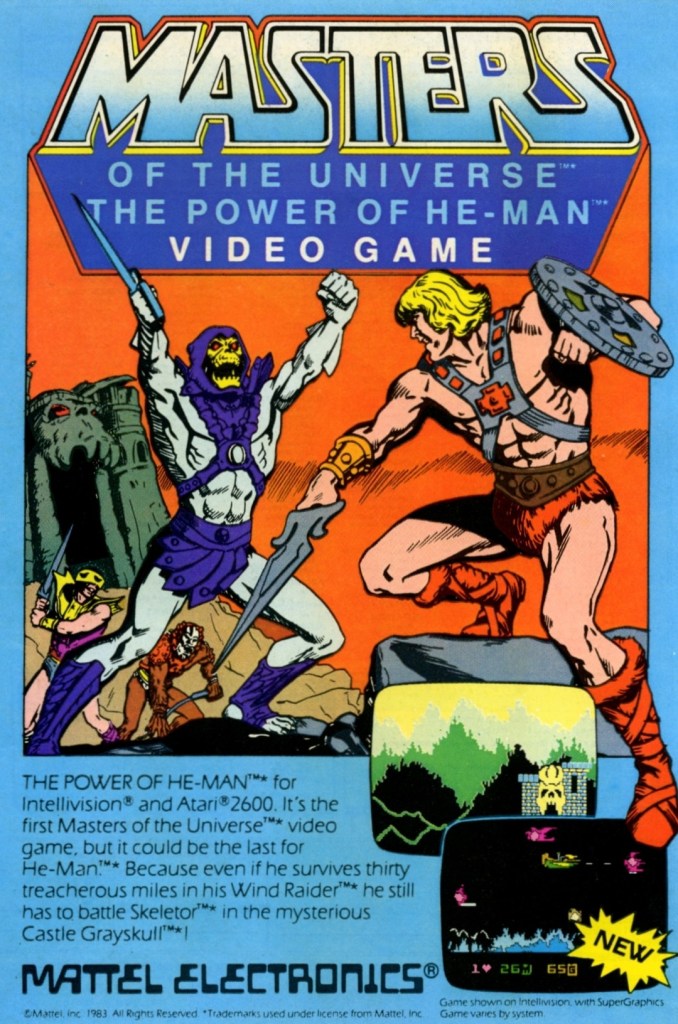
9. Masters of the Universe: The Power of He-Man print ad
Calling all He-Man fans.
I saw this print ad of Masters of the Universe: The Power of He-Man (for Atari 2600 and Intellivision) while reading a comic book long ago. Like the Tron games ad, this made me excited as I was fond of watching the He-Man cartoon series of the 1980s. While the selected screenshots caught my attention, it was the hand-drawn art of He-Man facing off with Skeletor and his minions that captivated me simply because it reminded me of the animated series. This is a fine example of promoting a video game that would instantly resonate with fans of He-Man and the Masters of the Universe franchise.
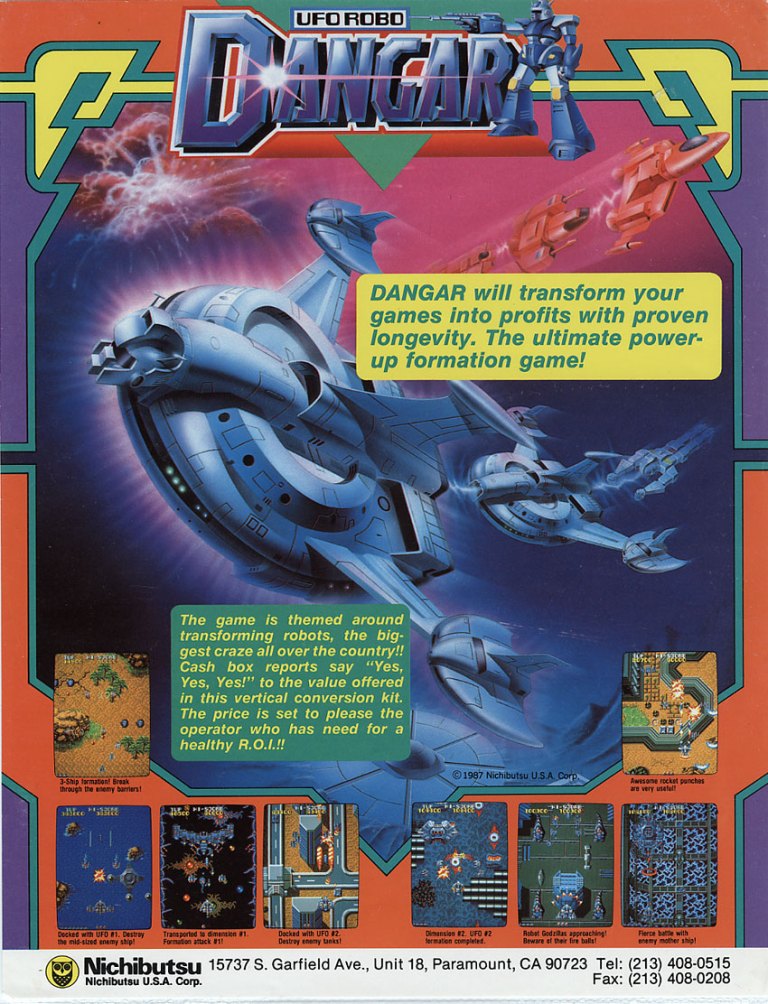
10. UFO Robo Dangar North American arcade flyer
The giant robot concept of this game gave some viewers the impression that it was based on some giant robot anime series from Japan even though the art work used does not suggest it.
Here is another arcade game from Nichibutsu but for the North American market and without the use of a model and without the subtle sexiness. UFO Robo Dangar is a 2D vertically scrolling science fiction shooting game and players get to control a giant robot (composed of flying vehicles that merged into one mechanical body) that has to go through countless waves of enemies in order to advance from one level to another. The arcade flyer used nice looking sci-fi art of ships with the game’s title having a robot and several screenshots of the game. The flyer even made a hard pitch towards arcade operators that UFO Robo Danger will transform their games into profits with proven longevity.
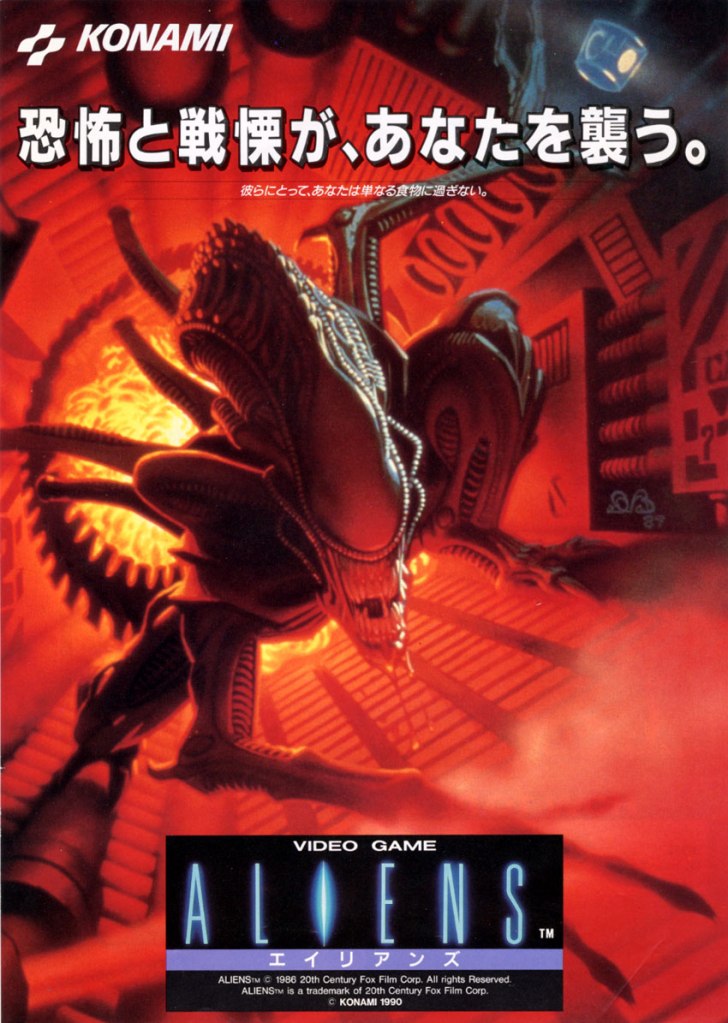
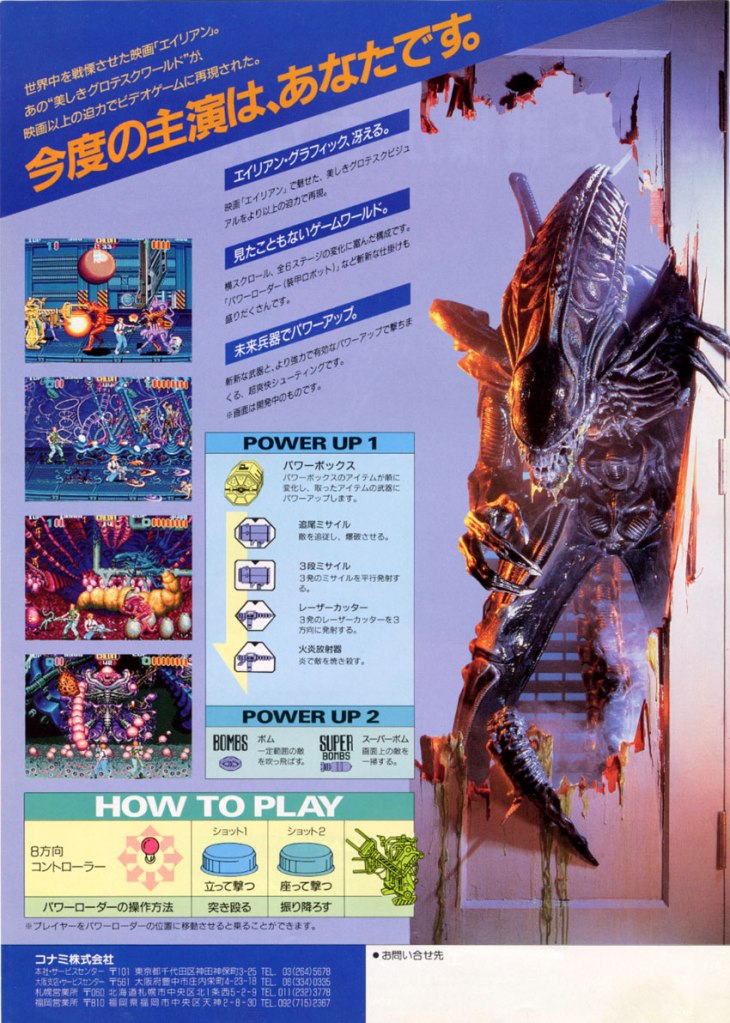
11. Aliens Japanese arcade flyer
The front.
The other side of the flyer of the 1990 arcade hit Aliens.
Quite arguably, Konami’s 1990 arcade hit Aliens is the best video game of any game design to be based on the 1986 film directed by James Cameron. Not only was Aliens a big hit in the arcades, it also won an award from the American Amusement Machine Association (AAMA). Aliens was released in Japanese arcades in February of 1990 and Konami released an arcade flyer that was much more visually striking than its North American arcade flyer. The front had detailed artwork of the Xenomorph while the rear had the instructions and screenshots presented in an orderly manner. The photograph of the Xenomorph alien was added intensity on selling the game. This is still a great looking arcade flyer.
Welcome back readers, fellow geeks and electronic gaming fans!
In this edition of the Retro Gaming Ads Blast (RGAB) series, we will take a look at another batch of retro gaming print ads – including arcade flyers – from the 1980s and 1990s.
For the newcomers reading this, Retro Gaming Ads Blast (RGAB) looks back at the many print ads of games (console, arcade, computer and handheld) that were published in comic books, magazines, flyers, posters and newspapers long before smartphones, social media, the worldwide web and streaming became popular. To put things in perspective, people back in the 1980s and 1990s were more trusting of print media for information and images about electronic games and related products.
With those details laid down, here is the newest batch of retro gaming print ads for you to see and enjoy…
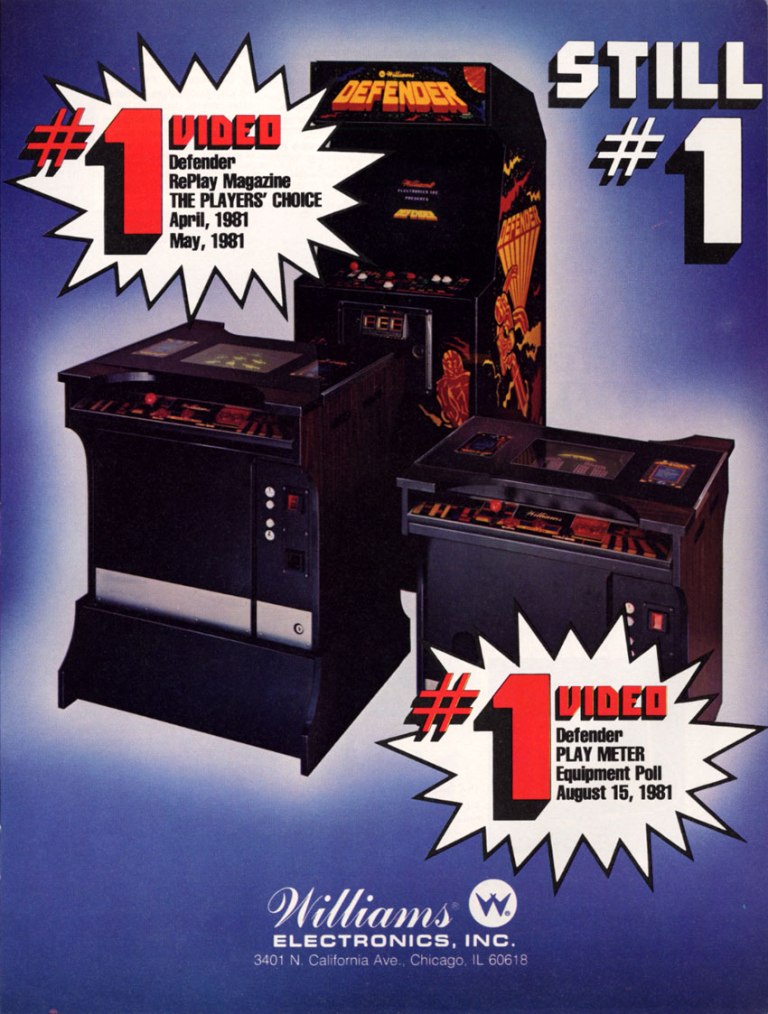
1. Defender arcade flyer
Perhaps Atari did not have enough original artwork of Defender to be used in this arcade flyer. So they ended up using footage of an astronaut on the moon.
Very long ago, I played the classic game Defender a lot on the Atari 2600. Strangely enough, I never played its arcade version as my visits to arcades were quite limited as I was so young back then. When it comes to the arcade flyer of Defender, I find the use of stock footage of an astronaut on the moon as the artistic backdrop baffling because the game’s concept was all about fighting back alien invaders and protecting the citizens. Ironically, the image blended well with the photos of two arcade machines showcased.
2. Amidar Atari 2600 print ad
Does this ad make you think about King Kong or animals?
When I was a young boy, I saw this Parker Brothers print ad of Amidar appear in many superhero comic books I read. I never played the game on the Atari 2600 nor in the arcades. Each time I saw this ad, I always wondered how the game played and what its creative concept was all about. The constant showing of a giant gorilla on the game box cover reminded me of King Kong.
3. Reactor Atari 2600 print ad
Parker Brothers made this ad imagining gamers getting very engaged with reactor once they start playing it.
Reactor was one of those video games that was somewhat influenced by the subject of nuclear technology, particularly about the nuclear reactors. This is another game I never played on console nor in the arcades. This Reactor print ad by Parker Brothers for the Atari 2600 has a visual style and creative concept that I still find fascinating to look at.
4. Punch-Out!! arcade flyer
This was years before Nintendo hired Mike Tyson to endorse the console version of Punch-Out!!
In 1984, Nintendo released the original Punch-Out!! game in the arcades and literally punched its way through to the top of American arcades that year while also scoring big in other arcades around the world. While the game proved to be very playable and a lot of fun, it could be argued that the intriguing image Nintendo used for the North American arcade flyer – a boxer down after literally getting beaten by the Punch-Out!! machine – made an impact on both gamers and arcade operators.
5. Arumana no Kiseki flyer
Is the famous Indiana Jones theme music playing inside your mind right now as you look at this art?
Released in 1987 on the Disk System of the Nintendo Family Computer (Famicom) in Japan, Arumana no Kiseki was one of the many 2D adventure games Konami released that entertained gamers. When compared to Castlevania – strongly influenced by American horror movies – this game was very influenced by the Indiana Jones movies of Steven Spielberg which is very evident in this promotional flyer.
In fact, some gamers who could not read the Japanese title actually thought this was an official Indiana Jones video game because the artwork was so suggestive. Having played and finished the game myself, I can say that Arumana no Kiseki was simply an Indiana Jones-inspired adventure game that had its own creative concept and unique settings and characters.
6. Devastators arcade flyer
The 1980s female Rambo smiling towards you.
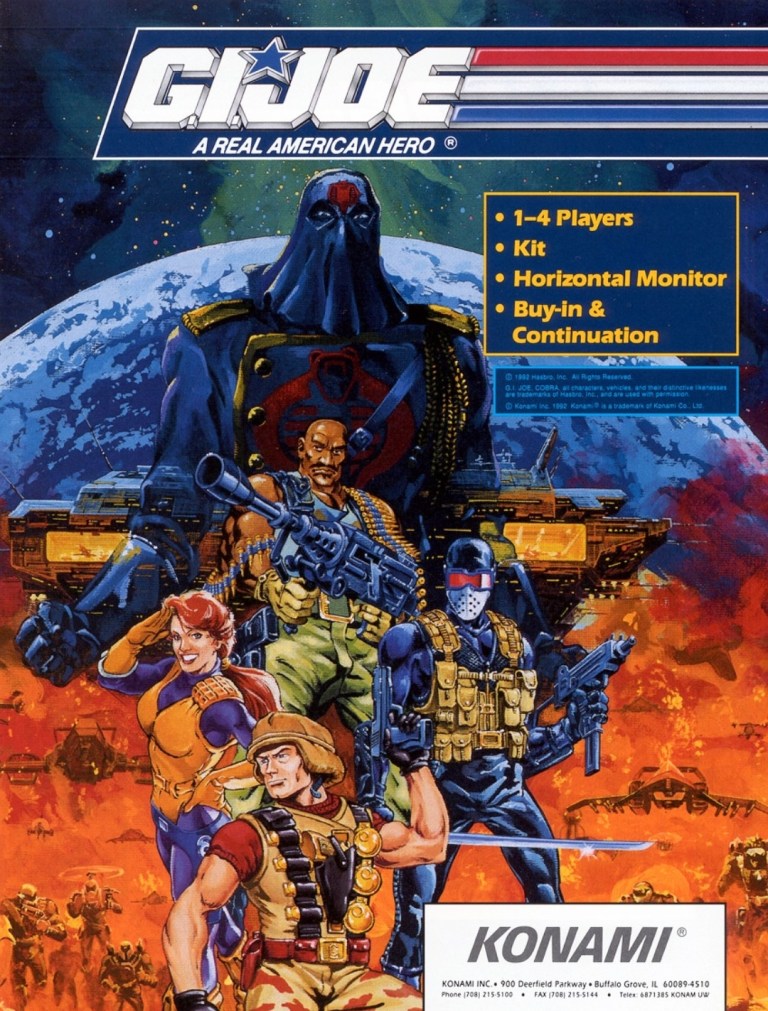
By looking at the track record of Konami closely, you will notice that many of their games in the 1980s were influenced by Hollywood movies and they hired pretty or sexy models for their arcade flyers. This arcade flyer of Devastators is no exception and you can clearly see the Rambo-inspired lady smiling while carrying a weapon. Devastators itself had strong Rambo vibes for its concept.
7. S.P.Y. Special Project Y arcade flyer
Somehow the picture of this flyer reminds me of Miami Vice.
Still with Konami, S.P.Y. Special Project Y is 1989 arcade game that featured action sequences in which players fight against countless enemies in order to progress with the minimal story. This game had certain spy movie elements and to promote it, Konami came up with this arcade flyer showcasing three sexy women wearing swimwear accompanied by two men who looked more like operators or schemers. Can you imagine yourself as an arcade operator looking at this flyer trying to decide to buy the game?
This arcade flyer is still great and exciting to look at, even if your not a TMNT fan.
Now this is one of the most definitive arcade games Konami ever made. Released in late 1989, Teenage Mutant Ninja Turtles became a massive arcade hit in North America constantly attracting lots of fans and casual gamers to play at each machine. The demand was so great, Konami had no choice but to hire a company to manufacture more machines. When it comes to promoting the game, Konami cleverly used a mix of artworks for the TMNT characters and fantasy environment while having a hired model playing April O’Neil blending in smoothly.
Having seen the 1980s animated series myself, I can say that the ad makers struck gold when it came to making a promotional image that Teenage Mutant Ninja Turtle fans can easily recognize and go to the arcade to play the game.
9. Batman arcade flyer
If you saw the 1989 movie, did you play this in the arcade?
The live-action Batman movie of 1989 was simply inescapable as there was so much hype, merchandising and promos connected with it. When it came to video games, it was not surprising that a lot of companies talked with Warner Bros. and eventually Atari made the official arcade game based on the movie (for insight on the production, watch PatmanQC’s video by clicking here). This early-1990s arcade flyer had a simplistic approach showing a few screenshots and descriptive text while having the live-action Batman (note: Michael Keaton in costume) dominating in the middle. Simplistic yet effective in telling gamers and arcade operators what to expect.
10. Xevious arcade flyer
This arcade flyer is exciting and creative to focus on.
Xevious is a long-running series of video games owned by Namco. Since the early 1980s, several Xevious video games were released on arcades, consoles and mobile devices. Believe it or not, the original Xevious game was published by Atari for North American arcades and the company came up with this dynamic looking flyer to promote it. The arcade flyer really looks dynamic due to the hand-drawn art surrounding the photo of the machine. Even by today standards, this flyer still looks modern and energetic.
11. Robin Hood: Prince of Thieves print ads
Tell me if this ad makes you want to play the game.
Original artwork here was meant to immerse viewers into the fantasy setting of the game based on the movie.
If you saw the 1991 movie Robin Hood: Prince of Thieves, were you able to play the video game adaptation? Robin Hood: Prince of Thieves on the Nintendo Entertainment System (NES) was notable for being specially featured in the Nintendo Power magazine and its game design was truly ambitious at the time. To promote the game and take advantage of the movie’s popularity, Virgin Games came out with two print ads targeting movie fans and NES gamers.
The first print ad above had lots of selected screenshots surrounding the game’s box and crammed the descriptive text. The 2nd print ad had original artwork to emphasize the fictional setting and used only three screenshots. Looking at both print ads, it was clear that the ad makers had no permission to use the likeness of Kevin Costner as Robin Hood. The same with other actors and their characters. Regardless, the ads still reminded me enough of the movie while keeping me informed about the video game.
Welcome back, my readers, YouTube viewers and all others who followed this series of articles focused on YouTube videos worth watching. Have you been searching for something fun or interesting to watch on YouTube? Do you feel bored right now and you crave for something to see on the world’s most popular online video destination?
I recommend you check out the following topics and the related videos I found.
#1 You, Me and the Movies react to 1984’s Runaway – When it comes to the works of the late Michael Crichton, you might be familiar with Jurassic Park, The Andromeda Strain, Congo, Sphere and Westworld. Way back in 1984, Runaway was released in cinemas and it was directed by Crichton himself. The result was a very unique way of telling a crime story with a heavy touch of techno thriller. Hollywood has not made another movie like Runaway. To discover more about Runaway, watch the reaction video of You, Me and the Movies.
#2 Minty Comedic Arts’ look at The Indian in the Cupboard – I remember way back in the mid-1990s when I was inside a local movie theater anticipating a movie to start playing. As I waited, a few movie trailers were shown and the one trailer that really caught my attention was that of The Indian in the Cupboard. Apart from having an interesting concept (based on the 1980 children’s book), the trailer even showed a few but special seconds of Darth Vader and RoboCop in motion. I never saw the movie but there is a lot of interesting stuff to learn about it. Watch the video by Minty Comedic Arts.
#3 The incompetence and delusions of super woke Canadian Prime Minister Justin Trudeau – Let’s be very clear here. Justin Trudeau, who has been Canada’s Prime Minister since 2015, is living with a very distorted view of reality and his fellow Canadians are already suffering economically and socially. A proud feminist, Trudeau recently attacked Americans for rejecting his fellow Communist and American counterpart Kamala Harris in the 2024 US Presidential Election. Trudeau’s recent speech only proved his delusional views and lack of common sense. Most likely, he is panicking already over US President-elect Donald Trump’s plan to impose tariffs on Canada. Watch the Sky News Australia video to find out more.
#4 The sinister truth about the Electric Vehicle (EV) industry that the mainstream news media is not telling you – I already said it before – electric vehicles (EVs) are dangerous and can harm you and your local community. There really is a conspiracy between the electric vehicle industry players, the mainstream news media and the climate change zealots. Together, those sinister forces are hiding the dark truth about EVs and they will do anything to get your money. Watch the Piston Pundit video now.
#5 More videos about Planet of the Apes (1968) – Did you notice that every time a new Planet of the Apes movie got released, there is the temporary revival of interest in the original movie of 1968? By today’s standards, Planet of the Apes of 1968 has little spectacle as it was more philosophical, more suspenseful and more about shock. If you want to discover more about the Planet of the Apes film that starred Charlton Heston, watch the selected videos below.
#6 PatmanQC’s look back at The Combatribes – The Combatribes was a hit in the arcades both in Japan and America way back in 1990. Unsurprisingly, the game was ported to the Super Nintendo Entertainment System (SNES) in 1992. Believe it or not, the company behind The Combatribes also made the Double Dragon games. If you wish to learn more about the history of The Combatribes, watch PatmanQC’s in-depth video.
#7 Decker Shado’s video review of City Hunter (1993) – Believe it or not, the 1993 Jackie Chan-led action comedy movie City Hunter was a live-action adaptation of the City Hunter manga series (which was adapted into an anime TV series). I never saw City Hunter when it was played in cinemas here in the Philippines in 1993 but I heard so much feedback from my friends as the claimed to laughing so hard inside the cinema. Years ago, YouTuber Decker Shado had a series of retro video reviews of Jackie Chan films and his City Hunter video review is entertaining.
#8 Slope’s Game Room’s Dino Crisis series retrospective – I can hardly believe it has been 25 years since I first played Dino Crisis on the PlayStation which was a memorable game as it was directed by Resident Evil creator Shinji Mikami. A lot of gamers called Dino Crisis “Resident Evil meets Jurassic Park” but in my view, it was daring creative choice by Mikami who led a team that worked so hard to animate dinosaurs while using a game engine that rendered full polygonal environments for players to explore. To my surprise, Dino Crisis 2 was released a little over year later and it had radically different gameplay that emphasized more of speed, shooting and scoring. A few years later, I played Dino Crisis 3 on a rented Xbox console and it was a very disappointing experience. To find out more about the history of the Dino Crisis games, watch Slope’s Game Room’s retrospective.
Welcome back readers, fellow geeks and electronic gaming fans!
In this edition of the Retro Gaming Ads Blast (RGAB) series, we will take a look at another batch of retro gaming print ads – including arcade flyers – from the 1980s and 1990s.
For the newcomers reading this, Retro Gaming Ads Blast (RGAB) looks back at the many print ads of games (console, arcade, computer and handheld) that were published in comic books, magazines, flyers, posters and newspapers long before smartphones, social media, the worldwide web and streaming became popular. To put things in perspective, people back in the 1980s and 1990s were more trusting of print media for information and images about electronic games and related products.
With those details laid down, here is the newest batch of retro gaming print ads for you to see and enjoy…
1. Jangou Lady arcade flyer
If you were to play Mahjong digitally, does sex appeal motivate you to do so?
Are you fond of playing the tile-based game Mahjong? Believe it or not, there were indeed ways to play Mahjong in digital form inside the arcade or in gambling joints in Japan. The game Jangou Lady allows users to play rounds of Mahjong but with a notable additive – the digital art of women which serves as an attraction. In the sex appeal is clearly evident on this arcade flyer from the 1980s.
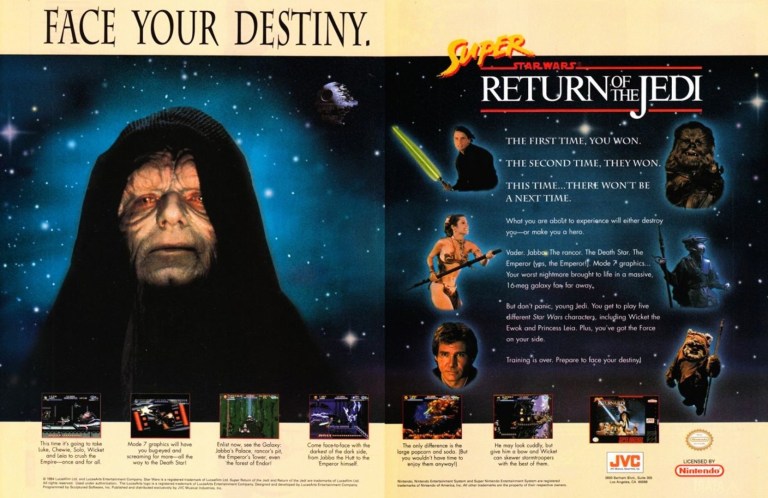
2. Star Wars: Return of the Jedi arcade flyer
Really nice art based on the movie.
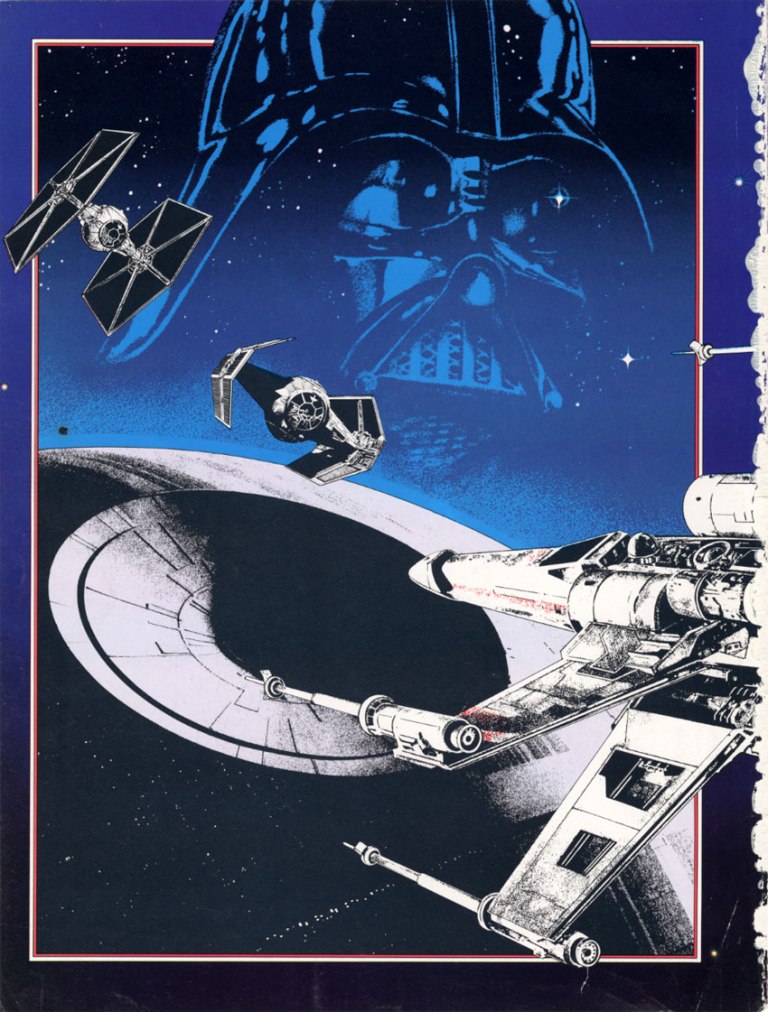
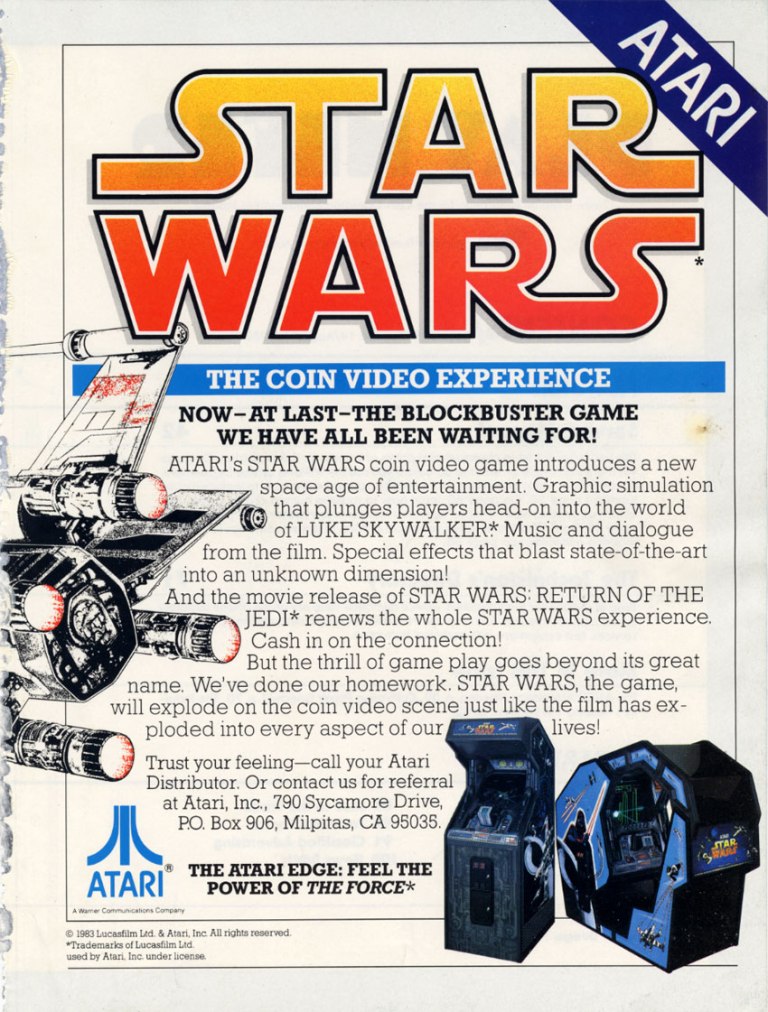
Way back in 1983, Return of the Jedi delighted moviegoers in the cinemas throughout America. Behind the scenes, video game giant Atari acquired the movie license to make the 1984 arcade game Star Wars: Return of the Jedi. The arcade flyer’s front featured a highly detailed hand-drawn art of Darth Vader, the Death Star, Luke Skywalker and Storm Troopers on hover bikes, and the Millennium Falcon which reflect the selected elements of the movie that were turned into playable sections. The image of the arcade machine was understandably inserted as it came with an unusual controller. This flyer is still captivating to look at.
3. Over Drive arcade flyer
This arcade flyer is a reminder that Konami was notable for hiring pretty and sexy women for their print ads.
In 1990, Konami produced a racing game for the arcades with a unique style of presentation. That game was Over Drive and it stood out among the many racing games in the arcade mainly because of its first-person view (with a digital version of the steering wheel and driver’s hands at the bottom of the screen) and unique approach on sprite-scaling. To promote the game, Konami hired sexy models for photography for use in both the arcade flyer and the exterior images on the machine. Having sexy models posing with a winning driver added to the motorsport racing vibe needed to promote the game.
4. American Gladiators for NES print ad
I saw American Gladiators on TV but never played this game.
American Gladiators was a syndicated TV show that featured a variety of games in which amateur athletes compete with the established gladiators to succeed and become the next American Gladiator. Due to its success, it was not surprising that video game adaptations of the show were realized just a few years after its debut. In 1991, GameTek released the American Gladiators game on the Nintendo Entertainment System (NES) and promoted it with this print ad that showcased their established gladiators of the time. This ad’s design was made to catch the attention of the fans.
5. Arch Rivals for NES print ad
I remember seeing a lot of people crowding in front of an Arch Rivals machine in the local arcade long ago.
Years before NBA Jam, there was Arch Rivals. Arch Rivals was a full court basketball video game in which players are allowed to punch players from the opposition in order to steal the ball and score. Over a year after the game’s 1989 arcade debut, the NES version was released and the publisher came up with a print ad showcasing a hilarious and cartoony artwork (the same art used for the game’s box cover) which gave readers a clear idea of what to expect. The art used is timeless and it still is funny to see.
6. Sega Sports print ad
See any Sega Sports video game you like?
Back in the 1990s, Sega excelled with sports video games. They were so aggressive, they established their sub-brand Sega Sports and this particular print ad showed one page promoting assorted sports video games (basketball, golf, baseball, tennis, boxing and American football) for the Sega Genesis and the other page with an exaggerated image of a guy with the line “Relive your jock itch” posted. Historically, a lot of American players and owners of the Genesis are slightly older than those on NES and Super Nintendo Entertainment System (SNES) during the 1990s and the strong sports games approach is a key factor.
7. Plumbers Don’t Wear Ties print ad
When I first saw this print ad, it did not interest me as the presentation is lousy.
The 3DO console is remembered for having a lot of games that used full-motion videos and photo slides regardless of what game designs came with them. Back in the 1990s, games designed as visual novels or dating simulations were still new in console gaming in the West. Following the PC version’s release, a 3DO port of Plumbers Don’t Wear Ties came out in 1994 and it received overwhelmingly negative reviews. The print ad here promoted the game as “an interactive romantic comedy” and fake quotes were displayed to fool ignorant readers that the game was entertaining. The print ad’s visual design had a mess of poorly implemented images. Ironically, this ad accidentally gave readers the idea that it was a slideshow game.
8. Dragon: The Bruce Lee Story and Demolition Man games print ad
If you saw the movies, did you play their respective video game adaptations?
The 1990s is remembered for the many movie-based video games that got released. Back in those days, a lot of Hollywood movie productions had video game adaptations as part of the business process and this is evident with the Dragon: The Bruce Lee Story and Demolition Man games released by Acclaim. For this particular print ad, the marketing team came up with a single-page ad to promote the two games with heavy emphasis on movie imagery leaving little room left for screenshots and other details. The way I look at this old print ad, it seems that Acclaim was aiming for not just movie fans but also gamers who like 2D fighting games and 2D action-adventure games.
9. Army Men: Sarge’s Heroes print ad
This print ad by 3DO is still funny to see.
In the late 1990s, The 3DO Company focused mainly on producing video games on multiple platforms and they had their own video game franchise based on the green plastic figures with a military theme. In 1999, they released Army Men: Sarge’s Heroes for PlayStation and Nintendo 64 (N64). To market the game, they had a hilarious visual concept of several solders freezing on an ice tray as a long green soldier marching on. This print ad always caught my attention while reading game magazines and it still is funny to stare at.
10. Sega Ages print ad
I can only speculate that Sega accepted Working Design’s financial offer for the publishing rights in North America.
Sega Ages is a series of ports and remakes of Sega’s own games (arcade and console) bundled together as compilations released on the modern consoles of the time. While Sega itself published Sega Ages on their Saturn console and Europe, the North American compilation was published by Working Designs under their separate brand Spaz which this particular print ad showed. While the classic Sega games of After Burner II, OutRun and Space Harrier often caught my attention, this ad made me wonder why did not Sega publish this compilation on the Saturn in North America themselves. Looking at this ad now remains awkward.
11. Sega Saturn North American print ad
Did you ever own a Sega Saturn in 1995?
While a lot of gamers and retailers were caught off-guard by Sega’s surprise early launch of the Saturn console in America, they still went ahead aggressively marketing the machine knowing they have a few months’ head start before the American launch of PlayStation. This print ad was designed to intrigue readers showing a bald lady whose head was made to look like the planet Saturn and next to her were images of Sega’s hottest games of the time – Virtua Fighter 2 and Virtua Cop. Sega relied strongly on imagery to promote their console with this print ad. It was somewhat weird yet eye-catching.
12. NBA Action ’95: Starring David Robinson print ad
David Robinson was the MVP of the NBA in 1995 but he failed to lead his team to the NBA championship back then. He would late win the NBA championship in the shortened 1999 season.
As mentioned early, Sega was aggressive the sports videos games and almost all of them were their own console exclusives. Their tradition of hiring professional athletes as endorsers continued during the age of the Genesis and Game Gear when they hired an NBA superstar as an endorser resulting in the Sega Sports basketball game titled as NBA Action ’95: Starring David Robinson. By the time the video game was released, Robinson was already the reigning Most Valuable Player (MVP) of the NBA. This print ad of Robinson in action still looks impressive but with a big catch – the superstar’s 1995 MVP achievement was arguably forgotten as he and his team (San Antonio Spurs) got eliminated by the Hakeem Olajuwon-led Houston Rockets in the Western Conference Finals. It did not help that Olajuwon outplayed Robinson a lot in that very playoff series. That is a sad reminder that also came with this Sega Sports print ad.
Welcome back, my readers, YouTube viewers and all others who followed this series of articles focused on YouTube videos worth watching. Have you been searching for something fun or interesting to watch on YouTube? Do you feel bored right now and you crave for something to see on the world’s most popular online video destination?
I recommend you check out the following topics and the related videos I found.
#1A look back at Tobal No. 1 – The 1990s will always be remembered as the decade when fighting games became wildly popular. While franchises like Tekken, Virtua Fighter, Street Fighter and The King of Fighters literally flooded the arcades and consoles, game developers at DreamFactory (a subsidiary of Square) were dissatisfied with the state of fighting games at the time and this eventually led to the creation of Tobal No. 1, one of the most unique games of its genre ever made. To learn more about it, watch the video below.
#2 Assorted videos of Air Force One (1997) – Watching Air Force One (starring Harrison Ford) on the big screen in 1997 was a fun experience for me. It was one of the many so-called Die Hard clones of the 1990s which featured one brave, vulnerable hero fighting terrorists while confined in a place where escape is not option. For your enjoyment, I selected one trivia video and a few reaction videos of Air Force One. As it is a great film, I encourage you to watch it first in case you have not seen it. Otherwise, go watch the selected videos below.
#3 Slope’s Game Room’s look back at the Choplifter series – I first played Choplifter on the Family Computer back in the late-1980s and it really was both unique and fun to play. It was a side-scrolling adventure game with military action but it was not an all-offense experience. In fact, the game gives you opportunities to rescue hostages and the game development history is pretty interesting to discover. As such, I encourage you to watch Slope’s Game Room’s retrospective of Choplifter.
#4 The games of Square in the 1990s remembered – If you know your video game history, Square Enix was established in 2003 as a result of a merger between Square (AKA SquareSoft) and Enix. When Square was still an independent, standalone company it released a lot of memorable games on the Super Nintendo Entertainment System (SNES) and the PlayStation in the 1990s. If you love retro gaming and if you are interested to discover (or rediscover) what Square released back in the 1990s, then this video is for you.
#5 Canadian Prime Minister Justin Trudeau receives response from returning US President Donald Trump regarding new tariffs – Justin Trudeau – the super woke and out-of-touch Canadian Prime Minister – told the returning US President Donald Trump that new tariffs would kill the economy of Canada. The result is a memorable response from Trump. To see what happened and how the public reacted, watch this Sky News Australia video. Lastly, never ever trust Trudeau. You will regret it believing in him as he is a very bad leader.
#6 Kamala Harris being hit by her donors and her fellow Democrats for reckless campaign spending – The defeated Commie Kamala Harris is now the target of her US presidential campaign donors and even her fellow Democrats. You see, her campaign team raised at least $1.5 billion and ended up with a debt of at least $20 million due to reckless spending and irresponsible handling of money. Apart from literally BUYING the support of celebrities and Hollywood Communists, the Harris campaign spent excessively on online ads, private jets and others. The donors are very furious and a lot of Democrats realized that the laughing hyena Kamala Harris severely damaged the political party. That being said, Kamala Harris would be delusional enough to actually run for US President again in 2028. Watch and learn from Sky News Australia’s video.
#7 You, Me and the Movies react to Friday the 13th Part VIII: Jason Takes Manhattan – Years I ago, I posted my retro review of Friday the 13th Part VIII: Jason Takes Manhattan. The 1989 Friday The 13th sequel was so sloppy and bad with its presentation, it sometimes could be funny to see and it’s okay to ridicule it. If you want to discover Jason Takes Manhattan without spending too much time, you should watch the reaction video of You, Me and the Movies.
8. The collapse of the Assad dictatorship in Syria – In case you missed the news, a new chapter in the history of Syria has officially started as the dictatorship of Bashar al-Assad officially ended with the Islamist rebels taking over the country. Assad and his family are now in Russia. While there is euphoria going on in Syria, you should not allow yourselves to be deceived because the civil war in Syria was never a case of “good versus evil”. Assad was allied with Russia and terrorist state Iran. Meanwhile, the Syrian rebels are allied with the Islamist Turkish forces, Jihadists, terrorists and they have Al-Qaeda members in their ranks. Syria now has a new beginning but where will it go? Watch the videos I selected for your viewing and learning.
Welcome back readers, fellow geeks and electronic gaming fans!
In this edition of the Retro Gaming Ads Blast (RGAB) series, we will take a look at another batch of retro gaming print ads – including arcade flyers – from the 1980s and 1990s.
For the newcomers reading this, Retro Gaming Ads Blast (RGAB) looks back at the many print ads of games (console, arcade, computer and handheld) that were published in comic books, magazines, flyers, posters and newspapers long before smartphones, social media, the worldwide web and streaming became popular. To put things in perspective, people back in the 1980s and 1990s were more trusting of print media for information and images about electronic games and related products.
With those details laid down, here is the newest batch of retro gaming print ads for you to see and enjoy…
1. Raiders of the Lost Ark game print ads
The print ad with strong Indiana Jones imagery.
The print ad with the movie theater exterior image and the small image of the Atari 2600 console.
Directed by Steven Spielberg, Raiders of the Lost Ark was one of the best adventure movies ever made as well as the start of the iconic character Indiana Jones. Given its huge commercial success, an official video game adaptation for the Atari 2600 was released in 1982 and game designer Howard Scott Warshaw even met with Spielberg during the game’s development.
To promote the game, Atari released two print ads – one ad had a movie theater exterior visual concept to emphasize they have the official video game adaptation based on the movie while the other ad showed the game’s official artwork and game box cover while emphasizing a savings offer. Atari really did what they could to sell a game while riding on the success of Raiders of the Lost Ark.
2. Phoenix print ad
Even without any screenshots, this print ad’s art still gives viewers a clear idea of what to expect.
Similar to what they did with Galaxian and Joust, Atari made this print ad promoting Phoenix which was a 2D sci-fi shooting game that was similar with Space Invaders in design. Colorized, hand-drawn artwork resembling the 2D sprites of the game was done to capture the attention of people. The art is so good, it made up for the lack screenshots of the game.
3. Moon Patrol arcade flyer
Front of the Moon Patrol flyer.
The other side of the arcade flyer.
Moon Patrol was a 2D sci-fi side-scrolling adventure game first released in the arcades in 1982. To sell the game to arcade operators, publisher Williams created the North American arcade flyer that heavily used hand-drawn comic book-style artworks on both sides while using available space on the other side for the descriptive text, contact details and the image of an arcade machine. What is very clear is that no screenshots of the game were shown to stand out which explains why a lot of hand-drawn art was used. The picture of the machine showing a screen of Moon Patrol was the closest thing to see a screenshot on this flyer. Personally, I really like the style and quality of the hand-drawn artwork as it made the flyer look lively.
4. Paperboy arcade flyers
The arcade flyer showing the Paperboy machine and screenshots. The hand-drawn art is nice.
This one uses comedy showing a grown man riding a bike as a paper delivery “boy”.
I really like the stronger emphasis on the in-game graphics of Paperboy which dominates the space. What you see is what you get in the arcade.
The first time I ever played the classic Paperboy was in the arcade inside a Las Vegas hotel way back in 1989, and it sure was a challenging yet fun experience. Before its arcade debut in 1985, the developers took a lot of risks making the game which includes coming up with a bicycle handle bar for each machine to have. To promote the game, Atari made at least three arcade flyers that creatively emphasized what the game’s concept was about, how did it play, why does the machine have bicycle handlebars and why players can expect fun. Atari’s promotional efforts paid off as Paperboy became a huge hit in the arcades not only in America but also in Japan.
5. Frogger multi-platform print ad
This print ad is still amusing to look at.
After Frogger became a hit in the arcades, Parker Brothers secured the rights to port the game on Atari consoles, the Intellivision, TI-99/4A, vic-20, the Commodore computers and ColecoVision. To promote their Frogger ports, the single-page print ad was made showing a player in the foreground playing in front of screens that each showed what the game looked like on each platform. Parker Brothers found tremendous success selling 4 million copies of Atari 2600 version of Frogger at a time when there were only 13 million units of Atari 2600 in existence. By the year 2005, video game sales of Frogger reached 20 million worldwide across different platforms.
6. Predator 2 print ad
This is one very edgy print ad as used an official image from the movie.
If there is anything memorable about the 1990 film Predator 2, it is the fact that it had the story and the alien hunter itself within a metropolitan setting. That being said, the Sega Genesis Predator 2 video game had a suitable design of shooting and adventuring within the urban settings. This video game ad really captured the vibe of the movie (even showing the reddish human skull with spine on the Predator’s left hand) and clearly showed what gamers could expect. This old ad is still captivating to look at and its edgy approach is still intact.
7. Atari Jaguar print ad
Did you ever own an Atari Jaguar console?
When I was reading video game magazines back in the 1990s, I always found print ads of the Atari Jaguar intriguing to look at. I was very young when I first played the Atari 2600 and its games at home, and later played some Atari games in the arcade. To me, seeing Atari Jaguar print ads like this one gave me moments of nostalgia and it made me wonder if Atari knew what it was doing with their so-called 64-bit game console. They did what they could to promote their console and the games within this 2-page print ad.
8. Vs. print ad
This print ad easily reminds me of the 1990s.
By 1997, both the arcades and the video game console market were filled with lots of 2D and 3D polygonal fighting games. Japan was the hot spot of the production of 3D polygon fighting games and the developer Polygon Magic (based in Japan) made Fighters’ Impact which Taito released in Japanese arcades and the PlayStation. The said game was picked up by THQ for a late-1997 release on the PlayStation in America under the title Vs. I never played this game but I heard that the game’s development included gang-oriented characters designed by Marvel Comics artist Kurtis Fujita. This Vs. ad is a lively reminder about the hip-hop fashion that made its way into video games.
9. GoldStar/LG Electronics 3DO print ad
This is a very weird way to market a video game machine.
Back in the 1990s, the South Korean electronics company GoldStar (which was part of the umbrella of LG Electronics) had the license to produce 3DO game consoles with its own style. In some ways, the GoldStar 3DO console looked like a premium console on the outside. Unfortunately, the GoldStar 3DO print ad here had a very sloppy presentation as the ad makers used very weird art of a brain-with-eyes holding a 3DO controller leaving little space left to promote the console and games (without any screenshots). The text description was sloppily done. This is a bad example of promoting video game hardware and games.
10. Pandemonium 2 print ad
I saw this ad but never played the game.
Looking back at 1997, I find it strange that I never got to play Pandemonium 2 on the PlayStation even though I saw its print ad in magazines. I had a lot of fun playing Pandemonium! on the console in 1996 but somehow missed out on its sequel. Looking back at the Pandemonium 2 print ad, I was surprised with how the game developers redesigned the two playable protagonists, especially Nikki who was clearly made to look very sexy. The word “libido” (meaning sexual drive) was deliberately placed above Nikki. The ad also had a hypnotizing mix of colors which I believe was also deliberately done by the ad makers. I can only wonder how the game played.
11. Mission: Impossible print ad
A captivating ad.
In 1990, Ultra Games (a label of Konami) released the Mission: Impossible video game on the Nintendo Entertainment System (NES) in America. Developed by Konami, the game was an adaptation of the 1988 TV series and it had an ambitious design with regards to level design and gameplay. To promote the game, the ad makers came up with a visual design showing the game’s box (which had a nice painted art on the cover) on the foreground and several screenshots resembling TV monitors on the background. Even by today’s standards, this print ad still looks good and captivating even if you are not too familiar with Mission: Impossible on TV.
12. The Lawnmower Man Sega CD and Genesis print ad
Are you fan of The Lawnmower Man movie?
Back in 1992, there was a lot of buzz generated by the movie The Lawnmower Man as it had a disturbing concept that involved virtual reality and, more notably, author Stephen King sued the filmmakers to remove his name from the title because the film differed so much from the source material. Of course, those developments did not stop the production of video game adaptations of the movie. This print ad promoting the Sega CD and Sega Genesis versions of the game heavily used the images of CyberJobe which were among the most memorable images from the film. Looking at the ad, the ad makers could have made the screenshots look a little larger to really sell the games.
13. Ground Zero: Texas print ad
The shotguns really made this ad eye-catching.
I never played the Sega CD video game Ground Zero: Texas but I knew that it was one of those games that heavily relied on video footage while giving players moments to interact. Back in 1993, there was an increase in the number of video games that carried lots of live action footage to drive the narrative and players were given options in order to progress. What is very notable about the game is not the game design but the very 2-page ad used to promote it. The image showing four people pointing their shotguns towards the viewer was easily the most captivating part of the ad. Even though there was vacant space in between, the screenshots of the game were displayed to be really small.
14. Alien vs. Predator for SNES and Game Boy print ad
This ad caught the attention of a lot of people back then.
Back in 1990, Dark Horse Comics launched the 4-issue mini-series of Aliens vs. Predator which turned out to be a very intriguing and engaging crossover comic book tale featuring two iconic sci-fi species of monsters. The success of the comic books led to the production of many video games which delighted both fans of Predator and Aliens. In 1993, Activision released Alien vs. Predator on the Super Nintendo Entertainment System (SNES) and the single-page print ad they came up with was engaging to look at. The SNES game box with the fine looking painted art was the main visual highlight leaving just enough space for the descriptive text, the Game Boy cover and two screenshots. Believe it or not, this video game was not related at all with the Alien vs. Predator arcade game and Atari Jaguar console game.
Welcome back readers, fellow geeks and electronic gaming fans!
In this edition of the Retro Gaming Ads Blast (RGAB) series, we will take a look at another batch of retro gaming print ads – including arcade flyers – from the 1980s and 1990s.
For the newcomers reading this, Retro Gaming Ads Blast (RGAB) looks back at the many print ads of games (console, arcade, computer and handheld) that were published in comic books, magazines, flyers, posters and newspapers long before smartphones, social media, the worldwide web and streaming became popular. To put things in perspective, people back in the 1980s and 1990s were more trusting of print media for information and images about electronic games and related products.
With those details laid down, here is the newest batch of retro gaming print ads for you to see and enjoy…
1. Star Wars: The Empire Strikes Back Atari print ads
I could not forget the first time I saw this print ad while reading a comic book.
This ad showed the Atari 2600 controller.
Even during its early years under George Lucas, the Star Wars entertainment franchise made its way into video games due to its massive popularity and Parker Brothers really made moves to cash in. This resulted in the Atari 2600 video game adaptation (1982) of The Empire Strikes Back which focused mainly on the memorable Hoth battles between Rebel fighters and the Empire’s AT-AT walkers. Parker Brothers came up with two print ads and each had a different visual concept: one had nicely drawn art along with two screenshots shown while the other had painted art of the AT-AT while showing the Atari joystick. These old print ads still look great and exciting.
2. Double Dragon Japanese and North American arcade flyers
If you read manga (Japanese comics) in Japan, then the art style of this arcade flyer should look familiar to you.
The character designs seem inspired by 1980s Hollywood action cinema.
Released in 1987, Double Dragon became a huge hit in the arcades of Japan, America and Europe resulting in financial gains for developer Technōs Japan and publisher Taito. What I find intriguing was the fact that the Double Dragon arcade flyers for Japan and North America had drastically different art styles used to promote it. The Japanese flyer had art style that is more common with manga while the North American had artwork that seemed inspired by Hollywood action movies (as well as the rise of martial arts films in America during the 1980s). The American flyer even had the two characters identified as Hammer and Spike and they both looked American. This is a classic example of using different approaches to promote a game in each market.
3. Universal Soldier print ad
The people who made this print ad made sure to use the names of the stars to help sell the game.
Even though its worldwide ticket sales did not reach $100 million, the 1992 movie Universal Soldier still caught a lot of attention from moviegoers simply because it had Jean-Claude Van Damme and Dolph Lundgren as the stars. Unsurprisingly, the movie had a video game adaptation and because publisher Accolade wanted to cash-in on the film’s hype, they made some deceptive moves by rebranding one of its games (already development) as a tie-in. Advertised as an official adaptation, Universal Soldier was actually a rushed conversion of Turrican II: The Final Fight. This print ad – which even showed the stars’ names – is a reminder of the deception Accolade pulled off.
4. Sega CD print ad
Do you find this Sega CD print ad hilarious?
When Sega was making waves with its Sega Genesis (Sega Mega Drive in Japan), the company was quick to react to the growing use of the compact disc (CD) format as a useful storage medium for video games. The Sega CD (Mega CD in Japan) was released as an add-on device to work with the Genesis console and Sega’s American team came up with a series of promotions. This print ad is just one of the promotions and ad makers came up with a “crazed” or “electrified” gamer dominating one page while showing the Genesis, the Sega CD and screenshots of games (running on CD) on the other page. By today’s standards, the Sega CD print ad is funny and catchy to look at.
5. Snatcher for Sega CD print ad
I find this Snatch print ad looking odd. The ad makers could have done more to focus on the game itself.
First released in Japan in 1988, Snatcher was a cyberpunk visual adventure game that was one of the early works of the famous Hideo Kojima (Metal Gear series). Due to its design and approach on visuals to tell a story, it was not surprising that a Sega CD version of it got released in 1994. To promote the game to the growing number of North American Sega CD gamers at the time, Konami came up with this rather unusual print ad showing the face of a smiling lady dominating the space leaving little room to show the screenshots and the game’s cover. The visual concept is engaging but it takes effort to notice it was promoting the Sega CD version of the video game. This old ad would have worked better had the ad makers increased the sizes of the screenshots and the game cover.
6. Jurassic Park for Sega CD print ad
Does the T. Rex look scary to you?
As part of its drive to add more games to the Sega CD add-on and help it sell more units, Sega acquired the Jurassic Park license and went on to produce an adaptation utilizing the technological features of the Sega CD. To aggressively promote the game, Sega came up with this print ad that had a Tyrannosaurs Rex (looking through spaces) on one page and then several screenshots plus text descriptions on the other. For a click-and-point Jurassic Park game, this ad was really exciting and intriguing to look at.
7. Atari Jaguar print ad
This was indeed an eye-catching ad.
In the early 1990s, Atari made an aggressive move to compete in the arena of video game consoles which they used to dominate from the late 1970s until 1983. This time around, they came up with the Jaguar console which had some pretty advanced technologies for the time. As part of their North American marketing campaign, Atari unleashed an ad showing game screenshots on the first page and huge artwork of a jaguar coming after Sonic, Mario and Yoshi (mascots of Sega and Nintendo respectively) symbolizing that the Atari Jaguar had more power and better technology than the Genesis and the Super Nintendo Entertainment System (SNS). While it was engaging to look at early on, this print ad is now an embarrassment as the Jaguar console failed terribly. Lastly, the marketing of the Jaguar as a 64-bit machine was never real.
8. George Foreman, The Simpsons and Spider-Man Game Gear print ad
This ad appeared in a lot of comic books in the 1990s.
In the early 1990s, Sega released the Game Gear handheld gaming device which instantly placed them in competition with Nintendo’s Game Boy. Through its Flying Edge label, Acclaim Entertainment promoted George Foreman’s KO Boxing, The Simpsons: Bart vs. the Space Mutants, and Spider-Man for the Game Gear hoping to sell well. This 3-game print ad highlighted the popular figures who had a lot of space for attracting attention. The ad maker managed to insert two screenshots per game, the game covers and a text description to inform consumers what they were being offered. A good ad to look at.
9. Time Gal for Sega CD print ad
The presentation here looks nice but Time Gal herself looked like she was drawn by a different artist.
Originally released in the arcades in Japan in 1985, Time Gal made its way to the Sega CD add-on in the early 1990s. It was a highly unusual video game as it was an interactive movie (with lots of anime footage) made with the use of Laserdisc technology for its arcade version. It played lots of anime scenes and players must choose the on-screen options to execute the character’s next action in order to progress. For the Sega CD version for North America, this print was made to capture the attention of consumers using the protagonist’s sex appeal on the cover art with four screenshots placed on the sides to show what to expect. I noticed that Time Gal on the cover art looked different from how she appeared in the anime sequences. At least the ad makers tried hard to sell the game.
10. Mortal Kombat print ad
Still an effective ad to promote a blockbuster game and make people informed it was coming to multiple platforms.
Considering how successful it was in the arcades, the 1993 release of Mortal Kombat for game consoles and handhelds was unsurprisingly highly anticipated and publisher acclaim came up with this single-page ad. The presentation involved the use of a photographic background of many spectators (to emphasize excitement and popularity), media quotes and screenshots to effectively promote the game.
11. Equinox print ad
Take a close look. Tell me if you find it funny.
I never played Equinox but I heard the loud buzz about its design as a 3D isometric game that had elements of exploration, platform play and puzzle solving. The people responsible for this print ad emphasized the concept that the game is so addicting to play, players will still play it as they get older. This ad has a subtle yet effective approach with humor.
12. James Bond 007: The Duel print ad
Timothy Dalton’s image as James Bond was sourced from Licence to Kill for this game’s ad.
Here is another decades-old James Bond video game print ad I found. Released a few years after Licence to Kill, James Bond 007: The Duel was notable not for its gameplay nor game design but for the fact that it used the image of Timothy Dalton as 007 for its print ad and the opening scenes in the game itself. Dalton’s Bond image here was never new nor originally taken for the game as it came directly from Licence to Kill’s publicity library. Each time I saw this ad, I was only reminded of the 1989 movie which I still enjoy watching.
13. Neo Geo AES console print ad
Do you find this ad both sexy and funny?
Decades ago, SNK made a huge splash in the arcades with lots of really fun games released with their Neo Geo (stylized as NEO GEO) hardware. In 1990, they released the cartridge-based Neo Geo AES console in Japan and America and it carried the same technology as the arcade hardware. To promote the console in North America (note: the Neo Geo console and its games were very expensive), SNK came up with this catchy and funny print ad showing a sexy woman feeling annoyed that her man spends more time with Neo Geo gaming than with her. This was a clever way of emphasizing the arcade-perfect experience in the comfort of home, and it was funny to look at.
14. Gradius II Japanese arcade flyer
Great looking painted art was used for this 1988 arcade game.
Since the original Gradius was a big hit in arcades in Japan in 1985, it was not surprising that Konami released Gradius II three years later. With regards to the use of painted art, the artist showed the game’s spaceship in a dominating position emphasizing high-speed travel and excitement. The image, which also looks more colorful, is a complete reversal of the painted art used in the flyer of the previous which showed the rear of the spaceship as it moves towards a larger spaceship (the opposition). This arcade flyer art still looks great as it has a timeless charm.
Welcome back readers, fellow geeks and electronic gaming fans!
In this edition of the Retro Gaming Ads Blast (RGAB) series, we will take a look at another batch of retro gaming print ads – including arcade flyers – from the 1980s and 1990s.
For the newcomers reading this, Retro Gaming Ads Blast (RGAB) looks back at the many print ads of games (console, arcade, computer and handheld) that were published in comic books, magazines, flyers, posters and newspapers long before smartphones, social media, the worldwide web and streaming became popular. To put things in perspective, people back in the 1980s and 1990s were more trusting of print media for information and images about electronic games and related products.
With those details laid down, here is the newest batch of retro gaming print ads for you to see and enjoy…
1. Galaxian for Atari print ad
A unique approach to the art done by the advertisers.
Developed by Namco, Galaxian was a 2D sci-fi shooter that debuted in arcades in 1979. It was so successful and widely acclaimed, it got ported to varied game consoles and home computers as the years passed by. For its release on the Atari 2600 and Atari 5200, this print ad was created to catch the attention of fans and gamers by utilizing artwork that resembled the look of 2D sprites from the game. That being said, no screenshots of Galaxian on the Atari consoles were shown because the artwork used looked detailed and were attention-grabbing already.
2. 1943: The Battle of Midway arcade flyer
This is a fine looking flyer.
In 1987, Capcom released in the arcades 1943: The Battle of Midway which was their follow-up to 1942. The arcade flyer itself was designed to strongly promote the game using a combination of screenshots, short-but-clear text descriptions and the great looking piece of artwork which really emphasized the World War II concept. Behind it all, this game was made by Japanese developers with the Western markets in mind and the irony is that the game has players control Americans fighting the Japanese fleet.
3. Top Gunner arcade conversion kit flyer
Show this nice looking image to the woke nut or modern day Communist near you. Watch and observe his or her reaction.
To make things clear, Top Gunner is actually the run-and-gun game Jackal and the alternative titles was mainly used in North American arcade distribution and also reflected Konami’s move of coming up with titles inspired by blockbuster movies of the time. To promote its 1986 arcade release in America as a conversion kit, the advertisers had three models playing soldiers on a military jeep to immerse gamers into the core concept of the game – moving armed military jeeps from one location to another while fighting bad guys. The approach used for the visual concept is indeed inspiring, especially during the Cold War. Top Gunner/Jackal became a hit in both arcades and consoles.
4. Joust for Atari print ad
While I played Joust on console, I don’t remember seeing this print ad before.
Made by Williams Electronics, Joust was one of those early 1980s arcade games that eventually made its way to the Atari 2600 console which was massively popular in North America. Strangely enough, the artistic approach Atari’s advertising came up with for the console version of Joust was similar with that of the ad of the Atari version of Galaxian (see item #1 above) in which artwork was used to resemble the 2D sprites of the game. Regardless, the images of this ad showed what a joust looked like – a martial game between two armed combatants going against each other while riding an animal.
5. Kid Chameleon print ad
Can you relate with Kid Chameleon’s identity crisis?
During the early years of the Sega Genesis, Sega of America exerted efforts to make new games that were not only exclusive to their console but also stand out among the many 2D side-scrolling adventure games by coming up with a protagonist with a unique personality that could somehow resonate with young kids and teenagers.
Developed by their internal experts (Sega Technical Institute), the company released Kid Chameleon in 1992 and they came up with the above print ad that had detailed hand-drawn art of the lead character as well as a wordy text description which was a clear attempt to help young gamers (including teenagers) get connected with both the game and the protagonist. The advertisers even had space to spare to accommodate two screenshots of the game.
6. Terminator 2: Judgment Day (AKA T2: The Arcade Game) for Sega Genesis print ad
This print ad appeared on the many comic books I read long ago.
Back in the early 1990s, Terminator 2: Judgment Day was a massive success in the global box office and this resulted in Arnold Schwarzenegger’s popularity to soar very high while also establishing the Terminator as an essential pop culture figure. Apart from comic books and merchandise, video games based on the movie were made and the one that stood out the most was the arcade shooter game initially titled Terminator 2: Judgment Day (later retitled as T2: The Arcade Game).
The arcade mega hit eventually got ported to the Sega Genesis and this print ad really looked flashy with its visual presentation showing screenshots and a zoomed-in look at how the Terminator T-800 looked like in the Genesis version complete with a few explosions in the background. It should be noted that this flashy print ad cleverly concealed the visual downgrades and the redrawn images as the Genesis itself could never come close to matching the high quality visuals of the arcade version.
7. CYBERPad print ad
I never owned the CYBERPad, nor have I ever used one.
During the so-called 16-bit console generation (actually the 4th console generation), there were lots of licensed console peripherals made by independent companies in support of the Sega Genesis and Super Nintendo Entertainment System (SNES). The company Suncom Technologies came up with the CYBERPad controller for the two consoles and they boasted in their print ad that the product had a programmable control pad that allowed users to create combinations for each game with convenience in mind. The CYBERPad also allowed the saving of the programmable moves and it had a rapid-fire feature and even a slow-motion function. The CYBERPad was made to make the gameplay experience more user-friendly.
If you look closely, this print announcement by GamePro technically advertised the game consoles, the arcade game and Lara Croft to its readers.
In 1999, GamePro magazine celebrated its 10th anniversary and to keep on resonating with gamers and maintaining the loyalty of their fans, they organized a reader sweepstakes with prizes worth over $25,000 to be won by the few winners. GamePro boasted a date with an unnamed model who played the iconic Lara Croft (Tomb Raider). Certain arcade machines plus the modern consoles of the time – including the brand-new Sega Dreamcast – were also at stake. The way it was presented, this GamePro print announcement was enticing to read.
9. Smash T.V. for SNES print ad
Smash T.V. was a lot of fun on both arcade and console.
The arcade hit Smash T.V. made its way to the Super Nintendo Entertainment System (SNES) in 1992 and the publisher came up with a print ad that had captivating artwork, six screenshots and a text description that emphasized that a lot of fun awaits gamers on the console version. In my view, this old ad is still amusing to look at.
10. David Robinson’s Supreme Court print ad
It was a smart move by Sega to get NBA superstar David Robinson as the endorser of this basketball video game exclusive on the Sega Genesis. This ad was published many years before Robinson finally won an NBA championship.
As part of its strategy in competing with Nintendo during the 4th console generation, Sega of America was focused on producing exclusive sports video games for the Genesis console backed by endorsements of sports professionals. In 1992, they released David Robinson’s Supreme Court on the Genesis and unsurprisingly their print ad used a large, stylized image of the NBA superstar dunking backed with an exciting text description plus screenshots showing the game’s use of the isometric view for gameplay. This is still worth looking at.
11. Taito’s “heat wave” print ad
An amusing and creative way to sell video games.
If your company lacks money to effectively market your video games individually, you can try making a single ad promoting them together. This is what Taito did in this print ad which showcases multiple games for different platforms and they used artwork of a player experiencing the so-called heat wave. This is a nice stroke of creativity on the part of Taito.
12. Jurassic Park Interactive print ad
This was a creepy print ad promoting the 3DO-exclusive Jurassic Park Interactive.
When it comes to video game consoles, having exclusive games is essential as long as they are of high quality, highly playable and enjoyable. The 3DO company acquired a license of the Jurassic Park movie and made the exclusive game Jurassic Park Interactive hoping it would sell a lot and lift up 3DO hardware sales.
This print ad, which features a zoomed-in image of the Raptor from the game, was more focused on selling the 3DO console than the video game as seen on the descriptive text. 3DO ran a promo selling the console which would entitle the buyer to get Jurassic Park Interactive and another game free. Nothing was done to describe the console’s multimedia capabilities of showing videos, images and graphics of the game (which was essentially a collection of mini-games). This print ad shows ignorance on the part of the 3DO company and the ad maker as it showed desperation happening really early in the console’s life. Notably, Jurassic Park Interactive was the only video game adaptation to use actual footage (note: the faces of the actors were edited out) and music from the film.
13. RoboCop 2 print ad
You want to become RoboCop to save the city of Detroit from criminals?
Way back in 1990, RoboCop 2 was a big hit in cinemas here in the Philippines and in some places around the world. As typical of the time, licenses to make video games based on the movie were released resulting in RoboCop 2 games for multiple platforms. The print ad featured two different images of RoboCop – one from the movie poster and the other from an official artwork. The descriptive text does a fine job to immerse readers into the story concept of the game but showing only two screenshots was a lackluster effort to sell the game.
14. Star Trek: The Next Generation – Echoes from the Past print ad
Space…the final frontier waiting for Sega Genesis gamers.
Released in 1994, Star Trek: The Next Generation – Echoes from the Past delivered the Star Trek TNG adventure experience to Sega Genesis gamers. In fact, it is the exact same experience that SNES gamers got the same year. In reality, Star Trek: The Next Generation – Echoes from the Past is actually a port of Star Trek: The Next Generation – Future’s Past on the SNES and the screenshots on the print ad are giveaways about it. In fairness to the ad makers, this print ad never attempted to deceive gamers that it promoted a totally different Star Trek TNG game.
15. Dinosaurs for Hire print ad
This print ad caught my attention and made me interested in the game and the comic book series. Even though it was small, Malibu Comics’ logo was still recognizable.
Dinosaurs for Hire (sometimes referred to as Tom Mason’s Dinosaurs for Hire) was a 2D side-scrolling platform adventure game based on the comic book series of Tom Mason. Published by Sega, it was a Genesis-exclusive game and this print ad had a catchy text description, a few screenshots and the eye-catching artwork of a triceratops facing the viewer. This print ad is still good to look at. If you’re thinking about searching for existing copies of the game, I encourage you to also read some Dinosaurs for Hire comic books before playing. By the way, Tom Mason also wrote several comic books of the Ultraverse.