Disclaimer: This is my original work with details sourced from reading the comic book and doing personal research. Anyone who wants to use this article, in part or in whole, needs to secure first my permission and agree to cite me as the source and author. Let it be known that any unauthorized use of this article will constrain the author to pursue the remedies under R.A. No. 8293, the Revised Penal Code, and/or all applicable legal actions under the laws of the Philippines.
Welcome back, superhero enthusiasts, 1990s culture enthusiasts, X-Men fans and comic book collectors! Today we revisit the Marvel Comics universe to examine one of the many tales of the X-Men monthly series.
Since issue #5, Omega Red was introduced and the creative team of the series inserted flashbacks showing Wolverine, Sabretooth and Maverick as paramilitary teammates from several years prior. It was also revealed that Wolverine and Omega Red encountered each other before, and their present day encounter resulted in the capture of the Canadian mutant. Wolverine managed to escape only to be recaptured by Sabretooth. Logan’s teammates were also captured by the same sinister group that has Omega Red.
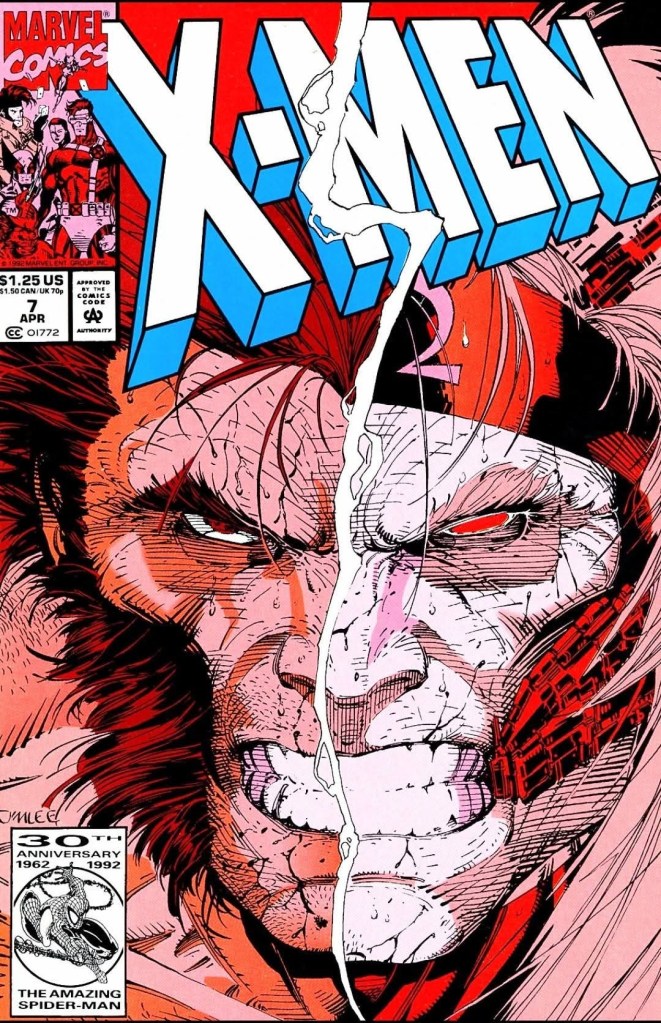
With those details laid down, here is a look back at X-Men #7, published by Marvel Comics in 1992 with a story plotted and drawn by Jim Lee, scripted by Scott Lobdell and inked by Art Thibert.
The cover.
Early story
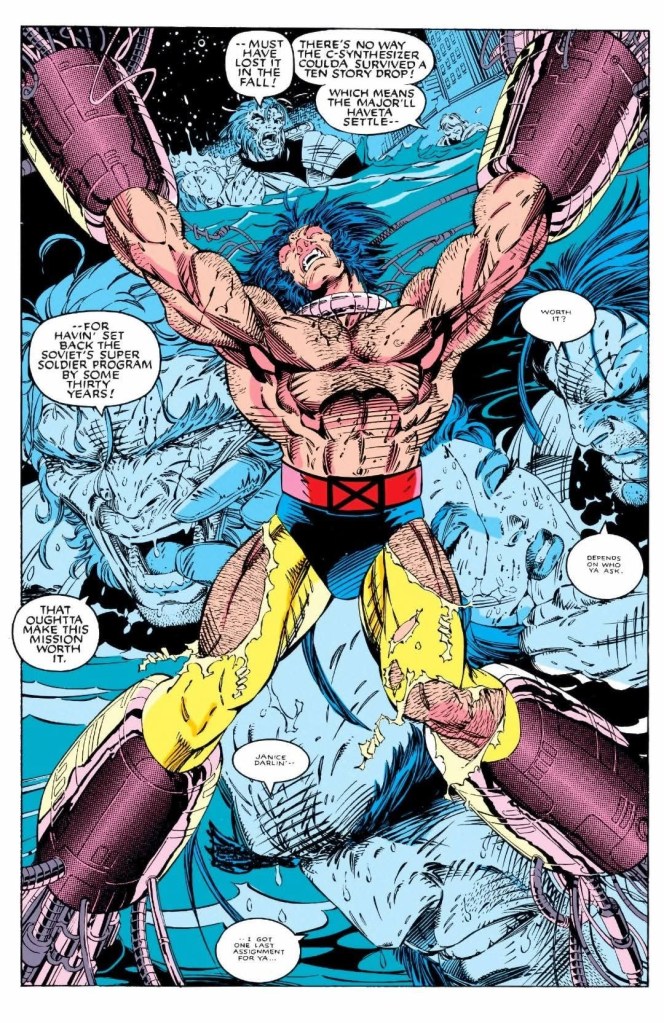
The story begins with Wolverine heavily restrained and his healing factor has been pushed to its limits. In the presence of Matsu’o Tsurayaba, Psylocke and others, Omega Red presses Wolverine for information about the carbonadium synthesizer. Matsu’o advises the Russian to not let the Canadian mutant bait him, and he shares the realization that it is impossible to mass produce his healing factor.
Matsu’o tells Omega Red that his only chance for survival rests in completing the process that was started thirty years prior. The Russian replied saying that he realizes he is dependent upon synthesizing the only metal capable of negating his death factor.
Not wanting to top, Omega Red says that he would rather pry the information from Wolverine’s brain by hand…
Quality
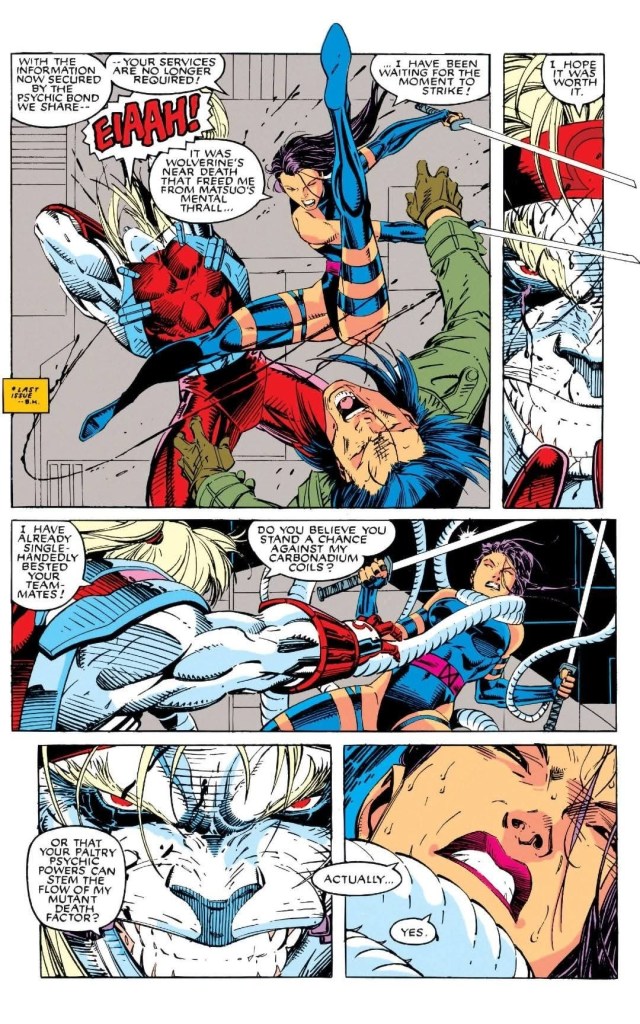
Psylocke in action versus Matsu’o and Omega Red.
To begin with, this is the conclusion to the storyline that started with issue #5. It is a cleverly paced story that had a good amount of build-up followed by big pay-offs with Jim Lee’s dynamic touch with the visuals.
Wolverine is once again vulnerable and Matsu’o’s gang already has the advantage. Matsu’o is determined to discover information about the C-Synthesizer no matter the cost (note: at the expense of Wolverine’s life). Omega Red’s death factor is much more emphasized in this issue and the goals behind the operations of the gang is made clearer here. As the story moved on, there were these clever twists that were entertaining to see leading to the chain of action-packed sequences. Without spoiling the plot, I can say that the creative team came up with a very solid conclusion in this short storyline and Maverick’s own presence has been justified as well.
As with the previous issue, scenes of Mojoworld were inserted giving readers updates about Dazzler and Longshot. Very clearly, this was the build-up leading into the 10th issue of the comic book series.
For those who enjoy visual spectacle, there is a lot to enjoy from Jim Lee here. As always, Lee draws action dynamically and made sure they are exciting to look at. Particularly, I found Lee’s carefully chosen action moments – particularly Sabretooth’s strike on Maverick and Wolverine’s strike against Omega Red – really impactful to look at.
Conclusion
Wolverine in a very vulnerable and painful state.
X-Men #7 (1992) is a very enjoyable read. It is a great conclusion to its 3-part storyline that started in issue #5 and by the time I read the end, Omega Red was clearly established as a very formidable foe of the X-Men even though he was a new addition to the lore. The writing of this comic book is very solid and the same thing can be said about the structure of the plot. Considering the time of its release, this comic book was clearly part of Jim Lee’s way of modernizing the X-Men.
Welcome back readers, fellow geeks and electronic gaming fans!
In this edition of the Retro Gaming Ads Blast (RGAB) series, we will take a look at another batch of retro gaming print ads – including arcade flyers – from the 1970s to the 1990s.
For the newcomers reading this, Retro Gaming Ads Blast (RGAB) looks back at the many print ads of games (console, arcade, computer and handheld) that were published in comic books, magazines, flyers, posters and newspapers long before smartphones, social media, the worldwide web and streaming became popular. To put things in perspective, people back in the 1980s and 1990s were more trusting of print media for information and images about electronic games and related products.
With those details laid down, here is the newest batch of retro gaming print ads for you to see and enjoy…
1. Intellivision print ad
Were you able to play a game on the Intellivision long ago?
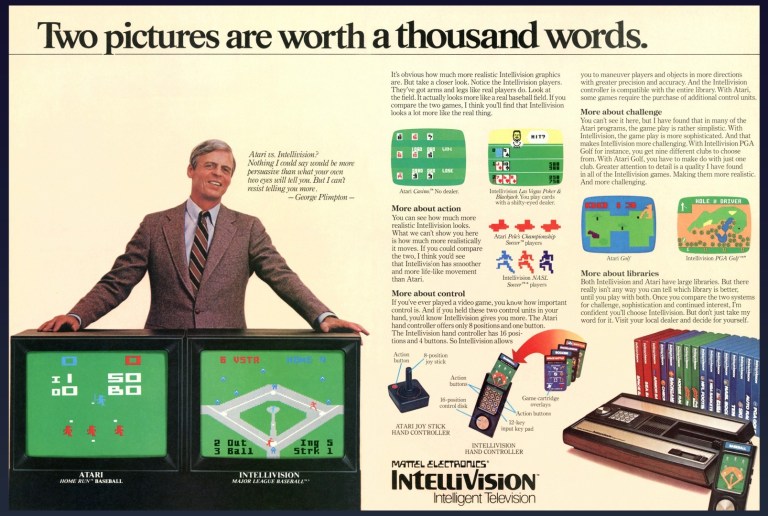
In 1979, Mattel launched their Intellivision game console in America which instantly placed them in competition with Atari’s 2600 console. In a bid to convince gain market share, Mattel daringly came up with a competitive print ad like the one above showing two TV sets (with an Atari 2600 baseball game and a similar game on Intellivision), descriptive text that explained why the intellivision and its games are better, and even mentioned Atari by name several times. Obviously the tactic did not lead Mattel to ultimate market victory but the above print ad showed it was okay for a newcomer to mention their competitor and aggressively attack it to gain customers (both newcomers and active gamers).
2. Popeye Japanese arcade flyer
The front of the flyer.
The rear.
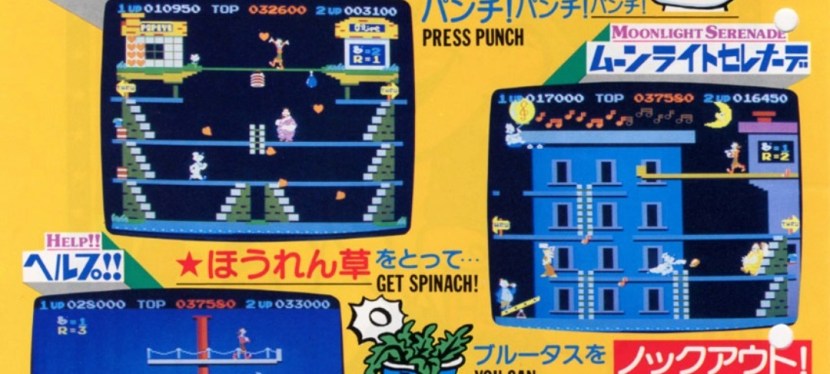
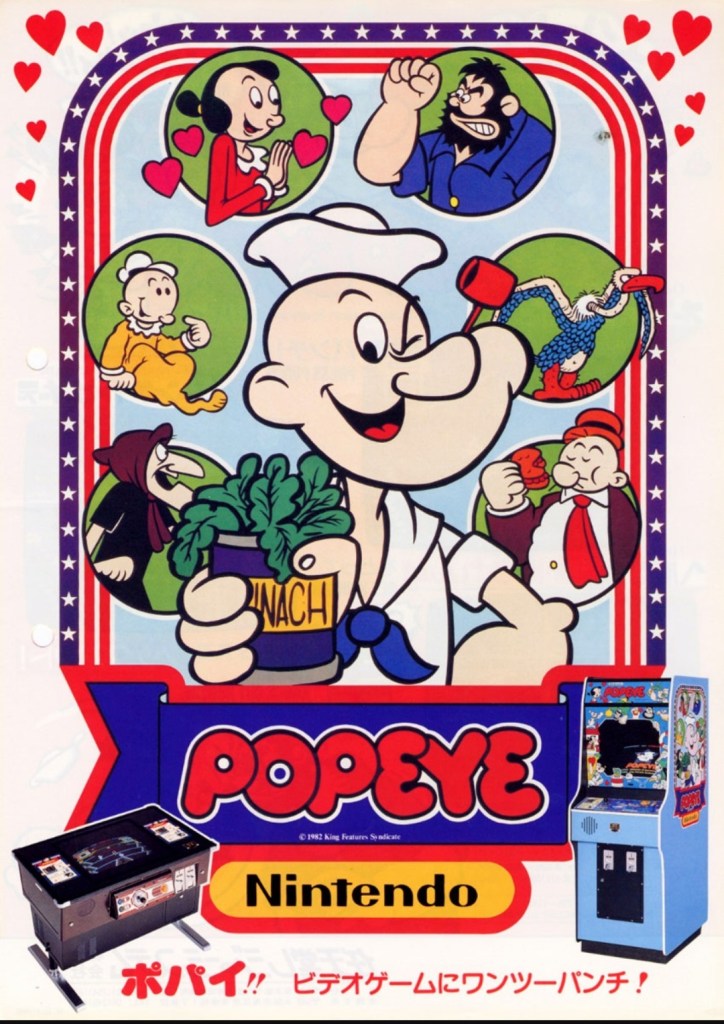
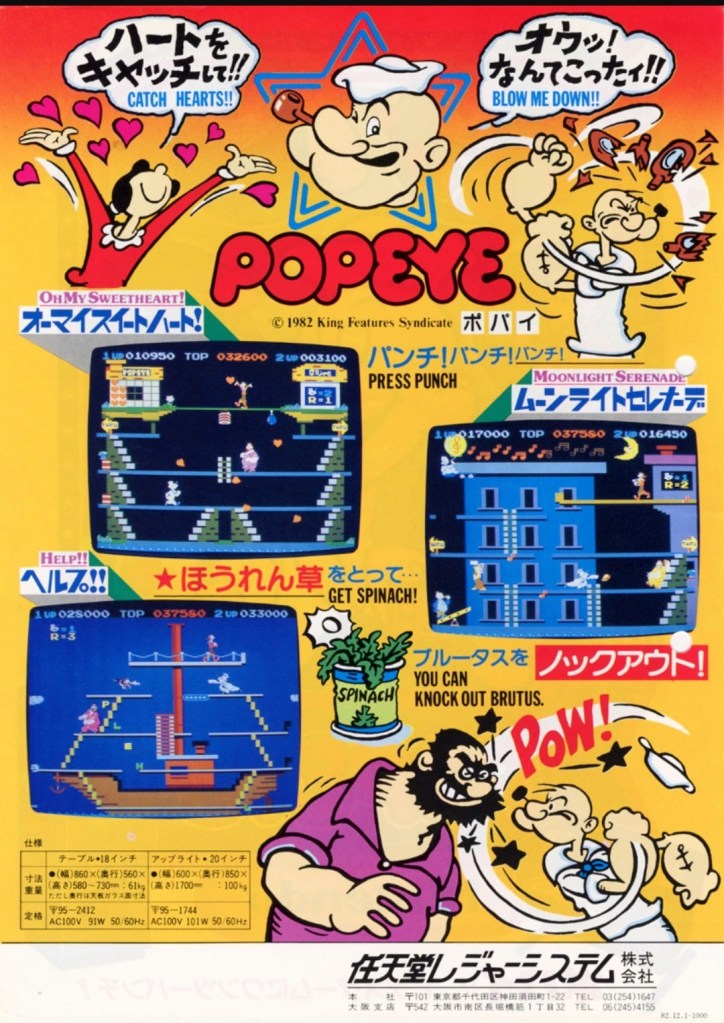
In 1982, Nintendo released the Popeye arcade game which was incidentally the result of the success of their original Donkey Kong arcade game. To promote the game, Nintendo came up with an arcade flyer that had a very lively front (note: the characters were instantly recognizable thanks to the great art used) and the rear having easy-to-read instructions on how to play the game, what levels to expect and what must be done when playing. Popeye was an arcade hit in Japan, but an even bigger hit in America. This old arcade flyer still looks nice.
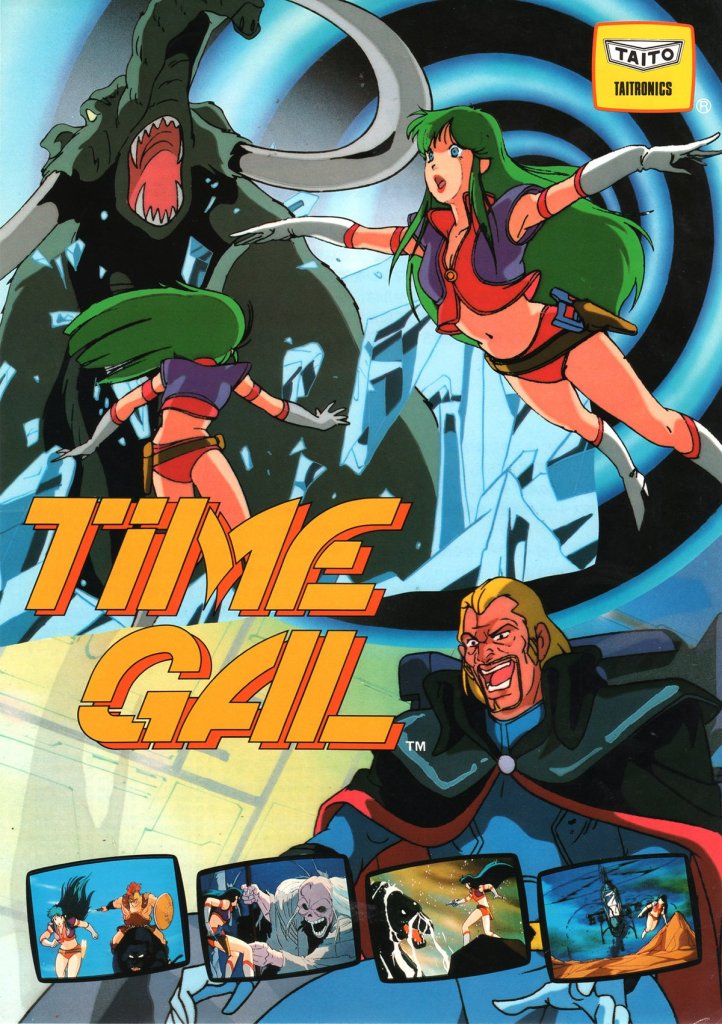
3. Time Gal arcade flyer
On face value, this one looks more like an anime promo since gameplay elements were missing.
Released in Japanese arcades in 1985, Time Gal is one of those games that used the expensive LaserDisc technology to stream pre-recorded animation (made by Toei) and challenged gamers to react quickly (using the joystick and button for commands) in order to progress in real-time. The arcade flyer has a very lively visual design making it clear to players and arcade operators that a lot of anime awaits those who play Time Gal. Technically, players watch anime cutscenes happen and react using the controls. Time Gal was an arcade hit and it made its way outside of Japan by getting ported for the Sega CD.
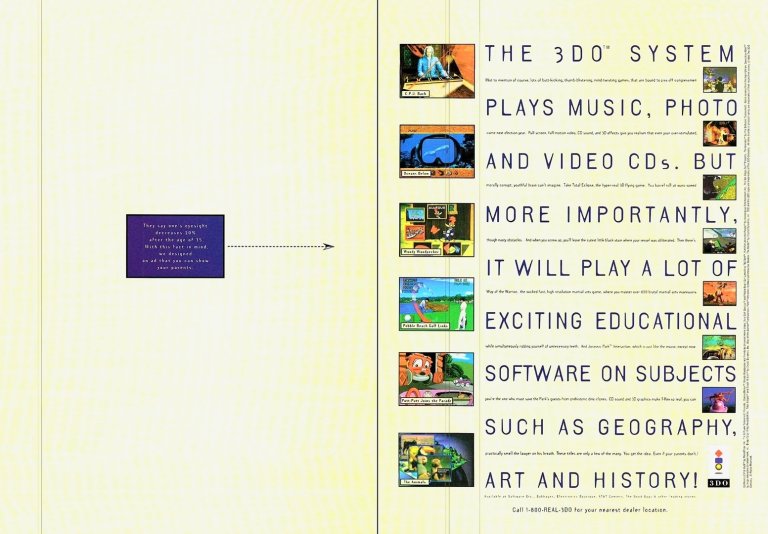
4. 3DO print ad
If you bought a 3DO long ago, was it for gaming or for home entertainment purposes?
Remember the 3DO? Developed by the 3DO Company and launched in 1993, the 3DO was designed to not only play video games but also function with multimedia features. In fact, the 3DO was initially marketed as a machine that allows users to watch videos, play music, browse digital photographs, and even immerse themselves with software focused on different topics. This is exactly what the above 3DO print ad emphasized. In retrospect, it was so odd for me to see the print ad inside video gaming magazines I read.
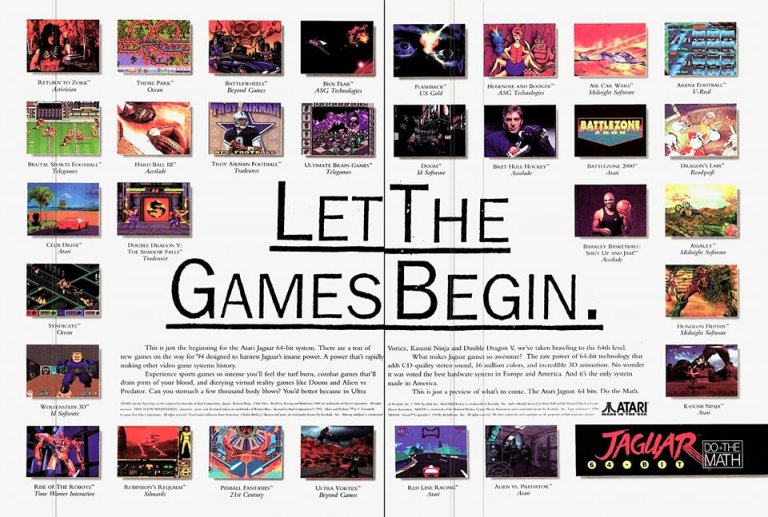
5. Atari Jaguar print ad
The strong focus on gaming was clear with Atari for the Jaguar.
Over a month after the launch of the 3DO, Atari launched its Jaguar console with a strong focus on video gaming. As console sales slowly grew in 1994, Atari came up with the above print ad – showing lots of games for the Jaguar – to lure in customers aggressively. If you look closely at the descriptive text of the ad, it mentions the Atari Jaguar as 64-bit system emphasizing that it is more powerful than other video game machines of the time. The bit count controversy harmed Atari and eventually the Jaguar failed.
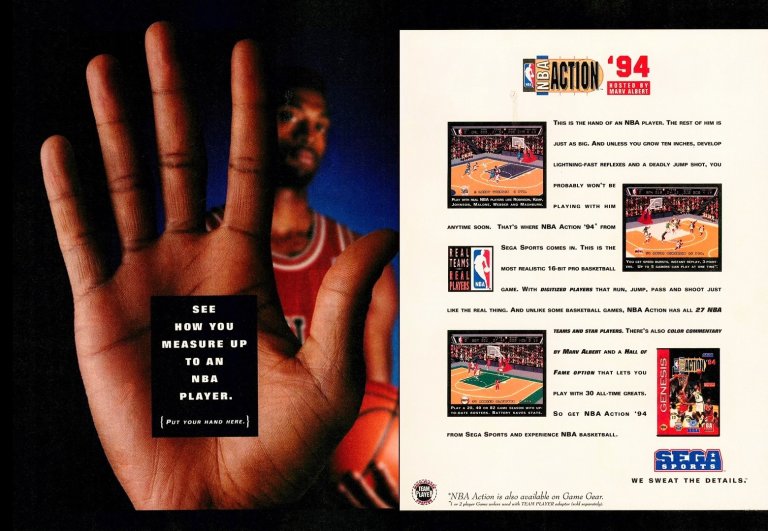
6. NBA Action ’94 print ad
Remember when Sega made NBA basketball video games that were exclusive to the Genesis console?
Remember when there were a lot of basketball video games licensed by the NBA in the 1990s? Through its own sports games brand – Sega Sports – Sega was dedicated to making exclusive sports video games for its customers and their NBA games were under the NBA Action brand. In 1994, they released NBA Action ’94 for the Genesis console and this two-page print ad they came up with had a catchy visual design (a supposed basketball player showing his palm and message to the camera on one side of the ad). Looking closely at the descriptive text, the ad mentions “most realistic 16-bit pro basketball”, “digitized players” and having all 27 NBA teams and star players. Sega Sports is no more but it’s legacy still lives on among Sega fans.
7. X-Men Sega Game Gear print ad
For X-Men fans!
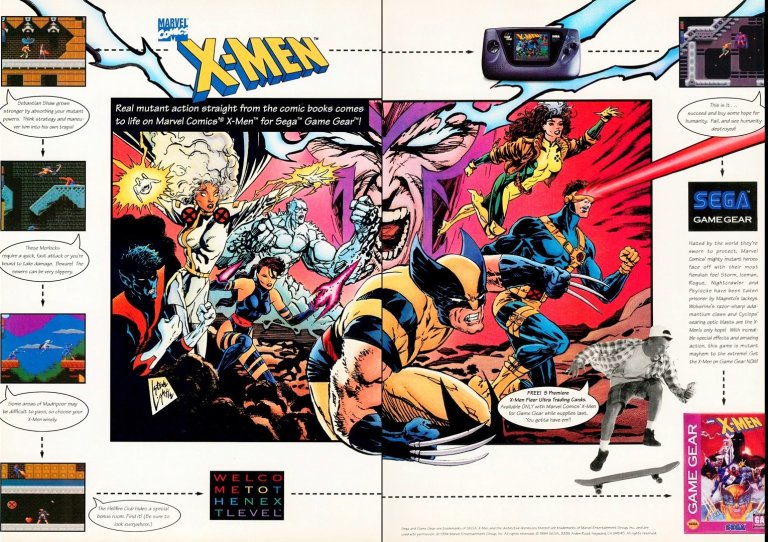
Similar to its approach with the Sega Sports brand, Sega developed exclusive games for the Game Gear. The company secured from Marvel the license to make an original X-Men game and to promote it, this 2-page print ad showcased original art of the established X-Men characters of the time while using the remaining spaces for the screenshots and descriptive text. This old print ad still looks attractive and will easily resonate with X-Men fans as well as 1990s superhero comics enthusiasts.
8. Liberty or Death print ad
American history is the core concept of this strategy game by Koei.
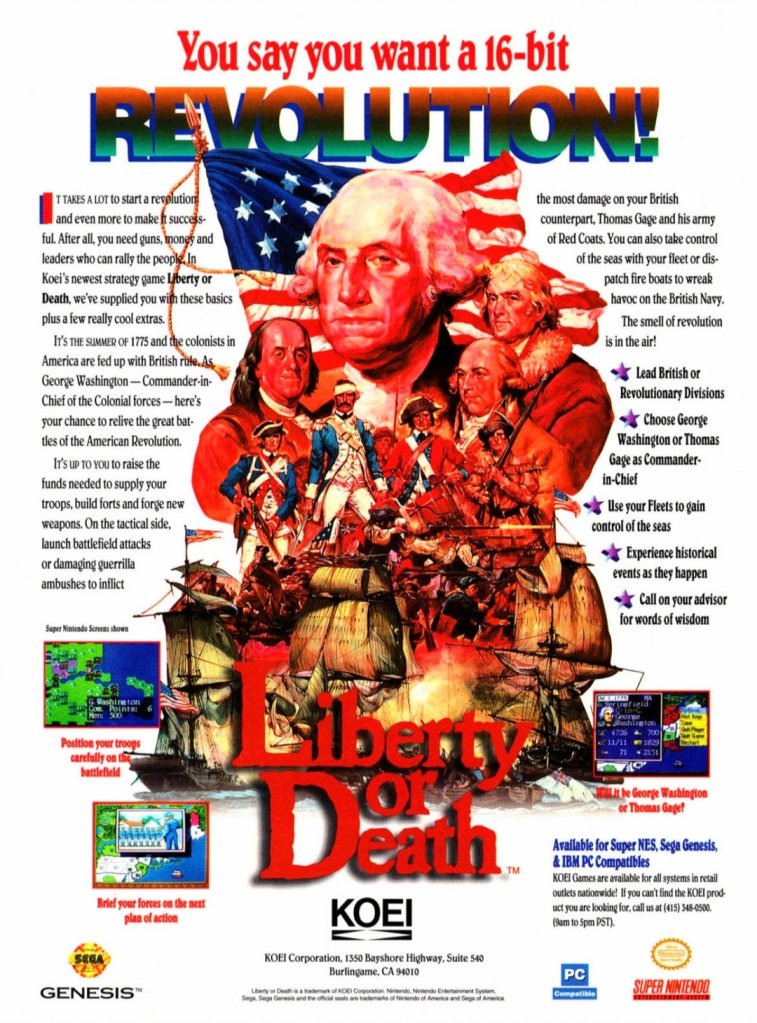
If there is anything notable about the Japanese company Koei, it is the fact that it released strategy and simulation games that tackled varied topics while making each game distinct and playable regardless of platform. In my experience, I had a lot of fun playing their business simulation Aerobiz Supersonic on the Super Nintendo Entertainment System (SNES). In 1993, Koei released their turn-based strategy game Liberty or Death which tackled American history for its setting (note: Koei already established itself with historical simulations). To sell the game, Koei came up with a print ad that had a very eye-catching historical art (George Washington, Thomas Jefferson, and Benjamin Franklin among the figures), a few selected screenshots and descriptive text that emphasized the essence of the game. This print ad is a reminder that no video game company today would make a historical simulation due to geopolitics (note: there are a lot of woke activists among video game employees today) and for business reasons.
Welcome back readers, fellow geeks and electronic gaming fans!
In this edition of the Retro Gaming Ads Blast (RGAB) series, we will take a look at another batch of retro gaming print ads – including arcade flyers – specifically about fighting games that were released in the 1990s. The said decade marked the time when Street Fighter II became a massive hit in the video arcades (and on game consoles) which sparked a wave of new fighting games from business competitors. In that same decade, 3D polygonal fighting games were also released which added greater choices of fighting games at the arcades and on game consoles that players could choose from.
For the newcomers reading this, Retro Gaming Ads Blast (RGAB) looks back at the many print ads of games (console, arcade, computer and handheld) that were published in comic books, magazines, flyers, posters and newspapers long before smartphones, social media, the worldwide web and streaming became popular. To put things in perspective, people back in the 1980s and 1990s were more trusting of print media for information and images about electronic games and related products.
With those details laid down, here is the newest batch of retro gaming print ads for you to see and enjoy…
1. Dead or Alive Japanese arcade flyer
Dead or Alive was the start of new success that impacted the direction of Tecmo in the gaming industry.
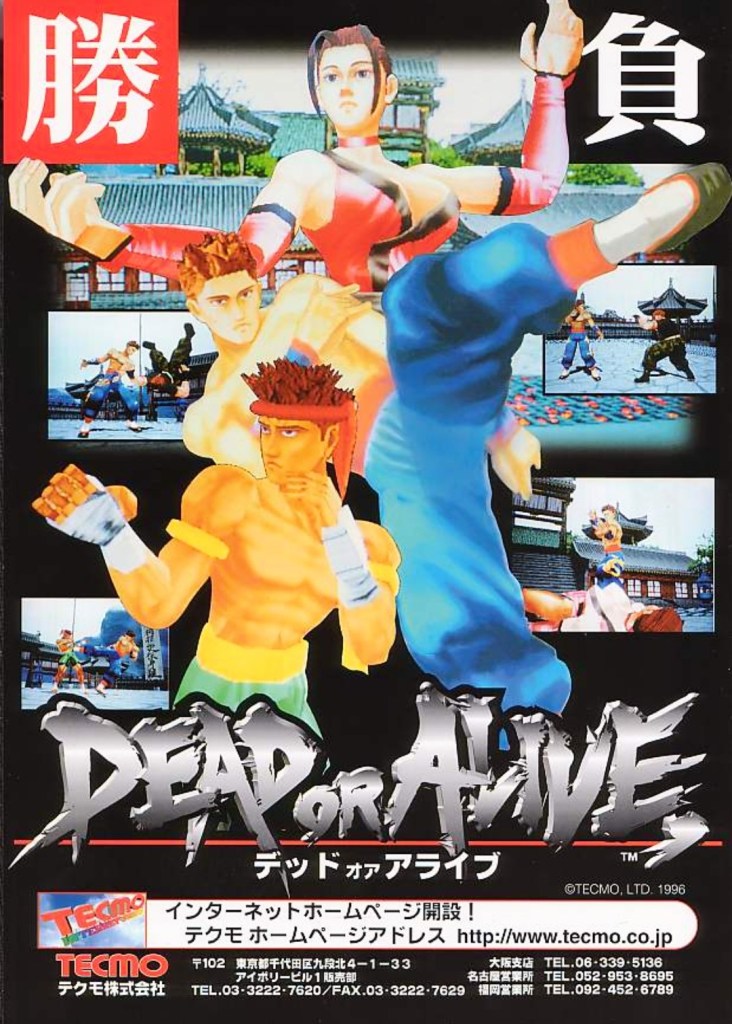
The above arcade flyer of Dead or Alive gave Japanese arcade operators and gamers a taste of what to expect with the game. While the screenshots showed some resemblance with what gamers saw in Virtua Fighter 2, the character designs Tecmo and its developers came up with were unique.
Before Dead or Alive was released in Japanese arcades in 1996, company Tecmo was in financial trouble and they asked Tomonobu Itagaki to make a fighting game similar to Sega’s polygonal blockbuster Virtua Fighter. A breakthrough for Tecmo happened when Sega announced they were licensing their Model 2 arcade to third-party companies which paved the way for Itagaki’s team to make Dead or Alive with it. The game became a big hit and it paved the way for Tecmo to release it on Sega Saturn and PlayStation, and the sequels that followed years later.
2. North American Soulcalibur Dreamcast version print ad
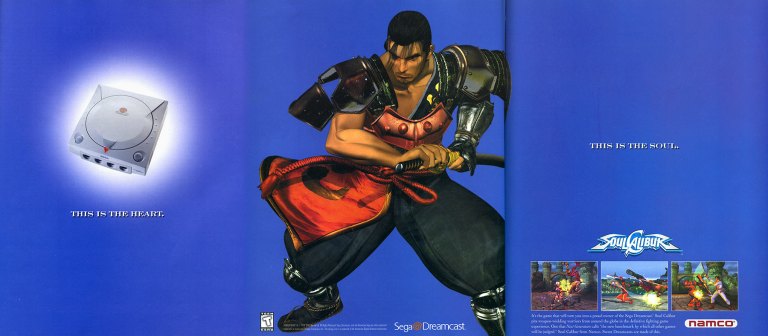
Namco came up with a creative approach to emphasize heart-and-soul promoting their game and the Dreamcast.
On September 9, 1999, Sega launched their Dreamcast console in America. With a gap of around ten months between the Japanese launch (November 1998) and the American launch, Sega had time to prepare Dreamcast’s release to American gamers with a huge lineup of games (both Sega’s games and from other publishers). Fortunately for Sega, they had Namco (their rival on arcade games) supporting their console.
Behind the scenes, Namco’s developers worked hard to not only port their arcade hit Soulcalibur to the Dreamcast, but to enhance the graphics using the console’s more advanced technology. The visual enhancements include rendering all of the games stages (and backgrounds) into full 3D polygonal environments. Namco also implemented different game modes and added even more content to ensure satisfaction to Dreamcast gamers.
The above 3-page print ad of Soulcalibur on Dreamcast was undeniably strategic and captivating to look at. The ad described the console as the heart, showed Soulcalibur character Mitsurugi (one of the game’s most popular characters) in the middle and then described the game (with 3 screenshots of game rendered with Dreamcast graphics) as the soul. It was a strong way to promote both the game and the console. In the years that followed, Soulcalibur grew into a popular fighting game franchise and the Dreamcast version will always be remembered as the crucial turning point.
3. X-Men: Children of the Atom arcade flyer
Anyone who read lots of X-Men comic books in the 1990s should be able to tell which character was drawn by which artist.
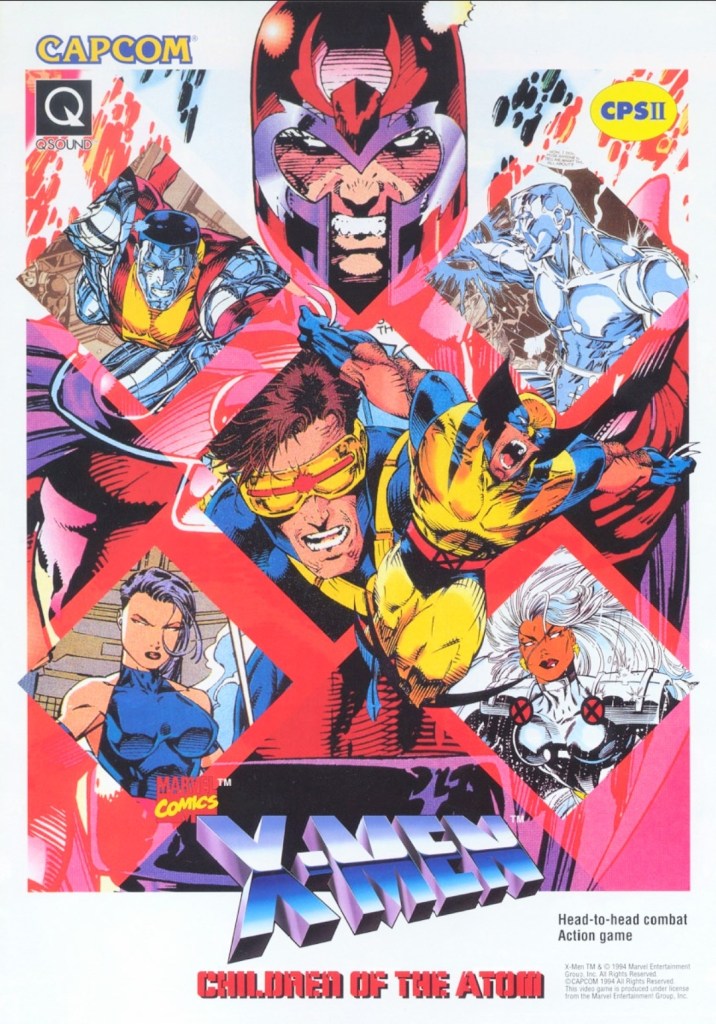
When Capcom first released X-Men: Children of the Atom in the arcades in the mid-1990s, I was surprised because I did not anticipate the day would come when the company behind Street Fighter II would actually make a 2D fighting game showcasing the Marvel’s mutants. Even more intriguing was the X-Men art Capcom used for the arcade flyer to promote the game. I recognize Jim Lee’s artworks of Magneto, Cyclops and Colossus. The art of Wolverine shown was drawn by Andy Kubert. It was a wise move for Capcom (with Marvel as a business partner) to use established X-Men comic book artworks instead of having their internal illustrator draw the characters. That being said, this arcade flyer still looks great and captivating to look at.
4. North American Ranma ½: Hard Battle print ad
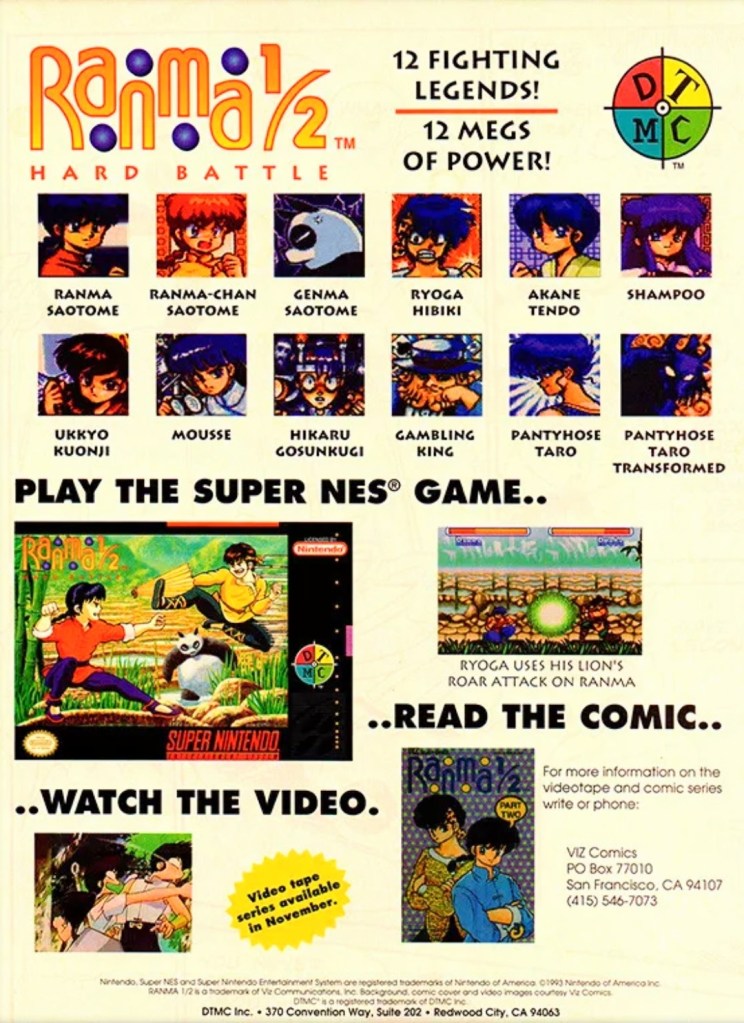
A print ad promoting the game while saving some space to promote the anime and comic books.
By 1993, Street Fighter II and its upgraded follow-ups were wildly popular both in the arcades and on game consoles around the world. At the same time, there were many other 2D fighting games released to compete with and cash-in on Street Fighter II’s success. Believe it or not, the established anime franchise Ranma ½ saw a video game adaptation in the form of a 2D fighting game – Ranma ½: Hard Battle.
The North American print ad above published by DTMC (in cooperation with Viz Communications) promoted the game (one screenshot, the SNES game box and images of the characters as they appeared in the game) as well as Ranma ½ on anime videos and comic books. The way it was presented, the print ad promoted Ranma ½: Hard Battle without much heart nor passion.
5. Fatal Fury: King of Fighters arcade flyer
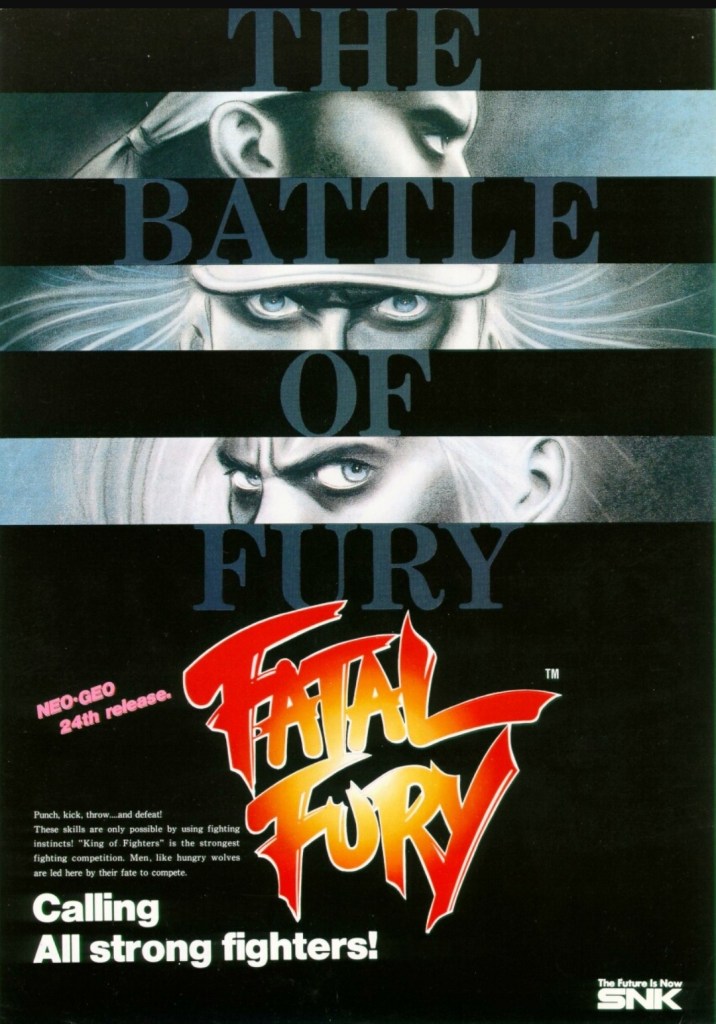
An intriguing visual presentation on the front.
You get to know the characters and what the game features are.
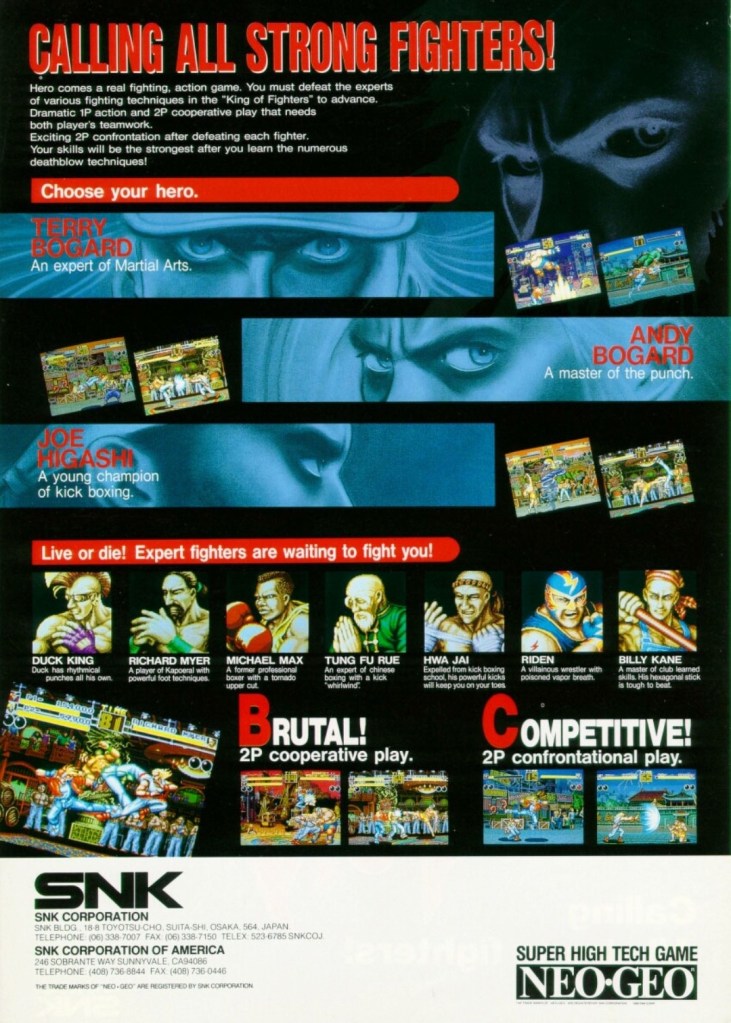
There is no doubt that Fatal Fury: King of Fighters is the most significant game that SNK made. Apart from being the company’s first fighting game for the Neo Geo system, it established the fictional “king of fighters” tournament that became the core concept for The King of Fighters series of games in the years that followed. Fatal Fury itself is notable for being designed by Takashi Nishiyama, a former Capcom employee who created the original Street Fighter game. What Nishiyama could not do with Street Fighter, he accomplished while making SNK’s fighting game. Compared with the combo-oriented approach of Street Fighter II, Fatal Fury was designed to emphasize the timing of special moves, confrontational play, cooperative play and the 3D-like spacing between characters (background row and foreground row in each stage) while telling a story in a solid way.
The above arcade flyer of Fatal Fury has this unique looking artwork on the front showing stylized rectangular shots of the major characters Terry Bogard, Andy Bogard and Joe Higashi. On the other side of the flyer are the details that emphasized the creative concept of the game, who the characters are and what they could expect with regards to gameplay features. This flyer is still captivating to look at and it could entice you to try playing the original Fatal Fury game before trying out the sequels and spin-offs.
6. Marvel vs. Capcom: Clash of Super Heroes arcade flyer
This is NOT a comic book crossover.
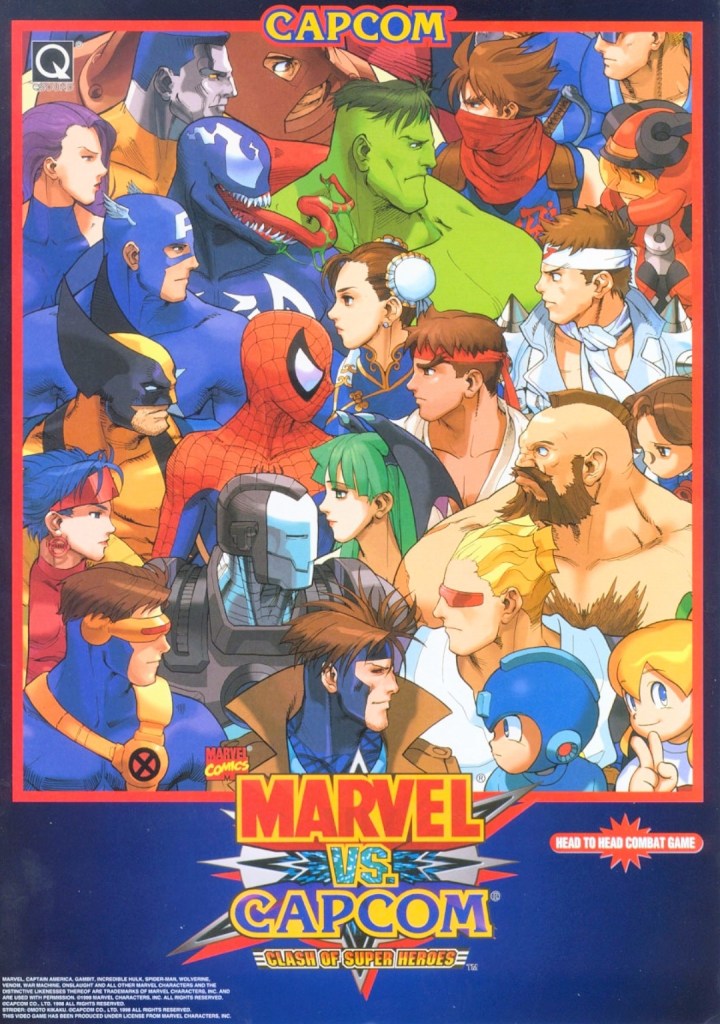
If there is anything that truly emphasizes the essence of a fictional crossover in terms of visuals, it’s the art that Capcom and Marvel agreed to for Marvel vs. Capcom: Clash of Superheroes which is evident on the front of the above arcade flyer. By looking at how the Marvel characters were drawn, it looks like someone at Capcom illustrated the artwork as the Capcom characters still maintained that particular art style seen in the artworks of the Japanese company’s other games like Street Fighter, Darkstalkers, Mega Man and Strider. Regardless, the artwork still is amusing to look at.
7. Art of Fighting arcade flyer
The front of the flyer.
The cast of characters showcased on the other side of the flyer.
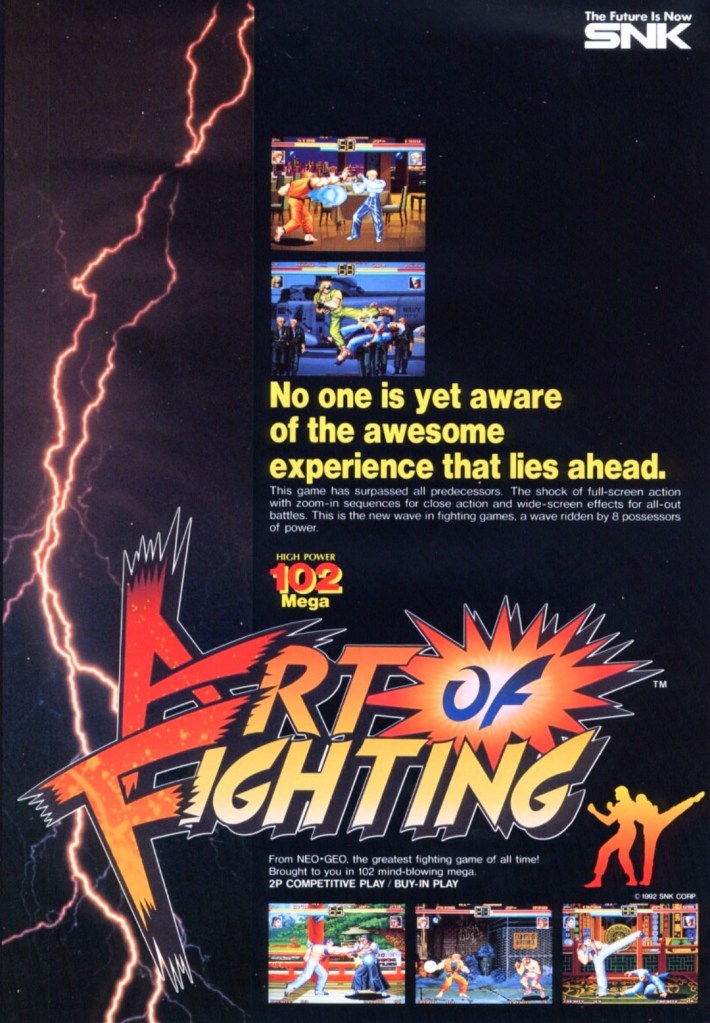
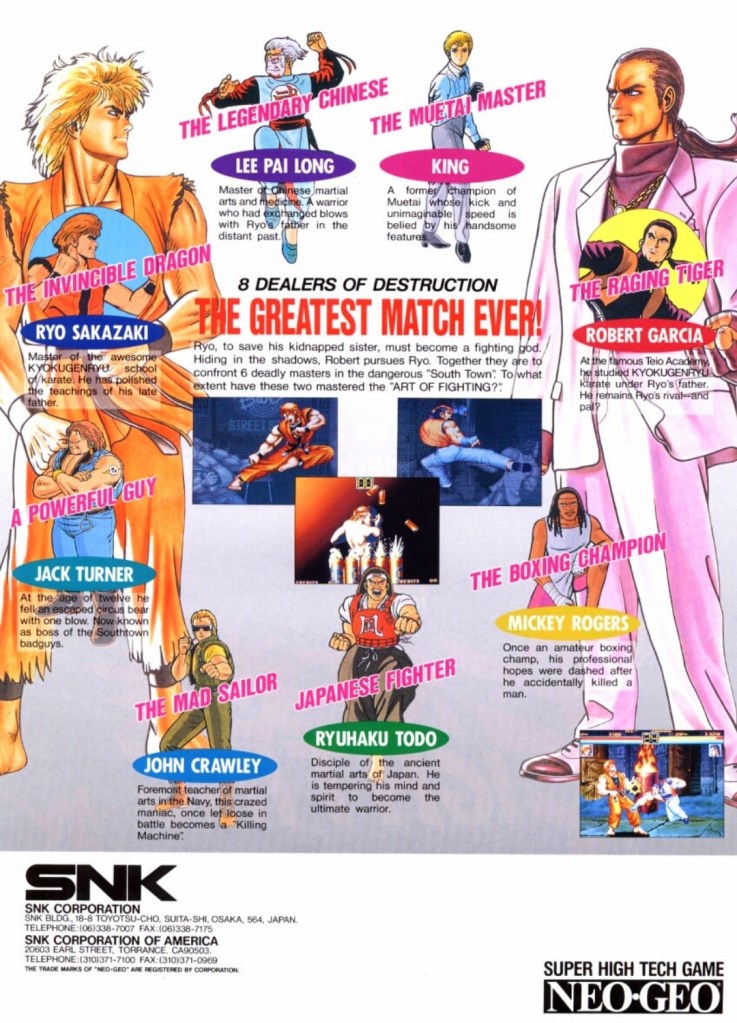
Following the success of Fatal Fury, SNK went on to release Art of Fighting in arcades in 1992 and it became successful enough for the company to make sequels. With regards to the realm of fantasy, Art of Fighting was part of the same fictional universe as Fatal Fury and The King of Fighters, and there were times when its own characters appeared in other SNK games.
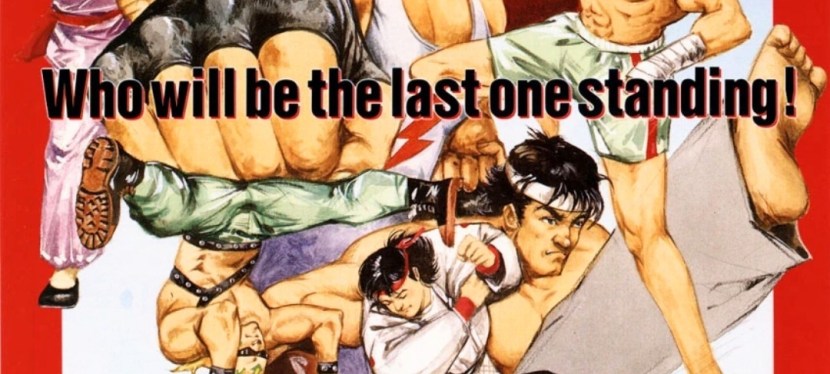
Art of Fighting’s arcade flyer had an energetic visual concept on the front with a rectangular lightning portion on the left balanced with five screenshots of the game itself. Once you get to the other side of the flyer, you will see really nice art of the characters with Ryo Sakazaki and Robert Garcia as the most dominating figures. Sakazaki and Garcia are the major characters of the Art of Fighting series. This flyer confidently introduced the characters and succeeded in making them look interesting.
8. Fighter’s History arcade flyer and print ad
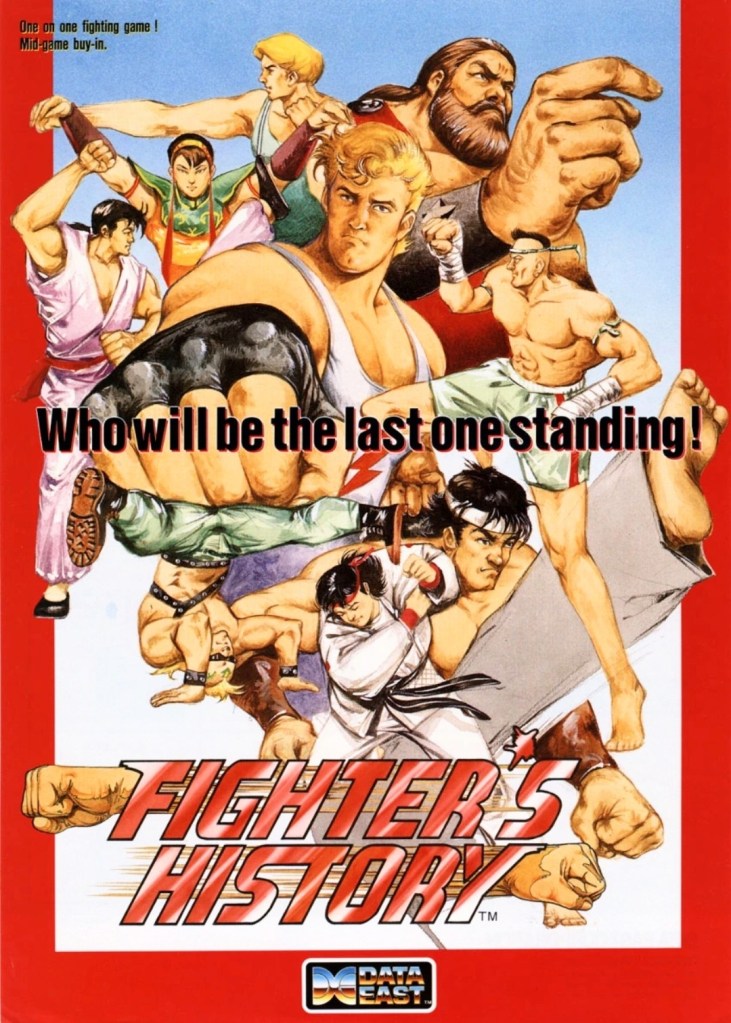
Great looking front artwork showing the game’s characters, posing and some action.
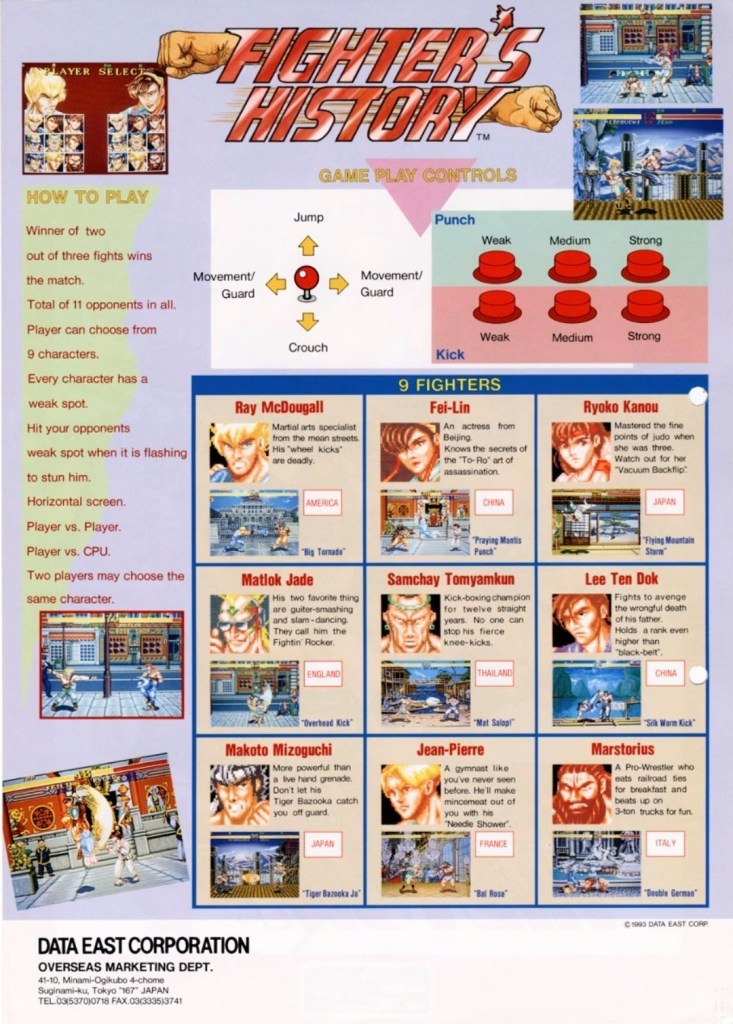
If you look closely at the controls, you will see the six-button layout and functions which are the same with those used in Street Fighter II.
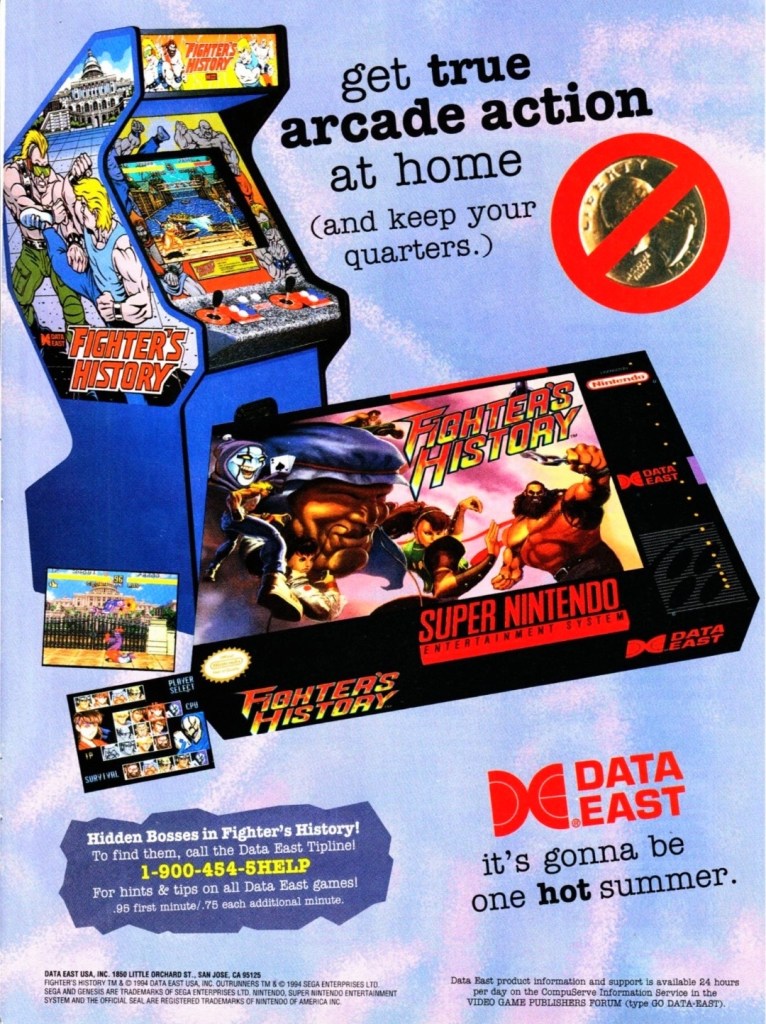
Data East offered two ways for gamers to enjoy Fighter’s History – pay a high price for the SNES version or gamers can go play the game in the arcade by dropping a few coins.
In 1993, Data East released their fighting game Fighter’s History in the arcades around the world. Along the way, the company released their arcade flyer which had a very captivating art work on the front featuring their characters and some action. The other side of the flyer showed the technical details on how to play, how the control works and who the characters are. Fighter’s History was nicely received in the arcades and the success led Data East into porting the game for the Super Nintendo Entertainment System (SNES). If you look at the print ad above, you can see how clever Data East was promoting the SNES version of the game while keeping an image of the arcade machine which serves like a subtle reminder that the same game is still available in video arcades.
Shortly after the release of Fighter’s History in the arcades, there were gamers who noticed that it had certain visual and gameplay elements that made it so familiar with what Street Fighter II had. When Capcom became aware of the similarities, they sued Data East claiming that Fighter’s History was too similar to their game and that copyright infringement was committed. Capcom lost the case ultimately and Data East went on to release two more Fighter’s History games.
9. Virtua Fighter 3 arcade flyer
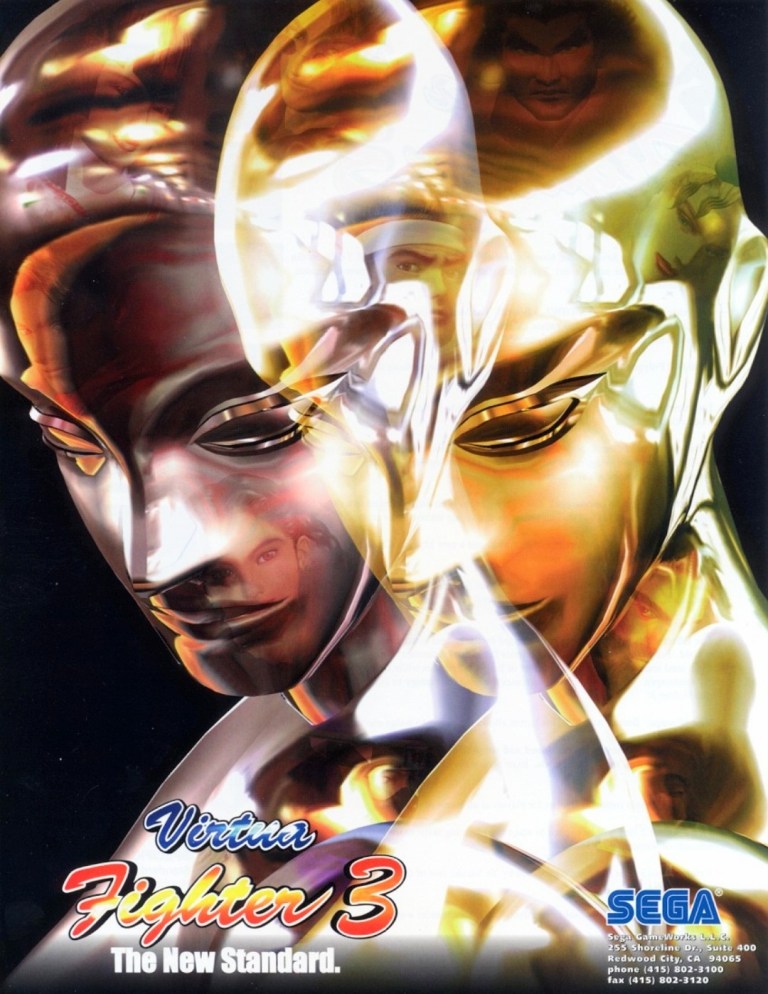
Virtua Fighter 3 truly raised the standards for arcade game graphics back in 1996.
When it comes to gaming innovation and standing out among the rest, Sega did exactly those when they released Virtua Fighter 3 in arcades in 1996 and it had the best-looking and really mind-blowing graphics at the time. Developed by AM2 (led by Yu Suzuki) on the very expensive Model 3 arcade hardware, Virtua Fighter 3 broke new ground on graphics as it moved over 1 million polygons per second, had highly detailed visuals on the characters and surroundings, realistic reflection effects, detailed shining, parallel lighting and high-specular Gouraud shading to name some. Even the characters’ eyes followed the opponent’s position.
The Virtua Fighter 3 arcade flyer showcased their reflective, metallic character Dural who in turn was part of the graphical showcase (emphasizing reflections, smooth animation and liquid metal effects) when the game was previewed in the 1996 AOU event in Japan. The words “The New Standard” written on the lower-left corner of the front of the flyer was justified and truthful.
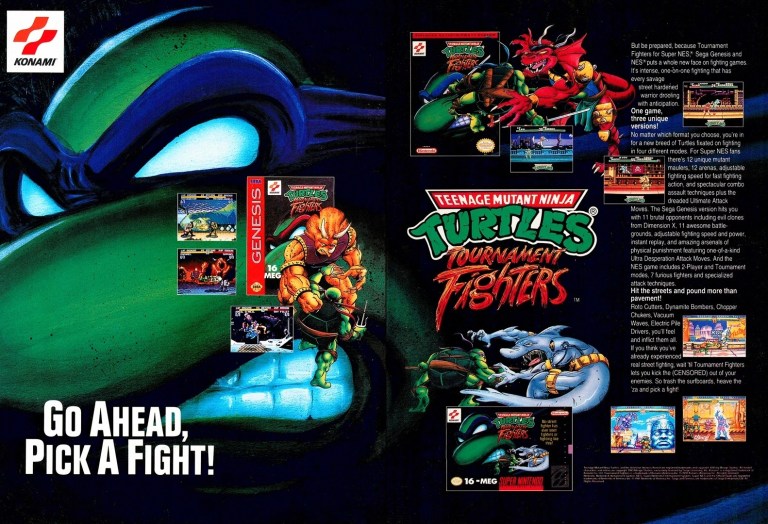
10. Teenage Mutant Ninja Turtles: Tournament Fighters print ad
This print ad had a nice visual presentation and was easily recognizable to the many TMNT fans.
In 1989, the Teenage Mutant Ninja Turtles (TMNT) franchise made quite a splash on video games which is not surprising as the multimedia franchise was already a popular in the West. More video game adaptation of TMNT were released in the early 1990s providing fans and gamers a lot of fun gameplay at the arcades (click here) and on consoles. Konami had the video game rights of TMNT and in a clear response to the sudden popularity of fighting games, they released Teenage Mutant Ninja Turtles: Tournament Fighters on the most popular game consoles of the time achieving varying levels of success critically and commercially (note: the SNES version stood out as the best). This print ad of the fighting game was effective in visually promoting the three console versions and the displayed text contained enough information to lure the attention of both fans and gamers.
Welcome back readers, fellow geeks and electronic gaming fans!
In this edition of the Retro Gaming Ads Blast (RGAB) series, we will take a look at another batch of retro gaming print ads – including arcade flyers – from the 1980s and 1990s.
For the newcomers reading this, Retro Gaming Ads Blast (RGAB) looks back at the many print ads of games (console, arcade, computer and handheld) that were published in comic books, magazines, flyers and newspapers long before smartphones, social media, the worldwide web and streaming became popular. To put things in perspective, people back in the 1980s and 1990s were more trusting of print media for information and images about electronic games and related products.
With those details laid down, here is the newest batch of retro gaming print ads for you to see and enjoy…
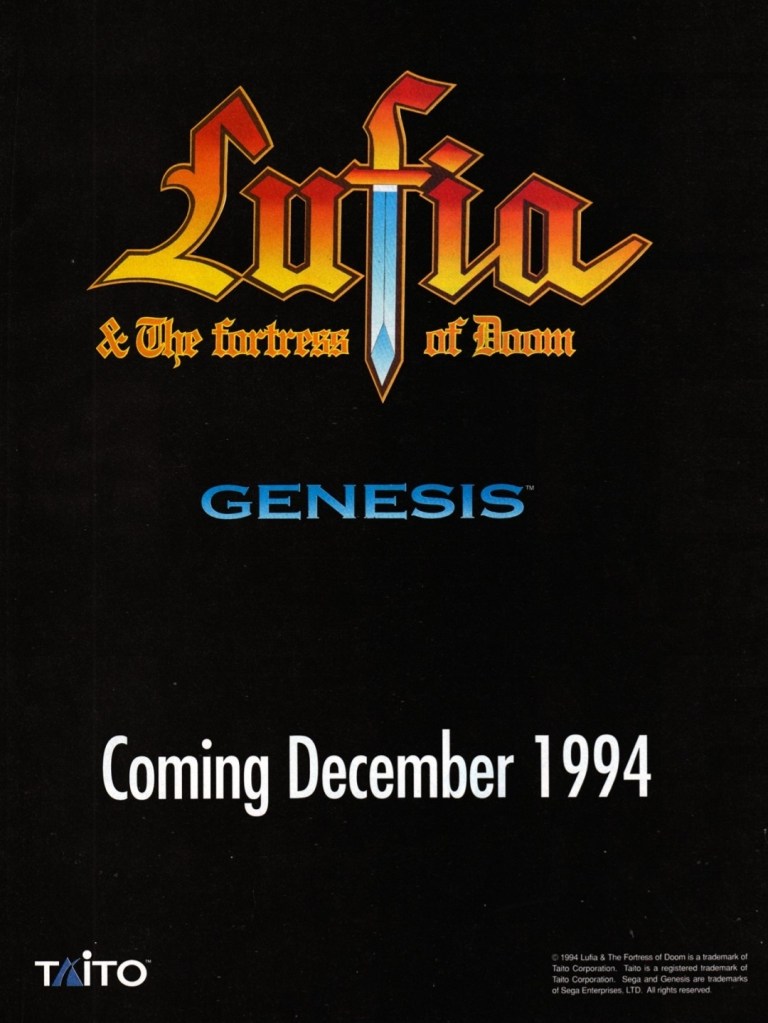
1. Lufia & The Fortress of Doom for Sega Genesis print ad
Considering the eventual scrapping of the Sega Genesis port of Lufia & The Fortress of Doom, this old print ad might as well serve like a tomb stone.
I want to start with this mostly black print ad about the Japanese role-playing game (JRPG) Lufia & The Fortress of Doom coming to the Sega Genesis console. This game was released on the Super Nintendo Entertainment System (SNES) in America and on the Super Famicom in Japan in 1993 and achieved commercial success for the Japan-based publisher Taito. In an attempt to keep on building up the success, a port of the game for the Sega Genesis (Sega Megadrive in other countries) was announced but ultimately it got canceled. It should be noted that Taito’s American division close down in 1995 and the sequel Lufia II: Rise of the Sinistrals was released in America by a different publisher. That being said, this particular print ad is a sad reminder of a broken promise for Sega Genesis gamers as well as Lufia and JRPG fans who wanted to play the 1993 RPG on a different console.
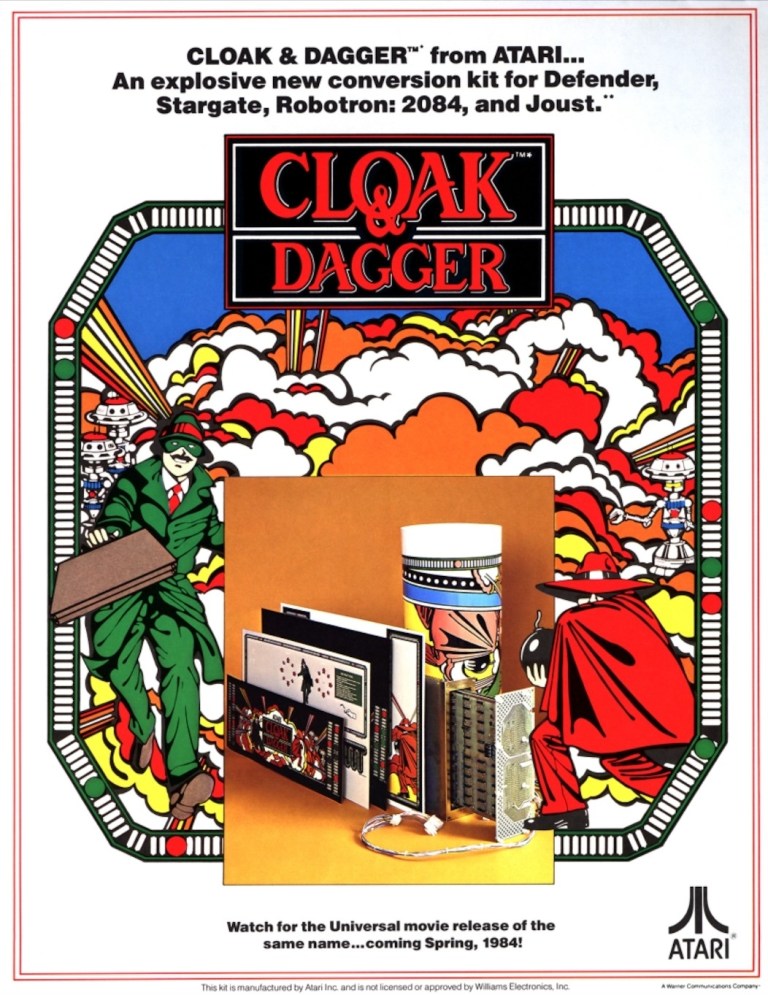
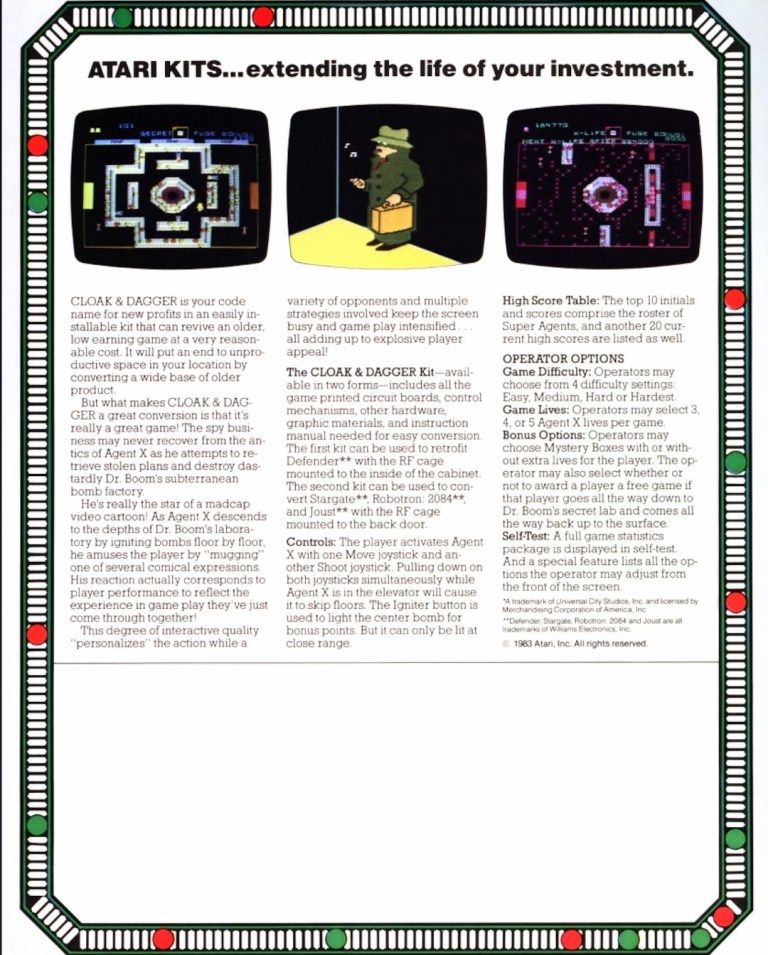
2. Cloak & Dagger arcade flyer
The front of the arcade flyer. There is even a mention of the Cloak & Dagger movie.
Details of the game explained with arcade operators in mind. I find it odd that there is a vacant amount of blank space on this side of the flyer.
Cloak & Dagger, the Atari arcade game that appeared in the 1984 movie of the same name (read my retro movie review by clicking here), has always been an arcade conversion kit as this arcade flyer showed. For the newcomers reading this, an arcade conversion kit allows the arcade operator to replace an old game without having to buy a brand-new arcade machine. Very cleverly, Atari targeted arcade machines of Robotron: 2084, Defender, Stargate and Joust (all were from the competitor Williams Electronics) with Cloak & Dagger. The Cloak & Dagger flyer’s front shows a picture of the pieces of hardware (for insertion into the arcade cabinet plus some physical adjustments) plus decorations for the exterior of the arcade cabinet. The other side of the flyer contains the technical details that make it convenient for arcade operators to understand on how to convert the older games (limited to the above-mentioned Williams games).
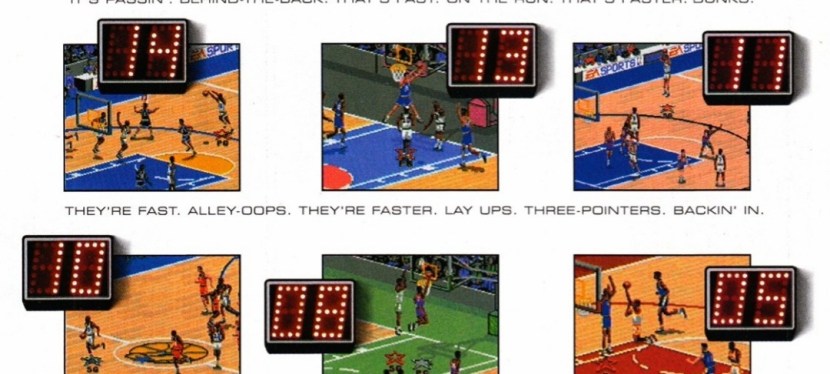
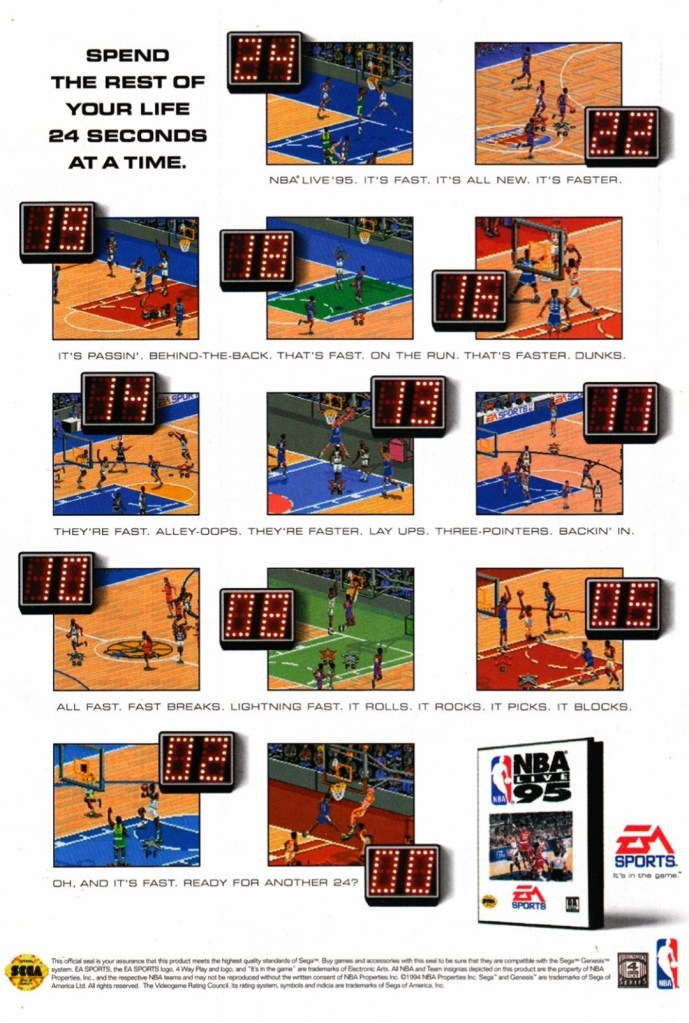
3. NBA Live 95 for Sega Genesis print ad
This print ad is still exciting to look at, especially when you are still passionate with basketball.
Back in late 1994, Electronic Arts (EA) revamped their NBA-licensed basketball game franchise with NBA Live 95 which came with a major game redesign that includes the isometric on-court perspective, T-meter for free throw shooting and more. NBA Live 95 was also the first entry of the NBA Live franchise and brand which lasted for decades. This print ad of the Sega Genesis version of NBA Live 95 has the clever display of several screenshots along with pics of the shot clock emphasizing suspense. The basketball action images themselves are not only eye-catching but strong enough to get gamers excited. This is still a solid print ad to look at.
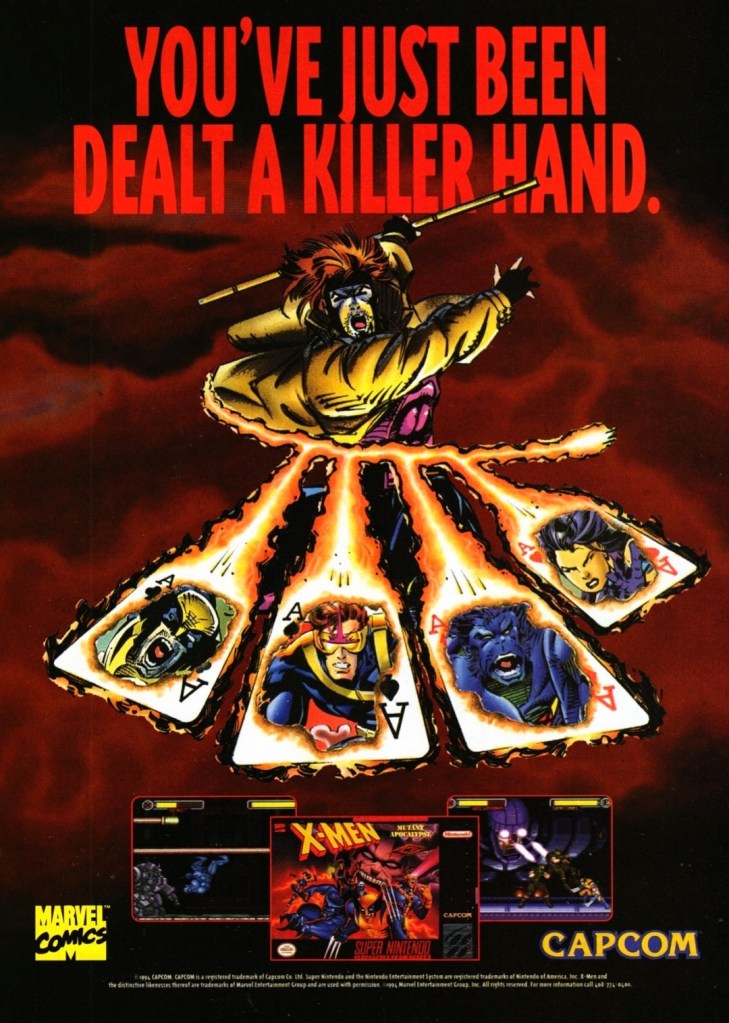
4. X-Men: Mutant Apocalypse print ad
An X-Men game by Capcom.
If there is anything significant about X-Men: Mutant Apocalypse, it is the fact that it was Capcom’s first-ever X-Men-based production that was also released a month before their own hit arcade game X-Men: Children of the Atom came out. Setting aside Capcom’s involvement, this game contains notable elements from the comic books that strongly resonated with dedicated X-Men fans. Apart from the two screenshots and the game box cover, this print ad has X-Men artwork by Andy Kubert who already was the regular artist of the X-Men monthly series.
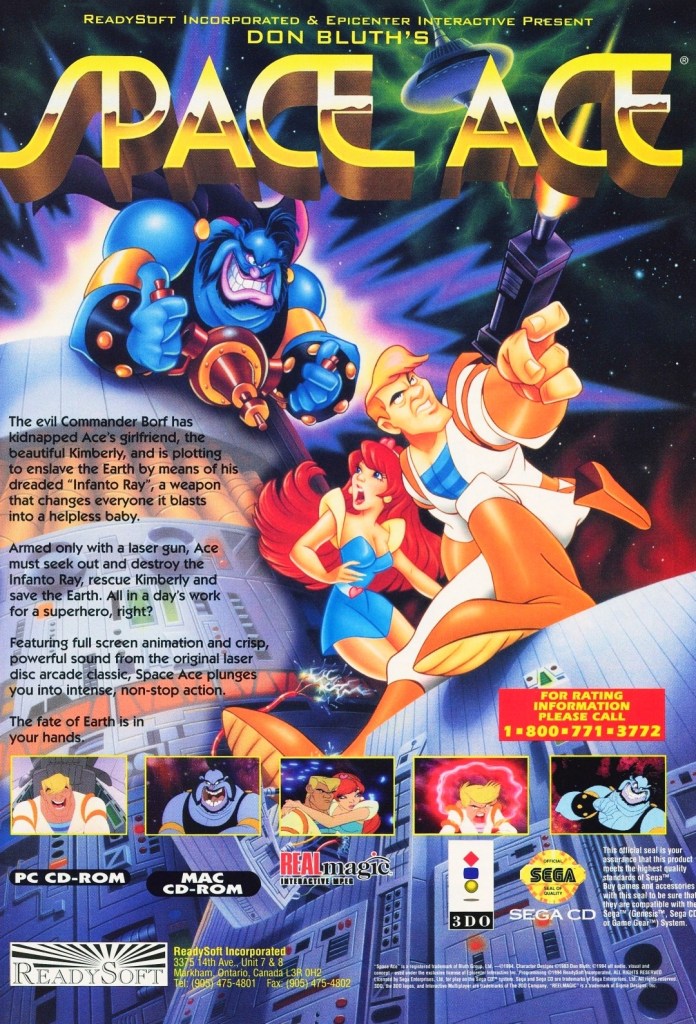
5. Space Ace multi-platform print ad
Anyone who is a fan of Don Bluth’s works in animation should be able to recognize the art style of this ad.
First released in the mid-1980s, Space Ace was a LaserDisc video game that was designed and produced by the legendary animator Don Bluth (An American Tail, The Land Before Time, Anastasia). After achieving success in the arcades, new versions of Space Ace were subsequently released on many other platforms, including the consoles and computers that used disc drives in the mid-1990s which this print ad emphasized. By looking at the lower part of the print ad, you will see Sega CD, 3DO, Macintosh and PC as targeted platforms. The most notable visual feature of the ad was, unsurprisingly, official art of Space Ace.
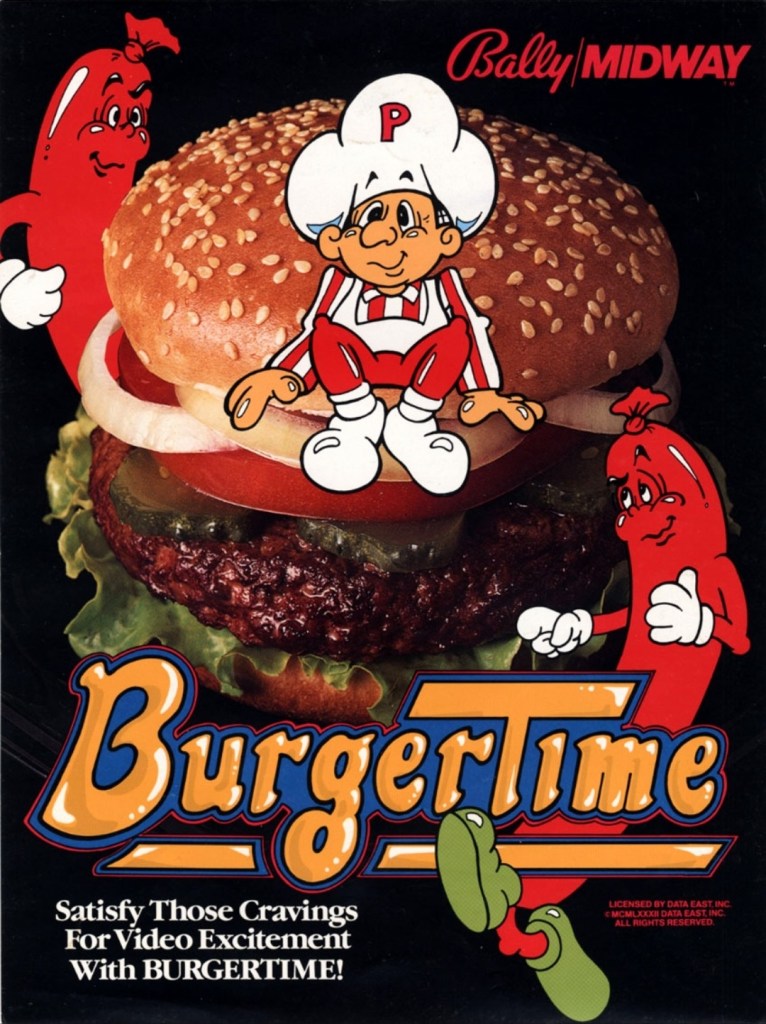
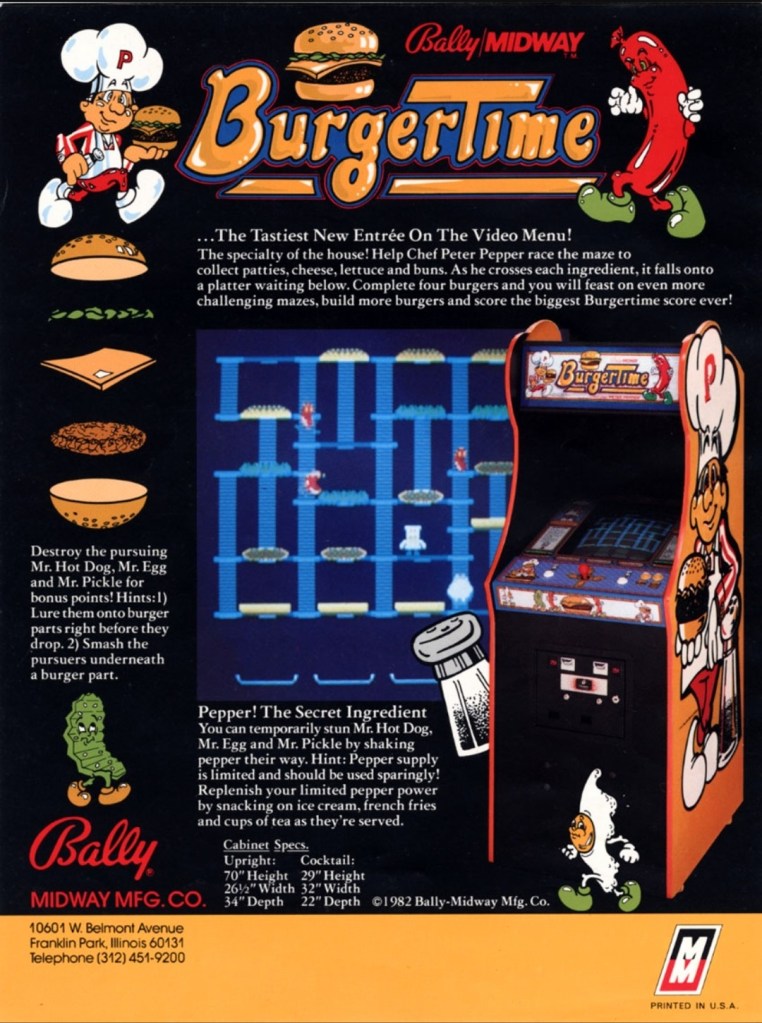
6. BurgerTime arcade flyer
The front of this flyer could make you crave for burgers.
The technical and creative details on the rear of the flyer.
Bally/Midway came up with this arcade flyer of BurgerTime which itself went on to become a beloved classic game. The front showed a very enticing looking hamburger that looked like it could fill a person’s belly and tingle his or her taste buds. Then they showed the hand-drawn in-game characters looking like they really are interacting with the hamburger. The back of the flyer shows details that emphasize what the game is about, why it could be a fun arcade addition and what the specs are. This is an engaging arcade flyer.
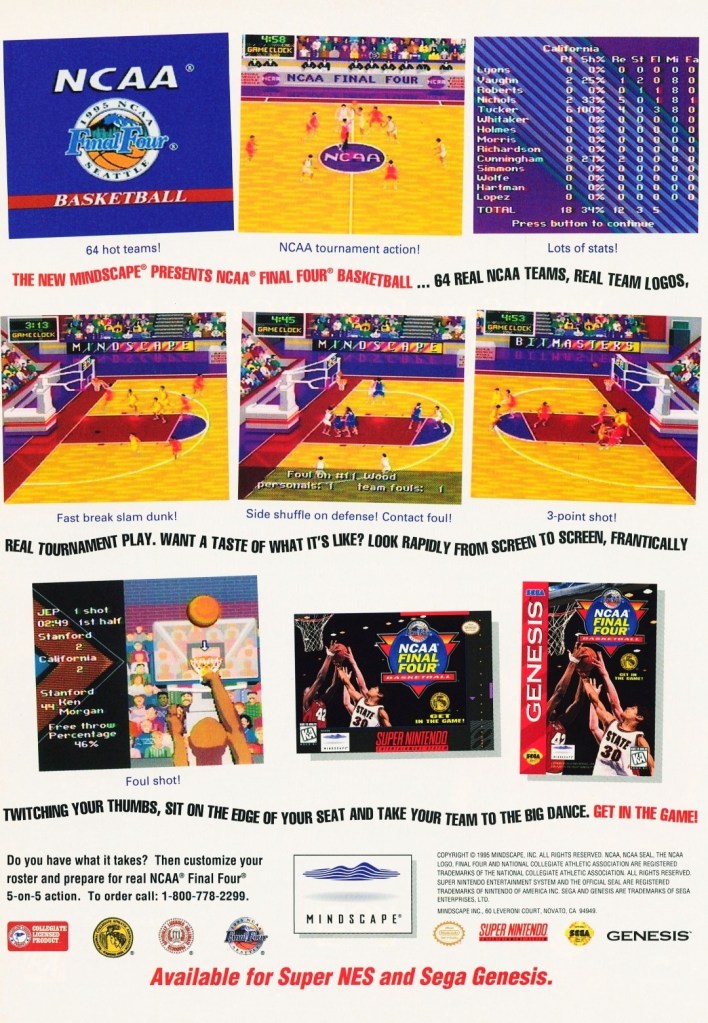
7. NCAA Final Four Basketball print ad
Do you know anyone who played this college basketball video game?
If there is anything notable about video gaming in the 1990s that is missing today, that would be the presence of multiple basketball video games released by different game publishers. Along the way, there were some college basketball video games such as NCAA Final Four Basketball developed by Bitmasters and published by Mindscape. This print ad had enough screenshots to show what the game looked like and how it played. The ad also mentioned that the game had 64 real NCAA teams and logos as well. This 1994 video game did not have a strong reception from game critics although it received a very high rating by GamePro magazine. NCAA Final Four Basketball has long been forgotten.
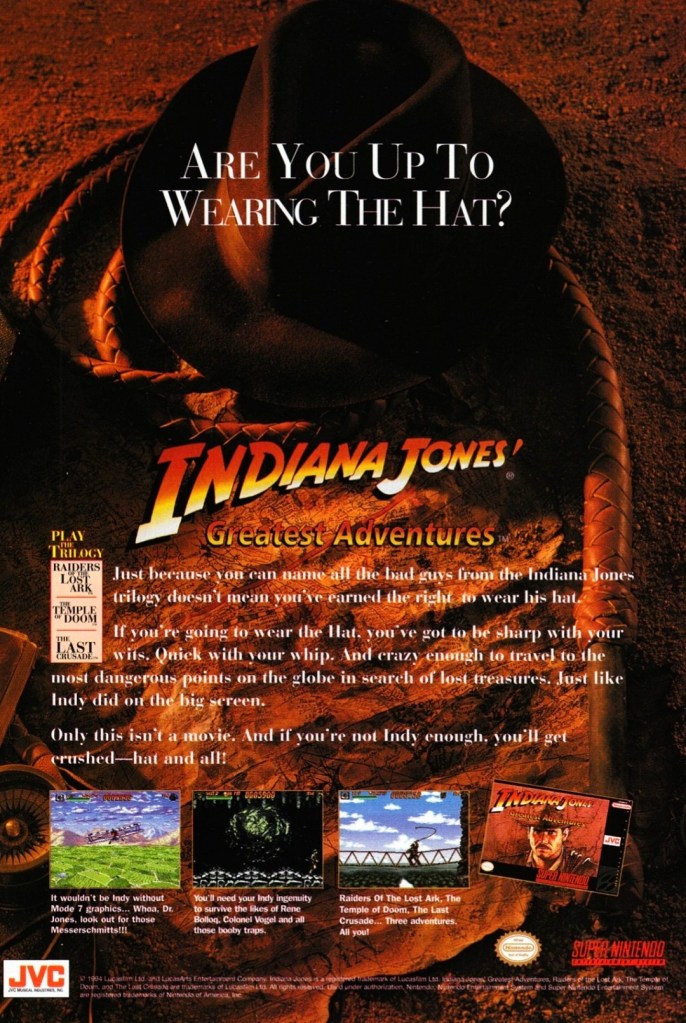
8. Indiana Jones’ Greatest Adventures print ad
An eye-catching print ad from a more memorable time when the Indiana Jones franchise was still under the full control of George Lucas and his enterprise.
Indiana Jones’ Greatest Adventures was an ambitious 2D side-scrolling adventure game that also served as an adaptation of the first three Indiana Jones movies (1981-1989) of Steven Spielberg and George Lucas. Like the Super Star Wars trilogy of games that preceded, this one was a challenging and lengthy game filled with lots of action. This print ad only showed Indy’s whip and hat but the screenshots, the text description and the game box cover (which has a young Harrison Ford as the iconic Jones) were more than enough to convince viewers that this was an Indiana Jones game.
Welcome back, my readers, YouTube viewers and all others who followed this series of articles focused on YouTube videos worth watching. Have you been searching for something fun or interesting to watch on YouTube? Do you feel bored right now and you crave for something to see on the world’s most popular online video destination?
I recommend you check out the following topics and the related videos I found.
#1Gus Abelgas Forensics features Antonio P. Antonio justice story – Last March, the surviving family of the late Antonio P. Antonio (APA) rejoiced when the Parañaque Regional Trial Court found suspect Nelson Antonio guilty of murdering his father (legal term: parricide) in 2013. It was a quest for justice that got fulfilled after more than a decade and along the way the family endured lots of challenges as they adjusted to life without their father (read my previous blog posts by clicking here and here). Recently, the local TV show Gus Abelgas Forensics produced an episode (note: Tagalog language) focused on the story of the late Antonio P. Antonio with special attention paid to the details of the investigation, the analysis of the evidence and information revealed by family members who were interviewed. The episode was released in full on YouTube and I recommend you watch it right now.
#2 Critical Drinker’s videos about Apocalypse Now and Fitzcarraldo – Critical Drinker is one of the most notable and more engaging YouTubers when it comes to entertainment. Apart from doing reviews or commentaries about movies and shows, he has a series of videos that closely examine the troubled entertainment productions. Posted below are his videos about Apocalypse Now (which was filmed here in the Philippines) and Fitzarraldo (notorious for manually hauling a 320-ton steamship up a steep hill as well as cases of deaths and plane crashes).
#3 Ashleigh Burton’s reaction video of Air Force One – If you are a Harrison Ford fan who ended up being depressed over his work in Indiana Jones and the Dial of Destiny, then it is time to look back at the actor’s more exciting works from long ago apart from the Star Wars and Indiana Jones movies. Recently, YouTuber Ashleigh Burton released her reaction video of the 1997 blockbuster film Air Force One which had Ford play a brave and fighting US President. Her reaction video is entertaining to watch and you can see it below.
#4 Reggie Miller’s memorable play on May 25, 1998 – Way back in 1998 here in the Philippines, I saw live on cable TV Game 4 of the NBA Eastern Conference Finals series between the Chicago Bulls and the Indiana Pacers. I was rooting for the Pacers as my all-time favorite NBA legend Larry Bird was the coach and they had a very solid team with Reggie Miller, Rik Smits, Mark Jackson and others. The game is best remembered for Reggie Miller’s stunning 3-point shot which involved pushing Michael Jordan out of the way to get the ball. Not only that, Miller had a sprained left ankle to do it all. Take note that the Pacers was one of very few times to push Jordan and the Bulls into a full seven games in a best-of-seven series. Watch the video below and enjoy.
#5 X-Men: Apocalypse movie reaction videos – As X-Men: Days of Future Past was such a great film to watch, there was hope that follow-up X-Men movies starring James McAvoy, Michael Fassbender, Nicholas Hoult and Jennifer Lawrence will turn out great and offer moviegoers fine alternatives to the many superhero movies being released by Marvel Studios, Sony Pictures and Warner Bros. Then X-Men: Apocalypse was released in 2016 and I saw it on opening day inside a local IMAX cinema here in the Philippines. I left the cinema feeling entertained but the overall fun factor of the movie paled in comparison with its 2014 predecessor. If you want to see the YouTubers’ opinions of X-Men: Apocalypse, watch the videos below.
#6 Top Hat Gaming Man’s Double Dragon history videos – Top Hat Gaming Man is an engaging YouTuber to follow when it comes to retro gaming. Among his many videos that examined the history of video games, he published videos focused on the Double Dragon game series which used to be wildly popular. If you are a Double Dragon fan or if you are simply interested to discover how was Double Dragon first created, watch the selected videos below.
Welcome back readers, fellow geeks and electronic gaming fans!
In this edition of the Retro Gaming Ads Blast (RGAB) series, we will take a look at another batch of retro gaming print ads from the 1980s and 1990s. In addition, there will be a few flyers of arcade games as well as promotional posters of a notable console game that was released only in Japan.
For the newcomers reading this, Retro Gaming Ads Blast (RGAB) looks back at the many print ads of games (console, arcade, computer and handheld) that were published in comic books, magazines, flyers and newspapers long before smartphones, social media, the worldwide web and streaming became popular. To put things in perspective, people back in the 1980s and 1990s were more trusting of print media for information and images about electronic games and related products.
With those details laid down, here is the newest batch of retro gaming print ads for you to see and enjoy…
1. M.I.A.: Missing in Action arcade flyer
This is an effective way of catching the attention of both players and arcade operators. I can imagine the woke, the SJWs and rabid feminists getting easily offended by this.
Konami was a very prominent producer of games back in the 1980s. Not only did the company produce high-quality and enjoyable military-themed games on consoles and computers, Konami also made its presence felt in the highly competitive sector of arcade games. In 1989, they released the arcade conversion kit of M.I.A.: Missing in Action and this flyer is the best know promotion of it. M.I.A.: Missing in Action is the follow-up to Konami’s hit game Rush’n Attack.
Visually, the flyer’s display of four screenshots combined with a dominating photographic image of prisoners of war (POWs) getting delightfully released by an attractive female Rambo-type rescuer were designed to catch the attention of young adult and adult gamers. The text descriptions (note: there were more details on the back of the flyer), however, were geared towards arcade operators who were looking for new games to acquire without the hassle of having to buy an entire arcade cabinet. That being said, this flyer was a clever way to appeal to arcade operators and the people who love playing arcade games.
2. Fonz arcade flyer
Simplistic yet effective to look at. If you are an arcade operator, this flyer conveniently has key information displayed.
Believe it or not, Sega was already active in arcade games way back in the 1970s. In this particular flyer, Sega’s arcade game Fonz (also called Moto-Cross, Man T.T.) offered players the unique experience of driving a digital vehicle using actual handlebars on the machine that were meant to create an immersive and realistic feel. If you look closely, the flyer has lots of details written with arcade operators and players in mind.
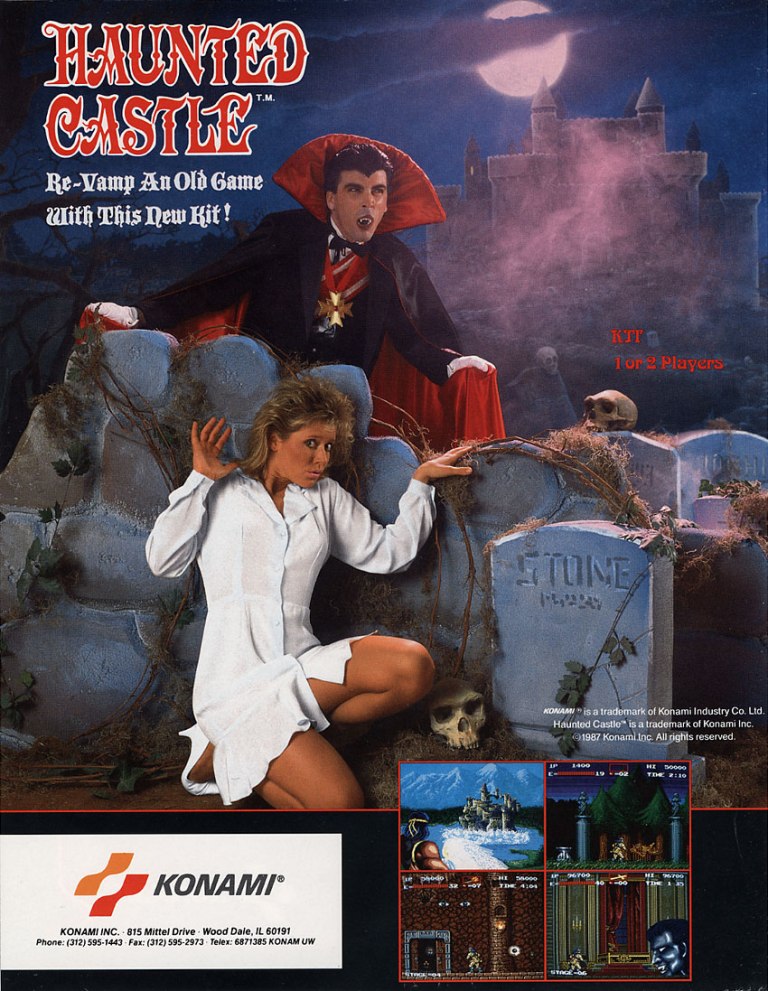
3. Haunted Castle arcade flyer
Indeed, this game is part of the Castlevania game franchise. It was one of the first Castlevania games released for arcades.
Arguably, Konami is best known for the Castlevania game series which covered handheld gaming devices, personal computers, video game consoles and even arcades. Haunted Castle (Japanese title: Akumajō Dracula) is the 2nd arcade game of the Castlevania franchise and it is not a port of any console game. Like the arcade flyer of M.I.A.: Missing in Action, this one was crafted to lure the attention (and money) of arcade operators looking for conversion kits to replace their old games. The visual presentation is eye-catching and even though the Castlevania brand was nowhere to be seen, Castlevania fans could tell this this arcade offering was part of their favorite game franchise.
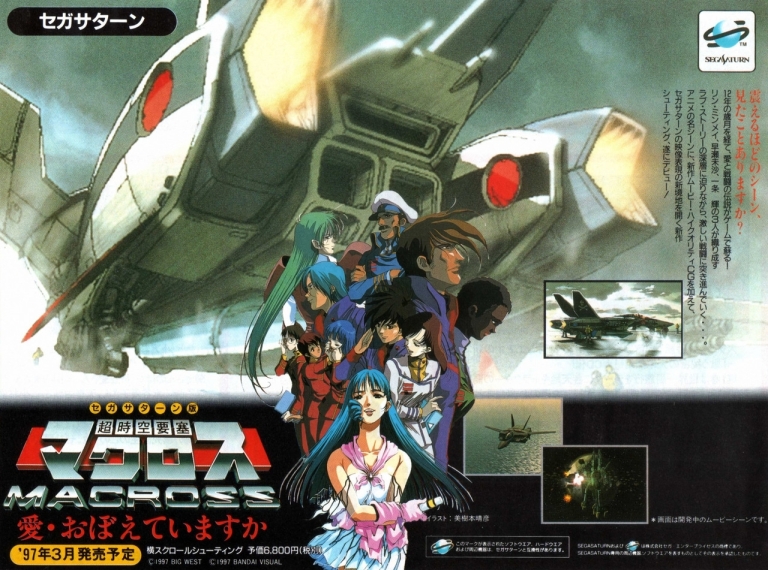
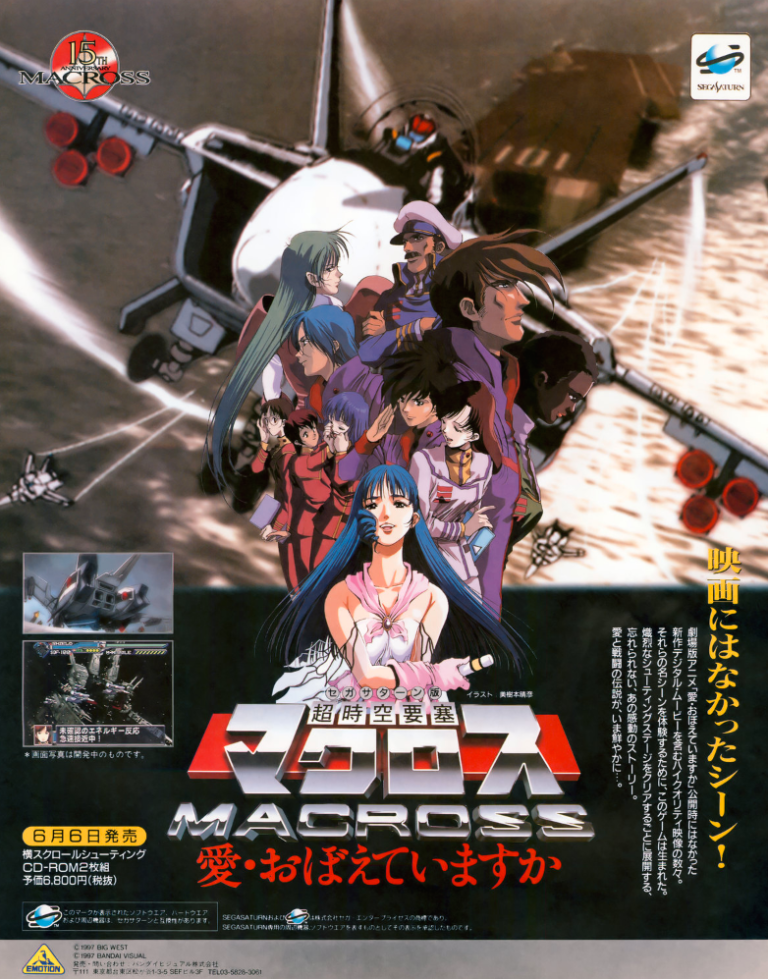
4. The Super Dimension Fortress Macross: Do You Remember Love? flyer and poster
The poster promoting the release of the game for Sega Saturn in Japan.
The flyer promoting the Sega Saturn game’s 1997 release as well as the 15th anniversary of Macross.
In 1997, the 15th anniversary of the Macross multimedia franchise was celebrated in Japan and among the highlights was the release of The Super Dimension Fortress Macross: Do You Remember Love? on the Sega Saturn. To promote the game and the franchise itself, lots of flyers and posters were released in Japan. If you look at the illustrated images on the promotional materials closely, you will realize that they are not from the original 1982-83 Macross anime TV series but rather from the The Super Dimension Fortress Macross: Do You Remember Love? animated movie of 1984 (read my retro movie review by clicking here).
While it might be baffling to some as to why the original anime TV series was not used as the source material for the 15th anniversary celebration through gaming, the 1984 anime feature film was actually more adaptable for a video game project (read my retro review by clicking here). It is so obvious, you just have to ask yourselves this question – how can the game developers compress the entire concepts of the 36-episode Macross anime series into one game while ensuring fun gameplay? Regardless, the game was a lot of fun to play and I enjoyed playing the PlayStation version in 1999.
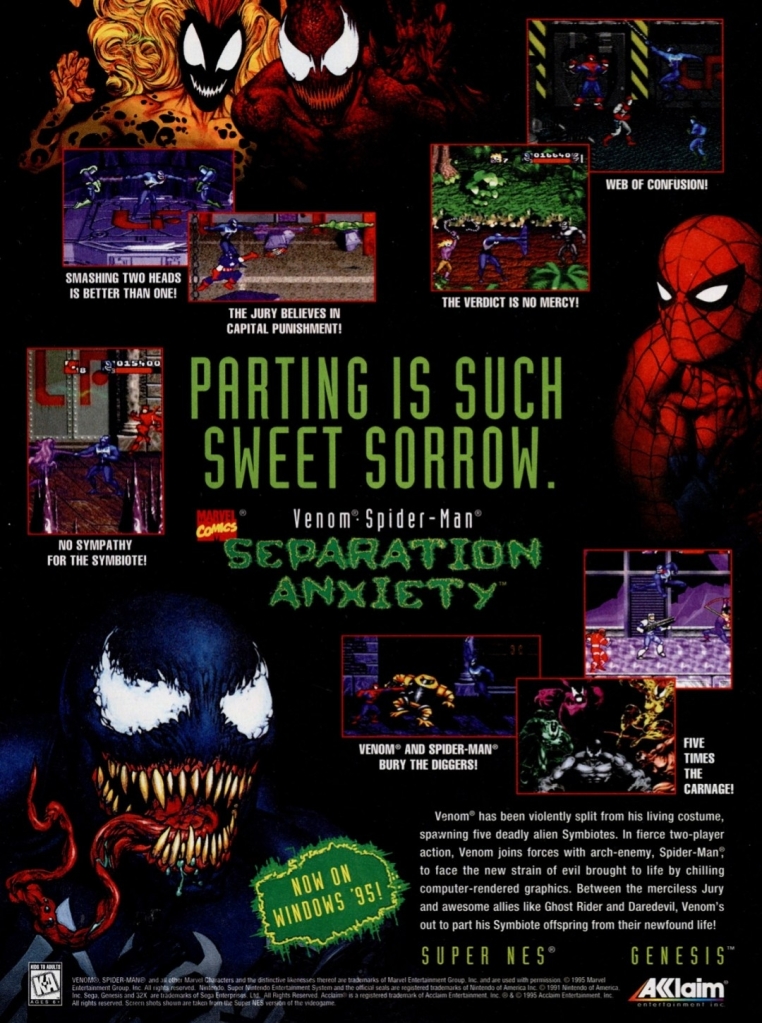
5. Venom/Spider-Man: Separation Anxiety print ad
A clear effort to sell the game to gamers as well as fans of Spider-Man and Venom.
In 1994, Acclaim released Spider-Man and Venom: Maximum Carnage (based on the 1993 comic book storyline Maximum Carnage) on Super Nintendo Entertainment System (SNES) and Sega Genesis ultimately becoming popular with comic book fans and gamers who enjoyed sidescrolling beat-them-up games.
Subsequently, Acclaim and develop Software Creations reunited to release the sequel Venom/Spider-Man: Separation Anxiety a year later on the two leading 16-bit consoles as well as on personal computer (PC). If there is anything notable about this eye-catching print ad, it is the fact that its visual presentation (with graphics on-par with the previous year’s game) cleverly hides the fact that it did not have much new to offer gamers with regards to gameplay and story cutscenes (which the previous game prominently had). Eventually, this game attracted weaker reviews from game critics and has since been forgotten.
6. Tecmo Super Bowl SNES print ad
From the time when Tecmo was still a strong producer of sports video games.
In 1991, Tecmo Super Bowl was released on the aging Nintendo Entertainment System (NES) and because its game design greatly entertained gamers, it became a tremendous commercial success. Not even the very high launch price of $54.99 stopped it from selling a lot.
To keep the commercial success and public interest going, Tecmo announced a new version of the game for the more powerful SNES console with the simple title of Tecmo Super Bowl. If you look closely at the print ad, you will notice that gameplay screenshots were not used at all. Instead, they showed images of the nicely illustrated art works they prepared as eye candy for the game with the intention of making it look cinematic. This is very curious because gameplay itself was the main selling factor of the NES version of Tecmo Super Bowl. I can only guess that Tecmo was not ready to show gameplay images by the time this print ad was made.
7. X-Men 2: Clone Wars print ad
The art used is too alienating for promoting this game.
During the age of the 16-bit consoles, there was a variety of X-Men video games released and produced by different companies. In 1993, an X-Men game published by Sega was released exclusively on the Genesis console which turned out to be fun for gamers and received mostly positive reviews from the critics. Sega went on to publish the sequel X-Men 2: Clone Wars and this print ad caught my attention because of how exaggerated the characters looked. It’s so strange, it’s as if the artist took visual reference from a somewhat blocky 3D polygonal portrait then tried to make them look hand-drawn. I wonder if anyone from Sega regretted this.
Welcome back readers, fellow geeks and electronic gaming fans!
In this edition of the Retro Gaming Ads Blast (RGAB) series, we will take a look at another batch of retro gaming print ads from the 1980s and 1990s.
For the newcomers reading this, Retro Gaming Ads Blast (RGAB) looks back at the many print ads of games (console, arcade, computer and handheld) that were published in comic books, magazines, flyers and newspapers long before smartphones, social media, the worldwide web and streaming became popular. To put things in perspective, people back in the 1980s and 1990s were more trusting of print media for information and images about electronic games and related products.
With those details laid down, here is the newest batch of retro gaming print ads for you to see and enjoy…
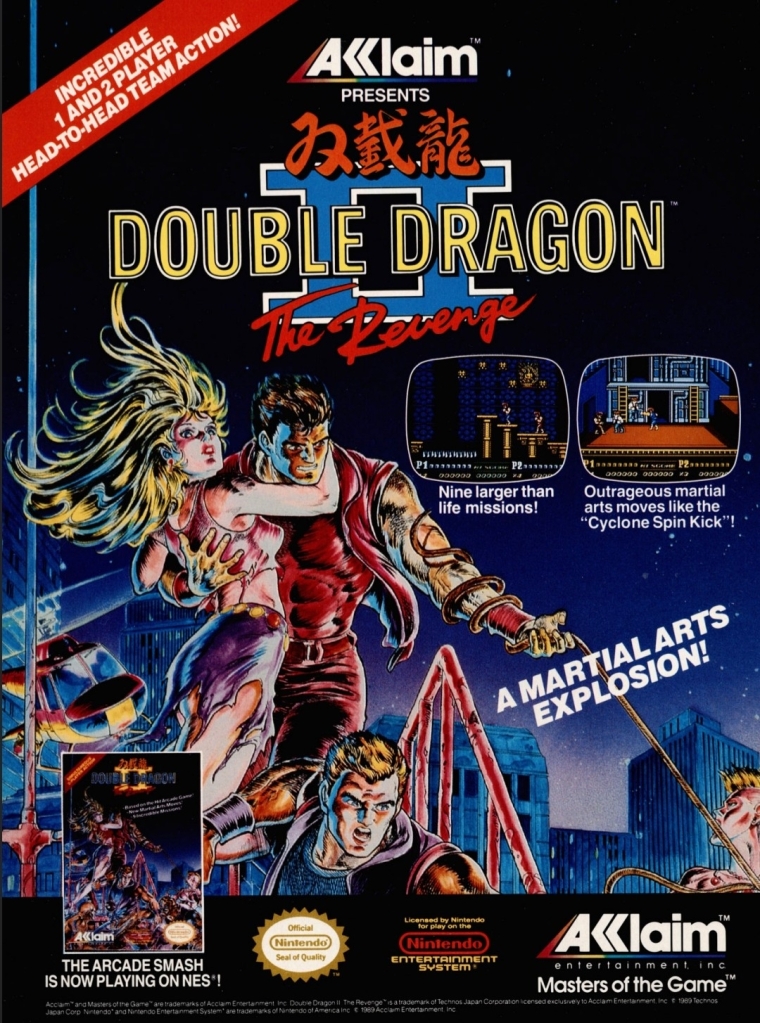
1. Double Dragon II: The Revenge print ad
Nice looking art used to promote the game.
The beat-them-up sub-genre of gaming was already popular in the 1980s and one of the most defining game franchises of this type of game was the Double Dragon series which proved to be popular with Nintendo Entertainment System (NES in America) and Family Computer (Famicom in Japan) gamers. As the first game was a very big hit on Nintendo’s consoles, the sequel Double Dragon II: The Revenge was promoted in America with strong confidence on the part of publisher Acclaim that it would become another massive hit. This print ad had a very nice looking comic books-style art that not only captured the concept of the game but also visualized the heroes Billy and Jimmy with enough details to focus on. I can say this was an eye-catching ad.
2. X-Men: Children of the Atom print ad
Great looking ad but the line “100% direct conversion” is not true at all.
Developed by Capcom in cooperation with Marvel, X-Men: Children of the Atom was a huge hit in the video arcades and it was not surprising that it got released on the Sega Saturn by Acclaim. Acclaim organized an aggressive promotional campaign by pouncing on the fans’ love and knowledge of the X-Men and the high fun factor of Capcom’s game. What this print ad got wrong, however, was the line “100% direct conversion of the #1 arcade smash!” which was wrong and misleading. In reality, the Sega Saturn version of the game had about one-third of the animation frames cut due to the console’s smaller RAM capacity.
As the years passed by, the Sega Saturn became the more suitable console for home ports of Capcom’s further 2D fighting games as Sony’s PlayStation had even more severe limitations and a graphics processor that was not suitable for 2D graphics. By the end of 2000, Capcom’s 2D fighting games on PlayStation all were inferior to the Sega Saturn versions.
3. Sky Shark NES print ad
This is an effective looking ad.
Released in Japan as Flying Shark, Sky Shark was released on multiple platforms in 1988 and there was an NES version of it which this particular print ad promoted. The American branch of Taito wisely used positive quotes from media outlets to promote the game while coming up with an engaging text description and displayed NES screenshots. And then there was that very engaging painted cover art that gave this print ad a lot of punch. An effective ad overall.
4. Conflict print ad
This is a very captivating artwork for advertising.
There is no denying the fact that the Cold War was a strong influence on arcade games and video games. Titles like Contra, Jackal, Metal Gear, Operation Wolf, Cabal and Rush’n Attack were militaristic games that entertained millions of gamers from the young adults to the little children. In 1990, Vic Tokai released the game Conflict on the NES which had a military theme but an unusual game design composed of digital maps with hexagons in which gamers will play with strategy to win battles. That being said, this print ad’s visual concept was very captivating yet also misleading. If you see how the game is played, you will know what I mean.
5. College Slam print ad
Were you ever interested in college basketball video games?
This is one of the more eye-catching print ads I’ve seen due to the artist’s illustration of a basketball with a mouth biting the basketball rim which dominates the space. For the newcomers reading this, College Slam was a basketball video game that was actually a repacked version of the popular NBA Jam with focus on NCAA basketball players. With the biting basketball at the center, it was easily an attraction and the screenshots implemented were larger than usual which easily gave gamers a clear look at what the game looked like. While this print ad is eye-catching, it did not help sell College Slam and there never was a follow-up.
6. Tecmo Super Baseball print ad
From the time when Tecmo was prolific with video games about sports.
Long before it started the Dead or Alive game franchise, Tecmo was once heavily invested in making sports video games. Tecmo Super Baseball was their first American pro baseball video game released for Super Nintendo Entertainment System (SNES) and Sega Genesis, and it was notable that the publisher secured only the Major League Baseball Players Association (MLBPA) which resulted in the game featuring real-life players but the teams had no names and no logos. Regardless, this print ad showed how aggressive Tecmo was in trying to attract consumers’ attention by showing ten screenshots with short text descriptions each. The ad’s write-up boasted realism as well as the promise of gaming quality.
7. The Punisher print ad
Marvel’s vigilante firing at someone.
In the early 1990s, Capcom and Marvel Comics started their partnership resulting in the releasing of the arcade game The Punisher. Developed by Capcom, the said arcade game became a big hit with gamers as it featured fun gameplay, multiple enemies appearing on screen simultaneously and other fun elements. Unsurprisingly, the game was ported (note: Sculptured Software was the lead developer) to the Sega Genesis with significant downgrades in terms of graphics, sound, enemy variety and other related elements due to technical limitations. That being said, this print ad used detailed art of the Punisher (with Col. Fury in the background) in a clever way to promote the Sega Genesis version while keeping their attention away from the obvious visual downgrades of the two screenshots displayed. The Punisher on Genesis was poorly received.
8. Stargate print ad
If you did not enjoy the movie, were you able to play the video game adaptation on Sega Genesis or Super NES?
Remember the sci-fi movie Stargate (1994)? The film was a surprise box office hit and eventually video game adaptations of it were made for the SNES, Sega Genesis, Game Gear and the GameBoy. This particular print ad, however, showed screenshots of the SNES and Genesis versions which is made obvious with the side-scrolling adventure plus 3D flying sequence (one screenshot showed it). Combined with images sourced from the movie poster plus an insert of the movie in home video format (lower-right corner), this print ad was obviously an aggressive way to promote the film with the post-theatrical business in mind. In case you are wondering, the cinematic Stargate is not related at all with the early 1980s video game (a follow-up to the classic game Defender) of the same name.
9. Aerobiz Supersonic print ad
For a simulation game released on consoles, Aerobiz Supersonic is pretty deep and a lot of fun to play.
The airline simulation game Aerobiz Supersonic is a highly addictive and surprisingly fun game that I enjoyed playing on the SNES (read my retro review by clicking here) and strangely enough I first learned about not through its print ad but by reading a preview published by Electronic Gaming Monthly (EGM) magazine. As for this print ad made by Koei’s American team, this is really odd to look at due to the ad makers’ choice of showing a not-so-attractive flight meal. In contrast to that, the ad makers did a good job describing the game creatively and showed three screenshots that were strategically selected in my view. Having played the game many times, I can say that this print ad is very truthful.
Disclaimer: This is my original work with details sourced from reading the comic book and doing personal research. Anyone who wants to use this article, in part or in whole, needs to secure first my permission and agree to cite me as the source and author. Let it be known that any unauthorized use of this article will constrain the author to pursue the remedies under R.A. No. 8293, the Revised Penal Code, and/or all applicable legal actions under the laws of the Philippines.
Welcome back superhero enthusiasts, 1990s arts and culture enthusiasts, Marvel Comics fans and comic book collectors! Today we go back to the year 1991 to explore a chapter of the Uncanny X-Men series that took place between X-Tinction Agenda and Mutant Genesis (the modernization point of Marvel’s mutants for the 1990s).
For the newcomers reading this, X-Tinction Agenda was a very notable part of the history of the X-Men comic book franchise as it marked the first time that the X-Men, X-Factor and the New Mutants were combined and also reunited several X-Men members who were scattered around the world. That being said, the state of mutants within Marvel Comics’ shared universe created a sense of uncertainty towards Charles Xavier’s grand dream of establishing a peaceful co-existence between humans and mutants.
With those details laid down, here is a look back at Uncanny X-Men #273, published in 1991 by Marvel Comics with a story written by Chris Claremont and drawn by Whilce Portacio, Klaus Janson, Jim Lee, John Byrne, Rick Leonardi, Marc Silvestri, Michael Golden and Larry Stroman.
The cover.
Early story
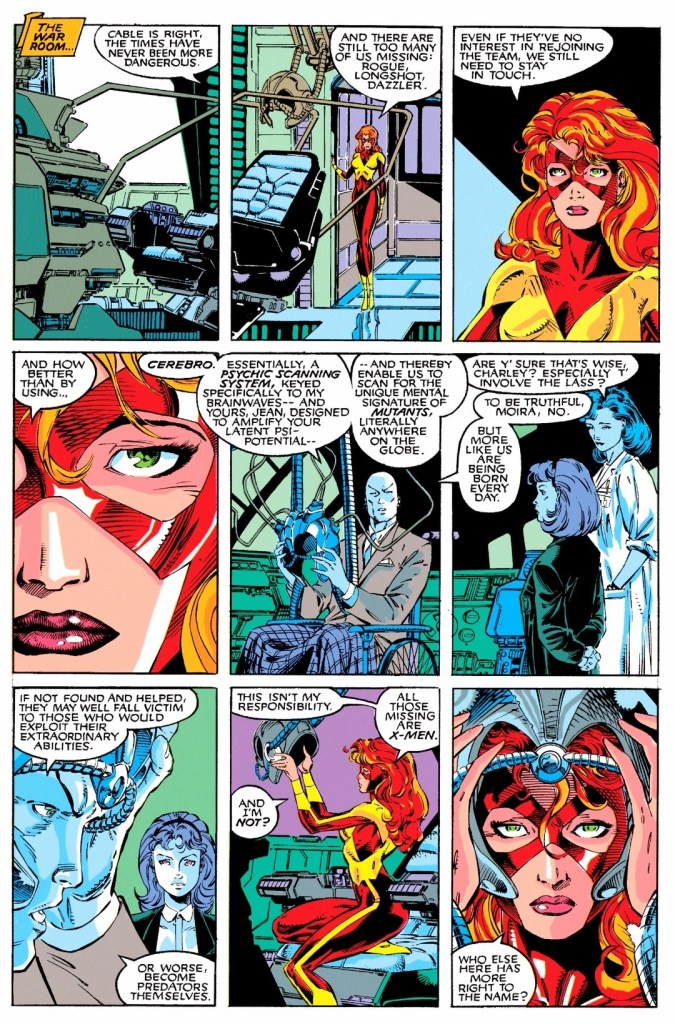
The story begins in the control center within the complex located deep under the ruins of Charles Xavier’s mansion. Storm (X-Men), Jean Grey (X-Factor), Cyclops (X-Factor) and Cable (New Mutants) carefully examine the worldly forces that oppose them. After Storm asked about what they could do about the opposing forces located in different parts of the world, Cable says that they should hit them hard and fast as they have the power to do so.
Storm asked Cable if violence is his only solution. Even though violence got things done for Cable, Cyclops rejects it and states that his fellow mutants (pertaining to the X-Men and X-Factor) are not like him.
As the conversation intensifies, Jean Grey tells Cable that they are not warriors and the school was not founded by Professor X to have mutants to fight wars. Cable replied that war is what they got and reminded them of the two mutants they lost and another one who ended up as a genetically engineered slave. Cable asked them if they want to see more of their fellow mutants end up badly…
Quality
In the absence of Professor X, Jean Grey (then a member of X-Factor) revisits Cerebro and recalls what she learned long ago.
In relation to the mentioned fact that this particular story took place between X-Tinction Agenda and Mutant Genesis, this is a tale that reflects a period of transition leading to the latter. That being said, Chris Claremont took the opportunity to emphasize the current state of the X-Men and the other mutants, as well as the uncertainty ahead of them all. To be clear, this story does not have Marvel’s mutants going up against another super villain nor a group that opposes them.
The story opened very strongly with the leading figures of the X-Men (Storm), X-Factor (Cyclops and Jean Grey) and the New Mutants (Cable) being together analyzing the global situation and the forces that oppose them.
For Cable, violence is necessary for their survival and progress because he sees war against mutants already happening and there is simply no room left for error nor compromise. Very symbolically, Storm, Cyclops and Jean Grey – who all were nurtured by Professor X with his pacifist dream of bridging the gap between mutants and humans – reject Cable’s beliefs as they don’t see themselves as warriors and they do not dream of conquering their enemies at all. All the dialogue that took place in the argument are very richly written and there are layers of meanings which long-time X-Men fans will able to relate with.
Along the way, Claremont and the other creators made good use of available comic book space to develop the other characters which resulted in the gradual developments within each team of mutants. Gambit here is a brand new member of the X-Men and his talk with Storm is very sensible to read. There was also this notable Danger Room training session between Archangel and Cannonball in which the former (who is already very experienced as one of the original X-Men and a current member of X-Factor) shares wisdom to the very young mutant (who later went on to lead X-Force some time later). The creative team also inserted a few moments of humor on the other character development scenes.
Conclusion
Truly this is one of the most symbolic and most engaging arguments between the leading figures of the X-Men, X-Factor and New Mutants (which later became X-Force).
Even though it was mainly focused on character development and has no battle with any enemy, Uncanny X-Men #273 (1991) remained a very engaging read as it tackles not only the current state of the three mutant teams of the time but also realigned their direction creatively and the results were fully realized through the eventual Muir Island saga as well as Mutant Genesis and even in further tales (including Fatal Attractions). In many ways, this comic book served as a solid foundation of things to come and this partially explains the eventual reform of the X-Men into a much larger group that had to be composed of two teams shortly after the return of Professor X (as seen in X-Men #1 and Uncanny X-Men #281 in 1991).
Overall, Uncanny X-Men #273 (1991) is highly recommended.
Disclaimer: This is my original work with details sourced from reading the comic book and doing personal research. Anyone who wants to use this article, in part or in whole, needs to secure first my permission and agree to cite me as the source and author. Let it be known that any unauthorized use of this article will constrain the author to pursue the remedies under R.A. No. 8293, the Revised Penal Code, and/or all applicable legal actions under the laws of the Philippines.
Welcome back superhero enthusiasts, 1990s arts and culture enthusiasts, Image Comics fans and comic book collectors! Today we go back to the wild 1990s and explore a part of the WildStorm universe through a tale of Backlash!
In my previous retro review, as the mission of Backlash and Taboo intensified, Zealot and Void of the WildCATs got involved in the action. Pike, who had been serving S’ryn, proved to be a formidable foe for Zealot and Taboo. The Savage Dragon meanwhile proved to be more than capable of bringing down S’ryn which made Backlash less relevant in his own comic book. Just as things intensified, something big blew up.
With those details laid down, here is a look back at Backlash #4 published in 1995 by Image Comics with a story written by Sean Ruffner, Jeff Mariotte and Booth. Booth was the artist.
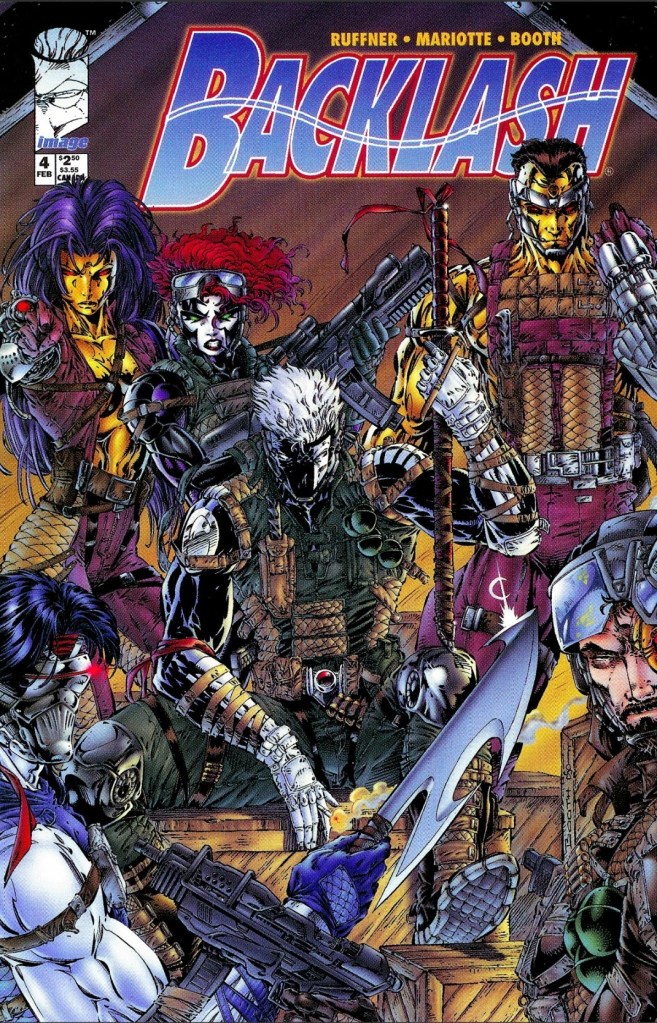
The cover.
Early story
The story begins just moments after the big explosion. Savage Dragon, Backlash, Zealot, Jacob Marlowe, Taboo, Void and Jack managed to survive. In line with his duty as a police officer, Savage Dragon tells Zealot that Backlash and his friends are coming with him as they have been tagged by the government as threats to national security. Zealot then lifts her blade up to Savage Dragon’s throat and states that if Backlash had not been with them, then her lord Emp (Marlowe) may well have been assassinated.
Eventually, Void uses her power to transport Backlash, Taboo, Jack, Zealot and Marlowe away, leaving Savage Dragon behind…
Quality
A briefing about the next mission.
To put things straight, this particular comic book serves as the conclusion of the storyline (the mission specifically) that started in issue #2 while also working as a bridge going into the next storyline. The good news here is that the creative team’s work here is good enough in terms of quality.
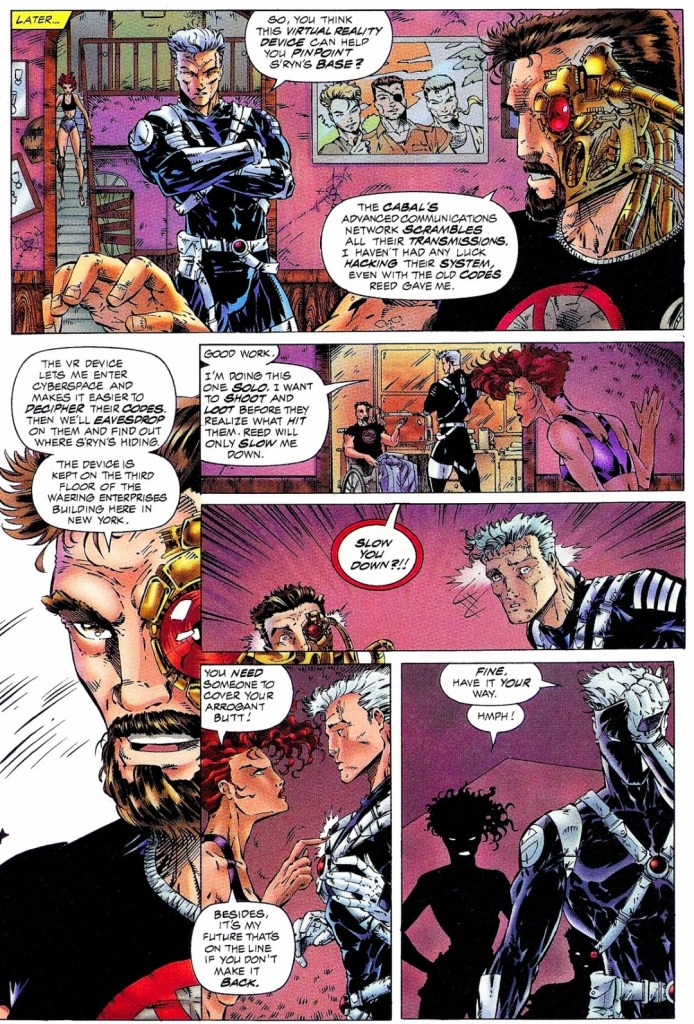
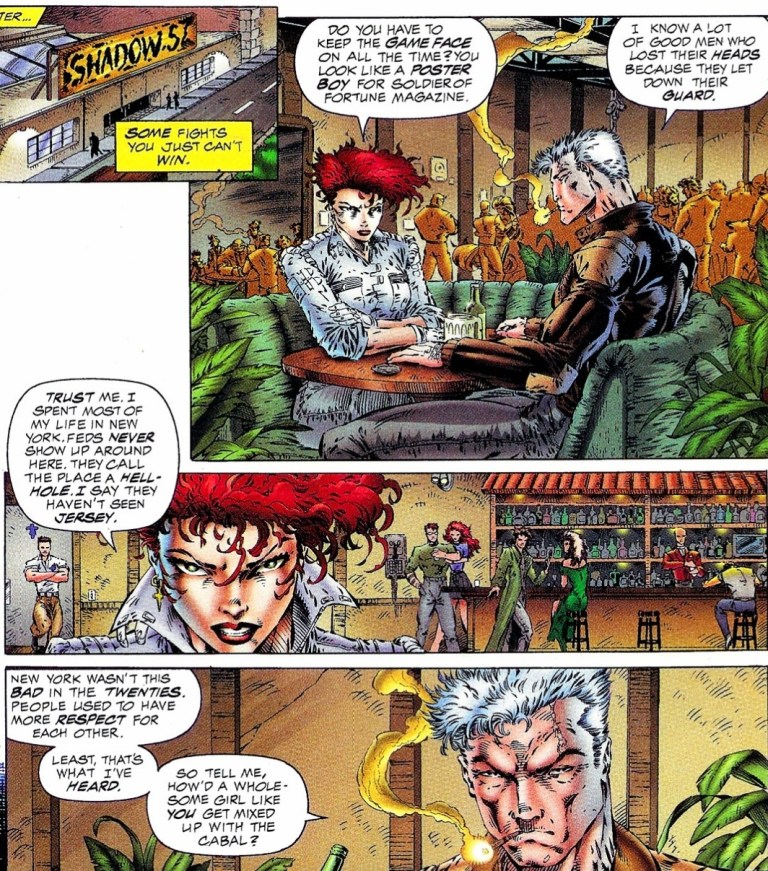
For one thing, the team really took their time to develop Backlash and Taboo some more right after the end of the first mission. Their talk with each other as civilians inside a New York City bar was nicely written and there were a few witty moments that I found enjoyable. Along the way, there was efficient expository dialogue that explains Taboo’s past connection with Pike and the Cabal. Backlash also shared some key details of himself which ultimately made him and Taboo have something in common.
This story also shows a key flaw in Backlash’s personal integrity – his romantic involvement with Taboo made him betray his beloved Diane. For one thing, this potentially opens a series of problems that will eventually haunt him later. On another thing, it seems that the creative team have something intriguing planned for the protagonist who has clearly been sharing this comic book series’ spotlight with Taboo.
As with the previous issues, this comic book continued the build-up and emphasis of the WildStorm universe’s concepts. In terms of crossovers, Wetworks’ leader Jackson Dane makes an appearance here and his unexpected reunion with Backlash is a must-see. For the newcomers reading this, WildStorm’s Grifter (WildCATs), Backlash, Dane (Wetworks) and Deathblow are all members of Team 7 which had its series of wild stories set twenty years prior (note: think of the Vietnam War era). It was also in 1994 when the first Team 7 comic book mini-series was first published. In some ways, Backlash interacting with Grifter in the Kindred mini-series and reuniting with Dane served as creative ways to emphasize the Team 7 concept to readers.
On the visuals, Brett Booth continues to do a fine job presenting the characters (who are clearly recognizable to me) and I noticed he seems to have fun trying to test readers’ visions by carefully inserting selected X-Men characters into the background during the bar scenes as Taboo and Backlash talked. As for Dane, I like Booth’s own take on the character
Conclusion
Look carefully at the background and you will spot X-Men team members Cyclops, Jean Grey Gambit and Rogue in civilian forms.
Backlash #4 (1995) is more of a build-up comic book that so happens to have a decent amount of action for entertainment value. The characterization scenes of Backlash and Taboo is a must-see while the conclusion of the first mission was nicely done complete with a worthy end to the crossover with WildCATs’ Zealot, Void and Jacob Marlowe. The story itself moved at a medium pace which is not surprising as there was something being built-up with the new mission in mind.
Disclaimer: This is my original work with details sourced from reading the comic book and doing personal research. Anyone who wants to use this article, in part or in whole, needs to secure first my permission and agree to cite me as the source and author. Let it be known that any unauthorized use of this article will constrain the author to pursue the remedies under R.A. No. 8293, the Revised Penal Code, and/or all applicable legal actions under the laws of the Philippines.
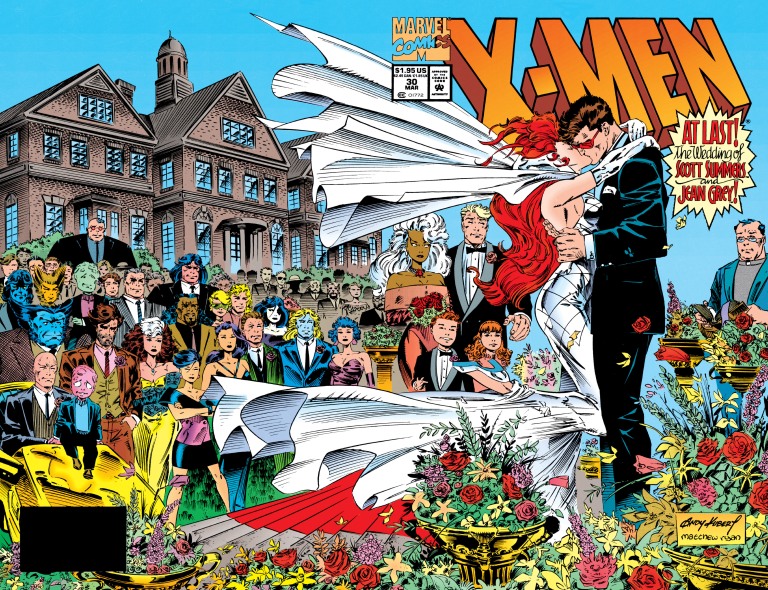
Welcome back, superheo enthusiasts, 1990s culture enthusiasts, X-Men fans and comic book collectors! Today we revisit the X-Men monthly series of the 1990s and look back at one of its most significant events it ever published – the wedding of Scott Summers/Cyclops and Jean Grey. By the time this particular comic book was published, the 30th anniversary celebration of the X-Men (note: Read my Fatal Attractions storyline retro reviews by clicking here and here) had just been concluded and that includes a major change of direction for the iconic X-Men member Wolverine. It is also notable that the X-Men had Sabretooth contained within Charles Xavier’s mansion (for retro reviews, click here, here and here).
With those details laid down, here is a look back at X-Men #30, published by Marvel Comics in 1994 with a story written by Fabian Nicieza and drawn by Andy Kubert.
The cover.
Early story
The story begins inside Xavier’s mansion. Jean Grey reads a handwritten letter from Logan/Wolverine, who left the household after getting traumatized from their last encounter with Magneto. Logan refers to her and Scott Summers as special. While reading, Jean is already in her fancy wedding dress being assisted by her mother and storm as Rachel Summers looks on. For Jean, the wedding is about her dedication on spending the rest of her life with Scott as well as possibly gaining Rachel (who comes from one possible future) as a daughter.
Professor X with four of his original team members plus Alex Summers.
Elsewhere in the mansion, the groom Scott spends quality time with his original teammates Bobbdy Drake/Ice Man, Warren Worthington/Archangel and Hank McCoy/Beast. With them also is his brother Alex Summers/Havok. Alex tells Scott that the day of his wedding is the first day of the rest of his life which causes Bobby to say something inappropriate.
Suddenly, Professor X comes in to join them…
Quality
Jean Grey in her wedding dress with her mother, Storm and Rachel Summers present.
To get straight to the point here, this comic book serves two purposes: highlighting Scott and Jean’s relationship to an all new level with the wedding as the main event, and offering long-time or die-hard X-Men fans a whole lot of stuff to chew on. Very clearly, Fabian Nicieza wrote the script with X-Men fans in mind while also making references to the past with some creative touches or shortcuts so that the comic book would not be bloated with excessive fan service.
The wedding itself was executed nicely by the Nicieza-Kubert team and was clearly conceptualized to not only be memorable for the fans but also creatively serve as a major pay-off to all those years of Scott and Jean Grey being together early as teammates, getting separated temporarily and getting together again (note: they were also the original X-Factor team). Right after the wedding was executed, the visuals and words elevated the emotions higher and any long-time X-Men fan will find the moment sentimental.
Opposite the wedding are several scenes showing the other X-Men characters plus those from X-Factor and X-Force (with a not-so-recognizable Cable present). The dialogue written ranged from sentimental to comedic. And then there were also a few lines that I felt were just thrown in as fillers.
As far as visuals go, Andy Kubert’s art here are pretty good to look at. While he did his best to really make the story visually appealing and memorable, there were a few panels of art that look rushed.
Conclusion
So many guests. Can you recognize many of them?
Since it highlights the wedding of Scott and Jean Grey with several other X-Men-related characters mixed in, X-Men #30 (1994) is clearly a commemorative story made with X-Men fans in mind. While a lot of work was done to make the story momentous on its own, readers who are unable to immerse themselves deeply into the X-Men mythos (plus X-Force, X-Factor and others) prior to reading this comic book won’t be able to relate to the wedding and the character moments very much. While it may not be significant to newcomers who find this comic book for the first time, it still marks a significant chapter in the history of X-Men within the Marvel Comics universe of the late 20th century. For the long-time fans who were able to read enough of Scott and Jean Grey’s times together from 1963 until the early 1990s, this is one X-Men tale that they can relate with deeply.













 Author Carlo Carrasco