Disclaimer: This is my original work with details sourced from reading the comic book and doing personal research. Anyone who wants to use this article, in part or in whole, needs to secure first my permission and agree to cite me as the source and author. Let it be known that any unauthorized use of this article will constrain the author to pursue the remedies under R.A. No. 8293, the Revised Penal Code, and/or all applicable legal actions under the laws of the Philippines.
Welcome back superhero enthusiasts, 1990s arts and culture enthusiasts, Marvel Comics fans and comic book collectors! Today we go back to the mid-1990s to explore the adaptation of the second season of the X-Men animated series in the form of the X-Men Adventures comic book series.
Before getting to the new retro comic book review, I should state that even though streaming is the norm for millions of people who love entertainment, it would be nice if the classic X-Men: The Animated Series (X-Men TAS) would someday get released on Blu-ray disc format. Even though many X-Men fans are streaming, there are still those who prefer collecting physical releases of what they enjoy. Really, watching entertainment with Blu-ray or 4K Blu-ray format is much better than streaming.
With those details laid down, here is a look back at X-Men Adventures Season II #3, published in 1994 by Marvel with a story written by Ralph Macchio and drawn by John Hebert.
The cover.
Early story
The story begins at the border of Kenya and Tanganyika where Mount Kilimanjaro rests. Something destructive emerges at the top of the mountain causing great disturbance on the people below. At a village, two black persons could not help but notice a demonic figure coming down at them. One of them gets possessed by it.
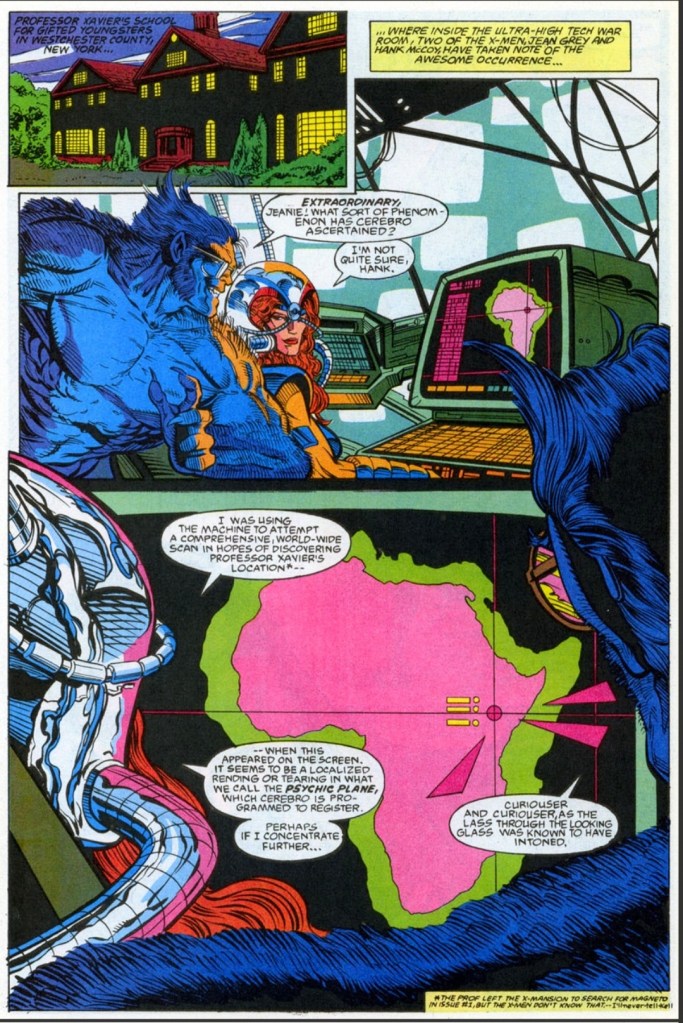
Meanwhile at their headquarters in Westchester County, New York, Jean Grey uses Cerebro to comprehensively scan the world to find Professor X’s location. What Jean detected was a psychic plane which catches Beast’s attention.
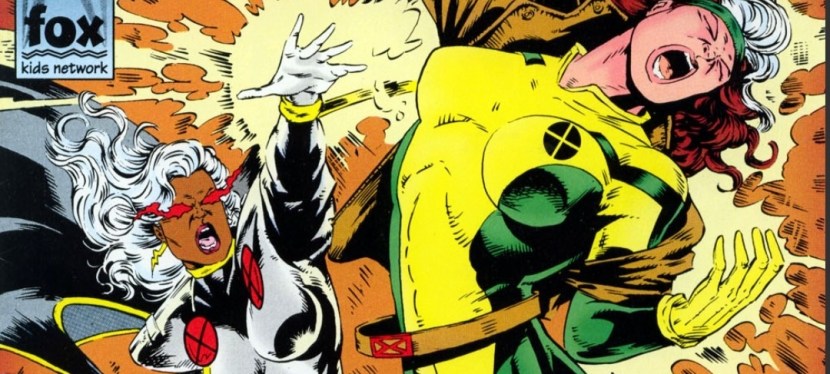
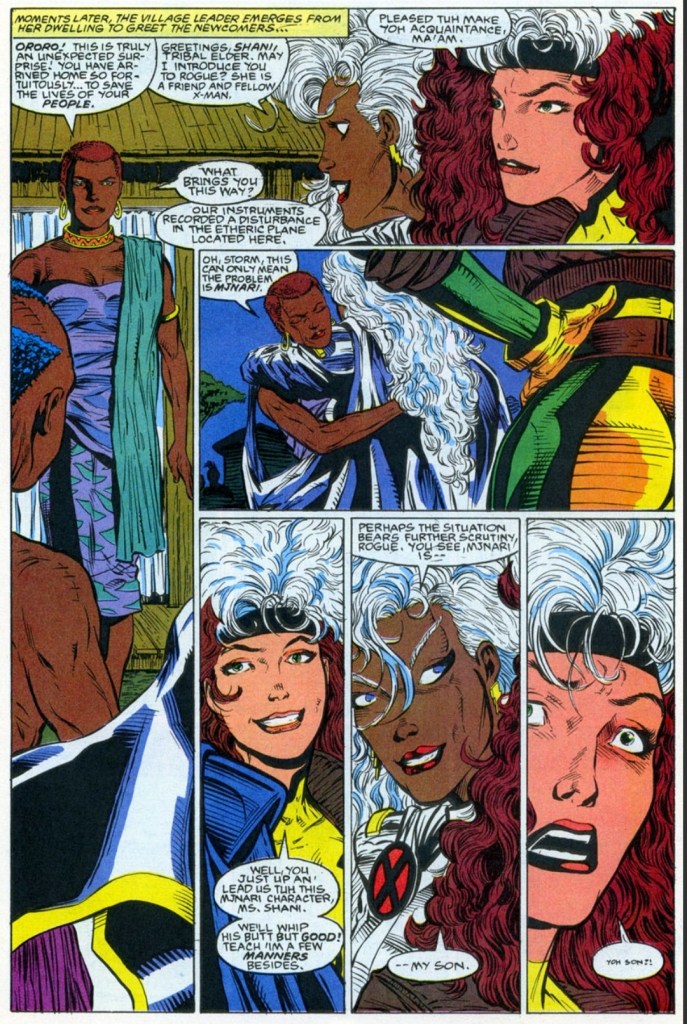
Shortly after, Rogue arrives with Storm who just returned from a hospital. As Jean updates them both, Storm realizes that the location of the psychic plane is in Africa…
Quality
Rogue in Africa with Storm.
The first thing I should confirm here is that there is a nice jump in the visual quality – in terms of style and detail specifically – thanks to illustrator John Hebert. Hebert’s work here is a nice relief compared to the rushed works of Andrew Wildman in the previous two issues, and he knows when to use the dynamic moments of spectacle and how to balance it with the calm moments. Hebert’s take on Wolverine is really good.
Regarding the story, I like the way the search for Charles Xavier – which was a sub-plot in the previous issues – unfolded while also opening the opportunity to develop Storm as she returns to Africa. In fact, this tale reveals some really engaging details from Storm’s past as well as her personal connection with a certain tribe of black people. These mentioned elements added nicely to the tension of a particular conflict that followed.
In fact, the Storm-centered story was nicely executed by the creative team and there were revelations that were gripping. Along the way, Rogue got a nice share of the spotlight and was a suitable supporting character even though the comic book had new characters.
Conclusion
Using Cerebro has big advantages.
X-Men Adventures Season II #3 (1994) is a good read and it also has a nice change of geographic setting as it mainly focused on Africa and Storm’s reconnection with her people. Storm is clearly the main character here and this is a solid pay-off as she only had a tiny part in the previous issue. This is a tale – with themes of family, culture and the responsibility that comes with having special talents or power – that should interest dedicated fans of Storm.
Overall, X-Men Adventures Season II #3 (1994) is recommended.
Disclaimer: This is my original work with details sourced from reading the comic book and doing personal research. Anyone who wants to use this article, in part or in whole, needs to secure first my permission and agree to cite me as the source and author. Let it be known that any unauthorized use of this article will constrain the author to pursue the remedies under R.A. No. 8293, the Revised Penal Code, and/or all applicable legal actions under the laws of the Philippines.
Welcome back superhero enthusiasts, 1990s arts and culture enthusiasts, Marvel Comics fans and comic book collectors! Today we go back to the mid-1990s to explore the adaptation of the second season of the X-Men animated series in the form of the X-Men Adventures comic book series.
Before getting to the retro comic book review, I want to ask you all: have you heard about the recent controversy about the firing of the showrunner of X-Men ’97? You can learn about it by clicking here and here. In case you are wondering, I have no intention to watch X-Men ’97 knowing that Marvel under woke Disney are only using established entertainment properties to spread their sinister propaganda. Hollywood has so many Commies, it should really be called Commiewood.
With those details laid down, here is a look back at X-Men Adventures Season II #2, published in 1994 by Marvel Comics with a story written by Ralph Macchio and drawn by Andrew Wildman.
The cover.
Early story
The story begins with the newly married couple Scott Summers (Cyclops) and Jean Grey enjoying their honeymoon on a boat somewhere in the South Pacific. Jean is enjoying their privacy together free from all the pressure they experienced as X-Men members. For her, the world feels really different.
Suddenly, Jean senses something as their boat approaches an island that was supposed to be uninhabited. A man with long pink hair has been anticipating their arrival and surprises them. He uses his power to manipulate the sea water to form waves to capsize their boat and push them further to the beach.
Soon enough, Cyclops and Jean find themselves facing Mister Sinister and his henchmen…
Quality
The Summers couple helpless in the presence of Mister Sinister who has an ambitious plan for all mutants.
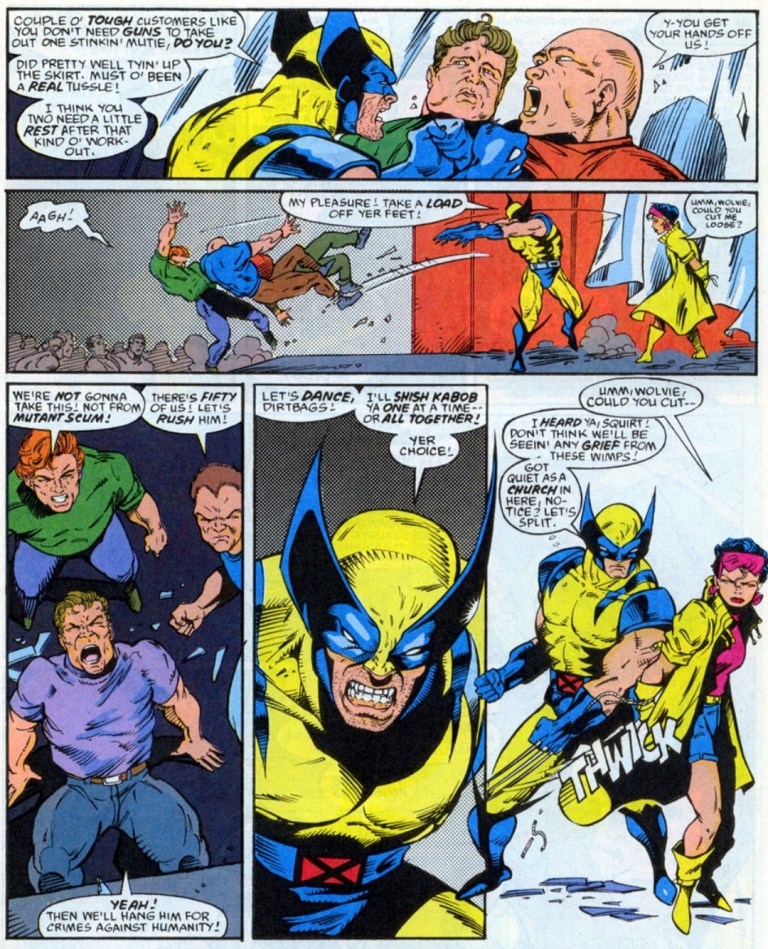
To put things clearly, this comic book is a nice pay-off to what was built up in the previous issue. Without spoiling the plot, I like the way the struggles of the X-Men were dramatized, specifically with regards to Wolverine (who was portrayed as an aggressor by the anti-mutant activists through the media) encountering the anti-mutant mob plus his interaction with Morph who got a lot more of the spotlight this time around. Morph’s return here has a bigger impact and the way things were told here will compel you to revisit the early issues of the first volume of X-Men Adventures and re-examine how he interacted with his teammates when he was still an X-Men member.
And then there is the sub-plot in which Cyclops and his wife Jean are captured by Mister Sinister and his henchmen. What I enjoyed the most in this part of the story was the efficient exposition done by the creative team to emphasize Sinister’s knowledge of Cyclops’ past and the X-Men which is connected with his master plan for the future that involves the genetic material of both Scott Summers and his wife. Sinister’s master plan for mutants is radically different from Magneto’s vision but remains essentially wicked as it involves overwhelming non-mutant people.
Conclusion
Wolverine faces the anti-mutant activists again not for revenge but to help his teammate.
X-Men Adventures Season II #2 (1994) is an action-packed read that is also intriguing and has few plot twists that added to the engagement. It is a better read than the previous issue and any X-Men fan who enjoys Mister Sinister antagonizing Marvel’s mutants will have stuff to enjoy and that includes the promise of future conflicts. If there’s anything that bogged down this comic book’s quality, it’s the somewhat rushed look of Andrew Wildman’s art.
Overall, X-Men Adventures Season II #2 (1994) is recommended.
Have you been searching for something fun or interesting to watch on YouTube? Do you feel bored right now and you crave for something to see on the world’s most popular online video destination?
I recommend you check out the following topics and the related videos I found.
#1Movie reaction videos by You, Me and the Movies – When it comes to watching movie reaction videos, I enjoy what the YouTube channel You, Me and the Movies posted. Go watch the five videos of theirs that I selected for your enjoyment. I also encourage you to visit You, Me and the Movies’ YouTube channel.
#2 Minty Comedic Arts’ superhero trivia videos – In recent times, superhero movies from Hollywood became irrelevant and unexciting not because of the so-called superhero movie fatigue but because they are no longer made to be fun. That being said, now is a good time to look back at the enjoyable superhero movies from the past through Minty Comedic Arts’ trivia videos below. You will learn something new and do not forget to visit Minty Comedic Arts’ YouTube channel.
#3 Looking back at the Sega Dreamcast’s American launch and legacy – It has been almost 25 years since the Sega Dreamcast console launched in the United States. The American launch turned out highly successful with almost $100 million in sales revenue achieved during the first 24 hours. For the newcomers reading this, there was a time when Sega had consoles and the Dreamcast was the last one they had before going all-in with multiplatform publishing of games. That being said, watch these videos of the Dreamcast.
#4 Assorted videos of violations and reckless driving incidents of electric bikes (e-bikes) and electric tricycles (e-trikes) in the Philippines – For the international readers and newcomers reading this, the amount of electric bikes (e-bikes) and electric tricycles (e-trikes) here in the Philippines grew dramatically over the past ten years. Because of the many incidents as well as cases of careless or reckless driving of e-bikes and e-trikes that took place, authorities in the National Capital Region (NCR) or Metro Manila took action to have such electric vehicles regulated as well as banned from traveling along major roads and highways. Hopefully in the future, e-bike and e-trike riders will be required to have their electric vehicles registered and get themselves licensed to drive. To see the incidents, watch the videos below…
#5 Rita Panahi and the Leftists who embarrassed themselves – We now move on to the more serious and real-world stuff. I can say that Rita Panahi and her segment titled “Lefties losing it” is easily the most engaging one to watch on Sky News Australia. Here you will see varied videos showing the recklessness, the shamelessness and craziness of the Leftists as captured on social media and news media. Watch and listen to the videos below…
Welcome back readers, fellow geeks and electronic gaming fans!
In this edition of the Retro Gaming Ads Blast (RGAB) series, we will examine print ads from the 1980s and the 1990s that caught my attention and I will explain why they are worth look back at.
For the newcomers reading this, Retro Gaming Ads Blast (RGAB) looks back at the many print ads of games (console, arcade, computer and handheld) that were published in comic books, magazines, flyers and newspapers long before smartphones, social media, the worldwide web and streaming became popular. To put things in perspective, people back in the 1980s and 1990s were more trusting of print media for information and images about electronic games.
With those details laid down, here is the newest batch of retro gaming print ads for you to see and enjoy…
1. Star Wars: Rebel Assault print ad
This print ad was strong enough to capture Star Wars fans’ attention and make them interested with the Sega CD.
If there is anything notable about the Sega CD (Mega CD in other parts of the world) platform, it is the fact that the machine was an add-on to be connected with the Sega Genesis (Sega Mega Drive elsewhere) console. That being said, LucasArts included the Sega CD as one of several platforms for the multiplatform release of their 1993 game Star Wars: Rebel Assault. The above print ad caught my attention with its use of 9 screenshots (emphasizing a wide look at the game’s Star Wars concept) and text description (emphasizing multi-media features connected with gameplay), and for a time it made me interested in the Sega CD. Looking back at the game’s marketing, Star Wars: Rebel Assault was designed to not only give gamers sessions of play to enjoy but also opportunities to immerse themselves deeper into the realm of Star Wars. The game even had selected video clips from the original Star Wars trilogy movies.
2. Cloak & Dagger print ad
This print ad could have used at least two screenshots from the arcade game…
In 1984, there was a movie titled Cloak & Dagger (read my retro movie review by clicking here) which was not only the 4th cinematic adaptation of the short story “The Boy Cried Murder” (written by Cornell Woolrich) but also had the real-life electronic game Cloak & Dagger as a crucial plot element. To make things clear, there was a Cloak & Dagger game released in the arcades (as emphasized in the above print ad) from Atari. Behind the scenes, the filmmakers and Atari worked together which explains the video game tie-in with the movie. While the above arcade conversion kit print ad does not show screenshots of gameplay, the four images of the playable protagonist Agent X shown were from the game’s short transition sequences (moving from one level to another) which were also displayed in the 1984 movie. Those images were enough to remind me about the movie I enjoyed.
More on the Atari connection, the movie had a cleverly presented short scene showing the young protagonist Davey (played by Henry Thomas) playing Cloak & Dagger on his Atari 5200 console with spliced gameplay footage of the arcade version shown within cuts. In real life, however, Atari never released a version of Cloak & Dagger for any console nor computer in the 1980s. Today, you can play the game on the Atari 50 collection on consoles.
3. BurgerTime print ad
This BurgerTime print ad was entertaining to look at and easily reminded viewers about food and the popular game coming home.
Back in 1982, BurgerTime (Japanese title: Hamburger) was released in the video arcades and turned out to be a big hit in both Japan and America. Seeking to capitalize on the game’s success, Mattel Electronics acquired the rights of the game from Data East and went on to release versions of it for the Intellivision, Atari 2600, Apple II and the IBM personal computer. Mattel went on to market the game for consoles and computers by coming up with a print ad (the one above) that had comic book-style hand drawn art of the playable protagonist chef Peter Pepper running away from walking versions (anthropomorphic figures) a hotdog, an egg, and a pickle. The ad showed a single screenshot which was sufficient enough to show readers the concept of the game clearly. In my experience, I never got to play BurgerTime in the arcades but I first learned about its existence thanks to the eye-catching print ad above which appeared in comic books I read. In addition, the print ad also does an effective job to remind readers about food.
4. SOS print ad
This print ad made me interested in the game as I was already aware of the historical sinking of the Titanic, and I already saw the disaster film The Poseidon Adventure.
Moving back to the 1990s, I saw the above print ad of the video game SOS for the Super Nintendo Entertainment System (SNES) while reading a comic book. The nice artwork caught my attention as it easily reminded me of the disaster movie The Poseidon Adventure (1972) as well as the real-life tragedy of the Titanic. Then I saw the screenshots on the print ad and they made me interested on the game which I later played on a rent-by-the-hour game joint. Looking back at the text description of the print ad, it did not describe what the technical and graphical features of SOS were. That being said, I was surprised to experience the game’s use of the SNES Mode 7 effects which enabled the scaling and rotating of the in-game environment which affected gameplay in many ways. Read my retro review of SOS by clicking here.
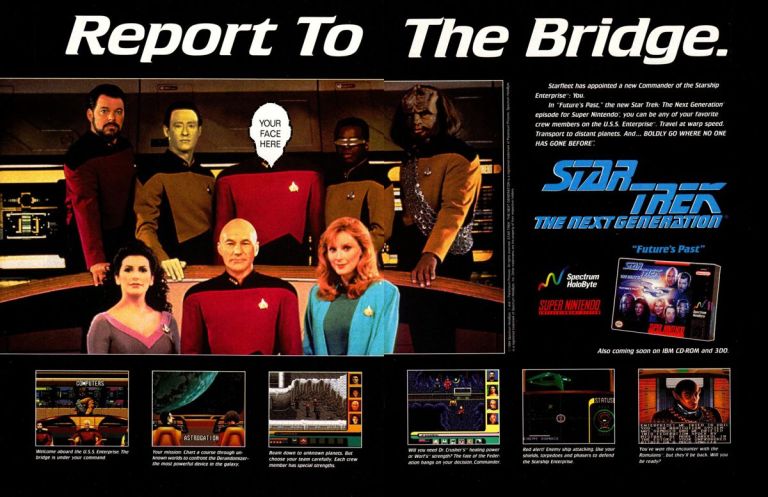
5. Star Trek: The Next Generation – Future’s Past print ad
This 2-page print ad was strong enough to invite readers to literally join the Star Trek: TNG crew and go where no man has gone before. By the way, when was the last time you saw Marina Sirtis or Gates McFadden on a video game ad?
Long before wokeness ruined Star Trek in this modern age, the sci-fi franchise reached a tremendous high in popularity and projects in the 1990s as that decade had Star Trek: The Next Generation (most of its TV seasons and three movies were released within the decade), Star Trek: Deep Space Nine and Star Trek: Voyager that kept fans entertained.
Considering its high popularity, it was not surprising that a video game adaptation of Star Trek: TNG was released in 1994 titled Star Trek: The Next Generation – Future’s Past (the version for Super Nintendo Entertainment System) and I saw the above print ad while reading a gaming magazine. Using a slightly altered version of the TNG group photo, the print ad emphasized its concept that the player will be able to lead the crew of the Starship Enterprise and take part in a series of missions in different parts of space with the likes of Captain Picard, Commander Riker, Data, Worf, Dr. Crusher, Deanna Troi and La Forge. While I was never a Star Trek fan, the above print ad caught my attention with its concept, the group photo and the screenshots gave me an idea of what the game has to offer. It should be noted that Star Trek: The Next Generation – Future’s Past was released between the end of Star Trek: TNG’s final season and the theatrical release of Star Trek: Generations.
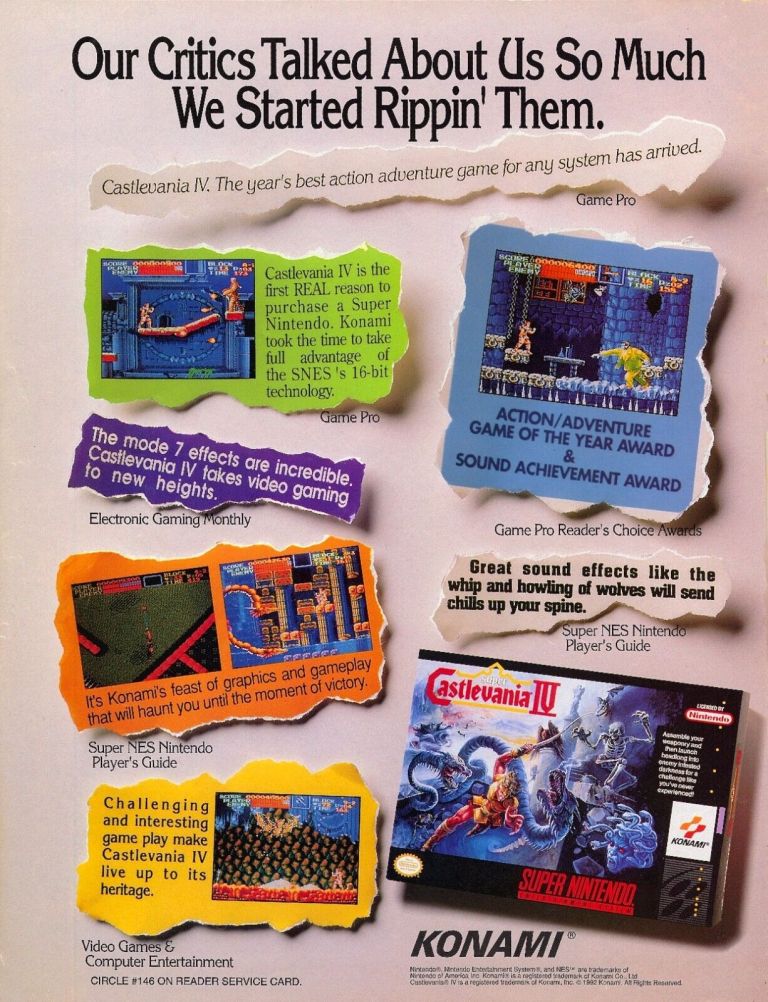
6. Super Castlevania IV print ad
This was one of the most eye-catching print ads I’ve seen about a Konami video game.
The jump in technology from one console generation to the next can be beneficial for gamers if game developers harnessed the advantages of new technologies to make new games that turned out to be more engaging and more enjoyable. Such was the case with Super Castlevania IV for the Super Nintendo Entertainment System (SNES) in 1991. The above print showed Konami highlighting the positive feedback their game received from different gaming media outlets and used screenshots to give gamers and long-time Castlevania fans exciting stuff to see. I got to play the game on the mini SNES console and I can say that in terms of visuals, controls and gameplay, Super Castlevania IV truly lived up to its title and it remains fun to play to this day.
Disclaimer: This is my original work with details sourced from reading the comic book and doing personal research. Anyone who wants to use this article, in part or in whole, needs to secure first my permission and agree to cite me as the source and author. Let it be known that any unauthorized use of this article will constrain the author to pursue the remedies under R.A. No. 8293, the Revised Penal Code, and/or all applicable legal actions under the laws of the Philippines.
Welcome back superhero enthusiasts, Tomb Raider fans and comic book collectors! Today we go back to year 2000 to revisit the 2nd issue of the Tomb Raider comic book series which was published through Image Comics.
In my previous retro review, the creative team smoothly and firmly established the iconic Lara Croft as an experienced treasure hunter and explorer who also knows how to negotiate with clients when it comes to high-risk tasks. In short, her debut in comics turned out very inspired by the video games and that made the Tomb Raider herself a fitting protagonist in the realm of comic books.
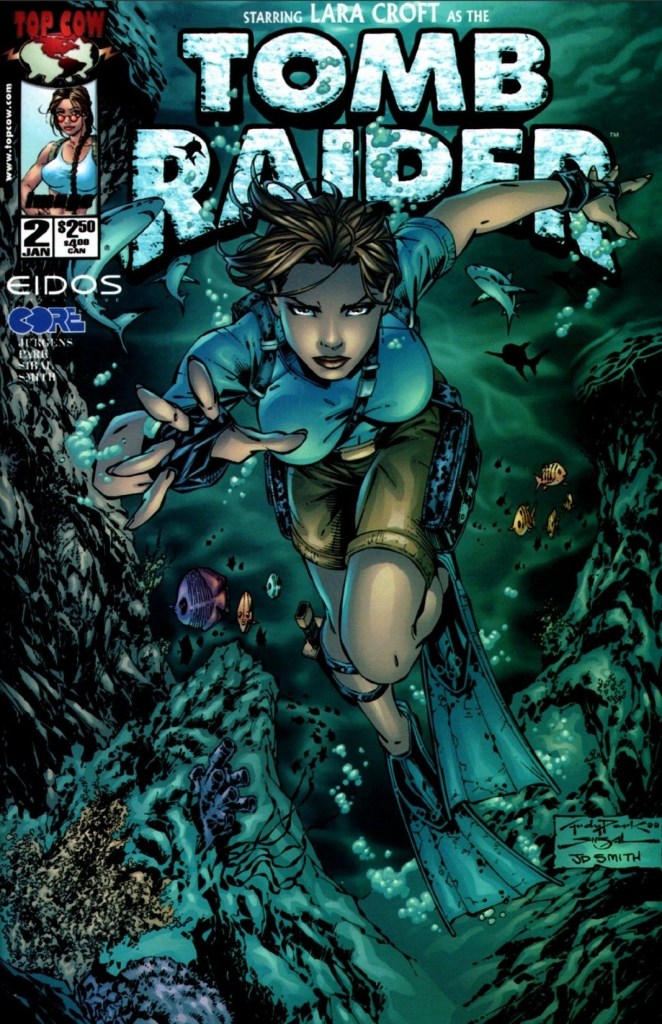
With those details laid down, here is a look back at Tomb Raider #2, published in 2000 by Image Comics (production work by Top Cow) with a story written by Dan Jurgens and drawn by Andy Park.
The cover.
Early story
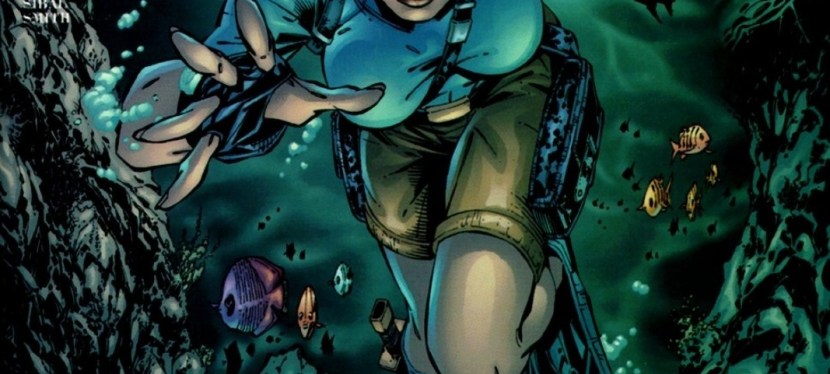
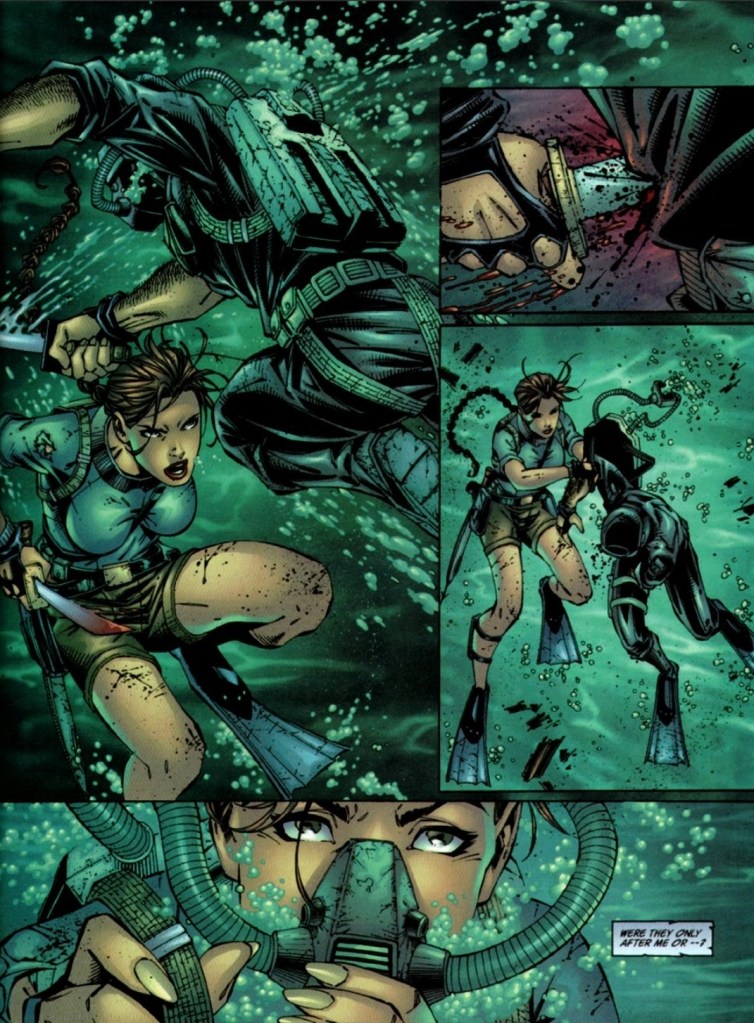
The story begins with Lara Croft in trouble deep underwater as her oxygen line had been cut off while her yacht got badly damaged by a time bomb placed on it by unidentified operators. The wounded Lara is approached by two scuba divers responsible for the attack. As they search her for valuable items, Lara fights back against them strategically. After the two got attacked by the sharks separately, she avoids the sharks near her only to witness her yacht sink from above and on to the surface below.
Lara then begins to worry about her butler Compton…
Quality
The interactions between Lara Croft and Compton remind me a lot about Bruce Wayne (Batman) and Alfred working together.
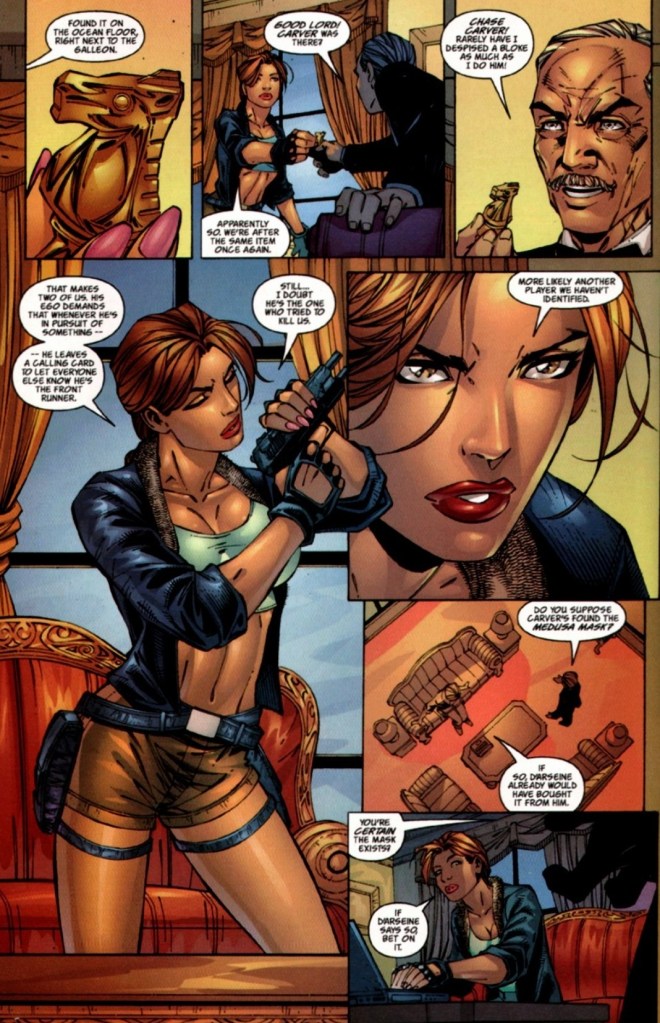
This tale shows Lara aided by Compton (who turned out to be more than just dedicated butler) on a search not only for artifacts but also for answers and people. This is the result of the disruption caused by a gang led by Chase Carver as Lara conducted the dangerous underwater search in relation to her agreement with a dangerous client. If there is any symbolism here, it would be the unfortunate events confirming that the so-called industry on the search for artifacts is truly dangerous not only because of difficult locations to visit but also because there are powerful stakeholders who resort to violence to get ahead of other searchers. In short, the very rich Lara is destined to encounter danger as she personally engages in the searching.
Using flashbacks, Dan Jurgens inserted scenes showing readers what Lara was like when she was a young girl, who her parents are, and how involved Compton became as the family’s defender and butler. As a result, Compton here ended up looking and acting very much like Batman’s Alfred Pennyworth (butler and operator). This is not exactly problematic as having Compton allows the creators to have Lara someone to talk with and place her trust on. That being said, I can say that Lara-Compton is pretty much like Batman-Alfred.
More on the story, there is a focus on the violent competition within the world of the search for artifacts. The attack by Carver’s gang drastically altered the direction of Lara’s search which leads her and Compton to Nepal.
When it comes to spectacle, I noticed that the Jurgens-Park duo ramped up the action a lot and the violence was intensified making this tale look like an R-rated action movie. This opened a lot of opportunities for Park to draw more dynamic action shots complete with explosions. In my view, the ramped-up spectacle did not overwhelm the narrative and turned out a very generous pay-off to the build-up.
Conclusion
There is plenty of action to enjoy in this comic book.
Tomb Raider #1 (2000) is a fun read that moved the story forward while saving enough space for character exposition (the flashbacks) and spectacle. As Lara’s search for answers goes on, the suspense got built-up nicely and there were details that caught my curiosity. As of now, I am looking forward to finding out more and what would happen next.
Disclaimer: This is my original work with details sourced from reading the comic book and doing personal research. Anyone who wants to use this article, in part or in whole, needs to secure first my permission and agree to cite me as the source and author. Let it be known that any unauthorized use of this article will constrain the author to pursue the remedies under R.A. No. 8293, the Revised Penal Code, and/or all applicable legal actions under the laws of the Philippines.
Welcome back superhero enthusiasts, 1990s arts and culture enthusiasts, and comic book collectors! Today we go back to the mid-1990s to explore a part of Defiant Comics through the Charlemagne series.
For the newcomers reading this, Defiant Comics was a comic book publisher founded by former Marvel Comics and Valiant editor-in-chief Jim Shooter. Defiant was established as a result of Shooter’s departure from Valiant and there were even some creators from the previous company who joined him as staffers in the new company. Defiant’s initial titles were Warriors of Plasm, The Good Guys and Dark Dominion. Charlemagne was part of the second wave of titles launched.
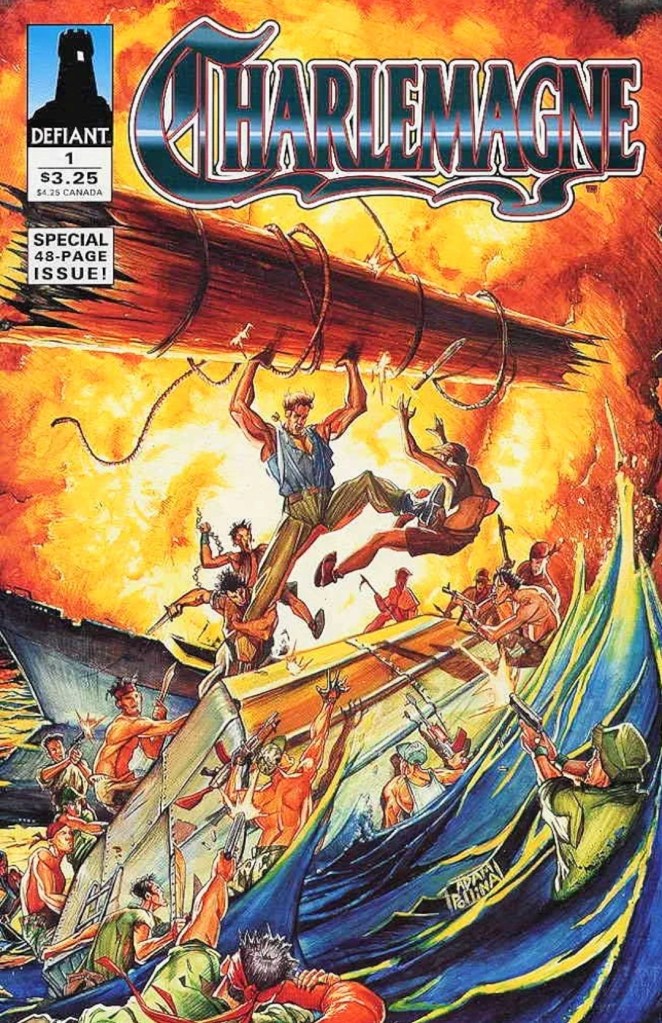
With those details laid down, here is a look back at Charlemagne #1, published in 1994 by Defiant Comics with a story plotted by Jim Shooter, Philip Nutman, Adam Pollina, Deborah Purcell and D.G. Chester, written by Chester and drawn by Pollina.
The cover.
Early story
The story begins in 1973 in the state of Kentucky. 12-year-old boy Charles has been feeling uneasy since it was reported that his older brother Pete serving in Vietnam has been missing-in-action. The father tries to comfort Charles who responds by asking him if he read Pete’s letters. By reading the letters, Charles paid attention to the details that described Vietnam and he even felt like was he was there. The young boy feels like he could find his missing brother.
A short time later as he and his father play baseball pitching outside, an important telephone call was received by the mother. It was Major Forney from the Pentagon searching for the father to give him updates about his missing son in Vietnam. It turns out the reports from Hanoi did not list Pete among the prisoners held there and chances on finding him are very slim. The father refused to accept his son’s status.
After hearing his father’s phone talk with the major, Charles refuses to believe his brother’s dead and immediately goes up to his room and starts preparing for a daring, solo travel to Vietnam…
Quality
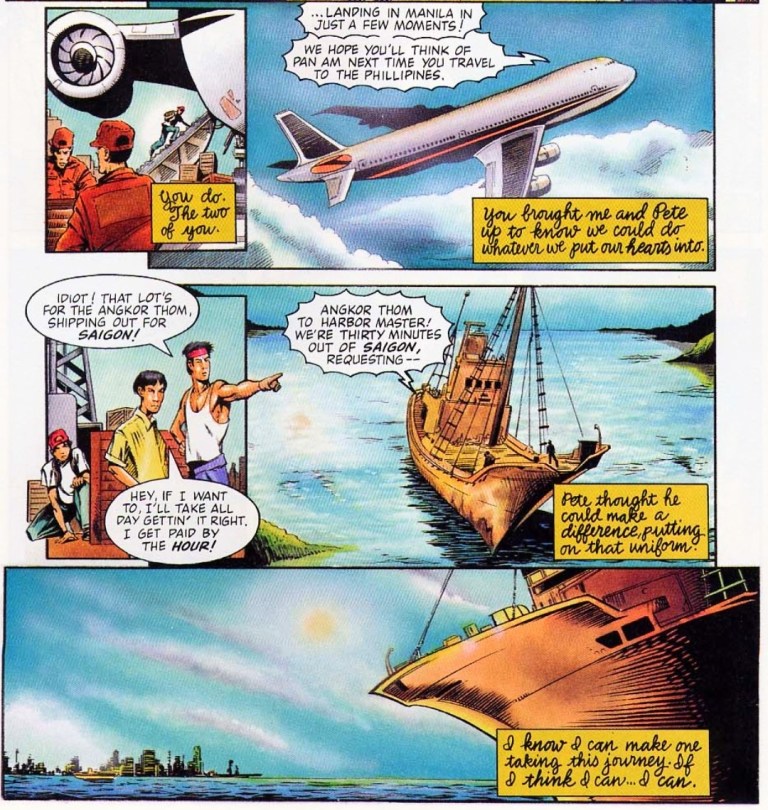
Incredibly, Charles travels from America to the Philippines by air, then to Vietnam by ship. How he got past security is beyond me.
If there is anything that would best describe the story of this comic book, it is a pretty enduring tale that moved with a slow-to-medium pace. That’s not to say it is not worth following. In fact, the narrative the writers came up with is quite gripping and as it flows on, you will really get to know the protagonist Charles and witness how his personality develops as he pushes through with his very daring pursuit of his missing brother in the middle of Vietnam.
Indeed, there is a superhero element in this story and the way it was emphasized by the creative team is actually unusual and experimental. The most defining element of Charles’ character is his uncompromising determination to find his older brother no matter what the odds. Without spoiling the plot, I can say that the superhero elements of Charles develop late in the story and the way they were presented is truly intriguing.
Of course, there are some questionable things about the story. Charles’ solo journey (note: he ran away from his parents at home leaving a letter) from America going into Vietnam as a young boy undetected is already unbelievable. His unrelenting search in Vietnam that lasted not days but actually a few years is even more unbelievable. These raises questions as to how much money did the young boy have to support himself with, and where did he stay to rest during the few years he spent in the Southeast Asian nation ravaged by war. If anything, this tale comes with a strong element of fantasy made to look like it happened during the Vietnam War.
Apart from Charles, there are a few supporting characters who happen to be interesting to focus on. Through the one Vietnamese support character – the doctor – you will get to see certain aspects of local society as well as the American and Communist Vietnam sides.
Conclusion
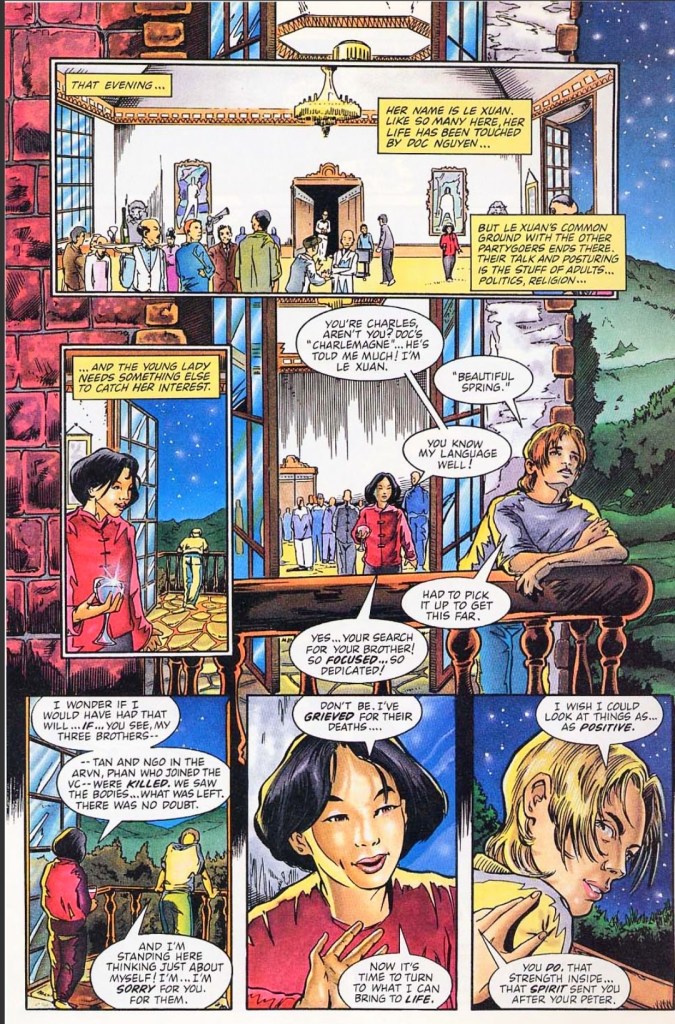
Charles experiences a taste of luxury in Vietnam.
Charlemagne #1 (1994) is ultimately an engaging and pretty intriguing read. This comic book’s superhero elements and spectacle are pretty light but the build-up of Charles (and his development into Charlemagne) is quite powerful to read. This tale turns out to be an origin story of Charlemagne and you will realize that when you read it from start to finish. Considering how this comic book turned out, I’m convinced to find out more in the next issue.
In recent times, Team Xbox and their studios officially confirmed that the Xbox-original (read: previously Xbox-exclusive) games Pentiment, Hi-Fi RUSH, Grounded and Sea of Thieves are heading to consoles of Sony and Nintendo. This is the result of what was discussed during the podcast (note: “the four games”) that had top Xbox officials updating people about their business plan and current direction. In case you missed that, watch the podcast right below…
To make things clear for the newcomers reading this, Team Xbox itself has already been publishing games on non-Xbox platforms for several years now. I’m talking about established titles like Minecraft and, in very recent times, the many games of Bethesda. By adding the newly acquired Activision-Blizzard into the Xbox family of companies, you can see Team Xbox’s publishing side has grown even bigger and the business impact should be felt over the next few years.
That being said, I should state that Phil Spencer and his Xbox team leaders should NOT neglect Xbox fans even as the business is moving towards multi-platform publishing and the “console-less” future in the 2030s.
In relation to what Spencer said during the podcast, the single-player games his team heavily invested in such as Starfield, Forza Motorsport (2023), Forza Horizon 5, Senua’s Saga: Hellblade II, Avowed, Indiana Jones and the Great Circle are still exclusive on Xbox consoles plus Windows PC and Xbox Game Pass (the popular subscription service itself will not be made available on non-Xbox platforms anytime soon).
There are also more Xbox-exclusive titles that have yet to be released such as Towerborne, South of Midnight, Clockwork Revolution, The Outer Worlds 2, the Fable reboot plus the very delayed ones such as Perfect Dark and Everwild.
While it is true that those are a lot of Xbox-exclusive games that fans and other gamers (who are seeking fun and unique games to play that are NOT available on PlayStation and Nintendo consoles) can look forward to over the next few years, I still say that Team Xbox should invest more to make even more exclusive games and become more aggressive.
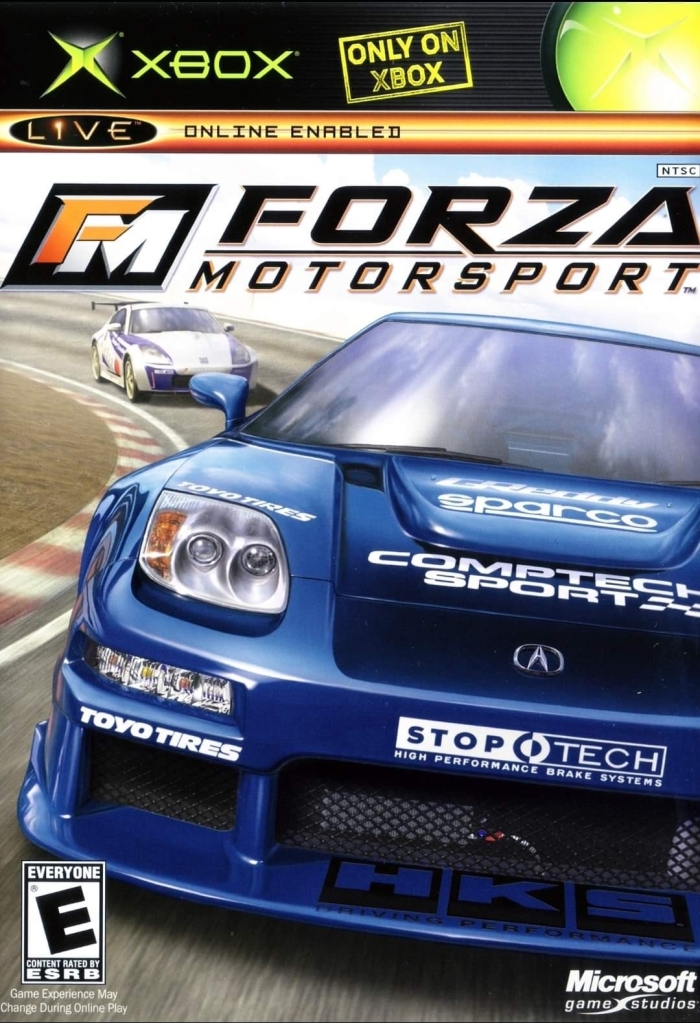
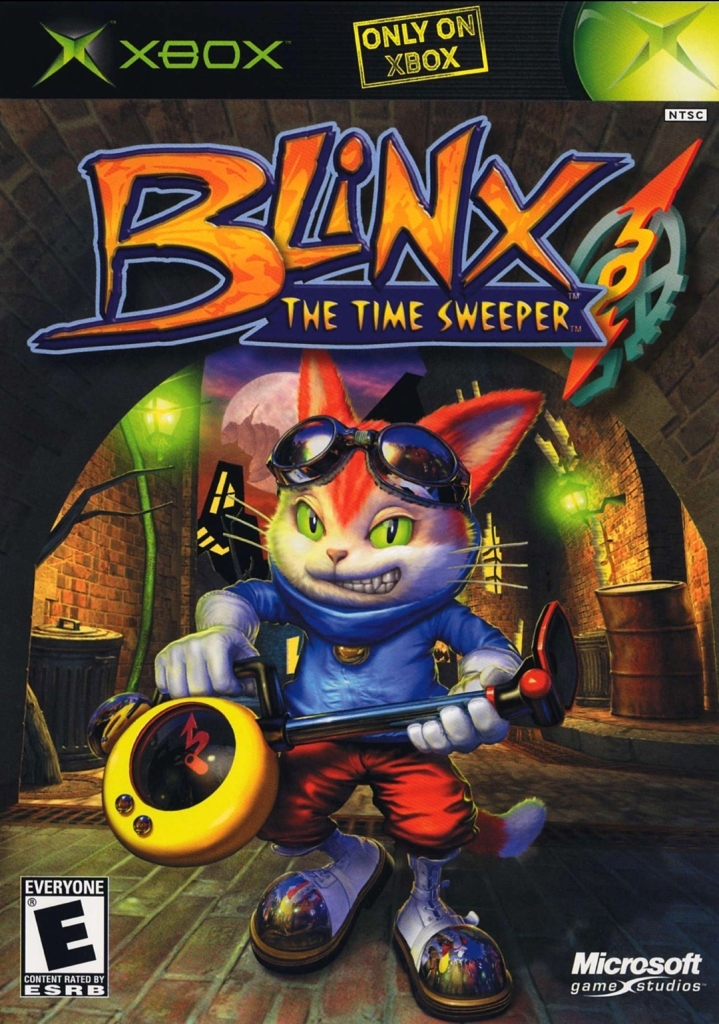
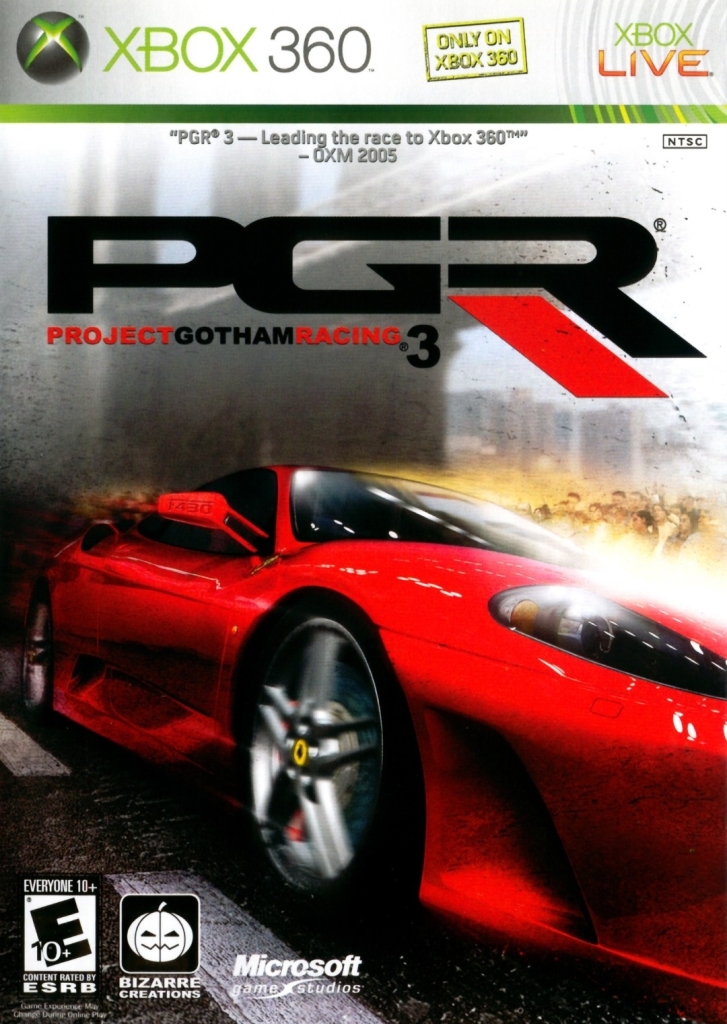
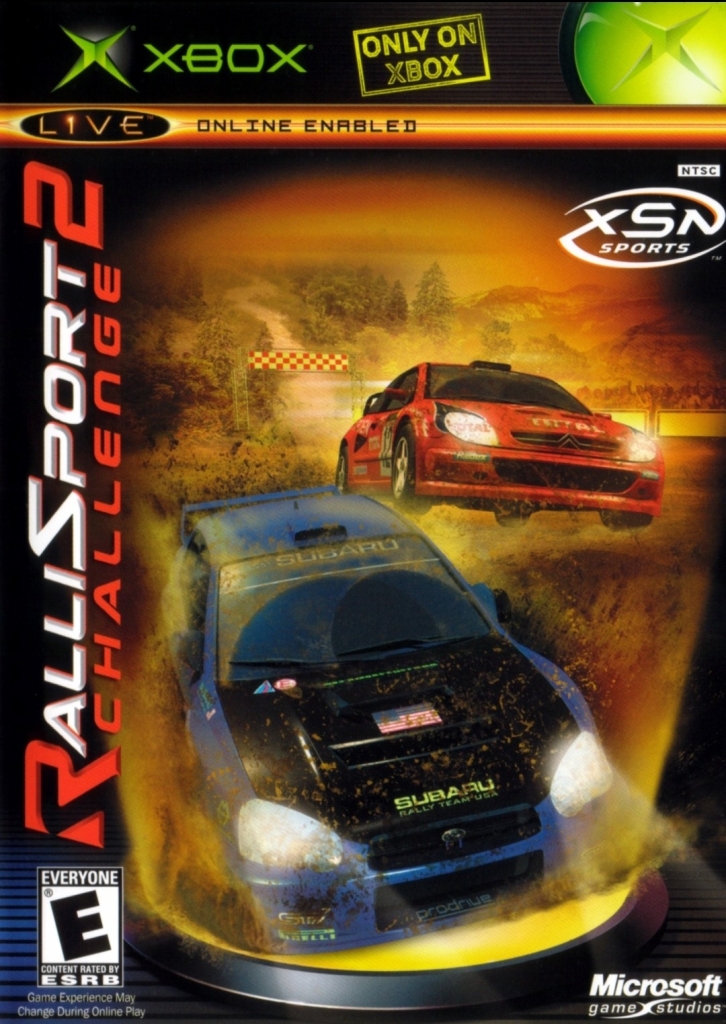
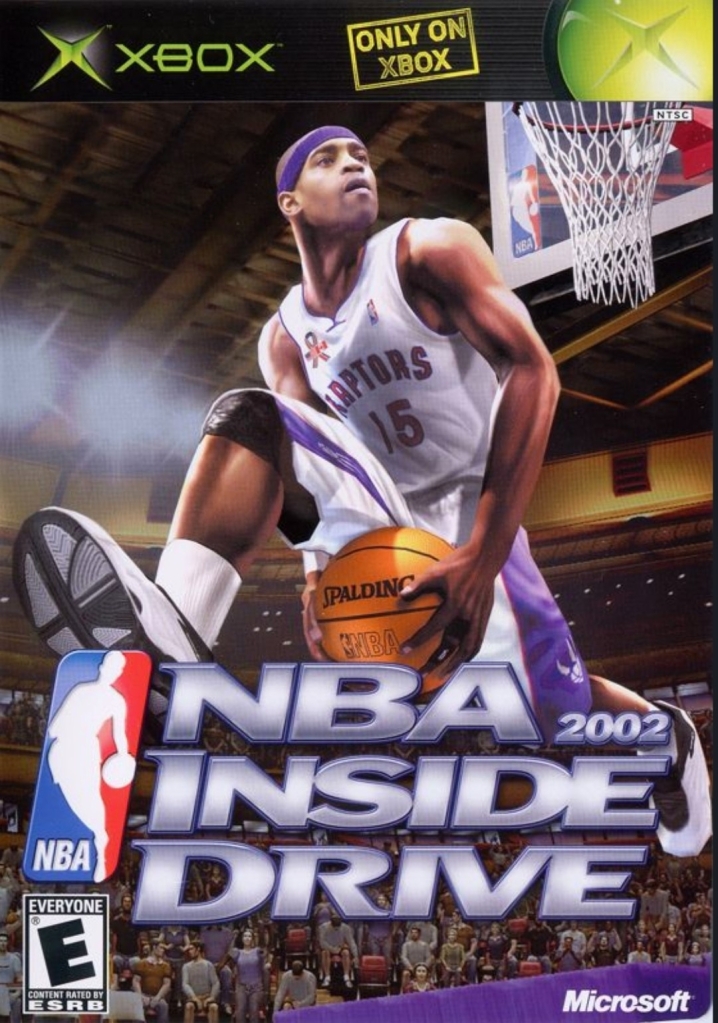
In the previous Xbox console generations, there were these exclusive games that had “Only on Xbox” placed on the front covers of their respective boxes. Check out the games below…
The start of something great!
Way back in 2002, this was the exclusive adventure and platform game to enjoy on the original Xbox console! It was flawed but still had fun.
If you are a long-time Xbox fan, were you able to buy this for your Xbox 360 console?
This exclusive game on Xbox 360 is a classic shooter to enjoy!
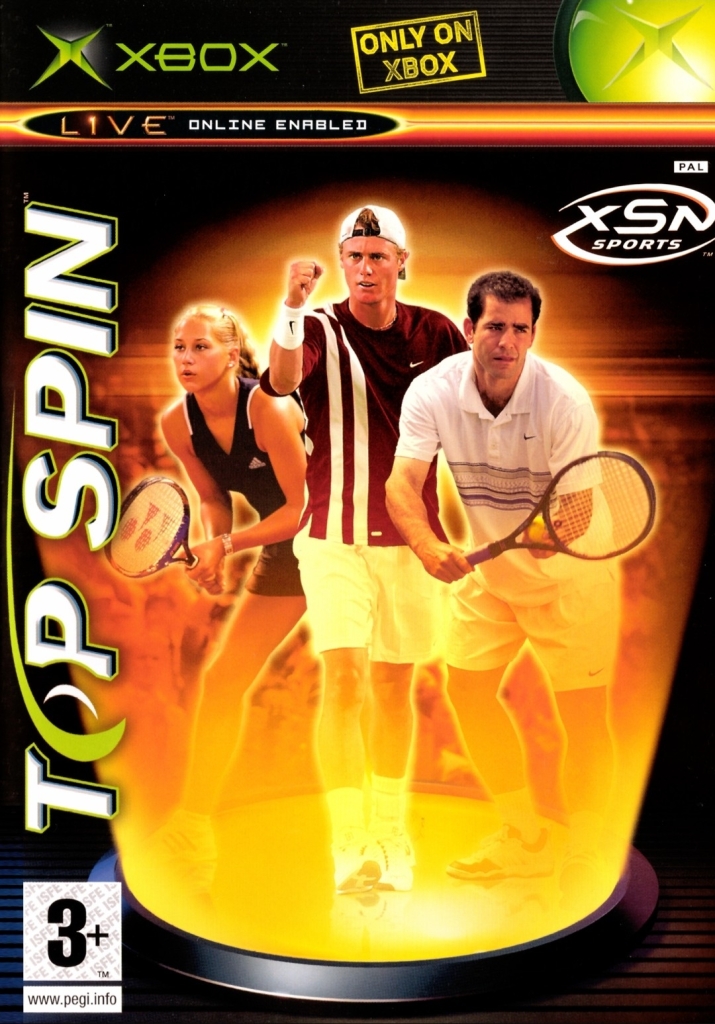
And, yes, there was a time when Team Xbox invested a lot to make exclusive sports video games under their Xbox Sports Network (XSN) franchise. Even the Top Spin game series actually started on the original Xbox console under the XSN label.
During the weeks leading to the launch of the original Xbox console in late 2001, I played NFL Fever 2002 on an Xbox kiosk. This was Microsoft’s exclusive NFL video game.
An exclusive racing game on the original Xbox that is rarely talked about. This game received many positive reviews at the time of its release.
The exclusive NBA basketball of Team Xbox from 2002.
It is absolutely true that Top Spin started as an Xbox-exclusive tennis video game made to entertain gamers on the console while also serving as a suitable competitor against Sega’s Virtua Tennis and Nintendo’s Mario Tennis.
Indeed, “Only on Xbox” in the old days had a very strong meaning – something fun and unique (if not special) was prepared for gamers and the only platform to play was on the Xbox console!
Going to the present leadership of Team Xbox, they seriously need to refocus on the exclusive games and confirm their dedication to all Xbox fans as well as the gamers seeking something fun and special to play on Xbox consoles or on Windows PC. A lot of people spent so much money to buy an Xbox Series X, Xbox Series S or a new PC for their entertainment needs and having more exclusive games will add even more value into the ecosystem of Microsoft.
I really wish to see Phil Spencer and his team move aggressively to produce even more Xbox-exclusive games not just for this current console generation but also for the next generation and even further. Perhaps Team Xbox should explore making exclusive sports video games (note: challenging 2K and Visual Concepts’ dominance on NBA video games could do good for the gamers and the industry) or make games on genres they have been ignoring.
Whether Team Xbox utilizes its own game studios or make deals with independent studios through their Xbox Game Studios Publishing, making more exclusive games is crucial and when it is well executed, Xbox fans and other gamers will benefit. Seriously, the shift to releasing Xbox-original games to PlayStation and Nintendo consoles should not be the main goal because it clearly does NOT justify betraying Xbox fans around the world.
Welcome back readers, fellow geeks and retro gaming fans!
In this edition of the Retro Gaming Ads Blast (RGAB) series, we will examine print ads from the 1990s that caught my attention and I will explain why they are worth look back at. In retrospect, the 1990s was a decade of serious changes in the world of electronic gaming as the industry saw the shift of graphics from 2D sprites and flat backgrounds to 3D polygons, the shift from cartridges to CDs for software distribution, and more.
For the newcomers reading this, Retro Gaming Ads Blast (RGAB) looks back at the many print ads of games (console, arcade, computer and handheld) that were published in comic books, magazines, flyers and newspapers long before smartphones, social media, the worldwide web and streaming became popular. To put things in perspective, people back in the 1980s and 1990s were more trusting of print media for game details and images.
With those details laid down, here is the newest batch of retro gaming print ads for you to see and enjoy…
1. Castlevania: Bloodlines print ad
Creepy looking but not horrific. The simplistic approach turned out to be effective on making Sega Genesis gamers excited for this Castlevania release.
During the early stage of the so-called 16-bit console wars, Konami’s Castelvania series made the huge next-generation leap with Super Castlevania IV on the Super Nintendo Entertainment System (SNES) which gave gamers loads of fun challenges along with technological improvements that added to the gameplay. Being a prolific multiplatform game maker, Konami knew it could not abandon its fans who own the 16-bit console of Sega and this led them to making a unique Castlevania experience with the Sega Genesis in mind – Castlevania: Bloodlines.
The above print ad of Castlevania: Bloodlines was very eye-catching as it showed a photographic presentation of the grave of the Belmont family (note: Simon Belmont is arguably the most known hero of the series) backed with a detailed text description as well as screenshots that showed exactly what Castlevania fans expected with gameplay and presentation. While the visual style of the ad had a subtle approach to horror, it succeeded in informing the public that another fun-filled Castlevania experience was coming. The game went on to be a hit among gamers and critics.
2. The Granstream Saga print ad
THQ really tried hard to sell The Granstream Saga in North America at a time when a lot more Japanese RPGs started coming into the market.
Back in the late 1990s, there was a slew of Japanese role-playing games (JRPGs) that got released on the PlayStation console in North America arguably because of the massive sales success of Final Fantasy VII in 1997. In 1998, THQ (note: then a newcomer in video gaming) made the daring move to release The Granstream Saga in North America and it was part of the company’s plan of releasing more RPGs. With regards to the 1998 print ad, THQ marketing team wisely emphasized the fact that the game launched at #1 in Japan (published by Sony) although, strangely, the rest of the short descriptive text did not emphasize the fact that the game was one of the first fully polygonal RPGs ever released. The ad had one image of an animated cut scene while there were two gameplay images. When I first saw the print ad, I became interested with The Granstream Saga as I was fond of both RPGs and anime. I never got to play it due to a lack of time and money back then.
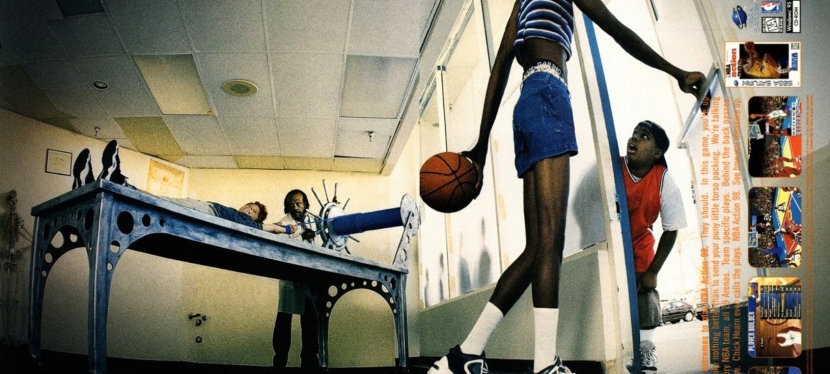
3. NBA Action 98 print ad
Do you find this print ad funny or disturbing or both?
The first time I saw Sega’s print ad of NBA Action 98 (a polygonal NBA basketball video game for the Sega Saturn), it caught my attention quickly mainly because of the concept of the imagery showing a really tall guy leaving the place after getting stretched to be tall (as emphasized by an adult operating a machine to stretch another kid’s body to get taller) as a kid from outside looks on. While it looked hilarious at first, the photographic imagery also had an unintentional dark tone as the adult operating the machine looked like he was torturing the kid. This print ad was really eye-catching in a rather disturbing fashion to me, so much so I did not have any interest left to check out the advertised game. The small size of the screenshots and the hard-to-read descriptive text did not help at all. In my view, this was a marketing misfire by Sega.
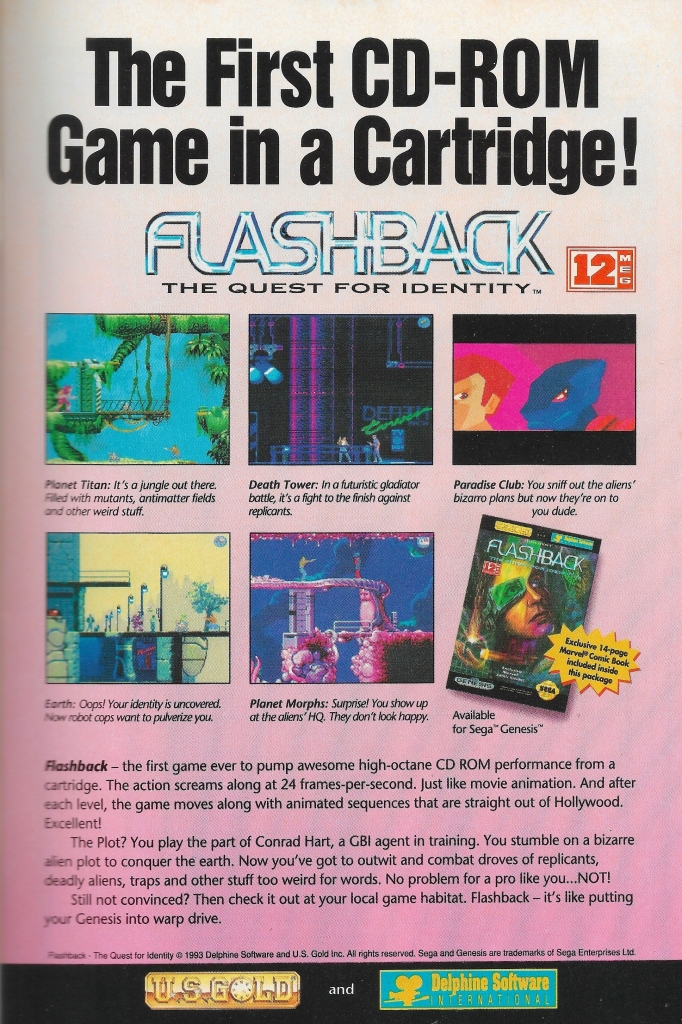
4. Flashback: The Quest for Identity print ad
This was indeed an eye-catching print ad.
Back in the 1990s, the CD-ROM was cutting edge technology in the world of computing and CDs (compact discs) helped game companies have their game content as well as multimedia files (example: full motion videos or animated scenes) released together conveniently. In the middle of the decade, a version of the game Flashback: The Quest for Identity (note: a game with computer-generated animation scenes previously released on PC) was released in cartridge format for the Sega Genesis as well as the Super Nintendo Entertainment System (SNES). This was a big deal back in the days of the so-called 16-bit console war and the above print ad clearly emphasized it with the description “The First CD-ROM Game in a Cartridge!” The advertisers also assured consumers that the in-game 24 frames-per-second frame rate, the Hollywood-inspired high-quality visuals and related gameplay elements were intact for consoles. When I saw this particular ad, I became convinced to buy the game for my SNES (read my retro review by clicking here). To see how Flashback looks like on Sega Genesis, watch this.
5. Albert Odyssey: Legend of Eldean print ad
To make things clear, Albert Odyssey: Legend of Eldean is not based on any anime property. It was the 3rd game of its series and the first and only one to be released in English.
There is no denying the fact that Working Designs (closed since 2005) contributed a lot to console gaming by localizing and releasing several Japanese role-playing games (JRPGs) in America at a time when such games were not yet popular. Apart from the Lunar RPGs and Dragon Force, the company brought Albert Odyssey: Legend of Eldean to the Sega Saturn console in America and they had a very eye-catching print ad promoting it. Like their ads for Lunar RPGs, the Albert Odyssey: Legend of Eldean print ad had a dominating anime-style artwork that highlighted the fantasy concept and characters, plus screenshots and in-game animated (note: not anime but detailed pixel artworks) sequences that were meant to attract RPG enthusiasts and gamers looking for the next-generation console gaming experiences. It should be noted that Albert Odyssey: Legend of Eldean was actually the 3rd game of its franchise that started in Japan, and it was the first and only Albert Odyssey game to ever be released in English. To this day, Albert Odyssey: Legend of Eldean still has not been re-released nor remastered for other consoles and original Sega Saturn copies of the game are very expensive to acquire. That being said, this particular print ad is a lively reminder of Albert Odyssey’s only Western release.
6. Resident Evil 3: Nemesis print ad
Capcom efficiently showed the new monster Nemesis, screenshots of the game and the return of Jill Valentine in this 1999 print ad.
After the release of the best-selling and acclaimed Resident Evil 2, Capcom approved the production of several Resident Evil projects that include sequels and spin-offs. Along the way, Sony announced in 1999 that the PlayStation 2 console will come out in 2000 and this had an impact on Capcom’s RE projects as many of them were being developed for the aging PlayStation (PS1) console. Before the PS2 announcement, Capcom had a PS1 RE game project with its story set on a cruise ship. That project was abandoned following the PS2 announcement and because Capcom did not want to leave its fans to wait too long for another Resident Evil adventure on PS1, they reviewed their list of proposed spin-off games and went ahead making Resident Evil 3: Nemesis (Japanese title: Biohazard 3: Last Escape) for a late 1999 release while the PS1 console was still in good demand.
In the above 1999 print ad, Resident Evil 3: Nemesis was shown with 3 screenshots assuring RE fans that the game has the tried-and-tested design of polygonal characters/monsters moving within pre-rendered environments, the action, the horror and adventure elements of the previous games. More notably, the new monster Nemesis had the biggest image and he rightfully became the main antagonist until the very end.
Lastly, the RE3 print ad featured the return of Jill Valentine (one of the protagonists of the first Resident Evil) and this time she had a clear sexualized look wearing a tube top and a mini-skirt. As I mentioned in my RE3 retro game review, I believe that the sexualized look of Jill was done by the game developers who were most likely influenced by the sexy appeal and iconography of the character Lara Croft from the Tomb Raider series of games. Like Lara Croft, Jill is sexy and capable of fighting with guns and other weapons. Whatever the intention of Capcom and the development behind the game, the print ad (which even had wrongful details about the timing of the story) clearly worked on getting RE fans and gamers’ attention as Resident Evil 3: Nemesis sold more than 3 million copies on PS1.
To put things in perspective, posted below is an excerpt from the Nikkei Asia article. Some parts in boldface…
James Relativo thought he had landed a great deal on an electric drum set, but instead the Manila resident was cheated out of his money in a country gaining the dubious distinction as Asia’s worst for online sales scams.
Shoppers across the Philippines have been bilked out of millions of dollars so far this year, with some turning to victim chat groups on Facebook and other social media. A recent report found more than one-third of Filipinos surveyed had been scammed or encountered retail fraud online.
“Some people easily believe in false promises even if they are too good to be true,” warned Alexander Ramos, executive director of the Cybercrime Investigation and Coordinating Center (CICC).
In retrospect, Relativo might have been more skeptical about a drum set going for 8,000 pesos ($140), less than half the usual price, on e-commerce site Shopee.
But he hit ‘buy’ without hesitating, and soon things turned suspicious. The seller shifted its communications to a messaging app and demanded half the cost of the drums for “refundable taxes.”
More money demands followed until a frustrated Relativo agreed to bypass Shopee’s payment system and settle his remaining balance on GCash, a digital payments platform. He never got his drums.
“I just kept telling him I wanted my money back,” Relativo told Nikkei Asia, his voice laced with exasperation. “It wasn’t like I was dealing with a scammer — he was talking to me, sending me pictures of the drum set being packed.“
The journalist’s saga highlights a bitter experience for a growing number of people in the Philippines, which clocked the highest scam rate for online shoppers across nearly a dozen economies in the 2023 Asia Scam Report, published in November.
Commissioned by the Global Anti-Scam Alliance (GASA) and Taiwan-based tech security company Gogolook, the report surveyed 20,000 respondents about their online shopping experiences in Vietnam, China, Thailand, Hong Kong, Taiwan, Indonesia, South Korea, Japan, Malaysia, Singapore and the Philippines.
The shopping scam rate in the Philippines led the group at an eye-watering 35.9%, followed by mainland China at 27.2%. South Korea had the lowest incidence, at 4.2%.
The explosion in online shopping has created a lucrative market for scammers. And a lack of cybercrime awareness is aggravating the problem in the Philippines, where people spend an average of 10 hours a day online by some estimates.
“Although (Filipinos) are considered very connected and digitally wired, (they) do not have adequate digital literacy skills,” said Mark Manantan, director of cybersecurity and critical technologies at the Pacific Forum in Hawaii.
The survey found that Filipinos were easy prey for scammers because they “respond too quickly” to sellers’ demands.
Let me end this piece by asking you readers: What is your reaction about this recent development? Do you think Nikkei Asia’s article is detailed enough and trustworthy when it comes to gaining a strong awareness about online scams? How members of your household or your local community got scammed online over the past six months? Why do you think a lot of people in the Philippines are so determined to spend a lot of money to watch a Taylor Swift event overseas?
Disclaimer: This is my original work with details sourced from playing the video game and doing personal research. Anyone who wants to use this article, in part or in whole, needs to secure first my permission and agree to cite me as the source and author. Let it be known that any unauthorized use of this article will constrain the author to pursue the remedies under R.A. No. 8293, the Revised Penal Code, and/or all applicable legal actions under the laws of the Philippines.
Welcome back retro gaming fans, collectors and readers!
Today, we will go back to the early 1980s to examine one particular video game I played many times on the Atari 2600 and it has a science fiction concept inspired by a certain dream that the late game designer Alan McNeil had.
With those details laid down, here is a look back at Berzerk, developed and published by Atari, Inc. on the Atari 2600 in 1982.
Cover of the Atari 2600 game package.
Game concept
Based on the official description of the game, players play a lone, armed human character who is a prisoner on an alien planet that is made up of mazes that have electrified walls. Several armed robots are actively hunting the human has no choice but shoot them and somehow surpass them to survive. There is, however, a more powerful villain called Evil Otto lurking nearby…
Gameplay and quality
When firing so close to a robot, be aware that it will fire at you without hesitation. To avoid getting hit, be aware of your character’s position, distance and the ability to move.
As typical with console games during the early 1980s, Berzerk’s design is pretty simple. Using the Atari 2600 joystick (which has only one button), you have to move your character around while avoiding touching the robots and electrified walls, and find your way out going to the next level. When it comes to in-game action, using the joystick, you are also able to shoot laser blasts in different directions (including diagonal).
From time to time, the level of challenge and gameplay intensity rises whenever the robots stand or move randomly on certain spots of the floor and when the random locations of the walls make it challenging to move around. In situations like these, I was compelled make quick decisions on when to move, which robots to shoot, and analyze if it is safe to move to another spot without getting electrified by a wall.
Adding further to the challenge is the sudden entrance of Evil Otto (who appears in the game as a digital smiley face) who is indestructible and passes through walls (note: this happens as long as you did not adjust the console to make the game easier). Once Evil Otto comes in (after you spent a certain amount of time in the level), I had to move my character out of the level even if there were still some robots remaining and shooting at me. Evil Otto even destroys robots that got on its way which symbolically shows how powerful he is.
In a situation like this, you will have to think fast on when to move, when to fire and how much distance do you need to be safe. That being said, you must also avoid touching the walls which are all electrified.
As mentioned earlier, there is an option available on the Atari 2600 version of the game that makes encounters with Evil Otto a bit easier. This allows players to blast Evil Otto to remove him for a temporary period of time and he comes back afterwards. In my experience with this game, I preferred the more challenging settings as the gameplay was already engaging with it. I should also state that while there are many robots walking around and ready to blast you, their intelligence is pretty low as you will see a few of them walk straight to the wall and get destroyed. There were also times when a robot simply walks straight into a fellow robot which destroys them both. Also there were times when a robot’s laser blast destroys another robot that got in the way. That being said, the option for easier gameplay on the Atari 2600 was unnecessary for me.
While the game design is simple, there is a ton of depth in terms of new levels you will find yourself in after exiting the previous level. Avoiding robots and Evil Otto to get out might look like the only goal for playing but in reality there is incentive to shoot as many robots as you can as scoring highly will reward you an additional life for ever number of points earned. There is no story ending at all as the game will go on and on for as long as you keep enjoying playing.
In relation to the gameplay, there is no music at all and that creates an immersion with emphasis on the excellent sound effects the game has. The sounds of the laser blast, the explosion of the robot, and the electrifying of your human character’s body still sound great and they have a strong futuristic, sci-fi touch.
Conclusion
The digital smiley face here is Evil Otto. Don’t let the smile fool you because it will go after you to destroy you, and not even the walls nor the robots can block its way.
Berzerk (1982) on Atari 2600 is still a fun game to play after all these decades. Its design is simple and yet there is depth within the gameplay. There is no story to complete but the game will keep on going as long as you enjoy blasting robots for more points to gain additional lives as rewards which should motivate you to keep on playing. Considering how simple the game’s design has always been, the sound effects really made playing it an immersive experience. This game is truly a classic that has to be played if you have the means to do so.


















 Author Carlo Carrasco