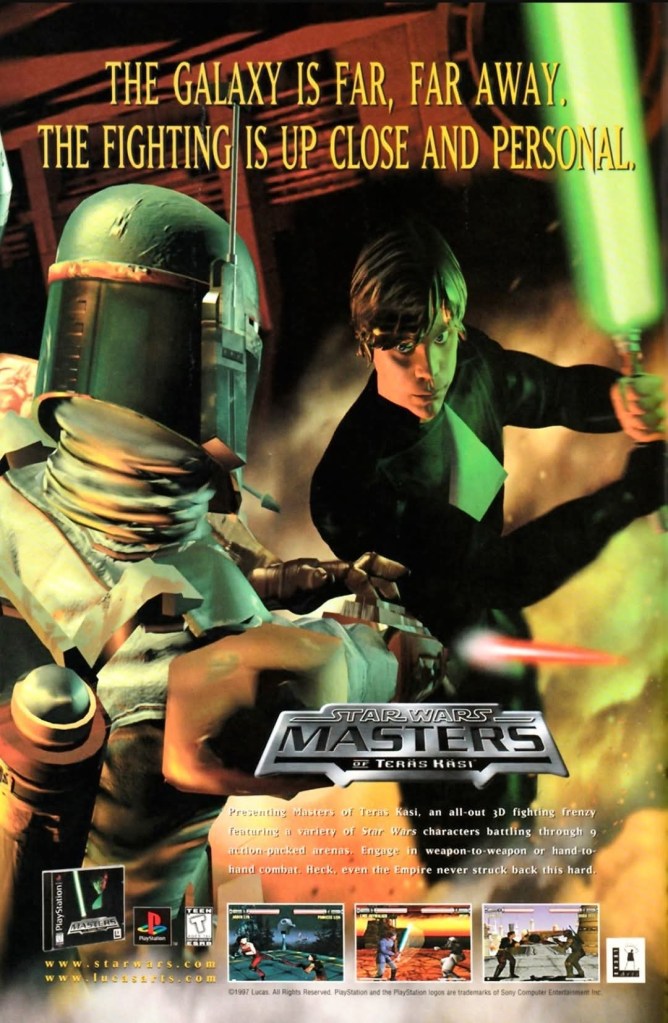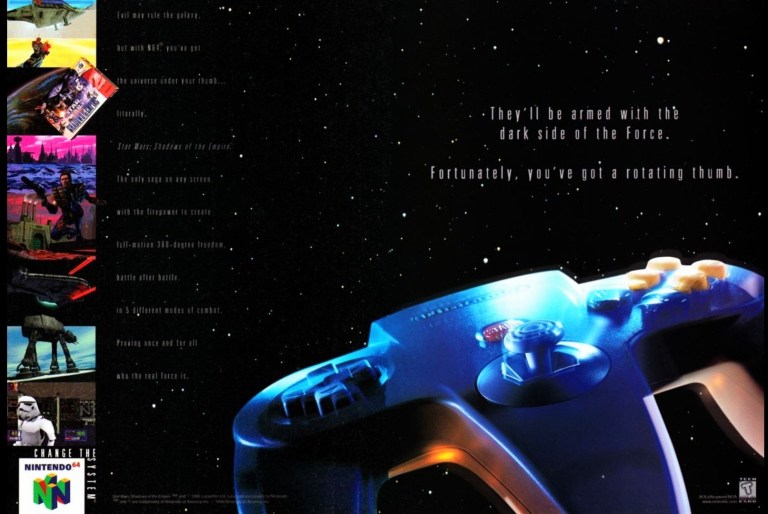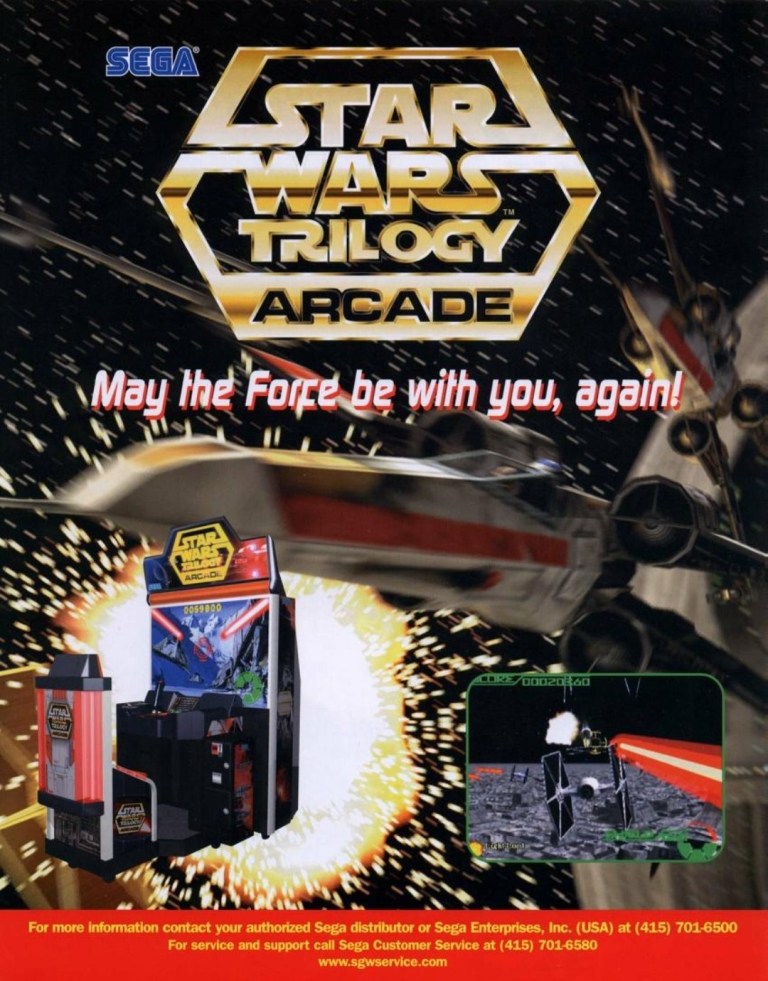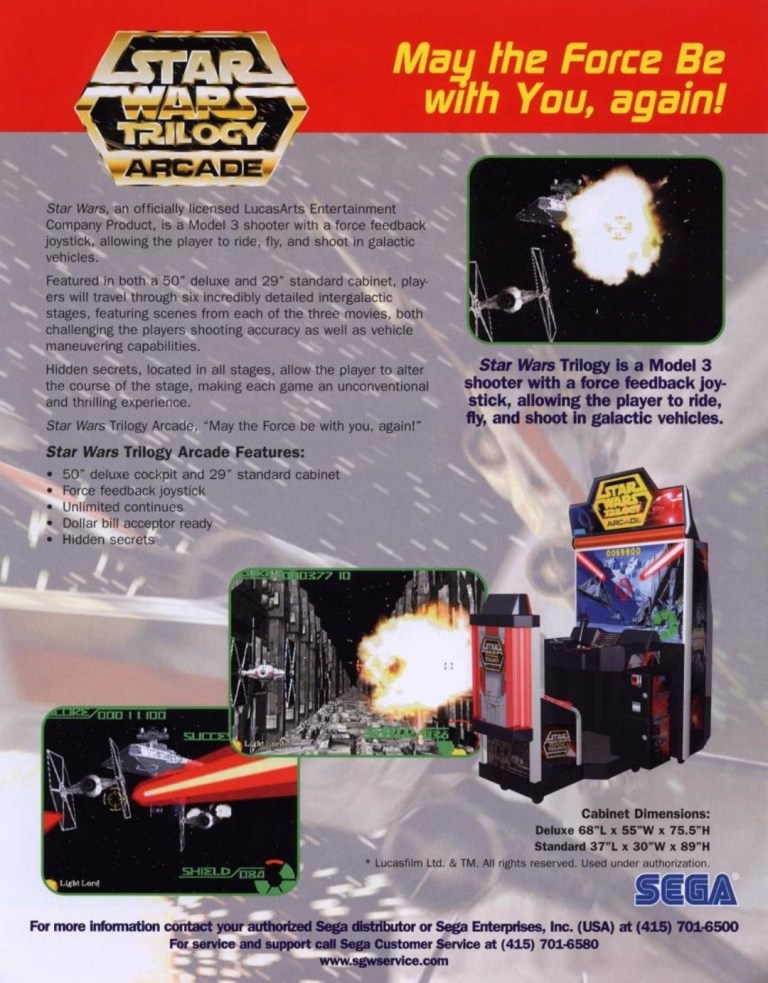
Retro Gaming Ads Blast – Part 28

Welcome back readers, fellow geeks and electronic gaming fans!

In this edition of the Retro Gaming Ads Blast (RGAB) series, we will take a look at another batch of retro gaming print ads – including arcade flyers – from the 1980s and 1990s.

For the newcomers reading this, Retro Gaming Ads Blast (RGAB) looks back at the many print ads of games (console, arcade, computer and handheld) that were published in comic books, magazines, flyers, posters and newspapers long before smartphones, social media, the worldwide web and streaming became popular. To put things in perspective, people back in the 1980s and 1990s were more trusting of print media for information and images about electronic games and related products.

With those details laid down, here is the newest batch of retro gaming print ads for you to see and enjoy…

1. Japanese Macross video games print ads

This 2-page ad had Minmay, Misa and Hikaru.
Computer-generated image of the Skull Leader Battroid was used here.

Looking at the history of Macross video games released only in Japan, there were these notable games that catered to the fans with different tastes during the period of 1997 to 1999. The two Japanese print ads here promoted the PlayStation version of The Super Dimension Fortress Macross: Do You Remember Love? (read my retro review by clicking here) and Macross: VF-X2 (only on PlayStation). 1997 marked the 15th anniversary of the entire Macross franchise and game publisher Bandai Visual kept the excitement for fans on high gear by aggressively promoting the two advertised games for their respective releases in 1999. These two print ads still resonate with long-time fans as each were clearly made to emphasize the games (with details, screenshots and original artworks) while using the right images of the Macross franchise for relevance.

2. Star Raiders print ad

This Star Raiders print ad made me interested enough to play the game on Atari 2600.

I remember the old days of play Star Raiders on the Atari 2600 back in the early 1980s. Strangely enough, I don’t remember seeing this old print ad. Regardless, I really like the way the ad makers used hand-drawn art work to dominate the space while leaving enough space for text description, a screenshot and the picture of the Atari console with the TV set. In my view, this old ad is both amusing and attention-grabbing.

3. The Empire Strikes Back arcade flyer

This is still a great looking arcade flyer.

Here is a Star Wars game I never played but managed to play it on a home computer. Released by Atari in 1985, The Empire Strikes Back (full title: Star Wars: The Empire Strikes Back) arcade game was the follow-up to the very popular Star Wars arcade game. Like its predecessor, it used vector graphics and certain sounds from the 1980 film for immersion. This arcade flyer is well designed showing three selected screenshots, a picture of the arcade cabinet and a portion of the AT-AT walker from the movie. The flyer truly showed gamers and arcade operators what they would get by selecting The Empire Strikes Back.  

4. Steve Meretzky’s Spellcasting 301: Spring Break print ad

Clearly the promoted game is for adult players only.

In the realm of computer gaming, there were certain games that catered to the more mature players. One example is Steve Meretzky’s Spellcasting 301: Spring Break which was released on for personal computers running on DOS (Disk Operating System) in 1992. This print ad clearly shows the adulterated nature of the game emphasizing sexy women with a paradise setting. This is the kind of print ad that you only in computer gaming magazines which had predominantly adult readers.

5. Pitfall! print ad

Still a great looking print ad.

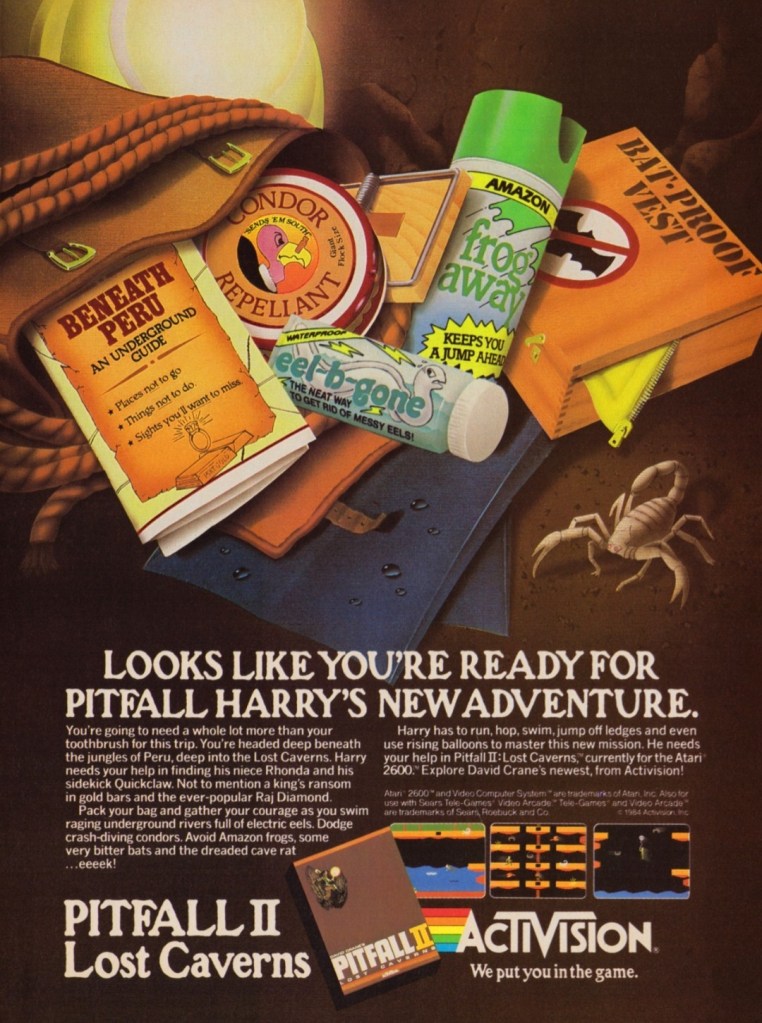
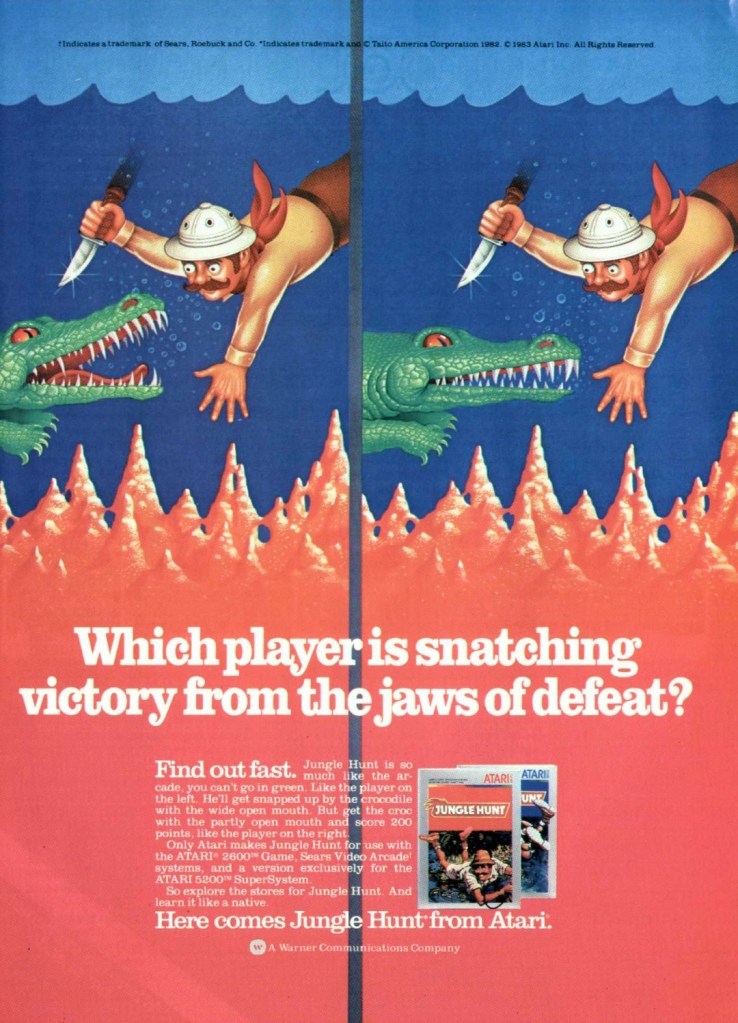
Back in 1982, 2D adventuring on the Atari 2600 reached new heights when Pitfall! was released. The game garnered wide praise for its gameplay and graphics, and because it was so enjoyable, it sold millions of copies and its success spread across other platforms. A key factor to its commercial success and strong identity with the Atari 2600 was this colorful print ad. The ad makers daringly used original artwork to emphasize the jungle, wilderness and adventure concept while leaving some space left to show a screenshot and the Atari 2600 game cover. Pitfall! is a video game classic.

6. Mario Bros. print ad

I saw this comic-style print ad while reading a comic book.

A few years before Nintendo skyrocketed with the massive success of Super Mario Bros., there was Mario Bros. on the Atari 2600 and Atari 5200. Published by Atari on their consoles, Mario Bros. was already a hit in the arcades. To capitalize on the popularity of the game, Atari came up with this comic-style print ad to capture people’s attention with the hope that the Atari 2600 and Atari 5200 ports will sell a lot. I first saw this ad while reading a comic book and it remains entertaining to see.

7. Ghoul Patrol print ad

Too bad the screenshots, the game box cover and white descriptive text were too small to look at.

Released in 1994 on the Super Nintendo Entertainment System (SNES), Ghoul Patrol is the accidental sequel to Zombies Ate My Neighbors. This was because the game did not start as a sequel but rather as an unrelated project that used the same gameplay engine of its predecessor. Since Zombies Ate My Neighbors already had a dedicated fanbase, a decision to turn the game into a sequel followed. Ghoul Patrol’s print ad took a different creative approach on its presentation by trying to look cool and catchy with a dominating pink background and slightly adulterated descriptions in green leaving little space left for screenshots and the white descriptive text. The print ad of Zombies Ate My Neighbors remains more engaging and more eye-catching than this one.

8. Silpheed print ad

This ad caught my attention and even made me interested on the Sega CD.

Released in 1993, Silpheed on Sega CD was a remake of the original game of 1986. Like its predecessor, the Sega CD had 3D effects but used pre-rendered computer animation for a background that actually was full motion video. The print ad of this game had this fantastic looking computer-generated artwork and displayed four screenshots that looked really exciting back in 1993. If you look closely at the captions, the ad emphasized the CD-quality look and the cinematic graphics the game had. This old ad has aged well.  

+++++

Thank you for reading. If you find this article engaging, please click the like button below, share this article to others and also please consider making a donation to support my publishing. If you are looking for a copywriter to create content for your special project or business, check out my services and my portfolio. Feel free to contact me with a private message. Also please feel free to visit my Facebook page Author Carlo Carrasco and follow me on Twitter at  @HavenorFantasy as well as on Tumblr at https://carlocarrasco.tumblr.com/ and on Instagram at https://www.instagram.com/authorcarlocarrasco
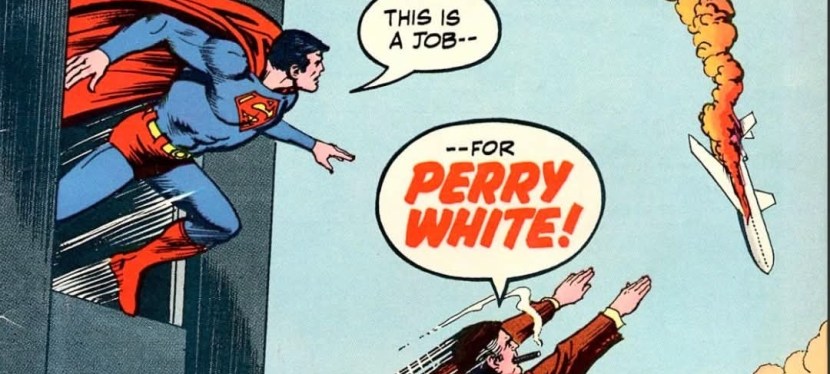
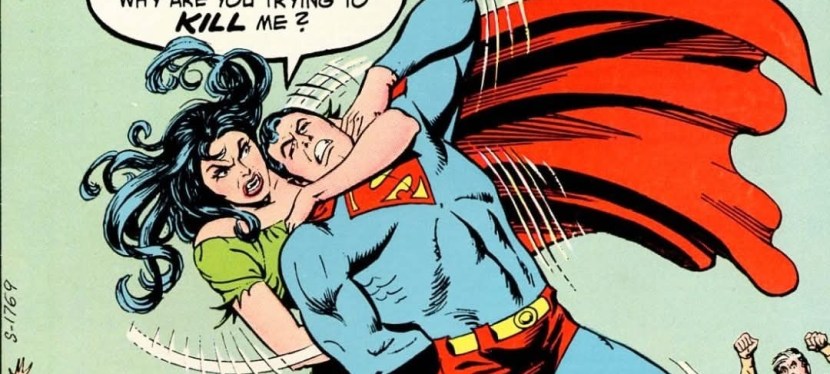
A Look Back at Superman #292 (1975)

Welcome back superhero enthusiasts, 20th century pop culture enthusiasts and comic book collectors! Today we go back to the year 1975 to take a close look at one of the many tales published through the original Superman monthly series (first launched in 1939).

When I first read the literary rivalry between Superman and Lex Luthor, it was before Crisis on Infinite Earths happened. The pre-Crisis Luthor was a criminal mad scientist (as opposed to the tycoon Luthor of the post-Crisis age) who had to use technology and smart moves during his encounters with the Man of Steel. The pre-Crisis conflicts between the two were often dynamic and fantasy inspired. Of course, there is a lot more between Superman and Luthor starting with a shared past in Smallville.

With those details laid down, here is a look back at Superman , published in 1975 by DC Comics with a story written by Elliot S. Maggin and drawn by Curt Swan.  

The cover.

Early story

The story begins at the ruined Metropolis International Airport with Superman helping with the huge repair efforts. It turns out, he and Lex Luthor just had an encounter there. When Mr. Hales of the airport authorities asked him why Luthor was always evil, Superman begins to remember the friendship he had with his rival when they were both teenagers in Smallville…

Quality

Yes, it is all true. Lex Luthor and Clark Kent were students in the same high school in Smallville when they were teenagers.

To make things clear, this comic book has two stories and the first one – titled “The Luthor Nobody Knows” – is clearly the main story.

The main story has this unusual format of storytelling that resulted in an abundance of flashbacks dominating the present-day tale. In connection with the tale’s title, this is a dramatized look back at the time when Luthor and Clark Kent (then Superboy) were high school students in Smallville. The creators took their time portraying young Clark Kent as the mild and ethical student and the teenage Lex Luthor as the daring student who truly believes he can make great achievements through science.

For those who might have heard the fabled start of the rivalry between Luthor and Superboy, you will see that in this comic book as well as the negative impact the former made as time went on. Along the way, you will see the stark differences between them which were nicely dramatized by the creators. Notably, you will see a more human portrayal of Luthor in his younger self.

The 2nd story of this comic book – titled “The private life of Clark Kent” – is just a 5-page additive geared towards Superman fans wanting more of him in his civilian identity.  

Conclusion

This battle between Superman and criminal mad scientist Luthor should resonate with comic book fans who love the pre-Crisis era of DC Comics.

Considering the way the main story was crafted, Superman (1975) is technically an origin story of Luthor who went from an ambitious young student into a criminal mad scientist. This should surprise readers who remained unaware of the shared past between Luthor and Superman before Crisis on Infinite Earths happened. In relation to what was mentioned earlier in the review, the Superboy-Luthor conflicts here looked dynamic. There is a good amount of entertainment here to see and it should resonate with long-time comic book readers who miss the pre-Crisis era of DC Comics.

Overall, Superman (1975) is recommended.

+++++

Thank you for reading. If you find this article engaging, please click the like button below, share this article to others and also please consider making a donation to support my publishing. If you are looking for a copywriter to create content for your special project or business, check out my services and my portfolio. Feel free to contact me with a private message. Also please feel free to visit my Facebook page Author Carlo Carrasco and follow me on Twitter at  @HavenorFantasy as well as on Tumblr at https://carlocarrasco.tumblr.com/ and on Instagram at https://www.instagram.com/authorcarlocarrasco
A Look Back at The Man of Steel #4 (1986)

Welcome back superhero enthusiasts, 1980s culture enthusiasts and comic book collectors! Today we go back to the mid-1980s to explore a part of the DC Comics shared universe through a tale of the iconic Superman.

Shortly after the end of the original multiverse of DC Comics, the publisher organized a massive reboot of its superhero franchises and universe. To reboot and modernize the iconic Superman, DC hired John Byrne and backed him up with a solid creative team. The result was the 6-part comic book mini-series The Man of Steel. Previously, I reviewed The Man of Steel #1 and #2 which collectively established Superman and Lois Lane as the iconic superhero and the definitive supporting character of the post-Crisis age respectively. Of course, the super villain opposite the post-Crisis Superman had to be established.

With those details laid down, here is a look back at The Man of Steel , published in 1986 by DC Comics with a story written and illustrated by John Byrne.

The cover.

Early story

The story begins when a daringly dressed Lois Lane arrives at the apartment of Clark Kent who has not even fully prepared himself for their trip to an extravagant gathering. It turns out, Lois’ ride picked her up earlier than expected which explains her early arrival.

After entering Clark’s apartment, she slowly begins to discover what he looked like in school and who his parents are. By this time, it has been almost eighteen months since Clark beat her to the first-ever Superman news story at the Daily Planet.

Afterwards, Lois and Clark took a surprising helicopter ride going to the luxurious ship of the powerful tycoon Lex Luthor…

Quality

Superman intervenes to protect Lois Lane from one of the terrorists.

To make things clear, this issue is all about John Byrne presenting a new version of Superman’s definitive rival Lex Luthor with the 1980s in mind. Instead of a mad scientist, the post-Crisis Luthor is a billionaire whose corporation (Lexcorp) has an interest in virtually every business in Metropolis and his immense wealth makes him a very powerful figure. This new version of Luthor was clearly done to be more grounded with reality, specifically with regards to the rise of tycoons in America in the 1980s. In short, Luthor was the ruthless and powerful businessman before Michael Douglas even got to play Gordon Gekko in 1987’s Wall Street.

While the effort of making a really new version of Superman’s arch-rival is clear, Luthor here does not appear too menacing at first. The story and impact of Luthor’s evil really started to materialize as soon as the South American terrorists appeared, but not in a way that you might expect. As mentioned above, Luthor here is more grounded with reality and that means you won’t see him oppose Superman with science and technology. Instead, Luthor simply has wealth, the power and resources to go against the Man of Steel. The tycoon also knows that the American-born Kryptonian would not dare attack him as laws already exist.

Having read lots of Superman’s encounters with Luthor in the pre-Crisis era – particularly the 1970s up to the mid-1980s – it is clear to me that their first post-Crisis encounter turned out underwhelming and never dynamic. In fairness, I really enjoyed reading the 2nd encounter between Superman and Luthor as the words of the latter were filled with anger and tension. It should be noted that Byrne’s visual approach on showing the city and the people as Luthor’s dialogue went on was a great touch.

When it comes to the storytelling, it is quite simple which is not surprising because it was crafted to make way for post-Crisis Luthor to be introduced and dramatized. As for the character development, there is indeed progress with regards to the chemistry between Clark Kent and Lois Lane who are portrayed as friends living with a journalistic competition between them. It was also in this comic book where you will see Superman follow the law and the command of Metropolis’ highest official.

Speaking of law, you will notice what kind of impact Luthor has on others when he really does things his own way. This is something you should read in this comic book.

Conclusion

This is John Byrne’s version of Lex Luthor in the form of a powerful tycoon. A complete departure from the mad scientist Luthor of the pre-Crisis era of DC Comics.

While the first-ever conflict between Superman and Luthor in the post-Crisis age was indeed underwhelming, it was John Byrne’s in-depth writing and portrayal of events that made The Man of Steel (1986) a worthy read. Don’t expect to see a lot of action here nor anything spectacular with Superman. Clearly, the tycoon Lex Luthor is the feature character of this tale and the start of his hatred towards Superman is really worth reading. In retrospect, Luthor’s ruthlessness and evil got stronger and clearer after the end of this comic book (for reference, click here).

Overall, The Man of Steel (1986) is recommended.

+++++

Thank you for reading. If you find this article engaging, please click the like button below, share this article to others and also please consider making a donation to support my publishing. If you are looking for a copywriter to create content for your special project or business, check out my services and my portfolio. Feel free to contact me with a private message. Also please feel free to visit my Facebook page Author Carlo Carrasco and follow me on Twitter at  @HavenorFantasy as well as on Tumblr at https://carlocarrasco.tumblr.com/ and on Instagram at https://www.instagram.com/authorcarlocarrasco
What to watch on YouTube right now – Part 57

Welcome back my readers, YouTube viewers and all others who followed this series of articles focused on YouTube videos worth watching. Have you been searching for something fun or interesting to watch on YouTube? Do you feel bored right now and you crave for something to see on the world’s most popular online video destination?

I recommend you check out the following topics and the related videos I found.

Revisiting the Ultraverse – When it comes to 1990s comics, the short-lived Ultraverse is the one franchise that defined the decade the most as it had lots of engaging concepts, solid stories and captivating characters to follow such as Prime, Mantra, Harcase, Prototype, The Strangers, The Solution and more! Behind the scenes, publisher Malibu Comics had a great creative team who brainstormed and developed the Ultraverse a lot prior to its 1993 launch. To learn more about the Ultraverse, watch the following videos below.

The 1993 debate between Peter David and Todd McFarlane – Way back in 1993, I learned bits of information about a certain debate between the prolific writer Peter David (The Incredible Hulk, Spider-Man 2099) and Todd McFarlane (Spider-Man and Spawn) through word-of-mouth and comics-related print media. Of course, Internet access here in the Philippines was not yet available back then but there was local awareness about the David-McFarlane verbal battle. Fortunately for us, an actual video of the entire debate was uploaded to YouTube and the YouTuber Strange Brain Parts posted an analytical video about it. The videos are now available for your viewing pleasure.

Lefties Losing It (Trump, Richard Gere, Taylor Swift booed and more) – In this recent episode of Lefties Losing It hosted by Rita Panahi, you will see how demented the current congressional Democrats have gotten, US President Donald Trump being cheered and how Taylor Swift was booed during the recent NFL Super Bowl, Richard Gere failing to accept reality and much more. Seriously, a lot of Leftists are still bitter over Trump’s return as President and they prefer to move on with their distorted view of reality. Wokeness truly is living wrongly. Watch and enjoy the video below.

VKunia reacts to Poltergeist (1982) – A lot of people find 1982’s Poltergeist (directed by Tobe Hooper and produced by Steven Spielberg) a scary viewing experience. It has been the subject of many documentaries or reaction or retro reviews on YouTube. YouTuber VKunia posted her own reaction video of it and you can how it affects her in the video below.

PatmanQC explains the history of The House of the Dead – The House of the Dead is a horror-themed series of video games that Sega first launched in 1996. During that year, there were The House of the Dead machines that suddenly appeared in local arcades here in the Philippines. Due to its horror theme and high level of violence, it caused some disturbance to concerned parents whose children saw or even played it. Regardless, the newer The House of the Dead games made its way to the local arcades as the years passed by. If you want to know who created the said Sega franchise and what were the inspirations for each game, watch the in-depth video by PatmanQC now.

Dawn of the Dead reaction videos – To make things clear, I was never a fan of Zack Snyder’s Dawn of the Dead remake. I saw it in the local cinema back in 2004 at a time when the new movies released were not so interesting. Even with modest expectations, I was not so entertained by it. Still the movie is popular with YouTubers who posted their own reactions to it. Watch and learn from the selected videos below.

+++++

Thank you for reading. If you find this article engaging, please click the like button below, share this article to others and also please consider making a donation to support my publishing. If you are looking for a copywriter to create content for your special project or business, check out my services and my portfolio. Feel free to contact me with a private message. Also please feel free to visit my Facebook page Author Carlo Carrasco and follow me on Twitter at  @HavenorFantasy as well as on Tumblr at https://carlocarrasco.tumblr.com/ and on Instagram athttps://www.instagram.com/authorcarlocarrasco

Retro Gaming Ads Blast – Part 27

Welcome back readers, fellow geeks and electronic gaming fans!

In this edition of the Retro Gaming Ads Blast (RGAB) series, we will take a look at another batch of retro gaming print ads – including arcade flyers – from the 1980s and to the year 2000.

For the newcomers reading this, Retro Gaming Ads Blast (RGAB) looks back at the many print ads of games (console, arcade, computer and handheld) that were published in comic books, magazines, flyers, posters and newspapers long before smartphones, social media, the worldwide web and streaming became popular. To put things in perspective, people back in the 1980s and 1990s were more trusting of print media for information and images about electronic games and related products.

With those details laid down, here is the newest batch of retro gaming print ads for you to see and enjoy…

1. Tutankham print ad

This print ad appeared in several comic books in 1983.

First released in the arcades in 1982, Tutankham is a 2D adventure game that had a mix of shooting, maze exploration and puzzle-solving with Egyptian settings and concepts. It made its way to the Atari 2600 published by Parker Brother, and it was this specific version I played. This game print ad appeared in comic books I read in 1983, and the people who made it implemented a hand-drawn art of the Egyptian pharaoh Tutankhamun dominating the space to emphasize the Egyptian setting. In fact, this ad made me think more of Egypt and left little to give me an idea of the game design.  

2. Star Trek arcade flyer

The clever use of classic Star Trek imagery was used in this initial flyer by Sega.
Back in the 1980s, a futuristic design for an arcade machine like this one was mind-blowing.

I never played the Star Trek arcade game (full title: Star Trek: Strategic Operations Simulator) Sega released in 1983. I only saw its graphics and gameplay during an episode of Starcade. With its game design and visual presentation, Star Trek was a very ambitious arcade project for its time and Sega really went in to promote it. The initial arcade flyer (first one above) was meant to grab the attention of both gamers and arcade operators. The next arcade flyer (2nd one above) showed the ambitious design of the arcade machine made with player immersion in mind.

3. Battlezone arcade flyer

While the hand-drawn artwork was too detailed for the arcade game’s graphics, it still emphasized strongly the concept of the game.

In the history of video games, Battlezone was a groundbreaking game both visually and with game design. It was designed to give gamers an immersive experience of driving a tank with 3D graphics, fun gameplay and a first-person view. Its own history is worth researching. Atari knew it had to heavily promote their ambitious game and the arcade flyer above featured nice hand-drawn artwork while also showing the two types of Battlezone machines that arcade operators can choose from. Battlezone went on to become a highly influential arcade game.

4. Chrono Cross North American print ad

Arguably, this print ad was aimed at RPG enthusiasts, Chrono Trigger fans and gamers looking for something adventurous to play.

First released on PlayStation in Japan, Chrono Cross made its way to the said console in America just a few months before the PlayStation 2 launched there. While there was a risk that came with releasing the ambitious follow-up to the classic Chrono Trigger so late in the PlayStation’s life, Squaresoft (now Square Enix) still went on to aggressively promote Chrono Cross in America. This 2-page print ad that appeared in many gaming magazines remains captivating to look at. As typical of the time, 3D polygonal models and the epic-looking art were used in dominating fashion leaving the small space (lower-left corner) to display a few gameplay screenshots and other 3D art. Still it a fun game to play and this should remind you that Chrono Cross was recently remastered for modern consoles.

5. Ms. Pac-Man arcade flyer

The wife of Pac-Man and the machine.

Given the fact that Pac-Man was so massively successful, it was not surprising that a sequel had to be made and released on as many arcades as possible. Ms. Pac-Man was the sequel and it was released in arcades in 1982 eventually achieving huge commercial and critical success. To promote the game, Midway’s ad makers came up with an ad showing unique art of Pac-Man’s wife looking glamorous (with a driver and a vehicle in the background) and a photograph of the arcade machine on the right. This also was one of the early arcade flyers to use the words “femme fatale”.

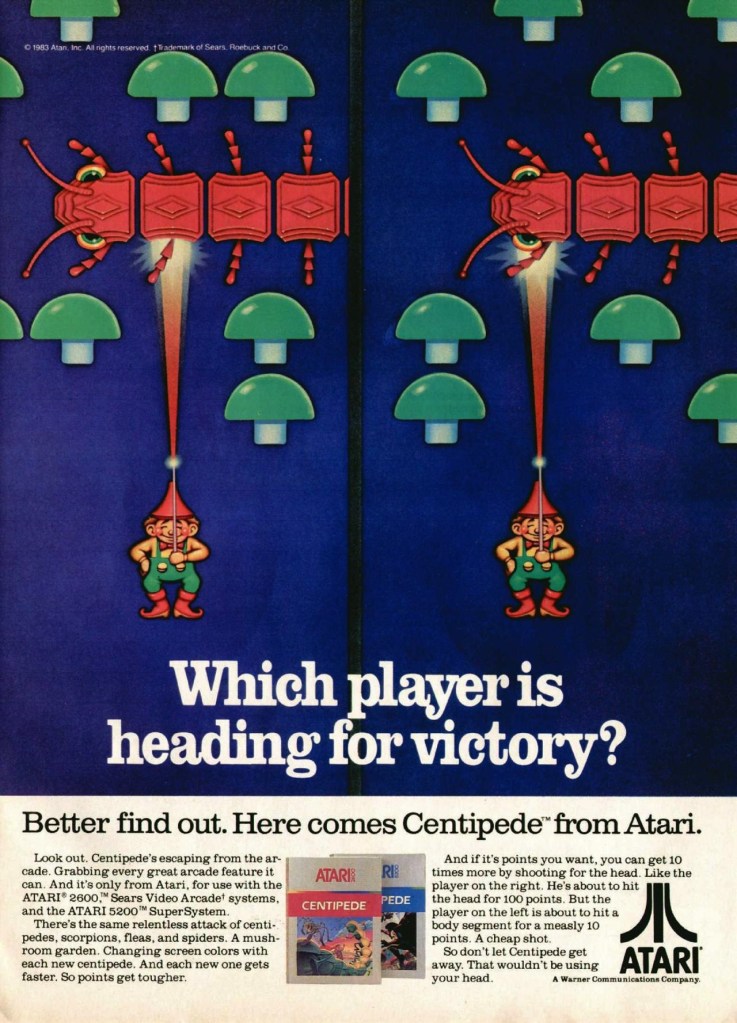
6. Centipede arcade flyer

Three machines of Centipede for arcade operators to choose from.

Centipede is another arcade classic from Atari. Released in 1981, a lot of players enjoyed the game’s simplistic and yet addicting design of shooting an incoming centipede and its remaining portions that move down the field. Similar to the Battlezone arcade flyer, this game’s flyer had nice art of a centipede on the top and images arcade machines. Even by today’s standards, this flyer remains eye-catching.

7. Tempest 2000 print ad

This 2-page print ad of Tempest 2000 is still captivating to look at.

Back in the 1990s, Atari went on to release their Jaguar console which was promoted as a 64-bit machine. At a gaming convention, the company met with prospective game developers over Jaguar projects and one of the developers volunteered to do Tempest (a memorable Atari arcade game). This resulted in the development of Tempest 2000 which was a remake of the classic.

As a Jaguar-exclusive game, Atari came up with an eye-catching 2-page ad showing off the 3D visual presentation (6 gameplay screenshots and one original artwork) while boasting in the text description that Tempest 2000 was named the “Best of Show” at the Consumer Electronics Show (CES). The game was released in 1994 attracting mostly positive reviews from game critics and was one of the best-selling Jaguar games (note: Tempest 2000 can now be played in the Atari 50 collection). With the Atari legacy and presentation combined, this print ad remains captivating to look at.

8. Alien vs Predator print ad

Arguably the most defining and most entertaining game on the Atari Jaguar.

If there is any game that truly defined enjoyment and the technological features of the Atari Jaguar, it is the 1994 first-person shooter Alien vs Predator. At the time of its release, it was one of the most immersive games of the Alien vs. Predator crossover franchise and it allowed players to experience what fighting the Predator or the Xenomorph was like. The game also allowed gamers to play as a Colonial Marine (human soldier).

To sell the game, Atari came up with a 2-page ad highlighting the Aliens on one page and the Predator on the other. As the Predator was shown with a grotesque human skull, the use of photographs (most likely sourced from the movies) strongly emphasize the game was aimed at the mature audience among gamers. Six screenshots of gameplay were displayed by the ad makers who were clearly aware of the high popularity of first-person shooting games. Alien vs Predator was a critical and commercial success, and its print ad is arguably the most memorable one of any Atari Jaguar game ever made.

+++++

Thank you for reading. If you find this article engaging, please click the like button below, share this article to others and also please consider making a donation to support my publishing. If you are looking for a copywriter to create content for your special project or business, check out my services and my portfolio. Feel free to contact me with a private message. Also please feel free to visit my Facebook page Author Carlo Carrasco and follow me on Twitter at  @HavenorFantasy as well as on Tumblr at https://carlocarrasco.tumblr.com/ and on Instagram at https://www.instagram.com/authorcarlocarrasco
A Look Back at Spider-Man 2099 #44 (1996)

Welcome back superhero enthusiasts, 1990s culture enthusiasts and comic book collectors! Today we go back to the year 1996 and explore a part of the Marvel Comic shared universe through a tale of the Spider-Man 2099 monthly series.

To put things in perspective, the original Spider-Man 2099 monthly series that launched in 1992 lasted a total of 46 issues. The prolific author Peter David wrote the first 44 issues as he resigned from his duty in relation to the sudden firing of Marvel 2099 editor Joey Cavalieri in 1996. The previous issue was a great read.

With those details laid down, here is a look back at Spider-Man 2099 , published in 1996 by Marvel Comics with a story written by Peter David and drawn by Ron Lim.

The cover.

Early story

The story begins in the City of New York already flooded and infiltrated by lots of marine life. Under the water, Spider-Man and Roman the Sub-Mariner fight each other intensely as the foot of a gigantic sea monster is about to step in. At the last moment, Spider-Man saw the huge foot and instantly flipped away to survive with the Sub-Mariner.

After getting separated, Spider-Man gets out of the water to breath and immediately spots an organic-looking horn that the Sub-Mariner used to control the huge monster. Suddenly, on the aquatic humanoids appears to get the horn. Spider-Man then used his web to get the horn first which triggered the aquatic humanoid to move fast towards him.

Quality

The intense battle between Sub-Mariner and Spider-Man went on even as the huge sea monster is very near them in the city.

Without spoiling the plot, this comic book is a tale about a massive disaster and also a tale about the complicated legacy of Miguel O’Hara whose personal life is even more connected with the corporation he works for.

The huge disaster of New York getting flooded (which started in the previous issue) and Spider-Man fighting the leader of the mutates (genetically designed sentient beings) concluded in a really satisfying way. The futuristic webslinger really found himself struggling with the determined Sub-Mariner (motivated by what Alchemax did to the aquatic world) while dealing with the fact that so many citizens got displaced or even got killed by not only the huge flood but also by the presence of the gigantic sea monster. The stakes were really raised high for Spider-Man and the pay-off was really good.

The rest of the comic book deals with the intense meeting between Conchata O’Hara and Tyler Stone, Xina’s time with the Net Prophet, Gabriel O’Hara’s time with “father” Jennifer. Among the three sub-plots, the conflict between Conchata and Tyler is very intense and dramatic to read. More importantly, it was crafted by Peter David to be really believable and it ultimately added tension to the background and even the future of Miguel O’Hara (now a powerful Alchemax executive). This particular sub-plot is easily the most important one this comic book has and it will compel fans to revisit the 25th issue of this monthly series as well as issue #10.

While the sub-plot of Xina and the Net Prophet does not generate enough depth for this comic book, there is a big revelation made in the sub-plot of Gabriel and “father” Jennifer which will compel fans to revisit issues #40 and #41. In fact, nothing is ever simple regarding the origin of a specific villain of the 2099 universe.

When it comes to the artwork, this comic book is a downgrade compared to what was presented in issue (drawn by Andrew Wildman). I’m not saying that Ron Lim’s art is bad, it’s just nowhere as good as that of Wildman’s art. In fairness, Ron Lim managed to make the city disaster look intense and he managed to make the characters look recognizable. In fact, Lim successfully made the Conchata-Tyler scenes look intense and dramatic.

Conclusion

The giant monster aspect of this comic book added intensity to the battle and the disaster. There were a few Godzilla vibes here and there.

As the final Peter David-written issue of this monthly series, Spider-Man 2099 (1996) is undeniably a very solid reading experience. There were strong pay-offs executed here to what was built-up in the previous issues, and in typical fashion, David kept building up the other sub-plots. The conclusion to the Conchata-Tyler sub-plot is actually more powerful than that of the city disaster. Clearly, Peter David kept track of the character developments and events that previously happened and dramatized them nicely here. In fact, you will feel some sympathy towards Miguel O’Hara knowing how unfortunately complicated his family legacy really is.  

Overall, Spider-Man 2099 (1996) is highly recommended!

+++++

Thank you for reading. If you find this article engaging, please click the like button below, share this article to others and also please consider making a donation to support my publishing. If you are looking for a copywriter to create content for your special project or business, check out my services and my portfolio. Feel free to contact me with a private message. Also please feel free to visit my Facebook page Author Carlo Carrasco and follow me on Twitter at  @HavenorFantasy as well as on Tumblr at https://carlocarrasco.tumblr.com/ and on Instagram at https://www.instagram.com/authorcarlocarrasco
A Look Back at Superman #79 (1993)

Welcome back superhero enthusiasts, 1990s pop culture enthusiasts and comic book collectors! Today we go back to the year 1993 and explore a notable chapter of the post-Crisis DC Comics universe through the Superman monthly series.

Months after DC Comics published the death of Superman with the best-selling Superman (1993), the publisher went on to shake things up with the Reign of the Supermen storyline. One of the four Supermen was Cyborg Superman who first appeared in Adventures of Superman #500 (1993) and had his first story in Superman #78 (1993).

With those details laid down, here is a look back at Superman , published in 1993 by DC Comics with a story written and drawn by Dan Jurgens.   

The cover.

Early story

The story begins inside a dark part of The Daily Planet with journalist Ronald Troupe starting his work in the absence of Clark Kent. Since Superman’s death, the very accomplished Kent has been absent and was perceived to have died somehow while covering Doomsday’s rampage through Metropolis. 

With Kent absent, the newspaper lost one of its best writers. This opened an opportunity for Ronald Troupe to approach Perry White to fill Kent’s slot and work. White, who was close with Kent, values hungry reporters and challenged Troupe to bring him a story so big, he could not turn it down.

With the sudden presence of the Supermen, Troupe viewed Cyborg Superman as a major subject to report about…

Quality

The evil Cyborg Superman handing over a device to US President Bill Clinton. This image is strangely symbolic as both of them are evil figures – one is fictional and the other is real. Clinton’s legacy of empowering Palestinian terrorists through the mass murderer Yasser Arafat still remains.

I want to start with the approach Dan Jurgens took to come up with this particular Reign of the Supermen story. Instead of telling the tale through the viewpoint of the more established Daily Planet journalist Lois Lane or photographer Jimmy Olsen, Jurgens instead used the newcomer Ronald Troupe who happened to be a hungry journalist tasked with coming up with a compelling report about Cyborg Superman. This creative approach resulted in a very fresh look at the events involving the caped cyborg complete with the use of a journalistic narrative Troupe wrote on his computer (the paragraphs are stylishly displayed on each page). The writing done was pretty lively to read from start to finish.

I do have a problem with how specific events turned out. To ensure that Troupe would encounter Cyborg Superman, the established character Max Lord (who is working directly with the US President over very sensitive matters) very unrealistically had his government-provided limousine stop (while entering the White House gate half-way) and actually got out to meet Troupe only because the reporter convinced him too easily. Even back in the 1990s, such a scenario is very unrealistic and no person working with the US President would ever stop to give a reporter special attention while compromising security of the White House.

And then there was the short sequence in which Troupe – already within the White House perimeter with several defense turrets already firing energy blasts – miraculously managed to get close to Cyborg Superman without getting hit was also very unbelievable. Very clearly, Troupe is this comic book’s magical black man.

To come up with the superhero spectacle, elements of Islamic terrorism (represented by the fictional Qurac and its terrorists) attacking the White House plus Cyborg Superman’s sudden involvement were implemented. Quite predictably, the caped cyborg became the centerpiece of the action. I can say the spectacle here was fresh and intriguing to see.

Conclusion

Cyborg Superman fights the terrorists of Qurac.

Superman (1993) has a very unique approach on storytelling but the above-mentioned unbelievable turnout of events plus Ronald Troupe being the magical black person (literally protected by plot armor) somewhat ruined the reading experience for me. By the time the story ended, the anticipated pay-off to everything that was built-up ended up weak and unsatisfying. To be clear, this is not a badly made comic book but its flaws really ruined it. Also by today’s standards, Cyborg Superman is a very evil character and having him with the American flag on the cover is disgusting.

With regards to geopolitics, having Bill Clinton as the US President made this comic book age very badly. As President, Clinton empowered Palestinian terrorists and anti-Semitic people through the mass murderer Yasser Arafat (a real-life demon) while disrespecting Israel and its people. People who love abortion, political correctness (which leads to wokeness), victimhood and LGBTQ rights also benefited from Clinton’s sinister leadership. By today’s standards, having Clinton and Cyborg Superman appear together strongly symbolize real-life evil and fictional evil in a rather creative way.

It was destiny that his wife Hillary Clinton lost the 2016 US Presidential Election to Donald Trump. This is because the Clinton legacy remains very bad for the whole world. Trump, who is now the US President once again, is already working to make serious corrections while also restoring dignity in America.

Overall, Superman (1987) is not worth your time. Only those who are really obsessed with the Reign of the Supermen storyline can enjoy it. For those looking for the iconic Superman, better look for another comic book!

+++++

Thank you for reading. If you find this article engaging, please click the like button below, share this article to others and also please consider making a donation to support my publishing. If you are looking for a copywriter to create content for your special project or business, check out my services and my portfolio. Feel free to contact me with a private message. Also please feel free to visit my Facebook page Author Carlo Carrasco and follow me on Twitter at  @HavenorFantasy as well as on Tumblr at https://carlocarrasco.tumblr.com/ and on Instagram at https://www.instagram.com/authorcarlocarrasco
Marvel vs. Capcom Fighting Collection: Arcade Classics is now available on Xbox Series X|S and Xbox One

Welcome back Xbox fans, geeks, retro gaming enthusiasts, fighting game enthusiasts and other gamers!

With the current Xbox-exclusive fantasy role-playing game Avowed coming out on February 18, I’m supposed to be excited about what Team Xbox has prepared this year. Of course, there were disappointments not only with certain Xbox first-party releases but also with the way things have been changing on the part of Team Xbox.

Times like these, retro gaming on Xbox is the answer for fans who want to experience a lot of fun and Capcom just released Marvel vs. Capcom Fighting Collection: Arcade Classics for Xbox Series X, Xbox Series S and even Xbox One users to enjoy. Watch and learn from the official Xbox trailer below.

For the newcomers reading this, the said collection comes with the following video games Capcom released long ago with an emphasis on crossovers with Marvel’s intellectual properties: X-Men: Children of the Atom (1994), Marvel Super Heroes (1995), X-Men vs. Street Fighter (1996), Marvel Super Heroes vs. Street Fighter (1997), Marvel vs. Capcom: Clash of Super Heroes (1998), Marvel vs. Capcom 2: New Age Of Heroes (2000) plus The Punisher (1993).

Wow! That’s a collection of very fun and popular games Capcom released from 1993 to 2000. With the exception of The Punisher arcade game (a 2D adventure game), I played them all in the arcades decades ago and I can say that having them in a single collection for the modern Xbox consoles is indeed a blessing for long-time Xbox gamers who love 2D fighting games and retro gaming. The way I feel right now, Marvel vs. Capcom Fighting Collection: Arcade Classics looks really enticing to purchase.

Marvel vs. Capcom: Clash of Super Heroes is not just a lot of fun to play but also will please those who love the characters. With Wolverine, Spider-Man, Venom, Captain America from Marvel’s side included, there is something that will bring both geeks and gamers together.

I have fond memories of Capcom 2D fighting games that carried Marvel’s intellectual properties. X-Me: Children of the Atom was enjoyable to play with and it resonated with me as I was already an X-Men comic book reader back in the 1990s. Marvel Super Heroes was also fun to play and it somewhat reminded me of The Infinity Gauntlet storyline. X-Men vs. Street Fighter was the most intriguing crossover fighting game at the time of its release and it really raised the bar for fast-and-furious style gameplay complete with a quick character swap during the heat of battles. Marvel Super Heroes vs. Street Fighter was the follow-up which came with changes that were not well received by the fans.

Then came the two Marvel vs. Capcom crossover fighting games which really built upon the foundation of X-Men vs. Street Fighter for more team battles with speed and impact in mind. I could not forget the inclusion of Resident Evil characters, Mega Man and others.

X-Men vs. Street Fighter is a classic tag-team, crossover-oriented video game! Fast and furious action ensured!
The Punisher arcade game is the only non-fighting game of the collection. Punisher fans should look at this.

Adding further zest to the collection is online play that allows casual matches, ranked matches, custom matches. Think about how your skills or your scoring will compare with those of other players from around the world.

That being said, Marvel vs. Capcom Fighting Collection: Arcade Classics is a retro gaming package that deserves attention as it carries some of the finest video games Capcom ever made.

To purchase Marvel vs. Capcom Fighting Collection: Arcade Classics for Xbox, click https://www.xbox.com/en-us/games/store/marvel-vs-capcom-fighting-collection-arcade-classics/9nwfm3hdjc94

+++++

Thank you for reading. If you find this article engaging, please click the like button below, share this article to others and also please consider making a donation to support my publishing. If you are looking for a copywriter to create content for your special project or business, check out my services and my portfolio. Feel free to contact me with a private message. Also please feel free to visit my Facebook page Author Carlo Carrasco and follow me on Twitter at  @HavenorFantasy as well as on Tumblr at https://carlocarrasco.tumblr.com/ and on Instagram athttps://www.instagram.com/authorcarlocarrasco

A Look Back at Superman #1 (1987)

Welcome back superhero enthusiasts, 1980s pop culture enthusiasts and comic book collectors! Today we go back to the year 1987 and explore a notable chapter of the post-Crisis DC Comics universe through the iconic Superman.

To put things in perspective, DC Comics rebooted its entire shared universe in 1986 after the conclusion of Crisis on Infinite Earths. They published the 6-part The Man of Steel mini-series to reboot the iconic Superman and modernize him with the creative leadership of John Byrne. By the time the mini-series ended, the new background stories, the supporting characters and creative foundation of the post-Crisis Superman were established. That being said, a brand new Superman monthly series led by Byrne was inevitable.

With those details laid down, here is a look back at Superman , published in 1987 by DC Comics with a story written and drawn by John Byrne.  

The cover.

Early story

The story begins with Superman smashing his way through into a secretive, high-tech facility. Noticing so much technology, he begins to wonder why would anyone abandon such a facility. As he slowly makes his way inside, he finds several images of him displayed confirming that someone has been devoting a great deal of time and effort to research him. This makes him concerned that someone in his old home town of Smallville could recognize a picture of Superman as their fellow resident Clark Kent.

As he keeps searching, he finds the body of a dead scientist whose neck was broken. He also notices the corpse’s fingerprints are the same as those found on the truck outside of the facility. The truck itself was involved in the theft of his Kryptonian rocket. After finding more nasty evidence, Superman digs deep down underneath the facility then lifts a huge part of the ground with the said structure on top. He lifts up everything and brought them all into space free from the reach of people below.

Superman then flies off to Metropolis to change into Clark Kent to meet with Lois Lane at the city park…

Quality

I like the way John Byrne told parallel narratives with Superman in the present on the left, and flashbacks of Metallo on the right.

To begin with, this tale written by John Byrne is another inspire piece of work published at a time when the post-Crisis shared universe of DC Comics was still new and expanding. Byrne really defined Superman’s place in the shared universe by modernizing it with the 1980s in mind and he came up with a story introducing the post-Crisis version of Metallo while coming up with a sub-plot of a mad scientist who was not only obsessed with Superman but also was involved with the said super villain.

The plot is clearly well-structured which starts with Superman doing believable detective work of his own which led to the discovery of the mad scientist whose intense research pose a danger to the Man of Steel. Having dual identities and social responsibilities to live up to, Superman also takes the time to adjust to his normal life as Clark Kent at a time when he has to socialize with his Daily Planet colleague Lois Lane. Without spoiling the plot, I can say that you will see the iconic superhero ranging from being mighty to becoming vulnerable, weakened and suffering tremendous pain. How Byrne handled the transition of Superman is excellent.

The sub-plot of the mad scientist obsessing over discoveries about Superman is short and yet highly significant. For one thing, Superman himself has been very careful on keeping his dual identities secret and yet someone managed to secretly photograph him and come up with a lot of information – including the destroyed world of Krypton and the Kryptonian legacy of the hero – that could expose his deepest secrets and ruin his life entirely. The mad scientist’s obsession has strong sci-fi elements related to UFOs and aliens from deep space.

For the Man of Steel, this is too dangerous and also too personal to be left behind untouched. This aspect of the story makes this old tale more relevant in today’s world of drones with cameras, CCTV systems, hacking and the potential of users (or artificial intelligence) who could collect information on people without their consent.

The post-Crisis Metallo looks inspired by the Terminator and appears in human form. He goes by the name John Corben who previously got fatally injured in a car crash and subsequently was taken by the mad scientist (who transplanted the man’s brain into a robotic body). It should be noted that the said scientist also has an obsession about Kryptonians which led to his plan to send a chosen warrior to go against Superman supposedly to prevent Earth from getting conquered. How Metallo and his physical fight with the Man of Steel is a must-read.

Conclusion

Imagine yourself discovering a secret room filled with information and pieces of evidence and visual references about you. This should resonate with people whose privacy got violated. Also try imagining people inside the offices of tech giants with collected information and images about you.

Superman (1987) is still a great read. It has a complex approach on portraying the battle between good and evil without losing focus on the storytelling and the expansion of Superman’s post-Crisis lore. Its sub-plot of the mad scientist and his obsession on Superman will resonate with people who feel vulnerable over the loss of their private information in today’s world of social media, abusive technology giants and artificial intelligence-driven surveillance systems. There is also a lot of superhero action for readers to enjoy, and the spectacle is never silly nor outlandish to look at. Oh yes, seeing Superman in a vulnerable state and getting actually hurt is believable to see.

Overall, Superman (1987) is highly recommended!

+++++

Thank you for reading. If you find this article engaging, please click the like button below, share this article to others and also please consider making a donation to support my publishing. If you are looking for a copywriter to create content for your special project or business, check out my services and my portfolio. Feel free to contact me with a private message. Also please feel free to visit my Facebook page Author Carlo Carrasco and follow me on Twitter at  @HavenorFantasy as well as on Tumblr at https://carlocarrasco.tumblr.com/ and on Instagram at https://www.instagram.com/authorcarlocarrasco
A Look Back at Superman #350 (1980)

Welcome back superhero enthusiasts, 20th century pop culture enthusiasts and comic book collectors! Today we go back to the year 1980 to take a close look at one of the many tales published through the original Superman monthly series (first launched in 1939).

Before Crisis on Infinite Earths happened, the DC Comics multiverse had a lot of superhero stories that had outlandish fantasy elements. For example, Action Comics #454 showed Superman eating tons of food in order to survive. In Action Comics #456, the battles between Superman and The Shark had lots of outlandish looking forms of action. In short, the old multiverse and its tropes are looking fun to revisit.

With those details laid down, here is a look back at Superman , published in 1980 by DC Comics with a story written by Gerry Conway and drawn by Curt Swan.  

The cover.

Early story

The story begins when Superman makes his move to prevent a punctured hot air balloon transport from crashing. It turns out the balloon was part of the promotion of a reunion event at Metropolis University and Superman really went there to attend it in his civilian identity as Clark Kent. Also attending the event is his long-time friend and colleague Lana Lang.

As the old professor Lemuel B. Tolkein – former superior of Clark and his classmates – speaks during the reunion, several attendees – including people Clark personally knew – begin to disappear into thin air. The remaining attendees and guests begin to panic…

Quality

Superman uses his special abilities to solve problems here.

I really like this story. Without spoiling the plot, I can say that this tale written by Conway is actually a mystery that happens to take place during Clark Kent’s reunion with many people from his past. As there is no good-versus-evil concept, the story is solidly focused on mysterious happenings that challenge Superman’s ability to solve problems. Even though he already has many super powers, the Man of Steel still got challenged a lot by the disappearances of people and things.

Apart from the story, I also enjoyed Conway’s approach on developing Clark Kent/Superman, Lana Lang and Lois Lane. Seeing Clark reconnecting with people from his past at Metropolis University was a refreshing portrayal and it also sheds light on how he handled himself during his collegiate years. As for Lois Lane, she was portrayed to be hostile towards Clark with regards to journalistic competition between them, and yet she still has tenderness towards Superman deep inside.

Conclusion

Superman quickly changes into his Clark Kent identity to attend the reunion.

Superman (1980) is enjoyable and the elements of the pre-Crisis multiverse of DC Comics added depth to it. The story is relaxing to follow and it managed to surprise me and keep me engaged until the very end. I am convinced to follow the next issue.

Overall, Superman (1980) is recommended.

+++++

Thank you for reading. If you find this article engaging, please click the like button below, share this article to others and also please consider making a donation to support my publishing. If you are looking for a copywriter to create content for your special project or business, check out my services and my portfolio. Feel free to contact me with a private message. Also please feel free to visit my Facebook page Author Carlo Carrasco and follow me on Twitter at  @HavenorFantasy as well as on Tumblr at https://carlocarrasco.tumblr.com/ and on Instagram at https://www.instagram.com/authorcarlocarrasco